US6269737B1 - Food cooking apparatus - Google Patents
Food cooking apparatusDownload PDFInfo
- Publication number
- US6269737B1 US6269737B1US09/593,223US59322300AUS6269737B1US 6269737 B1US6269737 B1US 6269737B1US 59322300 AUS59322300 AUS 59322300AUS 6269737 B1US6269737 B1US 6269737B1
- Authority
- US
- United States
- Prior art keywords
- lid
- container
- spigot
- side wall
- support
- Prior art date
- Legal status (The legal status is an assumption and is not a legal conclusion. Google has not performed a legal analysis and makes no representation as to the accuracy of the status listed.)
- Expired - Fee Related
Links
- 235000013305foodNutrition0.000titleclaimsabstractdescription127
- 238000010411cookingMethods0.000titleclaimsabstractdescription65
- 230000002093peripheral effectEffects0.000claimsdescription17
- 238000004891communicationMethods0.000claimsdescription10
- 230000000295complement effectEffects0.000claimsdescription5
- 239000007788liquidSubstances0.000abstractdescription21
- 244000144977poultrySpecies0.000description11
- XLYOFNOQVPJJNP-UHFFFAOYSA-NwaterSubstancesOXLYOFNOQVPJJNP-UHFFFAOYSA-N0.000description11
- 241000286209PhasianidaeSpecies0.000description4
- 238000009835boilingMethods0.000description4
- 238000010276constructionMethods0.000description3
- 229910052751metalInorganic materials0.000description3
- 239000002184metalSubstances0.000description3
- 238000010025steamingMethods0.000description3
- 238000010438heat treatmentMethods0.000description2
- 238000000034methodMethods0.000description2
- 230000001681protective effectEffects0.000description2
- 241000251468ActinopterygiiSpecies0.000description1
- 229910000975Carbon steelInorganic materials0.000description1
- 229910052782aluminiumInorganic materials0.000description1
- XAGFODPZIPBFFR-UHFFFAOYSA-NaluminiumChemical compound[Al]XAGFODPZIPBFFR-UHFFFAOYSA-N0.000description1
- 230000000712assemblyEffects0.000description1
- 238000000429assemblyMethods0.000description1
- 230000005587bubblingEffects0.000description1
- 239000010962carbon steelSubstances0.000description1
- 239000011248coating agentSubstances0.000description1
- 238000000576coating methodMethods0.000description1
- 235000019688fishNutrition0.000description1
- 210000005224forefingerAnatomy0.000description1
- 235000012020french friesNutrition0.000description1
- 235000013611frozen foodNutrition0.000description1
- 230000005484gravityEffects0.000description1
- 239000000463materialSubstances0.000description1
- 230000013011matingEffects0.000description1
- 238000012986modificationMethods0.000description1
- 230000004048modificationEffects0.000description1
- 239000010935stainless steelSubstances0.000description1
- 229910001220stainless steelInorganic materials0.000description1
- 210000003813thumbAnatomy0.000description1
- 235000013311vegetablesNutrition0.000description1
- 238000003466weldingMethods0.000description1
Images


Classifications
- A—HUMAN NECESSITIES
- A47—FURNITURE; DOMESTIC ARTICLES OR APPLIANCES; COFFEE MILLS; SPICE MILLS; SUCTION CLEANERS IN GENERAL
- A47J—KITCHEN EQUIPMENT; COFFEE MILLS; SPICE MILLS; APPARATUS FOR MAKING BEVERAGES
- A47J36/00—Parts, details or accessories of cooking-vessels
- A47J36/16—Inserts
- A47J36/20—Perforated bases or perforated containers to be placed inside a cooking utensil ; Draining baskets, inserts with separation wall
- A—HUMAN NECESSITIES
- A47—FURNITURE; DOMESTIC ARTICLES OR APPLIANCES; COFFEE MILLS; SPICE MILLS; SUCTION CLEANERS IN GENERAL
- A47J—KITCHEN EQUIPMENT; COFFEE MILLS; SPICE MILLS; APPARATUS FOR MAKING BEVERAGES
- A47J27/00—Cooking-vessels
- A47J27/04—Cooking-vessels for cooking food in steam; Devices for extracting fruit juice by means of steam ; Vacuum cooking vessels
- A—HUMAN NECESSITIES
- A47—FURNITURE; DOMESTIC ARTICLES OR APPLIANCES; COFFEE MILLS; SPICE MILLS; SUCTION CLEANERS IN GENERAL
- A47J—KITCHEN EQUIPMENT; COFFEE MILLS; SPICE MILLS; APPARATUS FOR MAKING BEVERAGES
- A47J27/00—Cooking-vessels
- A47J27/10—Cooking-vessels with water-bath arrangements for domestic use
- A—HUMAN NECESSITIES
- A47—FURNITURE; DOMESTIC ARTICLES OR APPLIANCES; COFFEE MILLS; SPICE MILLS; SUCTION CLEANERS IN GENERAL
- A47J—KITCHEN EQUIPMENT; COFFEE MILLS; SPICE MILLS; APPARATUS FOR MAKING BEVERAGES
- A47J37/00—Baking; Roasting; Grilling; Frying
- A47J37/12—Deep fat fryers, e.g. for frying fish or chips
- A47J37/1276—Constructional details
- A47J37/1285—Valves or arrangements to drain used oil or food particles settled at the bottom of the frying vessel
- A—HUMAN NECESSITIES
- A47—FURNITURE; DOMESTIC ARTICLES OR APPLIANCES; COFFEE MILLS; SPICE MILLS; SUCTION CLEANERS IN GENERAL
- A47J—KITCHEN EQUIPMENT; COFFEE MILLS; SPICE MILLS; APPARATUS FOR MAKING BEVERAGES
- A47J37/00—Baking; Roasting; Grilling; Frying
- A47J37/12—Deep fat fryers, e.g. for frying fish or chips
- A47J37/1295—Frying baskets or other food holders
- Y—GENERAL TAGGING OF NEW TECHNOLOGICAL DEVELOPMENTS; GENERAL TAGGING OF CROSS-SECTIONAL TECHNOLOGIES SPANNING OVER SEVERAL SECTIONS OF THE IPC; TECHNICAL SUBJECTS COVERED BY FORMER USPC CROSS-REFERENCE ART COLLECTIONS [XRACs] AND DIGESTS
- Y10—TECHNICAL SUBJECTS COVERED BY FORMER USPC
- Y10S—TECHNICAL SUBJECTS COVERED BY FORMER USPC CROSS-REFERENCE ART COLLECTIONS [XRACs] AND DIGESTS
- Y10S220/00—Receptacles
- Y10S220/912—Cookware, i.e. pots and pans
Definitions
- the present inventionrelates in general to cooking apparatus, and specifically to cooking apparatus designed for deep frying of poultry and other food items and for steaming or boiling food items.
- Typical deep frying food cooking apparatusinclude a container in which oil is heated and a basket or food support on which food items are placed and then lowered into the heated oil in the container to be cooked.
- Prior art fryersinclude large fryers for cooking large items such as turkeys, which often have their own support stand and heat source, and smaller fryers for cooking smaller items that can be used on a kitchen stove top or countertop.
- the useris exposed to the danger of large amounts of oil at very high temperatures, typically 350° F. or more.
- the high temperature oilcauses the moisture to flash off the food items and thereby creates bubbling and turbulence within the hot oil which causes the hot oil to spatter, potentially burning the user of the fryer.
- Typical prior art deep fryersinclude baskets with a handle that extends outward from the periphery of the basket so that a user may insert the basket into and remove the basket from the deep fryer with minimal exposure to the dangers of the spattering hot oil.
- the large prior art turkey or poultry fryerstypically utilize a flat plate like food support which do not have the same outwardly extending handle of smaller fryers. Because of the large size of turkeys and poultry items and their associated weight, such a handle would not always provide a secure grip on the food support when inserting or removing the food support into or out of the hot oil.
- the large prior art turkey and poultry fryer food supportstypically have a center post that extends upwardly from the center of the food support to a top end of the post that is adapted to be connected to a handle of some type for inserting and removing the food support into and out of the hot oil.
- the center postalso serves as a skewer upon which the turkey or poultry items are inserted so as to hold the turkey and poultry items in a centered orientation during the cooking process.
- Typical food steaming or boiling apparatusinclude a container for heating and boiling water and a basket for supporting food items to be boiled or steamed in the container.
- the baskettypically has a handle that extends across the top of the basket and, like the prior art turkey fryers, exposes the user to hot steam or boiling water when inserting or removing the basket from the container.
- prior art turkey and poultry fryerstypically utilize a food support that has legs extending downwardly from the bottom of the food support. The legs serve to position the food support and the turkey in a spaced relation from the bottom of the fryer container within which the turkey and the food support are placed.
- prior art food steamersalso often provide a basket that has legs extending downwardly from the bottom of the basket.
- the disadvantage of having legs extending downwardly from the bottom of the food support/basketis that the user may, when inserting or removing the food support/basket from the fryer/steamer, mistakenly believe that the entire food support/basket has cleared the upper most part of the container, when in fact, a leg is still extending into the container or extending outside of the container. This exposes the user to the danger that a leg of the food support may catch on a lip or side wall of the container and cause the food support/basket to tip and possibly spilling its food contents, or worse knock over the container and expose the user to the dangers of the spilled hot liquid of the container.
- Prior art fryers and food steamersdo not provide a means of draining the liquid contents from the container.
- To remove the liquid contents from the container:typical prior art fryers and food steamers require the user to pour the liquid contents of the container out of the top of the container, much like pouring water from a bucket. This method of removing the liquid contents of the container exposes the user to the dangers of spilling the contents and, if still hot, burning anyone who comes in contact with the spilled liquid.
- the present inventionovercomes the shortcomings of prior art fryers and food steamers by providing a cooking apparatus that minimizes the user's exposure to the hot contents of the cooking apparatus.
- the cooking apparatus of the present inventionincludes a food support that does not have legs extending downwardly from the food support and, therefore, does not expose the user to the potential dangers associated with the support legs protruding below the food support discussed above.
- the present inventionalso provides a cooking apparatus container with a spigot that allows the liquid contents to be safely drained without requiring the container to be tipped on its side to pour out the liquid contents.
- a cooking apparatusis provided that is adapted to be utilized with existing cooking containers that are suitable for high temperature heating of the desired cooking medium, such as oil or water.
- the cooking apparatusis dimensioned so that it may be easily inserted into and removed from the cooking container.
- the cooking apparatusincludes a food support that has a horizontal member which is adapted for receiving and supporting food items placed thereon. Extending upwardly from the horizontal member is at least one vertical member having a top end. The top end has a support connector which is designed to be utilized to suspend the food support in the cooking container.
- a lidis provided that has a handle and a lid connector. The lid connector is complementary to and selectively connectable to the support connector. The user can selectively engage the lid connector with the support connector and use the lid to lift the food support and suspend the food support from the lid.
- the usermay insert or remove the food support from the cooking container using the lid.
- the lidprovides protection for the user from the spattering of the hot liquid contents of the cooking container.
- the cooking apparatus of the inventionthereby overcomes disadvantages of prior art fryers and food steamers.
- a cooking apparatusis provided with both a container and a food support.
- the containerhas a bottom surface and a side wall that extends upwardly from the container bottom surface to a top edge of the side wall.
- the container bottom surface and side walldefine an interior of the container which is capable of holding the desired cooking medium, i.e. water or oil.
- the containeris further capable of being heated to a high temperature for the cooking of food.
- the food supporthas a horizontal member which is adapted for supporting food items placed thereon. Extending upwardly from the horizontal member is at least one vertical member.
- the at least one vertical memberhas a support connector on it.
- the support connectoris designed and adapted to engage with the top edge of the container side wall and the container side wall top edge is adapted to engage with the support connector.
- the at least one vertical memberis dimensioned so that when the food support is placed within the container interior, the support connector engages with the side wall top edge and the horizontal member is suspended in a spaced relation from the bottom surface of the container.
- This embodimentcan also be provided with a lid for the container which has lid connectors on the lid.
- the lid connectorsare adapted to be selectively connectable to the support connectors. This allows the food support to be inserted into and removed from the container interior by the lid, providing all the protective benefits of a lid, as mentioned above.
- the food support of the cooking apparatuscan be raised and lowered by a pair of grab hooks of the type used in the prior art. The grab hooks can be selectively connectable to the support connector engaged over the side wall of the container. This enables the user to lower the food support into or remove the food support from the container interior while with minimal exposure to the hot contents of the container.
- the cooking apparatusincludes a spigot attached to the container side wall and in communication with the container interior.
- the spigothas a valve member and a spout.
- the valve memberis selectively positionable between an opened position and a closed position relative to the spigot.
- the spoutis in communication with the spigot when the valve member is in the open position, thereby opening a flow path from the container interior through the spigot and the spout.
- the valve memberis in the closed position the spout is not in communication with the spigot and the valve member effectively closes the flow path from the container interior through the spigot and the spout.
- the liquid content of the containercan be selectively drained from the container interior in a controlled fashion.
- the use of the spigotovercomes the prior art disadvantage of requiring the contents of the container to be dumped or poured out of the container by tipping the container horizontally, much like pouring water out of a bucket. The spigot thereby reduces the dangers associated with removing hot liquid contents from the container.
- the spigotis provided with a stop which is connected to the spigot and extends outwardly from the spigot around the valve member.
- the stopis dimensioned and adapted to limit movement of the valve member beyond the opened position, and thereby prevents the valve member from being removed from the spigot which would result in uncontrolled discharge of the hot container contents through the spigot.
- the cooking apparatusincludes a container and a lid.
- the containerhas a bottom surface and a side wall that extends upwardly from the container bottom surface to a top edge of the side wall.
- the container bottom surface and side walldefine an interior of the container which is capable of holding the desired cooking medium, i.e. water or oil.
- the containeris further capable of being heated to a high temperature for the cooking of food.
- the lidis dimension to fit over the container side wall top edge and has a handle.
- the lidalso has a peripheral edge, a vertical central axis and opposite top and bottom surfaces. The top and bottom lid surfaces slant downwardly as the top and bottom lid surfaces extend radially inwardly from the peripheral edge toward the vertical central axis and form a central depression in the lid.
- the lidBy utilizing a lid with a central depression, the lid provides a point for any liquids that accumulate on the lid bottom surface to drip off of the lid.
- the drip pointpromotes the removal of liquids from the lid bottom surface and into the container when the lid is on or above the container and minimizes the possibility of uncontrolled liquid dripping off of the lid bottom surface in undesirable locations.
- the present inventionovercomes the disadvantages of the prior art fryers and food steamers.
- FIG. 1is a perspective view of the cooking apparatus of the invention that is comprised of a container, a spigot, a lid, and a food support residing in the interior of the container;
- FIG. 2is a top view of the cooking apparatus of FIG. 1;
- FIG. 3is a perspective, exploded view of the container, spigot, and food support
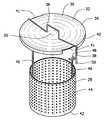
- FIG. 4is a perspective view of the food support being suspended from the lid
- FIG. 5is a cross-sectional side view of the spigot
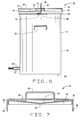
- FIG. 6is a side elevation view of the cooking apparatus of FIG. 1 showing the food support being suspended by the container rim and also engaged with the lid connectors;
- FIG. 7is a cross-sectional view of the lid of FIG. 4 along line 7 — 7 without the food support.
- FIG. 1shows the cooking apparatus, generally indicated as 20 , of the invention.
- the cooking apparatus 20is basically comprised of a lid 22 , a container 24 , a spigot 26 , and a food support 28 , shown in FIG. 3 .
- each of the component parts of the apparatusare constructed of metal.
- the lid 22is generally circular and has opposite top and bottom surfaces 30 , 32 , a center projection 33 , a peripheral edge 34 , a handle 36 , and lid connectors 38 .
- the lid 22is dimensioned to fit on the container 24 .
- the lid top and bottom surfaces 30 , 32slant downwardly as the lid top and bottom surfaces 30 , 32 extend radially inwardly from the peripheral edge 34 toward the center projection 33 .
- the slanting of the lid top and bottom surfaces 30 , 32form a central depression 39 in the lid 22 .
- the central depression 39 and the center projection 33are adapted to promote liquid on the lid bottom surface 32 to flow by gravity downwardly along the lid bottom surface 32 and toward the center projection 33 where the liquid will drip off of the lid bottom surface 32 .
- the lid 22also has a rim 40 that extends downwardly from the peripheral edge 34 beyond the lid bottom surface 32 .
- the lid rim 40extends around most of the peripheral edge 34 of the lid but is interrupted by a pair of notches 41 in the rim on opposite sides of the lid.
- the notches 41 in the lid rimare adapted to accommodate portions of the food support 28 in the container 24 in a manner yet to be described, while still providing a good fit between the lid 22 and the container 24 .
- the notches 41also allow steam or vapor to exit the container through the notches while cooking.
- the lid 22is typically not left on the container 24 while the poultry is being cooked.
- the handle 36 and the lid connectors 38are formed from a single metal rod.
- the handle 36is formed in a generally rectangular shape at the middle of the rod and the lid connectors 38 are formed as J-shaped hooks at opposite ends of the rod.
- the rodis secured to the lid top surface 30 by welding, riveting, or other equivalent means with the handle projecting perpendicularly upward from the lid top surface and the lid connectors 38 projecting downwardly from opposite sides of the lid adjacent ends of the notches 41 in the lid rim 40 .
- the food support 28is generally cylindrical in shape and is adapted to support food items placed thereon.
- the food support 28could have other configurations such as rectangular, square, or any other shape without departing from the scope of the invention.
- the food support 28has a colander type construction with a perforated, circular horizontal bottom member 42 and a perforated side wall 44 that extends upwardly from the periphery of the horizontal member 42 .
- Two vertical members 46 on diametrically opposite sides of the food support 28extend upwardly from the periphery of the horizontal member 42 beyond the perforated side wall 44 to top ends 48 that are formed as support connectors 50 .
- the support connectors 50are complementary to and selectively connectable to the lid connectors 38 to be described.
- the support connectors 50are formed as inverted U-shaped hooks that extend radially outwardly from opposite sides of the food support.
- any number of vertical members 46may extend upwardly beyond the perforated side wall 44 and each may have top ends 48 with integral support connectors 50 . It should also be understood that the food support 28 may have a construction of a wire basket often used in deep frying foods.
- the food support 28can be suspended from the lid 22 when the lid connectors 38 are connected to the support connectors 50 .
- the usermay insert or remove the food support 28 from the container 24 by the handle 36 on the lid 22 .
- the lid 22provides a shield that prevents the hot liquid contents of the container 24 from spattering onto the user's hand and arm.
- the lid connectors 38are J-shaped hooks and the food support connectors 50 are inverted U-shaped hooks that are complementary to the lid connectors.
- the lid connectors 38 and the support connectors 50can be of any complementary shapes that are selectively connectable to each other without departing from the scope of the invention. It is also to be understood that while the preferred embodiment is shown with two support connectors 50 and two lid connectors 38 , there can be any number of lid connectors 38 and support connectors 50 without departing from the scope of the invention.
- the container 24is generally cylindrical in shape and has a bottom surface 54 and a side wall 56 that extends upwardly from the bottom surface 54 to a top edge 58 of the side wall 56 .
- the container bottom surface 54 and side wall 56define an interior 60 of the container 24 .
- the container 24has handles 62 attached to opposite sides of the container side wall 56 .
- the side wall top edge 58is adapted to engage with the support connectors 50 on the food support 28 to suspend the food support in the container interior 60 .
- the support connectors 50engage with the side wall top edge 58 , as shown in FIGS. 1 and 6, to suspend the food support 28 in a spaced relation from the bottom surface 54 of the container 24 .
- the container 24has a spigot 26 .
- the spigot 26includes a valve member 64 and a spout 66 .
- the spigot 26has first and second ends 68 , 70 and an interior passageway 72 that extends through the spigot 26 from the spigot first end 68 to the spigot second end 70 .
- the spigot passageway 72has internal screw threads 74 that extend along a portion of the spigot passageway 72 between the spigot first and second ends 68 , 70 .
- the spigot 26is attached to the container side wall 56 at the spigot first end 68 near the container bottom surface 54 .
- the spigot passageway 72communicates with the container interior 60 .
- the spout 66has an interior passageway 76 and opposite first and second ends 78 , 80 .
- the spout passageway at the first end 78communicates with the spigot passageway 72 and the spout passageway at the second end 80 opens out of the spout 66 .
- the valve member 64has internal screw threads 82 and opposite first and second ends 84 , 86 .
- the valve member screw threads 82mate with the spigot passageway screw threads 74 and preferably both are fine threads to prevent leakage past the mating threads.
- a knob 88is connected to the valve member second end 86 .
- the valve member 64is threaded into the spigot passageway 72 with the valve member first end 84 positioned in the spigot passageway 72 and the valve member second end 86 extending outwardly from the spigot second end 70 .
- valve member threads 82 and the spigot passageway threads 74are preferably finely threaded, however, any thread dimensions that can effectuate a leak tight engagement and prevent the flow of liquid oil or water past the threads is sufficient.
- the selective rotation of the valve member 64causes the valve member 64 to move along the spigot passageway 72 between the spigot first and second ends 68 , 70 and between opened and closed positions of the valve member 64 relative to the spigot 26 .
- valve member 64When the valve member 64 is in the opened position, as shown in FIGS. 1, 3 and 5 , the valve member first end 84 is between the spout first end 78 and the spigot second end 70 , thereby creating a flow path between the spout passageway 76 , the spigot passageway 72 , and the container interior 60 .
- the valve member first end 84When the valve member 64 is in the closed position, as shown in FIG. 2, the valve member first end 84 is between the spout first end 78 and the spigot first end 68 , thereby closing the flow path and preventing communication between the spout passageway 76 and the spigot passageway 72 .
- a valve member stop 90is connected to the spigot second end 70 .
- the stop 90extends outwardly from the spigot second end 70 around the valve member second end 86 and the knob 88 .
- the stop 90is dimensioned and adapted to limit the movement of the valve member 64 along the spigot passageway 72 to prevent the valve member first end 84 from being removed from the spigot passageway 72 . While the stop 90 is shown as being “U” shaped and looping around the valve member knob 88 , it is to be understood that any configuration of the stop 90 that prevents the valve member first end 84 from being removed from the spigot passageway 72 is sufficient.
- the spigot 26allows for the liquid contents of the container 24 to be selectively drained from the container interior 60 .
- the spout passageway 76communicates with the spigot passageway 72 and the container interior 60 , thereby allowing the liquid contents of the container 24 to flow through the spigot passageway 72 and the spout passageway 74 .
- the userrotates the knob 88 with their thumb and forefinger in a clockwise direction, when looking along the spigot 26 toward the container 24 , thereby causing the valve member 64 to move along the spigot passageway 72 toward the spigot first end 68 .
- the valve member 64When the knob 88 is sufficiently rotated, the valve member 64 is in its closed position and prevents communication between the spigot passageway 72 and the spout passageway 76 .
- the userrotates the knob 88 in a counter-clockwise direction, when looking along the spigot 26 toward the container 24 , thereby causing the valve member 64 to move along the spigot passageway 72 toward the spigot second end 70 .
- the knob 88contacts the stop 90 , the valve member 64 is in the fully opened position and the spout passageway 76 communicates with the spigot passageway 72 and the container interior 60 .
- the stop 90prevents the continuing movement of the valve member 64 toward the spigot second end 70 , thereby preventing the unintentional removal of the valve member 64 from the spigot passageway 72 .
- the cooking apparatus 20is made out of metal, such as aluminum, carbon steel, or stainless steel and may contain a non-stick coating.
- metalsuch as aluminum, carbon steel, or stainless steel
- any material of constructionmay be used that is safe for cooking food and capable of being heated to the high temperatures necessary for deep frying food.
- the cooking apparatus 20is provided with a food support 28 that has support connectors 50 that are dimensioned and adapted to engage with the container side wall top edge 58 and are selectively connectable with the lid connectors 38 .
- the userwould fill the container interior 60 with the desired cooking medium, such as water or oil, and then heat the contents of the container 24 to the desired temperature by a heat source such as a gas burner. The user would then place the food items to be cooked in the food support 28 .
- the userwould take the lid 22 and connect the lid connectors 38 to the support connectors 50 of the food support 28 , lift the food support 28 into a position above the container 24 , and then lower the food support 28 into the container interior 60 .
- the lid 22provides a shield against spattering hot oil or water coming into contact with the user as the food support is lowered.
- the support connectors 50engage with the side wall top edge 58 and suspend the food support 28 in a spaced relation from the container bottom surface 54 .
- the usermay then leave the lid 22 on the container 24 , if desired, or remove the lid 22 .
- the userwould, after ensuring the support connectors 50 are fully engaged with and being suspended by the side wall top edge 58 , rotate the lid 22 in a counter-clockwise direction, when viewed from above, to disconnect the lid connectors 38 from the support connectors 50 .
- the lengths of the lid rim notches 41 and the positions of the lid connectors 38 at the ends of the notchesprovide sufficient clearance for the food support connectors 50 when rotating the lid relative to the food support connectors.
- the usercan then remove the lid 22 without removing the food support 28 .
- the userwould place the lid 22 on top of the container 24 with the food support connectors 50 positioned in the notches 41 opposite the lid connectors 38 .
- the userthen rotates the lid 22 clockwise, when viewed from above, to connect the lid connectors 38 to the support connectors 50 .
- the usermay then safely lift the lid 22 and the attached food support 28 from the container interior 60 with the lid 22 again providing a shield against hot oil or water coming in contact with the user.
- the usermay then empty the contents of the container interior 60 by opening the valve member 64 of the spigot 26 , as was discussed above.
Landscapes
- Engineering & Computer Science (AREA)
- Food Science & Technology (AREA)
- Frying-Pans Or Fryers (AREA)
- Cookers (AREA)
Abstract
Description
(i) Field of the Invention
The present invention relates in general to cooking apparatus, and specifically to cooking apparatus designed for deep frying of poultry and other food items and for steaming or boiling food items.
(ii) Description of the Related Art
Typical deep frying food cooking apparatus (deep fryers) include a container in which oil is heated and a basket or food support on which food items are placed and then lowered into the heated oil in the container to be cooked. Prior art fryers include large fryers for cooking large items such as turkeys, which often have their own support stand and heat source, and smaller fryers for cooking smaller items that can be used on a kitchen stove top or countertop. When deep frying large food items, such as turkeys or other poultry items, or smaller items such as french fries, vegetables or fish, the user is exposed to the danger of large amounts of oil at very high temperatures, typically 350° F. or more. When inserting frozen food items or items that contain moisture into deep fryers containing hot oil, the high temperature oil causes the moisture to flash off the food items and thereby creates bubbling and turbulence within the hot oil which causes the hot oil to spatter, potentially burning the user of the fryer.
Typical prior art deep fryers include baskets with a handle that extends outward from the periphery of the basket so that a user may insert the basket into and remove the basket from the deep fryer with minimal exposure to the dangers of the spattering hot oil. The large prior art turkey or poultry fryers typically utilize a flat plate like food support which do not have the same outwardly extending handle of smaller fryers. Because of the large size of turkeys and poultry items and their associated weight, such a handle would not always provide a secure grip on the food support when inserting or removing the food support into or out of the hot oil. Therefore, the large prior art turkey and poultry fryer food supports typically have a center post that extends upwardly from the center of the food support to a top end of the post that is adapted to be connected to a handle of some type for inserting and removing the food support into and out of the hot oil. Typically, the center post also serves as a skewer upon which the turkey or poultry items are inserted so as to hold the turkey and poultry items in a centered orientation during the cooking process. These handle assemblies of prior art turkey and poultry fryers expose the user to the dangers of the spattering hot oil. Specifically, because the food supports are inserted and removed from the hot oil container by a handle that attaches to the center post of the food support, the user's hand(s) and arm(s) are exposed to the spattering hot oil when inserting the food into and when removing the food from the deep fryer. Therefore, these prior art fryers require the user to wear protective clothing such as long sleeve shirts and gloves and/or gloves with extended gauntlets to avoid the possibility of being burned by the hot oil.
Typical food steaming or boiling apparatus (food steamers) include a container for heating and boiling water and a basket for supporting food items to be boiled or steamed in the container. The basket typically has a handle that extends across the top of the basket and, like the prior art turkey fryers, exposes the user to hot steam or boiling water when inserting or removing the basket from the container.
When steaming food or frying turkeys, it is desirable, for proper cooking, to keep the food off of the bottom surface of the container. To accomplish this, prior art turkey and poultry fryers typically utilize a food support that has legs extending downwardly from the bottom of the food support. The legs serve to position the food support and the turkey in a spaced relation from the bottom of the fryer container within which the turkey and the food support are placed. Likewise, prior art food steamers also often provide a basket that has legs extending downwardly from the bottom of the basket. The disadvantage of having legs extending downwardly from the bottom of the food support/basket is that the user may, when inserting or removing the food support/basket from the fryer/steamer, mistakenly believe that the entire food support/basket has cleared the upper most part of the container, when in fact, a leg is still extending into the container or extending outside of the container. This exposes the user to the danger that a leg of the food support may catch on a lip or side wall of the container and cause the food support/basket to tip and possibly spilling its food contents, or worse knock over the container and expose the user to the dangers of the spilled hot liquid of the container.
Prior art fryers and food steamers do not provide a means of draining the liquid contents from the container. To remove the liquid contents from the container, :typical prior art fryers and food steamers require the user to pour the liquid contents of the container out of the top of the container, much like pouring water from a bucket. This method of removing the liquid contents of the container exposes the user to the dangers of spilling the contents and, if still hot, burning anyone who comes in contact with the spilled liquid.
The present invention overcomes the shortcomings of prior art fryers and food steamers by providing a cooking apparatus that minimizes the user's exposure to the hot contents of the cooking apparatus. The cooking apparatus of the present invention includes a food support that does not have legs extending downwardly from the food support and, therefore, does not expose the user to the potential dangers associated with the support legs protruding below the food support discussed above. Furthermore, the present invention also provides a cooking apparatus container with a spigot that allows the liquid contents to be safely drained without requiring the container to be tipped on its side to pour out the liquid contents.
In one embodiment, a cooking apparatus is provided that is adapted to be utilized with existing cooking containers that are suitable for high temperature heating of the desired cooking medium, such as oil or water. The cooking apparatus is dimensioned so that it may be easily inserted into and removed from the cooking container. The cooking apparatus includes a food support that has a horizontal member which is adapted for receiving and supporting food items placed thereon. Extending upwardly from the horizontal member is at least one vertical member having a top end. The top end has a support connector which is designed to be utilized to suspend the food support in the cooking container. A lid is provided that has a handle and a lid connector. The lid connector is complementary to and selectively connectable to the support connector. The user can selectively engage the lid connector with the support connector and use the lid to lift the food support and suspend the food support from the lid.
By utilizing a lid having a lid connector that is selectively connectable to the support connector, the user may insert or remove the food support from the cooking container using the lid. The lid provides protection for the user from the spattering of the hot liquid contents of the cooking container. The cooking apparatus of the invention thereby overcomes disadvantages of prior art fryers and food steamers.
In another embodiment, a cooking apparatus is provided with both a container and a food support. The container has a bottom surface and a side wall that extends upwardly from the container bottom surface to a top edge of the side wall. The container bottom surface and side wall define an interior of the container which is capable of holding the desired cooking medium, i.e. water or oil. The container is further capable of being heated to a high temperature for the cooking of food. The food support has a horizontal member which is adapted for supporting food items placed thereon. Extending upwardly from the horizontal member is at least one vertical member. The at least one vertical member has a support connector on it. However, in this embodiment, the support connector is designed and adapted to engage with the top edge of the container side wall and the container side wall top edge is adapted to engage with the support connector.
The at least one vertical member is dimensioned so that when the food support is placed within the container interior, the support connector engages with the side wall top edge and the horizontal member is suspended in a spaced relation from the bottom surface of the container. By having the support connector engage with the side wall top edge in order to suspend the food support in a spaced relation from the container bottom surface, the necessity of having legs extending downwardly below the horizontal member is eliminated. Therefore, the present invention overcomes the previously discussed disadvantages of the prior art fryers and food steamers having food supports with legs.
This embodiment can also be provided with a lid for the container which has lid connectors on the lid. The lid connectors are adapted to be selectively connectable to the support connectors. This allows the food support to be inserted into and removed from the container interior by the lid, providing all the protective benefits of a lid, as mentioned above. Alternatively, the food support of the cooking apparatus can be raised and lowered by a pair of grab hooks of the type used in the prior art. The grab hooks can be selectively connectable to the support connector engaged over the side wall of the container. This enables the user to lower the food support into or remove the food support from the container interior while with minimal exposure to the hot contents of the container.
In yet another embodiment, the cooking apparatus includes a spigot attached to the container side wall and in communication with the container interior. The spigot has a valve member and a spout. The valve member is selectively positionable between an opened position and a closed position relative to the spigot. The spout is in communication with the spigot when the valve member is in the open position, thereby opening a flow path from the container interior through the spigot and the spout. When the valve member is in the closed position the spout is not in communication with the spigot and the valve member effectively closes the flow path from the container interior through the spigot and the spout. By having a spigot attached to the container side wall communicating with the container interior, the liquid content of the container can be selectively drained from the container interior in a controlled fashion. The use of the spigot overcomes the prior art disadvantage of requiring the contents of the container to be dumped or poured out of the container by tipping the container horizontally, much like pouring water out of a bucket. The spigot thereby reduces the dangers associated with removing hot liquid contents from the container.
Additionally, the spigot is provided with a stop which is connected to the spigot and extends outwardly from the spigot around the valve member. The stop is dimensioned and adapted to limit movement of the valve member beyond the opened position, and thereby prevents the valve member from being removed from the spigot which would result in uncontrolled discharge of the hot container contents through the spigot.
In another embodiment, the cooking apparatus includes a container and a lid. The container has a bottom surface and a side wall that extends upwardly from the container bottom surface to a top edge of the side wall. The container bottom surface and side wall define an interior of the container which is capable of holding the desired cooking medium, i.e. water or oil. The container is further capable of being heated to a high temperature for the cooking of food. The lid is dimension to fit over the container side wall top edge and has a handle. The lid also has a peripheral edge, a vertical central axis and opposite top and bottom surfaces. The top and bottom lid surfaces slant downwardly as the top and bottom lid surfaces extend radially inwardly from the peripheral edge toward the vertical central axis and form a central depression in the lid.
By utilizing a lid with a central depression, the lid provides a point for any liquids that accumulate on the lid bottom surface to drip off of the lid. The drip point promotes the removal of liquids from the lid bottom surface and into the container when the lid is on or above the container and minimizes the possibility of uncontrolled liquid dripping off of the lid bottom surface in undesirable locations.
Thus, the present invention overcomes the disadvantages of the prior art fryers and food steamers.
Further objectives and features of the present invention are set forth in the following detailed description of the preferred embodiment of the invention and in the drawing figures wherein:
FIG. 1 is a perspective view of the cooking apparatus of the invention that is comprised of a container, a spigot, a lid, and a food support residing in the interior of the container;
FIG. 2 is a top view of the cooking apparatus of FIG. 1;
FIG. 3 is a perspective, exploded view of the container, spigot, and food support;
FIG. 4 is a perspective view of the food support being suspended from the lid;
FIG. 5 is a cross-sectional side view of the spigot;
FIG. 6 is a side elevation view of the cooking apparatus of FIG. 1 showing the food support being suspended by the container rim and also engaged with the lid connectors; and
FIG. 7 is a cross-sectional view of the lid of FIG. 4 along line7—7 without the food support.
As used herein, words such as “horizontal” and “vertical” are not intended to be strictly construed in describing the invention. A “horizontal” member could have only a general horizontal configuration and a “vertical” member could have only a general vertical configuration.
FIG. 1 shows the cooking apparatus, generally indicated as20, of the invention. Thecooking apparatus 20 is basically comprised of alid 22, acontainer 24, aspigot 26, and afood support 28, shown in FIG.3. In the preferred embodiment, each of the component parts of the apparatus are constructed of metal. Detailed Description of the Invention:
In the preferred embodiment, thelid 22 is generally circular and has opposite top andbottom surfaces center projection 33, aperipheral edge 34, ahandle 36, andlid connectors 38. Thelid 22 is dimensioned to fit on thecontainer 24. The lid top andbottom surfaces bottom surfaces peripheral edge 34 toward thecenter projection 33. The slanting of the lid top andbottom surfaces central depression 39 in thelid 22. Thecentral depression 39 and thecenter projection 33 are adapted to promote liquid on thelid bottom surface 32 to flow by gravity downwardly along thelid bottom surface 32 and toward thecenter projection 33 where the liquid will drip off of thelid bottom surface 32. Thelid 22 also has arim 40 that extends downwardly from theperipheral edge 34 beyond thelid bottom surface 32. The lid rim40 extends around most of theperipheral edge 34 of the lid but is interrupted by a pair ofnotches 41 in the rim on opposite sides of the lid. Thenotches 41 in the lid rim are adapted to accommodate portions of thefood support 28 in thecontainer 24 in a manner yet to be described, while still providing a good fit between thelid 22 and thecontainer 24. Thenotches 41 also allow steam or vapor to exit the container through the notches while cooking. Although, when using thecooking apparatus 20 to deep fry poultry, thelid 22 is typically not left on thecontainer 24 while the poultry is being cooked. Thehandle 36 and thelid connectors 38 are formed from a single metal rod. Thehandle 36 is formed in a generally rectangular shape at the middle of the rod and thelid connectors 38 are formed as J-shaped hooks at opposite ends of the rod. The rod is secured to the lidtop surface 30 by welding, riveting, or other equivalent means with the handle projecting perpendicularly upward from the lid top surface and thelid connectors 38 projecting downwardly from opposite sides of the lid adjacent ends of thenotches 41 in thelid rim 40.
In the preferred embodiment, thefood support 28 is generally cylindrical in shape and is adapted to support food items placed thereon. However, it is to be understood that thefood support 28 could have other configurations such as rectangular, square, or any other shape without departing from the scope of the invention. In the preferred embodiment, thefood support 28 has a colander type construction with a perforated, circularhorizontal bottom member 42 and aperforated side wall 44 that extends upwardly from the periphery of thehorizontal member 42. Twovertical members 46 on diametrically opposite sides of thefood support 28 extend upwardly from the periphery of thehorizontal member 42 beyond theperforated side wall 44 to top ends48 that are formed assupport connectors 50. Thesupport connectors 50 are complementary to and selectively connectable to thelid connectors 38 to be described. In the preferred embodiment, thesupport connectors 50 are formed as inverted U-shaped hooks that extend radially outwardly from opposite sides of the food support.
While thefood support 28 has been described in a specific embodiment, it should be understood that any number ofvertical members 46 may extend upwardly beyond theperforated side wall 44 and each may have top ends48 withintegral support connectors 50. It should also be understood that thefood support 28 may have a construction of a wire basket often used in deep frying foods.
As can be seen in FIG. 4, thefood support 28 can be suspended from thelid 22 when thelid connectors 38 are connected to thesupport connectors 50. When thefood support 28 is suspended from thelid 22 the user may insert or remove thefood support 28 from thecontainer 24 by thehandle 36 on thelid 22. In this way, thelid 22 provides a shield that prevents the hot liquid contents of thecontainer 24 from spattering onto the user's hand and arm.
As described above, in the preferred embodiment, thelid connectors 38 are J-shaped hooks and thefood support connectors 50 are inverted U-shaped hooks that are complementary to the lid connectors. However, it is to be understood that thelid connectors 38 and thesupport connectors 50 can be of any complementary shapes that are selectively connectable to each other without departing from the scope of the invention. It is also to be understood that while the preferred embodiment is shown with twosupport connectors 50 and twolid connectors 38, there can be any number oflid connectors 38 andsupport connectors 50 without departing from the scope of the invention.
In the preferred embodiment, thecontainer 24 is generally cylindrical in shape and has abottom surface 54 and aside wall 56 that extends upwardly from thebottom surface 54 to atop edge 58 of theside wall 56. Thecontainer bottom surface 54 andside wall 56 define an interior60 of thecontainer 24. Thecontainer 24 hashandles 62 attached to opposite sides of thecontainer side wall 56. The side walltop edge 58 is adapted to engage with thesupport connectors 50 on thefood support 28 to suspend the food support in thecontainer interior 60. When thefood support 28 is placed in thecontainer interior 60, thesupport connectors 50 engage with the side walltop edge 58, as shown in FIGS. 1 and 6, to suspend thefood support 28 in a spaced relation from thebottom surface 54 of thecontainer 24.
In the preferred embodiment, thecontainer 24 has aspigot 26. Thespigot 26 includes avalve member 64 and aspout 66. As can best be seen in FIG. 5, thespigot 26 has first and second ends68,70 and aninterior passageway 72 that extends through thespigot 26 from the spigotfirst end 68 to the spigotsecond end 70. Thespigot passageway 72 hasinternal screw threads 74 that extend along a portion of thespigot passageway 72 between the spigot first and second ends68,70. Thespigot 26 is attached to thecontainer side wall 56 at the spigotfirst end 68 near thecontainer bottom surface 54. Thespigot passageway 72 communicates with thecontainer interior 60.
Thespout 66 has aninterior passageway 76 and opposite first and second ends78,80. The spout passageway at thefirst end 78 communicates with thespigot passageway 72 and the spout passageway at thesecond end 80 opens out of thespout 66.
Thevalve member 64 hasinternal screw threads 82 and opposite first and second ends84,86. The valvemember screw threads 82 mate with the spigotpassageway screw threads 74 and preferably both are fine threads to prevent leakage past the mating threads. Aknob 88 is connected to the valve membersecond end 86. Thevalve member 64 is threaded into thespigot passageway 72 with the valve memberfirst end 84 positioned in thespigot passageway 72 and the valve membersecond end 86 extending outwardly from the spigotsecond end 70. The engagement of thevalve member threads 82 with thespigot passageway threads 74 allows thevalve member 64 to be selectively rotated in the passageway and moved in opposite directions between opened and closed positions of the valve member in thespigot passageway 72 by turning theknob 88. As set forth above, thevalve member threads 82 and thespigot passageway threads 74 are preferably finely threaded, however, any thread dimensions that can effectuate a leak tight engagement and prevent the flow of liquid oil or water past the threads is sufficient. The selective rotation of thevalve member 64 causes thevalve member 64 to move along thespigot passageway 72 between the spigot first and second ends68,70 and between opened and closed positions of thevalve member 64 relative to thespigot 26.
When thevalve member 64 is in the opened position, as shown in FIGS. 1,3 and5, the valve memberfirst end 84 is between the spoutfirst end 78 and the spigotsecond end 70, thereby creating a flow path between thespout passageway 76, thespigot passageway 72, and thecontainer interior 60. When thevalve member 64 is in the closed position, as shown in FIG. 2, the valve memberfirst end 84 is between the spoutfirst end 78 and the spigotfirst end 68, thereby closing the flow path and preventing communication between thespout passageway 76 and thespigot passageway 72.
In the preferred embodiment, avalve member stop 90 is connected to the spigotsecond end 70. Thestop 90 extends outwardly from the spigotsecond end 70 around the valve membersecond end 86 and theknob 88. Thestop 90 is dimensioned and adapted to limit the movement of thevalve member 64 along thespigot passageway 72 to prevent the valve member first end84 from being removed from thespigot passageway 72. While thestop 90 is shown as being “U” shaped and looping around thevalve member knob 88, it is to be understood that any configuration of thestop 90 that prevents the valve member first end84 from being removed from thespigot passageway 72 is sufficient.
In operation, thespigot 26 allows for the liquid contents of thecontainer 24 to be selectively drained from thecontainer interior 60. When thevalve member 64 is in the opened position, thespout passageway 76 communicates with thespigot passageway 72 and thecontainer interior 60, thereby allowing the liquid contents of thecontainer 24 to flow through thespigot passageway 72 and thespout passageway 74. To close thevalve member 64, when thevalve member 64 is in the opened position, the user rotates theknob 88 with their thumb and forefinger in a clockwise direction, when looking along thespigot 26 toward thecontainer 24, thereby causing thevalve member 64 to move along thespigot passageway 72 toward the spigotfirst end 68. When theknob 88 is sufficiently rotated, thevalve member 64 is in its closed position and prevents communication between thespigot passageway 72 and thespout passageway 76. When opening thevalve member 64 from the closed position, the user rotates theknob 88 in a counter-clockwise direction, when looking along thespigot 26 toward thecontainer 24, thereby causing thevalve member 64 to move along thespigot passageway 72 toward the spigotsecond end 70. When theknob 88 contacts thestop 90, thevalve member 64 is in the fully opened position and thespout passageway 76 communicates with thespigot passageway 72 and thecontainer interior 60. Thestop 90 prevents the continuing movement of thevalve member 64 toward the spigotsecond end 70, thereby preventing the unintentional removal of thevalve member 64 from thespigot passageway 72.
As set forth earlier, in the preferred embodiment, thecooking apparatus 20 is made out of metal, such as aluminum, carbon steel, or stainless steel and may contain a non-stick coating. However, it should be understood that any material of construction may be used that is safe for cooking food and capable of being heated to the high temperatures necessary for deep frying food.
In the preferred embodiment, thecooking apparatus 20 is provided with afood support 28 that hassupport connectors 50 that are dimensioned and adapted to engage with the container side walltop edge 58 and are selectively connectable with thelid connectors 38. In use, the user would fill thecontainer interior 60 with the desired cooking medium, such as water or oil, and then heat the contents of thecontainer 24 to the desired temperature by a heat source such as a gas burner. The user would then place the food items to be cooked in thefood support 28. Next the user would take thelid 22 and connect thelid connectors 38 to thesupport connectors 50 of thefood support 28, lift thefood support 28 into a position above thecontainer 24, and then lower thefood support 28 into thecontainer interior 60. Thelid 22 provides a shield against spattering hot oil or water coming into contact with the user as the food support is lowered. As thefood support 28 is being lowered into thecontainer 24, thesupport connectors 50 engage with the side walltop edge 58 and suspend thefood support 28 in a spaced relation from thecontainer bottom surface 54. The user may then leave thelid 22 on thecontainer 24, if desired, or remove thelid 22. To remove thelid 22, without removing thefood support 28, the user would, after ensuring thesupport connectors 50 are fully engaged with and being suspended by the side walltop edge 58, rotate thelid 22 in a counter-clockwise direction, when viewed from above, to disconnect thelid connectors 38 from thesupport connectors 50. The lengths of thelid rim notches 41 and the positions of thelid connectors 38 at the ends of the notches provide sufficient clearance for thefood support connectors 50 when rotating the lid relative to the food support connectors. The user can then remove thelid 22 without removing thefood support 28. When it is desired to remove thefood support 28 from thecontainer interior 60, the user would place thelid 22 on top of thecontainer 24 with thefood support connectors 50 positioned in thenotches 41 opposite thelid connectors 38. The user then rotates thelid 22 clockwise, when viewed from above, to connect thelid connectors 38 to thesupport connectors 50. The user may then safely lift thelid 22 and the attachedfood support 28 from thecontainer interior 60 with thelid 22 again providing a shield against hot oil or water coming in contact with the user. The user may then empty the contents of thecontainer interior 60 by opening thevalve member 64 of thespigot 26, as was discussed above.
While the present invention has been described by reference to specific embodiments, it should be understood that modifications and variations of the invention may be constructed without departing from the scope of the invention as defined by the following claims.
Claims (21)
1. A cooking apparatus comprising:
a food support having a horizontal member and a vertical member, the horizontal member being adapted for supporting a food item thereon, the vertical member extending upwardly from the food support horizontal member, the vertical member having a top end, the top end having a support connector; and
a lid having opposite top and bottom surfaces, a handle on the lid top surface, and a lid connector on the lid, the lid connector being complementary to and selectively connectable to the support connector to suspend the food support from the lid, thereby enabling the food support to be lowered into or raised out of a cooking container by the lid with the lid protecting a user's hand from heated contents of the cooking container.
2. The cooking apparatus of claim1, wherein:
the lid connector projects downwardly below the lid bottom surface.
3. The cooking apparatus of claim2, wherein:
the support connector has a hook shape and the lid connector has a hook shape that is connectable to the support connector.
4. The cooking apparatus of claim1, wherein:
the lid has a peripheral side edge separating the lid top and bottom surfaces and the lid connector projects downwardly from the lid peripheral side edge.
5. The cooking apparatus of claim1, wherein:
the lid has a peripheral edge and a vertical central axis, the lid top and bottom surfaces slant downwardly as the lid top and bottom surfaces extend radially inwardly from the peripheral edge toward the central axis to form a central depression in the lid.
6. The cooking apparatus of claim5, wherein:
the central depression is conical.
7. The cooking apparatus of claim1, wherein:
the food support vertical member is one of a plurality of vertical members that each extend upwardly from the food support horizontal member, the support connector is one of a plurality of support connectors on the plurality of vertical members, and the lid connector is one of a plurality of lid connectors on the lid.
8. The cooking apparatus of claim7, wherein:
the food support horizontal member is perforated and has a peripheral edge, and a perforated side wall extends upwardly from the horizontal member peripheral edge, the perforated side wall and the perforated horizontal member defining an interior of the food support.
9. The cooking apparatus of claim1, further comprising:
a container having a bottom surface and a side wall, the side wall extending upwardly from the bottom surface to a top edge of the side wall, the bottom surface and the side wall defining an interior of the container; and
a spigot attached to the container side wall and in communication with the container interior, the spigot having a valve member and a spout, the valve member being selectively positionable between an opened position and a closed position relative to the spigot, the spout being in communication with the spigot when the valve member is in the opened position opening a flow path from the container interior through the spigot and the spout, and the spout not being in communication with the spigot when the valve member is in the closed position closing the flow path from the container interior through the spigot and the spout.
10. The cooking apparatus of claim9, wherein:
the spigot has a threaded interior passageway communicating with the container interior;
the spout has an interior passageway communicating with the spigot passageway;
the valve member is threaded and has opposite first and second ends, the valve member is threaded within the spigot passageway with the valve member second end extending outwardly from the spigot, the threads of the valve member engage with the threads of the spigot passageway thereby allowing the valve member to be selectively rotated in opposite directions within the spigot passageway, the selective rotation of the valve member causing the valve member to move along the spigot passageway between the closed and opened positions of the valve member relative to the spigot with the closed position preventing communication between the spout passageway and the spigot passageway and the opened position allowing communication between the spout passageway and the spigot passageway; and
a valve member stop extends outwardly from the spigot to a position adjacent the valve member second end where it limits the movement of the valve member along the spigot passageway toward the open position of the valve member, thereby preventing the valve member from moving past the opened position and being removed from the spigot passageway.
11. The cooking apparatus of claim1, further comprising:
a container having a bottom surface and a side wall, the side wall extending upwardly from the bottom surface to a top edge of the side wall, the bottom surface and the side wall defining an interior of the container; and
the vertical member support connector is also adapted to engage with the container side wall top edge to suspend the food support in a spaced relation from the container bottom surface when the food support is positioned in the container interior.
12. The cooking apparatus of claim1, further comprising:
a container having a bottom surface and a side wall, the side wall extending upwardly from the bottom surface to a top edge of the side wall, the bottom surface and the side wall defining an interior of the container, the side wall top edge being adapted to engage with the vertical member support connector of the food support to suspend the food support in a spaced relation from the bottom surface of the container when the food support is within the container interior.
13. The cooking apparatus of claim12, wherein:
the lid has a peripheral side edge that separates the lid top and bottom surfaces and is dimensioned to extend over the container side wall top edge, a notch is provided in the peripheral side edge and the notch is positioned on the peripheral side edge to accommodate the support connector of the food support in the notch when the container side wall top edge engages the support connector of the food support and the lid peripheral side edge extends over the container side wall top edge.
14. The cooking apparatus of claim13, wherein:
the lid connector is positioned in the notch.
15. The cooking apparatus of claim13, wherein:
the food support vertical member is one of a plurality of vertical members that each extend upwardly from the food support horizontal member, the support connector is one of a plurality of support connectors on the plurality of vertical members, and the lid notch is one of a plurality of lid notches that each accommodate a support connector.
16. The cooking apparatus of claim1, wherein:
the support connector is an inverted “U” shaped hook.
17. The cooking apparatus of claim1, wherein:
the food support vertical member is one of a pair of vertical members that each extend upwardly from opposite sides of the food support horizontal member, the support connector is one of a pair of support connectors on the pair of vertical members, and the lid connector is one of a pair of lid connectors on opposite sides of the lid.
18. The cooking apparatus of claim9, further comprising:
a valve stop located on an exterior of the spigot which prevents removal of the valve member from the spigot.
19. The cooking apparatus of claim18, wherein:
the valve member stop is “U” shaped and loops around the valve member.
20. The cooking apparatus of claim12, wherein:
the lid has a peripheral side edge that separates the lid top and bottom surfaces and is dimensioned to rest on the container side wall top edge and cover over the container interior.
21. The cooking apparatus of claim12, wherein:
the container is generally cylindrical, the lid is generally circular, and the lid has a central depression that has a conical shape with an apex.
Priority Applications (5)
| Application Number | Priority Date | Filing Date | Title |
|---|---|---|---|
| US09/593,223US6269737B1 (en) | 2000-06-14 | 2000-06-14 | Food cooking apparatus |
| US09/853,146US6446545B2 (en) | 2000-06-14 | 2001-05-10 | Food cooking apparatus with drain spigot |
| CA002376407ACA2376407A1 (en) | 2000-06-14 | 2001-06-14 | Food cooking apparatus |
| PCT/US2001/019169WO2001095740A1 (en) | 2000-06-14 | 2001-06-14 | Food cooking apparatus |
| US10/210,944US20030003209A1 (en) | 2000-06-14 | 2002-08-02 | Food cooking apparatus with drain spigot |
Applications Claiming Priority (1)
| Application Number | Priority Date | Filing Date | Title |
|---|---|---|---|
| US09/593,223US6269737B1 (en) | 2000-06-14 | 2000-06-14 | Food cooking apparatus |
Related Child Applications (1)
| Application Number | Title | Priority Date | Filing Date |
|---|---|---|---|
| US09/853,146DivisionUS6446545B2 (en) | 2000-06-14 | 2001-05-10 | Food cooking apparatus with drain spigot |
Publications (1)
| Publication Number | Publication Date |
|---|---|
| US6269737B1true US6269737B1 (en) | 2001-08-07 |
Family
ID=24373908
Family Applications (2)
| Application Number | Title | Priority Date | Filing Date |
|---|---|---|---|
| US09/593,223Expired - Fee RelatedUS6269737B1 (en) | 2000-06-14 | 2000-06-14 | Food cooking apparatus |
| US09/853,146Expired - Fee RelatedUS6446545B2 (en) | 2000-06-14 | 2001-05-10 | Food cooking apparatus with drain spigot |
Family Applications After (1)
| Application Number | Title | Priority Date | Filing Date |
|---|---|---|---|
| US09/853,146Expired - Fee RelatedUS6446545B2 (en) | 2000-06-14 | 2001-05-10 | Food cooking apparatus with drain spigot |
Country Status (3)
| Country | Link |
|---|---|
| US (2) | US6269737B1 (en) |
| CA (1) | CA2376407A1 (en) |
| WO (1) | WO2001095740A1 (en) |
Cited By (65)
| Publication number | Priority date | Publication date | Assignee | Title |
|---|---|---|---|---|
| US6446545B2 (en)* | 2000-06-14 | 2002-09-10 | Empire Comfort Systems, Inc. | Food cooking apparatus with drain spigot |
| US20030132221A1 (en)* | 2002-01-16 | 2003-07-17 | Eastern Sources Housewares (Hong Kong) Limited | Cooking appliance |
| US6711992B1 (en) | 2000-12-08 | 2004-03-30 | Mclemore John D. | Fryer, boiler and steamer cooking apparatus |
| US20040103795A1 (en)* | 2002-08-14 | 2004-06-03 | Mclemore John D. | Cooking apparatus |
| US20050034611A1 (en)* | 2002-08-14 | 2005-02-17 | Mclemore John D. | Cooking apparatus |
| USD505589S1 (en)* | 2003-03-04 | 2005-05-31 | Susan K. Hoff | Cooking utensil |
| US20060201336A1 (en)* | 2005-03-12 | 2006-09-14 | Williams Hilton A | Fry pot splatter shield |
| USD552410S1 (en)* | 2005-11-01 | 2007-10-09 | Access Business Group International Llc | Cooking utensil |
| USD552921S1 (en) | 2007-01-16 | 2007-10-16 | Hamilton Beach/Procter-Silex, Inc. | Deep fryer |
| US20080169281A1 (en)* | 2007-01-16 | 2008-07-17 | Hamilton Beach/Proctor-Silex, Inc. | Deep Fryer for Cooking Foodstuff |
| US20080277558A1 (en)* | 2007-05-07 | 2008-11-13 | Litwin Christopher J | Adjustable Support Device |
| US20090025702A1 (en)* | 2007-07-24 | 2009-01-29 | Triandafilos Hatjopoulos | Food ingredient holding and warming accessory for use with commercial griddles and charbroilers |
| US20090087534A1 (en)* | 2002-08-14 | 2009-04-02 | Mclemore John D | Cooking apparatus |
| USD642421S1 (en)* | 2011-02-18 | 2011-08-02 | Agostino Difante | Combined cooking device |
| WO2011038262A3 (en)* | 2009-09-25 | 2011-08-11 | Hearthmark, Llc | Small batch canning system |
| USD653074S1 (en)* | 2011-09-20 | 2012-01-31 | Agostino Difante | Combined oblong cooking device |
| USD653073S1 (en)* | 2011-08-02 | 2012-01-31 | Agostino Difante | Combined cooking device |
| USD658425S1 (en)* | 2012-01-09 | 2012-05-01 | Agostino Difante | Combined cooking container |
| USD658424S1 (en)* | 2011-11-21 | 2012-05-01 | Agostino Difante | Combined cooking device |
| US8186265B2 (en) | 2005-08-08 | 2012-05-29 | Ron's Enterprises, Inc. | Device to efficiently cook food |
| US20130125765A1 (en)* | 2011-11-22 | 2013-05-23 | Agostino Difante | Stock pot with fitted strainer-basket |
| USD687257S1 (en)* | 2013-01-28 | 2013-08-06 | Agostino Difante | Combined stock pot with vented strainer |
| USD687256S1 (en)* | 2013-01-28 | 2013-08-06 | Agostino Difante | Combined stock pot with slotted strainer |
| US8616121B1 (en)* | 2010-03-22 | 2013-12-31 | Paul Hansalik | Cooktop drain |
| US8707857B2 (en) | 2005-08-08 | 2014-04-29 | Ronald M. Popeil | Cooking device to deep fat fry foods |
| US8707860B2 (en) | 2011-09-22 | 2014-04-29 | Agostino Difante | Oblong cooking container with strainer-basket |
| US8826806B2 (en) | 2011-02-25 | 2014-09-09 | Agostino Difante | Cooking container with strainer-basket |
| US8850965B2 (en) | 2005-08-08 | 2014-10-07 | Ronald M. Popeil | Device to efficiently cook food |
| USD752913S1 (en)* | 2014-08-06 | 2016-04-05 | Bcb International Limited | Portable cooker having foldable handle |
| USD755012S1 (en)* | 2015-01-22 | 2016-05-03 | Blue Rhino Global Sourcing, Inc. | Fryer basket |
| US20180000285A1 (en)* | 2016-04-29 | 2018-01-04 | Alan Backus | Devices and methods for supporting and preparing foods |
| US20180049590A1 (en)* | 2016-04-29 | 2018-02-22 | Alan Backus | Devices and methods for supporting and preparing foods |
| CN108013752A (en)* | 2017-12-26 | 2018-05-11 | 汕头市虹桥包装实业有限公司 | A kind of container for spontaneous heating or from refrigeration |
| US10041277B1 (en)* | 2003-06-17 | 2018-08-07 | Metal Fusion, Inc. | Outdoor cooking apparatus |
| US20190231131A1 (en)* | 2017-08-09 | 2019-08-01 | Sharkninja Operating Llc | Cooking device and components thereof |
| US10412981B2 (en) | 2017-02-27 | 2019-09-17 | Ronald M. Popeil | System and method for deep frying poultry while avoiding skin damage |
| USD865445S1 (en)* | 2019-07-18 | 2019-11-05 | Shenzhen Wan Si Tuo Trading Co., Ltd. | Stainless steel steam basket |
| USD869903S1 (en)* | 2019-07-19 | 2019-12-17 | Ruiping Zhong | Multi-function cooking basket |
| USD873602S1 (en) | 2018-08-09 | 2020-01-28 | Sharkninja Operating Llc | Lid part of a food preparation device |
| USD874211S1 (en) | 2018-08-09 | 2020-02-04 | Sharkninja Operating Llc | Food preparation device and parts thereof |
| USD884422S1 (en)* | 2020-01-22 | 2020-05-19 | Ruiping Zhong | Multi-function cooking basket |
| US10765250B1 (en)* | 2018-06-26 | 2020-09-08 | Wyman Harding Griffin | Steam cooking apparatuses with invertible steaming insert baskets and controlled venting lids |
| US20200370758A1 (en)* | 2017-11-22 | 2020-11-26 | Chad Michael Cusimano | Cooking Appliance With Integral Drain |
| USD903414S1 (en) | 2018-08-09 | 2020-12-01 | Sharkninja Operating Llc | Cooking basket |
| USD910951S1 (en) | 2019-11-19 | 2021-02-16 | Mr. Bar-B-Q Products Llc | Scraper |
| USD914447S1 (en) | 2018-06-19 | 2021-03-30 | Sharkninja Operating Llc | Air diffuser |
| USD918654S1 (en) | 2019-06-06 | 2021-05-11 | Sharkninja Operating Llc | Grill plate |
| USD922126S1 (en) | 2019-06-06 | 2021-06-15 | Sharkninja Operating Llc | User interface for a food preparation device |
| USD922360S1 (en)* | 2019-02-12 | 2021-06-15 | Hawaii Pacific Health | Sanitizable security sleeve |
| US11033146B2 (en) | 2019-02-25 | 2021-06-15 | Sharkninja Operating Llc | Cooking device and components thereof |
| US11134808B2 (en) | 2020-03-30 | 2021-10-05 | Sharkninja Operating Llc | Cooking device and components thereof |
| USD932833S1 (en) | 2018-08-09 | 2021-10-12 | Sharkninja Operating Llc | Reversible cooking rack |
| US20210386080A1 (en)* | 2014-11-21 | 2021-12-16 | Tim McDonald | Apparatus and assembly for the cleaning and cooking of seafood and crustacea |
| US11272803B2 (en)* | 2018-06-26 | 2022-03-15 | Wyman Harding Griffin | Steam cooking apparatus with invertible insert basket and method of steam cooking using same |
| USD968891S1 (en) | 2021-03-18 | 2022-11-08 | Mr. Bar-B-Q Products Llc | Grilling basket |
| USD981731S1 (en) | 2022-02-03 | 2023-03-28 | Mr. Bar-B-Q Products Llc | Grill brush |
| USD981727S1 (en) | 2021-08-23 | 2023-03-28 | Mr. Bar-B-Q Products Llc | Grill brush |
| USD981728S1 (en) | 2021-08-23 | 2023-03-28 | Mr. Bar-B-Q Products Llc | Grill brush |
| USD981726S1 (en) | 2021-08-13 | 2023-03-28 | Mr. Bar-B-Q Products Llc | Grill brush |
| USD981725S1 (en) | 2021-08-13 | 2023-03-28 | Mr. Bar-B-Q Products Llc | Grill brush |
| USD981729S1 (en) | 2021-08-27 | 2023-03-28 | Mr. Bar-B-Q Products Llc | Grill brush |
| USD981730S1 (en) | 2021-08-27 | 2023-03-28 | Mr. Bar-B-Q Products Llc | Grill brush |
| USD992397S1 (en) | 2021-12-01 | 2023-07-18 | Mr. Bar-B-Q Products Llc | Tool handle |
| US11751710B2 (en) | 2019-02-25 | 2023-09-12 | Sharkninja Operating Llc | Guard for cooking system |
| USD1034046S1 (en)* | 2023-03-17 | 2024-07-09 | Forcome (Shanghai) Co., Ltd. | Cooking basket with a flange |
Families Citing this family (26)
| Publication number | Priority date | Publication date | Assignee | Title |
|---|---|---|---|---|
| US6532865B1 (en)* | 2001-11-09 | 2003-03-18 | Nathan Hoffman | Food cooking vessel |
| ITMI20022212A1 (en)* | 2002-10-18 | 2004-04-19 | De Longhi Spa | DEVICE AND DISCHARGE PROCEDURE FOR A LIQUID OF |
| JP4190309B2 (en)* | 2003-02-25 | 2008-12-03 | パロマ工業株式会社 | Pressure fryer |
| DK200300403A (en)* | 2003-03-17 | 2004-09-18 | Petersen Benny Indservice | A frying pan |
| US20040200359A1 (en)* | 2003-04-08 | 2004-10-14 | Snider Ronald B. | Outdoor cooker oven |
| US20050172949A1 (en)* | 2004-02-10 | 2005-08-11 | S.H. Leggitt Company | Apparatus for preparing food |
| US7172705B2 (en)* | 2004-04-19 | 2007-02-06 | Michele Cooper | Skimmer |
| US8067716B1 (en)* | 2005-02-03 | 2011-11-29 | Lloyd Ernest L | Cooking apparatus |
| US20060272633A1 (en)* | 2005-06-03 | 2006-12-07 | Osias Jovito M Jr | Safe turkey deep fryer |
| US20080073356A1 (en)* | 2006-09-25 | 2008-03-27 | Sulosky Ron A | Safety fryer |
| USD553432S1 (en)* | 2007-03-16 | 2007-10-23 | Test Rite International Company, Ltd. | Fryer rack |
| US20100186236A1 (en)* | 2009-01-26 | 2010-07-29 | Topolinski Dora J | Beverage utensil |
| US8828467B2 (en)* | 2009-04-04 | 2014-09-09 | Kurt H. Roth | Food steaming method and apparatus |
| USD612658S1 (en)* | 2009-09-17 | 2010-03-30 | Schenk Jill A | Portable beverage dispenser with four spigots |
| USD662761S1 (en)* | 2010-12-15 | 2012-07-03 | Pacific Market International, Llc | Cooking container |
| US20120222562A1 (en)* | 2011-03-04 | 2012-09-06 | Gaffar Mohammed | Food Steamer |
| US8763170B1 (en)* | 2011-07-11 | 2014-07-01 | Benjamin I Ungarsohn | Sink strainer scraper apparatus for dislodging residual solid debris therefrom |
| USD693067S1 (en)* | 2012-12-21 | 2013-11-05 | Miller Manufacturing Company | Watering device |
| USD730106S1 (en)* | 2013-03-14 | 2015-05-26 | Linda Porter | Steamer |
| US20180055254A1 (en)* | 2016-08-31 | 2018-03-01 | Peter Brubaker | Cereal bowl assembly |
| KR101906044B1 (en) | 2017-03-30 | 2018-10-08 | 정규태 | Steam cooking vessel having steam supply adapter |
| USD1000888S1 (en)* | 2020-07-02 | 2023-10-10 | Miir Holdings, Llc | Cooking pot |
| KR102329626B1 (en)* | 2020-09-09 | 2021-11-22 | 한인오 | Vaccum-insulated cooking device |
| USD1009544S1 (en) | 2021-08-04 | 2024-01-02 | Miir Holdings, Llc | French press |
| USD1071638S1 (en) | 2023-03-01 | 2025-04-22 | Miir Holdings, Llc | Coffee pot |
| USD1078385S1 (en) | 2023-11-29 | 2025-06-10 | Miir Holdings, Llc | Bottle |
Citations (21)
| Publication number | Priority date | Publication date | Assignee | Title |
|---|---|---|---|---|
| US1260794A (en)* | 1916-09-11 | 1918-03-26 | Olson John W | Cooking utensil. |
| US1272222A (en) | 1917-02-17 | 1918-07-09 | Charlotte E Clayton | Cooking vessel. |
| US1909983A (en) | 1932-07-29 | 1933-05-23 | Powell Millie | Vegetable cooker |
| CH178687A (en) | 1934-10-15 | 1935-07-31 | Rohner Stahl Albert | Device for making herbal steam packs. |
| US2350623A (en) | 1941-09-05 | 1944-06-06 | Charles H Kruea | Combination basting and skewering device |
| US3713378A (en) | 1971-02-18 | 1973-01-30 | Cobb J | Baster and tenderizer |
| US3808963A (en)* | 1972-09-21 | 1974-05-07 | O Ludena | Steam cooker |
| US3853044A (en)* | 1969-12-01 | 1974-12-10 | Chemetron Corp | Apparatus for cooking food in hot non-aqueous liquids under pressure |
| US4250803A (en)* | 1978-07-29 | 1981-02-17 | Rowenta-Werke Gmbh | Deep fryer |
| US4574776A (en)* | 1984-06-05 | 1986-03-11 | Panhandle Industries, Inc. | Cooking utensil |
| US4604989A (en)* | 1984-02-21 | 1986-08-12 | Hokusei Nikkei Household Utensils Co., Ltd. | Cooking vessel |
| US4626352A (en)* | 1984-02-28 | 1986-12-02 | Massey Simon C | Vessel strainer |
| US4951558A (en)* | 1989-04-03 | 1990-08-28 | Figliuzzi Vincent D | Basket lifting mechanism for cooking pot |
| US4957039A (en)* | 1990-01-17 | 1990-09-18 | Reyes Clyde L | Five in one cooker |
| US5106642A (en) | 1989-07-11 | 1992-04-21 | Robert Ciofalo | Roasting support for fowl |
| US5211105A (en)* | 1992-11-16 | 1993-05-18 | Liu I Wen | Smokeless and scorchless grill pan |
| US5235904A (en)* | 1992-12-10 | 1993-08-17 | Ludena Octavio R | Multi-flex cooker |
| US5301604A (en)* | 1992-11-04 | 1994-04-12 | Kazuo Takahashi | Reduced-pressure fryer machine |
| US5320028A (en) | 1993-10-01 | 1994-06-14 | Daniel Grunberg | Cooking utensil |
| US5584235A (en)* | 1995-12-18 | 1996-12-17 | Black & Decker Inc. | Food steamer flavoring support |
| US5758569A (en) | 1996-03-28 | 1998-06-02 | Barbour International | Poultry frying apparatus |
Family Cites Families (11)
| Publication number | Priority date | Publication date | Assignee | Title |
|---|---|---|---|---|
| US1554612A (en)* | 1924-01-02 | 1925-09-22 | Wilson Paul | Coffee-urn cover |
| US2809577A (en)* | 1954-12-01 | 1957-10-15 | Entpr Aluminum Company | Extension ring for coffee urns |
| US2926595A (en)* | 1957-04-05 | 1960-03-01 | Regal Ware | Coffee urn or the like |
| US3971304A (en)* | 1975-02-28 | 1976-07-27 | Lawrence Peska Associates, Inc. | Dual compartment beverage urn |
| US3998144A (en)* | 1975-07-29 | 1976-12-21 | Wilbur Curtis Co., Inc. | Coffee urn |
| US4366920A (en)* | 1977-12-28 | 1983-01-04 | Greenfield Jr Irving E | Demand preparation soluble coffee urn |
| US4658117A (en)* | 1986-01-24 | 1987-04-14 | Oneida, Ltd. | Food warmer with removable electric heater |
| US5470011A (en)* | 1994-05-02 | 1995-11-28 | Jordan; Anita E. | Beverage dispensing urn and drip collector device |
| US5560284A (en)* | 1994-11-15 | 1996-10-01 | Ohio Mattress Licensing And Components Group | Automatic drip brewing urn |
| GB2302003B (en)* | 1995-06-07 | 2000-02-16 | West Bend Co | Improved heating device for a small appliance |
| US6269737B1 (en)* | 2000-06-14 | 2001-08-07 | Empire Comfort Systems, Inc. | Food cooking apparatus |
- 2000
- 2000-06-14USUS09/593,223patent/US6269737B1/ennot_activeExpired - Fee Related
- 2001
- 2001-05-10USUS09/853,146patent/US6446545B2/ennot_activeExpired - Fee Related
- 2001-06-14WOPCT/US2001/019169patent/WO2001095740A1/enunknown
- 2001-06-14CACA002376407Apatent/CA2376407A1/ennot_activeAbandoned
Patent Citations (22)
| Publication number | Priority date | Publication date | Assignee | Title |
|---|---|---|---|---|
| US1260794A (en)* | 1916-09-11 | 1918-03-26 | Olson John W | Cooking utensil. |
| US1272222A (en) | 1917-02-17 | 1918-07-09 | Charlotte E Clayton | Cooking vessel. |
| US1909983A (en) | 1932-07-29 | 1933-05-23 | Powell Millie | Vegetable cooker |
| CH178687A (en) | 1934-10-15 | 1935-07-31 | Rohner Stahl Albert | Device for making herbal steam packs. |
| US2350623A (en) | 1941-09-05 | 1944-06-06 | Charles H Kruea | Combination basting and skewering device |
| US3853044A (en)* | 1969-12-01 | 1974-12-10 | Chemetron Corp | Apparatus for cooking food in hot non-aqueous liquids under pressure |
| US3713378A (en) | 1971-02-18 | 1973-01-30 | Cobb J | Baster and tenderizer |
| US3808963A (en)* | 1972-09-21 | 1974-05-07 | O Ludena | Steam cooker |
| US4250803A (en)* | 1978-07-29 | 1981-02-17 | Rowenta-Werke Gmbh | Deep fryer |
| US4604989A (en)* | 1984-02-21 | 1986-08-12 | Hokusei Nikkei Household Utensils Co., Ltd. | Cooking vessel |
| US4626352A (en)* | 1984-02-28 | 1986-12-02 | Massey Simon C | Vessel strainer |
| US4574776A (en)* | 1984-06-05 | 1986-03-11 | Panhandle Industries, Inc. | Cooking utensil |
| US4951558A (en)* | 1989-04-03 | 1990-08-28 | Figliuzzi Vincent D | Basket lifting mechanism for cooking pot |
| US5106642A (en) | 1989-07-11 | 1992-04-21 | Robert Ciofalo | Roasting support for fowl |
| US4957039A (en)* | 1990-01-17 | 1990-09-18 | Reyes Clyde L | Five in one cooker |
| US5301604A (en)* | 1992-11-04 | 1994-04-12 | Kazuo Takahashi | Reduced-pressure fryer machine |
| US5211105A (en)* | 1992-11-16 | 1993-05-18 | Liu I Wen | Smokeless and scorchless grill pan |
| US5235904A (en)* | 1992-12-10 | 1993-08-17 | Ludena Octavio R | Multi-flex cooker |
| US5320028A (en) | 1993-10-01 | 1994-06-14 | Daniel Grunberg | Cooking utensil |
| US5584235A (en)* | 1995-12-18 | 1996-12-17 | Black & Decker Inc. | Food steamer flavoring support |
| US5758569A (en) | 1996-03-28 | 1998-06-02 | Barbour International | Poultry frying apparatus |
| US5896810A (en) | 1996-03-28 | 1999-04-27 | Barbour International | Poultry frying apparatus |
Non-Patent Citations (4)
| Title |
|---|
| Pamphlet distributed by Barbour International, Inc. for Bayou Classic190 4026 26 Quart Turkey Fryer, 3 pages, date unknown. |
| Pamphlet distributed by Empire Comfort Systems for Superb cooking Products, Form No. 2301 dated Mar. 1997, 4 pages. |
| Pamphlet distributed by Empire Comfort Systems, Inc. for Turkey Fryer R-3094 cooking instructions effective Apr. 1997, 1 page. |
| Publication, Domestic Cooking Vessels, Pots and Kettles, Jan. 1, l914 No. 57 (unknown origin), 1 page, date unknown. |
Cited By (140)
| Publication number | Priority date | Publication date | Assignee | Title |
|---|---|---|---|---|
| US6446545B2 (en)* | 2000-06-14 | 2002-09-10 | Empire Comfort Systems, Inc. | Food cooking apparatus with drain spigot |
| US6711992B1 (en) | 2000-12-08 | 2004-03-30 | Mclemore John D. | Fryer, boiler and steamer cooking apparatus |
| US20030132221A1 (en)* | 2002-01-16 | 2003-07-17 | Eastern Sources Housewares (Hong Kong) Limited | Cooking appliance |
| US7412922B2 (en) | 2002-08-14 | 2008-08-19 | Mclemore John D | Cooking apparatus |
| US6941857B2 (en) | 2002-08-14 | 2005-09-13 | Mclemore John D. | Cooking apparatus |
| US20050276892A1 (en)* | 2002-08-14 | 2005-12-15 | Mclemore John D | Cooking apparatus |
| US20120009317A1 (en)* | 2002-08-14 | 2012-01-12 | Masterbuilt Manufacturing, Inc. | Cooking apparatus |
| US20040103795A1 (en)* | 2002-08-14 | 2004-06-03 | Mclemore John D. | Cooking apparatus |
| US20050034611A1 (en)* | 2002-08-14 | 2005-02-17 | Mclemore John D. | Cooking apparatus |
| US7981459B2 (en)* | 2002-08-14 | 2011-07-19 | Masterbuilt Manufacturing Inc. | Cooking apparatus |
| US20090087534A1 (en)* | 2002-08-14 | 2009-04-02 | Mclemore John D | Cooking apparatus |
| USD505589S1 (en)* | 2003-03-04 | 2005-05-31 | Susan K. Hoff | Cooking utensil |
| US10041277B1 (en)* | 2003-06-17 | 2018-08-07 | Metal Fusion, Inc. | Outdoor cooking apparatus |
| US20060201336A1 (en)* | 2005-03-12 | 2006-09-14 | Williams Hilton A | Fry pot splatter shield |
| US7316180B2 (en)* | 2005-03-12 | 2008-01-08 | Williams Hilton A | Fry pot splatter shield |
| US20070108217A1 (en)* | 2005-03-12 | 2007-05-17 | Williams Hilton A | Fry pot splatter shield |
| US8309151B2 (en) | 2005-08-08 | 2012-11-13 | Ron's Enterprises, Inc. | Device to efficiently cook food |
| US8186265B2 (en) | 2005-08-08 | 2012-05-29 | Ron's Enterprises, Inc. | Device to efficiently cook food |
| US8850965B2 (en) | 2005-08-08 | 2014-10-07 | Ronald M. Popeil | Device to efficiently cook food |
| US8707857B2 (en) | 2005-08-08 | 2014-04-29 | Ronald M. Popeil | Cooking device to deep fat fry foods |
| USD552410S1 (en)* | 2005-11-01 | 2007-10-09 | Access Business Group International Llc | Cooking utensil |
| US20080169281A1 (en)* | 2007-01-16 | 2008-07-17 | Hamilton Beach/Proctor-Silex, Inc. | Deep Fryer for Cooking Foodstuff |
| USD552921S1 (en) | 2007-01-16 | 2007-10-16 | Hamilton Beach/Procter-Silex, Inc. | Deep fryer |
| US20080277558A1 (en)* | 2007-05-07 | 2008-11-13 | Litwin Christopher J | Adjustable Support Device |
| US20090025702A1 (en)* | 2007-07-24 | 2009-01-29 | Triandafilos Hatjopoulos | Food ingredient holding and warming accessory for use with commercial griddles and charbroilers |
| WO2011038262A3 (en)* | 2009-09-25 | 2011-08-11 | Hearthmark, Llc | Small batch canning system |
| US8616121B1 (en)* | 2010-03-22 | 2013-12-31 | Paul Hansalik | Cooktop drain |
| USD642421S1 (en)* | 2011-02-18 | 2011-08-02 | Agostino Difante | Combined cooking device |
| US9572362B2 (en) | 2011-02-25 | 2017-02-21 | Agostino Difante | Stock pot with fitted strainer basket |
| US8826806B2 (en) | 2011-02-25 | 2014-09-09 | Agostino Difante | Cooking container with strainer-basket |
| USD653073S1 (en)* | 2011-08-02 | 2012-01-31 | Agostino Difante | Combined cooking device |
| USD653074S1 (en)* | 2011-09-20 | 2012-01-31 | Agostino Difante | Combined oblong cooking device |
| US8707860B2 (en) | 2011-09-22 | 2014-04-29 | Agostino Difante | Oblong cooking container with strainer-basket |
| USD658424S1 (en)* | 2011-11-21 | 2012-05-01 | Agostino Difante | Combined cooking device |
| US8707859B2 (en)* | 2011-11-22 | 2014-04-29 | Agostino Difante | Stock pot with fitted strainer-basket |
| US20130125765A1 (en)* | 2011-11-22 | 2013-05-23 | Agostino Difante | Stock pot with fitted strainer-basket |
| USD658425S1 (en)* | 2012-01-09 | 2012-05-01 | Agostino Difante | Combined cooking container |
| USD687257S1 (en)* | 2013-01-28 | 2013-08-06 | Agostino Difante | Combined stock pot with vented strainer |
| USD687256S1 (en)* | 2013-01-28 | 2013-08-06 | Agostino Difante | Combined stock pot with slotted strainer |
| USD752913S1 (en)* | 2014-08-06 | 2016-04-05 | Bcb International Limited | Portable cooker having foldable handle |
| US12310377B2 (en)* | 2014-11-21 | 2025-05-27 | Tim McDonald | Apparatus and assembly for the cleaning and cooking of seafood and crustacea |
| US20210386080A1 (en)* | 2014-11-21 | 2021-12-16 | Tim McDonald | Apparatus and assembly for the cleaning and cooking of seafood and crustacea |
| USD755012S1 (en)* | 2015-01-22 | 2016-05-03 | Blue Rhino Global Sourcing, Inc. | Fryer basket |
| US20180049590A1 (en)* | 2016-04-29 | 2018-02-22 | Alan Backus | Devices and methods for supporting and preparing foods |
| US20180000285A1 (en)* | 2016-04-29 | 2018-01-04 | Alan Backus | Devices and methods for supporting and preparing foods |
| US10412981B2 (en) | 2017-02-27 | 2019-09-17 | Ronald M. Popeil | System and method for deep frying poultry while avoiding skin damage |
| US11363910B2 (en)* | 2017-08-09 | 2022-06-21 | Sharkninja Operating Llc | Cooking device and components thereof |
| US20190231131A1 (en)* | 2017-08-09 | 2019-08-01 | Sharkninja Operating Llc | Cooking device and components thereof |
| US10413121B2 (en) | 2017-08-09 | 2019-09-17 | Sharkninja Operating Llc | Cooking device and components thereof |
| US10405697B2 (en) | 2017-08-09 | 2019-09-10 | Sharkninja Operating Llc | Cooking device and components thereof |
| US10413122B2 (en) | 2017-08-09 | 2019-09-17 | Sharkninja Operating Llc | Cooking device and components thereof |
| US11089902B2 (en)* | 2017-08-09 | 2021-08-17 | Sharkninja Operating Llc | Cooking device and components thereof |
| US10485378B2 (en) | 2017-08-09 | 2019-11-26 | Sharkninja Operating Llc | Cooking device and components thereof |
| US11547243B2 (en) | 2017-08-09 | 2023-01-10 | Sharkninja Operating Llc | Cooking device and components thereof |
| US11399657B2 (en) | 2017-08-09 | 2022-08-02 | Sharkninja Operating Llc | Cooking device and components thereof |
| US11304561B2 (en)* | 2017-08-09 | 2022-04-19 | Sharkninja Operating Llc | Cooking device and components thereof |
| US11547242B2 (en) | 2017-08-09 | 2023-01-10 | Sharkninja Operating Llc | Cooking device and components thereof |
| US20200060473A1 (en)* | 2017-08-09 | 2020-02-27 | Sharkninja Operating Llc | Cooking device and components thereof |
| US11278151B2 (en) | 2017-08-09 | 2022-03-22 | Sharkninja Operating Llc | Cooking device and components thereof |
| US11627834B2 (en) | 2017-08-09 | 2023-04-18 | Sharkninja Operating Llc | Cooking system for cooking food |
| US11266268B2 (en) | 2017-08-09 | 2022-03-08 | Sharkninja Operating Llc | Cooking device and components thereof |
| US11759048B2 (en)* | 2017-08-09 | 2023-09-19 | Sharkninja Operating Llc | Cooking device and components thereof |
| US11266267B2 (en) | 2017-08-09 | 2022-03-08 | Sharkninja Operating Llc | Cooking device and components thereof |
| US10646070B2 (en)* | 2017-08-09 | 2020-05-12 | Sharkninja Operating Llc | Cooking device and components thereof |
| US10653270B2 (en) | 2017-08-09 | 2020-05-19 | Sharkninja Operating Llc | Cooking device and components thereof |
| US11889950B2 (en) | 2017-08-09 | 2024-02-06 | Sharkninja Operating Llc | Cooking device and components thereof |
| US10660472B2 (en) | 2017-08-09 | 2020-05-26 | Sharkninja Operating Llc | Cooking device and components thereof |
| US10674868B2 (en) | 2017-08-09 | 2020-06-09 | Sharkninja Operating Llc | Cooking device and components thereof |
| US10682011B2 (en) | 2017-08-09 | 2020-06-16 | Sharkninja Operating Llc | Cooking device and components thereof |
| US11109710B2 (en) | 2017-08-09 | 2021-09-07 | Sharkninja Operating Llc | Cooking device and components thereof |
| US11759049B2 (en) | 2017-08-09 | 2023-09-19 | Sharkninja Operating Llc | Cooking device and components thereof |
| US10390656B2 (en) | 2017-08-09 | 2019-08-27 | Sharkninja Operating Llc | Cooking device and components thereof |
| US11445856B2 (en) | 2017-08-09 | 2022-09-20 | Sharkninja Operating Llc | Cooking device and components thereof |
| US10405698B2 (en) | 2017-08-09 | 2019-09-10 | Sharkninja Operating Llc | Cooking device and components thereof |
| US11089903B2 (en) | 2017-08-09 | 2021-08-17 | Sharkninja Operating Llc | Cooking device and components thereof |
| US20200370758A1 (en)* | 2017-11-22 | 2020-11-26 | Chad Michael Cusimano | Cooking Appliance With Integral Drain |
| US12044413B2 (en)* | 2017-11-22 | 2024-07-23 | Chad Michael Cusimano | Cooking appliance with integral drain |
| CN108013752B (en)* | 2017-12-26 | 2023-09-29 | 汕头市虹桥包装实业有限公司 | Container for self-heating or self-cooling |
| CN108013752A (en)* | 2017-12-26 | 2018-05-11 | 汕头市虹桥包装实业有限公司 | A kind of container for spontaneous heating or from refrigeration |
| USD914436S1 (en) | 2018-06-19 | 2021-03-30 | Sharkninja Operating Llc | Air diffuser with food preparation pot |
| USD914447S1 (en) | 2018-06-19 | 2021-03-30 | Sharkninja Operating Llc | Air diffuser |
| USD948938S1 (en) | 2018-06-19 | 2022-04-19 | Sharkninja Operating Llc | Air diffuser |
| US10765250B1 (en)* | 2018-06-26 | 2020-09-08 | Wyman Harding Griffin | Steam cooking apparatuses with invertible steaming insert baskets and controlled venting lids |
| US11272803B2 (en)* | 2018-06-26 | 2022-03-15 | Wyman Harding Griffin | Steam cooking apparatus with invertible insert basket and method of steam cooking using same |
| USD883016S1 (en) | 2018-08-09 | 2020-05-05 | Sharkninja Operating Llc | Food preparation device and parts thereof |
| USD935259S1 (en) | 2018-08-09 | 2021-11-09 | Sharkninja Operating Llc | Food preparation device |
| USD873602S1 (en) | 2018-08-09 | 2020-01-28 | Sharkninja Operating Llc | Lid part of a food preparation device |
| USD929793S1 (en) | 2018-08-09 | 2021-09-07 | Sharkninja Operating Llc | Food preparation device |
| USD929794S1 (en) | 2018-08-09 | 2021-09-07 | Sharkninja Operating Llc | Food preparation device |
| USD931680S1 (en) | 2018-08-09 | 2021-09-28 | Sharkninja Operating Llc | Cooking basket |
| USD920732S1 (en) | 2018-08-09 | 2021-06-01 | Sharkninja Operating Llc | Food preparation device |
| USD932833S1 (en) | 2018-08-09 | 2021-10-12 | Sharkninja Operating Llc | Reversible cooking rack |
| USD903413S1 (en) | 2018-08-09 | 2020-12-01 | Sharkninja Operating Llc | Cooking basket |
| USD934027S1 (en) | 2018-08-09 | 2021-10-26 | Sharkninja Operating Llc | Reversible cooking rack |
| USD903415S1 (en) | 2018-08-09 | 2020-12-01 | Sharkninja Operating Llc | Cooking basket |
| USD929173S1 (en) | 2018-08-09 | 2021-08-31 | Sharkninja Operating Llc | Food preparation device |
| USD903414S1 (en) | 2018-08-09 | 2020-12-01 | Sharkninja Operating Llc | Cooking basket |
| USD940503S1 (en) | 2018-08-09 | 2022-01-11 | Sharkninja Operating Llc | Cooking basket |
| USD941090S1 (en) | 2018-08-09 | 2022-01-18 | Sharkninja Operating Llc | Cooking basket |
| USD883017S1 (en) | 2018-08-09 | 2020-05-05 | Sharkninja Operating Llc | User interface for food preparation device |
| USD883014S1 (en) | 2018-08-09 | 2020-05-05 | Sharkninja Operating Llc | Food preparation device |
| USD883015S1 (en) | 2018-08-09 | 2020-05-05 | Sharkninja Operating Llc | Food preparation device and parts thereof |
| USD876874S1 (en) | 2018-08-09 | 2020-03-03 | Sharkninja Operating Llc | User interface for a food preparation device |
| USD876160S1 (en) | 2018-08-09 | 2020-02-25 | Sharkninja Operating Llc | Food preparation device and parts thereof |
| USD874211S1 (en) | 2018-08-09 | 2020-02-04 | Sharkninja Operating Llc | Food preparation device and parts thereof |
| USD922360S1 (en)* | 2019-02-12 | 2021-06-15 | Hawaii Pacific Health | Sanitizable security sleeve |
| US11147415B2 (en) | 2019-02-25 | 2021-10-19 | Sharkninja Operating Llc | Cooking device and components thereof |
| US11751722B2 (en) | 2019-02-25 | 2023-09-12 | Sharkninja Operating Llc | Cooking device and components thereof |
| US11832761B2 (en) | 2019-02-25 | 2023-12-05 | Sharkninja Operating Llc | Cooking device and components thereof |
| US11766152B2 (en) | 2019-02-25 | 2023-09-26 | Sharkninja Operating Llc | Cooking device and components thereof |
| US11751710B2 (en) | 2019-02-25 | 2023-09-12 | Sharkninja Operating Llc | Guard for cooking system |
| US11051654B2 (en) | 2019-02-25 | 2021-07-06 | Sharkninja Operating Llc | Cooking device and components thereof |
| US11033146B2 (en) | 2019-02-25 | 2021-06-15 | Sharkninja Operating Llc | Cooking device and components thereof |
| US12226039B2 (en) | 2019-02-25 | 2025-02-18 | Sharkninja Operating Llc | Guard for cooking system |
| US11363911B2 (en) | 2019-02-25 | 2022-06-21 | Sharkninja Operating Llc | Cooking device and components thereof |
| USD1015798S1 (en) | 2019-06-06 | 2024-02-27 | Sharkninja Operating Llc | Food preparation device |
| USD922126S1 (en) | 2019-06-06 | 2021-06-15 | Sharkninja Operating Llc | User interface for a food preparation device |
| USD934631S1 (en) | 2019-06-06 | 2021-11-02 | Sharkninja Operating Llc | Grill plate |
| USD982375S1 (en) | 2019-06-06 | 2023-04-04 | Sharkninja Operating Llc | Food preparation device |
| USD1049746S1 (en) | 2019-06-06 | 2024-11-05 | Sharkninja Operating Llc | Food preparation device |
| USD1054771S1 (en) | 2019-06-06 | 2024-12-24 | Sharkninja Operating Llc | Food preparation device |
| USD918654S1 (en) | 2019-06-06 | 2021-05-11 | Sharkninja Operating Llc | Grill plate |
| USD865445S1 (en)* | 2019-07-18 | 2019-11-05 | Shenzhen Wan Si Tuo Trading Co., Ltd. | Stainless steel steam basket |
| USD869903S1 (en)* | 2019-07-19 | 2019-12-17 | Ruiping Zhong | Multi-function cooking basket |
| USD910951S1 (en) | 2019-11-19 | 2021-02-16 | Mr. Bar-B-Q Products Llc | Scraper |
| USD884422S1 (en)* | 2020-01-22 | 2020-05-19 | Ruiping Zhong | Multi-function cooking basket |
| US11647861B2 (en) | 2020-03-30 | 2023-05-16 | Sharkninja Operating Llc | Cooking device and components thereof |
| US11678765B2 (en) | 2020-03-30 | 2023-06-20 | Sharkninja Operating Llc | Cooking device and components thereof |
| US11134808B2 (en) | 2020-03-30 | 2021-10-05 | Sharkninja Operating Llc | Cooking device and components thereof |
| US11969118B2 (en) | 2020-03-30 | 2024-04-30 | Sharkninja Operating Llc | Cooking device and components thereof |
| USD968891S1 (en) | 2021-03-18 | 2022-11-08 | Mr. Bar-B-Q Products Llc | Grilling basket |
| USD981726S1 (en) | 2021-08-13 | 2023-03-28 | Mr. Bar-B-Q Products Llc | Grill brush |
| USD981725S1 (en) | 2021-08-13 | 2023-03-28 | Mr. Bar-B-Q Products Llc | Grill brush |
| USD981728S1 (en) | 2021-08-23 | 2023-03-28 | Mr. Bar-B-Q Products Llc | Grill brush |
| USD981727S1 (en) | 2021-08-23 | 2023-03-28 | Mr. Bar-B-Q Products Llc | Grill brush |
| USD981730S1 (en) | 2021-08-27 | 2023-03-28 | Mr. Bar-B-Q Products Llc | Grill brush |
| USD981729S1 (en) | 2021-08-27 | 2023-03-28 | Mr. Bar-B-Q Products Llc | Grill brush |
| USD992397S1 (en) | 2021-12-01 | 2023-07-18 | Mr. Bar-B-Q Products Llc | Tool handle |
| USD981731S1 (en) | 2022-02-03 | 2023-03-28 | Mr. Bar-B-Q Products Llc | Grill brush |
| USD1034046S1 (en)* | 2023-03-17 | 2024-07-09 | Forcome (Shanghai) Co., Ltd. | Cooking basket with a flange |
Also Published As
| Publication number | Publication date |
|---|---|
| US20010054358A1 (en) | 2001-12-27 |
| WO2001095740A1 (en) | 2001-12-20 |
| US6446545B2 (en) | 2002-09-10 |
| CA2376407A1 (en) | 2001-12-20 |
Similar Documents
| Publication | Publication Date | Title |
|---|---|---|
| US6269737B1 (en) | Food cooking apparatus | |
| US10314430B1 (en) | Outdoor cooking apparatus | |
| US20030003209A1 (en) | Food cooking apparatus with drain spigot | |
| US5758569A (en) | Poultry frying apparatus | |
| US6314869B1 (en) | Outdoor cooking apparatus | |
| US6698335B1 (en) | Gas fired outdoor cooking apparatus | |
| US5653881A (en) | Straining vessel | |
| US6196120B1 (en) | Steamer insert, steamer assembly and method | |
| US6711992B1 (en) | Fryer, boiler and steamer cooking apparatus | |
| US6532865B1 (en) | Food cooking vessel | |
| US20160066743A1 (en) | Cooking Pot with Straining Lid and Spoon Support | |
| US20060272633A1 (en) | Safe turkey deep fryer | |
| CA2990188A1 (en) | Cooking splatter protection device and method | |
| US9192265B1 (en) | Grease collector receptacle and cooking utensil for use therewith | |
| US4773316A (en) | Method of frying food and apparatus for the practice thereof | |
| US8973490B2 (en) | Cooking apparatus with detachable support and method for using the same | |
| US4942809A (en) | Cooking jacket | |
| US7325482B1 (en) | Outdoor cooking apparatus | |
| KR200196696Y1 (en) | a tool for used a meat roast | |
| US20080072768A1 (en) | Food steamer | |
| US2844288A (en) | Household roasters | |
| WO2017085564A1 (en) | Hand-shield for cookware and kitchen utensils | |
| US10362902B2 (en) | Hand-shield for cookware and kitchen utensils | |
| KR102125481B1 (en) | Cast iron pan cookware | |
| KR0118240Y1 (en) | Cooking vessels for fryers |
Legal Events
| Date | Code | Title | Description |
|---|---|---|---|
| AS | Assignment | Owner name:EMPIRE COMFORT SYSTEMS, INC., ILLINOIS Free format text:ASSIGNMENT OF ASSIGNORS INTEREST;ASSIGNORS:RIGNEY, DONALD P.;CHRISTENSEN, DAVID M.;REEL/FRAME:010893/0769 Effective date:20000614 | |
| FPAY | Fee payment | Year of fee payment:4 | |
| AS | Assignment | Owner name:BANK OF AMERICA, N.A., ILLINOIS Free format text:SECURITY AGREEMENT;ASSIGNOR:EMPIRE COMFORT SYSTEMS, INC.;REEL/FRAME:022177/0576 Effective date:20090130 | |
| REMI | Maintenance fee reminder mailed | ||
| LAPS | Lapse for failure to pay maintenance fees | ||
| STCH | Information on status: patent discontinuation | Free format text:PATENT EXPIRED DUE TO NONPAYMENT OF MAINTENANCE FEES UNDER 37 CFR 1.362 | |
| FP | Expired due to failure to pay maintenance fee | Effective date:20090807 | |
| AS | Assignment | Owner name:EMPIRE COMFORT SYSTEMS, INC., ILLINOIS Free format text:RELEASE BY SECURED PARTY;ASSIGNOR:BANK OF AMERICA, N.A.;REEL/FRAME:030553/0041 Effective date:20130531 |