US6248074B1 - Ultrasonic diagnosis system in which periphery of magnetic sensor included in distal part of ultrasonic endoscope is made of non-conductive material - Google Patents
Ultrasonic diagnosis system in which periphery of magnetic sensor included in distal part of ultrasonic endoscope is made of non-conductive materialDownload PDFInfo
- Publication number
- US6248074B1 US6248074B1US09/164,053US16405398AUS6248074B1US 6248074 B1US6248074 B1US 6248074B1US 16405398 AUS16405398 AUS 16405398AUS 6248074 B1US6248074 B1US 6248074B1
- Authority
- US
- United States
- Prior art keywords
- ultrasonic
- magnetic field
- image
- magnetic sensor
- endoscope
- Prior art date
- Legal status (The legal status is an assumption and is not a legal conclusion. Google has not performed a legal analysis and makes no representation as to the accuracy of the status listed.)
- Expired - Lifetime
Links
- 239000012811non-conductive materialSubstances0.000titleclaimsabstractdescription22
- 238000003745diagnosisMethods0.000titleclaimsdescription58
- 238000001514detection methodMethods0.000claimsabstractdescription93
- 230000001133accelerationEffects0.000claimsdescription18
- 230000002093peripheral effectEffects0.000claimsdescription9
- 239000004020conductorSubstances0.000claimsdescription4
- 230000002194synthesizing effectEffects0.000claims1
- 238000002592echocardiographyMethods0.000abstractdescription6
- 238000012545processingMethods0.000description108
- 239000000523sampleSubstances0.000description49
- 238000003780insertionMethods0.000description48
- 230000037431insertionEffects0.000description48
- 238000010586diagramMethods0.000description44
- 238000002604ultrasonographyMethods0.000description30
- 230000008878couplingEffects0.000description28
- 238000010168coupling processMethods0.000description28
- 238000005859coupling reactionMethods0.000description28
- 238000000034methodMethods0.000description18
- 230000035945sensitivityEffects0.000description18
- 230000006870functionEffects0.000description16
- 239000004973liquid crystal related substanceSubstances0.000description13
- 230000005540biological transmissionEffects0.000description12
- 230000003287optical effectEffects0.000description12
- 238000004140cleaningMethods0.000description9
- 230000003902lesionEffects0.000description8
- 239000000463materialSubstances0.000description8
- 230000009466transformationEffects0.000description7
- 238000011282treatmentMethods0.000description7
- 238000005452bendingMethods0.000description6
- 230000008859changeEffects0.000description6
- 239000000645desinfectantSubstances0.000description6
- 238000007789sealingMethods0.000description5
- 230000003247decreasing effectEffects0.000description4
- 239000000835fiberSubstances0.000description4
- 238000005286illuminationMethods0.000description4
- 230000033001locomotionEffects0.000description4
- 238000005259measurementMethods0.000description4
- 210000000214mouthAnatomy0.000description4
- 230000004044responseEffects0.000description4
- 239000012530fluidSubstances0.000description3
- -1for exampleSubstances0.000description3
- 238000003384imaging methodMethods0.000description3
- 210000004283incisorAnatomy0.000description3
- 238000007689inspectionMethods0.000description3
- 230000010354integrationEffects0.000description3
- 230000001678irradiating effectEffects0.000description3
- 238000004519manufacturing processMethods0.000description3
- SXRSQZLOMIGNAQ-UHFFFAOYSA-NGlutaraldehydeChemical compoundO=CCCCC=OSXRSQZLOMIGNAQ-UHFFFAOYSA-N0.000description2
- 239000004698PolyethyleneSubstances0.000description2
- RTAQQCXQSZGOHL-UHFFFAOYSA-NTitaniumChemical compound[Ti]RTAQQCXQSZGOHL-UHFFFAOYSA-N0.000description2
- 238000010276constructionMethods0.000description2
- 238000011161developmentMethods0.000description2
- 208000037265diseases, disorders, signs and symptomsDiseases0.000description2
- 208000035475disorderDiseases0.000description2
- 229920001971elastomerPolymers0.000description2
- 210000003238esophagusAnatomy0.000description2
- 239000010985leatherSubstances0.000description2
- 239000000696magnetic materialSubstances0.000description2
- 210000000056organAnatomy0.000description2
- 239000004033plasticSubstances0.000description2
- 229920003023plasticPolymers0.000description2
- 229920002492poly(sulfone)Polymers0.000description2
- 229920000573polyethylenePolymers0.000description2
- 229920000306polymethylpentenePolymers0.000description2
- 239000011116polymethylpenteneSubstances0.000description2
- 230000008054signal transmissionEffects0.000description2
- 229920002379silicone rubberPolymers0.000description2
- 230000001954sterilising effectEffects0.000description2
- 238000004659sterilization and disinfectionMethods0.000description2
- 210000001562sternumAnatomy0.000description2
- 210000002784stomachAnatomy0.000description2
- 239000000126substanceSubstances0.000description2
- 239000010936titaniumSubstances0.000description2
- 229910052719titaniumInorganic materials0.000description2
- 230000001131transforming effectEffects0.000description2
- 210000001113umbilicusAnatomy0.000description2
- XLYOFNOQVPJJNP-UHFFFAOYSA-NwaterSubstancesOXLYOFNOQVPJJNP-UHFFFAOYSA-N0.000description2
- 235000014443Pyrus communisNutrition0.000description1
- 206010044565TremorDiseases0.000description1
- 230000002411adverseEffects0.000description1
- 230000003321amplificationEffects0.000description1
- 238000001574biopsyMethods0.000description1
- 239000000919ceramicSubstances0.000description1
- 210000000038chestAnatomy0.000description1
- 230000000694effectsEffects0.000description1
- 230000001788irregularEffects0.000description1
- 210000002429large intestineAnatomy0.000description1
- 238000012423maintenanceMethods0.000description1
- 229910052751metalInorganic materials0.000description1
- 239000002184metalSubstances0.000description1
- 238000003199nucleic acid amplification methodMethods0.000description1
- 230000010355oscillationEffects0.000description1
- 230000000737periodic effectEffects0.000description1
- 239000000088plastic resinSubstances0.000description1
- 230000000644propagated effectEffects0.000description1
- 230000010349pulsationEffects0.000description1
- 230000008439repair processEffects0.000description1
- 239000011347resinSubstances0.000description1
- 229920005989resinPolymers0.000description1
- 230000000241respiratory effectEffects0.000description1
Images









Classifications
- A—HUMAN NECESSITIES
- A61—MEDICAL OR VETERINARY SCIENCE; HYGIENE
- A61B—DIAGNOSIS; SURGERY; IDENTIFICATION
- A61B8/00—Diagnosis using ultrasonic, sonic or infrasonic waves
- A61B8/12—Diagnosis using ultrasonic, sonic or infrasonic waves in body cavities or body tracts, e.g. by using catheters
- A—HUMAN NECESSITIES
- A61—MEDICAL OR VETERINARY SCIENCE; HYGIENE
- A61B—DIAGNOSIS; SURGERY; IDENTIFICATION
- A61B5/00—Measuring for diagnostic purposes; Identification of persons
- A61B5/06—Devices, other than using radiation, for detecting or locating foreign bodies ; Determining position of diagnostic devices within or on the body of the patient
- A61B5/061—Determining position of a probe within the body employing means separate from the probe, e.g. sensing internal probe position employing impedance electrodes on the surface of the body
- A61B5/062—Determining position of a probe within the body employing means separate from the probe, e.g. sensing internal probe position employing impedance electrodes on the surface of the body using magnetic field
- A—HUMAN NECESSITIES
- A61—MEDICAL OR VETERINARY SCIENCE; HYGIENE
- A61B—DIAGNOSIS; SURGERY; IDENTIFICATION
- A61B5/00—Measuring for diagnostic purposes; Identification of persons
- A61B5/06—Devices, other than using radiation, for detecting or locating foreign bodies ; Determining position of diagnostic devices within or on the body of the patient
- A61B5/065—Determining position of the probe employing exclusively positioning means located on or in the probe, e.g. using position sensors arranged on the probe
- A61B5/067—Determining position of the probe employing exclusively positioning means located on or in the probe, e.g. using position sensors arranged on the probe using accelerometers or gyroscopes
- A—HUMAN NECESSITIES
- A61—MEDICAL OR VETERINARY SCIENCE; HYGIENE
- A61B—DIAGNOSIS; SURGERY; IDENTIFICATION
- A61B8/00—Diagnosis using ultrasonic, sonic or infrasonic waves
- A61B8/42—Details of probe positioning or probe attachment to the patient
- A61B8/4245—Details of probe positioning or probe attachment to the patient involving determining the position of the probe, e.g. with respect to an external reference frame or to the patient
- A61B8/4254—Details of probe positioning or probe attachment to the patient involving determining the position of the probe, e.g. with respect to an external reference frame or to the patient using sensors mounted on the probe
- A—HUMAN NECESSITIES
- A61—MEDICAL OR VETERINARY SCIENCE; HYGIENE
- A61B—DIAGNOSIS; SURGERY; IDENTIFICATION
- A61B8/00—Diagnosis using ultrasonic, sonic or infrasonic waves
- A61B8/44—Constructional features of the ultrasonic, sonic or infrasonic diagnostic device
- A61B8/4444—Constructional features of the ultrasonic, sonic or infrasonic diagnostic device related to the probe
- A61B8/445—Details of catheter construction
- A—HUMAN NECESSITIES
- A61—MEDICAL OR VETERINARY SCIENCE; HYGIENE
- A61B—DIAGNOSIS; SURGERY; IDENTIFICATION
- A61B8/00—Diagnosis using ultrasonic, sonic or infrasonic waves
- A61B8/44—Constructional features of the ultrasonic, sonic or infrasonic diagnostic device
- A61B8/4444—Constructional features of the ultrasonic, sonic or infrasonic diagnostic device related to the probe
- A61B8/4461—Features of the scanning mechanism, e.g. for moving the transducer within the housing of the probe
- A—HUMAN NECESSITIES
- A61—MEDICAL OR VETERINARY SCIENCE; HYGIENE
- A61B—DIAGNOSIS; SURGERY; IDENTIFICATION
- A61B8/00—Diagnosis using ultrasonic, sonic or infrasonic waves
- A61B8/46—Ultrasonic, sonic or infrasonic diagnostic devices with special arrangements for interfacing with the operator or the patient
- A61B8/461—Displaying means of special interest
- A61B8/463—Displaying means of special interest characterised by displaying multiple images or images and diagnostic data on one display
- A—HUMAN NECESSITIES
- A61—MEDICAL OR VETERINARY SCIENCE; HYGIENE
- A61B—DIAGNOSIS; SURGERY; IDENTIFICATION
- A61B8/00—Diagnosis using ultrasonic, sonic or infrasonic waves
- A61B8/48—Diagnostic techniques
- A61B8/483—Diagnostic techniques involving the acquisition of a 3D volume of data
- Y—GENERAL TAGGING OF NEW TECHNOLOGICAL DEVELOPMENTS; GENERAL TAGGING OF CROSS-SECTIONAL TECHNOLOGIES SPANNING OVER SEVERAL SECTIONS OF THE IPC; TECHNICAL SUBJECTS COVERED BY FORMER USPC CROSS-REFERENCE ART COLLECTIONS [XRACs] AND DIGESTS
- Y10—TECHNICAL SUBJECTS COVERED BY FORMER USPC
- Y10S—TECHNICAL SUBJECTS COVERED BY FORMER USPC CROSS-REFERENCE ART COLLECTIONS [XRACs] AND DIGESTS
- Y10S128/00—Surgery
- Y10S128/916—Ultrasound 3-D imaging
Definitions
- the present inventionrelates to an ultrasonic diagnosis system for producing an ultrasonic image with high positional precision.
- the periphery of a magnetic sensor in a distal part of an ultrasonic probewhich has an ultrasonic transducer for producing an ultrasonic tomographic image and the magnetic sensor for detecting a position, is made of a non-conductive material in order to reduce an eddy current developing in the periphery of the magnetic sensor and to thus improve the precision in detecting the position of the distal part.
- ultrasonic diagnosis systemsfor irradiating ultrasonic waves to the inside of a living body, extracting information of an intracorporeal state from echoes, and thus diagnosing a lesion have prevailed widely.
- an ultrasonic diagnosis system including an ultrasonic probe for irradiating ultrasonic waves intra-corporeallysuffers less decay of ultrasonic waves than a type of ultrasonic diagnosis system that irradiates ultrasonic waves extra-corporeally.
- High-frequency ultrasonic waves of a high resolutioncan therefore be employed.
- Japanese Unexamined Patent Publication No. 6-261900describes prior art for detecting the position of an ultrasonic transducer by moving the ultrasonic transducer spirally and utilizing a magnetic field, and constructing a three-dimensional image.
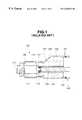
- FIG. 1shows the structure of a prior art distal part 102 of an ultrasonic endoscope 101 serving as an ultrasonic probe.
- the distal part 102consists of a distal body 105 attached to the distal end of a casing 104 outlining an insertion unit 103 , and a housing 106 .
- An illumination window 107 and objective window 108are juxtaposed on an inclined surface formed near the center of the distal body 105 .
- a passage hole 110 through which a flexible shaft 109 liesis bored in the distal body 105 .
- the housing 106 communicating with the passage hole 110is mounted on the distal end of the distal body 105 .
- a holder 112 having an ultrasonic transducer 111is located at the distal end of the flexible shaft 109 .
- the ultrasonic transducer 111is placed in the housing 106 .
- a sealing member 113 for sealing the housing 106is attached to the proximal end of the holder 112 .
- the housing 106is filled with an ultrasound propagation fluid (for example, water) 114 .
- a magnetic sensor 115 serving as a position sensoris located at the distal end of the housing 106 .
- the flexible shaft 109is rotated by a rotation unit that is not shown. This results in radial scanning. Spiral scanning is achieved by advancing or withdrawing the insertion unit 103 , that is, advancing or withdrawing the ultrasonic transducer 111 .
- a magnetic field generatoris installed extra-corporeally. A magnetic field is detected by the magnetic sensor 115 , and sent to a position detector that is an external apparatus. Based on position data computed by involving the position detector, a three-dimensional image is constructed using numerous two-dimensional images resulting from spiral scanning by means of an external apparatus. The image is then displayed on a monitor.
- all components thereof including the distal bodyare made of a conductive material such as a metal.
- a conductive materialsuch as a metal.
- an eddy currentdevelops on each conductor to consume magnetic energy. This leads to a phenomenon that a magnetic field reaching the magnetic sensor 115 is disordered. Consequently, position detection is not achieved correctly, and a measurement error occurs.
- the present inventionprovides an ultrasonic diagnosis system for producing an ultrasonic image with high positional precision by reducing an eddy current that develops around a magnetic sensor and by improving precision in position detection.
- the ultrasonic diagnosis systemcomprises an ultrasonic endoscope to be inserted into an object of observation, an ultrasonic transducer included in a distal part of the ultrasonic endoscope for producing an ultrasonic tomographic image, and a magnetic sensor included in the distal part for detecting the position of the ultrasonic transducer.
- the periphery of the magnetic sensor in the distal part of the ultrasonic diagnosis systemis made of a non-conductive material. Consequently, an eddy current developing in the periphery of the magnetic sensor is reduced, and precision in position detection is improved. This enables provision of an ultrasonic diagnosis system capable of producing an ultrasonic image with high positional precision.
- FIG. 1is a diagram showing a distal part of an ultrasonic diagnosis system in accordance with a prior art
- FIGS. 2 and 3relate to the first embodiment of the present invention
- FIG. 2is a schematic view of an ultrasonic diagnosis system including an ultrasonic endoscope
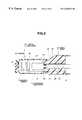
- FIG. 3is a diagram showing a distal part of the ultrasonic endoscope
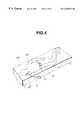
- FIG. 4is a diagram relating to the second embodiment of the present invention and showing a use state
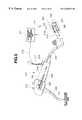
- FIGS. 5 to 8are diagrams relating to the third embodiment of the present invention.
- FIG. 5shows the structures of an ultrasonic endoscope of an ultrasonic diagnosis system and of a position detection catheter;
- FIG. 6is a block diagram showing the configuration of the ultrasonic diagnosis system including an ultrasound observation unit and ultrasonic image processing unit;
- FIG. 7is a diagram showing an example of image data representing a plurality of consecutive ultrasonic tomographic images
- FIG. 8is a diagram showing an example of a three-dimensional image constructed based on three-dimensional data
- FIG. 9is a block diagram relating to the fourth embodiment of the present invention and showing the configuration of an ultrasonic diagnosis system
- FIG. 10is a block diagram relating to the fifth embodiment of the present invention and showing the configuration of an ultrasonic diagnosis system
- FIG. 11shows the configuration of an ultrasonic diagnosis system
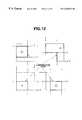
- FIG. 12is a diagram showing an example of an image displayed on an image processing monitor when a section display menu is selected
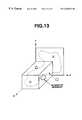
- FIG. 13is a diagram showing an example of an image displayed on the image processing monitor when a stereoscopic display menu is selected
- FIG. 14Ais a diagram showing a state in which a keyboard having a keypad is handled
- FIG. 14Bis a diagram showing a state in which the keyboard having the keypad is handled
- FIGS. 15 and 16relate to the seventh embodiment of the present invention.
- FIG. 15is a block diagram showing an example of a configuration including an ultrasonic endoscope and ultrasonic observation unit;
- FIG. 16is a block diagram showing another configuration different from the one shown in FIG. 15;
- FIGS. 17 and 18relate to the eighth embodiment of the present invention.
- FIG. 17is a diagram showing the configuration of an ultrasonic diagnosis system
- FIG. 18is a diagram showing the structure of the distal part of the ultrasonic endoscope.
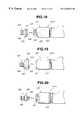
- FIG. 19is a diagram relating to the ninth embodiment of the present invention and showing the structure of a distal part of an ultrasonic endoscope
- FIG. 20is a diagram relating to the tenth embodiment of the present invention and showing the structure of a distal part of an ultrasonic endoscope
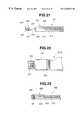
- FIG. 21is a diagram relating to the eleventh embodiment of the present invention and showing the structure of a distal part of an ultrasonic probe
- FIG. 22is a diagram relating to the twelfth embodiment of the present invention and showing the structure of a distal part of an ultrasonic endoscope
- FIG. 23is a diagram relating to the thirteenth embodiment of the present invention and showing the structure of a distal part of an ultrasonic probe
- FIG. 24is a diagram relating to the fourteenth embodiment of the present invention and showing the structure of a distal part of an ultrasonic endoscope
- FIG. 25is a diagram relating to the fifteenth embodiment of the present invention and showing the structure of a distal part of an ultrasonic probe
- FIGS. 26 to 35relate to the sixteenth embodiment of the present invention.
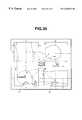
- FIG. 26is an explanatory diagram showing the overall configuration of an ultrasonic diagnosis system
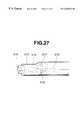
- FIG. 27is a perspective view showing a distal part of an ultrasonic endoscope in enlargement
- FIG. 28is a block diagram showing the configuration of an ultrasonic three-dimensional image processor
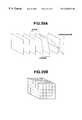
- FIG. 29Ais an explanatory diagram concerning an operation of the ultrasonic three-dimensional image processor upon interpolation of echo data blocks
- FIG. 29Bis an explanatory diagram concerning an operation of the ultrasonic three-dimensional image processor, conceptually showing addresses in a scanned position count memory;
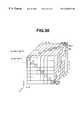
- FIG. 30is an explanatory diagram concerning an operation of the ultrasonic three-dimensional image processor, showing a three-dimensional scanning density graphic
- FIG. 31is an explanatory diagram concerning an operation of the ultrasonic three-dimensional image processor, showing an example of displaying a three-dimensional ultrasonic image of an examined region;
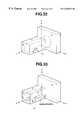
- FIG. 32is an explanatory diagram concerning an operation of the ultrasonic three-dimensional image processor, showing an example of displaying a three-dimensional ultrasonic image of an examined region;
- FIG. 33is an explanatory diagram concerning an operation of the ultrasonic three-dimensional image processor, showing an example of displaying a three-dimensional ultrasonic image of an examined region;
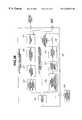
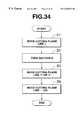
- FIG. 34is a flowchart describing a procedure of section setting carried out by a three-dimensional image processing circuit
- FIG. 35is an explanatory diagram concerning an operation of the three-dimensional image processing circuit, showing a plurality of sectional images appearing when sections used to produce a three-dimensional ultrasonic image are set;
- FIGS. 36A and 36Brelate to a variant of the sixteenth embodiment
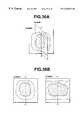
- FIG. 36Ais an explanatory diagram concerning an operation of the three-dimensional image processing circuit, showing a method of displaying a graphic that depicts three-dimensional scanning densities;
- FIG. 36Bis an explanatory diagram showing an operation of the three-dimensional image processing circuit, illustrating the method of displaying a graphic that depicts three-dimensional scanning densities;
- FIG. 37is a block diagram relating to the eighteenth embodiment of the present invention and showing the configuration of an ultrasonic three-dimensional image processor
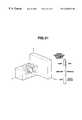
- FIG. 38is an explanatory diagram relating to the nineteenth embodiment of the present invention and showing the layout of components on a subject during ultrasonic diagnosis;
- FIG. 39is an explanatory diagram relating to the twentieth embodiment of the present invention and showing the layout of components in a subject during ultrasonic diagnosis;
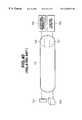
- FIG. 40is a block diagram used to explain a prior art relating to the twenty-first embodiment of the present invention, and schematically showing a transmission path in a portion of a conventional ultrasonic endoscope to be inserted into a body cavity;
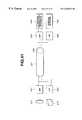
- FIG. 41is a block diagram relating to the twenty-first embodiment of the present invention, and schematically showing a transmission path in an insertion unit of an ultrasonic endoscope.
- FIG. 42is a block diagram relating to the twenty-second embodiment of the present invention, and schematically showing a transmission path in an insertion unit of an ultrasonic endoscope.
- FIG. 2shows an ultrasonic diagnosis system 1 .
- the ultrasonic diagnosis system 1consists of an ultrasonic endoscope 2 , a host processor 3 , a monitor 4 , and a magnetic field transmitter 5 serving as a magnetic field generator.
- the ultrasonic endoscope 2is provided with an ultrasound transmitter receiver 8 that has an ultrasonic transducer 7 (FIG. 3) included in the distal part of an elongated insertion unit 6 to be inserted into a body cavity, and a position detector 10 having a magnetic sensor 9 for detecting the position of the ultrasound transmitter receiver 8 .
- the host processor 3 to which the ultrasonic endoscope 2 is connectedconsists of an image detector 11 , a position detector 12 , and an image processor 13 .
- the image detector 11transmits or receives a signal used to drive the ultrasonic transducer 7 and image data sent from the ultrasonic transducer 7 over a signal line 14 , and stores them as the image data.
- the position detector 12receives a reference signal from the magnetic field transmitter 5 over a signal line 15 .
- the position detector 12receives a detection signal from the magnetic sensor 9 , which detects a magnetic field induced by the magnetic field transmitter 5 , over a signal line 16 .
- the image processor 13simultaneously fetches two-dimensional ultrasonic image data sent from the image detector 11 , and position data that indicates positions relevant to two-dimensional ultrasonic images and that is sent from the position detector 12 .
- the image processor 13then constructs a three-dimensional ultrasonic image using the two-dimensional ultrasonic images.
- the image processing composed of these stepshas been disclosed in Japanese Unexamined Patent Publication No. 6-261900.
- the three-dimensional ultrasonic imageis displayed on the monitor 4 .
- FIG. 3is a diagram showing a distal structure 20 of the ultrasonic endoscope 2 .
- the distal part 20consists of a distal body 22 attached to the distal end of a casing 21 outlining an insertion unit 6 and made of a non-conductive material, and a housing 23 made of a non-conductive material.
- An illumination window 24 and objective window 25are juxtaposed on an inclined surface of the distal body 22 , whereby the ultrasonic endoscope is regarded as an oblique-view type.
- the illumination window 24is used to irradiate light, which emanates from a light source, to the interior of a body cavity over light guide fibers that are not shown.
- the objective windowis used to receive an optical image.
- the optical imageis converted into an electrical signal by an imaging unit that includes a solid-state imaging device that is not shown, and then displayed on the monitor by way of a video processing circuit. Instead of displaying an image, which is produced by the imaging unit and sent over the image guide fibers, on the monitor, an optical image may be viewed directly.
- a passage hole 27 through which a flexible shaft 26 lies and a passage hole 28 through which the signal line 16 extending from the magnetic sensor 9 liesare defined in the distal body 22 .
- the housing 23 communicating with the passage holes 27 and 28is mounted on the distal end of the distal body 22 so that the housing 23 will be impermeable to any fluid.
- the flexible shaft 26has a holder 29 , which accommodates the ultrasonic transducer 7 , attached to the distal end thereof.
- the signal line 14 extending from the ultrasonic transducer 7is passed through the flexible shaft 26 .
- the ultrasonic transducer 7is placed in the housing 23 .
- a seal member 30 for sealing the housing 23is fitted on the proximal end of the holder 29 .
- the proximal end of the flexible shaft 26is rotated by a motor in an operation unit that is not shown. This causes the ultrasonic transducer 7 to oscillate radially for scanning. Consequently, an ultrasonic tomographic image depicting a plane orthogonal to the axis of rotation is produced.
- a holding member 31 for holding the magnetic sensor 9is located in front of the ultrasonic transducer 7 in the housing 23 .
- the magnetic sensor 9is realized with, for example, a coil having three orthogonal axes.
- the signal line 16 extending from the magnetic sensor 9is placed in the housing 23 and in the insertion unit 6 through the passage hole 28 .
- the passage hole 28is provided with a seal member for sealing the housing 23 , though the seal member is not illustrated.
- a lid 33 made of a non-conductive material and opened to accept an ultrasonic propagation fluid (for example, water) 32is located at the distal end of the housing 23 .
- the housing 23is made of a material capable of transmitting ultrasonic waves, such as, a resin so that ultrasonic waves can be transmitted by an ultrasound transmitting portion 34 .
- All the members of the distal structure 20 of this embodiment other than the ultrasonic transducer 7 , signal line 14 , magnetic sensor 9 , and signal line 16are made of a non-conductive material.
- the non-conductive materialis a plastic resin, ceramic, or the like.
- the insertion unit 6 of the ultrasonic endoscope 2is inserted into a body cavity of a subject (human body) 35 , for example, the stomach.
- the distal structure 20is introduced to a desired region.
- Ultrasonic diagnosisis then carried out.
- the magnetic field transmitter 5is driven to originate a reference signal to the distal structure 20 .
- the flexible shaft 26is rotated by a motor that is not shown. This causes the ultrasonic transducer 7 to rotate.
- the insertion unit 6is inched in an axial direction in order to carry out spiral scanning.
- Image data sent from the ultrasonic transducer 7is input to the image detector 11 in the host processor 3 over the signal line 14 , and stored as two-dimensional ultrasonic image data.
- the magnetic sensor 9detects a magnetic field induced by the magnetic field transmitter 5 , and inputs a detection signal, which is a signal detected by the magnetic sensor, to the position detector 12 over the signal line 16 .
- the image processor 13concurrently acquires both two-dimensional ultrasonic image data sent from the image detector 11 and position data that indicates positions relevant to two-dimensional ultrasonic images and is sent from the position detector 12 .
- the image processor 13then constructs a three-dimensional ultrasonic image using the two-dimensional ultrasonic images, and displays the three-dimensional ultrasonic image on the monitor 4 .
- the other members of the distal structure 20are made of a non-conductive material. Development of an eddy current is therefore minimized. The position data sent from the magnetic sensor 9 will therefore not be disordered but input to the position detector 12 .
- the ultrasonic endoscope 2not only the ultrasonic endoscope 2 but also its peripheral equipment or accessories are made of a non-conductive material.
- an examination bed 40 for a subject (human body) 35a housing of a magnetic field transmitter 5 , a magnetic field transmitter locking belt 41 used to lock the magnetic field transmitter 5 on the subject 35 , and a mouthpiece 42 used to introduce the ultrasonic endoscope 2 into the interior of the subject 35 are made of a non-conductive material.
- an ultrasonic endoscope 201has an elongated insertion unit 203 , which is to be inserted into a body cavity, extended from an operation unit 202 located proximally.
- An ultrasonic cable 205extends from the lateral side of the operation unit 202 .
- the operation unit 202has a plurality of operation buttons 214 formed on the lateral side of the proximal part thereof, and has a forceps port 215 a protruding from the lateral side of the distal part thereof.
- a DC motor 209 and a flexible shaft 208 whose one end is coupled to the axis of rotation of the DC motor 209are incorporated.
- a signal line 211 coupled to the DC motor 209is included in the ultrasonic cable 205 .
- a forceps channel 215serving as a passage that communicates with the forceps port 215 a is defined in the insertion unit 203 .
- the other end of the forceps channelcommunicates with a protruding port 215 b formed in a distal rigid part 204 of the insertion unit 203 .
- the distal rigid part 204 of the insertion unit 203has a cap 206 at the distal end thereof.
- An ultrasonic transducer 207is included in the cap 206 .
- the ultrasonic transducer 207is attached to the other end of the flexible shaft 208 , and driven by the DC motor 209 .
- An echo signal sent from the ultrasonic transducer 207is input to an ultrasonic observation unit 213 by way of the flexible shaft 208 , the DC motor 209 , the signal line 211 in the ultrasonic cable 205 , and a signal line, which is not shown, in an ultrasound connector 212 .
- a position detection catheter 217has a magnetic sensor 216 at the distal end thereof.
- the position detection catheter 217is inserted into the forceps channel 215 in the ultrasonic endoscope 201 through the forceps port 215 that is an entrance of the forceps channel.
- the position detection catheter 217is jutted out of the protruding port 215 b that is an exit of the forceps channel.
- a position signal representing a position detected by the magnetic sensor 216is input to an ultrasonic image processing unit 221 over a position signal cable 218 in the position detection catheter.
- the distal rigid part 204 located near the magnetic sensor 216that is, the cap 206 , the periphery of the protruding port 215 b of the forceps channel 215 , and the distal part of the flexible shaft 208 are made of a non-magnetic material, for example, titanium. This is intended not to disorder a magnetic field around the magnetic sensor 216 .
- a magnetic field source 219is located at a position outside the ultrasonic endoscope 201 and subject.
- the magnetic field source 219is connected to the ultrasonic image processing unit 221 .
- Image data of an ultrasonic tomographic image sent from the ultrasonic observation unit 213is displayed on an observation monitor 222 in real time.
- the image datais also input to a recording block 223 included in the ultrasonic image processing unit 221 , and thus recorded.
- the magnetic sensor 216 and magnetic field source 219are connected to a position signal processing block 224 included in the ultrasonic image processing unit 221 .
- Position data computed by the position signal processing block 224is input to the recording block 223 and recorded together with the image data.
- An output of the recording block 223is input to a three-dimensional processing block 225 and subjected to given processing. Thereafter, an image represented by the output signal is displayed on an image processing monitor 226 .
- the ultrasonic endoscope 201is inserted into a body cavity of a subject, and the DC motor 209 is rotated. This causes the ultrasonic transducer 207 attached to the distal part of the flexible shaft 208 to rotate.
- the ultrasonic transducer 207transmits ultrasonic waves radially in directions (radial directions) perpendicular to the axial direction of the distal rigid part 204 (direction in which the distal rigid part is inserted).
- the ultrasonic transducer 207receives reflected ultrasonic waves (echoes) reflected from a portion of the subject whose acoustic impedance has changed.
- the echoes stemming from radial scanningare input to the ultrasonic observation unit 213 , and synthesized with image data representing an ultrasonic tomographic image.
- the imageis then displayed on the observation monitor 222 in real time.
- the image datais input to the recording block 223 and recorded.
- image data of one ultrasonic tomographic image output from the ultrasonic observation unit 213is recorded in the recording block 223 .
- the magnetic field source 219produces a magnetic field in the peripheral space.
- the magnetic sensor 216senses the magnetic field, and outputs a voltage proportional to the magnetic fields as a position signal to the position signal processing block 224 .
- the position signal processing block 224computes a position and inclination of the magnetic sensor 216 relative to the magnetic field source 219 in real time using the received position signal.
- the position and inclinationis provided as position data (X, Y, Z; ⁇ , ⁇ , ⁇ ) relative to the magnetic field source 219 serving as an origin.
- the position datais input to the recording block 223 .
- image data of one ultrasonic tomographic imageis input from the ultrasonic observation unit 213 , the position data is recorded synchronously.
- image data of a plurality of consecutive ultrasonic tomographic images stemming from radial scanning performed by the ultrasonic transducer 207is recorded in the recording block 223 together with associated position data sent from the magnetic sensor 216 .
- a userinches the distal part of the ultrasonic endoscope 201 with the ultrasonic transducer 207 oscillated for radial scanning.
- image data of a plurality of consecutive ultrasonic tomographic images like those shown in FIG. 7is recorded in the recording block 223 together with associated position data.
- Position data produced by the magnetic sensor 216can therefore be treated as data relevant to positions and inclinations of the plurality of ultrasonic tomographic images.
- the three-dimensional processing block 225receives the image data of the plurality of ultrasonic tomographic images from the recording block 223 .
- the three-dimensional processing block 225averages image data of superposed ultrasonic tomographic images or interpolates image data of adjoining ultrasonic tomographic images.
- Three-dimensional data of coordinates (X, Y, Z) relative to a certain point serving as an originis thus structured.
- the three-dimensional processing block 225constructs a three-dimensional image like the one shown in FIG. 8 using the three-dimensional data according to a known method such as section setting, and outputs the image to the image processing monitor 226 .
- the image processing monitor 226displays the three-dimensional image.
- the three-dimensional imageexplicitly depicts the system of coordinates (X, Y, Z).
- the originis set at a deep end as an intersection among the coordinate axes. The spatial position of a region of interest can therefore be grasped easily.
- the forceps channel 215serves as a passage.
- the magnetic sensor 216functions as a position detecting means, and the ultrasonic image processing unit 221 including the three-dimensional processing block 225 functions as a three-dimensional processing means.
- the ultrasonic endoscopescans a subject by oscillating and rotating the ultrasonic transducer, and produces an ultrasonic tomographic image.
- the position detection catheter lying through the forceps channeluses the magnetic sensor to output a position signal.
- the ultrasonic image processing unitsynchronously acquires a position signal sent from the magnetic sensor and a plurality of consecutive ultrasonic tomographic images sent from the ultrasonic endoscope, and then structures three-dimensional data.
- ultrasonic tomographic images of high image qualitycan be acquired in order to structure three-dimensional data.
- three-dimensional datacan be structured using a general-purpose ultrasonic endoscope without the need of a special drive or a special ultrasonic probe.
- the position detection cathetercan be removed from the forceps channel. An examination can therefore be conducted with good maneuverability.
- the position detection cathetercan be removed from the forceps channel. Forceps or the like can then be inserted in order to carry out various kinds of treatments such as biopsy.
- three-dimensional datacan be structured in the course of a routine examination.
- a distortion deriving from a hand tremor, pulsation, a respiratory motion, or any other body motionappears in a three-dimensional image. According to this embodiment, such a distortion can be corrected.
- the distal rigid partis made of a non-magnetic material such as titanium, a magnetic field around the magnetic sensor will not be disordered. This means that a position can be detected accurately.
- the spatial positions of the magnetic sensor 216 and magnetic field source 219 of the third embodimentare switched. Specifically, the magnetic field source 219 is attached to the distal part of the position detection catheter 217 (See FIG. 5 ), and the magnetic sensor 216 is installed externally.
- the other componentsare identical to those of the third embodiment.
- the position signal processing block 224computes position data of the magnetic field source 219 in real time using a position signal output from the magnetic sensor 216 .
- the position signal processing block 224computes a position and inclination of the magnetic sensor 216 relative to the magnetic field source 219 according to a position signal.
- the position signal processing block 224then provides position data (X, Y, Z; ⁇ , ⁇ , ⁇ ) relative to the magnetic field source 219 serving as an origin.
- the magnetic field source 219functions as a position detecting means.
- This embodimenthas an acceleration sensor 228 attached to the distal part of the position detection catheter 217 in place of the aforesaid magnetic sensor 216 and magnetic field source 219 of the third embodiment.
- the ultrasonic endoscope 201has a position signal processing start button 214 a at almost the same position as the operation buttons 214 shown in FIG. 5 .
- the position signal processing start button 214 ais connected to the position signal processing block 224 over a control line.
- the other componentsare identical to those of the third embodiment.
- the position signal processing block 224starts operating in response to an input sent from the position signal processing start button 214 a over the control line.
- the acceleration sensor 228detects accelerations applied in the X direction, Y direction, and Z direction respectively, and outputs voltages proportional to the accelerations as position signals to the position signal processing block 224 .
- the position signal processing block 224integrates components of the position signals relevant to the X direction, Y direction, and Z direction respectively, which are sampled for a certain time, and thus calculates the speed of the acceleration sensor 228 .
- an integration constant employedis 0. Values of the speed which are sampled for a certain time are integrated in order to calculate coordinates (X, Y, Z) of the acceleration sensor 228 as position data. An integration constant employed this time is also 0.
- position data computed by the position signal processing block 224is equivalent to a magnitude by which the distal part of the ultrasonic endoscope 201 is displaced from the position of the origin at which the distal part thereof stands still at the time instant 0.
- the relative positional relationship among a plurality of consecutive ultrasonic tomographic imagesshould merely be clarified.
- the time instant 0 and origincan therefore be set arbitrarily.
- Position data to be selectedcorresponds to coordinates relative to an origin that is a point (standstill point of the acceleration sensor 228 ) at which the acceleration sensor 228 lies at a time instant 0 (standstill time instant of the acceleration sensor 228 ).
- a processing sequenceis carried out in real time by the position signal processing block 224 .
- the other operationsare identical to those of the third embodiment.
- the acceleration sensor 228functions as a position detecting means.
- An ultrasonic diagnosis system of this embodimenthas, aside from the same components as those of the third embodiment, a keyboard 233 with a liquid crystal touch panel 234 whose display menu is variable.
- the ultrasonic observation unit 213is provided with an observation control block 231 for controlling components in response to an input entered at the keyboard 233 .
- the ultrasonic image processing unit 221is provided with an image processing control block 232 for controlling components including the recording block 223 and three-dimensional processing block 225 in response to an input entered at the keyboard 233 .
- a control line 231 a extending from the observation control block 231is coupled to the image processing control block 232 .
- a control line 232 a extending from the image processing control block 232is coupled to the keyboard 233 .
- control lines 231 a and 232 aare used not only to communicate a control instruction but also to communicate a 2-bit sense code indicating a powered state listed in Table 1.
- the observation control block 231 of the ultrasonic observation unit 213When the ultrasonic observation unit 213 is powered and switched on, the observation control block 231 of the ultrasonic observation unit 213 outputs a sense code “01” to the image processing control block 232 in the ultrasonic image processing unit 221 over the control line 231 a.
- the observation control block 231outputs a sense code “00.”
- one low-order bit of the sense codeis used to sense the powered state of the ultrasonic observation unit 213 .
- “1”represents an on state, while “0” represents an off state.
- One high-order bit of the sense codeis used to sense the powered state of the ultrasonic image processing unit 221 .
- the image processing control block 232 of the ultrasonic image processing unit 221adds “10” to the value of a sense code input from the observation control block 231 over the control line 231 a .
- the image processing control block 232adds “00” to the value of the sense code. The sum is output to the keyboard 233 over the control line 232 a.
- the powered states of the ultrasonic observation unit 213 and ultrasonic image processing unit 221are recognized at the keyboard 233 .
- the sense codeis “01.”
- the liquid crystal touch panel 234 of the keyboard 233displays only menus necessary to control the ultrasonic observation unit 213 .
- the menusinclude, for example, a gain menu for adjusting an amplification ratio of an echo signal, a contrast menu, an STC (sensitivity time control) menu, a freeze menu for controlling the oscillations and rotation of the ultrasonic transducer 207 for radial scanning, and a freeze release menu.
- a given instructionis output as a code from the keyboard 233 .
- the codeis sent to the observation control block 231 via the image processing control block 232 over the control lines 232 a and 231 a.
- the observation control block 231halts the DC motor 209 over the signal line 211 in the ultrasonic cable 205 . Consequently, radial scanning is stopped.
- the freeze release menushould be selected from among the menus displayed on the liquid crystal touch panel 234 .
- the image processing control block 232does not give control.
- the sense codeis “10.”
- the liquid crystal touch panel 234displays only menus necessary to control the ultrasonic image processing unit 221 .
- the menusinclude, for example, menus associated with facilities that are necessary to structure three-dimensional data using image data and position data, which are recorded in the recording block 223 , and to display an image represented by the three-dimensional data in any of various forms shown in FIG. 8 or 12 on the image processing monitor 226 .
- a “section display menu” 234 a and “stereoscopic display menu” 234 b shown in FIG. 11are displayed.
- the three-dimensional processing block 225cuts three-dimensional data with mutually orthogonal cutting-plane lines ⁇ , ⁇ , x, and +, and displays resultant images on the image processing monitor 226 as shown in FIG. 12 .
- FIG. 13The relationship between the images shown in FIG. 12 and the three-dimensional image shown in FIG. 8, which has been described in conjunction with the third embodiment, is shown in FIG. 13 .
- sectional images(ranges defined with bold lines) defined with the cutting-plane lines ⁇ , ⁇ , x, and + bear the same symbols ⁇ , ⁇ , x, and +.
- FIG. 13shows these sectional images ⁇ , ⁇ , x, and + shown in FIG. 12 three-dimensionally.
- sectional images x and +depict sections parallel to the XY plane, that is, mutually parallel sections.
- the sectional image ⁇depicts a section parallel to the YZ plane, and the sectional image ⁇ depicts a section parallel to the ZX plane.
- These sectional images ⁇ and ⁇are perpendicular to the sectional images x and +, and mutually perpendicular.
- the cutting-plane lines ⁇ , ⁇ , x, and +indicate the locations of the sectional images ⁇ , ⁇ , x, and +.
- Image data indicating a gray-scale level exhibited by an echo signalis displayed as each sectional image shown in FIG. 12.
- a menu for moving the cutting-plane lines ⁇ , ⁇ , x, and +is displayed on the liquid crystal touch panel 234 .
- Each sectional imageis updated responsively to the movement.
- the three-dimensional processing block 225displays a three-dimensional image like the one shown in FIG. 8 on the image processing monitor 226 according to the selected sectional images.
- the sense codeis “11.”
- the liquid crystal touch panel 234displays both the menus necessary to control the ultrasonic observation unit 213 and ultrasonic image processing unit 221 .
- a representation of three-dimensional data structured by the three-dimensional processing block 225is not limited to the three-dimensional image shown in FIG. 8 .
- the representationmay be a plurality of sectional images like those shown in FIG. 12 bearing symbols (markers) that explicitly indicate a relative positional relationship.
- the magnetic sensor 216functions as a position detecting means
- the ultrasonic image processing unit 221 including the three-dimensional processing block 225functions as an image processing means.
- the liquid crystal touch panel 234functions as a menu selecting means
- the keyboard 233functions as an operator console.
- the keyboard 233 having the liquid crystal touch panel 234is used as an operator console.
- the liquid crystal touch panel 234may not be included.
- the keyboardmay be designed so that when the power supply is turned off, associated keys cannot be validated.
- liquid crystal touch panel 234is used as a menu selecting means. Alternatively, any other device having no liquid crystal will do.
- FIGS. 14A and 14Bshow a variant of the sixth embodiment.
- a keyboard 236has a keypad 237 .
- the keypad 237is, as shown in FIG. 14A, trisected lengthwise and sideways, and thus divided into nine areas. Menus associated to facilities are allocated to the areas.
- a trace modein which the cutting-plane line ⁇ shown in FIG. 12 can be moved.
- a usermoves his/her finger right and left as indicated with arrows in FIG. 14 B. This causes the cutting-plane line ⁇ to move in right and left directions in FIG. 12 in which the finger is moved. Resultant images are displayed on the image processing monitor 226 .
- a message saying, for example, “The keypad enters the trace mode.”is displayed on the image processing monitor 226 .
- the keypad 237is designed to selectively play a role of selecting a facility and a role of moving a cutting-plane line or cursor on a screen according to a selected mode.
- the keypad 237functions as a menu selecting means.
- the ultrasonic observation unit 213 and ultrasonic image processing unit 221are a plurality of stand-alone components.
- a unit for producing an image using echo data of ultrasonic tomographic imagesand a unit for producing an image other than the image represented by echo data, such as, a radiographic image, an MR (magnetic resonance) image, or a video endoscopic image may be included as the stand-alone components.
- any of a plurality of stand-alone unitsthat is, either of the ultrasonic observation unit and ultrasonic image processing unit whose power supply is turned on is sensed. Only a facility of the unit whose power supply is turned on is enabled to operate. Using one operator console, a plurality of stand-alone units can be controlled. This leads to improved maneuverability.
- the seventh embodiment of the present inventionwill be described below with reference to FIG. 15 .
- the ultrasonic endoscope 201is provided with a RAM 241 that is connected by signal lines to a write control circuit 246 and read control circuit 247 , which will be described later, included in the ultrasonic observation unit 213 .
- the ultrasonic observation unit 213consists of: a pulser 242 for applying a pulsating voltage to oscillate the ultrasonic transducer 207 at the time of viewing an ultrasonic tomographic image; a switch 243 for changing a destination of an echo signal sent from the ultrasonic transducer 207 over to either a transducer sensitivity corrector 244 or amplifier 248 ; a transducer sensitivity corrector 244 for correcting the sensitivity of the ultrasonic transducer 207 for reception; a read control circuit 247 for reading data recorded in the RAM 241 ; an amplifier 248 for amplifying an echo signal sent from the ultrasonic transducer 207 ; an A/D converter 249 for converting an amplified echo signal into a digital signal; a digital scan converter (DSC in the drawing) 250 for transforming coordinates so that an image represented by the digital signal can be displayed on the observation monitor 222 ; and a D/A converter 252 for converting image data recorded in a frame memory
- the transducer sensitivity corrector 244includes a reception voltage detection circuit 245 , and a write control circuit 246 for recording data in the RAM 241 .
- An output terminal of the switch 243is connected to the reception voltage detection circuit 245 .
- the frame memory 251is connected to the observation monitor 222 and ultrasonic image processing unit 221 .
- the ultrasonic endoscope 201 and ultrasonic observation unit 213are interconnected via an ultrasound connector 212 like the one shown in FIG. 6 .
- the ultrasonic observation unit 213may be connected to another ultrasonic endoscope.
- sensitivity data used to correct the sensitivity of the ultrasonic transducer 207 for receptionis recorded.
- the switch 243changes the destination of an echo signal over to the reception voltage detection circuit 245 in the transducer sensitivity corrector 244 . The operations will be described.
- the reception voltage detection circuit 245applies a voltage serving as a reference to the ultrasonic transducer 207 .
- a reception voltage whose level is proportional to the magnitude of echoes returned from a subject that is not shownis then converted into sensitivity data that is digital data, and output to the write control circuit 246 .
- the write control circuit 246records the sensitivity data in the RAM 41 in the ultrasonic endoscope 201 .
- the switch 243changes the destination of an echo signal over to the amplifier 248 .
- the read control circuit 247reads sensitivity data from the RAM 241 , and determines a gain to be produced by the amplifier 248 according to the sensitivity data.
- the amplifier 248amplifies an echo signal according to the determined gain. Thereafter, the amplified echo signal is converted into a digital signal by the A/D converter 249 . Coordinates represented by the digital signal are then transformed by the digital scan converter 250 . A resultant signal is output as an ultrasonic tomographic image to the observation monitor 222 via the D/A converter 252 .
- the ultrasonic endoscope 201functions as an ultrasonic probe
- the amplifier 248functions as a variable gain amplifier
- the ultrasonic observation unit 213functions as an observing means.
- the read control circuit 247functions as a gain control means
- the RAM 241functions as a gain setting means and memory means
- the transducer sensitivity corrector 244 including the write control circuit 246functions as a writing means.
- a reception voltage whose level is proportional to the magnitude of echoes returned from a subjectis converted into sensitivity data that is digital data.
- the present inventionis not limited to this form.
- a hydrophone 253may be installed externally. Electric waves output from the hydrophone may be received by the reception voltage detection circuit 245 . In this case, the switch 243 becomes unnecessary.
- a reception voltage sent from the hydrophone 253is detected by the reception voltage detection circuit 245 .
- the transducer sensitivity corrector 244may be provided as an inspection jig separately from the ultrasonic observation unit 213 .
- This configurationmakes it easy to record sensitivity data in the RAM 241 .
- the inspection jigis used to record sensitivity data in the RAM 241 prior to delivery from the factory or during a periodic inspection after the delivery.
- the ultrasonic endoscopeis connected selectively to circuit elements of the ultrasonic observation unit connects.
- the write control circuitstores an acoustic characteristic of the ultrasonic transducer in the RAM.
- the read control circuitcontrols a gain to be produced by the amplifier according to the gain set in the RAM with the ultrasonic endoscope serving as an ultrasonic probe connected to the ultrasonic observation unit. Once the ultrasonic probe is connected to the observation unit, a variation in sensitivity of the ultrasonic transducer for reception including a time-passing change can be corrected.
- an ultrasonic diagnosis system 301consists of: an ultrasonic endoscope 302 serving as an ultrasonic probe of this embodiment for irradiating ultrasonic waves to an examined region in a body cavity and producing an echo signal; an ultrasound processor 303 for producing a three-dimensional ultrasonic tomographic image of the examined region according to the echo signal produced by the ultrasonic endoscope 302 ; an observation monitor 304 for displaying the three-dimensional ultrasonic image produced by the ultrasound processor 303 ; and a position detector 307 that uses a magnetic sensor 306 included in the distal part of the ultrasonic endoscope 302 to detect a magnetic field generated by a magnetic field source 305 , and thus detects the position of the distal part of the ultrasonic endoscope 302 .
- the ultrasonic endoscope 302consists of an elongated insertion unit 321 to be inserted into a body cavity, and an operation unit 322 coupled to the proximal end of the insertion unit 321 .
- the insertion unit 321has a distal cap 323 , a bending portion 324 , and a soft tube 325 having plasticity are provided in that order from the distal end thereof.
- the bending portion 324can be angled by manipulating an angling knob 322 a formed on the operation unit 322 .
- an ultrasonic transducer 326 for transmitting or receiving ultrasonic waves in the outer circumferential directions of the distal cap 323is incorporated in the distal cap 323 of the insertion unit 321 .
- the magnetic sensor 306 for detecting a magnetic field generated around the distal cap 323 by the magnetic field source 305is attached to the distal end of the distal cap 323 .
- the distal part 321 a of the insertion unit 321has a scanner portion 331 .
- the ultrasonic transducer 326is incorporated in the scanner portion 331 .
- the ultrasonic transducer 326is enclosed in the distal cap 323 .
- the interior of the distal cap 323is filled with an ultrasound propagation medium that is not shown.
- An attachment 332is formed at the distal end of the distal cap 323 .
- the attachment 332has a convex part 333 at the distal end thereof.
- a position detecting unit 334is coupled to the attachment 332 .
- the position detecting unit 334has a coupling portion 335 that can be detachably attached to the attachment 332 .
- a coupling hole 336is bored in the coupling portion 335 .
- the coupling hole 336has a concave part 337 formed therein.
- the magnetic sensor 306is located oppositely to the coupling hole 336 of the coupling portion 335 .
- the magnetic sensor 306 of the position detecting unit 334 coupled to the attachment 332is electrically connected to the ultrasound processor 303 over a signal line, which is not shown, lying through the ultrasonic endoscope 302 .
- the ultrasonic transducer 326is connected to one end of a flexible shaft 341 lying through the insertion unit 321 .
- the other end of the flexible shaft 341is coupled to a DC motor 342 that rotates and drives the flexible shaft 341 lying through the operation unit 322 .
- the ultrasound processor 303transmits a pulsating voltage to the ultrasonic transducer 326 , and receives an echo signal from the ultrasonic transducer 326 .
- the echo signal sent from the ultrasonic transducer 326is transmitted to the ultrasound processor 303 via an ultrasound connector 344 over a signal line, which is not shown, contained in an ultrasonic cable 343 by way of the insertion unit 321 and operation unit 322 .
- a magnetic field detection signal sent from the magnetic sensor 306is transmitted to the ultrasound connector 344 over a signal line, which is not shown, contained in the ultrasonic cable 343 by way of the insertion unit 321 and operation unit 322 .
- the magnetic field detection signalis then transmitted to the position detector 307 over a magnetic field detection cable 346 coupled to the ultrasound connector 344 via a magnetic field detection connector 345 .
- the position detector 307outputs digital position/direction data (x, y, z, ⁇ , ⁇ , ⁇ ) to the ultrasound processor 303 .
- the position/direction datacontains information concerning coordinates (x, y, z) of the magnetic sensor 306 relative to the magnetic field source 305 and an orientation thereof [Eulerian angle ( ⁇ , ⁇ , ⁇ )], and is produced based on the magnetic field detection signal.
- echo datais selectively recorded with position/direction data sent from the position detector 307 as a header.
- echo data produced during one turn of the ultrasonic transducer 326that is, an amount of echo data necessary to construct one ultrasonic tomographic image is recorded in the form of an echo data block having position/direction data, which indicates the position and direction of the ultrasonic transducer 326 that has made one turn, as a header. This operation is repeated by advancing the distal part of the insertion unit 321 . Eventually, a plurality of consecutive echo data blocks is recorded.
- the ultrasound processor 303constructs a three-dimensional ultrasonic tomographic image and displays it on the observation monitor 304 .
- the signal detection unit 334is pushed against the distal part 321 a of the ultrasonic endoscope 302 with the coupling hole 336 thereof aligned with the attachment 332 .
- the convex part 333 of the attachment 332is then engaged with the concave part 337 of the coupling hole 336 .
- the position detection unit 334is mounted on the distal part 321 a of the ultrasonic endoscope 302 .
- the magnetic sensor 306is electrically coupled to a signal line, which is not shown, in the ultrasonic endoscope 302 .
- the position detection unit 334may fail, or the ultrasonic endoscope 302 require cleaning. On such an occasion, the position detection unit 334 is pulled out in the distal direction of the ultrasonic endoscope 302 in order to disengage the convex part 333 from the concave part 337 . The position detection unit 334 is thus dismounted from the attachment 332 .
- the position detection unit 334is dismounted from the distal part 321 a. Consequently, the distal part 321 a is shorter and lighter. This leads to improved maneuverability.
- the appearance of the distal part 321 a of the ultrasonic endoscope 302is identical to that of an ordinary ultrasonic endoscope.
- a balloon groove 351 in which a balloon used to dilate a body cavity is fittedis formed in the distal part.
- a position detection unit 334is coupled to the balloon groove 351 .
- the position detection unit 334has a coupling portion 335 detachably attached to the balloon groove 351 .
- a coupling hole 336is bored in the coupling portion 335 .
- a locking portion 352is formed in the coupling hole 336 .
- a magnetic sensor 306is located oppositely to the coupling hole 336 of the coupling portion 335 .
- a groove 353 shaped like the balloon groove 351is formed in the distal part of the coupling portion 335 .
- the magnetic sensor 306 of the position detection unit 334 coupled to the balloon groove 351is electrically connected to the position detector 307 over a signal line passing through an ultrasonic endoscope 302 , though it is not illustrated.
- the signal detection unit 334when an examination is intended to construct a three-dimensional ultrasonic image, the signal detection unit 334 is pushed against the distal part 321 a of the ultrasonic endoscope 302 with the coupling hole 336 aligned with the balloon groove 351 .
- the locking portion 352 of the coupling hole 336is engaged with the balloon groove 351 .
- the position detection unit 334is thus mounted on the distal part 321 a of the ultrasonic endoscope 302 .
- the magnetic sensor 306is electrically coupled to a signal line, which is not shown, in the ultrasonic endoscope 302 .
- a balloonnot shown
- the distal part of the balloonis fitted in the groove 353 .
- the position detection unitmay fail, or the ultrasonic endoscope 302 may require cleaning.
- the position detection unit 334is pulled out in the distal direction of the ultrasonic endoscope 302 in order to disengage the locking portion 352 from the balloon groove 351 .
- the position detection unit 334is thus dismounted from the distal part 321 a.
- This embodiment having the foregoing configurationprovides the same advantages as the eighth embodiment.
- the appearance of the distal part 321 a with the position detection unit 334 dismountedis the same as that of an ordinary ultrasonic endoscope. Consequently, maneuverability for an examination not intended to construct a three-dimensional ultrasonic image can be further improved.
- the appearance of a distal part 321 a of an ultrasonic endoscope 302is identical to that of an ordinary ultrasonic endoscope.
- a screw hole 361 used to access an ultrasonic mediumis bored in the distal part.
- a position detection unit 334is coupled to the screw hole 361 .
- the position detection unit 334has a coupling portion 335 detachably attached to the screw hole 361 .
- the coupling portion 335is provided with a screw portion 362 .
- a magnetic sensor 306is located oppositely to the screw portion 362 of the coupling portion 335 .
- the magnetic sensor 306 of the position detection unit 334 coupled to the screw hole 361is electrically connected to a position detector 307 over a signal line lying through the ultrasonic endoscope 302 , though it is not illustrated.
- a screw(not shown) used to seal an ultrasound propagation medium disposed in the screw hole 361 in the distal part 321 a of the ultrasonic endoscope 302 is removed.
- the position detection unit 334is then mounted in the screw hole 361 .
- the magnetic sensor 306is electrically coupled to a signal line, which is not shown, lying through the ultrasonic endoscope 302 .
- the position detection unitmay fail, or the ultrasonic endoscope 302 may require cleaning.
- the position detection unit 334is dismounted, and the screw for sealing the medium (not shown) is tightened.
- this embodiment having the foregoing configurationprovides the same advantages as the eighth embodiment.
- the appearance of the distal part 321 a with the position detection unit 334 dismountedis the same as that of an ordinary ultrasonic endoscope. Maneuverability for an examination not intended to construct a three-dimensional ultrasonic image can further be improved.
- This embodimentis an embodiment adapted to an ultrasonic probe that lies through a treatment appliance passage channel in an ordinary endoscope, that has its distal end jutted out through an opening of the treatment appliance passage channel located in the distal part of the endoscope, and that transmits or receives ultrasonic waves.
- a distal part 372 of an ultrasonic probe 371 of this embodimentis provided with an ultrasonic transducer 326 .
- a flexible shaft 373extends from the ultrasonic transducer 326 proximally to the proximal part of the probe.
- the flexible shaft 373is coupled to a connector that is not shown.
- the ultrasonic transducer 326is enclosed in a sheath 374 .
- the interior of the sheath 374is filled with an ultrasound propagation medium that is not shown.
- An attachment 332is formed at the distal end of the sheath 374 .
- the attachment 332has a convex part formed at the tip thereof.
- a position detection unit 334is coupled to the attachment 332 .
- the position detection unit 334has a coupling portion 335 detachably attached to the attachment 332 .
- a coupling hole 336is formed in the coupling portion 335 .
- the ultrasonic transducer 326is electrically connected to an ultrasound processor 303 over a signal line lying through the ultrasonic probe 371 , though it is not illustrated.
- the coupling hole 336has a concave part 337 formed therein.
- a magnetic sensor 306is located oppositely to the coupling hole 336 of the coupling portion 335 .
- the magnetic sensor 306 of the position detection unit 334 coupled to the attachment 332is electrically connected to a position detector 307 over a signal line lying through the ultrasonic probe 371 , though it is not illustrated.
- the ultrasonic probe 371 of this embodiment having the foregoing componentsis analogous to the ultrasonic endoscope 302 of the eighth embodiment. Specifically, when an examination is intended to construct a three-dimensional ultrasonic image, the signal detection unit 334 is pushed against the distal part 372 of the ultrasonic probe 371 with the coupling hole 336 aligned with the attachment 332 . The convex part 333 of the attachment 332 is then engaged with the concave part 337 of the coupling hole 336 . The position detection unit 334 is thus mounted on the distal part 372 of the ultrasonic probe 371 . At the same time, the magnetic sensor 306 is electrically coupled to a signal line, which is not shown, lying through the ultrasonic probe 371 .
- the position detection unit 334may fail, or the ultrasonic probe 371 may require cleaning. On such an occasion, the position detection unit 334 is pulled out in the distal direction of the ultrasonic probe 371 . The convex part 333 is then disengaged from the concave part 337 . Consequently, the position detection unit 334 is dismounted from the attachment 332 .
- the ultrasonic probe 371 of this embodimentprovides the same advantages as the ultrasonic endoscope 302 of the eighth embodiment.
- a distal part 321 of an ultrasonic endoscope 302is provided with a magnetic sensor 306 .
- the magnetic sensor 306is enclosed in a cover 381 .
- the cover 381is made of a material resistive to chemicals including glutaraldehyde that is a generally employed disinfectant (polyethylene, polymethyl pentene, polysulfone, silicon rubber, etc.).
- the magnetic sensor 306since the magnetic sensor 306 is enclosed in the cover 381 , the magnetic sensor 306 will not be stained with a disinfectant or the like during cleaning or sterilization using the disinfectant.
- the ultrasonic endoscope 302 of this embodimentcan be cleaned or sterilized in the same manner as an ordinary ultrasonic endoscope without the necessity of following a special procedure.
- This embodimentis an embodiment adapted to an ultrasonic probe that is passed through a treatment appliance passage channel in an ordinary endoscope, that has the tip thereof jutted out of an opening of the treatment appliance passage channel located in the distal part of the endoscope, and that transmits or receives ultrasonic waves.
- a distal part 386 of an ultrasonic probe 385 of this embodimentis provided with a magnetic sensor 306 .
- the magnetic sensor 306is enclosed in a cover 381 .
- the cover 381is made of a material resistive to chemicals including glutaraldehyde that is a generally employed disinfectant (polyethylene, polymethyl pentene, polysulfone, silicon rubber, etc.).
- the magnetic sensor 306is enclosed in the cover 381 .
- the magnetic sensor 306will not be stained with a disinfectant or the like during cleaning or sterilization using the disinfectant.
- the ultrasonic probe 385 of this embodimentcan be cleaned or sterilized according to the same procedure as an ordinary ultrasonic probe without the necessity of following a special procedure.
- a distal part 321 a of an ultrasonic endoscope 302is provided with a cover attachment 393 .
- the cover attachment 393has a convex part 394 .
- a magnetic sensor 306is mounted in the cover attachment 393 .
- a cover 395 enclosing the magnetic sensor 306is attached to the cover attachment 393 .
- the cover 395has a concave part 396 formed in the inner surface of a portion thereof to be attached to the cover attachment 393 .
- the other componentsare identical to those of the twelfth embodiment.
- the cover 395Prior to an examination, the cover 395 is pushed against the cover attachment 393 .
- the cover 395is mounted on the distal part 392 with the convex part 394 of the cover attachment 393 engaged with the concave part 396 of the cover 395 .
- the cover 395is disposable.
- the cover 395is pulled out in the distal direction of the ultrasonic endoscope 391 .
- the convex part 394is disengaged from the concave part 396 , whereby the old cover 395 is removed.
- the cover 395when the cover 395 must be cleaned or sterilized, the cover 395 should merely be replaced with a new one. This results in improved cleaning efficiency.
- This embodimentis an embodiment adapted to an ultrasonic probe that is passed through a treatment appliance passage channel in an ordinary endoscope, that has a tip thereof jutted out through an opening of the treatment appliance passage channel located in the distal part of the endoscope, and that transmits or receives ultrasonic waves.
- a distal part 402 of an ultrasonic probe 401is provided with a cover attachment 403 .
- the cover attachment 403has a convex part 404 .
- a magnetic sensor 306is mounted in the cover attachment 403 .
- a cover 405 enclosing the magnetic sensor 306is attached to the cover attachment 403 .
- the cover 405has a concave part 406 formed in the inner surface of a portion thereof to be attached to the cover attachment 403 .
- the cover 405Prior to an examination, the cover 405 is pushed against the cover attachment 403 .
- the cover 405is mounted on the distal part 402 with the concave part 406 of the cover 405 engaged with the convex part 404 of the cover attachment 403 .
- the cover 405is disposable.
- the cover 405is pulled in the distal direction of the ultrasonic probe 401 .
- the convex part 404is thus disengaged from the concave part 406 , whereby the old cover 405 is removed.
- the cover 405when the cover 405 must be cleaned or sterilized, the cover 405 should merely be replaced with a new one. This results in improved cleaning efficiency.
- An ultrasonic diagnosis system of this embodimentconsists of: an ultrasonic endoscope 501 serving as an intracorporeal ultrasonic probe; a light source apparatus 502 for supplying illumination light required for viewing an optical image of an examined region; a video processor 503 for producing an optical view image of the examined region; an ultrasonic observation apparatus 504 for producing a two-dimensional ultrasonic tomographic image of the examined region; an observation monitor 505 for displaying an optical view image and ultrasonic tomographic image; a position detector 506 for detecting the position of an insertion unit of the ultrasonic endoscope 501 ; an ultrasonic three-dimensional image processor 507 for producing a three-dimensional ultrasonic image; an image processing monitor 508 for displaying a three-dimensional ultrasonic image; and cables for linking these apparatuses.
- the ultrasonic endoscope 501has a large-diameter operation unit 510 formed continuously to the proximal end of an elongated insertion unit 509 that is inserted into a body cavity.
- a light source cable 511 to be coupled to the light source apparatus 502 and an ultrasonic cable 512 to be coupled to the ultrasonic observation apparatus 504extends from the lateral side of the operation unit 510 .
- a distal cap 513is mounted on the distal end of the insertion unit 509 .
- An ultrasonic transducer 514 for transmitting or receiving ultrasonic wavesis, as shown in FIG. 27, incorporated in the distal cap 513 so that the ultrasonic transducer 514 can rotate.
- a magnetic sensor 515 for detecting a magnetic fieldis mounted on the distal end of the distal cap 513 .
- An observation light irradiation window 516 and CCD camera 517are mounted on the proximal part of the distal cap 513 .
- a bending portion 518capable of being angled freely in order to move the distal cap 513 in directions indicated with bold arrows is formed at the proximal end of the distal cap 513 .
- a flexible shaft 519 having one end thereof coupled to the ultrasonic transducer 514is incorporated in the insertion unit 509 , whereby the ultrasonic transducer 514 is rotated.
- the other end of the flexible shaft 519is routed to the operation unit 510 and coupled to a DC motor 520 for rotating and driving the flexible shaft 519 .
- the operation unit 510has an angling knob 521 used to angle the bending portion 518 , a three-dimensional scanning start switch 522 A, and a three-dimensional scanning end switch 522 B.
- the light source cable 511contains light guide fibers (not shown) over which observation light a emanating from the light source apparatus 502 is propagated to the observation light irradiation window 516 , and a signal line (not shown) over which a CCD signal b sent from a CCD camera 517 is received by the video processor 503 .
- a light source connector 523 via which the light source cable 511 is coupled to the light source apparatus 502is coupled to the end of the light source cable 511 .
- the light source apparatus 502is provided with a lamp 524 for generating observation light a.
- a video cable 526is coupled to the light source connector 523 via a small connector 525 formed at an end of the light source connector 523 .
- the light source apparatusis connected to the video processor 503 over the video cable 526 .
- the video processor 503produces a video signal representing an optical view image of an examined region by processing a CCD signal b, and outputs a resultant signal to the observation monitor 505 .
- the ultrasonic cable 512contains a signal line over which a pulsating voltage is transmitted from the ultrasonic observation apparatus 504 to the ultrasonic transducer 514 , and an echo signal c from the ultrasonic transducer 514 is received by the ultrasonic observation apparatus 504 .
- the ultrasonic cable 512also contains a signal line (not shown) over which a magnetic field detection signal d sent from the magnetic sensor 515 and a three-dimensional scanning start/end signal sent from a three-dimensional scanning start switch 522 A or three-dimensional scanning end switch 522 B is received by the position detector 506 .
- An ultrasound connector 527 via which the operation unit is connected to the ultrasonic observation apparatus 504is coupled to an end of the ultrasonic cable 512 .
- the transmission route of the three-dimensional scanning start/end signalis the same as that of the magnetic field detection signal d. The illustration of the transmission route is omitted.
- the ultrasonic observation apparatus 504produces a tomographic image signal representing a two-dimensional ultrasonic tomographic image of an examined region by processing the echo signal c.
- the ultrasonic observation apparatus 504then outputs the tomographic image signal to the observation monitor 505 and outputs digital echo data to the ultrasonic three-dimensional image processor 507 .
- a position detection cable 529is coupled to the ultrasound connector 527 via a small connector 528 formed at an end of the ultrasound connector 527 .
- the ultrasonic observation apparatusis connected to the position detector 506 over the position detection cable 529 .
- the position detector 506is provided with a magnetic field source 530 for generating a magnetic field. Based on a magnetic field detection signal d representing a magnetic field generated by the magnetic field source 530 , digital position/direction data is produced and output to the ultrasonic three-dimensional image processor 507 .
- the ultrasonic three-dimensional image processor 507is, as shown in FIG. 28, provided with a recording unit 531 that is a large-capacity recording means for recording echo data sent from the ultrasonic observation apparatus 504 together with position/direction data sent from the position detector 506 , such as, a hard disk or magneto-optical disk; a coordinate transformation circuit 532 for transforming coordinates indicated by echo data recorded in the recording unit 531 ; a three-dimensional memory 533 for recording data resulting from coordinate transformation; and a three-dimensional image processing circuit 534 for performing various kinds of image processing including the processing of constructing a three-dimensional ultrasonic image according to the data stored in the three-dimensional memory 533 .
- a recording unit 531that is a large-capacity recording means for recording echo data sent from the ultrasonic observation apparatus 504 together with position/direction data sent from the position detector 506 , such as, a hard disk or magneto-optical disk
- a coordinate transformation circuit 532for transforming coordinates indicated by echo data
- the ultrasonic three-dimensional image processor 507has a three-dimensional density calculation circuit 539 .
- the three-dimensional density calculation circuit 539consists of: a switch 535 that opens or closes in response to a three-dimensional scanning start/end signal sent from the three-dimensional scanning start switch 522 A or three-dimensional scanning end switch 522 B; a position specification circuit 536 for computing with which positions in a scanned space locations of echo data to be recorded successively in the recording unit 531 coincide, and for specifying the positions; a scanned position count memory 537 for counting the number of times, by which a scanning spot defined by the ultrasonic endoscope 501 crosses each position in the space, according to the positions specified by the position specification circuit 536 , and for grasping areas scanned three-dimensionally by the ultrasonic endoscope 501 ; and a three-dimensional scanning density graphic production circuit 538 for producing a graphic, which depicts three-dimensional scanning densities or frequencies of three-dimensional scanning within the space, according to count values provided by the scanned position
- the ultrasonic three-dimensional graphic processor 507includes a display circuit 540 for switching an output of the three-dimensional image processing circuit 534 and an output of the three-dimensional scanning density calculation circuit 539 or superimposing one output on the other output, and converting a resultant signal into an analog signal.
- the display circuit 540outputs a three-dimensional ultrasonic image, a three-dimensional scanning density graphic that is a graphic depicting frequencies of three-dimensional scanning, or an image produced by superimposing the three-dimensional scanning density graphic on the three-dimensional ultrasonic image to the image processing monitor 508 .
- the ultrasonic endoscope 501is inserted into a tubular organ in a subject's body, for example, the stomach, esophagus, or large intestine by a user such as a physician.
- Observation light a emanating from the ultrasonic endoscope 501is irradiated through the observation light irradiation window 516 via the light source connector 523 over the light guide fibers contained in the light source cable 511 .
- a CCD signal bis input from the CCD camera 517 to the video processor 503 by way of the signal line contained in the light source cable 511 , the small connector 525 connected to the light source connector 523 , and the video cable 526 .
- the CCD signal brepresents an optical image that depicts the surface of an examined region which has been imaged by the CCD camera 517 .
- the video processor 503produces a video signal that represents the surface of the examined region, according to the CCD signal b, and outputs it to the observation monitor 505 .
- the flexible shaft 519is rotated and driven.
- the driving forceis conveyed to the distal end of the flexible shaft 519 , whereby the ultrasonic transducer 514 is rotated.
- a pulsating voltage transmitted repeatedly from the ultrasonic observation apparatus 504is applied to the ultrasonic transducer 514 .
- the ultrasonic transducer 514carries out so-called radial scanning, that is, rotates while transmitting or receiving ultrasonic waves to or from a living body.
- An echo signal c sent from the ultrasonic transducer 514represents the examined region, and stems from radial scanning.
- the echo signal cis input to the ultrasonic observation apparatus 504 via the ultrasound connector 527 over the signal line contained in the ultrasonic cable 512 .
- the ultrasonic observation apparatus 504detects the envelope of the echo signal c, outputs a logarithmic function of the echo signal c, converts the echo signal c into a digital signal, and carries out other processing.
- the ultrasonic observation apparatus 504thus produces a tomographic image signal representing the examined region, and outputs it to the observation monitor 505 .
- the ultrasonic observation apparatus 504produces digital echo data, which represents the examined region, according to the echo signal c, and outputs the digital echo data to the ultrasonic three-dimensional image processor 507 .
- the echo datais data bearing addresses that are values each composed of a distance from the ultrasonic transducer 514 and an angle of rotation for radial scanning, that is, values each corresponding to polar coordinates. Intensities of the echo signal c associated with the addresses are described as the data.
- the observation monitor 505displays an optical view image, which depicts the examined region, according to a video signal sent from the video processor 503 .
- the observation monitor 505also displays a two-dimensional ultrasonic tomographic image, which depicts the examined region, according to a tomographic image signal sent from the ultrasonic observation apparatus 504 . Display of the optical view image and display of ultrasonic tomographic image are switched with input of an instruction entered at an input means such as a keyboard or touch panel that is not shown. Alternatively, both the images are displayed simultaneously.
- the magnetic sensor 515detects a magnetic field generated by the magnetic field source 530 .
- a magnetic field detection signal d sent from the magnetic sensor 515is input to the position detector 506 by way of the signal line contained in the ultrasonic cable 512 , the small connector 528 connected to the ultrasound connector 527 , and the position detection cable 529 .
- the position detector 506Based on the magnetic field detection signal d, the position detector 506 outputs digital position/direction data, which contains information concerning the position (x, y, z) and orientation [Eulerian angle ( ⁇ , ⁇ , ⁇ )] of the magnetic sensor 515 relative to the magnetic field source 530 , to the ultrasonic three-dimensional image processor 507 .
- echo data sent from the ultrasonic observation apparatus 504is recorded in the recording unit 531 with position/direction data sent from the position detector 506 as a header.
- echo data acquired during one turn of the ultrasonic transducer 514that is, an amount of echo data required for constructing one ultrasonic tomographic image (hereinafter an echo data block) is recorded in the recording unit 531 .
- position/direction data that is produced while the ultrasonic transducer 514 makes one turn to acquire the echo data blockis recorded as a header of the echo data block.
- a usergrabs the insertion unit 509 of the ultrasonic endoscope 501 , and moves it in a direction of an arrow (in a direction in which the insertion unit is removed from a subject). Otherwise, the user angles the bending portion 518 by handling the angling knob 521 , and thus changes the direction of the distal cap 513 .
- echo data blocks representing a plurality of ultrasonic tomographic imagesthat are, as shown in FIG. 29A, not mutually parallel but exhibit a coarse three-dimensional scanning density or a coarse frequency of three-dimensional scanning are recorded in the recording unit 531 in the ultrasonic three-dimensional image processor 507 .
- a procedure described belowis adopted. Namely, information concerning a three-dimensional scanning density or a frequency of three-dimensional scanning is displayed in a screen on the image processing monitor 508 in the course of three-dimensional scanning.
- a three-dimensional scanning start signalis converted into a certain code (three-dimensional scanning start code) by the position detector 506 , and then input to the ultrasonic three-dimensional image processor 507 .
- the switch 535 in the ultrasonic three-dimensional image processor 507is closed with input of the three-dimensional scanning start code. This causes the processing of graphically displaying a three-dimensional scanning density to start. At this time, data at all addresses in the scanned position count memory 537 is reset to an initial value of 0.
- the position specification circuit 536specifies the locations of echo data blocks to be recorded successively in the recording unit 531 according to position/direction data input in parallel with data input to the recording unit 531 .
- FIG. 30is a conceptual diagram of addresses in the scanned position count memory 537 .
- the location of an echo data block corresponding to a position in the actual spaceis, as shown in FIG. 29A, the position of a plane.
- the position specification circuit 536increments data of a cube by one and thus updates it at every crossing by the plane.
- a frequency by which a scanning spot defined by the ultrasonic endoscope 501 during radial scanning crosses each area in the spaceis counted.
- an image represented by an echo data blockdepicts a plane crossing hatched cubes in FIG. 30 .
- data items defined by addresses ( 1 , 2 n+1, 2 n+1), ( 2 , 2 n, 2 n+1), etc.are incremented by one.
- the three-dimensional scanning density graphic production circuit 538produces, as shown in FIG. 31, a graphic depicting a three-dimensional scanning density or a frequency of three-dimensional scanning by which the ultrasonic endoscope 501 has scanned a subject (hereinafter, a three-dimensional scanning density graphic).
- FIG. 31shows the three-dimensional scanning density graphic as a simple three-dimensional image having different tones associated with three-dimensional scanning densities.
- the display circuit 540converts image data of the three-dimensional scanning density graphic produced by the three-dimensional scanning density graphic production circuit 538 into an analog signal, and outputs the analog signal to the image processing monitor 508 .
- a userpresses the three-dimensional scanning end switch 522 B.
- a three-dimensional scanning end signalis then converted into a certain code (three-dimensional scanning end code) by the position detector 506 , and input to the ultrasonic three-dimensional image processor 507 .
- the switch 535 in the ultrasonic three-dimensional image processor 507is opened with input of the three-dimensional scanning end code.
- the processing sequencemay be carried out in real time during three-dimensional scanning.
- an image like the one shown in FIG. 31is displayed on the image processing monitor 508 while being updated sequentially.
- a usercan therefore move the ultrasonic endoscope 501 or angle the bending portion 518 , so that the three-dimensional scanning density graphic will be entirely painted in red.
- a sufficiently wide range of a subjectcan be three-dimensionally scanned in order to construct a three-dimensional ultrasonic image.
- the irregularity in density of three-dimensional datacan be suppressed.
- position/direction data input from the position detector 506addresses in the scanned position count memory 537 , and a positional relationship among three-dimensional scanning densities must be defined.
- a position indicated by position/direction data when a three-dimensional scanning start code is input to the ultrasonic three-dimensional image processor 507that is, the position of the magnetic sensor 515 at the start of three-dimensional scanning is aligned with the center of a cube defined by an address (n+1, n+1, n+1) in the scanned position count memory 537 shown in FIG. 30 .
- An outer apex of a cube defined with an address ( 1 , 1 , 1 ) in the scanned position count memory 537is associated with an origin O of a three-dimensional scanning density graphic shown in FIG. 31 .
- the orientation of the top of the magnetic sensor 515 at the start of three-dimensional scanningthat is, the orientation of the top of the distal cap 513 is associated with the z axis shown in FIGS. 30 and 31.
- the coordinate transformation circuit 532 in the ultrasonic three-dimensional image processor 507reads echo data blocks recorded in the recording unit 531 , and converts polar coordinates indicating addresses into orthogonal coordinates. Furthermore, the coordinate transformation circuit 532 averages echo data blocks representing superposed images like those shown in FIG. 29A out of the plurality of echo data blocks that has been subjected to coordinate transformation. Otherwise, the coordinate transformation circuit 532 interpolates echo data blocks, or produces three-dimensional image data, of which addresses are expressed with three-dimensional orthogonal coordinates, like the one shown in FIG. 29 B. The three-dimensional image data is stored in the three-dimensional memory 533 .
- the three-dimensional image processing circuit 534reads three-dimensional image data from the three-dimensional memory 533 , and carries out processing necessary to construct a three-dimensional ultrasonic image like the one shown in FIGS. 32 and 33.
- the image constructionwill be outlined later.
- the display circuit 540converts image data of a three-dimensional ultrasonic image constructed by the three-dimensional ultrasonic image processing circuit 534 into an analog signal, and outputs the analog signal to the image processing monitor 508 .
- a three-dimensional ultrasonic image of an examined regionis displayed on the image processing monitor 508 .
- FIG. 34is a flowchart describing section setting that is part of the processing carried out by the three-dimensional image processing circuit 534 .
- FIG. 35shows a plurality of sectional images, or more particularly, four sectional images (sectional echo data) to be set for displaying ultrasonic images of an examined region three-dimensionally on the image processing monitor 508 as shown in FIGS. 32 and 33.
- An area patterned like the skin of a pearindicates a region of interest 541 such as a lesion.
- These sectional imagesare displayed on the image processing monitor 508 using three-dimensional image data read from the three-dimensional memory 533 .
- FIGS. 32 and 33show a three-dimensional ultrasonic image constructed finally by setting the four sectional images shown in FIG. 35 .
- Sections A, B, C, and D shown in FIGS. 32 and 33correspond to sectional images A, B, C, and D shown in FIG. 35 .
- the sectional images shown in FIG. 35correspond to sections resulting from parallel movement or turning of the sections shown in FIGS. 32 and 33. For example, the section A in FIGS. 32 and 33 is turned or moved in parallel so that it will contain the lesion as described below.
- the section Cis perpendicular to the sections A and D and corresponds to the sectional image containing a cutting-plane line+in FIG. 35 .
- the section Bcorresponds to the sectional image containing a cutting-plane line x in FIG. 35 .
- the section Acorresponds to the sectional image containing a cutting-plane line ⁇ in FIG. 35 .
- the section Dcorresponds to the sectional image containing a cutting-plane line ⁇ in FIG. 35 .
- the cutting-plane lines drawn with dashed lines in FIG. 35, and the frame line of a sectional image being handledare painted in yellow or the like so that they can be identified easily.
- the sectional imagecan be distinguished from the other sectional images displayed in black and white.
- a userhandles an input means such as a keyboard or touch panel that is not shown.
- the userslides a cursor ⁇ located near the sectional image B in directions of arrows in FIG. 35 (in lateral directions in FIG. 35 ), so that the region of interest 541 such as a lesion will appear in the sectional image A.
- the cutting-plane line ⁇then moves while being interlocked with the cursor.
- the region of interest 541then appears in the sectional image A along the cutting-plane line ⁇ .
- step S 2the user uses the input means to turn the sectional image A with a central point O as a center so that the region of interest 541 will be oriented properly.
- a certain point Kis moved in directions of arrows in order, whereby the sectional image A is turned.
- the region of interest 541is located below the subject to be examined.
- the input meansis used to move the cutting-plane lines + and x so that the cutting-plane line + or x will be set on the region of interest 541 .
- This moving procedureis identical to that for the cursor ⁇ .
- the region of interest 541then appears in the sectional image B or C.
- the cutting-plane line xhas been moved.
- the input meansis used to move the cutting-plane lines ⁇ and ⁇ so that the region of interest 541 will be interposed between the cutting-plane lines ⁇ and ⁇ .
- section setting for setting the sectional images constituting a three-dimensional ultrasonic imagewhich are shown in FIG. 35, is completed.
- the three-dimensional image processing circuit 534constructs a three-dimensional ultrasonic image, such as, a simple three-dimensional image that does not depict the surfaces of a tubular organ like the one shown in FIG. 32, or a three-dimensional image having surface data E extracted as shown in FIG. 33 .
- a procedure of extracting the surface datais already known. The description of the procedure will therefore be omitted.
- three-dimensional scanning densitiesthat is, the frequencies of three-dimensional scanning performed by the ultrasonic endoscope 501 are computed by the three-dimensional scanning density calculation circuit 539 .
- the irregularity in three-dimensional scanning densityis indicated as a graphic on the image processing monitor 508 .
- a usercan therefore carry out three-dimensional scanning over a sufficiently wide range to construct a three-dimensional ultrasonic image while checking the three-dimensional scanning density graphic. Consequently, the irregularity in density of produced three-dimensional data can be suppressed.
- the ultrasonic endoscope 501 mechanically designed to carry out simple radial scanning alonecan be employed. Consequently, the outer diameter of the insertion unit can be made smaller.
- three-dimensional datacan be produced accurately without suffering from the adverse effect of irregularity in three-dimensional scanning density.
- a three-dimensional scanning density graphicis a simple three-dimensional image having different tones associated with three-dimensional scanning densities.
- a method of displaying the three-dimensional scanning densities in a screenis not limited to this form.
- the three-dimensional scanning densitiesmay be indicated with different luminance levels instead of the different tones. Otherwise, the three-dimensional scanning densities may be depicted in a plurality of sectional images but not in the simple three-dimensional image.
- FIGS. 36A and 36Ban example in which the method of displaying an image depicting three-dimensional scanning densities has been modified is shown in FIGS. 36A and 36B.
- FIG. 36Ashows an example in which three-dimensional scanning densities are depicted in two mutually orthogonal sections of planes ⁇ and ⁇ .
- FIG. 36Bshows an example in which the two sectional images are displayed while being developed.
- the number of sectional imagesmay not be two.
- a larger number of sectional imagessuch as, a plurality of sectional images perpendicular to the z axis may be employed. Otherwise, such a three-dimensional scanning procedure may be adopted that only cubes indicating lower three-dimensional densities are displayed and three- dimensional scanning is carried on to delete the displayed cubes.
- the magnetic sensor 515is adopted as a means for detecting a position at which ultrasonic scanning is carried out.
- an acceleration sensor for computing a position using an acceleration, or any other position detection sensorwill do.
- the magnetic sensor 515is mounted on the distal end of the ultrasonic endoscope 501 .
- the magnetic sensor 515 and magnetic field source 530may be positioned the other way around. The position of the distal part of the ultrasonic endoscope 501 can still be detected.
- This embodimentis an example in which the method of computing three-dimensional scanning densities has been modified.
- the system configurationis identical to that of the sixteenth embodiment shown in FIGS. 26 to 28 .
- This embodimentis different from the sixteenth embodiment only in the method of computing three-dimensional scanning densities. The difference alone will be described below.
- the position specification circuit 536specifies locations of echo data blocks to be successively recorded in the recording unit 531 .
- Data of a cube in the three-dimensional addressing space in the scanned position count memory 537is incremented by one every time a position corresponding to the location of the data is crossed by a scanning spot defined by the ultrasonic endoscope 501 during radial scanning.
- the number of times by which each area in a corresponding space is crossed by the scanning spotis counted.
- the position specification circuit 536increments data of a cube, whose location corresponds to the position of the magnetic sensor 515 , by one at regular intervals.
- the density of a scanned point on a trajectory traced by the distal part of the ultrasonic endoscope 501is computed by counting the number of scanned points.
- the position of the magnetic sensor 515 represented by the position/direction datamay be contained in a cube at an address ( 1 , 1 , 1 ) in FIG. 30 . In this case, the data of the cube is incremented by one.
- the irregularity in three-dimensional scanning densitycan be depicted as a graphic. Three-dimensional data can therefore be produced accurately without being affected by the irregularity in three-dimensional scanning density.
- the position specification circuit 536increments data of a cube, of which location corresponds to the position of the magnetic sensor 515 , by one and thus updates the data at regular intervals.
- the density of a scanned point on a trajectory traced by the ultrasonic endoscope 501is determined by counting the scanned points.
- a trajectory traced by the magnetic sensor 515may be monitored for a certain period of time by means of the position specification circuit 516 .
- Data items of cubes whose locations correspond to positions along trajectoriesmay be incremented by the number of trajectories and thus updated.
- the density of a trajectory traced by the distal end of the ultrasonic endoscope 501may be determined by counting trajectories.
- This embodimentis an example in which an audible sound output means for informing a user of the fact that a three-dimensional scanning density has exceeded a given value by means of a sound is included.
- This embodimentis different from the sixteenth embodiment in terms of the configuration and operations of the ultrasonic three-dimensional image processor. The difference alone will be described.
- An ultrasonic three-dimensional image processor 507 a of this embodimentincludes the same components as that of the sixteenth embodiment.
- an alarm drive circuit 551 for informing a user of the irregularity in density of a point, which is scanned three-dimensionally by the user, by means of an audible sound according to position/direction datais included in the three-dimensional scanning density calculation circuit 539 .
- the alarm drive circuit 551is connected to alarms 552 and 553 located externally for outputting an alarm sound.
- the alarm drive circuit 551consists of a position differentiating circuit 554 for calculating a change in position of the magnetic sensor 515 according to position/direction data sent from the position detector 506 , an angle differentiating circuit 555 for calculating a change in orientation of the magnetic sensor 515 , and peak value detection circuits 556 and 557 for detecting peak values of outputs of the position differentiating circuit 554 and angle differentiating circuit 555 respectively.
- the position differentiating circuit in the three-dimensional scanning density calculation circuit 539sequentially differentiates data (x, y, z) of the position of the magnetic sensor 515 that is extracted from position/direction data sent from the position detector 506 .
- a change in derivativeis output to the peak value detection circuit 556 .
- the peak value detection circuit 556holds the peak value of the derivative for a certain period of time, and compares the peak value with a certain threshold. When the peak value exceeds the threshold, a voltage is applied to the alarm 552 in order to drive the alarm 552 . This causes the alarm 552 to output an alarm sound when a derivative of position information exceeds a given value.
- the angle differentiating circuit 555sequentially differentiates an orientation [Eulerian angle ( ⁇ , ⁇ , ⁇ )] of the magnetic sensor 515 , which is indicated by position/direction data sent from the position detector 506 , and outputs a change in derivative to the peak value detection circuit 557 .
- the peak value detection circuit 557 and alarm 553carry out operations similar to operations for handling the position information. When the derivative of angle information exceeds a given value, an alarm sound is output.
- the position differentiating circuit 554 and angle differentiating circuit 555 in the three-dimensional scanning density calculation circuit 539computes derivatives of position information and angle information, which are extracted from an output of the magnetic sensor 515 .
- the alarms 552 and 553inform a user of the fact that the derivatives have exceeded certain specific values by means of an audible sound. Thus, the user is reported the irregularity in three-dimensional scanning density.
- a change in position or angle of each tomographic image (derivative)is too large to construct a three-dimensional ultrasonic image, a user can recognize the fact owing to an alarm sound emitted by the alarm 552 or 553 . Three-dimensional scanning can then be resumed.
- the ultrasonic endoscope 1whose mechanical structure is intended to perform simple radial scanning alone can be used to reduce the outer diameter of the insertion unit. Moreover, three-dimensional data can be acquired accurately while being unaffected by the irregularity in three-dimensional density.
- a distance from a reference position of a subject, for example, the incisor tooth thereof to a lesioncan be calculated by inspecting a relationship in position or azimuth between a specific region of the subject and a scanning spot defined by ultrasonic waves. This will prove useful in a clinical practice for identifying the position of a lesion during a re-examination.
- Japanese Unexamined Patent Publication No. 62-68442has proposed an ultrasonic diagnosis system having a magnetic sensor incorporated in an ultrasonic probe so as to indicate information of the position and direction of the ultrasonic probe using a body mark or the like.
- a magnetic field sourceis embedded in a bed, and a subject is asked to lie down on the bed.
- the magnetic sensor mounted on or incorporated in the ultrasonic probeis used to measure the positions of an apical breast bone, the umbilicus, the right lateral region, or the left lateral region.
- a body markis then produced.
- an ultrasonic tomographic imageis acquired and displayed, a position relevant to the image and an angle relative to the bed are measured by the magnetic sensor. Information of the position and angle of the ultrasonic probe is indicated in the body mark chart.
- the reference positionthat is the position of the apical breast bone, umbilicus, right lateral region, or left lateral region is measured in advance and the body mark chart is created in advance. The information of the position and angle of the ultrasonic probe is then indicated. For this reason, when a subject moves on the bed during an examination, the reference position becomes inconsistent with the one in the body mark. This poses a problem that the information of the position and angle of the ultrasonic probe becomes inaccurate.
- the position detecting means for detecting a position using a magnetic sensorusually includes a magnetic field source for generating a magnetic field.
- the magnetic field sourceis mounted on a bed.
- the magnetic field sourceis incorporated in an arm mounted in a host processor and made of a material that will not affect a magnetic field.
- a bedhas many members that disorder a magnetic field, such as, a metallic column.
- a magnetic field sourceWhen a magnetic field source is mounted on such a bed, a generated magnetic field may be disordered wildly. This poses a problem that the position and direction of an ultrasonic probe cannot be measured accurately.
- the magnetic sensornormally, as the magnetic sensor lies farther, away the precision in detection achieved by the position detecting means deteriorates.
- the magnetic field sourceis incorporated in an arm mounted on a host processor or the like, the distance of the magnetic field source from the magnetic sensor becomes too large depending on the position of the host processor or the way of mounting the arm. Consequently, the precision in detecting the position and direction of the ultrasonic probe deteriorates. This poses a problem that position information cannot be acquired accurately.
- FIG. 38is an explanatory diagram showing the layout of components on a subject during ultrasonic diagnosis in accordance with this embodiment.
- This embodimentis concerned with a configuration in which the reference position of a subject and the position and direction of an ultrasonic probe can be grasped accurately.
- a magnetic field source 530is fixed to a belt 561 made of a material not disordering a magnetic field, such as, a rubber or leather.
- the belt 561is worn by a subject 562 (bound about his/her chest in this case). At this time, the belt 561 is always located at a specific position serving as a reference on the subject 562 .
- the belt 561is always located at the reference position on the subject 562 .
- the magnetic field source 530is fixed to the body of the subject 562 at the reference position or a certain position relative to the reference position.
- the position or direction of the ultrasonic endoscope 501 relative to the reference positioncan be measured more accurately. It is easy to identify the position of a lesion during a re-examination.
- the magnetic field source 530is bonded to the belt 561 made of a material not disordering a magnetic field, such as, a rubber or leather.
- the belt 561is bound about the body of the subject 562 .
- the magnetic sensor 515 and magnetic field source 530are located mutually closely. There is no fear that the precision in detecting the position and direction of the ultrasonic endoscope 501 deteriorates. The position and direction of the ultrasonic endoscope 501 can be measured accurately with high precision by means of the magnetic sensor 515 .
- the magnetic sensor 515is incorporated in the distal part of the ultrasonic endoscope 501 in the same manner as that in the first embodiment.
- the belt 561is used to place the magnetic field source 530 on the subject 562 .
- the magnetic sensor 515 and magnetic field source 530may be positioned the other way around. The position of the distal part of the ultrasonic endoscope 501 can still be detected properly.
- This embodimentis, similarly to the nineteenth embodiment, concerned with another configuration in which the reference position of a subject and the position and direction of an ultrasonic probe can be grasped accurately.
- the magnetic field source 530is fixed to a mouthpiece 563 made of a material not disordering a magnetic field, such as, a plastic.
- the mouthpiece 563is held in the mouth of the subject 562 during ultrasonic diagnosis.
- the ultrasonic endoscope 501is inserted into a body cavity via the oral cavity and esophagus through the mouthpiece 563 .
- the magnetic field source 530is fixed to the body of the subject 562 together with the mouthpiece 563 so that the magnetic field source 530 will be located at a certain position near the incisor teeth of the subject 562 .
- the position and direction of the ultrasonic endoscope 501 relative to the incisor teeth serving as the reference position of the subjectcan be measured more accurately. It is therefore easy to identify the position of a lesion during a re-examination.
- the magnetic field source 530is made of a material not disordering a magnetic field, such as, a plastic, and bonded to the mouthpiece 563 held in the mouth of the subject. Unlike when the magnetic field source 530 is mounted on a bed or the like, there is no fear of disordering a magnetic field. Moreover, unlike when the magnetic field source 530 is incorporated in an arm or the like formed on a host processor or the like, the magnetic sensor 515 and magnetic field source 530 are located mutually closely. There is therefore no fear that the precision in detecting the position and direction of the ultrasonic endoscope 501 may deteriorate. The position and direction of the ultrasonic endoscope 501 can be measured accurately with high precision by means of the magnetic sensor 515 .
- the magnetic sensor 515is incorporated in the distal part of the ultrasonic endoscope 501 .
- the magnetic field source 530is bonded to the mouthpiece 563 to be held in the mouth of the subject 562 .
- the positions of the magnetic sensor 515 and magnetic field source 530may be reversed. The position of the distal part of the ultrasonic endoscope 501 can still be detected properly.
- the magnetic sensor 515 and magnetic field source 530number one.
- a plurality of magnetic sensors 515may be included.
- the magnetic field source 530may be bonded to a belt to be bound about a subject's body.
- the magnetic sensors 515may be incorporated in the distal part of the ultrasonic endoscope 501 and bonded to the mouthpiece 563 . Otherwise, the magnetic field source and magnetic sensor may be positioned the other way around. Nevertheless, the position of the distal part of the ultrasonic endoscope 501 and the reference position of the subject can still be detected properly.
- an ultrasonic endoscope having an observation optical system such as a CCD camerais adopted as an intracorporeal ultrasonic probe.
- the embodimentscan also be adapted to an ultrasonic probe devoid of the optical system.
- the described configurationsinclude an ultrasonic endoscope whose mechanical structure is intended to carry out radial scanning.
- a scanning technique using ultrasonic wavesmay be a linear scan, sector scan, or convex scan.
- the embodimentscan also be adapted to an ultrasonic probe for scanning one surface during one scan.
- the scanned surfacemay not be a plane but may be a curved surface.
- a signal line 705lies through a portion (insertion unit) 701 of the ultrasonic endoscope to be inserted into a body cavity.
- the signal line 705serves as a transmission path for a typical ultrasonic endoscope over which a signal is transferred between an ultrasonic transducer 702 and ultrasonic observation apparatus 704 .
- a signal line 707 over which a position detection signal is transferred between a position sensor 703 and position detector 706lies through the portion 701 .
- the transmission path over which an echo signal sent from the ultrasonic transducer is transmittedIn addition to the transmission path over which an echo signal sent from the ultrasonic transducer is transmitted, the transmission path over which the position detection signal sent from the position sensor is transmitted must be laid in the insertion unit of the ultrasonic endoscope.
- the portion of the ultrasonic endoscope to be inserted into a body cavitybecomes large in diameter. This poses a problem that a subject must bear a load.
- ultrasonic diagnosis systemshaving a position sensor incorporated in the distal part of an insertion unit to be inserted into a body cavity, and making it possible to reduce the diameter of the insertion unit will be described as the twenty-first and twenty-second embodiments.
- FIG. 41schematically shows a transmission path in a portion of an ultrasonic endoscope 601 to be inserted into a body cavity (tortuous tube 641 of an insertion unit 609 ).
- a high-pass filter (HPF) 642is connected to an ultrasonic transducer 614 , and a low-pass filter (LPF) 643 is connected to a magnetic sensor 615 .
- the other terminals of the high-pass filter 642 and low-pass filter 643are coupled in parallel to one signal line 644 so that signal channels can be merged into one channel in the distal part of the insertion unit 609 .
- the signal line 644is passed through the tortuous tube 641 and extended to a proximal part of the ultrasonic endoscope.
- a high-pass filter 645 and low-pass filter 646are coupled in parallel to the proximal end of the signal line 644 .
- the signal channelis bifurcated in an operation unit 610 or ultrasound connector 627 .
- the other terminal of the high-pass filter 645is connected to the ultrasonic observation apparatus 604
- the other terminal of the low-pass filter 646is connected to the position detector 606 .
- a signal transmission path required for ultrasonic observationis limited to the one signal line 644 in order to decrease the outer diameter of the insertion unit 609 .
- a magnetic field detection signal output from the magnetic sensor 615 , and a driving signal and an ultrasonic signal such as an echo signal which are input or output to or from the ultrasonic transducer 614are transmitted over the signal line 644 .
- the number of cables in the tortuous tube 641is decreased.
- the ultrasonic transducer 614is driven with a pulsating signal whose frequency ranges from several megahertz to several tens of megahertz.
- a received echo signalis also a signal within the same frequency band.
- frequencies equal to or lower than several hundreds of kilohertzare assigned to an output signal of the magnetic sensor 614 .
- a driving signal transmitted from the ultrasonic observation apparatus 604passes through the high-pass filter 645 and enters the signal line 644 .
- the driving signalis then merged with an output signal of the magnetic sensor 615 .
- the driving signalwill not flow into the position detector 606 because of the low-pass filter 646 .
- the driving signal transmitted to the distal part of the tortuous tube 641 over the signal line 644 lying through the tortuous tube 641is supplied to the ultrasonic transducer 614 via the high-pass filter 642 .
- the ultrasonic transducer 614is then driven.
- an echo signal received by the ultrasonic transducer 614is sent to the ultrasonic observation apparatus 604 along a route opposite to the route of the driving signal or a route passing through the high-pass filter 642 , signal line 644 , and high-pass filter 645 .
- the ultrasonic observation apparatus 604produces a tomographic image signal concerning an examined region.
- a magnetic field detection signalis produced by the magnetic sensor 615 as a result of detection of a magnetic field generated by the magnetic field source 630 .
- the magnetic field detection signalpasses through the low-pass filter 643 and enters the signal line 644 while being unaffected by the driving signal and an ultrasonic signal such as an echo signal.
- the magnetic field detection signalis then merged with the ultrasonic signal and transmitted to the optimal part of the tortuous tube 641 over the signal line 644 lying through the tortuous tube 641 .
- the magnetic field detection signalis sent to the position detector 606 via the low-pass filter 646 , and processed by the position detector 606 . This results in position data.
- a driving signal required for ultrasonic observation or an ultrasonic signal such as an echo signal and a magnetic field detection signal required for detecting the position of the ultrasonic probeare separated from each other as signals of different frequency bands by means of the high-pass filter and low-pass filter.
- the signalsare transmitted over the same signal line. This results in a decreased number of signal lines in the insertion unit.
- the outer diameter of the insertion unitcan be reduced.
- An ultrasonic diagnosis system having a position detector incorporated in the distal part of the insertion unitcan be realized without the necessity of increasing the outer diameter of the insertion unit to be inserted into a body cavity.
- This embodimentprovides another example of a transmission path in an insertion unit of an ultrasonic endoscope. Components different from those of the twenty-first embodiment will be described below.
- the ultrasonic transducer 614 and magnetic sensor 615are connected to a switch (SW) 651 . Input/output signals of the ultrasonic transducer and magnetic sensor are switched. alternately.
- the other terminal of the switch 651is coupled to the signal line 644 .
- signal channelsare thus merged into one channel in the distal part of the insertion unit 609 .
- the signal line 644is passed through the tortuous tube 641 and extended to the proximal part of the tortuous tube.
- a switch 652is coupled to the proximal end of the signal line 644 .
- the ultrasonic observation apparatus 604 and position detector 606are connected to the other terminal of the switch 652 .
- the signal channelis then bifurcated in the operation unit 610 or ultrasound connector 627 .
- the one signal line 644is used as a signal transmission path required for ultrasonic observation in an effort to decrease the outer diameter of the insertion unit 609 .
- a magnetic field detection signal output from the magnetic sensor 615 and a driving signal and an ultrasonic signal such as an echo signal input or output to or from the ultrasonic transducer 614are switched by the switches 651 and 652 at regular intervals.
- the number of cables in the tortuous tube 641is decreased.
- the switches 651 and 652are changed over to the ultrasonic transducer 614 and ultrasonic observation apparatus 604 .
- a driving signal sent from the ultrasonic observation apparatus 604is supplied to the ultrasonic transducer 614 over the signal line 644 .
- An echo signal received by the ultrasonic transducer 614is transmitted to the ultrasonic observation apparatus 604 over the signal line 644 .
- the switches 651 and 652are changed over to the magnetic sensor 615 and position detector 606 .
- a magnetic field detection signal sent from the magnetic sensor 615is transmitted to the position detector 606 over the signal line 644 . The position of the ultrasonic probe is thus measured.
- the switches 651 and 652are changed over to the ultrasonic transducer 614 and ultrasonic observation apparatus 604 .
- An echo signal resulting from radial scanning performed using ultrasonic wavesis transmitted again to the ultrasonic observation apparatus 604 .
- a driving signal required for ultrasonic observation or an ultrasonic signal such as an echo signal and a magnetic field detection signal employed in detecting the position of the ultrasonic probeare switched in time-sharing.
- the signalsare transmitted over the same signal line. Consequently, the number of signal lines in the insertion unit can be decreased, and the outer diameter of the insertion unit can be made smaller.
- an ultrasonic diagnosis system having a position detector incorporated in the distal part of an insertion unitcan be realized without the necessity of increasing the outer diameter of the insertion unit to be inserted into a body cavity.
- the present inventionhas been described so far.
- the present inventionwill not be limited to the aforesaid embodiments.
- Variantswill also belong to the present invention as long as they conform to the gist of the present invention.
Landscapes
- Health & Medical Sciences (AREA)
- Life Sciences & Earth Sciences (AREA)
- Engineering & Computer Science (AREA)
- Surgery (AREA)
- Medical Informatics (AREA)
- Pathology (AREA)
- Veterinary Medicine (AREA)
- Biophysics (AREA)
- Biomedical Technology (AREA)
- Heart & Thoracic Surgery (AREA)
- Public Health (AREA)
- Molecular Biology (AREA)
- Physics & Mathematics (AREA)
- Animal Behavior & Ethology (AREA)
- General Health & Medical Sciences (AREA)
- Nuclear Medicine, Radiotherapy & Molecular Imaging (AREA)
- Radiology & Medical Imaging (AREA)
- Human Computer Interaction (AREA)
- Ultra Sonic Daignosis Equipment (AREA)
Abstract
Description
1. Field of the Invention
The present invention relates to an ultrasonic diagnosis system for producing an ultrasonic image with high positional precision. In the ultrasonic diagnosis system, the periphery of a magnetic sensor in a distal part of an ultrasonic probe, which has an ultrasonic transducer for producing an ultrasonic tomographic image and the magnetic sensor for detecting a position, is made of a non-conductive material in order to reduce an eddy current developing in the periphery of the magnetic sensor and to thus improve the precision in detecting the position of the distal part.
2. Description of the Related Art
In recent years, ultrasonic diagnosis systems for irradiating ultrasonic waves to the inside of a living body, extracting information of an intracorporeal state from echoes, and thus diagnosing a lesion have prevailed widely. Above all, an ultrasonic diagnosis system including an ultrasonic probe for irradiating ultrasonic waves intra-corporeally suffers less decay of ultrasonic waves than a type of ultrasonic diagnosis system that irradiates ultrasonic waves extra-corporeally. High-frequency ultrasonic waves of a high resolution can therefore be employed.
Japanese Unexamined Patent Publication No. 6-261900, describes prior art for detecting the position of an ultrasonic transducer by moving the ultrasonic transducer spirally and utilizing a magnetic field, and constructing a three-dimensional image.
FIG. 1 shows the structure of a prior artdistal part 102 of anultrasonic endoscope 101 serving as an ultrasonic probe. Thedistal part 102 consists of adistal body 105 attached to the distal end of acasing 104 outlining aninsertion unit 103, and ahousing 106. Anillumination window 107 andobjective window 108 are juxtaposed on an inclined surface formed near the center of thedistal body 105. Apassage hole 110 through which aflexible shaft 109 lies is bored in thedistal body 105. Thehousing 106 communicating with thepassage hole 110 is mounted on the distal end of thedistal body 105.
Aholder 112 having anultrasonic transducer 111 is located at the distal end of theflexible shaft 109. Theultrasonic transducer 111 is placed in thehousing 106. A sealingmember 113 for sealing thehousing 106 is attached to the proximal end of theholder 112. Thehousing 106 is filled with an ultrasound propagation fluid (for example, water)114. Amagnetic sensor 115 serving as a position sensor is located at the distal end of thehousing 106.
Due to the foregoing structure, theflexible shaft 109 is rotated by a rotation unit that is not shown. This results in radial scanning. Spiral scanning is achieved by advancing or withdrawing theinsertion unit 103, that is, advancing or withdrawing theultrasonic transducer 111. A magnetic field generator is installed extra-corporeally. A magnetic field is detected by themagnetic sensor 115, and sent to a position detector that is an external apparatus. Based on position data computed by involving the position detector, a three-dimensional image is constructed using numerous two-dimensional images resulting from spiral scanning by means of an external apparatus. The image is then displayed on a monitor.
As for the foregoing position sensor-inclusive ultrasonic endoscope, all components thereof including the distal body are made of a conductive material such as a metal. In a magnetic field generated by the magnetic field generator, an eddy current develops on each conductor to consume magnetic energy. This leads to a phenomenon that a magnetic field reaching themagnetic sensor 115 is disordered. Consequently, position detection is not achieved correctly, and a measurement error occurs.
The present invention provides an ultrasonic diagnosis system for producing an ultrasonic image with high positional precision by reducing an eddy current that develops around a magnetic sensor and by improving precision in position detection.
According to a preferred embodiment, the ultrasonic diagnosis system comprises an ultrasonic endoscope to be inserted into an object of observation, an ultrasonic transducer included in a distal part of the ultrasonic endoscope for producing an ultrasonic tomographic image, and a magnetic sensor included in the distal part for detecting the position of the ultrasonic transducer. The periphery of the magnetic sensor in the distal part of the ultrasonic diagnosis system is made of a non-conductive material. Consequently, an eddy current developing in the periphery of the magnetic sensor is reduced, and precision in position detection is improved. This enables provision of an ultrasonic diagnosis system capable of producing an ultrasonic image with high positional precision.
FIG. 1 is a diagram showing a distal part of an ultrasonic diagnosis system in accordance with a prior art;
FIGS. 2 and 3 relate to the first embodiment of the present invention;
FIG. 2 is a schematic view of an ultrasonic diagnosis system including an ultrasonic endoscope;
FIG. 3 is a diagram showing a distal part of the ultrasonic endoscope;
FIG. 4 is a diagram relating to the second embodiment of the present invention and showing a use state;
FIGS. 5 to8 are diagrams relating to the third embodiment of the present invention; and FIG. 5 shows the structures of an ultrasonic endoscope of an ultrasonic diagnosis system and of a position detection catheter;
FIG. 6 is a block diagram showing the configuration of the ultrasonic diagnosis system including an ultrasound observation unit and ultrasonic image processing unit;
FIG. 7 is a diagram showing an example of image data representing a plurality of consecutive ultrasonic tomographic images;
FIG. 8 is a diagram showing an example of a three-dimensional image constructed based on three-dimensional data;
FIG. 9 is a block diagram relating to the fourth embodiment of the present invention and showing the configuration of an ultrasonic diagnosis system;
FIG. 10 is a block diagram relating to the fifth embodiment of the present invention and showing the configuration of an ultrasonic diagnosis system;
FIG. 11 shows the configuration of an ultrasonic diagnosis system;
FIG. 12 is a diagram showing an example of an image displayed on an image processing monitor when a section display menu is selected;
FIG. 13 is a diagram showing an example of an image displayed on the image processing monitor when a stereoscopic display menu is selected;
FIG. 14A is a diagram showing a state in which a keyboard having a keypad is handled;
FIG. 14B is a diagram showing a state in which the keyboard having the keypad is handled;
FIGS. 15 and 16 relate to the seventh embodiment of the present invention;
FIG. 15 is a block diagram showing an example of a configuration including an ultrasonic endoscope and ultrasonic observation unit;
FIG. 16 is a block diagram showing another configuration different from the one shown in FIG. 15;
FIGS. 17 and 18 relate to the eighth embodiment of the present invention;
FIG. 17 is a diagram showing the configuration of an ultrasonic diagnosis system;
FIG. 18 is a diagram showing the structure of the distal part of the ultrasonic endoscope;
FIG. 19 is a diagram relating to the ninth embodiment of the present invention and showing the structure of a distal part of an ultrasonic endoscope;
FIG. 20 is a diagram relating to the tenth embodiment of the present invention and showing the structure of a distal part of an ultrasonic endoscope;
FIG. 21 is a diagram relating to the eleventh embodiment of the present invention and showing the structure of a distal part of an ultrasonic probe;
FIG. 22 is a diagram relating to the twelfth embodiment of the present invention and showing the structure of a distal part of an ultrasonic endoscope;
FIG. 23 is a diagram relating to the thirteenth embodiment of the present invention and showing the structure of a distal part of an ultrasonic probe;
FIG. 24 is a diagram relating to the fourteenth embodiment of the present invention and showing the structure of a distal part of an ultrasonic endoscope;
FIG. 25 is a diagram relating to the fifteenth embodiment of the present invention and showing the structure of a distal part of an ultrasonic probe;
FIGS. 26 to35 relate to the sixteenth embodiment of the present invention;
FIG. 26 is an explanatory diagram showing the overall configuration of an ultrasonic diagnosis system;
FIG. 27 is a perspective view showing a distal part of an ultrasonic endoscope in enlargement;
FIG. 28 is a block diagram showing the configuration of an ultrasonic three-dimensional image processor;
FIG. 29A is an explanatory diagram concerning an operation of the ultrasonic three-dimensional image processor upon interpolation of echo data blocks;
FIG. 29B is an explanatory diagram concerning an operation of the ultrasonic three-dimensional image processor, conceptually showing addresses in a scanned position count memory;
FIG. 30 is an explanatory diagram concerning an operation of the ultrasonic three-dimensional image processor, showing a three-dimensional scanning density graphic;
FIG. 31 is an explanatory diagram concerning an operation of the ultrasonic three-dimensional image processor, showing an example of displaying a three-dimensional ultrasonic image of an examined region;
FIG. 32 is an explanatory diagram concerning an operation of the ultrasonic three-dimensional image processor, showing an example of displaying a three-dimensional ultrasonic image of an examined region;
FIG. 33 is an explanatory diagram concerning an operation of the ultrasonic three-dimensional image processor, showing an example of displaying a three-dimensional ultrasonic image of an examined region;
FIG. 34 is a flowchart describing a procedure of section setting carried out by a three-dimensional image processing circuit;
FIG. 35 is an explanatory diagram concerning an operation of the three-dimensional image processing circuit, showing a plurality of sectional images appearing when sections used to produce a three-dimensional ultrasonic image are set;
FIGS. 36A and 36B relate to a variant of the sixteenth embodiment; and
FIG. 36A is an explanatory diagram concerning an operation of the three-dimensional image processing circuit, showing a method of displaying a graphic that depicts three-dimensional scanning densities;
FIG. 36B is an explanatory diagram showing an operation of the three-dimensional image processing circuit, illustrating the method of displaying a graphic that depicts three-dimensional scanning densities;
FIG. 37 is a block diagram relating to the eighteenth embodiment of the present invention and showing the configuration of an ultrasonic three-dimensional image processor;
FIG. 38 is an explanatory diagram relating to the nineteenth embodiment of the present invention and showing the layout of components on a subject during ultrasonic diagnosis;
FIG. 39 is an explanatory diagram relating to the twentieth embodiment of the present invention and showing the layout of components in a subject during ultrasonic diagnosis;
FIG. 40 is a block diagram used to explain a prior art relating to the twenty-first embodiment of the present invention, and schematically showing a transmission path in a portion of a conventional ultrasonic endoscope to be inserted into a body cavity;
FIG. 41 is a block diagram relating to the twenty-first embodiment of the present invention, and schematically showing a transmission path in an insertion unit of an ultrasonic endoscope; and
FIG. 42 is a block diagram relating to the twenty-second embodiment of the present invention, and schematically showing a transmission path in an insertion unit of an ultrasonic endoscope.
The first embodiment of the present invention will be described below.
FIG. 2 shows anultrasonic diagnosis system 1. Theultrasonic diagnosis system 1 consists of anultrasonic endoscope 2, ahost processor 3, amonitor 4, and amagnetic field transmitter 5 serving as a magnetic field generator.
Theultrasonic endoscope 2 is provided with anultrasound transmitter receiver 8 that has an ultrasonic transducer7 (FIG. 3) included in the distal part of anelongated insertion unit 6 to be inserted into a body cavity, and aposition detector 10 having amagnetic sensor 9 for detecting the position of theultrasound transmitter receiver 8.
Thehost processor 3 to which theultrasonic endoscope 2 is connected consists of animage detector 11, aposition detector 12, and animage processor 13. Theimage detector 11 transmits or receives a signal used to drive theultrasonic transducer 7 and image data sent from theultrasonic transducer 7 over asignal line 14, and stores them as the image data. Theposition detector 12 receives a reference signal from themagnetic field transmitter 5 over asignal line 15. Moreover, theposition detector 12 receives a detection signal from themagnetic sensor 9, which detects a magnetic field induced by themagnetic field transmitter 5, over asignal line 16. Theimage processor 13 simultaneously fetches two-dimensional ultrasonic image data sent from theimage detector 11, and position data that indicates positions relevant to two-dimensional ultrasonic images and that is sent from theposition detector 12. Theimage processor 13 then constructs a three-dimensional ultrasonic image using the two-dimensional ultrasonic images. The image processing composed of these steps has been disclosed in Japanese Unexamined Patent Publication No. 6-261900. The three-dimensional ultrasonic image is displayed on themonitor 4.
FIG. 3 is a diagram showing adistal structure 20 of theultrasonic endoscope 2. Thedistal part 20 consists of adistal body 22 attached to the distal end of acasing 21 outlining aninsertion unit 6 and made of a non-conductive material, and a housing23 made of a non-conductive material. Anillumination window 24 andobjective window 25 are juxtaposed on an inclined surface of thedistal body 22, whereby the ultrasonic endoscope is regarded as an oblique-view type. Theillumination window 24 is used to irradiate light, which emanates from a light source, to the interior of a body cavity over light guide fibers that are not shown. The objective window is used to receive an optical image. The optical image is converted into an electrical signal by an imaging unit that includes a solid-state imaging device that is not shown, and then displayed on the monitor by way of a video processing circuit. Instead of displaying an image, which is produced by the imaging unit and sent over the image guide fibers, on the monitor, an optical image may be viewed directly.
Apassage hole 27 through which aflexible shaft 26 lies and apassage hole 28 through which thesignal line 16 extending from themagnetic sensor 9 lies are defined in thedistal body 22. The housing23 communicating with the passage holes27 and28 is mounted on the distal end of thedistal body 22 so that the housing23 will be impermeable to any fluid. Theflexible shaft 26 has aholder 29, which accommodates theultrasonic transducer 7, attached to the distal end thereof. Thesignal line 14 extending from theultrasonic transducer 7 is passed through theflexible shaft 26. Theultrasonic transducer 7 is placed in the housing23. Aseal member 30 for sealing the housing23 is fitted on the proximal end of theholder 29. The proximal end of theflexible shaft 26, the end toward an operator's hand is rotated by a motor in an operation unit that is not shown. This causes theultrasonic transducer 7 to oscillate radially for scanning. Consequently, an ultrasonic tomographic image depicting a plane orthogonal to the axis of rotation is produced.
A holdingmember 31 for holding themagnetic sensor 9 is located in front of theultrasonic transducer 7 in the housing23. Themagnetic sensor 9 is realized with, for example, a coil having three orthogonal axes. Thesignal line 16 extending from themagnetic sensor 9 is placed in the housing23 and in theinsertion unit 6 through thepassage hole 28. Thepassage hole 28 is provided with a seal member for sealing the housing23, though the seal member is not illustrated. Alid 33 made of a non-conductive material and opened to accept an ultrasonic propagation fluid (for example, water)32 is located at the distal end of the housing23. The housing23 is made of a material capable of transmitting ultrasonic waves, such as, a resin so that ultrasonic waves can be transmitted by anultrasound transmitting portion 34.
All the members of thedistal structure 20 of this embodiment other than theultrasonic transducer 7,signal line 14,magnetic sensor 9, andsignal line 16 are made of a non-conductive material. The non-conductive material is a plastic resin, ceramic, or the like.
The operations of this embodiment will be described below, in connection with FIG.4.
Theinsertion unit 6 of theultrasonic endoscope 2 is inserted into a body cavity of a subject (human body)35, for example, the stomach. Thedistal structure 20 is introduced to a desired region. Ultrasonic diagnosis is then carried out. Themagnetic field transmitter 5 is driven to originate a reference signal to thedistal structure 20. In theultrasonic endoscope 2, theflexible shaft 26 is rotated by a motor that is not shown. This causes theultrasonic transducer 7 to rotate. Theinsertion unit 6 is inched in an axial direction in order to carry out spiral scanning. Image data sent from theultrasonic transducer 7 is input to theimage detector 11 in thehost processor 3 over thesignal line 14, and stored as two-dimensional ultrasonic image data.
On the other hand, themagnetic sensor 9 detects a magnetic field induced by themagnetic field transmitter 5, and inputs a detection signal, which is a signal detected by the magnetic sensor, to theposition detector 12 over thesignal line 16. Theimage processor 13 concurrently acquires both two-dimensional ultrasonic image data sent from theimage detector 11 and position data that indicates positions relevant to two-dimensional ultrasonic images and is sent from theposition detector 12. Theimage processor 13 then constructs a three-dimensional ultrasonic image using the two-dimensional ultrasonic images, and displays the three-dimensional ultrasonic image on themonitor 4. Located near themagnetic sensor 9 are conductors alone such as theultrasonic transducer 7 and thesignal line 14 extending from the ultrasonic transducer, and thesignal line 16 extending from themagnetic sensor 9. The other members of thedistal structure 20 are made of a non-conductive material. Development of an eddy current is therefore minimized. The position data sent from themagnetic sensor 9 will therefore not be disordered but input to theposition detector 12.
According to this embodiment, development of an eddy current in thedistal structure 20 can be suppressed as much as possible. A measurement error in position data can be reduced, and a three-dimensional ultrasonic image with high precision can be produced. This results in the improved reliability of an examination or diagnosis.
The second embodiment of the present invention will be described below.
In this embodiment, not only theultrasonic endoscope 2 but also its peripheral equipment or accessories are made of a non-conductive material.
To be more specific, anexamination bed 40 for a subject (human body)35, a housing of amagnetic field transmitter 5, a magnetic fieldtransmitter locking belt 41 used to lock themagnetic field transmitter 5 on the subject35, and amouthpiece 42 used to introduce theultrasonic endoscope 2 into the interior of the subject35 are made of a non-conductive material.
Owing to this structure, no eddy current develops in the peripheral equipment due to a magnetic field induced by themagnetic field transmitter 5. This leads to the improved precision in detecting the position of the distal part of the ultrasonic endoscope.
The third embodiment of the present invention will be described below.
As shown in FIGS. 5 and 6, anultrasonic endoscope 201 has an elongatedinsertion unit 203, which is to be inserted into a body cavity, extended from anoperation unit 202 located proximally. Anultrasonic cable 205 extends from the lateral side of theoperation unit 202.
Theoperation unit 202 has a plurality ofoperation buttons 214 formed on the lateral side of the proximal part thereof, and has aforceps port 215aprotruding from the lateral side of the distal part thereof. In theoperation unit 202, aDC motor 209 and aflexible shaft 208 whose one end is coupled to the axis of rotation of theDC motor 209 are incorporated.
Asignal line 211 coupled to theDC motor 209 is included in theultrasonic cable 205.
Moreover, aforceps channel 215 serving as a passage that communicates with theforceps port 215ais defined in theinsertion unit 203. The other end of the forceps channel communicates with a protrudingport 215bformed in a distalrigid part 204 of theinsertion unit 203.
The distalrigid part 204 of theinsertion unit 203 has acap 206 at the distal end thereof. Anultrasonic transducer 207 is included in thecap 206.
Theultrasonic transducer 207 is attached to the other end of theflexible shaft 208, and driven by theDC motor 209. An echo signal sent from theultrasonic transducer 207 is input to anultrasonic observation unit 213 by way of theflexible shaft 208, theDC motor 209, thesignal line 211 in theultrasonic cable 205, and a signal line, which is not shown, in anultrasound connector 212.
Aposition detection catheter 217 has amagnetic sensor 216 at the distal end thereof. Theposition detection catheter 217 is inserted into theforceps channel 215 in theultrasonic endoscope 201 through theforceps port 215 that is an entrance of the forceps channel. Theposition detection catheter 217 is jutted out of the protrudingport 215bthat is an exit of the forceps channel.
A position signal representing a position detected by themagnetic sensor 216 is input to an ultrasonicimage processing unit 221 over aposition signal cable 218 in the position detection catheter.
The distalrigid part 204 located near themagnetic sensor 216, that is, thecap 206, the periphery of the protrudingport 215bof theforceps channel 215, and the distal part of theflexible shaft 208 are made of a non-magnetic material, for example, titanium. This is intended not to disorder a magnetic field around themagnetic sensor 216.
Moreover, amagnetic field source 219 is located at a position outside theultrasonic endoscope 201 and subject. Themagnetic field source 219 is connected to the ultrasonicimage processing unit 221.
Image data of an ultrasonic tomographic image sent from theultrasonic observation unit 213 is displayed on anobservation monitor 222 in real time. The image data is also input to arecording block 223 included in the ultrasonicimage processing unit 221, and thus recorded.
Themagnetic sensor 216 andmagnetic field source 219 are connected to a positionsignal processing block 224 included in the ultrasonicimage processing unit 221. Position data computed by the positionsignal processing block 224 is input to therecording block 223 and recorded together with the image data.
An output of therecording block 223 is input to a three-dimensional processing block 225 and subjected to given processing. Thereafter, an image represented by the output signal is displayed on animage processing monitor 226.
Next, the operations of the ultrasonic diagnosis system of this embodiment will be described below.
For ultrasonic observation, theultrasonic endoscope 201 is inserted into a body cavity of a subject, and theDC motor 209 is rotated. This causes theultrasonic transducer 207 attached to the distal part of theflexible shaft 208 to rotate.
Consequently, theultrasonic transducer 207 transmits ultrasonic waves radially in directions (radial directions) perpendicular to the axial direction of the distal rigid part204 (direction in which the distal rigid part is inserted). Theultrasonic transducer 207 receives reflected ultrasonic waves (echoes) reflected from a portion of the subject whose acoustic impedance has changed.
The echoes stemming from radial scanning are input to theultrasonic observation unit 213, and synthesized with image data representing an ultrasonic tomographic image. The image is then displayed on the observation monitor222 in real time.
The image data is input to therecording block 223 and recorded. In other words, when theultrasonic transducer 207 makes a turn to perform radial scanning, image data of one ultrasonic tomographic image output from theultrasonic observation unit 213 is recorded in therecording block 223.
On the other hand, themagnetic field source 219 produces a magnetic field in the peripheral space. Themagnetic sensor 216 senses the magnetic field, and outputs a voltage proportional to the magnetic fields as a position signal to the positionsignal processing block 224.
The positionsignal processing block 224 computes a position and inclination of themagnetic sensor 216 relative to themagnetic field source 219 in real time using the received position signal. The position and inclination is provided as position data (X, Y, Z; ψ, φ, θ) relative to themagnetic field source 219 serving as an origin.
The position data is input to therecording block 223. When image data of one ultrasonic tomographic image is input from theultrasonic observation unit 213, the position data is recorded synchronously.
By repeating the foregoing operations, image data of a plurality of consecutive ultrasonic tomographic images stemming from radial scanning performed by theultrasonic transducer 207 is recorded in therecording block 223 together with associated position data sent from themagnetic sensor 216.
Specifically, a user inches the distal part of theultrasonic endoscope 201 with theultrasonic transducer 207 oscillated for radial scanning. Eventually, image data of a plurality of consecutive ultrasonic tomographic images like those shown in FIG. 7 is recorded in therecording block 223 together with associated position data.
Owing to the aforesaid configuration, when the distalrigid part 204 of theultrasonic endoscope 201 moves, themagnetic sensor 216 moves by the same distance in the same direction as the distalrigid part 204. Position data produced by themagnetic sensor 216 can therefore be treated as data relevant to positions and inclinations of the plurality of ultrasonic tomographic images.
Thereafter, the three-dimensional processing block 225 receives the image data of the plurality of ultrasonic tomographic images from therecording block 223. The three-dimensional processing block 225 averages image data of superposed ultrasonic tomographic images or interpolates image data of adjoining ultrasonic tomographic images. Three-dimensional data of coordinates (X, Y, Z) relative to a certain point serving as an origin is thus structured.
The three-dimensional processing block 225 constructs a three-dimensional image like the one shown in FIG. 8 using the three-dimensional data according to a known method such as section setting, and outputs the image to theimage processing monitor 226. Theimage processing monitor 226 displays the three-dimensional image.
As illustrated, the three-dimensional image explicitly depicts the system of coordinates (X, Y, Z). The origin is set at a deep end as an intersection among the coordinate axes. The spatial position of a region of interest can therefore be grasped easily.
As mentioned above, in this embodiment, theforceps channel 215 serves as a passage. Themagnetic sensor 216 functions as a position detecting means, and the ultrasonicimage processing unit 221 including the three-dimensional processing block 225 functions as a three-dimensional processing means.
According to this embodiment, the ultrasonic endoscope scans a subject by oscillating and rotating the ultrasonic transducer, and produces an ultrasonic tomographic image. The position detection catheter lying through the forceps channel uses the magnetic sensor to output a position signal. The ultrasonic image processing unit synchronously acquires a position signal sent from the magnetic sensor and a plurality of consecutive ultrasonic tomographic images sent from the ultrasonic endoscope, and then structures three-dimensional data. Thus, ultrasonic tomographic images of high image quality can be acquired in order to structure three-dimensional data.
Moreover, three-dimensional data can be structured using a general-purpose ultrasonic endoscope without the need of a special drive or a special ultrasonic probe.
Furthermore, when the ultrasonic endoscope is used for a purpose other than the purpose of structuring three-dimensional data, the position detection catheter can be removed from the forceps channel. An examination can therefore be conducted with good maneuverability.
After a three-dimensional image is viewed, the position detection catheter can be removed from the forceps channel. Forceps or the like can then be inserted in order to carry out various kinds of treatments such as biopsy. For this purpose, three-dimensional data can be structured in the course of a routine examination.
Moreover, in the system described in the Japanese Unexamined Patent Publication No. 6-30937, a distortion deriving from a hand tremor, pulsation, a respiratory motion, or any other body motion appears in a three-dimensional image. According to this embodiment, such a distortion can be corrected.
Moreover, since the distal rigid part is made of a non-magnetic material such as titanium, a magnetic field around the magnetic sensor will not be disordered. This means that a position can be detected accurately.
The fourth embodiment of the present invention will be described below with reference to FIG.9.
In this embodiment, the description of components identical to those of the third embodiment will be omitted, and differences will be highlighted.
In this embodiment, the spatial positions of themagnetic sensor 216 andmagnetic field source 219 of the third embodiment are switched. Specifically, themagnetic field source 219 is attached to the distal part of the position detection catheter217 (See FIG.5), and themagnetic sensor 216 is installed externally. The other components are identical to those of the third embodiment.
Next, the operations of this embodiment will be described below.
The positionsignal processing block 224 computes position data of themagnetic field source 219 in real time using a position signal output from themagnetic sensor 216.
In the third embodiment, the positionsignal processing block 224 computes a position and inclination of themagnetic sensor 216 relative to themagnetic field source 219 according to a position signal. The positionsignal processing block 224 then provides position data (X, Y, Z; ψ, Φ, θ) relative to themagnetic field source 219 serving as an origin.
By contrast, in this embodiment, since the relative positional relationship between themagnetic sensor 216 andmagnetic field source 219 is reversed, position data of themagnetic field source 219 relative to themagnetic sensor 216 is computed in the same manner. The other operations are identical to those of the third embodiment.
As mentioned above, in this embodiment, themagnetic field source 219 functions as a position detecting means.
According to this embodiment, almost the same advantages as those of the third embodiment are provided.
The fifth embodiment of the present invention will be described below with reference to FIG.10.
In this embodiment, the description of components identical to those of the third and fourth embodiments will be omitted with a difference being highlighted.
This embodiment has anacceleration sensor 228 attached to the distal part of theposition detection catheter 217 in place of the aforesaidmagnetic sensor 216 andmagnetic field source 219 of the third embodiment.
Moreover, theultrasonic endoscope 201 has a position signalprocessing start button 214aat almost the same position as theoperation buttons 214 shown in FIG.5. The position signalprocessing start button 214ais connected to the positionsignal processing block 224 over a control line. The other components are identical to those of the third embodiment.
Next, the operations of this embodiment will be described below.
The positionsignal processing block 224 starts operating in response to an input sent from the position signalprocessing start button 214aover the control line.
Theacceleration sensor 228 detects accelerations applied in the X direction, Y direction, and Z direction respectively, and outputs voltages proportional to the accelerations as position signals to the positionsignal processing block 224.
The positionsignal processing block 224 integrates components of the position signals relevant to the X direction, Y direction, and Z direction respectively, which are sampled for a certain time, and thus calculates the speed of theacceleration sensor 228. Incidentally, an integration constant employed is 0. Values of the speed which are sampled for a certain time are integrated in order to calculate coordinates (X, Y, Z) of theacceleration sensor 228 as position data. An integration constant employed this time is also 0.
The integration constants are 0. This means that theacceleration sensor 228 stands still at the origin at a time instant 0. In this case, therefore, position data computed by the positionsignal processing block 224 is equivalent to a magnitude by which the distal part of theultrasonic endoscope 201 is displaced from the position of the origin at which the distal part thereof stands still at the time instant 0.
For structuring three-dimensional data, the relative positional relationship among a plurality of consecutive ultrasonic tomographic images should merely be clarified. The time instant 0 and origin can therefore be set arbitrarily.
In practice, a user brings the distal part of theultrasonic endoscope 201 to a standstill and presses the position signalprocessing start button 214a. This causes the positionsignal processing block 224 to start operating. Position data to be selected corresponds to coordinates relative to an origin that is a point (standstill point of the acceleration sensor228) at which theacceleration sensor 228 lies at a time instant 0 (standstill time instant of the acceleration sensor228).
Moreover, a processing sequence is carried out in real time by the positionsignal processing block 224. The other operations are identical to those of the third embodiment.
In this embodiment, theacceleration sensor 228 functions as a position detecting means.
According to this embodiment, since the acceleration sensor is employed, almost the same advantages as those of the third and fourth embodiments can be exerted.
The sixth embodiment of the present invention will be described below with reference to FIG.11.
In this embodiment, the description of components identical to those of the third to fifth embodiments will be omitted. Different points alone will be described below.
An ultrasonic diagnosis system of this embodiment has, aside from the same components as those of the third embodiment, akeyboard 233 with a liquidcrystal touch panel 234 whose display menu is variable.
Moreover, theultrasonic observation unit 213 is provided with an observation control block231 for controlling components in response to an input entered at thekeyboard 233.
On the other hand, the ultrasonicimage processing unit 221 is provided with an imageprocessing control block 232 for controlling components including therecording block 223 and three-dimensional processing block 225 in response to an input entered at thekeyboard 233.
Acontrol line 231aextending from theobservation control block 231 is coupled to the imageprocessing control block 232. Acontrol line 232aextending from the imageprocessing control block 232 is coupled to thekeyboard 233.
Thesecontrol lines
The other components are nearly identical to those of the third embodiment.
| TABLE 1 | |||
| Ultrasonic image | |||
| Ultrasound | processing unit | ||
| observation unit | On stage | Off stage | ||
| On | 11 | 01 | ||
| 10 | 00 | |||
Next, the operations of this embodiment will be described below.
When theultrasonic observation unit 213 is powered and switched on, the observation control block231 of theultrasonic observation unit 213 outputs a sense code “01” to the imageprocessing control block 232 in the ultrasonicimage processing unit 221 over thecontrol line 231a.
Moreover, when theultrasonic observation unit 213 is switched off, the observation control block231 outputs a sense code “00.”
In other words, one low-order bit of the sense code is used to sense the powered state of theultrasonic observation unit 213. “1” represents an on state, while “0” represents an off state.
One high-order bit of the sense code is used to sense the powered state of the ultrasonicimage processing unit 221. When the ultrasonicimage processing unit 221 is switched on, the imageprocessing control block 232 of the ultrasonicimage processing unit 221 adds “10” to the value of a sense code input from the observation control block231 over thecontrol line 231a. When the ultrasonicimage processing unit 221 is switched off, the imageprocessing control block 232 adds “00” to the value of the sense code. The sum is output to thekeyboard 233 over thecontrol line 232a.
Based on the thus provided sense code listed in Table 1, the powered states of theultrasonic observation unit 213 and ultrasonicimage processing unit 221 are recognized at thekeyboard 233.
When theultrasonic observation unit 213 is switched on and the ultrasonicimage processing unit 221 is switched off, the sense code is “01.” In this case, the liquidcrystal touch panel 234 of thekeyboard 233 displays only menus necessary to control theultrasonic observation unit 213.
The menus include, for example, a gain menu for adjusting an amplification ratio of an echo signal, a contrast menu, an STC (sensitivity time control) menu, a freeze menu for controlling the oscillations and rotation of theultrasonic transducer 207 for radial scanning, and a freeze release menu.
When, for example, the freeze menu is selected from among the menus, a given instruction is output as a code from thekeyboard 233.
The code is sent to the observation control block231 via the imageprocessing control block 232 over thecontrol lines observation control block 231 halts theDC motor 209 over thesignal line 211 in theultrasonic cable 205. Consequently, radial scanning is stopped.
When radial scanning must be carried out again, the freeze release menu should be selected from among the menus displayed on the liquidcrystal touch panel 234. At this time, the imageprocessing control block 232 does not give control.
On the other hand, when theultrasonic observation unit 213 is switched off and the ultrasonicimage processing unit 221 is switched on, the sense code is “10.” In this case, the liquidcrystal touch panel 234 displays only menus necessary to control the ultrasonicimage processing unit 221.
The menus include, for example, menus associated with facilities that are necessary to structure three-dimensional data using image data and position data, which are recorded in therecording block 223, and to display an image represented by the three-dimensional data in any of various forms shown in FIG. 8 or12 on theimage processing monitor 226. Specifically, for example, a “section display menu”234aand “stereoscopic display menu”234bshown in FIG. 11 are displayed.
An example of operations of the three-dimensional processing block 225 that are provided when the menus are selected will be described below.
To begin with, a description will proceed on the assumption that, for example, the “section display menu”234ais selected on the liquidcrystal touch panel 234.
In this case, the three-dimensional processing block 225 cuts three-dimensional data with mutually orthogonal cutting-plane lines ◯, Δ, x, and +, and displays resultant images on the image processing monitor226 as shown in FIG.12.
The relationship between the images shown in FIG.12 and the three-dimensional image shown in FIG. 8, which has been described in conjunction with the third embodiment, is shown in FIG.13.
In FIG. 12, sectional images (ranges defined with bold lines) defined with the cutting-plane lines ◯, Δ, x, and + bear the same symbols ◯, Δ, x, and +. FIG. 13 shows these sectional images ◯, Δ, x, and + shown in FIG. 12 three-dimensionally.
Specifically, the sectional images x and + depict sections parallel to the XY plane, that is, mutually parallel sections. The sectional image ◯ depicts a section parallel to the YZ plane, and the sectional image Δ depicts a section parallel to the ZX plane. These sectional images ◯ and Δ are perpendicular to the sectional images x and +, and mutually perpendicular.
Thus, the cutting-plane lines ◯, Δ, x, and + indicate the locations of the sectional images ◯, Δ, x, and +.
Image data indicating a gray-scale level exhibited by an echo signal is displayed as each sectional image shown in FIG. 12. A menu for moving the cutting-plane lines ◯, Δ, x, and + is displayed on the liquidcrystal touch panel 234. Each sectional image is updated responsively to the movement.
Next, a description will proceed on the assumption that the “stereoscopic display menu”234bis selected on the liquidcrystal touch panel 234.
In this case, the three-dimensional processing block 225 displays a three-dimensional image like the one shown in FIG. 8 on the image processing monitor226 according to the selected sectional images.
Finally, when theultrasonic observation unit 213 is switched on and the ultrasonicimage processing unit 221 is switched on, the sense code is “11.” In this case, the liquidcrystal touch panel 234 displays both the menus necessary to control theultrasonic observation unit 213 and ultrasonicimage processing unit 221.
The other operations are nearly identical to those of the third embodiment.
As mentioned above, a representation of three-dimensional data structured by the three-dimensional processing block 225 is not limited to the three-dimensional image shown in FIG.8. Alternatively, the representation may be a plurality of sectional images like those shown in FIG. 12 bearing symbols (markers) that explicitly indicate a relative positional relationship.
As mentioned above, in this embodiment, themagnetic sensor 216 functions as a position detecting means, and the ultrasonicimage processing unit 221 including the three-dimensional processing block 225 functions as an image processing means. Moreover, the liquidcrystal touch panel 234 functions as a menu selecting means, and thekeyboard 233 functions as an operator console.
In this embodiment, thekeyboard 233 having the liquidcrystal touch panel 234 is used as an operator console. However, the liquidcrystal touch panel 234 may not be included. Moreover, the keyboard may be designed so that when the power supply is turned off, associated keys cannot be validated.
Moreover, in this embodiment, the liquidcrystal touch panel 234 is used as a menu selecting means. Alternatively, any other device having no liquid crystal will do.
FIGS. 14A and 14B show a variant of the sixth embodiment.
Akeyboard 236 has akeypad 237. Thekeypad 237 is, as shown in FIG. 14A, trisected lengthwise and sideways, and thus divided into nine areas. Menus associated to facilities are allocated to the areas.
Assume that an area allocated to, for example, a cutting-plane line ◯ out of the nine division areas is touched with a finger or the like. Thekeypad 237 then shifts to a mode (hereinafter, a trace mode) in which the cutting-plane line ◯ shown in FIG. 12 can be moved.
A user moves his/her finger right and left as indicated with arrows in FIG.14B. This causes the cutting-plane line ◯ to move in right and left directions in FIG. 12 in which the finger is moved. Resultant images are displayed on theimage processing monitor 226.
Moreover, when thekeypad 237 shifts to the mode in which the cutting-plane line ◯ shown in FIG. 12 can be moved, a message saying, for example, “The keypad enters the trace mode.” is displayed on theimage processing monitor 226.
Thus, thekeypad 237 is designed to selectively play a role of selecting a facility and a role of moving a cutting-plane line or cursor on a screen according to a selected mode.
In this variant, thekeypad 237 functions as a menu selecting means.
The sixth embodiment has been described that theultrasonic observation unit 213 and ultrasonicimage processing unit 221 are a plurality of stand-alone components. Alternatively, a unit for producing an image using echo data of ultrasonic tomographic images, and a unit for producing an image other than the image represented by echo data, such as, a radiographic image, an MR (magnetic resonance) image, or a video endoscopic image may be included as the stand-alone components.
According to the sixth embodiment, almost the same advantages as those of the third to fifth embodiment are provided. Besides, at the keyboard, any of a plurality of stand-alone units, that is, either of the ultrasonic observation unit and ultrasonic image processing unit whose power supply is turned on is sensed. Only a facility of the unit whose power supply is turned on is enabled to operate. Using one operator console, a plurality of stand-alone units can be controlled. This leads to improved maneuverability.
The seventh embodiment of the present invention will be described below with reference to FIG.15.
In this embodiment, the description of components identical to those of the third to sixth embodiments will be omitted. Different points alone will be described mainly.
Theultrasonic endoscope 201 is provided with aRAM 241 that is connected by signal lines to awrite control circuit 246 and readcontrol circuit 247, which will be described later, included in theultrasonic observation unit 213.
On the other hand, theultrasonic observation unit 213 consists of: apulser 242 for applying a pulsating voltage to oscillate theultrasonic transducer 207 at the time of viewing an ultrasonic tomographic image; aswitch 243 for changing a destination of an echo signal sent from theultrasonic transducer 207 over to either atransducer sensitivity corrector 244 oramplifier 248; atransducer sensitivity corrector 244 for correcting the sensitivity of theultrasonic transducer 207 for reception; aread control circuit 247 for reading data recorded in theRAM 241; anamplifier 248 for amplifying an echo signal sent from theultrasonic transducer 207; an A/D converter 249 for converting an amplified echo signal into a digital signal; a digital scan converter (DSC in the drawing)250 for transforming coordinates so that an image represented by the digital signal can be displayed on theobservation monitor 222; and a D/A converter 252 for converting image data recorded in aframe memory 251, which stores image data resulting from coordinate transformation, into an analog signal so that an image represented by the analog signal can be displayed on theobservation monitor 222.
Furthermore, thetransducer sensitivity corrector 244 includes a receptionvoltage detection circuit 245, and awrite control circuit 246 for recording data in theRAM 241. An output terminal of theswitch 243 is connected to the receptionvoltage detection circuit 245.
Moreover, theframe memory 251 is connected to theobservation monitor 222 and ultrasonicimage processing unit 221.
Theultrasonic endoscope 201 andultrasonic observation unit 213 are interconnected via anultrasound connector 212 like the one shown in FIG.6. Theultrasonic observation unit 213 may be connected to another ultrasonic endoscope.
Next, the operations of this embodiment will be described below.
To begin with, sensitivity data used to correct the sensitivity of theultrasonic transducer 207 for reception is recorded. At this time, theswitch 243 changes the destination of an echo signal over to the receptionvoltage detection circuit 245 in thetransducer sensitivity corrector 244. The operations will be described.
The receptionvoltage detection circuit 245 applies a voltage serving as a reference to theultrasonic transducer 207. A reception voltage whose level is proportional to the magnitude of echoes returned from a subject that is not shown is then converted into sensitivity data that is digital data, and output to thewrite control circuit 246. Thewrite control circuit 246 records the sensitivity data in theRAM 41 in theultrasonic endoscope 201.
Next, the operations of this embodiment that are provided when an ultrasonic tomographic image is viewed on the observation monitor222 will be described below.
In this case, theswitch 243 changes the destination of an echo signal over to theamplifier 248. On the other hand, theread control circuit 247 reads sensitivity data from theRAM 241, and determines a gain to be produced by theamplifier 248 according to the sensitivity data.
Theamplifier 248 amplifies an echo signal according to the determined gain. Thereafter, the amplified echo signal is converted into a digital signal by the A/D converter 249. Coordinates represented by the digital signal are then transformed by thedigital scan converter 250. A resultant signal is output as an ultrasonic tomographic image to the observation monitor222 via the D/A converter 252.
As mentioned above, in this embodiment, theultrasonic endoscope 201 functions as an ultrasonic probe, theamplifier 248 functions as a variable gain amplifier, and theultrasonic observation unit 213 functions as an observing means. Theread control circuit 247 functions as a gain control means, theRAM 241 functions as a gain setting means and memory means, and thetransducer sensitivity corrector 244 including thewrite control circuit 246 functions as a writing means.
The other operations are identical to those of the third embodiment.
In this embodiment, a reception voltage whose level is proportional to the magnitude of echoes returned from a subject is converted into sensitivity data that is digital data. The present invention is not limited to this form. Alternatively, as shown in FIG. 16, for example, ahydrophone 253 may be installed externally. Electric waves output from the hydrophone may be received by the receptionvoltage detection circuit 245. In this case, theswitch 243 becomes unnecessary.
For operating the ultrasonic diagnosis system, after thepulser 242 applies a voltage, which serves as a reference, to theultrasonic transducer 207, a reception voltage sent from thehydrophone 253 is detected by the receptionvoltage detection circuit 245.
In this embodiment, thetransducer sensitivity corrector 244 may be provided as an inspection jig separately from theultrasonic observation unit 213. This configuration makes it easy to record sensitivity data in theRAM 241. Specifically, the inspection jig is used to record sensitivity data in theRAM 241 prior to delivery from the factory or during a periodic inspection after the delivery.
According to this embodiment, almost the same advantages as those of the third to sixth embodiments are provided. Besides, the ultrasonic endoscope is connected selectively to circuit elements of the ultrasonic observation unit connects. The write control circuit stores an acoustic characteristic of the ultrasonic transducer in the RAM. The read control circuit controls a gain to be produced by the amplifier according to the gain set in the RAM with the ultrasonic endoscope serving as an ultrasonic probe connected to the ultrasonic observation unit. Once the ultrasonic probe is connected to the observation unit, a variation in sensitivity of the ultrasonic transducer for reception including a time-passing change can be corrected.
The eighth embodiment of the present invention will be described below.
As shown in FIG. 17, anultrasonic diagnosis system 301 consists of: anultrasonic endoscope 302 serving as an ultrasonic probe of this embodiment for irradiating ultrasonic waves to an examined region in a body cavity and producing an echo signal; anultrasound processor 303 for producing a three-dimensional ultrasonic tomographic image of the examined region according to the echo signal produced by theultrasonic endoscope 302; anobservation monitor 304 for displaying the three-dimensional ultrasonic image produced by theultrasound processor 303; and aposition detector 307 that uses amagnetic sensor 306 included in the distal part of theultrasonic endoscope 302 to detect a magnetic field generated by a magnetic field source305, and thus detects the position of the distal part of theultrasonic endoscope 302.
Theultrasonic endoscope 302 consists of anelongated insertion unit 321 to be inserted into a body cavity, and anoperation unit 322 coupled to the proximal end of theinsertion unit 321. Theinsertion unit 321 has adistal cap 323, a bendingportion 324, and asoft tube 325 having plasticity are provided in that order from the distal end thereof. The bendingportion 324 can be angled by manipulating anangling knob 322aformed on theoperation unit 322.
As shown in FIG. 18, anultrasonic transducer 326 for transmitting or receiving ultrasonic waves in the outer circumferential directions of thedistal cap 323 is incorporated in thedistal cap 323 of theinsertion unit 321. Moreover, themagnetic sensor 306 for detecting a magnetic field generated around thedistal cap 323 by the magnetic field source305 is attached to the distal end of thedistal cap 323.
To be more specific, thedistal part 321aof theinsertion unit 321 has ascanner portion 331. Theultrasonic transducer 326 is incorporated in thescanner portion 331. Theultrasonic transducer 326 is enclosed in thedistal cap 323. The interior of thedistal cap 323 is filled with an ultrasound propagation medium that is not shown. Anattachment 332 is formed at the distal end of thedistal cap 323. Theattachment 332 has aconvex part 333 at the distal end thereof.
Aposition detecting unit 334 is coupled to theattachment 332. Theposition detecting unit 334 has acoupling portion 335 that can be detachably attached to theattachment 332. Acoupling hole 336 is bored in thecoupling portion 335. Thecoupling hole 336 has aconcave part 337 formed therein. Themagnetic sensor 306 is located oppositely to thecoupling hole 336 of thecoupling portion 335. Themagnetic sensor 306 of theposition detecting unit 334 coupled to theattachment 332 is electrically connected to theultrasound processor 303 over a signal line, which is not shown, lying through theultrasonic endoscope 302.
Referring back to FIG. 17, theultrasonic transducer 326 is connected to one end of aflexible shaft 341 lying through theinsertion unit 321. The other end of theflexible shaft 341 is coupled to aDC motor 342 that rotates and drives theflexible shaft 341 lying through theoperation unit 322.
Theultrasound processor 303 transmits a pulsating voltage to theultrasonic transducer 326, and receives an echo signal from theultrasonic transducer 326. The echo signal sent from theultrasonic transducer 326 is transmitted to theultrasound processor 303 via anultrasound connector 344 over a signal line, which is not shown, contained in anultrasonic cable 343 by way of theinsertion unit 321 andoperation unit 322. A magnetic field detection signal sent from themagnetic sensor 306 is transmitted to theultrasound connector 344 over a signal line, which is not shown, contained in theultrasonic cable 343 by way of theinsertion unit 321 andoperation unit 322. The magnetic field detection signal is then transmitted to theposition detector 307 over a magneticfield detection cable 346 coupled to theultrasound connector 344 via a magneticfield detection connector 345.
Theposition detector 307 outputs digital position/direction data (x, y, z, ψ, θ, φ) to theultrasound processor 303. The position/direction data contains information concerning coordinates (x, y, z) of themagnetic sensor 306 relative to the magnetic field source305 and an orientation thereof [Eulerian angle (ψ, θ, φ)], and is produced based on the magnetic field detection signal.
Thus, in theultrasound processor 303, echo data is selectively recorded with position/direction data sent from theposition detector 307 as a header.
Specifically, echo data produced during one turn of theultrasonic transducer 326, that is, an amount of echo data necessary to construct one ultrasonic tomographic image is recorded in the form of an echo data block having position/direction data, which indicates the position and direction of theultrasonic transducer 326 that has made one turn, as a header. This operation is repeated by advancing the distal part of theinsertion unit 321. Eventually, a plurality of consecutive echo data blocks is recorded.
Based on the plurality of consecutive echo data blocks, theultrasound processor 303 constructs a three-dimensional ultrasonic tomographic image and displays it on theobservation monitor 304.
In the thus-configuredultrasonic endoscope 302 of this embodiment, prior to an examination intended to construct a three-dimensional ultrasonic image, thesignal detection unit 334 is pushed against thedistal part 321a of theultrasonic endoscope 302 with thecoupling hole 336 thereof aligned with theattachment 332. Theconvex part 333 of theattachment 332 is then engaged with theconcave part 337 of thecoupling hole 336. Theposition detection unit 334 is mounted on thedistal part 321aof theultrasonic endoscope 302. At the same time, themagnetic sensor 306 is electrically coupled to a signal line, which is not shown, in theultrasonic endoscope 302.
Moreover, an examination may not be intended to construct a three-dimensional ultrasonic image, theposition detection unit 334 may fail, or theultrasonic endoscope 302 require cleaning. On such an occasion, theposition detection unit 334 is pulled out in the distal direction of theultrasonic endoscope 302 in order to disengage theconvex part 333 from theconcave part 337. Theposition detection unit 334 is thus dismounted from theattachment 332.
In theultrasonic endoscope 302 of this embodiment, when an examination is not intended to construct a three-dimensional ultrasonic image, theposition detection unit 334 is dismounted from thedistal part 321a.Consequently, thedistal part 321ais shorter and lighter. This leads to improved maneuverability.
Moreover, even if theposition detection unit 334 fails, a repair is achieved merely by replacing the failingposition detection unit 334 with a newposition detection unit 334. Maintenance is thus easy to do. Furthermore, since theposition detection unit 334 is disposable, cleaning efficiency improves.
The ninth embodiment of the present invention will be described below.
In this embodiment, the description of components identical to those of the eighth embodiment will be omitted. Different points alone will be described mainly.
In this embodiment, as shown in FIG. 19, the appearance of thedistal part 321aof theultrasonic endoscope 302 is identical to that of an ordinary ultrasonic endoscope. Aballoon groove 351 in which a balloon used to dilate a body cavity is fitted is formed in the distal part. Aposition detection unit 334 is coupled to theballoon groove 351. Theposition detection unit 334 has acoupling portion 335 detachably attached to theballoon groove 351. Acoupling hole 336 is bored in thecoupling portion 335. A lockingportion 352 is formed in thecoupling hole 336. Amagnetic sensor 306 is located oppositely to thecoupling hole 336 of thecoupling portion 335. Agroove 353 shaped like theballoon groove 351 is formed in the distal part of thecoupling portion 335. Themagnetic sensor 306 of theposition detection unit 334 coupled to theballoon groove 351 is electrically connected to theposition detector 307 over a signal line passing through anultrasonic endoscope 302, though it is not illustrated.
The other components are identical to those of the eighth embodiment.
In this embodiment, when an examination is intended to construct a three-dimensional ultrasonic image, thesignal detection unit 334 is pushed against thedistal part 321a of theultrasonic endoscope 302 with thecoupling hole 336 aligned with theballoon groove 351. The lockingportion 352 of thecoupling hole 336 is engaged with theballoon groove 351. Theposition detection unit 334 is thus mounted on thedistal part 321aof theultrasonic endoscope 302. At the same time, themagnetic sensor 306 is electrically coupled to a signal line, which is not shown, in theultrasonic endoscope 302. Herein, when a balloon (not shown) is employed in an examination, the distal part of the balloon is fitted in thegroove 353.
An examination may not be intended to construct a three-dimensional image, the position detection unit may fail, or theultrasonic endoscope 302 may require cleaning. On such an occasion, theposition detection unit 334 is pulled out in the distal direction of theultrasonic endoscope 302 in order to disengage the lockingportion 352 from theballoon groove 351. Theposition detection unit 334 is thus dismounted from thedistal part 321a.
This embodiment having the foregoing configuration provides the same advantages as the eighth embodiment. In addition, the appearance of thedistal part 321awith theposition detection unit 334 dismounted is the same as that of an ordinary ultrasonic endoscope. Consequently, maneuverability for an examination not intended to construct a three-dimensional ultrasonic image can be further improved.
The tenth embodiment of the present invention will be described below.
In this embodiment, the description of components identical to those of the eighth embodiment will be omitted. Different points alone will be described mainly.
In this embodiment, as shown in FIG. 20, the appearance of adistal part 321aof anultrasonic endoscope 302 is identical to that of an ordinary ultrasonic endoscope. Ascrew hole 361 used to access an ultrasonic medium is bored in the distal part. Aposition detection unit 334 is coupled to thescrew hole 361. Theposition detection unit 334 has acoupling portion 335 detachably attached to thescrew hole 361. Thecoupling portion 335 is provided with ascrew portion 362. Amagnetic sensor 306 is located oppositely to thescrew portion 362 of thecoupling portion 335. Themagnetic sensor 306 of theposition detection unit 334 coupled to thescrew hole 361 is electrically connected to aposition detector 307 over a signal line lying through theultrasonic endoscope 302, though it is not illustrated.
The other components are identical to those of the eighth embodiment.
When an examination is intended to construct a three-dimensional ultrasonic image, a screw (not shown) used to seal an ultrasound propagation medium disposed in thescrew hole 361 in thedistal part 321aof theultrasonic endoscope 302 is removed. Theposition detection unit 334 is then mounted in thescrew hole 361. At the same time, themagnetic sensor 306 is electrically coupled to a signal line, which is not shown, lying through theultrasonic endoscope 302.
An examination may not be intended to construct a three-dimensional image, the position detection unit may fail, or theultrasonic endoscope 302 may require cleaning. On such an occasion, theposition detection unit 334 is dismounted, and the screw for sealing the medium (not shown) is tightened.
Similarly to the ninth embodiment, this embodiment having the foregoing configuration provides the same advantages as the eighth embodiment. In addition, the appearance of thedistal part 321awith theposition detection unit 334 dismounted is the same as that of an ordinary ultrasonic endoscope. Maneuverability for an examination not intended to construct a three-dimensional ultrasonic image can further be improved.
The eleventh embodiment of the present invention will be described below.
In this embodiment, the description of components identical to those of the eighth embodiment will be omitted. Different points alone will be described mainly.
This embodiment is an embodiment adapted to an ultrasonic probe that lies through a treatment appliance passage channel in an ordinary endoscope, that has its distal end jutted out through an opening of the treatment appliance passage channel located in the distal part of the endoscope, and that transmits or receives ultrasonic waves. As shown in FIG. 21, adistal part 372 of anultrasonic probe 371 of this embodiment is provided with anultrasonic transducer 326.
Aflexible shaft 373 extends from theultrasonic transducer 326 proximally to the proximal part of the probe. Theflexible shaft 373 is coupled to a connector that is not shown. Theultrasonic transducer 326 is enclosed in asheath 374. The interior of thesheath 374 is filled with an ultrasound propagation medium that is not shown. Anattachment 332 is formed at the distal end of thesheath 374. Theattachment 332 has a convex part formed at the tip thereof. Aposition detection unit 334 is coupled to theattachment 332. Theposition detection unit 334 has acoupling portion 335 detachably attached to theattachment 332. Acoupling hole 336 is formed in thecoupling portion 335. Theultrasonic transducer 326 is electrically connected to anultrasound processor 303 over a signal line lying through theultrasonic probe 371, though it is not illustrated.
Moreover, thecoupling hole 336 has aconcave part 337 formed therein. Amagnetic sensor 306 is located oppositely to thecoupling hole 336 of thecoupling portion 335. Themagnetic sensor 306 of theposition detection unit 334 coupled to theattachment 332 is electrically connected to aposition detector 307 over a signal line lying through theultrasonic probe 371, though it is not illustrated.
The other components are identical to those of the eighth embodiment.
Theultrasonic probe 371 of this embodiment having the foregoing components is analogous to theultrasonic endoscope 302 of the eighth embodiment. Specifically, when an examination is intended to construct a three-dimensional ultrasonic image, thesignal detection unit 334 is pushed against thedistal part 372 of theultrasonic probe 371 with thecoupling hole 336 aligned with theattachment 332. Theconvex part 333 of theattachment 332 is then engaged with theconcave part 337 of thecoupling hole 336. Theposition detection unit 334 is thus mounted on thedistal part 372 of theultrasonic probe 371. At the same time, themagnetic sensor 306 is electrically coupled to a signal line, which is not shown, lying through theultrasonic probe 371.
Moreover, an examination may not be intended to construct a three-dimensional ultrasonic image, theposition detection unit 334 may fail, or theultrasonic probe 371 may require cleaning. On such an occasion, theposition detection unit 334 is pulled out in the distal direction of theultrasonic probe 371. Theconvex part 333 is then disengaged from theconcave part 337. Consequently, theposition detection unit 334 is dismounted from theattachment 332.
Theultrasonic probe 371 of this embodiment provides the same advantages as theultrasonic endoscope 302 of the eighth embodiment.
The twelfth embodiment of the present invention will be described below.
In this embodiment, the description of components identical to those of the eighth embodiment will be omitted. Different points alone will be described below.
In this embodiment, as shown in FIG. 22, adistal part 321 of anultrasonic endoscope 302 is provided with amagnetic sensor 306. Themagnetic sensor 306 is enclosed in acover 381. Thecover 381 is made of a material resistive to chemicals including glutaraldehyde that is a generally employed disinfectant (polyethylene, polymethyl pentene, polysulfone, silicon rubber, etc.).
The other components are identical to those of the eighth embodiment.
In this embodiment having the foregoing components, since themagnetic sensor 306 is enclosed in thecover 381, themagnetic sensor 306 will not be stained with a disinfectant or the like during cleaning or sterilization using the disinfectant.
Consequently, theultrasonic endoscope 302 of this embodiment can be cleaned or sterilized in the same manner as an ordinary ultrasonic endoscope without the necessity of following a special procedure.
The thirteenth embodiment of the present invention will be described below.
In this embodiment, the description of components identical to those of the eleventh and twelfth embodiments will be omitted. Different points alone will be described below.
This embodiment is an embodiment adapted to an ultrasonic probe that is passed through a treatment appliance passage channel in an ordinary endoscope, that has the tip thereof jutted out of an opening of the treatment appliance passage channel located in the distal part of the endoscope, and that transmits or receives ultrasonic waves. As shown in FIG. 23, similarly to theultrasonic endoscope 302 of the twelfth embodiment, adistal part 386 of anultrasonic probe 385 of this embodiment is provided with amagnetic sensor 306. Themagnetic sensor 306 is enclosed in acover 381. Thecover 381 is made of a material resistive to chemicals including glutaraldehyde that is a generally employed disinfectant (polyethylene, polymethyl pentene, polysulfone, silicon rubber, etc.).
The other components are identical to those of the eleventh embodiment.
In this embodiment having the foregoing components, themagnetic sensor 306 is enclosed in thecover 381. Themagnetic sensor 306 will not be stained with a disinfectant or the like during cleaning or sterilization using the disinfectant.
Consequently, similarly to theultrasonic endoscope 302 of the twelfth embodiment, theultrasonic probe 385 of this embodiment can be cleaned or sterilized according to the same procedure as an ordinary ultrasonic probe without the necessity of following a special procedure.
The fourteenth embodiment of the present invention will be described below.
In this embodiment, the description of components identical to those of the twelfth embodiment will be omitted. Different points alone will be described below.
In this embodiment, as shown in FIG. 24, adistal part 321aof anultrasonic endoscope 302 is provided with acover attachment 393. Thecover attachment 393 has aconvex part 394. Amagnetic sensor 306 is mounted in thecover attachment 393. Acover 395 enclosing themagnetic sensor 306 is attached to thecover attachment 393. Thecover 395 has aconcave part 396 formed in the inner surface of a portion thereof to be attached to thecover attachment 393.
The other components are identical to those of the twelfth embodiment.
Prior to an examination, thecover 395 is pushed against thecover attachment 393. Thecover 395 is mounted on the distal part392 with theconvex part 394 of thecover attachment 393 engaged with theconcave part 396 of thecover 395. Thecover 395 is disposable. When the examination is completed, thecover 395 is pulled out in the distal direction of the ultrasonic endoscope391. Theconvex part 394 is disengaged from theconcave part 396, whereby theold cover 395 is removed.
In the ultrasonic endoscope391 of this embodiment, when thecover 395 must be cleaned or sterilized, thecover 395 should merely be replaced with a new one. This results in improved cleaning efficiency.
The fifteenth embodiment of the present invention will be described.
In this embodiment, the description of components identical to those of the eleventh to fourteenth embodiments will be omitted. Different points alone will be described mainly.
This embodiment is an embodiment adapted to an ultrasonic probe that is passed through a treatment appliance passage channel in an ordinary endoscope, that has a tip thereof jutted out through an opening of the treatment appliance passage channel located in the distal part of the endoscope, and that transmits or receives ultrasonic waves. As shown in FIG. 25, similarly to theultrasonic endoscope 302 of the fourteenth embodiment, adistal part 402 of anultrasonic probe 401 is provided with acover attachment 403. Thecover attachment 403 has aconvex part 404. Amagnetic sensor 306 is mounted in thecover attachment 403. Acover 405 enclosing themagnetic sensor 306 is attached to thecover attachment 403. Thecover 405 has aconcave part 406 formed in the inner surface of a portion thereof to be attached to thecover attachment 403.
The other components are identical to those of the eleventh embodiment.
Prior to an examination, thecover 405 is pushed against thecover attachment 403. Thecover 405 is mounted on thedistal part 402 with theconcave part 406 of thecover 405 engaged with theconvex part 404 of thecover attachment 403. Thecover 405 is disposable. When the examination is completed, thecover 405 is pulled in the distal direction of theultrasonic probe 401. Theconvex part 404 is thus disengaged from theconcave part 406, whereby theold cover 405 is removed.
In theultrasonic probe 401 of this embodiment, similarly to theultrasonic endoscope 302 of the fourteenth embodiment, when thecover 405 must be cleaned or sterilized, thecover 405 should merely be replaced with a new one. This results in improved cleaning efficiency.
The sixteenth embodiment of the present invention will be described below in connection with FIG.26.
An ultrasonic diagnosis system of this embodiment consists of: anultrasonic endoscope 501 serving as an intracorporeal ultrasonic probe; alight source apparatus 502 for supplying illumination light required for viewing an optical image of an examined region; avideo processor 503 for producing an optical view image of the examined region; anultrasonic observation apparatus 504 for producing a two-dimensional ultrasonic tomographic image of the examined region; anobservation monitor 505 for displaying an optical view image and ultrasonic tomographic image; aposition detector 506 for detecting the position of an insertion unit of theultrasonic endoscope 501; an ultrasonic three-dimensional image processor 507 for producing a three-dimensional ultrasonic image; an image processing monitor508 for displaying a three-dimensional ultrasonic image; and cables for linking these apparatuses.
Theultrasonic endoscope 501 has a large-diameter operation unit 510 formed continuously to the proximal end of anelongated insertion unit 509 that is inserted into a body cavity. Alight source cable 511 to be coupled to thelight source apparatus 502 and anultrasonic cable 512 to be coupled to theultrasonic observation apparatus 504 extends from the lateral side of theoperation unit 510.
Adistal cap 513 is mounted on the distal end of theinsertion unit 509. Anultrasonic transducer 514 for transmitting or receiving ultrasonic waves is, as shown in FIG. 27, incorporated in thedistal cap 513 so that theultrasonic transducer 514 can rotate. Amagnetic sensor 515 for detecting a magnetic field is mounted on the distal end of thedistal cap 513. An observationlight irradiation window 516 andCCD camera 517 are mounted on the proximal part of thedistal cap 513. Moreover, a bendingportion 518 capable of being angled freely in order to move thedistal cap 513 in directions indicated with bold arrows is formed at the proximal end of thedistal cap 513.
Aflexible shaft 519 having one end thereof coupled to theultrasonic transducer 514 is incorporated in theinsertion unit 509, whereby theultrasonic transducer 514 is rotated. The other end of theflexible shaft 519 is routed to theoperation unit 510 and coupled to aDC motor 520 for rotating and driving theflexible shaft 519. Theoperation unit 510 has anangling knob 521 used to angle the bendingportion 518, a three-dimensionalscanning start switch 522A, and a three-dimensionalscanning end switch 522B.
Thelight source cable 511 contains light guide fibers (not shown) over which observation light a emanating from thelight source apparatus 502 is propagated to the observationlight irradiation window 516, and a signal line (not shown) over which a CCD signal b sent from aCCD camera 517 is received by thevideo processor 503. Alight source connector 523 via which thelight source cable 511 is coupled to thelight source apparatus 502 is coupled to the end of thelight source cable 511. Thelight source apparatus 502 is provided with alamp 524 for generating observation light a.
Moreover, avideo cable 526 is coupled to thelight source connector 523 via asmall connector 525 formed at an end of thelight source connector 523. The light source apparatus is connected to thevideo processor 503 over thevideo cable 526. Thevideo processor 503 produces a video signal representing an optical view image of an examined region by processing a CCD signal b, and outputs a resultant signal to theobservation monitor 505.
Theultrasonic cable 512 contains a signal line over which a pulsating voltage is transmitted from theultrasonic observation apparatus 504 to theultrasonic transducer 514, and an echo signal c from theultrasonic transducer 514 is received by theultrasonic observation apparatus 504. Theultrasonic cable 512 also contains a signal line (not shown) over which a magnetic field detection signal d sent from themagnetic sensor 515 and a three-dimensional scanning start/end signal sent from a three-dimensionalscanning start switch 522A or three-dimensionalscanning end switch 522B is received by theposition detector 506. Anultrasound connector 527 via which the operation unit is connected to theultrasonic observation apparatus 504 is coupled to an end of theultrasonic cable 512. The transmission route of the three-dimensional scanning start/end signal is the same as that of the magnetic field detection signal d. The illustration of the transmission route is omitted.
Theultrasonic observation apparatus 504 produces a tomographic image signal representing a two-dimensional ultrasonic tomographic image of an examined region by processing the echo signal c. Theultrasonic observation apparatus 504 then outputs the tomographic image signal to theobservation monitor 505 and outputs digital echo data to the ultrasonic three-dimensional image processor 507.
Moreover, aposition detection cable 529 is coupled to theultrasound connector 527 via asmall connector 528 formed at an end of theultrasound connector 527. The ultrasonic observation apparatus is connected to theposition detector 506 over theposition detection cable 529. Theposition detector 506 is provided with amagnetic field source 530 for generating a magnetic field. Based on a magnetic field detection signal d representing a magnetic field generated by themagnetic field source 530, digital position/direction data is produced and output to the ultrasonic three-dimensional image processor 507.
The ultrasonic three-dimensional image processor 507 is, as shown in FIG. 28, provided with arecording unit 531 that is a large-capacity recording means for recording echo data sent from theultrasonic observation apparatus 504 together with position/direction data sent from theposition detector 506, such as, a hard disk or magneto-optical disk; a coordinatetransformation circuit 532 for transforming coordinates indicated by echo data recorded in therecording unit 531; a three-dimensional memory 533 for recording data resulting from coordinate transformation; and a three-dimensionalimage processing circuit 534 for performing various kinds of image processing including the processing of constructing a three-dimensional ultrasonic image according to the data stored in the three-dimensional memory 533.
Moreover, the ultrasonic three-dimensional image processor 507 has a three-dimensionaldensity calculation circuit 539. The three-dimensionaldensity calculation circuit 539 consists of: aswitch 535 that opens or closes in response to a three-dimensional scanning start/end signal sent from the three-dimensionalscanning start switch 522A or three-dimensionalscanning end switch 522B; aposition specification circuit 536 for computing with which positions in a scanned space locations of echo data to be recorded successively in therecording unit 531 coincide, and for specifying the positions; a scannedposition count memory 537 for counting the number of times, by which a scanning spot defined by theultrasonic endoscope 501 crosses each position in the space, according to the positions specified by theposition specification circuit 536, and for grasping areas scanned three-dimensionally by theultrasonic endoscope 501; and a three-dimensional scanning densitygraphic production circuit 538 for producing a graphic, which depicts three-dimensional scanning densities or frequencies of three-dimensional scanning within the space, according to count values provided by the scannedposition count memory 537.
The ultrasonic three-dimensionalgraphic processor 507 includes adisplay circuit 540 for switching an output of the three-dimensionalimage processing circuit 534 and an output of the three-dimensional scanningdensity calculation circuit 539 or superimposing one output on the other output, and converting a resultant signal into an analog signal. Thedisplay circuit 540 outputs a three-dimensional ultrasonic image, a three-dimensional scanning density graphic that is a graphic depicting frequencies of three-dimensional scanning, or an image produced by superimposing the three-dimensional scanning density graphic on the three-dimensional ultrasonic image to theimage processing monitor 508.
Next, the operations of the ultrasonic diagnosis system of this embodiment having the foregoing components will be described.
Theultrasonic endoscope 501 is inserted into a tubular organ in a subject's body, for example, the stomach, esophagus, or large intestine by a user such as a physician.
Observation light a emanating from theultrasonic endoscope 501 is irradiated through the observationlight irradiation window 516 via thelight source connector 523 over the light guide fibers contained in thelight source cable 511. At this time, a CCD signal b is input from theCCD camera 517 to thevideo processor 503 by way of the signal line contained in thelight source cable 511, thesmall connector 525 connected to thelight source connector 523, and thevideo cable 526. The CCD signal b represents an optical image that depicts the surface of an examined region which has been imaged by theCCD camera 517. Thevideo processor 503 produces a video signal that represents the surface of the examined region, according to the CCD signal b, and outputs it to theobservation monitor 505.
When theDC motor 520 is rotated, theflexible shaft 519 is rotated and driven. The driving force is conveyed to the distal end of theflexible shaft 519, whereby theultrasonic transducer 514 is rotated. During the rotation, a pulsating voltage transmitted repeatedly from theultrasonic observation apparatus 504 is applied to theultrasonic transducer 514. Theultrasonic transducer 514 carries out so-called radial scanning, that is, rotates while transmitting or receiving ultrasonic waves to or from a living body.
An echo signal c sent from theultrasonic transducer 514 represents the examined region, and stems from radial scanning. The echo signal c is input to theultrasonic observation apparatus 504 via theultrasound connector 527 over the signal line contained in theultrasonic cable 512. Theultrasonic observation apparatus 504 detects the envelope of the echo signal c, outputs a logarithmic function of the echo signal c, converts the echo signal c into a digital signal, and carries out other processing. Theultrasonic observation apparatus 504 thus produces a tomographic image signal representing the examined region, and outputs it to theobservation monitor 505.
Theultrasonic observation apparatus 504 produces digital echo data, which represents the examined region, according to the echo signal c, and outputs the digital echo data to the ultrasonic three-dimensional image processor 507. The echo data is data bearing addresses that are values each composed of a distance from theultrasonic transducer 514 and an angle of rotation for radial scanning, that is, values each corresponding to polar coordinates. Intensities of the echo signal c associated with the addresses are described as the data.
The observation monitor505 displays an optical view image, which depicts the examined region, according to a video signal sent from thevideo processor 503. The observation monitor505 also displays a two-dimensional ultrasonic tomographic image, which depicts the examined region, according to a tomographic image signal sent from theultrasonic observation apparatus 504. Display of the optical view image and display of ultrasonic tomographic image are switched with input of an instruction entered at an input means such as a keyboard or touch panel that is not shown. Alternatively, both the images are displayed simultaneously.
On the other hand, themagnetic sensor 515 detects a magnetic field generated by themagnetic field source 530. A magnetic field detection signal d sent from themagnetic sensor 515 is input to theposition detector 506 by way of the signal line contained in theultrasonic cable 512, thesmall connector 528 connected to theultrasound connector 527, and theposition detection cable 529. Based on the magnetic field detection signal d, theposition detector 506 outputs digital position/direction data, which contains information concerning the position (x, y, z) and orientation [Eulerian angle (ψ, θ, φ)] of themagnetic sensor 515 relative to themagnetic field source 530, to the ultrasonic three-dimensional image processor 507.
In the ultrasonic three-dimensional image processor 507, echo data sent from theultrasonic observation apparatus 504 is recorded in therecording unit 531 with position/direction data sent from theposition detector 506 as a header. Specifically, echo data acquired during one turn of theultrasonic transducer 514, that is, an amount of echo data required for constructing one ultrasonic tomographic image (hereinafter an echo data block) is recorded in therecording unit 531. At this time, position/direction data that is produced while theultrasonic transducer 514 makes one turn to acquire the echo data block is recorded as a header of the echo data block. By repeating this operation, a plurality of consecutive echo data blocks is recorded successively.
Now, a three-dimensional scanning method adopted by the ultrasonic diagnosis system of this embodiment will be described below.
In this embodiment, for three-dimensional scanning, as shown in FIG. 26, a user grabs theinsertion unit 509 of theultrasonic endoscope 501, and moves it in a direction of an arrow (in a direction in which the insertion unit is removed from a subject). Otherwise, the user angles the bendingportion 518 by handling theangling knob 521, and thus changes the direction of thedistal cap 513. As a result, echo data blocks representing a plurality of ultrasonic tomographic images that are, as shown in FIG. 29A, not mutually parallel but exhibit a coarse three-dimensional scanning density or a coarse frequency of three-dimensional scanning are recorded in therecording unit 531 in the ultrasonic three-dimensional image processor 507. However, in this state, the user cannot recognize whether or not three-dimensional scanning performed over a sufficiently wide range with a sufficiently high density or frequency has been completed in order to construct a three-dimensional ultrasonic image. This leads to a possibility that a density of obtained three-dimensional data becomes irregular.
According to this embodiment, a procedure described below is adopted. Namely, information concerning a three-dimensional scanning density or a frequency of three-dimensional scanning is displayed in a screen on theimage processing monitor 508 in the course of three-dimensional scanning.
First, at the start of three-dimensional scanning, a user presses the three-dimensionalscanning start switch 522A. A three-dimensional scanning start signal is converted into a certain code (three-dimensional scanning start code) by theposition detector 506, and then input to the ultrasonic three-dimensional image processor 507.
Theswitch 535 in the ultrasonic three-dimensional image processor 507 is closed with input of the three-dimensional scanning start code. This causes the processing of graphically displaying a three-dimensional scanning density to start. At this time, data at all addresses in the scannedposition count memory 537 is reset to an initial value of 0. Theposition specification circuit 536 specifies the locations of echo data blocks to be recorded successively in therecording unit 531 according to position/direction data input in parallel with data input to therecording unit 531.
FIG. 30 is a conceptual diagram of addresses in the scannedposition count memory 537. Herein, each cube of (2n+1)×(2n+1)×(2n+1)=(2n+1)3(where n denotes a natural number) corresponds to a cubic area in an actual space that is three-dimensionally scanned by theultrasonic endoscope 501.
The location of an echo data block corresponding to a position in the actual space is, as shown in FIG. 29A, the position of a plane. Theposition specification circuit 536 increments data of a cube by one and thus updates it at every crossing by the plane. Thus, a frequency by which a scanning spot defined by theultrasonic endoscope 501 during radial scanning crosses each area in the space is counted. For example, an image represented by an echo data block depicts a plane crossing hatched cubes in FIG.30. In this case, data items defined by addresses (1,2n+1,2n+1), (2,2n,2n+1), etc. are incremented by one.
The three-dimensional scanning densitygraphic production circuit 538 produces, as shown in FIG. 31, a graphic depicting a three-dimensional scanning density or a frequency of three-dimensional scanning by which theultrasonic endoscope 501 has scanned a subject (hereinafter, a three-dimensional scanning density graphic). FIG. 31 shows the three-dimensional scanning density graphic as a simple three-dimensional image having different tones associated with three-dimensional scanning densities.
Thedisplay circuit 540 converts image data of the three-dimensional scanning density graphic produced by the three-dimensional scanning densitygraphic production circuit 538 into an analog signal, and outputs the analog signal to theimage processing monitor 508.
For terminating three-dimensional scanning, a user presses the three-dimensionalscanning end switch 522B. A three-dimensional scanning end signal is then converted into a certain code (three-dimensional scanning end code) by theposition detector 506, and input to the ultrasonic three-dimensional image processor 507. Theswitch 535 in the ultrasonic three-dimensional image processor 507 is opened with input of the three-dimensional scanning end code. Thus, the processing of displaying three-dimensional scanning densities is terminated.
Furthermore, the processing sequence may be carried out in real time during three-dimensional scanning. In this case, an image like the one shown in FIG. 31 is displayed on the image processing monitor508 while being updated sequentially. A user can therefore move theultrasonic endoscope 501 or angle the bendingportion 518, so that the three-dimensional scanning density graphic will be entirely painted in red. Thus, a sufficiently wide range of a subject can be three-dimensionally scanned in order to construct a three-dimensional ultrasonic image. The irregularity in density of three-dimensional data can be suppressed.
Incidentally, for producing a three-dimensional scanning density graphic, position/direction data input from theposition detector 506, addresses in the scannedposition count memory 537, and a positional relationship among three-dimensional scanning densities must be defined.
In this embodiment, therefore, a position indicated by position/direction data when a three-dimensional scanning start code is input to the ultrasonic three-dimensional image processor 507, that is, the position of themagnetic sensor 515 at the start of three-dimensional scanning is aligned with the center of a cube defined by an address (n+1, n+1, n+1) in the scannedposition count memory 537 shown in FIG.30. An outer apex of a cube defined with an address (1,1,1) in the scannedposition count memory 537 is associated with an origin O of a three-dimensional scanning density graphic shown in FIG.31. As for an orientation, the orientation of the top of themagnetic sensor 515 at the start of three-dimensional scanning, that is, the orientation of the top of thedistal cap 513 is associated with the z axis shown in FIGS. 30 and 31.
After three-dimensional scanning is completed, the coordinatetransformation circuit 532 in the ultrasonic three-dimensional image processor 507 reads echo data blocks recorded in therecording unit 531, and converts polar coordinates indicating addresses into orthogonal coordinates. Furthermore, the coordinatetransformation circuit 532 averages echo data blocks representing superposed images like those shown in FIG. 29A out of the plurality of echo data blocks that has been subjected to coordinate transformation. Otherwise, the coordinatetransformation circuit 532 interpolates echo data blocks, or produces three-dimensional image data, of which addresses are expressed with three-dimensional orthogonal coordinates, like the one shown in FIG.29B. The three-dimensional image data is stored in the three-dimensional memory 533.
The three-dimensionalimage processing circuit 534 reads three-dimensional image data from the three-dimensional memory 533, and carries out processing necessary to construct a three-dimensional ultrasonic image like the one shown in FIGS. 32 and 33. The image construction will be outlined later.
Thedisplay circuit 540 converts image data of a three-dimensional ultrasonic image constructed by the three-dimensional ultrasonicimage processing circuit 534 into an analog signal, and outputs the analog signal to theimage processing monitor 508. Thus, a three-dimensional ultrasonic image of an examined region is displayed on theimage processing monitor 508.
Image construction carried out by the three-dimensionalimage processing circuit 534 will be described below. FIG. 34 is a flowchart describing section setting that is part of the processing carried out by the three-dimensionalimage processing circuit 534.
FIG. 35 shows a plurality of sectional images, or more particularly, four sectional images (sectional echo data) to be set for displaying ultrasonic images of an examined region three-dimensionally on the image processing monitor508 as shown in FIGS. 32 and 33. An area patterned like the skin of a pear indicates a region of interest541 such as a lesion. These sectional images are displayed on the image processing monitor508 using three-dimensional image data read from the three-dimensional memory 533.
FIGS. 32 and 33 show a three-dimensional ultrasonic image constructed finally by setting the four sectional images shown in FIG.35. Sections A, B, C, and D shown in FIGS. 32 and 33 correspond to sectional images A, B, C, and D shown in FIG.35. (However, the sectional images shown in FIG. 35 correspond to sections resulting from parallel movement or turning of the sections shown in FIGS. 32 and 33. For example, the section A in FIGS. 32 and 33 is turned or moved in parallel so that it will contain the lesion as described below.)
The section C is perpendicular to the sections A and D and corresponds to the sectional image containing a cutting-plane line+in FIG.35. The section B corresponds to the sectional image containing a cutting-plane line x in FIG.35. The section A corresponds to the sectional image containing a cutting-plane line Δ in FIG.35. Moreover, the section D corresponds to the sectional image containing a cutting-plane line □ in FIG.35.
Incidentally, the cutting-plane lines drawn with dashed lines in FIG. 35, and the frame line of a sectional image being handled are painted in yellow or the like so that they can be identified easily. Moreover, the sectional image can be distinguished from the other sectional images displayed in black and white.
During section setting described in FIG. 34, first, at step S1, a user handles an input means such as a keyboard or touch panel that is not shown. The user slides a cursor Δ located near the sectional image B in directions of arrows in FIG. 35 (in lateral directions in FIG.35), so that the region of interest541 such as a lesion will appear in the sectional image A. The cutting-plane line Δ then moves while being interlocked with the cursor. The region of interest541 then appears in the sectional image A along the cutting-plane line Δ.
At step S2, the user uses the input means to turn the sectional image A with a central point O as a center so that the region of interest541 will be oriented properly. At this time, a certain point K is moved in directions of arrows in order, whereby the sectional image A is turned. In the sectional image A in FIG. 35, the region of interest541 is located below the subject to be examined.
At step S3, the input means is used to move the cutting-plane lines + and x so that the cutting-plane line + or x will be set on the region of interest541. This moving procedure is identical to that for the cursor Δ. The region of interest541 then appears in the sectional image B or C. In FIG. 35, the cutting-plane line x has been moved.
At step S4, the input means is used to move the cutting-plane lines Δ and □ so that the region of interest541 will be interposed between the cutting-plane lines Δ and □.
Thus, section setting for setting the sectional images constituting a three-dimensional ultrasonic image, which are shown in FIG. 35, is completed.
After the completion of the section setting, the three-dimensionalimage processing circuit 534 constructs a three-dimensional ultrasonic image, such as, a simple three-dimensional image that does not depict the surfaces of a tubular organ like the one shown in FIG. 32, or a three-dimensional image having surface data E extracted as shown in FIG.33. Incidentally, a procedure of extracting the surface data is already known. The description of the procedure will therefore be omitted.
In this embodiment, three-dimensional scanning densities, that is, the frequencies of three-dimensional scanning performed by theultrasonic endoscope 501 are computed by the three-dimensional scanningdensity calculation circuit 539. The irregularity in three-dimensional scanning density is indicated as a graphic on theimage processing monitor 508. A user can therefore carry out three-dimensional scanning over a sufficiently wide range to construct a three-dimensional ultrasonic image while checking the three-dimensional scanning density graphic. Consequently, the irregularity in density of produced three-dimensional data can be suppressed. Eventually, theultrasonic endoscope 501 mechanically designed to carry out simple radial scanning alone can be employed. Consequently, the outer diameter of the insertion unit can be made smaller. Besides, three-dimensional data can be produced accurately without suffering from the adverse effect of irregularity in three-dimensional scanning density.
In this embodiment, as shown in FIG. 31, a three-dimensional scanning density graphic is a simple three-dimensional image having different tones associated with three-dimensional scanning densities. A method of displaying the three-dimensional scanning densities in a screen is not limited to this form. Alternatively, the three-dimensional scanning densities may be indicated with different luminance levels instead of the different tones. Otherwise, the three-dimensional scanning densities may be depicted in a plurality of sectional images but not in the simple three-dimensional image.
As a variant of the sixteenth embodiment, an example in which the method of displaying an image depicting three-dimensional scanning densities has been modified is shown in FIGS. 36A and 36B.
FIG. 36A shows an example in which three-dimensional scanning densities are depicted in two mutually orthogonal sections of planes α and β. FIG. 36B shows an example in which the two sectional images are displayed while being developed. The number of sectional images may not be two. Alternatively, a larger number of sectional images, such as, a plurality of sectional images perpendicular to the z axis may be employed. Otherwise, such a three-dimensional scanning procedure may be adopted that only cubes indicating lower three-dimensional densities are displayed and three- dimensional scanning is carried on to delete the displayed cubes.
In this embodiment, themagnetic sensor 515 is adopted as a means for detecting a position at which ultrasonic scanning is carried out. Alternatively, an acceleration sensor for computing a position using an acceleration, or any other position detection sensor will do. In this embodiment, themagnetic sensor 515 is mounted on the distal end of theultrasonic endoscope 501. Themagnetic sensor 515 andmagnetic field source 530 may be positioned the other way around. The position of the distal part of theultrasonic endoscope 501 can still be detected.
The seventeenth embodiment of the present invention will be described below.
In this embodiment, the description of components identical to those of the sixteenth embodiment will be omitted. Different points alone will be described mainly.
This embodiment is an example in which the method of computing three-dimensional scanning densities has been modified. The system configuration is identical to that of the sixteenth embodiment shown in FIGS. 26 to28.
This embodiment is different from the sixteenth embodiment only in the method of computing three-dimensional scanning densities. The difference alone will be described below.
In the sixteenth embodiment, based on position/direction data input in parallel with data input to therecording unit 531, theposition specification circuit 536 specifies locations of echo data blocks to be successively recorded in therecording unit 531. Data of a cube in the three-dimensional addressing space in the scannedposition count memory 537 is incremented by one every time a position corresponding to the location of the data is crossed by a scanning spot defined by theultrasonic endoscope 501 during radial scanning. Thus, the number of times by which each area in a corresponding space is crossed by the scanning spot is counted.
By contrast, according to this embodiment, based on position/direction data sent from theposition detector 506, theposition specification circuit 536 increments data of a cube, whose location corresponds to the position of themagnetic sensor 515, by one at regular intervals. Thus, the density of a scanned point on a trajectory traced by the distal part of theultrasonic endoscope 501 is computed by counting the number of scanned points. For example, the position of themagnetic sensor 515 represented by the position/direction data may be contained in a cube at an address (1,1,1) in FIG.30. In this case, the data of the cube is incremented by one.
The other operations are identical to those of the sixteenth embodiment.
Even in this embodiment, similarly to the sixteenth embodiment, the irregularity in three-dimensional scanning density can be depicted as a graphic. Three-dimensional data can therefore be produced accurately without being affected by the irregularity in three-dimensional scanning density.
In this embodiment, based on position/direction data, theposition specification circuit 536 increments data of a cube, of which location corresponds to the position of themagnetic sensor 515, by one and thus updates the data at regular intervals. Thus, the density of a scanned point on a trajectory traced by theultrasonic endoscope 501 is determined by counting the scanned points. This embodiment is not limited to this form. As a variant, a trajectory traced by themagnetic sensor 515 may be monitored for a certain period of time by means of theposition specification circuit 516. Data items of cubes whose locations correspond to positions along trajectories may be incremented by the number of trajectories and thus updated. Thus, the density of a trajectory traced by the distal end of theultrasonic endoscope 501 may be determined by counting trajectories.
The eighteenth embodiment of the present invention will be described below.
In this embodiment, the description of components identical to those of the sixteenth embodiment will be omitted. Different points alone will be described.
This embodiment will be described in conjunction with FIG.37.
This embodiment is an example in which an audible sound output means for informing a user of the fact that a three-dimensional scanning density has exceeded a given value by means of a sound is included. This embodiment is different from the sixteenth embodiment in terms of the configuration and operations of the ultrasonic three-dimensional image processor. The difference alone will be described.
An ultrasonic three-dimensional image processor 507aof this embodiment includes the same components as that of the sixteenth embodiment. In addition, analarm drive circuit 551 for informing a user of the irregularity in density of a point, which is scanned three-dimensionally by the user, by means of an audible sound according to position/direction data is included in the three-dimensional scanningdensity calculation circuit 539. Thealarm drive circuit 551 is connected toalarms
Thealarm drive circuit 551 consists of aposition differentiating circuit 554 for calculating a change in position of themagnetic sensor 515 according to position/direction data sent from theposition detector 506, anangle differentiating circuit 555 for calculating a change in orientation of themagnetic sensor 515, and peakvalue detection circuits position differentiating circuit 554 andangle differentiating circuit 555 respectively.
The other components are identical to those of the sixteenth embodiment.
In this embodiment, the position differentiating circuit in the three-dimensional scanningdensity calculation circuit 539 sequentially differentiates data (x, y, z) of the position of themagnetic sensor 515 that is extracted from position/direction data sent from theposition detector 506. A change in derivative is output to the peakvalue detection circuit 556. The peakvalue detection circuit 556 holds the peak value of the derivative for a certain period of time, and compares the peak value with a certain threshold. When the peak value exceeds the threshold, a voltage is applied to thealarm 552 in order to drive thealarm 552. This causes thealarm 552 to output an alarm sound when a derivative of position information exceeds a given value.
Moreover, theangle differentiating circuit 555 sequentially differentiates an orientation [Eulerian angle (ψ, θ, φ)] of themagnetic sensor 515, which is indicated by position/direction data sent from theposition detector 506, and outputs a change in derivative to the peakvalue detection circuit 557. The peakvalue detection circuit 557 andalarm 553 carry out operations similar to operations for handling the position information. When the derivative of angle information exceeds a given value, an alarm sound is output.
The other operations are identical to those of the sixteenth embodiment.
In this embodiment, theposition differentiating circuit 554 andangle differentiating circuit 555 in the three-dimensional scanningdensity calculation circuit 539 computes derivatives of position information and angle information, which are extracted from an output of themagnetic sensor 515. Thealarms alarm ultrasonic endoscope 1 whose mechanical structure is intended to perform simple radial scanning alone can be used to reduce the outer diameter of the insertion unit. Moreover, three-dimensional data can be acquired accurately while being unaffected by the irregularity in three-dimensional density.
Incidentally, when an ultrasonic probe to be inserted into a body cavity, such as, an ultrasonic endoscope is employed, a distance from a reference position of a subject, for example, the incisor tooth thereof to a lesion can be calculated by inspecting a relationship in position or azimuth between a specific region of the subject and a scanning spot defined by ultrasonic waves. This will prove useful in a clinical practice for identifying the position of a lesion during a re-examination.
Japanese Unexamined Patent Publication No. 62-68442 has proposed an ultrasonic diagnosis system having a magnetic sensor incorporated in an ultrasonic probe so as to indicate information of the position and direction of the ultrasonic probe using a body mark or the like. In this system, a magnetic field source is embedded in a bed, and a subject is asked to lie down on the bed. The magnetic sensor mounted on or incorporated in the ultrasonic probe is used to measure the positions of an apical breast bone, the umbilicus, the right lateral region, or the left lateral region. A body mark is then produced. When an ultrasonic tomographic image is acquired and displayed, a position relevant to the image and an angle relative to the bed are measured by the magnetic sensor. Information of the position and angle of the ultrasonic probe is indicated in the body mark chart.
However, in the system disclosed in the Japanese Unexamined Patent Publication No. 62-68422, the reference position that is the position of the apical breast bone, umbilicus, right lateral region, or left lateral region is measured in advance and the body mark chart is created in advance. The information of the position and angle of the ultrasonic probe is then indicated. For this reason, when a subject moves on the bed during an examination, the reference position becomes inconsistent with the one in the body mark. This poses a problem that the information of the position and angle of the ultrasonic probe becomes inaccurate.
Moreover, the position detecting means for detecting a position using a magnetic sensor usually includes a magnetic field source for generating a magnetic field. According to the U.S. Pat. No. 5,398,691, and Japanese Unexamined Patent Publications Nos. 4-332544 and 62-68422, the magnetic field source is mounted on a bed. In the system disclosed in Japanese Unexamined Patent Publication No. 6-261900, the magnetic field source is incorporated in an arm mounted in a host processor and made of a material that will not affect a magnetic field.
However, a bed has many members that disorder a magnetic field, such as, a metallic column. When a magnetic field source is mounted on such a bed, a generated magnetic field may be disordered terribly. This poses a problem that the position and direction of an ultrasonic probe cannot be measured accurately. Moreover, normally, as the magnetic sensor lies farther, away the precision in detection achieved by the position detecting means deteriorates. When the magnetic field source is incorporated in an arm mounted on a host processor or the like, the distance of the magnetic field source from the magnetic sensor becomes too large depending on the position of the host processor or the way of mounting the arm. Consequently, the precision in detecting the position and direction of the ultrasonic probe deteriorates. This poses a problem that position information cannot be acquired accurately.
Examples of the configuration of an ultrasonic diagnosis system that has solved the above problems will be presented as the nineteenth and twentieth embodiments below.
The nineteenth embodiment of the present invention will be described below.
In this embodiment, the description of components identical to those of the sixteenth embodiment will be omitted. Different points alone will be described mainly.
FIG. 38 is an explanatory diagram showing the layout of components on a subject during ultrasonic diagnosis in accordance with this embodiment.
This embodiment is concerned with a configuration in which the reference position of a subject and the position and direction of an ultrasonic probe can be grasped accurately.
As shown in FIG. 38, in this embodiment, amagnetic field source 530 is fixed to abelt 561 made of a material not disordering a magnetic field, such as, a rubber or leather. Thebelt 561 is worn by a subject562 (bound about his/her chest in this case). At this time, thebelt 561 is always located at a specific position serving as a reference on the subject562.
The other components are identical to those of the sixteenth embodiment.
According to this embodiment, thebelt 561 is always located at the reference position on the subject562. Themagnetic field source 530 is fixed to the body of the subject562 at the reference position or a certain position relative to the reference position. The position or direction of theultrasonic endoscope 501 relative to the reference position can be measured more accurately. It is easy to identify the position of a lesion during a re-examination.
In this embodiment, themagnetic field source 530 is bonded to thebelt 561 made of a material not disordering a magnetic field, such as, a rubber or leather. Thebelt 561 is bound about the body of the subject562. Compared with when themagnetic field source 530 is mounted on a bed or the like, the fear of disordering a magnetic field is limited. Moreover, compared with when themagnetic field source 530 is incorporated in an arm or the like formed on a host processor or the like, themagnetic sensor 515 andmagnetic field source 530 are located mutually closely. There is no fear that the precision in detecting the position and direction of theultrasonic endoscope 501 deteriorates. The position and direction of theultrasonic endoscope 501 can be measured accurately with high precision by means of themagnetic sensor 515.
The other operations and advantages are identical to those of the sixteenth embodiment.
In this embodiment, themagnetic sensor 515 is incorporated in the distal part of theultrasonic endoscope 501 in the same manner as that in the first embodiment. Thebelt 561 is used to place themagnetic field source 530 on the subject562. Themagnetic sensor 515 andmagnetic field source 530 may be positioned the other way around. The position of the distal part of theultrasonic endoscope 501 can still be detected properly.
The twentieth embodiment of the present invention will be described below.
In this embodiment, the description of components identical to those of the sixteenth embodiment will be omitted. Different points alone will be described mainly.
This embodiment will be described in conjunction with FIG.39.
This embodiment is, similarly to the nineteenth embodiment, concerned with another configuration in which the reference position of a subject and the position and direction of an ultrasonic probe can be grasped accurately.
As shown in FIG. 39, in this embodiment, themagnetic field source 530 is fixed to amouthpiece 563 made of a material not disordering a magnetic field, such as, a plastic. Themouthpiece 563 is held in the mouth of the subject562 during ultrasonic diagnosis. Theultrasonic endoscope 501 is inserted into a body cavity via the oral cavity and esophagus through themouthpiece 563.
The other components are identical to those of the sixteenth embodiment.
According to this embodiment, themagnetic field source 530 is fixed to the body of the subject562 together with themouthpiece 563 so that themagnetic field source 530 will be located at a certain position near the incisor teeth of the subject562. The position and direction of theultrasonic endoscope 501 relative to the incisor teeth serving as the reference position of the subject can be measured more accurately. It is therefore easy to identify the position of a lesion during a re-examination.
At this time, in this embodiment, themagnetic field source 530 is made of a material not disordering a magnetic field, such as, a plastic, and bonded to themouthpiece 563 held in the mouth of the subject. Unlike when themagnetic field source 530 is mounted on a bed or the like, there is no fear of disordering a magnetic field. Moreover, unlike when themagnetic field source 530 is incorporated in an arm or the like formed on a host processor or the like, themagnetic sensor 515 andmagnetic field source 530 are located mutually closely. There is therefore no fear that the precision in detecting the position and direction of theultrasonic endoscope 501 may deteriorate. The position and direction of theultrasonic endoscope 501 can be measured accurately with high precision by means of themagnetic sensor 515.
The other operations and advantages are identical to those of the sixteenth embodiment.
In this embodiment, similarly to the sixteenth embodiment, themagnetic sensor 515 is incorporated in the distal part of theultrasonic endoscope 501. Themagnetic field source 530 is bonded to themouthpiece 563 to be held in the mouth of the subject562. The positions of themagnetic sensor 515 andmagnetic field source 530 may be reversed. The position of the distal part of theultrasonic endoscope 501 can still be detected properly.
Moreover, in the nineteenth and twentieth embodiments, themagnetic sensor 515 andmagnetic field source 530 number one. Alternatively, a plurality ofmagnetic sensors 515 may be included. For example, similarly to the nineteenth embodiment, themagnetic field source 530 may be bonded to a belt to be bound about a subject's body. Themagnetic sensors 515 may be incorporated in the distal part of theultrasonic endoscope 501 and bonded to themouthpiece 563. Otherwise, the magnetic field source and magnetic sensor may be positioned the other way around. Nevertheless, the position of the distal part of theultrasonic endoscope 501 and the reference position of the subject can still be detected properly.
In the aforesaid embodiments, an ultrasonic endoscope having an observation optical system such as a CCD camera is adopted as an intracorporeal ultrasonic probe. The embodiments can also be adapted to an ultrasonic probe devoid of the optical system.
Moreover, the described configurations include an ultrasonic endoscope whose mechanical structure is intended to carry out radial scanning. A scanning technique using ultrasonic waves may be a linear scan, sector scan, or convex scan. The embodiments can also be adapted to an ultrasonic probe for scanning one surface during one scan. Moreover, the scanned surface may not be a plane but may be a curved surface.
In a conventional ultrasonic diagnosis system disclosed in Japanese Unexamined Patent Publication No. 6-261900, as shown in FIG. 40, asignal line 705 lies through a portion (insertion unit)701 of the ultrasonic endoscope to be inserted into a body cavity. Herein, thesignal line 705 serves as a transmission path for a typical ultrasonic endoscope over which a signal is transferred between anultrasonic transducer 702 andultrasonic observation apparatus 704. In addition, asignal line 707 over which a position detection signal is transferred between aposition sensor 703 andposition detector 706 lies through theportion 701.
In addition to the transmission path over which an echo signal sent from the ultrasonic transducer is transmitted, the transmission path over which the position detection signal sent from the position sensor is transmitted must be laid in the insertion unit of the ultrasonic endoscope. The portion of the ultrasonic endoscope to be inserted into a body cavity becomes large in diameter. This poses a problem that a subject must bear a load.
In consideration of the situation, ultrasonic diagnosis systems having a position sensor incorporated in the distal part of an insertion unit to be inserted into a body cavity, and making it possible to reduce the diameter of the insertion unit will be described as the twenty-first and twenty-second embodiments.
The twenty-first embodiment of the present invention will be described below.
FIG. 41 schematically shows a transmission path in a portion of an ultrasonic endoscope601 to be inserted into a body cavity (tortuous tube 641 of an insertion unit609).
A high-pass filter (HPF)642 is connected to anultrasonic transducer 614, and a low-pass filter (LPF)643 is connected to amagnetic sensor 615. The other terminals of the high-pass filter 642 and low-pass filter 643 are coupled in parallel to onesignal line 644 so that signal channels can be merged into one channel in the distal part of the insertion unit609.
Thesignal line 644 is passed through thetortuous tube 641 and extended to a proximal part of the ultrasonic endoscope. A high-pass filter 645 and low-pass filter 646 are coupled in parallel to the proximal end of thesignal line 644. Thus, the signal channel is bifurcated in an operation unit610 or ultrasound connector627. The other terminal of the high-pass filter 645 is connected to theultrasonic observation apparatus 604, and the other terminal of the low-pass filter 646 is connected to theposition detector 606.
As mentioned above, in this embodiment, a signal transmission path required for ultrasonic observation is limited to the onesignal line 644 in order to decrease the outer diameter of the insertion unit609. A magnetic field detection signal output from themagnetic sensor 615, and a driving signal and an ultrasonic signal such as an echo signal which are input or output to or from theultrasonic transducer 614 are transmitted over thesignal line 644. Thus, the number of cables in thetortuous tube 641 is decreased.
Next, the operations of the ultrasonic diagnosis system of this embodiment having the foregoing configuration will be described.
The operations thereof concerning transmission of an ultrasonic signal will be described in conjunction with FIG.41.
Theultrasonic transducer 614 is driven with a pulsating signal whose frequency ranges from several megahertz to several tens of megahertz. A received echo signal is also a signal within the same frequency band. On the other hand, frequencies equal to or lower than several hundreds of kilohertz are assigned to an output signal of themagnetic sensor 614.
A driving signal transmitted from theultrasonic observation apparatus 604 passes through the high-pass filter 645 and enters thesignal line 644. The driving signal is then merged with an output signal of themagnetic sensor 615. At this time, the driving signal will not flow into theposition detector 606 because of the low-pass filter 646. The driving signal transmitted to the distal part of thetortuous tube 641 over thesignal line 644 lying through thetortuous tube 641 is supplied to theultrasonic transducer 614 via the high-pass filter 642. Theultrasonic transducer 614 is then driven. Moreover, an echo signal received by theultrasonic transducer 614 is sent to theultrasonic observation apparatus 604 along a route opposite to the route of the driving signal or a route passing through the high-pass filter 642,signal line 644, and high-pass filter 645. Theultrasonic observation apparatus 604 produces a tomographic image signal concerning an examined region.
A magnetic field detection signal is produced by themagnetic sensor 615 as a result of detection of a magnetic field generated by the magnetic field source630. The magnetic field detection signal passes through the low-pass filter 643 and enters thesignal line 644 while being unaffected by the driving signal and an ultrasonic signal such as an echo signal. The magnetic field detection signal is then merged with the ultrasonic signal and transmitted to the optimal part of thetortuous tube 641 over thesignal line 644 lying through thetortuous tube 641. The magnetic field detection signal is sent to theposition detector 606 via the low-pass filter 646, and processed by theposition detector 606. This results in position data.
As mentioned above, according to this embodiment, a driving signal required for ultrasonic observation or an ultrasonic signal such as an echo signal and a magnetic field detection signal required for detecting the position of the ultrasonic probe are separated from each other as signals of different frequency bands by means of the high-pass filter and low-pass filter. The signals are transmitted over the same signal line. This results in a decreased number of signal lines in the insertion unit. The outer diameter of the insertion unit can be reduced. An ultrasonic diagnosis system having a position detector incorporated in the distal part of the insertion unit can be realized without the necessity of increasing the outer diameter of the insertion unit to be inserted into a body cavity.
The twenty-second embodiment of the present invention will be described below.
In this embodiment, the description of components identical to those of the twenty-first embodiment will be omitted. Different points alone will be described below.
This embodiment will be described in conjunction with FIG.42.
This embodiment provides another example of a transmission path in an insertion unit of an ultrasonic endoscope. Components different from those of the twenty-first embodiment will be described below.
Theultrasonic transducer 614 andmagnetic sensor 615 are connected to a switch (SW)651. Input/output signals of the ultrasonic transducer and magnetic sensor are switched. alternately. The other terminal of theswitch 651 is coupled to thesignal line 644. Thus, signal channels are thus merged into one channel in the distal part of the insertion unit609. Thesignal line 644 is passed through thetortuous tube 641 and extended to the proximal part of the tortuous tube. Aswitch 652 is coupled to the proximal end of thesignal line 644. Theultrasonic observation apparatus 604 andposition detector 606 are connected to the other terminal of theswitch 652. The signal channel is then bifurcated in the operation unit610 or ultrasound connector627.
As mentioned above, in this embodiment, the onesignal line 644 is used as a signal transmission path required for ultrasonic observation in an effort to decrease the outer diameter of the insertion unit609. A magnetic field detection signal output from themagnetic sensor 615 and a driving signal and an ultrasonic signal such as an echo signal input or output to or from theultrasonic transducer 614 are switched by theswitches tortuous tube 641 is decreased.
According to this embodiment, for radial scanning using ultrasonic waves, theswitches ultrasonic transducer 614 andultrasonic observation apparatus 604. A driving signal sent from theultrasonic observation apparatus 604 is supplied to theultrasonic transducer 614 over thesignal line 644. An echo signal received by theultrasonic transducer 614 is transmitted to theultrasonic observation apparatus 604 over thesignal line 644.
Every time theultrasonic transducer 614 completes one turn for radial scanning, theswitches magnetic sensor 615 andposition detector 606. A magnetic field detection signal sent from themagnetic sensor 615 is transmitted to theposition detector 606 over thesignal line 644. The position of the ultrasonic probe is thus measured.
When the position measurement is completed, theswitches ultrasonic transducer 614 andultrasonic observation apparatus 604. An echo signal resulting from radial scanning performed using ultrasonic waves is transmitted again to theultrasonic observation apparatus 604.
The above operations are repeated, whereby position measurement and acquisition of echo data are carried out in time-sharing using the common transmission path. An ultrasonic tomographic image of an examined region is thus produced.
In this embodiment, a driving signal required for ultrasonic observation or an ultrasonic signal such as an echo signal and a magnetic field detection signal employed in detecting the position of the ultrasonic probe are switched in time-sharing. The signals are transmitted over the same signal line. Consequently, the number of signal lines in the insertion unit can be decreased, and the outer diameter of the insertion unit can be made smaller. Eventually, an ultrasonic diagnosis system having a position detector incorporated in the distal part of an insertion unit can be realized without the necessity of increasing the outer diameter of the insertion unit to be inserted into a body cavity.
The present invention has been described so far. The present invention will not be limited to the aforesaid embodiments. Variants will also belong to the present invention as long as they conform to the gist of the present invention.
Claims (21)
1. An ultrasonic endoscope, comprising:
an ultrasonic transducer for producing an ultrasonic tomographic image;
a magnetic sensor for detecting a position; and
a distal part including said ultrasonic transducer and said magnetic sensor, at least one of said ultrasonic transducer and said magnetic sensor being fixedly disposed at the distal part, wherein portions of said endoscope peripheral to said magnetic sensor, which are unrelated to electrical conduction, are made of a non-conductive material.
2. An ultrasonic endoscope according to claim1, wherein said distal part is composed of a distal body that is a frame of said distal part, and a housing made of a non-conductive material for accommodating said ultrasonic transducer.
3. An ultrasonic endoscope according to claim1, wherein said ultrasonic transducer, a signal line coupled to said ultrasonic transducer, a magnetic sensor, and a signal line coupled to said magnetic sensor are made of a conductive material.
4. An ultrasonic endoscope, comprising:
an ultrasonic transmitter receiver for transmitting or receiving ultrasonic waves and producing an ultrasonic tomographic image;
a position detector for detecting the position of said ultrasonic transmitter receiver using a magnetic field generated externally to said endoscope;
wherein all portions of said ultrasonic endoscope unrelated to electrical conduction are made of a non-conductive material.
5. An ultrasonic diagnosis system, comprising:
a magnetic field generator for generating a magnetic field;
an ultrasonic endoscope including an ultrasonic transmitter receiver for transmitting or receiving ultrasonic waves to produce an ultrasonic tomographic image, and a magnetic sensor for sensing a magnetic field generated by said magnetic field generator so as to detect the position of said ultrasonic transmitter receiver, and having all regions thereof unrelated to electrical conduction made of a non-conductive material;
means for producing an ultrasonic tomographic image according to at least an echo signal produced by said ultrasonic transmitter receiver;
means for synthesizing ultrasonic tomographic images according to information of a position and direction detected using a signal sent from said magnetic sensor, and thus producing a three-dimensional ultrasonic image; and
peripheral equipment for said ultrasonic endoscope having all regions thereof which are unrelated to electrical conduction made of a non-conductive material.
6. An ultrasonic diagnosis system according to claim5, wherein said peripheral equipment includes a mouthpiece made of a non-conductive material for introducing an ultrasonic endoscope.
7. An ultrasonic diagnosis system according to claim6, wherein said peripheral equipment includes a housing of said magnetic field generator.
8. An ultrasonic diagnosis system according to claim6, wherein said peripheral equipment includes a locking belt for locking said magnetic field generator on a subject.
9. An ultrasonic diagnosis system according to claim6, said peripheral equipment includes a bed used to examine a subject.
10. An ultrasonic diagnosis system, comprising:
an ultrasonic endoscope including a passage and an ultrasonic transducer, and producing an ultrasonic tomographic image by moving said ultrasonic transducer for scanning;
a position detection catheter passed through said passage in said ultrasonic endoscope when used, and having a position detecting-means included in the distal part thereof; and
a three-dimensional processor for acquiring a position signal sent from said position detecting element and a plurality of consecutive ultrasonic tomographic images produced by said ultrasonic endoscope, and thus structuring three-dimensional data.
11. An ultrasonic diagnosis system according to claim10, wherein said three-dimensional processor constructs a three-dimensional image according to said three-dimensional data.
12. An ultrasonic diagnosis system according to claim11, wherein said position detecting element is a magnetic sensor for detecting a position using a magnetic field.
13. An ultrasonic diagnosis system according to claim12, wherein said position detection catheter and the distal part of said ultrasonic endoscope are made of a non-conductive material.
14. An ultrasonic diagnosis system according to claim11, wherein said position detecting element is a magnetic field source for generating a magnetic field, and a magnetic sensor for detecting the magnetic field generated by said magnetic field source is included.
15. An ultrasonic diagnosis system according to claim14, wherein said position detection catheter and the distal part of said ultrasonic endoscope are made of a non-conductive material.
16. An ultrasonic diagnosis system according to claim11, wherein said position detecting element is an acceleration sensor for detecting a position according to an acceleration.
17. An ultrasonic diagnosis system according to claim10, wherein said position detecting element is a magnetic sensor for detecting a position using a magnetic field.
18. An ultrasonic diagnosis system according to claim17, wherein said position detection catheter and the distal part of said ultrasonic endoscope are made of a non-conductive material.
19. An ultrasonic diagnosis system according to claim10, wherein said position detecting element is a magnetic field source for generating a magnetic field, and a magnetic sensor for detecting the magnetic field generated by said magnetic field source is included.
20. An ultrasonic diagnosis system according to claim19, wherein said position detection catheter and the distal part of said ultrasonic endoscope are made of a non-conductive material.
21. An ultrasonic diagnosis system according to claim10, wherein said position detecting element is an acceleration sensor for detecting a position according to an acceleration.
Applications Claiming Priority (8)
| Application Number | Priority Date | Filing Date | Title |
|---|---|---|---|
| JP9-264703 | 1997-09-30 | ||
| JP9264703AJPH1199155A (en) | 1997-09-30 | 1997-09-30 | Ultrasonic endoscope |
| JP28083597AJPH11113912A (en) | 1997-10-14 | 1997-10-14 | Ultrasonograph |
| JP9-280835 | 1997-10-14 | ||
| JP28391597AJP3808990B2 (en) | 1997-10-16 | 1997-10-16 | Ultrasound diagnostic imaging equipment |
| JP9-283915 | 1997-10-16 | ||
| JP29579797AJPH11128228A (en) | 1997-10-28 | 1997-10-28 | Ultrasonic probe device |
| JP9-295797 | 1997-10-28 |
Publications (1)
| Publication Number | Publication Date |
|---|---|
| US6248074B1true US6248074B1 (en) | 2001-06-19 |
Family
ID=27478698
Family Applications (1)
| Application Number | Title | Priority Date | Filing Date |
|---|---|---|---|
| US09/164,053Expired - LifetimeUS6248074B1 (en) | 1997-09-30 | 1998-09-30 | Ultrasonic diagnosis system in which periphery of magnetic sensor included in distal part of ultrasonic endoscope is made of non-conductive material |
Country Status (1)
| Country | Link |
|---|---|
| US (1) | US6248074B1 (en) |
Cited By (148)
| Publication number | Priority date | Publication date | Assignee | Title |
|---|---|---|---|---|
| WO2002087441A1 (en)* | 2001-05-01 | 2002-11-07 | Super Dimension Ltd. | Combined catheter and input device |
| US6505063B2 (en)* | 1999-12-15 | 2003-01-07 | Koninklijke Philips Electronics N.V. | Diagnostic imaging system with ultrasound probe |
| US20030164952A1 (en)* | 2000-08-25 | 2003-09-04 | Nikolaj Deichmann | Method and apparatus for three-dimensional optical scanning of interior surfaces |
| US20030195415A1 (en)* | 2002-02-14 | 2003-10-16 | Iddan Gavriel J. | Device, system and method for accoustic in-vivo measuring |
| EP1354557A1 (en)* | 2002-04-17 | 2003-10-22 | Olympus Optical Co., Ltd. | Ultrasonic diagnostic apparatus and method |
| WO2003103492A1 (en) | 2002-06-10 | 2003-12-18 | Rayonex Schwingungstechnik Gmbh | Method and device for controlling and determining the position of an instrument or device |
| US6685644B2 (en)* | 2001-04-24 | 2004-02-03 | Kabushiki Kaisha Toshiba | Ultrasound diagnostic apparatus |
| WO2004023986A1 (en) | 2002-08-30 | 2004-03-25 | Olympus Corporation | Medical treatment system, endoscope system, endoscope insert operation program, and endoscope device |
| WO2004028373A1 (en) | 2002-09-27 | 2004-04-08 | Olympus Corporation | Ultrasonic diagnosing system |
| US20040107080A1 (en)* | 2001-03-02 | 2004-06-03 | Nikolaj Deichmann | Method for modelling customised earpieces |
| US20040181128A1 (en)* | 2003-03-11 | 2004-09-16 | Masters Martin W. | Determining the geometry and dimensions of a three-dimensional object |
| US20040207661A1 (en)* | 2002-12-27 | 2004-10-21 | Kabushiki Kaisha Toshiba | Medical imaging apparatus which displays predetermined information in differentiable manner from others |
| US20040249286A1 (en)* | 2003-03-31 | 2004-12-09 | Kabushiki Kaisha Toshiba | Ultrasonic endocavity probe having adjustable length insert |
| EP1491146A1 (en)* | 2003-06-11 | 2004-12-29 | Olympus Optical Co., Ltd. | Ultrasonic diagnosis apparatus |
| US20050015079A1 (en)* | 2003-07-17 | 2005-01-20 | Yaron Keider | Ultrasound ablation catheter and method for its use |
| US20050027198A1 (en)* | 2003-07-31 | 2005-02-03 | Couvillon Lucien Alfred | Ultrasonic imaging catheter |
| US20050085716A1 (en)* | 2003-10-20 | 2005-04-21 | Scimed Life Systems, Inc. | Transducer/sensor assembly |
| DE102004011155A1 (en)* | 2004-03-08 | 2005-08-18 | Siemens Ag | Medical image data visualization method, especially for viewing two- dimensional blood vessel data recorded with an endoluminal instrument, whereby the coordinates of the instrument are also recorded and subsequently used |
| US20050197559A1 (en)* | 2004-03-08 | 2005-09-08 | Siemens Aktiengesellschaft | Method for endoluminal imaging with movement correction |
| US20050196028A1 (en)* | 2004-03-08 | 2005-09-08 | Siemens Aktiengesellschaft | Method of registering a sequence of 2D image data with 3D image data |
| US20050256402A1 (en)* | 2002-09-27 | 2005-11-17 | Olympus Corporation | Ultrasonograph |
| WO2005110237A1 (en) | 2004-05-14 | 2005-11-24 | Matsushita Electric Industrial Co., Ltd. | Ultrasonic diagnosing apparatus and ultrasonic image display method |
| US20060052703A1 (en)* | 2004-08-31 | 2006-03-09 | Takashi Kumazawa | Ultrasound probe diagnosing apparatus, ultrasound diagnostic apparatus, and ultrasound probe diagnosing method |
| US20060074289A1 (en)* | 2004-08-26 | 2006-04-06 | Doron Adler | Wireless determination of endoscope orientation |
| US20060106283A1 (en)* | 2003-02-26 | 2006-05-18 | Wallace Jeffrey M | Methods and devices for endoscopic imaging |
| US20060183992A1 (en)* | 2003-06-06 | 2006-08-17 | Olympus Corporation | Ultrasonic endoscope device |
| US7170677B1 (en) | 2002-01-25 | 2007-01-30 | Everest Vit | Stereo-measurement borescope with 3-D viewing |
| US20070078328A1 (en)* | 2005-02-10 | 2007-04-05 | Olympus Corporation | Operation assisting system |
| US20070078343A1 (en)* | 2004-04-30 | 2007-04-05 | Olympus Corporation | Ultrasonic diagnosis apparatus |
| US20070083116A1 (en)* | 2005-09-21 | 2007-04-12 | Fuji Photo Film Co., Ltd. | Ultrasonic diagnostic apparatus |
| US20070167814A1 (en)* | 2004-06-10 | 2007-07-19 | Olympus Corporation | Capacitive ultrasonic probe device |
| US20070167824A1 (en)* | 2005-11-30 | 2007-07-19 | Warren Lee | Method of manufacture of catheter tips, including mechanically scanning ultrasound probe catheter tip, and apparatus made by the method |
| US20070167825A1 (en)* | 2005-11-30 | 2007-07-19 | Warren Lee | Apparatus for catheter tips, including mechanically scanning ultrasound probe catheter tip |
| US20070232924A1 (en)* | 2006-03-13 | 2007-10-04 | Fujifilm Corporation | Ultrasonic probe and ultrasonic diagnosing apparatus |
| US20070239009A1 (en)* | 2004-11-25 | 2007-10-11 | Olympus Corporation | Ultrasonic diagnostic apparatus |
| US20070255273A1 (en)* | 2006-04-29 | 2007-11-01 | Board Of Regents, The University Of Texas System | Devices for use in Transluminal and Endoluminal Surgery |
| DE102006023733A1 (en)* | 2006-05-19 | 2007-12-06 | Siemens Ag | Instrument, imaging locating system and locating method |
| US20070287920A1 (en)* | 2004-09-16 | 2007-12-13 | Yukihiko Sawada | Ultrasonic Probe |
| US20080009714A1 (en)* | 2006-06-12 | 2008-01-10 | Olympus Medical Systems Corp. | Endoscope insertion shape detecting device |
| US20080089571A1 (en)* | 2006-10-17 | 2008-04-17 | Kabushiki Kaisha Toshiba | Ultrasonic imaging apparatus and a method of obtaining ultrasonic images |
| WO2008100386A3 (en)* | 2007-02-09 | 2008-10-02 | Univ Texas | Intravascular photoacoustic and ultrasound echo imaging |
| US20080269779A1 (en)* | 2003-12-02 | 2008-10-30 | Board Of Regents, The University Of Texas System | Surgical anchor and system |
| US20090012357A1 (en)* | 2004-08-06 | 2009-01-08 | Hiroshi Suzushima | In-Vivo Image Acquiring System and Body-Insertable Apparatus |
| EP1428178A4 (en)* | 2001-09-05 | 2009-01-14 | Given Imaging Ltd | System and method for three dimensional display of body lumens |
| US20090048484A1 (en)* | 2001-09-05 | 2009-02-19 | Paul Christopher Swain | Device, system and method for magnetically maneuvering an in vivo device |
| US20090177034A1 (en)* | 2006-09-21 | 2009-07-09 | Olympus Medical Systems Corp. | Endoscope system |
| US20090196459A1 (en)* | 2008-02-01 | 2009-08-06 | Perceptron, Inc. | Image manipulation and processing techniques for remote inspection device |
| US20090312608A1 (en)* | 2003-02-26 | 2009-12-17 | Ikona Medical Corporation | Method and devices of imaging and biopsy |
| DE102008062754A1 (en) | 2008-12-17 | 2010-06-24 | Rayonex Schwingungstechnik Gmbh | Method and system for transmitting data from a device to a receiving unit |
| US7798966B2 (en) | 2003-10-14 | 2010-09-21 | Olympus Corporation | Ultrasonic diagnostic apparatus |
| US20110060185A1 (en)* | 2009-06-01 | 2011-03-10 | Olympus Medical Systems Corp. | Medical device system and calibration method for medical instrument |
| US20110087224A1 (en)* | 2009-10-09 | 2011-04-14 | Cadeddu Jeffrey A | Magnetic surgical sled with variable arm |
| DE102010048574A1 (en) | 2010-10-18 | 2012-04-19 | Rayonex Schwingungstechnik Gmbh | Method and system for determining the position of a device |
| EP2219526A4 (en)* | 2007-11-26 | 2012-08-29 | Bard Inc C R | INTEGRATED SYSTEM FOR THE INTRAVASCULAR PLACEMENT OF A CATHETER |
| US8437833B2 (en) | 2008-10-07 | 2013-05-07 | Bard Access Systems, Inc. | Percutaneous magnetic gastrostomy |
| US8452068B2 (en) | 2008-06-06 | 2013-05-28 | Covidien Lp | Hybrid registration method |
| US8473032B2 (en) | 2008-06-03 | 2013-06-25 | Superdimension, Ltd. | Feature-based registration method |
| US8478382B2 (en) | 2008-02-11 | 2013-07-02 | C. R. Bard, Inc. | Systems and methods for positioning a catheter |
| US8512256B2 (en) | 2006-10-23 | 2013-08-20 | Bard Access Systems, Inc. | Method of locating the tip of a central venous catheter |
| WO2013178823A1 (en)* | 2012-06-01 | 2013-12-05 | Koelis | Device for guiding a medical imaging probe and method for guiding such a probe |
| EP1824391B1 (en)* | 2004-12-14 | 2014-04-16 | Boston Scientific Limited | System for improved three-dimensional imaging of a body lumen |
| US8774907B2 (en) | 2006-10-23 | 2014-07-08 | Bard Access Systems, Inc. | Method of locating the tip of a central venous catheter |
| US8781555B2 (en) | 2007-11-26 | 2014-07-15 | C. R. Bard, Inc. | System for placement of a catheter including a signal-generating stylet |
| US8784336B2 (en) | 2005-08-24 | 2014-07-22 | C. R. Bard, Inc. | Stylet apparatuses and methods of manufacture |
| US8801693B2 (en) | 2010-10-29 | 2014-08-12 | C. R. Bard, Inc. | Bioimpedance-assisted placement of a medical device |
| WO2014150376A1 (en)* | 2013-03-15 | 2014-09-25 | Muffin Incorporated | Internal ultrasound assembly fluid seal |
| US8849382B2 (en) | 2007-11-26 | 2014-09-30 | C. R. Bard, Inc. | Apparatus and display methods relating to intravascular placement of a catheter |
| USD724745S1 (en) | 2011-08-09 | 2015-03-17 | C. R. Bard, Inc. | Cap for an ultrasound probe |
| US9125578B2 (en) | 2009-06-12 | 2015-09-08 | Bard Access Systems, Inc. | Apparatus and method for catheter navigation and tip location |
| US9211107B2 (en) | 2011-11-07 | 2015-12-15 | C. R. Bard, Inc. | Ruggedized ultrasound hydrogel insert |
| US20150359517A1 (en)* | 2014-06-11 | 2015-12-17 | Covidien Lp | Swipe to see through ultrasound imaging for intraoperative applications |
| US9257220B2 (en) | 2013-03-05 | 2016-02-09 | Ezono Ag | Magnetization device and method |
| USD754357S1 (en) | 2011-08-09 | 2016-04-19 | C. R. Bard, Inc. | Ultrasound probe head |
| US9339206B2 (en) | 2009-06-12 | 2016-05-17 | Bard Access Systems, Inc. | Adaptor for endovascular electrocardiography |
| US9445734B2 (en) | 2009-06-12 | 2016-09-20 | Bard Access Systems, Inc. | Devices and methods for endovascular electrography |
| US9456766B2 (en) | 2007-11-26 | 2016-10-04 | C. R. Bard, Inc. | Apparatus for use with needle insertion guidance system |
| US9459087B2 (en) | 2013-03-05 | 2016-10-04 | Ezono Ag | Magnetic position detection system |
| US9492097B2 (en) | 2007-11-26 | 2016-11-15 | C. R. Bard, Inc. | Needle length determination and calibration for insertion guidance system |
| US9521961B2 (en) | 2007-11-26 | 2016-12-20 | C. R. Bard, Inc. | Systems and methods for guiding a medical instrument |
| US9532724B2 (en) | 2009-06-12 | 2017-01-03 | Bard Access Systems, Inc. | Apparatus and method for catheter navigation using endovascular energy mapping |
| US9554716B2 (en) | 2007-11-26 | 2017-01-31 | C. R. Bard, Inc. | Insertion guidance system for needles and medical components |
| US9575140B2 (en) | 2008-04-03 | 2017-02-21 | Covidien Lp | Magnetic interference detection system and method |
| US9579080B2 (en) | 2012-10-16 | 2017-02-28 | Muffin Incorporated | Internal transducer assembly with slip ring |
| US9597008B2 (en) | 2011-09-06 | 2017-03-21 | Ezono Ag | Imaging probe and method of obtaining position and/or orientation information |
| US20170105809A1 (en)* | 2014-04-15 | 2017-04-20 | Fiagon Ag Medical Technologies | Navigation assistance system for medical instruments |
| US9636031B2 (en) | 2007-11-26 | 2017-05-02 | C.R. Bard, Inc. | Stylets for use with apparatus for intravascular placement of a catheter |
| US9649048B2 (en) | 2007-11-26 | 2017-05-16 | C. R. Bard, Inc. | Systems and methods for breaching a sterile field for intravascular placement of a catheter |
| JP2017513601A (en)* | 2014-04-23 | 2017-06-01 | コーニンクレッカ フィリップス エヌ ヴェKoninklijke Philips N.V. | Catheter with integrated controller for imaging and pressure sensing |
| US9675323B2 (en) | 2013-03-15 | 2017-06-13 | Muffin Incorporated | Internal ultrasound assembly with port for fluid injection |
| US9839372B2 (en) | 2014-02-06 | 2017-12-12 | C. R. Bard, Inc. | Systems and methods for guidance and placement of an intravascular device |
| JP2018020109A (en)* | 2016-07-26 | 2018-02-08 | 東芝メディカルシステムズ株式会社 | Medical image processing apparatus and medical image processing program |
| US9901714B2 (en) | 2008-08-22 | 2018-02-27 | C. R. Bard, Inc. | Catheter assembly including ECG sensor and magnetic assemblies |
| US10046139B2 (en) | 2010-08-20 | 2018-08-14 | C. R. Bard, Inc. | Reconfirmation of ECG-assisted catheter tip placement |
| US10070932B2 (en) | 2013-08-29 | 2018-09-11 | Given Imaging Ltd. | System and method for maneuvering coils power optimization |
| US10172669B2 (en) | 2009-10-09 | 2019-01-08 | Ethicon Llc | Surgical instrument comprising an energy trigger lockout |
| US10314638B2 (en) | 2015-04-07 | 2019-06-11 | Ethicon Llc | Articulating radio frequency (RF) tissue seal with articulating state sensing |
| US10349890B2 (en) | 2015-06-26 | 2019-07-16 | C. R. Bard, Inc. | Connector interface for ECG-based catheter positioning system |
| US10418705B2 (en) | 2016-10-28 | 2019-09-17 | Covidien Lp | Electromagnetic navigation antenna assembly and electromagnetic navigation system including the same |
| US10434278B2 (en) | 2013-03-05 | 2019-10-08 | Ezono Ag | System for image guided procedure |
| US10446931B2 (en) | 2016-10-28 | 2019-10-15 | Covidien Lp | Electromagnetic navigation antenna assembly and electromagnetic navigation system including the same |
| US10449330B2 (en) | 2007-11-26 | 2019-10-22 | C. R. Bard, Inc. | Magnetic element-equipped needle assemblies |
| US10517505B2 (en) | 2016-10-28 | 2019-12-31 | Covidien Lp | Systems, methods, and computer-readable media for optimizing an electromagnetic navigation system |
| US10524691B2 (en) | 2007-11-26 | 2020-01-07 | C. R. Bard, Inc. | Needle assembly including an aligned magnetic element |
| US10603117B2 (en) | 2017-06-28 | 2020-03-31 | Ethicon Llc | Articulation state detection mechanisms |
| US10615500B2 (en) | 2016-10-28 | 2020-04-07 | Covidien Lp | System and method for designing electromagnetic navigation antenna assemblies |
| US10638952B2 (en) | 2016-10-28 | 2020-05-05 | Covidien Lp | Methods, systems, and computer-readable media for calibrating an electromagnetic navigation system |
| US10639008B2 (en) | 2009-10-08 | 2020-05-05 | C. R. Bard, Inc. | Support and cover structures for an ultrasound probe head |
| US10646201B2 (en) | 2014-11-18 | 2020-05-12 | C. R. Bard, Inc. | Ultrasound imaging system having automatic image presentation |
| US10722311B2 (en) | 2016-10-28 | 2020-07-28 | Covidien Lp | System and method for identifying a location and/or an orientation of an electromagnetic sensor based on a map |
| US10751509B2 (en) | 2007-11-26 | 2020-08-25 | C. R. Bard, Inc. | Iconic representations for guidance of an indwelling medical device |
| US10751109B2 (en) | 2014-12-22 | 2020-08-25 | Ethicon Llc | High power battery powered RF amplifier topology |
| US10751117B2 (en) | 2016-09-23 | 2020-08-25 | Ethicon Llc | Electrosurgical instrument with fluid diverter |
| US10751126B2 (en) | 2016-10-28 | 2020-08-25 | Covidien Lp | System and method for generating a map for electromagnetic navigation |
| US10779876B2 (en) | 2011-10-24 | 2020-09-22 | Ethicon Llc | Battery powered surgical instrument |
| US10792106B2 (en) | 2016-10-28 | 2020-10-06 | Covidien Lp | System for calibrating an electromagnetic navigation system |
| US10799284B2 (en) | 2017-03-15 | 2020-10-13 | Ethicon Llc | Electrosurgical instrument with textured jaws |
| US10820885B2 (en) | 2012-06-15 | 2020-11-03 | C. R. Bard, Inc. | Apparatus and methods for detection of a removable cap on an ultrasound probe |
| US10856934B2 (en) | 2016-04-29 | 2020-12-08 | Ethicon Llc | Electrosurgical instrument with electrically conductive gap setting and tissue engaging members |
| CN112155596A (en)* | 2020-10-10 | 2021-01-01 | 达闼机器人有限公司 | Ultrasonic diagnostic apparatus, method of generating ultrasonic image, and storage medium |
| US10905396B2 (en) | 2014-11-18 | 2021-02-02 | C. R. Bard, Inc. | Ultrasound imaging system having automatic image presentation |
| US10959806B2 (en) | 2015-12-30 | 2021-03-30 | Ethicon Llc | Energized medical device with reusable handle |
| US10959771B2 (en) | 2015-10-16 | 2021-03-30 | Ethicon Llc | Suction and irrigation sealing grasper |
| US10973584B2 (en) | 2015-01-19 | 2021-04-13 | Bard Access Systems, Inc. | Device and method for vascular access |
| US10987156B2 (en) | 2016-04-29 | 2021-04-27 | Ethicon Llc | Electrosurgical instrument with electrically conductive gap setting member and electrically insulative tissue engaging members |
| US10992079B2 (en) | 2018-10-16 | 2021-04-27 | Bard Access Systems, Inc. | Safety-equipped connection systems and methods thereof for establishing electrical connections |
| US11000207B2 (en) | 2016-01-29 | 2021-05-11 | C. R. Bard, Inc. | Multiple coil system for tracking a medical device |
| US11033325B2 (en) | 2017-02-16 | 2021-06-15 | Cilag Gmbh International | Electrosurgical instrument with telescoping suction port and debris cleaner |
| US11033323B2 (en) | 2017-09-29 | 2021-06-15 | Cilag Gmbh International | Systems and methods for managing fluid and suction in electrosurgical systems |
| US11090103B2 (en) | 2010-05-21 | 2021-08-17 | Cilag Gmbh International | Medical device |
| US11103213B2 (en) | 2009-10-08 | 2021-08-31 | C. R. Bard, Inc. | Spacers for use with an ultrasound probe |
| US11116568B2 (en) | 2017-06-23 | 2021-09-14 | Oral Diagnostix, Llc | Transoral ultrasound probe and method of use |
| CN113474665A (en)* | 2019-02-21 | 2021-10-01 | 西门子能源环球有限责任两合公司 | Method for monitoring an electrical line |
| US11317892B2 (en) | 2015-08-12 | 2022-05-03 | Muffin Incorporated | Over-the-wire ultrasound system with torque-cable driven rotary transducer |
| US20220133273A1 (en)* | 2019-02-11 | 2022-05-05 | The Penn State Research Foundation | Transparent ultrasound transducers for photoacoustic imaging |
| US11357574B2 (en) | 2013-10-31 | 2022-06-14 | Intersect ENT International GmbH | Surgical instrument and method for detecting the position of a surgical instrument |
| US11430139B2 (en) | 2019-04-03 | 2022-08-30 | Intersect ENT International GmbH | Registration method and setup |
| US11428808B2 (en)* | 2018-09-13 | 2022-08-30 | Cloudminds (Shenzhen) Holdings Co., Ltd. | Ultrasonic detection method, ultrasonic detection system, and related apparatus |
| US11484358B2 (en) | 2017-09-29 | 2022-11-01 | Cilag Gmbh International | Flexible electrosurgical instrument |
| US11490951B2 (en) | 2017-09-29 | 2022-11-08 | Cilag Gmbh International | Saline contact with electrodes |
| US11497546B2 (en) | 2017-03-31 | 2022-11-15 | Cilag Gmbh International | Area ratios of patterned coatings on RF electrodes to reduce sticking |
| WO2023031813A1 (en)* | 2021-08-31 | 2023-03-09 | Hoya Corporation | Endoscope with a removable sensor |
| US11911144B2 (en) | 2017-08-22 | 2024-02-27 | C. R. Bard, Inc. | Ultrasound imaging system and interventional medical device for use therewith |
| US11957342B2 (en) | 2021-11-01 | 2024-04-16 | Cilag Gmbh International | Devices, systems, and methods for detecting tissue and foreign objects during a surgical operation |
| EP4360558A1 (en)* | 2022-10-31 | 2024-05-01 | Siemens Healthineers AG | Method for providing a virtual, non-contrast image data set |
| US12089902B2 (en) | 2019-07-30 | 2024-09-17 | Coviden Lp | Cone beam and 3D fluoroscope lung navigation |
| US12329575B2 (en) | 2022-01-10 | 2025-06-17 | Biosense Webster (Israel) Ltd. | Controlling and visualizing rotation and deflection of a 4D ultrasound catheter having multiple shafts |
| US12390280B2 (en) | 2013-07-17 | 2025-08-19 | Fiagon Gmbh | Device and method for connecting a medical instrument to a position-detecting system |
| US12440238B2 (en) | 2021-09-09 | 2025-10-14 | C. R. Bard, Inc. | Apparatus for use with needle insertion guidance system |
Citations (8)
| Publication number | Priority date | Publication date | Assignee | Title |
|---|---|---|---|---|
| JPS6268442A (en) | 1985-09-24 | 1987-03-28 | 株式会社東芝 | Ultrasound diagnostic equipment |
| US4802487A (en)* | 1987-03-26 | 1989-02-07 | Washington Research Foundation | Endoscopically deliverable ultrasound imaging system |
| JPH04332544A (en) | 1990-11-22 | 1992-11-19 | Advanced Technol Lab Inc | Acoustical hold gram system |
| US5199437A (en)* | 1991-09-09 | 1993-04-06 | Sensor Electronics, Inc. | Ultrasonic imager |
| JPH0630937A (en) | 1992-07-15 | 1994-02-08 | Olympus Optical Co Ltd | Ultrasonic diagnosing apparatus |
| JPH06261900A (en) | 1993-03-12 | 1994-09-20 | Olympus Optical Co Ltd | Ultrasonic diagnostic device |
| US5398691A (en) | 1993-09-03 | 1995-03-21 | University Of Washington | Method and apparatus for three-dimensional translumenal ultrasonic imaging |
| US5997473A (en) | 1996-09-06 | 1999-12-07 | Olympus Optical Co., Ltd. | Method of locating a coil which consists of determining the space occupied by a source coil generating a magnetic field |
- 1998
- 1998-09-30USUS09/164,053patent/US6248074B1/ennot_activeExpired - Lifetime
Patent Citations (9)
| Publication number | Priority date | Publication date | Assignee | Title |
|---|---|---|---|---|
| JPS6268442A (en) | 1985-09-24 | 1987-03-28 | 株式会社東芝 | Ultrasound diagnostic equipment |
| US4802487A (en)* | 1987-03-26 | 1989-02-07 | Washington Research Foundation | Endoscopically deliverable ultrasound imaging system |
| JPH04332544A (en) | 1990-11-22 | 1992-11-19 | Advanced Technol Lab Inc | Acoustical hold gram system |
| US5353354A (en) | 1990-11-22 | 1994-10-04 | Advanced Technology Laboratories, Inc. | Acquisition and display of ultrasonic images from sequentially oriented image planes |
| US5199437A (en)* | 1991-09-09 | 1993-04-06 | Sensor Electronics, Inc. | Ultrasonic imager |
| JPH0630937A (en) | 1992-07-15 | 1994-02-08 | Olympus Optical Co Ltd | Ultrasonic diagnosing apparatus |
| JPH06261900A (en) | 1993-03-12 | 1994-09-20 | Olympus Optical Co Ltd | Ultrasonic diagnostic device |
| US5398691A (en) | 1993-09-03 | 1995-03-21 | University Of Washington | Method and apparatus for three-dimensional translumenal ultrasonic imaging |
| US5997473A (en) | 1996-09-06 | 1999-12-07 | Olympus Optical Co., Ltd. | Method of locating a coil which consists of determining the space occupied by a source coil generating a magnetic field |
Cited By (270)
| Publication number | Priority date | Publication date | Assignee | Title |
|---|---|---|---|---|
| US6505063B2 (en)* | 1999-12-15 | 2003-01-07 | Koninklijke Philips Electronics N.V. | Diagnostic imaging system with ultrasound probe |
| US20030164952A1 (en)* | 2000-08-25 | 2003-09-04 | Nikolaj Deichmann | Method and apparatus for three-dimensional optical scanning of interior surfaces |
| US7625335B2 (en)* | 2000-08-25 | 2009-12-01 | 3Shape Aps | Method and apparatus for three-dimensional optical scanning of interior surfaces |
| US8032337B2 (en) | 2001-03-02 | 2011-10-04 | 3Shape A/S | Method for modeling customized earpieces |
| US20040107080A1 (en)* | 2001-03-02 | 2004-06-03 | Nikolaj Deichmann | Method for modelling customised earpieces |
| US6685644B2 (en)* | 2001-04-24 | 2004-02-03 | Kabushiki Kaisha Toshiba | Ultrasound diagnostic apparatus |
| WO2002087441A1 (en)* | 2001-05-01 | 2002-11-07 | Super Dimension Ltd. | Combined catheter and input device |
| US8428685B2 (en) | 2001-09-05 | 2013-04-23 | Given Imaging Ltd. | System and method for magnetically maneuvering an in vivo device |
| US20090048484A1 (en)* | 2001-09-05 | 2009-02-19 | Paul Christopher Swain | Device, system and method for magnetically maneuvering an in vivo device |
| EP1428178A4 (en)* | 2001-09-05 | 2009-01-14 | Given Imaging Ltd | System and method for three dimensional display of body lumens |
| US7170677B1 (en) | 2002-01-25 | 2007-01-30 | Everest Vit | Stereo-measurement borescope with 3-D viewing |
| US7564626B2 (en) | 2002-01-25 | 2009-07-21 | Ge Inspection Technologies Lp | Stereo-measurement borescope with 3-D viewing |
| US20030195415A1 (en)* | 2002-02-14 | 2003-10-16 | Iddan Gavriel J. | Device, system and method for accoustic in-vivo measuring |
| EP1354557A1 (en)* | 2002-04-17 | 2003-10-22 | Olympus Optical Co., Ltd. | Ultrasonic diagnostic apparatus and method |
| US6755791B2 (en) | 2002-04-17 | 2004-06-29 | Olympus Corporation | Ultrasonic diagnostic apparatus and ultrasonic diagnostic method |
| WO2003103492A1 (en) | 2002-06-10 | 2003-12-18 | Rayonex Schwingungstechnik Gmbh | Method and device for controlling and determining the position of an instrument or device |
| US20050288576A1 (en)* | 2002-06-10 | 2005-12-29 | Stephan Fegert | Method and apparatus for control and location of an instrument or appliance |
| US7668583B2 (en) | 2002-06-10 | 2010-02-23 | Rayonex Schwingungstechnik Gmbh | Method and apparatus for control and location of an instrument or appliance |
| DE10225518B4 (en)* | 2002-06-10 | 2004-07-08 | Rayonex Schwingungstechnik Gmbh | Method and device for controlling and determining the position of an instrument or device |
| EP1543765A4 (en)* | 2002-08-30 | 2009-01-07 | Olympus Corp | MEDICAL TREATMENT SYSTEM, ENDOSCOPY SYSTEM, OPERATING PROGRAM FOR ENDOSCOPE INSERT, AND ENDOSCOPE DEVICE |
| US20050272971A1 (en)* | 2002-08-30 | 2005-12-08 | Olympus Corporation | Medical treatment system, endoscope system, endoscope insert operation program, and endoscope device |
| WO2004023986A1 (en) | 2002-08-30 | 2004-03-25 | Olympus Corporation | Medical treatment system, endoscope system, endoscope insert operation program, and endoscope device |
| US7488287B2 (en) | 2002-09-27 | 2009-02-10 | Olympus Corporation | Ultrasonic diagnosing system |
| US7775977B2 (en) | 2002-09-27 | 2010-08-17 | Olympus Corporation | Ultrasonic tomographic diagnostic apparatus |
| WO2004028373A1 (en) | 2002-09-27 | 2004-04-08 | Olympus Corporation | Ultrasonic diagnosing system |
| US20050228275A1 (en)* | 2002-09-27 | 2005-10-13 | Olympus Corporation | Ultrasonic diagnosing system |
| US20050256402A1 (en)* | 2002-09-27 | 2005-11-17 | Olympus Corporation | Ultrasonograph |
| EP1543775A4 (en)* | 2002-09-27 | 2007-09-19 | Olympus Corp | Ultrasonic diagnosing system |
| US8046707B2 (en)* | 2002-12-27 | 2011-10-25 | Kabushiki Kaisha Toshiba | Medical imaging apparatus which displays predetermined information in differentiable manner from others |
| US20040207661A1 (en)* | 2002-12-27 | 2004-10-21 | Kabushiki Kaisha Toshiba | Medical imaging apparatus which displays predetermined information in differentiable manner from others |
| US20090312608A1 (en)* | 2003-02-26 | 2009-12-17 | Ikona Medical Corporation | Method and devices of imaging and biopsy |
| US20060106283A1 (en)* | 2003-02-26 | 2006-05-18 | Wallace Jeffrey M | Methods and devices for endoscopic imaging |
| US7744528B2 (en)* | 2003-02-26 | 2010-06-29 | Infinite Biomedical Technologies, Llc | Methods and devices for endoscopic imaging |
| US20040181128A1 (en)* | 2003-03-11 | 2004-09-16 | Masters Martin W. | Determining the geometry and dimensions of a three-dimensional object |
| US20040249286A1 (en)* | 2003-03-31 | 2004-12-09 | Kabushiki Kaisha Toshiba | Ultrasonic endocavity probe having adjustable length insert |
| US7625342B2 (en)* | 2003-03-31 | 2009-12-01 | Kabushiki Kaisha Toshiba | Ultrasonic endocavity probe having adjustable length insert |
| US20060183992A1 (en)* | 2003-06-06 | 2006-08-17 | Olympus Corporation | Ultrasonic endoscope device |
| EP1669030A3 (en)* | 2003-06-11 | 2007-06-20 | Olympus Corporation | Ultrasonic diagnosis apparatus |
| EP1491146A1 (en)* | 2003-06-11 | 2004-12-29 | Olympus Optical Co., Ltd. | Ultrasonic diagnosis apparatus |
| US20050015079A1 (en)* | 2003-07-17 | 2005-01-20 | Yaron Keider | Ultrasound ablation catheter and method for its use |
| US7678104B2 (en) | 2003-07-17 | 2010-03-16 | Biosense Webster, Inc. | Ultrasound ablation catheter and method for its use |
| US8066699B2 (en) | 2003-07-17 | 2011-11-29 | Biosense Webster, Inc. | Ultrasound ablation catheter and method for its use |
| WO2005011504A1 (en)* | 2003-07-31 | 2005-02-10 | Scimed Life Systems, Inc. | Ultrasonic imaging catheter |
| US20070038114A1 (en)* | 2003-07-31 | 2007-02-15 | Couvillon Lucien A Jr | Ultrasonic imaging catheter |
| US7077808B2 (en) | 2003-07-31 | 2006-07-18 | Boston Scientific Scimed. Inc. | Ultrasonic imaging catheter |
| US8092391B2 (en) | 2003-07-31 | 2012-01-10 | Boston Scientific Scimed, Inc. | Ultrasonic imaging catheter |
| US20050027198A1 (en)* | 2003-07-31 | 2005-02-03 | Couvillon Lucien Alfred | Ultrasonic imaging catheter |
| US7798966B2 (en) | 2003-10-14 | 2010-09-21 | Olympus Corporation | Ultrasonic diagnostic apparatus |
| US7951081B2 (en)* | 2003-10-20 | 2011-05-31 | Boston Scientific Scimed, Inc. | Transducer/sensor assembly |
| WO2005041780A1 (en)* | 2003-10-20 | 2005-05-12 | Boston Scientific Limited | An improved transducer/sensor assembly |
| US20050085716A1 (en)* | 2003-10-20 | 2005-04-21 | Scimed Life Systems, Inc. | Transducer/sensor assembly |
| US8052603B2 (en) | 2003-10-20 | 2011-11-08 | Boston Scientific Scimed, Inc. | Transducer/sensor assembly |
| US20110208041A1 (en)* | 2003-10-20 | 2011-08-25 | Boston Scientific Scimed, Inc. | Transducer/sensor assembly |
| US8175682B2 (en) | 2003-10-20 | 2012-05-08 | Boston Scientific Scimed, Inc. | Transducer/sensor assembly |
| US20080269779A1 (en)* | 2003-12-02 | 2008-10-30 | Board Of Regents, The University Of Texas System | Surgical anchor and system |
| US9033957B2 (en) | 2003-12-02 | 2015-05-19 | Board Of Regents, The University Of Texas System | Surgical anchor and system |
| US20050196028A1 (en)* | 2004-03-08 | 2005-09-08 | Siemens Aktiengesellschaft | Method of registering a sequence of 2D image data with 3D image data |
| DE102004011156A1 (en)* | 2004-03-08 | 2005-10-06 | Siemens Ag | Method for endoluminal imaging with movement correction |
| DE102004011154B3 (en)* | 2004-03-08 | 2005-11-24 | Siemens Ag | A method of registering a sequence of 2D image data of a lumen device with 3D image data of the lumen device |
| US7657069B2 (en) | 2004-03-08 | 2010-02-02 | Siemens Aktiengesellschaft | Method for endoluminal imaging with movement correction |
| US7480398B2 (en) | 2004-03-08 | 2009-01-20 | Siemens Aktiengesellschaft | Method of registering a sequence of 2D image data with 3D image data |
| US20050197559A1 (en)* | 2004-03-08 | 2005-09-08 | Siemens Aktiengesellschaft | Method for endoluminal imaging with movement correction |
| DE102004011155A1 (en)* | 2004-03-08 | 2005-08-18 | Siemens Ag | Medical image data visualization method, especially for viewing two- dimensional blood vessel data recorded with an endoluminal instrument, whereby the coordinates of the instrument are also recorded and subsequently used |
| US7736316B2 (en) | 2004-04-30 | 2010-06-15 | Olympus Corporation | Ultrasonic diagnosis apparatus |
| US20070078343A1 (en)* | 2004-04-30 | 2007-04-05 | Olympus Corporation | Ultrasonic diagnosis apparatus |
| EP1757229A4 (en)* | 2004-05-14 | 2009-08-05 | Panasonic Corp | ULTRASONIC DIAGNOSIS APPARATUS AND ULTRASONIC IMAGE DISPLAY METHOD |
| WO2005110237A1 (en) | 2004-05-14 | 2005-11-24 | Matsushita Electric Industrial Co., Ltd. | Ultrasonic diagnosing apparatus and ultrasonic image display method |
| US7946989B2 (en) | 2004-05-14 | 2011-05-24 | Panasonic Corporation | Ultrasonic diagnosing apparatus and ultrasonic image display method |
| US20070249937A1 (en)* | 2004-05-14 | 2007-10-25 | Matsushita Electric Industrial Co., Ltd. | Ultrasonic Diagnosing Apparatus and Ultrasonic Image Display Method |
| US7892175B2 (en)* | 2004-06-10 | 2011-02-22 | Olympus Corporation | Capacitive ultrasonic probe device |
| US20070167814A1 (en)* | 2004-06-10 | 2007-07-19 | Olympus Corporation | Capacitive ultrasonic probe device |
| US7993265B2 (en)* | 2004-08-06 | 2011-08-09 | Olympus Corporation | In-vivo image acquiring system and body-insertable apparatus |
| US20090012357A1 (en)* | 2004-08-06 | 2009-01-08 | Hiroshi Suzushima | In-Vivo Image Acquiring System and Body-Insertable Apparatus |
| US7585273B2 (en)* | 2004-08-26 | 2009-09-08 | C2Cure, Inc. | Wireless determination of endoscope orientation |
| DE102005040528B8 (en)* | 2004-08-26 | 2016-10-27 | C2Cure Inc. | Wireless determination of an endoscope orientation |
| DE102005040528B4 (en)* | 2004-08-26 | 2016-08-04 | C2Cure Inc. | Wireless detection of the orientation of an endoscope |
| US20060074289A1 (en)* | 2004-08-26 | 2006-04-06 | Doron Adler | Wireless determination of endoscope orientation |
| US9204863B2 (en)* | 2004-08-31 | 2015-12-08 | Kabushiki Kaisha Toshiba | Ultrasound probe diagnosing apparatus, ultrasound diagnostic apparatus, and ultrasound probe diagnosing method |
| US20060052703A1 (en)* | 2004-08-31 | 2006-03-09 | Takashi Kumazawa | Ultrasound probe diagnosing apparatus, ultrasound diagnostic apparatus, and ultrasound probe diagnosing method |
| US20110218443A1 (en)* | 2004-09-16 | 2011-09-08 | Olympus Medical Systems Corp. | Ultrasonic probe |
| US20090275839A1 (en)* | 2004-09-16 | 2009-11-05 | Olympus Medical Systems Corp. | Ultrasonic probe |
| US20070287920A1 (en)* | 2004-09-16 | 2007-12-13 | Yukihiko Sawada | Ultrasonic Probe |
| US8076824B2 (en) | 2004-09-16 | 2011-12-13 | Olympus Medical Systems Corp. | Ultrasonic probe |
| US7692364B2 (en)* | 2004-09-16 | 2010-04-06 | Olympus Medical Systems Corporation | Ultrasonic probe |
| US20070239009A1 (en)* | 2004-11-25 | 2007-10-11 | Olympus Corporation | Ultrasonic diagnostic apparatus |
| EP1824391B1 (en)* | 2004-12-14 | 2014-04-16 | Boston Scientific Limited | System for improved three-dimensional imaging of a body lumen |
| US20070078328A1 (en)* | 2005-02-10 | 2007-04-05 | Olympus Corporation | Operation assisting system |
| US8784336B2 (en) | 2005-08-24 | 2014-07-22 | C. R. Bard, Inc. | Stylet apparatuses and methods of manufacture |
| US10004875B2 (en) | 2005-08-24 | 2018-06-26 | C. R. Bard, Inc. | Stylet apparatuses and methods of manufacture |
| US11207496B2 (en) | 2005-08-24 | 2021-12-28 | C. R. Bard, Inc. | Stylet apparatuses and methods of manufacture |
| US20070083116A1 (en)* | 2005-09-21 | 2007-04-12 | Fuji Photo Film Co., Ltd. | Ultrasonic diagnostic apparatus |
| US20070167824A1 (en)* | 2005-11-30 | 2007-07-19 | Warren Lee | Method of manufacture of catheter tips, including mechanically scanning ultrasound probe catheter tip, and apparatus made by the method |
| US20070167825A1 (en)* | 2005-11-30 | 2007-07-19 | Warren Lee | Apparatus for catheter tips, including mechanically scanning ultrasound probe catheter tip |
| US20070232924A1 (en)* | 2006-03-13 | 2007-10-04 | Fujifilm Corporation | Ultrasonic probe and ultrasonic diagnosing apparatus |
| US20100256636A1 (en)* | 2006-04-29 | 2010-10-07 | Raul Fernandez | Devices for Use in Transluminal and Endoluminal Surgery |
| US20070255273A1 (en)* | 2006-04-29 | 2007-11-01 | Board Of Regents, The University Of Texas System | Devices for use in Transluminal and Endoluminal Surgery |
| US8480668B2 (en) | 2006-04-29 | 2013-07-09 | Board Of Regents Of The University Of Texas System | Devices for use in transluminal and endoluminal surgery |
| US7691103B2 (en) | 2006-04-29 | 2010-04-06 | Board Of Regents, The University Of Texas System | Devices for use in transluminal and endoluminal surgery |
| US20070282197A1 (en)* | 2006-05-19 | 2007-12-06 | Siemens Aktiengesellschaft | Instrument, imaging position fixing system and position fixing method |
| DE102006023733A1 (en)* | 2006-05-19 | 2007-12-06 | Siemens Ag | Instrument, imaging locating system and locating method |
| US8257247B2 (en)* | 2006-06-12 | 2012-09-04 | Olympus Medical Systems Corp. | Endoscope insertion shape detecting device |
| US20080009714A1 (en)* | 2006-06-12 | 2008-01-10 | Olympus Medical Systems Corp. | Endoscope insertion shape detecting device |
| US20090177034A1 (en)* | 2006-09-21 | 2009-07-09 | Olympus Medical Systems Corp. | Endoscope system |
| US8233687B2 (en)* | 2006-10-17 | 2012-07-31 | Kabushiki Kaisha Toshiba | Ultrasonic imaging apparatus and a method of obtaining ultrasonic images |
| US20080089571A1 (en)* | 2006-10-17 | 2008-04-17 | Kabushiki Kaisha Toshiba | Ultrasonic imaging apparatus and a method of obtaining ultrasonic images |
| US9345422B2 (en) | 2006-10-23 | 2016-05-24 | Bard Acess Systems, Inc. | Method of locating the tip of a central venous catheter |
| US9833169B2 (en) | 2006-10-23 | 2017-12-05 | Bard Access Systems, Inc. | Method of locating the tip of a central venous catheter |
| US9265443B2 (en) | 2006-10-23 | 2016-02-23 | Bard Access Systems, Inc. | Method of locating the tip of a central venous catheter |
| US8858455B2 (en) | 2006-10-23 | 2014-10-14 | Bard Access Systems, Inc. | Method of locating the tip of a central venous catheter |
| US8512256B2 (en) | 2006-10-23 | 2013-08-20 | Bard Access Systems, Inc. | Method of locating the tip of a central venous catheter |
| US8774907B2 (en) | 2006-10-23 | 2014-07-08 | Bard Access Systems, Inc. | Method of locating the tip of a central venous catheter |
| WO2008100386A3 (en)* | 2007-02-09 | 2008-10-02 | Univ Texas | Intravascular photoacoustic and ultrasound echo imaging |
| US20110021924A1 (en)* | 2007-02-09 | 2011-01-27 | Shriram Sethuraman | Intravascular photoacoustic and utrasound echo imaging |
| US9549685B2 (en) | 2007-11-26 | 2017-01-24 | C. R. Bard, Inc. | Apparatus and display methods relating to intravascular placement of a catheter |
| US9649048B2 (en) | 2007-11-26 | 2017-05-16 | C. R. Bard, Inc. | Systems and methods for breaching a sterile field for intravascular placement of a catheter |
| US11779240B2 (en) | 2007-11-26 | 2023-10-10 | C. R. Bard, Inc. | Systems and methods for breaching a sterile field for intravascular placement of a catheter |
| US8781555B2 (en) | 2007-11-26 | 2014-07-15 | C. R. Bard, Inc. | System for placement of a catheter including a signal-generating stylet |
| US9999371B2 (en) | 2007-11-26 | 2018-06-19 | C. R. Bard, Inc. | Integrated system for intravascular placement of a catheter |
| US11529070B2 (en) | 2007-11-26 | 2022-12-20 | C. R. Bard, Inc. | System and methods for guiding a medical instrument |
| US10105121B2 (en) | 2007-11-26 | 2018-10-23 | C. R. Bard, Inc. | System for placement of a catheter including a signal-generating stylet |
| US8849382B2 (en) | 2007-11-26 | 2014-09-30 | C. R. Bard, Inc. | Apparatus and display methods relating to intravascular placement of a catheter |
| US10165962B2 (en) | 2007-11-26 | 2019-01-01 | C. R. Bard, Inc. | Integrated systems for intravascular placement of a catheter |
| US9681823B2 (en) | 2007-11-26 | 2017-06-20 | C. R. Bard, Inc. | Integrated system for intravascular placement of a catheter |
| US11134915B2 (en) | 2007-11-26 | 2021-10-05 | C. R. Bard, Inc. | System for placement of a catheter including a signal-generating stylet |
| US10231753B2 (en) | 2007-11-26 | 2019-03-19 | C. R. Bard, Inc. | Insertion guidance system for needles and medical components |
| US10238418B2 (en) | 2007-11-26 | 2019-03-26 | C. R. Bard, Inc. | Apparatus for use with needle insertion guidance system |
| US11123099B2 (en) | 2007-11-26 | 2021-09-21 | C. R. Bard, Inc. | Apparatus for use with needle insertion guidance system |
| US11707205B2 (en) | 2007-11-26 | 2023-07-25 | C. R. Bard, Inc. | Integrated system for intravascular placement of a catheter |
| US9636031B2 (en) | 2007-11-26 | 2017-05-02 | C.R. Bard, Inc. | Stylets for use with apparatus for intravascular placement of a catheter |
| US10342575B2 (en) | 2007-11-26 | 2019-07-09 | C. R. Bard, Inc. | Apparatus for use with needle insertion guidance system |
| US10966630B2 (en) | 2007-11-26 | 2021-04-06 | C. R. Bard, Inc. | Integrated system for intravascular placement of a catheter |
| US10449330B2 (en) | 2007-11-26 | 2019-10-22 | C. R. Bard, Inc. | Magnetic element-equipped needle assemblies |
| US9554716B2 (en) | 2007-11-26 | 2017-01-31 | C. R. Bard, Inc. | Insertion guidance system for needles and medical components |
| US10849695B2 (en) | 2007-11-26 | 2020-12-01 | C. R. Bard, Inc. | Systems and methods for breaching a sterile field for intravascular placement of a catheter |
| US12295714B2 (en) | 2007-11-26 | 2025-05-13 | C. R. Bard, Inc. | Needle assembly including an aligned magnetic element |
| EP2219526A4 (en)* | 2007-11-26 | 2012-08-29 | Bard Inc C R | INTEGRATED SYSTEM FOR THE INTRAVASCULAR PLACEMENT OF A CATHETER |
| US10524691B2 (en) | 2007-11-26 | 2020-01-07 | C. R. Bard, Inc. | Needle assembly including an aligned magnetic element |
| US10751509B2 (en) | 2007-11-26 | 2020-08-25 | C. R. Bard, Inc. | Iconic representations for guidance of an indwelling medical device |
| US9526440B2 (en) | 2007-11-26 | 2016-12-27 | C.R. Bard, Inc. | System for placement of a catheter including a signal-generating stylet |
| US9456766B2 (en) | 2007-11-26 | 2016-10-04 | C. R. Bard, Inc. | Apparatus for use with needle insertion guidance system |
| US10602958B2 (en) | 2007-11-26 | 2020-03-31 | C. R. Bard, Inc. | Systems and methods for guiding a medical instrument |
| US9521961B2 (en) | 2007-11-26 | 2016-12-20 | C. R. Bard, Inc. | Systems and methods for guiding a medical instrument |
| US9492097B2 (en) | 2007-11-26 | 2016-11-15 | C. R. Bard, Inc. | Needle length determination and calibration for insertion guidance system |
| US20090196459A1 (en)* | 2008-02-01 | 2009-08-06 | Perceptron, Inc. | Image manipulation and processing techniques for remote inspection device |
| US8478382B2 (en) | 2008-02-11 | 2013-07-02 | C. R. Bard, Inc. | Systems and methods for positioning a catheter |
| US8971994B2 (en) | 2008-02-11 | 2015-03-03 | C. R. Bard, Inc. | Systems and methods for positioning a catheter |
| US9575140B2 (en) | 2008-04-03 | 2017-02-21 | Covidien Lp | Magnetic interference detection system and method |
| US11074702B2 (en) | 2008-06-03 | 2021-07-27 | Covidien Lp | Feature-based registration method |
| US8473032B2 (en) | 2008-06-03 | 2013-06-25 | Superdimension, Ltd. | Feature-based registration method |
| US10096126B2 (en) | 2008-06-03 | 2018-10-09 | Covidien Lp | Feature-based registration method |
| US9117258B2 (en) | 2008-06-03 | 2015-08-25 | Covidien Lp | Feature-based registration method |
| US9659374B2 (en) | 2008-06-03 | 2017-05-23 | Covidien Lp | Feature-based registration method |
| US11783498B2 (en) | 2008-06-03 | 2023-10-10 | Covidien Lp | Feature-based registration method |
| US9271803B2 (en) | 2008-06-06 | 2016-03-01 | Covidien Lp | Hybrid registration method |
| US8452068B2 (en) | 2008-06-06 | 2013-05-28 | Covidien Lp | Hybrid registration method |
| US10674936B2 (en) | 2008-06-06 | 2020-06-09 | Covidien Lp | Hybrid registration method |
| US10285623B2 (en) | 2008-06-06 | 2019-05-14 | Covidien Lp | Hybrid registration method |
| US8467589B2 (en) | 2008-06-06 | 2013-06-18 | Covidien Lp | Hybrid registration method |
| US10478092B2 (en) | 2008-06-06 | 2019-11-19 | Covidien Lp | Hybrid registration method |
| US11931141B2 (en) | 2008-06-06 | 2024-03-19 | Covidien Lp | Hybrid registration method |
| US9901714B2 (en) | 2008-08-22 | 2018-02-27 | C. R. Bard, Inc. | Catheter assembly including ECG sensor and magnetic assemblies |
| US11027101B2 (en) | 2008-08-22 | 2021-06-08 | C. R. Bard, Inc. | Catheter assembly including ECG sensor and magnetic assemblies |
| US8437833B2 (en) | 2008-10-07 | 2013-05-07 | Bard Access Systems, Inc. | Percutaneous magnetic gastrostomy |
| US9907513B2 (en) | 2008-10-07 | 2018-03-06 | Bard Access Systems, Inc. | Percutaneous magnetic gastrostomy |
| DE102008062754A1 (en) | 2008-12-17 | 2010-06-24 | Rayonex Schwingungstechnik Gmbh | Method and system for transmitting data from a device to a receiving unit |
| US20110060185A1 (en)* | 2009-06-01 | 2011-03-10 | Olympus Medical Systems Corp. | Medical device system and calibration method for medical instrument |
| US9339206B2 (en) | 2009-06-12 | 2016-05-17 | Bard Access Systems, Inc. | Adaptor for endovascular electrocardiography |
| US9125578B2 (en) | 2009-06-12 | 2015-09-08 | Bard Access Systems, Inc. | Apparatus and method for catheter navigation and tip location |
| US9532724B2 (en) | 2009-06-12 | 2017-01-03 | Bard Access Systems, Inc. | Apparatus and method for catheter navigation using endovascular energy mapping |
| US9445734B2 (en) | 2009-06-12 | 2016-09-20 | Bard Access Systems, Inc. | Devices and methods for endovascular electrography |
| US10271762B2 (en) | 2009-06-12 | 2019-04-30 | Bard Access Systems, Inc. | Apparatus and method for catheter navigation using endovascular energy mapping |
| US10912488B2 (en) | 2009-06-12 | 2021-02-09 | Bard Access Systems, Inc. | Apparatus and method for catheter navigation and tip location |
| US10231643B2 (en) | 2009-06-12 | 2019-03-19 | Bard Access Systems, Inc. | Apparatus and method for catheter navigation and tip location |
| US11419517B2 (en) | 2009-06-12 | 2022-08-23 | Bard Access Systems, Inc. | Apparatus and method for catheter navigation using endovascular energy mapping |
| US11103213B2 (en) | 2009-10-08 | 2021-08-31 | C. R. Bard, Inc. | Spacers for use with an ultrasound probe |
| US11998386B2 (en) | 2009-10-08 | 2024-06-04 | C. R. Bard, Inc. | Support and cover structures for an ultrasound probe head |
| US10639008B2 (en) | 2009-10-08 | 2020-05-05 | C. R. Bard, Inc. | Support and cover structures for an ultrasound probe head |
| US10172669B2 (en) | 2009-10-09 | 2019-01-08 | Ethicon Llc | Surgical instrument comprising an energy trigger lockout |
| US20110087224A1 (en)* | 2009-10-09 | 2011-04-14 | Cadeddu Jeffrey A | Magnetic surgical sled with variable arm |
| US11090103B2 (en) | 2010-05-21 | 2021-08-17 | Cilag Gmbh International | Medical device |
| US10046139B2 (en) | 2010-08-20 | 2018-08-14 | C. R. Bard, Inc. | Reconfirmation of ECG-assisted catheter tip placement |
| DE102010048574A1 (en) | 2010-10-18 | 2012-04-19 | Rayonex Schwingungstechnik Gmbh | Method and system for determining the position of a device |
| WO2012052120A2 (en) | 2010-10-18 | 2012-04-26 | Rayonex Schwingungstechnik Gmbh | Method and system for determining the position of an apparatus |
| US8801693B2 (en) | 2010-10-29 | 2014-08-12 | C. R. Bard, Inc. | Bioimpedance-assisted placement of a medical device |
| US9415188B2 (en) | 2010-10-29 | 2016-08-16 | C. R. Bard, Inc. | Bioimpedance-assisted placement of a medical device |
| USD724745S1 (en) | 2011-08-09 | 2015-03-17 | C. R. Bard, Inc. | Cap for an ultrasound probe |
| USD754357S1 (en) | 2011-08-09 | 2016-04-19 | C. R. Bard, Inc. | Ultrasound probe head |
| US9597008B2 (en) | 2011-09-06 | 2017-03-21 | Ezono Ag | Imaging probe and method of obtaining position and/or orientation information |
| US10758155B2 (en) | 2011-09-06 | 2020-09-01 | Ezono Ag | Imaging probe and method of obtaining position and/or orientation information |
| US10765343B2 (en) | 2011-09-06 | 2020-09-08 | Ezono Ag | Imaging probe and method of obtaining position and/or orientation information |
| US10779876B2 (en) | 2011-10-24 | 2020-09-22 | Ethicon Llc | Battery powered surgical instrument |
| US9211107B2 (en) | 2011-11-07 | 2015-12-15 | C. R. Bard, Inc. | Ruggedized ultrasound hydrogel insert |
| US9538983B2 (en) | 2012-06-01 | 2017-01-10 | Koelis | Device for guiding a medical imaging probe and method for guiding such a probe |
| WO2013178823A1 (en)* | 2012-06-01 | 2013-12-05 | Koelis | Device for guiding a medical imaging probe and method for guiding such a probe |
| FR2991160A1 (en)* | 2012-06-01 | 2013-12-06 | Koelis | MEDICAL IMAGING PROBE GUIDING DEVICE, MEDICAL IMAGING PROBE ADAPTED TO BE GUIDED BY SUCH A DEVICE, AND METHOD FOR GUIDING SUCH PROBE. |
| US10820885B2 (en) | 2012-06-15 | 2020-11-03 | C. R. Bard, Inc. | Apparatus and methods for detection of a removable cap on an ultrasound probe |
| US9579080B2 (en) | 2012-10-16 | 2017-02-28 | Muffin Incorporated | Internal transducer assembly with slip ring |
| US9459087B2 (en) | 2013-03-05 | 2016-10-04 | Ezono Ag | Magnetic position detection system |
| US10434278B2 (en) | 2013-03-05 | 2019-10-08 | Ezono Ag | System for image guided procedure |
| US9257220B2 (en) | 2013-03-05 | 2016-02-09 | Ezono Ag | Magnetization device and method |
| US11071521B2 (en) | 2013-03-15 | 2021-07-27 | Muffin Incorporated | Internal ultrasound assembly with port for fluid injection |
| WO2014150376A1 (en)* | 2013-03-15 | 2014-09-25 | Muffin Incorporated | Internal ultrasound assembly fluid seal |
| US10595823B2 (en) | 2013-03-15 | 2020-03-24 | Muffin Incorporated | Internal ultrasound assembly fluid seal |
| US9675323B2 (en) | 2013-03-15 | 2017-06-13 | Muffin Incorporated | Internal ultrasound assembly with port for fluid injection |
| US12390280B2 (en) | 2013-07-17 | 2025-08-19 | Fiagon Gmbh | Device and method for connecting a medical instrument to a position-detecting system |
| US10070932B2 (en) | 2013-08-29 | 2018-09-11 | Given Imaging Ltd. | System and method for maneuvering coils power optimization |
| US11357574B2 (en) | 2013-10-31 | 2022-06-14 | Intersect ENT International GmbH | Surgical instrument and method for detecting the position of a surgical instrument |
| US10863920B2 (en) | 2014-02-06 | 2020-12-15 | C. R. Bard, Inc. | Systems and methods for guidance and placement of an intravascular device |
| US9839372B2 (en) | 2014-02-06 | 2017-12-12 | C. R. Bard, Inc. | Systems and methods for guidance and placement of an intravascular device |
| US20170105809A1 (en)* | 2014-04-15 | 2017-04-20 | Fiagon Ag Medical Technologies | Navigation assistance system for medical instruments |
| US10568713B2 (en)* | 2014-04-15 | 2020-02-25 | Fiagon Ag Medical Technologies | Navigation assistance system for medical instruments |
| JP2017513601A (en)* | 2014-04-23 | 2017-06-01 | コーニンクレッカ フィリップス エヌ ヴェKoninklijke Philips N.V. | Catheter with integrated controller for imaging and pressure sensing |
| US20150359517A1 (en)* | 2014-06-11 | 2015-12-17 | Covidien Lp | Swipe to see through ultrasound imaging for intraoperative applications |
| US11696746B2 (en) | 2014-11-18 | 2023-07-11 | C.R. Bard, Inc. | Ultrasound imaging system having automatic image presentation |
| US10905396B2 (en) | 2014-11-18 | 2021-02-02 | C. R. Bard, Inc. | Ultrasound imaging system having automatic image presentation |
| US10646201B2 (en) | 2014-11-18 | 2020-05-12 | C. R. Bard, Inc. | Ultrasound imaging system having automatic image presentation |
| US12274581B2 (en) | 2014-11-18 | 2025-04-15 | C. R. Bard, Inc. | Ultrasound imaging system having automatic image presentation |
| US10751109B2 (en) | 2014-12-22 | 2020-08-25 | Ethicon Llc | High power battery powered RF amplifier topology |
| US10973584B2 (en) | 2015-01-19 | 2021-04-13 | Bard Access Systems, Inc. | Device and method for vascular access |
| US10314638B2 (en) | 2015-04-07 | 2019-06-11 | Ethicon Llc | Articulating radio frequency (RF) tissue seal with articulating state sensing |
| US10349890B2 (en) | 2015-06-26 | 2019-07-16 | C. R. Bard, Inc. | Connector interface for ECG-based catheter positioning system |
| US11026630B2 (en) | 2015-06-26 | 2021-06-08 | C. R. Bard, Inc. | Connector interface for ECG-based catheter positioning system |
| US11317892B2 (en) | 2015-08-12 | 2022-05-03 | Muffin Incorporated | Over-the-wire ultrasound system with torque-cable driven rotary transducer |
| US10959771B2 (en) | 2015-10-16 | 2021-03-30 | Ethicon Llc | Suction and irrigation sealing grasper |
| US10959806B2 (en) | 2015-12-30 | 2021-03-30 | Ethicon Llc | Energized medical device with reusable handle |
| US11000207B2 (en) | 2016-01-29 | 2021-05-11 | C. R. Bard, Inc. | Multiple coil system for tracking a medical device |
| US10856934B2 (en) | 2016-04-29 | 2020-12-08 | Ethicon Llc | Electrosurgical instrument with electrically conductive gap setting and tissue engaging members |
| US10987156B2 (en) | 2016-04-29 | 2021-04-27 | Ethicon Llc | Electrosurgical instrument with electrically conductive gap setting member and electrically insulative tissue engaging members |
| JP2018020109A (en)* | 2016-07-26 | 2018-02-08 | 東芝メディカルシステムズ株式会社 | Medical image processing apparatus and medical image processing program |
| US11839422B2 (en) | 2016-09-23 | 2023-12-12 | Cilag Gmbh International | Electrosurgical instrument with fluid diverter |
| US10751117B2 (en) | 2016-09-23 | 2020-08-25 | Ethicon Llc | Electrosurgical instrument with fluid diverter |
| US12295644B2 (en) | 2016-09-23 | 2025-05-13 | Cilag Gmbh International | Electrosurgical instrument with fluid diverter |
| US10615500B2 (en) | 2016-10-28 | 2020-04-07 | Covidien Lp | System and method for designing electromagnetic navigation antenna assemblies |
| US11672604B2 (en) | 2016-10-28 | 2023-06-13 | Covidien Lp | System and method for generating a map for electromagnetic navigation |
| US10418705B2 (en) | 2016-10-28 | 2019-09-17 | Covidien Lp | Electromagnetic navigation antenna assembly and electromagnetic navigation system including the same |
| US10446931B2 (en) | 2016-10-28 | 2019-10-15 | Covidien Lp | Electromagnetic navigation antenna assembly and electromagnetic navigation system including the same |
| US10517505B2 (en) | 2016-10-28 | 2019-12-31 | Covidien Lp | Systems, methods, and computer-readable media for optimizing an electromagnetic navigation system |
| US10638952B2 (en) | 2016-10-28 | 2020-05-05 | Covidien Lp | Methods, systems, and computer-readable media for calibrating an electromagnetic navigation system |
| US10722311B2 (en) | 2016-10-28 | 2020-07-28 | Covidien Lp | System and method for identifying a location and/or an orientation of an electromagnetic sensor based on a map |
| US10751126B2 (en) | 2016-10-28 | 2020-08-25 | Covidien Lp | System and method for generating a map for electromagnetic navigation |
| US11786314B2 (en) | 2016-10-28 | 2023-10-17 | Covidien Lp | System for calibrating an electromagnetic navigation system |
| US10792106B2 (en) | 2016-10-28 | 2020-10-06 | Covidien Lp | System for calibrating an electromagnetic navigation system |
| US11759264B2 (en) | 2016-10-28 | 2023-09-19 | Covidien Lp | System and method for identifying a location and/or an orientation of an electromagnetic sensor based on a map |
| US11033325B2 (en) | 2017-02-16 | 2021-06-15 | Cilag Gmbh International | Electrosurgical instrument with telescoping suction port and debris cleaner |
| US10799284B2 (en) | 2017-03-15 | 2020-10-13 | Ethicon Llc | Electrosurgical instrument with textured jaws |
| US12023087B2 (en) | 2017-03-15 | 2024-07-02 | Cilag Gmbh International | Electrosurgical instrument with textured jaws |
| US11497546B2 (en) | 2017-03-31 | 2022-11-15 | Cilag Gmbh International | Area ratios of patterned coatings on RF electrodes to reduce sticking |
| US12167887B2 (en) | 2017-06-23 | 2024-12-17 | Oral Diagnostix, Llc | Transoral ultrasound probe |
| US11839421B2 (en) | 2017-06-23 | 2023-12-12 | Oral Diagnostix, Llc | Transoral ultrasound probe and method of use |
| US11116568B2 (en) | 2017-06-23 | 2021-09-14 | Oral Diagnostix, Llc | Transoral ultrasound probe and method of use |
| US10603117B2 (en) | 2017-06-28 | 2020-03-31 | Ethicon Llc | Articulation state detection mechanisms |
| US11911144B2 (en) | 2017-08-22 | 2024-02-27 | C. R. Bard, Inc. | Ultrasound imaging system and interventional medical device for use therewith |
| US11484358B2 (en) | 2017-09-29 | 2022-11-01 | Cilag Gmbh International | Flexible electrosurgical instrument |
| US11033323B2 (en) | 2017-09-29 | 2021-06-15 | Cilag Gmbh International | Systems and methods for managing fluid and suction in electrosurgical systems |
| US11490951B2 (en) | 2017-09-29 | 2022-11-08 | Cilag Gmbh International | Saline contact with electrodes |
| US12390264B2 (en) | 2017-09-29 | 2025-08-19 | Cilag Gmbh International | Systems and methods for managing fluid and suction in electrosurgical systems |
| US11428808B2 (en)* | 2018-09-13 | 2022-08-30 | Cloudminds (Shenzhen) Holdings Co., Ltd. | Ultrasonic detection method, ultrasonic detection system, and related apparatus |
| US11621518B2 (en) | 2018-10-16 | 2023-04-04 | Bard Access Systems, Inc. | Safety-equipped connection systems and methods thereof for establishing electrical connections |
| US10992079B2 (en) | 2018-10-16 | 2021-04-27 | Bard Access Systems, Inc. | Safety-equipped connection systems and methods thereof for establishing electrical connections |
| US20220133273A1 (en)* | 2019-02-11 | 2022-05-05 | The Penn State Research Foundation | Transparent ultrasound transducers for photoacoustic imaging |
| CN113474665B (en)* | 2019-02-21 | 2024-01-19 | 西门子能源环球有限责任两合公司 | Method for monitoring an electrical line |
| CN113474665A (en)* | 2019-02-21 | 2021-10-01 | 西门子能源环球有限责任两合公司 | Method for monitoring an electrical line |
| US11430139B2 (en) | 2019-04-03 | 2022-08-30 | Intersect ENT International GmbH | Registration method and setup |
| US12089902B2 (en) | 2019-07-30 | 2024-09-17 | Coviden Lp | Cone beam and 3D fluoroscope lung navigation |
| CN112155596A (en)* | 2020-10-10 | 2021-01-01 | 达闼机器人有限公司 | Ultrasonic diagnostic apparatus, method of generating ultrasonic image, and storage medium |
| WO2023031813A1 (en)* | 2021-08-31 | 2023-03-09 | Hoya Corporation | Endoscope with a removable sensor |
| US12440238B2 (en) | 2021-09-09 | 2025-10-14 | C. R. Bard, Inc. | Apparatus for use with needle insertion guidance system |
| US11957342B2 (en) | 2021-11-01 | 2024-04-16 | Cilag Gmbh International | Devices, systems, and methods for detecting tissue and foreign objects during a surgical operation |
| US12329575B2 (en) | 2022-01-10 | 2025-06-17 | Biosense Webster (Israel) Ltd. | Controlling and visualizing rotation and deflection of a 4D ultrasound catheter having multiple shafts |
| EP4360558A1 (en)* | 2022-10-31 | 2024-05-01 | Siemens Healthineers AG | Method for providing a virtual, non-contrast image data set |
Similar Documents
| Publication | Publication Date | Title |
|---|---|---|
| US6248074B1 (en) | Ultrasonic diagnosis system in which periphery of magnetic sensor included in distal part of ultrasonic endoscope is made of non-conductive material | |
| US7066889B2 (en) | Scanning probe | |
| JP4551051B2 (en) | Ultrasonic diagnostic equipment | |
| US20070038112A1 (en) | Scanning probe with integrated electronics | |
| US20120287750A1 (en) | Imaging apparatus | |
| JP2004113629A (en) | Ultrasonograph | |
| CN102231965A (en) | Biopsy support system | |
| WO2022202401A1 (en) | Medical image processing device, endoscope system, medical image processing method, and medical image processing program | |
| JP3808990B2 (en) | Ultrasound diagnostic imaging equipment | |
| JP4276825B2 (en) | Ultrasonic diagnostic equipment | |
| CN102008283B (en) | Electronic bronchoscope system with color Doppler ultrasonic scanning function | |
| JP4119530B2 (en) | Endoscope device and position detection catheter inserted into endoscope | |
| JP4248615B2 (en) | Ultrasound diagnostic imaging equipment | |
| JP2575395B2 (en) | Antenna device for NMR measurement | |
| JPH11113912A (en) | Ultrasonograph | |
| JP4198130B2 (en) | Ultrasonic diagnostic equipment | |
| CN102028502B (en) | Electronic laryngoscope system with color Doppler ultrasound scanning function | |
| JP2006204947A (en) | Ultrasonic image diagnostic apparatus | |
| CN201996577U (en) | Electronic laryngoscope system with color Doppler ultrasonic scanning function | |
| JP2001198125A (en) | Image diagnostic device | |
| JP2003180696A (en) | Ultrasonic diagnostic equipment | |
| WO2022181517A1 (en) | Medical image processing apparatus, method and program | |
| JP3699916B2 (en) | Ultrasonic diagnostic equipment | |
| JPH08131438A (en) | Ultrasonic doppler diagnostic system | |
| JP2007044074A (en) | Ultrasonic diagnostic device |
Legal Events
| Date | Code | Title | Description |
|---|---|---|---|
| AS | Assignment | Owner name:OLYMPUS OPTICAL CO., LTD., A CORPORATION OF JAPAN, Free format text:ASSIGNMENT OF ASSIGNORS INTEREST;ASSIGNORS:OHNO, MASAHIRO;KISHI, KENJI;KAWASHIMA, TOMONAO;AND OTHERS;REEL/FRAME:009491/0580 Effective date:19980914 | |
| STCF | Information on status: patent grant | Free format text:PATENTED CASE | |
| FEPP | Fee payment procedure | Free format text:PAYOR NUMBER ASSIGNED (ORIGINAL EVENT CODE: ASPN); ENTITY STATUS OF PATENT OWNER: LARGE ENTITY | |
| FPAY | Fee payment | Year of fee payment:4 | |
| FPAY | Fee payment | Year of fee payment:8 | |
| FPAY | Fee payment | Year of fee payment:12 | |
| AS | Assignment | Owner name:OLYMPUS CORPORATION, JAPAN Free format text:CHANGE OF ADDRESS;ASSIGNOR:OLYMPUS CORPORATION;REEL/FRAME:039344/0502 Effective date:20160401 |