US6202471B1 - Low-cost multilaminate sensors - Google Patents
Low-cost multilaminate sensorsDownload PDFInfo
- Publication number
- US6202471B1 US6202471B1US09/074,534US7453498AUS6202471B1US 6202471 B1US6202471 B1US 6202471B1US 7453498 AUS7453498 AUS 7453498AUS 6202471 B1US6202471 B1US 6202471B1
- Authority
- US
- United States
- Prior art keywords
- sensor
- layers
- sensing
- sensors
- layer
- Prior art date
- Legal status (The legal status is an assumption and is not a legal conclusion. Google has not performed a legal analysis and makes no representation as to the accuracy of the status listed.)
- Expired - Lifetime
Links
- 239000000203mixtureSubstances0.000claimsabstractdescription72
- 238000000034methodMethods0.000claimsabstractdescription54
- 230000007613environmental effectEffects0.000claimsabstractdescription9
- 239000011540sensing materialSubstances0.000claimsdescription19
- 239000002131composite materialSubstances0.000claimsdescription13
- 239000000843powderSubstances0.000claimsdescription13
- 239000002114nanocompositeSubstances0.000claimsdescription12
- 238000004519manufacturing processMethods0.000claimsdescription11
- 238000005520cutting processMethods0.000claimsdescription5
- 239000011248coating agentSubstances0.000claims1
- 238000000576coating methodMethods0.000claims1
- 239000000126substanceSubstances0.000abstractdescription26
- 230000005291magnetic effectEffects0.000abstractdescription11
- 238000012544monitoring processMethods0.000abstractdescription6
- 230000035699permeabilityEffects0.000abstractdescription4
- 239000010410layerSubstances0.000description101
- 239000000463materialSubstances0.000description32
- 230000004044responseEffects0.000description22
- 239000007789gasSubstances0.000description17
- 230000008569processEffects0.000description16
- 238000000151depositionMethods0.000description13
- 230000008021depositionEffects0.000description12
- 239000010408filmSubstances0.000description12
- 239000012491analyteSubstances0.000description11
- 230000008859changeEffects0.000description11
- 229920000642polymerPolymers0.000description10
- 230000035945sensitivityEffects0.000description10
- -1vaporSubstances0.000description9
- 239000002360explosiveSubstances0.000description8
- 230000003993interactionEffects0.000description8
- XOLBLPGZBRYERU-UHFFFAOYSA-Ntin dioxideChemical compoundO=[Sn]=OXOLBLPGZBRYERU-UHFFFAOYSA-N0.000description8
- XLOMVQKBTHCTTD-UHFFFAOYSA-NZinc monoxideChemical compound[Zn]=OXLOMVQKBTHCTTD-UHFFFAOYSA-N0.000description7
- 239000003054catalystSubstances0.000description7
- IJGRMHOSHXDMSA-UHFFFAOYSA-NAtomic nitrogenChemical compoundN#NIJGRMHOSHXDMSA-UHFFFAOYSA-N0.000description6
- YMWUJEATGCHHMB-UHFFFAOYSA-NDichloromethaneChemical compoundClCClYMWUJEATGCHHMB-UHFFFAOYSA-N0.000description6
- 239000000919ceramicSubstances0.000description6
- 239000012530fluidSubstances0.000description6
- 239000007788liquidSubstances0.000description6
- 230000003287optical effectEffects0.000description6
- 239000000758substrateSubstances0.000description6
- UFHFLCQGNIYNRP-UHFFFAOYSA-NHydrogenChemical compound[H][H]UFHFLCQGNIYNRP-UHFFFAOYSA-N0.000description5
- 239000013626chemical specieSubstances0.000description5
- 239000011229interlayerSubstances0.000description5
- XLYOFNOQVPJJNP-UHFFFAOYSA-NwaterChemical compoundOXLYOFNOQVPJJNP-UHFFFAOYSA-N0.000description5
- 230000015572biosynthetic processEffects0.000description4
- 238000004070electrodepositionMethods0.000description4
- PSCMQHVBLHHWTO-UHFFFAOYSA-Kindium(iii) chlorideChemical compoundCl[In](Cl)ClPSCMQHVBLHHWTO-UHFFFAOYSA-K0.000description4
- 239000002905metal composite materialSubstances0.000description4
- BASFCYQUMIYNBI-UHFFFAOYSA-NplatinumSubstances[Pt]BASFCYQUMIYNBI-UHFFFAOYSA-N0.000description4
- 238000007650screen-printingMethods0.000description4
- 239000002002slurrySubstances0.000description4
- 238000004528spin coatingMethods0.000description4
- 238000004544sputter depositionMethods0.000description4
- 238000010345tape castingMethods0.000description4
- UGFAIRIUMAVXCW-UHFFFAOYSA-NCarbon monoxideChemical compound[O+]#[C-]UGFAIRIUMAVXCW-UHFFFAOYSA-N0.000description3
- XDTMQSROBMDMFD-UHFFFAOYSA-NCyclohexaneChemical compoundC1CCCCC1XDTMQSROBMDMFD-UHFFFAOYSA-N0.000description3
- XSTXAVWGXDQKEL-UHFFFAOYSA-NTrichloroethyleneChemical compoundClC=C(Cl)ClXSTXAVWGXDQKEL-UHFFFAOYSA-N0.000description3
- 230000009471actionEffects0.000description3
- PNEYBMLMFCGWSK-UHFFFAOYSA-Naluminium oxideInorganic materials[O-2].[O-2].[O-2].[Al+3].[Al+3]PNEYBMLMFCGWSK-UHFFFAOYSA-N0.000description3
- 238000003491arrayMethods0.000description3
- 229910002091carbon monoxideInorganic materials0.000description3
- 238000005229chemical vapour depositionMethods0.000description3
- 238000013461designMethods0.000description3
- 238000001652electrophoretic depositionMethods0.000description3
- 238000009472formulationMethods0.000description3
- PCHJSUWPFVWCPO-UHFFFAOYSA-NgoldChemical compound[Au]PCHJSUWPFVWCPO-UHFFFAOYSA-N0.000description3
- 229910052737goldInorganic materials0.000description3
- 239000010931goldSubstances0.000description3
- 238000010438heat treatmentMethods0.000description3
- 239000001257hydrogenSubstances0.000description3
- 229910052739hydrogenInorganic materials0.000description3
- 238000005259measurementMethods0.000description3
- 229910052757nitrogenInorganic materials0.000description3
- MWUXSHHQAYIFBG-UHFFFAOYSA-Nnitrogen oxideInorganic materialsO=[N]MWUXSHHQAYIFBG-UHFFFAOYSA-N0.000description3
- 238000005240physical vapour depositionMethods0.000description3
- 230000005855radiationEffects0.000description3
- 239000011787zinc oxideSubstances0.000description3
- LFQSCWFLJHTTHZ-UHFFFAOYSA-NEthanolChemical compoundCCOLFQSCWFLJHTTHZ-UHFFFAOYSA-N0.000description2
- UQSXHKLRYXJYBZ-UHFFFAOYSA-NIron oxideChemical compound[Fe]=OUQSXHKLRYXJYBZ-UHFFFAOYSA-N0.000description2
- KFZMGEQAYNKOFK-UHFFFAOYSA-NIsopropanolChemical compoundCC(C)OKFZMGEQAYNKOFK-UHFFFAOYSA-N0.000description2
- KAESVJOAVNADME-UHFFFAOYSA-NPyrroleChemical compoundC=1C=CNC=1KAESVJOAVNADME-UHFFFAOYSA-N0.000description2
- 239000000956alloySubstances0.000description2
- 229910045601alloyInorganic materials0.000description2
- 238000004458analytical methodMethods0.000description2
- 238000013528artificial neural networkMethods0.000description2
- 238000005266castingMethods0.000description2
- 238000009750centrifugal castingMethods0.000description2
- 238000001311chemical methods and processMethods0.000description2
- 238000009388chemical precipitationMethods0.000description2
- 239000002322conducting polymerSubstances0.000description2
- 229920001940conductive polymerPolymers0.000description2
- 230000007812deficiencyEffects0.000description2
- 238000010586diagramMethods0.000description2
- 229910003460diamondInorganic materials0.000description2
- 239000010432diamondSubstances0.000description2
- 238000003618dip coatingMethods0.000description2
- 239000002019doping agentSubstances0.000description2
- 230000005611electricityEffects0.000description2
- 238000005516engineering processMethods0.000description2
- 238000000407epitaxyMethods0.000description2
- 238000001125extrusionMethods0.000description2
- PJXISJQVUVHSOJ-UHFFFAOYSA-Nindium(iii) oxideChemical compound[O-2].[O-2].[O-2].[In+3].[In+3]PJXISJQVUVHSOJ-UHFFFAOYSA-N0.000description2
- 230000001939inductive effectEffects0.000description2
- 238000010884ion-beam techniqueMethods0.000description2
- 150000002500ionsChemical class0.000description2
- VNWKTOKETHGBQD-UHFFFAOYSA-NmethaneChemical compoundCVNWKTOKETHGBQD-UHFFFAOYSA-N0.000description2
- 238000001451molecular beam epitaxyMethods0.000description2
- 238000010422paintingMethods0.000description2
- 229920000128polypyrrolePolymers0.000description2
- 238000002360preparation methodMethods0.000description2
- 238000003825pressingMethods0.000description2
- 238000007639printingMethods0.000description2
- 238000005546reactive sputteringMethods0.000description2
- 238000005245sinteringMethods0.000description2
- 238000005507sprayingMethods0.000description2
- 238000003786synthesis reactionMethods0.000description2
- 238000012360testing methodMethods0.000description2
- 239000010409thin filmSubstances0.000description2
- 229910001887tin oxideInorganic materials0.000description2
- HPGGPRDJHPYFRM-UHFFFAOYSA-Jtin(iv) chlorideChemical compoundCl[Sn](Cl)(Cl)ClHPGGPRDJHPYFRM-UHFFFAOYSA-J0.000description2
- 238000012546transferMethods0.000description2
- UBOXGVDOUJQMTN-UHFFFAOYSA-NtrichloroethyleneNatural productsClCC(Cl)ClUBOXGVDOUJQMTN-UHFFFAOYSA-N0.000description2
- 239000002699waste materialSubstances0.000description2
- KEQXNNJHMWSZHK-UHFFFAOYSA-L1,3,2,4$l^{2}-dioxathiaplumbetane 2,2-dioxideChemical compound[Pb+2].[O-]S([O-])(=O)=OKEQXNNJHMWSZHK-UHFFFAOYSA-L0.000description1
- QYEXBYZXHDUPRC-UHFFFAOYSA-NB#[Ti]#BChemical compoundB#[Ti]#BQYEXBYZXHDUPRC-UHFFFAOYSA-N0.000description1
- 102000004190EnzymesHuman genes0.000description1
- 108090000790EnzymesProteins0.000description1
- 239000004593EpoxySubstances0.000description1
- 229910002601GaNInorganic materials0.000description1
- JMASRVWKEDWRBT-UHFFFAOYSA-NGallium nitrideChemical compound[Ga]#NJMASRVWKEDWRBT-UHFFFAOYSA-N0.000description1
- 239000004366Glucose oxidaseSubstances0.000description1
- GRYLNZFGIOXLOG-UHFFFAOYSA-NNitric acidChemical compoundO[N+]([O-])=OGRYLNZFGIOXLOG-UHFFFAOYSA-N0.000description1
- CBENFWSGALASAD-UHFFFAOYSA-NOzoneChemical compound[O-][O+]=OCBENFWSGALASAD-UHFFFAOYSA-N0.000description1
- 239000004698PolyethyleneSubstances0.000description1
- 239000004743PolypropyleneSubstances0.000description1
- XUIMIQQOPSSXEZ-UHFFFAOYSA-NSiliconChemical compound[Si]XUIMIQQOPSSXEZ-UHFFFAOYSA-N0.000description1
- BQCADISMDOOEFD-UHFFFAOYSA-NSilverChemical compound[Ag]BQCADISMDOOEFD-UHFFFAOYSA-N0.000description1
- 229910021607Silver chlorideInorganic materials0.000description1
- 239000004809TeflonSubstances0.000description1
- 229920006362Teflon®Polymers0.000description1
- 229910021627Tin(IV) chlorideInorganic materials0.000description1
- GWEVSGVZZGPLCZ-UHFFFAOYSA-NTitan oxideChemical compoundO=[Ti]=OGWEVSGVZZGPLCZ-UHFFFAOYSA-N0.000description1
- 238000010521absorption reactionMethods0.000description1
- 230000001133accelerationEffects0.000description1
- 239000011149active materialSubstances0.000description1
- 238000013019agitationMethods0.000description1
- 150000004645aluminatesChemical class0.000description1
- 229910000410antimony oxideInorganic materials0.000description1
- 238000013459approachMethods0.000description1
- 229910052454barium strontium titanateInorganic materials0.000description1
- 229910002113barium titanateInorganic materials0.000description1
- JRPBQTZRNDNNOP-UHFFFAOYSA-Nbarium titanateChemical compound[Ba+2].[Ba+2].[O-][Ti]([O-])([O-])[O-]JRPBQTZRNDNNOP-UHFFFAOYSA-N0.000description1
- 230000008901benefitEffects0.000description1
- 239000011230binding agentSubstances0.000description1
- 239000011173biocompositeSubstances0.000description1
- 230000005540biological transmissionEffects0.000description1
- 229910052797bismuthInorganic materials0.000description1
- JCXGWMGPZLAOME-UHFFFAOYSA-Nbismuth atomChemical compound[Bi]JCXGWMGPZLAOME-UHFFFAOYSA-N0.000description1
- ZDVYABSQRRRIOJ-UHFFFAOYSA-Nboron;ironChemical compound[Fe]#BZDVYABSQRRRIOJ-UHFFFAOYSA-N0.000description1
- 150000001642boronic acid derivativesChemical class0.000description1
- 238000001354calcinationMethods0.000description1
- 239000003990capacitorSubstances0.000description1
- 239000012159carrier gasSubstances0.000description1
- 230000015556catabolic processEffects0.000description1
- 230000003197catalytic effectEffects0.000description1
- 229910000420cerium oxideInorganic materials0.000description1
- 150000004770chalcogenidesChemical class0.000description1
- 238000006243chemical reactionMethods0.000description1
- 150000008280chlorinated hydrocarbonsChemical class0.000description1
- 238000002485combustion reactionMethods0.000description1
- 238000004891communicationMethods0.000description1
- 238000009833condensationMethods0.000description1
- 230000005494condensationEffects0.000description1
- 230000008878couplingEffects0.000description1
- 238000010168coupling processMethods0.000description1
- 238000005859coupling reactionMethods0.000description1
- 239000013078crystalSubstances0.000description1
- 230000001186cumulative effectEffects0.000description1
- 238000005137deposition processMethods0.000description1
- 230000001066destructive effectEffects0.000description1
- 238000001514detection methodMethods0.000description1
- 230000001627detrimental effectEffects0.000description1
- 239000003989dielectric materialSubstances0.000description1
- 239000006185dispersionSubstances0.000description1
- 238000010494dissociation reactionMethods0.000description1
- 230000005593dissociationsEffects0.000description1
- 230000000694effectsEffects0.000description1
- 239000007772electrode materialSubstances0.000description1
- 230000002708enhancing effectEffects0.000description1
- 239000003256environmental substanceSubstances0.000description1
- 229940088598enzymeDrugs0.000description1
- 235000019441ethanolNutrition0.000description1
- 230000008020evaporationEffects0.000description1
- 238000001704evaporationMethods0.000description1
- 238000002474experimental methodMethods0.000description1
- 239000000835fiberSubstances0.000description1
- 229910052732germaniumInorganic materials0.000description1
- GNPVGFCGXDBREM-UHFFFAOYSA-Ngermanium atomChemical compound[Ge]GNPVGFCGXDBREM-UHFFFAOYSA-N0.000description1
- 239000011521glassSubstances0.000description1
- 229940116332glucose oxidaseDrugs0.000description1
- 150000004820halidesChemical class0.000description1
- 229910001385heavy metalInorganic materials0.000description1
- 150000004678hydridesChemical class0.000description1
- 229930195733hydrocarbonNatural products0.000description1
- 150000002430hydrocarbonsChemical class0.000description1
- 229910052738indiumInorganic materials0.000description1
- APFVFJFRJDLVQX-UHFFFAOYSA-Nindium atomChemical compound[In]APFVFJFRJDLVQX-UHFFFAOYSA-N0.000description1
- 229910003437indium oxideInorganic materials0.000description1
- 229910010272inorganic materialInorganic materials0.000description1
- 239000011147inorganic materialSubstances0.000description1
- 238000002955isolationMethods0.000description1
- 238000006317isomerization reactionMethods0.000description1
- 238000005551mechanical alloyingMethods0.000description1
- 230000007246mechanismEffects0.000description1
- 230000008018meltingEffects0.000description1
- 238000002844meltingMethods0.000description1
- 229910052751metalInorganic materials0.000description1
- 239000002184metalSubstances0.000description1
- 150000001247metal acetylidesChemical class0.000description1
- 150000002739metalsChemical class0.000description1
- WSFSSNUMVMOOMR-NJFSPNSNSA-NmethanoneChemical compoundO=[14CH2]WSFSSNUMVMOOMR-NJFSPNSNSA-N0.000description1
- 239000010445micaSubstances0.000description1
- 229910052618mica groupInorganic materials0.000description1
- 229910000476molybdenum oxideInorganic materials0.000description1
- 239000002086nanomaterialSubstances0.000description1
- 239000011858nanopowderSubstances0.000description1
- 229910017604nitric acidInorganic materials0.000description1
- 150000004767nitridesChemical class0.000description1
- QGLKJKCYBOYXKC-UHFFFAOYSA-NnonaoxidotritungstenChemical compoundO=[W]1(=O)O[W](=O)(=O)O[W](=O)(=O)O1QGLKJKCYBOYXKC-UHFFFAOYSA-N0.000description1
- 239000002773nucleotideSubstances0.000description1
- 125000003729nucleotide groupChemical group0.000description1
- 239000011368organic materialSubstances0.000description1
- 230000001590oxidative effectEffects0.000description1
- BMMGVYCKOGBVEV-UHFFFAOYSA-Noxo(oxoceriooxy)ceriumChemical compound[Ce]=O.O=[Ce]=OBMMGVYCKOGBVEV-UHFFFAOYSA-N0.000description1
- VTRUBDSFZJNXHI-UHFFFAOYSA-NoxoantimonyChemical compound[Sb]=OVTRUBDSFZJNXHI-UHFFFAOYSA-N0.000description1
- PQQKPALAQIIWST-UHFFFAOYSA-NoxomolybdenumChemical compound[Mo]=OPQQKPALAQIIWST-UHFFFAOYSA-N0.000description1
- BPUBBGLMJRNUCC-UHFFFAOYSA-Noxygen(2-);tantalum(5+)Chemical compound[O-2].[O-2].[O-2].[O-2].[O-2].[Ta+5].[Ta+5]BPUBBGLMJRNUCC-UHFFFAOYSA-N0.000description1
- RVTZCBVAJQQJTK-UHFFFAOYSA-Noxygen(2-);zirconium(4+)Chemical compound[O-2].[O-2].[Zr+4]RVTZCBVAJQQJTK-UHFFFAOYSA-N0.000description1
- 239000002245particleSubstances0.000description1
- 239000003208petroleumSubstances0.000description1
- 230000010399physical interactionEffects0.000description1
- 229910052697platinumInorganic materials0.000description1
- 231100000614poisonToxicity0.000description1
- 238000005498polishingMethods0.000description1
- 229920000515polycarbonatePolymers0.000description1
- 239000004417polycarbonateSubstances0.000description1
- 229920000573polyethylenePolymers0.000description1
- 229920001223polyethylene glycolPolymers0.000description1
- 238000006116polymerization reactionMethods0.000description1
- 229920001155polypropylenePolymers0.000description1
- 238000012545processingMethods0.000description1
- 239000011241protective layerSubstances0.000description1
- 238000000197pyrolysisMethods0.000description1
- 238000010791quenchingMethods0.000description1
- 230000000191radiation effectEffects0.000description1
- 229910001404rare earth metal oxideInorganic materials0.000description1
- 239000002994raw materialSubstances0.000description1
- 238000005070samplingMethods0.000description1
- 238000001878scanning electron micrographMethods0.000description1
- 239000004065semiconductorSubstances0.000description1
- 150000004760silicatesChemical class0.000description1
- 229910052710siliconInorganic materials0.000description1
- 239000010703siliconSubstances0.000description1
- HBMJWWWQQXIZIP-UHFFFAOYSA-Nsilicon carbideChemical compound[Si+]#[C-]HBMJWWWQQXIZIP-UHFFFAOYSA-N0.000description1
- 229910010271silicon carbideInorganic materials0.000description1
- 229910052709silverInorganic materials0.000description1
- 239000004332silverSubstances0.000description1
- HKZLPVFGJNLROG-UHFFFAOYSA-Msilver monochlorideChemical compound[Cl-].[Ag+]HKZLPVFGJNLROG-UHFFFAOYSA-M0.000description1
- 238000001179sorption measurementMethods0.000description1
- 238000001228spectrumMethods0.000description1
- 238000003756stirringMethods0.000description1
- VEALVRVVWBQVSL-UHFFFAOYSA-Nstrontium titanateChemical compound[Sr+2].[O-][Ti]([O-])=OVEALVRVVWBQVSL-UHFFFAOYSA-N0.000description1
- 230000008961swellingEffects0.000description1
- 229910001936tantalum oxideInorganic materials0.000description1
- XSOKHXFFCGXDJZ-UHFFFAOYSA-Ntelluride(2-)Chemical compound[Te-2]XSOKHXFFCGXDJZ-UHFFFAOYSA-N0.000description1
- 238000005287template synthesisMethods0.000description1
- OGIDPMRJRNCKJF-UHFFFAOYSA-Ntitanium oxideInorganic materials[Ti]=OOGIDPMRJRNCKJF-UHFFFAOYSA-N0.000description1
- 238000004448titrationMethods0.000description1
- 231100000331toxicToxicity0.000description1
- 230000002588toxic effectEffects0.000description1
- 239000003440toxic substanceSubstances0.000description1
- 230000009466transformationEffects0.000description1
- 238000011282treatmentMethods0.000description1
- 229910001930tungsten oxideInorganic materials0.000description1
- 238000007740vapor depositionMethods0.000description1
- 239000010457zeoliteSubstances0.000description1
- 229910001928zirconium oxideInorganic materials0.000description1
- 229910000859α-FeInorganic materials0.000description1
Images


Classifications
- G—PHYSICS
- G01—MEASURING; TESTING
- G01N—INVESTIGATING OR ANALYSING MATERIALS BY DETERMINING THEIR CHEMICAL OR PHYSICAL PROPERTIES
- G01N33/00—Investigating or analysing materials by specific methods not covered by groups G01N1/00 - G01N31/00
- G01N33/0004—Gaseous mixtures, e.g. polluted air
- G01N33/0009—General constructional details of gas analysers, e.g. portable test equipment
- G01N33/0027—General constructional details of gas analysers, e.g. portable test equipment concerning the detector
- G01N33/0031—General constructional details of gas analysers, e.g. portable test equipment concerning the detector comprising two or more sensors, e.g. a sensor array
- B—PERFORMING OPERATIONS; TRANSPORTING
- B82—NANOTECHNOLOGY
- B82Y—SPECIFIC USES OR APPLICATIONS OF NANOSTRUCTURES; MEASUREMENT OR ANALYSIS OF NANOSTRUCTURES; MANUFACTURE OR TREATMENT OF NANOSTRUCTURES
- B82Y25/00—Nanomagnetism, e.g. magnetoimpedance, anisotropic magnetoresistance, giant magnetoresistance or tunneling magnetoresistance
- B—PERFORMING OPERATIONS; TRANSPORTING
- B82—NANOTECHNOLOGY
- B82Y—SPECIFIC USES OR APPLICATIONS OF NANOSTRUCTURES; MEASUREMENT OR ANALYSIS OF NANOSTRUCTURES; MANUFACTURE OR TREATMENT OF NANOSTRUCTURES
- B82Y30/00—Nanotechnology for materials or surface science, e.g. nanocomposites
- B—PERFORMING OPERATIONS; TRANSPORTING
- B82—NANOTECHNOLOGY
- B82Y—SPECIFIC USES OR APPLICATIONS OF NANOSTRUCTURES; MEASUREMENT OR ANALYSIS OF NANOSTRUCTURES; MANUFACTURE OR TREATMENT OF NANOSTRUCTURES
- B82Y5/00—Nanobiotechnology or nanomedicine, e.g. protein engineering or drug delivery
- G—PHYSICS
- G01—MEASURING; TESTING
- G01N—INVESTIGATING OR ANALYSING MATERIALS BY DETERMINING THEIR CHEMICAL OR PHYSICAL PROPERTIES
- G01N27/00—Investigating or analysing materials by the use of electric, electrochemical, or magnetic means
- G01N27/02—Investigating or analysing materials by the use of electric, electrochemical, or magnetic means by investigating impedance
- G01N27/04—Investigating or analysing materials by the use of electric, electrochemical, or magnetic means by investigating impedance by investigating resistance
- G01N27/12—Investigating or analysing materials by the use of electric, electrochemical, or magnetic means by investigating impedance by investigating resistance of a solid body in dependence upon absorption of a fluid; of a solid body in dependence upon reaction with a fluid, for detecting components in the fluid
Definitions
- Prior art methods for producing gas sensorsinclude those of U.S. Pat. No. 4,631,952 which teaches a method of preparing a sensor by the formation of a dispersion of conducting particles with a material capable of swelling in the presence of the liquid, gas or vapor to be sensed. Furthermore, U.S. Pat. No. 4,984,446 teaches the preparation of a gas detecting device by a layer by layer build up process, and U.S. Pat. No. 4,988,539 teaches an evaporation-deposition method and process for manufacturing a gas detection sensor. Finally, U.S. Pat. No. 5,387,462 teaches a method of making a sensor for gas, vapor, and liquid from a composite article with an electrically conductive surface having an array of whisker-like microstructures with an aspect ratio of 3:1 to 100:1.
- the inventionincludes a method of making a chemical composition sensor. This method comprises selecting a sensing material which interacts with an analyte species of interest, and forming a laminated structure of this sensing material and at least one electrode layer. The laminated structure is then cut crosswise to expose alternating layers of the sensing and electrode materials. Finally, terminal leads are attached to the slices.
- the laminated structuremay include multiple sensing and/or electrode layers, each of which may be of the same or different compositions.
- the structuremay have 3-500 layers, or in other embodiments 10-100 layers, or in still other embodiments 20-50 layers.
- the slicesmay be calcined and sintered before they are cut.
- the sensormay be partially or completely coated, for example to protect the electrodes from environmental damage.
- the sensing layersmay be prepared using powders or composites, e.g., nanostructured powders and nanocomposites.
- the termination stepmay be accomplished before the cutting step.
- the interaction between the sensor and the analytemay be physical, chemical, electronic, electrical, magnetic, structural, thermal, optical, surface, or some combination.
- the sensormay include layers other than the sensing and electrode layers, for example, heating or insulating layers.
- the inventioncomprises a method of manufacturing a sensor, including selecting a sensing material, providing that material in a nanostructured form (e.g., a nanostructured powder or a nanocomposite), forming a laminated structure comprising an electrode layer and a sensing layer which includes the nanostructured material, and terminating the layers by providing, for example, electrical leads.
- a sensing materiale.g., a nanostructured powder or a nanocomposite
- forming a laminated structurecomprising an electrode layer and a sensing layer which includes the nanostructured material
- terminating the layersby providing, for example, electrical leads.
- the inventionincludes methods of determining a change in state of an environment, such as a chemical composition change.
- a laminated sensorcomprising 10-500 layers is inserted into the environment, and a property change in the sensor is used to determine the change in the environment.
- a nanostructured laminated sensoris inserted into the environment, and a property change in the sensor is used to determine the change in the environment.
- the nanostructured sensormay have, for example 3-500 layers.
- the laminated sensormay have 10-100 layers. In other embodiments, the sensor may have 20-50 layers.
- the property changemay be chemical, physical, electronic, electrical, magnetic, structural, thermal, optical, surface, or some combination.
- the sensorsmay have 10-500 layers, where at least one layer is a sensing layer and at least one layer is an electrode layer.
- the sensorsmay have 3-500 layers, where at least one layer is a sensing layer and at least one layer is an electrode layer, and where the sensors respond to environmental changes by changing their capacitance, inductance, permittivity, permeability, dielectric constant, resonance frequency, refractive index, transparency to light, reflection characteristics, and/or coercivity.
- the laminated structuremay contain multiple sensing layers or multiple electrode layers, which may have the same or differing compositions.
- the structuresmay have 10-100 layers, or 20-50 layers. Some layers may be nanostructured. Layers other than the sensing and electrode layers, such as insulating or heating layers, may also be included in the structure.
- the sensorsmay also be terminated with at least one terminal lead connected to an electrode layer.
- “Sensitivity,” as that term is used herein,is a dimensionless measure equal to the ratio of the change in a measured property to the original value of that property.
- the sensitivity of a chemical sensor whose resistance is a function of chemical environmentis defined as ((R a ⁇ R s )/R a ), where R a represents the resistance of the sensor in the absence of the sensed chemical species, and R s represents the resistance of the sensor in the presence of the sensed chemical species.
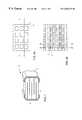
- FIG. 1depicts a diagram of a laminated multilayer sensor according to the invention
- FIG. 2depicts the process of terminating and cutting a laminated stack to produce the sensor shown in FIG. 1;
- FIG. 3is a circuit diagram illustrating the use of the sensor depicted in FIG. 1;
- FIG. 4shows an illustrative electrode pattern for the sensors of the invention
- FIG. 5is a backscatter image of the sensor of Example 1;
- FIG. 6is an SEM micrograph of the sensor of Example 1
- FIG. 7presents the response data of the sensor of Example 1 to 5% hydrogen gas
- FIG. 8presents the response data of the sensor of Example 1 to water vapor.
- the present inventionprovides methods for the synthesis of a chemical composition sensor and a fluid composition sensor. Additionally, a method for the use of a chemical composition sensor to detect the composition of a species of particular interest is disclosed in the presently claimed invention. In another aspect, the present invention provides novel fluid and chemical composition sensors for detecting the presence and composition of liquids, vapors and gases.
- the method for the synthesis of a chemical composition sensor or a fluid composition sensorinvolves selecting a particular species of interest and then selecting a particular material composition that is capable of interacting with the species of interest. If the selected material composition is capable of interacting simultaneously with multiple species of interest, compositions that interact equally with two or more species are preferred for the practice of the invention. In a preferred embodiment, the material compositions interact with one species. In another preferred embodiment, the material composition may interact with up to (n ⁇ 1) species, where n is the number of species. In yet another preferred embodiment, the material composition may interact with all n species on an unequal basis.
- this inventionrequires that the material compositions chosen be physically robust in presence of all species in its environment for a duration equal to or greater than the desired life for the sensor. It is also desirable that more than n such material compositions are identified and used, because, in the event that one element fails, the redundant elements provide the necessary signal for reliable operation of the sensor.
- the interaction of the species with the material composition in this inventionnecessarily requires that the material's properties detectably change when the species and material composition are exposed to each other materially, mechanically, thermally, optically, or electromagnetically, or a combination of these. Any property change which can be reliably detected with a satisfactory signal-to-noise ratio may be used, including physical changes, chemical changes, electrical and electronic changes, magnetic changes, structural changes, optical changes, thermal changes, surface changes, or any combination of these.
- physical interactionsinclude but are not limited to adsorption, absorption, expansion, shrinkage, and phase transformation.
- chemical interactionsinclude but are not limited to reaction with the material, isomerization, dissociation, and polymerization.
- electrical and electronic interactionsinclude but are not limited to changes in dielectric constants, charge transfer, and hole transfer.
- a laminated stack structure 10(FIG. 1 ), preferably multilayer, is formed using the identified sensing material.
- the laminated stackcontains at least one sensing layer 12 , and at least one electrode layer 14 .
- the sensor shown in FIG. 1also comprises electrical terminals 16 , in electrical communication with the electrode layers 14 .
- the sensing layer 12can be formed by any method, including but not limited to spin coating, dip coating, powder pressing, tape casting, screen printing, curtain deposition, physical sputtering, reactive sputtering, physical vapor deposition, chemical vapor deposition, ion beam, e-beam deposition, molecular beam epitaxy, laser deposition, plasma deposition, electrophoretic deposition, magnetophoretic deposition, thermophoretic deposition, stamping, centrifugal casting, gel casting, extrusion, electrochemical deposition, screen-stencil printing, brush painting, or a combination of one or more of the above-mentioned methods.
- the sensing layer thicknesscan be in the range of 1 nm to 10 cm, a preferred thickness being less than 100 microns, an more preferred thickness being less than 10 microns, and a most preferred thickness being less than 1 micron.
- the sensing layercan also be doped with catalysts to further enhance the selectivity of interaction or the kinetics of interaction, or doped with promoters to enhance the ability to detect the changes in properties of the material composition. These secondary treatments of the sensing layer may enhance the performance of the sensing layer.
- compositions of the sensing layerinclude but are not limited to organic, inorganic, metallic, alloy, ceramic, conducting polymer, non-conducting polymer, ion conducting, non-metallic, ceramic-ceramic composite, ceramic-polymer composite, ceramic-metal composite, metal-polymer composite, polymer-polymer composite, metal-metal composite, processed materials including paper and fibers, and natural materials such as mica, bio-organisms, biologically active materials, biologically derived materials, biocomposites, or a combination of one or more of these.
- compositionsinclude but are not limited to doped or undoped, stoichiometric or non-stoichiometric titanium oxide, barium titanate, strontium titanate, zinc oxide, indium oxide, zirconium oxide, tin oxide, antimony oxide, tungsten oxide, molybdenum oxide, tantalum oxide, cerium oxide, rare earth oxides, silicon carbide, bismuth telluride, gallium nitride, silicon, germanium, iron oxide, titanium boride, iron boride, zirconates, aluminates, tungstates, carbides, borates, hydrides, oxides, oxynitrides, oxycarbides, halides, silicates, phosphides, nitrides, chalcogenides, complex oxides such as dielectrics and ferrites, enzymes, nucleotides, antibodies, cells, and polymers.
- the sensing layercan be porous or dense, flat or tapered, uniform or non-uniform, planar or wavy, straight or curved, non-patterned or patterned, micron or sub-micron, grain sized confined or not, or a combination of one or more of these.
- the electrode layer 14may comprise any composition that conducts the signal more easily than the sensing layer, most preferably with a lower impedance than the sensing layer. If the signal is electrical signal, the electrode layer is any composition that conducts electricity more easily than the sensing layer, preferably with a lower impedance than the sensing layer. It is most preferred that the electrode impedance be very low, preferably below 10% of the sensing material layer's impedance. In case properties other than electrical are utilized for sensing, the impedance to the signal should be less in the electrode layer than the sensing layer.
- the composition of the electrode layercan include, but is not limited to, organic materials, inorganic materials, metallic, alloy, ceramic, polymer, non-metallic, ceramic-ceramic composite, ceramic-polymer composite, ceramic-metal composite, metal-polymer composite, polymer-polymer composite, metal-metal composite, or a combination of one or more of these.
- Geometriesmay be porous or dense, flat or tapered, uniform or non-uniform, planar or wavy, straight or curved, non-patterned or patterned, micron or sub-micron, grain size confined or not, or a combination of one or more of these.
- Methods of forming the electrode layerinclude but are not limited to spin coating, dip coating, powder pressing, tape casting, screen printing, curtain deposition, physical sputtering, reactive sputtering, physical vapor deposition, chemical vapor deposition, ion beam, e-beam deposition, molecular beam epitaxy, laser deposition, plasma deposition, electrophoretic deposition, magnetophoretic deposition, thermophoretic deposition, stamping, centrifugal casting, gel casting, extrusion, electrochemical deposition, screen and stencil printing, brush painting, or a combination of one or more of such methods.
- the senoris comprised of laminated layers of sensing layers 12 and electrodes 14 .
- the sensormay just have one layer or multiple layers, the preferred embodiment being multiple layers.
- the individual sensing layers or electrodescan be the same or different formulation.
- the sensing layercan be replaced with resistive layers by design to provide heat to the sensor.
- EMIelectromagnetic interference
- one of the layerscan be air or an insulating layer in order to provide thermal isolation to the active layer.
- electrochemical couple layersmay be provided to internally generated electricity and energy needed to satisfactorily operate the sensor.
- the electrode layerscan function as anodes and cathodes.
- the sensormay be a minor part of the multilaminate device and the sensor containing device can have primary function of reliably providing an electrical, thermal, magnetic, electromagnetic, optical, or structural function in an application.
- the sensing layercan also comprise multilaminates of different material formulations.
- the multilayer stack 10has a rectangular shape.
- the stack shapecan also be circular, elliptical or any other shape.
- the edgesmay be rounded or sharp.
- the electrodes in the multilayer stackcan be connected to yield a single sensor element structure or connected selectively to yield a sensor array.
- common electrodes for two or more sensorsmay be used to reduce the external lead costs and crowding.
- the terminationcan similarly be internal or external to satisfy the particular needs of an application.
- FIG. 2 ashows a terminated stack 10 , which is saw cut along lines A—A, B—B, and C—C as shown in FIG. 2 b.
- FIG. 2 cshows the exposed alternating layers at the surfaces of the slices 18 .
- Each sliceis a device which can be used in a circuit shown as FIG. 3 to detect the composition of an analyte in a gas, vapor, liquid or a combination of these.
- the circuit shown in FIG. 3is illustrative; it may be replaced with any suitable circuit that can detect the signal to noise ratio acceptable in a given application.
- the multilayer stackcan be a single element or an array of sensing elements.
- single element sensorsresult after the slicing operation.
- an array element bodyan array of sensor elements result after the slicing operation.
- the exposed cut surfacesprovide the sensing surfaces, while the unexposed surfaces isolate the device.
- the electrodes of the deviceprovide means to connect the sensor to an external circuit and obtain the signal.
- the sensing layers and the electrode layersbe isolated from external environmental damage such as that from thermal, mechanical, chemical, electrical, magnetic, or radiation effects, or a combination of one or more of these.
- This desired protectionmay be achieved by providing a conformal covering over the layers on the unexposed surfaces, such as an polymer conformal protective layer.
- the exposed surfacemay also be isolated from external thermal, mechanical, chemical, electrical, magnetic, or radiation damage by covering with a layer of ceramic or porous rigid material mesh.
- the exposed surfacemay also be covered with a layer that enhances the selectivity of the analyte reaching the sensing surface.
- Such a layercan include, but is not limited to, polymers, metals, zeolites, or porous media, each of which has a higher permeability for the analyte of interest and a lower permeability for other species that are not of interest.
- the exposed surfaceis covered with polyethylene, polypropylene, teflon, polycarbonates, or polyaromatics.
- any covering on the exposed surfacedoes not impede the interaction of the analyte or analytes to be sensed with the active sensing layer by an amount greater than the species that are not of interest. Exceptions to this general rule may be made in certain cases, for example, when it is critical to protect the element from destructive effects of the environment.
- the sliced sensor elementsare also calibrated.
- the calibrationis preferably performed with a gas, vapor or liquid mixture whose composition of one of the desired species is varied.
- the impedance value versus the concentration of the varying speciesis obtained.
- Such calibration datais preferably obtained for all species of interest.
- pattern matching softwaree.g., neural networks
- neural networkscan be utilized to correlate the response of the device to each specific analyte.
- a method for manufacturing a fluid composition sensorinvolves selecting a chemical species of interest, selecting a material composition that selectively interacts with the species of interest, preparing a quantum confined or nanometer cluster form of the selected sensing material, preparing thin monolithic or composite film arrays of quantum confined or nanocluster forms of sensing materials, and finally connecting leads to form the sensor array.
- Electrodesare provided to enable the measurement of impedance changes in the film with composition changes.
- the electrodesare prepared by screen printing, tape casting, spraying, sputtering, chemical vapor deposition, physical vapor deposition, epitaxy, electrochemical deposition, mold stamping, and cutting through a multilayer to expose the electrodes. It is particularly preferred that the electrodes be uniform, without sharp edges, and reproducible between the sensors.
- FIG. 4shows two views of an illustrative electrode pattern. The electrodes 14 in this pattern can be exposed for termination by cutting at lines A-A′ and B-B′.
- a resistive elementin the substrate to heat the sensor to a desirable temperature to facilitate the interaction of the species of interest to the material composition as desired.
- the quantum confined and nanometer cluster form of the materialis formed into thin or thick films preferably using, but not limited to, one of the following manufacturing methods or a combination thereof including masked screen printing, masked tape casting, masked spraying, masked sputtering of nanostructured targets, masked vapor deposition, masked epitaxy, masked electrochemical or electrophoretic deposition of cluster, and masked mold stamping.
- a single manufacturing methodis used to prepare all sensing elements in a sensor. Since the presently claimed invention requires that elements of different material compositions be deposited to detect different species of interest, it is inherent to change the mask and repeat the element forming step.
- the filmis preferably dried and sintered at low temperatures to ensure mechanical robustness.
- low temperaturesis preferred because high temperatures can cause grain growth and consequent loss of surface area and confinement-related properties.
- the sintering temperaturesbe less than 0.75T m , where T m is the melting point of the film's material. If necessary, higher temperatures can be used, however it is then preferred that the sintering time be minimized.
- the leadsare connected to the electrodes.
- a common electrodebe used.
- the common electrodeis one that connects all the sensor elements.
- the second free electrode of each elementis next used to determine the impedance of each element as a function of the sensor element's environment.
- the sensor elementsare calibrated.
- the calibrationis preferably performed with a gas mixture whose composition varies only in one of the desired species.
- the impedance value versus the concentration of the varying speciesis obtained.
- Such calibration datais then obtained for all species of interest.
- pattern matching softwaresuch as neural networks can be employed.
- the novel chemical composition sensors and fluid composition sensors as describedcan be utilized to determine the composition and presence of vapors, gases and liquid analytes.
- the sensor element or arraycan be connected in a circuit to prepare a monitor capable of detecting changes in the property of the sensing layer.
- the sensormay be used as a disposable sensor or as a non-disposable sensor, as a regenerable or non-regenerable sensor, or as a continuous or cumulative sensor.
- the sensor element or sensor element arrayis first exposed to the environment whose composition needs to be measured.
- the sensing mechanismcan be based, for example, on resistance, capacitance, inductance, impedance, phase angle, loss factor, dissipation, breakdown voltage, electrical temperature coefficient of an electrical property, Nernst current, impedance associated with ion conducting, open circuit potential, electrochemical property, electronic property, magnetic property, thermal property, mechanical property, or optical property.
- the impedance valueis obtained and interpreted in light of the calibration data. The interpreted impedance then yields the desired composition information.
- particular sensor designs and sensing layer propertiesare specifically designed to detect particular compositions. Therefore, the choice of particular sensor designs and sensing layer properties may limit the potential use of the sensor elements or arrays.
- Multilayer Pt/ZnO/Pt structures of initial size 0.125′′ ⁇ 0.100′′ ⁇ 0.058′′ (1 ⁇ w ⁇ h) having 12 layers of ZnOwere lapped and polished to expose the active multilayered sensor surface as follows: After mounting the samples on the polishing surface with a crystal bond wax, they were then polished to 600 grit on both sides.
- the final components shown in the backscatter images (FIG. 5)had dimensions of 0.125 ⁇ 0.100 ⁇ 0.029 (1 ⁇ w ⁇ h), and gave a high level of contrast between the 12 active layers and the interlocking electrodes.
- FIG. 6offers a closeup of the interlayer electrode and shows some of the porosity of the samples.
- the grain size in the multilayer structurewas on the order of several microns.
- the deviceswere then mounted on an alumina substrate and leaded with a silver based epoxy for leads.
- the sensorwas tested in air (200 ml/min) and the resistance of the sensor element was measured as a function of changes in air composition.
- the testing of the devicesrevealed that the devices were sensitive to moisture, to temperature, and to reducing gases.
- FIG. 7shows the response of the device to 5% hydrogen gas. There is a decrease in the resistivity of the device on switching to hydrogen and an increase on switching back to air. Some EMI noise is apparent in the data due to the way the meter makes the measurement. Other measurements confirmed that the EMI noise can be eliminated.
- FIG. 8presents the response data.
- the sensitivity of the sensor to water vapor in airwas found to be 15 and the response time was less than 5 seconds.
- the sensorwas also responsive carbon monoxide.
- the sensitivity of the sensor to carbon monoxidewas 0.15 and response time was over a minute.
- the sensorhad no response to methane, which suggests that the sensor is sensitive to certain reducing gases, but not all reducing gases.
- the sensorshowed no response to an oxidizing environment.
- Non-stoichiometric barium strontium titanate (BaSrTiO 3 ) multilayer structures of 1812 EIA standard capacitor size and NPO formulationwere ground on a 40 micron diamond pad exposing the multilayer surface and leaving an interdigital electrode with the sensing material between the fingers of the electrodes. The sensor surfaces were then polished with 9 micron diamond paste. Five different sensors produced in this manner were tested to establish reproducibility of the performance. First each sensor was exposed to 200 ml/min of nitrogen for one minute to establish a base line. Next, the sensor environment was changed to 200 ml/min of analyte containing nitrogen. Finally, the sensor environment was changed back to pure nitrogen. The capacitance of each sensor was measured as a function of gas composition.
- Sensorswere sensitive to hydrogen at temperatures higher than 550° C., demonstrating the device's usefulness for high temperature applications.
- the response timewas about 1 minute and the sensitivity was about 0.45.
- the sensorwas found to exhibit changes in inductance as well (inductive selectivity to hydrogen was about 20.0 at 619° C. and response time was less than 5 seconds). This demonstrates that the sensor's capacitance and inductance are also alternative usable signals for sensor metrology.
- Indium (III) chloride(Aldrich, as received) 100 g was dissolved in 40 ml water with the addition of 70% HNO 3 . Then 12.896 g of 61.55% SnCl 4 solution was added to the InCl 3 solution. Constant agitation was maintained using a magnet stir bar. The indium and tin chloride solution was titrated using 14% NH 3 solution until the pH of the solution turned to around 10. During the titration, the clear solution turned to milk white slurry.
- the slurrywas filtered under vacuum, and washed first with water, then with denatured ethyl alcohol, and finally with cyclohexane. The resulting cake was dried at 100° C. for 3 hours, yielding fine white powders.
- the powders so producedwere ball-milled for 5 hours followed by calcination at 450° C. for 30 minutes, leading to yellow ITO powders. Then ITO powders were characterized with X-ray diffractometer which indicated that the size of the powders were about 13.5 nanometers.
- a discontinuous, interdigitated gold electrodewas screen printed on alumina substrate.
- a single sensing layer laminatewas then deposited as follows: 100 ml 0.1 M pyrrole and 0.5 M KCI solution was first prepared, and dispensed into a vial with 83.3 mg of a biospecies—glucose oxidase (Sigma, G6766). Then 300 1 pyrrole-biospecies solution was pipetted and galvanized under 1.0 A for 2 minutes with Ag/AgCl as reference electrode, platinum as counter electrode, and interdigtated gold electrodes prepared above as working electrodes. A thin layer of polypyrrole film was formed onto the interdigitated gold electrodes under galvanization, and biospecies were grafted on the polypyrrole nanocomposite film.
- the prototype nanocomposite sensorswere tested with 2000 ppm trichloroethylene (TCE) in zero-grade synthetic air.
- the gas flow ratewas controlled with Mass Flow Controller at 200 ml/minute, and the sensor testing temperature was kept at room temperature (22° C. ⁇ 23° C.).
- the resistance spectrawere recorded with Quicklog interface and software from Omega Engineering, Inc. The results show that the sensors had good sensitivity for dichloromethane and trichloroethylene.
- the sensitivity (R a ⁇ R s )/R a )was 0.15 for dichloromethane and 0.10 for trichloroethylene.
- the response timewas less than 10 seconds.
- Tin Oxide (SnO 2 ) nanopowders with a specific surface area of 56.1 m 2 /gwere mixed in a solution of 0.005 g/ml of poly(ethylene glycol) binder dissolved in isopropanol and the mixture was sonicated for 20 minutes, producing a thick slurry.
- the prepared slurrywas deposited onto an alumina substrate with pre-printed electrodes, using spin coating at a rotation speed of about 1000 rpm. Each spin coating process yielded a single laminate thin film nanocomposite sensor.
- Table 1shows a summary of the sensitivities and response times for sets of deposited SnO 2 sensors to analytes as room temperature or higher.
- the single laminate sensoris sensitive to explosive stimulant signature.
- the sensitivityincreases with the presence of a catalytic dopant and with a slight increase in device temperature.
- the sensoris also sensitive to cyclohexane, another species that is commonly found with explosive materials, although to a somewhat different level.
- the teachings of this inventioncan help reduce the cost of sensor, reduce the material needed, and reduce waste, while increasing the production rate of sensors and enhancing the efficiency and effectiveness of the sensors.
- This inventioncan be specifically utilized to develop and produce products that sense, react, trigger, or adapt to changes to environment in general, and in the chemical composition of a fluid in particular.
- the inventioncan be generically applied to develop and produce products that sense, react, trigger, or adapt to changes in the environment such as changes in the thermal state, mechanical state, magnetic state, electromagnetic state, ionic state, optical state, photonic state, chromatic state, electronic state, biological state, or nuclear state, or a combination of two or more of these.
- the sensing layersare prepared from thermally sensitive material compositions, rapid response thermal sensors can be produced.
- piezoelectric compositionsare used in the sensing layer in a multilaminate stack, vibration and acceleration sensors can be produced.
- magnetic compositionscan yield rapid response magnetic sensors and magnetoresistive sensors.
- the interlayerinstead is prepared from compositions that interact with photons, novel chromatic, luminescent, photodetectors and photoelectric devices may be produced. With compositions interacting with nuclear radiation, sensors for detecting nuclear radiation may be produced.
- biomedical sensorsWith biologically active interlayers, biomedical sensors may be produced. With insulating interlayers, these device may be thermally isolated or made safe and reliable.
- the interlayerscan be mixed, as discussed before, to provide multifunctional devices and products.
- the sensing layersmay be cut or left intact for specific applications.
- the sensing layermay be just one layer or a multitude of as many layers as cost-effectively desirable for the application.
- the electrodemay also be one layer or a multitude of as many layers as cost-effective and necessary for the application.
- These sensorshave performance characteristics desired in chemical, metallurgical, environmental, geological, petroleum, glass, ceramic, materials, semiconductor, telecommunications, electronics, electrical, automobile, aerospace and biomedical applications. Such sensors can be combined with metrology techniques and transducers to produce “smart” products and products that adapt and learn from their environments.
Landscapes
- Chemical & Material Sciences (AREA)
- Engineering & Computer Science (AREA)
- Nanotechnology (AREA)
- Health & Medical Sciences (AREA)
- Life Sciences & Earth Sciences (AREA)
- General Health & Medical Sciences (AREA)
- Physics & Mathematics (AREA)
- General Physics & Mathematics (AREA)
- Crystallography & Structural Chemistry (AREA)
- Analytical Chemistry (AREA)
- Biochemistry (AREA)
- Pathology (AREA)
- Immunology (AREA)
- Medicinal Chemistry (AREA)
- Condensed Matter Physics & Semiconductors (AREA)
- Bioinformatics & Cheminformatics (AREA)
- Composite Materials (AREA)
- Food Science & Technology (AREA)
- Materials Engineering (AREA)
- Chemical Kinetics & Catalysis (AREA)
- Electrochemistry (AREA)
- Combustion & Propulsion (AREA)
- Biophysics (AREA)
- Biotechnology (AREA)
- General Engineering & Computer Science (AREA)
- Medical Informatics (AREA)
- Molecular Biology (AREA)
- Pharmacology & Pharmacy (AREA)
- Investigating Or Analyzing Materials By The Use Of Fluid Adsorption Or Reactions (AREA)
Abstract
Description
| TABLE 1 |
| Sensor response to (3 ppm) analyte in 200 ml/minute |
| Response | ||||
| Sensitivity | Time | |||
| Sensing Material | Analyte | Temp. (C°) | (Rair-Rg)/Rg | (seconds) |
| Nanocomposite | Explosive | 21 | 26% | 65 |
| Nanocomposite + | Explosive | 21 | 40% | 40 |
| Catalyst | ||||
| Nanocomposite + | Explosive | 30 | 213% | 25 |
| Catalyst | ||||
| Nanocomposite + | Cyclohexane | 21 | 44% | 30 |
| Catalyst | ||||
Claims (12)
Priority Applications (16)
| Application Number | Priority Date | Filing Date | Title |
|---|---|---|---|
| US09/074,534US6202471B1 (en) | 1997-10-10 | 1998-05-07 | Low-cost multilaminate sensors |
| PCT/US1998/015821WO1999006825A1 (en) | 1997-07-31 | 1998-07-30 | Low-cost multilaminate sensors |
| US09/753,806US6513362B1 (en) | 1997-10-10 | 2001-01-03 | Low-cost multi-laminate sensors |
| US10/001,423US6813931B2 (en) | 1997-10-10 | 2001-12-03 | Nanocomposite devices and related nanotechnology |
| US10/144,013US6737463B2 (en) | 1996-09-03 | 2002-05-10 | Nanomaterials and magnetic media with coated nanostructured fillers and carriers |
| US10/424,395US7388042B2 (en) | 1996-09-03 | 2003-04-28 | Nanotechnology for biomedical implants |
| US10/426,414US7183337B1 (en) | 1996-09-03 | 2003-04-30 | Optically clear nanocomposites and products using nanoscale fillers |
| US10/435,287US7238734B2 (en) | 1996-09-03 | 2003-05-09 | Optical filters from nanocomposites |
| US10/434,828US7250454B2 (en) | 1996-09-03 | 2003-05-09 | Conductive nanocomposite films |
| US10/441,683US20030212179A1 (en) | 1996-09-03 | 2003-05-20 | Ink nanotechnology |
| US10/441,501US7387673B2 (en) | 1996-09-03 | 2003-05-20 | Color pigment nanotechnology |
| US10/449,278US6830822B2 (en) | 1996-09-03 | 2003-05-30 | Inorganic colors and related nanotechnology |
| US10/455,874US6849109B2 (en) | 1996-09-03 | 2003-06-06 | Inorganic dopants, inks and related nanotechnology |
| US10/679,611US20040139888A1 (en) | 1996-09-03 | 2003-10-06 | Printing inks and reagents for nanoelectronics and consumer products |
| US10/698,577US7559494B1 (en) | 1996-09-03 | 2003-10-31 | Method of forming non-stoichiometric nanoscale powder comprising temperature-processing of a stoichiometric metal compound |
| US11/812,550US7713350B2 (en) | 1996-09-03 | 2007-06-20 | Inorganic colors and related nanotechnology |
Applications Claiming Priority (3)
| Application Number | Priority Date | Filing Date | Title |
|---|---|---|---|
| US6171897P | 1997-10-10 | 1997-10-10 | |
| US6812197P | 1997-12-19 | 1997-12-19 | |
| US09/074,534US6202471B1 (en) | 1997-10-10 | 1998-05-07 | Low-cost multilaminate sensors |
Related Parent Applications (1)
| Application Number | Title | Priority Date | Filing Date |
|---|---|---|---|
| US08/739,257Continuation-In-PartUS5905000A (en) | 1996-09-03 | 1996-10-30 | Nanostructured ion conducting solid electrolytes |
Related Child Applications (2)
| Application Number | Title | Priority Date | Filing Date |
|---|---|---|---|
| US09/083,893DivisionUS6228904B1 (en) | 1996-09-03 | 1998-05-22 | Nanostructured fillers and carriers |
| US09/753,806DivisionUS6513362B1 (en) | 1996-09-03 | 2001-01-03 | Low-cost multi-laminate sensors |
Publications (1)
| Publication Number | Publication Date |
|---|---|
| US6202471B1true US6202471B1 (en) | 2001-03-20 |
Family
ID=27370113
Family Applications (3)
| Application Number | Title | Priority Date | Filing Date |
|---|---|---|---|
| US09/074,534Expired - LifetimeUS6202471B1 (en) | 1996-09-03 | 1998-05-07 | Low-cost multilaminate sensors |
| US09/753,806Expired - LifetimeUS6513362B1 (en) | 1996-09-03 | 2001-01-03 | Low-cost multi-laminate sensors |
| US10/001,423Expired - LifetimeUS6813931B2 (en) | 1997-10-10 | 2001-12-03 | Nanocomposite devices and related nanotechnology |
Family Applications After (2)
| Application Number | Title | Priority Date | Filing Date |
|---|---|---|---|
| US09/753,806Expired - LifetimeUS6513362B1 (en) | 1996-09-03 | 2001-01-03 | Low-cost multi-laminate sensors |
| US10/001,423Expired - LifetimeUS6813931B2 (en) | 1997-10-10 | 2001-12-03 | Nanocomposite devices and related nanotechnology |
Country Status (1)
| Country | Link |
|---|---|
| US (3) | US6202471B1 (en) |
Cited By (40)
| Publication number | Priority date | Publication date | Assignee | Title |
|---|---|---|---|---|
| US6513364B1 (en)* | 1998-04-30 | 2003-02-04 | Siemens Aktiengesellschaft | Hydrogen sensor |
| US6514453B2 (en)* | 1997-10-21 | 2003-02-04 | Nanoproducts Corporation | Thermal sensors prepared from nanostructureed powders |
| US6537498B1 (en)* | 1995-03-27 | 2003-03-25 | California Institute Of Technology | Colloidal particles used in sensing arrays |
| US20030159927A1 (en)* | 1995-03-27 | 2003-08-28 | California Institute Of Technology | Colloidal particles used in sensing arrays |
| US6653842B2 (en) | 2001-07-10 | 2003-11-25 | Digital Concepts Of Missouri | Galvanic probes as pH and oxidation reduction potential sensors, control devices employing such probes, and related methods |
| EP1406085A1 (en)* | 2002-10-01 | 2004-04-07 | Metrohm Ag | Electrode, electrode element, methods of their fabrication and use of said electrode |
| US6773926B1 (en) | 2000-09-25 | 2004-08-10 | California Institute Of Technology | Nanoparticle-based sensors for detecting analytes in fluids |
| US20040155751A1 (en)* | 2001-07-18 | 2004-08-12 | Hubert Benzel | Semicoductor component and a method for producing the same |
| US20050126438A1 (en)* | 2002-05-05 | 2005-06-16 | Olaf Binkle | Production of ceramic, glass ceramic and other mineral materials and composite materials |
| US20050156155A1 (en)* | 2000-08-08 | 2005-07-21 | Atanackovic Petar B. | Rare earth-oxides, rare earth-nitrides, rare earth-phosphides and ternary alloys with silicon |
| US20050241935A1 (en)* | 1998-06-09 | 2005-11-03 | California Institute Of Technology | Colloidal particles used in sensing array |
| US6985082B1 (en)* | 2001-07-12 | 2006-01-10 | The Ohio State University Reasearch Foundation | Carbon monoxide sensor and method of use |
| US7011737B2 (en) | 2004-04-02 | 2006-03-14 | The Penn State Research Foundation | Titania nanotube arrays for use as sensors and method of producing |
| US20080209982A1 (en)* | 2007-03-01 | 2008-09-04 | Dutta Prabir K | Robust high temperature composite and co sensor made from such composite |
| WO2009023643A1 (en)* | 2007-08-13 | 2009-02-19 | Smart Nanomaterials, Llc | Nano-enhanced modularly constructed composite panel |
| US20090058431A1 (en)* | 2007-08-29 | 2009-03-05 | Applied Nanotech Holdings, Inc. | Etch resistant gas sensor |
| US20090090170A1 (en)* | 2007-08-29 | 2009-04-09 | Applied Nanotech Holdings, Inc. | Etch resistant gas sensor |
| US20090090626A1 (en)* | 2006-10-12 | 2009-04-09 | Holt Christopher T | Hydrogen sensitive composite material, hydrogen gas sensor, and sensor for detecting hydrogen and other gases with improved baseline resistance |
| US20090207413A1 (en)* | 2006-03-23 | 2009-08-20 | The Research Foundation Of State University Of New York | Optical methods and systems for detecting a constituent in a gas containing oxygen in harsh environments |
| US20090298191A1 (en)* | 2006-10-18 | 2009-12-03 | President And Fellows Of Harvard College | Lateral Flow and Flow-through Bioassay Devices Based On Patterned Porous Media, Methods of Making Same, and Methods of Using Same |
| US20100184901A1 (en)* | 2009-01-20 | 2010-07-22 | Ppg Industries Ohio, Inc. | Transparent, colorless infrared radiation absorbing compositions comprising nanoparticles |
| US20110105360A1 (en)* | 2008-03-27 | 2011-05-05 | President And Fellows Of Harvard College | Paper-based cellular arrays |
| US20110111517A1 (en)* | 2008-03-27 | 2011-05-12 | President And Fellows Of Harvard College | Paper-based microfluidic systems |
| US20110189786A1 (en)* | 2008-03-27 | 2011-08-04 | President And Fellows Of Harvard College | Cotton thread as a low-cost multi-assay diagnostic platform |
| JP2012078130A (en)* | 2010-09-30 | 2012-04-19 | Denso Corp | Particulate substance detection sensor and manufacturing method thereof |
| US8394330B1 (en)* | 1998-10-02 | 2013-03-12 | The California Institute Of Technology | Conductive organic sensors, arrays and methods of use |
| EP2629086A1 (en)* | 2012-02-14 | 2013-08-21 | Honeywell Romania SRL | Molecule sensing and identification |
| JP2013231627A (en)* | 2012-04-27 | 2013-11-14 | Nippon Soken Inc | Particle matter detection element, manufacturing method thereof, and particle matter detection sensor |
| US8628729B2 (en) | 2008-03-27 | 2014-01-14 | President And Fellows Of Harvard College | Three-dimensional microfluidic devices |
| US20140041464A1 (en)* | 2011-03-24 | 2014-02-13 | Expantech Co., Ltd. | Sensor having an embedded electrode, and method for manufacturing same |
| US20140238731A1 (en)* | 2013-02-25 | 2014-08-28 | 3M Innovative Properties Company | Film constructions for interdigitated electrodes with bus bars and methods of making same |
| US8821810B2 (en) | 2010-02-03 | 2014-09-02 | President And Fellows Of Harvard College | Devices and methods for multiplexed assays |
| US9018060B2 (en) | 2010-06-15 | 2015-04-28 | 3M Innovative Properties Company | Variable capacitance sensors and methods of making the same |
| CN104792829A (en)* | 2014-04-07 | 2015-07-22 | 英诺晶片科技股份有限公司 | Sensor device |
| US9192933B2 (en) | 2009-03-06 | 2015-11-24 | President And Fellows Of Harvard College | Microfluidic, electrochemical devices |
| US9354231B1 (en)* | 2011-07-25 | 2016-05-31 | Leidos, Inc. | Reactive self-indicating absorbent materials, methods, and systems |
| US9987658B1 (en) | 2017-03-29 | 2018-06-05 | The United States Of America As Represented By The Aministrator Of The National Aeronautics And Space Administration | Method of manufacturing a humidity sensing material |
| JP2018179995A (en)* | 2017-04-20 | 2018-11-15 | 戸田建設株式会社 | Sheet-like sensor |
| US10325724B2 (en) | 2017-03-29 | 2019-06-18 | The United States Of America As Represented By The Administrator Of Nasa | Energy storage system using rare earth and hydroxyl co-doped ceramic in humid-environment |
| US20200206819A1 (en)* | 2018-12-31 | 2020-07-02 | Tata Consultancy Services Limited | Synthesis of nano particles |
Families Citing this family (111)
| Publication number | Priority date | Publication date | Assignee | Title |
|---|---|---|---|---|
| US6895805B2 (en)* | 2000-12-05 | 2005-05-24 | William Hoagland | Hydrogen gas indicator system |
| US7229600B2 (en)* | 2003-01-31 | 2007-06-12 | Nanoproducts Corporation | Nanoparticles of rare earth oxides |
| JP4519423B2 (en)* | 2003-05-30 | 2010-08-04 | 創世理工株式会社 | Optical devices using semiconductors |
| EP1698215A4 (en)* | 2003-12-05 | 2009-06-24 | Commw Of Australia | METHOD FOR PRODUCING AN ELECTRICAL COMPONENT |
| JP4885863B2 (en) | 2004-10-08 | 2012-02-29 | エスディーシー マテリアルズ インコーポレイテッド | Extraction apparatus, separation apparatus and extraction method |
| KR100650319B1 (en)* | 2004-11-03 | 2006-11-27 | 신유선 | Formation method of multilayer ceramic chip and multilayer ceramic capacitor |
| US7171841B2 (en)* | 2004-12-01 | 2007-02-06 | Uchicago Argonne, Llc | Ultrafast and ultrasensitive hydrogen sensors based on self-assembly monolayer promoted 2-dimensional palladium nanoclusters |
| US7428137B2 (en)* | 2004-12-03 | 2008-09-23 | Dowgiallo Jr Edward J | High performance capacitor with high dielectric constant material |
| JP4603370B2 (en)* | 2005-01-18 | 2010-12-22 | 創世理工株式会社 | Semiconductor optical device fabricated on substrate and fabrication method thereof |
| JP5089020B2 (en)* | 2005-01-19 | 2012-12-05 | 創世理工株式会社 | Semiconductor electronic devices fabricated on a substrate |
| WO2007030156A2 (en)* | 2005-04-27 | 2007-03-15 | The Regents Of The University Of California | Semiconductor materials matrix for neutron detection |
| US7722966B1 (en) | 2005-05-11 | 2010-05-25 | Alliance For Sustainable Energy, Llc | Nano-composite materials |
| EP2477230B1 (en) | 2005-08-12 | 2015-02-25 | Cambrios Technologies Corporation | Nanowires-based transparent conductors on a flexible donor substrate |
| US7918977B2 (en)* | 2005-11-08 | 2011-04-05 | Synkera Technologies, Inc. | Solid state electrochemical gas sensor and method for fabricating same |
| US7846496B2 (en)* | 2006-03-10 | 2010-12-07 | Uop Llc | Mixed matrix membranes incorporating surface-functionalized molecular sieve nanoparticles and methods for making the same |
| US8177260B2 (en) | 2006-09-26 | 2012-05-15 | Switch2Health Inc. | Coupon redeemable upon completion of a predetermined threshold of physical activity |
| US8924248B2 (en) | 2006-09-26 | 2014-12-30 | Fitbit, Inc. | System and method for activating a device based on a record of physical activity |
| US8018568B2 (en) | 2006-10-12 | 2011-09-13 | Cambrios Technologies Corporation | Nanowire-based transparent conductors and applications thereof |
| EP2082436B1 (en) | 2006-10-12 | 2019-08-28 | Cambrios Film Solutions Corporation | Nanowire-based transparent conductors and method of making them |
| DE102007013522A1 (en)* | 2007-03-21 | 2008-09-25 | Robert Bosch Gmbh | Sensor element of a gas sensor |
| TWI556456B (en) | 2007-04-20 | 2016-11-01 | 坎畢歐科技公司 | Composite transparent conductor and method of forming same |
| WO2008137429A1 (en)* | 2007-05-01 | 2008-11-13 | Romny Scientific, Inc. | Method for forming thermoelectric device from particulate raw materials |
| US8945219B1 (en) | 2007-05-11 | 2015-02-03 | SDCmaterials, Inc. | System for and method of introducing additives to biological materials using supercritical fluids |
| US8481449B1 (en) | 2007-10-15 | 2013-07-09 | SDCmaterials, Inc. | Method and system for forming plug and play oxide catalysts |
| US8344438B2 (en)* | 2008-01-31 | 2013-01-01 | Qimonda Ag | Electrode of an integrated circuit |
| USD627900S1 (en) | 2008-05-07 | 2010-11-23 | SDCmaterials, Inc. | Glove box |
| US8501269B2 (en)* | 2008-10-16 | 2013-08-06 | Apollo, Inc. | Sensitive materials for gas sensing and method of making same |
| US8344526B2 (en)* | 2009-03-25 | 2013-01-01 | Bhat Nikhil | Energy generating supports |
| US20110032103A1 (en)* | 2009-08-07 | 2011-02-10 | Bhat Nikhil | Motion detection system |
| WO2011041507A1 (en)* | 2009-10-01 | 2011-04-07 | Board Of Supervisors Of Louisiana State University And Agricultural And Mechanical College | Apparatus and method for nanocomposite sensors |
| US8803025B2 (en) | 2009-12-15 | 2014-08-12 | SDCmaterials, Inc. | Non-plugging D.C. plasma gun |
| US9149797B2 (en) | 2009-12-15 | 2015-10-06 | SDCmaterials, Inc. | Catalyst production method and system |
| US9126191B2 (en) | 2009-12-15 | 2015-09-08 | SDCmaterials, Inc. | Advanced catalysts for automotive applications |
| US9039916B1 (en) | 2009-12-15 | 2015-05-26 | SDCmaterials, Inc. | In situ oxide removal, dispersal and drying for copper copper-oxide |
| US8545652B1 (en) | 2009-12-15 | 2013-10-01 | SDCmaterials, Inc. | Impact resistant material |
| US8652992B2 (en) | 2009-12-15 | 2014-02-18 | SDCmaterials, Inc. | Pinning and affixing nano-active material |
| US8470112B1 (en) | 2009-12-15 | 2013-06-25 | SDCmaterials, Inc. | Workflow for novel composite materials |
| US8557727B2 (en) | 2009-12-15 | 2013-10-15 | SDCmaterials, Inc. | Method of forming a catalyst with inhibited mobility of nano-active material |
| WO2011097470A2 (en) | 2010-02-05 | 2011-08-11 | Cambrios Technologies Corporation | Photosensitive ink compositions and transparent conductors and method of using the same |
| DE102010027070A1 (en)* | 2010-07-13 | 2012-01-19 | Eberhard-Karls-Universität Tübingen | Gas sensor and method for its production |
| US8781791B2 (en) | 2010-09-30 | 2014-07-15 | Fitbit, Inc. | Touchscreen with dynamically-defined areas having different scanning modes |
| US8762101B2 (en) | 2010-09-30 | 2014-06-24 | Fitbit, Inc. | Methods and systems for identification of event data having combined activity and location information of portable monitoring devices |
| US8954290B2 (en) | 2010-09-30 | 2015-02-10 | Fitbit, Inc. | Motion-activated display of messages on an activity monitoring device |
| US8694282B2 (en) | 2010-09-30 | 2014-04-08 | Fitbit, Inc. | Methods and systems for geo-location optimized tracking and updating for events having combined activity and location information |
| US8738321B2 (en) | 2010-09-30 | 2014-05-27 | Fitbit, Inc. | Methods and systems for classification of geographic locations for tracked activity |
| US8615377B1 (en) | 2010-09-30 | 2013-12-24 | Fitbit, Inc. | Methods and systems for processing social interactive data and sharing of tracked activity associated with locations |
| US9148483B1 (en) | 2010-09-30 | 2015-09-29 | Fitbit, Inc. | Tracking user physical activity with multiple devices |
| US8744803B2 (en) | 2010-09-30 | 2014-06-03 | Fitbit, Inc. | Methods, systems and devices for activity tracking device data synchronization with computing devices |
| US8805646B2 (en) | 2010-09-30 | 2014-08-12 | Fitbit, Inc. | Methods, systems and devices for linking user devices to activity tracking devices |
| US8768648B2 (en) | 2010-09-30 | 2014-07-01 | Fitbit, Inc. | Selection of display power mode based on sensor data |
| US8812259B2 (en) | 2010-09-30 | 2014-08-19 | Fitbit, Inc. | Alarm setting and interfacing with gesture contact interfacing controls |
| US11243093B2 (en) | 2010-09-30 | 2022-02-08 | Fitbit, Inc. | Methods, systems and devices for generating real-time activity data updates to display devices |
| US9310909B2 (en) | 2010-09-30 | 2016-04-12 | Fitbit, Inc. | Methods, systems and devices for physical contact activated display and navigation |
| US8744804B2 (en) | 2010-09-30 | 2014-06-03 | Fitbit, Inc. | Methods, systems and devices for automatic linking of activity tracking devices to user devices |
| US8849610B2 (en) | 2010-09-30 | 2014-09-30 | Fitbit, Inc. | Tracking user physical activity with multiple devices |
| US10983945B2 (en) | 2010-09-30 | 2021-04-20 | Fitbit, Inc. | Method of data synthesis |
| US8751194B2 (en) | 2010-09-30 | 2014-06-10 | Fitbit, Inc. | Power consumption management of display in portable device based on prediction of user input |
| US9241635B2 (en) | 2010-09-30 | 2016-01-26 | Fitbit, Inc. | Portable monitoring devices for processing applications and processing analysis of physiological conditions of a user associated with the portable monitoring device |
| US8954291B2 (en) | 2010-09-30 | 2015-02-10 | Fitbit, Inc. | Alarm setting and interfacing with gesture contact interfacing controls |
| US8762102B2 (en) | 2010-09-30 | 2014-06-24 | Fitbit, Inc. | Methods and systems for generation and rendering interactive events having combined activity and location information |
| US8712724B2 (en) | 2010-09-30 | 2014-04-29 | Fitbit, Inc. | Calendar integration methods and systems for presentation of events having combined activity and location information |
| US8775120B2 (en) | 2010-09-30 | 2014-07-08 | Fitbit, Inc. | Method of data synthesis |
| US8738323B2 (en) | 2010-09-30 | 2014-05-27 | Fitbit, Inc. | Methods and systems for metrics analysis and interactive rendering, including events having combined activity and location information |
| US10004406B2 (en) | 2010-09-30 | 2018-06-26 | Fitbit, Inc. | Portable monitoring devices for processing applications and processing analysis of physiological conditions of a user associated with the portable monitoring device |
| US9188460B2 (en) | 2010-09-30 | 2015-11-17 | Fitbit, Inc. | Methods, systems and devices for generating real-time activity data updates to display devices |
| US9390427B2 (en) | 2010-09-30 | 2016-07-12 | Fitbit, Inc. | Methods, systems and devices for automatic linking of activity tracking devices to user devices |
| US8620617B2 (en) | 2010-09-30 | 2013-12-31 | Fitbit, Inc. | Methods and systems for interactive goal setting and recommender using events having combined activity and location information |
| US9253168B2 (en) | 2012-04-26 | 2016-02-02 | Fitbit, Inc. | Secure pairing of devices via pairing facilitator-intermediary device |
| US9784708B2 (en) | 2010-11-24 | 2017-10-10 | Spec Sensors, Llc | Printed gas sensor |
| US8669202B2 (en) | 2011-02-23 | 2014-03-11 | SDCmaterials, Inc. | Wet chemical and plasma methods of forming stable PtPd catalysts |
| US8738925B1 (en) | 2013-01-07 | 2014-05-27 | Fitbit, Inc. | Wireless portable biometric device syncing |
| AU2012299065B2 (en) | 2011-08-19 | 2015-06-04 | SDCmaterials, Inc. | Coated substrates for use in catalysis and catalytic converters and methods of coating substrates with washcoat compositions |
| US9641239B2 (en) | 2012-06-22 | 2017-05-02 | Fitbit, Inc. | Adaptive data transfer using bluetooth |
| US9156025B2 (en) | 2012-11-21 | 2015-10-13 | SDCmaterials, Inc. | Three-way catalytic converter using nanoparticles |
| US9511352B2 (en) | 2012-11-21 | 2016-12-06 | SDCmaterials, Inc. | Three-way catalytic converter using nanoparticles |
| US9728059B2 (en) | 2013-01-15 | 2017-08-08 | Fitbit, Inc. | Sedentary period detection utilizing a wearable electronic device |
| US8827906B2 (en) | 2013-01-15 | 2014-09-09 | Fitbit, Inc. | Methods, systems and devices for measuring fingertip heart rate |
| US9039614B2 (en) | 2013-01-15 | 2015-05-26 | Fitbit, Inc. | Methods, systems and devices for measuring fingertip heart rate |
| CN105592921A (en) | 2013-07-25 | 2016-05-18 | Sdc材料公司 | Washcoats and coated substrates for catalytic converters and method for manufacturing and using same |
| GB2517701A (en)* | 2013-08-28 | 2015-03-04 | Nokia Technologies Oy | Sensing |
| EP3060335A4 (en) | 2013-10-22 | 2017-07-19 | SDCMaterials, Inc. | Catalyst design for heavy-duty diesel combustion engines |
| WO2015061482A1 (en) | 2013-10-22 | 2015-04-30 | SDCmaterials, Inc. | Compositions of lean nox trap |
| US9031812B2 (en) | 2014-02-27 | 2015-05-12 | Fitbit, Inc. | Notifications on a user device based on activity detected by an activity monitoring device |
| US11990019B2 (en) | 2014-02-27 | 2024-05-21 | Fitbit, Inc. | Notifications on a user device based on activity detected by an activity monitoring device |
| US9687811B2 (en) | 2014-03-21 | 2017-06-27 | SDCmaterials, Inc. | Compositions for passive NOx adsorption (PNA) systems and methods of making and using same |
| US9449365B2 (en) | 2014-04-11 | 2016-09-20 | Fitbit, Inc. | Personalized scaling of graphical indicators |
| US9449409B2 (en) | 2014-04-11 | 2016-09-20 | Fitbit, Inc. | Graphical indicators in analog clock format |
| US9344546B2 (en) | 2014-05-06 | 2016-05-17 | Fitbit, Inc. | Fitness activity related messaging |
| WO2016040771A1 (en) | 2014-09-12 | 2016-03-17 | Spec Sensors, Llc | Breath sampling devices and methods of breath sampling using sensors |
| US10241073B2 (en) | 2015-05-26 | 2019-03-26 | Spec Sensors Llc | Wireless near-field gas sensor system and methods of manufacturing the same |
| KR102713216B1 (en) | 2015-06-25 | 2024-10-02 | 로스웰 엠이 아이엔씨. | Biomolecular sensors and methods |
| WO2017132567A1 (en) | 2016-01-28 | 2017-08-03 | Roswell Biotechnologies, Inc. | Massively parallel dna sequencing apparatus |
| CN109071212A (en) | 2016-01-28 | 2018-12-21 | 罗斯韦尔生物技术股份有限公司 | Use the method and apparatus of large-scale molecular electronic sensor array measurement analyte |
| JP6854532B2 (en) | 2016-02-09 | 2021-04-07 | ロズウェル バイオテクノロジーズ,インコーポレイテッド | Electronic, label-free DNA and genome sequencing |
| US10080530B2 (en) | 2016-02-19 | 2018-09-25 | Fitbit, Inc. | Periodic inactivity alerts and achievement messages |
| US10597767B2 (en) | 2016-02-22 | 2020-03-24 | Roswell Biotechnologies, Inc. | Nanoparticle fabrication |
| DE102016105647B4 (en)* | 2016-03-28 | 2021-08-12 | Krohne Messtechnik Gmbh | Guide element for an antenna and method for producing such a guide element |
| US9829456B1 (en)* | 2016-07-26 | 2017-11-28 | Roswell Biotechnologies, Inc. | Method of making a multi-electrode structure usable in molecular sensing devices |
| KR102622275B1 (en) | 2017-01-10 | 2024-01-05 | 로스웰 바이오테크놀로지스 인코포레이티드 | Methods and systems for DNA data storage |
| US11656197B2 (en) | 2017-01-19 | 2023-05-23 | Roswell ME Inc. | Solid state sequencing devices comprising two dimensional layer materials |
| US10508296B2 (en) | 2017-04-25 | 2019-12-17 | Roswell Biotechnologies, Inc. | Enzymatic circuits for molecular sensors |
| KR102692957B1 (en) | 2017-04-25 | 2024-08-06 | 로스웰 엠이 아이엔씨. | Enzyme circuits for molecular sensors |
| CA3057155A1 (en) | 2017-05-09 | 2018-11-15 | Roswell Biotechnologies, Inc. | Binding probe circuits for molecular sensors |
| KR102737316B1 (en) | 2017-08-30 | 2024-12-02 | 로스웰 엠이 아이엔씨. | Progressive Enzyme Molecular Electronic Sensors for DNA Data Storage |
| WO2019075100A1 (en) | 2017-10-10 | 2019-04-18 | Roswell Biotechnologies, Inc. | Methods, apparatus and systems for amplification-free dna data storage |
| CA3088231A1 (en)* | 2018-01-11 | 2019-07-18 | Allerguard Ltd. | System and method of detecting food allergens |
| US11828741B2 (en) | 2018-06-01 | 2023-11-28 | The Johns Hopkins University | Sensor that detects an analyte in the presence of an interfering stimulus |
| US12146852B2 (en) | 2019-09-06 | 2024-11-19 | Roswell Biotechnologies, Inc. | Methods of fabricating nanoscale structures usable in molecular sensors and other devices |
| US20240118237A1 (en)* | 2020-12-08 | 2024-04-11 | The University Of Toledo | Nanocomposite of molybdenum oxide and conductive carbon for formaldehyde gas detection at room temperature |
| LT7025B (en)* | 2021-12-23 | 2023-09-25 | Vmti Fizinių Ir Technologijos Mokslų Centras | Method of manufacturing an electrochemical cell and an electrochemical cell |
| TWI849738B (en)* | 2023-02-13 | 2024-07-21 | 新唐科技股份有限公司 | Sensing device and manufacturing method thereof |
Citations (17)
| Publication number | Priority date | Publication date | Assignee | Title |
|---|---|---|---|---|
| JPS60196659A (en) | 1984-03-21 | 1985-10-05 | Hitachi Ltd | Resistance measurement electrode for sensor |
| US4631952A (en) | 1985-08-30 | 1986-12-30 | Chevron Research Company | Resistive hydrocarbon leak detector |
| US4984446A (en) | 1988-05-27 | 1991-01-15 | Ricoh Company, Ltd. | Gas detecting device and gas detecting system using the same |
| US4988539A (en) | 1988-12-06 | 1991-01-29 | Association Pour La Recherche Et Le Developpment Des Methodes Et Processus Industriels - Armines | Method of manufacturing a gas detection sensor, and the resulting sensor |
| US5252949A (en) | 1991-08-28 | 1993-10-12 | Hughes Aircraft Company | Chemical sensor for carbon monoxide detection |
| US5387462A (en) | 1991-04-05 | 1995-02-07 | Minnesota Mining And Manufacturing Company | Sensors based on nanostructured composite films |
| US5427672A (en) | 1992-07-31 | 1995-06-27 | Hoechst Aktiengesellschaft | Planar sensor made of ceramic material, for detecting combustible gases |
| US5466575A (en) | 1988-11-14 | 1995-11-14 | I-Stat Corporation | Process for the manufacture of wholly microfabricated biosensors |
| US5476003A (en) | 1993-10-05 | 1995-12-19 | Robert Bosch Gmbh | Measuring sensor for determining gas compositions |
| US5486277A (en)* | 1993-09-20 | 1996-01-23 | Regents Of The University Of California | High performance capacitors using nano-structure multilayer materials fabrication |
| US5539965A (en) | 1994-06-22 | 1996-07-30 | Rutgers, The University Of New Jersey | Method for making piezoelectric composites |
| US5548474A (en) | 1994-03-01 | 1996-08-20 | Avx Corporation | Electrical components such as capacitors having electrodes with an insulating edge |
| WO1996029711A1 (en) | 1995-03-22 | 1996-09-26 | Raychem Corporation | Electrical device |
| JPH08261979A (en) | 1995-03-20 | 1996-10-11 | Nippon Telegr & Teleph Corp <Ntt> | Electrode for sensor |
| US5571401A (en) | 1995-03-27 | 1996-11-05 | California Institute Of Technology | Sensor arrays for detecting analytes in fluids |
| US5629474A (en) | 1993-03-30 | 1997-05-13 | Keele University | Production of a sensor for carbon monoxide or water vapor including a semi conductor metallic oxide, catalyst, and rheological agent |
| US5739193A (en)* | 1996-05-07 | 1998-04-14 | Hoechst Celanese Corp. | Polymeric compositions having a temperature-stable dielectric constant |
Family Cites Families (12)
| Publication number | Priority date | Publication date | Assignee | Title |
|---|---|---|---|---|
| US4017820A (en)* | 1975-07-25 | 1977-04-12 | Illinois Tool Works Inc. | Humidity sensor with multiple electrode layers separated by a porous monolithic ceramic dielectric structure |
| LU76937A1 (en)* | 1977-03-11 | 1978-10-18 | ||
| DE3322481A1 (en)* | 1983-06-22 | 1985-01-03 | Siemens AG, 1000 Berlin und 8000 München | THICK-LAYER GAS SENSOR FOR DETECTING AND MEASURING GASEOUS CARBON HYDROGEN IMPURITIES WITH DOUBLE AND TRIPLE BINDINGS, ESPECIALLY ACETYLENE, IN AIR AND A METHOD FOR THE PRODUCTION THEREOF |
| GB8606045D0 (en)* | 1986-03-12 | 1986-04-16 | Emi Plc Thorn | Gas sensitive device |
| US5065140A (en)* | 1991-03-08 | 1991-11-12 | Bell Communications Research, Inc. | Early warning reactive gas detection system |
| US5170226A (en)* | 1991-05-17 | 1992-12-08 | International Business Machines Corporation | Fabrication of quantum devices in compound semiconductor layers and resulting structures |
| EP0645621A3 (en)* | 1993-09-28 | 1995-11-08 | Siemens Ag | Sensor. |
| JPH0826979A (en)* | 1994-07-14 | 1996-01-30 | Tsumura & Co | Immune function activator |
| US5670115A (en)* | 1995-10-16 | 1997-09-23 | General Motors Corporation | Hydrogen sensor |
| US5905000A (en)* | 1996-09-03 | 1999-05-18 | Nanomaterials Research Corporation | Nanostructured ion conducting solid electrolytes |
| US5952040A (en)* | 1996-10-11 | 1999-09-14 | Nanomaterials Research Corporation | Passive electronic components from nano-precision engineered materials |
| EP0851222A1 (en)* | 1996-12-31 | 1998-07-01 | Corning Incorporated | Metal oxide semiconductor catalyst hydrocarbon sensor |
- 1998
- 1998-05-07USUS09/074,534patent/US6202471B1/ennot_activeExpired - Lifetime
- 2001
- 2001-01-03USUS09/753,806patent/US6513362B1/ennot_activeExpired - Lifetime
- 2001-12-03USUS10/001,423patent/US6813931B2/ennot_activeExpired - Lifetime
Patent Citations (17)
| Publication number | Priority date | Publication date | Assignee | Title |
|---|---|---|---|---|
| JPS60196659A (en) | 1984-03-21 | 1985-10-05 | Hitachi Ltd | Resistance measurement electrode for sensor |
| US4631952A (en) | 1985-08-30 | 1986-12-30 | Chevron Research Company | Resistive hydrocarbon leak detector |
| US4984446A (en) | 1988-05-27 | 1991-01-15 | Ricoh Company, Ltd. | Gas detecting device and gas detecting system using the same |
| US5466575A (en) | 1988-11-14 | 1995-11-14 | I-Stat Corporation | Process for the manufacture of wholly microfabricated biosensors |
| US4988539A (en) | 1988-12-06 | 1991-01-29 | Association Pour La Recherche Et Le Developpment Des Methodes Et Processus Industriels - Armines | Method of manufacturing a gas detection sensor, and the resulting sensor |
| US5387462A (en) | 1991-04-05 | 1995-02-07 | Minnesota Mining And Manufacturing Company | Sensors based on nanostructured composite films |
| US5252949A (en) | 1991-08-28 | 1993-10-12 | Hughes Aircraft Company | Chemical sensor for carbon monoxide detection |
| US5427672A (en) | 1992-07-31 | 1995-06-27 | Hoechst Aktiengesellschaft | Planar sensor made of ceramic material, for detecting combustible gases |
| US5629474A (en) | 1993-03-30 | 1997-05-13 | Keele University | Production of a sensor for carbon monoxide or water vapor including a semi conductor metallic oxide, catalyst, and rheological agent |
| US5486277A (en)* | 1993-09-20 | 1996-01-23 | Regents Of The University Of California | High performance capacitors using nano-structure multilayer materials fabrication |
| US5476003A (en) | 1993-10-05 | 1995-12-19 | Robert Bosch Gmbh | Measuring sensor for determining gas compositions |
| US5548474A (en) | 1994-03-01 | 1996-08-20 | Avx Corporation | Electrical components such as capacitors having electrodes with an insulating edge |
| US5539965A (en) | 1994-06-22 | 1996-07-30 | Rutgers, The University Of New Jersey | Method for making piezoelectric composites |
| JPH08261979A (en) | 1995-03-20 | 1996-10-11 | Nippon Telegr & Teleph Corp <Ntt> | Electrode for sensor |
| WO1996029711A1 (en) | 1995-03-22 | 1996-09-26 | Raychem Corporation | Electrical device |
| US5571401A (en) | 1995-03-27 | 1996-11-05 | California Institute Of Technology | Sensor arrays for detecting analytes in fluids |
| US5739193A (en)* | 1996-05-07 | 1998-04-14 | Hoechst Celanese Corp. | Polymeric compositions having a temperature-stable dielectric constant |
Non-Patent Citations (5)
| Title |
|---|
| Edlund et al., "Thin-film polymeric sensors for detection and quantification of multivalent metal ions", Sensors and Actuators B. 10; 185-190, 1993. |
| Gaggiotti et al. "Surface chemistry of tin oxide based gas sensors", Appl. Phys., 76(8);4467-71, Oct. 15, 1994. |
| Gaggiotti et al., "Temperature dependencies of sensitivity and surface chemical composition of SnOxgas sensors", Elsevier Sci., S.A., 516-19, (1995). |
| Phani, A.R., "X-ray photoelectron spectroscopy studies on Pd doped SnO2 liquid petroleum gas sensor", Appl. Phys. Lett., 71(16); 2358-60, Oct. 20, 1997. |
| Serrini "Chemical composition and crystalline structure of SnO2 thin fimls used as gas sensors", Elsevier Sci. S.A., 113-22, 1997 |
Cited By (71)
| Publication number | Priority date | Publication date | Assignee | Title |
|---|---|---|---|---|
| US6537498B1 (en)* | 1995-03-27 | 2003-03-25 | California Institute Of Technology | Colloidal particles used in sensing arrays |
| US20030159927A1 (en)* | 1995-03-27 | 2003-08-28 | California Institute Of Technology | Colloidal particles used in sensing arrays |
| US6514453B2 (en)* | 1997-10-21 | 2003-02-04 | Nanoproducts Corporation | Thermal sensors prepared from nanostructureed powders |
| US6513364B1 (en)* | 1998-04-30 | 2003-02-04 | Siemens Aktiengesellschaft | Hydrogen sensor |
| US20050241935A1 (en)* | 1998-06-09 | 2005-11-03 | California Institute Of Technology | Colloidal particles used in sensing array |
| US7955561B2 (en) | 1998-06-09 | 2011-06-07 | The California Institute Of Technology | Colloidal particles used in sensing array |
| US8394330B1 (en)* | 1998-10-02 | 2013-03-12 | The California Institute Of Technology | Conductive organic sensors, arrays and methods of use |
| US7273657B2 (en)* | 2000-08-08 | 2007-09-25 | Translucent Photonics, Inc. | Rare earth-oxides, rare earth-nitrides, rare earth-phosphides and ternary alloys with silicon |
| US20050156155A1 (en)* | 2000-08-08 | 2005-07-21 | Atanackovic Petar B. | Rare earth-oxides, rare earth-nitrides, rare earth-phosphides and ternary alloys with silicon |
| US6773926B1 (en) | 2000-09-25 | 2004-08-10 | California Institute Of Technology | Nanoparticle-based sensors for detecting analytes in fluids |
| US20040104130A1 (en)* | 2001-07-10 | 2004-06-03 | Mosley Michael David | Galvanic probes as pH and oxidation reduction potential sensors, control devices employing such probes, and related methods |
| US6653842B2 (en) | 2001-07-10 | 2003-11-25 | Digital Concepts Of Missouri | Galvanic probes as pH and oxidation reduction potential sensors, control devices employing such probes, and related methods |
| US6985082B1 (en)* | 2001-07-12 | 2006-01-10 | The Ohio State University Reasearch Foundation | Carbon monoxide sensor and method of use |
| US7193290B2 (en)* | 2001-07-18 | 2007-03-20 | Robert Bosch Gmbh | Semiconductor component and a method for producing the same |
| US20040155751A1 (en)* | 2001-07-18 | 2004-08-12 | Hubert Benzel | Semicoductor component and a method for producing the same |
| US20050126438A1 (en)* | 2002-05-05 | 2005-06-16 | Olaf Binkle | Production of ceramic, glass ceramic and other mineral materials and composite materials |
| US7384470B2 (en) | 2002-05-05 | 2008-06-10 | Itn Nanovation Ag | Production of ceramic, glass ceramic and other mineral materials and composite materials |
| EP1406085A1 (en)* | 2002-10-01 | 2004-04-07 | Metrohm Ag | Electrode, electrode element, methods of their fabrication and use of said electrode |
| US7011737B2 (en) | 2004-04-02 | 2006-03-14 | The Penn State Research Foundation | Titania nanotube arrays for use as sensors and method of producing |
| US20090207413A1 (en)* | 2006-03-23 | 2009-08-20 | The Research Foundation Of State University Of New York | Optical methods and systems for detecting a constituent in a gas containing oxygen in harsh environments |
| US7864322B2 (en) | 2006-03-23 | 2011-01-04 | The Research Foundation Of State University Of New York | Optical methods and systems for detecting a constituent in a gas containing oxygen in harsh environments |
| US9011778B2 (en)* | 2006-10-12 | 2015-04-21 | Nextech Materials, Ltd. | Hydrogen sensitive composite material, hydrogen gas sensor, and sensor for detecting hydrogen and other gases with improved baseline resistance |
| US20090090626A1 (en)* | 2006-10-12 | 2009-04-09 | Holt Christopher T | Hydrogen sensitive composite material, hydrogen gas sensor, and sensor for detecting hydrogen and other gases with improved baseline resistance |
| US10302611B2 (en) | 2006-10-12 | 2019-05-28 | Nexceris Innovation Holdings, Llc | Hydrogen-selective porous composite |
| US20090298191A1 (en)* | 2006-10-18 | 2009-12-03 | President And Fellows Of Harvard College | Lateral Flow and Flow-through Bioassay Devices Based On Patterned Porous Media, Methods of Making Same, and Methods of Using Same |
| US8603832B2 (en) | 2006-10-18 | 2013-12-10 | President And Fellows Of Harvard College | Lateral flow and flow-through bioassay devices based on patterned porous media, methods of making same, and methods of using same |
| US9193988B2 (en) | 2006-10-18 | 2015-11-24 | President And Fellows Of Harvard College | Lateral flow and flow-through bioassay devices based on patterned porous media, methods of making same, and methods of using same |
| US8377710B2 (en) | 2006-10-18 | 2013-02-19 | President And Fellows Of Harvard College | Lateral flow and flow-through bioassay devices based on patterned porous media, methods of making same, and methods of using same |
| US20080209982A1 (en)* | 2007-03-01 | 2008-09-04 | Dutta Prabir K | Robust high temperature composite and co sensor made from such composite |
| US7694547B2 (en)* | 2007-03-01 | 2010-04-13 | The Ohio State University Research Foundation | Robust high temperature composite and CO sensor made from such composite |
| WO2009023643A1 (en)* | 2007-08-13 | 2009-02-19 | Smart Nanomaterials, Llc | Nano-enhanced modularly constructed composite panel |
| US20090058431A1 (en)* | 2007-08-29 | 2009-03-05 | Applied Nanotech Holdings, Inc. | Etch resistant gas sensor |
| US8519446B2 (en)* | 2007-08-29 | 2013-08-27 | Applied Nanotech Holdings, Inc. | Etch resistant gas sensor |
| US20090090170A1 (en)* | 2007-08-29 | 2009-04-09 | Applied Nanotech Holdings, Inc. | Etch resistant gas sensor |
| US8921118B2 (en) | 2008-03-27 | 2014-12-30 | President And Fellows Of Harvard College | Paper-based microfluidic systems |
| US8206992B2 (en) | 2008-03-27 | 2012-06-26 | President And Fellows Of Harvard College | Cotton thread as a low-cost multi-assay diagnostic platform |
| US9829488B2 (en) | 2008-03-27 | 2017-11-28 | President And Fellows Of Havard College | Paper-based cellular arrays |
| US20110105360A1 (en)* | 2008-03-27 | 2011-05-05 | President And Fellows Of Harvard College | Paper-based cellular arrays |
| US20110189786A1 (en)* | 2008-03-27 | 2011-08-04 | President And Fellows Of Harvard College | Cotton thread as a low-cost multi-assay diagnostic platform |
| US20110111517A1 (en)* | 2008-03-27 | 2011-05-12 | President And Fellows Of Harvard College | Paper-based microfluidic systems |
| US8628729B2 (en) | 2008-03-27 | 2014-01-14 | President And Fellows Of Harvard College | Three-dimensional microfluidic devices |
| US20100184901A1 (en)* | 2009-01-20 | 2010-07-22 | Ppg Industries Ohio, Inc. | Transparent, colorless infrared radiation absorbing compositions comprising nanoparticles |
| US8324300B2 (en) | 2009-01-20 | 2012-12-04 | Ppg Industries Ohio, Inc | Transparent, colorless infrared radiation absorbing compositions comprising nanoparticles |
| US9192933B2 (en) | 2009-03-06 | 2015-11-24 | President And Fellows Of Harvard College | Microfluidic, electrochemical devices |
| US8821810B2 (en) | 2010-02-03 | 2014-09-02 | President And Fellows Of Harvard College | Devices and methods for multiplexed assays |
| US9018060B2 (en) | 2010-06-15 | 2015-04-28 | 3M Innovative Properties Company | Variable capacitance sensors and methods of making the same |
| EP2583090B1 (en)* | 2010-06-15 | 2016-04-06 | 3M Innovative Properties Company | Variable capacitance sensors and methods of making the same |
| JP2012078130A (en)* | 2010-09-30 | 2012-04-19 | Denso Corp | Particulate substance detection sensor and manufacturing method thereof |
| US20140041464A1 (en)* | 2011-03-24 | 2014-02-13 | Expantech Co., Ltd. | Sensor having an embedded electrode, and method for manufacturing same |
| US9347806B2 (en)* | 2011-03-24 | 2016-05-24 | Joinset Co., Ltd. | Sensor having an embedded electrode, and method for manufacturing same |
| US10201800B2 (en) | 2011-07-25 | 2019-02-12 | Leidos, Inc. | Reactive self-indicating absorbent materials, methods, and systems |
| US9354231B1 (en)* | 2011-07-25 | 2016-05-31 | Leidos, Inc. | Reactive self-indicating absorbent materials, methods, and systems |
| US9097741B2 (en) | 2012-02-14 | 2015-08-04 | Honeywell International Inc. | Molecule sensing and identification |
| EP2629086A1 (en)* | 2012-02-14 | 2013-08-21 | Honeywell Romania SRL | Molecule sensing and identification |
| JP2013231627A (en)* | 2012-04-27 | 2013-11-14 | Nippon Soken Inc | Particle matter detection element, manufacturing method thereof, and particle matter detection sensor |
| US9119289B2 (en)* | 2013-02-25 | 2015-08-25 | 3M Innovative Properties Company | Film constructions for interdigitated electrodes with bus bars and methods of making same |
| US20140238731A1 (en)* | 2013-02-25 | 2014-08-28 | 3M Innovative Properties Company | Film constructions for interdigitated electrodes with bus bars and methods of making same |
| TWI601164B (en)* | 2013-02-25 | 2017-10-01 | 3M新設資產公司 | Film constructions for interdigitated electrodes with bus bars and methods of making same |
| CN104792829A (en)* | 2014-04-07 | 2015-07-22 | 英诺晶片科技股份有限公司 | Sensor device |
| EP2930500A1 (en)* | 2014-04-07 | 2015-10-14 | Innochips Technology Co., Ltd. | Layered sensor array device |
| WO2018183652A1 (en)* | 2017-03-29 | 2018-10-04 | United States Of America As Represented By The Administrator Of The National Aeronautics And Space Administration | Method of manufacturing a humidity sensing material |
| US9987658B1 (en) | 2017-03-29 | 2018-06-05 | The United States Of America As Represented By The Aministrator Of The National Aeronautics And Space Administration | Method of manufacturing a humidity sensing material |
| US10325724B2 (en) | 2017-03-29 | 2019-06-18 | The United States Of America As Represented By The Administrator Of Nasa | Energy storage system using rare earth and hydroxyl co-doped ceramic in humid-environment |
| US10573465B2 (en) | 2017-03-29 | 2020-02-25 | United States Of America As Represented By The Administrator Of Nasa | Solid dielectric for rechargeable energy storage capacitor |
| US10573464B2 (en) | 2017-03-29 | 2020-02-25 | United States Of America As Represented By The Administrator Of Nasa | Rechargeable energy storage capacitor and system |
| JP2018179995A (en)* | 2017-04-20 | 2018-11-15 | 戸田建設株式会社 | Sheet-like sensor |
| JP2020173261A (en)* | 2017-04-20 | 2020-10-22 | 戸田建設株式会社 | Sheet sensor |
| JP7126083B2 (en) | 2017-04-20 | 2022-08-26 | 戸田建設株式会社 | sheet sensor |
| JP7126086B2 (en) | 2017-04-20 | 2022-08-26 | 戸田建設株式会社 | sheet sensor |
| US20200206819A1 (en)* | 2018-12-31 | 2020-07-02 | Tata Consultancy Services Limited | Synthesis of nano particles |
| US11583924B2 (en)* | 2018-12-31 | 2023-02-21 | Tata Consultancy Services Limited | Synthesis of nano particles |
Also Published As
| Publication number | Publication date |
|---|---|
| US20020184939A1 (en) | 2002-12-12 |
| US6513362B1 (en) | 2003-02-04 |
| US6813931B2 (en) | 2004-11-09 |
Similar Documents
| Publication | Publication Date | Title |
|---|---|---|
| US6202471B1 (en) | Low-cost multilaminate sensors | |
| Joshi et al. | Efficient heterostructures of Ag@ CuO/BaTiO3 for low-temperature CO2 gas detection: assessing the role of nanointerfaces during sensing by operando DRIFTS technique | |
| US7816681B2 (en) | Capacitive gas sensor and method of fabricating the same | |
| US20090148347A1 (en) | Nano-crystalline composite-oxide thin film, environmental gas sensor using the thin film, and method of manufacturing the environmental gas sensor | |
| EP0675355A1 (en) | Sensor element and particle sensor | |
| JP2010139497A (en) | Ultrasensitive gas sensor using oxide semiconductor nano-fiber and method for producing the same | |
| US20070028667A1 (en) | Electronic nose sensor array, sensor system including the same, method of manufacturing the same, and analysis method using the sensor system | |
| KR100735031B1 (en) | Chemical sensor | |
| Qu et al. | Development of multi-functional sensors in thick-film and thin-filmtechnology | |
| CN1272235C (en) | Gas sensor and manufacturing method thereof | |
| US20030057968A1 (en) | Liquid property sensor | |
| JP2011112642A (en) | Environmental gas sensor, and method for manufacturing the same | |
| US6134946A (en) | Nano-crystalline porous tin oxide film for carbon monoxide sensing | |
| EP0751383B1 (en) | Sensor with output correcting function | |
| Kumar et al. | Hydrothermal growth of zinc oxide (ZnO) nanorods (NRs) on screen printed IDEs for pH measurement application | |
| KR101201896B1 (en) | Capacitive Type Gas Sensors and Method for Fabricating the Same | |
| US5273779A (en) | Method of fabricating a gas sensor and the product fabricated thereby | |
| EP3818362B1 (en) | Gas sensor | |
| Gatea | The role of substrate temperature on the performance of humidity sensors manufactured from cerium oxide thin films | |
| EP1616172A1 (en) | A thin semiconductor film gas sensor device | |
| Wilson et al. | Sol-gel materials for gas-sensing applications | |
| WO1999006825A1 (en) | Low-cost multilaminate sensors | |
| KR20220114858A (en) | Porous zinc oxide sheet with metal catalysts formed on the surface and gas sensor using the same | |
| EP2422189A1 (en) | Electrical device | |
| Singh et al. | Selective gas detection of titania nanoparticles via impedance spectroscopy and capacitive measurement |
Legal Events
| Date | Code | Title | Description |
|---|---|---|---|
| AS | Assignment | Owner name:NANOMATERIALS RESEARCH CORPORATION, COLORADO Free format text:ASSIGNMENT OF ASSIGNORS INTEREST;ASSIGNORS:YADAV, TAPESH;KOSTLECKY, CLAYTON;LEIGH, WILLIAM;AND OTHERS;REEL/FRAME:009618/0501;SIGNING DATES FROM 19980502 TO 19980506 | |
| STCF | Information on status: patent grant | Free format text:PATENTED CASE | |
| AS | Assignment | Owner name:NANOENERGY CORPORATION A DELAWARE CORPORATION, COL Free format text:ASSIGNMENT OF ASSIGNORS INTEREST;ASSIGNOR:NANOMATERIALS RESEARCH, LLC;REEL/FRAME:012177/0385 Effective date:20010403 | |
| FPAY | Fee payment | Year of fee payment:4 | |
| AS | Assignment | Owner name:NANOPRODUCTS CORPORATION, COLORADO Free format text:CHANGE OF NAME;ASSIGNOR:NANOENERGY CORPORATION;REEL/FRAME:016547/0085 Effective date:20020208 | |
| FEPP | Fee payment procedure | Free format text:PAT HOLDER NO LONGER CLAIMS SMALL ENTITY STATUS, ENTITY STATUS SET TO UNDISCOUNTED (ORIGINAL EVENT CODE: STOL); ENTITY STATUS OF PATENT OWNER: LARGE ENTITY | |
| AS | Assignment | Owner name:NANOMATERIALS RESEARCH, LLC, COLORADO Free format text:CHANGE OF NAME;ASSIGNOR:NANOMATERIALS RESEARCH CORPORATION;REEL/FRAME:017938/0989 Effective date:20010313 | |
| AS | Assignment | Owner name:KOCH NANOMATERIALS, LLC, BY KOCH GENESIS COMPANY, Free format text:SECURITY AGREEMENT;ASSIGNOR:NANOPRODUCTS CORPORATION;REEL/FRAME:019477/0836 Effective date:20070627 | |
| AS | Assignment | Owner name:NANOPRODUCTS CORPORATION, COLORADO Free format text:RELEASE BY SECURED PARTY;ASSIGNOR:KOCH NANOMATERIALS, LLC, BY KOCH GENESIS COMPANY, LLC;REEL/FRAME:020417/0791 Effective date:20080128 | |
| AS | Assignment | Owner name:PPG INDUSTRIES OHIO, INC., OHIO Free format text:ASSIGNMENT OF ASSIGNORS INTEREST;ASSIGNOR:NANOPRODUCTS CORPORATION;REEL/FRAME:020540/0506 Effective date:20080128 Owner name:PPG INDUSTRIES OHIO, INC.,OHIO Free format text:ASSIGNMENT OF ASSIGNORS INTEREST;ASSIGNOR:NANOPRODUCTS CORPORATION;REEL/FRAME:020540/0506 Effective date:20080128 | |
| FPAY | Fee payment | Year of fee payment:8 | |
| FPAY | Fee payment | Year of fee payment:12 |