US6178121B1 - Semiconductor memory device, semiconductor device, and electronic apparatus using the semiconductor device - Google Patents
Semiconductor memory device, semiconductor device, and electronic apparatus using the semiconductor deviceDownload PDFInfo
- Publication number
- US6178121B1 US6178121B1US09/367,053US36705399AUS6178121B1US 6178121 B1US6178121 B1US 6178121B1US 36705399 AUS36705399 AUS 36705399AUS 6178121 B1US6178121 B1US 6178121B1
- Authority
- US
- United States
- Prior art keywords
- potential
- data
- electrode
- memory cell
- vcc
- Prior art date
- Legal status (The legal status is an assumption and is not a legal conclusion. Google has not performed a legal analysis and makes no representation as to the accuracy of the status listed.)
- Expired - Lifetime
Links
- 239000004065semiconductorSubstances0.000titleclaimsdescription64
- 239000003990capacitorSubstances0.000claimsabstractdescription69
- 239000000758substrateSubstances0.000claimsdescription9
- 230000004044responseEffects0.000claimsdescription2
- VYPSYNLAJGMNEJ-UHFFFAOYSA-NSilicium dioxideChemical compoundO=[Si]=OVYPSYNLAJGMNEJ-UHFFFAOYSA-N0.000description10
- 102100027668Carboxy-terminal domain RNA polymerase II polypeptide A small phosphatase 1Human genes0.000description9
- 101710134395Carboxy-terminal domain RNA polymerase II polypeptide A small phosphatase 1Proteins0.000description9
- PUPNJSIFIXXJCH-UHFFFAOYSA-Nn-(4-hydroxyphenyl)-2-(1,1,3-trioxo-1,2-benzothiazol-2-yl)acetamideChemical compoundC1=CC(O)=CC=C1NC(=O)CN1S(=O)(=O)C2=CC=CC=C2C1=OPUPNJSIFIXXJCH-UHFFFAOYSA-N0.000description9
- 102100035233FurinHuman genes0.000description6
- 101001022148Homo sapiens FurinProteins0.000description6
- 101000701936Homo sapiens Signal peptidase complex subunit 1Proteins0.000description6
- 229910052681coesiteInorganic materials0.000description5
- 229910052906cristobaliteInorganic materials0.000description5
- 239000000377silicon dioxideSubstances0.000description5
- 229910052682stishoviteInorganic materials0.000description5
- 229910052905tridymiteInorganic materials0.000description5
- 230000036039immunityEffects0.000description4
- 101000601394Homo sapiens Neuroendocrine convertase 2Proteins0.000description3
- 102100037732Neuroendocrine convertase 2Human genes0.000description3
- 229910021420polycrystalline siliconInorganic materials0.000description3
- 229920005591polysiliconPolymers0.000description3
- 102100027667Carboxy-terminal domain RNA polymerase II polypeptide A small phosphatase 2Human genes0.000description2
- 101710134389Carboxy-terminal domain RNA polymerase II polypeptide A small phosphatase 2Proteins0.000description2
- 238000010586diagramMethods0.000description2
- 230000006870functionEffects0.000description2
- 238000000034methodMethods0.000description2
- 230000002730additional effectEffects0.000description1
- 229910052782aluminiumInorganic materials0.000description1
- XAGFODPZIPBFFR-UHFFFAOYSA-NaluminiumChemical compound[Al]XAGFODPZIPBFFR-UHFFFAOYSA-N0.000description1
- 230000007423decreaseEffects0.000description1
- 230000003247decreasing effectEffects0.000description1
- 229910052751metalInorganic materials0.000description1
- 239000002184metalSubstances0.000description1
- 238000000072solvent casting and particulate leachingMethods0.000description1
Images




Classifications
- G—PHYSICS
- G11—INFORMATION STORAGE
- G11C—STATIC STORES
- G11C11/00—Digital stores characterised by the use of particular electric or magnetic storage elements; Storage elements therefor
- G11C11/21—Digital stores characterised by the use of particular electric or magnetic storage elements; Storage elements therefor using electric elements
- G11C11/34—Digital stores characterised by the use of particular electric or magnetic storage elements; Storage elements therefor using electric elements using semiconductor devices
- G11C11/40—Digital stores characterised by the use of particular electric or magnetic storage elements; Storage elements therefor using electric elements using semiconductor devices using transistors
- G11C11/401—Digital stores characterised by the use of particular electric or magnetic storage elements; Storage elements therefor using electric elements using semiconductor devices using transistors forming cells needing refreshing or charge regeneration, i.e. dynamic cells
- G11C11/403—Digital stores characterised by the use of particular electric or magnetic storage elements; Storage elements therefor using electric elements using semiconductor devices using transistors forming cells needing refreshing or charge regeneration, i.e. dynamic cells with charge regeneration common to a multiplicity of memory cells, i.e. external refresh
- G11C11/404—Digital stores characterised by the use of particular electric or magnetic storage elements; Storage elements therefor using electric elements using semiconductor devices using transistors forming cells needing refreshing or charge regeneration, i.e. dynamic cells with charge regeneration common to a multiplicity of memory cells, i.e. external refresh with one charge-transfer gate, e.g. MOS transistor, per cell
- G—PHYSICS
- G11—INFORMATION STORAGE
- G11C—STATIC STORES
- G11C11/00—Digital stores characterised by the use of particular electric or magnetic storage elements; Storage elements therefor
- G11C11/21—Digital stores characterised by the use of particular electric or magnetic storage elements; Storage elements therefor using electric elements
- G11C11/34—Digital stores characterised by the use of particular electric or magnetic storage elements; Storage elements therefor using electric elements using semiconductor devices
- G11C11/40—Digital stores characterised by the use of particular electric or magnetic storage elements; Storage elements therefor using electric elements using semiconductor devices using transistors
- G11C11/401—Digital stores characterised by the use of particular electric or magnetic storage elements; Storage elements therefor using electric elements using semiconductor devices using transistors forming cells needing refreshing or charge regeneration, i.e. dynamic cells
- G11C11/4063—Auxiliary circuits, e.g. for addressing, decoding, driving, writing, sensing or timing
- G11C11/407—Auxiliary circuits, e.g. for addressing, decoding, driving, writing, sensing or timing for memory cells of the field-effect type
- G11C11/4074—Power supply or voltage generation circuits, e.g. bias voltage generators, substrate voltage generators, back-up power, power control circuits
Definitions
- the present inventionrelates to a semiconductor memory device such as a DRAM (dynamic random access memory), a semiconductor device, and an electronic instrument using the semiconductor device, and more particularly to control of the potential of the cell plate of a memory cell transistor.
- a semiconductor memory devicesuch as a DRAM (dynamic random access memory)
- DRAMdynamic random access memory
- semiconductor devicesuch as a DRAM (dynamic random access memory)
- electronic instrumentusing the semiconductor device, and more particularly to control of the potential of the cell plate of a memory cell transistor.
- FIG. 6shows a memory cell array of a conventional DRAM.
- memory cells 1 - 4are provided with N-type MOS transistors (hereinafter called “NMOS transistor”) 5 , 8 , 10 , and 12 and data-storing capacitors 7 , 9 , 11 , and 13 , respectively.
- Bit lines 36 and 37 and word lines 38 - 41are connected to the memory cells 1 - 4 .
- a potential VCC/2which is the half the power potential VCC is applied to a cell plate electrode 14 .
- a sense amplifier circuit 21comprises P-type MOS transistors (hereinafter called “PMOS transistor”) 22 - 24 and NMOS transistors 25 - 27 .
- a precharge circuit 32includes PMOS transistors 33 - 35 .
- Data to be written in the memory cells 1 - 4is input to a data-input circuit 30 A, and the data read out from the memory cells 1 - 4 is amplified by the sense amplifier 21 to be output from a data-output circuit 30 B.
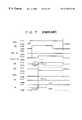
- FIG. 7is a timing chart showing an operation of writing data in the memory cell 1 of the DRAM shown in FIG. 6.
- a signal SPRis grounded to precharge the bit lines 36 and 37 with the potential of VCC/2 before data is written in the memory cell 1 .
- the potential of the word line 38is changed from the ground potential GND to a high potential VPP to turn on the transistor 5 .
- the potential of the bit line 36changes corresponding to the charge stored in the data-storing capacitor 7 .
- the potential of the bit line 36changes to a potential that is ⁇ V1 lower than the precharge potential VCC/2 as shown by the solid line in FIG. 7 .
- the potential of a node 6changes to a potential that is ⁇ V2 lower than the potential VCC/2 as shown by the broken line in FIG. 7 .
- the potential of the bit line 36changes to a potential that is ⁇ V1 higher than the precharge potential VCC/2 as shown by the broken line in FIG. 7 .
- the data-input circuit 30sets the potential of the bit line 36 at the power potential VCC (or ground potential GND) in response to the data-input signal.
- the bit line 37is at the ground potential GND (or power potential VCC).
- VCCpower potential
- the potential of the bit line 36is set at the power potential VCC
- a charge with the power potential VCC(the node 6 is at VCC) is stored in the data-storing capacitor 7 . Therefore, the data “HIGH” is written in the memory cell 1 .
- the potential of the bit line 36is set at the ground potential GND
- a charge with the ground potential GND(the node 6 is at GND) is stored in the data-storing capacitor 7 . Therefore, the data “LOW” is written in the memory cell 1 .
- each of the word lines 39 - 41 in the memory cell transistors 2 - 4is at the ground potential GND, no writing operation is performed if the transistors 8 , 10 , and 12 are turned off.
- FIG. 8is a timing chart showing an operation of reading out data from the memory cell 1 of the DRAM shown in FIG. 6 .
- FIG. 8In the data-readout operation shown in FIG. 8, only points differing from the data-writing operation shown in FIG. 7 will be described.
- the sense amplifier 21amplifies the potential of the bit line 36 up to the power potential VCC (or ground potential GND) to read out data.
- the potential of the bit line 37is amplified up to the ground potential GND (or power potential VCC).
- the potential of the node 6returns to the power potential VCC (or ground potential GND) to conduct a refresh operation.
- no data-readout operationis performed if each of the word lines 39 - 41 is at the ground potential GND and the transistors 8 , 10 , and 12 are turned off.
- a cell plate electrode 14is at a constant potential as high as VCC/2 and the node 6 is at the power potential VCC or at the ground potential GND after writing and readout operations. Therefore, variation in the potential of the bit line 36 is small, both in a readout operation after a write-operation and in a continuous readout operation.
- a variation ⁇ V1 in the potential of the bit line 36is represented by the following equation (1) or (2) on the premise that the capacitance of the memory cell 1 is Cmc and the load on the bit line 36 is Cbl.
- the load capacitance Cbl on the bit line 36increases with an increase in the number of memory cells connected to the bit line 36 .
- the potential variation ⁇ V1 of the bit line 36decreases from the equations (1)-(3).
- measuresmay be taken in which the bit line 36 is divided in the longitudinal direction of FIG. 6 to shorten the length per line.
- the number of sense amplifiers 21increases in proportion to the number of divided bit lines, thereby increasing the area of a semiconductor memory device in a semiconductor device.
- Such a small potential variation ⁇ V1 of the bit line 36causes unstable performance of the sense amplifier 21 due to noises and the like. This also hinders high speed access to a memory because of a time-consuming operation of the sense amplifier 21 . Moreover, if the power voltage is made lower using prior art technology to reduce power dissipation, the potential variation ⁇ V1 of the bit line is further decreased, whereby it is impossible to perform an operation at low voltages.
- An object of the present inventionis to provide a semiconductor memory device which is improved in the noise immunity of a sense amplifier and can attain high speed performance of a sense amplifier, a semiconductor device, and an electronic instrument using the same.
- a further object of the present inventionis to provide a semiconductor memory device which can reduce power dissipation, a semiconductor device, an electronic instrument using the same.
- a semiconductor memory devicecomprises:
- each of the memory cellsbeing connected to one of the word lines and also to one of the bit line pairs;
- each of the memory cellscomprises:
- a transistorcomprising a control electrode and two input/output electrodes, the control electrode being connected to one of the word lines, and one of the input/output electrodes being connected to a bit line of one of the bit line pairs;
- a data-storing capacitorcomprising first and second electrodes, the first electrode being connected to the other of the input/output electrodes of the transistor, and the second electrode being connected to one of the potential control circuits;
- each of the plurality of potential control circuitschanges the potential of the second electrode of the data-storing capacitor based on data stored in a memory cell in the plurality of memory cells after data-writing and data-reading operations for the memory cell has been completed.
- the potential of the second electrode (which is also called “cell plate electrode”) of the data-storing capacitor in the memory cellis changed by the potential control circuit.
- the potential of the first electrode of the data-storing capacitorcan be raised or dropped, whereby the potential of the first electrode of the data-storing capacitor is higher or lower than that used in conventional systems. Therefore, the potential variation of the bit line is increased both in a readout operation after a writing operation and in a continuous readout operation.
- the noise immunity of the sense amplifieris improved, thereby enabling stable operation.
- the operation speed of the sense amplifierbecomes higher, thereby enabling high speed readout operation.
- potential variation of the bit lineis secured at a certain level even if the power potential is low, thereby enabling operation at low voltages.
- the data-storing characteristics of the memory cellcan be improved.
- Each of the potential control circuitsmay be provided for one group of the memory cells among the plurality of memory cells, when the one group of the memory cells is commonly connected to one of the bit line pairs.
- each of the potential control circuitsmay return the value of the potential of the second electrode to the value before the change.
- Each of the potential control circuitsmay control the potential of the second electrode of the data-storing capacitor only when the data stored in the memory cell is “HIGH”.
- each of the potential control circuitsmay set the potential of the second electrode of the data-storing capacitor to be the ground potential GND after the writing and reading operations of the “HIGH” data for the memory cell have been completed, and each of the potential control circuits may set the potential of the second electrode of the data-storing capacitor to be VCC/2 except when the writing and reading operations have been completed.
- each of the potential control circuitsmay set the potential of the second electrode of the data-storing capacitor to be the power potential VCC after the writing and reading operations of the “LOW” data for the memory cell have been completed, and each of the potential control circuits may set the potential of the second electrode of the data-storing capacitor to be VCC/2 except when the writing and reading operations have been completed.
- a potential that is supplied to the control electrode of the transistor that is connected to one of the word linesmay be set to be less than ⁇ VCC/2 when the one of the word lines is not selected. This ensures that the transistor of the memory cell connected to the word line is not inadvertently turned on when the word line is unselected.
- Each of the potential control circuitsmay comprise: a first switching circuit that is switched based on a control signal that becomes active after the writing and reading operations of data for the memory cell has been completed; and a second switching circuit that is switched based on a data potential stored in the memory cell.
- the second switching circuitmay be connected to one of the bit line pairs, for example.
- the present inventioncan be applied to a semiconductor device in which the above-described semiconductor memory device is formed on a semiconductor substrate and to an electronic instrument comprising such semiconductor device.
- FIG. 1is a circuit diagram of a semiconductor memory device according to an embodiment of the present invention.
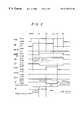
- FIG. 2is a timing chart for describing a data-writing operation in the semiconductor memory device shown in FIG. 1 .
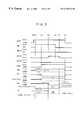
- FIG. 3is a timing chart for describing a data-readout operation in the semiconductor memory device shown in FIG. 1 .
- FIG. 4is a schematic sectional view showing an embodiment of a semiconductor structure to which the present invention is applied.
- FIG. 5is a schematic sectional view showing another embodiment of a semiconductor structure to which the present invention is applied.
- FIG. 6is a circuit diagram of a conventional semiconductor memory device.
- FIG. 7is a timing chart for describing a data-writing operation in the semiconductor memory device shown in FIG. 6 .
- FIG. 8is a timing chart for describing a data-readout operation in the semiconductor memory device shown in FIG. 6 .
- FIG. 1shows an example of a memory cell array of a DRAM as a semiconductor memory device according to the present invention.
- parts having the same function as the parts shown in FIG. 6are represented by the same reference numbers.
- FIG. 1shows four memory cells 1 - 4 in the memory cell array. These memory cells 1 - 4 are connected to word lines 38 - 41 respectively.
- the memory cells 1 and 3are connected to a common bit line 36 and the memory cells 2 and 4 are connected to a common bit line 37 .
- the memory cell 1has an NMOS transistor 5 and a data-storing capacitor 7 .
- the memory cell 2has an NMOS transistor 8 and data-storing capacitor 9
- the memory cell 3has an NMOS transistor 10 and data-storing capacitor 11
- the memory cell 4has an NMOS transistor 12 and data-storing capacitor 13 .
- the above structurewill be described taking the memory cell 1 as an example.
- the NMOS transistor 5 of the memory cell 1comprises a gate electrode (control electrode) and drain and source electrodes (two input/output electrodes).
- the gate electrodeis connected to the word line 38 .
- One of the source and drain electrodesis connected to the bit line 36 and the other electrode is connected to a first electrode (the upper electrode in FIG. 1) of the data-storing capacitor 7 .
- the potential of the first electrode of the data-storing capacitor 7is shown later as the potential of a node 6 .
- the potential of each second electrode (cell plate electrode) of the data-storing capacitors 7 , 9 , 11 , and 13is shown later as the potential of a node 14 .
- a sense amplifier circuit 21which is shared by the memory cells 1 - 4 comprises PMOS transistors 22 - 24 and NMOS transistors 25 - 27 .
- a precharge circuit 32which is shared by a pair of bit lines 36 and 37 comprises PMOS transistors 33 - 35 .
- the bit lines 36 and 37are connected to bus lines 31 A, 31 B respectively.
- a data-input circuit 30 A and a data-output circuit 30 Bare connected to these bus lines 31 A and 31 B.
- a data-input signalis input to the data-input circuit 30 A and a data-output signal is output from the data-output circuit 30 B.
- a potential control circuit 40is arranged to set and control the potential of the node 14 of the data-storing capacitors 7 , 9 , 11 , and 13 , which is a characteristic structure of this example.
- the potential control circuit 40is substantially divided into two circuits 40 A, 40 B.
- the potential control circuit 40 Acontrols the potential of the node 14 of he two memory cells 1 and 3 which are connected to the bit line 36 .
- the potential control circuit 40 Acontrols the potential of the node 14 on the basis of the data stored in the memory cell 1 or 3 when each of data-writing and data-reading operations performed in one memory cell 1 or 3 among the memory cells connected to the bit line 36 is completed.
- the potential control circuit 40 Blikewise controls the potential of the node 14 of the two memory cells 2 and 4 which are connected to the bit line 37 .
- the above structurewill be described taking the potential control circuit 40 A as an example.
- the PMOS transistors 41 and 42 and the NMOS transistors 47 and 48are connected in series between a VCC terminal and the ground.
- the NMOS transistors 45 and 46are connected in series between the node 14 and a line 52 set at a constant cell plate potential. In this example, a potential VCC/2 which is half the power potential VCC is applied to the line 52 .
- the PMOS transistor 41 and NMOS transistors 45 and 48 of the potential control circuit 40 Aconstitute a first switching circuit which is subjected to on/off control by a first control signal SCP 1 .
- the first control signal SPC 1is input to a gate electrode of the PMOS 41 after being reversed by an inverter 51 A.
- the gate electrode of the NMOS transistor 45is connected to the PMOS transistor 41 and hence the NMOS transistor 45 is also subjected to on/off control by the first signal SCP 1 .
- the first control signal SPC 1is input to a gate electrode of the NMOS transistor 48 .
- a second control signal SPC 2which becomes active at a timing that differs from that of the first signal SPC 1 is input to the potential control circuit 40 B.
- An inverter 51 Bis provided to reverse the second control signal SPC 2 .
- the NMOS transistor 46is shared by the potential control circuits 40 A and 40 B and subjected to on/off control by the second control signal SPC 2 .
- the PMOS transistor 42 and NMOS transistor 47 of the potential control circuit 40 Aare connected to the bit line 36 through respective gate electrodes of these transistors. These transistors 42 and 47 therefore constitute a second switching circuit which is subjected to on/off control on the basis of the data potential of the memory cell 1 .
- FIG. 2is a timing chart for describing a data-writing operation in the DRAM shown in FIG. 1 .
- the potential of a signal SPR to be input to a precharge circuit 32is kept at the ground potential GND up to a timing t0 as shown in FIG. 2, and the bit lines 36 and 37 are precharged so that these bit lines are at the potential VCC/2. Then, at the timing t0, the signal SPR is raised to the power potential VCC to complete the precharge operation.
- the potential of the word line 38is changed from the low potential VS to the high potential VPP as shown in FIG. 2 .
- a negative potential lower than ⁇ VCC/2is used rather than the ground potential GND for reasons described later.
- the transistor 5When the potential of the word line 38 is set at the high potential VPP at a timing t1 shown in FIG. 2, the transistor 5 is turned on. Because of this, the potential of the bit line 36 varies in accordance with the charge stored in the data-storing capacitor 7 . Specifically, in the case where the data “HIGH” has been written in the memory cell 1 , the potential of the bit line 36 is changed to a potential that is ⁇ V1 higher than the precharge potential VCC/2 as shown by the broken line in FIG. 2 . As a result, the potential of the node 6 is changed to a potential that is ⁇ V2 higher than the potential VCC/2 as shown by the broken line in FIG. 2 .
- the potential of the bit line 36is changed to a potential that is ⁇ V1 lower than the precharge potential VCC/2 as shown by the solid line in FIG. 2 .
- the potential of the node 6is changed to a potential that is ⁇ V2 lower than the potential VCC/2 as shown by the solid line in FIG. 2 .
- the data-input circuit 30 Aset the potential of the bit line 36 at the data potential on the basis of a data-input signal.
- the potential of the bit line 36is set at the power potential VCC.
- the potential of the bit line 36is set at the ground potential GND.
- the potential of the first control signal SCP 1is raised from the ground potential GND to the power potential VCC. This results in the PMOS transistor 41 and the NMOS transistor 48 being turned on and the NMOS transistor 45 being turned off.
- the PMOS transistor 42is turned off and the NMOS transistor 47 is turned on. Because of this, the node 14 is electrically conducted to the ground potential GND through the NMOS transistors 47 and 48 and its potential varies as shown by the solid line in FIG. 2 .
- the PMOS transistor 42is turned on and the NMOS transistor 47 is turned off.
- the PMOS transistor 41 and the NMOS transistor 48are also turned on and the NMOS transistor 45 is turned off since the first control signal SCP 1 is “HIGH”. Therefore, the node 14 is electrically conducted to the power potential VCC through the PMOS transistors 41 and 42 and its potential varies as shown by the dotted line in FIG. 2 .
- the potential of the word line 38is dropped to a low potential VS to turn off the NMOS transistor 5 of the memory cell 1 .
- the potential of the first control signal SCPLbecomes the ground potential GND.
- the PMOS transistor 41is switched from on to off, the NMOS transistor 45 is switched from off to on and the NMOS transistor 48 is switched from on to off.
- the node 14is electrically conducted to the line 52 through the NMOS transistors 45 and 46 and the potential of the node 14 becomes VCC/2 as shown in FIG. 2 .
- the potential of the node 6can be set at a potential that is VCC/2 higher than the potential VCC of the conventional example after an operation of writing the data “HIGH” is completed.
- the potential of the node 6can be set at a potential that is VCC/2 lower than the potential VCC of the conventional example after an operation of writing the data “LOW” is completed.
- the potential of the signal SPR to be input to the precharge circuit 32is dropped from the power potential VCC to the ground potential GND to complete a series of operation of writing data in the memory cell 1 .
- the operation of writing data in the memory cells 2 - 4is not performed by setting the potential of the word lines 39 - 41 at a low potential VS and allowing the NMOS transistors 8 , 10 , and 12 to be off during the operation of writing data in the memory cell 1 .
- the data-writing operationcan be performed using the same procedures as in the case of the memory cell 1 if any one of the word lines 39 , 40 , and 41 and any one of the signals SCP 1 and SCP 2 are respectively allowed to work.
- FIG. 3is a timing chart showing the data-readout operation in the memory cell 1 .
- the potential of the signal SPCis raised from the ground potential GND to the power potential VCC at a timing t0 as in the data-writing operation shown in FIG. 1 .
- the potential of the word line 38is then raised from the lower potential VS to the higher potential VPP at a timing t1.
- the bit lines 36 and 37are precharged to the potential VCC/2 and the NMOS transistor 5 is then turned on.
- the reason why the potential of the word line 38 is set at a potential that is VCC/2 lower than the ground potential GND during a period before the timing t1is as follows.
- the potential of the node 6is GND ⁇ VCC/2.
- the NMOS transistor 5is turned on before the timing t1.
- the lower potential VS of the word line 38is set at a potential lower than GND ⁇ VCC/2 in this example.
- the potential of the bit line 36varies corresponding to the charge stored in the data-storing capacitor 7 .
- the potential of the bit line 36is changed to a potential that is ⁇ V1 higher than the precharge potential VCC/2 as shown by the solid line in FIG. 3 .
- the potential of the node 6is changed to a potential that is ⁇ V2 higher than the potential VCC/2 as shown by the solid line in FIG. 3 .
- the potential of the bit line 36is changed to a potential that is ⁇ V1 lower than the precharge potential VCC/2 as shown by the broken line in FIG. 3 .
- the potential of the node 6is changed to a potential that is ⁇ V 2 lower than the potential VCC/2 as shown by the broken line in FIG. 3 .
- the potential of the signal SSAis raised from the ground potential GND to the power potential VCC. Because of this, the sense amplifier 21 amplifies the potential of the bit line 36 on the basis of a change in the potential of the signal SSA to read out the data.
- the sense amplifier 21amplifies the potential of the bit line 36 to the power potential VCC as shown by the solid line in FIG. 3 to read out the data.
- the sense amplifier 21amplifies the potential of the bit line 36 to the ground potential GND as shown by the broken line in FIG. 3 to read out the data. At this time, the sense amplifier 21 amplifies the potential of the bit line 37 in a manner so that the potential of the bit line 37 differs from that of the bit line 36 .
- the potential of the node 6is also changed.
- the potential of the node 6is changed to the power potential VCC as shown by the solid line in FIG. 3 .
- the potential of the node 6is changed to the ground potential GND as shown by the broken line in FIG. 3 . This operation is referred to as a refresh operation.
- the potential of the first control signal SCP 1is raised from the ground potential GND to the power potential VCC. Because of this, the PMOS transistor 41 and the NMOS transistor 48 are turned on and the NMOS transistor 45 is turned off.
- the PMOS transistor 42When the data “HIGH” has been written in the memory cell 1 , the PMOS transistor 42 is turned off and the NMOS transistor 47 is turned on. Therefore, the node 14 is electrically conducted to the ground potential GND through the NMOS transistors 47 and 48 and its potential is changed to the potential as shown by the solid line in FIG. 3 .
- the PMOS transistor 42is turned on and the NMOS transistor 47 is turned off.
- the PMOS transistor 41 and the NMOS transistor 48are also turned on and the NMOS transistor 45 is turned off since the first control signal SCP 1 is “HIGH”.
- the node 14is electrically conducted to the power potential VCC through the PMOS transistors 41 and 42 and its potential is changed to the potential as shown by the broken line in FIG. 3 .
- the potential of the word line 38is dropped to the lower potential VS to turn off the NMOS transistor 5 of the memory cell 1 .
- the potential of the first control signal SCP 1is changed to the ground potential GND.
- the PMOS transistor 41is switched from on to off
- the NMOS transistor 45is switched from off to on
- the NMOS transistor 48is switched from on to off.
- the node 14is electrically conducted to the line 52 through the NMOS transistors 45 and 46 and the potential of the node 14 becomes VCC/2 as shown in FIG. 3 .
- the potential of the node 6can be set at a potential that is VCC/2 higher than the potential VCC of the conventional example after an operation of reading out the data “HIGH” is completed.
- the potential of the node 6can be set at a potential that is VCC/2 lower than the potential VCC of the conventional example after an operation of reading out the data “LOW” is completed.
- the potential of the signal SPR to be input to the precharge circuit 32is dropped from the power potential VCC to the ground potential GND as shown in FIG. 3 to complete a series of operation of reading out data in the memory cell 1 .
- the operation of reading out data from the memory cells 2 - 4is not performed by setting the potential of the word lines 39 - 41 at the low potential VS and allowing the NMOS transistors 8 , 10 , and 12 to be off during the operation of writing data in the memory cell 1 .
- the data-readout operationis performed in the same procedures as in the case of the memory cell 1 if any one of the word lines 39 , 40 , and 41 and any one of the signals SCP 1 and SCP 2 are respectively allowed to work.
- Each on/off condition of the transistors 41 , 42 , 45 , 47 , and 48 and the potential condition of the node 14 at the time of the data-writing operation and data-readout operationare as shown in the following Table 1.
- SPC1VCC
- the potential of the node 6can be made to be either the power potential VCC which is VCC/2 higher or the ground potential GND which is VCC/2 lower compared with the potential VCC/2 used in a conventional example after each of the data-writing operation and data-readout operation is completed. Therefore, variation in the potential of the bit line increases both in a readout operation after a writing operation and in a continuous readout operation.
- ⁇ V1f(Cmc, Cbl) ⁇ (Vcc+VCC/2 ⁇ VCC/2) (4)
- ⁇ V1f(Cmc, Cbl) ⁇ (GND ⁇ VCC/2 ⁇ VCC/2) (5)
- the swing width of the potential when data is read out by the sense amplifier 21increases with the potential of the node 6 .
- Strict refresh characteristics (storing characteristics) after the data-readout operationare required when the data written in the memory cell 1 is “HIGH”. Accordingly, the control by changing the potential of the node 14 after the data-writing or data-readout operation may be taken only when the data “HIGH” is written in the memory cell 1 . Because of this, the transistors 41 - 44 arranged in the potential control circuit 40 A and 40 B can be omitted. This has the additional effect of improving the noise immunity of the sense amplifier 21 with increased data potential of the node 6 . In this case, the lower potential VS to be set as the potential of the word line may be designed to be the ground potential GND.
- the potential of the bit lines 36 and 37is input to the potential control circuit 40 , but the type of input is not limited to this.
- the data potential stored in the memory cellmay be input to the potential control circuit 40 .
- a data-input signal and a data-output signalmay be input to the potential control circuit 40 in the writing operation and in the readout operation respectively.
- FIGS. 4 and 5are schematic sectional views showing two types of semiconductor structure to which the present invention is applied.
- FIG. 4shows a stacked capacitor cell structure and
- FIG. 5a trench capacitor cell structure.
- a memory cell 1comprising an NMOS transistor 5 and a data-storing capacitor 7 is formed on a p-type semiconductor substrate 100 of the semiconductor device.
- n + diffused layers 102 and 104as a source region and drain region of the NMOS transistor 5 respectively, an inversion layer 106 as a first electrode of the data-storing capacitor 7 , and an element isolated region 108 are formed.
- An SiO 2 film 110which also serves as a gate oxide film is formed on the semiconductor substrate 100 .
- a polysilicon layeris formed on the SiO 2 film 110 . From the polysilicon layer, a gate electrode 112 and an electrode layer 114 as a second electrode for the data-storing capacitor 7 are formed.
- the data-storing capacitor 7comprises the inversion layer 106 , the SiO 2 film 110 and the electrode layer 114 .
- an insulated layer 116is formed, and an electrode layer 118 connected to the bit line 36 , and an electrode layer 120 connected to the word line 37 are also formed from a metal layer such as an aluminum layer.
- the electrode layer 114 as the second electrode (node 14 ) of the data-storing capacitor 7is connected to the memory cells 2 - 4 connected to the bit lines 36 are 37 , but the electrode layer 114 is insulated/isolated from the memory cells connected to other pairs of bit lines.
- This structurediffers from that of the semiconductor memory device of FIG. 6 which is a conventional example. This is because each node 14 of all the memory cells is connected in common and the potential VCC/2 is always applied to the node 14 in the conventional semiconductor memory device shown in FIG. 6 .
- a memory cell 1comprising an NMOS transistor 5 and a data-storing capacitor 7 is formed on a p-type semiconductor substrate 100 .
- FIG. 5differs from that of FIG. 4 in that the data-storing capacitor 7 is formed in a trench 130 .
- This data-storing capacitor 7is provided with an inversion layer 132 which is formed as a first electrode along the trench 130 , an SiO 2 layer 134 and an electrode layer 136 which is formed as a second electrode on the SiO 2 layer.
- the electrode layer 136 as the second electrode (node 14 ) of the data-storing capacitor 7is connected to the memory cells 2 - 4 connected to the bit lines 36 , 37 but is insulated/isolated from memory cells connected to other pairs of bit lines.
- An electronic instrumentcomprising a semiconductor device provided with the semiconductor memory device of the present invention enables operation at low voltages. Therefore, the present invention can be applied to various electronic instruments such as installed types of electronic instruments such as a personal computer using a semiconductor memory device as a memory. Moreover, the present invention can be applied to portable electronic instruments such as mobile computers and portable telephones, enabling small battery dissipation.
Landscapes
- Engineering & Computer Science (AREA)
- Microelectronics & Electronic Packaging (AREA)
- Computer Hardware Design (AREA)
- Dram (AREA)
Abstract
Description
The present invention relates to a semiconductor memory device such as a DRAM (dynamic random access memory), a semiconductor device, and an electronic instrument using the semiconductor device, and more particularly to control of the potential of the cell plate of a memory cell transistor.
FIG. 6 shows a memory cell array of a conventional DRAM. In FIG. 6, memory cells1-4 are provided with N-type MOS transistors (hereinafter called “NMOS transistor”)5,8,10, and12 and data-storingcapacitors Bit lines cell plate electrode 14. Asense amplifier circuit 21 comprises P-type MOS transistors (hereinafter called “PMOS transistor”)22-24 and NMOS transistors25-27. Aprecharge circuit 32 includes PMOS transistors33-35. Data to be written in the memory cells1-4 is input to a data-input circuit 30A, and the data read out from the memory cells1-4 is amplified by thesense amplifier 21 to be output from a data-output circuit 30B.
FIG. 7 is a timing chart showing an operation of writing data in thememory cell 1 of the DRAM shown in FIG. 6. A signal SPR is grounded to precharge thebit lines memory cell 1. The potential of theword line 38 is changed from the ground potential GND to a high potential VPP to turn on thetransistor 5.
At this time, the potential of thebit line 36 changes corresponding to the charge stored in the data-storingcapacitor 7. Specifically, when the data “HIGH” has been written in thememory cell 1, the potential of thebit line 36 changes to a potential that is ΔV1 lower than the precharge potential VCC/2 as shown by the solid line in FIG.7. As a result, the potential of anode 6 changes to a potential that is ΔV2 lower than the potential VCC/2 as shown by the broken line in FIG.7. When the data “LOW” has been written in thememory cell 1, the potential of thebit line 36 changes to a potential that is ΔV1 higher than the precharge potential VCC/2 as shown by the broken line in FIG.7. This results in the potential of thenode 6 changing to a potential that is ΔV2 higher than the potential VCC/2 as shown by the solid line in FIG.7.
The data-input circuit 30 sets the potential of thebit line 36 at the power potential VCC (or ground potential GND) in response to the data-input signal. In this case, thebit line 37 is at the ground potential GND (or power potential VCC). When the potential of thebit line 36 is set at the power potential VCC, a charge with the power potential VCC (thenode 6 is at VCC) is stored in the data-storingcapacitor 7. Therefore, the data “HIGH” is written in thememory cell 1. When the potential of thebit line 36 is set at the ground potential GND, a charge with the ground potential GND (thenode 6 is at GND) is stored in the data-storingcapacitor 7. Therefore, the data “LOW” is written in thememory cell 1.
Since each of the word lines39-41 in the memory cell transistors2-4 is at the ground potential GND, no writing operation is performed if thetransistors
FIG. 8 is a timing chart showing an operation of reading out data from thememory cell 1 of the DRAM shown in FIG.6. In the data-readout operation shown in FIG. 8, only points differing from the data-writing operation shown in FIG. 7 will be described.
In the readout operation shown in FIG. 8, after the potential of theword line 38 is raised from the ground potential GND to a high potential VPP, the potential of a signal SSA is raised from the ground potential GND to the power potential VCC. At this time, thesense amplifier 21 amplifies the potential of thebit line 36 up to the power potential VCC (or ground potential GND) to read out data. In this case, the potential of thebit line 37 is amplified up to the ground potential GND (or power potential VCC). At the same time, the potential of thenode 6 returns to the power potential VCC (or ground potential GND) to conduct a refresh operation.
In the memory cells2-4, no data-readout operation is performed if each of the word lines39-41 is at the ground potential GND and thetransistors
In this prior art, acell plate electrode 14 is at a constant potential as high as VCC/2 and thenode 6 is at the power potential VCC or at the ground potential GND after writing and readout operations. Therefore, variation in the potential of thebit line 36 is small, both in a readout operation after a write-operation and in a continuous readout operation.
A variation ΔV1 in the potential of thebit line 36 is represented by the following equation (1) or (2) on the premise that the capacitance of thememory cell 1 is Cmc and the load on thebit line 36 is Cbl.
The function f(Cmc, Cbl) in the above equation (1) is given by the following equation (3).
The load capacitance Cbl on thebit line 36 increases with an increase in the number of memory cells connected to thebit line 36. In this case, the potential variation ΔV1 of thebit line 36 decreases from the equations (1)-(3). In order to avoid this phenomenon, measures may be taken in which thebit line 36 is divided in the longitudinal direction of FIG. 6 to shorten the length per line. However, the number ofsense amplifiers 21 increases in proportion to the number of divided bit lines, thereby increasing the area of a semiconductor memory device in a semiconductor device.
Such a small potential variation ΔV1 of thebit line 36 causes unstable performance of thesense amplifier 21 due to noises and the like. This also hinders high speed access to a memory because of a time-consuming operation of thesense amplifier 21. Moreover, if the power voltage is made lower using prior art technology to reduce power dissipation, the potential variation ΔV1 of the bit line is further decreased, whereby it is impossible to perform an operation at low voltages.
An object of the present invention is to provide a semiconductor memory device which is improved in the noise immunity of a sense amplifier and can attain high speed performance of a sense amplifier, a semiconductor device, and an electronic instrument using the same.
A further object of the present invention is to provide a semiconductor memory device which can reduce power dissipation, a semiconductor device, an electronic instrument using the same.
A semiconductor memory device according to the present invention comprises:
a plurality of word lines;
a plurality of bit line pairs;
a plurality of memory cells, each of the memory cells being connected to one of the word lines and also to one of the bit line pairs;
a plurality of potential-control circuits; and
a plurality of sense amplifiers which amplify data read-out from the plurality of memory cells through the plurality of bit line pairs to output the amplified data;
wherein each of the memory cells comprises:
a transistor comprising a control electrode and two input/output electrodes, the control electrode being connected to one of the word lines, and one of the input/output electrodes being connected to a bit line of one of the bit line pairs; and
a data-storing capacitor comprising first and second electrodes, the first electrode being connected to the other of the input/output electrodes of the transistor, and the second electrode being connected to one of the potential control circuits;
wherein each of the plurality of potential control circuits changes the potential of the second electrode of the data-storing capacitor based on data stored in a memory cell in the plurality of memory cells after data-writing and data-reading operations for the memory cell has been completed.
In the present invention, when each data-writing and data-reading operation is completed, the potential of the second electrode (which is also called “cell plate electrode”) of the data-storing capacitor in the memory cell is changed by the potential control circuit. As a result, the potential of the first electrode of the data-storing capacitor can be raised or dropped, whereby the potential of the first electrode of the data-storing capacitor is higher or lower than that used in conventional systems. Therefore, the potential variation of the bit line is increased both in a readout operation after a writing operation and in a continuous readout operation. As a result, the noise immunity of the sense amplifier is improved, thereby enabling stable operation. The operation speed of the sense amplifier becomes higher, thereby enabling high speed readout operation. Furthermore, potential variation of the bit line is secured at a certain level even if the power potential is low, thereby enabling operation at low voltages.
Since the potential of the data-storing capacitor is higher or lower than in conventional systems, the data-storing characteristics of the memory cell can be improved.
Each of the potential control circuits may be provided for one group of the memory cells among the plurality of memory cells, when the one group of the memory cells is commonly connected to one of the bit line pairs.
Because of this, an increase in the area occupied by a circuit pattern on the semiconductor substrate can be limited since only one potential control circuit is provided for each pair of bit lines.
After the potential of the second electrode has been changed and one of the word lines connected to the memory cell has been brought to an unselected condition, each of the potential control circuits may return the value of the potential of the second electrode to the value before the change.
Because of this, the data value stored in the memory cell connected to the pair of bit lines is not changed.
Each of the potential control circuits may control the potential of the second electrode of the data-storing capacitor only when the data stored in the memory cell is “HIGH”.
This is because strict refresh characteristics (storing characteristics) after the data-readout operation are required when the data written in the memory cell is “HIGH”.
Each of the potential control circuits may control the potential of the second electrode of the data-storing capacitor so that the value of the potential of the second electrode that is set when the data stored in the memory cell is “HIGH” is different from the value of the potential of the second electrode that is set when the data stored in the memory cell is “LOW”. In this case, when the data stored in the memory cell is “HIGH”, each of the potential control circuits can set the potential of the second electrode of the data-storing capacitor to be less than a given value. When the data stored in the memory cell is “LOW”, each of the potential control circuits can set the potential of the second electrode of the data-storing capacitor to be higher than a given value.
For example, if a data potential at the time when the data stored in the memory cell is “HIGH” is a power potential VCC, and if a data potential at the time when the data stored in the memory cell is “LOW” is a ground potential GND, each of the potential control circuits may set the potential of the second electrode of the data-storing capacitor to be the ground potential GND after the writing and reading operations of the “HIGH” data for the memory cell have been completed, and each of the potential control circuits may set the potential of the second electrode of the data-storing capacitor to be VCC/2 except when the writing and reading operations have been completed.
In the above condition, each of the potential control circuits may set the potential of the second electrode of the data-storing capacitor to be the power potential VCC after the writing and reading operations of the “LOW” data for the memory cell have been completed, and each of the potential control circuits may set the potential of the second electrode of the data-storing capacitor to be VCC/2 except when the writing and reading operations have been completed. A potential that is supplied to the control electrode of the transistor that is connected to one of the word lines may be set to be less than −VCC/2 when the one of the word lines is not selected. This ensures that the transistor of the memory cell connected to the word line is not inadvertently turned on when the word line is unselected.
Each of the potential control circuits may comprise: a first switching circuit that is switched based on a control signal that becomes active after the writing and reading operations of data for the memory cell has been completed; and a second switching circuit that is switched based on a data potential stored in the memory cell. The second switching circuit may be connected to one of the bit line pairs, for example.
Two semiconductor structures can be given as a structure to which the present invention can be applied. One of these structures is a stacked capacitor cell structure. In this structure, each of the plurality of memory cells is formed by stacking the first and second electrodes of the data-storing capacitor, and an insulating layer between the first and second electrodes. Another structure is a trench capacitor cell structure. In this structure, each of the plurality of memory cells is formed by arranging the first electrode of the data-storing capacitor, an insulating layer, and the second electrode of the data-storing capacitor along a trench formed on a semiconductor substrate.
The present invention can be applied to a semiconductor device in which the above-described semiconductor memory device is formed on a semiconductor substrate and to an electronic instrument comprising such semiconductor device.
FIG. 1 is a circuit diagram of a semiconductor memory device according to an embodiment of the present invention.
FIG. 2 is a timing chart for describing a data-writing operation in the semiconductor memory device shown in FIG.1.
FIG. 3 is a timing chart for describing a data-readout operation in the semiconductor memory device shown in FIG.1.
FIG. 4 is a schematic sectional view showing an embodiment of a semiconductor structure to which the present invention is applied.
FIG. 5 is a schematic sectional view showing another embodiment of a semiconductor structure to which the present invention is applied.
FIG. 6 is a circuit diagram of a conventional semiconductor memory device.
FIG. 7 is a timing chart for describing a data-writing operation in the semiconductor memory device shown in FIG.6.
FIG. 8 is a timing chart for describing a data-readout operation in the semiconductor memory device shown in FIG.6.
FIG. 1 shows an example of a memory cell array of a DRAM as a semiconductor memory device according to the present invention. Among the parts shown in FIG. 1, parts having the same function as the parts shown in FIG. 6 are represented by the same reference numbers.
FIG. 1 shows four memory cells1-4 in the memory cell array. These memory cells1-4 are connected to word lines38-41 respectively. Thememory cells common bit line 36 and thememory cells common bit line 37.
Thememory cell 1 has anNMOS transistor 5 and a data-storingcapacitor 7. Thememory cell 2 has an NMOS transistor8 and data-storing capacitor9, thememory cell 3 has anNMOS transistor 10 and data-storing capacitor11, and thememory cell 4 has anNMOS transistor 12 and data-storingcapacitor 13.
The above structure will be described taking thememory cell 1 as an example. TheNMOS transistor 5 of thememory cell 1 comprises a gate electrode (control electrode) and drain and source electrodes (two input/output electrodes). The gate electrode is connected to theword line 38. One of the source and drain electrodes is connected to thebit line 36 and the other electrode is connected to a first electrode (the upper electrode in FIG. 1) of the data-storingcapacitor 7. The potential of the first electrode of the data-storingcapacitor 7 is shown later as the potential of anode 6. The potential of each second electrode (cell plate electrode) of the data-storingcapacitors node 14.
Asense amplifier circuit 21 which is shared by the memory cells1-4 comprises PMOS transistors22-24 and NMOS transistors25-27. Aprecharge circuit 32 which is shared by a pair ofbit lines bus lines input circuit 30A and a data-output circuit 30B are connected to thesebus lines input circuit 30A and a data-output signal is output from the data-output circuit 30B.
Apotential control circuit 40 is arranged to set and control the potential of thenode 14 of the data-storingcapacitors potential control circuit 40 is substantially divided into twocircuits potential control circuit 40A controls the potential of thenode 14 of he twomemory cells bit line 36. Thepotential control circuit 40A controls the potential of thenode 14 on the basis of the data stored in thememory cell memory cell bit line 36 is completed. Thepotential control circuit 40B likewise controls the potential of thenode 14 of the twomemory cells bit line 37.
Thepotential control circuit 40A comprisesPMOS transistors potential control circuit 40B comprisesPMOS transistors 43 and44 andNMOS transistors
The above structure will be described taking thepotential control circuit 40A as an example. ThePMOS transistors NMOS transistors NMOS transistors node 14 and aline 52 set at a constant cell plate potential. In this example, a potential VCC/2 which is half the power potential VCC is applied to theline 52.
ThePMOS transistor 41 andNMOS transistors potential control circuit 40A constitute a first switching circuit which is subjected to on/off control by a first control signal SCP1. In more detail, the first control signal SPC1 is input to a gate electrode of thePMOS 41 after being reversed by aninverter 51A. The gate electrode of theNMOS transistor 45 is connected to thePMOS transistor 41 and hence theNMOS transistor 45 is also subjected to on/off control by the first signal SCP1. The first control signal SPC1 is input to a gate electrode of theNMOS transistor 48. A second control signal SPC2 which becomes active at a timing that differs from that of the first signal SPC1 is input to thepotential control circuit 40B. An inverter51B is provided to reverse the second control signal SPC2. TheNMOS transistor 46 is shared by thepotential control circuits
ThePMOS transistor 42 andNMOS transistor 47 of thepotential control circuit 40A are connected to thebit line 36 through respective gate electrodes of these transistors. Thesetransistors memory cell 1.
FIG. 2 is a timing chart for describing a data-writing operation in the DRAM shown in FIG.1. Prior to an operation of writing data in thememory cell 1, the potential of a signal SPR to be input to aprecharge circuit 32 is kept at the ground potential GND up to a timing t0 as shown in FIG. 2, and the bit lines36 and37 are precharged so that these bit lines are at the potential VCC/2. Then, at the timing t0, the signal SPR is raised to the power potential VCC to complete the precharge operation.
When data is written in thememory cell 1, the potential of theword line 38 is changed from the low potential VS to the high potential VPP as shown in FIG.2. In this example, a negative potential lower than −VCC/2 is used rather than the ground potential GND for reasons described later.
When the potential of theword line 38 is set at the high potential VPP at a timing t1 shown in FIG. 2, thetransistor 5 is turned on. Because of this, the potential of thebit line 36 varies in accordance with the charge stored in the data-storingcapacitor 7. Specifically, in the case where the data “HIGH” has been written in thememory cell 1, the potential of thebit line 36 is changed to a potential that is ΔV1 higher than the precharge potential VCC/2 as shown by the broken line in FIG.2. As a result, the potential of thenode 6 is changed to a potential that is ΔV2 higher than the potential VCC/2 as shown by the broken line in FIG.2. On the other hand, in the case where the data “LOW” has been written in thememory cell 1, the potential of thebit line 36 is changed to a potential that is ΔV1 lower than the precharge potential VCC/2 as shown by the solid line in FIG.2. As a result, the potential of thenode 6 is changed to a potential that is ΔV2 lower than the potential VCC/2 as shown by the solid line in FIG.2.
At a timing t2 of FIG. 2, the data-input circuit 30A set the potential of thebit line 36 at the data potential on the basis of a data-input signal. When the data is “HIGH”, the potential of thebit line 36 is set at the power potential VCC. When the data is “LOW”, the potential of thebit line 36 is set at the ground potential GND.
When the potential of thebit line 36 is set at the power potential VCC, the charge with the power potential VCC is stored in the data-storingcapacitor 7 of thememory cell 1. This means that the data “HIGH” is written in thememory cell 1. Because of this, the potential of thenode 6 is changed to the power potential VCC as shown by the solid line in FIG.2. On the other hand, when the potential of thebit line 36 is set at the ground potential GND, the charge with the ground potential GND is stored in the data-storingcapacitor 7 of thememory cell 1. This means that the data “LOW” is written in thememory cell 1. Because of this, the potential of thenode 6 is changed to the ground potential GND as shown by the broken line in FIG.2.
At a timing t3 while the potential of theword line 38 is VPP, the potential of the first control signal SCP1 is raised from the ground potential GND to the power potential VCC. This results in thePMOS transistor 41 and theNMOS transistor 48 being turned on and theNMOS transistor 45 being turned off.
In the case where the data “HIGH” has been written in thememory cell 1, thePMOS transistor 42 is turned off and theNMOS transistor 47 is turned on. Because of this, thenode 14 is electrically conducted to the ground potential GND through theNMOS transistors
On the other hand, in the case where the data “LOW” has been written in thememory cell 1, thePMOS transistor 42 is turned on and theNMOS transistor 47 is turned off. At this time, thePMOS transistor 41 and theNMOS transistor 48 are also turned on and theNMOS transistor 45 is turned off since the first control signal SCP1 is “HIGH”. Therefore, thenode 14 is electrically conducted to the power potential VCC through thePMOS transistors
At a timing t4 shown in FIG. 2, the potential of theword line 38 is dropped to a low potential VS to turn off theNMOS transistor 5 of thememory cell 1.
At a timing t5 shown in FIG. 2, the potential of the first control signal SCPL becomes the ground potential GND. Comparing with the condition at the timing t3 shown in FIG. 2, thePMOS transistor 41 is switched from on to off, theNMOS transistor 45 is switched from off to on and theNMOS transistor 48 is switched from on to off. As a result, thenode 14 is electrically conducted to theline 52 through theNMOS transistors node 14 becomes VCC/2 as shown in FIG.2.
When the data “HIGH” has been written in thememory cell 1, the potential of thenode 6 is raised to VCC+VCC/2 through the data-storingcapacitor 7 as shown by the solid line in FIG.2. When the data “LOW” has been written in thememory cell 1, the potential of thenode 6 is dropped to GND−VCC/2 through the data-storingcapacitor 7 as shown by the broken line in FIG.2.
In this example, the potential of thenode 6 can be set at a potential that is VCC/2 higher than the potential VCC of the conventional example after an operation of writing the data “HIGH” is completed. Alternatively, the potential of thenode 6 can be set at a potential that is VCC/2 lower than the potential VCC of the conventional example after an operation of writing the data “LOW” is completed.
Then, as shown in FIG. 2, the potential of the signal SPR to be input to theprecharge circuit 32 is dropped from the power potential VCC to the ground potential GND to complete a series of operation of writing data in thememory cell 1.
As shown in FIG. 2, the operation of writing data in the memory cells2-4 is not performed by setting the potential of the word lines39-41 at a low potential VS and allowing theNMOS transistors memory cell 1.
When it is intended to write data in any of thememory cells memory cell 1 if any one of the word lines39,40, and41 and any one of the signals SCP1 and SCP2 are respectively allowed to work.
The readout operation in thememory cell 1 shown in FIG. 1 will be described with reference to FIG.3. FIG. 3 is a timing chart showing the data-readout operation in thememory cell 1.
In the case of reading out data from thememory cell 1, the potential of the signal SPC is raised from the ground potential GND to the power potential VCC at a timing t0 as in the data-writing operation shown in FIG.1. The potential of theword line 38 is then raised from the lower potential VS to the higher potential VPP at a timing t1. By these operations, the bit lines36 and37 are precharged to the potential VCC/2 and theNMOS transistor 5 is then turned on.
The reason why the potential of theword line 38 is set at a potential that is VCC/2 lower than the ground potential GND during a period before the timing t1 is as follows. When the data “LOW” has been written in thememory cell 1 in the above-described writing operation, the potential of thenode 6 is GND−VCC/2. At this time, if the potential of theword line 38 is set at the ground potential GND as in the conventional system, theNMOS transistor 5 is turned on before the timing t1. To avoid this, the lower potential VS of theword line 38 is set at a potential lower than GND−VCC/2 in this example.
When theNMOS transistor 5 is turned on at the timing t1, the potential of thebit line 36 varies corresponding to the charge stored in the data-storingcapacitor 7. In other words, when the data “HIGH” has been written in thememory cell 1, the potential of thebit line 36 is changed to a potential that is ΔV1 higher than the precharge potential VCC/2 as shown by the solid line in FIG.3. As a result, the potential of thenode 6 is changed to a potential that is ΔV2 higher than the potential VCC/2 as shown by the solid line in FIG.3. On the other hand, when the data “LOW” has been written in thememory cell 1, the potential of thebit line 36 is changed to a potential that is ΔV1 lower than the precharge potential VCC/2 as shown by the broken line in FIG.3. As a result, the potential of thenode 6 is changed to a potential that is ΔV2 lower than the potential VCC/2 as shown by the broken line in FIG.3.
At a timing t2 shown in FIG. 3, the potential of the signal SSA is raised from the ground potential GND to the power potential VCC. Because of this, thesense amplifier 21 amplifies the potential of thebit line 36 on the basis of a change in the potential of the signal SSA to read out the data. In more detail, when the data “HIGH” has been written in thememory cell 1, thesense amplifier 21 amplifies the potential of thebit line 36 to the power potential VCC as shown by the solid line in FIG. 3 to read out the data. On the other hand, when the data “LOW” has been written in thememory cell 1, thesense amplifier 21 amplifies the potential of thebit line 36 to the ground potential GND as shown by the broken line in FIG. 3 to read out the data. At this time, thesense amplifier 21 amplifies the potential of thebit line 37 in a manner so that the potential of thebit line 37 differs from that of thebit line 36.
At the timing t2, the potential of thenode 6 is also changed. When the data “HIGH” has been written in thememory cell 1, the potential of thenode 6 is changed to the power potential VCC as shown by the solid line in FIG.3. When the data “LOW” has been written in thememory cell 1, the potential of thenode 6 is changed to the ground potential GND as shown by the broken line in FIG.3. This operation is referred to as a refresh operation.
At a timing t3 while the potential of theword line 38 is VPP, the potential of the first control signal SCP1 is raised from the ground potential GND to the power potential VCC. Because of this, thePMOS transistor 41 and theNMOS transistor 48 are turned on and theNMOS transistor 45 is turned off.
When the data “HIGH” has been written in thememory cell 1, thePMOS transistor 42 is turned off and theNMOS transistor 47 is turned on. Therefore, thenode 14 is electrically conducted to the ground potential GND through theNMOS transistors
On the other hand, in the case where the data “LOW” has been written in thememory cell 1, thePMOS transistor 42 is turned on and theNMOS transistor 47 is turned off. ThePMOS transistor 41 and theNMOS transistor 48 are also turned on and theNMOS transistor 45 is turned off since the first control signal SCP1 is “HIGH”. Hence, thenode 14 is electrically conducted to the power potential VCC through thePMOS transistors
At a timing t4 shown in FIG. 3, the potential of theword line 38 is dropped to the lower potential VS to turn off theNMOS transistor 5 of thememory cell 1.
At a timing t5 shown in FIG. 3, the potential of the first control signal SCP1 is changed to the ground potential GND. At this time, comparing with the condition at the timing t3 shown in FIG. 3, thePMOS transistor 41 is switched from on to off, theNMOS transistor 45 is switched from off to on and theNMOS transistor 48 is switched from on to off. As a result, thenode 14 is electrically conducted to theline 52 through theNMOS transistors node 14 becomes VCC/2 as shown in FIG.3.
When the data “HIGH” has been written in thememory cell 1, the potential of thenode 6 is raised to VCC+VCC/2 through the data-storingcapacitor 7 as shown by the solid line in FIG.3. Similarly, when the data “LOW” has been written in thememory cell 1, the potential of thenode 6 is dropped to GND−VCC/2 through the data-storingcapacitor 7 as shown by the broken line in FIG.3.
In this example, the potential of thenode 6 can be set at a potential that is VCC/2 higher than the potential VCC of the conventional example after an operation of reading out the data “HIGH” is completed. Alternatively, the potential of thenode 6 can be set at a potential that is VCC/2 lower than the potential VCC of the conventional example after an operation of reading out the data “LOW” is completed.
Then, the potential of the signal SPR to be input to theprecharge circuit 32 is dropped from the power potential VCC to the ground potential GND as shown in FIG. 3 to complete a series of operation of reading out data in thememory cell 1.
As shown in FIG. 3, the operation of reading out data from the memory cells2-4 is not performed by setting the potential of the word lines39-41 at the low potential VS and allowing theNMOS transistors memory cell 1.
When it is intended to write data in any of thememory cells memory cell 1 if any one of the word lines39,40, and41 and any one of the signals SCP1 and SCP2 are respectively allowed to work.
Each on/off condition of thetransistors node 14 at the time of the data-writing operation and data-readout operation are as shown in the following Table 1.
| TABLE 1 | ||
| SPC1 signal | SPC1 = VCC | SPC1 = GND |
| Data | Data = H | Data = L | Data = H | Data = |
| Transistor | ||||
| 41 | ON | ON | OFF | |
| Transistor | ||||
| 42 | OFF | ON | OFF | ON |
| OFF | OFF | ON | ||
| Transistor | ||||
| 47 | ON | OFF | OFF | |
| Transistor | ||||
| 48 | ON | ON | OFF | OFF |
| Potential of | GND | Vcc | Vcc/2 |
In the present invention, the potential of thenode 6 can be made to be either the power potential VCC which is VCC/2 higher or the ground potential GND which is VCC/2 lower compared with the potential VCC/2 used in a conventional example after each of the data-writing operation and data-readout operation is completed. Therefore, variation in the potential of the bit line increases both in a readout operation after a writing operation and in a continuous readout operation.
In this example, a variation ΔV1 in the potential of the bit line is given by the following equation (4) or (5).
As is clear from the comparison of these equations (4) and (5) with the above equations (1) and (2) showing the variation ΔV1 in the potential of the bit line used in a conventional device, the variation AVI in the potential of the bit line in this example is twice as large as that of the conventional device.
This results in the noise immunity of thesense amplifier 21 being improved, thereby enabling a stable operation. Since the operational speed of thesense amplifier 21 is increased, high speed reading can be achieved. Moreover, even if the power voltage is reduced, a certain variation in the potential of the bit line is secured, thereby enabling an operation at low voltages in a semiconductor device.
The swing width of the potential when data is read out by thesense amplifier 21 increases with the potential of thenode 6. Strict refresh characteristics (storing characteristics) after the data-readout operation are required when the data written in thememory cell 1 is “HIGH”. Accordingly, the control by changing the potential of thenode 14 after the data-writing or data-readout operation may be taken only when the data “HIGH” is written in thememory cell 1. Because of this, the transistors41-44 arranged in thepotential control circuit sense amplifier 21 with increased data potential of thenode 6. In this case, the lower potential VS to be set as the potential of the word line may be designed to be the ground potential GND.
In this example, the potential of the bit lines36 and37 is input to thepotential control circuit 40, but the type of input is not limited to this. The data potential stored in the memory cell may be input to thepotential control circuit 40. For example, a data-input signal and a data-output signal may be input to thepotential control circuit 40 in the writing operation and in the readout operation respectively.
In this example, only a circuit area of a semiconductor memory device is described. However, the present invention can be applied to a semiconductor device comprising a semiconductor memory device.
FIGS. 4 and 5 are schematic sectional views showing two types of semiconductor structure to which the present invention is applied. FIG. 4 shows a stacked capacitor cell structure and FIG. 5 a trench capacitor cell structure.
In FIG. 4, amemory cell 1 comprising anNMOS transistor 5 and a data-storingcapacitor 7 is formed on a p-type semiconductor substrate 100 of the semiconductor device. On thesemiconductor substrate 100, n+ diffusedlayers NMOS transistor 5 respectively, aninversion layer 106 as a first electrode of the data-storingcapacitor 7, and an element isolatedregion 108 are formed. An SiO2film110 which also serves as a gate oxide film is formed on thesemiconductor substrate 100. A polysilicon layer is formed on the SiO2film110. From the polysilicon layer, agate electrode 112 and an electrode layer114 as a second electrode for the data-storingcapacitor 7 are formed.
Accordingly, the data-storingcapacitor 7 comprises theinversion layer 106, the SiO2film110 and the electrode layer114.
On the polysilicon layer, aninsulated layer 116 is formed, and anelectrode layer 118 connected to thebit line 36, and anelectrode layer 120 connected to theword line 37 are also formed from a metal layer such as an aluminum layer.
When forming thememory cell 1 shown in FIG. 1, the electrode layer114 as the second electrode (node14) of the data-storingcapacitor 7 is connected to the memory cells2-4 connected to the bit lines36 are37, but the electrode layer114 is insulated/isolated from the memory cells connected to other pairs of bit lines. This structure differs from that of the semiconductor memory device of FIG. 6 which is a conventional example. This is because eachnode 14 of all the memory cells is connected in common and the potential VCC/2 is always applied to thenode 14 in the conventional semiconductor memory device shown in FIG.6.
In the structure shown in FIG. 5, amemory cell 1 comprising anNMOS transistor 5 and a data-storingcapacitor 7 is formed on a p-type semiconductor substrate 100.
The structure of FIG. 5 differs from that of FIG. 4 in that the data-storingcapacitor 7 is formed in atrench 130. This data-storingcapacitor 7 is provided with aninversion layer 132 which is formed as a first electrode along thetrench 130, an SiO2layer134 and anelectrode layer 136 which is formed as a second electrode on the SiO2layer.
In the structure shown in FIG. 5, theelectrode layer 136 as the second electrode (node14) of the data-storingcapacitor 7 is connected to the memory cells2-4 connected to the bit lines36,37 but is insulated/isolated from memory cells connected to other pairs of bit lines.
An electronic instrument comprising a semiconductor device provided with the semiconductor memory device of the present invention enables operation at low voltages. Therefore, the present invention can be applied to various electronic instruments such as installed types of electronic instruments such as a personal computer using a semiconductor memory device as a memory. Moreover, the present invention can be applied to portable electronic instruments such as mobile computers and portable telephones, enabling small battery dissipation.
Claims (16)
1. A semiconductor memory device comprising:
a plurality of word lines;
a plurality of bit line pairs;
a plurality of memory cells, each of the memory cells being connected to one of the word lines and also to one of the bit line pairs;
a plurality of potential-control circuits; and
a plurality of sense amplifiers which amplify data read-out from the plurality of memory cells through the plurality of bit line pairs to output the amplified data;
wherein each of the memory cells comprises:
a transistor comprising a control electrode and two input/output electrodes, the control electrode being connected to one of the word lines, and one of the input/output electrodes being connected to a bit line of one of the bit line pairs; and
a data-storing capacitor further comprising a first electrode and a second electrode, the first electrode being connected to the other of the input/output electrodes of the transistor, and the second electrode being connected to one of the potential control circuits;
wherein each of the plurality of potential control circuits changes the potential of the second electrode of the data-storing capacitor in response to and based on data stored in a memory cell in the plurality of memory cells after data-writing and data-reading operations for the memory cell has been completed.
2. The semiconductor memory device as defined in claim1,
wherein each of the potential control circuits is provided for one group of memory cells among the plurality of memory cells, the one group of memory cells being commonly connected to one of the bit line pairs.
3. The semiconductor memory device as defined in claim2,
wherein after the potential of the second electrode has been changed and one of the word lines connected to the memory cell has been brought to an unselected condition, each of the potential control circuits returns a value of the potential of the second electrode to a value before the change.
4. The semiconductor memory device as defined in, claim1,
wherein each of the potential control circuits controls the potential of the second electrode of the data-storing capacitor only when the data stored in the memory cell is “HIGH”.
5. The semiconductor memory device as defined in claim1,
wherein each of the potential control circuits controls the potential of the second electrode of the data-storing capacitor so that the value of the potential of the second electrode that is set when the data stored in the memory cell is “HIGH” is different from the value of the potential of the second electrode that is set when the data stored in the memory cell is “LOW”.
6. The semiconductor memory device as defined in claim4,
wherein each of the potential control circuits sets the potential of the second electrode of the data-storing capacitor to be less than a given value when the data stored in the memory cell is “HIGH”.
7. The semiconductor memory device as defined in claim5,
wherein each of the potential control circuits sets the potential of the second electrode of the data-storing capacitor to be higher than a given value when the data stored in the memory cell is “LOW”.
8. The semiconductor memory device as defined in claim6,
wherein if a data potential at the time when the data stored in the memory cell is “HIGH” is a power potential VCC, and if a data potential at the time when the data stored in the memory cell is “LOW” is a ground potential GND, each of the potential control circuits sets the potential of the second electrode of the data-storing capacitor to be the ground potential GND after the writing and reading operations of the “HIGH” data for the memory cell have been completed; and
wherein each of the potential control circuits sets the potential of the second electrode of the data-storing capacitor to be VCC/2 except when the writing and reading operations have been completed.
9. The semiconductor memory device as defined in claim7,
wherein if a data potential at the time when the data stored in the memory cell is “HIGH” is a power potential VCC, and if a data potential at the time when the data stored in the memory cell is “LOW” is a ground potential GND, each of the potential control circuits sets the potential of the second electrode of the data-storing capacitor to be the power potential VCC after the writing and reading operations of the “LOW” data for the memory cell have been completed; and
wherein each of the potential control circuits sets the potential of the second electrode of the data-storing capacitor to be VCC/2 except when the writing and reading operations have been completed.
10. The semiconductor memory device as defined in claim9,
wherein a potential that is supplied to the control electrode of the transistor that is connected to one of the word lines is set to be less than −VCC/2 when the one of the word lines is not selected.
11. The semiconductor memory device as defined in claim1,
wherein each of the potential control circuits comprises:
a first switching circuit that is switched based on a control signal that becomes active after the writing and reading operations of data for the memory cell has been completed; and
a second switching circuit that is switched based on a data potential stored in the memory cell.
12. The semiconductor memory device as defined in claim11,
wherein the second switching circuit is connected to one of the bit line pairs.
13. The semiconductor memory device as defined in claim1,
wherein each of the plurality of memory cells has a stacked capacitor cell structure that is formed by stacking the first and second electrodes of the data-storing capacitor, and an insulating layer between the first and second electrodes.
14. The semiconductor memory device as defined in claim1,
wherein each of the plurality of memory cells has a trench capacitor cell structure that is formed by arranging the first electrode of the data-storing capacitor, an insulating layer, and the second electrode of the data-storing capacitor along a trench formed on a semiconductor substrate.
15. The semiconductor device wherein the semiconductor memory device as defined in claim1 is formed on a semiconductor substrate.
16. An electronic instrument comprising at least the semiconductor device as defined in claim15.
Applications Claiming Priority (2)
| Application Number | Priority Date | Filing Date | Title |
|---|---|---|---|
| JP34108897 | 1997-12-11 | ||
| PCT/JP1998/005587WO1999030325A1 (en) | 1997-12-11 | 1998-12-10 | Semiconductor memory device, semiconductor device, and electronic apparatus using the semiconductor device |
Publications (1)
| Publication Number | Publication Date |
|---|---|
| US6178121B1true US6178121B1 (en) | 2001-01-23 |
Family
ID=18343150
Family Applications (1)
| Application Number | Title | Priority Date | Filing Date |
|---|---|---|---|
| US09/367,053Expired - LifetimeUS6178121B1 (en) | 1997-12-11 | 1998-12-10 | Semiconductor memory device, semiconductor device, and electronic apparatus using the semiconductor device |
Country Status (3)
| Country | Link |
|---|---|
| US (1) | US6178121B1 (en) |
| KR (1) | KR20000070994A (en) |
| WO (1) | WO1999030325A1 (en) |
Cited By (14)
| Publication number | Priority date | Publication date | Assignee | Title |
|---|---|---|---|---|
| US20050262097A1 (en)* | 2004-05-07 | 2005-11-24 | Sim-Tang Siew Y | System for moving real-time data events across a plurality of devices in a network for simultaneous data protection, replication, and access services |
| US20060101384A1 (en)* | 2004-11-02 | 2006-05-11 | Sim-Tang Siew Y | Management interface for a system that provides automated, real-time, continuous data protection |
| US7680834B1 (en) | 2004-06-08 | 2010-03-16 | Bakbone Software, Inc. | Method and system for no downtime resychronization for real-time, continuous data protection |
| US7689602B1 (en) | 2005-07-20 | 2010-03-30 | Bakbone Software, Inc. | Method of creating hierarchical indices for a distributed object system |
| CN101814320A (en)* | 2009-02-10 | 2010-08-25 | 台湾积体电路制造股份有限公司 | Memory circuit, system and operation method |
| US7788521B1 (en) | 2005-07-20 | 2010-08-31 | Bakbone Software, Inc. | Method and system for virtual on-demand recovery for real-time, continuous data protection |
| US7979404B2 (en) | 2004-09-17 | 2011-07-12 | Quest Software, Inc. | Extracting data changes and storing data history to allow for instantaneous access to and reconstruction of any point-in-time data |
| US8060889B2 (en) | 2004-05-10 | 2011-11-15 | Quest Software, Inc. | Method and system for real-time event journaling to provide enterprise data services |
| US8131723B2 (en) | 2007-03-30 | 2012-03-06 | Quest Software, Inc. | Recovering a file system to any point-in-time in the past with guaranteed structure, content consistency and integrity |
| US20120099368A1 (en)* | 2010-10-20 | 2012-04-26 | Semiconductor Energy Laboratory Co., Ltd. | Method for driving semiconductor device |
| US8364648B1 (en) | 2007-04-09 | 2013-01-29 | Quest Software, Inc. | Recovering a database to any point-in-time in the past with guaranteed data consistency |
| US20140317153A1 (en)* | 2013-04-19 | 2014-10-23 | International Business Machines Corporation | Processing data loads |
| US20140317149A1 (en)* | 2013-04-22 | 2014-10-23 | Sap Ag | Multi-Buffering System Supporting Read/Write Access to Different Data Source Type |
| US9418110B1 (en)* | 2008-06-30 | 2016-08-16 | Emc Corporation | Intelligent, scalable, low-overhead mechanism for data retrieval in a distributed network environment |
Citations (6)
| Publication number | Priority date | Publication date | Assignee | Title |
|---|---|---|---|---|
| JPH0492285A (en) | 1990-08-08 | 1992-03-25 | Nec Corp | Semiconductor memory circuit |
| US5274586A (en)* | 1990-10-18 | 1993-12-28 | Mitsubishi Denki Kabushiki Kaisha | Semiconductor device having a capacitor dielectric film of multilayer structure and a method of controlling the same |
| US5282167A (en)* | 1990-12-27 | 1994-01-25 | Kabushiki Kaisha Toshiba | Dynamic random access memory |
| JPH0620467A (en) | 1992-06-30 | 1994-01-28 | Nec Corp | Semiconductor storage device |
| US5654913A (en)* | 1995-02-08 | 1997-08-05 | Matsushita Electric Industrial Co., Ltd | Apparatus and method for extending data retention time of semiconductor storage circuit |
| US5734603A (en)* | 1997-02-10 | 1998-03-31 | Powerchip Semiconductor Corp. | Method and circuit for reducing cell plate noise |
- 1998
- 1998-12-10KRKR1019997007260Apatent/KR20000070994A/ennot_activeCeased
- 1998-12-10USUS09/367,053patent/US6178121B1/ennot_activeExpired - Lifetime
- 1998-12-10WOPCT/JP1998/005587patent/WO1999030325A1/ennot_activeApplication Discontinuation
Patent Citations (6)
| Publication number | Priority date | Publication date | Assignee | Title |
|---|---|---|---|---|
| JPH0492285A (en) | 1990-08-08 | 1992-03-25 | Nec Corp | Semiconductor memory circuit |
| US5274586A (en)* | 1990-10-18 | 1993-12-28 | Mitsubishi Denki Kabushiki Kaisha | Semiconductor device having a capacitor dielectric film of multilayer structure and a method of controlling the same |
| US5282167A (en)* | 1990-12-27 | 1994-01-25 | Kabushiki Kaisha Toshiba | Dynamic random access memory |
| JPH0620467A (en) | 1992-06-30 | 1994-01-28 | Nec Corp | Semiconductor storage device |
| US5654913A (en)* | 1995-02-08 | 1997-08-05 | Matsushita Electric Industrial Co., Ltd | Apparatus and method for extending data retention time of semiconductor storage circuit |
| US5734603A (en)* | 1997-02-10 | 1998-03-31 | Powerchip Semiconductor Corp. | Method and circuit for reducing cell plate noise |
Cited By (36)
| Publication number | Priority date | Publication date | Assignee | Title |
|---|---|---|---|---|
| US20050262097A1 (en)* | 2004-05-07 | 2005-11-24 | Sim-Tang Siew Y | System for moving real-time data events across a plurality of devices in a network for simultaneous data protection, replication, and access services |
| US8108429B2 (en) | 2004-05-07 | 2012-01-31 | Quest Software, Inc. | System for moving real-time data events across a plurality of devices in a network for simultaneous data protection, replication, and access services |
| US8060889B2 (en) | 2004-05-10 | 2011-11-15 | Quest Software, Inc. | Method and system for real-time event journaling to provide enterprise data services |
| US20100198788A1 (en)* | 2004-06-08 | 2010-08-05 | Siew Yong Sim-Tang | Method and system for no downtime resynchronization for real-time, continuous data protection |
| US7680834B1 (en) | 2004-06-08 | 2010-03-16 | Bakbone Software, Inc. | Method and system for no downtime resychronization for real-time, continuous data protection |
| US7979404B2 (en) | 2004-09-17 | 2011-07-12 | Quest Software, Inc. | Extracting data changes and storing data history to allow for instantaneous access to and reconstruction of any point-in-time data |
| US8650167B2 (en) | 2004-09-17 | 2014-02-11 | Dell Software Inc. | Method and system for data reduction |
| US8195628B2 (en) | 2004-09-17 | 2012-06-05 | Quest Software, Inc. | Method and system for data reduction |
| US8544023B2 (en) | 2004-11-02 | 2013-09-24 | Dell Software Inc. | Management interface for a system that provides automated, real-time, continuous data protection |
| US20060101384A1 (en)* | 2004-11-02 | 2006-05-11 | Sim-Tang Siew Y | Management interface for a system that provides automated, real-time, continuous data protection |
| US7904913B2 (en) | 2004-11-02 | 2011-03-08 | Bakbone Software, Inc. | Management interface for a system that provides automated, real-time, continuous data protection |
| US7979441B2 (en) | 2005-07-20 | 2011-07-12 | Quest Software, Inc. | Method of creating hierarchical indices for a distributed object system |
| US7689602B1 (en) | 2005-07-20 | 2010-03-30 | Bakbone Software, Inc. | Method of creating hierarchical indices for a distributed object system |
| US8639974B1 (en) | 2005-07-20 | 2014-01-28 | Dell Software Inc. | Method and system for virtual on-demand recovery |
| US8151140B2 (en) | 2005-07-20 | 2012-04-03 | Quest Software, Inc. | Method and system for virtual on-demand recovery for real-time, continuous data protection |
| US20100146004A1 (en)* | 2005-07-20 | 2010-06-10 | Siew Yong Sim-Tang | Method Of Creating Hierarchical Indices For A Distributed Object System |
| US8375248B2 (en) | 2005-07-20 | 2013-02-12 | Quest Software, Inc. | Method and system for virtual on-demand recovery |
| US8200706B1 (en) | 2005-07-20 | 2012-06-12 | Quest Software, Inc. | Method of creating hierarchical indices for a distributed object system |
| US7788521B1 (en) | 2005-07-20 | 2010-08-31 | Bakbone Software, Inc. | Method and system for virtual on-demand recovery for real-time, continuous data protection |
| US8429198B1 (en) | 2005-07-20 | 2013-04-23 | Quest Software, Inc. | Method of creating hierarchical indices for a distributed object system |
| US8365017B2 (en) | 2005-07-20 | 2013-01-29 | Quest Software, Inc. | Method and system for virtual on-demand recovery |
| US8352523B1 (en) | 2007-03-30 | 2013-01-08 | Quest Software, Inc. | Recovering a file system to any point-in-time in the past with guaranteed structure, content consistency and integrity |
| US8972347B1 (en) | 2007-03-30 | 2015-03-03 | Dell Software Inc. | Recovering a file system to any point-in-time in the past with guaranteed structure, content consistency and integrity |
| US8131723B2 (en) | 2007-03-30 | 2012-03-06 | Quest Software, Inc. | Recovering a file system to any point-in-time in the past with guaranteed structure, content consistency and integrity |
| US8712970B1 (en) | 2007-04-09 | 2014-04-29 | Dell Software Inc. | Recovering a database to any point-in-time in the past with guaranteed data consistency |
| US8364648B1 (en) | 2007-04-09 | 2013-01-29 | Quest Software, Inc. | Recovering a database to any point-in-time in the past with guaranteed data consistency |
| US9418110B1 (en)* | 2008-06-30 | 2016-08-16 | Emc Corporation | Intelligent, scalable, low-overhead mechanism for data retrieval in a distributed network environment |
| CN101814320B (en)* | 2009-02-10 | 2013-10-30 | 台湾积体电路制造股份有限公司 | Memory circuits, systems and methods of operation |
| CN101814320A (en)* | 2009-02-10 | 2010-08-25 | 台湾积体电路制造股份有限公司 | Memory circuit, system and operation method |
| US8976571B2 (en)* | 2010-10-20 | 2015-03-10 | Semiconductor Energy Laboratory Co., Ltd. | Method for driving semiconductor device |
| US20120099368A1 (en)* | 2010-10-20 | 2012-04-26 | Semiconductor Energy Laboratory Co., Ltd. | Method for driving semiconductor device |
| TWI587299B (en)* | 2010-10-20 | 2017-06-11 | 半導體能源研究所股份有限公司 | Semiconductor device driving method |
| US20140317153A1 (en)* | 2013-04-19 | 2014-10-23 | International Business Machines Corporation | Processing data loads |
| US9218370B2 (en)* | 2013-04-19 | 2015-12-22 | International Business Machines Corporation | Processing data loads |
| US20140317149A1 (en)* | 2013-04-22 | 2014-10-23 | Sap Ag | Multi-Buffering System Supporting Read/Write Access to Different Data Source Type |
| US9449032B2 (en)* | 2013-04-22 | 2016-09-20 | Sap Se | Multi-buffering system supporting read/write access to different data source type |
Also Published As
| Publication number | Publication date |
|---|---|
| WO1999030325A1 (en) | 1999-06-17 |
| KR20000070994A (en) | 2000-11-25 |
Similar Documents
| Publication | Publication Date | Title |
|---|---|---|
| KR100646972B1 (en) | 3T1D Memory Cells Using Gated Diodes and Methods of Use Thereof | |
| US6384445B1 (en) | Semiconductor memory device including memory cell transistors formed on SOI substrate and having fixed body regions | |
| US4584672A (en) | CMOS dynamic random-access memory with active cycle one half power supply potential bit line precharge | |
| KR960011200B1 (en) | Memory cell of semiconductor | |
| US7738306B2 (en) | Method to improve the write speed for memory products | |
| US6545933B2 (en) | Semiconductor memory | |
| US6178121B1 (en) | Semiconductor memory device, semiconductor device, and electronic apparatus using the semiconductor device | |
| US4791616A (en) | Semiconductor memory device | |
| US20230005522A1 (en) | Readout circuit structure | |
| KR930006620B1 (en) | Dynamic RAM with Low Noise | |
| US4506351A (en) | One-device random access memory having enhanced sense signal | |
| US5835403A (en) | Multiplication of storage capacitance in memory cells by using the Miller effect | |
| US6438042B1 (en) | Arrangement of bitline boosting capacitor in semiconductor memory device | |
| US8542547B2 (en) | Semiconductor device and data processing system | |
| US5995410A (en) | Multiplication of storage capacitance in memory cells by using the Miller effect | |
| JPH06326272A (en) | Semiconductor memory | |
| US7170798B2 (en) | Controlled substrate voltage for memory switches | |
| US5563434A (en) | Semiconductor memory device having capacitor of thin film transistor structure | |
| KR20040017208A (en) | Semiconductor memory device | |
| JP4716736B2 (en) | Memory cell using gated diode and method of use thereof, semiconductor structure | |
| US20250104763A1 (en) | Dynamic random-access memory structure with high speed and wide bus | |
| JPH0510756B2 (en) | ||
| JPS6226115B2 (en) | ||
| JPS60258794A (en) | Dynamic semiconductor memory device | |
| JPS60256998A (en) | Dynamic semiconductor memory device |
Legal Events
| Date | Code | Title | Description |
|---|---|---|---|
| AS | Assignment | Owner name:SEIKO EPSON CORPORATION, JAPAN Free format text:ASSIGNMENT OF ASSIGNORS INTEREST;ASSIGNOR:MARUYAMA, AKIRA;REEL/FRAME:010253/0289 Effective date:19990922 | |
| STCF | Information on status: patent grant | Free format text:PATENTED CASE | |
| CC | Certificate of correction | ||
| FEPP | Fee payment procedure | Free format text:PAYOR NUMBER ASSIGNED (ORIGINAL EVENT CODE: ASPN); ENTITY STATUS OF PATENT OWNER: LARGE ENTITY | |
| FPAY | Fee payment | Year of fee payment:4 | |
| FPAY | Fee payment | Year of fee payment:8 | |
| FPAY | Fee payment | Year of fee payment:12 |