US6155448A - Fuel tank - Google Patents
Fuel tankDownload PDFInfo
- Publication number
- US6155448A US6155448AUS09/273,007US27300799AUS6155448AUS 6155448 AUS6155448 AUS 6155448AUS 27300799 AUS27300799 AUS 27300799AUS 6155448 AUS6155448 AUS 6155448A
- Authority
- US
- United States
- Prior art keywords
- fuel
- storage chamber
- lower wall
- fuel tank
- wall
- Prior art date
- Legal status (The legal status is an assumption and is not a legal conclusion. Google has not performed a legal analysis and makes no representation as to the accuracy of the status listed.)
- Expired - Lifetime
Links
Images




Classifications
- B—PERFORMING OPERATIONS; TRANSPORTING
- B60—VEHICLES IN GENERAL
- B60K—ARRANGEMENT OR MOUNTING OF PROPULSION UNITS OR OF TRANSMISSIONS IN VEHICLES; ARRANGEMENT OR MOUNTING OF PLURAL DIVERSE PRIME-MOVERS IN VEHICLES; AUXILIARY DRIVES FOR VEHICLES; INSTRUMENTATION OR DASHBOARDS FOR VEHICLES; ARRANGEMENTS IN CONNECTION WITH COOLING, AIR INTAKE, GAS EXHAUST OR FUEL SUPPLY OF PROPULSION UNITS IN VEHICLES
- B60K15/00—Arrangement in connection with fuel supply of combustion engines or other fuel consuming energy converters, e.g. fuel cells; Mounting or construction of fuel tanks
- B60K15/03—Fuel tanks
Definitions
- the present inventionrelates to a fuel tank for storing fuel.
- Japanese Laid-Open Patent Application No. H8-170568discloses a fuel tank constructed in such structure that a fuel storage chamber for storing the fuel is made of an extensible envelope film and that the envelope film expands and contracts according to the amount of the fuel in the fuel storage chamber, thereby preventing the evaporated fuel from appearing above the fuel level in the fuel storage chamber.
- the above envelope filmis composed of an upper wall, a lower wall, and a side wall of a bellows shape connecting these upper wall and lower wall to each other, and the lower wall of the envelope film is attached to a flat bottom wall of a housing.
- the upper wall of the envelope filmmoves up and down in the housing, depending upon the fuel amount in the fuel storage chamber, and the side wall expands and contracts with the up and down motion of the upper wall.
- the capacity of the fuel storage chamberthus increases and decreases with the upper and down motion of the upper wall and the expansion and contraction of the side wall of the envelope film.
- the inventorfound out the fact that, because in the above fuel tank the lower wall of the envelope film forming the fuel storage chamber was fixed to the bottom wall of the housing, the lower wall was not displaced or deformed according to the fuel amount in the fuel storage chamber and the maximum amount of the fuel that was able to be stored in the fuel storage chamber of the above fuel tank was thus smaller than the maximum that would have been expected if the lower wall should have been displaceable or deformable in the direction to increase the capacity of the fuel storage chamber, according to the fuel amount in the fuel storage chamber.
- the present inventionhas been accomplished in order to solve the above issue and an object of the invention is to provide a fuel tank provided with a fuel storage chamber that is deformable according to the amount of fuel stored therein, wherein the amount of the fuel that can be stored in the fuel storage chamber is maintained at the maximum.
- a fuel tank of the present inventionis a fuel tank comprising a fuel storage chamber that is deformable according to the amount of fuel stored therein, wherein the fuel storage chamber comprises a lower wall to be curved downward according to increase in the amount of fuel and is supported by a support member that allows the lower wall to be curved downward.
- this fuel tank of the present inventionis constructed in such structure that the lower wall forming the fuel storage chamber becomes curved downward according to the increase in the amount of fuel and that at this time the support member for supporting the fuel storage chamber does not restrain the downward curvature of the lower wall, the capacity of the fuel storage chamber is increased as compared with the fuel tank not allowing such deformation of the lower wall.
- the fuel storage chamberis composed of an upper wall and a lower wall of a polygon opposed to each other, and peripheral walls connecting these upper wall and lower wall.
- the walls constituting the fuel storage chamberare formed, specifically, in multilayered structure of resin.
- the support memberis preferably constructed in structure for supporting a peripheral part of the fuel storage chamber.
- the support member for supporting the peripheral part of the fuel storage chamberdoes not restrain the downward curvature of the lower wall and, therefore, the lower wall is well curved downward.
- the peripheral part of the fuel storage chamberis composed, specifically, of the peripheral walls, and connecting portions of the upper wall and lower wall connected to the peripheral walls.
- the support memberis preferably configured to support corners of the peripheral part.
- the peripheral partparticularly at the corners, has higher rigidity than the other portions, because there are the upper wall, the lower wall, and vertical connecting portions for connecting adjacent peripheral walls.
- the fuel storage chamberis supported well even by the structure for supporting only the corners.
- the support memberis configured to support only the corners of the peripheral part as against the invention for supporting the whole of the peripheral part, the configuration of the support member is simplified. Even if the peripheral walls are deformed with deformation of the lower wall, the corners will rarely be deformed because of their high rigidity as described above. Therefore, the deformation of the peripheral walls and the lower wall is not restrained even in the structure for supporting the corners.
- the peripheral wallshave a flange member and the support member supports the flange member.
- the support member supporting the flange member of the peripheral wallsdoes not restrain the downward curvature of the lower wall and, therefore, the lower wall is well curved downward.
- the support memberis preferably configured to comprise vibration suppressing means for suppressing input of vibration from the outside of the fuel storage chamber thereinto.
- the vibration suppressing meanssuppresses vibration of the fuel storage chamber and also suppresses production of noise.
- the vibration suppressing meansis an elastic member and this elastic member supports the fuel storage chamber in a vibration-isolating manner.
- the vibration of the fuel storage chamberfor example, due to acceleration G or vertical G is transmitted to the elastic member and elastic action of this elastic member suppresses the vibration of the fuel storage chamber and also suppresses production of noise.
- the elastic memberis, specifically, a vibration-isolating material of rubber.
- Another specific example of the elastic memberis a coil spring.
- the support memberis preferably an elastically deformable support member, which abuts against the lower wall, for supporting the lower wall, the elastically deformable support member being arranged to elastically deform while dispersing a load exerted by the lower wall according to the downward curvature of the lower wall.
- the elastically deformable support memberas the support member abuts against the lower wall and supports the lower wall with elastically deforming while dispersing the load exerted by the lower wall according to the downward curvature of the lower wall. Therefore, the support member allows the downward curvature of the lower wall while receiving the weight of the fuel storage chamber including the fuel. Thanks to this, the lower wall is well curved downward. Since the elastically deformable support member supports the fuel storage chamber while elastically deforming, it suppresses the vibration of the fuel storage chamber and also suppresses the production of noise.
- the elastically deformable support memberis, specifically, a plurality of sheetlike resin members stretched so as to receive the lower wall.
- Another specific example of the elastically deformable support memberis a plurality of wirelike resin members stretched so as to receive the lower wall.
- Another specific example of the elastically deformable support memberis a foamed member on which the lower wall is mounted.
- Another specific example of the elastically deformable support memberis a spring member on which the lower wall is mounted.
- Still another specific example of the elastically deformable support memberis a rubber member on which the lower wall is mounted.
- the fuel storage chamberis more curved downward than the upward curvature of the upper wall with increase of the fuel amount, because of the weight of the fuel storage chamber including the fuel. Therefore, deformation amounts of the upper wall and the lower wall are different from each other, which could result in twisting and in turn breaking the peripheral walls connecting them and making the capacity of the fuel storage chamber instable. Further, where a fuel meter (gage) for measuring the fuel amount of the fuel storage chamber is constructed to measure the fuel amount, for example, according to the deformation of the upper wall or the lower wall, the measurement will be inaccurate.
- the elastically deformable support memberpermits the downward curvature of the lower wall while receiving the weight of the fuel storage chamber including the fuel, as described above, so that the deformation amounts of the upper wall and the lower wall can be equalized. This prevents the breakage due to the twisting of the peripheral walls, stabilizes the capacity of the fuel storage chamber, and permits accurate measurement of the fuel amount.
- the support memberis configured to have deformation amount adjusting means, which abuts against the lower wall, for adjusting a deformation amount of the downward curvature of the lower wall so as to match with a deformation amount of curvature of the upper wall, the deformation amounts of the upper wall and the lower wall become nearly equal to each other, which prevents the breakage due to the twisting of the peripheral walls, which stabilizes the capacity of the fuel storage chamber, and which permits the accurate measurement of the fuel amount.
- curvature deformation regulating meansfor regulating the downward curvature of the lower wall at predetermined magnitude, below the fuel storage chamber.
- the curvature deformation regulating meansprovided below the fuel storage chamber regulates the downward curvature of the lower wall at the predetermined magnitude, so that the lower wall is not deformed excessively over the predetermined magnitude. This protects the lower wall.
- the curvature deformation regulating meansis preferably an auxiliary fuel tank, located below the fuel storage chamber and connected to the fuel storage chamber, for temporarily storing the fuel from the fuel storage chamber.
- the auxiliary fuel tankis utilized as the curvature deformation regulating means and there is, therefore, no dead space below the fuel storage chamber. Therefore, this compactifies the fuel tank and, further, improves mountability of the whole fuel tank including the auxiliary fuel tank.
- the fuel in the fuel storage chamberis supplied to the auxiliary fuel tank with reliability, because the auxiliary fuel tank is located below the fuel storage chamber.
- the auxiliary fuel tankis preferably configured in a shape to match with the shape of the lower wall during the downward curvature of the lower wall.
- This configurationis employed, protection of the lower wall is further enhanced, because the shape of the auxiliary fuel tank matches with the shape of the lower wall during the downward curvature of the lower wall.
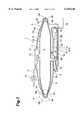
- FIG. 1is a partial sectional view to show a fuel storage apparatus provided with the fuel tank of the first embodiment
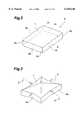
- FIG. 2is a perspective view to show the basic shape of the fuel tank
- FIG. 3is a perspective view to show a state of the fuel tank in which the fuel is full;
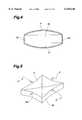
- FIG. 4is a sectional view taken along line X--X of FIG. 3;
- FIG. 5is a perspective view to show a state of the fuel tank in which the fuel is little;
- FIG. 6is a sectional view taken along line X--X of FIG. 5;
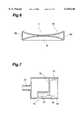
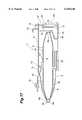
- FIG. 7is a sectional plan view to show the auxiliary fuel tank
- FIG. 8is a detailed sectional view to show an enlarged view of part A in FIG. 1;
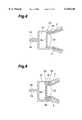
- FIG. 9is a detailed sectional view, similar to FIG. 8, to show a fuel storage apparatus provided with the fuel tank of the second embodiment
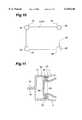
- FIG. 10is a schematic plan view to show the fuel tank of the second embodiment
- FIG. 11is a detailed sectional view, similar to FIG. 8, to show a fuel storage apparatus provided with the fuel tank of the third embodiment
- FIG. 12is an explanatory drawing to show a state of vibration isolation of the fuel tank of FIG. 11;
- FIG. 13is a detailed sectional view, similar to FIG. 8, to show a fuel storage apparatus provided with the fuel tank of the fourth embodiment
- FIG. 14is an explanatory drawing to show a state of vibration isolation of the fuel tank of FIG. 13;
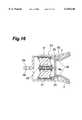
- FIG. 15is a detailed sectional view, similar to FIG. 8, to show a fuel storage apparatus provided with the fuel tank of the fifth embodiment
- FIG. 16is an explanatory drawing to show a state of vibration isolation of the fuel tank of FIG. 15;
- FIG. 17is a partial sectional view to show a fuel storage apparatus provided with the fuel tank of the sixth embodiment
- FIG. 18is a plan view to show the major part of a fuel storage apparatus provided with the fuel tank of the seventh embodiment
- FIG. 19is a sectional view taken along line Y--Y of FIG. 18;
- FIG. 20is a plan view to show the major part of a fuel storage apparatus provided with the fuel tank of the eighth embodiment
- FIG. 21is a sectional view taken along line Z--Z of FIG. 20;
- FIG. 22is a sectional structural diagram to show the major part of a fuel storage apparatus provided with the fuel tank of the ninth embodiment
- FIG. 23is a sectional structural diagram to show the major part of a fuel storage apparatus provided with the fuel tank of the tenth embodiment.
- FIG. 24is a sectional structural diagram to show the major part of a fuel storage apparatus provided with the fuel tank of the eleventh embodiment.
- the fuel tank of the present inventionis used as a tank for storing the fuel to be supplied, for example, to an internal combustion engine. Of course, it can also be used as a tank for simply storing the fuel.
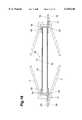
- FIG. 1is a partial sectional view to show a fuel storage apparatus provided with the fuel tank of the first embodiment.
- This fuel storage apparatus 1has a housing (also called a tank shell) 4 constituting the outer shell of the fuel storage apparatus 1.
- This housing 4is made of a rigid member, such as metal or synthetic resin, and is composed of an upper portion 2 and a lower portion 3 separated up and down from each other.
- the upper portion 2has an upwardly curved shape and the lower portion 3 has a downwardly curved shape.
- These upper and lower portions 2, 3are hermetically connected to each other at flanges 2a, 3a formed around the entire periphery of each portion.
- a partition wall 6Inside an inner space defined by the upper portion 2 and lower portion 3 of the housing 4, there is a partition wall 6 (see FIG. 2) of a hexahedron, and this partition wall 6 partitions the inner space in the housing 4 into a fuel storage chamber 5 inside the partition wall 6 and upper and lower spaces 61a, 61b outside the partition wall 6.
- the partition wall 6 and fuel storage chamber 5compose a fuel tank 70.
- the partition wall 6 forming the fuel tank 70has the basic shape of substantially a rectangular parallelepiped, as illustrated in FIG. 2, and is comprised of a pair of substantially rectangular upper wall 7 and lower wall 8 opposed to each other in the vertical direction, and four substantially rectangular side walls (peripheral walls) 9a to 9d for connecting (or closing) corresponding edges of these upper wall 7 and lower wall 8 to each other.
- These side walls 9a to 9dare connected so that their both edges are connected to edges of other adjacent side walls and connecting portions 9e to 9h are formed between the side walls 9a to 9d.
- the partition wall 6 having these upper wall 7, lower wall 8, and side walls 9a to 9dis formed, for example, in multilayered structure in which a skin layer of high-density polyethylene covers the both surfaces of the flat core part made of ethylene-vinyl copolymer resin or nylon.
- the partition wall 6 of this structureis substantially rigid and deformable.
- the area of the upper wall 7 or the lower wall 8is larger than the area of one side wall and the rigidity of the upper wall 7 and the lower wall 8 is smaller than that of the side walls 9a to 9d.
- the upper wall 7 and lower wall 8are not limited to the rectangular walls, but may be a pair of polygonal walls. Accordingly, the upper wall 7 and lower wall 8 correspond to the polygonal walls, and the side walls 9a to 9d to the connecting walls connecting the upper wall 7 and the lower wall 8.
- the shapes of the upper wall 7, lower wall 8, and side walls 9a to 9dare properly selected, depending upon the shape of the space for the fuel tank 70 to be mounted.
- the fuel storage chamber 5 of the substantially rectangular parallelepiped shape in the basic shape of the partition wall 6is defined inside the partition wall 6.
- the fuel amount in the fuel storage chamber 5exceeds one at which the rectangular parallelepiped shape can be maintained (hereinafter referred to as predetermined amount)
- the upper wall 7 and lower wall 8move away from each other to be curved so as to inflate outward while the side walls 9a to 9d approach each other to be curved so as to be indented inward, as illustrated in FIG. 3 and FIG. 4.
- the upper wall 7suffers inflation due to the increase in the fuel amount to be curved so as to warp vertically upward
- the lower wall 8suffers inflation due to the increase in the fuel amount and the weight of the fuel to be curved so as to warp vertically downward
- the side walls 9a to 9dbecome curved so as to warp horizontally and inwardly. In this way the amount of the fuel that can be stored in the fuel storage chamber 5 increases gradually.
- the upper wall 7 and lower wall 8move toward each other to be curved so as to be indented inward and the side walls 9a to 9d also move toward each other to be curved so as to be indented inward, as illustrated in FIG. 5 and FIG. 6.
- the upper wall 7becomes curved so as to warp downward
- the lower wall 8becomes curved so as to warp upward
- the side walls 9a to 9dbecomes curved so as to warp horizontally and inwardly. In this way the amount of the fuel that can be stored in the fuel storage chamber 5 decreases gradually.
- Deformation amounts of the upper wall 7 and the lower wall 8are greater than those of the side walls 9a to 9d. Accordingly, the upper wall 7 and lower wall 8 serve as large deformation surfaces, and the side walls 9a to 9d as small deformation surfaces.
- a fuel pipe 60 for supplying or discharging the fuel into or from the fuel storage chamber 5is connected to the approximate center of the lower wall 8 forming the partition wall 6.
- This fuel pipe 60is branched below the lower wall 8 into a fuel supply pipe 10 and a fuel inlet pipe 20 connected to an auxiliary fuel tank 14 described hereinafter.
- the fuel supplied through a fuel inlet(not illustrated) is supplied through the fuel supply pipe 10 and fuel pipe 60 into the fuel storage chamber 5 and is also supplied through the fuel inlet pipe 20 into the auxiliary fuel tank 14. During discharge of the fuel, the fuel in the fuel storage chamber 5 is sucked through the fuel pipe 60 and fuel inlet pipe 20 into the auxiliary fuel tank 14.
- fuel supply pipe 10 and fuel inlet pipe 20permit the curvature deformation of the lower wall 8, because their pipe walls are formed in the bellows shape to be extensible and bendable at the connection to the fuel pipe 60.
- the fuel inlet pipe 20is formed in the bellows shape throughout the entire length thereof.
- An evaporated fuel exhaust pipe 11 for discharging the gas, particularly the evaporated fuel, from the fuel storage chamber 5 to the outside of the fuel storage chamber 5is connected through an isolation valve 12 to the approximate center of the upper wall 7 forming the partition wall 6.
- This evaporated fuel exhaust pipe 11is flexible and permits the curvature deformation of the upper wall 7.
- the isolation valve 12isolates the evaporated fuel exhaust pipe 11 to prevent the fuel from leaking to the outside of the fuel storage chamber 5 when the fuel level of the fuel storage chamber 5 reaches the isolation valve 12.
- the evaporated fuel exhaust pipe 11is connected through a check valve 13 and a charcoal canister (not illustrated) for temporarily adsorbing the evaporated fuel to a suction passage (not illustrated) of the internal combustion engine.
- the evaporated fuel adsorbed to this charcoal canisteris discharged into the suction passage to be burned, according to the engine operating status of the internal combustion engine.
- the above check valve 13is opened when the pressure inside the evaporated fuel exhaust pipe 11 between the check valve 13 and the isolation valve 12 becomes over a positive pressure preliminarily determined. It is closed when the pressure is below the predetermined positive pressure. This action of the check valve 13 prevents the gas from flowing into the fuel storage chamber 5 after the isolation valve 12 has isolated the pipe 11.
- a fuel gage 71for detecting a displacing position or a moving amount of the upper wall 7 in the vertical direction and for calculating the fuel amount in the fuel storage chamber 5.
- This fuel gage 71is a pendulum type gage which computes the fuel amount from an angle of displacement of a pendulum.
- the auxiliary fuel tank 14 for temporarily storing the fuel from the fuel storage chamber 5is located on the lower portion 3 of the housing 4 and below the lower wall 8 on the side between the fuel pipe 60 and the side wall 9c.
- a fuel pump 16Placed inside this auxiliary fuel tank 14 is a fuel pump 16 for feeding the fuel from the auxiliary fuel tank 14 through a fuel feed pipe 15 to fuel injection valves (not illustrated) of the internal combustion engine.
- This fuel pump 16sucks in the fuel through a filter 17 for filtering dust or the like in the fuel and feeds the fuel to the fuel injection valves with controlling the pressure of the fuel to a predetermined value.
- a separation wall 18 extending substantially vertically upstands on a lower wall 50 of the auxiliary fuel tank 14.
- This separation wall 18is placed so as to surround the fuel pump 16 and filter 17, as illustrated in FIG. 7, to form an accommodation chamber 19 for accommodating the fuel pump 16 and filter 17, thereby preventing the fuel around the filter 17 from being drained away when the auxiliary fuel tank 14 is inclined so as to incline the fuel level in the auxiliary fuel tank 14. Accordingly, this separation wall 18 functions as fuel drain preventing means.
- an upper surface of an upper wall 52 of the auxiliary fuel tank 14 and an upper surface of part 3a below the lower wall 8 on the side between the fuel pipe 60 and the side wall 9a, in the lower portion 3 of the housing 4match with the shape of the lower wall 8 when the lower wall 8 of the partition wall 6 is curved downward; and a lower surface of the upper portion 2 of the housing 4 matches with the shape of the upper wall 7 when the upper wall 7 of the partition wall 6 is curved upward.
- the upper wall 52 and the predetermined part 3a of the lower portion 3prevent the lower wall 8 from being further curved downward, thereby regulating the downward curvature of the lower wall 8 at predetermined magnitude;
- the upper portion 2prevents the upper wall 7 from being further curved upward, thereby regulating the upward curvature of the upper wall 7 at predetermined magnitude.
- the magnitudes of the curvature deformations thus regulatedare those equivalent to the full tank amount of fuel, for example.
- the upper wall 52 of the auxiliary fuel tank 14, the predetermined part 3a of the lower portion 3 of the housing 4, and the upper portion 2 of the housing 4work each as curvature deformation regulating means for regulating the curvature of the lower wall 8 or the upper wall 7 at the predetermined magnitude.
- the lower wall 8 and upper wall 7 of the partition wall 6are prevented from being curved excessively over the predetermined allowable level, by the upper wall 52 of the auxiliary fuel tank 14, the predetermined part 3a of the lower portion 3 of the housing 4, and the upper portion 2 of the housing 4.
- the upper wall 7 and lower wall 8are thus protected during the curvature deformation.
- the upper wall 7 and lower wall 8are further protected during the curvature deformation, because the shape of the upper wall 52 of the auxiliary fuel tank 14 and the predetermined part 3a of the lower portion 3 of the housing 4 matches with the shape of the downward curvature of the lower wall 8 while the shape of the upper portion 2 of the housing 4 matches with the shape of the upward curvature of the upper wall 7.
- the upper wall 7 and lower wall 8are protected in this way, thereby preventing deterioration of or damage to the fuel tank 70 due to excess deformation.
- the upper wall 52 of the auxiliary fuel tank 14is utilized for prevention of deformation of the lower wall 8 as described above, there is no dead space below the partition wall 6, the whole of the fuel storage apparatus 1 is compactified, and the mountability of the fuel storage apparatus 1 is improved.
- the fuel in the fuel storage chamber 5is supplied to the auxiliary fuel tank 14 with reliability, because the auxiliary fuel tank 14 is located below the fuel storage chamber 5.
- the supply of the fuel through the fuel supply pipe 10 into the fuel storage chamber 5is stopped when the lower wall 8 of the partition wall 6 comes to contact the upper wall 52 of the auxiliary fuel tank 14 and the top surface of the predetermined part 3a of the lower portion 3 of the housing 4 and when the upper wall 7 of the partition wall 6 comes to contact the lower surface of the upper portion 2 of the housing 4.
- the maximum storage amount of the fuel in the fuel storage chamber 5is determined by the upper wall 52 of the auxiliary fuel tank 14, the predetermined part 3a of the lower portion 3 of the housing 4, and the upper portion 2 of the housing 4.
- the upper wall 52 of the auxiliary fuel tank 14, the predetermined part 3a of the lower portion 3 of the housing 4, and the upper portion 2 of the housing 4, working as the curvature deformation regulating meansalso serve each as fuel storage amount defining means for defining the maximum amount of the fuel that can be stored in the fuel storage chamber.
- a space 21 having approximately the same height as that of the side walls 9a to 9d of the partition wall 6is formed by the upper portion 2 and the lower portion 3.
- the side walls 9a to 9d and connecting portions 22 of the upper and lower walls 7, 8are Accommodated in this space 21.
- the connecting portions 22 of the upper and lower walls 7, 8as parts of the side walls, the connecting portions 22 of the upper and lower walls 7, 8 and the side walls 9a to 9d together will be called a side-wall-equivalent portion 62, which corresponds to the peripheral part of the partition wall 6 (fuel tank 70).
- the partition wall 6is supported so as to be horizontally slidable relative to the housing 4 while the side-wall-equivalent part 62 is pinched by the upper portion 2 and the lower portion 3 of the housing 4.
- the housing peripheral part connecting the upper portion 2 and lower portion 3 of the housing 4constitutes a pinching portion 23 which horizontally slidably pinches the side-wall-equivalent part 62 of the partition wall 6 (see FIG. 8).
- This pinching portion 23functions as a support member for supporting the partition wall 6.
- the above side-wall-equivalent part 62is displaced as horizontally sliding in the pinching portion 23 during the curvature deformation of the upper wall 7 and lower wall 8.
- upward and downward displacement of the connecting portions 22 of the upper wall 7 and lower wall 8is very small relative to the upper wall 7 and lower wall 8. Therefore, as illustrated in FIG. 8, the pinching portion 23 does not restrain the upward and downward curvature deformation of the upper wall 7 and lower wall 8.
- the partition wall 6is supported at the side-wall-equivalent part 62 by the pinching portion 23 of the housing 4 in this way, the upper wall 7 and lower wall 8 are permitted to undergo the upward and downward curvature deformation according to the fuel amount in the fuel storage chamber 5.
- the fuelis supplied through the fuel supply pipe 10 into the partition wall 6 the basic shape of which is the substantially rectangular parallelepiped shape illustrated in FIG. 2, and with increase of the fuel amount in the fuel storage chamber 5 over the aforementioned predetermined amount, the upper wall 7 becomes curved upward and the lower wall 8 becomes curved downward, while the side walls 9a to 9d become curved inward.
- These curvaturesgradually increase according to the increase in the fuel amount without being restrained by the pinching portion (support member) 23 supporting the fuel tank 70, so as to increase the capacity of the fuel storage chamber 5, whereby the fuel can be stored up to the maximum in the fuel storage chamber 5.
- the fuelis also charged into the auxiliary fuel tank 14.
- the present embodimentis adapted so that the greater amount of the fuel can be stored in the fuel storage chamber 5 than in the fuel tank inhibiting the upward curvature of the upper wall 7 and the downward curvature of the lower wall 8 with increase in the fuel amount. Because of this structure, the amount of the fuel that can be stored in the fuel storage chamber 5 can be maintained at the maximum.
- the fuel pumpis actuated to feed the fuel from the fuel storage chamber 5 through the fuel pipe 60, fuel inlet pipe 20, filter 17, and fuel feed pipe 15 to the fuel injection valves of the internal combustion engine.
- the upward curvature of the upper wall 7, the downward curvature of the lower wall 8, and the inward curvature of the side walls 9a to 9dbecome gradually relaxed with decrease of the fuel amount in the fuel storage chamber 5 and then the partition wall 6 returns to the substantially rectangular parallelepiped shape illustrated in FIG. 2 when the fuel amount of the fuel storage chamber 5 is decreased to the predetermined amount.
- the negative pressure due to suctionmakes the upper wall 7 curved downward, the lower wall 8 curved upward, and the side walls 9a to 9d curved inward as illustrated in FIG. 5.
- These curvaturesgradually increase according to the decrease of the fuel amount without being restrained by the pinching portion 23 supporting the fuel tank 70.
- the upper wall 7becomes abutting against the lower wall 8 approximately at their center to be in close contact therewith, as illustrated in FIG. 6, further curvature deformation is stopped.
- the present embodimentis adapted so that the capacity of the space in the fuel storage chamber 5 is decreased more than in the fuel tank inhibiting the lower curvature of the upper wall 7 and the upper curvature of the lower wall 8 with decrease in the fuel amount, by the degree corresponding to the capacity of the fuel storage chamber 5 decreased by the curvatures. Because of this structure, the evaporated fuel is decreased drastically.
- the vibration of the vehiclemay vibrate the fuel tank 70 up and down (i.e., vertical G may vibrate it). Increase of the vertical vibration of this fuel tank 70 will produce noise or damage the side-wall-equivalent portion 62 of the fuel tank 70 supported by the pinching portion 23 of the housing 4.
- the second embodimentis thus arranged to suppress the vertical vibration of the fuel tank 70 without restraining the curvature deformation of the fuel tank 70.
- the second embodimentis adapted so that vibration-isolating members (elastic members) 25 of rubber having elasticity, for example, are interposed each between the four corners 24 of the partition wall 6 (fuel tank 70) and the pinching portion 23 of the housing 4.
- the vibration-isolating members 25are made of rubber and the partition wall 6 is made of resin as described previously; therefore, the side-wall-equivalent portion 62 is hard to slide relative to the vibration-isolating members 25.
- the vibration-isolating members 25are, therefore, provided at the four corners 24 (parts of the side-wall-equivalent portion 62) which have the connecting portions 9e to 9h connecting the upper wall 7, the lower wall 8, and adjacent side walls and which have the highest rigidity, as compared with the other portions, and thus undergo little deformation.
- the deformation of the side walls 9a to 9d, the upper wall 7, and the lower wall 8will not be suppressed even if the corners 24 are supported through the vibration-isolating members 25 by the pinching portion 23; and then, the side walls 9a to 9d, the upper wall 7, and the lower wall 8 can undergo the curvature deformation similar to that in the first embodiment.
- the partition wall 6can be supported well even in the structure supporting only the corners 24.
- the vibration-isolating members 25correspond to vertical vibration suppressing means out of vibration suppressing means for suppressing (or attenuating) input of vibration from the outside of the fuel storage chamber 5 thereinto. This suppresses the damage to the fuel tank 70 and the production of noise.
- the other structure, operation, and effect of the second embodimentare the same as those of the first embodiment and are thus omitted to explain herein.
- the fuel tank 70when the fuel tank 70 is mounted on the vehicle, it is vibrated laterally by acceleration G (in front and back directions of the vehicle or in horizontal directions of the vehicle), which may produce the noise or damage the corners 24 of the side-wall-equivalent portion 62 supported by the housing 4.
- the third embodimentis thus arranged to suppress the vertical vibration of the fuel tank 70 and also suppress the lateral vibration thereof.
- coil springs 52as elastic members are located in place of the vibration-isolating members 25 of the second embodiment.
- the coil springs 52extend and contract so as to permit the vertical and lateral vibration of the fuel tank 70, as illustrated in FIG. 12.
- the coil springs 52thus suppress the vertical vibration of the fuel tank 70 and also suppress the lateral vibration of the fuel tank 70 by their elastic action. Accordingly, the coil springs 52 function as vibration (vertical and lateral vibration) suppressing means.
- the other structure, operation, and effect of the third embodimentare the same as those of the second embodiment and thus the description thereof is omitted herein.
- the fuel tank 70is supported only at the four corners 24 by the pinching portion 23 of the housing 4. Because of this structure, the support strength of the fuel tank 70 to the housing 4 is small and the housing 4 could fail to support the fuel tank 70 when the vibration of the fuel tank 70 is great.
- the fourth embodimentis thus arranged to suppress the vertical and lateral vibration of the fuel tank 70 and to enhance the support strength of the fuel tank 70 to the housing 4.
- flanges (flange members) 26extending laterally and outwardly horizontally from the side walls 9a to 9d are formed integrally with the side walls 9a to 9d.
- the flanges 26are formed at the four corners 24 of the fuel tank 70.
- a flange through hole 27 vertically penetrating each flange 26is formed in the central part of the flange 26 and a pair of second vibration-isolating members (elastic members) 28 of rubber having elasticity, for example, are located between the flange 26 and the upper portion 2 or the lower portion 3 (the pinching portion 23), i.e., on the both sides of the flange 26 in the vertical direction.
- isolator through holes 29vertically penetrating the second vibration-isolating members 28 are formed each coaxially with the flange through hole 27.
- each of the second vibration-isolating members 28is provided with two legs 31 in contact with the flange 26.
- an upper portion through hole 32 and a lower portion through hole 33 perpendicularly penetrating the upper portion 2 and lower portion 3are formed coaxially with the isolator through hole 29, in the upper portion 2 and lower portion 3 (pinching portion 23).
- a collar 34is inserted through these upper portion through hole 32, isolator through hole 29, flange through hole 27, and lower portion through hole 33.
- a bolt 35is inserted into this collar 34 and this bolt 35 is fastened by a nut 36.
- the inside diameter of the flange through hole 27is larger than the outside diameter of the collar 34.
- the flange 26is firmly fastened so as to be slidable relative to the upper portion 2 and lower portion 3 (pinching portion 23), through the second vibration-isolating members 28 by the collar 34, bolt 35, and nut 36. Therefore, the support strength of the fuel tank 70 to the housing 4 is higher than those in the second and third embodiments.
- the side walls 9a to 9dcan be displaced laterally. Accordingly, the flanges 26 serve as slide support portions (the peripheral part of the partition wall 6) slidably supported relative to the housing 4.
- each second vibration-isolating member 28With the lateral displacement of the side walls 9a to 9d, the two legs 31 of each second vibration-isolating member 28 are laterally displaced following the flange 26 because of their elastic action, as illustrated in FIG. 14. Thanks to this structure, the second vibration-isolating members 28 do not inhibit the lateral displacement of the side walls 9a to 9d and the second vibration-isolating members 28 suppress the lateral vibration of the fuel tank 70. Accordingly, the second vibration-isolating members 28 correspond to lateral vibration suppressing means. Of course, the second vibration-isolating members 28 also suppress the vertical vibration. Therefore, the second vibration-isolating members 28 also correspond to vertical vibration suppressing means.
- the other structure, operation, and effect of the fourth embodimentare the same as those of the second embodiment and the description thereof is omitted herein.
- the fourth embodimentis arranged to suppress the lateral vibration of the fuel tank 70, but the legs 31 of the second vibration-isolating members 28 are displaced largely according to the horizontal vibration of the fuel tank 70. Therefore, the second vibration-isolating members 28 except for the legs 31 do not contribute to the suppression of the lateral vibration.
- the fifth embodimentis thus arranged to enhance the lateral vibration suppressing effect of the fuel tank 70.
- third vibration-isolating members 37for example, of rubber having elasticity are placed on the both sides of the flanges 26 in the vertical direction. These third vibration-isolating members 37 are each in contact with the flange 26 through a collar 38, for example, of metal and are fixed each to the upper portion 2 or to the lower portion 3 (pinching portion 23) through a collar 39, for example, of metal.
- a bolt 40is buried in the upper part of the lower third vibration-isolating member 37 while a nut 41 is buried in the lower part of the upper third vibration-isolating member 37. Then the bolt 40 is inserted through the above flange through hole 27 to be fastened by the nut 41.
- the third vibration-isolating members 37follow this displacement to be deformed because of their elastic action. At this time, the third vibration-isolating members 37 are totally deformed, so as to suppress the lateral vibration of the fuel tank 70. Accordingly, the third vibration-isolating members 37 function as lateral vibration suppressing means. Since the third vibration-isolating members 37 are totally deformed as described above, the lateral vibration of the fuel tank 70 is more suppressed than in the fourth embodiment.
- the other structure, operation, and effect of the fifth embodimentare the same as those of the second embodiment and the description thereof is omitted herein.
- the fuel pump 16has to be installed vertically because of the shape of the space for placement of the fuel storage apparatus 1 and piping.
- the sixth embodimentis thus adapted for the vertical placement of the fuel pump 16.
- the auxiliary fuel tank 14 forming the fuel storage apparatus 1is placed in a side portion of the housing 4, and the filter 17 and the fuel pump 16 vertically installed are provided in this auxiliary fuel tank 14.
- the auxiliary fuel tank 14is provided with a housing side wall portion 43 extending vertically and connecting the upper portion 2 to the lower portion 3 of the housing 4 at the side portion, a housing shutting wall portion 72 standing inside the housing side wall portion 43 and shutting the auxiliary fuel tank from the fuel tank 70, and a space portion 73 defined by these housing side wall portion 43, housing shutting wall portion 72, upper portion 2, and lower portion 3 and including the above fuel pump 16 and filter 17.
- the housing shutting wall portion 72has a deformation regulating wall 49 as curvature deformation regulating means in the lower side thereof near the fuel tank 70, and this deformation regulating wall 49 regulates the downward curvature of the lower wall 8 forming the partition wall 6 at the predetermined magnitude.
- the evaporated fuel in the auxiliary fuel tank 14is fed through an evaporated fuel feed pipe 51 to the charcoal canister.
- the fuel tank 70experiences more downward bending of the lower wall 8 than bending of the upper wall 7 because of the weight of the fuel tank 70 including the fuel. Because of this, the magnitude of the upward curvature of the upper wall 7 is not coincident with the magnitude of the downward curvature of the lower wall 8 during the curvature deformation of the partition wall 6 according to the increase of the fuel amount in the fuel storage chamber 5. Namely, the curvature deformation amounts of the upper wall 7 and the lower wall 8 are different from each other (the shapes of the upper wall 7 and lower wall 8 become asymmetric), which could twist and break the side walls 9a to 9d connecting them. In addition, the capacity of the fuel storage chamber 5 is instable.
- the seventh embodimentis thus arranged to prevent occurrence of twisting of the side walls 9a to 9d during the curvature deformation of the partition wall 6, to stabilize the capacity of the fuel storage chamber 5, and to make the fuel measurement accurate.
- the fuel tank 70is supported as being accommodated in a fuel tank accommodating section 74.
- This fuel tank accommodating section 74is generally composed of a pair of holding portions 75 the vertical cross section of which is the U-shape and which are placed so that recesses (gaps) 80 forming the U-shape are opposed to each other, and a plurality of resin members 76 connecting these holding portions 75.
- the resin members 76are made, for example, of such resin as polyacetal and in a thin plate shape (sheet shape), and a plurality of such resin members 76 are provided for each of the upper side and lower side of the holding portions 75, thereby connecting the holding portions 75 to each other on the upper side and on the lower side. Then the fuel tank 70 is placed in a space portion defined by the two holding portions 75 and the upper and lower resin members 76.
- the height of the recess portions 80 of the holding members 75is approximately equal to that of the side walls 9a to 9d of the partition wall 6 and the side-wall-equivalent portion 62 of the partition wall 6 (fuel tank 70) described previously is accommodated in these recess portions 80.
- This side-wall-equivalent portion 62is supported so as to be horizontally slidable relative to the holding portions 75 while being pinched by the holding portions 75.
- the holding portions 75work as support members (pinching portions) for horizontally slidably pinching the side-wall-equivalent portion (peripheral part) 62 of the fuel tank 70.
- Fixing portions 77 of a flat plate shapeare connected respectively to the both ends of each holding member 75 on the lower side.
- the four fixing portions 77 of the two holding portions 75are fixed each to the peripheral part of the housing 4.
- the shape of the peripheral part of the upper portion 2 and the lower portion 3 of the housing 4is also modified so as to be able to accommodate the fuel tank accommodating portion 74.
- the lower resin members 76receive the weight of the fuel tank 70 including the fuel and are elastically deformed while dispersing the load exerted by the lower wall 8 according to the downward curvature of the lower wall 8, so as to support the lower wall 8 with permitting the curvature of the lower wall 8.
- the upper and lower resin members 76are extended well in the curvature deformation direction while horizontally expanding clearances between other adjacent resin members 76 with following the curvature deformation of the upper wall 7 and lower wall 8.
- the lower resin members 76function as elastically deformable support members (support members) for supporting the lower wall 8 while receiving the weight of the fuel tank 70 including the fuel and permitting the downward curvature deformation of the lower wall 8 with eliminating the influence of the weight.
- the lower resin members 76permit the downward curvature of the lower wall with receiving the weight of the fuel tank 70 including the fuel, the downward curvature deformation amount of the lower wall 8 becomes approximately coincident with the upward curvature deformation amount of the upper wall 7. Accordingly, the lower resin members 76 also serve as deformation amount adjusting means for adjusting the downward curvature deformation amount of the lower wall 8 so as to match with the upward curvature deformation amount of the upper wall 7 (or for making the downward curvature deformation amount of the lower wall 8 approximately coincident with the upward curvature deformation amount of the upper wall 7).
- the resin members 76are also provided on the upper side is that the upward curvature deformation amount of the upper wall 7 is further equalized to the downward curvature deformation amount of the lower wall 8 by controlling the magnitude of the upward curvature deformation of the upper wall 7. Accordingly, the upper resin members 76 also serve as the above deformation amount adjusting means.
- the resin members 76keep the magnitudes of the curvature deformations of the upper wall 7 and the lower wall 8 approximately coincident with each other with increase of the fuel amount, the occurrence of twisting of the side walls 9a to 9d is prevented, the capacity of the fuel storage chamber 5 is stabilized, and the fuel measurement is made accurate. Since the resin members 76 support the fuel tank 70 with being elastically deformed, the vibration of the fuel tank 70 is suppressed, the damage to the fuel tank 70 is also prevented, and the production of noise is also restrained. Accordingly, the resin members 76 also work as the vibration suppressing means described above.
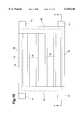
- FIG. 20is a plan view to show the major part of the fuel storage apparatus provided with the fuel tank of the eighth embodiment and FIG. 21 is a sectional view thereof taken along line Z--Z of FIG. 20.
- the eighth embodimentis different from the seventh embodiment in that resin members 78, 79 forming meshes are used as elastically deformable support members, in place of the plurality of resin members 76 of the thin plate shape connecting the holding portions 75 to each other.
- the resin members 78, 79 as elastically deformable support membersalso serve as the aforementioned deformation amount adjusting means and as the vibration suppressing means.
- Each of the resin members 78, 79 forming the meshesis a wirelike resin member and they are placed so as to cross each other up and down like seams.
- the holding portions 75may be connected to each other only by the wirelike resin members 78.
- the seventh and eighth embodimentsare arranged so that the resin members 76, 78, 79 are provided corresponding to the both upper wall 7 and lower wall 8 of the fuel tank 70 in order to equalize the deformation amounts of the upper wall 7 and lower wall 8 with each other
- the resin membersmay be provided corresponding only to the lower wall 8 so as to make the deformation amounts of the upper wall 7 and lower wall 8 approximately coincident with each other.
- the upper resin memberscan be eliminated.
- the number of upper resin members(the number of lines) can also be made smaller than the number of lower resin members in order to further equalize the curvature deformations of the upper wall 7 and the lower wall 8 with each other.
- the elastically deformable support members 76, 78, 79are not limited to the resin members.
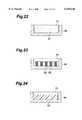
- the apparatuscan also be arranged so that the fuel tank accommodating section 74 described in the seventh and eighth embodiments is made as a recessed case 90, the fuel tank 70 is accommodated in this case 90, and the fuel tank 70 is mounted, for example, on a foamed member 91 (sponge or the like) illustrated in FIG. 22, or on spring members 92 (spring coils, plate springs, coned disk springs, etc.) illustrated in FIG. 23, or on a rubber member 93 illustrated in FIG. 24, as an elastically deformable support member placed in the case 90.
- a foamed member 91spongee or the like
- spring members 92spring coils, plate springs, coned disk springs, etc.
- the elastically deformable support membercan be any member that abuts against the lower wall 8 and that supports the lower wall 8 so as to permit the curvature of the lower wall 8 with being elastically deformed while dispersing the load exerted by the lower wall 8 according to the downward curvature of the lower wall 8.
- the present inventionwas described above in detail, based on the embodiments thereof, but the present invention is not limited only to the above embodiments.
- the second to fifth embodiments described abovewere arranged so that the elastic members 25, 28, 37, 52 were interposed at the corners 24 of the fuel tank 70, but the elastic members may be arranged to be interposed throughout the whole of the side-wall-equivalent portion 62.
- the fuel tankwas the fuel tank 70 composed of the upper wall 7 and lower wall 8 of the polygon shape opposed to each other, and the side walls 9a to 9d connecting these upper wall 7 and lower wall 8, but, without having to be limited to the fuel tank of this structure, the present invention can be applied to any fuel tank that is provided with the fuel storage chamber deformable according to the amount of the fuel stored therein.
- the fuel tank according to the present inventionis so constructed that the lower wall forming the fuel storage chamber is curved downward according to the increase of the fuel amount and that at this time the support member supporting the fuel storage chamber does not restrain the downward curvature of the lower wall, whereby the capacity of the fuel storage chamber can be increased, as compared with those inhibiting the deformation of the lower wall. As a result, the amount of the fuel that can be stored in the fuel storage chamber can be maintained at the maximum.
Landscapes
- Engineering & Computer Science (AREA)
- Life Sciences & Earth Sciences (AREA)
- Sustainable Development (AREA)
- Sustainable Energy (AREA)
- Chemical & Material Sciences (AREA)
- Combustion & Propulsion (AREA)
- Transportation (AREA)
- Mechanical Engineering (AREA)
- Cooling, Air Intake And Gas Exhaust, And Fuel Tank Arrangements In Propulsion Units (AREA)
Abstract
Description
1. Field of the Invention
The present invention relates to a fuel tank for storing fuel.
2. Related Background Art
If there is a space above the fuel level in the fuel tank, the fuel will be evaporated and this evaporated fuel could be emitted to the atmosphere. For example, Japanese Laid-Open Patent Application No. H8-170568 discloses a fuel tank constructed in such structure that a fuel storage chamber for storing the fuel is made of an extensible envelope film and that the envelope film expands and contracts according to the amount of the fuel in the fuel storage chamber, thereby preventing the evaporated fuel from appearing above the fuel level in the fuel storage chamber. Specifically, the above envelope film is composed of an upper wall, a lower wall, and a side wall of a bellows shape connecting these upper wall and lower wall to each other, and the lower wall of the envelope film is attached to a flat bottom wall of a housing. The upper wall of the envelope film moves up and down in the housing, depending upon the fuel amount in the fuel storage chamber, and the side wall expands and contracts with the up and down motion of the upper wall. The capacity of the fuel storage chamber thus increases and decreases with the upper and down motion of the upper wall and the expansion and contraction of the side wall of the envelope film.
The inventor, however, found out the fact that, because in the above fuel tank the lower wall of the envelope film forming the fuel storage chamber was fixed to the bottom wall of the housing, the lower wall was not displaced or deformed according to the fuel amount in the fuel storage chamber and the maximum amount of the fuel that was able to be stored in the fuel storage chamber of the above fuel tank was thus smaller than the maximum that would have been expected if the lower wall should have been displaceable or deformable in the direction to increase the capacity of the fuel storage chamber, according to the fuel amount in the fuel storage chamber.
The present invention has been accomplished in order to solve the above issue and an object of the invention is to provide a fuel tank provided with a fuel storage chamber that is deformable according to the amount of fuel stored therein, wherein the amount of the fuel that can be stored in the fuel storage chamber is maintained at the maximum.
A fuel tank of the present invention is a fuel tank comprising a fuel storage chamber that is deformable according to the amount of fuel stored therein, wherein the fuel storage chamber comprises a lower wall to be curved downward according to increase in the amount of fuel and is supported by a support member that allows the lower wall to be curved downward.
Since this fuel tank of the present invention is constructed in such structure that the lower wall forming the fuel storage chamber becomes curved downward according to the increase in the amount of fuel and that at this time the support member for supporting the fuel storage chamber does not restrain the downward curvature of the lower wall, the capacity of the fuel storage chamber is increased as compared with the fuel tank not allowing such deformation of the lower wall.
Specifically, the fuel storage chamber is composed of an upper wall and a lower wall of a polygon opposed to each other, and peripheral walls connecting these upper wall and lower wall.
The walls constituting the fuel storage chamber are formed, specifically, in multilayered structure of resin.
The support member is preferably constructed in structure for supporting a peripheral part of the fuel storage chamber. When this structure is adopted, the support member for supporting the peripheral part of the fuel storage chamber does not restrain the downward curvature of the lower wall and, therefore, the lower wall is well curved downward.
The peripheral part of the fuel storage chamber is composed, specifically, of the peripheral walls, and connecting portions of the upper wall and lower wall connected to the peripheral walls.
The support member is preferably configured to support corners of the peripheral part. When this configuration is employed, the peripheral part, particularly at the corners, has higher rigidity than the other portions, because there are the upper wall, the lower wall, and vertical connecting portions for connecting adjacent peripheral walls. Hence the fuel storage chamber is supported well even by the structure for supporting only the corners. Since the support member is configured to support only the corners of the peripheral part as against the invention for supporting the whole of the peripheral part, the configuration of the support member is simplified. Even if the peripheral walls are deformed with deformation of the lower wall, the corners will rarely be deformed because of their high rigidity as described above. Therefore, the deformation of the peripheral walls and the lower wall is not restrained even in the structure for supporting the corners.
In a preferred configuration the peripheral walls have a flange member and the support member supports the flange member. When this configuration is employed, the support member supporting the flange member of the peripheral walls does not restrain the downward curvature of the lower wall and, therefore, the lower wall is well curved downward.
The support member is preferably configured to comprise vibration suppressing means for suppressing input of vibration from the outside of the fuel storage chamber thereinto. When this configuration is adopted, the vibration suppressing means suppresses vibration of the fuel storage chamber and also suppresses production of noise.
In a preferred configuration the vibration suppressing means is an elastic member and this elastic member supports the fuel storage chamber in a vibration-isolating manner. When this configuration is adopted, the vibration of the fuel storage chamber, for example, due to acceleration G or vertical G is transmitted to the elastic member and elastic action of this elastic member suppresses the vibration of the fuel storage chamber and also suppresses production of noise.
Here, the elastic member is, specifically, a vibration-isolating material of rubber.
Another specific example of the elastic member is a coil spring.
The support member is preferably an elastically deformable support member, which abuts against the lower wall, for supporting the lower wall, the elastically deformable support member being arranged to elastically deform while dispersing a load exerted by the lower wall according to the downward curvature of the lower wall. When this configuration is employed, the elastically deformable support member as the support member abuts against the lower wall and supports the lower wall with elastically deforming while dispersing the load exerted by the lower wall according to the downward curvature of the lower wall. Therefore, the support member allows the downward curvature of the lower wall while receiving the weight of the fuel storage chamber including the fuel. Thanks to this, the lower wall is well curved downward. Since the elastically deformable support member supports the fuel storage chamber while elastically deforming, it suppresses the vibration of the fuel storage chamber and also suppresses the production of noise.
Here, the elastically deformable support member is, specifically, a plurality of sheetlike resin members stretched so as to receive the lower wall.
Another specific example of the elastically deformable support member is a plurality of wirelike resin members stretched so as to receive the lower wall.
Another specific example of the elastically deformable support member is a foamed member on which the lower wall is mounted.
Another specific example of the elastically deformable support member is a spring member on which the lower wall is mounted.
Still another specific example of the elastically deformable support member is a rubber member on which the lower wall is mounted.
Here, for example, where the upper wall is arranged to be curved upward according to the increase in the fuel amount in order to further increase the amount of fuel to be stored in the fuel storage chamber, the fuel storage chamber is more curved downward than the upward curvature of the upper wall with increase of the fuel amount, because of the weight of the fuel storage chamber including the fuel. Therefore, deformation amounts of the upper wall and the lower wall are different from each other, which could result in twisting and in turn breaking the peripheral walls connecting them and making the capacity of the fuel storage chamber instable. Further, where a fuel meter (gage) for measuring the fuel amount of the fuel storage chamber is constructed to measure the fuel amount, for example, according to the deformation of the upper wall or the lower wall, the measurement will be inaccurate.
In contrast with it, the elastically deformable support member permits the downward curvature of the lower wall while receiving the weight of the fuel storage chamber including the fuel, as described above, so that the deformation amounts of the upper wall and the lower wall can be equalized. This prevents the breakage due to the twisting of the peripheral walls, stabilizes the capacity of the fuel storage chamber, and permits accurate measurement of the fuel amount.
When the support member is configured to have deformation amount adjusting means, which abuts against the lower wall, for adjusting a deformation amount of the downward curvature of the lower wall so as to match with a deformation amount of curvature of the upper wall, the deformation amounts of the upper wall and the lower wall become nearly equal to each other, which prevents the breakage due to the twisting of the peripheral walls, which stabilizes the capacity of the fuel storage chamber, and which permits the accurate measurement of the fuel amount.
In a preferred configuration there is provided curvature deformation regulating means for regulating the downward curvature of the lower wall at predetermined magnitude, below the fuel storage chamber. When this configuration is employed, the curvature deformation regulating means provided below the fuel storage chamber regulates the downward curvature of the lower wall at the predetermined magnitude, so that the lower wall is not deformed excessively over the predetermined magnitude. This protects the lower wall.
The curvature deformation regulating means is preferably an auxiliary fuel tank, located below the fuel storage chamber and connected to the fuel storage chamber, for temporarily storing the fuel from the fuel storage chamber. When this configuration is adopted, the auxiliary fuel tank is utilized as the curvature deformation regulating means and there is, therefore, no dead space below the fuel storage chamber. Therefore, this compactifies the fuel tank and, further, improves mountability of the whole fuel tank including the auxiliary fuel tank. In addition, the fuel in the fuel storage chamber is supplied to the auxiliary fuel tank with reliability, because the auxiliary fuel tank is located below the fuel storage chamber.
The auxiliary fuel tank is preferably configured in a shape to match with the shape of the lower wall during the downward curvature of the lower wall. When this configuration is employed, protection of the lower wall is further enhanced, because the shape of the auxiliary fuel tank matches with the shape of the lower wall during the downward curvature of the lower wall.
The present invention will be more fully understood from the detailed description given hereinbelow and the accompanying drawings, which are given by way of illustration only and are not to be considered as limiting the present invention.
Further scope of applicability of the present invention will become apparent from the detailed description given hereinafter. However, it should be understood that the detailed description and specific examples, while indicating preferred embodiments of the invention, are given by way of illustration only, since various changes and modifications within the spirit and scope of the invention will be apparent to those skilled in the art from this detailed description.
FIG. 1 is a partial sectional view to show a fuel storage apparatus provided with the fuel tank of the first embodiment;
FIG. 2 is a perspective view to show the basic shape of the fuel tank;
FIG. 3 is a perspective view to show a state of the fuel tank in which the fuel is full;
FIG. 4 is a sectional view taken along line X--X of FIG. 3;
FIG. 5 is a perspective view to show a state of the fuel tank in which the fuel is little;
FIG. 6 is a sectional view taken along line X--X of FIG. 5;
FIG. 7 is a sectional plan view to show the auxiliary fuel tank;
FIG. 8 is a detailed sectional view to show an enlarged view of part A in FIG. 1;
FIG. 9 is a detailed sectional view, similar to FIG. 8, to show a fuel storage apparatus provided with the fuel tank of the second embodiment;
FIG. 10 is a schematic plan view to show the fuel tank of the second embodiment;
FIG. 11 is a detailed sectional view, similar to FIG. 8, to show a fuel storage apparatus provided with the fuel tank of the third embodiment;
FIG. 12 is an explanatory drawing to show a state of vibration isolation of the fuel tank of FIG. 11;
FIG. 13 is a detailed sectional view, similar to FIG. 8, to show a fuel storage apparatus provided with the fuel tank of the fourth embodiment;
FIG. 14 is an explanatory drawing to show a state of vibration isolation of the fuel tank of FIG. 13;
FIG. 15 is a detailed sectional view, similar to FIG. 8, to show a fuel storage apparatus provided with the fuel tank of the fifth embodiment;
FIG. 16 is an explanatory drawing to show a state of vibration isolation of the fuel tank of FIG. 15;
FIG. 17 is a partial sectional view to show a fuel storage apparatus provided with the fuel tank of the sixth embodiment;
FIG. 18 is a plan view to show the major part of a fuel storage apparatus provided with the fuel tank of the seventh embodiment;
FIG. 19 is a sectional view taken along line Y--Y of FIG. 18;
FIG. 20 is a plan view to show the major part of a fuel storage apparatus provided with the fuel tank of the eighth embodiment;
FIG. 21 is a sectional view taken along line Z--Z of FIG. 20;
FIG. 22 is a sectional structural diagram to show the major part of a fuel storage apparatus provided with the fuel tank of the ninth embodiment;
FIG. 23 is a sectional structural diagram to show the major part of a fuel storage apparatus provided with the fuel tank of the tenth embodiment; and
FIG. 24 is a sectional structural diagram to show the major part of a fuel storage apparatus provided with the fuel tank of the eleventh embodiment.
The preferred embodiments of the fuel tank according to the present invention will be described with reference to the accompanying drawings. In the figures, the same elements will be denoted by the same reference symbols and redundant description will be omitted.
The fuel tank of the present invention is used as a tank for storing the fuel to be supplied, for example, to an internal combustion engine. Of course, it can also be used as a tank for simply storing the fuel.
FIG. 1 is a partial sectional view to show a fuel storage apparatus provided with the fuel tank of the first embodiment. This fuel storage apparatus 1 has a housing (also called a tank shell) 4 constituting the outer shell of the fuel storage apparatus 1. Thishousing 4 is made of a rigid member, such as metal or synthetic resin, and is composed of anupper portion 2 and alower portion 3 separated up and down from each other. Theupper portion 2 has an upwardly curved shape and thelower portion 3 has a downwardly curved shape. These upper andlower portions flanges
Inside an inner space defined by theupper portion 2 andlower portion 3 of thehousing 4, there is a partition wall 6 (see FIG. 2) of a hexahedron, and thispartition wall 6 partitions the inner space in thehousing 4 into a fuel storage chamber 5 inside thepartition wall 6 and upper andlower spaces 61a, 61b outside thepartition wall 6. Thepartition wall 6 and fuel storage chamber 5 compose afuel tank 70.
Thepartition wall 6 forming thefuel tank 70 has the basic shape of substantially a rectangular parallelepiped, as illustrated in FIG. 2, and is comprised of a pair of substantially rectangularupper wall 7 andlower wall 8 opposed to each other in the vertical direction, and four substantially rectangular side walls (peripheral walls) 9a to 9d for connecting (or closing) corresponding edges of theseupper wall 7 andlower wall 8 to each other. Theseside walls 9a to 9d are connected so that their both edges are connected to edges of other adjacent side walls and connectingportions 9e to 9h are formed between theside walls 9a to 9d.
Thepartition wall 6 having theseupper wall 7,lower wall 8, andside walls 9a to 9d is formed, for example, in multilayered structure in which a skin layer of high-density polyethylene covers the both surfaces of the flat core part made of ethylene-vinyl copolymer resin or nylon. Thepartition wall 6 of this structure is substantially rigid and deformable.
The area of theupper wall 7 or thelower wall 8 is larger than the area of one side wall and the rigidity of theupper wall 7 and thelower wall 8 is smaller than that of theside walls 9a to 9d.
Here, theupper wall 7 andlower wall 8 are not limited to the rectangular walls, but may be a pair of polygonal walls. Accordingly, theupper wall 7 andlower wall 8 correspond to the polygonal walls, and theside walls 9a to 9d to the connecting walls connecting theupper wall 7 and thelower wall 8. The shapes of theupper wall 7,lower wall 8, andside walls 9a to 9d are properly selected, depending upon the shape of the space for thefuel tank 70 to be mounted.
As described above, the fuel storage chamber 5 of the substantially rectangular parallelepiped shape in the basic shape of thepartition wall 6 is defined inside thepartition wall 6. After with supply of the fuel into the fuel storage chamber 5 the fuel amount in the fuel storage chamber 5 exceeds one at which the rectangular parallelepiped shape can be maintained (hereinafter referred to as predetermined amount), theupper wall 7 andlower wall 8 move away from each other to be curved so as to inflate outward while theside walls 9a to 9d approach each other to be curved so as to be indented inward, as illustrated in FIG. 3 and FIG. 4.
More specifically, as the fuel amount in the fuel storage chamber 5 increases over the predetermined amount, theupper wall 7 suffers inflation due to the increase in the fuel amount to be curved so as to warp vertically upward, thelower wall 8 suffers inflation due to the increase in the fuel amount and the weight of the fuel to be curved so as to warp vertically downward, and theside walls 9a to 9d become curved so as to warp horizontally and inwardly. In this way the amount of the fuel that can be stored in the fuel storage chamber 5 increases gradually.
On the other hand, as the fuel is discharged from the fuel storage chamber 5 so as to decrease the fuel amount in the fuel storage chamber 5 below the predetermined amount, theupper wall 7 andlower wall 8 move toward each other to be curved so as to be indented inward and theside walls 9a to 9d also move toward each other to be curved so as to be indented inward, as illustrated in FIG. 5 and FIG. 6.
More specifically, as the fuel amount in the fuel storage chamber 5 decreases below the predetermined amount, theupper wall 7 becomes curved so as to warp downward, thelower wall 8 becomes curved so as to warp upward, and theside walls 9a to 9d becomes curved so as to warp horizontally and inwardly. In this way the amount of the fuel that can be stored in the fuel storage chamber 5 decreases gradually.
Deformation amounts of theupper wall 7 and thelower wall 8 are greater than those of theside walls 9a to 9d. Accordingly, theupper wall 7 andlower wall 8 serve as large deformation surfaces, and theside walls 9a to 9d as small deformation surfaces.
Again referring to FIG. 1, afuel pipe 60 for supplying or discharging the fuel into or from the fuel storage chamber 5 is connected to the approximate center of thelower wall 8 forming thepartition wall 6. Thisfuel pipe 60 is branched below thelower wall 8 into afuel supply pipe 10 and afuel inlet pipe 20 connected to anauxiliary fuel tank 14 described hereinafter.
The fuel supplied through a fuel inlet (not illustrated) is supplied through thefuel supply pipe 10 andfuel pipe 60 into the fuel storage chamber 5 and is also supplied through thefuel inlet pipe 20 into theauxiliary fuel tank 14. During discharge of the fuel, the fuel in the fuel storage chamber 5 is sucked through thefuel pipe 60 andfuel inlet pipe 20 into theauxiliary fuel tank 14.
Thesefuel supply pipe 10 andfuel inlet pipe 20 permit the curvature deformation of thelower wall 8, because their pipe walls are formed in the bellows shape to be extensible and bendable at the connection to thefuel pipe 60. In the present embodiment thefuel inlet pipe 20 is formed in the bellows shape throughout the entire length thereof.
An evaporatedfuel exhaust pipe 11 for discharging the gas, particularly the evaporated fuel, from the fuel storage chamber 5 to the outside of the fuel storage chamber 5 is connected through anisolation valve 12 to the approximate center of theupper wall 7 forming thepartition wall 6. This evaporatedfuel exhaust pipe 11 is flexible and permits the curvature deformation of theupper wall 7. Theisolation valve 12 isolates the evaporatedfuel exhaust pipe 11 to prevent the fuel from leaking to the outside of the fuel storage chamber 5 when the fuel level of the fuel storage chamber 5 reaches theisolation valve 12.
The evaporatedfuel exhaust pipe 11 is connected through acheck valve 13 and a charcoal canister (not illustrated) for temporarily adsorbing the evaporated fuel to a suction passage (not illustrated) of the internal combustion engine. The evaporated fuel adsorbed to this charcoal canister is discharged into the suction passage to be burned, according to the engine operating status of the internal combustion engine.
Theabove check valve 13 is opened when the pressure inside the evaporatedfuel exhaust pipe 11 between thecheck valve 13 and theisolation valve 12 becomes over a positive pressure preliminarily determined. It is closed when the pressure is below the predetermined positive pressure. This action of thecheck valve 13 prevents the gas from flowing into the fuel storage chamber 5 after theisolation valve 12 has isolated thepipe 11.
Further, on the internal wall surface of theupper portion 2 of thehousing 4 there is provided afuel gage 71 for detecting a displacing position or a moving amount of theupper wall 7 in the vertical direction and for calculating the fuel amount in the fuel storage chamber 5. Thisfuel gage 71 is a pendulum type gage which computes the fuel amount from an angle of displacement of a pendulum.
Theauxiliary fuel tank 14 for temporarily storing the fuel from the fuel storage chamber 5 is located on thelower portion 3 of thehousing 4 and below thelower wall 8 on the side between thefuel pipe 60 and theside wall 9c. Placed inside thisauxiliary fuel tank 14 is afuel pump 16 for feeding the fuel from theauxiliary fuel tank 14 through afuel feed pipe 15 to fuel injection valves (not illustrated) of the internal combustion engine. Thisfuel pump 16 sucks in the fuel through afilter 17 for filtering dust or the like in the fuel and feeds the fuel to the fuel injection valves with controlling the pressure of the fuel to a predetermined value.
Aseparation wall 18 extending substantially vertically up stands on alower wall 50 of theauxiliary fuel tank 14. Thisseparation wall 18 is placed so as to surround thefuel pump 16 andfilter 17, as illustrated in FIG. 7, to form anaccommodation chamber 19 for accommodating thefuel pump 16 andfilter 17, thereby preventing the fuel around thefilter 17 from being drained away when theauxiliary fuel tank 14 is inclined so as to incline the fuel level in theauxiliary fuel tank 14. Accordingly, thisseparation wall 18 functions as fuel drain preventing means.
As illustrated in FIG. 1, an upper surface of anupper wall 52 of theauxiliary fuel tank 14 and an upper surface ofpart 3a below thelower wall 8 on the side between thefuel pipe 60 and theside wall 9a, in thelower portion 3 of the housing 4 (thepart 3a will be referred to simply as predetermined part of the lower portion 3) match with the shape of thelower wall 8 when thelower wall 8 of thepartition wall 6 is curved downward; and a lower surface of theupper portion 2 of thehousing 4 matches with the shape of theupper wall 7 when theupper wall 7 of thepartition wall 6 is curved upward.
When thelower wall 8 is curved downward to go into contact with theupper wall 52 of theauxiliary fuel tank 14 and with the upper surface of thepredetermined part 3a of thelower portion 3 of thehousing 4, theupper wall 52 and thepredetermined part 3a of thelower portion 3 prevent thelower wall 8 from being further curved downward, thereby regulating the downward curvature of thelower wall 8 at predetermined magnitude; when theupper wall 7 is curved upward to go into contact with the lower surface of theupper portion 2 of thehousing 4, theupper portion 2 prevents theupper wall 7 from being further curved upward, thereby regulating the upward curvature of theupper wall 7 at predetermined magnitude. The magnitudes of the curvature deformations thus regulated are those equivalent to the full tank amount of fuel, for example.
Therefore, theupper wall 52 of theauxiliary fuel tank 14, thepredetermined part 3a of thelower portion 3 of thehousing 4, and theupper portion 2 of thehousing 4 work each as curvature deformation regulating means for regulating the curvature of thelower wall 8 or theupper wall 7 at the predetermined magnitude.
Accordingly, thelower wall 8 andupper wall 7 of thepartition wall 6 are prevented from being curved excessively over the predetermined allowable level, by theupper wall 52 of theauxiliary fuel tank 14, thepredetermined part 3a of thelower portion 3 of thehousing 4, and theupper portion 2 of thehousing 4. Theupper wall 7 andlower wall 8 are thus protected during the curvature deformation. In addition, theupper wall 7 andlower wall 8 are further protected during the curvature deformation, because the shape of theupper wall 52 of theauxiliary fuel tank 14 and thepredetermined part 3a of thelower portion 3 of thehousing 4 matches with the shape of the downward curvature of thelower wall 8 while the shape of theupper portion 2 of thehousing 4 matches with the shape of the upward curvature of theupper wall 7. Theupper wall 7 andlower wall 8 are protected in this way, thereby preventing deterioration of or damage to thefuel tank 70 due to excess deformation.
Since theupper wall 52 of theauxiliary fuel tank 14 is utilized for prevention of deformation of thelower wall 8 as described above, there is no dead space below thepartition wall 6, the whole of the fuel storage apparatus 1 is compactified, and the mountability of the fuel storage apparatus 1 is improved. In addition, the fuel in the fuel storage chamber 5 is supplied to theauxiliary fuel tank 14 with reliability, because theauxiliary fuel tank 14 is located below the fuel storage chamber 5.
The supply of the fuel through thefuel supply pipe 10 into the fuel storage chamber 5 is stopped when thelower wall 8 of thepartition wall 6 comes to contact theupper wall 52 of theauxiliary fuel tank 14 and the top surface of thepredetermined part 3a of thelower portion 3 of thehousing 4 and when theupper wall 7 of thepartition wall 6 comes to contact the lower surface of theupper portion 2 of thehousing 4. Namely, the maximum storage amount of the fuel in the fuel storage chamber 5 is determined by theupper wall 52 of theauxiliary fuel tank 14, thepredetermined part 3a of thelower portion 3 of thehousing 4, and theupper portion 2 of thehousing 4.
From this reason, theupper wall 52 of theauxiliary fuel tank 14, thepredetermined part 3a of thelower portion 3 of thehousing 4, and theupper portion 2 of thehousing 4, working as the curvature deformation regulating means, also serve each as fuel storage amount defining means for defining the maximum amount of the fuel that can be stored in the fuel storage chamber.
Inside the entire circumference of the housing peripheral part connecting theupper portion 2 andlower portion 3 of thehousing 4, as illustrated in FIG. 1 and FIG. 8, aspace 21 having approximately the same height as that of theside walls 9a to 9d of thepartition wall 6 is formed by theupper portion 2 and thelower portion 3. Accommodated in thisspace 21 are theside walls 9a to 9d and connectingportions 22 of the upper andlower walls side walls 9a to 9d. Regarding the connectingportions 22 of the upper andlower walls portions 22 of the upper andlower walls side walls 9a to 9d together will be called a side-wall-equivalent portion 62, which corresponds to the peripheral part of the partition wall 6 (fuel tank 70).
In this way thepartition wall 6 is supported so as to be horizontally slidable relative to thehousing 4 while the side-wall-equivalent part 62 is pinched by theupper portion 2 and thelower portion 3 of thehousing 4. Namely, the housing peripheral part connecting theupper portion 2 andlower portion 3 of thehousing 4 constitutes a pinchingportion 23 which horizontally slidably pinches the side-wall-equivalent part 62 of the partition wall 6 (see FIG. 8). This pinchingportion 23 functions as a support member for supporting thepartition wall 6.
The above side-wall-equivalent part 62 is displaced as horizontally sliding in the pinchingportion 23 during the curvature deformation of theupper wall 7 andlower wall 8. During the curvature deformation of theupper wall 7 andlower wall 8, upward and downward displacement of the connectingportions 22 of theupper wall 7 andlower wall 8 is very small relative to theupper wall 7 andlower wall 8. Therefore, as illustrated in FIG. 8, the pinchingportion 23 does not restrain the upward and downward curvature deformation of theupper wall 7 andlower wall 8.
Since thepartition wall 6 is supported at the side-wall-equivalent part 62 by the pinchingportion 23 of thehousing 4 in this way, theupper wall 7 andlower wall 8 are permitted to undergo the upward and downward curvature deformation according to the fuel amount in the fuel storage chamber 5.
In thefuel tank 70 constructed as described above, the fuel is supplied through thefuel supply pipe 10 into thepartition wall 6 the basic shape of which is the substantially rectangular parallelepiped shape illustrated in FIG. 2, and with increase of the fuel amount in the fuel storage chamber 5 over the aforementioned predetermined amount, theupper wall 7 becomes curved upward and thelower wall 8 becomes curved downward, while theside walls 9a to 9d become curved inward. These curvatures gradually increase according to the increase in the fuel amount without being restrained by the pinching portion (support member) 23 supporting thefuel tank 70, so as to increase the capacity of the fuel storage chamber 5, whereby the fuel can be stored up to the maximum in the fuel storage chamber 5. At this time the fuel is also charged into theauxiliary fuel tank 14.
As described above, the present embodiment is adapted so that the greater amount of the fuel can be stored in the fuel storage chamber 5 than in the fuel tank inhibiting the upward curvature of theupper wall 7 and the downward curvature of thelower wall 8 with increase in the fuel amount. Because of this structure, the amount of the fuel that can be stored in the fuel storage chamber 5 can be maintained at the maximum.
On the other hand, in the fuel discharge operation the fuel pump is actuated to feed the fuel from the fuel storage chamber 5 through thefuel pipe 60,fuel inlet pipe 20,filter 17, andfuel feed pipe 15 to the fuel injection valves of the internal combustion engine. The upward curvature of theupper wall 7, the downward curvature of thelower wall 8, and the inward curvature of theside walls 9a to 9d become gradually relaxed with decrease of the fuel amount in the fuel storage chamber 5 and then thepartition wall 6 returns to the substantially rectangular parallelepiped shape illustrated in FIG. 2 when the fuel amount of the fuel storage chamber 5 is decreased to the predetermined amount.
As the fuel is further fed from the fuel storage chamber 5 so as to decrease the fuel amount in the fuel storage chamber 5 to below the predetermined amount, the negative pressure due to suction makes theupper wall 7 curved downward, thelower wall 8 curved upward, and theside walls 9a to 9d curved inward as illustrated in FIG. 5. These curvatures gradually increase according to the decrease of the fuel amount without being restrained by the pinchingportion 23 supporting thefuel tank 70. When theupper wall 7 becomes abutting against thelower wall 8 approximately at their center to be in close contact therewith, as illustrated in FIG. 6, further curvature deformation is stopped.
As described above, the present embodiment is adapted so that the capacity of the space in the fuel storage chamber 5 is decreased more than in the fuel tank inhibiting the lower curvature of theupper wall 7 and the upper curvature of thelower wall 8 with decrease in the fuel amount, by the degree corresponding to the capacity of the fuel storage chamber 5 decreased by the curvatures. Because of this structure, the evaporated fuel is decreased drastically.
Incidentally, when the fuel storage apparatus 1 is mounted on a vehicle, the vibration of the vehicle may vibrate thefuel tank 70 up and down (i.e., vertical G may vibrate it). Increase of the vertical vibration of thisfuel tank 70 will produce noise or damage the side-wall-equivalent portion 62 of thefuel tank 70 supported by the pinchingportion 23 of thehousing 4. The second embodiment is thus arranged to suppress the vertical vibration of thefuel tank 70 without restraining the curvature deformation of thefuel tank 70.
Referring to FIG. 9 and FIG. 10, the second embodiment is adapted so that vibration-isolating members (elastic members) 25 of rubber having elasticity, for example, are interposed each between the fourcorners 24 of the partition wall 6 (fuel tank 70) and the pinchingportion 23 of thehousing 4.
Here, the vibration-isolatingmembers 25 are made of rubber and thepartition wall 6 is made of resin as described previously; therefore, the side-wall-equivalent portion 62 is hard to slide relative to the vibration-isolatingmembers 25.
In this second embodiment the vibration-isolatingmembers 25 are, therefore, provided at the four corners 24 (parts of the side-wall-equivalent portion 62) which have the connectingportions 9e to 9h connecting theupper wall 7, thelower wall 8, and adjacent side walls and which have the highest rigidity, as compared with the other portions, and thus undergo little deformation.
Therefore, the deformation of theside walls 9a to 9d, theupper wall 7, and thelower wall 8 will not be suppressed even if thecorners 24 are supported through the vibration-isolatingmembers 25 by the pinchingportion 23; and then, theside walls 9a to 9d, theupper wall 7, and thelower wall 8 can undergo the curvature deformation similar to that in the first embodiment.
Since thecorners 24 have the high rigidity as described above, thepartition wall 6 can be supported well even in the structure supporting only thecorners 24.
Because of this structure supporting only thecorners 24, the structure becomes simpler than the first embodiment supporting the whole of the side-wall-equivalent portion 62.
In this second embodiment constructed as described above, when thefuel tank 70 vibrates vertically, this vibration is transmitted to the vibration-isolatingmembers 25 and the elastic action of the vibration-isolatingmembers 25 suppresses the vertical vibration. Accordingly, the vibration-isolatingmembers 25 correspond to vertical vibration suppressing means out of vibration suppressing means for suppressing (or attenuating) input of vibration from the outside of the fuel storage chamber 5 thereinto. This suppresses the damage to thefuel tank 70 and the production of noise.
The vibration-isolating characteristics of the vibration-isolatingmembers 25, which are frequencies of vibration that can be prevented by the vibration-isolatingmembers 25, differ depending upon the elastic modulus of the vibration-isolatingmembers 25. Therefore, the elastic modulus of the vibration-isolatingmembers 25 is properly selected according to the frequencies of the vertical vibration of thefuel tank 70 to be suppressed. The other structure, operation, and effect of the second embodiment are the same as those of the first embodiment and are thus omitted to explain herein.
Incidentally, when thefuel tank 70 is mounted on the vehicle, it is vibrated laterally by acceleration G (in front and back directions of the vehicle or in horizontal directions of the vehicle), which may produce the noise or damage thecorners 24 of the side-wall-equivalent portion 62 supported by thehousing 4. The third embodiment is thus arranged to suppress the vertical vibration of thefuel tank 70 and also suppress the lateral vibration thereof.
In the third embodiment, as illustrated in FIG. 11, coil springs 52 as elastic members are located in place of the vibration-isolatingmembers 25 of the second embodiment. The coil springs 52 extend and contract so as to permit the vertical and lateral vibration of thefuel tank 70, as illustrated in FIG. 12.
The coil springs 52 thus suppress the vertical vibration of thefuel tank 70 and also suppress the lateral vibration of thefuel tank 70 by their elastic action. Accordingly, the coil springs 52 function as vibration (vertical and lateral vibration) suppressing means. The other structure, operation, and effect of the third embodiment are the same as those of the second embodiment and thus the description thereof is omitted herein.
Meanwhile, in the second embodiment and third embodiment, thefuel tank 70 is supported only at the fourcorners 24 by the pinchingportion 23 of thehousing 4. Because of this structure, the support strength of thefuel tank 70 to thehousing 4 is small and thehousing 4 could fail to support thefuel tank 70 when the vibration of thefuel tank 70 is great. The fourth embodiment is thus arranged to suppress the vertical and lateral vibration of thefuel tank 70 and to enhance the support strength of thefuel tank 70 to thehousing 4.
In this fourth embodiment, as illustrated in FIG. 13, flanges (flange members) 26 extending laterally and outwardly horizontally from theside walls 9a to 9d are formed integrally with theside walls 9a to 9d. Theflanges 26 are formed at the fourcorners 24 of thefuel tank 70. A flange throughhole 27 vertically penetrating eachflange 26 is formed in the central part of theflange 26 and a pair of second vibration-isolating members (elastic members) 28 of rubber having elasticity, for example, are located between theflange 26 and theupper portion 2 or the lower portion 3 (the pinching portion 23), i.e., on the both sides of theflange 26 in the vertical direction. Through the central portions of these second vibration-isolatingmembers holes 29 vertically penetrating the second vibration-isolatingmembers 28 are formed each coaxially with the flange throughhole 27.
In a wall surface of each second vibration-isolatingmember 28 in contact with theflange 26, a groove orrecess 30 is formed so as to surround the isolator throughhole 29. Namely, each of the second vibration-isolatingmembers 28 is provided with twolegs 31 in contact with theflange 26. Further, an upper portion throughhole 32 and a lower portion throughhole 33 perpendicularly penetrating theupper portion 2 andlower portion 3 are formed coaxially with the isolator throughhole 29, in theupper portion 2 and lower portion 3 (pinching portion 23). Acollar 34 is inserted through these upper portion throughhole 32, isolator throughhole 29, flange throughhole 27, and lower portion throughhole 33. Abolt 35 is inserted into thiscollar 34 and thisbolt 35 is fastened by anut 36. The inside diameter of the flange throughhole 27 is larger than the outside diameter of thecollar 34.
In the fourth embodiment constructed as described above, theflange 26 is firmly fastened so as to be slidable relative to theupper portion 2 and lower portion 3 (pinching portion 23), through the second vibration-isolatingmembers 28 by thecollar 34,bolt 35, andnut 36. Therefore, the support strength of thefuel tank 70 to thehousing 4 is higher than those in the second and third embodiments.
Since the inside diameter of the flange throughhole 27 is larger than the outside diameter of thecollar 34, theside walls 9a to 9d can be displaced laterally. Accordingly, theflanges 26 serve as slide support portions (the peripheral part of the partition wall 6) slidably supported relative to thehousing 4.
With the lateral displacement of theside walls 9a to 9d, the twolegs 31 of each second vibration-isolatingmember 28 are laterally displaced following theflange 26 because of their elastic action, as illustrated in FIG. 14. Thanks to this structure, the second vibration-isolatingmembers 28 do not inhibit the lateral displacement of theside walls 9a to 9d and the second vibration-isolatingmembers 28 suppress the lateral vibration of thefuel tank 70. Accordingly, the second vibration-isolatingmembers 28 correspond to lateral vibration suppressing means. Of course, the second vibration-isolatingmembers 28 also suppress the vertical vibration. Therefore, the second vibration-isolatingmembers 28 also correspond to vertical vibration suppressing means. The other structure, operation, and effect of the fourth embodiment are the same as those of the second embodiment and the description thereof is omitted herein.
Incidentally, the fourth embodiment is arranged to suppress the lateral vibration of thefuel tank 70, but thelegs 31 of the second vibration-isolatingmembers 28 are displaced largely according to the horizontal vibration of thefuel tank 70. Therefore, the second vibration-isolatingmembers 28 except for thelegs 31 do not contribute to the suppression of the lateral vibration. This means that the lateral vibration suppressing effect of thefuel tank 70 is rather weak in the fourth embodiment. The fifth embodiment is thus arranged to enhance the lateral vibration suppressing effect of thefuel tank 70.
In the fifth embodiment, as illustrated in FIG. 15, third vibration-isolatingmembers 37, for example, of rubber having elasticity are placed on the both sides of theflanges 26 in the vertical direction. These third vibration-isolatingmembers 37 are each in contact with theflange 26 through acollar 38, for example, of metal and are fixed each to theupper portion 2 or to the lower portion 3 (pinching portion 23) through acollar 39, for example, of metal. Abolt 40 is buried in the upper part of the lower third vibration-isolatingmember 37 while anut 41 is buried in the lower part of the upper third vibration-isolatingmember 37. Then thebolt 40 is inserted through the above flange throughhole 27 to be fastened by thenut 41.
In the fifth embodiment, as illustrated in FIG. 16, when theside walls 9a to 9d of thefuel tank 70 are displaced laterally, the third vibration-isolatingmembers 37 follow this displacement to be deformed because of their elastic action. At this time, the third vibration-isolatingmembers 37 are totally deformed, so as to suppress the lateral vibration of thefuel tank 70. Accordingly, the third vibration-isolatingmembers 37 function as lateral vibration suppressing means. Since the third vibration-isolatingmembers 37 are totally deformed as described above, the lateral vibration of thefuel tank 70 is more suppressed than in the fourth embodiment. The other structure, operation, and effect of the fifth embodiment are the same as those of the second embodiment and the description thereof is omitted herein.
Incidentally, there are cases where thefuel pump 16 has to be installed vertically because of the shape of the space for placement of the fuel storage apparatus 1 and piping. The sixth embodiment is thus adapted for the vertical placement of thefuel pump 16.
As illustrated in FIG. 17, theauxiliary fuel tank 14 forming the fuel storage apparatus 1 is placed in a side portion of thehousing 4, and thefilter 17 and thefuel pump 16 vertically installed are provided in thisauxiliary fuel tank 14. Theauxiliary fuel tank 14 is provided with a housingside wall portion 43 extending vertically and connecting theupper portion 2 to thelower portion 3 of thehousing 4 at the side portion, a housing shuttingwall portion 72 standing inside the housingside wall portion 43 and shutting the auxiliary fuel tank from thefuel tank 70, and aspace portion 73 defined by these housingside wall portion 43, housing shuttingwall portion 72,upper portion 2, andlower portion 3 and including theabove fuel pump 16 andfilter 17. The housing shuttingwall portion 72 has adeformation regulating wall 49 as curvature deformation regulating means in the lower side thereof near thefuel tank 70, and thisdeformation regulating wall 49 regulates the downward curvature of thelower wall 8 forming thepartition wall 6 at the predetermined magnitude. The evaporated fuel in theauxiliary fuel tank 14 is fed through an evaporatedfuel feed pipe 51 to the charcoal canister.
The other structure, operation, and effect of the sixth embodiment are the same as those of the first embodiment and the description thereof is omitted herein.
Incidentally, in the first to the sixth embodiments, thefuel tank 70 experiences more downward bending of thelower wall 8 than bending of theupper wall 7 because of the weight of thefuel tank 70 including the fuel. Because of this, the magnitude of the upward curvature of theupper wall 7 is not coincident with the magnitude of the downward curvature of thelower wall 8 during the curvature deformation of thepartition wall 6 according to the increase of the fuel amount in the fuel storage chamber 5. Namely, the curvature deformation amounts of theupper wall 7 and thelower wall 8 are different from each other (the shapes of theupper wall 7 andlower wall 8 become asymmetric), which could twist and break theside walls 9a to 9d connecting them. In addition, the capacity of the fuel storage chamber 5 is instable. Further, the fuel measurement becomes inaccurate in the case of the pendulum type fuel gage 71 (see FIG. 1) for measuring the fuel amount from the displacement position of theupper wall 7 as described previously. The seventh embodiment is thus arranged to prevent occurrence of twisting of theside walls 9a to 9d during the curvature deformation of thepartition wall 6, to stabilize the capacity of the fuel storage chamber 5, and to make the fuel measurement accurate.
In this seventh embodiment, as illustrated in FIG. 18 and FIG. 19, thefuel tank 70 is supported as being accommodated in a fueltank accommodating section 74. This fueltank accommodating section 74 is generally composed of a pair of holdingportions 75 the vertical cross section of which is the U-shape and which are placed so that recesses (gaps) 80 forming the U-shape are opposed to each other, and a plurality ofresin members 76 connecting these holdingportions 75.
Theresin members 76 are made, for example, of such resin as polyacetal and in a thin plate shape (sheet shape), and a plurality ofsuch resin members 76 are provided for each of the upper side and lower side of the holdingportions 75, thereby connecting the holdingportions 75 to each other on the upper side and on the lower side. Then thefuel tank 70 is placed in a space portion defined by the two holdingportions 75 and the upper andlower resin members 76.
The height of therecess portions 80 of the holdingmembers 75 is approximately equal to that of theside walls 9a to 9d of thepartition wall 6 and the side-wall-equivalent portion 62 of the partition wall 6 (fuel tank 70) described previously is accommodated in theserecess portions 80. This side-wall-equivalent portion 62 is supported so as to be horizontally slidable relative to the holdingportions 75 while being pinched by the holdingportions 75. Accordingly, the holdingportions 75 work as support members (pinching portions) for horizontally slidably pinching the side-wall-equivalent portion (peripheral part) 62 of thefuel tank 70.
Fixingportions 77 of a flat plate shape are connected respectively to the both ends of each holdingmember 75 on the lower side. The four fixingportions 77 of the two holdingportions 75 are fixed each to the peripheral part of thehousing 4. With these changes, the shape of the peripheral part of theupper portion 2 and thelower portion 3 of thehousing 4 is also modified so as to be able to accommodate the fueltank accommodating portion 74.
In the seventh embodiment constructed as described above, thelower resin members 76 receive the weight of thefuel tank 70 including the fuel and are elastically deformed while dispersing the load exerted by thelower wall 8 according to the downward curvature of thelower wall 8, so as to support thelower wall 8 with permitting the curvature of thelower wall 8. During this curvature deformation, the upper andlower resin members 76 are extended well in the curvature deformation direction while horizontally expanding clearances between otheradjacent resin members 76 with following the curvature deformation of theupper wall 7 andlower wall 8. Accordingly, thelower resin members 76 function as elastically deformable support members (support members) for supporting thelower wall 8 while receiving the weight of thefuel tank 70 including the fuel and permitting the downward curvature deformation of thelower wall 8 with eliminating the influence of the weight.
Since thelower resin members 76 permit the downward curvature of the lower wall with receiving the weight of thefuel tank 70 including the fuel, the downward curvature deformation amount of thelower wall 8 becomes approximately coincident with the upward curvature deformation amount of theupper wall 7. Accordingly, thelower resin members 76 also serve as deformation amount adjusting means for adjusting the downward curvature deformation amount of thelower wall 8 so as to match with the upward curvature deformation amount of the upper wall 7 (or for making the downward curvature deformation amount of thelower wall 8 approximately coincident with the upward curvature deformation amount of the upper wall 7).
The reason why theresin members 76 are also provided on the upper side is that the upward curvature deformation amount of theupper wall 7 is further equalized to the downward curvature deformation amount of thelower wall 8 by controlling the magnitude of the upward curvature deformation of theupper wall 7. Accordingly, theupper resin members 76 also serve as the above deformation amount adjusting means.
Since theresin members 76 keep the magnitudes of the curvature deformations of theupper wall 7 and thelower wall 8 approximately coincident with each other with increase of the fuel amount, the occurrence of twisting of theside walls 9a to 9d is prevented, the capacity of the fuel storage chamber 5 is stabilized, and the fuel measurement is made accurate. Since theresin members 76 support thefuel tank 70 with being elastically deformed, the vibration of thefuel tank 70 is suppressed, the damage to thefuel tank 70 is also prevented, and the production of noise is also restrained. Accordingly, theresin members 76 also work as the vibration suppressing means described above.
FIG. 20 is a plan view to show the major part of the fuel storage apparatus provided with the fuel tank of the eighth embodiment and FIG. 21 is a sectional view thereof taken along line Z--Z of FIG. 20.
The eighth embodiment is different from the seventh embodiment in thatresin members resin members 76 of the thin plate shape connecting the holdingportions 75 to each other. Of course, theresin members resin members portions 75 may be connected to each other only by thewirelike resin members 78.
It is needless to mention that this structure can also achieve the same operation and effect as the seventh embodiment.
Although the seventh and eighth embodiments are arranged so that theresin members upper wall 7 andlower wall 8 of thefuel tank 70 in order to equalize the deformation amounts of theupper wall 7 andlower wall 8 with each other, the resin members may be provided corresponding only to thelower wall 8 so as to make the deformation amounts of theupper wall 7 andlower wall 8 approximately coincident with each other. Namely, the upper resin members can be eliminated. The number of upper resin members (the number of lines) can also be made smaller than the number of lower resin members in order to further equalize the curvature deformations of theupper wall 7 and thelower wall 8 with each other.
The elasticallydeformable support members tank accommodating section 74 described in the seventh and eighth embodiments is made as a recessedcase 90, thefuel tank 70 is accommodated in thiscase 90, and thefuel tank 70 is mounted, for example, on a foamed member 91 (sponge or the like) illustrated in FIG. 22, or on spring members 92 (spring coils, plate springs, coned disk springs, etc.) illustrated in FIG. 23, or on arubber member 93 illustrated in FIG. 24, as an elastically deformable support member placed in thecase 90. The point is that the elastically deformable support member can be any member that abuts against thelower wall 8 and that supports thelower wall 8 so as to permit the curvature of thelower wall 8 with being elastically deformed while dispersing the load exerted by thelower wall 8 according to the downward curvature of thelower wall 8.
The present invention was described above in detail, based on the embodiments thereof, but the present invention is not limited only to the above embodiments. For example, the second to fifth embodiments described above were arranged so that theelastic members corners 24 of thefuel tank 70, but the elastic members may be arranged to be interposed throughout the whole of the side-wall-equivalent portion 62.
In the above embodiments the fuel tank was thefuel tank 70 composed of theupper wall 7 andlower wall 8 of the polygon shape opposed to each other, and theside walls 9a to 9d connecting theseupper wall 7 andlower wall 8, but, without having to be limited to the fuel tank of this structure, the present invention can be applied to any fuel tank that is provided with the fuel storage chamber deformable according to the amount of the fuel stored therein.
As described above, the fuel tank according to the present invention is so constructed that the lower wall forming the fuel storage chamber is curved downward according to the increase of the fuel amount and that at this time the support member supporting the fuel storage chamber does not restrain the downward curvature of the lower wall, whereby the capacity of the fuel storage chamber can be increased, as compared with those inhibiting the deformation of the lower wall. As a result, the amount of the fuel that can be stored in the fuel storage chamber can be maintained at the maximum.
From the invention thus described, it will be obvious that the invention may be varied in many ways. Such variations are not to be regarded as a departure from the spirit and scope of the invention, and all such modifications as would be obvious to one skilled in the art are intended for inclusion within the scope of the following claims.
Claims (9)
1. A fuel tank comprising a fuel storage chamber which is deformable according to the amount of fuel stored therein,
wherein said fuel storage chamber comprises a lower wall which becomes curved downward according to increase of said amount of fuel;
wherein said fuel storage chamber is supported by a support member which permit downward curvature of said lower wall; and
wherein said fuel storage chamber is comprised of an upper wall and said lower wall of a polygonal shape opposed to each other, and peripheral walls connecting said upper wall and said lower wall to each other.
2. The fuel tank according to claim 1, wherein the walls forming said fuel storage chamber are made in multilayered structure of resin.
3. The fuel tank according to claim 1, wherein said support member supports a peripheral part of said fuel storage chamber.
4. The fuel tank according to claim 3, wherein said peripheral part of the fuel storage chamber is comprised of said peripheral walls and, connecting portions of said upper wall and said lower wall connected to the peripheral walls.
5. The fuel tank according to claim 3, wherein said support member supports corners of said peripheral part.
6. The fuel tank according to claim 1, wherein said peripheral walls have a flange member and said support member supports said flange member.
7. The fuel tank according to claim 1, wherein said upper wall is curved upward according to the increase of said amount of the fuel and said support member comprises deformation amount adjusting means, abutting against said lower wall, for adjusting a downward curvature deformation amount of said lower wall so as to match with an upward curvature deformation amount of said upper wall.
8. A fuel tank comprising a fuel storage chamber which is deformable according to the amount of fuel stored therein,
wherein said fuel storage chamber comprises a lower wall which becomes curved downward according to increase of said amount of fuel;
wherein said fuel storage chamber is supported by a support member which permits downward curvature of said lower wall;
wherein below said fuel storage chamber there is provided curvature deformation regulating means for regulating the downward curvature of said lower wall at a predetermined magnitude; and
wherein said curvature deformation regulating means is an auxiliary fuel tank located below said fuel storage chamber and connected to said fuel storage chamber to temporarily store the fuel from said fuel storage chamber.
9. The fuel tank according to claim 8, wherein said auxiliary fuel tank has a shape coincident with a shape of the lower wall during the downward curvature of said lower wall.
Priority Applications (1)
| Application Number | Priority Date | Filing Date | Title |
|---|---|---|---|
| US09/657,784US6616007B2 (en) | 1998-03-23 | 2000-09-08 | Fuel tank |
Applications Claiming Priority (4)
| Application Number | Priority Date | Filing Date | Title |
|---|---|---|---|
| JP7427698 | 1998-03-23 | ||
| JP10-074276 | 1998-03-23 | ||
| JP10-289508 | 1998-10-12 | ||
| JP28950898AJP3381248B2 (en) | 1998-03-23 | 1998-10-12 | Fuel tank |
Related Child Applications (1)
| Application Number | Title | Priority Date | Filing Date |
|---|---|---|---|
| US09/657,784DivisionUS6616007B2 (en) | 1998-03-23 | 2000-09-08 | Fuel tank |
Publications (1)
| Publication Number | Publication Date |
|---|---|
| US6155448Atrue US6155448A (en) | 2000-12-05 |
Family
ID=26415423
Family Applications (2)
| Application Number | Title | Priority Date | Filing Date |
|---|---|---|---|
| US09/273,007Expired - LifetimeUS6155448A (en) | 1998-03-23 | 1999-03-19 | Fuel tank |
| US09/657,784Expired - Fee RelatedUS6616007B2 (en) | 1998-03-23 | 2000-09-08 | Fuel tank |
Family Applications After (1)
| Application Number | Title | Priority Date | Filing Date |
|---|---|---|---|
| US09/657,784Expired - Fee RelatedUS6616007B2 (en) | 1998-03-23 | 2000-09-08 | Fuel tank |
Country Status (4)
| Country | Link |
|---|---|
| US (2) | US6155448A (en) |
| EP (1) | EP0945298B1 (en) |
| JP (1) | JP3381248B2 (en) |
| DE (1) | DE69913019T2 (en) |
Cited By (12)
| Publication number | Priority date | Publication date | Assignee | Title |
|---|---|---|---|---|
| US20030118145A1 (en)* | 2000-05-12 | 2003-06-26 | Faris Sadeg M | Multiple chamber containment system |
| US6719163B1 (en)* | 1999-09-28 | 2004-04-13 | Ti Group Automotive Systems Technology Center Gmbh | Polymeric fuel container |
| US20040129708A1 (en)* | 2002-12-20 | 2004-07-08 | Matthias Borchert | Fuel tank with a carrier for carrying functional components and said carrier |
| US20040144780A1 (en)* | 2003-01-28 | 2004-07-29 | Brandner Brian W. | Fuel tank |
| US20060011173A1 (en)* | 2004-02-13 | 2006-01-19 | Davis Jeffrey A | Tank assembly and components |
| US20060219224A1 (en)* | 2005-03-29 | 2006-10-05 | Honda Motor Co., Ltd. | Fuel tank |
| US20160121712A1 (en)* | 2014-10-30 | 2016-05-05 | Honda Motor Co., Ltd. | Fluid storage apparatus |
| US20170009631A1 (en)* | 2015-07-10 | 2017-01-12 | Mgi Coutier | Reservoir assembly |
| DE102016219386A1 (en)* | 2016-10-06 | 2018-04-12 | Audi Ag | Equipment container for a motor vehicle and method for operating a resource container |
| US11384719B2 (en)* | 2019-03-15 | 2022-07-12 | Milwaukee Electric Tool Corporation | Fluid tank for a power tool |
| US11518018B2 (en) | 2019-01-21 | 2022-12-06 | Milwaukee Electric Tool Corporation | Power tool with non-conductive driveshaft |
| US11618149B2 (en) | 2019-04-26 | 2023-04-04 | Milwaukee Electric Tool Corporation | Telescoping tool with collapsible bearing assembly |
Families Citing this family (9)
| Publication number | Priority date | Publication date | Assignee | Title |
|---|---|---|---|---|
| ITMI20031086A1 (en)* | 2003-05-30 | 2004-11-30 | Milano Politecnico | LOCALLY SUCCESSFUL STRUCTURE WITH HIGH ENERGY ABSORPTION AND METHOD TO INCREASE THE PASSIVE SAFETY OF A STRUCTURE, IN PARTICULAR A STRUCTURE FOR AIRCRAFT APPLICATIONS |
| US20050242109A1 (en)* | 2004-04-30 | 2005-11-03 | Avon Rubber & Plastics, Inc. | Liquid storage and dispensing system and method |
| DE102005047486B4 (en)* | 2005-10-04 | 2007-06-14 | Eisenmann Anlagenbau Gmbh & Co. Kg | Lift table |
| US9352845B1 (en)* | 2012-02-09 | 2016-05-31 | The Boeing Company | Bladders, storage containers, and aircraft fuel systems |
| JP2017019470A (en)* | 2015-07-15 | 2017-01-26 | キャタピラー エス エー アール エル | Synthetic resin tank |
| WO2019051432A1 (en) | 2017-09-10 | 2019-03-14 | Space Arena, Inc. | Enclosures for facilitating activities in space, and associated systems and methods |
| EP4234415A1 (en) | 2017-09-10 | 2023-08-30 | Orbit Fab, Inc. | Systems and methods for delivering, storing, and processing materials in space |
| US11034235B2 (en) | 2017-12-06 | 2021-06-15 | Orbit Fab, Inc. | Systems and methods for creating and automating an enclosed volume with a flexible fuel tank and propellant metering for machine operations |
| US11130589B2 (en)* | 2019-02-14 | 2021-09-28 | The Boeing Company | Crash force attenuating fuel system |
Citations (30)
| Publication number | Priority date | Publication date | Assignee | Title |
|---|---|---|---|---|
| US2378467A (en)* | 1943-07-22 | 1945-06-19 | Bendix Aviat Corp | Accumulator bladder |
| US2508906A (en)* | 1945-01-16 | 1950-05-23 | Us Rubber Co | Collapsible fuel tank |
| US2736356A (en)* | 1954-10-18 | 1956-02-28 | Chance Vought Aircraft Inc | Expellant bladder type fuel cell |
| US3347406A (en)* | 1965-11-15 | 1967-10-17 | Goodrich Co B F | Fuel tank |
| US3617034A (en)* | 1970-02-25 | 1971-11-02 | Union Oil Co | Internal combustion engine fuel system minimizing evaporative fuel losses |
| US3701540A (en)* | 1971-12-10 | 1972-10-31 | William L Pringle And Associat | Fuel tank assembly |
| US3756367A (en)* | 1972-01-10 | 1973-09-04 | Ammco Tools Inc | Hydraulic brake system bleeder |
| US3779420A (en)* | 1971-08-13 | 1973-12-18 | Goodyear Tire & Rubber | Fluid container |
| US3801402A (en)* | 1968-04-01 | 1974-04-02 | Goodyear Tire & Rubber | Method of preparing a composite structure |
| US3931907A (en)* | 1975-01-15 | 1976-01-13 | Henle George A | Combination water supply and waste holding tank |
| US3949720A (en)* | 1974-02-25 | 1976-04-13 | Zipprich Charles F | Fuel container systems |
| US3977379A (en)* | 1971-01-05 | 1976-08-31 | Joseph Weissenbach | Contained volatile liquids vapor retention system |
| US4256150A (en)* | 1979-04-04 | 1981-03-17 | Bier-Drive Ag | Method of filling a plastic bag in a pressure tank with a carbonated beverage, in particular beer |
| JPS56128221A (en)* | 1980-03-10 | 1981-10-07 | Mazda Motor Corp | Fuel tank for engine |
| JPS60157427A (en)* | 1984-01-25 | 1985-08-17 | Hitachi Ltd | Container control method for automatic conveyer |
| JPS60158923A (en)* | 1983-12-21 | 1985-08-20 | ハンス・エーテイケル・アクチエンゲゼルシヤフト・マシイネン・ウント・アパラーテフアブリーク | Opened type clamp and method and device for preforming flat blank for said clamp |
| JPS60158922A (en)* | 1984-01-30 | 1985-08-20 | Hashimoto Forming Co Ltd | Bending device of molding or the like |
| US4579139A (en)* | 1982-04-16 | 1986-04-01 | Bowles Fluidics Corporation | Siphon starter |
| JPS6416426A (en)* | 1987-07-10 | 1989-01-19 | Nippon Denso Co | Storage device for liquid fuel of automobile |
| US4880135A (en)* | 1987-07-15 | 1989-11-14 | Neou In Meei | Evaporative emission control of liquid storage tanks using bellow sealing systems |
| US4951699A (en)* | 1989-11-06 | 1990-08-28 | Chrysler Corporation | Fuel transfer system with aspirator |
| US5056493A (en)* | 1989-01-24 | 1991-10-15 | Walter Holzer | Environmentally harmonious fuel tank |
| JPH07132738A (en)* | 1993-11-09 | 1995-05-23 | Toyoda Gosei Co Ltd | Liquid fuel storage device |
| US5421383A (en)* | 1993-08-31 | 1995-06-06 | Schmid; Lawrence A. | Slide rail system for aeration diffusers and mixers |
| US5467889A (en)* | 1994-07-12 | 1995-11-21 | Aerotrans | Nestable elastic fuel tank and method for making same |
| JPH08170568A (en)* | 1994-10-21 | 1996-07-02 | Toyota Motor Corp | Vehicle fuel storage device |
| US5596971A (en)* | 1994-10-21 | 1997-01-28 | Toyota Jidosha Kabushiki Kaisha | Fuel storing device for motor vehicle |
| US5722374A (en)* | 1995-11-20 | 1998-03-03 | Toyota Jidosha Kabushiki Kaisha | Fuel storing device for an automobile |
| US5746185A (en)* | 1995-11-20 | 1998-05-05 | Toyota Jidosha Kabushiki Kaisha | Fuel storing device for an automobile |
| US5746186A (en)* | 1996-02-29 | 1998-05-05 | Toyota Jidosha Kabushiki Kaisha | Fuel storing device for an automobile |
Family Cites Families (6)
| Publication number | Priority date | Publication date | Assignee | Title |
|---|---|---|---|---|
| US2594235A (en)* | 1946-06-24 | 1952-04-22 | Wingfoot Corp | Gasoline container |
| US3528687A (en)* | 1968-09-13 | 1970-09-15 | Goodyear Tire & Rubber | Fitting for a flexible walled container |
| US3887104A (en)* | 1970-10-07 | 1975-06-03 | David F Cole | Sealed gas tank |
| US4008831A (en)* | 1972-11-20 | 1977-02-22 | Jacques Vidilles | Safety reservoir for hydrocarbons and dangerous liquids |
| US3966147A (en)* | 1974-11-26 | 1976-06-29 | Grumman Aerospace Corporation | Hammock supported fuel tank |
| US4214721A (en)* | 1978-04-14 | 1980-07-29 | Grumman Aerospace Corporation | Aircraft collapsible fuel tank |
- 1998
- 1998-10-12JPJP28950898Apatent/JP3381248B2/ennot_activeExpired - Fee Related
- 1999
- 1999-03-19USUS09/273,007patent/US6155448A/ennot_activeExpired - Lifetime
- 1999-03-22EPEP99105759Apatent/EP0945298B1/ennot_activeExpired - Lifetime
- 1999-03-22DEDE69913019Tpatent/DE69913019T2/ennot_activeExpired - Lifetime
- 2000
- 2000-09-08USUS09/657,784patent/US6616007B2/ennot_activeExpired - Fee Related
Patent Citations (30)
| Publication number | Priority date | Publication date | Assignee | Title |
|---|---|---|---|---|
| US2378467A (en)* | 1943-07-22 | 1945-06-19 | Bendix Aviat Corp | Accumulator bladder |
| US2508906A (en)* | 1945-01-16 | 1950-05-23 | Us Rubber Co | Collapsible fuel tank |
| US2736356A (en)* | 1954-10-18 | 1956-02-28 | Chance Vought Aircraft Inc | Expellant bladder type fuel cell |
| US3347406A (en)* | 1965-11-15 | 1967-10-17 | Goodrich Co B F | Fuel tank |
| US3801402A (en)* | 1968-04-01 | 1974-04-02 | Goodyear Tire & Rubber | Method of preparing a composite structure |
| US3617034A (en)* | 1970-02-25 | 1971-11-02 | Union Oil Co | Internal combustion engine fuel system minimizing evaporative fuel losses |
| US3977379A (en)* | 1971-01-05 | 1976-08-31 | Joseph Weissenbach | Contained volatile liquids vapor retention system |
| US3779420A (en)* | 1971-08-13 | 1973-12-18 | Goodyear Tire & Rubber | Fluid container |
| US3701540A (en)* | 1971-12-10 | 1972-10-31 | William L Pringle And Associat | Fuel tank assembly |
| US3756367A (en)* | 1972-01-10 | 1973-09-04 | Ammco Tools Inc | Hydraulic brake system bleeder |
| US3949720A (en)* | 1974-02-25 | 1976-04-13 | Zipprich Charles F | Fuel container systems |
| US3931907A (en)* | 1975-01-15 | 1976-01-13 | Henle George A | Combination water supply and waste holding tank |
| US4256150A (en)* | 1979-04-04 | 1981-03-17 | Bier-Drive Ag | Method of filling a plastic bag in a pressure tank with a carbonated beverage, in particular beer |
| JPS56128221A (en)* | 1980-03-10 | 1981-10-07 | Mazda Motor Corp | Fuel tank for engine |
| US4579139A (en)* | 1982-04-16 | 1986-04-01 | Bowles Fluidics Corporation | Siphon starter |
| JPS60158923A (en)* | 1983-12-21 | 1985-08-20 | ハンス・エーテイケル・アクチエンゲゼルシヤフト・マシイネン・ウント・アパラーテフアブリーク | Opened type clamp and method and device for preforming flat blank for said clamp |
| JPS60157427A (en)* | 1984-01-25 | 1985-08-17 | Hitachi Ltd | Container control method for automatic conveyer |
| JPS60158922A (en)* | 1984-01-30 | 1985-08-20 | Hashimoto Forming Co Ltd | Bending device of molding or the like |
| JPS6416426A (en)* | 1987-07-10 | 1989-01-19 | Nippon Denso Co | Storage device for liquid fuel of automobile |
| US4880135A (en)* | 1987-07-15 | 1989-11-14 | Neou In Meei | Evaporative emission control of liquid storage tanks using bellow sealing systems |
| US5056493A (en)* | 1989-01-24 | 1991-10-15 | Walter Holzer | Environmentally harmonious fuel tank |
| US4951699A (en)* | 1989-11-06 | 1990-08-28 | Chrysler Corporation | Fuel transfer system with aspirator |
| US5421383A (en)* | 1993-08-31 | 1995-06-06 | Schmid; Lawrence A. | Slide rail system for aeration diffusers and mixers |
| JPH07132738A (en)* | 1993-11-09 | 1995-05-23 | Toyoda Gosei Co Ltd | Liquid fuel storage device |
| US5467889A (en)* | 1994-07-12 | 1995-11-21 | Aerotrans | Nestable elastic fuel tank and method for making same |
| JPH08170568A (en)* | 1994-10-21 | 1996-07-02 | Toyota Motor Corp | Vehicle fuel storage device |
| US5596971A (en)* | 1994-10-21 | 1997-01-28 | Toyota Jidosha Kabushiki Kaisha | Fuel storing device for motor vehicle |
| US5722374A (en)* | 1995-11-20 | 1998-03-03 | Toyota Jidosha Kabushiki Kaisha | Fuel storing device for an automobile |
| US5746185A (en)* | 1995-11-20 | 1998-05-05 | Toyota Jidosha Kabushiki Kaisha | Fuel storing device for an automobile |
| US5746186A (en)* | 1996-02-29 | 1998-05-05 | Toyota Jidosha Kabushiki Kaisha | Fuel storing device for an automobile |
Cited By (25)
| Publication number | Priority date | Publication date | Assignee | Title |
|---|---|---|---|---|
| US6719163B1 (en)* | 1999-09-28 | 2004-04-13 | Ti Group Automotive Systems Technology Center Gmbh | Polymeric fuel container |
| US20030118145A1 (en)* | 2000-05-12 | 2003-06-26 | Faris Sadeg M | Multiple chamber containment system |
| US20040129708A1 (en)* | 2002-12-20 | 2004-07-08 | Matthias Borchert | Fuel tank with a carrier for carrying functional components and said carrier |
| US20040144780A1 (en)* | 2003-01-28 | 2004-07-29 | Brandner Brian W. | Fuel tank |
| US6877627B2 (en) | 2003-01-28 | 2005-04-12 | Ti Group Automotive Systems, L.L.C. | Fuel tank |
| US20050140052A1 (en)* | 2003-01-28 | 2005-06-30 | Brandner Brian W. | Fuel tank |
| US7850890B2 (en) | 2003-01-28 | 2010-12-14 | Ti Group Automotive Systems, L.L.C. | Method of manufacturing a fuel tank |
| US20060011173A1 (en)* | 2004-02-13 | 2006-01-19 | Davis Jeffrey A | Tank assembly and components |
| US7493894B2 (en) | 2004-02-13 | 2009-02-24 | Kelch Corporation | Tank assembly and components |
| US20060219224A1 (en)* | 2005-03-29 | 2006-10-05 | Honda Motor Co., Ltd. | Fuel tank |
| US7343903B2 (en)* | 2005-03-29 | 2008-03-18 | Honda Motor Co., Ltd. | Fuel tank |
| CN105564224A (en)* | 2014-10-30 | 2016-05-11 | 本田技研工业株式会社 | Fluid storage apparatus |
| CN105564224B (en)* | 2014-10-30 | 2018-06-26 | 本田技研工业株式会社 | Fluid reservoir |
| US10059194B2 (en)* | 2014-10-30 | 2018-08-28 | Honda Motor Co., Ltd. | Fluid storage apparatus |
| US20160121712A1 (en)* | 2014-10-30 | 2016-05-05 | Honda Motor Co., Ltd. | Fluid storage apparatus |
| US20170009631A1 (en)* | 2015-07-10 | 2017-01-12 | Mgi Coutier | Reservoir assembly |
| US10012126B2 (en)* | 2015-07-10 | 2018-07-03 | Mgi Coutier | Reservoir assembly |
| DE102016219386A1 (en)* | 2016-10-06 | 2018-04-12 | Audi Ag | Equipment container for a motor vehicle and method for operating a resource container |
| US12042921B2 (en) | 2019-01-21 | 2024-07-23 | Milwaukee Electric Tool Corporation | Power tool with non-conductive driveshaft |
| US11518018B2 (en) | 2019-01-21 | 2022-12-06 | Milwaukee Electric Tool Corporation | Power tool with non-conductive driveshaft |
| US20230094058A1 (en) | 2019-01-21 | 2023-03-30 | Milwaukee Electric Tool Corporation | Power tool with non-conductive driveshaft |
| US12128539B2 (en) | 2019-01-21 | 2024-10-29 | Milwaukee Electric Tool Corporation | Power tool with non-conductive driveshaft |
| US11384719B2 (en)* | 2019-03-15 | 2022-07-12 | Milwaukee Electric Tool Corporation | Fluid tank for a power tool |
| US12064861B2 (en) | 2019-04-26 | 2024-08-20 | Milwaukee Electric Tool Corporation | Telescoping tool with collapsible bearing assembly |
| US11618149B2 (en) | 2019-04-26 | 2023-04-04 | Milwaukee Electric Tool Corporation | Telescoping tool with collapsible bearing assembly |
Also Published As
| Publication number | Publication date |
|---|---|
| DE69913019T2 (en) | 2004-08-26 |
| DE69913019D1 (en) | 2004-01-08 |
| JPH11336628A (en) | 1999-12-07 |
| US20020047016A1 (en) | 2002-04-25 |
| EP0945298A3 (en) | 2000-11-08 |
| US6616007B2 (en) | 2003-09-09 |
| EP0945298B1 (en) | 2003-11-26 |
| EP0945298A2 (en) | 1999-09-29 |
| JP3381248B2 (en) | 2003-02-24 |
Similar Documents
| Publication | Publication Date | Title |
|---|---|---|
| US6155448A (en) | Fuel tank | |
| CA2360290C (en) | Fuel tank anti-deflection device | |
| JP6287967B2 (en) | Fuel tank structure | |
| JP6992669B2 (en) | Fuel supply device | |
| US7357153B2 (en) | Pressure-reducing valve for high-pressure gas cylinders | |
| JP5807661B2 (en) | Fuel tank | |
| US11415193B2 (en) | Multi-chamber type air spring device | |
| US6389893B1 (en) | Fuel amount detector | |
| JPH08197969A (en) | Vehicle fuel storage device | |
| JP2010163939A (en) | Pulsation damper | |
| KR102681377B1 (en) | Gas fuel storage device for vehicle | |
| US11774003B2 (en) | Valve | |
| EP0982169B1 (en) | Fuel tank and vehicle equipped with the same | |
| JP3389600B2 (en) | Fuel tank | |
| JP3389601B2 (en) | Fuel tank | |
| JPH07145760A (en) | Intake resonator | |
| JP3334533B2 (en) | Fuel tank | |
| KR101312949B1 (en) | Shock absorbing device of independent typed storage tank | |
| JPH08198387A (en) | Sloshing prevention device | |
| JPH11278066A (en) | Fuel tank | |
| KR102624866B1 (en) | Purge control solenoid valve structure | |
| KR200491941Y1 (en) | External safety valve of gas bulk tank lorry | |
| JP2000062477A (en) | Fuel tank | |
| JP2005227288A (en) | Fuel storage device | |
| US20060134980A1 (en) | Engine mounting insulator |
Legal Events
| Date | Code | Title | Description |
|---|---|---|---|
| AS | Assignment | Owner name:TOYOTA JIDOSHA KABUSHIKI KAISHA, JAPAN Free format text:ASSIGNMENT OF ASSIGNORS INTEREST;ASSIGNORS:ISHIKAWA, TAKASHI;ARASE, TOMOYASU;KOBAYASHI, MASAHIDE;AND OTHERS;REEL/FRAME:009865/0153 Effective date:19990311 | |
| STCF | Information on status: patent grant | Free format text:PATENTED CASE | |
| FEPP | Fee payment procedure | Free format text:PAYOR NUMBER ASSIGNED (ORIGINAL EVENT CODE: ASPN); ENTITY STATUS OF PATENT OWNER: LARGE ENTITY | |
| FPAY | Fee payment | Year of fee payment:4 | |
| FPAY | Fee payment | Year of fee payment:8 | |
| FPAY | Fee payment | Year of fee payment:12 |