US6132451A - Optical fiber for myocardial channel formation - Google Patents
Optical fiber for myocardial channel formationDownload PDFInfo
- Publication number
- US6132451A US6132451AUS08/482,178US48217895AUS6132451AUS 6132451 AUS6132451 AUS 6132451AUS 48217895 AUS48217895 AUS 48217895AUS 6132451 AUS6132451 AUS 6132451A
- Authority
- US
- United States
- Prior art keywords
- optical fiber
- distal
- patient
- channel forming
- handle
- Prior art date
- Legal status (The legal status is an assumption and is not a legal conclusion. Google has not performed a legal analysis and makes no representation as to the accuracy of the status listed.)
- Expired - Fee Related
Links
- 239000013307optical fiberSubstances0.000titleabstractdescription33
- 230000015572biosynthetic processEffects0.000titledescription7
- 230000002107myocardial effectEffects0.000titledescription3
- 229910052751metalInorganic materials0.000claimsdescription5
- 239000002184metalSubstances0.000claimsdescription5
- 229910052782aluminiumInorganic materials0.000claimsdescription3
- XAGFODPZIPBFFR-UHFFFAOYSA-NaluminiumChemical compound[Al]XAGFODPZIPBFFR-UHFFFAOYSA-N0.000claimsdescription3
- 229920001971elastomerPolymers0.000claimsdescription3
- RYGMFSIKBFXOCR-UHFFFAOYSA-NCopperChemical compound[Cu]RYGMFSIKBFXOCR-UHFFFAOYSA-N0.000claims1
- 229910045601alloyInorganic materials0.000claims1
- 239000000956alloySubstances0.000claims1
- 229910052802copperInorganic materials0.000claims1
- 239000010949copperSubstances0.000claims1
- 239000013536elastomeric materialSubstances0.000claims1
- 239000000523sampleSubstances0.000abstractdescription39
- 239000000463materialSubstances0.000description7
- 239000000853adhesiveSubstances0.000description6
- 230000001070adhesive effectEffects0.000description6
- 239000000032diagnostic agentSubstances0.000description6
- 229940039227diagnostic agentDrugs0.000description6
- 239000003814drugSubstances0.000description6
- 230000000250revascularizationEffects0.000description6
- 229940124597therapeutic agentDrugs0.000description6
- 230000001225therapeutic effectEffects0.000description6
- 238000000034methodMethods0.000description5
- 230000003287optical effectEffects0.000description5
- -1polyethylene terephthalatePolymers0.000description4
- 239000004698PolyethyleneSubstances0.000description3
- 239000011248coating agentSubstances0.000description3
- 238000000576coating methodMethods0.000description3
- 239000000945fillerSubstances0.000description3
- 239000004033plasticSubstances0.000description3
- 229920003023plasticPolymers0.000description3
- 229920000573polyethylenePolymers0.000description3
- 229920000098polyolefinPolymers0.000description3
- NIXOWILDQLNWCW-UHFFFAOYSA-MAcrylateChemical compound[O-]C(=O)C=CNIXOWILDQLNWCW-UHFFFAOYSA-M0.000description2
- VYPSYNLAJGMNEJ-UHFFFAOYSA-NSilicium dioxideChemical compoundO=[Si]=OVYPSYNLAJGMNEJ-UHFFFAOYSA-N0.000description2
- 238000005253claddingMethods0.000description2
- 238000010276constructionMethods0.000description2
- 229920002313fluoropolymerPolymers0.000description2
- 239000004811fluoropolymerSubstances0.000description2
- 239000005350fused silica glassSubstances0.000description2
- 210000005003heart tissueAnatomy0.000description2
- 239000002654heat shrinkable materialSubstances0.000description2
- 210000004165myocardiumAnatomy0.000description2
- 230000035515penetrationEffects0.000description2
- 229920000139polyethylene terephthalatePolymers0.000description2
- 239000005020polyethylene terephthalateSubstances0.000description2
- 210000000779thoracic wallAnatomy0.000description2
- JOYRKODLDBILNP-UHFFFAOYSA-NEthyl urethaneChemical compoundCCOC(N)=OJOYRKODLDBILNP-UHFFFAOYSA-N0.000description1
- 229920002614Polyether block amidePolymers0.000description1
- 229920006355TefzelPolymers0.000description1
- 230000005540biological transmissionEffects0.000description1
- 239000008280bloodSubstances0.000description1
- 210000004369bloodAnatomy0.000description1
- 230000017531blood circulationEffects0.000description1
- 238000001816coolingMethods0.000description1
- 210000001174endocardiumAnatomy0.000description1
- 238000005516engineering processMethods0.000description1
- QHSJIZLJUFMIFP-UHFFFAOYSA-Nethene;1,1,2,2-tetrafluoroetheneChemical compoundC=C.FC(F)=C(F)FQHSJIZLJUFMIFP-UHFFFAOYSA-N0.000description1
- 238000001125extrusionMethods0.000description1
- 238000002682general surgeryMethods0.000description1
- 238000001746injection mouldingMethods0.000description1
- 230000000302ischemic effectEffects0.000description1
- 210000005240left ventricleAnatomy0.000description1
- 239000011159matrix materialSubstances0.000description1
- 238000012986modificationMethods0.000description1
- 230000004048modificationEffects0.000description1
- 239000006223plastic coatingSubstances0.000description1
- 229920000642polymerPolymers0.000description1
- KKEYFWRCBNTPAC-UHFFFAOYSA-Lterephthalate(2-)Chemical compound[O-]C(=O)C1=CC=C(C([O-])=O)C=C1KKEYFWRCBNTPAC-UHFFFAOYSA-L0.000description1
- 210000000115thoracic cavityAnatomy0.000description1
Images

Classifications
- A—HUMAN NECESSITIES
- A61—MEDICAL OR VETERINARY SCIENCE; HYGIENE
- A61B—DIAGNOSIS; SURGERY; IDENTIFICATION
- A61B18/00—Surgical instruments, devices or methods for transferring non-mechanical forms of energy to or from the body
- A61B18/18—Surgical instruments, devices or methods for transferring non-mechanical forms of energy to or from the body by applying electromagnetic radiation, e.g. microwaves
- A61B18/20—Surgical instruments, devices or methods for transferring non-mechanical forms of energy to or from the body by applying electromagnetic radiation, e.g. microwaves using laser
- A61B18/22—Surgical instruments, devices or methods for transferring non-mechanical forms of energy to or from the body by applying electromagnetic radiation, e.g. microwaves using laser the beam being directed along or through a flexible conduit, e.g. an optical fibre; Couplings or hand-pieces therefor
- A—HUMAN NECESSITIES
- A61—MEDICAL OR VETERINARY SCIENCE; HYGIENE
- A61B—DIAGNOSIS; SURGERY; IDENTIFICATION
- A61B17/00—Surgical instruments, devices or methods
- A61B17/00234—Surgical instruments, devices or methods for minimally invasive surgery
- A61B2017/00238—Type of minimally invasive operation
- A61B2017/00243—Type of minimally invasive operation cardiac
- A61B2017/00247—Making holes in the wall of the heart, e.g. laser Myocardial revascularization
- A—HUMAN NECESSITIES
- A61—MEDICAL OR VETERINARY SCIENCE; HYGIENE
- A61B—DIAGNOSIS; SURGERY; IDENTIFICATION
- A61B17/00—Surgical instruments, devices or methods
- A61B2017/0046—Surgical instruments, devices or methods with a releasable handle; with handle and operating part separable
- A—HUMAN NECESSITIES
- A61—MEDICAL OR VETERINARY SCIENCE; HYGIENE
- A61B—DIAGNOSIS; SURGERY; IDENTIFICATION
- A61B18/00—Surgical instruments, devices or methods for transferring non-mechanical forms of energy to or from the body
- A61B2018/00315—Surgical instruments, devices or methods for transferring non-mechanical forms of energy to or from the body for treatment of particular body parts
- A61B2018/00345—Vascular system
- A61B2018/00351—Heart
- A61B2018/00392—Transmyocardial revascularisation
Definitions
- This inventionis directed to the formation of one or more channels into the wall of a patient's heart and particularly to the intraoperative formation of such channels in the heart wall. These channels may be used to increase blood flow to heart tissue experiencing ischemic conditions and for the delivery of therapeutic or diagnostic agents to various locations.
- the present inventionis directed to an improved laser based device for forming a channel in the wall of a patient's heart and particularly in the free-wall defining in part the left ventricle.
- One embodiment of the inventionincludes an elongated optical fiber having a proximal end and a distal end, an elongated distal probe tip which has an interior chamber into which the distal extremity of the optical fiber is fixed and an outer support member which is secured to the proximal portion of the probe tip and a distal portion of the optical fiber to ensure the integrity of the probe tip and optical fiber during the channel forming procedure.
- an elongated optical fiberhas a proximal end and a distal end and an elongated distal probe tip which has a projection or step therefrom spaced from the distal end of the probe tip which acts as a stop to prevent excessive penetration of the probe tip during channel formation.
- the probe lengthis about 20 to about 80 mm and the length of the portion of the probe tip which extends out the distal end of the outer support member is about 10 to about 30 mm, preferably about 15 to about 25 mm.
- the outer support memberis secured by the outer support member to ensure holding the probe tip in the case of a fractured probe tip.
- the proximal portion of the outer support member secured to the distal end of the optical fibershould be at least about the same length as described above for the distal portion, although generally it will be longer.
- An adapteris provided on the proximal end of the device which is configured to connect the proximal end of the optical fiber in an optical transmission relationship with a laser source.
- a handleis provided on the distal portion of the channel forming device which firmly, yet softly engages the optical fiber device.
- the handlehas an elongated holding member with an aperture in the distal portion thereof which is configured to receive a rubber or elastomeric gasket which, in turn, receives and frictionally engages the region of the distal section of the optical fiber device such as the outer support member disposed over the probe tip of the prior embodiment to allow manual manipulation of the optical fiber.
- the holding membermay be relatively stiff along its length or it can be provided with a shapable intermediate section so that the physician can put the handle in a shape which helps deliver the probe tip to the desired location on the patient's epicardium and at the desired attack angle, particularly when the channel is to be formed on the posterior side of the patient's heart.
- the channel forming device of the inventioncan be readily advanced manually or mechanically to the patient's epicardium.
- a thoracoscopecan be utilized to observe the delivery of the device or to actually deliver the device.
- the passageway formed into the heart wallmay be used for other purposes.
- therapeutic or diagnostic agentsmay be introduced into the channel for delivery to the patient's endocardium or myocardium.
- the therapeutic or diagnostic agentmay be incorporated into a biocompatible matrix deposited within the channel for delivery or release over an extended period.
- the channel forming deviceWhen delivering a therapeutic or diagnostic agent to the interior of the channel, the channel forming device may be removed and a delivery catheter with an inner lumen may be advanced through the steerable catheter until the distal end of the delivery catheter extends into the channel extending within the wall of the patient's heart.
- the therapeutic or diagnostic agentmay then be delivered through the inner lumen of the delivery catheter and out a port in the distal end of the catheter into the channel formed in the patient's heart.
- the delivery cathetermay be a simple elongated flexible tube with an inner lumen extending therein to a port or opening in the distal end of the catheter.
- the outer dimensionsare suitable to provide longitudinal movement of the delivery catheter within the steering catheter.
- the distal extremity of the delivery catheteris preferably configured to readily fit into the channel formed in the epicardium and myocardium so that delivery of the therapeutic or diagnostic agent well into the channel is ensured.
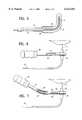
- FIG. 1is an elevational view, partially in section, of a channel forming device embodying features of the present invention.
- FIG. 2is a transverse cross-sectional view of the channel forming device shown in FIG. 1, taken along the lines 2--2.
- FIG. 3is a transverse cross-sectional view of the channel forming device shown in FIG. 1, taken along the lines 3--3.
- FIG. 4is a transverse cross-sectional view of the channel forming device shown in FIG. 1, taken along the lines 4--4.
- FIG. 5is an elevational view of a distal extremity of the device shown in FIG. 1 in which the probe tip has been deformed so as to curve into an L-shape.
- FIG. 6is an elevational view of the channel forming device shown in FIG. 1 secured by a stiff handle to facilitate placement of the channel forming means.
- FIG. 7is an elevational view of the channel forming device shown in FIG. 1 secured by a shapable handle to facilitate placement of the channel forming means.
- FIGS. 1-4a channel forming device 10 is shown embodying features of the invention.
- the device 10includes an elongated optical fiber 11, an elongated probe 12 disposed about and secured to the distal extremity of the optical fiber, and an outer tubular support member 13 secured to the exterior of the proximal extremity of the probe 12 and a distal portion of the optical fiber which is not disposed in the interior chamber 14 of the probe 12.
- the exterior of the optical fiber 11is provided with a fluoropolymeric cladding 15 along its length except for the distal portion 16 which extends into the distal portion of the interior chamber 14.
- the elongated probe 12has a cylindrical body 17 which is bonded to the optical fiber 11 by adhesive 18.
- the probe 12has a bulbous distal end 19 which acts as a lens to control laser energy emitted from the distal end of the optical fiber to a location immediately distal to the lens to ensure formation a channel of a desired size.
- the cylindrical body 17is provided with a coating or jacket 20 of suitable plastic material which will aid in the bonding of the outer tubular support member 13, strengthen the probe 12 and maintain the integrity of the probe, if the lens material fractures.
- the plastic materialis a heat shrinkable materials such as polyethylene terephthalate (PET) or polyethylene.
- the optical fiber 11 within the elongated probe 12is provided with a body of adhesive 18 which prevents relative longitudinal movement between the optical fiber and the elongated probe 12.
- a fluoropolymer buffer 22is disposed about the optical fiber 11 proximal to the body of adhesive 18 and extends proximally along essentially the remainder of the optical fiber.
- An outer jacket 23is disposed about the fluoropolymer buffer 22 along its length, and terminates within the outer support tubular support member 13 proximal to the elongated probe 12.
- Filler tubing 24is provided on the exterior of the buffer 22 and generally extends from the distal end of jacket 23 to the adhesive 18.
- the outer tubular support member 13has an outer and inner tubular elements 25 and 26 with the distal ends thereof forming a annular shoulder 27 which acts to limit the penetration of the probe 12 into the channel as it is being formed and thus the depth of the channel.
- the outer tubular element 25is longer than the inner tubular element 26 and the proximal end of the outer tubular member is secured to the exterior of jacket 23.
- the inner tubular member 26is secured to the filler shrink tubing 24 and the coating 20 on the cylindrical body 17 of the elongated probe 12.
- the inner and outer tubular elements 25 and 26are preferably formed of heat shrinkable materials such as polyethylene so that these elements can be heat shrunk onto the proximal extremity of the probe 11 and the distal extremity of the optical fiber which does not extend into the probe 12 and secure these members together.
- Other means of securing the outer tubular support member 13 to the optical fiber 11 and the elongated probe 12may be employed, such as a suitable adhesive or insert injection molding.
- the proximal end of the device 10is provided with a connector 28 which has a rotatable, internally threaded collar 29 which facilitates an optical connection with a source of laser energy.
- FIG. 5illustrates an alternative embodiment where the distal extremity of the device 10 is formed into an L-shape to facilitate the use of the device on the posterior side of the patient's heart.
- the channel forming device 10 shownis formed by forming the distal extremity of the optical fiber-probe subassembly in the desired shape at relatively high temperature and then cooling the subassembly in the formed shape.
- the outer tubular member and other elementsmay be added after the distal extremity has been shaped.
- FIGS. 6 and 7illustrate a handle 30 which is secured to the channel forming device 10 at a location on the exterior of the outer tubular support member 13 so that forces are applied to the probe 12 rather than the optical fiber 11.
- An annular rubber or elastomeric gasket 31is provided in an aperture in the distal end of the handle 30 facilitate a firm but soft grasp of the elongated probe member 12.
- the device 10is merely pushed into the passageway of the annular gasket 31 which is sized to frictionally engage a portion of the outer tubular support member 13 to thereby stabilize and hold device 10 while it is being pressed against the patient's epicardium to form the channel.
- a variety of other locking or holding elementscan be used.
- the handle 30 as shownis formed of metal shaft 32 and a plastic coating or jacket 33.
- a suitable metalis aluminum which is light weight and nonmagnetic.
- the handle 30may comprise a proximal section 34 and a distal section 35 with a flexible junction 36.
- the flexible junctionis formed of malleable material such as annealed aluminum and is covered with a accordioned plastic jacket 37.
- the various components of the device 10may be formed of a wide variety of conventional materials used in the construction of intravascular catheters and other intracorporeal devices.
- the contemplated materials of construction and the sources thereof for one presently preferred embodimentare provided in the following table.
- the overall length of channel forming deviceis about 200 to about 400 cm with a typical value being about 350 cm, with the actual length being determined by the location of the source of laser energy.
- the operative distal portion of the devicei.e. the portion which is inserted into the patient is about 10 to about 50 cm.
- the probe tipis about 1 to about 5 cm in length with the length of the exposed distal portion which extends out of the tubular support member being about 0.75 to about 2.5 cm, preferably about 1.25 to about 2 cm.
- the outer diameter of the probe tipis about 1 to about 3 mm, preferably about 1.5 to about 2 mm, and is measured at the widest portion of the bulbous tip which forms the lens.
- the outer diameter of the coating or jacket on the probe tipis essentially the same as the bulbous tip.
- the length of the outer tubular support memberis about 15 to about 40 cm, preferably about 20 to about 30 cm and the radial dimension of the shoulder stop formed by the distal end of the outer tubular support member is about 0.5 to about
Landscapes
- Health & Medical Sciences (AREA)
- Surgery (AREA)
- Physics & Mathematics (AREA)
- Life Sciences & Earth Sciences (AREA)
- Engineering & Computer Science (AREA)
- Medical Informatics (AREA)
- Nuclear Medicine, Radiotherapy & Molecular Imaging (AREA)
- Electromagnetism (AREA)
- Optics & Photonics (AREA)
- Biomedical Technology (AREA)
- Heart & Thoracic Surgery (AREA)
- Otolaryngology (AREA)
- Molecular Biology (AREA)
- Animal Behavior & Ethology (AREA)
- General Health & Medical Sciences (AREA)
- Public Health (AREA)
- Veterinary Medicine (AREA)
- Laser Surgery Devices (AREA)
- Radiation-Therapy Devices (AREA)
Abstract
Description
This invention is directed to the formation of one or more channels into the wall of a patient's heart and particularly to the intraoperative formation of such channels in the heart wall. These channels may be used to increase blood flow to heart tissue experiencing ischemic conditions and for the delivery of therapeutic or diagnostic agents to various locations.
The formation of channels to increase the blood to flow to a patient's heart tissue is called myocardial revascularization. The first clinical trials of the revascularization process was made by Mirhoseini et al. See for example the discussions in Lasers in General Surgery (Williams & Wilkins; 1989), pp 216-223. Other early disclosures of this procedure is found in an article by Okada et al. in Kobe J. Med. Sci 32, 151-161, October 1986 and U.S. Pat. No. 4,658,817 (Hardy). These early references describe intraoperative revascularization procedures which require an opening in the chest wall and include formation of the channels through the epicardium.
Copending application Ser. No. 08/361,787, filed on Dec. 20, 1994 (Aita et al.), now U.S. Pat. No. 5,554,152 which is incorporated herein in its entirety, describes an intraoperative system for myocardial revascularization which is introduced through the chest wall. While the intra-operative system for performing revascularization, developed by Aita et al., was a substantial advance, one of the difficulties in developing intraoperative channel forming devices was to provide an intraoperative device which was flexible enough to be manually positioned within the patient's chest cavity and yet be constructed of sufficient strength to maintain its integrity and to preclude loss of the distal tip of the optical device, particularly within the patient's heart, during the procedure. Another difficulty with prior channel forming devices is the difficulty in forming channels on the posterior side of the patient's heart. The present invention minimizes the difficulties of the prior channel forming devices.
The present invention is directed to an improved laser based device for forming a channel in the wall of a patient's heart and particularly in the free-wall defining in part the left ventricle.
One embodiment of the invention includes an elongated optical fiber having a proximal end and a distal end, an elongated distal probe tip which has an interior chamber into which the distal extremity of the optical fiber is fixed and an outer support member which is secured to the proximal portion of the probe tip and a distal portion of the optical fiber to ensure the integrity of the probe tip and optical fiber during the channel forming procedure.
In another embodiment of the invention an elongated optical fiber has a proximal end and a distal end and an elongated distal probe tip which has a projection or step therefrom spaced from the distal end of the probe tip which acts as a stop to prevent excessive penetration of the probe tip during channel formation.
In a presently preferred device the probe length is about 20 to about 80 mm and the length of the portion of the probe tip which extends out the distal end of the outer support member is about 10 to about 30 mm, preferably about 15 to about 25 mm. Generally, at least about 10 mm of the proximal portion of the probe tip, preferably at least about 20 mm of the proximal portion of the probe tip, is secured by the outer support member to ensure holding the probe tip in the case of a fractured probe tip. The proximal portion of the outer support member secured to the distal end of the optical fiber should be at least about the same length as described above for the distal portion, although generally it will be longer.
An adapter is provided on the proximal end of the device which is configured to connect the proximal end of the optical fiber in an optical transmission relationship with a laser source.
To facilitate use of a channel forming device in the posterior side of the patient's heart in another embodiment, a handle is provided on the distal portion of the channel forming device which firmly, yet softly engages the optical fiber device. The handle has an elongated holding member with an aperture in the distal portion thereof which is configured to receive a rubber or elastomeric gasket which, in turn, receives and frictionally engages the region of the distal section of the optical fiber device such as the outer support member disposed over the probe tip of the prior embodiment to allow manual manipulation of the optical fiber. The holding member may be relatively stiff along its length or it can be provided with a shapable intermediate section so that the physician can put the handle in a shape which helps deliver the probe tip to the desired location on the patient's epicardium and at the desired attack angle, particularly when the channel is to be formed on the posterior side of the patient's heart.
The channel forming device of the invention can be readily advanced manually or mechanically to the patient's epicardium. A thoracoscope can be utilized to observe the delivery of the device or to actually deliver the device. While forming a passageway through the wall of the patient's heart for the purpose of revascularization is of significant importance, the passageway formed into the heart wall may be used for other purposes. For example, therapeutic or diagnostic agents may be introduced into the channel for delivery to the patient's endocardium or myocardium. The therapeutic or diagnostic agent may be incorporated into a biocompatible matrix deposited within the channel for delivery or release over an extended period. When delivering a therapeutic or diagnostic agent to the interior of the channel, the channel forming device may be removed and a delivery catheter with an inner lumen may be advanced through the steerable catheter until the distal end of the delivery catheter extends into the channel extending within the wall of the patient's heart. The therapeutic or diagnostic agent may then be delivered through the inner lumen of the delivery catheter and out a port in the distal end of the catheter into the channel formed in the patient's heart. The delivery catheter may be a simple elongated flexible tube with an inner lumen extending therein to a port or opening in the distal end of the catheter. The outer dimensions are suitable to provide longitudinal movement of the delivery catheter within the steering catheter. The distal extremity of the delivery catheter is preferably configured to readily fit into the channel formed in the epicardium and myocardium so that delivery of the therapeutic or diagnostic agent well into the channel is ensured.
These and other advantages of the invention will become more apparent from the following detailed description of the invention, when taken in conjunction with the accompanying exemplary drawings.
FIG. 1 is an elevational view, partially in section, of a channel forming device embodying features of the present invention.
FIG. 2 is a transverse cross-sectional view of the channel forming device shown in FIG. 1, taken along thelines 2--2.
FIG. 3 is a transverse cross-sectional view of the channel forming device shown in FIG. 1, taken along the lines 3--3.
FIG. 4 is a transverse cross-sectional view of the channel forming device shown in FIG. 1, taken along the lines 4--4.
FIG. 5 is an elevational view of a distal extremity of the device shown in FIG. 1 in which the probe tip has been deformed so as to curve into an L-shape.
FIG. 6 is an elevational view of the channel forming device shown in FIG. 1 secured by a stiff handle to facilitate placement of the channel forming means.
FIG. 7 is an elevational view of the channel forming device shown in FIG. 1 secured by a shapable handle to facilitate placement of the channel forming means.
In FIGS. 1-4 achannel forming device 10 is shown embodying features of the invention. Thedevice 10 includes an elongatedoptical fiber 11, anelongated probe 12 disposed about and secured to the distal extremity of the optical fiber, and an outertubular support member 13 secured to the exterior of the proximal extremity of theprobe 12 and a distal portion of the optical fiber which is not disposed in theinterior chamber 14 of theprobe 12.
The exterior of theoptical fiber 11 is provided with afluoropolymeric cladding 15 along its length except for thedistal portion 16 which extends into the distal portion of theinterior chamber 14. Theelongated probe 12 has acylindrical body 17 which is bonded to theoptical fiber 11 by adhesive 18. Theprobe 12 has a bulbousdistal end 19 which acts as a lens to control laser energy emitted from the distal end of the optical fiber to a location immediately distal to the lens to ensure formation a channel of a desired size. Thecylindrical body 17 is provided with a coating orjacket 20 of suitable plastic material which will aid in the bonding of the outertubular support member 13, strengthen theprobe 12 and maintain the integrity of the probe, if the lens material fractures. Preferably, the plastic material is a heat shrinkable materials such as polyethylene terephthalate (PET) or polyethylene. Theoptical fiber 11 within theelongated probe 12 is provided with a body ofadhesive 18 which prevents relative longitudinal movement between the optical fiber and theelongated probe 12. Afluoropolymer buffer 22 is disposed about theoptical fiber 11 proximal to the body ofadhesive 18 and extends proximally along essentially the remainder of the optical fiber. Anouter jacket 23 is disposed about thefluoropolymer buffer 22 along its length, and terminates within the outer supporttubular support member 13 proximal to theelongated probe 12.Filler tubing 24 is provided on the exterior of thebuffer 22 and generally extends from the distal end ofjacket 23 to theadhesive 18.
The outertubular support member 13 has an outer and innertubular elements annular shoulder 27 which acts to limit the penetration of theprobe 12 into the channel as it is being formed and thus the depth of the channel. The outertubular element 25 is longer than the innertubular element 26 and the proximal end of the outer tubular member is secured to the exterior ofjacket 23. The innertubular member 26 is secured to thefiller shrink tubing 24 and thecoating 20 on thecylindrical body 17 of theelongated probe 12. The inner and outertubular elements probe 11 and the distal extremity of the optical fiber which does not extend into theprobe 12 and secure these members together. Other means of securing the outertubular support member 13 to theoptical fiber 11 and theelongated probe 12 may be employed, such as a suitable adhesive or insert injection molding.
The proximal end of thedevice 10 is provided with aconnector 28 which has a rotatable, internally threadedcollar 29 which facilitates an optical connection with a source of laser energy.
FIG. 5 illustrates an alternative embodiment where the distal extremity of thedevice 10 is formed into an L-shape to facilitate the use of the device on the posterior side of the patient's heart. Thechannel forming device 10 shown is formed by forming the distal extremity of the optical fiber-probe subassembly in the desired shape at relatively high temperature and then cooling the subassembly in the formed shape. The outer tubular member and other elements may be added after the distal extremity has been shaped.
FIGS. 6 and 7 illustrate ahandle 30 which is secured to thechannel forming device 10 at a location on the exterior of the outertubular support member 13 so that forces are applied to theprobe 12 rather than theoptical fiber 11. An annular rubber orelastomeric gasket 31 is provided in an aperture in the distal end of thehandle 30 facilitate a firm but soft grasp of theelongated probe member 12. Thedevice 10 is merely pushed into the passageway of theannular gasket 31 which is sized to frictionally engage a portion of the outertubular support member 13 to thereby stabilize and holddevice 10 while it is being pressed against the patient's epicardium to form the channel. A variety of other locking or holding elements can be used.
Thehandle 30 as shown is formed ofmetal shaft 32 and a plastic coating orjacket 33. A suitable metal is aluminum which is light weight and nonmagnetic. As shown in FIG. 7, thehandle 30 may comprise aproximal section 34 and adistal section 35 with aflexible junction 36. The flexible junction is formed of malleable material such as annealed aluminum and is covered with a accordionedplastic jacket 37.
The various components of thedevice 10 may be formed of a wide variety of conventional materials used in the construction of intravascular catheters and other intracorporeal devices. The contemplated materials of construction and the sources thereof for one presently preferred embodiment are provided in the following table.
__________________________________________________________________________COMPONENT MATERIAL SUPPLIER __________________________________________________________________________Proximal Optical Connector Various Amphenol Corporation Lisle, IL and Spectran.sup.1 Specialty Optics, Co. Avon, CT Proximal Strain Relief Raychem Corporation Thermostat Systems Division Menlo Park, CA 94025 Jacket (23) Pebax 7233 tubing North America Infinity with 3% TiO.sub.2 Extrusions and Engineering, Inc. Santa Clara, CA 95054 Filler Shrink Tubing (24) Polyolefin, 1/16" Raychem Corporation (RNF-100) Thermostat Systems Division Menlo Park, CA 94025 Tubular Element (26) Polyolefin, 1/8" Raychem Corporation (RNF-100) Thermostat Systems Division Menlo Park, CA 94025 Inner Tubular Element (25) Polyolefin, 1/16" Raychem Corporation (RNF-100) Thermostat Systems Division Menlo Park, CA 94025 UV-Cured Adhesive (18) Urethane Oligomer Dymax Corp. (197-M) Acrylate Torrington, CT PET Shrink Tubing (19) Polyethylene Advanced Polymers, Inc. Terephthalate Salem, NH Probe (12) Fused Quartz Polymicro Technologies, Inc. Phoenix, AZ Optical Fiber Buffer (22) Tefzel ® Spectran.sup.1 Specialty Optic Co. Avon, CT Optical Fiber Cladding (15) Propietary Spectran.sup.1 Specialty Optic Co. Flouropolymer Avon, CT Acrylate Optical Fiber (11) Fused Silica Spectran.sup.1 Specialty Optic Co. (Low OH.sup.-) Avon, CT __________________________________________________________________________ .sup.1 Components sold in a finished subassembly. Part No. HCL MO365T.
The overall length of channel forming device is about 200 to about 400 cm with a typical value being about 350 cm, with the actual length being determined by the location of the source of laser energy. The operative distal portion of the device, i.e. the portion which is inserted into the patient is about 10 to about 50 cm. The probe tip is about 1 to about 5 cm in length with the length of the exposed distal portion which extends out of the tubular support member being about 0.75 to about 2.5 cm, preferably about 1.25 to about 2 cm. The outer diameter of the probe tip is about 1 to about 3 mm, preferably about 1.5 to about 2 mm, and is measured at the widest portion of the bulbous tip which forms the lens. The outer diameter of the coating or jacket on the probe tip is essentially the same as the bulbous tip. The length of the outer tubular support member is about 15 to about 40 cm, preferably about 20 to about 30 cm and the radial dimension of the shoulder stop formed by the distal end of the outer tubular support member is about 0.5 to about 2 mm.
Although individual features of embodiments of the invention may be shown in some of the drawings and not in others, those skilled in the art will recognize that individual features of one embodiment of the invention can be combined with any or all the features of another embodiment. Various modifications and improvements may be made to the invention without departing from the scope thereof.
Claims (9)
1. An intraoperative device for forming a channel within a wall of a patient's heart comprising:
a) an elongated member having a distal extremity with a channel forming means thereon and having a longitudinal axis extending therethrough; and
b) a handle which is secured to the distal extremity of the elongated member at a substantial angle with respect to a longitudinal axis extending through the distal extremity of the elongated member to facilitate advancement of the channel forming means against the wall of the patient's heart and which has an intermediate shapable section.
2. The intraoperative device of claim 1 wherein the handle has a proximal section and a distal section with the shapable intermediate section between the proximal and distal sections.
3. The intraoperative device of claim 2 wherein the proximal section of the handle is provided with a gripping means to facilitate manual movement thereof.
4. The intraoperative device of claim 2 wherein the handle is provided with an aperture in the distal end thereof to receive the channel forming means.
5. The intraoperative device of claim 4 wherein a gasket is disposed within the aperture to firmly but softly grip the channel forming means.
6. The intraoperative device of claim 5 wherein the gasket is formed of rubber or elastomeric material.
7. The intraoperative device of claim 1 wherein the shapable intermediate section is formed of a malleable metal.
8. The intraoperative device of claim 7 wherein the malleable metal is selected from the group consisting of aluminum, copper and malleable alloys thereof.
9. The intraoperative device of claim 7 wherein the malleable metal is in the form of rod or cable.
Priority Applications (5)
| Application Number | Priority Date | Filing Date | Title |
|---|---|---|---|
| US08/482,178US6132451A (en) | 1995-06-07 | 1995-06-07 | Optical fiber for myocardial channel formation |
| PCT/US1996/009159WO1996039964A1 (en) | 1995-06-07 | 1996-06-05 | Probe for myocardial channel formation |
| EP96917232AEP0831746A1 (en) | 1995-06-07 | 1996-06-05 | Probe for myocardial channel formation |
| CA002223944ACA2223944A1 (en) | 1995-06-07 | 1996-06-05 | Probe for myocardial channel formation |
| JP9501548AJPH11506678A (en) | 1995-06-07 | 1996-06-05 | Probes for myocardial channel formation |
Applications Claiming Priority (1)
| Application Number | Priority Date | Filing Date | Title |
|---|---|---|---|
| US08/482,178US6132451A (en) | 1995-06-07 | 1995-06-07 | Optical fiber for myocardial channel formation |
Publications (1)
| Publication Number | Publication Date |
|---|---|
| US6132451Atrue US6132451A (en) | 2000-10-17 |
Family
ID=23915032
Family Applications (1)
| Application Number | Title | Priority Date | Filing Date |
|---|---|---|---|
| US08/482,178Expired - Fee RelatedUS6132451A (en) | 1995-06-07 | 1995-06-07 | Optical fiber for myocardial channel formation |
Country Status (5)
| Country | Link |
|---|---|
| US (1) | US6132451A (en) |
| EP (1) | EP0831746A1 (en) |
| JP (1) | JPH11506678A (en) |
| CA (1) | CA2223944A1 (en) |
| WO (1) | WO1996039964A1 (en) |
Cited By (38)
| Publication number | Priority date | Publication date | Assignee | Title |
|---|---|---|---|---|
| US6261304B1 (en) | 1998-09-10 | 2001-07-17 | Percardia, Inc. | Delivery methods for left ventricular conduit |
| US20020007138A1 (en)* | 1998-09-10 | 2002-01-17 | Percardia, Inc. | Left ventricular conduit with blood vessel graft |
| US6363939B1 (en) | 1996-06-19 | 2002-04-02 | Wilk Patent Development Corp. | Coronary artery by-pass method |
| US6409751B1 (en) | 1998-09-10 | 2002-06-25 | Percardia, Inc. | Stent delivery system and method of use |
| US20030055371A1 (en)* | 1998-01-30 | 2003-03-20 | Percardia, Inc. | Left ventricular conduits to coronary arteries and methods for coronary bypass |
| US20030137008A1 (en)* | 2000-03-28 | 2003-07-24 | Hidetoshi Nozaki | Solid state imaging device having a photodiode and a MOSFET and method of manufacturing the same |
| US20030181895A1 (en)* | 2000-07-27 | 2003-09-25 | Nobuo Kitamura | Tissue supporting device for medical treatment |
| US20040133969A1 (en)* | 2003-01-10 | 2004-07-15 | Tyler Pipe Company, A Division Of Ransom Industries, Lp | Closet carrier system and method of assembly |
| US20050004633A1 (en)* | 2001-09-21 | 2005-01-06 | Michael Weber | Device for applying at least a laser needle on a patient's body |
| US6854467B2 (en) | 2000-05-04 | 2005-02-15 | Percardia, Inc. | Methods and devices for delivering a ventricular stent |
| US6913021B2 (en) | 1996-08-13 | 2005-07-05 | Percardia, Inc. | Method for revascularizing a coronary vessel |
| US6916304B2 (en) | 1999-05-04 | 2005-07-12 | Percardia, Inc. | Transmyocardial implant with flow reduction |
| US6926690B2 (en) | 1998-09-10 | 2005-08-09 | Percardia, Inc. | Transmyocardial shunt and its attachment mechanism, for left ventricular revascularization |
| US6949118B2 (en) | 2002-01-16 | 2005-09-27 | Percardia, Inc. | Encased implant and methods |
| US6953481B2 (en) | 1998-09-10 | 2005-10-11 | Percardia, Inc. | Designs for left ventricular conduit |
| US6964652B2 (en) | 1999-08-04 | 2005-11-15 | Percardia, Inc. | Left ventricular conduits and methods for delivery |
| US6976990B2 (en) | 2001-01-25 | 2005-12-20 | Percardia, Inc. | Intravascular ventriculocoronary bypass via a septal passageway |
| US7008397B2 (en) | 2002-02-13 | 2006-03-07 | Percardia, Inc. | Cardiac implant and methods |
| US7011095B2 (en) | 1998-09-10 | 2006-03-14 | Percardia, Inc. | Valve designs for left ventricular conduits |
| US7033372B1 (en) | 1999-08-04 | 2006-04-25 | Percardia, Inc. | Corkscrew reinforced left ventricle to coronary artery channel |
| US7326219B2 (en) | 2002-09-09 | 2008-02-05 | Wilk Patent Development | Device for placing transmyocardial implant |
| US20080065046A1 (en)* | 2006-09-08 | 2008-03-13 | Sabbah Hani N | Intramyocardial patterning for global cardiac resizing and reshaping |
| US20080269720A1 (en)* | 2007-04-11 | 2008-10-30 | Sabbah Hani N | Cardiac repair, resizing and reshaping using the venous system of the heart |
| US20090012413A1 (en)* | 2006-09-08 | 2009-01-08 | Sabbah Hani N | Cardiac patterning for improving diastolic function |
| US20090259210A1 (en)* | 2008-04-10 | 2009-10-15 | Sabbah Hani N | Method, apparatus and kits for forming structural members within the cardiac venous system |
| US20090259212A1 (en)* | 2008-04-10 | 2009-10-15 | Sabbah Hani N | Apparatus and method for controlled depth of injection into myocardial tissue |
| US10993805B2 (en) | 2008-02-26 | 2021-05-04 | Jenavalve Technology, Inc. | Stent for the positioning and anchoring of a valvular prosthesis in an implantation site in the heart of a patient |
| US11065138B2 (en) | 2016-05-13 | 2021-07-20 | Jenavalve Technology, Inc. | Heart valve prosthesis delivery system and method for delivery of heart valve prosthesis with introducer sheath and loading system |
| US11185405B2 (en) | 2013-08-30 | 2021-11-30 | Jenavalve Technology, Inc. | Radially collapsible frame for a prosthetic valve and method for manufacturing such a frame |
| US11197754B2 (en) | 2017-01-27 | 2021-12-14 | Jenavalve Technology, Inc. | Heart valve mimicry |
| US11337800B2 (en) | 2015-05-01 | 2022-05-24 | Jenavalve Technology, Inc. | Device and method with reduced pacemaker rate in heart valve replacement |
| US11357624B2 (en) | 2007-04-13 | 2022-06-14 | Jenavalve Technology, Inc. | Medical device for treating a heart valve insufficiency |
| US11517431B2 (en) | 2005-01-20 | 2022-12-06 | Jenavalve Technology, Inc. | Catheter system for implantation of prosthetic heart valves |
| US11564794B2 (en) | 2008-02-26 | 2023-01-31 | Jenavalve Technology, Inc. | Stent for the positioning and anchoring of a valvular prosthesis in an implantation site in the heart of a patient |
| US11589981B2 (en) | 2010-05-25 | 2023-02-28 | Jenavalve Technology, Inc. | Prosthetic heart valve and transcatheter delivered endoprosthesis comprising a prosthetic heart valve and a stent |
| US12121461B2 (en) | 2015-03-20 | 2024-10-22 | Jenavalve Technology, Inc. | Heart valve prosthesis delivery system and method for delivery of heart valve prosthesis with introducer sheath |
| US12171658B2 (en) | 2022-11-09 | 2024-12-24 | Jenavalve Technology, Inc. | Catheter system for sequential deployment of an expandable implant |
| US12414854B2 (en) | 2010-05-20 | 2025-09-16 | Jenavalve Technology, Inc. | Catheter system for introducing an expandable stent into the body of a patient |
Families Citing this family (16)
| Publication number | Priority date | Publication date | Assignee | Title |
|---|---|---|---|---|
| US5683366A (en)* | 1992-01-07 | 1997-11-04 | Arthrocare Corporation | System and method for electrosurgical tissue canalization |
| US5697882A (en) | 1992-01-07 | 1997-12-16 | Arthrocare Corporation | System and method for electrosurgical cutting and ablation |
| US6179824B1 (en) | 1993-05-10 | 2001-01-30 | Arthrocare Corporation | System and methods for electrosurgical restenosis of body lumens |
| US6749604B1 (en) | 1993-05-10 | 2004-06-15 | Arthrocare Corporation | Electrosurgical instrument with axially-spaced electrodes |
| US6896674B1 (en) | 1993-05-10 | 2005-05-24 | Arthrocare Corporation | Electrosurgical apparatus having digestion electrode and methods related thereto |
| US6019756A (en)* | 1996-04-05 | 2000-02-01 | Eclipse Surgical Technologies, Inc. | Laser device for transmyocardial revascularization procedures |
| US5980545A (en)* | 1996-05-13 | 1999-11-09 | United States Surgical Corporation | Coring device and method |
| US5807383A (en)* | 1996-05-13 | 1998-09-15 | United States Surgical Corporation | Lasing device |
| US6283955B1 (en) | 1996-05-13 | 2001-09-04 | Edwards Lifesciences Corp. | Laser ablation device |
| US6620155B2 (en) | 1996-07-16 | 2003-09-16 | Arthrocare Corp. | System and methods for electrosurgical tissue contraction within the spine |
| US5947989A (en)* | 1996-12-12 | 1999-09-07 | United States Surgical Corporation | Method and apparatus for transmyocardial revascularization |
| US7435247B2 (en) | 1998-08-11 | 2008-10-14 | Arthrocare Corporation | Systems and methods for electrosurgical tissue treatment |
| US8355799B2 (en) | 2008-12-12 | 2013-01-15 | Arthrocare Corporation | Systems and methods for limiting joint temperature |
| US9526556B2 (en) | 2014-02-28 | 2016-12-27 | Arthrocare Corporation | Systems and methods systems related to electrosurgical wands with screen electrodes |
| US9649148B2 (en) | 2014-07-24 | 2017-05-16 | Arthrocare Corporation | Electrosurgical system and method having enhanced arc prevention |
| US9597142B2 (en) | 2014-07-24 | 2017-03-21 | Arthrocare Corporation | Method and system related to electrosurgical procedures |
Citations (23)
| Publication number | Priority date | Publication date | Assignee | Title |
|---|---|---|---|---|
| DE2828322A1 (en)* | 1978-06-28 | 1980-01-10 | Eichler Juergen | Laser instrument for medical use - comprises long thin tube with lens at distal end and includes light conductive fibre |
| US4249533A (en)* | 1977-05-16 | 1981-02-10 | Olympus Optical Co., Ltd. | Laser knife |
| DE3415293A1 (en)* | 1984-04-24 | 1985-11-14 | Osada Electric Co. Ltd., Tokio/Tokyo | Laser hand unit |
| US4608980A (en)* | 1984-04-13 | 1986-09-02 | Osada Electric Co., Ltd. | Laser hand piece |
| US4658817A (en)* | 1985-04-01 | 1987-04-21 | Children's Hospital Medical Center | Method and apparatus for transmyocardial revascularization using a laser |
| US4860743A (en)* | 1986-10-27 | 1989-08-29 | University Of Florida | Laser method and apparatus for the recanalization of vessels and the treatment of other cardiac conditions |
| US4890898A (en)* | 1988-08-18 | 1990-01-02 | Hgm Medical Laser Systems, Inc. | Composite microsize optical fiber-electric lead cable |
| US4917084A (en)* | 1985-07-31 | 1990-04-17 | C. R. Bard, Inc. | Infrared laser catheter system |
| US4967745A (en)* | 1987-04-10 | 1990-11-06 | Massachusetts Institute Of Technology | Multi-fiber plug for a laser catheter |
| US4985029A (en)* | 1989-01-11 | 1991-01-15 | Masahiko Hoshino | Laser apparatus for medical treatment |
| US5093877A (en)* | 1990-10-30 | 1992-03-03 | Advanced Cardiovascular Systems | Optical fiber lasing apparatus lens |
| WO1992006638A1 (en)* | 1990-10-10 | 1992-04-30 | W.L. Gore & Associates, Inc. | A laparoscopy surgical instrument |
| US5125926A (en)* | 1990-09-24 | 1992-06-30 | Laser Engineering, Inc. | Heart-synchronized pulsed laser system |
| WO1992012679A1 (en)* | 1991-01-28 | 1992-08-06 | Laserscope | Process for transecting the transverse carpal ligament |
| US5186714A (en)* | 1992-05-18 | 1993-02-16 | Yab Revo-Tech Inc. | Multifunctional surgical instrument |
| US5201731A (en)* | 1988-03-30 | 1993-04-13 | Hakky Said I | Laser resectoscope with ultransonic imaging means |
| US5312399A (en)* | 1992-09-29 | 1994-05-17 | Hakky Said I | Laser resectoscope with mechanical cutting means and laser coagulating means |
| US5324283A (en)* | 1991-07-03 | 1994-06-28 | Richard Wolf Gmbh | Medical instrument having a switch for controlling an external device |
| US5380316A (en)* | 1990-12-18 | 1995-01-10 | Advanced Cardiovascular Systems, Inc. | Method for intra-operative myocardial device revascularization |
| US5389096A (en)* | 1990-12-18 | 1995-02-14 | Advanced Cardiovascular Systems | System and method for percutaneous myocardial revascularization |
| US5395360A (en)* | 1994-02-23 | 1995-03-07 | Coherent, Inc. | Damage resistant sterilizable fiber optic probe assembly |
| US5397304A (en)* | 1992-04-10 | 1995-03-14 | Medtronic Cardiorhythm | Shapable handle for steerable electrode catheter |
| US5401272A (en)* | 1992-09-25 | 1995-03-28 | Envision Surgical Systems, Inc. | Multimodality probe with extendable bipolar electrodes |
- 1995
- 1995-06-07USUS08/482,178patent/US6132451A/ennot_activeExpired - Fee Related
- 1996
- 1996-06-05JPJP9501548Apatent/JPH11506678A/enactivePending
- 1996-06-05WOPCT/US1996/009159patent/WO1996039964A1/ennot_activeApplication Discontinuation
- 1996-06-05CACA002223944Apatent/CA2223944A1/ennot_activeAbandoned
- 1996-06-05EPEP96917232Apatent/EP0831746A1/ennot_activeWithdrawn
Patent Citations (23)
| Publication number | Priority date | Publication date | Assignee | Title |
|---|---|---|---|---|
| US4249533A (en)* | 1977-05-16 | 1981-02-10 | Olympus Optical Co., Ltd. | Laser knife |
| DE2828322A1 (en)* | 1978-06-28 | 1980-01-10 | Eichler Juergen | Laser instrument for medical use - comprises long thin tube with lens at distal end and includes light conductive fibre |
| US4608980A (en)* | 1984-04-13 | 1986-09-02 | Osada Electric Co., Ltd. | Laser hand piece |
| DE3415293A1 (en)* | 1984-04-24 | 1985-11-14 | Osada Electric Co. Ltd., Tokio/Tokyo | Laser hand unit |
| US4658817A (en)* | 1985-04-01 | 1987-04-21 | Children's Hospital Medical Center | Method and apparatus for transmyocardial revascularization using a laser |
| US4917084A (en)* | 1985-07-31 | 1990-04-17 | C. R. Bard, Inc. | Infrared laser catheter system |
| US4860743A (en)* | 1986-10-27 | 1989-08-29 | University Of Florida | Laser method and apparatus for the recanalization of vessels and the treatment of other cardiac conditions |
| US4967745A (en)* | 1987-04-10 | 1990-11-06 | Massachusetts Institute Of Technology | Multi-fiber plug for a laser catheter |
| US5201731A (en)* | 1988-03-30 | 1993-04-13 | Hakky Said I | Laser resectoscope with ultransonic imaging means |
| US4890898A (en)* | 1988-08-18 | 1990-01-02 | Hgm Medical Laser Systems, Inc. | Composite microsize optical fiber-electric lead cable |
| US4985029A (en)* | 1989-01-11 | 1991-01-15 | Masahiko Hoshino | Laser apparatus for medical treatment |
| US5125926A (en)* | 1990-09-24 | 1992-06-30 | Laser Engineering, Inc. | Heart-synchronized pulsed laser system |
| WO1992006638A1 (en)* | 1990-10-10 | 1992-04-30 | W.L. Gore & Associates, Inc. | A laparoscopy surgical instrument |
| US5093877A (en)* | 1990-10-30 | 1992-03-03 | Advanced Cardiovascular Systems | Optical fiber lasing apparatus lens |
| US5380316A (en)* | 1990-12-18 | 1995-01-10 | Advanced Cardiovascular Systems, Inc. | Method for intra-operative myocardial device revascularization |
| US5389096A (en)* | 1990-12-18 | 1995-02-14 | Advanced Cardiovascular Systems | System and method for percutaneous myocardial revascularization |
| WO1992012679A1 (en)* | 1991-01-28 | 1992-08-06 | Laserscope | Process for transecting the transverse carpal ligament |
| US5324283A (en)* | 1991-07-03 | 1994-06-28 | Richard Wolf Gmbh | Medical instrument having a switch for controlling an external device |
| US5397304A (en)* | 1992-04-10 | 1995-03-14 | Medtronic Cardiorhythm | Shapable handle for steerable electrode catheter |
| US5186714A (en)* | 1992-05-18 | 1993-02-16 | Yab Revo-Tech Inc. | Multifunctional surgical instrument |
| US5401272A (en)* | 1992-09-25 | 1995-03-28 | Envision Surgical Systems, Inc. | Multimodality probe with extendable bipolar electrodes |
| US5312399A (en)* | 1992-09-29 | 1994-05-17 | Hakky Said I | Laser resectoscope with mechanical cutting means and laser coagulating means |
| US5395360A (en)* | 1994-02-23 | 1995-03-07 | Coherent, Inc. | Damage resistant sterilizable fiber optic probe assembly |
Non-Patent Citations (18)
| Title |
|---|
| Mirhoseini, "Laser Applications in Thoracic and Cardiovascular Surgery," Medical Instrumentation, vol. 17, No. 6, 401-403 (Nov.-Dec. 1982). |
| Mirhoseini, "Laser Revascularization of the Heart," in New Frontiers in Laser Medicine and Surgery (Atsumi, Editor), ISBM Elsevier Science Publishing Co., 296-303 (1982). |
| Mirhoseini, et al., "Lasers in Cardiothoracic Surgery," in Lasers in General Surgery (Joffe, Editor), Williams and Wilkins, 216-232 (1989). |
| Mirhoseini, et al., "Myocardial Revascularization by Laser: A Clinical Report," Lasers in Surgery and Medicine 3:241-245 (1983). |
| Mirhoseini, et al., "New Concepts in Revascularization of the Myocardium," A Thorac. Surg. 45:415-420 (Apr. 1988). |
| Mirhoseini, et al., "Revascularization of the Heart by Laser," Journal of Microsurgery 253-260 (Jun. 1981). |
| Mirhoseini, et al., "Transvenicular Revascularization by Laser," Lasers in Surgery and Medicine 2:187-198 (1982). |
| Mirhoseini, et al., Clinical Report: "Laser Myocardial Revascularization," Lasers in Surgery and Medicine 6:459-461 (1986). |
| Mirhoseini, et al., Clinical Report: Laser Myocardial Revascularization, Lasers in Surgery and Medicine 6:459 461 (1986).* |
| Mirhoseini, et al., Lasers in Cardiothoracic Surgery, in Lasers in General Surgery (Joffe, Editor), Williams and Wilkins, 216 232 (1989).* |
| Mirhoseini, et al., Myocardial Revascularization by Laser: A Clinical Report, Lasers in Surgery and Medicine 3:241 245 (1983).* |
| Mirhoseini, et al., New Concepts in Revascularization of the Myocardium, A Thorac. Surg. 45:415 420 (Apr. 1988).* |
| Mirhoseini, et al., Revascularization of the Heart by Laser, Journal of Microsurgery 253 260 (Jun. 1981).* |
| Mirhoseini, et al., Transvenicular Revascularization by Laser, Lasers in Surgery and Medicine 2:187 198 (1982).* |
| Mirhoseini, Laser Applications in Thoracic and Cardiovascular Surgery, Medical Instrumentation, vol. 17, No. 6, 401 403 (Nov. Dec. 1982).* |
| Mirhoseini, Laser Revascularization of the Heart, in New Frontiers in Laser Medicine and Surgery (Atsumi, Editor), ISBM Elsevier Science Publishing Co., 296 303 (1982).* |
| Walter, et al., Europ. Surg. Res. 3: 130 138 (1971).* |
| Walter, et al., Europ. Surg. Res. 3: 130-138 (1971). |
Cited By (63)
| Publication number | Priority date | Publication date | Assignee | Title |
|---|---|---|---|---|
| US6363939B1 (en) | 1996-06-19 | 2002-04-02 | Wilk Patent Development Corp. | Coronary artery by-pass method |
| US6913021B2 (en) | 1996-08-13 | 2005-07-05 | Percardia, Inc. | Method for revascularizing a coronary vessel |
| US6929011B2 (en) | 1996-08-13 | 2005-08-16 | Percardia, Inc. | Method to deliver blood from a heart chamber to a vessel |
| US7294115B1 (en) | 1998-01-30 | 2007-11-13 | Percardia, Inc. | Methods of providing direct blood flow between a heart chamber and a coronary vessel |
| US6949080B2 (en) | 1998-01-30 | 2005-09-27 | Percardia, Inc. | Left ventricular conduits to coronary arteries and methods for coronary bypass |
| US20030055371A1 (en)* | 1998-01-30 | 2003-03-20 | Percardia, Inc. | Left ventricular conduits to coronary arteries and methods for coronary bypass |
| US6694983B2 (en) | 1998-09-10 | 2004-02-24 | Percardia, Inc. | Delivery methods for left ventricular conduit |
| US7101402B2 (en) | 1998-09-10 | 2006-09-05 | Percardia, Inc. | Designs for left ventricular conduit |
| US7704222B2 (en) | 1998-09-10 | 2010-04-27 | Jenavalve Technology, Inc. | Methods and conduits for flowing blood from a heart chamber to a blood vessel |
| US8597226B2 (en) | 1998-09-10 | 2013-12-03 | Jenavalve Technology, Inc. | Methods and conduits for flowing blood from a heart chamber to a blood vessel |
| US7347867B2 (en) | 1998-09-10 | 2008-03-25 | Wilk Patent And Development Corporation | Designs for left ventricular conduit |
| US6261304B1 (en) | 1998-09-10 | 2001-07-17 | Percardia, Inc. | Delivery methods for left ventricular conduit |
| US6881199B2 (en) | 1998-09-10 | 2005-04-19 | Percardia, Inc. | Left ventricular conduit with blood vessel graft |
| US7736327B2 (en) | 1998-09-10 | 2010-06-15 | Jenavalve Technology, Inc. | Methods and conduits for flowing blood from a heart chamber to a blood vessel |
| US8216174B2 (en) | 1998-09-10 | 2012-07-10 | Jenavalve Technology, Inc. | Methods and conduits for flowing blood from a heart chamber to a blood vessel |
| US6926690B2 (en) | 1998-09-10 | 2005-08-09 | Percardia, Inc. | Transmyocardial shunt and its attachment mechanism, for left ventricular revascularization |
| US6409751B1 (en) | 1998-09-10 | 2002-06-25 | Percardia, Inc. | Stent delivery system and method of use |
| US20020007138A1 (en)* | 1998-09-10 | 2002-01-17 | Percardia, Inc. | Left ventricular conduit with blood vessel graft |
| US6387119B2 (en) | 1998-09-10 | 2002-05-14 | Percardia, Inc. | Delivery methods for left ventricular conduit |
| US6953481B2 (en) | 1998-09-10 | 2005-10-11 | Percardia, Inc. | Designs for left ventricular conduit |
| US7011095B2 (en) | 1998-09-10 | 2006-03-14 | Percardia, Inc. | Valve designs for left ventricular conduits |
| US6916304B2 (en) | 1999-05-04 | 2005-07-12 | Percardia, Inc. | Transmyocardial implant with flow reduction |
| US6964652B2 (en) | 1999-08-04 | 2005-11-15 | Percardia, Inc. | Left ventricular conduits and methods for delivery |
| US7033372B1 (en) | 1999-08-04 | 2006-04-25 | Percardia, Inc. | Corkscrew reinforced left ventricle to coronary artery channel |
| US20030137008A1 (en)* | 2000-03-28 | 2003-07-24 | Hidetoshi Nozaki | Solid state imaging device having a photodiode and a MOSFET and method of manufacturing the same |
| US6854467B2 (en) | 2000-05-04 | 2005-02-15 | Percardia, Inc. | Methods and devices for delivering a ventricular stent |
| US20030181895A1 (en)* | 2000-07-27 | 2003-09-25 | Nobuo Kitamura | Tissue supporting device for medical treatment |
| US6976990B2 (en) | 2001-01-25 | 2005-12-20 | Percardia, Inc. | Intravascular ventriculocoronary bypass via a septal passageway |
| US20050004633A1 (en)* | 2001-09-21 | 2005-01-06 | Michael Weber | Device for applying at least a laser needle on a patient's body |
| US6949118B2 (en) | 2002-01-16 | 2005-09-27 | Percardia, Inc. | Encased implant and methods |
| US7008397B2 (en) | 2002-02-13 | 2006-03-07 | Percardia, Inc. | Cardiac implant and methods |
| US7326219B2 (en) | 2002-09-09 | 2008-02-05 | Wilk Patent Development | Device for placing transmyocardial implant |
| US20080065047A1 (en)* | 2002-11-29 | 2008-03-13 | Sabbah Hani N | Intramyocardial patterning for treating localized anomalies of the heart |
| US20040133969A1 (en)* | 2003-01-10 | 2004-07-15 | Tyler Pipe Company, A Division Of Ransom Industries, Lp | Closet carrier system and method of assembly |
| US11517431B2 (en) | 2005-01-20 | 2022-12-06 | Jenavalve Technology, Inc. | Catheter system for implantation of prosthetic heart valves |
| US9782258B2 (en) | 2006-09-08 | 2017-10-10 | The Regents Of The University Of California | Intramyocardial patterning for global cardiac resizing and reshaping |
| US20090012413A1 (en)* | 2006-09-08 | 2009-01-08 | Sabbah Hani N | Cardiac patterning for improving diastolic function |
| US20080065048A1 (en)* | 2006-09-08 | 2008-03-13 | Sabbah Hani N | Intramyocardial patterning for global cardiac resizing and reshaping |
| US20080065046A1 (en)* | 2006-09-08 | 2008-03-13 | Sabbah Hani N | Intramyocardial patterning for global cardiac resizing and reshaping |
| US9375313B2 (en) | 2006-09-08 | 2016-06-28 | The Regents Of The University Of California | Intramyocardial patterning for global cardiac resizing and reshaping |
| US20080269720A1 (en)* | 2007-04-11 | 2008-10-30 | Sabbah Hani N | Cardiac repair, resizing and reshaping using the venous system of the heart |
| US7875017B2 (en) | 2007-04-11 | 2011-01-25 | Henry Ford Health System | Cardiac repair, resizing and reshaping using the venous system of the heart |
| US20110087190A1 (en)* | 2007-04-11 | 2011-04-14 | Henry Ford Health System | Cardiac Repair, Resizing and Reshaping Using the Venous System of the Heart |
| US8419711B2 (en) | 2007-04-11 | 2013-04-16 | Henry Ford Health System | Cardiac repair, resizing and reshaping using the venous system of the heart |
| US11357624B2 (en) | 2007-04-13 | 2022-06-14 | Jenavalve Technology, Inc. | Medical device for treating a heart valve insufficiency |
| US11564794B2 (en) | 2008-02-26 | 2023-01-31 | Jenavalve Technology, Inc. | Stent for the positioning and anchoring of a valvular prosthesis in an implantation site in the heart of a patient |
| US10993805B2 (en) | 2008-02-26 | 2021-05-04 | Jenavalve Technology, Inc. | Stent for the positioning and anchoring of a valvular prosthesis in an implantation site in the heart of a patient |
| US12232957B2 (en) | 2008-02-26 | 2025-02-25 | Jenavalve Technology, Inc. | Stent for the positioning and anchoring of a valvular prosthesis in an implantation site in the heart of a patient |
| US11154398B2 (en) | 2008-02-26 | 2021-10-26 | JenaValve Technology. Inc. | Stent for the positioning and anchoring of a valvular prosthesis in an implantation site in the heart of a patient |
| US20090259210A1 (en)* | 2008-04-10 | 2009-10-15 | Sabbah Hani N | Method, apparatus and kits for forming structural members within the cardiac venous system |
| US8801665B2 (en) | 2008-04-10 | 2014-08-12 | Henry Ford Health System | Apparatus and method for controlled depth of injection into myocardial tissue |
| US20090259212A1 (en)* | 2008-04-10 | 2009-10-15 | Sabbah Hani N | Apparatus and method for controlled depth of injection into myocardial tissue |
| US12414854B2 (en) | 2010-05-20 | 2025-09-16 | Jenavalve Technology, Inc. | Catheter system for introducing an expandable stent into the body of a patient |
| US11589981B2 (en) | 2010-05-25 | 2023-02-28 | Jenavalve Technology, Inc. | Prosthetic heart valve and transcatheter delivered endoprosthesis comprising a prosthetic heart valve and a stent |
| US12318281B2 (en) | 2013-08-30 | 2025-06-03 | Jenavalve Technology, Inc. | Radially collapsible frame for a prosthetic valve and method for manufacturing such a frame |
| US11185405B2 (en) | 2013-08-30 | 2021-11-30 | Jenavalve Technology, Inc. | Radially collapsible frame for a prosthetic valve and method for manufacturing such a frame |
| US12121461B2 (en) | 2015-03-20 | 2024-10-22 | Jenavalve Technology, Inc. | Heart valve prosthesis delivery system and method for delivery of heart valve prosthesis with introducer sheath |
| US12343255B2 (en) | 2015-05-01 | 2025-07-01 | Jenavalve Technology, Inc. | Device and method with reduced pacemaker rate in heart valve replacement |
| US11337800B2 (en) | 2015-05-01 | 2022-05-24 | Jenavalve Technology, Inc. | Device and method with reduced pacemaker rate in heart valve replacement |
| US11065138B2 (en) | 2016-05-13 | 2021-07-20 | Jenavalve Technology, Inc. | Heart valve prosthesis delivery system and method for delivery of heart valve prosthesis with introducer sheath and loading system |
| US11197754B2 (en) | 2017-01-27 | 2021-12-14 | Jenavalve Technology, Inc. | Heart valve mimicry |
| US12433745B2 (en) | 2017-01-27 | 2025-10-07 | Jenavalve Technology, Inc. | Heart valve mimicry |
| US12171658B2 (en) | 2022-11-09 | 2024-12-24 | Jenavalve Technology, Inc. | Catheter system for sequential deployment of an expandable implant |
Also Published As
| Publication number | Publication date |
|---|---|
| JPH11506678A (en) | 1999-06-15 |
| WO1996039964A1 (en) | 1996-12-19 |
| EP0831746A1 (en) | 1998-04-01 |
| CA2223944A1 (en) | 1996-12-19 |
Similar Documents
| Publication | Publication Date | Title |
|---|---|---|
| US6132451A (en) | Optical fiber for myocardial channel formation | |
| US5728091A (en) | Optical fiber for myocardial channel formation | |
| EP0830088B1 (en) | Surgical channel forming device with penetration limiter | |
| US5951567A (en) | Introducer for channel forming device | |
| US6093177A (en) | Catheter with flexible intermediate section | |
| US7766904B2 (en) | Adjustable laser probe for use in vitreoretinal surgery | |
| US5441496A (en) | Laser delivery system with soft tip | |
| US6251104B1 (en) | Guiding catheter system for ablating heart tissue | |
| US20020032437A1 (en) | Myocardial revascularization | |
| EP0868923A3 (en) | Steerable catheter | |
| US20020052621A1 (en) | Circumferential pulmonary vein ablation using a laser and fiberoptic balloon catheter | |
| US20060292912A1 (en) | Method of deployable medical lead fixation | |
| JP2008516638A (en) | Removal probe with reinforcing member | |
| EP0598403B1 (en) | Stylet for installing a retrograde coronary cannula | |
| WO2022206836A1 (en) | Spring coil delivery system and device | |
| WO2022206837A1 (en) | Spring coil delivery system and spring coil delivery device | |
| JPH08112352A (en) | Tube for medical treatment | |
| JPS6148384B2 (en) | ||
| JPH07148171A (en) | Tube-shaped inserting instrument | |
| JPH0530738Y2 (en) | ||
| JPS62145205A (en) | Fiber for laser beam transmission | |
| JPH04291312A (en) | Endoscope | |
| JPS62210404A (en) | Fiber for laser beam transmission | |
| JPH02154751A (en) | Laser probe |
Legal Events
| Date | Code | Title | Description |
|---|---|---|---|
| AS | Assignment | Owner name:ECLIPSE SURGICAL TECHNOLOGIES, INC., CALIFORNIA Free format text:ASSIGNMENT OF ASSIGNORS INTEREST;ASSIGNOR:CARDIOGENESIS CORPORATION;REEL/FRAME:010401/0528 Effective date:19990823 | |
| REMI | Maintenance fee reminder mailed | ||
| LAPS | Lapse for failure to pay maintenance fees | ||
| STCH | Information on status: patent discontinuation | Free format text:PATENT EXPIRED DUE TO NONPAYMENT OF MAINTENANCE FEES UNDER 37 CFR 1.362 | |
| FP | Lapsed due to failure to pay maintenance fee | Effective date:20041017 |