US6130165A - Autoaligned etching process for realizing word lines in memory devices integrated semiconductor substrates - Google Patents
Autoaligned etching process for realizing word lines in memory devices integrated semiconductor substratesDownload PDFInfo
- Publication number
- US6130165A US6130165AUS08/997,499US99749997AUS6130165AUS 6130165 AUS6130165 AUS 6130165AUS 99749997 AUS99749997 AUS 99749997AUS 6130165 AUS6130165 AUS 6130165A
- Authority
- US
- United States
- Prior art keywords
- layer
- conducting layer
- conducting
- etching
- self
- Prior art date
- Legal status (The legal status is an assumption and is not a legal conclusion. Google has not performed a legal analysis and makes no representation as to the accuracy of the status listed.)
- Expired - Lifetime
Links
- 238000005530etchingMethods0.000titleclaimsabstractdescription53
- 238000000034methodMethods0.000titleclaimsabstractdescription33
- 239000004065semiconductorSubstances0.000titleclaimsabstractdescription19
- 239000000758substrateSubstances0.000titleclaimsabstractdescription17
- 230000015654memoryEffects0.000claimsabstractdescription16
- 238000009413insulationMethods0.000claimsabstractdescription7
- 230000001681protective effectEffects0.000claimsabstractdescription5
- 239000010410layerSubstances0.000claimsdescription93
- 238000012876topographyMethods0.000claimsdescription12
- 229910021420polycrystalline siliconInorganic materials0.000claimsdescription11
- 229920005591polysiliconPolymers0.000claimsdescription11
- 230000008021depositionEffects0.000claimsdescription6
- 239000011241protective layerSubstances0.000claimsdescription3
- 229910021332silicideInorganic materials0.000claimsdescription3
- FVBUAEGBCNSCDD-UHFFFAOYSA-Nsilicide(4-)Chemical group[Si-4]FVBUAEGBCNSCDD-UHFFFAOYSA-N0.000claimsdescription3
- WQJQOUPTWCFRMM-UHFFFAOYSA-Ntungsten disilicideChemical group[Si]#[W]#[Si]WQJQOUPTWCFRMM-UHFFFAOYSA-N0.000claimsdescription3
- 229910021342tungsten silicideInorganic materials0.000claimsdescription3
- 238000004519manufacturing processMethods0.000claimsdescription2
- 238000000151depositionMethods0.000claims1
- 239000000126substanceSubstances0.000claims1
- 238000000206photolithographyMethods0.000description5
- 239000011159matrix materialSubstances0.000description4
- 239000004020conductorSubstances0.000description2
- 230000000875corresponding effectEffects0.000description2
- 230000003647oxidationEffects0.000description2
- 238000007254oxidation reactionMethods0.000description2
- 229910008814WSi2Inorganic materials0.000description1
- 238000004458analytical methodMethods0.000description1
- 230000015572biosynthetic processEffects0.000description1
- 230000002596correlated effectEffects0.000description1
- 239000002019doping agentSubstances0.000description1
- -1e.g.Chemical compound0.000description1
- 230000000694effectsEffects0.000description1
- 239000000463materialSubstances0.000description1
- 238000000386microscopyMethods0.000description1
- 229920000642polymerPolymers0.000description1
- 238000007789sealingMethods0.000description1
Images


Classifications
- H—ELECTRICITY
- H10—SEMICONDUCTOR DEVICES; ELECTRIC SOLID-STATE DEVICES NOT OTHERWISE PROVIDED FOR
- H10B—ELECTRONIC MEMORY DEVICES
- H10B41/00—Electrically erasable-and-programmable ROM [EEPROM] devices comprising floating gates
- H10B41/30—Electrically erasable-and-programmable ROM [EEPROM] devices comprising floating gates characterised by the memory core region
- H—ELECTRICITY
- H01—ELECTRIC ELEMENTS
- H01L—SEMICONDUCTOR DEVICES NOT COVERED BY CLASS H10
- H01L21/00—Processes or apparatus adapted for the manufacture or treatment of semiconductor or solid state devices or of parts thereof
- H01L21/02—Manufacture or treatment of semiconductor devices or of parts thereof
- H01L21/04—Manufacture or treatment of semiconductor devices or of parts thereof the devices having potential barriers, e.g. a PN junction, depletion layer or carrier concentration layer
- H01L21/18—Manufacture or treatment of semiconductor devices or of parts thereof the devices having potential barriers, e.g. a PN junction, depletion layer or carrier concentration layer the devices having semiconductor bodies comprising elements of Group IV of the Periodic Table or AIIIBV compounds with or without impurities, e.g. doping materials
- H01L21/30—Treatment of semiconductor bodies using processes or apparatus not provided for in groups H01L21/20 - H01L21/26
- H01L21/31—Treatment of semiconductor bodies using processes or apparatus not provided for in groups H01L21/20 - H01L21/26 to form insulating layers thereon, e.g. for masking or by using photolithographic techniques; After treatment of these layers; Selection of materials for these layers
- H01L21/3205—Deposition of non-insulating-, e.g. conductive- or resistive-, layers on insulating layers; After-treatment of these layers
- H01L21/321—After treatment
- H01L21/3213—Physical or chemical etching of the layers, e.g. to produce a patterned layer from a pre-deposited extensive layer
- H—ELECTRICITY
- H01—ELECTRIC ELEMENTS
- H01L—SEMICONDUCTOR DEVICES NOT COVERED BY CLASS H10
- H01L21/00—Processes or apparatus adapted for the manufacture or treatment of semiconductor or solid state devices or of parts thereof
- H01L21/70—Manufacture or treatment of devices consisting of a plurality of solid state components formed in or on a common substrate or of parts thereof; Manufacture of integrated circuit devices or of parts thereof
- H01L21/71—Manufacture of specific parts of devices defined in group H01L21/70
- H01L21/768—Applying interconnections to be used for carrying current between separate components within a device comprising conductors and dielectrics
- H01L21/76838—Applying interconnections to be used for carrying current between separate components within a device comprising conductors and dielectrics characterised by the formation and the after-treatment of the conductors
Definitions
- the present inventionrelates to a self-aligned etching process for providing word lines in an electronic memory device integrated on a semiconductor substrate displaying a topography of the matrix type comprising word lines and bit lines.
- the present inventionrelates to a self-aligned etching process for providing a plurality of parallel word lines in a first conducting layer deposited over a planarized architecture obtained starting from a semiconductor substrate on which is provided a plurality of active elements extending along separate parallel lines, e.g., bit lines, for memory cells comprising gate regions formed by a first conducting layer, an intermediate dielectric layer and a second conducting layer, said gate regions being insulated from each other by insulation regions to form this architecture with said word lines being defined photolithographically by protective strips.
- the present inventionalso relates to a memory device with matrix configuration of the cross-point type and comprising bit lines and word lines.
- the present inventionconcerns specifically but not exclusively a self-aligned etching process for providing word lines in contactless semiconductor memories having a virtual ground circuitry.
- the following descriptionis given with reference to this specific field of application with the only purpose of simplifying its explanation.
- EPROM or FLASH-EPROM electronic memory devicesrequire the provision on a semiconductor substrate of a matrix-type topography in which a plurality of bit lines, having a floating gate region is intersected on the top by a plurality of conducting strips properly called word lines.
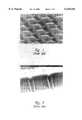
- FIG. 1A typical topography of this type is shown in the photograph of FIG. 1 obtained by electronic microscopy techniques.
- a semiconductor substratee.g., like the one shown in FIG. 2, in which a division into active areas with the possible presence of a field oxide dividing layer 2 is already provided, e.g., like the one shown in FIG. 2A, and multiple deposits are made over the entire surface of the substrate.
- a thin gate oxide layer 3is deposited.
- a deposition of a first polysilicon layer 4, identified by the name POLY1is provided.
- a deposition of a second dielectric interpoly layer 5follows, e.g., ONO, such an interpoly layer is encapsulated on the top by another layer 6 of polysilicon which is identified by the name POLYCAP.
- a masked photolithography stepwhich for convenience is identified by the name "POLY1 mask” defines a topography of protected areas for the gate regions and related bit lines.
- a self-aligned etchingallows removal of parallel strips of multiple layers until reaching the active areas of the substrate 1.
- This etching phaseremoves from the unprotected areas of the photolithography the POLYCAP layer 6, the ONO layer 5, the POLY1 layer 4, the gate oxide layer 3 and the field oxide 2 if necessary where present.
- the gate regions 13are formed as shown in FIG. 2 by a stratified gagture of POLYCAP--ONO--POLY1--gate oxide and field oxide if any.
- removal of the POLYCAP layer 6causes the deposition of polymers which create a pair of steps 10 or ribs on the underlying POLY1 layer 4, which thus projects laterally with respect to the layers deposited above as shown in FIGS. 2 and 4 and 4A.
- Another cause which could be at the origin of the formation of this pair of steps 10is generally an additional oxidation step usually used for sealing the bit lines 13.
- the POLYCAP layer 6can reoxidize more than the POLY1 layer 4 (depending on the type of dopant in POLY1) as shown in FIG. 2.
- step 10 formed by the POLY1 layer 4 projecting laterallycan originate a short circuit between adjacent floating gate regions once a self-aligned etching has been completed to define word lines and hence individual memory cells.
- FIG. 3shows an electronic microscope photograph of a semiconductor substrate having a matrix-type topography after performance of a self-aligned etching to define the word lines, which can be identified in the high-luminosity areas which are connected by thin white strips revealing the presence of the steps 10.
- Provision of the plurality of word lines intersecting the gate regions 13calls for the deposition of a conducting layer entirely covering the planarized architecture 9 as shown in FIG. 4.
- This conducting layercan be obtained by means of successive deposition of a protective layer 12, e.g., of polysilicon and indicated for convenience by the name POLY2, and a final layer 11 of silicide, e.g., tungsten silicide.
- a protective layer 12e.g., of polysilicon and indicated for convenience by the name POLY2
- a final layer 11 of silicidee.g., tungsten silicide.
- Another objective of this etchingis to mutually insulate the individual memory cells by removing materials from the floating gate regions unprotected by the photolithography step.
- the first stepcalls for removal of the conducting layer 11, 12 and the underlying POLYCAP layer 6 while the second step calls for removal of the ONO layer 5 and POLY1 layer 4.
- the prior art process described up to nowhas provided on the semiconductor substrate 1 a matrix topography comprising gate regions, corresponding bit lines 13 and word lines orthogonal thereto.
- This topographyis widely used in EPROM or E 2 PROM memory devices and in particular in EPROM, Flash EPROM and EEPROM memory devices having a cross-point and virtual ground structure as described, e.g., in European Patent No. 0 573 728.
- the existence of the pair of steps 10 present in the floating gate regions associated with each bit line 13 between the POLYCAP layer 6 and the underlying layersis undesirable. As mentioned, these steps can originate undesired contacts which can affect the reliability of the memory devices.
- An object of the present inventionis to create a self-aligned etching process for a definition of geometry associated with word lines which would allow overcoming the above-mentioned shortcomings which still limit the reliability of the memory devices provided in accordance with the prior art.
- An embodiment of the present inventionuses a definition of word lines and individual memory cells, a self-aligned etching with a vertical profile limited to removal of a conducting layer and an underlying polysilicon layer.
- FIG. 1shows an electronic microscope photograph of a plurality of Flash EPROM memory cells having a matrix-type topography of which can be seen only the bit lines.
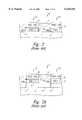
- FIGS. 2 and 2Ashow diagrammatically and in enlarged scale a vertical cross section of a semiconductor electronic device with a planarized architecture comprising gate regions conformed as a stratified POLYCAP--ONO--POLY1--gate oxide structure, with the presence of field oxide shown in FIG. 2A.
- FIG. 3shows an electronic microscope photograph of a semiconductor substrate having a matrix-type topography and taken after performance of a self-aligned etching for the definition of the word lines.
- FIGS. 4 and 4Ashow schematically and in enlarged scale, with the presence of field oxide shown in FIG. 4A, a vertical cross section of a semiconductor electronic device with a planarized architecture covered above by a conducting layer provided in accordance with the prior art.
- FIGS. 5 and 5Ashow schematically and in enlarged scale, with the presence of field oxide shown in Figure 5A, a vertical cross section of a semiconductor electronic device limited to a gate region conformed as a stratified POLY2--POLYCAP--ONO--POLY1 structure created by a process in accordance with the present invention after etching performed with a so-called POLY2 mask.
- These layers 11, 12are deposited over a planarized architecture 9 obtained starting from a semiconductor substrate 1 on which a plurality of active elements is provided extending along separated parallel lines, e.g., bit lines 13, of memory cells.
- These memory cellscomprise gate regions made up of a thin gate oxide layer 3, a first conducting layer 4, an intermediate dielectric layer 5 and a second conducting layer 6.
- the gate regions 13are mutually insulated by insulating dielectric films 7, 8 deposited between the gate regions 13 to form said planarized architecture 9.
- the word linesare defined photolithographically by protective strips which are orthogonal to the bit lines.
- the vertical cross section of the floating gate regionshows a stratified structure built over a semiconductor substrate 1 and comprises an optional field oxide layer 2, e.g., like the one shown in FIG. 5A, a thin gate oxide layer 3, a first polysilicon conducting layer 4 indicated as POLY1, an interpoly dielectric layer 5, e.g., ONO, and a second conducting polysilicon layer 6 indicated as POLYCAP.
- POLYCAPa conducting layer including two layers 12, 11, i.e., the first 12 of polysilicon termed also POLY2 and the second 11 of silicide e.g., tungsten silicide (WSi 2 ).
- the etching for definition of the word line geometry and insulation of the individual memory cellsis provided in two successive steps.
- a self-aligned etchingstarting from the exposed surface of the additional conducting layer 11, 12.
- This etchingproceeds with a vertical profile (an isotropic etch) for removal of the conducting layer 11, 12 and of the underlying layers 6 and 5 of POLYCAP and ONO from the gate regions 13 not protected by the photolithographic process.
- a POLY2 maskis used for definition of the word lines in the photolithography step.
- This isotropic etchingcan extend its action even laterally so as to remove also the pair of polysilicon steps 10 formed as fully explained with reference to the prior art.
- the isotropic etchingremoves the POLY1 layer 4, including the steps 10, without removing the layers 5, 6, 11, 12, because the layers 5, 6, 11, 12 are protected by a polymeric passivating layer formed during the anisotropic portion of the self-aligning etching.
- FIG. 5the vertical cross section of the individual cell taken from the floating gate region 13 shows a characteristic morphology easily identifiable by means of a SEM, TEM or FIB analysis.
- the self-aligned etching proposed by the present inventionis capable of ensuring good reliability of the memory devices with matrix configuration if provided in accordance with the process described here.
Landscapes
- Engineering & Computer Science (AREA)
- Physics & Mathematics (AREA)
- Condensed Matter Physics & Semiconductors (AREA)
- General Physics & Mathematics (AREA)
- Manufacturing & Machinery (AREA)
- Computer Hardware Design (AREA)
- Microelectronics & Electronic Packaging (AREA)
- Power Engineering (AREA)
- Non-Volatile Memory (AREA)
- Semiconductor Memories (AREA)
- Drying Of Semiconductors (AREA)
Abstract
Description
Claims (8)
Priority Applications (1)
| Application Number | Priority Date | Filing Date | Title |
|---|---|---|---|
| US09/528,406US6380582B2 (en) | 1996-12-24 | 2000-03-17 | Autoaligned etching process for realizing word lines in memory devices integrated semiconductor substrates |
Applications Claiming Priority (2)
| Application Number | Priority Date | Filing Date | Title |
|---|---|---|---|
| EP96830649 | 1996-12-24 | ||
| EP96830649AEP0851485B1 (en) | 1996-12-24 | 1996-12-24 | Self-aligned etching process to realize word lines of semiconductor integrated memory devices |
Related Child Applications (1)
| Application Number | Title | Priority Date | Filing Date |
|---|---|---|---|
| US09/528,406DivisionUS6380582B2 (en) | 1996-12-24 | 2000-03-17 | Autoaligned etching process for realizing word lines in memory devices integrated semiconductor substrates |
Publications (1)
| Publication Number | Publication Date |
|---|---|
| US6130165Atrue US6130165A (en) | 2000-10-10 |
Family
ID=8226092
Family Applications (2)
| Application Number | Title | Priority Date | Filing Date |
|---|---|---|---|
| US08/997,499Expired - LifetimeUS6130165A (en) | 1996-12-24 | 1997-12-23 | Autoaligned etching process for realizing word lines in memory devices integrated semiconductor substrates |
| US09/528,406Expired - LifetimeUS6380582B2 (en) | 1996-12-24 | 2000-03-17 | Autoaligned etching process for realizing word lines in memory devices integrated semiconductor substrates |
Family Applications After (1)
| Application Number | Title | Priority Date | Filing Date |
|---|---|---|---|
| US09/528,406Expired - LifetimeUS6380582B2 (en) | 1996-12-24 | 2000-03-17 | Autoaligned etching process for realizing word lines in memory devices integrated semiconductor substrates |
Country Status (4)
| Country | Link |
|---|---|
| US (2) | US6130165A (en) |
| EP (1) | EP0851485B1 (en) |
| JP (1) | JPH10261777A (en) |
| DE (1) | DE69637095D1 (en) |
Cited By (1)
| Publication number | Priority date | Publication date | Assignee | Title |
|---|---|---|---|---|
| US20040113648A1 (en)* | 2002-12-13 | 2004-06-17 | Wen-Jyh Hung | Method of exposing desired layers in a multi-layer semiconductor using focused ion beams for physical failure |
Families Citing this family (3)
| Publication number | Priority date | Publication date | Assignee | Title |
|---|---|---|---|---|
| KR100311049B1 (en)* | 1999-12-13 | 2001-10-12 | 윤종용 | Nonvolatile semiconductor memory device and manufacturing method thereof |
| JP2003309194A (en)* | 2002-04-18 | 2003-10-31 | Nec Electronics Corp | Semiconductor storage device and its manufacturing method |
| CN100418210C (en)* | 2004-09-22 | 2008-09-10 | 中芯国际集成电路制造(上海)有限公司 | Levelling method of multilayer laminated polycrystalline silicon grid for flash storage |
Citations (6)
| Publication number | Priority date | Publication date | Assignee | Title |
|---|---|---|---|---|
| US5160407A (en)* | 1991-01-02 | 1992-11-03 | Applied Materials, Inc. | Low pressure anisotropic etch process for tantalum silicide or titanium silicide layer formed over polysilicon layer deposited on silicon oxide layer on semiconductor wafer |
| US5240870A (en)* | 1991-04-18 | 1993-08-31 | National Semiconductor Corporation | Stacked gate process flow for cross-point EPROM with internal access transistor |
| US5330938A (en)* | 1989-12-22 | 1994-07-19 | Sgs-Thomson Microelectronics S.R.L. | Method of making non-volatile split gate EPROM memory cell and self-aligned field insulation |
| US5342801A (en)* | 1993-03-08 | 1994-08-30 | National Semiconductor Corporation | Controllable isotropic plasma etching technique for the suppression of stringers in memory cells |
| US5475250A (en)* | 1988-12-05 | 1995-12-12 | Sgs-Thomson Microelectronics S.R.L. | Matrix of EPROM memory cells with a tablecloth structure having an improved capacitive ratio and a process for its manufacture |
| US5629230A (en)* | 1995-08-01 | 1997-05-13 | Micron Technology, Inc. | Semiconductor processing method of forming field oxide regions on a semiconductor substrate utilizing a laterally outward projecting foot portion |
Family Cites Families (3)
| Publication number | Priority date | Publication date | Assignee | Title |
|---|---|---|---|---|
| JP2723396B2 (en)* | 1991-09-19 | 1998-03-09 | シャープ株式会社 | Method of manufacturing nonvolatile memory device |
| EP0573728B1 (en)* | 1992-06-01 | 1996-01-03 | STMicroelectronics S.r.l. | Process for fabricating high density contactless EPROMs |
| US5847427A (en)* | 1995-12-21 | 1998-12-08 | Kabushiki Kaisha Toshiba | Non-volatile semiconductor memory device utilizing an oxidation suppressing substance to prevent the formation of bird's breaks |
- 1996
- 1996-12-24EPEP96830649Apatent/EP0851485B1/ennot_activeExpired - Lifetime
- 1996-12-24DEDE69637095Tpatent/DE69637095D1/ennot_activeExpired - Lifetime
- 1997
- 1997-12-18JPJP9348835Apatent/JPH10261777A/enactivePending
- 1997-12-23USUS08/997,499patent/US6130165A/ennot_activeExpired - Lifetime
- 2000
- 2000-03-17USUS09/528,406patent/US6380582B2/ennot_activeExpired - Lifetime
Patent Citations (6)
| Publication number | Priority date | Publication date | Assignee | Title |
|---|---|---|---|---|
| US5475250A (en)* | 1988-12-05 | 1995-12-12 | Sgs-Thomson Microelectronics S.R.L. | Matrix of EPROM memory cells with a tablecloth structure having an improved capacitive ratio and a process for its manufacture |
| US5330938A (en)* | 1989-12-22 | 1994-07-19 | Sgs-Thomson Microelectronics S.R.L. | Method of making non-volatile split gate EPROM memory cell and self-aligned field insulation |
| US5160407A (en)* | 1991-01-02 | 1992-11-03 | Applied Materials, Inc. | Low pressure anisotropic etch process for tantalum silicide or titanium silicide layer formed over polysilicon layer deposited on silicon oxide layer on semiconductor wafer |
| US5240870A (en)* | 1991-04-18 | 1993-08-31 | National Semiconductor Corporation | Stacked gate process flow for cross-point EPROM with internal access transistor |
| US5342801A (en)* | 1993-03-08 | 1994-08-30 | National Semiconductor Corporation | Controllable isotropic plasma etching technique for the suppression of stringers in memory cells |
| US5629230A (en)* | 1995-08-01 | 1997-05-13 | Micron Technology, Inc. | Semiconductor processing method of forming field oxide regions on a semiconductor substrate utilizing a laterally outward projecting foot portion |
Non-Patent Citations (1)
| Title |
|---|
| S. Wolf and R.N. Tauber, Silicon Processing for the VLSI Era, vol. 1, Lattic Press, p. 553, 1986.* |
Cited By (1)
| Publication number | Priority date | Publication date | Assignee | Title |
|---|---|---|---|---|
| US20040113648A1 (en)* | 2002-12-13 | 2004-06-17 | Wen-Jyh Hung | Method of exposing desired layers in a multi-layer semiconductor using focused ion beams for physical failure |
Also Published As
| Publication number | Publication date |
|---|---|
| US20020014653A1 (en) | 2002-02-07 |
| JPH10261777A (en) | 1998-09-29 |
| US6380582B2 (en) | 2002-04-30 |
| EP0851485A1 (en) | 1998-07-01 |
| DE69637095D1 (en) | 2007-07-05 |
| EP0851485B1 (en) | 2007-05-23 |
Similar Documents
| Publication | Publication Date | Title |
|---|---|---|
| US6784481B2 (en) | Flash memory device with isolation regions and a charge storage dielectric layer formed only on an active region | |
| KR100266094B1 (en) | Manufacturing Method of Semiconductor Memory Device | |
| US7057226B2 (en) | Semiconductor device and method of fabricating the same | |
| US5250457A (en) | Method of forming a buried bit line array of memory cells | |
| US7303958B2 (en) | Semiconductor device and method of manufacturing the same | |
| US20020081796A1 (en) | Method for fabricating a non-volatile memory device | |
| US6893917B2 (en) | Structure and fabricating method to make a cell with multi-self-alignment in split gate flash | |
| US6362050B2 (en) | Method for forming a non-volatile memory cell that eliminates substrate trenching | |
| US6130165A (en) | Autoaligned etching process for realizing word lines in memory devices integrated semiconductor substrates | |
| KR20040023716A (en) | Method of manufacturing a semiconductor device with a non-volatile memory comprising a memory cell with an access gate and with a control gate and a charge storage region | |
| US6034395A (en) | Semiconductor device having a reduced height floating gate | |
| US5639681A (en) | Process for eliminating effect of polysilicon stringers in semiconductor devices | |
| US6239037B1 (en) | Autoaligned etching process for realizing word lines and improving the reliability of semiconductor integrated memory devices | |
| KR20040010061A (en) | Method of fabricating semiconductor device | |
| US6762452B2 (en) | Non-volatile memory cells integrated on a semiconductor substrate | |
| KR100317318B1 (en) | Nonvolatile memory device and method for fabricating the same | |
| EP1032035B1 (en) | Process of manufacturing electronic virtual ground memory devices | |
| US6716715B2 (en) | Dram bit lines | |
| JP2528608B2 (en) | Method for forming a buried bit line array of storage cells | |
| KR100480806B1 (en) | Flash memory and method for fabricating the same | |
| JP2008166325A (en) | Method of manufacturing semiconductor device | |
| KR100871372B1 (en) | Gate forming method of flash memory device | |
| KR100523919B1 (en) | Method of manufacturing flash memory device | |
| KR20050002424A (en) | Method of manufacturing flash memory device | |
| KR0169597B1 (en) | Method for manufacturing capacitor of semiconductor device |
Legal Events
| Date | Code | Title | Description |
|---|---|---|---|
| AS | Assignment | Owner name:SGS-THOMSON MICROELECTRONICS S.R.L., ITALY Free format text:ASSIGNMENT OF ASSIGNORS INTEREST;ASSIGNORS:CAMERLENGHI, EMILIO;COLABELLA, ELIO;PIVIDOR, LUCA;AND OTHERS;REEL/FRAME:009378/0469;SIGNING DATES FROM 19980126 TO 19980127 | |
| AS | Assignment | Owner name:SGS-THOMSON MICROELECTRONICS S.R.L., ITALY Free format text:CORRECTIVE ASSIGNMENT TO CORRECT THE NAME OF AN ASSIIGNOR ON A PREVIOUS RECORDING AT REEL 9378 FRAME 0469;ASSIGNORS:CAMERLENGHI, EMILIO;COLABELLA, ELIO;PIVIDORI, LUCA;AND OTHERS;REEL/FRAME:009653/0258;SIGNING DATES FROM 19980126 TO 19980127 | |
| STCF | Information on status: patent grant | Free format text:PATENTED CASE | |
| FEPP | Fee payment procedure | Free format text:PAYOR NUMBER ASSIGNED (ORIGINAL EVENT CODE: ASPN); ENTITY STATUS OF PATENT OWNER: LARGE ENTITY | |
| FEPP | Fee payment procedure | Free format text:PAYER NUMBER DE-ASSIGNED (ORIGINAL EVENT CODE: RMPN); ENTITY STATUS OF PATENT OWNER: LARGE ENTITY Free format text:PAYOR NUMBER ASSIGNED (ORIGINAL EVENT CODE: ASPN); ENTITY STATUS OF PATENT OWNER: LARGE ENTITY | |
| FPAY | Fee payment | Year of fee payment:4 | |
| FPAY | Fee payment | Year of fee payment:8 | |
| FPAY | Fee payment | Year of fee payment:12 | |
| AS | Assignment | Owner name:MICRON TECHNOLOGY, INC., IDAHO Free format text:ASSIGNMENT OF ASSIGNORS INTEREST;ASSIGNOR:STMICROELECTRONICS, S.R.L. (FORMERLY KNOWN AS SGS-THMSON MICROELECTRONICS S.R.L.);REEL/FRAME:031796/0348 Effective date:20120523 | |
| AS | Assignment | Owner name:U.S. BANK NATIONAL ASSOCIATION, AS COLLATERAL AGENT, CALIFORNIA Free format text:SECURITY INTEREST;ASSIGNOR:MICRON TECHNOLOGY, INC.;REEL/FRAME:038669/0001 Effective date:20160426 Owner name:U.S. BANK NATIONAL ASSOCIATION, AS COLLATERAL AGEN Free format text:SECURITY INTEREST;ASSIGNOR:MICRON TECHNOLOGY, INC.;REEL/FRAME:038669/0001 Effective date:20160426 | |
| AS | Assignment | Owner name:MORGAN STANLEY SENIOR FUNDING, INC., AS COLLATERAL AGENT, MARYLAND Free format text:PATENT SECURITY AGREEMENT;ASSIGNOR:MICRON TECHNOLOGY, INC.;REEL/FRAME:038954/0001 Effective date:20160426 Owner name:MORGAN STANLEY SENIOR FUNDING, INC., AS COLLATERAL Free format text:PATENT SECURITY AGREEMENT;ASSIGNOR:MICRON TECHNOLOGY, INC.;REEL/FRAME:038954/0001 Effective date:20160426 | |
| AS | Assignment | Owner name:U.S. BANK NATIONAL ASSOCIATION, AS COLLATERAL AGENT, CALIFORNIA Free format text:CORRECTIVE ASSIGNMENT TO CORRECT THE REPLACE ERRONEOUSLY FILED PATENT #7358718 WITH THE CORRECT PATENT #7358178 PREVIOUSLY RECORDED ON REEL 038669 FRAME 0001. ASSIGNOR(S) HEREBY CONFIRMS THE SECURITY INTEREST;ASSIGNOR:MICRON TECHNOLOGY, INC.;REEL/FRAME:043079/0001 Effective date:20160426 Owner name:U.S. BANK NATIONAL ASSOCIATION, AS COLLATERAL AGEN Free format text:CORRECTIVE ASSIGNMENT TO CORRECT THE REPLACE ERRONEOUSLY FILED PATENT #7358718 WITH THE CORRECT PATENT #7358178 PREVIOUSLY RECORDED ON REEL 038669 FRAME 0001. ASSIGNOR(S) HEREBY CONFIRMS THE SECURITY INTEREST;ASSIGNOR:MICRON TECHNOLOGY, INC.;REEL/FRAME:043079/0001 Effective date:20160426 | |
| AS | Assignment | Owner name:MICRON TECHNOLOGY, INC., IDAHO Free format text:RELEASE BY SECURED PARTY;ASSIGNOR:U.S. BANK NATIONAL ASSOCIATION, AS COLLATERAL AGENT;REEL/FRAME:047243/0001 Effective date:20180629 | |
| AS | Assignment | Owner name:MICRON TECHNOLOGY, INC., IDAHO Free format text:RELEASE BY SECURED PARTY;ASSIGNOR:MORGAN STANLEY SENIOR FUNDING, INC., AS COLLATERAL AGENT;REEL/FRAME:050937/0001 Effective date:20190731 |