US6128736A - Method for inserting a watermark signal into data - Google Patents
Method for inserting a watermark signal into dataDownload PDFInfo
- Publication number
- US6128736A US6128736AUS09/215,958US21595898AUS6128736AUS 6128736 AUS6128736 AUS 6128736AUS 21595898 AUS21595898 AUS 21595898AUS 6128736 AUS6128736 AUS 6128736A
- Authority
- US
- United States
- Prior art keywords
- data
- values
- intermediate extracted
- watermarked
- represented
- Prior art date
- Legal status (The legal status is an assumption and is not a legal conclusion. Google has not performed a legal analysis and makes no representation as to the accuracy of the status listed.)
- Expired - Lifetime
Links
Images


Classifications
- G—PHYSICS
- G06—COMPUTING OR CALCULATING; COUNTING
- G06T—IMAGE DATA PROCESSING OR GENERATION, IN GENERAL
- G06T1/00—General purpose image data processing
- G06T1/0021—Image watermarking
- G06T1/0028—Adaptive watermarking, e.g. Human Visual System [HVS]-based watermarking
Definitions
- the present inventionrelates generally to preventing unlawful copying of audio, video and other media that can be digitized and, more particularly, to a method for inserting a watermark into digitized data.
- U.S. patent application Ser. No. 09/118,467which is incorporated herein by its reference, describes a method for detecting watermarks in which a block DCT transform is applied to an image and then selected terms of the resulting block DCTs are summed to obtain a vector of values. This vector is then compared against an encoded watermark signal to determine whether that watermark has been inserted into the image.
- the corresponding watermark insertion algorithmalso described in U.S. patent application Ser. No. 09/118,467, proceeds by first summing the same block DCT terms to determine the vector already present in the image. This vector is random if the image has not been watermarked earlier.
- the inserterthen chooses a new vector that resembles the original noise vector, but has a high correlation with the desired watermark signal. Next, it distributes the difference between the new vector and the old vector throughout the block DCT terms according to the relative sensitivity of the eye to changes in those terms. That is, large fractions of the difference are added to terms to which the eye is insensitive, while smaller fractions are added to the terms to which the eye is more sensitive. Finally, the inverse block DCT transform is taken to obtain a watermarked image.
- block DCTsor any block-based transforms
- Perceptual models based on block transformstend to ignore the interaction between noise added to neighboring blocks, resulting in a type of "blocking artifact," such as that visible in highly compressed MPEG and JPEG images. These same artifacts are also visible in images that have been too strongly watermarked by the insertion method of U.S. patent application Ser. No. 09/118,467.
- the present inventionimproves on the insertion method of U.S. patent application Ser. No. 09/118,467 by allowing the image noise to be distributed according to a perceptual model based on more appropriate image representations, such as pixels or wavelets, while still generating a watermark detectable by a DCT-based detection method. It, thus, achieves higher image fidelity than the earlier insertion algorithm, while maintaining the advantages of block DCTs for speed, frequency separation and relationship to compression algorithms.
- watermarksare inserted by a two-layered process, a lower layer and an upper layer.
- the lower layerresembles the insertion method of U.S. patent application Ser. No. 09/118,467, except that it (a) operates on an intermediate array of averaged blocks, instead of the whole image; and (b) uses a simpler perceptual model.
- the changes made by the lower layer to the intermediate array of averaged blocksare distributed through the image according to a perceptual model computed on the most appropriate image representation, such as pixels or wavelets.
- the method for inserting a watermark signal into data to be watermarkedcomprises the steps of: applying a partial watermark extraction to unwatermarked data for generating a first set of intermediate extracted values; identifying a first set of target values that are to replace the intermediate extracted values; computing the difference between the first set of target values and the first set of intermediate extracted values; and adding the computed difference throughout the unwatermarked data.
- the step of identifying a first set of target values that are to replace the intermediate extracted valuesfurther comprises the substeps of: applying a transform to the first set of intermediate extracted values; applying a further partial watermark extraction to the transformed first set of intermediate extracted values to obtain a second set of intermediate extracted values; identifying a second set of target values that are to replace the second set of intermediate extracted values; computing the difference between the second set of target values and the second set of intermediate extracted values; adding the computed difference throughout the transformed first set of intermediate extracted values to obtain a transformed first set of target values; and applying an inverse transform to the first set of transformed target values to obtain the first set of target values.
- FIG. 1shows a data-flow diagram of the upper layer of a preferred embodiment of the watermark insertion method of the present invention.
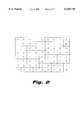
- FIG. 2shows the manner in which images are divided into M ⁇ N blocks and accumulated in the upper layer.
- FIG. 3shows a data-flow diagram of the lower layer of a preferred embodiment of the watermark insertion method of the present invention.
- the upper layer of the insertion algorithmis illustrated and generally referred to by reference numeral 100.
- two inputs 102, 104are taken.
- the first input 102being the image to be watermarked and the second input 104 being the watermark signal to be inserted.
- the imagecan be represented in any form that can be transformed into the form most appropriate for perceptual modeling. This transformation is performed in the image transformer 106.
- the image representation that is output by the image transformeris a W ⁇ H array of pixel intensities.
- thismay be replaced by any representation that has the following property: if the image is converted to a pixel representation, divide the image into M ⁇ N blocks, sum all those blocks together, and then convert the resulting accumulated M ⁇ N array into the representation in question, the result will be the same as if the image is converted into the representation in question before dividing into M ⁇ N blocks and summing. Put more succinctly, the transform of the sum is equal to the sum of the transforms.
- This propertyis found in several types of image representations that may be useful for implementing the present invention, such as DCT, block DCT, FFT, block FFT, wavelets, Hadamard transforms and Cortex transforms.
- the watermark signal 104is represented as a length-L vector (1 ⁇ L) of values. This is the signal that one would wish the watermarked version of the image to yield when a watermark extraction process, such as that disclosed in U.S. patent application Ser. No. 09/118,467, is applied to
- the output 108 of the image transformer 106is sent first to perceptual modeler 110.
- each element of this slack array 112corresponds to a pixel.
- a large value in the slack array 112indicates that the eye is very tolerant of changes in that pixel, while a small value indicates the eye is very sensitive to changes in that pixel.
- the slackis based on the brightness of the pixel, as well as the context in which it appears.
- slackis computed from the pixel brightness and from the standard deviation of brightness in a small neighborhood around the pixel.
- I[i,j]intensity of pixel i,j in image (real values ranging between 0 and 1)
- Kbconstant that controls how quickly the amount of visual masking increases as texture increases
- Kcconstant that controls the minimum amount of masking from texture (between 0 and 1)
- Kdconstant that controls the rate at which visual masking increases as intensity increases
- Keconstant that controls the minimum amount of masking from intensity (between 0 and 1)
- the image 108 and the slack array 112are now sent to a pair of accumulators 114 and 116. Both of these accumulators 114, 116 work identically, each dividing its respective input array into M ⁇ N blocks, and then summing the blocks to obtain a single, accumulated M ⁇ N array 118, 120 for accumulators 114 and 116 respectively.
- the division into M ⁇ N blocksneed not be made in a rectilinear grid, so long as it is identical for both the image array 108 and the slack array 112, and corresponds to the summation pattern used in the watermark detector used. An example of a summation pattern is illustrated in FIG. 2.
- Mnumber of rows in accumulated array
- Nnumber of columns in accumulated array
- Km[i,j]constant giving row of accumulated array that D[i,j] must be added into
- Kn[i,i]constant giving column of accumulated array that D[i,j] must be added into (that is, Km[ ] and Kn[ ] define the pattern with which the data should be accumulated)
- A[m,n]is now element m,n of the M ⁇ N accumulated array
- the outputs 118, 120 of accumulators 114 and 116, respectively,are then sent, along with the watermark signal 104, to the lower layer 200 of the watermark insertion method of the present invention.
- the image 108 obtained from the image transformer 106, the M ⁇ N accumulated image 118 Obtained from accumulator 114, the slack array 112 obtained from the perceptual modeler 110, the M ⁇ N accumulated slack array 118 obtained from the accumulator 114, and the M ⁇ N new array 202 obtained from the lower layer 200are all sent to the distributor 122.
- These changesare then distributed throughout the image proportionally according to the pixel slacks and results in a W ⁇ H array 124.
- the function of distributoris given in detail in the following pseudocode:
- Ad[m,n]value m,n accumulated from D[ ]
- New[m,n]element m,n of new array to be distributed into D[ ]
- Kbconstant minimum allowable value for any element of D[ ]
- Km[i,j]constant giving row of accumulated array that D[i,j] must be added into (same as array in accumulator pseudocode)
- Kn[i,j]constant giving column of accumulated array that D[i,j] must be added into (same as array in accumulator pseudocode)
- the changescan be distributed according to how they might be affected by attacks, in addition to how they affect fidelity.
- the inverse image transformer 126transforms the image back into the same representation it was received in.
- the output of the inverse image transformer 126is the finished, watermarked image 128.
- the lower layer 200has three inputs 118, 120, and 104 obtained from the upper layer 100, namely, the accumulated image data 118, the accumulated image slacks 120 and the watermark signal 104.
- the accumulated image data 118is first sent through block transformer 204, which transforms it into the same representation that will be used by the watermark detector.
- block-based transformsare referred to, which necessitate the present invention because of the inappropriateness of such transforms for perceptual modeling, the invention might just as well be used with a non-block based, invertible transform. The invention would deliver an improvement if this other transform is unsuitable for perceptual modeling for any reason.
- the block transformer 204divides its input data into 8 ⁇ 8 blocks and computes the DCTs of each of them.
- Alternatives to this block DCT transforminclude the full DCT, FFT, M ⁇ N block FFT, wavelets, Hadamard transforms and Cortex transforms.
- the output 206 of block transformer 204is first sent to the perceptual modeler 208, along with the accumulated slack data 120 given by the upper layer 100.
- the perceptual modeler 208then computes an M ⁇ N array of slacks 210 for the block transformed, accumulated image data, much as the upper layer's perceptual modeler 110 did for the whole image 108.
- the lower layer's 100 perceptual modeleris more difficult to efficiently implement because its input 120, 206 is inappropriate for perceptual modeling, but it is nevertheless often possible to design a less-than-perfect modeler 208 for use with the lower layer 200.
- the imperfections of the modeler 208will be overcome by the better modeler 110 of the upper layer 100.
- modeler 208 of the lower layer 200can make use of the accumulated output 210 of the modeler 208 of the lower layer 200 to improve its slack estimates.
- the modeler 110 of the lower layer 100finds the average, accumulated pixel slack for each 8 ⁇ 8 block and multiplies it by constant slack values for the 64 terms of the 8 ⁇ 8 DCT. More sophisticated models are possible, as are known in the art, but are not needed.
- Asp[m,n]value m,n in accumulated array of pixel slacks (Sp[ ])
- Ka[r,c]constant giving the perceptual slack for term m,n of an 8 ⁇ 8 DCT
- the outputs 206, 210 of block transformer 204 and perceptual modeler 208are then sent to two accumulators 212 and 214.
- These accumulators 212, 214are similar to the accumulators 114, 116 used in the upper layer 100, except that they accumulate in a different pattern.
- the pattern used in the lower layer 200is the one employed in the final phase of the watermark detector used.
- the output 216, 218 of each accumulator 212, 214 respectively,is a vector of length L (which is the same length as the watermark signal 104), where each of its elements is the sum of a subset of the terms of the accumulator's 212, 214 input 206, 210, respectively.
- Ad[m,n]element m,n of array of data to be accumulated (DCT team or DCT slack)
- V[k]is now element 1 of the accumulated vector
- the output 216, 218 of accumulators 212 and 214, respectively, together with the watermark signal 104 acquired as input,are sent to mixer 220.
- the mixer 220performs an analogous function for the lower layer 200 to that performed by the whole lower layer 200 for the upper layer 100. Namely, it produces a new vector 222 of L values that should replace the vector accumulated from the block transformer's 204 output 206.
- the problem that the mixer 220 must solveis that of finding a vector 222 which (a) has a high correlation coefficient with the desired watermark vector 104; (b) will still have a high correlation with the watermark vector 104 even after some noise has been added to it; and (c) can be inserted into the image 102 with minimal perceptual change.
- the correlation coefficient that will be obtained after a given amount of normally distributed, zero-mean noise has been added to the new vectorcan be computed as follows:
- ris the noise vector added
- wis the watermark vector 104
- uis the new vector 222
- Ecis the expected correlation.
- w'.r and u'.rwill be 0, and r .r will be the standard deviation of the noise, Sn, such that:
- the perceptual change required to insert a given vectorcan be estimated by computing the distance from that vector to the accumulated data from the unwatermarked image 102, weighted by the accumulated slacks 120.
- A.B. Watson (1993) "DCT Quantization Matrices Usually Optimized for Indirect Images” SPIE 1913: 202-216is followed in using L4 distance for this computation.
- uis the new vector 222
- vis the old vector 206 (accumulated output of the block transformer)
- sis the accumulated slacks 120.
- the problem of finding an optimal new vector 222is simplified by assuming that this vector will lie in the plane described by the origin of the space, the watermark vector, w, and the old vector, v.
- the new vector 222can be expressed as a weighted sum of the watermark vector and the old vector:
- Eca fixed correlation
- Sna given amount of noise
- J and Sna given amount of noise
- J and Sna desired Sn
- J and Sna desired Sn
- J and Sna minimum Sn
- the mixerfirst tries to minimize J, using the desired values of Ec and Sn. If the resulting J is greater than the maximum allowable distance, the mixer then tries to reduce J by using lower values of Sn. If J is still too large, even when Sn is at the given minimum, the mixer reduces Ec until J is acceptable.
- V[k]value k accumulated from input data
- Kbminimum amount of normal noise that wmk must survive (amount expected from quantization errors)
- Kcdesired expected correlation coefficient between W[ ] and mixed signal+normal noise with variance Ka
- Kdmaximum perceptual distance between V[ ] and mixed signal
- the outputs 206, 216, 218, 210, 222 of block transformer 204, accumulators 212 and 214, perceptual modeler 208 and mixer 220, respectively,are all sent to distributor 224.
- the distributor 224 of the lower layer 200works in an identical manner to the distributor 122 of the upper layer 100 to distribute the changes required to inserting vector 222 into the data 206 from the block transformer 204.
- V[k]value k accumulated from D[ ]
- Kbconstant minimum allowable value for any element of D[ ]
- the changescan be distributed according to how they might be affected by attacks, in addition to how they affect fidelity.
- the output 226 of the distributor 224is sent to an inverse block transformer 228, which performs the inverse of the transform performed by the block transformer 204 to obtain the new M ⁇ N array 202 of data that the upper layer 100 will distribute into the whole image at distributor 122.
Landscapes
- Physics & Mathematics (AREA)
- General Physics & Mathematics (AREA)
- Engineering & Computer Science (AREA)
- Theoretical Computer Science (AREA)
- Editing Of Facsimile Originals (AREA)
- Image Processing (AREA)
- Compression Or Coding Systems Of Tv Signals (AREA)
- Television Systems (AREA)
Abstract
Description
1. Field of the Invention
The present invention relates generally to preventing unlawful copying of audio, video and other media that can be digitized and, more particularly, to a method for inserting a watermark into digitized data.
2. Prior Art
U.S. patent application Ser. No. 09/118,467, which is incorporated herein by its reference, describes a method for detecting watermarks in which a block DCT transform is applied to an image and then selected terms of the resulting block DCTs are summed to obtain a vector of values. This vector is then compared against an encoded watermark signal to determine whether that watermark has been inserted into the image. The corresponding watermark insertion algorithm, also described in U.S. patent application Ser. No. 09/118,467, proceeds by first summing the same block DCT terms to determine the vector already present in the image. This vector is random if the image has not been watermarked earlier. The inserter then chooses a new vector that resembles the original noise vector, but has a high correlation with the desired watermark signal. Next, it distributes the difference between the new vector and the old vector throughout the block DCT terms according to the relative sensitivity of the eye to changes in those terms. That is, large fractions of the difference are added to terms to which the eye is insensitive, while smaller fractions are added to the terms to which the eye is more sensitive. Finally, the inverse block DCT transform is taken to obtain a watermarked image.
The choice of using the block DCT transform in the preferred implementation of U.S. patent application Ser. No. 09/118,467 was made for several reasons. The primary reason is that the DCT is the transform used in MPEG video compression and JPEG still image compression. Thus, employing it for watermarking allows rapid watermark detection compressed data. A secondary, but more fundamental, reason is that block DCTs are a fast way to separate low frequency data (which is robust to most image transformations) from high frequencies (which is more fragile).
However, block DCTs, or any block-based transforms, are not a good representation for the perceptual modeling required during insertion. Perceptual models based on block transforms tend to ignore the interaction between noise added to neighboring blocks, resulting in a type of "blocking artifact," such as that visible in highly compressed MPEG and JPEG images. These same artifacts are also visible in images that have been too strongly watermarked by the insertion method of U.S. patent application Ser. No. 09/118,467.
The present invention improves on the insertion method of U.S. patent application Ser. No. 09/118,467 by allowing the image noise to be distributed according to a perceptual model based on more appropriate image representations, such as pixels or wavelets, while still generating a watermark detectable by a DCT-based detection method. It, thus, achieves higher image fidelity than the earlier insertion algorithm, while maintaining the advantages of block DCTs for speed, frequency separation and relationship to compression algorithms.
Therefore, it is an object of the present invention to provide a method for inserting a watermark signal into data which lessens or eliminates the deficiencies associated with prior art watermark insertion methods.
It is a further object of the present invention to provide a method for inserting a watermark signal into data which allows image noise to be distributed according to a perceptual model based on more appropriate image representations, such as pixels or wavelets, while still generating a watermark detectable by a DCT-based watermark detection method.
It is yet a further object of the present invention to provide a method for inserting a watermark signal into data which achieves higher image fidelity than watermark insertion methods of the prior art, while maintaining the advantages of block DCTs for speed, frequency separation and relationship to compression algorithms.
Accordingly, in the method of the present invention, watermarks are inserted by a two-layered process, a lower layer and an upper layer. The lower layer resembles the insertion method of U.S. patent application Ser. No. 09/118,467, except that it (a) operates on an intermediate array of averaged blocks, instead of the whole image; and (b) uses a simpler perceptual model. In the upper layer, the changes made by the lower layer to the intermediate array of averaged blocks are distributed through the image according to a perceptual model computed on the most appropriate image representation, such as pixels or wavelets.
More specifically, the method for inserting a watermark signal into data to be watermarked comprises the steps of: applying a partial watermark extraction to unwatermarked data for generating a first set of intermediate extracted values; identifying a first set of target values that are to replace the intermediate extracted values; computing the difference between the first set of target values and the first set of intermediate extracted values; and adding the computed difference throughout the unwatermarked data.
In a preferred embodiment of the method of the present invention, the step of identifying a first set of target values that are to replace the intermediate extracted values further comprises the substeps of: applying a transform to the first set of intermediate extracted values; applying a further partial watermark extraction to the transformed first set of intermediate extracted values to obtain a second set of intermediate extracted values; identifying a second set of target values that are to replace the second set of intermediate extracted values; computing the difference between the second set of target values and the second set of intermediate extracted values; adding the computed difference throughout the transformed first set of intermediate extracted values to obtain a transformed first set of target values; and applying an inverse transform to the first set of transformed target values to obtain the first set of target values.
These and other features, aspects, and advantages of the methods of the present invention will become better understood with regard to the following description, appended claims, and accompanying drawings where:
FIG. 1 shows a data-flow diagram of the upper layer of a preferred embodiment of the watermark insertion method of the present invention.
FIG. 2 shows the manner in which images are divided into M×N blocks and accumulated in the upper layer.
FIG. 3 shows a data-flow diagram of the lower layer of a preferred embodiment of the watermark insertion method of the present invention.
Although this invention is applicable to numerous and various types of digitized data, it has been found particularly useful in the environment of digital image data. Therefore, without limiting the applicability of the invention to digital image data, the invention will be described in such environment.
Referring now to FIG. 1, the upper layer of the insertion algorithm is illustrated and generally referred to byreference numeral 100. In theupper layer 100 twoinputs 102, 104 are taken. The first input 102 being the image to be watermarked and thesecond input 104 being the watermark signal to be inserted.
The image can be represented in any form that can be transformed into the form most appropriate for perceptual modeling. This transformation is performed in theimage transformer 106. In the preferred implementation, the image representation that is output by the image transformer is a W×H array of pixel intensities. However, this may be replaced by any representation that has the following property: if the image is converted to a pixel representation, divide the image into M×N blocks, sum all those blocks together, and then convert the resulting accumulated M×N array into the representation in question, the result will be the same as if the image is converted into the representation in question before dividing into M×N blocks and summing. Put more succinctly, the transform of the sum is equal to the sum of the transforms. This property is found in several types of image representations that may be useful for implementing the present invention, such as DCT, block DCT, FFT, block FFT, wavelets, Hadamard transforms and Cortex transforms.
Thewatermark signal 104 is represented as a length-L vector (1×L) of values. This is the signal that one would wish the watermarked version of the image to yield when a watermark extraction process, such as that disclosed in U.S. patent application Ser. No. 09/118,467, is applied to
Theoutput 108 of theimage transformer 106, henceforth referred to simply as the "image," is sent first toperceptual modeler 110. This computes a W×H array of "slack," 112 each of which approximates a relative insensitivity of the human eye to changes in the corresponding element of the image. Thus, in the preferred implementation, each element of thisslack array 112 corresponds to a pixel. A large value in theslack array 112 indicates that the eye is very tolerant of changes in that pixel, while a small value indicates the eye is very sensitive to changes in that pixel. The slack is based on the brightness of the pixel, as well as the context in which it appears. Several methods known in the art exist for computing such slack values and hence will not be described herein. In the preferred implementation, a simple model is used in which the slack is computed from the pixel brightness and from the standard deviation of brightness in a small neighborhood around the pixel.
The following pseudocode describes the preferred, upper-level perceptual modeler algorithm in detail:
I[i,j]=intensity of pixel i,j in image (real values ranging between 0 and 1)
Ka=constant that controls the level of texture which yields half the maximum visual masking
Kb=constant that controls how quickly the amount of visual masking increases as texture increases
Kc=constant that controls the minimum amount of masking from texture (between 0 and 1)
Kd=constant that controls the rate at which visual masking increases as intensity increases
Ke=constant that controls the minimum amount of masking from intensity (between 0 and 1)
For each pixel, i,j
______________________________________ v = variance of a neighborhood of pixels around pixel i,j t = Kc + (1 - Kc) / (1 + exp( (Ka - v) / Kb )) b = Ke + (1 - Ke) * I[i,j] Kd Sp[i,j] = b * t } Sp[i,j] is now the slack for pixel i,j. ______________________________________
Theimage 108 and theslack array 112 are now sent to a pair ofaccumulators accumulators N array accumulators image array 108 and theslack array 112, and corresponds to the summation pattern used in the watermark detector used. An example of a summation pattern is illustrated in FIG. 2.
The following pseudocode describes the accumulator functions in detail:
D[i,j]=element i,j of array of data to be accumulated (pixel or pixel slack)
M=number of rows in accumulated array
N=number of columns in accumulated array
Km[i,j]=constant giving row of accumulated array that D[i,j] must be added into
Kn[i,i]=constant giving column of accumulated array that D[i,j] must be added into (that is, Km[ ] and Kn[ ] define the pattern with which the data should be accumulated)
Let A[1. . . M,1. . . N]=0
For each element, i,j of D[
______________________________________ { m = Km[i,j] n = Kn[i,j] A[m,n] = A[m,n] + D[i,j] } ______________________________________A[m,n] is now element m,n of the M×N accumulated array
Theoutputs accumulators watermark signal 104, to thelower layer 200 of the watermark insertion method of the present invention. This produces a new M×N array 202, which is a "watermarked" version of the M×N accumulatedimage array 108; "watermarked" in the sense that, if the finished, watermarked image is sent through an accumulator again, the result will be this new array.
In the penultimate step, theimage 108 obtained from theimage transformer 106, the M×N accumulatedimage 118 Obtained fromaccumulator 114, theslack array 112 obtained from theperceptual modeler 110, the M×N accumulatedslack array 118 obtained from theaccumulator 114, and the M×Nnew array 202 obtained from thelower layer 200 are all sent to thedistributor 122. This subtracts the accumulated image data from thenew array 202 to determine how much each element of the accumulated image data must be increased or decreased in order to change the image 102 into a watermarkedimage 128. These changes are then distributed throughout the image proportionally according to the pixel slacks and results in a W×H array 124. The function of distributor is given in detail in the following pseudocode:
D[i,j]=pixel i,j in image
Ad[m,n]=value m,n accumulated from D[ ]
S[i,j]=perceptual slack for pixel i,j of D[ ]
As[m,n]=value m,n accumulated from S[ ]
New[m,n]=element m,n of new array to be distributed into D[ ]
Ka=constant maximum allowable value for any element of D[ ]
Kb=constant minimum allowable value for any element of D[ ]
Km[i,j]=constant giving row of accumulated array that D[i,j] must be added into (same as array in accumulator pseudocode)
Kn[i,j]=constant giving column of accumulated array that D[i,j] must be added into (same as array in accumulator pseudocode)
For each element, i,j of D[
______________________________________ m = Km[i,j] n = Kn[i,j] If Ad[m,n] ! = New[m,n] and As[m,n] > 0 { v = D[i,j] + (New[m,n] - Ad[m,n]) * S[i,j] / As [m,n] If v > Ka { v = Ka } If v < Kb { v = Kb } Ad[m,n] = Ad[m,n] - D[i,j] + v As[m,n] = As[m,n] - S[i,j] D[i,j] = v } } ______________________________________Alternatively, the changes can be distributed according to how they might be affected by attacks, in addition to how they affect fidelity. Finally, the inverse image transformer 126 transforms the image back into the same representation it was received in. The output of the inverse image transformer 126 is the finished, watermarkedimage 128.
Referring now to FIG. 3, there is illustrated thelower layer 200 of the method of the present invention, which is very similar to theupper layer 100. Thelower layer 200 has threeinputs upper layer 100, namely, the accumulatedimage data 118, the accumulatedimage slacks 120 and thewatermark signal 104.
The accumulatedimage data 118 is first sent through block transformer 204, which transforms it into the same representation that will be used by the watermark detector. Although block-based transforms are referred to, which necessitate the present invention because of the inappropriateness of such transforms for perceptual modeling, the invention might just as well be used with a non-block based, invertible transform. The invention would deliver an improvement if this other transform is unsuitable for perceptual modeling for any reason. In the preferred implementation, the block transformer 204 divides its input data into 8×8 blocks and computes the DCTs of each of them. Alternatives to this block DCT transform include the full DCT, FFT, M×N block FFT, wavelets, Hadamard transforms and Cortex transforms.
Theoutput 206 of block transformer 204 is first sent to theperceptual modeler 208, along with the accumulatedslack data 120 given by theupper layer 100. Theperceptual modeler 208 then computes an M×N array ofslacks 210 for the block transformed, accumulated image data, much as the upper layer'sperceptual modeler 110 did for thewhole image 108. Of course, the lower layer's 100 perceptual modeler is more difficult to efficiently implement because itsinput perfect modeler 208 for use with thelower layer 200. The imperfections of themodeler 208 will be overcome by thebetter modeler 110 of theupper layer 100. Furthermore, themodeler 208 of thelower layer 200 can make use of the accumulatedoutput 210 of themodeler 208 of thelower layer 200 to improve its slack estimates. In the preferred implementation, themodeler 110 of thelower layer 100 finds the average, accumulated pixel slack for each 8×8 block and multiplies it by constant slack values for the 64 terms of the 8×8 DCT. More sophisticated models are possible, as are known in the art, but are not needed.
The following pseudocode describes the function of the preferred, lower level perceptual modeler in detail:
D[m,n]=term m,n of 8×8 block DCT of data
Asp[m,n]=value m,n in accumulated array of pixel slacks (Sp[ ])
Ka[r,c]=constant giving the perceptual slack for term m,n of an 8×8 DCT
For each 8×8 block DCT, D[m0. . . m0+8,n0. . .
______________________________________ s = average of values in Asp[m0 . . . m0+8,n0 . . . n0+8] For each term, r,c in an 8 x 8 block { Sd[m0+r,n0+c] = Ka[r,c] * s } } ______________________________________Sd [m,n] is now the slack for D[m,n]
Theoutputs perceptual modeler 208 are then sent to twoaccumulators 212 and 214. Theseaccumulators 212, 214 are similar to theaccumulators upper layer 100, except that they accumulate in a different pattern. The pattern used in thelower layer 200 is the one employed in the final phase of the watermark detector used. Theoutput accumulator 212, 214 respectively, is a vector of length L (which is the same length as the watermark signal 104), where each of its elements is the sum of a subset of the terms of the accumulator's 212, 214input
In pseudocode, the function of the lower layer accumulators is nearly identical to that of the upper layer:
Ad[m,n]=element m,n of array of data to be accumulated (DCT team or DCT slack)
L=length of accumulated vector
Kk[m,n]=constant indicating which element of the accumulated vector Ad[m,n] must be added into (=-1 if Ad[m,n] should be ignored because it's either a DC term or a high frequency)
Let V[1. . . L]=0
For each element, m, n of Ad[
______________________________________ { If Kk[m,n] ! = -1 { k = Kk[m,n] V[k] = V[k] + Ad[m,n] } } ______________________________________V[k] is nowelement 1 of the accumulated vector
Theoutput accumulators 212 and 214, respectively, together with thewatermark signal 104 acquired as input, are sent tomixer 220. Themixer 220 performs an analogous function for thelower layer 200 to that performed by the wholelower layer 200 for theupper layer 100. Namely, it produces anew vector 222 of L values that should replace the vector accumulated from the block transformer's 204output 206. The problem that themixer 220 must solve is that of finding avector 222 which (a) has a high correlation coefficient with the desiredwatermark vector 104; (b) will still have a high correlation with thewatermark vector 104 even after some noise has been added to it; and (c) can be inserted into the image 102 with minimal perceptual change.
The correlation coefficient that will be obtained after a given amount of normally distributed, zero-mean noise has been added to the new vector can be computed as follows:
w'=w-mean (w)
u'=u-mean (u)
Ec=w'.(u'+r)/sqrt(w'.w'*(u'+r).(u'+r)) =(w'.u'+w'.r)/sqrt(w'.w'*(u'.(u'+2u'.r+r.r))
where r is the noise vector added, w is thewatermark vector 104, u is thenew vector 222, and Ec is the expected correlation. On average, w'.r and u'.r will be 0, and r .r will be the standard deviation of the noise, Sn, such that:
Ec=w'.u'/squrt(w'.w'*(u'.u'+Sn))
The perceptual change required to insert a given vector can be estimated by computing the distance from that vector to the accumulated data from the unwatermarked image 102, weighted by the accumulatedslacks 120. In the preferred implementation, A.B. Watson (1993) "DCT Quantization Matrices Usually Optimized for Indirect Images" SPIE 1913: 202-216 is followed in using L4 distance for this computation. Thus:
J=sum(((u-v)/s) 4) 0.25
Where u is thenew vector 222, v is the old vector 206 (accumulated output of the block transformer) and s is the accumulatedslacks 120.
In the preferred implementation, the problem of finding an optimalnew vector 222 is simplified by assuming that this vector will lie in the plane described by the origin of the space, the watermark vector, w, and the old vector, v. Thus, thenew vector 222 can be expressed as a weighted sum of the watermark vector and the old vector:
u=alpha*w+beta*v
This reduces the mixer's problem to that of finding the best alpha and beta.
Several approaches to finding u are possible. One might specify a fixed correlation, Ec, for a given amount of noise, Sn, and try to minimize J. Alternatively, one might specify J and Sn, and try to maximize Ec, etc. In the preferred implementation, a combination of these approaches have been chosen. The user specifies a desired Ec (preferably this is the threshold that will be used during detection), a desired Sn (preferably this reflects the amount of noise the user expects the watermark to be subjected to as the image is degraded by transmission and modification), a minimum Sn (preferably this reflects the absolute minimum noise the watermark might be subjected to, such as that resulting from quantization error when the image is stored in integer form), and a maximum allowable perceptual distance. The mixer first tries to minimize J, using the desired values of Ec and Sn. If the resulting J is greater than the maximum allowable distance, the mixer then tries to reduce J by using lower values of Sn. If J is still too large, even when Sn is at the given minimum, the mixer reduces Ec until J is acceptable.
To realize the above-described, preferred mixer algorithm, extensive use of searching is made use of. First, a gradient descent search is performed, where beta is varied to find the minimum possible J. During this search, the value of alpha needs to be computed such that the following equations are satisfied:
ualpha*w+beta*v
Ec=w'.u/sqrt(w'.w'*(u'.u'+L Sn))
For a given Ec, Sn and beta (where L is the number of elements in w), it is a simple matter to derive the correct alpha algebraically:
alpha=(Ec/(1-Ec 2))* sqrt((v'.v'-(w'.v') 2) beta 2 +L Sn 2)-(w'.v') beta
When it is found that the resulting J is too large, successive binary searches are performed, first on lower values of Sn, and then on lower values of Ec. Within each iteration of these searches, the gradient descent search is again performed to find the best alpha and beta for the new Ec and Sn.
In pseudocode:
V[k]=value k accumulated from input data
s[k]=value k accumulated from perceptual slack
W[m,n]=desired watermark signal
Ka=desired amount of normal noise that wmk should survive
Kb=minimum amount of normal noise that wmk must survive (amount expected from quantization errors)
Kc=desired expected correlation coefficient between W[ ] and mixed signal+normal noise with variance Ka
Kd=maximum perceptual distance between V[ ] and mixed signal
Ke=constant controlling precesion with which mixture is made
Use gradient descent to find the value of Beta that minimizes J, computed as follows:
______________________________________ Alpha = (Kc / (1 - Kc 2))* sqrt ((V . V - (W . V) 2) Beta 2 + L Ka2)- (W . V) Beta U[. . .] = Alpha * W[. . .] + Beta * V[. . .] J = sum (((V[. . .] - U[. . .]) / s[. . .]) 4) (1/4) If J > Kd /*Here we use a binary search to reduce the amount of noise that the watermark will survive*/ High = Ka Low = Kb While High - Low > Ke { T = (High - Low) / 2 Use gradient descent to find the value of Beta that minimizes J, computed as follows: Alpha = (Kc / (1 - Kc 2))* sqrt ((V . V - (W . V) 2) Beta 2 + L T 2) - (W . V) Beta U[. . .] = Alpha * W[. . .] + Beta * V[. . .] J = sum(((V[. . .] - U[. . .]) / s[. . . ]) 4) (1/4) If J > Kd { High = T } else { Low = T } } } If J > Kd { /*Here we use a binary search to reduce the desired expected correlation coefficient*/ High = Kc Low = 0 While High - Low > Ke { T = (High - Low)/2 Use gradient descent to find the value of Beta that minimizes J, computed as follows: Alpha = (T / (1 - T 2))* sqrt ((V . V - (W . V) 2) Beta 2 + L Ka 2)-(W . V) Beta U[. . .] = Alpha * W[. . .] + Beta * V[. . .] J = sum (((V[. . .] - U[. . .]) / s[. . .]) 4) (1/4) If J > Kd { High = T } else { Low = T } } } ______________________________________U[. . .]=Alpha*W[. . .]+Beta *V[. . .]
U is now the new vector to be inserted into the image
In the penultimate step of thelower layer 200, theoutputs accumulators 212 and 214,perceptual modeler 208 andmixer 220, respectively, are all sent todistributor 224. Thedistributor 224 of thelower layer 200 works in an identical manner to thedistributor 122 of theupper layer 100 to distribute the changes required to insertingvector 222 into thedata 206 from the block transformer 204.
In pseudocode:
D[m,n]=element m,n of array that new signal is to be distributed into
V[k]=value k accumulated from D[ ]
S[m,n]=perceptual slack for element m,n of D[ ]
s[k]=value k accumulated from S[ ]
U[k]=element k of new signal to be distributed into D[ ]
Ka=constant maximum allowable value for any element of D[ ]
Kb=constant minimum allowable value for any element of D[ ]
Kk[m,n]=constant indicating which element of the accumulated vector Ad[m,n] must be added into (=-1 if Ad[m,n] should be ignored because it's either a DC term or a high frequency)
For each element, m,n of D[
______________________________________ { If Kk[m,n] > -1 { k = Kk[m,n] If V[k] ! = U[k] and s[k] > 0 { v = D[m,n] + (U[k] - Ad[k]) * S[m,n] / s [k] If v > Ka { v = Ka } If v < Kb { v = Kb } V[k] = v[k] - D[m,n] + v s[k] = s[k] - S[m,n] D[m,n] = v } } } ______________________________________Alternatively, the changes can be distributed according to how they might be affected by attacks, in addition to how they affect fidelity. Finally, theoutput 226 of thedistributor 224 is sent to aninverse block transformer 228, which performs the inverse of the transform performed by the block transformer 204 to obtain the new M×N array 202 of data that theupper layer 100 will distribute into the whole image atdistributor 122.
It should be apparent to someone of ordinary skill in the art that the present invention can also be applied to media other than images, such as audio or video without departing from the spirit or scope of the invention. Whenever a watermark detection method is used in which watermarks can be extracted from the summed blocks of a piece of media, and in which the representation used for that extraction process is not the best one for perceptual modeling, an improved insertion method can be created by employing the two-layer method of the present invention.
Similarly, it should be apparent to one of ordinary skill in the art that the present invention is not limited to the representations used in the preferred implementation (pixels and block DCTs), but may be employed with any pair of representations.
While there has been shown and described what is considered to be preferred embodiments of the invention, it will, of course, be understood that various modifications and changes in form or detail could readily be made without departing from the spirit of the invention. It is therefore intended that the invention be not limited to the exact forms described and illustrated, but should be constructed to cover all modifications that may fall within the scope of the appended claims.
Claims (32)
1. A method for inserting a watermark signal into unwatermarked data, the watermark signal being extracted by application of a given watermark extraction process, the method comprising the steps of:
(a) applying a part of the watermark extraction process to the unwatermarked data for generating a first set of intermediate extracted values;
(b) identifying a first set of target values that are to replace the intermediate extracted values by;
(i) applying a transform to the first set of intermediate extracted values;
(ii) applying a further part of the watermark extraction process to the transformed first set of intermediate extracted values to obtain a second set of intermediate extracted values;
(iii) identifying a second set of target values that are to replace the second set of intermediate extracted values;
(iv) computing the difference between the second set of target values and the second set of intermediate extracted values;
(v) adding the computed difference throughout the transformed first set of intermediate extracted values to obtain a transformed first set of target values; and
(vi) applying an inverse transform to the first set of transformed target values to obtain the first set of target values;
(c) computing the difference between the first set of target values and the first set of intermediate extracted values; and
(d) adding the computed difference throughout the unwatermarked data.
2. The method of claim 1, wherein the unwatermarked data represents an audio signal.
3. The method of claim 1, wherein the first set of intermediate extracted values is smaller than the unwatermarked data.
4. The method of claim 3, wherein the first set of intermediate extracted values is obtained by averaging subsets of the unwatermarked data.
5. The method of claim 1, wherein the unwatermarked data represents an image.
6. The method of claim 1, wherein the unwatermarked data represents a video signal.
7. The method of claim 1, wherein step (d) comprises distributing the computed difference according to a perceptual model of human visual sensitivity.
8. The method of claim 1, wherein step (d) comprises distributing the computed difference according to how affected the data will be to a predetermined attack so that the attack will not affect the watermarked data.
9. The method of claim 1, wherein the data to be watermarked is represented in a spatial domain.
10. The method of claim 1, wherein the unwatermarked data represents an audio signal.
11. The method of claim 1, wherein the data to be watermarked is represented in a transformed domain.
12. The method of claim 11, wherein the transformed domain is selected from a group consisting of DCT, block DCT, FFT, block FFT, wavelet, Hadamard transform, Cortex transform.
13. The method of claim 1, wherein step (b) is performed such that the first set of target values maximizes a measure of robust match with the watermark signal.
14. The method of claim 13, wherein the measure of robust match is determined according to the equations:
w'=w-mean(w)
u'=u-mean(u)
Ec=w'.u'/sqrt(w'.w'*(u'.u'+Sn))
where x.y indicates the inner product of vectors x and y, w is the watermark signal, u is the first set of target values, Sn is expected noise, and Ec is expected correlation.
15. The method of claim 4, wherein the second set of intermediate extracted values is smaller than the first set of intermediate extracted values.
16. The method of claim 15, wherein the second set of intermediate extracted values is obtained by averaging subsets of the first set of intermediate extracted values.
17. The method of claim 1, wherein the unwatermarked data represents an image.
18. The method of claim 1, wherein the unwatermarked data represents a video signal.
19. The method of claim 1, wherein step (v) comprises distributing the computed difference according to a perceptual model of human visual sensitivity.
20. The method of claim 1, wherein step (v) comprises distributing the computed difference according to how affected the data will be to a predetermined attack so that the attack will not affect the watermarked data.
21. The method of claim 1, wherein the data to be watermarked is represented in a transformed domain and wherein the second set of intermediate extracted values is represented in a spatial domain.
22. The method of claim 1, wherein the data to be watermarked is represented in a temporal domain.
23. The method of claim 1, wherein the second set of intermediate extracted data is represented in a transformed domain and wherein the data to be watermarked is in a different transformed domain.
24. The method of claim 23, wherein one of the transformed domains is selected from a group consisting of DCT, block DCT, FFT, block FFT, wavelet, Hadamard transform, Cortex transform.
25. The method of claim 1, wherein step (iii) is performed such that the second set of target values maximizes a measure of robust match with the watermark signal.
26. The method of claim 25, wherein the measure of robust match is determined according to the equations:
w'=w-mean(w)
u'=u-mean(u)
Ec=W'.u'/sqrt(w'.w'*(u'.u'+Sn))
where x.y indicates the inner product of vectors x and y, w is the watermark signal, u is the second set of target values, Sn is expected noise, and Ec is expected correlation.
27. The method of claim 1, wherein the data to be watermarked is represented in spatial and temporal domains.
28. The method of claim 1, wherein the data to be watermarked is represented in a transformed domain and wherein the second set of intermediate extracted values is represented in a temporal domain.
29. The method of claim 1, wherein the data to be watermarked is represented in a transformed domain and wherein the second set of intermediate extracted values is represented in spatial and temporal domains.
30. The method of claim 1, wherein the second set of intermediate extracted data is represented in a transformed domain and wherein the data to be watermarked is in a spatial domain.
31. The method of claim 1, wherein the second set of intermediate extracted data is represented in a transformed domain and wherein the data to be watermarked is in a temporal domain.
32. The method of claim 1, wherein the second set of intermediate extracted data is represented in a transformed domain and wherein the data to be watermarked is in spatial and temporal domains.
Priority Applications (4)
| Application Number | Priority Date | Filing Date | Title |
|---|---|---|---|
| US09/215,958US6128736A (en) | 1998-12-18 | 1998-12-18 | Method for inserting a watermark signal into data |
| CA002321048ACA2321048A1 (en) | 1998-12-18 | 1999-05-14 | Method for inserting a watermark signal into data |
| PCT/US1999/010735WO2000038157A1 (en) | 1998-12-18 | 1999-05-14 | Method for inserting a watermark signal into data |
| JP2000590145AJP2002533961A (en) | 1998-12-18 | 1999-05-14 | How to insert a digital watermark signal into data |
Applications Claiming Priority (1)
| Application Number | Priority Date | Filing Date | Title |
|---|---|---|---|
| US09/215,958US6128736A (en) | 1998-12-18 | 1998-12-18 | Method for inserting a watermark signal into data |
Publications (1)
| Publication Number | Publication Date |
|---|---|
| US6128736Atrue US6128736A (en) | 2000-10-03 |
Family
ID=22805083
Family Applications (1)
| Application Number | Title | Priority Date | Filing Date |
|---|---|---|---|
| US09/215,958Expired - LifetimeUS6128736A (en) | 1998-12-18 | 1998-12-18 | Method for inserting a watermark signal into data |
Country Status (4)
| Country | Link |
|---|---|
| US (1) | US6128736A (en) |
| JP (1) | JP2002533961A (en) |
| CA (1) | CA2321048A1 (en) |
| WO (1) | WO2000038157A1 (en) |
Cited By (31)
| Publication number | Priority date | Publication date | Assignee | Title |
|---|---|---|---|---|
| WO2001033496A1 (en)* | 1999-11-04 | 2001-05-10 | Digimarc Corporation | Methods for optimizing watermark detection |
| US20020106105A1 (en)* | 2000-12-07 | 2002-08-08 | Pelly Jason Charles | Embedding data in material |
| US6434701B1 (en)* | 1999-04-06 | 2002-08-13 | Kwan Software Engineering, Inc. | System and method for digitally marking a file |
| US6456726B1 (en)* | 1999-10-26 | 2002-09-24 | Matsushita Electric Industrial Co., Ltd. | Methods and apparatus for multi-layer data hiding |
| US20030036910A1 (en)* | 2001-05-08 | 2003-02-20 | Minne Van Der Veen | Watermarking |
| US20030086587A1 (en)* | 1998-03-04 | 2003-05-08 | Koninklijke Philips Electronics N.V. | Watermark detection |
| US20030133590A1 (en)* | 2002-01-11 | 2003-07-17 | Nec Research Institute, Inc. | Applying informed coding, informed embedding and perceptual shaping to design a robust, high-capacity watermark |
| US20030174893A1 (en)* | 2002-03-18 | 2003-09-18 | Eastman Kodak Company | Digital image storage method |
| US20040028255A1 (en)* | 2000-12-22 | 2004-02-12 | Nec Research Institute, Inc. | Watermarking with cone-forest detection regions |
| US20040059581A1 (en)* | 1999-05-22 | 2004-03-25 | Darko Kirovski | Audio watermarking with dual watermarks |
| US20040101160A1 (en)* | 2002-11-08 | 2004-05-27 | Sanyo Electric Co., Ltd. | Multilayered digital watermarking system |
| US6792535B1 (en)* | 1999-04-06 | 2004-09-14 | Kwan Software Engineering, Inc. | System and method for digitally marking a file with a removable mark |
| US20040199772A1 (en)* | 1999-04-06 | 2004-10-07 | Kwan John Man Kwong | System and method for digitally marking a file with a removable mark |
| US20040204943A1 (en)* | 1999-07-13 | 2004-10-14 | Microsoft Corporation | Stealthy audio watermarking |
| US20050055214A1 (en)* | 2003-07-15 | 2005-03-10 | Microsoft Corporation | Audio watermarking with dual watermarks |
| US20050108542A1 (en)* | 1999-07-13 | 2005-05-19 | Microsoft Corporation | Watermarking with covert channel and permutations |
| US20050172125A1 (en)* | 1999-03-31 | 2005-08-04 | Canon Kabushiki Kaisha | Information processing system, information processing apparatus, and computer-readable recording medium |
| US20060171474A1 (en)* | 2002-10-23 | 2006-08-03 | Nielsen Media Research | Digital data insertion apparatus and methods for use with compressed audio/video data |
| US20070047759A1 (en)* | 2005-08-30 | 2007-03-01 | Fujitsu Limited | Method and apparatus for embedding information in imaged data, printed material, and computer product |
| US7395211B2 (en) | 2000-08-16 | 2008-07-01 | Dolby Laboratories Licensing Corporation | Modulating one or more parameters of an audio or video perceptual coding system in response to supplemental information |
| US7460684B2 (en) | 2003-06-13 | 2008-12-02 | Nielsen Media Research, Inc. | Method and apparatus for embedding watermarks |
| US20090060257A1 (en)* | 2007-08-29 | 2009-03-05 | Korea Advanced Institute Of Science And Technology | Watermarking method resistant to geometric attack in wavelet transform domain |
| US7742737B2 (en) | 2002-01-08 | 2010-06-22 | The Nielsen Company (Us), Llc. | Methods and apparatus for identifying a digital audio signal |
| US20100300271A1 (en)* | 2009-05-27 | 2010-12-02 | Microsoft Corporation | Detecting Beat Information Using a Diverse Set of Correlations |
| US7853124B2 (en) | 2004-04-07 | 2010-12-14 | The Nielsen Company (Us), Llc | Data insertion apparatus and methods for use with compressed audio/video data |
| US8078301B2 (en) | 2006-10-11 | 2011-12-13 | The Nielsen Company (Us), Llc | Methods and apparatus for embedding codes in compressed audio data streams |
| US8412363B2 (en) | 2004-07-02 | 2013-04-02 | The Nielson Company (Us), Llc | Methods and apparatus for mixing compressed digital bit streams |
| US8483426B2 (en) | 1996-05-07 | 2013-07-09 | Digimarc Corporation | Digital watermarks |
| US8879567B1 (en) | 2006-06-27 | 2014-11-04 | Qurio Holdings, Inc. | High-speed WAN to wireless LAN gateway |
| US8965039B2 (en) | 2006-11-02 | 2015-02-24 | Qurio Holdings, Inc. | Client-side watermarking using hybrid I-frames |
| US8990850B2 (en) | 2006-09-28 | 2015-03-24 | Qurio Holdings, Inc. | Personalized broadcast system |
Citations (7)
| Publication number | Priority date | Publication date | Assignee | Title |
|---|---|---|---|---|
| US5659726A (en)* | 1995-02-23 | 1997-08-19 | Sandford, Ii; Maxwell T. | Data embedding |
| US5664018A (en)* | 1996-03-12 | 1997-09-02 | Leighton; Frank Thomson | Watermarking process resilient to collusion attacks |
| US5687236A (en)* | 1995-06-07 | 1997-11-11 | The Dice Company | Steganographic method and device |
| US5721788A (en)* | 1992-07-31 | 1998-02-24 | Corbis Corporation | Method and system for digital image signatures |
| US5825892A (en)* | 1996-10-28 | 1998-10-20 | International Business Machines Corporation | Protecting images with an image watermark |
| US5875249A (en)* | 1997-01-08 | 1999-02-23 | International Business Machines Corporation | Invisible image watermark for image verification |
| US5889868A (en)* | 1996-07-02 | 1999-03-30 | The Dice Company | Optimization methods for the insertion, protection, and detection of digital watermarks in digitized data |
- 1998
- 1998-12-18USUS09/215,958patent/US6128736A/ennot_activeExpired - Lifetime
- 1999
- 1999-05-14JPJP2000590145Apatent/JP2002533961A/enactivePending
- 1999-05-14CACA002321048Apatent/CA2321048A1/ennot_activeAbandoned
- 1999-05-14WOPCT/US1999/010735patent/WO2000038157A1/enactiveApplication Filing
Patent Citations (7)
| Publication number | Priority date | Publication date | Assignee | Title |
|---|---|---|---|---|
| US5721788A (en)* | 1992-07-31 | 1998-02-24 | Corbis Corporation | Method and system for digital image signatures |
| US5659726A (en)* | 1995-02-23 | 1997-08-19 | Sandford, Ii; Maxwell T. | Data embedding |
| US5687236A (en)* | 1995-06-07 | 1997-11-11 | The Dice Company | Steganographic method and device |
| US5664018A (en)* | 1996-03-12 | 1997-09-02 | Leighton; Frank Thomson | Watermarking process resilient to collusion attacks |
| US5889868A (en)* | 1996-07-02 | 1999-03-30 | The Dice Company | Optimization methods for the insertion, protection, and detection of digital watermarks in digitized data |
| US5825892A (en)* | 1996-10-28 | 1998-10-20 | International Business Machines Corporation | Protecting images with an image watermark |
| US5875249A (en)* | 1997-01-08 | 1999-02-23 | International Business Machines Corporation | Invisible image watermark for image verification |
Non-Patent Citations (2)
| Title |
|---|
| Mitchell D. Swanson, et al., Multi Resolution Scene Based Video Watermarking Using Perceptual Models, IEEE Journal on Selected Areas in Communications, vol. 16, No. 4, pp. 540 550, May 1998.* |
| Mitchell D. Swanson, et al., Multi-Resolution Scene-Based Video Watermarking Using Perceptual Models, IEEE Journal on Selected Areas in Communications, vol. 16, No. 4, pp. 540-550, May 1998. |
Cited By (78)
| Publication number | Priority date | Publication date | Assignee | Title |
|---|---|---|---|---|
| US20090123026A1 (en)* | 1996-05-07 | 2009-05-14 | Rhoads Geoffrey B | Method and Apparatus for Associating Identifiers with Content |
| US6307949B1 (en)* | 1996-05-07 | 2001-10-23 | Digimarc Corporation | Methods for optimizing watermark detection |
| US20020090113A1 (en)* | 1996-05-07 | 2002-07-11 | Rhoads Geoffrey B. | Methods for optimizing watermark detection |
| US8483426B2 (en) | 1996-05-07 | 2013-07-09 | Digimarc Corporation | Digital watermarks |
| US7177443B2 (en) | 1996-05-07 | 2007-02-13 | Digimarc Corporation | Method and apparatus for associating identifiers with content |
| US20070274564A1 (en)* | 1996-05-07 | 2007-11-29 | Rhoads Geoffrey B | Method and Apparatus for Associating Identifiers with Content |
| US6920232B2 (en) | 1996-05-07 | 2005-07-19 | Digimarc Corporation | Watermark encoding using arbitrary features |
| US20050141751A1 (en)* | 1996-05-07 | 2005-06-30 | Rhoads Geoffrey B. | Method and apparatus for associating identifiers with content |
| US8103053B2 (en) | 1996-05-07 | 2012-01-24 | Digimarc Corporation | Method and apparatus for associating identifiers with content |
| US7747038B2 (en) | 1996-05-07 | 2010-06-29 | Digimarc Corporation | Method and apparatus for associating identifiers with content |
| US7433491B2 (en)* | 1996-05-07 | 2008-10-07 | Digimarc Corporation | Method and apparatus for associating identifiers with content |
| US20030086587A1 (en)* | 1998-03-04 | 2003-05-08 | Koninklijke Philips Electronics N.V. | Watermark detection |
| US6865589B2 (en)* | 1998-03-04 | 2005-03-08 | Koninklijke Philips Electronics N.V. | Watermark detection |
| US7146394B2 (en)* | 1998-03-04 | 2006-12-05 | Koninklijke Philips Electronics N.V. | Watermark detection |
| US20050089192A1 (en)* | 1998-03-04 | 2005-04-28 | Haitsma Jaap A. | Watermark detection |
| US20050172125A1 (en)* | 1999-03-31 | 2005-08-04 | Canon Kabushiki Kaisha | Information processing system, information processing apparatus, and computer-readable recording medium |
| US7200231B2 (en)* | 1999-03-31 | 2007-04-03 | Canon Kabushiki Kaisha | Information processing system, information processing apparatus, and computer-readable recording medium |
| US6792535B1 (en)* | 1999-04-06 | 2004-09-14 | Kwan Software Engineering, Inc. | System and method for digitally marking a file with a removable mark |
| US20040199772A1 (en)* | 1999-04-06 | 2004-10-07 | Kwan John Man Kwong | System and method for digitally marking a file with a removable mark |
| US6434701B1 (en)* | 1999-04-06 | 2002-08-13 | Kwan Software Engineering, Inc. | System and method for digitally marking a file |
| US8285995B2 (en) | 1999-04-06 | 2012-10-09 | Kwan Software Engineering, Inc. | System and method for digitally marking a file with a removable mark |
| US20040059581A1 (en)* | 1999-05-22 | 2004-03-25 | Darko Kirovski | Audio watermarking with dual watermarks |
| US7197368B2 (en) | 1999-05-22 | 2007-03-27 | Microsoft Corporation | Audio watermarking with dual watermarks |
| US20050108542A1 (en)* | 1999-07-13 | 2005-05-19 | Microsoft Corporation | Watermarking with covert channel and permutations |
| US7020285B1 (en) | 1999-07-13 | 2006-03-28 | Microsoft Corporation | Stealthy audio watermarking |
| US7266697B2 (en) | 1999-07-13 | 2007-09-04 | Microsoft Corporation | Stealthy audio watermarking |
| US7543148B1 (en)* | 1999-07-13 | 2009-06-02 | Microsoft Corporation | Audio watermarking with covert channel and permutations |
| US7552336B2 (en) | 1999-07-13 | 2009-06-23 | Microsoft Corporation | Watermarking with covert channel and permutations |
| US20040204943A1 (en)* | 1999-07-13 | 2004-10-14 | Microsoft Corporation | Stealthy audio watermarking |
| US6456726B1 (en)* | 1999-10-26 | 2002-09-24 | Matsushita Electric Industrial Co., Ltd. | Methods and apparatus for multi-layer data hiding |
| WO2001033496A1 (en)* | 1999-11-04 | 2001-05-10 | Digimarc Corporation | Methods for optimizing watermark detection |
| US7395211B2 (en) | 2000-08-16 | 2008-07-01 | Dolby Laboratories Licensing Corporation | Modulating one or more parameters of an audio or video perceptual coding system in response to supplemental information |
| US7085396B2 (en)* | 2000-12-07 | 2006-08-01 | Sony United Kingdom Limited | Embedding data in material |
| US20020106105A1 (en)* | 2000-12-07 | 2002-08-08 | Pelly Jason Charles | Embedding data in material |
| US20040028255A1 (en)* | 2000-12-22 | 2004-02-12 | Nec Research Institute, Inc. | Watermarking with cone-forest detection regions |
| US6856693B2 (en)* | 2000-12-22 | 2005-02-15 | Nec Laboratories America, Inc. | Watermarking with cone-forest detection regions |
| US20030036910A1 (en)* | 2001-05-08 | 2003-02-20 | Minne Van Der Veen | Watermarking |
| US8548373B2 (en) | 2002-01-08 | 2013-10-01 | The Nielsen Company (Us), Llc | Methods and apparatus for identifying a digital audio signal |
| US7742737B2 (en) | 2002-01-08 | 2010-06-22 | The Nielsen Company (Us), Llc. | Methods and apparatus for identifying a digital audio signal |
| US6996249B2 (en)* | 2002-01-11 | 2006-02-07 | Nec Laboratories America, Inc. | Applying informed coding, informed embedding and perceptual shaping to design a robust, high-capacity watermark |
| US20030133590A1 (en)* | 2002-01-11 | 2003-07-17 | Nec Research Institute, Inc. | Applying informed coding, informed embedding and perceptual shaping to design a robust, high-capacity watermark |
| US6993196B2 (en) | 2002-03-18 | 2006-01-31 | Eastman Kodak Company | Digital image storage method |
| US20030174893A1 (en)* | 2002-03-18 | 2003-09-18 | Eastman Kodak Company | Digital image storage method |
| US9106347B2 (en) | 2002-10-23 | 2015-08-11 | The Nielsen Company (Us), Llc | Digital data insertion apparatus and methods for use with compressed audio/video data |
| US9900633B2 (en) | 2002-10-23 | 2018-02-20 | The Nielsen Company (Us), Llc | Digital data insertion apparatus and methods for use with compressed audio/video data |
| US10681399B2 (en) | 2002-10-23 | 2020-06-09 | The Nielsen Company (Us), Llc | Digital data insertion apparatus and methods for use with compressed audio/video data |
| US11223858B2 (en) | 2002-10-23 | 2022-01-11 | The Nielsen Company (Us), Llc | Digital data insertion apparatus and methods for use with compressed audio/video data |
| US20060171474A1 (en)* | 2002-10-23 | 2006-08-03 | Nielsen Media Research | Digital data insertion apparatus and methods for use with compressed audio/video data |
| US20040101160A1 (en)* | 2002-11-08 | 2004-05-27 | Sanyo Electric Co., Ltd. | Multilayered digital watermarking system |
| US7321666B2 (en)* | 2002-11-08 | 2008-01-22 | Sanyo Electric Co., Ltd. | Multilayered digital watermarking system |
| US20130094690A1 (en)* | 2003-06-13 | 2013-04-18 | Venugopal Srinivasan | Methods and apparatus for embedding watermarks |
| US8787615B2 (en)* | 2003-06-13 | 2014-07-22 | The Nielsen Company (Us), Llc | Methods and apparatus for embedding watermarks |
| US9202256B2 (en) | 2003-06-13 | 2015-12-01 | The Nielsen Company (Us), Llc | Methods and apparatus for embedding watermarks |
| US7460684B2 (en) | 2003-06-13 | 2008-12-02 | Nielsen Media Research, Inc. | Method and apparatus for embedding watermarks |
| US8085975B2 (en) | 2003-06-13 | 2011-12-27 | The Nielsen Company (Us), Llc | Methods and apparatus for embedding watermarks |
| US7643652B2 (en) | 2003-06-13 | 2010-01-05 | The Nielsen Company (Us), Llc | Method and apparatus for embedding watermarks |
| US20120039504A1 (en)* | 2003-06-13 | 2012-02-16 | Venugopal Srinivasan | Methods and apparatus for embedding watermarks |
| US8351645B2 (en)* | 2003-06-13 | 2013-01-08 | The Nielsen Company (Us), Llc | Methods and apparatus for embedding watermarks |
| US7206649B2 (en) | 2003-07-15 | 2007-04-17 | Microsoft Corporation | Audio watermarking with dual watermarks |
| US20050055214A1 (en)* | 2003-07-15 | 2005-03-10 | Microsoft Corporation | Audio watermarking with dual watermarks |
| US9332307B2 (en) | 2004-04-07 | 2016-05-03 | The Nielsen Company (Us), Llc | Data insertion apparatus and methods for use with compressed audio/video data |
| US20110055860A1 (en)* | 2004-04-07 | 2011-03-03 | Arun Ramaswamy | Data insertion apparatus and methods for use with compressed audio/video data |
| US8600216B2 (en) | 2004-04-07 | 2013-12-03 | The Nielsen Company (Us), Llc | Data insertion apparatus and methods for use with compressed audio/video data |
| US7853124B2 (en) | 2004-04-07 | 2010-12-14 | The Nielsen Company (Us), Llc | Data insertion apparatus and methods for use with compressed audio/video data |
| US9191581B2 (en) | 2004-07-02 | 2015-11-17 | The Nielsen Company (Us), Llc | Methods and apparatus for mixing compressed digital bit streams |
| US8412363B2 (en) | 2004-07-02 | 2013-04-02 | The Nielson Company (Us), Llc | Methods and apparatus for mixing compressed digital bit streams |
| US20070047759A1 (en)* | 2005-08-30 | 2007-03-01 | Fujitsu Limited | Method and apparatus for embedding information in imaged data, printed material, and computer product |
| US7634105B2 (en) | 2005-08-30 | 2009-12-15 | Fujitsu Limited | Method and apparatus for embedding information in imaged data, printed material, and computer product |
| US9485804B1 (en) | 2006-06-27 | 2016-11-01 | Qurio Holdings, Inc. | High-speed WAN to wireless LAN gateway |
| US8879567B1 (en) | 2006-06-27 | 2014-11-04 | Qurio Holdings, Inc. | High-speed WAN to wireless LAN gateway |
| US8990850B2 (en) | 2006-09-28 | 2015-03-24 | Qurio Holdings, Inc. | Personalized broadcast system |
| US9286903B2 (en) | 2006-10-11 | 2016-03-15 | The Nielsen Company (Us), Llc | Methods and apparatus for embedding codes in compressed audio data streams |
| US8972033B2 (en) | 2006-10-11 | 2015-03-03 | The Nielsen Company (Us), Llc | Methods and apparatus for embedding codes in compressed audio data streams |
| US8078301B2 (en) | 2006-10-11 | 2011-12-13 | The Nielsen Company (Us), Llc | Methods and apparatus for embedding codes in compressed audio data streams |
| US8965039B2 (en) | 2006-11-02 | 2015-02-24 | Qurio Holdings, Inc. | Client-side watermarking using hybrid I-frames |
| US20090060257A1 (en)* | 2007-08-29 | 2009-03-05 | Korea Advanced Institute Of Science And Technology | Watermarking method resistant to geometric attack in wavelet transform domain |
| US20100300271A1 (en)* | 2009-05-27 | 2010-12-02 | Microsoft Corporation | Detecting Beat Information Using a Diverse Set of Correlations |
| US8878041B2 (en) | 2009-05-27 | 2014-11-04 | Microsoft Corporation | Detecting beat information using a diverse set of correlations |
Also Published As
| Publication number | Publication date |
|---|---|
| JP2002533961A (en) | 2002-10-08 |
| WO2000038157A1 (en) | 2000-06-29 |
| CA2321048A1 (en) | 2000-06-29 |
Similar Documents
| Publication | Publication Date | Title |
|---|---|---|
| US6128736A (en) | Method for inserting a watermark signal into data | |
| US5933798A (en) | Detecting a watermark embedded in an information signal | |
| US6724911B1 (en) | Robust digital watermarking | |
| EP1164543B1 (en) | Digital information embedding/extracting | |
| Swanson et al. | Multiresolution scene-based video watermarking using perceptual models | |
| US6693965B1 (en) | Apparatus for and method of embedding and extracting digital information, and medium having program for carrying out the method recorded thereon | |
| US6668068B2 (en) | Image attribute altering device and electronic watermark embedding device | |
| Darmstaedter et al. | Low cost spatial watermarking | |
| EP1006710B1 (en) | Digital watermark embedding and detection devices | |
| KR100299000B1 (en) | System for changing attribute of image by electronic watermark | |
| JP2002516539A (en) | Selective block processing method and its aspect | |
| KR101135472B1 (en) | Reversible watermark inserting, extracting and original contents restoring methods using difference histogram | |
| KR20020071925A (en) | Method and arrangement for embedding a watermark in an information signal | |
| EP0903942A3 (en) | Apparatus for superimposing a digital watermark in a video signal and apparatus for detecting the same | |
| KR20020071927A (en) | Method and arrangement for embedding a watermark in an information signal | |
| CN101258752B (en) | Coefficient choose of video watermark | |
| Pröfrock et al. | A New Uncompressed-Domain Video Watermarking Approach Robust to H. 264/AVC Compression. | |
| Wu | Multimedia data hiding and authentication via halftoning and coordinate projection | |
| Delaigle et al. | Low cost watermarking based on a human visual model | |
| KR20010106815A (en) | Watermarking method and apparatus in still picture with moving picture | |
| KR19980080152A (en) | How to insert a digital watermark | |
| JPH1127508A (en) | Information embedding method, information detecting method, information embedding device, information detecting device, and recording medium | |
| Mettripun et al. | Reducing prediction error in watermark retrieval process by multiple non-linear filtering | |
| Kimoto | Sophisticated Spatial Domain Watermarking by Bit Inverting Transformation | |
| Choi et al. | Scene-Based Temporal Spread Spectrum Video Watermarking |
Legal Events
| Date | Code | Title | Description |
|---|---|---|---|
| AS | Assignment | Owner name:SIGNAFY, INC., NEW JERSEY Free format text:ASSIGNMENT OF ASSIGNORS INTEREST;ASSIGNOR:MILLER, MATTHEW L.;REEL/FRAME:009666/0481 Effective date:19981110 | |
| STCF | Information on status: patent grant | Free format text:PATENTED CASE | |
| AS | Assignment | Owner name:NEC CORPORATION, JAPAN Free format text:ASSIGNMENT OF ASSIGNORS INTEREST;ASSIGNOR:SIGNAFY, INC.;REEL/FRAME:013699/0099 Effective date:20021209 | |
| FEPP | Fee payment procedure | Free format text:PAYOR NUMBER ASSIGNED (ORIGINAL EVENT CODE: ASPN); ENTITY STATUS OF PATENT OWNER: LARGE ENTITY | |
| FPAY | Fee payment | Year of fee payment:4 | |
| FPAY | Fee payment | Year of fee payment:8 | |
| FPAY | Fee payment | Year of fee payment:12 |