US6123617A - Clean room air filtering system - Google Patents
Clean room air filtering systemDownload PDFInfo
- Publication number
- US6123617A US6123617AUS09/184,285US18428598AUS6123617AUS 6123617 AUS6123617 AUS 6123617AUS 18428598 AUS18428598 AUS 18428598AUS 6123617 AUS6123617 AUS 6123617A
- Authority
- US
- United States
- Prior art keywords
- air
- clean room
- make
- mover
- chemical
- Prior art date
- Legal status (The legal status is an assumption and is not a legal conclusion. Google has not performed a legal analysis and makes no representation as to the accuracy of the status listed.)
- Expired - Fee Related
Links
Images



Classifications
- F—MECHANICAL ENGINEERING; LIGHTING; HEATING; WEAPONS; BLASTING
- F24—HEATING; RANGES; VENTILATING
- F24F—AIR-CONDITIONING; AIR-HUMIDIFICATION; VENTILATION; USE OF AIR CURRENTS FOR SCREENING
- F24F3/00—Air-conditioning systems in which conditioned primary air is supplied from one or more central stations to distributing units in the rooms or spaces where it may receive secondary treatment; Apparatus specially designed for such systems
- F24F3/12—Air-conditioning systems in which conditioned primary air is supplied from one or more central stations to distributing units in the rooms or spaces where it may receive secondary treatment; Apparatus specially designed for such systems characterised by the treatment of the air otherwise than by heating and cooling
- F24F3/16—Air-conditioning systems in which conditioned primary air is supplied from one or more central stations to distributing units in the rooms or spaces where it may receive secondary treatment; Apparatus specially designed for such systems characterised by the treatment of the air otherwise than by heating and cooling by purification, e.g. by filtering; by sterilisation; by ozonisation
- F24F3/167—Clean rooms, i.e. enclosed spaces in which a uniform flow of filtered air is distributed
- F—MECHANICAL ENGINEERING; LIGHTING; HEATING; WEAPONS; BLASTING
- F24—HEATING; RANGES; VENTILATING
- F24F—AIR-CONDITIONING; AIR-HUMIDIFICATION; VENTILATION; USE OF AIR CURRENTS FOR SCREENING
- F24F8/00—Treatment, e.g. purification, of air supplied to human living or working spaces otherwise than by heating, cooling, humidifying or drying
- F24F8/10—Treatment, e.g. purification, of air supplied to human living or working spaces otherwise than by heating, cooling, humidifying or drying by separation, e.g. by filtering
- F24F8/15—Treatment, e.g. purification, of air supplied to human living or working spaces otherwise than by heating, cooling, humidifying or drying by separation, e.g. by filtering by chemical means
Definitions
- This inventionrelates to air filtration systems and, in particular, air filtration systems for clean rooms used for manufacturing processes which require an extremely clean environment.
- Clean room contaminantsmay be generally classified as either particulate or gas-phase. Common particulate contaminants include dust, lint and other debris. Gas-phase (or molecular-level) contaminants are typically tens-of-thousands of times smaller than particulate contaminants. Because it is now known that gas-phase contaminants are especially detrimental to device yields and device performance of today's increasingly small semiconductor devices, more effort is now being directed to reducing the level of gas-phase contaminants in clean rooms.
- Various filtersare known in the art for removing gas-phase contaminants from air. Examples of such chemical filters are discussed in U.S. Pat. No. 5,626,820.
- One such example of a chemical filteris a chemical filter of the pleated filter type comprising an air permeable, relatively thick web of non-woven fibrous carrier material of pleated form.
- the webincludes a matrix formed of a large multiplicity of synthetic fibers and is characterized in that activated carbon particles are distributed throughout the web, bound in the interstices of the matrix in a manner preventing loss to the air of particles in quantity substantially detrimental to the performance of any HEPA filter that may be downstream of the chemical filter.
- the activated carbon particlesare of the type selected to remove predetermined gas-phase contaminants from the air source.
- Various clean room filtering systemshave been developed including the use of chemical filters to reduce gas-phase contamination of clean room air. Examples of such air filtering systems are shown in U.S. Pat. Nos. 5,109,916, 5,626,820 and 5,752,985.
- FIG. 1shows a conventional clean room air filtering system in which a clean room 10 is supplied with filtered make-up air 80 by a make-up air handling unit 50 which filters make-up air supply 70 with make-up air filter 60.
- the clean room 10is also supplied with filtered recirculation air 90 by recirculation air handling unit 48.
- Recirculation air handling unit 48draws pre-filtered recirculation air 130 across recirculation chemical filter 110 to produce chemical-filtered recirculation air 100.
- the system shown in FIG. 1chemical-filters only pre-filtered recirculation air 130 and does not chemical-filter filtered make-up air 80 until after filtered make-up air 80 passes through clean room 10.
- Clean room filters 20are provided for additional filtration prior to clean room supply air entering the clean room area.
- the clean room filters 20can be, for example, ultra low penetration air (ULPA) filters or other comparable particulate air filters.
- Plenum 30receives filtered make-up air 80 and filtered recirculation air 90 and is located
- FIG. 2shows a conventional clean room air filtering system similar to the filtering system shown in FIG. 1 except that the chemical-filtering is performed on make-up air supply 70 by make-up chemical filter 120 instead of on pre-filtered recirculation air 130 by recirculation chemical filter 110.
- Chemical-filtered make-up air 85is supplied to clean room 10 by make-up air handling unit 50.
- An air filtering system of the present inventionhas a make-up air handling unit that supplies filtered make-up air to a primary air handling unit.
- the make-up air that enters the make-up air handling unitis supplied from an outside source (such as the air outside of the building containing the clean room).
- Recirculation air from the clean roomis also supplied to the primary air handling unit.
- a chemical filterfilters both the filtered make-up air and the recirculation air prior to the make-up air and the recirculation air entering the clean room. All recirculation air from the clean room and all make-up air passes through the chemical filter and the primary air handling unit prior to introduction to the clean room.
- the recirculated airis chemical-filtered every time it is recirculated, resulting in the continued removal of gas-phase contaminants produced by processes performed in the clean room.
- the systemchemical-filters all make-up air prior to introduction to the clean room.
- the inventionresults in decreased maintenance costs.
- FIG. 1is a schematic drawing of a conventional system using a chemical filter in a recirculation air loop
- FIG. 2is a schematic drawing of a conventional system using a chemical filter in a make-up air path
- FIG. 3is a schematic drawing showing an air filtering system of the invention
- FIG. 4is a schematic drawing showing an air filtering system of another embodiment of the invention.
- FIG. 5is a schematic drawing showing an air filtering system of another embodiment of the invention.
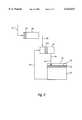
- FIG. 3shows a clean room air filtering system of the invention.
- clean room 10is supplied with chemical-filtered clean room supply air 95 by primary air handling unit 40.
- Both filtered make-up air 80 and recirculation air 135are supplied to primary air handling unit 40.
- Filtered make-up air 80is supplied by make-up air handling unit 50, which is, in turn, supplied by make-up air supply 70.
- Make-up air supply 70is filtered by make-up air filter 60, which can be, for example, a high-efficiency particulate air (HEPA) filter or other particulate air filter or a series of HEPA and other filters.
- HEPAhigh-efficiency particulate air
- Both filtered make-up air 80 and recirculation air 135pass through at least one supply air chemical filter 140 prior to being supplied to the clean room 10 as chemical filtered clean room supply air 95.
- the chemical filtercan be, for example, one of the types of chemical filters discussed in U.S. Pat. No. 5,626,820. Also, multiple chemical filters may be used. If multiple chemical filters are used, they can be aligned in series with each other.
- the chemical-filtered clean room supply air 95enters a ceiling plenum 25 adjacent the clean room filters 20.
- the chemical-filtered clean room supply air 95is supplied to the ceiling plenum 25 from the primary air handling unit 40 through a clean room supply air duct 145.
- the clean room supply air duct 145attaches to the ceiling plenum 25 at a location which is within a low pressure ceiling space 35.
- the air in the clean room supply air duct 145can be isolated from air in the low pressure space 35.
- the low pressure ceiling space 35is maintained at a lower air pressure than the clean room 10.
- any leaks that may exist between the clean room 10 and the low pressure ceiling space 35will result in air transferring from the clean room 10 to the low pressure ceiling space 35 and will, therefore, avoid contaminants entering the clean room 10 from the low pressure ceiling space 35.
- the primary air handling unit 40 and the chemical filter 140are simplified. Also, locating the primary air handling unit 40 outside of the ceiling space 35 allows the primary air handling unit 40 to be larger, resulting in fewer primary air handling units being required as compared to conventional clean room conditioning systems. This reduction in the number of primary air handlers can further reduce maintenance costs and clean room down time.
- the pressure drop across a chemical filteris usually lower than the pressure drop across a particulate filter.
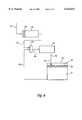
- supply air chemical filter 140is shown in FIG. 3 as being located within primary air handling unit 40, supply air chemical filter 140 can be located either upstream (FIG. 4) or downstream (FIG. 5) of primary air handling unit 40 as long as filtered make-up air 80 enters the recirculation air loop upstream of supply air chemical filter 140, i.e. both filtered make-up air 80 and recirculation air 135 after being joined pass through supply air chemical filter 140. It is important that filtered make-up air 80 enters the recirculation loop upstream of supply air chemical filter 140 so that gas-phase contaminants can be removed from the filtered make-up air 80 prior to its introduction to clean room 10.
Landscapes
- Engineering & Computer Science (AREA)
- Chemical & Material Sciences (AREA)
- Combustion & Propulsion (AREA)
- Mechanical Engineering (AREA)
- General Engineering & Computer Science (AREA)
- Chemical Kinetics & Catalysis (AREA)
- General Chemical & Material Sciences (AREA)
- Ventilation (AREA)
- Filtering Of Dispersed Particles In Gases (AREA)
Abstract
Description
This invention relates to air filtration systems and, in particular, air filtration systems for clean rooms used for manufacturing processes which require an extremely clean environment.
Certain manufacturing processes, including the manufacturer of semiconductor devices, require an extremely clean environment. This environment is commonly referred to as a clean room. Proper filtering of the air in a clean room is critical in the manufacturing of, for example, semiconductor devices because even very small contaminants can cause decreases in yield and device performance.
Clean room contaminants may be generally classified as either particulate or gas-phase. Common particulate contaminants include dust, lint and other debris. Gas-phase (or molecular-level) contaminants are typically tens-of-thousands of times smaller than particulate contaminants. Because it is now known that gas-phase contaminants are especially detrimental to device yields and device performance of today's increasingly small semiconductor devices, more effort is now being directed to reducing the level of gas-phase contaminants in clean rooms.
Various filters are known in the art for removing gas-phase contaminants from air. Examples of such chemical filters are discussed in U.S. Pat. No. 5,626,820. One such example of a chemical filter is a chemical filter of the pleated filter type comprising an air permeable, relatively thick web of non-woven fibrous carrier material of pleated form. The web includes a matrix formed of a large multiplicity of synthetic fibers and is characterized in that activated carbon particles are distributed throughout the web, bound in the interstices of the matrix in a manner preventing loss to the air of particles in quantity substantially detrimental to the performance of any HEPA filter that may be downstream of the chemical filter. The activated carbon particles are of the type selected to remove predetermined gas-phase contaminants from the air source. Various clean room filtering systems have been developed including the use of chemical filters to reduce gas-phase contamination of clean room air. Examples of such air filtering systems are shown in U.S. Pat. Nos. 5,109,916, 5,626,820 and 5,752,985.
FIG. 1 shows a conventional clean room air filtering system in which aclean room 10 is supplied with filtered make-up air 80 by a make-upair handling unit 50 which filters make-up air supply 70 with make-up air filter 60. Theclean room 10 is also supplied with filteredrecirculation air 90 by recirculationair handling unit 48. Recirculationair handling unit 48 draws pre-filteredrecirculation air 130 across recirculationchemical filter 110 to produce chemical-filteredrecirculation air 100. The system shown in FIG. 1 chemical-filters only pre-filteredrecirculation air 130 and does not chemical-filter filtered make-up air 80 until after filtered make-up air 80 passes throughclean room 10.Clean room filters 20 are provided for additional filtration prior to clean room supply air entering the clean room area. Theclean room filters 20 can be, for example, ultra low penetration air (ULPA) filters or other comparable particulate air filters.Plenum 30 receives filtered make-up air 80 and filteredrecirculation air 90 and is located adjacent theclean room filters 20.
FIG. 2 shows a conventional clean room air filtering system similar to the filtering system shown in FIG. 1 except that the chemical-filtering is performed on make-up air supply 70 by make-upchemical filter 120 instead of on pre-filteredrecirculation air 130 by recirculationchemical filter 110. Chemical-filtered make-up air 85 is supplied toclean room 10 by make-upair handling unit 50.
While the use of chemical filters in clean room air filtering systems for the purpose of reducing gas-phase contaminants may be known in the art, certain problems exist with these systems. For example, some systems, such as the system shown in U.S. Pat. No. 5,752,985, pass only a portion of the air entering the clean room through a chemical filter and, therefore, allow air that has not been passed through a chemical filter to enter the clean room. Similarly, U.S. Pat. No. 5,109,916 shows filtering system in which only a portion of the air entering a conditioned space is chemical-filtered. Also, systems such as the system shown in U.S. Pat. No. 5,752,985 and Japanese Patent Publication No. JP-A-8-89747 use multiple chemical filters, each with its own fan unit. This type of system typically requires a large number of chemical filters and fan units, resulting in a high initial cost and high maintenance costs.
Other clean room filtering systems, such as Japanese Patent Publication No. JP-A-8-89747, locate the chemical filters and fan units in the ceiling space above the clean room. Such systems result in high maintenance costs due to the difficulty associated with accessing the ceiling space as compared to accessing a remotely located chemical filter and fan unit.
The inventor of the present invention recognized these problems and developed an air filtering system that addresses them. An air filtering system of the present invention has a make-up air handling unit that supplies filtered make-up air to a primary air handling unit. The make-up air that enters the make-up air handling unit is supplied from an outside source (such as the air outside of the building containing the clean room). Recirculation air from the clean room is also supplied to the primary air handling unit. A chemical filter filters both the filtered make-up air and the recirculation air prior to the make-up air and the recirculation air entering the clean room. All recirculation air from the clean room and all make-up air passes through the chemical filter and the primary air handling unit prior to introduction to the clean room.
By chemical-filtering all of the clean room supply air, the recirculated air is chemical-filtered every time it is recirculated, resulting in the continued removal of gas-phase contaminants produced by processes performed in the clean room. In addition, the system chemical-filters all make-up air prior to introduction to the clean room. In addition, by locating higher capacity chemical filters and air handling units outside of the ceiling space above the clean room, the invention results in decreased maintenance costs.
The foregoing and further objects, features and advantages of the present invention will be described in or be apparent from the following description of embodiments with reference to the accompanying drawings, where like numerals are used to represent like elements and wherein:
FIG. 1 is a schematic drawing of a conventional system using a chemical filter in a recirculation air loop;
FIG. 2 is a schematic drawing of a conventional system using a chemical filter in a make-up air path;
FIG. 3 is a schematic drawing showing an air filtering system of the invention;
FIG. 4 is a schematic drawing showing an air filtering system of another embodiment of the invention; and
FIG. 5 is a schematic drawing showing an air filtering system of another embodiment of the invention.
FIG. 3 shows a clean room air filtering system of the invention.
In FIG. 3,clean room 10 is supplied with chemical-filtered cleanroom supply air 95 by primaryair handling unit 40. Both filtered make-up air 80 andrecirculation air 135 are supplied to primaryair handling unit 40. Filtered make-up air 80 is supplied by make-upair handling unit 50, which is, in turn, supplied by make-up air supply 70. Make-up air supply 70 is filtered by make-up air filter 60, which can be, for example, a high-efficiency particulate air (HEPA) filter or other particulate air filter or a series of HEPA and other filters.
Both filtered make-up air 80 andrecirculation air 135 pass through at least one supply airchemical filter 140 prior to being supplied to theclean room 10 as chemical filtered cleanroom supply air 95. The chemical filter can be, for example, one of the types of chemical filters discussed in U.S. Pat. No. 5,626,820. Also, multiple chemical filters may be used. If multiple chemical filters are used, they can be aligned in series with each other.
By chemical-filtering all air that is supplied toclean room 10, gas-phase contaminants in both the filtered make-upair 80 and therecirculation air 135 are removed. This approach has the advantage of removing gas-phase contaminants from the make-upair 80 which would otherwise be allowed to enter the clean room 10 (such as in the system of FIG. 1). Also, unlike the system of FIG. 2, the system of FIG. 3 removes gas-phase contaminants fromrecirculation air 135.
In a preferred embodiment shown in FIG. 3, the chemical-filtered cleanroom supply air 95 enters aceiling plenum 25 adjacent the clean room filters 20. The chemical-filtered cleanroom supply air 95 is supplied to theceiling plenum 25 from the primaryair handling unit 40 through a clean roomsupply air duct 145. The clean roomsupply air duct 145 attaches to theceiling plenum 25 at a location which is within a lowpressure ceiling space 35. The air in the clean roomsupply air duct 145 can be isolated from air in thelow pressure space 35. The lowpressure ceiling space 35 is maintained at a lower air pressure than theclean room 10. By maintaining the lowpressure ceiling space 35 at a lower air pressure than theclean room 10, any leaks that may exist between theclean room 10 and the lowpressure ceiling space 35 will result in air transferring from theclean room 10 to the lowpressure ceiling space 35 and will, therefore, avoid contaminants entering theclean room 10 from the lowpressure ceiling space 35.
By locating the primaryair handling unit 40 and thechemical filter 140 outside of theceiling space 35 of theclean room 10, maintenance of the primaryair handling unit 40 and thechemical filter 140 are simplified. Also, locating the primaryair handling unit 40 outside of theceiling space 35 allows the primaryair handling unit 40 to be larger, resulting in fewer primary air handling units being required as compared to conventional clean room conditioning systems. This reduction in the number of primary air handlers can further reduce maintenance costs and clean room down time.
All else being equal, the pressure drop across a chemical filter is usually lower than the pressure drop across a particulate filter. By filtering the make-upair supply 70 with the make-upair filter 60 prior to introduction of the filtered make-upair 80 into the primaryair handling unit 40,recirculation air 135 does not need to undergo extensive particulate filtering. As approximately 95% of the chemical filtered cleanroom supply air 95 comes from recirculation air 135 (as opposed to filtered make-up air 80), locating the main particulate filter (make-up air filter 60) outside of the loop driven by primaryair handling unit 40 allows the use of a smaller capacity primaryair handling unit 40.
Although supplyair chemical filter 140 is shown in FIG. 3 as being located within primaryair handling unit 40, supplyair chemical filter 140 can be located either upstream (FIG. 4) or downstream (FIG. 5) of primaryair handling unit 40 as long as filtered make-upair 80 enters the recirculation air loop upstream of supplyair chemical filter 140, i.e. both filtered make-upair 80 andrecirculation air 135 after being joined pass through supplyair chemical filter 140. It is important that filtered make-upair 80 enters the recirculation loop upstream of supplyair chemical filter 140 so that gas-phase contaminants can be removed from the filtered make-upair 80 prior to its introduction toclean room 10.
While the present invention has been described with reference to embodiments thereof, it is to be understood that the invention is not limited to the described embodiments or constructions. To the contrary, the invention is intended to cover various modifications and equivalent arrangements. In addition, while the various elements of the disclosed invention are shown in various combinations and configurations, which are exemplary, other combinations and configurations, including more, less or only a single element, are also within the spirit and scope of the invention.
Claims (17)
1. An air filtering system for use with a clean room, comprising:
a primary air mover that supplies make-up air and recirculation air to the clean room, the primary air mover being located outside of a ceiling space of the clean room;
a make-up air mover that supplies the make-up air to the primary air mover;
one or a series of make-up air filters that filter the make-up air prior to the make-up air being supplied to the primary air mover;
a recirculation air path that supplies the recirculation air from the clean room to the primary air mover; and
at least one chemical filter that filters the make-up air and the recirculation air prior to the make-up air and the recirculation air being supplied to the clean room, wherein all the recirculation air and all the make-up air is filtered by the at least one chemical filter and is supplied to the clean room by the primary air mover.
2. The air filtering system of claim 1, further comprising a conduit for connecting the primary air mover to the clean room.
3. The air filtering system of claim 1, wherein the at least one chemical filter is located upstream of a first location where the make-up air enters the primary air mover and upstream of a second location where the recirculation air enters the primary air mover.
4. The air filtering system of claim 1, wherein the at least one chemical filter is located within the primary air mover.
5. The air filtering system of claim 1, wherein the at least one chemical filter is located between the primary air mover and the clean room.
6. The air filtering system of claim 1, further comprising a clean room filter that filters the air supplied to the clean room by the primary air mover downstream of the at least one chemical filter.
7. The air filtering system of claim 6, further comprising a pressurized plenum between the primary air mover and the clean room filter, the plenum communicating air flow between the primary air mover and the clean room filter.
8. The air filtering system of claim 7, further comprising:
a clean room air supply duct through which the air from the primary air mover passes; and
a low pressure space adjacent the plenum and through which the clean room air supply duct passes, the air in the clean room air supply duct being isolated from air in the low pressure space and the air in the low pressure space having a lower air pressure than the air in the clean room.
9. A method of filtering air for use in a clean room, the method comprising:
supplying filtered make-up air from a make-up air mover to a primary air mover;
supplying recirculation air from the clean room to the primary air mover; and
filtering the filtered make-up air and the recirculation air with at least one chemical filter prior to supplying the chemical-filtered make-up air and the chemical-filtered recirculation air to the clean room, the chemical filtering being performed at a location outside of a ceiling space of the clean room.
10. The method of claim 9, wherein the chemical-filtered make up air and chemical-filtered recirculation air are supplied to the clean room through a conduit.
11. The method of claim 9, wherein the at least one chemical filter is located upstream of a first location where the filtered make-up air enters the primary air mover and upstream of a second location where the recirculation air enters the primary air mover.
12. The method of claim 9, wherein the at least one chemical filter is located within the primary air mover.
13. The method of claim 9, wherein the at least one chemical filter is located between the primary air mover and the clean room.
14. The method of claim 9, further comprising additionally filtering the air supplied to the clean room by the primary air mover, the additional filtering being performed downstream of the chemical-filtering.
15. The method of claim 14, further comprising communicating air flow between the primary air mover and the additional filtering through a pressurized plenum.
16. The method of claim 9, wherein the step of supplying filtered make-up air comprises supplying particulate filtered air.
17. The method of claim 15, further comprising:
supplying the chemical-filtered make-up air and the chemical-filtered recirculation air to the clean room through a clean room supply duct; and
maintaining a low pressure space adjacent the plenum and through which the clean room supply duct passes, the air in the clean room supply duct being isolated from air in the low pressure space and the air in the low pressure space having a lower air pressure than the air in the clean room.
Priority Applications (1)
| Application Number | Priority Date | Filing Date | Title |
|---|---|---|---|
| US09/184,285US6123617A (en) | 1998-11-02 | 1998-11-02 | Clean room air filtering system |
Applications Claiming Priority (1)
| Application Number | Priority Date | Filing Date | Title |
|---|---|---|---|
| US09/184,285US6123617A (en) | 1998-11-02 | 1998-11-02 | Clean room air filtering system |
Publications (1)
| Publication Number | Publication Date |
|---|---|
| US6123617Atrue US6123617A (en) | 2000-09-26 |
Family
ID=22676299
Family Applications (1)
| Application Number | Title | Priority Date | Filing Date |
|---|---|---|---|
| US09/184,285Expired - Fee RelatedUS6123617A (en) | 1998-11-02 | 1998-11-02 | Clean room air filtering system |
Country Status (1)
| Country | Link |
|---|---|
| US (1) | US6123617A (en) |
Cited By (23)
| Publication number | Priority date | Publication date | Assignee | Title |
|---|---|---|---|---|
| US6368393B1 (en)* | 1999-07-14 | 2002-04-09 | Nec Corporation | Fan filter unit for cleanroom |
| US6641648B2 (en) | 2001-04-17 | 2003-11-04 | Foster-Miller, Inc. | Passive filtration system |
| US20040003581A1 (en)* | 2002-07-06 | 2004-01-08 | Lim Chang-Su | Fresh air ducts including downstream filters for clean rooms |
| US6817941B1 (en)* | 2001-10-25 | 2004-11-16 | Lsi Logic Corporation | Uniform airflow diffuser |
| US20060079172A1 (en)* | 2004-10-13 | 2006-04-13 | Lockheed Martin Corporation | Common filtration unit for building makeup air and emergency exhaust |
| US20060277879A1 (en)* | 2005-12-08 | 2006-12-14 | Filtration Manufacturing, Inc. | Extended surface pleat air filter |
| US20090275278A1 (en)* | 2008-04-30 | 2009-11-05 | Taiwan Semiconductor Manufacturing Co., Ltd. | Ultra-pure air system for nano wafer environment |
| US20110198055A1 (en)* | 2011-02-09 | 2011-08-18 | Udi Meirav | Modular, High-Throughput Air Treatment System |
| WO2011146478A1 (en)* | 2010-05-17 | 2011-11-24 | Enverid Systems, Inc. | Method and system for improved-efficiency air-conditioning |
| US8157892B2 (en) | 2010-05-17 | 2012-04-17 | Enverid Systems, Inc. | Method and system for improved-efficiency air-conditioning |
| US8480775B2 (en) | 2010-12-20 | 2013-07-09 | Microsoft Corporation | Self cleaning fan assembly |
| US9316410B2 (en) | 2011-11-17 | 2016-04-19 | Enverid Systems, Inc. | Method and system for conditioning air in an enclosed environment with distributed air circulation systems |
| US9328936B2 (en) | 2012-01-10 | 2016-05-03 | Enverid Systems, Inc. | Methods and systems for managing air quality and energy use in air-conditioning systems |
| US9399187B2 (en) | 2012-09-24 | 2016-07-26 | Enverid Systems, Inc. | Air handling system with integrated air treatment |
| US9533250B2 (en) | 2011-08-23 | 2017-01-03 | Enverid Systems, Inc. | Sorbents for carbon dioxide reduction from indoor air |
| US9919257B2 (en) | 2013-09-17 | 2018-03-20 | Enverid Systems, Inc. | Systems and methods for efficient heating of sorbents in an indoor air scrubber |
| US10675582B2 (en) | 2012-07-18 | 2020-06-09 | Enverid Systems, Inc. | Systems and methods for regenerating adsorbents for indoor air scrubbing |
| US10792608B2 (en) | 2015-08-24 | 2020-10-06 | Enverid Systems, Inc. | Scrubber for HVAC system |
| US10850224B2 (en) | 2012-11-15 | 2020-12-01 | Enverid Systems, Inc. | Method and system for reduction of unwanted gases in indoor air |
| US10913026B2 (en) | 2015-05-11 | 2021-02-09 | Enverid Systems, Inc. | Method and system for reduction of unwanted gases in indoor air |
| US11110387B2 (en) | 2016-11-10 | 2021-09-07 | Enverid Systems, Inc. | Low noise, ceiling mounted indoor air scrubber |
| US11207633B2 (en) | 2016-04-19 | 2021-12-28 | Enverid Systems, Inc. | Systems and methods for closed-loop heating and regeneration of sorbents |
| US11541346B2 (en) | 2012-05-22 | 2023-01-03 | Enverid Systems, Inc. | Efficient use of adsorbents for indoor air scrubbing |
Citations (11)
| Publication number | Priority date | Publication date | Assignee | Title |
|---|---|---|---|---|
| US4549472A (en)* | 1983-09-29 | 1985-10-29 | Hitachi Ltd. | Rearrangeable partial environmental control device |
| US5039321A (en)* | 1988-11-04 | 1991-08-13 | Toshiba Ceramics Co., Ltd. | Apparatus for preventing clouding of a semiconductor wafer |
| US5109916A (en)* | 1990-10-31 | 1992-05-05 | Carrier Corporation | Air conditioning filter system |
| JPH05346239A (en)* | 1992-06-15 | 1993-12-27 | Nec Corp | Air conditioning system suitable for clean room |
| US5314516A (en)* | 1993-11-03 | 1994-05-24 | Taikisha, Ltd. | Sealing device for filters |
| JPH0888155A (en)* | 1994-09-20 | 1996-04-02 | Asahi Kogyosha:Kk | Interface box for local cleaning and its clean room |
| JPH0889747A (en)* | 1994-09-21 | 1996-04-09 | Takasago Thermal Eng Co Ltd | Clean room system |
| US5626820A (en)* | 1988-12-12 | 1997-05-06 | Kinkead; Devon A. | Clean room air filtering |
| JPH09153533A (en)* | 1995-12-01 | 1997-06-10 | Mitsubishi Electric Corp | Semiconductor wafer storage system and semiconductor device manufacturing method using the system |
| JPH09155126A (en)* | 1995-12-08 | 1997-06-17 | Takuma Co Ltd | Chemical filter for purifying gas and its manufacture |
| US5752985A (en)* | 1996-09-24 | 1998-05-19 | Mitsubishi Denki Kabushiki Kaisha | Clean room having an air conditioning system |
- 1998
- 1998-11-02USUS09/184,285patent/US6123617A/ennot_activeExpired - Fee Related
Patent Citations (11)
| Publication number | Priority date | Publication date | Assignee | Title |
|---|---|---|---|---|
| US4549472A (en)* | 1983-09-29 | 1985-10-29 | Hitachi Ltd. | Rearrangeable partial environmental control device |
| US5039321A (en)* | 1988-11-04 | 1991-08-13 | Toshiba Ceramics Co., Ltd. | Apparatus for preventing clouding of a semiconductor wafer |
| US5626820A (en)* | 1988-12-12 | 1997-05-06 | Kinkead; Devon A. | Clean room air filtering |
| US5109916A (en)* | 1990-10-31 | 1992-05-05 | Carrier Corporation | Air conditioning filter system |
| JPH05346239A (en)* | 1992-06-15 | 1993-12-27 | Nec Corp | Air conditioning system suitable for clean room |
| US5314516A (en)* | 1993-11-03 | 1994-05-24 | Taikisha, Ltd. | Sealing device for filters |
| JPH0888155A (en)* | 1994-09-20 | 1996-04-02 | Asahi Kogyosha:Kk | Interface box for local cleaning and its clean room |
| JPH0889747A (en)* | 1994-09-21 | 1996-04-09 | Takasago Thermal Eng Co Ltd | Clean room system |
| JPH09153533A (en)* | 1995-12-01 | 1997-06-10 | Mitsubishi Electric Corp | Semiconductor wafer storage system and semiconductor device manufacturing method using the system |
| JPH09155126A (en)* | 1995-12-08 | 1997-06-17 | Takuma Co Ltd | Chemical filter for purifying gas and its manufacture |
| US5752985A (en)* | 1996-09-24 | 1998-05-19 | Mitsubishi Denki Kabushiki Kaisha | Clean room having an air conditioning system |
Cited By (41)
| Publication number | Priority date | Publication date | Assignee | Title |
|---|---|---|---|---|
| US6368393B1 (en)* | 1999-07-14 | 2002-04-09 | Nec Corporation | Fan filter unit for cleanroom |
| US6641648B2 (en) | 2001-04-17 | 2003-11-04 | Foster-Miller, Inc. | Passive filtration system |
| US6817941B1 (en)* | 2001-10-25 | 2004-11-16 | Lsi Logic Corporation | Uniform airflow diffuser |
| US20040003581A1 (en)* | 2002-07-06 | 2004-01-08 | Lim Chang-Su | Fresh air ducts including downstream filters for clean rooms |
| US6849100B2 (en)* | 2002-07-06 | 2005-02-01 | Samsung Electronics Co., Ltd. | Fresh air ducts including downstream filters for clean rooms |
| US20050115213A1 (en)* | 2002-07-06 | 2005-06-02 | Lim Chang-Su | Fresh air ducts including downstream filters for clean rooms |
| US20060079172A1 (en)* | 2004-10-13 | 2006-04-13 | Lockheed Martin Corporation | Common filtration unit for building makeup air and emergency exhaust |
| US7331854B2 (en)* | 2004-10-13 | 2008-02-19 | Lockheed Martin Corporation | Common filtration unit for building makeup air and emergency exhaust |
| US20060277879A1 (en)* | 2005-12-08 | 2006-12-14 | Filtration Manufacturing, Inc. | Extended surface pleat air filter |
| US7727299B2 (en) | 2005-12-08 | 2010-06-01 | Filtration Manufacturing, Inc. | Extended surface pleat air filter |
| US8394156B2 (en) | 2008-04-30 | 2013-03-12 | Taiwan Semiconductor Manufacturing Co., Ltd. | Ultra-pure air system for nano wafer environment |
| US20090275278A1 (en)* | 2008-04-30 | 2009-11-05 | Taiwan Semiconductor Manufacturing Co., Ltd. | Ultra-pure air system for nano wafer environment |
| US10730003B2 (en) | 2010-05-17 | 2020-08-04 | Enverid Systems, Inc. | Method and system for improved-efficiency air-conditioning |
| US8157892B2 (en) | 2010-05-17 | 2012-04-17 | Enverid Systems, Inc. | Method and system for improved-efficiency air-conditioning |
| WO2011146478A1 (en)* | 2010-05-17 | 2011-11-24 | Enverid Systems, Inc. | Method and system for improved-efficiency air-conditioning |
| US8491710B2 (en) | 2010-05-17 | 2013-07-23 | Enverid Systems, Inc. | Method and system for improved-efficiency air-conditioning |
| US10086324B2 (en) | 2010-05-17 | 2018-10-02 | Enverid Systems, Inc. | Method and system for improve-efficiency air-conditioning |
| US8480775B2 (en) | 2010-12-20 | 2013-07-09 | Microsoft Corporation | Self cleaning fan assembly |
| US9375672B2 (en) | 2011-02-09 | 2016-06-28 | Enverid Systems, Inc. | Modular, high-throughput air treatment system |
| US20110198055A1 (en)* | 2011-02-09 | 2011-08-18 | Udi Meirav | Modular, High-Throughput Air Treatment System |
| US8690999B2 (en) | 2011-02-09 | 2014-04-08 | Enverid Systems, Inc. | Modular, high-throughput air treatment system |
| US9789436B2 (en) | 2011-05-17 | 2017-10-17 | Enverid Systems, Inc. | Sorbents for carbon dioxide reduction from indoor air |
| US9533250B2 (en) | 2011-08-23 | 2017-01-03 | Enverid Systems, Inc. | Sorbents for carbon dioxide reduction from indoor air |
| US10281168B2 (en) | 2011-11-17 | 2019-05-07 | Enverid Systems, Inc. | Method and system for conditioning air in an enclosed environment with distributed air circulation systems |
| US9976760B2 (en) | 2011-11-17 | 2018-05-22 | Enverid Systems, Inc. | Method and system for conditioning air in an enclosed environment with distributed air circulation systems |
| US9316410B2 (en) | 2011-11-17 | 2016-04-19 | Enverid Systems, Inc. | Method and system for conditioning air in an enclosed environment with distributed air circulation systems |
| US9328936B2 (en) | 2012-01-10 | 2016-05-03 | Enverid Systems, Inc. | Methods and systems for managing air quality and energy use in air-conditioning systems |
| US9939163B2 (en) | 2012-01-10 | 2018-04-10 | Enverid Systems, Inc. | Systems and methods for air-conditioning systems with scrubbing systems including a scrubbing bypass mode |
| US11541346B2 (en) | 2012-05-22 | 2023-01-03 | Enverid Systems, Inc. | Efficient use of adsorbents for indoor air scrubbing |
| US10675582B2 (en) | 2012-07-18 | 2020-06-09 | Enverid Systems, Inc. | Systems and methods for regenerating adsorbents for indoor air scrubbing |
| US9399187B2 (en) | 2012-09-24 | 2016-07-26 | Enverid Systems, Inc. | Air handling system with integrated air treatment |
| US11608998B2 (en) | 2012-09-24 | 2023-03-21 | Enverid Systems, Inc. | Air handling system with integrated air treatment |
| US11890571B2 (en) | 2012-11-15 | 2024-02-06 | Enverid Systems, Inc. | Method and system for reduction of unwanted gases in indoor air |
| US10850224B2 (en) | 2012-11-15 | 2020-12-01 | Enverid Systems, Inc. | Method and system for reduction of unwanted gases in indoor air |
| US9919257B2 (en) | 2013-09-17 | 2018-03-20 | Enverid Systems, Inc. | Systems and methods for efficient heating of sorbents in an indoor air scrubber |
| US10765990B2 (en) | 2013-09-17 | 2020-09-08 | Enverid Systems, Inc. | Systems and methods for efficient heating of sorbents in an indoor air scrubber |
| US10913026B2 (en) | 2015-05-11 | 2021-02-09 | Enverid Systems, Inc. | Method and system for reduction of unwanted gases in indoor air |
| US10792608B2 (en) | 2015-08-24 | 2020-10-06 | Enverid Systems, Inc. | Scrubber for HVAC system |
| US11207633B2 (en) | 2016-04-19 | 2021-12-28 | Enverid Systems, Inc. | Systems and methods for closed-loop heating and regeneration of sorbents |
| US11110387B2 (en) | 2016-11-10 | 2021-09-07 | Enverid Systems, Inc. | Low noise, ceiling mounted indoor air scrubber |
| US11673090B2 (en) | 2016-11-10 | 2023-06-13 | Enverid Systems, Inc. | Low noise, ceiling mounted indoor air scrubber |
Similar Documents
| Publication | Publication Date | Title |
|---|---|---|
| US6123617A (en) | Clean room air filtering system | |
| US10279302B2 (en) | Filter elements; air filter arrangements; and, methods | |
| KR100474577B1 (en) | Fresh air duct and apparatus for supplying air to clean room system | |
| US6090184A (en) | Filter system | |
| AU644324B2 (en) | Filtration arrangement and method | |
| US6368386B1 (en) | Filter construction resistant to the passage of water soluble materials; and method | |
| US7524362B2 (en) | Modular filter assembly | |
| US7425226B2 (en) | Fluid filter with canted fanfold pleats | |
| US7037354B1 (en) | Expandable air filtration apparatus | |
| US6059852A (en) | Plastic injection molded furnace filter | |
| PT1198280E (en) | COMPOSITE FILTER AND METHOD FOR MANUFACTURING | |
| US20040001003A1 (en) | Switch frame electronic air filter alarming device | |
| EP0498020A1 (en) | Method and system for handling exhaust gas in a boiler | |
| US20200240372A1 (en) | Dual stage air filter system | |
| JPS605217A (en) | Filter apparatus having gas bypass apparatus and gas bypass method | |
| CN105396384A (en) | Easily-mounted/dismounted automobile air conditioner filter | |
| JPS6191426A (en) | air purification system | |
| US5765627A (en) | Cooling air system | |
| JPH0647232A (en) | Method for preventing degradation of collecting efficiency of air filter device using electret filter medium | |
| JPH04113141A (en) | Clean room | |
| JPH02208433A (en) | Air cleaner device for clean room | |
| JP2001300218A (en) | Filter medium for air filter, air filter using the same and method for using air filter | |
| JPS6391116A (en) | Air filter | |
| JPS60211244A (en) | Air conditioner for air purifying chamber | |
| JPH031739Y2 (en) |
Legal Events
| Date | Code | Title | Description |
|---|---|---|---|
| AS | Assignment | Owner name:SEH-AMERICA, INC., WASHINGTON Free format text:ASSIGNMENT OF ASSIGNORS INTEREST;ASSIGNOR:JOHNSON, ROY P.;REEL/FRAME:009566/0041 Effective date:19981029 | |
| FEPP | Fee payment procedure | Free format text:PAYER NUMBER DE-ASSIGNED (ORIGINAL EVENT CODE: RMPN); ENTITY STATUS OF PATENT OWNER: LARGE ENTITY | |
| FPAY | Fee payment | Year of fee payment:4 | |
| REMI | Maintenance fee reminder mailed | ||
| LAPS | Lapse for failure to pay maintenance fees | ||
| STCH | Information on status: patent discontinuation | Free format text:PATENT EXPIRED DUE TO NONPAYMENT OF MAINTENANCE FEES UNDER 37 CFR 1.362 | |
| FP | Lapsed due to failure to pay maintenance fee | Effective date:20080926 |