US6105283A - Shoe insole for correction, control, and underfoot comfort - Google Patents
Shoe insole for correction, control, and underfoot comfortDownload PDFInfo
- Publication number
- US6105283A US6105283AUS08/928,222US92822297AUS6105283AUS 6105283 AUS6105283 AUS 6105283AUS 92822297 AUS92822297 AUS 92822297AUS 6105283 AUS6105283 AUS 6105283A
- Authority
- US
- United States
- Prior art keywords
- insole
- angle
- foot
- plate
- heel
- Prior art date
- Legal status (The legal status is an assumption and is not a legal conclusion. Google has not performed a legal analysis and makes no representation as to the accuracy of the status listed.)
- Expired - Fee Related
Links
Images


Classifications
- A—HUMAN NECESSITIES
- A43—FOOTWEAR
- A43B—CHARACTERISTIC FEATURES OF FOOTWEAR; PARTS OF FOOTWEAR
- A43B7/00—Footwear with health or hygienic arrangements
- A43B7/38—Elevating, i.e. height increasing
- A—HUMAN NECESSITIES
- A43—FOOTWEAR
- A43B—CHARACTERISTIC FEATURES OF FOOTWEAR; PARTS OF FOOTWEAR
- A43B7/00—Footwear with health or hygienic arrangements
- A43B7/14—Footwear with health or hygienic arrangements with foot-supporting parts
- A—HUMAN NECESSITIES
- A43—FOOTWEAR
- A43B—CHARACTERISTIC FEATURES OF FOOTWEAR; PARTS OF FOOTWEAR
- A43B17/00—Insoles for insertion, e.g. footbeds or inlays, for attachment to the shoe after the upper has been joined
- A43B17/02—Insoles for insertion, e.g. footbeds or inlays, for attachment to the shoe after the upper has been joined wedge-like or resilient
- A—HUMAN NECESSITIES
- A43—FOOTWEAR
- A43B—CHARACTERISTIC FEATURES OF FOOTWEAR; PARTS OF FOOTWEAR
- A43B7/00—Footwear with health or hygienic arrangements
- A43B7/14—Footwear with health or hygienic arrangements with foot-supporting parts
- A43B7/1405—Footwear with health or hygienic arrangements with foot-supporting parts with pads or holes on one or more locations, or having an anatomical or curved form
- A43B7/141—Footwear with health or hygienic arrangements with foot-supporting parts with pads or holes on one or more locations, or having an anatomical or curved form having an anatomical or curved form
- A—HUMAN NECESSITIES
- A43—FOOTWEAR
- A43B—CHARACTERISTIC FEATURES OF FOOTWEAR; PARTS OF FOOTWEAR
- A43B7/00—Footwear with health or hygienic arrangements
- A43B7/14—Footwear with health or hygienic arrangements with foot-supporting parts
- A43B7/1405—Footwear with health or hygienic arrangements with foot-supporting parts with pads or holes on one or more locations, or having an anatomical or curved form
- A43B7/1415—Footwear with health or hygienic arrangements with foot-supporting parts with pads or holes on one or more locations, or having an anatomical or curved form characterised by the location under the foot
- A43B7/142—Footwear with health or hygienic arrangements with foot-supporting parts with pads or holes on one or more locations, or having an anatomical or curved form characterised by the location under the foot situated under the medial arch, i.e. under the navicular or cuneiform bones
- A—HUMAN NECESSITIES
- A43—FOOTWEAR
- A43B—CHARACTERISTIC FEATURES OF FOOTWEAR; PARTS OF FOOTWEAR
- A43B7/00—Footwear with health or hygienic arrangements
- A43B7/14—Footwear with health or hygienic arrangements with foot-supporting parts
- A43B7/1405—Footwear with health or hygienic arrangements with foot-supporting parts with pads or holes on one or more locations, or having an anatomical or curved form
- A43B7/1415—Footwear with health or hygienic arrangements with foot-supporting parts with pads or holes on one or more locations, or having an anatomical or curved form characterised by the location under the foot
- A43B7/144—Footwear with health or hygienic arrangements with foot-supporting parts with pads or holes on one or more locations, or having an anatomical or curved form characterised by the location under the foot situated under the heel, i.e. the calcaneus bone
- A—HUMAN NECESSITIES
- A43—FOOTWEAR
- A43B—CHARACTERISTIC FEATURES OF FOOTWEAR; PARTS OF FOOTWEAR
- A43B7/00—Footwear with health or hygienic arrangements
- A43B7/14—Footwear with health or hygienic arrangements with foot-supporting parts
- A43B7/1405—Footwear with health or hygienic arrangements with foot-supporting parts with pads or holes on one or more locations, or having an anatomical or curved form
- A43B7/1415—Footwear with health or hygienic arrangements with foot-supporting parts with pads or holes on one or more locations, or having an anatomical or curved form characterised by the location under the foot
- A43B7/1445—Footwear with health or hygienic arrangements with foot-supporting parts with pads or holes on one or more locations, or having an anatomical or curved form characterised by the location under the foot situated under the midfoot, i.e. the second, third or fourth metatarsal
- A—HUMAN NECESSITIES
- A43—FOOTWEAR
- A43D—MACHINES, TOOLS, EQUIPMENT OR METHODS FOR MANUFACTURING OR REPAIRING FOOTWEAR
- A43D999/00—Subject matter not provided for in other groups of this subclass
Definitions
- the present inventionrelates to a set of shoe inserts, and more particularly, to a set of orthoinserts for allowing an easy application for many types of abnormal feet and an easy control of the angle of an insole plate to the ground by a forefoot wedge and a rearfoot wedge in order to provide better underfoot comfort and control when wearing sporting and walking shoes.
- the footcontacts the ground and supports the weight of a body when standing, and allows to walking or exercising by appropriate and flexible movements of its bones and muscles. As a result, it is necessary to redistribute the pressure of the body weight by the even contact of the entire plantar surface of the foot to the ground.
- the plantar surface of normal feet with three archescontacts the ground evenly to provide stable standing.
- the archesabsorb the ground reaction force functioning like a spring and allowing the whole foot to move in a heel-to-toe motion freely providing easy and stable sagittal movements of body.
- the normal footbiomechanically, has 8 to 12 degrees of functional movement ranges from the sum of the movements of its supination and pronation around the longitudinal axis of the subtalar joint, each of which has 4 to 6 degrees.
- human feet and their ambulationcan be classified into three distinctive shapes, foot supination (pes cavus), wherein foot moves to the direction of inversion, adduction, and plantar flexion, and foot pronation (pes planus), wherein the foot moves to the direction of eversion, abduction, and dorsiflexion, and the normal foot (pes rectus), wherein the foot has a very good alignment to the ground.
- the abnormal footsuch as an oversupinated foot, slightly pronated foot, hyperpronated foot,etc. usually cause functional problems and pain when walking and standing as well as running and heavy exercise.
- a castis taken of a foot using plaster bandages, and then custom-made orthoses or insoles are made by molding over the plaster foot, cast with synthetic resins or any appropriate materials.
- Japan Patent Office Publication No. Hei 4-97701describes an insole for ski boots, wherein the thickness of the fore part and the rear part of the insole is different from each other depending on the pressure difference applied on each of them.
- the wedgehas somehow different thickness on its ends, but the incline angle between its ends is not restricted to a specific angle with its inclined shape characteristics.
- the pads 2, 4, 5 and 6have an even thickness and are attached on the insole plate 1 being used to adjust the thickness of the insole plate 1 or the gap between the insole plate 1 and sole.
- insolescompensate the uneven contact to the ground surface by attaching the wedges or the pads on the insole plate 1 so as to mass produce the insoles.
- various parametersshould be considered when these wedges and pads are applied on the insole, not only the adhesive site or their thickness but structural or anatomical foot variance.
- the insolecomprises a pair of flat insole plates 1 which have a convex shape corresponding to the arch of sole, a pair of forefoot pads 7 accompanying each of the insole plates, a pair of rearfoot pads 8, a pair of longitudinal pads 2, and a pair of auxiliary pads 9.
- the present inventiondirected to an orthoinsert for allowing an easy application for many types of abnormal foot function such as oversupination, semipronation, and hyperpronation,etc.
- orthoinsertscan be used to correct many foot alignment problems such as forefoot invertus, forefoot evertus, rearfoot varus, rearfoot valgus, plantar flexed or dorsiflexed first metatarsus, etc.
- the insole of the present inventioncomprises three pair of different insole plate types which can have the full length of the entire sole for sport shoes or walking shoes or the length corresponding to the length of the heel-to-metatarsal head with an arch supporting lesion to match the arch of foot with varying heights, a heel site for stabilizing the calcaneus of the foot. Furthermore, adhesive and adjustable forefoot wedges are attached on the forepart of the undersurface of the orthoinserts to control the angle of the forefoot to the ground surface, and adhesive and adjustable rearfoot wedges are attached on the rearpart of the undersurface of orthoinserts to correct the angle of the rear part of a foot to the ground surface.
- the insole plate, the arch filler, and the heel siteare integrated.
- the insole platescan have foot classified and preformed shapes depending on the abnormal foot type, such as semipronated foot, oversupinated foot, hyperpronated foot, and the like.
- the insole for the oversupinated footmay include the first metatarsus and medial cuneiform accommodation which is incarved where the first metatarsus and its contacting first cuneiform meet.
- the insole for the oversupinated footmay include both the first-inclined site and a cut for the first metatarsal head.
- the hyperpronating type insole plateis such a manner further characterized in such a manner that a medially inclined angle is formed on the heel site with a constant inclination following the shape of the foot.
- An inverted angleis added to the above angle around the longitudinal axis of the midtarsal joint of the foot so that the midpart of the insole has the highest arch filler.
- the semipronating type orthoinserthas a medially inscribed varus angle on its heel and the forefoot and rearfoot angles can be altered accordingly.
- Foot anglesare constantly proportional and changeable to the heel site by using wedges.
- One end of the forefoot wedge attached on the insole plateis round-edge finished so as to have a similar shape with the forepart of the insole plate, wherein a plurality of control lines are formed on the surface of the forepart of the insole plate. As each line is spaced in a constant interval apart longitudinally so that the selection of any one of the control lines provides the control of the angle of the forepart of the insole plate to the ground surface.
- the range of the forepart angle of the insole plate to the ground surfacecan be adjusted from 0.5 to 10 degrees, and preferably 2 to 3 degree.
- one end of the rearfoot wedge attached to the insole plateis round-edge finished so as to have a similar shape with the rearpart of the insole plate, wherein a plurality of control lines are formed on the surface of the rearpart of the insole plate with each line spaced a constant interval apart longitudinally so that the selection of any one of the control lines provides the angle control of the rear half insole plate to the ground surface.
- the control lines of the rearfoot wedgeare formed so as to have an arc having the same diameter as the corner of the rearfoot wedge of the insole plate.
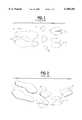
- FIG. 1is a schematic plan view of an embodiment of the conventional preformed insoles
- FIG. 2is a schematic plan view of another embodiment of the conventional premoulded insoles
- FIG. 3is a schematic plan view of an embodiment of the orthoinsert according to the present invention.
- FIG. 4is a cross-sectional view of the orthoinsert of shown in FIG. 3,
- FIG. 5is a schematic plan view of another embodiment of the orthoinsert for hyperpronated foot according to the present invention.
- FIG. 6is a cross-sectional view of the arch height of the orthoinsert shown in FIG. 5.
- the orthoinserts of the present inventioncomprise a pair of shell plates 1, forefoot wedges 15 and rearfoot wedges 16, both of which are attached on the shell plates.
- the shell plate 1can be a full length of an entire sole from the heel end to the toe end to replace the conventional shoe innersoles, or a length corresponding to the length of the sole except the forefoot part. The length must be appropriately controlled or precut for a pair of certain shoes depending on certain shoe design.
- the shell plateshave arch fillers 10a, 10b corresponding to the foot arches holding the heel accordingly, all of which are integrated with three types of shells.
- Orthoinsertsare generally mass produced by injection moulding method or extrusion moulding method, etc. by using synthetic resin or other appropriate materials.
- the forefoot wedge 15 attached on the fore part of the undersurface of the shell plate 1can be used as means for controlling the angle of the forefoot to the ground surface by controlling the angle of its inclination or declination.
- the forefoot wedgecan be made of a plate wedge in such a manner that one end is thick and the other end is thin.
- the material for the forefoot wedgeis the same as that of the shell plate 1.
- a rearfoot wedge 16 attached on the rear part of the undersurface of the shell plate 1can be used as means for controlling the angle of the rearfoot to the ground surface by controlling the angle of its inclination or declination which is understood to have the same function as the forefoot wedge 15 or similar thereto.
- the rearfoot wedge 16since the rearfoot wedge 16 is directly placed under the heel site, it may have a wide space compared with the forefoot wedge 15, and preferably, it can have the space over the three quarter of width of the rear part of the shell plate 1.
- the angle of the shell plates to the groundcan be controlled by the application of the forefoot wedges 15 and the rearfoot wedges 16. Accordingly, the shell plates can be attached on the midsole of the shoes depending on the shoe manufacturer's choice.
- Shoe and orthoinsertsfunction together to distribute the whole weight of the body correctly to the ground when applied on each of three abnormal foot shapes, such as semipronated, oversupinated, and hyperpronated feet.
- each shell typehas a plurality of shells of varied length.
- the insole for the supinated footmay include a first metatarsus accommodative site 12 which is incarved where the first metatarsus and its contacting first cuneiform meet, or a cut 13 which is cut in the interface of the first metatarsus and the first phalange.
- the application of the first metatarsus accommodative site 12is the main idea which is first introduced in the present invention.
- the shell plate 1 for the supinated foot provided by the present inventionallows to correct all kinds of foot shapes which are mainly classified into three basic types so that the mass production for the orthoinserts are possible accordingly.
- the orthoinserts for the supinated feetis one which the first metatarsus accommodative site 12 is formed much lower than compared with other metatarsi in order to make the oversupinated feet to roll-inward to achieve better alignment.
- the first accommodative site 12 of the insole plate 1 for oversupinating typeholds the above part of the first metatarsus and the first cuneiform on its incarved site. Therefore, heel-to-ground alignment can be corrected.
- ⁇ incarve ⁇means a kind of technique to carve inside a given product, which is well known to those who manufacture the orthoinserts for sports shoes, walking shoes and dress or high-heel shoes.
- a cut 13is formed by removing the site where the first metatarsal head contacts so as to accommodate the site at the right level.
- the shell plate 1 for the oversupinated footmay employ both the first inclined site 12 and the cut 13 together.
- the hyperpronating type shell plate 14is further characterized in that a skived varus angle site 11 is formed at the heel with a constant inclination following the foot shape and an inverted or counter rotated angle is added around the longitudinal axis of the shell plate so that the forepart of the hyperpronating plate 14 has a higher arch filler 10a than the arch filler 10b for a semipronation shell plate, as illustrated in FIG. 6.
- the shell plate 14 for hyperpronating type foothas the skived varus angle site and the inverted angle together, and the formation of the skived varus angle site 11 is known as Kirby's technique which is started by Dr. Kirby and designed for effectively holding the heel aligned with angle ranges of 15 to 40 degrees.
- Kirby's techniquewhich is started by Dr. Kirby and designed for effectively holding the heel aligned with angle ranges of 15 to 40 degrees.
- Kirby's techniquewhich is started by Dr. Kirby and designed for effectively holding the heel aligned with angle ranges of 15 to 40 degrees.
- the usage of only Kirby's methodshows that the correction of hyperpronated feet is not always applicable for the adult flat foot which is already too hardened to be corrected.
- the formation of the distorted or inverted angleis known as Blake's technique which is initiated by Dr. Blake, wherein the inverted angle is formed around the midfoot so that the forepart and the rearpart of the insole plate 1 are maintained counter rotated in the possible angle ranges of approximately 15 to 45 degree.
- Dr. Blakethe usage of the Blake's method may not be sufficient for a child's foot which is still soft and too flexible to be corrected.
- the present inventionis therefore characterized in the new shell plate 14 for the hyperpronated foot by properly adopting both the conventional Kirby's method and the Blake's method and solving the disdvantages of both methods.
- the present inventionprovides the orthoinserts for foot correction, control and comfort, which are suitable for any type of abnormal foot shapes by setting up the semi pronating type insole plate as a standard to thereby develop the patterned shell plate 1 for the oversupinated foot and shell plate 14 for the hyperpronated foot accordingly.
- the present inventionalso includes a forefoot wedge 15 and a rearfoot wedge 16. They should be attached under the shell plates 1, 14, which have classified and patterned types, for example, over supinating-type, semipronating-type, and hyperpronating-type, and the angle between each of the two wedges to the ground surface is controlled separately.
- One end of the forefoot wedge 15 attached on the shell plateshas a round-edge finish so as to have a similar shape with the fore part of the shell plates, wherein a plurality of control lines 17 are formed on its surface with each line spaced a constant interval apart longitudinally and the selection of any one of the control lines 17 provides the control of the angle of the fore part of the orthoinserts to the ground surface and the angle can be increased/decreased accordingly for the effective application on the individual foot's functional difference.
- the plurality of the control lines 17 formed on the surface of the forefoot wedge 15can be used as a standard for the angle control of the fore part of the shell to the ground surface, and each control line represents 1 degree difference.
- the angle size which is controlled by the control lines 17 and the number of the control lines 17can be varied by those skilled in these related arts by using theory or trial and error counting. Therefore, the present invention should not be confined to the number of the control lines 17 or the controlled angle size.
- the angle range of orthoinserts to the ground surfacecan be adjusted from 0.5 to 10 degree, and preferably 2 to 3 degree.
- One end of the rearfoot wedge 16 attached on the orthoinsertshas round-edge finish so as to have a similar shape with the rear part of the orthoinserts, wherein a plurality of control lines 17 are formed on the surface of its rear part with each spaced a constant interval apart along the shape of the heel so that a selection of any one of the control lines provides the control of the angle of the rear part of the orthoinserts to the ground surface.
- the angle range of the insole plate 1 to the ground surfacecan be adjusted from 0.5 to 10 degrees, and preferably 2 to 3 degrees.
- the rear foot wedge 16can have a wider dimension than the forefoot wedge 15, which is due to the fact that the rear part of the foot or heel carries most of the body weight.
- the oversupinating heelis everted while the forepart of the foot is controlled by five metatarsals and phalanges.
- the control lines 17 of the rearfoot wedge 16preferably are composed of arcs having the same diameter as the corner of the rearfoot wedge 16, which is understood to make a precise control of the angle by attaching the rearfoot wedge 16 on the rear part of the shell plate 1 and then cutting the extending part out of the wedge.
- orthoinsert suitable for a certain foot shape for correctionwhich is classified and patterned of three types, such as, oversupinating-type, semipronating-type, and hyperpronating-type, and then to use one or both of the forefoot wedge 15 and the rearfoot wedge 16, which is suitable to control the minute difference among individuals for the easy and convenient application of orthoinserts into a pair of sport shoes or walking shoes.
- Orthoinserts for the foot correction and comfort of the present inventioncan be either applied between the middle insole and the bottom insole of a shoe or attached on the middle insole to be integrated together so that the usage of the shoe having the orthoinsert provides the improved activity and the effective correction of the foot.
- an orthoinsertincluding the control lines 17 formed on the forefoot wedge 15 and the rearfoot wedge 16, wherein the angle between the distorted foot and the ground surface is easily controlled by appropriately selecting the control lines 17 depending on the mechanical condition for any type of abnormal functioning foot and a mass production is possible accordingly.
Landscapes
- Health & Medical Sciences (AREA)
- Epidemiology (AREA)
- General Health & Medical Sciences (AREA)
- Public Health (AREA)
- Footwear And Its Accessory, Manufacturing Method And Apparatuses (AREA)
- Orthopedics, Nursing, And Contraception (AREA)
Abstract
Description
The present invention relates to a set of shoe inserts, and more particularly, to a set of orthoinserts for allowing an easy application for many types of abnormal feet and an easy control of the angle of an insole plate to the ground by a forefoot wedge and a rearfoot wedge in order to provide better underfoot comfort and control when wearing sporting and walking shoes.
The foot contacts the ground and supports the weight of a body when standing, and allows to walking or exercising by appropriate and flexible movements of its bones and muscles. As a result, it is necessary to redistribute the pressure of the body weight by the even contact of the entire plantar surface of the foot to the ground.
Generally, the plantar surface of normal feet with three arches contacts the ground evenly to provide stable standing. When walking or running, the arches absorb the ground reaction force functioning like a spring and allowing the whole foot to move in a heel-to-toe motion freely providing easy and stable sagittal movements of body.
The normal foot, biomechanically, has 8 to 12 degrees of functional movement ranges from the sum of the movements of its supination and pronation around the longitudinal axis of the subtalar joint, each of which has 4 to 6 degrees. In general, human feet and their ambulation can be classified into three distinctive shapes, foot supination (pes cavus), wherein foot moves to the direction of inversion, adduction, and plantar flexion, and foot pronation (pes planus), wherein the foot moves to the direction of eversion, abduction, and dorsiflexion, and the normal foot (pes rectus), wherein the foot has a very good alignment to the ground.
However, the abnormal foot, such as an oversupinated foot, slightly pronated foot, hyperpronated foot,etc. usually cause functional problems and pain when walking and standing as well as running and heavy exercise.
Accordingly, there has been an increasing demand for design and development of sport shoes for better fitting.
For example, last construction has been changed with straight lasted shoes for hyperpronated foot, semi-curved shoes for normal foot and curved lasted shoe construction for supinating foot, etc. However, shoe construction cannot change abnormal function of the foot. Furthermore, it may be the shoes which causes foot injuries by wearing a wrong pair of shoes. Moreover the shoes have expensive prices.
Generally, in order to make custom-made shoes and orthoses for foot correction, a cast is taken of a foot using plaster bandages, and then custom-made orthoses or insoles are made by molding over the plaster foot, cast with synthetic resins or any appropriate materials.
However, orthoses requires too much time and often complicated procedure to make and they are also too expensive to use.
Moreover, it is impossible to mass produce orthoses because they are supposed to be made for one specific foot and they also require proper adjustment to change their shape.
Japan Patent Office Publication No. Hei 4-97701 describes an insole for ski boots, wherein the thickness of the fore part and the rear part of the insole is different from each other depending on the pressure difference applied on each of them.
However, this process is done by analyzing the foot pressure distribution of the specific foot and determining the appropriate thickness of the insole according to the individual measurements to thereby make the corresponding insole thereto while still having the problems described above.
Chattanooga Corporation located in U.S.A. manufactures premolded devices as seen in FIG. 1 under the registered trademark of `Viscolas`, the insole comprising a pair offlat insole plates 1 following the shape of sole, a pair oflongitudinal arch pads 2, a pair ofheel wedges 3, a large and a smallmetatarsal pad 4, aneuroma pad 5, and atoe crest pad 6. The wedge has somehow different thickness on its ends, but the incline angle between its ends is not restricted to a specific angle with its inclined shape characteristics. Thepads insole plate 1 being used to adjust the thickness of theinsole plate 1 or the gap between theinsole plate 1 and sole. The above-described insoles compensate the uneven contact to the ground surface by attaching the wedges or the pads on theinsole plate 1 so as to mass produce the insoles. However, there is still a problem in fitting the insole on many different types of feet because various parameters should be considered when these wedges and pads are applied on the insole, not only the adhesive site or their thickness but structural or anatomical foot variance. Moreover, it is almost impossible to control the angle to the ground surface with hyperpronated, oversupinated or semipronated feet.
Professional Protective Technology of the Langer Group in U.S.A. also manufactures preformed insoles under the trade mark of Temppthotics as seen in FIG. 2. The insole comprises a pair offlat insole plates 1 which have a convex shape corresponding to the arch of sole, a pair of forefoot pads 7 accompanying each of the insole plates, a pair ofrearfoot pads 8, a pair oflongitudinal pads 2, and a pair ofauxiliary pads 9.
These pads are to be attached on theinsole plates 1 to compensate the uneven contact of the foot to the ground surface thereby making it possible to mass produce them. However, it also has problems in fitting the insole on a certain foot because many parameters should be considered when these pads are attached on theinsole plate 1, and moreover it is almost impossible to control the foot angle to the ground surface with semipronating or hyperpronating or over supinating feet.
Therefore, there is a strong demand for the development of a shoe insole (orthoinsert) which provides an easy application on sport and walking shoes or means of foot correction and underfoot comfort for the abnormal foot classified according to the function and shape such as semipronating type, supinating type and hyperpronating type.
The present invention directed to an orthoinsert for allowing an easy application for many types of abnormal foot function such as oversupination, semipronation, and hyperpronation,etc. Biomechanically, orthoinserts can be used to correct many foot alignment problems such as forefoot invertus, forefoot evertus, rearfoot varus, rearfoot valgus, plantar flexed or dorsiflexed first metatarsus, etc.
The insole of the present invention comprises three pair of different insole plate types which can have the full length of the entire sole for sport shoes or walking shoes or the length corresponding to the length of the heel-to-metatarsal head with an arch supporting lesion to match the arch of foot with varying heights, a heel site for stabilizing the calcaneus of the foot. Furthermore, adhesive and adjustable forefoot wedges are attached on the forepart of the undersurface of the orthoinserts to control the angle of the forefoot to the ground surface, and adhesive and adjustable rearfoot wedges are attached on the rearpart of the undersurface of orthoinserts to correct the angle of the rear part of a foot to the ground surface. The insole plate, the arch filler, and the heel site are integrated.
The insole plates can have foot classified and preformed shapes depending on the abnormal foot type, such as semipronated foot, oversupinated foot, hyperpronated foot, and the like.
Primarily, among the above abnormal foot types, the insole for the oversupinated foot may include the first metatarsus and medial cuneiform accommodation which is incarved where the first metatarsus and its contacting first cuneiform meet. Preferably, the insole for the oversupinated foot may include both the first-inclined site and a cut for the first metatarsal head.
In addition, the hyperpronating type insole plate is such a manner further characterized in such a manner that a medially inclined angle is formed on the heel site with a constant inclination following the shape of the foot. An inverted angle is added to the above angle around the longitudinal axis of the midtarsal joint of the foot so that the midpart of the insole has the highest arch filler.
Finally, the semipronating type orthoinsert has a medially inscribed varus angle on its heel and the forefoot and rearfoot angles can be altered accordingly.
Foot angles are constantly proportional and changeable to the heel site by using wedges.
One end of the forefoot wedge attached on the insole plate is round-edge finished so as to have a similar shape with the forepart of the insole plate, wherein a plurality of control lines are formed on the surface of the forepart of the insole plate. As each line is spaced in a constant interval apart longitudinally so that the selection of any one of the control lines provides the control of the angle of the forepart of the insole plate to the ground surface.
By using the above control lines of the forefoot wedge, the range of the forepart angle of the insole plate to the ground surface can be adjusted from 0.5 to 10 degrees, and preferably 2 to 3 degree.
In addition, one end of the rearfoot wedge attached to the insole plate is round-edge finished so as to have a similar shape with the rearpart of the insole plate, wherein a plurality of control lines are formed on the surface of the rearpart of the insole plate with each line spaced a constant interval apart longitudinally so that the selection of any one of the control lines provides the angle control of the rear half insole plate to the ground surface. By the above control lines of the rearfoot wedge, the angle range of the rearpart of the insole plate to the ground surface can be adjusted from 0.5 to 10 degrees, and preferably 2 to 3 degree.
The control lines of the rearfoot wedge are formed so as to have an arc having the same diameter as the corner of the rearfoot wedge of the insole plate.
It is to be understood that both the foregoing general description and the following detailed description are exemplary and explanatory and are intended to provide further explanation of the invention as claimed.
In the accompanying drawings:
FIG. 1 is a schematic plan view of an embodiment of the conventional preformed insoles,
FIG. 2 is a schematic plan view of another embodiment of the conventional premoulded insoles,
FIG. 3 is a schematic plan view of an embodiment of the orthoinsert according to the present invention,
FIG. 4 is a cross-sectional view of the orthoinsert of shown in FIG. 3,
FIG. 5 is a schematic plan view of another embodiment of the orthoinsert for hyperpronated foot according to the present invention, and
FIG. 6 is a cross-sectional view of the arch height of the orthoinsert shown in FIG. 5.
Reference will now be made in detail to the preferred embodiments of the present invention, examples of which are illustrated in the accompanying drawings.
As seen in FIGS. 3 to 6, the orthoinserts of the present invention comprise a pair ofshell plates 1,forefoot wedges 15 andrearfoot wedges 16, both of which are attached on the shell plates. Theshell plate 1 can be a full length of an entire sole from the heel end to the toe end to replace the conventional shoe innersoles, or a length corresponding to the length of the sole except the forefoot part. The length must be appropriately controlled or precut for a pair of certain shoes depending on certain shoe design.
The shell plates havearch fillers 10a, 10b corresponding to the foot arches holding the heel accordingly, all of which are integrated with three types of shells. Orthoinserts are generally mass produced by injection moulding method or extrusion moulding method, etc. by using synthetic resin or other appropriate materials.
In addition, theforefoot wedge 15 attached on the fore part of the undersurface of theshell plate 1 can be used as means for controlling the angle of the forefoot to the ground surface by controlling the angle of its inclination or declination. The forefoot wedge can be made of a plate wedge in such a manner that one end is thick and the other end is thin. The material for the forefoot wedge is the same as that of theshell plate 1.
Arearfoot wedge 16 attached on the rear part of the undersurface of theshell plate 1 can be used as means for controlling the angle of the rearfoot to the ground surface by controlling the angle of its inclination or declination which is understood to have the same function as theforefoot wedge 15 or similar thereto.
Specifically, since therearfoot wedge 16 is directly placed under the heel site, it may have a wide space compared with theforefoot wedge 15, and preferably, it can have the space over the three quarter of width of the rear part of theshell plate 1.
The angle of the shell plates to the ground can be controlled by the application of theforefoot wedges 15 and therearfoot wedges 16. Accordingly, the shell plates can be attached on the midsole of the shoes depending on the shoe manufacturer's choice. Shoe and orthoinserts function together to distribute the whole weight of the body correctly to the ground when applied on each of three abnormal foot shapes, such as semipronated, oversupinated, and hyperpronated feet.
In order to achieve total underfoot comfort, the shell design must be classified and preformed shell shapes provided for each abnormal foot type. The shell plates should be directly and easily applied to the foot. Each shell type has a plurality of shells of varied length.
Among the above orthoinsert types, the insole for the supinated foot may include a first metatarsusaccommodative site 12 which is incarved where the first metatarsus and its contacting first cuneiform meet, or acut 13 which is cut in the interface of the first metatarsus and the first phalange. The application of the first metatarsusaccommodative site 12 is the main idea which is first introduced in the present invention. Theshell plate 1 for the supinated foot provided by the present invention allows to correct all kinds of foot shapes which are mainly classified into three basic types so that the mass production for the orthoinserts are possible accordingly.
As the first metatarsus is either in a platarflexed position or a valgus position, the orthoinserts for the supinated feet is one which the first metatarsusaccommodative site 12 is formed much lower than compared with other metatarsi in order to make the oversupinated feet to roll-inward to achieve better alignment. The firstaccommodative site 12 of theinsole plate 1 for oversupinating type holds the above part of the first metatarsus and the first cuneiform on its incarved site. Therefore, heel-to-ground alignment can be corrected.
The above `incarve` means a kind of technique to carve inside a given product, which is well known to those who manufacture the orthoinserts for sports shoes, walking shoes and dress or high-heel shoes.
Further, acut 13 is formed by removing the site where the first metatarsal head contacts so as to accommodate the site at the right level.
Theshell plate 1 for the oversupinated foot may employ both the firstinclined site 12 and thecut 13 together.
In contrast, the hyperpronatingtype shell plate 14 is further characterized in that a skivedvarus angle site 11 is formed at the heel with a constant inclination following the foot shape and an inverted or counter rotated angle is added around the longitudinal axis of the shell plate so that the forepart of thehyperpronating plate 14 has a higher arch filler 10a than thearch filler 10b for a semipronation shell plate, as illustrated in FIG. 6.
As described above, it is another characteristic of the present invention that theshell plate 14 for hyperpronating type foot has the skived varus angle site and the inverted angle together, and the formation of the skivedvarus angle site 11 is known as Kirby's technique which is started by Dr. Kirby and designed for effectively holding the heel aligned with angle ranges of 15 to 40 degrees. However, the usage of only Kirby's method shows that the correction of hyperpronated feet is not always applicable for the adult flat foot which is already too hardened to be corrected.
In addition to this, the formation of the distorted or inverted angle is known as Blake's technique which is initiated by Dr. Blake, wherein the inverted angle is formed around the midfoot so that the forepart and the rearpart of theinsole plate 1 are maintained counter rotated in the possible angle ranges of approximately 15 to 45 degree. Again, however, the usage of the Blake's method may not be sufficient for a child's foot which is still soft and too flexible to be corrected.
The present invention is therefore characterized in thenew shell plate 14 for the hyperpronated foot by properly adopting both the conventional Kirby's method and the Blake's method and solving the disdavantages of both methods.
As described above, the present invention provides the orthoinserts for foot correction, control and comfort, which are suitable for any type of abnormal foot shapes by setting up the semi pronating type insole plate as a standard to thereby develop the patternedshell plate 1 for the oversupinated foot andshell plate 14 for the hyperpronated foot accordingly.
The present invention also includes aforefoot wedge 15 and arearfoot wedge 16. They should be attached under theshell plates
One end of theforefoot wedge 15 attached on the shell plates has a round-edge finish so as to have a similar shape with the fore part of the shell plates, wherein a plurality ofcontrol lines 17 are formed on its surface with each line spaced a constant interval apart longitudinally and the selection of any one of thecontrol lines 17 provides the control of the angle of the fore part of the orthoinserts to the ground surface and the angle can be increased/decreased accordingly for the effective application on the individual foot's functional difference.
The plurality of thecontrol lines 17 formed on the surface of theforefoot wedge 15 can be used as a standard for the angle control of the fore part of the shell to the ground surface, and each control line represents 1 degree difference.
However, the angle size which is controlled by thecontrol lines 17 and the number of thecontrol lines 17 can be varied by those skilled in these related arts by using theory or trial and error counting. Therefore, the present invention should not be confined to the number of thecontrol lines 17 or the controlled angle size.
By the aboveangle control line 17 of theforefoot wedge 15, the angle range of orthoinserts to the ground surface can be adjusted from 0.5 to 10 degree, and preferably 2 to 3 degree.
One end of therearfoot wedge 16 attached on the orthoinserts has round-edge finish so as to have a similar shape with the rear part of the orthoinserts, wherein a plurality ofcontrol lines 17 are formed on the surface of its rear part with each spaced a constant interval apart along the shape of the heel so that a selection of any one of the control lines provides the control of the angle of the rear part of the orthoinserts to the ground surface. By the above control line of therearfoot wedge 16, the angle range of theinsole plate 1 to the ground surface can be adjusted from 0.5 to 10 degrees, and preferably 2 to 3 degrees.
However, therear foot wedge 16 can have a wider dimension than theforefoot wedge 15, which is due to the fact that the rear part of the foot or heel carries most of the body weight. The oversupinating heel is everted while the forepart of the foot is controlled by five metatarsals and phalanges.
The control lines 17 of therearfoot wedge 16 preferably are composed of arcs having the same diameter as the corner of therearfoot wedge 16, which is understood to make a precise control of the angle by attaching therearfoot wedge 16 on the rear part of theshell plate 1 and then cutting the extending part out of the wedge.
Therefore, it is first necessary to choose one type of orthoinsert suitable for a certain foot shape for correction which is classified and patterned of three types, such as, oversupinating-type, semipronating-type, and hyperpronating-type, and then to use one or both of theforefoot wedge 15 and therearfoot wedge 16, which is suitable to control the minute difference among individuals for the easy and convenient application of orthoinserts into a pair of sport shoes or walking shoes.
Orthoinserts for the foot correction and comfort of the present invention can be either applied between the middle insole and the bottom insole of a shoe or attached on the middle insole to be integrated together so that the usage of the shoe having the orthoinsert provides the improved activity and the effective correction of the foot.
Therefore, by the present invention, there is provided an orthoinsert including thecontrol lines 17 formed on theforefoot wedge 15 and therearfoot wedge 16, wherein the angle between the distorted foot and the ground surface is easily controlled by appropriately selecting thecontrol lines 17 depending on the mechanical condition for any type of abnormal functioning foot and a mass production is possible accordingly.
It will be apparent to those skilled in the art that some modifications and variations of the present invention can be made without departing from the spirit or scope of the invention. Thus, it is intended that the present invention cover the modifications and variations of this invention provided they come within the scope of the appended claims and their equivalents.
Claims (3)
1. An orthoinsert comprising:
an insole plate which has a length corresponding to the length of heel-to-metatarsal head,
wherein an arch filler corresponding to the arch of foot, and a heel site for holding the heel of foot are formed in the plate, the insole having an undersurface,
a forefoot wedge attached on a right fore part of the undersurface of the insole plate to control the angle of the forefoot to the ground surface, and
a rearfoot wedge attached on a right rear part of the undersurface of the insole plate to control the angle of the rearfoot to the ground surface, wherein said insole plate, said arch filler, and said heel site are integrated,
wherein the insole plate has a classified and preformed shape for a hyperpronated foot and the insole plate for a hyperpronated foot includes a medially inskived varus angle site which is formed on the heel site with a constant inclination angle, and a combined distorted angle with said inskived varus angle on the heel, so that a fore part of said insole having said arch filler has a constant angle to said heel site.
2. The orthoinsert as claimed in claim 1, wherein one end of each of said wedges is round-edge finished so as to have a similar shape with said plate, and control lines on the plate for positioning said wedges spaced a constant interval apart so that the selection of any one of said control lines provides control of the angle of the plate to the ground surface.
3. The orthoinsert as claimed in claim 2, wherein said forefoot wedge and said rearfoot wedge are adjustable by said control lines with the angle range of each of said forepart and said rear part of said insole plate to the ground surface from 0.5 to 10 degrees.
Applications Claiming Priority (2)
| Application Number | Priority Date | Filing Date | Title |
|---|---|---|---|
| KR1019960053313AKR0173096B1 (en) | 1996-11-11 | 1996-11-11 | Foot orthotic insoles |
| KR96-53313 | 1996-11-11 |
Publications (1)
| Publication Number | Publication Date |
|---|---|
| US6105283Atrue US6105283A (en) | 2000-08-22 |
Family
ID=19481467
Family Applications (1)
| Application Number | Title | Priority Date | Filing Date |
|---|---|---|---|
| US08/928,222Expired - Fee RelatedUS6105283A (en) | 1996-11-11 | 1997-09-12 | Shoe insole for correction, control, and underfoot comfort |
Country Status (5)
| Country | Link |
|---|---|
| US (1) | US6105283A (en) |
| JP (1) | JP3239334B2 (en) |
| KR (1) | KR0173096B1 (en) |
| CN (1) | CN1149028C (en) |
| MY (1) | MY125468A (en) |
Cited By (50)
| Publication number | Priority date | Publication date | Assignee | Title |
|---|---|---|---|---|
| WO2003037124A1 (en)* | 2001-10-29 | 2003-05-08 | Kantro Scott R | Devices and methods for orthotic customization |
| US6604301B1 (en)* | 2000-07-10 | 2003-08-12 | II Arthur Manoli | Shoe sole insert |
| FR2838308A1 (en)* | 2002-04-15 | 2003-10-17 | Pascal Chenut | Orthopaedic footwear sole for re-establishment or preservation of correct foot dynamics has zones applying pressure to articular receptors |
| US6694648B2 (en) | 2002-07-19 | 2004-02-24 | Julie Eriksen | Metatarsal arch support |
| US20040255488A1 (en)* | 2003-06-17 | 2004-12-23 | Jeffrey S. Brooks, Inc. | Insole with a neuroma pad |
| US20060018893A1 (en)* | 1996-06-01 | 2006-01-26 | Bart Vanhaesebroeck | Method for determining modulation of P110delta activity |
| US20060053664A1 (en)* | 2004-09-15 | 2006-03-16 | Tager Steven E | Orthopedic foot devices |
| US7069665B1 (en) | 2002-07-19 | 2006-07-04 | Biocorrect L.L.C. | Correcting foot alignment |
| US20070033834A1 (en)* | 2005-08-12 | 2007-02-15 | Cheskin Melvyn P | Shoe insole |
| US20070079532A1 (en)* | 2005-10-12 | 2007-04-12 | Ramirez Manuel M | Soles with adjustable and interchangeable supports |
| US20070084084A1 (en)* | 2005-10-13 | 2007-04-19 | Rich Jeffrey S | User moldable adjustable insert |
| AU2005319806B2 (en)* | 2004-12-22 | 2009-01-15 | Foot Science International Limited | Orthotic kits and assemblies |
| US20090049712A1 (en)* | 2007-08-24 | 2009-02-26 | Athena Pacific, Llc | Orthotic foot device with removable support components and method of making same |
| US20090083999A1 (en)* | 2007-09-28 | 2009-04-02 | Steve Fadem | Shoe sole for reversed appearance of shoes |
| US20090107010A1 (en)* | 2007-10-30 | 2009-04-30 | Rutherford Ralph A | Shoe assembly for strength training and fitness exercise |
| WO2010040974A1 (en)* | 2008-10-10 | 2010-04-15 | Gerrard Farrell | Foot exercise device |
| US7707751B2 (en) | 2006-06-16 | 2010-05-04 | Schering-Plough Healthcare Products, Inc. | Adjustable orthotic |
| US20100263230A1 (en)* | 2009-04-15 | 2010-10-21 | Marie Smirman | Insert for rockered foot bed of footwear |
| US20110088145A1 (en)* | 2008-05-26 | 2011-04-21 | Masanori Harada | Support structure for prophylaxis or treatment of a disorder accompanying a foot deformation |
| US20110124473A1 (en)* | 2009-11-17 | 2011-05-26 | Ryan Michael Kole | Lower leg and foot exercise device |
| US8479405B2 (en) | 2010-09-30 | 2013-07-09 | Marie Smirman | Measurement system for varus/valgus angles in feet |
| US8826571B2 (en) | 2010-04-27 | 2014-09-09 | Ralph A. RUTHERFORD | Shoe assembly for strength training and fitness exercise |
| US20150201702A1 (en)* | 2012-03-01 | 2015-07-23 | Spenco Medical Corportion | Insole for Relief of Over-Pronation and Knee Joint Stress |
| USD758058S1 (en) | 2015-06-25 | 2016-06-07 | Spenco Medical Corporation | Heel cup |
| USD761543S1 (en) | 2015-06-25 | 2016-07-19 | Spenco Medical Corporation | Shoe insole |
| USD762367S1 (en) | 2015-06-25 | 2016-08-02 | Spenco Medical Corporation | Shoe insole |
| USD762366S1 (en) | 2015-06-25 | 2016-08-02 | Spenco Medical Corporation | Shoe insole |
| USD762368S1 (en) | 2015-06-25 | 2016-08-02 | Spenco Medical Corporation | Shoe insole |
| USD766560S1 (en) | 2015-06-25 | 2016-09-20 | Implus Footcare, Llc | Shoe insole |
| USD771921S1 (en) | 2015-06-25 | 2016-11-22 | Implus Footcare, Llc | Shoe insole |
| USD771922S1 (en) | 2015-09-15 | 2016-11-22 | Implus Footcare, Llc | Shoe insole |
| USD778040S1 (en) | 2015-09-25 | 2017-02-07 | Implus Footcare, Llc | Shoe insole |
| USD778567S1 (en) | 2015-09-17 | 2017-02-14 | Implus Footcare, Llc | Shoe insole |
| USD797428S1 (en) | 2015-07-15 | 2017-09-19 | Implus Footcare, Llc | Shoe insole |
| USD797430S1 (en) | 2015-07-15 | 2017-09-19 | Implus Footcare, Llc | Shoe insole |
| USD797429S1 (en) | 2015-07-15 | 2017-09-19 | Implus Footcare, Llc | Shoe insole |
| US9788602B2 (en) | 2012-08-31 | 2017-10-17 | Implus Footcare, Llc | Basketball insole |
| US9930926B2 (en) | 2010-06-25 | 2018-04-03 | Implus Footcare, Llc | Contoured support insole |
| USD814750S1 (en) | 2015-09-25 | 2018-04-10 | Fourfoot, Llc | Sandal |
| US9961958B1 (en) | 2015-05-28 | 2018-05-08 | Implus Footcare, Llc | Contoured support shoe insole |
| US10136698B2 (en) | 2015-05-28 | 2018-11-27 | Implus Footcare, Llc | Shoe insole |
| US10441023B2 (en) | 2011-02-02 | 2019-10-15 | Implus Footcare, Llc | Flow insole |
| US10485299B2 (en) | 2015-05-28 | 2019-11-26 | Implus Footcare, Llc | Contoured support shoe insole |
| WO2020006604A1 (en)* | 2018-07-06 | 2020-01-09 | Frankie4 IP 2 Pty Ltd | An assembly for providing footwear with a plurality of removable and interchangeable footbeds |
| WO2020010282A3 (en)* | 2018-07-06 | 2020-03-12 | Richard Kim | Orthotic arch support device and method of use |
| US10709203B2 (en) | 2015-05-28 | 2020-07-14 | Implus Footcare, Llc | Contoured support shoe insole |
| CN112971267A (en)* | 2021-03-17 | 2021-06-18 | 温州职业技术学院 | Foot-eversion-resistant insole |
| ES2931430A1 (en)* | 2021-06-21 | 2022-12-29 | Podoactiva S L | DEVICE KIT FOR PERFORMING BIOMECHANICAL TESTS ON THE FOOT (Machine-translation by Google Translate, not legally binding) |
| USD1026440S1 (en) | 2023-10-31 | 2024-05-14 | Taiyuan Kewen Suyi Trading Co., Ltd. | Orthotic insole |
| US12376983B2 (en) | 2018-07-06 | 2025-08-05 | Richard Kim | Orthotic arch support devices and methods of use |
Families Citing this family (10)
| Publication number | Priority date | Publication date | Assignee | Title |
|---|---|---|---|---|
| KR100388136B1 (en)* | 2001-04-10 | 2003-06-19 | 박인식 | Biomechanical Ankle foot Orthoses |
| KR101320299B1 (en)* | 2004-07-10 | 2013-10-22 | 김지욱 | Appapatus for curing body status |
| CA2574031A1 (en)* | 2004-07-10 | 2006-01-19 | Ji-Woog Kim | Method and apparatus for curing body status |
| US8250783B2 (en)* | 2007-09-18 | 2012-08-28 | Esoles Llc | Multi-component footbeds |
| CN101849727B (en)* | 2010-06-10 | 2012-08-29 | 浙江红蜻蜓鞋业股份有限公司 | Shoe pad capable of balancing pressure of sole |
| CN103099384A (en)* | 2011-11-15 | 2013-05-15 | 株式会社学山 | Insole with customized balance keeping gaskets |
| CN104720944A (en)* | 2015-01-22 | 2015-06-24 | 王水争 | Increased within orthopaedic shoe |
| TWI569743B (en)* | 2016-01-15 | 2017-02-11 | 歐立達股份有限公司 | A device for foot three dimensional motion control and plantar pressure redistribution |
| JP7102036B2 (en)* | 2020-10-06 | 2022-07-19 | エーシル株式会社 | Orthodontic plates, insoles and shoes |
| JP7678444B1 (en)* | 2024-09-24 | 2025-05-16 | 琢也 冨永 | Insole manufacturing system, insole manufacturing method, and insole |
Citations (8)
| Publication number | Priority date | Publication date | Assignee | Title |
|---|---|---|---|---|
| US1118736A (en)* | 1914-04-11 | 1914-11-24 | Stella F Whittaker | Insole. |
| US2312378A (en)* | 1940-05-23 | 1943-03-02 | John D Baum | Arch support |
| US2613455A (en)* | 1948-01-03 | 1952-10-14 | Joseph A Amico | Arch support |
| US2680919A (en)* | 1951-12-03 | 1954-06-15 | Florida L Riggs | Insole-type appliance |
| US4841648A (en)* | 1988-02-29 | 1989-06-27 | Shaffer David E | Personalized insole kit |
| JPH0497701A (en)* | 1990-08-16 | 1992-03-30 | Masamichi Uchida | Insole for skiing boot |
| US5138774A (en)* | 1990-06-04 | 1992-08-18 | Jeff Sarkozi | Insole with removable, height-adjustable stackable support pads |
| US5799414A (en)* | 1989-09-14 | 1998-09-01 | Kellerman; David | Shoe insert with non-compressible deformable base attached to resilient pads |
- 1996
- 1996-11-11KRKR1019960053313Apatent/KR0173096B1/ennot_activeExpired - Lifetime
- 1997
- 1997-08-12MYMYPI97003681Apatent/MY125468A/enunknown
- 1997-08-22JPJP24019897Apatent/JP3239334B2/ennot_activeExpired - Fee Related
- 1997-09-09CNCNB971182469Apatent/CN1149028C/ennot_activeExpired - Fee Related
- 1997-09-12USUS08/928,222patent/US6105283A/ennot_activeExpired - Fee Related
Patent Citations (8)
| Publication number | Priority date | Publication date | Assignee | Title |
|---|---|---|---|---|
| US1118736A (en)* | 1914-04-11 | 1914-11-24 | Stella F Whittaker | Insole. |
| US2312378A (en)* | 1940-05-23 | 1943-03-02 | John D Baum | Arch support |
| US2613455A (en)* | 1948-01-03 | 1952-10-14 | Joseph A Amico | Arch support |
| US2680919A (en)* | 1951-12-03 | 1954-06-15 | Florida L Riggs | Insole-type appliance |
| US4841648A (en)* | 1988-02-29 | 1989-06-27 | Shaffer David E | Personalized insole kit |
| US5799414A (en)* | 1989-09-14 | 1998-09-01 | Kellerman; David | Shoe insert with non-compressible deformable base attached to resilient pads |
| US5138774A (en)* | 1990-06-04 | 1992-08-18 | Jeff Sarkozi | Insole with removable, height-adjustable stackable support pads |
| JPH0497701A (en)* | 1990-08-16 | 1992-03-30 | Masamichi Uchida | Insole for skiing boot |
Cited By (78)
| Publication number | Priority date | Publication date | Assignee | Title |
|---|---|---|---|---|
| US20060018893A1 (en)* | 1996-06-01 | 2006-01-26 | Bart Vanhaesebroeck | Method for determining modulation of P110delta activity |
| US6604301B1 (en)* | 2000-07-10 | 2003-08-12 | II Arthur Manoli | Shoe sole insert |
| US6823550B2 (en)* | 2001-10-29 | 2004-11-30 | Scott R. Kantro | Devices and methods for orthotic customization |
| WO2003037124A1 (en)* | 2001-10-29 | 2003-05-08 | Kantro Scott R | Devices and methods for orthotic customization |
| FR2838308A1 (en)* | 2002-04-15 | 2003-10-17 | Pascal Chenut | Orthopaedic footwear sole for re-establishment or preservation of correct foot dynamics has zones applying pressure to articular receptors |
| WO2003086127A1 (en)* | 2002-04-15 | 2003-10-23 | Pascal Chenut | Proprioceptive orthopedic sole comprising modular correction means |
| US20060000120A1 (en)* | 2002-04-15 | 2006-01-05 | Pascal Chenut | Proprioceptive orthopedic sole comprising modular correction means |
| US7069665B1 (en) | 2002-07-19 | 2006-07-04 | Biocorrect L.L.C. | Correcting foot alignment |
| US6694648B2 (en) | 2002-07-19 | 2004-02-24 | Julie Eriksen | Metatarsal arch support |
| US20040255488A1 (en)* | 2003-06-17 | 2004-12-23 | Jeffrey S. Brooks, Inc. | Insole with a neuroma pad |
| US7140130B2 (en) | 2003-06-17 | 2006-11-28 | Dr. Brooks Innovations, Llc | Insole with a neuroma pad |
| US20060053664A1 (en)* | 2004-09-15 | 2006-03-16 | Tager Steven E | Orthopedic foot devices |
| US7299568B2 (en) | 2004-09-15 | 2007-11-27 | Tager Steven E | Orthopedic foot devices |
| AU2005319806B2 (en)* | 2004-12-22 | 2009-01-15 | Foot Science International Limited | Orthotic kits and assemblies |
| US20090151194A1 (en)* | 2005-08-12 | 2009-06-18 | Spenco Medical Corporation, Inc. | Shoe Insole |
| US8250784B2 (en) | 2005-08-12 | 2012-08-28 | Spenco Medical Corporation | Shoe insole |
| US7484319B2 (en)* | 2005-08-12 | 2009-02-03 | Spenco Medical Corporation | Shoe insole |
| US7908768B2 (en) | 2005-08-12 | 2011-03-22 | Spenco Medical Corporation | Shoe insole |
| US20070033834A1 (en)* | 2005-08-12 | 2007-02-15 | Cheskin Melvyn P | Shoe insole |
| US20110131835A1 (en)* | 2005-08-12 | 2011-06-09 | Spenco Medical Corporation, Inc. | Shoe Insole |
| US20100095552A1 (en)* | 2005-08-12 | 2010-04-22 | Spenco Medical Corporation, Inc. | Shoe Insole |
| US7665169B2 (en)* | 2005-08-12 | 2010-02-23 | Spenco Medical Corporation | Shoe insole |
| US20070079532A1 (en)* | 2005-10-12 | 2007-04-12 | Ramirez Manuel M | Soles with adjustable and interchangeable supports |
| US7644522B2 (en)* | 2005-10-12 | 2010-01-12 | Manuel Ramirez Martinez Ramirez | Soles with adjustable and interchangeable supports |
| US7900380B2 (en) | 2005-10-13 | 2011-03-08 | Masterfit Enterprises Inc. | User moldable adjustable insert |
| US20070084084A1 (en)* | 2005-10-13 | 2007-04-19 | Rich Jeffrey S | User moldable adjustable insert |
| US7707751B2 (en) | 2006-06-16 | 2010-05-04 | Schering-Plough Healthcare Products, Inc. | Adjustable orthotic |
| US8453346B2 (en) | 2007-08-24 | 2013-06-04 | Orthosole Limited, A Guernsey Limited Company | Orthotic foot device with removable support components and method of making same |
| US20090049712A1 (en)* | 2007-08-24 | 2009-02-26 | Athena Pacific, Llc | Orthotic foot device with removable support components and method of making same |
| US20090083999A1 (en)* | 2007-09-28 | 2009-04-02 | Steve Fadem | Shoe sole for reversed appearance of shoes |
| US7794368B2 (en) | 2007-10-30 | 2010-09-14 | Rutherford Ralph A | Shoe assembly for strength training and fitness exercise |
| US20090107010A1 (en)* | 2007-10-30 | 2009-04-30 | Rutherford Ralph A | Shoe assembly for strength training and fitness exercise |
| US20110088145A1 (en)* | 2008-05-26 | 2011-04-21 | Masanori Harada | Support structure for prophylaxis or treatment of a disorder accompanying a foot deformation |
| US20110224049A1 (en)* | 2008-10-10 | 2011-09-15 | Gerrard Farrell | Foot exercise device |
| WO2010040974A1 (en)* | 2008-10-10 | 2010-04-15 | Gerrard Farrell | Foot exercise device |
| US9282786B2 (en) | 2008-10-10 | 2016-03-15 | Gerrard Farrell | Foot exercise device |
| US20100263230A1 (en)* | 2009-04-15 | 2010-10-21 | Marie Smirman | Insert for rockered foot bed of footwear |
| US20100263231A1 (en)* | 2009-04-15 | 2010-10-21 | Marie Smirman | Forefoot wedge insert for footwear |
| US8523194B2 (en) | 2009-04-15 | 2013-09-03 | Marie Smirman | Forefoot wedge insert for footwear |
| US20100263232A1 (en)* | 2009-04-15 | 2010-10-21 | Marie Smirman | Moldable arch support for footwear |
| US9132308B2 (en) | 2009-11-17 | 2015-09-15 | Rk Inventions, Llc | Lower leg and foot exercise device |
| US20110124473A1 (en)* | 2009-11-17 | 2011-05-26 | Ryan Michael Kole | Lower leg and foot exercise device |
| US8360940B2 (en) | 2009-11-17 | 2013-01-29 | Rk Inventions, Llc | Lower leg and foot exercise device |
| US8826571B2 (en) | 2010-04-27 | 2014-09-09 | Ralph A. RUTHERFORD | Shoe assembly for strength training and fitness exercise |
| US10136697B2 (en) | 2010-06-25 | 2018-11-27 | Implus Footcare, Llc | Contoured support insole |
| US9930926B2 (en) | 2010-06-25 | 2018-04-03 | Implus Footcare, Llc | Contoured support insole |
| US8479405B2 (en) | 2010-09-30 | 2013-07-09 | Marie Smirman | Measurement system for varus/valgus angles in feet |
| US10441023B2 (en) | 2011-02-02 | 2019-10-15 | Implus Footcare, Llc | Flow insole |
| US20150201702A1 (en)* | 2012-03-01 | 2015-07-23 | Spenco Medical Corportion | Insole for Relief of Over-Pronation and Knee Joint Stress |
| US9788602B2 (en) | 2012-08-31 | 2017-10-17 | Implus Footcare, Llc | Basketball insole |
| US10136698B2 (en) | 2015-05-28 | 2018-11-27 | Implus Footcare, Llc | Shoe insole |
| US9961958B1 (en) | 2015-05-28 | 2018-05-08 | Implus Footcare, Llc | Contoured support shoe insole |
| US10485299B2 (en) | 2015-05-28 | 2019-11-26 | Implus Footcare, Llc | Contoured support shoe insole |
| US10709203B2 (en) | 2015-05-28 | 2020-07-14 | Implus Footcare, Llc | Contoured support shoe insole |
| USD762367S1 (en) | 2015-06-25 | 2016-08-02 | Spenco Medical Corporation | Shoe insole |
| USD771921S1 (en) | 2015-06-25 | 2016-11-22 | Implus Footcare, Llc | Shoe insole |
| USD766560S1 (en) | 2015-06-25 | 2016-09-20 | Implus Footcare, Llc | Shoe insole |
| USD762368S1 (en) | 2015-06-25 | 2016-08-02 | Spenco Medical Corporation | Shoe insole |
| USD762366S1 (en) | 2015-06-25 | 2016-08-02 | Spenco Medical Corporation | Shoe insole |
| USD761543S1 (en) | 2015-06-25 | 2016-07-19 | Spenco Medical Corporation | Shoe insole |
| USD758058S1 (en) | 2015-06-25 | 2016-06-07 | Spenco Medical Corporation | Heel cup |
| USD797428S1 (en) | 2015-07-15 | 2017-09-19 | Implus Footcare, Llc | Shoe insole |
| USD797430S1 (en) | 2015-07-15 | 2017-09-19 | Implus Footcare, Llc | Shoe insole |
| USD797429S1 (en) | 2015-07-15 | 2017-09-19 | Implus Footcare, Llc | Shoe insole |
| USD771922S1 (en) | 2015-09-15 | 2016-11-22 | Implus Footcare, Llc | Shoe insole |
| USD778567S1 (en) | 2015-09-17 | 2017-02-14 | Implus Footcare, Llc | Shoe insole |
| USD778040S1 (en) | 2015-09-25 | 2017-02-07 | Implus Footcare, Llc | Shoe insole |
| USD857353S1 (en) | 2015-09-25 | 2019-08-27 | Fourfoot, Llc | Sandal |
| USD814750S1 (en) | 2015-09-25 | 2018-04-10 | Fourfoot, Llc | Sandal |
| USD803539S1 (en) | 2015-09-25 | 2017-11-28 | Implus Footcare, Llc | Shoe insole |
| WO2020006604A1 (en)* | 2018-07-06 | 2020-01-09 | Frankie4 IP 2 Pty Ltd | An assembly for providing footwear with a plurality of removable and interchangeable footbeds |
| WO2020010282A3 (en)* | 2018-07-06 | 2020-03-12 | Richard Kim | Orthotic arch support device and method of use |
| US11350699B2 (en) | 2018-07-06 | 2022-06-07 | Richard Kim | Orthotic arch support device and method of use |
| US12376983B2 (en) | 2018-07-06 | 2025-08-05 | Richard Kim | Orthotic arch support devices and methods of use |
| CN112971267A (en)* | 2021-03-17 | 2021-06-18 | 温州职业技术学院 | Foot-eversion-resistant insole |
| CN112971267B (en)* | 2021-03-17 | 2022-02-01 | 温州职业技术学院 | Foot-eversion-resistant insole |
| ES2931430A1 (en)* | 2021-06-21 | 2022-12-29 | Podoactiva S L | DEVICE KIT FOR PERFORMING BIOMECHANICAL TESTS ON THE FOOT (Machine-translation by Google Translate, not legally binding) |
| USD1026440S1 (en) | 2023-10-31 | 2024-05-14 | Taiyuan Kewen Suyi Trading Co., Ltd. | Orthotic insole |
Also Published As
| Publication number | Publication date |
|---|---|
| CN1182559A (en) | 1998-05-27 |
| CN1149028C (en) | 2004-05-12 |
| MY125468A (en) | 2006-08-30 |
| JP3239334B2 (en) | 2001-12-17 |
| KR19980035082A (en) | 1998-08-05 |
| KR0173096B1 (en) | 1999-01-15 |
| JPH10137280A (en) | 1998-05-26 |
Similar Documents
| Publication | Publication Date | Title |
|---|---|---|
| US6105283A (en) | Shoe insole for correction, control, and underfoot comfort | |
| US5345701A (en) | Adjustable orthotic | |
| US9770064B2 (en) | Support system for footwear providing support at or below the sustentaculum tali | |
| US20040194344A1 (en) | User-customizable insoles for footwear and method of customizing insoles | |
| US4620376A (en) | Forefoot valgus compensated footwear | |
| US6510626B1 (en) | Custom orthotic foot support assembly | |
| US5327664A (en) | Postural control foot orthotic with a forefoot posting shim | |
| US6880266B2 (en) | Footwear sole | |
| US7120958B2 (en) | Mass producible custom-made shoe inserts | |
| US8756836B2 (en) | Foot support | |
| US6874258B2 (en) | Orthopedic shoe appliance and method | |
| US6938363B1 (en) | Orthopedic shoe appliance and method | |
| US20040103561A1 (en) | Footwear with orthopedic component system | |
| US7041075B2 (en) | Orthotic foot devices for bare feet and methods for stabilizing feet | |
| US20010032400A1 (en) | Footwear outsole having arcuate inner-structure | |
| WO2001058297A1 (en) | Shoe assembly | |
| WO1985005540A1 (en) | Sandal having side wall for preventing pronation | |
| US4783911A (en) | Skate boot assembly | |
| KR102101945B1 (en) | Semi-customized insole and method for selecting semi-customized insole | |
| US6745501B2 (en) | Orthotic for improving toe-off action of human foot | |
| US9781971B2 (en) | Integrated medical shoe device | |
| KR100955038B1 (en) | Last for manufacturing a shoe | |
| WO2000030483A1 (en) | Improvements in footwear | |
| US20250176660A1 (en) | Padded shoe for body balance adjustment by body type | |
| Janisse | Shoes and shoe modifications |
Legal Events
| Date | Code | Title | Description |
|---|---|---|---|
| AS | Assignment | Owner name:BIOMECHANICS CO., LTD., KOREA, REPUBLIC OF Free format text:ASSIGNMENT OF ASSIGNORS INTEREST;ASSIGNOR:IN-SIK PARK;REEL/FRAME:011195/0686 Effective date:20000817 | |
| FEPP | Fee payment procedure | Free format text:PAYOR NUMBER ASSIGNED (ORIGINAL EVENT CODE: ASPN); ENTITY STATUS OF PATENT OWNER: LARGE ENTITY | |
| FPAY | Fee payment | Year of fee payment:4 | |
| FPAY | Fee payment | Year of fee payment:8 | |
| REMI | Maintenance fee reminder mailed | ||
| REMI | Maintenance fee reminder mailed | ||
| LAPS | Lapse for failure to pay maintenance fees | ||
| STCH | Information on status: patent discontinuation | Free format text:PATENT EXPIRED DUE TO NONPAYMENT OF MAINTENANCE FEES UNDER 37 CFR 1.362 | |
| FP | Lapsed due to failure to pay maintenance fee | Effective date:20120822 |