US6100123A - Pillar CMOS structure - Google Patents
Pillar CMOS structureDownload PDFInfo
- Publication number
- US6100123A US6100123AUS09/009,456US945698AUS6100123AUS 6100123 AUS6100123 AUS 6100123AUS 945698 AUS945698 AUS 945698AUS 6100123 AUS6100123 AUS 6100123A
- Authority
- US
- United States
- Prior art keywords
- pillar
- substrate
- well
- diffusion
- forming
- Prior art date
- Legal status (The legal status is an assumption and is not a legal conclusion. Google has not performed a legal analysis and makes no representation as to the accuracy of the status listed.)
- Expired - Fee Related
Links
- 239000000758substrateSubstances0.000claimsabstractdescription61
- 238000009792diffusion processMethods0.000claimsabstractdescription49
- XUIMIQQOPSSXEZ-UHFFFAOYSA-NSiliconChemical compound[Si]XUIMIQQOPSSXEZ-UHFFFAOYSA-N0.000claimsabstractdescription26
- 229910052710siliconInorganic materials0.000claimsabstractdescription26
- 239000010703siliconSubstances0.000claimsabstractdescription26
- 238000000034methodMethods0.000claimsabstractdescription20
- 239000012212insulatorSubstances0.000claimsabstractdescription12
- 239000000463materialSubstances0.000claimsdescription44
- 150000002500ionsChemical class0.000claimsdescription22
- 125000006850spacer groupChemical group0.000claimsdescription22
- 239000011810insulating materialSubstances0.000claimsdescription7
- 238000009413insulationMethods0.000claimsdescription2
- 238000000151depositionMethods0.000claims3
- 229910021420polycrystalline siliconInorganic materials0.000description19
- 229920005591polysiliconPolymers0.000description19
- VYPSYNLAJGMNEJ-UHFFFAOYSA-NSilicium dioxideChemical compoundO=[Si]=OVYPSYNLAJGMNEJ-UHFFFAOYSA-N0.000description18
- 229910052581Si3N4Inorganic materials0.000description9
- 229920002120photoresistant polymerPolymers0.000description9
- 235000012239silicon dioxideNutrition0.000description9
- 239000000377silicon dioxideSubstances0.000description9
- HQVNEWCFYHHQES-UHFFFAOYSA-Nsilicon nitrideChemical groupN12[Si]34N5[Si]62N3[Si]51N64HQVNEWCFYHHQES-UHFFFAOYSA-N0.000description9
- 239000013078crystalSubstances0.000description6
- 238000005516engineering processMethods0.000description5
- 230000015572biosynthetic processEffects0.000description4
- 239000007943implantSubstances0.000description4
- 238000005530etchingMethods0.000description3
- 239000011368organic materialSubstances0.000description3
- 239000004065semiconductorSubstances0.000description3
- ZOXJGFHDIHLPTG-UHFFFAOYSA-NBoronChemical compound[B]ZOXJGFHDIHLPTG-UHFFFAOYSA-N0.000description2
- 229910052796boronInorganic materials0.000description2
- 239000003989dielectric materialSubstances0.000description2
- 238000004519manufacturing processMethods0.000description2
- 229910021421monocrystalline siliconInorganic materials0.000description2
- 150000004767nitridesChemical class0.000description2
- 238000001020plasma etchingMethods0.000description2
- 238000005498polishingMethods0.000description2
- 229910015900BF3Inorganic materials0.000description1
- 239000004642PolyimideSubstances0.000description1
- LFRIGMPQNHOCMY-UHFFFAOYSA-N[SiH4].[Cl].[Cl]Chemical compound[SiH4].[Cl].[Cl]LFRIGMPQNHOCMY-UHFFFAOYSA-N0.000description1
- 229910052785arsenicInorganic materials0.000description1
- RQNWIZPPADIBDY-UHFFFAOYSA-Narsenic atomChemical compound[As]RQNWIZPPADIBDY-UHFFFAOYSA-N0.000description1
- WTEOIRVLGSZEPR-UHFFFAOYSA-Nboron trifluorideChemical compoundFB(F)FWTEOIRVLGSZEPR-UHFFFAOYSA-N0.000description1
- 239000004020conductorSubstances0.000description1
- 230000008878couplingEffects0.000description1
- 238000010168coupling processMethods0.000description1
- 238000005859coupling reactionMethods0.000description1
- 238000010586diagramMethods0.000description1
- BHEPBYXIRTUNPN-UHFFFAOYSA-Nhydridophosphorus(.) (triplet)Chemical compound[PH]BHEPBYXIRTUNPN-UHFFFAOYSA-N0.000description1
- 229910052738indiumInorganic materials0.000description1
- APFVFJFRJDLVQX-UHFFFAOYSA-Nindium atomChemical compound[In]APFVFJFRJDLVQX-UHFFFAOYSA-N0.000description1
- 238000002955isolationMethods0.000description1
- 238000002789length controlMethods0.000description1
- 238000001459lithographyMethods0.000description1
- 230000006911nucleationEffects0.000description1
- 238000010899nucleationMethods0.000description1
- 230000003647oxidationEffects0.000description1
- 238000007254oxidation reactionMethods0.000description1
- 230000003071parasitic effectEffects0.000description1
- 229920001721polyimidePolymers0.000description1
Images



Classifications
- H—ELECTRICITY
- H10—SEMICONDUCTOR DEVICES; ELECTRIC SOLID-STATE DEVICES NOT OTHERWISE PROVIDED FOR
- H10D—INORGANIC ELECTRIC SEMICONDUCTOR DEVICES
- H10D84/00—Integrated devices formed in or on semiconductor substrates that comprise only semiconducting layers, e.g. on Si wafers or on GaAs-on-Si wafers
- H10D84/01—Manufacture or treatment
- H10D84/0123—Integrating together multiple components covered by H10D12/00 or H10D30/00, e.g. integrating multiple IGBTs
- H10D84/0126—Integrating together multiple components covered by H10D12/00 or H10D30/00, e.g. integrating multiple IGBTs the components including insulated gates, e.g. IGFETs
- H10D84/0165—Integrating together multiple components covered by H10D12/00 or H10D30/00, e.g. integrating multiple IGBTs the components including insulated gates, e.g. IGFETs the components including complementary IGFETs, e.g. CMOS devices
- H10D84/0195—Integrating together multiple components covered by H10D12/00 or H10D30/00, e.g. integrating multiple IGBTs the components including insulated gates, e.g. IGFETs the components including complementary IGFETs, e.g. CMOS devices the components including vertical IGFETs
- H—ELECTRICITY
- H10—SEMICONDUCTOR DEVICES; ELECTRIC SOLID-STATE DEVICES NOT OTHERWISE PROVIDED FOR
- H10D—INORGANIC ELECTRIC SEMICONDUCTOR DEVICES
- H10D84/00—Integrated devices formed in or on semiconductor substrates that comprise only semiconducting layers, e.g. on Si wafers or on GaAs-on-Si wafers
- H10D84/01—Manufacture or treatment
- H10D84/02—Manufacture or treatment characterised by using material-based technologies
- H10D84/03—Manufacture or treatment characterised by using material-based technologies using Group IV technology, e.g. silicon technology or silicon-carbide [SiC] technology
- H10D84/038—Manufacture or treatment characterised by using material-based technologies using Group IV technology, e.g. silicon technology or silicon-carbide [SiC] technology using silicon technology, e.g. SiGe
- H—ELECTRICITY
- H10—SEMICONDUCTOR DEVICES; ELECTRIC SOLID-STATE DEVICES NOT OTHERWISE PROVIDED FOR
- H10D—INORGANIC ELECTRIC SEMICONDUCTOR DEVICES
- H10D84/00—Integrated devices formed in or on semiconductor substrates that comprise only semiconducting layers, e.g. on Si wafers or on GaAs-on-Si wafers
- H10D84/80—Integrated devices formed in or on semiconductor substrates that comprise only semiconducting layers, e.g. on Si wafers or on GaAs-on-Si wafers characterised by the integration of at least one component covered by groups H10D12/00 or H10D30/00, e.g. integration of IGFETs
- H10D84/82—Integrated devices formed in or on semiconductor substrates that comprise only semiconducting layers, e.g. on Si wafers or on GaAs-on-Si wafers characterised by the integration of at least one component covered by groups H10D12/00 or H10D30/00, e.g. integration of IGFETs of only field-effect components
- H10D84/83—Integrated devices formed in or on semiconductor substrates that comprise only semiconducting layers, e.g. on Si wafers or on GaAs-on-Si wafers characterised by the integration of at least one component covered by groups H10D12/00 or H10D30/00, e.g. integration of IGFETs of only field-effect components of only insulated-gate FETs [IGFET]
- H10D84/85—Complementary IGFETs, e.g. CMOS
Definitions
- This inventionrelates generally to the formation of integrated structures and circuits on semi-conductor substrates and more particularly to the formation of FET structures and circuits.
- this inventionrelates to formation of CMOS FET structures and circuits on semi-conductor substrates and especially to pillar CMOS technology which utilizes both vertical and horizontal surfaces on which to form FET devices.
- One technique of increasing integrated circuit density on a given size semi-conductor substrateis by using vertical surfaces on which to form at least a portion of devices such as FET's.
- One form this takesis so-called pillar technology in which epitaxial silicon crystals or "pillars" are grown on a single silicon crystal substrate and the sidewalls of the grown epitaxial silicon "pillars", are used to form at least part of some of the devices, thus allowing increased integrated circuit density, i.e. more devices per horizontal surface of the substrate, without necessity of reducing the layout ground rule size.
- the present inventionprovides an improved technique and resulting devices in pillar CMOS technology.
- a method of forming a pillar CMOS FET device, especially an inverter, and the device so formedincludes the steps of forming abutting N wells and P wells in a silicon substrate and then forming N + and P + diffusions in the P and N wells respectively.
- a unitary pillar of the epitaxial siliconis grown on the substrate which pillar has a base at the substrate which base overlays both the N and P wells and preferably extends at least from said N + diffusion to said P + diffusion in said substrate.
- the pillarterminates at a distal end.
- An N wellis formed on the side of the pillar overlying the N well in the substrate and a P well is formed on the side of the distal end of the pillar overlying the P well on the substrate and abuts the N well in the pillar.
- a P + diffusionis formed in the N well in the pillar adjacent the distal end and a N + diffusion is formed in the P well in the pillar adjacent the distal end.
- a gate insulatorpreferably silicon dioxide is formed over both sides of the pillar and gate electrodes are formed over the gate insulators.
- the mask materialis formed on the substrate with an opening which extends down to the substrate and mandrel or spacer material is deposited in the opening around the walls of the mask.
- the epitaxial siliconis grown within the opening defining the spacer material.
- the spacer or mandrel materialis then removed and gate insulators are grown on opposite sides of the pillar followed by forming gates on opposite sides of the pillar preferably of polysilicon.
- wiring channelscan be formed at the same time as the opening in the mask material is formed and the mandrel material deposited in the channels which mandrel material is removed at the same time the mandrel is removed after the growing of the epitaxial silicon.
- the insulatoris grown on the substrate and wiring preferably polysilicon is deposited in the channels preferably at the same time that the gate material is deposited.
- a self-aligning process of forming the pillar where the N and P wellsis provided so as to precisely align the pillar on the substrate.
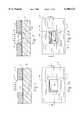
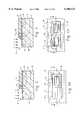
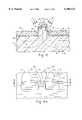
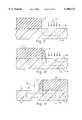
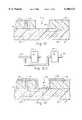
- FIGS. 1 through 8are longitudinal sectional views somewhat diagrammatic depicting the steps in forming a pillar CMOS structure according to one embodiment of the present invention:
- FIGS. 1A through 5Aare corresponding top-plan views somewhat diagrammatic of the structures shown in FIGS. 1 through 5 respectively;
- FIGS. 7A and 8Aare corresponding top-plan views somewhat diagrammatic of the structures shown in FIGS. 7 and 8 respectively;
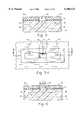
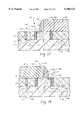
- FIGS. 9 through 18are longitudinal sectional views somewhat diagrammatic of the steps in forming a pillar CMOS structure according to another embodiment of the present invention.
- FIG. 12Ais a top-plan view somewhat diagrammatic showing the etched wiring channels and openings for the polysilicon wiring and gates;
- FIG. 16Ais a top-plan x-ray view of a device of FIG. 16 with a cut mask shown for etching the polysilicon gates;
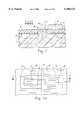
- FIG. 19is a top plan view somewhat schematic showing the wiring of two devices formed on a pillar as an inverter
- FIG. 19Ais a schematic representation of the circuitry formed by the connection in FIG. 19;
- FIG. 20is a top plan view somewhat schematic of two pillar constituting four devices where there is a two input NAND gate
- FIG. 20Ais a schematic circuit representation of the circuit formed by the wiring in FIG. 20.
- FIGS. 1 through 8, 1A through 5A, and 7A and 8Avarious successive steps in the production of a pillar CMOS structure according to one embodiment of the present invention is shown.
- a single crystal silicon substrate 10is provided which has formed thereon a layer of sacrificial silicon dioxide 12.
- the silicon dioxide layer 12is about 50 to 100 ⁇ thick.
- a mask material 14which preferably is an insulating material and in the preferred embodiment is silicon nitride, is deposited on top of the oxide layer 12 which mask 14 has an opening 16 formed therein.
- the opening 16can be formed by conventional photolithographic techniques wherein a photoresist material is applied over the mask, exposed, developed and the mask etched down to the oxide layer 12. The opening 16 is then used to implant P-type ions into the substrate 10 to form a P well 18. Typical P-type ions are boron, boron fluoride and indium with boron being the most common. This structure is shown in FIGS. 1 and 1A. (It is to be understood that many pillars are typically formed in the manufacture of the circuitry, with only one being shown for illustration.)
- N-type ionsare phosphorous and arsenic.
- FIGS. 2 and 2Aa single silicon crystal substrate 10 is provided which has a P well 18 and N + diffusion 28 therein.
- a layer of polysilicon 32is deposited over the entire surface including the silicon nitride layer 14 and the exposed sacrificial oxide 12 on top of the N + diffusion.
- the polysilicon layer 32is then chemically/mechanically (CHEM/MEC) polished until the surface is planar and then by conventional photolithographic methods a portion of the nitride layer 14 is exposed and reactive ion etched down to the oxide layer 12 as shown in FIGS. 3 and 3a.
- N-type ionsare implanted into the substrate 10 adjacent to the P well 18 to form an N well 34 as shown in FIG. 3.
- An additional sidewall oxide spacer 36is then deposited as shown adjacent the oxide spacer 26 to form an opening 37 and P ions are implanted in the N well 34 to form a P + diffusion 38 as shown in FIG. 4.
- P ionsare implanted in the N well 34 to form a P + diffusion 38 as shown in FIG. 4.
- the remaining polysilicon 32is stripped and silicon nitride 42 is deposited as a mask material around the oxide 26 and 36.
- a column or pillar 44 of epitaxial siliconis grown in the opening on the exposed surface of the silicon substrate 10 where the oxides have been removed as shown in FIG. 6.
- the epitaxial siliconpreferably is grown selectively at low temperatures, i.e. preferably below about 800° centigrade in an atmosphere such as di-chlor silane (DCS) plus H 2 plus HCl so as prevent nucleation on the sidewall sites and thus assure that single crystal epitaxial silicon will grow.
- DCSdi-chlor silane
- H 2plus HCl
- a layer of photoresist 46is applied over the exposed surface of the silicon nitride 42 and the epitaxial silicon 44 shown in FIG. 6 and is patterned by conventional photolithographic techniques to form an opening 48 therein, which opening is generally aligned with the portion of the pillar 44 on top of the N well 34 and the portion of silicon nitride 42 overlying the P + diffusion as shown in FIGS. 7 and 7a. This is then implanted with N-type ions to form a continuation of the N well as shown in FIGS. 7 and 7a.
- the implant of the N-type ionswill counter dope the previous P doping and will thus form a pillar having an N well doped 50 on the left-hand side corresponding to and merging with the N well 34 and P well doped 52 on the right-hand side corresponding to and merging with the P-doped well 18, all as shown in FIGS. 7 and 7a.
- the photoresist 46is stripped and an oxide cap 60 is grown on top of the pillar 44 and then the nitride mask 42 is stripped. Thereafter sidewall gate dielectrics such as silicon dioxide or silicon-oxynitride 62 and 63 are formed on opposite sides of the pillar 44. Thereafter a layer of polysilicon is deposited over the entire structure. The polysilicon layer is planarized and polished to the top of cap oxide 60 to form separate layers 64 and 66.
- Polysilicon layers 64 and 66are then reactive ion etched selective to oxide to the configuration shown in FIGS. 8 and 8a. Any remaining exposed thin gate oxide on the sides of the pillar 44 is removed. This will expose a portion of the top of the pillar 44 to angle implant P + ions to form a P + diffusion 68 in the N well on the left-hand side and to angle implant N-type ions to form an N + diffusion 69 in the P well on the right-hand side of the pillar 44 (as shown in FIGS. 8 and 8a).
- a sacrificial oxidemay be grown on the exposed silicon surfaces prior to the implanting of the diffusion is desired. As is well known in the art, photoresist is used to mask areas that are not to be implanted (i.e. right-hand side when left-hand side is implanted and vice-versa). Also the P + ions will dope the polysilicon 64 and the N ions will dope the polysilicon 66.
- the polysilicon 64acts as a gate electrode over the gate oxide 63 for a PFET, the source and drain being the P + diffusions, and the polysilicon 66 acts as a gate electrode over gate oxide 62 to form an NFET with the N + diffusions acting as the source and drain for the NFET.
- the FET'sare located on a pillar in a vertical direction and thus longer channels can be achieved if desired, without utilizing any additional space on the surface of silicon wafer 10; and more devices can be formed in a given area on the wafer 10.
- FIGS. 9 through 17the steps of forming a pillar CMOS structure according to another embodiment of the present invention are shown.
- a single crystal silicon substrate 90is provided on top of which is deposited a P well mask layer 92.
- the mask 92can be a photoresist or other organic material, or silicon dioxide or silicon nitride.
- An opening 94is formed in the mask material 92 and P-type ions are implanted to form a P well 96 in the substrate 90 as shown in FIG. 9.
- a sidewall spacer 98is formed adjacent the P well 92 following which N + diffusion zone 100 is formed in the P well by implanting N-type ions to form the structure as shown in FIG. 10.
- spacer material 98preferably should be organic such as photoresist, paralyne or polyimide.
- N well mask 106is provided over the N + diffusion in the P well with opening 108 overlying the substrate 90 adjacent the P well 96.
- the maskis either a photoresist or other organic material or a silicon dioxide or silicon nitride material.
- N-type ionsare implanted into the silicon substrate 90 adjacent the P well ions to form an N well 110.
- Side wall spacer 112is then formed adjacent the N well mask 106 and P-type ions are implanted into the N well to form a P + diffusion 114 as shown in FIG. 11.
- the N well mask material 106 and sidewall spacer 112are then stripped and a pillar "hard" mask 120 is deposited on the stripped surface.
- the pillar maskpreferably is silicon dioxide or silicon nitride to withstand subsequent hot processing steps, and an opening 122 is formed therein which overlies the portion of the P + diffusion in the N well, and the N + diffusion in the P well. This is formed by conventional photolithographic techniques wherein opened portion 122 of mask material 120 is etched down to the exposed substrate as shown in FIG. 12.
- openings or channels (one of which is shown) 124 for the channel wiringare also etched in the mask material 120 down to the substrate surface using the same photolithographic techniques and in the same operation as when the opening 122 is formed. This is shown somewhat diagrammatically in FIGS. 12 and 12A. (These channels could also be formed over an isolation region such as shallow trench insulation (STI), LOCOS (local oxidation of silicon) or other insulating material to reduce coupling to the substrate.)
- STIshallow trench insulation
- LOCOSlocal oxidation of silicon
- a conformal layer of gate mandrel material 128is deposited over the surface of the structure shown in FIG. 12, which completely fills the channel 124 and which conforms to the opening 122 as shown in FIG. 13.
- the material 128is selected so as to etch selectively to both the mask material 120 and epitaxial silicon as will be explained presently.
- the mask 120is formed of silicon dioxide which is preferable
- the mandrel material 128is a silicon nitride.
- Reactive Ion Etching (RIE)is used to form spacers 129 from the mandrel material 128 on the edges of the mask 120 in the opening 122.
- a pillar or column 130 of epitaxial siliconis grown from the surface of the crystal 90.
- the top of the pillar 130is preferably planarized by CHEM/MEC polishing. (Due to the much higher aspect ratio of the channels 124, the mandrel material 128 in the channels 124 blocks the bottom of the channel opening, thus preventing subsequent epitaxial silicon growth in the gate channel wiring opening 124.)
- the pillar 130is separated from the mask 120 by the spacers 129, as is shown in FIG. 14.
- gate dielectric 132such as silicon dioxide is formed on the sides of the pillar 132
- gate dielectric 134is formed on the surface of the silicon crystal 90
- cap dielectric 136is formed on top of the pillar 130.
- dielectric material 137is formed on the substrate 10 in the channels 134. This is shown in FIG. 15.
- gate polysilicon 140is deposited in the space 131 between the gate dielectric 132 and the pillar mask 120 as shown in FIG. 16.
- Gate polysilicon 141is also deposited in the gate wiring channels 124 on material 137 also as shown is FIG. 16.
- FIG. 16Adepicts photolithographic techniques used to remove the ends of the polysilicon 140 so as to have separate gate electrodes on opposite sides of the pillar 132. This is done by photolithographic techniques using photoresist and a cut-mask 142 as shown diagrammatically in 16A and is known in the art. Removal of gate conductor from the sides of the pillar prevents parasitic conduction from source/drain diffusions to adjacent wells.
- FIGS. 17 and 18The implanting of the pillar 130 to form wells and diffusions is shown, diagrammatically in FIGS. 17 and 18.
- an N well mask 150is provided having an opening 152 through which an N well 154 is formed in the left side of the pillar 130.
- a spacer 156is formed and a P + diffusion 158 is provided in the N well 154.
- the mask 150 and spacer 156is then stripped and the same procedure is repeated on the opposite side using mask 164 having opening 166 and side wall spacer 168 to form a P well 170 on the right-hand side of the column 130 with an N + diffusion 172 in this P well.
- FET devicesare provided on the column which include a PFET with P + region 14 on the substrate 10 and the P + region 158 in the pillar 130 acting as a source and drain and the polysilicon 140 as the gate and an NFET is provided on the opposite side of the pillar with the N + region 100 on the substrate 90 and the N + region 172 in the pillar 130 acting as source and drain and polysilicon 140 acting as a gate.
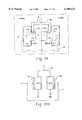
- FIG. 19is a somewhat schematic top plan view representation of the wiring of the two devices formed on a single pillar in the substrate for use as an inverter.
- the gate wiring 141connects the gates 140 on both the PFET and the NFET. This constitutes one level of wiring.
- a second level of wiring designated as 180connects the P + and W diffusions at contacts 182 and 183 respectively of the opposite sides of the pillar and it is tied together to be the output A from the inverter.
- the input Ais to the gate wiring 141 as indicated in FIG. 19.
- Voltage and groundare applied as shown schematically at VH and GND respectively.
- the circuit representation of the connection shown in FIG. 19is shown in FIG. 19A.
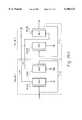
- FIG. 20is a top plan view somewhat schematic showing two pillars on the substrate constituting four devices wired as a NAND gate.
- the pillarsare designated arbitrarily pillar 1 and pillar 2 and the devices are designated arbitrarily device 1, device 2, device 3, and device 4. (These designations correspond to the diagram shown in FIG. 20A.)
- the gate wiring 141ties gates 140 on opposite sides of both pillar 1 and pillar 2; i.e. the gates 140 of device 1 and device 3 are connected and the gates 140 of device 2 and device 4 are connected.
- the input to devices 1 and 3is gate input A and the input to devices 2 and 4 is gate input B.
- wiring 184connects through contact 186 to P + diffusion 158 in device 3 and P + diffusion 158 through contact 188 in device 4 and to N + diffusion 172 in device 2 by contact 190.
- line 184constitutes the output AB.
- additional wiring 192which is connected by via 194 to the N + diffusion 172 in device 1 and by via 196 to N + diffusion 100 in device 2.
- the P + diffusions 114 in the substrates in devices 3 and 4are connected to voltage (VH) and the N + diffusions 100 in the substrate in devices 1 and 2 are connected to ground (GND). This connection is shown schematically in FIG. 20A.
- connections of the PFET and NFET as shown in FIGS. 19 and 19A to form an inverterare well known as well as are the connections of the PFET's and NFET's as shown in FIGS. 20 and 20A to form a NAND gate. It is also to be understood that other gates and the like can also be wired with the above two described being merely illustrative and not intended to be limiting.
Landscapes
- Metal-Oxide And Bipolar Metal-Oxide Semiconductor Integrated Circuits (AREA)
Abstract
Description
1. Field of the Invention
This invention relates generally to the formation of integrated structures and circuits on semi-conductor substrates and more particularly to the formation of FET structures and circuits. In even more particular aspects, this invention relates to formation of CMOS FET structures and circuits on semi-conductor substrates and especially to pillar CMOS technology which utilizes both vertical and horizontal surfaces on which to form FET devices.
2. Background Information
One technique of increasing integrated circuit density on a given size semi-conductor substrate is by using vertical surfaces on which to form at least a portion of devices such as FET's. One form this takes is so-called pillar technology in which epitaxial silicon crystals or "pillars" are grown on a single silicon crystal substrate and the sidewalls of the grown epitaxial silicon "pillars", are used to form at least part of some of the devices, thus allowing increased integrated circuit density, i.e. more devices per horizontal surface of the substrate, without necessity of reducing the layout ground rule size. This permits the use of coarser lithography as well permitting greater channel length control, both of which are desirable results in integrated circuit technology.
The present invention provides an improved technique and resulting devices in pillar CMOS technology.
According to the present invention a method of forming a pillar CMOS FET device, especially an inverter, and the device so formed is provided. The method includes the steps of forming abutting N wells and P wells in a silicon substrate and then forming N+ and P+ diffusions in the P and N wells respectively. A unitary pillar of the epitaxial silicon is grown on the substrate which pillar has a base at the substrate which base overlays both the N and P wells and preferably extends at least from said N+ diffusion to said P+ diffusion in said substrate. The pillar terminates at a distal end. An N well is formed on the side of the pillar overlying the N well in the substrate and a P well is formed on the side of the distal end of the pillar overlying the P well on the substrate and abuts the N well in the pillar. A P+ diffusion is formed in the N well in the pillar adjacent the distal end and a N+ diffusion is formed in the P well in the pillar adjacent the distal end. A gate insulator preferably silicon dioxide is formed over both sides of the pillar and gate electrodes are formed over the gate insulators.
In one embodiment the mask material is formed on the substrate with an opening which extends down to the substrate and mandrel or spacer material is deposited in the opening around the walls of the mask. The epitaxial silicon is grown within the opening defining the spacer material. The spacer or mandrel material is then removed and gate insulators are grown on opposite sides of the pillar followed by forming gates on opposite sides of the pillar preferably of polysilicon. In this embodiment, wiring channels can be formed at the same time as the opening in the mask material is formed and the mandrel material deposited in the channels which mandrel material is removed at the same time the mandrel is removed after the growing of the epitaxial silicon. The insulator is grown on the substrate and wiring preferably polysilicon is deposited in the channels preferably at the same time that the gate material is deposited.
In another embodiment a self-aligning process of forming the pillar where the N and P wells is provided so as to precisely align the pillar on the substrate.
FIGS. 1 through 8 are longitudinal sectional views somewhat diagrammatic depicting the steps in forming a pillar CMOS structure according to one embodiment of the present invention:
FIGS. 1A through 5A are corresponding top-plan views somewhat diagrammatic of the structures shown in FIGS. 1 through 5 respectively;
FIGS. 7A and 8A are corresponding top-plan views somewhat diagrammatic of the structures shown in FIGS. 7 and 8 respectively;
FIGS. 9 through 18 are longitudinal sectional views somewhat diagrammatic of the steps in forming a pillar CMOS structure according to another embodiment of the present invention;
FIG. 12A is a top-plan view somewhat diagrammatic showing the etched wiring channels and openings for the polysilicon wiring and gates;
FIG. 16A is a top-plan x-ray view of a device of FIG. 16 with a cut mask shown for etching the polysilicon gates; and
FIG. 19 is a top plan view somewhat schematic showing the wiring of two devices formed on a pillar as an inverter;
FIG. 19A is a schematic representation of the circuitry formed by the connection in FIG. 19;
FIG. 20 is a top plan view somewhat schematic of two pillar constituting four devices where there is a two input NAND gate; and
FIG. 20A is a schematic circuit representation of the circuit formed by the wiring in FIG. 20.
Referring now to the drawings and for the present FIGS. 1 through 8, 1A through 5A, and 7A and 8A, various successive steps in the production of a pillar CMOS structure according to one embodiment of the present invention is shown. As shown in FIGS. 1 and 1A, a singlecrystal silicon substrate 10 is provided which has formed thereon a layer ofsacrificial silicon dioxide 12. Typically thesilicon dioxide layer 12 is about 50 to 100 Å thick. Amask material 14 which preferably is an insulating material and in the preferred embodiment is silicon nitride, is deposited on top of theoxide layer 12 whichmask 14 has anopening 16 formed therein. Theopening 16 can be formed by conventional photolithographic techniques wherein a photoresist material is applied over the mask, exposed, developed and the mask etched down to theoxide layer 12. The opening 16 is then used to implant P-type ions into thesubstrate 10 to form aP well 18. Typical P-type ions are boron, boron fluoride and indium with boron being the most common. This structure is shown in FIGS. 1 and 1A. (It is to be understood that many pillars are typically formed in the manufacture of the circuitry, with only one being shown for illustration.)
Following the implanting of the P ions to form theP well 18,sidewall oxide spacer 26 is formed around theopening 16 to thereby form asmaller opening 27 into which N-type ions are implanted to form an N+ diffusion zone 28. Typical N-type ions are phosphorous and arsenic. Thus as shown in FIGS. 2 and 2A a singlesilicon crystal substrate 10 is provided which has aP well 18 and N+ diffusion 28 therein.
Following the steps shown in FIGS. 2 and 2A a layer ofpolysilicon 32 is deposited over the entire surface including thesilicon nitride layer 14 and the exposedsacrificial oxide 12 on top of the N+ diffusion. Thepolysilicon layer 32 is then chemically/mechanically (CHEM/MEC) polished until the surface is planar and then by conventional photolithographic methods a portion of thenitride layer 14 is exposed and reactive ion etched down to theoxide layer 12 as shown in FIGS. 3 and 3a. Following this, N-type ions are implanted into thesubstrate 10 adjacent to the P well 18 to form an N well 34 as shown in FIG. 3.
An additionalsidewall oxide spacer 36 is then deposited as shown adjacent theoxide spacer 26 to form anopening 37 and P ions are implanted in the N well 34 to form a P+ diffusion 38 as shown in FIG. 4. Thus, at this point there are adjacent P and N wells with the P well having an N+ diffusion therein and the N well having a P+ diffusion therein.
Following the formation of the P+ diffusion shown in FIGS. 4 and 4a, theremaining polysilicon 32 is stripped andsilicon nitride 42 is deposited as a mask material around theoxide oxides window 39, defined by a mark, as well as theoxide 12 underlying theoxide sacrificial oxide 12 in the opening as well as theoxides
Following the removal of the oxides a column orpillar 44 of epitaxial silicon is grown in the opening on the exposed surface of thesilicon substrate 10 where the oxides have been removed as shown in FIG. 6. The epitaxial silicon preferably is grown selectively at low temperatures, i.e. preferably below about 800° centigrade in an atmosphere such as di-chlor silane (DCS) plus H2 plus HCl so as prevent nucleation on the sidewall sites and thus assure that single crystal epitaxial silicon will grow. However, technology advances have made it possible to use higher temperature and different ambients, in some instances. The structure is then polished by CHEM/MEC polishing and the epitaxial silicon is implanted with P-type ions to form a P well in thepillar 44 as shown in FIG. 6.
Following this, a layer ofphotoresist 46 is applied over the exposed surface of thesilicon nitride 42 and theepitaxial silicon 44 shown in FIG. 6 and is patterned by conventional photolithographic techniques to form anopening 48 therein, which opening is generally aligned with the portion of thepillar 44 on top of the N well 34 and the portion ofsilicon nitride 42 overlying the P+ diffusion as shown in FIGS. 7 and 7a. This is then implanted with N-type ions to form a continuation of the N well as shown in FIGS. 7 and 7a. It will be appreciated that the implant of the N-type ions will counter dope the previous P doping and will thus form a pillar having an N well doped 50 on the left-hand side corresponding to and merging with the N well 34 and P well doped 52 on the right-hand side corresponding to and merging with the P-doped well 18, all as shown in FIGS. 7 and 7a.
Following of the forming of the structure shown in FIGS. 7 and 7a thephotoresist 46 is stripped and anoxide cap 60 is grown on top of thepillar 44 and then thenitride mask 42 is stripped. Thereafter sidewall gate dielectrics such as silicon dioxide or silicon-oxynitride pillar 44. Thereafter a layer of polysilicon is deposited over the entire structure. The polysilicon layer is planarized and polished to the top ofcap oxide 60 to formseparate layers
Polysilicon layers 64 and 66 are then reactive ion etched selective to oxide to the configuration shown in FIGS. 8 and 8a. Any remaining exposed thin gate oxide on the sides of thepillar 44 is removed. This will expose a portion of the top of thepillar 44 to angle implant P+ ions to form a P+ diffusion 68 in the N well on the left-hand side and to angle implant N-type ions to form an N+ diffusion 69 in the P well on the right-hand side of the pillar 44 (as shown in FIGS. 8 and 8a). A sacrificial oxide may be grown on the exposed silicon surfaces prior to the implanting of the diffusion is desired. As is well known in the art, photoresist is used to mask areas that are not to be implanted (i.e. right-hand side when left-hand side is implanted and vice-versa). Also the P+ ions will dope thepolysilicon 64 and the N ions will dope thepolysilicon 66.
Thepolysilicon 64 acts as a gate electrode over thegate oxide 63 for a PFET, the source and drain being the P+ diffusions, and thepolysilicon 66 acts as a gate electrode overgate oxide 62 to form an NFET with the N+ diffusions acting as the source and drain for the NFET. Thus as can be seen, the FET's are located on a pillar in a vertical direction and thus longer channels can be achieved if desired, without utilizing any additional space on the surface ofsilicon wafer 10; and more devices can be formed in a given area on thewafer 10.
Referring now to FIGS. 9 through 17, the steps of forming a pillar CMOS structure according to another embodiment of the present invention are shown. As shown in FIG. 9 a singlecrystal silicon substrate 90 is provided on top of which is deposited a Pwell mask layer 92. Themask 92 can be a photoresist or other organic material, or silicon dioxide or silicon nitride. Anopening 94 is formed in themask material 92 and P-type ions are implanted to form a P well 96 in thesubstrate 90 as shown in FIG. 9. Asidewall spacer 98 is formed adjacent the P well 92 following which N+ diffusion zone 100 is formed in the P well by implanting N-type ions to form the structure as shown in FIG. 10. Ifmask layer 92 is photoresist or other organic material,spacer material 98 preferably should be organic such as photoresist, paralyne or polyimide.
Themask 92 and thesidewall 98 are then stripped and an N well mask 106 is provided over the N+ diffusion in the P well withopening 108 overlying thesubstrate 90 adjacent the P well 96. Again, the mask is either a photoresist or other organic material or a silicon dioxide or silicon nitride material. N-type ions are implanted into thesilicon substrate 90 adjacent the P well ions to form an N well 110.Side wall spacer 112 is then formed adjacent the N well mask 106 and P-type ions are implanted into the N well to form a P+ diffusion 114 as shown in FIG. 11. The N wellmask material 106 andsidewall spacer 112 are then stripped and a pillar "hard"mask 120 is deposited on the stripped surface. The pillar mask preferably is silicon dioxide or silicon nitride to withstand subsequent hot processing steps, and anopening 122 is formed therein which overlies the portion of the P+ diffusion in the N well, and the N+ diffusion in the P well. This is formed by conventional photolithographic techniques wherein openedportion 122 ofmask material 120 is etched down to the exposed substrate as shown in FIG. 12.
At the same time that theopening 122 is formed in themask 120, openings or channels (one of which is shown) 124 for the channel wiring are also etched in themask material 120 down to the substrate surface using the same photolithographic techniques and in the same operation as when theopening 122 is formed. This is shown somewhat diagrammatically in FIGS. 12 and 12A. (These channels could also be formed over an isolation region such as shallow trench insulation (STI), LOCOS (local oxidation of silicon) or other insulating material to reduce coupling to the substrate.)
Following the forming of theopening 122 and thechannels 124 for the wiring, a conformal layer ofgate mandrel material 128 is deposited over the surface of the structure shown in FIG. 12, which completely fills thechannel 124 and which conforms to theopening 122 as shown in FIG. 13. Thematerial 128 is selected so as to etch selectively to both themask material 120 and epitaxial silicon as will be explained presently. Thus if, for example, themask 120 is formed of silicon dioxide which is preferable, themandrel material 128 is a silicon nitride. Reactive Ion Etching (RIE) is used to formspacers 129 from themandrel material 128 on the edges of themask 120 in theopening 122. Thereafter a pillar orcolumn 130 of epitaxial silicon is grown from the surface of thecrystal 90. The top of thepillar 130 is preferably planarized by CHEM/MEC polishing. (Due to the much higher aspect ratio of thechannels 124, themandrel material 128 in thechannels 124 blocks the bottom of the channel opening, thus preventing subsequent epitaxial silicon growth in the gatechannel wiring opening 124.) Thepillar 130 is separated from themask 120 by thespacers 129, as is shown in FIG. 14.
Following the growing of thecolumn 130 thespacers 129 are removed by etching leaving aspace 131 between thepillar 130 and themask 120. This also removes remainingmandrel material 128 in the channels, and this opens thewiring channels 124 to the substrate. Thereafter gate dielectric 132 such as silicon dioxide is formed on the sides of thepillar 132,gate dielectric 134 is formed on the surface of thesilicon crystal 90, andcap dielectric 136 is formed on top of thepillar 130. Also,dielectric material 137 is formed on thesubstrate 10 in thechannels 134. This is shown in FIG. 15. Following this,gate polysilicon 140 is deposited in thespace 131 between thegate dielectric 132 and thepillar mask 120 as shown in FIG. 16.Gate polysilicon 141 is also deposited in thegate wiring channels 124 onmaterial 137 also as shown is FIG. 16.
FIG. 16A depicts photolithographic techniques used to remove the ends of thepolysilicon 140 so as to have separate gate electrodes on opposite sides of thepillar 132. This is done by photolithographic techniques using photoresist and a cut-mask 142 as shown diagrammatically in 16A and is known in the art. Removal of gate conductor from the sides of the pillar prevents parasitic conduction from source/drain diffusions to adjacent wells.
Following this, thecap oxide 136 is removed. The implanting of thepillar 130 to form wells and diffusions is shown, diagrammatically in FIGS. 17 and 18. As shown in FIG. 17 anN well mask 150 is provided having anopening 152 through which an N well 154 is formed in the left side of thepillar 130. Aspacer 156 is formed and a P+ diffusion 158 is provided in the N well 154. Themask 150 andspacer 156 is then stripped and the same procedure is repeated on the oppositeside using mask 164 havingopening 166 andside wall spacer 168 to form a P well 170 on the right-hand side of thecolumn 130 with an N+ diffusion 172 in this P well. Themask 164 andsidewall material 168 is removed and thus FET devices are provided on the column which include a PFET with P+ region 14 on thesubstrate 10 and the P+ region 158 in thepillar 130 acting as a source and drain and thepolysilicon 140 as the gate and an NFET is provided on the opposite side of the pillar with the N+ region 100 on thesubstrate 90 and the N+ region 172 in thepillar 130 acting as source and drain andpolysilicon 140 acting as a gate.
FIG. 19 is a somewhat schematic top plan view representation of the wiring of the two devices formed on a single pillar in the substrate for use as an inverter. As can be seen thegate wiring 141 connects thegates 140 on both the PFET and the NFET. This constitutes one level of wiring. A second level of wiring designated as 180 connects the P+ and W diffusions atcontacts gate wiring 141 as indicated in FIG. 19. Voltage and ground are applied as shown schematically at VH and GND respectively. The circuit representation of the connection shown in FIG. 19 is shown in FIG. 19A.
FIG. 20 is a top plan view somewhat schematic showing two pillars on the substrate constituting four devices wired as a NAND gate. The pillars are designated arbitrarilypillar 1 andpillar 2 and the devices are designated arbitrarilydevice 1,device 2,device 3, anddevice 4. (These designations correspond to the diagram shown in FIG. 20A.) As seen in FIG. 20, thegate wiring 141ties gates 140 on opposite sides of bothpillar 1 andpillar 2; i.e. thegates 140 ofdevice 1 anddevice 3 are connected and thegates 140 ofdevice 2 anddevice 4 are connected. The input todevices devices wiring 184 connects throughcontact 186 to P+ diffusion 158 indevice 3 and P+ diffusion 158 throughcontact 188 indevice 4 and to N+ diffusion 172 indevice 2 bycontact 190. Typicallyline 184 constitutes the output AB. At the next level above the level of the wiring on 184,additional wiring 192 which is connected by via 194 to the N+ diffusion 172 indevice 1 and by via 196 to N+ diffusion 100 indevice 2. The P+ diffusions 114 in the substrates indevices devices
Claims (13)
1. A method of forming a pillar CMOS FET device comprising the steps of:
forming abutting N and P wells in a silicon substrate;
forming N+ and P+ diffusions in said P well and N well in said substrate, respectively;
growing a single undivided unitary pillar of epitaxial silicon on said substrate, which pillar has a base end at said substrate and which pillar has opposite sides, one of which sides overlaps said N well and the other one of which sides overlays said P well;
said pillar terminating at a distal end;
forming an N well on the side of the pillar overlying the N well in the substrate and a P well on the side of the pillar overlying the P well on the substrate and abutting the N well in the pillar;
forming a P+ diffusion in the N well in the pillar adjacent the distal end and an N+ diffusion in the P well in the pillar adjacent the distal end;
maintaining said pillar as a single undivided unitary structure;
forming gate insulators over said opposite sides of said pillar, and
forming gate electrodes over said gate insulators.
2. The invention as defined in claim 1 wherein said gate electrodes and said gate insulators are formed by providing a mask material on said substrate;
forming an opening in said mask material extending from said substrate at a location where said pillar is to be grown;
providing a spacer material on said mask material around said opening therein;
growing said pillar inside said opening;
removing said spacer material after said pillar has been grown, and thereafter forming said gate insulators and said gate electrodes.
3. The invention as defined in claim 2 wherein following removal of said spacer material, said gate insulation are formed on the opposite sides of said pillar and on the substrate which is exposed, and thereafter a gate material is deposited between the mask material and said gate insulators.
4. The invention as defined in claim 3 further characterized by providing wiring connecting said pillar CMOS FET device as an inverter.
5. The invention as defined in claim 4 further characterized by forming wiring channels in said mask material and exposing said substrate in said wiring channels;
providing insulating material on said exposed substrate in said wiring channels; and
providing said wiring in said wiring channels on said insulating material.
6. The invention as defined in claim 5 further characterized by forming said wiring channels and said opening in the mask material during the same operation.
7. The invention as defined in claim 1 wherein said N and P wells in said substrate are formed by a self-aligning process.
8. The invention as defined in claim 1 wherein an insulating material is applied to the substrate;
mask material is applied over said insulating material;
an opening is formed in the mask material and the insulating material to expose a surface on said substrate; and
growing said pillar on said surface of said substrate.
9. The invention is defined in claim 8 wherein said mask material is stripped following the growing of said pillar, and
gate insulators are formed on said pillar.
10. The invention as defined in claim 1 wherein the P+ diffusion and N+ diffusion in said substrate extend to at least to its respective side of said pillar at its base.
11. The invention as defined in claim 1 wherein said method includes depositing mask material to define an edge of one of said wells in said substrate, and depositing first spacer material to define an edge of a first diffusion in said one well and a portion of the substrate on which said pillar is grown.
12. The invention as defined in claims 11 wherein said method includes depositing a second spacer material adjacent said first spacer material to define an edge of a second diffusion in a second well and a second portion of the substrate on which said pillar is grown.
13. The invention as defined in claim 7 wherein said self-aligning process includes providing first and second mask material covering a portion of respective opposite sides of said pillar at said base end thereof, and
wherein said N+ diffusion and P+ diffusion in said distal end of said pillar are made by angle implanting of the respective ions.
Priority Applications (3)
| Application Number | Priority Date | Filing Date | Title |
|---|---|---|---|
| US09/009,456US6100123A (en) | 1998-01-20 | 1998-01-20 | Pillar CMOS structure |
| US09/561,670US6344381B1 (en) | 1998-01-20 | 2000-05-01 | Method for forming pillar CMOS |
| US09/561,676US6255699B1 (en) | 1998-01-20 | 2000-05-01 | Pillar CMOS structure |
Applications Claiming Priority (1)
| Application Number | Priority Date | Filing Date | Title |
|---|---|---|---|
| US09/009,456US6100123A (en) | 1998-01-20 | 1998-01-20 | Pillar CMOS structure |
Related Child Applications (2)
| Application Number | Title | Priority Date | Filing Date |
|---|---|---|---|
| US09/561,670DivisionUS6344381B1 (en) | 1998-01-20 | 2000-05-01 | Method for forming pillar CMOS |
| US09/561,676DivisionUS6255699B1 (en) | 1998-01-20 | 2000-05-01 | Pillar CMOS structure |
Publications (1)
| Publication Number | Publication Date |
|---|---|
| US6100123Atrue US6100123A (en) | 2000-08-08 |
Family
ID=21737766
Family Applications (3)
| Application Number | Title | Priority Date | Filing Date |
|---|---|---|---|
| US09/009,456Expired - Fee RelatedUS6100123A (en) | 1998-01-20 | 1998-01-20 | Pillar CMOS structure |
| US09/561,676Expired - Fee RelatedUS6255699B1 (en) | 1998-01-20 | 2000-05-01 | Pillar CMOS structure |
| US09/561,670Expired - Fee RelatedUS6344381B1 (en) | 1998-01-20 | 2000-05-01 | Method for forming pillar CMOS |
Family Applications After (2)
| Application Number | Title | Priority Date | Filing Date |
|---|---|---|---|
| US09/561,676Expired - Fee RelatedUS6255699B1 (en) | 1998-01-20 | 2000-05-01 | Pillar CMOS structure |
| US09/561,670Expired - Fee RelatedUS6344381B1 (en) | 1998-01-20 | 2000-05-01 | Method for forming pillar CMOS |
Country Status (1)
| Country | Link |
|---|---|
| US (3) | US6100123A (en) |
Cited By (18)
| Publication number | Priority date | Publication date | Assignee | Title |
|---|---|---|---|---|
| US6204532B1 (en)* | 1998-01-28 | 2001-03-20 | International Business Machines Corporation | Pillar transistor incorporating a body contact |
| US6242775B1 (en)* | 1998-02-24 | 2001-06-05 | Micron Technology, Inc. | Circuits and methods using vertical complementary transistors |
| US6304483B1 (en) | 1998-02-24 | 2001-10-16 | Micron Technology, Inc. | Circuits and methods for a static random access memory using vertical transistors |
| US6465298B2 (en) | 1997-07-08 | 2002-10-15 | Micron Technology, Inc. | Method of fabricating a semiconductor-on-insulator memory cell with buried word and body lines |
| US6486703B2 (en) | 1998-08-04 | 2002-11-26 | Micron Technology, Inc. | Programmable logic array with vertical transistors |
| US6498065B1 (en) | 1998-08-04 | 2002-12-24 | Micron Technology, Inc. | Memory address decode array with vertical transistors |
| US6556068B2 (en) | 1998-02-26 | 2003-04-29 | Micron Technology, Inc. | Threshold voltage compensation circuits for low voltage and low power CMOS integrated circuits |
| US6580137B2 (en) | 2000-08-29 | 2003-06-17 | Boise State University | Damascene double gated transistors and related manufacturing methods |
| US20030142564A1 (en)* | 1997-10-06 | 2003-07-31 | Micron Technology, Inc. | Circuit and method for an open bit line memory cell with a vertical transistor and trench plate trench capacitor |
| US20040052139A1 (en)* | 2002-06-21 | 2004-03-18 | Brown Kris K. | Memory cell and method for forming the same |
| US6812516B2 (en) | 1998-02-27 | 2004-11-02 | Micron Technology, Inc. | Field programmable logic arrays with vertical transistors |
| US20050063233A1 (en)* | 2002-06-21 | 2005-03-24 | Brown Kris K. | Memory cell and method for forming the same |
| US7049196B2 (en) | 1998-02-24 | 2006-05-23 | Micron Technology, Inc. | Vertical gain cell and array for a dynamic random access memory and method for forming the same |
| US7057223B2 (en) | 1997-10-06 | 2006-06-06 | Micron Technology, Inc | Circuit and method for a folded bit line memory cell with vertical transistor and trench capacitor |
| US20060249776A1 (en)* | 2005-05-05 | 2006-11-09 | Manning H M | Memory cell, device, system and method for forming same |
| US7408216B2 (en) | 1998-01-22 | 2008-08-05 | Micron Technology, Inc. | Device, system, and method for a trench capacitor having micro-roughened semiconductor surfaces |
| US8866214B2 (en) | 2011-10-12 | 2014-10-21 | International Business Machines Corporation | Vertical transistor having an asymmetric gate |
| US10832916B1 (en) | 2019-07-15 | 2020-11-10 | International Business Machines Corporation | Self-aligned gate isolation with asymmetric cut placement |
Families Citing this family (6)
| Publication number | Priority date | Publication date | Assignee | Title |
|---|---|---|---|---|
| US6960510B2 (en)* | 2002-07-01 | 2005-11-01 | International Business Machines Corporation | Method of making sub-lithographic features |
| US6821834B2 (en)* | 2002-12-04 | 2004-11-23 | Yoshiyuki Ando | Ion implantation methods and transistor cell layout for fin type transistors |
| US7074656B2 (en)* | 2003-04-29 | 2006-07-11 | Taiwan Semiconductor Manufacturing Company, Ltd. | Doping of semiconductor fin devices |
| US7084500B2 (en)* | 2003-10-29 | 2006-08-01 | Texas Instruments Incorporated | Semiconductor circuit with multiple contact sizes |
| US7863112B2 (en)* | 2008-01-08 | 2011-01-04 | International Business Machines Corporation | Method and structure to protect FETs from plasma damage during FEOL processing |
| KR100946084B1 (en)* | 2008-03-27 | 2010-03-10 | 주식회사 하이닉스반도체 | Vertical transistors in semiconductor devices and methods of forming them |
Citations (9)
| Publication number | Priority date | Publication date | Assignee | Title |
|---|---|---|---|---|
| US4566025A (en)* | 1982-06-24 | 1986-01-21 | Rca Corporation | CMOS Structure incorporating vertical IGFETS |
| US4670768A (en)* | 1983-12-16 | 1987-06-02 | Hitachi, Ltd. | Complementary MOS integrated circuits having vertical channel FETs |
| US4686758A (en)* | 1984-06-27 | 1987-08-18 | Honeywell Inc. | Three-dimensional CMOS using selective epitaxial growth |
| US4740826A (en)* | 1985-09-25 | 1988-04-26 | Texas Instruments Incorporated | Vertical inverter |
| US5010386A (en)* | 1989-12-26 | 1991-04-23 | Texas Instruments Incorporated | Insulator separated vertical CMOS |
| US5032529A (en)* | 1988-08-24 | 1991-07-16 | Harris Corporation | Trench gate VCMOS method of manufacture |
| US5072276A (en)* | 1986-10-08 | 1991-12-10 | Texas Instruments Incorporated | Elevated CMOS |
| US5258635A (en)* | 1988-09-06 | 1993-11-02 | Kabushiki Kaisha Toshiba | MOS-type semiconductor integrated circuit device |
| US5378914A (en)* | 1990-05-31 | 1995-01-03 | Canon Kabushiki Kaisha | Semiconductor device with a particular source/drain and gate structure |
Family Cites Families (4)
| Publication number | Priority date | Publication date | Assignee | Title |
|---|---|---|---|---|
| JPH03187272A (en)* | 1989-12-15 | 1991-08-15 | Mitsubishi Electric Corp | MOS field effect transistor and its manufacturing method |
| US5102809A (en)* | 1990-10-11 | 1992-04-07 | Texas Instruments Incorporated | SOI BICMOS process |
| US5763302A (en)* | 1995-06-07 | 1998-06-09 | Lsi Logic Corporation | Self-aligned twin well process |
| KR0146080B1 (en)* | 1995-07-26 | 1998-08-01 | 문정환 | Twin well formation method of semiconductor device |
- 1998
- 1998-01-20USUS09/009,456patent/US6100123A/ennot_activeExpired - Fee Related
- 2000
- 2000-05-01USUS09/561,676patent/US6255699B1/ennot_activeExpired - Fee Related
- 2000-05-01USUS09/561,670patent/US6344381B1/ennot_activeExpired - Fee Related
Patent Citations (9)
| Publication number | Priority date | Publication date | Assignee | Title |
|---|---|---|---|---|
| US4566025A (en)* | 1982-06-24 | 1986-01-21 | Rca Corporation | CMOS Structure incorporating vertical IGFETS |
| US4670768A (en)* | 1983-12-16 | 1987-06-02 | Hitachi, Ltd. | Complementary MOS integrated circuits having vertical channel FETs |
| US4686758A (en)* | 1984-06-27 | 1987-08-18 | Honeywell Inc. | Three-dimensional CMOS using selective epitaxial growth |
| US4740826A (en)* | 1985-09-25 | 1988-04-26 | Texas Instruments Incorporated | Vertical inverter |
| US5072276A (en)* | 1986-10-08 | 1991-12-10 | Texas Instruments Incorporated | Elevated CMOS |
| US5032529A (en)* | 1988-08-24 | 1991-07-16 | Harris Corporation | Trench gate VCMOS method of manufacture |
| US5258635A (en)* | 1988-09-06 | 1993-11-02 | Kabushiki Kaisha Toshiba | MOS-type semiconductor integrated circuit device |
| US5010386A (en)* | 1989-12-26 | 1991-04-23 | Texas Instruments Incorporated | Insulator separated vertical CMOS |
| US5378914A (en)* | 1990-05-31 | 1995-01-03 | Canon Kabushiki Kaisha | Semiconductor device with a particular source/drain and gate structure |
Non-Patent Citations (4)
| Title |
|---|
| IBM Technical Disclosure Bulletin, "New Self-Aligned Pillar CMOS Technology--Structures and Fabrication Methods," vol. 32, No. 8A, Jan. 1990. pp. 144-145. |
| IBM Technical Disclosure Bulletin, "Structures and Layout of a New Self-Aligned Pillar CMOS Logic Gate and SRAM Cell," vol. 32, No. 9A, Feb. 1990. pp. 338-340. |
| IBM Technical Disclosure Bulletin, New Self Aligned Pillar CMOS Technology Structures and Fabrication Methods, vol. 32, No. 8A, Jan. 1990. pp. 144 145.* |
| IBM Technical Disclosure Bulletin, Structures and Layout of a New Self Aligned Pillar CMOS Logic Gate and SRAM Cell, vol. 32, No. 9A, Feb. 1990. pp. 338 340.* |
Cited By (49)
| Publication number | Priority date | Publication date | Assignee | Title |
|---|---|---|---|---|
| US6465298B2 (en) | 1997-07-08 | 2002-10-15 | Micron Technology, Inc. | Method of fabricating a semiconductor-on-insulator memory cell with buried word and body lines |
| US20030142564A1 (en)* | 1997-10-06 | 2003-07-31 | Micron Technology, Inc. | Circuit and method for an open bit line memory cell with a vertical transistor and trench plate trench capacitor |
| US7057223B2 (en) | 1997-10-06 | 2006-06-06 | Micron Technology, Inc | Circuit and method for a folded bit line memory cell with vertical transistor and trench capacitor |
| US6798009B2 (en) | 1997-10-06 | 2004-09-28 | Micron Technology, Inc. | Circuit and method for an open bit line memory cell with a vertical transistor and trench plate trench capacitor |
| US7223678B2 (en) | 1997-10-06 | 2007-05-29 | Micron Technology, Inc. | Circuit and method for a folded bit line memory cell with vertical transistor and trench capacitor |
| US7408216B2 (en) | 1998-01-22 | 2008-08-05 | Micron Technology, Inc. | Device, system, and method for a trench capacitor having micro-roughened semiconductor surfaces |
| US6204532B1 (en)* | 1998-01-28 | 2001-03-20 | International Business Machines Corporation | Pillar transistor incorporating a body contact |
| US6477080B2 (en) | 1998-02-24 | 2002-11-05 | Micron Technology, Inc. | Circuits and methods for a static random access memory using vertical transistors |
| US6777744B2 (en) | 1998-02-24 | 2004-08-17 | Micron Technology, Inc. | Circuits and methods using vertical, complementary transistors |
| US7049196B2 (en) | 1998-02-24 | 2006-05-23 | Micron Technology, Inc. | Vertical gain cell and array for a dynamic random access memory and method for forming the same |
| US6242775B1 (en)* | 1998-02-24 | 2001-06-05 | Micron Technology, Inc. | Circuits and methods using vertical complementary transistors |
| US6304483B1 (en) | 1998-02-24 | 2001-10-16 | Micron Technology, Inc. | Circuits and methods for a static random access memory using vertical transistors |
| US6449186B2 (en)* | 1998-02-24 | 2002-09-10 | Micron Technology, Inc. | Circuits and methods for a static random access memory using vertical transistors |
| US6556068B2 (en) | 1998-02-26 | 2003-04-29 | Micron Technology, Inc. | Threshold voltage compensation circuits for low voltage and low power CMOS integrated circuits |
| US6674672B2 (en) | 1998-02-26 | 2004-01-06 | Micron Technology, Inc. | Threshold voltage compensation circuits for low voltage and low power CMOS integrated circuits |
| US6812516B2 (en) | 1998-02-27 | 2004-11-02 | Micron Technology, Inc. | Field programmable logic arrays with vertical transistors |
| US6498065B1 (en) | 1998-08-04 | 2002-12-24 | Micron Technology, Inc. | Memory address decode array with vertical transistors |
| US6747305B2 (en) | 1998-08-04 | 2004-06-08 | Micron Technology, Inc. | Memory address decode array with vertical transistors |
| US6486703B2 (en) | 1998-08-04 | 2002-11-26 | Micron Technology, Inc. | Programmable logic array with vertical transistors |
| US6515510B2 (en) | 1998-08-04 | 2003-02-04 | Micron Technology, Inc. | Programmable logic array with vertical transistors |
| US6580137B2 (en) | 2000-08-29 | 2003-06-17 | Boise State University | Damascene double gated transistors and related manufacturing methods |
| US6921935B2 (en) | 2002-06-21 | 2005-07-26 | Micron Technology, Inc. | Memory cell and method for forming the same |
| US6797573B2 (en) | 2002-06-21 | 2004-09-28 | Micron Technology, Inc. | Memory cell and method for forming the same |
| US20050082588A1 (en)* | 2002-06-21 | 2005-04-21 | Brown Kris K. | Memory cell and method for forming the same |
| US20050063233A1 (en)* | 2002-06-21 | 2005-03-24 | Brown Kris K. | Memory cell and method for forming the same |
| US20060063330A1 (en)* | 2002-06-21 | 2006-03-23 | Brown Kris K | Memory cell and method for forming the same |
| US20060068548A1 (en)* | 2002-06-21 | 2006-03-30 | Brown Kris K | Memory cell and method for forming the same |
| US7034351B2 (en) | 2002-06-21 | 2006-04-25 | Micron Technology, Inc. | Memory cell and method for forming the same |
| US7045844B2 (en) | 2002-06-21 | 2006-05-16 | Micron Technology, Inc. | Memory cell and method for forming the same |
| US20040219742A1 (en)* | 2002-06-21 | 2004-11-04 | Brown Kris K. | Memory cell and method for forming the same |
| US20040052139A1 (en)* | 2002-06-21 | 2004-03-18 | Brown Kris K. | Memory cell and method for forming the same |
| US7518174B2 (en) | 2002-06-21 | 2009-04-14 | Micron Technology, Inc. | Memory cell and method for forming the same |
| US7176513B2 (en) | 2002-06-21 | 2007-02-13 | Micron Technology, Inc. | Memory cell and method for forming the same |
| US6756625B2 (en) | 2002-06-21 | 2004-06-29 | Micron Technology, Inc. | Memory cell and method for forming the same |
| US20050082594A1 (en)* | 2002-06-21 | 2005-04-21 | Brown Kris K. | Memory cell and method for forming the same |
| US7276418B2 (en) | 2002-06-21 | 2007-10-02 | Micron Technology, Inc. | Memory cell and method for forming the same |
| US7324367B2 (en) | 2002-06-21 | 2008-01-29 | Micron Technology, Inc. | Memory cell and method for forming the same |
| US20080099816A1 (en)* | 2002-06-21 | 2008-05-01 | Brown Kris K | Memory cell and method for forming the same |
| US20070173014A1 (en)* | 2005-05-05 | 2007-07-26 | Manning H M | Method for forming memory cell and device |
| US7372092B2 (en) | 2005-05-05 | 2008-05-13 | Micron Technology, Inc. | Memory cell, device, and system |
| US7504298B2 (en) | 2005-05-05 | 2009-03-17 | Micron Technology, Inc. | Method for forming memory cell and device |
| US20060249776A1 (en)* | 2005-05-05 | 2006-11-09 | Manning H M | Memory cell, device, system and method for forming same |
| US20090173982A1 (en)* | 2005-05-05 | 2009-07-09 | Micron Technology, Inc. | Method for forming memory cell and device |
| US7786522B2 (en) | 2005-05-05 | 2010-08-31 | Micron Technology, Inc. | Method for forming memory cell and device |
| US20100290268A1 (en)* | 2005-05-05 | 2010-11-18 | Micron Technology, Inc. | Memory cell, pair of memory cells, and memory array |
| US8207564B2 (en) | 2005-05-05 | 2012-06-26 | Micron Technology, Inc. | Memory cell, pair of memory cells, and memory array |
| US8866214B2 (en) | 2011-10-12 | 2014-10-21 | International Business Machines Corporation | Vertical transistor having an asymmetric gate |
| US9142660B2 (en) | 2011-10-12 | 2015-09-22 | International Business Machines Corporation | Method to fabricate a vertical transistor having an asymmetric gate with two conductive layers having different work functions |
| US10832916B1 (en) | 2019-07-15 | 2020-11-10 | International Business Machines Corporation | Self-aligned gate isolation with asymmetric cut placement |
Also Published As
| Publication number | Publication date |
|---|---|
| US6255699B1 (en) | 2001-07-03 |
| US6344381B1 (en) | 2002-02-05 |
Similar Documents
| Publication | Publication Date | Title |
|---|---|---|
| US6100123A (en) | Pillar CMOS structure | |
| US5777370A (en) | Trench isolation of field effect transistors | |
| US6963094B2 (en) | Metal oxide semiconductor transistors having a drain punch through blocking region and methods for fabricating metal oxide semiconductor transistors having a drain punch through blocking region | |
| US6365465B1 (en) | Self-aligned double-gate MOSFET by selective epitaxy and silicon wafer bonding techniques | |
| US6174754B1 (en) | Methods for formation of silicon-on-insulator (SOI) and source/drain-on-insulator(SDOI) transistors | |
| KR100324120B1 (en) | Semiconductor memory device | |
| US4980306A (en) | Method of making a CMOS device with trench isolation device | |
| US20020003256A1 (en) | MOS semiconductor device and method of manufacturing the same | |
| US5920108A (en) | Late process method and apparatus for trench isolation | |
| KR20030024566A (en) | Structure and fabrication method for capacitors integratible with vertical replacement gate transistors | |
| JPS63239973A (en) | Integrated circuits and their manufacturing methods | |
| JP2000040797A (en) | Semiconductor structure having semiconductor element and method of forming the same | |
| US6515319B2 (en) | Field-effect-controlled transistor and method for fabricating the transistor | |
| US5882966A (en) | BiDMOS semiconductor device and method of fabricating the same | |
| JP2865289B2 (en) | Manufacturing method of floating gate element | |
| US6046088A (en) | Method for self-aligning polysilicon gates with field isolation and the resultant structure | |
| US6734058B2 (en) | Method for fabricating a semiconductor device | |
| US6350638B2 (en) | Method of forming complementary type conductive regions on a substrate | |
| US4722912A (en) | Method of forming a semiconductor structure | |
| US5705440A (en) | Methods of fabricating integrated circuit field effect transistors having reduced-area device isolation regions | |
| US20020042181A1 (en) | Process for producing flash memory without mis-alignment of floating gate with field oxide | |
| US5145796A (en) | Method for manufacturing a semiconductor apparatus | |
| JP3373772B2 (en) | Semiconductor device | |
| US5811864A (en) | Planarized integrated circuit product and method for making it | |
| KR100281889B1 (en) | Semiconductor device having field shield isolation region and manufacturing method thereof |
Legal Events
| Date | Code | Title | Description |
|---|---|---|---|
| AS | Assignment | Owner name:INTERNATIONAL BUSINESS MACHINES CORPORATION, NEW Y Free format text:ASSIGNMENT OF ASSIGNORS INTEREST;ASSIGNORS:BRACCHITTA, JOHN A.;MANDELMAN, JACK A.;PARKE, STEPHEN A.;AND OTHERS;REEL/FRAME:008935/0644;SIGNING DATES FROM 19971103 TO 19971112 | |
| FEPP | Fee payment procedure | Free format text:PAYOR NUMBER ASSIGNED (ORIGINAL EVENT CODE: ASPN); ENTITY STATUS OF PATENT OWNER: LARGE ENTITY | |
| CC | Certificate of correction | ||
| FEPP | Fee payment procedure | Free format text:PAYOR NUMBER ASSIGNED (ORIGINAL EVENT CODE: ASPN); ENTITY STATUS OF PATENT OWNER: LARGE ENTITY Free format text:PAYER NUMBER DE-ASSIGNED (ORIGINAL EVENT CODE: RMPN); ENTITY STATUS OF PATENT OWNER: LARGE ENTITY | |
| FPAY | Fee payment | Year of fee payment:4 | |
| REMI | Maintenance fee reminder mailed | ||
| LAPS | Lapse for failure to pay maintenance fees | ||
| STCH | Information on status: patent discontinuation | Free format text:PATENT EXPIRED DUE TO NONPAYMENT OF MAINTENANCE FEES UNDER 37 CFR 1.362 | |
| FP | Lapsed due to failure to pay maintenance fee | Effective date:20080808 |