US5990684A - Method and apparatus for continuously monitoring an aqueous flow to detect and quantify ions - Google Patents
Method and apparatus for continuously monitoring an aqueous flow to detect and quantify ionsDownload PDFInfo
- Publication number
- US5990684A US5990684AUS08/984,256US98425697AUS5990684AUS 5990684 AUS5990684 AUS 5990684AUS 98425697 AUS98425697 AUS 98425697AUS 5990684 AUS5990684 AUS 5990684A
- Authority
- US
- United States
- Prior art keywords
- ions
- ion
- conductivity
- target
- target ions
- Prior art date
- Legal status (The legal status is an assumption and is not a legal conclusion. Google has not performed a legal analysis and makes no representation as to the accuracy of the status listed.)
- Expired - Fee Related
Links
Images



Classifications
- G—PHYSICS
- G01—MEASURING; TESTING
- G01N—INVESTIGATING OR ANALYSING MATERIALS BY DETERMINING THEIR CHEMICAL OR PHYSICAL PROPERTIES
- G01N33/00—Investigating or analysing materials by specific methods not covered by groups G01N1/00 - G01N31/00
- G01N33/18—Water
- G01N33/1813—Specific cations in water, e.g. heavy metals
- G—PHYSICS
- G01—MEASURING; TESTING
- G01N—INVESTIGATING OR ANALYSING MATERIALS BY DETERMINING THEIR CHEMICAL OR PHYSICAL PROPERTIES
- G01N27/00—Investigating or analysing materials by the use of electric, electrochemical, or magnetic means
- G01N27/02—Investigating or analysing materials by the use of electric, electrochemical, or magnetic means by investigating impedance
- G01N27/04—Investigating or analysing materials by the use of electric, electrochemical, or magnetic means by investigating impedance by investigating resistance
- G01N27/06—Investigating or analysing materials by the use of electric, electrochemical, or magnetic means by investigating impedance by investigating resistance of a liquid
- G01N27/08—Investigating or analysing materials by the use of electric, electrochemical, or magnetic means by investigating impedance by investigating resistance of a liquid which is flowing continuously
- G01N27/10—Investigation or analysis specially adapted for controlling or monitoring operations or for signalling
- G—PHYSICS
- G01—MEASURING; TESTING
- G01N—INVESTIGATING OR ANALYSING MATERIALS BY DETERMINING THEIR CHEMICAL OR PHYSICAL PROPERTIES
- G01N33/00—Investigating or analysing materials by specific methods not covered by groups G01N1/00 - G01N31/00
- G01N33/18—Water
- G01N33/1886—Water using probes, e.g. submersible probes, buoys
Definitions
- the present inventionrelates to the field of fluid contamination monitors and, in particular, to methods and apparatus for detecting specific contaminants in potable and non-potable water flows.
- SDWASafe Drinking Water Act
- the number of monitoring sites in the outgoing distribution systemdepends upon the number of customers served by the utility. For example, in large utilities serving more than 100,000 customers, the utilities must provide monitoring at 100 sites in the distribution system.
- TrihalomethanesIn the drinking water filtration industry, common contaminants of concern are trihalomethanes, biological contamination, nitrate and heavy metals, such as lead. Each are removed by different means within the filtration system. Trihalomethanes are effectively removed with charcoal. Biological contamination such as cysts are removed with fine mesh mechanical filtration. Nitrate and lead are removed by either of two methods, reverse osmosis (RO) or ion exchange resins.
- ROreverse osmosis
- RO systemsare effective for removing nitrates and heavy metals.
- Most quality systemsoffer a monitor that indicates that there is a rupture in the RO membrane and thus the system requires membrane replacement.
- Such monitorsgenerally measure the conductivity of the input water and the output water. When the membrane is intact, the conductivity of the input water will differ from that of the output water to the extent that the system is removing inorganic contaminants from the water.
- the membraneruptures, allowing the input water to flow through the membrane, the difference between the conductivity of the input water and the output water will lessen beyond a pre-set threshold and trigger a signal to the user.
- a disadvantage to RO systemsis that they require about five gallons of water to back-flush the membrane for every filtered gallon available for use. For a typical system delivering five gallons of water per day, an RO system will use up to 25 gallons of water per day to back-flush. Thus, while effective for removing inorganic contaminants, RO systems are very wasteful of water.
- Ion exchange resinscome from the manufacturer in the form of beads, having ion exchange sites on the beads. A plurality of such beads are typically agglomerated together to form a resin bed. Cation resins commonly have sodium on the exchange sites and anion resins commonly have chloride ions on the exchange sites. In ion exchange resins, heavier ions displace lighter ions. The following table sets forth a list of cations together with their selectivity coefficients. Selectivity coefficients are indicators of the preference of the resin for each of the ions relative to hydrogen.
- cationssuch as iron (Fe), zinc (Zn) and calcium (Ca) have lower preference ratings than mercury (Hg) and lead (Pb).
- Hgmercury
- Pblead
- the logical stage to detect cation breakthrough in water from municipal water systemsis at the copper level, having the effect of maximizing the longevity of the filtration cartridge and minimizing the health risks.
- an earlier stage threshold ion of cation breakthroughsuch as zinc, is preferred for well water users to protect from such harmful ions as cadmium, which would be removed by municipal systems but may be present in wells.
- nitrate selective anion exchange resinswhich reversed the selectivity coefficients of nitrate and sulfates and thus the problem was solved.
- a disadvantage to using nitrate selective anion resinsis that they are about 33% less efficient, i.e., the nitrate selective resins last about a third less long than a conventional anion exchange resin column.
- a monitor using nitrate as a threshold ionwould allow the use of the more efficient conventional anion resin, maximize its longevity, and provide an alert to the user that the filter cartridge needed replacement.
- CWAClean Water Act
- SIU'sSignificant Industrial Users
- MCL'sMaximum Contaminant Levels
- the frequency of monitoring of wastewater by both the wastewater treatment plants and the SIU'scan be annually or more frequently.
- the common practice for monitoringis to collect water samples in the wastewater stream and submit those samples to testing laboratories for analysis. While the current practice is sufficient to comply with the mandates of the Clean Water Act, there is a possibility that a surge or spike of a contaminant can get into the wastewater treatment plant sludge undetected. Such an event may result in a costly cleanup process and possible fines from the EPA.
- an in-line, continuous monitorthat will detect and quantify contamination spikes in a water flow.
- the present inventionis a method and apparatus for detecting contaminants in an aqueous flow.
- the method of the present inventioninvolves providing a conduit having at least one ion collection portion, disposing the aqueous flow through the conduit, attracting target ions to the ion collection portion such that they are bonded to the ion collection portion, and detecting a contaminant, or contaminants, based upon a predetermined property of the plurality of target ions bonded to the ion collection portion.
- the predetermined propertyis a conductivity of the target ions
- the detecting stepinvolves measuring an initial conductivity of the ion collection portion before the plurality of target ions are bonded to the ion collection portion and measuring the subsequent conductivity's of the ion collection portion while the target ions are bonded to the ion collection point, calculating a change in conductivity by comparing each of the subsequent conductivity's to the initial conductivity, and determining whether the change in conductivity differs from a predetermined change in conductivity.
- the change in conductivityis measured by measuring the change in voltage of a constant current flow.
- Another group of embodiments of the method of the present inventioninvolve the additional step of disposing an ion exchange portion within the conduit by disposing a predetermined ion exchange resin within the conduit and doping the plurality of target ions onto the ion exchange resin.
- This resinperforms the additional steps of attracting ions of contaminants having higher selectivity coefficients relative to the ion exchange resin than the selectivity coefficient of the target ions, and exchanging the ions of the contaminants for the target ions doped to the ion exchange resin such that the ions of the contaminants are bonded to the ion exchange resin and such that the target ions are disposed within the aqueous flow.
- Still other embodimentsinvolve the steps of calculating values of predetermined properties and providing a display or alarm based upon the calculated values.
- the apparatus of the present inventionincludes a conduit into which an ion collection portion is disposed, a sensor that senses ions collected on the ion collection portion and sends a signal corresponding to a value of a predetermined property of the ions, and a microprocessor in communication with the sensor and programmed to process the signal and determine the presence of the at least one contaminant based upon the processed signal.
- the predetermined propertyis the conductivity of the target ions and the sensor includes a sensor substrate comprising an insulator layer, conductive pads, and an ion collection layer that is selective for the target ion, a constant current power supply attached to the conductive pads, and a voltmeter for measuring a voltage from the constant current power supply and for providing a signal, corresponding to the voltage, to the microprocessor.
- the target ionsbond to the ion collection layer forming a conductive bridge between the conductive pads, the conductive bridge changes the voltage of the current flow through the conductive pads, the voltmeter detects this change in voltage and sends the corresponding signal to the microprocessor, and the microprocessor processes the signal and detects the presence of contaminants based upon the change in conductivity.
- the ion collection layeris a polymer, polyvinyl pyridine for example, which is selective for the target ions, copper for example.
- the sensoris adapted to sense specific ions such as iron, zinc, cadmium, calcium, strontium, copper, mercury, lead, nitrate, and sulfate ions.
- the apparatusalso includes an ion exchange portion, comprising an ion exchange resin doped with the target ions, disposed within the conduit at a position upstream of the ion collection portion.
- multiple sensorsare employed to measure multiple contaminants.
- Another aspect of the inventionis to provide a monitor to detect the presence of threshold ions in water filtration systems.
- Another aspect of the present inventionis to provide a monitoring system that can detect and report different concentration levels for different contaminants.
- Another aspect of the inventionis to provide a monitoring system that is economic to the user.
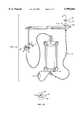
- FIG. 1is an isometric view of a home water filtration system employing one embodiment of the monitor of the present invention.
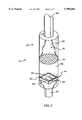
- FIG. 2is an isometric section view of the preferred embodiment of the monitor of FIG. 1.
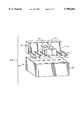
- FIG. 3is an isometric view of a monitor having a monitor base unit connected to a microprocessor and having two sensor cartridges.
- FIG. 4is an isometric view of the monitor base unit showing sensor cartridge engaging slots and the water and electrical connectors.
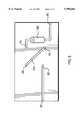
- FIG. 5is a rear elevation view of the monitor base unit showing a container of doped ion exchange resins and the water connections between two sensor cartridges.
- FIG. 6is a cut side view of a first sensor cartridge, showing a water inlet and outlet and a resin incorporated BAW device.
- FIG. 7is a cut side view of a second sensor cartridge, showing a water inlet and outlet and a resin incorporated BAW device.
- the present inventionis a monitor apparatus and method of detecting and quantifying specified ions in an aqueous flow.
- the monitor of the present inventioninvolves the doping of a target ion onto an ion exchange resin and measuring the presence of this target ion in the flow of analyte downstream of the resin.
- a monitor 10is located at an outlet end 12 of a water filter system 14 having a conduit in which an ion exchange resin (not shown) is disposed.
- the water filtration system 14has a water-dispensing faucet 16, which has a threaded male connector 18.
- a faucet collar 20is located under the dispensing faucet 16 with the threaded male connector 18 extending through a faucet engaging hole 22 of the faucet collar 20.
- the faucet collar 20has a green light 24 and a red light 26. The green light 24 is illuminated when water is dispensed from the faucet 16 until the monitor 10 detects the presence of a target ion T, at which time the red light 26 is illuminated on the faucet collar 20.
- the monitor 10has a conduit 30.
- the conduit 30has an inlet 32, an outlet 34, and a top region 36 and a bottom region 38 separated by a restraining screen 40.
- An ion exchange resin bed 42, doped with a target ion T,is contained in the top region 36 of the conduit 30.
- a sensor substrate 44is positioned in the bottom region 38 of the conduit 30.
- the sensor substrate 44has an insulator layer 46, conductive pads 48 and a polymer layer 50 which is selective for the target ion, T.
- the conductive pads 48are connected to a constant current supply (not shown) and, in the preferred embodiment, are gold. However, other conductive materials commonly used in such applications may be used to achieve similar results.
- Analyte water exiting the water filter 14enters the monitor inlet 32 and passes into the ion exchange resin bed 42. Ions in the analyte having a selectivity coefficient higher than the target ion, T, will displace the target ion, while ions having selectivity coefficients lower than, T, will not displace target ions in the ion exchange resin bed 42.
- the analyte water passing from the ion exchange resin bed 42passes across the polymer layer 50 of the sensor substrate 44. Any target ions in the analyte will affix to the polymer layer 50 in a conductive bridge 52 between the conductive pads 48, changing the voltage of the current flow in the constant current source. Ohm's Law states that:
- Iis the electrical current measured in amperes
- Eis the electromotive force expressed in volts
- Ris the resistance, expressed in ohms, ⁇ .
- the target ions, Tcause a change in conductivity between the conductive pads 48
- the resultant change to the resistance, Rin the equation, necessitates a corresponding change in E to maintain a constant current I.
- the change in voltageis detected by a voltmeter.
- the green light 24 on the faucet collar 20is disabled and the red light 26 is enabled, effectively signaling the user that it is time to change the water filter cartridge.
- the ions with higher selectivity coefficients than Cuare Ca, Sr, Hg and Pb.
- Ca and Srare higher than Cu in the 4% resin and lower than Cu in the 8% resin.
- the signal meanswould be triggered by the presence of Ca and Sr, whereas by employing the 8% resin, the signal means would not be triggered by the presence of either Ca or Sr.
- the present inventionallows for selection of ions to be detected, based on the selection of the ion exchange resin selected for the ion exchange column.
- two or more monitorsare situated in parallel.
- the monitorwas employed to determine the presence of Ca or Sr in a water stream, one monitor would employ the 8% resin and the other would employ the 4% with Cu being the target ion. If neither monitor triggered the signal means, then the water stream would not be at a breakthrough state for Ca or Sr, for in this example, either Ca or Sr would trigger monitor 2. If monitor 2 was triggered but monitor 1 was not triggered, then the water stream must contain Ca or Sr, for if any other ions triggered monitor 2, then monitor 1 would be triggered also.
- the monitor of the present inventioncan isolate specific ions or groups of ions.
- the monitoremploys reference ions, target ions and marker ions.
- the reference ionsare ions having a selectivity coefficient immediately higher than the target ion on a chart of ion exchange resin selectivity coefficients.
- the target ionsare the ions being detected and quantified.
- the marker ionsare ions having a selectivity coefficient immediately lower than the target ion.
- Selectivity coefficientsare measures of the attraction of an ion to an ion exchange resin. For cations, the coefficients are expressed as the attraction relative to hydrogen. For anions, the coefficients are expressed as the attraction relative to hydroxide.
- the monitorhas a first sensor which, with calculations in a microprocessor, determines the number of first reference ions in the analyte.
- a second sensorwhich employs first marker ions, and with calculations in the microprocessor, determines the total number of first target ions in the analyte.
- the monitorhas a flow meter, which provides flow rate of the analyte.
- the microprocessorcomputes the concentration of the first target ions in the analyte, adjusted by the capture ratio of the ion exchange resin, by dividing the number of first target ions in the analyte by the flow rate of the analyte.
- a third sensoris employed to detect and quantity a second target ion.
- the first target ion which was detected and quantified in the second sensorbecomes a second reference ion for the second target ion detected in the third sensor and the first marker ion used in the second sensor becomes the second target ion detected in the third sensor.
- the number of different target ions that can be detected and quantified by a single monitor of the present inventionis limited only by the availability of ion exchange resins to differentiate among ions.
- the monitorrequires an ion having a selectivity coefficient immediately higher and immediately lower than the target ion.
- the detected ionscan be cations or anions.
- adjoining cationshave the maximum separation in their selectivity coefficients.
- strontiumis an adjoining ion, having the next lower selectivity coefficient, for both the 8% and 12% cross-linked resins.
- the monitormay be connected to a microprocessor and has a base unit comprising a base unit water inlet, a base unit water outlet and sensor cartridges.
- the sensor cartridgeseach have a water inlet, a sensor and a water outlet.
- the sensorshave a layer of ion exchange resin and a bulk acoustic wave (BAW) device to detect changes in mass in the ion exchange resin layer and an insulator.
- the layer of resinis deposited on the bulk acoustic wave (BAW) device or a substrate in vibratory contact with the BAW device.
- the BAW deviceconsists of a thin, flat piezoelectric crystal having metal electrodes covering the top and bottom faces.
- Piezoelectric crystalsare well known in the art and have been applied to a number of applications, including a variety of sensor applications. Since the BAW substrate is piezoelectric in nature, an applied potential results in a corresponding mechanical deformation. Furthermore, due to its elasticity, the substrate “springs" back to its original shape upon removal of this potential. Because of the finite inertia of the crystal, however, the crystal behaves as a mass on a spring, oscillating at a characteristic frequency for some time until the acoustic wave is finally damped out. Such a situation is analogous to a guitar string, oscillating at a specific pitch after it has been plucked.
- the substrateis piezoelectric in nature
- a corresponding electrical signalappears on the metal electrodes of the device.
- an extremely stable oscillatorcan be realized.
- This oscillation frequencyis almost exactly the resonant frequency of the BAW device, differing only enough to account for any electrical phase shift through the amplifier.
- the resonant frequency of the BAW deviceis highly dependent upon a number of parameters, including the velocity, v, at which the wave travels through the bulk of the crystal, the thickness, t, of the crystal, and the interaction of the BAW with the surfaces of the device (i.e., the boundary conditions).
- the first two parameters, v and tremain constant.
- the resonant frequencybecomes highly dependent upon the elastic properties of the film, the electrical conductivity of the film, and the mass of the film.
- a BAW crystal oscillatorcan be utilized as a very sensitive microbalance for the measurement of masses in the nanogram range.
- the change in massis manifested as a change in BAW resonant frequency, which is, in turn, manifested as a change in the oscillation frequency.
- This frequency changecan be modeled by Sauerbrey's equation, as follows, ##EQU1## where m is the mass loaded onto the device (in kg), f 0 is the nominal resonant frequency of the device (in Hz), ⁇ f is the change in frequency (in Hz), v s is the velocity of the BAW in the substrate (in m/s), ⁇ 5 is the density of the substrate (in kg/m 3 ), and A is the active surface area of the device (in cm 2 ).
- the minimum detectable frequency change (1 Hz)corresponds to a change in mass of about 2 nanograms/cm 2 .
- a first metal electrodeis coated with a layer of ion exchange resin, preferably of a thickness of about one micron.
- the layeris subsequently doped with the target ion, T, the reference ion, R or the marker ion, M.
- the base unithas a container of ion exchange resin, doped with a reference ion, R, with R having selectivity coefficient immediately higher than a first target ion, T, a first sensor cartridge and a second sensor cartridge.
- the first sensor cartridgehas a first sensor.
- the second sensor cartridgehas a second sensor.
- the first sensorhas a layer of ion exchange resin incorporated on a top electrode of a first BAW device doped with the target ion, T.
- a second ion exchange resin layer incorporated on a second electrode of the second sensoris doped with a marker ion, M, the ion having the next lower selectivity coefficient in the ion exchange resin table from the target ion, T.
- the analytepasses from a monitor base unit water inlet into the container of ion exchange resin. All ions in the analyte having selectivity coefficients higher than the reference ion, R, will affix to the ion exchange resin and exchange for the reference ion, R.
- the output water from the containermay contain R, or ions having selectivity coefficients less than R, including the target ion, T.
- the water, exiting the container,passes into the first sensor cartridge, having the first sensor with a layer of ion exchange resin doped with the target ion, T.
- the reference ions R, in the waterwill affix to the layer and exchange with target ions, T, on the layer. Any target ions, T, in the water will either displace the target ion, T, on the first layer or they will pass by the first layer without displacing any target ions. In either case, the net effect to the mass of the layer will be zero. Ions having lower selectivity coefficients will not displace target ions, T, on the first layer. Thus, the water, having passed the first sensor, will contain either target ions extant in the analyte, the displaced target ions, or ions having selectivity coefficients lower than the target ions.
- the exchange of reference ions, R, on the first layerwill increase the mass of the first layer to the extent that reference ions, R, are present in the water, less the mass of the target ions, T, displaced by the reference ions, R.
- the waterpasses from the container into the first sensor cartridge and passes over the first layer of ion exchange resin incorporated on the top electrode of the BAW device.
- a bed of ion exchange resinbe downstream from each sensor, with the resin being doped with the same ion as the doped ion on the preceding sensor.
- the exchange of target ions, T, on the second ion exchange resin layerwill increase the mass of the second layer, less the mass of the marker ions, M, displaced to the extent that target ions, T, are present in the water.
- the mass change, m 1 , of the first sensorwill be the mass of the reference ions, R, less the target ions, T, displaced and can be expressed as follows:
- R Ais the number of reference ions
- W Ris the atomic weight of the reference ions
- W Tis the atomic weight of the target ions.
- R Ais expressed as: ##EQU2##
- the mass change, m 2on the second sensor, will be the mass of the target ions displaced by the reference ions, R, plus the mass of the target ions, T, in the analyte less the weight of the marker ions, M, displaced by the target ions, M, and can be expressed as follows:
- T Ais the number of target ions in the analyte
- W Mis the atomic weight of the marker ions.
- the number of target ions in the analyteis expressed as follows: ##EQU3##
- the increase in mass on the second layerwill result in a decrease in the frequency of the BAW device measured in MHz.
- the frequency decreaseis recorded by the microprocessor in one-second intervals.
- the decreased frequencyis converted to m 2 , the mass change on the second sensor layer during the interval.
- the microprocessoraccepts input from a flow meter, recording the passing of water into the monitor base unit in ml/sec.
- the microprocessorwill convert the change in frequency to the number of atoms per second, adjust the number of atoms by the capture ratio of the ion exchange resin and divide by the ml/sec recorded from the flow meter.
- the resultis a reading of the presence of the target ion, T. Since the BAW records the mass changes in the sub-pictogram to microgram range, the resultant measurement will be in parts-per-billion (ppb).
- the monitor base unithas a third cartridge having a third sensor with a third layer doped with a marker ion, M'.
- the value for the number of target ions, Tbecomes R A , the number of reference ions, R', in the calculation required to quantify the second target ion, T'.
- the marker ion, M, on the second layer of the second sensorbecomes the target ion, T', for detection of the second target ion, T'.
- R' Ais T A , the number of target ions, T.
- T' Ais the number of target ions in the analyte
- W M'is the atomic weight of the marker ions, M'.
- monitors of the present inventionmay be employed to detect and quantify multiple ions.
- a monitormay be configured to detect mercury and copper.
- the container of ion exchange resinis doped with lead.
- the analytepasses into the container and the ions heavier than lead exchange with the lead.
- the analytepasses over the first sensor layer which has an ion exchange resin doped with mercury.
- the leadexchanges with the mercury.
- the waterpasses through a resin bed doped with mercury to capture any lead ions that failed to exchange with the mercury on the first sensor layer.
- the waternow has the mercury that was displaced, the mercury in the analyte and cations lighter than mercury.
- the waterpasses over the second sensor, which is doped with copper.
- the layer of the third sensoris doped with calcium. The copper from the second sensor displaces the calcium ions on the third sensor, and so on.
- the weight change on the first sensor layeris the weight of lead less the weight of the mercury displaced by the lead. Since the unit weight of the lead and mercury are known, the number of lead ions is calculated. The exchange of mercury with lead is a one-for-one exchange. Thus, the number of mercury ions displaced is known.
- the weight change on the second layeris (1) the weight of the mercury which was displaced by the lead, (2) the weight of the mercury in the analyte and (3) less the weight of the copper ions displaced.
- the unit weights of mercury and copperare known and, thus, the total weight of the mercury, and the total number of mercury ions, on the layer is known. Subtracting the number of displaced mercury ions from the total mercury ions on the layer yields the number of mercury ions in the analyte.
- the calculations for the copper detectionare the same as that for mercury.
- the monitorwill detect and quantify multiple ions so long as the ions being detected have ions with adjacent selectivity coefficients. If there is a break in the succession for selectivity, the sensor cartridge for the ion having the highest selectivity in a contiguous group must be preceded with a container of ion exchange resin having the next higher selectivity coefficient on the exchange sites of the resin.
- the monitor 54has a monitor base unit 56, connected to a microprocessor 58.
- the monitor base unit 56has a base unit water inlet 60, a base unit water outlet 62, a first sensor cartridge 64, and a second sensor cartridge 66.
- the sensor cartridges 64 and 66engage cartridge engaging slots 70 when seated on the monitor base unit 56.
- the first sensor cartridge, 64engages a first water inlet nipple 72 located in a first water inlet 74, a first water outlet nipple 76, located in a first water outlet 78 and a pair of electrical connector pins 80 located on a rear surface 82 of the monitor base unit 56.
- the second sensor cartridge 66engages a second water inlet nipple 84 located in a second water inlet 86, a second water outlet nipple 88, located in a second water outlet 90 and a pair of electrical connector pins 92 located on the rear surface 82 of the monitor base unit 56.
- the water inlet nipples and water outlet nipples 72, 76, 84, 88have circumferentially mounted O-rings 94 located in O-ring grooves 95 (shown in FIG. 6).
- Pairs of indicator lights 96are located in a top region 98 of the rear surface 82 for each sensor cartridge 64 and 66. The pairs of indicator lights, 96 flash green when the sensor cartridges 64 and 66 are operational and flash red when the sensor cartridges 64 and 66 need replacement.
- the analyte waterenters the base unit water inlet 60, passes into a container 100, which contains a bed of ion exchange resin doped with the reference ion, R, where the ions heavier than the reference ion exchange for the reference ion.
- the water exiting the container 100passes into the first water inlet 74.
- Water exiting the first sensor cartridge 64passes through the first water outlet 78, and flows through a tube 104 into the second water inlet 86.
- Water exiting the second sensor cartridge 66passes through the second water outlet 90 and on through the base unit water outlet 62.
- FIG. 6shows the first sensor cartridge 64.
- the first water inlet nipple 72engages a water inlet recess 110
- the first water outlet nipple 76engages a water outlet recess 112
- the electrical connector pins 80engage an electrical pin recess 116.
- the analyte watershown in a flow path 120, enters the first sensor cartridge 64 through the water inlet recess 110, passes across a top surface 130 of a first BAW device 132, passes a water exit passage 134, and flows through a first bed of ion resin exchange resin 136.
- the first BAW device, 132has a layer of ion exchange resin 137 doped with a target ion, T, a top electrode 138, a layer of piezoelectric crystal 140, a bottom electrode 142 and an insulator 144. Though quartz crystals, such as those commercially available from Sawtek, Inc., Orlando, Fla. and Motorola, Inc.
- the insulator 144encapsulate the bottom electrode 142 to isolate the bottom electrode 142 from the analyte water.
- the analyte waterthen passes through the first water outlet 78 and into the second sensor cartridge 66, shown in FIG. 7.
- the analyte watershown in a flow path 120, enters the second sensor cartridge 66 through the water inlet recess 150, passes across a top surface 152 of a second BAW device 154, having a layer of ion exchange resin 156 doped with a marker ion, M, passes a water exit passage 157, and flows through a second bed of ion resin exchange resin 158, which is doped with the marker ion, M.
- the flow rate of the analyte waterwill be determined by a flow meter (not shown) with the rate in ml/sec being inputted to the microprocessor 20. It is preferred that the flow rate be less than 0.125 gpm and that the temperature range of the analyte water be between 45 and 75 degrees F.
- any type of flow metercapable of measuring fluids having these ranges of flow and temperature, and capable of sending a signal to the microprocessor, may be used.
- magnetic flowmeters, coriolis mass flowmeters, vortex shedders, differential pressure meters or variable area flowmetersare all well known in the art and all may be adapted to measure the desired flows and produce the desired outputs.
- the microprocessorconverts the mass m, computed in Sauerbrey's equation to the number of ions of the target ions, T and T' by accessing a conversion table embedded in the microprocessor 20.
- the number of ionsis adjusted by the capture ratio of the ion exchange resin.
- the microprocessor 20then divides the number of ions accumulated in time t, and divides by the analyte water flow during time t. The result is the concentration of Tand T' in the analyte.
- the concentration, in parts per billion,is transmitted to an output device, such as a PC, not shown.
- a microprocessor 20such as the Motorola 68HC11, is be employed to perform frequency counting, linearization, computational functions, converting frequency to mass, table look-up functions including converting mass to number of ions and outputting MCL's for each ion being detected, arithmetic functions computing ppm (parts-per-million) or ppb (parts-per billion) and data conversion to output devices.
- a series of microprocessorsadapted to perform different portions of the required calculations, and to provide the necessary outputs, may be used to achieve similar results.
- the method of the present inventionmay be used to detect concentration levels of certain contaminants in an aqueous flow.
- the BAW systemmay be substituted for the conductivity system of the preferred embodiment to provide a failure detector for a filter cartridge. For example, if there was a need to detect Hg, Pb, and Ba, then detection of Cu, the ion that precedes those on the selectivity chart, would provide indication that the ion exchange resin was at a stage to break through for any of those elements. If the threshold ion is at the copper level, then when the ion exchange resin has reached a saturation stage in which copper is breaking through the resin, the filter cartridge needs replacement before heavier, more toxic metals elute into the filtered water.
- the water passing from a water filterpasses into a water inlet of a monitor base unit having a sensor cartridge.
- the sensorhas a layer of ion exchange resin incorporated on a top electrode of the BAW device.
- the layeris doped with a marker ion, which in this case is calcium. Any ions having a selectivity coefficient higher than calcium will affix to the layer and displace calcium ions. Ions having selectivity coefficients lower than calcium will not affix to the resin layer.
- the exchange of heavier than calcium ions with calcium on the layerwill increase the mass of the layer to the extent that heavier than calcium ions are present in the water less the mass of the calcium ions displaced.
- the microprocessortransmits an electronic output device, such as, a red light, which alerts the user that the water filter requires a change of the filtration cartridge.
- the BAW deviceis replaced with the sensor substrate having conductive pads and the reference ions and target ions are detected and quantified by measuring changes in voltage rather than by changes in mass.
- This embodimentis identical to the monitors described with reference to FIGS. 1 and 2, except that a flowmeter and microprocessor are added to convert the changes in voltage into contamination levels, measured in parts per million, parts per billion, etc., of the desired contaminant.
- an ion selective polymeris employed in place of the calcium doped ion exchange resin to detect levels of copper.
- a polymersuch as polyvinyl pyridine, PVP, is incorporated on a top electrode of a BAW device.
- Polyvinyl pyridineis selective for copper, i.e., if ions heavier or lower than PVP pass by a PVP incorporated layer, the ions will not affix to the surface.
- the sensor containing the PVP layerwill quantify the number of copper ions in the analyte.
- the embodimentcan be used as a copper monitor, a threshold monitor for an ion exchange resin column or as a provider of R A , the number of copper ions used as reference ions in an ion quantifying monitor.
Landscapes
- Chemical & Material Sciences (AREA)
- Health & Medical Sciences (AREA)
- Life Sciences & Earth Sciences (AREA)
- Pathology (AREA)
- General Physics & Mathematics (AREA)
- Immunology (AREA)
- Physics & Mathematics (AREA)
- Analytical Chemistry (AREA)
- Biochemistry (AREA)
- General Health & Medical Sciences (AREA)
- Food Science & Technology (AREA)
- Medicinal Chemistry (AREA)
- Engineering & Computer Science (AREA)
- Chemical Kinetics & Catalysis (AREA)
- Electrochemistry (AREA)
- Treatment Of Water By Ion Exchange (AREA)
- Investigating Or Analyzing Materials By The Use Of Electric Means (AREA)
Abstract
Description
TABLE 1 ______________________________________ Cation Selectivity Coefficients of Four Cation Resins selectivity coefficients Cross-linking, wt % Ion symbol 4 8 12 16 ______________________________________ hydrogen H 1.0 1.0 1.0 1.0 iron Fe 2.4 2.55 2.7 2.9 zinc Zn 2.6 2.7 2.8 3.0 cadmium Cd 2.8 2.95 3.3 3.95 calcium Ca 3.4 3.9 4.6 5.8 strontium Sr 3.9 4.95 6.25 8.1 copper Cu 3.2 5.3 9.5 14.5 mercury Hg 5.1 7.2 9.7 14.0 lead Pb 5.4 7.5 10.1 14.5 ______________________________________
______________________________________ Contaminant Symbol MCL (ppm) ______________________________________ Copper Cu 1.3 Lead Pb 0.015 Zinc Zn 5.0 Mercury Hg 0.002 Arsenic As 0.050 ______________________________________
I=E/R,
m.sub.1 =R.sub.A W.sub.R -R.sub.A W.sub.T
m.sub.2 =R.sub.A W.sub.T +T.sub.A W.sub.T -(R.sub.A +T.sub.A)W.sub.M
m.sub.3 =R'.sub.A W.sub.T' +T'.sub.A W.sub.T' -(R'.sub.A +T'.sub.A)W.sub.M'
Claims (20)
Priority Applications (7)
| Application Number | Priority Date | Filing Date | Title |
|---|---|---|---|
| US08/984,256US5990684A (en) | 1997-12-02 | 1997-12-02 | Method and apparatus for continuously monitoring an aqueous flow to detect and quantify ions |
| JP2000523545AJP2001525545A (en) | 1997-12-02 | 1998-12-01 | Method and apparatus for continuously monitoring water flow to detect and quantify ions |
| AU15401/99AAU1540199A (en) | 1997-12-02 | 1998-12-01 | Method and apparatus for continuously monitoring an aqueous flow to detect and quantify ions |
| EP98959643AEP1036317A4 (en) | 1997-12-02 | 1998-12-01 | Method and apparatus for continuously monitoring an aqueous flow to detect and quantify ions |
| CA002305455ACA2305455A1 (en) | 1997-12-02 | 1998-12-01 | Method and apparatus for continuously monitoring an aqueous flow to detect and quantify ions |
| PCT/US1998/025442WO1999028737A1 (en) | 1997-12-02 | 1998-12-01 | Method and apparatus for continuously monitoring an aqueous flow to detect and quantify ions |
| US09/333,200US6232783B1 (en) | 1997-12-02 | 1999-06-15 | Method for monitoring an aqueous flow using selective film |
Applications Claiming Priority (1)
| Application Number | Priority Date | Filing Date | Title |
|---|---|---|---|
| US08/984,256US5990684A (en) | 1997-12-02 | 1997-12-02 | Method and apparatus for continuously monitoring an aqueous flow to detect and quantify ions |
Related Child Applications (1)
| Application Number | Title | Priority Date | Filing Date |
|---|---|---|---|
| US09/333,200Continuation-In-PartUS6232783B1 (en) | 1997-12-02 | 1999-06-15 | Method for monitoring an aqueous flow using selective film |
Publications (1)
| Publication Number | Publication Date |
|---|---|
| US5990684Atrue US5990684A (en) | 1999-11-23 |
Family
ID=25530415
Family Applications (2)
| Application Number | Title | Priority Date | Filing Date |
|---|---|---|---|
| US08/984,256Expired - Fee RelatedUS5990684A (en) | 1997-12-02 | 1997-12-02 | Method and apparatus for continuously monitoring an aqueous flow to detect and quantify ions |
| US09/333,200Expired - Fee RelatedUS6232783B1 (en) | 1997-12-02 | 1999-06-15 | Method for monitoring an aqueous flow using selective film |
Family Applications After (1)
| Application Number | Title | Priority Date | Filing Date |
|---|---|---|---|
| US09/333,200Expired - Fee RelatedUS6232783B1 (en) | 1997-12-02 | 1999-06-15 | Method for monitoring an aqueous flow using selective film |
Country Status (6)
| Country | Link |
|---|---|
| US (2) | US5990684A (en) |
| EP (1) | EP1036317A4 (en) |
| JP (1) | JP2001525545A (en) |
| AU (1) | AU1540199A (en) |
| CA (1) | CA2305455A1 (en) |
| WO (1) | WO1999028737A1 (en) |
Cited By (13)
| Publication number | Priority date | Publication date | Assignee | Title |
|---|---|---|---|---|
| US6232783B1 (en)* | 1997-12-02 | 2001-05-15 | John H. Merrill | Method for monitoring an aqueous flow using selective film |
| US20030209494A1 (en)* | 1998-05-06 | 2003-11-13 | Alltech Associates, Inc. | Continuously regenerated and integrated suppressor and detector for suppressed ion chromatography and method |
| US20040234954A1 (en)* | 2003-03-03 | 2004-11-25 | Klaus Nusslein | Surfaces that selectively bind to moieties |
| US6890486B2 (en)* | 2001-07-26 | 2005-05-10 | University Of Massachusetts | MIP/QCM sensors for high sensitivity-fast sensing of small molecules in solution |
| US20050109098A1 (en)* | 2003-11-21 | 2005-05-26 | Baker Hughes Incorporated | Method and apparatus for downhole fluid analysis using molecularly imprinted polymers |
| US20080052012A1 (en)* | 2006-08-22 | 2008-02-28 | Howell Jason W | Water quality monitoring device and method |
| FR2911087A1 (en)* | 2007-01-10 | 2008-07-11 | Eastman Kodak Co | INK QUALITY CONTROL METHOD AND DEVICE |
| US20090123340A1 (en)* | 2007-05-04 | 2009-05-14 | H2Observe, Llc | Water quality monitoring device and method |
| US8187444B2 (en) | 2007-08-10 | 2012-05-29 | Eric John Kruger | Fluid treatment device |
| CN103364248A (en)* | 2013-07-30 | 2013-10-23 | 北京市农林科学院 | Pre-treatment apparatus for test of nitrate nitrogen isotope in water body |
| US20150276836A1 (en)* | 2014-03-06 | 2015-10-01 | The Board Of Regents Of The University Of Texas System | Methods and devices for measuring conductivity of fluids |
| US11327066B2 (en)* | 2019-01-10 | 2022-05-10 | Haier Us Appliance Solutions, Inc. | Water contaminant measurement system and methods for measuring concentration levels of contaminants in water |
| US11353428B2 (en)* | 2015-12-14 | 2022-06-07 | Qorvo Us, Inc. | BAW sensor device with peel-resistant wall structure |
Families Citing this family (56)
| Publication number | Priority date | Publication date | Assignee | Title |
|---|---|---|---|---|
| US9066695B2 (en) | 1998-04-30 | 2015-06-30 | Abbott Diabetes Care Inc. | Analyte monitoring device and methods of use |
| US6949816B2 (en) | 2003-04-21 | 2005-09-27 | Motorola, Inc. | Semiconductor component having first surface area for electrically coupling to a semiconductor chip and second surface area for electrically coupling to a substrate, and method of manufacturing same |
| US8688188B2 (en) | 1998-04-30 | 2014-04-01 | Abbott Diabetes Care Inc. | Analyte monitoring device and methods of use |
| US8480580B2 (en) | 1998-04-30 | 2013-07-09 | Abbott Diabetes Care Inc. | Analyte monitoring device and methods of use |
| US8465425B2 (en) | 1998-04-30 | 2013-06-18 | Abbott Diabetes Care Inc. | Analyte monitoring device and methods of use |
| US8974386B2 (en) | 1998-04-30 | 2015-03-10 | Abbott Diabetes Care Inc. | Analyte monitoring device and methods of use |
| US6175752B1 (en) | 1998-04-30 | 2001-01-16 | Therasense, Inc. | Analyte monitoring device and methods of use |
| US8346337B2 (en) | 1998-04-30 | 2013-01-01 | Abbott Diabetes Care Inc. | Analyte monitoring device and methods of use |
| US6560471B1 (en) | 2001-01-02 | 2003-05-06 | Therasense, Inc. | Analyte monitoring device and methods of use |
| JP4919138B2 (en)* | 2001-02-20 | 2012-04-18 | 新東工業株式会社 | Waste water denitrification equipment |
| EP1397068A2 (en) | 2001-04-02 | 2004-03-17 | Therasense, Inc. | Blood glucose tracking apparatus and methods |
| US6807842B2 (en)* | 2001-09-18 | 2004-10-26 | The Charles Stark Draper Laboratory, Inc. | Molecular recognition sensor system |
| US8260393B2 (en) | 2003-07-25 | 2012-09-04 | Dexcom, Inc. | Systems and methods for replacing signal data artifacts in a glucose sensor data stream |
| US8010174B2 (en) | 2003-08-22 | 2011-08-30 | Dexcom, Inc. | Systems and methods for replacing signal artifacts in a glucose sensor data stream |
| US9247901B2 (en) | 2003-08-22 | 2016-02-02 | Dexcom, Inc. | Systems and methods for replacing signal artifacts in a glucose sensor data stream |
| US6664793B1 (en) | 2002-03-01 | 2003-12-16 | Allen R. Sampson | Fluid presence and qualitative measurements by transient immitivity response |
| AU2003245431A1 (en)* | 2002-06-07 | 2003-12-22 | Carl R. Marschke | Water supply monitoring for contaminant detection |
| WO2004027393A1 (en)* | 2002-09-20 | 2004-04-01 | The Charles Stark Draper Laboratory, Inc. | Molecular recognition sensor system |
| WO2007120442A2 (en) | 2003-07-25 | 2007-10-25 | Dexcom, Inc. | Dual electrode system for a continuous analyte sensor |
| US8423113B2 (en) | 2003-07-25 | 2013-04-16 | Dexcom, Inc. | Systems and methods for processing sensor data |
| US20050176136A1 (en)* | 2003-11-19 | 2005-08-11 | Dexcom, Inc. | Afinity domain for analyte sensor |
| US7591801B2 (en) | 2004-02-26 | 2009-09-22 | Dexcom, Inc. | Integrated delivery device for continuous glucose sensor |
| US9135402B2 (en) | 2007-12-17 | 2015-09-15 | Dexcom, Inc. | Systems and methods for processing sensor data |
| US8275437B2 (en) | 2003-08-01 | 2012-09-25 | Dexcom, Inc. | Transcutaneous analyte sensor |
| US8160669B2 (en) | 2003-08-01 | 2012-04-17 | Dexcom, Inc. | Transcutaneous analyte sensor |
| US7774145B2 (en) | 2003-08-01 | 2010-08-10 | Dexcom, Inc. | Transcutaneous analyte sensor |
| US7920906B2 (en) | 2005-03-10 | 2011-04-05 | Dexcom, Inc. | System and methods for processing analyte sensor data for sensor calibration |
| US20140121989A1 (en) | 2003-08-22 | 2014-05-01 | Dexcom, Inc. | Systems and methods for processing analyte sensor data |
| US9247900B2 (en) | 2004-07-13 | 2016-02-02 | Dexcom, Inc. | Analyte sensor |
| US8423114B2 (en) | 2006-10-04 | 2013-04-16 | Dexcom, Inc. | Dual electrode system for a continuous analyte sensor |
| ATE480761T1 (en) | 2003-12-05 | 2010-09-15 | Dexcom Inc | CALIBRATION METHODS FOR A CONTINUOUSLY WORKING ANALYTICAL SENSOR |
| US11633133B2 (en) | 2003-12-05 | 2023-04-25 | Dexcom, Inc. | Dual electrode system for a continuous analyte sensor |
| WO2009048462A1 (en) | 2007-10-09 | 2009-04-16 | Dexcom, Inc. | Integrated insulin delivery system with continuous glucose sensor |
| US8808228B2 (en) | 2004-02-26 | 2014-08-19 | Dexcom, Inc. | Integrated medicament delivery device for use with continuous analyte sensor |
| US7654956B2 (en) | 2004-07-13 | 2010-02-02 | Dexcom, Inc. | Transcutaneous analyte sensor |
| US20070045902A1 (en) | 2004-07-13 | 2007-03-01 | Brauker James H | Analyte sensor |
| US8452368B2 (en) | 2004-07-13 | 2013-05-28 | Dexcom, Inc. | Transcutaneous analyte sensor |
| US7783333B2 (en) | 2004-07-13 | 2010-08-24 | Dexcom, Inc. | Transcutaneous medical device with variable stiffness |
| US8886272B2 (en) | 2004-07-13 | 2014-11-11 | Dexcom, Inc. | Analyte sensor |
| US20060016700A1 (en) | 2004-07-13 | 2006-01-26 | Dexcom, Inc. | Transcutaneous analyte sensor |
| US8565848B2 (en) | 2004-07-13 | 2013-10-22 | Dexcom, Inc. | Transcutaneous analyte sensor |
| WO2007102842A2 (en) | 2006-03-09 | 2007-09-13 | Dexcom, Inc. | Systems and methods for processing analyte sensor data |
| JP5220623B2 (en) | 2006-03-16 | 2013-06-26 | ユニバーサル ナノセンサー テクノロジーズ インコーポレーテッド | Dielectric constant detection method and system |
| WO2007143225A2 (en) | 2006-06-07 | 2007-12-13 | Abbott Diabetes Care, Inc. | Analyte monitoring system and method |
| WO2008154312A1 (en) | 2007-06-08 | 2008-12-18 | Dexcom, Inc. | Integrated medicament delivery device for use with continuous analyte sensor |
| US20110120870A1 (en)* | 2007-08-10 | 2011-05-26 | Eric John Kruger | Method and apparatus for treating a fluid |
| US8417312B2 (en) | 2007-10-25 | 2013-04-09 | Dexcom, Inc. | Systems and methods for processing sensor data |
| US8290559B2 (en) | 2007-12-17 | 2012-10-16 | Dexcom, Inc. | Systems and methods for processing sensor data |
| CA2754052C (en)* | 2009-03-04 | 2016-12-06 | Al-Amin Dhirani | Conductance detection system and method |
| US20110192179A1 (en)* | 2010-02-05 | 2011-08-11 | Freije Iii William F | Evaporative heat transfer system and method |
| US9611165B2 (en) | 2012-06-08 | 2017-04-04 | Corning Incorporated | Method and apparatus for bending a glass sheet and an electronic device casing |
| JP6565076B2 (en)* | 2015-02-26 | 2019-08-28 | 三菱日立パワーシステムズ株式会社 | Salinity measurement method |
| US20190120785A1 (en) | 2017-10-24 | 2019-04-25 | Dexcom, Inc. | Pre-connected analyte sensors |
| US11331022B2 (en) | 2017-10-24 | 2022-05-17 | Dexcom, Inc. | Pre-connected analyte sensors |
| EP3772650A1 (en)* | 2019-08-08 | 2021-02-10 | Robert Bosch GmbH | An automated heavy metal sensor |
| CN110927353A (en)* | 2019-12-11 | 2020-03-27 | 中国环境科学研究院 | Rural domestic sewage measurement system |
Citations (3)
| Publication number | Priority date | Publication date | Assignee | Title |
|---|---|---|---|---|
| US4013554A (en)* | 1974-05-17 | 1977-03-22 | Sachs-Systemtechnik Gmbh | Method and apparatus for purifying water contaminated with anodically oxidizable organic matter |
| US4871427A (en)* | 1988-06-24 | 1989-10-03 | United States Of America As Represented By The Secretary Of The Air Force | Ion detection using a differential resistance measurement of an ion exchange membrane |
| US5521510A (en)* | 1993-10-08 | 1996-05-28 | Hoechst Aktiengesellschaft | Process for monitoring for organic impurities in water |
Family Cites Families (9)
| Publication number | Priority date | Publication date | Assignee | Title |
|---|---|---|---|---|
| US3159573A (en)* | 1961-03-30 | 1964-12-01 | Smith Corp A O | Resistance sensing probe system |
| DE1498553A1 (en)* | 1964-10-30 | 1969-04-30 | Ammer Dipl Ing Heinzgert | Process and device for measuring the efficiency and the exhaustion state of strongly acidic cation exchangers |
| US3992662A (en)* | 1974-08-16 | 1976-11-16 | Billy D. Etherton | Liquid conductivity measuring device |
| US4057481A (en)* | 1976-05-24 | 1977-11-08 | Allied Chemical Corporation | High performance, quality controlled bipolar membrane |
| US4801551A (en)* | 1986-10-06 | 1989-01-31 | Westinghouse Electric Corp. | Rugged dissolved carbon dioxide monitor for high purity water |
| DE3641697C2 (en)* | 1986-12-06 | 1996-09-05 | Licentia Gmbh | Arrangement for measuring an ion concentration and its use |
| US5218856A (en)* | 1992-03-06 | 1993-06-15 | Axiom Analytical, Inc. | Analysis of liquid-carried impurities by means of sparging |
| US5282381A (en)* | 1992-09-08 | 1994-02-01 | Hughes Aircraft Company | Supercritical fluid contamination monitor |
| US5990684A (en)* | 1997-12-02 | 1999-11-23 | Merrill; John H. | Method and apparatus for continuously monitoring an aqueous flow to detect and quantify ions |
- 1997
- 1997-12-02USUS08/984,256patent/US5990684A/ennot_activeExpired - Fee Related
- 1998
- 1998-12-01EPEP98959643Apatent/EP1036317A4/ennot_activeWithdrawn
- 1998-12-01WOPCT/US1998/025442patent/WO1999028737A1/ennot_activeApplication Discontinuation
- 1998-12-01CACA002305455Apatent/CA2305455A1/ennot_activeAbandoned
- 1998-12-01JPJP2000523545Apatent/JP2001525545A/ennot_activeWithdrawn
- 1998-12-01AUAU15401/99Apatent/AU1540199A/ennot_activeAbandoned
- 1999
- 1999-06-15USUS09/333,200patent/US6232783B1/ennot_activeExpired - Fee Related
Patent Citations (3)
| Publication number | Priority date | Publication date | Assignee | Title |
|---|---|---|---|---|
| US4013554A (en)* | 1974-05-17 | 1977-03-22 | Sachs-Systemtechnik Gmbh | Method and apparatus for purifying water contaminated with anodically oxidizable organic matter |
| US4871427A (en)* | 1988-06-24 | 1989-10-03 | United States Of America As Represented By The Secretary Of The Air Force | Ion detection using a differential resistance measurement of an ion exchange membrane |
| US5521510A (en)* | 1993-10-08 | 1996-05-28 | Hoechst Aktiengesellschaft | Process for monitoring for organic impurities in water |
Cited By (20)
| Publication number | Priority date | Publication date | Assignee | Title |
|---|---|---|---|---|
| US6232783B1 (en)* | 1997-12-02 | 2001-05-15 | John H. Merrill | Method for monitoring an aqueous flow using selective film |
| US20030209494A1 (en)* | 1998-05-06 | 2003-11-13 | Alltech Associates, Inc. | Continuously regenerated and integrated suppressor and detector for suppressed ion chromatography and method |
| US6709583B2 (en) | 1998-05-06 | 2004-03-23 | Alltech Associates, Inc. | Continuously regenerated and integrated suppressor and detector for suppressed ion chromatography and method |
| US6890486B2 (en)* | 2001-07-26 | 2005-05-10 | University Of Massachusetts | MIP/QCM sensors for high sensitivity-fast sensing of small molecules in solution |
| US20040234954A1 (en)* | 2003-03-03 | 2004-11-25 | Klaus Nusslein | Surfaces that selectively bind to moieties |
| US7395704B2 (en)* | 2003-11-21 | 2008-07-08 | Baker Hughes Incorporated | Method and apparatus for downhole fluid analysis using molecularly imprinted polymers |
| US20050109098A1 (en)* | 2003-11-21 | 2005-05-26 | Baker Hughes Incorporated | Method and apparatus for downhole fluid analysis using molecularly imprinted polymers |
| US7505857B2 (en) | 2006-08-22 | 2009-03-17 | H2Observe, Llc | Water quality monitoring device and method |
| US20080052012A1 (en)* | 2006-08-22 | 2008-02-28 | Howell Jason W | Water quality monitoring device and method |
| FR2911087A1 (en)* | 2007-01-10 | 2008-07-11 | Eastman Kodak Co | INK QUALITY CONTROL METHOD AND DEVICE |
| WO2008083837A3 (en)* | 2007-01-10 | 2008-08-28 | Eastman Kodak Co | Process and device for ink quality control |
| US20090123340A1 (en)* | 2007-05-04 | 2009-05-14 | H2Observe, Llc | Water quality monitoring device and method |
| US8187444B2 (en) | 2007-08-10 | 2012-05-29 | Eric John Kruger | Fluid treatment device |
| US8388817B2 (en) | 2007-08-10 | 2013-03-05 | Eric John Kruger | Method and apparatus for treating a fluid |
| CN103364248A (en)* | 2013-07-30 | 2013-10-23 | 北京市农林科学院 | Pre-treatment apparatus for test of nitrate nitrogen isotope in water body |
| CN103364248B (en)* | 2013-07-30 | 2016-01-20 | 北京市农林科学院 | Water body nitrate nitrogen isotope test pretreating device |
| US20150276836A1 (en)* | 2014-03-06 | 2015-10-01 | The Board Of Regents Of The University Of Texas System | Methods and devices for measuring conductivity of fluids |
| US9778299B2 (en)* | 2014-03-06 | 2017-10-03 | The Board Of Regents Of The University Of Texas System | Methods and devices for measuring compositions of fluids |
| US11353428B2 (en)* | 2015-12-14 | 2022-06-07 | Qorvo Us, Inc. | BAW sensor device with peel-resistant wall structure |
| US11327066B2 (en)* | 2019-01-10 | 2022-05-10 | Haier Us Appliance Solutions, Inc. | Water contaminant measurement system and methods for measuring concentration levels of contaminants in water |
Also Published As
| Publication number | Publication date |
|---|---|
| CA2305455A1 (en) | 1999-06-10 |
| WO1999028737A1 (en) | 1999-06-10 |
| AU1540199A (en) | 1999-06-16 |
| EP1036317A1 (en) | 2000-09-20 |
| EP1036317A4 (en) | 2002-04-03 |
| JP2001525545A (en) | 2001-12-11 |
| US6232783B1 (en) | 2001-05-15 |
Similar Documents
| Publication | Publication Date | Title |
|---|---|---|
| US5990684A (en) | Method and apparatus for continuously monitoring an aqueous flow to detect and quantify ions | |
| US4937557A (en) | Monitoring and indicating circuit for reverse osmosis filter | |
| US3964999A (en) | Determination of sodium form water softener breakthrough | |
| EP0565610B1 (en) | In-line detector system for real-time determination of impurity concentration in a flowing gas stream | |
| US5087883A (en) | Differential conductivity meter for fluids and products containing such meters | |
| EP0814887B1 (en) | Filtration monitoring and control system | |
| US3238452A (en) | Apparatus and method for detecting contaminants in a fluid | |
| US4506540A (en) | Liquid sensor and the use thereof in controlling the corrosion of pipelines | |
| EP0720739A1 (en) | Differential gas sensing in-line monitoring system | |
| US5450358A (en) | Method and system for monitoring the quality of a water purification apparatus | |
| KR100692108B1 (en) | Water Quality Tester for Water Treatment | |
| US6420185B1 (en) | Water contamination concentration apparatus and process | |
| MXPA00004991A (en) | Method and apparatus for continuously monitoring an aqueous flow to detect and quantify ions | |
| EP0589970B1 (en) | Monitoring apparatus | |
| WO2001039870A2 (en) | Determination of the efficiency of a filter | |
| Li et al. | Parameter optimization and performance analysis of nanofiltration membrane in treatment of compound-contaminated high-hardness water | |
| US11549879B2 (en) | Membrane integrity monitoring in water treatment | |
| Gruber et al. | Ventilatory Early Warning System | |
| KR100500966B1 (en) | High turbid filter having indicator exchange time of filter | |
| Bridgeman et al. | The Use and Application of Particle‐Count Data in Water Treatment | |
| CA1052919A (en) | Determination of sodium form water softener breakthrough | |
| EP2643691B1 (en) | Method for on-line continuous chlorine analysis in turbid water and process streams | |
| KR100794117B1 (en) | Apparatus and method for measuring cumulative usage time of water purifier filter | |
| Wilson et al. | A practical assessment of the use of particle counters for monitoring the risk of Cryptosporidium and Giardia | |
| WO2025085274A1 (en) | Thiosulfate sensor |
Legal Events
| Date | Code | Title | Description |
|---|---|---|---|
| FPAY | Fee payment | Year of fee payment:4 | |
| AS | Assignment | Owner name:TOWN OF MILLINOCKET, MAINE Free format text:SECURITY AGREEMENT;ASSIGNOR:BRIMS NESS CORPORATION;REEL/FRAME:014770/0277 Effective date:20031010 | |
| AS | Assignment | Owner name:BRIMS NESS CORPORATION, MAINE Free format text:ASSIGNMENT OF ASSIGNORS INTEREST;ASSIGNOR:MERRILL, JOHN H.;REEL/FRAME:014770/0272 Effective date:20031003 | |
| FEPP | Fee payment procedure | Free format text:PAYOR NUMBER ASSIGNED (ORIGINAL EVENT CODE: ASPN); ENTITY STATUS OF PATENT OWNER: SMALL ENTITY | |
| AS | Assignment | Owner name:STATE OF MAINE - DECD, MAINE Free format text:SUBORDINATION AGREEMENT;ASSIGNOR:TOWN OF MILLINOCKET;REEL/FRAME:015341/0048 Effective date:20040316 Owner name:TOWN OF MILLINOCKET, MAINE Free format text:SECURITY AGREEMENT;ASSIGNOR:BRIMS NESS CORPORATION;REEL/FRAME:015341/0052 Effective date:20040316 | |
| FPAY | Fee payment | Year of fee payment:8 | |
| REMI | Maintenance fee reminder mailed | ||
| LAPS | Lapse for failure to pay maintenance fees | ||
| STCH | Information on status: patent discontinuation | Free format text:PATENT EXPIRED DUE TO NONPAYMENT OF MAINTENANCE FEES UNDER 37 CFR 1.362 | |
| FP | Lapsed due to failure to pay maintenance fee | Effective date:20111123 |