US5894369A - Lens device with anti-fogging - Google Patents
Lens device with anti-foggingDownload PDFInfo
- Publication number
- US5894369A US5894369AUS08/967,659US96765997AUS5894369AUS 5894369 AUS5894369 AUS 5894369AUS 96765997 AUS96765997 AUS 96765997AUS 5894369 AUS5894369 AUS 5894369A
- Authority
- US
- United States
- Prior art keywords
- lens
- lens barrel
- barrel
- cylindrical member
- lens device
- Prior art date
- Legal status (The legal status is an assumption and is not a legal conclusion. Google has not performed a legal analysis and makes no representation as to the accuracy of the status listed.)
- Expired - Lifetime
Links
- 239000000463materialSubstances0.000claimsabstractdescription33
- 125000006850spacer groupChemical group0.000claimsabstractdescription27
- 238000000151depositionMethods0.000claimsabstractdescription21
- 230000002093peripheral effectEffects0.000claimsabstractdescription8
- 238000003780insertionMethods0.000claimsdescription27
- 230000037431insertionEffects0.000claimsdescription27
- 239000000853adhesiveSubstances0.000claimsdescription26
- 230000001070adhesive effectEffects0.000claimsdescription23
- 230000003287optical effectEffects0.000claimsdescription9
- 239000003822epoxy resinSubstances0.000claimsdescription3
- 238000012634optical imagingMethods0.000claimsdescription3
- 229920000647polyepoxidePolymers0.000claimsdescription3
- 230000004323axial lengthEffects0.000claimsdescription2
- 238000004891communicationMethods0.000claimsdescription2
- 238000003384imaging methodMethods0.000claims1
- 239000007769metal materialSubstances0.000claims1
- 239000005304optical glassSubstances0.000abstract1
- 239000007788liquidSubstances0.000description12
- 238000005406washingMethods0.000description12
- 238000005286illuminationMethods0.000description11
- 230000008021depositionEffects0.000description9
- 239000011521glassSubstances0.000description8
- 239000002184metalSubstances0.000description8
- 238000009736wettingMethods0.000description8
- 238000009833condensationMethods0.000description5
- 230000005494condensationEffects0.000description5
- 238000000227grindingMethods0.000description5
- UHOVQNZJYSORNB-UHFFFAOYSA-NBenzeneChemical compoundC1=CC=CC=C1UHOVQNZJYSORNB-UHFFFAOYSA-N0.000description3
- 230000036760body temperatureEffects0.000description3
- 238000010276constructionMethods0.000description3
- 239000000356contaminantSubstances0.000description3
- 238000010586diagramMethods0.000description3
- 230000000694effectsEffects0.000description3
- 230000000717retained effectEffects0.000description3
- 239000002904solventSubstances0.000description3
- CSCPPACGZOOCGX-UHFFFAOYSA-NAcetoneChemical compoundCC(C)=OCSCPPACGZOOCGX-UHFFFAOYSA-N0.000description2
- AMQJEAYHLZJPGS-UHFFFAOYSA-NN-PentanolChemical compoundCCCCCOAMQJEAYHLZJPGS-UHFFFAOYSA-N0.000description2
- 238000004140cleaningMethods0.000description2
- BGTOWKSIORTVQH-UHFFFAOYSA-NcyclopentanoneChemical compoundO=C1CCCC1BGTOWKSIORTVQH-UHFFFAOYSA-N0.000description2
- ZSIAUFGUXNUGDI-UHFFFAOYSA-Nhexan-1-olChemical compoundCCCCCCOZSIAUFGUXNUGDI-UHFFFAOYSA-N0.000description2
- 238000005470impregnationMethods0.000description2
- 238000003754machiningMethods0.000description2
- 238000000034methodMethods0.000description2
- 239000004575stoneSubstances0.000description2
- 230000003746surface roughnessEffects0.000description2
- 229920003002synthetic resinPolymers0.000description2
- 239000000057synthetic resinSubstances0.000description2
- 230000001476alcoholic effectEffects0.000description1
- 238000004873anchoringMethods0.000description1
- 238000001574biopsyMethods0.000description1
- 238000005422blastingMethods0.000description1
- 210000001124body fluidAnatomy0.000description1
- 239000010839body fluidSubstances0.000description1
- 230000015556catabolic processEffects0.000description1
- 238000006731degradation reactionMethods0.000description1
- 230000000593degrading effectEffects0.000description1
- 230000006866deteriorationEffects0.000description1
- 239000012777electrically insulating materialSubstances0.000description1
- 239000000835fiberSubstances0.000description1
- 239000012530fluidSubstances0.000description1
- -1for exampleSubstances0.000description1
- 230000012447hatchingEffects0.000description1
- 230000020169heat generationEffects0.000description1
- 230000001788irregularEffects0.000description1
- 238000004519manufacturing processMethods0.000description1
- 125000000325methylidene groupChemical group[H]C([H])=*0.000description1
- 230000000630rising effectEffects0.000description1
- 230000035939shockEffects0.000description1
- 239000007787solidSubstances0.000description1
- 230000001954sterilising effectEffects0.000description1
- 238000004659sterilization and disinfectionMethods0.000description1
- 239000000758substrateSubstances0.000description1
- XLYOFNOQVPJJNP-UHFFFAOYSA-NwaterSubstancesOXLYOFNOQVPJJNP-UHFFFAOYSA-N0.000description1
Images
Classifications
- A—HUMAN NECESSITIES
- A61—MEDICAL OR VETERINARY SCIENCE; HYGIENE
- A61B—DIAGNOSIS; SURGERY; IDENTIFICATION
- A61B1/00—Instruments for performing medical examinations of the interior of cavities or tubes of the body by visual or photographical inspection, e.g. endoscopes; Illuminating arrangements therefor
- A61B1/00064—Constructional details of the endoscope body
- A61B1/00071—Insertion part of the endoscope body
- A61B1/0008—Insertion part of the endoscope body characterised by distal tip features
- A61B1/00096—Optical elements
- A—HUMAN NECESSITIES
- A61—MEDICAL OR VETERINARY SCIENCE; HYGIENE
- A61B—DIAGNOSIS; SURGERY; IDENTIFICATION
- A61B1/00—Instruments for performing medical examinations of the interior of cavities or tubes of the body by visual or photographical inspection, e.g. endoscopes; Illuminating arrangements therefor
- A61B1/12—Instruments for performing medical examinations of the interior of cavities or tubes of the body by visual or photographical inspection, e.g. endoscopes; Illuminating arrangements therefor with cooling or rinsing arrangements
- A61B1/127—Instruments for performing medical examinations of the interior of cavities or tubes of the body by visual or photographical inspection, e.g. endoscopes; Illuminating arrangements therefor with cooling or rinsing arrangements with means for preventing fogging
- G—PHYSICS
- G02—OPTICS
- G02B—OPTICAL ELEMENTS, SYSTEMS OR APPARATUS
- G02B23/00—Telescopes, e.g. binoculars; Periscopes; Instruments for viewing the inside of hollow bodies; Viewfinders; Optical aiming or sighting devices
- G02B23/24—Instruments or systems for viewing the inside of hollow bodies, e.g. fibrescopes
- G02B23/2407—Optical details
- G02B23/2423—Optical details of the distal end
- A—HUMAN NECESSITIES
- A61—MEDICAL OR VETERINARY SCIENCE; HYGIENE
- A61B—DIAGNOSIS; SURGERY; IDENTIFICATION
- A61B1/00—Instruments for performing medical examinations of the interior of cavities or tubes of the body by visual or photographical inspection, e.g. endoscopes; Illuminating arrangements therefor
- A61B1/04—Instruments for performing medical examinations of the interior of cavities or tubes of the body by visual or photographical inspection, e.g. endoscopes; Illuminating arrangements therefor combined with photographic or television appliances
- A61B1/05—Instruments for performing medical examinations of the interior of cavities or tubes of the body by visual or photographical inspection, e.g. endoscopes; Illuminating arrangements therefor combined with photographic or television appliances characterised by the image sensor, e.g. camera, being in the distal end portion
Definitions
- This inventionrelates to a lens device suitable for use as an objective lens on an optical imaging system of endoscopic instrument, and more particularly to a lens device with anti-fogging functions.
- Extended out on the front side of a manipulating head grip of endoscopeis a rod-like insertion instrument for introduction into a body cavity.
- the insertion instrument or rodcontains components of illumination and observation systems which are necessary for endoscopic observations or examinations.
- Led out on the rear side of the manipulating head gripis a so-called universal cable which contains a light guide in the form of a bundle of fiber optics to send forward illumination light from a light source.
- the universal cableis usually disconnectibly connected to a connection terminal of a light source with a source lamp.
- the fore light emitting end of the light guideis coextensively passed through the endoscopic insertion rod down to a light projecting window of the illumination system, which is provided at the fore distal end of the endoscopic insertion rod.
- An illumination lensis fitted in the light projecting window for the purpose of dispersing illumination light which is emitted from the light guide.
- the observation systemserves to pick up images of intracavitary portions which are lighted up by the illumination system.
- the endoscopescan be classified into two types.
- the first oneis an optical endoscope which is arranged to transfer optical images through an optical image guide to an eyepiece which is provided on or in the vicinity of the manipulating head grip, so that an operator can view the images of intracavitary portions through the eyepiece.
- the second oneis an electronic endoscope which is provided with a photoelectric image sensor device like CCD thereby to convert images of intracavitary portions under observation into electric signals, which are then processed by a signal processor to display video images of the intracavitary portions on a viewing screen.
- components for the endoscopic observation systemincluding an objective lens, are built into a fore end portion of the insertion rod.
- the objective lensis composed of a plural number of lens elements which are mounted in a lens barrel.
- an input end of a light guideis located at the focus of the objective lens, and, in the case of an electronic endoscope, a photoelectric image sensor is located in that position.
- the respective lens elements of the objective lensare mounted in a lens barrel which is built into a rigid tip end section of the endoscopic insertion rod.
- a wide angle lens systemis usually employed as an objective lens, and, of a plural number of objective lens elements, the first lens element which is located in a foremost position on the side of subject is constituted by a concave lens.
- the first lensis preferred to be in the form of a plano-concave lens which is fitted in a lens barrel with its flat surface on the outer side, that is, on the side of the subject. Consequently, the first lens element is normally required to have a concave surface of extremely large curvature on the inner side thereof.
- a lens surface washeris provided on the endoscopic insertion rod thereby to wash away deposited contaminant with a cleaning fluid. More specifically, normally deposited contaminants are washed away with a washing liquid which is spurted out from a nozzle which is provided on a lens surface washer, while residues of the washing liquid are removed from the lens surface by blasting compressed air thereon.
- the distal end portions of the endoscopic insertion rod, including the first lensare warmed up to a temperature level which is almost same as the body temperature of the patient, and, in the case of an electronic endoscope which contains a heat-generating element like a solid-state image sensor, the first lens could reach a higher temperature level.
- the washing liquidis supplied to the first lens of the objective lens assembly in an unheated state, that is to say, at the ambient temperature. Consequently, the first lens is quickly cooled off to a colder temperature as soon as the washing liquid is sprinkled on its surfaces.
- a lens devicehaving a plural number of optical lens elements mounted in a cylindrical lens barrel, including a first lens element located in a foremost position on the side of a subject and a second lens element located behind and at a gap space from the first lens element, the lens device including a spacer ring fitted in the lens barrel to hold the first and second lens elements in a predetermined spaced relation, the spacer ring being formed of a material having higher thermal conductivity than the lens elements and provided with a moisture depositing surface of non-flat shape to increase the surface area thereof.
- the lens deviceis particularly suitable for use on an endoscope by mounting the lens barrel as an objective lens of an optical imaging system on a distal end portion of an endoscopic insertion rod.
- the fore end face of the lens barrelis exposed to the outside at the distal end of the endoscopic insertion rod, and, whenever exterior surfaces of the insertion rod are cooled off, heat is efficiently conducted to the spacer ring from the fore end face of the lens barrel to let moisture condense preferentially on the moisture depositing surface on the inner periphery of the spacer ring if any.
- a seal pocketis provided between the lens barrel and prism frame.
- the seal pocketis packed with a seal material to stop clearances between the lens barrel and prism frame with a securer hermetical seal.
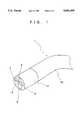
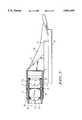
- FIG. 1is a schematic outer view of a fore end portion of an endoscopic insertion rod
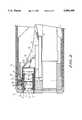
- FIG. 2is a schematic sectional view on an enlarged scale of a tip end section of the endoscopic insertion rod
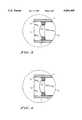
- FIG. 3is a fragmentary sectional view of a lens device in one embodiment of the present invention.
- FIG. 4is a fragmentary sectional view of a lens device in another embodiment of the present invention.
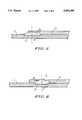
- FIG. 5is a fragmentary sectional view of a seal pocket packed with a seal material to hermetically shield the clearances between lens barrel and prism frame;
- FIG. 6is a fragmentary sectional view of a seal pocket of modified construction similarly packed with a seal material to hermetically shield the clearances between lens barrel and prism frame;
- FIG. 7is a sectional view of a lens device having a seal member interposed between lens barrel and prism frame;
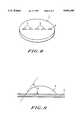
- FIG. 8is a schematic perspective view of an adhesive deposited on a glass surface
- FIG. 9is a schematic illustration explanatory of a wetting angle of an adhesive on the glass surface
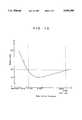
- FIG. 10is a diagram showing relations between wetting angle and strength of adhesion
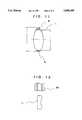
- FIG. 11is a schematic view of a lens element having machined surfaces in outer peripheral portions thereof.
- FIG. 12is a schematic view of a grinding stone adopted for machining the lens elements.
- the lens device according to the inventionis applied as an objective lens of an endoscopic image pickup system. Needless to say, the lens device of the present invention can find other applications where anti-fogging functions are required.
- FIG. 1there is shown a fore end portion of an endoscopic insertion rod.
- the insertion rod of an endoscopewhich is provided a rigid tip end section 1a at its distal end.
- the tip end section 1ais connected to the distal end of the insertion rod 1 through an angle section 1b of a predetermined axial length, which can be flexibly bent into arbitrary directions and which is, although not shown in the drawing, connected to a main flexible body of the insertion rod 1.
- illumination and observation windows 2 and 3 of illumination and observation systemsare provided on an end face portion (or on a lateral side) of the tip end section 1a.
- a biopsy channel or instrument channelwhich serves to guide forceps or other instruments into a body cavity, along with a nozzle 5 which spurts out a cleaning liquid or compressed air to clean the observation window 3.
- the tip end section 1a of the endoscopic insertion rod 1which is provided with a plural number of axial bores for mounting the illumination system and the optical image pickup system and for an instrument channel or channels 4 etc.
- the tip end section 1a which contains a plural number of boresis formed of metal or other rigid material for the purpose of guaranteeing necessary structural strength and for improving machining accuracy in forming a number of axial bores required.
- Fitted on the distal end of the tip end section lais an end cap 6 of synthetic resin material which is provided with apertures in axial alignment with the illumination window 2, observation window 3, instrument channel 4 and nozzle 5.
- An outer skin layer 7 of the main flexible rod sectionis extended across the angle section 1b and joined with the end cap 6 in such a manner as to enshroud the entire insertion rod 1 in an electrically insulated state.
- This arrangementprevents any metal part of the insertion rod from being exposed directly on the outer side, protecting patients against electrical shocks which could otherwise occur, for example, when a high-frequency bioptic instrument is inserted in the instrument channel 4.
- An objective lens unit 10is mounted within a bore which is formed in the tip end section 1a of the insertion rod 1 contiguously with the observation window 3.
- the objective lens unit 10is composed of a plural number of lens elements which are mounted in a lens barrel 11. Fitted on the inner end of the lens barrel 11 is a holder frame 13 of a prism 12 which is located behind the lens barrel 11 to turn the light path at right angles toward a solid-state image sensor 15.
- the solid-state image sensor 15is mounted on a substrate 14 and cemented to the prism 12. If desired, the solid-state image sensor may be directly connected to the lens barrel 11 without using a prism.
- the objective lens unitmay be of a construction which is composed of four lens elements L 1 to L 4 as shown in FIG. 2.
- the first lens element L 1 which is in the foremost positionis a plano-convex lens having a flat surface on the front side or on the side of the subject and a concave surface on the image-forming side.
- the second lens element L 2 which is located next to the first lens element L 1is a plano-convex lens having a convex surface on the image-forming side.
- the second and third lens elements L 3 and L 4are constituted by a cemented lens.
- the first and second lens elements L 1 and L 2are axially spaced apart from each other by a gap of a predetermined width, while the second lens element L 2 is partly abutted on the third lens element L 3 .
- a stopper ring 16is provided at the inner end of the lens barrel 11 on the image-forming side of the fourth lens element L 4 , and a spacer ring 17 is fitted between the first and second lens elements L 1 and L 2 .
- an annular spacer rib 18is provided on the inner periphery of the lens barrel 11 at a position between the second and third lens elements L 2 and L 3 .
- the first lens element L1 in the foremost positionis securely bonded to the lens barrel 11 by the use of an adhesive.
- the fore distal end of the barrel 11is tightly fitted in the end cap 6.
- Seal material 19is filled in an annular groove of V-shape in section, which is formed between outer marginal edge portions of the first lens element L 1 and inner peripheral edges at the outer end of the lens barrel 11. Further, seal material 19 is also applied to cover the prism frame 13, prism 12 and solid-state image sensor 15.
- the prism frame 13 which is assembled with the lens barrel 11is fixedly mounted in a predetermined position on the tip end section 1a of the endoscopic insertion rod 1 by means of a set screw 20, which is covered with seal material 19.
- the spacer ring 17 between the first and second lens elements L 1 and L 2is formed of a material of high thermal conductivity like metal.
- the lens barrel 11is formed of a metal or other material with high thermal conductivity.
- the prism frame 13 which is fitted on the lens barrel 11is formed of an electrically insulating material like synthetic resin.
- the tip end section 1atends to pick up temperature under the influence of body temperature of the patient or due to heat generation by the solid-state image sensor 15, up to a temperature level equivalent with or higher than the patient's body temperature, while it is being retained in the body cavity over a relatively long period of time.
- a washing liquid to be spurted onto the observation window 3 from the nozzle 5is held in a tank which is normally not equipped with a heater. Therefore, the first lens L 1 is cooled down as soon as the washing liquid is spurted from the nozzle 5 to clean the observation window 3.
- the cold washing liquidalso comes into contact with the lens barrel 11 which is formed of a metal with far higher thermal conductivity as compared with the first lens L 1 and which is in abutting engagement with the spacer ring 17 of a metal of high thermal conductivity. Therefore, when the washing liquid is spurted out from the nozzle 5 toward the observation window 3, the lens barrel 11 and spacer ring 17 are cooled down more quickly than center portions of the first lens element L 1 , and should moisture exist in the air gap between the first and second lens elements L1 and L2, it tends to condense firstly on those surfaces which are at lower temperatures. That is to say, moisture tends to condense on the spacer ring 17 which is the quickest one to be cooled by the washing liquid.
- the spacer ring 17which is relatively small in thickness, does not have enough room on its surfaces for deposition of a large amount of moisture. Therefore, it is desirable to shape the spacer ring 17 in such a manner as to increase its surface area as much as possible.
- the inner periphery of the spacer ring 17may be formed in an arcuately concave shape, providing an arcuate moisture deposition surface 17a with a broadened surface area which permits a greater amount of moisture deposition.
- the moisture content in the air spaceshould be of such a small amount which can be totally taken up by the moisture depositing surface 17a of the spacer ring 17, leaving the first lens L 1 completely free of moisture deposition or suppressing moisture deposition on the first lens element substantially to such an amount which would not cause fogging to endoscopic observation images.
- a temperature difference across the lens barrel 11occurs not only at the time of washing the observation window 3 as described above, for example, but also when using an endoscope after high-temperature sterilization in which the endoscope as a whole is treated with a high temperature.
- fogging of the first lens element L 1can be prevented by the preferential moisture deposition on the moisture depositing surface 17a of the spacer ring 17.
- the moisture depositing surface 17a' of the spacer ring 17'has a greater surface area for moisture deposition, and, in addition to the function of preventing the fogging of the first lens element L 1 , contributes to further improve the quality of endoscopic observation images picked up by the solid-state image sensor 15, scattering harmful components of incident light rays by irregular reflections on the tapped grooves.
- the objective lens unit of the inventionprevents fogging of the surfaces of the first lens element L 1 by preferentially condensing moisture in the air gap between the first and second lens elements L 1 and L 2 , if any.
- the spacer ring 17might fail to maintain sufficient anti-fogging effects on the first lens element L 1 .
- the distance between the objective lens 10 and the image sensor 15is adjusted by moving the lens barrel 11 in the direction of the optical axis. More particularly, the final adjustment of the focus position is normally made by shifting the position of the lens barrel 11 axially in the forward and backward directions about ⁇ 0.2 mm from a reference position adopted in an assembling stage, namely, axially over a distance of about 4 mm in total.
- the lens barrel 11is fitted in the prism frame 13 loosely to permit the axial sliding movements in that range, and therefore, it is necessary to hermetically seal all gap spaces or clearances when fixing the lens barrel 11 to the prism frame 13 subsequent to the final adjustments, because otherwise the lens barrel 11 will easily lose air-tightness.
- seal material 19is filled in the clearances at the fore end of the prism frame 13 as shown in FIG. 2 to seal up all open gaps.
- the seal material which can be applied to fill in the small gapsis limited in amount and therefore it is difficult to maintain a sufficient seal strength by the seal material 19 alone, which may suffer from degradations in seal strength as a result of impregnation of moisture.
- this seal pocketis packed with an adhesive type seal material 23.
- the seal pocket which is constituted by the annular groove 21 on the lens barrel 11 and the annular sunken wall portion 22 on the prism frame 13should have a width greater than the axial focus position adjustment range.
- the provision of the seal pocket of this naturemakes it possible to pack a greater amount of seal material 23 in the narrow gap space between the lens barrel 11 and the prism frame 13 to form a seal of greater strength which can ensure hermetical tightness of the objective lens in a securer manner.
- the seal pocketcan keep moisture out of the lens barrel 1 even when outer part of the seal material 23 is moistened to some extent due to deposition or impregnation of water.
- the seal material 23hardens into a solid state within the seal pocket, it is strongly bonded to stepped wall portions of the annular groove 21 of the lens barrel 11 as well as to stepped portions of the sunken wall portion 22 of the prism frame 13 to form an anchor seal. Thanks to the anchoring effects of the seal material 22, the lens barrel 11 and prism frame 13 are stably retained in the adjusted positional relations, precluding deviations of the lens barrel 11 from the adjusted focus position.
- the seal pocketmay be arranged in a form other than the above-described from, for example, in the form as shown in FIG. 6.
- a seal pocketis formed by an annular groove 25 which is provided on the outer periphery of the lens barrel, substantially in the same dimensions as the annular groove 21 of FIG. 5, and an annular groove 26 which is provided on the inner periphery of the prism frame 13 face to face with the annular groove 25.
- These annular grooves 25 and 26are formed in such positions that centers of the two grooves are aligned in the radial direction when the lens barrel 11 is located in a predetermined reference position relative to the prism frame 13.
- the widths in the axial direction of the annular grooves 25 and 26are determined on the basis of the range in which the lens barrel 11 is to be moved for adjustments of the focus position as described hereinbefore.
- the two grooves 25 and 26may be formed in the same width in the axial direction, or alternatively the groove 26 on the prism frame 13 may be formed in a larger width than the groove 25 on the lens barrel 11.
- Seal material 27is packed in the pocket which is defined between the two grooves 25 and 26.
- the prism frame 13is provided with a seal material charging hole 28 in communication with the groove 26.
- the seal pocket of this constructioncan also provide a stronger hermetical seal for the space between the lens barrel 11 and prism frame 13.
- a hermetical sealmay be formed by interposing a seal member like an O-ring 30 between the lens barrel 11 and prism frame 13 as shown in FIG. 7.
- the seal member 30is accommodated in an annular groove 31 which is formed on the inner periphery of the prism frame 13 with an increased thickness.
- the gap space between the lens barrel 11 and prism frame 13can be sealed perfectly by the arrangements as described above, the hermetical seal between the first lens element L 1 and lens barrel 11 can be improved further by using a suitable adhesive as described below.
- the adhesive to be used for bonding the first lens element L 1 to the lens barrel 11should have suitable compatibility with both metal and glass.
- epoxy resin adhesivesare employed for filling clearances between metal and glass materials.
- solventit is preferable to use an alcoholic solvent, for example, acetone or the like.
- solventssuch as cyclopentanone, n-pentanol, n-hexanol are preferred.
- benzene, methylene carbide, o-cyclolbenzene or butylnitrilecan be used.
- the wettabilityindicates the extent to which an adhesive agent can spread and wet the surfaces to be bonded.
- use of an adhesive with high wettabilityis extremely advantageous in forming strong hermetical tightness between bonded components.
- wettability of a bonding surface by an adhesiveis expressed by way of a wetting angle. More particularly, an adhesive is dropped on a surface of bonding material S to measure a rising angle of a semi-globular mound of the adhesive as a wetting angle indicative of its wettability.
- the adhesive agentshould have a smaller wetting angle on the first lens element L 1 .
- the wettability of an adhesive agentvaries not only in relation with the properties of the adhesive and of the material to be bonded, but also depending upon the surface conditions of the bonding material. In this regard, it has been generally accepted that a bonding surface should be made as smooth as possible to better the wettability. However, this cannot be applied to wettability on glass as seen in the diagram of FIG. 10 which shows the relations between wetting angle ⁇ of an adhesive on glass and strength of adhesion.
- the wetting anglebecomes the smallest at a glass surface roughness of about #1,000 in mesh size. Accordingly, sufficient adhesion strength can be obtained at #400 to #1,200 in mesh size, and, at these small wetting angles, the adhesive can be spread in an accelerated manner to ensure sufficient air tightness at the bonded joint.
- adhesion strength as well as hermetical tightnesscan be improved by controlling the glass surfaces to a predetermined roughness. More specifically, it is preferred to machine peripheral surfaces of the first lens element L1 to a mesh size of #400 to #1,200, more preferably, to a mesh size of approximately #1,000. As seen in FIG. 11, preferably the lens element is formed in a slightly larger size in diameter in a manufacturing stage, and afterwards reduced to a predetermined diameter by a grinding operation, removing extra marginal portions R (indicated by hatching in the same figure) which are provided for centering purposes.
- the first lens element L 1can be securely bonded and fixed to the lens barrel 11 by the adhesive which is uniformly spread between the lens element L 1 and the lens barrel 11 entirely around the respective outer and inner peripheries, making it possible to maintain an extremely high hermetical seal over a long period of time.
- the lens device according to the present inventionis completely shielded with strong hermetical seal means at the gap spaces or clearances between the lens barrel 11 and prism frame 13 as well as at the clearances between the lens barrel 11 and first lens element L1, so that, once dry air is charged into the lens barrel 11, it can preclude the fogging phenomenon due to existence of moisture in the gap space between the first and second lens elements L 1 and L 2 . Even if moisture creeps into the gap space during use over a long period of time, the lens device still retains extremely high anti-fogging functions since such moisture is preferentially condensed on moisture depositing surfaces of the spacer ring 17.
Landscapes
- Health & Medical Sciences (AREA)
- Life Sciences & Earth Sciences (AREA)
- Physics & Mathematics (AREA)
- Surgery (AREA)
- Optics & Photonics (AREA)
- Biomedical Technology (AREA)
- Medical Informatics (AREA)
- Radiology & Medical Imaging (AREA)
- Nuclear Medicine, Radiotherapy & Molecular Imaging (AREA)
- Engineering & Computer Science (AREA)
- Biophysics (AREA)
- Heart & Thoracic Surgery (AREA)
- Pathology (AREA)
- Molecular Biology (AREA)
- Animal Behavior & Ethology (AREA)
- General Health & Medical Sciences (AREA)
- Public Health (AREA)
- Veterinary Medicine (AREA)
- Astronomy & Astrophysics (AREA)
- General Physics & Mathematics (AREA)
- Endoscopes (AREA)
Abstract
Description
This invention relates to a lens device suitable for use as an objective lens on an optical imaging system of endoscopic instrument, and more particularly to a lens device with anti-fogging functions.
Extended out on the front side of a manipulating head grip of endoscope is a rod-like insertion instrument for introduction into a body cavity. The insertion instrument or rod contains components of illumination and observation systems which are necessary for endoscopic observations or examinations. Led out on the rear side of the manipulating head grip is a so-called universal cable which contains a light guide in the form of a bundle of fiber optics to send forward illumination light from a light source. The universal cable is usually disconnectibly connected to a connection terminal of a light source with a source lamp. The fore light emitting end of the light guide is coextensively passed through the endoscopic insertion rod down to a light projecting window of the illumination system, which is provided at the fore distal end of the endoscopic insertion rod. An illumination lens is fitted in the light projecting window for the purpose of dispersing illumination light which is emitted from the light guide. On the other hand, the observation system serves to pick up images of intracavitary portions which are lighted up by the illumination system.
By the type of image pickup system, the endoscopes can be classified into two types. The first one is an optical endoscope which is arranged to transfer optical images through an optical image guide to an eyepiece which is provided on or in the vicinity of the manipulating head grip, so that an operator can view the images of intracavitary portions through the eyepiece. The second one is an electronic endoscope which is provided with a photoelectric image sensor device like CCD thereby to convert images of intracavitary portions under observation into electric signals, which are then processed by a signal processor to display video images of the intracavitary portions on a viewing screen. In any case, components for the endoscopic observation system, including an objective lens, are built into a fore end portion of the insertion rod. Normally, the objective lens is composed of a plural number of lens elements which are mounted in a lens barrel. In the case of an optical endoscope, an input end of a light guide is located at the focus of the objective lens, and, in the case of an electronic endoscope, a photoelectric image sensor is located in that position. The respective lens elements of the objective lens are mounted in a lens barrel which is built into a rigid tip end section of the endoscopic insertion rod.
For the purpose of securing a wide view field, a wide angle lens system is usually employed as an objective lens, and, of a plural number of objective lens elements, the first lens element which is located in a foremost position on the side of subject is constituted by a concave lens. From the standpoint of reducing complicate irregularities in contour at the distal end of the endoscopic insertion rod, the first lens is preferred to be in the form of a plano-concave lens which is fitted in a lens barrel with its flat surface on the outer side, that is, on the side of the subject. Consequently, the first lens element is normally required to have a concave surface of extremely large curvature on the inner side thereof. Besides, it is necessary to provide an air gap of a predetermined width between the first lens and a second lens element which is located on the rear side of the first lens element.
While the endoscopic insertion rod is retained within a body cavity for an examination, the exterior surfaces of the first lens, which is exposed on the front side of the instrument, are often smudged by deposition of body fluids or other contaminants to such a degree as to cause considerable blurring to the images of intracavitary portions under observation. Therefore, it is usually the case that a lens surface washer is provided on the endoscopic insertion rod thereby to wash away deposited contaminant with a cleaning fluid. More specifically, normally deposited contaminants are washed away with a washing liquid which is spurted out from a nozzle which is provided on a lens surface washer, while residues of the washing liquid are removed from the lens surface by blasting compressed air thereon. Within a body cavity, the distal end portions of the endoscopic insertion rod, including the first lens, are warmed up to a temperature level which is almost same as the body temperature of the patient, and, in the case of an electronic endoscope which contains a heat-generating element like a solid-state image sensor, the first lens could reach a higher temperature level. Nevertheless, according to the general procedure, the washing liquid is supplied to the first lens of the objective lens assembly in an unheated state, that is to say, at the ambient temperature. Consequently, the first lens is quickly cooled off to a colder temperature as soon as the washing liquid is sprinkled on its surfaces.
When the first lens is quickly cooled off in this manner, fogging or moisture condensation occurs to the inner concave surface of the first lens element should moisture exist in the air gap between the first and second lenses. Besides, because of the large curvature of the inner concave surface, the first lens undergoes temperature drops most conspicuously in its thinner center portions or in the vicinity of its center portions. It follows that fogging or moisture condensation takes place concentratedly in center portions of the inner concave surface of the first lens, abruptly degrading the quality of images to an extremely obscured state because most of image-forming light rays are collected in center portions of the concave surface of the first lens.
In this regard, in order to prevent fogging or moisture condensation on the inner surface of the first lens, it has been known in the art to use a lens barrel having moisture-free dry air sealed in air spaces between the lens elements which are fitted in the barrel. Although the lens elements at the opposite ends of the lens barrel are mounted in a hermetically sealed state to retain dry air in the barrel, it is extremely difficult to maintain the dryness over a long period of time since dry air is gradually replaced by moistened air. Accordingly, the anti-fogging function which resorts to dry air has limits in time, suffering from deteriorations in anti-fogging effects upon lapse of a certain period of time.
In view of the situations as discussed above, it is an object of the present invention to provide a lens device with anti-fogging functions, which can maintain the anti-fogging functions over a long period of time.
It is another object of the present invention to provide a lens device which can prevent fogging or moisture condensation within a lens barrel, particularly in center areas of an inner concave surface of a first lens element located in a foremost position on the lens barrel.
It is still another object of the present invention to provide a lens device which is arranged to let moisture, if any, condense preferentially in those areas outside an effective diameter of a first lens element located in a foremost position on a lens barrel.
In accordance with the present invention, the above-stated objective are achieved by the provision of a lens device having a plural number of optical lens elements mounted in a cylindrical lens barrel, including a first lens element located in a foremost position on the side of a subject and a second lens element located behind and at a gap space from the first lens element, the lens device including a spacer ring fitted in the lens barrel to hold the first and second lens elements in a predetermined spaced relation, the spacer ring being formed of a material having higher thermal conductivity than the lens elements and provided with a moisture depositing surface of non-flat shape to increase the surface area thereof.
For increasing the surface area of the moisture depositing surface on the inner periphery of the spacer ring, it may be formed in an arcuately concave shape in cross section or formed with a plural number of tapped grooves. The lens device is particularly suitable for use on an endoscope by mounting the lens barrel as an objective lens of an optical imaging system on a distal end portion of an endoscopic insertion rod. The fore end face of the lens barrel is exposed to the outside at the distal end of the endoscopic insertion rod, and, whenever exterior surfaces of the insertion rod are cooled off, heat is efficiently conducted to the spacer ring from the fore end face of the lens barrel to let moisture condense preferentially on the moisture depositing surface on the inner periphery of the spacer ring if any.
According to another feature of the present invention, a seal pocket is provided between the lens barrel and prism frame. The seal pocket is packed with a seal material to stop clearances between the lens barrel and prism frame with a securer hermetical seal.
The above and other objects, features and advantages of the invention will become apparent from the following particular description, taken in conjunction with the accompanying drawings which show by way of example preferred embodiments of the invention and in which:
FIG. 1 is a schematic outer view of a fore end portion of an endoscopic insertion rod;
FIG. 2 is a schematic sectional view on an enlarged scale of a tip end section of the endoscopic insertion rod;
FIG. 3 is a fragmentary sectional view of a lens device in one embodiment of the present invention;
FIG. 4 is a fragmentary sectional view of a lens device in another embodiment of the present invention;
FIG. 5 is a fragmentary sectional view of a seal pocket packed with a seal material to hermetically shield the clearances between lens barrel and prism frame;
FIG. 6 is a fragmentary sectional view of a seal pocket of modified construction similarly packed with a seal material to hermetically shield the clearances between lens barrel and prism frame;
FIG. 7 is a sectional view of a lens device having a seal member interposed between lens barrel and prism frame;
FIG. 8 is a schematic perspective view of an adhesive deposited on a glass surface;
FIG. 9 is a schematic illustration explanatory of a wetting angle of an adhesive on the glass surface;
FIG. 10 is a diagram showing relations between wetting angle and strength of adhesion;
FIG. 11 is a schematic view of a lens element having machined surfaces in outer peripheral portions thereof; and
FIG. 12 is a schematic view of a grinding stone adopted for machining the lens elements.
Hereafter, the invention is described more particularly by way of its preferred embodiments with reference to the accompanying drawings. In the following description, the lens device according to the invention is applied as an objective lens of an endoscopic image pickup system. Needless to say, the lens device of the present invention can find other applications where anti-fogging functions are required.
Referring first to FIG. 1, there is shown a fore end portion of an endoscopic insertion rod. In this figure, indicated at 1 is the insertion rod of an endoscope, which is provided a rigid tip end section 1a at its distal end. The tip end section 1a is connected to the distal end of theinsertion rod 1 through anangle section 1b of a predetermined axial length, which can be flexibly bent into arbitrary directions and which is, although not shown in the drawing, connected to a main flexible body of theinsertion rod 1. Provided on an end face portion (or on a lateral side) of the tip end section 1a are illumination andobservation windows observation windows observation window 3.
Shown on an enlarged scale in FIG. 2 is the tip end section 1a of theendoscopic insertion rod 1 which is provided with a plural number of axial bores for mounting the illumination system and the optical image pickup system and for an instrument channel orchannels 4 etc. Normally, the tip end section 1a which contains a plural number of bores is formed of metal or other rigid material for the purpose of guaranteeing necessary structural strength and for improving machining accuracy in forming a number of axial bores required. Fitted on the distal end of the tip end section la is an end cap 6 of synthetic resin material which is provided with apertures in axial alignment with theillumination window 2,observation window 3,instrument channel 4 and nozzle 5. An outer skin layer 7 of the main flexible rod section is extended across theangle section 1b and joined with the end cap 6 in such a manner as to enshroud theentire insertion rod 1 in an electrically insulated state. This arrangement prevents any metal part of the insertion rod from being exposed directly on the outer side, protecting patients against electrical shocks which could otherwise occur, for example, when a high-frequency bioptic instrument is inserted in theinstrument channel 4.
Anobjective lens unit 10 is mounted within a bore which is formed in the tip end section 1a of theinsertion rod 1 contiguously with theobservation window 3. Theobjective lens unit 10 is composed of a plural number of lens elements which are mounted in alens barrel 11. Fitted on the inner end of thelens barrel 11 is aholder frame 13 of aprism 12 which is located behind thelens barrel 11 to turn the light path at right angles toward a solid-state image sensor 15. The solid-state image sensor 15 is mounted on asubstrate 14 and cemented to theprism 12. If desired, the solid-state image sensor may be directly connected to thelens barrel 11 without using a prism.
For instance, the objective lens unit may be of a construction which is composed of four lens elements L1 to L4 as shown in FIG. 2. In this case, the first lens element L1 which is in the foremost position is a plano-convex lens having a flat surface on the front side or on the side of the subject and a concave surface on the image-forming side. The second lens element L2 which is located next to the first lens element L1 is a plano-convex lens having a convex surface on the image-forming side. Further, the second and third lens elements L3 and L4 are constituted by a cemented lens. The first and second lens elements L1 and L2 are axially spaced apart from each other by a gap of a predetermined width, while the second lens element L2 is partly abutted on the third lens element L3. Astopper ring 16 is provided at the inner end of thelens barrel 11 on the image-forming side of the fourth lens element L4, and aspacer ring 17 is fitted between the first and second lens elements L1 and L2. Further, anannular spacer rib 18 is provided on the inner periphery of thelens barrel 11 at a position between the second and third lens elements L2 and L3.
For the purpose of hermetically closing thelens barrel 11, the first lens element L1 in the foremost position is securely bonded to thelens barrel 11 by the use of an adhesive. In addition, in order to enhance the hermetic tightness of thelens barrel 11, the fore distal end of thebarrel 11 is tightly fitted in the end cap 6.Seal material 19 is filled in an annular groove of V-shape in section, which is formed between outer marginal edge portions of the first lens element L1 and inner peripheral edges at the outer end of thelens barrel 11. Further,seal material 19 is also applied to cover theprism frame 13,prism 12 and solid-state image sensor 15. Theprism frame 13 which is assembled with thelens barrel 11 is fixedly mounted in a predetermined position on the tip end section 1a of theendoscopic insertion rod 1 by means of aset screw 20, which is covered withseal material 19.
Thespacer ring 17 between the first and second lens elements L1 and L2 is formed of a material of high thermal conductivity like metal. Similarly, thelens barrel 11 is formed of a metal or other material with high thermal conductivity. On the other hand, theprism frame 13 which is fitted on thelens barrel 11 is formed of an electrically insulating material like synthetic resin. As a result, thelens barrel 11 is maintained electrically out of contact with other conducting parts like the tip end section 1a of theinsertion rod 1 to preclude possibilities of current leakage which might otherwise occur during use of a high-frequency bioptic instrument.
When theendoscopic insertion rod 1 is introduced into a body cavity of a patient, the tip end section 1a tends to pick up temperature under the influence of body temperature of the patient or due to heat generation by the solid-state image sensor 15, up to a temperature level equivalent with or higher than the patient's body temperature, while it is being retained in the body cavity over a relatively long period of time. On the other hand, a washing liquid to be spurted onto theobservation window 3 from the nozzle 5 is held in a tank which is normally not equipped with a heater. Therefore, the first lens L1 is cooled down as soon as the washing liquid is spurted from the nozzle 5 to clean theobservation window 3. On such an occasion, the supply of washing liquid would not give rise to any problem in particular as long as air in the space between the first and second lens elements L1 and L2 is dry air which is completely free of moisture. However, if it contains moisture even in a slight amount, fogging or moisture condensation will occur as a result of temperature drops of the first lens L1.
Nevertheless, while the first lens L1 is undergoing temperature drops to a certain degree by contact with the cold washing liquid which is spurted out from the nozzle 5, the cold washing liquid also comes into contact with thelens barrel 11 which is formed of a metal with far higher thermal conductivity as compared with the first lens L1 and which is in abutting engagement with thespacer ring 17 of a metal of high thermal conductivity. Therefore, when the washing liquid is spurted out from the nozzle 5 toward theobservation window 3, thelens barrel 11 andspacer ring 17 are cooled down more quickly than center portions of the first lens element L1, and should moisture exist in the air gap between the first and second lens elements L1 and L2, it tends to condense firstly on those surfaces which are at lower temperatures. That is to say, moisture tends to condense on thespacer ring 17 which is the quickest one to be cooled by the washing liquid.
However, thespacer ring 17, which is relatively small in thickness, does not have enough room on its surfaces for deposition of a large amount of moisture. Therefore, it is desirable to shape thespacer ring 17 in such a manner as to increase its surface area as much as possible. For example, as shown in FIG. 3, the inner periphery of thespacer ring 17 may be formed in an arcuately concave shape, providing an arcuate moisture deposition surface 17a with a broadened surface area which permits a greater amount of moisture deposition. Since the air space between the first and second lens elements L1 and L2 is initially filled with moisture-free dry air and shielded by theseal material 19, the moisture content in the air space, if any, should be of such a small amount which can be totally taken up by the moisture depositing surface 17a of thespacer ring 17, leaving the first lens L1 completely free of moisture deposition or suppressing moisture deposition on the first lens element substantially to such an amount which would not cause fogging to endoscopic observation images.
A temperature difference across thelens barrel 11 occurs not only at the time of washing theobservation window 3 as described above, for example, but also when using an endoscope after high-temperature sterilization in which the endoscope as a whole is treated with a high temperature. In any case, fogging of the first lens element L1 can be prevented by the preferential moisture deposition on the moisture depositing surface 17a of thespacer ring 17.
There may be employed aspacer ring 17 of a shape other than the one which is shown in FIG. 3, for instance, there may be employed a spacer ring 17' which is provided with tapped grooves on a moisture depositing surface 17a' on its inner periphery as shown in FIG. 4. In this case, thanks to the tapped grooves, the moisture depositing surface 17a' of the spacer ring 17' has a greater surface area for moisture deposition, and, in addition to the function of preventing the fogging of the first lens element L1, contributes to further improve the quality of endoscopic observation images picked up by the solid-state image sensor 15, scattering harmful components of incident light rays by irregular reflections on the tapped grooves.
In this manner, the objective lens unit of the invention prevents fogging of the surfaces of the first lens element L1 by preferentially condensing moisture in the air gap between the first and second lens elements L1 and L2, if any. However, in case an unexpectedly large amount of moisture exists in the air gap, thespacer ring 17 might fail to maintain sufficient anti-fogging effects on the first lens element L1. In order to avoid such a situation, it is important for thelens barrel 11 to be hermetically tight enough for preventing intrusion of moisture from outside. This is the reason why theseal material 19 is packed between thelens barrel 11 and the first lens element L1. For improving the hermetical tightness of thelens barrel 11, it is desirable to make adjustments as described below.
Firstly, it is necessary to check for errors as occurring in the process of assembling the respective lens elements into the lens barrel, as well as deviations from the focus position of theobjective lens unit 10 as occurring when connecting theprism 14 and solid-state image sensor 16 to theprism frame 13. In order to locate the solid-state image sensor 15 exactly at the focus of theobjective lens unit 10, the distance between theobjective lens 10 and theimage sensor 15 is adjusted by moving thelens barrel 11 in the direction of the optical axis. More particularly, the final adjustment of the focus position is normally made by shifting the position of thelens barrel 11 axially in the forward and backward directions about ±0.2 mm from a reference position adopted in an assembling stage, namely, axially over a distance of about 4 mm in total. For this purpose, thelens barrel 11 is fitted in theprism frame 13 loosely to permit the axial sliding movements in that range, and therefore, it is necessary to hermetically seal all gap spaces or clearances when fixing thelens barrel 11 to theprism frame 13 subsequent to the final adjustments, because otherwise thelens barrel 11 will easily lose air-tightness. After assembling together thelens barrel 11 relative to theprism frame 13 and making adjustments of the focus position as described above,seal material 19 is filled in the clearances at the fore end of theprism frame 13 as shown in FIG. 2 to seal up all open gaps. However, the seal material which can be applied to fill in the small gaps is limited in amount and therefore it is difficult to maintain a sufficient seal strength by theseal material 19 alone, which may suffer from degradations in seal strength as a result of impregnation of moisture.
In order to seal the open gaps or clearances between thelens barrel 11 and theprism frame 13 more perfectly, it is desirable to provide a seal pocket between these members, including an annular groove 21 formed on and around the outer periphery of thelens barrel 11 in face to face relation with a steppedsunken wall portion 22 formed on the inner periphery of a fore end portion of theprism frame 13 as shown particularly in FIG. 5. Preferably, this seal pocket is packed with an adhesivetype seal material 23. Considering that the adjustment of focus position can be made by varying the relative positions of thelens barrel 11 andprism frame 13 within an extremely fine range of ±0.2 mm axially in the forward or backward direction from the reference position P indicated in the same figure, the seal pocket which is constituted by the annular groove 21 on thelens barrel 11 and the annularsunken wall portion 22 on theprism frame 13 should have a width greater than the axial focus position adjustment range. By arranging a seal pocket in this manner, it can always be formed between thelens barrel 11 and theprism frame 13 although its shape might be changed in a slight degree when thelens barrel 11 is axially displaced relative to theprism frame 13 for the adjustment of focus position. The annular groove 21 is preferred to be as deep as possible within a range which would not impair the strength of thelens barrel 11.
The provision of the seal pocket of this nature makes it possible to pack a greater amount ofseal material 23 in the narrow gap space between thelens barrel 11 and theprism frame 13 to form a seal of greater strength which can ensure hermetical tightness of the objective lens in a securer manner. The seal pocket can keep moisture out of thelens barrel 1 even when outer part of theseal material 23 is moistened to some extent due to deposition or impregnation of water. Besides, as theseal material 23 hardens into a solid state within the seal pocket, it is strongly bonded to stepped wall portions of the annular groove 21 of thelens barrel 11 as well as to stepped portions of thesunken wall portion 22 of theprism frame 13 to form an anchor seal. Thanks to the anchoring effects of theseal material 22, thelens barrel 11 andprism frame 13 are stably retained in the adjusted positional relations, precluding deviations of thelens barrel 11 from the adjusted focus position.
If desired, the seal pocket may be arranged in a form other than the above-described from, for example, in the form as shown in FIG. 6. In this case, a seal pocket is formed by an annular groove 25 which is provided on the outer periphery of the lens barrel, substantially in the same dimensions as the annular groove 21 of FIG. 5, and anannular groove 26 which is provided on the inner periphery of theprism frame 13 face to face with the annular groove 25. Theseannular grooves 25 and 26 are formed in such positions that centers of the two grooves are aligned in the radial direction when thelens barrel 11 is located in a predetermined reference position relative to theprism frame 13. The widths in the axial direction of theannular grooves 25 and 26 are determined on the basis of the range in which thelens barrel 11 is to be moved for adjustments of the focus position as described hereinbefore. In this regard, the twogrooves 25 and 26 may be formed in the same width in the axial direction, or alternatively thegroove 26 on theprism frame 13 may be formed in a larger width than the groove 25 on thelens barrel 11.Seal material 27 is packed in the pocket which is defined between the twogrooves 25 and 26. To this end, theprism frame 13 is provided with a sealmaterial charging hole 28 in communication with thegroove 26. Thus, the seal pocket of this construction can also provide a stronger hermetical seal for the space between thelens barrel 11 andprism frame 13.
Further, a hermetical seal may be formed by interposing a seal member like an O-ring 30 between thelens barrel 11 andprism frame 13 as shown in FIG. 7. In this case, theseal member 30 is accommodated in an annular groove 31 which is formed on the inner periphery of theprism frame 13 with an increased thickness.
While the gap space between thelens barrel 11 andprism frame 13 can be sealed perfectly by the arrangements as described above, the hermetical seal between the first lens element L1 andlens barrel 11 can be improved further by using a suitable adhesive as described below.
The adhesive to be used for bonding the first lens element L1 to thelens barrel 11 should have suitable compatibility with both metal and glass. Generally epoxy resin adhesives are employed for filling clearances between metal and glass materials. As for solvent, it is preferable to use an alcoholic solvent, for example, acetone or the like. Among others, solvents such as cyclopentanone, n-pentanol, n-hexanol are preferred. Alternatively, benzene, methylene carbide, o-cyclolbenzene or butylnitrile can be used.
In selecting an adhesive, it is important to consider the wettability, a factor which has great influences on the adhesion or adhesive strength. More specifically, the wettability indicates the extent to which an adhesive agent can spread and wet the surfaces to be bonded. The higher the wettability, the greater becomes the adhesive strength. Namely, use of an adhesive with high wettability is extremely advantageous in forming strong hermetical tightness between bonded components. Generally, wettability of a bonding surface by an adhesive is expressed by way of a wetting angle. More particularly, an adhesive is dropped on a surface of bonding material S to measure a rising angle of a semi-globular mound of the adhesive as a wetting angle indicative of its wettability. From the standpoint of securing higher adhesion and hermetical tightness, the adhesive agent should have a smaller wetting angle on the first lens element L1. Of course, the wettability of an adhesive agent varies not only in relation with the properties of the adhesive and of the material to be bonded, but also depending upon the surface conditions of the bonding material. In this regard, it has been generally accepted that a bonding surface should be made as smooth as possible to better the wettability. However, this cannot be applied to wettability on glass as seen in the diagram of FIG. 10 which shows the relations between wetting angle θ of an adhesive on glass and strength of adhesion.
As clear from that diagram, the wetting angle becomes the smallest at a glass surface roughness of about #1,000 in mesh size. Accordingly, sufficient adhesion strength can be obtained at #400 to #1,200 in mesh size, and, at these small wetting angles, the adhesive can be spread in an accelerated manner to ensure sufficient air tightness at the bonded joint.
It follows that adhesion strength as well as hermetical tightness can be improved by controlling the glass surfaces to a predetermined roughness. More specifically, it is preferred to machine peripheral surfaces of the first lens element L1 to a mesh size of #400 to #1,200, more preferably, to a mesh size of approximately #1,000. As seen in FIG. 11, preferably the lens element is formed in a slightly larger size in diameter in a manufacturing stage, and afterwards reduced to a predetermined diameter by a grinding operation, removing extra marginal portions R (indicated by hatching in the same figure) which are provided for centering purposes.
In removing outer peripheral portions of the lens element by a grinding operation, for example, there may be employed a grinding stone as shown at 60 in FIG. 12. In abrading outer peripheral portions of the first lens element L1 by a grinding operation, it is important to control the surface roughness to a mesh size of approximately #1,000 as mentioned above. By so doing, an applied epoxy resin adhesive can be spread uniformly over the entire machined surfaces of the first lens element L1 and strongly bonded with the latter at the time of mounting the lens element in thelens barrel 11. Consequently, the first lens element L1 can be securely bonded and fixed to thelens barrel 11 by the adhesive which is uniformly spread between the lens element L1 and thelens barrel 11 entirely around the respective outer and inner peripheries, making it possible to maintain an extremely high hermetical seal over a long period of time.
As clear from the foregoing description, the lens device according to the present invention is completely shielded with strong hermetical seal means at the gap spaces or clearances between thelens barrel 11 andprism frame 13 as well as at the clearances between thelens barrel 11 and first lens element L1, so that, once dry air is charged into thelens barrel 11, it can preclude the fogging phenomenon due to existence of moisture in the gap space between the first and second lens elements L1 and L2. Even if moisture creeps into the gap space during use over a long period of time, the lens device still retains extremely high anti-fogging functions since such moisture is preferentially condensed on moisture depositing surfaces of thespacer ring 17. Therefore, when used on an endoscopic insrtion rod or under circumstances where a large temperature difference occurs between the inner and outer sides of the lens barrel, it can always prevent fogging of the first lens element L1 or other optical elements of the lens device especially in the passage areas of image-forming light rays.
Claims (12)
1. A lens device having a plural number of optical lens elements mounted within a cylindrical lens barrel, including a first lens element located in a foremost position on the side of a subject and a second lens element located behind and at a space from said first lens element, said lens device comprising:
a spacer ring fitted in said lens barrel to set apart said first and second lens elements by a gap space of a predetermined width, said spacer ring being formed of a material having higher thermal conductivity than said lens elements and, on the side of inner periphery thereof, provided with a moisture depositing surface formed in a non-flat shape to increase surface area on said inner periphery.
2. A lens device as defined in claim 1, wherein said lens barrel is formed of a metallic material of high thermal conductivity and mounted on an optical imaging system with a front end portion of said lens barrel in an exposed state.
3. A lens device as defined in claim 1, wherein said moisture depositing surface of said spacer ring is formed in an arcuately concave shape in cross section in axial direction.
4. A lens device as defined in claim 1, wherein said moisture depositing surface on the inner periphery of said spacer ring is formed with a large number of tapped grooves.
5. A lens device as defined in claim 1, wherein said lens barrel is incorporated into an endoscopic imaging system on a tip end portion of an endoscopic insertion rod, with a front end portion of said lens barrel in an exposed state.
6. A lens device as defined in claim 5, wherein said lens barrel is fitted in a cylindrical member axially slidably within a predetermined focus position adjustment range, and provided with an annular groove on and around the outer periphery thereof in association with a stepped sunken wall portion formed on and around the inner periphery of said cylindrical member to provide a seal pocket to be packed with a seal material.
7. A lens device as defined in claim 6, wherein said cylindrical member is provided with a stepped sunken wall portion on the inner periphery thereof over a predetermined length from a fore distal end thereof, said annular groove on said lens barrel being located in such a position as to come into radially overlapping relation with said annular groove on said lens barrel when the latter is in said focus position adjustment range.
8. A lens device as defined in claim 6, wherein said lens barrel and cylindrical member are formed with annular groove on outer and inner peripheries thereof in radially overlapping relation with each other to provide said seal pocket, said annular grooves on said lens barrel and cylindrical member each having an axial length greater than a slidable range of said lens barrel corresponding to said focus position adjustment range, and said cylindrical member is provided with a seal material supply port opened on the outer periphery thereof in communication with said annular groove.
9. A lens device as defined in claim 6, wherein said lens barrel is axially slidably fitted in said cylindrical member for adjustments of focus position of an objective lens member and hermetically shielded by a seal material filled in clearances between said lens barrel and said cylindrical member.
10. A lens device as defined in claim 1, wherein said first lens element is bonded to said lens barrel by the use of an adhesive, outer peripheral surfaces of said first lens element being machined to a predetermined roughness to improve wettability of said adhesive.
11. A lens device as defined in claim 10, wherein said adhesive is an epoxy resin adhesive.
12. A lens device as defined in claim 10, wherein the outer peripheral surfaces of said first lens element are machined to a roughness of #400 to #1,200 in mesh size.
Applications Claiming Priority (8)
| Application Number | Priority Date | Filing Date | Title |
|---|---|---|---|
| JP8-318600 | 1996-11-15 | ||
| JP31860096AJP3887855B2 (en) | 1996-11-15 | 1996-11-15 | Lens device |
| JP8-325860 | 1996-11-22 | ||
| JP32586096AJP3584643B2 (en) | 1996-11-22 | 1996-11-22 | Lens device |
| JP34448996AJP3591180B2 (en) | 1996-12-10 | 1996-12-10 | Endoscope lens device |
| JP8-344489 | 1996-12-10 | ||
| JP9-057092 | 1997-02-26 | ||
| JP05709297AJP3422208B2 (en) | 1997-02-26 | 1997-02-26 | Endoscope optical component mounting mechanism |
Publications (1)
| Publication Number | Publication Date |
|---|---|
| US5894369Atrue US5894369A (en) | 1999-04-13 |
Family
ID=27463448
Family Applications (1)
| Application Number | Title | Priority Date | Filing Date |
|---|---|---|---|
| US08/967,659Expired - LifetimeUS5894369A (en) | 1996-11-15 | 1997-11-10 | Lens device with anti-fogging |
Country Status (2)
| Country | Link |
|---|---|
| US (1) | US5894369A (en) |
| DE (1) | DE19750640C2 (en) |
Cited By (78)
| Publication number | Priority date | Publication date | Assignee | Title |
|---|---|---|---|---|
| US6258025B1 (en)* | 1997-01-31 | 2001-07-10 | Medifront Ab | Rotable lens cleaning device |
| US20020186478A1 (en)* | 2001-06-07 | 2002-12-12 | Fuji Photo Optical Co., Ltd. | Lens assembly for endoscopic lens system |
| US6511419B2 (en)* | 2000-09-29 | 2003-01-28 | Fuji Photo Optical Co., Ltd. | Endoscope tip part with no swell at outer skin fixing part |
| US6547721B1 (en)* | 1998-08-07 | 2003-04-15 | Olympus Optical Co., Ltd. | Endoscope capable of being autoclaved |
| WO2003013349A3 (en)* | 2001-08-09 | 2003-07-10 | Smith & Nephew Inc | Endoscope with imaging probe |
| US6605035B2 (en)* | 2000-09-07 | 2003-08-12 | Fuji Photo Optical Co., Ltd. | Endoscope |
| US20040242963A1 (en)* | 2003-05-30 | 2004-12-02 | Olympus Corporation | Endoscope and assembly method therefor |
| US20050175300A1 (en)* | 2004-01-29 | 2005-08-11 | Hiroyuki Tanaka | Optical component and method of manufacturing the same |
| US20050206780A1 (en)* | 2004-03-18 | 2005-09-22 | Sony Corporation | Camera |
| US20050276207A1 (en)* | 2004-06-15 | 2005-12-15 | Tdk Corporation | Objective lens, actuator, optical head, and optical recording/reproducing apparatus |
| US20070265504A1 (en)* | 2006-05-10 | 2007-11-15 | Ott Ciro T | Videolaryngostroboscope |
| US20090201413A1 (en)* | 2008-02-09 | 2009-08-13 | Fishman James B | Surface camera system |
| EP2105777A1 (en)* | 2008-03-28 | 2009-09-30 | Fujifilm Corporation | Optical unit for probe and optical unit producing method |
| US20090244734A1 (en)* | 2008-03-28 | 2009-10-01 | Naoki Sasaki | Lens assembly and imaging apparatus |
| US20090244733A1 (en)* | 2008-03-28 | 2009-10-01 | Naoki Sasaki | Lens assembly and imaging apparatus |
| US20090253955A1 (en)* | 2005-09-02 | 2009-10-08 | Olympus Medical Systems Corp. | Electronic endoscope |
| US20090256914A1 (en)* | 2008-04-11 | 2009-10-15 | Jeff Silverman | In-ground camera |
| US20100013984A1 (en)* | 2008-07-16 | 2010-01-21 | Honeywell International Inc. | Noncondensing security camera housing window assembly |
| EP2148232A1 (en)* | 2008-07-22 | 2010-01-27 | FUJIFILM Corporation | Endoscope optical sytem device and endoscope with the same |
| USD613403S1 (en) | 2008-12-10 | 2010-04-06 | Minimally Invasive Devices, Llc | Sheath tip for maintaining surgical scope visualization |
| US20100160734A1 (en)* | 2008-12-18 | 2010-06-24 | Henke-Sass, Wolf Gmbh | Endoscope having an endoscope shaft, in which an imaging optics is situated at the distal end thereof |
| US20100168520A1 (en)* | 2007-06-19 | 2010-07-01 | Minimally Invasive Devices, Llc | View optimizer and stabilizer for use with surgical scopes |
| US20110074941A1 (en)* | 2009-09-25 | 2011-03-31 | Fujifilm Corporation | Image pickup device and endoscope |
| US20110087072A1 (en)* | 2009-10-12 | 2011-04-14 | Adam Graham James | Flow guide |
| US20110237886A1 (en)* | 2010-03-26 | 2011-09-29 | Fujifilm Corporation | Imaging unit and endoscope |
| US20120120490A1 (en)* | 2006-12-29 | 2012-05-17 | Cognex Corporation | Manually Adjustable Ruggedized Focus Mechanism |
| CN102648841A (en)* | 2011-02-28 | 2012-08-29 | 富士胶片株式会社 | Endoscope having end nozzle |
| US20120220826A1 (en)* | 2011-02-25 | 2012-08-30 | Goki Yamamoto | Endoscope apparatus |
| US20120253129A1 (en)* | 2011-03-28 | 2012-10-04 | Fujifilm Corporation | Endoscope and lighting optical device therefor |
| US20130088790A1 (en)* | 2011-10-11 | 2013-04-11 | Hoya Corporation | Lens support frame |
| CN104545775A (en)* | 2013-10-28 | 2015-04-29 | 青岛奥美克医疗科技有限公司 | Structure of hard-tube anti-fog endoscope |
| US9050036B2 (en) | 2007-06-19 | 2015-06-09 | Minimally Invasive Devices, Inc. | Device for maintaining visualization with surgical scopes |
| US9078562B2 (en) | 2010-01-11 | 2015-07-14 | Minimally Invasive Devices, Inc. | Systems and methods for optimizing and maintaining visualization of a surgical field during the use of surgical scopes |
| US9211059B2 (en) | 2007-06-19 | 2015-12-15 | Minimally Invasive Devices, Inc. | Systems and methods for optimizing and maintaining visualization of a surgical field during the use of surgical scopes |
| US9474439B2 (en) | 2012-11-13 | 2016-10-25 | Karl Storz Gmbh & Co. Kg | Observation instrument comprising a high-resolution image recorder |
| US9522017B2 (en) | 2010-12-03 | 2016-12-20 | Minimally Invasive Devices, Inc. | Devices, systems, and methods for performing endoscopic surgical procedures |
| US20170049301A1 (en)* | 2014-06-27 | 2017-02-23 | Sony Olympus Medical Solutions Inc. | Optical connector and medical equipment |
| US20170115481A1 (en)* | 2015-10-23 | 2017-04-27 | Largan Precision Co., Ltd. | Image capturing system, image capturing module and electronic device |
| US20170255002A1 (en)* | 2014-12-04 | 2017-09-07 | Fujifilm Corporation | Image pickup optical system and image pickup unit of endoscope, and endoscope |
| US9775502B2 (en) | 2014-05-06 | 2017-10-03 | Buffalo Filter Llc | Laparascope and endoscope cleaning and defogging device |
| US9924979B2 (en) | 2014-09-09 | 2018-03-27 | Medos International Sarl | Proximal-end securement of a minimally invasive working channel |
| US9980737B2 (en) | 2014-08-04 | 2018-05-29 | Medos International Sarl | Flexible transport auger |
| US10111712B2 (en) | 2014-09-09 | 2018-10-30 | Medos International Sarl | Proximal-end securement of a minimally invasive working channel |
| EP3275360A4 (en)* | 2015-12-17 | 2019-02-06 | Olympus Corporation | Stereoscopic imaging unit |
| US10264959B2 (en) | 2014-09-09 | 2019-04-23 | Medos International Sarl | Proximal-end securement of a minimally invasive working channel |
| US10299838B2 (en) | 2016-02-05 | 2019-05-28 | Medos International Sarl | Method and instruments for interbody fusion and posterior fixation through a single incision |
| US10398292B2 (en) | 2013-03-14 | 2019-09-03 | Floshield, Inc. | Fluid dispensing control systems and methods |
| US10682130B2 (en) | 2015-09-04 | 2020-06-16 | Medos International Sarl | Surgical access port stabilization |
| US10786264B2 (en) | 2015-03-31 | 2020-09-29 | Medos International Sarl | Percutaneous disc clearing device |
| US20200345452A1 (en)* | 2016-08-01 | 2020-11-05 | Cantel (Uk) Limited | Universal endoscope drying cabinet |
| US20200367722A1 (en)* | 2013-03-15 | 2020-11-26 | Dvl, Inc. | System and device for visualization of an enclosed space |
| CN112558266A (en)* | 2020-09-21 | 2021-03-26 | 南京理工大学 | Optical device |
| US10962763B2 (en) | 2017-05-26 | 2021-03-30 | Olympus Corporation | Optical unit |
| US20210093164A1 (en)* | 2018-05-31 | 2021-04-01 | Olympus Corporation | Endoscope and insertion section of endoscope |
| USRE48534E1 (en) | 2012-04-16 | 2021-04-27 | DePuy Synthes Products, Inc. | Detachable dilator blade |
| US11013530B2 (en) | 2019-03-08 | 2021-05-25 | Medos International Sarl | Surface features for device retention |
| US11045324B2 (en) | 2006-12-08 | 2021-06-29 | DePuy Synthes Products, Inc. | Method of implanting a curable implant material |
| US11051862B2 (en) | 2001-11-03 | 2021-07-06 | DePuy Synthes Products, Inc. | Device for straightening and stabilizing the vertebral column |
| US11129727B2 (en) | 2019-03-29 | 2021-09-28 | Medos International Sari | Inflatable non-distracting intervertebral implants and related methods |
| US11134987B2 (en) | 2011-10-27 | 2021-10-05 | DePuy Synthes Products, Inc. | Method and devices for a sub-splenius/supra-levator scapulae surgical access technique |
| CN113508324A (en)* | 2020-05-29 | 2021-10-15 | 深圳市大疆创新科技有限公司 | Optical system, precision device and electronic apparatus |
| US11219439B2 (en) | 2012-09-26 | 2022-01-11 | DePuy Synthes Products, Inc. | NIR/RED light for lateral neuroprotection |
| US11241252B2 (en) | 2019-03-22 | 2022-02-08 | Medos International Sarl | Skin foundation access portal |
| US11327268B2 (en)* | 2018-08-21 | 2022-05-10 | Spring Rainbow Optics Co., Ltd | Camera module with thermal deformable material |
| US11372313B2 (en)* | 2017-09-29 | 2022-06-28 | Nidec Sankyo Corporation | Lens unit |
| US11439380B2 (en) | 2015-09-04 | 2022-09-13 | Medos International Sarl | Surgical instrument connectors and related methods |
| US20220361742A1 (en)* | 2021-05-11 | 2022-11-17 | Konica Minolta, Inc. | Intraoral measurement device |
| US20220373781A1 (en)* | 2016-02-11 | 2022-11-24 | Olympus Winter & Ibe Gmbh | Video endoscope |
| US11559328B2 (en) | 2015-09-04 | 2023-01-24 | Medos International Sarl | Multi-shield spinal access system |
| US11660082B2 (en) | 2011-11-01 | 2023-05-30 | DePuy Synthes Products, Inc. | Dilation system |
| US11672562B2 (en) | 2015-09-04 | 2023-06-13 | Medos International Sarl | Multi-shield spinal access system |
| US20230213839A1 (en)* | 2020-06-09 | 2023-07-06 | Maxell, Ltd. | Lens unit and camera module |
| US11737743B2 (en) | 2007-10-05 | 2023-08-29 | DePuy Synthes Products, Inc. | Dilation system and method of using the same |
| US11744447B2 (en) | 2015-09-04 | 2023-09-05 | Medos International | Surgical visualization systems and related methods |
| US11771517B2 (en) | 2021-03-12 | 2023-10-03 | Medos International Sarl | Camera position indication systems and methods |
| US11813026B2 (en) | 2019-04-05 | 2023-11-14 | Medos International Sarl | Systems, devices, and methods for providing surgical trajectory guidance |
| US12150636B2 (en) | 2015-09-04 | 2024-11-26 | Medos International Sárl | Surgical instrument connectors and related methods |
| US12426868B2 (en) | 2007-09-28 | 2025-09-30 | DePuy Synthes Products, Inc. | Balloon with shape control for spinal procedures |
Families Citing this family (1)
| Publication number | Priority date | Publication date | Assignee | Title |
|---|---|---|---|---|
| CN103070660A (en)* | 2013-01-18 | 2013-05-01 | 浙江大学 | Three-dimensional electronic endoscope image pick-up device |
Citations (8)
| Publication number | Priority date | Publication date | Assignee | Title |
|---|---|---|---|---|
| US4525745A (en)* | 1982-10-22 | 1985-06-25 | General Electric Company | Temperature compensation for TV projection lens and CRT assembly |
| US4779613A (en)* | 1986-03-13 | 1988-10-25 | Olympus Optical Co., Ltd. | Endoscope with means for preventing an observing optical system from being fogged |
| US4832003A (en)* | 1986-09-12 | 1989-05-23 | Olympus Optical Co., Ltd. | Electronic endoscope tip |
| US4867137A (en)* | 1987-03-19 | 1989-09-19 | Olympus Optical Co., Ltd. | Electronic endoscope |
| US4971035A (en)* | 1989-02-28 | 1990-11-20 | Asahi Kogaku Kogyo Kabushiki Kaisha | Insert part of endoscope |
| US4993405A (en)* | 1989-05-15 | 1991-02-19 | Olympus Optical Co., Ltd. | Imaging apparatus |
| US5188094A (en)* | 1991-09-30 | 1993-02-23 | Adair Edwin Lloyd | Heat sterilizable electronic video endoscope |
| US5557474A (en)* | 1995-05-26 | 1996-09-17 | Martin Marietta Corporation | Passive thermal compensation method and apparatus |
- 1997
- 1997-11-10USUS08/967,659patent/US5894369A/ennot_activeExpired - Lifetime
- 1997-11-14DEDE19750640Apatent/DE19750640C2/ennot_activeExpired - Fee Related
Patent Citations (8)
| Publication number | Priority date | Publication date | Assignee | Title |
|---|---|---|---|---|
| US4525745A (en)* | 1982-10-22 | 1985-06-25 | General Electric Company | Temperature compensation for TV projection lens and CRT assembly |
| US4779613A (en)* | 1986-03-13 | 1988-10-25 | Olympus Optical Co., Ltd. | Endoscope with means for preventing an observing optical system from being fogged |
| US4832003A (en)* | 1986-09-12 | 1989-05-23 | Olympus Optical Co., Ltd. | Electronic endoscope tip |
| US4867137A (en)* | 1987-03-19 | 1989-09-19 | Olympus Optical Co., Ltd. | Electronic endoscope |
| US4971035A (en)* | 1989-02-28 | 1990-11-20 | Asahi Kogaku Kogyo Kabushiki Kaisha | Insert part of endoscope |
| US4993405A (en)* | 1989-05-15 | 1991-02-19 | Olympus Optical Co., Ltd. | Imaging apparatus |
| US5188094A (en)* | 1991-09-30 | 1993-02-23 | Adair Edwin Lloyd | Heat sterilizable electronic video endoscope |
| US5557474A (en)* | 1995-05-26 | 1996-09-17 | Martin Marietta Corporation | Passive thermal compensation method and apparatus |
Cited By (154)
| Publication number | Priority date | Publication date | Assignee | Title |
|---|---|---|---|---|
| US6258025B1 (en)* | 1997-01-31 | 2001-07-10 | Medifront Ab | Rotable lens cleaning device |
| US6547721B1 (en)* | 1998-08-07 | 2003-04-15 | Olympus Optical Co., Ltd. | Endoscope capable of being autoclaved |
| USRE43281E1 (en)* | 1998-08-07 | 2012-03-27 | Masakazu Higuma | Endoscope capable of being autoclaved |
| US6605035B2 (en)* | 2000-09-07 | 2003-08-12 | Fuji Photo Optical Co., Ltd. | Endoscope |
| US6511419B2 (en)* | 2000-09-29 | 2003-01-28 | Fuji Photo Optical Co., Ltd. | Endoscope tip part with no swell at outer skin fixing part |
| US20020186478A1 (en)* | 2001-06-07 | 2002-12-12 | Fuji Photo Optical Co., Ltd. | Lens assembly for endoscopic lens system |
| US6695775B2 (en)* | 2001-06-07 | 2004-02-24 | Fuji Photo Optical Co., Ltd. | Lens assembly for endoscopic lens system |
| WO2003013349A3 (en)* | 2001-08-09 | 2003-07-10 | Smith & Nephew Inc | Endoscope with imaging probe |
| US6916286B2 (en) | 2001-08-09 | 2005-07-12 | Smith & Nephew, Inc. | Endoscope with imaging probe |
| US11051862B2 (en) | 2001-11-03 | 2021-07-06 | DePuy Synthes Products, Inc. | Device for straightening and stabilizing the vertebral column |
| US20040242963A1 (en)* | 2003-05-30 | 2004-12-02 | Olympus Corporation | Endoscope and assembly method therefor |
| US20050175300A1 (en)* | 2004-01-29 | 2005-08-11 | Hiroyuki Tanaka | Optical component and method of manufacturing the same |
| US20050206780A1 (en)* | 2004-03-18 | 2005-09-22 | Sony Corporation | Camera |
| US7671919B2 (en)* | 2004-03-18 | 2010-03-02 | Sony Corporation | Camera |
| US20050276207A1 (en)* | 2004-06-15 | 2005-12-15 | Tdk Corporation | Objective lens, actuator, optical head, and optical recording/reproducing apparatus |
| US8821381B2 (en)* | 2005-09-02 | 2014-09-02 | Olympus Medical Systems Corp. | Electronic endoscope |
| US20090253955A1 (en)* | 2005-09-02 | 2009-10-08 | Olympus Medical Systems Corp. | Electronic endoscope |
| US20070265504A1 (en)* | 2006-05-10 | 2007-11-15 | Ott Ciro T | Videolaryngostroboscope |
| US7654952B2 (en)* | 2006-05-10 | 2010-02-02 | Ciro Timoteo Ott | Videolaryngostroboscope |
| US11045324B2 (en) | 2006-12-08 | 2021-06-29 | DePuy Synthes Products, Inc. | Method of implanting a curable implant material |
| US9039208B2 (en)* | 2006-12-29 | 2015-05-26 | Cognex Corporation | Manually adjustable ruggedized focus mechanism |
| US20120120490A1 (en)* | 2006-12-29 | 2012-05-17 | Cognex Corporation | Manually Adjustable Ruggedized Focus Mechanism |
| US9050036B2 (en) | 2007-06-19 | 2015-06-09 | Minimally Invasive Devices, Inc. | Device for maintaining visualization with surgical scopes |
| US10398290B2 (en) | 2007-06-19 | 2019-09-03 | Floshield, Inc. | Device for maintaining visualization with surgical scopes |
| US8888689B2 (en) | 2007-06-19 | 2014-11-18 | Minimally Invasive Devices, Inc. | Systems and methods for optimizing and maintaining visualization of a surgical field during the use of surgical scopes |
| US10231609B2 (en) | 2007-06-19 | 2019-03-19 | Floshield, Inc. | Systems and methods for optimizing and maintaining visualization of a surgical field during the use of surgical scopes |
| US9050037B2 (en) | 2007-06-19 | 2015-06-09 | Minimally Invasive Devices, Inc. | View optimizer and stabilizer for use with surgical scopes |
| US20100168520A1 (en)* | 2007-06-19 | 2010-07-01 | Minimally Invasive Devices, Llc | View optimizer and stabilizer for use with surgical scopes |
| US20100198014A1 (en)* | 2007-06-19 | 2010-08-05 | Minimally Invasive Devices Llc | Systems and methods for optimizing and maintaining visualization of a surgical field during the use of surgical scopes |
| US9211059B2 (en) | 2007-06-19 | 2015-12-15 | Minimally Invasive Devices, Inc. | Systems and methods for optimizing and maintaining visualization of a surgical field during the use of surgical scopes |
| US12426868B2 (en) | 2007-09-28 | 2025-09-30 | DePuy Synthes Products, Inc. | Balloon with shape control for spinal procedures |
| US11737743B2 (en) | 2007-10-05 | 2023-08-29 | DePuy Synthes Products, Inc. | Dilation system and method of using the same |
| US20090201413A1 (en)* | 2008-02-09 | 2009-08-13 | Fishman James B | Surface camera system |
| US8508594B2 (en)* | 2008-02-09 | 2013-08-13 | ON-BOARD VIDEO, Ltd. | Surface camera system |
| US7791828B2 (en)* | 2008-03-28 | 2010-09-07 | Fujinon Corporation | Lens assembly and imaging apparatus |
| US8035902B2 (en) | 2008-03-28 | 2011-10-11 | Fujifilm Corporation | Optical unit for probe and optical unit producing method |
| US7660057B2 (en)* | 2008-03-28 | 2010-02-09 | Fujinon Corporation | Lens assembly and imaging apparatus |
| US20090244727A1 (en)* | 2008-03-28 | 2009-10-01 | Shuichi Ishii | Optical unit for probe and optical unit producing method |
| US20090244733A1 (en)* | 2008-03-28 | 2009-10-01 | Naoki Sasaki | Lens assembly and imaging apparatus |
| US20090244734A1 (en)* | 2008-03-28 | 2009-10-01 | Naoki Sasaki | Lens assembly and imaging apparatus |
| EP2105777A1 (en)* | 2008-03-28 | 2009-09-30 | Fujifilm Corporation | Optical unit for probe and optical unit producing method |
| US20140078309A1 (en)* | 2008-04-11 | 2014-03-20 | Jeff Silverman | In-ground camera |
| US9319643B2 (en)* | 2008-04-11 | 2016-04-19 | Fox Sports Productions, Inc. | In-ground camera |
| US8638366B2 (en)* | 2008-04-11 | 2014-01-28 | Fox Sports Productions | In-ground camera |
| US20090256914A1 (en)* | 2008-04-11 | 2009-10-15 | Jeff Silverman | In-ground camera |
| US9319642B2 (en)* | 2008-04-11 | 2016-04-19 | Fox Sports Productions | In-ground camera with prism |
| US20090256913A1 (en)* | 2008-04-11 | 2009-10-15 | Jeff Silverman | In-ground camera |
| US20100013984A1 (en)* | 2008-07-16 | 2010-01-21 | Honeywell International Inc. | Noncondensing security camera housing window assembly |
| EP2148232A1 (en)* | 2008-07-22 | 2010-01-27 | FUJIFILM Corporation | Endoscope optical sytem device and endoscope with the same |
| USD613403S1 (en) | 2008-12-10 | 2010-04-06 | Minimally Invasive Devices, Llc | Sheath tip for maintaining surgical scope visualization |
| US20100160734A1 (en)* | 2008-12-18 | 2010-06-24 | Henke-Sass, Wolf Gmbh | Endoscope having an endoscope shaft, in which an imaging optics is situated at the distal end thereof |
| US8366611B2 (en)* | 2008-12-18 | 2013-02-05 | Henke-Sass, Wolf Gmbh | Endoscope with sealing ring |
| DE102008063619B4 (en) | 2008-12-18 | 2021-08-26 | Henke-Sass, Wolf Gmbh | Endoscope with an endoscope shaft in which imaging optics are arranged at its distal end |
| US20110074941A1 (en)* | 2009-09-25 | 2011-03-31 | Fujifilm Corporation | Image pickup device and endoscope |
| US8670028B2 (en)* | 2009-09-25 | 2014-03-11 | Fujifilm Corporation | Image pickup device and endoscope |
| US8419624B2 (en) | 2009-10-12 | 2013-04-16 | Endoguard Limited | Flow guide |
| US20110087072A1 (en)* | 2009-10-12 | 2011-04-14 | Adam Graham James | Flow guide |
| USRE46977E1 (en) | 2009-10-12 | 2018-08-07 | Endoguard Limited | Flow guide |
| USRE46062E1 (en) | 2009-10-12 | 2016-07-12 | Endoguard Limited | Flow guide |
| US9078562B2 (en) | 2010-01-11 | 2015-07-14 | Minimally Invasive Devices, Inc. | Systems and methods for optimizing and maintaining visualization of a surgical field during the use of surgical scopes |
| US20110237886A1 (en)* | 2010-03-26 | 2011-09-29 | Fujifilm Corporation | Imaging unit and endoscope |
| US10154780B2 (en) | 2010-08-04 | 2018-12-18 | Floshield, Inc. | Systems and methods for optimizing and maintaining visualization of a surgical field during the use of surgical scopes |
| US11696679B2 (en) | 2010-08-04 | 2023-07-11 | Floshield, Inc. | Systems and methods for optimizing and maintaining visualization of a surgical field during the use of surgical scopes |
| US9522017B2 (en) | 2010-12-03 | 2016-12-20 | Minimally Invasive Devices, Inc. | Devices, systems, and methods for performing endoscopic surgical procedures |
| US8944998B2 (en)* | 2011-02-25 | 2015-02-03 | Fujifilm Corporation | Endoscope apparatus |
| US20120220826A1 (en)* | 2011-02-25 | 2012-08-30 | Goki Yamamoto | Endoscope apparatus |
| CN102648841A (en)* | 2011-02-28 | 2012-08-29 | 富士胶片株式会社 | Endoscope having end nozzle |
| CN102648841B (en)* | 2011-02-28 | 2015-03-25 | 富士胶片株式会社 | Endoscope having end nozzle |
| US20120253129A1 (en)* | 2011-03-28 | 2012-10-04 | Fujifilm Corporation | Endoscope and lighting optical device therefor |
| US8619376B2 (en)* | 2011-10-11 | 2013-12-31 | Hoya Corporation | Lens support frame |
| US20130088790A1 (en)* | 2011-10-11 | 2013-04-11 | Hoya Corporation | Lens support frame |
| US11234736B2 (en) | 2011-10-27 | 2022-02-01 | DePuy Synthes Products, Inc. | Method and devices for a sub-splenius/supra-levator scapulae surgical access technique |
| US11911017B2 (en) | 2011-10-27 | 2024-02-27 | DePuy Synthes Products, Inc. | Method and devices for a sub-splenius/supra-levator scapulae surgical access technique |
| US11937797B2 (en) | 2011-10-27 | 2024-03-26 | DePuy Synthes Products, Inc. | Method and devices for a sub-splenius/supra-levator scapulae surgical access technique |
| US11278323B2 (en) | 2011-10-27 | 2022-03-22 | DePuy Synthes Products, Inc. | Method and devices for a sub-splenius/supra-levator scapulae surgical access technique |
| US11241255B2 (en) | 2011-10-27 | 2022-02-08 | DePuy Synthes Products, Inc. | Method and devices for a sub-splenius/supra-levator scapulae surgical access technique |
| US11134987B2 (en) | 2011-10-27 | 2021-10-05 | DePuy Synthes Products, Inc. | Method and devices for a sub-splenius/supra-levator scapulae surgical access technique |
| US11660082B2 (en) | 2011-11-01 | 2023-05-30 | DePuy Synthes Products, Inc. | Dilation system |
| USRE48534E1 (en) | 2012-04-16 | 2021-04-27 | DePuy Synthes Products, Inc. | Detachable dilator blade |
| US11559295B2 (en) | 2012-09-26 | 2023-01-24 | DePuy Synthes Products, Inc. | NIR/red light for lateral neuroprotection |
| US11219439B2 (en) | 2012-09-26 | 2022-01-11 | DePuy Synthes Products, Inc. | NIR/RED light for lateral neuroprotection |
| US9474439B2 (en) | 2012-11-13 | 2016-10-25 | Karl Storz Gmbh & Co. Kg | Observation instrument comprising a high-resolution image recorder |
| US10398292B2 (en) | 2013-03-14 | 2019-09-03 | Floshield, Inc. | Fluid dispensing control systems and methods |
| US12108938B2 (en)* | 2013-03-15 | 2024-10-08 | Dvl, Inc. | System and device for visualization of an enclosed space |
| US20200367722A1 (en)* | 2013-03-15 | 2020-11-26 | Dvl, Inc. | System and device for visualization of an enclosed space |
| CN104545775B (en)* | 2013-10-28 | 2016-06-08 | 青岛奥美克医疗科技有限公司 | The structure of a kind of antifog endoscope of hard pipe |
| CN104545775A (en)* | 2013-10-28 | 2015-04-29 | 青岛奥美克医疗科技有限公司 | Structure of hard-tube anti-fog endoscope |
| US9775502B2 (en) | 2014-05-06 | 2017-10-03 | Buffalo Filter Llc | Laparascope and endoscope cleaning and defogging device |
| US20170049301A1 (en)* | 2014-06-27 | 2017-02-23 | Sony Olympus Medical Solutions Inc. | Optical connector and medical equipment |
| US10842356B2 (en) | 2014-06-27 | 2020-11-24 | Sony Corporation | Optical connector and medical equipment |
| US10470644B2 (en)* | 2014-06-27 | 2019-11-12 | Sony Corporation | Optical connector and medical equipment |
| US12433610B2 (en) | 2014-08-04 | 2025-10-07 | Medos International Sarl | Flexible transport auger |
| US10863994B2 (en) | 2014-08-04 | 2020-12-15 | Medos International Sàrl | Flexible transport auger |
| US11712252B2 (en) | 2014-08-04 | 2023-08-01 | Medos International Sarl | Flexible transport auger |
| US9980737B2 (en) | 2014-08-04 | 2018-05-29 | Medos International Sarl | Flexible transport auger |
| US10264959B2 (en) | 2014-09-09 | 2019-04-23 | Medos International Sarl | Proximal-end securement of a minimally invasive working channel |
| US11213196B2 (en) | 2014-09-09 | 2022-01-04 | Medos International Sarl | Proximal-end securement of a minimally invasive working channel |
| US9924979B2 (en) | 2014-09-09 | 2018-03-27 | Medos International Sarl | Proximal-end securement of a minimally invasive working channel |
| US10111712B2 (en) | 2014-09-09 | 2018-10-30 | Medos International Sarl | Proximal-end securement of a minimally invasive working channel |
| US10786330B2 (en) | 2014-09-09 | 2020-09-29 | Medos International Sarl | Proximal-end securement of a minimally invasive working channel |
| US20170255002A1 (en)* | 2014-12-04 | 2017-09-07 | Fujifilm Corporation | Image pickup optical system and image pickup unit of endoscope, and endoscope |
| US12343021B2 (en) | 2015-03-31 | 2025-07-01 | Medos International Sàrl | Percutaneous disc clearing device |
| US12042158B2 (en) | 2015-03-31 | 2024-07-23 | Medos International Sarl | Percutaneous disc clearing device |
| US11464523B2 (en) | 2015-03-31 | 2022-10-11 | Medos International Sarl | Percutaneous disc clearing device |
| US10786264B2 (en) | 2015-03-31 | 2020-09-29 | Medos International Sarl | Percutaneous disc clearing device |
| US10682130B2 (en) | 2015-09-04 | 2020-06-16 | Medos International Sarl | Surgical access port stabilization |
| US11950766B2 (en) | 2015-09-04 | 2024-04-09 | Medos International Sàrl | Surgical visualization systems and related methods |
| US10869659B2 (en) | 2015-09-04 | 2020-12-22 | Medos International Sarl | Surgical instrument connectors and related methods |
| US11744447B2 (en) | 2015-09-04 | 2023-09-05 | Medos International | Surgical visualization systems and related methods |
| US11000312B2 (en) | 2015-09-04 | 2021-05-11 | Medos International Sarl | Multi-shield spinal access system |
| US10874425B2 (en) | 2015-09-04 | 2020-12-29 | Medos International Sarl | Multi-shield spinal access system |
| US12402909B2 (en) | 2015-09-04 | 2025-09-02 | Medos International Sàrl | Multi-shield spinal access system |
| US12383302B2 (en) | 2015-09-04 | 2025-08-12 | Medos International Sàrl | Surgical visualization systems and related methods |
| US11331090B2 (en) | 2015-09-04 | 2022-05-17 | Medos International Sarl | Surgical visualization systems and related methods |
| US11344190B2 (en) | 2015-09-04 | 2022-05-31 | Medos International Sarl | Surgical visualization systems and related methods |
| US12193704B2 (en) | 2015-09-04 | 2025-01-14 | Medos International Sàrl | Multi-shield spinal access system |
| US11439380B2 (en) | 2015-09-04 | 2022-09-13 | Medos International Sarl | Surgical instrument connectors and related methods |
| US12150636B2 (en) | 2015-09-04 | 2024-11-26 | Medos International Sárl | Surgical instrument connectors and related methods |
| US11793546B2 (en) | 2015-09-04 | 2023-10-24 | Medos International Sarl | Surgical visualization systems and related methods |
| US11712264B2 (en) | 2015-09-04 | 2023-08-01 | Medos International Sarl | Multi-shield spinal access system |
| US10779810B2 (en) | 2015-09-04 | 2020-09-22 | Medos International Sarl | Devices and methods for surgical retraction |
| US11559328B2 (en) | 2015-09-04 | 2023-01-24 | Medos International Sarl | Multi-shield spinal access system |
| US10758220B2 (en) | 2015-09-04 | 2020-09-01 | Medos International Sarl | Devices and methods for providing surgical access |
| US11672562B2 (en) | 2015-09-04 | 2023-06-13 | Medos International Sarl | Multi-shield spinal access system |
| US11883064B2 (en) | 2015-09-04 | 2024-01-30 | Medos International Sarl | Multi-shield spinal access system |
| US10987129B2 (en) | 2015-09-04 | 2021-04-27 | Medos International Sarl | Multi-shield spinal access system |
| US11806043B2 (en) | 2015-09-04 | 2023-11-07 | Medos International Sarl | Devices and methods for providing surgical access |
| US11801070B2 (en) | 2015-09-04 | 2023-10-31 | Medos International Sarl | Surgical access port stabilization |
| US9964759B2 (en)* | 2015-10-23 | 2018-05-08 | Largan Precision Co.,Ltd. | Image capturing system, image capturing module and electronic device |
| US20170115481A1 (en)* | 2015-10-23 | 2017-04-27 | Largan Precision Co., Ltd. | Image capturing system, image capturing module and electronic device |
| EP3275360A4 (en)* | 2015-12-17 | 2019-02-06 | Olympus Corporation | Stereoscopic imaging unit |
| US11020153B2 (en) | 2016-02-05 | 2021-06-01 | Medos International Sarl | Method and instruments for interbody fusion and posterior fixation through a single incision |
| US12144527B2 (en) | 2016-02-05 | 2024-11-19 | Medos International Sarl | Method and instruments for interbody fusion and posterior fixation through a single incision |
| US10299838B2 (en) | 2016-02-05 | 2019-05-28 | Medos International Sarl | Method and instruments for interbody fusion and posterior fixation through a single incision |
| US20220373781A1 (en)* | 2016-02-11 | 2022-11-24 | Olympus Winter & Ibe Gmbh | Video endoscope |
| US20200345452A1 (en)* | 2016-08-01 | 2020-11-05 | Cantel (Uk) Limited | Universal endoscope drying cabinet |
| US10962763B2 (en) | 2017-05-26 | 2021-03-30 | Olympus Corporation | Optical unit |
| US11372313B2 (en)* | 2017-09-29 | 2022-06-28 | Nidec Sankyo Corporation | Lens unit |
| US11712152B2 (en)* | 2018-05-31 | 2023-08-01 | Olympus Corporation | Endoscope and insertion section of endoscope having first and second resins for retaining optical member at distal end |
| US20210093164A1 (en)* | 2018-05-31 | 2021-04-01 | Olympus Corporation | Endoscope and insertion section of endoscope |
| US11327268B2 (en)* | 2018-08-21 | 2022-05-10 | Spring Rainbow Optics Co., Ltd | Camera module with thermal deformable material |
| US11013530B2 (en) | 2019-03-08 | 2021-05-25 | Medos International Sarl | Surface features for device retention |
| US12089873B2 (en) | 2019-03-22 | 2024-09-17 | Medos International Sàrl | Skin foundation access portal |
| US11241252B2 (en) | 2019-03-22 | 2022-02-08 | Medos International Sarl | Skin foundation access portal |
| US11129727B2 (en) | 2019-03-29 | 2021-09-28 | Medos International Sari | Inflatable non-distracting intervertebral implants and related methods |
| US11813026B2 (en) | 2019-04-05 | 2023-11-14 | Medos International Sarl | Systems, devices, and methods for providing surgical trajectory guidance |
| CN113508324A (en)* | 2020-05-29 | 2021-10-15 | 深圳市大疆创新科技有限公司 | Optical system, precision device and electronic apparatus |
| US12339568B2 (en)* | 2020-06-09 | 2025-06-24 | Maxell, Ltd. | Lens unit and camera module |
| US20230213839A1 (en)* | 2020-06-09 | 2023-07-06 | Maxell, Ltd. | Lens unit and camera module |
| CN112558266A (en)* | 2020-09-21 | 2021-03-26 | 南京理工大学 | Optical device |
| US12303341B2 (en) | 2021-03-12 | 2025-05-20 | Medos International Srl | Camera position indication systems and methods |
| US11771517B2 (en) | 2021-03-12 | 2023-10-03 | Medos International Sarl | Camera position indication systems and methods |
| US12285158B2 (en)* | 2021-05-11 | 2025-04-29 | Konica Minolta, Inc. | Intraoral measurement device |
| US20220361742A1 (en)* | 2021-05-11 | 2022-11-17 | Konica Minolta, Inc. | Intraoral measurement device |
Also Published As
| Publication number | Publication date |
|---|---|
| DE19750640C2 (en) | 2003-10-30 |
| DE19750640A1 (en) | 1998-05-20 |
Similar Documents
| Publication | Publication Date | Title |
|---|---|---|
| US5894369A (en) | Lens device with anti-fogging | |
| US6695775B2 (en) | Lens assembly for endoscopic lens system | |
| EP2148232B1 (en) | Endoscope optical sytem device and endoscope with the same | |
| US6503196B1 (en) | Endoscope having a composite distal closure element | |
| US6080101A (en) | Endoscope video camera head which can be autoclaved | |
| US6716161B2 (en) | Endoscope suitable for autoclave sterilization | |
| US8419616B2 (en) | Image pickup device with a protection member and an optical reflection member | |
| US6953432B2 (en) | Imager cover-glass mounting | |
| JP3692670B2 (en) | Endoscope lens device | |
| JP3981263B2 (en) | Electronic endoscope | |
| WO2012132598A1 (en) | Method for assembling endoscopic imaging unit and endoscope | |
| US8790249B2 (en) | Endoscope, optical member, and method of manufacturing endoscope | |
| JP2000139821A (en) | Endoscope device | |
| JP3286252B2 (en) | Endoscope device | |
| JP2000115594A (en) | Solid-state image sensor unit | |
| JP2000139819A (en) | Endoscope | |
| JP3793316B2 (en) | Endoscopic imaging device | |
| JP3887855B2 (en) | Lens device | |
| JP3908337B2 (en) | Endoscope | |
| US7570438B2 (en) | Optical apparatus with off-axis direction-of-view | |
| JP3422208B2 (en) | Endoscope optical component mounting mechanism | |
| JP3584643B2 (en) | Lens device | |
| JP3591180B2 (en) | Endoscope lens device | |
| JPH02110420A (en) | Endoscope | |
| JP2001029311A (en) | Endoscope |
Legal Events
| Date | Code | Title | Description |
|---|---|---|---|
| AS | Assignment | Owner name:FUJI PHOTO OPTICAL CO., LTD., JAPAN Free format text:ASSIGNMENT OF ASSIGNORS INTEREST;ASSIGNORS:AKIBA, HARUO;MITSUMORI, NAOTAKE;WATANABE, JOJI;AND OTHERS;REEL/FRAME:009720/0984 Effective date:19971031 | |
| STCF | Information on status: patent grant | Free format text:PATENTED CASE | |
| FEPP | Fee payment procedure | Free format text:PAYOR NUMBER ASSIGNED (ORIGINAL EVENT CODE: ASPN); ENTITY STATUS OF PATENT OWNER: LARGE ENTITY | |
| FPAY | Fee payment | Year of fee payment:4 | |
| FPAY | Fee payment | Year of fee payment:8 | |
| FPAY | Fee payment | Year of fee payment:12 |