US5885850A - Method for the 3D interconnection of packages of electronic components, and device obtained by this method - Google Patents
Method for the 3D interconnection of packages of electronic components, and device obtained by this methodDownload PDFInfo
- Publication number
- US5885850A US5885850AUS08/146,099US14609993AUS5885850AUS 5885850 AUS5885850 AUS 5885850AUS 14609993 AUS14609993 AUS 14609993AUS 5885850 AUS5885850 AUS 5885850A
- Authority
- US
- United States
- Prior art keywords
- packages
- blocks
- stack
- pins
- faces
- Prior art date
- Legal status (The legal status is an assumption and is not a legal conclusion. Google has not performed a legal analysis and makes no representation as to the accuracy of the status listed.)
- Expired - Lifetime
Links
Images


Classifications
- H—ELECTRICITY
- H05—ELECTRIC TECHNIQUES NOT OTHERWISE PROVIDED FOR
- H05K—PRINTED CIRCUITS; CASINGS OR CONSTRUCTIONAL DETAILS OF ELECTRIC APPARATUS; MANUFACTURE OF ASSEMBLAGES OF ELECTRICAL COMPONENTS
- H05K1/00—Printed circuits
- H05K1/18—Printed circuits structurally associated with non-printed electric components
- H05K1/182—Printed circuits structurally associated with non-printed electric components associated with components mounted in the printed circuit board, e.g. insert mounted components [IMC]
- H05K1/185—Components encapsulated in the insulating substrate of the printed circuit or incorporated in internal layers of a multilayer circuit
- H—ELECTRICITY
- H01—ELECTRIC ELEMENTS
- H01L—SEMICONDUCTOR DEVICES NOT COVERED BY CLASS H10
- H01L21/00—Processes or apparatus adapted for the manufacture or treatment of semiconductor or solid state devices or of parts thereof
- H01L21/02—Manufacture or treatment of semiconductor devices or of parts thereof
- H01L21/04—Manufacture or treatment of semiconductor devices or of parts thereof the devices having potential barriers, e.g. a PN junction, depletion layer or carrier concentration layer
- H01L21/48—Manufacture or treatment of parts, e.g. containers, prior to assembly of the devices, using processes not provided for in a single one of the groups H01L21/18 - H01L21/326 or H10D48/04 - H10D48/07
- H01L21/4814—Conductive parts
- H01L21/4846—Leads on or in insulating or insulated substrates, e.g. metallisation
- H01L21/4853—Connection or disconnection of other leads to or from a metallisation, e.g. pins, wires, bumps
- H—ELECTRICITY
- H01—ELECTRIC ELEMENTS
- H01L—SEMICONDUCTOR DEVICES NOT COVERED BY CLASS H10
- H01L23/00—Details of semiconductor or other solid state devices
- H01L23/34—Arrangements for cooling, heating, ventilating or temperature compensation ; Temperature sensing arrangements
- H01L23/42—Fillings or auxiliary members in containers or encapsulations selected or arranged to facilitate heating or cooling
- H01L23/433—Auxiliary members in containers characterised by their shape, e.g. pistons
- H01L23/4334—Auxiliary members in encapsulations
- H—ELECTRICITY
- H01—ELECTRIC ELEMENTS
- H01L—SEMICONDUCTOR DEVICES NOT COVERED BY CLASS H10
- H01L24/00—Arrangements for connecting or disconnecting semiconductor or solid-state bodies; Methods or apparatus related thereto
- H01L24/93—Batch processes
- H01L24/95—Batch processes at chip-level, i.e. with connecting carried out on a plurality of singulated devices, i.e. on diced chips
- H01L24/97—Batch processes at chip-level, i.e. with connecting carried out on a plurality of singulated devices, i.e. on diced chips the devices being connected to a common substrate, e.g. interposer, said common substrate being separable into individual assemblies after connecting
- H—ELECTRICITY
- H01—ELECTRIC ELEMENTS
- H01L—SEMICONDUCTOR DEVICES NOT COVERED BY CLASS H10
- H01L25/00—Assemblies consisting of a plurality of semiconductor or other solid state devices
- H01L25/03—Assemblies consisting of a plurality of semiconductor or other solid state devices all the devices being of a type provided for in a single subclass of subclasses H10B, H10D, H10F, H10H, H10K or H10N, e.g. assemblies of rectifier diodes
- H01L25/10—Assemblies consisting of a plurality of semiconductor or other solid state devices all the devices being of a type provided for in a single subclass of subclasses H10B, H10D, H10F, H10H, H10K or H10N, e.g. assemblies of rectifier diodes the devices having separate containers
- H01L25/105—Assemblies consisting of a plurality of semiconductor or other solid state devices all the devices being of a type provided for in a single subclass of subclasses H10B, H10D, H10F, H10H, H10K or H10N, e.g. assemblies of rectifier diodes the devices having separate containers the devices being integrated devices of class H10
- H—ELECTRICITY
- H01—ELECTRIC ELEMENTS
- H01L—SEMICONDUCTOR DEVICES NOT COVERED BY CLASS H10
- H01L2224/00—Indexing scheme for arrangements for connecting or disconnecting semiconductor or solid-state bodies and methods related thereto as covered by H01L24/00
- H01L2224/01—Means for bonding being attached to, or being formed on, the surface to be connected, e.g. chip-to-package, die-attach, "first-level" interconnects; Manufacturing methods related thereto
- H01L2224/42—Wire connectors; Manufacturing methods related thereto
- H01L2224/47—Structure, shape, material or disposition of the wire connectors after the connecting process
- H01L2224/48—Structure, shape, material or disposition of the wire connectors after the connecting process of an individual wire connector
- H01L2224/481—Disposition
- H01L2224/48151—Connecting between a semiconductor or solid-state body and an item not being a semiconductor or solid-state body, e.g. chip-to-substrate, chip-to-passive
- H01L2224/48221—Connecting between a semiconductor or solid-state body and an item not being a semiconductor or solid-state body, e.g. chip-to-substrate, chip-to-passive the body and the item being stacked
- H01L2224/48245—Connecting between a semiconductor or solid-state body and an item not being a semiconductor or solid-state body, e.g. chip-to-substrate, chip-to-passive the body and the item being stacked the item being metallic
- H01L2224/48247—Connecting between a semiconductor or solid-state body and an item not being a semiconductor or solid-state body, e.g. chip-to-substrate, chip-to-passive the body and the item being stacked the item being metallic connecting the wire to a bond pad of the item
- H—ELECTRICITY
- H01—ELECTRIC ELEMENTS
- H01L—SEMICONDUCTOR DEVICES NOT COVERED BY CLASS H10
- H01L2225/00—Details relating to assemblies covered by the group H01L25/00 but not provided for in its subgroups
- H01L2225/03—All the devices being of a type provided for in the same main group of the same subclass of class H10, e.g. assemblies of rectifier diodes
- H01L2225/10—All the devices being of a type provided for in the same main group of the same subclass of class H10, e.g. assemblies of rectifier diodes the devices having separate containers
- H01L2225/1005—All the devices being of a type provided for in the same main group of the same subclass of class H10, e.g. assemblies of rectifier diodes the devices having separate containers the devices being integrated devices of class H10
- H01L2225/1011—All the devices being of a type provided for in the same main group of the same subclass of class H10, e.g. assemblies of rectifier diodes the devices having separate containers the devices being integrated devices of class H10 the containers being in a stacked arrangement
- H01L2225/1017—All the devices being of a type provided for in the same main group of the same subclass of class H10, e.g. assemblies of rectifier diodes the devices having separate containers the devices being integrated devices of class H10 the containers being in a stacked arrangement the lowermost container comprising a device support
- H01L2225/1029—All the devices being of a type provided for in the same main group of the same subclass of class H10, e.g. assemblies of rectifier diodes the devices having separate containers the devices being integrated devices of class H10 the containers being in a stacked arrangement the lowermost container comprising a device support the support being a lead frame
- H—ELECTRICITY
- H01—ELECTRIC ELEMENTS
- H01L—SEMICONDUCTOR DEVICES NOT COVERED BY CLASS H10
- H01L2225/00—Details relating to assemblies covered by the group H01L25/00 but not provided for in its subgroups
- H01L2225/03—All the devices being of a type provided for in the same main group of the same subclass of class H10, e.g. assemblies of rectifier diodes
- H01L2225/10—All the devices being of a type provided for in the same main group of the same subclass of class H10, e.g. assemblies of rectifier diodes the devices having separate containers
- H01L2225/1005—All the devices being of a type provided for in the same main group of the same subclass of class H10, e.g. assemblies of rectifier diodes the devices having separate containers the devices being integrated devices of class H10
- H01L2225/1011—All the devices being of a type provided for in the same main group of the same subclass of class H10, e.g. assemblies of rectifier diodes the devices having separate containers the devices being integrated devices of class H10 the containers being in a stacked arrangement
- H01L2225/1047—Details of electrical connections between containers
- H01L2225/1064—Electrical connections provided on a side surface of one or more of the containers
- H—ELECTRICITY
- H01—ELECTRIC ELEMENTS
- H01L—SEMICONDUCTOR DEVICES NOT COVERED BY CLASS H10
- H01L2225/00—Details relating to assemblies covered by the group H01L25/00 but not provided for in its subgroups
- H01L2225/03—All the devices being of a type provided for in the same main group of the same subclass of class H10, e.g. assemblies of rectifier diodes
- H01L2225/10—All the devices being of a type provided for in the same main group of the same subclass of class H10, e.g. assemblies of rectifier diodes the devices having separate containers
- H01L2225/1005—All the devices being of a type provided for in the same main group of the same subclass of class H10, e.g. assemblies of rectifier diodes the devices having separate containers the devices being integrated devices of class H10
- H01L2225/1011—All the devices being of a type provided for in the same main group of the same subclass of class H10, e.g. assemblies of rectifier diodes the devices having separate containers the devices being integrated devices of class H10 the containers being in a stacked arrangement
- H01L2225/1094—Thermal management, e.g. cooling
- H—ELECTRICITY
- H01—ELECTRIC ELEMENTS
- H01L—SEMICONDUCTOR DEVICES NOT COVERED BY CLASS H10
- H01L2924/00—Indexing scheme for arrangements or methods for connecting or disconnecting semiconductor or solid-state bodies as covered by H01L24/00
- H01L2924/01—Chemical elements
- H01L2924/01005—Boron [B]
- H—ELECTRICITY
- H01—ELECTRIC ELEMENTS
- H01L—SEMICONDUCTOR DEVICES NOT COVERED BY CLASS H10
- H01L2924/00—Indexing scheme for arrangements or methods for connecting or disconnecting semiconductor or solid-state bodies as covered by H01L24/00
- H01L2924/01—Chemical elements
- H01L2924/01006—Carbon [C]
- H—ELECTRICITY
- H01—ELECTRIC ELEMENTS
- H01L—SEMICONDUCTOR DEVICES NOT COVERED BY CLASS H10
- H01L2924/00—Indexing scheme for arrangements or methods for connecting or disconnecting semiconductor or solid-state bodies as covered by H01L24/00
- H01L2924/01—Chemical elements
- H01L2924/01013—Aluminum [Al]
- H—ELECTRICITY
- H01—ELECTRIC ELEMENTS
- H01L—SEMICONDUCTOR DEVICES NOT COVERED BY CLASS H10
- H01L2924/00—Indexing scheme for arrangements or methods for connecting or disconnecting semiconductor or solid-state bodies as covered by H01L24/00
- H01L2924/01—Chemical elements
- H01L2924/01014—Silicon [Si]
- H—ELECTRICITY
- H01—ELECTRIC ELEMENTS
- H01L—SEMICONDUCTOR DEVICES NOT COVERED BY CLASS H10
- H01L2924/00—Indexing scheme for arrangements or methods for connecting or disconnecting semiconductor or solid-state bodies as covered by H01L24/00
- H01L2924/01—Chemical elements
- H01L2924/01033—Arsenic [As]
- H—ELECTRICITY
- H01—ELECTRIC ELEMENTS
- H01L—SEMICONDUCTOR DEVICES NOT COVERED BY CLASS H10
- H01L2924/00—Indexing scheme for arrangements or methods for connecting or disconnecting semiconductor or solid-state bodies as covered by H01L24/00
- H01L2924/01—Chemical elements
- H01L2924/01058—Cerium [Ce]
- H—ELECTRICITY
- H01—ELECTRIC ELEMENTS
- H01L—SEMICONDUCTOR DEVICES NOT COVERED BY CLASS H10
- H01L2924/00—Indexing scheme for arrangements or methods for connecting or disconnecting semiconductor or solid-state bodies as covered by H01L24/00
- H01L2924/01—Chemical elements
- H01L2924/01082—Lead [Pb]
- H—ELECTRICITY
- H01—ELECTRIC ELEMENTS
- H01L—SEMICONDUCTOR DEVICES NOT COVERED BY CLASS H10
- H01L2924/00—Indexing scheme for arrangements or methods for connecting or disconnecting semiconductor or solid-state bodies as covered by H01L24/00
- H01L2924/10—Details of semiconductor or other solid state devices to be connected
- H01L2924/11—Device type
- H01L2924/12—Passive devices, e.g. 2 terminal devices
- H01L2924/1204—Optical Diode
- H01L2924/12042—LASER
- H—ELECTRICITY
- H01—ELECTRIC ELEMENTS
- H01L—SEMICONDUCTOR DEVICES NOT COVERED BY CLASS H10
- H01L2924/00—Indexing scheme for arrangements or methods for connecting or disconnecting semiconductor or solid-state bodies as covered by H01L24/00
- H01L2924/10—Details of semiconductor or other solid state devices to be connected
- H01L2924/11—Device type
- H01L2924/14—Integrated circuits
- H—ELECTRICITY
- H05—ELECTRIC TECHNIQUES NOT OTHERWISE PROVIDED FOR
- H05K—PRINTED CIRCUITS; CASINGS OR CONSTRUCTIONAL DETAILS OF ELECTRIC APPARATUS; MANUFACTURE OF ASSEMBLAGES OF ELECTRICAL COMPONENTS
- H05K2201/00—Indexing scheme relating to printed circuits covered by H05K1/00
- H05K2201/09—Shape and layout
- H05K2201/09009—Substrate related
- H05K2201/09118—Moulded substrate
- H—ELECTRICITY
- H05—ELECTRIC TECHNIQUES NOT OTHERWISE PROVIDED FOR
- H05K—PRINTED CIRCUITS; CASINGS OR CONSTRUCTIONAL DETAILS OF ELECTRIC APPARATUS; MANUFACTURE OF ASSEMBLAGES OF ELECTRICAL COMPONENTS
- H05K2201/00—Indexing scheme relating to printed circuits covered by H05K1/00
- H05K2201/10—Details of components or other objects attached to or integrated in a printed circuit board
- H05K2201/10431—Details of mounted components
- H05K2201/10507—Involving several components
- H05K2201/10515—Stacked components
- H—ELECTRICITY
- H05—ELECTRIC TECHNIQUES NOT OTHERWISE PROVIDED FOR
- H05K—PRINTED CIRCUITS; CASINGS OR CONSTRUCTIONAL DETAILS OF ELECTRIC APPARATUS; MANUFACTURE OF ASSEMBLAGES OF ELECTRICAL COMPONENTS
- H05K2201/00—Indexing scheme relating to printed circuits covered by H05K1/00
- H05K2201/10—Details of components or other objects attached to or integrated in a printed circuit board
- H05K2201/10613—Details of electrical connections of non-printed components, e.g. special leads
- H05K2201/10621—Components characterised by their electrical contacts
- H05K2201/10689—Leaded Integrated Circuit [IC] package, e.g. dual-in-line [DIL]
- H—ELECTRICITY
- H05—ELECTRIC TECHNIQUES NOT OTHERWISE PROVIDED FOR
- H05K—PRINTED CIRCUITS; CASINGS OR CONSTRUCTIONAL DETAILS OF ELECTRIC APPARATUS; MANUFACTURE OF ASSEMBLAGES OF ELECTRICAL COMPONENTS
- H05K2203/00—Indexing scheme relating to apparatus or processes for manufacturing printed circuits covered by H05K3/00
- H05K2203/14—Related to the order of processing steps
- H05K2203/1461—Applying or finishing the circuit pattern after another process, e.g. after filling of vias with conductive paste, after making printed resistors
- H05K2203/1469—Circuit made after mounting or encapsulation of the components
Definitions
- An object of the present inventionis a method for the interconnection of stacked packages as well as the device resulting therefrom, each of the packages encapsulating an electronic component such as a semiconductor chip, containing for example an integrated circuit, or an electronic circuit or a sensor; these components shall hereinafter be designated by the terms components or chips without discrimination.
- an electronic componentsuch as a semiconductor chip, containing for example an integrated circuit, or an electronic circuit or a sensor; these components shall hereinafter be designated by the terms components or chips without discrimination.
- An object of the present inventionis to circumvent the preceding limitations by the stacking and interconnecting no longer of chips but of packages containing the components and by using the faces of the stack as interconnection surfaces.
- an object of the inventionis a method of interconnection as defined by claim 1, as well as a device comprising stacked and interconnected packages as defined by claim 6.
- FIG. 1represents a mode of carrying out the method according to the invention
- FIGS. 2a and 2bshow examples of packages capable of being inserted into the device according to the invention
- FIG. 3shows a step for the manufacture of the device according to the invention
- FIGS. 4a to 4cshow different variants of a following step in the manufacture of the device according to the invention
- FIG. 5shows a partial view of an embodiment of the device according to the invention
- FIGS. 6a and 6bshow details of the embodiment of the previous figure
- FIG. 7shows another embodiment of the device according to the invention.
- FIG. 8shows an alternative mode of carrying out the method according to the invention
- FIG. 9shows a step of the manufacturing method according to the previous figure.
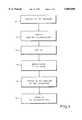
- FIG. 1therefore illustrates a mode of carrying out the method according to the invention.
- the first step of the methodconsists in stacking packages, each containing an electronic component, for example a semiconductor chip in which an integrated circuit is made.
- Each of the packagesis furthermore provided with connection pins.
- FIG. 2aillustrates an example of a package such as this.
- This figureshows a package, with the general reference 2, that is rectangular for example. It has connection pins 21, emerging for example on two of its sides, for example on the small sides. A section has been made in the package along its big length. It is possible to distinguish therein the chip 20, generally positioned on an electrically conductive sheet 22, as well as two pins 21 that extend into the interior of the package 2 and are connected by conductive wires 19 to the connection pads (not shown) of the chip 20.
- the sheet 22 and the pins 21are formed out of one and the same conductive sheet, the parts 21 and 22 being kept in a fixedly joined state by parts located outside a certain perimeter, a subsequent cut being made along this perimeter.
- the different elements mentioned aboveare embedded in a plastic material 24, epoxy resin for example, forming the package.
- the package shownmay be, for example, of the TSOP (Thin Small Outline Package) type.
- FIG. 2bshows another example of a package that may be used in the device according to the invention.
- FIG. 2awhich is similar to FIG. 2a, again shows a package 2 seen in a sectional view and comprising connection pins 21, as well as the semiconductor chip 20.
- the packagefurther comprises a board 23, made of a material that is a good conductor of heat and forms a conductive heat drain, this board at least partially constituting the back of the package 2.
- the heat draincan be made out of the sheet 22.
- the sheetis extended to one of the sides of the package, preferably to a side that has no pins.
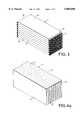
- FIG. 3shows a projection of the stack 3 of the packages 2 made during the step 11, the packages being, for example, those shown in FIG. 2a.
- the references 31 and 32are used to designate the faces of the stack that include the pins 21, the reference 33 designates the upper face of the stack (parallel to the packages 2) and the reference 34 designates one of the other lateral faces.
- the stacked packagesare fixedly joined together by the coating of the entire unit with an electrically insulating material such as a polymerizable resin, for example epoxy resin.
- an electrically insulating materialsuch as a polymerizable resin, for example epoxy resin.
- the coating materialis chosen such that it can be thermo-mechanically matched with the material forming the package so as to facilitate the thermal dissipation of the chips by conduction through the package and the coating and prevent possible breakages due to excessive differences in the values of the expansion coefficients of the materials.
- the next step (13, FIG. 1)consists in cutting the stack so that the pins 21 of the different packages are flush with the faces of the stack and also, as the case may be, the heat drains.
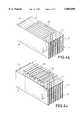
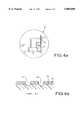
- FIG. 4ashows the result of this step 13 in the case of the packages illustrated in FIG. 2a.
- the faces 32, 33 and 34 of the stack 3can be seen in this figure.
- the pins 21are seen again: they are now flush with the face 32.
- the packages 2are represented by dashes as they can no longer be seen because of the coating material.
- FIG. 4bshows a view similar to that of FIG. 4a, but relates to the packages shown in FIG. 2b.
- the stackwhich is still referenced 3, is formed by packages 2, each having a heat drain 23. These packages are flush with the lateral faces of the stack, i.e. the face 34 and the face opposite to it, just as the pins 21 of the packages are flush with the faces 31 and 32.
- FIG. 4cis a variant of the preceding figure which further comprises a heat sink 36, for example a ribbed radiator type of heat sink, positioned on the face 34 of the stack 3 with which the conductive heat drains 23 are flush.
- a heat sink 36for example a ribbed radiator type of heat sink, positioned on the face 34 of the stack 3 with which the conductive heat drains 23 are flush.
- a heat sink of the same typemay be positioned on the face of the stack which is opposite the face 34 and with which the conductive heat drains 23 may also be flush.
- the heat sink 36may be fastened for example by bonding, by means of an epoxy bonder for example, either directly to the face of the stack or after the metallization of the stack as described hereinafter.
- the next step (14, FIG. 1)consists in depositing one (or more) conductive layers, made of metal for example, on all the faces of the previously made stack 3.
- the next step(15, FIG. 1) consists in making connections linking the pins 21 to one another on the faces of the stack 3, using the above metal layer.
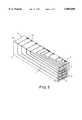
- FIG. 5is a fractional view of a stack according to the invention on which exemplary connections are illustrated.
- This figureshows the stack 3, the faces 31, 33 and 34 of which can be seen.
- the figurealso shows the packages 2 in dashes and their connection pins 21 flush with the face 31.
- the stack 3On one or more of its faces, for example the face 33, the stack 3 has pads 35, called stack pads, for its electrical connection to external circuits.
- the pins 21are interconnected to one another and at the same time, when necessary, they are connected to the stack pads 35 by means of connections C.
- the figureshows the case where the packages 2 contain memories.
- all their homologous pinsare connected to one another and to a stack pad 35 except one pin, referenced 25, for each of the packages.
- This pin 25which corresponds to the memory selection input is connected, for each package, individually to a distinct stack pad 35.
- the packagescomprise more pins such as 25, requiring connection individually to a distinct pad, then the same procedure is used for each of them.
- FIGS. 6a and 6billustrate an embodiment of the connections C in greater detail.
- FIG. 6ashows a fractional and enlarged view of a piece A of the stack of FIG. 5, in which a connection C and a stack pad 35 are seen.
- FIG. 6bshows a sectional view along an axis BB of FIG. 6a.
- connection Cis formed by two etchings 51 and 52, made by means of a laser which locally destroys the conductive layer, referenced M, and reveals the insulating material, referenced D, used to fixedly hold the stack together. This material has been shown in dashes in FIG. 6a for the clarity of the drawing. In this way, the electrical insulation of the connection C from the rest of the layer M is achieved.
- the stack pads 35may advantageously be made by the same laser etching technique as the one shown in FIG. 6a.
- Another method of making the connections Cconsists first of all in making grooves in the coating material of the stack 3, at the level where the pins 21 are flush, so as to reveal the ends of these pins, and in making these grooves according to the design chosen for the connections C.
- These groovesmay be made by laser.
- an electrically conductive layer(of metal for example) is deposited on the entire stack, the faces and the grooves.
- the conductive layeris removed from the plane surfaces of the stack (by polishing or by laser for example) so as to let it remain only in the grooves where it forms the desired connections.
- connections Care of course possible.
- connections C and the stack pads 35may be positioned on any faces of the stack or even on all the faces, the choice being made according to the application.
- this conductive heat drainmay be made of an electrically insulating material (aluminium nitride or silicon carbide for example) if it is desired to position pins 21 and/or to form connections C on the faces with which the drains 23 are flush.
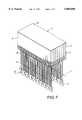
- the last step of the method shown in FIG. 1, referenced 16,consists in fastening connection pins to the stack, as shown in FIG. 7.
- certain of the connections C connecting pins 21 to the stack padsare shown.
- these stack padscannot be seen here because they are covered by the ends of pins 36 of two grates 37 for example, the pins 36 being designed to form the connection pins of the stack, after cutting along a plane XY, as is known in the field of the encapsulation of components.
- a stack 3is not necessarily provided with connection pins. It may be mounted flat, i.e. either by direct soldering on its stack pads to a printed circuit, the packages being then positioned in parallel or perpendicularly to the circuit, or to another stack or by means of adapted grates.
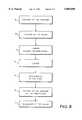
- a stacking of blocksis made, these stacks themselves being formed by stacked packages, to increase the number of packages processed simultaneously and, consequently, to reduce the cost.
- This variantis shown in FIG. 8.
- the first step 11consists, as above, in stacking the packages to form a block.
- the second step, referenced 10,consists in stacking a certain number of blocks thus obtained, adding certain interposed layers as shown in FIG. 9. For example, it is possible in this way to stack about twenty blocks.
- FIG. 9shows, for example, two blocks, 94 and 95, seen in a sectional view, each constituted for example by eight packages 2 and each comprising, for example, a heat drain 23 that may or may not extend over the whole length of the package.
- a shim 93designed to enable the subsequent separation of the blocks: for this purpose, its dimensions are greater than those of the packages. It is made of silicone for example.
- two printed circuit type substrateshave been placed on either side of each block, referenced 91 and 92, making it easy to route the connections.
- the printed circuitsare, for example, bonded (layer 96) to the packages 2 and fixedly joined to each other by the interposed element 93.
- the circuits 91 and 92may also be replaced by insulating shims, made of epoxy for example.
- step 12All the blocks are then joined together by an insulator material D, as the packages were earlier (step 12), and then cut out or ground (step 13).
- FIG. 9shows the two blocks at the end of the step 13.
- steps 14 and 15are carried out on the stack of the blocks and then, in a step 17, the blocks are separated.
- a certain number of operationsnotably the making of the connections on the lateral faces of the blocks, have been carried out collectively on a large number of blocks. It is of course possible to then carry out an operation for the fastening of connection pins.
- the packageshere are stacked, and this is done without any spacing between the packages;
- connection pinson any number of sides: for, the invention does not require that one or two of the lateral faces should be free of pins;
- the inventionis not limited to the particular examples described here above, and different variants are possible.
- the figuresillustrate the stack of packages having substantially the same size, but this is not necessary: when the packages have different sizes, the invention can be applied provided that all the packages are positioned according to the dimensions of the largest one by using, for each package, a printed circuit type of support to which the package is connected, it being possible for this printed circuit to be a multilayer element, thus making it easy to route the connections.
Landscapes
- Engineering & Computer Science (AREA)
- Microelectronics & Electronic Packaging (AREA)
- Power Engineering (AREA)
- Computer Hardware Design (AREA)
- General Physics & Mathematics (AREA)
- Condensed Matter Physics & Semiconductors (AREA)
- Physics & Mathematics (AREA)
- Ceramic Engineering (AREA)
- Manufacturing & Machinery (AREA)
- Lead Frames For Integrated Circuits (AREA)
- Cooling Or The Like Of Semiconductors Or Solid State Devices (AREA)
- Structures Or Materials For Encapsulating Or Coating Semiconductor Devices Or Solid State Devices (AREA)
- Combinations Of Printed Boards (AREA)
Abstract
Description
An object of the present invention is a method for the interconnection of stacked packages as well as the device resulting therefrom, each of the packages encapsulating an electronic component such as a semiconductor chip, containing for example an integrated circuit, or an electronic circuit or a sensor; these components shall hereinafter be designated by the terms components or chips without discrimination.
The making of present-day electronic systems, for both civilian and military use, should take account of increasingly greater requirements of compactness owing to the constantly rising number of circuits that are being implemented. In this context, it has already been proposed to make stacks of integrated circuits as described, for example, in the U.S. Pat. No. 4,706,166. According to this patent, the chips themselves are positioned on a printed circuit, placed against one another perpendicularly to the printed circuit; the connection pads of each of the chips are brought to one and the same side of the chip; this side is positioned on the printed circuit, and the connections with the printed circuit are made thereon. However, this arrangement has limitations, related notably to the number of pads that it is physically possible to place on only one side of a semiconductor chip; in addition, this arrangement is costly because the chips are not standard ones (the arrangement of the pads has to be modified); finally, there is little access possible to the connections thus made and these connections, in addition, cannot be seen, whereas in certain applications they need to be seen. This drawback limits their use.
An object of the present invention is to circumvent the preceding limitations by the stacking and interconnecting no longer of chips but of packages containing the components and by using the faces of the stack as interconnection surfaces.
Thus, firstly, the above drawbacks and limitations are avoided and, secondly, the cost price of the components is reduced. For, especially when the components are semiconductor chips, there are chips in packages, generally made of plastic, that are available in the market at prices below those of the chips alone, chiefly because of the quantities manufactured. Furthermore, they are easier to test and hence cost less.
More specifically, an object of the invention is a method of interconnection as defined by claim 1, as well as a device comprising stacked and interconnected packages as defined by claim 6.
Other objects, special features and results of the invention shall emerge from the following description, illustrated by the appended drawings, of which:
FIG. 1 represents a mode of carrying out the method according to the invention;
FIGS. 2a and 2b show examples of packages capable of being inserted into the device according to the invention;
FIG. 3 shows a step for the manufacture of the device according to the invention;
FIGS. 4a to 4c show different variants of a following step in the manufacture of the device according to the invention;
FIG. 5 shows a partial view of an embodiment of the device according to the invention;
FIGS. 6a and 6b show details of the embodiment of the previous figure;
FIG. 7 shows another embodiment of the device according to the invention.
FIG. 8 shows an alternative mode of carrying out the method according to the invention;
FIG. 9 shows a step of the manufacturing method according to the previous figure.
In these different figures, the same references refer to the same elements. Furthermore, for the clarity of the drawings, the figures have not been drawn to true scale.
FIG. 1 therefore illustrates a mode of carrying out the method according to the invention.
The first step of the method, referenced 11, consists in stacking packages, each containing an electronic component, for example a semiconductor chip in which an integrated circuit is made. Each of the packages is furthermore provided with connection pins.
FIG. 2a illustrates an example of a package such as this.
This figure shows a package, with thegeneral reference 2, that is rectangular for example. It hasconnection pins 21, emerging for example on two of its sides, for example on the small sides. A section has been made in the package along its big length. It is possible to distinguish therein thechip 20, generally positioned on an electricallyconductive sheet 22, as well as twopins 21 that extend into the interior of thepackage 2 and are connected byconductive wires 19 to the connection pads (not shown) of thechip 20. In one alternative embodiment, thesheet 22 and thepins 21 are formed out of one and the same conductive sheet, theparts
In the embodiment shown, the different elements mentioned above are embedded in aplastic material 24, epoxy resin for example, forming the package. The package shown may be, for example, of the TSOP (Thin Small Outline Package) type.
FIG. 2b shows another example of a package that may be used in the device according to the invention.
This figure, which is similar to FIG. 2a, again shows apackage 2 seen in a sectional view and comprisingconnection pins 21, as well as thesemiconductor chip 20. In FIG. 2b, since the section is not made across apin 21, that part of the pin which is within thepackage 2 cannot be seen. In this variant, the package further comprises aboard 23, made of a material that is a good conductor of heat and forms a conductive heat drain, this board at least partially constituting the back of thepackage 2.
In another alternative mode, not shown, the heat drain can be made out of thesheet 22. To this end, the sheet is extended to one of the sides of the package, preferably to a side that has no pins.
FIG. 3 shows a projection of thestack 3 of thepackages 2 made during thestep 11, the packages being, for example, those shown in FIG. 2a. Thereferences pins 21, thereference 33 designates the upper face of the stack (parallel to the packages 2) and thereference 34 designates one of the other lateral faces.
In the next step (12, FIG. 1), the stacked packages are fixedly joined together by the coating of the entire unit with an electrically insulating material such as a polymerizable resin, for example epoxy resin. In a preferred embodiment, the coating material is chosen such that it can be thermo-mechanically matched with the material forming the package so as to facilitate the thermal dissipation of the chips by conduction through the package and the coating and prevent possible breakages due to excessive differences in the values of the expansion coefficients of the materials.
The next step (13, FIG. 1) consists in cutting the stack so that thepins 21 of the different packages are flush with the faces of the stack and also, as the case may be, the heat drains.
FIG. 4a shows the result of thisstep 13 in the case of the packages illustrated in FIG. 2a.
Thefaces stack 3 can be seen in this figure. Thepins 21 are seen again: they are now flush with theface 32. Thepackages 2 are represented by dashes as they can no longer be seen because of the coating material.
FIG. 4b shows a view similar to that of FIG. 4a, but relates to the packages shown in FIG. 2b. The stack, which is still referenced 3, is formed bypackages 2, each having aheat drain 23. These packages are flush with the lateral faces of the stack, i.e. theface 34 and the face opposite to it, just as thepins 21 of the packages are flush with thefaces
FIG. 4c is a variant of the preceding figure which further comprises aheat sink 36, for example a ribbed radiator type of heat sink, positioned on theface 34 of thestack 3 with which the conductive heat drains 23 are flush. A heat sink of the same type may be positioned on the face of the stack which is opposite theface 34 and with which the conductive heat drains 23 may also be flush.
Theheat sink 36 may be fastened for example by bonding, by means of an epoxy bonder for example, either directly to the face of the stack or after the metallization of the stack as described hereinafter.
The next step (14, FIG. 1) consists in depositing one (or more) conductive layers, made of metal for example, on all the faces of the previously madestack 3.
The next step (15, FIG. 1) consists in making connections linking thepins 21 to one another on the faces of thestack 3, using the above metal layer.
FIG. 5 is a fractional view of a stack according to the invention on which exemplary connections are illustrated.
This figure shows thestack 3, thefaces packages 2 in dashes and their connection pins 21 flush with theface 31. On one or more of its faces, for example theface 33, thestack 3 haspads 35, called stack pads, for its electrical connection to external circuits. Thepins 21 are interconnected to one another and at the same time, when necessary, they are connected to thestack pads 35 by means of connections C.
As an example, the figure shows the case where thepackages 2 contain memories. In this case, all their homologous pins are connected to one another and to astack pad 35 except one pin, referenced 25, for each of the packages. Thispin 25 which corresponds to the memory selection input is connected, for each package, individually to adistinct stack pad 35. Naturally, if the packages comprise more pins such as 25, requiring connection individually to a distinct pad, then the same procedure is used for each of them.
FIGS. 6a and 6b illustrate an embodiment of the connections C in greater detail.
FIG. 6a shows a fractional and enlarged view of a piece A of the stack of FIG. 5, in which a connection C and astack pad 35 are seen. FIG. 6b shows a sectional view along an axis BB of FIG. 6a.
Each of the connections C is formed by twoetchings stack pads 35 may advantageously be made by the same laser etching technique as the one shown in FIG. 6a.
Another method of making the connections C consists first of all in making grooves in the coating material of thestack 3, at the level where thepins 21 are flush, so as to reveal the ends of these pins, and in making these grooves according to the design chosen for the connections C. These grooves may be made by laser. Then an electrically conductive layer (of metal for example) is deposited on the entire stack, the faces and the grooves. Finally, the conductive layer is removed from the plane surfaces of the stack (by polishing or by laser for example) so as to let it remain only in the grooves where it forms the desired connections.
Other methods of making the connections C, such as photolithography for example, are of course possible.
It must be noted that the connections C and thestack pads 35 may be positioned on any faces of the stack or even on all the faces, the choice being made according to the application. Should thepackages 2 comprise aconductive heat drain 23, as shown for example in FIG. 2b, this conductive heat drain may be made of an electrically insulating material (aluminium nitride or silicon carbide for example) if it is desired to positionpins 21 and/or to form connections C on the faces with which thedrains 23 are flush.
The last step of the method shown in FIG. 1, referenced 16, consists in fastening connection pins to the stack, as shown in FIG. 7.
This figure again shows thestack 3, thefaces pins 21 of the packages, flush with theface 32. By way of an example, certain of the connectionsC connecting pins 21 to the stack pads are shown. However, these stack pads cannot be seen here because they are covered by the ends ofpins 36 of twogrates 37 for example, thepins 36 being designed to form the connection pins of the stack, after cutting along a plane XY, as is known in the field of the encapsulation of components.
The last-mentioned step is optional. For, astack 3 is not necessarily provided with connection pins. It may be mounted flat, i.e. either by direct soldering on its stack pads to a printed circuit, the packages being then positioned in parallel or perpendicularly to the circuit, or to another stack or by means of adapted grates.
In one variant mode of manufacture, a stacking of blocks is made, these stacks themselves being formed by stacked packages, to increase the number of packages processed simultaneously and, consequently, to reduce the cost. This variant is shown in FIG. 8.
Thefirst step 11 consists, as above, in stacking the packages to form a block.
The second step, referenced 10, consists in stacking a certain number of blocks thus obtained, adding certain interposed layers as shown in FIG. 9. For example, it is possible in this way to stack about twenty blocks.
FIG. 9 shows, for example, two blocks, 94 and 95, seen in a sectional view, each constituted for example by eightpackages 2 and each comprising, for example, aheat drain 23 that may or may not extend over the whole length of the package. Between the twoblocks shim 93, designed to enable the subsequent separation of the blocks: for this purpose, its dimensions are greater than those of the packages. It is made of silicone for example. In the variant shown, in addition two printed circuit type substrates have been placed on either side of each block, referenced 91 and 92, making it easy to route the connections. The printed circuits are, for example, bonded (layer 96) to thepackages 2 and fixedly joined to each other by the interposedelement 93. Thecircuits
All the blocks are then joined together by an insulator material D, as the packages were earlier (step 12), and then cut out or ground (step 13). FIG. 9 shows the two blocks at the end of thestep 13.
The above-mentionedsteps step 17, the blocks are separated. Thus, a certain number of operations, notably the making of the connections on the lateral faces of the blocks, have been carried out collectively on a large number of blocks. It is of course possible to then carry out an operation for the fastening of connection pins.
A description has thus been given of a 3D interconnection device for packages containing electronic components, said device having numerous advantages:
it enables a high density of components: for, the packages here are stacked, and this is done without any spacing between the packages;
it can be used with packages having connection pins on any number of sides: for, the invention does not require that one or two of the lateral faces should be free of pins;
it can be applied to the stacking of any number of packages;
it provides for efficient heat matching as well as efficient heat sink properties;
its production cost is low, notably because it lends itself to the use of packages when they are taken out of the mold, when they are still joined together in strip form: the strips are then stacked as described here above for the packages, and several stacks may thus be made in a group.
The invention is not limited to the particular examples described here above, and different variants are possible. Thus, the figures illustrate the stack of packages having substantially the same size, but this is not necessary: when the packages have different sizes, the invention can be applied provided that all the packages are positioned according to the dimensions of the largest one by using, for each package, a printed circuit type of support to which the package is connected, it being possible for this printed circuit to be a multilayer element, thus making it easy to route the connections.
Claims (6)
1. A method of producing a plurality of blocks, each having interconnected therein a plurality of packages with each package containing at least one electronic component and having connection pins, comprising the steps of:
(a) selecting a plurality of packages of electrical components, each of said packages containing (i) at least one electronic component having connection pins, and (ii) a first insulating material embedding the component and connection pins with the component entirely surrounded by said insulating material and said pins having a portion extending outside each package;
(b) stacking (11) the packages in a plurality of blocks with the extending pins on faces of the blocks;
(c) stacking (10) the blocks;
(d) coating and joining (12) the stacked blocks fixedly together in a single stack of blocks with a second electrically insulating material, said coating surrounding and embedding the lateral sides of the stacked blocks and with the pins extending outside at least two faces of the coated stack of blocks, said first and second materials being thermo-mechanically matched;
(e) cutting (13) the pins of the packages where they extend outside said two faces of the stack of coated blocks so that they are flush with faces of the stack;
(f) forming (15) electrical connections among the pins on the faces of the stack of coated blocks; and
(g) separating the blocks of the stack from one another.
2. The method of claim 1 further comprising during the step of stacking the blocks inserting a shim (93) between two adjacent blocks (94, 95) of a stack, to facilitate said separating of said blocks (17).
3. The method of claim 2 wherein said shim is of a silicone material.
4. The method of claim 2 wherein said shim has a dimension greater than a corresponding dimension of the packages.
5. The method of claim 2 further comprising placing a substrate at the top or bottom (91, 92) of a block (94).
6. The method of claim 5 wherein at least one of said substrates (91, 92) comprises printed circuits making contact with the electrical connections.
Applications Claiming Priority (3)
| Application Number | Priority Date | Filing Date | Title |
|---|---|---|---|
| FR9203009AFR2688630B1 (en) | 1992-03-13 | 1992-03-13 | METHOD AND DEVICE FOR THREE-DIMENSIONAL INTERCONNECTION OF ELECTRONIC COMPONENT PACKAGES. |
| FR9203009 | 1992-03-13 | ||
| PCT/FR1993/000239WO1993018549A1 (en) | 1992-03-13 | 1993-03-10 | Process and device for three-dimensional interconnection of housings for electronic components |
Publications (1)
| Publication Number | Publication Date |
|---|---|
| US5885850Atrue US5885850A (en) | 1999-03-23 |
Family
ID=9427647
Family Applications (1)
| Application Number | Title | Priority Date | Filing Date |
|---|---|---|---|
| US08/146,099Expired - LifetimeUS5885850A (en) | 1992-03-13 | 1993-03-10 | Method for the 3D interconnection of packages of electronic components, and device obtained by this method |
Country Status (6)
| Country | Link |
|---|---|
| US (1) | US5885850A (en) |
| EP (1) | EP0584349B1 (en) |
| JP (1) | JP3140784B2 (en) |
| DE (1) | DE69331406T2 (en) |
| FR (1) | FR2688630B1 (en) |
| WO (1) | WO1993018549A1 (en) |
Cited By (24)
| Publication number | Priority date | Publication date | Assignee | Title |
|---|---|---|---|---|
| EP1075021A1 (en)* | 1999-08-02 | 2001-02-07 | Alcatel | Method of making a high density module made from electronic components, modules, encapsulations and module so obtained |
| WO2001059841A1 (en)* | 2000-02-11 | 2001-08-16 | 3D Plus | Three-dimensional interconnection method and electronic device obtained by same |
| RU2183884C1 (en)* | 2000-12-21 | 2002-06-20 | СИНЕРДЖЕСТИК КОМПЬЮТИНГ СИСТЕМС (СИКС) АпС | Multilayer hybrid electronic module |
| US6426559B1 (en) | 2000-06-29 | 2002-07-30 | National Semiconductor Corporation | Miniature 3D multi-chip module |
| US20020191380A1 (en)* | 1999-12-15 | 2002-12-19 | Christian Val | Method and device for interconnecting, electronic components in three dimensions |
| US20050012188A1 (en)* | 2001-11-09 | 2005-01-20 | Christian Val | Device for the hermetic encapsulation of a component that must be protected against all stresses |
| US20050077621A1 (en)* | 2002-04-22 | 2005-04-14 | Keith Gann | Vertically stacked pre-packaged integrated circuit chips |
| US20060043563A1 (en)* | 2002-04-22 | 2006-03-02 | Gann Keith D | Stacked microelectronic layer and module with three-axis channel T-connects |
| EP1724835A1 (en)* | 2005-05-17 | 2006-11-22 | Irvine Sensors Corporation | Electronic module comprising a layer containing integrated circuit die and a method for making the same |
| US20070117369A1 (en)* | 2003-07-01 | 2007-05-24 | 3D Plus | Method for interconnecting active and passive components, and a resulting thin heterogeneous component |
| US20070262443A1 (en)* | 2004-09-21 | 2007-11-15 | 3D Plus | Electronic Device with Integrated Heat Distributor |
| US20080170374A1 (en)* | 2005-04-01 | 2008-07-17 | 3D Plus | Low-Thickness Electronic Module Comprising a Stack of Electronic Packages Provided with Connection Balls |
| US20080289174A1 (en)* | 2005-12-23 | 2008-11-27 | 3D Plus | Process for the Collective Fabrication of 3D Electronic Modules |
| US20080316727A1 (en)* | 2005-11-30 | 2008-12-25 | 3D Plus | 3D Electronic Module |
| EP1360882A4 (en)* | 2001-01-26 | 2009-05-06 | Irvine Sensors Corp | A stackable microcircuit layer formed from a plastic encapsulated microcircuit and method of making the same |
| US20090209052A1 (en)* | 2006-08-22 | 2009-08-20 | 3D Plus | Process for the collective fabrication of 3d electronic modules |
| US20090260228A1 (en)* | 2007-10-26 | 2009-10-22 | 3D Plus | Process for the vertical interconnection of 3d electronic modules by vias |
| US20100063596A1 (en)* | 2006-04-13 | 2010-03-11 | Smith & Nephew Orthopaedics Ag | Joint socket and hip endoprosthesis having the same |
| US20100276081A1 (en)* | 2007-01-30 | 2010-11-04 | 3D Plus | Method of interconnecting electronic wafers |
| US20110168904A1 (en)* | 2008-09-08 | 2011-07-14 | Konninklijk Philips Electronics N.V. | Radiation detector with a stack of converter plates and interconnect layers |
| US8359740B2 (en) | 2008-12-19 | 2013-01-29 | 3D Plus | Process for the wafer-scale fabrication of electronic modules for surface mounting |
| US8546190B2 (en) | 2009-03-10 | 2013-10-01 | 3D Plus | Method for positioning chips during the production of a reconstituted wafer |
| CN105914153A (en)* | 2015-02-20 | 2016-08-31 | 3D加公司 | Method for manufacturing a 3d electronic module with external interconnection leads |
| US10321569B1 (en) | 2015-04-29 | 2019-06-11 | Vpt, Inc. | Electronic module and method of making same |
Families Citing this family (1)
| Publication number | Priority date | Publication date | Assignee | Title |
|---|---|---|---|---|
| FR2719967B1 (en)* | 1994-05-10 | 1996-06-07 | Thomson Csf | Three-dimensional interconnection of electronic component boxes using printed circuits. |
Citations (19)
| Publication number | Priority date | Publication date | Assignee | Title |
|---|---|---|---|---|
| US3029495A (en)* | 1959-04-06 | 1962-04-17 | Norman J Doctor | Electrical interconnection of miniaturized modules |
| US3370203A (en)* | 1965-07-19 | 1968-02-20 | United Aircraft Corp | Integrated circuit modules |
| US4487993A (en)* | 1981-04-01 | 1984-12-11 | General Electric Company | High density electronic circuits having very narrow conductors |
| US4525921A (en)* | 1981-07-13 | 1985-07-02 | Irvine Sensors Corporation | High-density electronic processing package-structure and fabrication |
| US4551629A (en)* | 1980-09-16 | 1985-11-05 | Irvine Sensors Corporation | Detector array module-structure and fabrication |
| US4706166A (en)* | 1986-04-25 | 1987-11-10 | Irvine Sensors Corporation | High-density electronic modules--process and product |
| JPS62293749A (en)* | 1986-06-13 | 1987-12-21 | Nippon Telegr & Teleph Corp <Ntt> | Three-dimensional mounting structure of semiconductor device and manufacture thereof |
| WO1988008203A1 (en)* | 1987-04-17 | 1988-10-20 | Xoc Devices, Inc. | Packaging system for stacking integrated circuits |
| US4794092A (en)* | 1987-11-18 | 1988-12-27 | Grumman Aerospace Corporation | Single wafer moated process |
| US4877752A (en)* | 1988-10-31 | 1989-10-31 | The United States Of America As Represented By The Secretary Of The Army | 3-D packaging of focal plane assemblies |
| EP0354708A2 (en)* | 1988-08-08 | 1990-02-14 | Texas Instruments Incorporated | General three dimensional packaging |
| US4953005A (en)* | 1987-04-17 | 1990-08-28 | Xoc Devices, Inc. | Packaging system for stacking integrated circuits |
| US4983533A (en)* | 1987-10-28 | 1991-01-08 | Irvine Sensors Corporation | High-density electronic modules - process and product |
| US5019946A (en)* | 1988-09-27 | 1991-05-28 | General Electric Company | High density interconnect with high volumetric efficiency |
| US5043794A (en)* | 1990-09-24 | 1991-08-27 | At&T Bell Laboratories | Integrated circuit package and compact assemblies thereof |
| US5075253A (en)* | 1989-04-12 | 1991-12-24 | Advanced Micro Devices, Inc. | Method of coplanar integration of semiconductor IC devices |
| WO1992003035A1 (en)* | 1990-08-01 | 1992-02-20 | Staktek Corporation | Ultra high density integrated circuit packages, method and apparatus |
| EP0490739A1 (en)* | 1990-12-11 | 1992-06-17 | Thomson-Csf | Interconnection method and device for three-dimensional integrated circuits |
| EP0516096A2 (en)* | 1991-05-31 | 1992-12-02 | Fujitsu Limited | Semiconductor device unit having holder and method of mounting semiconductor devices using holder |
- 1992
- 1992-03-13FRFR9203009Apatent/FR2688630B1/ennot_activeExpired - Lifetime
- 1993
- 1993-03-10WOPCT/FR1993/000239patent/WO1993018549A1/enactiveIP Right Grant
- 1993-03-10USUS08/146,099patent/US5885850A/ennot_activeExpired - Lifetime
- 1993-03-10DEDE69331406Tpatent/DE69331406T2/ennot_activeExpired - Lifetime
- 1993-03-10JPJP05515405Apatent/JP3140784B2/ennot_activeExpired - Lifetime
- 1993-03-10EPEP93918735Apatent/EP0584349B1/ennot_activeExpired - Lifetime
Patent Citations (20)
| Publication number | Priority date | Publication date | Assignee | Title |
|---|---|---|---|---|
| US3029495A (en)* | 1959-04-06 | 1962-04-17 | Norman J Doctor | Electrical interconnection of miniaturized modules |
| US3370203A (en)* | 1965-07-19 | 1968-02-20 | United Aircraft Corp | Integrated circuit modules |
| US4551629A (en)* | 1980-09-16 | 1985-11-05 | Irvine Sensors Corporation | Detector array module-structure and fabrication |
| US4487993A (en)* | 1981-04-01 | 1984-12-11 | General Electric Company | High density electronic circuits having very narrow conductors |
| US4525921A (en)* | 1981-07-13 | 1985-07-02 | Irvine Sensors Corporation | High-density electronic processing package-structure and fabrication |
| US4706166A (en)* | 1986-04-25 | 1987-11-10 | Irvine Sensors Corporation | High-density electronic modules--process and product |
| JPS62293749A (en)* | 1986-06-13 | 1987-12-21 | Nippon Telegr & Teleph Corp <Ntt> | Three-dimensional mounting structure of semiconductor device and manufacture thereof |
| US4953005A (en)* | 1987-04-17 | 1990-08-28 | Xoc Devices, Inc. | Packaging system for stacking integrated circuits |
| WO1988008203A1 (en)* | 1987-04-17 | 1988-10-20 | Xoc Devices, Inc. | Packaging system for stacking integrated circuits |
| US4983533A (en)* | 1987-10-28 | 1991-01-08 | Irvine Sensors Corporation | High-density electronic modules - process and product |
| US4794092A (en)* | 1987-11-18 | 1988-12-27 | Grumman Aerospace Corporation | Single wafer moated process |
| EP0354708A2 (en)* | 1988-08-08 | 1990-02-14 | Texas Instruments Incorporated | General three dimensional packaging |
| US5019946A (en)* | 1988-09-27 | 1991-05-28 | General Electric Company | High density interconnect with high volumetric efficiency |
| US4877752A (en)* | 1988-10-31 | 1989-10-31 | The United States Of America As Represented By The Secretary Of The Army | 3-D packaging of focal plane assemblies |
| US5075253A (en)* | 1989-04-12 | 1991-12-24 | Advanced Micro Devices, Inc. | Method of coplanar integration of semiconductor IC devices |
| WO1992003035A1 (en)* | 1990-08-01 | 1992-02-20 | Staktek Corporation | Ultra high density integrated circuit packages, method and apparatus |
| US5279029A (en)* | 1990-08-01 | 1994-01-18 | Staktek Corporation | Ultra high density integrated circuit packages method |
| US5043794A (en)* | 1990-09-24 | 1991-08-27 | At&T Bell Laboratories | Integrated circuit package and compact assemblies thereof |
| EP0490739A1 (en)* | 1990-12-11 | 1992-06-17 | Thomson-Csf | Interconnection method and device for three-dimensional integrated circuits |
| EP0516096A2 (en)* | 1991-05-31 | 1992-12-02 | Fujitsu Limited | Semiconductor device unit having holder and method of mounting semiconductor devices using holder |
Non-Patent Citations (2)
| Title |
|---|
| Val, Christian: 3 D Interconnection for Ultra Dense Multichip Modules , 1990, pp. 814 821.* |
| Val, Christian: 3-D Interconnection for Ultra-Dense Multichip Modules, 1990, pp. 814-821. |
Cited By (45)
| Publication number | Priority date | Publication date | Assignee | Title |
|---|---|---|---|---|
| WO2001009941A1 (en)* | 1999-08-02 | 2001-02-08 | Alcatel | Method for obtaining a high density module, based on encapsulated modular electronic components and resulting module |
| FR2797348A1 (en)* | 1999-08-02 | 2001-02-09 | Cit Alcatel | METHOD FOR OBTAINING A HIGH DENSITY MODULE FROM ELECTRONIC, MODULAR, ENCAPSULATED COMPONENTS AND MODULE THUS OBTAINED |
| EP1075021A1 (en)* | 1999-08-02 | 2001-02-07 | Alcatel | Method of making a high density module made from electronic components, modules, encapsulations and module so obtained |
| US6683373B1 (en) | 1999-08-02 | 2004-01-27 | Alcatel | Method of modifying connecting leads and thinning bases of encapsulated modular electronic components to obtain a high-density module, and a module obtained thereby |
| US6809367B2 (en) | 1999-12-15 | 2004-10-26 | 3D Plus | Device for interconnecting, in three dimensions, electronic components |
| US20020191380A1 (en)* | 1999-12-15 | 2002-12-19 | Christian Val | Method and device for interconnecting, electronic components in three dimensions |
| WO2001059841A1 (en)* | 2000-02-11 | 2001-08-16 | 3D Plus | Three-dimensional interconnection method and electronic device obtained by same |
| FR2805082A1 (en)* | 2000-02-11 | 2001-08-17 | 3D Plus Sa | THREE-DIMENSIONAL INTERCONNECTION METHOD AND ELECTRONIC DEVICE OBTAINED THEREBY |
| US6716672B2 (en) | 2000-02-11 | 2004-04-06 | 3D Plus | Three dimensional interconnection method and electronic device obtained by same |
| US6426559B1 (en) | 2000-06-29 | 2002-07-30 | National Semiconductor Corporation | Miniature 3D multi-chip module |
| RU2183884C1 (en)* | 2000-12-21 | 2002-06-20 | СИНЕРДЖЕСТИК КОМПЬЮТИНГ СИСТЕМС (СИКС) АпС | Multilayer hybrid electronic module |
| EP1360882A4 (en)* | 2001-01-26 | 2009-05-06 | Irvine Sensors Corp | A stackable microcircuit layer formed from a plastic encapsulated microcircuit and method of making the same |
| US20050012188A1 (en)* | 2001-11-09 | 2005-01-20 | Christian Val | Device for the hermetic encapsulation of a component that must be protected against all stresses |
| US20050077621A1 (en)* | 2002-04-22 | 2005-04-14 | Keith Gann | Vertically stacked pre-packaged integrated circuit chips |
| US20060043563A1 (en)* | 2002-04-22 | 2006-03-02 | Gann Keith D | Stacked microelectronic layer and module with three-axis channel T-connects |
| US20110045635A1 (en)* | 2002-04-22 | 2011-02-24 | Keith Gann | Vertically stacked pre-packaged integrated circuit chips |
| US7872339B2 (en) | 2002-04-22 | 2011-01-18 | Keith Gann | Vertically stacked pre-packaged integrated circuit chips |
| US7777321B2 (en) | 2002-04-22 | 2010-08-17 | Gann Keith D | Stacked microelectronic layer and module with three-axis channel T-connects |
| US20100009499A1 (en)* | 2002-04-22 | 2010-01-14 | Gann Keith D | Stacked microelectronic layer and module with three-axis channel t-connects |
| US8012803B2 (en) | 2002-04-22 | 2011-09-06 | Aprolase Development Co., Llc | Vertically stacked pre-packaged integrated circuit chips |
| US7635639B2 (en) | 2003-07-01 | 2009-12-22 | 3D Plus | Method for the interconnection of active and passive components and resulting thin heterogeneous component |
| US20070117369A1 (en)* | 2003-07-01 | 2007-05-24 | 3D Plus | Method for interconnecting active and passive components, and a resulting thin heterogeneous component |
| US7476965B2 (en) | 2004-09-21 | 2009-01-13 | 3D Plus | Electronic device with integrated heat distributor |
| US20070262443A1 (en)* | 2004-09-21 | 2007-11-15 | 3D Plus | Electronic Device with Integrated Heat Distributor |
| US20080170374A1 (en)* | 2005-04-01 | 2008-07-17 | 3D Plus | Low-Thickness Electronic Module Comprising a Stack of Electronic Packages Provided with Connection Balls |
| US8243468B2 (en) | 2005-04-01 | 2012-08-14 | 3D Plus | Low-thickness electronic module comprising a stack of electronic packages provided with connection balls |
| EP1724835A1 (en)* | 2005-05-17 | 2006-11-22 | Irvine Sensors Corporation | Electronic module comprising a layer containing integrated circuit die and a method for making the same |
| US20080316727A1 (en)* | 2005-11-30 | 2008-12-25 | 3D Plus | 3D Electronic Module |
| US8264853B2 (en) | 2005-11-30 | 2012-09-11 | 3D Plus | 3D electronic module |
| US20080289174A1 (en)* | 2005-12-23 | 2008-11-27 | 3D Plus | Process for the Collective Fabrication of 3D Electronic Modules |
| US7877874B2 (en) | 2005-12-23 | 2011-02-01 | 3D Plus | Process for the collective fabrication of 3D electronic modules |
| US20100063596A1 (en)* | 2006-04-13 | 2010-03-11 | Smith & Nephew Orthopaedics Ag | Joint socket and hip endoprosthesis having the same |
| US20090209052A1 (en)* | 2006-08-22 | 2009-08-20 | 3D Plus | Process for the collective fabrication of 3d electronic modules |
| US7951649B2 (en) | 2006-08-22 | 2011-05-31 | 3D Plus | Process for the collective fabrication of 3D electronic modules |
| US8136237B2 (en) | 2007-01-30 | 2012-03-20 | 3D Plus | Method of interconnecting electronic wafers |
| US20100276081A1 (en)* | 2007-01-30 | 2010-11-04 | 3D Plus | Method of interconnecting electronic wafers |
| US20090260228A1 (en)* | 2007-10-26 | 2009-10-22 | 3D Plus | Process for the vertical interconnection of 3d electronic modules by vias |
| US8567051B2 (en)* | 2007-10-26 | 2013-10-29 | 3D Plus | Process for the vertical interconnection of 3D electronic modules by vias |
| US20110168904A1 (en)* | 2008-09-08 | 2011-07-14 | Konninklijk Philips Electronics N.V. | Radiation detector with a stack of converter plates and interconnect layers |
| US8461542B2 (en) | 2008-09-08 | 2013-06-11 | Koninklijke Philips Electronics N.V. | Radiation detector with a stack of converter plates and interconnect layers |
| US8359740B2 (en) | 2008-12-19 | 2013-01-29 | 3D Plus | Process for the wafer-scale fabrication of electronic modules for surface mounting |
| US8546190B2 (en) | 2009-03-10 | 2013-10-01 | 3D Plus | Method for positioning chips during the production of a reconstituted wafer |
| CN105914153A (en)* | 2015-02-20 | 2016-08-31 | 3D加公司 | Method for manufacturing a 3d electronic module with external interconnection leads |
| CN105914153B (en)* | 2015-02-20 | 2020-03-20 | 3D加公司 | Process for manufacturing a 3D electronic module comprising external interconnect pins |
| US10321569B1 (en) | 2015-04-29 | 2019-06-11 | Vpt, Inc. | Electronic module and method of making same |
Also Published As
| Publication number | Publication date |
|---|---|
| FR2688630A1 (en) | 1993-09-17 |
| JPH06507759A (en) | 1994-09-01 |
| EP0584349B1 (en) | 2002-01-02 |
| FR2688630B1 (en) | 2001-08-10 |
| DE69331406T2 (en) | 2002-08-08 |
| JP3140784B2 (en) | 2001-03-05 |
| EP0584349A1 (en) | 1994-03-02 |
| DE69331406D1 (en) | 2002-02-07 |
| WO1993018549A1 (en) | 1993-09-16 |
Similar Documents
| Publication | Publication Date | Title |
|---|---|---|
| US5885850A (en) | Method for the 3D interconnection of packages of electronic components, and device obtained by this method | |
| US5400218A (en) | Device for the 3D encapsulation of semiconductor chips | |
| EP0596075B1 (en) | Non-conductive end layer for integrated stack of ic chips | |
| US6005778A (en) | Chip stacking and capacitor mounting arrangement including spacers | |
| US5517754A (en) | Fabrication processes for monolithic electronic modules | |
| US5571754A (en) | Method of fabrication of endcap chip with conductive, monolithic L-connect for multichip stack | |
| US5640760A (en) | Method for the 3D interconnection of packages of electronic components using printed circuit boards | |
| JP2505958B2 (en) | Integrated circuit device packaging method | |
| US7245021B2 (en) | Micropede stacked die component assembly | |
| CN1041579C (en) | Method and apparatus for stress relieving electronic components | |
| US8012803B2 (en) | Vertically stacked pre-packaged integrated circuit chips | |
| EP0247775A2 (en) | Semiconductor package with high density I/O lead connection | |
| US5227995A (en) | High density semiconductor memory module using split finger lead frame | |
| JP3483280B2 (en) | Three-dimensional interconnection method of electronic component package and three-dimensional component formed thereby | |
| KR19980032206A (en) | High Performance Multichip Module Package | |
| US11367709B2 (en) | Semiconductor chip stack arrangement and semiconductor chip for producing such a semiconductor chip stack arrangement | |
| JPH06244360A (en) | Semiconductor device | |
| US6972243B2 (en) | Fabrication of semiconductor dies with micro-pins and structures produced therewith | |
| US5908304A (en) | Mass memory and method for the manufacture of mass memories | |
| USRE36894E (en) | Semiconductor package with high density I/O lead connection | |
| KR19980058412A (en) | Multilayer Multi-chip Module Semiconductor Device and Manufacturing Method Thereof | |
| EP0032565B1 (en) | Mounting and packaging of silicon devices on ceramic substrates, and packaged silicon devices | |
| US20050082658A1 (en) | Simplified stacked chip assemblies | |
| KR100219473B1 (en) | Semiconductor device the use for tab lead and method of mount of the same |
Legal Events
| Date | Code | Title | Description |
|---|---|---|---|
| AS | Assignment | Owner name:THOMSON-CSF, FRANCE Free format text:ASSIGNMENT OF ASSIGNORS INTEREST;ASSIGNOR:VAL, CHRISTIAN;REEL/FRAME:006963/0001 Effective date:19931020 | |
| STCF | Information on status: patent grant | Free format text:PATENTED CASE | |
| FEPP | Fee payment procedure | Free format text:PAYOR NUMBER ASSIGNED (ORIGINAL EVENT CODE: ASPN); ENTITY STATUS OF PATENT OWNER: LARGE ENTITY | |
| FPAY | Fee payment | Year of fee payment:4 | |
| FPAY | Fee payment | Year of fee payment:8 | |
| FPAY | Fee payment | Year of fee payment:12 |