US5885288A - Surgical instrument - Google Patents
Surgical instrumentDownload PDFInfo
- Publication number
- US5885288A US5885288AUS08/873,281US87328197AUS5885288AUS 5885288 AUS5885288 AUS 5885288AUS 87328197 AUS87328197 AUS 87328197AUS 5885288 AUS5885288 AUS 5885288A
- Authority
- US
- United States
- Prior art keywords
- stem section
- surgical instrument
- bendable
- distal end
- bendable portion
- Prior art date
- Legal status (The legal status is an assumption and is not a legal conclusion. Google has not performed a legal analysis and makes no representation as to the accuracy of the status listed.)
- Expired - Lifetime
Links
Images


Classifications
- A—HUMAN NECESSITIES
- A61—MEDICAL OR VETERINARY SCIENCE; HYGIENE
- A61B—DIAGNOSIS; SURGERY; IDENTIFICATION
- A61B17/00—Surgical instruments, devices or methods
- A61B17/28—Surgical forceps
- A61B17/29—Forceps for use in minimally invasive surgery
- A—HUMAN NECESSITIES
- A61—MEDICAL OR VETERINARY SCIENCE; HYGIENE
- A61B—DIAGNOSIS; SURGERY; IDENTIFICATION
- A61B34/00—Computer-aided surgery; Manipulators or robots specially adapted for use in surgery
- A61B34/70—Manipulators specially adapted for use in surgery
- A61B34/71—Manipulators operated by drive cable mechanisms
- A—HUMAN NECESSITIES
- A61—MEDICAL OR VETERINARY SCIENCE; HYGIENE
- A61B—DIAGNOSIS; SURGERY; IDENTIFICATION
- A61B17/00—Surgical instruments, devices or methods
- A61B17/28—Surgical forceps
- A61B17/29—Forceps for use in minimally invasive surgery
- A61B17/2909—Handles
- A—HUMAN NECESSITIES
- A61—MEDICAL OR VETERINARY SCIENCE; HYGIENE
- A61B—DIAGNOSIS; SURGERY; IDENTIFICATION
- A61B17/00—Surgical instruments, devices or methods
- A61B17/00234—Surgical instruments, devices or methods for minimally invasive surgery
- A61B2017/00292—Surgical instruments, devices or methods for minimally invasive surgery mounted on or guided by flexible, e.g. catheter-like, means
- A61B2017/003—Steerable
- A—HUMAN NECESSITIES
- A61—MEDICAL OR VETERINARY SCIENCE; HYGIENE
- A61B—DIAGNOSIS; SURGERY; IDENTIFICATION
- A61B17/00—Surgical instruments, devices or methods
- A61B17/00234—Surgical instruments, devices or methods for minimally invasive surgery
- A61B2017/00292—Surgical instruments, devices or methods for minimally invasive surgery mounted on or guided by flexible, e.g. catheter-like, means
- A61B2017/003—Steerable
- A61B2017/00305—Constructional details of the flexible means
- A61B2017/00314—Separate linked members
- A—HUMAN NECESSITIES
- A61—MEDICAL OR VETERINARY SCIENCE; HYGIENE
- A61B—DIAGNOSIS; SURGERY; IDENTIFICATION
- A61B17/00—Surgical instruments, devices or methods
- A61B17/28—Surgical forceps
- A61B17/29—Forceps for use in minimally invasive surgery
- A61B2017/2901—Details of shaft
- A61B2017/2905—Details of shaft flexible
- A—HUMAN NECESSITIES
- A61—MEDICAL OR VETERINARY SCIENCE; HYGIENE
- A61B—DIAGNOSIS; SURGERY; IDENTIFICATION
- A61B17/00—Surgical instruments, devices or methods
- A61B17/28—Surgical forceps
- A61B17/29—Forceps for use in minimally invasive surgery
- A61B2017/2926—Details of heads or jaws
- A61B2017/2927—Details of heads or jaws the angular position of the head being adjustable with respect to the shaft
- A—HUMAN NECESSITIES
- A61—MEDICAL OR VETERINARY SCIENCE; HYGIENE
- A61B—DIAGNOSIS; SURGERY; IDENTIFICATION
- A61B17/00—Surgical instruments, devices or methods
- A61B17/28—Surgical forceps
- A61B17/29—Forceps for use in minimally invasive surgery
- A61B2017/2926—Details of heads or jaws
- A61B2017/2927—Details of heads or jaws the angular position of the head being adjustable with respect to the shaft
- A61B2017/2929—Details of heads or jaws the angular position of the head being adjustable with respect to the shaft with a head rotatable about the longitudinal axis of the shaft
- A—HUMAN NECESSITIES
- A61—MEDICAL OR VETERINARY SCIENCE; HYGIENE
- A61B—DIAGNOSIS; SURGERY; IDENTIFICATION
- A61B17/00—Surgical instruments, devices or methods
- A61B17/28—Surgical forceps
- A61B17/29—Forceps for use in minimally invasive surgery
- A61B2017/2926—Details of heads or jaws
- A61B2017/2932—Transmission of forces to jaw members
- A61B2017/2939—Details of linkages or pivot points
- A—HUMAN NECESSITIES
- A61—MEDICAL OR VETERINARY SCIENCE; HYGIENE
- A61B—DIAGNOSIS; SURGERY; IDENTIFICATION
- A61B17/00—Surgical instruments, devices or methods
- A61B17/34—Trocars; Puncturing needles
- A61B17/3417—Details of tips or shafts, e.g. grooves, expandable, bendable; Multiple coaxial sliding cannulas, e.g. for dilating
- A61B17/3421—Cannulas
- A61B2017/3445—Cannulas used as instrument channel for multiple instruments
- A—HUMAN NECESSITIES
- A61—MEDICAL OR VETERINARY SCIENCE; HYGIENE
- A61B—DIAGNOSIS; SURGERY; IDENTIFICATION
- A61B34/00—Computer-aided surgery; Manipulators or robots specially adapted for use in surgery
- A61B34/30—Surgical robots
- A61B2034/305—Details of wrist mechanisms at distal ends of robotic arms
- A61B2034/306—Wrists with multiple vertebrae
- A—HUMAN NECESSITIES
- A61—MEDICAL OR VETERINARY SCIENCE; HYGIENE
- A61B—DIAGNOSIS; SURGERY; IDENTIFICATION
- A61B34/00—Computer-aided surgery; Manipulators or robots specially adapted for use in surgery
- A61B34/70—Manipulators specially adapted for use in surgery
- A—HUMAN NECESSITIES
- A61—MEDICAL OR VETERINARY SCIENCE; HYGIENE
- A61M—DEVICES FOR INTRODUCING MEDIA INTO, OR ONTO, THE BODY; DEVICES FOR TRANSDUCING BODY MEDIA OR FOR TAKING MEDIA FROM THE BODY; DEVICES FOR PRODUCING OR ENDING SLEEP OR STUPOR
- A61M1/00—Suction or pumping devices for medical purposes; Devices for carrying-off, for treatment of, or for carrying-over, body-liquids; Drainage systems
- A61M1/84—Drainage tubes; Aspiration tips
- A61M1/85—Drainage tubes; Aspiration tips with gas or fluid supply means, e.g. for supplying rinsing fluids or anticoagulants
- A—HUMAN NECESSITIES
- A61—MEDICAL OR VETERINARY SCIENCE; HYGIENE
- A61M—DEVICES FOR INTRODUCING MEDIA INTO, OR ONTO, THE BODY; DEVICES FOR TRANSDUCING BODY MEDIA OR FOR TAKING MEDIA FROM THE BODY; DEVICES FOR PRODUCING OR ENDING SLEEP OR STUPOR
- A61M25/00—Catheters; Hollow probes
- A61M25/01—Introducing, guiding, advancing, emplacing or holding catheters
- A61M25/0105—Steering means as part of the catheter or advancing means; Markers for positioning
- A61M25/0133—Tip steering devices
- A61M25/0147—Tip steering devices with movable mechanical means, e.g. pull wires
- A61M2025/015—Details of the distal fixation of the movable mechanical means
- A—HUMAN NECESSITIES
- A61—MEDICAL OR VETERINARY SCIENCE; HYGIENE
- A61M—DEVICES FOR INTRODUCING MEDIA INTO, OR ONTO, THE BODY; DEVICES FOR TRANSDUCING BODY MEDIA OR FOR TAKING MEDIA FROM THE BODY; DEVICES FOR PRODUCING OR ENDING SLEEP OR STUPOR
- A61M25/00—Catheters; Hollow probes
- A61M25/01—Introducing, guiding, advancing, emplacing or holding catheters
- A61M25/0105—Steering means as part of the catheter or advancing means; Markers for positioning
- A61M25/0133—Tip steering devices
- A61M25/0138—Tip steering devices having flexible regions as a result of weakened outer material, e.g. slots, slits, cuts, joints or coils
- A—HUMAN NECESSITIES
- A61—MEDICAL OR VETERINARY SCIENCE; HYGIENE
- A61M—DEVICES FOR INTRODUCING MEDIA INTO, OR ONTO, THE BODY; DEVICES FOR TRANSDUCING BODY MEDIA OR FOR TAKING MEDIA FROM THE BODY; DEVICES FOR PRODUCING OR ENDING SLEEP OR STUPOR
- A61M25/00—Catheters; Hollow probes
- A61M25/01—Introducing, guiding, advancing, emplacing or holding catheters
- A61M25/0105—Steering means as part of the catheter or advancing means; Markers for positioning
- A61M25/0133—Tip steering devices
- A61M25/0147—Tip steering devices with movable mechanical means, e.g. pull wires
Definitions
- the present inventionrelates to a surgical instrument and, more particularly, to an endoscopic surgical instrument which may be used for suction and/or irrigation of tissue and bodily fluids.
- the present inventionis a surgical instrument comprising a manually engageable handle and a first stem section having a longitudinal axis and extending from the handle.
- a tip portion of the surgical instrumenthas a suction port for applying suction to tissue and a fluid outlet port for directing fluid to tissue.
- a second stem sectionis connected between the first stem section and the tip portion and has at least a portion which is bendable.
- the second stem sectionsupports the tip portion for movement between a plurality of orientations relative to the axis and to the first stem section.
- the surgical instrumentcomprises means for bending the bendable portion of the second stem section to change the orientation of the tip portion of the surgical instrument relative to the axis and to the first stem section from a first orientation to a second orientation.
- the means for enabling bending movementmoves the tip portion through a plurality of arcuate paths which are of different lengths and which are spaced apart from each other along the longitudinal axis.
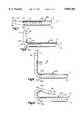
- FIG. 1is a schematic side elevational view of a surgical instrument constructed in accordance with a first embodiment of the present invention
- FIG. 2is an enlarged view of a portion of the surgical instrument of FIG. 1;
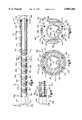
- FIG. 3is an enlarged schematic side elevational view of a movable stem section of the surgical instrument of FIG. 1;
- FIG. 4is a view taken along line 4--4 of FIG. 3;
- FIG. 5is a sectional view taken along line 5--5 of FIG. 3;
- FIG. 6is a fragmentary plan view taken along line 6--6 of FIG. 3;
- FIG. 7is a schematic view of a portion of FIG. 1 showing the movable stem section associated with a cannula and bent in a first direction;
- FIG. 8is a view similar to FIG. 7 showing the movable section bent further and in a second direction;
- FIG. 9is a view similar to FIG. 7 showing the movable section of the surgical instrument bent at a different location along its length;
- FIG. 10is a view similar to FIG. 7 showing the movable section bent to an angle greater than 180°;
- FIG. 11is a view similar to FIG. 3 of a portion of a surgical instrument which is constructed in accordance with a second embodiment of the present invention.
- FIG. 12is a sectional view taken along line 12--12 of FIG. 11;
- FIG. 13is a sectional view taken along line 13--13 of FIG. 11;
- FIG. 14is a view similar to FIG. 4 taken along line 14--14 of FIG. 11.
- the present inventionrelates to a surgical instrument and in particular to a surgical instrument which may be used for suction and/or irrigation of tissue.
- the present inventionis applicable to various surgical instrument constructions.
- FIGS. 1-10illustrate a surgical instrument 10.
- the surgical instrument 10includes generally a handle 12 with an actuator assembly 14.
- a proximal end portion 16 of a first stem section or rigid stem section 18is fixed to the handle 12.
- a proximal end portion 20 of a second stem section or movable stem section 22is connected with a distal end portion 24 of the rigid stem section 18.
- a suction port or aspiration port 26, and a fluid outlet port or irrigation port 28,are located on a distal end portion or tip portion 30 of the movable stem section 22.
- the handle 12 of the surgical instrument 10includes a main body portion 40 having a pistol grip configuration which is configured to be manually gripped by a person's hand.
- An irrigation fluid passage 42is formed in the main body portion 40 of the handle 12.
- Irrigation fluidsuch as water or saline solution can be supplied to the surgical instrument 10 by a known fluid source connected at a fluid inlet opening 48.
- a portion of the irrigation fluid passage 42extends through a manually engageable trigger 44.
- the trigger 44is supported in the main body portion 40 of the handle 12 for sliding movement relative to the main body portion.
- a spring 46 connected between the trigger 44 and the main body portion 40 of the handle 12biases the trigger to an unactuated position shown in FIG. 1. When the trigger 44 is in the unactuated position as shown in FIG. 1, flow of irrigation fluid through the passage 42 is blocked. When the trigger 44 is in the actuated position as shown in FIG. 2, flow of irrigation fluid through the passage 42 is enabled.
- the actuator assembly 14is mounted in the main body portion 40 of the handle 12.
- the actuator assembly 14is illustrated only schematically. It should be understood that other types of actuator assemblies can be substituted.
- the actuator assembly 14is illustrative of the various types of actuator assemblies which can be used to provide the actuation force for bending the movable stem section 22 of the surgical instrument 10 in the manner illustrated.
- the actuator assembly 14(FIGS. 1 and 2) includes a manually engageable deflection control lever 50 which projects from the main body portion 40 of the handle 12.
- the deflection control lever 50is supported by a pivot pin 52 for pivotal movement relative to the main body portion 40 of the handle 12.
- a pull rod 56extends through a passage 58 in the main body portion 40 of the handle 12.
- the pull rod 56is connected via a link 59 with the deflection control lever 50.
- the proximal ends of two deflection control wires 60 and 62are connected for movement with the pull rod 56.
- the two wires 60 and 62comprise the end portions of a single control wire the central portion of which is looped around the tip portion 30 of the surgical instrument 10 as described below.
- the deflection control wires 60 and 62extend from the pull rod 56 into respective deflection control wire passages 64 and 66 in the rigid stem section 18.
- the deflection control wires 60 and 62in a manner described below, pass through the rigid stem section 18 and the movable stem section 22, and are connected with the tip portion 30 of the surgical instrument 10.
- the rigid stem section 18 of the surgical instrument 10is a tubular member which extends between and interconnects the handle 12 and the movable stem section 22.
- the rigid stem section 18has a longitudinal central axis 74 which forms a longitudinal central axis of the surgical instrument 10.
- the rigid stem section 18includes a generally cylindrical main body portion 70 (FIG. 5) which is made from a plastic material and which has a cylindrical outer side surface 72.
- the plastic materialis one which exhibits the characteristics of resilience and low bending resistance.
- SILASTIC® brand polymerwhich is available from Dow Corning Corporation of Midland, Mich. This polymer is comparable in physical character to milled and compounded rubber prior to vulcanization but containing organosilicon polymers.
- a metal sheath 76overlies the main body portion 70.
- the movable stem section 22is substantially similar to the rigid stem section 18, with the exceptions that the sheath 76 is not included and that the movable stem section has a series of grooves, described below in detail, for providing flexibility to the movable stem section.
- a central passage or suction passage 80 of the main body portion 70is defined by an inner peripheral surface 82 of the main body portion.
- the suction passage 80has an oblong shape generally centered on the axis 74.
- the proximal end 84 of the suction passage 80is formed as a suction connection 86 for connection with standard suction (aspiration) means.
- An irrigation passage 90 of the main body portion 70is defined by a circular inner peripheral surface 92 of the main body portion.
- the irrigation passage 90is disposed below the suction passage 80 (as viewed in FIGS. 3, 5 and 6).
- the irrigation passage 90is connected in fluid communication with the irrigation fluid passage 42 in the handle 12.
- the deflection control wire passages 64 and 66extend through and are formed in the main body portion 70, at a location above the suction passage 80 (as viewed in FIGS. 3 and 5-6).
- the deflection control wires 60 and 62extend from the pull rod 56 through the control wire passages 64 and 66 in the main body portion 70.
- a pair of support rod passages 110 and 112are formed in the main body portion 70, spaced apart on opposite sides of the irrigation passage 90.
- a pair of metal support rods 114 and 116are disposed in the support rod passages 110 and 112 and extend parallel to the central axis 74 when the surgical instrument 10 is linear.
- the support rods 114 and 116extend in both the rigid stem section 18 and the movable stem section 22.
- the support rods 114 and 116are made from a flexible, resilient metal.
- the preferred materialis TINEL® brand metal, which is a superelastic nickel-titanium alloy available from Raychem Corporation of Menlo Park, Calif. After an apparent plastic deformation to strain the metal more than ten times the elastic limit of stainless steel, a Tinel shape-memory alloy returns to its original shape each time the deforming load is released. No temperature change is required to induce this superelasticity. Also, the Tinel material does not take a permanent set when bent to a position off the central axis 74.
- the support rods 114 and 116exhibit a self-centering effect and thus tend to attempt to return the movable stem section 22 of the surgical instrument 10 to its linear condition, as illustrated in FIG. 1, after it is bent off the central axis 74.
- the support rods 114 and 116may obviate a deflection control return spring such as the return spring 54 (FIG. 2).
- the support rods 114 and 116because they are made from metal, also provide a substantial amount of structural support for the rigid stem section 18 of the surgical instrument 10.
- the outer surface 72 of the plastic main body portion 70 of the surgical instrument 10is circumferentially relieved or indented or grooved at predetermined locations to control the bending characteristics of the movable stem section 22 of the surgical instrument. Specifically, a series of circumferential grooves 120-138 is formed in the outer surface 72 of the main body portion 70.
- Each one of the grooves 120-138extends perpendicular to the axis 74.
- the grooves 120-138define between them a series of links 140-156 of the movable stem section 22 of the surgical instrument 10.
- the grooves 120-138act as pivot joints defining pivot axes between the links 140-156.
- the pivot axesall extend parallel to each other.
- the grooves 120-138, and thus the pivot joints defined by the grooves,are bendable independently of each other.
- the bending resistance of the main body portion 70 and, thereby, of the movable stem section 22 of the surgical instrument 10,is controlled by the depth (radial extent), width (axial extent), and axial placement of the grooves 120-138.
- all the grooves 120-138have the same arcuate cross-sectional configuration and have the same first depth, i.e., radial extent.
- the grooves 120-138are spaced apart by a first distance along the length of the movable stem section 22 of the surgical instrument 10. The first distance is relatively small and, accordingly, the bending resistance of the main body portion 70 is relatively low.
- groovesmay be provided which are spaced apart by a second distance, different from the first distance, along the length of the movable stem section 22 of the surgical instrument 10. If the second distance is substantially greater than the first distance, this tends to increase the bending resistance of the main body portion 70, to a level which is relatively high and is greater than the bending resistance of the main body portion at the location of the grooves 120-138.
- groovesmay be provided on the movable stem section 22 of the surgical instrument 10 which are deeper than the grooves 120-138, that is, which have a radial extent which is greater than the depth of the grooves 120-138.
- groovesmay be provided which have a width (axial extent) which is greater than the width of the grooves 120-138.
- the distal end portion or tip portion 30 of the surgical instrument 10comprises a metal tip 160 which is bonded or otherwise secured to the distal end of the main body portion 70.
- the deflection control wires 60 and 62extend into the tip 160 and form a loop 162.
- the suction passage 80extends into and through the metal tip 160 and terminates in the suction port 26.
- the irrigation passage 90extends into and through the metal tip 160 and terminates in the irrigation port 28.
- the suction port 26 and the irrigation port 28are formed as openings in a distal end surface 164 of the metal tip 160 of the surgical instrument 10. It should be understood that the suction port 26 and the irrigation port 28 could be formed in any part of the surgical instrument 10 which is supported for movement on the movable stem section 22. Therefore, the terms "distal end portion" and "tip portion”, which refer to that part of the surgical instrument having the suction port and the irrigation port, should be read to encompass any such structure or configuration.
- the surgical instrument 10is typically used in association with a cannula 200 (FIGS. 7-10 ) having an open distal end 202.
- the cannula 200is a known tubular member of any suitable construction which is used, in a known manner, to provide an open path through body tissue to the operating site.
- the surgical instrument 10is inserted axially through the cannula until at least the distal end portion 30 of the surgical instrument protrudes from the distal end 202 of the cannula 200.
- a predetermined amount of the movable stem section 22 of the surgical instrument 10may also protrude from the distal end 202 of the cannula 200, as described below.
- the movable stem section 22 of the surgical instrumentis bendable at about the location of the distal end 202 of the cannula 200, to position the tip portion 30 in the desired location.
- a known source of suctionis connected with the suction connection 86 (FIG. 1)
- suctioncan be drawn through the suction passage 80 when the movable stem section is in any of the orientations shown in FIGS. 1-10.
- irrigation fluidcan be pumped through the irrigation passage 90 when the movable stem section is in any of the orientations shown in FIGS. 1-10.
- the distal end 202 of the cannula 200acts as a fulcrum about which the movable stem section 22 of the surgical instrument 10 bends. Depending on how much of the surgical instrument 10 protrudes from the distal end 202 of the cannula 200, the surgical instrument bends through different arcuate paths of different lengths, at different locations along the length of the movable stem section.
- the surgical instrument 10bends at different locations along the length of the movable stem section 22, when the deflection control lever 50 is moved, because of the restrictions on its movement resulting from the presence of the cannula 200.
- the movable stem section 22 of a surgical instrument 10 in accordance with the present inventioncan be bent at the same angle, relative to the longitudinal axis 74 of the rigid stem section 18, at more than one location along the length of the movable stem section.
- the surgical instrument 10bends, as shown in FIG. 7, at the approximate location of the groove 120.
- the tip portion 30 of the surgical instrument as shown in FIG. 7extends at a relatively small angle to the central axis 74, at the approximate location of the groove 120.
- the movable stem section 22 of the surgical instrument 10bends in a first arcuate path, of a first length, at a first location along the axis 74.
- the surgical instrument 10bends in a manner as shown in FIG. 8.
- the tip portion 30 of the surgical instrument 10extends at an angle of 90° to the central axis 74, at the approximate location of the groove 126.
- the movable stem section 22 of the surgical instrument 10bends in a second arcuate path, of a length different from the first length, at a second location along the axis 74.
- the surgical instrument 10bends in a manner as shown in FIG. 9.
- the distal end portion 30 of the surgical instrument 10extends at an angle of 90° to the central axis 74, at the approximate location of the groove 138.
- This 90° bending locationis spaced apart from the 90° bending location shown in FIG. 8 by a substantial distance along the length of the movable stem section 22 of the surgical instrument 10.
- the movable stem section 22 of the surgical instrument 10bends in a third arcuate path, of a third length different from the first and second lengths, at a third location along the axis 74.
- the positioning of the surgical instrument 10 relative to the cannula 200can control and determine the bending location.
- the wall of a body spacecan be used to control the bending.
- the tough outer wall of a spinal disc, or a bone defining a body cavity such as a sinuscan act as the fulcrum for bending the movable stem section 22 of the surgical instrument 10 to perform work within the spinal disc. Any of the embodiments described herein can be used with a cannula in the manner described above.
- the movable stem section 22 of the surgical instrument 10can bend up to 90° to 180°, or more, at many locations along its length depending on the range of bending movement which is available at each groove 120-138.
- the movable stem section 22is bent through an arc which has a circumferential extent of greater than 180°.
- the amount of bending of the movable stem section 22 of the surgical instrument 10is controlled by the amount of tension on the deflection control wires 60 and 62 the amount of movement of the deflection control lever 50. Because of the ability of the surgical instrument 10 to bend at 90° or more at almost any selected location along the length of the movable stem section 22, the distal end portion 30 of the surgical instrument, including the suction port 26 and the irrigation port 28, can be positioned and used in substantially any position outside the distal end 202 of the cannula 200.
- the present inventionis not limited to bending movement of, for example, 90° or more.
- the movable stem section 22might be independently bendable at, say, 18° at each of ten different locations along its length, thus providing a total of 180° of bending movement.
- FIGS. 11-14illustrate a portion, i.e., the movable stem section 302, of a surgical instrument 300 which is constructed in accordance with a second embodiment of the present invention.
- Components of the surgical instrument 300 which are shown incompletely or not at all, such as the handle assembly,are the same as or similar to the corresponding components in the surgical assembly 10.
- a rigid stem section 304 (FIG. 12) of the surgical instrument 300has a longitudinal central axis 306.
- the axis 306forms a longitudinal central axis of the surgical instrument 300.
- the rigid stem section 304includes an outer plastic sheath 308 which overlies an intermediate metal tube 310.
- An intermediate plastic sheath 312is disposed radially inward of the metal tube 310.
- the plastic sheath 312has four deflection control wire passages 314, 316, 318, and 320 through which four deflection control wires 322, 324, 326, and 328 extend.
- the control wires 322-328are operatively connected with a deflection control lever (not shown) which is similar to the lever 50 (FIGS. 1 and 2).
- the rigid stem section 304also includes a plastic body portion 340.
- the plastic body portion 340is a flexible tubular member which extends within the intermediate plastic sheath 312.
- the plastic body portion 340is preferably made from a polymeric material such as polytetrafluoroethylene which is flexible and resilient.
- the plastic body portion 340has a generally cylindrical configuration with an outer periphery 342.
- a suction passage 344 and an irrigation passage 346are formed in and extend through the plastic body portion 340.
- the suction passage 344 and the irrigation passage 346are connected with, respectively, a suction source and a source of irrigation fluid (both not shown).
- the movable stem section 302 of the surgical instrument 300is made of a plurality of links 350-370 which are pivotally interconnected to enable controlled movement of a distal end portion or tip portion 380 of the surgical instrument to a plurality of positions off the axis 306.
- Each link 350-370is preferably made from a metal such as stainless steel and includes a radially extending wall portion 382 having four deflection control wire passages 384 through which the deflection control wires 322-328 extend.
- each link 350-370also includes a circular central opening 386 centered on the axis 306.
- the plastic body portion 340is received in and extends axially through the central openings 386 of the links 350-370.
- Upper and lower guide tabs 388 and 390project axially from the wall portion 382 of each link 350-370 in a direction toward the tip portion 380.
- a pair of pivot pins 392 and 394are received in socket portions 396 and 398 of the next most proximal link.
- the pivot pins 392 and 394, and the sockets 396 and 398form pivot joints which define a plurality of pivot axes 400-412 (FIG. 11).
- the pivot axes 400-412extend in a direction perpendicular to the central axis 306 and parallel to each other.
- Each pivot axis 400-412in the preferred embodiment, provides about 45° of relative movement between an adjacent pair of links 350-370. This amount of movement could be different in other configurations in accordance with the present invention.
- the most proximal link 370 (FIG. 11) of the movable stem section 302is rigidly connected with the rigid stem section 304.
- the plastic body portion 340extends from the rigid stem section 304 into and through the movable stem section 302.
- the plastic body portion 340extends axially within the central passages 386 of the links.
- the distal end portion 380 of the surgical instrument 300is rigidly connected with the outermost or most distal link 510 of the movable stem section 302.
- the distal end portion 380comprises a metal tip 430 which is connected for movement with the most distal link 350.
- the suction passage 344extends into and through the metal tip 430 and terminates in a suction port 432.
- the irrigation passage 346extends into and through the metal tip 430 and terminates in a irrigation port 434.
- the suction port 432 and the irrigation port 434are formed as openings in a distal end surface 436 of the tip 430 of the surgical instrument 300.
- the distal ends of the four deflection control wires 322-328are connected in a force-transmitting relationship with the metal tip 430.
- the two upper (as viewed in FIGS. 11-13) deflection control wires 322 and 324are formed as one piece which includes an intermediate portion 440 which loops around a post 442 (FIG. 14) on the metal tip 430.
- the two lower (as viewed in FIGS. 11-13) deflection control wires 326 and 328are formed as one piece which includes an intermediate portion which loops around a lower post on the metal tip 430.
- This change in the tension on the deflection control wires 322-328is transmitted through the wires into the metal tip 430.
- the increase in tension on the upper control wires 322 and 324acts to attempt to pull the metal tip 430 toward the handle.
- the movable stem section 302bends about the pivot axes 400-412 as the links 350-370 pivot relative to the rigid stem section 304.
- the metal tip 430thus moves upward (as viewed in FIG. 11) off the central axis 306.
- the surgical instrument 300is usable with a cannula such as the cannula 200 (FIGS. 7-10) and is selectively bendable at different locations along its length in the same manner as the surgical instrument 10.
- the controlled movement of the metal tip 430results in controlled movement, and positioning, of the suction port 432 and the irrigation port 434.
- the movable stem section 302 of the surgical instrument 300is bendable through an arc which is greater than 180°, relative to the central axis 306 of the surgical instrument.
- the tubular plastic body portion 340supports and stabilizes the relatively movable links 350-370.
- the tubular plastic body portion 340also has a self-centering effect.
Landscapes
- Health & Medical Sciences (AREA)
- Life Sciences & Earth Sciences (AREA)
- Surgery (AREA)
- Engineering & Computer Science (AREA)
- Medical Informatics (AREA)
- Nuclear Medicine, Radiotherapy & Molecular Imaging (AREA)
- Biomedical Technology (AREA)
- Heart & Thoracic Surgery (AREA)
- Molecular Biology (AREA)
- Animal Behavior & Ethology (AREA)
- General Health & Medical Sciences (AREA)
- Public Health (AREA)
- Veterinary Medicine (AREA)
- Ophthalmology & Optometry (AREA)
- Robotics (AREA)
- Surgical Instruments (AREA)
Abstract
Description
Claims (14)
Priority Applications (3)
| Application Number | Priority Date | Filing Date | Title |
|---|---|---|---|
| US08/873,281US5885288A (en) | 1994-05-24 | 1997-06-11 | Surgical instrument |
| PCT/US1998/008048WO1998056298A1 (en) | 1997-06-11 | 1998-04-21 | Surgical instrument |
| AU71450/98AAU7145098A (en) | 1997-06-11 | 1998-04-21 | Surgical instrument |
Applications Claiming Priority (3)
| Application Number | Priority Date | Filing Date | Title |
|---|---|---|---|
| US08/248,507US5454827A (en) | 1994-05-24 | 1994-05-24 | Surgical instrument |
| US08/505,476US5618294A (en) | 1994-05-24 | 1995-07-21 | Surgical instrument |
| US08/873,281US5885288A (en) | 1994-05-24 | 1997-06-11 | Surgical instrument |
Related Parent Applications (2)
| Application Number | Title | Priority Date | Filing Date |
|---|---|---|---|
| US08/248,507Continuation-In-PartUS5454827A (en) | 1994-05-24 | 1994-05-24 | Surgical instrument |
| US08/505,476Continuation-In-PartUS5618294A (en) | 1994-05-24 | 1995-07-21 | Surgical instrument |
Publications (1)
| Publication Number | Publication Date |
|---|---|
| US5885288Atrue US5885288A (en) | 1999-03-23 |
Family
ID=25361321
Family Applications (1)
| Application Number | Title | Priority Date | Filing Date |
|---|---|---|---|
| US08/873,281Expired - LifetimeUS5885288A (en) | 1994-05-24 | 1997-06-11 | Surgical instrument |
Country Status (3)
| Country | Link |
|---|---|
| US (1) | US5885288A (en) |
| AU (1) | AU7145098A (en) |
| WO (1) | WO1998056298A1 (en) |
Cited By (39)
| Publication number | Priority date | Publication date | Assignee | Title |
|---|---|---|---|---|
| WO2001085246A1 (en)* | 2000-05-05 | 2001-11-15 | Boston Scientific Limited | Bi-directional steerable catheter with asymmetric fulcrum |
| US6464711B1 (en) | 1999-03-19 | 2002-10-15 | Medtronic Xomed, Inc. | Articulating mechanism for steerable surgical cutting instruments |
| US6569105B1 (en) | 2000-09-14 | 2003-05-27 | Syntheon, Llc | Rotatable and deflectable biopsy forceps |
| US6602267B2 (en) | 2001-10-17 | 2003-08-05 | Medcanica, Inc. | Articulable and reciprocable surgical knife |
| US6656195B2 (en) | 2000-09-22 | 2003-12-02 | Medtronic Xomed, Inc. | Flexible inner tubular members and rotary tissue cutting instruments having flexible inner tubular members |
| US20040199051A1 (en)* | 2003-04-03 | 2004-10-07 | Thomas Weisel | Articulating shaft |
| US6817974B2 (en) | 2001-06-29 | 2004-11-16 | Intuitive Surgical, Inc. | Surgical tool having positively positionable tendon-actuated multi-disk wrist joint |
| US20070038230A1 (en)* | 2005-08-11 | 2007-02-15 | Arthrotek, Inc. | Steerable suture passing device |
| US20070055259A1 (en)* | 2005-08-17 | 2007-03-08 | Norton Britt K | Apparatus and methods for removal of intervertebral disc tissues |
| US20070074720A1 (en)* | 2005-09-20 | 2007-04-05 | John Schwartz | Endotracheal intubation device |
| US20070162062A1 (en)* | 2005-12-08 | 2007-07-12 | Norton Britt K | Reciprocating apparatus and methods for removal of intervertebral disc tissues |
| US20070239203A1 (en)* | 2002-12-06 | 2007-10-11 | Intuitive Surgical, Inc. | Flexible wrist for surgical tool |
| US20080200761A1 (en)* | 2005-09-20 | 2008-08-21 | Ai Medical Devices | Endotracheal intubation device |
| US20090012533A1 (en)* | 2007-04-23 | 2009-01-08 | Hansen Medical, Inc. | Robotic instrument control system |
| US7553275B2 (en) | 2004-08-31 | 2009-06-30 | Surgical Solutions Llc | Medical device with articulating shaft |
| US20090192347A1 (en)* | 2005-07-26 | 2009-07-30 | Ams Research Corporation | Methods and Systems for Treatment of Prolapse |
| US7670284B2 (en) | 2004-08-31 | 2010-03-02 | Surgical Solutions Llc | Medical device with articulating shaft |
| WO2010060992A1 (en)* | 2008-11-27 | 2010-06-03 | Q Medical International Ag | Instrument for laparoscopic surgery |
| US20100168827A1 (en)* | 2008-12-30 | 2010-07-01 | Schultz Jeffrey W | Deflectable sheath introducer |
| US20100280526A1 (en)* | 2009-04-29 | 2010-11-04 | Arch Day Design, Llc | Medical Device With Articulating Shaft Mechanism |
| US20110230917A1 (en)* | 2007-04-06 | 2011-09-22 | Warsaw Orthopedic, Inc. | Adjustable multi-axial spinal coupling assemblies |
| US8142473B2 (en) | 2008-10-03 | 2012-03-27 | Tyco Healthcare Group Lp | Method of transferring rotational motion in an articulating surgical instrument |
| USD691718S1 (en) | 2012-08-23 | 2013-10-15 | Gyrus Acmi, Inc. | Microdebrider |
| US20140066901A1 (en)* | 2012-08-29 | 2014-03-06 | Entrigue Surgical, Inc. | Systems, Devices and Methods for Providing Therapy with Image Guidance |
| US20140200405A1 (en)* | 2012-11-15 | 2014-07-17 | Rutgers, The State University Of New Jersey | Extendable intubation stylet |
| US9005112B2 (en) | 2001-06-29 | 2015-04-14 | Intuitive Surgical Operations, Inc. | Articulate and swapable endoscope for a surgical robot |
| US9211134B2 (en) | 2012-04-09 | 2015-12-15 | Carefusion 2200, Inc. | Wrist assembly for articulating laparoscopic surgical instruments |
| US20160346513A1 (en)* | 2015-05-26 | 2016-12-01 | Vanderbilt University | Surgical device tip with arc length varying curvature |
| US9622735B2 (en) | 2000-08-01 | 2017-04-18 | Zimmer Spine, Inc. | Method for securing vertebrae |
| US20170105904A1 (en)* | 2014-03-24 | 2017-04-20 | T & T Devices Ltd | A nasal bridle insertion device |
| US9687225B2 (en) | 2013-12-20 | 2017-06-27 | Biomet Sports Medicine, Llc | Suture passer with tissue reinforcement positioner |
| US20190059699A1 (en)* | 2017-08-29 | 2019-02-28 | Opcom Inc. | Insert tube and endoscope using the same |
| WO2019152727A1 (en)* | 2018-02-02 | 2019-08-08 | Kalera Medical, Inc. | Devices and methods for minimally invasive kidney stone removal by combined aspiration and irrigation |
| US11793536B2 (en) | 2014-04-17 | 2023-10-24 | Stryker Corporation | Surgical tool having cables for selectively steering and locking a shaft in a bend |
| WO2023225321A1 (en)* | 2022-05-19 | 2023-11-23 | Boston Scientific Scimed, Inc. | Systems and methods for treating a stricture along the biliary and/or pancreatic tract |
| CN119344855A (en)* | 2023-07-17 | 2025-01-24 | 武汉迈瑞生物医疗科技有限公司 | Surgical instruments and surgical systems |
| WO2025022252A1 (en)* | 2023-07-21 | 2025-01-30 | Cilag Gmbh International | Systems and subsystems for articulating a surgical instrument |
| US12256989B2 (en) | 2022-09-29 | 2025-03-25 | Calyxo, Inc. | Tool guiding device for kidney stone treatment apparatus |
| US12329399B2 (en) | 2022-03-02 | 2025-06-17 | Calyxo, Inc. | Kidney stone treatment system |
Families Citing this family (9)
| Publication number | Priority date | Publication date | Assignee | Title |
|---|---|---|---|---|
| DE112008002383T5 (en) | 2007-09-06 | 2010-06-24 | LenSx Lasers, Inc., Aliso Viejo | Precise targeting of surgical photodisruption |
| US20110028948A1 (en) | 2009-07-29 | 2011-02-03 | Lensx Lasers, Inc. | Optical System for Ophthalmic Surgical Laser |
| US8262647B2 (en) | 2009-07-29 | 2012-09-11 | Alcon Lensx, Inc. | Optical system for ophthalmic surgical laser |
| US9504608B2 (en) | 2009-07-29 | 2016-11-29 | Alcon Lensx, Inc. | Optical system with movable lens for ophthalmic surgical laser |
| US8267925B2 (en) | 2009-07-29 | 2012-09-18 | Alcon Lensx, Inc. | Optical system for ophthalmic surgical laser |
| US8506559B2 (en) | 2009-11-16 | 2013-08-13 | Alcon Lensx, Inc. | Variable stage optical system for ophthalmic surgical laser |
| US8852177B2 (en) | 2012-03-09 | 2014-10-07 | Alcon Lensx, Inc. | Spatio-temporal beam modulator for surgical laser systems |
| US10182943B2 (en) | 2012-03-09 | 2019-01-22 | Alcon Lensx, Inc. | Adjustable pupil system for surgical laser systems |
| US9011429B2 (en)* | 2012-06-07 | 2015-04-21 | Smith & Nephew, Inc. | Flexible probe with adjustable tip |
Citations (12)
| Publication number | Priority date | Publication date | Assignee | Title |
|---|---|---|---|---|
| US3470876A (en)* | 1966-09-28 | 1969-10-07 | John Barchilon | Dirigible catheter |
| US3605725A (en)* | 1968-08-07 | 1971-09-20 | Medi Tech Inc | Controlled motion devices |
| EP0030128A1 (en)* | 1979-11-30 | 1981-06-10 | Park Royal Porcelain Company Limited | Electrical sockets |
| DE3920706A1 (en)* | 1989-06-24 | 1991-01-10 | Foerster Ernst | Catheter for carrying out a biopsy - has mini-endoscope and a forceps combined with an inner sheath which slides in an outer sheath |
| FR2662778A1 (en)* | 1990-05-31 | 1991-12-06 | Chevallier Rene | Rod for operating an intervention device, controlled in terms of flexion |
| WO1993000048A1 (en)* | 1991-06-25 | 1993-01-07 | Sgro Jean Claude | Positioning device for operating chirurgical instruments, particularly in celioscopic surgery |
| WO1993004634A1 (en)* | 1991-09-12 | 1993-03-18 | Surgical Dynamics, Inc. | Bendable dissectomy probe and steerable cannula |
| DE4136861A1 (en)* | 1991-11-11 | 1993-05-13 | Kernforschungsz Karlsruhe | Controllable surgical instrument within trocar for min. invasive surgery - has manipulating and insertion parts, flexible part connected to end of insertion part which is movable and controllable, and effector fitted to flexible part |
| DE4204051A1 (en)* | 1992-02-12 | 1993-08-19 | Karl Von Rauch | Surgical instrument for use in laparoscopic operations - has blade with combined rotary and longitudinal movement |
| WO1993020760A1 (en)* | 1992-04-13 | 1993-10-28 | Raychem Corporation | A surgical device |
| US5354311A (en)* | 1991-07-29 | 1994-10-11 | Smith & Nephew Dyonics Inc. | Deflecting forceps |
| US5540706A (en)* | 1993-01-25 | 1996-07-30 | Aust; Gilbert M. | Surgical instrument |
- 1997
- 1997-06-11USUS08/873,281patent/US5885288A/ennot_activeExpired - Lifetime
- 1998
- 1998-04-21WOPCT/US1998/008048patent/WO1998056298A1/enactiveApplication Filing
- 1998-04-21AUAU71450/98Apatent/AU7145098A/ennot_activeAbandoned
Patent Citations (12)
| Publication number | Priority date | Publication date | Assignee | Title |
|---|---|---|---|---|
| US3470876A (en)* | 1966-09-28 | 1969-10-07 | John Barchilon | Dirigible catheter |
| US3605725A (en)* | 1968-08-07 | 1971-09-20 | Medi Tech Inc | Controlled motion devices |
| EP0030128A1 (en)* | 1979-11-30 | 1981-06-10 | Park Royal Porcelain Company Limited | Electrical sockets |
| DE3920706A1 (en)* | 1989-06-24 | 1991-01-10 | Foerster Ernst | Catheter for carrying out a biopsy - has mini-endoscope and a forceps combined with an inner sheath which slides in an outer sheath |
| FR2662778A1 (en)* | 1990-05-31 | 1991-12-06 | Chevallier Rene | Rod for operating an intervention device, controlled in terms of flexion |
| WO1993000048A1 (en)* | 1991-06-25 | 1993-01-07 | Sgro Jean Claude | Positioning device for operating chirurgical instruments, particularly in celioscopic surgery |
| US5354311A (en)* | 1991-07-29 | 1994-10-11 | Smith & Nephew Dyonics Inc. | Deflecting forceps |
| WO1993004634A1 (en)* | 1991-09-12 | 1993-03-18 | Surgical Dynamics, Inc. | Bendable dissectomy probe and steerable cannula |
| DE4136861A1 (en)* | 1991-11-11 | 1993-05-13 | Kernforschungsz Karlsruhe | Controllable surgical instrument within trocar for min. invasive surgery - has manipulating and insertion parts, flexible part connected to end of insertion part which is movable and controllable, and effector fitted to flexible part |
| DE4204051A1 (en)* | 1992-02-12 | 1993-08-19 | Karl Von Rauch | Surgical instrument for use in laparoscopic operations - has blade with combined rotary and longitudinal movement |
| WO1993020760A1 (en)* | 1992-04-13 | 1993-10-28 | Raychem Corporation | A surgical device |
| US5540706A (en)* | 1993-01-25 | 1996-07-30 | Aust; Gilbert M. | Surgical instrument |
Cited By (81)
| Publication number | Priority date | Publication date | Assignee | Title |
|---|---|---|---|---|
| US6464711B1 (en) | 1999-03-19 | 2002-10-15 | Medtronic Xomed, Inc. | Articulating mechanism for steerable surgical cutting instruments |
| WO2001085246A1 (en)* | 2000-05-05 | 2001-11-15 | Boston Scientific Limited | Bi-directional steerable catheter with asymmetric fulcrum |
| US6579278B1 (en) | 2000-05-05 | 2003-06-17 | Scimed Life Systems, Inc. | Bi-directional steerable catheter with asymmetric fulcrum |
| US9622735B2 (en) | 2000-08-01 | 2017-04-18 | Zimmer Spine, Inc. | Method for securing vertebrae |
| US6569105B1 (en) | 2000-09-14 | 2003-05-27 | Syntheon, Llc | Rotatable and deflectable biopsy forceps |
| US20030195432A1 (en)* | 2000-09-14 | 2003-10-16 | Kortenbach Juergen A. | Rotatable and deflectable biopsy forceps |
| US6656195B2 (en) | 2000-09-22 | 2003-12-02 | Medtronic Xomed, Inc. | Flexible inner tubular members and rotary tissue cutting instruments having flexible inner tubular members |
| WO2003001986A3 (en)* | 2001-06-29 | 2009-03-19 | Intuitive Surgical Inc | Surgical tool having positively positionable tendon-actuated multi-disk wrist joint |
| US9717486B2 (en) | 2001-06-29 | 2017-08-01 | Intuitive Surgical Operations, Inc. | Apparatus for pitch and yaw rotation |
| US20050090809A1 (en)* | 2001-06-29 | 2005-04-28 | Intuitive Surgical, Inc. | Surgical tool having positively positionable tendon-actuated multi-disk wrist joint |
| US8911428B2 (en) | 2001-06-29 | 2014-12-16 | Intuitive Surgical Operations, Inc. | Apparatus for pitch and yaw rotation |
| US8142421B2 (en) | 2001-06-29 | 2012-03-27 | Intuitive Surgical Operations Inc. | Surgical tool having positively positionable tendon-actuated multi-disk wrist joint |
| US11051794B2 (en) | 2001-06-29 | 2021-07-06 | Intuitive Surgical Operations, Inc. | Apparatus for pitch and yaw rotation |
| US9005112B2 (en) | 2001-06-29 | 2015-04-14 | Intuitive Surgical Operations, Inc. | Articulate and swapable endoscope for a surgical robot |
| US10506920B2 (en) | 2001-06-29 | 2019-12-17 | Intuitive Surgical Operations, Inc. | Articulate and swappable endoscope for a surgical robot |
| US6817974B2 (en) | 2001-06-29 | 2004-11-16 | Intuitive Surgical, Inc. | Surgical tool having positively positionable tendon-actuated multi-disk wrist joint |
| US10105128B2 (en) | 2001-06-29 | 2018-10-23 | Intuitive Surgical Operations, Inc. | Apparatus for pitch and yaw rotation |
| US9730572B2 (en) | 2001-06-29 | 2017-08-15 | Intuitive Surgical Operations, Inc. | Articulate and swappable endoscope for a surgical robot |
| US20100228284A1 (en)* | 2001-06-29 | 2010-09-09 | Intuitive Surgical Operations, Inc. | Surgical tool having positively positionable tendon-actuated multi-disk wrist joint |
| US7736356B2 (en) | 2001-06-29 | 2010-06-15 | Intutive Surgical Operations, Inc. | Surgical tool having positively positionable tendon-actuated multi-disk wrist joint |
| US6602267B2 (en) | 2001-10-17 | 2003-08-05 | Medcanica, Inc. | Articulable and reciprocable surgical knife |
| US7862580B2 (en) | 2002-12-06 | 2011-01-04 | Intuitive Surgical Operations, Inc. | Flexible wrist for surgical tool |
| US11633241B2 (en) | 2002-12-06 | 2023-04-25 | Intuitive Surgical Operations, Inc. | Flexible wrist for surgical tool |
| US8790243B2 (en) | 2002-12-06 | 2014-07-29 | Intuitive Surgical Operations, Inc. | Flexible wrist for surgical tool |
| US8337521B2 (en) | 2002-12-06 | 2012-12-25 | Intuitive Surgical Operations, Inc. | Flexible wrist for surgical tool |
| US9585641B2 (en) | 2002-12-06 | 2017-03-07 | Intuitive Surgical Operations, Inc. | Flexible wrist for surgical tool |
| US8690908B2 (en) | 2002-12-06 | 2014-04-08 | Intuitive Surgical Operations, Inc. | Flexible wrist for surgical tool |
| US20070239203A1 (en)* | 2002-12-06 | 2007-10-11 | Intuitive Surgical, Inc. | Flexible wrist for surgical tool |
| US20110125166A1 (en)* | 2002-12-06 | 2011-05-26 | Intuitive Surgical Operations, Inc. | Flexible Wrist for Surgical Tool |
| US9095317B2 (en) | 2002-12-06 | 2015-08-04 | Intuitive Surgical Operations, Inc. | Flexible wrist for surgical tool |
| US10524868B2 (en) | 2002-12-06 | 2020-01-07 | Intuitive Surgical Operations, Inc. | Flexible wrist for surgical tool |
| US20040199051A1 (en)* | 2003-04-03 | 2004-10-07 | Thomas Weisel | Articulating shaft |
| US7008375B2 (en) | 2003-04-03 | 2006-03-07 | Surgical Solutions Llc | Articulating shaft |
| US20100160736A1 (en)* | 2004-08-31 | 2010-06-24 | Surgical Solutions Llc | Medical Device With Articulating Shaft |
| US9339286B2 (en) | 2004-08-31 | 2016-05-17 | Surgical Solutions Llc | Medical device with articulating shaft |
| US7670284B2 (en) | 2004-08-31 | 2010-03-02 | Surgical Solutions Llc | Medical device with articulating shaft |
| US7553275B2 (en) | 2004-08-31 | 2009-06-30 | Surgical Solutions Llc | Medical device with articulating shaft |
| US20090192347A1 (en)* | 2005-07-26 | 2009-07-30 | Ams Research Corporation | Methods and Systems for Treatment of Prolapse |
| US20070038230A1 (en)* | 2005-08-11 | 2007-02-15 | Arthrotek, Inc. | Steerable suture passing device |
| US9271720B2 (en) | 2005-08-11 | 2016-03-01 | Biomet Sports Medicine, Llc | Steerable suture passing device |
| US20070055259A1 (en)* | 2005-08-17 | 2007-03-08 | Norton Britt K | Apparatus and methods for removal of intervertebral disc tissues |
| US8231524B2 (en)* | 2005-09-20 | 2012-07-31 | Ai Medical Devices, Inc. | Endotracheal intubation device |
| US7658708B2 (en)* | 2005-09-20 | 2010-02-09 | Ai Medical Devices, Inc. | Endotracheal intubation device |
| US20080200761A1 (en)* | 2005-09-20 | 2008-08-21 | Ai Medical Devices | Endotracheal intubation device |
| US20070074720A1 (en)* | 2005-09-20 | 2007-04-05 | John Schwartz | Endotracheal intubation device |
| US20070162062A1 (en)* | 2005-12-08 | 2007-07-12 | Norton Britt K | Reciprocating apparatus and methods for removal of intervertebral disc tissues |
| US20110230917A1 (en)* | 2007-04-06 | 2011-09-22 | Warsaw Orthopedic, Inc. | Adjustable multi-axial spinal coupling assemblies |
| US20090012533A1 (en)* | 2007-04-23 | 2009-01-08 | Hansen Medical, Inc. | Robotic instrument control system |
| US8142473B2 (en) | 2008-10-03 | 2012-03-27 | Tyco Healthcare Group Lp | Method of transferring rotational motion in an articulating surgical instrument |
| US8568444B2 (en) | 2008-10-03 | 2013-10-29 | Covidien Lp | Method of transferring rotational motion in an articulating surgical instrument |
| WO2010060992A1 (en)* | 2008-11-27 | 2010-06-03 | Q Medical International Ag | Instrument for laparoscopic surgery |
| US8932277B2 (en) | 2008-11-27 | 2015-01-13 | Q Medical International Ag | Instrument for laparoscopic surgery |
| US20100168827A1 (en)* | 2008-12-30 | 2010-07-01 | Schultz Jeffrey W | Deflectable sheath introducer |
| US10980976B2 (en) | 2008-12-30 | 2021-04-20 | Biosense Webster, Inc. | Deflectable sheath introducer |
| US12064570B2 (en) | 2008-12-30 | 2024-08-20 | Biosense Webster, Inc. | Deflectable sheath introducer |
| US10046141B2 (en)* | 2008-12-30 | 2018-08-14 | Biosense Webster, Inc. | Deflectable sheath introducer |
| US20100280526A1 (en)* | 2009-04-29 | 2010-11-04 | Arch Day Design, Llc | Medical Device With Articulating Shaft Mechanism |
| US9717517B2 (en) | 2012-04-09 | 2017-08-01 | Carefusion 2200, Inc. | Wrist assembly for articulating laparoscopic surgical instruments |
| US9211134B2 (en) | 2012-04-09 | 2015-12-15 | Carefusion 2200, Inc. | Wrist assembly for articulating laparoscopic surgical instruments |
| USD691718S1 (en) | 2012-08-23 | 2013-10-15 | Gyrus Acmi, Inc. | Microdebrider |
| US20140066901A1 (en)* | 2012-08-29 | 2014-03-06 | Entrigue Surgical, Inc. | Systems, Devices and Methods for Providing Therapy with Image Guidance |
| US20140200405A1 (en)* | 2012-11-15 | 2014-07-17 | Rutgers, The State University Of New Jersey | Extendable intubation stylet |
| US10278689B2 (en) | 2013-12-20 | 2019-05-07 | Biomet Manufacturing, Llc | Suture passer with tissue reinforcement positioner |
| US9687225B2 (en) | 2013-12-20 | 2017-06-27 | Biomet Sports Medicine, Llc | Suture passer with tissue reinforcement positioner |
| US10517800B2 (en)* | 2014-03-24 | 2019-12-31 | T & T Devices Ltd | Nasal bridle insertion device |
| US20170105904A1 (en)* | 2014-03-24 | 2017-04-20 | T & T Devices Ltd | A nasal bridle insertion device |
| US11793536B2 (en) | 2014-04-17 | 2023-10-24 | Stryker Corporation | Surgical tool having cables for selectively steering and locking a shaft in a bend |
| US20160346513A1 (en)* | 2015-05-26 | 2016-12-01 | Vanderbilt University | Surgical device tip with arc length varying curvature |
| US10918268B2 (en)* | 2017-08-29 | 2021-02-16 | Opcom Inc. | Insert tube and endoscope using the same |
| US20190059699A1 (en)* | 2017-08-29 | 2019-02-28 | Opcom Inc. | Insert tube and endoscope using the same |
| US11324526B2 (en) | 2018-02-02 | 2022-05-10 | Calyxo, Inc. | Devices and methods for minimally invasive kidney stone removal by combined aspiration and irrigation |
| US11116530B2 (en) | 2018-02-02 | 2021-09-14 | Calyxo, Inc. | Devices and methods for minimally invasive kidney stone removal by combined aspiration and irrigation |
| US12023059B2 (en) | 2018-02-02 | 2024-07-02 | Calyxo, Inc. | Devices and methods for minimally invasive kidney stone removal by combined aspiration and irrigation |
| WO2019152727A1 (en)* | 2018-02-02 | 2019-08-08 | Kalera Medical, Inc. | Devices and methods for minimally invasive kidney stone removal by combined aspiration and irrigation |
| US12318099B2 (en) | 2018-02-02 | 2025-06-03 | Calyxo, Inc. | Devices and methods for minimally invasive kidney stone removal by combined aspiration and irrigation |
| US12329399B2 (en) | 2022-03-02 | 2025-06-17 | Calyxo, Inc. | Kidney stone treatment system |
| US12329396B2 (en) | 2022-03-02 | 2025-06-17 | Calyxo, Inc. | Kidney stone treatment system |
| WO2023225321A1 (en)* | 2022-05-19 | 2023-11-23 | Boston Scientific Scimed, Inc. | Systems and methods for treating a stricture along the biliary and/or pancreatic tract |
| US12256989B2 (en) | 2022-09-29 | 2025-03-25 | Calyxo, Inc. | Tool guiding device for kidney stone treatment apparatus |
| CN119344855A (en)* | 2023-07-17 | 2025-01-24 | 武汉迈瑞生物医疗科技有限公司 | Surgical instruments and surgical systems |
| WO2025022252A1 (en)* | 2023-07-21 | 2025-01-30 | Cilag Gmbh International | Systems and subsystems for articulating a surgical instrument |
Also Published As
| Publication number | Publication date |
|---|---|
| AU7145098A (en) | 1998-12-30 |
| WO1998056298A1 (en) | 1998-12-17 |
Similar Documents
| Publication | Publication Date | Title |
|---|---|---|
| US5885288A (en) | Surgical instrument | |
| US11491310B2 (en) | Articulating mechanism with flex-hinged links | |
| US5669926A (en) | Surgical instrument | |
| US5938588A (en) | Superelastic control wire sheath for flexible endoscope | |
| US10493238B2 (en) | Steering mechanism for bi-directional catheter | |
| US6645218B1 (en) | Surgical instrument | |
| US6749560B1 (en) | Endoscope shaft with slotted tube | |
| US9861790B2 (en) | Steering mechanism for bi-directional catheter | |
| US8133171B2 (en) | Wire spring guide for flexible endoscope | |
| USRE38335E1 (en) | Surgical instrument | |
| US5318528A (en) | Steerable surgical devices | |
| EP0452402A4 (en) | Steerable medical device | |
| US5904649A (en) | Organ retractors |
Legal Events
| Date | Code | Title | Description |
|---|---|---|---|
| AS | Assignment | Owner name:ENDIUS INCORPORATED, MASSACHUSETTS Free format text:ASSIGNMENT OF ASSIGNORS INTEREST;ASSIGNORS:AUST, GILBERT M.;TAYLOR, TIMOTHY E.;REEL/FRAME:008659/0727 Effective date:19970616 | |
| STCF | Information on status: patent grant | Free format text:PATENTED CASE | |
| FPAY | Fee payment | Year of fee payment:4 | |
| FPAY | Fee payment | Year of fee payment:8 | |
| FEPP | Fee payment procedure | Free format text:PAYOR NUMBER ASSIGNED (ORIGINAL EVENT CODE: ASPN); ENTITY STATUS OF PATENT OWNER: LARGE ENTITY | |
| FEPP | Fee payment procedure | Free format text:PAT HOLDER NO LONGER CLAIMS SMALL ENTITY STATUS, ENTITY STATUS SET TO UNDISCOUNTED (ORIGINAL EVENT CODE: STOL); ENTITY STATUS OF PATENT OWNER: LARGE ENTITY | |
| AS | Assignment | Owner name:ZIMMER SPINE, INC., MINNESOTA Free format text:MERGER;ASSIGNOR:ENDIUS INCORPORATED;REEL/FRAME:022143/0280 Effective date:20071221 Owner name:ZIMMER SPINE, INC.,MINNESOTA Free format text:MERGER;ASSIGNOR:ENDIUS INCORPORATED;REEL/FRAME:022143/0280 Effective date:20071221 | |
| FPAY | Fee payment | Year of fee payment:12 |