US5875942A - Hinged cap separable from bottle at the time of disposal - Google Patents
Hinged cap separable from bottle at the time of disposalDownload PDFInfo
- Publication number
- US5875942A US5875942AUS08/786,509US78650997AUS5875942AUS 5875942 AUS5875942 AUS 5875942AUS 78650997 AUS78650997 AUS 78650997AUS 5875942 AUS5875942 AUS 5875942A
- Authority
- US
- United States
- Prior art keywords
- cap body
- outer cylinder
- cap
- skirt portion
- container
- Prior art date
- Legal status (The legal status is an assumption and is not a legal conclusion. Google has not performed a legal analysis and makes no representation as to the accuracy of the status listed.)
- Expired - Lifetime
Links
Images

Classifications
- B—PERFORMING OPERATIONS; TRANSPORTING
- B65—CONVEYING; PACKING; STORING; HANDLING THIN OR FILAMENTARY MATERIAL
- B65D—CONTAINERS FOR STORAGE OR TRANSPORT OF ARTICLES OR MATERIALS, e.g. BAGS, BARRELS, BOTTLES, BOXES, CANS, CARTONS, CRATES, DRUMS, JARS, TANKS, HOPPERS, FORWARDING CONTAINERS; ACCESSORIES, CLOSURES, OR FITTINGS THEREFOR; PACKAGING ELEMENTS; PACKAGES
- B65D47/00—Closures with filling and discharging, or with discharging, devices
- B65D47/04—Closures with discharging devices other than pumps
- B65D47/06—Closures with discharging devices other than pumps with pouring spouts or tubes; with discharge nozzles or passages
- B65D47/08—Closures with discharging devices other than pumps with pouring spouts or tubes; with discharge nozzles or passages having articulated or hinged closures
- B65D47/0804—Closures with discharging devices other than pumps with pouring spouts or tubes; with discharge nozzles or passages having articulated or hinged closures integrally formed with the base element provided with the spout or discharge passage
- B65D47/0833—Hinges without elastic bias
- B—PERFORMING OPERATIONS; TRANSPORTING
- B65—CONVEYING; PACKING; STORING; HANDLING THIN OR FILAMENTARY MATERIAL
- B65D—CONTAINERS FOR STORAGE OR TRANSPORT OF ARTICLES OR MATERIALS, e.g. BAGS, BARRELS, BOTTLES, BOXES, CANS, CARTONS, CRATES, DRUMS, JARS, TANKS, HOPPERS, FORWARDING CONTAINERS; ACCESSORIES, CLOSURES, OR FITTINGS THEREFOR; PACKAGING ELEMENTS; PACKAGES
- B65D41/00—Caps, e.g. crown caps or crown seals, i.e. members having parts arranged for engagement with the external periphery of a neck or wall defining a pouring opening or discharge aperture; Protective cap-like covers for closure members, e.g. decorative covers of metal foil or paper
- B65D41/02—Caps or cap-like covers without lines of weakness, tearing strips, tags, or like opening or removal devices
- B65D41/16—Snap-on caps or cap-like covers
- B—PERFORMING OPERATIONS; TRANSPORTING
- B65—CONVEYING; PACKING; STORING; HANDLING THIN OR FILAMENTARY MATERIAL
- B65D—CONTAINERS FOR STORAGE OR TRANSPORT OF ARTICLES OR MATERIALS, e.g. BAGS, BARRELS, BOTTLES, BOXES, CANS, CARTONS, CRATES, DRUMS, JARS, TANKS, HOPPERS, FORWARDING CONTAINERS; ACCESSORIES, CLOSURES, OR FITTINGS THEREFOR; PACKAGING ELEMENTS; PACKAGES
- B65D41/00—Caps, e.g. crown caps or crown seals, i.e. members having parts arranged for engagement with the external periphery of a neck or wall defining a pouring opening or discharge aperture; Protective cap-like covers for closure members, e.g. decorative covers of metal foil or paper
- B65D41/02—Caps or cap-like covers without lines of weakness, tearing strips, tags, or like opening or removal devices
Definitions
- the present inventionrelates to a hinged cap separable from bottle at the time of disposal. More specifically, the invention relates to a hinged cap that is strongly fitted and secured to the mouth of a container but that can be easily removed from the mouth of the container without using any special tool, and that offers excellent sealing and tamper-evidence.
- Plastic capshave an excellent moldability, exhibit excellent flexibility and can, hence, be strongly fitted and secured to the mouths of containers by the capping operation to maintain high degree of sealing.
- the plastic capsare used for a glass bottle and the plastic containers made of materials different from the cap materials.
- the plastic containersmade of materials different from the cap materials.
- Japanese Utility Model Laid-Open No. 59247 /1994discloses a container closure comprising a cap body fitted and secured to the mouth of a container, a cylinder screwed to the cap body, and an overcap coupled by hinges to the cylinder.
- the cap bodycomprises a top plate portion having a breaking portion for forming a flow-out port, a side wall coupled integrally to the peripheral edge of the top plate, and an inner ring that downwardly extends from the inner surface of the top plate portion maintaining a suitable gap from the side wall.
- the cap bodyis secured to the mouth of the container as the mouth of the container is fitted to between the side wall and the inner ring.
- the side wallis formed being broadened toward the back thereof or has a plurality of slits extending in the direction of height maintaining a suitable distance in the circumferential direction, so that the cap body can be removed from the mouth of the container without using any special tool.
- a screw threadis formed on the upper outer peripheral surface of the side wall to hold the cylinder. When the cylinder is engaged with, and held by, the side wall, the side wall is pushed by the cylinder and is firmly held by the mouth of the container to maintain good sealing.
- the cylinder formed integrally with the overcapis turned, so that the cap body is removed from the side wall.
- the cap bodycan be easily removed by hand from the mouth of the container and can, hence, be separated easily from the container at the time of disposal.
- Japanese Utility Model Laid-Open No. 9751/1995discloses a container closure comprising an inner plug fitted and secured to the mouth of the container, an outer cylinder and an overcap.
- the inner plug of the container closurehas, formed in the top plate portion thereof, a breaking portion for forming a flow-out port, and permits the mouth of the container to be fitted between the side wall and the inner ring.
- the top plate portionhas an annular erected portion that is so formed as to surround the breaking portion, and the overcap is fitted being screwed about the outer surface of the erected portion.
- the outer cylinderis so provided as to surround the outer peripheral surface of the side wall of the inner plug, the outer cylinder and the side wall of the inner plug are formed integrally together via a weakened portion, and a reinforcing ring is fitted in space between the inner surface of the outer cylinder and the outer surface of the side wall. That is, in a state where the container closure is fitted to the mouth of the container, the side wall of the inner plug is pushed onto the wall of the mouth of the container by the reinforcing ring, whereby the inner plug is firmly secured to the mouth of the container to maintain good sealing.
- the outer cylindercan be easily torn away from the inner plug by breaking the weakened portion.
- the container closureoffers tamper-evidence since the inner plug is removed from the mouth of the container after the outer cylinder is torn away from the inner plug.
- the former container closurei.e., the container closure of Japanese Utility Model Laid-Open No. 59247/1994 does not offer tamper-evidence. That is, the container closure is removed by breaking neither the cylinder formed integrally with the cap nor the cap body. Therefore, even if the container closure that was once removed from the mouth of the container is fitted again to the mouth of the container, this fact cannot at all be recognized by a third person.
- this container closureis constituted by the two molded articles, i.e., constituted by the cap body and the cylinder formed integrally with the overcap. Therefore, the container closure cannot be produced by one time of molding. Besides, the two molded articles that are produced must be coupled together, leaving a problem of low productivity.
- the latter container closurei.e., the container closure disclosed in Japanese Utility Model Laid-Open No. 9751/1995 is constituted by three molded articles of an inner plug molded integrally with the outer cylinder, an overcap and a reinforcing ring, and can be produced very inefficiently even compared with the former container closure.
- the inner plug formed integrally with the outer cylinderhas a complex triple-wall structure consisting of inner ring, side wall and outer cylinder.
- a separately molded reinforcing ringmust be fitted between the side wall and the outer cylinder. Accordingly, the metal mold becomes complex, and the inner plug that is molded must have a high dimensional precision.
- a hinged capcomprising:
- a cap bodyincluding a top plate portion and a skirt portion, the top plate portion having a flow-out port or having a portion for forming the flow-out port, the skirt portion having a protrusion formed on the inner surface thereof to engage with the mouth of a container;
- skirt portion of said cap bodyis provided with a plurality of slits extending in the axial direction maintaining a distance in the circumferential direction
- the skirt portion of said cap body and said outer cylinderare separated away from each other via cut surfaces but are formed integrally together via a plurality of breakable bridge portions and are formed on the upper side or on the lower side of the cut surfaces
- the outer surface of the skirt portion of the cap body and the inner surface of the outer cylinderare intimately contacted to each other at the cut surfaces in a state where at least the cap body is fitted to the mouth of the container.
- the peripheral edge of the upper surface of the top plate portion of the cap bodyis provided with a small peripheral protrusion, and the inner surface of the upper closure has a horizontal surface that comes into contact with the upper end of the peripheral protrusion.
- the top plate portion of the cap bodyhas a portion for forming the flow-out port, it is desired that the portion is provided with a tab for opening.
- the outer cylinderprotects the skirt portion of the cap body at the time of capping.
- the outer cylindercomes into intimate contact with the outer surface of the skirt portion of the cap body via cut surfaces to maintain the sealing.
- the outer cylinderis pushed up or pushed down to break the breakable bridge portions, so that the outer cylinder is removed integrally with the upper closure. With the outer cylinder being removed, the skirt portion of the cap body can be easily separated from the mouth of the container without using any tool.
- the cap of the present inventioncomprises the cap body, outer cylinder and upper closure that are molded integrally. That is, the upper closure is coupled by a hinge to the outer cylinder which is molded integrally with the skirt portion of the cap body via the breakable bridge portions. Therefore, the cap of the present invention is produced through substantially a single molding step featuring a very high productivity.
- the skirt portion of the cap bodyis provided with a plurality of slits extending in the axial direction maintaining a distance in the circumferential direction.
- the skirt portion of the cap body and the outer cylinderare separated from each other via cut surfaces but are molded integrally together via the breakable bridge portions on the upper side or on the lower side of the cut surfaces.
- the outer surface of the skirt portion of the cap bodyis brought into intimate contact with the inner surface of the outer cylinder at the cut surfaces.
- the skirt portion of the cap bodyis hooped by the outer cylinder in a state where the mouth is at least sealed; i.e., the skirt portion is prevented from outwardly expanding, and the mouth of the container is reliably sealed.
- the skirt portionis provided with slits extending in the axial direction. That is, the slits in the skirt portion work to weaken the engagement between the mouth of the container and the protrusion of the skirt portion.
- a plurality of breakable bridge portionsare provided on the upper side or on the lower side of the cut surfaces to couple the skirt portion of the cap body to the outer cylinder. Therefore, slits in the cut surfaces do not adversely affect the bridge portions.
- the outer surface of the skirt portion of the cap bodycomes into intimate contact with the inner surface of the outer cylinder at the cut surfaces. Therefore, the external force is prevented from acting on the breakable bridge portions, and the bridge portions are protected during the capping operation.
- the small peripheral protrusionis formed at the peripheral edge on the upper surface of the top plate of the cap body, and the horizontal surface is formed on the inner surface of the top closure over the whole periphery to come into contact with the upper end of the peripheral protrusion when the upper closure is closed.
- the peripheral protrusionworks as a stopper, and the pressure acting on the upper closure is received by the peripheral protrusion. Accordingly, the external force is more effectively prevented from acting upon the bridge portions, and the bridge portions are perfectly protected.
- the hinged cap of the type in which the top plate portion of the cap body has a portion for forming the flow-out portoffers improved tamper-evidence owing to the outer cylinder.
- the skirt portion of the cap body, outer cylinder and upper closureare injection-molded or compression-molded integrally and, then, a slit is formed by using a cutter or the like between the skirt portion of the cap body and the outer cylinder, and the portions except the bridge portions are separated from each other. Therefore, the cap can be easily produced by molding using an ordinary metal mold which comprises a core and a cavity.
- the skirt portion of the cap body and the outer cylindercan be coupled together through the bridge portions as well as through a coupling portion that cannot be broken.
- the outer cylinder and the cap bodycan be removed together from the mouth of the container after the bridge portions have been broken.
- a weakened linecan be formed in the outer cylinder upwardly extending from the lower end thereof. The outer cylinder can be easily removed by breaking along the weakened line.
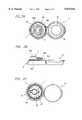
- FIG. 1is a side view illustrating a hinged cap according to an embodiment of the present invention
- FIG. 2is a view illustrating a state where an upper closure of the hinged cap of FIG. 1 is opened, wherein the diagram (A) is a top view, the diagram (B) is a side view, and the diagram (C) is a bottom view;
- FIG. 3is a side sectional view illustrating a state where the hinged cap of FIG. 1 is fitted to the mouth of the container;
- FIG. 4is a view illustrating a state where an outer cylinder and the upper closure are removed together from a cap body fitted to the mouth of the container;
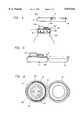
- FIG. 5is a side view illustrating another hinged cap of the present invention.
- FIG. 6is a top view of a further hinged cap of the present invention.
- FIG. 1a side sectional view (FIG. 1) illustrating a hinged cap according to an embodiment of the present invention
- a view(FIG. 2, wherein the diagram is a top view, the diagram B is a side view and the diagram C is a bottom view) illustrating a state where the upper closure of the hinged cap of FIG. 1 is opened
- a side sectional view(FIG. 3) illustrating a state where the hinged cap is fitted to the mouth of the container
- the hinged cap of the present inventionroughly comprises a cap body 1, an outer cylinder 2 connected thereto, and an upper closure 4 coupled by a hinge 3 to the upper end of the outer cylinder 2.
- the upper closure 4is turned and closed to completely cover the cap body 1 (FIG. 1) and is turned and opened, so that the cap body 1 is exposed (FIG. 2). Then, a tab 13 is torn away, and a liquid contained in the container is poured out.
- the cap body 1comprises a top plate portion 5 and a skirt portion 6 hanging down from the outer periphery thereof.
- FIG. 4illustrates a state where the outer cylinder 2 and the upper closure 4 are removed from the cap body 1 that is fitted to the mouth 50 of the container.
- a protrusion 7is formed along the inner periphery of the skirt portion 6 to come into engagement with a recessed portion 51 of the outer peripheral side of the mouth 50 of the container, so that the mouth 50 of the container comes into intimate contact with the inner surface of the upper plate portion 5 to accomplish the sealing.
- an inner ring 8is formed on the inner surface of the upper plate portion 5 to come into engagement with the inner peripheral side of the mouth 50 of the container, whereby the sealing is accomplished even on the inner peripheral side of the mouth 50 of the container to accomplish more reliable sealing.
- the upper plate portion 5 of the cap body 1has a portion 11 for forming a flow-out port is formed by a score 10.
- the portion 11is provided with a tab 12 for opening.
- the opening tab 12is pulled, the score 10 is broken, the flow-out port is formed in the portion 11, and the liquid contained in the container is poured out through the flow-out port.
- the opening tab 12is provided with a knurled protrusion 13 for preventing the slipping, so that it can be easily pulled by hand.
- a peripheral protrusion 14is formed on the outer surface of the top plate portion 5 so as to surround the portion 11 for forming the flow-out port. In pouring out the liquid, the peripheral protrusion 14 works as a guide so that the liquid is smoothly poured out.
- peripheral downwardly oriented protrusion 15On the inner surface of the upper closure 4 is formed a peripheral downwardly oriented protrusion 15 which, when the upper closure 4 is closed, comes into intimate contact with the inner peripheral surface of the peripheral protrusion 14. That is, even in a state where the flow-out port has been formed in the portion 11, the port is completely closed when the upper closure 4 is closed to maintain favorable sealing.
- the peripheral protrusion 14 surrounding the portion 11is tall along a half peripheral portion 14a on the side opposite to the side where the outer cylinder 2 and the upper closure 4 are coupled together by the hinge 3, and is short along a half peripheral portion 14b on the side of the hinge 3.
- the outer cylinder 2is so provided as to cover the outer peripheral surface of the skirt portion 6.
- the skirt portion 6 of the cap body 1 covered with the outer cylinder 2is provided with a plurality of slits 20 extending in the axial direction maintaining a distance in the circumferential direction.
- the skirt portion of the cap body 1 and the outer cylinder 2are separated from each other via circumferential cut surfaces.
- the skirt portion 6 and the outer cylinder 2, however,are molded integrally together via a plurality of breakable bridge portions 22 on the upper side of the cut surfaces 21.
- FIG. 2Aclearly shows the bridge portions 22, and
- FIG. 4shows the bridge portions 22 that are remaining as designated at 22' on the skirt portion 6 and on the outer cylinder 2 (which has been removed from the cap body 1).
- the outer surface of the skirt portion 6 of the cap body and the inner surface of the outer cylinder 2are intimately contacted to each other at the cut surfaces 21 in a state (FIG. 3) where the cap body 1 is sealing the mouth 50 of the container.
- the skirt portion 6outwardly expands due to the action of the plurality of slits 20 formed in the skirt portion 6 of the cap body 1 and extending in the axial direction. Therefore, the recessed portion 51 on the outer peripheral side of the mouth 50 of the container is disengaged from the inwardly facing protrusion 7 of the skirt portion, and the cap body 1 is easily removed from the mouth 50 of the container.
- the number of the slits and their interval in the circumferential directionare suitably determined from the above-mentioned points.
- the skirt portion 6is provided with the slits 20 in a number of, usually, 2 to 20 and, particularly, 8 to 12 though it may vary depending upon the diameter of the cap.
- the skirt portion 6 and the outer cylinder 2being intimately contacted to each other at the cut surfaces 21, the skirt portion 6 of the cap body is hooped by the outer cylinder 2 in a state where the cap body 1 is fitted to the mouth 50 of the container, the skirt portion 6 is prevented from outwardly expanding, and the mouth 50 of the container is reliably sealed.
- the intimately contacted stateplays a particularly important role. That is, the slits 20 in the skirt portion 6 work to weaken the engagement between the recessed portion 51 formed along the outer periphery of the mouth 50 of the container and the protrusion 7 of the skirt portion 6. With the hooping force of the outer cylinder 2 working thereon, however, a strong and reliable engagement is obtained.
- the skirt portion 6 of the cap body and the outer cylinder 2are coupled together through breakable bridge portions 22 only.
- the upper closure 4 coupled by the hinge to the outer cylinder 2is pulled up or pushed down by fingers, therefore, deviation takes place between the outer cylinder 2 and the skirt portion 6 on the cut surfaces 21, and the bridge portions 22 coupling the cap body 1 to the outer cylinder 2 are easily broken by the shearing force.
- FIG. 4illustrates a state where the outer cylinder 2 is separated from the cap body 1 that is fitted and secured to the mouth 50 of the container.
- the skirt portion 6 of the cap bodyhas been provided with the slits 20.
- the skirt portion 6is allowed to outwardly expand in the radial direction, and the cap body can be easily separated and removed from the mouth 50 of the container without using any tool.
- reference numeral 22'denotes the bridge portions 22 after broken.
- the cap after usedcan be separated from the container and disposed of easily.
- each bridge portion 22has a sectional area of 0.1 to 1.5 mm 2 and, particularly, 0.2 to 1.0 mm 2 in the direction of cut surfaces 21 (axial direction of the cap).
- the bridge portions 22are provided on the upper side of the cut surfaces 21.
- the bridge portions 22may be arranged on the lower side of the cut surfaces 21.
- the top plate portion 5 of the cap body 1has the portion 11 for forming the flow-out port.
- the upper closure 4is turned and is opened, and the content is poured out through the flow-out port formed in the portion 11 by breaking the score 10.
- the cap of this typeoffers very good tamper-evidence. That is, to remove the cap body 1 from the mouth 50 of the container, the outer cylinder 2 must be separated away from the cap body. In the cap of this type, therefore, the outer cylinder 2 that is separated proves that the cap is removed from the mouth 50 of the container even though the flow-out port has not been formed in the portion 11.
- the present inventionis in no way limited to the cap of the above-mentioned type only but can also be applied to the caps of, for example, the type in which the flow-out port has been formed from the beginning in the outer surface of the top plate portion 5 of the cap body 1. In this case, there is no improvement in the tamper-evidence, but the above-mentioned separability and sealing are accomplished to a satisfactory degree.
- the small peripheral protrusion 30is formed at the peripheral edge on the upper surface of the top plate portion 5 of the cap body, and a horizontal surface 31 is formed on the whole inner peripheral surface of the upper closure 4 so as to come into engagement with the peripheral protrusion 30 when the upper closure 4 is closed.
- the skirt portion 6 of the cap body and the outer cylinder 2are coupled integrally through the breakable bridge portions 22. During the capping operation and when the cap is conveyed and supplied, therefore, it is likely that the load in the axial direction may be concentrated on the bridge portions 22 causing the bridge portions 22 to be broken.
- peripheral protrusion 30 and the horizontal surface 31being formed as described above, however, the peripheral protrusion 30 works as a stopper which receives the load in the axial direction exerted on the upper closure 4. Therefore, the pressure is effectively prevented from being concentrated on the bridge portions 22 that can be easily broken, and the bridge portions 22 are perfectly protected.
- the lower end 2a of the outer cylinder 2is extending up to the recessed portion 51 on the outer peripheral side of the mouth 50 of the container. That is, when the lower end 2a is not extending up to the recessed portion 51, the skirt portion 6 of the cap body is not tightened by the outer cylinder 2 to a sufficient degree, and satisfactory sealing is not maintained.
- the lower end of the outer cylinder 2may be located at a position lower than the lower end of the skirt portion 6 of the cap body as shown in FIG. 3, or may be located at a position nearly horizontal relative to the lower end of the skirt portion 6 of the cap body, or may be located at a higher position.
- the bridge portions 22are provided on the upper side of the cut surfaces 21. As briefly mentioned above, however, the bridge portions 22 may be provided on the lower side of the cut surfaces 21. From the standpoint of productivity, however, it is desired that the bridge portions 22 are provided on the upper side of the cut surfaces 21.
- the resin for molding the capthere can be used a variety of plastics such as low-, medium or high-density polyethylene, linear low-density polyethylene, polypropylene, thermoplastic polyester, polyamide, styrene resin, ABS resin and the like resins.
- the hinged cap of the present inventionis obtained in a state where the cap body 1, outer cylinder 2 and upper closure 4 are integrally molded together by injection molding or compression molding.
- cuttingis performed between the cap body 1 and the outer cylinder 2 by using a cutter or the like to form cut surfaces 21 in the portions except the bridge portions 22, so that the two are separated from each other.
- cuttingis performed by inserting the cutter or the like from the lower side of the cap.
- the cutter or the likeis inserted from the upper side of the cap in a state where the upper closure 4 is opened.
- the cap of the present inventioncan be produced efficiently and within short periods of time in the flow of a substantially single molding step by using an ordinary metal mold comprising a core and a cavity maintaining very high productivity and high precision at each of the portions of the cap, suppressing the formation of defective products.
- the outer cylinder 2is provided with a weakened line 40 to facilitate the removal of the outer cylinder 2.
- the weakened line 40extends in the axial direction of the outer cylinder 2 and has a notch 41 formed at the upper end thereof. That is, the outer cylinder 2 is torn away by breaking the weakened line 40 starting from the notch 41. The outer cylinder 2 that is torn away is torn off in the circumferential direction, whereby the bridge portions 22 are broken, and the outer cylinder 2 is very easily removed from the cap body 1.
- the weakened lineis, usually, a score but may be a perforation.
- the scoreis formed on the outer surface of the outer cylinder 2.
- the notch 41may be formed at the lower end of the weakened line 40.
- FIG. 6is a top view of the hinged cap in a state where the upper closure is opened, wherein a coupling portion is provided as designated at 45.
- the coupling portion 45is wider than the bridge portions 22 and cannot be easily broken. If the outer cylinder 2 is turn off with the coupling portion 45 as a fulcrum, the bridge portions 22 are broken and the skirt portion 6 is liberated from the hooping force. By pulling up the outer cylinder 2 formed integrally with the upper closure 4 in this state, therefore, the cap body 1 can, at the same time, be removed from the mouth 50 of the container.
- the coupling portion 45can be easily formed by so effecting the cutting for forming the cut surfaces 21 as to leave the bridge portions 22 and the coupling portion 45.
- the coupling portion 45When the coupling portion 45 is to be formed in the hinged cap of FIG. 5, it is desired to form the coupling portion 45 at a position away from the break-starting portion (notch 41) of the weakened line 40.
- the cap of the present inventioncan be efficiently produced through a series of molding steps maintaining a very high productivity.
- the skirt portion of the cap bodyis intimately contacted to the mouth of the container being tightened by the outer cylinder to establish a reliable sealing structure.
- the capcan be easily removed from the mouth of the container without using any particular tool. Therefore, the cap after used can be separated easily from the container at the time of disposal.
- the cap of the type having a portion where the port will be formedoffers excellent tamper-evidence.
Landscapes
- Engineering & Computer Science (AREA)
- Mechanical Engineering (AREA)
- Closures For Containers (AREA)
Abstract
Description
1. Field of the Invention
The present invention relates to a hinged cap separable from bottle at the time of disposal. More specifically, the invention relates to a hinged cap that is strongly fitted and secured to the mouth of a container but that can be easily removed from the mouth of the container without using any special tool, and that offers excellent sealing and tamper-evidence.
2. Description of the Prior Art
Plastic caps have an excellent moldability, exhibit excellent flexibility and can, hence, be strongly fitted and secured to the mouths of containers by the capping operation to maintain high degree of sealing.
In many cases, however, the plastic caps are used for a glass bottle and the plastic containers made of materials different from the cap materials. To meet the demands for reusing the resources and for separating the cap from the bottle at the time of disposal, it has been desired to easily remove the caps from the mouths of the containers without using a tool such as cutter or the like.
There have been proposed a variety of caps separable from bottle at the time of disposal. For example, Japanese Utility Model Laid-Open No. 59247 /1994 discloses a container closure comprising a cap body fitted and secured to the mouth of a container, a cylinder screwed to the cap body, and an overcap coupled by hinges to the cylinder. In the container closure, the cap body comprises a top plate portion having a breaking portion for forming a flow-out port, a side wall coupled integrally to the peripheral edge of the top plate, and an inner ring that downwardly extends from the inner surface of the top plate portion maintaining a suitable gap from the side wall. That is, the cap body is secured to the mouth of the container as the mouth of the container is fitted to between the side wall and the inner ring. Besides, the side wall is formed being broadened toward the back thereof or has a plurality of slits extending in the direction of height maintaining a suitable distance in the circumferential direction, so that the cap body can be removed from the mouth of the container without using any special tool. Furthermore, a screw thread is formed on the upper outer peripheral surface of the side wall to hold the cylinder. When the cylinder is engaged with, and held by, the side wall, the side wall is pushed by the cylinder and is firmly held by the mouth of the container to maintain good sealing.
According to the container closure of the above prior art, the cylinder formed integrally with the overcap is turned, so that the cap body is removed from the side wall. Thus, the cap body can be easily removed by hand from the mouth of the container and can, hence, be separated easily from the container at the time of disposal.
Furthermore, Japanese Utility Model Laid-Open No. 9751/1995 discloses a container closure comprising an inner plug fitted and secured to the mouth of the container, an outer cylinder and an overcap. Like the cap body mentioned above, the inner plug of the container closure has, formed in the top plate portion thereof, a breaking portion for forming a flow-out port, and permits the mouth of the container to be fitted between the side wall and the inner ring. Moreover, the top plate portion has an annular erected portion that is so formed as to surround the breaking portion, and the overcap is fitted being screwed about the outer surface of the erected portion. The outer cylinder is so provided as to surround the outer peripheral surface of the side wall of the inner plug, the outer cylinder and the side wall of the inner plug are formed integrally together via a weakened portion, and a reinforcing ring is fitted in space between the inner surface of the outer cylinder and the outer surface of the side wall. That is, in a state where the container closure is fitted to the mouth of the container, the side wall of the inner plug is pushed onto the wall of the mouth of the container by the reinforcing ring, whereby the inner plug is firmly secured to the mouth of the container to maintain good sealing. The outer cylinder can be easily torn away from the inner plug by breaking the weakened portion. With the outer cylinder being torn away from the inner plug, the side wall is no longer pushed by the reinforcing ring. Therefore, the inner plug can be removed from the mouth of the container without using any special tool. As described above, this container closure can be separated easily from the container at the time of disposal. Besides, the container closure offers tamper-evidence since the inner plug is removed from the mouth of the container after the outer cylinder is torn away from the inner plug.
However, the former container closure, i.e., the container closure of Japanese Utility Model Laid-Open No. 59247/1994 does not offer tamper-evidence. That is, the container closure is removed by breaking neither the cylinder formed integrally with the cap nor the cap body. Therefore, even if the container closure that was once removed from the mouth of the container is fitted again to the mouth of the container, this fact cannot at all be recognized by a third person. Furthermore, this container closure is constituted by the two molded articles, i.e., constituted by the cap body and the cylinder formed integrally with the overcap. Therefore, the container closure cannot be produced by one time of molding. Besides, the two molded articles that are produced must be coupled together, leaving a problem of low productivity.
Furthermore, the latter container closure, i.e., the container closure disclosed in Japanese Utility Model Laid-Open No. 9751/1995 is constituted by three molded articles of an inner plug molded integrally with the outer cylinder, an overcap and a reinforcing ring, and can be produced very inefficiently even compared with the former container closure. Besides, the inner plug formed integrally with the outer cylinder has a complex triple-wall structure consisting of inner ring, side wall and outer cylinder. In addition, a separately molded reinforcing ring must be fitted between the side wall and the outer cylinder. Accordingly, the metal mold becomes complex, and the inner plug that is molded must have a high dimensional precision. Moreover, there remains a probability in that the reinforcing ring falls down prior to effecting the capping operation, which is a serious defect from the standpoint of production.
It is therefore an object of the present invention to provide a hinged cap which is free from the defects of the above-mentioned conventional container closures, can be easily separated from the container at the time of disposal, offers excellent tamper-evidence, easily molded and produced, and is effectively prevented from being broken at the time of capping.
According to the present invention, there is provided a hinged cap, comprising:
a cap body including a top plate portion and a skirt portion, the top plate portion having a flow-out port or having a portion for forming the flow-out port, the skirt portion having a protrusion formed on the inner surface thereof to engage with the mouth of a container;
an outer cylinder formed integrally with said cap body so as to cover the outer surfaces of said cap body and said skirt portion; and
an upper closure coupled by a hinge to the upper end portion of said outer cylinder;
wherein the skirt portion of said cap body is provided with a plurality of slits extending in the axial direction maintaining a distance in the circumferential direction, the skirt portion of said cap body and said outer cylinder are separated away from each other via cut surfaces but are formed integrally together via a plurality of breakable bridge portions and are formed on the upper side or on the lower side of the cut surfaces, and the outer surface of the skirt portion of the cap body and the inner surface of the outer cylinder are intimately contacted to each other at the cut surfaces in a state where at least the cap body is fitted to the mouth of the container.
In the hinged cap of the present invention, it is desired that the peripheral edge of the upper surface of the top plate portion of the cap body is provided with a small peripheral protrusion, and the inner surface of the upper closure has a horizontal surface that comes into contact with the upper end of the peripheral protrusion.
When the top plate portion of the cap body has a portion for forming the flow-out port, it is desired that the portion is provided with a tab for opening.
In the hinged cap of the present invention, the outer cylinder protects the skirt portion of the cap body at the time of capping. In a state where the mouth of the container is closed, the outer cylinder comes into intimate contact with the outer surface of the skirt portion of the cap body via cut surfaces to maintain the sealing. At the time of opening the cap, the outer cylinder is pushed up or pushed down to break the breakable bridge portions, so that the outer cylinder is removed integrally with the upper closure. With the outer cylinder being removed, the skirt portion of the cap body can be easily separated from the mouth of the container without using any tool.
The hinged cap of the type in which the top plate portion of the cap body has a portion for forming the flow-out port, offers good tamper-evidence.
It is very important that the cap of the present invention comprises the cap body, outer cylinder and upper closure that are molded integrally. That is, the upper closure is coupled by a hinge to the outer cylinder which is molded integrally with the skirt portion of the cap body via the breakable bridge portions. Therefore, the cap of the present invention is produced through substantially a single molding step featuring a very high productivity.
Furthermore, the skirt portion of the cap body is provided with a plurality of slits extending in the axial direction maintaining a distance in the circumferential direction. When the outer cylinder is removed, therefore, the skirt portion outwardly expands in the radial direction, facilitating the removal of the cap body from the mouth of the container.
According to the present invention, furthermore, the skirt portion of the cap body and the outer cylinder are separated from each other via cut surfaces but are molded integrally together via the breakable bridge portions on the upper side or on the lower side of the cut surfaces. Besides, the outer surface of the skirt portion of the cap body is brought into intimate contact with the inner surface of the outer cylinder at the cut surfaces.
That is, with the skirt portion and the outer cylinder being intimately contacted at the cut surfaces, the skirt portion of the cap body is hooped by the outer cylinder in a state where the mouth is at least sealed; i.e., the skirt portion is prevented from outwardly expanding, and the mouth of the container is reliably sealed. This is particularly important in the case of the cap of the present invention in which the skirt portion is provided with slits extending in the axial direction. That is, the slits in the skirt portion work to weaken the engagement between the mouth of the container and the protrusion of the skirt portion. With the skirt portion being hooped by the outer cylinder, however, strong and reliable engagement is accomplished.
A plurality of breakable bridge portions are provided on the upper side or on the lower side of the cut surfaces to couple the skirt portion of the cap body to the outer cylinder. Therefore, slits in the cut surfaces do not adversely affect the bridge portions. At the time of capping operation, furthermore, the outer surface of the skirt portion of the cap body comes into intimate contact with the inner surface of the outer cylinder at the cut surfaces. Therefore, the external force is prevented from acting on the breakable bridge portions, and the bridge portions are protected during the capping operation.
The small peripheral protrusion is formed at the peripheral edge on the upper surface of the top plate of the cap body, and the horizontal surface is formed on the inner surface of the top closure over the whole periphery to come into contact with the upper end of the peripheral protrusion when the upper closure is closed. During the capping operation or when the cap is being conveyed or supplied, therefore, the peripheral protrusion works as a stopper, and the pressure acting on the upper closure is received by the peripheral protrusion. Accordingly, the external force is more effectively prevented from acting upon the bridge portions, and the bridge portions are perfectly protected.
When the outer cylinder is pushed up or pushed down, furthermore, deviation takes place between the outer cylinder and the skirt portion on the cut surfaces, and the bridge portions coupling the cap body to the outer cylinder are cut due to the shearing force. Slits are formed in the skirt portion of the cap body. When the outer cylinder is removed from the skirt portion, therefore, the skirt portion is allowed to expand outwardly in the radial direction. Accordingly, the cap body can be easily separated away from the mouth of the container, and the mouth of the container can be easily opened without using any tool.
The outer cylinder that is removed proves that the cap body has already been removed from the mouth of the container. Therefore, the hinged cap of the type in which the top plate portion of the cap body has a portion for forming the flow-out port, offers improved tamper-evidence owing to the outer cylinder.
According to the present invention, the skirt portion of the cap body, outer cylinder and upper closure are injection-molded or compression-molded integrally and, then, a slit is formed by using a cutter or the like between the skirt portion of the cap body and the outer cylinder, and the portions except the bridge portions are separated from each other. Therefore, the cap can be easily produced by molding using an ordinary metal mold which comprises a core and a cavity.
In the present invention, furthermore, the skirt portion of the cap body and the outer cylinder can be coupled together through the bridge portions as well as through a coupling portion that cannot be broken. In this case, the outer cylinder and the cap body can be removed together from the mouth of the container after the bridge portions have been broken. Furthermore, a weakened line can be formed in the outer cylinder upwardly extending from the lower end thereof. The outer cylinder can be easily removed by breaking along the weakened line.
FIG. 1 is a side view illustrating a hinged cap according to an embodiment of the present invention;
FIG. 2 is a view illustrating a state where an upper closure of the hinged cap of FIG. 1 is opened, wherein the diagram (A) is a top view, the diagram (B) is a side view, and the diagram (C) is a bottom view;
FIG. 3 is a side sectional view illustrating a state where the hinged cap of FIG. 1 is fitted to the mouth of the container;
FIG. 4 is a view illustrating a state where an outer cylinder and the upper closure are removed together from a cap body fitted to the mouth of the container;
FIG. 5 is a side view illustrating another hinged cap of the present invention; and
FIG. 6 is a top view of a further hinged cap of the present invention.
The invention will now be described in detail with reference to the accompanying drawings.
Referring to a side sectional view (FIG. 1) illustrating a hinged cap according to an embodiment of the present invention, a view (FIG. 2, wherein the diagram is a top view, the diagram B is a side view and the diagram C is a bottom view) illustrating a state where the upper closure of the hinged cap of FIG. 1 is opened, and a side sectional view (FIG. 3) illustrating a state where the hinged cap is fitted to the mouth of the container, the hinged cap of the present invention roughly comprises a cap body 1, anouter cylinder 2 connected thereto, and anupper closure 4 coupled by ahinge 3 to the upper end of theouter cylinder 2. As will be understood from FIGS. 1 and 2, theupper closure 4 is turned and closed to completely cover the cap body 1 (FIG. 1) and is turned and opened, so that the cap body 1 is exposed (FIG. 2). Then, atab 13 is torn away, and a liquid contained in the container is poured out. The cap body 1 comprises atop plate portion 5 and askirt portion 6 hanging down from the outer periphery thereof.
FIG. 4 illustrates a state where theouter cylinder 2 and theupper closure 4 are removed from the cap body 1 that is fitted to themouth 50 of the container.
As best shown in FIG. 3, aprotrusion 7 is formed along the inner periphery of theskirt portion 6 to come into engagement with a recessedportion 51 of the outer peripheral side of themouth 50 of the container, so that themouth 50 of the container comes into intimate contact with the inner surface of theupper plate portion 5 to accomplish the sealing. In this embodiment, furthermore, aninner ring 8 is formed on the inner surface of theupper plate portion 5 to come into engagement with the inner peripheral side of themouth 50 of the container, whereby the sealing is accomplished even on the inner peripheral side of themouth 50 of the container to accomplish more reliable sealing.
Referring to FIGS. 1 and 3, furthermore, theupper plate portion 5 of the cap body 1 has aportion 11 for forming a flow-out port is formed by ascore 10. Theportion 11 is provided with atab 12 for opening. When theopening tab 12 is pulled, thescore 10 is broken, the flow-out port is formed in theportion 11, and the liquid contained in the container is poured out through the flow-out port. Here, it is desired that theopening tab 12 is provided with aknurled protrusion 13 for preventing the slipping, so that it can be easily pulled by hand.
Aperipheral protrusion 14 is formed on the outer surface of thetop plate portion 5 so as to surround theportion 11 for forming the flow-out port. In pouring out the liquid, theperipheral protrusion 14 works as a guide so that the liquid is smoothly poured out.
On the inner surface of theupper closure 4 is formed a peripheral downwardly orientedprotrusion 15 which, when theupper closure 4 is closed, comes into intimate contact with the inner peripheral surface of theperipheral protrusion 14. That is, even in a state where the flow-out port has been formed in theportion 11, the port is completely closed when theupper closure 4 is closed to maintain favorable sealing. Referring to FIGS. 1 and 2(A), it is desired that theperipheral protrusion 14 surrounding theportion 11, is tall along a halfperipheral portion 14a on the side opposite to the side where theouter cylinder 2 and theupper closure 4 are coupled together by thehinge 3, and is short along a halfperipheral portion 14b on the side of thehinge 3. This is because, when theupper closure 4 is closed, the peripheral downwardly orientedprotrusion 15 formed on theupper closure 4 smoothly enters into theperipheral protrusion 14 when theupper closure 4 is closed, and the turn of theupper closure 4 is not hindered. Besides, the content is poured out from the side opposite to the hinge-coupling portion 3, and the function of theperipheral protrusion 14 for guiding the pouring is not impaired.
Theouter cylinder 2 is so provided as to cover the outer peripheral surface of theskirt portion 6. As best shown in FIG. 4, theskirt portion 6 of the cap body 1 covered with theouter cylinder 2 is provided with a plurality ofslits 20 extending in the axial direction maintaining a distance in the circumferential direction.
The skirt portion of the cap body 1 and theouter cylinder 2 are separated from each other via circumferential cut surfaces. Theskirt portion 6 and theouter cylinder 2, however, are molded integrally together via a plurality ofbreakable bridge portions 22 on the upper side of the cut surfaces 21. FIG. 2A clearly shows thebridge portions 22, and FIG. 4 shows thebridge portions 22 that are remaining as designated at 22' on theskirt portion 6 and on the outer cylinder 2 (which has been removed from the cap body 1).
The outer surface of theskirt portion 6 of the cap body and the inner surface of theouter cylinder 2 are intimately contacted to each other at the cut surfaces 21 in a state (FIG. 3) where the cap body 1 is sealing themouth 50 of the container.
When thebridge portions 22 are broken to separate theouter cylinder 2 from the cap body 1, theskirt portion 6 outwardly expands due to the action of the plurality ofslits 20 formed in theskirt portion 6 of the cap body 1 and extending in the axial direction. Therefore, the recessedportion 51 on the outer peripheral side of themouth 50 of the container is disengaged from the inwardly facingprotrusion 7 of the skirt portion, and the cap body 1 is easily removed from themouth 50 of the container. The number of the slits and their interval in the circumferential direction are suitably determined from the above-mentioned points.
In the cap of the present invention, it is desired that theskirt portion 6 is provided with theslits 20 in a number of, usually, 2 to 20 and, particularly, 8 to 12 though it may vary depending upon the diameter of the cap.
With theskirt portion 6 and theouter cylinder 2 being intimately contacted to each other at the cut surfaces 21, theskirt portion 6 of the cap body is hooped by theouter cylinder 2 in a state where the cap body 1 is fitted to themouth 50 of the container, theskirt portion 6 is prevented from outwardly expanding, and themouth 50 of the container is reliably sealed. In the case of the cap of the present invention in which theskirt portion 6 is provided with theslits 20 that are extending in the axial direction, the intimately contacted state plays a particularly important role. That is, theslits 20 in theskirt portion 6 work to weaken the engagement between the recessedportion 51 formed along the outer periphery of themouth 50 of the container and theprotrusion 7 of theskirt portion 6. With the hooping force of theouter cylinder 2 working thereon, however, a strong and reliable engagement is obtained.
In FIGS. 1 to 4, theskirt portion 6 of the cap body and theouter cylinder 2 are coupled together throughbreakable bridge portions 22 only. When theupper closure 4 coupled by the hinge to theouter cylinder 2 is pulled up or pushed down by fingers, therefore, deviation takes place between theouter cylinder 2 and theskirt portion 6 on the cut surfaces 21, and thebridge portions 22 coupling the cap body 1 to theouter cylinder 2 are easily broken by the shearing force.
FIG. 4 illustrates a state where theouter cylinder 2 is separated from the cap body 1 that is fitted and secured to themouth 50 of the container. Theskirt portion 6 of the cap body has been provided with theslits 20. When theouter cylinder 2 is removed from theskirt portion 6, therefore, theskirt portion 6 is allowed to outwardly expand in the radial direction, and the cap body can be easily separated and removed from themouth 50 of the container without using any tool. In FIG. 4, reference numeral 22' denotes thebridge portions 22 after broken.
According to the present invention as described above, the cap after used can be separated from the container and disposed of easily.
The number and positions of thebridge portions 22 provided between theskirt portion 6 of the cap body and theouter cylinder 2 may be such that thebridge portions 22 are not broken during the capping operation and that thebridge portions 22 are easily broken when it is attempted to remove the cap body 1 from themouth 50 of the container (i.e., when the cap is to be discarded), enabling theouter cylinder 2 to be quickly separated away from theskirt portion 6. In this sense, there is no particular limitation on the positions and number of the bridge portions. In general, it is desired that eachbridge portion 22 has a sectional area of 0.1 to 1.5 mm2 and, particularly, 0.2 to 1.0 mm2 in the direction of cut surfaces 21 (axial direction of the cap). In the embodiment of FIGS. 1 to 4, thebridge portions 22 are provided on the upper side of the cut surfaces 21. However, thebridge portions 22 may be arranged on the lower side of the cut surfaces 21.
In the above-mentioned cap, thetop plate portion 5 of the cap body 1 has theportion 11 for forming the flow-out port. Theupper closure 4 is turned and is opened, and the content is poured out through the flow-out port formed in theportion 11 by breaking thescore 10. The cap of this type offers very good tamper-evidence. That is, to remove the cap body 1 from themouth 50 of the container, theouter cylinder 2 must be separated away from the cap body. In the cap of this type, therefore, theouter cylinder 2 that is separated proves that the cap is removed from themouth 50 of the container even though the flow-out port has not been formed in theportion 11.
The present invention is in no way limited to the cap of the above-mentioned type only but can also be applied to the caps of, for example, the type in which the flow-out port has been formed from the beginning in the outer surface of thetop plate portion 5 of the cap body 1. In this case, there is no improvement in the tamper-evidence, but the above-mentioned separability and sealing are accomplished to a satisfactory degree.
In the present invention as clearly shown in FIGS. 1 and 3, it is desired that the smallperipheral protrusion 30 is formed at the peripheral edge on the upper surface of thetop plate portion 5 of the cap body, and ahorizontal surface 31 is formed on the whole inner peripheral surface of theupper closure 4 so as to come into engagement with theperipheral protrusion 30 when theupper closure 4 is closed. In the cap of the present invention, theskirt portion 6 of the cap body and theouter cylinder 2 are coupled integrally through thebreakable bridge portions 22. During the capping operation and when the cap is conveyed and supplied, therefore, it is likely that the load in the axial direction may be concentrated on thebridge portions 22 causing thebridge portions 22 to be broken. With theperipheral protrusion 30 and thehorizontal surface 31 being formed as described above, however, theperipheral protrusion 30 works as a stopper which receives the load in the axial direction exerted on theupper closure 4. Therefore, the pressure is effectively prevented from being concentrated on thebridge portions 22 that can be easily broken, and thebridge portions 22 are perfectly protected.
According to the present invention, it is essential that thelower end 2a of theouter cylinder 2 is extending up to the recessedportion 51 on the outer peripheral side of themouth 50 of the container. That is, when thelower end 2a is not extending up to the recessedportion 51, theskirt portion 6 of the cap body is not tightened by theouter cylinder 2 to a sufficient degree, and satisfactory sealing is not maintained. Moreover, so far as theouter cylinder 2 has such a size, the lower end of theouter cylinder 2 may be located at a position lower than the lower end of theskirt portion 6 of the cap body as shown in FIG. 3, or may be located at a position nearly horizontal relative to the lower end of theskirt portion 6 of the cap body, or may be located at a higher position.
According to the above-mentioned embodiment, thebridge portions 22 are provided on the upper side of the cut surfaces 21. As briefly mentioned above, however, thebridge portions 22 may be provided on the lower side of the cut surfaces 21. From the standpoint of productivity, however, it is desired that thebridge portions 22 are provided on the upper side of the cut surfaces 21.
As the resin for molding the cap, there can be used a variety of plastics such as low-, medium or high-density polyethylene, linear low-density polyethylene, polypropylene, thermoplastic polyester, polyamide, styrene resin, ABS resin and the like resins.
By using the above-mentioned resin, the hinged cap of the present invention is obtained in a state where the cap body 1,outer cylinder 2 andupper closure 4 are integrally molded together by injection molding or compression molding. After this molding step, cutting is performed between the cap body 1 and theouter cylinder 2 by using a cutter or the like to form cut surfaces 21 in the portions except thebridge portions 22, so that the two are separated from each other. When thebridge portions 22 are to be provided on the upper side of the cut surfaces 21, cutting is performed by inserting the cutter or the like from the lower side of the cap. When thebridge portions 22 are to be provided on the lower side of the cut surfaces 21, the cutter or the like is inserted from the upper side of the cap in a state where theupper closure 4 is opened.
As described above, the cap of the present invention can be produced efficiently and within short periods of time in the flow of a substantially single molding step by using an ordinary metal mold comprising a core and a cavity maintaining very high productivity and high precision at each of the portions of the cap, suppressing the formation of defective products.
It is of course allowable to form thebridge portions 22 and the cut surfaces 21 simultaneously in the above step of molding. During the molding, in this case, the cap body 1 and theouter cylinder 2 are not intimately contacted to each other at portions where the cut surfaces 21 are formed. In the state where the cap body 1 is fitted to themouth 50 of the container, however, theskirt portion 6 of the cap body are outwardly expanded and, hence, the cap body 1 and theouter cylinder 2 are intimately contacted to each other via the cut surfaces 21.
It is also possible to form theslits 20 at a subsequent step after the step of integral molding.
According to another embodiment of the present invention shown in FIG. 5, theouter cylinder 2 is provided with a weakenedline 40 to facilitate the removal of theouter cylinder 2. As will be obvious from FIG. 5, the weakenedline 40 extends in the axial direction of theouter cylinder 2 and has anotch 41 formed at the upper end thereof. That is, theouter cylinder 2 is torn away by breaking the weakenedline 40 starting from thenotch 41. Theouter cylinder 2 that is torn away is torn off in the circumferential direction, whereby thebridge portions 22 are broken, and theouter cylinder 2 is very easily removed from the cap body 1. The weakened line is, usually, a score but may be a perforation.
It is generally desired that the score is formed on the outer surface of theouter cylinder 2.
Thenotch 41 may be formed at the lower end of the weakenedline 40.
In the above-mentioned embodiment of FIG. 1, theouter cylinder 2 and theskirt portion 6 of the cap body are coupled integrally through thebreakable bridge portions 22 only. It is, however, also possible to form a coupling portion that cannot be broken between the two together with thebridge portions 22. This embodiment is shown in FIG. 6 which is a top view of the hinged cap in a state where the upper closure is opened, wherein a coupling portion is provided as designated at 45. Thecoupling portion 45 is wider than thebridge portions 22 and cannot be easily broken. If theouter cylinder 2 is turn off with thecoupling portion 45 as a fulcrum, thebridge portions 22 are broken and theskirt portion 6 is liberated from the hooping force. By pulling up theouter cylinder 2 formed integrally with theupper closure 4 in this state, therefore, the cap body 1 can, at the same time, be removed from themouth 50 of the container.
Thecoupling portion 45 can be easily formed by so effecting the cutting for forming the cut surfaces 21 as to leave thebridge portions 22 and thecoupling portion 45.
When thecoupling portion 45 is to be formed in the hinged cap of FIG. 5, it is desired to form thecoupling portion 45 at a position away from the break-starting portion (notch 41) of the weakenedline 40.
The cap of the present invention can be efficiently produced through a series of molding steps maintaining a very high productivity.
In the capped and sealed state, the skirt portion of the cap body is intimately contacted to the mouth of the container being tightened by the outer cylinder to establish a reliable sealing structure. The cap can be easily removed from the mouth of the container without using any particular tool. Therefore, the cap after used can be separated easily from the container at the time of disposal.
Besides, the cap of the type having a portion where the port will be formed offers excellent tamper-evidence.
Claims (7)
1. A hinged cap comprising:
a cap body including a top plate portion and a skirt portion, the top plate portion having a portion for forming a flow-out port, the skirt portion having a protrusion formed on the inner surface thereof to engage with the mouth of a container;
an outer cylinder formed integrally with said cap body so as to cover the outer surfaces of said cap body and said skirt portion; and
an upper closure coupled by a hinge to the upper end portion of said outer cylinder;
wherein the skirt portion of said cap body is provided with a plurality of slits extending in the axial direction maintaining a distance in the circumferential direction, the skirt portion of said cap body and said outer cylinder are separated away from each other via cut surfaces but are formed integrally together via a plurality of breakable bridge portions that are formed on the upper or lower side of the cut surfaces, and the outer surface of the skirt portion of the cap body and the inner surface of the outer cylinder are intimately contacted to each other at the cut surfaces in a state where at least the cap body is fitted to the mouth of the container.
2. A hinged cap according to claim 1, wherein a small peripheral protrusion is formed at the peripheral edge on the upper surface of the top plate portion of the cap body, and a horizontal surface is formed on the inner surface of the upper closure so as to come into contact with the upper end of said peripheral protrusion.
3. A hinged cap according to claim 1, wherein the outer surface of the skirt portion of said cap body and the inner surface of the outer cylinder are formed being separated away from each other via the cut surfaces at portions except the breakable bridge portions by cutting after injection-molding or compression-molding.
4. A hinged cap according to claim 1, wherein said skirt portion of said cap body and said outer cylinder are coupled together via said breakable bridge portions and a coupling portion that cannot be broken.
5. A hinged cap according to claim 1, wherein said top plate portion has the portion for forming the flow-out port sectionalized by a score.
6. A hinged cap according to claim 1, wherein said outer cylinder has a weakened line extending from the lower end thereof toward the upper end thereof.
7. A hinged cap according to claim 6, wherein said weakened line is located near a portion where said upper closure and said outer cylinder are coupled together by the hinge, and a notch is formed at the upper end or the lower end of said weakened line.
Applications Claiming Priority (4)
| Application Number | Priority Date | Filing Date | Title |
|---|---|---|---|
| JP6653696 | 1996-03-22 | ||
| JP8-066536 | 1996-03-22 | ||
| JP8-222018 | 1996-08-23 | ||
| JP22201896AJP3161977B2 (en) | 1996-08-23 | 1996-08-23 | Cap with excellent separability |
Publications (1)
| Publication Number | Publication Date |
|---|---|
| US5875942Atrue US5875942A (en) | 1999-03-02 |
Family
ID=26407725
Family Applications (1)
| Application Number | Title | Priority Date | Filing Date |
|---|---|---|---|
| US08/786,509Expired - LifetimeUS5875942A (en) | 1996-03-22 | 1997-01-21 | Hinged cap separable from bottle at the time of disposal |
Country Status (5)
| Country | Link |
|---|---|
| US (1) | US5875942A (en) |
| EP (1) | EP0796801B1 (en) |
| KR (1) | KR100445578B1 (en) |
| CN (1) | CN1082925C (en) |
| DE (1) | DE69712954T2 (en) |
Cited By (57)
| Publication number | Priority date | Publication date | Assignee | Title |
|---|---|---|---|---|
| US6170683B1 (en) | 1999-11-16 | 2001-01-09 | Rexam Medical Packaging Inc. | Two stage dispensing cap for pressurized containers |
| US6253937B1 (en)* | 1995-06-06 | 2001-07-03 | Raymond G. Anderson | Snap top, easy pouring dispensing cap |
| US6360909B1 (en) | 2000-02-18 | 2002-03-26 | Sonoco Development, Inc. | Container closure having a frangible seal |
| WO2002028735A1 (en)* | 2000-10-03 | 2002-04-11 | Seaquist Closures Foreign, Inc. | Closure lid and resealable closure system |
| US6405885B1 (en) | 2000-12-22 | 2002-06-18 | Seaquist Closures Foreign, Inc. | Locking tamper-evident dispensing closure |
| US6419101B1 (en)* | 1999-09-14 | 2002-07-16 | Crown Cork & Seal Technologies Corporation | Tear band closure |
| US6460712B2 (en)* | 2001-02-02 | 2002-10-08 | Seaquist Closures Foreign, Inc. | One-piece tamper-evident closure system with a resealable, hinged lid |
| US20020195471A1 (en)* | 2001-04-18 | 2002-12-26 | Nottingham John R. | Container and lid assembly |
| US6530500B2 (en)* | 1999-07-08 | 2003-03-11 | The Sherwin-Williams Company | Storage and dispensing container for viscous fluids, paints and the like, and method of minimizing dripping |
| US20030089746A1 (en)* | 2000-01-25 | 2003-05-15 | Philippe Odet | Closure device and container provided with same |
| US6631820B2 (en) | 2000-12-22 | 2003-10-14 | Seaquist Closures Foreign, Inc. | Tamper-evident dispensing closure with partial breakaway cover |
| US6644487B2 (en)* | 2001-08-17 | 2003-11-11 | Seaquist Closures Foreign, Inc. | Tamper-evident closure with break-off piece retention |
| US6655553B2 (en) | 2000-10-25 | 2003-12-02 | Seaquist Closures Foreign, Inc. | Dispensing closure with tamper-evident sleeve |
| US20040011831A1 (en)* | 2002-07-03 | 2004-01-22 | Mcdonald Robert E. | Plastic paint container having a cube-shaped body |
| KR100445578B1 (en)* | 1996-03-22 | 2004-12-09 | 니혼 크라운 코르크 가부시키가이샤 | A hinged cap separable from bottle at the time of disposal |
| USD500953S1 (en) | 2001-08-14 | 2005-01-18 | The Sherwin-Williams Company | Container for coating materials |
| USD510866S1 (en) | 2001-08-14 | 2005-10-25 | The Sherwin-Williams Company | Round paint container |
| USD511101S1 (en) | 2001-08-14 | 2005-11-01 | The Sherwin-Williams Company | Round paint container with handle |
| US20050279753A1 (en)* | 2004-06-22 | 2005-12-22 | Rexam Beauty And Closures, Inc. | Release system for container |
| US20060016713A1 (en)* | 2000-04-11 | 2006-01-26 | Wylie Arun M | Container |
| US20060043113A1 (en)* | 2004-08-30 | 2006-03-02 | Rocklin Verespej | Cap assembly and container used therewith |
| US20060163252A1 (en)* | 2005-01-24 | 2006-07-27 | Letica Corporation | Container |
| US20060249533A1 (en)* | 2004-08-30 | 2006-11-09 | Scholle Corporation | Cap assembly and container used therewith |
| US20070102390A1 (en)* | 2005-11-08 | 2007-05-10 | Seaquist Closures Foreign, Inc. | Closure with deformed wall retention of lid hinge shaft |
| US20070102389A1 (en)* | 2005-11-08 | 2007-05-10 | Seaquist Closures Foreign, Inc. | Tamper-evident closure |
| USD563228S1 (en) | 2001-08-14 | 2008-03-04 | The Sherwin-Williams Company | Container for coating materials |
| USD573475S1 (en) | 2001-08-14 | 2008-07-22 | The Sherwin-Williams Company | Square paint container |
| US20080179276A1 (en)* | 2003-05-27 | 2008-07-31 | Portola Packaging, Inc. | Manufacture of removable membrane sealing components for consumer packaging |
| US20090071927A1 (en)* | 2005-11-15 | 2009-03-19 | Sebastien Lucien Fily | Tamper evident closure |
| US7510095B2 (en) | 2005-03-11 | 2009-03-31 | Berry Plastics Corporation | System comprising a radially aligned container and closure |
| US20090134188A1 (en)* | 2006-11-20 | 2009-05-28 | Mccormick & Company Incorporated | Non-drip spout closure |
| US20090175759A1 (en)* | 2005-05-19 | 2009-07-09 | Davis Gregory T | Needleless hub disinfection device and method |
| USD598752S1 (en) | 2007-11-20 | 2009-08-25 | Mccormick & Company, Incorporated | Non-drip spout |
| US20100001431A1 (en)* | 2004-06-22 | 2010-01-07 | Rexam Beauty And Closures, Inc. | Release system for container |
| US20100122254A1 (en)* | 2008-11-11 | 2010-05-13 | Cray Inc. | Batch and application scheduler interface layer in a multiprocessor computing environment |
| US20100181315A1 (en)* | 2005-08-01 | 2010-07-22 | Toyo Seikan Kaisha, Ltd. | Oxygen barrier cap with pullring |
| US20100264145A1 (en)* | 2007-10-31 | 2010-10-21 | Claude Benoit-Gonin | Tamper evident closure |
| US20130020327A1 (en)* | 2010-06-07 | 2013-01-24 | Cj Cheiljedang Corporation | Stopper and container having the same |
| US20130087523A1 (en)* | 2011-05-10 | 2013-04-11 | The Clorox Company | Closure |
| US9187219B2 (en) | 2013-03-06 | 2015-11-17 | Westrock Slatersville, Llc | Pour lip closure with drain back |
| US9371165B2 (en) | 2013-08-16 | 2016-06-21 | Westrock Slatersville, Llc | Two-piece child-resistant dispensing closure |
| JP2019038597A (en)* | 2017-08-28 | 2019-03-14 | 東京ライト工業株式会社 | Cap separable from container mouth |
| US10301057B2 (en) | 2016-07-11 | 2019-05-28 | Calibre Closures Llc | Dispensing container with internal squeeze limiting member |
| US20220106085A1 (en)* | 2019-09-18 | 2022-04-07 | Silgan White Cap LLC | Tamper Evident Flip Cap |
| USD981234S1 (en) | 2021-09-15 | 2023-03-21 | Closure Systems International Inc. | Closure |
| US20230249882A1 (en)* | 2022-02-08 | 2023-08-10 | Michael Angelo Gomez | Bottle cap with a flip lid |
| USD998464S1 (en) | 2021-10-29 | 2023-09-12 | Closure Systems International Inc. | Closure |
| USD998463S1 (en) | 2021-10-29 | 2023-09-12 | Closure Systems International Inc. | Closure |
| US11801977B1 (en) | 2022-12-02 | 2023-10-31 | Closure Systems International Inc. | Package with one-piece closure |
| USD1012705S1 (en) | 2021-09-20 | 2024-01-30 | Closure Systems International Inc. | Closure |
| US20240067419A1 (en)* | 2022-08-30 | 2024-02-29 | Silgan White Cap LLC | Closure |
| US11945625B2 (en) | 2022-06-24 | 2024-04-02 | Closure Systems International Inc. | Package with closure |
| US11970319B2 (en) | 2022-05-10 | 2024-04-30 | Closure Systems International Inc. | Anti-rotational and removal closure |
| US12065295B2 (en) | 2021-08-19 | 2024-08-20 | Closure Systems International Inc. | One-piece closure |
| USD1045606S1 (en) | 2022-11-18 | 2024-10-08 | Closure Systems International Inc. | Hinged overcap |
| USD1053010S1 (en) | 2022-11-10 | 2024-12-03 | Closure Systems International Inc. | Hinged overcap |
| US12397976B2 (en) | 2023-03-28 | 2025-08-26 | Closure Systems International Inc. | Flip-top closure and a package |
Families Citing this family (14)
| Publication number | Priority date | Publication date | Assignee | Title |
|---|---|---|---|---|
| FR2810641B1 (en)* | 2000-06-21 | 2002-10-18 | Cebal | FLEXIBLE TUBE PROVIDED WITH A LARGE DIAMETER NECK AND RIGID TIP TO BE FIXED ON SAID TUBE |
| DE10160362A1 (en)* | 2001-12-08 | 2003-06-26 | Saint Gobain Oberland Ag | Closure cap, in particular, for a Glass bottle comprises at least one catch protrusion which interacts with the at least one undercut on the bottle neck section |
| CN100448753C (en)* | 2004-12-13 | 2009-01-07 | 陈栢蟾 | Non-circular containers with safety rings |
| KR100757795B1 (en)* | 2006-06-21 | 2007-09-11 | 채동석 | Stopper and container with stopper |
| ES2331682B1 (en)* | 2009-04-08 | 2010-10-13 | Seaplast S.A. | SEALED PLUG WITH FLAT COVER FOR WIDE MOUTH CONTAINERS. |
| CN102582928B (en)* | 2012-02-17 | 2015-03-11 | 莫尼托有限公司 | Quickly-opened bottle cap |
| HUE038803T2 (en)* | 2013-04-29 | 2018-11-28 | Clariant Healthcare Packaging France S A S | Cap for a container |
| FR3019801B1 (en)* | 2014-04-10 | 2018-03-02 | United Caps France | CAP FOR BOTTLE |
| CN108996006A (en)* | 2016-06-24 | 2018-12-14 | 佛山市海盈食品有限公司 | Bottle cap applied to flexible package punch |
| JP6326472B2 (en)* | 2016-10-06 | 2018-05-16 | 日本クロージャー株式会社 | Plastic container lid |
| KR101880107B1 (en)* | 2016-12-16 | 2018-07-19 | 성보연 | Container cap easily separate collection |
| EP3443836A1 (en) | 2017-08-17 | 2019-02-20 | Ottmar Hödl | Agricultural attachment for the treatment of silage in trench silos |
| KR102110373B1 (en)* | 2019-03-22 | 2020-05-14 | 노윤호 | Bottle cap |
| CN110758896A (en)* | 2019-11-27 | 2020-02-07 | 广州曼盛包装有限公司 | Quick detach structure soy sauce bottle lid |
Citations (10)
| Publication number | Priority date | Publication date | Assignee | Title |
|---|---|---|---|---|
| US4782964A (en)* | 1986-10-21 | 1988-11-08 | Duma Packaging A/S | Closure assembly for a container |
| US4895282A (en)* | 1988-08-01 | 1990-01-23 | Owens-Illinois Closure Inc. | Dispensing closure with pull tab for enlarging orifice |
| EP0214095B1 (en)* | 1985-08-20 | 1990-05-23 | Alfatechnic Ag | Plastic closure |
| WO1992017379A1 (en)* | 1991-04-04 | 1992-10-15 | Rudolf Ernst Ag | Bottle closure made of plastics material |
| US5240155A (en)* | 1992-02-05 | 1993-08-31 | Seaquist Closures | Closure with integral twist ring |
| JPH0659247A (en)* | 1992-08-11 | 1994-03-04 | Matsushita Electric Ind Co Ltd | Projection type image display device |
| US5301849A (en)* | 1989-05-17 | 1994-04-12 | Rical S.A. | Spout assembly and sealing cap with spring-loaded hinge |
| JPH079751A (en)* | 1993-06-23 | 1995-01-13 | Tohoku Ricoh Co Ltd | Screen printing machine |
| US5588562A (en)* | 1994-10-31 | 1996-12-31 | Sander; Dieter | Tamper evident resealable plastic closure |
| US5601215A (en)* | 1994-05-19 | 1997-02-11 | Heinrich Stolz Gmbh & Co. Kg | Closure for a container |
Family Cites Families (14)
| Publication number | Priority date | Publication date | Assignee | Title |
|---|---|---|---|---|
| CH661488A5 (en)* | 1983-06-10 | 1987-07-31 | Alfatechnic Ag | PLASTIC LOCK. |
| JP2528851Y2 (en)* | 1988-11-04 | 1997-03-12 | 三笠産業 株式会社 | Cap |
| JP2532090Y2 (en)* | 1990-07-27 | 1997-04-09 | 株式会社吉野工業所 | Caps and containers with lids that flip elastically |
| JPH0410048A (en)* | 1990-04-27 | 1992-01-14 | Canon Inc | Information output device |
| JPH04102252U (en)* | 1991-02-12 | 1992-09-03 | 株式会社吉野工業所 | Cap with elastic reversible lid body |
| JPH0659247U (en) | 1993-01-28 | 1994-08-16 | 凸版印刷株式会社 | Easily removable spout |
| JP2589213Y2 (en)* | 1993-06-16 | 1999-01-27 | 株式会社吉野工業所 | Nozzle with inner cap |
| JP2593426Y2 (en) | 1993-07-15 | 1999-04-12 | 株式会社吉野工業所 | Nozzle with inner cap |
| JP3164465B2 (en)* | 1993-08-11 | 2001-05-08 | 株式会社ドッヂ商会 | Inner lid made of synthetic resin with removal function |
| JPH07315403A (en)* | 1994-05-30 | 1995-12-05 | Japan Crown Cork Co Ltd | Cap superior in separation disposal properties |
| JP3376461B2 (en)* | 1994-08-10 | 2003-02-10 | 三笠産業株式会社 | Heat resistant cap |
| US5875942A (en)* | 1996-03-22 | 1999-03-02 | Japan Crown Cork Co., Ltd. | Hinged cap separable from bottle at the time of disposal |
| JP4095129B2 (en)* | 1996-03-22 | 2008-06-04 | 日本クラウンコルク株式会社 | Hinge cap for easy separation and disposal |
| JP3161977B2 (en)* | 1996-08-23 | 2001-04-25 | 日本クラウンコルク株式会社 | Cap with excellent separability |
- 1997
- 1997-01-21USUS08/786,509patent/US5875942A/ennot_activeExpired - Lifetime
- 1997-01-24DEDE69712954Tpatent/DE69712954T2/ennot_activeExpired - Lifetime
- 1997-01-24EPEP97300444Apatent/EP0796801B1/ennot_activeExpired - Lifetime
- 1997-02-03KRKR1019970003240Apatent/KR100445578B1/ennot_activeExpired - Lifetime
- 1997-02-21CNCN97102820Apatent/CN1082925C/ennot_activeExpired - Fee Related
Patent Citations (10)
| Publication number | Priority date | Publication date | Assignee | Title |
|---|---|---|---|---|
| EP0214095B1 (en)* | 1985-08-20 | 1990-05-23 | Alfatechnic Ag | Plastic closure |
| US4782964A (en)* | 1986-10-21 | 1988-11-08 | Duma Packaging A/S | Closure assembly for a container |
| US4895282A (en)* | 1988-08-01 | 1990-01-23 | Owens-Illinois Closure Inc. | Dispensing closure with pull tab for enlarging orifice |
| US5301849A (en)* | 1989-05-17 | 1994-04-12 | Rical S.A. | Spout assembly and sealing cap with spring-loaded hinge |
| WO1992017379A1 (en)* | 1991-04-04 | 1992-10-15 | Rudolf Ernst Ag | Bottle closure made of plastics material |
| US5240155A (en)* | 1992-02-05 | 1993-08-31 | Seaquist Closures | Closure with integral twist ring |
| JPH0659247A (en)* | 1992-08-11 | 1994-03-04 | Matsushita Electric Ind Co Ltd | Projection type image display device |
| JPH079751A (en)* | 1993-06-23 | 1995-01-13 | Tohoku Ricoh Co Ltd | Screen printing machine |
| US5601215A (en)* | 1994-05-19 | 1997-02-11 | Heinrich Stolz Gmbh & Co. Kg | Closure for a container |
| US5588562A (en)* | 1994-10-31 | 1996-12-31 | Sander; Dieter | Tamper evident resealable plastic closure |
Cited By (92)
| Publication number | Priority date | Publication date | Assignee | Title |
|---|---|---|---|---|
| US6253937B1 (en)* | 1995-06-06 | 2001-07-03 | Raymond G. Anderson | Snap top, easy pouring dispensing cap |
| KR100445578B1 (en)* | 1996-03-22 | 2004-12-09 | 니혼 크라운 코르크 가부시키가이샤 | A hinged cap separable from bottle at the time of disposal |
| US6530500B2 (en)* | 1999-07-08 | 2003-03-11 | The Sherwin-Williams Company | Storage and dispensing container for viscous fluids, paints and the like, and method of minimizing dripping |
| US20050028884A1 (en)* | 1999-07-08 | 2005-02-10 | The Sherwin Williams Company | Storage and dispensing container for paint |
| US7325687B2 (en) | 1999-07-08 | 2008-02-05 | The Sherwin-Williams Company | Storage and dispensing container for paint |
| US7703641B2 (en)* | 1999-07-08 | 2010-04-27 | The Sherwin-Williams Company | Storage and dispensing container for paint |
| US6634525B2 (en)* | 1999-07-08 | 2003-10-21 | The Sherwin-Williams Company | Storage and dispensing container for paint |
| US6419101B1 (en)* | 1999-09-14 | 2002-07-16 | Crown Cork & Seal Technologies Corporation | Tear band closure |
| US6170683B1 (en) | 1999-11-16 | 2001-01-09 | Rexam Medical Packaging Inc. | Two stage dispensing cap for pressurized containers |
| US6851586B2 (en)* | 2000-01-25 | 2005-02-08 | Tetra Laval Holdings & Finance S.A. | Closure device and container provided with same |
| US20030089746A1 (en)* | 2000-01-25 | 2003-05-15 | Philippe Odet | Closure device and container provided with same |
| US6360909B1 (en) | 2000-02-18 | 2002-03-26 | Sonoco Development, Inc. | Container closure having a frangible seal |
| US20060016713A1 (en)* | 2000-04-11 | 2006-01-26 | Wylie Arun M | Container |
| US20060288660A1 (en)* | 2000-04-11 | 2006-12-28 | Wylie Arun M | Container |
| US20060163106A1 (en)* | 2000-04-11 | 2006-07-27 | Wylie Arun M | Container |
| US20060163105A1 (en)* | 2000-04-11 | 2006-07-27 | Wylie Arun M | Container |
| US20060163107A1 (en)* | 2000-04-11 | 2006-07-27 | Wylie Arun M | Container |
| US20060163108A1 (en)* | 2000-04-11 | 2006-07-27 | Wylie Arun M | Container |
| US20060283756A1 (en)* | 2000-04-11 | 2006-12-21 | Wylie Arun M | Container |
| US7032756B2 (en) | 2000-04-11 | 2006-04-25 | Wylie Arun M | Container |
| US20060289326A1 (en)* | 2000-04-11 | 2006-12-28 | Wylie Arun M | Container |
| US20070074487A1 (en)* | 2000-04-11 | 2007-04-05 | Wylie Arun M | Container |
| US20070000804A1 (en)* | 2000-04-11 | 2007-01-04 | Wylie Arun M | Container |
| US20060289543A1 (en)* | 2000-04-11 | 2006-12-28 | Wylie Arun M | Container |
| AU2001294641B2 (en)* | 2000-10-03 | 2005-12-01 | Seaquist Closures Foreign, Inc. | Closure lid and resealable closure system |
| US6550626B1 (en) | 2000-10-03 | 2003-04-22 | Seaquist Closures Foreign, Inc. | Closure lid and resealable closure system with tamper-evident features |
| WO2002028735A1 (en)* | 2000-10-03 | 2002-04-11 | Seaquist Closures Foreign, Inc. | Closure lid and resealable closure system |
| US6655553B2 (en) | 2000-10-25 | 2003-12-02 | Seaquist Closures Foreign, Inc. | Dispensing closure with tamper-evident sleeve |
| US6631820B2 (en) | 2000-12-22 | 2003-10-14 | Seaquist Closures Foreign, Inc. | Tamper-evident dispensing closure with partial breakaway cover |
| US20030205549A1 (en)* | 2000-12-22 | 2003-11-06 | Harrold John E. | Tamper-evident dispensing closure with partial breakaway cover |
| US6405885B1 (en) | 2000-12-22 | 2002-06-18 | Seaquist Closures Foreign, Inc. | Locking tamper-evident dispensing closure |
| US6460712B2 (en)* | 2001-02-02 | 2002-10-08 | Seaquist Closures Foreign, Inc. | One-piece tamper-evident closure system with a resealable, hinged lid |
| US6983862B2 (en) | 2001-04-18 | 2006-01-10 | The Sherwin-Williams Company | Container and lid assembly |
| US20020195471A1 (en)* | 2001-04-18 | 2002-12-26 | Nottingham John R. | Container and lid assembly |
| USD563228S1 (en) | 2001-08-14 | 2008-03-04 | The Sherwin-Williams Company | Container for coating materials |
| USD500953S1 (en) | 2001-08-14 | 2005-01-18 | The Sherwin-Williams Company | Container for coating materials |
| USD511101S1 (en) | 2001-08-14 | 2005-11-01 | The Sherwin-Williams Company | Round paint container with handle |
| USD510866S1 (en) | 2001-08-14 | 2005-10-25 | The Sherwin-Williams Company | Round paint container |
| USD573475S1 (en) | 2001-08-14 | 2008-07-22 | The Sherwin-Williams Company | Square paint container |
| US7044317B2 (en)* | 2001-08-17 | 2006-05-16 | Seaquist Closures Foreign, Inc. | Tamper-evident closure with break-off piece retention |
| US6644487B2 (en)* | 2001-08-17 | 2003-11-11 | Seaquist Closures Foreign, Inc. | Tamper-evident closure with break-off piece retention |
| US6896156B2 (en) | 2002-07-03 | 2005-05-24 | The Sherwin-Williams Company | Plastic paint container having a cube-shaped body |
| US20040011831A1 (en)* | 2002-07-03 | 2004-01-22 | Mcdonald Robert E. | Plastic paint container having a cube-shaped body |
| US7832579B2 (en)* | 2003-05-27 | 2010-11-16 | Portola Packaging, Inc. | Manufacture of removable manufacture sealing components for consumer packaging |
| US20080179276A1 (en)* | 2003-05-27 | 2008-07-31 | Portola Packaging, Inc. | Manufacture of removable membrane sealing components for consumer packaging |
| US7806290B2 (en)* | 2004-06-22 | 2010-10-05 | Rexam Beauty And Closures, Inc. | Release system for container |
| US8434640B2 (en) | 2004-06-22 | 2013-05-07 | Allen G. Timm | Release system for container |
| US20100001431A1 (en)* | 2004-06-22 | 2010-01-07 | Rexam Beauty And Closures, Inc. | Release system for container |
| US20050279753A1 (en)* | 2004-06-22 | 2005-12-22 | Rexam Beauty And Closures, Inc. | Release system for container |
| US7357277B2 (en)* | 2004-08-30 | 2008-04-15 | Scholle Corporation | Cap assembly and container used therewith |
| US7387220B2 (en)* | 2004-08-30 | 2008-06-17 | Scholle Corporation | Cap assembly and container used therewith |
| US20060249533A1 (en)* | 2004-08-30 | 2006-11-09 | Scholle Corporation | Cap assembly and container used therewith |
| US20060043113A1 (en)* | 2004-08-30 | 2006-03-02 | Rocklin Verespej | Cap assembly and container used therewith |
| US20060163252A1 (en)* | 2005-01-24 | 2006-07-27 | Letica Corporation | Container |
| US7510095B2 (en) | 2005-03-11 | 2009-03-31 | Berry Plastics Corporation | System comprising a radially aligned container and closure |
| US20090175759A1 (en)* | 2005-05-19 | 2009-07-09 | Davis Gregory T | Needleless hub disinfection device and method |
| US7682561B2 (en)* | 2005-05-19 | 2010-03-23 | Sage Products, Inc. | Needleless hub disinfection device and method |
| US20100181315A1 (en)* | 2005-08-01 | 2010-07-22 | Toyo Seikan Kaisha, Ltd. | Oxygen barrier cap with pullring |
| US20070102390A1 (en)* | 2005-11-08 | 2007-05-10 | Seaquist Closures Foreign, Inc. | Closure with deformed wall retention of lid hinge shaft |
| US20070102389A1 (en)* | 2005-11-08 | 2007-05-10 | Seaquist Closures Foreign, Inc. | Tamper-evident closure |
| US9650184B2 (en)* | 2005-11-15 | 2017-05-16 | Clariant Production (France) S.A.S. | Package containing tamper evidence features |
| US20090071927A1 (en)* | 2005-11-15 | 2009-03-19 | Sebastien Lucien Fily | Tamper evident closure |
| WO2008008385A3 (en)* | 2006-07-10 | 2008-11-20 | Scholle Corp | Cap assembly and container used therewith |
| US20090134188A1 (en)* | 2006-11-20 | 2009-05-28 | Mccormick & Company Incorporated | Non-drip spout closure |
| US7870980B2 (en) | 2006-11-20 | 2011-01-18 | Mccormick & Company, Incorporated | Non-drip spout closure |
| US8490804B2 (en)* | 2007-10-31 | 2013-07-23 | Obrist Closures Switzerland Gmbh | Closure with movable tamper-evident member |
| US20100264145A1 (en)* | 2007-10-31 | 2010-10-21 | Claude Benoit-Gonin | Tamper evident closure |
| USD598752S1 (en) | 2007-11-20 | 2009-08-25 | Mccormick & Company, Incorporated | Non-drip spout |
| US20100122254A1 (en)* | 2008-11-11 | 2010-05-13 | Cray Inc. | Batch and application scheduler interface layer in a multiprocessor computing environment |
| US20130020327A1 (en)* | 2010-06-07 | 2013-01-24 | Cj Cheiljedang Corporation | Stopper and container having the same |
| US9546027B2 (en)* | 2011-05-10 | 2017-01-17 | The Clorox Company | Irremovable closure |
| US20130087523A1 (en)* | 2011-05-10 | 2013-04-11 | The Clorox Company | Closure |
| US9187219B2 (en) | 2013-03-06 | 2015-11-17 | Westrock Slatersville, Llc | Pour lip closure with drain back |
| US10106300B2 (en) | 2013-03-06 | 2018-10-23 | Silgan Dispensing Systems Slatersville Llc | Pour lip closure with drain back |
| US9371165B2 (en) | 2013-08-16 | 2016-06-21 | Westrock Slatersville, Llc | Two-piece child-resistant dispensing closure |
| US10301057B2 (en) | 2016-07-11 | 2019-05-28 | Calibre Closures Llc | Dispensing container with internal squeeze limiting member |
| JP2019038597A (en)* | 2017-08-28 | 2019-03-14 | 東京ライト工業株式会社 | Cap separable from container mouth |
| US11827425B2 (en)* | 2019-09-18 | 2023-11-28 | Silgan White Cap LLC | Tamper evident flip cap |
| US20220106085A1 (en)* | 2019-09-18 | 2022-04-07 | Silgan White Cap LLC | Tamper Evident Flip Cap |
| US12065295B2 (en) | 2021-08-19 | 2024-08-20 | Closure Systems International Inc. | One-piece closure |
| USD981234S1 (en) | 2021-09-15 | 2023-03-21 | Closure Systems International Inc. | Closure |
| USD1012705S1 (en) | 2021-09-20 | 2024-01-30 | Closure Systems International Inc. | Closure |
| USD998463S1 (en) | 2021-10-29 | 2023-09-12 | Closure Systems International Inc. | Closure |
| USD998464S1 (en) | 2021-10-29 | 2023-09-12 | Closure Systems International Inc. | Closure |
| US20230249882A1 (en)* | 2022-02-08 | 2023-08-10 | Michael Angelo Gomez | Bottle cap with a flip lid |
| US11970319B2 (en) | 2022-05-10 | 2024-04-30 | Closure Systems International Inc. | Anti-rotational and removal closure |
| US11945625B2 (en) | 2022-06-24 | 2024-04-02 | Closure Systems International Inc. | Package with closure |
| US20240067419A1 (en)* | 2022-08-30 | 2024-02-29 | Silgan White Cap LLC | Closure |
| USD1053010S1 (en) | 2022-11-10 | 2024-12-03 | Closure Systems International Inc. | Hinged overcap |
| USD1045606S1 (en) | 2022-11-18 | 2024-10-08 | Closure Systems International Inc. | Hinged overcap |
| US11801977B1 (en) | 2022-12-02 | 2023-10-31 | Closure Systems International Inc. | Package with one-piece closure |
| US12397976B2 (en) | 2023-03-28 | 2025-08-26 | Closure Systems International Inc. | Flip-top closure and a package |
Also Published As
| Publication number | Publication date |
|---|---|
| DE69712954T2 (en) | 2003-01-23 |
| EP0796801B1 (en) | 2002-06-05 |
| EP0796801A3 (en) | 1998-04-29 |
| CN1082925C (en) | 2002-04-17 |
| CN1163220A (en) | 1997-10-29 |
| KR19980018013A (en) | 1998-06-05 |
| KR100445578B1 (en) | 2004-12-09 |
| EP0796801A2 (en) | 1997-09-24 |
| DE69712954D1 (en) | 2002-07-11 |
Similar Documents
| Publication | Publication Date | Title |
|---|---|---|
| US5875942A (en) | Hinged cap separable from bottle at the time of disposal | |
| US6016931A (en) | Cap separable from bottle at the time of disposal | |
| US4526282A (en) | Tamper proof closure cap, method, and tool for making same | |
| US6260721B1 (en) | Plastic cap | |
| US4552328A (en) | Mold for making tamper-proof closure | |
| SK98895A3 (en) | Scwrew-top closure, method of its manufacture, scwrew-top closure assembly with vessel and mould for carrying out the method | |
| JP5038787B2 (en) | cap | |
| US4667838A (en) | Tamper-evident closure with ribbed skirt | |
| BG62607B1 (en) | Cover with inseparable band indicating unauthorized opening | |
| EP1457423B1 (en) | Container main body made of synthetic resin and preforming mold device | |
| US4699286A (en) | Plastic bottle caps | |
| US5950876A (en) | Insert molded tamper evident pouring spout | |
| US4784281A (en) | Tamper-evident closures | |
| US6068151A (en) | Tamper-indicating plastic closure having pilfer band | |
| JP4095129B2 (en) | Hinge cap for easy separation and disposal | |
| JP4156055B2 (en) | Hinge cap with excellent separation and disposal | |
| US5992710A (en) | Lid with integrally molded pouring spout | |
| EP3837187B1 (en) | Locking bottle transport ring for a stopper | |
| JP4762426B2 (en) | Separable disposal cap | |
| JP3748604B2 (en) | Plastic container lid for easy separation and disposal | |
| JP2567418Y2 (en) | Container lid | |
| JP3698765B2 (en) | Cap with excellent separation and disposal | |
| JPS60183352A (en) | Plastic vessel cover with vent hole | |
| JP4449487B2 (en) | Plastic cap with anti-tampering function | |
| JP2000247347A (en) | Resin cap |
Legal Events
| Date | Code | Title | Description |
|---|---|---|---|
| AS | Assignment | Owner name:JAPAN CROWN CORK CO. LTD., JAPAN Free format text:ASSIGNMENT OF ASSIGNORS INTEREST;ASSIGNORS:OHMI, HIDEHIKO;KUBO, TATEO;KUMATA, MITSUO;REEL/FRAME:008403/0280 Effective date:19970114 | |
| STCF | Information on status: patent grant | Free format text:PATENTED CASE | |
| FPAY | Fee payment | Year of fee payment:4 | |
| FPAY | Fee payment | Year of fee payment:8 | |
| FEPP | Fee payment procedure | Free format text:PAYER NUMBER DE-ASSIGNED (ORIGINAL EVENT CODE: RMPN); ENTITY STATUS OF PATENT OWNER: LARGE ENTITY Free format text:PAYOR NUMBER ASSIGNED (ORIGINAL EVENT CODE: ASPN); ENTITY STATUS OF PATENT OWNER: LARGE ENTITY | |
| FPAY | Fee payment | Year of fee payment:12 |