US5842237A - Convertible bed/chair with waste disposal - Google Patents
Convertible bed/chair with waste disposalDownload PDFInfo
- Publication number
- US5842237A US5842237AUS08/601,997US60199796AUS5842237AUS 5842237 AUS5842237 AUS 5842237AUS 60199796 AUS60199796 AUS 60199796AUS 5842237 AUS5842237 AUS 5842237A
- Authority
- US
- United States
- Prior art keywords
- commode
- patient
- nozzle
- water
- bed
- Prior art date
- Legal status (The legal status is an assumption and is not a legal conclusion. Google has not performed a legal analysis and makes no representation as to the accuracy of the status listed.)
- Expired - Fee Related
Links
- 239000002699waste materialSubstances0.000titleclaimsabstractdescription42
- XLYOFNOQVPJJNP-UHFFFAOYSA-NwaterSubstancesOXLYOFNOQVPJJNP-UHFFFAOYSA-N0.000claimsdescription45
- 210000002700urineAnatomy0.000claimsdescription8
- 210000003608feceAnatomy0.000claimsdescription6
- 239000003349gelling agentSubstances0.000claimsdescription5
- 239000007921spraySubstances0.000claimsdescription5
- 238000003860storageMethods0.000claimsdescription5
- 230000005484gravityEffects0.000claimsdescription3
- 239000003795chemical substances by applicationSubstances0.000claimsdescription2
- 238000010438heat treatmentMethods0.000claimsdescription2
- 230000009849deactivationEffects0.000claims1
- 210000002414legAnatomy0.000abstractdescription22
- 239000000463materialSubstances0.000abstractdescription10
- 230000009471actionEffects0.000abstractdescription6
- 210000001217buttockAnatomy0.000abstractdescription5
- 238000007605air dryingMethods0.000abstract1
- 230000007246mechanismEffects0.000description17
- 210000002683footAnatomy0.000description16
- 210000000689upper legAnatomy0.000description16
- 230000006870functionEffects0.000description9
- 230000002093peripheral effectEffects0.000description9
- 230000008602contractionEffects0.000description8
- 238000001035dryingMethods0.000description8
- 230000000994depressogenic effectEffects0.000description7
- 230000004888barrier functionEffects0.000description4
- 230000000881depressing effectEffects0.000description4
- 238000000034methodMethods0.000description4
- 230000004048modificationEffects0.000description4
- 238000012986modificationMethods0.000description4
- 238000003825pressingMethods0.000description4
- 230000002441reversible effectEffects0.000description4
- 238000005406washingMethods0.000description4
- 230000000694effectsEffects0.000description3
- 210000003127kneeAnatomy0.000description3
- 230000036961partial effectEffects0.000description3
- 230000008569processEffects0.000description3
- 230000004913activationEffects0.000description2
- 230000000903blocking effectEffects0.000description2
- 210000004392genitaliaAnatomy0.000description2
- 238000000465mouldingMethods0.000description2
- 230000003134recirculating effectEffects0.000description2
- 230000000717retained effectEffects0.000description2
- 239000004094surface-active agentSubstances0.000description2
- 210000003371toeAnatomy0.000description2
- 101710098560NADPH-cytochrome P450 reductase 2Proteins0.000description1
- 208000027418Wounds and injuryDiseases0.000description1
- 239000000853adhesiveSubstances0.000description1
- 230000001070adhesive effectEffects0.000description1
- 210000000436anusAnatomy0.000description1
- 230000008901benefitEffects0.000description1
- 230000005465channelingEffects0.000description1
- 238000004140cleaningMethods0.000description1
- 238000010276constructionMethods0.000description1
- 238000011109contaminationMethods0.000description1
- 230000008878couplingEffects0.000description1
- 238000010168coupling processMethods0.000description1
- 238000005859coupling reactionMethods0.000description1
- 230000006378damageEffects0.000description1
- 230000013872defecationEffects0.000description1
- 230000001877deodorizing effectEffects0.000description1
- 238000000151depositionMethods0.000description1
- CEJLBZWIKQJOAT-UHFFFAOYSA-Ndichloroisocyanuric acidChemical groupClN1C(=O)NC(=O)N(Cl)C1=OCEJLBZWIKQJOAT-UHFFFAOYSA-N0.000description1
- 239000012530fluidSubstances0.000description1
- 239000006260foamSubstances0.000description1
- 208000014674injuryDiseases0.000description1
- 238000003780insertionMethods0.000description1
- 230000037431insertionEffects0.000description1
- 230000000670limiting effectEffects0.000description1
- 239000006210lotionSubstances0.000description1
- 239000011159matrix materialSubstances0.000description1
- 239000005022packaging materialSubstances0.000description1
- 210000003899penisAnatomy0.000description1
- 239000002304perfumeSubstances0.000description1
- 239000000843powderSubstances0.000description1
- 230000009467reductionEffects0.000description1
- 230000002829reductive effectEffects0.000description1
- 239000012858resilient materialSubstances0.000description1
- 230000000284resting effectEffects0.000description1
- 230000000452restraining effectEffects0.000description1
- 238000007789sealingMethods0.000description1
- 239000007787solidSubstances0.000description1
- 230000008961swellingEffects0.000description1
- 230000007704transitionEffects0.000description1
- 238000011144upstream manufacturingMethods0.000description1
- 210000003708urethraAnatomy0.000description1
- 230000000007visual effectEffects0.000description1
Images



Classifications
- A—HUMAN NECESSITIES
- A61—MEDICAL OR VETERINARY SCIENCE; HYGIENE
- A61G—TRANSPORT, PERSONAL CONVEYANCES, OR ACCOMMODATION SPECIALLY ADAPTED FOR PATIENTS OR DISABLED PERSONS; OPERATING TABLES OR CHAIRS; CHAIRS FOR DENTISTRY; FUNERAL DEVICES
- A61G7/00—Beds specially adapted for nursing; Devices for lifting patients or disabled persons
- A61G7/10—Devices for lifting patients or disabled persons, e.g. special adaptations of hoists thereto
- A61G7/16—Devices for lifting patients or disabled persons, e.g. special adaptations of hoists thereto converting a lying surface into a chair
- A—HUMAN NECESSITIES
- A61—MEDICAL OR VETERINARY SCIENCE; HYGIENE
- A61G—TRANSPORT, PERSONAL CONVEYANCES, OR ACCOMMODATION SPECIALLY ADAPTED FOR PATIENTS OR DISABLED PERSONS; OPERATING TABLES OR CHAIRS; CHAIRS FOR DENTISTRY; FUNERAL DEVICES
- A61G7/00—Beds specially adapted for nursing; Devices for lifting patients or disabled persons
- A61G7/002—Beds specially adapted for nursing; Devices for lifting patients or disabled persons having adjustable mattress frame
- A—HUMAN NECESSITIES
- A61—MEDICAL OR VETERINARY SCIENCE; HYGIENE
- A61G—TRANSPORT, PERSONAL CONVEYANCES, OR ACCOMMODATION SPECIALLY ADAPTED FOR PATIENTS OR DISABLED PERSONS; OPERATING TABLES OR CHAIRS; CHAIRS FOR DENTISTRY; FUNERAL DEVICES
- A61G7/00—Beds specially adapted for nursing; Devices for lifting patients or disabled persons
- A61G7/002—Beds specially adapted for nursing; Devices for lifting patients or disabled persons having adjustable mattress frame
- A61G7/005—Beds specially adapted for nursing; Devices for lifting patients or disabled persons having adjustable mattress frame tiltable around transverse horizontal axis, e.g. for Trendelenburg position
- A—HUMAN NECESSITIES
- A61—MEDICAL OR VETERINARY SCIENCE; HYGIENE
- A61G—TRANSPORT, PERSONAL CONVEYANCES, OR ACCOMMODATION SPECIALLY ADAPTED FOR PATIENTS OR DISABLED PERSONS; OPERATING TABLES OR CHAIRS; CHAIRS FOR DENTISTRY; FUNERAL DEVICES
- A61G7/00—Beds specially adapted for nursing; Devices for lifting patients or disabled persons
- A61G7/002—Beds specially adapted for nursing; Devices for lifting patients or disabled persons having adjustable mattress frame
- A61G7/012—Beds specially adapted for nursing; Devices for lifting patients or disabled persons having adjustable mattress frame raising or lowering of the whole mattress frame
- A—HUMAN NECESSITIES
- A61—MEDICAL OR VETERINARY SCIENCE; HYGIENE
- A61G—TRANSPORT, PERSONAL CONVEYANCES, OR ACCOMMODATION SPECIALLY ADAPTED FOR PATIENTS OR DISABLED PERSONS; OPERATING TABLES OR CHAIRS; CHAIRS FOR DENTISTRY; FUNERAL DEVICES
- A61G7/00—Beds specially adapted for nursing; Devices for lifting patients or disabled persons
- A61G7/02—Beds specially adapted for nursing; Devices for lifting patients or disabled persons with toilet conveniences, or specially adapted for use with toilets
- A—HUMAN NECESSITIES
- A61—MEDICAL OR VETERINARY SCIENCE; HYGIENE
- A61G—TRANSPORT, PERSONAL CONVEYANCES, OR ACCOMMODATION SPECIALLY ADAPTED FOR PATIENTS OR DISABLED PERSONS; OPERATING TABLES OR CHAIRS; CHAIRS FOR DENTISTRY; FUNERAL DEVICES
- A61G9/00—Bed-pans, urinals or other sanitary devices for bed-ridden persons; Cleaning devices therefor, e.g. combined with toilet-urinals
- A—HUMAN NECESSITIES
- A61—MEDICAL OR VETERINARY SCIENCE; HYGIENE
- A61G—TRANSPORT, PERSONAL CONVEYANCES, OR ACCOMMODATION SPECIALLY ADAPTED FOR PATIENTS OR DISABLED PERSONS; OPERATING TABLES OR CHAIRS; CHAIRS FOR DENTISTRY; FUNERAL DEVICES
- A61G2203/00—General characteristics of devices
- A61G2203/30—General characteristics of devices characterised by sensor means
- A61G2203/44—General characteristics of devices characterised by sensor means for weight
- Y—GENERAL TAGGING OF NEW TECHNOLOGICAL DEVELOPMENTS; GENERAL TAGGING OF CROSS-SECTIONAL TECHNOLOGIES SPANNING OVER SEVERAL SECTIONS OF THE IPC; TECHNICAL SUBJECTS COVERED BY FORMER USPC CROSS-REFERENCE ART COLLECTIONS [XRACs] AND DIGESTS
- Y10—TECHNICAL SUBJECTS COVERED BY FORMER USPC
- Y10S—TECHNICAL SUBJECTS COVERED BY FORMER USPC CROSS-REFERENCE ART COLLECTIONS [XRACs] AND DIGESTS
- Y10S5/00—Beds
- Y10S5/928—Beds with sprinkling or washing means
Definitions
- the present inventionrelates in general to patient care beds.
- the present inventionrelates to an improved patient care bed convertible between a bed and a chair position, and a waste disposal system incorporated therein.
- the bedshave typically been complex apparatus. While the desired range of movement of the bed requires a certain amount of physical complexity, the operation of the beds (at least beyond the basic raising and lowering functions) has been rather complicated also. Additionally, where waste disposal has been provided, there has been little done in the way of cleansing the patient, or the arrangements for such cleansing have been rather complex. Even where a cleansing system has been provided, this complexity has not resulted in ease of use.
- a further considerationis the odor produced by the bodily waste of the patient.
- One solutionis to remove the waste immediately, yet this results in a large number of waste containers and a proportional waste of packaging material.
- the collection unit of the U.S. Pat. No. 5,350,369 patentpermits multiple uses by solidifying the waste with a deodorizing gelling material.
- the construction of the collection unit of that patentoften results in the fecal matter sliding upon the sides of the container. This may leave an odorous residue which is not gelled.
- An object of the present inventionis to provide a bed for patient care which provides a wide range of movement of the various bed sections.
- Another object of the present inventionis to provide such a bed which may be adjusted for height, Trendelenburg, reverse Trendelenburg, back and leg motion sufficient to place the bed in a chair position.
- a further object of the present inventionis to provide such a bed with a separate leg support section for each leg of the patient, with each leg section being independently controllable for movement.
- Yet another object of the present inventionis to provide a bed for patient care which includes a waste disposal system.
- a further object of the present inventionis for such a waste disposal system to provide multiple uses without creating an odor problem.
- a further object of the present inventionis to provide such a waste disposal system which provides for convenient cleansing of the patient.
- Another object of the present inventionis to provide a method of cleansing a patient after defecation.
- Yet a further object of the present inventionis to provide such a waste disposal system which is readily disposable yet maintains the waste sealed against egress.
- Yet another object of the present inventionis to provide such a bed for patient care in which the operating controls are simple and convenient.
- a further object of the present inventionis to provide such a bed in which the operation of the waste disposal system is safe and efficient.
- a bed for patient care having a waste disposal systemThe bed includes a back, seat and two leg sections for supporting the patient. These sections of the bed may be raised, lowered, and tilted. The leg sections may be moved independently for use with patients having one leg immobilized.
- the seat sectionincludes two panels which separate to expose an aperture permitting a waste canister to be raised into engagement with the buttocks of the patient. An audible signal is alerts the patient prior to this action.
- the waste canisterprovides a directable bidet wash, and an air dry feature. Gelling material within the canister swells during the bidet function to cover and seal the waste. The entire canister may be sealed and disposed of.
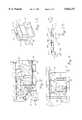
- FIG. 1is a perspective view of a bed according to the present invention in the reclining position
- FIG. 2is a perspective view of the bed of FIG. 1 in the upright position
- FIG. 3is a schematic side view showing the linkages permitting movement of the bed sections
- FIG. 4is a partial schematic top view of the linkages of FIG. 3;
- FIGS. 5 and 6are partial top and side views, respectively, of a foot rest according to the present invention.
- FIG. 7is a cross-sectional view (in the closed position) showing the operation of the seat section for waste disposal
- FIG. 8is a rear view showing the waste disposal mechanism (in the open position) and cleansing and drying means;
- FIG. 9is a side view of the mechanism of FIG. 8;
- FIG. 10is a perspective view of a waste canister according to the present invention.
- FIG. 11is a cross-sectional view of the container of FIG. 10 with a lid attached;
- FIG. 12is a detail view of a urine sample collector according to the present invention.
- FIG. 13is a perspective view of the mounting and interface connections of the container of FIG. 10;
- FIG. 14is a detail view of a nozzle adjustment arrangement according to the present invention.
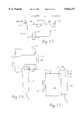
- FIG. 15is a schematic depiction of a water supply arrangement according to the present invention.
- FIG. 16is a front view of a controller device according to the present invention.
- FIG. 17is a side view of the controller device of FIG. 16 in a storage configuration.
- a bed according to the present inventionis generally designated by reference numeral 10.
- the bedgenerally includes a lift mechanism sub-assembly 12 which rests upon the ground, a main frame 14 supported on the lift mechanism, a patient support assembly 16 mounted on the main frame, and a waste disposal system 18 (FIG. 2), also mounted within the main frame.
- a lift mechanism sub-assembly 12which rests upon the ground
- main frame 14supported on the lift mechanism
- a patient support assembly 16mounted on the main frame
- a waste disposal system 18FIG. 2
- the lift mechanism 12will preferably permit movement of the bed 10 with respect to the ground, and therefore preferably includes a set of front wheels 20 and a set of rear wheels 22. At least one of these sets of wheels, preferably the front set, individually rotate about a vertical axis for steering.
- the wheelsalso preferably include a prior art locking mechanism to prevent their swivel and rotation thus securing the bed.
- the locking mechanismis preferably accessible by one or more locking levers 24 (FIGS. 1 and 2) recessed mounted on the exterior of the main frame.
- the lift mechanism 12also permits the main frame to be placed in various positions. For example, Trendelenburg, reverse Trendelenburg, standard horizontal, and various heights within the standard horizontal are obtainable. To achieve this, the lift mechanism includes various linkages connecting the wheels 20 and 22 to the main frame 14.
- the rear wheelsare connected to a rear end of a pivot bar 26, with the front end of the pivot bar being pivotally connected to the main frame near the front end thereof.
- linear expansion members 28such as hydraulic or air cylinders, electric linear motors, etc.
- the degree of expansion or contraction of the member 28will cause the pivot bar, and thus the rear wheels, to take various elevation positions with respect to the main frame.
- the front wheels 20are mounted to a wheel frame 30, with the wheel frame being connected to the main frame via two sets of parallelogram bars 32. Additionally, linear expansion members 34 extend between the wheel sub-frame 30 and the main frame 14. As may be envisioned, expansion and contraction of the members 34 will thus cause the wheel frame 30, and thus the front wheels 20, to take various elevation positions with respect to the main frame.
- the various elevation positions of the front and rear wheels with respect to the main framemay thus be used to attain the various bed positions. For example, maintaining the front wheels stationary (with members 34 extended), while drawing the rear wheels toward the main frame, (by contraction of members 28) will place the bed in the Trendelenburg position. Similarly, maintaining the rear wheels stationary while drawing in the front wheels will provide the reverse Trendelenburg position for the bed. Finally, moving both the front and rear wheels may effect strictly vertical movement of the bed, to thus adjust the bed height.
- each bar 26 and 32must of course move freely to effect these movements. To ensure this, each bar is placed in its own vertical plane. This is best shown in FIG. 4, which is a partial plan view taken along line 4--4 of FIG. 3, with the removed portion of the device being a mirror image.
- the main frame 14includes a pair of side bars connected together at their ends by lateral bars 38.
- the pivot bars 26are pivoted to the associated side bars 36 near the front of the side bars.
- first support bars 40Spaced inwardly from the side bars (and the pivot bars 26) are first support bars 40, again extending between the lateral bars 38.
- the support barsinclude a dog-leg or offset portion 42 adjacent the rear wheels 22.
- secondary support bars 44Spaced yet further laterally inward are secondary support bars 44, (part of mainframe) again extending between the lateral bars 38.
- Each set of parallelogram bars 32is pivoted to the secondary bars.
- the forwardmost bar 32is pivoted to the first support bar 40, while the rearmost bar 32 is pivoted to both the support bars 40 and 44.
- the relative pivot points on the support barsare respectively equally offset in the front-to-rear direction, with the rear bar 32 being pivoted rearmost, and in particular in the offset portion 42, hence forming the parallelogram linkage.
- the various linkages and barsmay move without restriction to provide the desired movement.
- the pivot bars 26may be fixed together by a laterally extending wheel frame brace 46, which may advantageously be the attachment point for the linear expansion members 28.
- the rectangular structure formed by the side bars 36 and lateral bars 38may provide a support for vertically extending knee struts 48 and hip struts 50.
- a thigh plate 52may be fixed between the upper ends of the struts 48 and 50, to support the buttocks and thighs of the patient.
- the upper end of the knee struts 48may serve as a fulcrum point for a leg plate 54 extending forwardly from the thigh plate.
- the leg platemay include a fulcrum arm 56 extending rearward from the fulcrum point, with a linear expansion member 58 connected between bracket 56 and the main frame 14. As such, expansion and contraction of the member 58 will cause rotation of the leg plate 54 with respect to the thigh plate 52, between a raised position shown in FIG. 3 and a lowered position shown in FIG. 2.
- a back plate 60pivoted to the upper end of the hip struts 50, and extending rearward to support the back and head of the patient.
- the plate 60may be provided with a pivot bracket 62 extending downward from the pivot point, with a linear expansion member 64 extending between the bracket and the main frame. Expansion and contraction of the member 64 will thus cause rotation of the back plate with respect to the thigh plate, between a lowered position shown in FIG. 3 and a raised position shown in FIG. 2.
- the bedmay be moved between a flat bed-like position in FIG. 3, and a chair-like position shown in FIG. 2. Additionally, the leg and back plates may be moved independently to achieve numerous positions.
- each of the back, thigh and leg platesinclude a raised peripheral lip 66 to retain mattress segments for each of the back, thigh, and leg plates.
- Mounted to this lipthere may be appropriate retraining bars 68 to assist in retaining the patient, pillows, etc., on the surface of the device. As is known in the art, these restraining bars may be mounted for selective movement between raised and lowered positions.
- a first modificationis a split leg feature.
- the leg plate 54may be formed by two split plates 70 arranged in side-by-side relation. Both split plates share a common pivot shaft bridging between each outboard knee strut (and possibly a central strut which is not shown), and each is provided with its own expansion member 58.
- Each of the split platesmay be rotated independently, such that a single leg may be supported in the raised position for medical purposes, while the other leg may be moved to the lowered position for patient comfort.
- a locking plate 72(FIG. 1) pivoted to one of the plates and movable between a released position allowing individual movement, and a locked position, shown in FIG. 1, secured by bolting to the other split plate.
- each of the split plateswill mount an individual mattress segment 74.
- each of the split platesmay be provided with an adjustable foot rest 76, shown in FIGS. 1, 5, and 6.
- Each foot restwill include a longitudinally extending base rod 78 mounted near the free end of each split plate at the outboard edge.
- the base rodsare hollow, and include an adjustment slot 80 extending longitudinally, with the slot 80 including several detent positions 82.
- Mounted for sliding movement over the base rodis a mounting sleeve 84, which includes a radially extending through hole (not shown) which may be aligned with the slot 80.
- the foot restfurther includes a threaded shaft 86 having at its upper end an enlarged manual handle 88. The lower end of the shaft extends freely through a rotating sleeve 90, and through hole in the mounting sleeve 84, and is engaged with a friction locking block 92 within the base rod 78.
- a planar foot support 94Mounted upon the pivot rod 90 is a planar foot support 94.
- the foot supportmay be fixed to the pivot sleeve 90, but preferably is mounted for rotation about the pivot sleeve. as such, the foot support may be placed in an operative position as shown in FIGS. 1 and 2, where the supports 94 extend inboard toward each other to form a platform upon which the patient's feet may rest, especially in the chair configuration of FIG. 2.
- the foot supportsmay be rotated 90 degrees toward the head of the bed, and are in an inoperative position.
- the foot restsmay advantageously be used not only for supporting the patients feet, but may also serve to lift and support a sheet and/or blanket above the toes of the patient, eliminating pressure on the toes caused by the sheet.
- a further modification for the deviceis the provision of a commode feature.
- the thigh plate 52is provided with a centrally located opening 96 (FIG. 7). To the front and rear of this opening the thigh plate may be provided with standard mattress pads 98. Over this opening, however, there are provided two retractable mattress sections 100, arranged in lateral side-by-side relation. These pads 100 may be filled with a resilient material, such as foam, or may be selectively inflatable. In either event, the pads are capable of contraction and expansion.
- each belt 102is associated with each pad.
- Each belt 102at least partially surrounds the associated pad, and is secured to the adjacent main frame raised peripheral lip.
- each beltis a strip of material having a first end secured to the lip 66 at a first end 104, extending laterally across the pad, down across the laterally interior face of the pad, and then laterally below the pad where a second end 106 of the strip is secured to the thigh plate 52.
- the actual attachment of the belt to the lip and/or plate 52may be selective as by hook-and-loop fasteners, or may be by other easily removable fastening devices.
- each actuatoris pivoted at its lower end to the main frame to enable rotation motion about a longitudinally extending axis.
- the upper end of each actuatoris connected to a means for pivoting the actuator, which in the embodiment shown includes a linkage 110 and a linear expansion member 112 (one set removed for clarity).
- a linkage 110and a linear expansion member 112 (one set removed for clarity).
- expansion and contraction of the member 112will thus cause the actuators 108 to rotate between a closed position shown in FIG. 7 and an open position shown in FIG. 8.
- each actuatoris provided with a convex formed plate 114, such that the two plates may act jointly to support the laterally interior sections of the pads 100 when the actuators are in the closed position, as shown in FIG. 7.
- a roller 116near the upper end of each actuator there is mounted a roller 116. In the closed position, this roller will be located below a slot 118 in the thigh plate 52 laterally exterior to the opening 96. The band 102 is passed through this slot and wrapped about the roller 116. From the dashed line in FIG. 7, it may be seen that when the actuators are moved to the open position the roller moves with the actuator, and thus draws the band 102 downward.
- the padsare located above the opening 96, with the convex formed plates 114 of necessity being spaced below the level of the thigh plate 52. As such, during closing of the mattress pads (which is achieved without the intervention of mechanical devices) there is little or no possibility of a portion of the patient's body being pinched between two rigid members, but only between the soft mattress pads. This clearly avoids potential injury to the patient.
- the mattress pads 100may be desirable to form the mattress pads 100 as the known variably inflatable type.
- the inflation of the padsmay be increased during closing to assist in the closing, but additionally to lift the patient upward away from the closing action.
- the seatis closed pneumatically. It will be appreciated that the seat could be closed hydraulically by a reversal of the hydraulic action used to open the mattress pads.
- the seatis held open by the hydraulic blocking valve which is energized so as to provide a holding force for holding the mattress pads open.
- the blocking valveis energized in a manner for releasing the holding force of the hydraulic cylinder.
- the mattress padsare pneumatically inflated.
- the location of bladders within the mattress padsare arranged such that, upon inflation, the mattress pads drive inwardly towards the center of the opening.
- the commode unitmay be of any known type, and will typically include a lifting mechanism for raising and lowering the unit to interface with the patient.
- This lifting mechanismmay include a platform 122 (FIGS. 8 and 9) to directly mount the commode unit, with the platform being supported by one or more linear bearings 124 or slide mechanisms mounted to the main frame to permit the vertical movement of the platform. This vertical movement may then be effected by a linear expansion member 126 mounted between the main frame and the platform.
- the commode unitmay thus be placed in a lowered position when the actuators and mattress pads are closed, and raised to interface with the buttocks of the patient when the actuators and mattress pads have been opened.
- a pressure sensoris utilized in the hydraulic line between the hydraulic manifold and the hydraulic extension cylinder utilized in the lifting mechanism.
- the pressure sensormay be fitted within the line in known manners, with the preferred embodiment comprising a T-fitting in the hydraulic line.
- the pressure sensoris utilized to stop the commode lifting mechanism after it engages with the buttocks of the patient.
- the pressure sensoris calibrated to provide approximately two pounds of force around the circumference of the commode rim top.
- Utilization of the pressure sensor in this mannercreates a seal between the patient and commode to prevent patient waste and/or bidet water from soiling the surrounding mattress and sheet.
- the selected amount of pressuree.g., two pounds
- an electric signalis sent from the sensor to the solenoid to close the solenoid and thereby turn off the hydraulic pump.
- the commode unit 120includes a housing 128 which defines a cavity 130 for receiving the waste from the patient.
- This preferred unitis disposable, and includes a base 132 in the form of a generally rectangular upwardly concave member having at its upper edge a peripheral lip 134. This base is preferably molded as a single item.
- the cover 136includes a peripheral lip 138 conforming to the lip 134, such that the lips 134 and 136 may be secured together, as by thermal or ultrasonic bonding, adhesives, etc.
- the coveralso includes an upwardly extending engagement rim 140 formed by an upwardly extending outer wall 140a and an upper face 140b.
- the clear demarcation between wall 140a and face 140b shown in the figuresis of course illustrative, and these two elements may be formed as a smooth transition with greater curvature and less definition between them.
- the rimmay take a peripheral form or shape similar to a standard toilet seat, and will typically extend rearward a sufficient distance to adequately encompass the anus and forward a sufficient distance to encompass the urethra or penis, such that the patient may both defecate and urinate within the confines of the rim, with the waste being retained within the cavity 130.
- the rim 140 and lip 136be formed as a monolithic unit by molding.
- barrier plate 149near to, but spaced upwardly from, the inner edge of the upper face 140b, as shown in FIG. 11.
- This barrier plateserves to form an air channel between the inner and outer walls of the rim 140 and the barrier plate.
- Such an air channelcan be advantageous as described more fully below.
- a urine sample container 142may additionally be provided.
- a containerwould include a receptacle or cup portion 144 to receive the urine, and a hook or coupling section 146 adapted to engage with the forward end of the rim to retain the container 142 in position.
- the container 142has been shown in the figures as conforming well to the rim 140, other configurations, such as a standard cylindrical cup with a pair of hook arms, could also be employed.
- a laterally extending wallcould be formed in the base 132 to divide the cavity 130 into a rear section for fecal matter and a forward section for urine.
- the commode unitis readily suited for use as a disposable unit for increased convenience and sanitation.
- the base 132 of the commode unitmay be received within an opening 150 in the platform 122, with the peripheral lip 134 resting upon the base. This will provide adequate support for the commode unit on the platform, but will permit the commode unit to be easily removed from the platform by manually lifting the commode unit upward.
- the used commode unitmay then be disposed of, and a new unit inserted into the platform. This operation is of course performed when the mattress pads are in the open position to permit access to the commode unit.
- the commode unitbe provided with a safety lid, generally designated by reference numeral 152 (FIG. 11).
- the safety lid 152preferably includes a peripheral section 154 which conforms at least to the rim 140. As is shown in FIG. 11, it is most preferred that this peripheral section closely conform to the outer wall 140a and upper face 140b of the raised rim 140, and to the lip 136.
- the lid 152includes a depressed central region 156 conforming in shape to the inner edge of the upper face 140b. However, this central region is slightly larger than this inner edge, such that the central region 156 may be locked below the upper face 140b to form an interference fit, as shown in FIG. 11.
- This interference fitmay be achieved simply by forcing the lid downward upon the commode unit, with the resilience of the rim 140 and/or the central region permitting the central region to pass below the inner edge into the locked position. as may be envisioned, this interference fit will secure the lid in place, as well as provide a further seal against egress of the contained waste.
- rim 140further includes an inner wall 140c extending downward from the upper face 140b, for reasons described below.
- the central region 156will of course also be depressed such that the interference fit may be achieved below the edge of the inner wall.
- the lidis formed as a molded unit, or at least mainly from molded units.
- the central regionmay be molded with a size to easily fit in the confines of inner wall 140c, but have a sheet of material 158 (such as plastic) secured to its lower face, with this sheet having the enlarged dimension to provide the desired interference fit.
- a handle 160 upon the lidsuch that the entire commode unit and lid combination may be lifted by the handle after the lid is secured in place. This not only assists in carrying the unit for disposal, but in lifting the unit from the opening in the platform 122 just after the lid is secured.
- the handleshould not cause a reduction in the integrity of the commode unit/lid combination.
- the handle 160is formed by the known plastic strap having T segments at its end for insertion into appropriate holes, as shown in FIG. 11, the holes should not provide direct access to the cavity 130, but should be covered and sealed by the sheet 158.
- odor control meansare provided. While various vacuum devices could be used for channeling air from the cavity 130 of the commode unit, or various perfumes could be injected into the cavity, it is preferred that the cavity 130 contain a gelling agent 148 (FIG. 10) to encase the waste.
- a gelling agent 148FOG. 10
- One preferred agentis Sodium dichloroisocyanurate in an organic matrix (available from Safetec of America, N. Tonawanda, N.Y., under the product name Red-Z). This material may simply be placed into the cavity 130 in its powder form prior to initial use of the commode unit. During use by the patient the moisture in the fecal matter and urine will cause swelling and gelling of the material 148.
- This actionmay, in itself, be sufficient to cause the fecal matter and urine to be completely encased within the material. If this is not the case, the addition of a small amount of water to the commode unit (such as one cup) subsequent to depositing the waste will typically be sufficient for encasement of the waste. Once thus encased, the odor from the waste is eliminated.
- the gelling materialsuch as approximately 21 grams, prior to initial use, the gelling action may be repeated for several uses of the commode unit with adequate encasement of each new waste input.
- Another preferred variation for the device 10is to provide cleansing means for washing and drying the patient's anal (and/or genital) region after using the commode unit.
- cleansing meansfor washing and drying the patient's anal (and/or genital) region after using the commode unit.
- Various prior art mechanisms for this purposeare known, and are roughly similar to a bidet. These prior art arrangements could be used with the present device and commode unit. However, it is preferred that the device 10 be provided with an inventive patient cleansing means.
- a first component of this cleansing meansis a water storage tank 162 (FIG. 8) mounted to the main frame below the patient. This tank will hold a sufficient amount of water for several washing cycles, with the number of cycles preferably corresponding generally to the number of uses possible with the gelling agent 148.
- a water fill inlet 164(FIG. 2) is provided at a convenient location on the exterior of the device 10, and is connected to the tank 162.
- the tankmay include an appropriate water level sensor (not shown), and the device may include a set of indicator lights 166 operatively connected to the sensor.
- the indicator lightscould include a tank water level low indicator, and a tank water level high indicator, to provide a simple visual indication of these conditions.
- the indicator lights 166may include a commode unit full indicator light which is activated upon a predetermined number of operations of the washing cycle, typically corresponding to the number of uses feasible with the gelling agent.
- Commode unit full indicationmay also be activated by an increase in weight.
- Current configurationincludes a weight sensor (mechanical spring) calibrated to a predetermined value to provide an indication when the unit is approximately two-thirds full.
- the cleansing meanswill also include a water pump 168 (FIG. 8) connected to the tank via an inlet line 170.
- An output of the pumpis of course connected to an outlet line 172, which is connected operatively to a spray nozzle 174 (FIGS. 10 and 14) associated with the waste receptacle or commode unit 120, such that the spray nozzle will produce a fountain of water which may impinge upon the anal region of the patient after use of the commode.
- One inventive aspect of this arrangementis a novel heating arrangement for this water, to provide patient comfort.
- the water tank 162is provided with a thermostatically controlled heater (not shown) for maintaining the water within the tank at a predetermined temperature.
- a thermostatically controlled heater(not shown) for maintaining the water within the tank at a predetermined temperature.
- such a heaterwill not have an appreciable affect upon the water naturally retained within the lines 170 and 172 and in the pump, which would normally result in the nozzle ejecting cold water until the heated water reaches the nozzle.
- the outlet line 172is provided with a solenoid actuated valve 176.
- the output line 172includes a T connection 178, with one branch of the T providing normal flow through the output line, but the other branch connecting to a recirculation line 180 connected to the tank 162. This is illustrated schematically in FIG. 15.
- the T connectionis located upstream of the valve 176, and the lines and valve 176 are vertically arranged such that, upon cessation of the pump operation, gravity will cause the water level in the output line to fall below the vertical level of the valve 176.
- valve 176is normally closed, preventing flow to the nozzle 174.
- the pumpwill draw water through the inlet line, and will attempt to force water through the outlet line.
- all flowwill pass through the second branch of T connection 178, recirculating the water to the tank 162. This will continue for a predetermined time sufficient to fill the lines with heated water from the tank, as opposed to cold water which had been sitting in the lines.
- the valve 176is opened, and flow will pass through the first branch of the T connection and thus to the nozzle 174 to provide the bidet.
- the provision of cleansing meansassists in hygiene and patient comfort. Additionally, the water expelled in this process may advantageously be used to activate the gelling material to encase the waste. Furthermore, the present cleansing means ensures that the patient will be provided with only warm comfortable water during this process.
- the anal region of the patientmay advantageously be coated with a surfactant lotion prior to initial cleansing, and after each subsequent cleansing.
- a surfactantwill prevent the stool from sticking to the patients skin, and will greatly assist in removal of the stool from the anal region. This will reduce or eliminate the need for manual cleaning of the anal region, reducing possible discomfort to the patient, and reducing the risk of contamination by the stool.
- the device 10also include drying means to dry the anal (and/or genital) region of the patient.
- the devicemay include an air blower 182 mounted to the main frame, preferably including a heater. The outlet of the blower is connected to a conduit 184 interfacing to the cavity 130 of the commode unit. In this manner, the air from the blower will circulate in the commode unit, thus impinging upon the anal region to assist in drying after cleansing.
- the interior of such rimmay be provided with appropriate ducts 186 (FIG. 10) to cause the air to more directly impinge upon the anal region for improved drying.
- the ducts 186are an outlet for the air channel defined by the walls of the rim 140 and the barrier plate 149.
- the above-described cleansing means and drying meansmay be employed with various commode systems, including those directly connected to a waste drain, it is also possible to employ these means with the preferred disposable commode unit 120.
- the output line 172 from the water pumpmay be connected to a bulkhead fitting 188 mounted on the platform 122 of the lifting mechanism, with the bulkhead fitting being accessible from above.
- the conduit 184 from the air blowermay be connected to a diffuser or directing vane 190 mounted on the platform 122.
- the commode units 120may then be provided with a fluid stem fitting 192 (FIG. 14) mounted on the underside of the lip 134, and operatively connected to the nozzle 174.
- a fluid stem fitting 192(FIG. 14) mounted on the underside of the lip 134, and operatively connected to the nozzle 174.
- the placement of the stem fitting 192is such that it will operatively engage with the bulkhead 188 when the commode unit is placed within the opening 150 of the platform.
- the lip 134 and 136may include an opening providing access to the space between the inner and outer walls of the rim 140, with this opening 194 surrounding the vane 190 when the commode unit is placed on the platform.
- the device 10be provided with means for manually directing the nozzle for cleansing. This means could of course be provided on prior art bidet-type cleansing systems, but is described with reference to the preferred disposable commode unit.
- the inner wall 140c of the rim 140is provided with a slot 196, typically elongated in the longitudinal direction, and having a width such that the slot is larger than the nozzle 174.
- a T connector 198is then machined (or initially formed) to form the nozzle 174 from the base or stem 200 of such T. This may be effected by removing a section 202 of the T until the inner passageway therethrough is reached, and by plugging this passageway downstream of the removed section. This will cause water passing through the stem to exit at the removed section. It is this stem which extends through the slot 196 to form the nozzle.
- the crossbar 204 of such Twill then have a first end 206 and a second end 208.
- a length of flexible tubing 210Connected to the first end 206 is a length of flexible tubing 210, which passes between the inner and outer walls of the rim 140 and is connected to the stem 192.
- the second end 208 of the crossbaris also connected to a piece of flexible tubing 212, but this piece is much shorter, and is connected to an elongated bidet handle 214.
- Both this second tubing 212 and a portion of the handle 214extend between the inner and outer walls of the rim 140, but the free end of the handle 214 extends through an opening in the outer wall of the rim, such that it is accessible to the patient.
- This handle 214is also either solid, or is plugged, such that water may not flow though the handle.
- a lidwould preferably encompass or enclose the handle extending from the rim 140. This may reduce the integrity of the sealed unit, or may simply increase the cost of forming the lid. To avoid this problem the attendant may simply grasp the handle 214 and pull outward, thus disengaging the handle from the tubing 212. The handle may then be placed in the cavity 130 of the commode unit prior to applying the lid. This can serve a further function, in that removing the handle may permit the nozzle 174 to be drawn or pushed between the walls of the rim 140 such that the nozzle does not prohibit movement of the central portion of the lid into the desired interference position.
- the controllerincludes at least a hand grip section 218 ergonomically adapted to be held in the human hand, a display screen 220, and several buttons 222, preferably designated numbers 1-3 from the left to right and clear entry/clear.
- the controllerincludes, or is connected to, various memory and logic chips (not shown) which in turn produce signals to activate various expansion members, pumps, and blowers. These chips also interface the display screen and buttons to permit the user to access the various functions.
- the display screenprovide a menu system for various functions. For example, a main screen could appear as:
- buttons 222As may be envisioned, by pressing one of the associated buttons 222 a further menu would appear. For example, pressing the "one" button for bed adjustment could summon the menu:
- pressing the appropriate buttoncould summon a further menu with the choices being “up” or “down”, or “bed” or “chair”.
- depressing the main menu number of mattress adjustmentcould summon a further menu to choose between the head or seat mattress, with either of these choices resulting in a further menu where the choices would be "harder” and "softer".
- the various mattress segmentscould be provided with variable inflation means for varying the firmness of the mattress segments, as is known in the art, and it is this inflation means which would be ultimately controlled for adjusting the mattress.
- Selecting the first menu itemwould of course open the mattress pads 100 and raise the commode unit, or, if already raised, would lower the commode unit and close the mattress pads.
- the device 10be provided with a speaker and stored messages to provide an audible warning such as "caution: the seat is about to open” or “caution: the seat is about to close” at the beginning of each respective operation.
- Selecting the second menu item, "wash and dry”would activate the water pump, solenoid valve, and air blower in the manner described above.
- the number of times this selection is madeis stored in memory for use in controlling the indicator light 166 associated with replacing the commode unit. Additionally, it may be desirable to permit this choice only once per raising of the commode unit, to prevent wasting of water and commode units (due to using all of the gelling agent, if provided).
- the third menu itemis "dry again", and simply activates the air blower for a preset period of time as with the automatic activation following washing. It is preferred that there be no limit to the number of drying cycles permitted.
- the controllermay also provide specialized menu selections intended for use only by the care provider.
- Such specialized menusmay be summoned by pressing a predetermined button sequence, such as "clear”, "3", “clear”, "1".
- An example of such a menuwould be:
- Selecting the first menu itemcould automatically place the device in a predetermined position, such as flat bed, and/or cause high mattress inflation for a very firm mattress.
- the second menu itemwould summon a further menu permitting a choice of the regular or reverse Trendelenburg positions described above. This "Trendelenburg" selection could also provide a menu selection for bed height adjustment, in turn summoning a menu with selections for "up” and "down”.
- the final main specialty menu selectionis "other". This could of course lead to various other menu selections, but one of importance could be "replace canister”. Selecting this item would cause the mattress pads to open, permitting access to the commode unit. Additionally, this selection could reset the counter for uses of a particular commode unit, for use in controlling the indicator light 166 noted above.
- the controllermay include a menu system that is audible in nature.
- a selected buttonmay be depressed whereupon the first item in the main menu is audibly output through a speaker in the controller. If the output is indeed the selection the patient desires, a second selected button may be depressed to choose that menu option. Alternatively, the first button may be depressed to advance the audible menu to the next item in the main menu, and so forth and so on. Upon activation of the second selected button, thereby indicating a selection of the desired menu option, a submenu may be audibly output in the same manner. Upon selection of the ultimate option, third and fourth buttons 222 are utilized for control.
- a patient desiring to adjust the bedmay access the main menu by depressing a first selected button 222 on controller 216.
- wordssuch as "ADJUST BED" are audibly output from a speaker (not shown) in the controller 216. Since this is the option desired by the patient, a second selected button 222 is depressed to make the selection and to produce a signal indicative of the selection.
- the controlleraudibly outputs an appropriate instruction to the patient. In this case, such an instruction would advise the patient to access a submenu by depressing the first selected button.
- the patientwould access a submenu whereupon, for instance, the words "ADJUST HEAD” would be audibly output from the controller 216.
- the patientwould then again depress the first selected button 222 to advance the menu to the next option.
- the patientcould continue to operate controller 216 in this manner until the desired option was reached, whereupon the second selected button is depressed to generate a signal indicative of the selection.
- further instructionswould be audibly output to advise the patient how to operate the controller.
- the patientwould then utilize third and fourth selected buttons 222, for instance, to control up and down functions, respectively, of the foot portion of the bed.
- the controllermay be provided with a hanger device 224 such that the unit may be placed in a convenient location when not in use.
- a base 226mounted to the main frame for storing the controller.
- This basemay include a recess in its upper face adapted to receive a portion of the controller, such as an enlarged display/button portion. To permit the display to be easily read by a care provider, it is preferred that the display thus face upward when in the base 226. This could result, however, in the handle portion 218 extending outward and creating an obstacle.
- the enlarged display/button sectioninclude a recess 228 which receives the handle section 218.
- This recesswill receive the handle section in the usual extending configuration shown in FIG. 16, and rotated 90 degrees to a storage position shown in FIG. 17.
- a rod 230 connected to the display/button section and passing through the recessmay be received within a slot 232 in the handle section 218.
- a spring (not shown) placed in the slotwould thus bias the handle section into abutment with the recess 228 in either position, securing the handle against unintentional movement, but permitting manual movement between the positions.
Landscapes
- Health & Medical Sciences (AREA)
- Life Sciences & Earth Sciences (AREA)
- Animal Behavior & Ethology (AREA)
- General Health & Medical Sciences (AREA)
- Public Health (AREA)
- Veterinary Medicine (AREA)
- Nursing (AREA)
- Rehabilitation Therapy (AREA)
- Epidemiology (AREA)
- Invalid Beds And Related Equipment (AREA)
Abstract
Description
1. Field of the Invention
The present invention relates in general to patient care beds. In particular, the present invention relates to an improved patient care bed convertible between a bed and a chair position, and a waste disposal system incorporated therein.
2. Description of the Related Art
In the field of patient care, there have been various attempts to provide patient beds which provide increased comfort and convenience. To this end, such beds often permit the back and/or leg sections of the bed to be raised and lowered. Examples of such arrangements are shown in U.S. Pat. Nos. 3,216,026, 3,220,020, and 3,278,952. Additionally, there have been beds which allow such movement to continue to a sufficient extent that the bed takes the form of a chair. Examples of these arrangements are shown in U.S. Pat. Nos. 4,920,587, 5,189,745, and 5,350,369. In the latter two patents, the bed, in the chair position, may be used in a similar manner to a wheel chair.
A further effort to increase convenience and comfort has resulted in some beds providing waste disposal to accommodate the bodily functions of the user. The three patents noted immediately above provide examples of such systems. Further examples are found in U.S. Pat. Nos. 801,117 and 1,589,889.
With these prior art systems, the beds have typically been complex apparatus. While the desired range of movement of the bed requires a certain amount of physical complexity, the operation of the beds (at least beyond the basic raising and lowering functions) has been rather complicated also. Additionally, where waste disposal has been provided, there has been little done in the way of cleansing the patient, or the arrangements for such cleansing have been rather complex. Even where a cleansing system has been provided, this complexity has not resulted in ease of use.
The need to treat such waste as a biohazard has also been a relatively recent development. At least one prior art system (the above-noted U.S. Pat. No. 5,350,369) does permit sealing of the waste collection unit. However, this collection unit is relatively complicated, and therefore expensive.
A further consideration is the odor produced by the bodily waste of the patient. One solution is to remove the waste immediately, yet this results in a large number of waste containers and a proportional waste of packaging material. The collection unit of the U.S. Pat. No. 5,350,369 patent permits multiple uses by solidifying the waste with a deodorizing gelling material. However, the construction of the collection unit of that patent often results in the fecal matter sliding upon the sides of the container. This may leave an odorous residue which is not gelled.
An object of the present invention is to provide a bed for patient care which provides a wide range of movement of the various bed sections.
Another object of the present invention is to provide such a bed which may be adjusted for height, Trendelenburg, reverse Trendelenburg, back and leg motion sufficient to place the bed in a chair position.
A further object of the present invention is to provide such a bed with a separate leg support section for each leg of the patient, with each leg section being independently controllable for movement.
Yet another object of the present invention is to provide a bed for patient care which includes a waste disposal system.
A further object of the present invention is for such a waste disposal system to provide multiple uses without creating an odor problem.
A further object of the present invention is to provide such a waste disposal system which provides for convenient cleansing of the patient.
Another object of the present invention is to provide a method of cleansing a patient after defecation.
Yet a further object of the present invention is to provide such a waste disposal system which is readily disposable yet maintains the waste sealed against egress.
Yet another object of the present invention is to provide such a bed for patient care in which the operating controls are simple and convenient.
A further object of the present invention is to provide such a bed in which the operation of the waste disposal system is safe and efficient.
These and other objects are achieved by a bed for patient care having a waste disposal system. The bed includes a back, seat and two leg sections for supporting the patient. These sections of the bed may be raised, lowered, and tilted. The leg sections may be moved independently for use with patients having one leg immobilized. The seat section includes two panels which separate to expose an aperture permitting a waste canister to be raised into engagement with the buttocks of the patient. An audible signal is alerts the patient prior to this action. The waste canister provides a directable bidet wash, and an air dry feature. Gelling material within the canister swells during the bidet function to cover and seal the waste. The entire canister may be sealed and disposed of.
The objects and features of the invention noted above are explained in more detail with reference to the drawings, in which like reference numerals denote like elements, and in which:
FIG. 1 is a perspective view of a bed according to the present invention in the reclining position;
FIG. 2 is a perspective view of the bed of FIG. 1 in the upright position;
FIG. 3 is a schematic side view showing the linkages permitting movement of the bed sections;
FIG. 4 is a partial schematic top view of the linkages of FIG. 3;
FIGS. 5 and 6 are partial top and side views, respectively, of a foot rest according to the present invention;
FIG. 7 is a cross-sectional view (in the closed position) showing the operation of the seat section for waste disposal;
FIG. 8 is a rear view showing the waste disposal mechanism (in the open position) and cleansing and drying means;
FIG. 9 is a side view of the mechanism of FIG. 8;
FIG. 10 is a perspective view of a waste canister according to the present invention;
FIG. 11 is a cross-sectional view of the container of FIG. 10 with a lid attached;
FIG. 12 is a detail view of a urine sample collector according to the present invention;
FIG. 13 is a perspective view of the mounting and interface connections of the container of FIG. 10;
FIG. 14 is a detail view of a nozzle adjustment arrangement according to the present invention;
FIG. 15 is a schematic depiction of a water supply arrangement according to the present invention;
FIG. 16 is a front view of a controller device according to the present invention; and
FIG. 17 is a side view of the controller device of FIG. 16 in a storage configuration.
With reference to FIGS. 1 and 2, a bed according to the present invention is generally designated byreference numeral 10. The bed generally includes alift mechanism sub-assembly 12 which rests upon the ground, amain frame 14 supported on the lift mechanism, apatient support assembly 16 mounted on the main frame, and a waste disposal system 18 (FIG. 2), also mounted within the main frame. Each of these items will be discussed in order.
With further reference to FIGS. 2 and 3, thelift mechanism 12 is shown in detail. Themechanism 12 will preferably permit movement of thebed 10 with respect to the ground, and therefore preferably includes a set offront wheels 20 and a set ofrear wheels 22. At least one of these sets of wheels, preferably the front set, individually rotate about a vertical axis for steering. The wheels also preferably include a prior art locking mechanism to prevent their swivel and rotation thus securing the bed. The locking mechanism is preferably accessible by one or more locking levers 24 (FIGS. 1 and 2) recessed mounted on the exterior of the main frame.
Thelift mechanism 12 also permits the main frame to be placed in various positions. For example, Trendelenburg, reverse Trendelenburg, standard horizontal, and various heights within the standard horizontal are obtainable. To achieve this, the lift mechanism includes various linkages connecting thewheels main frame 14.
In particular, the rear wheels are connected to a rear end of apivot bar 26, with the front end of the pivot bar being pivotally connected to the main frame near the front end thereof. To permit rotation of the pivot bar, linear expansion members 28 (such as hydraulic or air cylinders, electric linear motors, etc.) are connected at a first end to the main frame, and at a second end to thepivot bar 26 at a position spaced from the pivotal connection between the pivot bar and the main frame. As such, the degree of expansion or contraction of themember 28 will cause the pivot bar, and thus the rear wheels, to take various elevation positions with respect to the main frame.
In a similar manner, thefront wheels 20 are mounted to awheel frame 30, with the wheel frame being connected to the main frame via two sets of parallelogram bars 32. Additionally,linear expansion members 34 extend between thewheel sub-frame 30 and themain frame 14. As may be envisioned, expansion and contraction of themembers 34 will thus cause thewheel frame 30, and thus thefront wheels 20, to take various elevation positions with respect to the main frame.
The various elevation positions of the front and rear wheels with respect to the main frame may thus be used to attain the various bed positions. For example, maintaining the front wheels stationary (withmembers 34 extended), while drawing the rear wheels toward the main frame, (by contraction of members 28) will place the bed in the Trendelenburg position. Similarly, maintaining the rear wheels stationary while drawing in the front wheels will provide the reverse Trendelenburg position for the bed. Finally, moving both the front and rear wheels may effect strictly vertical movement of the bed, to thus adjust the bed height.
Thevarious bars line 4--4 of FIG. 3, with the removed portion of the device being a mirror image.
As shown in FIGS. 3 and 4, themain frame 14 includes a pair of side bars connected together at their ends bylateral bars 38. The pivot bars 26 are pivoted to the associated side bars 36 near the front of the side bars. Spaced inwardly from the side bars (and the pivot bars 26) are first support bars 40, again extending between the lateral bars 38. As is shown in FIG. 4, the support bars include a dog-leg or offsetportion 42 adjacent therear wheels 22. Spaced yet further laterally inward are secondary support bars 44, (part of mainframe) again extending between the lateral bars 38. Each set of parallelogram bars 32 is pivoted to the secondary bars. In particular, theforwardmost bar 32 is pivoted to thefirst support bar 40, while therearmost bar 32 is pivoted to both the support bars 40 and 44. As may be seen, the relative pivot points on the support bars are respectively equally offset in the front-to-rear direction, with therear bar 32 being pivoted rearmost, and in particular in the offsetportion 42, hence forming the parallelogram linkage.
By this arrangement the various linkages and bars may move without restriction to provide the desired movement. To further assist in this movement the pivot bars 26 may be fixed together by a laterally extendingwheel frame brace 46, which may advantageously be the attachment point for thelinear expansion members 28.
The rectangular structure formed by the side bars 36 andlateral bars 38 may provide a support for vertically extending knee struts 48 and hip struts 50. As is best shown in FIG. 3, athigh plate 52 may be fixed between the upper ends of thestruts leg plate 54 extending forwardly from the thigh plate. The leg plate may include afulcrum arm 56 extending rearward from the fulcrum point, with alinear expansion member 58 connected betweenbracket 56 and themain frame 14. As such, expansion and contraction of themember 58 will cause rotation of theleg plate 54 with respect to thethigh plate 52, between a raised position shown in FIG. 3 and a lowered position shown in FIG. 2.
In a similar manner, there may be provided aback plate 60 pivoted to the upper end of the hip struts 50, and extending rearward to support the back and head of the patient. Theplate 60 may be provided with apivot bracket 62 extending downward from the pivot point, with alinear expansion member 64 extending between the bracket and the main frame. Expansion and contraction of themember 64 will thus cause rotation of the back plate with respect to the thigh plate, between a lowered position shown in FIG. 3 and a raised position shown in FIG. 2.
From the above description it may be seen that the bed may be moved between a flat bed-like position in FIG. 3, and a chair-like position shown in FIG. 2. Additionally, the leg and back plates may be moved independently to achieve numerous positions.
It is preferred that each of the back, thigh and leg plates include a raisedperipheral lip 66 to retain mattress segments for each of the back, thigh, and leg plates. Mounted to this lip there may be appropriate retraining bars 68 to assist in retaining the patient, pillows, etc., on the surface of the device. As is known in the art, these restraining bars may be mounted for selective movement between raised and lowered positions. Similarly, there may be a pair ofarmrests 69 mounted to the lip at the rear of the thigh section, or to the forward end of the back section. The armrests may be placed in an operative position as shown in FIG. 1 where they operate as an additional restraint, and as shown in FIG. 2 where the operate as standard armrests. By release of a friction lock at the pivot point, the armrests may be pivoted approximately 180 degrees counterclockwise in FIG. 1 to an inoperative position.
While the above-described device is fully operative, various modifications are preferred for ease of use and patient comfort.
A first modification is a split leg feature. As is best shown in FIGS. 1 and 2, theleg plate 54 may be formed by two splitplates 70 arranged in side-by-side relation. Both split plates share a common pivot shaft bridging between each outboard knee strut (and possibly a central strut which is not shown), and each is provided with itsown expansion member 58. Each of the split plates may be rotated independently, such that a single leg may be supported in the raised position for medical purposes, while the other leg may be moved to the lowered position for patient comfort. In cases where this feature is to be avoided, there may be provided a locking plate 72 (FIG. 1) pivoted to one of the plates and movable between a released position allowing individual movement, and a locked position, shown in FIG. 1, secured by bolting to the other split plate. As may be envisioned, each of the split plates will mount anindividual mattress segment 74.
As a further modification, each of the split plates may be provided with anadjustable foot rest 76, shown in FIGS. 1, 5, and 6. Each foot rest will include a longitudinally extendingbase rod 78 mounted near the free end of each split plate at the outboard edge. The base rods are hollow, and include anadjustment slot 80 extending longitudinally, with theslot 80 including several detent positions 82. Mounted for sliding movement over the base rod is a mountingsleeve 84, which includes a radially extending through hole (not shown) which may be aligned with theslot 80. The foot rest further includes a threadedshaft 86 having at its upper end an enlargedmanual handle 88. The lower end of the shaft extends freely through arotating sleeve 90, and through hole in the mountingsleeve 84, and is engaged with afriction locking block 92 within thebase rod 78.
As such, rotating the handle clockwise will cause the friction block to apply a clamping force betweenpivot sleeve 90 andbase rod 78 causing the foot rest assembly to become locked. Opposite rotation will release the clamping force, and permit sliding of the threaded shaft/sleeve 90 combination along the base rod to a new position. In this manner the footrest may be adjusted for different leg lengths.
Mounted upon thepivot rod 90 is aplanar foot support 94. The foot support may be fixed to thepivot sleeve 90, but preferably is mounted for rotation about the pivot sleeve. as such, the foot support may be placed in an operative position as shown in FIGS. 1 and 2, where thesupports 94 extend inboard toward each other to form a platform upon which the patient's feet may rest, especially in the chair configuration of FIG. 2. Alternatively, the foot supports may be rotated 90 degrees toward the head of the bed, and are in an inoperative position. It is noted that the foot rests may advantageously be used not only for supporting the patients feet, but may also serve to lift and support a sheet and/or blanket above the toes of the patient, eliminating pressure on the toes caused by the sheet.
A further modification for the device is the provision of a commode feature.
For this feature thethigh plate 52 is provided with a centrally located opening 96 (FIG. 7). To the front and rear of this opening the thigh plate may be provided withstandard mattress pads 98. Over this opening, however, there are provided tworetractable mattress sections 100, arranged in lateral side-by-side relation. Thesepads 100 may be filled with a resilient material, such as foam, or may be selectively inflatable. In either event, the pads are capable of contraction and expansion.
To effect or assist in this expansion and contraction, abelt 102 is associated with each pad. Eachbelt 102 at least partially surrounds the associated pad, and is secured to the adjacent main frame raised peripheral lip. In the preferred embodiment, each belt is a strip of material having a first end secured to thelip 66 at afirst end 104, extending laterally across the pad, down across the laterally interior face of the pad, and then laterally below the pad where asecond end 106 of the strip is secured to thethigh plate 52. The actual attachment of the belt to the lip and/orplate 52 may be selective as by hook-and-loop fasteners, or may be by other easily removable fastening devices.
Below theopening 96 in thethigh plate 52 there are mounted a pair ofactuators 108. As is best shown in FIG. 8, the actuators are arranged in laterally side-by-side relation, with one actuator associated with eachmattress pad 100. Each actuator is pivoted at its lower end to the main frame to enable rotation motion about a longitudinally extending axis. The upper end of each actuator is connected to a means for pivoting the actuator, which in the embodiment shown includes alinkage 110 and a linear expansion member 112 (one set removed for clarity). As may be envisioned, expansion and contraction of themember 112 will thus cause theactuators 108 to rotate between a closed position shown in FIG. 7 and an open position shown in FIG. 8.
The upper face of each actuator is provided with a convex formedplate 114, such that the two plates may act jointly to support the laterally interior sections of thepads 100 when the actuators are in the closed position, as shown in FIG. 7. Additionally, near the upper end of each actuator there is mounted aroller 116. In the closed position, this roller will be located below aslot 118 in thethigh plate 52 laterally exterior to theopening 96. Theband 102 is passed through this slot and wrapped about theroller 116. From the dashed line in FIG. 7, it may be seen that when the actuators are moved to the open position the roller moves with the actuator, and thus draws theband 102 downward. This drawing of the band causes the associated pad to be compressed laterally outward, thus exposing theopening 96 in the thigh plate. Additionally, the actuators are moved to the open position, thus removing the convex formed plates from their position below the opening. Due to the resiliency of the pad, when released, an opposite force will of course cause the pads to close to their original position.
It is noted that the pads are located above theopening 96, with the convex formedplates 114 of necessity being spaced below the level of thethigh plate 52. As such, during closing of the mattress pads (which is achieved without the intervention of mechanical devices) there is little or no possibility of a portion of the patient's body being pinched between two rigid members, but only between the soft mattress pads. This clearly avoids potential injury to the patient.
As a further safety feature, it may be desirable to form themattress pads 100 as the known variably inflatable type. In this manner the inflation of the pads may be increased during closing to assist in the closing, but additionally to lift the patient upward away from the closing action. In this regard it may be desirable to continue inflation until the pads are overinflated from the normal setting, and then reduce the inflation after the closing operation is complete. In a preferred embodiment of this invention, the seat is closed pneumatically. It will be appreciated that the seat could be closed hydraulically by a reversal of the hydraulic action used to open the mattress pads. During operation of the commode feature of the present invention, the seat is held open by the hydraulic blocking valve which is energized so as to provide a holding force for holding the mattress pads open. In order to close the mattress pads pneumatically, the blocking valve is energized in a manner for releasing the holding force of the hydraulic cylinder. After the hydraulic cylinder is emptied, thereby releasing the holding force, the mattress pads are pneumatically inflated. The location of bladders within the mattress pads are arranged such that, upon inflation, the mattress pads drive inwardly towards the center of the opening.
When the actuators are in the open position it may be seen that the thigh section is fully open to the main frame therebelow. It is in this position on the main frame that there is mounted acommode unit 120. The commode unit may be of any known type, and will typically include a lifting mechanism for raising and lowering the unit to interface with the patient. This lifting mechanism may include a platform 122 (FIGS. 8 and 9) to directly mount the commode unit, with the platform being supported by one or morelinear bearings 124 or slide mechanisms mounted to the main frame to permit the vertical movement of the platform. This vertical movement may then be effected by alinear expansion member 126 mounted between the main frame and the platform. As may be envisioned, the commode unit may thus be placed in a lowered position when the actuators and mattress pads are closed, and raised to interface with the buttocks of the patient when the actuators and mattress pads have been opened. A pressure sensor is utilized in the hydraulic line between the hydraulic manifold and the hydraulic extension cylinder utilized in the lifting mechanism. The pressure sensor may be fitted within the line in known manners, with the preferred embodiment comprising a T-fitting in the hydraulic line. The pressure sensor is utilized to stop the commode lifting mechanism after it engages with the buttocks of the patient. In the preferred embodiment, the pressure sensor is calibrated to provide approximately two pounds of force around the circumference of the commode rim top. Utilization of the pressure sensor in this manner creates a seal between the patient and commode to prevent patient waste and/or bidet water from soiling the surrounding mattress and sheet. In operation, once the selected amount of pressure is reached (e.g., two pounds), an electric signal is sent from the sensor to the solenoid to close the solenoid and thereby turn off the hydraulic pump.
While various commode units may be employed, a preferred arrangement is shown in FIGS. 10-13. With reference to FIG. 10, thecommode unit 120 includes a housing 128 which defines acavity 130 for receiving the waste from the patient. This preferred unit is disposable, and includes a base 132 in the form of a generally rectangular upwardly concave member having at its upper edge aperipheral lip 134. This base is preferably molded as a single item.
Mounted to the base is acover 136. Thecover 136 includes a peripheral lip 138 conforming to thelip 134, such that thelips engagement rim 140 formed by an upwardly extendingouter wall 140a and anupper face 140b. The clear demarcation betweenwall 140a andface 140b shown in the figures is of course illustrative, and these two elements may be formed as a smooth transition with greater curvature and less definition between them. The rim may take a peripheral form or shape similar to a standard toilet seat, and will typically extend rearward a sufficient distance to adequately encompass the anus and forward a sufficient distance to encompass the urethra or penis, such that the patient may both defecate and urinate within the confines of the rim, with the waste being retained within thecavity 130. As with the base, it is preferred that therim 140 andlip 136 be formed as a monolithic unit by molding.
In some instances it may be preferred to include abarrier plate 149 near to, but spaced upwardly from, the inner edge of theupper face 140b, as shown in FIG. 11. This barrier plate serves to form an air channel between the inner and outer walls of therim 140 and the barrier plate. Such an air channel can be advantageous as described more fully below.
As shown in FIG. 12, aurine sample container 142 may additionally be provided. Such a container would include a receptacle orcup portion 144 to receive the urine, and a hook orcoupling section 146 adapted to engage with the forward end of the rim to retain thecontainer 142 in position. While thecontainer 142 has been shown in the figures as conforming well to therim 140, other configurations, such as a standard cylindrical cup with a pair of hook arms, could also be employed. As another example, a laterally extending wall could be formed in the base 132 to divide thecavity 130 into a rear section for fecal matter and a forward section for urine.
As may be seen from the above description, the commode unit is readily suited for use as a disposable unit for increased convenience and sanitation. Specifically, as is best illustrated in FIG. 13, thebase 132 of the commode unit may be received within anopening 150 in theplatform 122, with theperipheral lip 134 resting upon the base. This will provide adequate support for the commode unit on the platform, but will permit the commode unit to be easily removed from the platform by manually lifting the commode unit upward. The used commode unit may then be disposed of, and a new unit inserted into the platform. This operation is of course performed when the mattress pads are in the open position to permit access to the commode unit.
To aid in the removal of the used commode unit, it is preferred that the commode unit be provided with a safety lid, generally designated by reference numeral 152 (FIG. 11). Thesafety lid 152 preferably includes aperipheral section 154 which conforms at least to therim 140. As is shown in FIG. 11, it is most preferred that this peripheral section closely conform to theouter wall 140a andupper face 140b of the raisedrim 140, and to thelip 136.
Within this peripheral section thelid 152 includes a depressedcentral region 156 conforming in shape to the inner edge of theupper face 140b. However, this central region is slightly larger than this inner edge, such that thecentral region 156 may be locked below theupper face 140b to form an interference fit, as shown in FIG. 11. This interference fit may be achieved simply by forcing the lid downward upon the commode unit, with the resilience of therim 140 and/or the central region permitting the central region to pass below the inner edge into the locked position. as may be envisioned, this interference fit will secure the lid in place, as well as provide a further seal against egress of the contained waste.
In the preferred form shown in FIG. 11,rim 140 further includes aninner wall 140c extending downward from theupper face 140b, for reasons described below. Where this is the case, thecentral region 156 will of course also be depressed such that the interference fit may be achieved below the edge of the inner wall. Additionally, for reduced cost and increased structural integrity, it is preferred that the lid is formed as a molded unit, or at least mainly from molded units. However, such molding may make it difficult to form an enlarged section at the central region to provide the interference fit. To avoid this problem, the central region may be molded with a size to easily fit in the confines ofinner wall 140c, but have a sheet of material 158 (such as plastic) secured to its lower face, with this sheet having the enlarged dimension to provide the desired interference fit.
For yet further convenience, it may be desired to provide ahandle 160 upon the lid, such that the entire commode unit and lid combination may be lifted by the handle after the lid is secured in place. This not only assists in carrying the unit for disposal, but in lifting the unit from the opening in theplatform 122 just after the lid is secured. In this regard it is noted that the handle should not cause a reduction in the integrity of the commode unit/lid combination. For example, if thehandle 160 is formed by the known plastic strap having T segments at its end for insertion into appropriate holes, as shown in FIG. 11, the holes should not provide direct access to thecavity 130, but should be covered and sealed by thesheet 158.
As a further preferred embodiment for thedevice 10 and/or commode unit, odor control means are provided. While various vacuum devices could be used for channeling air from thecavity 130 of the commode unit, or various perfumes could be injected into the cavity, it is preferred that thecavity 130 contain a gelling agent 148 (FIG. 10) to encase the waste. One preferred agent is Sodium dichloroisocyanurate in an organic matrix (available from Safetec of America, N. Tonawanda, N.Y., under the product name Red-Z). This material may simply be placed into thecavity 130 in its powder form prior to initial use of the commode unit. During use by the patient the moisture in the fecal matter and urine will cause swelling and gelling of the material 148. This action may, in itself, be sufficient to cause the fecal matter and urine to be completely encased within the material. If this is not the case, the addition of a small amount of water to the commode unit (such as one cup) subsequent to depositing the waste will typically be sufficient for encasement of the waste. Once thus encased, the odor from the waste is eliminated. By providing a sufficient amount of the gelling material, such as approximately 21 grams, prior to initial use, the gelling action may be repeated for several uses of the commode unit with adequate encasement of each new waste input.
Another preferred variation for thedevice 10 is to provide cleansing means for washing and drying the patient's anal (and/or genital) region after using the commode unit. Various prior art mechanisms for this purpose are known, and are roughly similar to a bidet. These prior art arrangements could be used with the present device and commode unit. However, it is preferred that thedevice 10 be provided with an inventive patient cleansing means.
A first component of this cleansing means is a water storage tank 162 (FIG. 8) mounted to the main frame below the patient. This tank will hold a sufficient amount of water for several washing cycles, with the number of cycles preferably corresponding generally to the number of uses possible with the gelling agent 148. A water fill inlet 164 (FIG. 2) is provided at a convenient location on the exterior of thedevice 10, and is connected to thetank 162. The tank may include an appropriate water level sensor (not shown), and the device may include a set ofindicator lights 166 operatively connected to the sensor. As examples, the indicator lights could include a tank water level low indicator, and a tank water level high indicator, to provide a simple visual indication of these conditions. Additionally, the indicator lights 166 may include a commode unit full indicator light which is activated upon a predetermined number of operations of the washing cycle, typically corresponding to the number of uses feasible with the gelling agent. Commode unit full indication may also be activated by an increase in weight. Current configuration includes a weight sensor (mechanical spring) calibrated to a predetermined value to provide an indication when the unit is approximately two-thirds full.
The cleansing means will also include a water pump 168 (FIG. 8) connected to the tank via aninlet line 170. An output of the pump is of course connected to anoutlet line 172, which is connected operatively to a spray nozzle 174 (FIGS. 10 and 14) associated with the waste receptacle orcommode unit 120, such that the spray nozzle will produce a fountain of water which may impinge upon the anal region of the patient after use of the commode.
One inventive aspect of this arrangement is a novel heating arrangement for this water, to provide patient comfort.
In this regard, thewater tank 162 is provided with a thermostatically controlled heater (not shown) for maintaining the water within the tank at a predetermined temperature. However, such a heater will not have an appreciable affect upon the water naturally retained within thelines
To avoid this problem, theoutlet line 172 is provided with a solenoid actuatedvalve 176. Additionally, theoutput line 172 includes aT connection 178, with one branch of the T providing normal flow through the output line, but the other branch connecting to arecirculation line 180 connected to thetank 162. This is illustrated schematically in FIG. 15. The T connection is located upstream of thevalve 176, and the lines andvalve 176 are vertically arranged such that, upon cessation of the pump operation, gravity will cause the water level in the output line to fall below the vertical level of thevalve 176.
In operation,valve 176 is normally closed, preventing flow to thenozzle 174. The pump will draw water through the inlet line, and will attempt to force water through the outlet line. However, since thevalve 176 is closed, all flow will pass through the second branch ofT connection 178, recirculating the water to thetank 162. This will continue for a predetermined time sufficient to fill the lines with heated water from the tank, as opposed to cold water which had been sitting in the lines. After this time period thevalve 176 is opened, and flow will pass through the first branch of the T connection and thus to thenozzle 174 to provide the bidet.
It is noted that recirculating flow will continue during this time, but the pump provides sufficient pressure for both recirculation and nozzle spray. After a second predetermined time period the pump is deactivated and thus the nozzle spray is halted, with thevalve 176 still remaining open. Gravity then causes the water level in the lines to drop below the level ofvalve 176. After a third predetermined time period sufficient for this drop to take place, thevalue 176 is closed, and the system is ready for another cycle.
As may be envisioned, the provision of cleansing means assists in hygiene and patient comfort. Additionally, the water expelled in this process may advantageously be used to activate the gelling material to encase the waste. Furthermore, the present cleansing means ensures that the patient will be provided with only warm comfortable water during this process.
As a further part of this process, the anal region of the patient may advantageously be coated with a surfactant lotion prior to initial cleansing, and after each subsequent cleansing. Such a surfactant will prevent the stool from sticking to the patients skin, and will greatly assist in removal of the stool from the anal region. This will reduce or eliminate the need for manual cleaning of the anal region, reducing possible discomfort to the patient, and reducing the risk of contamination by the stool.
As a compliment to the cleansing means, it is preferred that thedevice 10 also include drying means to dry the anal (and/or genital) region of the patient. To this end, the device may include anair blower 182 mounted to the main frame, preferably including a heater. The outlet of the blower is connected to aconduit 184 interfacing to thecavity 130 of the commode unit. In this manner, the air from the blower will circulate in the commode unit, thus impinging upon the anal region to assist in drying after cleansing. For those arrangements where the commode unit includes a rim similar torim 140, the interior of such rim may be provided with appropriate ducts 186 (FIG. 10) to cause the air to more directly impinge upon the anal region for improved drying. As may be seen theducts 186 are an outlet for the air channel defined by the walls of therim 140 and thebarrier plate 149.
While the above-described cleansing means and drying means may be employed with various commode systems, including those directly connected to a waste drain, it is also possible to employ these means with the preferreddisposable commode unit 120. For example, as shown in FIGS. 8 and 13, theoutput line 172 from the water pump may be connected to a bulkhead fitting 188 mounted on theplatform 122 of the lifting mechanism, with the bulkhead fitting being accessible from above. Similarly, theconduit 184 from the air blower may be connected to a diffuser or directingvane 190 mounted on theplatform 122.
Thecommode units 120 may then be provided with a fluid stem fitting 192 (FIG. 14) mounted on the underside of thelip 134, and operatively connected to thenozzle 174. As may be envisioned, the placement of the stem fitting 192 is such that it will operatively engage with thebulkhead 188 when the commode unit is placed within theopening 150 of the platform. Similarly, thelip rim 140, with thisopening 194 surrounding thevane 190 when the commode unit is placed on the platform. By this arrangement the commode unit may be produced as an inexpensive disposable unit, yet still provide cleansing and/or drying means.
As yet a further refinement, it is preferred that thedevice 10 be provided with means for manually directing the nozzle for cleansing. This means could of course be provided on prior art bidet-type cleansing systems, but is described with reference to the preferred disposable commode unit.
With reference to FIGS. 10 and 14, theinner wall 140c of therim 140 is provided with aslot 196, typically elongated in the longitudinal direction, and having a width such that the slot is larger than thenozzle 174. A Tconnector 198 is then machined (or initially formed) to form thenozzle 174 from the base or stem 200 of such T. This may be effected by removing asection 202 of the T until the inner passageway therethrough is reached, and by plugging this passageway downstream of the removed section. This will cause water passing through the stem to exit at the removed section. It is this stem which extends through theslot 196 to form the nozzle.
Thecrossbar 204 of such T will then have afirst end 206 and asecond end 208. Connected to thefirst end 206 is a length offlexible tubing 210, which passes between the inner and outer walls of therim 140 and is connected to thestem 192. Thesecond end 208 of the crossbar is also connected to a piece offlexible tubing 212, but this piece is much shorter, and is connected to anelongated bidet handle 214. Both thissecond tubing 212 and a portion of thehandle 214 extend between the inner and outer walls of therim 140, but the free end of thehandle 214 extends through an opening in the outer wall of the rim, such that it is accessible to the patient. Thishandle 214 is also either solid, or is plugged, such that water may not flow though the handle.
With this arrangement, water entering thestem 192 passes through thefirst tubing 210 and enters theT connector 198. A small portion of water will enter thesecond tubing 212, but further flow is halted by thehandle 214. As such all further flow will pass through thestem 200 of the T and exit at the removedsection 202, creating the fountain of water and defining thenozzle 174. Furthermore, since the nozzle is smaller than theslot 196 through which it extends, the user may manually grasp thehandle 214 and move the handle to the front and rear, and rotate the handle about its longitudinal axis, thus causing similar movements in the T connector and thus thenozzle 174. In this manner the patient may direct the fountain of water to achieve the desired cleansing with minimal body movements.
Where the commode unit is of the disposable variety as shown, and employs the describedlid 152, such a lid would preferably encompass or enclose the handle extending from therim 140. This may reduce the integrity of the sealed unit, or may simply increase the cost of forming the lid. To avoid this problem the attendant may simply grasp thehandle 214 and pull outward, thus disengaging the handle from thetubing 212. The handle may then be placed in thecavity 130 of the commode unit prior to applying the lid. This can serve a further function, in that removing the handle may permit thenozzle 174 to be drawn or pushed between the walls of therim 140 such that the nozzle does not prohibit movement of the central portion of the lid into the desired interference position.
For the various bed positioning and cleansing functions described above, there must of course be some control means for permitting the user to initiate and control these functions. In prior art patient bed systems it has been known to provide a handheld remote control, and this is also preferred for thedevice 10.
With reference to FIG. 16, there is shown acontroller 216 according to the present invention. The controller includes at least ahand grip section 218 ergonomically adapted to be held in the human hand, adisplay screen 220, andseveral buttons 222, preferably designated numbers 1-3 from the left to right and clear entry/clear.
The controller includes, or is connected to, various memory and logic chips (not shown) which in turn produce signals to activate various expansion members, pumps, and blowers. These chips also interface the display screen and buttons to permit the user to access the various functions. In this regard it is preferred that the display screen provide a menu system for various functions. For example, a main screen could appear as:
______________________________________ PATIENT CHOICES: 1. ADJUSTBED 2. USE COMMODE 3. ADJUST MATTRESS ______________________________________
As may be envisioned, by pressing one of the associated buttons 222 a further menu would appear. For example, pressing the "one" button for bed adjustment could summon the menu:
______________________________________ ADJUST BED: 1.HEAD 2. FOOT 3. BED/CHAIR ______________________________________
Again, pressing the appropriate button could summon a further menu with the choices being "up" or "down", or "bed" or "chair".
In a similar manner, depressing the main menu number of mattress adjustment could summon a further menu to choose between the head or seat mattress, with either of these choices resulting in a further menu where the choices would be "harder" and "softer". While not an important aspect of this invention, the various mattress segments could be provided with variable inflation means for varying the firmness of the mattress segments, as is known in the art, and it is this inflation means which would be ultimately controlled for adjusting the mattress.
The remaining choice from the initial menu was "use commode". Selecting this item could summon a further menu such as:
______________________________________ COMMODE MENU: 1. OPEN ORCLOSE 2. WASH AND DRY 3. DRY AGAIN ______________________________________
Selecting the first menu item would of course open themattress pads 100 and raise the commode unit, or, if already raised, would lower the commode unit and close the mattress pads. In this regard it is preferred that thedevice 10 be provided with a speaker and stored messages to provide an audible warning such as "caution: the seat is about to open" or "caution: the seat is about to close" at the beginning of each respective operation.
Selecting the second menu item, "wash and dry" would activate the water pump, solenoid valve, and air blower in the manner described above. In this regard, it is preferred that the number of times this selection is made is stored in memory for use in controlling the indicator light 166 associated with replacing the commode unit. Additionally, it may be desirable to permit this choice only once per raising of the commode unit, to prevent wasting of water and commode units (due to using all of the gelling agent, if provided).
The third menu item is "dry again", and simply activates the air blower for a preset period of time as with the automatic activation following washing. It is preferred that there be no limit to the number of drying cycles permitted.
While the above menu items are those typically used by the patient, the controller may also provide specialized menu selections intended for use only by the care provider. Such specialized menus may be summoned by pressing a predetermined button sequence, such as "clear", "3", "clear", "1". An example of such a menu would be:
______________________________________ NURSES MENU: 1.CPR 2. Trendelenburg 3. OTHER ______________________________________
Selecting the first menu item could automatically place the device in a predetermined position, such as flat bed, and/or cause high mattress inflation for a very firm mattress. The second menu item would summon a further menu permitting a choice of the regular or reverse Trendelenburg positions described above. This "Trendelenburg" selection could also provide a menu selection for bed height adjustment, in turn summoning a menu with selections for "up" and "down".
The final main specialty menu selection is "other". This could of course lead to various other menu selections, but one of importance could be "replace canister". Selecting this item would cause the mattress pads to open, permitting access to the commode unit. Additionally, this selection could reset the counter for uses of a particular commode unit, for use in controlling the indicator light 166 noted above.
Alternatively, the controller may include a menu system that is audible in nature. In this regard, as an alternative embodiment to the controller as just described, a selected button may be depressed whereupon the first item in the main menu is audibly output through a speaker in the controller. If the output is indeed the selection the patient desires, a second selected button may be depressed to choose that menu option. Alternatively, the first button may be depressed to advance the audible menu to the next item in the main menu, and so forth and so on. Upon activation of the second selected button, thereby indicating a selection of the desired menu option, a submenu may be audibly output in the same manner. Upon selection of the ultimate option, third andfourth buttons 222 are utilized for control.
For example, a patient desiring to adjust the bed may access the main menu by depressing a first selectedbutton 222 oncontroller 216. Upon depressing the first selectedbutton 222, words such as "ADJUST BED" are audibly output from a speaker (not shown) in thecontroller 216. Since this is the option desired by the patient, a second selectedbutton 222 is depressed to make the selection and to produce a signal indicative of the selection. The controller audibly outputs an appropriate instruction to the patient. In this case, such an instruction would advise the patient to access a submenu by depressing the first selected button. Upon doing so, the patient would access a submenu whereupon, for instance, the words "ADJUST HEAD" would be audibly output from thecontroller 216. Assuming the patient wishes to adjust the foot portion of the bed, the patient would then again depress the first selectedbutton 222 to advance the menu to the next option. The patient could continue to operatecontroller 216 in this manner until the desired option was reached, whereupon the second selected button is depressed to generate a signal indicative of the selection. In this example, once the patient has made the appropriate selection to adjust the foot portion of the bed, further instructions would be audibly output to advise the patient how to operate the controller. Particularly, the patient would then utilize third and fourth selectedbuttons 222, for instance, to control up and down functions, respectively, of the foot portion of the bed.
As a further convenience the controller may be provided with ahanger device 224 such that the unit may be placed in a convenient location when not in use. Additionally, there may be provided a base 226 mounted to the main frame for storing the controller. This base may include a recess in its upper face adapted to receive a portion of the controller, such as an enlarged display/button portion. To permit the display to be easily read by a care provider, it is preferred that the display thus face upward when in thebase 226. This could result, however, in thehandle portion 218 extending outward and creating an obstacle.
To avoid this problem, it is preferred that the enlarged display/button section include arecess 228 which receives thehandle section 218. This recess will receive the handle section in the usual extending configuration shown in FIG. 16, and rotated 90 degrees to a storage position shown in FIG. 17. To maintain the handle in one or the other configuration, arod 230 connected to the display/button section and passing through the recess may be received within aslot 232 in thehandle section 218. A spring (not shown) placed in the slot (above therod 230 in FIG. 17) would thus bias the handle section into abutment with therecess 228 in either position, securing the handle against unintentional movement, but permitting manual movement between the positions.
From the foregoing it will be seen that this invention is one well adapted to attain all ends and objects hereinabove set forth together with the other advantages which are obvious and which are inherent to the structure.
It will be understood that certain features and subcombinations are of utility and may be employed without reference to other features and subcombinations. This is contemplated by and is within the scope of the claims.
Since many possible embodiments may be made of the invention without departing from the scope thereof, it is to be understood that all matter herein set forth or shown in the accompanying drawings is to be interpreted as illustrative, and not in a limiting sense.
Claims (6)
1. In a patient support having a waste disposal system and a water tank for heating and storing heated water, a water pump for drawing water from said tank and supplying said water to a nozzle operatively connected to said tank for providing a cleansing spray to the anal region of the patient, the improvement comprising:
a valve located intermediate said pump and said nozzle;
a recirculation conduit for permitting flow of said water from said pump to said tank;
control means for closing said valve during initial operation of said pump to cause recirculation, and for opening said valve after the water supplied by said pump has a temperature substantially equal to that of said water within said tank; and
a commode provided on said patient support for receipt and storage of feces and/or urine, said commode being a replaceable unit;
an air blower having an output, a conduit connected to said output of said air blower, with said conduit directing air expelled by said blower to said commode and thus an anal region of the patient; and
said patient support including a vane operatively connected to said conduit, and said commode further including an air channel removably engaged with said vane and an air outlet operatively connected to said air channel.
2. The improvement of claim 1, wherein said nozzle is mounted upon said commode, said patient support including a fitting operatively connected to said water supplied by said pump, and said commode further including a stem removably engaged with said fitting, said stem being operatively connected to said nozzle.
3. The improvement of claim 2, wherein said nozzle is mounted to said commode for movement, and further including a manual handle connected to said nozzle such that movement of said handle causes movement of said nozzle.
4. The improvement of claim 3, wherein said commode includes a cavity for receipt and storage of feces and urine, and further including an initially powdered gelling agent within said cavity, said agent being activated by moisture.
5. The improvement of claim 1, wherein said valve is located vertically below said nozzle a sufficient distance such that upon deactivation of said pump said water above said valve will fall by gravity to a level below that of said valve.
6. The improvement of claim 1, wherein said nozzle is mounted upon said commode.
Priority Applications (4)
| Application Number | Priority Date | Filing Date | Title |
|---|---|---|---|
| US08/601,997US5842237A (en) | 1996-02-15 | 1996-02-15 | Convertible bed/chair with waste disposal |
| AU18507/97AAU1850797A (en) | 1996-02-15 | 1997-02-13 | Convertible bed/chair with waste disposal |
| PCT/US1997/001561WO1997029726A1 (en) | 1996-02-15 | 1997-02-13 | Convertible bed/chair with waste disposal |
| US09/152,175US6009570A (en) | 1996-02-15 | 1998-09-11 | Convertible bed/chair with waste disposal |
Applications Claiming Priority (1)
| Application Number | Priority Date | Filing Date | Title |
|---|---|---|---|
| US08/601,997US5842237A (en) | 1996-02-15 | 1996-02-15 | Convertible bed/chair with waste disposal |
Related Child Applications (1)
| Application Number | Title | Priority Date | Filing Date |
|---|---|---|---|
| US09/152,175ContinuationUS6009570A (en) | 1996-02-15 | 1998-09-11 | Convertible bed/chair with waste disposal |
Publications (1)
| Publication Number | Publication Date |
|---|---|
| US5842237Atrue US5842237A (en) | 1998-12-01 |
Family
ID=24409559
Family Applications (2)
| Application Number | Title | Priority Date | Filing Date |
|---|---|---|---|
| US08/601,997Expired - Fee RelatedUS5842237A (en) | 1996-02-15 | 1996-02-15 | Convertible bed/chair with waste disposal |
| US09/152,175Expired - Fee RelatedUS6009570A (en) | 1996-02-15 | 1998-09-11 | Convertible bed/chair with waste disposal |
Family Applications After (1)
| Application Number | Title | Priority Date | Filing Date |
|---|---|---|---|
| US09/152,175Expired - Fee RelatedUS6009570A (en) | 1996-02-15 | 1998-09-11 | Convertible bed/chair with waste disposal |
Country Status (3)
| Country | Link |
|---|---|
| US (2) | US5842237A (en) |
| AU (1) | AU1850797A (en) |
| WO (1) | WO1997029726A1 (en) |
Cited By (31)
| Publication number | Priority date | Publication date | Assignee | Title |
|---|---|---|---|---|
| US6101646A (en)* | 1998-06-22 | 2000-08-15 | Son; Chong Eun | Dual-function folding bed used as chair equipped with patient toilet |
| US6110159A (en)* | 1997-07-29 | 2000-08-29 | Niles Parts Co., Ltd. | Device for disposing excrement |
| ES2159236A1 (en)* | 1999-05-07 | 2001-09-16 | Soto Julio Enrique Velasquez | Combined bed, chair and wheelchair |
| US6502259B2 (en)* | 2001-03-07 | 2003-01-07 | Chi-An Chang | Air cushion bed with flushing device |
| US20040187199A1 (en)* | 2003-03-27 | 2004-09-30 | Otto Edgar Allan | Urine collection device |
| US20040187200A1 (en)* | 2003-03-27 | 2004-09-30 | Otto Edgar A. | Urine collection device |
| US20070214559A1 (en)* | 2006-03-15 | 2007-09-20 | Al-Mutairi Ahmad L | Portable toilet |
| US20090287170A1 (en)* | 2008-05-13 | 2009-11-19 | Preferred Medical Devices, Inc. | Urine collection system |
| US20100199429A1 (en)* | 2007-07-08 | 2010-08-12 | Bhaskar Vitthal Patwardhan | Sliding back for fouler bed |
| CN102302403A (en)* | 2011-06-24 | 2012-01-04 | 胡克争 | Multifunctional nursing trolley |
| US8156577B1 (en)* | 2009-11-03 | 2012-04-17 | Timothy Teague | Aerated bathroom fixture |
| CN102600030A (en)* | 2012-04-06 | 2012-07-25 | 何斌 | Electric control defecation nursing bed |
| CN102670376A (en)* | 2012-01-15 | 2012-09-19 | 河南科技大学 | Incubator for neonates |
| CN103027810A (en)* | 2012-08-01 | 2013-04-10 | 江苏泰泉电子自动化设备有限公司 | Full-automatic body-turning nursing bed |
| CN103027812A (en)* | 2012-08-01 | 2013-04-10 | 江苏泰泉电子自动化设备有限公司 | Defecation device of nursing bed |
| US8453283B2 (en) | 2010-11-03 | 2013-06-04 | Hill-Rom Services, Inc. | Patient support apparatus with movable siderail assembly |
| US20130185870A1 (en)* | 2010-10-26 | 2013-07-25 | Takayuki Ishida | Bed for nursing care |
| US8621688B2 (en) | 2010-12-13 | 2014-01-07 | Hill-Rom Services, Inc. | Siderail assembly for patient support apparatus |
| US8677535B2 (en) | 2010-10-08 | 2014-03-25 | Hill-Rom Services, Inc. | Patient support apparatus with storable egress handles |
| US8713727B2 (en) | 2010-07-30 | 2014-05-06 | Hill-Rom Services, Inc. | Siderail assembly for patient support apparatus |
| US8745786B2 (en) | 2010-11-10 | 2014-06-10 | Hill-Rom Services, Inc. | Siderail assembly for patient support apparatus |
| US9038215B2 (en)* | 2012-09-13 | 2015-05-26 | Ahmed I. S. I. Al-Jafar | Bed with integral toilet |
| US20150335505A1 (en)* | 2012-12-21 | 2015-11-26 | Kawasaki Jukogyo Kabushiki Kaisha | Nursing bed and shape change method thereof |
| US10154930B2 (en) | 2016-08-01 | 2018-12-18 | Stryker Corporation | EMS backboard |
| US10792202B2 (en)* | 2017-08-09 | 2020-10-06 | Rubie Williams | Hospital bed assembly |
| US20210015655A1 (en)* | 2019-07-15 | 2021-01-21 | Thelma Rowena Liverpool | System for collecting body waste of non-ambulatory patients |
| US11020293B2 (en) | 2016-08-01 | 2021-06-01 | Stryker Corporation | Multi-function person handling equipment |
| US11052005B2 (en) | 2017-09-19 | 2021-07-06 | Stryker Corporation | Patient support apparatus with handles for patient ambulation |
| US11116680B2 (en) | 2017-09-19 | 2021-09-14 | Stryker Corporation | Patient support apparatus for controlling patient ingress and egress |
| US11147726B2 (en) | 2016-08-01 | 2021-10-19 | Stryker Corporation | Person support apparatus system |
| US11160705B2 (en) | 2017-10-20 | 2021-11-02 | Stryker Corporation | Adjustable patient support apparatus for assisted egress and ingress |
Families Citing this family (29)
| Publication number | Priority date | Publication date | Assignee | Title |
|---|---|---|---|---|
| US6760929B2 (en) | 2002-08-26 | 2004-07-13 | David William Dippel | Cantilevered limited mobility bench toilet and commode |
| BRPI0508763A (en)* | 2004-03-31 | 2007-08-28 | Unilever Nv | liquid cleaning composition and method of deposition of an optical modifier |
| US7202199B2 (en) | 2004-03-31 | 2007-04-10 | Unilever Home & Personal Care Usa Division Of Conopco, Inc. | Isotropic cleansing composition with particulate optical modifiers |
| EP1898763B1 (en)* | 2005-05-17 | 2014-11-26 | Ohad Paz | Multi-position support apparatus featuring a motorized foot support |
| AT502500B1 (en)* | 2005-11-17 | 2007-04-15 | Rummel Matratzen Gmbh & Co Kg | LIEGE FURNITURE |
| TWI380809B (en)* | 2007-11-15 | 2013-01-01 | Shao Yu Peng | Mobile bathroom and health care aid system |
| US7900297B2 (en)* | 2007-12-10 | 2011-03-08 | Shao-Yu Peng | Movably auxiliary sanitary care apparatus |
| US10238566B2 (en)* | 2010-12-08 | 2019-03-26 | Hill-Rom Services, Inc. | Mattress bladder boosting during chair egress |
| CN105012094B (en)* | 2015-07-08 | 2017-06-16 | 山东旭日清洁器械有限公司 | Packing formula intelligent cleaning-nursing bed |
| US20180036473A1 (en)* | 2015-08-06 | 2018-02-08 | Whole Bath, LLC. | Remote-Controlled Medicine Delivery System |
| US10563390B2 (en) | 2017-12-19 | 2020-02-18 | Whole Bath, Llc | Wash and clean apparatus |
| US11458260B2 (en) | 2016-07-16 | 2022-10-04 | Bemis Manufacturing Company | Spray canister device with removable sleeved cover |
| US10869583B2 (en) | 2016-07-16 | 2020-12-22 | Whole Bath, Llc | Wash, clean and dry system with removable spray canister device |
| CA3061046C (en) | 2016-05-06 | 2023-01-03 | Whole Bath, Llc | Seat and cover system with medical units |
| WO2017193114A1 (en) | 2016-05-06 | 2017-11-09 | Whole Bath, Llc | A medicine delivery, wash, clean and air dry system |
| US10526774B2 (en) | 2016-05-06 | 2020-01-07 | Whole Bath, Llc | Spraying nozzle apparatus |
| US11253114B2 (en) | 2016-05-06 | 2022-02-22 | Whole Bath, Llc | Wash, clean and dry system with removable spray canister device |
| CA3061246C (en) | 2016-05-06 | 2022-07-12 | Whole Bath, Llc | Drying nozzle apparatus |
| US10695243B2 (en) | 2016-07-01 | 2020-06-30 | Jifeng Zhang | Multi-function multi-configuration care bed for enhanced patient comfort and caregiver convenience |
| TWI666365B (en) | 2016-08-11 | 2019-07-21 | 美商荷魯貝斯有限公司 | A method and a wash system with a built-in cleanser assembly |
| CN106618826B (en)* | 2016-12-23 | 2019-08-16 | 北京益康生活智能科技有限公司 | A kind of intelligent nursing system |
| CN110603019A (en)* | 2017-03-31 | 2019-12-20 | P·R·马文古 | Seat arrangement for a wheelchair and wheelchair comprising such a seat arrangement |
| US10512331B2 (en)* | 2017-06-09 | 2019-12-24 | Junfang Zhang | Ergonomic smart chair and mobility system and use thereof |
| CN110037873A (en)* | 2019-05-20 | 2019-07-23 | 丹阳市国健培康智能医疗科技有限公司 | A kind of training health intelligent nursing system |
| US11242192B2 (en) | 2019-05-30 | 2022-02-08 | Whole Bath, Llc | Spray canister device |
| US11739516B2 (en) | 2019-07-15 | 2023-08-29 | Bemis Manufacturing Company | Toilet seat assembly |
| US11445869B2 (en) | 2019-07-15 | 2022-09-20 | Bemis Manufacturing Company | Toilet seat assembly |
| CA3085085A1 (en) | 2019-08-20 | 2021-02-20 | Stryker Corporation | Person support apparatus with adjustable exit detection zones |
| US11857475B1 (en) | 2022-08-24 | 2024-01-02 | Diana M. Carrano | Detachable commode |
Citations (48)
| Publication number | Priority date | Publication date | Assignee | Title |
|---|---|---|---|---|
| US801117A (en)* | 1905-03-18 | 1905-10-03 | Marguerite De Loche Stow | Invalid-bed. |
| US1589889A (en)* | 1924-05-10 | 1926-06-22 | George N Mas | Invalid bed |
| US1682266A (en)* | 1928-08-28 | Surgical apparatus | ||
| US2749558A (en)* | 1951-12-11 | 1956-06-12 | Lent Constantin Paul | Defecation relief unit for aeroplane personnel and sick-bed |
| GB984604A (en)* | 1962-11-30 | 1965-02-24 | Walter Roy Bridgens | Cushions, pillows, mattresses and the like |
| US3216026A (en)* | 1961-05-16 | 1965-11-09 | Hard Mfg Company | Electrically operated hospital bed |
| US3220021A (en)* | 1964-04-09 | 1965-11-30 | Nelson Ted | Adjustable seat length hospital bed |
| US3220020A (en)* | 1963-04-30 | 1965-11-30 | Nelson Ted | Adjustable height bed |
| US3262133A (en)* | 1963-08-01 | 1966-07-26 | Lite Hospital Equipment Inc | Adjustable bed |
| US3278952A (en)* | 1962-08-17 | 1966-10-18 | Holm S Mfg Co | Compound positioning apparatus for hospital beds and the like |
| US3312985A (en)* | 1966-07-05 | 1967-04-11 | Invalift Corp | Invalid bed with lifting mechanism |
| US3336606A (en)* | 1966-03-24 | 1967-08-22 | Lite Hospital Equipment Inc | Bed for persons having physical disability |
| US3402408A (en)* | 1967-07-24 | 1968-09-24 | Clyde B. Hutt | Adjustable hospital bed |
| US3422985A (en)* | 1965-04-13 | 1969-01-21 | North American Rockwell | Waste collection assembly |
| US3521311A (en)* | 1968-03-01 | 1970-07-21 | Paul P Cohen | Mattress |
| US3724004A (en)* | 1971-06-01 | 1973-04-03 | Stiegelmeyer & Co Gmbh | Adjustable bed |
| US3798686A (en)* | 1971-06-09 | 1974-03-26 | Gaiser Enterprises Inc | Self inflatable air mattress, and sleeping bag |
| US3878572A (en)* | 1973-09-21 | 1975-04-22 | Eleon Gustav Eriksson | Collecting device for solid or liquid waste material |
| US3922735A (en)* | 1973-05-07 | 1975-12-02 | Hisao Kato | Bed for patient |
| US3943583A (en)* | 1974-05-28 | 1976-03-16 | Daika Kabushiki-Kaisha | Bed with a commode |
| US3958283A (en)* | 1974-08-09 | 1976-05-25 | Hill-Rom Company, Inc. | Elevating and Trendelenburg mechanism for an adjustable bed |
| US4039363A (en)* | 1976-09-13 | 1977-08-02 | Robertson James H | Method of making floating seat cushion |
| US4094024A (en)* | 1976-08-30 | 1978-06-13 | Interroyal Corporation | System for controlling relative movement of portions of a bed |
| GB2022995A (en)* | 1978-06-10 | 1979-12-28 | Pek Sun Chang | Adjustable height support apparatus |
| WO1982003171A1 (en)* | 1981-03-20 | 1982-09-30 | Henry C Zur | Improved beds and adjustable body supporting assemblies |
| US4425676A (en)* | 1982-03-09 | 1984-01-17 | Crane Robert L | Cushion to reduce the incidence of decubitus ulcers in immobilized patients |
| US4472848A (en)* | 1982-05-20 | 1984-09-25 | Newman Clarence R | Apparatus and method for positioning a bedridden patient on a bedpan |
| US4638514A (en)* | 1986-03-24 | 1987-01-27 | Kurt Landsberger | Raised superimposed toilet seat and bidet-like device in combination |
| US4694520A (en)* | 1986-01-15 | 1987-09-22 | Ssi Medical Services, Inc. | Patient support apparatus |
| US4791686A (en)* | 1985-04-27 | 1988-12-20 | Harusige Taniguchi | Device for automatic rinsing of private parts after defecation and/or urination of physically disabled persons |
| US4821348A (en)* | 1988-02-22 | 1989-04-18 | Richard Paterson | Convertable bed and bathroom combination |
| US4828709A (en)* | 1987-08-17 | 1989-05-09 | Houser Jack L | Recirculating shower using limited water supply |
| US4833457A (en)* | 1987-11-23 | 1989-05-23 | Graebe Jr William F | Immersion control device and associated alarm system |
| GB2219198A (en)* | 1988-05-31 | 1989-12-06 | James Paul Lansing | Adjustable bed table |
| US4920587A (en)* | 1988-12-07 | 1990-05-01 | Kerr Harry D | Bedside toilet |
| US4955090A (en)* | 1989-11-13 | 1990-09-11 | Alexander Stefan | Zero gravity toilet |
| US4977629A (en)* | 1988-03-15 | 1990-12-18 | Jones Betty J | Portable inflatable patient assist apparatus |
| US4995124A (en)* | 1988-10-20 | 1991-02-26 | Sustena, Inc. | Constant pressure load bearing air chamber |
| US5033130A (en)* | 1988-06-01 | 1991-07-23 | Patents Exploitation Company B.V. | Protection article for dejecta receivers |
| US5058222A (en)* | 1989-02-23 | 1991-10-22 | Workman James P | Support structure containing closed system for collection of human wastes |
| US5077845A (en)* | 1989-10-20 | 1992-01-07 | Sanyo Electric Co., Ltd. | Bed with built-in commode |
| US5090067A (en)* | 1990-02-23 | 1992-02-25 | Cogdill Cletus V | Bidet apparatus |
| WO1992003994A1 (en)* | 1990-09-12 | 1992-03-19 | American Innotek, Inc. | Fluid containment bag |
| US5189745A (en)* | 1989-02-23 | 1993-03-02 | Burke Mobility Products, Inc. | Mattress construction for support structure containing human waste collection system |
| US5342583A (en)* | 1991-10-24 | 1994-08-30 | Son Jong E | Patient's stool and urine disposing apparatus |
| DE9418386U1 (en)* | 1994-11-17 | 1995-02-23 | Förderverein Institut für Medizintechnik Dresden eV, 01445 Radebeul | Adjustment device for stepless height and incline adjustment of a level |
| US5504948A (en)* | 1994-07-11 | 1996-04-09 | Cory Allen Chandler | Combination toilet seat and bidet attachment |
| US5647090A (en)* | 1994-09-26 | 1997-07-15 | Yang; Sung Hwa | Cleaning apparatus with spray and suction capability |
Family Cites Families (6)
| Publication number | Priority date | Publication date | Assignee | Title |
|---|---|---|---|---|
| US2878848A (en)* | 1953-07-27 | 1959-03-24 | Republic Molding Corp | Containers |
| US2974825A (en)* | 1959-02-24 | 1961-03-14 | J E Plastics Mfg Corp | Container |
| US3358875A (en)* | 1965-11-15 | 1967-12-19 | Clark Mfg Co J L | Sheet metal container with hemmed body end |
| US3654638A (en)* | 1969-12-17 | 1972-04-11 | Alice W Nye | Output commode pan |
| DE2948393A1 (en)* | 1979-12-01 | 1981-06-11 | Medinal Handelsgesellschaft mbH, 2800 Bremen | Tray for urology and other medical applications - is tapered towards forward end and has droplet shaped contour |
| US5581825A (en)* | 1995-06-01 | 1996-12-10 | Honsvald; Magnhild | Bidet shower seat |
- 1996
- 1996-02-15USUS08/601,997patent/US5842237A/ennot_activeExpired - Fee Related
- 1997
- 1997-02-13AUAU18507/97Apatent/AU1850797A/ennot_activeAbandoned
- 1997-02-13WOPCT/US1997/001561patent/WO1997029726A1/enactiveApplication Filing
- 1998
- 1998-09-11USUS09/152,175patent/US6009570A/ennot_activeExpired - Fee Related
Patent Citations (49)
| Publication number | Priority date | Publication date | Assignee | Title |
|---|---|---|---|---|
| US1682266A (en)* | 1928-08-28 | Surgical apparatus | ||
| US801117A (en)* | 1905-03-18 | 1905-10-03 | Marguerite De Loche Stow | Invalid-bed. |
| US1589889A (en)* | 1924-05-10 | 1926-06-22 | George N Mas | Invalid bed |
| US2749558A (en)* | 1951-12-11 | 1956-06-12 | Lent Constantin Paul | Defecation relief unit for aeroplane personnel and sick-bed |
| US3216026A (en)* | 1961-05-16 | 1965-11-09 | Hard Mfg Company | Electrically operated hospital bed |
| US3278952A (en)* | 1962-08-17 | 1966-10-18 | Holm S Mfg Co | Compound positioning apparatus for hospital beds and the like |
| GB984604A (en)* | 1962-11-30 | 1965-02-24 | Walter Roy Bridgens | Cushions, pillows, mattresses and the like |
| US3220020A (en)* | 1963-04-30 | 1965-11-30 | Nelson Ted | Adjustable height bed |
| US3262133A (en)* | 1963-08-01 | 1966-07-26 | Lite Hospital Equipment Inc | Adjustable bed |
| US3220021A (en)* | 1964-04-09 | 1965-11-30 | Nelson Ted | Adjustable seat length hospital bed |
| US3422985A (en)* | 1965-04-13 | 1969-01-21 | North American Rockwell | Waste collection assembly |
| US3336606A (en)* | 1966-03-24 | 1967-08-22 | Lite Hospital Equipment Inc | Bed for persons having physical disability |
| US3312985A (en)* | 1966-07-05 | 1967-04-11 | Invalift Corp | Invalid bed with lifting mechanism |
| US3402408A (en)* | 1967-07-24 | 1968-09-24 | Clyde B. Hutt | Adjustable hospital bed |
| US3521311A (en)* | 1968-03-01 | 1970-07-21 | Paul P Cohen | Mattress |
| US3724004A (en)* | 1971-06-01 | 1973-04-03 | Stiegelmeyer & Co Gmbh | Adjustable bed |
| US3798686A (en)* | 1971-06-09 | 1974-03-26 | Gaiser Enterprises Inc | Self inflatable air mattress, and sleeping bag |
| US3922735A (en)* | 1973-05-07 | 1975-12-02 | Hisao Kato | Bed for patient |
| US3878572A (en)* | 1973-09-21 | 1975-04-22 | Eleon Gustav Eriksson | Collecting device for solid or liquid waste material |
| US3943583A (en)* | 1974-05-28 | 1976-03-16 | Daika Kabushiki-Kaisha | Bed with a commode |
| US3958283A (en)* | 1974-08-09 | 1976-05-25 | Hill-Rom Company, Inc. | Elevating and Trendelenburg mechanism for an adjustable bed |
| US4094024A (en)* | 1976-08-30 | 1978-06-13 | Interroyal Corporation | System for controlling relative movement of portions of a bed |
| US4039363A (en)* | 1976-09-13 | 1977-08-02 | Robertson James H | Method of making floating seat cushion |
| GB2022995A (en)* | 1978-06-10 | 1979-12-28 | Pek Sun Chang | Adjustable height support apparatus |
| WO1982003171A1 (en)* | 1981-03-20 | 1982-09-30 | Henry C Zur | Improved beds and adjustable body supporting assemblies |
| US4425676A (en)* | 1982-03-09 | 1984-01-17 | Crane Robert L | Cushion to reduce the incidence of decubitus ulcers in immobilized patients |
| US4472848A (en)* | 1982-05-20 | 1984-09-25 | Newman Clarence R | Apparatus and method for positioning a bedridden patient on a bedpan |
| US4791686A (en)* | 1985-04-27 | 1988-12-20 | Harusige Taniguchi | Device for automatic rinsing of private parts after defecation and/or urination of physically disabled persons |
| US4694520A (en)* | 1986-01-15 | 1987-09-22 | Ssi Medical Services, Inc. | Patient support apparatus |
| US4638514A (en)* | 1986-03-24 | 1987-01-27 | Kurt Landsberger | Raised superimposed toilet seat and bidet-like device in combination |
| US4828709A (en)* | 1987-08-17 | 1989-05-09 | Houser Jack L | Recirculating shower using limited water supply |
| US4833457A (en)* | 1987-11-23 | 1989-05-23 | Graebe Jr William F | Immersion control device and associated alarm system |
| US4821348A (en)* | 1988-02-22 | 1989-04-18 | Richard Paterson | Convertable bed and bathroom combination |
| US4977629A (en)* | 1988-03-15 | 1990-12-18 | Jones Betty J | Portable inflatable patient assist apparatus |
| GB2219198A (en)* | 1988-05-31 | 1989-12-06 | James Paul Lansing | Adjustable bed table |
| US5033130A (en)* | 1988-06-01 | 1991-07-23 | Patents Exploitation Company B.V. | Protection article for dejecta receivers |
| US4995124A (en)* | 1988-10-20 | 1991-02-26 | Sustena, Inc. | Constant pressure load bearing air chamber |
| US4920587A (en)* | 1988-12-07 | 1990-05-01 | Kerr Harry D | Bedside toilet |
| US5058222A (en)* | 1989-02-23 | 1991-10-22 | Workman James P | Support structure containing closed system for collection of human wastes |
| US5189745A (en)* | 1989-02-23 | 1993-03-02 | Burke Mobility Products, Inc. | Mattress construction for support structure containing human waste collection system |
| US5350369A (en)* | 1989-02-23 | 1994-09-27 | Burke, Inc. | Apparatus and methods for closed collection of human wastes |
| US5077845A (en)* | 1989-10-20 | 1992-01-07 | Sanyo Electric Co., Ltd. | Bed with built-in commode |
| US4955090A (en)* | 1989-11-13 | 1990-09-11 | Alexander Stefan | Zero gravity toilet |
| US5090067A (en)* | 1990-02-23 | 1992-02-25 | Cogdill Cletus V | Bidet apparatus |
| WO1992003994A1 (en)* | 1990-09-12 | 1992-03-19 | American Innotek, Inc. | Fluid containment bag |
| US5342583A (en)* | 1991-10-24 | 1994-08-30 | Son Jong E | Patient's stool and urine disposing apparatus |
| US5504948A (en)* | 1994-07-11 | 1996-04-09 | Cory Allen Chandler | Combination toilet seat and bidet attachment |
| US5647090A (en)* | 1994-09-26 | 1997-07-15 | Yang; Sung Hwa | Cleaning apparatus with spray and suction capability |
| DE9418386U1 (en)* | 1994-11-17 | 1995-02-23 | Förderverein Institut für Medizintechnik Dresden eV, 01445 Radebeul | Adjustment device for stepless height and incline adjustment of a level |
Cited By (43)
| Publication number | Priority date | Publication date | Assignee | Title |
|---|---|---|---|---|
| US6110159A (en)* | 1997-07-29 | 2000-08-29 | Niles Parts Co., Ltd. | Device for disposing excrement |
| US6101646A (en)* | 1998-06-22 | 2000-08-15 | Son; Chong Eun | Dual-function folding bed used as chair equipped with patient toilet |
| ES2159236A1 (en)* | 1999-05-07 | 2001-09-16 | Soto Julio Enrique Velasquez | Combined bed, chair and wheelchair |
| US6502259B2 (en)* | 2001-03-07 | 2003-01-07 | Chi-An Chang | Air cushion bed with flushing device |
| US20040187199A1 (en)* | 2003-03-27 | 2004-09-30 | Otto Edgar Allan | Urine collection device |
| US20040187200A1 (en)* | 2003-03-27 | 2004-09-30 | Otto Edgar A. | Urine collection device |
| US6857137B2 (en) | 2003-03-27 | 2005-02-22 | Edgar A. Otto | Urine collection device |
| US6904621B2 (en) | 2003-03-27 | 2005-06-14 | Preferred Medical Devices, Inc. | Urine collection device |
| US7802323B2 (en)* | 2006-03-15 | 2010-09-28 | Al-Mutairi Ahmad L B M | Portable toilet |
| US20070214559A1 (en)* | 2006-03-15 | 2007-09-20 | Al-Mutairi Ahmad L | Portable toilet |
| US8578530B2 (en)* | 2007-07-08 | 2013-11-12 | Precision Automation And Robotics India Ltd. | Sliding back for fouler bed |
| US20100199429A1 (en)* | 2007-07-08 | 2010-08-12 | Bhaskar Vitthal Patwardhan | Sliding back for fouler bed |
| US20090287170A1 (en)* | 2008-05-13 | 2009-11-19 | Preferred Medical Devices, Inc. | Urine collection system |
| US8156577B1 (en)* | 2009-11-03 | 2012-04-17 | Timothy Teague | Aerated bathroom fixture |
| US8713727B2 (en) | 2010-07-30 | 2014-05-06 | Hill-Rom Services, Inc. | Siderail assembly for patient support apparatus |
| US8677535B2 (en) | 2010-10-08 | 2014-03-25 | Hill-Rom Services, Inc. | Patient support apparatus with storable egress handles |
| US20130185870A1 (en)* | 2010-10-26 | 2013-07-25 | Takayuki Ishida | Bed for nursing care |
| US8806680B2 (en)* | 2010-10-26 | 2014-08-19 | Takayuki Ishida | Bed for nursing care |
| US8453283B2 (en) | 2010-11-03 | 2013-06-04 | Hill-Rom Services, Inc. | Patient support apparatus with movable siderail assembly |
| US8732875B2 (en) | 2010-11-03 | 2014-05-27 | Hill-Rom Services, Inc. | Patient support apparatus with movable siderail assembly |
| US9756954B2 (en) | 2010-11-10 | 2017-09-12 | Hill-Rom Services, Inc. | Siderail assembly for patient support appartatus |
| US8745786B2 (en) | 2010-11-10 | 2014-06-10 | Hill-Rom Services, Inc. | Siderail assembly for patient support apparatus |
| US8621688B2 (en) | 2010-12-13 | 2014-01-07 | Hill-Rom Services, Inc. | Siderail assembly for patient support apparatus |
| US9173797B2 (en) | 2010-12-13 | 2015-11-03 | Hill-Rom Services, Inc. | Siderail assembly for patient support apparatus |
| CN102302403A (en)* | 2011-06-24 | 2012-01-04 | 胡克争 | Multifunctional nursing trolley |
| CN102670376A (en)* | 2012-01-15 | 2012-09-19 | 河南科技大学 | Incubator for neonates |
| CN102600030A (en)* | 2012-04-06 | 2012-07-25 | 何斌 | Electric control defecation nursing bed |
| CN103027812A (en)* | 2012-08-01 | 2013-04-10 | 江苏泰泉电子自动化设备有限公司 | Defecation device of nursing bed |
| CN103027810A (en)* | 2012-08-01 | 2013-04-10 | 江苏泰泉电子自动化设备有限公司 | Full-automatic body-turning nursing bed |
| US9038215B2 (en)* | 2012-09-13 | 2015-05-26 | Ahmed I. S. I. Al-Jafar | Bed with integral toilet |
| US20150335505A1 (en)* | 2012-12-21 | 2015-11-26 | Kawasaki Jukogyo Kabushiki Kaisha | Nursing bed and shape change method thereof |
| US10092468B2 (en)* | 2012-12-21 | 2018-10-09 | Kawasaki Jukogyo Kabushiki Kaisha | Nursing bed and shape change method thereof |
| US10154930B2 (en) | 2016-08-01 | 2018-12-18 | Stryker Corporation | EMS backboard |
| US11147726B2 (en) | 2016-08-01 | 2021-10-19 | Stryker Corporation | Person support apparatus system |
| US11020293B2 (en) | 2016-08-01 | 2021-06-01 | Stryker Corporation | Multi-function person handling equipment |
| US10792202B2 (en)* | 2017-08-09 | 2020-10-06 | Rubie Williams | Hospital bed assembly |
| US11052005B2 (en) | 2017-09-19 | 2021-07-06 | Stryker Corporation | Patient support apparatus with handles for patient ambulation |
| US11116680B2 (en) | 2017-09-19 | 2021-09-14 | Stryker Corporation | Patient support apparatus for controlling patient ingress and egress |
| US11723821B2 (en) | 2017-09-19 | 2023-08-15 | Stryker Corporation | Patient support apparatus for controlling patient ingress and egress |
| US11160705B2 (en) | 2017-10-20 | 2021-11-02 | Stryker Corporation | Adjustable patient support apparatus for assisted egress and ingress |
| US11806290B2 (en) | 2017-10-20 | 2023-11-07 | Stryker Corporation | Adjustable patient support apparatus for assisted egress and ingress |
| US20210015655A1 (en)* | 2019-07-15 | 2021-01-21 | Thelma Rowena Liverpool | System for collecting body waste of non-ambulatory patients |
| US11806268B2 (en)* | 2019-07-15 | 2023-11-07 | Thelma Rowena Liverpool | System for collecting body waste of non-ambulatory patients |
Also Published As
| Publication number | Publication date |
|---|---|
| AU1850797A (en) | 1997-09-02 |
| WO1997029726A1 (en) | 1997-08-21 |
| US6009570A (en) | 2000-01-04 |
Similar Documents
| Publication | Publication Date | Title |
|---|---|---|
| US5842237A (en) | Convertible bed/chair with waste disposal | |
| US3757355A (en) | Portable body waste collecting system | |
| US5058222A (en) | Support structure containing closed system for collection of human wastes | |
| US5564136A (en) | Incontinence seat for a wheelchair | |
| EP1895883B1 (en) | Bathing system | |
| KR101949268B1 (en) | A patient bed system with a defecation device having an improved piping structure | |
| US9930968B2 (en) | Apparatus for lifting and supporting the lower leg and foot of a patient | |
| KR101592963B1 (en) | Bed system for serious patient | |
| NZ228001A (en) | Convertible bed and bathroom combination | |
| CN101237803A (en) | Bathing system and corresponding method | |
| US5241712A (en) | Invalid toliet seat | |
| WO2003056991A2 (en) | Mattress and bedpan cushion system | |
| JP3127367B2 (en) | Multipurpose care bed | |
| US4970736A (en) | Multi-functional bed for attending to the daily hygienic need of an infirm patient | |
| JP2000279454A (en) | Bed device for self-reliance care | |
| KR200348639Y1 (en) | Mobile bedpan for patients | |
| JP2002052048A (en) | Care bed with shower toilet | |
| CN217744859U (en) | Nursing bed with automatic toilet nursing function | |
| JP2001340398A (en) | Bed | |
| GB2231785A (en) | Nursing bed with sanitary facilities | |
| JPH11113797A (en) | Movable toilet | |
| JPH0337423B2 (en) | ||
| JP2001258955A (en) | Nursing bed with shower toilet | |
| JP2022032351A (en) | Chair for diaper change | |
| US20020189018A1 (en) | Mattress cavity cushion system |
Legal Events
| Date | Code | Title | Description |
|---|---|---|---|
| AS | Assignment | Owner name:LOTECON, INC., SOUTH CAROLINA Free format text:ASSIGNMENT OF ASSIGNORS INTEREST;ASSIGNORS:HARGEST, THOMAS G.;BLACKWELL, BART T,;MOSS, ADRIAN;REEL/FRAME:007900/0865;SIGNING DATES FROM 19951122 TO 19960212 | |
| AS | Assignment | Owner name:DRAVO LIME COMPANY, PENNSYLVANIA Free format text:ASSIGNMENT OF ASSIGNORS INTEREST;ASSIGNORS:COLLEGE, JOHN W.;TSENG, SHIAW C.;MCKINNEY, DAVID;REEL/FRAME:007870/0202 Effective date:19960304 | |
| AS | Assignment | Owner name:LOTECON, LLC, SOUTH CAROLINA Free format text:ASSIGNMENT OF ASSIGNORS INTEREST;ASSIGNOR:LOTECON, INC.;REEL/FRAME:008281/0019 Effective date:19961202 | |
| FPAY | Fee payment | Year of fee payment:4 | |
| FPAY | Fee payment | Year of fee payment:8 | |
| REMI | Maintenance fee reminder mailed | ||
| LAPS | Lapse for failure to pay maintenance fees | ||
| STCH | Information on status: patent discontinuation | Free format text:PATENT EXPIRED DUE TO NONPAYMENT OF MAINTENANCE FEES UNDER 37 CFR 1.362 | |
| FP | Lapsed due to failure to pay maintenance fee | Effective date:20101201 |