US5831593A - Low-power standby mode for a remote sensing device - Google Patents
Low-power standby mode for a remote sensing deviceDownload PDFInfo
- Publication number
- US5831593A US5831593AUS08/586,270US58627096AUS5831593AUS 5831593 AUS5831593 AUS 5831593AUS 58627096 AUS58627096 AUS 58627096AUS 5831593 AUS5831593 AUS 5831593A
- Authority
- US
- United States
- Prior art keywords
- remote control
- sensing device
- recited
- battery powered
- strain gauges
- Prior art date
- Legal status (The legal status is an assumption and is not a legal conclusion. Google has not performed a legal analysis and makes no representation as to the accuracy of the status listed.)
- Expired - Lifetime
Links
Images



Classifications
- G—PHYSICS
- G06—COMPUTING OR CALCULATING; COUNTING
- G06F—ELECTRIC DIGITAL DATA PROCESSING
- G06F1/00—Details not covered by groups G06F3/00 - G06F13/00 and G06F21/00
- G06F1/26—Power supply means, e.g. regulation thereof
- G06F1/32—Means for saving power
- G06F1/3203—Power management, i.e. event-based initiation of a power-saving mode
- G06F1/3206—Monitoring of events, devices or parameters that trigger a change in power modality
- G06F1/3215—Monitoring of peripheral devices
- H—ELECTRICITY
- H04—ELECTRIC COMMUNICATION TECHNIQUE
- H04Q—SELECTING
- H04Q9/00—Arrangements in telecontrol or telemetry systems for selectively calling a substation from a main station, in which substation desired apparatus is selected for applying a control signal thereto or for obtaining measured values therefrom
- G—PHYSICS
- G06—COMPUTING OR CALCULATING; COUNTING
- G06F—ELECTRIC DIGITAL DATA PROCESSING
- G06F1/00—Details not covered by groups G06F3/00 - G06F13/00 and G06F21/00
- G06F1/26—Power supply means, e.g. regulation thereof
- G06F1/32—Means for saving power
- G06F1/3203—Power management, i.e. event-based initiation of a power-saving mode
- G06F1/3234—Power saving characterised by the action undertaken
- G06F1/325—Power saving in peripheral device
- G06F1/3259—Power saving in cursor control device, e.g. mouse, joystick, trackball
- Y—GENERAL TAGGING OF NEW TECHNOLOGICAL DEVELOPMENTS; GENERAL TAGGING OF CROSS-SECTIONAL TECHNOLOGIES SPANNING OVER SEVERAL SECTIONS OF THE IPC; TECHNICAL SUBJECTS COVERED BY FORMER USPC CROSS-REFERENCE ART COLLECTIONS [XRACs] AND DIGESTS
- Y02—TECHNOLOGIES OR APPLICATIONS FOR MITIGATION OR ADAPTATION AGAINST CLIMATE CHANGE
- Y02D—CLIMATE CHANGE MITIGATION TECHNOLOGIES IN INFORMATION AND COMMUNICATION TECHNOLOGIES [ICT], I.E. INFORMATION AND COMMUNICATION TECHNOLOGIES AIMING AT THE REDUCTION OF THEIR OWN ENERGY USE
- Y02D10/00—Energy efficient computing, e.g. low power processors, power management or thermal management
Definitions
- the present inventiongenerally relates to remote sensing devices which alternate between an "active” and a “standby” state, such that the device must be in the “active” state whenever its sensed quantities are changing rapidly, but which should not respond to slow changes, and with power drain requirements such that the device must be generally kept in the "standby” state whenever it is not required to be in the "active” state.
- a particular exampleis a remote control device for controlling a cursor on a computer or television screen, which must be “on” whenever it is used, but will be actually in use only a small fraction of the time, and must have a battery life measured in years.
- TV remote control deviceIn an application such as a television (TV) remote control device, battery life on the order of years is required, but the device must respond immediately to user input.
- a usermay pick up the device and immediately use it to control, for example, TV volume.
- the user inputis a switch closure, which may be used to activate the device, switching it from a quiescent, very low power state to full activity, which needs to be maintained only during the period of actual use.
- remote control devicestransmit via an infrared (IR) link an encoded signal indicating a channel selection or other control function entered by the user.
- IRinfrared
- a remote control device used to control a cursor on a display screenmust be compact and have long battery life.
- a small joy stick operable by the tip of the user's thumb or fingerprovides a very compact user input.
- Such a joy stickcan be incorporated into a wireless remote control device very much like the remote control for a TV, or it can be incorporated into a compact keyboard which, again, can have a wireless IR link or can be wired to a battery powered computer system, such as a laptop computer.
- a small isometric joy stickuses sensitive analog sensors, such as strain gauges, to provide the most compact sensing structure.
- sensitive analog sensorssuch as strain gauges
- the analog sensormust appear to the user to be continuously active, and its neutral state must be kept in calibration so that a drift induced, for example, by changing room temperature does not produce a false control signal. Calibration is maintained by detecting, from the properties of the signal, when the sensor is or is not being touched by the user, and then adjusting the neutral state to that sensed when it is not being touched. This detection requires several seconds of activity.
- Continuous activityrequires substantial power, defeating the battery life objective.
- Continuous activitycan be adequately simulated by very brief activation at frequent intervals, say several times per second.
- the userbegins to use the sensor, this can be detected at the next activation and the device turned full on to respond immediately to the user's wishes.
- thisrequires that the device be already in calibration, which seems to require that it have been already turned on for some period in anticipation of user input. This, of course, is not feasible since user demand is unpredictable.
- all currently available remote control devicesrequire a switch closure to signal the beginning of a period of activity.
- a space probe monitoring an ambient field (electrical, magnetic, radiant, gravitational, etc.), a telemetry device monitoring physiological variables (temperature, heart rate, etc.) in a human or animal subject, an intrusion detector which responds to either a sudden change in radiant temperature produced by the entry of a warm intruder or a shift in echo frequency produced by movement,are applications which may benefit from the teachings of the invention.
- the quantity being sensedis subject to slow variations which are insignificant, and to rapid variations which must be detected and reported with little delay, with strong restraints on total power consumption.
- the present inventionis applicable in these and similar situations.
- a battery powered remote control deviceincluding a sensitive analog input device, such as an isometric joy stick using strain gauge technology, which requires substantial power when activated.
- This deviceis effectively immediately responsive to a user at any time yet has a total power drain several orders of magnitude less than that required for continuous activation. This is accomplished by
- the joystickconsists of a ceramic shaft embedded in the circuit board at one end and fitted with a rubber cap at the other end.
- the shafthas four thick-film ceramic strain gauges silk-screened on its sides. Signals sampled from various combinations of the four strain gauges are processed by special circuitry and a microprocessor to measure the force applied to the cap in the X, Y and Z directions.
- the microprocessoruses these measurements to generate cursor motion and action signals, and to maintain the calibration of the measurement circuitry as required to cancel irrelevant environmental effects such as ambient temperature. It also determines whether the device is in use or not, and during idle periods it reduces the sampling rate as described above.
- FIG. 1is a pictorial diagram showing a remote control device incorporating a joy stick for control of a cursor on a display screen;
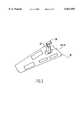
- FIG. 2is a pictorial diagram showing a circuit board on which the joystick is mounted;
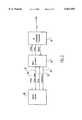
- FIG. 3is a high level block diagram showing the major components of the preferred implementation of the invention and their interactions;
- FIG. 4is a detailed schematic diagram of the sensor module and microprocessor as used in the preferred implementation of the invention.
- FIG. 5is a flow diagram showing the logic of the program which controls the microprocessor in the circuit shown in FIG. 4.
- a hand held remote control device 10having a plurality of function keys or buttons, generally indicated at 11.
- a small joystick 12is sensitive to forces in the horizontal, X and Y, and vertical, Z, directions.
- this joystickconsists of a ceramic shaft 23 embedded in the circuit board 20 of the remote control device at one end and a rubber cap 22 at the other end.
- the shaft 23has four thick-film ceramic strain gauges 44 to 47 silk-screened on its sides.
- the specific construction of the joystickmay be that of the IBM TrackPoint III.
- the microprocessoranalyzes the gauge resistances and derives motion and action (button-press) data for the pointing cursor, and transmits these as an encoded infrared (IR) signal to a receiver 13 connected to, for example, a serial port of a personal computer or "smart" television set 14.
- the receiver 13decodes the signal and transmits the data to the host (personal computer or smart television set) in a standard format as used in a conventional pointing device, such as a mouse.
- the infrared transmission system and mouse communication protocolmay be any of those well known in the art.
- the mapping of joystick force to cursor movement signalsis that used by the IBM TrackPoint III product, or any similar pointing stick.
- the joystickmay be incorporated into a keyboard which may be battery powered and communicate via an IR link with a receiver 13 as shown in FIG. 1 or it may be incorporated into a battery powered computer, such as a lap top computer.
- strain gauge sensorsallow for a very compact design of the cursor pointing device.
- strain gauge sensorsrequire periodic recalibration. Such recalibration necessarily entails a current drain from the power source.
- battery lifecan be considerably shortened.
- the present inventionovercomes this problem with a stand-by power algorithm implemented in the circuit shown in FIG. 3, to which reference is now made.
- FIG. 3is a high level block diagram of the preferred implementation of the invention.
- the sensor module 30contains the strain gauges and associated analog and analog-to-digital (A/D) conversion circuitry. It is powered from the microprocessor 35 over power bus 31 only when a sample is required; otherwise, it is unpowered. In full activity, it is powered for about one millisecond out of every ten.
- A/Danalog-to-digital
- a signal on the sense select line 32specifies what is to be measured (i.e., X, Y or Z), and calibration data is supplied on calibration line 34.
- the sensor moduleresponds with digital data on the data line 33. Normally, each of X, Y and Z is measured, successively, within the 1 msec sample period.
- the data receivedare processed by the microprocessor 35 to produce movement and action data when appropriate for transfer to the infrared (IR) transmitter, which transmits them to the host receiver 13 (FIG. 1).
- This linkis one-way in the preferred embodiment, but it could easily be two-way if required for a specific application.
- FIG. 4The details of the implementation are given in FIG. 4.
- many of the circuit elements which are in the sensor module 30are included in the microprocessor 40.
- Thismay be a commercially available unit, such as the 83C754 or 87C754 (written ambiguously 8xC754) microprocessor manufactured and sold by Philips Semiconductors.
- the three operational amplifiers 41, 42 and 43 shownmay be contained, for example, in a quad unit LMC6034 operational amplifier produced by National Semiconductor Corporation.
- the joystick strain gauges 44 to 47when powered from pin 16 or 17 of the 8xC754 microprocessor, produce voltages depending on the forces applied to the cap of the joystick.
- the four strain gaugesare connected in 2 half-bridge circuits connected in parallel.
- Operational amplifier 41is connected to receive a combined signal generated by the strain gauges 44 and 45
- operational amplifier 42is connected to receive a combined signal generated by the strain gauges 46 and 47
- operational amplifier 43is connected to receive a combined signal from the strain gauges 44 through 47 and fixed resistor R1.
- the useful signalsare quite small (e.g., resolution of about 30 microvolts required, in voltages of about 2 volts), so each operational amplifier is operated in differential open loop mode as part of a zero-threshold comparator, in conjunction with circuitry contained in the 8xC754 microprocessor.
- the reference voltage(derived from the calibration data 34 shown in FIG.
- the X, Y and Z data received by the microprocessorare processed according to standard algorithms not relevant to this invention to generate motion and action signals, as described above.
- these signalsare the same as would be transmitted by a conventional pointing device, such as a mouse, representing movement in the horizontal plane and activation and release of button switches.
- these signalsare used to control the movement of a cursor on the display screen, and to indicate selection or other actions connected therewith, but the actual use to which they are put depends on the system and application programs in use in, for example, the personal computer or "smart" television 14 shown in FIG. 1.
- the voltage signals supplied by the strain gagesare quite small.
- One unit in the digital formcorresponds to about 30 microvolts ( ⁇ V), or less than one part in 100,000 of the working voltage of the circuit.
- ⁇ Vmicrovolts
- the zero set pointsare subject to slow drift resulting from changing ambient conditions, especially temperature.
- the signalsbe sampled on the order of every ten milliseconds (msec) during active use. To reduce power drain, the sampling current is shut off except when a measurement must actually be made.
- the measurement cyclerequires about 1 msec for a duty cycle in the fully active state of about 10%.
- the microprocessoralso is in idle mode, with current drain of about 300 microamperes ( ⁇ A) for about 8.5 out of 10 msec, yielding a net average drain of about 2.5 milliamperes (mA) when the device is in active use. Determination that the device is not in active use requires a longer time, typically, about three seconds. It is only when this determination has been made that the zero set points can be adjusted and the device put into a low-drain standby mode. In standby mode, the device executes sampling cycles with a frequency decreasing with elapsed time since the last active use. As long as the values sampled are consistent with previous values (e.g., within one digital unit), no action is taken.
- the deviceenters a provisionally active mode, analyzing for activity, for the required time, typically about three seconds. If no activity is found, the zero set point is adjusted to the new values and standby mode is continued; otherwise, the device returns to full active mode.
- the "Alarm” unit 50is a timer circuit, operating at a low clock rate (perhaps 32 kc) which, when started by a pulse from pin 3 of the 8XC754, returns a pulse to pin 5 (RST) of the 8XC754 after a delay of 50, 100, 200, or 1000 m seconds, as set by a prior signal on line from pin 28. This allows the 8XC754 to be put into Power Down mode between sampling times.
- the wake up delay for the pointing deviceis at most the maximum sampling period.
- An acceptable valueis between one and two seconds.
- the sampling power drainis reduced by a factor of almost 100, but calibration is maintained.
- the microprocessorhas a power drain while in power down mode of 80 ⁇ A and power drain during sampling of 6 mA, so average drain for sampling with a one second sampling interval is 86 ⁇ A.
- Xa, Ya and Zaare X, Y and Z values at data line 33 (FIG. 3).
- Xo, Yo and Zoare current zero values for these readings.
- Xo, Yo and Zoare reset to current values of Xa, Ya and Za, respectively, whenever Xa and Ya each vary by no more than one unit during a period of 2.8 seconds.
- Activityis defined as any occurrence of
- Time since last activityis the clock time since the most recent occurrence of activity, except that when zero reset occurs, activity at the beginning of that 2.8 second period is ignored.
- the devicewould be in the last column of the table most of the time (e.g., overnight and whenever the set has not been actively controlled for ten minutes or more).
- Power drainis a constant 80 ⁇ A plus 6,000 ⁇ A for 1 msec out of every second, for an average drain of 86 ⁇ A, which is comparable to the passive leakage drain of the type of batteries typically used in such devices. Consequently, battery life in an unused device will be similar to the shelf life of the batteries.
- the devicewill appear to the user to respond instantaneously, except perhaps when it is first picked up after a long (i.e., greater than ten minutes) period of disuse, when there may be a just noticeable delay.
- the maximum sampling intervalcould be shortened if necessary without major impact on battery life.
- the output of the sensoris sampled in function block 54. If the calibrated sample values are non-zero (block 55) the necessary control functions are performed in function block 52. The sample interval is set to minimum (0.01 sec), and the ⁇ user activity ⁇ timer is reset to zero; the "time since last active use" is not changed. If the calibrated sample values are not non-zero, a determination as to whether there has been user activation is made in block 51 as described above. If it is determined that there has been no user activation, calibration values are reset and the sampling interval is adjusted according to the table above. In all cases, the process returns to ⁇ start ⁇ to repeat.
Landscapes
- Engineering & Computer Science (AREA)
- Theoretical Computer Science (AREA)
- Physics & Mathematics (AREA)
- General Engineering & Computer Science (AREA)
- General Physics & Mathematics (AREA)
- Computer Networks & Wireless Communication (AREA)
- Position Input By Displaying (AREA)
- Power Sources (AREA)
Abstract
Description
1. Field of the Invention
The present invention generally relates to remote sensing devices which alternate between an "active" and a "standby" state, such that the device must be in the "active" state whenever its sensed quantities are changing rapidly, but which should not respond to slow changes, and with power drain requirements such that the device must be generally kept in the "standby" state whenever it is not required to be in the "active" state. A particular example is a remote control device for controlling a cursor on a computer or television screen, which must be "on" whenever it is used, but will be actually in use only a small fraction of the time, and must have a battery life measured in years.
2. Background Description
In an application such as a television (TV) remote control device, battery life on the order of years is required, but the device must respond immediately to user input. A user may pick up the device and immediately use it to control, for example, TV volume. In current TV remote controls, the user input is a switch closure, which may be used to activate the device, switching it from a quiescent, very low power state to full activity, which needs to be maintained only during the period of actual use. Typically, such remote control devices transmit via an infrared (IR) link an encoded signal indicating a channel selection or other control function entered by the user. Thus, when the user wants to decrease the TV volume, the down arrow for volume is pressed. This form of simple encoding and control allows the electronics of the remote control to normally be in a low-power, quiescent state most of the time and become active only upon the press of one of the buttons on the remote control device by the user.
A remote control device used to control a cursor on a display screen, like the remote control for a TV, must be compact and have long battery life. A small joy stick operable by the tip of the user's thumb or finger provides a very compact user input. Such a joy stick can be incorporated into a wireless remote control device very much like the remote control for a TV, or it can be incorporated into a compact keyboard which, again, can have a wireless IR link or can be wired to a battery powered computer system, such as a laptop computer.
While traditional cursor pointing devices, such as a mouse or track ball, have variously used optical and electrical sensors to detect movement of the mouse or trackball, such sensors do not lend themselves to a compact design. A small isometric joy stick, as used in one implementation of the subject invention, uses sensitive analog sensors, such as strain gauges, to provide the most compact sensing structure. However, if the user input is the displacement of a sensitive analog sensor such as an isometric joystick from its neutral state, there is a double problem. The analog sensor must appear to the user to be continuously active, and its neutral state must be kept in calibration so that a drift induced, for example, by changing room temperature does not produce a false control signal. Calibration is maintained by detecting, from the properties of the signal, when the sensor is or is not being touched by the user, and then adjusting the neutral state to that sensed when it is not being touched. This detection requires several seconds of activity.
Continuous activity requires substantial power, defeating the battery life objective. Continuous activity can be adequately simulated by very brief activation at frequent intervals, say several times per second. When the user begins to use the sensor, this can be detected at the next activation and the device turned full on to respond immediately to the user's wishes. However, this requires that the device be already in calibration, which seems to require that it have been already turned on for some period in anticipation of user input. This, of course, is not feasible since user demand is unpredictable. To the best of applicant's knowledge, all currently available remote control devices require a switch closure to signal the beginning of a period of activity.
More generally, there are many applications in which a remote sensing unit, which must operate with minimal power consumption, is required to detect and report accurately any sudden change from "normal" in the value of a measured variable, while ignoring slow changes due to environmental or other effects. A space probe monitoring an ambient field (electrical, magnetic, radiant, gravitational, etc.), a telemetry device monitoring physiological variables (temperature, heart rate, etc.) in a human or animal subject, an intrusion detector which responds to either a sudden change in radiant temperature produced by the entry of a warm intruder or a shift in echo frequency produced by movement, are applications which may benefit from the teachings of the invention. In each of these, the quantity being sensed is subject to slow variations which are insignificant, and to rapid variations which must be detected and reported with little delay, with strong restraints on total power consumption. The present invention is applicable in these and similar situations.
It is therefore an object of the present invention to provide a battery powered remote control device, incorporating an analog sensor which requires frequent recalibration but which can respond effectively immediately to user input even after a long period when it is not being used and yet has very low power drain during such periods.
According to one implementation of the invention, there is provided a battery powered remote control device including a sensitive analog input device, such as an isometric joy stick using strain gauge technology, which requires substantial power when activated. This device is effectively immediately responsive to a user at any time yet has a total power drain several orders of magnitude less than that required for continuous activation. This is accomplished by
detecting occasions of use by analysis of the output of the sensor,
following periods of non-use, activating the sensor only very briefly (for a single sample) at intervals increasing with the time elapsed since the last occasion of use, the maximum interval being such as to appear negligible to the user, giving a minimum duty cycle of the order of 1/1000,
if the sensor output is found to be consistent with non-use and correct calibration, no further action is taken, otherwise the sensor is activated and its signal analyzed, and
if the analysis indicates use, then the period of non-use is ended, otherwise, calibration is corrected and intermittent activation continues.
In a preferred embodiment of the invention, the joystick consists of a ceramic shaft embedded in the circuit board at one end and fitted with a rubber cap at the other end. The shaft has four thick-film ceramic strain gauges silk-screened on its sides. Signals sampled from various combinations of the four strain gauges are processed by special circuitry and a microprocessor to measure the force applied to the cap in the X, Y and Z directions. The microprocessor uses these measurements to generate cursor motion and action signals, and to maintain the calibration of the measurement circuitry as required to cancel irrelevant environmental effects such as ambient temperature. It also determines whether the device is in use or not, and during idle periods it reduces the sampling rate as described above.
The foregoing and other objects, aspects and advantages will be better understood from the following detailed description of a preferred embodiment of the invention with reference to the drawings, in which:
FIG. 1 is a pictorial diagram showing a remote control device incorporating a joy stick for control of a cursor on a display screen;
FIG. 2 is a pictorial diagram showing a circuit board on which the joystick is mounted;
FIG. 3 is a high level block diagram showing the major components of the preferred implementation of the invention and their interactions;
FIG. 4 is a detailed schematic diagram of the sensor module and microprocessor as used in the preferred implementation of the invention; and
FIG. 5 is a flow diagram showing the logic of the program which controls the microprocessor in the circuit shown in FIG. 4.
Referring now to the drawings, and more particularly to FIG. 1, there is shown a hand heldremote control device 10 having a plurality of function keys or buttons, generally indicated at 11. Asmall joystick 12 is sensitive to forces in the horizontal, X and Y, and vertical, Z, directions. As shown in more detail in FIG. 2, this joystick consists of aceramic shaft 23 embedded in thecircuit board 20 of the remote control device at one end and arubber cap 22 at the other end. Theshaft 23 has four thick-filmceramic strain gauges 44 to 47 silk-screened on its sides. Force on the joystick results in bending or compression of the shaft of the joystick, and consequent elongation or compression of strain gauges bonded to the sides of the joystick shaft near its base, causing changes in the electrical resistance of the gages proportional to the corresponding directional components of the applied forces. The specific construction of the joystick may be that of the IBM TrackPoint III.
Returning again to FIG. 1, the microprocessor, with associated circuitry contained in the hand-heldcontrol 10, analyzes the gauge resistances and derives motion and action (button-press) data for the pointing cursor, and transmits these as an encoded infrared (IR) signal to areceiver 13 connected to, for example, a serial port of a personal computer or "smart"television set 14. Thereceiver 13 decodes the signal and transmits the data to the host (personal computer or smart television set) in a standard format as used in a conventional pointing device, such as a mouse. The infrared transmission system and mouse communication protocol may be any of those well known in the art. The mapping of joystick force to cursor movement signals is that used by the IBM TrackPoint III product, or any similar pointing stick.
In another application of the joystick, the joystick may be incorporated into a keyboard which may be battery powered and communicate via an IR link with areceiver 13 as shown in FIG. 1 or it may be incorporated into a battery powered computer, such as a lap top computer.
As mentioned, the use of strain gauge sensors allows for a very compact design of the cursor pointing device. However, strain gauge sensors require periodic recalibration. Such recalibration necessarily entails a current drain from the power source. In the case of battery powered devices such as that shown in FIG. 1, battery life can be considerably shortened. The present invention overcomes this problem with a stand-by power algorithm implemented in the circuit shown in FIG. 3, to which reference is now made.
FIG. 3 is a high level block diagram of the preferred implementation of the invention. Thesensor module 30 contains the strain gauges and associated analog and analog-to-digital (A/D) conversion circuitry. It is powered from themicroprocessor 35 overpower bus 31 only when a sample is required; otherwise, it is unpowered. In full activity, it is powered for about one millisecond out of every ten. When a sample is required, power is applied, a signal on the senseselect line 32 specifies what is to be measured (i.e., X, Y or Z), and calibration data is supplied oncalibration line 34. The sensor module responds with digital data on thedata line 33. Normally, each of X, Y and Z is measured, successively, within the 1 msec sample period. The data received are processed by themicroprocessor 35 to produce movement and action data when appropriate for transfer to the infrared (IR) transmitter, which transmits them to the host receiver 13 (FIG. 1). This link is one-way in the preferred embodiment, but it could easily be two-way if required for a specific application.
The details of the implementation are given in FIG. 4. Here, many of the circuit elements which are in thesensor module 30 are included in the microprocessor 40. This may be a commercially available unit, such as the 83C754 or 87C754 (written ambiguously 8xC754) microprocessor manufactured and sold by Philips Semiconductors. The threeoperational amplifiers pin 16 or 17 of the 8xC754 microprocessor, produce voltages depending on the forces applied to the cap of the joystick. The four strain gauges are connected in 2 half-bridge circuits connected in parallel.Operational amplifier 41 is connected to receive a combined signal generated by the strain gauges 44 and 45,operational amplifier 42 is connected to receive a combined signal generated by the strain gauges 46 and 47, andoperational amplifier 43 is connected to receive a combined signal from the strain gauges 44 through 47 and fixed resistor R1. The useful signals are quite small (e.g., resolution of about 30 microvolts required, in voltages of about 2 volts), so each operational amplifier is operated in differential open loop mode as part of a zero-threshold comparator, in conjunction with circuitry contained in the 8xC754 microprocessor. The reference voltage (derived from thecalibration data 34 shown in FIG. 3) is supplied frompin 19 or 20 of the 8xC754 microprocessor combined with a voltage ramp generated by resistor R11 and capacitor C2 (under control ofpin 12 of the 8xC754 microprocessor) to sweep across the range of interest for the measurement being made. The time of coincidence of the voltage from the strain gauge assembly and the sweeping reference voltage (signaled by a voltage step at the appropriate one ofpins 9, 10 or 11) is noted by a timer-counter in the 8xC754 microprocessor and is the data supplied to the microprocessor.
The X, Y and Z data received by the microprocessor are processed according to standard algorithms not relevant to this invention to generate motion and action signals, as described above.
In the preferred implementation, these signals are the same as would be transmitted by a conventional pointing device, such as a mouse, representing movement in the horizontal plane and activation and release of button switches. Typically, these signals are used to control the movement of a cursor on the display screen, and to indicate selection or other actions connected therewith, but the actual use to which they are put depends on the system and application programs in use in, for example, the personal computer or "smart"television 14 shown in FIG. 1.
The voltage signals supplied by the strain gages are quite small. One unit in the digital form corresponds to about 30 microvolts (μV), or less than one part in 100,000 of the working voltage of the circuit. Thus, the zero set points are subject to slow drift resulting from changing ambient conditions, especially temperature. Proper response to the user requires that the signals be sampled on the order of every ten milliseconds (msec) during active use. To reduce power drain, the sampling current is shut off except when a measurement must actually be made. The measurement cycle requires about 1 msec for a duty cycle in the fully active state of about 10%. The microprocessor also is in idle mode, with current drain of about 300 microamperes (μA) for about 8.5 out of 10 msec, yielding a net average drain of about 2.5 milliamperes (mA) when the device is in active use. Determination that the device is not in active use requires a longer time, typically, about three seconds. It is only when this determination has been made that the zero set points can be adjusted and the device put into a low-drain standby mode. In standby mode, the device executes sampling cycles with a frequency decreasing with elapsed time since the last active use. As long as the values sampled are consistent with previous values (e.g., within one digital unit), no action is taken. If a greater difference is found, the device enters a provisionally active mode, analyzing for activity, for the required time, typically about three seconds. If no activity is found, the zero set point is adjusted to the new values and standby mode is continued; otherwise, the device returns to full active mode.
The "Alarm"unit 50 is a timer circuit, operating at a low clock rate (perhaps 32 kc) which, when started by a pulse from pin 3 of the 8XC754, returns a pulse to pin 5 (RST) of the 8XC754 after a delay of 50, 100, 200, or 1000 m seconds, as set by a prior signal on line from pin 28. This allows the 8XC754 to be put into Power Down mode between sampling times.
The wake up delay for the pointing device is at most the maximum sampling period. An acceptable value is between one and two seconds. At one second, the sampling power drain is reduced by a factor of almost 100, but calibration is maintained. The microprocessor has a power drain while in power down mode of 80 μA and power drain during sampling of 6 mA, so average drain for sampling with a one second sampling interval is 86 μA.
The stand-by power algorithm implemented by the microprocessor is based on the following definitions. Xa, Ya and Za are X, Y and Z values at data line 33 (FIG. 3). Xo, Yo and Zo are current zero values for these readings. Thus, an output from the joystick is defined as X=Xa-Xo, Y=Ya-Yo, and Z=Za-Zo. For purposes of calibration, Xo, Yo and Zo are reset to current values of Xa, Ya and Za, respectively, whenever Xa and Ya each vary by no more than one unit during a period of 2.8 seconds. "Activity" is defined as any occurrence of |X|>1 or |Y|>1 or |Z|>1, where "1" is the minimum quantification from the A/D conversion. Time since last activity is the clock time since the most recent occurrence of activity, except that when zero reset occurs, activity at the beginning of that 2.8 second period is ignored.
An example of the schedule of sampling interval with elapsed time since last active use is shown in the table below:
______________________________________ Time since <1 1-2 2-4 4-10 >10 last min min min min minactive use Sampling 10 50 100 200 1 sec interval msec msec msec msec ______________________________________
For the example of a TV remote control application, the device would be in the last column of the table most of the time (e.g., overnight and whenever the set has not been actively controlled for ten minutes or more). Power drain is a constant 80 μA plus 6,000 μA for 1 msec out of every second, for an average drain of 86 μA, which is comparable to the passive leakage drain of the type of batteries typically used in such devices. Consequently, battery life in an unused device will be similar to the shelf life of the batteries. On the other hand, the device will appear to the user to respond instantaneously, except perhaps when it is first picked up after a long (i.e., greater than ten minutes) period of disuse, when there may be a just noticeable delay. Clearly, the maximum sampling interval could be shortened if necessary without major impact on battery life.
Referring to FIG. 5, the output of the sensor is sampled infunction block 54. If the calibrated sample values are non-zero (block 55) the necessary control functions are performed infunction block 52. The sample interval is set to minimum (0.01 sec), and the `user activity` timer is reset to zero; the "time since last active use" is not changed. If the calibrated sample values are not non-zero, a determination as to whether there has been user activation is made inblock 51 as described above. If it is determined that there has been no user activation, calibration values are reset and the sampling interval is adjusted according to the table above. In all cases, the process returns to `start` to repeat.
While the invention has been described in terms of a single preferred embodiment, those skilled in the art will recognize that the invention can be practiced with modification within the spirit and scope of the appended claims and, in particular, the invention may be applied to those situations where a quantity being sensed is subject to slow variations which are insignificant and to rapid variations which must be detected and reported with little delay and where there are strong restraints on total power consumption.
Claims (20)
1. A method for reducing power requirements of a sensing device subject to long periods during which the sensing device must be inactive but alert for rapid change while actively maintaining calibration against a slowly changing ambient, comprising the steps of:
monitoring the sensing device at a selected time interval;
if a variable sensed by the sensing device has a value indicating an extended period of inactivity, then
adjusting the selected interval to a longer time interval;
determining if calibration of the sensing device is correct; and
if the calibration of the sensing device is not correct, then
correcting the calibration of the sensing device;
otherwise, if the variable sensed by the sensing device has a value indicating activity, then
performing a function in response to the sensed variable.
2. The method according to claim 1, further comprising the step of providing power to the sensing device only when data is required from the sensing device.
3. The method according to claim 2 further comprising the step of providing power to the microprocessor with a battery.
4. The method recited in claim 1 wherein the function performed is reporting a value derived from the sensed variable to a host system.
5. The method recited in claim 1 wherein the function performed is a commanded operation according to a content of the sensed variable.
6. The method recited in claim 1 wherein the sensed variable is a force having a magnitude and direction.
7. The method recited in claim 6 wherein the force is resolvable in at least two dimensions.
8. The method according to claim 2, comprising performing the steps with a microprocessor.
9. A battery powered remote control device comprising:
a sensing device subject to long periods during which the sensing device must be inactive but alert for rapid change while actively maintaining calibration against a slowly changing ambient;
means for sampling at least one analog signal from the sensing device and generating a digital output proportional to the analog signal; and
a microprocessor, connected to receive the digital output from the sampling means, for taking a sample from said sensor device during periods of inactivity and performing a recalibration based on the sampled signal, the sampling interval for recalibration being increased in periods of extended inactivity.
10. The battery powered remote control device recited in claim 9 wherein the sensing device comprises a joystick having an analog sensor that generates the analog signal due to flexure of the joystick.
11. The battery powered remote control device recited in claim 10 further comprising transmitter means for transmitting encoded control signals generated by said microprocessor in response to flexure of the joystick.
12. The battery powered remote control device recited in claim 10 wherein the joystick comprises one of a ceramic, a metal and a plastic shaft to which the analog sensor is affixed.
13. The battery powered remote cursor control device recited in claim 12 wherein the analog sensor comprises four strain gauges mounted about the joystick causing resistances of said four strain gauges to vary as functions of horizontal and vertical forces applied to said joystick.
14. The battery powered remote control device recited in claim 13 wherein the four strain gauges are connected in two half-bridge circuits and further comprising first, second and third operational amplifiers connected to said bridge circuit, said first operational amplifier being connected to receive a combined signal generated by a first pair of the strain gauges, the second operational amplifier being connected to receive a combined signal generated by a second pair of the strain gauges, and the third operational amplifier being connected to receive a combined signal from all four of said strain gauges connected in a half bridge with a fixed resistor.
15. The battery powered remote control device recited in claim 9 wherein part or all of said sampling means is packaged with the microprocessor on the same chip.
16. A battery powered remote control device which performs periodic self calibration against a changing ambient during periods of user inactivity, comprising:
a sensor for sensing a user input to perform a remote control function to control a remote host system;
a microprocessor connected to receive said user input and generate a corresponding remote control function therefrom;
a transmitter connected to said microprocessor for transmitting said corresponding remote control function to said host system; and
calibration means, associated with said microprocessor, for activating said sensor after a predetermined period of user inactivity and sampling a returned signal from said sensor, and using said returned signal to perform a sensor calibration, wherein said predetermined period is progressively increased during extended periods of user inactivity.
17. A battery powered remote control device which performs periodic self calibration as recited in claim 16 wherein said sensor comprises a joystick connected to strain gauges.
18. A battery powered remote control device which performs periodic self calibration as recited in claim 16 wherein said transmitter comprises a transceiver for receiving signals from said host system.
19. A battery powered remote control device which performs periodic self calibration as recited in claim 18 wherein said remote control comprises a television remote control.
20. A battery powered remote control device which performs periodic self calibration as recited in claim 16 wherein said remote control comprises a computer remote control.
Priority Applications (9)
| Application Number | Priority Date | Filing Date | Title |
|---|---|---|---|
| US08/586,270US5831593A (en) | 1996-01-16 | 1996-01-16 | Low-power standby mode for a remote sensing device |
| TW085106617ATW307839B (en) | 1996-01-16 | 1996-06-03 | Low-power standby mode for a remote sensing device |
| KR1019960047064AKR100225216B1 (en) | 1996-01-16 | 1996-10-21 | Low power standby mode for remote sensing devices |
| DE69629547TDE69629547T2 (en) | 1996-01-16 | 1996-12-23 | Remote sensor with standby |
| EP96309405AEP0785497B1 (en) | 1996-01-16 | 1996-12-23 | Low-power standby mode for a remote sensing device |
| JP34541496AJP3307552B2 (en) | 1996-01-16 | 1996-12-25 | Power reduction method and battery power remote control device |
| SG1997000025ASG55264A1 (en) | 1996-01-16 | 1997-01-08 | Low-power standby mode for a remote sensing device |
| CN97102120ACN1076550C (en) | 1996-01-16 | 1997-01-09 | Low-power stand by mode for remote sensing device |
| HK98102279.1AHK1003075B (en) | 1996-01-16 | 1998-03-18 | A remote sensing device having low power standby mode and method thereof |
Applications Claiming Priority (1)
| Application Number | Priority Date | Filing Date | Title |
|---|---|---|---|
| US08/586,270US5831593A (en) | 1996-01-16 | 1996-01-16 | Low-power standby mode for a remote sensing device |
Publications (1)
| Publication Number | Publication Date |
|---|---|
| US5831593Atrue US5831593A (en) | 1998-11-03 |
Family
ID=24345060
Family Applications (1)
| Application Number | Title | Priority Date | Filing Date |
|---|---|---|---|
| US08/586,270Expired - LifetimeUS5831593A (en) | 1996-01-16 | 1996-01-16 | Low-power standby mode for a remote sensing device |
Country Status (8)
| Country | Link |
|---|---|
| US (1) | US5831593A (en) |
| EP (1) | EP0785497B1 (en) |
| JP (1) | JP3307552B2 (en) |
| KR (1) | KR100225216B1 (en) |
| CN (1) | CN1076550C (en) |
| DE (1) | DE69629547T2 (en) |
| SG (1) | SG55264A1 (en) |
| TW (1) | TW307839B (en) |
Cited By (27)
| Publication number | Priority date | Publication date | Assignee | Title |
|---|---|---|---|---|
| US6067077A (en) | 1998-04-10 | 2000-05-23 | Immersion Corporation | Position sensing for force feedback devices |
| US6509890B1 (en)* | 1998-03-31 | 2003-01-21 | International Business Machines Corporation | Mini-TrackPoint IV pointing device |
| US6628266B1 (en)* | 1999-06-30 | 2003-09-30 | Nokia Mobile Phones Limited | Joystick controller |
| US6686911B1 (en) | 1996-11-26 | 2004-02-03 | Immersion Corporation | Control knob with control modes and force feedback |
| US6708279B1 (en)* | 1998-10-27 | 2004-03-16 | Canon Kabushiki Kaisha | Temperature sensor calibration during powersave mode by executing a control program in a control unit and lowering clock frequency after other devices are powered off |
| US20040080487A1 (en)* | 2002-10-29 | 2004-04-29 | Griffin Jason T. | Electronic device having keyboard for thumb typing |
| US6956558B1 (en) | 1998-03-26 | 2005-10-18 | Immersion Corporation | Rotary force feedback wheels for remote control devices |
| US20060284840A1 (en)* | 2005-06-15 | 2006-12-21 | Research In Motion Limited | Portable electronic device including pointer and related methods |
| US20070080946A1 (en)* | 2005-10-07 | 2007-04-12 | Research In Motion Limited | Portable electronic device including trackball unit and associated methods |
| US7489309B2 (en) | 1996-11-26 | 2009-02-10 | Immersion Corporation | Control knob with multiple degrees of freedom and force feedback |
| US20090128714A1 (en)* | 2007-11-16 | 2009-05-21 | Oki Semiconductor Co., Ltd. | Electronic device, remote control device, and remote control system |
| US20090189867A1 (en)* | 2008-01-30 | 2009-07-30 | Apple, Inc. | Auto Scanning for Multiple Frequency Stimulation Multi-Touch Sensor Panels |
| US7650810B2 (en) | 2002-04-03 | 2010-01-26 | Immersion Corporation | Haptic control devices |
| US7688310B2 (en) | 1999-12-07 | 2010-03-30 | Immersion Corporation | Haptic feedback using a keyboard device |
| US7765182B2 (en) | 1996-05-21 | 2010-07-27 | Immersion Corporation | Haptic authoring |
| US7889174B2 (en) | 1997-12-03 | 2011-02-15 | Immersion Corporation | Tactile feedback interface device including display screen |
| US8129190B2 (en) | 2006-11-17 | 2012-03-06 | Applied Nanotech Holdings, Inc. | Tagged petroleum products and methods of detecting same |
| US8139333B2 (en) | 2008-04-09 | 2012-03-20 | Kabushiki Kaisha Tokai Rika Denki Seisakusho | Short circuit protection circuit |
| US8157650B2 (en) | 2006-09-13 | 2012-04-17 | Immersion Corporation | Systems and methods for casino gaming haptics |
| US8188989B2 (en) | 1996-11-26 | 2012-05-29 | Immersion Corporation | Control knob with multiple degrees of freedom and force feedback |
| US8823660B2 (en) | 2007-01-03 | 2014-09-02 | Apple Inc. | Multi-touch auto scanning |
| US8836656B2 (en) | 2007-01-03 | 2014-09-16 | Apple Inc. | Channel scan logic |
| US8917234B2 (en) | 2002-10-15 | 2014-12-23 | Immersion Corporation | Products and processes for providing force sensations in a user interface |
| US8992322B2 (en) | 2003-06-09 | 2015-03-31 | Immersion Corporation | Interactive gaming systems with haptic feedback |
| US9104791B2 (en) | 2009-05-28 | 2015-08-11 | Immersion Corporation | Systems and methods for editing a model of a physical system for a simulation |
| US9486292B2 (en) | 2008-02-14 | 2016-11-08 | Immersion Corporation | Systems and methods for real-time winding analysis for knot detection |
| US9866924B2 (en) | 2013-03-14 | 2018-01-09 | Immersion Corporation | Systems and methods for enhanced television interaction |
Families Citing this family (6)
| Publication number | Priority date | Publication date | Assignee | Title |
|---|---|---|---|---|
| US6424335B1 (en)* | 1998-09-02 | 2002-07-23 | Fujitsu Limited | Notebook computer with detachable infrared multi-mode input device |
| FI20055240L (en)* | 2005-05-20 | 2006-11-21 | Polar Electro Oy | Per-user performance meter peripheral device, per-user performance meter and method |
| JP2008146679A (en)* | 2008-02-18 | 2008-06-26 | Alps Electric Co Ltd | Input device and electronic device equipped therewith |
| JP2012203817A (en)* | 2011-03-28 | 2012-10-22 | Nec Computertechno Ltd | Computer device and method for controlling the same |
| CN105607724A (en)* | 2015-12-22 | 2016-05-25 | 深圳市金立通信设备有限公司 | Terminal control method and terminal |
| TWI719619B (en)* | 2019-09-03 | 2021-02-21 | 瑞昱半導體股份有限公司 | Electronic system with power-saving echo cancellation and related echo cancellation method |
Citations (13)
| Publication number | Priority date | Publication date | Assignee | Title |
|---|---|---|---|---|
| US4313226A (en)* | 1980-03-03 | 1982-01-26 | Sheltered Workshop For The Disabled, Inc. | Fiber optic control apparatus |
| GB2150721A (en)* | 1983-12-02 | 1985-07-03 | Itt | Remote data collection and transport apparatus |
| US4591914A (en)* | 1984-01-30 | 1986-05-27 | Sony Corporation | Apparatus for controlling power supply to electronic circuitry |
| US4649373A (en)* | 1983-08-10 | 1987-03-10 | International Business Machines Corporation | Powered conservation system in battery powered keyboard device including a microprocessor |
| US4698748A (en)* | 1983-10-07 | 1987-10-06 | Essex Group, Inc. | Power-conserving control system for turning-off the power and the clocking for data transactions upon certain system inactivity |
| US4788661A (en)* | 1985-11-01 | 1988-11-29 | Clarion Co., Ltd. | Microcomputer reset circuit |
| US4825209A (en)* | 1985-03-06 | 1989-04-25 | Alps Electric Co., Ltd | Remote control apparatus |
| US4918995A (en)* | 1988-01-04 | 1990-04-24 | Gas Research Institute | Electronic gas meter |
| US4982279A (en)* | 1987-07-28 | 1991-01-01 | Sanyo Electric Co., Ltd. | Television receiver having a memorandum function |
| US4992951A (en)* | 1988-04-29 | 1991-02-12 | Chrysler Corporation | Utilization of a reset output of a regulator as a system low-voltage inhibit |
| US5187469A (en)* | 1990-08-06 | 1993-02-16 | Tandy Corporation | Universal remote control including quick touch function |
| US5283559A (en)* | 1992-09-21 | 1994-02-01 | International Business Machines Corp. | Automatic calibration of a capacitive touch screen used with a fixed element flat screen display panel |
| US5541622A (en)* | 1990-07-24 | 1996-07-30 | Incontrol Solutions, Inc. | Miniature isometric joystick |
Family Cites Families (3)
| Publication number | Priority date | Publication date | Assignee | Title |
|---|---|---|---|---|
| US4313227A (en)* | 1979-01-29 | 1982-01-26 | Texas Instruments Incorporated | Light energy information transmission system |
| JPH04157856A (en)* | 1990-10-20 | 1992-05-29 | Fujitsu Ltd | Alternating current interference detection system |
| US5287210A (en)* | 1992-01-13 | 1994-02-15 | Siavash Sefidvash | Smart infrared controller |
- 1996
- 1996-01-16USUS08/586,270patent/US5831593A/ennot_activeExpired - Lifetime
- 1996-06-03TWTW085106617Apatent/TW307839B/ennot_activeIP Right Cessation
- 1996-10-21KRKR1019960047064Apatent/KR100225216B1/ennot_activeExpired - Fee Related
- 1996-12-23DEDE69629547Tpatent/DE69629547T2/ennot_activeExpired - Lifetime
- 1996-12-23EPEP96309405Apatent/EP0785497B1/ennot_activeExpired - Lifetime
- 1996-12-25JPJP34541496Apatent/JP3307552B2/ennot_activeExpired - Fee Related
- 1997
- 1997-01-08SGSG1997000025Apatent/SG55264A1/enunknown
- 1997-01-09CNCN97102120Apatent/CN1076550C/ennot_activeExpired - Lifetime
Patent Citations (13)
| Publication number | Priority date | Publication date | Assignee | Title |
|---|---|---|---|---|
| US4313226A (en)* | 1980-03-03 | 1982-01-26 | Sheltered Workshop For The Disabled, Inc. | Fiber optic control apparatus |
| US4649373A (en)* | 1983-08-10 | 1987-03-10 | International Business Machines Corporation | Powered conservation system in battery powered keyboard device including a microprocessor |
| US4698748A (en)* | 1983-10-07 | 1987-10-06 | Essex Group, Inc. | Power-conserving control system for turning-off the power and the clocking for data transactions upon certain system inactivity |
| GB2150721A (en)* | 1983-12-02 | 1985-07-03 | Itt | Remote data collection and transport apparatus |
| US4591914A (en)* | 1984-01-30 | 1986-05-27 | Sony Corporation | Apparatus for controlling power supply to electronic circuitry |
| US4825209A (en)* | 1985-03-06 | 1989-04-25 | Alps Electric Co., Ltd | Remote control apparatus |
| US4788661A (en)* | 1985-11-01 | 1988-11-29 | Clarion Co., Ltd. | Microcomputer reset circuit |
| US4982279A (en)* | 1987-07-28 | 1991-01-01 | Sanyo Electric Co., Ltd. | Television receiver having a memorandum function |
| US4918995A (en)* | 1988-01-04 | 1990-04-24 | Gas Research Institute | Electronic gas meter |
| US4992951A (en)* | 1988-04-29 | 1991-02-12 | Chrysler Corporation | Utilization of a reset output of a regulator as a system low-voltage inhibit |
| US5541622A (en)* | 1990-07-24 | 1996-07-30 | Incontrol Solutions, Inc. | Miniature isometric joystick |
| US5187469A (en)* | 1990-08-06 | 1993-02-16 | Tandy Corporation | Universal remote control including quick touch function |
| US5283559A (en)* | 1992-09-21 | 1994-02-01 | International Business Machines Corp. | Automatic calibration of a capacitive touch screen used with a fixed element flat screen display panel |
Non-Patent Citations (2)
| Title |
|---|
| "Analog Joystick Interface Emulation Using A Digital Counter", IBM Technical Disclosure Bulletin, vol. 37, pp. 73-74 Aug. 1994. |
| Analog Joystick Interface Emulation Using A Digital Counter , IBM Technical Disclosure Bulletin, vol. 37, pp. 73 74 Aug. 1994.* |
Cited By (40)
| Publication number | Priority date | Publication date | Assignee | Title |
|---|---|---|---|---|
| US7765182B2 (en) | 1996-05-21 | 2010-07-27 | Immersion Corporation | Haptic authoring |
| US8188989B2 (en) | 1996-11-26 | 2012-05-29 | Immersion Corporation | Control knob with multiple degrees of freedom and force feedback |
| US6686911B1 (en) | 1996-11-26 | 2004-02-03 | Immersion Corporation | Control knob with control modes and force feedback |
| US7489309B2 (en) | 1996-11-26 | 2009-02-10 | Immersion Corporation | Control knob with multiple degrees of freedom and force feedback |
| US7889174B2 (en) | 1997-12-03 | 2011-02-15 | Immersion Corporation | Tactile feedback interface device including display screen |
| US6956558B1 (en) | 1998-03-26 | 2005-10-18 | Immersion Corporation | Rotary force feedback wheels for remote control devices |
| US6509890B1 (en)* | 1998-03-31 | 2003-01-21 | International Business Machines Corporation | Mini-TrackPoint IV pointing device |
| US8552982B2 (en) | 1998-04-10 | 2013-10-08 | Immersion Corporation | Position sensing methods for interface devices |
| US6704002B1 (en)* | 1998-04-10 | 2004-03-09 | Immersion Corporation | Position sensing methods for interface devices |
| US6067077A (en) | 1998-04-10 | 2000-05-23 | Immersion Corporation | Position sensing for force feedback devices |
| US6708279B1 (en)* | 1998-10-27 | 2004-03-16 | Canon Kabushiki Kaisha | Temperature sensor calibration during powersave mode by executing a control program in a control unit and lowering clock frequency after other devices are powered off |
| US6628266B1 (en)* | 1999-06-30 | 2003-09-30 | Nokia Mobile Phones Limited | Joystick controller |
| US7688310B2 (en) | 1999-12-07 | 2010-03-30 | Immersion Corporation | Haptic feedback using a keyboard device |
| US7650810B2 (en) | 2002-04-03 | 2010-01-26 | Immersion Corporation | Haptic control devices |
| US8917234B2 (en) | 2002-10-15 | 2014-12-23 | Immersion Corporation | Products and processes for providing force sensations in a user interface |
| US20040080487A1 (en)* | 2002-10-29 | 2004-04-29 | Griffin Jason T. | Electronic device having keyboard for thumb typing |
| US8992322B2 (en) | 2003-06-09 | 2015-03-31 | Immersion Corporation | Interactive gaming systems with haptic feedback |
| US20060284840A1 (en)* | 2005-06-15 | 2006-12-21 | Research In Motion Limited | Portable electronic device including pointer and related methods |
| US20070080946A1 (en)* | 2005-10-07 | 2007-04-12 | Research In Motion Limited | Portable electronic device including trackball unit and associated methods |
| US8721416B2 (en) | 2006-09-13 | 2014-05-13 | Immersion Corporation | Systems and methods for casino gaming haptics |
| US8157650B2 (en) | 2006-09-13 | 2012-04-17 | Immersion Corporation | Systems and methods for casino gaming haptics |
| US8129190B2 (en) | 2006-11-17 | 2012-03-06 | Applied Nanotech Holdings, Inc. | Tagged petroleum products and methods of detecting same |
| US8836656B2 (en) | 2007-01-03 | 2014-09-16 | Apple Inc. | Channel scan logic |
| US11592948B2 (en) | 2007-01-03 | 2023-02-28 | Apple Inc. | Channel scan logic |
| US11132097B2 (en) | 2007-01-03 | 2021-09-28 | Apple Inc. | Channel scan logic |
| US11194423B2 (en) | 2007-01-03 | 2021-12-07 | Apple Inc. | Multi-touch auto scanning |
| US8823660B2 (en) | 2007-01-03 | 2014-09-02 | Apple Inc. | Multi-touch auto scanning |
| US10031609B2 (en) | 2007-01-03 | 2018-07-24 | Apple Inc. | Channel scan logic |
| US9063601B2 (en) | 2007-01-03 | 2015-06-23 | Apple Inc. | Channel scan logic |
| US10712866B2 (en) | 2007-01-03 | 2020-07-14 | Apple Inc. | Multi-touch auto scanning |
| US9383843B2 (en) | 2007-01-03 | 2016-07-05 | Apple Inc. | Multi-touch auto scanning |
| US10664095B2 (en) | 2007-01-03 | 2020-05-26 | Apple Inc. | Channel scan logic |
| US20090128714A1 (en)* | 2007-11-16 | 2009-05-21 | Oki Semiconductor Co., Ltd. | Electronic device, remote control device, and remote control system |
| US8405783B2 (en)* | 2007-11-16 | 2013-03-26 | Oki Semiconductor Co., Ltd. | Electronic device, remote control device, and remote control system |
| US10969917B2 (en) | 2008-01-30 | 2021-04-06 | Apple Inc. | Auto scanning for multiple frequency stimulation multi-touch sensor panels |
| US20090189867A1 (en)* | 2008-01-30 | 2009-07-30 | Apple, Inc. | Auto Scanning for Multiple Frequency Stimulation Multi-Touch Sensor Panels |
| US9486292B2 (en) | 2008-02-14 | 2016-11-08 | Immersion Corporation | Systems and methods for real-time winding analysis for knot detection |
| US8139333B2 (en) | 2008-04-09 | 2012-03-20 | Kabushiki Kaisha Tokai Rika Denki Seisakusho | Short circuit protection circuit |
| US9104791B2 (en) | 2009-05-28 | 2015-08-11 | Immersion Corporation | Systems and methods for editing a model of a physical system for a simulation |
| US9866924B2 (en) | 2013-03-14 | 2018-01-09 | Immersion Corporation | Systems and methods for enhanced television interaction |
Also Published As
| Publication number | Publication date |
|---|---|
| DE69629547T2 (en) | 2004-06-17 |
| KR100225216B1 (en) | 1999-10-15 |
| EP0785497B1 (en) | 2003-08-20 |
| SG55264A1 (en) | 1998-12-21 |
| KR970060999A (en) | 1997-08-12 |
| CN1164150A (en) | 1997-11-05 |
| CN1076550C (en) | 2001-12-19 |
| EP0785497A1 (en) | 1997-07-23 |
| DE69629547D1 (en) | 2003-09-25 |
| JP3307552B2 (en) | 2002-07-24 |
| HK1003075A1 (en) | 1998-10-09 |
| TW307839B (en) | 1997-06-11 |
| JPH09198186A (en) | 1997-07-31 |
Similar Documents
| Publication | Publication Date | Title |
|---|---|---|
| US5831593A (en) | Low-power standby mode for a remote sensing device | |
| US7113087B1 (en) | Proximity sensing based on antenna impedance variation | |
| CN109152542A (en) | The system and method being worn for detecting when sensor | |
| KR20060053976A (en) | Momentum measurement device and method using acceleration sensor | |
| WO2002047465A3 (en) | Body supported activity and condition monitor | |
| JP2018506026A (en) | Environmental sensor and method for measuring and predicting environmental parameters | |
| US20210038085A1 (en) | Method and electronic device capable of more accurately establishing personal blood pressure estimation model for specific user based on personal profile of physiological feature of user | |
| US7532116B2 (en) | Wireless human interface device with integrated temperature sensor | |
| US20110122732A1 (en) | User interface features for a watch | |
| US20140326072A1 (en) | Occupancy sensor | |
| KR100243170B1 (en) | Method for transmitting the pointing data of remocon and method for processing the received data | |
| HK1003075B (en) | A remote sensing device having low power standby mode and method thereof | |
| JPH09276256A (en) | Body activity measuring system | |
| US20020171629A1 (en) | Low power measurement circuit for position sensor | |
| CN114063824B (en) | Pressure sensing module, pressure sensing detection method, device and electronic equipment | |
| US20050215910A1 (en) | Remote control capable of measuring body temperature | |
| KR20090005704A (en) | Information input device and information input method for portable terminal | |
| KR100368871B1 (en) | Measure meter of salt match for cooking | |
| KR20050008420A (en) | A body heat recorder | |
| CN221260096U (en) | Ambient temperature and humidity and detection temperature register | |
| KR200328013Y1 (en) | A body heat recorder | |
| KR20040086886A (en) | A digital scale for home use | |
| KR200328014Y1 (en) | A blood pressure pulsation recorder | |
| KR200216976Y1 (en) | Presence Induction Sensor | |
| Domingues | A Guide to Select Sensors for Biomedical Propose |
Legal Events
| Date | Code | Title | Description |
|---|---|---|---|
| AS | Assignment | Owner name:IBM CORPORATION, NEW YORK Free format text:ASSIGNMENT OF ASSIGNORS INTEREST;ASSIGNOR:RUTLEDGE, JOSEPH DELA;REEL/FRAME:007837/0595 Effective date:19960115 | |
| STCF | Information on status: patent grant | Free format text:PATENTED CASE | |
| FEPP | Fee payment procedure | Free format text:PAYOR NUMBER ASSIGNED (ORIGINAL EVENT CODE: ASPN); ENTITY STATUS OF PATENT OWNER: LARGE ENTITY | |
| FPAY | Fee payment | Year of fee payment:4 | |
| FPAY | Fee payment | Year of fee payment:8 | |
| FPAY | Fee payment | Year of fee payment:12 |