US5823468A - Hybrid aircraft - Google Patents
Hybrid aircraftDownload PDFInfo
- Publication number
- US5823468A US5823468AUS08/547,574US54757495AUS5823468AUS 5823468 AUS5823468 AUS 5823468AUS 54757495 AUS54757495 AUS 54757495AUS 5823468 AUS5823468 AUS 5823468A
- Authority
- US
- United States
- Prior art keywords
- hull
- aircraft
- wing
- propelling means
- thrust
- Prior art date
- Legal status (The legal status is an assumption and is not a legal conclusion. Google has not performed a legal analysis and makes no representation as to the accuracy of the status listed.)
- Expired - Fee Related
Links
- 230000007935neutral effectEffects0.000claimsabstractdescription11
- 239000000463materialSubstances0.000claimsdescription18
- 230000033001locomotionEffects0.000claimsdescription17
- 230000005540biological transmissionEffects0.000claimsdescription5
- 230000003750conditioning effectEffects0.000claimsdescription4
- 239000006260foamSubstances0.000claimsdescription4
- 238000005461lubricationMethods0.000claimsdescription2
- 238000010276constructionMethods0.000abstractdescription15
- 238000005253claddingMethods0.000abstractdescription3
- 238000005299abrasionMethods0.000abstractdescription2
- 239000002648laminated materialSubstances0.000abstract1
- 239000003570airSubstances0.000description36
- 239000007789gasSubstances0.000description24
- 239000013598vectorSubstances0.000description23
- 238000013461designMethods0.000description20
- 230000000694effectsEffects0.000description19
- 238000000034methodMethods0.000description12
- RZVHIXYEVGDQDX-UHFFFAOYSA-N9,10-anthraquinoneChemical compoundC1=CC=C2C(=O)C3=CC=CC=C3C(=O)C2=C1RZVHIXYEVGDQDX-UHFFFAOYSA-N0.000description10
- 238000005516engineering processMethods0.000description10
- 239000002131composite materialSubstances0.000description9
- 238000004519manufacturing processMethods0.000description9
- 230000003068static effectEffects0.000description8
- 229920000271Kevlar®Polymers0.000description7
- 238000013459approachMethods0.000description7
- 230000008901benefitEffects0.000description7
- 108010036050human cationic antimicrobial protein 57Proteins0.000description7
- 239000004761kevlarSubstances0.000description7
- 230000001141propulsive effectEffects0.000description7
- 230000009467reductionEffects0.000description7
- 238000005452bendingMethods0.000description6
- 230000008859changeEffects0.000description6
- 230000005484gravityEffects0.000description6
- 238000009434installationMethods0.000description6
- 239000003381stabilizerSubstances0.000description6
- 239000000446fuelSubstances0.000description5
- 230000006870functionEffects0.000description5
- 238000010438heat treatmentMethods0.000description5
- 230000002829reductive effectEffects0.000description5
- 238000010586diagramMethods0.000description4
- 238000009826distributionMethods0.000description4
- 238000012423maintenanceMethods0.000description4
- 230000007704transitionEffects0.000description4
- OKTJSMMVPCPJKN-UHFFFAOYSA-NCarbonChemical compound[C]OKTJSMMVPCPJKN-UHFFFAOYSA-N0.000description3
- 229920003235aromatic polyamidePolymers0.000description3
- 230000006872improvementEffects0.000description3
- 230000001133accelerationEffects0.000description2
- 230000004308accommodationEffects0.000description2
- 230000002411adverseEffects0.000description2
- XAGFODPZIPBFFR-UHFFFAOYSA-NaluminiumChemical compound[Al]XAGFODPZIPBFFR-UHFFFAOYSA-N0.000description2
- 229910052782aluminiumInorganic materials0.000description2
- VQKWAUROYFTROF-UHFFFAOYSA-Narc-31Chemical compoundO=C1N(CCN(C)C)C2=C3C=C4OCOC4=CC3=NN=C2C2=C1C=C(OC)C(OC)=C2VQKWAUROYFTROF-UHFFFAOYSA-N0.000description2
- 230000015572biosynthetic processEffects0.000description2
- 230000006835compressionEffects0.000description2
- 238000007906compressionMethods0.000description2
- 230000007812deficiencyEffects0.000description2
- 239000000835fiberSubstances0.000description2
- 239000002828fuel tankSubstances0.000description2
- 229910002804graphiteInorganic materials0.000description2
- 239000010439graphiteSubstances0.000description2
- 230000001976improved effectEffects0.000description2
- 238000002347injectionMethods0.000description2
- 239000007924injectionSubstances0.000description2
- 238000003780insertionMethods0.000description2
- 230000037431insertionEffects0.000description2
- 238000005304joiningMethods0.000description2
- 230000008569processEffects0.000description2
- 230000003252repetitive effectEffects0.000description2
- 230000004044responseEffects0.000description2
- 230000011218segmentationEffects0.000description2
- 239000002918waste heatSubstances0.000description2
- XLYOFNOQVPJJNP-UHFFFAOYSA-NwaterSubstancesOXLYOFNOQVPJJNP-UHFFFAOYSA-N0.000description2
- 238000004804windingMethods0.000description2
- 239000002759woven fabricSubstances0.000description2
- 229920002799BoPETPolymers0.000description1
- 239000005041Mylar™Substances0.000description1
- 241000566150Pandion haliaetusSpecies0.000description1
- 206010034719Personality changeDiseases0.000description1
- 229910000831SteelInorganic materials0.000description1
- 230000004913activationEffects0.000description1
- 239000000853adhesiveSubstances0.000description1
- 230000001070adhesive effectEffects0.000description1
- 229910045601alloyInorganic materials0.000description1
- 239000000956alloySubstances0.000description1
- 239000012080ambient airSubstances0.000description1
- 238000003491arrayMethods0.000description1
- 230000000712assemblyEffects0.000description1
- 238000000429assemblyMethods0.000description1
- 230000003190augmentative effectEffects0.000description1
- 230000004888barrier functionEffects0.000description1
- 230000009286beneficial effectEffects0.000description1
- 230000033228biological regulationEffects0.000description1
- 229910052799carbonInorganic materials0.000description1
- 230000002860competitive effectEffects0.000description1
- 238000004590computer programMethods0.000description1
- 125000004122cyclic groupChemical group0.000description1
- 230000003247decreasing effectEffects0.000description1
- 230000009977dual effectEffects0.000description1
- 238000001125extrusionMethods0.000description1
- 230000002349favourable effectEffects0.000description1
- 239000011888foilSubstances0.000description1
- -1for exampleSubstances0.000description1
- 239000011521glassSubstances0.000description1
- 210000003128headAnatomy0.000description1
- 239000001307heliumSubstances0.000description1
- 229910052734heliumInorganic materials0.000description1
- SWQJXJOGLNCZEY-UHFFFAOYSA-Nhelium atomChemical compound[He]SWQJXJOGLNCZEY-UHFFFAOYSA-N0.000description1
- 238000007689inspectionMethods0.000description1
- 230000003993interactionEffects0.000description1
- 229910001095light aluminium alloyInorganic materials0.000description1
- 230000000670limiting effectEffects0.000description1
- 238000011089mechanical engineeringMethods0.000description1
- 230000005226mechanical processes and functionsEffects0.000description1
- 230000007246mechanismEffects0.000description1
- 239000012528membraneSubstances0.000description1
- 230000004048modificationEffects0.000description1
- 238000012986modificationMethods0.000description1
- 230000003287optical effectEffects0.000description1
- 239000013307optical fiberSubstances0.000description1
- 238000005457optimizationMethods0.000description1
- 230000036961partial effectEffects0.000description1
- 230000003094perturbing effectEffects0.000description1
- 229920002620polyvinyl fluoridePolymers0.000description1
- 238000010248power generationMethods0.000description1
- 230000002787reinforcementEffects0.000description1
- 230000008439repair processEffects0.000description1
- 230000029058respiratory gaseous exchangeEffects0.000description1
- 230000000717retained effectEffects0.000description1
- 239000004065semiconductorSubstances0.000description1
- 238000004088simulationMethods0.000description1
- 238000004162soil erosionMethods0.000description1
- 239000000243solutionSubstances0.000description1
- 239000010959steelSubstances0.000description1
- 230000003319supportive effectEffects0.000description1
- 239000000725suspensionSubstances0.000description1
- 230000002195synergetic effectEffects0.000description1
- 230000009897systematic effectEffects0.000description1
- 229920001169thermoplasticPolymers0.000description1
- 239000004416thermosoftening plasticSubstances0.000description1
- 238000013519translationMethods0.000description1
- 230000001960triggered effectEffects0.000description1
- 230000035899viabilityEffects0.000description1
- 238000003466weldingMethods0.000description1
Images







Classifications
- B—PERFORMING OPERATIONS; TRANSPORTING
- B64—AIRCRAFT; AVIATION; COSMONAUTICS
- B64C—AEROPLANES; HELICOPTERS
- B64C29/00—Aircraft capable of landing or taking-off vertically, e.g. vertical take-off and landing [VTOL] aircraft
- B—PERFORMING OPERATIONS; TRANSPORTING
- B64—AIRCRAFT; AVIATION; COSMONAUTICS
- B64B—LIGHTER-THAN AIR AIRCRAFT
- B64B1/00—Lighter-than-air aircraft
- B64B1/06—Rigid airships; Semi-rigid airships
- B—PERFORMING OPERATIONS; TRANSPORTING
- B64—AIRCRAFT; AVIATION; COSMONAUTICS
- B64B—LIGHTER-THAN AIR AIRCRAFT
- B64B1/00—Lighter-than-air aircraft
- B64B1/06—Rigid airships; Semi-rigid airships
- B64B1/08—Framework construction
- B—PERFORMING OPERATIONS; TRANSPORTING
- B64—AIRCRAFT; AVIATION; COSMONAUTICS
- B64B—LIGHTER-THAN AIR AIRCRAFT
- B64B1/00—Lighter-than-air aircraft
- B64B1/06—Rigid airships; Semi-rigid airships
- B64B1/14—Outer covering
- B64B1/18—Attachment to structure
- B—PERFORMING OPERATIONS; TRANSPORTING
- B64—AIRCRAFT; AVIATION; COSMONAUTICS
- B64B—LIGHTER-THAN AIR AIRCRAFT
- B64B1/00—Lighter-than-air aircraft
- B64B1/06—Rigid airships; Semi-rigid airships
- B64B1/24—Arrangement of propulsion plant
- B64B1/30—Arrangement of propellers
- B64B1/32—Arrangement of propellers surrounding hull
- B—PERFORMING OPERATIONS; TRANSPORTING
- B64—AIRCRAFT; AVIATION; COSMONAUTICS
- B64B—LIGHTER-THAN AIR AIRCRAFT
- B64B1/00—Lighter-than-air aircraft
- B64B1/06—Rigid airships; Semi-rigid airships
- B64B1/24—Arrangement of propulsion plant
- B64B1/30—Arrangement of propellers
- B64B1/34—Arrangement of propellers of lifting propellers
- B—PERFORMING OPERATIONS; TRANSPORTING
- B64—AIRCRAFT; AVIATION; COSMONAUTICS
- B64C—AEROPLANES; HELICOPTERS
- B64C27/00—Rotorcraft; Rotors peculiar thereto
- B64C27/22—Compound rotorcraft, i.e. aircraft using in flight the features of both aeroplane and rotorcraft
- B64C27/28—Compound rotorcraft, i.e. aircraft using in flight the features of both aeroplane and rotorcraft with forward-propulsion propellers pivotable to act as lifting rotors
- B—PERFORMING OPERATIONS; TRANSPORTING
- B64—AIRCRAFT; AVIATION; COSMONAUTICS
- B64C—AEROPLANES; HELICOPTERS
- B64C27/00—Rotorcraft; Rotors peculiar thereto
- B64C27/52—Tilting of rotor bodily relative to fuselage
- B—PERFORMING OPERATIONS; TRANSPORTING
- B64—AIRCRAFT; AVIATION; COSMONAUTICS
- B64C—AEROPLANES; HELICOPTERS
- B64C29/00—Aircraft capable of landing or taking-off vertically, e.g. vertical take-off and landing [VTOL] aircraft
- B64C29/0008—Aircraft capable of landing or taking-off vertically, e.g. vertical take-off and landing [VTOL] aircraft having its flight directional axis horizontal when grounded
- B64C29/0016—Aircraft capable of landing or taking-off vertically, e.g. vertical take-off and landing [VTOL] aircraft having its flight directional axis horizontal when grounded the lift during taking-off being created by free or ducted propellers or by blowers
- B64C29/0033—Aircraft capable of landing or taking-off vertically, e.g. vertical take-off and landing [VTOL] aircraft having its flight directional axis horizontal when grounded the lift during taking-off being created by free or ducted propellers or by blowers the propellers being tiltable relative to the fuselage
- B—PERFORMING OPERATIONS; TRANSPORTING
- B64—AIRCRAFT; AVIATION; COSMONAUTICS
- B64C—AEROPLANES; HELICOPTERS
- B64C39/00—Aircraft not otherwise provided for
- B64C39/10—All-wing aircraft
- B—PERFORMING OPERATIONS; TRANSPORTING
- B64—AIRCRAFT; AVIATION; COSMONAUTICS
- B64B—LIGHTER-THAN AIR AIRCRAFT
- B64B2201/00—Hybrid airships, i.e. airships where lift is generated aerodynamically and statically
- B—PERFORMING OPERATIONS; TRANSPORTING
- B64—AIRCRAFT; AVIATION; COSMONAUTICS
- B64C—AEROPLANES; HELICOPTERS
- B64C1/00—Fuselages; Constructional features common to fuselages, wings, stabilising surfaces or the like
- B64C2001/0054—Fuselage structures substantially made from particular materials
- B64C2001/0063—Fuselage structures substantially made from particular materials from wood
- B—PERFORMING OPERATIONS; TRANSPORTING
- B64—AIRCRAFT; AVIATION; COSMONAUTICS
- B64C—AEROPLANES; HELICOPTERS
- B64C1/00—Fuselages; Constructional features common to fuselages, wings, stabilising surfaces or the like
- B64C2001/0054—Fuselage structures substantially made from particular materials
- B64C2001/0072—Fuselage structures substantially made from particular materials from composite materials
- B—PERFORMING OPERATIONS; TRANSPORTING
- B64—AIRCRAFT; AVIATION; COSMONAUTICS
- B64C—AEROPLANES; HELICOPTERS
- B64C1/00—Fuselages; Constructional features common to fuselages, wings, stabilising surfaces or the like
- B64C2001/0054—Fuselage structures substantially made from particular materials
- B64C2001/0081—Fuselage structures substantially made from particular materials from metallic materials
- Y—GENERAL TAGGING OF NEW TECHNOLOGICAL DEVELOPMENTS; GENERAL TAGGING OF CROSS-SECTIONAL TECHNOLOGIES SPANNING OVER SEVERAL SECTIONS OF THE IPC; TECHNICAL SUBJECTS COVERED BY FORMER USPC CROSS-REFERENCE ART COLLECTIONS [XRACs] AND DIGESTS
- Y02—TECHNOLOGIES OR APPLICATIONS FOR MITIGATION OR ADAPTATION AGAINST CLIMATE CHANGE
- Y02T—CLIMATE CHANGE MITIGATION TECHNOLOGIES RELATED TO TRANSPORTATION
- Y02T50/00—Aeronautics or air transport
- Y02T50/10—Drag reduction
- Y—GENERAL TAGGING OF NEW TECHNOLOGICAL DEVELOPMENTS; GENERAL TAGGING OF CROSS-SECTIONAL TECHNOLOGIES SPANNING OVER SEVERAL SECTIONS OF THE IPC; TECHNICAL SUBJECTS COVERED BY FORMER USPC CROSS-REFERENCE ART COLLECTIONS [XRACs] AND DIGESTS
- Y02—TECHNOLOGIES OR APPLICATIONS FOR MITIGATION OR ADAPTATION AGAINST CLIMATE CHANGE
- Y02T—CLIMATE CHANGE MITIGATION TECHNOLOGIES RELATED TO TRANSPORTATION
- Y02T50/00—Aeronautics or air transport
- Y02T50/40—Weight reduction
Definitions
- the inventionrelates to a hybrid aircraft and, in particular, a hybrid aircraft with vertical take off and landing (VTOL) and/or running vertical take off and landing (R-VTOL) and/or super short take off and landing S-STOL capabilities.
- VTOLvertical take off and landing
- R-VTOLrunning vertical take off and landing
- S-STOLsuper short take off and landing S-STOL capabilities.
- hybridrefers to the fact that the four known lift principles, dynamic, ground effect thrust lift and static lift have been incorporated into the aircraft design.
- this partially buoyant airshiphas no VTOL nor R-VROL capabilities.
- This type of airshipcan carry very large payloads over very long distances.
- the partially buoyant airshipis not competitive in terms of payload capacity and speed and overall productivity.
- a partial buoyant aircrafthas been designed with emphasis on the application of a "jet flap" and in combination with a lifting body, as referred to in U.S. Pat. No. 4,149,688 by Miller, Jr. While the aircraft seems suitable for improved short take off and landing, its claim for VTOL capability will lack efficiency as the deltoid shape is not well suited for fitting with thrusters, particularly large scale thrusters, efficient in vertical thrust production.
- the rearward positioned thrustersimpede on a good VTOL performance, because their slipstream impinges on the rear top end of the hull.
- thrusterswhen in VTOL function, as in proposed positions fore and at the stern will lead to downwash ground effects severe unbalancing pitch moments of the aircraft in hover. Further, structurally, such deltoid fuselage are inefficient and costly to build.
- Helicoptersare convenient VTOL aircraft but are complex and costly to operate. Since a helicopter obtains all of its lift from its engines, it is unable to carry substantial payloads ( ⁇ 10 ton payload) over medium (1000 miles) ranges as most useful load is consumed by fuel. It is particularly expensive to carry people and bulk break low density cargo using helicopter because of the severe restriction in available cabin space. Helicopters are nonetheless advantageous for carrying priority payloads into remote areas lacking aviation infrastructure or ground access, where their VTOL capabilities justify the expense. Attempts have been made to improve helicopter transport by increasing the size and numbers of rotors. However, these aircraft have not greatly improved the commercial viability of helicopter transport.
- a further aircraft design which seeks to address some of the regional short haul (up to 500 miles) air transport problemsis the tilt rotor aircraft, also known as the Bell Boeing V-22.
- the tilt rotor aircrafthave large tiltable rotors which allow the aircraft to have both VTOL capability and horizontal thrust.
- This type of aircrafthas fixed wings which provide for some dynamic lift.
- helicoptersthe tilt rotor aircraft is costly to build and operate, it cannot carry heavy lift, large size cargo, and offers limited cabin space and comfort. It does not offer cost effective passenger transport capabilities.
- the primary advantage of the tilt rotor aircraft over the helicopter,is the ability to transport payloads at higher speeds.
- tilt rotor aircraftbecause of the substantially high cost of the tilt rotor aircraft, their only application has been limited to military delivery mission, where delivery speed is a consideration, and restricted to some selected reconnaissance special mission operations. As a result, to date there are believed to be no commercial applications of tilt rotor aircraft.
- An aircrafthas been invented which provides an appropriate balance of providing payload capacities of between 5 and 50 tons, useful cruise speeds over a range of distances, the ability to operate with both existing and underdeveloped aviation infrastructure and the ability to operate in unprepared field sites.
- the aircraftis capable of VTOL or R-VROL and S-STOL, using about 30% runway length of conventional aircraft and has the ability to attain a medium cruise speed range of 300-400 km/h.
- the aircrafthas a significantly enlarged cabin and freight hold space over conventional airplanes and helicopters, and has reasonable production, operation and maintenance costs.
- the aircraft of the present inventioncan be made to be a size comparable with conventional airplanes to allow accommodation in existing aviation maintenance and support structures.
- the aircraft of the present inventionis useful for combination transport of passengers and light priority cargo delivery or bringing heavy loads with combined R-VTOL and VTOL operational capabilities in regions lacking conventional air transport infrastructure.
- the aircraftis useful in slow or low flying operations, such as surveying, patrolling, or search and rescue.
- the aircraftis useful in highly developed industrial areas for point delivery of passengers and cargo on extreme short haul (150-300 km multiple stop shuttle type service routes.
- An aircrafthas been invented which has an airframe geometry-tandem wing configuration which provides for increased crash worthiness, due to substantially reduced take off and landing speeds of typically 90-150 km, a lifting body hull shape which substantially cannot stall and provides an air safety cushion beneath the hull in VTOL and R/VTOL.
- the aircraftis comprised of a hull with a plurality of the wings shaped as airfoils about the hull.
- Each of the wingshas a propelling means, such as for example, a propeller or rigid prop-rotor, mounted thereto.
- the wingsare each pivotal moveable about their neutral aerodynamic pressure axis and the propelling means are also each independently pivotally mounted.
- the pivotal movement of the wings and propelling meansis controllable and in combination provide for lift thrust forces, control thrust forces and forward thrust forces.
- the pivotal movement of all elementsis computer controlled so as to provide substantially instantaneous control forces, for example, in the presence of side gusts and the like.
- the wingsare pivotal about their neutral axis so that minimal force is required to make significant changes in the attitude of an individual wing. This allows substantially instantaneous application of forces vector generated as the prop slipstream acts on the wing to achieve control moments, for example, differential deflection of two wing sections, left and right, to counteract the rotational moment introduced by a side gust. Where greater forces are required to maintain the desired attitude of the aircraft, the rotors can be actuated to pivot to produce additional and substantial control forces.
- the hull shape of the aircraftprovides for the generation of a significant ground lift effect to assist in VTOL operations and significantly improving VROL lift performance.
- the ground lift effectis provided by a plurality of propellers spaced about the hull and disposed to create substantially vertical thrust.
- the propellersare positioned in spaced relation relative to the hull such that their slipstreams substantially do not impinge on the hull.
- the propellersare selected to each have a direction of rotation toward the center point, in plan view, of the hull.
- the four propellerscan be counter-rotating fore and aft and left and right.
- the hullis to carry the main aerodynamic lift in R-VTOL and S-STOL. After reaching cruise, the hull is unloaded and up to 50% dynamic lift need will be supported by the wing sections. This improves the lift-to-drag ratio to values (8-11) comparable to wings of conventional design.
- the hullis shaped to provide varying degrees of camber in the upper and lower surfaces of the hull to thereby provide more of aerodynamic lift in an air stream.
- the aerodynamic hull liftallows the aircraft, when used in R-VTOL or S-STOL, to increase its payload capacity by 100-120% compared to design load capacity in VTOL operations.
- the dimensions of the aircraft hullare selected to both maximize the aircraft's cargo capacity and to minimize the drag picture thereby to optimize it transport productivity.
- the hullis constructed to have a rigidity to withstand flight speeds of about 400 km/hr.
- the hull of the aircraftis constructed of a plurality of transverse rings with modular torsion members disposed therebetween to form a triangulated geodesic-type, space shell frame.
- a hard outer composite shellis semi-rigidly mounted around the space shell frame.
- Added means of internal pressurizationmake the airframe a pressure tensioned tensile structure under normal cruise load conditions which increases the stiffness by about 50% compared to a non-pressurized vessel.
- the space shell frameis dimensioned to provide structural integrity to the airframe in the event of pressure failure. Safe flight operations can be continued with cruise speeds reduced to about 200-220 km/h.
- the aircraft of the present inventioncan be driven by any suitable system.
- a conventional drive traincan be employed.
- a turbo-electric drive systemcan be used.
- a turbo-electric drive systemcomprises a central gas turbine engine and means to convey power to the propelling means.
- Such a systemhas various advantages over a conventional system including a reduction in weight and the avoidance of the requirement for a cross coupled transmission.
- the capability of installing the turbines internal of the fuselageprovides for internal ducting of heated gases from the turbines.
- the exhaust gases in such an arrangementcan be used for heat exchange purposes for heating the cabin, for channelling to prevent icing on critical surfaces or for use in the heating of gases for use in a static lift system, if desired.
- a design of a lifting body hull geometryhas been developed, leading to innovative construction methods in aviation which can be termed "large component airframe approach".
- This methodallows the production of an airframe from a significantly reduced amount of different air frame components.
- the various parts of the airframecan be broken down in such a way that a smaller number of medium sized beams plate and panel elements can be produced using composite forming techniques other than expensive auto-cleave curing. Jointing techniques and self aligning components facilitate the ease of assembly of such an aircraft. Due to lower speed and reduced aerodynamic loading, less expensive materials such as Kevlar R, E-Glass and formable thermo-plastics can be used.
- the propelling means of the present inventioncan be any suitable type, for example propeller-rotors or high speed fans. Where high speed fans are used, they are disposed about the hull body and this aircraft has been termed the "advanced hybrid aircraft" (AHA Ship). Preferably, 8 to 12 fans of, for example 2.5 to 4 m diameter, are mounted about the horizontal center line of the hull and are fitted with thrust deflectors for a range of directional thrust. Other fans can be mounted to provide directional or forward cruise thrust, for example at the stem of the hull. This aircraft provides excellent directional control in all flight modes.
- AHA ShipAHA Ship
- 8 to 12 fansare mounted about the horizontal center line of the hull and are fitted with thrust deflectors for a range of directional thrust.
- Other fanscan be mounted to provide directional or forward cruise thrust, for example at the stem of the hull. This aircraft provides excellent directional control in all flight modes.
- an aircraftcomprising: a hull, a plurality of wings shaped as airfoils mounted about the hull in spaced apart relation, each wing being mounted to be pivotal moveable about its neutral aerodynamic pressure axis and a propelling means mounted on each wing and being pivotally moveable independent of the wing.
- an aircraftcomprising: a hull having an upper surface and a lower surface and a geometrical center point, a vertical axis passing through the center point, a plurality of propelling means mounted on the hull in spaced apart relation about the center point, the propelling means each being disposed to provide thrust substantially parallel with the vertical axis and to create a slip stream directed toward the lower surface of the hull, the lower surface being shaped to trap the slip stream which is deflected beneath the hull.
- an aircraftcomprising: a hull having a longitudinal axis and shaped to provide substantial aerodynamic lift in an air stream, the hull having an aspect ratio of between about 1 to 2.5 and a hull chord thickness ratio of between about 3 to 4.5.
- an aircraft hullhaving a cross sectional shape comprising four arc segments connected tangentially.
- an aircraftcomprising a hull having a longitudinal axis, the hull including a plurality of frame sections in series each positioned substantially orthogonal to the longitudinal axis and a plurality of torsion members disposed between adjacent frame sections in series, the rings and torsion members interconnecting to form a triangulated frame.
- an aircraftcomprising: a hull having a plurality of wing sections attached thereto and a plurality of propelling means, the propelling means being driven by a turbo-electric drive system including a gas turbine, an alternator and a power conditioning and transmission system to deliver power generated by the gas turbine to the propelling means.
- a turbo-electric drive systemincluding a gas turbine, an alternator and a power conditioning and transmission system to deliver power generated by the gas turbine to the propelling means.
- an aircraftcomprising: a hull shaped to provide substantial aerodynamic lift in an air stream, a plurality of wings mounted about the hull, a plurality of high speed fans disposed about the hull and having a thrust deflecting means mounted in association with the fans to provide a range of directional thrust.
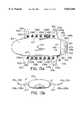
- FIG. 1is a perspective view of the aircraft showing the overall external configuration, having the propellers in the horizontal thrust position;
- FIG. 2is a side elevation view of an aircraft according to FIG. 1, having its propellers in the vertical thrust position and showing the cabin and cockpit arrangement;
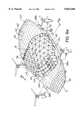
- FIG. 3is a perspective view into the lower fuselage with the top portion of the lifting body hull surface removed;
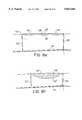
- FIG. 4ashows the geometric principles in the constructions of the hull as seen in cross section
- FIG. 4bis a schematic perspective view showing the geometric principles in the construction of the hull components
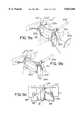
- FIG. 5ais a front elevational view illustrating the ground lift effect principles
- FIG. 5bis a plan view illustrating the vortex patterns created by the quad position thrusters beneath the lifting body hull
- FIG. 6ais a perspective view of the fuselage showing the construction elements
- FIG. 6bis a cross section along line 6b--6b of FIG. 6a;
- FIG. 6cis a perspective view of a clustered assembly of the box plate hull surface
- FIG. 6dis a perspective view of a typical stand alone bay and shows the keel, the shell space frame and the transverse ribs;
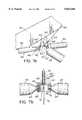
- FIG. 7ais a perspective, sectional view through a frame node connector with a cable guide/clamping device and a plurality of space frame members;
- FIG. 7bis a cross-sectional view through a frame node connector with a cable guide/clamping device and plurality of space frame members;
- FIG. 8ais a perspective view of a shell frame nodal connection showing a rib section interfacing to the outer cover;
- FIG. 8bis cross section view of a shell frame nodal connection with a rib section interfacing to the outer cover and outer cover panel connector element;
- FIG. 8cis a side view showing a rib section interfacing between the space shell frame and the outer cover panels
- FIG. 8dis sectional view of an outer cover panel connector
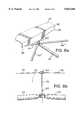
- FIG. 8eshows a cross section of an alternate hull surface panel
- FIG. 8fshows cross section of an alternate hull surface panel with an integrated air duct
- FIG. 9ais a perspective view of a propeller and a wing section according to the aircraft of FIG. 1, showing pivotal ranges useful in the present invention
- FIG. 9bis a perspective view showing the independent wing section vertical tilt capability and differential vertical tilt range
- FIG. 9cis a side elevational view showing an alternate propeller arrangement having a stabilizer attached to the engine nacelle;
- FIG. 10is a block diagram showing the main elements of the flight control system
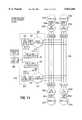
- FIG. 11is a block diagram showing the system circuit for Turbo Electric Drive System (TEDS);
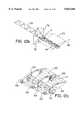
- FIG. 12ais a cross section through a hull station with an integrated carry through beam
- FIG. 12bis a perspective view of the internal frame at the interface of a carry through beam and an outrigger
- FIG. 12cis a perspective view of an external outrigger and a pivotal wing section
- FIG. 13ais a plan view of an alternate AHA ship
- FIG. 13bis a schematic front elevational view showing the thruster arrangement in an alternate AHA ship
- FIG. 13cis a schematic side elevational view showing the thruster arrangement in an alternate AHA ship.
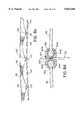
- FIG. 13dis a cross sectional view through a fan unit useful in the alternate AHA ship of FIG. 13a.
- FIGS. 1, 2 and 9aa preferred embodiment of the Hybrid Aircraft (HA), also called the “aircraft”, according to the present invention is shown.
- the aircraftis comprised of a lifting body hull 1 and four of thrust generating prop-rotors 23a, 23b, 23c, 23d mounted fore and aft about the center line on both sides along the hull at the end of outrigger 74 (FIG. 12a and 12b).
- Four wing sections 20a, 20b, 20c, 20dconfigured in a tandem fashion, best seen in FIG. 1, are mounted to rotate pivotally about the outriggers at their neutral aerodynamic pressure axis 65 (FIG. 9a).
- the four thrust generating prop-rotors 23a, 23b, 23c, 23dare driven by engines housed by nacelles 21a, 21b, 21c, 21d and are installed to provide, in horizontal position (shown in phantom in FIG. 9a), thrust to propel the aircraft forward, and, in the vertical position, static vertical thrust lift and control thrust simultaneously in VTOL, hover and R-VTOL.
- the axis of rotation 24a of the prop-rotorscan be rotated individually and are independently pivotal about axis 22a passing through engine nacelle 21a through typically a range of from -10° to 90°, relative to vertical.
- axis 65 of wings 20is common with axis 22 prop-rotor assemblies 21, 23.
- each prop-rotor assembly 21a, 23aconsists of the prop-rotor and an engine, a gear box, a lubrication system, an interface to cross shafting housed with the nacelle.
- Cross shafting 1g, 1g(FIG. 3) is installed in internal of the hull in carry through beams.
- FIGS. 1, 2, 3, 6a and 6bthe layout of the main subsystem components and the main load carrying and distributing structural elements of the overall "HA" airframe are shown.
- a large keel 25is integrated in the lower portion of the lifting body hull 1.
- two carry through beams 26, 26'run perpendicular to the keel 25, fore and aft through the hull 1.
- These beams 26, 26'are connected to the keel 25 and the space frame shell structure 41. Additional beam truss structures 75, 75' (FIG.
- the landing gearis a conventional tricycle land gear arrangement 8a, 8b, 8c.
- a hard point, for external cargo lift operations,is provided and includes a hook 10 external to the lower mid section of hull and a truss reinforcement 10' within the hull. Structurally it is integrated into the keel 25.
- Transverse ribs 50, 50'are also formed in the lower hull. These ribs 50, 50', having truss construction, are integrated to the shell 41 and the keel 25 and follow the lower hull curvature. Keel 25, beams 75, 75' and transverse ribs 50, 50' together provide the strongest portion of the airframe.
- the lower hullis defined by a shell 30 formed by box plate elements 54 which are connected in such a way as to contribute additional stiffness to the hull.
- This lower hull shell 30 of the aircraftfunctionally requires the highest mechanical surface stiffness. Significant aerodynamic and mechanical surface forces are acting on the lower shelf 30 due to impact loads occurring in ground handling, by ground effect, for example, impact of gravel at VTOL, and when landing on water.
- the aircraftalso includes a close out structure 48, 48' which separates the upper half of the hull interior from the lower half of the hull interior, a lower cabin 13 formed within keel 25, upper cabins 14 formed by decking 16 and floor beams supported over ribs 50, 50'.
- the double deck conceptoffers significant advantages over conventional aircraft holds since the light volume loads, for example passengers or parcels, can be carried in the upper cabins 14, while lower cabin space 13, is configured to be practically suited for denser cargo and can tolerate heavy point loads. Assuming a typical hull width of 6-7 m of the lower deck cabin for a 30 ton commercial payload "HA", substantial additional cabin surfaces, for example up to 110% of the size of lower cabin can be realized by adding decking 16 to form upper cabin 14.
- Upper cabincan accommodate low density cargo of 7-10 lb. per cu.feet or additional passengers. This is of particular operational advantage when the aircraft is operated in R-VTOL or S-STOL mode, since it can lift 100% to 120% more payload compared to its operations in VTOL.
- staircases 12a, 12bare provided for access between lower cabin 13 and upper cabin 14.
- a rear access door ais provided.
- Loading and unloading of freightcan be performed through a large front ramp 3 which opens into lower cabin 13. This can be done without special loading or unloading equipment and can shorten reduce the time for loading and unloading.
- large windows 6can be conveniently installed in the upper cabin 14, feasible due to much lower pressure differential between cabin and ambient air space than in conventional aircraft.
- This design feature of the main top passenger cabin 14 having large windows 6, for example having dimensions of 4 ⁇ 6 ft,can allow for a particularly attractive viewing experience from the aircraft, which typically may travel at altitudes between 8,000 and 12,000 feet.
- Viewing ports 7can be integrated into the front ramp 3 to allow for viewing from the lower cabin 13.
- the shell 41extends from about 18% to about 85% of the hull length. It is formed by series of transverse rings 43 and torsion elements 44 connecting these rings and resembles a geodesic type structure in appearance.
- the shell structure 41due to its basic inherent triangulation, provides a very stiff, rigid internal body shell which is optimized to absorb torsion forces about 100 times better than a classical Zeppelin-type ring and longitudinal beam construction.
- this shell structure part 41 of the hull 1can be broken down into segments 43' (FIG. 6d) containing 3-4 rings 43 with corresponding torsion members 44 forming together a hull segment of typically 5-7.5 m in length. An assembly of 5-10 segments, depending on hull size, typically forms the whole shell.
- cover panels 42are mounted in a semi flexible manner as to provide a pressure tight and aerodynamic cladding of the hull 1.
- the space shell frame structure 41is provided with stiffened rings (not shown) at its ends which allow the attachment of the tapering front hull cap 57 and tapering rear hull cap 57'.
- Caps 57, 57'are self-supporting and are produced from the same box plate elements 54 as lower hull shell 30. Referring to FIG. 6c, these elements 54 are formed of sandwich composites including Kevlar, graphite, honeycomb and Kevlar combinations. These elements facilitate modular construction of the end caps 57, 57'.
- a static lifting gasfor example, helium or hot air, if desired.
- the inclusion of such lifting gasis particularly useful if the aircraft is to be used for VTOL.
- large equipmentsuch as for example, wide aperture radar equipment useful in sensor platform missions, can conveniently be installed in this space, if desired.
- the hull, including the shells 30, 41, covering 42 and caps 57, 57are preferably maintained in tension. Even while on the ground some residual amount of internal pressure, for example 1-1.5" WC is required, to keep the airframe and the hull in this preferred tensioned state.
- closeout structure 48, 48'is required to be pressure tight to separate the cabins 13, 14 and doors 3, 5 from the upper interior of the hull.
- the material of the closeout structure 48is a flexible membrane structure, or sandwich composite, which is thin having a thickness of for example, 1 to 3 mm and formed of a fewer layers than conventional fuselage sandwich composites.
- the close out structureis supported away from the cabin 13, 14 by keel 25 and a tent like frame work of beams 27 and suspension cables 49.
- the hull shape 1is based on a simple and locally symmetric geometry and is generally elliptical in cross section and tapered toward the bow 1' and stem 1".
- the overall hull 1 sizei.e. As equivalent wing surface, is determined by the required R-VTOL or S-STOL lift capability of the aircraft and the desire to take off at low speeds of typically 90-135 km/h.
- the hull geometryfurther provides for good aerodynamic cruise drag performance in terms of a satisfactory lift-to-drag-ratio, for example 8-12 designed to balance, with the propulsive power required in VTOL, at a medium high cruise speed of typically 300-370 km/h.
- the hull geometryfacilitates the formation of large "air cushion” with symmetric ground effect patterns which impinge beneath the aircrafts center of gravity and the aerodynamic center of the hull.
- the hull 1 shapeis rounded to make use of internal pressurization to stiffen the lifting body hull and provides a shape suitable for landing on water surfaces with a minimum draft of typically, 25 mm.
- the shapesupports low production cost
- the semi axis symmetric cross sectionsupports the use of repetitive plate elements in the production of the airframe needing only a small number of different molds, typically 40-60 units.
- the x-axisis the horizontal axis across the width of the craft; the y-axis being the vertical axis; and the z-axis is the axis along the length of the craft.
- the hull cross section contourconsists of 2 smaller arc segments 30, 30' and 2 larger arc segments 31, 31' with tangential end conditions. Angles ⁇ and ⁇ quantify the rotational distance of the ends of arcs 30, 30' from the x-axis.
- x 1can assume values of between 2 and 3.5; R 0max is the selected maximum diameter of the original body of revolution; and r n (x) is the discrete radius of each smaller arc (30, 30' in each hull section, n, along the z-axis.
- the hull cross sectionis generally a body of revolution cut in half, with an original maximum radius r 0max 30 with a constant mid section 32 inserted in between the centers of the two arcs 30 and 30'.
- the selection of the base radius r 0maxdetermines the basic maximum height of the hull.
- the determined r 0max multiplied by a factor xdetermines the width of the constant mid section 32, and thus the aspect ratio of the fuselage.
- the discrete value xdepends mainly on the amount of dynamic lift to be supported by a given hull at the desired take off speed.
- the constant mid section 32has to assume values between 2* r 0max and 3.5* r 0max varying the aspect ratio between about 0.75 and 2.5.
- Another variable of use in varying the hull cross section geometryis the selection of the angles ⁇ and ⁇ , of the arcs about the x-axis.
- different arc angle values ⁇ and ⁇can be used.
- This geometryallows the hull 1 to have more camber on its top arc 31, will create more dynamic lift.
- high camber airfoilsincrease the lift coefficient significantly for the same wing reference surface area.
- the increased camber of the upper hull relative to the lower hullfacilitates the production of a substantially fail safe fuselage by making the underlying shell frame members more arched, and thus less prone to what is known as "snap-through" failure. This is particularly significant in modes under bending stress induced by maximal vertical gust loads and where the pressurization system of the hull has failed.
- the lower angle ⁇ at 75°-85°lets the lower portion of the hull to have a less pronounced curvature 31' than the upper arc 31.
- the resulting, substantially flat hull bottom surfacefacilitates ground lift effect by trapping air to create a pressure build up beneath the lifting body 1.
- the potentially weaker structure of the flatter lower hull 31'is offset by the presence of the massive stiffening keel 25 and ribs 50, 50' installed along the middle lower portion of the hull 1.
- the succession of variations in cross section with typical hull segment thicknesses of 1.5-3 mform in their overall assembly typically a fully or a halt symmetrical air foil shape.
- This airfoil of short aspect ratiocan have chord-length to chord-thickness ratios of between 1:3.5 to 1:5, i.e. 20-28% chord thickness in side view.
- Such an aircraft having a body of medium slendernessis more efficient to resist structural deformation due to bending moments acting on the hull in cruise flight.
- each arc length 30, 30', 31, 31'can be subdivided into a selected number, n, of arc segments, typically to yield optimized arc length of 1-1.5 m, and the length of the hull can be divided into segments of typically 2.5 m.
- nthe length of the hull can be covered with panels requiring only 2 or 3 variations of curvatures.
- This segmentationcan also apply to the hull ring 43 and torsion members 44.
- Significant reduction in component production and assembly costsresult.
- the hull design 1can be made essentially symmetric fore and aft, as shown in phantom and indicated as 39 in FIG. 5b, thus reducing the number of airframe components which are different in shape by 50%.
- FIGS. 5a and 5bin VTOL or hover mode, with an aircraft, as shown, having a symmetric hull and four prop-rotors, termed a "quad-rotor" arrangement, or in an alternative embodiment having more than four thrust generators, 50% of the air moved downward in all thrust dawn wash columns 35a, 35b, 35c, 35d, after hitting the ground, is being deflected inward beneath the hull, as shown by the arrows in FIG. 5a. All these combined counter-rotating vortex disks of air impinge, as indicated at 36, beneath the hull and intersect below the center of gravity 38, which is substantially the same as the aerodynamic center.
- the preferred hull shape embodiment thereforshould be a symmetrical contour 39, or close to being a symmetrical body, as shown by hull 1.
- the rotorsare placed outside of the outer perimeter of the hull in plan view.
- the horizontal propeller plane of rotationis substantially at the same vertical position as the height of the outer hull curvature at the corresponding locations along the length of the hull.
- the resulting airflowis almost tangential to the propeller plane and thus minimizes down draft effects, where the air feeding into the propellers is drawn over the hull surface.
- the clearance, indicated as C in FIG. 5b, between the outer limits of the propeller rotation and the outer perimeter of the hull, in plan view,should preferably be at least 15-20% of the prop diameter.
- the lifting body airframe 1provides the basic structural frame work, to which externally, the propulsion system is attached.
- the large diameter prop-rotors 23a, 23dare mounted at the end points of cantilevered outriggers 74a, 74d.
- Tiltable wing sections 20a, 20dare mounted between the hull and the prop-rotors 23a, 23d. The chord center line 40 of these wing sections can be pivoted independently from the tilting of the prop-rotors.
- the wing sectionsare mounted to rotate and be positioned within the range of from -10° to 130°, relative to a horizontal axis with the usual positioning in cruise being 1°-5°, 40°-75° in R-VTOL and up to 130° in certain hover flight control conditions.
- the rotor axis 24is typically tilted in a range of from 0° to 110°, relative to horizontal, with the prop axis being generally 0° in cruise flight, 90° in hover and various other positions for control and take off modes.
- a differential angle of up to 23° between rotor axis positioning and wing positionare usefully practical.
- FIG. 9ashowing a vertically oriented wing section 20a', and a horizontally oriented wing section 20a, shown in phantom.
- the present inventionallows the reduction of pylon lift loss in VTOL and S-STOL. With wing section 20a' in this vertical position, blockage of the propeller slipstream is substantially avoided and down wash drag over the outrigger 74 of the wing is reduced to about 1.5% VTOL lift loss compared the values of 8% VTOL lift loss commonly resulting where a fixed, non-tiltable wing is used as a support pylon for a tiltable prop.
- the wing section angle of rotationcan be kept positive above prop angle of rotation at all times at S-STOL and in transition to cruise. In contrast to conventional fixed wing-tilt rotor aircraft, this arrangement not only prevents thrust lift losses but increases the dynamic lift generated, or, inversely, can be used to decrease lift at S-STOL landing. Additionally, the wing sections 20a, 20b, 20c, 20d in presence of the a propeller thrust slipstream becomes a blown wing section 20 providing lift and control at very low speeds, for example below 80 km/h. This is particularly beneficial in maintaining attitude control in the final moments of the landing process.
- the independent tilting of the four wing sections 20a, 20b, 20c, 20dallows the distribution of required dynamic lift between the four wings to sustain cruise flight.
- the dynamic lift required for any given point of the flight envelope to keep the aircraft airborneis being supplied by the sum of the lift forces produced by the lifting body and the four wing sections.
- the lifting body 1has a significantly smaller aspect ratio than the wing sections 20a, 20b, 20c, 20d, it therefore produces more induced drag for a certain amount of dynamic lift produced. It is, thus, advantageous to unload the lifting body at cruise speed and allow the 4 wing sections make up the portion of the dynamic lift shifted away from the hull.
- the four wing sections 20a, 20b, 20c, 20dwill produce the same amount of dynamic lift with significantly less overall drag penalty then the lifting body 1 carrying 100% of the dynamic load by itself.
- the hull of the present inventionconsists of a rigid self-supporting space frame shell 41 around which semi-flexibly attached a semi-rigid covering formed of panels 42, which is able to substantially maintain its overall surface geometry when under no internal pressure.
- a gap 53is formed between the shell 41 and the panels 42.
- the shell 41 and the panels 42act together with internal pressurization to form a lightweight, rigid pressure vessel providing significant increase (about 50-55%), over unpressurized vessels with the same mechanical structure, in resistance to bending moment and streamlining of the frame 41 to achieve a suitable aerodynamic hull surface shape.
- This mechanical approachhas been termed a "Pressure Tensioned Shell Frame" (PTSF) fuselage by the inventor.
- PTSFPressure Tensioned Shell Frame
- the shell 41is a series of rings 43 in positioned orthogonally to the z-axis.
- Each ring 43is formed, in the preferred embodiment as shown in FIG. 12a, of a plurality of tubes in the form of a polygon with 12 to 18 corner vertices 78 (18 vertice polygon rings are shown). Every second ring is rotated by 30° or correspondingly 20°, thus creating a frame cross section (in front view) having 24-36 rows of vertices 78.
- the ring 43 vertices 78are regularly spaced about the top and lateral portions of the cross section of the inner contour of the hull, while the lower sections of the rings 43' are modified to include a greater number of members to accommodate connection of structural ribs.
- Each vertex 78is aligned for each second ring along the z-axis of the hull curvature.
- the rings 43 and the interconnecting torsion beams 44form a web of interlocking triangles connected by elevated nodal points 45, at the vertices, providing some amount of depth space to the shell structure.
- each node 45has substantially the shape of a ring and has 6 bore holes which allow the insertion of bolts 45' which are fitted from the inside of the ring node 45 and are engaged in tapped counter holes formed in the end cones 43', 44' of members 43, 44.
- Each node 45being a pin-type joint, acts to connect six tube members of the shell frame 41. Perpendicular to the plane of intersection of the ring tube members 43 with the node 45, preferably a latch mechanism 63 is inserted into a slot 62 formed across the top side of the node 45.
- the latch 63is maintained in the slot by a pin bolt 46 and is part of a clamping device 60 which allows local clamping of a cable 58 and the tip or "toothed" portion of the rib 52 which is semi-rigid and which bridges the gap 53 between the inwardly located rigid space frame shell 41 and the semi-rigid outer covering of panels 42.
- the panels 42take the shape of gores running from bow cap 57 to stem cap 57'.
- the cable guide/clamping device 60is typically 0.65 m in length and 0.15 m in height and is formed of a clamp 60' which secures a pair of planar members 60". Planar members 60" are bonded to rib 52 and are engaged by clamp 60' during assembly.
- the outer cover panels 42are formed as a sandwich composite of lightweight layers.
- the preferred sandwichprovides the best strength to weight ratio with currently available materials and consists of, from outwardly facing surface to inwardly facing surface: a very thin layer, for example 0.005 mm, of an abrasion resistant film (e.g. Tedlar R; a layer of a tri-axial woven fabric using poly-aramide fiber (a.g. Kevlar R; a honeycomb core sheet of about 10 to 15 mm thickness; another layer of the tri-axial woven fabric using poly-aramide fiber; and a final inner layer of an effective gas barrier film, such as metallized Mylar R, which is commercially available.
- the layers of the sandwichare bonded with an adhesive.
- the honeycomb sheetcontributes enough "in-plane" stiffness to the sandwich to resist wobble and flutter stresses which are introduced into the outer surface during cruise at speeds of about 360 km/h.
- Such a panel constructionhas a weight of typically about 0.45-0.65 kg/m 2 .
- the panelhas an equivalent tear resistance of a 1.5 mm thick aluminum sheet with a fraction of the aluminum sheet's weight.
- the panelhas several times the unit tension strengths of modem Blimp flexible structures.
- outer hull cover panelsare formed of two sheets of flexible material with a sheet of low density honeycomb disposed therebetween.
- two thin sheets of flexible material 42, 42'are used to form an inner and an outer covering layer.
- Closed cell foam 28, having a low density of between about 15-30 kg/m 3is placed between sheets 42, 42'.
- the space between the flexible sheetsis inflated prior to injection of the foam and the sheets thereby act as a mold until the injected foam cures.
- Such an arrangementprovides enough structural stiffness to maintain the cross sectional shape of the hull.
- the coveringis formed by two spaced sheets 42, 42' of flexible, high-tensile material and the space 28' between the sheets is pressurized separately from the overall hull volume by independent means of pressurization. In this way, the higher internal pressure in the space acts to stiffen the outer cover locally without effecting the whole hull volume.
- the sandwich compositeas described above, is the preferred material for use in the formation of panels 42.
- the sandwich materialTo assemble the covering on the hull, the sandwich material it is cut into repetitive panels 42' which follow the geometry defined by the sequence of vertices 78 along the perimeter of the shell 41. Referring to FIG. 8b, a interface seam of two adjacent panels 42 and a perpendicularly extending "toothed" rib 52 is shown.
- the "toothed" ribshave typically a height to span ratio of about 0.20:1 to 0.25:1 and can be produced from the same material as the panels 42 or other light weight sandwich materials.
- the construction method useful for interconnecting a rib 52 with the panels 42makes use of integrated joining edge technology which has perfected the fabrication techniques of heat and ultrasonic welding and facilitates the joining of these separate parts.
- a connector 64which is integrated to rib 52 and engages enlarged edges 42a of panels 42. Edges 42a of panels are enlarged by means of integrated edge technology.
- connector 64is formed as an upper section 64a and a lower section 64b which are joined by a fastener 2, such as a screw. Lower section 64b is securely integrated to rib 52.
- Corresponding grooves 64a' and 64b'are formed in sections 64a, 64b, so that when joined, a channel is formed between sections 64a and 64b which is shaped to receive and firmly hold panel edge 42a.
- edges 42a of panels 42are placed in grooves 64b' and section 64a is placed over this arrangement so that edges 42a also fit within grooves 64a'.
- Fastener 2is then inserted to firmly join the sections 64a and 64b.
- connector 64is formed in extended lengths by extrusion of poly-aramids, such as Kevlar R.
- the tip portion of a "tooth"is bonded into clamping device 60.
- the latch 63 formed on device 60fits the geometry and location of each of the node connector points 45 and slot 62.
- Cable 58formed of Kevlar R, is incorporated along the edge of the rib 52. This cable 58 acts as the main tension member to transmit the outer hull surface tension forces, generated in part by the internal hull pressurization, into the cable guide/clamping device 60 which, in turn, conducts all concentrated tensile forces through the latch 63 into the node 45.
- the latch 63after insertion into slot 62 of node 45, allows for some lateral rotational motion around pin bolt 46.
- the geometry of the latch 63is determined by the amount of stresses the internal pressurization of the hull generates per unit area of the covering. Further clamping devices 60 can be attached along the ring members between nodes 45, as desired to further distribute the load into the frame. About 36 rib connecting points are installed along the upper portion of each ring 43.
- the outer coveringis formed by a complete set of panels 42, each longitudinal panel is formed of 12-24 gores. These panels can be installed from the hull top centerline down to the intersection of the lower shell 30. After the whole hull surface is completely enclosed by the upper hull covering formed of panels 42, lower shell 30, bow hull cap 57 and stem hull cap 57', the hull can be internally pressurized. Pressurization means are well known from blimps and air supported domes, and do not require further description. With a slight pressure bulk up over ambient pressure, for example of about 3-12 inches of WC (3000 Pascal) the outer cover panels 42 will be stretched tight.
- the hull geometrieshave been developed such that, under internal pressure, the hull enclosed gases (air and/or a lifting gas) effect a uniform perpendicular surface pressure throughout the inner hull and act to force the panels 42 radially outwardly.
- the in-plane surface tension load acting on each of the panels 42is transferred into the ribs 52. This tension is consequently transferred through the cable guide/clamping device 60 to the latch 63 and into the node 45.
- the arched shape of the ribs 52 between two adjacent nodes 45allows distribution of the accumulated tension load between two rings 43.
- At least some of the space frame nodes 45have rods 51 with cable eyes 51' formed thereon installed about their pin bolts 46.
- the rods 51are free to assume the geometry driven angles to align with the keel 25.
- a tension wire 47runs to the upper right 25a and left 25b comer of the keel 25 at a location corresponding to the ring 43 position on which the node 45 is located.
- These arrays of cables 47act to offset the hoop stresses created by the internal pressure and retained by the surface tension and also act to distribute some of the force created by a concentrated payload housed in lower cabin 13 and upper cabin 14 through the keel structure 25 and into the shell 41. Additionally, the tension wires 47 act to render the shell frame structure 41 stable without internal pressure present.
- the local buckling strength of the space frame members 43, 44which have typically 8-12 cm beam diameter and 0.5-2 mm wall thickness when aircraft aluminum alloys are used, is defined such that the full structural and shape integrity of the lifting body hull can be maintained at a lower cruise speeds of 110-125 knots with a 60 feet/sec vertical gust moment. This will allow the aircraft to return to base even in adverse weather conditions.
- the hull internal carry-through beams 26are preferably of conventional modular truss construction or a large diameter tube.
- Beam 26is closely integrated to the keel 25 and frame 41 by a series of tension cables 73 connect the beams 26, 26' to the shell 41 while rigid tube elements 72 connect the keel 25 to beams 26, 26' to provide a well supported beam 26.
- the ends 71 of beam 26directly interface with shell structure 41 and create a very stiff local web of beams suitable to act as a "hard-point" 76 at which the outriggers 74b, 74c are supported.
- Some of the beam members in web 76allow tangential distribution of moments into the space shell hull structure members 43, 44 which are particularly suited to absorb forces acting "in plane".
- the hard point 76provides enough stiffness against bending moment in its vertical, as well as, its horizontal planes to withstand the rotor thrust forces which will act in both direction at this point.
- the external outriggers 74can be a square truss, as shown, or a tube. Outrigger 74 is limited in maximum height and width to the inner maximum chord height geometry of the wing sections 20 airfoil type. A typical outrigger 74 has a diameter of 0.8 m to 1.8 m. The specific diameter is selected with reference to size of wing section 20, thrust required and propeller sizes.
- each wing section 20can be rotated differentially from the propeller axis, but is often tilted at about the same angle as the propeller axis itself, the thrust forces acting on the tip of this outrigger 74, and its resulting bending moments, are very much in line with the position of the wing section. They can deviate in VTOL hover and S-STOL flight mode usually to a maximum angle of about 18°-22°. Thus, the force vector introduced into the outrigger, is the same as the thrust vector which is the largest load acting on this structure.
- the wing sectionis preferably made an integral part of this arrangement. The wing section, when approximately aligned with the thrust axis, provides a much higher moment of inertia in the plane of its chord length, than the outrigger beam itself.
- the wing section 20is designed as a stiff wing box with stiffened ribs 86, panels 77 extending between ribs 77 and composite sandwich surface covering 68.
- the wing sectionhas a high cross sectional moment of inertia along its length. Both the moment of inertia for the outrigger 74 and the moment of inertia for the wing section 20 are summed for that position in whatever angle the wing section is rotated to at a given moment. This significantly increases stiffness results for a given structural weight.
- the combination of wing 20 and outrigger 74 these componentsadd to each other their individual maximum bending moment strength capability, when compared to acting alone to support a corresponding load.
- the wing ribs 66 installed bearingsare surface type bearings 69 optimized to sustain torsion loading. Bearings 69 can be produced from composites, to reduce weight, or can be made from classical roller bearing materials, such as steel.
- the aircraft of the present inventionis configured to deliver precision hover and good station keeping ability in 80% of all prevailing wind speeds.
- Control system hardware and software meansare provided to supply a propulsion and force vector controlling in combination, which can deliver thrust vector changes rapidly to achieve attitude control. Smaller vector changes can be delivered in a fraction of a second, while larger vector changes can be delivered within about 0.5-1.5 seconds.
- tiltable prop-rotorsare usually limited to tilt rates of typically 0.7°-1.5° per second, to avoid excessive stresses induced through the inertia of gyroscopic forces.
- tilting of props 24 alonecannot provide the yaw moments required, to maintain the hull in the pre-turbulence position in such conditions. This is particularly, when it is desired to match closely a target over the ground during hover.
- an onboard computer-based sensing systemmeasures the rate of acceleration and determines the forces required to arrest, or, to slow down this adverse rotation.
- This immediate activation of yaw momentwill either prevent the start of a rotation in the y-axis in perturbations up to about 20 knots, and/or significantly slow down the rotational speed in this axis, until the slower pivoting propellers have reached a pivot angle of 2°-3° from vertical in about 1.5-2 seconds, again tilting differentially forward and backward on each side of the hull, after the onset of the perturbing wave front, gust or wind shift has collided with the aircraft.
- Table 1shows the systematic symmetric "hair” and “differential” combinations and variations of magnitudes of propeller thrust vectors, rotor axis vectors and the wing section negative and positive dynamic fit vectors for the two main flight modes to be controlled: Hover and Cruise flight.
- Table 1shows the systematic symmetric "hair” and “differential” combinations and variations of magnitudes of propeller thrust vectors, rotor axis vectors and the wing section negative and positive dynamic fit vectors for the two main flight modes to be controlled: Hover and Cruise flight.
- Table 1shows the systematic symmetric "hair” and “differential” combinations and variations of magnitudes of propeller thrust vectors, rotor axis vectors and the wing section negative and positive dynamic fit vectors for the two main flight modes to be controlled: Hover and Cruise flight.
- Table 1presents the elements involved in flight attitude control in a table form.
- the attitude control, pitch, roll moment generation in z, and x axisis accomplished through differential collective thrust changes of rotors side-to-side and fore-to-aft.
- Main yaw moment for rotation around the "y-axis"is generated through tilt of the right side props backward to maximum or 10° (from vertical) and the tilt of left side propellers by the same degree forward.
- Yaw moment in hover controlinvolves additionally the wing sections as described in detail above.
- Forward translational slow speed modeis achieved through collective tilt, of all four props forward, typically 2°-5°.
- Translational motion backwardslikewise, is achieved through collective tilt of all four props or all four wing section backwards. In case of backwards motion the propeller tilt is preferably limited to a maximum angle of 10° backward.
- Translational movement sidewaysis achieved by introducing first a roll moment with differential thrust between right and left rotors and then keeping collectively thrust in the same proportion.
- Other solutionswould be added cyclic in lateral for one axis only or installation of other means, such as fan thrusters (not shown) in the bow and stem caps perpendicular to the center line of the hull, in this way providing translational sideways movement without roll.
- vertical stabilizers 88, 88'(FIG. 9c) are mounted onto the engine nacelles 21.
- the four propellersare tilted to a position of about 70°-75° from horizontal to maintain an advantageous ground air cushion effect and to optimize lift and forward acceleration vectors.
- the four wing sectionsare tilted collectively to about a 15° higher tilt angle than their corresponding propeller axis. This provides very effective acting "blown" control surfaces, over which the air stream of the propeller is accelerated and thus the wing sections can provide pitch and roll control moment in the S-STOL situation, even at very low flight speeds between 80 and 110 km/h (45-60 kts), when aerodynamics control surfaces typically are lacking effectiveness, due to missing air pressures almost not acting on them in very low speeds.
- Directional control, (yaw-control)is provided by differential thrust between right and left propellers.
- vertical stabilizers 88, 88'(FIG. 9c) having rudders 89, 89' can be used to provide a blown rudder arrangement.
- This embodimentwould provide directional (yaw) control as known in conventional aircraft designs.
- This stabilizer-rudder configurationis considered feasible, but not the preferred embodiment for structural reasons and reasons of applying a preferred advanced computer controlled stability enhancement design approach.
- the thrust vectorcan be rotated by slowly tilting the four propellers collectively forward.
- the x-axis forward component of this vectoraccelerates the aircraft forward. This results in increasing forward speed and in the generation of dynamic lift by the lifting body hull and the four wing sections. This starts to reduce the magnitude of thrust lift required and permits further downward tilt towards horizontal of the propeller axis.
- the effectiveness of axis bound generation of control vectorchanges. These are, however, governed by basic laws of geometry. Full transition is reached typically at speeds ⁇ 165 km/h (90 kts).
- differential tilt of one pair of wing sectionsfor example, the left and right wing sections closest to the bow, fore and the other pair aft.
- Roll control and coordinated turnscan be effected by differential tilt of the wing sections on each side of the hull and by differential thrust of right and left side propellers.
- Trim in cruise flightis achieved by differential fuel tank filling of fuel tanks fore and aft of the center of gravity. (Not shown).
- Directional stabilityis provided through differential thrust variations of right and left propellers pairs and, in an alternate embodiment, can be assisted by deflection of stabilizer 88 mounted rudder tabs 89.
- FIG. 10shows a block diagram of the main flight control system components of the hardware layout described above.
- the basic control conceptincludes the control elements, as follows:
- control actuator control signal sizethe 5 input variables of the pilot(s) have to converted into control actuator control signal size, to be specified for each of the 12 or 16 means of control available.
- actuators activated by electrical motorsare sufficient. This will allow the omission of a hydraulics, a major contributor to maintenance burden in any aircraft
- the cockpit 17is installed in the front portion of the bow hull cap 57 of the hull 1.
- the cockpit layout and pilot interfacesmay be any suitable arrangement such as that arrangement recently developed by Boeing-Bell Helicopter in the realization of the V-22 Osprey.
- the 12 or 16 elements listed aboveare controlled by electric actuators and configured with dual redundancy.
- the interaction of all elements controlledis coordinated by a computer 80.
- the system approachis typically based on state-of-art Fly-by-wire or Fly-by-Light control concepts.
- the computer 80 to which all components of the Fly-By-Wire system are linked,is housed in the cockpit.
- the central core of the systemis a three-axis laser gyro 83 for measuring the rotation angles in the x, y, z axis, which is linked to the computer 80 which monitors continuously the attitude changes of the aircraft.
- Auto-pilot functionsare installed with typical automatic pilot capability for engagement by the pilot, if desired.
- the auto-pilot functionsare preprogrammed to automatically handle certain recurring flight modes which arise as part of the various operational routine requirements.
- the control systemis essentially based on "Rate Change Control" (RCC) principles, whereby the laser gyro 83 supplies the data regarding the rate of changes of relative movement in the x, y, z spatial coordinate system.
- the pilotvia a control stick and the other interface means, can set the desired values for rates of change in regards to various control parameters of the aircraft to be modified and/or maintained at any given time.
- the "control laws" computer program subroutines 85deal with the preprogrammed equations describing the motion of the aircraft and provide data to the mixer 86, which will provide discrete signals 87a, 87b, 87c, 87d to a combination of actuators to achieve the flight control desired.
- Onboard optical sensor 82is preferably included in the flight control system to provide data to the computer concerning the translational movement of the aircraft in close ground proximity.
- Sensors 84are conventional and provide data to the computer 80 concerning the prevailing atmospheric conditions.
- Modem "steady state” laser-based gyro technologyalso monitors the continuous moving reference point, for example the actual location of the aircraft at any given point in time or the latest progression of position of the aircraft in its flight path.
- an onboard Global positioning system 81can provide information on the real time position of the aircraft.
- This sophisticated control technologyis recently available at moderate commercial systems costs, and is currently available in "steady-state” hardware versions, having high reliability and requiring little maintenance, compared to earlier models using a combination of rotating mechanical and electrical parts.
- FIG. 10is shows a superior flight control system without application of mechanical means of linkage.
- the above mentioned Fly-by-lightis the same system approach as the fly-by-wire system.
- the fly-by-lightuses optical fibers to transmit the data from the central control processors to the local processors and actuators. This is an advantage for an aircraft of significant physical size and which, from time to time, may fly close to strong magnetic fields, for example in the inspection of high voltage power lines.
- the control systemis fully digital and has a layout of triple, or quadruple redundancy. Such a system could have also have an advanced "teaming mode", which would enable the computer system to "learn” and “save” certain responses to gust, ground effect, turbulence, etc.
- load cellsare in installed in the landing gears. These load cells provide automatic updates of the center of gravity shifts due to the rapid changing loading and unloading situations of the aircraft. These data will assure safe and flexible changing of payloads with a minimum of supervision by the crew or a "load master".
- the first drive systemincludes conventional main drive train components. They include a conventional gas shaft turbine and auxiliaries, a gear box, a clutch and components for required "simplex" cross shafting for each pair of propellers front and aft.
- the shafting 19, 19'(FIG. 3) allows transmission of about 50% of the propulsive power from any of the two paired fore and aft engines, over to the opposite located propeller in case of engine failure at that unit.
- the shaft 19, 19'can be supported by the carry through structures 26, 26'. These installations are quite conventional and require no further description.
- the second preferred drive systemis termed a Turbo Electric Drive System (TEDS).
- TESSTurbo Electric Drive System
- Permanent magnet brushless motors and high speed power generator technology combined with semi conductors (thyristors), used for manipulation of high voltages and currentshas evolved significantly in capability and seen drastic reduction in cost.
- these drive unitsare capable of running at high rpm of between about 10,000 and 40,000.
- the weight algorithms for the turbo-electric drive outputshave reached the 0.2-0.25 kg/kW range per shaft power for electric motors and a level about 0.10-0.15 kg/kW for alternator output power in the ⁇ 1000 kW range.
- the TEDS layoutis shown in a basic block diagram in FIG. 11.
- the systemincludes conventional (aircraft certified) gas turbine 90, 90' in redundant layout, high speed, high density alternators 93 in redundant layout which are each directly coupled through gear boxes 92, 92', which optimize alternator rpm, to electric power conditioning and control units 91, 91'.
- a high voltage power transmission system 96 in redundant layouttransmits power to four brushless permanent magnet motors 99a, 99b, 99c, 99d and gear boxes 95a, 95b, 95c, 95d to drive the constant rpm variable pitch propellers 23a, 23b, 23c, 23d.
- This systempreferably has electronic fuel injection governors controlled by the central flight computer 80.
- the gas turbine engines 90, 90' and alternators 93, 93'are preferably housed in an engine room 104 suitably located in the stern of the "HA".
- the engine roomis preferably positioned within the hull to be accessible from within the hull during flight to allow for in-flight repairs and modifications.
- the shaft gas turbine 90is the prime drive for the high speed alternator 93.
- This constant speed driveconfigured as a direct shaft coupled alternator, can run at ⁇ 10,000 rpm.
- the electric power conditioning and control units 91, 91'include circuits containing a set of high performance thyristors and condition and manipulate the currents, wave forms and outputs instantaneously. It is controlled by a computer which receives, in turn, control signals from the flight guidance computer 80. The control signals have to be delivered to the various actuators to enact the power settings, etc., as a response to the pilot inputs.
- the alternators 93, 93'supply energy, modulated by units 91, 91', to the four the brushless permanent magnet motors 99a, 99b, 99c, 99d.
- the drive shafts of these motorsrotate at between about 10,000-12,000 rpm.
- the motor rpmis geared down by conventional two-stage gear boxes 95a, 95b, 95c, 95d to match the propeller tip speed of an optimized propellers size.
- High voltage power supply lines 96run from the engine mom 104 to the four motors,
- the drive motor windingscan be arranged in two separate segments and in such a manner as to have a built in 50% power redundancy, in case of failure of one of the windings.
- the propellersare of the constant speed (rpm) type.
- the electronic fuel governorinjects an amount of fuel into the turbine which corresponds to the load condition signal produced by the flight computer.
- the hull internal power plantmakes features of lifting gas heating or the air within the hull possible.
- the more practically feasible installations of heat exchange means and simpler ductingenhances the possibilities of heating the hull internal gas, thus to improve VTOL lift, if desirable.
- FIGS. 13a-13dAn alternate embodiment of the aircraft of the present invention is shown in FIGS. 13a-13d.
- This aircraftis termed the Advanced Hybrid Aircraft ("AHA"Ship).
- AHAAdvanced Hybrid Aircraft
- This embodimenthas a variation in the arrangement of propulsion and control elements from those discussed earlier herein.
- the hullcan accommodate a lifting gas to providing up to 15% of its maximum take off weight by static lift, if desired. Its overall design considerations follow the main principles presented above for the preferred "quad-rotor" embodiment.
- the lifting body hull 105has a plurality of pivotal stub wing sections 106a, 106b, 106c, 106d mounted thereon in tandem arrangement, fore and aft of the center of gravity 124.
- Wings 106a-dprovide pitch control and coordinated turns in cruise and low speed.
- vertical stabilizers 115a, 115b, 115c, 115d with integrated rudder tabs 116a, 116b, 116c, 116dare mounted to facilitate directional control in cruise flight
- the stub wing sectionsare pivotally mounted at their neutral aerodynamic pressure points and can be rotated from 0° (horizontal) to 25°.
- a plurality of fans 108a-108g and 108a'-108g "are mounted.
- 2-4 fan unitsare mounted fore and aft and left and right from the center of gravity 124.
- the fansare installed in horizontal flanges 107 and 107' which extend from the maximum perimeter of the hull 105.
- the fansare preferably those commonly used in the first fan stage of high-bypass-ratio gas turbines, for example those commercially available from General Electric Company. They are typically deployed in current large size passenger jet aircraft and providing together with the gas turbine 10,000-30,000 kg of thrust each. These fans are very light weight and quiet.
- a total of 8-14 fan units, having diameters of 1.5-4 mwould be required to produce the thrust required to lift a 15 to 30 ton aircraft.
- ducts 111are formed in the mounting flanges 107, 107' for accommodating the fans.
- the ductsare spaced so that there is a distance of about 2 m between fan locations to allow unhindered air supply to each fan.
- an individual high speed brushless permanent high density magnet motor drive unit 99can be mounted and directly shafted to the fan.
- the motor drive units 99preferably have 800-2,500 kW output capacity. Electric power to drive each of the fans 108a-108g and 108a'-108g", is supplied by a central power stations 113 in the rear of the aircraft.
- a turbo electric drive system(TEDS), as previously described in detail with reference to FIG. 11, can provide the power required.
- Thrust deflectors 109are installed in the ducts 11 below the fans. Thrust deflectors 109 can actively be controlled to deflect the thrust up to 25° to the left right sides, seen from vertical thrust axis. To allow the creation of thrust deflection creating yaw moment independently from creating translational movement fore and aft, preferably the thrust deflectors for the four fans closest to each of the bow and stem 108a, 108b, 108a', 108b', 108f, 108g, 108f', 108g' have their pivot axis parallel to the z-axis of the hull 105 and the deflectors for the remaining fans have their pivot axis parallel to the x-axis.
- the thrust deflectors for the centrally located fans 108d, 108d'are mounted beneath the fans in circular frames 117 supported by roller bearings.
- the circular frames 117 to which thrust deflectors 109 are mountedhas the appropriate mechanical means to allow quick rotation around its axis thus to facilitate rapid change of direction of thrust about at least 1800 with rotation rate of typically of 90°-120° per second.
- the upper and lower openings of the duct 111 into which each fan installed,can be closed by a set of louvers 118, 118' to provide a fairing when the VTOL thrusters are not in usage, typically in cruise flight.
- Power stations 113based on high speed alternator 119 technology, produce electric power required to run the electric fan motors 99.
- High speed brushless alternators 119are directly shafted to large scale gas turbines 120 which typically generate 5,000-10,000 kW output power.
- An electronic current output conditioneris controlled by computers and is coupled to the flight control and guidance system of the aircraft to assure the supply of properly modulated electric power to each of the brushless motors 99.
- fans 108h, 108i, 108jcan be mounted in ducts 112a, 112b, 112c so the plane of rotation of the fan is in a vertical position.
- the fansare located at about 95% chord length of the lifting body hull 105.
- These fans 108h, 108i, 108jprovide a separate forward propulsion system for the aircraft.
- the electric power required to drive these fansis also delivered from the same high speed alternator turbine combination housed in power stations 113.
- the air intake ducts 114a, 114b, 114c for these fan units 108h, 108i, 108jare integrated into the upper and lower rear hull surfaces at about 85-90% of the chord length of the hull.
- the slipstreams of the fansexit through ducts 112a, 112b, 112c mounted at center of the aircrafts trailing edge.
- the location of air intake ducts 114a, 114b, 114c for the rear fans 108h, 108i, 108jfacilitates the reduction of the boundary layer.
- the intake ductscould be configured on the hull surface as a boundary layer suction ring slot 118, assisting in efficient wake propulsion and boundary layer control, delivering all these features in a synergistic fashion.
- Directional controlis accomplished very easily and precisely with the AHA ship.
- Application of differential and collective thrust vectors created by the thrust deflectors of fans 108a-108g and 108a'-108g' acting in x and z-axisprovides yaw moments to allow slow speed translational movement to the sides and fore and aft.
- Additional directional thrust in any direction from 0°-180°can be provided by fans 108d, 108d' through rotation of its of deflector. This allows fine tuning of vectors to create an overall control vector picture which allows precision control and any desired flight direction in hover and VTOL.
- the rear mounted fanscan also be equipped with thrust deflectors and can be used to produce directional control in forward flight and hover. This is of particular use in the presence of head winds in hover or VTOL.
- the high speed fans 108a-108g and 108a'-108g'operate at very high rpm of about 6,000-10,000.
- the disc loading of these fansis increased by 50% over conventional prop-rotors, from about 80-90 kg/m2 to about 140-160 kg/m2, but fan downwash speeds and unit lift performance measured in kg lift per hp remain within economically feasible ranges.
- Thrust column densityremains in a range which avoids soil erosion problems which should be considered in any craft capable of hover.
- the criticality of the overall propulsion failure in hover triggered by any individual engine failureis decreased due to the higher number of overall propulsive elements available and power generation redundancy and the significantly smaller moment imbalance caused by the failure of one or two VTOL fan units.
- the remaining number of 12 fanswould assure that overall thrust levels required for safe operations can be produced by the remaining units, and overall thrust available stays almost at 100%. Thrust performance can be maintained, in the event of a failure of one of the turbines, by increasing output of the remaining prime power delivering turbines. In the presented layout.
- the alternate embodimentincludes cruise flight drag reduction aerodynamics by means of boundary layer control and wake propulsion.
- the geometry layoutresults in major 20-30% reduction of wake drag, particularly in an aircraft having a relatively large lifting body hull.
Landscapes
- Engineering & Computer Science (AREA)
- Aviation & Aerospace Engineering (AREA)
- Mechanical Engineering (AREA)
- Chemical & Material Sciences (AREA)
- Combustion & Propulsion (AREA)
- Structures Of Non-Positive Displacement Pumps (AREA)
- Toys (AREA)
- Tires In General (AREA)
- Aerodynamic Tests, Hydrodynamic Tests, Wind Tunnels, And Water Tanks (AREA)
Abstract
Description
The invention relates to a hybrid aircraft and, in particular, a hybrid aircraft with vertical take off and landing (VTOL) and/or running vertical take off and landing (R-VTOL) and/or super short take off and landing S-STOL capabilities. The term "Hybrid" refers to the fact that the four known lift principles, dynamic, ground effect thrust lift and static lift have been incorporated into the aircraft design.
The need to transport substantial cargo, and/or a large number of passengers over considerable distances quickly, efficiently and in a cost effective manner has led to a variety of medium to large (30-100 ton payload) aircraft designs restrictively successful in medium long range applications, where large ground infrastructures are available to support their operations.
No design is currently existent as to make available transport services with an appropriate balance so as to provide a medium (30-40 ton) payload capacity, with substantial cruise speeds of up to about 400 km/h, with wide body cabin comfort, heavy lift VTOL and Super-Short Take Off Landing (S-STOL) operational capabilities, with typically short to medium (150-1000 mile) range at good transport economics and with the ability to operate from either unprepared held sites, and/or underdeveloped and/or existing aviation ground structures while being functionally compatible with commercial aircraft traffic and operating patterns.
Novel airships designs emerged in the seventies and eighties, which can be seen as an effort to arrive at an aircraft design having the specified features. These airships, commonly termed lighter than air (LTA) aircraft, are based on predominantly buoyant lift principles. Given the use of static lifting gas, such LTA aircraft must be of enormous size and volume to obtain substantial (30-50 ton) lifting capacity. These aircraft have a number of severe deficiencies. They have poor low speed control characteristics, are very difficult to handle on the ground, and ballasting procedures make loading and unloading impractical. In addition, these aircraft cannot be accommodated in existing aviation support structures and, are unable to maintain speeds higher than 160 km/h because of the enormous drag penalty introduced by their large volumes resulting in poor transport productivity.
Efforts have been made to overcome the speed deficiency of LTA aircraft through the creation of "hybrid airships" as described in U.S. Pat. No. 4,591,112 by Piasecki et al. in which propulsive means are added to the LTA such that the static lift provided offsets the empty weight of the structures and propulsive means. This design is still unable to sustain higher speeds because it retains a large cross-section and corresponding substantial drag penalty. This hybrid airship also retains the corresponding ground handling problems due to excessive physical size. Its slow speed capabilities (110-130 km/h), are not particularly suitable for commercial use in the transport of passengers. It remains a typical special mission aircraft concept suitable for craning operation. A further critical engineering problem confronted by such design is the ability to address vibration forces introduced by the helicopter type propulsive means acting on the not well integrated largely space propulsive support and airframe structures.
Further, an effort to improve on hybrid airship resulted in the design of partially buoyant airships which derive some limited lift from their hull shape. An example of such airship is shown in U.S. Pat. No. 4,052,025 by Clark et al. This airship is truly a long range aircraft with extremely large dimensions which is unable to use existing aviation infrastructure. This airship is very complex and costly to construct with each fuselage panel having a different configuration. In addition, the helical wound base structure fuselage lacks rigidity which prevents he aircraft from attaining medium-high cruise speeds of about 400 km/h. Engineering problems are created as a result of its enormous wing span and other dimensions and, like LTA airships, this partially buoyant airship creates considerable ground handling problems. Further, this partially buoyant airship has no VTOL nor R-VROL capabilities. This type of airship can carry very large payloads over very long distances. However, when compared to other aircraft, such as the large jumbo jets, the partially buoyant airship is not competitive in terms of payload capacity and speed and overall productivity.
In yet another effort in the same category, a partial buoyant aircraft has been designed with emphasis on the application of a "jet flap" and in combination with a lifting body, as referred to in U.S. Pat. No. 4,149,688 by Miller, Jr. While the aircraft seems suitable for improved short take off and landing, its claim for VTOL capability will lack efficiency as the deltoid shape is not well suited for fitting with thrusters, particularly large scale thrusters, efficient in vertical thrust production. The rearward positioned thrusters, impede on a good VTOL performance, because their slipstream impinges on the rear top end of the hull. Further, thrusters, when in VTOL function, as in proposed positions fore and at the stern will lead to downwash ground effects severe unbalancing pitch moments of the aircraft in hover. Further, structurally, such deltoid fuselage are inefficient and costly to build.
Helicopters are convenient VTOL aircraft but are complex and costly to operate. Since a helicopter obtains all of its lift from its engines, it is unable to carry substantial payloads (≧10 ton payload) over medium (1000 miles) ranges as most useful load is consumed by fuel. It is particularly expensive to carry people and bulk break low density cargo using helicopter because of the severe restriction in available cabin space. Helicopters are nonetheless advantageous for carrying priority payloads into remote areas lacking aviation infrastructure or ground access, where their VTOL capabilities justify the expense. Attempts have been made to improve helicopter transport by increasing the size and numbers of rotors. However, these aircraft have not greatly improved the commercial viability of helicopter transport.
A further aircraft design which seeks to address some of the regional short haul (up to 500 miles) air transport problems is the tilt rotor aircraft, also known as the Bell Boeing V-22. The tilt rotor aircraft have large tiltable rotors which allow the aircraft to have both VTOL capability and horizontal thrust. This type of aircraft has fixed wings which provide for some dynamic lift. Like helicopters, the tilt rotor aircraft is costly to build and operate, it cannot carry heavy lift, large size cargo, and offers limited cabin space and comfort. It does not offer cost effective passenger transport capabilities. The primary advantage of the tilt rotor aircraft over the helicopter, is the ability to transport payloads at higher speeds. However, because of the substantially high cost of the tilt rotor aircraft, their only application has been limited to military delivery mission, where delivery speed is a consideration, and restricted to some selected reconnaissance special mission operations. As a result, to date there are believed to be no commercial applications of tilt rotor aircraft.
An aircraft has been invented which provides an appropriate balance of providing payload capacities of between 5 and 50 tons, useful cruise speeds over a range of distances, the ability to operate with both existing and underdeveloped aviation infrastructure and the ability to operate in unprepared field sites.
The aircraft is capable of VTOL or R-VROL and S-STOL, using about 30% runway length of conventional aircraft and has the ability to attain a medium cruise speed range of 300-400 km/h. The aircraft has a significantly enlarged cabin and freight hold space over conventional airplanes and helicopters, and has reasonable production, operation and maintenance costs. The aircraft of the present invention can be made to be a size comparable with conventional airplanes to allow accommodation in existing aviation maintenance and support structures.
Because of the versatility of the aircraft and its high cost effectiveness, its applications for use can vary widely. For example, the aircraft of the present invention is useful for combination transport of passengers and light priority cargo delivery or bringing heavy loads with combined R-VTOL and VTOL operational capabilities in regions lacking conventional air transport infrastructure. The aircraft is useful in slow or low flying operations, such as surveying, patrolling, or search and rescue. The aircraft is useful in highly developed industrial areas for point delivery of passengers and cargo on extreme short haul (150-300 km multiple stop shuttle type service routes.
An aircraft has been invented which has an airframe geometry-tandem wing configuration which provides for increased crash worthiness, due to substantially reduced take off and landing speeds of typically 90-150 km, a lifting body hull shape which substantially cannot stall and provides an air safety cushion beneath the hull in VTOL and R/VTOL.
In one aspect of the invention, the aircraft is comprised of a hull with a plurality of the wings shaped as airfoils about the hull. Each of the wings has a propelling means, such as for example, a propeller or rigid prop-rotor, mounted thereto. The wings are each pivotal moveable about their neutral aerodynamic pressure axis and the propelling means are also each independently pivotally mounted. The pivotal movement of the wings and propelling means is controllable and in combination provide for lift thrust forces, control thrust forces and forward thrust forces. In one embodiment, the pivotal movement of all elements is computer controlled so as to provide substantially instantaneous control forces, for example, in the presence of side gusts and the like.
The wings are pivotal about their neutral axis so that minimal force is required to make significant changes in the attitude of an individual wing. This allows substantially instantaneous application of forces vector generated as the prop slipstream acts on the wing to achieve control moments, for example, differential deflection of two wing sections, left and right, to counteract the rotational moment introduced by a side gust. Where greater forces are required to maintain the desired attitude of the aircraft, the rotors can be actuated to pivot to produce additional and substantial control forces.
In another aspect of the invention, the hull shape of the aircraft provides for the generation of a significant ground lift effect to assist in VTOL operations and significantly improving VROL lift performance. The ground lift effect is provided by a plurality of propellers spaced about the hull and disposed to create substantially vertical thrust. The propellers are positioned in spaced relation relative to the hull such that their slipstreams substantially do not impinge on the hull. With such a propeller configuration, at initial take off, 50% of the air mass being forced vertically down by the each of the propeller thrust columns is deflected by the ground surface to move inwardly beneath the hull. These air masses from each of the propellers impinge and are forced upwardly to cause a cushion of air beneath the hull acting upwardly to create a ground lift effect. Preferably, the propellers are selected to each have a direction of rotation toward the center point, in plan view, of the hull. For example, the four propellers can be counter-rotating fore and aft and left and right.
In another aspect of the present invention, the hull is to carry the main aerodynamic lift in R-VTOL and S-STOL. After reaching cruise, the hull is unloaded and up to 50% dynamic lift need will be supported by the wing sections. This improves the lift-to-drag ratio to values (8-11) comparable to wings of conventional design. The hull is shaped to provide varying degrees of camber in the upper and lower surfaces of the hull to thereby provide more of aerodynamic lift in an air stream. The aerodynamic hull lift allows the aircraft, when used in R-VTOL or S-STOL, to increase its payload capacity by 100-120% compared to design load capacity in VTOL operations. In a preferred embodiment, the dimensions of the aircraft hull are selected to both maximize the aircraft's cargo capacity and to minimize the drag picture thereby to optimize it transport productivity.
In yet another aspect of the present invention, the hull is constructed to have a rigidity to withstand flight speeds of about 400 km/hr. The hull of the aircraft is constructed of a plurality of transverse rings with modular torsion members disposed therebetween to form a triangulated geodesic-type, space shell frame. A hard outer composite shell is semi-rigidly mounted around the space shell frame. Added means of internal pressurization make the airframe a pressure tensioned tensile structure under normal cruise load conditions which increases the stiffness by about 50% compared to a non-pressurized vessel. The space shell frame is dimensioned to provide structural integrity to the airframe in the event of pressure failure. Safe flight operations can be continued with cruise speeds reduced to about 200-220 km/h.
The aircraft of the present invention can be driven by any suitable system. For example, a conventional drive train can be employed. In another aspect of the invention, a turbo-electric drive system can be used. A turbo-electric drive system comprises a central gas turbine engine and means to convey power to the propelling means. Such a system has various advantages over a conventional system including a reduction in weight and the avoidance of the requirement for a cross coupled transmission. In addition, the capability of installing the turbines internal of the fuselage provides for internal ducting of heated gases from the turbines. The exhaust gases in such an arrangement can be used for heat exchange purposes for heating the cabin, for channelling to prevent icing on critical surfaces or for use in the heating of gases for use in a static lift system, if desired.
In yet another aspect of the invention, a design of a lifting body hull geometry has been developed, leading to innovative construction methods in aviation which can be termed "large component airframe approach". This method allows the production of an airframe from a significantly reduced amount of different air frame components. The various parts of the airframe can be broken down in such a way that a smaller number of medium sized beams plate and panel elements can be produced using composite forming techniques other than expensive auto-cleave curing. Jointing techniques and self aligning components facilitate the ease of assembly of such an aircraft. Due to lower speed and reduced aerodynamic loading, less expensive materials such as Kevlar R, E-Glass and formable thermo-plastics can be used.
The propelling means of the present invention can be any suitable type, for example propeller-rotors or high speed fans. Where high speed fans are used, they are disposed about the hull body and this aircraft has been termed the "advanced hybrid aircraft" (AHA Ship). Preferably, 8 to 12 fans of, for example 2.5 to 4 m diameter, are mounted about the horizontal center line of the hull and are fitted with thrust deflectors for a range of directional thrust. Other fans can be mounted to provide directional or forward cruise thrust, for example at the stem of the hull. This aircraft provides excellent directional control in all flight modes.
Thus, in accordance with a broad aspect of the present invention there is provided an aircraft comprising: a hull, a plurality of wings shaped as airfoils mounted about the hull in spaced apart relation, each wing being mounted to be pivotal moveable about its neutral aerodynamic pressure axis and a propelling means mounted on each wing and being pivotally moveable independent of the wing.
In accordance with a further broad aspect of the present invention there is provided an aircraft comprising: a hull having an upper surface and a lower surface and a geometrical center point, a vertical axis passing through the center point, a plurality of propelling means mounted on the hull in spaced apart relation about the center point, the propelling means each being disposed to provide thrust substantially parallel with the vertical axis and to create a slip stream directed toward the lower surface of the hull, the lower surface being shaped to trap the slip stream which is deflected beneath the hull.
In accordance with another broad aspect of the present invention there is provided an aircraft comprising: a hull having a longitudinal axis and shaped to provide substantial aerodynamic lift in an air stream, the hull having an aspect ratio of between about 1 to 2.5 and a hull chord thickness ratio of between about 3 to 4.5.
In accordance with a further broad aspect of the present invention there is provided an aircraft hull having a cross sectional shape comprising four arc segments connected tangentially.
In accordance with another broad aspect of the present invention there is provided an aircraft comprising a hull having a longitudinal axis, the hull including a plurality of frame sections in series each positioned substantially orthogonal to the longitudinal axis and a plurality of torsion members disposed between adjacent frame sections in series, the rings and torsion members interconnecting to form a triangulated frame.
In accordance with another broad aspect of the present invention there is provided an aircraft comprising: a hull having a plurality of wing sections attached thereto and a plurality of propelling means, the propelling means being driven by a turbo-electric drive system including a gas turbine, an alternator and a power conditioning and transmission system to deliver power generated by the gas turbine to the propelling means.
In accordance with a further broad aspect of the present invention there is provided an aircraft comprising: a hull shaped to provide substantial aerodynamic lift in an air stream, a plurality of wings mounted about the hull, a plurality of high speed fans disposed about the hull and having a thrust deflecting means mounted in association with the fans to provide a range of directional thrust.
A further, detailed, description of the invention, briefly described above, will follow by reference to the following drawings of specific embodiments of the invention. These drawings depict only typical embodiments of the invention and are therefore not to be considered limiting of its scope. In the drawings:
FIG. 1 is a perspective view of the aircraft showing the overall external configuration, having the propellers in the horizontal thrust position;
FIG. 2 is a side elevation view of an aircraft according to FIG. 1, having its propellers in the vertical thrust position and showing the cabin and cockpit arrangement;
FIG. 3 is a perspective view into the lower fuselage with the top portion of the lifting body hull surface removed;
FIG. 4a shows the geometric principles in the constructions of the hull as seen in cross section;
FIG. 4b is a schematic perspective view showing the geometric principles in the construction of the hull components;
FIG. 5a is a front elevational view illustrating the ground lift effect principles;
FIG. 5b is a plan view illustrating the vortex patterns created by the quad position thrusters beneath the lifting body hull;
FIG. 6a is a perspective view of the fuselage showing the construction elements;
FIG. 6b is a cross section alongline 6b--6b of FIG. 6a;
FIG. 6c is a perspective view of a clustered assembly of the box plate hull surface;
FIG. 6d is a perspective view of a typical stand alone bay and shows the keel, the shell space frame and the transverse ribs;
FIG. 7a is a perspective, sectional view through a frame node connector with a cable guide/clamping device and a plurality of space frame members;
FIG. 7b is a cross-sectional view through a frame node connector with a cable guide/clamping device and plurality of space frame members;
FIG. 8a is a perspective view of a shell frame nodal connection showing a rib section interfacing to the outer cover;
FIG. 8b is cross section view of a shell frame nodal connection with a rib section interfacing to the outer cover and outer cover panel connector element;
FIG. 8c is a side view showing a rib section interfacing between the space shell frame and the outer cover panels;
FIG. 8d is sectional view of an outer cover panel connector;
FIG. 8e shows a cross section of an alternate hull surface panel;
FIG. 8f shows cross section of an alternate hull surface panel with an integrated air duct;
FIG. 9a is a perspective view of a propeller and a wing section according to the aircraft of FIG. 1, showing pivotal ranges useful in the present invention;
FIG. 9b is a perspective view showing the independent wing section vertical tilt capability and differential vertical tilt range;
FIG. 9c is a side elevational view showing an alternate propeller arrangement having a stabilizer attached to the engine nacelle;
FIG. 10 is a block diagram showing the main elements of the flight control system;
FIG. 11 is a block diagram showing the system circuit for Turbo Electric Drive System (TEDS);
FIG. 12a is a cross section through a hull station with an integrated carry through beam;
FIG. 12b is a perspective view of the internal frame at the interface of a carry through beam and an outrigger;
FIG. 12c is a perspective view of an external outrigger and a pivotal wing section;
FIG. 13a is a plan view of an alternate AHA ship;
FIG. 13b is a schematic front elevational view showing the thruster arrangement in an alternate AHA ship;
FIG. 13c is a schematic side elevational view showing the thruster arrangement in an alternate AHA ship; and,
FIG. 13d is a cross sectional view through a fan unit useful in the alternate AHA ship of FIG. 13a.
The detailed description of the invention will start with a global overview of the main features of the aircraft and the main building blocks of the airframe. It will then proceed to the aspects of "simple geometry" being the base for ease of production, and then proceed to specific inventive mechanical aspects of the pressurized hull structure, describe then the control aspects, followed by the description of an advanced propulsion system particularly suited to the invented aircraft. Last, a second alternate embodiment of the hybrid aircraft of the present invention will be presented.
Referring to FIGS. 1, 2 and 9a, a preferred embodiment of the Hybrid Aircraft (HA), also called the "aircraft", according to the present invention is shown. The aircraft is comprised of a liftingbody hull 1 and four of thrust generating prop-rotors wing sections rotors nacelles rotation 24a of the prop-rotors can be rotated individually and are independently pivotal aboutaxis 22a passing throughengine nacelle 21a through typically a range of from -10° to 90°, relative to vertical. Preferably,axis 65 ofwings 20 is common with axis 22 prop-rotor assemblies rotor assembly
Referring to FIGS. 1, 2, 3, 6a and 6b the layout of the main subsystem components and the main load carrying and distributing structural elements of the overall "HA" airframe are shown. In the lower portion of the liftingbody hull 1, alarge keel 25 is integrated. Abovekeel 25, two carry throughbeams 26, 26' run perpendicular to thekeel 25, fore and aft through thehull 1. Thesebeams 26, 26' are connected to thekeel 25 and the spaceframe shell structure 41. Additionalbeam truss structures 75, 75' (FIG. 12a) interface with thekeel 25 andshell structure 41 and run across the lower bottom hull, outwardly from the left and right sides ofkeel 25 at the position of therear landing gear Beam truss structures 75, 76' absorb and redistribute the loads from thelanding gear keel 25 and the lower portions of thehull 1. The landing gear is a conventional tricycleland gear arrangement hook 10 external to the lower mid section of hull and a truss reinforcement 10' within the hull. Structurally it is integrated into thekeel 25.
Preferably the aircraft also includes a close outstructure 48, 48' which separates the upper half of the hull interior from the lower half of the hull interior, alower cabin 13 formed withinkeel 25,upper cabins 14 formed by decking 16 and floor beams supported overribs 50, 50'. The double deck concept offers significant advantages over conventional aircraft holds since the light volume loads, for example passengers or parcels, can be carried in theupper cabins 14, whilelower cabin space 13, is configured to be practically suited for denser cargo and can tolerate heavy point loads. Assuming a typical hull width of 6-7 m of the lower deck cabin for a 30 ton commercial payload "HA", substantial additional cabin surfaces, for example up to 110% of the size of lower cabin can be realized by addingdecking 16 to formupper cabin 14. In this way, 100% of the design load of the aircraft by weight can be realized. Upper cabin can accommodate low density cargo of 7-10 lb. per cu.feet or additional passengers. This is of particular operational advantage when the aircraft is operated in R-VTOL or S-STOL mode, since it can lift 100% to 120% more payload compared to its operations in VTOL.
To facilitate transport of passengers, staircases 12a, 12b are provided for access betweenlower cabin 13 andupper cabin 14. In addition, a rear access door a is provided. Loading and unloading of freight can be performed through a largefront ramp 3 which opens intolower cabin 13. This can be done without special loading or unloading equipment and can shorten reduce the time for loading and unloading. Also,large windows 6 can be conveniently installed in theupper cabin 14, feasible due to much lower pressure differential between cabin and ambient air space than in conventional aircraft. This design feature of the maintop passenger cabin 14 havinglarge windows 6, for example having dimensions of 4×6 ft, can allow for a particularly attractive viewing experience from the aircraft, which typically may travel at altitudes between 8,000 and 12,000 feet. Viewing ports 7 can be integrated into thefront ramp 3 to allow for viewing from thelower cabin 13.
Theshell 41 extends from about 18% to about 85% of the hull length. It is formed by series oftransverse rings 43 andtorsion elements 44 connecting these rings and resembles a geodesic type structure in appearance. Theshell structure 41, due to its basic inherent triangulation, provides a very stiff, rigid internal body shell which is optimized to absorb torsion forces about 100 times better than a classical Zeppelin-type ring and longitudinal beam construction. For ease of construction purposes, thisshell structure part 41 of thehull 1 can be broken down into segments 43' (FIG. 6d) containing 3-4rings 43 withcorresponding torsion members 44 forming together a hull segment of typically 5-7.5 m in length. An assembly of 5-10 segments, depending on hull size, typically forms the whole shell. About theshell 41,cover panels 42 are mounted in a semi flexible manner as to provide a pressure tight and aerodynamic cladding of thehull 1.
The spaceshell frame structure 41 is provided with stiffened rings (not shown) at its ends which allow the attachment of the taperingfront hull cap 57 and tapering rear hull cap 57'.Caps 57, 57' are self-supporting and are produced from the samebox plate elements 54 aslower hull shell 30. Referring to FIG. 6c, theseelements 54 are formed of sandwich composites including Kevlar, graphite, honeycomb and Kevlar combinations. These elements facilitate modular construction of the end caps 57, 57'.
In the relative voluminous upper interior portion of thehull 1, significant space is available for accommodation of a static lifting gas, for example, helium or hot air, if desired. The inclusion of such lifting gas is particularly useful if the aircraft is to be used for VTOL. Alternately, or in addition, large equipment, such as for example, wide aperture radar equipment useful in sensor platform missions, can conveniently be installed in this space, if desired.
The hull, including theshells closeout structure 48, 48' is required to be pressure tight to separate thecabins doors closeout structure 48 is a flexible membrane structure, or sandwich composite, which is thin having a thickness of for example, 1 to 3 mm and formed of a fewer layers than conventional fuselage sandwich composites. The close out structure is supported away from thecabin keel 25 and a tent like frame work ofbeams 27 andsuspension cables 49.
Referring to FIGS. 1, 2, 4a and 4b, thehull shape 1 is based on a simple and locally symmetric geometry and is generally elliptical in cross section and tapered toward the bow 1' andstem 1". Theoverall hull 1 size, i.e. As equivalent wing surface, is determined by the required R-VTOL or S-STOL lift capability of the aircraft and the desire to take off at low speeds of typically 90-135 km/h. The hull geometry further provides for good aerodynamic cruise drag performance in terms of a satisfactory lift-to-drag-ratio, for example 8-12 designed to balance, with the propulsive power required in VTOL, at a medium high cruise speed of typically 300-370 km/h. Further, the hull geometry facilitates the formation of large "air cushion" with symmetric ground effect patterns which impinge beneath the aircrafts center of gravity and the aerodynamic center of the hull. Thehull 1 shape is rounded to make use of internal pressurization to stiffen the lifting body hull and provides a shape suitable for landing on water surfaces with a minimum draft of typically, 25 mm. The shape supports low production cost, the semi axis symmetric cross section supports the use of repetitive plate elements in the production of the airframe needing only a small number of different molds, typically 40-60 units.
For convenience, the standard geometry convention is followed in the description of the hull geometry, as follows: the x-axis is the horizontal axis across the width of the craft; the y-axis being the vertical axis; and the z-axis is the axis along the length of the craft. The hull cross section contour consists of 2smaller arc segments larger arc segments 31, 31' with tangential end conditions. Angles α and β quantify the rotational distance of the ends ofarcs
It is important to notice that the cross section is close to being elliptical, but mathematically not congruent with the contour of an ellipse. The cross sectional dimensions of the hull change with a given station length "z" value along the z-axis of the hull. According to the known laws of geometry, a relationship for the maximum hull width X (x) and maximum height Y (x) value of each cross section can be determined, as follows:
______________________________________ The hull width value is: X = (0.5 * x.sub.1 * R.sub.0max) + r.sub.n (X) The upper hull height value is: Y = (f) α, (x.sub.1 * R.sub.0max) + r.sub.n (X) The lower hull height value is: Y = (f) β, (x.sub.1 * R.sub.0max) + r.sub.n ______________________________________ (X),
wherein x1 can assume values of between 2 and 3.5; R0max is the selected maximum diameter of the original body of revolution; and rn (x) is the discrete radius of each smaller arc (30, 30' in each hull section, n, along the z-axis.
The hull cross section is generally a body of revolution cut in half, with an originalmaximum radius r 0max 30 with a constantmid section 32 inserted in between the centers of the twoarcs mid section 32, and thus the aspect ratio of the fuselage. The discrete value x depends mainly on the amount of dynamic lift to be supported by a given hull at the desired take off speed. To achieve overall good structural low airframe weight and good aerodynamic performance, the constantmid section 32 has to assume values between 2* r0max and 3.5* r0max varying the aspect ratio between about 0.75 and 2.5.
Another variable of use in varying the hull cross section geometry is the selection of the angles α and β, of the arcs about the x-axis. In order to improve dynamic lift conditions for the same size lifting body hull, different arc angle values α and β can be used. For the lower portion of the hull, arc angles β=75°-85° have been determined most suitable, while for the upper portion of the hull arc angles α=60°-70° have been found to be preferable. This geometry allows thehull 1 to have more camber on itstop arc 31, will create more dynamic lift. As known, high camber airfoils increase the lift coefficient significantly for the same wing reference surface area. At the same time the increased camber of the upper hull relative to the lower hull facilitates the production of a substantially fail safe fuselage by making the underlying shell frame members more arched, and thus less prone to what is known as "snap-through" failure. This is particularly significant in modes under bending stress induced by maximal vertical gust loads and where the pressurization system of the hull has failed.
Likewise, resulting from above method, the lower angle β at 75°-85° lets the lower portion of the hull to have a less pronounced curvature 31' than theupper arc 31. The resulting, substantially flat hull bottom surface facilitates ground lift effect by trapping air to create a pressure build up beneath the liftingbody 1. The potentially weaker structure of the flatter lower hull 31' is offset by the presence of themassive stiffening keel 25 andribs 50, 50' installed along the middle lower portion of thehull 1.
As shown in FIGS. 2 and 4a, the succession of variations in cross section with typical hull segment thicknesses of 1.5-3 m, form in their overall assembly typically a fully or a halt symmetrical air foil shape. This airfoil of short aspect ratio, can have chord-length to chord-thickness ratios of between 1:3.5 to 1:5, i.e. 20-28% chord thickness in side view. Such an aircraft having a body of medium slenderness is more efficient to resist structural deformation due to bending moments acting on the hull in cruise flight.
Applying the above-described method, optimum surface to volume ratio hull shapes with good aerodynamic performance capabilities can be obtained while having finesse ratios of between about 3 and 4.5.
Referring to FIG. 4b, eacharc length hull ring 43 andtorsion members 44. Significant reduction in component production and assembly costs result. Additionally, for certain applications, thehull design 1 can be made essentially symmetric fore and aft, as shown in phantom and indicated as 39 in FIG. 5b, thus reducing the number of airframe components which are different in shape by 50%.
Referring to FIGS. 5a and 5b, in VTOL or hover mode, with an aircraft, as shown, having a symmetric hull and four prop-rotors, termed a "quad-rotor" arrangement, or in an alternative embodiment having more than four thrust generators, 50% of the air moved downward in all thrustdawn wash columns gravity 38, which is substantially the same as the aerodynamic center. When the air vortexes impinge, they create a zone of increased air pressure which is thrust 90° upward and form a supportive cushion of air, as indicated at 36'. This causes a fountain effect. The proper placement of the prop-rotors downwash columns gaps 37, 37' are available for the air to escape. The preferred hull shape embodiment therefor should be asymmetrical contour 39, or close to being a symmetrical body, as shown byhull 1.
Experimentation with a 6 m model representing the "HA" hull-rotor geometry has confirmed the validity of this concept and provided detailed scientific data on the actual lift improvement achievable. It has been found that where the distance between the ground and the lowest point of hull curvature is equal to the prop diameter, a ground lift effect force equal to 30% of the original thrust force delivered by the propellers can be obtained. With closer ground proximity, for example distances between the ground and the lowest point of the hull of between 0.35-0.50× the prop diameter, even stronger ground lift effects, for example of up to additional 36% of original thrust generated, have been measured. In particular, prop disk loading of ≧80 kg/m2 support this affect.
Referring to FIG. 2, to avoid lift loss induced by air being drawn over the hull to feed the propeller, particularly when propellers are positioned for aircraft hover or VTOL, the rotors are placed outside of the outer perimeter of the hull in plan view. In the preferred embodiment, the horizontal propeller plane of rotation is substantially at the same vertical position as the height of the outer hull curvature at the corresponding locations along the length of the hull. The resulting airflow is almost tangential to the propeller plane and thus minimizes down draft effects, where the air feeding into the propellers is drawn over the hull surface. The clearance, indicated as C in FIG. 5b, between the outer limits of the propeller rotation and the outer perimeter of the hull, in plan view, should preferably be at least 15-20% of the prop diameter.
The liftingbody airframe 1 provides the basic structural frame work, to which externally, the propulsion system is attached. Referring to FIGS. 9a, 9b and 12a-12c, the large diameter prop-rotors Tiltable wing sections rotors chord center line 40 of these wing sections can be pivoted independently from the tilting of the prop-rotors. Preferably, the wing sections are mounted to rotate and be positioned within the range of from -10° to 130°, relative to a horizontal axis with the usual positioning in cruise being 1°-5°, 40°-75° in R-VTOL and up to 130° in certain hover flight control conditions. Therotor axis 24 is typically tilted in a range of from 0° to 110°, relative to horizontal, with the prop axis being generally 0° in cruise flight, 90° in hover and various other positions for control and take off modes. Typically, a differential angle of up to 23° between rotor axis positioning and wing position are usefully practical.
Numerous benefits result from this differential tilt capability. In particular, there are three benefits which represent a major improvement over the existing tilt rotor technology. Referring to FIG. 9a, showing a vertically orientedwing section 20a', and a horizontally orientedwing section 20a, shown in phantom. First, the present invention allows the reduction of pylon lift loss in VTOL and S-STOL. Withwing section 20a' in this vertical position, blockage of the propeller slipstream is substantially avoided and down wash drag over theoutrigger 74 of the wing is reduced to about 1.5% VTOL lift loss compared the values of 8% VTOL lift loss commonly resulting where a fixed, non-tiltable wing is used as a support pylon for a tiltable prop.
The wing section angle of rotation can be kept positive above prop angle of rotation at all times at S-STOL and in transition to cruise. In contrast to conventional fixed wing-tilt rotor aircraft, this arrangement not only prevents thrust lift losses but increases the dynamic lift generated, or, inversely, can be used to decrease lift at S-STOL landing. Additionally, thewing sections blown wing section 20 providing lift and control at very low speeds, for example below 80 km/h. This is particularly beneficial in maintaining attitude control in the final moments of the landing process.
Dynamic lift improvements in S-STOL and transition flight and better aircraft handling characteristics result.
Thirdly, the independent tilting of the fourwing sections body 1 has a significantly smaller aspect ratio than thewing sections wing sections body 1 carrying 100% of the dynamic load by itself.
Referring to FIG. 6a and 6b, the hull of the present invention consists of a rigid self-supportingspace frame shell 41 around which semi-flexibly attached a semi-rigid covering formed ofpanels 42, which is able to substantially maintain its overall surface geometry when under no internal pressure. Agap 53, of typically 0.5-0.75 m, is formed between theshell 41 and thepanels 42. Theshell 41 and thepanels 42 act together with internal pressurization to form a lightweight, rigid pressure vessel providing significant increase (about 50-55%), over unpressurized vessels with the same mechanical structure, in resistance to bending moment and streamlining of theframe 41 to achieve a suitable aerodynamic hull surface shape. This mechanical approach has been termed a "Pressure Tensioned Shell Frame" (PTSF) fuselage by the inventor.
While internal pressurization is a known method in mechanical engineering to stiffen vessels and has been employed in space and aviation technology prior to the present invention, no suitable construction has been developed which is useful for large sized aircraft travelling at medium to high speeds. Generally, theshell 41 is a series ofrings 43 in positioned orthogonally to the z-axis. Eachring 43 is formed, in the preferred embodiment as shown in FIG. 12a, of a plurality of tubes in the form of a polygon with 12 to 18 corner vertices 78 (18 vertice polygon rings are shown). Every second ring is rotated by 30° or correspondingly 20°, thus creating a frame cross section (in front view) having 24-36 rows ofvertices 78. In alternate embodiment as shown in FIGS. 6a and 6b, thering 43vertices 78 are regularly spaced about the top and lateral portions of the cross section of the inner contour of the hull, while the lower sections of the rings 43' are modified to include a greater number of members to accommodate connection of structural ribs.
Eachvertex 78 is aligned for each second ring along the z-axis of the hull curvature. Therings 43 and the interconnectingtorsion beams 44, form a web of interlocking triangles connected by elevatednodal points 45, at the vertices, providing some amount of depth space to the shell structure.
Referring to FIGS. 7a, 7b and 8a to 8d, eachnode 45 has substantially the shape of a ring and has 6 bore holes which allow the insertion of bolts 45' which are fitted from the inside of thering node 45 and are engaged in tapped counter holes formed in theend cones 43', 44' ofmembers node 45, being a pin-type joint, acts to connect six tube members of theshell frame 41. Perpendicular to the plane of intersection of thering tube members 43 with thenode 45, preferably alatch mechanism 63 is inserted into aslot 62 formed across the top side of thenode 45. Thelatch 63 is maintained in the slot by apin bolt 46 and is part of aclamping device 60 which allows local clamping of acable 58 and the tip or "toothed" portion of therib 52 which is semi-rigid and which bridges thegap 53 between the inwardly located rigidspace frame shell 41 and the semi-rigid outer covering ofpanels 42. Thepanels 42 take the shape of gores running frombow cap 57 to stem cap 57'. The cable guide/clamping device 60 is typically 0.65 m in length and 0.15 m in height and is formed of a clamp 60' which secures a pair ofplanar members 60".Planar members 60" are bonded torib 52 and are engaged by clamp 60' during assembly.
To further understand the mechanics of the attachment of theouter covering panels 42, the construction and mechanical particularities of theouter cover panels 42, their connection to thelongitudinal interface ribs 52 and their mechanical function will be explained.
Theouter cover panels 42 are formed as a sandwich composite of lightweight layers. The preferred sandwich provides the best strength to weight ratio with currently available materials and consists of, from outwardly facing surface to inwardly facing surface: a very thin layer, for example 0.005 mm, of an abrasion resistant film (e.g. Tedlar R; a layer of a tri-axial woven fabric using poly-aramide fiber (a.g. Kevlar R; a honeycomb core sheet of about 10 to 15 mm thickness; another layer of the tri-axial woven fabric using poly-aramide fiber; and a final inner layer of an effective gas barrier film, such as metallized Mylar R, which is commercially available. The layers of the sandwich are bonded with an adhesive. The honeycomb sheet contributes enough "in-plane" stiffness to the sandwich to resist wobble and flutter stresses which are introduced into the outer surface during cruise at speeds of about 360 km/h. Such a panel construction has a weight of typically about 0.45-0.65 kg/m2. The panel has an equivalent tear resistance of a 1.5 mm thick aluminum sheet with a fraction of the aluminum sheet's weight. The panel has several times the unit tension strengths of modem Blimp flexible structures.
In an alternate embodiment of the outer hull cover panels are formed of two sheets of flexible material with a sheet of low density honeycomb disposed therebetween. In another alternate embodiment, as shown in FIG. 8e, two thin sheets offlexible material 42, 42' are used to form an inner and an outer covering layer.Closed cell foam 28, having a low density of between about 15-30 kg/m3, is placed betweensheets 42, 42'. The space between the flexible sheets is inflated prior to injection of the foam and the sheets thereby act as a mold until the injected foam cures. Such an arrangement provides enough structural stiffness to maintain the cross sectional shape of the hull. In yet another embodiment, shown in FIG. 8f, the covering is formed by two spacedsheets 42, 42' of flexible, high-tensile material and the space 28' between the sheets is pressurized separately from the overall hull volume by independent means of pressurization. In this way, the higher internal pressure in the space acts to stiffen the outer cover locally without effecting the whole hull volume.
The sandwich composite, as described above, is the preferred material for use in the formation ofpanels 42. To assemble the covering on the hull, the sandwich material it is cut into repetitive panels 42' which follow the geometry defined by the sequence ofvertices 78 along the perimeter of theshell 41. Referring to FIG. 8b, a interface seam of twoadjacent panels 42 and a perpendicularly extending "toothed"rib 52 is shown. The "toothed" ribs have typically a height to span ratio of about 0.20:1 to 0.25:1 and can be produced from the same material as thepanels 42 or other light weight sandwich materials. The construction method useful for interconnecting arib 52 with thepanels 42 makes use of integrated joining edge technology which has perfected the fabrication techniques of heat and ultrasonic welding and facilitates the joining of these separate parts. Referring to FIGS. 8b and 8d, the interconnection of twopanels 42 with arib 52 is accomplished by use of aconnector 64 which is integrated torib 52 and engagesenlarged edges 42a ofpanels 42.Edges 42a of panels are enlarged by means of integrated edge technology. In particular,connector 64 is formed as anupper section 64a and alower section 64b which are joined by a fastener 2, such as a screw.Lower section 64b is securely integrated torib 52. Correspondinggrooves 64a' and 64b' are formed insections sections panel edge 42a. During assembly of the covering, edges 42a ofpanels 42 are placed ingrooves 64b' andsection 64a is placed over this arrangement so that edges 42a also fit withingrooves 64a'. Fastener 2 is then inserted to firmly join thesections connector 64, installation of the covering can be accomplished from outside of the hull. Preferably,connector 64 is formed in extended lengths by extrusion of poly-aramids, such as Kevlar R.
To connect theribs 52 with thenodes 45 of thespace shell 41, the tip portion of a "tooth" is bonded into clampingdevice 60. Thelatch 63 formed ondevice 60 fits the geometry and location of each of the node connector points 45 andslot 62.Cable 58, formed of Kevlar R, is incorporated along the edge of therib 52. Thiscable 58 acts as the main tension member to transmit the outer hull surface tension forces, generated in part by the internal hull pressurization, into the cable guide/clamping device 60 which, in turn, conducts all concentrated tensile forces through thelatch 63 into thenode 45. Thelatch 63, after insertion intoslot 62 ofnode 45, allows for some lateral rotational motion aroundpin bolt 46. This provides some lateral deflection flexibility for thesemi-rigid rib 52 between theouter panels 42 and therigid frame 41. The geometry of thelatch 63 is determined by the amount of stresses the internal pressurization of the hull generates per unit area of the covering.Further clamping devices 60 can be attached along the ring members betweennodes 45, as desired to further distribute the load into the frame. About 36 rib connecting points are installed along the upper portion of eachring 43.
The outer covering is formed by a complete set ofpanels 42, each longitudinal panel is formed of 12-24 gores. These panels can be installed from the hull top centerline down to the intersection of thelower shell 30. After the whole hull surface is completely enclosed by the upper hull covering formed ofpanels 42,lower shell 30,bow hull cap 57 and stem hull cap 57', the hull can be internally pressurized. Pressurization means are well known from blimps and air supported domes, and do not require further description. With a slight pressure bulk up over ambient pressure, for example of about 3-12 inches of WC (3000 Pascal) theouter cover panels 42 will be stretched tight. The hull geometries have been developed such that, under internal pressure, the hull enclosed gases (air and/or a lifting gas) effect a uniform perpendicular surface pressure throughout the inner hull and act to force thepanels 42 radially outwardly. The in-plane surface tension load acting on each of thepanels 42 is transferred into theribs 52. This tension is consequently transferred through the cable guide/clamping device 60 to thelatch 63 and into thenode 45. This stresses the underlying shellframe structure members ribs 52 between twoadjacent nodes 45 allows distribution of the accumulated tension load between tworings 43.
Referring to FIGS. 6b and 7a, at least some of thespace frame nodes 45 haverods 51 with cable eyes 51' formed thereon installed about theirpin bolts 46. Therods 51 are free to assume the geometry driven angles to align with thekeel 25. Thus, from the center point inside of thenode 45, to the cable eye 51' of theend rod 51, atension wire 47 runs to theupper right 25a and left 25b comer of thekeel 25 at a location corresponding to thering 43 position on which thenode 45 is located. These arrays ofcables 47, act to offset the hoop stresses created by the internal pressure and retained by the surface tension and also act to distribute some of the force created by a concentrated payload housed inlower cabin 13 andupper cabin 14 through thekeel structure 25 and into theshell 41. Additionally, thetension wires 47 act to render theshell frame structure 41 stable without internal pressure present.
Application of detailed engineering, including finite element techniques and vertical gust simulation of the forces the aircraft hull is subjected to in cruise flight, have quantified that the combination of above-describedcovering panels 42,ribs 52, and theshell members shell 41 during typical cruise speeds, shows the superior weight to strength ratio of hull. As known, components made from materials such as Kevlar R and carbon graphite, carry many more times the load of a force applied in tension, than that applied in compression. Averaged surface assembly unit weights of typically 2.2-2.5 kg per m sq. (at defined load conditions) are in this way achievable with the described construction method. Which consequently will result in a lightweight airframe structure having favorable empty weight fractions of typically 0.45 to 0.5 at a 40 ton maximum take off weight aircraft size. In the event the pressurization fails, the local buckling strength of thespace frame members
Referring to FIGS. 12a to 12c, due to the fact that the vertical static lift component in a smaller "Hybrid Aircraft" plays no, or, only a minor role in the balance of lift forces in VTOL, a very significant amount of force (typically 10-20 ton) and vibrations are acting an theoutriggers 74. The design ofsuch outriggers 74 should be sufficiently stiff to withstand the forces and yet be relatively lightweight.
The hull internal carry-through beams 26 (only one shown) are preferably of conventional modular truss construction or a large diameter tube.Beam 26 is closely integrated to thekeel 25 andframe 41 by a series oftension cables 73 connect thebeams 26, 26' to theshell 41 whilerigid tube elements 72 connect thekeel 25 tobeams 26, 26' to provide a well supportedbeam 26. The ends 71 ofbeam 26 directly interface withshell structure 41 and create a very stiff local web of beams suitable to act as a "hard-point" 76 at which the outriggers 74b, 74c are supported. Some of the beam members inweb 76 allow tangential distribution of moments into the space shellhull structure members hard point 76 provides enough stiffness against bending moment in its vertical, as well as, its horizontal planes to withstand the rotor thrust forces which will act in both direction at this point.
Theexternal outriggers 74 can be a square truss, as shown, or a tube.Outrigger 74 is limited in maximum height and width to the inner maximum chord height geometry of thewing sections 20 airfoil type. Atypical outrigger 74 has a diameter of 0.8 m to 1.8 m. The specific diameter is selected with reference to size ofwing section 20, thrust required and propeller sizes.
Because eachwing section 20 can be rotated differentially from the propeller axis, but is often tilted at about the same angle as the propeller axis itself, the thrust forces acting on the tip of thisoutrigger 74, and its resulting bending moments, are very much in line with the position of the wing section. They can deviate in VTOL hover and S-STOL flight mode usually to a maximum angle of about 18°-22°. Thus, the force vector introduced into the outrigger, is the same as the thrust vector which is the largest load acting on this structure. The wing section is preferably made an integral part of this arrangement. The wing section, when approximately aligned with the thrust axis, provides a much higher moment of inertia in the plane of its chord length, than the outrigger beam itself.
Thewing section 20 is designed as a stiff wing box with stiffenedribs 86,panels 77 extending betweenribs 77 and composite sandwich surface covering 68. The wing section has a high cross sectional moment of inertia along its length. Both the moment of inertia for theoutrigger 74 and the moment of inertia for thewing section 20 are summed for that position in whatever angle the wing section is rotated to at a given moment. This significantly increases stiffness results for a given structural weight. The combination ofwing 20 andoutrigger 74 these components add to each other their individual maximum bending moment strength capability, when compared to acting alone to support a corresponding load. Thewing ribs 66 installed bearings aresurface type bearings 69 optimized to sustain torsion loading.Bearings 69 can be produced from composites, to reduce weight, or can be made from classical roller bearing materials, such as steel.
With this outrigger and wing geometry, in VTOL flight mode, when thewing sections 20 are in vertical position, to also act under certain conditions as control moment generators, adequate outrigger striffness is assured. Likewise, in forward flight, when the wing sections act as a conventional airfoil to produce dynamic lift, sufficient outrigger stiffness is available to alternatively accommodate both thrust and dynamic lift forces acting on thewing sections 20 and thus the outrigger, depending on flight mode and dynamic lift load distribution.
The aircraft of the present invention is configured to deliver precision hover and good station keeping ability in 80% of all prevailing wind speeds. Control system hardware and software means are provided to supply a propulsion and force vector controlling in combination, which can deliver thrust vector changes rapidly to achieve attitude control. Smaller vector changes can be delivered in a fraction of a second, while larger vector changes can be delivered within about 0.5-1.5 seconds.
Commercially available, large diameter tiltable prop-rotors are usually limited to tilt rates of typically 0.7°-1.5° per second, to avoid excessive stresses induced through the inertia of gyroscopic forces. When considering the effect of sharp edge gusts or wind direction changes, which can occur in about 0.5-1 seconds, it becomes clear that the tilting ofprops 24 alone cannot provide the yaw moments required, to maintain the hull in the pre-turbulence position in such conditions. This is particularly, when it is desired to match closely a target over the ground during hover.
Here the pivotal installation of the wing sections have their supplementary function; allowing rapid rotation around their neutral axis with rotational speeds of up to 22°/second. Referring to FIGS. 1, 9a and 9b, at the onset of the rotation in "y-axis" of the aircraft, an onboard computer-based sensing system measures the rate of acceleration and determines the forces required to arrest, or, to slow down this adverse rotation. Within about 0.2 second about 6-7% of the thrust produced by thepropellers wing sections
This immediate activation of yaw moment will either prevent the start of a rotation in the y-axis in perturbations up to about 20 knots, and/or significantly slow down the rotational speed in this axis, until the slower pivoting propellers have reached a pivot angle of 2°-3° from vertical in about 1.5-2 seconds, again tilting differentially forward and backward on each side of the hull, after the onset of the perturbing wave front, gust or wind shift has collided with the aircraft. Application of the standard cosine function of the rotor tilt angle, which determines the horizontal thrust vector available in x-axis in a vertical acting thruster for a given amount of vertical thrust available, shows the following picture: at 3° prop-rotor tilt, additionally to the vectors already created by the immediate wing sections tilt, 5.2% of vertical thrust vector is available. The percentage of each of the two controlvector producing sub-systems
When the prop-rotors wing sections
Table 1 shows the systematic symmetric "hair" and "differential" combinations and variations of magnitudes of propeller thrust vectors, rotor axis vectors and the wing section negative and positive dynamic fit vectors for the two main flight modes to be controlled: Hover and Cruise flight. A description of components involved in the relevant attitude control requirements follows Table 1.
Table 1 presents the elements involved in flight attitude control in a table form.
TABLE 1 __________________________________________________________________________ HOVER FLIGHT CRUISE FLIGHT Roll Pitch Yaw Trnsl.z Trnsl.x Altit. Roll Pitch Yaw Vel. Altit. __________________________________________________________________________Prop. Pitch Change x x x.sup.n x x x Propeller Tilt x x Rotation Wing Section x x x x x x Different. left - right x x x x x Different. fore - aft x x x Rudder Deflection x __________________________________________________________________________ VTOL Flight mode and hover
The attitude control, pitch, roll moment generation in z, and x axis is accomplished through differential collective thrust changes of rotors side-to-side and fore-to-aft. Main yaw moment for rotation around the "y-axis" is generated through tilt of the right side props backward to maximum or 10° (from vertical) and the tilt of left side propellers by the same degree forward. Yaw moment in hover control involves additionally the wing sections as described in detail above. Forward translational slow speed mode is achieved through collective tilt, of all four props forward, typically 2°-5°. Translational motion backwards, likewise, is achieved through collective tilt of all four props or all four wing section backwards. In case of backwards motion the propeller tilt is preferably limited to a maximum angle of 10° backward.
Translational movement sideways is achieved by introducing first a roll moment with differential thrust between right and left rotors and then keeping collectively thrust in the same proportion. Other solutions would be added cyclic in lateral for one axis only or installation of other means, such as fan thrusters (not shown) in the bow and stem caps perpendicular to the center line of the hull, in this way providing translational sideways movement without roll. In another embodiment,vertical stabilizers 88, 88' (FIG. 9c) are mounted onto theengine nacelles 21. Whenprop axis 24 is in vertical position, the rudder integratedtabs 89,89' on thestabilizers 88, 88' collectively lift or right, to cause deflection of the propeller slipstream and thus translational movement in "x" axis without roll angle.
In S-STOL the four propellers are tilted to a position of about 70°-75° from horizontal to maintain an advantageous ground air cushion effect and to optimize lift and forward acceleration vectors. The four wing sections are tilted collectively to about a 15° higher tilt angle than their corresponding propeller axis. This provides very effective acting "blown" control surfaces, over which the air stream of the propeller is accelerated and thus the wing sections can provide pitch and roll control moment in the S-STOL situation, even at very low flight speeds between 80 and 110 km/h (45-60 kts), when aerodynamics control surfaces typically are lacking effectiveness, due to missing air pressures almost not acting on them in very low speeds. Directional control, (yaw-control) is provided by differential thrust between right and left propellers.
In an optional embodiment,vertical stabilizers 88, 88' (FIG. 9c) havingrudders 89, 89' can be used to provide a blown rudder arrangement. This embodiment would provide directional (yaw) control as known in conventional aircraft designs. This stabilizer-rudder configuration is considered feasible, but not the preferred embodiment for structural reasons and reasons of applying a preferred advanced computer controlled stability enhancement design approach.
Transition flight mode (from VTOL and Hover only):
Starting from a VTOL, or hover flight mode with the prop axis at about 90° from horizontal, the thrust vector can be rotated by slowly tilting the four propellers collectively forward. The x-axis forward component of this vector accelerates the aircraft forward. This results in increasing forward speed and in the generation of dynamic lift by the lifting body hull and the four wing sections. This starts to reduce the magnitude of thrust lift required and permits further downward tilt towards horizontal of the propeller axis. During the tilting process, the effectiveness of axis bound generation of control vector changes. These are, however, governed by basic laws of geometry. Full transition is reached typically at speeds ≧165 km/h (90 kts).
Cruise Flight mode:
In cruise flight pitch control is provided by differential tilt of one pair of wing sections, for example, the left and right wing sections closest to the bow, fore and the other pair aft. Roll control and coordinated turns can be effected by differential tilt of the wing sections on each side of the hull and by differential thrust of right and left side propellers. Trim in cruise flight is achieved by differential fuel tank filling of fuel tanks fore and aft of the center of gravity. (Not shown). Directional stability is provided through differential thrust variations of right and left propellers pairs and, in an alternate embodiment, can be assisted by deflection ofstabilizer 88 mountedrudder tabs 89.
The aircraft control concept is built around a concept known as Active Computer Augmented Stability concept. FIG. 10 shows a block diagram of the main flight control system components of the hardware layout described above. The basic control concept includes the control elements, as follows:
Control means:
4×variation of prop blade pitch, thrust regulation
4×variation of propeller tilt axis
4×variation of tilt angle of wing sections
4×variation of rudders mounted in prop slip steam (optional)
Control means available to pilot:
1 control stick for roll and pitch control and to facilitate control in VROL hover for transitional side movement and local translation fore and aft
1 button mounted on stick for collective prop axis tilt
1 button for collective thrust change
1 pedal for directional control
Mixers:
the 5 input variables of the pilot(s) have to converted into control actuator control signal size, to be specified for each of the 12 or 16 means of control available.
Actuators:
due to the relatively slow cycle times of the aircraft, actuators activated by electrical motors are sufficient. This will allow the omission of a hydraulics, a major contributor to maintenance burden in any aircraft
Referring to FIG. 2, thecockpit 17 is installed in the front portion of thebow hull cap 57 of thehull 1. The cockpit layout and pilot interfaces may be any suitable arrangement such as that arrangement recently developed by Boeing-Bell Helicopter in the realization of the V-22 Osprey.
Referring to FIG. 10, the 12 or 16 elements listed above are controlled by electric actuators and configured with dual redundancy. The interaction of all elements controlled is coordinated by acomputer 80. The system approach is typically based on state-of-art Fly-by-wire or Fly-by-Light control concepts. Thecomputer 80 to which all components of the Fly-By-Wire system are linked, is housed in the cockpit.
The central core of the system is a three-axis laser gyro 83 for measuring the rotation angles in the x, y, z axis, which is linked to thecomputer 80 which monitors continuously the attitude changes of the aircraft. Auto-pilot functions are installed with typical automatic pilot capability for engagement by the pilot, if desired. The auto-pilot functions are preprogrammed to automatically handle certain recurring flight modes which arise as part of the various operational routine requirements. Further, the control system, is essentially based on "Rate Change Control" (RCC) principles, whereby thelaser gyro 83 supplies the data regarding the rate of changes of relative movement in the x, y, z spatial coordinate system. The pilot, via a control stick and the other interface means, can set the desired values for rates of change in regards to various control parameters of the aircraft to be modified and/or maintained at any given time. The "control laws"computer program subroutines 85 deal with the preprogrammed equations describing the motion of the aircraft and provide data to themixer 86, which will providediscrete signals
Onboardoptical sensor 82 is preferably included in the flight control system to provide data to the computer concerning the translational movement of the aircraft in close ground proximity.Sensors 84 are conventional and provide data to thecomputer 80 concerning the prevailing atmospheric conditions.
Modem "steady state" laser-based gyro technology also monitors the continuous moving reference point, for example the actual location of the aircraft at any given point in time or the latest progression of position of the aircraft in its flight path. Alternately, an onboardGlobal positioning system 81 can provide information on the real time position of the aircraft. This sophisticated control technology is recently available at moderate commercial systems costs, and is currently available in "steady-state" hardware versions, having high reliability and requiring little maintenance, compared to earlier models using a combination of rotating mechanical and electrical parts.
FIG. 10 is shows a superior flight control system without application of mechanical means of linkage. The above mentioned Fly-by-light is the same system approach as the fly-by-wire system. However, the fly-by-light uses optical fibers to transmit the data from the central control processors to the local processors and actuators. This is an advantage for an aircraft of significant physical size and which, from time to time, may fly close to strong magnetic fields, for example in the inspection of high voltage power lines.
The control system is fully digital and has a layout of triple, or quadruple redundancy. Such a system could have also have an advanced "teaming mode", which would enable the computer system to "learn" and "save" certain responses to gust, ground effect, turbulence, etc.
To support ease of flight operations, particularly in minimum ground infrastructure support environments, load cells are in installed in the landing gears. These load cells provide automatic updates of the center of gravity shifts due to the rapid changing loading and unloading situations of the aircraft. These data will assure safe and flexible changing of payloads with a minimum of supervision by the crew or a "load master".
The drive systems
Two drive systems are preferred for use in the present aircraft. The first drive system includes conventional main drive train components. They include a conventional gas shaft turbine and auxiliaries, a gear box, a clutch and components for required "simplex" cross shafting for each pair of propellers front and aft. The shafting 19, 19' (FIG. 3) allows transmission of about 50% of the propulsive power from any of the two paired fore and aft engines, over to the opposite located propeller in case of engine failure at that unit. Theshaft 19, 19' can be supported by the carry throughstructures 26, 26'. These installations are quite conventional and require no further description.
The second preferred drive system is termed a Turbo Electric Drive System (TEDS). Over the past 10 years, very significant progress has been made in light weight electric engine and new drive technology. Permanent magnet brushless motors and high speed power generator technology combined with semi conductors (thyristors), used for manipulation of high voltages and currents has evolved significantly in capability and seen drastic reduction in cost. In contrast to conventional electric motors, these drive units are capable of running at high rpm of between about 10,000 and 40,000. The weight algorithms for the turbo-electric drive outputs have reached the 0.2-0.25 kg/kW range per shaft power for electric motors and a level about 0.10-0.15 kg/kW for alternator output power in the ≧1000 kW range. While TEDS systems are known, the utilization of such system as primary drive systems for aircraft has not previously been realized. For a number of compelling engineering and operational reasons, such an turbo-electric drive system (TEDS) approach is useful as an alternate system approach for a "Hybrid Aircraft" of the present invention.
The TEDS layout is shown in a basic block diagram in FIG. 11. The system includes conventional (aircraft certified)gas turbine 90, 90' in redundant layout, high speed,high density alternators 93 in redundant layout which are each directly coupled throughgear boxes 92, 92', which optimize alternator rpm, to electric power conditioning andcontrol units 91, 91'. A high voltagepower transmission system 96 in redundant layout transmits power to four brushlesspermanent magnet motors gear boxes variable pitch propellers central flight computer 80. Thegas turbine engines 90, 90' andalternators 93, 93' are preferably housed in anengine room 104 suitably located in the stern of the "HA". The engine room is preferably positioned within the hull to be accessible from within the hull during flight to allow for in-flight repairs and modifications.
Theshaft gas turbine 90 is the prime drive for thehigh speed alternator 93. This constant speed drive, configured as a direct shaft coupled alternator, can run at ≧10,000 rpm.
The electric power conditioning andcontrol units 91, 91' include circuits containing a set of high performance thyristors and condition and manipulate the currents, wave forms and outputs instantaneously. It is controlled by a computer which receives, in turn, control signals from theflight guidance computer 80. The control signals have to be delivered to the various actuators to enact the power settings, etc., as a response to the pilot inputs.
At the power user level, thealternators 93, 93' supply energy, modulated byunits 91, 91', to the four the brushlesspermanent magnet motors stage gear boxes power supply lines 96 run from theengine mom 104 to the four motors, The drive motor windings can be arranged in two separate segments and in such a manner as to have a built in 50% power redundancy, in case of failure of one of the windings.
The propellers are of the constant speed (rpm) type. In order to maintain the propeller speed constant, when varying lift/control require that the blade pitch be changed to provide more or less thrust, the electronic fuel governor injects an amount of fuel into the turbine which corresponds to the load condition signal produced by the flight computer. Systems having constant rpm prop with electronic fuel governor are very well established technology.
The hull internal power plant makes features of lifting gas heating or the air within the hull possible. The location of the gas turbines inside the hull and their position in such a way that some of the waste heat generated by them, can be extracted before the exhaust gases leave the stem of the aircraft, makes a combination with stem mounted heat exchangers mechanically practical enough, to have much easier installation of "super-heating" techniques compared to the conventional layout, in which waste heat has to be ducted from the exterior location of the turbine to heat exchangers located in the hull. The more practically feasible installations of heat exchange means and simpler ducting enhances the possibilities of heating the hull internal gas, thus to improve VTOL lift, if desirable.
An alternate embodiment of the aircraft of the present invention is shown in FIGS. 13a-13d. This aircraft is termed the Advanced Hybrid Aircraft ("AHA"Ship). This embodiment has a variation in the arrangement of propulsion and control elements from those discussed earlier herein.
The overall hull of the "AHA" is configured as a lifting body hull of small to medium aspect ratio, for example AR=1-3, and finesse ratios of for example, between 1:4-1:6 with a symmetric body for ground effect optimization. The hull can accommodate a lifting gas to providing up to 15% of its maximum take off weight by static lift, if desired. Its overall design considerations follow the main principles presented above for the preferred "quad-rotor" embodiment.
The liftingbody hull 105 has a plurality of pivotalstub wing sections Wings 106a-d provide pitch control and coordinated turns in cruise and low speed. At the end of thestub wings 106c 106d,vertical stabilizers integrated rudder tabs
Along the maximum diameter middle portion of the hull in plan view, a plurality offans 108a-108g and 108a'-108g " are mounted. Typically 2-4 fan units are mounted fore and aft and left and right from the center of gravity 124. The fans are installed inhorizontal flanges 107 and 107' which extend from the maximum perimeter of thehull 105. The fans are preferably those commonly used in the first fan stage of high-bypass-ratio gas turbines, for example those commercially available from General Electric Company. They are typically deployed in current large size passenger jet aircraft and providing together with the gas turbine 10,000-30,000 kg of thrust each. These fans are very light weight and quiet. Generally a total of 8-14 fan units, having diameters of 1.5-4 m would be required to produce the thrust required to lift a 15 to 30 ton aircraft.
Referring to FIG. 13d,ducts 111 are formed in the mountingflanges 107, 107' for accommodating the fans. The ducts are spaced so that there is a distance of about 2 m between fan locations to allow unhindered air supply to each fan. In the ducts, below thefan disk 108 an individual high speed brushless permanent high density magnetmotor drive unit 99 can be mounted and directly shafted to the fan. Themotor drive units 99 preferably have 800-2,500 kW output capacity. Electric power to drive each of thefans 108a-108g and 108a'-108g", is supplied by acentral power stations 113 in the rear of the aircraft. A turbo electric drive system (TEDS), as previously described in detail with reference to FIG. 11, can provide the power required.
Thrustdeflectors 109 are installed in theducts 11 below the fans. Thrustdeflectors 109 can actively be controlled to deflect the thrust up to 25° to the left right sides, seen from vertical thrust axis. To allow the creation of thrust deflection creating yaw moment independently from creating translational movement fore and aft, preferably the thrust deflectors for the four fans closest to each of the bow and stem 108a, 108b, 108a', 108b', 108f, 108g, 108f', 108g' have their pivot axis parallel to the z-axis of thehull 105 and the deflectors for the remaining fans have their pivot axis parallel to the x-axis.
Preferably, the thrust deflectors for the centrally locatedfans circular frames 117 supported by roller bearings. Thecircular frames 117 to which thrustdeflectors 109 are mounted, has the appropriate mechanical means to allow quick rotation around its axis thus to facilitate rapid change of direction of thrust about at least 1800 with rotation rate of typically of 90°-120° per second.
The upper and lower openings of theduct 111 into which each fan installed, can be closed by a set oflouvers 118, 118' to provide a fairing when the VTOL thrusters are not in usage, typically in cruise flight.
At the center line rear section of thefuselage 105,further fans ducts body hull 105. Thesefans power stations 113.
Theair intake ducts fan units ducts air intake ducts rear fans suction ring slot 118, assisting in efficient wake propulsion and boundary layer control, delivering all these features in a synergistic fashion.
Directional control is accomplished very easily and precisely with the AHA ship. Application of differential and collective thrust vectors created by the thrust deflectors offans 108a-108g and 108a'-108g' acting in x and z-axis provides yaw moments to allow slow speed translational movement to the sides and fore and aft. Additional directional thrust in any direction from 0°-180° can be provided byfans
Thehigh speed fans 108a-108g and 108a'-108g' operate at very high rpm of about 6,000-10,000. The disc loading of these fans is increased by 50% over conventional prop-rotors, from about 80-90 kg/m2 to about 140-160 kg/m2, but fan downwash speeds and unit lift performance measured in kg lift per hp remain within economically feasible ranges. Thrust column density remains in a range which avoids soil erosion problems which should be considered in any craft capable of hover.
The criticality of the overall propulsion failure in hover triggered by any individual engine failure is decreased due to the higher number of overall propulsive elements available and power generation redundancy and the significantly smaller moment imbalance caused by the failure of one or two VTOL fan units. In the preferred embodiment, if one or two of the electric motors driving the fan units should fail, the remaining number of 12 fans would assure that overall thrust levels required for safe operations can be produced by the remaining units, and overall thrust available stays almost at 100%. Thrust performance can be maintained, in the event of a failure of one of the turbines, by increasing output of the remaining prime power delivering turbines. In the presented layout.
The alternate embodiment, includes cruise flight drag reduction aerodynamics by means of boundary layer control and wake propulsion. The geometry layout results in major 20-30% reduction of wake drag, particularly in an aircraft having a relatively large lifting body hull. The fact that the air breathing turbine engines are housed close to the stem and preferably within 85-95% of hull chord length, makes a relatively simple combination of a ring suction slot and air intake ducts, at about 85% of hull length, with the rear propulsion feasible.
It will be apparent that many changes may be made to the illustrative embodiments, while falling within the scope of the invention and it is intended that all such changes be covered by the claims appended hereto.
Claims (43)
1. An aircraft comprising: a lifting body hull, a plurality of wings spaced about the hull including a left-side forward wing, a left-side rear wing, a right-side forward wing and a right-side rear wing, each wing being shaped as an airfoil and mounted to be pivotally moveable about its neutral axis, each wing being pivotable independent of each other wing and a propelling means mounted on each wing and being pivotally moveable at least between a position in which it is disposed to provide thrust substantially vertically and a position in which it is disposed to provide forward thrust, each propelling means being pivotable independent of each other propelling means and independent of the pivotal movement of the wing to which it is attached.
2. The aircraft as defined in claim 1 wherein each propelling means is selected to be capable of providing differential thrust from each other propelling means.
3. The aircraft as defined in claim 1 wherein each propelling means includes a prop-rotor, an engine, a gear box, a lubrication system and an interface to a control system.
4. The aircraft as defined in claim 1 wherein the wings are each formed to provide aerodynamic lift in an airstream, the lift provided by the wings being up to 45% of the lift required by the aircraft during cruise flight.
5. The aircraft as defined in claim 1 wherein the wings are located in the slipstream of the propelling means and are capable of pivoting at a faster rate than the propelling means.
6. An aircraft capable of vertical take off and landing comprising: a hull having an upper surface, a lower surface, a center point and a vertical axis passing through the center point, and a plurality of propelling means mounted about the hull in spaced apart relation about the center point, the propelling means each being capable of providing thrust substantially parallel with the vertical axis and of creating a slip stream directed substantially downwardly, the propelling means each having at least one prop-rotor assembly which, when disposed to provide thrust substantially parallel with the vertical axis, define a plane of rotation which is positioned above the hull's horizontal center line, and the lower surface being substantially flat to trap any slip stream which is deflected beneath the hull and the propelling means being spaced from the hull such that their slip streams do not impinge on the upper surface of the hull.
7. The aircraft as defined in claim 6 wherein the hull is a lifting body shaped to provide substantial aerodynamic lift in an air stream having an aspect ratio of between about 1 to 2.5 and a chord-length to chord-thickness ratio of between 1:3.5 to 1:5.
8. The aircraft as defined in claim 6 wherein the camber over the upper surface is greater than that over the lower surface.
9. The aircraft as defined in claim 6, further comprising four outriggers mounted to and extending outwardly from the hull, each outrigger having mounted thereon a wing section, each wing section being pivotally moveable about its neutral axis and being formed to provide aerodynamic lift in an airstream, the lift provided by the wings being up to 45% of the lift required by the aircraft during cruise flight.
10. The aircraft as defined in any of claims 1 or 9 wherein each wing is pivotable and positionable within the range of -10° to 130° where an axis parallel to the hull's horizontal center line is taken as 0°.
11. The aircraft as defined in claim 9, wherein at least one propelling means is mounted on each outrigger's outer tip, the propelling means being pivotal between a position in which it is disposed to provide thrust substantially parallel with the vertical axis and a position in which it is disposed to provide forward thrust, the pivotal movement of the propelling means being independent of the pivotal movement of the wing sections.
12. The aircraft as defined in any of claims 1 or 11 wherein each propelling means is pivotable and positionable within the range of 0° to 110° an axis parallel to the hull's horizontal center line is taken as 0°.
13. The aircraft as defined in claim 9, wherein the hull has a center point and the wing sections are disposed substantially symmetrically about the center point.
14. The aircraft as defined in claim 13, wherein the hull includes a longitudinal axis extending through its center point and the hull in plan view is substantially symmetrical about its longitudinal axis.
15. The aircraft as defined in claims 14, wherein the hull further includes a z-axis extending through the center point perpendicular to both the longitudinal axis and the vertical axis and the hull in plan view being substantially symmetrical about the z-axis.
16. The aircraft as defined in claim 14, wherein the slip streams create a downwash current of air about the hull which substantially prevents an accumulated air mass beneath the hull from escaping.
17. The aircraft as defined in claim 16, wherein the wing sections are mounted at a distance of 1.5 times the maximum hull diameter from the hull horizontal center line.
18. The aircraft of claim 6 wherein the cross section of the hull is defined by a first arc α extending above the hull's horizontal centre line on each side of the hull and a second arc β extending below the hull's horizontal centre line on each side of the hull and a top arc extending between the arcs α and a lower arc extending between the arcs β and wherein the arcs α are each between about 60° to 70° and the arcs β are each between about 75° to 85°.
19. An aircraft comprising a hull having a longitudinal axis extending from the hull's bow to the hull's stern and including a plurality of curved elongate frame members in series each positioned substantially orthogonal to the longitudinal axis and a plurality of torsion members disposed between adjacent elongate frame members in series, the elongate frame members each formed as a plurality of tubes connected at their ends in the form of a polygon, the tubes and torsion members interconnected by joint members to form a triangulated frame, each joint member being formed as a ring with a plurality of bore holes formed therethrough, each bore hole for accepting a bolt inserted from within the ring to extend out through the bore and engageable into a tapped counter hole formed in the end one of a tube or a torsion member.
20. The aircraft as defined in claim 19, wherein the covering is comprised of a plurality of panels clamped together by a plurality of longitudinal ribs interfacing to the frame.
21. The aircraft of claim 19 wherein the plurality of curved elongate frame members are arranged in series between a front hull cap and a rear hull cap.
22. The aircraft of claim 21 wherein the front hull cap and the rear hull cap are formed from a plurality of box plate elements, each box plate element having a curved outer face.
23. The aircraft of claim 19 further comprising a covering disposed outwardly of the frame and a means for attachment of the covering to the frame, the means for attachment being disposed to transfer surface tension loads from the covering to the frame.
24. The aircraft as defined in claim 23, wherein the covering includes a first sheet of flexible material, a second sheet of flexible material overlaying the first sheet of flexible material and, disposed therebetween, a stiffening material.
25. The aircraft as defined in claim 24, wherein the stiffening material is selected from the group consisting of a sheet of honeycomb material, a closed cell foam or a gas at high pressure.
26. The aircraft as defined in claim 23 wherein the means for attachment comprises a connecting strip attached to the covering at a first end and a cable at its second end, the cable being engaged by at least one latch system mounted on the elongate frame members.
27. The aircraft as defined in claim 26, wherein the at least one latch system is mounted onto a joint member.
28. The aircraft as defined in claim 26, wherein the covering is an airtight laminate and the hull is internally pressurized.
29. The aircraft as defined in claim 28, wherein the hull is internally pressurized to about 3000 Pascal and the hull is in tension.
30. The aircraft as defined in claim 19 further comprising a keel mechanically integrated to the hull and a plurality of transverse ribs extending from the keel toward the side of the hull, the ribs stiffening the lower hull and supporting an upper deck.
31. The aircraft as defined in claim 30, further comprising a plurality of tension cables extending between the elongate frame members and the keel.
32. The aircraft as defined in claim 30 further comprising a pair of carry through beam members extending along the width of the hull and integrated to the frame and keel, the carry through beam being formed to damp vibration and an outrigger attached at the ends of each carry through beam.
33. The aircraft as defined in claim 32, wherein each of the outriggers are formed for accepting the mounting of a wing thereon, the wing being formed as a stiff wing box and mounted on the outrigger to be pivotally moveable about its neutral pressure axis.
34. The aircraft of claim 32 wherein the wings are located in the slipstream of the propelling means and are capable of pivoting at a faster rate than the propelling means.
35. The aircraft of claim 34 wherein the wing and propelling means pivotal positioning is controlled by a system comprising means for variation of the propelling means blade pitch, means for rotation of the propelling means and means for rotation of the wing sections.
36. The aircraft as defined in any of claims 34 or 5, wherein the wings are capable of pivoting at a rate of up to 30 times that of the propelling means.
37. The aircraft of any of claims 1 or 36 wherein the pivotal positioning of the wings and the propelling means is controlled by a system comprising means for variation of the propelling means blade pitch, means for rotation of the propelling means and means for rotation of the wing sections.
38. The aircraft as defined in any of claims 6 or 19 wherein the propelling means are driven by a redundant turbo-electric drive system including at least one gas turbine, an alternator and a power conditioning and transmission system to deliver power generated by the gas turbine to the propelling means.
39. The aircraft of claim 38 wherein the turbines are mounted within the hull and accessible in flight.
40. An aircraft comprising: a lifting body hull shaped to provide substantial aerodynamic lift in an air stream, a plurality of wings mounted about the hull, a plurality of high speed fans disposed about the hull, a thrust deflecting means mounted in association with the fans to provide a range of directional thrust, the thrust deflecting means being louvers positioned in the slip stream of the fans and mounted in a frame supported by roller bearings to provide for in-plane rotation of the louvers for providing thrust vectoring in 360° and an integrated propulsion system including a plurality of high speed fans positioned within the stern of the aircraft and having air intake ducts in communication with the fans for active boundary layer control.
41. The aircraft of claim 40 wherein the hull is shaped to have an aspect ratio of between about 2 and 3.5.
42. The aircraft of claim 41 wherein there are two wings positioned in tandem on each side of the hull and each wing section is pivotally moveable about its neutral pressure axis.
43. The aircraft of claim 41 wherein there are four to six fans on each side of the hull and mounted in a flange extending outwardly from the hull, the fans being disposed to provide vertical thrust.
Priority Applications (15)
| Application Number | Priority Date | Filing Date | Title |
|---|---|---|---|
| US08/547,574US5823468A (en) | 1995-10-24 | 1995-10-24 | Hybrid aircraft |
| CN96198541ACN1094453C (en) | 1995-10-24 | 1996-10-24 | Hybrid aircraft |
| KR1019980702952AKR19990067015A (en) | 1995-10-24 | 1996-10-24 | Hybrid aircraft |
| JP9516156AJPH11513635A (en) | 1995-10-24 | 1996-10-24 | Hybrid aircraft |
| EP02075631AEP1209076A3 (en) | 1995-10-24 | 1996-10-24 | Hybrid aircraft |
| CNB021052344ACN1190345C (en) | 1995-10-24 | 1996-10-24 | hybrid aircraft |
| BR9610900-9ABR9610900A (en) | 1995-10-24 | 1996-10-24 | Hybrid aircraft |
| EP02075630AEP1211173A3 (en) | 1995-10-24 | 1996-10-24 | Hybrid aircraft |
| EP02075573AEP1211172A3 (en) | 1995-10-24 | 1996-10-24 | Hybrid aircraft |
| PCT/CA1996/000705WO1997015492A2 (en) | 1995-10-24 | 1996-10-24 | Hybrid aircraft |
| EP96934255AEP0854821B1 (en) | 1995-10-24 | 1996-10-24 | Hybrid aircraft |
| CA 2235307CA2235307C (en) | 1995-10-24 | 1996-10-24 | Hybrid aircraft |
| AU72726/96AAU7272696A (en) | 1995-10-24 | 1996-10-24 | Hybrid aircraft |
| RU98110060/28ARU2160689C2 (en) | 1995-10-24 | 1996-10-24 | Hybrid aircraft |
| DE69621033TDE69621033T2 (en) | 1995-10-24 | 1996-10-24 | HYBRID AIRCRAFT |
Applications Claiming Priority (1)
| Application Number | Priority Date | Filing Date | Title |
|---|---|---|---|
| US08/547,574US5823468A (en) | 1995-10-24 | 1995-10-24 | Hybrid aircraft |
Publications (1)
| Publication Number | Publication Date |
|---|---|
| US5823468Atrue US5823468A (en) | 1998-10-20 |
Family
ID=24185200
Family Applications (1)
| Application Number | Title | Priority Date | Filing Date |
|---|---|---|---|
| US08/547,574Expired - Fee RelatedUS5823468A (en) | 1995-10-24 | 1995-10-24 | Hybrid aircraft |
Country Status (10)
| Country | Link |
|---|---|
| US (1) | US5823468A (en) |
| EP (4) | EP0854821B1 (en) |
| JP (1) | JPH11513635A (en) |
| KR (1) | KR19990067015A (en) |
| CN (2) | CN1190345C (en) |
| AU (1) | AU7272696A (en) |
| BR (1) | BR9610900A (en) |
| DE (1) | DE69621033T2 (en) |
| RU (1) | RU2160689C2 (en) |
| WO (1) | WO1997015492A2 (en) |
Cited By (209)
| Publication number | Priority date | Publication date | Assignee | Title |
|---|---|---|---|---|
| EP1112927A1 (en)* | 1999-12-20 | 2001-07-04 | Manuel Munoz Saiz | Aircraft lift arrangement |
| US6260796B1 (en)* | 1997-03-04 | 2001-07-17 | Wallace Neil Klingensmith | Multi-thrustered hover craft |
| US6286783B1 (en)* | 1997-01-04 | 2001-09-11 | Hermann Kuenkler | Aircraft with a fuselage substantially designed as an aerodynamic lifting body |
| US6311925B1 (en)* | 1999-06-10 | 2001-11-06 | Ohio Airships, Inc. | Airship and method for transporting cargo |
| US6328257B1 (en)* | 1997-01-16 | 2001-12-11 | SCHäFER FRITZ PETER | Cruise airship with an anchoring device and a helium tempering device |
| US6443399B1 (en)* | 2000-07-14 | 2002-09-03 | Honeywell International Inc. | Flight control module merged into the integrated modular avionics |
| US6769493B1 (en) | 2001-03-02 | 2004-08-03 | Wetzone Technologies, Llc | Liquid dispensing lighter-than-air airship system |
| US6793180B2 (en) | 2002-08-05 | 2004-09-21 | Daniel Nachbar | Lighter than air foldable airship |
| US20050007528A1 (en)* | 2003-07-04 | 2005-01-13 | Seiko Epson Corporation | Liquid crystal device, method for producing the liquid crystal device, and electronic apparatus |
| US6860449B1 (en)* | 2002-07-16 | 2005-03-01 | Zhuo Chen | Hybrid flying wing |
| WO2005019025A1 (en)* | 2003-08-15 | 2005-03-03 | Imre Nagy | High speed airship |
| US6880783B2 (en)* | 2000-06-05 | 2005-04-19 | Jeffery Roger Munk | Hybrid air vehicle having air cushion landing gear |
| US6886776B2 (en) | 2001-10-02 | 2005-05-03 | Karl F. Milde, Jr. | VTOL personal aircraft |
| US20050116091A1 (en)* | 2003-10-23 | 2005-06-02 | Kelly Patrick D. | High-altitude launching of rockets lifted by helium devices and platforms with rotatable wings |
| US6910370B2 (en)* | 2002-05-22 | 2005-06-28 | United Technologies Corporation | Apparatus and method for preventing inlet vortex |
| US20060016930A1 (en)* | 2004-07-09 | 2006-01-26 | Steve Pak | Sky hopper |
| US20060038062A1 (en)* | 2004-05-13 | 2006-02-23 | Akhmeteli Andrey M | Layered shell vacuum balloons |
| US20060060695A1 (en)* | 2004-06-21 | 2006-03-23 | Walden Michael K | Mass transfer system for stabilizing an airship and other vehicles subject to pitch and roll moments |
| US7040573B2 (en)* | 2004-02-02 | 2006-05-09 | Richard Selman | Landplane to flying boat conversion |
| WO2006069291A2 (en) | 2004-12-22 | 2006-06-29 | Aurora Flight Sciences Corporation | System and method for utilizing stored electrical energy for vtol aircraft thrust enhancement and attitude control |
| US20060162638A1 (en)* | 2005-01-26 | 2006-07-27 | Boncodin Franz B | Multi-mission/purpose ground-effect craft derived from a common modular platform |
| US20070001053A1 (en)* | 2004-05-13 | 2007-01-04 | Akhmeteli Andrey M | Layered shell vacuum balloons |
| US20070018035A1 (en)* | 2005-07-20 | 2007-01-25 | Saiz Manuel M | Lifting and Propulsion System For Aircraft With Vertical Take-Off and Landing |
| US20070102571A1 (en)* | 2005-10-20 | 2007-05-10 | Colting Hokan S | Airship for lifting heavy loads & methods of operation |
| WO2007008187A3 (en)* | 2005-05-12 | 2007-06-07 | Tetraheed Llc | Multi-part system to accelerate building of permanent colonies on the moon and mars |
| US20070246601A1 (en)* | 2004-10-07 | 2007-10-25 | Layton Otis F | Manned/unmanned V.T.O.L. flight vehicle |
| US20070262195A1 (en)* | 2006-05-11 | 2007-11-15 | Robert Bulaga | UAV With Control and Stability System |
| US20070295859A1 (en)* | 2006-06-24 | 2007-12-27 | Charles Roy Colvin | Heavy lift airship |
| US20080179452A1 (en)* | 2007-01-25 | 2008-07-31 | Kinkopf Joseph W | Air Vehicle Propulsion System on Gimbaled Truss |
| US20080179454A1 (en)* | 2006-10-20 | 2008-07-31 | Pierre Balaskovic | Lenticular airship |
| USD583294S1 (en) | 2007-03-07 | 2008-12-23 | Lta Corporation | Airship |
| WO2008105923A3 (en)* | 2006-08-24 | 2009-04-30 | American Dynamics Flight Syste | High torque aerial lift (htal) |
| US20090134268A1 (en)* | 2007-11-26 | 2009-05-28 | Kulesha Richard L | Lighter-than-air vertical load lifting system |
| US20090145998A1 (en)* | 2008-01-11 | 2009-06-11 | Salyer Ival O | Aircraft using turbo-electric hybrid propulsion system |
| US20090166498A1 (en)* | 2007-12-28 | 2009-07-02 | Alion Science And Technology Corporation | Trailing edge blade clamp |
| US20090200416A1 (en)* | 2008-02-08 | 2009-08-13 | Yee-Chun Lee | Boundary layer propulsion airship with related system and method |
| US20090314880A1 (en)* | 2008-06-02 | 2009-12-24 | Blaine Knight Rawdon | Bi-convex airship |
| US20100012771A1 (en)* | 2006-08-29 | 2010-01-21 | Skyhook International Inc. | Hybrid lift air vehicle |
| US20100030536A1 (en)* | 2006-11-08 | 2010-02-04 | The Boeing Company | Flight in factory |
| US20100083632A1 (en)* | 2008-10-08 | 2010-04-08 | Searete Llc, A Limited Liability Corporation Of The State Of Delaware | Hybrid propulsive engine including at least one independently rotatable compressor rotor |
| US20100083668A1 (en)* | 2008-10-08 | 2010-04-08 | Searete Llc, A Limited Liability Corporation Of The State Of Delaware | Hybrid propulsive engine including at least one independently rotatable compressor stator |
| US20100096493A1 (en)* | 2007-02-05 | 2010-04-22 | Khakimov Boris V | Emergency and rescue aircraft |
| US20100107651A1 (en)* | 2008-10-08 | 2010-05-06 | Searete Llc, A Limited Liability Corporation Of The State Of Delaware | Hybrid propulsive engine including at least one independently rotatable compressor stator |
| US20100126178A1 (en)* | 2008-10-08 | 2010-05-27 | Searete Llc, A Limited Liability Corporation Of The State Of Delaware | Hybrid propulsive engine including at least one independently rotatable turbine stator |
| US20100129215A1 (en)* | 2008-11-21 | 2010-05-27 | Preus Robert W | System for providing dynamic pitch control in a wind turbine |
| US20100140415A1 (en)* | 2008-12-08 | 2010-06-10 | Honeywell International Inc. | Vertical take off and landing unmanned aerial vehicle airframe structure |
| US20100204848A1 (en)* | 2009-02-10 | 2010-08-12 | Botura Galdemir C | Aircraft electrical power system |
| US20100270424A1 (en)* | 2009-04-24 | 2010-10-28 | Delaurier James D | Hybrid airship |
| US20100276546A1 (en)* | 2009-04-09 | 2010-11-04 | Im Sunstar | High speed airship structure |
| US20100300787A1 (en)* | 2007-11-30 | 2010-12-02 | Fergus Johnathan Ardern | Hover dodgem |
| US20110001020A1 (en)* | 2009-07-02 | 2011-01-06 | Pavol Forgac | Quad tilt rotor aerial vehicle with stoppable rotors |
| US20110024555A1 (en)* | 2009-01-27 | 2011-02-03 | Kuhn Jr Ira Francis | Purebred and Hybrid Electric VTOL Tilt Rotor Aircraft |
| US20110042509A1 (en)* | 2009-08-24 | 2011-02-24 | Bevirt Joeben | Lightweight Vertical Take-Off and Landing Aircraft and Flight Control Paradigm Using Thrust Differentials |
| US20110057074A1 (en)* | 2009-09-09 | 2011-03-10 | Aurora Flight Sciences Corporation | Modular miniature unmanned aircraft with vectored thrust control |
| USD635083S1 (en) | 2008-10-09 | 2011-03-29 | Delaurier James D | Hybrid airship |
| US20110198438A1 (en)* | 2010-02-18 | 2011-08-18 | 21St Century Airship Technologies Inc. | Propulsion and steering system for an airship |
| US20110204188A1 (en)* | 2010-02-24 | 2011-08-25 | Robert Marcus | Rotocraft |
| US20110240794A1 (en)* | 2010-03-30 | 2011-10-06 | King Abdulaziz City For Science And Technology | Airship for transportation |
| WO2012040446A1 (en)* | 2010-09-24 | 2012-03-29 | Heaton Clifford D | Airplane wing |
| US20120091257A1 (en)* | 2009-05-27 | 2012-04-19 | Israel Aerospace Industries Ltd. | Air vehicle |
| US20120119016A1 (en)* | 2010-05-10 | 2012-05-17 | Donald Orval Shaw | Modular Flight Vehicle With Wings |
| US20120126052A1 (en)* | 2010-11-22 | 2012-05-24 | Hideyo Murakami | Flight device |
| US20120200418A1 (en)* | 2011-02-09 | 2012-08-09 | Panasonic Corporation | Power supply distribution system and power supply distribution method |
| US8297550B2 (en) | 2007-08-09 | 2012-10-30 | Lta Corporation | Lenticular airship and associated controls |
| US20120273608A1 (en)* | 2008-06-16 | 2012-11-01 | Jess Peter E | hybrid lift air vehicle |
| USD670638S1 (en) | 2010-07-20 | 2012-11-13 | Lta Corporation | Airship |
| US8376263B2 (en) | 2010-08-27 | 2013-02-19 | Rolls-Royce Corporation | Roadable aircraft |
| US20130068892A1 (en)* | 2010-06-04 | 2013-03-21 | Hazry Bin Desa | Flying apparatus for aerial agricultural application |
| WO2012135876A3 (en)* | 2011-03-22 | 2013-03-28 | Firooz Kita | New kind of airships of the future |
| US20130126675A1 (en)* | 2011-11-23 | 2013-05-23 | Stratospheric Airships, Llc | Durable airship hull and in situ airship hull repair |
| US8596571B2 (en) | 2011-03-31 | 2013-12-03 | Lta Corporation | Airship including aerodynamic, floatation, and deployable structures |
| CN103523220A (en)* | 2013-10-28 | 2014-01-22 | 魏伯卿 | Rotatable stepped arrangement multi-flank volute power vertical takeoff and landing airplane |
| CN103612752A (en)* | 2013-03-07 | 2014-03-05 | 杨义华 | Vertical take-off technology of vertical take-off and landing jet plane |
| US20140124625A1 (en)* | 2008-10-29 | 2014-05-08 | Rinaldo Brutoco | System, method and apparatus for widespread commercialization of hydrogen as a carbon-free alternative fuel source |
| US20140158817A1 (en)* | 2011-10-31 | 2014-06-12 | Tp Aerospace, Inc. | Rigid airship utilizing a rigid frame formed by high pressure inflated tubes |
| US20140158823A1 (en)* | 2012-12-07 | 2014-06-12 | Michael Smith | High altitude balloon system |
| US20140231582A1 (en)* | 2012-10-03 | 2014-08-21 | Sean Headrick | Methods and Systems of Constructing a Multi Rotor Aircraft Fuselage |
| US8886371B2 (en) | 2011-01-10 | 2014-11-11 | William C. Peters | Method and system for high fidelity VTOL and hover capability |
| US8894002B2 (en) | 2010-07-20 | 2014-11-25 | Lta Corporation | System and method for solar-powered airship |
| WO2014210393A1 (en)* | 2013-06-27 | 2014-12-31 | Plimp, Inc. | Hybrid vtol vehicle |
| US8931739B1 (en)* | 2009-12-08 | 2015-01-13 | The Boeing Company | Aircraft having inflatable fuselage |
| US20150028151A1 (en)* | 2013-07-25 | 2015-01-29 | Joby Aviation, Inc. | Aerodynamically Efficient Lightweight Vertical Take-Off And Landing Aircraft With Multi-Configuration Wing Tip Mounted Rotors |
| US20150076281A1 (en)* | 2012-04-24 | 2015-03-19 | Laskarri Limited | Neutral buoyancy craft |
| US9016622B1 (en) | 2012-03-08 | 2015-04-28 | Igor Pasternak | Flight system for a constant volume, variable buoyancy air vehicle |
| US20150175258A1 (en)* | 2013-12-20 | 2015-06-25 | Hung-Fu Lee | Helicopter with h-pattern structure |
| DE102014100027A1 (en)* | 2014-01-02 | 2015-07-02 | Hung-Fu Lee | Helicopter with a H-shaped construction |
| JP2015123918A (en)* | 2013-12-27 | 2015-07-06 | 株式会社原子力エンジニアリング | Ground traveling flying object |
| US9120560B1 (en)* | 2011-10-13 | 2015-09-01 | Latitude Engineering, LLC | Vertical take-off and landing aircraft |
| US20150274288A1 (en)* | 2014-04-01 | 2015-10-01 | Sikorsky Aircraft Corporation | Compliant wing control for aircraft |
| CN105059524A (en)* | 2015-07-29 | 2015-11-18 | 骆银成 | Micropower hovering recreational vehicle |
| US20150344134A1 (en)* | 2014-06-03 | 2015-12-03 | Juan Gabriel Cruz Ayoroa | High Performance VTOL Aircraft |
| US20150375852A1 (en)* | 2014-06-30 | 2015-12-31 | Google Inc. | Plastic Optical Fiber for Reliable Low-Cost Avionic Networks |
| US20160023747A1 (en)* | 2014-07-25 | 2016-01-28 | Scott R. Kempshall | Hybrid lighter-than-air vehicle |
| US20160023748A1 (en)* | 2014-07-25 | 2016-01-28 | Scott R. Kempshall | Hybrid lighter-than-air vehicle |
| US20160040595A1 (en)* | 2014-08-08 | 2016-02-11 | Thomas International, Inc. | Adjustable size inlet system |
| US9266597B1 (en)* | 2011-08-01 | 2016-02-23 | Worldwide Aeros Corporation | Aerostructure for rigid body airship |
| US20160229518A1 (en)* | 2014-07-25 | 2016-08-11 | Scott R. Kempshall | Hybrid lighter-than-air vehicle |
| US9475579B2 (en)* | 2013-08-13 | 2016-10-25 | The United States Of America As Represented By The Administrator Of The National Aeronautics And Space Administration | Vertical take-off and landing vehicle with increased cruise efficiency |
| US20160355257A1 (en)* | 2015-06-05 | 2016-12-08 | Dana R. CHAPPELL | Unmanned aerial rescue system |
| US9567088B2 (en) | 2013-10-15 | 2017-02-14 | Swift Engineering, Inc. | Vertical take-off and landing aircraft |
| US20170058506A1 (en)* | 2015-08-31 | 2017-03-02 | The Boeing Company | Systems and methods for manufacturing a tubular structure |
| US9586690B2 (en) | 2013-03-14 | 2017-03-07 | Rolls-Royce Corporation | Hybrid turbo electric aero-propulsion system control |
| US20170096209A1 (en)* | 2014-06-18 | 2017-04-06 | Nikolai Borisowich SHULGIN | "vestaplan" gliding helistat |
| ES2611024A1 (en)* | 2015-10-30 | 2017-05-04 | Conrado Vilalta Casals | Aircraft (Machine-translation by Google Translate, not legally binding) |
| US9708059B2 (en)* | 2014-02-19 | 2017-07-18 | The United States Of America As Represented By The Adminstrator Of The National Aeronautics And Space Administration | Compound wing vertical takeoff and landing small unmanned aircraft system |
| US20170225573A1 (en)* | 2014-09-23 | 2017-08-10 | Sikorsky Aircraft Corporation | Hybrid electric power drive system for a rotorcraft |
| US20170247100A1 (en)* | 2016-02-26 | 2017-08-31 | Airbus Operations Sas | Doors for an easy access to the pressurized housing of a flying wing, from the trailing edge |
| US9802691B2 (en) | 2015-06-17 | 2017-10-31 | Kohei Nakamura | Buoyant aerial vehicle |
| US9802690B2 (en) | 2013-11-04 | 2017-10-31 | Lta Corporation | Cargo airship |
| US9821909B2 (en) | 2016-04-05 | 2017-11-21 | Swift Engineering, Inc. | Rotating wing assemblies for tailsitter aircraft |
| WO2017200610A1 (en)* | 2016-05-18 | 2017-11-23 | Airbus Group Hq, Inc. | Self-piloted aircraft for passenger or cargo transportation |
| US9845141B2 (en) | 2012-12-07 | 2017-12-19 | Raven Industries, Inc. | Atmospheric balloon system |
| US9932118B2 (en)* | 2015-07-17 | 2018-04-03 | Hankuk Carbon Co., Ltd. | Vertical take-off and landing aircraft using hybrid electric propulsion system |
| US9958876B2 (en)* | 2016-07-27 | 2018-05-01 | Kitty Hawk Corporation | Flight configuration for payload and lift aircraft |
| US9965582B2 (en) | 2015-08-31 | 2018-05-08 | The Boeing Company | Systems and methods for determining sizes and shapes of geodesic modules |
| US9988138B2 (en) | 2009-12-08 | 2018-06-05 | The Boeing Company | Inflatable airfoil system having reduced radar observability |
| US9987506B2 (en) | 2010-12-15 | 2018-06-05 | Robert Marcus | UAV—or personal flying device—delivered deployable descent device |
| CN108367803A (en)* | 2016-01-15 | 2018-08-03 | 极光飞行科学公司 | Hybrid power push type VTOL aircraft |
| US10040548B2 (en) | 2016-06-28 | 2018-08-07 | Saeid A. ALZAHRANI | Multi-mode aerial vehicle |
| US20180222580A1 (en)* | 2012-12-07 | 2018-08-09 | Delorean Aerospace, Llc | Vertical takeoff and landing aircraft |
| US20180229840A1 (en)* | 2015-07-09 | 2018-08-16 | South China Agricultural University | Falling-resistant and Anti-Drifting Unmanned Aerial Vehicle |
| US10066510B2 (en) | 2013-03-15 | 2018-09-04 | United Technologies Corporation | Nacelle mounted latching system |
| US10071801B2 (en) | 2013-08-13 | 2018-09-11 | The United States Of America As Represented By The Administrator Of Nasa | Tri-rotor aircraft capable of vertical takeoff and landing and transitioning to forward flight |
| US20180290723A1 (en)* | 2017-04-07 | 2018-10-11 | Bell Helicopter Textron Inc. | Push-out bubble window for rotary aircraft |
| EP3401215A1 (en) | 2017-05-08 | 2018-11-14 | Pinnacle Vista, LLC | Multi-copter lift body aircraft with tail pusher |
| US10155584B2 (en) | 2012-11-15 | 2018-12-18 | SZ DJI Technology Co., Ltd. | Unmanned aerial vehicle and operations thereof |
| CN109421927A (en)* | 2017-08-28 | 2019-03-05 | 本田技研工业株式会社 | VTOL machine |
| US10252797B2 (en)* | 2016-09-08 | 2019-04-09 | General Electric Company | Tiltrotor propulsion system for an aircraft |
| US10293932B2 (en) | 2016-06-28 | 2019-05-21 | Saeid A. ALZAHRANI | Multi-mode unmanned aerial vehicle |
| US10370100B2 (en) | 2015-03-24 | 2019-08-06 | United States Of America As Represented By The Administrator Of Nasa | Aerodynamically actuated thrust vectoring devices |
| US10384773B2 (en)* | 2016-09-08 | 2019-08-20 | General Electric Company | Tiltrotor propulsion system for an aircraft |
| US10384774B2 (en) | 2016-09-08 | 2019-08-20 | General Electric Company | Tiltrotor propulsion system for an aircraft |
| US10392106B2 (en)* | 2016-09-08 | 2019-08-27 | General Electric Company | Tiltrotor propulsion system for an aircraft |
| US10464668B2 (en) | 2015-09-02 | 2019-11-05 | Jetoptera, Inc. | Configuration for vertical take-off and landing system for aerial vehicles |
| US10696391B2 (en) | 2017-11-16 | 2020-06-30 | Textron Innovations Inc. | Extended range quad tiltrotor aircraft |
| KR20200085680A (en)* | 2019-01-07 | 2020-07-15 | 디스이즈엔지니어링 주식회사 | Air vehicle |
| US10752352B2 (en) | 2017-12-07 | 2020-08-25 | Textron Innovations Inc. | Dual rotor propulsion systems for tiltrotor aircraft |
| US10875658B2 (en) | 2015-09-02 | 2020-12-29 | Jetoptera, Inc. | Ejector and airfoil configurations |
| CN112173061A (en)* | 2019-07-01 | 2021-01-05 | 波音公司 | Pressure vessel with substantially flat panels |
| US10899466B2 (en)* | 2015-09-02 | 2021-01-26 | Bae Systems Plc | Electrical power supply on a vehicle |
| US10919641B2 (en) | 2018-07-02 | 2021-02-16 | Joby Aero, Inc | System and method for airspeed determination |
| US10960785B2 (en) | 2019-04-23 | 2021-03-30 | Joby Aero, Inc. | Battery thermal management system and method |
| US10988226B2 (en)* | 2017-10-16 | 2021-04-27 | LTA Research and Exploration, LLC | Methods and apparatus for constructing airships |
| US10988248B2 (en) | 2019-04-25 | 2021-04-27 | Joby Aero, Inc. | VTOL aircraft |
| US11001378B2 (en) | 2016-08-08 | 2021-05-11 | Jetoptera, Inc. | Configuration for vertical take-off and landing system for aerial vehicles |
| US11034442B2 (en)* | 2015-08-31 | 2021-06-15 | University Of Maryland, College Park | Universal vehicle with improved stability for safe operation in air, water and terrain environments |
| DE102013000168B4 (en)* | 2013-01-09 | 2021-06-17 | Mdgroup Germany Gmbh | Aerodynamic multicopter / quadrocopter |
| CN113060269A (en)* | 2021-04-08 | 2021-07-02 | 西北工业大学 | Aerodynamic layout of tandem tilting canal wing airship |
| USD924777S1 (en) | 2018-03-30 | 2021-07-13 | Egan Airships, Inc. | Hybrid aerial vehicle |
| US11066145B1 (en)* | 2020-08-28 | 2021-07-20 | H2 Clipper, Inc. | Method and apparatus for lighter-than-air airship with improved structure and delivery system |
| US20210245873A1 (en)* | 2020-02-10 | 2021-08-12 | Wisk Aero Llc | Aircraft with pusher propeller |
| US11106221B1 (en)* | 2019-11-25 | 2021-08-31 | Kitty Hawk Corporation | Multicopter with self-adjusting rotors |
| US11142315B2 (en) | 2014-03-13 | 2021-10-12 | Endurant Systems, Llc | UAV configurations and battery augmentation for UAV internal combustion engines, and associated systems and methods |
| US11148801B2 (en) | 2017-06-27 | 2021-10-19 | Jetoptera, Inc. | Configuration for vertical take-off and landing system for aerial vehicles |
| US20210371093A1 (en)* | 2018-03-31 | 2021-12-02 | Dr. Nakamats Innovation Institute | Aerial vehicle such as high speed drone |
| US11230384B2 (en) | 2019-04-23 | 2022-01-25 | Joby Aero, Inc. | Vehicle cabin thermal management system and method |
| US20220033065A1 (en)* | 2017-05-12 | 2022-02-03 | Kitty Hawk Corporation | Geometry-based flight control system |
| WO2022046064A1 (en)* | 2020-08-28 | 2022-03-03 | H2 Clipper, Inc. | Method and apparatus for lighter-than-air airship with improved structure and delivery system |
| US11323214B2 (en) | 2018-09-17 | 2022-05-03 | Joby Aero, Inc. | Aircraft control system |
| US20220163978A1 (en)* | 2019-03-13 | 2022-05-26 | Chang Mo Moon | Vertical take-off and landing aircraft using hybrid electric propulsion system |
| US20220219818A1 (en)* | 2018-07-23 | 2022-07-14 | Airgility, Inc. | System of play platform for multi-mission application spanning any one or combination of domains or environments |
| US11407510B2 (en) | 2018-12-07 | 2022-08-09 | Joby Aero, Inc. | Rotary airfoil and design therefore |
| US11418077B2 (en)* | 2018-07-27 | 2022-08-16 | Valeo Siemens Eautomotive Germany Gmbh | Rotor assembly with magnets and cooling channels and cooling channel separation element in the shaft |
| US11420756B1 (en) | 2021-07-01 | 2022-08-23 | Beta Air, Llc | Systems and methods for fault detection and control in an electric aircraft |
| US20220284531A1 (en)* | 2021-03-05 | 2022-09-08 | Xwing, Inc. | Optimizing aircraft load distribution |
| US11447246B2 (en)* | 2017-05-08 | 2022-09-20 | Insitu, Inc. | Modular aircraft with vertical takeoff and landing capability |
| US20220326710A1 (en)* | 2021-04-12 | 2022-10-13 | Hyundai Motor Company | Control method of air vehicle for urban air mobility |
| US11485245B2 (en) | 2020-03-31 | 2022-11-01 | Kitty Hawk Corporation | Electric vertical take-off and landing vehicle with wind turbine |
| US11492092B2 (en)* | 2016-05-31 | 2022-11-08 | Hybrid-Airplane Technologies Gmbh | Aircraft having supporting structure and gas-filled envelope |
| US11511854B2 (en)* | 2018-04-27 | 2022-11-29 | Textron Systems Corporation | Variable pitch rotor assembly for electrically driven vectored thrust aircraft applications |
| US11520300B2 (en) | 2018-06-29 | 2022-12-06 | Bae Systems Plc | Load controller |
| US20230012961A1 (en)* | 2020-01-23 | 2023-01-19 | Deep Science, Llc | Systems and methods for active control of surface drag using intermittent or variable actuation |
| US11673347B2 (en) | 2015-02-02 | 2023-06-13 | Aerostar International, Llc | Tendon sleeve for high-altitude balloon and system for making the same |
| US11718395B2 (en) | 2019-09-13 | 2023-08-08 | Rolls-Royce Corporation | Electrically controlled vertical takeoff and landing aircraft system and method |
| US11747830B2 (en) | 2018-12-19 | 2023-09-05 | Joby Aero, Inc. | Vehicle navigation system |
| US11753135B2 (en)* | 2017-11-13 | 2023-09-12 | Total Sa | Method for transporting a payload to a target location, and related hybrid airship |
| US11814165B2 (en) | 2018-09-11 | 2023-11-14 | Swift Engineering, Inc. | Systems and methods for aerodynamic deployment of wing structures |
| US11827347B2 (en) | 2018-05-31 | 2023-11-28 | Joby Aero, Inc. | Electric power system architecture and fault tolerant VTOL aircraft using same |
| US11900819B2 (en) | 2018-04-24 | 2024-02-13 | Joby Aero, Inc. | Determining VTOL departure time in an aviation transport network for efficient resource management |
| US11905983B2 (en) | 2020-01-23 | 2024-02-20 | Deep Science, Llc | Systems and methods for active control of surface drag using electrodes |
| US11933334B2 (en) | 2021-02-17 | 2024-03-19 | Enterprise Science Fund, Llc | In-plane transverse momentum injection to disrupt large-scale eddies in a turbulent boundary layer |
| US11940816B2 (en) | 2018-12-07 | 2024-03-26 | Joby Aero, Inc. | Aircraft control system and method |
| US11955017B2 (en) | 2018-05-07 | 2024-04-09 | Joby Aero, Inc. | Dynamic aircraft routing |
| EP4132816A4 (en)* | 2020-04-07 | 2024-05-15 | Mightyfly Inc. | SYSTEM AND PROCEDURE FOR PACKAGING TRANSPORT |
| US12006048B2 (en) | 2018-05-31 | 2024-06-11 | Joby Aero, Inc. | Electric power system architecture and fault tolerant VTOL aircraft using same |
| US12012229B2 (en) | 2020-03-06 | 2024-06-18 | Joby Aero, Inc. | System and method for robotic charging aircraft |
| US12037136B2 (en) | 2020-03-31 | 2024-07-16 | Kitty Hawk Corporation | Charging station for self-balancing multicopter |
| US12057021B2 (en) | 2018-05-07 | 2024-08-06 | Joby Aero, Inc. | Dynamic aircraft routing |
| US12140438B2 (en) | 2019-03-18 | 2024-11-12 | Joby Aero, Inc. | Multi-modal transportation service planning and fulfillment |
| US12157580B2 (en) | 2020-04-29 | 2024-12-03 | Joby Aero, Inc. | Systems and methods for transferring aircraft |
| US12175396B2 (en) | 2020-09-01 | 2024-12-24 | Joby Aero, Inc. | Systems and methods for facilitating aerial vehicle services |
| US12187409B2 (en) | 2017-08-02 | 2025-01-07 | Joby Aero, Inc. | VTOL aircraft for network system |
| GB2632013A (en)* | 2023-07-21 | 2025-01-22 | Mgi Eng Ltd | Vertical take-off and landing aircraft |
| US12211392B2 (en) | 2019-12-31 | 2025-01-28 | Joby Aero, Inc. | Systems and methods for providing aircraft sensory cues |
| US12230146B2 (en) | 2017-04-25 | 2025-02-18 | Joby Aero, Inc. | Efficient VTOL resource management in an aviation transport network |
| US12242283B2 (en) | 2018-05-07 | 2025-03-04 | Joby Aero, Inc. | System and method for landing and storing vertical take-off and landing aircraft |
| US12254777B2 (en) | 2020-05-28 | 2025-03-18 | Joby Aero, Inc. | Cloud service integration with onboard vehicle system |
| US12263932B2 (en) | 2022-04-25 | 2025-04-01 | Worrel Smith | Aircraft with lifting body fuselage profile |
| US12280885B2 (en) | 2018-06-01 | 2025-04-22 | Joby Aero, Inc. | System and method for aircraft noise mitigation |
| EP4527745A3 (en)* | 2019-07-19 | 2025-05-07 | Flying Whales | Method and system for manufacturing an aerostat with a rigid structure, and heavy load-carrying aerostat manufactured thereby |
| US12339661B2 (en) | 2019-11-06 | 2025-06-24 | Joby Aero, Inc. | Aerial ride quality improvement system using feedback |
| US12367539B2 (en) | 2020-03-25 | 2025-07-22 | Joby Aero, Inc. | Systems and methods for generating flight plans used by a ride sharing network |
| US12372978B2 (en) | 2021-07-02 | 2025-07-29 | Joby Aero, Inc. | Vehicle autonomy architecture |
| US12387607B2 (en) | 2020-12-10 | 2025-08-12 | Joby Aero, Inc. | Unmanned aircraft control using ground control station |
| US20250256833A1 (en)* | 2024-02-09 | 2025-08-14 | Rtx Corporation | Aircraft vertical stabilizer with moveable propulsion system(s) |
| WO2025174515A1 (en)* | 2024-02-13 | 2025-08-21 | Mithra Sankrithi | Partially aerostatically supported ram air cushion ship |
| US12400160B2 (en) | 2020-05-07 | 2025-08-26 | Joby Aero, Inc. | Systems and methods for simulating aircraft systems |
| US12420959B2 (en) | 2021-01-20 | 2025-09-23 | Germaniumtech Gmbh | Flight unit for an aircraft |
| US12442645B2 (en) | 2020-11-09 | 2025-10-14 | Joby Aero, Inc. | Multi-modal transportation service planning and fulfillment |
Families Citing this family (94)
| Publication number | Priority date | Publication date | Assignee | Title |
|---|---|---|---|---|
| GB2332892A (en)* | 1997-08-08 | 1999-07-07 | Mark Alexander Roberts | Hovering craft with ducted fans |
| GB9808668D0 (en)* | 1998-04-24 | 1998-06-24 | Smiths Industries Plc | Monitoring |
| DE60142830D1 (en)* | 2000-05-16 | 2010-09-30 | Bell Helicopter Textron Inc | MULTIMODAL SWIVEL ROTOR TAPE CONTROL SYSTEM |
| KR20020015404A (en)* | 2000-08-22 | 2002-02-28 | 사태형 | Propelling equipment and balloon of airship |
| KR100453114B1 (en)* | 2001-11-27 | 2004-10-15 | 주식회사 한 지아이에스 | Method and device for position control of airship |
| RU2260198C9 (en)* | 2003-12-16 | 2005-12-20 | Открытое акционерное общество "Корпорация "Фазотрон-Научно-исследовательский институт радиостроения" | Method for determining shortest distance to high-voltage power line from onboard of aircraft |
| FR2881874B1 (en) | 2005-02-09 | 2007-04-27 | Photonis Sas Soc Par Actions S | PHOTOMULTIPLIER TUBE WITH LONGER SHIFTS OF TRANSIT TIME |
| DE202005009621U1 (en) | 2005-06-21 | 2005-12-15 | Singer, Csaba | Hybrid aircraft e.g. helicopter, has two wings arranged laterally at casing and engaging together with casing by rotating around axis using rotating mechanism, rotation symmetric and mirror symmetrical configuration |
| US7735779B2 (en)* | 2006-11-02 | 2010-06-15 | The Boeing Company | Optimized fuselage structure |
| US7861970B2 (en) | 2006-11-02 | 2011-01-04 | The Boeing Company | Fuselage structure including an integrated fuselage stanchion |
| RU2356785C1 (en)* | 2007-12-03 | 2009-05-27 | Феликс Георгиевич Булычев | Airborne power station |
| RU2389651C2 (en)* | 2008-03-07 | 2010-05-20 | Эдуард Дмитриевич Житников | Helicopter bearing system |
| FR2929243B1 (en)* | 2008-03-25 | 2010-04-23 | Eurocopter France | RAPID HYBRID HELICOPTER WITH EXTENDABLE HIGH DISTANCE |
| CZ2008500A3 (en)* | 2008-08-20 | 2009-07-15 | Vycítal@Jirí | Aircraft hybrid drive |
| FR2947521B1 (en)* | 2009-07-01 | 2012-03-02 | Dorian Ken Orian Roman Epsztein | STRATUS EJECTOR AEROSTAT OF MATERIAL PARTICLES ABOVE MEGALOPOLS, AND METHODS OF USE |
| FR2955558B1 (en)* | 2010-01-26 | 2015-12-18 | Yves Barbarie | A PROFILE AEROSTAT FOR BETTER AIR PENETRATION |
| CN101913250A (en)* | 2010-08-17 | 2010-12-15 | 沈阳飞机工业(集团)有限公司 | Rudder wall plate molding process |
| CN102023640B (en)* | 2010-11-23 | 2012-07-04 | 北京航空航天大学 | Selection method of nominal design point in flight envelope |
| CN102126554A (en)* | 2011-01-28 | 2011-07-20 | 南京航空航天大学 | Unmanned air vehicle with multiple rotary wings in plane-symmetry layout |
| CN102407936A (en)* | 2011-09-06 | 2012-04-11 | 苏氏工业科学技术(北京)有限公司 | Integral keel and skin composite self-propelled equipment cabin structure |
| CN102424104A (en)* | 2011-12-31 | 2012-04-25 | 沈阳航空航天大学 | Four-rotor-wing indoor airship |
| KR101332551B1 (en)* | 2012-01-09 | 2013-11-22 | 한국과학기술연구원 | Vertical take off and landing aircraft powered by solar energy |
| GR20120100226A (en)* | 2012-04-24 | 2013-11-18 | Laskarri Limited, | Neutral buoyancy seacraft |
| KR101346605B1 (en)* | 2012-05-18 | 2014-01-02 | 동명대학교산학협력단 | Balloon-type Airborne Robot Kit |
| CN102991672A (en)* | 2012-05-18 | 2013-03-27 | 宋新民 | Variable power wing vertical short-range taking off and landing aircraft |
| CN102717887B (en)* | 2012-05-23 | 2015-11-25 | 北京航空航天大学 | A kind of inflatable wing and can the near space dirigible of tilted propeller of adopting |
| DE102012104783B4 (en)* | 2012-06-01 | 2019-12-24 | Quantum-Systems Gmbh | Aircraft, preferably UAV, drone and / or UAS |
| CA2820254C (en) | 2012-07-09 | 2020-02-18 | Mcmaster University | Hybrid powertrain system |
| CN103895864A (en)* | 2012-12-27 | 2014-07-02 | 师伟 | Dual-motor, low energy consumption, low carbon, and plane crush resistant passenger helicopter |
| RU2518381C1 (en)* | 2013-02-01 | 2014-06-10 | Общество с ограниченной ответственностью ОКБ "АТЛАНТ" | Rigid airship |
| CN103274042B (en)* | 2013-05-10 | 2016-05-18 | 华南农业大学 | A kind of floated driven helicopter |
| CN103213667A (en)* | 2013-05-21 | 2013-07-24 | 关松生 | Flapping-wing aircraft |
| DE102013011861B4 (en)* | 2013-07-16 | 2023-07-06 | Horst Balter | Balloon/hot-air balloon/zeppelin/balloon or hot-air balloon/zeppelin combination of one or more buoyancy bodies to form a complete system |
| US9187168B2 (en)* | 2013-07-30 | 2015-11-17 | The Boeing Company | Natural-path tearstraps and stiffeners for spherical composite pressure bulkheads |
| CN103507948A (en)* | 2013-10-16 | 2014-01-15 | 黄克玉 | Non-main-wing airplane |
| US10625852B2 (en)* | 2014-03-18 | 2020-04-21 | Joby Aero, Inc. | Aerodynamically efficient lightweight vertical take-off and landing aircraft with pivoting rotors and stowing rotor blades |
| CN103935509B (en)* | 2014-04-15 | 2016-06-29 | 西安交通大学 | One vert quadrotor coordinate hoisting transportation device |
| CN105292444A (en)* | 2014-07-08 | 2016-02-03 | 吴建伟 | Vertical take-off and landing aircraft |
| CN104595032B (en)* | 2014-11-19 | 2016-08-24 | 上海交通大学 | A kind of multi-fan super large bypass ratio turbine push system |
| CN106184692A (en)* | 2015-04-30 | 2016-12-07 | 郑州航空工业管理学院 | A kind of flying wing type hybrid lift dirigible of the dismantled and assembled power that verts |
| EP3303128A1 (en)* | 2015-06-03 | 2018-04-11 | X Development LLC | Hardpoint strain reliefs |
| PT108532B (en)* | 2015-06-05 | 2022-11-03 | Inst Superior Tecnico | MULTIFUNCTIONAL AIR TRANSPORT SYSTEM |
| CN104986319B (en)* | 2015-07-21 | 2017-06-16 | 中国科学院光电研究院 | A kind of installation method of vector propulsion device, dirigible and vector propulsion device |
| CN105217011B (en)* | 2015-09-01 | 2017-07-25 | 张卫平 | One kind rises floating integral aircraft and control method |
| CN105083521A (en)* | 2015-09-18 | 2015-11-25 | 深圳市惠通环宇科技有限公司 | Airship |
| CN106608350B (en)* | 2015-10-22 | 2024-03-15 | 深圳光启合众科技有限公司 | Multi-rotor aircraft |
| FR3043386B1 (en)* | 2015-11-09 | 2018-10-19 | Garrett Smith | AIRCRAFT IMPLEMENTED IN A SYSTEM FOR GENERATING ELECTRICAL ENERGY |
| CN106741778B (en)* | 2015-11-23 | 2018-07-20 | 中国科学院沈阳自动化研究所 | A kind of rotatable propeller system in deep-sea |
| US10655728B2 (en)* | 2015-12-01 | 2020-05-19 | The Boeing Company | Reconfigurable lubrication system for tiltrotor transmission |
| JP6705669B2 (en)* | 2016-03-14 | 2020-06-03 | 白川 利久 | Unmanned lifesaving airplane |
| ITUA20161595A1 (en)* | 2016-03-15 | 2017-09-15 | Navis S R L | Vertical take-off aircraft with revolving wings and electric motors |
| US10295438B2 (en)* | 2016-06-24 | 2019-05-21 | The Boeing Company | Modeling and analysis of leading edge ribs of an aircraft wing |
| FR3053133B1 (en)* | 2016-06-27 | 2018-08-17 | Parrot Drones | METHOD FOR THE DYNAMIC CONVERSION OF ATTITUDE OF A ROTARY SAIL DRONE |
| US20210284348A1 (en)* | 2016-08-08 | 2021-09-16 | Lord Corporation | Mounting systems, devices, and methods for aircraft engines |
| RU2635024C1 (en)* | 2016-09-08 | 2017-11-08 | Николай Петрович Дядченко | Multifunctional aircraft of vertical take-off and landing |
| US20180065739A1 (en)* | 2016-09-08 | 2018-03-08 | General Electric Company | Tiltrotor propulsion system for an aircraft |
| RO131684A0 (en)* | 2016-09-27 | 2017-02-28 | Liviu Grigorian Giurca | Vertical take-off and landing aircrafts |
| US11383851B2 (en) | 2016-10-06 | 2022-07-12 | Textron Innovations Inc. | Tiltrotor control |
| CN107010197B (en)* | 2016-11-22 | 2023-09-12 | 中国人民解放军空军工程大学 | A static propeller specific direction generating and fixing mechanism |
| CN106739891A (en)* | 2016-12-15 | 2017-05-31 | 许昌周视经纬电子科技有限公司 | A kind of carplane |
| JP2020055323A (en)* | 2017-01-23 | 2020-04-09 | 浩平 中村 | Levitation flying vehicle |
| KR102314149B1 (en)* | 2017-03-13 | 2021-10-18 | 삼성전자 주식회사 | Unmanned flying vehicle including a duct structure |
| CN107054613A (en)* | 2017-04-13 | 2017-08-18 | 上海微小卫星工程中心 | Cargo aircraft based on laser array delivery of energy |
| RU2652373C1 (en)* | 2017-05-31 | 2018-04-25 | Александр Александрович Перфилов | Aerostat |
| CN107521661A (en)* | 2017-09-03 | 2017-12-29 | 佛山市龙远科技有限公司 | A kind of rotatable more amphibious unmanned planes of power VTOL of wing |
| CN107458601A (en)* | 2017-09-03 | 2017-12-12 | 佛山市龙远科技有限公司 | A kind of amphibious unmanned plane of the VTOL with auxiliary power |
| CN107539470A (en)* | 2017-09-03 | 2018-01-05 | 佛山市龙远科技有限公司 | A kind of four oars amphibious unmanned plane of VTOL |
| CN107696811A (en)* | 2017-09-03 | 2018-02-16 | 佛山市龙远科技有限公司 | A kind of VTOL amphibious unmanned plane of more power |
| CN107554783A (en)* | 2017-09-03 | 2018-01-09 | 佛山市龙远科技有限公司 | A kind of amphibious unmanned plane of VTOL |
| CN107499504A (en)* | 2017-09-03 | 2017-12-22 | 佛山市龙远科技有限公司 | A kind of amphibious unmanned plane of rotatable VTOL of wing |
| CN107554778A (en)* | 2017-09-03 | 2018-01-09 | 佛山市海茂聚航科技有限公司 | A kind of land and water unmanned plane of VTOL |
| RU2700323C2 (en)* | 2017-09-05 | 2019-09-16 | Александр Степанович Дрозд | Aeromechanical method of controlling configuration and flight mode of converted aircraft (convertoplane) |
| WO2019056053A1 (en)* | 2017-09-22 | 2019-03-28 | AMSL Innovations Pty Ltd | Wing tilt actuation system for electric vertical take-off and landing (vtol) aircraft |
| ES2971634T3 (en)* | 2017-11-13 | 2024-06-06 | Totalenergies Onetech | Hybrid aircraft and related assembly and/or maintenance procedure |
| TWI688519B (en)* | 2018-01-08 | 2020-03-21 | 經緯航太科技股份有限公司 | Fixed-wing aeroplane take-off system and method thereof |
| RU189830U1 (en)* | 2018-02-02 | 2019-06-05 | Общество ограниченной ответственности "ФАН ФЛАЙТ", ООО "ФАН ФЛАЙТ" | Vertical take-off and landing aircraft |
| CN109229371A (en)* | 2018-07-12 | 2019-01-18 | 哈尔滨工程大学 | A kind of novel aircraft of dwelling based on quadrotor more |
| WO2020141513A2 (en)* | 2018-12-31 | 2020-07-09 | Polarity Mobility Av Ltd. | Evtol aircraft |
| KR102086834B1 (en)* | 2019-01-09 | 2020-03-10 | 주식회사 한 지아이에스 | hybrid aerostate |
| DE102019001240B4 (en)* | 2019-02-20 | 2021-02-04 | Gabor Siegfried Andrä | Electrically powered, vertical take-off and landing aircraft for transporting people and loads with a modular, fail-safe drive concept and maximum lift surface |
| CN109854378B (en)* | 2019-04-08 | 2023-10-24 | 沈阳建筑大学 | Turbofan engine with mode adjustment capability |
| KR102187961B1 (en)* | 2019-05-03 | 2020-12-08 | 주식회사 스카이시스 | Mooring type flight apparatus |
| CN110001972A (en)* | 2019-05-17 | 2019-07-12 | 南京信息工程大学 | The overboard emergent treatment system of unmanned plane |
| EP3757004B1 (en)* | 2019-06-27 | 2023-03-29 | Volocopter GmbH | Vtol aircraft with wing connecting booms |
| IT201900015336A1 (en)* | 2019-09-03 | 2021-03-03 | Gerardo Imperatore | SHUTTLE BUS FOR TAKE-OFF AND VERTICAL LANDING WITH ELECTRIC MULTI-THRUSTERS OR TURBOFANS, FOR THE CIVIL AND MILITARY TRANSPORT OF PEOPLE AND MATERIALS, AS WELL AS FOR THE EXTREME RESCUE OF PEOPLE FROM SKYSCRAPERS. |
| US11548607B2 (en)* | 2019-12-16 | 2023-01-10 | The Boeing Company | Longitudinal beam joint for a pressure deck assembly |
| CN111846191A (en)* | 2020-07-27 | 2020-10-30 | 重庆交通大学 | Combined power airship |
| US20230056709A1 (en)* | 2020-09-29 | 2023-02-23 | Aeronext Inc. | Aircraft |
| JP2022092705A (en)* | 2020-12-11 | 2022-06-23 | quintuple air株式会社 | Flight body |
| IT202100002609A1 (en)* | 2021-02-05 | 2022-08-05 | C I R A Centro Italiano Ricerche Aerospaziali S C P A | UNMANNED TYPE HYBRID INFLATABLE AIRCRAFT |
| CN112896485B (en)* | 2021-02-24 | 2023-04-28 | 河南大学 | Two-axis inclined wing aircraft with streamline fuselage and control method |
| CN113086159B (en)* | 2021-04-06 | 2022-04-15 | 深圳市仁怡安装工程有限公司 | Portable staircase for airship |
| CN113704873B (en)* | 2021-08-03 | 2024-04-09 | 中国航空工业集团公司沈阳飞机设计研究所 | Method for analyzing stability of integral air inlet channel of composite material |
| CN115202404B (en)* | 2022-09-15 | 2022-12-02 | 广东容祺智能科技有限公司 | Maintenance and inspection method for photovoltaic power generation set based on unmanned aerial vehicle |
Citations (29)
| Publication number | Priority date | Publication date | Assignee | Title |
|---|---|---|---|---|
| US1686130A (en)* | 1922-05-16 | 1928-10-02 | Charles S Hall | Aircraft |
| US1726062A (en)* | 1928-10-16 | 1929-08-27 | Clarence C Gilman | Dirigible aircraft |
| US1766844A (en)* | 1928-07-11 | 1930-06-24 | Albert R Springer | Airplane lifter |
| US2052025A (en)* | 1930-02-27 | 1936-08-25 | Benjamin R Harris | Emulsion |
| US2060469A (en)* | 1934-10-31 | 1936-11-10 | William N Noble | Airship |
| US2082376A (en)* | 1936-04-27 | 1937-06-01 | John F Boettner | Flying machine |
| US2091580A (en)* | 1934-05-02 | 1937-08-31 | Nicholas D Belinski | Flying machine |
| US2462201A (en)* | 1943-02-02 | 1949-02-22 | Westinghouse Electric Corp | Electrical airplane propulsion |
| US3110456A (en)* | 1961-08-08 | 1963-11-12 | English Electric Co Ltd | Vertical take-off aircraft |
| GB1001594A (en)* | 1960-08-12 | 1965-08-18 | Alexandre Korganoff | Improvements in submersible vessels |
| US3545210A (en)* | 1967-09-01 | 1970-12-08 | Rolls Royce | Gas turbine power plant |
| US3614033A (en)* | 1968-06-14 | 1971-10-19 | Central Aircraft Mfg Co Inc | Tandem wing aircraft with freely pitching wing surfaces |
| US3877665A (en)* | 1969-09-09 | 1975-04-15 | Ver Flugtechnische Werke | Fuselage configuration |
| US3934843A (en)* | 1974-08-05 | 1976-01-27 | Black John O | Free wing for convertible aircraft structure |
| US3970270A (en)* | 1974-11-11 | 1976-07-20 | Pittet Jr Rene E | Low speed aircraft |
| US4052025A (en)* | 1975-04-03 | 1977-10-04 | Clark Frank M | Semi-buoyant aircraft |
| US4149688A (en)* | 1976-10-01 | 1979-04-17 | Aereon Corporation | Lifting body aircraft for V/STOL service |
| US4591112A (en)* | 1975-09-09 | 1986-05-27 | Piasecki Aircraft Corporation | Vectored thrust airship |
| US4605185A (en)* | 1983-10-17 | 1986-08-12 | Daniel Reyes | Airplane powered by vehicular motor |
| DE3508100A1 (en)* | 1985-03-07 | 1986-09-11 | Hans Jürgen 5475 Burgbrohl Bothe | Hybrid aircraft |
| DE3508101A1 (en)* | 1985-03-07 | 1986-09-11 | Hans Jürgen 5475 Burgbrohl Bothe | Hybrid aircraft |
| GB2198400A (en)* | 1986-12-08 | 1988-06-15 | Kei Mori | Creating lifting power for vtol |
| US4889297A (en)* | 1987-11-11 | 1989-12-26 | Minoru Ikeda | Light aircraft for short-distance takeoff and landing |
| FR2644134A1 (en)* | 1989-03-09 | 1990-09-14 | Wieczorek Julien | Dual intervening rotor helicopters, with variable position of the central engine unit and with G.A.C. |
| US5069290A (en)* | 1989-04-10 | 1991-12-03 | Brotz Gregory R | Structure and method of producing foams having hydrogen-filled cells for use in airship/balloon envelopes |
| US5110070A (en)* | 1990-06-12 | 1992-05-05 | Luftschiffbau Zeppelin Gmbh | Rigid airship having ribs and long beams forming a carrier frame |
| US5178344A (en)* | 1991-09-13 | 1993-01-12 | Vaclav Dlouhy | VTOL aircraft |
| US5285986A (en)* | 1991-04-18 | 1994-02-15 | Luftschiffbau Zeppelin Gmbh | Rigid airship with a carrier frame of ribs and beams enclosed by skin sections forming an envelope |
| US5383627A (en)* | 1992-08-20 | 1995-01-24 | Bundo; Mutsuro | Omnidirectional propelling type airship |
Family Cites Families (2)
| Publication number | Priority date | Publication date | Assignee | Title |
|---|---|---|---|---|
| US2252342A (en)* | 1938-08-05 | 1941-08-12 | Thomas M Finley | Semidirigible flying machine |
| ZA834078B (en)* | 1982-03-05 | 1984-01-23 |
- 1995
- 1995-10-24USUS08/547,574patent/US5823468A/ennot_activeExpired - Fee Related
- 1996
- 1996-10-24BRBR9610900-9Apatent/BR9610900A/ennot_activeIP Right Cessation
- 1996-10-24EPEP96934255Apatent/EP0854821B1/ennot_activeExpired - Lifetime
- 1996-10-24CNCNB021052344Apatent/CN1190345C/ennot_activeExpired - Fee Related
- 1996-10-24EPEP02075630Apatent/EP1211173A3/ennot_activeWithdrawn
- 1996-10-24RURU98110060/28Apatent/RU2160689C2/ennot_activeIP Right Cessation
- 1996-10-24EPEP02075573Apatent/EP1211172A3/ennot_activeWithdrawn
- 1996-10-24DEDE69621033Tpatent/DE69621033T2/ennot_activeExpired - Fee Related
- 1996-10-24EPEP02075631Apatent/EP1209076A3/ennot_activeWithdrawn
- 1996-10-24JPJP9516156Apatent/JPH11513635A/enactivePending
- 1996-10-24WOPCT/CA1996/000705patent/WO1997015492A2/enactiveIP Right Grant
- 1996-10-24KRKR1019980702952Apatent/KR19990067015A/ennot_activeWithdrawn
- 1996-10-24CNCN96198541Apatent/CN1094453C/ennot_activeExpired - Fee Related
- 1996-10-24AUAU72726/96Apatent/AU7272696A/ennot_activeAbandoned
Patent Citations (29)
| Publication number | Priority date | Publication date | Assignee | Title |
|---|---|---|---|---|
| US1686130A (en)* | 1922-05-16 | 1928-10-02 | Charles S Hall | Aircraft |
| US1766844A (en)* | 1928-07-11 | 1930-06-24 | Albert R Springer | Airplane lifter |
| US1726062A (en)* | 1928-10-16 | 1929-08-27 | Clarence C Gilman | Dirigible aircraft |
| US2052025A (en)* | 1930-02-27 | 1936-08-25 | Benjamin R Harris | Emulsion |
| US2091580A (en)* | 1934-05-02 | 1937-08-31 | Nicholas D Belinski | Flying machine |
| US2060469A (en)* | 1934-10-31 | 1936-11-10 | William N Noble | Airship |
| US2082376A (en)* | 1936-04-27 | 1937-06-01 | John F Boettner | Flying machine |
| US2462201A (en)* | 1943-02-02 | 1949-02-22 | Westinghouse Electric Corp | Electrical airplane propulsion |
| GB1001594A (en)* | 1960-08-12 | 1965-08-18 | Alexandre Korganoff | Improvements in submersible vessels |
| US3110456A (en)* | 1961-08-08 | 1963-11-12 | English Electric Co Ltd | Vertical take-off aircraft |
| US3545210A (en)* | 1967-09-01 | 1970-12-08 | Rolls Royce | Gas turbine power plant |
| US3614033A (en)* | 1968-06-14 | 1971-10-19 | Central Aircraft Mfg Co Inc | Tandem wing aircraft with freely pitching wing surfaces |
| US3877665A (en)* | 1969-09-09 | 1975-04-15 | Ver Flugtechnische Werke | Fuselage configuration |
| US3934843A (en)* | 1974-08-05 | 1976-01-27 | Black John O | Free wing for convertible aircraft structure |
| US3970270A (en)* | 1974-11-11 | 1976-07-20 | Pittet Jr Rene E | Low speed aircraft |
| US4052025A (en)* | 1975-04-03 | 1977-10-04 | Clark Frank M | Semi-buoyant aircraft |
| US4591112A (en)* | 1975-09-09 | 1986-05-27 | Piasecki Aircraft Corporation | Vectored thrust airship |
| US4149688A (en)* | 1976-10-01 | 1979-04-17 | Aereon Corporation | Lifting body aircraft for V/STOL service |
| US4605185A (en)* | 1983-10-17 | 1986-08-12 | Daniel Reyes | Airplane powered by vehicular motor |
| DE3508100A1 (en)* | 1985-03-07 | 1986-09-11 | Hans Jürgen 5475 Burgbrohl Bothe | Hybrid aircraft |
| DE3508101A1 (en)* | 1985-03-07 | 1986-09-11 | Hans Jürgen 5475 Burgbrohl Bothe | Hybrid aircraft |
| GB2198400A (en)* | 1986-12-08 | 1988-06-15 | Kei Mori | Creating lifting power for vtol |
| US4889297A (en)* | 1987-11-11 | 1989-12-26 | Minoru Ikeda | Light aircraft for short-distance takeoff and landing |
| FR2644134A1 (en)* | 1989-03-09 | 1990-09-14 | Wieczorek Julien | Dual intervening rotor helicopters, with variable position of the central engine unit and with G.A.C. |
| US5069290A (en)* | 1989-04-10 | 1991-12-03 | Brotz Gregory R | Structure and method of producing foams having hydrogen-filled cells for use in airship/balloon envelopes |
| US5110070A (en)* | 1990-06-12 | 1992-05-05 | Luftschiffbau Zeppelin Gmbh | Rigid airship having ribs and long beams forming a carrier frame |
| US5285986A (en)* | 1991-04-18 | 1994-02-15 | Luftschiffbau Zeppelin Gmbh | Rigid airship with a carrier frame of ribs and beams enclosed by skin sections forming an envelope |
| US5178344A (en)* | 1991-09-13 | 1993-01-12 | Vaclav Dlouhy | VTOL aircraft |
| US5383627A (en)* | 1992-08-20 | 1995-01-24 | Bundo; Mutsuro | Omnidirectional propelling type airship |
Non-Patent Citations (3)
| Title |
|---|
| Bell Osprey V 22 publication.* |
| Bell Osprey V-22 publication. |
| NTIS Technical Notes No. 5 May 1 1986 U.S.A.* |
Cited By (347)
| Publication number | Priority date | Publication date | Assignee | Title |
|---|---|---|---|---|
| US6286783B1 (en)* | 1997-01-04 | 2001-09-11 | Hermann Kuenkler | Aircraft with a fuselage substantially designed as an aerodynamic lifting body |
| US6328257B1 (en)* | 1997-01-16 | 2001-12-11 | SCHäFER FRITZ PETER | Cruise airship with an anchoring device and a helium tempering device |
| US6260796B1 (en)* | 1997-03-04 | 2001-07-17 | Wallace Neil Klingensmith | Multi-thrustered hover craft |
| US6311925B1 (en)* | 1999-06-10 | 2001-11-06 | Ohio Airships, Inc. | Airship and method for transporting cargo |
| EP1112927A1 (en)* | 1999-12-20 | 2001-07-04 | Manuel Munoz Saiz | Aircraft lift arrangement |
| US6880783B2 (en)* | 2000-06-05 | 2005-04-19 | Jeffery Roger Munk | Hybrid air vehicle having air cushion landing gear |
| US6443399B1 (en)* | 2000-07-14 | 2002-09-03 | Honeywell International Inc. | Flight control module merged into the integrated modular avionics |
| US6769493B1 (en) | 2001-03-02 | 2004-08-03 | Wetzone Technologies, Llc | Liquid dispensing lighter-than-air airship system |
| US6886776B2 (en) | 2001-10-02 | 2005-05-03 | Karl F. Milde, Jr. | VTOL personal aircraft |
| US6910370B2 (en)* | 2002-05-22 | 2005-06-28 | United Technologies Corporation | Apparatus and method for preventing inlet vortex |
| US6860449B1 (en)* | 2002-07-16 | 2005-03-01 | Zhuo Chen | Hybrid flying wing |
| US6793180B2 (en) | 2002-08-05 | 2004-09-21 | Daniel Nachbar | Lighter than air foldable airship |
| US20050007528A1 (en)* | 2003-07-04 | 2005-01-13 | Seiko Epson Corporation | Liquid crystal device, method for producing the liquid crystal device, and electronic apparatus |
| EA010321B1 (en)* | 2003-08-15 | 2008-08-29 | Имре Нейджи | High speed airship |
| WO2005019025A1 (en)* | 2003-08-15 | 2005-03-03 | Imre Nagy | High speed airship |
| US20060231678A1 (en)* | 2003-08-15 | 2006-10-19 | Imre Nagy | High speed airship |
| EP1654155A4 (en)* | 2003-08-15 | 2008-03-26 | Imre Nagy | High speed airship |
| US20050116091A1 (en)* | 2003-10-23 | 2005-06-02 | Kelly Patrick D. | High-altitude launching of rockets lifted by helium devices and platforms with rotatable wings |
| US7131613B2 (en)* | 2003-10-23 | 2006-11-07 | Tetraheed Llc | High-altitude launching of rockets lifted by helium devices and platforms with rotatable wings |
| US7040573B2 (en)* | 2004-02-02 | 2006-05-09 | Richard Selman | Landplane to flying boat conversion |
| US20060038062A1 (en)* | 2004-05-13 | 2006-02-23 | Akhmeteli Andrey M | Layered shell vacuum balloons |
| US20070001053A1 (en)* | 2004-05-13 | 2007-01-04 | Akhmeteli Andrey M | Layered shell vacuum balloons |
| US20060060695A1 (en)* | 2004-06-21 | 2006-03-23 | Walden Michael K | Mass transfer system for stabilizing an airship and other vehicles subject to pitch and roll moments |
| US7878449B2 (en) | 2004-06-21 | 2011-02-01 | Ltas Holdings, Llc | Mass transfer system for stabilizing an airship and other vehicles subject to pitch and roll moments |
| US20080164370A1 (en)* | 2004-06-21 | 2008-07-10 | Ltas Holdings Llc | Mass transfer system for stabilizing an airship and other vehicles subject to pitch and roll moments |
| US7185848B2 (en)* | 2004-06-21 | 2007-03-06 | Ltas Holdings, Llc | Mass transfer system for stabilizing an airship and other vehicles subject to pitch and roll moments |
| US7350749B2 (en) | 2004-06-21 | 2008-04-01 | Ltas Holdings, Llc | Mass transfer system for stabilizing an airship and other vehicles subject to pitch and roll moments |
| WO2006085919A3 (en)* | 2004-06-21 | 2007-04-12 | Ltas Holdings Llc | Mass transfer system for stabilizing an airship and other vehicles subject to pitch and roll moments |
| US7472863B2 (en)* | 2004-07-09 | 2009-01-06 | Steve Pak | Sky hopper |
| US20060016930A1 (en)* | 2004-07-09 | 2006-01-26 | Steve Pak | Sky hopper |
| US20070246601A1 (en)* | 2004-10-07 | 2007-10-25 | Layton Otis F | Manned/unmanned V.T.O.L. flight vehicle |
| US7857254B2 (en) | 2004-12-22 | 2010-12-28 | Aurora Flight Sciences Corporation | System and method for utilizing stored electrical energy for VTOL aircraft thrust enhancement and attitude control |
| WO2006069291A2 (en) | 2004-12-22 | 2006-06-29 | Aurora Flight Sciences Corporation | System and method for utilizing stored electrical energy for vtol aircraft thrust enhancement and attitude control |
| US20070057113A1 (en)* | 2004-12-22 | 2007-03-15 | Robert Parks | System and method for utilizing stored electrical energy for VTOL aircraft thrust enhancement and attitude control |
| US20060162638A1 (en)* | 2005-01-26 | 2006-07-27 | Boncodin Franz B | Multi-mission/purpose ground-effect craft derived from a common modular platform |
| US7398740B2 (en) | 2005-01-26 | 2008-07-15 | Boncodin Franz B | Multi-mission/purpose ground-effect craft derived from a common modular platform |
| WO2007008187A3 (en)* | 2005-05-12 | 2007-06-07 | Tetraheed Llc | Multi-part system to accelerate building of permanent colonies on the moon and mars |
| US20070018035A1 (en)* | 2005-07-20 | 2007-01-25 | Saiz Manuel M | Lifting and Propulsion System For Aircraft With Vertical Take-Off and Landing |
| DE112006002879T5 (en) | 2005-10-20 | 2008-10-02 | 21st Century Airship Technologies Inc., Newmarket | Airship for lifting heavy loads and operating procedures |
| US20070102571A1 (en)* | 2005-10-20 | 2007-05-10 | Colting Hokan S | Airship for lifting heavy loads & methods of operation |
| US20070262195A1 (en)* | 2006-05-11 | 2007-11-15 | Robert Bulaga | UAV With Control and Stability System |
| US20070295859A1 (en)* | 2006-06-24 | 2007-12-27 | Charles Roy Colvin | Heavy lift airship |
| US7500638B2 (en)* | 2006-06-24 | 2009-03-10 | Colvin Jr Charles Roy | Heavy lift airship |
| US8322647B2 (en) | 2006-08-24 | 2012-12-04 | American Dynamics Flight Systems, Inc. | High torque aerial lift (HTAL) |
| WO2008105923A3 (en)* | 2006-08-24 | 2009-04-30 | American Dynamics Flight Syste | High torque aerial lift (htal) |
| US20100012771A1 (en)* | 2006-08-29 | 2010-01-21 | Skyhook International Inc. | Hybrid lift air vehicle |
| US8167236B2 (en)* | 2006-08-29 | 2012-05-01 | Shell Technology Ventures Fund 1.B.V. | Hybrid lift air vehicle |
| US8418952B2 (en) | 2006-10-20 | 2013-04-16 | Lta Corporation | Lenticular airship |
| US8109462B2 (en) | 2006-10-20 | 2012-02-07 | Lta Corporation | Lenticular airship |
| US20080179454A1 (en)* | 2006-10-20 | 2008-07-31 | Pierre Balaskovic | Lenticular airship |
| AU2007347827B2 (en)* | 2006-10-20 | 2011-12-01 | Lta Corporation | Lenticular airship |
| US7866601B2 (en)* | 2006-10-20 | 2011-01-11 | Lta Corporation | Lenticular airship |
| US8688408B2 (en)* | 2006-11-08 | 2014-04-01 | The Boeing Company | Flight in factory |
| US20100030536A1 (en)* | 2006-11-08 | 2010-02-04 | The Boeing Company | Flight in factory |
| US20080179452A1 (en)* | 2007-01-25 | 2008-07-31 | Kinkopf Joseph W | Air Vehicle Propulsion System on Gimbaled Truss |
| US7874515B2 (en)* | 2007-01-25 | 2011-01-25 | Lockheed-Martin Corporation | Air vehicle propulsion system on gimbaled truss |
| US8177159B2 (en)* | 2007-02-05 | 2012-05-15 | Khakimov Boris V | Emergency and rescue aircraft |
| US20100096493A1 (en)* | 2007-02-05 | 2010-04-22 | Khakimov Boris V | Emergency and rescue aircraft |
| USD583294S1 (en) | 2007-03-07 | 2008-12-23 | Lta Corporation | Airship |
| US8297550B2 (en) | 2007-08-09 | 2012-10-30 | Lta Corporation | Lenticular airship and associated controls |
| US20140070050A1 (en)* | 2007-08-09 | 2014-03-13 | Lta Corporation | Lenticular airship and associated controls |
| US8616503B2 (en) | 2007-08-09 | 2013-12-31 | Lta Corporation | Lenticular airship and associated controls |
| US9840318B2 (en)* | 2007-08-09 | 2017-12-12 | Pierre Balaskovic | Lenticular airship and associated controls |
| US9828082B2 (en) | 2007-10-18 | 2017-11-28 | Lta Corporation | Airship having a cargo compartment |
| US8141814B2 (en)* | 2007-11-26 | 2012-03-27 | The Boeing Company | Lighter-than-air vertical load lifting system |
| US20090134268A1 (en)* | 2007-11-26 | 2009-05-28 | Kulesha Richard L | Lighter-than-air vertical load lifting system |
| US20100300787A1 (en)* | 2007-11-30 | 2010-12-02 | Fergus Johnathan Ardern | Hover dodgem |
| US20090166498A1 (en)* | 2007-12-28 | 2009-07-02 | Alion Science And Technology Corporation | Trailing edge blade clamp |
| US7980522B2 (en) | 2007-12-28 | 2011-07-19 | Alion Science And Technology Corporation | Trailing edge blade clamp |
| US8727271B2 (en) | 2008-01-11 | 2014-05-20 | Ival O. Salyer | Aircraft using turbo-electric hybrid propulsion system |
| US9493245B2 (en) | 2008-01-11 | 2016-11-15 | Ival O. Salyer | Aircraft using turbo-electric hybrid propulsion system |
| US20090145998A1 (en)* | 2008-01-11 | 2009-06-11 | Salyer Ival O | Aircraft using turbo-electric hybrid propulsion system |
| US8286909B2 (en) | 2008-02-08 | 2012-10-16 | Stratocomm Corporation | Boundary layer propulsion airship with related system and method |
| US20090200416A1 (en)* | 2008-02-08 | 2009-08-13 | Yee-Chun Lee | Boundary layer propulsion airship with related system and method |
| US20090314880A1 (en)* | 2008-06-02 | 2009-12-24 | Blaine Knight Rawdon | Bi-convex airship |
| US8905353B2 (en)* | 2008-06-02 | 2014-12-09 | The Boeing Company | Bi-convex airship |
| US20120273608A1 (en)* | 2008-06-16 | 2012-11-01 | Jess Peter E | hybrid lift air vehicle |
| US8596036B2 (en) | 2008-10-08 | 2013-12-03 | The Invention Science Fund I Llc | Hybrid propulsive engine including at least one independently rotatable compressor rotor |
| US8549833B2 (en) | 2008-10-08 | 2013-10-08 | The Invention Science Fund I Llc | Hybrid propulsive engine including at least one independently rotatable compressor stator |
| US20100107652A1 (en)* | 2008-10-08 | 2010-05-06 | Searete Llc, A Limited Liability Corporation Of The State Of Delaware | Hybrid propulsive engine including at least one independently rotatable compressor rotor |
| US8857191B2 (en) | 2008-10-08 | 2014-10-14 | The Invention Science Fund I, Llc | Hybrid propulsive engine including at least one independently rotatable propeller/fan |
| US20100083632A1 (en)* | 2008-10-08 | 2010-04-08 | Searete Llc, A Limited Liability Corporation Of The State Of Delaware | Hybrid propulsive engine including at least one independently rotatable compressor rotor |
| US8099944B2 (en) | 2008-10-08 | 2012-01-24 | The Invention Science Fund I, Llc | Hybrid propulsive engine including at least one independently rotatable propeller/fan |
| US8109073B2 (en) | 2008-10-08 | 2012-02-07 | The Invention Science Fund I, Llc | Hybrid propulsive engine including at least one independently rotatable compressor stator |
| US20100107651A1 (en)* | 2008-10-08 | 2010-05-06 | Searete Llc, A Limited Liability Corporation Of The State Of Delaware | Hybrid propulsive engine including at least one independently rotatable compressor stator |
| US20100108806A1 (en)* | 2008-10-08 | 2010-05-06 | Searete Llc, A Limited Liability Corporation Of The State Of Delaware | Hybrid propulsive engine including at least one independently rotatable propeller/fan |
| US20100083668A1 (en)* | 2008-10-08 | 2010-04-08 | Searete Llc, A Limited Liability Corporation Of The State Of Delaware | Hybrid propulsive engine including at least one independently rotatable compressor stator |
| US20100126178A1 (en)* | 2008-10-08 | 2010-05-27 | Searete Llc, A Limited Liability Corporation Of The State Of Delaware | Hybrid propulsive engine including at least one independently rotatable turbine stator |
| US20100083669A1 (en)* | 2008-10-08 | 2010-04-08 | Searete Llc, A Limited Liability Corporation Of The State Of Delaware | Hybrid propulsive engine including at least one independently rotatable propeller/fan |
| US20100083631A1 (en)* | 2008-10-08 | 2010-04-08 | Searete LLC, a limited liablitiy corporation of the State of Delaware | Hybrid propulsive engine including at least one independently rotatable turbine stator |
| US20110100014A1 (en)* | 2008-10-08 | 2011-05-05 | Searete Llc, A Limited Liability Corporation Of The State Of Delaware | Hybrid propulsive engine including at least one independently rotatable propeller/fan |
| US8291716B2 (en) | 2008-10-08 | 2012-10-23 | The Invention Science Fund I Llc | Hybrid propulsive engine including at least one independently rotatable turbine stator |
| USD635083S1 (en) | 2008-10-09 | 2011-03-29 | Delaurier James D | Hybrid airship |
| US20140124625A1 (en)* | 2008-10-29 | 2014-05-08 | Rinaldo Brutoco | System, method and apparatus for widespread commercialization of hydrogen as a carbon-free alternative fuel source |
| US9102391B2 (en)* | 2008-10-29 | 2015-08-11 | Rinaldo Brutoco | Hydrogen lighter-than-air craft structure |
| US20100129215A1 (en)* | 2008-11-21 | 2010-05-27 | Preus Robert W | System for providing dynamic pitch control in a wind turbine |
| US8573937B2 (en) | 2008-11-21 | 2013-11-05 | Xzeres Corp. | System for providing dynamic pitch control in a wind turbine |
| US20100140415A1 (en)* | 2008-12-08 | 2010-06-10 | Honeywell International Inc. | Vertical take off and landing unmanned aerial vehicle airframe structure |
| US8328130B2 (en) | 2008-12-08 | 2012-12-11 | Honeywell International Inc. | Vertical take off and landing unmanned aerial vehicle airframe structure |
| US8469306B2 (en) | 2009-01-27 | 2013-06-25 | Ira F. Kuhn, Jr. | Purebred and hybrid electric VTOL tilt rotor aircraft |
| US20110024555A1 (en)* | 2009-01-27 | 2011-02-03 | Kuhn Jr Ira Francis | Purebred and Hybrid Electric VTOL Tilt Rotor Aircraft |
| US8260522B2 (en)* | 2009-02-10 | 2012-09-04 | Goodrich Corporation | Aircraft electrical power system |
| US20100204848A1 (en)* | 2009-02-10 | 2010-08-12 | Botura Galdemir C | Aircraft electrical power system |
| US8439294B2 (en)* | 2009-04-09 | 2013-05-14 | Sunstar IM | High speed airship structure |
| US20100276546A1 (en)* | 2009-04-09 | 2010-11-04 | Im Sunstar | High speed airship structure |
| US20100270424A1 (en)* | 2009-04-24 | 2010-10-28 | Delaurier James D | Hybrid airship |
| US10287011B2 (en)* | 2009-05-27 | 2019-05-14 | Israel Aerospace Industries Ltd. | Air vehicle |
| US20120091257A1 (en)* | 2009-05-27 | 2012-04-19 | Israel Aerospace Industries Ltd. | Air vehicle |
| US20110001020A1 (en)* | 2009-07-02 | 2011-01-06 | Pavol Forgac | Quad tilt rotor aerial vehicle with stoppable rotors |
| US8733690B2 (en)* | 2009-08-24 | 2014-05-27 | Joby Aviation, Inc. | Lightweight vertical take-off and landing aircraft and flight control paradigm using thrust differentials |
| US20110042509A1 (en)* | 2009-08-24 | 2011-02-24 | Bevirt Joeben | Lightweight Vertical Take-Off and Landing Aircraft and Flight Control Paradigm Using Thrust Differentials |
| US20110057074A1 (en)* | 2009-09-09 | 2011-03-10 | Aurora Flight Sciences Corporation | Modular miniature unmanned aircraft with vectored thrust control |
| US8721383B2 (en)* | 2009-09-09 | 2014-05-13 | Aurora Flight Sciences Corporation | Modular miniature unmanned aircraft with vectored thrust control |
| US9988138B2 (en) | 2009-12-08 | 2018-06-05 | The Boeing Company | Inflatable airfoil system having reduced radar observability |
| US10259561B2 (en) | 2009-12-08 | 2019-04-16 | The Boeing Company | Inflatable airfoil system configured to reduce reflection of electromagnetic waves |
| US8931739B1 (en)* | 2009-12-08 | 2015-01-13 | The Boeing Company | Aircraft having inflatable fuselage |
| US20110198438A1 (en)* | 2010-02-18 | 2011-08-18 | 21St Century Airship Technologies Inc. | Propulsion and steering system for an airship |
| US20110204188A1 (en)* | 2010-02-24 | 2011-08-25 | Robert Marcus | Rotocraft |
| US8590828B2 (en)* | 2010-02-24 | 2013-11-26 | Robert Marcus | Rotocraft |
| US8973862B2 (en) | 2010-02-24 | 2015-03-10 | Robert Marcus | Rotocraft |
| US8622337B2 (en)* | 2010-03-30 | 2014-01-07 | King Abdulaziz City For Science And Technology | Airship for transportation |
| US20110240794A1 (en)* | 2010-03-30 | 2011-10-06 | King Abdulaziz City For Science And Technology | Airship for transportation |
| US8646720B2 (en)* | 2010-05-10 | 2014-02-11 | Donald Orval Shaw | Modular flight vehicle with wings |
| US20120119016A1 (en)* | 2010-05-10 | 2012-05-17 | Donald Orval Shaw | Modular Flight Vehicle With Wings |
| US20130068892A1 (en)* | 2010-06-04 | 2013-03-21 | Hazry Bin Desa | Flying apparatus for aerial agricultural application |
| USD670638S1 (en) | 2010-07-20 | 2012-11-13 | Lta Corporation | Airship |
| US8894002B2 (en) | 2010-07-20 | 2014-11-25 | Lta Corporation | System and method for solar-powered airship |
| US8899514B2 (en) | 2010-07-20 | 2014-12-02 | Lta Corporation | System and method for varying airship aerostatic buoyancy |
| US8376263B2 (en) | 2010-08-27 | 2013-02-19 | Rolls-Royce Corporation | Roadable aircraft |
| WO2012040446A1 (en)* | 2010-09-24 | 2012-03-29 | Heaton Clifford D | Airplane wing |
| US20120126052A1 (en)* | 2010-11-22 | 2012-05-24 | Hideyo Murakami | Flight device |
| US11110305B2 (en) | 2010-12-15 | 2021-09-07 | Robert Marcus | UAV—or personal flying device-delivered deployable descent device |
| US9987506B2 (en) | 2010-12-15 | 2018-06-05 | Robert Marcus | UAV—or personal flying device—delivered deployable descent device |
| US10369388B2 (en) | 2010-12-15 | 2019-08-06 | Robert Marcus | UAV- or personal flying device-delivered deployable descent device |
| US8886371B2 (en) | 2011-01-10 | 2014-11-11 | William C. Peters | Method and system for high fidelity VTOL and hover capability |
| US9201481B2 (en)* | 2011-02-09 | 2015-12-01 | Panasonic Intellectual Property Management Co., Ltd. | Power supply distribution system and power supply distribution method |
| US20120200418A1 (en)* | 2011-02-09 | 2012-08-09 | Panasonic Corporation | Power supply distribution system and power supply distribution method |
| AT521768A5 (en)* | 2011-03-22 | 2020-05-15 | Kita Firooz | New kind of future airships |
| AT521768B1 (en)* | 2011-03-22 | 2020-07-15 | Kita Firooz | New kind of future airships |
| WO2012135876A3 (en)* | 2011-03-22 | 2013-03-28 | Firooz Kita | New kind of airships of the future |
| DE112012001360B4 (en) | 2011-03-22 | 2021-12-23 | Firooz Kita | New kind of future airships |
| US9745042B2 (en) | 2011-03-31 | 2017-08-29 | Lta Corporation | Airship including aerodynamic, floatation, and deployable structures |
| US8596571B2 (en) | 2011-03-31 | 2013-12-03 | Lta Corporation | Airship including aerodynamic, floatation, and deployable structures |
| US9266597B1 (en)* | 2011-08-01 | 2016-02-23 | Worldwide Aeros Corporation | Aerostructure for rigid body airship |
| US9120560B1 (en)* | 2011-10-13 | 2015-09-01 | Latitude Engineering, LLC | Vertical take-off and landing aircraft |
| US20140158817A1 (en)* | 2011-10-31 | 2014-06-12 | Tp Aerospace, Inc. | Rigid airship utilizing a rigid frame formed by high pressure inflated tubes |
| US20130126675A1 (en)* | 2011-11-23 | 2013-05-23 | Stratospheric Airships, Llc | Durable airship hull and in situ airship hull repair |
| US9216806B2 (en)* | 2011-11-23 | 2015-12-22 | Stratospheric Airships, Llc | Durable airship hull and in situ airship hull repair |
| US9016622B1 (en) | 2012-03-08 | 2015-04-28 | Igor Pasternak | Flight system for a constant volume, variable buoyancy air vehicle |
| US20150076281A1 (en)* | 2012-04-24 | 2015-03-19 | Laskarri Limited | Neutral buoyancy craft |
| US20140231582A1 (en)* | 2012-10-03 | 2014-08-21 | Sean Headrick | Methods and Systems of Constructing a Multi Rotor Aircraft Fuselage |
| US10472056B2 (en)* | 2012-11-15 | 2019-11-12 | SZ DJI Technology Co., Ltd. | Unmanned aerial vehicle and operations thereof |
| US11338912B2 (en) | 2012-11-15 | 2022-05-24 | SZ DJI Technology Co., Ltd. | Unmanned aerial vehicle and operations thereof |
| US10155584B2 (en) | 2012-11-15 | 2018-12-18 | SZ DJI Technology Co., Ltd. | Unmanned aerial vehicle and operations thereof |
| US10189562B2 (en) | 2012-11-15 | 2019-01-29 | SZ DJI Technology Co., Ltd. | Unmanned aerial vehicle and operations thereof |
| US10196137B2 (en) | 2012-11-15 | 2019-02-05 | SZ DJI Technology Co., Ltd. | Unmanned aerial vehicle and operations thereof |
| US10272994B2 (en) | 2012-11-15 | 2019-04-30 | SZ DJI Technology Co., Ltd. | Unmanned aerial vehicle and operations thereof |
| US9845141B2 (en) | 2012-12-07 | 2017-12-19 | Raven Industries, Inc. | Atmospheric balloon system |
| US11912404B2 (en) | 2012-12-07 | 2024-02-27 | Delorean Aerospace, Llc | Vertical takeoff and landing aircraft |
| US10994838B2 (en)* | 2012-12-07 | 2021-05-04 | Delorean Aerospace, Llc | Vertical takeoff and landing aircraft |
| US9463861B2 (en) | 2012-12-07 | 2016-10-11 | Raven Industries, Inc. | High altitude balloon system |
| US20180222580A1 (en)* | 2012-12-07 | 2018-08-09 | Delorean Aerospace, Llc | Vertical takeoff and landing aircraft |
| US9193480B2 (en)* | 2012-12-07 | 2015-11-24 | Raven Industries, Inc. | High altitude balloon system |
| US20140158823A1 (en)* | 2012-12-07 | 2014-06-12 | Michael Smith | High altitude balloon system |
| DE102013000168B4 (en)* | 2013-01-09 | 2021-06-17 | Mdgroup Germany Gmbh | Aerodynamic multicopter / quadrocopter |
| CN103612752A (en)* | 2013-03-07 | 2014-03-05 | 杨义华 | Vertical take-off technology of vertical take-off and landing jet plane |
| US9586690B2 (en) | 2013-03-14 | 2017-03-07 | Rolls-Royce Corporation | Hybrid turbo electric aero-propulsion system control |
| US10066510B2 (en) | 2013-03-15 | 2018-09-04 | United Technologies Corporation | Nacelle mounted latching system |
| WO2014210393A1 (en)* | 2013-06-27 | 2014-12-31 | Plimp, Inc. | Hybrid vtol vehicle |
| US20180079479A1 (en)* | 2013-06-27 | 2018-03-22 | Egan Airships, Inc. | Hybrid vtol vehicle |
| AU2014302220B2 (en)* | 2013-06-27 | 2018-02-15 | Egan Airships, Inc. | Hybrid VTOL vehicle |
| US9856007B2 (en)* | 2013-06-27 | 2018-01-02 | Egan Airships, Inc. | Hybrid VTOL vehicle |
| US10894591B2 (en)* | 2013-06-27 | 2021-01-19 | Egan Airships, Inc. | Hybrid VTOL vehicle |
| US10035587B2 (en)* | 2013-07-25 | 2018-07-31 | Joby Aero, Inc. | Aerodynamically efficient lightweight vertical take-off and landing aircraft with multi-configuration wing tip mounted rotors |
| US9527581B2 (en)* | 2013-07-25 | 2016-12-27 | Joby Aviation, Inc. | Aerodynamically efficient lightweight vertical take-off and landing aircraft with multi-configuration wing tip mounted rotors |
| US20150028151A1 (en)* | 2013-07-25 | 2015-01-29 | Joby Aviation, Inc. | Aerodynamically Efficient Lightweight Vertical Take-Off And Landing Aircraft With Multi-Configuration Wing Tip Mounted Rotors |
| US10071801B2 (en) | 2013-08-13 | 2018-09-11 | The United States Of America As Represented By The Administrator Of Nasa | Tri-rotor aircraft capable of vertical takeoff and landing and transitioning to forward flight |
| US9475579B2 (en)* | 2013-08-13 | 2016-10-25 | The United States Of America As Represented By The Administrator Of The National Aeronautics And Space Administration | Vertical take-off and landing vehicle with increased cruise efficiency |
| US10538321B2 (en) | 2013-08-13 | 2020-01-21 | United States Of America As Represented By The Administrator Of Nasa | Tri-rotor aircraft capable of vertical takeoff and landing and transitioning to forward flight |
| US9731820B1 (en) | 2013-10-15 | 2017-08-15 | Swift Engineering, Inc. | Vertical take-off and landing aircraft |
| US9567088B2 (en) | 2013-10-15 | 2017-02-14 | Swift Engineering, Inc. | Vertical take-off and landing aircraft |
| CN103523220A (en)* | 2013-10-28 | 2014-01-22 | 魏伯卿 | Rotatable stepped arrangement multi-flank volute power vertical takeoff and landing airplane |
| CN103523220B (en)* | 2013-10-28 | 2015-06-17 | 魏伯卿 | Rotatable stepped arrangement multi-flank volute power vertical takeoff and landing airplane |
| US9802690B2 (en) | 2013-11-04 | 2017-10-31 | Lta Corporation | Cargo airship |
| US20150175258A1 (en)* | 2013-12-20 | 2015-06-25 | Hung-Fu Lee | Helicopter with h-pattern structure |
| JP2015123918A (en)* | 2013-12-27 | 2015-07-06 | 株式会社原子力エンジニアリング | Ground traveling flying object |
| DE102014100027B4 (en)* | 2014-01-02 | 2018-01-18 | Hung-Fu Lee | Helicopter with a H-shaped construction |
| DE102014100027A1 (en)* | 2014-01-02 | 2015-07-02 | Hung-Fu Lee | Helicopter with a H-shaped construction |
| US9708059B2 (en)* | 2014-02-19 | 2017-07-18 | The United States Of America As Represented By The Adminstrator Of The National Aeronautics And Space Administration | Compound wing vertical takeoff and landing small unmanned aircraft system |
| US11142315B2 (en) | 2014-03-13 | 2021-10-12 | Endurant Systems, Llc | UAV configurations and battery augmentation for UAV internal combustion engines, and associated systems and methods |
| US12049311B2 (en) | 2014-03-13 | 2024-07-30 | Endurant Systems, Llc | UAV configurations and battery augmentation for UAV internal combustion engines, and associated systems and methods |
| US11661191B2 (en) | 2014-03-13 | 2023-05-30 | Endurant Systems, Llc | UAV configurations and battery augmentation for UAV internal combustion engines, and associated systems and methods |
| US20150274288A1 (en)* | 2014-04-01 | 2015-10-01 | Sikorsky Aircraft Corporation | Compliant wing control for aircraft |
| US10144509B2 (en)* | 2014-06-03 | 2018-12-04 | Juan Gabriel Cruz Ayoroa | High performance VTOL aircraft |
| US20150344134A1 (en)* | 2014-06-03 | 2015-12-03 | Juan Gabriel Cruz Ayoroa | High Performance VTOL Aircraft |
| US20170096209A1 (en)* | 2014-06-18 | 2017-04-06 | Nikolai Borisowich SHULGIN | "vestaplan" gliding helistat |
| US20150375852A1 (en)* | 2014-06-30 | 2015-12-31 | Google Inc. | Plastic Optical Fiber for Reliable Low-Cost Avionic Networks |
| US9458829B2 (en)* | 2014-06-30 | 2016-10-04 | Google Inc. | Plastic optical fiber for reliable low-cost avionic networks |
| US9623954B2 (en)* | 2014-07-25 | 2017-04-18 | Hyalta Aeronautices, Inc. | Hybrid lighter-than-air vehicle |
| US10377465B2 (en)* | 2014-07-25 | 2019-08-13 | Hyalta Aeronautics, Inc. | Hybrid lighter-than-air vehicle |
| US20160023748A1 (en)* | 2014-07-25 | 2016-01-28 | Scott R. Kempshall | Hybrid lighter-than-air vehicle |
| US10287000B2 (en)* | 2014-07-25 | 2019-05-14 | Hyalta Aeronautics, Inc. | Hybrid lighter-than-air vehicle |
| US20160023747A1 (en)* | 2014-07-25 | 2016-01-28 | Scott R. Kempshall | Hybrid lighter-than-air vehicle |
| US20160229518A1 (en)* | 2014-07-25 | 2016-08-11 | Scott R. Kempshall | Hybrid lighter-than-air vehicle |
| US20160040595A1 (en)* | 2014-08-08 | 2016-02-11 | Thomas International, Inc. | Adjustable size inlet system |
| US10107196B2 (en)* | 2014-08-08 | 2018-10-23 | Thomas International, Inc. | Adjustable size inlet system |
| US20170225573A1 (en)* | 2014-09-23 | 2017-08-10 | Sikorsky Aircraft Corporation | Hybrid electric power drive system for a rotorcraft |
| US10759280B2 (en)* | 2014-09-23 | 2020-09-01 | Sikorsky Aircraft Corporation | Hybrid electric power drive system for a rotorcraft |
| US11673347B2 (en) | 2015-02-02 | 2023-06-13 | Aerostar International, Llc | Tendon sleeve for high-altitude balloon and system for making the same |
| US10370100B2 (en) | 2015-03-24 | 2019-08-06 | United States Of America As Represented By The Administrator Of Nasa | Aerodynamically actuated thrust vectoring devices |
| US9650134B2 (en)* | 2015-06-05 | 2017-05-16 | Dana R. CHAPPELL | Unmanned aerial rescue system |
| US20160355257A1 (en)* | 2015-06-05 | 2016-12-08 | Dana R. CHAPPELL | Unmanned aerial rescue system |
| US9802691B2 (en) | 2015-06-17 | 2017-10-31 | Kohei Nakamura | Buoyant aerial vehicle |
| US10858098B2 (en)* | 2015-07-09 | 2020-12-08 | South China Agricultural University | Falling-resistant and anti-drifting unmanned aerial vehicle |
| US20180229840A1 (en)* | 2015-07-09 | 2018-08-16 | South China Agricultural University | Falling-resistant and Anti-Drifting Unmanned Aerial Vehicle |
| US10099794B2 (en)* | 2015-07-17 | 2018-10-16 | Hankuk Carbon Co., Ltd. | Vertical take-off and landing aircraft using hybrid-electric propulsion system |
| US10035604B2 (en)* | 2015-07-17 | 2018-07-31 | Hankuk Carbon Co., Ltd. | Vertical take-off and landing aircraft using hybrid-electric propulsion system |
| US9932118B2 (en)* | 2015-07-17 | 2018-04-03 | Hankuk Carbon Co., Ltd. | Vertical take-off and landing aircraft using hybrid electric propulsion system |
| CN105059524A (en)* | 2015-07-29 | 2015-11-18 | 骆银成 | Micropower hovering recreational vehicle |
| US9957031B2 (en)* | 2015-08-31 | 2018-05-01 | The Boeing Company | Systems and methods for manufacturing a tubular structure |
| US20170058506A1 (en)* | 2015-08-31 | 2017-03-02 | The Boeing Company | Systems and methods for manufacturing a tubular structure |
| US20220048620A1 (en)* | 2015-08-31 | 2022-02-17 | University Of Maryland, College Park | Universal vehicle with improved stability for safe operation in air, water and terrain environments |
| US9965582B2 (en) | 2015-08-31 | 2018-05-08 | The Boeing Company | Systems and methods for determining sizes and shapes of geodesic modules |
| US11034442B2 (en)* | 2015-08-31 | 2021-06-15 | University Of Maryland, College Park | Universal vehicle with improved stability for safe operation in air, water and terrain environments |
| US10875658B2 (en) | 2015-09-02 | 2020-12-29 | Jetoptera, Inc. | Ejector and airfoil configurations |
| US10899466B2 (en)* | 2015-09-02 | 2021-01-26 | Bae Systems Plc | Electrical power supply on a vehicle |
| US10464668B2 (en) | 2015-09-02 | 2019-11-05 | Jetoptera, Inc. | Configuration for vertical take-off and landing system for aerial vehicles |
| ES2611024A1 (en)* | 2015-10-30 | 2017-05-04 | Conrado Vilalta Casals | Aircraft (Machine-translation by Google Translate, not legally binding) |
| US10926874B2 (en)* | 2016-01-15 | 2021-02-23 | Aurora Flight Sciences Corporation | Hybrid propulsion vertical take-off and landing aircraft |
| AU2017207344B2 (en)* | 2016-01-15 | 2022-04-14 | Aurora Flight Sciences Corporation | Hybrid propulsion vertical take-off and landing aircraft |
| CN108367803A (en)* | 2016-01-15 | 2018-08-03 | 极光飞行科学公司 | Hybrid power push type VTOL aircraft |
| CN108367803B (en)* | 2016-01-15 | 2022-02-08 | 极光飞行科学公司 | Hybrid propulsion vertical take-off and landing aircraft |
| US10407151B2 (en)* | 2016-02-26 | 2019-09-10 | Airbus Operations Sas | Doors for an easy access to the pressurized housing of a flying wing, from the trailing edge |
| US20170247100A1 (en)* | 2016-02-26 | 2017-08-31 | Airbus Operations Sas | Doors for an easy access to the pressurized housing of a flying wing, from the trailing edge |
| US10293933B2 (en) | 2016-04-05 | 2019-05-21 | Swift Engineering, Inc. | Rotating wing assemblies for tailsitter aircraft |
| US9821909B2 (en) | 2016-04-05 | 2017-11-21 | Swift Engineering, Inc. | Rotating wing assemblies for tailsitter aircraft |
| WO2017200610A1 (en)* | 2016-05-18 | 2017-11-23 | Airbus Group Hq, Inc. | Self-piloted aircraft for passenger or cargo transportation |
| US11492092B2 (en)* | 2016-05-31 | 2022-11-08 | Hybrid-Airplane Technologies Gmbh | Aircraft having supporting structure and gas-filled envelope |
| US10040548B2 (en) | 2016-06-28 | 2018-08-07 | Saeid A. ALZAHRANI | Multi-mode aerial vehicle |
| US10293932B2 (en) | 2016-06-28 | 2019-05-21 | Saeid A. ALZAHRANI | Multi-mode unmanned aerial vehicle |
| US9958876B2 (en)* | 2016-07-27 | 2018-05-01 | Kitty Hawk Corporation | Flight configuration for payload and lift aircraft |
| US11001378B2 (en) | 2016-08-08 | 2021-05-11 | Jetoptera, Inc. | Configuration for vertical take-off and landing system for aerial vehicles |
| US10252797B2 (en)* | 2016-09-08 | 2019-04-09 | General Electric Company | Tiltrotor propulsion system for an aircraft |
| US10384774B2 (en) | 2016-09-08 | 2019-08-20 | General Electric Company | Tiltrotor propulsion system for an aircraft |
| US10392106B2 (en)* | 2016-09-08 | 2019-08-27 | General Electric Company | Tiltrotor propulsion system for an aircraft |
| US11673661B2 (en) | 2016-09-08 | 2023-06-13 | General Electric Company | Tiltrotor propulsion system for an aircraft |
| US11046428B2 (en) | 2016-09-08 | 2021-06-29 | General Electric Company | Tiltrotor propulsion system for an aircraft |
| US10384773B2 (en)* | 2016-09-08 | 2019-08-20 | General Electric Company | Tiltrotor propulsion system for an aircraft |
| US20180290723A1 (en)* | 2017-04-07 | 2018-10-11 | Bell Helicopter Textron Inc. | Push-out bubble window for rotary aircraft |
| US12230146B2 (en) | 2017-04-25 | 2025-02-18 | Joby Aero, Inc. | Efficient VTOL resource management in an aviation transport network |
| EP3401215A1 (en) | 2017-05-08 | 2018-11-14 | Pinnacle Vista, LLC | Multi-copter lift body aircraft with tail pusher |
| US11447246B2 (en)* | 2017-05-08 | 2022-09-20 | Insitu, Inc. | Modular aircraft with vertical takeoff and landing capability |
| US20220033065A1 (en)* | 2017-05-12 | 2022-02-03 | Kitty Hawk Corporation | Geometry-based flight control system |
| US12084168B2 (en)* | 2017-05-12 | 2024-09-10 | Kitty Hawk Corporation | Geometry-based flight control system |
| US11148801B2 (en) | 2017-06-27 | 2021-10-19 | Jetoptera, Inc. | Configuration for vertical take-off and landing system for aerial vehicles |
| US12187409B2 (en) | 2017-08-02 | 2025-01-07 | Joby Aero, Inc. | VTOL aircraft for network system |
| CN109421927A (en)* | 2017-08-28 | 2019-03-05 | 本田技研工业株式会社 | VTOL machine |
| US10988226B2 (en)* | 2017-10-16 | 2021-04-27 | LTA Research and Exploration, LLC | Methods and apparatus for constructing airships |
| US11753135B2 (en)* | 2017-11-13 | 2023-09-12 | Total Sa | Method for transporting a payload to a target location, and related hybrid airship |
| US10696391B2 (en) | 2017-11-16 | 2020-06-30 | Textron Innovations Inc. | Extended range quad tiltrotor aircraft |
| US10752352B2 (en) | 2017-12-07 | 2020-08-25 | Textron Innovations Inc. | Dual rotor propulsion systems for tiltrotor aircraft |
| USD924777S1 (en) | 2018-03-30 | 2021-07-13 | Egan Airships, Inc. | Hybrid aerial vehicle |
| US20210371093A1 (en)* | 2018-03-31 | 2021-12-02 | Dr. Nakamats Innovation Institute | Aerial vehicle such as high speed drone |
| US12103669B2 (en)* | 2018-03-31 | 2024-10-01 | Dr. Nakamats Innovation Institute | Aerial vehicle such as high speed drone |
| US12420920B2 (en)* | 2018-03-31 | 2025-09-23 | Dr. Nakamats Innovation Institute | Aerial vehicle such as high speed drone |
| US12129022B2 (en)* | 2018-03-31 | 2024-10-29 | Dr. Nakamats Innovation Institute | Aerial vehicle such as high speed drone |
| US11900819B2 (en) | 2018-04-24 | 2024-02-13 | Joby Aero, Inc. | Determining VTOL departure time in an aviation transport network for efficient resource management |
| US11511854B2 (en)* | 2018-04-27 | 2022-11-29 | Textron Systems Corporation | Variable pitch rotor assembly for electrically driven vectored thrust aircraft applications |
| US12057021B2 (en) | 2018-05-07 | 2024-08-06 | Joby Aero, Inc. | Dynamic aircraft routing |
| US11955017B2 (en) | 2018-05-07 | 2024-04-09 | Joby Aero, Inc. | Dynamic aircraft routing |
| US12242283B2 (en) | 2018-05-07 | 2025-03-04 | Joby Aero, Inc. | System and method for landing and storing vertical take-off and landing aircraft |
| US12142150B2 (en) | 2018-05-07 | 2024-11-12 | Joby Aero, Inc. | Vertical take-off and landing (VTOL) aircraft noise signature mitigation |
| US12347325B2 (en) | 2018-05-07 | 2025-07-01 | Joby Aero, Inc. | Dynamic aircraft routing |
| US12006048B2 (en) | 2018-05-31 | 2024-06-11 | Joby Aero, Inc. | Electric power system architecture and fault tolerant VTOL aircraft using same |
| US12195178B2 (en) | 2018-05-31 | 2025-01-14 | Joby Aero, Inc. | Electric power system architecture and fault tolerant VTOL aircraft using same |
| US11827347B2 (en) | 2018-05-31 | 2023-11-28 | Joby Aero, Inc. | Electric power system architecture and fault tolerant VTOL aircraft using same |
| US12351324B2 (en) | 2018-05-31 | 2025-07-08 | Joby Aero, Inc. | Fault-tolerant VTOL aircraft with redundant control surfaces and actuators |
| US12280885B2 (en) | 2018-06-01 | 2025-04-22 | Joby Aero, Inc. | System and method for aircraft noise mitigation |
| US11520300B2 (en) | 2018-06-29 | 2022-12-06 | Bae Systems Plc | Load controller |
| US11597532B2 (en) | 2018-07-02 | 2023-03-07 | Joby Aero, Inc. | System and method for airspeed determination |
| US10919641B2 (en) | 2018-07-02 | 2021-02-16 | Joby Aero, Inc | System and method for airspeed determination |
| US20220219818A1 (en)* | 2018-07-23 | 2022-07-14 | Airgility, Inc. | System of play platform for multi-mission application spanning any one or combination of domains or environments |
| US12312073B2 (en)* | 2018-07-23 | 2025-05-27 | Airgility, Inc. | System of play platform for multi-mission application spanning any one or combination of domains or environments |
| US11418077B2 (en)* | 2018-07-27 | 2022-08-16 | Valeo Siemens Eautomotive Germany Gmbh | Rotor assembly with magnets and cooling channels and cooling channel separation element in the shaft |
| US12312083B2 (en) | 2018-09-11 | 2025-05-27 | Swift Engineering, Inc. | Systems and methods for aerodynamic deployment of wing structures |
| US11814165B2 (en) | 2018-09-11 | 2023-11-14 | Swift Engineering, Inc. | Systems and methods for aerodynamic deployment of wing structures |
| US11323214B2 (en) | 2018-09-17 | 2022-05-03 | Joby Aero, Inc. | Aircraft control system |
| US11940816B2 (en) | 2018-12-07 | 2024-03-26 | Joby Aero, Inc. | Aircraft control system and method |
| US11407510B2 (en) | 2018-12-07 | 2022-08-09 | Joby Aero, Inc. | Rotary airfoil and design therefore |
| US11747830B2 (en) | 2018-12-19 | 2023-09-05 | Joby Aero, Inc. | Vehicle navigation system |
| KR20200085680A (en)* | 2019-01-07 | 2020-07-15 | 디스이즈엔지니어링 주식회사 | Air vehicle |
| US20220163978A1 (en)* | 2019-03-13 | 2022-05-26 | Chang Mo Moon | Vertical take-off and landing aircraft using hybrid electric propulsion system |
| US12007789B2 (en)* | 2019-03-13 | 2024-06-11 | Yongbeeat, Inc. | Vertical take-off and landing aircraft using hybrid electric propulsion system |
| US12140438B2 (en) | 2019-03-18 | 2024-11-12 | Joby Aero, Inc. | Multi-modal transportation service planning and fulfillment |
| US11548407B2 (en) | 2019-04-23 | 2023-01-10 | Joby Aero, Inc. | Battery thermal management system and method |
| US12269603B2 (en) | 2019-04-23 | 2025-04-08 | Joby Aero, Inc. | Vehicle cabin thermal management system and method |
| US11479146B2 (en) | 2019-04-23 | 2022-10-25 | Joby Aero, Inc. | Battery thermal management system and method |
| US10960785B2 (en) | 2019-04-23 | 2021-03-30 | Joby Aero, Inc. | Battery thermal management system and method |
| US11794905B2 (en) | 2019-04-23 | 2023-10-24 | Joby Aero, Inc. | Vehicle cabin thermal management system and method |
| US11230384B2 (en) | 2019-04-23 | 2022-01-25 | Joby Aero, Inc. | Vehicle cabin thermal management system and method |
| US10988248B2 (en) | 2019-04-25 | 2021-04-27 | Joby Aero, Inc. | VTOL aircraft |
| EP3760534A1 (en)* | 2019-07-01 | 2021-01-06 | The Boeing Company | Pressure vessel having substantially flat panel |
| CN112173061A (en)* | 2019-07-01 | 2021-01-05 | 波音公司 | Pressure vessel with substantially flat panels |
| US11441731B2 (en) | 2019-07-01 | 2022-09-13 | The Boeing Company | Pressure vessel having substantially flat panel |
| EP4527745A3 (en)* | 2019-07-19 | 2025-05-07 | Flying Whales | Method and system for manufacturing an aerostat with a rigid structure, and heavy load-carrying aerostat manufactured thereby |
| US11718395B2 (en) | 2019-09-13 | 2023-08-08 | Rolls-Royce Corporation | Electrically controlled vertical takeoff and landing aircraft system and method |
| US12339661B2 (en) | 2019-11-06 | 2025-06-24 | Joby Aero, Inc. | Aerial ride quality improvement system using feedback |
| US11815911B2 (en) | 2019-11-25 | 2023-11-14 | Kitty Hawk Corporation | Multicopter with self-adjusting rotors |
| US12140968B2 (en) | 2019-11-25 | 2024-11-12 | Kitty Hawk Corporation | Multicopter with self-adjusting rotors |
| US11106221B1 (en)* | 2019-11-25 | 2021-08-31 | Kitty Hawk Corporation | Multicopter with self-adjusting rotors |
| US12211392B2 (en) | 2019-12-31 | 2025-01-28 | Joby Aero, Inc. | Systems and methods for providing aircraft sensory cues |
| US12065236B2 (en)* | 2020-01-23 | 2024-08-20 | Enterprise Science Fund, Llc | Systems and methods for active control of surface drag using intermittent or variable actuation |
| US11905983B2 (en) | 2020-01-23 | 2024-02-20 | Deep Science, Llc | Systems and methods for active control of surface drag using electrodes |
| US20230012961A1 (en)* | 2020-01-23 | 2023-01-19 | Deep Science, Llc | Systems and methods for active control of surface drag using intermittent or variable actuation |
| US11975830B2 (en)* | 2020-02-10 | 2024-05-07 | Wisk Aero Llc | Aircraft with pusher propeller |
| US20210245873A1 (en)* | 2020-02-10 | 2021-08-12 | Wisk Aero Llc | Aircraft with pusher propeller |
| US12384044B2 (en) | 2020-03-06 | 2025-08-12 | Joby Aero, Inc. | System and method for robotic charging aircraft |
| US12012229B2 (en) | 2020-03-06 | 2024-06-18 | Joby Aero, Inc. | System and method for robotic charging aircraft |
| US12367539B2 (en) | 2020-03-25 | 2025-07-22 | Joby Aero, Inc. | Systems and methods for generating flight plans used by a ride sharing network |
| US11485245B2 (en) | 2020-03-31 | 2022-11-01 | Kitty Hawk Corporation | Electric vertical take-off and landing vehicle with wind turbine |
| US12037136B2 (en) | 2020-03-31 | 2024-07-16 | Kitty Hawk Corporation | Charging station for self-balancing multicopter |
| EP4132816A4 (en)* | 2020-04-07 | 2024-05-15 | Mightyfly Inc. | SYSTEM AND PROCEDURE FOR PACKAGING TRANSPORT |
| US12157580B2 (en) | 2020-04-29 | 2024-12-03 | Joby Aero, Inc. | Systems and methods for transferring aircraft |
| US12400160B2 (en) | 2020-05-07 | 2025-08-26 | Joby Aero, Inc. | Systems and methods for simulating aircraft systems |
| US12254777B2 (en) | 2020-05-28 | 2025-03-18 | Joby Aero, Inc. | Cloud service integration with onboard vehicle system |
| WO2022046064A1 (en)* | 2020-08-28 | 2022-03-03 | H2 Clipper, Inc. | Method and apparatus for lighter-than-air airship with improved structure and delivery system |
| US11066145B1 (en)* | 2020-08-28 | 2021-07-20 | H2 Clipper, Inc. | Method and apparatus for lighter-than-air airship with improved structure and delivery system |
| US11396356B2 (en) | 2020-08-28 | 2022-07-26 | H2 Clipper, Inc. | Method and apparatus for lighter-than-air airship with improved structure and delivery system |
| US12084163B2 (en) | 2020-08-28 | 2024-09-10 | H2 Clipper, Inc. | Method and apparatus for lighter-than-air airship with improved structure and delivery system |
| US11820482B2 (en) | 2020-08-28 | 2023-11-21 | H2 Clipper, Inc. | Method and apparatus for lighter-than-air airship with improved structure and delivery system |
| US12175396B2 (en) | 2020-09-01 | 2024-12-24 | Joby Aero, Inc. | Systems and methods for facilitating aerial vehicle services |
| US12442645B2 (en) | 2020-11-09 | 2025-10-14 | Joby Aero, Inc. | Multi-modal transportation service planning and fulfillment |
| US12387607B2 (en) | 2020-12-10 | 2025-08-12 | Joby Aero, Inc. | Unmanned aircraft control using ground control station |
| US12420959B2 (en) | 2021-01-20 | 2025-09-23 | Germaniumtech Gmbh | Flight unit for an aircraft |
| US11933334B2 (en) | 2021-02-17 | 2024-03-19 | Enterprise Science Fund, Llc | In-plane transverse momentum injection to disrupt large-scale eddies in a turbulent boundary layer |
| US20220284531A1 (en)* | 2021-03-05 | 2022-09-08 | Xwing, Inc. | Optimizing aircraft load distribution |
| CN113060269A (en)* | 2021-04-08 | 2021-07-02 | 西北工业大学 | Aerodynamic layout of tandem tilting canal wing airship |
| US20220326710A1 (en)* | 2021-04-12 | 2022-10-13 | Hyundai Motor Company | Control method of air vehicle for urban air mobility |
| US12007770B2 (en)* | 2021-04-12 | 2024-06-11 | Hyundai Motor Company | Control method of air vehicle for urban air mobility |
| US11420756B1 (en) | 2021-07-01 | 2022-08-23 | Beta Air, Llc | Systems and methods for fault detection and control in an electric aircraft |
| US12071253B2 (en) | 2021-07-01 | 2024-08-27 | Beta Air, Llc | Systems and methods for fault detection and control in an electric aircraft |
| US12372978B2 (en) | 2021-07-02 | 2025-07-29 | Joby Aero, Inc. | Vehicle autonomy architecture |
| US12263932B2 (en) | 2022-04-25 | 2025-04-01 | Worrel Smith | Aircraft with lifting body fuselage profile |
| GB2632013A (en)* | 2023-07-21 | 2025-01-22 | Mgi Eng Ltd | Vertical take-off and landing aircraft |
| US20250256833A1 (en)* | 2024-02-09 | 2025-08-14 | Rtx Corporation | Aircraft vertical stabilizer with moveable propulsion system(s) |
| WO2025174515A1 (en)* | 2024-02-13 | 2025-08-21 | Mithra Sankrithi | Partially aerostatically supported ram air cushion ship |
| US12441467B2 (en) | 2025-01-17 | 2025-10-14 | Wisk Aero Llc | Aircraft with tilting fan assemblies |
Also Published As
| Publication number | Publication date |
|---|---|
| CN1190345C (en) | 2005-02-23 |
| JPH11513635A (en) | 1999-11-24 |
| EP1211172A3 (en) | 2002-11-27 |
| DE69621033D1 (en) | 2002-06-06 |
| CN1378952A (en) | 2002-11-13 |
| EP0854821B1 (en) | 2002-05-02 |
| RU2160689C2 (en) | 2000-12-20 |
| EP0854821A2 (en) | 1998-07-29 |
| DE69621033T2 (en) | 2002-08-22 |
| CN1202861A (en) | 1998-12-23 |
| WO1997015492A2 (en) | 1997-05-01 |
| BR9610900A (en) | 2000-01-18 |
| KR19990067015A (en) | 1999-08-16 |
| EP1209076A3 (en) | 2002-11-27 |
| EP1211173A2 (en) | 2002-06-05 |
| WO1997015492A3 (en) | 1997-05-29 |
| EP1211172A2 (en) | 2002-06-05 |
| CN1094453C (en) | 2002-11-20 |
| EP1211173A3 (en) | 2002-11-27 |
| AU7272696A (en) | 1997-05-15 |
| EP1209076A2 (en) | 2002-05-29 |
Similar Documents
| Publication | Publication Date | Title |
|---|---|---|
| US5823468A (en) | Hybrid aircraft | |
| US4591112A (en) | Vectored thrust airship | |
| CN101778759B (en) | Lentil-shaped spaceship and associated controls | |
| EP2076429B1 (en) | Lenticular airship | |
| US8052082B1 (en) | Optimized aerodynamic, propulsion, structural and operations features for lighter-than-air vehicles | |
| RU98110060A (en) | HYBRID AIRCRAFT | |
| JPH0392500A (en) | Airship | |
| US7219854B2 (en) | Cycloidal hybrid advanced surface effects vehicle | |
| CA2235307C (en) | Hybrid aircraft | |
| GB1561057A (en) | Vectored thrust airship | |
| DeLaurier et al. | Progress report on the engineering development of the Magnus Aerospace LTA 20-1 airship | |
| Sandford | Some Recent Developments in the Design of Rigid Airships | |
| Onda | A new type of non-rigid airship system | |
| HK1171997A (en) | Lenticular airship and associated controls | |
| HK1171998B (en) | Lenticular airship and associated controls | |
| HK1171211A (en) | Lenticular airship and associated controls | |
| AU2012200617A1 (en) | Lenticular airship | |
| HK1140988B (en) | Lenticular airship and associated controls |
Legal Events
| Date | Code | Title | Description |
|---|---|---|---|
| AS | Assignment | Owner name:HYBRID AEROSYSTEMS INC., CANADA Free format text:ASSIGNMENT OF ASSIGNORS INTEREST;ASSIGNOR:BOTHE, HANS-JUERGEN;REEL/FRAME:011260/0589 Effective date:20000526 | |
| FPAY | Fee payment | Year of fee payment:4 | |
| FPAY | Fee payment | Year of fee payment:8 | |
| REMI | Maintenance fee reminder mailed | ||
| LAPS | Lapse for failure to pay maintenance fees | ||
| STCH | Information on status: patent discontinuation | Free format text:PATENT EXPIRED DUE TO NONPAYMENT OF MAINTENANCE FEES UNDER 37 CFR 1.362 | |
| FP | Lapsed due to failure to pay maintenance fee | Effective date:20101020 |