US5781113A - Electronic confinement system for animals using modulated radio waves - Google Patents
Electronic confinement system for animals using modulated radio wavesDownload PDFInfo
- Publication number
- US5781113A US5781113AUS08/776,733US77673397AUS5781113AUS 5781113 AUS5781113 AUS 5781113AUS 77673397 AUS77673397 AUS 77673397AUS 5781113 AUS5781113 AUS 5781113A
- Authority
- US
- United States
- Prior art keywords
- signal
- animal
- receiver
- deterrent
- home base
- Prior art date
- Legal status (The legal status is an assumption and is not a legal conclusion. Google has not performed a legal analysis and makes no representation as to the accuracy of the status listed.)
- Expired - Fee Related
Links
Images


Classifications
- A—HUMAN NECESSITIES
- A01—AGRICULTURE; FORESTRY; ANIMAL HUSBANDRY; HUNTING; TRAPPING; FISHING
- A01K—ANIMAL HUSBANDRY; AVICULTURE; APICULTURE; PISCICULTURE; FISHING; REARING OR BREEDING ANIMALS, NOT OTHERWISE PROVIDED FOR; NEW BREEDS OF ANIMALS
- A01K15/00—Devices for taming animals, e.g. nose-rings or hobbles; Devices for overturning animals in general; Training or exercising equipment; Covering boxes
- A01K15/02—Training or exercising equipment, e.g. mazes or labyrinths for animals ; Electric shock devices; Toys specially adapted for animals
- A01K15/021—Electronic training devices specially adapted for dogs or cats
- A01K15/023—Anti-evasion devices
- Y—GENERAL TAGGING OF NEW TECHNOLOGICAL DEVELOPMENTS; GENERAL TAGGING OF CROSS-SECTIONAL TECHNOLOGIES SPANNING OVER SEVERAL SECTIONS OF THE IPC; TECHNICAL SUBJECTS COVERED BY FORMER USPC CROSS-REFERENCE ART COLLECTIONS [XRACs] AND DIGESTS
- Y10—TECHNICAL SUBJECTS COVERED BY FORMER USPC
- Y10S—TECHNICAL SUBJECTS COVERED BY FORMER USPC CROSS-REFERENCE ART COLLECTIONS [XRACs] AND DIGESTS
- Y10S119/00—Animal husbandry
- Y10S119/908—Electrical animal control or handling
- Y—GENERAL TAGGING OF NEW TECHNOLOGICAL DEVELOPMENTS; GENERAL TAGGING OF CROSS-SECTIONAL TECHNOLOGIES SPANNING OVER SEVERAL SECTIONS OF THE IPC; TECHNICAL SUBJECTS COVERED BY FORMER USPC CROSS-REFERENCE ART COLLECTIONS [XRACs] AND DIGESTS
- Y10—TECHNICAL SUBJECTS COVERED BY FORMER USPC
- Y10S—TECHNICAL SUBJECTS COVERED BY FORMER USPC CROSS-REFERENCE ART COLLECTIONS [XRACs] AND DIGESTS
- Y10S128/00—Surgery
- Y10S128/903—Radio telemetry
Definitions
- This inventionrelates to an electronic confinement arrangement for animals, and more particularly to a wire fence confinement arrangement which utilizes a boundary antenna to transmit a modulated signal to activate a receiver positioned on an animal.
- This and other conventional systemsmount a receiver on a collar.
- the collardelivers a shock to an animal wearing the collar when the animal is in relatively close proximity to a perimeter antenna wire.
- the conventional systemsare unintentionally activated, however, by common and naturally occurring sources of unmodulated radio frequencies. These sources include, for example, lightning and household electrical motors such as those motors used in hair dryers and blenders.
- the present inventionprovides an animal confinement arrangement including a home base for transmitting a modulated signal and a receiver for receiving the modulated signal.
- the received modulated signalis demodulated using a demodulator.
- the demodulated signalis compared to a reference signal to produce a comparator signal indicating whether the received modulated signal was transmitted by the home base.
- deterrent circuitrywhich is responsive to a strength level of the received modulated signal for producing a deterrent signal. The deterrent signal is applied to an animal if the comparator signal indicates that the received modulated signal was transmitted by the home base.
- the modulated signal transmitted from the home baseis encoded with a digital signal.
- the received encoded modulated signalis demodulated and the digital signal recovered in the receiver.
- the deterrentin response to the strength level of the received modulated signal and the digital code, produces the deterrent signal.
- the deterrent signalis applied to the animal if the digital signal was transmitted from the home base.
- a confinement arrangementincluding a home base transmitter for transmitting modulated signals.
- a first wiredefines a confinement area and receives and emits a first modulated signal.
- a second wire within the confinement area and adjacent to the home basereceives and emits a second modulated signal.
- a receiver attached to an animaldetects a first, low strength level of the first modulated signal from the first wire and activates deterrent devices on the collar. If the animal continues toward the first wire, the receiver also detects a second, higher strength level of the first modulated signal from the first wire and activates an alarm signal to the home base and disconnects the deterrent circuits. If the animal approaches the second wire, the receiver detects the second modulated signal and reactivates the deterrent circuits, thereby reconfining the animal.
- an adjustable signal detection circuit and an adjustable spike out circuitare provided in the animal's receiver.
- the adjustable signal detection circuitpermits the sensitivity of the receiver to be adjusted to activate the deterrent circuits at different distances from the first wire.
- the level of the deterrentis also adjustable to provide varying degrees of deterrence.
- a portable collar communicatoris included in the receiver mounted on the animal's collar.
- the animal's owneris able to communicate with the animal via a microphone positioned at the home base or through a portable unit.
- the output of the microphoneis converted, amplified, combined with a modulated frequency, and then transmitted to the animal's receiver.
- a collar communicator circuit in the receiverconverts the transmitted voice signal so the animal can hear the owner's transmitted voice.
- the collar communicator circuitincludes a power saver circuit permitting use of the collar communicator circuit without consuming excessive energy from the receiver's power supply.
- the animal's receiverincludes an antenna for detecting the modulated signals from the first wire and the second wire.
- the antennaincludes a ferrite core with four protruding legs arranged at an angle of substantially 90 degrees to each other. Each of the four legs are wound with a continuous length of wire. The antenna improves reception when the animal is in full, unrestrained motion.
- a low battery strength level indicatoris provided.
- an indicatorwarns the owner of an imminent power failure of the receiver mounted on the animal's collar.
- the systemalso includes a number of low battery indicators positioned at the base station which are responsive to different modulated signals transmitted by animal receivers. Each animal receiver transmits respectively different modulated signals indicative of a low battery level for the different receivers.
- FIG. 1is a schematic illustration of an exemplary confinement system in accordance with the present invention
- FIG. 2is an exemplary circuit of a home base transmitter and alarm circuit in accordance with the present invention
- FIG. 3is an exemplary circuit for a receiver with a deterrent circuit, an alarm circuit, and a deterrent control circuit in accordance with the present invention
- FIG. 4is an exemplary circuit for a transmitter unit in accordance with an exemplary embodiment of the present invention.
- FIG. 5is an exemplary communicator circuit of a receiver in accordance with an exemplary embodiment of the present invention.
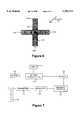
- FIG. 6is a schematic illustration of an exemplary antenna for the confinement system shown in FIG. 1;
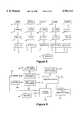
- FIG. 7is an exemplary circuit used in conjunction with the confinement system shown in FIG. 1;
- FIG. 8is an exemplary circuit for determining and transmitting a low battery strength level from the animal's collar in accordance with the present invention.
- FIG. 9is another exemplary circuit of a home base transmitter and alarm circuit utilizing a microprocessor in accordance with the present invention.
- FIG. 10is another exemplary circuit for a receiver utilizing a microprocessor in accordance with the present invention.
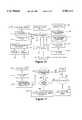
- FIG. 11is a flow chart illustrating the operation of the microprocessor in the home base transmitter shown in FIG. 9;
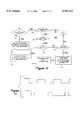
- FIG. 12is a flow chart illustrating the operation of the microprocessor in the receiver shown in FIG. 10.
- FIG. 13is a signal diagram illustrating the signals transmitted by the home base transmitter shown in FIG. 9.
- the confinement system for animals of the present inventionoperates by transmitting a first, predetermined modulated signal to a receiver mounted on an animal's collar.
- the modulated signalis demodulated by the receiver and it is determined if the received signal is the modulated signal. If the demodulated and reference signals are similar, then the signal strength of the first signal is used to determine whether the animal is close to a boundary area. If the modulated and reference signals are not similar, the first signal is ignored.
- a home base 1which includes a transmitter for transmitting a first, predetermined modulated signal (A) and a second, predetermined modulated signal (B) which is different from the first, predetermined modulated signal (A).
- a first signal-emitting wire 3 responsive to the first signal (A)is disposed around a confinement area. Wire 3 can be above ground or buried under ground.
- a second signal-emitting wire 5, responsive to the second signal (B),is disposed within the confinement area around home base 1.
- Wire 5can circle home base 1 or be positioned adjacent to home base 1.
- Wire 5can be above ground or buried under ground.
- Receiver 11is responsive to the first and second signals (A) and (B).
- First signal (A)is broadcast to wire 3, and is emitted therefrom.
- the strength of the emitted signalvaries with the distance from wire 3, as is well known.
- Receiver 11has a deterrent circuit responsive to a first level of strength of signal (A), preferably between 0.001 and 0.005 watts. Once the first level of strength of signal (A) is detected, the deterrent circuit produces a deterrent, including electrical shock and audio, which both act upon the animal to, it is hoped, drive the animal back toward the center of the confinement area.
- the receiver 11activates its alarm and disconnect circuit.
- the alarm and disconnect circuitare responsive to a second level of strength of first signal (A), preferably 0.01 to 0.05 watts. After the second strength level of first signal (A) is detected, the disconnect and alarm circuit disconnects the deterrent circuit, so that the animal 7 no longer receives the deterrent, and it may wander outside the confinement area.
- the term "disconnect” hereinrefers to an electrical deactivation. Simultaneously with the disconnect, the collar alarm broadcasts an alarm activation signal back to the home base 1, warning the owner that the animal 7 has ignored the deterrent and is escaping.
- Collar 9carries a reconnect circuit responsive to second signal (B). Once the animal 7 approaches wire 5, the reconnect circuit reactivates the disconnected deterrent circuit, and the animal 7 is reconfined.
- FIG. 2an exemplary circuit for home base 1 is shown.
- the home baseis powered by DC electricity.
- Home base 1includes frequency generator 21 which generates an oscillating signal of predetermined frequency, for example, 30 KHz. A portion of the output of frequency generator 21 is directed to modulator 27, which shapes the curve of second signal (B), as is well known.
- Second signal (B)is then transmitted by second transmitter 29 to antenna 31, also referred to herein as wire 5.
- Wire 5then emits second signal (B), which is received and processed by the receiver 11 in collar 9, as hereinafter described.
- Wire 3emits first signal (A) which is received and processed by the receiver 11 in collar 9.
- First signal (A)is a modulated signal which is generated by modulating a carrier signal, for example, the output signal of the frequency generator 21, with a modulating signal which is, for example, an analog signal or a digital signal.
- Modulated first signal (A)is generated by modulator 10.
- Modulated first signal (A)is then transmitted by first transmitter 23 to antenna 25, also referred to herein as wire 3.
- the first modulated signalis demodulated by a demodulator in the receiver 11 in collar 9 and compared to a reference signal or is examined to determine if the signal received by the receiver 11 in collar 9 has been transmitted from wire 3.
- the receiver 11 in collar 9can prevent inadvertent activation of the deterrent circuit caused by radio waves generated by common and natural sources as well as signals generated by other confinement systems which are received by receiver 11 in collar 9.
- Antenna 25is also used to receive an alarm activation signal broadcast by the collar alarm to warn the owner that the animal has ignored the deterrent and is escaping.
- This alarm signalpasses through a band pass filter 30 that only allows certain frequency signals to pass.
- the output signal of band pass filter 30is provided to amplifier 32 which amplifies the signal.
- Detector 34is activated by a signal of a certain signal strength.
- the output of detector 34is coupled to relay 36, which is, in turn, coupled to alarm 38.
- the alarm 33is activated to warn the owner of the escaping animal. The alarm may then be reset using reset circuit 40.
- Modulator 10can modulate signal (A) using a variety of modulation techniques including, for example, amplitude modulation, frequency modulation, pulse modulation and phase modulation, as are known.
- First and second transmitters, 23 and 29,each have means for increasing or decreasing the signal strength, so as to increase the size of the field of transmitted and emitted signals, as is well known.
- first strength level signal of modulated first signal (A)is detected by antenna 41 in receiver 11 in collar 9.
- First signal (A)passes through a band pass filter 43 that allows only the pre-designated frequency of 30 KHz to pass or frequencies around the pre-designated frequency of 30 KHz to pass.
- the frequency of first signal (A)may vary. Accordingly, the band pass filter will be selected to pass frequencies which include the frequency or frequency range of first signal (A).
- the output signal of band pass filter 43is provided to (1) demodulator 70 which demodulates first signal (A) to extract the modulating signal,. After signal (A) is demodulated, it is provided to comparator 75 which compares the demodulated signal (A') to a reference signal to determine if the demodulated signal is first signal (A) transmitted by wire 3. If the demodulated signal is the correct signal, then comparator 75 provides the first demodulated signal (A') to amplifier 45. Modulated first signal (A) and demodulated first signal (A') have substantially the same signal strength.
- comparator 75ignores the input signal for a period of time. After the period of time has elapsed, the comparator compares the currently received signal to the reference signal to determine if the correct signal is received.
- Amplifier 45amplifies the demodulated first signal (A') up to 100 times, so as to energize the remainder of the circuit.
- the output of amplifier 45is divided evenly among detectors 47, 49, and 51.
- Detector 47is activated only in response to demodulated signal (A') corresponding to modulated signal (A) which has a received signal strength of between 0.001 and 0.005 watts. This signal level is detected when the animal is still some distance from wire 3.
- Detectors 49 and 51are not activated by the first strength level of first signal (A).
- the output of detector 47is coupled to first relay 53, which is, in turn, coupled to second relay 55.
- Second relay 55activates an electrical spike circuit 59 and an audio signal circuit 61 to produce an electrical shock and a sound unpleasant to the animal.
- Circuits to produce the electrical shock and audioare well known in the art and are described, for example, in U.S. Pat. No. 4,733,633 entitled ELECTRONIC CONFINEMENT ARRANGEMENT FOR ANIMALS and issued to Yarnall et al., which is incorporated herein by reference.
- Second strength level of signal (A)is detected by detector 49.
- Detector 49is activated only in response to demodulated signal (A') corresponding to modulated signal (A) having a received signal strength of between 0.01 and 0.05 watts.
- the output of detector 49is coupled to third relay 63, which in turn activates frequency generator 65 to broadcast an alarm via transmitter 67 back to home base 1.
- Frequency generator 65may be any type of generator capable of generating an oscillating signal at a predetermined frequency, preferably 50 KHz.
- Detector 49is also coupled to first relay 53, which then activates second relay 55 to deactivate the electrical and audio circuits, 59 and 61, respectively.
- detector 51After animal 7 returns to the proximity of second emitting wire 5, detector 51 detects the presence of modulated signal (B). Output of detector 51 acts upon fourth relay 69 to activate first relay 53, which activates the second relay 55, to reactivate the deterrent circuits of electrical shock and audio.
- the received signalcould be provided directly to amplifier 45.
- comparator 75acts upon the second relay 55 directly or through relay 53 or detector 49 as illustrated by the broken line in FIG. 3, for example, to deactivate the deterrent circuits of electrical shock and audio for a specified period of time if the correct signal is not received.
- signals (A) and (B)are transmitted at or around 30 KHz, other radio frequencies or bands of frequencies could be used.
- the alarm signal frequency of 50 KHzcould be another frequency.
- a plurality of individual frequencies or bands of frequenciescould be transmitted and received, one frequency or frequency band for a different animal, to make the system workable for a plurality of animals.
- potentiometer 50 and potentiometer 60another embodiment, containing adjustable signal circuitry and adjustable spike out circuitry, is provided.
- the potentiometers 50 and 60enable the user to individually customize an animal's collar detector unit sensitivity. This feature is desirable because some animals, for example trained animals, are less likely to leave the confinement area. In contrast, untrained animals are likely to need increased monitoring and deterrence to prevent the animal from leaving the confinement area. As a result, the owner would desire to lower the unit's sensitivity for a trained animal, while increasing the unit's sensitivity for an untrained animal.
- the amount of spike out deterrentmay be varied.
- the amount of current applied as a deterrenceis variable.
- dobermansare highly sensitive to electrical shocks.
- a lower spike out deterrentprovides a suitable deterrent.
- rottweilersare not deterred by lower spike out levels. Accordingly, an elevated spike out deterrence is desirable. This feature is desirable because some animals need less of a deterrent to be contained within the predetermined confinement area, while some animals need more.
- potentiometer 50is coupled to detector 49, thereby allowing the user to increase or decrease the sensitivity of detector 49 to the outer perimeter's deterrent signal.
- the usercan vary the strength of the modulated signal (A) that is necessary to activate detector 49.
- Potentiometer 60is connected to the spike out circuit 59, thereby allowing the user to increase or decrease the level of the spike out deterrent to be sent to the animal. This circuitry may also be used when more than one animal is being contained within the predetermined confinement area.
- FIG. 4another exemplary embodiment, contains a collar communicator circuit for allowing the user to communicate with the animal via the receiver mounted on the animal's collar unit. This embodiment enables the animal's owner to communicate with the animal.
- FIG. 4may be used as a stand-alone, hand-held unit which is easily transportable or may be integrated into the system of FIG. 2, with frequency generator 107, transmitter 109, and antenna 110 corresponding to frequency generator 21, transmitter 29, and antenna 31.
- the modulator 108 mixeris coupled between frequency generator 107 and transmitter 109.
- This embodimentis also portable and easily transportable, thereby permitting system mobility.
- the owneris able to use the system to locate the animal even if the animal is out of range of the predetermined confinement area's antennas because the owner can travel with the transportable system.
- FIG. 4illustrates an embodiment of the transmitter unit 400.
- the transmitter unit 400is small enough so that it may be either stationary or portable.
- the ownerspeaks directly into a microphone 105.
- the owner's voiceis then electronically converted by the microphone 105 and amplified through an audio amplifier 106, as is well known.
- Frequency generator 107creates a predetermined radio frequency (C) (for example, 99.5 KHz).
- Cradio frequency
- the signal having frequency (C)is modulated and combined with the animal owner's electronically converted voice by a modulator mixer 108.
- the signalis then transmitted via a transmitter 109 and an antenna 110 to the receiver 11.
- antenna 111In communicator circuitry 500, located in receiver 11, antenna 111, as shown in FIG. 5, receives all forms of radio signals, including frequency (C) sent from the transmitter unit 400.
- a timer 112activates a relay 113 for a fraction of a second at predetermined timed intervals. Because the relay is activated for only a fraction of a second at regular intervals, and is not operating continuously, the battery life of the receiver unit is greatly increased.
- the relay 113allows power 114 to energize the detection circuitry, an amplifier 116 and a detector 117, of the communicator circuitry 500.
- band pass filter 115allows frequency (C) (here, 99.5 KHz) or frequencies close to frequency (C) to pass through the bandpass filter.
- the amplifier 116amplifies the received signal having frequency (C).
- the detector 117activates a relay 119 to energize audio 120 and demodulator 118, allowing the animal to hear the owner's voice.
- Antenna 111may be incorporated as antenna 41 of the collar receiver unit of FIG. 3.
- FIG. 6illustrates an exemplary antenna 141 which enables the user to maintain contact continuously with the animal, even when it is in motion and changes direction of travel.
- the antenna 141eliminates the need for using multiple measuring circuits and detector circuits. It is a simple but highly functional design allowing the antenna to detect and transmit the required signals when the animal is in full and unrestrained movement.
- the antenna 141is a one-piece component that is comprised of one ferrite core 620 with four protruding legs 600a-600d at 90 degree angles to each other. Each of the four legs are wound with one continuous length of wire 610.
- the legs 600a14 600d of the antenna 141are two dimensional, laying flat on a single plane. Because only one antenna is used, the size of the animal's receiver 11 is kept small. Furthermore, because no additional components are used, such as measuring circuits and comparator circuits, there is no increased drain on the battery. Finally, manufacturing costs remain low.
- the antenna 141may be incorporated as antenna 41 of the collar receiver unit shown in FIG. 3.
- FIG. 7another embodiment, containing a low battery strength alarm, is provided.
- the current level of the battery 231 in the receiver 11is checked periodically for a low battery strength level.
- Either or both of wires 3 and 5may be used as receiving antenna(s) for receiving a signal (D), the low battery strength indicator signal.
- Dthe low battery strength indicator signal.
- a battery strength level indicator 233measures the current level of battery 231 of the animal's receiver 11. To reduce the energy drainage of this circuit on the battery 231, a timer 232 activates this circuit at predetermined time intervals (for example, once every 4 hours). If the battery strength level indicator 233 reads a low current level from the battery 231, a relay 234 activates a frequency generator 235. The frequency generator 235 generates a low battery strength signal (D). A modulator 236 modulates the low battery strength signal (D) to the predetermined modulation level in accordance with the specific animal's receiver 11. A transmitter 237 transmits the low battery strength signal (D), with its proper modulation levels, through an antenna 238, to be received at the home base 1 by the user.
- FIG. 8is an exemplary circuit for receiving the low battery strength signal (D) at the home base 1.
- An amplifier 210which is the same as amplifier 32 in the circuit of FIG. 2, amplifies signal (D) up to 100 times, so as to energize the remainder of the circuit.
- a detector 211is only activated by the modulated signal (D). Once the circuit verifies the intensity of signal (D) (a strength of between 0.001 and 0.005 watts) and the predetermined modulation level of signal (D) (between 0.01 KHz and 0.05 KHz), a relay 212 activates an alarm 213 to alert the owner of the low battery level in the animal's receiver 11.
- an aspect of this inventionis that it is possible to utilize a configuration capable of indicating the imminent power failure of a particular animal's receiver 11 when more than one animal is confined in the same area.
- the low battery strength signal (D) produced by each animal's receiver 11will have a different level of modulation on signal (D).
- the detector 211is searching for signal (D) with a modulation of between 0.01 KHz and 0.05 KHz
- a detector 215may be searching for signal (D) with a modulation of between 0.06 KHz and 0.1 KHz
- a detector 219may be searching for signal (D) with a modulation of between 0.11 KHz and 0.15 KHz
- a detector 223may be searching for signal (D) with a modulation of between 0.16 KHz and 0.20 KHz
- a detector 227may be searching for signal (D) with a modulation of between 0.21 KHz and 0.25 KHz.
- Alarms 213, 217, 221, 225, and 229are visible alarms such as light emitting diodes or flashing lights and/or audible alarms such as buzzers or whistles.
- Resets 214, 218, 222, 226, and 230allow the user to deactivate the home base 1 alarms and reset the alarm and activate relays 212, 216, 220, 224 and 228 to a normal ready position.
- a plurality of modulating signals for modulating the carrier signalcould be transmitted in signal (A) or from another confinement system and received, one modulating signal corresponding to a different animal, to make the system workable for a plurality of animals.
- the detectorsare activated by first and second strength levels between 0.001-0.005 and 0.01-0.05 watts, other strength levels could be used.
- FIGS. 9 and 10Another exemplary embodiment is shown in FIGS. 9 and 10.
- FIG. 9is an alternate exemplary embodiment for the home base transmitter shown in FIG. 2.
- FIG. 10is an alternate exemplary embodiment for receiver 11 shown in FIG. 3.
- FIGS. 9 and 10encodes the signals transmitted between the home base transmitter and the receiver 11 using a binary coded pulse sequence, a digital signal.
- Each receiver 11is assigned one of a plurality of different binary coded pulse sequences as receiver identifiers.
- the binary codesare used to identify a particular receiver 11.
- Signals transmitted by receiver 11are encoded with the binary code.
- the home base transmitterremoves the binary code from the transmitted signal to identify which receiver 11 transmitted the signal. In this way, different receivers 11 can transmit on the same frequency.
- the receiver 11transmits a signal encoded with the binary code.
- the home base transmitterreceives the encoded signal, removes the binary code, and activates an alarm.
- the home base transmitteralso identifies which animal has escaped the confinement area.
- Each home base transmitteralso has a binary code pulse sequence which is added to the first, predetermined modulated signal (A).
- the binary codeis used as a fence address.
- Receiver 11receives the encoded signal (A) and removes the binary code. Receiver 11 is only responsive to the received encoded signal (A) which contains the fence address assigned to that particular receiver 11. Otherwise, receiver 11 is not responsive to the received encoded signal (A).
- the microprocessor 425controls the home base transmitter.
- Microprocessor 425generates a binary coded pulse sequence which is added to the first, predetermined modulated signal (A) which is also generated by microprocessor 425.
- the microprocessorcan be adjusted to transmit different binary coded pulse sequences using digital code select switch 430. The use of different binary coded pulse sequences allows multiple adjacent electronic confinement systems to operate at the same time.
- Encoded signal (A)has a frequency of about 38.4 kHz.
- Encoded signal (A)is provided to outer loop level driver 410 which is a MOSFET high current driver.
- the outer loop level driverdrives the antenna 400 to transmit the encoded signal (A).
- Antenna 400corresponds to the first signal-emitting wire 3.
- the signal level produced by outer loop level driver 410can be adjusted using loop level adjust switch 420.
- microprocessor 425produces the second, predetermined modulated signal (B).
- Signal (B)is provided to the inner loop driver 450 which is a MOSFET high current driver.
- the inner loop level driverdrives the antenna 445 to transmit signal (B).
- Antenna 445corresponds to the second signal-emitting wire 5.
- Microprocessor 425modulates signals (A) and (B) as shown in FIG. 13.
- modulated signal (A)is “on,” modulated signal (B) is “off.”
- modulated signal (B)is “on,” modulated signal A is “off.”
- the time during which modulated signals (A) and (B) are "on”is different. Based on the difference in modulation, it can be determined if the received signal is signal (A) or signal (B). As a result, only one receiver tuned to a particular frequency is needed to receive both signals (A) and (B). Thus, the size of receiver 11 is minimized.
- the home base transmitteralso includes a 455 kHz receiver 415 which demodulates signals from antennas 400, 440, and 445.
- Antenna 440is disposed in close proximity to the home base transmitter to detect transmissions from receiver 11 when the animal 7 is in close proximity to the home base transmitter.
- the 455 kHz receiver 415is a Phillips NE614 receiver integrated circuit.
- the signals received by antennas 400, 440, and 445are transmitted from receiver 11 and include binary codes having a rate of 1200 baud.
- the transmitted signalsindicate whether animal 7 has left the confinement area or whether the battery 380, shown in FIG. 10, is at a low level.
- microprocessor 425when receiving a signal from the home base transmitter is explained below with reference to FIGS. 9 and 11.
- the demodulated signalis provided, at step 600, to microprocessor 425 from 455 kHz receiver 415.
- the microprocessor 425removes the binary code from the demodulated signal and compares, at step 620, the binary code to assigned binary codes.
- Microprocessor 415has a table which includes a list of binary codes identifying the receivers assigned to that base station. The binary codes in the table are the assigned binary codes.
- Microprocessor 425terminates processing if it is determined, at step 630, that the binary code from the received signal is not one of the assigned binary codes.
- microprocessor 425determines, at step 640, whether the received signal has been transmitted because the battery 380, shown in FIG. 10, is low.
- the low battery alarmis activated, at step 650, if the signal indicates a low battery in receiver 11.
- the microprocessoralso provides data to a display (not shown) to display which receiver 11 has the low battery 380.
- the microprocessordetermines, at step 660, if the received signal indicates that animal 7 has escaped.
- Microprocessor 425activates an alarm and displays a message on a 4 line, 16 character liquid crystal display on escape display and reset switches 435 shown in FIG. 9, at step 670, to identify which receiver 11 transmitted the digital code. This data is used to identify which animal 7 has escaped.
- Receiver 11is explained below with reference to FIGS. 10 and 12.
- Receiver 11has a 39 KHz LC tuned antenna 310 which receives signals (A) and (B) from the home base transmitter.
- the antennacomprises an inductor wrapped on a ferrite core resonating with a capacitor.
- the received signalis provided to 39 kHz receiver 315 which demodulates and detects the strength level of the received signal, signal (A) or (B).
- 39 kHz receiverremoves the binary code from demodulated signal (A').
- 39 kHz receiver 315provides the strength levels from signal (A) and (B) and the binary code from signal (A) to microprocessor 300.
- 39 kHz receiver 315also identifies which signal, Signal (A) or (B), has been received. This data is provided to microprocessor 300.
- Microprocessor 300determines, at step 500, if the received signal is signal (B). If signal (B) has been received, shock deterrent generator 325 and the audio deterrent generator 326 are reactivated at step 520.
- the received signalis not signal (B)
- the fence addressis stored in the microprocessor.
- the binary code for the fence addresscan be changed between, for example, three different binary codes using digital code select switch 345. If the binary code is the correct fence address, then it is determined, at step 545, whether the signal strength of the received signal is at the level, between 0.001 and 0.005 watts, to initiate activation of the shock deterrent generator 325 and audio deterrent generator 326 at step 550.
- the deterrent level applied by the shock deterrent generator 325 to animal 7can be adjusted using deterrent setting switch 320. If the level is correct, step 550 is initiated. If the signal level is not correct, it is then determined, at step 560, whether the signal strength is at a level, between 0.01 and 0.05 watts, to initiate, at step 570, deactivation of the shock deterrent generator 325 and audio deterrent generator 326. If neither level is satisfied, processing is terminated by microprocessor 300. In addition, if the correct binary code is not received or if the received signal is not signal (A), the microprocessor terminates processing.
- the first and second signal strength levelscan be adjusted using distance adjust switch 330.
- the strength of the shock deterrentcan be adjusted using the deterrent setting switch.
- Microprocessor 300also provides a binary code to 455 kHz escape transmitter 335, at step 580, if animal 7 leaves the confinement area.
- 455 kHz escape transmitter 335encodes a modulated signal which is transmitted from the receiver 11 via 455 kHz escape antenna 340 using the binary code.
- the home base transmitterdetects the transmitted signal, removes the binary code and displays which animal 7 has escaped as well as sounding an alarm.
- Receiver 11also includes an antenna 350, crystal controlled oscillator 355, and a speaker 360 for receiving voice transmissions from the home base transmitter or a portable transmitter as explained above.
- Crystal controlled oscillator 355is controlled by microprocessor 300 to control the amount of power consumed.
- the voice receiveris either deactivated, activated on a periodic basis, or activated all the time. These three modes are selected by the microprocessor 300 in response to the switching of communication mode switch 375.
Landscapes
- Life Sciences & Earth Sciences (AREA)
- Environmental Sciences (AREA)
- Health & Medical Sciences (AREA)
- General Health & Medical Sciences (AREA)
- Physical Education & Sports Medicine (AREA)
- Animal Behavior & Ethology (AREA)
- Zoology (AREA)
- Animal Husbandry (AREA)
- Biodiversity & Conservation Biology (AREA)
- Alarm Systems (AREA)
- Catching Or Destruction (AREA)
Abstract
Description
This patent application is a U.S. national phase application of PCT/US95/09950, filed Aug. 4, 1995, which is a continuation-in-part application of parent applications Ser. No. 08/286,668 filed on Aug. 5, 1994, now U.S. Pat. No. 5,610,588, and a continuation-in-part of Ser. No. 08/414,912 filed on Mar. 31, 1995, now U.S. Pat. No. 5,565,850.
This invention relates to an electronic confinement arrangement for animals, and more particularly to a wire fence confinement arrangement which utilizes a boundary antenna to transmit a modulated signal to activate a receiver positioned on an animal.
One system for accomplishing the confinement of an animal is disclosed in U.S. Pat. No. 5,170,149 entitled CONFINEMENT ARRANGEMENT FOR ANIMALS and issued to Yarnall, Sr. et al. This and other conventional systems mount a receiver on a collar. The collar delivers a shock to an animal wearing the collar when the animal is in relatively close proximity to a perimeter antenna wire. The conventional systems are unintentionally activated, however, by common and naturally occurring sources of unmodulated radio frequencies. These sources include, for example, lightning and household electrical motors such as those motors used in hair dryers and blenders.
Another exemplary conventional system is described in U.S. Pat. No. 4,898,120 entitled ANIMAL TRAINING AND RESTRAINING SYSTEM and issued to Brose. The '120 patent describes a system which includes a transmitter/receiver mounted on an animal's collar for transmitting a series of pulses. A control unit receives the transmitted pulses and provides them to an analog-to-digital (A/D) converter for converting the transmitted pules to digital form based on the amplitude of the received pulses. A central processing unit (CPU) in the control unit uses the digital signals to define the average strength of the transmitted pulses to ascertain if the animal has approached a predetermined distance from the transmitter. The system does not distinguish the transmitted signal, however, from naturally occurring and common sources of unmodulated radio frequencies.
Another exemplary conventional system is described in U.S. Pat. No. 4,967,695 entitled SYSTEM FOR CONTROLLING THE MOVEMENT OF AN ANIMAL and issued to Giunta. The '695 patent describes a confinement system which uses three separate antennas to overcome the problem of a temporary loss of signal when the animal changes direction of travel. The three separate antennas are linked to three individual measuring circuits, which are then connected to a comparator circuit that is linked to a switch circuit. The system has a comparator circuit and a large number of antennas and measuring circuits--all of which must fit inside the animal's receiver unit. These components may increase the size of the receiver unit. In addition, there is an increased drain on the battery used to power the receiver because of the increased number of electronic components that are located in the animal's collar unit. Finally, the manufacturing cost of the animal's receiver unit may be increased.
The foregoing illustrates the limitations known to exist in present confinement systems. Thus, it is apparent that it would be advantageous to provide an alternative confinement system which will account for common and naturally occurring sources of unmodulated radio frequencies and will include an animal's receiver unit that can overcome temporary loss of signal without requiring extensive additional circuitry. Accordingly, these are the principal objects of the present invention.
To achieve these and other objects, and in view of its purposes, the present invention provides an animal confinement arrangement including a home base for transmitting a modulated signal and a receiver for receiving the modulated signal. The received modulated signal is demodulated using a demodulator. The demodulated signal is compared to a reference signal to produce a comparator signal indicating whether the received modulated signal was transmitted by the home base. Also provided is deterrent circuitry which is responsive to a strength level of the received modulated signal for producing a deterrent signal. The deterrent signal is applied to an animal if the comparator signal indicates that the received modulated signal was transmitted by the home base.
In another exemplary aspect of the present invention, the modulated signal transmitted from the home base is encoded with a digital signal. The received encoded modulated signal is demodulated and the digital signal recovered in the receiver. The deterrent, in response to the strength level of the received modulated signal and the digital code, produces the deterrent signal. The deterrent signal is applied to the animal if the digital signal was transmitted from the home base.
In another exemplary aspect of the present invention, a confinement arrangement including a home base transmitter for transmitting modulated signals is provided. A first wire defines a confinement area and receives and emits a first modulated signal. A second wire within the confinement area and adjacent to the home base receives and emits a second modulated signal. A receiver attached to an animal detects a first, low strength level of the first modulated signal from the first wire and activates deterrent devices on the collar. If the animal continues toward the first wire, the receiver also detects a second, higher strength level of the first modulated signal from the first wire and activates an alarm signal to the home base and disconnects the deterrent circuits. If the animal approaches the second wire, the receiver detects the second modulated signal and reactivates the deterrent circuits, thereby reconfining the animal.
In another exemplary aspect of the present invention, an adjustable signal detection circuit and an adjustable spike out circuit are provided in the animal's receiver. The adjustable signal detection circuit permits the sensitivity of the receiver to be adjusted to activate the deterrent circuits at different distances from the first wire. The level of the deterrent is also adjustable to provide varying degrees of deterrence.
In still another exemplary aspect of the present invention, a portable collar communicator is included in the receiver mounted on the animal's collar. The animal's owner is able to communicate with the animal via a microphone positioned at the home base or through a portable unit. The output of the microphone is converted, amplified, combined with a modulated frequency, and then transmitted to the animal's receiver. In response to detection of the owner's modulated voice signal, a collar communicator circuit in the receiver converts the transmitted voice signal so the animal can hear the owner's transmitted voice. The collar communicator circuit includes a power saver circuit permitting use of the collar communicator circuit without consuming excessive energy from the receiver's power supply.
In another exemplary aspect of the present invention, the animal's receiver includes an antenna for detecting the modulated signals from the first wire and the second wire. The antenna includes a ferrite core with four protruding legs arranged at an angle of substantially 90 degrees to each other. Each of the four legs are wound with a continuous length of wire. The antenna improves reception when the animal is in full, unrestrained motion.
In another exemplary aspect of the present invention, a low battery strength level indicator is provided. When the intensity of a signal received from the collar unit falls below a predetermined value, an indicator warns the owner of an imminent power failure of the receiver mounted on the animal's collar. The system also includes a number of low battery indicators positioned at the base station which are responsive to different modulated signals transmitted by animal receivers. Each animal receiver transmits respectively different modulated signals indicative of a low battery level for the different receivers.
The foregoing and other aspects of the present invention will become apparent from the following detailed description of the invention when considered in conjunction with the accompanying drawing.
FIG. 1 is a schematic illustration of an exemplary confinement system in accordance with the present invention;
FIG. 2 is an exemplary circuit of a home base transmitter and alarm circuit in accordance with the present invention;
FIG. 3 is an exemplary circuit for a receiver with a deterrent circuit, an alarm circuit, and a deterrent control circuit in accordance with the present invention;
FIG. 4 is an exemplary circuit for a transmitter unit in accordance with an exemplary embodiment of the present invention;
FIG. 5 is an exemplary communicator circuit of a receiver in accordance with an exemplary embodiment of the present invention;
FIG. 6 is a schematic illustration of an exemplary antenna for the confinement system shown in FIG. 1;
FIG. 7 is an exemplary circuit used in conjunction with the confinement system shown in FIG. 1;
FIG. 8 is an exemplary circuit for determining and transmitting a low battery strength level from the animal's collar in accordance with the present invention;
FIG. 9 is another exemplary circuit of a home base transmitter and alarm circuit utilizing a microprocessor in accordance with the present invention;
FIG. 10 is another exemplary circuit for a receiver utilizing a microprocessor in accordance with the present invention;
FIG. 11 is a flow chart illustrating the operation of the microprocessor in the home base transmitter shown in FIG. 9;
FIG. 12 is a flow chart illustrating the operation of the microprocessor in the receiver shown in FIG. 10; and
FIG. 13 is a signal diagram illustrating the signals transmitted by the home base transmitter shown in FIG. 9.
In general terms, the confinement system for animals of the present invention operates by transmitting a first, predetermined modulated signal to a receiver mounted on an animal's collar. The modulated signal is demodulated by the receiver and it is determined if the received signal is the modulated signal. If the demodulated and reference signals are similar, then the signal strength of the first signal is used to determine whether the animal is close to a boundary area. If the modulated and reference signals are not similar, the first signal is ignored.
Referring to FIG. 1, there is shown a home base 1 which includes a transmitter for transmitting a first, predetermined modulated signal (A) and a second, predetermined modulated signal (B) which is different from the first, predetermined modulated signal (A). A first signal-emittingwire 3 responsive to the first signal (A) is disposed around a confinement area.Wire 3 can be above ground or buried under ground.
A second signal-emitting wire 5, responsive to the second signal (B), is disposed within the confinement area around home base 1. Wire 5 can circle home base 1 or be positioned adjacent to home base 1. Wire 5 can be above ground or buried under ground.
An animal 7 to be kept within the confinement area wears a collar 9 that carries a receiver 11. Receiver 11 is responsive to the first and second signals (A) and (B). First signal (A) is broadcast towire 3, and is emitted therefrom. The strength of the emitted signal varies with the distance fromwire 3, as is well known. As the animal 7 approacheswire 3, the strength of the signal continuously increases and as the animal 7 departs fromwire 3 the strength of the signal decreases. Receiver 11 has a deterrent circuit responsive to a first level of strength of signal (A), preferably between 0.001 and 0.005 watts. Once the first level of strength of signal (A) is detected, the deterrent circuit produces a deterrent, including electrical shock and audio, which both act upon the animal to, it is hoped, drive the animal back toward the center of the confinement area.
If the animal 7 ignores the deterrent and continues towardwire 3, the receiver 11 activates its alarm and disconnect circuit. The alarm and disconnect circuit are responsive to a second level of strength of first signal (A), preferably 0.01 to 0.05 watts. After the second strength level of first signal (A) is detected, the disconnect and alarm circuit disconnects the deterrent circuit, so that the animal 7 no longer receives the deterrent, and it may wander outside the confinement area. The term "disconnect" herein refers to an electrical deactivation. Simultaneously with the disconnect, the collar alarm broadcasts an alarm activation signal back to the home base 1, warning the owner that the animal 7 has ignored the deterrent and is escaping.
After the animal 7 escapes, it may desire to return to the home base 1 or to the confinement area, due to habit or due to action of the owner. Collar 9 carries a reconnect circuit responsive to second signal (B). Once the animal 7 approaches wire 5, the reconnect circuit reactivates the disconnected deterrent circuit, and the animal 7 is reconfined.
Referring to FIG. 2, an exemplary circuit for home base 1 is shown. The home base is powered by DC electricity. Home base 1 includes frequency generator 21 which generates an oscillating signal of predetermined frequency, for example, 30 KHz. A portion of the output of frequency generator 21 is directed tomodulator 27, which shapes the curve of second signal (B), as is well known. Second signal (B) is then transmitted bysecond transmitter 29 toantenna 31, also referred to herein as wire 5. Wire 5 then emits second signal (B), which is received and processed by the receiver 11 in collar 9, as hereinafter described.
As is described later, the first modulated signal is demodulated by a demodulator in the receiver 11 in collar 9 and compared to a reference signal or is examined to determine if the signal received by the receiver 11 in collar 9 has been transmitted fromwire 3. As a result, the receiver 11 in collar 9 can prevent inadvertent activation of the deterrent circuit caused by radio waves generated by common and natural sources as well as signals generated by other confinement systems which are received by receiver 11 in collar 9.
First and second transmitters, 23 and 29, each have means for increasing or decreasing the signal strength, so as to increase the size of the field of transmitted and emitted signals, as is well known.
Referring to FIG. 3, an exemplary circuit for the receiver 11 in collar 9 is shown. As the animal 7 nearswire 3, the first strength level signal of modulated first signal (A) is detected byantenna 41 in receiver 11 in collar 9. First signal (A) passes through aband pass filter 43 that allows only the pre-designated frequency of 30 KHz to pass or frequencies around the pre-designated frequency of 30 KHz to pass. Depending on the selected modulation technique, the frequency of first signal (A) may vary. Accordingly, the band pass filter will be selected to pass frequencies which include the frequency or frequency range of first signal (A).
The output signal ofband pass filter 43 is provided to (1)demodulator 70 which demodulates first signal (A) to extract the modulating signal,. After signal (A) is demodulated, it is provided tocomparator 75 which compares the demodulated signal (A') to a reference signal to determine if the demodulated signal is first signal (A) transmitted bywire 3. If the demodulated signal is the correct signal, then comparator 75 provides the first demodulated signal (A') toamplifier 45. Modulated first signal (A) and demodulated first signal (A') have substantially the same signal strength.
If the demodulated signal is not the correct signal, then comparator 75 ignores the input signal for a period of time. After the period of time has elapsed, the comparator compares the currently received signal to the reference signal to determine if the correct signal is received.
If animal 7 continues towardwire 3, second strength level of signal (A) is detected bydetector 49.Detector 49 is activated only in response to demodulated signal (A') corresponding to modulated signal (A) having a received signal strength of between 0.01 and 0.05 watts. The output ofdetector 49 is coupled to third relay 63, which in turn activatesfrequency generator 65 to broadcast an alarm viatransmitter 67 back to home base 1.Frequency generator 65 may be any type of generator capable of generating an oscillating signal at a predetermined frequency, preferably 50 KHz.Detector 49 is also coupled tofirst relay 53, which then activatessecond relay 55 to deactivate the electrical and audio circuits, 59 and 61, respectively.
After animal 7 returns to the proximity of second emitting wire 5,detector 51 detects the presence of modulated signal (B). Output ofdetector 51 acts uponfourth relay 69 to activatefirst relay 53, which activates thesecond relay 55, to reactivate the deterrent circuits of electrical shock and audio.
Alternatively, the received signal could be provided directly toamplifier 45. In this case,comparator 75 acts upon thesecond relay 55 directly or throughrelay 53 ordetector 49 as illustrated by the broken line in FIG. 3, for example, to deactivate the deterrent circuits of electrical shock and audio for a specified period of time if the correct signal is not received.
Although signals (A) and (B) are transmitted at or around 30 KHz, other radio frequencies or bands of frequencies could be used. Likewise, the alarm signal frequency of 50 KHz could be another frequency. Also, while we have disclosed only a single frequency or band of frequencies for signals (A) and (B), a plurality of individual frequencies or bands of frequencies could be transmitted and received, one frequency or frequency band for a different animal, to make the system workable for a plurality of animals.
Referring to FIG. 3, and in particular, topotentiometer 50 and potentiometer 60, another embodiment, containing adjustable signal circuitry and adjustable spike out circuitry, is provided. Thepotentiometers 50 and 60 enable the user to individually customize an animal's collar detector unit sensitivity. This feature is desirable because some animals, for example trained animals, are less likely to leave the confinement area. In contrast, untrained animals are likely to need increased monitoring and deterrence to prevent the animal from leaving the confinement area. As a result, the owner would desire to lower the unit's sensitivity for a trained animal, while increasing the unit's sensitivity for an untrained animal.
In addition, the amount of spike out deterrent may be varied. As a result, the amount of current applied as a deterrence is variable. For example, dobermans are highly sensitive to electrical shocks. Thus, a lower spike out deterrent provides a suitable deterrent. Alternatively, rottweilers are not deterred by lower spike out levels. Accordingly, an elevated spike out deterrence is desirable. This feature is desirable because some animals need less of a deterrent to be contained within the predetermined confinement area, while some animals need more.
In FIG. 3,potentiometer 50 is coupled todetector 49, thereby allowing the user to increase or decrease the sensitivity ofdetector 49 to the outer perimeter's deterrent signal. Thus, the user can vary the strength of the modulated signal (A) that is necessary to activatedetector 49. Potentiometer 60 is connected to the spike outcircuit 59, thereby allowing the user to increase or decrease the level of the spike out deterrent to be sent to the animal. This circuitry may also be used when more than one animal is being contained within the predetermined confinement area.
FIG. 4, another exemplary embodiment, contains a collar communicator circuit for allowing the user to communicate with the animal via the receiver mounted on the animal's collar unit. This embodiment enables the animal's owner to communicate with the animal. FIG. 4 may be used as a stand-alone, hand-held unit which is easily transportable or may be integrated into the system of FIG. 2, withfrequency generator 107,transmitter 109, andantenna 110 corresponding to frequency generator 21,transmitter 29, andantenna 31. In this arrangement, themodulator 108 mixer is coupled betweenfrequency generator 107 andtransmitter 109.
This embodiment is also portable and easily transportable, thereby permitting system mobility. For example, the owner is able to use the system to locate the animal even if the animal is out of range of the predetermined confinement area's antennas because the owner can travel with the transportable system.
FIG. 4 illustrates an embodiment of thetransmitter unit 400. Thetransmitter unit 400 is small enough so that it may be either stationary or portable. The owner speaks directly into amicrophone 105. The owner's voice is then electronically converted by themicrophone 105 and amplified through anaudio amplifier 106, as is well known.Frequency generator 107 creates a predetermined radio frequency (C) (for example, 99.5 KHz). The signal having frequency (C) is modulated and combined with the animal owner's electronically converted voice by amodulator mixer 108. The signal is then transmitted via atransmitter 109 and anantenna 110 to the receiver 11.
Incommunicator circuitry 500, located in receiver 11,antenna 111, as shown in FIG. 5, receives all forms of radio signals, including frequency (C) sent from thetransmitter unit 400. Atimer 112 activates arelay 113 for a fraction of a second at predetermined timed intervals. Because the relay is activated for only a fraction of a second at regular intervals, and is not operating continuously, the battery life of the receiver unit is greatly increased.
Therelay 113 allowspower 114 to energize the detection circuitry, anamplifier 116 and adetector 117, of thecommunicator circuitry 500. When frequency (C) has been transmitted,band pass filter 115 allows frequency (C) (here, 99.5 KHz) or frequencies close to frequency (C) to pass through the bandpass filter. Theamplifier 116 amplifies the received signal having frequency (C). In response to the presence of the signal having frequency (C), thedetector 117 activates arelay 119 to energize audio 120 anddemodulator 118, allowing the animal to hear the owner's voice.Antenna 111 may be incorporated asantenna 41 of the collar receiver unit of FIG. 3.
FIG. 6 illustrates anexemplary antenna 141 which enables the user to maintain contact continuously with the animal, even when it is in motion and changes direction of travel. Theantenna 141 eliminates the need for using multiple measuring circuits and detector circuits. It is a simple but highly functional design allowing the antenna to detect and transmit the required signals when the animal is in full and unrestrained movement.
Theantenna 141 is a one-piece component that is comprised of oneferrite core 620 with four protrudinglegs 600a-600d at 90 degree angles to each other. Each of the four legs are wound with one continuous length ofwire 610. The legs 600a14 600d of theantenna 141 are two dimensional, laying flat on a single plane. Because only one antenna is used, the size of the animal's receiver 11 is kept small. Furthermore, because no additional components are used, such as measuring circuits and comparator circuits, there is no increased drain on the battery. Finally, manufacturing costs remain low. Theantenna 141 may be incorporated asantenna 41 of the collar receiver unit shown in FIG. 3.
Referring to FIG. 7, another embodiment, containing a low battery strength alarm, is provided. In this embodiment, the current level of thebattery 231 in the receiver 11 is checked periodically for a low battery strength level. Either or both ofwires 3 and 5 (see FIG. 1) may be used as receiving antenna(s) for receiving a signal (D), the low battery strength indicator signal. Recalling FIG. 1, an animal 7 to be kept within the predefined confinement area, determined bywire 3, wears a collar 9 that carries a receiver 11 for signal (D).
Referring to FIG. 7, a batterystrength level indicator 233 measures the current level ofbattery 231 of the animal's receiver 11. To reduce the energy drainage of this circuit on thebattery 231, atimer 232 activates this circuit at predetermined time intervals (for example, once every 4 hours). If the batterystrength level indicator 233 reads a low current level from thebattery 231, arelay 234 activates afrequency generator 235. Thefrequency generator 235 generates a low battery strength signal (D). Amodulator 236 modulates the low battery strength signal (D) to the predetermined modulation level in accordance with the specific animal's receiver 11. Atransmitter 237 transmits the low battery strength signal (D), with its proper modulation levels, through anantenna 238, to be received at the home base 1 by the user.
FIG. 8 is an exemplary circuit for receiving the low battery strength signal (D) at the home base 1. Anamplifier 210, which is the same asamplifier 32 in the circuit of FIG. 2, amplifies signal (D) up to 100 times, so as to energize the remainder of the circuit. Adetector 211 is only activated by the modulated signal (D). Once the circuit verifies the intensity of signal (D) (a strength of between 0.001 and 0.005 watts) and the predetermined modulation level of signal (D) (between 0.01 KHz and 0.05 KHz), arelay 212 activates analarm 213 to alert the owner of the low battery level in the animal's receiver 11.
As mentioned above, an aspect of this invention is that it is possible to utilize a configuration capable of indicating the imminent power failure of a particular animal's receiver 11 when more than one animal is confined in the same area. In this arrangement, the low battery strength signal (D) produced by each animal's receiver 11 will have a different level of modulation on signal (D). Whereas thedetector 211 is searching for signal (D) with a modulation of between 0.01 KHz and 0.05 KHz, for example, adetector 215 may be searching for signal (D) with a modulation of between 0.06 KHz and 0.1 KHz, adetector 219 may be searching for signal (D) with a modulation of between 0.11 KHz and 0.15 KHz, adetector 223 may be searching for signal (D) with a modulation of between 0.16 KHz and 0.20 KHz, and adetector 227 may be searching for signal (D) with a modulation of between 0.21 KHz and 0.25 KHz.
In addition, although we have disclosed only a single modulated signal to be demodulated and compared at the receiver 11 of collar 9 for signal (A) for certain of the aforementioned embodiments, a plurality of modulating signals for modulating the carrier signal could be transmitted in signal (A) or from another confinement system and received, one modulating signal corresponding to a different animal, to make the system workable for a plurality of animals.
Finally, although the detectors are activated by first and second strength levels between 0.001-0.005 and 0.01-0.05 watts, other strength levels could be used.
Another exemplary embodiment is shown in FIGS. 9 and 10. FIG. 9 is an alternate exemplary embodiment for the home base transmitter shown in FIG. 2. FIG. 10 is an alternate exemplary embodiment for receiver 11 shown in FIG. 3.
The embodiment shown in FIGS. 9 and 10 encodes the signals transmitted between the home base transmitter and the receiver 11 using a binary coded pulse sequence, a digital signal. Each receiver 11 is assigned one of a plurality of different binary coded pulse sequences as receiver identifiers. The binary codes are used to identify a particular receiver 11. Signals transmitted by receiver 11 are encoded with the binary code. The home base transmitter removes the binary code from the transmitted signal to identify which receiver 11 transmitted the signal. In this way, different receivers 11 can transmit on the same frequency.
For example, when an animal 7 escapes from the confinement area, the receiver 11 transmits a signal encoded with the binary code. The home base transmitter receives the encoded signal, removes the binary code, and activates an alarm. The home base transmitter also identifies which animal has escaped the confinement area.
Each home base transmitter also has a binary code pulse sequence which is added to the first, predetermined modulated signal (A). The binary code is used as a fence address. Receiver 11 receives the encoded signal (A) and removes the binary code. Receiver 11 is only responsive to the received encoded signal (A) which contains the fence address assigned to that particular receiver 11. Otherwise, receiver 11 is not responsive to the received encoded signal (A).
Themicroprocessor 425, shown in FIG. 9, controls the home base transmitter.Microprocessor 425 generates a binary coded pulse sequence which is added to the first, predetermined modulated signal (A) which is also generated bymicroprocessor 425. The microprocessor can be adjusted to transmit different binary coded pulse sequences using digital codeselect switch 430. The use of different binary coded pulse sequences allows multiple adjacent electronic confinement systems to operate at the same time.
Encoded signal (A) has a frequency of about 38.4 kHz. Encoded signal (A) is provided to outerloop level driver 410 which is a MOSFET high current driver. The outer loop level driver drives theantenna 400 to transmit the encoded signal (A).Antenna 400 corresponds to the first signal-emittingwire 3. The signal level produced by outerloop level driver 410 can be adjusted using loop level adjustswitch 420.
Similarly,microprocessor 425 produces the second, predetermined modulated signal (B). Signal (B) is provided to theinner loop driver 450 which is a MOSFET high current driver. The inner loop level driver drives theantenna 445 to transmit signal (B).Antenna 445 corresponds to the second signal-emitting wire 5.
The home base transmitter also includes a 455kHz receiver 415 which demodulates signals fromantennas Antenna 440 is disposed in close proximity to the home base transmitter to detect transmissions from receiver 11 when the animal 7 is in close proximity to the home base transmitter. The 455kHz receiver 415 is a Phillips NE614 receiver integrated circuit. The signals received byantennas battery 380, shown in FIG. 10, is at a low level.
The operation ofmicroprocessor 425 when receiving a signal from the home base transmitter is explained below with reference to FIGS. 9 and 11. The demodulated signal is provided, atstep 600, tomicroprocessor 425 from 455 kHzreceiver 415. Then, atstep 610, themicroprocessor 425 removes the binary code from the demodulated signal and compares, atstep 620, the binary code to assigned binary codes.Microprocessor 415 has a table which includes a list of binary codes identifying the receivers assigned to that base station. The binary codes in the table are the assigned binary codes.Microprocessor 425 terminates processing if it is determined, atstep 630, that the binary code from the received signal is not one of the assigned binary codes.
If the binary code is one of the assigned binary codes,microprocessor 425 determines, atstep 640, whether the received signal has been transmitted because thebattery 380, shown in FIG. 10, is low. The low battery alarm is activated, atstep 650, if the signal indicates a low battery in receiver 11. The microprocessor also provides data to a display (not shown) to display which receiver 11 has thelow battery 380.
Alternatively, if the signal does not indicate a low battery level, the microprocessor determines, atstep 660, if the received signal indicates that animal 7 has escaped.Microprocessor 425 activates an alarm and displays a message on a 4 line, 16 character liquid crystal display on escape display and resetswitches 435 shown in FIG. 9, atstep 670, to identify which receiver 11 transmitted the digital code. This data is used to identify which animal 7 has escaped.
Receiver 11 is explained below with reference to FIGS. 10 and 12. Receiver 11, as shown in FIG. 1, has a 39 KHz LC tunedantenna 310 which receives signals (A) and (B) from the home base transmitter. The antenna comprises an inductor wrapped on a ferrite core resonating with a capacitor. The received signal is provided to 39kHz receiver 315 which demodulates and detects the strength level of the received signal, signal (A) or (B). In addition, 39 kHz receiver removes the binary code from demodulated signal (A'). 39kHz receiver 315 provides the strength levels from signal (A) and (B) and the binary code from signal (A) tomicroprocessor 300. 39kHz receiver 315 also identifies which signal, Signal (A) or (B), has been received. This data is provided tomicroprocessor 300.
If the received signal is not signal (B), it is determined, atstep 530, if the transmitted signal is signal (A). Next, it is determined, atstep 540, whether the binary code from the signal corresponds to the fence address for receiver 11. The fence address is stored in the microprocessor. The binary code for the fence address can be changed between, for example, three different binary codes using digital codeselect switch 345. If the binary code is the correct fence address, then it is determined, atstep 545, whether the signal strength of the received signal is at the level, between 0.001 and 0.005 watts, to initiate activation of theshock deterrent generator 325 andaudio deterrent generator 326 atstep 550. The deterrent level applied by theshock deterrent generator 325 to animal 7 can be adjusted usingdeterrent setting switch 320. If the level is correct,step 550 is initiated. If the signal level is not correct, it is then determined, atstep 560, whether the signal strength is at a level, between 0.01 and 0.05 watts, to initiate, atstep 570, deactivation of theshock deterrent generator 325 andaudio deterrent generator 326. If neither level is satisfied, processing is terminated bymicroprocessor 300. In addition, if the correct binary code is not received or if the received signal is not signal (A), the microprocessor terminates processing.
The first and second signal strength levels can be adjusted using distance adjustswitch 330. In addition, the strength of the shock deterrent can be adjusted using the deterrent setting switch.
Receiver 11 also includes anantenna 350, crystal controlledoscillator 355, and aspeaker 360 for receiving voice transmissions from the home base transmitter or a portable transmitter as explained above. Crystal controlledoscillator 355 is controlled bymicroprocessor 300 to control the amount of power consumed. The voice receiver is either deactivated, activated on a periodic basis, or activated all the time. These three modes are selected by themicroprocessor 300 in response to the switching ofcommunication mode switch 375.
Although illustrated and described herein with reference to certain specific embodiments, the present invention is nevertheless not intended to be limited to the details shown. Rather, various modifications may be made in the details within the scope and range of equivalents of the claims and without departing from the spirit of the invention.
Claims (1)
1. An animal confinement arrangement comprising:
home base transmitting means for transmitting a digitally encoded signal from a first signal-emitting wire, the first signal-emitting wire disposed around a confinement area and the digitally encoded signal containing a specified digital signal;
receiver means for receiving the digitally encoded signal;
means for removing the specified digital signal from the digitally encoded signal and determining a signal strength of the transmitted digitally encoded signal; and
deterrent means, in response to the specified digital code and the strength level, for producing a deterrent signal which is applied to an animal.
Priority Applications (1)
| Application Number | Priority Date | Filing Date | Title |
|---|---|---|---|
| US08/776,733US5781113A (en) | 1994-08-05 | 1995-08-04 | Electronic confinement system for animals using modulated radio waves |
Applications Claiming Priority (4)
| Application Number | Priority Date | Filing Date | Title |
|---|---|---|---|
| US08/286,668US5610588A (en) | 1994-08-05 | 1994-08-05 | Electronic confinement system for animals using modulated radio waves |
| US08/414,912US5565850A (en) | 1994-08-05 | 1995-03-31 | Electronic confinement system for animals using modulated radio waves |
| PCT/US1995/009950WO1996004628A1 (en) | 1994-08-05 | 1995-08-04 | Electronic confinement system for animals using modulated radio waves |
| US08/776,733US5781113A (en) | 1994-08-05 | 1995-08-04 | Electronic confinement system for animals using modulated radio waves |
Related Parent Applications (2)
| Application Number | Title | Priority Date | Filing Date |
|---|---|---|---|
| US08/286,668Continuation-In-PartUS5610588A (en) | 1994-08-05 | 1994-08-05 | Electronic confinement system for animals using modulated radio waves |
| US08/414,912Continuation-In-PartUS5565850A (en) | 1994-08-05 | 1995-03-31 | Electronic confinement system for animals using modulated radio waves |
Publications (1)
| Publication Number | Publication Date |
|---|---|
| US5781113Atrue US5781113A (en) | 1998-07-14 |
Family
ID=26963993
Family Applications (4)
| Application Number | Title | Priority Date | Filing Date |
|---|---|---|---|
| US08/414,912Expired - Fee RelatedUS5565850A (en) | 1994-08-05 | 1995-03-31 | Electronic confinement system for animals using modulated radio waves |
| US08/776,733Expired - Fee RelatedUS5781113A (en) | 1994-08-05 | 1995-08-04 | Electronic confinement system for animals using modulated radio waves |
| US08/607,397Expired - Fee RelatedUS5808551A (en) | 1994-08-05 | 1996-02-27 | Electronic confinement system for animals or people transmitting digitally encoded signals |
| US09/041,188Expired - Fee RelatedUS5844489A (en) | 1994-08-05 | 1998-03-10 | Electronic confinement system for animals or people transmitting digitally encoded signals |
Family Applications Before (1)
| Application Number | Title | Priority Date | Filing Date |
|---|---|---|---|
| US08/414,912Expired - Fee RelatedUS5565850A (en) | 1994-08-05 | 1995-03-31 | Electronic confinement system for animals using modulated radio waves |
Family Applications After (2)
| Application Number | Title | Priority Date | Filing Date |
|---|---|---|---|
| US08/607,397Expired - Fee RelatedUS5808551A (en) | 1994-08-05 | 1996-02-27 | Electronic confinement system for animals or people transmitting digitally encoded signals |
| US09/041,188Expired - Fee RelatedUS5844489A (en) | 1994-08-05 | 1998-03-10 | Electronic confinement system for animals or people transmitting digitally encoded signals |
Country Status (3)
| Country | Link |
|---|---|
| US (4) | US5565850A (en) |
| AU (1) | AU3239295A (en) |
| WO (1) | WO1996004628A1 (en) |
Cited By (7)
| Publication number | Priority date | Publication date | Assignee | Title |
|---|---|---|---|---|
| US6147610A (en)* | 1999-09-17 | 2000-11-14 | Yarnall, Jr.; Robert G. | External deterrent arrangement for electronic containment systems |
| US6201477B1 (en) | 1999-09-17 | 2001-03-13 | Robert G. Yarnall, Jr. | Switched capacitor power supply for an electronic animal containment system |
| US6230661B1 (en) | 1999-09-17 | 2001-05-15 | Robert G. Yarnall, Jr. | External battery arrangement for electronic containment systems |
| US6232916B1 (en)* | 1999-08-31 | 2001-05-15 | Lucent Technologies, Inc. | GPS restraint system and method for confining a subject within a defined area |
| US20050139169A1 (en)* | 2003-12-29 | 2005-06-30 | So Ho Y. | Electronic fence system and controlling method thereof |
| US20060037560A1 (en)* | 2004-08-17 | 2006-02-23 | So Ho Y | Electronic fence transmitter for self-adjusting the receiving distance |
| US20060202818A1 (en)* | 2005-03-09 | 2006-09-14 | Greenberg Stephen J | Pet tracking systems, other tracking systems, and portable virtual fence |
Families Citing this family (90)
| Publication number | Priority date | Publication date | Assignee | Title |
|---|---|---|---|---|
| US5460124A (en)* | 1993-07-15 | 1995-10-24 | Perimeter Technologies Incorporated | Receiver for an electronic animal confinement system |
| US5565850A (en)* | 1994-08-05 | 1996-10-15 | Yarnall, Jr.; Robert G. | Electronic confinement system for animals using modulated radio waves |
| FR2752670B1 (en)* | 1996-09-03 | 1998-11-13 | Dynavet Sarl | INTERACTIVE ZONE BOUNDARY CROSSING SYSTEM BETWEEN AN ANIMAL AND A MONITORING STATION |
| US6600422B2 (en) | 1996-10-29 | 2003-07-29 | Joint Techno Concepts International, Inc. | Apparatus and method for electronic exclusion and confinement of animals relative to a selected area |
| US6657544B2 (en) | 1996-10-29 | 2003-12-02 | Joint Techno Concepts International, Inc. | Apparatus and method for electronic exclusion and confinement of animals relative to a selected area |
| US5794569A (en)* | 1996-10-29 | 1998-08-18 | Joint Techno Concepts International, Inc. | Apparatus and method for electronic confinement of animals |
| US8466795B2 (en)* | 1997-01-21 | 2013-06-18 | Pragmatus Mobile LLC | Personal security and tracking system |
| US5769032A (en)* | 1997-02-03 | 1998-06-23 | Yarnall, Sr.; Robert G. | Method and apparatus for confining animals and/or humans using spread spectrum signals |
| US5969600A (en)* | 1997-02-19 | 1999-10-19 | Ranco Inc. Of Delware | Dangerous condition warning device incorporating a time-limited hush mode of operation to defeat an audible low battery warning signal |
| US6079367A (en)* | 1997-10-10 | 2000-06-27 | Dogwatch, Inc. | Animal training apparatus and method |
| SE9704589D0 (en)* | 1997-12-09 | 1997-12-09 | Alfa Laval Agri Ab | An apparatus and a method for monitoring an animal related space |
| US6019066A (en)* | 1998-03-16 | 2000-02-01 | Taylor; Todd T. | Animal confinement/training system |
| PT1068599E (en)* | 1998-04-09 | 2003-09-30 | Ist Oy | AUTOMATIC CONTROL SYSTEM FOR A SAFETY DEVICE |
| US6075443A (en)* | 1998-07-31 | 2000-06-13 | Sarnoff Corporation | Wireless tether |
| US5939988A (en)* | 1998-07-31 | 1999-08-17 | Neyhart; Gene Michael | Child proximity monitor and alarm |
| US6067018A (en)* | 1998-12-22 | 2000-05-23 | Joan M. Skelton | Lost pet notification system |
| US6211790B1 (en) | 1999-05-19 | 2001-04-03 | Elpas North America, Inc. | Infant and parent matching and security system and method of matching infant and parent |
| AU5929400A (en)* | 1999-07-09 | 2001-01-30 | Ifco Enterprises Inc | Remote operational status notification system for electronic animal control apparatus |
| US20070120668A1 (en)* | 2000-03-10 | 2007-05-31 | Radio Systems Corporation | Security System Using Piezoelectric Sensors |
| US8157610B1 (en) | 2000-04-11 | 2012-04-17 | Disney Enterprises, Inc. | Location-sensitive toy and method therefor |
| US7064669B2 (en)* | 2000-06-09 | 2006-06-20 | Light Elliott D | Electronic tether for portable objects |
| US20050284413A1 (en)* | 2004-06-10 | 2005-12-29 | Brian Boesch | Training of animals using wireless communication and having spontaneous adjustment |
| US7375638B2 (en)* | 2000-06-09 | 2008-05-20 | Robelight, Llc | Electronic tether for portable objects |
| US7042360B2 (en)* | 2000-06-09 | 2006-05-09 | Light Elliott D | Electronic tether for portable objects |
| US6748902B1 (en)* | 2000-06-09 | 2004-06-15 | Brian Boesch | System and method for training of animals |
| US7937042B2 (en)* | 2000-06-09 | 2011-05-03 | Dot Holdings, Llc | Animal training and tracking system using RF identification tags |
| US6575120B1 (en)* | 2000-09-11 | 2003-06-10 | Dogwatch Inc. | Animal control system |
| US6720881B1 (en)* | 2002-03-22 | 2004-04-13 | Thomas W. Halliday | Perimeter security system |
| GB0217393D0 (en)* | 2002-07-26 | 2002-09-04 | Gardner Sarah M | Wireless identity tracing system (WITS) for tracing animals and food products |
| US6684820B1 (en)* | 2002-10-01 | 2004-02-03 | James E. Davis | Animal control system |
| US7173535B2 (en)* | 2002-10-15 | 2007-02-06 | Bach Eric D | Apparatus and system for containing an animal |
| US7389089B1 (en)* | 2002-11-25 | 2008-06-17 | At&T Delaware Intellectual Property, Inc. | Methods to remotely control a wireless unit |
| US7773982B2 (en)* | 2002-11-25 | 2010-08-10 | At&T Intellectual Property, I, L.P. | Methods, systems and storage media to remotely control a wireless unit |
| US7109728B2 (en)* | 2003-02-25 | 2006-09-19 | Agilent Technologies, Inc. | Probe based information storage for probes used for opens detection in in-circuit testing |
| US20040206310A1 (en)* | 2003-04-17 | 2004-10-21 | Hutchins Jeffrey A. | Voice receiver and annunciator for pets |
| US8310201B1 (en) | 2003-05-06 | 2012-11-13 | Cypress Semiconductor Corporation | Battery with electronic compartment |
| US7388350B1 (en)* | 2003-05-06 | 2008-06-17 | Cypress Semiconductor Corporation | Battery with electronic compartment |
| DE10337171A1 (en)* | 2003-08-13 | 2005-03-17 | Airbus Deutschland Gmbh | Method for exchanging programs in aircraft computers |
| CA2439722A1 (en)* | 2003-09-04 | 2005-03-04 | Vernon George Houle | A method of controlling movement on the inside and around the outside of a facility |
| US7068174B1 (en) | 2003-12-10 | 2006-06-27 | Innotek, Inc. | Method and apparatus for communicating an animal control signal |
| US8342135B2 (en)* | 2003-12-10 | 2013-01-01 | Radio Systems Corporation | Method and apparatus for varying animal correction signals |
| US7117822B1 (en) | 2003-12-10 | 2006-10-10 | Innotek, Inc. | Method and apparatus for communicating a randomized signal |
| US7046152B1 (en)* | 2003-12-10 | 2006-05-16 | Innotek, Inc. | Method and apparatus for communicating control signals |
| FR2869218B1 (en)* | 2004-04-21 | 2006-06-09 | Europlak Sa | GASTRIC CERCLING DEVICE OR MOTORIZED "GASTRIC RING" HAVING AT LEAST ONE RECEIVED ANTENNA FOR DELIVERY, REMOTE CONTROL AND DATA SENDING BY INDUCTION |
| US20050257752A1 (en)* | 2004-05-20 | 2005-11-24 | Shirley Langer | PET accessory with wireless telephonic voice transmitter |
| US7377234B2 (en)* | 2004-08-02 | 2008-05-27 | Radio Systems Corporation | Portable animal tracking system |
| WO2006039117A2 (en)* | 2004-09-21 | 2006-04-13 | Skyfence Inc. | Positioning system that uses signals from a point source |
| EP1803105B1 (en) | 2004-10-18 | 2009-12-30 | Walter Kidde Portable Equipment, Inc. | Low battery warning silencing in life safety devices |
| WO2006044751A2 (en) | 2004-10-18 | 2006-04-27 | Walter Kidde Portable Equipment, Inc. | Frequency communications scheme in life safety devices |
| DE602005020044D1 (en)* | 2004-10-18 | 2010-04-29 | Kidde Portable Equipment Inc | GATEWAY DEVICE FOR CONNECTING A SYSTEM WITH LIVE SAFETY DEVICES |
| KR100718841B1 (en)* | 2004-10-30 | 2007-05-16 | 김준수 | Animal homing device |
| US20060112901A1 (en)* | 2004-11-16 | 2006-06-01 | Gomez David R | Electronic pet containment system with improved transmitter with constant field generation |
| US20070109135A1 (en)* | 2005-11-03 | 2007-05-17 | Dogwatch Inc. | Transmitter loop monitor |
| KR100703215B1 (en)* | 2006-02-20 | 2007-04-09 | 삼성전기주식회사 | Low power wireless communication device and low power wireless communication method |
| US8159355B2 (en)* | 2006-03-16 | 2012-04-17 | Radio Systems Corporation | Multi-option communication methods of fault notification in pet containment systems |
| US7779788B2 (en)* | 2006-05-30 | 2010-08-24 | Radio Systems Corporation | Animal training system with multiple configurable correction settings |
| US20080042855A1 (en)* | 2006-08-08 | 2008-02-21 | Laurenzano Lisa M | In-ground border detector |
| US20080173255A1 (en)* | 2007-01-18 | 2008-07-24 | Radio Systems Corporation | Electronic Animal Training Apparatus Providing Feedback |
| US7817038B2 (en)* | 2007-01-22 | 2010-10-19 | Microsoft Corporation | Object detection framework for set of related objects |
| US20090013939A1 (en)* | 2007-07-13 | 2009-01-15 | Whitlock International, L.L.C. | Apparatus and method for restricting movement of an animal into or out of a defined area |
| US8006649B2 (en)* | 2007-09-14 | 2011-08-30 | Dogwatch Inc. | Animal control system having correction monitor |
| US8438999B2 (en)* | 2009-09-12 | 2013-05-14 | Titan Pet Products, Inc. | Systems and methods for animal containment, training, and tracking |
| NO332094B1 (en) | 2009-12-23 | 2012-06-18 | Nofence As | Method and system for fencing animals without the use of a physical fence |
| US8692676B2 (en)* | 2010-02-01 | 2014-04-08 | Perimeter Technologies Inc. | Time of flight animal monitoring |
| US8701600B2 (en) | 2010-03-23 | 2014-04-22 | Woodstream Corporation | Radial-shape wireless dog fence system and method with reduced clock speed variation between base unit and collar |
| US8726845B2 (en) | 2010-03-23 | 2014-05-20 | Woodstream Corporation | Radial-shape wireless dog fence system and method with temperature compensated crystal oscillator for reduced clock speed variation between base unit and collar |
| US8297233B2 (en)* | 2010-03-23 | 2012-10-30 | Woodstream Corporation | Radial-shape wireless dog fence system and method |
| US20120000431A1 (en)* | 2010-07-05 | 2012-01-05 | Kamran Khoshkish | Electronic Pet Containment System |
| US9526229B2 (en) | 2010-11-30 | 2016-12-27 | Perimeter Technologies, Inc. | Animal training system and method |
| US9713160B2 (en)* | 2011-10-20 | 2017-07-18 | Telefonaktiebolaget Lm Ericsson (Publ) | Methods and arrangements for allocation of radio resources |
| US11470814B2 (en) | 2011-12-05 | 2022-10-18 | Radio Systems Corporation | Piezoelectric detection coupling of a bark collar |
| US11553692B2 (en) | 2011-12-05 | 2023-01-17 | Radio Systems Corporation | Piezoelectric detection coupling of a bark collar |
| US10674709B2 (en) | 2011-12-05 | 2020-06-09 | Radio Systems Corporation | Piezoelectric detection coupling of a bark collar |
| US10154651B2 (en) | 2011-12-05 | 2018-12-18 | Radio Systems Corporation | Integrated dog tracking and stimulus delivery system |
| US10228447B2 (en) | 2013-03-15 | 2019-03-12 | Radio Systems Corporation | Integrated apparatus and method to combine a wireless fence collar with GPS tracking capability |
| US20160000042A1 (en)* | 2014-07-02 | 2016-01-07 | Blu Angel Llc | Pet Fence Device, System and Method |
| US10098324B2 (en) | 2015-04-09 | 2018-10-16 | Jonathan O. Baize | Herd control method and system |
| US10645908B2 (en) | 2015-06-16 | 2020-05-12 | Radio Systems Corporation | Systems and methods for providing a sound masking environment |
| US10231440B2 (en) | 2015-06-16 | 2019-03-19 | Radio Systems Corporation | RF beacon proximity determination enhancement |
| US10268220B2 (en) | 2016-07-14 | 2019-04-23 | Radio Systems Corporation | Apparatus, systems and methods for generating voltage excitation waveforms |
| WO2018157111A1 (en) | 2017-02-27 | 2018-08-30 | Radio Systems Corporation | Threshold barrier system |
| US11394196B2 (en) | 2017-11-10 | 2022-07-19 | Radio Systems Corporation | Interactive application to protect pet containment systems from external surge damage |
| US10986813B2 (en) | 2017-12-12 | 2021-04-27 | Radio Systems Corporation | Method and apparatus for applying, monitoring, and adjusting a stimulus to a pet |
| US10842128B2 (en) | 2017-12-12 | 2020-11-24 | Radio Systems Corporation | Method and apparatus for applying, monitoring, and adjusting a stimulus to a pet |
| US11372077B2 (en) | 2017-12-15 | 2022-06-28 | Radio Systems Corporation | Location based wireless pet containment system using single base unit |
| US10514439B2 (en) | 2017-12-15 | 2019-12-24 | Radio Systems Corporation | Location based wireless pet containment system using single base unit |
| US11238889B2 (en) | 2019-07-25 | 2022-02-01 | Radio Systems Corporation | Systems and methods for remote multi-directional bark deterrence |
| US11080983B2 (en)* | 2019-11-01 | 2021-08-03 | Dell Products L.P. | Automatically providing positional information via use of distributed sensor arrays |
| US11289619B2 (en) | 2019-11-01 | 2022-03-29 | Dell Products L.P. | Automatically limiting power consumption by devices using infrared or radio communications |
| US11490597B2 (en) | 2020-07-04 | 2022-11-08 | Radio Systems Corporation | Systems, methods, and apparatus for establishing keep out zones within wireless containment regions |
Citations (31)
| Publication number | Priority date | Publication date | Assignee | Title |
|---|---|---|---|---|
| US4208658A (en)* | 1977-10-27 | 1980-06-17 | Nissan Motor Company, Limited | Radar-operated vehicle safety assurance system |
| US4225206A (en)* | 1979-08-06 | 1980-09-30 | General Motors Corporation | Electrical connector for electromagnetic fuel injector |
| US4229724A (en)* | 1977-08-04 | 1980-10-21 | Prince Corporation | Vehicle position indicator with selectable position alarm means |
| US4242668A (en)* | 1979-04-30 | 1980-12-30 | Walter Herzog | Cart theft prevention system |
| US4297684A (en)* | 1979-03-26 | 1981-10-27 | Honeywell Inc. | Fiber optic intruder alarm system |
| US4371934A (en)* | 1979-05-04 | 1983-02-01 | Robert Bosch Gmbh | Vehicle trip computer |
| US4480310A (en)* | 1980-05-30 | 1984-10-30 | Alvarez Luis W | Dead reckoning range finding device for cart |
| US4494553A (en)* | 1981-04-01 | 1985-01-22 | F. William Carr | Vital signs monitor |
| US4656476A (en)* | 1985-08-26 | 1987-04-07 | Richard Tavtigian | Warning device for golf carts |
| US4675656A (en)* | 1984-03-16 | 1987-06-23 | Narcisse Bernadine O | Out-of-range personnel monitor and alarm |
| US4733633A (en)* | 1986-11-20 | 1988-03-29 | Yarnall Sr Robert G | Electronic confinement arrangement for animals |
| US4745882A (en)* | 1986-11-20 | 1988-05-24 | Yarnall Sr Robert G | Electronic confinement and communications arrangement for animals |
| US4898120A (en)* | 1988-06-16 | 1990-02-06 | Torrington Product Ventures, Inc. | Animal training and restraining system |
| US4967695A (en)* | 1989-06-23 | 1990-11-06 | Invisible Fence Company, Inc. | System for controlling the movement of an animal |
| US4996945A (en)* | 1990-05-04 | 1991-03-05 | Invisible Fence Company, Inc. | Electronic animal control system with lightning arrester |
| US5067441A (en)* | 1990-12-10 | 1991-11-26 | Torrington Product Ventures, Inc. | Electronic assembly for restricting animals to defined areas |
| US5121711A (en)* | 1990-12-04 | 1992-06-16 | Aine Harry E | Wireless control of animals |
| US5161485A (en)* | 1991-12-31 | 1992-11-10 | Invisible Fence Company, Inc. | Animal collar arrangement |
| US5170149A (en)* | 1991-10-01 | 1992-12-08 | Yarnall Sr Robert G | Confinement arrangement for animals |
| US5207178A (en)* | 1992-01-31 | 1993-05-04 | Invisible Fence Company, Inc. | Electrode device for an electric shock generator carried on an animal collar |
| US5241923A (en)* | 1992-07-23 | 1993-09-07 | Pole/Zero Corporation | Transponder control of animal whereabouts |
| US5266944A (en)* | 1991-06-26 | 1993-11-30 | Bodyguard Technologies, Inc. | Electronic system and method for monitoring abusers for compliance with a protective order |
| US5307053A (en)* | 1992-05-22 | 1994-04-26 | Lucile A. Wills | Device and method for alerting hunters |
| US5322034A (en)* | 1992-05-01 | 1994-06-21 | Iowa State University Research Foundation, Inc. | Livestock record system |
| US5335664A (en)* | 1991-09-17 | 1994-08-09 | Casio Computer Co., Ltd. | Monitor system and biological signal transmitter therefor |
| US5425330A (en)* | 1993-08-19 | 1995-06-20 | Invisible Fence Company, Inc. | Animal control device |
| US5435271A (en)* | 1993-08-19 | 1995-07-25 | Invisible Fence Company, Inc. | Multi-channel animal control device with external data communication |
| US5460124A (en)* | 1993-07-15 | 1995-10-24 | Perimeter Technologies Incorporated | Receiver for an electronic animal confinement system |
| US5565850A (en)* | 1994-08-05 | 1996-10-15 | Yarnall, Jr.; Robert G. | Electronic confinement system for animals using modulated radio waves |
| US5572401A (en)* | 1993-12-13 | 1996-11-05 | Key Idea Development L.L.C. | Wearable personal computer system having flexible battery forming casing of the system |
| US5610588A (en)* | 1994-08-05 | 1997-03-11 | Yarnall, Jr.; Robert G. | Electronic confinement system for animals using modulated radio waves |
Family Cites Families (1)
| Publication number | Priority date | Publication date | Assignee | Title |
|---|---|---|---|---|
| US4371937A (en)* | 1981-03-30 | 1983-02-01 | United Technologies Corporation | Retaining airspeed hold engagement in low speed maneuver |
- 1995
- 1995-03-31USUS08/414,912patent/US5565850A/ennot_activeExpired - Fee Related
- 1995-08-04WOPCT/US1995/009950patent/WO1996004628A1/enactiveApplication Filing
- 1995-08-04AUAU32392/95Apatent/AU3239295A/ennot_activeAbandoned
- 1995-08-04USUS08/776,733patent/US5781113A/ennot_activeExpired - Fee Related
- 1996
- 1996-02-27USUS08/607,397patent/US5808551A/ennot_activeExpired - Fee Related
- 1998
- 1998-03-10USUS09/041,188patent/US5844489A/ennot_activeExpired - Fee Related
Patent Citations (31)
| Publication number | Priority date | Publication date | Assignee | Title |
|---|---|---|---|---|
| US4229724A (en)* | 1977-08-04 | 1980-10-21 | Prince Corporation | Vehicle position indicator with selectable position alarm means |
| US4208658A (en)* | 1977-10-27 | 1980-06-17 | Nissan Motor Company, Limited | Radar-operated vehicle safety assurance system |
| US4297684A (en)* | 1979-03-26 | 1981-10-27 | Honeywell Inc. | Fiber optic intruder alarm system |
| US4242668A (en)* | 1979-04-30 | 1980-12-30 | Walter Herzog | Cart theft prevention system |
| US4371934A (en)* | 1979-05-04 | 1983-02-01 | Robert Bosch Gmbh | Vehicle trip computer |
| US4225206A (en)* | 1979-08-06 | 1980-09-30 | General Motors Corporation | Electrical connector for electromagnetic fuel injector |
| US4480310A (en)* | 1980-05-30 | 1984-10-30 | Alvarez Luis W | Dead reckoning range finding device for cart |
| US4494553A (en)* | 1981-04-01 | 1985-01-22 | F. William Carr | Vital signs monitor |
| US4675656A (en)* | 1984-03-16 | 1987-06-23 | Narcisse Bernadine O | Out-of-range personnel monitor and alarm |
| US4656476A (en)* | 1985-08-26 | 1987-04-07 | Richard Tavtigian | Warning device for golf carts |
| US4733633A (en)* | 1986-11-20 | 1988-03-29 | Yarnall Sr Robert G | Electronic confinement arrangement for animals |
| US4745882A (en)* | 1986-11-20 | 1988-05-24 | Yarnall Sr Robert G | Electronic confinement and communications arrangement for animals |
| US4898120A (en)* | 1988-06-16 | 1990-02-06 | Torrington Product Ventures, Inc. | Animal training and restraining system |
| US4967695A (en)* | 1989-06-23 | 1990-11-06 | Invisible Fence Company, Inc. | System for controlling the movement of an animal |
| US4996945A (en)* | 1990-05-04 | 1991-03-05 | Invisible Fence Company, Inc. | Electronic animal control system with lightning arrester |
| US5121711A (en)* | 1990-12-04 | 1992-06-16 | Aine Harry E | Wireless control of animals |
| US5067441A (en)* | 1990-12-10 | 1991-11-26 | Torrington Product Ventures, Inc. | Electronic assembly for restricting animals to defined areas |
| US5266944A (en)* | 1991-06-26 | 1993-11-30 | Bodyguard Technologies, Inc. | Electronic system and method for monitoring abusers for compliance with a protective order |
| US5335664A (en)* | 1991-09-17 | 1994-08-09 | Casio Computer Co., Ltd. | Monitor system and biological signal transmitter therefor |
| US5170149A (en)* | 1991-10-01 | 1992-12-08 | Yarnall Sr Robert G | Confinement arrangement for animals |
| US5161485A (en)* | 1991-12-31 | 1992-11-10 | Invisible Fence Company, Inc. | Animal collar arrangement |
| US5207178A (en)* | 1992-01-31 | 1993-05-04 | Invisible Fence Company, Inc. | Electrode device for an electric shock generator carried on an animal collar |
| US5322034A (en)* | 1992-05-01 | 1994-06-21 | Iowa State University Research Foundation, Inc. | Livestock record system |
| US5307053A (en)* | 1992-05-22 | 1994-04-26 | Lucile A. Wills | Device and method for alerting hunters |
| US5241923A (en)* | 1992-07-23 | 1993-09-07 | Pole/Zero Corporation | Transponder control of animal whereabouts |
| US5460124A (en)* | 1993-07-15 | 1995-10-24 | Perimeter Technologies Incorporated | Receiver for an electronic animal confinement system |
| US5425330A (en)* | 1993-08-19 | 1995-06-20 | Invisible Fence Company, Inc. | Animal control device |
| US5435271A (en)* | 1993-08-19 | 1995-07-25 | Invisible Fence Company, Inc. | Multi-channel animal control device with external data communication |
| US5572401A (en)* | 1993-12-13 | 1996-11-05 | Key Idea Development L.L.C. | Wearable personal computer system having flexible battery forming casing of the system |
| US5565850A (en)* | 1994-08-05 | 1996-10-15 | Yarnall, Jr.; Robert G. | Electronic confinement system for animals using modulated radio waves |
| US5610588A (en)* | 1994-08-05 | 1997-03-11 | Yarnall, Jr.; Robert G. | Electronic confinement system for animals using modulated radio waves |
Non-Patent Citations (3)
| Title |
|---|
| "Invisible Fencing" product brochure, coversheet and p. 5, 1991. |
| International Search Report, Appl. No. PCT/US95/09950, 1 page, 12 Oct. 1995.* |
| Invisible Fencing product brochure, coversheet and p. 5, 1991.* |
Cited By (12)
| Publication number | Priority date | Publication date | Assignee | Title |
|---|---|---|---|---|
| US6232916B1 (en)* | 1999-08-31 | 2001-05-15 | Lucent Technologies, Inc. | GPS restraint system and method for confining a subject within a defined area |
| US6147610A (en)* | 1999-09-17 | 2000-11-14 | Yarnall, Jr.; Robert G. | External deterrent arrangement for electronic containment systems |
| US6201477B1 (en) | 1999-09-17 | 2001-03-13 | Robert G. Yarnall, Jr. | Switched capacitor power supply for an electronic animal containment system |
| US6230661B1 (en) | 1999-09-17 | 2001-05-15 | Robert G. Yarnall, Jr. | External battery arrangement for electronic containment systems |
| US20050139169A1 (en)* | 2003-12-29 | 2005-06-30 | So Ho Y. | Electronic fence system and controlling method thereof |
| US7081821B2 (en) | 2003-12-29 | 2006-07-25 | Ho Yun So | Electronic fence system and controlling method thereof |
| US20060226994A1 (en)* | 2003-12-29 | 2006-10-12 | So Ho Y | Electronic fence system and controlling method thereof |
| US7518522B2 (en) | 2003-12-29 | 2009-04-14 | Ho Yun So | Electronic fence system and controlling method thereof |
| US20060037560A1 (en)* | 2004-08-17 | 2006-02-23 | So Ho Y | Electronic fence transmitter for self-adjusting the receiving distance |
| US7126475B2 (en) | 2004-08-17 | 2006-10-24 | Ho Yun So | Electronic fence transmitter for self-adjusting the receiving distance |
| US20060202818A1 (en)* | 2005-03-09 | 2006-09-14 | Greenberg Stephen J | Pet tracking systems, other tracking systems, and portable virtual fence |
| US7411492B2 (en) | 2005-03-09 | 2008-08-12 | Stephen Jay Greenberg | Pet tracking systems, other tracking systems, and portable virtual fence |
Also Published As
| Publication number | Publication date |
|---|---|
| US5808551A (en) | 1998-09-15 |
| US5844489A (en) | 1998-12-01 |
| US5565850A (en) | 1996-10-15 |
| WO1996004628A1 (en) | 1996-02-15 |
| AU3239295A (en) | 1996-03-04 |
Similar Documents
| Publication | Publication Date | Title |
|---|---|---|
| US5781113A (en) | Electronic confinement system for animals using modulated radio waves | |
| US5610588A (en) | Electronic confinement system for animals using modulated radio waves | |
| US5868103A (en) | Method and apparatus for controlling an animal | |
| US5170149A (en) | Confinement arrangement for animals | |
| US5381129A (en) | Wireless pet containment system | |
| US6058889A (en) | Combination confinement system and bark inhibitor | |
| US5575242A (en) | Animal control system | |
| EP1055213A1 (en) | Pet locator system | |
| US6163261A (en) | Wireless pet confinement system | |
| US7421979B2 (en) | Electronic fence capable of guiding animals to return | |
| US5298883A (en) | Proximity alert system | |
| US4593273A (en) | Out-of-range personnel monitor and alarm | |
| US6657544B2 (en) | Apparatus and method for electronic exclusion and confinement of animals relative to a selected area | |
| US4833452A (en) | Safety device and method of establishing group communication | |
| AU2007202433B2 (en) | Control of animal containment system transmitter settings with minimal switches | |
| US6431122B1 (en) | Wireless confinement and training system for an animal | |
| US6078260A (en) | Method and apparatus for keeping track of children | |
| US6600422B2 (en) | Apparatus and method for electronic exclusion and confinement of animals relative to a selected area | |
| EP0898449B1 (en) | Warning device | |
| US5640146A (en) | Radio tracking system and method of operation thereof | |
| US5650769A (en) | Radio receiver for use in a radio tracking system and a method of operation thereof | |
| US6230661B1 (en) | External battery arrangement for electronic containment systems | |
| US5790024A (en) | Intrusion monitoring system | |
| WO2007019206A2 (en) | Pet confinement system using ultra wideband | |
| US7623030B1 (en) | Distance determination and alarm system |
Legal Events
| Date | Code | Title | Description |
|---|---|---|---|
| CC | Certificate of correction | ||
| FPAY | Fee payment | Year of fee payment:4 | |
| REMI | Maintenance fee reminder mailed | ||
| LAPS | Lapse for failure to pay maintenance fees | ||
| STCH | Information on status: patent discontinuation | Free format text:PATENT EXPIRED DUE TO NONPAYMENT OF MAINTENANCE FEES UNDER 37 CFR 1.362 | |
| FP | Lapsed due to failure to pay maintenance fee | Effective date:20060714 |