US5709583A - Steering system for radio-controlled wheeled vehicle toy - Google Patents
Steering system for radio-controlled wheeled vehicle toyDownload PDFInfo
- Publication number
- US5709583A US5709583AUS08/484,867US48486795AUS5709583AUS 5709583 AUS5709583 AUS 5709583AUS 48486795 AUS48486795 AUS 48486795AUS 5709583 AUS5709583 AUS 5709583A
- Authority
- US
- United States
- Prior art keywords
- vehicle
- body frame
- toy
- front fork
- vehicle body
- Prior art date
- Legal status (The legal status is an assumption and is not a legal conclusion. Google has not performed a legal analysis and makes no representation as to the accuracy of the status listed.)
- Expired - Lifetime
Links
Images

Classifications
- A—HUMAN NECESSITIES
- A63—SPORTS; GAMES; AMUSEMENTS
- A63H—TOYS, e.g. TOPS, DOLLS, HOOPS OR BUILDING BLOCKS
- A63H17/00—Toy vehicles, e.g. with self-drive; ; Cranes, winches or the like; Accessories therefor
- A63H17/22—Scooters with driver figure propelled by their wheels or by movement of the figure
- A—HUMAN NECESSITIES
- A63—SPORTS; GAMES; AMUSEMENTS
- A63H—TOYS, e.g. TOPS, DOLLS, HOOPS OR BUILDING BLOCKS
- A63H17/00—Toy vehicles, e.g. with self-drive; ; Cranes, winches or the like; Accessories therefor
- A63H17/26—Details; Accessories
- A63H17/36—Steering-mechanisms for toy vehicles
Definitions
- the present inventionrelates to a steering system for a radio-controlled wheeled vehicle toy, and more particularly to a steering system particularly suited to a radio-controlled wheeled vehicle toy remotely controlled in travel direction.
- Conventional steering systems of the remotely-controlled wheeled vehicle toysare generally classified into two well-known types: one of which causes a front fork portion of the vehicle toy to turn right and left so that the center of gravity of the vehicle toy is displaced; and the other of which types causes a predetermined weight element (for example, such as an electric power unit and the like mounted to a body of the vehicle toy) to swing right and left so that the center of gravity of the vehicle toy is displaced.
- a predetermined weight elementfor example, such as an electric power unit and the like mounted to a body of the vehicle toy
- the wheeled vehicle toywhich is provided with any one of the conventional steering systems having the above constructions, depends on the displacement of the center of gravity of the vehicle toy when the vehicle toy makes turns.
- the vehicle toytravels at high speed, the vehicle toy is subjected to a large force to keep the course of the vehicle toy straight, which force acts adversely on a turning effort of the vehicle toy to seriously impair the vehicle toy in maneuverability.
- any one of the conventional steering systems having the above constructionsrequires a large force to realize the displacement of the center of gravity of the vehicle toy in making turns, and therefore requires a servo-mechanism comprising a motor, reduction gears and an electric circuit for controlling a steering angle of the vehicle toy, which increases the manufacturing cost and typically the weight of the steering system of the vehicle toy.
- the present inventionis embodied by a generally longitudinal vehicle body frame, a caster axle mounted on a front end of the vehicle body frame and tilted backward from vertical, a front fork rotatable on the caster axle and rotatably supporting a front wheel, a rear-wheel drive drivingly coupled with a rear wheel, a radio-control receiver and an electric power source mounted to the vehicle body frame, and auxiliary wheels mounted on opposite sides of the vehicle body frame so as to be brought into contact with the ground when the vehicle body frame leans laterally.
- a steering systemis mounted in a front-end portion of the vehicle body frame.
- the steering systemhas a steering mechanism which produces a control torque for rotating the front fork based on a control signal issued from the receiver, and a resilient mechanism to resiliently transmit the control torque to the front fork.
- the inventionis a radio-controlled, wheeled vehicle toy comprising: a vehicle body frame; a radio-control receiver and an electric power source both mounted to the vehicle body frame; at least two vehicle wheels rotatably supported by the vehicle body frame; a motor; a rotational coupling between the motor and at least one of the vehicle wheels; and a switch positioned across the motor and operable according to a signal initiated by the receiver, the signal closing the switch and shorting the motor, the shorted motor exerting a drag on the linkage and the at least one of the vehicle wheels to effectively brake the vehicle toy.
- the inventionis a radio-controlled wheeled vehicle toy comprising: a generally longitudinal vehicle body frame; a caster axle mounted on a front end of the vehicle body frame and tilted backward from vertical; a front fork rotatable on the caster axle and rotatably supporting a front vehicle wheel; an electric drive coupled with a rear vehicle wheel; a radio-control receiver and an electric power source both mounted to the vehicle body frame; and a steering system mounted in a front-end portion of the vehicle body frame and having: a steering mechanism which produces a control torque based on a control signal issued from the receiver; and a resilient coupling between the steering mechanism and the front fork.
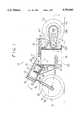
- FIG. 1is a longitudinal sectional side view of a the wheeled vehicle toy constructed in accordance with a first embodiment of the present invention
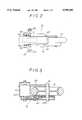
- FIG. 2is a plan view of a central portion of the vehicle toy of FIG. 1;
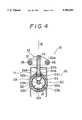
- FIG. 3is an enlarged cross-sectional view taken along the line 3--3 of FIG. 1;
- FIG. 4is an enlarged cross-sectional view taken along the line 4--4 of FIG. 1;
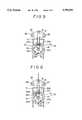
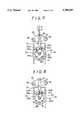
- FIG. 5is a view illustrating the steering system of the first embodiment of the present invention in operation when the vehicle toy travels straight;
- FIG. 6is a view illustrating the steering system of the first embodiment of the present invention when the vehicle toy begins to make a left turn;
- FIG. 7is a view illustrating the steering system of the first embodiment of the present invention during the left turn
- FIG. 8is a view illustrating the steering system of the first embodiment of the present invention when the vehicle toy is in the process of completing the left turn and returning to straightforward travel;
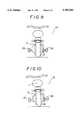
- FIG. 9is a rear view of the vehicle toy corresponding to FIG. 5;
- FIG. 10is a rear view of the vehicle toy corresponding to FIG. 6;
- FIG. 11is a rear view of the vehicle corresponding to FIG. 7;
- FIG. 12is a rear view of the vehicle toy corresponding to FIG. 8;
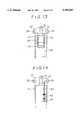
- FIG. 13is a view illustrating a second embodiment of the steering system of the present invention.
- FIG. 14is a view illustrating a third embodiment of the steering system of the present invention.
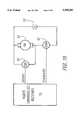
- FIG. 15is a schematic diagram illustrating the forward drive and braking circuitry employed in the vehicle toy of FIG. 1.
- FIGS. 1-4a first embodiment of a wheeled vehicle toy of the present invention
- FIG. 1shows a longitudinal sectional side view of the vehicle toy
- FIG. 2a plan view of the vehicle toy, looking from the rear of the vehicle (right side) of FIG. 1
- FIG. 3an enlarged cross-sectional view of the vehicle toy, taken along the line 3--3 of FIG. 1
- FIG. 4an enlarged cross-sectional view of the vehicle toy, taken along the line 4--4 of FIG. 1.
- a handle bar, a rider, and like partswhich do not relate to the present invention, will be omitted in the following description.
- a preferred embodiment radio-controlled two-wheeled vehicle toy 10 of the present inventioncomprises: a vehicle body frame 11; a front wheel 12 and a rear wheel 13 mounted on a front and a rear portion of the vehicle body frame 11, respectively; a front fork 15 which is rotatable on a caster axle 14 mounted on a front-end portion of the vehicle body frame 11 so as to be tilted backward from the vertical, and rotatably supports the front wheel 12; a steering unit 16 for controlling the front fork 15 in direction; an electric rear-wheel drive 17 coupled with the rear wheel 13 for driving the rear wheel 13; a preferably removable electric power source 18, which might be a single battery of one or more cells or several separate batteries wired and bound together in a pack to act in common; a radio-control receiver 19 for controlling both the steering unit 16 and the rear-wheel drive portion 17; and an auxiliary wheel unit indicated generally at 20 provided with a pair of auxiliary wheels 53 mounted on opposite sides of the vehicle body frame 11, which are brought into contact with the
- the vehicle body frame 11preferably is made of plastics and like light, strong materials, assumes a narrow box-like shape having its front portion tilted slightly upward, and is divided into three sections; a central one for receiving the power source 18 therein; an rear one (which is partially disposed over the central one) for receiving a circuit board of the receiver 19 therein; and a front one (i.e., front portion slightly tilted upward from the remainder of the vehicle body frame 11) for receiving the steering unit 16 therein.
- Projected forward from the front-end portion of the vehicle body frame 11is an arm portion 21 of a casing 33 of the steering unit 16 described later.
- the arm portion 21is integrally formed with the casing 33.
- the caster axle 14is mounted in a front-end portion of the arm portion 21 of the casing 33 so as to be tilted backward from the vertical by an angle of, for example, 30 degrees.
- the electric rear-wheel drive 17is mounted on a lower area of the rear portion of the vehicle body frame 11 through a buffer spring 22 which absorbs shocks caused by irregularities in the road and the like through the rear wheel 13.
- Front wheel 12preferably includes a solid, relatively dense rubber tire 12a, which, by virtue of its heavy weight along the outer edge of the wheel 12, provides a gyroscopic effect when the wheel 12 rotates.
- the gyroscopic effect providedaffords stability and balance to the vehicle toy 10 while it is moving.
- the front fork 15is constructed of a fork holder 23, a pair of parallel springs 24, a pair of parallel outer pipes 25, and a pair of parallel inner shafts 26.
- the fork holder 23is provided with: a shaft-mounting portion 23a for fixedly mounting the inner shafts 26 therein, which portions 23a assumes a substantially-triangular flat plate-like shape; a handle arm portion 23b projecting rearward from a central area of the shaft-mounting portion 23a; and an abutting portion 23c formed in a rear-end area of the handle arm portion 23b.
- the shaft-mounting portion 23a of the fork holder 23has its front-end portion mounted on the caster axle 14 so as to be rotatable thereon.
- the pair of parallel inner shafts 26are fixedly mounted on the opposite rear ends of the shaft-mounting portion 23a so as to be symmetrically arranged with respect to the center line of the shaft-mounting portion 23a.
- Each of the parallel inner shafts 26has its lower portion slidably mounted in each of the parallel outer pipes 25.
- Each of the parallel springs 24is interposed between a lower surface of the shaft-mounting portion 23a of the fork holder 23 and an upper end of each of the parallel outer pipes 25 to absorb shocks caused by irregularities in the road and the like through the front wheel 12.
- each of the outer pipes 25Formed in a lower-end portion of each of the outer pipes 25 is a bearing portion 26a in which the front wheel 12 is rotatably mounted. Consequently, the front fork 15 resiliently supports the front wheel 12 so as to absorb the shocks transmitted through the front wheel 12, is rotatably mounted on the caster axle 14, and receives a control torque for steering the vehicle toy 10 as described later, which torque is produced in the steering unit 16.
- the steering unit 16is provided with a steering mechanism 30 which produces a force which is applied to the front fork 15 as a control torque by the use of which the vehicle toy 10 is remotely controlled in its travel direction.
- the steering mechanism 30is constructed of a ring-like permanent magnet (hereinafter simply referred to as the ring-like magnet) 31 and a magnetic coil 32, which is disposed inside the ring-like magnet 31 and controlled by applications of electric current issued from the receiver 19. Both the ring-like magnet 31 and the magnetic coil 32 are housed in the casing 33 in which is provided a control torque transmission resilient member or means in the form of a torsion spring 34.
- the casing 33is mounted in the front portion of the vehicle body frame 11. Torsion spring 34 provides a resilient coupling between magnetic coil 32 of steering mechanism 30 and the front fork 15 through fork holder 23 resiliently applying the control torque to the front fork 15.
- a central axle 32ais provided in a central portion of a lower area of the magnetic coil 32 to protrude downward, in which lower area an operation pin 32b and a stopper pin 32c are further provided so as to be diametrically opposed to each other in arrangement and protrude downward.
- the ring-like magnet 31has its center axis arranged in parallel with the caster axle 14, and is fixedly mounted in the casing 31.
- the magnetic coil 32has its central axle 32a inserted into a protruding bearing portion 33a of the casing 33 so as to be rotatably mounted in the casing 33. As shown in FIG.
- a pair of stopper portions 33b of the casing 33are symmetrically arranged with respect to a longitudinal center line of the vehicle body frame 11 so as to restrict rotation of the magnetic coil 32 within a predetermined angular range.
- the torsion spring 34which assumes a substantially U-shaped form provided with a left leg portion 34a and a right leg portion 34b, as viewed in FIG. 4.
- the operation pin 32b of the magnetic coil 32is disposed between these leg portions 34a and 34b of the torsion spring 34.
- the arrow Dshows a travel direction of the vehicle toy 10.
- the electric rear-wheel drive 17 of the vehicle toy 10is constructed of: a drive motor 41; a speed-reduction unit 42 constructed of a gear train driven by the drive motor 41; and a drive casing 43 housing both the drive motor 41 and the speed-reduction unit 42 therein.
- the drive casing 43is partitioned into two casing areas 43a, 43b; the first one 43a for housing the drive motor 41 therein; and the second one 43b for housing the speed-reduction unit 42 therein.
- the first casing area 43ais rotatably mounted on the rear portion of the vehicle body frame 11 and resiliently supported by the buffer spring 22, which absorbs shocks caused by irregularities in the road and the like through the rear wheel 13.
- the second casing area 43bextends rearward from the first casing area 43a, as shown in FIG. 1, and rotates with the first casing area 43a.
- a drive shaft 44is provided in a final gear of the speed-reduction unit 42, on which drive shaft 44 the rear wheel 13 is fixedly mounted.
- the drive trainhas 36:10, 36:18, and 56:18 reduction gears to produce a total reduction of 22.4:1.
- the power source 18supplies electric current to each of the receiver 19, drive motor 41, steering mechanism 30 and the like, and is detachably mounted in the central portion of the vehicle body frame 11 through a power source lock unit 45.
- the auxiliary wheel unit 20is provided with the pair of auxiliary wheels 53 which contact the ground when the vehicle toy 10 leans sideward from the vertical by a predetermined angle.
- the auxiliary wheel unit 20is constructed of: a pair of mounting-bracket boss members 51 rotatably mounted on opposite sides of the central portion of the vehicle body frame 11 so as to be disposed in lower areas on the opposite sides thereof, each of which boss members 51 assumes a substantially L-shaped form; a pair of torsion springs 52 each of which resiliently and rotatably supports each of the boss members 51; and the pair of the auxiliary wheels 53 each of which is rotatably mounted on a free-end axle portion of each of the boss members 51.
- the auxiliary wheels 53are arranged to contact the ground when the vehicle toy 10 leans sideward from the vertical by a predetermined angle, for example, by an angle of 30 degrees.
- the wheelsmay be set to contact the ground when the vehicle toy 10 leans sideways from the vertical at a predetermined angle other than 30 degrees and it will be appreciated that the auxiliary wheels could further be mounted to permit selective setting of the angle of the vehicle toy at which the wheels 53 contact the ground.
- each member 51may be mountable to unit 20 in any of a plurality of discrete angular orientations, for example, by being keyed with any of a plurality of angularly arranged slots on unit 20, such that each wheel 53 might be selectively set at a first angle, which permits the easiest control of the vehicle toy, a second angle which permits more vehicle lean but, nevertheless, still permits the auxiliary wheels to support the vehicle toy at least when the toy is at rest, and a third highest angle, with the auxiliary wheel so high that the auxiliary wheel cannot support the vehicle toy while it is at rest.
- FIGS. 5-8show operation of the steering unit 16
- FIGS. 9-12show rear views of the vehicle toy 10 corresponding to the operation of the steering unit 16.
- the receiver 19receives the signal and permits the power source 18 to supply electric current to the drive motor 41 so that the vehicle toy 10 begins to travel. More particularly, and as shown in FIG. 15, it is preferable that the motor 41 be placed in series with a switch 92, that the power source 18 be placed across the motor 41 and switch 92, and that the switch be operable according to a FORWARD signal initiated by the receiver 19. Accordingly, when the receiver 19 causes the FORWARD signal to be applied, the switch 92 closes and the motor 41 is driven by electrical current from the power source 18.
- the radio-control transmitter(not shown) emits a signal for braking the vehicle toy 10
- the receiver 19receives the signal and prohibits the power source 18 from supplying electric current to the drive motor 41 by terminating the FORWARD signal to open the switch 92.
- a switch 91be placed across the motor 41 and that the switch be operable according to a BRAKE signal initiated by the receiver 19. Accordingly, when the receiver 18 causes the BRAKE signal to be applied, the switch 92 closes and the motor 41 is shorted out. As should be understood, the shorted motor causes a back EMF that exerts a drag on the speed-reduction unit 42 and the rear wheel 13 to dynamically brake the vehicle toy 10.
- the BRAKE signalcab be the reverse drive signal of a conventional radio control toy vehicle transmitter (not depicted).
- the switches 91, 92are transistors or the like.
- other switching devicesmay be employed as the switches 91, 92 without departing from the spirit and scope of the present invention.
- such other switching devicesmay include opto-isolators, switching transformers, and the like.
- appropriate circuitry(not shown) is provided with the motor 41 and the switches 91, 92 to condition the FORWARD and BRAKE signals used to control the switches 91, 92 and to condition the application of electric current to the motor 41 by the power source 18.
- the vehicle toy 10has the magnetic coil 32 of the steering mechanism 30 thereof supplied with no electric current, so that the magnetic coil 32 tends to remain stationary to assume the position as shown in FIG. 5 due to the centering forces applied by torsion spring 34 from the front fork.
- the front wheel 12when the vehicle toy 10 leans to the left (for example), the front wheel 12 also leans to the left to produce a force pushing the vehicle body frame 11 to the right due to a so-called caster effect, so that the vehicle toy 10 recovers its balance.
- the front wheelWhen the vehicle toy 10 leans to the right, the front wheel also leans to the right to produce a force pushing the vehicle body frame 11 to the left due to the caster effect, so that the vehicle toy 11 recovers its balance. As a result, the vehicle toy 10 travels in a straight path.
- the vehicle toy 10receives a left-turn signal emitted from the radio-control transmitter (not shown).
- the receiver 19 of the vehicle toy 10issues a signal causing the power source 18 to supply electric current to the magnetic coil 32, so that the magnetic coil 32 turns counterclockwise until its stopper pin 32c abuts against the stopper portion 33b of the casting 33.
- the operation pin 32b of the magnetic coil 32abuts against and applies a force to the left leg portion 34a of the torsion spring 34 to cause the torsion spring 34 to rotate counterclockwise, so that an inner surface of the right leg portion 34b of the torsion spring 34 abuts against the abutting portion 23c of the fork holder 23, where the force is resiliently applied by the spring 34 to the fork holder 23 as a control torque through the holder 23 on the front fork 15.
- the fork holder 23thus is rotated clockwise on the caster axle 14, as shown in FIG. 6.
- the front wheel 12is slightly turned to the right to have the vehicle toy 10 lose its balance, so that the vehicle body frame 11 is subjected to a leftward centrifugal force, whereby the vehicle body frame 11 tends to fall to the left, as shown in FIG. 10.
- the front wheel 12is subjected to a force causing the front wheel 12 to turn to the left on the caster axle 14, so that the vehicle toy 10 leans leftward to make a left turn.
- the fork holder 23rotates counterclockwise on the caster axle 14;
- the torsion spring 34has the inner surface of its left leg portion 34a abut against the operation pin 32b of the magnetic coil 32, and has the inner surface of its right leg portion 34b abut against the abutting portion 23c of the fork holder 23, so that the torsion spring 34 has its leg portions 34a, 34b opened as a whole. Due to the presence of a resilient force exerted by the torsion spring 34, as shown in FIG.
- an actual left-turn angle "b" of the front wheel 12is slightly smaller than an apparent left-turn angle "a" corresponding to both the travel speed and the banking angle of the vehicle toy 10, so that the vehicle body frame 11 is continuously subjected to a force causing the vehicle toy 10 to fall to the left.
- the vehicle toy 10continues its left turn even after the vehicle toy 10 reaches a predetermined banking condition in which its auxiliary wheels 53 are brought into contact with the ground as shown in FIG. 11.
- the radio-control transmitter(not shown) emits a signal for preventing the vehicle toy 10 from continuing the turn.
- the receiver 19issues a signal for preventing the power source 18 from supplying the electric current to the magnetic coil 32 of the steering mechanism 30 so that the displacement force produced by the magnetic coil 32 is removed, as shown in FIG. 8, to permit the torsion spring 34 to return to its initial position, whereby the abutting portion 23c of the fork holder 23 is free from any external force.
- a right-turn signalis emitted by the radio-control transmitter (not shown).
- the receiver 19issues a signal permitting the magnetic coil 32 to turn clockwise, so that the vehicle toy 10 makes the right turn in the same way as described above.
- the auxiliary wheel unit 20prevents the vehicle toy 10 from falling on the ground, and further permits the vehicle toy 10 to begin moving from a stationary condition.
- the torsion springs 52(shown in FIG. 2), which serve as buffers, are provided for absorbing shocks caused by irregularities in the road and the like through the auxiliary wheels 53 (also shown in FIG. 2).
- the vehicle toy 10makes turns by the use of the steering system of the present invention, it suffices to apply a small control torque to the fork holder 23 of the vehicle toy 10 so as to have the vehicle toy 10 slightly lose its balance during its straight travel. Consequently, in making turns, the vehicle toy 10 does not require a large control torque, which permits the vehicle toy 10 to use an electromagnet and like elements as its force generator. Further, in the vehicle toy 10 of the present invention, in making turns, since the vehicle toy 10 slightly loses its balance intentionally to produce and utilize a force having the vehicle toy 10 fall on the ground, it is possible to considerably improve the response of the steering system of the present invention.
- FIG. 13shows a second embodiment of the steering unit of the present invention
- FIG. 14shows a third embodiment of the steering unit of the present invention.
- parts similar to those of the first embodiment of the present inventionare denoted by the same reference numerals and characters as those used in the first embodiment.
- the ring-like magnet 31 and the magnetic coil 32serve as the steering mechanism 30 which produces the control force and the torsion spring 34 resiliently transmits or applies the control force to the front fork as a control torque.
- the steering mechanismis constructed as a servo-motor 151 which produces the control force, and a pair of tension coil springs 152 are used as resilient members or means in place of the torsion spring 34 of the first embodiment to transmit the force and apply it to the front fork as a control torque.
- the tension coil springs 152are mounted between opposite ends of a swingable arm 153 and a pair of symmetrical positions of the fork holder 23', which positions are symmetrical with respect to a center line of the fork holder 23' passing through the caster axle 14 to resiliently couple the swingable arm 153 of the steering mechanism and fork 15 through fork holder 23'.
- the swingable arm 153 of the servo-motor 151in making a left turn, is rotated clockwise to have the front wheel 12 turn slightly to the right to upset the balance of the vehicle and subject the vehicle to a leftward centrifugal force, causing the vehicle to fall to the left and generating a force causing the front wheel to then turn to the left as before.
- an actual left-turn angle "b"shown in FIG.
- the torsion spring 34 of the first embodimentis replaced with an assembly of a solenoid 61 and a magnet 62.
- An operation rod 63has one of its opposite ends connected with the magnet 62 and the other connected with a portion of the fork holder 23".
- electric currentis applied to the solenoid 61 so as to have the solenoid 61 attract or repel the magnet 62, whereby the fork holder 23" is rotated on the caster axle 14. Due to the presence of such attracting or repelling force exerted by the assembly 61, 62 in place of the torsion spring 34, an actual left-turn angle "b" (shown in FIG.
- the magnetic coupling between magnet 62 and solenoid 61also provides a direct resilient coupling between the steering mechanism which produces the force applied as the control torque to the front fork through fork holder 23".
- a servo-mechanismin the front portion of the vehicle body frame.
- the servo-mechanismproduces the force which is resiliently applied to the front fork of the vehicle toy as a control torque to resiliently control the front fork in rotation. Consequently, during the straight travel, when the vehicle toy tends to fall to the left, the front wheel leans to the left to produce a force pushing the vehicle body frame to the right. In contrast with this, when the vehicle toy tends to fall to the right, the front wheel leans to the right to produce a force pushing the vehicle body frame to the left. As a result, the vehicle toy recovers its balance during the straight travel.
- the vehicle toy of the present inventionis excellent in responsiveness of operation.
- the steering system of the present inventionis small in the number of its components, easy in its assembly operations, and low in manufacturing costs and relatively light in weight. Reduced weight increases battery life, improves acceleration and steering responsiveness, reduces braking load and distance and reduces material and shipping costs. Simplicity should improve reliability and make the steering system more affordable in lower cost toys.
- the steering inventioncould be applied to a three-wheeled vehicle such as a motorcycle with sidecar, preferably one with a flexible coupling to the mainframe of the motorcycle to permit the frame to lean to either side at least slightly.
- a tricycle-type motorcyclemight be employed with a single front steering wheel and a pair of rear driven roadwheels.
- the framewould be pivotally mounted to a rear wheel assembly including the rear wheels and the rear wheel drive unit so that the frame could pitch to either lateral side while connected with the rear drive unit.
- a four-wheeled vehiclemight be provided by effectively pivotally coupling together, side by side, a pair of two-wheeled vehicles in a way which would again permit the main portions of the vehicle frames carrying the front wheels to pitch to either side by a pivotal coupling of the front wheels and frame(s) supporting the front wheels with a remaining rear drive portion of the vehicle, which would typically include at least two road wheels always in contact with the ground.
- auxiliary wheel unit 20having a pair of auxiliary wheels 53
- auxiliary wheeled unitseach with a single auxiliary wheel could be provided on either side of the vehicle body frame 11 so as to provide a cavity within the frame between the units, for example, to accommodate a larger power supply or other components within the frame.
- auxiliary wheelsare depicted as being parallel to the frame 11 and upright, it may be desirable to pitch the wheels 53 from the vertical by an amount equal to the pitch of the vehicle 10 from the vertical (e.g. 30°) when the auxiliary wheels come into contact with the ground so that the wheels 53 are perpendicular to a level, horizontal surface on which the toy vehicle is supported when it is pitched over onto the auxiliary wheel.
- the rear-wheel driveis described as including a speed reduction unit 42 coupled to the rear wheel 13 by means of a drive shaft 44, it will be apparent that the final gear of the reduction drive unit 42 could be formed or coupled directly with the rear wheel 13 to rotate with the wheel on a common axle provided where drive shaft 44 was provided. It further will be apparent that the gear-type speed-reduction unit 42 could also be driven in a reverse direction, if desired, and that a conventional reverse drive control could be provided in the vehicle unit to respond to the "BRAKE" signal or an equivalent to reverse the direction of current supply to the motor, rather than shorting out the motor, to positively drive the rear wheel in a reverse direction for slowing or stopping.
- some hand controllersgenerate two separate forward direction signals, a conventional forward signal and a "TURBO" forward signal. This is typically accomplished by providing two separate contacts along the path of travel of the actuator generating the forward control signal to generate either of two separate forward control signals.
- the motor in the toy vehiclemay be intermittently powered on a duty cycle. When the TURBO signal is received, the motor may be powered continuously.
- a coilcould be located directly on or over castor axle 14 to act directly upon the axle 14 or some portion of that axle as in a solenoid or that the axle 14 may be provided with an appropriate winding to act directly upon a surrounding ring-like magnet like the second and first embodiments, respectively.
- a resilient magnetic couplingwould be generated between the two to apply a control torque directly but resiliently to the front fork.
- a torsion spring couplingcould also be provided if it is undesirable to operate magnetically directly on the castor axle 14.
Landscapes
- Toys (AREA)
Abstract
Description
1. Field of the Invention
The present invention relates to a steering system for a radio-controlled wheeled vehicle toy, and more particularly to a steering system particularly suited to a radio-controlled wheeled vehicle toy remotely controlled in travel direction.
2. Description of the Prior Art
Conventional steering systems of the remotely-controlled wheeled vehicle toys are generally classified into two well-known types: one of which causes a front fork portion of the vehicle toy to turn right and left so that the center of gravity of the vehicle toy is displaced; and the other of which types causes a predetermined weight element (for example, such as an electric power unit and the like mounted to a body of the vehicle toy) to swing right and left so that the center of gravity of the vehicle toy is displaced.
However, the conventional steering systems having the above constructions present certain difficult problems. The wheeled vehicle toy, which is provided with any one of the conventional steering systems having the above constructions, depends on the displacement of the center of gravity of the vehicle toy when the vehicle toy makes turns. On the other hand when the vehicle toy travels at high speed, the vehicle toy is subjected to a large force to keep the course of the vehicle toy straight, which force acts adversely on a turning effort of the vehicle toy to seriously impair the vehicle toy in maneuverability.
In addition, any one of the conventional steering systems having the above constructions requires a large force to realize the displacement of the center of gravity of the vehicle toy in making turns, and therefore requires a servo-mechanism comprising a motor, reduction gears and an electric circuit for controlling a steering angle of the vehicle toy, which increases the manufacturing cost and typically the weight of the steering system of the vehicle toy.
It is an object of the present invention to provide a steering system of a radio-controlled wheeled vehicle toy, which is small in the number of its parts, easy in assembly operations thereof and excellent in maneuverability. More particularly, in one aspect the present invention is embodied by a generally longitudinal vehicle body frame, a caster axle mounted on a front end of the vehicle body frame and tilted backward from vertical, a front fork rotatable on the caster axle and rotatably supporting a front wheel, a rear-wheel drive drivingly coupled with a rear wheel, a radio-control receiver and an electric power source mounted to the vehicle body frame, and auxiliary wheels mounted on opposite sides of the vehicle body frame so as to be brought into contact with the ground when the vehicle body frame leans laterally. A steering system is mounted in a front-end portion of the vehicle body frame. The steering system has a steering mechanism which produces a control torque for rotating the front fork based on a control signal issued from the receiver, and a resilient mechanism to resiliently transmit the control torque to the front fork.
In another aspect, the invention is a radio-controlled, wheeled vehicle toy comprising: a vehicle body frame; a radio-control receiver and an electric power source both mounted to the vehicle body frame; at least two vehicle wheels rotatably supported by the vehicle body frame; a motor; a rotational coupling between the motor and at least one of the vehicle wheels; and a switch positioned across the motor and operable according to a signal initiated by the receiver, the signal closing the switch and shorting the motor, the shorted motor exerting a drag on the linkage and the at least one of the vehicle wheels to effectively brake the vehicle toy.
In yet another aspect, the invention is a radio-controlled wheeled vehicle toy comprising: a generally longitudinal vehicle body frame; a caster axle mounted on a front end of the vehicle body frame and tilted backward from vertical; a front fork rotatable on the caster axle and rotatably supporting a front vehicle wheel; an electric drive coupled with a rear vehicle wheel; a radio-control receiver and an electric power source both mounted to the vehicle body frame; and a steering system mounted in a front-end portion of the vehicle body frame and having: a steering mechanism which produces a control torque based on a control signal issued from the receiver; and a resilient coupling between the steering mechanism and the front fork.
The foregoing summary, as well as the following detailed description of preferred embodiments of the invention, will be better understood when read in conjunction with the appended drawings. For the purpose of illustrating the invention, there is shown in the drawings embodiments which are presently preferred. It should be understood, however, that the invention is not limited to the precise arrangements and instrumentalities shown. In the drawings:
FIG. 1 is a longitudinal sectional side view of a the wheeled vehicle toy constructed in accordance with a first embodiment of the present invention;
FIG. 2 is a plan view of a central portion of the vehicle toy of FIG. 1;
FIG. 3 is an enlarged cross-sectional view taken along the line 3--3 of FIG. 1;
FIG. 4 is an enlarged cross-sectional view taken along the line 4--4 of FIG. 1;
FIG. 5 is a view illustrating the steering system of the first embodiment of the present invention in operation when the vehicle toy travels straight;
FIG. 6 is a view illustrating the steering system of the first embodiment of the present invention when the vehicle toy begins to make a left turn;
FIG. 7 is a view illustrating the steering system of the first embodiment of the present invention during the left turn;
FIG. 8 is a view illustrating the steering system of the first embodiment of the present invention when the vehicle toy is in the process of completing the left turn and returning to straightforward travel;
FIG. 9 is a rear view of the vehicle toy corresponding to FIG. 5;
FIG. 10 is a rear view of the vehicle toy corresponding to FIG. 6;
FIG. 11 is a rear view of the vehicle corresponding to FIG. 7;
FIG. 12 is a rear view of the vehicle toy corresponding to FIG. 8;
FIG. 13 is a view illustrating a second embodiment of the steering system of the present invention;
FIG. 14 is a view illustrating a third embodiment of the steering system of the present invention; and
FIG. 15 is a schematic diagram illustrating the forward drive and braking circuitry employed in the vehicle toy of FIG. 1.
Certain terminology may be used in the following description for convenience only and is not limiting. For example, the words "left", "right", "upper", and "lower" designate directions in the drawings to which reference is made, and the words "inwardly" and "outwardly" are further directions toward and away from, respectively, the geometric center of a referenced object. The terminology includes the words above specifically mentioned, derivatives thereof, and words of similar import.
Referring to the drawings in detail, wherein like numerals are used to indicate like elements throughout, there is shown in FIGS. 1-4 a first embodiment of a wheeled vehicle toy of the present invention, wherein FIG. 1 shows a longitudinal sectional side view of the vehicle toy; FIG. 2 a plan view of the vehicle toy, looking from the rear of the vehicle (right side) of FIG. 1; FIG. 3 an enlarged cross-sectional view of the vehicle toy, taken along the line 3--3 of FIG. 1; and FIG. 4 an enlarged cross-sectional view of the vehicle toy, taken along the line 4--4 of FIG. 1. Incidentally, a handle bar, a rider, and like parts, which do not relate to the present invention, will be omitted in the following description.
As shown in FIG. 1, a preferred embodiment radio-controlled two-wheeled vehicle toy 10 of the present invention comprises: avehicle body frame 11; a front wheel 12 and arear wheel 13 mounted on a front and a rear portion of thevehicle body frame 11, respectively; afront fork 15 which is rotatable on acaster axle 14 mounted on a front-end portion of thevehicle body frame 11 so as to be tilted backward from the vertical, and rotatably supports the front wheel 12; asteering unit 16 for controlling thefront fork 15 in direction; an electric rear-wheel drive 17 coupled with therear wheel 13 for driving therear wheel 13; a preferably removableelectric power source 18, which might be a single battery of one or more cells or several separate batteries wired and bound together in a pack to act in common; a radio-control receiver 19 for controlling both thesteering unit 16 and the rear-wheel drive portion 17; and an auxiliary wheel unit indicated generally at 20 provided with a pair ofauxiliary wheels 53 mounted on opposite sides of thevehicle body frame 11, which are brought into contact with the ground when thevehicle body frame 11 leans sideways from the vertical by a predetermined angle.
Thevehicle body frame 11 preferably is made of plastics and like light, strong materials, assumes a narrow box-like shape having its front portion tilted slightly upward, and is divided into three sections; a central one for receiving thepower source 18 therein; an rear one (which is partially disposed over the central one) for receiving a circuit board of thereceiver 19 therein; and a front one (i.e., front portion slightly tilted upward from the remainder of the vehicle body frame 11) for receiving thesteering unit 16 therein. Projected forward from the front-end portion of thevehicle body frame 11 is anarm portion 21 of acasing 33 of thesteering unit 16 described later. Thearm portion 21 is integrally formed with thecasing 33. Thecaster axle 14 is mounted in a front-end portion of thearm portion 21 of thecasing 33 so as to be tilted backward from the vertical by an angle of, for example, 30 degrees. The electric rear-wheel drive 17 is mounted on a lower area of the rear portion of thevehicle body frame 11 through a buffer spring 22 which absorbs shocks caused by irregularities in the road and the like through therear wheel 13.
Front wheel 12 preferably includes a solid, relativelydense rubber tire 12a, which, by virtue of its heavy weight along the outer edge of the wheel 12, provides a gyroscopic effect when the wheel 12 rotates. As may be understood, the gyroscopic effect provided affords stability and balance to thevehicle toy 10 while it is moving.
As is clear from FIG. 1, thefront fork 15 is constructed of afork holder 23, a pair ofparallel springs 24, a pair of parallelouter pipes 25, and a pair of parallelinner shafts 26. As shown in FIG. 4, thefork holder 23 is provided with: a shaft-mounting portion 23a for fixedly mounting theinner shafts 26 therein, which portions 23a assumes a substantially-triangular flat plate-like shape; ahandle arm portion 23b projecting rearward from a central area of the shaft-mounting portion 23a; and anabutting portion 23c formed in a rear-end area of thehandle arm portion 23b. The shaft-mounting portion 23a of thefork holder 23 has its front-end portion mounted on thecaster axle 14 so as to be rotatable thereon. The pair of parallelinner shafts 26 are fixedly mounted on the opposite rear ends of the shaft-mounting portion 23a so as to be symmetrically arranged with respect to the center line of the shaft-mounting portion 23a. Each of the parallelinner shafts 26 has its lower portion slidably mounted in each of the parallelouter pipes 25. Each of theparallel springs 24 is interposed between a lower surface of the shaft-mounting portion 23a of thefork holder 23 and an upper end of each of the parallelouter pipes 25 to absorb shocks caused by irregularities in the road and the like through the front wheel 12. Formed in a lower-end portion of each of theouter pipes 25 is a bearing portion 26a in which the front wheel 12 is rotatably mounted. Consequently, thefront fork 15 resiliently supports the front wheel 12 so as to absorb the shocks transmitted through the front wheel 12, is rotatably mounted on thecaster axle 14, and receives a control torque for steering thevehicle toy 10 as described later, which torque is produced in thesteering unit 16.
Thesteering unit 16 is provided with asteering mechanism 30 which produces a force which is applied to thefront fork 15 as a control torque by the use of which thevehicle toy 10 is remotely controlled in its travel direction. Thesteering mechanism 30 is constructed of a ring-like permanent magnet (hereinafter simply referred to as the ring-like magnet) 31 and amagnetic coil 32, which is disposed inside the ring-like magnet 31 and controlled by applications of electric current issued from thereceiver 19. Both the ring-like magnet 31 and themagnetic coil 32 are housed in thecasing 33 in which is provided a control torque transmission resilient member or means in the form of atorsion spring 34. Thecasing 33 is mounted in the front portion of thevehicle body frame 11. Torsionspring 34 provides a resilient coupling betweenmagnetic coil 32 ofsteering mechanism 30 and thefront fork 15 throughfork holder 23 resiliently applying the control torque to thefront fork 15.
Acentral axle 32a is provided in a central portion of a lower area of themagnetic coil 32 to protrude downward, in which lower area anoperation pin 32b and astopper pin 32c are further provided so as to be diametrically opposed to each other in arrangement and protrude downward. The ring-like magnet 31 has its center axis arranged in parallel with thecaster axle 14, and is fixedly mounted in thecasing 31. Themagnetic coil 32 has itscentral axle 32a inserted into a protrudingbearing portion 33a of thecasing 33 so as to be rotatably mounted in thecasing 33. As shown in FIG. 6, a pair ofstopper portions 33b of thecasing 33 are symmetrically arranged with respect to a longitudinal center line of thevehicle body frame 11 so as to restrict rotation of themagnetic coil 32 within a predetermined angular range. Further mounted on the bearingportion 33a of thecasing 33 is thetorsion spring 34 which assumes a substantially U-shaped form provided with aleft leg portion 34a and aright leg portion 34b, as viewed in FIG. 4. Theoperation pin 32b of themagnetic coil 32 is disposed between theseleg portions torsion spring 34. Also disposed between theseleg portions torsion spring 34 is the abuttingportion 23c of thefork holder 23, which engages with front areas of theseleg portions vehicle toy 10.
As shown in FIGS. 1 and 3, the electric rear-wheel drive 17 of thevehicle toy 10 is constructed of: adrive motor 41; a speed-reduction unit 42 constructed of a gear train driven by thedrive motor 41; and adrive casing 43 housing both thedrive motor 41 and the speed-reduction unit 42 therein. Thedrive casing 43 is partitioned into twocasing areas drive motor 41 therein; and the second one 43b for housing the speed-reduction unit 42 therein. Thefirst casing area 43a is rotatably mounted on the rear portion of thevehicle body frame 11 and resiliently supported by the buffer spring 22, which absorbs shocks caused by irregularities in the road and the like through therear wheel 13. Thesecond casing area 43b extends rearward from thefirst casing area 43a, as shown in FIG. 1, and rotates with thefirst casing area 43a. Adrive shaft 44 is provided in a final gear of the speed-reduction unit 42, on which driveshaft 44 therear wheel 13 is fixedly mounted. In a presently contemplated embodiment, the drive train has 36:10, 36:18, and 56:18 reduction gears to produce a total reduction of 22.4:1.
As seen in FIG. 1, thepower source 18 supplies electric current to each of thereceiver 19, drivemotor 41,steering mechanism 30 and the like, and is detachably mounted in the central portion of thevehicle body frame 11 through a powersource lock unit 45.
As seen in FIGS. 1 and 2, theauxiliary wheel unit 20 is provided with the pair ofauxiliary wheels 53 which contact the ground when thevehicle toy 10 leans sideward from the vertical by a predetermined angle. Namely, theauxiliary wheel unit 20 is constructed of: a pair of mounting-bracket boss members 51 rotatably mounted on opposite sides of the central portion of thevehicle body frame 11 so as to be disposed in lower areas on the opposite sides thereof, each of whichboss members 51 assumes a substantially L-shaped form; a pair of torsion springs 52 each of which resiliently and rotatably supports each of theboss members 51; and the pair of theauxiliary wheels 53 each of which is rotatably mounted on a free-end axle portion of each of theboss members 51. Preferably, theauxiliary wheels 53 are arranged to contact the ground when thevehicle toy 10 leans sideward from the vertical by a predetermined angle, for example, by an angle of 30 degrees. The wheels may be set to contact the ground when thevehicle toy 10 leans sideways from the vertical at a predetermined angle other than 30 degrees and it will be appreciated that the auxiliary wheels could further be mounted to permit selective setting of the angle of the vehicle toy at which thewheels 53 contact the ground. For example, eachmember 51 may be mountable tounit 20 in any of a plurality of discrete angular orientations, for example, by being keyed with any of a plurality of angularly arranged slots onunit 20, such that eachwheel 53 might be selectively set at a first angle, which permits the easiest control of the vehicle toy, a second angle which permits more vehicle lean but, nevertheless, still permits the auxiliary wheels to support the vehicle toy at least when the toy is at rest, and a third highest angle, with the auxiliary wheel so high that the auxiliary wheel cannot support the vehicle toy while it is at rest.
Now, operation of thevehicle toy 10 of the present invention will be described with reference to the drawings in which FIGS. 5-8 show operation of thesteering unit 16 and FIGS. 9-12 show rear views of thevehicle toy 10 corresponding to the operation of thesteering unit 16.
When a radio-control transmitter (conventional and not shown) emits a signal for actuating thedrive motor 41, thereceiver 19 receives the signal and permits thepower source 18 to supply electric current to thedrive motor 41 so that thevehicle toy 10 begins to travel. More particularly, and as shown in FIG. 15, it is preferable that themotor 41 be placed in series with aswitch 92, that thepower source 18 be placed across themotor 41 andswitch 92, and that the switch be operable according to a FORWARD signal initiated by thereceiver 19. Accordingly, when thereceiver 19 causes the FORWARD signal to be applied, theswitch 92 closes and themotor 41 is driven by electrical current from thepower source 18.
Likewise, when the radio-control transmitter (not shown) emits a signal for braking thevehicle toy 10, thereceiver 19 receives the signal and prohibits thepower source 18 from supplying electric current to thedrive motor 41 by terminating the FORWARD signal to open theswitch 92. In addition, and as shown in FIG. 15, it is also preferable that aswitch 91 be placed across themotor 41 and that the switch be operable according to a BRAKE signal initiated by thereceiver 19. Accordingly, when thereceiver 18 causes the BRAKE signal to be applied, theswitch 92 closes and themotor 41 is shorted out. As should be understood, the shorted motor causes a back EMF that exerts a drag on the speed-reduction unit 42 and therear wheel 13 to dynamically brake thevehicle toy 10. It will be appreciated that the BRAKE signal cab be the reverse drive signal of a conventional radio control toy vehicle transmitter (not depicted).
Preferably, theswitches switches motor 41 and theswitches switches motor 41 by thepower source 18.
The operation of thetoy vehicle 10 during travel will now be described. To keep thetoy vehicle 10 traveling on a straight course, thevehicle toy 10 has themagnetic coil 32 of thesteering mechanism 30 thereof supplied with no electric current, so that themagnetic coil 32 tends to remain stationary to assume the position as shown in FIG. 5 due to the centering forces applied bytorsion spring 34 from the front fork. In this condition, when thevehicle toy 10 leans to the left (for example), the front wheel 12 also leans to the left to produce a force pushing thevehicle body frame 11 to the right due to a so-called caster effect, so that thevehicle toy 10 recovers its balance. When thevehicle toy 10 leans to the right, the front wheel also leans to the right to produce a force pushing thevehicle body frame 11 to the left due to the caster effect, so that thevehicle toy 11 recovers its balance. As a result, thevehicle toy 10 travels in a straight path.
In making a left turn, thevehicle toy 10 receives a left-turn signal emitted from the radio-control transmitter (not shown). As a result, thereceiver 19 of thevehicle toy 10 issues a signal causing thepower source 18 to supply electric current to themagnetic coil 32, so that themagnetic coil 32 turns counterclockwise until itsstopper pin 32c abuts against thestopper portion 33b of the casting 33. As a result, theoperation pin 32b of themagnetic coil 32 abuts against and applies a force to theleft leg portion 34a of thetorsion spring 34 to cause thetorsion spring 34 to rotate counterclockwise, so that an inner surface of theright leg portion 34b of thetorsion spring 34 abuts against the abuttingportion 23c of thefork holder 23, where the force is resiliently applied by thespring 34 to thefork holder 23 as a control torque through theholder 23 on thefront fork 15. Thefork holder 23 thus is rotated clockwise on thecaster axle 14, as shown in FIG. 6. As a result, the front wheel 12 is slightly turned to the right to have thevehicle toy 10 lose its balance, so that thevehicle body frame 11 is subjected to a leftward centrifugal force, whereby thevehicle body frame 11 tends to fall to the left, as shown in FIG. 10.
As a result, the front wheel 12 is subjected to a force causing the front wheel 12 to turn to the left on thecaster axle 14, so that thevehicle toy 10 leans leftward to make a left turn. In this condition, as shown in FIG. 7: thefork holder 23 rotates counterclockwise on thecaster axle 14; thetorsion spring 34 has the inner surface of itsleft leg portion 34a abut against theoperation pin 32b of themagnetic coil 32, and has the inner surface of itsright leg portion 34b abut against the abuttingportion 23c of thefork holder 23, so that thetorsion spring 34 has itsleg portions torsion spring 34, as shown in FIG. 7, an actual left-turn angle "b" of the front wheel 12 is slightly smaller than an apparent left-turn angle "a" corresponding to both the travel speed and the banking angle of thevehicle toy 10, so that thevehicle body frame 11 is continuously subjected to a force causing thevehicle toy 10 to fall to the left. As a result, thevehicle toy 10 continues its left turn even after thevehicle toy 10 reaches a predetermined banking condition in which itsauxiliary wheels 53 are brought into contact with the ground as shown in FIG. 11.
To return thevehicle toy 10 to travel in a straight path, the radio-control transmitter (not shown) emits a signal for preventing thevehicle toy 10 from continuing the turn. Upon receipt of the above signal, thereceiver 19 issues a signal for preventing thepower source 18 from supplying the electric current to themagnetic coil 32 of thesteering mechanism 30 so that the displacement force produced by themagnetic coil 32 is removed, as shown in FIG. 8, to permit thetorsion spring 34 to return to its initial position, whereby the abuttingportion 23c of thefork holder 23 is free from any external force. Consequently, since the force, which is exerted by thetorsion spring 34 to have the actual angle "be" be smaller than the apparent angle "a", is removed, it is possible for thefork holder 23 to freely turn on thecaster axle 14 so as to have the apparent angle "a" corresponding to the travel speed and the banking angle of thevehicle toy 10. Further, due to the caster effect, thevehicle toy 10 is subjected to a recovering force indicated by the arrow in FIG. 12 to return to its straight travel, as shown in FIG. 9.
In making a right turn, a right-turn signal is emitted by the radio-control transmitter (not shown). When the signal is received by thereceiver 19, thereceiver 19 issues a signal permitting themagnetic coil 32 to turn clockwise, so that thevehicle toy 10 makes the right turn in the same way as described above.
As shown in FIG. 11, theauxiliary wheel unit 20 prevents thevehicle toy 10 from falling on the ground, and further permits thevehicle toy 10 to begin moving from a stationary condition. The torsion springs 52 (shown in FIG. 2), which serve as buffers, are provided for absorbing shocks caused by irregularities in the road and the like through the auxiliary wheels 53 (also shown in FIG. 2).
As described above, when thevehicle toy 10 makes turns by the use of the steering system of the present invention, it suffices to apply a small control torque to thefork holder 23 of thevehicle toy 10 so as to have thevehicle toy 10 slightly lose its balance during its straight travel. Consequently, in making turns, thevehicle toy 10 does not require a large control torque, which permits thevehicle toy 10 to use an electromagnet and like elements as its force generator. Further, in thevehicle toy 10 of the present invention, in making turns, since thevehicle toy 10 slightly loses its balance intentionally to produce and utilize a force having thevehicle toy 10 fall on the ground, it is possible to considerably improve the response of the steering system of the present invention.
FIG. 13 shows a second embodiment of the steering unit of the present invention, and FIG. 14 shows a third embodiment of the steering unit of the present invention. Incidentally, in any of the second and the third embodiment of the steering unit of the present invention, parts similar to those of the first embodiment of the present invention are denoted by the same reference numerals and characters as those used in the first embodiment.
In the first embodiment of the present invention, the ring-like magnet 31 and themagnetic coil 32 serve as thesteering mechanism 30 which produces the control force and thetorsion spring 34 resiliently transmits or applies the control force to the front fork as a control torque. In contrast, in the second embodiment of the present invention, as shown in FIG. 13, the steering mechanism is constructed as a servo-motor 151 which produces the control force, and a pair of tension coil springs 152 are used as resilient members or means in place of thetorsion spring 34 of the first embodiment to transmit the force and apply it to the front fork as a control torque. More particularly, the tension coil springs 152 are mounted between opposite ends of aswingable arm 153 and a pair of symmetrical positions of the fork holder 23', which positions are symmetrical with respect to a center line of the fork holder 23' passing through thecaster axle 14 to resiliently couple theswingable arm 153 of the steering mechanism and fork 15 through fork holder 23'. In the second embodiment of the present invention having the above construction, in making a left turn, theswingable arm 153 of the servo-motor 151 is rotated clockwise to have the front wheel 12 turn slightly to the right to upset the balance of the vehicle and subject the vehicle to a leftward centrifugal force, causing the vehicle to fall to the left and generating a force causing the front wheel to then turn to the left as before. At this time, due to the presence of a resilient force exerted by one of the tension coil springs 152, as already described with reference to FIG. 7 in the first embodiment, an actual left-turn angle "b" (shown in FIG. 7) of the front wheel 12 is slightly smaller than an apparent left-turn angle "a" corresponding to both the travel speed and the banking angle of thevehicle toy 10 to fall to the left. As a result, thevehicle toy 10 continues its left turn as in the case of the first embodiment of the present invention. To return thevehicle toy 10 to its straight travel, the servo-motor 151 is powered back to its original "neutral" position, whereby thevehicle toy 10 returns to its straight travel (as shown in FIG. 9).
In the third embodiment of the present invention, as shown in FIG. 14, thetorsion spring 34 of the first embodiment is replaced with an assembly of asolenoid 61 and amagnet 62. Anoperation rod 63 has one of its opposite ends connected with themagnet 62 and the other connected with a portion of thefork holder 23". In operation, electric current is applied to thesolenoid 61 so as to have thesolenoid 61 attract or repel themagnet 62, whereby thefork holder 23" is rotated on thecaster axle 14. Due to the presence of such attracting or repelling force exerted by theassembly torsion spring 34, an actual left-turn angle "b" (shown in FIG. 7) of the front wheel 12 is slightly smaller than an apparent left-turn angle "a" corresponding to both the travel speed and the banking angle of thevehicle toy 10, so that thevehicle body frame 11 is continuously subjected to a force causing thevehicle toy 10 to fall to the left. As a result, thevehicle toy 10 continues its left turn as is in the case of the first embodiment of the present invention. The magnetic coupling betweenmagnet 62 andsolenoid 61 also provides a direct resilient coupling between the steering mechanism which produces the force applied as the control torque to the front fork throughfork holder 23".
In each of the above embodiments of the present invention, it is possible to use any of the ring-like magnet, electromagnet, servo-motor, or the assembly thereof. Of course, it should be understood that one skilled in the art could accomplish modifications within the scope of the present invention, and accordingly the present invention should be measured from the following claims.
As described above, as for the steering system of the wheeled vehicle toy of the present invention, there is provided a servo-mechanism in the front portion of the vehicle body frame. The servo-mechanism produces the force which is resiliently applied to the front fork of the vehicle toy as a control torque to resiliently control the front fork in rotation. Consequently, during the straight travel, when the vehicle toy tends to fall to the left, the front wheel leans to the left to produce a force pushing the vehicle body frame to the right. In contrast with this, when the vehicle toy tends to fall to the right, the front wheel leans to the right to produce a force pushing the vehicle body frame to the left. As a result, the vehicle toy recovers its balance during the straight travel. In making turns, it suffices to apply a small control torque to the fork holder of the vehicle toy to have the toy slightly lose its balance during the straight travel, which permits an electromagnet to serve as the prime mover of the steering system of the present invention. Further, in making turns, since the vehicle toy utilizes the force having the toy lose its balance, the vehicle toy of the present invention is excellent in responsiveness of operation. As is clear from the above, the steering system of the present invention is small in the number of its components, easy in its assembly operations, and low in manufacturing costs and relatively light in weight. Reduced weight increases battery life, improves acceleration and steering responsiveness, reduces braking load and distance and reduces material and shipping costs. Simplicity should improve reliability and make the steering system more affordable in lower cost toys.
While the preferred embodiment of the present invention is described in terms of a two-wheeled remotely controlled toy vehicle, it will be appreciated that aspects of the invention could be applied to vehicles of three or more wheels. In particular, the steering invention could be applied to a three-wheeled vehicle such as a motorcycle with sidecar, preferably one with a flexible coupling to the mainframe of the motorcycle to permit the frame to lean to either side at least slightly. Alternatively, a tricycle-type motorcycle might be employed with a single front steering wheel and a pair of rear driven roadwheels. Preferably, the frame would be pivotally mounted to a rear wheel assembly including the rear wheels and the rear wheel drive unit so that the frame could pitch to either lateral side while connected with the rear drive unit. Also, it is not inconceivable that a four-wheeled vehicle might be provided by effectively pivotally coupling together, side by side, a pair of two-wheeled vehicles in a way which would again permit the main portions of the vehicle frames carrying the front wheels to pitch to either side by a pivotal coupling of the front wheels and frame(s) supporting the front wheels with a remaining rear drive portion of the vehicle, which would typically include at least two road wheels always in contact with the ground.
Other changes to the details of the disclosed preferred embodiment wheeledvehicle 10 will be apparent. For example, although a singleauxiliary wheel unit 20 having a pair ofauxiliary wheels 53 is disclosed, a pair of mirror image auxiliary wheeled units, each with a single auxiliary wheel could be provided on either side of thevehicle body frame 11 so as to provide a cavity within the frame between the units, for example, to accommodate a larger power supply or other components within the frame. Also, although auxiliary wheels are depicted as being parallel to theframe 11 and upright, it may be desirable to pitch thewheels 53 from the vertical by an amount equal to the pitch of thevehicle 10 from the vertical (e.g. 30°) when the auxiliary wheels come into contact with the ground so that thewheels 53 are perpendicular to a level, horizontal surface on which the toy vehicle is supported when it is pitched over onto the auxiliary wheel.
While the rear-wheel drive is described as including aspeed reduction unit 42 coupled to therear wheel 13 by means of adrive shaft 44, it will be apparent that the final gear of thereduction drive unit 42 could be formed or coupled directly with therear wheel 13 to rotate with the wheel on a common axle provided wheredrive shaft 44 was provided. It further will be apparent that the gear-type speed-reduction unit 42 could also be driven in a reverse direction, if desired, and that a conventional reverse drive control could be provided in the vehicle unit to respond to the "BRAKE" signal or an equivalent to reverse the direction of current supply to the motor, rather than shorting out the motor, to positively drive the rear wheel in a reverse direction for slowing or stopping. It will further be appreciated that other types of control enhancements used with other radio control wheeled vehicles could similarly be applied to the preferred embodiment wheeled vehicle disclosed. For example, some hand controllers generate two separate forward direction signals, a conventional forward signal and a "TURBO" forward signal. This is typically accomplished by providing two separate contacts along the path of travel of the actuator generating the forward control signal to generate either of two separate forward control signals. In response to the conventional signal, the motor in the toy vehicle may be intermittently powered on a duty cycle. When the TURBO signal is received, the motor may be powered continuously.
While three indirect steering systems are disclosed it will be appreciated that a coil could be located directly on or overcastor axle 14 to act directly upon theaxle 14 or some portion of that axle as in a solenoid or that theaxle 14 may be provided with an appropriate winding to act directly upon a surrounding ring-like magnet like the second and first embodiments, respectively. A resilient magnetic coupling would be generated between the two to apply a control torque directly but resiliently to the front fork. Of course a torsion spring coupling could also be provided if it is undesirable to operate magnetically directly on thecastor axle 14.
From the foregoing description, it can be seen that the present invention comprises a new and useful wheeled vehicle toy. It will be appreciated by those skilled in the art that other changes could be made to the embodiments described above without departing from the broad inventive concepts thereof. It is understood, therefore, that this invention is not limited to the particular embodiments disclosed, but it is intended to cover modifications within the spirit and scope of the present invention as defined by the appended claims.
Claims (16)
1. A radio-controlled wheeled vehicle toy comprising:
a generally longitudinal vehicle body frame;
a caster axle mounted on a front end of the vehicle body frame and tilted backward from vertical;
a front fork rotatable on the caster axle and rotatably supporting a front vehicle wheel, said front fork having a centered position, allowing the vehicle to travel straight;
a rear-wheel drive drivingly coupled with a rear vehicle wheel;
a radio-control receiver and an electric power source both mounted to the vehicle body frame; and
a steering system mounted in a front-end portion of the vehicle body frame and having:
a steering mechanism which produces a force to rotate the front fork based on a control signal issued from the receiver; and
a resilient mechanism which resiliently applies the steering mechanism force as a control torque to the front fork, forcing the front fork from its centered position to turn the vehicle.
2. The vehicle toy as set forth in claim 1 wherein:
the steering mechanism includes a magnetic coil disposed inside a ring-like magnet to produce the force based on a control electric current issued from the receiver; and
the resilient mechanism includes a U-shaped torsion spring having a pair of leg portions, the spring being mounted on a fixed portion of the vehicle body frame, the force produced in the magnetic coil being transmitted to one of the leg portions and thereafter being resiliently transmitted from the other of the leg portions to the front fork as the control torque.
3. The vehicle toy as set forth in claim 1 wherein:
the steering mechanism includes a servo-motor provided with a swingable arm to produce the force based on a control electric current issued from the receiver; and
the resilient mechanism includes a pair of generally longitudinally oriented tension coil springs, each spring being disposed between an opposite lateral end of the swingable arm of the servo-motor and a respective opposite lateral portion of the front fork and being symmetrical with respect to the caster axle, to transmit the force produced by the magnetic coil to the swingable arm and resiliently to the front fork through the tension coil springs as the control torque.
4. The vehicle toy as set forth in claim 1 wherein the steering system includes a magnetic coil for being energized with a control electric current to produce one of a magnetic attracting force and a magnetic repelling force, a magnet positioned to be attracted and repelled by the magnetic coil, and a connecting rod coupling the magnet and the front fork, the attracting force and the repelling force produced between the magnetic coil and the magnet being resiliently transmitted to the front fork as the control torque.
5. A radio-controlled vehicle toy according to claim 1 further comprising:
a motor; and
a switch positioned across the motor and operable according to a signal initiated by the receiver, the signal closing the switch and shorting the motor, the shorted motor exerting a drag on the rear wheel drive to effectively brake the vehicle toy.
6. A radio-controlled wheeled vehicle toy comprising:
a generally longitudinal vehicle body frame;
a caster axle mounted on a front end of the vehicle body frame and tilted backward from vertical;
a front fork rotatable on the caster axle and rotatably supporting a front vehicle wheel, said front fork having a centered position, allowing the vehicle to travel straight;
an electric drive coupled with a rear vehicle wheel;
a radio-control receiver and an electric power source both mounted to the vehicle body frame; and
a steering system mounted in a front-end portion of the vehicle body frame and having:
a steering mechanism which produces a force based on a control signal issued from the receiver; and
a resilient coupling located between the steering mechanism and the front fork which resiliently applies the force to the front fork as a control torque, forcing the front fork from its centered position to turn the vehicle.
7. The vehicle toy as set forth in claim 6 wherein:
the steering mechanism includes a magnetic coil disposed inside a ring-like magnet to produce the control torque based on a control electric current issued from the receiver; and
the resilient coupling includes a U-shaped torsion spring having a pair of leg portions, the spring being mounted on a fixed portion of the vehicle body frame, so as to receive the force produced by the magnetic coil at one of the leg portions and to thereafter resiliently transmit the force from the other of the leg portions to the front fork as the control torque.
8. The vehicle toy as set forth in claim 6 wherein:
the steering mechanism includes a servo-motor provided with a swingable arm to produce the force based on a control electric current issued from the receiver; and
the resilient coupling includes a pair of generally longitudinally oriented tension coil springs, each spring being disposed between an opposite lateral end of the swingable arm of the servo-motor and a respective opposite lateral portion of the front fork and being symmetrical with respect to the caster axle, the force produced in the magnetic coil being transmitted to the swingable arm and thereafter being resiliently transmitted to the front fork through the tension coil springs as the control torque.
9. The vehicle toy as set forth in claim 6 wherein the steering system includes a magnetic coil for being energized with a control electric current to produce one of a magnetic attracting force and a magnetic repelling force, a magnet located to be attracted and repelled by the magnetic coil, and a connecting rod resiliently coupling the magnet and the front fork.
10. The vehicle toy as set forth in claim 6 further comprising auxiliary wheels mounted on opposite sides of the vehicle body frame so as to be brought into contact with an underlying surface when the vehicle body frame leans laterally to a predetermined degree.
11. The vehicle toy as set forth in claim 10 wherein height of the auxiliary wheels on the opposite sides of the vehicle body is adjustable.
12. The vehicle toy as set forth in claim 6 wherein the electric drive includes an electric motor and a switch positioned across the motor and operable according to a signal initiated by the receiver, to closing and short the motor so as to exert a drag on the electric drive and brake the vehicle toy.
13. The vehicle toy as set forth in claim 6 wherein resilient coupling applies a control torque of a magnitude sufficient to rotate the fork to turn the front wheel to steer the vehicle.
14. The vehicle toy as set forth in claim 1 wherein said resilient mechanism applies a control torque of a magnitude sufficient to rotate the fork to turn the front wheel to steer the vehicle.
15. The vehicle toy as set forth in claim 1 further comprising:
auxiliary wheels mounted on opposite sides of the vehicle body frame so as to be brought into contact with an underlying surface when the vehicle body frame leans laterally.
16. A radio-controlled wheeled vehicle toy comprising:
a generally longitudinal vehicle body frame;
a caster axle coupled with a front end of the vehicle body frame and having a top end of the axle tilted backward from vertical;
a front wheel support rotatable on the caster axle and rotatably supporting a front vehicle wheel, said front wheel support having a centered position, allowing the vehicle to travel straight;
a rear-wheel drive drivingly coupled with a rear vehicle wheel;
a radio-control receiver and an electric power source both mounted to the vehicle body frame; and
a steering system including:
a steering mechanism which produces a force to rotate the front wheel support based on a control signal issued from the receiver; and
a resilient mechanism physically and functionally coupled between the steering mechanism and the front wheel support which resiliently applies the steering mechanism force to the front wheel support as a steering torque, forcing the front fork from its centered position to turn the front wheel and steer the vehicle.
Priority Applications (1)
| Application Number | Priority Date | Filing Date | Title |
|---|---|---|---|
| CA 2154616CA2154616C (en) | 1994-07-27 | 1995-07-25 | Steering system for radio-controlled wheeled vehicle toy |
Applications Claiming Priority (2)
| Application Number | Priority Date | Filing Date | Title |
|---|---|---|---|
| JP6-193787 | 1994-07-27 | ||
| JP6193787AJPH0838746A (en) | 1994-07-27 | 1994-07-27 | Direction control device for radio control motorcycle toy |
Publications (1)
| Publication Number | Publication Date |
|---|---|
| US5709583Atrue US5709583A (en) | 1998-01-20 |
Family
ID=16313793
Family Applications (1)
| Application Number | Title | Priority Date | Filing Date |
|---|---|---|---|
| US08/484,867Expired - LifetimeUS5709583A (en) | 1994-07-27 | 1995-06-07 | Steering system for radio-controlled wheeled vehicle toy |
Country Status (7)
| Country | Link |
|---|---|
| US (1) | US5709583A (en) |
| EP (1) | EP0694323B1 (en) |
| JP (1) | JPH0838746A (en) |
| CN (1) | CN1118708A (en) |
| AT (1) | ATE174526T1 (en) |
| DE (1) | DE69506630T2 (en) |
| ES (1) | ES2127995T3 (en) |
Cited By (25)
| Publication number | Priority date | Publication date | Assignee | Title |
|---|---|---|---|---|
| US5882241A (en)* | 1997-01-22 | 1999-03-16 | Mullaney; Sean T. | Toy vehicle with movable front end |
| US6024627A (en)* | 1997-08-19 | 2000-02-15 | Tilbor; Neil | Toy vehicle with gyroscopic action rear wheels |
| WO2000029087A2 (en) | 1998-11-18 | 2000-05-25 | Bang Zoom Design, Inc. | Remote control toy vehicle with improved stability |
| US6171172B1 (en)* | 1999-12-17 | 2001-01-09 | Elliot A. Rudell | Toy that senses obstacles to activate sound and turning |
| US6170354B1 (en)* | 1999-07-20 | 2001-01-09 | New Bright Industrial Co., Ltd. | Steering gear box for toy vehicle |
| US20010053653A1 (en)* | 2000-06-15 | 2001-12-20 | Nikko Co., Ltd. | Remote control running toys |
| EP1208892A2 (en) | 2000-11-27 | 2002-05-29 | Tilbor Marketing & Development, Inc. | Radio controlled bicycle |
| US6551169B2 (en) | 1999-08-06 | 2003-04-22 | Mattel, Inc. | Toy vehicle with rotating front end |
| US6659837B1 (en)* | 2002-10-31 | 2003-12-09 | Alvimar Manufacturing Co., Ltd. | Inflatable radio control car |
| US6692333B2 (en) | 2002-05-31 | 2004-02-17 | The Obb, Llc | Toy vehicle |
| US20040224602A1 (en)* | 2002-05-31 | 2004-11-11 | Kislevitz Androc L. | Pivotable handheld remote control device |
| US20040251657A1 (en)* | 2001-05-31 | 2004-12-16 | Makoto Kan | Motorcycle body protecting device |
| US20050250414A1 (en)* | 2004-02-11 | 2005-11-10 | Vladimir Leonov | Remote-controlled toy vehicle having multi-mode drive mechanism |
| US20060085111A1 (en)* | 2002-12-18 | 2006-04-20 | Satoru Kojima | Roll angle control device for remote-controlled two-wheeled vehicle |
| US20060121824A1 (en)* | 2004-10-26 | 2006-06-08 | Lee Chun W | Remote-controlled motorcycle and method of counter-steering |
| US20060276101A1 (en)* | 2003-05-23 | 2006-12-07 | Kenji Mukaida | Radio-controlled toy two-wheeled vehicle |
| US20080227365A1 (en)* | 2007-03-14 | 2008-09-18 | Silverlit Toys Manufactory, Ltd. | Balancing system and turning mechanism for remote controlled toy |
| US20090264046A1 (en)* | 2008-04-16 | 2009-10-22 | Mattel, Inc. | Remote-Controlled Toy Vehicle |
| US20090325460A1 (en)* | 2008-06-26 | 2009-12-31 | Vladimir Leonov | Steering Mechanism for a Toy Vehicle |
| US20100075572A1 (en)* | 2008-09-25 | 2010-03-25 | Anderson Model Co., Ltd. | Remote-control toy motorcycle |
| US20100261407A1 (en)* | 2009-04-14 | 2010-10-14 | Hong Fu Jin Precision Industry (Shenzhen) Co., Ltd. | Two-wheel toy car |
| US20110183577A1 (en)* | 2010-01-22 | 2011-07-28 | Anderson Model Co., Ltd. | Remote control two-wheel model |
| US8002606B2 (en) | 2008-03-31 | 2011-08-23 | Mattel, Inc. | Trim adjustment for toy vehicle steering |
| US20190099683A1 (en)* | 2017-10-03 | 2019-04-04 | Dongguan Silverlit Toys Co., Ltd. | Tube racer track system |
| US10946298B1 (en) | 2018-12-28 | 2021-03-16 | Hasbro, Inc. | Positioning and guiding mechanisms for appendages and vehicle platform |
Families Citing this family (7)
| Publication number | Priority date | Publication date | Assignee | Title |
|---|---|---|---|---|
| GB2367767B (en)* | 1998-11-18 | 2002-06-12 | Bang Zoom Design Ltd | Remote control toy vehicle with improved stability |
| JP3999110B2 (en)* | 2002-11-22 | 2007-10-31 | 大陽工業株式会社 | Radio-controlled motorcycle toy |
| FR2863508B1 (en)* | 2003-12-15 | 2006-04-21 | Philippe Francois Girardi | RECLINING VEHICLE RADIO ORDER |
| JP5162353B2 (en)* | 2008-06-27 | 2013-03-13 | 株式会社セガ トイズ | Traveling toy |
| CN102824749A (en)* | 2012-08-24 | 2012-12-19 | 晋江恒盛玩具有限公司 | Toy motorcycle capable of inclining freely |
| CN103706122A (en)* | 2013-12-09 | 2014-04-09 | 广西科技大学 | SCM-based (single-chip microcomputer based) intelligent car control method |
| CN108791566B (en)* | 2018-06-08 | 2023-07-04 | 刘玉华 | A self-balancing four-wheel vehicle with a zigzag crankshaft |
Citations (40)
| Publication number | Priority date | Publication date | Assignee | Title |
|---|---|---|---|---|
| US2159974A (en)* | 1937-07-08 | 1939-05-30 | Marx & Co Louis | Multiple vehicle toy |
| US2699011A (en)* | 1950-11-22 | 1955-01-11 | Robert K Sedgwick | Bicycle type toy |
| GB747701A (en)* | 1953-12-16 | 1956-04-11 | Lines Bros Ltd | Improvements in apparatus for controlling movements of model ships or other toys |
| US2814908A (en)* | 1955-06-21 | 1957-12-03 | Ernst Max | Toy motor cycle with mounting and dismounting cyclist |
| US2829467A (en)* | 1956-08-13 | 1958-04-08 | Mariano J Pagano | Two-wheeled gyro-controlled toy motorcycle |
| DE1039898B (en)* | 1954-09-04 | 1958-09-25 | Dr Med Dent Otto Lauber | Device for actuating the front wheel steering of self-driving, electrically controlled model vehicles |
| US3546814A (en)* | 1969-02-24 | 1970-12-15 | Federico Melendez | Robot driver of a two-wheel motorcycle |
| US3650067A (en)* | 1969-11-24 | 1972-03-21 | G L J Toy Co Inc | Gyroscope toy |
| US3756338A (en)* | 1971-12-14 | 1973-09-04 | H Goodridge | Gyro-controlled motorcycle |
| US3840086A (en)* | 1973-02-05 | 1974-10-08 | J Burton | Automatic cartridge tape steering system for machines |
| US3886682A (en)* | 1974-02-01 | 1975-06-03 | Ideal Toy Corp | Toy vehicle and launcher |
| US4143307A (en)* | 1977-07-22 | 1979-03-06 | Hansen Russel W | Motor speed control circuit apparatus |
| US4171592A (en)* | 1977-07-18 | 1979-10-23 | Shigeru Saitoh | Toy moving car operated by a wireless electric device |
| US4201011A (en)* | 1978-07-05 | 1980-05-06 | Mattel, Inc. | Toy motorcycle |
| USRE30299E (en)* | 1975-02-12 | 1980-06-10 | Ideal Toy Corporation | Gyroscope toy |
| JPS5613971A (en)* | 1979-07-13 | 1981-02-10 | Kuniaki Miyazawa | Model twoowheeled automobile which is capable of remoteecontrol |
| US4267663A (en)* | 1979-10-25 | 1981-05-19 | Sin Nagahara | Radio-controlled steering device for toy motorcycles |
| US4290228A (en)* | 1980-02-13 | 1981-09-22 | Adolph E. Goldfarb | Toy vehicles with automatic banking |
| US4309841A (en)* | 1979-12-28 | 1982-01-12 | Shinsei Kogyo Company, Ltd. | Two-wheel toy vehicle with inertia flywheel |
| GB2087739A (en)* | 1980-11-26 | 1982-06-03 | Icd Corp | Toy motor cycle |
| US4342175A (en)* | 1980-07-21 | 1982-08-03 | Entex Industries, Inc. | Radio controlled motorcycle |
| US4363186A (en)* | 1981-02-12 | 1982-12-14 | Adolph E. Goldfarb | Toy motorcycle and launcher |
| US4383388A (en)* | 1980-11-26 | 1983-05-17 | Icd Corporation | Toy remote-control motor bicycle |
| US4471566A (en)* | 1981-09-19 | 1984-09-18 | Nikko Co., Ltd. | Direction converting device for a running car racer |
| US4526554A (en)* | 1981-02-12 | 1985-07-02 | Adolph E. Goldfarb | Toy motorcycle and launcher apparatus |
| US4568306A (en)* | 1984-03-26 | 1986-02-04 | Martin John E | Unicycle toy |
| US4571213A (en)* | 1983-11-17 | 1986-02-18 | Nikko Co., Ltd. | Direction-converting device for a toy car |
| US4601674A (en)* | 1985-04-15 | 1986-07-22 | Kabushiki Kaisha Hanzawa Corporation | Toy motorcycle |
| JPS62107891A (en)* | 1985-11-07 | 1987-05-19 | Nippon Kokan Kk <Nkk> | Laser beam machine |
| US4705487A (en)* | 1985-01-16 | 1987-11-10 | Nikko Co., Ltd. | Movable toy automatically swingable between an up position and a down position |
| US4712806A (en)* | 1986-05-28 | 1987-12-15 | Patrin Raymond A | Girocycle |
| GB2199257A (en)* | 1986-12-29 | 1988-07-06 | Taiyo Kogyo Co Ltd | Steering control device for a moveable toy |
| US4764149A (en)* | 1985-10-28 | 1988-08-16 | Takara Co., Ltd. | Spring driven two-wheel toy vehicle |
| US4881917A (en)* | 1987-12-30 | 1989-11-21 | Itla Corporation | Remote control steering mechanism |
| US4902271A (en)* | 1988-02-12 | 1990-02-20 | Tomy Kogyo Co., Inc. | Radio controlled steering device for a two-wheeled vehicle toy |
| JPH0265992A (en)* | 1988-08-29 | 1990-03-06 | Pentel Kk | Work holding mechanism |
| US4966569A (en)* | 1989-02-01 | 1990-10-30 | Green Corporation | Radio controlled two-wheeled vehicle toy |
| US5269718A (en)* | 1992-08-19 | 1993-12-14 | Reed David A | Toy racing car with improved propulsion means |
| US5368516A (en)* | 1993-10-21 | 1994-11-29 | Bang Zoom Design Inc. | Radio controlled two-wheeled toy motorcycle |
| DE4324774A1 (en)* | 1993-07-24 | 1995-01-26 | Ulrich Bareis | Model motor-cycle |
- 1994
- 1994-07-27JPJP6193787Apatent/JPH0838746A/enactivePending
- 1995
- 1995-01-05CNCN95101146.4Apatent/CN1118708A/enactivePending
- 1995-06-07USUS08/484,867patent/US5709583A/ennot_activeExpired - Lifetime
- 1995-07-25EPEP95305194Apatent/EP0694323B1/ennot_activeExpired - Lifetime
- 1995-07-25ESES95305194Tpatent/ES2127995T3/ennot_activeExpired - Lifetime
- 1995-07-25ATAT95305194Tpatent/ATE174526T1/ennot_activeIP Right Cessation
- 1995-07-25DEDE69506630Tpatent/DE69506630T2/ennot_activeExpired - Fee Related
Patent Citations (41)
| Publication number | Priority date | Publication date | Assignee | Title |
|---|---|---|---|---|
| US2159974A (en)* | 1937-07-08 | 1939-05-30 | Marx & Co Louis | Multiple vehicle toy |
| US2699011A (en)* | 1950-11-22 | 1955-01-11 | Robert K Sedgwick | Bicycle type toy |
| GB747701A (en)* | 1953-12-16 | 1956-04-11 | Lines Bros Ltd | Improvements in apparatus for controlling movements of model ships or other toys |
| DE1039898B (en)* | 1954-09-04 | 1958-09-25 | Dr Med Dent Otto Lauber | Device for actuating the front wheel steering of self-driving, electrically controlled model vehicles |
| US2814908A (en)* | 1955-06-21 | 1957-12-03 | Ernst Max | Toy motor cycle with mounting and dismounting cyclist |
| US2829467A (en)* | 1956-08-13 | 1958-04-08 | Mariano J Pagano | Two-wheeled gyro-controlled toy motorcycle |
| US3546814A (en)* | 1969-02-24 | 1970-12-15 | Federico Melendez | Robot driver of a two-wheel motorcycle |
| US3650067A (en)* | 1969-11-24 | 1972-03-21 | G L J Toy Co Inc | Gyroscope toy |
| US3756338A (en)* | 1971-12-14 | 1973-09-04 | H Goodridge | Gyro-controlled motorcycle |
| US3840086A (en)* | 1973-02-05 | 1974-10-08 | J Burton | Automatic cartridge tape steering system for machines |
| US3886682A (en)* | 1974-02-01 | 1975-06-03 | Ideal Toy Corp | Toy vehicle and launcher |
| USRE30299E (en)* | 1975-02-12 | 1980-06-10 | Ideal Toy Corporation | Gyroscope toy |
| US4171592A (en)* | 1977-07-18 | 1979-10-23 | Shigeru Saitoh | Toy moving car operated by a wireless electric device |
| US4143307A (en)* | 1977-07-22 | 1979-03-06 | Hansen Russel W | Motor speed control circuit apparatus |
| US4201011A (en)* | 1978-07-05 | 1980-05-06 | Mattel, Inc. | Toy motorcycle |
| JPS5613971A (en)* | 1979-07-13 | 1981-02-10 | Kuniaki Miyazawa | Model twoowheeled automobile which is capable of remoteecontrol |
| US4267663A (en)* | 1979-10-25 | 1981-05-19 | Sin Nagahara | Radio-controlled steering device for toy motorcycles |
| US4309841A (en)* | 1979-12-28 | 1982-01-12 | Shinsei Kogyo Company, Ltd. | Two-wheel toy vehicle with inertia flywheel |
| US4290228A (en)* | 1980-02-13 | 1981-09-22 | Adolph E. Goldfarb | Toy vehicles with automatic banking |
| US4342175A (en)* | 1980-07-21 | 1982-08-03 | Entex Industries, Inc. | Radio controlled motorcycle |
| GB2087739A (en)* | 1980-11-26 | 1982-06-03 | Icd Corp | Toy motor cycle |
| US4383388A (en)* | 1980-11-26 | 1983-05-17 | Icd Corporation | Toy remote-control motor bicycle |
| US4387532A (en)* | 1980-11-26 | 1983-06-14 | Icd Corporation | Toy remote-control motor bicycle |
| US4363186A (en)* | 1981-02-12 | 1982-12-14 | Adolph E. Goldfarb | Toy motorcycle and launcher |
| US4526554A (en)* | 1981-02-12 | 1985-07-02 | Adolph E. Goldfarb | Toy motorcycle and launcher apparatus |
| US4471566A (en)* | 1981-09-19 | 1984-09-18 | Nikko Co., Ltd. | Direction converting device for a running car racer |
| US4571213A (en)* | 1983-11-17 | 1986-02-18 | Nikko Co., Ltd. | Direction-converting device for a toy car |
| US4568306A (en)* | 1984-03-26 | 1986-02-04 | Martin John E | Unicycle toy |
| US4705487A (en)* | 1985-01-16 | 1987-11-10 | Nikko Co., Ltd. | Movable toy automatically swingable between an up position and a down position |
| US4601674A (en)* | 1985-04-15 | 1986-07-22 | Kabushiki Kaisha Hanzawa Corporation | Toy motorcycle |
| US4764149A (en)* | 1985-10-28 | 1988-08-16 | Takara Co., Ltd. | Spring driven two-wheel toy vehicle |
| JPS62107891A (en)* | 1985-11-07 | 1987-05-19 | Nippon Kokan Kk <Nkk> | Laser beam machine |
| US4712806A (en)* | 1986-05-28 | 1987-12-15 | Patrin Raymond A | Girocycle |
| GB2199257A (en)* | 1986-12-29 | 1988-07-06 | Taiyo Kogyo Co Ltd | Steering control device for a moveable toy |
| US4881917A (en)* | 1987-12-30 | 1989-11-21 | Itla Corporation | Remote control steering mechanism |
| US4902271A (en)* | 1988-02-12 | 1990-02-20 | Tomy Kogyo Co., Inc. | Radio controlled steering device for a two-wheeled vehicle toy |
| JPH0265992A (en)* | 1988-08-29 | 1990-03-06 | Pentel Kk | Work holding mechanism |
| US4966569A (en)* | 1989-02-01 | 1990-10-30 | Green Corporation | Radio controlled two-wheeled vehicle toy |
| US5269718A (en)* | 1992-08-19 | 1993-12-14 | Reed David A | Toy racing car with improved propulsion means |
| DE4324774A1 (en)* | 1993-07-24 | 1995-01-26 | Ulrich Bareis | Model motor-cycle |
| US5368516A (en)* | 1993-10-21 | 1994-11-29 | Bang Zoom Design Inc. | Radio controlled two-wheeled toy motorcycle |
Cited By (46)
| Publication number | Priority date | Publication date | Assignee | Title |
|---|---|---|---|---|
| US5882241A (en)* | 1997-01-22 | 1999-03-16 | Mullaney; Sean T. | Toy vehicle with movable front end |
| US6024627A (en)* | 1997-08-19 | 2000-02-15 | Tilbor; Neil | Toy vehicle with gyroscopic action rear wheels |
| WO2000029087A2 (en) | 1998-11-18 | 2000-05-25 | Bang Zoom Design, Inc. | Remote control toy vehicle with improved stability |
| US6095891A (en)* | 1998-11-18 | 2000-08-01 | Bang Zoom Design, Ltd. | Remote control toy vehicle with improved stability |
| DE19983743B3 (en)* | 1998-11-18 | 2014-07-10 | Bang Zoom Design Inc. | Remote controlled toy vehicle with improved stability |
| US6170354B1 (en)* | 1999-07-20 | 2001-01-09 | New Bright Industrial Co., Ltd. | Steering gear box for toy vehicle |
| US6551169B2 (en) | 1999-08-06 | 2003-04-22 | Mattel, Inc. | Toy vehicle with rotating front end |
| US6171172B1 (en)* | 1999-12-17 | 2001-01-09 | Elliot A. Rudell | Toy that senses obstacles to activate sound and turning |
| US20010053653A1 (en)* | 2000-06-15 | 2001-12-20 | Nikko Co., Ltd. | Remote control running toys |
| US6796874B2 (en)* | 2000-06-15 | 2004-09-28 | Nikko Co., Ltd. | Toy vehicle with shock absorbing steering mechanism |
| US6682394B2 (en) | 2000-11-27 | 2004-01-27 | Leynian Ltd. Co. | Radio controlled two wheeled vehicle |
| EP1208892A2 (en) | 2000-11-27 | 2002-05-29 | Tilbor Marketing & Development, Inc. | Radio controlled bicycle |
| US6482069B1 (en)* | 2000-11-27 | 2002-11-19 | Leynian Ltd. Co. | Radio controlled bicycle |
| AU756648C (en)* | 2000-11-27 | 2004-02-12 | Tilbor Marketing And Development, Inc. | Radio controlled bicycle |
| US20040198157A1 (en)* | 2000-11-27 | 2004-10-07 | Neil Tilbor | Two wheeled radio control vehicle |
| AU756648B2 (en)* | 2000-11-27 | 2003-01-16 | Tilbor Marketing And Development, Inc. | Radio controlled bicycle |
| US20040251657A1 (en)* | 2001-05-31 | 2004-12-16 | Makoto Kan | Motorcycle body protecting device |
| US7055843B2 (en)* | 2001-05-31 | 2006-06-06 | Honda Access Corporation | Vehicle body-protecting device for two-wheeled motor vehicle |
| US6692333B2 (en) | 2002-05-31 | 2004-02-17 | The Obb, Llc | Toy vehicle |
| US20040224602A1 (en)* | 2002-05-31 | 2004-11-11 | Kislevitz Androc L. | Pivotable handheld remote control device |
| US6659837B1 (en)* | 2002-10-31 | 2003-12-09 | Alvimar Manufacturing Co., Ltd. | Inflatable radio control car |
| US20060085111A1 (en)* | 2002-12-18 | 2006-04-20 | Satoru Kojima | Roll angle control device for remote-controlled two-wheeled vehicle |
| US7610131B2 (en)* | 2002-12-18 | 2009-10-27 | Satoru Kojima | Roll angle control device for remote-controlled two-wheeled vehicle |
| US20060276101A1 (en)* | 2003-05-23 | 2006-12-07 | Kenji Mukaida | Radio-controlled toy two-wheeled vehicle |
| US7291053B2 (en)* | 2003-05-23 | 2007-11-06 | Nikko Co., Ltd. | Radio-controlled toy two-wheeled vehicle |
| US20050250414A1 (en)* | 2004-02-11 | 2005-11-10 | Vladimir Leonov | Remote-controlled toy vehicle having multi-mode drive mechanism |
| US7234990B2 (en) | 2004-02-11 | 2007-06-26 | Mattle, Inc. | Remote-controlled toy vehicle having multi-mode drive mechanism |
| US20060121824A1 (en)* | 2004-10-26 | 2006-06-08 | Lee Chun W | Remote-controlled motorcycle and method of counter-steering |
| US7503828B2 (en) | 2004-10-26 | 2009-03-17 | Mattel, Inc. | Remote-controlled motorcycle and method of counter-steering |
| WO2006047548A3 (en)* | 2004-10-26 | 2006-08-10 | Mattel Inc | Remote-controlled motorcycle and method of counter-steering |
| US20080227365A1 (en)* | 2007-03-14 | 2008-09-18 | Silverlit Toys Manufactory, Ltd. | Balancing system and turning mechanism for remote controlled toy |
| US7896725B2 (en)* | 2007-03-14 | 2011-03-01 | Silverlit Limited | Balancing system and turning mechanism for remote controlled toy |
| US8231427B2 (en) | 2008-03-31 | 2012-07-31 | Mattel, Inc. | Trim adjustment for toy vehicle steering |
| US8002606B2 (en) | 2008-03-31 | 2011-08-23 | Mattel, Inc. | Trim adjustment for toy vehicle steering |
| US20090264046A1 (en)* | 2008-04-16 | 2009-10-22 | Mattel, Inc. | Remote-Controlled Toy Vehicle |
| US8162715B2 (en)* | 2008-04-16 | 2012-04-24 | Mattel, Inc. | Remote-controlled toy vehicle |
| US7938709B2 (en) | 2008-06-26 | 2011-05-10 | Vladimir Leonov | Steering mechanism for a toy vehicle |
| US20090325460A1 (en)* | 2008-06-26 | 2009-12-31 | Vladimir Leonov | Steering Mechanism for a Toy Vehicle |
| EP2168642A1 (en) | 2008-09-25 | 2010-03-31 | Anderson Model, Co., Ltd. | Remote-control toy motorcycle |
| US20100075572A1 (en)* | 2008-09-25 | 2010-03-25 | Anderson Model Co., Ltd. | Remote-control toy motorcycle |
| US20100261407A1 (en)* | 2009-04-14 | 2010-10-14 | Hong Fu Jin Precision Industry (Shenzhen) Co., Ltd. | Two-wheel toy car |
| US8298039B2 (en)* | 2009-04-14 | 2012-10-30 | Hong Fu Jin Precision Industry (Shenzhen) Co., Ltd. | Two-wheel toy car |
| US20110183577A1 (en)* | 2010-01-22 | 2011-07-28 | Anderson Model Co., Ltd. | Remote control two-wheel model |
| US20190099683A1 (en)* | 2017-10-03 | 2019-04-04 | Dongguan Silverlit Toys Co., Ltd. | Tube racer track system |
| US10335700B2 (en)* | 2017-10-03 | 2019-07-02 | Dongguan Silverlit Toys Co., Ltd | Tube racer track system |
| US10946298B1 (en) | 2018-12-28 | 2021-03-16 | Hasbro, Inc. | Positioning and guiding mechanisms for appendages and vehicle platform |
Also Published As
| Publication number | Publication date |
|---|---|
| EP0694323A1 (en) | 1996-01-31 |
| JPH0838746A (en) | 1996-02-13 |
| DE69506630T2 (en) | 1999-06-17 |
| ATE174526T1 (en) | 1999-01-15 |
| HK1012592A1 (en) | 1999-10-15 |
| CN1118708A (en) | 1996-03-20 |
| ES2127995T3 (en) | 1999-05-01 |
| EP0694323B1 (en) | 1998-12-16 |
| DE69506630D1 (en) | 1999-01-28 |
Similar Documents
| Publication | Publication Date | Title |
|---|---|---|
| US5709583A (en) | Steering system for radio-controlled wheeled vehicle toy | |
| US6095891A (en) | Remote control toy vehicle with improved stability | |
| US4892503A (en) | Action toy vehicle with controllable auxiliary wheel | |
| US4666420A (en) | Toy car of a front wheel driving type | |
| US9352242B2 (en) | Toy vehicle with rollover stunt movements | |
| US6939197B1 (en) | Toy vehicle with enhanced jumping capability | |
| US20150314206A1 (en) | Toy Vehicle with Rollover Stunt Movements | |
| US4695266A (en) | Steerable electric toy car | |
| JP3999110B2 (en) | Radio-controlled motorcycle toy | |
| US4163341A (en) | Slotless steering assembly | |
| US7094125B2 (en) | Steering device for toy and running toy | |
| WO2009129373A1 (en) | Remote-controlled toy vehicle | |
| US8231427B2 (en) | Trim adjustment for toy vehicle steering | |
| US20070207699A1 (en) | Toy vehicle with stabilized front wheel | |
| US4267663A (en) | Radio-controlled steering device for toy motorcycles | |
| US7938709B2 (en) | Steering mechanism for a toy vehicle | |
| US5727986A (en) | Radio-controlled toy car with a rolling mechanism | |
| US20060009119A1 (en) | Toy vehicle with stabilized front wheel | |
| WO2003086561A1 (en) | Car model | |
| AU2008229730A1 (en) | Steering control device for running toy and running toy | |
| US3590523A (en) | Toy vehicle with track drive mechanism having an internal power source | |
| CA2154616C (en) | Steering system for radio-controlled wheeled vehicle toy | |
| US6827627B2 (en) | Magnetic steering assembly for a toy vehicle | |
| US8932102B2 (en) | Steering mechanism for toy vehicle | |
| HK1012592B (en) | Steering system of radio controlled two-wheeled vehicle toy |
Legal Events
| Date | Code | Title | Description |
|---|---|---|---|
| AS | Assignment | Owner name:TYCO INDUSTRIES, INC., NEW JERSEY Free format text:ASSIGNMENT OF ASSIGNORS INTEREST;ASSIGNORS:SUTO, SHOHEI;JAFFE, JONATHAN ADAM;REEL/FRAME:007643/0837;SIGNING DATES FROM 19950828 TO 19950906 | |
| STCF | Information on status: patent grant | Free format text:PATENTED CASE | |
| FPAY | Fee payment | Year of fee payment:4 | |
| FPAY | Fee payment | Year of fee payment:8 | |
| FPAY | Fee payment | Year of fee payment:12 |