US5697703A - Reciprocal drive mechanism for automatic paint stirring equipment - Google Patents
Reciprocal drive mechanism for automatic paint stirring equipmentDownload PDFInfo
- Publication number
- US5697703A US5697703AUS08/774,045US77404596AUS5697703AUS 5697703 AUS5697703 AUS 5697703AUS 77404596 AUS77404596 AUS 77404596AUS 5697703 AUS5697703 AUS 5697703A
- Authority
- US
- United States
- Prior art keywords
- paint
- shafts
- drive member
- housing
- wheel
- Prior art date
- Legal status (The legal status is an assumption and is not a legal conclusion. Google has not performed a legal analysis and makes no representation as to the accuracy of the status listed.)
- Expired - Fee Related
Links
- 239000003973paintSubstances0.000titleclaimsabstractdescription53
- 238000003756stirringMethods0.000titleclaimsabstractdescription53
- 239000000463materialSubstances0.000claimsdescription2
- 239000002861polymer materialSubstances0.000claimsdescription2
- 230000000712assemblyEffects0.000description11
- 238000000429assemblyMethods0.000description11
- 230000008878couplingEffects0.000description4
- 238000010168coupling processMethods0.000description4
- 238000005859coupling reactionMethods0.000description4
- 238000012423maintenanceMethods0.000description3
- 238000013019agitationMethods0.000description2
- 230000001419dependent effectEffects0.000description2
- 238000006073displacement reactionMethods0.000description2
- 239000007788liquidSubstances0.000description2
- 239000004809TeflonSubstances0.000description1
- 229920006362Teflon®Polymers0.000description1
- 238000003780insertionMethods0.000description1
- 230000037431insertionEffects0.000description1
- 239000004922lacquerSubstances0.000description1
- 238000012986modificationMethods0.000description1
- 230000004048modificationEffects0.000description1
- 239000004033plasticSubstances0.000description1
- 229920001059synthetic polymerPolymers0.000description1
Images
Classifications
- B—PERFORMING OPERATIONS; TRANSPORTING
- B44—DECORATIVE ARTS
- B44D—PAINTING OR ARTISTIC DRAWING, NOT OTHERWISE PROVIDED FOR; PRESERVING PAINTINGS; SURFACE TREATMENT TO OBTAIN SPECIAL ARTISTIC SURFACE EFFECTS OR FINISHES
- B44D3/00—Accessories or implements for use in connection with painting or artistic drawing, not otherwise provided for; Methods or devices for colour determination, selection, or synthesis, e.g. use of colour tables
- B44D3/06—Implements for stirring or mixing paints
- B—PERFORMING OPERATIONS; TRANSPORTING
- B01—PHYSICAL OR CHEMICAL PROCESSES OR APPARATUS IN GENERAL
- B01F—MIXING, e.g. DISSOLVING, EMULSIFYING OR DISPERSING
- B01F27/00—Mixers with rotary stirring devices in fixed receptacles; Kneaders
- B01F27/80—Mixers with rotary stirring devices in fixed receptacles; Kneaders with stirrers rotating about a substantially vertical axis
- B01F27/88—Mixers with rotary stirring devices in fixed receptacles; Kneaders with stirrers rotating about a substantially vertical axis with a separate receptacle-stirrer unit that is adapted to be coupled to a drive mechanism
- B—PERFORMING OPERATIONS; TRANSPORTING
- B01—PHYSICAL OR CHEMICAL PROCESSES OR APPARATUS IN GENERAL
- B01F—MIXING, e.g. DISSOLVING, EMULSIFYING OR DISPERSING
- B01F31/00—Mixers with shaking, oscillating, or vibrating mechanisms
- B01F31/44—Mixers with shaking, oscillating, or vibrating mechanisms with stirrers performing an oscillatory, vibratory or shaking movement
- B01F31/445—Mixers with shaking, oscillating, or vibrating mechanisms with stirrers performing an oscillatory, vibratory or shaking movement performing an oscillatory movement about an axis
- B—PERFORMING OPERATIONS; TRANSPORTING
- B01—PHYSICAL OR CHEMICAL PROCESSES OR APPARATUS IN GENERAL
- B01F—MIXING, e.g. DISSOLVING, EMULSIFYING OR DISPERSING
- B01F35/00—Accessories for mixers; Auxiliary operations or auxiliary devices; Parts or details of general application
- B01F35/30—Driving arrangements; Transmissions; Couplings; Brakes
- B—PERFORMING OPERATIONS; TRANSPORTING
- B01—PHYSICAL OR CHEMICAL PROCESSES OR APPARATUS IN GENERAL
- B01F—MIXING, e.g. DISSOLVING, EMULSIFYING OR DISPERSING
- B01F35/00—Accessories for mixers; Auxiliary operations or auxiliary devices; Parts or details of general application
- B01F35/30—Driving arrangements; Transmissions; Couplings; Brakes
- B01F35/32—Driving arrangements
- B—PERFORMING OPERATIONS; TRANSPORTING
- B01—PHYSICAL OR CHEMICAL PROCESSES OR APPARATUS IN GENERAL
- B01F—MIXING, e.g. DISSOLVING, EMULSIFYING OR DISPERSING
- B01F35/00—Accessories for mixers; Auxiliary operations or auxiliary devices; Parts or details of general application
- B01F35/30—Driving arrangements; Transmissions; Couplings; Brakes
- B01F35/32—Driving arrangements
- B01F35/323—Driving arrangements for vertical stirrer shafts
- B01F35/3231—Driving several stirrer shafts, e.g. about the same axis
- B—PERFORMING OPERATIONS; TRANSPORTING
- B01—PHYSICAL OR CHEMICAL PROCESSES OR APPARATUS IN GENERAL
- B01F—MIXING, e.g. DISSOLVING, EMULSIFYING OR DISPERSING
- B01F35/00—Accessories for mixers; Auxiliary operations or auxiliary devices; Parts or details of general application
- B01F35/40—Mounting or supporting mixing devices or receptacles; Clamping or holding arrangements therefor
- B01F35/42—Clamping or holding arrangements for mounting receptacles on mixing devices
- Y—GENERAL TAGGING OF NEW TECHNOLOGICAL DEVELOPMENTS; GENERAL TAGGING OF CROSS-SECTIONAL TECHNOLOGIES SPANNING OVER SEVERAL SECTIONS OF THE IPC; TECHNICAL SUBJECTS COVERED BY FORMER USPC CROSS-REFERENCE ART COLLECTIONS [XRACs] AND DIGESTS
- Y10—TECHNICAL SUBJECTS COVERED BY FORMER USPC
- Y10S—TECHNICAL SUBJECTS COVERED BY FORMER USPC CROSS-REFERENCE ART COLLECTIONS [XRACs] AND DIGESTS
- Y10S366/00—Agitating
- Y10S366/605—Paint mixer
Definitions
- the present inventionrelates generally to automatic paint stirring equipment and, more particularly, to a novel drive mechanism for automatic paint stirring equipment.
- the automatic paint stirring equipmentcomprises a housing having a plurality of shafts rotatably mounted to the housing about a generally vertical axis. Paint cans having a lid with a stirring assembly associated with the lid are then removably secured to and supported by the housing. Once the paint can with its lid is supported by the housing, a drive coupling between the lower end of the shaft and the stirring assembly for the paint can detachably engage each other so that rotation of the shaft is transmitted to the stirring assembly thus stirring the paint in the desired fashion.
- these previously known automatic paint stirring equipmenttypically utilize a pulley secured to an upper end of each of the shafts.
- An elongated endless beltthen extends around the pulleys and is itself rotatably driven by a motor. Consequently, as the drive pulley is rotatably driven by the motor, the pulleys, and thus the shafts associated with each pulley, are rotatably driven in a preset direction. This rotational movement of the shaft in turn is transmitted to the stirring assembly contained within the interior of the paint can to stir the paint in the desired fashion.
- the present inventionprovides a novel drive mechanism for automatic paint stirring equipment which overcomes all of the above-mentioned disadvantages of the previously known automatic paint stirring equipment.
- the paint stirring equipment of the present inventionincludes a housing having a plurality of shafts rotatably mounted to the housing about a generally vertical axis.
- the housingitself is adapted to support a plurality of paint cam each of which has a paint lid with a stirring assembly rotatably mounted to the lid and contained within the interior of the paint can.
- a detachable coupling between the lower end of each shaft and an upper end of the stirring assembly on the paintcan positioned below the shaft engage each other so that rotational movement of the shaft is transmitted to the stirring assembly.
- a driven memberpreferably a gear wheel
- An elongated rigid drive memberpreferably a gear rack
- the gear racksimultaneously meshingly engages with a plurality of gear wheels secured to the shafts. Consequently, longitudinal displacement of the gear rack simultaneously rotatably drives the gear wheels with their associated shafts in a rotational direction dependent upon the direction of longitudinal movement of the gear rack.
- the present inventionincludes a motor which rotatably drives a wheel about an axis generally parallel with the axis of the drive shafts.
- An elongated linkis then pivotally secured at one end to one end of the gear rack and at its other end to the drive wheel adjacent its outer periphery. Consequently, upon rotation of the drive wheel, the drive wheel via the link longitudinally reciprocally drives the gear rack.
- the drive shafts, and thus the stirring assembly associated with each drive shaftare reciprocally rotatably driven in alternating rotational directions.
- the alternating rotational movement of the stirring assembly associated with the lid for each paintcan produces enhanced agitation of the paint contained within the paint can and thus ensures complete mixing of the paint.
- the rotational movement of the stirring assembly in the present inventioncan be accomplished at a much lower rotational speed than would the previously known unidirectional rotational stirring assemblies, thereby reducing the overall wear and tear and maintenance costs of the automatic paint stirring equipment.
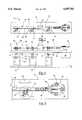
- FIG. 1is a top plan view illustrating a preferred embodiment of the present invention
- FIG. 2is a side view illustrating the preferred embodiment of the present invention.
- FIG. 3is a fragmentary top view of a portion of the preferred embodiment of the present invention and enlarged for clarity.
- the automatic paint stirring equipment 10includes a housing 12 having a plurality of shafts 14 rotatably mounted to the housing 12 by conventional bushing assemblies 16. Each shaft 14, furthermore, is rotatable about a generally vertical axis of rotation and the shafts 14 are aligned with each other as best shown in FIG. 1.
- the term "paint”includes paints, lacquers and other finishes applied in liquid form to a surface.
- the housing 12 for the automatic paint stirring equipment 10is adapted to removably receive and support a plurality of paint cans 20 so that one paint can 20 is optionally associated with each shaft 14.
- each paint canincludes a lid 22, illustrated diagrammatically, with a stirring assembly 24 rotatably mounted to the lid 22.
- the stirring assembly 24is contained within the interior of the paint can 20 so that rotation of the stirring assembly 24 mixes the paint contained within the paint can 20.
- a conventional coupling assembly 26, illustrated diagrammatically,is operatively disposed between each shaft 14 and its associated stirring assembly 24 for its associated paint can 20. Upon insertion of the paint can 20 into the housing 12, the coupling 26 automatically couples the stirring assembly 24 to the shaft 14 so that the stirring assembly 24 rotates in unison with the rotation of the shaft 14.
- a driven member or gear wheel 30is secured to the upper end of each drive shaft 14.
- An elongated rigid drive member 32preferably a gear rack, is longitudinally slidably mounted to the housing 12 by bearing blocks 34.
- the bearing blocks 34slidably engage one side 36 of the drive member 32 and ensures that the opposite side 38, i.e. the two sides of the drive member 32, remains in meshing engagement with the gear wheels or driven members 30 secured to the shafts 14. Consequently, longitudinal displacement of the drive member 32 simultaneously rotatably drives the shafts 14 in a rotational direction dependent upon the longitudinal direction of movement of the drive member 32.
- the drive member 32comprises an elongated gear rack while the driven members 30 comprise pinions or gear wheels.
- the drive blocks 34are preferably constructed from a synthetic polymer material such as plastic, teflon or the like having a low coefficient of friction. Use of such material insures minimal wear and tear for both the guide blocks 34 as well as the drive member 32.
- FIG. 3illustrates a preferred embodiment of the drive member in which a motor 40 rotatably drives a shaft 42 (FIG. 2), either directly or indirectly, about an axis parallel to the axis of the shafts 14.
- a wheel 44is secured to the top of the shaft 42 so that the wheel 44 rotates in unison with the shaft 42.
- an elongated link 46has one end 48 pivotally secured to one end of the drive member 32.
- the opposite end 50 of the link 46is pivotally secured to the wheel 44 adjacent its outer periphery and thus at a position radially spaced from the axis of rotation of the wheel 44.
- the stirring assemblies 24are alternately driven in opposite rotational directions, the stirring assemblies 24 agitate the paint or other liquid contained within the interior of the paint can 20. Furthermore, in view of the enhanced agitation caused by the alternating rotation of the stirring assemblies 24, the stirring assemblies 24 can be rotated at a much slower speed than the previously known unidirectional stirring assemblies thus minimizing wear and tear and maintenance costs for the automatic paint stirring equipment.
Landscapes
- Chemical & Material Sciences (AREA)
- Chemical Kinetics & Catalysis (AREA)
- Coating Apparatus (AREA)
- Mixers Of The Rotary Stirring Type (AREA)
Abstract
Description
1. Field of the Invention
The present invention relates generally to automatic paint stirring equipment and, more particularly, to a novel drive mechanism for automatic paint stirring equipment.
2. Description of the Prior Art
There are many types of previously known automatic paint stirring equipment of the type used in automotive body repair shops. In general, the automatic paint stirring equipment comprises a housing having a plurality of shafts rotatably mounted to the housing about a generally vertical axis. Paint cans having a lid with a stirring assembly associated with the lid are then removably secured to and supported by the housing. Once the paint can with its lid is supported by the housing, a drive coupling between the lower end of the shaft and the stirring assembly for the paint can detachably engage each other so that rotation of the shaft is transmitted to the stirring assembly thus stirring the paint in the desired fashion.
In order to rotatably drive the shafts, these previously known automatic paint stirring equipment typically utilize a pulley secured to an upper end of each of the shafts. An elongated endless belt then extends around the pulleys and is itself rotatably driven by a motor. Consequently, as the drive pulley is rotatably driven by the motor, the pulleys, and thus the shafts associated with each pulley, are rotatably driven in a preset direction. This rotational movement of the shaft in turn is transmitted to the stirring assembly contained within the interior of the paint can to stir the paint in the desired fashion.
One disadvantage of the previously known automatic paint stirring equipment is that, because the stirring assembly within the interior of each paint can is rotatably driven in a preset rotational direction, the stirring assemblies must be driven at a relatively high rotational speed in order to ensure proper mixing or stirring of the paint. This relatively high speed rotational movement of the shafts as well as their associated components, however, creates undue wear and tear for the paint stirring equipment thus requiring relatively frequent maintenance and part replacement.
The present invention provides a novel drive mechanism for automatic paint stirring equipment which overcomes all of the above-mentioned disadvantages of the previously known automatic paint stirring equipment.
In brief, in the conventional fashion, the paint stirring equipment of the present invention includes a housing having a plurality of shafts rotatably mounted to the housing about a generally vertical axis. The housing itself is adapted to support a plurality of paint cam each of which has a paint lid with a stirring assembly rotatably mounted to the lid and contained within the interior of the paint can.
Once the paint can is inserted into and supported by the housing, a detachable coupling between the lower end of each shaft and an upper end of the stirring assembly on the paint can positioned below the shaft engage each other so that rotational movement of the shaft is transmitted to the stirring assembly.
Unlike the previously known automatic paint stirring equipment, however, a driven member, preferably a gear wheel, is secured to the upper end of each shaft. An elongated rigid drive member, preferably a gear rack, is then longitudinally slidably mounted to the housing so that the gear rack simultaneously meshingly engages with a plurality of gear wheels secured to the shafts. Consequently, longitudinal displacement of the gear rack simultaneously rotatably drives the gear wheels with their associated shafts in a rotational direction dependent upon the direction of longitudinal movement of the gear rack.
In order to longitudinally reciprocally drive the gear rack, the present invention includes a motor which rotatably drives a wheel about an axis generally parallel with the axis of the drive shafts. An elongated link is then pivotally secured at one end to one end of the gear rack and at its other end to the drive wheel adjacent its outer periphery. Consequently, upon rotation of the drive wheel, the drive wheel via the link longitudinally reciprocally drives the gear rack. In doing so, the drive shafts, and thus the stirring assembly associated with each drive shaft, are reciprocally rotatably driven in alternating rotational directions.
In practice, the alternating rotational movement of the stirring assembly associated with the lid for each paint can produces enhanced agitation of the paint contained within the paint can and thus ensures complete mixing of the paint. Furthermore, the rotational movement of the stirring assembly in the present invention can be accomplished at a much lower rotational speed than would the previously known unidirectional rotational stirring assemblies, thereby reducing the overall wear and tear and maintenance costs of the automatic paint stirring equipment.
A better understanding of the present invention will be had upon reference to the following detailed description when read in conjunction with the accompanying drawing, wherein like reference characters refer to like parts throughout the several views, and in which:
FIG. 1 is a top plan view illustrating a preferred embodiment of the present invention;
FIG. 2 is a side view illustrating the preferred embodiment of the present invention; and
FIG. 3 is a fragmentary top view of a portion of the preferred embodiment of the present invention and enlarged for clarity.
With reference to FIGS. 1 and 2, automaticpaint stirring equipment 10 of the type utilized in automotive paint shops is there shown. The automaticpaint stirring equipment 10 includes ahousing 12 having a plurality ofshafts 14 rotatably mounted to thehousing 12 byconventional bushing assemblies 16. Eachshaft 14, furthermore, is rotatable about a generally vertical axis of rotation and theshafts 14 are aligned with each other as best shown in FIG. 1. Furthermore, as used herein, the term "paint" includes paints, lacquers and other finishes applied in liquid form to a surface.
Thehousing 12 for the automaticpaint stirring equipment 10 is adapted to removably receive and support a plurality ofpaint cans 20 so that one paint can 20 is optionally associated with eachshaft 14. As best shown in FIG. 2, each paint can includes alid 22, illustrated diagrammatically, with astirring assembly 24 rotatably mounted to thelid 22. Thestirring assembly 24 is contained within the interior of the paint can 20 so that rotation of thestirring assembly 24 mixes the paint contained within the paint can 20. Additionally, aconventional coupling assembly 26, illustrated diagrammatically, is operatively disposed between eachshaft 14 and its associatedstirring assembly 24 for its associated paint can 20. Upon insertion of the paint can 20 into thehousing 12, thecoupling 26 automatically couples thestirring assembly 24 to theshaft 14 so that thestirring assembly 24 rotates in unison with the rotation of theshaft 14.
In order to rotatably drive theshafts 14 and thus their associatedstirring assemblies 24, a driven member orgear wheel 30 is secured to the upper end of eachdrive shaft 14. An elongatedrigid drive member 32, preferably a gear rack, is longitudinally slidably mounted to thehousing 12 by bearingblocks 34. Thebearing blocks 34 slidably engage oneside 36 of thedrive member 32 and ensures that theopposite side 38, i.e. the two sides of thedrive member 32, remains in meshing engagement with the gear wheels or drivenmembers 30 secured to theshafts 14. Consequently, longitudinal displacement of thedrive member 32 simultaneously rotatably drives theshafts 14 in a rotational direction dependent upon the longitudinal direction of movement of thedrive member 32.
In the preferred embodiment of the invention, thedrive member 32 comprises an elongated gear rack while the drivenmembers 30 comprise pinions or gear wheels. Other arrangements, for example a frictional engagement between thedrive member 32 and drivenmembers 30, may alternatively be employed.
Additionally, thedrive blocks 34 are preferably constructed from a synthetic polymer material such as plastic, teflon or the like having a low coefficient of friction. Use of such material insures minimal wear and tear for both the guide blocks 34 as well as thedrive member 32.
With reference now particularly to FIG. 3, thedrive member 32 is reciprocally longitudinally driven which simultaneously produces alternating rotational movement of thedrive shafts 14 and their associatedstirring assemblies 24. FIG. 3 illustrates a preferred embodiment of the drive member in which amotor 40 rotatably drives a shaft 42 (FIG. 2), either directly or indirectly, about an axis parallel to the axis of theshafts 14. Awheel 44 is secured to the top of theshaft 42 so that thewheel 44 rotates in unison with theshaft 42. Still referring to FIGS. 2 and 3, anelongated link 46 has oneend 48 pivotally secured to one end of thedrive member 32. Theopposite end 50 of thelink 46 is pivotally secured to thewheel 44 adjacent its outer periphery and thus at a position radially spaced from the axis of rotation of thewheel 44.
As best shown in FIG. 3, upon rotation of thewheel 44 by themotor 40, the driving connection between thelink 46 and thedrive member 32 longitudinally reciprocally drives thedrive member 32 as indicated byarrow 52 for each complete rotation of thewheel 44. In doing so, the rotation of theshafts 14 and thus of their associated stirringassemblies 24 alternate in rotational direction for each revolution of thewheel 44.
Since thestirring assemblies 24 are alternately driven in opposite rotational directions, thestirring assemblies 24 agitate the paint or other liquid contained within the interior of the paint can 20. Furthermore, in view of the enhanced agitation caused by the alternating rotation of thestirring assemblies 24, thestirring assemblies 24 can be rotated at a much slower speed than the previously known unidirectional stirring assemblies thus minimizing wear and tear and maintenance costs for the automatic paint stirring equipment.
From the foregoing, it can be seen that the present invention provides a simple and highly effective drive mechanism for automatic paint stirring equipment. Having described my invention, however, many modifications thereto will become apparent to those skilled in the art to which it pertains without deviation from the spirit of the invention as defined by the scope of the appended claims.
Claims (6)
1. For use in conjunction with automatic paint stirring equipment of the type having a housing with a plurality of spaced apart and parallel shafts rotatably mounted to the housing, each shaft adapted for detachable driving connection with a stirring assembly associated with a paint can, a drive mechanism for reciprocally simultaneously driving a plurality of said shafts comprising:
a driven member secured to each of said shafts,
an elongated rigid drive member, said drive member having means for drivingly engaging a plurality of said driven members so that longitudinal movement of said drive member simultaneously rotatably drives said driven members,
means for longitudinally reciprocally driving said drive member
wherein said longitudinal reciprocal driving means comprises:
a motor which drives an output shaft,
an elongated link,
means for pivotally connecting one end of said link to one end of said drive member, and
means for pivotally connecting the other end of said link to said output shaft at a position radially spaced from an axis of rotation of said output shaft.
2. The invention as defined in claim 1 and comprising a wheel secured to said output shaft and wherein said other end of said link is pivotally connected to said wheel adjacent an outer periphery of said wheel.
3. The invention as defined in claim 1 wherein each driven member comprises a gear wheel and wherein said drive member comprises a gear rack which meshingly engages with said gear wheels.
4. The invention as defined in claim 1 and comprising a pair of spaced bearing blocks secured to the housing so that said bearing blocks abut against a side of the drive member opposite from the driven members.
5. The invention as defined in claim 4 wherein said bearing blocks are constructed of a material having a low friction coefficient.
6. The invention as defined in claim 5 wherein said bearing blocks are constructed of a polymer material.
Priority Applications (1)
| Application Number | Priority Date | Filing Date | Title |
|---|---|---|---|
| US08/774,045US5697703A (en) | 1996-12-27 | 1996-12-27 | Reciprocal drive mechanism for automatic paint stirring equipment |
Applications Claiming Priority (1)
| Application Number | Priority Date | Filing Date | Title |
|---|---|---|---|
| US08/774,045US5697703A (en) | 1996-12-27 | 1996-12-27 | Reciprocal drive mechanism for automatic paint stirring equipment |
Publications (1)
| Publication Number | Publication Date |
|---|---|
| US5697703Atrue US5697703A (en) | 1997-12-16 |
Family
ID=25100080
Family Applications (1)
| Application Number | Title | Priority Date | Filing Date |
|---|---|---|---|
| US08/774,045Expired - Fee RelatedUS5697703A (en) | 1996-12-27 | 1996-12-27 | Reciprocal drive mechanism for automatic paint stirring equipment |
Country Status (1)
| Country | Link |
|---|---|
| US (1) | US5697703A (en) |
Cited By (27)
| Publication number | Priority date | Publication date | Assignee | Title |
|---|---|---|---|---|
| US5947598A (en)* | 1998-09-15 | 1999-09-07 | Dedoes Industries, Inc. | Automatic paint stirring equipment with improved driving means |
| US5988868A (en)* | 1998-09-15 | 1999-11-23 | Dedoes Industries, Inc. | Drive member for automatic paint stirring equipment |
| US6053218A (en)* | 1998-11-10 | 2000-04-25 | X-Pert Paint Mixing Systems, Inc. | Semi-automated system for dispensing automotive paint |
| US6095373A (en)* | 1998-11-10 | 2000-08-01 | X-Pert Paint Mixing Systems, Inc. | Paint container lid for a semi-automated automotive paint dispensing system |
| US6146009A (en)* | 1999-10-13 | 2000-11-14 | X-Pert Paint Mixing Systems, Inc. | Paint container lid member adaptable for use with a plurality of paint mixing systems |
| US6206250B1 (en) | 1999-10-13 | 2001-03-27 | X-Pert Paint Mixing Systems, Inc. | Lid member for a paint container useable with a semi-automated automotive paint dispensing system |
| US6230938B1 (en) | 1999-10-13 | 2001-05-15 | X-Pert Paint Mixing Systems, Inc. | Seal structure for a fluid pour spout of a paint container lid member |
| US6234218B1 (en) | 1999-10-13 | 2001-05-22 | X-Pert Paint Mixing Systems, Inc. | Semi-automated automotive paint dispensing system |
| US6290383B1 (en) | 1998-06-24 | 2001-09-18 | Processall, Inc. | Apparatus mixing, filtering, reacting and drying materials |
| US20030131759A1 (en)* | 2001-08-10 | 2003-07-17 | Francis Larry J. | Composite materials and methods of making and using such composite materials |
| US20050041524A1 (en)* | 2001-11-30 | 2005-02-24 | Alain Krzywdziak | Paint stirring machine and method for mounting same |
| US6945690B2 (en) | 2003-05-29 | 2005-09-20 | Masterchem Industries, Inc. | System for holding paint container |
| US6945689B2 (en) | 2003-04-18 | 2005-09-20 | Masterchem Industries, Llc | System for holding paint container |
| US20060019376A1 (en)* | 2004-07-21 | 2006-01-26 | Bungay Henry R Iii | Fermentation chamber and mixing apparatus |
| US7014078B2 (en) | 2001-12-05 | 2006-03-21 | Masterchem Industries Llc | Container |
| US20070008813A1 (en)* | 2003-05-27 | 2007-01-11 | Norbert Kranzinger | Apparatus for foaming a slurry |
| US20070206437A1 (en)* | 2003-06-19 | 2007-09-06 | Garcia Thierry Claude L | Modular Cabinet for Storing and Driving Stirrer Cans |
| US20090325282A1 (en)* | 2008-06-30 | 2009-12-31 | Bungay Iii Henry Robert | Vessels for mixing bioprocessing materials |
| US20120067147A1 (en)* | 2009-03-23 | 2012-03-22 | Ruhua SHEN | bevel gearing device for stirring rack of tinting machine |
| US8424704B2 (en) | 2004-06-02 | 2013-04-23 | X-Pert Paint Mixing Systems, Inc. | Self-cleaning lid for a paint container fluid pour spout |
| CN103191665A (en)* | 2013-04-19 | 2013-07-10 | 江苏科技大学 | Multi-freedom-degree adjustable stirring device |
| WO2016086962A1 (en)* | 2014-12-02 | 2016-06-09 | Clariant International Ltd | Batching machine, in particular for dyes |
| CN106743800A (en)* | 2016-12-23 | 2017-05-31 | 大连佳林设备制造有限公司 | The amplitude adjustable casing of frequency that shakes shakes flat machine |
| US20180334646A1 (en)* | 2015-11-13 | 2018-11-22 | The Johns Hopkins University | Cell culture system and method of use thereof |
| CN110479165A (en)* | 2019-09-02 | 2019-11-22 | 黑龙江省农业科学院土壤肥料与环境资源研究所 | A kind of mixing arrangement for the production of agriculture microbial manure |
| CN110814107A (en)* | 2019-10-30 | 2020-02-21 | 南通华恒智能科技有限公司 | Overturning mechanism of numerical control CZ all-in-one machine |
| CN111359506A (en)* | 2020-04-06 | 2020-07-03 | 袁帅 | Stirring equipment for powder or liquid |
Citations (17)
| Publication number | Priority date | Publication date | Assignee | Title |
|---|---|---|---|---|
| US321031A (en)* | 1885-06-30 | Washing-machine | ||
| US408818A (en)* | 1889-08-13 | Churn | ||
| US409533A (en)* | 1889-08-20 | Churn | ||
| US425693A (en)* | 1890-04-15 | Washing-machine | ||
| US627968A (en)* | 1899-01-30 | 1899-07-04 | Paris T Benbow | Washing-machine. |
| US796685A (en)* | 1905-03-09 | 1905-08-08 | Charles S Waybright | Churn. |
| US957248A (en)* | 1909-12-28 | 1910-05-10 | Winfield S Pettit | Churn. |
| US2428492A (en)* | 1944-05-13 | 1947-10-07 | Haller John | Agitating machine |
| US2603461A (en)* | 1948-10-16 | 1952-07-15 | Sherwin Williams Co | Mixing machine |
| US2757910A (en)* | 1956-08-07 | o neill | ||
| US2802649A (en)* | 1954-03-08 | 1957-08-13 | Zac Lac Paint & Lacquer Corp | Paint mixing apparatus |
| US2965363A (en)* | 1957-11-26 | 1960-12-20 | Air Hydraulics Inc | Paint mixing machine |
| US3118653A (en)* | 1959-03-25 | 1964-01-21 | Arnold A Dedoes | Paint mixing apparatus |
| FR2102417A5 (en)* | 1970-08-03 | 1972-04-07 | Fillon Roger | |
| GB2203059A (en)* | 1987-04-09 | 1988-10-12 | Richard William Clarke | Stirring apparatus for paint |
| US5160198A (en)* | 1989-07-18 | 1992-11-03 | Fillon-Pichon S.A. | Modular structure cabinet for stirrers of paints and similar products |
| US5496109A (en)* | 1995-04-20 | 1996-03-05 | Dedoes Industries, Inc. | Paint stirring equipment with improved idler wheel |
- 1996
- 1996-12-27USUS08/774,045patent/US5697703A/ennot_activeExpired - Fee Related
Patent Citations (17)
| Publication number | Priority date | Publication date | Assignee | Title |
|---|---|---|---|---|
| US2757910A (en)* | 1956-08-07 | o neill | ||
| US408818A (en)* | 1889-08-13 | Churn | ||
| US409533A (en)* | 1889-08-20 | Churn | ||
| US425693A (en)* | 1890-04-15 | Washing-machine | ||
| US321031A (en)* | 1885-06-30 | Washing-machine | ||
| US627968A (en)* | 1899-01-30 | 1899-07-04 | Paris T Benbow | Washing-machine. |
| US796685A (en)* | 1905-03-09 | 1905-08-08 | Charles S Waybright | Churn. |
| US957248A (en)* | 1909-12-28 | 1910-05-10 | Winfield S Pettit | Churn. |
| US2428492A (en)* | 1944-05-13 | 1947-10-07 | Haller John | Agitating machine |
| US2603461A (en)* | 1948-10-16 | 1952-07-15 | Sherwin Williams Co | Mixing machine |
| US2802649A (en)* | 1954-03-08 | 1957-08-13 | Zac Lac Paint & Lacquer Corp | Paint mixing apparatus |
| US2965363A (en)* | 1957-11-26 | 1960-12-20 | Air Hydraulics Inc | Paint mixing machine |
| US3118653A (en)* | 1959-03-25 | 1964-01-21 | Arnold A Dedoes | Paint mixing apparatus |
| FR2102417A5 (en)* | 1970-08-03 | 1972-04-07 | Fillon Roger | |
| GB2203059A (en)* | 1987-04-09 | 1988-10-12 | Richard William Clarke | Stirring apparatus for paint |
| US5160198A (en)* | 1989-07-18 | 1992-11-03 | Fillon-Pichon S.A. | Modular structure cabinet for stirrers of paints and similar products |
| US5496109A (en)* | 1995-04-20 | 1996-03-05 | Dedoes Industries, Inc. | Paint stirring equipment with improved idler wheel |
Cited By (38)
| Publication number | Priority date | Publication date | Assignee | Title |
|---|---|---|---|---|
| US6290383B1 (en) | 1998-06-24 | 2001-09-18 | Processall, Inc. | Apparatus mixing, filtering, reacting and drying materials |
| US5947598A (en)* | 1998-09-15 | 1999-09-07 | Dedoes Industries, Inc. | Automatic paint stirring equipment with improved driving means |
| US5988868A (en)* | 1998-09-15 | 1999-11-23 | Dedoes Industries, Inc. | Drive member for automatic paint stirring equipment |
| US6053218A (en)* | 1998-11-10 | 2000-04-25 | X-Pert Paint Mixing Systems, Inc. | Semi-automated system for dispensing automotive paint |
| US6095373A (en)* | 1998-11-10 | 2000-08-01 | X-Pert Paint Mixing Systems, Inc. | Paint container lid for a semi-automated automotive paint dispensing system |
| US6290110B1 (en) | 1999-10-13 | 2001-09-18 | X-Pert Paint Mixing Systems, Inc. | Fluid seal for a pour spout of a paint container lid member |
| US6230938B1 (en) | 1999-10-13 | 2001-05-15 | X-Pert Paint Mixing Systems, Inc. | Seal structure for a fluid pour spout of a paint container lid member |
| US6234218B1 (en) | 1999-10-13 | 2001-05-22 | X-Pert Paint Mixing Systems, Inc. | Semi-automated automotive paint dispensing system |
| US6206250B1 (en) | 1999-10-13 | 2001-03-27 | X-Pert Paint Mixing Systems, Inc. | Lid member for a paint container useable with a semi-automated automotive paint dispensing system |
| US6146009A (en)* | 1999-10-13 | 2000-11-14 | X-Pert Paint Mixing Systems, Inc. | Paint container lid member adaptable for use with a plurality of paint mixing systems |
| US6474516B2 (en) | 1999-10-13 | 2002-11-05 | X-Pert Paint Mixing Systems, Inc. | Seal structure for a fluid pour spout of a paint container lid member |
| US6755326B2 (en) | 1999-10-13 | 2004-06-29 | X-Pert Paint Mixing Systems, Inc. | Seal structure for a fluid pour spout of a paint container lid member |
| US20030131759A1 (en)* | 2001-08-10 | 2003-07-17 | Francis Larry J. | Composite materials and methods of making and using such composite materials |
| US7491267B2 (en) | 2001-08-10 | 2009-02-17 | Ceratech, Inc. | Composite materials and methods of making and using such composite materials |
| US20050041524A1 (en)* | 2001-11-30 | 2005-02-24 | Alain Krzywdziak | Paint stirring machine and method for mounting same |
| US7160022B2 (en)* | 2001-11-30 | 2007-01-09 | Fillon Technologies | Paint stirring machine and method for mounting same |
| US7156265B2 (en) | 2001-12-05 | 2007-01-02 | Masterchem Industries Llc | Container |
| US7014078B2 (en) | 2001-12-05 | 2006-03-21 | Masterchem Industries Llc | Container |
| US6945689B2 (en) | 2003-04-18 | 2005-09-20 | Masterchem Industries, Llc | System for holding paint container |
| US20070008813A1 (en)* | 2003-05-27 | 2007-01-11 | Norbert Kranzinger | Apparatus for foaming a slurry |
| US6945690B2 (en) | 2003-05-29 | 2005-09-20 | Masterchem Industries, Inc. | System for holding paint container |
| US20070206437A1 (en)* | 2003-06-19 | 2007-09-06 | Garcia Thierry Claude L | Modular Cabinet for Storing and Driving Stirrer Cans |
| US7922383B2 (en)* | 2003-06-19 | 2011-04-12 | Fillon Investissement | Modular cabinet for storing and driving stirrer cans |
| US8424704B2 (en) | 2004-06-02 | 2013-04-23 | X-Pert Paint Mixing Systems, Inc. | Self-cleaning lid for a paint container fluid pour spout |
| US20060019376A1 (en)* | 2004-07-21 | 2006-01-26 | Bungay Henry R Iii | Fermentation chamber and mixing apparatus |
| US8535936B2 (en) | 2008-06-30 | 2013-09-17 | Twistaferm | Vessels for mixing bioprocessing materials |
| US20090325282A1 (en)* | 2008-06-30 | 2009-12-31 | Bungay Iii Henry Robert | Vessels for mixing bioprocessing materials |
| US20120067147A1 (en)* | 2009-03-23 | 2012-03-22 | Ruhua SHEN | bevel gearing device for stirring rack of tinting machine |
| CN103191665A (en)* | 2013-04-19 | 2013-07-10 | 江苏科技大学 | Multi-freedom-degree adjustable stirring device |
| CN103191665B (en)* | 2013-04-19 | 2015-05-13 | 江苏科技大学 | Multi-freedom-degree adjustable stirring device |
| WO2016086962A1 (en)* | 2014-12-02 | 2016-06-09 | Clariant International Ltd | Batching machine, in particular for dyes |
| US20180334646A1 (en)* | 2015-11-13 | 2018-11-22 | The Johns Hopkins University | Cell culture system and method of use thereof |
| US10597623B2 (en)* | 2015-11-13 | 2020-03-24 | The Johns Hopkins University | Multiwell cell culture system having rotating shafts for mixing culture media and method of use thereof |
| US11053468B2 (en)* | 2015-11-13 | 2021-07-06 | The Johns Hopkins University | Multiwell cell culture system having rotating shafts for mixing culture media and method of use thereof |
| CN106743800A (en)* | 2016-12-23 | 2017-05-31 | 大连佳林设备制造有限公司 | The amplitude adjustable casing of frequency that shakes shakes flat machine |
| CN110479165A (en)* | 2019-09-02 | 2019-11-22 | 黑龙江省农业科学院土壤肥料与环境资源研究所 | A kind of mixing arrangement for the production of agriculture microbial manure |
| CN110814107A (en)* | 2019-10-30 | 2020-02-21 | 南通华恒智能科技有限公司 | Overturning mechanism of numerical control CZ all-in-one machine |
| CN111359506A (en)* | 2020-04-06 | 2020-07-03 | 袁帅 | Stirring equipment for powder or liquid |
Similar Documents
| Publication | Publication Date | Title |
|---|---|---|
| US5697703A (en) | Reciprocal drive mechanism for automatic paint stirring equipment | |
| US2802649A (en) | Paint mixing apparatus | |
| AU659775B2 (en) | An agitator for mixing or blending various products, in particular paints, varnishes or the like | |
| US6848356B1 (en) | Blending apparatus for ice cream | |
| GB2203059A (en) | Stirring apparatus for paint | |
| US5947598A (en) | Automatic paint stirring equipment with improved driving means | |
| JPH1043568A (en) | Kneading device | |
| US5542761A (en) | Automatic paint stirring equipment with improved bushing | |
| ES2047899T3 (en) | APPARATUS FOR MIXING VISCOUS MATERIALS. | |
| CN114789010A (en) | Modular raw materials turns over mixes device | |
| FR2685889B1 (en) | PAINTS STIRRING MACHINE. | |
| US5496109A (en) | Paint stirring equipment with improved idler wheel | |
| WO1998017451A1 (en) | Barrel mixer | |
| US5190375A (en) | Agitator with a rotary shaft and hollow shaft for stirring and mixing materials | |
| DE2233089C3 (en) | Device for stirring a liquid | |
| KR19980018239A (en) | Kneading device | |
| US3054600A (en) | Fluid mixing apparatus | |
| DE4118794A1 (en) | Lubricant-free, toothed belt drive planetary motion mixer, for pastes and viscous prods. - has central, vertical drive shaft terminating above mixing container and bearing spacer rotatable around drive shaft axis etc. | |
| US4699016A (en) | Translatable drive apparatus | |
| SU1045905A1 (en) | Device for agitation of liquids in cylindrical vessels | |
| JPH0141443Y2 (en) | ||
| US2748604A (en) | Universal power supply | |
| SU1011222A1 (en) | Apparatus for making different viscosity mixtures | |
| CN108820750A (en) | A kind of interval dislocation shunting flow-line equipment | |
| GB2237752A (en) | Drive mechanism for use in a mixer |
Legal Events
| Date | Code | Title | Description |
|---|---|---|---|
| AS | Assignment | Owner name:DEDOES INDUSTRIES, INC., MICHIGAN Free format text:ASSIGNMENT OF ASSIGNORS INTEREST;ASSIGNOR:LUCCHETTI, DAVID;REEL/FRAME:008384/0901 Effective date:19961215 | |
| REMI | Maintenance fee reminder mailed | ||
| LAPS | Lapse for failure to pay maintenance fees | ||
| STCH | Information on status: patent discontinuation | Free format text:PATENT EXPIRED DUE TO NONPAYMENT OF MAINTENANCE FEES UNDER 37 CFR 1.362 | |
| FP | Lapsed due to failure to pay maintenance fee | Effective date:20011216 |