US5681278A - Coronary vasculature treatment method - Google Patents
Coronary vasculature treatment methodDownload PDFInfo
- Publication number
- US5681278A US5681278AUS08/264,458US26445894AUS5681278AUS 5681278 AUS5681278 AUS 5681278AUS 26445894 AUS26445894 AUS 26445894AUS 5681278 AUS5681278 AUS 5681278A
- Authority
- US
- United States
- Prior art keywords
- congener
- blood vessel
- coronary
- coronary blood
- administering
- Prior art date
- Legal status (The legal status is an assumption and is not a legal conclusion. Google has not performed a legal analysis and makes no representation as to the accuracy of the status listed.)
- Expired - Fee Related
Links
- 238000000034methodMethods0.000titleclaimsabstractdescription72
- 210000005166vasculatureAnatomy0.000title1
- MWUXSHHQAYIFBG-UHFFFAOYSA-NNitric oxideChemical compoundO=[N]MWUXSHHQAYIFBG-UHFFFAOYSA-N0.000claimsabstractdescription65
- XEYBHCRIKKKOSS-UHFFFAOYSA-Ndisodium;azanylidyneoxidanium;iron(2+);pentacyanideChemical compound[Na+].[Na+].[Fe+2].N#[C-].N#[C-].N#[C-].N#[C-].N#[C-].[O+]#NXEYBHCRIKKKOSS-UHFFFAOYSA-N0.000claimsabstractdescription54
- 229940083618sodium nitroprussideDrugs0.000claimsabstractdescription54
- 210000004204blood vesselAnatomy0.000claimsabstractdescription33
- 208000007536ThrombosisDiseases0.000claimsabstractdescription21
- 239000012867bioactive agentSubstances0.000claimsabstractdescription21
- 239000003795chemical substances by applicationSubstances0.000claimsabstractdescription17
- 210000003038endotheliumAnatomy0.000claimsabstractdescription17
- 241000124008MammaliaSpecies0.000claimsabstractdescription11
- SNIOPGDIGTZGOP-UHFFFAOYSA-NNitroglycerinChemical compound[O-][N+](=O)OCC(O[N+]([O-])=O)CO[N+]([O-])=OSNIOPGDIGTZGOP-UHFFFAOYSA-N0.000claimsabstractdescription7
- 239000000006NitroglycerinSubstances0.000claimsabstractdescription7
- 229960003711glyceryl trinitrateDrugs0.000claimsabstractdescription7
- 239000002840nitric oxide donorSubstances0.000claimsabstractdescription6
- 210000004351coronary vesselAnatomy0.000claimsdescription53
- 210000002216heartAnatomy0.000claimsdescription26
- 239000007943implantSubstances0.000claimsdescription26
- 239000000039congenerSubstances0.000claimsdescription23
- 208000010110spontaneous platelet aggregationDiseases0.000claimsdescription19
- 229960001123epoprostenolDrugs0.000claimsdescription15
- 230000009885systemic effectEffects0.000claimsdescription14
- 210000003462veinAnatomy0.000claimsdescription14
- 230000005764inhibitory processEffects0.000claimsdescription12
- GMVPRGQOIOIIMI-DWKJAMRDSA-Nprostaglandin E1Chemical compoundCCCCC[C@H](O)\C=C\[C@H]1[C@H](O)CC(=O)[C@@H]1CCCCCCC(O)=OGMVPRGQOIOIIMI-DWKJAMRDSA-N0.000claimsdescription9
- 238000013270controlled releaseMethods0.000claimsdescription7
- 230000001225therapeutic effectEffects0.000claimsdescription7
- 208000001953HypotensionDiseases0.000claimsdescription6
- 229920000642polymerPolymers0.000claimsdescription6
- 230000024883vasodilationEffects0.000claimsdescription6
- 230000010100anticoagulationEffects0.000claimsdescription5
- 230000036543hypotensionEffects0.000claimsdescription5
- 239000003102growth factorSubstances0.000claimsdescription4
- ODKSFYDXXFIFQN-BYPYZUCNSA-NL-arginineChemical compoundOC(=O)[C@@H](N)CCCN=C(N)NODKSFYDXXFIFQN-BYPYZUCNSA-N0.000claimsdescription3
- 229930064664L-arginineNatural products0.000claimsdescription3
- 235000014852L-arginineNutrition0.000claimsdescription3
- 208000005392SpasmDiseases0.000claimsdescription3
- 230000002459sustained effectEffects0.000claimsdescription3
- 230000001939inductive effectEffects0.000claimsdescription2
- KAQKFAOMNZTLHT-VVUHWYTRSA-NepoprostenolChemical compoundO1C(=CCCCC(O)=O)C[C@@H]2[C@@H](/C=C/[C@@H](O)CCCCC)[C@H](O)C[C@@H]21KAQKFAOMNZTLHT-VVUHWYTRSA-N0.000claims1
- 208000037803restenosisDiseases0.000abstractdescription29
- 238000002399angioplastyMethods0.000abstractdescription12
- 230000002792vascularEffects0.000abstractdescription9
- 206010002388Angina unstableDiseases0.000abstractdescription6
- 208000007814Unstable AnginaDiseases0.000abstractdescription6
- 201000004332intermediate coronary syndromeDiseases0.000abstractdescription6
- 208000010125myocardial infarctionDiseases0.000abstractdescription3
- 210000001772blood plateletAnatomy0.000description34
- 238000001802infusionMethods0.000description31
- 238000012377drug deliveryMethods0.000description20
- KAQKFAOMNZTLHT-OZUDYXHBSA-Nprostaglandin I2Chemical compoundO1\C(=C/CCCC(O)=O)C[C@@H]2[C@@H](/C=C/[C@@H](O)CCCCC)[C@H](O)C[C@@H]21KAQKFAOMNZTLHT-OZUDYXHBSA-N0.000description19
- 239000003814drugSubstances0.000description18
- 208000014674injuryDiseases0.000description18
- 210000003516pericardiumAnatomy0.000description18
- 208000027418Wounds and injuryDiseases0.000description17
- 230000006378damageEffects0.000description17
- 229940079593drugDrugs0.000description16
- 230000000694effectsEffects0.000description16
- 241001465754MetazoaSpecies0.000description14
- KKJUPNGICOCCDW-UHFFFAOYSA-N7-N,N-Dimethylamino-1,2,3,4,5-pentathiocyclooctaneChemical compoundCN(C)C1CSSSSSC1KKJUPNGICOCCDW-UHFFFAOYSA-N0.000description13
- 230000017531blood circulationEffects0.000description13
- NTNWOCRCBQPEKQ-YFKPBYRVSA-NN(omega)-methyl-L-arginineChemical compoundCN=C(N)NCCC[C@H](N)C(O)=ONTNWOCRCBQPEKQ-YFKPBYRVSA-N0.000description12
- 241000282472Canis lupus familiarisSpecies0.000description11
- 210000001367arteryAnatomy0.000description11
- 238000007887coronary angioplastyMethods0.000description10
- 125000004122cyclic groupChemical group0.000description10
- 230000003511endothelial effectEffects0.000description10
- 210000000329smooth muscle myocyteAnatomy0.000description10
- 238000002560therapeutic procedureMethods0.000description10
- NTNWOCRCBQPEKQ-UHFFFAOYSA-NNG-mono-methyl-L-arginineNatural productsCN=C(N)NCCCC(N)C(O)=ONTNWOCRCBQPEKQ-UHFFFAOYSA-N0.000description9
- 230000009467reductionEffects0.000description9
- 108010064719OxyhemoglobinsProteins0.000description8
- 208000005228Pericardial EffusionDiseases0.000description8
- 230000000747cardiac effectEffects0.000description8
- 208000029078coronary artery diseaseDiseases0.000description8
- 239000004033plasticSubstances0.000description8
- 230000002537thrombolytic effectEffects0.000description8
- 239000003146anticoagulant agentSubstances0.000description7
- 230000015572biosynthetic processEffects0.000description7
- 239000007788liquidSubstances0.000description7
- 238000001356surgical procedureMethods0.000description7
- 241000282414Homo sapiensSpecies0.000description6
- 206010047139VasoconstrictionDiseases0.000description6
- 230000001154acute effectEffects0.000description6
- 230000004872arterial blood pressureEffects0.000description6
- 239000004621biodegradable polymerSubstances0.000description6
- 229920002988biodegradable polymerPolymers0.000description6
- 210000004369bloodAnatomy0.000description6
- 239000008280bloodSubstances0.000description6
- 230000004663cell proliferationEffects0.000description6
- 230000008859changeEffects0.000description6
- 239000012530fluidSubstances0.000description6
- 230000000004hemodynamic effectEffects0.000description6
- 230000003902lesionEffects0.000description6
- 230000025033vasoconstrictionEffects0.000description6
- 201000001320AtherosclerosisDiseases0.000description5
- 102000008186CollagenHuman genes0.000description5
- 108010035532CollagenProteins0.000description5
- 230000002776aggregationEffects0.000description5
- 238000004220aggregationMethods0.000description5
- 230000004087circulationEffects0.000description5
- 229920001436collagenPolymers0.000description5
- 210000002889endothelial cellAnatomy0.000description5
- 238000001990intravenous administrationMethods0.000description5
- 210000005246left atriumAnatomy0.000description5
- 239000012528membraneSubstances0.000description5
- 210000004912pericardial fluidAnatomy0.000description5
- 210000004623platelet-rich plasmaAnatomy0.000description5
- 230000008569processEffects0.000description5
- 210000001147pulmonary arteryAnatomy0.000description5
- 239000003071vasodilator agentSubstances0.000description5
- 201000000057Coronary StenosisDiseases0.000description4
- 208000032843HemorrhageDiseases0.000description4
- FAPWRFPIFSIZLT-UHFFFAOYSA-MSodium chlorideChemical compound[Na+].[Cl-]FAPWRFPIFSIZLT-UHFFFAOYSA-M0.000description4
- 206010042434Sudden deathDiseases0.000description4
- 206010047163VasospasmDiseases0.000description4
- 230000023445activated T cell autonomous cell deathEffects0.000description4
- YEESUBCSWGVPCE-UHFFFAOYSA-Nazanylidyneoxidanium iron(2+) pentacyanideChemical compound[Fe++].[C-]#N.[C-]#N.[C-]#N.[C-]#N.[C-]#N.N#[O+]YEESUBCSWGVPCE-UHFFFAOYSA-N0.000description4
- 208000034158bleedingDiseases0.000description4
- 230000000740bleeding effectEffects0.000description4
- 238000009826distributionMethods0.000description4
- 206010020718hyperplasiaDiseases0.000description4
- 239000000463materialSubstances0.000description4
- 230000007246mechanismEffects0.000description4
- 210000001370mediastinumAnatomy0.000description4
- 238000013508migrationMethods0.000description4
- 229960002460nitroprussideDrugs0.000description4
- 230000002265preventionEffects0.000description4
- 239000011780sodium chlorideSubstances0.000description4
- 210000001562sternumAnatomy0.000description4
- 208000011580syndromic diseaseDiseases0.000description4
- 229940124549vasodilatorDrugs0.000description4
- HTTJABKRGRZYRN-UHFFFAOYSA-NHeparinChemical compoundOC1C(NC(=O)C)C(O)OC(COS(O)(=O)=O)C1OC1C(OS(O)(=O)=O)C(O)C(OC2C(C(OS(O)(=O)=O)C(OC3C(C(O)C(O)C(O3)C(O)=O)OS(O)(=O)=O)C(CO)O2)NS(O)(=O)=O)C(C(O)=O)O1HTTJABKRGRZYRN-UHFFFAOYSA-N0.000description3
- 238000000692Student's t-testMethods0.000description3
- 208000024248Vascular System injuryDiseases0.000description3
- 208000012339Vascular injuryDiseases0.000description3
- 206010000891acute myocardial infarctionDiseases0.000description3
- 238000003287bathingMethods0.000description3
- 230000036772blood pressureEffects0.000description3
- 210000003748coronary sinusAnatomy0.000description3
- 238000011161developmentMethods0.000description3
- 230000005684electric fieldEffects0.000description3
- 210000003989endothelium vascularAnatomy0.000description3
- 230000006870functionEffects0.000description3
- 229960002897heparinDrugs0.000description3
- 229920000669heparinPolymers0.000description3
- 238000002347injectionMethods0.000description3
- 239000007924injectionSubstances0.000description3
- 238000003780insertionMethods0.000description3
- 230000037431insertionEffects0.000description3
- 238000005259measurementMethods0.000description3
- 239000011859microparticleSubstances0.000description3
- 230000005012migrationEffects0.000description3
- 238000001543one-way ANOVAMethods0.000description3
- WEXRUCMBJFQVBZ-UHFFFAOYSA-NpentobarbitalChemical compoundCCCC(C)C1(CC)C(=O)NC(=O)NC1=OWEXRUCMBJFQVBZ-UHFFFAOYSA-N0.000description3
- 230000036513peripheral conductanceEffects0.000description3
- 230000035755proliferationEffects0.000description3
- 150000003180prostaglandinsChemical class0.000description3
- 230000004044responseEffects0.000description3
- 230000002966stenotic effectEffects0.000description3
- 230000001839systemic circulationEffects0.000description3
- 210000000115thoracic cavityAnatomy0.000description3
- 210000000779thoracic wallAnatomy0.000description3
- 230000006442vascular toneEffects0.000description3
- 210000002417xiphoid boneAnatomy0.000description3
- ZOOGRGPOEVQQDX-UUOKFMHZSA-N3',5'-cyclic GMPChemical compoundC([C@H]1O2)OP(O)(=O)O[C@H]1[C@@H](O)[C@@H]2N1C(N=C(NC2=O)N)=C2N=C1ZOOGRGPOEVQQDX-UUOKFMHZSA-N0.000description2
- 241000282465CanisSpecies0.000description2
- 206010011089Coronary artery stenosisDiseases0.000description2
- 206010011091Coronary artery thrombosisDiseases0.000description2
- 206010051269Graft thrombosisDiseases0.000description2
- 108090000190ThrombinProteins0.000description2
- 206010057469Vascular stenosisDiseases0.000description2
- 230000003872anastomosisEffects0.000description2
- 230000001028anti-proliverative effectEffects0.000description2
- 230000002785anti-thrombosisEffects0.000description2
- 230000006502antiplatelets effectsEffects0.000description2
- 210000000709aortaAnatomy0.000description2
- 230000003143atherosclerotic effectEffects0.000description2
- 230000008901benefitEffects0.000description2
- 230000005540biological transmissionEffects0.000description2
- 210000001715carotid arteryAnatomy0.000description2
- 210000000038chestAnatomy0.000description2
- 230000001684chronic effectEffects0.000description2
- 238000004891communicationMethods0.000description2
- 208000002528coronary thrombosisDiseases0.000description2
- ZOOGRGPOEVQQDX-UHFFFAOYSA-Ncyclic GMPNatural productsO1C2COP(O)(=O)OC2C(O)C1N1C=NC2=C1NC(N)=NC2=OZOOGRGPOEVQQDX-UHFFFAOYSA-N0.000description2
- 230000009089cytolysisEffects0.000description2
- 230000003247decreasing effectEffects0.000description2
- 230000003205diastolic effectEffects0.000description2
- 231100000673dose–response relationshipToxicity0.000description2
- 238000001647drug administrationMethods0.000description2
- 239000000066endothelium dependent relaxing factorSubstances0.000description2
- 239000000835fiberSubstances0.000description2
- 244000144993groups of animalsSpecies0.000description2
- 230000036541healthEffects0.000description2
- 230000003993interactionEffects0.000description2
- 230000003211malignant effectEffects0.000description2
- 238000004519manufacturing processMethods0.000description2
- 230000002503metabolic effectEffects0.000description2
- 208000031225myocardial ischemiaDiseases0.000description2
- 210000004165myocardiumAnatomy0.000description2
- 229940082615organic nitrates used in cardiac diseaseDrugs0.000description2
- 229940094443oxytocics prostaglandinsDrugs0.000description2
- 230000008506pathogenesisEffects0.000description2
- 230000001991pathophysiological effectEffects0.000description2
- 229960001412pentobarbitalDrugs0.000description2
- 230000000737periodic effectEffects0.000description2
- 230000002093peripheral effectEffects0.000description2
- 230000003389potentiating effectEffects0.000description2
- 230000000750progressive effectEffects0.000description2
- 230000001737promoting effectEffects0.000description2
- 230000002685pulmonary effectEffects0.000description2
- 230000000250revascularizationEffects0.000description2
- 239000000523sampleSubstances0.000description2
- 239000001509sodium citrateSubstances0.000description2
- NLJMYIDDQXHKNR-UHFFFAOYSA-Ksodium citrateChemical compoundO.O.[Na+].[Na+].[Na+].[O-]C(=O)CC(O)(CC([O-])=O)C([O-])=ONLJMYIDDQXHKNR-UHFFFAOYSA-K0.000description2
- 229960004072thrombinDrugs0.000description2
- 210000001519tissueAnatomy0.000description2
- YUFCOOWNNHGGOD-UMMCILCDSA-N8-bromo-3',5'-cyclic GMPChemical compoundC([C@H]1O2)OP(O)(=O)O[C@H]1[C@@H](O)[C@@H]2N1C(N=C(NC2=O)N)=C2N=C1BrYUFCOOWNNHGGOD-UMMCILCDSA-N0.000description1
- 206010000060Abdominal distensionDiseases0.000description1
- 208000004476Acute Coronary SyndromeDiseases0.000description1
- 206010063081Acute left ventricular failureDiseases0.000description1
- 102100032381Alpha-hemoglobin-stabilizing proteinHuman genes0.000description1
- 241000283690Bos taurusSpecies0.000description1
- 208000024172Cardiovascular diseaseDiseases0.000description1
- 201000000054Coronary RestenosisDiseases0.000description1
- 206010056489Coronary artery restenosisDiseases0.000description1
- 230000006820DNA synthesisEffects0.000description1
- 206010053172Fatal outcomesDiseases0.000description1
- 108010073385FibrinProteins0.000description1
- 102000009123FibrinHuman genes0.000description1
- BWGVNKXGVNDBDI-UHFFFAOYSA-NFibrin monomerChemical compoundCNC(=O)CNC(=O)CNBWGVNKXGVNDBDI-UHFFFAOYSA-N0.000description1
- 229940121710HMGCoA reductase inhibitorDrugs0.000description1
- 241000282412HomoSpecies0.000description1
- 101000797984Homo sapiens Alpha-hemoglobin-stabilizing proteinProteins0.000description1
- 206010020772HypertensionDiseases0.000description1
- 206010061216InfarctionDiseases0.000description1
- PWKSKIMOESPYIA-BYPYZUCNSA-NL-N-acetyl-CysteineChemical compoundCC(=O)N[C@@H](CS)C(O)=OPWKSKIMOESPYIA-BYPYZUCNSA-N0.000description1
- PCZOHLXUXFIOCF-UHFFFAOYSA-NMonacolin XNatural productsC12C(OC(=O)C(C)CC)CC(C)C=C2C=CC(C)C1CCC1CC(O)CC(=O)O1PCZOHLXUXFIOCF-UHFFFAOYSA-N0.000description1
- 206010028980NeoplasmDiseases0.000description1
- 102000008299Nitric Oxide SynthaseHuman genes0.000description1
- 108010021487Nitric Oxide SynthaseProteins0.000description1
- 208000031481Pathologic ConstrictionDiseases0.000description1
- 108010038512Platelet-Derived Growth FactorProteins0.000description1
- 102000010780Platelet-Derived Growth FactorHuman genes0.000description1
- TUZYXOIXSAXUGO-UHFFFAOYSA-NPravastatinNatural productsC1=CC(C)C(CCC(O)CC(O)CC(O)=O)C2C(OC(=O)C(C)CC)CC(O)C=C21TUZYXOIXSAXUGO-UHFFFAOYSA-N0.000description1
- 108010023197StreptokinaseProteins0.000description1
- 238000002679ablationMethods0.000description1
- 229960004308acetylcysteineDrugs0.000description1
- 230000009471actionEffects0.000description1
- 230000004913activationEffects0.000description1
- 230000004931aggregating effectEffects0.000description1
- 239000000556agonistSubstances0.000description1
- 230000004075alterationEffects0.000description1
- 210000003484anatomyAnatomy0.000description1
- 230000002744anti-aggregatory effectEffects0.000description1
- 230000003110anti-inflammatory effectEffects0.000description1
- 230000000118anti-neoplastic effectEffects0.000description1
- 230000000702anti-platelet effectEffects0.000description1
- 239000003416antiarrhythmic agentSubstances0.000description1
- 238000013176antiplatelet therapyMethods0.000description1
- 210000002403aortic endothelial cellAnatomy0.000description1
- 238000013459approachMethods0.000description1
- 238000003556assayMethods0.000description1
- 230000009286beneficial effectEffects0.000description1
- 230000000975bioactive effectEffects0.000description1
- 230000003115biocidal effectEffects0.000description1
- 230000004071biological effectEffects0.000description1
- 230000023555blood coagulationEffects0.000description1
- 201000011510cancerDiseases0.000description1
- 238000007675cardiac surgeryMethods0.000description1
- 230000002612cardiopulmonary effectEffects0.000description1
- 230000005779cell damageEffects0.000description1
- 208000037887cell injuryDiseases0.000description1
- 230000012292cell migrationEffects0.000description1
- 230000007248cellular mechanismEffects0.000description1
- 230000035605chemotaxisEffects0.000description1
- 230000035602clottingEffects0.000description1
- 230000002596correlated effectEffects0.000description1
- 230000000875corresponding effectEffects0.000description1
- 230000034994deathEffects0.000description1
- 230000008021depositionEffects0.000description1
- 238000013461designMethods0.000description1
- 238000009792diffusion processMethods0.000description1
- 230000000916dilatatory effectEffects0.000description1
- 230000010339dilationEffects0.000description1
- 238000002224dissectionMethods0.000description1
- 238000002651drug therapyMethods0.000description1
- 230000008753endothelial functionEffects0.000description1
- 235000020774essential nutrientsNutrition0.000description1
- 238000000605extractionMethods0.000description1
- 229950003499fibrinDrugs0.000description1
- 239000003527fibrinolytic agentSubstances0.000description1
- 239000000017hydrogelSubstances0.000description1
- 239000002471hydroxymethylglutaryl coenzyme A reductase inhibitorSubstances0.000description1
- 208000021822hypotensiveDiseases0.000description1
- 230000001077hypotensive effectEffects0.000description1
- 229960002240iloprostDrugs0.000description1
- HIFJCPQKFCZDDL-ACWOEMLNSA-NiloprostChemical compoundC1\C(=C/CCCC(O)=O)C[C@@H]2[C@@H](/C=C/[C@@H](O)C(C)CC#CC)[C@H](O)C[C@@H]21HIFJCPQKFCZDDL-ACWOEMLNSA-N0.000description1
- 230000001771impaired effectEffects0.000description1
- 238000002513implantationMethods0.000description1
- 238000000338in vitroMethods0.000description1
- 230000007574infarctionEffects0.000description1
- 239000003112inhibitorSubstances0.000description1
- 230000002401inhibitory effectEffects0.000description1
- 239000012212insulatorSubstances0.000description1
- 230000003601intercostal effectEffects0.000description1
- 230000008069intimal proliferationEffects0.000description1
- 238000001361intraarterial administrationMethods0.000description1
- 238000011835investigationMethods0.000description1
- 210000004731jugular veinAnatomy0.000description1
- 230000023404leukocyte cell-cell adhesionEffects0.000description1
- 150000002617leukotrienesChemical class0.000description1
- 229960004844lovastatinDrugs0.000description1
- PCZOHLXUXFIOCF-BXMDZJJMSA-NlovastatinChemical compoundC([C@H]1[C@@H](C)C=CC2=C[C@H](C)C[C@@H]([C@H]12)OC(=O)[C@@H](C)CC)C[C@@H]1C[C@@H](O)CC(=O)O1PCZOHLXUXFIOCF-BXMDZJJMSA-N0.000description1
- QLJODMDSTUBWDW-UHFFFAOYSA-Nlovastatin hydroxy acidNatural productsC1=CC(C)C(CCC(O)CC(O)CC(O)=O)C2C(OC(=O)C(C)CC)CC(C)C=C21QLJODMDSTUBWDW-UHFFFAOYSA-N0.000description1
- 239000011159matrix materialSubstances0.000description1
- 230000010534mechanism of actionEffects0.000description1
- 230000001404mediated effectEffects0.000description1
- 238000002483medicationMethods0.000description1
- 210000004379membraneAnatomy0.000description1
- 238000012544monitoring processMethods0.000description1
- 210000001616monocyteAnatomy0.000description1
- 230000028550monocyte chemotaxisEffects0.000description1
- 210000002464muscle smooth vascularAnatomy0.000description1
- 229960003753nitric oxideDrugs0.000description1
- 210000000056organAnatomy0.000description1
- 230000008520organizationEffects0.000description1
- 230000000144pharmacologic effectEffects0.000description1
- 230000008288physiological mechanismEffects0.000description1
- 229940096701plain lipid modifying drug hmg coa reductase inhibitorsDrugs0.000description1
- 210000002381plasmaAnatomy0.000description1
- 230000036470plasma concentrationEffects0.000description1
- BASFCYQUMIYNBI-UHFFFAOYSA-NplatinumChemical compound[Pt]BASFCYQUMIYNBI-UHFFFAOYSA-N0.000description1
- 230000002980postoperative effectEffects0.000description1
- 229960002965pravastatinDrugs0.000description1
- TUZYXOIXSAXUGO-PZAWKZKUSA-NpravastatinChemical compoundC1=C[C@H](C)[C@H](CC[C@@H](O)C[C@@H](O)CC(O)=O)[C@H]2[C@@H](OC(=O)[C@@H](C)CC)C[C@H](O)C=C21TUZYXOIXSAXUGO-PZAWKZKUSA-N0.000description1
- 238000001556precipitationMethods0.000description1
- 239000002243precursorSubstances0.000description1
- 230000002250progressing effectEffects0.000description1
- 238000010298pulverizing processMethods0.000description1
- 239000002516radical scavengerSubstances0.000description1
- 230000002285radioactive effectEffects0.000description1
- 230000000306recurrent effectEffects0.000description1
- 230000009711regulatory functionEffects0.000description1
- 230000008439repair processEffects0.000description1
- 230000008458response to injuryEffects0.000description1
- 238000012552reviewMethods0.000description1
- 208000037974severe injuryDiseases0.000description1
- 230000009528severe injuryEffects0.000description1
- 229920002379silicone rubberPolymers0.000description1
- 239000004945silicone rubberSubstances0.000description1
- 210000002460smooth muscleAnatomy0.000description1
- 230000015590smooth muscle cell migrationEffects0.000description1
- 239000000243solutionSubstances0.000description1
- 208000037804stenosisDiseases0.000description1
- 230000036262stenosisEffects0.000description1
- 230000004936stimulating effectEffects0.000description1
- 229960005202streptokinaseDrugs0.000description1
- 239000000126substanceSubstances0.000description1
- 238000003786synthesis reactionMethods0.000description1
- 231100000057systemic toxicityToxicity0.000description1
- 229940124597therapeutic agentDrugs0.000description1
- 150000003573thiolsChemical class0.000description1
- RZWIIPASKMUIAC-VQTJNVASSA-NthromboxaneChemical compoundCCCCCCCC[C@H]1OCCC[C@@H]1CCCCCCCRZWIIPASKMUIAC-VQTJNVASSA-N0.000description1
- DSNBHJFQCNUKMA-SCKDECHMSA-Nthromboxane A2Chemical compoundOC(=O)CCC\C=C/C[C@@H]1[C@@H](/C=C/[C@@H](O)CCCCC)O[C@@H]2O[C@H]1C2DSNBHJFQCNUKMA-SCKDECHMSA-N0.000description1
- 230000008733traumaEffects0.000description1
- 230000001960triggered effectEffects0.000description1
- 208000019553vascular diseaseDiseases0.000description1
- 210000004509vascular smooth muscle cellAnatomy0.000description1
- 230000003639vasoconstrictive effectEffects0.000description1
- 239000002699waste materialSubstances0.000description1
- 238000005303weighingMethods0.000description1
Images





Classifications
- A—HUMAN NECESSITIES
- A61—MEDICAL OR VETERINARY SCIENCE; HYGIENE
- A61M—DEVICES FOR INTRODUCING MEDIA INTO, OR ONTO, THE BODY; DEVICES FOR TRANSDUCING BODY MEDIA OR FOR TAKING MEDIA FROM THE BODY; DEVICES FOR PRODUCING OR ENDING SLEEP OR STUPOR
- A61M25/00—Catheters; Hollow probes
- A61M25/10—Balloon catheters
- A61M25/104—Balloon catheters used for angioplasty
- A—HUMAN NECESSITIES
- A61—MEDICAL OR VETERINARY SCIENCE; HYGIENE
- A61M—DEVICES FOR INTRODUCING MEDIA INTO, OR ONTO, THE BODY; DEVICES FOR TRANSDUCING BODY MEDIA OR FOR TAKING MEDIA FROM THE BODY; DEVICES FOR PRODUCING OR ENDING SLEEP OR STUPOR
- A61M25/00—Catheters; Hollow probes
- A61M25/10—Balloon catheters
- A—HUMAN NECESSITIES
- A61—MEDICAL OR VETERINARY SCIENCE; HYGIENE
- A61M—DEVICES FOR INTRODUCING MEDIA INTO, OR ONTO, THE BODY; DEVICES FOR TRANSDUCING BODY MEDIA OR FOR TAKING MEDIA FROM THE BODY; DEVICES FOR PRODUCING OR ENDING SLEEP OR STUPOR
- A61M37/00—Other apparatus for introducing media into the body; Percutany, i.e. introducing medicines into the body by diffusion through the skin
- A—HUMAN NECESSITIES
- A61—MEDICAL OR VETERINARY SCIENCE; HYGIENE
- A61N—ELECTROTHERAPY; MAGNETOTHERAPY; RADIATION THERAPY; ULTRASOUND THERAPY
- A61N1/00—Electrotherapy; Circuits therefor
- A61N1/02—Details
- A61N1/04—Electrodes
- A61N1/05—Electrodes for implantation or insertion into the body, e.g. heart electrode
- A61N1/0587—Epicardial electrode systems; Endocardial electrodes piercing the pericardium
- A—HUMAN NECESSITIES
- A61—MEDICAL OR VETERINARY SCIENCE; HYGIENE
- A61N—ELECTROTHERAPY; MAGNETOTHERAPY; RADIATION THERAPY; ULTRASOUND THERAPY
- A61N1/00—Electrotherapy; Circuits therefor
- A61N1/18—Applying electric currents by contact electrodes
- A61N1/20—Applying electric currents by contact electrodes continuous direct currents
- A61N1/30—Apparatus for iontophoresis, i.e. transfer of media in ionic state by an electromotoric force into the body, or cataphoresis
- A—HUMAN NECESSITIES
- A61—MEDICAL OR VETERINARY SCIENCE; HYGIENE
- A61N—ELECTROTHERAPY; MAGNETOTHERAPY; RADIATION THERAPY; ULTRASOUND THERAPY
- A61N1/00—Electrotherapy; Circuits therefor
- A61N1/18—Applying electric currents by contact electrodes
- A61N1/20—Applying electric currents by contact electrodes continuous direct currents
- A61N1/30—Apparatus for iontophoresis, i.e. transfer of media in ionic state by an electromotoric force into the body, or cataphoresis
- A61N1/303—Constructional details
- A—HUMAN NECESSITIES
- A61—MEDICAL OR VETERINARY SCIENCE; HYGIENE
- A61N—ELECTROTHERAPY; MAGNETOTHERAPY; RADIATION THERAPY; ULTRASOUND THERAPY
- A61N1/00—Electrotherapy; Circuits therefor
- A61N1/18—Applying electric currents by contact electrodes
- A61N1/20—Applying electric currents by contact electrodes continuous direct currents
- A61N1/30—Apparatus for iontophoresis, i.e. transfer of media in ionic state by an electromotoric force into the body, or cataphoresis
- A61N1/303—Constructional details
- A61N1/306—Arrangements where at least part of the apparatus is introduced into the body
- A—HUMAN NECESSITIES
- A61—MEDICAL OR VETERINARY SCIENCE; HYGIENE
- A61P—SPECIFIC THERAPEUTIC ACTIVITY OF CHEMICAL COMPOUNDS OR MEDICINAL PREPARATIONS
- A61P7/00—Drugs for disorders of the blood or the extracellular fluid
- A61P7/02—Antithrombotic agents; Anticoagulants; Platelet aggregation inhibitors
- A—HUMAN NECESSITIES
- A61—MEDICAL OR VETERINARY SCIENCE; HYGIENE
- A61P—SPECIFIC THERAPEUTIC ACTIVITY OF CHEMICAL COMPOUNDS OR MEDICINAL PREPARATIONS
- A61P9/00—Drugs for disorders of the cardiovascular system
- A61P9/10—Drugs for disorders of the cardiovascular system for treating ischaemic or atherosclerotic diseases, e.g. antianginal drugs, coronary vasodilators, drugs for myocardial infarction, retinopathy, cerebrovascula insufficiency, renal arteriosclerosis
- A—HUMAN NECESSITIES
- A61—MEDICAL OR VETERINARY SCIENCE; HYGIENE
- A61P—SPECIFIC THERAPEUTIC ACTIVITY OF CHEMICAL COMPOUNDS OR MEDICINAL PREPARATIONS
- A61P9/00—Drugs for disorders of the cardiovascular system
- A61P9/14—Vasoprotectives; Antihaemorrhoidals; Drugs for varicose therapy; Capillary stabilisers
- A—HUMAN NECESSITIES
- A61—MEDICAL OR VETERINARY SCIENCE; HYGIENE
- A61M—DEVICES FOR INTRODUCING MEDIA INTO, OR ONTO, THE BODY; DEVICES FOR TRANSDUCING BODY MEDIA OR FOR TAKING MEDIA FROM THE BODY; DEVICES FOR PRODUCING OR ENDING SLEEP OR STUPOR
- A61M25/00—Catheters; Hollow probes
- A61M25/10—Balloon catheters
- A61M2025/1043—Balloon catheters with special features or adapted for special applications
- A61M2025/105—Balloon catheters with special features or adapted for special applications having a balloon suitable for drug delivery, e.g. by using holes for delivery, drug coating or membranes
- A—HUMAN NECESSITIES
- A61—MEDICAL OR VETERINARY SCIENCE; HYGIENE
- A61M—DEVICES FOR INTRODUCING MEDIA INTO, OR ONTO, THE BODY; DEVICES FOR TRANSDUCING BODY MEDIA OR FOR TAKING MEDIA FROM THE BODY; DEVICES FOR PRODUCING OR ENDING SLEEP OR STUPOR
- A61M2210/00—Anatomical parts of the body
- A61M2210/12—Blood circulatory system
- A61M2210/122—Pericardium
- A—HUMAN NECESSITIES
- A61—MEDICAL OR VETERINARY SCIENCE; HYGIENE
- A61M—DEVICES FOR INTRODUCING MEDIA INTO, OR ONTO, THE BODY; DEVICES FOR TRANSDUCING BODY MEDIA OR FOR TAKING MEDIA FROM THE BODY; DEVICES FOR PRODUCING OR ENDING SLEEP OR STUPOR
- A61M25/00—Catheters; Hollow probes
- A61M25/10—Balloon catheters
- A61M25/1002—Balloon catheters characterised by balloon shape
- A—HUMAN NECESSITIES
- A61—MEDICAL OR VETERINARY SCIENCE; HYGIENE
- A61M—DEVICES FOR INTRODUCING MEDIA INTO, OR ONTO, THE BODY; DEVICES FOR TRANSDUCING BODY MEDIA OR FOR TAKING MEDIA FROM THE BODY; DEVICES FOR PRODUCING OR ENDING SLEEP OR STUPOR
- A61M29/00—Dilators with or without means for introducing media, e.g. remedies
- A61M29/02—Dilators made of swellable material
Definitions
- This inventionrelates to methods and devices for the site-specific delivery of bioactive agents in mammals, especially for cardiac and peripheral vascular applications, and more particularly, as respects application for coronary thrombolysis and revascularization procedures, to methods and devices for prevention of coronary vasoconstriction, vascular thrombosis and restenosis during and after percutaneous transluminal coronary angioplasty and for prevention of coronary artery bypass graft thrombosis and occlusion.
- the endotheliumreleases local factors (endothelium-derived relaxing factor nitric oxide! and prostaglandin I 2 PGI 2 , or prostacyclin! into the vessel wall (intramural release) and into the blood stream (intraluminal release). These factors maintain vascular tone (vessel relaxation), inhibit clot formation on the vessel inner surface (platelet adhesion and aggregation), inhibit monocyte adherence and chemotaxis, and inhibit smooth muscle cell migration and proliferation. Normal endothelium releases both prostacyclin and nitric oxide in response to platelet aggregation.
- Nitric oxide releaseinhibits platelet adhesion, prevents further aggregation, and promotes platelet disaggregation.
- Prostacyclin releasepromoted by platelet-derived thromboxane A 2 , acts synergistically with nitric oxide to prevent platelet-mediated vasoconstriction. As a result of this process, vasodilation and thrombolysis occurs, and blood flow is maintained. If the endothelium is dysfunctional or damaged, however, nitric oxide and prostacyclin release is impaired. Platelet aggregation and adhesion can occur unopposed, with platelet-derived products acting directly on the smooth muscle cells to cause vasoconstriction.
- COL. CARDIOL.17:71B, 1991; "The antiaggregating properties of vascular endothelium: Interactions between prostacyclin and nitric oxide", Radomski M., et al., BRIT. J. PHARMACOL., 92:639, 1987; "EDRF increases cyclic GMP in platelets during passage through the coronary vascular bed", Pohl U., et al., CIRC. RES., 65:1798, 1989; "Human endothelial cells inhibit platelet aggregation by separately stimulating platelet cAMP and cGMP", Alheid U., et al., EUROP. J.
- Atherosclerosiscan form within a blood vessel over a period of years from a variety of causes.
- the resulting lesion, or plaquemay progressively occlude the vessel and impede blood flow to vital organs.
- the stenotic lesions when covered by endotheliumare termed stable. See, "Cellular proliferation in atherosclerosis and hypertension", Schwartz S., et al., PROG. CARDIOVASC. DIS., 26:355, 1984; and "The pathogenesis of atherosclerosis: An update", Ross R., N. ENGL. J. MED., 314:488, 1986.
- Unstable stenotic lesionsare associated with endothelial cell injury at the sites of coronary stenosis.
- Injury to the endotheliumstops the local release of the endothelium-derived factors.
- Severe injury to the vessel wallexposes the underlying collagen layer, which immediately activates platelet adhesion and aggregation (clumping) and stimulates vasoconstriction (spasm).
- the platelet blood clotting cascadeis triggered, thrombin and fibrin quickly form at the site(s) of vascular injury, and a thrombus begins forming.
- the aggregating plateletsrelease local growth factor (platelet-derived growth factor or PDGF) which activates smooth muscle cells within the vessel wall.
- platelet-derived growth factor or PDGFlocal growth factor
- CARDIOL.15:1667, 1990; "Time course of smooth muscle cell proliferation in the intima and media of arteries following experimental angioplasty", Hanke H., et al., CIRC. RES., 67:651, 1990; "Effect of platelet factors on migration of cultured bovine aortic endothelial and smooth muscle cells", Bell L., et al., CIRC. RES., 65:1057, 1989; "Role of platelets in smooth muscle cell proliferation and migration after vascular injury in rat carotid artery", Fingerle J., et al., PROC. NATL. ACAD.
- Coronary arteriesthe arteries of the heart, perfuse the cardiac muscle with oxygenated arterial blood. They provide essential nutrients and allow for metabolic waste and gas exchange. These arteries are subject to unremitting service demands for continuous blood flow throughout the life of the patient.
- a severe proximal coronary artery stenosis with endothelial injuryinduces cyclic coronary flow reductions ("CFR's"). These are periodic or spasmodic progressive reductions in blood flow in the injured artery.
- Episodes of CFR'sare correlated to clinical acute ischemic heart disease syndromes, which comprise unstable angina, acute myocardial infarction and sudden death.
- the common pathophysiologic linkis endothelial injury with vasospasm and/or thrombus formation.
- Coronary artery diseaseis the leading cause of death in the United States today. In 1992, the clinical population of unstable angina patients in the United States numbered approximately 1,000,000. Of these patients, it is estimated that 160,000 underwent coronary thrombolysis therapy where a clot dissolving agent is injected intravenously or intracoronary to reopen the thrombosed vessel and reduce the incidence of myocardial infarction and sudden death. See, “Mechanisms contributing to precipitation of unstable angina and acute myocardial infarction: Implications regarding therapy", Epstein S., et at., AMER. J.
- CARDIOL.54:1245, 1984; "Unstable angina with fatal outcome: Dynamic coronary thrombosis leading to infarction and/or sudden death", Falk E., CIRC., 71:699, 1985; "Speculation regarding mechanisms responsible for acute ischemic heart disease syndromes", Willerson J., et al., J. AMER. COL. CARDIOL., 8:245, 1986; "Platelets and thrombolytic therapy", Coller B., N. ENGL. J.
- CABGcoronary artery bypass graft
- PTCApercutaneous transluminal coronary angioplasty
- PTCA or angioplastyis a term that now may include other percutaneous transluminal methods of decreasing stenosis within a blood vessel, and includes not only balloon dilation, but also thermal ablation and mechanical atherectomy with shaving, extraction or ultrasonic pulverization of the lesion.
- thermal ablation and mechanical atherectomy with shaving, extraction or ultrasonic pulverization of the lesionDuring 1992 in the United States, it is estimated that some 400,000 patients underwent coronary angioplasty procedures.
- Restenosisis a reparative response to endovascular injury after angioplasty and in vein grafts following vessel bypass surgery.
- the sequence of eventsis similar to that described above for unstable lesions associated with endothelial injury, progressing through the process of platelet aggregation, vasoconstriction, thrombus formation, PDGF release, smooth muscle cell proliferation, and thrombus organization.
- Clinical studiesindicate that thrombolytic therapy is ineffective in about 20% of the treated patients and that 20% of those patients initially responding to therapy develop vessel rethrombosis within one week. Clinical studies also indicate that significant restenosis occurs in about 40% of the PTCA patients within six months and in about 20% of the CABG patients within one year. This complication results in increased morbidity, need for repeating the procedure, and escalating medical costs. With an estimated 690,000 coronary revascularization procedures performed in the United States in 1992, these incidences mean as many as 200,000 patients may develop vessel restenosis within one year after operation. Repeat procedures could account for $2.85 billion in additional health care costs in the United States.
- Prostaglandin E 1(“PGE 1 ", a congener of endothelium-derived PGI 2 and prostacyclin) and a known potent vasodilator with antiplatelet, anti-inflammatory and antiproliferative effects--see "Hemodynamic effects of prostaglandin E 1 infusion in patients with acute myocardial infarction and left ventricular failure", Popat K., et al., AMER. HEART J., 103:485, 1982; "Comparison of equimolar concentrations of iloprost, prostacyclin, and prostaglandin E 1 on human platelet function", Fisher C., et al., J. LAB. CLIN.
- nitric oxideis the endogenous endothelium-derived nitrovasodilator.
- This effectwas potentiated by the pretreatment with the reduced thiol, N-acetylcysteine, at a dose of 100 mg/kg for 30 minutes, "lntravenous nitroglycerin infusion inhibits cyclic blood flow responses caused by periodic platelet thrombus formation in stenosed canine coronary arteries", Folts J., et al., CIRC., 83:2122, 1991.
- Sodium nitroprussideis also a nitric oxide donor agent, "Metabolic activation of sodium nitroprusside to nitric oxide in vascular smooth muscle", Kowaluk E., et al., J. PHARMACOL. EXPER. THERAPEUTICS, 262:916, 1992.
- vascular diseasesincluding vessel restenosis following PTCA.
- These drug delivery systemsinclude: (1) intravascular devices for site-specific (coronary artery) drug delivery comprising double-balloon catheters, porous balloon catheters, microporous balloon catheters, channel balloon catheters, balloon over stent catheters, hydrogel coated balloon catheters, iontophoretic balloon catheters and stent devices; (2) periadventitial and epicardial drug delivery devices, requiring surgical implantation, which include drug-eluting polymer matrices and a iontophoretic patch device; and (3) intramural injection of drug-eluting microparticles.
- Intrapericardial injection of drugshas been used for the treatment of malignant or loculated pericardial effusions in man.
- Drugs that have been injected into the pericardial spaceinclude antibiotic, antineoplastic, radioactive and fibrinolytic agents. This method of site-specific drug delivery has been shown to be effective in attaining higher, longer-lasting drug levels in the pericardial fluid with lower plasma concentrations and less systemic toxicity. It has been reported that no major complications were associated with the intrapericardial drug infusion catheter and that it was possible to repeat the procedure without difficulty.
- An object of this inventionis to provide nonsystemic, site-specific and time extended administration of bioactive substances at low dosages effective to achieve a desired treatment effect and localized so as not to generalize the effect systemically.
- An object of this inventionis to impart thrombolytic, vasodilator, antithrombotic and antiproliferative actions to injured coronary vessels with reduced systemic effects.
- An object of this inventionis to provide delivery systems for site-specific pharmacologic therapy effective to prevent venous bypass graft thrombosis and intimal hyperplasia in coronary artery surgery patients.
- extravascular treatment sitewe mean a site proximately adjacent the exterior of the vessel.
- conagers of an endothelium-derived bioactive agentinclude prostacyclin, prostaglandin E 1 , and a nitrovasodilator agent.
- Nitrovasodilater agentsinclude nitric oxide and nitric oxide donor agents, including L-arginine, sodium nitroprusside and nitroglycycerine.
- the so administered nitrovasodilatorsare effective to provide one or more of the therapeutic effects of promotion of vasodilation, inhibition of vessel spasm, inhibition of platelet aggregation, inhibition of vessel thrombosis, and inhibition of platelet growth factor release, at the treatment site, without inducing systemic hypotension or anticoagulation.
- the treatment sitemay be any blood vessel.
- the most acute such blood vesselsare coronary blood vessels.
- the coronary blood vesselmay be a natural artery or an artificial artery, such as a vein graft for arterial bypass.
- the step of administeringincludes delivering the congener in a controlled manner over a sustained period of time, and comprises intrapericardially or transpericardially extravascularly delivering the congener to the coronary blood vessel.
- Methods of deliverycomprise (i) either intrapericardially or transpericardially infusing the congener through a percutaneously inserted catheter extravascularly to the coronary blood vessel, (ii) iontophoretically delivering the congener transpericardially extravascularly to the coronary blood vessel, and (iii) inserting extravascularly to the coronary blood vessel an implant capable of extended time release of the congener.
- the last method of deliveryincludes percutaneously inserting the implant proximately adjacent, onto, or into the pericardial sac surrounding the heart, and in a particular, comprises surgically wrapping the implant around a vein graft used for an arterial bypass.
- the extravascular implantmay be a biodegradable controlled-release polymer comprising the congener.
- an apparatus for distribution of a liquid carrying a solute (more particularly in the method of this invention, a nitrovasodilator) onto a surface of a mammal body partcomprises an elongated catheter body having a proximal and distal segment, the body defining first and second lumens extending therethrough.
- the first lumenextends into a plurality of first passages connecting the first lumen to the exterior of the distal segment, and the second lumen extends into a plurality of second passages connecting the second lumen to the exterior of the distal segment.
- a predominately laterally expandable bagis mounted to an outer surface of the distal segment of the body to be free over the first passages and not cover the second passages, thereby defining a bag cavity between the bag and the outer surface.
- the baghas a plurality of fluid outlets from the balloon cavity to an exterior portion of the bag, providing fluid communication from the first lumen to the exterior portion.
- a predominately vertically expandable second balloonis mounted to an outer surface of the distal segment of the body to be free over the second passages and not cover the first passages, thereby defining a second balloon cavity between the second balloon and the outer surface.
- a catheter sheathsurrounds at least a portion of the catheter body for introduction of the distal segment into a body cavity (in the particular of the method of this invention the mediastinum of the thoracic cavity) and for extension of the first and second balloons beyond the distal extremity of the sheath for disposition of the exterior portion of the bag against the body part (pericardium), whereby a liquid introduced into the first lumen passes therethrough into the bag for inflation thereof and passage from the bag cavity through the outlets, and gas introduced through the second lumen passes therethrough into the second balloon for inflation thereof to expand against a portion of the anatomy of the mammal within the body cavity adjacent the body part (in the particular of the method of this invention, the mediastinum), thereby to press the exterior portion of the bag against the body part surface (the pericardium) so that liquid emerging from the outlets contacts the (pericardium) surface for (transpericardial) passage of the solute (nitrovasodilator) therethrough.
- An apparatus in accordance with our invention for distribution of a gas (in a particular in accordance with a method of our invention, nitric oxide gas) onto a surface of a mammal body partcomprises an elongated catheter body having a proximal and distal segment, the body defining first and second lumens extending therethrough.
- the first lumenextends through the distal end of the catheter for receiving a guidewire therethrough.
- the second lumenextends to at least one opening connecting the second lumen to the exterior of the distal segment.
- a tube surrounding at least a portion of the catheter bodycreates a passageway therebetween.
- a balloon comprising a gas permeable membraneis mounted to an outer surface of the distal segment of the body, thereby defining a balloon cavity between the balloon and the outer surface.
- a catheter sheathsurrounds at least a portion of the catheter body for introduction of the distal segment into a body cavity and extension of the balloon beyond the distal extremity of the sheath for disposition exteriorly of the sheath on a guidewire. Accordingly, a gas introduced into the passageway passes therethrough into the balloon for inflation thereof and passes from the balloon cavity through the gas permeable membrane into contact with the body part (coronary artery), and gas within the balloon exits the balloon through the opening for withdrawal from the balloon
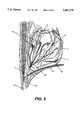
- FIG. 1is an illustration of the heart and a percutaneously inserted intrapericardial drug infusion catheter for intrapericardial delivery of nitrovasodilator to epicardial coronary arteries in accordance with this invention.
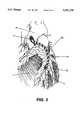
- FIG. 2is an illustration of the heart and a percutaneously inserted intrapericardial drug delivery implant for intrapericardial delivery of nitrovasodilator to epicardial coronary arteries in accordance with this invention.
- FIG. 3is an illustration of the heart with coronary artery bypass vein graft and an extravascular biodegradable polymer spiral-wrap implant for controlled release of nitrovasodilator to the vein graft in accordance with this invention.
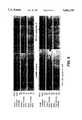
- FIG. 4is a representative recording of aortic pressure, phasic and mean flow velocity in the left anterior descending coronary artery, and pulmonary arterial pressure explained in Example 1.
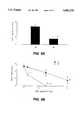
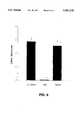
- FIG. 5Ashows dosage of sodium nitroprusside (SNP, ⁇ g/kg/min) required to abolish cyclic flow reductions given intravenously (IV) or intrapericardially (IP), as explained in Example 1.
- SNPsodium nitroprusside
- FIG. 5Bshows change in frequency of cyclic flow reductions (CFR's/30 minutes) after each dose of sodium nitroprusside (SNP, ⁇ g/kg/min) given intravenously (IV) or intrapericardially (IP), as explained in Example 1.
- SNPsodium nitroprusside
- IVintravenously
- IPintrapericardially
- FIGS. 6A-6Dshow changes respectively in mean aortic pressure (AOM, mmHg), cardiac output (CO, L/min), peripheral vascular resistance (PVR, units), and pulmonary arterial pressure (PAP, mmHg) after each dose of sodium nitroprusside (SNP, ⁇ /kg/min) given intrapericardially (IP) or intravenously (IV), as explained in Example 1.
- AOMmean aortic pressure
- COcardiac output
- PVRperipheral vascular resistance
- PAPpulmonary arterial pressure
- FIG. 7Ashows percent change in ex-vivo platelet aggregation induced by collagen at 20 ⁇ g/ml in platelet-rich plasma obtained from systemic circulation before and after each dose of sodium nitroprusside (SNP, ⁇ g/kg/min) given intravenously (IV) or intrapericardially (IP), as explained in Example 2.
- SNPsodium nitroprusside
- IVintravenously
- IPintrapericardially
- FIG. 7Bshows percent change in ex-vivo platelet aggregation induced by collagen at 20 ⁇ g/ml in platelet-rich plasma obtained from coronary circulation (coronary sinus) before and after each dose of sodium nitroprusside (SNP, ⁇ g/kg/min) given intravenously (IV) or intrapericardially (IP), as explained in Example 2.
- SNPsodium nitroprusside
- IVintravenously
- IPintrapericardially
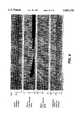
- FIG. 8is a representative recording of aortic pressure and phasic and mean flow velocity in the left anterior descending coronary artery (LAD) after N G -monomethyl-L-arginine (L-NMMA) was given into the left atrium at 5 mg/kg, after sodium nitroprusside (SNP) was given intrapericardially at 0.5 ⁇ g/kg/min, and after oxyhemoglobin (HbO 2 ) was given into the LAD CORONARY ARTERY at 200 ⁇ g/kg/min, as explained in Example 3.
- LADleft anterior descending coronary artery
- SNPsodium nitroprusside
- HbO 2oxyhemoglobin
- FIG. 9shows changes in frequency of cyclic flow reductions (CFR's/30 minutes) in the left anterior descending coronary artery (LAD) after N G -monomethyl-L-arginine (L-NMMA) was given into the left atrium at 5 mg/kg, after sodium nitroprusside (SNP) was given intrapericardially at 0.5 ⁇ g/kg/min, and after oxyhemoglobin (HbO 2 ) was given into the LAD coronary artery at 200-600 ⁇ g/kg/min., as explained in Example 3.
- L-NMMA*p ⁇ 0.01; compared to SNP, **p ⁇ 0.01.
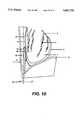
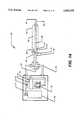
- FIG. 10schematically shows a transpericardial nitrovasodilator drug delivery catheter in place for use in accordance with this invention.
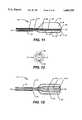
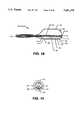
- FIG. 11schematically shows a longitudinal section of a portion of the transpericardial nitrovasodilator drug delivery catheter of FIG. 10.
- FIG. 12schematically shows a cross section of the portion of the transpericardial nitrovasodilator drug delivery catheter of FIG. 11.
- FIG. 13schematically shows a bottom view of a distal portion of the transpericardial nitrovasodilator drug delivery catheter of FIG. 10.
- FIG. 14schematically shows a longitudinal section of an intrapericardial nitrovasodilator drug delivery catheter for delivery of gaseous nitric oxide to epicardial coronary arteries in accordance with this invention, schematically connected with a gas supply and control system.
- FIG. 15schematically shows a cross section of a proximal part of the intrapericardial nitrovasodilator drug delivery catheter of FIG. 14.
- FIG. 16schematically shows a cross section of a distal part of the intrapericardial nitrovasodilator drug delivery catheter of FIG. 14.
- FIG. 17schematically shows an iontophoretic transpericardial nitrovasodilator drug delivery catheter in place for use in accordance with this invention.
- FIG. 18schematically shows a longitudinal section of a portion of the iontophoretic transpericardial nitrovasodilator drug delivery catheter of FIG. 17.
- FIG. 19schematically shows a cross section of the portion of the iontophoretic transpericardial nitrovasodilator drug delivery catheter of FIG. 17.
- Our inventioninvolves a method of treating blood vessels in a mammal, which comprises the extravascular administration, adjacent and site-specific to a blood vessel in the mammal, especially a human, of a bioactive agent capable of one or more of the effects of (a) lysis of a platelet thrombus with restoration of blood flow, (b) inhibition of platelet adhesion and aggregation at the site(s) of vessel injury, and (c) vasodilation of the vessel at the injury site(s) to maintain blood flow through the vessel, at a dosage rate effective to promote the desired local therapeutic effect upon the vessel at the vessel injury site(s), but less than sufficient to generalize these effects systemically.
- the bioactive agentpreferably is a conager of an endothelium-derived bioactive agent, including nitric oxide, sodium nitroprusside, nitroglycerin and prostacyclin.
- the method of administrationincludes controlled delivery of the bioactive agent over a sustained period of time.
- the site-specific dosage rateis significantly lower than a systemic dosage rate necessary to promote the therapeutic effects at the site(s).
- the therapeutic effectis lysis of the thrombus with restoration of blood flow, inhibition of platelet aggregation adjacent to the injury site(s) without promoting systemic anticoagulation, and vasodilation adjacent to the site(s) to maintain blood flow through the vessel without promoting systemic hypotension.
- the methodis also effective to promote vasodilation and prevent platelet thrombus formation, as where the site is the site(s) of a surgical procedure that injures the vessel, such as a PTCA procedure or a CABG operation.
- the methodis effective for treating acute thrombosis and chronic restenosis.
- a dosage rateof from about 0.1 to about 3.0 ⁇ g/kg/min is effective to produce at least one of the desired therapeutic effects.
- the method of administrationincludes infusion of the bioactive agent extravascular and adjacent the vessel at the specific site(s).
- the vessel treatedis a coronary blood vessel and bioactive agent delivery is by an infusion catheter, the distal outlet of which is percutaneously introduced into the pericardial sac surrounding the heart of the mammal.
- the distal outletis of small size, suitably less than 1.5 mm in outer diameter, is made of a material that is nonreactive to adjacent tissues, suitably a silicone rubber polymer, is nontraumatic to adjacent tissues, suitably a ⁇ pig-tail ⁇ tip design, and is effective for distributing the bioactive agent at the treatment site onto the extravascular surface of the target vessel(s).
- a the human heart 1showing the epicardial coronary arteries 3, the pericardial sac 4 enveloping the heart, and pericardial fluid 5 bathing the heart within the pericardial sac.
- One of the coronary arteries 3is indicated to be stenosed at 3'.
- Below the heartis the diaphragm musculature 6.
- the sternum 7In the chest of the patient in front of the heart is the sternum 7 and the lower extension thereof called the xiphoid process.
- Shown percutaneously inserted below the xiphoid processis a subxiphoid introducer 8 which has pierced the pericardium 4.
- Catheter 2Carried within the subxiphoid introducer 8 is a thereby percutaneously inserted intrapericardial nitrovasodilator agent infusion catheter 2.
- Catheter 2includes a catheter pig-tail 9 which secures infusion catheter 2 within pericardium 4, and has one or more distal side holes indicated on both sides of the lead line of reference numeral "9" for delivery of the infused nitrovasodilator agent.
- Fluidly connected to the end of infusion catheter 2 external to the chestis external drug infusion pump 10 for delivery of nitrovasodilator agent intrapericardially and extravascularly to the epicardial coronary arteries 3, as indicated schematically by the arrows 11.
- the nitrovasodilator agentforms part of the bath in which the heart is bathed and the nitrovasodilator agent is delivered extravascularly, that is, to the outside of the vessels, for outside-in diffusion into the vessels.
- the method of administrationincludes percutaneously or surgically inserting, extravascularly and adjacent the vessel at the site of treatment, an implant capable of extended time controlled-release of the bioactive agent.
- the implantincludes a biodegradable polymer comprising the bioactive agent with controlled-release properties (see, for example, U.S. Pat. No. 5,099,060 and U.S. Pat. No. 4,980,449, incorporated herein by reference).
- the implantmay be fiber-tipped for distribution of the bioactive agent to the treatment site from the biodegradable fiber tips. Referring to FIG. 2, an implant is illustrated.
- a heart 1 as in FIG. 1has epicardial coronary arteries 3, pericardial sac 4, pericardial fluid 5, diaphragm 6 and sternum 7.
- One of the coronary arteries 3is indicated to be stenosed at 3'.
- Shown percutaneously inserted below the xiphoid process of sternum 7is a subxiphoid implant introducer 13, which has pierced the pericardium 4.
- Carried with in the implant introducer 13is a thereby percutaneously inserted intrapericardial nitrovasodilator agent delivery implant 12 comprising nitrovasodilator agent/biodegradable polymer implant fibers 14 for intrapericardial release of nitrovasodilator from the erodible polymer extravascularly to the epicardial coronary arteries 3, as indicated schematically by the arrows 15.
- Suitable other forms of an implant for percutaneous pericardial extravascular insertionare intrapericardial microparticles and a sponge matrix, all comprising a biodegradable polymer.
- the implantsuitably may comprise a wrap for a blood vessel at the site of treatment, the wrap comprising the bioactive agent.
- the method of administrationcomprises surgically inserting around the vein graft an implant capable of extended controlled-release of the bioactive agent.
- a suitable form of the implant for extravascular insertionis a spiral-wrap device comprising a biodegradable polymer.
- the spiral-wrap implantis of a calibrated inner diameter, suitably to prevent vein graft distention, and is isocompliant with the vein graft, suitably to match normal coronary artery compliance. Referring to FIG.
- FIG. 3is an illustration of the heart 1 showing the aorta 16, an epicardial coronary artery 3, a proximal anastomosis site 17 and a distal anastomosis site 18 of a coronary artery bypass vein graft 19, and an extravascular biodegradable polymer spiral-wrap implant for controlled release of nitrovasodilator drug to the vein graft 20.
- an epipericardial drug distributing catheter apparatus 30is illustrated for distribution of a liquid carrying a nitrovasodilator onto the pericardium for transpericardial delivery of the nitrovasodilator.
- the apparatuscomprises an elongated catheter body 31 having a proximal segment 32 and distal segment 33.
- a first lumen 34 and second lumen 35extend through body 31.
- First lumen 34extends into a plurality of first passages 36 connecting first lumen 34 to a portion 37 of the exterior of distal segment 33.
- Second lumen 35extends into a plurality of second passages 38 connecting second lumen 35 to a portion 39 of the distal segment exterior.
- a predominately laterally expandable bag 40is mounted to an outer surface 41 of distal segment 33 to be free over the first passages 36 and not cover the second passages 38, thereby defining a bag cavity 42 between the bag 40 and the outer surface 41.
- Bag 40has a plurality of fluid outlets 43 from balloon cavity 42 to an exterior portion 44 of bag 40, providing fluid communication from first lumen 34 to exterior portion 44.
- a predominately vertically expandable balloon 45is mounted to an outer surface 46 of distal segment 33 to be free over second passages 38 and not cover first passages 36, thereby defining a balloon cavity 48 between balloon 45 and outer surface 46.
- a catheter sheath 47surrounds catheter body 31.
- sheath 47 with catheter 31 nested thereinis advanced within an introducer under the xiphod process of the sternum 7 into the mediastinum 21 of the thoracic cavity 22 to a position between pericardium 4 and the inner chest wall, as shown in FIG. 10.
- the distal end of catheter body 31is advanced from sheath 47 to extend the first and second balloons 40 and 45 beyond the distal extremity of the sheath and dispose exterior portion 44 of bag 40 against pericardium 4 and orient second balloon 45 facing the inner chest wall.
- a gassuitably air, is introduced through second lumen 35 and passes therethrough into second balloon 45, inflating balloon 45 predominately vertically, relative to the axis of the elongate catheter body 31.
- Apparatus 50comprises an elongated catheter body 51 having a proximal segment 52 and a distal segment 53, body 51 defining a first lumen 54 and a second lumen 55 extending therethrough.
- First lumen 54extends through the distal end 53 of catheter 51 for receiving a guidewire 57 therethrough.
- Second lumen 55extends to at least one opening 58 (a plurality of openings 58 are illustrated in this embodiment). Openings 58 connect second lumen 55 to the exterior of distal segment 53.
- a tube 59 surrounding at least a portion of catheter body 51creates a passageway 65 therebetween.
- a balloon 60 comprising a gas permeable membraneis mounted to an outer surface 61 of the distal segment of body 51, thereby defining a balloon cavity 62 between balloon 60 and body 51.
- An introducer 63surrounds at least a portion of catheter body 51 for introduction of distal segment 53 into the thoracic cavity and extension of balloon 60 beyond the distal extremity of sheath 63 for disposition exteriorly of the sheath on guidewire 57.
- gaseous nitric oxide supplied by tank 70is carried by conduit 71 controlled by microvalve 72 actuated by a solenoid 73 responsive to a pressure differential diaphragm 74 and is introduced into catheter apparatus 50, of which distal segment 53 has been introduced through the pericardium 4 through introducer 63.
- the nitric oxide gasflows through passageway 65 and passes into balloon 60 which it inflates.
- the nitric oxide resident in balloon cavity 62passes from cavity 62 through the gas permeable membrane of balloon 60 and enters the pericardial fluid bathing the coronary arteries for treatment of them.
- Gas within balloon cavity 62has an exit passage from balloon cavity 62 through openings 58 for withdrawal from the balloon through lumen 55 into a gas return conduit 75 under the force of withdrawal pump 76.
- FIGS. 17-19an apparatus for iontophoretic delivery of a nitrovasodilator onto the pericardium for transpericardial delivery of the nitrovasodilator is depicted schematically.
- the deviceis similar to the device illustrated in FIGS. 10-12, and corresponding numbers indicate similar structure, except the first lumen 34 does not lead to passages connecting the lumen exteriorly into a ballon cavity. Instead, lumen 34 (see FIG. 19) carries electrical leads 80, 81. Voltage carrying lead 80 is connected to a charge plate 83 in front of which is a pad 82 containing a repository of a nitrovasodilator. Pad 82 is attached to the outer surface 41 of distal segment 33.
- Negative electrode 84is coupled to the ground of lead 81.
- a chargeis provided over lead 80 to charge plate 83.
- An electric fieldis established between charge plate 83 and negative electrode 84. This electric field penetrates through the pericardium as it flows from plate 83 to electrode 84.
- the fieldpasses through nitrovasodilator pad 82, and charged nitrovasodilator molecules contained within pad 82 migrate from pad 82 and through pericardium 4 as the electric field traverses the pericardial membrane.
- the charge supplied to plate 83is sufficient to establish the iontophoretic circuit, but insufficient to disturb the transmission of the cardiac impulse through the heart.
- Plastic catheterswere placed in the left carotid artery for monitoring blood pressures and in a cephalic vein for administering fluids and drugs.
- a balloon-tipped thermodilution catheterwas placed through a jugular vein into the pulmonary artery for measuring pulmonary artery pressure and cardiac output.
- a left thoracotomywas performed in the fifth intercostal space, and the heart was exposed through a small pericardial window.
- a plastic cuffwas fixed to the edge of the incised pericardium to prevent the leakage of fluid from the pericardial sac, thus creating a pericardial well.
- LADleft anterior descending coronary artery
- a miniature ultrasonic Doppler flow probewas placed around the proximal part of the exposed LAD coronary artery to measure the velocity of blood flow.
- An additional plastic catheterwas positioned in the coronary sinus for collecting venous blood samples from the coronary circulation.
- Basic hemodynamicswere continuously recorded on a physiologic recorder, including heart rate, systolic and diastolic aortic blood pressures, systolic, diastolic, and balloon-wedge pulmonary artery pressures, phasic and mean blood flow velocities in the LAD coronary artery, and thermodilution cardiac output.
- CFR'scyclic flow reductions
- Group IIn six dogs, saline was dripped onto the surface of the exposed LAD coronary artery and into the pericardial well at a infusion rate of 0.2 ml/min through a plastic catheter. The saline infusion was continued for 60 minutes and hemodynamics were recorded continuously. The animals were then humanely killed by pentobarbital overdose.
- sodium nitroprusside(Abbott Labs, North Chicago, Ill.) was administered via delivery catheter on the extravascular surface of the injured LAD coronary artery and allowed to accumulate in the pericardial well.
- the intrapericardial dose of sodium nitroprussidewas started at 0.5 ⁇ g/kg/min. If CFR's were not affected within 30 minutes, the dosage was increased to 3.0 ⁇ g/kg/min. A maximal dosage of 6.0 ⁇ g/kg/min was given to the animals not responding to the two lower doses. The animals were killed 30 minutes after CFR's were abolished or after the highest dose of sodium nitroprusside was given for 30 minutes in the manner described above.
- Cyclic coronary flow reductionsdeveloped in all 20 dogs after endothelial injury and the external constriction of the LAD coronary artery.
- the reduction of coronary flow velocity caused by external constrictionwas similar among the 3 experimental groups of animals (phasic flow velocity reduced to 70.7 ⁇ 9.2% of baseline in Group I, to 66.5 ⁇ 4.9% in Group II, and to 56.4 ⁇ 5.0% in Group III (p>0.05).
- the frequency of initial (baseline, no drug) cyclic flow reductions in the coronary arterieswas also similar among the 3 groups of animals.
- the heart rate and aortic blood pressuredid not change significantly after the development of CFR's. After 30 minutes of consistent CFR's, for all studies, different interventions were then administered.
- the average dose of sodium nitroprusside required to abolish the CFR'swas significantly lower when it was administered intrapericardially than when it was given intravenously (1.6 ⁇ 0.5 vs. 4.8 ⁇ 0.8 ⁇ g/kg/min, respectively).
- IP drug delivery compared to IV drug administration+p ⁇ 0.01.
- the frequency of CFR'swas also significantly lower in animals that received intrapericardial sodium nitroprusside than in animals that received sodium nitroprusside at the same dose intravenously.
- Intrapericardial saline infusiondid not significantly change aortic pressures, cardiac output, pulmonary artery pressures or peripheral vascular resistance.
- sodium nitroprusside infusion(Groups II and III) reduced aortic pressures and peripheral vascular resistance in a dose-dependent manner.
- Cardiac output and pulmonary artery pressureswere not significantly affected by either intravenous or intrapericardial administration of sodium nitroprusside.
- Ex-vivo platelet aggregationwas performed before and 10 minutes after the administration of each dose of sodium nitroprusside in Groups II and III. Blood samples were collected from the plastic catheters in the aorta and the coronary sinus and anticoagulated with 3.8% sodium citrate (9 volumes blood:1 volume sodium citrate). Platelet-rich plasma was obtained by centrifuging the whole blood sample at 200 ⁇ g for 20 minutes at room temperature. The platelet count in platelet-rich plasma was adjusted to 300,000/mm 3 . A four-channel platelet aggregometer (model PAP-4, Bio-Data, Horsham, Pa.) was used for the assay. Collagen (Sigma, St. Louis, Mo.) was used as a platelet agonist. The degree of platelet aggregation was reported as a percentage of maximal increase of light transmission in platelet-rich plasma over that in platelet-poor plasma.
- Example 1As in Example 1, all values were expressed as the mean ⁇ standard error of the mean. A one-way analysis of variance with repeated measurements was used to compare the frequency of the platelet aggregation values obtained at different time periods before and after each treatment. Student's t-test was used compare values between two different groups (p ⁇ 0.05 was considered significant).
- Sodium nitroprusside infusion(Groups II and III) inhibited collagen-induced platelet aggregation in a dose-dependent manner in both the systemic circulation (FIG. 7A, compared to control level, *p ⁇ 0.05, **p ⁇ 0.01) and coronary circulation (FIG. 7B, compared to control level, *p ⁇ 0.05).
- the degree of inhibition of platelet aggregation in coronary circulationwas higher than that in the systemic circulation (FIG. 7B).
- Example 2This example was a study to determine the mechanisms involved in the action of sodium nitroprusside.
- the exposed LAD coronary arterywas mildly injured (3-5 vessel squeezes) and stenosed with a plastic constrictor.
- Oxyhemoglobinwas given at incremental doses of 200, 400, and 600 ⁇ g/kg/min. If oxyhemoglobin restored the CFR's abolished by intrapericardial sodium nitroprusside, the animals were monitored for 30 minutes to ensure the consistency of the CFR's and were then killed in the manner described above.
- Mean aortic pressurewas not significantly affected by oxyhemoglobin infusion.
Landscapes
- Health & Medical Sciences (AREA)
- Engineering & Computer Science (AREA)
- Life Sciences & Earth Sciences (AREA)
- Animal Behavior & Ethology (AREA)
- General Health & Medical Sciences (AREA)
- Public Health (AREA)
- Veterinary Medicine (AREA)
- Heart & Thoracic Surgery (AREA)
- Biomedical Technology (AREA)
- Nuclear Medicine, Radiotherapy & Molecular Imaging (AREA)
- Radiology & Medical Imaging (AREA)
- Hematology (AREA)
- Anesthesiology (AREA)
- Bioinformatics & Cheminformatics (AREA)
- Cardiology (AREA)
- Vascular Medicine (AREA)
- Pulmonology (AREA)
- Biophysics (AREA)
- Child & Adolescent Psychology (AREA)
- Organic Chemistry (AREA)
- Chemical Kinetics & Catalysis (AREA)
- Pharmacology & Pharmacy (AREA)
- Chemical & Material Sciences (AREA)
- Medicinal Chemistry (AREA)
- General Chemical & Material Sciences (AREA)
- Dermatology (AREA)
- Medical Informatics (AREA)
- Diabetes (AREA)
- Urology & Nephrology (AREA)
- Pharmaceuticals Containing Other Organic And Inorganic Compounds (AREA)
- Medicines That Contain Protein Lipid Enzymes And Other Medicines (AREA)
- Acyclic And Carbocyclic Compounds In Medicinal Compositions (AREA)
- Media Introduction/Drainage Providing Device (AREA)
- Medicines Containing Plant Substances (AREA)
- Infusion, Injection, And Reservoir Apparatuses (AREA)
Abstract
Description
This invention relates to methods and devices for the site-specific delivery of bioactive agents in mammals, especially for cardiac and peripheral vascular applications, and more particularly, as respects application for coronary thrombolysis and revascularization procedures, to methods and devices for prevention of coronary vasoconstriction, vascular thrombosis and restenosis during and after percutaneous transluminal coronary angioplasty and for prevention of coronary artery bypass graft thrombosis and occlusion.
1. Pathophysiological Background
A. Vascular Endothelium Function
Normal blood vessels are lined with a layer of endothelial cells. The endothelium releases local factors (endothelium-derived relaxing factor nitric oxide! and prostaglandin I2 PGI2, or prostacyclin!) into the vessel wall (intramural release) and into the blood stream (intraluminal release). These factors maintain vascular tone (vessel relaxation), inhibit clot formation on the vessel inner surface (platelet adhesion and aggregation), inhibit monocyte adherence and chemotaxis, and inhibit smooth muscle cell migration and proliferation. Normal endothelium releases both prostacyclin and nitric oxide in response to platelet aggregation. Nitric oxide release inhibits platelet adhesion, prevents further aggregation, and promotes platelet disaggregation. Prostacyclin release, promoted by platelet-derived thromboxane A2, acts synergistically with nitric oxide to prevent platelet-mediated vasoconstriction. As a result of this process, vasodilation and thrombolysis occurs, and blood flow is maintained. If the endothelium is dysfunctional or damaged, however, nitric oxide and prostacyclin release is impaired. Platelet aggregation and adhesion can occur unopposed, with platelet-derived products acting directly on the smooth muscle cells to cause vasoconstriction. The net result is a blood vessel which is highly susceptible to thrombosis and vasospasm. See, "Nitric oxide release accounts for the biological activity of endothelium-derived relaxing factor", Palmer R., et al., NATURE, 327:524, 1987; "Control of coronary vascular tone by nitric oxide", Kelm M., et al., CIRC. RES., 66:1561, 1990; "Regulatory functions of the vascular endothelium", Vane J., et al., N. ENGL. J. MED., 323:27, 1990; "Endothelial modulation of vascular tone: Relevance to coronary angioplasty and restenosis", Harrison D., J. AMER. COL. CARDIOL., 17:71B, 1991; "The antiaggregating properties of vascular endothelium: Interactions between prostacyclin and nitric oxide", Radomski M., et al., BRIT. J. PHARMACOL., 92:639, 1987; "EDRF increases cyclic GMP in platelets during passage through the coronary vascular bed", Pohl U., et al., CIRC. RES., 65:1798, 1989; "Human endothelial cells inhibit platelet aggregation by separately stimulating platelet cAMP and cGMP", Alheid U., et al., EUROP. J. PHARMACOL., 164:103, 1989; "Nitric oxide: An endogenous modulator of leukocyte adhesion", Kubes P., et al., PROC. NATL. ACAD. SCI., 88:4651, 1991; "Nitric oxide and prostacyclin: Divergence of inhibitory effects on monocyte chemotaxis and adhesion to endothelium in vitro", Bath P., et al., ARTERIOSCLER. THROMB., 11:254, 1991; "Nitric oxide generating vasodilators and 8-Br-cGMP inhibit mitogenesis and proliferation of cultured rat vascular smooth muscle cells", Garg U., et al., J. CLIN. INVEST., 83:1774, 1989; "Role of blood platelets and prostaglandins in coronary artery disease", Mehta J., et al., AMER. J. CARDIOL., 48:366, 1981; and "Prostaglandins and cardiovascular disease: A review", Jacobsen D., SURGERY, 93:564, 1983.
B. Vascular Stenosis
Atherosclerosis can form within a blood vessel over a period of years from a variety of causes. The resulting lesion, or plaque, may progressively occlude the vessel and impede blood flow to vital organs. The stenotic lesions when covered by endothelium are termed stable. See, "Cellular proliferation in atherosclerosis and hypertension", Schwartz S., et al., PROG. CARDIOVASC. DIS., 26:355, 1984; and "The pathogenesis of atherosclerosis: An update", Ross R., N. ENGL. J. MED., 314:488, 1986.
Unstable stenotic lesions are associated with endothelial cell injury at the sites of coronary stenosis. Injury to the endothelium stops the local release of the endothelium-derived factors. Severe injury to the vessel wall exposes the underlying collagen layer, which immediately activates platelet adhesion and aggregation (clumping) and stimulates vasoconstriction (spasm). The platelet blood clotting cascade is triggered, thrombin and fibrin quickly form at the site(s) of vascular injury, and a thrombus begins forming. The aggregating platelets release local growth factor (platelet-derived growth factor or PDGF) which activates smooth muscle cells within the vessel wall. Over a period of days-to-weeks, smooth muscle cells migrate into the thrombus and proliferate, and the thrombus becomes organized. See, "The restenosis paradigm revisited: An alternative proposal for cellular mechanisms", Schwartz R., et al., J. AMER. COL. CARDIOL., 20:1284, 1992; "The pathogenesis of coronary artery disease and the acute coronary syndromes: Parts I and II", Fuster V., et al., N. ENGL. J. MED., 326:242 and 310, 1992; "Migration of smooth muscle and endothelial cells", Casscells W., CIRC., 86:723, 1992; "The role of platelets, thrombin and hyperplasia in restenosis after coronary angioplasty", Ip J., et al., J. AMER. COL. CARDIOL., 17:77B, 1991; "Syndromes of accelerated atherosclerosis: Role of vascular injury and smooth muscle cell proliferation", Ip J., et al., J. AMER. COL. CARDIOL., 15:1667, 1990; "Time course of smooth muscle cell proliferation in the intima and media of arteries following experimental angioplasty", Hanke H., et al., CIRC. RES., 67:651, 1990; "Effect of platelet factors on migration of cultured bovine aortic endothelial and smooth muscle cells", Bell L., et al., CIRC. RES., 65:1057, 1989; "Role of platelets in smooth muscle cell proliferation and migration after vascular injury in rat carotid artery", Fingerle J., et al., PROC. NATL. ACAD. SCI., 86:8412, 1989; "Restenosis after coronary angioplasty: Potential biologic determinants and role of intimal hyperplasia", Liu M., et al., CIRC., 79:1374, 1989; "Is vasospasm related to platelet deposition?", Lain J., et al., CIRC., 75:243, 1988; "Role of platelets and thrombosis in mechanisms of acute occlusion and restenosis after angioplasty", Harker L., AMER. J. CARDIOL., 60:20B, 1987; and "Restenosis after arterial angioplasty: A hemorrheologic response to injury", Chesebro J., et al., AMER. J. CARDIOL., 60:10B, 1987.
C. Coronary Artery Stenosis
The described vasoconstrictive physiologic mechanisms occur both in peripheral and in coronary arteries, but the consequences of the processes are more life threatening in the coronary arteries. Coronary arteries, the arteries of the heart, perfuse the cardiac muscle with oxygenated arterial blood. They provide essential nutrients and allow for metabolic waste and gas exchange. These arteries are subject to unremitting service demands for continuous blood flow throughout the life of the patient. A severe proximal coronary artery stenosis with endothelial injury induces cyclic coronary flow reductions ("CFR's"). These are periodic or spasmodic progressive reductions in blood flow in the injured artery. Episodes of CFR's are correlated to clinical acute ischemic heart disease syndromes, which comprise unstable angina, acute myocardial infarction and sudden death. The common pathophysiologic link is endothelial injury with vasospasm and/or thrombus formation.
Coronary artery disease is the leading cause of death in the United States today. In 1992, the clinical population of unstable angina patients in the United States numbered approximately 1,000,000. Of these patients, it is estimated that 160,000 underwent coronary thrombolysis therapy where a clot dissolving agent is injected intravenously or intracoronary to reopen the thrombosed vessel and reduce the incidence of myocardial infarction and sudden death. See, "Mechanisms contributing to precipitation of unstable angina and acute myocardial infarction: Implications regarding therapy", Epstein S., et at., AMER. J. CARDIOL., 54:1245, 1984; "Unstable angina with fatal outcome: Dynamic coronary thrombosis leading to infarction and/or sudden death", Falk E., CIRC., 71:699, 1985; "Speculation regarding mechanisms responsible for acute ischemic heart disease syndromes", Willerson J., et al., J. AMER. COL. CARDIOL., 8:245, 1986; "Platelets and thrombolytic therapy", Coller B., N. ENGL. J. MED., 322:33, 1990; and "Frequency and severity of cyclic flow alterations and platelet aggregation predict the severity of neointimal proliferation following experimental coronary stenosis and endothelial injury", Willerson J., et al., PROC. NATL. ACAD. SCI., 88: 10624, 1991.
2. Surgical Procedures for Coronary Artery Disease
A. Procedures
Historically, the treatment of advanced atherosclerotic coronary artery disease (i.e., beyond that amenable to therapy via medication alone) has involved cardiac surgery in the form of a coronary artery bypass graft ("CABG"). The patient is placed on cardiopulmonary bypass (heart-lung machine) and the heart muscle is temporarily stopped (cardioplegia). Repairs are then surgically affected on the heart in the form of detour conduit grafted vessels (vein or artery graft) providing blood flow around the coronary artery obstruction(s). While CABG surgery has been shown to be effective, it carries with it inherent surgical risk and requires a recuperation period of several weeks. During 1992, approximately 290,000 patients underwent CABG surgery in the United States.
A major advance in the treatment of atherosclerotic coronary artery disease occurred in the late 1970's with introduction of the less-invasive percutaneous transluminal coronary angioplasty ("PTCA") procedures. The PTCA technique involves the retrograde introduction, from an artery in the leg or arm, up to the area of coronary vascular stenosis, of a catheter with a small dilating balloon at its tip. The catheter is advanced through the arteries via direct fluoroscopic guidance and passed across the luminal narrowing of the vessel. Once in place the catheter balloon is inflated for a short period of time. This results in mechanical deformation of the lesion or vessel with a subsequent increase in the cross-sectional area. This in turn reduces obstruction and transluminal pressure gradients, and increases blood flow through the coronary artery. PTCA or angioplasty is a term that now may include other percutaneous transluminal methods of decreasing stenosis within a blood vessel, and includes not only balloon dilation, but also thermal ablation and mechanical atherectomy with shaving, extraction or ultrasonic pulverization of the lesion. During 1992 in the United States, it is estimated that some 400,000 patients underwent coronary angioplasty procedures.
B. The Problem of Vascular Restenosis
Despite the major therapeutic advances in the treatment of coronary artery disease represented by thrombolytic therapy, CABG operations and PTCA procedures, the success of these measures has been hampered by the development of vessel renarrowing or reclosure, most significantly in patients undergoing thrombolysis and angioplasty procedures. Abrupt vessel occlusion or early restenosis may develop during a period of hours to days post-procedure due to vasospasm and/or platelet thrombus formation at the site of vessel injury. The more common and major limitation, however, is a development of progressive reversion of the diseased vessel to its previous stenotic condition, negating any gains achieved from the procedure. This gradual renarrowing process is referred to as restenosis or intimal hyperplasia. Restenosis is a reparative response to endovascular injury after angioplasty and in vein grafts following vessel bypass surgery. The sequence of events is similar to that described above for unstable lesions associated with endothelial injury, progressing through the process of platelet aggregation, vasoconstriction, thrombus formation, PDGF release, smooth muscle cell proliferation, and thrombus organization.
Clinical studies indicate that thrombolytic therapy is ineffective in about 20% of the treated patients and that 20% of those patients initially responding to therapy develop vessel rethrombosis within one week. Clinical studies also indicate that significant restenosis occurs in about 40% of the PTCA patients within six months and in about 20% of the CABG patients within one year. This complication results in increased morbidity, need for repeating the procedure, and escalating medical costs. With an estimated 690,000 coronary revascularization procedures performed in the United States in 1992, these incidences mean as many as 200,000 patients may develop vessel restenosis within one year after operation. Repeat procedures could account for $2.85 billion in additional health care costs in the United States.
6. Lack of Success in Prevention of Vasular Restenosis Without Side-Effects
At present, no therapy is know that consistently prevents the major clinical problem of vascular restenosis. Intravenous medications have been tried as a means to prevent PTCA restenosis and other coronary disease syndromes. Systemically administered pravastatin (U.S. Pat. No. 4,346,227) and lovastatin (U.S. Pat. No. 5,140,012), both HMG CoA reductase inhibitors, have been said to prevent restenosis following angioplasty. Prostaglandin E1 ("PGE1 ", a congener of endothelium-derived PGI2 and prostacyclin) and a known potent vasodilator with antiplatelet, anti-inflammatory and antiproliferative effects--see "Hemodynamic effects of prostaglandin E1 infusion in patients with acute myocardial infarction and left ventricular failure", Popat K., et al., AMER. HEART J., 103:485, 1982; "Comparison of equimolar concentrations of iloprost, prostacyclin, and prostaglandin E1 on human platelet function", Fisher C., et al., J. LAB. CLIN. MED., 109: 184, 1987; and "Prostaglandin E1 inhibits DNA synthesis in arterial smooth muscle cells stimulated with platelet-derived growth factors", Nilsson J., et al., ATHEROSCLEROSIS, 53:77, 1984--has been reported to inhibit abrupt occlusion and early restenosis in patients when infused intravenously after PTCA for 12 hours at dosages of from 20 to 40 ng/kg/min following a 65 ng bolus given intracoronary before and after PTCA, "Prostaglandin E1 infusion after angioplasty in humans inhibits abrupt occlusion and early restenosis", See J., et al., ADV. PROSTAGLANDIN, THROMBOXANE AND LEUKOTRIENE RES., 17:266, 1987. However, prostacyclin (PGI2) did not lower the coronary restenosis rate at 5 months following PTCA, although infused intravenously for 48 hours after PTCA at dosages of 5.0 ng/kg/min following intracoronary infusion at 7.0 ng/kg/min before and after the PTCA procedure, "Effect of short-term prostacyclin administration on restenosis after percutaneous transluminal coronary angioplasty", Knudtson M., et al., J. AMER. COL. CARDIOL., 15:691, 1990.
Sodium nitroprusside and other organic nitrates including nitroglycerin have long been used as vasodilator agents, and investigations, cited above, have shown that nitric oxide is the endogenous endothelium-derived nitrovasodilator. These agents also have anti-platelet effects, "The interaction of sodium nitroprusside with human endothelial cells and platelets: Nitroprusside and prostacyclin synergistically inhibit platelet function", Levin R., et al., CIRC., 66:1299, 1982; "Platelets, vasoconstriction, and nitroglycerin during arterial wall injury: A new antithrombotic role for an old drug", Lam J., et al., CIRC., 78:7122, 1988. In a study in stenosed and endothelium-injured canine coronary arteries, promotion of endogenous nitric oxide production by infusion of L-arginine (the precursor for nitric oxide synthesis), at a dosage of 60 mg/kg, decreased platelet aggregation and abolished CFR's, "Endogenous nitric oxide protects against platelet aggregation and cyclic flow variations in stenosed and endothelium-injured arteries", Yao S., et al., CIRC., 86: 1302, 1992. Intravenous nitroglycerin infusion at dosages from 10 to 15 μg/kg/min inhibited CFR's in stenosed and endothelium-injured coronary arteries of dogs. This effect was potentiated by the pretreatment with the reduced thiol, N-acetylcysteine, at a dose of 100 mg/kg for 30 minutes, "lntravenous nitroglycerin infusion inhibits cyclic blood flow responses caused by periodic platelet thrombus formation in stenosed canine coronary arteries", Folts J., et al., CIRC., 83:2122, 1991. Sodium nitroprusside is also a nitric oxide donor agent, "Metabolic activation of sodium nitroprusside to nitric oxide in vascular smooth muscle", Kowaluk E., et al., J. PHARMACOL. EXPER. THERAPEUTICS, 262:916, 1992.
The difficulty with systemic infusion of PGE1, PGI2, prostacyclin, sodium nitroprusside and the other organic nitrates is that, in dosages high enough to provide signs of beneficial cardiac effect, the potent vasodilator and antiplatelet effects of these bioactive agents also produce systemic side effects of bleeding and hypotension. No known therapy consistently prevents acute coronary thrombosis and chronic vascular restenosis while reducing the systemic side-effects of bleeding and hypotension. See, "Prevention of restenosis after percutaneous transluminal coronary angioplasty: The search for a 'magic bullet'", Hermans W., et al., AMER. HEART J., 122:171, 1991; and "Clinical trials of restenosis after coronary angioplasty", Popma J., et al., CIRC., 84:1426, 1991.
Recently, site-specific drug delivery to the arterial wall has become a new strategy for the treatment of vascular diseases, including vessel restenosis following PTCA. These drug delivery systems include: (1) intravascular devices for site-specific (coronary artery) drug delivery comprising double-balloon catheters, porous balloon catheters, microporous balloon catheters, channel balloon catheters, balloon over stent catheters, hydrogel coated balloon catheters, iontophoretic balloon catheters and stent devices; (2) periadventitial and epicardial drug delivery devices, requiring surgical implantation, which include drug-eluting polymer matrices and a iontophoretic patch device; and (3) intramural injection of drug-eluting microparticles. All of these methods are limited by certain problems including additional trauma to the vessel wall, rapid washout of drug, need for invasive insertion, and/or use of therapeutic agents having a single mechanism of action. See, "Effect of controlled adventitial heparin delivery on smooth muscle proliferation following endothelial injury", Edelman E., et al., PROC. NATL. ACAD. SCI., 87:3773, 1990; "Localized release of perivascular heparin inhibits intimal proliferation after endothelial injury without systemic anticoagulation", Okada T., et al., NEUROSURGERY, 25:892, 1989; "Iontophoretic transmyocardial drug delivery: A novel approach to antiarrhythmic drug therapy", Avitall B., et al., CIRC., 85:1582, 1992; "Direct intraarterial wall injection of microparticles via a catheter: A potential drug delivery strategy following angioplasty", Wilensky R., et al., AMER. HEART J., 122:1136, 1991; "Local anticoagulation without systemic effect using a polymer heparin delivery system", Okada T., et al., STROKE, 19:1470, 1988.
Intrapericardial injection of drugs has been used for the treatment of malignant or loculated pericardial effusions in man. Drugs that have been injected into the pericardial space include antibiotic, antineoplastic, radioactive and fibrinolytic agents. This method of site-specific drug delivery has been shown to be effective in attaining higher, longer-lasting drug levels in the pericardial fluid with lower plasma concentrations and less systemic toxicity. It has been reported that no major complications were associated with the intrapericardial drug infusion catheter and that it was possible to repeat the procedure without difficulty. See, "Intrapericardial instillation of platin in malignant pericardial effusion", Fiorentino M., et al., CANCER, 62:1904, 1988; and "Use of streptokinase to aid drainage of postoperative pericardial effusion", Cross J., et al., BRIT. HEART J., 62:217, 1989.
It is an object of this invention to provide treatment of vascular thrombosis and angioplasty restenosis, particularly coronary vascular thrombosis and angioplasty restenosis, thereby to decrease incidence of vessel rethrombosis, unstable angina, myocardial infarction and sudden death.
It is an object of this invention to prevent coronary angioplasty restenosis, thereby to improve the results of the procedure, to decrease need for additional intervention and to lower health care costs.
An object of this invention is to provide nonsystemic, site-specific and time extended administration of bioactive substances at low dosages effective to achieve a desired treatment effect and localized so as not to generalize the effect systemically.
An object of this invention is to impart thrombolytic, vasodilator, antithrombotic and antiproliferative actions to injured coronary vessels with reduced systemic effects.
An object of this invention is to provide delivery systems for site-specific pharmacologic therapy effective to prevent venous bypass graft thrombosis and intimal hyperplasia in coronary artery surgery patients.
These and other objects and benefits of our invention will become apparent from the description of our invention that now follows.
We have discovered that administration of a cogener of an endothelium-derived bioactive agent, more particularly a nitrovasodilator, representatively the nitric oxide donor agent sodium nitroprusside, to an extravascular treatment site, at a therapeutically effective dosage rate, is effective for abolishing CFR's while reducing or avoiding systemic effects such as supression of platelet function and bleeding. By "extravascular treatment site", we mean a site proximately adjacent the exterior of the vessel. In accordance with our invention, conagers of an endothelium-derived bioactive agent include prostacyclin, prostaglandin E1, and a nitrovasodilator agent. Nitrovasodilater agents include nitric oxide and nitric oxide donor agents, including L-arginine, sodium nitroprusside and nitroglycycerine. The so administered nitrovasodilators are effective to provide one or more of the therapeutic effects of promotion of vasodilation, inhibition of vessel spasm, inhibition of platelet aggregation, inhibition of vessel thrombosis, and inhibition of platelet growth factor release, at the treatment site, without inducing systemic hypotension or anticoagulation.
The treatment site may be any blood vessel. The most acute such blood vessels are coronary blood vessels. The coronary blood vessel may be a natural artery or an artificial artery, such as a vein graft for arterial bypass.
The step of administering includes delivering the congener in a controlled manner over a sustained period of time, and comprises intrapericardially or transpericardially extravascularly delivering the congener to the coronary blood vessel. Methods of delivery comprise (i) either intrapericardially or transpericardially infusing the congener through a percutaneously inserted catheter extravascularly to the coronary blood vessel, (ii) iontophoretically delivering the congener transpericardially extravascularly to the coronary blood vessel, and (iii) inserting extravascularly to the coronary blood vessel an implant capable of extended time release of the congener. The last method of delivery includes percutaneously inserting the implant proximately adjacent, onto, or into the pericardial sac surrounding the heart, and in a particular, comprises surgically wrapping the implant around a vein graft used for an arterial bypass. The extravascular implant may be a biodegradable controlled-release polymer comprising the congener.
In accordance with our invention, an apparatus for distribution of a liquid carrying a solute (more particularly in the method of this invention, a nitrovasodilator) onto a surface of a mammal body part (more particularly in accordance with a method of this invention, the pericardium) comprises an elongated catheter body having a proximal and distal segment, the body defining first and second lumens extending therethrough. The first lumen extends into a plurality of first passages connecting the first lumen to the exterior of the distal segment, and the second lumen extends into a plurality of second passages connecting the second lumen to the exterior of the distal segment. A predominately laterally expandable bag is mounted to an outer surface of the distal segment of the body to be free over the first passages and not cover the second passages, thereby defining a bag cavity between the bag and the outer surface. The bag has a plurality of fluid outlets from the balloon cavity to an exterior portion of the bag, providing fluid communication from the first lumen to the exterior portion. A predominately vertically expandable second balloon is mounted to an outer surface of the distal segment of the body to be free over the second passages and not cover the first passages, thereby defining a second balloon cavity between the second balloon and the outer surface. A catheter sheath surrounds at least a portion of the catheter body for introduction of the distal segment into a body cavity (in the particular of the method of this invention the mediastinum of the thoracic cavity) and for extension of the first and second balloons beyond the distal extremity of the sheath for disposition of the exterior portion of the bag against the body part (pericardium), whereby a liquid introduced into the first lumen passes therethrough into the bag for inflation thereof and passage from the bag cavity through the outlets, and gas introduced through the second lumen passes therethrough into the second balloon for inflation thereof to expand against a portion of the anatomy of the mammal within the body cavity adjacent the body part (in the particular of the method of this invention, the mediastinum), thereby to press the exterior portion of the bag against the body part surface (the pericardium) so that liquid emerging from the outlets contacts the (pericardium) surface for (transpericardial) passage of the solute (nitrovasodilator) therethrough.
An apparatus in accordance with our invention for distribution of a gas (in a particular in accordance with a method of our invention, nitric oxide gas) onto a surface of a mammal body part (more particularly in accordance with a method of our invention, a coronary artery) comprises an elongated catheter body having a proximal and distal segment, the body defining first and second lumens extending therethrough. The first lumen extends through the distal end of the catheter for receiving a guidewire therethrough. The second lumen extends to at least one opening connecting the second lumen to the exterior of the distal segment. A tube surrounding at least a portion of the catheter body creates a passageway therebetween. A balloon comprising a gas permeable membrane is mounted to an outer surface of the distal segment of the body, thereby defining a balloon cavity between the balloon and the outer surface. A catheter sheath surrounds at least a portion of the catheter body for introduction of the distal segment into a body cavity and extension of the balloon beyond the distal extremity of the sheath for disposition exteriorly of the sheath on a guidewire. Accordingly, a gas introduced into the passageway passes therethrough into the balloon for inflation thereof and passes from the balloon cavity through the gas permeable membrane into contact with the body part (coronary artery), and gas within the balloon exits the balloon through the opening for withdrawal from the balloon
The present invention may be more completely and easily understood when taken in conjunction with the accompanying drawings, in which:
FIG. 1 is an illustration of the heart and a percutaneously inserted intrapericardial drug infusion catheter for intrapericardial delivery of nitrovasodilator to epicardial coronary arteries in accordance with this invention.
FIG. 2 is an illustration of the heart and a percutaneously inserted intrapericardial drug delivery implant for intrapericardial delivery of nitrovasodilator to epicardial coronary arteries in accordance with this invention.
FIG. 3 is an illustration of the heart with coronary artery bypass vein graft and an extravascular biodegradable polymer spiral-wrap implant for controlled release of nitrovasodilator to the vein graft in accordance with this invention.
FIG. 4 is a representative recording of aortic pressure, phasic and mean flow velocity in the left anterior descending coronary artery, and pulmonary arterial pressure explained in Example 1.
FIG. 5A shows dosage of sodium nitroprusside (SNP, μg/kg/min) required to abolish cyclic flow reductions given intravenously (IV) or intrapericardially (IP), as explained in Example 1.
FIG. 5B shows change in frequency of cyclic flow reductions (CFR's/30 minutes) after each dose of sodium nitroprusside (SNP, μg/kg/min) given intravenously (IV) or intrapericardially (IP), as explained in Example 1.
FIGS. 6A-6D show changes respectively in mean aortic pressure (AOM, mmHg), cardiac output (CO, L/min), peripheral vascular resistance (PVR, units), and pulmonary arterial pressure (PAP, mmHg) after each dose of sodium nitroprusside (SNP, μ/kg/min) given intrapericardially (IP) or intravenously (IV), as explained in Example 1.
FIG. 7A shows percent change in ex-vivo platelet aggregation induced by collagen at 20 μg/ml in platelet-rich plasma obtained from systemic circulation before and after each dose of sodium nitroprusside (SNP, μg/kg/min) given intravenously (IV) or intrapericardially (IP), as explained in Example 2.
FIG. 7B shows percent change in ex-vivo platelet aggregation induced by collagen at 20 μg/ml in platelet-rich plasma obtained from coronary circulation (coronary sinus) before and after each dose of sodium nitroprusside (SNP, μg/kg/min) given intravenously (IV) or intrapericardially (IP), as explained in Example 2.
FIG. 8 is a representative recording of aortic pressure and phasic and mean flow velocity in the left anterior descending coronary artery (LAD) after NG -monomethyl-L-arginine (L-NMMA) was given into the left atrium at 5 mg/kg, after sodium nitroprusside (SNP) was given intrapericardially at 0.5 μg/kg/min, and after oxyhemoglobin (HbO2) was given into the LAD CORONARY ARTERY at 200 μg/kg/min, as explained in Example 3.
FIG. 9 shows changes in frequency of cyclic flow reductions (CFR's/30 minutes) in the left anterior descending coronary artery (LAD) after NG -monomethyl-L-arginine (L-NMMA) was given into the left atrium at 5 mg/kg, after sodium nitroprusside (SNP) was given intrapericardially at 0.5 μg/kg/min, and after oxyhemoglobin (HbO2) was given into the LAD coronary artery at 200-600 μg/kg/min., as explained in Example 3. Compared to L-NMMA, *p<0.01; compared to SNP, **p<0.01.
FIG. 10 schematically shows a transpericardial nitrovasodilator drug delivery catheter in place for use in accordance with this invention.
FIG. 11 schematically shows a longitudinal section of a portion of the transpericardial nitrovasodilator drug delivery catheter of FIG. 10.
FIG. 12 schematically shows a cross section of the portion of the transpericardial nitrovasodilator drug delivery catheter of FIG. 11.
FIG. 13 schematically shows a bottom view of a distal portion of the transpericardial nitrovasodilator drug delivery catheter of FIG. 10.
FIG. 14 schematically shows a longitudinal section of an intrapericardial nitrovasodilator drug delivery catheter for delivery of gaseous nitric oxide to epicardial coronary arteries in accordance with this invention, schematically connected with a gas supply and control system.
FIG. 15 schematically shows a cross section of a proximal part of the intrapericardial nitrovasodilator drug delivery catheter of FIG. 14.
FIG. 16 schematically shows a cross section of a distal part of the intrapericardial nitrovasodilator drug delivery catheter of FIG. 14.
FIG. 17 schematically shows an iontophoretic transpericardial nitrovasodilator drug delivery catheter in place for use in accordance with this invention.
FIG. 18 schematically shows a longitudinal section of a portion of the iontophoretic transpericardial nitrovasodilator drug delivery catheter of FIG. 17.
FIG. 19 schematically shows a cross section of the portion of the iontophoretic transpericardial nitrovasodilator drug delivery catheter of FIG. 17.
Our invention involves a method of treating blood vessels in a mammal, which comprises the extravascular administration, adjacent and site-specific to a blood vessel in the mammal, especially a human, of a bioactive agent capable of one or more of the effects of (a) lysis of a platelet thrombus with restoration of blood flow, (b) inhibition of platelet adhesion and aggregation at the site(s) of vessel injury, and (c) vasodilation of the vessel at the injury site(s) to maintain blood flow through the vessel, at a dosage rate effective to promote the desired local therapeutic effect upon the vessel at the vessel injury site(s), but less than sufficient to generalize these effects systemically. The bioactive agent preferably is a conager of an endothelium-derived bioactive agent, including nitric oxide, sodium nitroprusside, nitroglycerin and prostacyclin. The method of administration includes controlled delivery of the bioactive agent over a sustained period of time. Typically, the site-specific dosage rate is significantly lower than a systemic dosage rate necessary to promote the therapeutic effects at the site(s).
When the bioactive agent is sodium nitroprusside and the site of blood vessel treatment is the site of endothelial injury and thrombus formation, the therapeutic effect is lysis of the thrombus with restoration of blood flow, inhibition of platelet aggregation adjacent to the injury site(s) without promoting systemic anticoagulation, and vasodilation adjacent to the site(s) to maintain blood flow through the vessel without promoting systemic hypotension. The method is also effective to promote vasodilation and prevent platelet thrombus formation, as where the site is the site(s) of a surgical procedure that injures the vessel, such as a PTCA procedure or a CABG operation. Thus the method is effective for treating acute thrombosis and chronic restenosis. When the bioactive agent is sodium nitroprusside administered extravascularly and adjacent to the treatment site(s), a dosage rate of from about 0.1 to about 3.0 μg/kg/min is effective to produce at least one of the desired therapeutic effects.
The method of administration includes infusion of the bioactive agent extravascular and adjacent the vessel at the specific site(s). In a preferred application, the vessel treated is a coronary blood vessel and bioactive agent delivery is by an infusion catheter, the distal outlet of which is percutaneously introduced into the pericardial sac surrounding the heart of the mammal. Preferably the distal outlet is of small size, suitably less than 1.5 mm in outer diameter, is made of a material that is nonreactive to adjacent tissues, suitably a silicone rubber polymer, is nontraumatic to adjacent tissues, suitably a `pig-tail` tip design, and is effective for distributing the bioactive agent at the treatment site onto the extravascular surface of the target vessel(s). Referring now to FIG. 1, there is illustrated a thehuman heart 1 showing the epicardialcoronary arteries 3, thepericardial sac 4 enveloping the heart, andpericardial fluid 5 bathing the heart within the pericardial sac. One of thecoronary arteries 3 is indicated to be stenosed at 3'. Below the heart is thediaphragm musculature 6. In the chest of the patient in front of the heart is thesternum 7 and the lower extension thereof called the xiphoid process. Shown percutaneously inserted below the xiphoid process is asubxiphoid introducer 8 which has pierced thepericardium 4. Carried within thesubxiphoid introducer 8 is a thereby percutaneously inserted intrapericardial nitrovasodilatoragent infusion catheter 2.Catheter 2 includes a catheter pig-tail 9 which securesinfusion catheter 2 withinpericardium 4, and has one or more distal side holes indicated on both sides of the lead line of reference numeral "9" for delivery of the infused nitrovasodilator agent. Fluidly connected to the end ofinfusion catheter 2 external to the chest is externaldrug infusion pump 10 for delivery of nitrovasodilator agent intrapericardially and extravascularly to the epicardialcoronary arteries 3, as indicated schematically by thearrows 11. The nitrovasodilator agent forms part of the bath in which the heart is bathed and the nitrovasodilator agent is delivered extravascularly, that is, to the outside of the vessels, for outside-in diffusion into the vessels.
The method of administration includes percutaneously or surgically inserting, extravascularly and adjacent the vessel at the site of treatment, an implant capable of extended time controlled-release of the bioactive agent. Preferably the implant includes a biodegradable polymer comprising the bioactive agent with controlled-release properties (see, for example, U.S. Pat. No. 5,099,060 and U.S. Pat. No. 4,980,449, incorporated herein by reference). The implant may be fiber-tipped for distribution of the bioactive agent to the treatment site from the biodegradable fiber tips. Referring to FIG. 2, an implant is illustrated. Aheart 1 as in FIG. 1 has epicardialcoronary arteries 3,pericardial sac 4,pericardial fluid 5,diaphragm 6 andsternum 7. One of thecoronary arteries 3 is indicated to be stenosed at 3'. Shown percutaneously inserted below the xiphoid process ofsternum 7 is asubxiphoid implant introducer 13, which has pierced thepericardium 4. Carried with in theimplant introducer 13 is a thereby percutaneously inserted intrapericardial nitrovasodilatoragent delivery implant 12 comprising nitrovasodilator agent/biodegradablepolymer implant fibers 14 for intrapericardial release of nitrovasodilator from the erodible polymer extravascularly to the epicardialcoronary arteries 3, as indicated schematically by thearrows 15. Suitable other forms of an implant for percutaneous pericardial extravascular insertion are intrapericardial microparticles and a sponge matrix, all comprising a biodegradable polymer.
The implant suitably may comprise a wrap for a blood vessel at the site of treatment, the wrap comprising the bioactive agent. In a method of the invention directed to venous bypass graft treatment, the method of administration comprises surgically inserting around the vein graft an implant capable of extended controlled-release of the bioactive agent. A suitable form of the implant for extravascular insertion is a spiral-wrap device comprising a biodegradable polymer. Preferably the spiral-wrap implant is of a calibrated inner diameter, suitably to prevent vein graft distention, and is isocompliant with the vein graft, suitably to match normal coronary artery compliance. Referring to FIG. 3 is an illustration of theheart 1 showing theaorta 16, an epicardialcoronary artery 3, aproximal anastomosis site 17 and adistal anastomosis site 18 of a coronary arterybypass vein graft 19, and an extravascular biodegradable polymer spiral-wrap implant for controlled release of nitrovasodilator drug to thevein graft 20.
Referring to FIGS. 10-13, an epipericardial drug distributingcatheter apparatus 30 is illustrated for distribution of a liquid carrying a nitrovasodilator onto the pericardium for transpericardial delivery of the nitrovasodilator. The apparatus comprises anelongated catheter body 31 having aproximal segment 32 anddistal segment 33. Afirst lumen 34 andsecond lumen 35 extend throughbody 31.First lumen 34 extends into a plurality offirst passages 36 connectingfirst lumen 34 to a portion 37 of the exterior ofdistal segment 33.Second lumen 35 extends into a plurality ofsecond passages 38 connectingsecond lumen 35 to aportion 39 of the distal segment exterior. A predominately laterallyexpandable bag 40 is mounted to anouter surface 41 ofdistal segment 33 to be free over thefirst passages 36 and not cover thesecond passages 38, thereby defining abag cavity 42 between thebag 40 and theouter surface 41.Bag 40 has a plurality of fluid outlets 43 fromballoon cavity 42 to anexterior portion 44 ofbag 40, providing fluid communication fromfirst lumen 34 toexterior portion 44. A predominately verticallyexpandable balloon 45 is mounted to anouter surface 46 ofdistal segment 33 to be free oversecond passages 38 and not coverfirst passages 36, thereby defining aballoon cavity 48 betweenballoon 45 andouter surface 46. Acatheter sheath 47 surroundscatheter body 31.
In use ofdrug delivery catheter 30,sheath 47 withcatheter 31 nested therein is advanced within an introducer under the xiphod process of thesternum 7 into themediastinum 21 of the thoracic cavity 22 to a position betweenpericardium 4 and the inner chest wall, as shown in FIG. 10. The distal end ofcatheter body 31 is advanced fromsheath 47 to extend the first andsecond balloons exterior portion 44 ofbag 40 againstpericardium 4 and orientsecond balloon 45 facing the inner chest wall. A gas, suitably air, is introduced throughsecond lumen 35 and passes therethrough intosecond balloon 45, inflatingballoon 45 predominately vertically, relative to the axis of theelongate catheter body 31. This expandsballoon 45 into contact against the inner chest wall of the mediastinum. Further inflation causesballoon 45 to pressexterior portion 44 ofbag 40 against the surface ofpericardium 7. A liquid is introduced intofirst lumen 34 and passes therethrough intobag 40, expandingbag 40 predominately laterally. The liquid passes frombag cavity 42 through the outlets 43 and emerges therefrom onto the surface ofpericardium 4 for transpericardial passage of a drug (nitrovasodilator) in solution in the liquid and entry of the drug into the pericardial fluid bathing the heart, from which it comes into contact with the coronary arteries for migration into the vessel wall.
Referring to FIGS. 14-16, anapparatus 50 for intrapericardial delivery of gaseous nitric oxide to the epicardial coronary arteries in accordance with our invention is illustrated schematically.Apparatus 50 comprises anelongated catheter body 51 having aproximal segment 52 and adistal segment 53,body 51 defining afirst lumen 54 and asecond lumen 55 extending therethrough.First lumen 54 extends through thedistal end 53 ofcatheter 51 for receiving aguidewire 57 therethrough.Second lumen 55 extends to at least one opening 58 (a plurality ofopenings 58 are illustrated in this embodiment).Openings 58 connectsecond lumen 55 to the exterior ofdistal segment 53. Atube 59 surrounding at least a portion ofcatheter body 51 creates apassageway 65 therebetween. Aballoon 60 comprising a gas permeable membrane is mounted to anouter surface 61 of the distal segment ofbody 51, thereby defining aballoon cavity 62 betweenballoon 60 andbody 51. Anintroducer 63 surrounds at least a portion ofcatheter body 51 for introduction ofdistal segment 53 into the thoracic cavity and extension ofballoon 60 beyond the distal extremity ofsheath 63 for disposition exteriorly of the sheath onguidewire 57.
In use ofapparatus 50 for intrapericardial delivery of gaseous nitric oxide to the epicardial coronary arteries in accordance with our invention, gaseous nitric oxide supplied bytank 70 is carried byconduit 71 controlled bymicrovalve 72 actuated by a solenoid 73 responsive to a pressuredifferential diaphragm 74 and is introduced intocatheter apparatus 50, of whichdistal segment 53 has been introduced through thepericardium 4 throughintroducer 63. The nitric oxide gas flows throughpassageway 65 and passes intoballoon 60 which it inflates. The nitric oxide resident inballoon cavity 62 passes fromcavity 62 through the gas permeable membrane ofballoon 60 and enters the pericardial fluid bathing the coronary arteries for treatment of them. Gas withinballoon cavity 62 has an exit passage fromballoon cavity 62 throughopenings 58 for withdrawal from the balloon throughlumen 55 into agas return conduit 75 under the force ofwithdrawal pump 76.
Referring to FIGS. 17-19, an apparatus for iontophoretic delivery of a nitrovasodilator onto the pericardium for transpericardial delivery of the nitrovasodilator is depicted schematically. The device is similar to the device illustrated in FIGS. 10-12, and corresponding numbers indicate similar structure, except thefirst lumen 34 does not lead to passages connecting the lumen exteriorly into a ballon cavity. Instead, lumen 34 (see FIG. 19) carries electrical leads 80, 81.Voltage carrying lead 80 is connected to acharge plate 83 in front of which is apad 82 containing a repository of a nitrovasodilator.Pad 82 is attached to theouter surface 41 ofdistal segment 33. Circumscribing the perimetry ofpad 82 isnegative electrode 84, electrically insulated fromcharge plate 83 andpad 82 byelectrode insulators Negative electrode 84 is coupled to the ground oflead 81. Whenpad 82 is placed in contact with thepericardium 4 andplate 83, a charge is provided overlead 80 to chargeplate 83. An electric field is established betweencharge plate 83 andnegative electrode 84. This electric field penetrates through the pericardium as it flows fromplate 83 toelectrode 84. The field passes throughnitrovasodilator pad 82, and charged nitrovasodilator molecules contained withinpad 82 migrate frompad 82 and throughpericardium 4 as the electric field traverses the pericardial membrane. The charge supplied to plate 83 is sufficient to establish the iontophoretic circuit, but insufficient to disturb the transmission of the cardiac impulse through the heart.
In the following examples, the method of this invention is demonstrated to be effective.
All procedures in this an the following examples were conducted according to the principles of the American Physiological Society.
Twenty mongrel dogs weighing 25-35 kg were anesthetized with sodium pentobarbital (30 mg/kg given intravenously) and connected to a mechanical ventilator. Plastic catheters were placed in the left carotid artery for monitoring blood pressures and in a cephalic vein for administering fluids and drugs. A balloon-tipped thermodilution catheter was placed through a jugular vein into the pulmonary artery for measuring pulmonary artery pressure and cardiac output. A left thoracotomy was performed in the fifth intercostal space, and the heart was exposed through a small pericardial window. A plastic cuff was fixed to the edge of the incised pericardium to prevent the leakage of fluid from the pericardial sac, thus creating a pericardial well. A 1-2 cm segment of the left anterior descending (LAD) coronary artery was carefully exposed by dissection and nearby vessel branches were ligated. A miniature ultrasonic Doppler flow probe was placed around the proximal part of the exposed LAD coronary artery to measure the velocity of blood flow. An additional plastic catheter was positioned in the coronary sinus for collecting venous blood samples from the coronary circulation.
Basic hemodynamics were continuously recorded on a physiologic recorder, including heart rate, systolic and diastolic aortic blood pressures, systolic, diastolic, and balloon-wedge pulmonary artery pressures, phasic and mean blood flow velocities in the LAD coronary artery, and thermodilution cardiac output.
The endothelium of the LAD coronary artery was injured by squeezing the artery 10-20 times with cushioned forceps. A plastic constrictor was placed around the LAD coronary artery at the site of injury to occlude the vessel and reduce the phasic flow velocity to approximately 60% of the baseline level. Subsequently, cyclic flow reductions (CFR's) developed as a result of recurrent platelet adhesion, aggregation and dislodgement on the injured endothelial surface. These 20 dogs were further studied in three groups:
Group I. In six dogs, saline was dripped onto the surface of the exposed LAD coronary artery and into the pericardial well at a infusion rate of 0.2 ml/min through a plastic catheter. The saline infusion was continued for 60 minutes and hemodynamics were recorded continuously. The animals were then humanely killed by pentobarbital overdose.
Group II. In seven dogs, sodium nitroprusside (Abbott Labs, North Chicago, Ill.) was administered via delivery catheter on the extravascular surface of the injured LAD coronary artery and allowed to accumulate in the pericardial well. The intrapericardial dose of sodium nitroprusside was started at 0.5 μg/kg/min. If CFR's were not affected within 30 minutes, the dosage was increased to 3.0 μg/kg/min. A maximal dosage of 6.0 μg/kg/min was given to the animals not responding to the two lower doses. The animals were killed 30 minutes after CFR's were abolished or after the highest dose of sodium nitroprusside was given for 30 minutes in the manner described above.
Group III. In the remaining seven dogs, sodium nitroprusside was administered intravenously at the same dosage range described for Group II. The animals were monitored and killed in the same manner as described above.
All values were expressed as the mean±standard error of the mean. A one-way analysis of variance with repeated measurements was used to compare the frequency of CFR's and the hemodynamic changes obtained at different time periods before and after each treatment. Student's t-test was used compare values between two different groups (p<0.05 was considered significant).
1. Effect of Nitroprusside on CFR's
Cyclic coronary flow reductions developed in all 20 dogs after endothelial injury and the external constriction of the LAD coronary artery. The reduction of coronary flow velocity caused by external constriction was similar among the 3 experimental groups of animals (phasic flow velocity reduced to 70.7±9.2% of baseline in Group I, to 66.5±4.9% in Group II, and to 56.4±5.0% in Group III (p>0.05). The frequency of initial (baseline, no drug) cyclic flow reductions in the coronary arteries was also similar among the 3 groups of animals. The heart rate and aortic blood pressure did not change significantly after the development of CFR's. After 30 minutes of consistent CFR's, for all studies, different interventions were then administered.
In the Group I studies, intrapericardial infusion of saline did not change the flow pattern or CFR frequency in any of the 6 animals (0% effective).
In the Group II studies, intrapericardial infusion of sodium nitroprusside (FIG. 4) abolished the CFR's within 10 to 30 minutes in all 7 animals (100% effective).
In the Group III studies, intravenous infusion of sodium nitroprusside abolished the CFR's within 10 to 30 minutes in 5 of 7 animals (71% effective).
As shown in FIG. 5A, the average dose of sodium nitroprusside required to abolish the CFR's was significantly lower when it was administered intrapericardially than when it was given intravenously (1.6±0.5 vs. 4.8±0.8 μg/kg/min, respectively). Referring to FIG. 5A, IP drug delivery compared to IV drug administration, +p<0.01.
As shown in FIG. 5B, the frequency of CFR's was also significantly lower in animals that received intrapericardial sodium nitroprusside than in animals that received sodium nitroprusside at the same dose intravenously. Referring to FIG. 5B, compared to control values, *p<0.05, **p<0.01; compared to IV drug administration, +p<0.05, ++p<0.01.
These data indicate that treatment with sodium nitroprusside protects against CFR's in stenosed and endothelium injured coronary arteries and that the effective dosage required to abolish CFR's is lower and more effective when it is given intrapericardially than when it is given intravenously.
2. Effect Of Nitroprusside On Hemodynamics
Intrapericardial saline infusion (Group I) did not significantly change aortic pressures, cardiac output, pulmonary artery pressures or peripheral vascular resistance. As shown in FIGS. 6A-6D, sodium nitroprusside infusion (Groups II and III) reduced aortic pressures and peripheral vascular resistance in a dose-dependent manner. Cardiac output and pulmonary artery pressures were not significantly affected by either intravenous or intrapericardial administration of sodium nitroprusside. Referring to FIGS. 6A-6D, compared to the control values, *p<0.05, **p<0.01; compared to IP at 3.0 μg/kg/min, +p<0.01.
These data indicate that extravascular intrapericardial infusion of sodium nitroprusside has an advantage over intravenous infusion in reducing the systemic hypotensive side-effects of sodium nitroprusside.
Ex-vivo platelet aggregation was performed before and 10 minutes after the administration of each dose of sodium nitroprusside in Groups II and III. Blood samples were collected from the plastic catheters in the aorta and the coronary sinus and anticoagulated with 3.8% sodium citrate (9 volumes blood:1 volume sodium citrate). Platelet-rich plasma was obtained by centrifuging the whole blood sample at 200× g for 20 minutes at room temperature. The platelet count in platelet-rich plasma was adjusted to 300,000/mm3. A four-channel platelet aggregometer (model PAP-4, Bio-Data, Horsham, Pa.) was used for the assay. Collagen (Sigma, St. Louis, Mo.) was used as a platelet agonist. The degree of platelet aggregation was reported as a percentage of maximal increase of light transmission in platelet-rich plasma over that in platelet-poor plasma.
As in Example 1, all values were expressed as the mean±standard error of the mean. A one-way analysis of variance with repeated measurements was used to compare the frequency of the platelet aggregation values obtained at different time periods before and after each treatment. Student's t-test was used compare values between two different groups (p<0.05 was considered significant).
Sodium nitroprusside infusion (Groups II and III) inhibited collagen-induced platelet aggregation in a dose-dependent manner in both the systemic circulation (FIG. 7A, compared to control level, *p<0.05, **p<0.01) and coronary circulation (FIG. 7B, compared to control level, *p<0.05). In the animals treated with extravascular intrapericardial sodium nitroprusside, the degree of inhibition of platelet aggregation in coronary circulation was higher than that in the systemic circulation (FIG. 7B).
These data indicate that inhibition of platelet aggregation in the coronary circulation is greater with extravascular intrapericardial infusion of sodium nitroprusside than when it is given intravenously and reduces the systemic side-effects of antiplatelet therapy, such as bleeding complications.
This example was a study to determine the mechanisms involved in the action of sodium nitroprusside. The same preparative procedure was followed as in Example 1 for an additional group of five dogs (Group IV), except that in these animals, plastic catheters were also placed into the left atrium of the heart and into a branch of the LAD coronary artery proximal to the exposed segment. The exposed LAD coronary artery was mildly injured (3-5 vessel squeezes) and stenosed with a plastic constrictor. An inhibitor of nitric oxide synthetase, NG -mono-methyl-L-arginine (L-NMMA, Calbiochem, La Jolla, Calif.), was administered into the left atrium at 5 mg/kg to eliminate the production of endogenous nitric oxide and induce CFR's. After 30 minutes of L-NMMA-induced CFR's, sodium nitroprusside was administered via delivery catheter on the extravascular surface of the injured LAD coronary artery and into the pericardial well. If the CFR's were abolished by the intrapericardial infusion of sodium nitroprusside, oxyhemoglobin, a scavenger of nitric oxide, was administered into the LAD coronary artery. Oxyhemoglobin was given at incremental doses of 200, 400, and 600 μg/kg/min. If oxyhemoglobin restored the CFR's abolished by intrapericardial sodium nitroprusside, the animals were monitored for 30 minutes to ensure the consistency of the CFR's and were then killed in the manner described above.
As in the prior examples, all values were expressed as the mean±standard error of the mean. A one-way analysis of variance with repeated measurements was used to compare the frequency of CFR's and the hemodynamic changes obtained at different time periods before and after each treatment. Student's t-test was used compare values between two different groups (p<0.05 was considered significant).
Infusion of L-NMMA into the left atrium at a dose of 5 mg/kg caused CFR's in all 5 animals in Group IV. The mean aortic pressure increased approximately 20 mmHg following L-NMMA infusion. After 30 minutes of consistent CFR's, extravascular intrapericardial sodium nitroprusside infusion at a dosage of 0.5 μg/kg/min abolished the CFR's within 10 to 30 minutes in all 5 dogs (p<0.01, FIG. 8 and 9). The mean aortic pressure returned to the level before L-NMMA was infused. Oxyhemoglobin, infused into the proximal LADcoronary artery 30 minutes after CFR's were abolished with sodium nitroprusside, restored CFR's within 5 to 20 minutes in all 5 dogs (p<0.01, FIG. 8 and 9). An average dose of 320±80 μg/kg/min of oxyhemoglobin was given to restore CFR's. The severity of the restored CFR's was similar to that of L-NMMA-induced CFR's in 3 of 5 animals and slightly less than that of the initial CFR's in the other 2 dogs. Mean aortic pressure was not significantly affected by oxyhemoglobin infusion.
These data indicate that nitric oxide does play an important role when extravascular intrapericardial sodium nitroprusside abolishes coronary CFR's.
Having now described in detail the methodology of our invention, those in the art will appreciate more than merely the detailed means described for implementing the invention, and our invention is not meant to be limited merely to these detailed implementations, but to all implementations comphrehended by our claims within the spirit of our invention.
Claims (21)
1. The method of treating a mammal comprising the steps of:
(a) selecting a congener of an endothelium-derived bioactive agent;
(b) administering a therapeutically effective dosage of the selected congener to a site proximately adjacent the exterior of a coronary blood vessel; and
(c) allowing the congener to treat the coronary blood vessel from the outside-in.
2. The method of claim 1 in which said step of selecting further comprises selecting sodium nitroprusside as said congener.
3. The method of claim 1 in which said coronary blood vessel is a coronary artery.
4. The method of claim 1 in which said coronary blood vessel is a vein graft for arterial bypass.
5. The method of claim 1 in which said step of administering includes delivering said congener in a controlled manner over a sustained period of time.
6. The method of claim 1 in which said step of administering comprises administering a dosage rate of said selected congener effective to provide one or more of the therapeutic effects of promotion of vasodilation, inhibition of vessel spasm, inhibition of platelet aggregation, inhibition of vessel thrombosis, and inhibition of platelet growth factor release, at said treatment sites, without inducing systemic hypotension or anticoagulation.
7. The method of claim 1 in which said step of administering comprises administering a dosage rate of from about 0.1 to about 3.0 μg/kg/min of said selected congener.
8. The method of claim 1 in which said step of administering comprises intrapericardially extravascularly delivering said congener to said coronary blood vessel.
9. The method of claim 8 in which said step of administering comprises intrapericardially infusing said congener through a percutaneously inserted catheter extravascularly to said coronary blood vessel.
10. The method of claim 1 in which said step of selecting further comprises selecting said congener from the group consisting of prostacyclin, prostaglandin E1, or a nitrovasodilator, or a combination thereof.
11. The method of claim 10 in which said step of selecting further comprises selecting said nitrovasodilator from the group consisting of nitric oxide, a nitric oxide donor agent, or a combination thereof.
12. The method of claim 11 in which said step of selecting further comprises selecting said nitric oxide donor agent from the group consisting of L-arginine, sodium nitroprusside, nitroglycerin, or a combination thereof.
13. The method of claim 1 in which said step of administering comprises transpericardially extravascularly delivering said congener to said coronary blood vessel.
14. The method of claim 13 in which said step of administering comprises transpericardially infusing said congener through a percutaneously inserted catheter extravascularly to said coronary blood vessel.
15. The method of claim 13 in which said step of administering comprises iontophoretically delivering said congener transpericardially extravascularly to said coronary blood vessel.
16. The method of claim 1 in which said step of administering comprises inserting extravascularly to said coronary blood vessel an implant capable of extended time release of said congener.
17. The method of claim 16 in which said step of inserting said extravascular implant comprises percutaneously inserting said implant proximately adjacent, onto, or into the pericardial sac surrounding the heart.
18. The method of claim 16 in which step of inserting said extravascular implant comprises surgically wrapping said implant around a vein graft used for an arterial bypass.
19. The method of claim 16 in which said step of inserting said implant further comprises inserting a biodegradable controlled-release polymer comprising said congener.
20. A method of treating a coronary blood vessel in a mammal, which comprises intrapericardially or transpericardially supplying sodium nitroprusside to the blood vessel in a therapeutically effective dose.
21. A method of treating a coronary blood vessel in a mammal, which comprises intrapericardially or transpericardially extravascularly delivering a congener of an endothelium-derived bioactive agent of said blood vessel at a therapeutically effective dosage rate.
Priority Applications (11)
| Application Number | Priority Date | Filing Date | Title |
|---|---|---|---|
| US08/264,458US5681278A (en) | 1994-06-23 | 1994-06-23 | Coronary vasculature treatment method |
| US08/486,104US5634895A (en) | 1994-06-23 | 1995-06-07 | Apparatus and method for transpericardial delivery of fluid |
| CA2193836ACA2193836C (en) | 1994-06-23 | 1995-06-23 | Vascular treatment method and apparatus |
| AU31340/95AAU3134095A (en) | 1994-06-23 | 1995-06-23 | Intrapericardial space drug delivery apparatus and method |
| PCT/US1995/009055WO1996000112A1 (en) | 1994-06-23 | 1995-06-23 | Vascular treatment method and apparatus |
| PCT/US1995/009047WO1996000038A1 (en) | 1994-06-23 | 1995-06-23 | Intrapericardial space drug delivery apparatus and method |
| JP8503514AJPH10507092A (en) | 1994-06-23 | 1995-06-23 | Vascular treatment method and apparatus |
| EP95927258AEP0766580B1 (en) | 1994-06-23 | 1995-06-23 | Compositions of prostacyclin, pge or a nitrovasodilator or combinations thereof for the treatment of diseases of the vascular system |
| AU31344/95AAU3134495A (en) | 1994-06-23 | 1995-06-23 | Vascular treatment method and apparatus |
| DE69534798TDE69534798T2 (en) | 1994-06-23 | 1995-06-23 | PREPARATIONS OF PROSTACYCLIN, PGE OR A NITROVASODILATOR AND THEIR MIXTURES FOR THE TREATMENT OF DISEASES OF THE VASCULAR SYSTEM |
| AT95927258TATE318164T1 (en) | 1994-06-23 | 1995-06-23 | PREPARATIONS MADE OF PROSTACYCLIN, PGE OR A NITROVASODILATOR AND MIXTURES THEREOF FOR THE TREATMENT OF DISEASES OF THE VASCULAR SYSTEM |
Applications Claiming Priority (1)
| Application Number | Priority Date | Filing Date | Title |
|---|---|---|---|
| US08/264,458US5681278A (en) | 1994-06-23 | 1994-06-23 | Coronary vasculature treatment method |
Related Child Applications (1)
| Application Number | Title | Priority Date | Filing Date |
|---|---|---|---|
| US08/486,104DivisionUS5634895A (en) | 1994-06-23 | 1995-06-07 | Apparatus and method for transpericardial delivery of fluid |
Publications (1)
| Publication Number | Publication Date |
|---|---|
| US5681278Atrue US5681278A (en) | 1997-10-28 |
Family
ID=23006161
Family Applications (2)
| Application Number | Title | Priority Date | Filing Date |
|---|---|---|---|
| US08/264,458Expired - Fee RelatedUS5681278A (en) | 1994-06-23 | 1994-06-23 | Coronary vasculature treatment method |
| US08/486,104Expired - Fee RelatedUS5634895A (en) | 1994-06-23 | 1995-06-07 | Apparatus and method for transpericardial delivery of fluid |
Family Applications After (1)
| Application Number | Title | Priority Date | Filing Date |
|---|---|---|---|
| US08/486,104Expired - Fee RelatedUS5634895A (en) | 1994-06-23 | 1995-06-07 | Apparatus and method for transpericardial delivery of fluid |
Country Status (8)
| Country | Link |
|---|---|
| US (2) | US5681278A (en) |
| EP (1) | EP0766580B1 (en) |
| JP (1) | JPH10507092A (en) |
| AT (1) | ATE318164T1 (en) |
| AU (2) | AU3134095A (en) |
| CA (1) | CA2193836C (en) |
| DE (1) | DE69534798T2 (en) |
| WO (2) | WO1996000112A1 (en) |
Cited By (148)
| Publication number | Priority date | Publication date | Assignee | Title |
|---|---|---|---|---|
| US5900433A (en)* | 1995-06-23 | 1999-05-04 | Cormedics Corp. | Vascular treatment method and apparatus |
| US5904938A (en)* | 1995-02-16 | 1999-05-18 | The General Hospital Corporation | Treatment of vascular thrombosis and restenosis with inhaled nitric oxide |
| WO1999049773A2 (en) | 1998-03-31 | 1999-10-07 | Cardiogenesis Corporation | Delivery catheter system for heart chamber |
| US5972013A (en)* | 1997-09-19 | 1999-10-26 | Comedicus Incorporated | Direct pericardial access device with deflecting mechanism and method |
| WO1999060924A1 (en) | 1998-05-26 | 1999-12-02 | Comedicus Incorporated | Intrapericardial procedures and apparatuses |
| US6004295A (en)* | 1997-06-26 | 1999-12-21 | An-Go-Gen Inc. | Catheters |
| WO2000024452A1 (en)* | 1998-10-23 | 2000-05-04 | Biocardia, Inc. | Systems and compounds for drug delivery to interstitial regions of the myocardium |
| US6162195A (en)* | 1995-06-07 | 2000-12-19 | Cormedics Corp. | Method and apparatus for accessing the pericardial space |
| US6161543A (en)* | 1993-02-22 | 2000-12-19 | Epicor, Inc. | Methods of epicardial ablation for creating a lesion around the pulmonary veins |
| US6206004B1 (en) | 1996-12-06 | 2001-03-27 | Comedicus Incorporated | Treatment method via the pericardial space |
| WO2001026730A1 (en)* | 1999-10-08 | 2001-04-19 | Scimed Life Systems, Inc. | Iontophoretic delivery to heart tissue |
| US6231518B1 (en) | 1998-05-26 | 2001-05-15 | Comedicus Incorporated | Intrapericardial electrophysiological procedures |
| US6237605B1 (en) | 1996-10-22 | 2001-05-29 | Epicor, Inc. | Methods of epicardial ablation |
| US6287285B1 (en) | 1998-01-30 | 2001-09-11 | Advanced Cardiovascular Systems, Inc. | Therapeutic, diagnostic, or hydrophilic coating for an intracorporeal medical device |
| US6311692B1 (en) | 1996-10-22 | 2001-11-06 | Epicor, Inc. | Apparatus and method for diagnosis and therapy of electrophysiological disease |
| US20020049457A1 (en)* | 1999-05-20 | 2002-04-25 | Kaplan Aaron V. | Methods and apparatus for transpericardial left atrial appendage closure |
| US20020090388A1 (en)* | 2000-12-01 | 2002-07-11 | Humes H. David | Intravascular drug delivery device and use therefor |
| US6436365B2 (en)* | 1997-09-23 | 2002-08-20 | Schering Aktiengesellschaft | Process for therapeutic treatment of proliferative diseases |
| US6443949B2 (en)* | 1997-03-13 | 2002-09-03 | Biocardia, Inc. | Method of drug delivery to interstitial regions of the myocardium |
| WO2002087472A1 (en)* | 2001-04-27 | 2002-11-07 | The Medstar Research Institute | Stent-based delivery of statins to prevent restenosis |
| US6478776B1 (en) | 2000-04-05 | 2002-11-12 | Biocardia, Inc. | Implant delivery catheter system and methods for its use |
| US20030022819A1 (en)* | 2000-06-16 | 2003-01-30 | Ling Leona E. | Angiogenesis-modulating compositions and uses |
| US20030073992A1 (en)* | 1996-10-22 | 2003-04-17 | Epicor, Inc. | Methods and devices for ablation |
| US20030083725A1 (en)* | 2001-10-29 | 2003-05-01 | Berthold Kramm | Method and apparatus for endovenous pacing lead |
| US6569082B1 (en) | 1999-08-10 | 2003-05-27 | Origin Medsystems, Inc. | Apparatus and methods for cardiac restraint |
| US6575956B1 (en) | 1997-12-31 | 2003-06-10 | Pharmasonics, Inc. | Methods and apparatus for uniform transcutaneous therapeutic ultrasound |
| US6592552B1 (en) | 1997-09-19 | 2003-07-15 | Cecil C. Schmidt | Direct pericardial access device and method |
| WO2002049702A3 (en)* | 2000-12-19 | 2003-08-07 | Edwards Lifesciences Corp | Intra-pericardial drug delivery device for angiogenesis |
| US6645202B1 (en) | 1996-10-22 | 2003-11-11 | Epicor Medical, Inc. | Apparatus and method for ablating tissue |
| US20030229331A1 (en)* | 1999-11-05 | 2003-12-11 | Pharmasonics, Inc. | Methods and apparatus for uniform transcutaneous therapeutic ultrasound |
| US20040006140A1 (en)* | 1994-10-05 | 2004-01-08 | Kaesemeyer Wayne H | Controlled release arginine formulations |
| US20040008999A1 (en)* | 2002-06-12 | 2004-01-15 | Ayako Iino | Image forming apparatus |
| US6685672B1 (en) | 2000-07-13 | 2004-02-03 | Edwards Lifesciences Corporation | Multi-balloon drug delivery catheter for angiogenesis |
| US6689128B2 (en) | 1996-10-22 | 2004-02-10 | Epicor Medical, Inc. | Methods and devices for ablation |
| US20040087941A1 (en)* | 1998-05-20 | 2004-05-06 | Wang Paul J. | Cardiac system and method for treatment of cardiac arrhythmias and transmyocardial revascularization |
| US20040171546A1 (en)* | 1998-09-11 | 2004-09-02 | President And Fellows Of Harvard College | Regulation of lung tissue by hedgehog-like polypeptides and formulations and uses related thereto |
| US6805128B1 (en) | 1996-10-22 | 2004-10-19 | Epicor Medical, Inc. | Apparatus and method for ablating tissue |
| US20040242682A1 (en)* | 1999-01-07 | 2004-12-02 | Kaesemeyer Wayne H. | Compositions comprising arginine and nitrates |
| US20050002933A1 (en)* | 1997-02-10 | 2005-01-06 | Baron Margaret H. | Methods for modulating hematopoiesis and vascular growth |
| US20050054568A1 (en)* | 2000-06-16 | 2005-03-10 | Ling Leona E. | Angiogenesis-modulating compositions and uses |
| US20050084514A1 (en)* | 2000-11-06 | 2005-04-21 | Afmedica, Inc. | Combination drug therapy for reducing scar tissue formation |
| US20050085548A1 (en)* | 1997-04-10 | 2005-04-21 | Kaesemeyer Wayne H. | Method and formulation for treating vascular disease |
| US6889091B2 (en) | 2002-03-06 | 2005-05-03 | Medtronic, Inc. | Method and apparatus for placing a coronary sinus/cardiac vein pacing lead using a multi-purpose side lumen |
| US20050165452A1 (en)* | 2004-01-28 | 2005-07-28 | Medtronic, Inc. | Antithrombogenic medical device |
| US20050256076A1 (en)* | 2004-03-26 | 2005-11-17 | Curis, Inc. | RNA interference modulators of hedgehog signaling and uses thereof |
| US7083620B2 (en) | 2002-10-30 | 2006-08-01 | Medtronic, Inc. | Electrosurgical hemostat |
| US7094235B2 (en) | 2001-04-26 | 2006-08-22 | Medtronic, Inc. | Method and apparatus for tissue ablation |
| EP1313406A4 (en)* | 2000-08-29 | 2006-09-13 | Aaron V Kaplan | Methods and apparatus for transpericardial left atrial appendage closure |
| US7118566B2 (en) | 2002-05-16 | 2006-10-10 | Medtronic, Inc. | Device and method for needle-less interstitial injection of fluid for ablation of cardiac tissue |
| US7128740B2 (en) | 1996-05-03 | 2006-10-31 | Jacobs Clemens J | Method for interrupting conduction paths within the heart |
| US7156845B2 (en) | 1998-07-07 | 2007-01-02 | Medtronic, Inc. | Method and apparatus for creating a bi-polar virtual electrode used for the ablation of tissue |
| US20070010781A1 (en)* | 2005-06-27 | 2007-01-11 | Venkataramana Vijay | Implantable aorto-coronary sinus shunt for myocardial revascularization |
| US7166105B2 (en) | 1995-02-22 | 2007-01-23 | Medtronic, Inc. | Pen-type electrosurgical instrument |
| US7169144B2 (en) | 1998-07-07 | 2007-01-30 | Medtronic, Inc. | Apparatus and method for creating, maintaining, and controlling a virtual electrode used for the ablation of tissue |
| US20070078113A1 (en)* | 2005-04-20 | 2007-04-05 | Roth Mark B | Methods, compositions and articles of manufacture for enhancing survivability of cells, tissues, organs, and organisms |
| US7214180B2 (en) | 1999-08-10 | 2007-05-08 | Origin Medsystems, Inc. | Method for cardiac restraint |
| WO2007059010A2 (en) | 2005-11-14 | 2007-05-24 | Enterprise Partners Venture Capital | Stem cell factor therapy for tissue injury |
| US20070156217A1 (en)* | 2002-05-10 | 2007-07-05 | Cardiac Pacemakers, Inc. | Apparatus for lead placement on a surface of the heart |
| US7250048B2 (en) | 2001-04-26 | 2007-07-31 | Medtronic, Inc. | Ablation system and method of use |
| US7288096B2 (en) | 2003-01-17 | 2007-10-30 | Origin Medsystems, Inc. | Apparatus for placement of cardiac defibrillator and pacer |
| US7294143B2 (en) | 2002-05-16 | 2007-11-13 | Medtronic, Inc. | Device and method for ablation of cardiac tissue |
| US20070269477A1 (en)* | 2004-05-05 | 2007-11-22 | Igo Stephen R | Heart Treatment Method |
| US7309325B2 (en) | 1998-07-07 | 2007-12-18 | Medtronic, Inc. | Helical needle apparatus for creating a virtual electrode used for the ablation of tissue |
| US20080039362A1 (en)* | 2006-08-09 | 2008-02-14 | Afmedica, Inc. | Combination drug therapy for reducing scar tissue formation |
| US7347858B2 (en) | 2001-12-11 | 2008-03-25 | Medtronic, Inc. | Method and system for treatment of atrial tachyarrhythmias |
| US20080085329A1 (en)* | 2003-10-22 | 2008-04-10 | Fred Hutchinson Cancer Research Center, Inc. | Methods, Compositions and Devices for Inducing Stasis in Cells, Tissues, Organs, and Organisms |
| US7364578B2 (en) | 2002-01-25 | 2008-04-29 | Medtronic, Inc. | System and method of performing an electrosurgical procedure |
| US7367972B2 (en) | 2001-04-26 | 2008-05-06 | Medtronic, Inc. | Ablation system |
| US7435250B2 (en) | 2000-04-27 | 2008-10-14 | Medtronic, Inc. | Method and apparatus for tissue ablation |
| US7470272B2 (en) | 1997-07-18 | 2008-12-30 | Medtronic, Inc. | Device and method for ablating tissue |
| US7497857B2 (en) | 2003-04-29 | 2009-03-03 | Medtronic, Inc. | Endocardial dispersive electrode for use with a monopolar RF ablation pen |
| US7507235B2 (en) | 2001-01-13 | 2009-03-24 | Medtronic, Inc. | Method and system for organ positioning and stabilization |
| US7526342B2 (en) | 1999-08-10 | 2009-04-28 | Maquet Cardiovascular Llc | Apparatus for endoscopic cardiac mapping and lead placement |
| US7566334B2 (en) | 2004-06-02 | 2009-07-28 | Medtronic, Inc. | Ablation device with jaws |
| US7597698B2 (en) | 1999-08-10 | 2009-10-06 | Maquet Cardiovascular Llc | Apparatus and method for endoscopic encirclement of pulmonary veins for epicardial ablation |
| US7615015B2 (en) | 2000-01-19 | 2009-11-10 | Medtronic, Inc. | Focused ultrasound ablation devices having selectively actuatable emitting elements and methods of using the same |
| US7628780B2 (en) | 2001-01-13 | 2009-12-08 | Medtronic, Inc. | Devices and methods for interstitial injection of biologic agents into tissue |
| US7678108B2 (en) | 2004-06-02 | 2010-03-16 | Medtronic, Inc. | Loop ablation apparatus and method |
| US20100094277A1 (en)* | 2008-10-09 | 2010-04-15 | Olympus Medical Systems Corp. | High-frequency surgical device and method |
| US7706882B2 (en) | 2000-01-19 | 2010-04-27 | Medtronic, Inc. | Methods of using high intensity focused ultrasound to form an ablated tissue area |
| US7706894B2 (en) | 2000-10-10 | 2010-04-27 | Medtronic, Inc. | Heart wall ablation/mapping catheter and method |
| US20100145361A1 (en)* | 2004-06-18 | 2010-06-10 | Francischelli David E | Methods and Devices for Occlusion of an Atrial Appendage |
| US7740623B2 (en) | 2001-01-13 | 2010-06-22 | Medtronic, Inc. | Devices and methods for interstitial injection of biologic agents into tissue |
| US7744562B2 (en) | 2003-01-14 | 2010-06-29 | Medtronics, Inc. | Devices and methods for interstitial injection of biologic agents into tissue |
| US7758576B2 (en) | 2004-06-02 | 2010-07-20 | Medtronic, Inc. | Clamping ablation tool and method |
| US7758580B2 (en) | 2004-06-02 | 2010-07-20 | Medtronic, Inc. | Compound bipolar ablation device and method |
| US7818039B2 (en) | 2000-04-27 | 2010-10-19 | Medtronic, Inc. | Suction stabilized epicardial ablation devices |
| US7824399B2 (en) | 2001-04-26 | 2010-11-02 | Medtronic, Inc. | Ablation system and method of use |
| US7824403B2 (en) | 1996-10-22 | 2010-11-02 | St. Jude Medical, Atrial Fibrillation Division, Inc. | Methods and devices for ablation |
| US7828810B2 (en) | 2003-10-09 | 2010-11-09 | Sentreheart, Inc. | Apparatus and method for the ligation of tissue |
| US7918865B2 (en) | 2005-04-07 | 2011-04-05 | Sentreheart, Inc. | Apparatus and method for the ligation of tissue |
| US7959626B2 (en) | 2001-04-26 | 2011-06-14 | Medtronic, Inc. | Transmural ablation systems and methods |
| US7967816B2 (en) | 2002-01-25 | 2011-06-28 | Medtronic, Inc. | Fluid-assisted electrosurgical instrument with shapeable electrode |
| US20110230955A1 (en)* | 2008-11-24 | 2011-09-22 | Vascular Graft Solutions Ltd. | External stent |
| US8048419B2 (en) | 2006-02-02 | 2011-11-01 | Innovative Biotherapies, Inc. | Extracorporeal cell-based therapeutic device and delivery system |
| US8162933B2 (en) | 2000-04-27 | 2012-04-24 | Medtronic, Inc. | Vibration sensitive ablation device and method |
| US8221402B2 (en) | 2000-01-19 | 2012-07-17 | Medtronic, Inc. | Method for guiding a medical device |
| US8308719B2 (en) | 1998-09-21 | 2012-11-13 | St. Jude Medical, Atrial Fibrillation Division, Inc. | Apparatus and method for ablating tissue |
| US8333764B2 (en) | 2004-05-12 | 2012-12-18 | Medtronic, Inc. | Device and method for determining tissue thickness and creating cardiac ablation lesions |
| US8361272B2 (en) | 2006-07-08 | 2013-01-29 | Ferring B.V. | Polyurethane elastomers |
| US8409219B2 (en) | 2004-06-18 | 2013-04-02 | Medtronic, Inc. | Method and system for placement of electrical lead inside heart |
| US8460707B2 (en) | 2004-08-05 | 2013-06-11 | Ferring B.V. | Stabilised prostaglandin composition |
| US8469983B2 (en) | 2007-09-20 | 2013-06-25 | Sentreheart, Inc. | Devices and methods for remote suture management |
| US8512337B2 (en) | 2001-04-26 | 2013-08-20 | Medtronic, Inc. | Method and system for treatment of atrial tachyarrhythmias |
| US8524254B2 (en) | 2006-10-18 | 2013-09-03 | Ferring B.V. | Bioresorbable polymers |
| US8557281B2 (en) | 2002-09-27 | 2013-10-15 | Ferring B.V. | Water-swellable polymers |
| US8568409B2 (en) | 2000-03-06 | 2013-10-29 | Medtronic Advanced Energy Llc | Fluid-assisted medical devices, systems and methods |
| US8632533B2 (en) | 2009-02-23 | 2014-01-21 | Medtronic Advanced Energy Llc | Fluid-assisted electrosurgical device |
| US8663245B2 (en) | 2004-06-18 | 2014-03-04 | Medtronic, Inc. | Device for occlusion of a left atrial appendage |
| US8709007B2 (en) | 1997-10-15 | 2014-04-29 | St. Jude Medical, Atrial Fibrillation Division, Inc. | Devices and methods for ablating cardiac tissue |
| US8771297B2 (en) | 2007-03-30 | 2014-07-08 | Sentreheart, Inc. | Devices, systems, and methods for closing the left atrial appendage |
| US8801707B2 (en) | 2004-05-14 | 2014-08-12 | Medtronic, Inc. | Method and devices for treating atrial fibrillation by mass ablation |
| US8821488B2 (en) | 2008-05-13 | 2014-09-02 | Medtronic, Inc. | Tissue lesion evaluation |
| US8870864B2 (en) | 2011-10-28 | 2014-10-28 | Medtronic Advanced Energy Llc | Single instrument electrosurgery apparatus and its method of use |
| US8882756B2 (en) | 2007-12-28 | 2014-11-11 | Medtronic Advanced Energy Llc | Fluid-assisted electrosurgical devices, methods and systems |
| US8906012B2 (en) | 2010-06-30 | 2014-12-09 | Medtronic Advanced Energy Llc | Electrosurgical devices with wire electrode |
| US8920417B2 (en) | 2010-06-30 | 2014-12-30 | Medtronic Advanced Energy Llc | Electrosurgical devices and methods of use thereof |
| US8932208B2 (en) | 2005-05-26 | 2015-01-13 | Maquet Cardiovascular Llc | Apparatus and methods for performing minimally-invasive surgical procedures |
| US8974813B2 (en) | 2006-07-05 | 2015-03-10 | Ferring B.V. | Hydrophilic polyurethane compositions |
| US9023040B2 (en) | 2010-10-26 | 2015-05-05 | Medtronic Advanced Energy Llc | Electrosurgical cutting devices |
| US9029144B2 (en) | 2008-06-18 | 2015-05-12 | Innovative Bio Therapies, Inc. | Methods for enhanced propagation of cells |
| US9138289B2 (en) | 2010-06-28 | 2015-09-22 | Medtronic Advanced Energy Llc | Electrode sheath for electrosurgical device |
| US9198664B2 (en) | 2009-04-01 | 2015-12-01 | Sentreheart, Inc. | Tissue ligation devices and controls therefor |
| US9227088B2 (en) | 2006-05-25 | 2016-01-05 | Medtronic, Inc. | Methods of using high intensity focused ultrasound to form an ablated tissue area containing a plurality of lesions |
| US9254168B2 (en) | 2009-02-02 | 2016-02-09 | Medtronic Advanced Energy Llc | Electro-thermotherapy of tissue using penetrating microelectrode array |
| US9333027B2 (en)* | 2010-05-28 | 2016-05-10 | Medtronic Advanced Energy Llc | Method of producing an electrosurgical device |
| US9345541B2 (en) | 2009-09-08 | 2016-05-24 | Medtronic Advanced Energy Llc | Cartridge assembly for electrosurgical devices, electrosurgical unit and methods of use thereof |
| US9381061B2 (en) | 2000-03-06 | 2016-07-05 | Medtronic Advanced Energy Llc | Fluid-assisted medical devices, systems and methods |
| US9408608B2 (en) | 2013-03-12 | 2016-08-09 | Sentreheart, Inc. | Tissue ligation devices and methods therefor |
| US9427281B2 (en) | 2011-03-11 | 2016-08-30 | Medtronic Advanced Energy Llc | Bronchoscope-compatible catheter provided with electrosurgical device |
| US9486281B2 (en) | 2010-04-13 | 2016-11-08 | Sentreheart, Inc. | Methods and devices for accessing and delivering devices to a heart |
| US9498206B2 (en) | 2011-06-08 | 2016-11-22 | Sentreheart, Inc. | Tissue ligation devices and tensioning devices therefor |
| US9592090B2 (en) | 2010-03-11 | 2017-03-14 | Medtronic Advanced Energy Llc | Bipolar electrosurgical cutter with position insensitive return electrode contact |
| US9750565B2 (en) | 2011-09-30 | 2017-09-05 | Medtronic Advanced Energy Llc | Electrosurgical balloons |
| US9936956B2 (en) | 2015-03-24 | 2018-04-10 | Sentreheart, Inc. | Devices and methods for left atrial appendage closure |
| US9974599B2 (en) | 2014-08-15 | 2018-05-22 | Medtronic Ps Medical, Inc. | Multipurpose electrosurgical device |
| US10052218B2 (en) | 2011-04-18 | 2018-08-21 | Vascular Graft Solutions Ltd. | Devices and methods for deploying implantable sleeves over blood vessels |
| US10058380B2 (en) | 2007-10-05 | 2018-08-28 | Maquet Cordiovascular Llc | Devices and methods for minimally-invasive surgical procedures |
| US10130369B2 (en) | 2015-03-24 | 2018-11-20 | Sentreheart, Inc. | Tissue ligation devices and methods therefor |
| US10194975B1 (en) | 2017-07-11 | 2019-02-05 | Medtronic Advanced Energy, Llc | Illuminated and isolated electrosurgical apparatus |
| US10258408B2 (en) | 2013-10-31 | 2019-04-16 | Sentreheart, Inc. | Devices and methods for left atrial appendage closure |
| US10292710B2 (en) | 2016-02-26 | 2019-05-21 | Sentreheart, Inc. | Devices and methods for left atrial appendage closure |
| US10716612B2 (en) | 2015-12-18 | 2020-07-21 | Medtronic Advanced Energy Llc | Electrosurgical device with multiple monopolar electrode assembly |
| US11051875B2 (en) | 2015-08-24 | 2021-07-06 | Medtronic Advanced Energy Llc | Multipurpose electrosurgical device |
| US11224435B2 (en) | 2016-09-23 | 2022-01-18 | Sentreheart Llc | Devices and Methods for left atrial appendage closure |
| US11389227B2 (en) | 2015-08-20 | 2022-07-19 | Medtronic Advanced Energy Llc | Electrosurgical device with multivariate control |
| US11844526B2 (en) | 2018-03-27 | 2023-12-19 | Atricure, Inc. | Devices and methods for left atrial appendage closure |
| US12023082B2 (en) | 2017-10-06 | 2024-07-02 | Medtronic Advanced Energy Llc | Hemostatic thermal sealer |
Families Citing this family (93)
| Publication number | Priority date | Publication date | Assignee | Title |
|---|---|---|---|---|
| US5852058A (en)* | 1993-06-11 | 1998-12-22 | The Board Of Trustees Of The Leland Stanford Junior University | Intramural delivery of nitric oxide enhancer for inhibiting lesion formation after vascular injury |
| US5861168A (en)* | 1993-06-11 | 1999-01-19 | The Board Of Trustees Of The Leland Stanford Junior University | Intramural delivery of nitric oxide enhancer for inhibiting lesion formation after vascular injury |
| US5891459A (en)* | 1993-06-11 | 1999-04-06 | The Board Of Trustees Of The Leland Stanford Junior University | Enhancement of vascular function by modulation of endogenous nitric oxide production or activity |
| US6152141A (en)* | 1994-07-28 | 2000-11-28 | Heartport, Inc. | Method for delivery of therapeutic agents to the heart |
| US6425881B1 (en)* | 1994-10-05 | 2002-07-30 | Nitrosystems, Inc. | Therapeutic mixture useful in inhibiting lesion formation after vascular injury |
| US5797870A (en)* | 1995-06-07 | 1998-08-25 | Indiana University Foundation | Pericardial delivery of therapeutic and diagnostic agents |
| US6283951B1 (en)* | 1996-10-11 | 2001-09-04 | Transvascular, Inc. | Systems and methods for delivering drugs to selected locations within the body |
| WO1997016169A1 (en)* | 1995-11-01 | 1997-05-09 | Chiron Corporation | Treatment of a cardiovascular indication by delivery of therapeutics to the pericardial space |
| EP1264601A3 (en)* | 1995-11-01 | 2003-11-12 | Chiron Corporation | Treatment of a coronary condition by delivery of therapeutics to the pericardial space |
| DE69637676D1 (en)* | 1995-11-09 | 2008-10-23 | Univ R | Use of locally administered lysines to IMPROVE VASCULAR FUNCTION |
| US8321013B2 (en) | 1996-01-08 | 2012-11-27 | Impulse Dynamics, N.V. | Electrical muscle controller and pacing with hemodynamic enhancement |
| US9289618B1 (en) | 1996-01-08 | 2016-03-22 | Impulse Dynamics Nv | Electrical muscle controller |
| US7167748B2 (en) | 1996-01-08 | 2007-01-23 | Impulse Dynamics Nv | Electrical muscle controller |
| JP4175662B2 (en) | 1996-01-08 | 2008-11-05 | インパルス ダイナミクス エヌ.ヴイ. | Electric muscle control device |
| US8825152B2 (en) | 1996-01-08 | 2014-09-02 | Impulse Dynamics, N.V. | Modulation of intracellular calcium concentration using non-excitatory electrical signals applied to the tissue |
| US9713723B2 (en) | 1996-01-11 | 2017-07-25 | Impulse Dynamics Nv | Signal delivery through the right ventricular septum |
| US6258032B1 (en)* | 1997-01-29 | 2001-07-10 | William M. Hammesfahr | Method of diagnosis and treatment and related compositions and apparatus |
| US7840264B1 (en) | 1996-08-19 | 2010-11-23 | Mr3 Medical, Llc | System and method for breaking reentry circuits by cooling cardiac tissue |
| US7908003B1 (en) | 1996-08-19 | 2011-03-15 | Mr3 Medical Llc | System and method for treating ischemia by improving cardiac efficiency |
| US6045565A (en)* | 1997-11-04 | 2000-04-04 | Scimed Life Systems, Inc. | Percutaneous myocardial revascularization growth factor mediums and method |
| US6086582A (en)* | 1997-03-13 | 2000-07-11 | Altman; Peter A. | Cardiac drug delivery system |
| CA2225013C (en) | 1997-04-04 | 2006-06-06 | Institut Du N.O. Inc. | Injection system for delivery of a gaseous substance |
| US5984908A (en)* | 1997-04-10 | 1999-11-16 | Chase Medical Inc | Venous return catheter having integral support member |
| US6273913B1 (en)* | 1997-04-18 | 2001-08-14 | Cordis Corporation | Modified stent useful for delivery of drugs along stent strut |
| DE69739334D1 (en) | 1997-07-16 | 2009-05-07 | Metacure N V | Device for controlling a smooth muscle |
| US6711436B1 (en) | 1997-08-08 | 2004-03-23 | Duke University | Compositions, apparatus and methods for facilitating surgical procedures |
| WO1999007354A2 (en)* | 1997-08-08 | 1999-02-18 | Duke University | Compositions, apparatus and methods for facilitating surgical procedures |
| AU9596698A (en) | 1997-10-15 | 1999-05-03 | Thomas Jefferson University | Nitric oxide donor compositions, methods, apparatus, and kits for preventing or alleviating vasoconstriction or vasospasm in a mammal |
| US6749617B1 (en) | 1997-11-04 | 2004-06-15 | Scimed Life Systems, Inc. | Catheter and implants for the delivery of therapeutic agents to tissues |
| US7921855B2 (en)* | 1998-01-07 | 2011-04-12 | Asthmatx, Inc. | Method for treating an asthma attack |
| US6179827B1 (en) | 1998-03-16 | 2001-01-30 | Chase Medical | Catheter having integral expandable/collapsible lumen |
| US6296630B1 (en) | 1998-04-08 | 2001-10-02 | Biocardia, Inc. | Device and method to slow or stop the heart temporarily |
| US6152911A (en)* | 1998-08-27 | 2000-11-28 | Chase Medical, Inc. | Venous return catheter having multiple helical support members |
| US8700161B2 (en) | 1999-03-05 | 2014-04-15 | Metacure Limited | Blood glucose level control |
| US8019421B2 (en)* | 1999-03-05 | 2011-09-13 | Metacure Limited | Blood glucose level control |
| US8666495B2 (en) | 1999-03-05 | 2014-03-04 | Metacure Limited | Gastrointestinal methods and apparatus for use in treating disorders and controlling blood sugar |
| WO2006073671A1 (en) | 2004-12-09 | 2006-07-13 | Impulse Dynamics Nv | Protein activity modification |
| US9101765B2 (en) | 1999-03-05 | 2015-08-11 | Metacure Limited | Non-immediate effects of therapy |
| US6319244B2 (en) | 1999-03-16 | 2001-11-20 | Chase Medical, L.P. | Catheter with flexible and rigid reinforcements |
| US7092753B2 (en)* | 1999-06-04 | 2006-08-15 | Impulse Dynamics Nv | Drug delivery device |
| US7190997B1 (en)* | 1999-06-04 | 2007-03-13 | Impulse Dynamics Nv | Drug delivery device |
| ATE356629T1 (en)* | 1999-06-05 | 2007-04-15 | Univ Leland Stanford Junior | METHOD AND COMPOSITION FOR INHIBITING CARDIOVASCULAR CELL PROLIFERATION |
| US6746481B1 (en) | 1999-06-28 | 2004-06-08 | Medtronic, Inc. | Implatable device including a polyamino acid component |
| US20030187460A1 (en)* | 1999-08-10 | 2003-10-02 | Chin Albert K. | Methods and apparatus for endoscopic cardiac surgery |
| US20030187461A1 (en)* | 1999-08-10 | 2003-10-02 | Chin Albert K. | Releasable guide and method for endoscopic cardiac lead placement |
| US20060287574A1 (en)* | 1999-08-25 | 2006-12-21 | Chin Albert K | Longitudinal dilator |
| US20050154370A1 (en)* | 1999-10-29 | 2005-07-14 | Medtronic, Inc. | Methods and systems for providing therapies into the pericardial space |
| US20040121942A1 (en)* | 1999-11-02 | 2004-06-24 | Kenneth Chien | Method for inhibition of phospholamban activity for the treatment of cardiac disease and heart failure |
| AU2623201A (en)* | 1999-12-30 | 2001-07-16 | Kam W Leong | Controlled delivery of therapeutic agents by insertable medical devices |
| JP2003520830A (en)* | 2000-01-25 | 2003-07-08 | エドワーズ ライフサイエンシーズ コーポレイション | Delivery system for treatment of restenosis and anastomotic intimal hyperplasia |
| US6726920B1 (en) | 2000-09-22 | 2004-04-27 | Durect Corporation | Implantable drug delivery patch |
| US6690970B1 (en) | 2000-10-06 | 2004-02-10 | Syde A. Taheri | Biological pacemaker and implantation catheter |
| JP2003007916A (en)* | 2001-06-19 | 2003-01-10 | Sanyo Electric Co Ltd | Method of manufacturing circuit device |
| US8934968B2 (en)* | 2001-08-03 | 2015-01-13 | Cardiac Pacemakers, Inc. | Neurostimulation and coronary artery disease treatment |
| US7481759B2 (en)* | 2001-08-03 | 2009-01-27 | Cardiac Pacemakers, Inc. | Systems and methods for treatment of coronary artery disease |
| US20030077310A1 (en)* | 2001-10-22 | 2003-04-24 | Chandrashekhar Pathak | Stent coatings containing HMG-CoA reductase inhibitors |
| JP2006519663A (en) | 2003-03-10 | 2006-08-31 | インパルス ダイナミックス エヌヴイ | Apparatus and method for delivering electrical signals for regulating gene expression in heart tissue |
| US11439815B2 (en) | 2003-03-10 | 2022-09-13 | Impulse Dynamics Nv | Protein activity modification |
| US8792985B2 (en) | 2003-07-21 | 2014-07-29 | Metacure Limited | Gastrointestinal methods and apparatus for use in treating disorders and controlling blood sugar |
| US7186214B2 (en)* | 2004-02-12 | 2007-03-06 | Medtronic, Inc. | Instruments and methods for accessing an anatomic space |
| JP2007526316A (en)* | 2004-03-01 | 2007-09-13 | ルーメン セラピューティックス リミテッド ライアビリティ カンパニー | Compositions and methods for treating diseases |
| US11779768B2 (en) | 2004-03-10 | 2023-10-10 | Impulse Dynamics Nv | Protein activity modification |
| US8352031B2 (en) | 2004-03-10 | 2013-01-08 | Impulse Dynamics Nv | Protein activity modification |
| US8548583B2 (en) | 2004-03-10 | 2013-10-01 | Impulse Dynamics Nv | Protein activity modification |
| WO2005087295A2 (en)* | 2004-03-18 | 2005-09-22 | Ino Medics Ltd. | Delivery of nitric oxide to a blood vessel |
| US20050266042A1 (en)* | 2004-05-27 | 2005-12-01 | Medtronic Vascular, Inc. | Methods and apparatus for treatment of aneurysmal tissue |
| WO2006099244A1 (en)* | 2005-03-11 | 2006-09-21 | Hong Kong Nitric Oxide Limited | Combination therapy for endothelial dysfunction, angina and diabetes |
| WO2006097934A2 (en) | 2005-03-18 | 2006-09-21 | Metacure Limited | Pancreas lead |
| US20080085293A1 (en)* | 2006-08-22 | 2008-04-10 | Jenchen Yang | Drug eluting stent and therapeutic methods using c-Jun N-terminal kinase inhibitor |
| US8012143B1 (en) | 2006-12-12 | 2011-09-06 | Pacesetter, Inc. | Intrapericardial delivery tools and methods |
| US20080294175A1 (en)* | 2007-05-21 | 2008-11-27 | Epitek, Inc. | Left atrial appendage closure |
| EP2148623A1 (en)* | 2007-05-21 | 2010-02-03 | Epitek, Inc. | Left atrial appendage closure |
| US20090036965A1 (en)* | 2007-07-30 | 2009-02-05 | Robert Glenmore Walsh | Conjunctive stent therapy |
| US20090036875A1 (en)* | 2007-07-30 | 2009-02-05 | Robert Glenmore Walsh | Cardiac tissue therapy |
| US20090170933A1 (en)* | 2007-12-26 | 2009-07-02 | Cook Incorporated | Method for removing a medical device from a spasmodic constriction in a bodily passageway |
| US9603674B2 (en)* | 2008-05-30 | 2017-03-28 | The Regents Of The University Of California | Method to protect the esophagus and other mediastinal structures during cardiac and thoracic interventions |
| WO2010042471A2 (en)* | 2008-10-07 | 2010-04-15 | Boston Scientific Scimed, Inc. | Medical devices for delivery of therapeutic agents to body lumens |
| US11660430B2 (en)* | 2008-10-10 | 2023-05-30 | Peter Forsell | Heart assisting device |
| EP2405933A1 (en)* | 2009-03-13 | 2012-01-18 | Medtronic, Inc | Method of treating heart failure |
| WO2011031301A2 (en)* | 2009-08-28 | 2011-03-17 | Mount Sinai School Of Medicine Of New York University | Intrapericardial delivery of periostin |
| EP2351529B1 (en)* | 2010-01-27 | 2019-06-05 | Aeeg Ab | Post operative wound support device |
| US8934975B2 (en) | 2010-02-01 | 2015-01-13 | Metacure Limited | Gastrointestinal electrical therapy |
| EP2422823B1 (en)* | 2010-07-30 | 2014-03-19 | Institut Quimic De Sarria | Bioactive implant |
| US9277905B2 (en) | 2012-08-02 | 2016-03-08 | W. L. Gore & Associates, Inc. | Space-filling device |
| WO2014127278A2 (en)* | 2013-02-18 | 2014-08-21 | Elutin, Inc. | Site specific drug delivery wraps, systems and methods of use thereof |
| US20140276054A1 (en)* | 2013-03-15 | 2014-09-18 | Volcano Corporation | Piezoelectric-Actuated Fluid-Delivery Devices and Associated Systems and Methods |
| US9526503B2 (en)* | 2013-08-12 | 2016-12-27 | W. L. Gore & Associates, Inc. | Lumbar ostia occlusion devices and methods of deploying the same |
| US10842988B2 (en)* | 2014-06-02 | 2020-11-24 | Medtronic, Inc. | Over-the-wire delivery of a substernal lead |
| US20170042551A1 (en)* | 2015-08-13 | 2017-02-16 | The Brain Protection Company PTY LTD | Implantable damping devices for treating dementia and associated systems and methods of use |
| US10433870B2 (en) | 2015-10-08 | 2019-10-08 | Medtronic, Inc. | Interventional medical systems and methods for delivering a medical electrical lead to an epicardial implant site |
| US10327812B2 (en) | 2015-11-04 | 2019-06-25 | Rainbow Medical Ltd. | Pericardial access device |
| US10667842B2 (en) | 2017-11-24 | 2020-06-02 | Rainbow Medical Ltd. | Pericardial needle mechanism |
| WO2020117562A1 (en) | 2018-12-04 | 2020-06-11 | The Brain Protection Company PTY LTD | Combinatorial therapies including implantable damping devices and therapeutic agents for treating a condition and associated systems and methods of use |
Citations (15)
| Publication number | Priority date | Publication date | Assignee | Title |
|---|---|---|---|---|
| US3923060A (en)* | 1974-04-23 | 1975-12-02 | Jr Everett H Ellinwood | Apparatus and method for implanted self-powered medication dispensing having timing and evaluator means |
| US4003379A (en)* | 1974-04-23 | 1977-01-18 | Ellinwood Jr Everett H | Apparatus and method for implanted self-powered medication dispensing |
| US4346227A (en)* | 1980-06-06 | 1982-08-24 | Sankyo Company, Limited | ML-236B Derivatives and their preparation |
| US5069662A (en)* | 1988-10-21 | 1991-12-03 | Delcath Systems, Inc. | Cancer treatment |
| US5075108A (en)* | 1986-01-03 | 1991-12-24 | Consolidated Pharmaceuticals, Limited | Melphalan derivatives |
| US5100392A (en)* | 1989-12-08 | 1992-03-31 | Biosynthesis, Inc. | Implantable device for administration of drugs or other liquid solutions |
| US5140012A (en)* | 1990-05-31 | 1992-08-18 | E. R. Squibb & Sons, Inc. | Method for preventing onset of restenosis after angioplasty employing pravastatin |
| US5167960A (en)* | 1988-08-03 | 1992-12-01 | New England Deaconess Hospital Corporation | Hirudin-coated biocompatible substance |
| US5212165A (en)* | 1989-10-23 | 1993-05-18 | E. R. Squibb & Sons, Inc. | Method for rehabilitating the vasorelaxant action of the coronary arteries impaired through atherosclerosis or hypercholesterolemia employing an ace inhibitor |
| US5222936A (en)* | 1991-09-25 | 1993-06-29 | Stephen Robert L | Intracorporeal iontophoretic method |
| US5236413A (en)* | 1990-05-07 | 1993-08-17 | Feiring Andrew J | Method and apparatus for inducing the permeation of medication into internal tissue |
| US5298018A (en)* | 1992-08-14 | 1994-03-29 | Pdt Cardiovascular, Inc. | Method for treating cardiovascular disease through adjunctive photodynamic therapy |
| US5304120A (en)* | 1992-07-01 | 1994-04-19 | Btx Inc. | Electroporation method and apparatus for insertion of drugs and genes into endothelial cells |
| US5403834A (en)* | 1992-12-07 | 1995-04-04 | Eukarion, Inc. | Synthetic catalytic free radical scavengers useful as antioxidants for prevention and therapy of disease |
| US5405919A (en)* | 1992-08-24 | 1995-04-11 | The United States Of America As Represented By The Secretary Of Health And Human Services | Polymer-bound nitric oxide/nucleophile adduct compositions, pharmaceutical compositions and methods of treating biological disorders |
Family Cites Families (21)
| Publication number | Priority date | Publication date | Assignee | Title |
|---|---|---|---|---|
| US4250878A (en)* | 1978-11-22 | 1981-02-17 | Motion Control, Inc. | Non-invasive chemical species delivery apparatus and method |
| US4411648A (en)* | 1981-06-11 | 1983-10-25 | Board Of Regents, The University Of Texas System | Iontophoretic catheter device |
| US4423725A (en)* | 1982-03-31 | 1984-01-03 | Baran Ostap E | Multiple surgical cuff |
| DE3325797A1 (en)* | 1983-07-16 | 1985-01-31 | Natec Inst Naturwiss | Balloon-tipped catheter, especially an endotracheal catheter |
| ZA85332B (en)* | 1984-01-20 | 1985-09-25 | Cedars Sinai Medical Center | Method of treatment of the myocardium and catheter for retroinfusion of pharmacologic agents |
| US4809707A (en)* | 1985-04-12 | 1989-03-07 | Kvm Engineering, Inc. | Electrode for non-invasive allergy testing |
| US4637815A (en)* | 1985-08-06 | 1987-01-20 | Lemole Gerald M | Irrigational hemostatic solution |
| DE3588205T2 (en)* | 1985-09-24 | 1999-06-02 | Item Development Ab, Stocksund | Use of adenosine in the manufacture of a medicament for continuous intravenous infusion in human patients |
| JPH06696B2 (en)* | 1987-01-27 | 1994-01-05 | 積水化学工業株式会社 | Tape preparation |
| US5163905A (en)* | 1990-01-12 | 1992-11-17 | Don Michael T Anthony | Regional perfusion dissolution catheter |
| US5176638A (en)* | 1990-01-12 | 1993-01-05 | Don Michael T Anthony | Regional perfusion catheter with improved drug delivery control |
| AU8074591A (en)* | 1990-06-15 | 1992-01-07 | Cortrak Medical, Inc. | Drug delivery apparatus and method |
| US5279546A (en)* | 1990-06-27 | 1994-01-18 | Lake Region Manufacturing Company, Inc. | Thrombolysis catheter system |
| US5178608A (en)* | 1990-09-24 | 1993-01-12 | Advanced Biomedical Devices, Inc. | Balloon catheter with expandable inflation member |
| JPH04330012A (en)* | 1991-01-24 | 1992-11-18 | Kitsuen Kagaku Kenkyu Zaidan | Coronary vasodilator |
| US5318531A (en)* | 1991-06-11 | 1994-06-07 | Cordis Corporation | Infusion balloon catheter |
| JPH0596012A (en)* | 1991-10-07 | 1993-04-20 | Olympus Optical Co Ltd | Thermotherapic device |
| US5278192A (en)* | 1992-07-02 | 1994-01-11 | The Research Foundation Of State University Of New York | Method of vasodilator therapy for treating a patient with a condition |
| US5650447A (en)* | 1992-08-24 | 1997-07-22 | The United States Of America As Represented By The Secretary Of The Department Of Health And Human Services | Nitric oxide-releasing polymers to treat restenosis and related disorders |
| US5421818A (en)* | 1993-10-18 | 1995-06-06 | Inner Ear Medical Delivery Systems, Inc. | Multi-functional inner ear treatment and diagnostic system |
| US5397307A (en)* | 1993-12-07 | 1995-03-14 | Schneider (Usa) Inc. | Drug delivery PTCA catheter and method for drug delivery |
- 1994
- 1994-06-23USUS08/264,458patent/US5681278A/ennot_activeExpired - Fee Related
- 1995
- 1995-06-07USUS08/486,104patent/US5634895A/ennot_activeExpired - Fee Related
- 1995-06-23AUAU31340/95Apatent/AU3134095A/ennot_activeAbandoned
- 1995-06-23WOPCT/US1995/009055patent/WO1996000112A1/enactiveIP Right Grant
- 1995-06-23JPJP8503514Apatent/JPH10507092A/enactivePending
- 1995-06-23AUAU31344/95Apatent/AU3134495A/ennot_activeAbandoned
- 1995-06-23DEDE69534798Tpatent/DE69534798T2/ennot_activeExpired - Lifetime
- 1995-06-23EPEP95927258Apatent/EP0766580B1/ennot_activeExpired - Lifetime
- 1995-06-23ATAT95927258Tpatent/ATE318164T1/ennot_activeIP Right Cessation
- 1995-06-23WOPCT/US1995/009047patent/WO1996000038A1/enactiveApplication Filing
- 1995-06-23CACA2193836Apatent/CA2193836C/ennot_activeExpired - Fee Related
Patent Citations (16)
| Publication number | Priority date | Publication date | Assignee | Title |
|---|---|---|---|---|
| US4003379A (en)* | 1974-04-23 | 1977-01-18 | Ellinwood Jr Everett H | Apparatus and method for implanted self-powered medication dispensing |
| US3923060A (en)* | 1974-04-23 | 1975-12-02 | Jr Everett H Ellinwood | Apparatus and method for implanted self-powered medication dispensing having timing and evaluator means |
| US4346227A (en)* | 1980-06-06 | 1982-08-24 | Sankyo Company, Limited | ML-236B Derivatives and their preparation |
| US5075108A (en)* | 1986-01-03 | 1991-12-24 | Consolidated Pharmaceuticals, Limited | Melphalan derivatives |
| US5167960A (en)* | 1988-08-03 | 1992-12-01 | New England Deaconess Hospital Corporation | Hirudin-coated biocompatible substance |
| US5069662A (en)* | 1988-10-21 | 1991-12-03 | Delcath Systems, Inc. | Cancer treatment |
| US5212165A (en)* | 1989-10-23 | 1993-05-18 | E. R. Squibb & Sons, Inc. | Method for rehabilitating the vasorelaxant action of the coronary arteries impaired through atherosclerosis or hypercholesterolemia employing an ace inhibitor |
| US5100392A (en)* | 1989-12-08 | 1992-03-31 | Biosynthesis, Inc. | Implantable device for administration of drugs or other liquid solutions |
| US5236413A (en)* | 1990-05-07 | 1993-08-17 | Feiring Andrew J | Method and apparatus for inducing the permeation of medication into internal tissue |
| US5236413B1 (en)* | 1990-05-07 | 1996-06-18 | Andrew J Feiring | Method and apparatus for inducing the permeation of medication into internal tissue |
| US5140012A (en)* | 1990-05-31 | 1992-08-18 | E. R. Squibb & Sons, Inc. | Method for preventing onset of restenosis after angioplasty employing pravastatin |
| US5222936A (en)* | 1991-09-25 | 1993-06-29 | Stephen Robert L | Intracorporeal iontophoretic method |
| US5304120A (en)* | 1992-07-01 | 1994-04-19 | Btx Inc. | Electroporation method and apparatus for insertion of drugs and genes into endothelial cells |
| US5298018A (en)* | 1992-08-14 | 1994-03-29 | Pdt Cardiovascular, Inc. | Method for treating cardiovascular disease through adjunctive photodynamic therapy |
| US5405919A (en)* | 1992-08-24 | 1995-04-11 | The United States Of America As Represented By The Secretary Of Health And Human Services | Polymer-bound nitric oxide/nucleophile adduct compositions, pharmaceutical compositions and methods of treating biological disorders |
| US5403834A (en)* | 1992-12-07 | 1995-04-04 | Eukarion, Inc. | Synthetic catalytic free radical scavengers useful as antioxidants for prevention and therapy of disease |
Non-Patent Citations (98)
| Title |
|---|
| "Cellular proliferation in atherosclerosis and hypertension", Schwartz S. et al., Prog. Cardiovasc. Dis., 26:355, 1984. |
| "Clinical trials of restenosis after coronary angioplasty", Popma J. et al., Circ., 84:1426, 1991. |
| "Comparison of equimolar concentrations of iloprost, prostacyclin, and prostaglandin E1 on human platelet function", Fisher C et al., J. Lab. Clin. Med., 109: 184, 1987. |
| "Control of coronary vascular tone by nitric oxide", Kelm M. et al., Circ. Res., 66:1561, 1990. |
| "Direct intraarterial wall injection of microparticles via a catheter: A potential drug delivery strategy following angioplasty", Wilensky R. et al., Amer. Heart J., 122: 1136, 1991. |
| "EDRF increases cyclic GMP in platelets during passage through the coronary vascular bed", Pohl U. et al., Circ. RES., 65:1798, 1989. |
| "Effect of controlled adventitial heparin delivery on smooth muscle proliferation following endothelial injury", Edelman E. et al., Proc. Natl. Acad. Sci., 87:3773, 1990. |
| "Effect of platelet factors on migration of cultured bovine aortic endothelial and smooth muscle cells", Bell L. et al., Circ. Res., 65:1057, 1989. |
| "Effect of short-term prostacyclin administration on restenosis after percutaneous transluminal coronary angioplasty", Knudtson M. et al., J. Amer. Col. Cardiol., 15:691, 1990. |
| "Endogenous nitric oxide protects against platelet aggregation and cyclic flow variations in stenosed and endothelium-injured arteries", Yao S. et al., Circ., 86: 1302, 1992. |
| "Endothelial modulation of vascular tone: Relevance to coronary angioplasty and restenosis", Harrison D. , J. Amer. Col. Cardiol., 17:71B, 1991. |
| "Frequency and severity of cyclic flow alterations and platelet aggregation predict the severity of neointimal proliferation following experimental coronary stenosis and endothelial injury", Willerson J. et al., Proc. Natl. Acad. Sci., 88:10624, 1991. |
| "Hemodynamic effects of prostaglandin E1 infusion in patients with acute myocardial infarction and left ventricular failure": Popat K. et al., Amer. Heart J., 103:485, 1982. |
| "Human endothelial cells inhibit platelet aggregation by separately stimulating platelet cAMP and cGMP", Alheid U. et al., Europ. J. Pharmacol., 164:103, 1989. |
| "Intrapericardial instillation of platin in malignant pericardial effusion", Fiorentino M. et al., Cancer, 62:1904, 1988. |
| "Intravenous nitroglycerin infusion inhibits cyclic blood flow responses caused by periodic platelet thrombus formation in stenosed canine coronary arteries", Folts J. et al., Circ., 83:2122, 1991. |
| "Iontophoretic transmyocardial drug delivery: A novel approach to antiarrhythmic drug therapy", Avitall B. et al., Circ., 85:1582, 1992. |
| "Is vasospasm related to platelet deposition?", Lam J. et al., Circ., 75:243, 1988. |
| "Local anticoagulation without systemic effect using a polymer heparin delivery system", Okada T. et al., Stroke, 19:1470, 1988. |
| "Localized release of perivascular heparin inhibits intimal proliferation after endothelial injury without systemic anticoagulation", Okada T. et al., Neurosurgery, 25:892, 1989. |
| "Mechanisms contributing to precipitation of unstable angina and acute myocardial infarction: Implications regarding therapy", Epstein S. et al., Amer. J. Cardiol., 54:1245, 1984. |
| "Metabolic activation of sodium nitroprusside to nitric oxide in vascular smooth muscle", Kowaluk E. et al., J. Pharmacol. Exper. Therapeutics, 262:916, 1992. |
| "Migration of smooth muscle and endothelial cells", Casscells W. ., Circ, 86:723, 1992. |
| "Nitric oxide and prostacyclin: Divergence of inhibitory effects on monocyte chemotaxis and adhesion to endothelium in vitro", Bath P. et al., Arterioscler. Thromb., 11:254, 1991. |
| "Nitric oxide generating vasodilators and 8-Br-cGMP inhibit mitogenesis and proliferation of cultured rat vascular smooth muscle cells", Garg U. et al., J. Clin. Invest., 83:1774, 1989. |
| "Nitric oxide release accounts for the biological activity of endothelium-derived relaxing factor", Palmer R. et al., Nature, 327:524, 1987. |
| "Nitric oxide: An endogenous modulator of leukocyte adhesion", Kubes P. et al., Proc. Natl. Acad. Sci., 88:4651, 1991. |
| "Platelets and thrombolytic therapy", Coller B. ., N. Engl. J. Med, 322:33, 1990. |
| "Platelets, vasoconstriction, and nitroglycerin during arterial wall injury: A new antithrombotic role for an old drug", Lam J. et al., Circ., 78:7122, 1988. |
| "Prevention of restenosis after percutaneous transluminal coronary angioplasty: The search for a `magic bullet`", Hermans W. et al., Amer. Heart J., 122:171, 1991. |
| "Prostaglandin E1 infusion after angioplasty in humans inhibits abrupt occlusion and early restenosis", See J. et al., Adv. Prostaglandin, Thromboxane and Leukotriene Res., 17:266, 1987. |
| "Prostaglandin E1 inhibits DNA synthesis in arterial smooth muscle cells stimulated with platelet-derived growth factors", Nilsson J. et al., Atherosclerosis, 53:77, 1984. |
| "Prostaglandins and cardiovascular disease: A review", Jacobsen D., Surgery, 93:564, 1983. |
| "Regulatory functions of the vascular endothelium", Vane J. et al., N. Engl. J. Med., 323:27, 1990. |
| "Restenosis after coronary angioplasty: Potential biologic determinants and role of intimal hyperplasia", Liu M. et al., Circ., 79:1374, 1989. |
| "Role of blood platelets and prostaglandins in coronary artery disease", Mehta J. et al., Amer. J. Cardiol., 48:366, 1981. |
| "Role of platelets and thrombosis in mechanisms of acute occlusion and restenosis after angioplasty", Harker L., Amer. J. Cardiol., 60: 20B, 1987. |
| "Role of platelets in smooth muscle cell proliferation and migration after vascular injury in rat carotid artery", Fingerle J. et al., Proc. Natl. Acad. Sci., 86:8412, 1989. |
| "Speculation regarding mechanisms responsible for acute ischemic heart disease syndromes", Willerson J. et al., J. Amer. Col. Cardiol., 8:245, 1986. |
| "Syndromes of accelerated atherosclerosis: Role of vascular injury and smooth muscle cell proliferation", Ip J. et al., J. Amer. Col. Cardiol., 15:1667, 1990. |
| "The antiaggregating properties of vascular endothelium: Interactions between prostacyclin and nitric oxide", Radomski M. et al., Brit. J. Pharmacol., 92: 639, 1987. |
| "The interaction of sodium nitroprusside with human endothelial cells and platelets: Nitroprusside and prostacyclin synergistically inhibit platelet function", Levin R. et al., Circ., 66:1299, 1982. |
| "The pathogenesis of atherosclerosis: An update", Ross R. ., N. Engl. J. Med, 314:488, 1986. |
| "The pathogenesis of coronary artery disease and the acute coronary syndromes: Parts I and II", Fuster V. et al., N. Engl. J. Med., 326:242 and 310, 1992. |
| "The restenosis paradigm revisited: An alternative proposal for cellular mechanisms", Schwartz R. et at., J. Amer. Col. Cardiol., 20:1284, 1992. |
| "The role of platelets thrombin and hyperplasia in restenosis after coronary angioplasty", Ip J. et al., J. Amer. Col. Cardiol, 17:77B., 1991. |
| "Time course of smooth muscle cell proliferation in the intima and media of arteries following experimental angioplasty", Hanke H. et al., Circ. Res., 67:651, 1990. |
| "Unstable angina with fatal outcome: Dynamic coronary thrombosis leading to infarction and/or sudden death", Falk E., Circ., 71:699, 1985. |
| "Use of streptokinase to aid drainage of postoperative pericardial effusion", Cross J. et al., Brit. Heart J., 62:217, 1989. |
| Cellular proliferation in atherosclerosis and hypertension , Schwartz S. et al., Prog. Cardiovasc. Dis., 26:355, 1984.* |
| Clinical trials of restenosis after coronary angioplasty , Popma J. et al., Circ., 84:1426, 1991.* |
| Comparison of equimolar concentrations of iloprost, prostacyclin, and prostaglandin E 1 on human platelet function , Fisher C et al., J. Lab. Clin. Med., 109: 184, 1987.* |
| Control of coronary vascular tone by nitric oxide , Kelm M. et al., Circ. Res., 66:1561, 1990.* |
| Direct intraarterial wall injection of microparticles via a catheter: A potential drug delivery strategy following angioplasty , Wilensky R. et al., Amer. Heart J., 122: 1136, 1991.* |
| EDRF increases cyclic GMP in platelets during passage through the coronary vascular bed , Pohl U. et al., Circ. RES., 65:1798, 1989.* |
| Effect of controlled adventitial heparin delivery on smooth muscle proliferation following endothelial injury , Edelman E. et al., Proc. Natl. Acad. Sci., 87:3773, 1990.* |
| Effect of platelet factors on migration of cultured bovine aortic endothelial and smooth muscle cells , Bell L. et al., Circ. Res., 65:1057, 1989.* |
| Effect of short term prostacyclin administration on restenosis after percutaneous transluminal coronary angioplasty , Knudtson M. et al., J. Amer. Col. Cardiol., 15:691, 1990.* |
| Endogenous nitric oxide protects against platelet aggregation and cyclic flow variations in stenosed and endothelium injured arteries , Yao S. et al., Circ., 86: 1302, 1992.* |
| Endothelial modulation of vascular tone: Relevance to coronary angioplasty and restenosis , Harrison D. , J. Amer. Col. Cardiol., 17:71B, 1991.* |
| Frequency and severity of cyclic flow alterations and platelet aggregation predict the severity of neointimal proliferation following experimental coronary stenosis and endothelial injury , Willerson J. et al., Proc. Natl. Acad. Sci., 88:10624, 1991.* |
| Hemodynamic effects of prostaglandin E 1 infusion in patients with acute myocardial infarction and left ventricular failure : Popat K. et al., Amer. Heart J., 103:485, 1982.* |
| Human endothelial cells inhibit platelet aggregation by separately stimulating platelet cAMP and cGMP , Alheid U. et al., Europ. J. Pharmacol., 164:103, 1989.* |
| Intrapericardial instillation of platin in malignant pericardial effusion , Fiorentino M. et al., Cancer, 62:1904, 1988.* |
| Intravenous nitroglycerin infusion inhibits cyclic blood flow responses caused by periodic platelet thrombus formation in stenosed canine coronary arteries , Folts J. et al., Circ., 83:2122, 1991.* |
| Iontophoretic transmyocardial drug delivery: A novel approach to antiarrhythmic drug therapy , Avitall B. et al., Circ., 85:1582, 1992.* |
| Is vasospasm related to platelet deposition , Lam J. et al., Circ., 75:243, 1988.* |
| Local anticoagulation without systemic effect using a polymer heparin delivery system , Okada T. et al., Stroke, 19:1470, 1988.* |
| Localized release of perivascular heparin inhibits intimal proliferation after endothelial injury without systemic anticoagulation , Okada T. et al., Neurosurgery, 25:892, 1989.* |
| Mechanisms contributing to precipitation of unstable angina and acute myocardial infarction: Implications regarding therapy , Epstein S. et al., Amer. J. Cardiol., 54:1245, 1984.* |
| Metabolic activation of sodium nitroprusside to nitric oxide in vascular smooth muscle , Kowaluk E. et al., J. Pharmacol. Exper. Therapeutics, 262:916, 1992.* |
| Migration of smooth muscle and endothelial cells , Casscells W. ., Circ, 86:723, 1992.* |
| Nitric oxide and prostacyclin: Divergence of inhibitory effects on monocyte chemotaxis and adhesion to endothelium in vitro , Bath P. et al., Arterioscler. Thromb., 11:254, 1991.* |
| Nitric oxide generating vasodilators and 8 Br cGMP inhibit mitogenesis and proliferation of cultured rat vascular smooth muscle cells , Garg U. et al., J. Clin. Invest., 83:1774, 1989.* |
| Nitric oxide release accounts for the biological activity of endothelium derived relaxing factor , Palmer R. et al., Nature, 327:524, 1987.* |
| Nitric oxide: An endogenous modulator of leukocyte adhesion , Kubes P. et al., Proc. Natl. Acad. Sci., 88:4651, 1991.* |
| Platelets and thrombolytic therapy , Coller B. ., N. Engl. J. Med, 322:33, 1990.* |
| Platelets, vasoconstriction, and nitroglycerin during arterial wall injury: A new antithrombotic role for an old drug , Lam J. et al., Circ., 78:7122, 1988.* |
| Prevention of restenosis after percutaneous transluminal coronary angioplasty: The search for a magic bullet , Hermans W. et al., Amer. Heart J., 122:171, 1991.* |
| Prostaglandin E 1 infusion after angioplasty in humans inhibits abrupt occlusion and early restenosis , See J. et al., Adv. Prostaglandin, Thromboxane and Leukotriene Res., 17:266, 1987.* |
| Prostaglandin E 1 inhibits DNA synthesis in arterial smooth muscle cells stimulated with platelet derived growth factors , Nilsson J. et al., Atherosclerosis, 53:77, 1984.* |
| Prostaglandins and cardiovascular disease: A review , Jacobsen D., Surgery, 93:564, 1983.* |
| Regulatory functions of the vascular endothelium , Vane J. et al., N. Engl. J. Med., 323:27, 1990.* |
| Restenosis after coronary angioplasty: Potential biologic determinants and role of intimal hyperplasia , Liu M. et al., Circ., 79:1374, 1989.* |
| Role of blood platelets and prostaglandins in coronary artery disease , Mehta J. et al., Amer. J. Cardiol., 48:366, 1981.* |
| Role of platelets and thrombosis in mechanisms of acute occlusion and restenosis after angioplasty , Harker L., Amer. J. Cardiol., 60: 20B, 1987.* |
| Role of platelets in smooth muscle cell proliferation and migration after vascular injury in rat carotid artery , Fingerle J. et al., Proc. Natl. Acad. Sci., 86:8412, 1989.* |
| Speculation regarding mechanisms responsible for acute ischemic heart disease syndromes , Willerson J. et al., J. Amer. Col. Cardiol., 8:245, 1986.* |
| Syndromes of accelerated atherosclerosis: Role of vascular injury and smooth muscle cell proliferation , Ip J. et al., J. Amer. Col. Cardiol., 15:1667, 1990.* |
| The antiaggregating properties of vascular endothelium: Interactions between prostacyclin and nitric oxide , Radomski M. et al., Brit. J. Pharmacol., 92: 639, 1987.* |
| The interaction of sodium nitroprusside with human endothelial cells and platelets: Nitroprusside and prostacyclin synergistically inhibit platelet function , Levin R. et al., Circ., 66:1299, 1982.* |
| The pathogenesis of atherosclerosis: An update , Ross R. ., N. Engl. J. Med, 314:488, 1986.* |
| The pathogenesis of coronary artery disease and the acute coronary syndromes: Parts I and II , Fuster V. et al., N. Engl. J. Med., 326:242 and 310, 1992.* |
| The restenosis paradigm revisited: An alternative proposal for cellular mechanisms , Schwartz R. et at., J. Amer. Col. Cardiol., 20:1284, 1992.* |
| The role of platelets thrombin and hyperplasia in restenosis after coronary angioplasty , Ip J. et al., J. Amer. Col. Cardiol, 17:77B., 1991.* |
| Time course of smooth muscle cell proliferation in the intima and media of arteries following experimental angioplasty , Hanke H. et al., Circ. Res., 67:651, 1990.* |
| Unstable angina with fatal outcome: Dynamic coronary thrombosis leading to infarction and/or sudden death , Falk E., Circ., 71:699, 1985.* |
| Use of streptokinase to aid drainage of postoperative pericardial effusion , Cross J. et al., Brit. Heart J., 62:217, 1989.* |
Cited By (279)
| Publication number | Priority date | Publication date | Assignee | Title |
|---|---|---|---|---|
| US6161543A (en)* | 1993-02-22 | 2000-12-19 | Epicor, Inc. | Methods of epicardial ablation for creating a lesion around the pulmonary veins |
| US20110196039A9 (en)* | 1994-10-05 | 2011-08-11 | Kaesemeyer Wayne H | Controlled release arginine formulations |
| US20110212174A1 (en)* | 1994-10-05 | 2011-09-01 | Kaesemeyer Wayne H | Controlled release arginine formulations |
| US20040006140A1 (en)* | 1994-10-05 | 2004-01-08 | Kaesemeyer Wayne H | Controlled release arginine formulations |
| US5904938A (en)* | 1995-02-16 | 1999-05-18 | The General Hospital Corporation | Treatment of vascular thrombosis and restenosis with inhaled nitric oxide |
| US9770282B2 (en) | 1995-02-22 | 2017-09-26 | Medtronic, Inc. | Apparatus and method for creating, maintaining, and controlling a virtual electrode used for the ablation of tissue |
| US7247155B2 (en) | 1995-02-22 | 2007-07-24 | Medtronic, Inc. | Apparatus and method for creating, maintaining, and controlling a virtual electrode used for the ablation of tissue |
| US7166105B2 (en) | 1995-02-22 | 2007-01-23 | Medtronic, Inc. | Pen-type electrosurgical instrument |
| US7422588B2 (en) | 1995-02-22 | 2008-09-09 | Medtronic, Inc. | Pen-type electrosurgical instrument |
| US7794460B2 (en) | 1995-02-22 | 2010-09-14 | Medtronic, Inc. | Method of ablating tissue |
| US6666844B1 (en) | 1995-06-07 | 2003-12-23 | Stephen R. Igo | Method and apparatus for accessing the pericardial space |
| US6162195A (en)* | 1995-06-07 | 2000-12-19 | Cormedics Corp. | Method and apparatus for accessing the pericardial space |
| US5900433A (en)* | 1995-06-23 | 1999-05-04 | Cormedics Corp. | Vascular treatment method and apparatus |
| US7128740B2 (en) | 1996-05-03 | 2006-10-31 | Jacobs Clemens J | Method for interrupting conduction paths within the heart |
| US6858026B2 (en) | 1996-10-22 | 2005-02-22 | Epicor Medical, Inc. | Methods and devices for ablation |
| US8721636B2 (en) | 1996-10-22 | 2014-05-13 | St. Jude Medical, Atrial Fibrillation Division, Inc. | Apparatus and method for diagnosis and therapy of electrophysiological disease |
| US6314962B1 (en) | 1996-10-22 | 2001-11-13 | Epicor, Inc. | Method of ablating tissue around the pulmonary veins |
| US7338486B2 (en) | 1996-10-22 | 2008-03-04 | St. Jude Medical, Atrial Fibrillation Division, Inc. | Methods and devices for ablation |
| US7387126B2 (en) | 1996-10-22 | 2008-06-17 | St. Jude Medical, Atrial Fibrillation Division, Inc. | Surgical system and procedure for treatment of medically refractory atrial fibrillation |
| US7674257B2 (en) | 1996-10-22 | 2010-03-09 | St. Jude Medical, Atrial Fibrillation Division, Inc. | Apparatus and method for ablating tissue |
| US6971394B2 (en) | 1996-10-22 | 2005-12-06 | Epicor Medical, Inc. | Methods and devices for ablation |
| US6949095B2 (en) | 1996-10-22 | 2005-09-27 | Epicor Medical, Inc. | Apparatus and method for diagnosis and therapy of electrophysiological disease |
| US7824403B2 (en) | 1996-10-22 | 2010-11-02 | St. Jude Medical, Atrial Fibrillation Division, Inc. | Methods and devices for ablation |
| US6474340B1 (en) | 1996-10-22 | 2002-11-05 | Epicor, Inc. | Apparatus and method for diagnosis and therapy of electrophysiological disease |
| US8002771B2 (en) | 1996-10-22 | 2011-08-23 | St. Jude Medical, Atrial Fibrillation Division, Inc. | Surgical system and procedure for treatment of medically refractory atrial fibrillation |
| US6311692B1 (en) | 1996-10-22 | 2001-11-06 | Epicor, Inc. | Apparatus and method for diagnosis and therapy of electrophysiological disease |
| US6484727B1 (en) | 1996-10-22 | 2002-11-26 | Epicor, Inc. | Apparatus and method for diagnosis and therapy of electrophysiological disease |
| US8114069B2 (en) | 1996-10-22 | 2012-02-14 | St. Jude Medical, Atrial Fibrillation Division, Inc. | Methods and devices for ablation |
| US6314963B1 (en) | 1996-10-22 | 2001-11-13 | Epicor, Inc. | Method of ablating tissue from an epicardial location |
| US6237605B1 (en) | 1996-10-22 | 2001-05-29 | Epicor, Inc. | Methods of epicardial ablation |
| US6840936B2 (en) | 1996-10-22 | 2005-01-11 | Epicor Medical, Inc. | Methods and devices for ablation |
| US20030073992A1 (en)* | 1996-10-22 | 2003-04-17 | Epicor, Inc. | Methods and devices for ablation |
| US6805128B1 (en) | 1996-10-22 | 2004-10-19 | Epicor Medical, Inc. | Apparatus and method for ablating tissue |
| US6689128B2 (en) | 1996-10-22 | 2004-02-10 | Epicor Medical, Inc. | Methods and devices for ablation |
| US6805129B1 (en) | 1996-10-22 | 2004-10-19 | Epicor Medical, Inc. | Apparatus and method for ablating tissue |
| US6719755B2 (en) | 1996-10-22 | 2004-04-13 | Epicor Medical, Inc. | Methods and devices for ablation |
| US6701931B2 (en) | 1996-10-22 | 2004-03-09 | Epicor Medical, Inc. | Methods and devices for ablation |
| US8057465B2 (en) | 1996-10-22 | 2011-11-15 | St. Jude Medical, Atrial Fibrillation Division, Inc. | Methods and devices for ablation |
| US8535301B2 (en) | 1996-10-22 | 2013-09-17 | St. Jude Medical, Atrial Fibrillation Division, Inc. | Surgical system and procedure for treatment of medically refractory atrial fibrillation |
| US6645202B1 (en) | 1996-10-22 | 2003-11-11 | Epicor Medical, Inc. | Apparatus and method for ablating tissue |
| US6206004B1 (en) | 1996-12-06 | 2001-03-27 | Comedicus Incorporated | Treatment method via the pericardial space |
| US8691230B2 (en) | 1997-02-10 | 2014-04-08 | The President And Fellows Of Harvard College | Methods for inhibiting hematopoiesis with a hedgehog antagonist |
| US20050002933A1 (en)* | 1997-02-10 | 2005-01-06 | Baron Margaret H. | Methods for modulating hematopoiesis and vascular growth |
| US6511477B2 (en) | 1997-03-13 | 2003-01-28 | Biocardia, Inc. | Method of drug delivery to interstitial regions of the myocardium |
| US20060020158A1 (en)* | 1997-03-13 | 2006-01-26 | Biocardia, Inc. | Method of drug delivery to interstitial regions of the myocardium |
| US7998105B2 (en) | 1997-03-13 | 2011-08-16 | Biocardia, Inc. | Method of treating coronary arteries with perivascular delivery of therapeutic agents |
| US20030135113A1 (en)* | 1997-03-13 | 2003-07-17 | Biocardia, Inc. | Method of drug delivery to interstitial regions of the myocardium |
| US6443949B2 (en)* | 1997-03-13 | 2002-09-03 | Biocardia, Inc. | Method of drug delivery to interstitial regions of the myocardium |
| US20020198486A1 (en)* | 1997-03-13 | 2002-12-26 | Altman Peter A. | Method of drug delivery to interstitial regions of the myocardium |
| US20040102759A1 (en)* | 1997-03-13 | 2004-05-27 | Biocardia, Inc. | Method of treating coronary arteries with perivascular delivery of therapetic agents |
| US20050085548A1 (en)* | 1997-04-10 | 2005-04-21 | Kaesemeyer Wayne H. | Method and formulation for treating vascular disease |
| US6004295A (en)* | 1997-06-26 | 1999-12-21 | An-Go-Gen Inc. | Catheters |
| US7678111B2 (en) | 1997-07-18 | 2010-03-16 | Medtronic, Inc. | Device and method for ablating tissue |
| US7470272B2 (en) | 1997-07-18 | 2008-12-30 | Medtronic, Inc. | Device and method for ablating tissue |
| US5972013A (en)* | 1997-09-19 | 1999-10-26 | Comedicus Incorporated | Direct pericardial access device with deflecting mechanism and method |
| US6592552B1 (en) | 1997-09-19 | 2003-07-15 | Cecil C. Schmidt | Direct pericardial access device and method |
| US6436365B2 (en)* | 1997-09-23 | 2002-08-20 | Schering Aktiengesellschaft | Process for therapeutic treatment of proliferative diseases |
| US8709007B2 (en) | 1997-10-15 | 2014-04-29 | St. Jude Medical, Atrial Fibrillation Division, Inc. | Devices and methods for ablating cardiac tissue |
| US6575956B1 (en) | 1997-12-31 | 2003-06-10 | Pharmasonics, Inc. | Methods and apparatus for uniform transcutaneous therapeutic ultrasound |
| US6287285B1 (en) | 1998-01-30 | 2001-09-11 | Advanced Cardiovascular Systems, Inc. | Therapeutic, diagnostic, or hydrophilic coating for an intracorporeal medical device |
| WO1999049773A2 (en) | 1998-03-31 | 1999-10-07 | Cardiogenesis Corporation | Delivery catheter system for heart chamber |
| US20040087941A1 (en)* | 1998-05-20 | 2004-05-06 | Wang Paul J. | Cardiac system and method for treatment of cardiac arrhythmias and transmyocardial revascularization |
| US7041095B2 (en) | 1998-05-20 | 2006-05-09 | New England Medical Center | Cardiac ablation system and method for treatment of cardiac arrhythmias and transmyocardial revascularization |
| US20060217699A1 (en)* | 1998-05-20 | 2006-09-28 | Wang Paul J | Cardiac ablation system and method for treatment of cardiac arrhthmias and transmyocardial revascularization |
| WO1999060924A1 (en) | 1998-05-26 | 1999-12-02 | Comedicus Incorporated | Intrapericardial procedures and apparatuses |
| US6231518B1 (en) | 1998-05-26 | 2001-05-15 | Comedicus Incorporated | Intrapericardial electrophysiological procedures |
| US7156845B2 (en) | 1998-07-07 | 2007-01-02 | Medtronic, Inc. | Method and apparatus for creating a bi-polar virtual electrode used for the ablation of tissue |
| US7699805B2 (en) | 1998-07-07 | 2010-04-20 | Medtronic, Inc. | Helical coil apparatus for ablation of tissue |
| US9113896B2 (en) | 1998-07-07 | 2015-08-25 | Medtronic, Inc. | Method and apparatus for creating a bi-polar virtual electrode used for the ablation of tissue |
| US7169144B2 (en) | 1998-07-07 | 2007-01-30 | Medtronic, Inc. | Apparatus and method for creating, maintaining, and controlling a virtual electrode used for the ablation of tissue |
| US7309325B2 (en) | 1998-07-07 | 2007-12-18 | Medtronic, Inc. | Helical needle apparatus for creating a virtual electrode used for the ablation of tissue |
| US7691593B2 (en) | 1998-09-11 | 2010-04-06 | President And Fellows Of Harvard College | Regulation of lung tissue by patched therapeutics and formulations and uses related thereto |
| US20040171546A1 (en)* | 1998-09-11 | 2004-09-02 | President And Fellows Of Harvard College | Regulation of lung tissue by hedgehog-like polypeptides and formulations and uses related thereto |
| US8308719B2 (en) | 1998-09-21 | 2012-11-13 | St. Jude Medical, Atrial Fibrillation Division, Inc. | Apparatus and method for ablating tissue |
| WO2000024452A1 (en)* | 1998-10-23 | 2000-05-04 | Biocardia, Inc. | Systems and compounds for drug delivery to interstitial regions of the myocardium |
| US20040242682A1 (en)* | 1999-01-07 | 2004-12-02 | Kaesemeyer Wayne H. | Compositions comprising arginine and nitrates |
| US6488689B1 (en) | 1999-05-20 | 2002-12-03 | Aaron V. Kaplan | Methods and apparatus for transpericardial left atrial appendage closure |
| US8974473B2 (en) | 1999-05-20 | 2015-03-10 | Sentreheart, Inc. | Methods and apparatus for transpericardial left atrial appendage closure |
| US7318829B2 (en) | 1999-05-20 | 2008-01-15 | Aaron V. Kaplan | Methods and apparatus for transpericardial left atrial appendage closure |
| US8721663B2 (en) | 1999-05-20 | 2014-05-13 | Sentreheart, Inc. | Methods and apparatus for transpericardial left atrial appendage closure |
| US20020049457A1 (en)* | 1999-05-20 | 2002-04-25 | Kaplan Aaron V. | Methods and apparatus for transpericardial left atrial appendage closure |
| US9724105B2 (en) | 1999-05-20 | 2017-08-08 | Sentreheart, Inc. | Methods and apparatus for transpericardial left atrial appendage closure |
| US20020099390A1 (en)* | 1999-05-20 | 2002-07-25 | Kaplan Aaron V. | Methods and apparatus for transpericardial left atrial appendage closure |
| US20020103492A1 (en)* | 1999-05-20 | 2002-08-01 | Kaplan Aaron V. | Methods and apparatus for transpericardial left atrial appendage closure |
| US7226458B2 (en) | 1999-05-20 | 2007-06-05 | Aaron V. Kaplan | Methods and apparatus for transpericardial left atrial appendage closure |
| US9055959B2 (en) | 1999-07-19 | 2015-06-16 | St. Jude Medical, Atrial Fibrillation Division, Inc. | Methods and devices for ablation |
| US7597698B2 (en) | 1999-08-10 | 2009-10-06 | Maquet Cardiovascular Llc | Apparatus and method for endoscopic encirclement of pulmonary veins for epicardial ablation |
| US7214180B2 (en) | 1999-08-10 | 2007-05-08 | Origin Medsystems, Inc. | Method for cardiac restraint |
| US7398781B1 (en) | 1999-08-10 | 2008-07-15 | Maquet Cardiovascular, Llc | Method for subxiphoid endoscopic access |
| US6569082B1 (en) | 1999-08-10 | 2003-05-27 | Origin Medsystems, Inc. | Apparatus and methods for cardiac restraint |
| US7526342B2 (en) | 1999-08-10 | 2009-04-28 | Maquet Cardiovascular Llc | Apparatus for endoscopic cardiac mapping and lead placement |
| US6587718B2 (en) | 1999-10-08 | 2003-07-01 | Scimed Life Systems, Inc. | Iontophoretic delivery to heart tissue |
| WO2001026730A1 (en)* | 1999-10-08 | 2001-04-19 | Scimed Life Systems, Inc. | Iontophoretic delivery to heart tissue |
| US20030229331A1 (en)* | 1999-11-05 | 2003-12-11 | Pharmasonics, Inc. | Methods and apparatus for uniform transcutaneous therapeutic ultrasound |
| US8221402B2 (en) | 2000-01-19 | 2012-07-17 | Medtronic, Inc. | Method for guiding a medical device |
| US7615015B2 (en) | 2000-01-19 | 2009-11-10 | Medtronic, Inc. | Focused ultrasound ablation devices having selectively actuatable emitting elements and methods of using the same |
| US7706882B2 (en) | 2000-01-19 | 2010-04-27 | Medtronic, Inc. | Methods of using high intensity focused ultrasound to form an ablated tissue area |
| US9381061B2 (en) | 2000-03-06 | 2016-07-05 | Medtronic Advanced Energy Llc | Fluid-assisted medical devices, systems and methods |
| US8568409B2 (en) | 2000-03-06 | 2013-10-29 | Medtronic Advanced Energy Llc | Fluid-assisted medical devices, systems and methods |
| US6478776B1 (en) | 2000-04-05 | 2002-11-12 | Biocardia, Inc. | Implant delivery catheter system and methods for its use |
| US6971998B2 (en) | 2000-04-05 | 2005-12-06 | Biocardia, Inc. | Implant delivery catheter system and methods for its use |
| US8529550B2 (en) | 2000-04-05 | 2013-09-10 | Biocardia, Inc. | Implant delivery catheter system and methods for its use |
| US7435250B2 (en) | 2000-04-27 | 2008-10-14 | Medtronic, Inc. | Method and apparatus for tissue ablation |
| US9693819B2 (en) | 2000-04-27 | 2017-07-04 | Medtronic, Inc. | Vibration sensitive ablation device and method |
| US8162933B2 (en) | 2000-04-27 | 2012-04-24 | Medtronic, Inc. | Vibration sensitive ablation device and method |
| US7818039B2 (en) | 2000-04-27 | 2010-10-19 | Medtronic, Inc. | Suction stabilized epicardial ablation devices |
| US20030022819A1 (en)* | 2000-06-16 | 2003-01-30 | Ling Leona E. | Angiogenesis-modulating compositions and uses |
| US7498304B2 (en) | 2000-06-16 | 2009-03-03 | Curis, Inc. | Angiogenesis-modulating compositions and uses |
| US20050054568A1 (en)* | 2000-06-16 | 2005-03-10 | Ling Leona E. | Angiogenesis-modulating compositions and uses |
| US20040215140A1 (en)* | 2000-07-13 | 2004-10-28 | Forman Michael Robert | Multi-balloon drug delivery catheter for angiogenesis |
| US6997898B2 (en) | 2000-07-13 | 2006-02-14 | Edwards Lifesciences Corporation | Multi-balloon drug delivery catheter for angiogenesis |
| US6685672B1 (en) | 2000-07-13 | 2004-02-03 | Edwards Lifesciences Corporation | Multi-balloon drug delivery catheter for angiogenesis |
| EP1313406A4 (en)* | 2000-08-29 | 2006-09-13 | Aaron V Kaplan | Methods and apparatus for transpericardial left atrial appendage closure |
| US8706260B2 (en) | 2000-10-10 | 2014-04-22 | Medtronic, Inc. | Heart wall ablation/mapping catheter and method |
| US7706894B2 (en) | 2000-10-10 | 2010-04-27 | Medtronic, Inc. | Heart wall ablation/mapping catheter and method |
| US20050084514A1 (en)* | 2000-11-06 | 2005-04-21 | Afmedica, Inc. | Combination drug therapy for reducing scar tissue formation |
| US20020090388A1 (en)* | 2000-12-01 | 2002-07-11 | Humes H. David | Intravascular drug delivery device and use therefor |
| US6692458B2 (en) | 2000-12-19 | 2004-02-17 | Edwards Lifesciences Corporation | Intra-pericardial drug delivery device with multiple balloons and method for angiogenesis |
| EP1681074A1 (en)* | 2000-12-19 | 2006-07-19 | Edwards Lifesciences Corporation | Intra-pericardial drug delivery device for angiogenesis |
| WO2002049702A3 (en)* | 2000-12-19 | 2003-08-07 | Edwards Lifesciences Corp | Intra-pericardial drug delivery device for angiogenesis |
| US7507235B2 (en) | 2001-01-13 | 2009-03-24 | Medtronic, Inc. | Method and system for organ positioning and stabilization |
| US7740623B2 (en) | 2001-01-13 | 2010-06-22 | Medtronic, Inc. | Devices and methods for interstitial injection of biologic agents into tissue |
| US7628780B2 (en) | 2001-01-13 | 2009-12-08 | Medtronic, Inc. | Devices and methods for interstitial injection of biologic agents into tissue |
| US8512337B2 (en) | 2001-04-26 | 2013-08-20 | Medtronic, Inc. | Method and system for treatment of atrial tachyarrhythmias |
| US8221415B2 (en) | 2001-04-26 | 2012-07-17 | Medtronic, Inc. | Method and apparatus for tissue ablation |
| US8262649B2 (en) | 2001-04-26 | 2012-09-11 | Medtronic, Inc. | Method and apparatus for tissue ablation |
| US7250048B2 (en) | 2001-04-26 | 2007-07-31 | Medtronic, Inc. | Ablation system and method of use |
| US7094235B2 (en) | 2001-04-26 | 2006-08-22 | Medtronic, Inc. | Method and apparatus for tissue ablation |
| US7367972B2 (en) | 2001-04-26 | 2008-05-06 | Medtronic, Inc. | Ablation system |
| US7250051B2 (en) | 2001-04-26 | 2007-07-31 | Medtronic, Inc. | Method and apparatus for tissue ablation |
| US7959626B2 (en) | 2001-04-26 | 2011-06-14 | Medtronic, Inc. | Transmural ablation systems and methods |
| US7824399B2 (en) | 2001-04-26 | 2010-11-02 | Medtronic, Inc. | Ablation system and method of use |
| WO2002087472A1 (en)* | 2001-04-27 | 2002-11-07 | The Medstar Research Institute | Stent-based delivery of statins to prevent restenosis |
| US6936040B2 (en) | 2001-10-29 | 2005-08-30 | Medtronic, Inc. | Method and apparatus for endovenous pacing lead |
| US20030083725A1 (en)* | 2001-10-29 | 2003-05-01 | Berthold Kramm | Method and apparatus for endovenous pacing lead |
| US7657323B2 (en) | 2001-10-29 | 2010-02-02 | Medtronic, Inc. | Endovenous device for dispersing a dilating agent |
| US20050256559A1 (en)* | 2001-10-29 | 2005-11-17 | Medtronic, Inc. | Method and apparatus for endovenous pacing lead |
| US7347858B2 (en) | 2001-12-11 | 2008-03-25 | Medtronic, Inc. | Method and system for treatment of atrial tachyarrhythmias |
| US8623010B2 (en) | 2002-01-25 | 2014-01-07 | Medtronic, Inc. | Cardiac mapping instrument with shapeable electrode |
| US7364578B2 (en) | 2002-01-25 | 2008-04-29 | Medtronic, Inc. | System and method of performing an electrosurgical procedure |
| US7967816B2 (en) | 2002-01-25 | 2011-06-28 | Medtronic, Inc. | Fluid-assisted electrosurgical instrument with shapeable electrode |
| US6889091B2 (en) | 2002-03-06 | 2005-05-03 | Medtronic, Inc. | Method and apparatus for placing a coronary sinus/cardiac vein pacing lead using a multi-purpose side lumen |
| US8996133B2 (en) | 2002-05-10 | 2015-03-31 | Sentreheart, Inc. | Methods and apparatus for lead placement on a surface of the heart |
| US20070203554A1 (en)* | 2002-05-10 | 2007-08-30 | Cardiac Pacemakers, Inc. | Methods and apparatus for lead placement on a surface of the heart |
| US20070156220A1 (en)* | 2002-05-10 | 2007-07-05 | Cardiac Pacemakers, Inc. | Methods for lead placement on a surface of the heart |
| US20070156217A1 (en)* | 2002-05-10 | 2007-07-05 | Cardiac Pacemakers, Inc. | Apparatus for lead placement on a surface of the heart |
| US7610104B2 (en) | 2002-05-10 | 2009-10-27 | Cerebral Vascular Applications, Inc. | Methods and apparatus for lead placement on a surface of the heart |
| US7294143B2 (en) | 2002-05-16 | 2007-11-13 | Medtronic, Inc. | Device and method for ablation of cardiac tissue |
| US7975703B2 (en) | 2002-05-16 | 2011-07-12 | Medtronic, Inc. | Device and method for needle-less interstitial injection of fluid for ablation of cardiac tissue |
| US7118566B2 (en) | 2002-05-16 | 2006-10-10 | Medtronic, Inc. | Device and method for needle-less interstitial injection of fluid for ablation of cardiac tissue |
| US8414573B2 (en) | 2002-05-16 | 2013-04-09 | Medtronic, Inc. | Device and method for ablation of cardiac tissue |
| US20040008999A1 (en)* | 2002-06-12 | 2004-01-15 | Ayako Iino | Image forming apparatus |
| US9987364B2 (en) | 2002-09-27 | 2018-06-05 | Ferring B.V. | Water-swellable polymers |
| US8628798B2 (en) | 2002-09-27 | 2014-01-14 | Ferring B.V. | Water-swellable polymers |
| US8557281B2 (en) | 2002-09-27 | 2013-10-15 | Ferring B.V. | Water-swellable polymers |
| US7083620B2 (en) | 2002-10-30 | 2006-08-01 | Medtronic, Inc. | Electrosurgical hemostat |
| US7963963B2 (en) | 2002-10-30 | 2011-06-21 | Medtronic, Inc. | Electrosurgical hemostat |
| US7744562B2 (en) | 2003-01-14 | 2010-06-29 | Medtronics, Inc. | Devices and methods for interstitial injection of biologic agents into tissue |
| US8273072B2 (en) | 2003-01-14 | 2012-09-25 | Medtronic, Inc. | Devices and methods for interstitial injection of biologic agents into tissue |
| US7288096B2 (en) | 2003-01-17 | 2007-10-30 | Origin Medsystems, Inc. | Apparatus for placement of cardiac defibrillator and pacer |
| US7871409B2 (en) | 2003-04-29 | 2011-01-18 | Medtronic, Inc. | Endocardial dispersive electrode for use with a monopolar RF ablation pen |
| US7497857B2 (en) | 2003-04-29 | 2009-03-03 | Medtronic, Inc. | Endocardial dispersive electrode for use with a monopolar RF ablation pen |
| US10327780B2 (en) | 2003-10-09 | 2019-06-25 | Sentreheart, Inc. | Apparatus and method for the ligation of tissue |
| US7846168B2 (en) | 2003-10-09 | 2010-12-07 | Sentreheart, Inc. | Apparatus and method for the ligation of tissue |
| US7828810B2 (en) | 2003-10-09 | 2010-11-09 | Sentreheart, Inc. | Apparatus and method for the ligation of tissue |
| US8795297B2 (en) | 2003-10-09 | 2014-08-05 | Sentreheart, Inc. | Apparatus and method for the ligation of tissue |
| US9271819B2 (en) | 2003-10-09 | 2016-03-01 | Sentreheart, Inc. | Apparatus and method for the ligation of tissue |
| US10806460B2 (en) | 2003-10-09 | 2020-10-20 | Sentreheart Llc | Apparatus and method for the ligation of tissue |
| US11350944B2 (en) | 2003-10-09 | 2022-06-07 | Sentreheart Llc | Apparatus and method for the ligation of tissue |
| US20080085329A1 (en)* | 2003-10-22 | 2008-04-10 | Fred Hutchinson Cancer Research Center, Inc. | Methods, Compositions and Devices for Inducing Stasis in Cells, Tissues, Organs, and Organisms |
| US20050165452A1 (en)* | 2004-01-28 | 2005-07-28 | Medtronic, Inc. | Antithrombogenic medical device |
| US20050256076A1 (en)* | 2004-03-26 | 2005-11-17 | Curis, Inc. | RNA interference modulators of hedgehog signaling and uses thereof |
| US8802639B2 (en) | 2004-03-26 | 2014-08-12 | Curis, Inc. | RNA interference modulators of hedgehog signaling and uses thereof |
| US20070269477A1 (en)* | 2004-05-05 | 2007-11-22 | Igo Stephen R | Heart Treatment Method |
| US8333764B2 (en) | 2004-05-12 | 2012-12-18 | Medtronic, Inc. | Device and method for determining tissue thickness and creating cardiac ablation lesions |
| US8801707B2 (en) | 2004-05-14 | 2014-08-12 | Medtronic, Inc. | Method and devices for treating atrial fibrillation by mass ablation |
| US8162941B2 (en) | 2004-06-02 | 2012-04-24 | Medtronic, Inc. | Ablation device with jaws |
| US7678108B2 (en) | 2004-06-02 | 2010-03-16 | Medtronic, Inc. | Loop ablation apparatus and method |
| US7758580B2 (en) | 2004-06-02 | 2010-07-20 | Medtronic, Inc. | Compound bipolar ablation device and method |
| US7758576B2 (en) | 2004-06-02 | 2010-07-20 | Medtronic, Inc. | Clamping ablation tool and method |
| US7875028B2 (en) | 2004-06-02 | 2011-01-25 | Medtronic, Inc. | Ablation device with jaws |
| US7566334B2 (en) | 2004-06-02 | 2009-07-28 | Medtronic, Inc. | Ablation device with jaws |
| US8172837B2 (en) | 2004-06-02 | 2012-05-08 | Medtronic, Inc. | Clamping ablation tool and method |
| US20100145361A1 (en)* | 2004-06-18 | 2010-06-10 | Francischelli David E | Methods and Devices for Occlusion of an Atrial Appendage |
| US8663245B2 (en) | 2004-06-18 | 2014-03-04 | Medtronic, Inc. | Device for occlusion of a left atrial appendage |
| US8409219B2 (en) | 2004-06-18 | 2013-04-02 | Medtronic, Inc. | Method and system for placement of electrical lead inside heart |
| US8926635B2 (en) | 2004-06-18 | 2015-01-06 | Medtronic, Inc. | Methods and devices for occlusion of an atrial appendage |
| US9656063B2 (en) | 2004-06-18 | 2017-05-23 | Medtronic, Inc. | Method and system for placement of electrical lead inside heart |
| US8460707B2 (en) | 2004-08-05 | 2013-06-11 | Ferring B.V. | Stabilised prostaglandin composition |
| US8709482B2 (en) | 2004-08-05 | 2014-04-29 | Ferring B.V. | Stabilised prostaglandin composition |
| US8491934B2 (en) | 2004-08-05 | 2013-07-23 | Ferring B.V. | Stabilised prostaglandin composition |
| US7918865B2 (en) | 2005-04-07 | 2011-04-05 | Sentreheart, Inc. | Apparatus and method for the ligation of tissue |
| US9522006B2 (en) | 2005-04-07 | 2016-12-20 | Sentreheart, Inc. | Apparatus and method for the ligation of tissue |
| US20070078113A1 (en)* | 2005-04-20 | 2007-04-05 | Roth Mark B | Methods, compositions and articles of manufacture for enhancing survivability of cells, tissues, organs, and organisms |
| US8822535B2 (en) | 2005-04-20 | 2014-09-02 | Fred Hutchinson Cancer Research Center | Methods, compositions and articles of manufacture for enhancing survivability of cells, tissues, organs, and organisms |
| US8932208B2 (en) | 2005-05-26 | 2015-01-13 | Maquet Cardiovascular Llc | Apparatus and methods for performing minimally-invasive surgical procedures |
| US20070010781A1 (en)* | 2005-06-27 | 2007-01-11 | Venkataramana Vijay | Implantable aorto-coronary sinus shunt for myocardial revascularization |
| US20090304636A1 (en)* | 2005-11-14 | 2009-12-10 | Enterprise Partners Venture Capital | Stem Cell Factor Therapy for Tissue Injury |
| US8404653B2 (en) | 2005-11-14 | 2013-03-26 | Enterprise Partners Venture Capital | Membrane bound stem cell factor therapy for ischemic heart |
| WO2007059010A2 (en) | 2005-11-14 | 2007-05-24 | Enterprise Partners Venture Capital | Stem cell factor therapy for tissue injury |
| US8048419B2 (en) | 2006-02-02 | 2011-11-01 | Innovative Biotherapies, Inc. | Extracorporeal cell-based therapeutic device and delivery system |
| US10589130B2 (en) | 2006-05-25 | 2020-03-17 | Medtronic, Inc. | Methods of using high intensity focused ultrasound to form an ablated tissue area containing a plurality of lesions |
| US9227088B2 (en) | 2006-05-25 | 2016-01-05 | Medtronic, Inc. | Methods of using high intensity focused ultrasound to form an ablated tissue area containing a plurality of lesions |
| US9724119B2 (en) | 2006-05-25 | 2017-08-08 | Medtronic, Inc. | Methods of using high intensity focused ultrasound to form an ablated tissue area containing a plurality of lesions |
| US9931134B2 (en) | 2006-05-25 | 2018-04-03 | Medtronic, Inc. | Methods of using high intensity focused ultrasound to form an ablated tissue area containing a plurality of lesions |
| US10105445B2 (en) | 2006-07-05 | 2018-10-23 | Ferring B.V. | Hydrophilic polyurethane compositions |
| US8974813B2 (en) | 2006-07-05 | 2015-03-10 | Ferring B.V. | Hydrophilic polyurethane compositions |
| US8361273B2 (en) | 2006-07-08 | 2013-01-29 | Ferring B.V. | Polyurethane elastomers |
| US8361272B2 (en) | 2006-07-08 | 2013-01-29 | Ferring B.V. | Polyurethane elastomers |
| US20080039362A1 (en)* | 2006-08-09 | 2008-02-14 | Afmedica, Inc. | Combination drug therapy for reducing scar tissue formation |
| US8524254B2 (en) | 2006-10-18 | 2013-09-03 | Ferring B.V. | Bioresorbable polymers |
| US8986325B2 (en) | 2007-03-30 | 2015-03-24 | Sentreheart, Inc. | Devices, systems, and methods for closing the left atrial appendage |
| US11826050B2 (en) | 2007-03-30 | 2023-11-28 | Atricure, Inc. | Devices, systems, and methods for closing the left atrial appendage |
| US8771297B2 (en) | 2007-03-30 | 2014-07-08 | Sentreheart, Inc. | Devices, systems, and methods for closing the left atrial appendage |
| US9498223B2 (en) | 2007-03-30 | 2016-11-22 | Sentreheart, Inc. | Devices for closing the left atrial appendage |
| US11020122B2 (en) | 2007-03-30 | 2021-06-01 | Sentreheart Llc | Methods for closing the left atrial appendage |
| US10966725B2 (en) | 2007-03-30 | 2021-04-06 | Sentreheart Llc | Devices and systems for closing the left atrial appendage |
| US8469983B2 (en) | 2007-09-20 | 2013-06-25 | Sentreheart, Inc. | Devices and methods for remote suture management |
| US10993766B2 (en) | 2007-10-05 | 2021-05-04 | Maquet Cardiovascular Llc | Devices and methods for minimally-invasive surgical procedures |
| US10058380B2 (en) | 2007-10-05 | 2018-08-28 | Maquet Cordiovascular Llc | Devices and methods for minimally-invasive surgical procedures |
| US8882756B2 (en) | 2007-12-28 | 2014-11-11 | Medtronic Advanced Energy Llc | Fluid-assisted electrosurgical devices, methods and systems |
| US8821488B2 (en) | 2008-05-13 | 2014-09-02 | Medtronic, Inc. | Tissue lesion evaluation |
| US9029144B2 (en) | 2008-06-18 | 2015-05-12 | Innovative Bio Therapies, Inc. | Methods for enhanced propagation of cells |
| US20100094277A1 (en)* | 2008-10-09 | 2010-04-15 | Olympus Medical Systems Corp. | High-frequency surgical device and method |
| US8734503B2 (en)* | 2008-11-24 | 2014-05-27 | Vascular Graft Solutions Ltd. | External stent |
| US9949852B2 (en) | 2008-11-24 | 2018-04-24 | Vascular Graft Solutions Ltd. | Implant for supporting bodily conduits such as blood vessels or/and grafted vessels |
| US9265632B2 (en) | 2008-11-24 | 2016-02-23 | Vascular Graft Solutions Ltd. | Methods of supporting a vein |
| US20110230955A1 (en)* | 2008-11-24 | 2011-09-22 | Vascular Graft Solutions Ltd. | External stent |
| US9254168B2 (en) | 2009-02-02 | 2016-02-09 | Medtronic Advanced Energy Llc | Electro-thermotherapy of tissue using penetrating microelectrode array |
| US8632533B2 (en) | 2009-02-23 | 2014-01-21 | Medtronic Advanced Energy Llc | Fluid-assisted electrosurgical device |
| US9486283B2 (en) | 2009-02-23 | 2016-11-08 | Medtronic Advanced Energy Llc | Fluid-assisted electrosurgical device |
| US11950784B2 (en) | 2009-04-01 | 2024-04-09 | Atricure, Inc. | Tissue ligation devices and controls therefor |
| US9198664B2 (en) | 2009-04-01 | 2015-12-01 | Sentreheart, Inc. | Tissue ligation devices and controls therefor |
| US10799241B2 (en) | 2009-04-01 | 2020-10-13 | Sentreheart Llc | Tissue ligation devices and controls therefor |
| US11751942B2 (en) | 2009-09-08 | 2023-09-12 | Medtronic Advanced Energy Llc | Surgical device |
| US9345541B2 (en) | 2009-09-08 | 2016-05-24 | Medtronic Advanced Energy Llc | Cartridge assembly for electrosurgical devices, electrosurgical unit and methods of use thereof |
| US10085796B2 (en) | 2010-03-11 | 2018-10-02 | Medtronic Advanced Energy Llc | Bipolar electrosurgical cutter with position insensitive return electrode contact |
| US9592090B2 (en) | 2010-03-11 | 2017-03-14 | Medtronic Advanced Energy Llc | Bipolar electrosurgical cutter with position insensitive return electrode contact |
| US10405919B2 (en) | 2010-04-13 | 2019-09-10 | Sentreheart, Inc. | Methods and devices for treating atrial fibrillation |
| US9486281B2 (en) | 2010-04-13 | 2016-11-08 | Sentreheart, Inc. | Methods and devices for accessing and delivering devices to a heart |
| US9333027B2 (en)* | 2010-05-28 | 2016-05-10 | Medtronic Advanced Energy Llc | Method of producing an electrosurgical device |
| US9895191B2 (en) | 2010-06-28 | 2018-02-20 | Medtronic Advanced Energy Llc | Electrode sheath for electrosurgical device |
| US9138289B2 (en) | 2010-06-28 | 2015-09-22 | Medtronic Advanced Energy Llc | Electrode sheath for electrosurgical device |
| US8920417B2 (en) | 2010-06-30 | 2014-12-30 | Medtronic Advanced Energy Llc | Electrosurgical devices and methods of use thereof |
| US9445858B2 (en) | 2010-06-30 | 2016-09-20 | Medtronic Advanced Energy Llc | Bipolar electrosurgical device |
| US8906012B2 (en) | 2010-06-30 | 2014-12-09 | Medtronic Advanced Energy Llc | Electrosurgical devices with wire electrode |
| US9023040B2 (en) | 2010-10-26 | 2015-05-05 | Medtronic Advanced Energy Llc | Electrosurgical cutting devices |
| US9427281B2 (en) | 2011-03-11 | 2016-08-30 | Medtronic Advanced Energy Llc | Bronchoscope-compatible catheter provided with electrosurgical device |
| US10517671B2 (en) | 2011-03-11 | 2019-12-31 | Medtronic Advanced Engery LLC | Broncoscope-compatible catheter provided with electrosurgical device |
| US10052218B2 (en) | 2011-04-18 | 2018-08-21 | Vascular Graft Solutions Ltd. | Devices and methods for deploying implantable sleeves over blood vessels |
| US11026690B2 (en) | 2011-06-08 | 2021-06-08 | Sentreheart Llc | Tissue ligation devices and tensioning devices therefor |
| US9498206B2 (en) | 2011-06-08 | 2016-11-22 | Sentreheart, Inc. | Tissue ligation devices and tensioning devices therefor |
| US9750565B2 (en) | 2011-09-30 | 2017-09-05 | Medtronic Advanced Energy Llc | Electrosurgical balloons |
| US10154878B2 (en) | 2011-09-30 | 2018-12-18 | Medtronic Advanced Energy Llc | Electrosurgical balloons |
| US8870864B2 (en) | 2011-10-28 | 2014-10-28 | Medtronic Advanced Energy Llc | Single instrument electrosurgery apparatus and its method of use |
| US11207073B2 (en) | 2013-03-12 | 2021-12-28 | Sentreheart Llc | Tissue ligation devices and methods therefor |
| US10251650B2 (en) | 2013-03-12 | 2019-04-09 | Sentreheart, Inc. | Tissue litigation devices and methods therefor |
| US9408608B2 (en) | 2013-03-12 | 2016-08-09 | Sentreheart, Inc. | Tissue ligation devices and methods therefor |
| US10799288B2 (en) | 2013-10-31 | 2020-10-13 | Sentreheart Llc | Devices and methods for left atrial appendage closure |
| US11844566B2 (en) | 2013-10-31 | 2023-12-19 | Atricure, Inc. | Devices and methods for left atrial appendage closure |
| US10258408B2 (en) | 2013-10-31 | 2019-04-16 | Sentreheart, Inc. | Devices and methods for left atrial appendage closure |
| US9974599B2 (en) | 2014-08-15 | 2018-05-22 | Medtronic Ps Medical, Inc. | Multipurpose electrosurgical device |
| US10130369B2 (en) | 2015-03-24 | 2018-11-20 | Sentreheart, Inc. | Tissue ligation devices and methods therefor |
| US9936956B2 (en) | 2015-03-24 | 2018-04-10 | Sentreheart, Inc. | Devices and methods for left atrial appendage closure |
| US10959734B2 (en) | 2015-03-24 | 2021-03-30 | Sentreheart Llc | Tissue ligation devices and methods therefor |
| US10716571B2 (en) | 2015-03-24 | 2020-07-21 | Sentreheart Llc | Devices and methods for left atrial appendage closure |
| US11389227B2 (en) | 2015-08-20 | 2022-07-19 | Medtronic Advanced Energy Llc | Electrosurgical device with multivariate control |
| US12082871B2 (en) | 2015-08-24 | 2024-09-10 | Medtronic Advanced Energy Llc | Multipurpose electrosurgical device |
| US11051875B2 (en) | 2015-08-24 | 2021-07-06 | Medtronic Advanced Energy Llc | Multipurpose electrosurgical device |
| US10716612B2 (en) | 2015-12-18 | 2020-07-21 | Medtronic Advanced Energy Llc | Electrosurgical device with multiple monopolar electrode assembly |
| US10292710B2 (en) | 2016-02-26 | 2019-05-21 | Sentreheart, Inc. | Devices and methods for left atrial appendage closure |
| US11389167B2 (en) | 2016-02-26 | 2022-07-19 | Atricure, Inc. | Devices and methods for left atrial appendage closure |
| US11224435B2 (en) | 2016-09-23 | 2022-01-18 | Sentreheart Llc | Devices and Methods for left atrial appendage closure |
| US11672591B2 (en) | 2017-07-11 | 2023-06-13 | Medtronic Advanced Energy Llc | Illuminated and isolated electrosurgical apparatus |
| US10806504B2 (en) | 2017-07-11 | 2020-10-20 | Medtronic Advanced Energy, Llc | Illuminated and isolated electrosurgical apparatus |
| US10194975B1 (en) | 2017-07-11 | 2019-02-05 | Medtronic Advanced Energy, Llc | Illuminated and isolated electrosurgical apparatus |
| US12089888B2 (en) | 2017-07-11 | 2024-09-17 | Medtronic Advanced Energy Llc | Illuminated and isolated electrosurgical apparatus |
| US12023082B2 (en) | 2017-10-06 | 2024-07-02 | Medtronic Advanced Energy Llc | Hemostatic thermal sealer |
| US11844526B2 (en) | 2018-03-27 | 2023-12-19 | Atricure, Inc. | Devices and methods for left atrial appendage closure |
Also Published As
| Publication number | Publication date |
|---|---|
| CA2193836A1 (en) | 1996-01-04 |
| EP0766580B1 (en) | 2006-02-22 |
| DE69534798T2 (en) | 2006-10-26 |
| AU3134495A (en) | 1996-01-19 |
| AU3134095A (en) | 1996-01-19 |
| JPH10507092A (en) | 1998-07-14 |
| WO1996000112A1 (en) | 1996-01-04 |
| ATE318164T1 (en) | 2006-03-15 |
| DE69534798D1 (en) | 2006-04-27 |
| CA2193836C (en) | 2010-03-30 |
| EP0766580A1 (en) | 1997-04-09 |
| US5634895A (en) | 1997-06-03 |
| WO1996000038A1 (en) | 1996-01-04 |
| EP0766580A4 (en) | 2001-06-27 |
Similar Documents
| Publication | Publication Date | Title |
|---|---|---|
| US5681278A (en) | Coronary vasculature treatment method | |
| US5900433A (en) | Vascular treatment method and apparatus | |
| US8585641B2 (en) | Neurotoxic agents and medical devices therefor | |
| US7400931B2 (en) | Devices and methods to stimulate therapeutic angiogenesis for ischemia and heart failure | |
| US8388581B2 (en) | System for treating the heart with potentially embolic agents through a right heart approach | |
| US6071956A (en) | Treatment of tissues to reduce subsequent response to injury | |
| US7547301B2 (en) | Device and method to slow or stop the heart temporarily | |
| US6616650B1 (en) | Method and apparatus for delivery of therapeutic agent | |
| US5242397A (en) | Catheter device and method of use for intramural delivery of protein kinase C and tyrosine protein kinase inhibitors to prevent restenosis after balloon angioplasty | |
| US5985307A (en) | Device and method for non-occlusive localized drug delivery | |
| US20020040204A1 (en) | Electroporation-enhanced inhibition of vascular neointimal hyperplasia | |
| US20050215991A1 (en) | Cardiac drug delivery system and method of use | |
| US20030100887A1 (en) | Mechanical apparatus and method for dilating and delivering a therapeutic agent to a site of treatment | |
| US20040255956A1 (en) | Post-conditioning for the reduction of ischemic-reperfusion injury in the heart and other organs | |
| JP2000502682A (en) | Local intravascular delivery of growth factors that promote angiogenesis | |
| US20030216678A1 (en) | Methods for inducing vascular remodeling and related methods for treating diseased vascular structures | |
| Ishihara et al. | Time course of impaired coronary flow reserve after reperfusion in patients with acute myocardial infarction | |
| US20040034336A1 (en) | Charged liposomes/micelles with encapsulted medical compounds | |
| WO1999049926A2 (en) | Delivery of an angiogenic substance | |
| JP2002136599A (en) | Method and apparatus for delivering therapeutic agent to heart | |
| ANDERSON | Effects of coronary bypass graft occlusion on left ventricular performance | |
| Hartmann et al. | Endothelium-Dependent and Endothelium-lndependent Flow Regulation in Coronary Vascular Regions Supplied by Arterial and Venous Bypass Grafts | |
| WO2005048988A1 (en) | Charged liposomes/micelles with encapsulated medical compounds | |
| Blood et al. | " Indirect Myocardial Revascularization" Historical Development and Current Progress A Potential Application of Cardiomyoplasty |
Legal Events
| Date | Code | Title | Description |
|---|---|---|---|
| AS | Assignment | Owner name:CORMEDICS CORP., TEXAS Free format text:ASSIGNMENT OF ASSIGNORS INTEREST;ASSIGNORS:IGO, STEPHEN R.;MEADOR, JAMES W.;REEL/FRAME:008294/0300 Effective date:19940523 | |
| REMI | Maintenance fee reminder mailed | ||
| FPAY | Fee payment | Year of fee payment:4 | |
| SULP | Surcharge for late payment | ||
| FPAY | Fee payment | Year of fee payment:8 | |
| SULP | Surcharge for late payment | Year of fee payment:7 | |
| REMI | Maintenance fee reminder mailed | ||
| LAPS | Lapse for failure to pay maintenance fees | ||
| STCH | Information on status: patent discontinuation | Free format text:PATENT EXPIRED DUE TO NONPAYMENT OF MAINTENANCE FEES UNDER 37 CFR 1.362 | |
| FP | Lapsed due to failure to pay maintenance fee | Effective date:20091028 |