US5667476A - Endoscope articulation system to reduce effort during articulation of an endoscope - Google Patents
Endoscope articulation system to reduce effort during articulation of an endoscopeDownload PDFInfo
- Publication number
- US5667476A US5667476AUS08/464,260US46426095AUS5667476AUS 5667476 AUS5667476 AUS 5667476AUS 46426095 AUS46426095 AUS 46426095AUS 5667476 AUS5667476 AUS 5667476A
- Authority
- US
- United States
- Prior art keywords
- control
- cable
- lever
- insertion tube
- handle
- Prior art date
- Legal status (The legal status is an assumption and is not a legal conclusion. Google has not performed a legal analysis and makes no representation as to the accuracy of the status listed.)
- Expired - Lifetime
Links
Images
Classifications
- A—HUMAN NECESSITIES
- A61—MEDICAL OR VETERINARY SCIENCE; HYGIENE
- A61M—DEVICES FOR INTRODUCING MEDIA INTO, OR ONTO, THE BODY; DEVICES FOR TRANSDUCING BODY MEDIA OR FOR TAKING MEDIA FROM THE BODY; DEVICES FOR PRODUCING OR ENDING SLEEP OR STUPOR
- A61M25/00—Catheters; Hollow probes
- A61M25/01—Introducing, guiding, advancing, emplacing or holding catheters
- A61M25/0105—Steering means as part of the catheter or advancing means; Markers for positioning
- A61M25/0133—Tip steering devices
- A61M25/0136—Handles therefor
- A—HUMAN NECESSITIES
- A61—MEDICAL OR VETERINARY SCIENCE; HYGIENE
- A61B—DIAGNOSIS; SURGERY; IDENTIFICATION
- A61B1/00—Instruments for performing medical examinations of the interior of cavities or tubes of the body by visual or photographical inspection, e.g. endoscopes; Illuminating arrangements therefor
- A61B1/005—Flexible endoscopes
- A61B1/0051—Flexible endoscopes with controlled bending of insertion part
- A61B1/0052—Constructional details of control elements, e.g. handles
- Y—GENERAL TAGGING OF NEW TECHNOLOGICAL DEVELOPMENTS; GENERAL TAGGING OF CROSS-SECTIONAL TECHNOLOGIES SPANNING OVER SEVERAL SECTIONS OF THE IPC; TECHNICAL SUBJECTS COVERED BY FORMER USPC CROSS-REFERENCE ART COLLECTIONS [XRACs] AND DIGESTS
- Y10—TECHNICAL SUBJECTS COVERED BY FORMER USPC
- Y10T—TECHNICAL SUBJECTS COVERED BY FORMER US CLASSIFICATION
- Y10T74/00—Machine element or mechanism
- Y10T74/20—Control lever and linkage systems
- Y10T74/20396—Hand operated
- Y10T74/20402—Flexible transmitter [e.g., Bowden cable]
Definitions
- the present inventionrelates to the field of endoscopy, and more particularly, to a system for articulation of an endoscope.
- endoscopesfor diagnostic and therapeutic indications
- endoscopesfor diagnostic and therapeutic indications
- specialized endoscopeshave been developed for specific uses.
- endoscopesfor examination of the esophagus, stomach, and duodenum
- colonoscopesfor examining the colon
- angioscopesfor examining blood vessels
- bronchoscopesfor examining the bronchia
- laparoscopesfor examining the peritoneal cavity
- arthroscopesfor examining joint spaces.
- endoscopesfor screening symptomatic and asymptomatic patients. These endoscopes are expensive and are used in contaminated and sensitive environments.
- Conventional endoscopestypically have an elongated insertion tube that is inserted into a patient at a point of entry and extended to a selected body cavity.
- the insertion tubeis connected at its proximal end to a handle portion.
- the distal end of the insertion tubeis controlled and steered by control cables that are attached to the insertion tube's distal end and extend the length of the insertion tube.
- the control cablesare directly connected to control wheels mounted to the handle portion.
- the control wheelsare used to control articulation of the insertion tube by rotating the control wheels relative to the handle, thereby pulling directly on the control cables and causing the distal section of the insertion tube to bend. Accordingly, the insertion tube can be steered by a physician to follow the contours of a pathway through the patient's body to desired body cavity.
- the tip of the insertion tubemust be accurately steerable in the up/down and left/right directions to permit the physician to place the tip at a selected location once the distal end of the insertion tube is within the selected body cavity.
- the insertion tube of a conventional, non-sheathed endoscopeincludes a biopsy channel, suction channels, and air and water channels that extend along the length of the insertion tube.
- the insertion tubeis axially rigid, yet sufficiently flexible to allow it to follow the curves and bends along the pathway in the patient; however, it must be sufficiently stiff in order to prevent the biopsy channel, the suction channel, or the air and water channels from collapsing when the insertion tube is articulated.
- Improved endoscopesare used with an endoscopic sheath, as is described in U.S. Pat. No. 4,646,722, to Silverstein et al.
- the sheathcovers and isolates the insertion tube from the contaminated environment.
- the sheathtypically includes a plurality of integral channels, including a biopsy channel, a suction channel, and air and water channels.
- the endoscope sheathis sufficiently flexible to bend with the insertion tube while being stiff enough to prevent the channels from kinking or collapsing during articulation of the insertion tube.
- the biopsy channel of the insertion tube or sheathnot collapse or excessively narrow because an endoscopic accessory, such as a forceps or the like may be required to travel along the biopsy channel during an endoscopic procedure, or alternatively, it may be necessary to remove particulate matter from the tip of the endoscope through the biopsy channel.
- the endoscopic accessoriesfurther add to the overall stiffness of the sheathed or unsheathed insertion tube.
- the necessary stiffness of the unsheathed or sheathed insertion tuberesults in a significant resistance to articulation of the insertion tube's distal end that is felt by the physician during manipulation of the control wheels.
- the resistance to articulationis overcome by exerting a significant amount of axial force on the selected control cables. Accordingly, a significant amount of force must be exerted by the physician on the conventional control wheels so as to sufficiently pull on one or more of the control cables to overcome the inherent resistance to bending.
- the handle portion of the instrumentis typically held in the physician's left hand.
- the right handis usually placed on the endoscope's shaft to advance the instrument into the patient and to retract the instrument out of the patient.
- the physician's right handis not used to manipulate the control wheels in order to avoid contamination of the endoscope. Accordingly, the control wheels are adjusted with only one hand.
- the physical effort required to rotate the control wheels with one hand to overcome the stiffness of the insertion tube, sheath, and accessorycan result in excessive fatigue of the physician's left hand, particularly during a long endoscopic procedure.
- the excessive effort required to articulate the insertion tubealso greatly increases the duration of a procedure, thereby reducing the cost efficiency of the endoscopic procedure.
- Conventional endoscopeshave been designed to reduce the amount of effort required to move the control wheels by rigidly connecting a small diameter drum located within the handle portion to a large diameter control wheel that is rotated by the physician's thumb.
- the control cablesextend around the small diameter drum so as to move axially when the drum is rotated.
- a lithotripteris a basket device which is used to crush kidney or bile stones for removal.
- a conventional lithotripsy deviceuses a screw mechanism that is rotated at its proximal end in order to provide sufficient force at the distal end to crush the stones and facilitate their removal. The force required to turn the screw to generate the sufficient force to crush the kidney or bile stones is typically high enough that it is very difficult for the physician to maintain during the endoscopic procedure without mechanical advantage.
- an endoscopic deviceincludes a handle and an insertion tube attached to the handle.
- the insertion tubehas a distal section that is articulatable relative to a proximal section that engages the handle.
- At least one control cableis securely attached to the insertion tube's distal section, and the control cable extends proximally toward the handle.
- the control cableis axially movable relative to the insertion tube to cause the distal section of the insertion tube to articulate.
- a control memberis movably attached to the handle and positioned for ease of manipulation by a user to control articulation of the distal section of the insertion tube.
- the control memberis movable upon a first force being applied thereto by the user.
- the articulation systemis connected to the control member and to the control cable.
- the articulation systemincludes a component that is substantially linearly movable relative to the control member so as to convert the first force, which is applied to the control member, into a second force that is exerted on the control cable, thereby causing the axial movement of the control cable and articulation of the distal section.
- the second forceis greater than the first force, such that the articulation system provides a mechanical advantage between movement of the control member and axial movement of the control cable.
- control memberincludes a control wheel and drum assembly.
- the articulation systemincludes a movable pulley and connecting cable.
- the connecting cableextends around the movable pulley and around the drum.
- the movable pulleyis securely connected to an end of the control cable, and the pulley is substantially linearly movable relative to the drum and control wheel upon rotation of the control wheel and drum.
- the articulation systemincludes a lever that is pivotally mounted at a pivot point to the handle.
- the control cableis attached to a first portion of the lever at a first distance from the pivot point, such that pivotal movement of the lever results in substantially linear movement of the lever's first portion and axial movement of the control cable.
- a connecting memberconnects the lever to the drum and control wheel, such that rotation of the control wheel causes the lever to pivot relative to the handle, thereby causing the control cable to move axially.
- the connecting memberis connected to the lever at a second distance from the pivot point that is different than the first distance, so the lever provides a mechanical advantage in transferring force from the control wheel to the control cable.
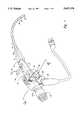
- FIG. 1is an isometric view of an endoscope and sheath assembly with an endoscope articulation system in accordance with the present invention contained within the handle of the endoscope.
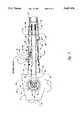
- FIG. 2is an enlarged cross-sectional view taken substantially along line 2--2 of FIG. 1 showing an embodiment of the endoscope articulation system within the handle of the endoscope.
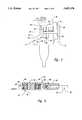
- FIG. 3is an enlarged cross-sectional view taken substantially along line 3--3 of FIG. 1 showing a control mechanism including exterior control wheels and interior drums mounted on the endoscope handle.
- FIG. 4is an enlarged cross-sectional view taken substantially along line 4--4 of FIG. 2 showing the movable pulley assembly of the endoscope articulation system.
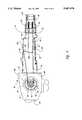
- FIG. 5is an enlarged cross-sectional view of an alternate embodiment of the endoscope articulation system in accordance with the present invention.
- an articulation system 10 in accordance with a preferred embodiment of the inventionis positioned within a handle 12 of a sheathed endoscope 14 that is used by a physician to perform endoscopic procedures.
- the endoscope 14has an elongated insertion tube 16 connected at its proximal section 18 to the handle 12.
- a distal section 22 of the insertion tube 16, opposite the proximal sectionis shaped and sized to extend into a selected body cavity of a patient.
- the insertion tube 16includes a device for conveying an image from the insertion tube's distal section 22 to an eyepiece 24 connected to the proximal end of the handle 12.
- a number of devicescan be used to perform this function, including, for example, a lens that is optically coupled to the eyepiece through an optical waveguide, or a miniature camera that is electronically coupled to a monitor.
- the imaging deviceenables the physician to see portions of the patient's body cavity and to see objects located just beyond the distal section 22 of the insertion tube 16 during the endoscopic procedure.
- the insertion tube 16 in the illustrated embodimentis removably positioned within an endoscopic sheath 26 to isolate the insertion tube from the contaminated environment during the endoscopic procedure.
- the sheath 26has a plurality of channels extending along its length, including an endoscope channel that receives and isolates the insertion tube 16, air and water channels that direct air and water to the distal end of the insertion tube, a suction channel that provides a suction force at the insertion tube's distal end 22, and a biopsy channel 28 that slidably receives an endoscopic accessory 30 therein.
- the endoscopic accessory 30typically includes an elongated, axially rigid shaft, such as a kink-resistant catheter, with a tool on the distal end that is passed through the biopsy channel 28 and beyond the open distal end of the biopsy channel to perform a selected endoscopic procedure that is viewed through the insertion tube 16 via the eyepiece 24.
- an elongated, axially rigid shaftsuch as a kink-resistant catheter
- the biopsy channel 28, the air and water channels, and the suction channelare flexible enough to bend when the insertion tube 16 articulates, but are sufficiently stiff to prevent kinking of the channels during the most extreme articulation.
- the stiffness of the channels of the sheath 26, the endoscopic accessory 30, and the insertion tube 16combine to significantly resist articulation of the insertion tube's distal section 22.
- the insertion tube 16includes a plurality of control cables 32 that are securely attached to the distal section 22 of the insertion tube and extend proximally along the length of the insertion tube to the handle 12.
- the control cables 32are axially movable within the insertion tube 16 except at their distal ends, such that the control cables cause the distal section 22 of the insertion tube to articulate in the up/down or left/right directions when a selected cable is moved axially.
- a control mechanism 34that includes two control wheels 36 and 38 is rotatably mounted on the handle 12 in a position that allows a physician to rotate the control wheels with his or her thumb while holding the handle with the same hand.
- the control wheels 36 and 38are coupled to the control cables 32 by the articulation system 10, as discussed in detail below, such that rotation of one of the control wheels results in axial movement of at least one control cable, thereby articulating the distal section 22 of the insertion tube 16.
- the articulation system 10provides a mechanical advantage between the control wheels 36 and 38 and the control cables 32 to reduce the amount of force needed to be exerted by the physician on the control wheels in order to articulate the insertion tube's distal section 22. Accordingly, the physician can easily control the position and degree of articulation of the distal section 22 and precisely position the distal end of the insertion tube for performing a selected diagnostic or therapeutic procedure without excess fatigue.
- the articulation system 10is positioned within an interior chamber 40 defined by sidewalls 42 of the handle 12.
- the articulation system 10is attached to the proximal ends of the control cables 32, which extend into the distal portion of the handle 12.
- the articulation system 10extends between the proximal ends of the control cables 32 and the control mechanism 34 located at the proximal portion of the handle 12.
- control mechanism 34includes an inner control wheel 36 rigidly connected to an exterior shaft 44 that extends through a sidewall 42 of the handle 12 and rigidly connects to a first coaxially aligned drum 46 within the interior chamber 40.
- the control mechanism 34also includes an outer control wheel 38 rigidly connected to an interior shaft 48 that is positioned partially within the exterior shaft 44 and coaxially aligned with the inner control wheel 36 and the first drum 46.
- the interior shaft 48extends through the inner control wheel 36, the exterior shaft 44, and the first drum 46, and rigidly connects to a second drum 50 adjacent to the first drum.
- the inner and outer control wheels 36 and 38are independently rotatable relative to each other and relative to the handle 12 so as to independently rotate the first and second drums 46 and 50.
- the first and second drums 46 and 50each have a diameter that is smaller than the diameter of their respective control wheels 36 and 38 in order to provide a first degree of mechanical advantage between the force exerted on the control wheel and the force transmitted by the drum.
- the first and second drums 46 and 50each have an annular groove 52 therearound that securely receives a control wire 54 of the articulation system 10, such that rotation of the first and second drums move their respective control wires around the drum without slippage. Accordingly, rotation of, for example, the inner control wheel 36 by a physician or other user causes the exterior shaft 44 to rotate which, in tin-n, causes the first drum 46 to rotate, thereby moving the control wire 54 around the first drum.
- the control wire 54has an upper section 56 that extends distally away from the top of the respective drum toward the control cables 32 and a lower section 58 that extends distally away from the bottom of the drum.
- the upper and lower sections 56 and 58are integrally connected by the portion of the control wire 54 wrapped around the respective drum.
- the control wire 54has a fixed length, such that when the control wheel 36 or 38 is rotated, the upper and lower sections 56 and 58 move axially in the opposite directions.
- the control wire 48is a stainless steel cable, although other suitable materials can be used, and the drum and control wheel can be modified in order to maintain secure engagement with the control wire without slippage of the control wire over the drum.
- Each control wire 54is coupled to two of the control cables 32 by flexible connecting cable portions 60 and 62 and movable pulleys 64 and 66 of the articulation system 10.
- first and second control cables 68 and 70are coupled to first and second control cables 68 and 70.
- the first control cable 68controls upward articulation of the insertion tube's distal section 22
- the second control cable 70controls downward articulation of the insertion tube's distal section.
- a second control wire 72illustrated in FIG. 3, is coupled in the same manner to two similar control cables that control left and right articulation of the insertion tube's distal section.
- the upper section 56 of the control wire 54is securely connected at its distal end to a first end of the upper flexible cable portion 60 by a cable coupling device 74, so axial movement of the upper section causes axial movement in the upper flexible cable portion without any stretching of the flexible cable.
- the upper flexible cable portion 60extends around an upper movable pulley 64 and is securely anchored at its second end to the sidewall 42 of the handle 12.
- the upper section 56 of the control wire 54 and the upper flexible cable portion 60are pulled axially toward the first drum 46 when the control wheel 36 and first drum are rotated counterclockwise.
- the upper flexible cable portion 60is pulled over the upper movable pulley and the upper movable pulley 64 is pulled substantially linearly and proximally away from the insertion tube 16.
- the proximal movement of the upper movable pulley 64causes the first control cable 68 to move axially within the insertion tube 16 and to articulate the insertion tube's distal section upwardly.
- the articulation system 10transmits the rotational movement of the control wheels 36 and 38 to the axial movement of the control cables 32.
- the upper movable pulley 64moves in a substantially linear direction relative to the control wheels 36 and the first drum 46, and provides a two-to-one mechanical advantage between the first control cable 68 and the control mechanism 34.
- the force exerted on the control wire 54 at the first drum 46is approximately one-half of the axial force exerted by the upper movable pulley 64 on the first control cable 68.
- the articulation system 10converts the first force exerted by a physician on a control wheel to the increased second force on the selected control cable to cause axial movement of the control cable and the articulation of the insertion tube's distal section.
- the articulation system 10also allows for substantially reduced physical exertion by a physician in order to articulate and steer the distal section of the endoscope.
- the lower section 58is rigidly connected to the first end of a lower flexible cable portion 62 that extends around the lower movable pulley 66 and is anchored at its second end to the handle's sidewall 42.
- the lower movable pulley 66is securely connected to the second control cable 70.
- the lower movable pulley 66moves in a substantially linear direction relative to the control mechanism 34, and provides a two-to-one mechanical advantage between the second control cable 70 and the control mechanism 34. Accordingly, the force exerted on the control wire 54 at the second drum 50 (FIG. 3) is approximately one-half of the axial force exerted on the second control cable.
- the control wire 54 and the upper and lower cable portions 60 and 62form a connecting cable 63 that extends around the movable pulleys 64 and 66 and that connects to the control mechanism 34. Accordingly, as shown in FIG. 2, the control cables 68 and 70 do not wrap around the movable pulleys 64 and 66.
- the upper and lower flexible cable portions 60 and 62are constructed of a non-stretchable, fine, multi-strand metallic cable or, in the alternative, a non-metallic flexible material, such as oriented ultra-high molecular weight polyethylene.
- the upper and lower section 56 and 58 of the control wire 48are integrally connected by the portion extending around the drum 46, such that the upper and lower sections, the upper and lower flexible cable portions 60 and 62, the upper and lower movable pulleys 64 and 66, and the respective first and second control cables 68 and 70 move simultaneously in opposite directions relative to the handle 12 when the inner control wheel 36 is rotated.
- control cablesthat control left and right motion, such that rotation of the outer control wheel 38 and second drum 50 causes one movable pulley to move distally relative to the second drum as the other movable pulley moves proximally, thereby causing the distal section of the insertion tube to articulate either left or right.
- the upper movable pulley 64includes a pulley wheel 76 that is rotatably mounted on an axle 78 extending between two sideplates 80 that protect the pulley wheel.
- the pulley wheel 76has an outer sheave 82 extending about its outer circumference.
- the outer sheave 82has a groove 84 formed therein that is shaped to securely receive and grip the upper flexible cable portion 60 therein to prevent slippage as the flexible cable moves around the pulley wheel 76.
- the outer sheaf 82also maintains the upper flexible cable portion 60 in a centered position around the pulley wheel 76.
- the movable pulley 64further includes a pin 86 that extends between leg portions 88, shown in FIGS.
- connection member 90that is rigidly attached to the first control cable 70.
- the connection member 90is allowed to move along the pin 86 between the leg portions 88 so the angular orientation of the first control cable 68 relative to the upper movable pulley 64 can change as the upper movable pulley and the first control cable move between distal and proximal positions within the handle 12.
- the pin 86 and connection member 90 arrangementeffectively reduces the bending forces exerted on the proximal end of the first control cable 68 when the movable pulley and the control cable are in the distal-most position.
- the lower movable pulley 66has configuration identical to the upper pulley 68, and the lower movable pulley is connected to the lower control cable with the same type of connection member 90.
- the illustrated embodimentobtains a two-to-one mechanical advantage with a single movable pulley connected to each control cable
- greater mechanical advantagecan be achieved between the control wheel and each control cable by use of more than one pulley as in, for example, a block-and-tackle arrangement.
- the movable pulleys 66 and 68 of the illustrated articulation system 10allow for the increased mechanical advantage with movable pulleys that are small enough to be contained and isolated within the confines of the handle's interior chamber 40. However, the movable pulleys do not have to be completely contained within the interior chamber.
- an alternate embodiment of the articulation system 10is illustrated having a system utilizing a movable pulley 92, a lower flexible cable portion 62, and control cable 54 that are similar to the embodiment discussed above.
- the movable pulley 92is securely connected to a left control cable 94 that controls articulation of the insertion tube's 16 distal section in the left direction.
- the upper section 56 of the control wire 54extends distally away from the second drum 66 and connects at its distal end to an upper end 96 of a lever 98.
- the lever 98is pivotally connected to the handle 12 within the interior chamber 40, and the lever pivots about a pivot point 100 that is at a first distance from the distal end of the control wire's upper section 56.
- the proximal end of the right control cable 102which controls articulation of the insertion tube's distal section in the right direction, is securely connected to the lever 98 at a mid-point 104 between the lever's upper end 96 and the pivot point 100.
- the distance from the pivot point 100 to the mid-point 104is approximately half the distance between the distal end of the control wire's upper section 56 and the pivot point 100.
- the lever 98provides approximately a two-to-one mechanical advantage over a configuration with the control wire 54 directly attached to the right control cable 102. Accordingly, a first amount of force exerted on the control wire via the outer control wheel 38 results in a second force that is twice the first force and that is exerted axially on the right control cable 102.
- the lever 98 and control wire 54work together to transmit the rotational movement of the outer control wheel 38 to the axial movement of the control cable 102.
- the lever 98 and control wire 54also work together to convert the first force exerted by the physician on the control wheel 38 to the increased second force exerted on the right control cable 102 to cause axial movement of the control cable and articulation of the insertion tube's distal section.
- the illustrated alternate embodimentshows the lever providing a two-to-one mechanical advantage
- other alternate embodimentscan have the connection point of the control cable at a position along the length of the lever other than the mid-point to increase or decrease the mechanical advantage as desired.
- the illustrated alternate embodimenthas the lever 98 used in conjunction with a lower movable pulley 66, although the lower movable pulley may also be replaced by a similar lever mechanism to provide the increased mechanical advantage between the control mechanism and control cable.
- a lever assembly, a movable pulley, or other mechanical advantage coupler in accordance with the present inventioncan be connected to the upper, lower, left, or right control cables to provide the increased mechanical advantage.
Landscapes
- Health & Medical Sciences (AREA)
- Life Sciences & Earth Sciences (AREA)
- Public Health (AREA)
- Biophysics (AREA)
- Surgery (AREA)
- Engineering & Computer Science (AREA)
- Biomedical Technology (AREA)
- Heart & Thoracic Surgery (AREA)
- Veterinary Medicine (AREA)
- Animal Behavior & Ethology (AREA)
- General Health & Medical Sciences (AREA)
- Anesthesiology (AREA)
- Hematology (AREA)
- Physics & Mathematics (AREA)
- Nuclear Medicine, Radiotherapy & Molecular Imaging (AREA)
- Optics & Photonics (AREA)
- Pathology (AREA)
- Radiology & Medical Imaging (AREA)
- Pulmonology (AREA)
- Medical Informatics (AREA)
- Molecular Biology (AREA)
- Surgical Instruments (AREA)
- Instruments For Viewing The Inside Of Hollow Bodies (AREA)
Abstract
Description
The present invention relates to the field of endoscopy, and more particularly, to a system for articulation of an endoscope.
The use of endoscopes for diagnostic and therapeutic indications is rapidly expanding. To improve performance, specialized endoscopes have been developed for specific uses. For example, there are upper endoscopes for examination of the esophagus, stomach, and duodenum, colonoscopes for examining the colon, angioscopes for examining blood vessels, bronchoscopes for examining the bronchia, laparoscopes for examining the peritoneal cavity, and arthroscopes for examining joint spaces. The discussion which follows applies to all of these types of endoscopes and any modifications thereof.
There has been a large increase in the use of endoscopes for screening symptomatic and asymptomatic patients. These endoscopes are expensive and are used in contaminated and sensitive environments. Conventional endoscopes typically have an elongated insertion tube that is inserted into a patient at a point of entry and extended to a selected body cavity. The insertion tube is connected at its proximal end to a handle portion. The distal end of the insertion tube is controlled and steered by control cables that are attached to the insertion tube's distal end and extend the length of the insertion tube. The control cables are directly connected to control wheels mounted to the handle portion. The control wheels are used to control articulation of the insertion tube by rotating the control wheels relative to the handle, thereby pulling directly on the control cables and causing the distal section of the insertion tube to bend. Accordingly, the insertion tube can be steered by a physician to follow the contours of a pathway through the patient's body to desired body cavity. The tip of the insertion tube must be accurately steerable in the up/down and left/right directions to permit the physician to place the tip at a selected location once the distal end of the insertion tube is within the selected body cavity.
The insertion tube of a conventional, non-sheathed endoscope includes a biopsy channel, suction channels, and air and water channels that extend along the length of the insertion tube. The insertion tube is axially rigid, yet sufficiently flexible to allow it to follow the curves and bends along the pathway in the patient; however, it must be sufficiently stiff in order to prevent the biopsy channel, the suction channel, or the air and water channels from collapsing when the insertion tube is articulated.
Improved endoscopes are used with an endoscopic sheath, as is described in U.S. Pat. No. 4,646,722, to Silverstein et al. The sheath covers and isolates the insertion tube from the contaminated environment. The sheath typically includes a plurality of integral channels, including a biopsy channel, a suction channel, and air and water channels. The endoscope sheath is sufficiently flexible to bend with the insertion tube while being stiff enough to prevent the channels from kinking or collapsing during articulation of the insertion tube.
It is especially important that the biopsy channel of the insertion tube or sheath not collapse or excessively narrow because an endoscopic accessory, such as a forceps or the like may be required to travel along the biopsy channel during an endoscopic procedure, or alternatively, it may be necessary to remove particulate matter from the tip of the endoscope through the biopsy channel. In addition, the endoscopic accessories further add to the overall stiffness of the sheathed or unsheathed insertion tube.
The necessary stiffness of the unsheathed or sheathed insertion tube results in a significant resistance to articulation of the insertion tube's distal end that is felt by the physician during manipulation of the control wheels. The resistance to articulation is overcome by exerting a significant amount of axial force on the selected control cables. Accordingly, a significant amount of force must be exerted by the physician on the conventional control wheels so as to sufficiently pull on one or more of the control cables to overcome the inherent resistance to bending.
During a clinical procedure the handle portion of the instrument is typically held in the physician's left hand. The right hand is usually placed on the endoscope's shaft to advance the instrument into the patient and to retract the instrument out of the patient. Preferably, the physician's right hand is not used to manipulate the control wheels in order to avoid contamination of the endoscope. Accordingly, the control wheels are adjusted with only one hand. The physical effort required to rotate the control wheels with one hand to overcome the stiffness of the insertion tube, sheath, and accessory can result in excessive fatigue of the physician's left hand, particularly during a long endoscopic procedure. The excessive effort required to articulate the insertion tube also greatly increases the duration of a procedure, thereby reducing the cost efficiency of the endoscopic procedure.
Conventional endoscopes have been designed to reduce the amount of effort required to move the control wheels by rigidly connecting a small diameter drum located within the handle portion to a large diameter control wheel that is rotated by the physician's thumb. The control cables extend around the small diameter drum so as to move axially when the drum is rotated. Although the combination of the large control wheel and smaller drum facilitates articulation of the insertion tube's distal end, the optimum size combination of control wheel and drum still requires a substantially large force to be exerted by the physician on the control wheels to achieve the necessary torque on the drum to steer or otherwise control the insertion tube's distal end.
There are other endoscopic devices which require the generation of a force at the distal tip of the device. A lithotripter is a basket device which is used to crush kidney or bile stones for removal. A conventional lithotripsy device uses a screw mechanism that is rotated at its proximal end in order to provide sufficient force at the distal end to crush the stones and facilitate their removal. The force required to turn the screw to generate the sufficient force to crush the kidney or bile stones is typically high enough that it is very difficult for the physician to maintain during the endoscopic procedure without mechanical advantage.
The present invention is directed toward an endoscope articulation system that reduces the amount of effort and force necessary for use of the control mechanism to articulate the distal end of an endoscopic device. In a preferred embodiment of the invention, an endoscopic device includes a handle and an insertion tube attached to the handle. The insertion tube has a distal section that is articulatable relative to a proximal section that engages the handle. At least one control cable is securely attached to the insertion tube's distal section, and the control cable extends proximally toward the handle. The control cable is axially movable relative to the insertion tube to cause the distal section of the insertion tube to articulate. A control member is movably attached to the handle and positioned for ease of manipulation by a user to control articulation of the distal section of the insertion tube. The control member is movable upon a first force being applied thereto by the user. The articulation system is connected to the control member and to the control cable. The articulation system includes a component that is substantially linearly movable relative to the control member so as to convert the first force, which is applied to the control member, into a second force that is exerted on the control cable, thereby causing the axial movement of the control cable and articulation of the distal section. The second force is greater than the first force, such that the articulation system provides a mechanical advantage between movement of the control member and axial movement of the control cable.
In the preferred embodiment, the control member includes a control wheel and drum assembly. The articulation system includes a movable pulley and connecting cable. The connecting cable extends around the movable pulley and around the drum. The movable pulley is securely connected to an end of the control cable, and the pulley is substantially linearly movable relative to the drum and control wheel upon rotation of the control wheel and drum. This configuration provides increased mechanical advantage between movement of the control member and axial movement of the control cables, with the result that a reduced force exerted by the physician or other user is needed at the control wheel in order to articulate and steer the distal end of the insertion tube.
In an alternate embodiment of the invention, the articulation system includes a lever that is pivotally mounted at a pivot point to the handle. The control cable is attached to a first portion of the lever at a first distance from the pivot point, such that pivotal movement of the lever results in substantially linear movement of the lever's first portion and axial movement of the control cable. A connecting member connects the lever to the drum and control wheel, such that rotation of the control wheel causes the lever to pivot relative to the handle, thereby causing the control cable to move axially. The connecting member is connected to the lever at a second distance from the pivot point that is different than the first distance, so the lever provides a mechanical advantage in transferring force from the control wheel to the control cable.
FIG. 1 is an isometric view of an endoscope and sheath assembly with an endoscope articulation system in accordance with the present invention contained within the handle of the endoscope.
FIG. 2 is an enlarged cross-sectional view taken substantially along line 2--2 of FIG. 1 showing an embodiment of the endoscope articulation system within the handle of the endoscope.
FIG. 3 is an enlarged cross-sectional view taken substantially along line 3--3 of FIG. 1 showing a control mechanism including exterior control wheels and interior drums mounted on the endoscope handle.
FIG. 4 is an enlarged cross-sectional view taken substantially along line 4--4 of FIG. 2 showing the movable pulley assembly of the endoscope articulation system.
FIG. 5 is an enlarged cross-sectional view of an alternate embodiment of the endoscope articulation system in accordance with the present invention.
As shown in FIG. 1, anarticulation system 10 in accordance with a preferred embodiment of the invention is positioned within ahandle 12 of a sheathedendoscope 14 that is used by a physician to perform endoscopic procedures. Theendoscope 14 has an elongatedinsertion tube 16 connected at its proximal section 18 to thehandle 12. A distal section 22 of theinsertion tube 16, opposite the proximal section is shaped and sized to extend into a selected body cavity of a patient. As is well known in the art, theinsertion tube 16 includes a device for conveying an image from the insertion tube's distal section 22 to aneyepiece 24 connected to the proximal end of thehandle 12. A number of devices can be used to perform this function, including, for example, a lens that is optically coupled to the eyepiece through an optical waveguide, or a miniature camera that is electronically coupled to a monitor. The imaging device enables the physician to see portions of the patient's body cavity and to see objects located just beyond the distal section 22 of theinsertion tube 16 during the endoscopic procedure.
Theinsertion tube 16 in the illustrated embodiment is removably positioned within anendoscopic sheath 26 to isolate the insertion tube from the contaminated environment during the endoscopic procedure. Thesheath 26 has a plurality of channels extending along its length, including an endoscope channel that receives and isolates theinsertion tube 16, air and water channels that direct air and water to the distal end of the insertion tube, a suction channel that provides a suction force at the insertion tube's distal end 22, and abiopsy channel 28 that slidably receives anendoscopic accessory 30 therein. Theendoscopic accessory 30 typically includes an elongated, axially rigid shaft, such as a kink-resistant catheter, with a tool on the distal end that is passed through thebiopsy channel 28 and beyond the open distal end of the biopsy channel to perform a selected endoscopic procedure that is viewed through theinsertion tube 16 via theeyepiece 24.
Thebiopsy channel 28, the air and water channels, and the suction channel are flexible enough to bend when theinsertion tube 16 articulates, but are sufficiently stiff to prevent kinking of the channels during the most extreme articulation. The stiffness of the channels of thesheath 26, theendoscopic accessory 30, and theinsertion tube 16 combine to significantly resist articulation of the insertion tube's distal section 22.
Theinsertion tube 16 includes a plurality ofcontrol cables 32 that are securely attached to the distal section 22 of the insertion tube and extend proximally along the length of the insertion tube to thehandle 12. Thecontrol cables 32 are axially movable within theinsertion tube 16 except at their distal ends, such that the control cables cause the distal section 22 of the insertion tube to articulate in the up/down or left/right directions when a selected cable is moved axially.
Acontrol mechanism 34 that includes twocontrol wheels handle 12 in a position that allows a physician to rotate the control wheels with his or her thumb while holding the handle with the same hand. Thecontrol wheels control cables 32 by thearticulation system 10, as discussed in detail below, such that rotation of one of the control wheels results in axial movement of at least one control cable, thereby articulating the distal section 22 of theinsertion tube 16. Thearticulation system 10 provides a mechanical advantage between thecontrol wheels control cables 32 to reduce the amount of force needed to be exerted by the physician on the control wheels in order to articulate the insertion tube's distal section 22. Accordingly, the physician can easily control the position and degree of articulation of the distal section 22 and precisely position the distal end of the insertion tube for performing a selected diagnostic or therapeutic procedure without excess fatigue.
As best seen in FIG. 2, thearticulation system 10 is positioned within aninterior chamber 40 defined by sidewalls 42 of thehandle 12. Thearticulation system 10 is attached to the proximal ends of thecontrol cables 32, which extend into the distal portion of thehandle 12. Thearticulation system 10 extends between the proximal ends of thecontrol cables 32 and thecontrol mechanism 34 located at the proximal portion of thehandle 12.
As best seen in FIG. 3, thecontrol mechanism 34 includes aninner control wheel 36 rigidly connected to anexterior shaft 44 that extends through asidewall 42 of thehandle 12 and rigidly connects to a first coaxially aligneddrum 46 within theinterior chamber 40. Thecontrol mechanism 34 also includes anouter control wheel 38 rigidly connected to aninterior shaft 48 that is positioned partially within theexterior shaft 44 and coaxially aligned with theinner control wheel 36 and thefirst drum 46. Theinterior shaft 48 extends through theinner control wheel 36, theexterior shaft 44, and thefirst drum 46, and rigidly connects to asecond drum 50 adjacent to the first drum. Accordingly, the inner andouter control wheels handle 12 so as to independently rotate the first andsecond drums second drums respective control wheels
The first andsecond drums annular groove 52 therearound that securely receives acontrol wire 54 of thearticulation system 10, such that rotation of the first and second drums move their respective control wires around the drum without slippage. Accordingly, rotation of, for example, theinner control wheel 36 by a physician or other user causes theexterior shaft 44 to rotate which, in tin-n, causes thefirst drum 46 to rotate, thereby moving thecontrol wire 54 around the first drum.
As best seen in FIG. 2, thecontrol wire 54 has anupper section 56 that extends distally away from the top of the respective drum toward thecontrol cables 32 and alower section 58 that extends distally away from the bottom of the drum. The upper andlower sections control wire 54 wrapped around the respective drum. Thecontrol wire 54 has a fixed length, such that when thecontrol wheel lower sections control wire 48 is a stainless steel cable, although other suitable materials can be used, and the drum and control wheel can be modified in order to maintain secure engagement with the control wire without slippage of the control wire over the drum.
Eachcontrol wire 54 is coupled to two of thecontrol cables 32 by flexible connectingcable portions movable pulleys 64 and 66 of thearticulation system 10. For purposes of simplicity, only onecontrol wire 54 is illustrated in FIG. 2 being coupled to first andsecond control cables 68 and 70. Thefirst control cable 68 controls upward articulation of the insertion tube's distal section 22, and the second control cable 70 controls downward articulation of the insertion tube's distal section. It is to be understood that, in the preferred embodiment, asecond control wire 72, illustrated in FIG. 3, is coupled in the same manner to two similar control cables that control left and right articulation of the insertion tube's distal section.
Theupper section 56 of thecontrol wire 54 is securely connected at its distal end to a first end of the upperflexible cable portion 60 by acable coupling device 74, so axial movement of the upper section causes axial movement in the upper flexible cable portion without any stretching of the flexible cable. The upperflexible cable portion 60 extends around an upper movable pulley 64 and is securely anchored at its second end to thesidewall 42 of thehandle 12. Theupper section 56 of thecontrol wire 54 and the upperflexible cable portion 60 are pulled axially toward thefirst drum 46 when thecontrol wheel 36 and first drum are rotated counterclockwise. Thus, the upperflexible cable portion 60 is pulled over the upper movable pulley and the upper movable pulley 64 is pulled substantially linearly and proximally away from theinsertion tube 16. The proximal movement of the upper movable pulley 64 causes thefirst control cable 68 to move axially within theinsertion tube 16 and to articulate the insertion tube's distal section upwardly.
Accordingly, thearticulation system 10 transmits the rotational movement of thecontrol wheels control cables 32. The upper movable pulley 64 moves in a substantially linear direction relative to thecontrol wheels 36 and thefirst drum 46, and provides a two-to-one mechanical advantage between thefirst control cable 68 and thecontrol mechanism 34. As a result, the force exerted on thecontrol wire 54 at thefirst drum 46 is approximately one-half of the axial force exerted by the upper movable pulley 64 on thefirst control cable 68. Thus, thearticulation system 10 converts the first force exerted by a physician on a control wheel to the increased second force on the selected control cable to cause axial movement of the control cable and the articulation of the insertion tube's distal section. Thearticulation system 10 also allows for substantially reduced physical exertion by a physician in order to articulate and steer the distal section of the endoscope.
Similar to the control wife'supper section 56, thelower section 58 is rigidly connected to the first end of a lowerflexible cable portion 62 that extends around the lowermovable pulley 66 and is anchored at its second end to the handle'ssidewall 42. The lowermovable pulley 66 is securely connected to the second control cable 70. The lowermovable pulley 66 moves in a substantially linear direction relative to thecontrol mechanism 34, and provides a two-to-one mechanical advantage between the second control cable 70 and thecontrol mechanism 34. Accordingly, the force exerted on thecontrol wire 54 at the second drum 50 (FIG. 3) is approximately one-half of the axial force exerted on the second control cable.
Thecontrol wire 54 and the upper andlower cable portions movable pulleys 64 and 66 and that connects to thecontrol mechanism 34. Accordingly, as shown in FIG. 2, thecontrol cables 68 and 70 do not wrap around themovable pulleys 64 and 66.
In one embodiment of the invention, the upper and lowerflexible cable portions lower section control wire 48 are integrally connected by the portion extending around thedrum 46, such that the upper and lower sections, the upper and lowerflexible cable portions movable pulleys 64 and 66, and the respective first andsecond control cables 68 and 70 move simultaneously in opposite directions relative to thehandle 12 when theinner control wheel 36 is rotated. A similar configuration is provided for the control cables that control left and right motion, such that rotation of theouter control wheel 38 andsecond drum 50 causes one movable pulley to move distally relative to the second drum as the other movable pulley moves proximally, thereby causing the distal section of the insertion tube to articulate either left or right.
As best seen in FIG. 4, the upper movable pulley 64 includes apulley wheel 76 that is rotatably mounted on anaxle 78 extending between twosideplates 80 that protect the pulley wheel. Thepulley wheel 76 has anouter sheave 82 extending about its outer circumference. Theouter sheave 82 has agroove 84 formed therein that is shaped to securely receive and grip the upperflexible cable portion 60 therein to prevent slippage as the flexible cable moves around thepulley wheel 76. Theouter sheaf 82 also maintains the upperflexible cable portion 60 in a centered position around thepulley wheel 76. The movable pulley 64 further includes apin 86 that extends betweenleg portions 88, shown in FIGS. 2 and 4, and the pin extends through aconnection member 90 that is rigidly attached to the first control cable 70. Theconnection member 90 is allowed to move along thepin 86 between theleg portions 88 so the angular orientation of thefirst control cable 68 relative to the upper movable pulley 64 can change as the upper movable pulley and the first control cable move between distal and proximal positions within thehandle 12. Thepin 86 andconnection member 90 arrangement effectively reduces the bending forces exerted on the proximal end of thefirst control cable 68 when the movable pulley and the control cable are in the distal-most position. The lowermovable pulley 66 has configuration identical to theupper pulley 68, and the lower movable pulley is connected to the lower control cable with the same type ofconnection member 90.
Although the illustrated embodiment obtains a two-to-one mechanical advantage with a single movable pulley connected to each control cable, greater mechanical advantage can be achieved between the control wheel and each control cable by use of more than one pulley as in, for example, a block-and-tackle arrangement. Themovable pulleys articulation system 10 allow for the increased mechanical advantage with movable pulleys that are small enough to be contained and isolated within the confines of the handle'sinterior chamber 40. However, the movable pulleys do not have to be completely contained within the interior chamber.
While the arrangement can be used to improve mechanical advantage of a conventional, unsheathed endoscope design, it is especially important for non-conventional endoscope design, such as theflexible endoscope 14 illustrated in FIG. 1 that is used with thedisposable sheath 26. In these non-conventional, non-symmetrical designs, the force required to articulate the distal section of the insertion tube is greater than the conventional endoscopes, because the stiffness of the disposable sheath is combined with the inherent stiffness of the endoscope, as discussed above.
As best seen in FIG. 5, an alternate embodiment of thearticulation system 10 is illustrated having a system utilizing amovable pulley 92, a lowerflexible cable portion 62, and controlcable 54 that are similar to the embodiment discussed above. Themovable pulley 92 is securely connected to aleft control cable 94 that controls articulation of the insertion tube's 16 distal section in the left direction. Theupper section 56 of thecontrol wire 54 extends distally away from thesecond drum 66 and connects at its distal end to anupper end 96 of alever 98. Thelever 98 is pivotally connected to thehandle 12 within theinterior chamber 40, and the lever pivots about apivot point 100 that is at a first distance from the distal end of the control wire'supper section 56. When theouter control wheel 38 is rotated counterclockwise, the control wife'supper section 56 pulls the lever'supper end 96 substantially linearly and proximally through an arc, causing the lever to pivot about thepivot point 100. Conversely, when theouter control wheel 38 is rotated clockwise, thelever 98 pivots, such that theupper end 96 moves substantially linearly and distally through an arc.
The proximal end of theright control cable 102, which controls articulation of the insertion tube's distal section in the right direction, is securely connected to thelever 98 at a mid-point 104 between the lever'supper end 96 and thepivot point 100. In the illustrated embodiment, the distance from thepivot point 100 to the mid-point 104 is approximately half the distance between the distal end of the control wire'supper section 56 and thepivot point 100. When theouter control wheel 38 is rotated counterclockwise and thelever 98 pivots about thepivot point 100, the mid-point 104 moves proximally in a generally linear direction toward the control wheel, thereby pulling theright control cable 102 axially in the proximal direction. Thelever 98 provides approximately a two-to-one mechanical advantage over a configuration with thecontrol wire 54 directly attached to theright control cable 102. Accordingly, a first amount of force exerted on the control wire via theouter control wheel 38 results in a second force that is twice the first force and that is exerted axially on theright control cable 102. Thus, thelever 98 andcontrol wire 54 work together to transmit the rotational movement of theouter control wheel 38 to the axial movement of thecontrol cable 102. Thelever 98 andcontrol wire 54 also work together to convert the first force exerted by the physician on thecontrol wheel 38 to the increased second force exerted on theright control cable 102 to cause axial movement of the control cable and articulation of the insertion tube's distal section.
This increased mechanical advantage allows the physician to easily articulate the distal section of the insertion tube with a reduced effort, as discussed above. Although the illustrated alternate embodiment shows the lever providing a two-to-one mechanical advantage, other alternate embodiments can have the connection point of the control cable at a position along the length of the lever other than the mid-point to increase or decrease the mechanical advantage as desired. In addition, the illustrated alternate embodiment has thelever 98 used in conjunction with a lowermovable pulley 66, although the lower movable pulley may also be replaced by a similar lever mechanism to provide the increased mechanical advantage between the control mechanism and control cable. Further, it is to be understood that either a lever assembly, a movable pulley, or other mechanical advantage coupler in accordance with the present invention can be connected to the upper, lower, left, or right control cables to provide the increased mechanical advantage.
Numerous modifications and variations of the endoscope articulation system to reduce effort during articulation of an endoscope invention disclosed herein will occur to those skilled in the art in view of this disclosure. Other types of devices that provide mechanical advantage between the control wheel and the control cable can be used while remaining within the spirit and scope of the present invention. Therefore, it is to be understood that these modifications and variations, and equivalents thereof, may be practiced while remaining within the spirit and the scope of the invention as defined in the following claims.
Claims (18)
1. An endoscope, comprising:
a handle;
an insertion tube having a proximal section attached to said handle and having a distal section opposite said proximal section, said distal section being articulatable relative to said proximal section;
a control cable attached to said distal section of said insertion tube, said control cable being axially movable relative to said insertion tube, said distal section of said insertion tube being articulated upon axial movement of said control cable;
a control member attached to said handle and positioned for movement by a user relative to said handle; and
a mechanical advantage coupler connected to said control member and to said control cable, said mechanical advantage coupler having a component that is substantially linearly movable relative to said control member, said mechanical advantage coupler providing a mechanical advantage between said movement of said control member and axial movement of said control cable, said mechanical advantage coupler includes a pulley assembly connected to said control cable and coupled to said control member, said pulley assembly including a pulley wheel and cable portion extending around said pulley wheel, said cable portion being attached to said control member and being movable over said pulley wheel upon movement of said control member.
2. The endoscope of claim 1 wherein said handle includes a housing that defines an interior chamber, and said movable pulley is positioned within said interior chamber between said control member and said control cable.
3. The endoscope of claim 1 wherein said mechanical advantage coupler includes a lever and a connecting member, said lever being pivotally mounted at a pivot point to said handle, said control cable being attached to a first portion of said lever at a first distance from said pivot point, said first portion of said lever being substantially linearly movable relative to said control member, said connecting member being connected to said control member and connected to a second portion of said lever a second distance from said pivot point, said second distance being different than said first distance.
4. The endoscope of claim 1 wherein said mechanical advantage coupler includes a lever and a connecting member, a first portion of said lever being connected to said handle and a second portion of said lever being connected to said control cable, said second portion of said lever being substantially linearly movable relative to said control member, and said connecting member having a first end connected to said lever and a second end connected to said control member.
5. The endoscope of claim 1 wherein said axial movement of said control cable articulates said distal section of said insertion tube in a first plane of movement, and further comprising:
a second control cable attached to said distal section of said insertion tube, said second control cable being axially movable relative to said insertion tube to cause said distal section of said insertion tube to articulate in a second plane of movement that is different than said first plane of movement;
a second control member attached to said handle and positioned for movement by a user relative to said handle; and
a second mechanical advantage coupler connected to said second control member and attached to said second control cable, said second mechanical advantage coupler having a component that is substantially linearly movable relative to said second control member, said second mechanical advantage coupler providing a mechanical advantage between movement of said second control member and movement of said second control cable.
6. The endoscope of claim 5 wherein said second mechanical advantage coupler includes a second pulley assembly connected to said second control cable and coupled to said control member, said second pulley assembly including a second pulley wheel and a second cable portion extending around said second pulley wheel, said second cable portion being attached to said second control member and being movable over said second pulley wheel upon movement of said control member.
7. The endoscope of claim 5 wherein said second mechanical advantage coupler includes a second lever and a second connecting member, said second lever having a third portion connected to said handle and having a fourth portion connected to said second control cable, said fourth portion of said second lever being substantially linearly movable relative to said second control member, and said second connecting member being connected to said second lever and to said second control member.
8. An endoscope, comprising:
a handle adapted to be held by a user during an endoscopic procedure;
an insertion tube having proximal and distal sections, said proximal section being attached to said handle and said distal section being opposite said proximal section and being articulatably movable relative to said proximal section;
a control cable attached to said distal section of said insertion tube and being axially movable relative to said insertion tube to cause said distal section of said insertion tube to articulate;
a control member attached to said handle and adapted to control articulation of said distal section, said control member being movable by a user relative to said handle during the endoscopic procedure; and
a transmitting means connected at a first portion to said control cable and connected at a second portion to said control member, said transmitting means being configured to transmit movement of said control member to said control cable to cause axial movement of said control cable to articulate said distal end of said insertion tube, said transmitting means being substantially linearly movable relative to said control member and relative to said control cable, said transmitting means providing a mechanical advantage in transmitting said movement of said control member to said control cable for articulation of said distal section, said transmitting means includes a movable pulley and a connecting cable extending around the movable pulley, said movable pulley being connected to said control cable and being movable over said connecting cable, said connecting cable being attached to said movable pulley and to said control member.
9. The endoscope of claim 8 wherein said handle includes a housing that defines an interior chamber, and said movable pulley is positioned within said interior chamber between said control member and said control cable.
10. The endoscope of claim 8 wherein said transmitting means includes a lever and a connecting member, said lever being pivotally mounted at a pivot point to said handle, said control cable being attached to a first portion of said lever at a first distance from said pivot point, said first portion of said lever being substantially linearly movable relative to said control member, said connecting member having first and second ends with said first end connected to a second portion of said lever a second distance from said pivot point, said second distance being different than said first distance, and said second end of said connecting member being connected to said control member.
11. The endoscope of claim 8 wherein said transmitting means includes a lever and a connecting member, a first portion of said lever being connected to said handle and a second portion of said lever being connected to said control cable, said second portion of said lever being substantially linearly movable relative to said control member and said connecting member having a first end connected to said lever and a second end connected to said control member.
12. The endoscope of claim 8 wherein said axial movement of said control cable articulates said distal section of said insertion tube in a first plane of movement and said control member has first and second portions, said first portion being connected to said first transmitting means, and said second portion beingmovable relative to said handle, and the endoscope further comprising:
a second control cable attached to said distal section of said insertion tube, said second control cable being axially movable relative to said insertion tube to cause said distal section of said insertion tube to articulate in a second plane of movement that is different than said first plane; and
a second transmitting means connected to said second control cable and connected to said second portion of said control member, said second transmitting means transmitting movement of said second portion of said control member to said second control cable to cause axial movement of said second control cable and articulation of said distal section, said second transmitting means having a component that is substantially linearly movable relative to said control member and relative to said second control cable, said second transmitting means providing mechanical advantage in transmitting said movement of said second portion of said control member to said second control cable for articulation of said distal section in said second plane of movement.
13. The endoscope of claim 12 wherein said second transmitting means includes a lever and a connecting member, said lever being pivotally mounted at a pivot point to said handle, said second control cable being attached to a first portion of said lever at a first distance from said pivot point, said first portion of said lever being substantially linearly movable relative to said control member, said connecting member being connected to said second portion of said control member and being connected to a second portion of said lever a second distance from said pivot point, said second distance being different than said first distance.
14. An endoscope assembly usable for an endoscopic procedure, comprising:
a handle having a housing defining an interior chamber with proximal and distal ends;
an insertion tube having proximal and distal sections, said proximal section attached to said housing at said distal end of said interior chamber and said distal section being opposite said proximal section and articulatable relative to said proximal section;
a control cable attached to said distal section of said insertion tube for articulating said distal section in a plane of movement, said control cable extending proximally from said distal section toward said housing and terminating at a proximal end within said interior chamber;
a control member rotatably attached to said handle housing, said control member including a control wheel connected to a shaft and a drum connected to the shaft, said drum positioned within said interior chamber and said control wheel being exterior of said interior chamber and positioned to be rotated by a user holding onto said handle during the endoscopic procedure and exerting a first force on said control wheel, such that rotation of said control wheel relative to said housing causes said drum to rotate; and
a connecting means securely connected to said proximal end of said control cable and to said drum, said connecting means being positioned within said interior chamber and having a component that is substantially linearly movable between said drum and said control cable, said connecting means transmitting movement of said control wheel and said drum to said control cable, and said connecting means converting said first force causing said rotational movement of said drum to a second force that causes axial movement of said control cable and articulating movement of said distal end and providing a mechanical advantage between first and second forces, said connecting means comprises a flexible cable connected to said drum and a pulley connected to said proximal end of said control cable, said flexible cable having first and second ends anchored to said housing and a middle portion therebetween that wraps partially around said drum and that wraps partially around said pulley, said pulley being substantially linearly movable relative to said drum upon rotation of said drum to cause said control cable to move axially.
15. The endoscopic assembly of claim 14 wherein said connecting means comprises a connecting cable connected to said drum and a lever pivotally mounted at a pivot point to said housing, said control cable being attached to a first portion of said lever at a first distance from said pivot point, said first portion of said lever being substantially linearly movable relative to said control member, said connecting cable having a first end connected to a second portion of said lever a second distance from said pivot point, said second distance being different than said first distance.
16. The endoscope assembly of claim 14 wherein said axial movement of said control cable articulates said distal section of said insertion tube in a first plane of movement, said control member including a second control wheel connected to a second shaft and a second drum connected to said second shaft, said second control wheel and said second drum being rotatable relative to said handle independent of said first control wheel and said first drum, said second control wheel being rotatable upon a third force being exerted thereon, and the endoscope assembly further comprising:
a second control cable attached to said distal section of said insertion tube for articulating said distal section in a second plane of movement that is different than said first plane, said second control cable extending proximally from said distal end toward said housing and terminating at a proximal end within said interior chamber; and
a second connecting means securely connected to said proximal end of said second control cable and to said second drum, said second connecting means being positioned within said interior chamber and having a component that is substantially linearly movable between said second drum and said second control cable, said second connecting means transmitting movement of said second control wheel and said second drum to said second control cable, and said second connecting means converting said third force causing said rotational movement of said second drum to a fourth force that causes axial movement of said second control cable and articulating movement of said distal section in said second plane of movement and providing mechanical advantage between said third and fourth forces.
17. The endoscopic assembly of claim 16 wherein said second connecting means comprises said second flexible cable connected to said second drum and a lever pivotally mounted at a pivot point to said housing, said second control cable being attached to a first portion of said lever at a first distance from said pivot point, said first portion of said lever being substantially linearly movable relative to said control member, said second flexible cable being connected to a second portion of said lever a second distance from said pivot point, said second distance being different than said first distance.
18. An endoscope usable for an endoscopic procedure, comprising:
a handle for holding during the endoscopic procedure, said handle having a housing defining an interior chamber;
an insertion tube having a proximal end attached to said handle and a distal end opposite said proximal end, said insertion tube having an articulating section adjacent to said distal end that is articulatably movable in two planes, a plurality of interior control channels extending between the proximal and distal ends, said proximal end of said interior control channels coupled to said interior chamber;
a plurality of control cables positioned within said plurality of interior control channels, said control cables having a proximal end and a distal end, said distal end being rigidly attached to said articulating section, each of said control cables being axially movable within a respective one of said interior control channels to cause said articulating section to articulate in at least one of the two planes;
a control wheel assembly rotatably mounted to said handle, said control wheel having a shaft rotatably extending through a portion of said housing, said shaft having an interior end within said interior chamber and an exterior end exterior of said interior chamber, said control wheel further having an exterior control member and an interior control drum, said exterior control member being rigidly attached to said exterior end of said shaft and being adapted to be engaged by a user and rotated relative to said housing, and said interior control drum being rigidly attached to said interior end of said shaft and being rotatable relative to said housing upon rotation of said exterior control member; and
a movable pulley system connected to said interior control drum and to said control cables, said movable pulley system including:
a control wire having first and second ends and a first middle portion extending therebetween, said first middle portion being movably wrapped around said interior control drum for axial movement upon rotation of said exterior control member;
a first flexible cable having a first anchored end rigidly anchored to said housing between said control wheel assembly and said proximal ends of said control cables, a first movable end rigidly connected to said first end of said control wire, and a second middle portion extending between said first anchored and movable ends;
a second flexible cable having a second anchored end rigidly anchored to said housing between said control wheel assembly and said proximal ends of said control cables, a second movable end rigidly connected to said second end of said control wire, and a third middle portion extending between said second anchored and movable ends;
a first movable pulley slidably attached to said proximal end of one of said control cables and movably attached to said second middle portion of said first flexible cable, such that said rotation of said exterior control wheel in a first direction rotates said interior control drum, thereby axially moving said first movable end and said second middle portion of said first flexible cable to cause said first movable pulley to move within said interior chamber thereby axially moving said one of said control cables and causing said distal end of said one of said control cables to pull on said articulating section of said insertion tube to articulate said articulating section in one of said two planes, said first movable pulley including an outer housing having a shaft extending therethrough and a first pulley wheel rotatably mounted on said shaft within said outer housing, said first pulley wheel engaging said second middle portion of said first flexible cable with the second middle portion extending around said first pulley wheel, and a retaining pin rigidly attached to said outer housing and slidably retaining said proximal end of said one of said control cables thereon, thereby providing a mechanical advantage within said interior chamber to articulate said articulating section; and
a second movable pulley slidably attached to said proximal end of a second of said control cables and movably attached to said third middle portion of said second flexible cable, such that said rotation of said exterior control wheel in a second direction rotates said interior control drum, thereby axially moving said second movable end and said third middle portion of said second flexible cable to cause said second movable pulley to move within said interior chamber thereby axially moving said second of said control cables and causing said distal end of said control cable to articulate said articulating end of said insertion tube in one of said two planes, said second movable pulley including an outer housing having a shaft extending therethrough and a second pulley wheel rotatably mounted on said shaft within said outer housing, said second pulley wheel engaging said third middle portion of said second flexible cable with the third middle portion extending around the second pulley wheel, and a retaining pin rigidly attached to said outer housing and slidably retaining said proximal end of said second one of said control cables thereon, thereby providing a mechanical advantage within said interior chamber to articulate said articulating section.
Priority Applications (2)
| Application Number | Priority Date | Filing Date | Title |
|---|---|---|---|
| US08/464,260US5667476A (en) | 1995-06-05 | 1995-06-05 | Endoscope articulation system to reduce effort during articulation of an endoscope |
| US08/639,981US5626553A (en) | 1995-06-05 | 1996-04-29 | Endoscope articulation system to reduce effort during articulation of an endoscope |
Applications Claiming Priority (1)
| Application Number | Priority Date | Filing Date | Title |
|---|---|---|---|
| US08/464,260US5667476A (en) | 1995-06-05 | 1995-06-05 | Endoscope articulation system to reduce effort during articulation of an endoscope |
Related Child Applications (1)
| Application Number | Title | Priority Date | Filing Date |
|---|---|---|---|
| US08/639,981DivisionUS5626553A (en) | 1995-06-05 | 1996-04-29 | Endoscope articulation system to reduce effort during articulation of an endoscope |
Publications (1)
| Publication Number | Publication Date |
|---|---|
| US5667476Atrue US5667476A (en) | 1997-09-16 |
Family
ID=23843182
Family Applications (2)
| Application Number | Title | Priority Date | Filing Date |
|---|---|---|---|
| US08/464,260Expired - LifetimeUS5667476A (en) | 1995-06-05 | 1995-06-05 | Endoscope articulation system to reduce effort during articulation of an endoscope |
| US08/639,981Expired - LifetimeUS5626553A (en) | 1995-06-05 | 1996-04-29 | Endoscope articulation system to reduce effort during articulation of an endoscope |
Family Applications After (1)
| Application Number | Title | Priority Date | Filing Date |
|---|---|---|---|
| US08/639,981Expired - LifetimeUS5626553A (en) | 1995-06-05 | 1996-04-29 | Endoscope articulation system to reduce effort during articulation of an endoscope |
Country Status (1)
| Country | Link |
|---|---|
| US (2) | US5667476A (en) |
Cited By (108)
| Publication number | Priority date | Publication date | Assignee | Title |
|---|---|---|---|---|
| US5993381A (en)* | 1997-08-18 | 1999-11-30 | Asahi Kogaku Kogyo Kabushiki Kaisha | Operating unit for an endoscope |
| US6162207A (en)* | 1997-08-18 | 2000-12-19 | Asahi Kogaku Kogyo Kabushiki Kaisha | Operating unit for endoscopic treatment tool |
| US6171316B1 (en) | 1997-10-10 | 2001-01-09 | Origin Medsystems, Inc. | Endoscopic surgical instrument for rotational manipulation |
| US6206903B1 (en) | 1999-10-08 | 2001-03-27 | Intuitive Surgical, Inc. | Surgical tool with mechanical advantage |
| US6315774B1 (en)* | 1996-03-29 | 2001-11-13 | Eclipse Surgical Technologies, Inc. | Minimally invasive apparatus for forming revascularization channels |
| US6358244B1 (en) | 1996-07-12 | 2002-03-19 | Endo Surgical Devices, Inc. | Endarterectomy surgical instrument and procedure |
| US20020087049A1 (en)* | 1998-02-24 | 2002-07-04 | Brock David L. | Flexible instrument |
| US6468203B2 (en) | 2000-04-03 | 2002-10-22 | Neoguide Systems, Inc. | Steerable endoscope and improved method of insertion |
| US20020161281A1 (en)* | 2000-04-03 | 2002-10-31 | Ross Jaffe | Endoscope having a guide tube |
| US6491627B1 (en)* | 1999-08-18 | 2002-12-10 | Fuji Photo Optical Co., Ltd. | Manipulation mechanism for an angle section of an endoscope |
| US6522933B2 (en) | 2001-03-30 | 2003-02-18 | Biosense, Webster, Inc. | Steerable catheter with a control handle having a pulley mechanism |
| US6610007B2 (en) | 2000-04-03 | 2003-08-26 | Neoguide Systems, Inc. | Steerable segmented endoscope and method of insertion |
| USD484594S1 (en) | 2002-02-27 | 2003-12-30 | Pentax Corporation | Operating knob for endoscope |
| US6676684B1 (en)* | 2001-09-04 | 2004-01-13 | Intuitive Surgical, Inc. | Roll-pitch-roll-yaw surgical tool |
| US20040015054A1 (en)* | 2002-07-05 | 2004-01-22 | Kazuhiko Hino | Bending control mechanism for endoscope |
| USD486910S1 (en) | 2002-02-27 | 2004-02-17 | Pentax Corporation | Endoscope |
| US20040073083A1 (en)* | 2002-09-30 | 2004-04-15 | Olympus Optical Co., Ltd. | Electric bending endoscope |
| USD493529S1 (en) | 2002-02-27 | 2004-07-27 | Pentax Corporation | Endoscope |
| US20040176751A1 (en)* | 2002-08-14 | 2004-09-09 | Endovia Medical, Inc. | Robotic medical instrument system |
| US6793622B2 (en) | 2001-09-05 | 2004-09-21 | Olympus Optical Co., Ltd. | Electric bending endoscope |
| US20040193146A1 (en)* | 2001-02-15 | 2004-09-30 | Endo Via Medical, Inc. | Robotically controlled surgical instruments |
| US6800056B2 (en) | 2000-04-03 | 2004-10-05 | Neoguide Systems, Inc. | Endoscope with guiding apparatus |
| US6810281B2 (en) | 2000-12-21 | 2004-10-26 | Endovia Medical, Inc. | Medical mapping system |
| US6858005B2 (en) | 2000-04-03 | 2005-02-22 | Neo Guide Systems, Inc. | Tendon-driven endoscope and methods of insertion |
| US6974411B2 (en) | 2000-04-03 | 2005-12-13 | Neoguide Systems, Inc. | Endoscope with single step guiding apparatus |
| US20050288656A1 (en)* | 2004-06-24 | 2005-12-29 | Koerner Richard J | System for bi-directionally controlling the cryo-tip of a cryoablation catheter |
| US6984203B2 (en) | 2000-04-03 | 2006-01-10 | Neoguide Systems, Inc. | Endoscope with adjacently positioned guiding apparatus |
| US20060149127A1 (en)* | 2004-12-30 | 2006-07-06 | Seddiqui Fred R | Disposable multi-lumen catheter with reusable stylet |
| US7090683B2 (en) | 1998-02-24 | 2006-08-15 | Hansen Medical, Inc. | Flexible instrument |
| US20060247528A1 (en)* | 2003-05-19 | 2006-11-02 | Matsushita Electric Industrial Co., Ltd. | Ultrasonic probe |
| US20070015989A1 (en)* | 2005-07-01 | 2007-01-18 | Avantis Medical Systems, Inc. | Endoscope Image Recognition System and Method |
| US7214230B2 (en) | 1998-02-24 | 2007-05-08 | Hansen Medical, Inc. | Flexible instrument |
| US20070270646A1 (en)* | 2006-05-19 | 2007-11-22 | Perry Weiner | Cystoscope and disposable sheath system |
| US20080125628A1 (en)* | 2005-06-24 | 2008-05-29 | Olympus Medical Systems Corp. | Endoscope |
| US20080139886A1 (en)* | 2006-12-07 | 2008-06-12 | Olympus Corporation | Endoscope and bending operation device for endoscope |
| US20080253686A1 (en)* | 2007-04-10 | 2008-10-16 | Avantis Medical Systems, Inc. | Method and Device for Examining or Imaging an Interior Surface of a Cavity |
| US20080308098A1 (en)* | 2007-06-18 | 2008-12-18 | Ai Medical Devices | Endotracheal intubation device |
| US20090012365A1 (en)* | 2005-07-22 | 2009-01-08 | Olympus Medical Systems Corp. | Endoscope |
| US20090030496A1 (en)* | 2006-01-25 | 2009-01-29 | Ralf Kaufmann | Insertion system for stents, comprising tension-compression kinematics |
| US20090088792A1 (en)* | 2007-10-02 | 2009-04-02 | Tyco Healthcare Group Lp | Articulating Surgical Instrument |
| US20090171275A1 (en)* | 2007-12-28 | 2009-07-02 | Isaac Ostrovsky | Controlling movement of distal portion of medical device |
| US20090234280A1 (en)* | 2008-03-17 | 2009-09-17 | Boston Scientific Scimed, Inc. | Steering mechanism |
| US20090240106A1 (en)* | 2008-03-05 | 2009-09-24 | Board Of Regents, The University Of Texas System | Endoscope With a Stimulating Electrode For Peripheral Nerve Blocks Under Direct Vision |
| US7608083B2 (en) | 2001-02-15 | 2009-10-27 | Hansen Medical, Inc. | Robotically controlled medical instrument with a flexible section |
| US20090299352A1 (en)* | 2007-12-21 | 2009-12-03 | Boston Scientific Scimed, Inc. | Steerable laser-energy delivery device |
| US20090326450A1 (en)* | 2008-06-27 | 2009-12-31 | Boston Scientific Scimed, Inc. | Steerable medical device |
| US20100004591A1 (en)* | 2008-07-07 | 2010-01-07 | Boston Scientific Scimed, Inc. | Multi-plane motion control mechanism |
| US7713190B2 (en) | 1998-02-24 | 2010-05-11 | Hansen Medical, Inc. | Flexible instrument |
| US20100121147A1 (en)* | 2008-11-12 | 2010-05-13 | Boston Scientific Scimed, Inc. | Steering mechanism |
| US7727185B2 (en) | 2001-02-15 | 2010-06-01 | Hansen Medical, Inc. | Coaxial catheter system |
| US20100199999A1 (en)* | 2009-02-06 | 2010-08-12 | Vazales Brad E | Methods for cleaning endotracheal tubes |
| US7775972B2 (en) | 1998-02-24 | 2010-08-17 | Hansen Medical, Inc. | Flexible instrument |
| US20100324363A1 (en)* | 2008-03-05 | 2010-12-23 | Board Of Regents, The University Of Texas System | Disposable sheath designs for the stimulating endoscope and needle endoscopes having distal electrodes for nerve block under direct vision and methods for making and using same |
| US20110023888A1 (en)* | 2009-02-06 | 2011-02-03 | Endoclear, Llc | Methods for removing debris from medical tubes |
| US7927272B2 (en) | 2006-08-04 | 2011-04-19 | Avantis Medical Systems, Inc. | Surgical port with embedded imaging device |
| US20110105843A1 (en)* | 2009-10-30 | 2011-05-05 | Tyco Healthcare Group Lp | Surgical Instrument With Tendon Preload-and-Locking Device |
| US20110245601A1 (en)* | 2010-04-03 | 2011-10-06 | Richard Wolf Gmbh | Endoscopic instrument |
| US8083879B2 (en) | 2005-11-23 | 2011-12-27 | Intuitive Surgical Operations, Inc. | Non-metallic, multi-strand control cable for steerable instruments |
| US20120010598A1 (en)* | 2006-02-28 | 2012-01-12 | Frassica James J | Rotate-to-advance catheterization system |
| US20120100729A1 (en)* | 2010-10-21 | 2012-04-26 | Avram Allan Edidin | Imaging system having a quick connect coupling interface |
| US8182418B2 (en) | 2008-02-25 | 2012-05-22 | Intuitive Surgical Operations, Inc. | Systems and methods for articulating an elongate body |
| US8182422B2 (en) | 2005-12-13 | 2012-05-22 | Avantis Medical Systems, Inc. | Endoscope having detachable imaging device and method of using |
| US8197399B2 (en) | 2006-05-19 | 2012-06-12 | Avantis Medical Systems, Inc. | System and method for producing and improving images |
| US8235887B2 (en) | 2006-01-23 | 2012-08-07 | Avantis Medical Systems, Inc. | Endoscope assembly with retroscope |
| US8289381B2 (en) | 2005-01-05 | 2012-10-16 | Avantis Medical Systems, Inc. | Endoscope with an imaging catheter assembly and method of configuring an endoscope |
| US8287446B2 (en) | 2006-04-18 | 2012-10-16 | Avantis Medical Systems, Inc. | Vibratory device, endoscope having such a device, method for configuring an endoscope, and method of reducing looping of an endoscope |
| USD669175S1 (en)* | 2011-03-31 | 2012-10-16 | Karl Storz Gmbh & Co. Kg | Handle for medical device |
| US20130023859A1 (en)* | 2011-07-21 | 2013-01-24 | Tyco Healthcare Group Lp | Articulating Links with Middle Link Control System |
| US8361090B2 (en) | 2002-01-09 | 2013-01-29 | Intuitive Surgical Operations, Inc. | Apparatus and method for endoscopic colectomy |
| US8414598B2 (en) | 1998-02-24 | 2013-04-09 | Hansen Medical, Inc. | Flexible instrument |
| US8414505B1 (en) | 2001-02-15 | 2013-04-09 | Hansen Medical, Inc. | Catheter driver system |
| CN103120825A (en)* | 2011-11-18 | 2013-05-29 | 韦伯斯特生物官能(以色列)有限公司 | Medical device control handle |
| US8460237B2 (en) | 2011-11-10 | 2013-06-11 | Biosense Webster (Israel), Ltd. | Medical device control handle with multiplying linear motion |
| US20130205937A1 (en)* | 2011-07-15 | 2013-08-15 | Olympus Medical Systems Corp. | Insertion apparatus |
| US8517923B2 (en) | 2000-04-03 | 2013-08-27 | Intuitive Surgical Operations, Inc. | Apparatus and methods for facilitating treatment of tissue via improved delivery of energy based and non-energy based modalities |
| US8568299B2 (en) | 2006-05-19 | 2013-10-29 | Intuitive Surgical Operations, Inc. | Methods and apparatus for displaying three-dimensional orientation of a steerable distal tip of an endoscope |
| US8797392B2 (en) | 2005-01-05 | 2014-08-05 | Avantis Medical Sytems, Inc. | Endoscope assembly with a polarizing filter |
| US8872906B2 (en) | 2005-01-05 | 2014-10-28 | Avantis Medical Systems, Inc. | Endoscope assembly with a polarizing filter |
| US8882657B2 (en) | 2003-03-07 | 2014-11-11 | Intuitive Surgical Operations, Inc. | Instrument having radio frequency identification systems and methods for use |
| US8888688B2 (en) | 2000-04-03 | 2014-11-18 | Intuitive Surgical Operations, Inc. | Connector device for a controllable instrument |
| US8992470B2 (en) | 2006-05-19 | 2015-03-31 | Boston Scientific Scimed, Inc. | Control mechanism for steerable medical device |
| US20150119801A1 (en)* | 2013-10-31 | 2015-04-30 | Cook Medical Technologies Llc | Steerable intraluminal medical device |
| WO2015120348A1 (en) | 2014-02-06 | 2015-08-13 | Dentsply International Inc. | Inspection of dental roots and the endodontic cavity space therein |
| US9220398B2 (en) | 2007-10-11 | 2015-12-29 | Intuitive Surgical Operations, Inc. | System for managing Bowden cables in articulating instruments |
| US9248266B2 (en) | 2013-12-17 | 2016-02-02 | Biovision Technologies, Llc | Method of performing a sphenopalatine ganglion block procedure |
| US9357984B2 (en) | 2013-04-23 | 2016-06-07 | Covidien Lp | Constant value gap stabilizer for articulating links |
| US9445714B2 (en) | 2010-03-29 | 2016-09-20 | Endoclear Llc | Endotracheal tube coupling adapters |
| US9516995B2 (en) | 2013-12-17 | 2016-12-13 | Biovision Technologies, Llc | Surgical device for performing a sphenopalatine ganglion block procedure |
| US20170000313A1 (en)* | 2013-03-05 | 2017-01-05 | Boston Scientific Scimed, Inc. | Control system for medical devices and related methods of use |
| US9694163B2 (en) | 2013-12-17 | 2017-07-04 | Biovision Technologies, Llc | Surgical device for performing a sphenopalatine ganglion block procedure |
| CN107072502A (en)* | 2015-06-29 | 2017-08-18 | 奥林巴斯株式会社 | endoscope |
| US10004863B2 (en) | 2012-12-04 | 2018-06-26 | Endoclear Llc | Closed suction cleaning devices, systems and methods |
| US10016575B2 (en) | 2014-06-03 | 2018-07-10 | Endoclear Llc | Cleaning devices, systems and methods |
| US10016580B2 (en) | 2013-12-17 | 2018-07-10 | Biovision Technologies, Llc | Methods for treating sinus diseases |
| CN109008905A (en)* | 2018-08-03 | 2018-12-18 | 苏州中科先进技术研究院有限公司 | A kind of endoscopic procedure portion and endoscope |
| US10512392B2 (en) | 2008-02-06 | 2019-12-24 | Intuitive Surgical Operations, Inc. | Segmented instrument having braking capabilities |
| US10525240B1 (en) | 2018-06-28 | 2020-01-07 | Sandler Scientific LLC | Sino-nasal rinse delivery device with agitation, flow-control and integrated medication management system |
| US10722322B2 (en) | 2010-03-29 | 2020-07-28 | Endoclear Llc | Distal airway cleaning devices |
| WO2021141799A1 (en)* | 2020-01-09 | 2021-07-15 | Baker Hughes Oilfield Operations Llc | Cable force adjustment |
| US11096563B2 (en) | 2005-11-22 | 2021-08-24 | Intuitive Surgical Operations, Inc. | Method of determining the shape of a bendable instrument |
| US11259688B2 (en) | 2018-04-18 | 2022-03-01 | Duke University | Devices for assisting manipulation of input mechanisms of medical instruments |
| US11684248B2 (en) | 2017-09-25 | 2023-06-27 | Micronvision Corp. | Endoscopy/stereo colposcopy medical instrument |
| US11771304B1 (en) | 2020-11-12 | 2023-10-03 | Micronvision Corp. | Minimally invasive endoscope |
| US11832797B2 (en) | 2016-09-25 | 2023-12-05 | Micronvision Corp. | Endoscopic fluorescence imaging |
| US11844498B2 (en) | 2015-02-23 | 2023-12-19 | Uroviu Corporation | Handheld surgical endoscope |
| US11944267B2 (en) | 2019-07-25 | 2024-04-02 | Uroviu Corp. | Disposable endoscopy cannula with integrated grasper |
| US11980342B2 (en) | 2020-11-12 | 2024-05-14 | Micronvision Corp. | Minimally invasive endoscope |
| US12268358B2 (en) | 2019-12-05 | 2025-04-08 | Uroviu Corp. | Portable endoscope with side-mountable disposable portion |
Families Citing this family (52)
| Publication number | Priority date | Publication date | Assignee | Title |
|---|---|---|---|---|
| CA2206156A1 (en)* | 1995-09-15 | 1997-04-03 | Robert Lee Thompson | Surgical/diagnostic imaging device |
| US6007484A (en) | 1995-09-15 | 1999-12-28 | Image Technologies Corporation | Endoscope having elevation and azimuth control of camera |
| US6428470B1 (en) | 1995-09-15 | 2002-08-06 | Pinotage, Llc | Imaging system and components thereof |
| US6413209B1 (en) | 1995-09-15 | 2002-07-02 | Med Images, Inc. | Imaging system with condensation control |
| AU9207398A (en)* | 1997-08-27 | 1999-03-16 | Pinotage, Llc | Controllable multi-directional surgical positioning device |
| US7758569B2 (en) | 1998-02-24 | 2010-07-20 | Hansen Medical, Inc. | Interchangeable surgical instrument |
| US7901399B2 (en)* | 1998-02-24 | 2011-03-08 | Hansen Medical, Inc. | Interchangeable surgical instrument |
| US8303576B2 (en)* | 1998-02-24 | 2012-11-06 | Hansen Medical, Inc. | Interchangeable surgical instrument |
| US20030167007A1 (en)* | 2002-01-09 | 2003-09-04 | Amir Belson | Apparatus and method for spectroscopic examination of the colon |
| US20040089306A1 (en)* | 2002-05-28 | 2004-05-13 | Ronald Hundertmark | Devices and methods for removing bronchial isolation devices implanted in the lung |
| US7200559B2 (en)* | 2003-05-29 | 2007-04-03 | Microsoft Corporation | Semantic object synchronous understanding implemented with speech application language tags |
| US8287584B2 (en)* | 2005-11-14 | 2012-10-16 | Sadra Medical, Inc. | Medical implant deployment tool |
| US20050171467A1 (en)* | 2004-01-30 | 2005-08-04 | Jaime Landman | Multiple function surgical device |
| US7918869B2 (en)* | 2004-05-07 | 2011-04-05 | Usgi Medical, Inc. | Methods and apparatus for performing endoluminal gastroplasty |
| US7591799B2 (en)* | 2004-06-14 | 2009-09-22 | Biosense Webster, Inc. | Steering mechanism for bi-directional catheter |
| US7377906B2 (en)* | 2004-06-15 | 2008-05-27 | Biosense Webster, Inc. | Steering mechanism for bi-directional catheter |
| US20080021274A1 (en)* | 2005-01-05 | 2008-01-24 | Avantis Medical Systems, Inc. | Endoscopic medical device with locking mechanism and method |
| US20070293720A1 (en)* | 2005-01-05 | 2007-12-20 | Avantis Medical Systems, Inc. | Endoscope assembly and method of viewing an area inside a cavity |
| DE102005003632A1 (en) | 2005-01-20 | 2006-08-17 | Fraunhofer-Gesellschaft zur Förderung der angewandten Forschung e.V. | Catheter for the transvascular implantation of heart valve prostheses |
| US8231524B2 (en)* | 2005-09-20 | 2012-07-31 | Ai Medical Devices, Inc. | Endotracheal intubation device |
| US20090231419A1 (en)* | 2007-02-06 | 2009-09-17 | Avantis Medical Systems, Inc. | Endoscope Assembly and Method of Performing a Medical Procedure |
| US7896915B2 (en) | 2007-04-13 | 2011-03-01 | Jenavalve Technology, Inc. | Medical device for treating a heart valve insufficiency |
| EP3375479B1 (en)* | 2007-05-18 | 2023-03-22 | Boston Scientific Scimed, Inc. | Medical drive systems |
| US7703653B2 (en) | 2007-09-28 | 2010-04-27 | Tyco Healthcare Group Lp | Articulation mechanism for surgical instrument |
| US20090209888A1 (en)* | 2008-02-18 | 2009-08-20 | Seyed Hessam Khatami | Spine Wheel |
| US9044318B2 (en) | 2008-02-26 | 2015-06-02 | Jenavalve Technology Gmbh | Stent for the positioning and anchoring of a valvular prosthesis |
| BR112012021347A2 (en) | 2008-02-26 | 2019-09-24 | Jenavalve Tecnology Inc | stent for positioning and anchoring a valve prosthesis at an implantation site in a patient's heart |
| US8137308B2 (en)* | 2008-09-16 | 2012-03-20 | Biosense Webster, Inc. | Catheter with adjustable deflection sensitivity |
| WO2010066789A1 (en)* | 2008-12-10 | 2010-06-17 | Ambu A/S | Endoscope bending section control mechanism |
| US10046141B2 (en) | 2008-12-30 | 2018-08-14 | Biosense Webster, Inc. | Deflectable sheath introducer |
| US8403832B2 (en)* | 2010-02-26 | 2013-03-26 | Covidien Lp | Drive mechanism for articulation of a surgical instrument |
| US8292889B2 (en)* | 2010-02-26 | 2012-10-23 | Tyco Healthcare Group Lp | Drive mechanism for articulation of a surgical instrument |
| US10856978B2 (en) | 2010-05-20 | 2020-12-08 | Jenavalve Technology, Inc. | Catheter system |
| WO2011147849A1 (en) | 2010-05-25 | 2011-12-01 | Jenavalve Technology Inc. | Prosthetic heart valve and transcatheter delivered endoprosthesis comprising a prosthetic heart valve and a stent |
| WO2012046413A1 (en)* | 2010-10-05 | 2012-04-12 | パナソニック株式会社 | Endoscope |
| US9022976B2 (en) | 2012-10-30 | 2015-05-05 | St. Jude Medical, Atrial Fibrillation Division, Inc. | Push-coil steering mechanism |
| WO2015026557A1 (en) | 2013-08-20 | 2015-02-26 | Cook Medical Technologies Llc | Endoscope mountable visualization device and handle |
| CN105491978A (en) | 2013-08-30 | 2016-04-13 | 耶拿阀门科技股份有限公司 | Radially collapsible frame for a prosthetic valve and method for manufacturing such a frame |
| KR102160753B1 (en)* | 2013-09-13 | 2020-09-28 | 삼성전자주식회사 | Endoscope device |
| JP6563940B2 (en)* | 2014-02-06 | 2019-08-21 | ノバルティス アーゲー | Manufacture of articulating ophthalmic surgical probes |
| US10238272B2 (en) | 2014-09-29 | 2019-03-26 | Cook Medical Technologies Llc | Endoscope mountable visualization device quick-connect/release handle attachment mechanism |
| CN107072481B (en)* | 2015-03-18 | 2018-12-18 | 奥林巴斯株式会社 | Bend operating apparatus and endoscope |
| EP3270825B1 (en) | 2015-03-20 | 2020-04-22 | JenaValve Technology, Inc. | Heart valve prosthesis delivery system |
| US10709555B2 (en) | 2015-05-01 | 2020-07-14 | Jenavalve Technology, Inc. | Device and method with reduced pacemaker rate in heart valve replacement |
| WO2017195125A1 (en) | 2016-05-13 | 2017-11-16 | Jenavalve Technology, Inc. | Heart valve prosthesis delivery system and method for delivery of heart valve prosthesis with introducer sheath and loading system |
| JP3215550U (en)* | 2017-01-25 | 2018-03-29 | 珠海嘉潤医用影像科技有限公司Zhuhai Kaden Medical Imaging Technology Co., Ltd | Control mechanism for tension cord of bronchoscope |
| WO2018138658A1 (en) | 2017-01-27 | 2018-08-02 | Jenavalve Technology, Inc. | Heart valve mimicry |
| WO2018162556A1 (en) | 2017-03-08 | 2018-09-13 | Ambu A/S | A handle for an endoscope |
| WO2018162559A1 (en) | 2017-03-08 | 2018-09-13 | Ambu A/S | A handle for an endoscope |
| EP3513706B1 (en) | 2018-01-19 | 2024-10-16 | Ambu A/S | A method for fixation of a wire portion of an endoscope, and an endoscope |
| EP3517017B1 (en) | 2018-01-26 | 2023-01-18 | Ambu A/S | A method for fixation of a wire portion of an endoscope, and an endoscope |
| WO2024102411A1 (en) | 2022-11-09 | 2024-05-16 | Jenavalve Technology, Inc. | Catheter system for sequential deployment of an expandable implant |
Citations (15)
| Publication number | Priority date | Publication date | Assignee | Title |
|---|---|---|---|---|
| US2975785A (en)* | 1957-09-26 | 1961-03-21 | Bausch & Lomb | Optical viewing instrument |
| US3788303A (en)* | 1972-01-24 | 1974-01-29 | American Cystoscope Makers Inc | Orthogonally deflectable endoscope |
| US4375818A (en)* | 1979-03-12 | 1983-03-08 | Olympus Optical Company Ltd. | Ultrasonic diagnosis system assembled into endoscope |
| US4461282A (en)* | 1978-05-02 | 1984-07-24 | Kabushiki Kaisha Medos Kenkyusho | Mechanism for direction changing of endoscope top end |
| GB2138687A (en)* | 1983-04-29 | 1984-10-31 | Warner Lambert Tech | Method and apparatus for deflecting the tip of an endoscope |
| US4633882A (en)* | 1982-03-15 | 1987-01-06 | Olympus Optical Co., Ltd. | Device for diagnosing body cavity interiors with ultrasonic waves |
| US4646722A (en)* | 1984-12-10 | 1987-03-03 | Opielab, Inc. | Protective endoscope sheath and method of installing same |
| US4688555A (en)* | 1986-04-25 | 1987-08-25 | Circon Corporation | Endoscope with cable compensating mechanism |
| US4742816A (en)* | 1986-05-02 | 1988-05-10 | Olympus Optical Co., Ltd. | Operation device for endoscopes |
| US4825850A (en)* | 1988-05-13 | 1989-05-02 | Opielab, Inc. | Contamination protection system for endoscope control handles |
| US4941455A (en)* | 1989-07-05 | 1990-07-17 | Kabushiki Kaisha Machida Seisakusho | Endoscope having bending means |
| US4947827A (en)* | 1988-12-30 | 1990-08-14 | Opielab, Inc. | Flexible endoscope |
| US4996974A (en)* | 1989-04-17 | 1991-03-05 | Welch Allyn, Inc. | Adjustable steering control for flexible probe |
| US5376094A (en)* | 1993-08-19 | 1994-12-27 | Boston Scientific Corporation | Improved actuating handle with pulley system for providing mechanical advantage to a surgical working element |
| US5388568A (en)* | 1990-07-09 | 1995-02-14 | B.V. Optische Industrie "De Oude Delft" | Manipulator assembly for an endoscope |
Family Cites Families (4)
| Publication number | Priority date | Publication date | Assignee | Title |
|---|---|---|---|---|
| US3162214A (en)* | 1963-01-16 | 1964-12-22 | American Optical Corp | Flexible tubular structures |
| US4919112B1 (en)* | 1989-04-07 | 1993-12-28 | Low-cost semi-disposable endoscope | |
| EP0415553B1 (en)* | 1989-07-31 | 1996-01-17 | Kabushiki Kaisha Machida Seisakusho | Bending device |
| DE4201280C1 (en)* | 1992-01-18 | 1992-12-10 | Richard Wolf Gmbh, 7134 Knittlingen, De |
- 1995
- 1995-06-05USUS08/464,260patent/US5667476A/ennot_activeExpired - Lifetime
- 1996
- 1996-04-29USUS08/639,981patent/US5626553A/ennot_activeExpired - Lifetime
Patent Citations (15)
| Publication number | Priority date | Publication date | Assignee | Title |
|---|---|---|---|---|
| US2975785A (en)* | 1957-09-26 | 1961-03-21 | Bausch & Lomb | Optical viewing instrument |
| US3788303A (en)* | 1972-01-24 | 1974-01-29 | American Cystoscope Makers Inc | Orthogonally deflectable endoscope |
| US4461282A (en)* | 1978-05-02 | 1984-07-24 | Kabushiki Kaisha Medos Kenkyusho | Mechanism for direction changing of endoscope top end |
| US4375818A (en)* | 1979-03-12 | 1983-03-08 | Olympus Optical Company Ltd. | Ultrasonic diagnosis system assembled into endoscope |
| US4633882A (en)* | 1982-03-15 | 1987-01-06 | Olympus Optical Co., Ltd. | Device for diagnosing body cavity interiors with ultrasonic waves |
| GB2138687A (en)* | 1983-04-29 | 1984-10-31 | Warner Lambert Tech | Method and apparatus for deflecting the tip of an endoscope |
| US4646722A (en)* | 1984-12-10 | 1987-03-03 | Opielab, Inc. | Protective endoscope sheath and method of installing same |
| US4688555A (en)* | 1986-04-25 | 1987-08-25 | Circon Corporation | Endoscope with cable compensating mechanism |
| US4742816A (en)* | 1986-05-02 | 1988-05-10 | Olympus Optical Co., Ltd. | Operation device for endoscopes |
| US4825850A (en)* | 1988-05-13 | 1989-05-02 | Opielab, Inc. | Contamination protection system for endoscope control handles |
| US4947827A (en)* | 1988-12-30 | 1990-08-14 | Opielab, Inc. | Flexible endoscope |
| US4996974A (en)* | 1989-04-17 | 1991-03-05 | Welch Allyn, Inc. | Adjustable steering control for flexible probe |
| US4941455A (en)* | 1989-07-05 | 1990-07-17 | Kabushiki Kaisha Machida Seisakusho | Endoscope having bending means |
| US5388568A (en)* | 1990-07-09 | 1995-02-14 | B.V. Optische Industrie "De Oude Delft" | Manipulator assembly for an endoscope |
| US5376094A (en)* | 1993-08-19 | 1994-12-27 | Boston Scientific Corporation | Improved actuating handle with pulley system for providing mechanical advantage to a surgical working element |
Cited By (241)
| Publication number | Priority date | Publication date | Assignee | Title |
|---|---|---|---|---|
| US6315774B1 (en)* | 1996-03-29 | 2001-11-13 | Eclipse Surgical Technologies, Inc. | Minimally invasive apparatus for forming revascularization channels |
| US6358244B1 (en) | 1996-07-12 | 2002-03-19 | Endo Surgical Devices, Inc. | Endarterectomy surgical instrument and procedure |
| US5993381A (en)* | 1997-08-18 | 1999-11-30 | Asahi Kogaku Kogyo Kabushiki Kaisha | Operating unit for an endoscope |
| US6162207A (en)* | 1997-08-18 | 2000-12-19 | Asahi Kogaku Kogyo Kabushiki Kaisha | Operating unit for endoscopic treatment tool |
| US6171316B1 (en) | 1997-10-10 | 2001-01-09 | Origin Medsystems, Inc. | Endoscopic surgical instrument for rotational manipulation |
| US6663641B1 (en) | 1997-10-10 | 2003-12-16 | Origin Medsystems, Inc. | Endoscopic surgical instrument for rotational manipulation |
| US7775972B2 (en) | 1998-02-24 | 2010-08-17 | Hansen Medical, Inc. | Flexible instrument |
| US7905828B2 (en) | 1998-02-24 | 2011-03-15 | Hansen Medical, Inc. | Flexible instrument |
| US7713190B2 (en) | 1998-02-24 | 2010-05-11 | Hansen Medical, Inc. | Flexible instrument |
| US8114097B2 (en) | 1998-02-24 | 2012-02-14 | Hansen Medical, Inc. | Flexible instrument |
| US8414598B2 (en) | 1998-02-24 | 2013-04-09 | Hansen Medical, Inc. | Flexible instrument |
| US7371210B2 (en) | 1998-02-24 | 2008-05-13 | Hansen Medical, Inc. | Flexible instrument |
| US7867241B2 (en) | 1998-02-24 | 2011-01-11 | Hansen Medical, Inc. | Flexible instrument |
| US20020087049A1 (en)* | 1998-02-24 | 2002-07-04 | Brock David L. | Flexible instrument |
| US7090683B2 (en) | 1998-02-24 | 2006-08-15 | Hansen Medical, Inc. | Flexible instrument |
| US7918861B2 (en) | 1998-02-24 | 2011-04-05 | Hansen Medical, Inc. | Flexible instrument |
| US7214230B2 (en) | 1998-02-24 | 2007-05-08 | Hansen Medical, Inc. | Flexible instrument |
| US7931586B2 (en) | 1998-02-24 | 2011-04-26 | Hansen Medical, Inc. | Flexible instrument |
| US6491627B1 (en)* | 1999-08-18 | 2002-12-10 | Fuji Photo Optical Co., Ltd. | Manipulation mechanism for an angle section of an endoscope |
| US6206903B1 (en) | 1999-10-08 | 2001-03-27 | Intuitive Surgical, Inc. | Surgical tool with mechanical advantage |
| US9808140B2 (en) | 2000-04-03 | 2017-11-07 | Intuitive Surgical Operations, Inc. | Steerable segmented endoscope and method of insertion |
| US10105036B2 (en) | 2000-04-03 | 2018-10-23 | Intuitive Surgical Operations, Inc. | Connector device for a controllable instrument |
| US9138132B2 (en) | 2000-04-03 | 2015-09-22 | Intuitive Surgical Operations, Inc. | Steerable endoscope and improved method of insertion |
| US8226546B2 (en) | 2000-04-03 | 2012-07-24 | Intuitive Surgical Operations, Inc. | Steerable endoscope and improved method of insertion |
| US9427282B2 (en) | 2000-04-03 | 2016-08-30 | Intuitive Surgical Operations, Inc. | Apparatus and methods for facilitating treatment of tissue via improved delivery of energy based and non-energy based modalities |
| US6800056B2 (en) | 2000-04-03 | 2004-10-05 | Neoguide Systems, Inc. | Endoscope with guiding apparatus |
| US6468203B2 (en) | 2000-04-03 | 2002-10-22 | Neoguide Systems, Inc. | Steerable endoscope and improved method of insertion |
| US12076102B2 (en) | 2000-04-03 | 2024-09-03 | Intuitive Surgical Operations, Inc. | Connector device for a controllable instrument |
| US6837846B2 (en) | 2000-04-03 | 2005-01-04 | Neo Guide Systems, Inc. | Endoscope having a guide tube |
| US6858005B2 (en) | 2000-04-03 | 2005-02-22 | Neo Guide Systems, Inc. | Tendon-driven endoscope and methods of insertion |
| US6869396B2 (en) | 2000-04-03 | 2005-03-22 | Neoguide Systems, Inc. | Steerable endoscope and improved method of insertion |
| US6890297B2 (en) | 2000-04-03 | 2005-05-10 | Neo Guide Systems, Inc. | Steerable endoscope and improved method of insertion |
| US8845524B2 (en) | 2000-04-03 | 2014-09-30 | Intuitive Surgical Operations, Inc. | Steerable segmented endoscope and method of insertion |
| US6974411B2 (en) | 2000-04-03 | 2005-12-13 | Neoguide Systems, Inc. | Endoscope with single step guiding apparatus |
| US8062212B2 (en) | 2000-04-03 | 2011-11-22 | Intuitive Surgical Operations, Inc. | Steerable endoscope and improved method of insertion |
| US6984203B2 (en) | 2000-04-03 | 2006-01-10 | Neoguide Systems, Inc. | Endoscope with adjacently positioned guiding apparatus |
| US7044907B2 (en) | 2000-04-03 | 2006-05-16 | Neoguide Systems, Inc. | Steerable endoscope and improved method of insertion |
| US8888688B2 (en) | 2000-04-03 | 2014-11-18 | Intuitive Surgical Operations, Inc. | Connector device for a controllable instrument |
| US7087013B2 (en) | 2000-04-03 | 2006-08-08 | Neoguide Systems, Inc. | Steerable segmented endoscope and method of insertion |
| US20040019254A1 (en)* | 2000-04-03 | 2004-01-29 | Amir Belson | Steerable segmented endoscope and method of insertion |
| US10327625B2 (en) | 2000-04-03 | 2019-06-25 | Intuitive Surgical Operations, Inc. | Apparatus and methods for facilitating treatment of tissue via improved delivery of energy based and non-energy based modalities |
| US8834354B2 (en) | 2000-04-03 | 2014-09-16 | Intuitive Surgical Operations, Inc. | Steerable endoscope and improved method of insertion |
| US8827894B2 (en) | 2000-04-03 | 2014-09-09 | Intuitive Surgical Operations, Inc. | Steerable endoscope and improved method of insertion |
| US8517923B2 (en) | 2000-04-03 | 2013-08-27 | Intuitive Surgical Operations, Inc. | Apparatus and methods for facilitating treatment of tissue via improved delivery of energy based and non-energy based modalities |
| US20030191367A1 (en)* | 2000-04-03 | 2003-10-09 | Amir Belson | Steerable segmented endoscope and method of insertion |
| US6610007B2 (en) | 2000-04-03 | 2003-08-26 | Neoguide Systems, Inc. | Steerable segmented endoscope and method of insertion |
| US10736490B2 (en) | 2000-04-03 | 2020-08-11 | Intuitive Surgical Operations, Inc. | Connector device for a controllable instrument |
| US8721530B2 (en) | 2000-04-03 | 2014-05-13 | Intuitive Surgical Operations, Inc. | Tendon-driven endoscope and methods of use |
| US20030004399A1 (en)* | 2000-04-03 | 2003-01-02 | Amir Belson | Steerable endoscope and improved method of insertion |
| US10893794B2 (en) | 2000-04-03 | 2021-01-19 | Intuitive Surgical Operations, Inc. | Steerable endoscope and improved method of insertion |
| US8641602B2 (en) | 2000-04-03 | 2014-02-04 | Intuitive Surgical Operations, Inc. | Steerable endoscope and improved method of insertion |
| US11026564B2 (en) | 2000-04-03 | 2021-06-08 | Intuitive Surgical Operations, Inc. | Apparatus and methods for facilitating treatment of tissue via improved delivery of energy based and non-energy based modalities |
| US20020161281A1 (en)* | 2000-04-03 | 2002-10-31 | Ross Jaffe | Endoscope having a guide tube |
| US6810281B2 (en) | 2000-12-21 | 2004-10-26 | Endovia Medical, Inc. | Medical mapping system |
| US7744608B2 (en) | 2001-02-15 | 2010-06-29 | Hansen Medical, Inc. | Robotically controlled medical instrument |
| US8187229B2 (en) | 2001-02-15 | 2012-05-29 | Hansen Medical, Inc. | Coaxial catheter system |
| US8603068B2 (en) | 2001-02-15 | 2013-12-10 | Hansen Medical Inc. | Coaxial catheter system |
| US7955316B2 (en) | 2001-02-15 | 2011-06-07 | Han Sen Medical, Inc. | Coaxial catheter system |
| US20040193146A1 (en)* | 2001-02-15 | 2004-09-30 | Endo Via Medical, Inc. | Robotically controlled surgical instruments |
| US10695536B2 (en) | 2001-02-15 | 2020-06-30 | Auris Health, Inc. | Catheter driver system |
| US7608083B2 (en) | 2001-02-15 | 2009-10-27 | Hansen Medical, Inc. | Robotically controlled medical instrument with a flexible section |
| US7854738B2 (en) | 2001-02-15 | 2010-12-21 | Hansen Medical, Inc. | Robotically controlled medical instrument |
| US7819884B2 (en) | 2001-02-15 | 2010-10-26 | Hansen Medical, Inc. | Robotically controlled medical instrument |
| US8414505B1 (en) | 2001-02-15 | 2013-04-09 | Hansen Medical, Inc. | Catheter driver system |
| US7699835B2 (en) | 2001-02-15 | 2010-04-20 | Hansen Medical, Inc. | Robotically controlled surgical instruments |
| US7766894B2 (en) | 2001-02-15 | 2010-08-03 | Hansen Medical, Inc. | Coaxial catheter system |
| US7727185B2 (en) | 2001-02-15 | 2010-06-01 | Hansen Medical, Inc. | Coaxial catheter system |
| US6522933B2 (en) | 2001-03-30 | 2003-02-18 | Biosense, Webster, Inc. | Steerable catheter with a control handle having a pulley mechanism |
| US6676684B1 (en)* | 2001-09-04 | 2004-01-13 | Intuitive Surgical, Inc. | Roll-pitch-roll-yaw surgical tool |
| US6793622B2 (en) | 2001-09-05 | 2004-09-21 | Olympus Optical Co., Ltd. | Electric bending endoscope |
| US8696694B2 (en) | 2002-01-09 | 2014-04-15 | Intuitive Surgical Operations, Inc. | Apparatus and method for endoscopic colectomy |
| US8361090B2 (en) | 2002-01-09 | 2013-01-29 | Intuitive Surgical Operations, Inc. | Apparatus and method for endoscopic colectomy |
| US10349816B2 (en) | 2002-01-09 | 2019-07-16 | Intuitive Surgical Operations, Inc. | Apparatus and method for endoscopic colectomy |
| US9421016B2 (en) | 2002-01-09 | 2016-08-23 | Intuitive Surgical Operations, Inc. | Apparatus and method for endoscopic colectomy |
| USD486910S1 (en) | 2002-02-27 | 2004-02-17 | Pentax Corporation | Endoscope |
| USD484594S1 (en) | 2002-02-27 | 2003-12-30 | Pentax Corporation | Operating knob for endoscope |
| USD493529S1 (en) | 2002-02-27 | 2004-07-27 | Pentax Corporation | Endoscope |
| USD498846S1 (en) | 2002-02-27 | 2004-11-23 | Pentax Corporation | Endoscope |
| US6905461B2 (en)* | 2002-07-05 | 2005-06-14 | Fuji Photo Optical Co., Ltd. | Bending control mechanism for endoscope |
| US20040015054A1 (en)* | 2002-07-05 | 2004-01-22 | Kazuhiko Hino | Bending control mechanism for endoscope |
| US8671950B2 (en) | 2002-08-14 | 2014-03-18 | Hansen Medical, Inc. | Robotic medical instrument system |
| US20040176751A1 (en)* | 2002-08-14 | 2004-09-09 | Endovia Medical, Inc. | Robotic medical instrument system |
| US7959557B2 (en) | 2002-08-14 | 2011-06-14 | Hansen Medical, Inc. | Robotic medical instrument system |
| US20070238924A1 (en)* | 2002-08-14 | 2007-10-11 | Hansen Medical, Inc. | Robotic medical instrument system |
| US20070239186A1 (en)* | 2002-08-14 | 2007-10-11 | Hansen Medical, Inc. | Robotic medical instrument system |
| US20040073083A1 (en)* | 2002-09-30 | 2004-04-15 | Olympus Optical Co., Ltd. | Electric bending endoscope |
| US7722532B2 (en)* | 2002-09-30 | 2010-05-25 | Olympus Optical Co., Ltd. | Electric bending endoscope |
| US8882657B2 (en) | 2003-03-07 | 2014-11-11 | Intuitive Surgical Operations, Inc. | Instrument having radio frequency identification systems and methods for use |
| US10959807B2 (en) | 2003-03-07 | 2021-03-30 | Intuitive Surgical Operations, Inc. | Systems and methods for determining the state of motion of an instrument |
| US9980778B2 (en) | 2003-03-07 | 2018-05-29 | Intuitive Surgical Operations, Inc. | Instrument having radio frequency identification systems and methods for use |
| US20060247528A1 (en)* | 2003-05-19 | 2006-11-02 | Matsushita Electric Industrial Co., Ltd. | Ultrasonic probe |
| US8021304B2 (en)* | 2003-05-19 | 2011-09-20 | Panasonic Corporation | Ultrasonic probe |
| US20050288656A1 (en)* | 2004-06-24 | 2005-12-29 | Koerner Richard J | System for bi-directionally controlling the cryo-tip of a cryoablation catheter |
| EP1768590A4 (en)* | 2004-06-24 | 2009-04-22 | Cryocor Inc | System for bi-directionally controlling the cryo-tip of a cryoablation catheter |
| US7374553B2 (en)* | 2004-06-24 | 2008-05-20 | Cryocor, Inc. | System for bi-directionally controlling the cryo-tip of a cryoablation catheter |
| WO2006011931A3 (en)* | 2004-06-24 | 2007-12-13 | Cryocor Inc | System for bi-directionally controlling the cryo-tip of a cryoablation catheter |
| US20060149127A1 (en)* | 2004-12-30 | 2006-07-06 | Seddiqui Fred R | Disposable multi-lumen catheter with reusable stylet |
| US8797392B2 (en) | 2005-01-05 | 2014-08-05 | Avantis Medical Sytems, Inc. | Endoscope assembly with a polarizing filter |
| US8872906B2 (en) | 2005-01-05 | 2014-10-28 | Avantis Medical Systems, Inc. | Endoscope assembly with a polarizing filter |
| US8289381B2 (en) | 2005-01-05 | 2012-10-16 | Avantis Medical Systems, Inc. | Endoscope with an imaging catheter assembly and method of configuring an endoscope |
| US20080125628A1 (en)* | 2005-06-24 | 2008-05-29 | Olympus Medical Systems Corp. | Endoscope |
| US7780593B2 (en)* | 2005-06-24 | 2010-08-24 | Olympus Medical Systems Corp. | Endoscope |
| US20070015989A1 (en)* | 2005-07-01 | 2007-01-18 | Avantis Medical Systems, Inc. | Endoscope Image Recognition System and Method |
| US20090012365A1 (en)* | 2005-07-22 | 2009-01-08 | Olympus Medical Systems Corp. | Endoscope |
| US11096563B2 (en) | 2005-11-22 | 2021-08-24 | Intuitive Surgical Operations, Inc. | Method of determining the shape of a bendable instrument |
| US11617499B2 (en) | 2005-11-22 | 2023-04-04 | Intuitive Surgical Operations, Inc. | System for determining the shape of a bendable instrument |
| US8083879B2 (en) | 2005-11-23 | 2011-12-27 | Intuitive Surgical Operations, Inc. | Non-metallic, multi-strand control cable for steerable instruments |
| US8182422B2 (en) | 2005-12-13 | 2012-05-22 | Avantis Medical Systems, Inc. | Endoscope having detachable imaging device and method of using |
| US11529044B2 (en) | 2005-12-13 | 2022-12-20 | Psip Llc | Endoscope imaging device |
| US10045685B2 (en) | 2006-01-23 | 2018-08-14 | Avantis Medical Systems, Inc. | Endoscope |
| US8235887B2 (en) | 2006-01-23 | 2012-08-07 | Avantis Medical Systems, Inc. | Endoscope assembly with retroscope |
| US7985250B2 (en)* | 2006-01-25 | 2011-07-26 | Jotec Gmbh | Insertion system for stents, comprising tension-compression kinematics |
| US20090030496A1 (en)* | 2006-01-25 | 2009-01-29 | Ralf Kaufmann | Insertion system for stents, comprising tension-compression kinematics |
| US8435229B2 (en)* | 2006-02-28 | 2013-05-07 | Olympus Endo Technology America Inc. | Rotate-to-advance catheterization system |
| US20120010598A1 (en)* | 2006-02-28 | 2012-01-12 | Frassica James J | Rotate-to-advance catheterization system |
| US8287446B2 (en) | 2006-04-18 | 2012-10-16 | Avantis Medical Systems, Inc. | Vibratory device, endoscope having such a device, method for configuring an endoscope, and method of reducing looping of an endoscope |
| US20070270646A1 (en)* | 2006-05-19 | 2007-11-22 | Perry Weiner | Cystoscope and disposable sheath system |
| US12256891B2 (en) | 2006-05-19 | 2025-03-25 | Intuitive Surgical Operations, Inc. | Methods and apparatus for displaying three-dimensional orientation of a steerable distal tip of an endoscope |
| US9357901B2 (en) | 2006-05-19 | 2016-06-07 | Intuitive Surgical Operations, Inc. | Methods and apparatus for displaying three-dimensional orientation of a steerable distal tip of an endoscope |
| US8568299B2 (en) | 2006-05-19 | 2013-10-29 | Intuitive Surgical Operations, Inc. | Methods and apparatus for displaying three-dimensional orientation of a steerable distal tip of an endoscope |
| US10426412B2 (en) | 2006-05-19 | 2019-10-01 | Intuitive Surgical Operations, Inc. | Methods and apparatus for displaying three-dimensional orientation of a steerable distal tip of an endoscope |
| US8992470B2 (en) | 2006-05-19 | 2015-03-31 | Boston Scientific Scimed, Inc. | Control mechanism for steerable medical device |
| US8310530B2 (en) | 2006-05-19 | 2012-11-13 | Avantis Medical Systems, Inc. | Device and method for reducing effects of video artifacts |
| US8197399B2 (en) | 2006-05-19 | 2012-06-12 | Avantis Medical Systems, Inc. | System and method for producing and improving images |
| US8587645B2 (en) | 2006-05-19 | 2013-11-19 | Avantis Medical Systems, Inc. | Device and method for reducing effects of video artifacts |
| US20110160535A1 (en)* | 2006-08-04 | 2011-06-30 | Avantis Medical Systems, Inc. | Surgical access port with embedded imaging device |
| US7927272B2 (en) | 2006-08-04 | 2011-04-19 | Avantis Medical Systems, Inc. | Surgical port with embedded imaging device |
| US20080139886A1 (en)* | 2006-12-07 | 2008-06-12 | Olympus Corporation | Endoscope and bending operation device for endoscope |
| US20080253686A1 (en)* | 2007-04-10 | 2008-10-16 | Avantis Medical Systems, Inc. | Method and Device for Examining or Imaging an Interior Surface of a Cavity |
| US9044185B2 (en) | 2007-04-10 | 2015-06-02 | Avantis Medical Systems, Inc. | Method and device for examining or imaging an interior surface of a cavity |
| US10354382B2 (en) | 2007-04-10 | 2019-07-16 | Avantis Medical Systems, Inc. | Method and device for examining or imaging an interior surface of a cavity |
| US9613418B2 (en) | 2007-04-10 | 2017-04-04 | Avantis Medical Systems, Inc. | Method and device for examining or imaging an interior surface of a cavity |
| US8064666B2 (en) | 2007-04-10 | 2011-11-22 | Avantis Medical Systems, Inc. | Method and device for examining or imaging an interior surface of a cavity |
| US20080308098A1 (en)* | 2007-06-18 | 2008-12-18 | Ai Medical Devices | Endotracheal intubation device |
| US9707003B2 (en) | 2007-10-02 | 2017-07-18 | Covidien Lp | Articulating surgical instrument |
| US20090088792A1 (en)* | 2007-10-02 | 2009-04-02 | Tyco Healthcare Group Lp | Articulating Surgical Instrument |
| US9220398B2 (en) | 2007-10-11 | 2015-12-29 | Intuitive Surgical Operations, Inc. | System for managing Bowden cables in articulating instruments |
| US20090299352A1 (en)* | 2007-12-21 | 2009-12-03 | Boston Scientific Scimed, Inc. | Steerable laser-energy delivery device |
| US20090171275A1 (en)* | 2007-12-28 | 2009-07-02 | Isaac Ostrovsky | Controlling movement of distal portion of medical device |
| US8216210B2 (en) | 2007-12-28 | 2012-07-10 | Boston Scientific Scimed, Inc. | Controlling movement of distal portion of medical device |
| US9192744B2 (en) | 2007-12-28 | 2015-11-24 | Boston Scientific Scimed, Inc. | Controlling movement of distal portion of medical device |
| US7780648B2 (en) | 2007-12-28 | 2010-08-24 | Boston Scientific Scimed, Inc. | Controlling movement of distal portion of medical device |
| US10952594B2 (en) | 2008-02-06 | 2021-03-23 | Intuitive Surgical Operations, Inc. | Segmented instrument having braking capabilities |
| US10512392B2 (en) | 2008-02-06 | 2019-12-24 | Intuitive Surgical Operations, Inc. | Segmented instrument having braking capabilities |
| US8182418B2 (en) | 2008-02-25 | 2012-05-22 | Intuitive Surgical Operations, Inc. | Systems and methods for articulating an elongate body |
| US8608647B2 (en) | 2008-02-25 | 2013-12-17 | Intuitive Surgical Operations, Inc. | Systems and methods for articulating an elongate body |
| US9986896B2 (en) | 2008-03-05 | 2018-06-05 | The Board Of Regents Of The University Of Texas System | Disposable sheath designs for the stimulating endoscope and needle endoscopes having distal electrodes for nerve block under direct vision and methods for making and using same |
| US20100324363A1 (en)* | 2008-03-05 | 2010-12-23 | Board Of Regents, The University Of Texas System | Disposable sheath designs for the stimulating endoscope and needle endoscopes having distal electrodes for nerve block under direct vision and methods for making and using same |
| US20090240106A1 (en)* | 2008-03-05 | 2009-09-24 | Board Of Regents, The University Of Texas System | Endoscope With a Stimulating Electrode For Peripheral Nerve Blocks Under Direct Vision |
| US10039436B2 (en) | 2008-03-17 | 2018-08-07 | Boston Scientific Scimed, Inc. | Steering mechanism |
| US9357903B2 (en) | 2008-03-17 | 2016-06-07 | Boston Scientific Scimed, Inc. | Steering mechanism |
| US8585639B2 (en) | 2008-03-17 | 2013-11-19 | Boston Scientific Scimed, Inc. | Steering mechanism |
| US20090234280A1 (en)* | 2008-03-17 | 2009-09-17 | Boston Scientific Scimed, Inc. | Steering mechanism |
| US8048024B2 (en) | 2008-03-17 | 2011-11-01 | Boston Scientific Scimed, Inc. | Steering mechanism |
| US10130242B2 (en) | 2008-06-27 | 2018-11-20 | Boston Scientific Scimed, Inc. | Steerable medical device |
| US8137336B2 (en) | 2008-06-27 | 2012-03-20 | Boston Scientific Scimed, Inc. | Steerable medical device |
| US9192285B2 (en) | 2008-06-27 | 2015-11-24 | Boston Scientific Scimed, Inc. | Steerable medical device |
| US20090326450A1 (en)* | 2008-06-27 | 2009-12-31 | Boston Scientific Scimed, Inc. | Steerable medical device |
| US8048025B2 (en) | 2008-07-07 | 2011-11-01 | Boston Scientific Scimed, Inc. | Multi-plane motion control mechanism |
| US8517984B2 (en) | 2008-07-07 | 2013-08-27 | Boston Scientific Scimed, Inc. | Multi-plane motion control mechanism |
| US20100004591A1 (en)* | 2008-07-07 | 2010-01-07 | Boston Scientific Scimed, Inc. | Multi-plane motion control mechanism |
| US8834357B2 (en) | 2008-11-12 | 2014-09-16 | Boston Scientific Scimed, Inc. | Steering mechanism |
| US20100121147A1 (en)* | 2008-11-12 | 2010-05-13 | Boston Scientific Scimed, Inc. | Steering mechanism |
| US9380930B2 (en) | 2008-11-12 | 2016-07-05 | Boston Scientific Scimed, Inc. | Steering mechanism |
| US10682203B2 (en) | 2009-02-06 | 2020-06-16 | Endoclear Llc | Methods of cleaning endotracheal tubes including light treatment |
| US9907624B2 (en) | 2009-02-06 | 2018-03-06 | Endoclear Llc | Body-inserted tube cleaning with suction |
| US8458844B2 (en) | 2009-02-06 | 2013-06-11 | Endoclear, Llc | Medical tube cleaning apparatus |
| US8601633B2 (en) | 2009-02-06 | 2013-12-10 | Endoclear Llc | Cleaning of body-inserted medical tubes |
| US8468637B2 (en) | 2009-02-06 | 2013-06-25 | Endoclear Llc | Mechanically-actuated endotracheal tube cleaning device |
| US10441380B2 (en) | 2009-02-06 | 2019-10-15 | Endoclear Llc | Body-inserted tube cleaning |
| US20110023888A1 (en)* | 2009-02-06 | 2011-02-03 | Endoclear, Llc | Methods for removing debris from medical tubes |
| US9386907B2 (en) | 2009-02-06 | 2016-07-12 | Endoclear Llc | Visualization systems and methods |
| US9398837B2 (en) | 2009-02-06 | 2016-07-26 | Endoclear Llc | Methods for confirming placement of endotracheal tubes |
| US20110023886A1 (en)* | 2009-02-06 | 2011-02-03 | Endoclear, Llc | Medical tube cleaning apparatus |
| US8381345B2 (en) | 2009-02-06 | 2013-02-26 | Endoclear, Llc | Devices for cleaning endotracheal tubes |
| US20110023885A1 (en)* | 2009-02-06 | 2011-02-03 | Endoclear, Llc | Mechanically-actuated endotracheal tube cleaning device |
| US20100199448A1 (en)* | 2009-02-06 | 2010-08-12 | Endoclear, Llc | Devices for cleaning endotracheal tubes |
| US8534287B2 (en) | 2009-02-06 | 2013-09-17 | Endoclear, Llc | Methods for tracheostomy visualization |
| US20100199999A1 (en)* | 2009-02-06 | 2010-08-12 | Vazales Brad E | Methods for cleaning endotracheal tubes |
| US8382908B2 (en) | 2009-02-06 | 2013-02-26 | Endoclear, Llc | Methods for cleaning endotracheal tubes |
| US9579012B2 (en) | 2009-02-06 | 2017-02-28 | Endoclear Llc | Visualized endotracheal tube placement systems |
| US9095286B2 (en) | 2009-02-06 | 2015-08-04 | Endoclear Llc | Body-inserted tube cleaning |
| US9962233B2 (en) | 2009-02-06 | 2018-05-08 | Endoclear Llc | Body-inserted tube cleaning |
| US9332891B2 (en) | 2009-02-06 | 2016-05-10 | Endoclear Llc | Tracheostomy visualization |
| US8157919B2 (en) | 2009-02-06 | 2012-04-17 | Endoclear, Llc | Methods for removing debris from medical tubes |
| US9855111B2 (en) | 2009-02-06 | 2018-01-02 | Endoclear Llc | Methods of removing biofilm from endotracheal tubes |
| US20110105843A1 (en)* | 2009-10-30 | 2011-05-05 | Tyco Healthcare Group Lp | Surgical Instrument With Tendon Preload-and-Locking Device |
| US8523844B2 (en) | 2009-10-30 | 2013-09-03 | Covidien Lp | Surgical instrument with tendon preload-and-locking device |
| US10722322B2 (en) | 2010-03-29 | 2020-07-28 | Endoclear Llc | Distal airway cleaning devices |
| US9445714B2 (en) | 2010-03-29 | 2016-09-20 | Endoclear Llc | Endotracheal tube coupling adapters |
| US8529438B2 (en)* | 2010-04-03 | 2013-09-10 | Richard Wolf Gmbh | Endoscopic instrument |
| US20110245601A1 (en)* | 2010-04-03 | 2011-10-06 | Richard Wolf Gmbh | Endoscopic instrument |
| US8702594B2 (en)* | 2010-10-21 | 2014-04-22 | Avram Allan Edidin | Imaging system having a quick connect coupling interface |
| US20120100729A1 (en)* | 2010-10-21 | 2012-04-26 | Avram Allan Edidin | Imaging system having a quick connect coupling interface |
| USD669175S1 (en)* | 2011-03-31 | 2012-10-16 | Karl Storz Gmbh & Co. Kg | Handle for medical device |
| US20130205937A1 (en)* | 2011-07-15 | 2013-08-15 | Olympus Medical Systems Corp. | Insertion apparatus |
| US8753263B2 (en)* | 2011-07-15 | 2014-06-17 | Olympus Medical Systems Corp. | Insertion apparatus |
| US20130023859A1 (en)* | 2011-07-21 | 2013-01-24 | Tyco Healthcare Group Lp | Articulating Links with Middle Link Control System |
| US8460237B2 (en) | 2011-11-10 | 2013-06-11 | Biosense Webster (Israel), Ltd. | Medical device control handle with multiplying linear motion |
| AU2012250288B2 (en)* | 2011-11-18 | 2015-04-02 | Biosense Webster (Israel), Ltd. | Medical device control handle |
| RU2617271C2 (en)* | 2011-11-18 | 2017-04-24 | Байосенс Вебстер (Изрэйл), Лтд. | Medical device control handle |
| CN103120825A (en)* | 2011-11-18 | 2013-05-29 | 韦伯斯特生物官能(以色列)有限公司 | Medical device control handle |
| US9199061B2 (en)* | 2011-11-18 | 2015-12-01 | Biosense Webster (Israel) Ltd. | Medical device control handle |
| US10828468B2 (en) | 2011-11-18 | 2020-11-10 | Biosense Webster (Israel) Ltd. | Medical device control handle |
| JP2013106952A (en)* | 2011-11-18 | 2013-06-06 | Biosense Webster (Israel) Ltd | Medical device control handle |
| CN103120825B (en)* | 2011-11-18 | 2016-09-14 | 韦伯斯特生物官能(以色列)有限公司 | Medical device control handle |
| US10821249B2 (en) | 2012-12-04 | 2020-11-03 | Endoclear Llc | Closed suction cleaning devices, systems and methods |
| US11173266B2 (en) | 2012-12-04 | 2021-11-16 | Endoclear Llc | Closed suction cleaning devices, systems and methods |
| US10004863B2 (en) | 2012-12-04 | 2018-06-26 | Endoclear Llc | Closed suction cleaning devices, systems and methods |
| US9993141B2 (en)* | 2013-03-05 | 2018-06-12 | Boston Scientific Scimed, Inc. | Control system for medical devices and related methods of use |
| US20170000313A1 (en)* | 2013-03-05 | 2017-01-05 | Boston Scientific Scimed, Inc. | Control system for medical devices and related methods of use |
| US9357984B2 (en) | 2013-04-23 | 2016-06-07 | Covidien Lp | Constant value gap stabilizer for articulating links |
| US20150119801A1 (en)* | 2013-10-31 | 2015-04-30 | Cook Medical Technologies Llc | Steerable intraluminal medical device |
| US9364636B2 (en)* | 2013-10-31 | 2016-06-14 | Cook Medical Technologies Llc | Steerable intraluminal medical device |
| US9694163B2 (en) | 2013-12-17 | 2017-07-04 | Biovision Technologies, Llc | Surgical device for performing a sphenopalatine ganglion block procedure |
| US9839347B2 (en) | 2013-12-17 | 2017-12-12 | Biovision Technologies Llc | Method of performing a sphenopalatine ganglion block procedure |
| US9248266B2 (en) | 2013-12-17 | 2016-02-02 | Biovision Technologies, Llc | Method of performing a sphenopalatine ganglion block procedure |
| US10420459B2 (en) | 2013-12-17 | 2019-09-24 | Biovision Technologies, Llc | Method of performing a sphenopalatine ganglion block procedure |
| US9510743B2 (en) | 2013-12-17 | 2016-12-06 | Biovision Technologies, Llc | Stabilized surgical device for performing a sphenopalatine ganglion block procedure |
| US9516995B2 (en) | 2013-12-17 | 2016-12-13 | Biovision Technologies, Llc | Surgical device for performing a sphenopalatine ganglion block procedure |
| US10589072B2 (en) | 2013-12-17 | 2020-03-17 | Biovision Technologies, Llc | Methods for treating sinus diseases |
| US10046143B2 (en) | 2013-12-17 | 2018-08-14 | Biovision Technologies Llc | Surgical device for performing a sphenopalatine ganglion block procedure |
| US10016580B2 (en) | 2013-12-17 | 2018-07-10 | Biovision Technologies, Llc | Methods for treating sinus diseases |
| US11058855B2 (en) | 2013-12-17 | 2021-07-13 | Biovision Technologies, Llc | Surgical device for performing a sphenopalatine ganglion block procedure |
| WO2015120348A1 (en) | 2014-02-06 | 2015-08-13 | Dentsply International Inc. | Inspection of dental roots and the endodontic cavity space therein |
| US10850062B2 (en) | 2014-06-03 | 2020-12-01 | Endoclear Llc | Cleaning devices, systems and methods |
| US10016575B2 (en) | 2014-06-03 | 2018-07-10 | Endoclear Llc | Cleaning devices, systems and methods |
| US11844498B2 (en) | 2015-02-23 | 2023-12-19 | Uroviu Corporation | Handheld surgical endoscope |
| US10219682B2 (en) | 2015-06-29 | 2019-03-05 | Olympus Corporation | Endoscope |
| CN107072502A (en)* | 2015-06-29 | 2017-08-18 | 奥林巴斯株式会社 | endoscope |
| US11832797B2 (en) | 2016-09-25 | 2023-12-05 | Micronvision Corp. | Endoscopic fluorescence imaging |
| US11684248B2 (en) | 2017-09-25 | 2023-06-27 | Micronvision Corp. | Endoscopy/stereo colposcopy medical instrument |
| US11259688B2 (en) | 2018-04-18 | 2022-03-01 | Duke University | Devices for assisting manipulation of input mechanisms of medical instruments |
| US10525240B1 (en) | 2018-06-28 | 2020-01-07 | Sandler Scientific LLC | Sino-nasal rinse delivery device with agitation, flow-control and integrated medication management system |
| CN109008905A (en)* | 2018-08-03 | 2018-12-18 | 苏州中科先进技术研究院有限公司 | A kind of endoscopic procedure portion and endoscope |
| CN109008905B (en)* | 2018-08-03 | 2021-05-18 | 苏州中科先进技术研究院有限公司 | Endoscope operation part and endoscope |
| US11944267B2 (en) | 2019-07-25 | 2024-04-02 | Uroviu Corp. | Disposable endoscopy cannula with integrated grasper |
| US12268358B2 (en) | 2019-12-05 | 2025-04-08 | Uroviu Corp. | Portable endoscope with side-mountable disposable portion |
| WO2021141799A1 (en)* | 2020-01-09 | 2021-07-15 | Baker Hughes Oilfield Operations Llc | Cable force adjustment |
| US11771304B1 (en) | 2020-11-12 | 2023-10-03 | Micronvision Corp. | Minimally invasive endoscope |
| US11980342B2 (en) | 2020-11-12 | 2024-05-14 | Micronvision Corp. | Minimally invasive endoscope |
Also Published As
| Publication number | Publication date |
|---|---|
| US5626553A (en) | 1997-05-06 |
Similar Documents
| Publication | Publication Date | Title |
|---|---|---|
| US5667476A (en) | Endoscope articulation system to reduce effort during articulation of an endoscope | |
| US11324395B2 (en) | Endoscopic imaging system | |
| US8075474B2 (en) | Endoscope system and medical instrument | |
| JP4758646B2 (en) | Tendon driven endoscope and insertion method thereof | |
| CA2585882C (en) | Medical instrument having an articulatable end effector | |
| EP1426072B1 (en) | Locally-propelled, intraluminal device with cable loop track | |
| US6802809B2 (en) | Endoscope | |
| JP7560133B2 (en) | Insertion unit for medical instrument and intubation system thereof | |
| EP1852073A1 (en) | Medical instrument handle and medical instrument having same | |
| US20250268460A1 (en) | Medical articulation devices and methods of using the same | |
| US20250134361A1 (en) | Medical devices and related methods | |
| US20110288371A1 (en) | Endoscope device | |
| JP3722732B2 (en) | Endoscope | |
| US20230329527A1 (en) | Medical devices and related systems and methods | |
| JP2025513293A (en) | Medical Devices and Related Systems and Methods | |
| KR20250051708A (en) | Medical devices and related methods | |
| JPH03146022A (en) | Endoscope | |
| JPH11197101A (en) | Endoscope |
Legal Events
| Date | Code | Title | Description |
|---|---|---|---|
| AS | Assignment | Owner name:VISION-SCIENCES, INC., MASSACHUSETTS Free format text:ASSIGNMENT OF ASSIGNORS INTEREST;ASSIGNORS:FRASSICA, JAMES J.;AILINGER, ROBERT E.;REEL/FRAME:007726/0816;SIGNING DATES FROM 19950517 TO 19950526 | |
| STCF | Information on status: patent grant | Free format text:PATENTED CASE | |
| FPAY | Fee payment | Year of fee payment:4 | |
| FPAY | Fee payment | Year of fee payment:8 | |
| FEPP | Fee payment procedure | Free format text:PAYOR NUMBER ASSIGNED (ORIGINAL EVENT CODE: ASPN); ENTITY STATUS OF PATENT OWNER: SMALL ENTITY | |
| FPAY | Fee payment | Year of fee payment:12 |