US5615445A - Taping knife handle - Google Patents
Taping knife handleDownload PDFInfo
- Publication number
- US5615445A US5615445AUS08/364,217US36421794AUS5615445AUS 5615445 AUS5615445 AUS 5615445AUS 36421794 AUS36421794 AUS 36421794AUS 5615445 AUS5615445 AUS 5615445A
- Authority
- US
- United States
- Prior art keywords
- blade
- inner member
- backing
- plate
- taping knife
- Prior art date
- Legal status (The legal status is an assumption and is not a legal conclusion. Google has not performed a legal analysis and makes no representation as to the accuracy of the status listed.)
- Expired - Lifetime
Links
Images


Classifications
- B—PERFORMING OPERATIONS; TRANSPORTING
- B44—DECORATIVE ARTS
- B44C—PRODUCING DECORATIVE EFFECTS; MOSAICS; TARSIA WORK; PAPERHANGING
- B44C7/00—Paperhanging
- B44C7/02—Machines, apparatus, tools or accessories therefor
- B—PERFORMING OPERATIONS; TRANSPORTING
- B25—HAND TOOLS; PORTABLE POWER-DRIVEN TOOLS; MANIPULATORS
- B25G—HANDLES FOR HAND IMPLEMENTS
- B25G1/00—Handle constructions
- B25G1/10—Handle constructions characterised by material or shape
- B—PERFORMING OPERATIONS; TRANSPORTING
- B25—HAND TOOLS; PORTABLE POWER-DRIVEN TOOLS; MANIPULATORS
- B25G—HANDLES FOR HAND IMPLEMENTS
- B25G3/00—Attaching handles to the implements
- B25G3/36—Lap joints; Riveted, screwed, or like joints
- E—FIXED CONSTRUCTIONS
- E04—BUILDING
- E04F—FINISHING WORK ON BUILDINGS, e.g. STAIRS, FLOORS
- E04F21/00—Implements for finishing work on buildings
- E04F21/02—Implements for finishing work on buildings for applying plasticised masses to surfaces, e.g. plastering walls
- E04F21/06—Implements for applying plaster, insulating material, or the like
Definitions
- the present inventionrelates to a taping knife and more particularly to a taping knife having an ergonomically shaped handle formed of lightweight, yet strong, interlocking component parts. Furthermore, this invention accepts a hammer head that can be molded in place without the need for a fastener.
- Taping kniveswhich have varying blade widths, are used to finish drywall construction projects and create a smooth transition between abutting drywall surfaces.
- a smaller (e.g. 4-6 inch) taping knifeis generally used to apply a drywalling compound (often referred to as "mud") and drywall tape to the joints formed by the abutting drywall surfaces.
- muda drywalling compound
- drywall tapea drywall tape compound
- unseated nailsmust also be finally set into the boards.
- progressively larger (e.g. 8 inch-14 inch) knivesare used to apply more mud to the joint areas. This step is repeated until the joint is sufficiently flat and smooth.
- a firm grip upon the handle of a taping knifeis advantageous to prevent the knife from turning or slipping when smoothing mud or when its handle end is being used to sink nails.
- Present taping knivesoften use plastics, such as glass-filled nylons, polyolefins, or wood, for the handle.
- plasticssuch as glass-filled nylons, polyolefins, or wood
- the low coefficient of friction on the smooth outer surface of the handleallows slippage of the trowel in the user's hand, particularly where the hand becomes wetted from perspiration or mud.
- a taping knifehaving a lightweight, hollow handle with interlocking parts and inexpensive watertight seals.
- the handleis ergonomically shaped to fit the user's hand.
- the handleconsists of lightweight, yet strong, component parts.
- the partsinclude an inner member of hollow adjoining halves with inner structural ribs, a protruding ridge on one half which is received by recessed groove on the opposite half, an endcap, a hammering head, and an outer grip member.
- the outer grip membersurrounds areas of maximum exposure to the user's hand, secures the hammering head against the endcap, and seals the inner member assembly.
- the handlecan be injection molded from two separate types of plastic, where the outer hand grip is molded from a thermoplastic rubber having a slightly soft, non-slip, rubber-like surface which provides a favorable grippability to the handle and added ergonomic comfort for the user.
- the inner member of the handleas molded from a harder, stronger plastic, provides inner strength for mounting the knife blade and subsequently using the tool.
- an inner membercan be formed from polypropylene which provides a strong, durable, and resilient blade mounting surface.
- the friction of the polypropylene, relative to the friction of the outer hand grip,can be controlled by varying the finish on the exposed portions of the inner member.
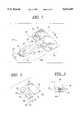
- FIG. 1is a perspective view of a taping knife embodiment of the present invention.
- FIG. 2is an exploded view of the taping knife blade and backing plate.
- FIG. 3is a side view of the proximal blade securement region of the taping knife handle.
- FIG. 4is a 3--3 cross sectional view of the taping knife of FIG. 1.
- FIG. 5is a 6--6 cross sectional view of the taping knife of as shown in FIG. 4.
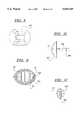
- FIG. 6shows enlarged portions of the 6--6 cross sectional of the taping knife handle as shown in FIG. 4.
- FIG. 7is an exploded view of the handle endcap and hammering head components.
- FIG. 8is a side view of the hammering head component.
- FIG. 9is an top view of the hammering head component.
- FIG. 10is a end view of the hammering head component.
- FIG. 11is a 11--11 cross-sectional view of the adjoined inner member halves of the taping knife handle of FIG. 4.
- FIG. 12is an enlarged cross-sectional view of the adjoined inner member halves of FIG. 11 where the protruding ridge of the outside wall ridge is received by the opposing recessed groove.
- a taping knife 11is constructed of a flat metal blade 13, a backing-plate 15, and a handle 17.
- Handle 17is ergonomically shaped and comprised of a proximal blade securement region 19, a distal region 15, a distal endcap 21, a hammering head 23, an outer grip member 25, and a grippable portion 140.
- Outer grip member 25provides a soft, grippable, rubber-like material in areas of maximum exposure to the user's hand, forming grippable areas.
- a hanging hole 27extends through handle 17 and provides space for a cord, thong, or string (not shown) to be threaded though hole 27. Alternatively, hanging hole 27 may be threaded over a hanging bracket for sales viewing or for storage. Referring to FIG.
- blade 13is rectangular in shape and has a thin dimension.
- a proximal section 29 of the bladeis located nearest to the work surface (not shown) during blade use, and a distal section 31 of the blade provides an area for mounting to backing plate 15.
- Distal section 31includes a series of five or more blade-mounting holes 33, spaced along the width of the blade.
- Backing-plate 15includes a proximal section 35 which is of the same width as blade 13, and a distal section 37 which is curved at its corners 39, 41.
- Proximal section 35is thicker than distal section 37 and terminates in a blade-receiving slot 43 for receiving distal section 31 of blade 13.
- Slot 43bifurcates proximal section 35 of backing-plate 15 along its entire length.
- Slot 43extends deep enough distally within section 35 to receive and encompass blade-mounting holes 33.
- a stamping operationis used to force portions of section 35 at the slot interface into blade-mounting holes 33, rigidly holding blade 13 to backing-plate 15. The stamping operation creates indentations 45.
- Distal section 37 of backing-plate 15includes a pair of backing-plate holes 47 for use in mounting the backing plate to handle 17.
- handle 17is formed of an inner plastic core member 49 about which outer grip member 25 is formed. As shown in FIGS. 4 and 5, core member 49 is integrally molded as one piece with blade securement region 19.
- inner member 49is comprised of two adjoining member halves 51, 53.
- Each halfincludes an inside surface 55, an outside surface 57, an outer wall 58, and a structural rib network 59 extending between the two inside surfaces 55 of each half 51, 53 so as to provide structural support to handle 17.
- the structural ribs 59are integrally formed with the inside surface 55 of member halves 51, 53.
- outer wall 58 of member half 51includes a centered, protruding ridge 120 which extends around the perimeter of outer wall 58 of member half 51.
- Ridge 120extends from ridge end 122 distally to ridge end 124, and from ridge end 126 distally to ridge end 128.
- Outer wall 58 of member half 53includes a corresponding centered, recessed groove 130 which extends around the perimeter of outer wall 58 of member half 53 (mirroring ridge 120 of FIG. 4).
- FIG. 12shows an enlargement of the interlocking ridge 120 and groove 130.
- each member half 51, 53also includes a pair of guide posts 61, 63 and a pair of corresponding guide receiver tubes 65, 67 which align with mirrored tubes and posts of the other member half.
- Posts 61, 63 and tubes 65, 67further assure proper alignment and mating of the member halves 51, 53.
- blade securement region 19 of handle 17terminates at its proximal end with a plate-receiving slot 69 for receiving backing-plate 15.
- section 19includes a pair of backing-plate fastening holes 71, which extend through both member halves 51, 53. As shown in FIGS. 4 and 5, holes 71 align with a pair of backing-plate fastening hole walls 73.
- inside surface 55 of each adjoining member half 51, 53includes a least one structural rib 75 connecting axially with backing-plate fastening hole wall 73 for added support in mounting the combination of backing-plate 15 and blade 13.
- backing-plate fastening hole 71aligns with backing-plate mounting hole 47 (FIG. 2) upon mounting of backing-plate 15 in plate-receiving slot 69.
- a rivet 77(FIG. 1) secures backing-plate 15 to inner member 49.
- a first circumferential flange 74extends from outside surface 57 of inner member 49 and is located in proximal blade securement region 19 where plate-receiving slot 69 terminates at its distal end.
- inner member 49terminates at its most distal end 15 in a flat surface 80.
- a second circumferential flange 81extends from outside surface 57 of inner member 49 in distal region 15. As shown in FIG. 6, flange 81 has an outer surface 95 which extends proximally forward from flat surface 80 and parallels the proximally expanding shape of inner member 49. Flange 81 has a maximum outer diameter 82 (FIG. 6) at the most proximal end of flange 81.
- Distal region 15also includes at least one enclosed compartment 83 as formed from structural ribs 59 of inner member 49.
- Compartment 83is formed proximally forward from surface 80 and lies substantially proximal of flange 81.
- At least one access hole 84leads into each enclosed compartment 83 through outer surface 57 of member halves 51, 53.
- Surface 80includes a first tongue-receiving slot 87 which extends proximally forward through structural ribs 59 and into compartment 83.
- Tongue-receiving slot 37includes a proximal and a distal end.
- an endcap 21is formed of a plastic material which is the same as the material forming inner member 49.
- Endcap 21includes an inner surface 90 and an outer surface 91.
- Endcap 21also includes a proximal end 27, nearest to inner member 49, and a distal end 28.
- endcap proximal end 27terminates in an endcap wall 92 which has an inner diameter 93 and outer diameter 94.
- Inner diameter 93is larger than maximum outer diameter 82 of flange 81.
- Endcap's inner surface 90is substantially similar to flange outer surface 95 so that endcap 21 fits conformingly over flange surface 95.
- Endcap 21also includes a lip 100 extending inwards around the circumference of inner surface 90, with lip 100 being flush with terminating endwall 92. Lip 100 hooks onto the proximal end of flange 81 and allows endcap 21 to lock into place, thus easing further assembly of handle 17.
- endcap 21also includes a flat surface 98 terminating its distal end.
- Surface 98includes a second tongue-receiving slot 96 which aligns with first tongue-receiving slot 87 of inner member 49.
- a hammering head 23includes a proximal end 105, nearest to inner member 49, and a distal end 106.
- Hammering head 23is usually formed from metal.
- Hammering head 23includes a generally convex headcap 107 and a tongue 108 which extends proximally from headcap 107.
- Tongue 108terminates proximally with notches 109 on each side of tongue 108.
- tongue 108extends proximally a sufficient distance to place notches 109 inside contained compartment(s) 83 of inner member 49.
- outer grip member 25extends from endcap wall 92 to first circumferential flange 74, where the material comprising grip member 25 abuts and seals against these surfaces. Also, upon formation of outer grip member 25, member 25 material flows into and is forced through access holes 84 which lead into enclosed compartment(s) 83. As a result, member 25 material fills compartment(s) 83 and encloses proximal end 105 of tongue 108 and tongue notches 109 (FIG. 6).
- member 25 materialwhen hardened, seals and secures hammering head 107 firmly against endcap 21, thus completing distal region 15 assembly of handle 17 without need for further adhesives or fasteners.
- hanging hole 27is aligned with a hanging hole wall 110.
- Hole wall 110terminates in an annular rim 111 which extends outward from outside surface 57 on each member half 51, 53.
- Outer grip member 25surrounds and seals against rim 111, so as to provide a relatively flush surface for contact with the user's hand.
Landscapes
- Engineering & Computer Science (AREA)
- Architecture (AREA)
- Mechanical Engineering (AREA)
- Civil Engineering (AREA)
- Structural Engineering (AREA)
- Knives (AREA)
Abstract
Description
The present invention relates to a taping knife and more particularly to a taping knife having an ergonomically shaped handle formed of lightweight, yet strong, interlocking component parts. Furthermore, this invention accepts a hammer head that can be molded in place without the need for a fastener.
Taping knives, which have varying blade widths, are used to finish drywall construction projects and create a smooth transition between abutting drywall surfaces. After drywall boards are in place, a smaller (e.g. 4-6 inch) taping knife is generally used to apply a drywalling compound (often referred to as "mud") and drywall tape to the joints formed by the abutting drywall surfaces. At this stage, unseated nails must also be finally set into the boards. After the mud dries, progressively larger (e.g. 8 inch-14 inch) knives are used to apply more mud to the joint areas. This step is repeated until the joint is sufficiently flat and smooth.
A firm grip upon the handle of a taping knife is advantageous to prevent the knife from turning or slipping when smoothing mud or when its handle end is being used to sink nails. Present taping knives often use plastics, such as glass-filled nylons, polyolefins, or wood, for the handle. However, the low coefficient of friction on the smooth outer surface of the handle allows slippage of the trowel in the user's hand, particularly where the hand becomes wetted from perspiration or mud.
When taping knives are used to spread mud, the user tends to grasp the body of the handle with three to five fingers. The index and middle fingers are often extended forward, towards or resting on the blade, for added control of the angle and pressure of the blade's working face as presented to the work surface. The user's fingers and palm are prone to become chapped and may develop callouses wherever slippage or chafing occurs between the handle and the hand. A major factor promoting callousing of the hand is the presence of mud. Mud serves as an irritant by its abrasiveness as well as its chemical effect on the skin.
Present taping knives often use injection moldable plastics, such as glass-filled nylons or polyolefins, for the handle. However, when hollow plastic handles are used, watertight seals must be maintained around the joints in the component plastic parts because the complete tool is often submerged in water for cleaning. If water leaks into the handle's hollow cavities, then the weight advantage of a hollow structure may be reduced significantly. Often the manufacturing and final assembly processes, to achieve the necessary tolerances for proper handle assembly with watertight seals, become complex and expensive.
Therefore, it is an object of the present invention to overcome the deficiencies of prior art taping knives which make use of solid plastic, metal, wood or other handle materials, or which make use of hollow materials with expensive or ineffective component part seals.
It is a further object of the present invention to provide a taping knife with a grippable, non-slip outer surface.
It is a further object of the present invention to provide a taping knife which utilizes the outer grippable material to secure the assemblage of the handle's component parts.
It is a further object of the present invention to provide an improved taping knife in the combination of handle, the backing-plate and blade.
These and other objects are achieved in a taping knife having a lightweight, hollow handle with interlocking parts and inexpensive watertight seals.
In one embodiment, the handle is ergonomically shaped to fit the user's hand. The handle consists of lightweight, yet strong, component parts. The parts include an inner member of hollow adjoining halves with inner structural ribs, a protruding ridge on one half which is received by recessed groove on the opposite half, an endcap, a hammering head, and an outer grip member. The outer grip member surrounds areas of maximum exposure to the user's hand, secures the hammering head against the endcap, and seals the inner member assembly.
In one embodiment the handle can be injection molded from two separate types of plastic, where the outer hand grip is molded from a thermoplastic rubber having a slightly soft, non-slip, rubber-like surface which provides a favorable grippability to the handle and added ergonomic comfort for the user. The inner member of the handle, as molded from a harder, stronger plastic, provides inner strength for mounting the knife blade and subsequently using the tool.
In one embodiment, an inner member can be formed from polypropylene which provides a strong, durable, and resilient blade mounting surface. The friction of the polypropylene, relative to the friction of the outer hand grip, can be controlled by varying the finish on the exposed portions of the inner member.
FIG. 1 is a perspective view of a taping knife embodiment of the present invention.
FIG. 2 is an exploded view of the taping knife blade and backing plate.
FIG. 3 is a side view of the proximal blade securement region of the taping knife handle.
FIG. 4 is a 3--3 cross sectional view of the taping knife of FIG. 1.
FIG. 5 is a 6--6 cross sectional view of the taping knife of as shown in FIG. 4.
FIG. 6 shows enlarged portions of the 6--6 cross sectional of the taping knife handle as shown in FIG. 4.
FIG. 7 is an exploded view of the handle endcap and hammering head components.
FIG. 8 is a side view of the hammering head component.
FIG. 9 is an top view of the hammering head component.
FIG. 10 is a end view of the hammering head component.
FIG. 11 is a 11--11 cross-sectional view of the adjoined inner member halves of the taping knife handle of FIG. 4.
FIG. 12 is an enlarged cross-sectional view of the adjoined inner member halves of FIG. 11 where the protruding ridge of the outside wall ridge is received by the opposing recessed groove.
Referring to FIG. 1, ataping knife 11 is constructed of aflat metal blade 13, a backing-plate 15, and ahandle 17.Handle 17 is ergonomically shaped and comprised of a proximal blade securementregion 19, adistal region 15, adistal endcap 21, ahammering head 23, anouter grip member 25, and agrippable portion 140.Outer grip member 25 provides a soft, grippable, rubber-like material in areas of maximum exposure to the user's hand, forming grippable areas. Ahanging hole 27 extends throughhandle 17 and provides space for a cord, thong, or string (not shown) to be threaded thoughhole 27. Alternatively, hanginghole 27 may be threaded over a hanging bracket for sales viewing or for storage. Referring to FIG. 2,blade 13 is rectangular in shape and has a thin dimension. Aproximal section 29 of the blade is located nearest to the work surface (not shown) during blade use, and adistal section 31 of the blade provides an area for mounting tobacking plate 15.Distal section 31 includes a series of five or more blade-mountingholes 33, spaced along the width of the blade. Backing-plate 15 includes aproximal section 35 which is of the same width asblade 13, and adistal section 37 which is curved at itscorners Proximal section 35 is thicker thandistal section 37 and terminates in a blade-receiving slot 43 for receivingdistal section 31 ofblade 13. Slot 43 bifurcatesproximal section 35 of backing-plate 15 along its entire length. Slot 43 extends deep enough distally withinsection 35 to receive and encompass blade-mounting holes 33. A stamping operation is used to force portions ofsection 35 at the slot interface into blade-mounting holes 33, rigidly holdingblade 13 to backing-plate 15. The stamping operation createsindentations 45.Distal section 37 of backing-plate 15 includes a pair of backing-plate holes 47 for use in mounting the backing plate to handle 17. Referring to FIGS. 1, 3 and 5handle 17 is formed of an innerplastic core member 49 about whichouter grip member 25 is formed. As shown in FIGS. 4 and 5,core member 49 is integrally molded as one piece with blade securementregion 19.
As shown in FIG. 5,inner member 49 is comprised of two adjoining member halves 51, 53. Each half includes aninside surface 55, anoutside surface 57, anouter wall 58, and astructural rib network 59 extending between the two insidesurfaces 55 of eachhalf structural ribs 59 are integrally formed with theinside surface 55 of member halves 51, 53.
As shown in FIG. 4,outer wall 58 ofmember half 51 includes a centered, protrudingridge 120 which extends around the perimeter ofouter wall 58 ofmember half 51.Ridge 120 extends fromridge end 122 distally toridge end 124, and fromridge end 126 distally toridge end 128.Outer wall 58 ofmember half 53 includes a corresponding centered, recessedgroove 130 which extends around the perimeter ofouter wall 58 of member half 53 (mirroring ridge 120 of FIG. 4).
As further shown in FIG. 11, when member halves 51, 53 are joined,groove 130 receivesridge 120 to provide a seal around the perimeter of the joinedmember halves ridge 120 andgroove 130.
Referring back to FIGS. 4 and 6 eachmember half guide receiver tubes Posts tubes
Referring again to FIGS. 1 and 3,blade securement region 19 ofhandle 17 terminates at its proximal end with a plate-receivingslot 69 for receiving backing-plate 15. As shown in FIGS. 1, 4 and 5,section 19 includes a pair of backing-plate fastening holes 71, which extend through both member halves 51, 53. As shown in FIGS. 4 and 5, holes 71 align with a pair of backing-platefastening hole walls 73.
Referring to FIG. 4, insidesurface 55 of each adjoiningmember half structural rib 75 connecting axially with backing-platefastening hole wall 73 for added support in mounting the combination of backing-plate 15 andblade 13.
Additionally, backing-plate fastening hole 71 aligns with backing-plate mounting hole 47 (FIG. 2) upon mounting of backing-plate 15 in plate-receivingslot 69. A rivet 77 (FIG. 1) secures backing-plate 15 toinner member 49. A firstcircumferential flange 74 extends fromoutside surface 57 ofinner member 49 and is located in proximalblade securement region 19 where plate-receivingslot 69 terminates at its distal end.
Referring to FIGS. 4-6,inner member 49 terminates at its mostdistal end 15 in aflat surface 80. A secondcircumferential flange 81 extends fromoutside surface 57 ofinner member 49 indistal region 15. As shown in FIG. 6,flange 81 has anouter surface 95 which extends proximally forward fromflat surface 80 and parallels the proximally expanding shape ofinner member 49.Flange 81 has a maximum outer diameter 82 (FIG. 6) at the most proximal end offlange 81.
Referring to FIG. 1 and FIGS. 4-7, anendcap 21 is formed of a plastic material which is the same as the material forminginner member 49.Endcap 21 includes aninner surface 90 and anouter surface 91.Endcap 21 also includes aproximal end 27, nearest toinner member 49, and adistal end 28.
Referring to FIG. 7, endcapproximal end 27 terminates in anendcap wall 92 which has aninner diameter 93 andouter diameter 94.Inner diameter 93 is larger than maximumouter diameter 82 offlange 81. Endcap'sinner surface 90 is substantially similar to flangeouter surface 95 so thatendcap 21 fits conformingly overflange surface 95.Endcap 21 also includes alip 100 extending inwards around the circumference ofinner surface 90, withlip 100 being flush with terminatingendwall 92.Lip 100 hooks onto the proximal end offlange 81 and allowsendcap 21 to lock into place, thus easing further assembly ofhandle 17. Referring to FIGS. 6 and 7,endcap 21 also includes aflat surface 98 terminating its distal end.Surface 98 includes a second tongue-receivingslot 96 which aligns with first tongue-receivingslot 87 ofinner member 49.
Referring to FIGS. 8-10, a hammeringhead 23 includes aproximal end 105, nearest toinner member 49, and adistal end 106. Hammeringhead 23 is usually formed from metal. Hammeringhead 23 includes a generallyconvex headcap 107 and atongue 108 which extends proximally fromheadcap 107.Tongue 108 terminates proximally withnotches 109 on each side oftongue 108. Referring to FIGS. 4-6,tongue 108 extends proximally a sufficient distance to placenotches 109 inside contained compartment(s) 83 ofinner member 49.
Referring again to FIG. 1 and FIGS. 4 and 5,outer grip member 25 extends from endcapwall 92 to firstcircumferential flange 74, where the material comprisinggrip member 25 abuts and seals against these surfaces. Also, upon formation ofouter grip member 25,member 25 material flows into and is forced through access holes 84 which lead into enclosed compartment(s) 83. As a result,member 25 material fills compartment(s) 83 and enclosesproximal end 105 oftongue 108 and tongue notches 109 (FIG. 6). Upon fillingnotches 109 and compartment(s) 83,member 25 material, when hardened, seals and secures hammeringhead 107 firmly againstendcap 21, thus completingdistal region 15 assembly ofhandle 17 without need for further adhesives or fasteners.
Referring again to FIGS. 4, 11 and 12, the sealing receipt ofridge 120 intogroove 130 preventsouter grip member 25 material from flowing into unintended structural cavities. For instance,outer grip 25 material is intended to flow only into compartments(s) 83. Without the seal achieved byridge 120 and groove 130 around the perimeter of inner member halves 51, 53,outer grip 25 material might leak, and/or be forcibly introduced, into hollowinner member 49. This would negate any weight advantages gained by using a hollow inner structure.
Referring to FIG. 6, hanginghole 27 is aligned with a hanginghole wall 110.Hole wall 110 terminates in anannular rim 111 which extends outward fromoutside surface 57 on eachmember half Outer grip member 25 surrounds and seals againstrim 111, so as to provide a relatively flush surface for contact with the user's hand.
While only one preferred embodiment of the invention has been described hereinabove, those of ordinary skill in the art will recognize that the embodiment may be modified and altered without departing from the central spirit and scope of the invention. Thus, the preferred embodiment described hereinabove is to be considered in all respects as illustrative and not restrictive, the scope of the invention being indicated by the appended claims, rather than by the foregoing description, and all changes which come within the meaning and range of equivalency of the claims are intended to be embraced herein.
Claims (21)
1. A tapping knife, comprising:
a blade member having a working blade region and a blade securement region;
an elongated handle secured to said blade member in said securement region and extending distally from said blade member along the line of gripping, said handle including,
(i) an inner member formed from a first plastic material, said inner member having distal and proximal ends; and
(ii) an outer grip member formed of a second plastic material which surrounds a portion of said inner member to form a grippable area,
said securement region including a backing plate secured to said blade and said handle being secured to said backing plate.
2. The taping knife of claim 1 wherein said blade includes a proximal end and a distal end, said proximal end including a blade-mounting hole, and wherein said backing-plate includes
(i) a proximal end and distal end; and
(ii) a blade-receiving slot which bifurcates lengthwise said proximal end of said backing-plate, said slot receiving said distal end of said blade and said slot extending to encompass said blade-mounting hole; and
(iii) a stampable area adjacent said blade mounting hole which can be engaged with said blade-mounting hole to secure said blade to said backing plate; and
(iv) at least one backing-plate mounting hole in said distal end of said backing-plate.
3. A taping knife, comprising:
a blade member having a working blade area and a blade securement region;
an elongated handle secured to said blade member in said securement region and extending distally from said blade member along the line of gripping, said handle having distal and proximal ends and further including,
(i) a hollow inner member formed from a first plastic material, said inner member having distal and proximal ends and including two adjoining halves, each said half having an inside surface, an outside surface, and an outside wall; and
(ii) a structural rib network on said inside surfaces of said inner member halves; and
(iii) a hammering head formed from a hard, strong material having distal and proximal ends, said hammering head including a distal headcap and a tongue, said tongue extending proximally forward and including at least a pair of notches; and
(iv) a slot in said distal end of said inner member for receiving said hammering head tongue; and
(v) an outer grip member formed of a second thermoplastic rubber material which surrounds the grippable portion of said inner member; and
(vi) at least one compartment formed by said structural ribs in said handle's distal end, said compartment including at least one access hole through said inner member halves, wherein
(a) said tongue and said tongue notches extend proximally forward into said compartment; and
(b) said outer grip material flows into and is forced through said compartment access holes, said material filling said inner member compartment and securely surrounding said hammering head tongue and said tongue notches.
4. The taping knife of claim 3 wherein said structural ribs are integrally formed with said inside surface of each said inner member half.
5. The taping knife of claim 4 wherein said grippable portion of one adjoining inner member half includes a protruding ridge, centered in said outside wall, which extends towards and is received by a recessed groove, centered in said outside wall of the opposite adjoining inner member half.
6. The taping knife of claim 7 wherein said securement region includes a backing plate secured to said blade and said handle secured to said backing plate.
7. The taping knife of claim 6 wherein said blade includes a proximal end and a distal end, said proximal end including a blade-mounting hole, and wherein said backing-plate includes
(i) a proximal end and distal end; and
(ii) a blade-receiving slot which bifurcates lengthwise said proximal end of said backing-plate, said slot receiving said proximal end of said blade and said slot extending to encompass said blade-mounting hole; and
(iii) a stampable area adjacent said blade-mounting hole which can be engaged with said blade-mounting hole to secure said blade to said backing-plate; and
(iv) at least one backing-plate mounting hole in said distal end of said backing-plate.
8. The taping knife of claim 7 wherein said inner member further includes a hole through said distal end for receiving a hanging means.
9. The taping knife of claim 8 wherein said hanging means includes a metal bracket.
10. The taping knife of claim 8 wherein said hanging means includes a flexible cord.
11. The taping knife of claim 8 wherein said handle further includes an endcap which fits over said adjoined inner member halves at said distal end.
12. The taping knife of claim 11 wherein said distal end of said inner member further includes a first circumferential flange on said outside surface for receiving said endcap.
13. The taping knife of claim 12 wherein said endcap further includes,
(i) an inside surface and an outside surface; and
(ii) a distal end and a proximal end; and
(iii) a slot in its distal end which aligns with said inner member slot;
wherein said endcap terminates in an endcap wall, with said wall including a circumferential lip around said inside surface of the most proximal end of said wall, and wherein said lip snaps over said flange thereby holding said inner member halves together for further assembly.
14. The taping knife of claim 13 wherein said proximal end of said inner member further includes a second circumferential flange on said outside surface, wherein said outer grip material surrounds said adjoined inner member halves and abuts and seals against said second flange and said endcap wall in a flush manner with the user's hand.
15. The taping knife of claim 14 wherein said adjoining member halves form a blade-receiving slot which terminates said proximal end of said inner member, and said slot including
(i) at least one backing-plate fastening hole through said inner member halves and said slot; and
(ii) a supporting wall aligned around said hole; and
(iii) at least one structurally supporting rib along said inside surface of each said inner member half, said rib extending axially and adjoining said hole supporting wall;
wherein said backing-plate mounting hole aligns with said backing-plate fastening through which a fastening means is used to secure said backing-plate to said inner member of said handle.
16. The taping knife of claim 15 wherein said fastening means is a rivet.
17. The taping knife of claim 15 wherein said blade fastening means includes a bolt and nut combination.
18. The taping knife of claim 11 wherein said endcap is formed of the same plastic material as said inner member.
19. The taping knife of claim 11 wherein said hammering head is formed of metal.
20. A taping knife, comprising:
a blade member having a working blade region and a blade securement region;
an elongated handle secured to said blade member in said securement region and extending distally from said blade member along the line of gripping, said handle including,
(i) an inner member formed from a first plastic material, said inner member having distal and proximal ends; and
(ii) an outer grip member formed of a second plastic material which is molded about a portion of said inner member to form a grippable area, said inner member including multiple component parts, said component parts being secured together by said outer grip member.
21. The taping knife of claim 20 and further including interlocking means for interlocking said component parts.
Priority Applications (4)
| Application Number | Priority Date | Filing Date | Title |
|---|---|---|---|
| US08/364,217US5615445A (en) | 1994-12-27 | 1994-12-27 | Taping knife handle |
| AU40548/95AAU710563B2 (en) | 1994-12-27 | 1995-12-19 | Taping knife handle |
| GB9526151AGB2296462B (en) | 1994-12-27 | 1995-12-21 | A taping knife |
| CA002165908ACA2165908A1 (en) | 1994-12-27 | 1995-12-21 | Taping knife handle |
Applications Claiming Priority (1)
| Application Number | Priority Date | Filing Date | Title |
|---|---|---|---|
| US08/364,217US5615445A (en) | 1994-12-27 | 1994-12-27 | Taping knife handle |
Publications (1)
| Publication Number | Publication Date |
|---|---|
| US5615445Atrue US5615445A (en) | 1997-04-01 |
Family
ID=23433558
Family Applications (1)
| Application Number | Title | Priority Date | Filing Date |
|---|---|---|---|
| US08/364,217Expired - LifetimeUS5615445A (en) | 1994-12-27 | 1994-12-27 | Taping knife handle |
Country Status (4)
| Country | Link |
|---|---|
| US (1) | US5615445A (en) |
| AU (1) | AU710563B2 (en) |
| CA (1) | CA2165908A1 (en) |
| GB (1) | GB2296462B (en) |
Cited By (72)
| Publication number | Priority date | Publication date | Assignee | Title |
|---|---|---|---|---|
| US5956799A (en)* | 1997-09-10 | 1999-09-28 | Panaccione; Mark Thomas | Putty knife and scraper handle |
| US5964009A (en)* | 1997-09-15 | 1999-10-12 | Snap-On Technologies, Inc. | Tool with dual-material handle |
| US6138313A (en)* | 1995-08-10 | 2000-10-31 | Newell Operating Company | Paint brush with improved grip construction and method of manufacture thereof |
| US6182317B1 (en)* | 1999-05-10 | 2001-02-06 | Chin-Chen Huang | Scraper having hammering head connected with the blade |
| USD439056S1 (en) | 2000-03-30 | 2001-03-20 | Newell Operating Company | Paint brush |
| USD439418S1 (en) | 2000-03-30 | 2001-03-27 | Newell Operating Company | Paint brush |
| USD439417S1 (en) | 2000-03-30 | 2001-03-27 | Newell Operating Company | Paint brush |
| USD440405S1 (en) | 2000-03-30 | 2001-04-17 | Brian E. Woodnorth | Paint brush |
| USD440769S1 (en) | 2000-03-30 | 2001-04-24 | Newell Operating Company | Paint brush |
| USD440771S1 (en) | 2000-03-30 | 2001-04-24 | Newell Operating Company | Paint brush |
| EP0930133A3 (en)* | 1998-01-20 | 2001-05-09 | Kuhlen GmbH | Trowel with handle |
| US6247204B1 (en) | 1999-09-15 | 2001-06-19 | Mike Hamby | Handle for trowel and related tools |
| USD446437S1 (en) | 2000-12-21 | 2001-08-14 | Martin Chen | Handle |
| USD446943S1 (en) | 2000-03-30 | 2001-08-28 | Newell Operating Company | Paint brush |
| USD450459S1 (en) | 2000-03-30 | 2001-11-20 | Newell Operating Company | Paint brush |
| US6368536B1 (en) | 1997-09-15 | 2002-04-09 | Snap-On Technologies, Inc. | Method of forming tool with dual-material handle |
| USD461287S1 (en) | 2001-09-04 | 2002-08-06 | Cleret, Inc. | Squeegee handle |
| US6453563B1 (en)* | 2001-01-05 | 2002-09-24 | Hyde Manufacturing Company, Inc. | Hand tool handle |
| USD463670S1 (en) | 2001-07-25 | 2002-10-01 | Newell Operating Company | Paint applicator |
| USD463917S1 (en) | 2001-02-16 | 2002-10-08 | Newell Operating Company | Paint brush |
| USD464802S1 (en) | 2001-02-16 | 2002-10-29 | Newell Operating Company | Paint brush |
| USD464803S1 (en) | 2001-02-16 | 2002-10-29 | Newell Operating Company | Paint brush |
| USD465091S1 (en) | 2001-02-16 | 2002-11-05 | Newell Operating Company | Paint brush |
| US6473939B1 (en)* | 2000-11-21 | 2002-11-05 | Kraft Tool Company | Soft grip tool handle and method of manufacture |
| USD465657S1 (en) | 2001-02-16 | 2002-11-19 | Newell Operating Company | Paint brush |
| USD465931S1 (en) | 2001-02-16 | 2002-11-26 | Newell Operating Company | Paint brush |
| US6516490B1 (en) | 1999-03-17 | 2003-02-11 | Thomas Hatala | Ice scraper construction |
| USD470316S1 (en) | 2001-07-25 | 2003-02-18 | Newell Operating Company | Paint applicator |
| USD470662S1 (en) | 2001-07-30 | 2003-02-25 | Newell Operating Company | Paint applicator |
| USD471719S1 (en) | 2001-07-25 | 2003-03-18 | Newell Operating Company | Paint applicator |
| USD478730S1 (en) | 2002-01-11 | 2003-08-26 | Newell Operating Company | Paint applicator handle |
| USD482203S1 (en) | 2002-03-28 | 2003-11-18 | Newell Operating Company | Paint applicator handle |
| US6742215B2 (en) | 2001-02-06 | 2004-06-01 | A. Richard S.E.N.C. | Ergonomic drywall knife |
| USD491729S1 (en) | 2002-12-31 | 2004-06-22 | Newell Operating Company | Utility handle |
| USD492122S1 (en) | 2002-12-31 | 2004-06-29 | Newell Operating Company | Utility handle |
| USD492491S1 (en) | 2002-12-31 | 2004-07-06 | Newell Operating Company | Utility handle |
| USD494372S1 (en) | 2002-01-11 | 2004-08-17 | Newell Operating Company | Paint applicator handle |
| US20050034415A1 (en)* | 2003-07-31 | 2005-02-17 | Paul Laplante | Method and apparatus for applying drywall tape |
| US20050179272A1 (en)* | 2004-02-17 | 2005-08-18 | Virutex Ilko S.A. | Oblong, non-slip, ergonomic handle for kitchen utensils |
| US20060070213A1 (en)* | 2004-09-27 | 2006-04-06 | Huang Yin H | Cushioned tool handle device |
| US20070017101A1 (en)* | 2005-07-22 | 2007-01-25 | United States Gypsum Company | Taping knife with enlarged hammer element |
| US20070017052A1 (en)* | 2005-07-22 | 2007-01-25 | United States Gypsum Company | Taping knife with offset handle |
| US20070056133A1 (en)* | 2005-09-13 | 2007-03-15 | Marshalltown Company | Surface finishing tool |
| US20070074401A1 (en)* | 2005-07-22 | 2007-04-05 | Myers Matthew E | Taping knife handle with identification insert |
| USD541616S1 (en) | 2005-07-22 | 2007-05-01 | United States Gypsum Company | Contoured handle for taping knife |
| USD541617S1 (en)* | 2005-07-22 | 2007-05-01 | United States Gypsum Company | Handle for taping knife with enlarged hammer end |
| USD549070S1 (en) | 2005-07-22 | 2007-08-21 | United States Gypsum Company | Offset handle for taping knife |
| USD553939S1 (en) | 2006-12-29 | 2007-10-30 | United States Gypsum Company | Offset handle for taping knife |
| US20070295376A1 (en)* | 2006-06-22 | 2007-12-27 | Chen-Te Liu | Improved Unbrella Handle Structure |
| US20080047074A1 (en)* | 2006-08-25 | 2008-02-28 | Aaron Charles Rosso | Wallboard taping knife with polymeric hammer |
| USD565383S1 (en) | 2005-07-22 | 2008-04-01 | United States Gypsum Company | Contoured handle for taping knife |
| USD567019S1 (en) | 2005-02-17 | 2008-04-22 | Virutex Ilko S.A. | Oblong, non-slip, ergonomic handle for kitchen utensils |
| US20080235955A1 (en)* | 2007-04-02 | 2008-10-02 | Aaron Charles Rosso | Jab saw with accessible internal fastening location |
| EP2239104A1 (en) | 2009-04-09 | 2010-10-13 | Flügger A/S | Floatable hand tool |
| US20110100751A1 (en)* | 2009-11-04 | 2011-05-05 | Paquet Jules P | Two piece climber apparatus |
| USD638223S1 (en)* | 2007-11-22 | 2011-05-24 | A. Richard Tools Co./Outils A. Richard Co. | Paint brush handle |
| USD667717S1 (en)* | 2011-08-18 | 2012-09-25 | Matthew Page | Tool handle |
| USD667716S1 (en)* | 2011-08-18 | 2012-09-25 | Matthew Page | Tool handle |
| US9155381B2 (en) | 2012-09-19 | 2015-10-13 | Easy Pro Products, Llc | Guides for painting |
| USD742199S1 (en)* | 2014-06-27 | 2015-11-03 | A. Richard Tools Co. | Taping knife |
| WO2016003808A1 (en) | 2014-07-02 | 2016-01-07 | Modern Packaging Llc | Overmolded cutlery articles |
| USD772681S1 (en)* | 2013-08-09 | 2016-11-29 | Wilmar Corporation | Tool handle |
| USD808242S1 (en) | 2016-02-08 | 2018-01-23 | The Sherwin-Williams Company | Prep tool |
| USD808241S1 (en) | 2016-02-08 | 2018-01-23 | The Sherwin-Williams Company | Prep tool |
| US20180126533A1 (en)* | 2016-11-04 | 2018-05-10 | Hangzhou Zhongjie Tools Co.,Ltd. | Combined Integral Chisel having High Efficiency |
| USD828740S1 (en) | 2017-01-17 | 2018-09-18 | The Sherwin-Williams Company | Multi-tool with bit slot |
| US10112329B2 (en) | 2015-11-02 | 2018-10-30 | Modern Packaging Llc | Overmolded disposable cutlery articles |
| USD843734S1 (en)* | 2016-06-16 | 2019-03-26 | James Charles Dale | Handle for interchangeable painting tool heads |
| US10369687B2 (en) | 2016-02-08 | 2019-08-06 | The Sherwin Williams Company | Prep tool |
| US10442094B1 (en)* | 2014-03-21 | 2019-10-15 | Robert F. Weir | Multipurpose machete with spur knife and removable storage handle assembly |
| USD871178S1 (en) | 2016-02-08 | 2019-12-31 | The Sherwin-Williams Company | Folding tool |
| US20200141134A1 (en)* | 2015-03-17 | 2020-05-07 | Michael Hernandez | Joint Compound Spreading Tool For Drywall Joint Finishing |
Families Citing this family (3)
| Publication number | Priority date | Publication date | Assignee | Title |
|---|---|---|---|---|
| GB2342306B (en)* | 1996-01-17 | 2000-06-14 | Marshalltown Trowel Co | Plastic molded float handle |
| US5781956A (en)* | 1996-01-17 | 1998-07-21 | Marshalltown Trowel Company | Plastic molded float handle |
| AT15241U1 (en)* | 2015-04-07 | 2017-04-15 | Ing Johann Hörtnagl - Werkzeuge Gmbh | Tool with a handle and a handle attached to the tool part |
Citations (20)
| Publication number | Priority date | Publication date | Assignee | Title |
|---|---|---|---|---|
| US31436A (en)* | 1861-02-19 | Mason s trowel | ||
| US747036A (en)* | 1903-08-31 | 1903-12-15 | George H Bishop | Trowel-handle. |
| US751356A (en)* | 1904-02-02 | op philadelphia | ||
| US2410572A (en)* | 1944-12-04 | 1946-11-05 | Pioneer Tool Company Inc | Cutlery |
| US2871899A (en)* | 1958-04-16 | 1959-02-03 | Bridgeport Hardware Mfg Corp | Tool handles |
| US3018497A (en)* | 1959-12-14 | 1962-01-30 | Red Devil Tools | Tool having a hand grip construction |
| US3078491A (en)* | 1960-10-24 | 1963-02-26 | Ames Taping Tool Systems Mfg C | Broadknife |
| US3189069A (en)* | 1963-12-06 | 1965-06-15 | Stanley Works | Tool handle with resilient gripping means |
| US3302673A (en)* | 1965-02-08 | 1967-02-07 | Harold S Forsberg | Composite tool handle |
| US4381579A (en)* | 1979-12-21 | 1983-05-03 | Hilti Aktiengesellschaft | Handle for a hand-held device |
| US4452289A (en)* | 1981-12-28 | 1984-06-05 | Fiskars Manufacturing Corporation | Combination hand grip and bits storage |
| US4620369A (en)* | 1984-08-09 | 1986-11-04 | Gercken Richard H | Drywall knife |
| US4639029A (en)* | 1985-08-09 | 1987-01-27 | Kolonia Robert A | Tool handle |
| US4729271A (en)* | 1986-11-20 | 1988-03-08 | Kenigson Robert H | Screwdriver handle |
| US4739536A (en)* | 1985-07-13 | 1988-04-26 | Wera Werk Hermann Werner Gmbh & Co. | Screwdriver handgrip having harder and softer zones |
| US4794694A (en)* | 1988-02-01 | 1989-01-03 | Daniel Podlesny B | Broad putty knife with snap-on tang |
| US4837892A (en)* | 1988-03-04 | 1989-06-13 | Conair Corporation | Cushioned handle structure for personal care appliances |
| US4884312A (en)* | 1987-01-20 | 1989-12-05 | Clark Ronald M | Hand trowel |
| US4941232A (en)* | 1987-10-07 | 1990-07-17 | Bettcher Industries, Inc. | Slip resistant, cushioning cover for handles |
| GB2274615A (en)* | 1993-01-29 | 1994-08-03 | Moss Prod Pty Ltd | Moulded plastic handle and method of its manufacture |
- 1994
- 1994-12-27USUS08/364,217patent/US5615445A/ennot_activeExpired - Lifetime
- 1995
- 1995-12-19AUAU40548/95Apatent/AU710563B2/ennot_activeCeased
- 1995-12-21CACA002165908Apatent/CA2165908A1/ennot_activeAbandoned
- 1995-12-21GBGB9526151Apatent/GB2296462B/ennot_activeExpired - Fee Related
Patent Citations (20)
| Publication number | Priority date | Publication date | Assignee | Title |
|---|---|---|---|---|
| US31436A (en)* | 1861-02-19 | Mason s trowel | ||
| US751356A (en)* | 1904-02-02 | op philadelphia | ||
| US747036A (en)* | 1903-08-31 | 1903-12-15 | George H Bishop | Trowel-handle. |
| US2410572A (en)* | 1944-12-04 | 1946-11-05 | Pioneer Tool Company Inc | Cutlery |
| US2871899A (en)* | 1958-04-16 | 1959-02-03 | Bridgeport Hardware Mfg Corp | Tool handles |
| US3018497A (en)* | 1959-12-14 | 1962-01-30 | Red Devil Tools | Tool having a hand grip construction |
| US3078491A (en)* | 1960-10-24 | 1963-02-26 | Ames Taping Tool Systems Mfg C | Broadknife |
| US3189069A (en)* | 1963-12-06 | 1965-06-15 | Stanley Works | Tool handle with resilient gripping means |
| US3302673A (en)* | 1965-02-08 | 1967-02-07 | Harold S Forsberg | Composite tool handle |
| US4381579A (en)* | 1979-12-21 | 1983-05-03 | Hilti Aktiengesellschaft | Handle for a hand-held device |
| US4452289A (en)* | 1981-12-28 | 1984-06-05 | Fiskars Manufacturing Corporation | Combination hand grip and bits storage |
| US4620369A (en)* | 1984-08-09 | 1986-11-04 | Gercken Richard H | Drywall knife |
| US4739536A (en)* | 1985-07-13 | 1988-04-26 | Wera Werk Hermann Werner Gmbh & Co. | Screwdriver handgrip having harder and softer zones |
| US4639029A (en)* | 1985-08-09 | 1987-01-27 | Kolonia Robert A | Tool handle |
| US4729271A (en)* | 1986-11-20 | 1988-03-08 | Kenigson Robert H | Screwdriver handle |
| US4884312A (en)* | 1987-01-20 | 1989-12-05 | Clark Ronald M | Hand trowel |
| US4941232A (en)* | 1987-10-07 | 1990-07-17 | Bettcher Industries, Inc. | Slip resistant, cushioning cover for handles |
| US4794694A (en)* | 1988-02-01 | 1989-01-03 | Daniel Podlesny B | Broad putty knife with snap-on tang |
| US4837892A (en)* | 1988-03-04 | 1989-06-13 | Conair Corporation | Cushioned handle structure for personal care appliances |
| GB2274615A (en)* | 1993-01-29 | 1994-08-03 | Moss Prod Pty Ltd | Moulded plastic handle and method of its manufacture |
Cited By (111)
| Publication number | Priority date | Publication date | Assignee | Title |
|---|---|---|---|---|
| US6138313A (en)* | 1995-08-10 | 2000-10-31 | Newell Operating Company | Paint brush with improved grip construction and method of manufacture thereof |
| US6401290B1 (en)* | 1995-08-10 | 2002-06-11 | Newell Operating Company | Paint brush with improved grip construction |
| US5956799A (en)* | 1997-09-10 | 1999-09-28 | Panaccione; Mark Thomas | Putty knife and scraper handle |
| US6228306B1 (en) | 1997-09-15 | 2001-05-08 | Snap-On Technologies, Inc. | Method for making tool with dual-material handle |
| US5964009A (en)* | 1997-09-15 | 1999-10-12 | Snap-On Technologies, Inc. | Tool with dual-material handle |
| US6368536B1 (en) | 1997-09-15 | 2002-04-09 | Snap-On Technologies, Inc. | Method of forming tool with dual-material handle |
| EP0930133A3 (en)* | 1998-01-20 | 2001-05-09 | Kuhlen GmbH | Trowel with handle |
| US6516490B1 (en) | 1999-03-17 | 2003-02-11 | Thomas Hatala | Ice scraper construction |
| US6182317B1 (en)* | 1999-05-10 | 2001-02-06 | Chin-Chen Huang | Scraper having hammering head connected with the blade |
| US6247204B1 (en) | 1999-09-15 | 2001-06-19 | Mike Hamby | Handle for trowel and related tools |
| USD439418S1 (en) | 2000-03-30 | 2001-03-27 | Newell Operating Company | Paint brush |
| USD440771S1 (en) | 2000-03-30 | 2001-04-24 | Newell Operating Company | Paint brush |
| USD440769S1 (en) | 2000-03-30 | 2001-04-24 | Newell Operating Company | Paint brush |
| USD446943S1 (en) | 2000-03-30 | 2001-08-28 | Newell Operating Company | Paint brush |
| USD450459S1 (en) | 2000-03-30 | 2001-11-20 | Newell Operating Company | Paint brush |
| USD440405S1 (en) | 2000-03-30 | 2001-04-17 | Brian E. Woodnorth | Paint brush |
| USD439417S1 (en) | 2000-03-30 | 2001-03-27 | Newell Operating Company | Paint brush |
| USD439056S1 (en) | 2000-03-30 | 2001-03-20 | Newell Operating Company | Paint brush |
| US6821468B2 (en) | 2000-11-21 | 2004-11-23 | Kraft Tool Company | Soft grip tool handle and method of manufacture |
| US6473939B1 (en)* | 2000-11-21 | 2002-11-05 | Kraft Tool Company | Soft grip tool handle and method of manufacture |
| USD446437S1 (en) | 2000-12-21 | 2001-08-14 | Martin Chen | Handle |
| US6453563B1 (en)* | 2001-01-05 | 2002-09-24 | Hyde Manufacturing Company, Inc. | Hand tool handle |
| US6742215B2 (en) | 2001-02-06 | 2004-06-01 | A. Richard S.E.N.C. | Ergonomic drywall knife |
| USD464802S1 (en) | 2001-02-16 | 2002-10-29 | Newell Operating Company | Paint brush |
| USD465091S1 (en) | 2001-02-16 | 2002-11-05 | Newell Operating Company | Paint brush |
| USD464803S1 (en) | 2001-02-16 | 2002-10-29 | Newell Operating Company | Paint brush |
| USD465657S1 (en) | 2001-02-16 | 2002-11-19 | Newell Operating Company | Paint brush |
| USD465931S1 (en) | 2001-02-16 | 2002-11-26 | Newell Operating Company | Paint brush |
| USD463917S1 (en) | 2001-02-16 | 2002-10-08 | Newell Operating Company | Paint brush |
| USD463670S1 (en) | 2001-07-25 | 2002-10-01 | Newell Operating Company | Paint applicator |
| USD471719S1 (en) | 2001-07-25 | 2003-03-18 | Newell Operating Company | Paint applicator |
| USD470316S1 (en) | 2001-07-25 | 2003-02-18 | Newell Operating Company | Paint applicator |
| USD470662S1 (en) | 2001-07-30 | 2003-02-25 | Newell Operating Company | Paint applicator |
| USD461287S1 (en) | 2001-09-04 | 2002-08-06 | Cleret, Inc. | Squeegee handle |
| USD494372S1 (en) | 2002-01-11 | 2004-08-17 | Newell Operating Company | Paint applicator handle |
| USD478730S1 (en) | 2002-01-11 | 2003-08-26 | Newell Operating Company | Paint applicator handle |
| USD482203S1 (en) | 2002-03-28 | 2003-11-18 | Newell Operating Company | Paint applicator handle |
| USD492491S1 (en) | 2002-12-31 | 2004-07-06 | Newell Operating Company | Utility handle |
| USD492122S1 (en) | 2002-12-31 | 2004-06-29 | Newell Operating Company | Utility handle |
| USD491729S1 (en) | 2002-12-31 | 2004-06-22 | Newell Operating Company | Utility handle |
| US20050034415A1 (en)* | 2003-07-31 | 2005-02-17 | Paul Laplante | Method and apparatus for applying drywall tape |
| US20050179272A1 (en)* | 2004-02-17 | 2005-08-18 | Virutex Ilko S.A. | Oblong, non-slip, ergonomic handle for kitchen utensils |
| US20060070213A1 (en)* | 2004-09-27 | 2006-04-06 | Huang Yin H | Cushioned tool handle device |
| USD567019S1 (en) | 2005-02-17 | 2008-04-22 | Virutex Ilko S.A. | Oblong, non-slip, ergonomic handle for kitchen utensils |
| USD553940S1 (en) | 2005-07-22 | 2007-10-30 | United States Gypsum Company | Handle for taping knife with enlarged hammer end |
| USD572565S1 (en) | 2005-07-22 | 2008-07-08 | United States Gypsum Company | Handle for taping knife with enlarged hammer end |
| RU2426605C2 (en)* | 2005-07-22 | 2011-08-20 | Юнайтед Стэйтс Джипсум Компани | Film filling spattle with offset handle |
| US20070074401A1 (en)* | 2005-07-22 | 2007-04-05 | Myers Matthew E | Taping knife handle with identification insert |
| USD541616S1 (en) | 2005-07-22 | 2007-05-01 | United States Gypsum Company | Contoured handle for taping knife |
| USD541617S1 (en)* | 2005-07-22 | 2007-05-01 | United States Gypsum Company | Handle for taping knife with enlarged hammer end |
| USD549070S1 (en) | 2005-07-22 | 2007-08-21 | United States Gypsum Company | Offset handle for taping knife |
| USD551053S1 (en) | 2005-07-22 | 2007-09-18 | United States Gypsum Company | Contoured handle for taping knife |
| CN101222982B (en)* | 2005-07-22 | 2011-02-23 | 美国石膏公司 | scraper with offset handle |
| USD553941S1 (en) | 2005-07-22 | 2007-10-30 | United States Gypsum Company | Offset handle for taping knife |
| US20070017052A1 (en)* | 2005-07-22 | 2007-01-25 | United States Gypsum Company | Taping knife with offset handle |
| USD557102S1 (en)* | 2005-07-22 | 2007-12-11 | United States Gypsum Company | Handle for taping knife with enlarged hammer end |
| EP1907129A4 (en)* | 2005-07-22 | 2009-12-30 | United States Gypsum Co | Taping knife with offset handle |
| JP2009503291A (en)* | 2005-07-22 | 2009-01-29 | ユナイテッド・ステイツ・ジプサム・カンパニー | Taping knife with offset pattern |
| USD565383S1 (en) | 2005-07-22 | 2008-04-01 | United States Gypsum Company | Contoured handle for taping knife |
| US7458127B2 (en) | 2005-07-22 | 2008-12-02 | United States Gypsum Company | Taping knife with offset handle |
| US20070017101A1 (en)* | 2005-07-22 | 2007-01-25 | United States Gypsum Company | Taping knife with enlarged hammer element |
| WO2007018704A1 (en)* | 2005-07-22 | 2007-02-15 | United States Gypsum Company | Taping knife with offset handle |
| US7434318B2 (en) | 2005-07-22 | 2008-10-14 | United States Gypsum Company | Tool with enlarged hammer element |
| US20070056133A1 (en)* | 2005-09-13 | 2007-03-15 | Marshalltown Company | Surface finishing tool |
| US20070295376A1 (en)* | 2006-06-22 | 2007-12-27 | Chen-Te Liu | Improved Unbrella Handle Structure |
| US20080047074A1 (en)* | 2006-08-25 | 2008-02-28 | Aaron Charles Rosso | Wallboard taping knife with polymeric hammer |
| US7587778B2 (en)* | 2006-08-25 | 2009-09-15 | United States Gypsum Company | Wallboard taping knife with polymeric hammer |
| US20090293200A1 (en)* | 2006-08-25 | 2009-12-03 | Aaron Charles Rosso | Wallboard taping knife with polymeric hammer |
| USD565921S1 (en) | 2006-12-29 | 2008-04-08 | United States Gypsum Company | Offset handle for taping knife |
| USD553939S1 (en) | 2006-12-29 | 2007-10-30 | United States Gypsum Company | Offset handle for taping knife |
| US20080235955A1 (en)* | 2007-04-02 | 2008-10-02 | Aaron Charles Rosso | Jab saw with accessible internal fastening location |
| USD638223S1 (en)* | 2007-11-22 | 2011-05-24 | A. Richard Tools Co./Outils A. Richard Co. | Paint brush handle |
| EP2239104A1 (en) | 2009-04-09 | 2010-10-13 | Flügger A/S | Floatable hand tool |
| US20110100751A1 (en)* | 2009-11-04 | 2011-05-05 | Paquet Jules P | Two piece climber apparatus |
| US8733505B2 (en)* | 2009-11-04 | 2014-05-27 | Jules P. Paquet | Two piece climber apparatus |
| USD667717S1 (en)* | 2011-08-18 | 2012-09-25 | Matthew Page | Tool handle |
| USD667716S1 (en)* | 2011-08-18 | 2012-09-25 | Matthew Page | Tool handle |
| US9155381B2 (en) | 2012-09-19 | 2015-10-13 | Easy Pro Products, Llc | Guides for painting |
| USD772681S1 (en)* | 2013-08-09 | 2016-11-29 | Wilmar Corporation | Tool handle |
| US10442094B1 (en)* | 2014-03-21 | 2019-10-15 | Robert F. Weir | Multipurpose machete with spur knife and removable storage handle assembly |
| USD742199S1 (en)* | 2014-06-27 | 2015-11-03 | A. Richard Tools Co. | Taping knife |
| WO2016003808A1 (en) | 2014-07-02 | 2016-01-07 | Modern Packaging Llc | Overmolded cutlery articles |
| US9956815B2 (en) | 2014-07-02 | 2018-05-01 | Modern Packaging Llc | Overmolded cutlery articles |
| US10760288B2 (en)* | 2015-03-17 | 2020-09-01 | Michael Hernandez | Joint compound spreading tool for drywall joint finishing |
| US20200141134A1 (en)* | 2015-03-17 | 2020-05-07 | Michael Hernandez | Joint Compound Spreading Tool For Drywall Joint Finishing |
| US10112329B2 (en) | 2015-11-02 | 2018-10-30 | Modern Packaging Llc | Overmolded disposable cutlery articles |
| USD959231S1 (en) | 2016-02-08 | 2022-08-02 | The Sherwin-Williams Company | Prep tool |
| US11945089B2 (en) | 2016-02-08 | 2024-04-02 | The Sherwin-Williams Company | Prep tool |
| USD853819S1 (en) | 2016-02-08 | 2019-07-16 | The Sherwin-Williams Company | Prep tool |
| US10369687B2 (en) | 2016-02-08 | 2019-08-06 | The Sherwin Williams Company | Prep tool |
| USD1036961S1 (en) | 2016-02-08 | 2024-07-30 | The Sherwin Williams Company | Prep tool |
| USD1021601S1 (en) | 2016-02-08 | 2024-04-09 | The Sherwin-Williams Company | Prep tool |
| USD871178S1 (en) | 2016-02-08 | 2019-12-31 | The Sherwin-Williams Company | Folding tool |
| USD873113S1 (en) | 2016-02-08 | 2020-01-21 | Swimc Llc | Prep tool |
| USD808241S1 (en) | 2016-02-08 | 2018-01-23 | The Sherwin-Williams Company | Prep tool |
| USD808242S1 (en) | 2016-02-08 | 2018-01-23 | The Sherwin-Williams Company | Prep tool |
| USD925326S1 (en) | 2016-02-08 | 2021-07-20 | The Sherwin-Williams Company | Prep tool |
| USD904851S1 (en) | 2016-02-08 | 2020-12-15 | The Sherwin-Williams Company | Prep tool |
| USD990281S1 (en) | 2016-02-08 | 2023-06-27 | The Sherwin-Williams Company | Prep tool |
| US11370098B2 (en) | 2016-02-08 | 2022-06-28 | The Sherwin-Williams Company | Prep tool |
| US11253987B2 (en) | 2016-02-08 | 2022-02-22 | The Sherwin-Williams Company | Prep tool |
| USD913704S1 (en)* | 2016-06-16 | 2021-03-23 | James Charles Dale | Handle for interchangeable painting tool heads |
| USD843734S1 (en)* | 2016-06-16 | 2019-03-26 | James Charles Dale | Handle for interchangeable painting tool heads |
| US20180126533A1 (en)* | 2016-11-04 | 2018-05-10 | Hangzhou Zhongjie Tools Co.,Ltd. | Combined Integral Chisel having High Efficiency |
| USD946995S1 (en) | 2017-01-17 | 2022-03-29 | The Sherwin-Williams Company | Multi-tool with bit slot |
| USD942834S1 (en) | 2017-01-17 | 2022-02-08 | The Sherwin-Williams Company | Multi-tool with bit slot |
| USD828740S1 (en) | 2017-01-17 | 2018-09-18 | The Sherwin-Williams Company | Multi-tool with bit slot |
| USD1018250S1 (en) | 2017-01-17 | 2024-03-19 | The Sherwin-Williams Company | Multi-tool with bit slot |
| USD904852S1 (en) | 2017-01-17 | 2020-12-15 | The Sherwin-Williams Company | Multi-tool with bit slot |
| USD864693S1 (en) | 2017-01-17 | 2019-10-29 | The Sherwin Williams Company | Multi-tool with bit slot |
| USD1068431S1 (en) | 2017-01-17 | 2025-04-01 | Swimc Llc | Multi-tool with bit slot |
Also Published As
| Publication number | Publication date |
|---|---|
| AU4054895A (en) | 1996-07-04 |
| GB2296462B (en) | 1998-07-22 |
| CA2165908A1 (en) | 1996-06-28 |
| AU710563B2 (en) | 1999-09-23 |
| GB2296462A (en) | 1996-07-03 |
| GB9526151D0 (en) | 1996-02-21 |
Similar Documents
| Publication | Publication Date | Title |
|---|---|---|
| US5615445A (en) | Taping knife handle | |
| US5713096A (en) | Finishing trowel handle | |
| US4837892A (en) | Cushioned handle structure for personal care appliances | |
| CA2615766C (en) | Taping knife with offset handle | |
| US5675860A (en) | Hand-held applicator tool | |
| US4281433A (en) | Compound tool | |
| US7434318B2 (en) | Tool with enlarged hammer element | |
| MX2008000976A (en) | Taping knife handle with identification insert. | |
| CA2310939C (en) | Paint brush with two component brush handle and method of making same | |
| CA2746710A1 (en) | Tool with ergonomic handle and replaceable cutter head | |
| US20170305008A1 (en) | Handle for a screwdriver | |
| US5850657A (en) | Woodworking tool for preparing a wood surface for finishing | |
| AU727953B2 (en) | Taping knife handle | |
| JPH0524803Y2 (en) | ||
| AU732071B2 (en) | Finishing trowel handle | |
| US20040025277A1 (en) | Smoother with a friction sleeve on handle | |
| EP1140435A1 (en) | Tool handle | |
| KR910003720Y1 (en) | Scraper | |
| US4260135A (en) | Easy pull clawed tool rest | |
| GB2316035A (en) | Finishing trowel handle | |
| US20200206889A1 (en) | Hand tool assembly | |
| JPH0446537Y2 (en) | ||
| JPS61139624U (en) | ||
| HK1133230A (en) | Taping knife handle with identification insert | |
| HK1121712B (en) | Taping knife with offset handle |
Legal Events
| Date | Code | Title | Description |
|---|---|---|---|
| AS | Assignment | Owner name:MARSHALLTOWN TROWEL COMPANY, IOWA Free format text:ASSIGNMENT OF ASSIGNORS INTEREST;ASSIGNORS:KELSAY, CURTIS DWIGHT;NESS, ALAN JEROME;REEL/FRAME:007384/0368;SIGNING DATES FROM 19950213 TO 19950227 | |
| STCF | Information on status: patent grant | Free format text:PATENTED CASE | |
| CC | Certificate of correction | ||
| FPAY | Fee payment | Year of fee payment:4 | |
| RR | Request for reexamination filed | Effective date:20010518 | |
| B1 | Reexamination certificate first reexamination | Free format text:THE PATENTABILITY OF CLAIMS 3-19 IS CONFIRMED. CLAIM 2 IS CANCELLED. CLAIMS 1 AND 20 ARE DETERMINED TO BE PATENTABLE AS AMENDED. CLAIM 21, DEPENDENT ON AN AMENDED CLAIM, IS DETERMINED TO BE PATENTABLE. | |
| AS | Assignment | Owner name:MARSHALLTOWN COMPANY, IOWA Free format text:CHANGE OF NAME;ASSIGNOR:MARSHALLTOWN TROWEL COMPANY;REEL/FRAME:014675/0589 Effective date:20020806 | |
| FPAY | Fee payment | Year of fee payment:8 | |
| FPAY | Fee payment | Year of fee payment:12 |