US5538680A - Method of molding a polar boss to a composite pressure vessel - Google Patents
Method of molding a polar boss to a composite pressure vesselDownload PDFInfo
- Publication number
- US5538680A US5538680AUS08/265,406US26540694AUS5538680AUS 5538680 AUS5538680 AUS 5538680AUS 26540694 AUS26540694 AUS 26540694AUS 5538680 AUS5538680 AUS 5538680A
- Authority
- US
- United States
- Prior art keywords
- thermoplastic
- liner
- boss
- projection
- mounting aperture
- Prior art date
- Legal status (The legal status is an assumption and is not a legal conclusion. Google has not performed a legal analysis and makes no representation as to the accuracy of the status listed.)
- Expired - Lifetime
Links
Images



Classifications
- B—PERFORMING OPERATIONS; TRANSPORTING
- B29—WORKING OF PLASTICS; WORKING OF SUBSTANCES IN A PLASTIC STATE IN GENERAL
- B29C—SHAPING OR JOINING OF PLASTICS; SHAPING OF MATERIAL IN A PLASTIC STATE, NOT OTHERWISE PROVIDED FOR; AFTER-TREATMENT OF THE SHAPED PRODUCTS, e.g. REPAIRING
- B29C65/00—Joining or sealing of preformed parts, e.g. welding of plastics materials; Apparatus therefor
- B29C65/56—Joining or sealing of preformed parts, e.g. welding of plastics materials; Apparatus therefor using mechanical means or mechanical connections, e.g. form-fits
- B29C65/60—Riveting or staking
- B29C65/606—Riveting or staking the rivets being integral with one of the parts to be joined, i.e. staking
- B—PERFORMING OPERATIONS; TRANSPORTING
- B29—WORKING OF PLASTICS; WORKING OF SUBSTANCES IN A PLASTIC STATE IN GENERAL
- B29C—SHAPING OR JOINING OF PLASTICS; SHAPING OF MATERIAL IN A PLASTIC STATE, NOT OTHERWISE PROVIDED FOR; AFTER-TREATMENT OF THE SHAPED PRODUCTS, e.g. REPAIRING
- B29C66/00—General aspects of processes or apparatus for joining preformed parts
- B29C66/01—General aspects dealing with the joint area or with the area to be joined
- B29C66/05—Particular design of joint configurations
- B29C66/10—Particular design of joint configurations particular design of the joint cross-sections
- B29C66/13—Single flanged joints; Fin-type joints; Single hem joints; Edge joints; Interpenetrating fingered joints; Other specific particular designs of joint cross-sections not provided for in groups B29C66/11 - B29C66/12
- B29C66/131—Single flanged joints, i.e. one of the parts to be joined being rigid and flanged in the joint area
- B—PERFORMING OPERATIONS; TRANSPORTING
- B29—WORKING OF PLASTICS; WORKING OF SUBSTANCES IN A PLASTIC STATE IN GENERAL
- B29C—SHAPING OR JOINING OF PLASTICS; SHAPING OF MATERIAL IN A PLASTIC STATE, NOT OTHERWISE PROVIDED FOR; AFTER-TREATMENT OF THE SHAPED PRODUCTS, e.g. REPAIRING
- B29C66/00—General aspects of processes or apparatus for joining preformed parts
- B29C66/50—General aspects of joining tubular articles; General aspects of joining long products, i.e. bars or profiled elements; General aspects of joining single elements to tubular articles, hollow articles or bars; General aspects of joining several hollow-preforms to form hollow or tubular articles
- B29C66/51—Joining tubular articles, profiled elements or bars; Joining single elements to tubular articles, hollow articles or bars; Joining several hollow-preforms to form hollow or tubular articles
- B29C66/53—Joining single elements to tubular articles, hollow articles or bars
- B29C66/532—Joining single elements to the wall of tubular articles, hollow articles or bars
- B29C66/5324—Joining single elements to the wall of tubular articles, hollow articles or bars said single elements being substantially annular, i.e. of finite length
- B29C66/53245—Joining single elements to the wall of tubular articles, hollow articles or bars said single elements being substantially annular, i.e. of finite length said articles being hollow
- B29C66/53246—Joining single elements to the wall of tubular articles, hollow articles or bars said single elements being substantially annular, i.e. of finite length said articles being hollow said single elements being spouts, e.g. joining spouts to containers
- B29C66/53247—Joining single elements to the wall of tubular articles, hollow articles or bars said single elements being substantially annular, i.e. of finite length said articles being hollow said single elements being spouts, e.g. joining spouts to containers said spouts comprising flanges
- B—PERFORMING OPERATIONS; TRANSPORTING
- B29—WORKING OF PLASTICS; WORKING OF SUBSTANCES IN A PLASTIC STATE IN GENERAL
- B29C—SHAPING OR JOINING OF PLASTICS; SHAPING OF MATERIAL IN A PLASTIC STATE, NOT OTHERWISE PROVIDED FOR; AFTER-TREATMENT OF THE SHAPED PRODUCTS, e.g. REPAIRING
- B29C66/00—General aspects of processes or apparatus for joining preformed parts
- B29C66/50—General aspects of joining tubular articles; General aspects of joining long products, i.e. bars or profiled elements; General aspects of joining single elements to tubular articles, hollow articles or bars; General aspects of joining several hollow-preforms to form hollow or tubular articles
- B29C66/51—Joining tubular articles, profiled elements or bars; Joining single elements to tubular articles, hollow articles or bars; Joining several hollow-preforms to form hollow or tubular articles
- B29C66/53—Joining single elements to tubular articles, hollow articles or bars
- B29C66/534—Joining single elements to open ends of tubular or hollow articles or to the ends of bars
- B29C66/5344—Joining single elements to open ends of tubular or hollow articles or to the ends of bars said single elements being substantially annular, i.e. of finite length, e.g. joining flanges to tube ends
- B—PERFORMING OPERATIONS; TRANSPORTING
- B29—WORKING OF PLASTICS; WORKING OF SUBSTANCES IN A PLASTIC STATE IN GENERAL
- B29C—SHAPING OR JOINING OF PLASTICS; SHAPING OF MATERIAL IN A PLASTIC STATE, NOT OTHERWISE PROVIDED FOR; AFTER-TREATMENT OF THE SHAPED PRODUCTS, e.g. REPAIRING
- B29C66/00—General aspects of processes or apparatus for joining preformed parts
- B29C66/70—General aspects of processes or apparatus for joining preformed parts characterised by the composition, physical properties or the structure of the material of the parts to be joined; Joining with non-plastics material
- B29C66/73—General aspects of processes or apparatus for joining preformed parts characterised by the composition, physical properties or the structure of the material of the parts to be joined; Joining with non-plastics material characterised by the intensive physical properties of the material of the parts to be joined, by the optical properties of the material of the parts to be joined, by the extensive physical properties of the parts to be joined, by the state of the material of the parts to be joined or by the material of the parts to be joined being a thermoplastic or a thermoset
- B29C66/739—General aspects of processes or apparatus for joining preformed parts characterised by the composition, physical properties or the structure of the material of the parts to be joined; Joining with non-plastics material characterised by the intensive physical properties of the material of the parts to be joined, by the optical properties of the material of the parts to be joined, by the extensive physical properties of the parts to be joined, by the state of the material of the parts to be joined or by the material of the parts to be joined being a thermoplastic or a thermoset characterised by the material of the parts to be joined being a thermoplastic or a thermoset
- B29C66/7392—General aspects of processes or apparatus for joining preformed parts characterised by the composition, physical properties or the structure of the material of the parts to be joined; Joining with non-plastics material characterised by the intensive physical properties of the material of the parts to be joined, by the optical properties of the material of the parts to be joined, by the extensive physical properties of the parts to be joined, by the state of the material of the parts to be joined or by the material of the parts to be joined being a thermoplastic or a thermoset characterised by the material of the parts to be joined being a thermoplastic or a thermoset characterised by the material of at least one of the parts being a thermoplastic
- B—PERFORMING OPERATIONS; TRANSPORTING
- B65—CONVEYING; PACKING; STORING; HANDLING THIN OR FILAMENTARY MATERIAL
- B65D—CONTAINERS FOR STORAGE OR TRANSPORT OF ARTICLES OR MATERIALS, e.g. BAGS, BARRELS, BOTTLES, BOXES, CANS, CARTONS, CRATES, DRUMS, JARS, TANKS, HOPPERS, FORWARDING CONTAINERS; ACCESSORIES, CLOSURES, OR FITTINGS THEREFOR; PACKAGING ELEMENTS; PACKAGES
- B65D11/00—Containers having bodies formed by interconnecting or uniting two or more rigid, or substantially rigid, components made wholly or mainly of plastics material
- B65D11/02—Containers having bodies formed by interconnecting or uniting two or more rigid, or substantially rigid, components made wholly or mainly of plastics material of curved cross-section
- B65D11/06—Drums or barrels
- B—PERFORMING OPERATIONS; TRANSPORTING
- B29—WORKING OF PLASTICS; WORKING OF SUBSTANCES IN A PLASTIC STATE IN GENERAL
- B29C—SHAPING OR JOINING OF PLASTICS; SHAPING OF MATERIAL IN A PLASTIC STATE, NOT OTHERWISE PROVIDED FOR; AFTER-TREATMENT OF THE SHAPED PRODUCTS, e.g. REPAIRING
- B29C65/00—Joining or sealing of preformed parts, e.g. welding of plastics materials; Apparatus therefor
- B29C65/02—Joining or sealing of preformed parts, e.g. welding of plastics materials; Apparatus therefor by heating, with or without pressure
- B29C65/08—Joining or sealing of preformed parts, e.g. welding of plastics materials; Apparatus therefor by heating, with or without pressure using ultrasonic vibrations
- B—PERFORMING OPERATIONS; TRANSPORTING
- B29—WORKING OF PLASTICS; WORKING OF SUBSTANCES IN A PLASTIC STATE IN GENERAL
- B29C—SHAPING OR JOINING OF PLASTICS; SHAPING OF MATERIAL IN A PLASTIC STATE, NOT OTHERWISE PROVIDED FOR; AFTER-TREATMENT OF THE SHAPED PRODUCTS, e.g. REPAIRING
- B29C66/00—General aspects of processes or apparatus for joining preformed parts
- B29C66/70—General aspects of processes or apparatus for joining preformed parts characterised by the composition, physical properties or the structure of the material of the parts to be joined; Joining with non-plastics material
- B29C66/71—General aspects of processes or apparatus for joining preformed parts characterised by the composition, physical properties or the structure of the material of the parts to be joined; Joining with non-plastics material characterised by the composition of the plastics material of the parts to be joined
- B—PERFORMING OPERATIONS; TRANSPORTING
- B29—WORKING OF PLASTICS; WORKING OF SUBSTANCES IN A PLASTIC STATE IN GENERAL
- B29C—SHAPING OR JOINING OF PLASTICS; SHAPING OF MATERIAL IN A PLASTIC STATE, NOT OTHERWISE PROVIDED FOR; AFTER-TREATMENT OF THE SHAPED PRODUCTS, e.g. REPAIRING
- B29C66/00—General aspects of processes or apparatus for joining preformed parts
- B29C66/70—General aspects of processes or apparatus for joining preformed parts characterised by the composition, physical properties or the structure of the material of the parts to be joined; Joining with non-plastics material
- B29C66/72—General aspects of processes or apparatus for joining preformed parts characterised by the composition, physical properties or the structure of the material of the parts to be joined; Joining with non-plastics material characterised by the structure of the material of the parts to be joined
- B29C66/721—Fibre-reinforced materials
- B—PERFORMING OPERATIONS; TRANSPORTING
- B29—WORKING OF PLASTICS; WORKING OF SUBSTANCES IN A PLASTIC STATE IN GENERAL
- B29L—INDEXING SCHEME ASSOCIATED WITH SUBCLASS B29C, RELATING TO PARTICULAR ARTICLES
- B29L2031/00—Other particular articles
- B29L2031/712—Containers; Packaging elements or accessories, Packages
- B29L2031/7154—Barrels, drums, tuns, vats
- B29L2031/7156—Pressure vessels
- B—PERFORMING OPERATIONS; TRANSPORTING
- B29—WORKING OF PLASTICS; WORKING OF SUBSTANCES IN A PLASTIC STATE IN GENERAL
- B29L—INDEXING SCHEME ASSOCIATED WITH SUBCLASS B29C, RELATING TO PARTICULAR ARTICLES
- B29L2031/00—Other particular articles
- B29L2031/737—Articles provided with holes, e.g. grids, sieves
- F—MECHANICAL ENGINEERING; LIGHTING; HEATING; WEAPONS; BLASTING
- F17—STORING OR DISTRIBUTING GASES OR LIQUIDS
- F17C—VESSELS FOR CONTAINING OR STORING COMPRESSED, LIQUEFIED OR SOLIDIFIED GASES; FIXED-CAPACITY GAS-HOLDERS; FILLING VESSELS WITH, OR DISCHARGING FROM VESSELS, COMPRESSED, LIQUEFIED, OR SOLIDIFIED GASES
- F17C2205/00—Vessel construction, in particular mounting arrangements, attachments or identifications means
- F17C2205/03—Fluid connections, filters, valves, closure means or other attachments
- F17C2205/0302—Fittings, valves, filters, or components in connection with the gas storage device
- F17C2205/0305—Bosses, e.g. boss collars
Definitions
- the present inventionis related to the attachment of a boss to a composite pressure vessel, and more particularly to a method and device for securing a polar boss to a composite pressure vessel without relying on an adhesive placed between the boss and the vessel.
- Composite pressure vesselsare constructed by securing reinforcing fibers in a resin matrix. Composite construction provides vessels which are both lightweight and strong. Accordingly, composite vessels are used in a wide variety of applications to store fluids under pressure. Each composite vessel defines a pressure chamber which contains a pressurized fluid that is moved in a controlled manner in or out of the vessel.
- pressurized oxygenis drawn from such vessels by fire fighters, scuba divers, and other people.
- Pressurized fluids for extinguishing firesare stored in such vessels in homes, public buildings, and many other locations.
- Compressed natural gas (CNG)is drawn from pressure vessels to fuel a variety of vehicles.
- Pressurized oxygen, acetylene, and other flammable gasesare stored in such vessels for use by metal workers.
- Hospitals and dental officesstore pressurized anesthetic gases and oxygen in pressure vessels, and research laboratories hold liquid nitrogen and other cryogenic fluids in such vessels.
- composite vesselsinclude a fluid-impermeable liner. Both metallic and non-metallic liners are used, but non-metallic liners are preferred because of their lighter weight. Such liners may be designed not merely to serve as fluid barriers but also to act as a mandrel during fiber winding when the vessel is fabricated using that method.
- the vesselis typically configured with a pressure chamber orifice and a boss is fitted about the orifice.
- the bossis threaded or otherwise shaped for connection to nozzles, valves, gauges, tubes, and similar fixtures which direct and control fluid flow. Accordingly, the boss is formed of metal or another strong, rigid material.
- the bosstypically includes a cylindrical neck with a longitudinal passage that provides fluid communication between the pressure chamber and the environment outside the vessel.
- a longitudinal axisis defined within the neck substantially parallel to the passage.
- a flangeis secured to one end of the neck.
- the flangewhich is larger than the pressure chamber orifice, is secured to the liner of the pressure vessel to hold the boss in place. Movement of the flange with respect to the liner is preferably restricted in at least two ways.
- bossshould not be permitted to move along the central longitudinal axis of the neck such that it falls completely inside the pressure chamber. Nor should the boss be allowed to move in the opposite direction and separate itself from the vessel.
- the bossshould not be permitted to rotate with respect to the liner about the central axis of the neck or about the pressure chamber orifice.
- the bossshould not thwart the attempt by rotating with respect to the liner.
- Another approachpositions the boss between two lips of a partially bifurcated liner.
- a linerincludes two lip layers disposed about the circumference of the pressure chamber orifice.
- the boss flangeis positioned in an annular recess between the lip layers and is encapsulated by the liner lips. No adhesive is used between the boss and the liner lips.
- a different approach to securing the boss to the linerincludes placing a layer of adhesive between the boss and the liner.
- the adhesivebonds the boss and the liner together, at least initially.
- some adhesivesdeteriorate over time.
- the adhesivemay not last the entire 15 years needed to span the service life of a CNG container, particularly if hydrothermal stresses or chemical contaminants are introduced into the vessel.
- thermoplastic materialssuch as nylons and polyolefins
- petroleum-based thermoplastic materialsinherently have a so-called "lubricated" surface.
- adhesives to bond metal to such materialstypically involves elaborate surface preparation and treatment steps to ensure an adequate bond. The repeatability of adequate bonding also becomes operator sensitive and hence problematic in large volume manufacturing.
- Adhesivesare also of limited use in applications which subject the boss and liner to repeated or large torques relative to one another. In such applications the adhesive tends to shear apart. For instance, the adhesive may fail in response to torques produced by repeatedly threading fixtures in and out of the boss. Once the adhesive layer shears apart it is generally impractical to attempt repair, and the pressure vessel loses much of its usefulness.
- the present inventionis directed to a method and device for securing a boss to a thermoplastic liner of a pressure vessel.
- the device of the present inventioncomprises a liner which includes at least one pressure chamber orifice that provides access to a pressure chamber inside the vessel.
- the bossis configured with a neck having a passage for providing fluid communication between the pressure chamber and the environment outside the vessel. A flange is secured near one end of the neck.
- a preferred pressure vessel of the present inventionincludes a thermoplastic liner which substantially defines a pressure chamber within the vessel.
- a polar region of the linerhas a pressure chamber orifice placed in fluid communication with the pressure chamber.
- Two thermoplastic studswhich are rigid homogeneous extensions of the liner extend along longitudinal stud axes perpendicular to the liner adjacent the pressure chamber orifice. Each stud is preferably circular but may also be ovoid or utilize other cross-sectional geometries transverse to the stud axis.
- the vesselalso includes a metal boss having a neck and a flange secured to the neck.
- the flangemay be an integral extension of the neck.
- the neckis aligned with the pressure chamber orifice so that a passage in the neck provides fluid communication between the pressure chamber and the environment outside the vessel.
- One surface of the flangehas a mounting aperture which is positioned in mating engagement with the stud to restrict movement of the boss relative to the liner.
- the mounting apertureextends through the flange and has an enlarged locking chamber portion.
- the studextends through the entire length of the mounting aperture and substantially conforms in shape to the aperture.
- the aperture and the conforming studprovide a mechanical lock which prevents boss rotation and translation relative to the liner. Additional security is provided by a composite case which is disposed about the liner, the stud, and the boss.
- the studis a preferably a unitary, homogeneous projection from the liner.
- the stud and the linerare formed of substantially the same thermoplastic material.
- the stud and the linerare connected by the inherent cohesion of the thermoplastic material.
- an adhesive layer, retaining pin, or other supplementary meansis not required.
- Contiguous connecting portions of the stud and the linereach preferably consist essentially of the same thermoplastic material, with no intervening adhesive layer.
- the thermoplastic lineris formed by molding thermoplastic material into a liner having a thermoplastic projection.
- the thermoplastic materialis blow-molded without any substantial use of injection-molding.
- a two-piece moldis used to form a thermoplastic liner having two perpendicularly projecting thermoplastic studs. To secure the boss, each stud is inserted into a corresponding mounting aperture in the boss and then melted sufficiently to conform in shape to the aperture's locking chamber, or to form a rivet head outside the aperture.
- the presently preferred methodincludes inserting a thermoplastic projection of the liner into a mounting aperture which is located in the boss.
- the bosscannot rotate about the pressure chamber orifice relative to the liner because rotation requires movement transverse to the direction of the projection.
- the projection and mounting aperturetogether provide a mechanical lock which prevents such movement.
- the methodfurther includes melting at least a portion of the thermoplastic projection sufficiently for the projection to more closely conform in shape to the mounting aperture. A portion of the melted projection is compressed against an inner wall of a locking chamber within the mounting aperture.
- the melting stepincludes substantially filling the locking chamber with a portion of the thermoplastic projection. The narrower portion of the aperture is thus secured on one side by the enlarged portion of the projection in the locking chamber, and on the others side by the liner from which the projection extends.
- the end of the thermoplastic projection distal from the linermay be brought substantially flush with one surface of the boss, or the thermoplastic projection may be configured with an enlarged riveting head outside the mounting aperture.
- the mounting aperture and the projectiontogether provide a mechanical lock that prevents boss translation.
- a composite case which covers the melted portion of the thermoplastic projectionis constructed by winding resin-impregnated fiber about the liner and boss.
- the casemay also be constructed by tube rolling, i.e., by wrapping sheets of fiber reinforcement about the mandrel, or by other conventional methods.
- the lineracts as a mandrel while the composite case is constructed. The mechanical and adhesive properties of the composite case acting against the boss and the liner provide an additional lock between the liner and the boss.
- the present inventionthus provides a robust and low-cost method and device for attaching a boss to a composite pressure vessel without relying on an adhesive layer positioned between the boss and the vessel.
- the strength and cohesion of the liner, stud, and boss together with the interlocking shapes of the stud and the mounting apertureprovide a mechanical lock which prevents boss translation and rotation.
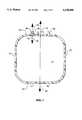
- FIG. 1is a longitudinal cross-section of a thermoplastic liner according to the present invention, illustrating a pair of thermoplastic studs extending perpendicularly from a polar region of the liner adjacent a pressure chamber orifice.
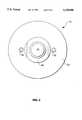
- FIG. 2is a top view of a polar boss suitable for attachment to the liner of FIG. 1.
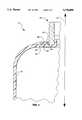
- FIG. 3is a longitudinal cross-section of a portion of the liner and the polar boss showing the stud immediately after its insertion in a mounting aperture of the boss.
- FIG. 4illustrates the liner, stud, and boss shown in FIG. 3 after the stud has been partially melted and substantially conformed to the mounting aperture.
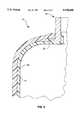
- FIG. 5illustrates the liner, stud, and boss shown in FIG. 4 after a composite case has been wrapped about them by fiber winding.
- FIG. 6is a longitudinal cross-section illustrating a portion of the liner and alternative embodiments of the stud and the mounting aperture.
- FIG. 7is an isometric view illustrating one half of a symmetric die used in forming the liner and stud by a blow-molding process.
- the present inventionrelates to a method and device for securing a boss to a thermoplastic liner of a pressure vessel.
- a preferred embodiment of a pressure vessel of the present inventioncomprises a thermoplastic liner 12, illustrated in FIG. 1, which substantially defines a pressure chamber 14 within the vessel.
- the thermoplastic liner 12is constructed of conventional thermoplastic material.
- thermoplastic materialis a material which will repeatedly soften when heated above room temperature and will harden when allowed to cool.
- Thermoplastic materialsthus include, without limitation, styrene, acrylics, cellulosics, polyolefins including without limitation polypropylenes and polyethylenes, vinyls, polyamides including without limitation nylons, fluorocarbons, and other thermoplastic resins known to those of skill in the arts of blow-molding, injection-molding, and extrusion processing of thermoplastic materials.
- a polar region 16 of the liner 12is configured with a pressure chamber orifice 18 which is in fluid communication with the pressure chamber 14.
- the liner 12 shownhas a single orifice 18, additional orifices may be present.
- a second orificemay be placed in the opposite end 20 of the liner 12 to permit the liner 12 to be mounted for rotation upon a shaft (not shown) which passes through the liner 12 along an axis of rotation 22.
- the liner 12may serve as a mandrel for construction of a surrounding composite case 62 (FIG. 5) by conventional fiber winding methods.
- FIG. 1shows an orifice 18 located in the polar region 16 of the liner 12
- the present inventionalso contemplates attachment of bosses to orifices located at other positions in the liner 12.
- one or more orifices with corresponding bossesmay be located in a side 24 of the liner 12 to permit connection of the vessel to nozzles, valves, gauges, tubes, and similar fixtures which direct and control fluid flow.
- a thermoplastic projection 26is rigidly attached to the liner 12. Attachment is preferably accomplished by a connecting portion 28 of the projection 26 which is contiguous to and cohesive with a connecting portion 30 of the liner 12.
- the connecting portion 28 of the projection 26is the largest portion of the projection 26 that is contiguous to the liner 12.
- the connecting portion of the liner 12is the largest portion of the liner 12 that is contiguous to the projection 26.
- the connecting portions 28 and 30each consist essentially of the thermoplastic material which is used to form the liner 12. In particular, the connecting portions 28 and 30 contain no additional adhesive. That is, the projection 26 is not attached to the liner by a adhesive layer but is rather held in place by the inherent cohesiveness of the thermoplastic material.
- the studs 32are preferably integral parts of the liner 12, with no discontinuity between the studs 32 and the liner 12.
- the projection 26may be shaped as a vane, a ridge, a tooth, a cone, or any of a variety of other shapes.
- the projection 26takes the shape of a cylindrical stud 32 which extends along a longitudinal stud axis 34 perpendicular to the liner 12.
- the stud 32is substantially parallel to the axis 22.
- the stud 32 shownis substantially circular in a cross-section transverse to the stud axis 34, the cylindrical stud 32 need not be circular in cross-section.
- embodiments which require greater stud strengthmay employ a stud which is substantially ovoid in cross-section.
- Other cross-sectional geometriesmay also be effectively employed; geometries compatible with blow-molding are preferred.
- the pressure vessel of the present inventionalso includes a boss 40.
- the boss 40is typically formed of metal in order to resist the stresses of connecting fixtures to the vessel.
- the boss 40also reinforces the vessel around the pressure chamber orifice 18.
- the present inventionalso contemplates the use of bosses formed of plastic, hard rubber, resin, or other relatively strong, rigid materials.
- the boss 40has a neck 42 which contains a passage 44.
- the boss 40is positioned with the passage 44 aligned with the pressure chamber orifice 18 to permit fluid communication between the pressure chamber 14 and the environment 46 outside the vessel.
- a boss 40 having a single central passage 44is illustrated in this preferred embodiment, other embodiments of the vessel may employ bosses which have one or more offset passages.
- Other bosses, which are intended for use as plugs and therefore contain no passage,may also be utilized as the particular application requires.
- the boss 40includes a flange 50 which extends outwardly from the neck 42 and extends annularly about the passage 44.
- the flange 50has at least one mounting aperture 52 which is positioned in mating engagement with the corresponding stud 32 to restrict rotation of the boss 40 relative to the liner 12.
- two mounting apertures 52are configured in the flange 50, as illustrated in FIG. 2.
- the studs 32are preferably circular in cross-section.
- the mounting aperture 52is also preferably configured with a circular cross-section, as shown in FIG. 2.
- the geometry of the mounting aperture 52should be compatible with that of the stud 32.
- embodiments employing an ovoid studwould also preferably employ an ovoid mounting aperture.
- the flange 50is shown positioned outside the pressure chamber 14.
- the stud 32may project from an inner wall 48 of the liner with the flange 50 positioned inside the pressure chamber 14.
- Each stud 32is positioned in mating engagement with a corresponding mounting aperture 52 in the flange 50 of the boss 40.
- a presently preferred embodiment of the boss 40has two mounting apertures 52 which mate with two thermoplastic studs 32.
- the utilization of two studsprovides greater resistance to boss rotation than if only one stud is used.
- two diametrically opposed studs 32can be formed together with the liner 12 by blow-molding thermoplastic material into a two-piece die, whereas forming three or more studs spaced evenly about the chamber orifice 18 requires either additional die pieces or additional steps such as injection-molding.
- each mounting aperture 52extends completely through the flange 50.
- the flangeis equipped with mounting cavities that are depressions rather than apertures. Such mounting cavities are shaped and dimensioned for mating engagement with corresponding vanes, teeth, or other thermoplastic projections from the liner in order to prevent boss rotation.
- FIG. 3shows a stud 32 which extends along and then beyond the entire length of the mounting aperture 52 both before and after melting
- the studextends for less than the entire length of the mounting aperture either before melting or both before and after melting.
- the melted studis covered by a cap (not shown) after the boss is attached to the liner.
- the melted studis countersunk to avoid a gap between the flange and the composite case which is formed over the stud.
- the presently preferred mounting aperture 52has an enlarged locking chamber portion 54 and a narrower portion 56.
- the locking chamber 54 shownis a larger circular bore formed next to a smaller circular bore 56 such that a step 58 separates the two portions 54 and 56 of the aperture 52.
- the mounting aperturetakes the shape of a truncated inverted cone, thereby eliminating any step which delimits the transition from the locking chamber to the narrower portion 56 of the aperture.
- the locking chambermay assume any of a variety of shapes provided that it is larger than, and separated from the liner by, the narrower portion of the mounting aperture. The locking chamber must be contiguous to the narrower portion but need not be contiguous to the environment outside the vessel.
- FIG. 4also illustrates the stud 32 of FIG. 3 after it has been substantially conformed to the shape of the mounting aperture 52.
- an enlarged head 60 of the conformed stud 32substantially fills the locking chamber 54. Because the stud 32 is a projection of the liner 12, the flange 50 is thus secured between the head 60 of the stud 32 on one side and the liner 12 on the other side.
- the stud 32 and the mounting aperture 52together provide a mechanical lock which prevents translation of the boss 40 relative to the liner 12 in the direction generally parallel to the axis 22.
- This lockis preferably of sufficient strength to withstand the inflatable mandrel pressure within the pressure chamber 14, to provide a rigid mandrel for applying composite materials.
- Typical pressures within the pressure chamber 14 for an inflatable mandrelmay be a pressure in the range up to about 120 p.s.i.
- the stud 32 and the mounting aperture 52provide a mechanical lock which prevents rotation of the boss 40 about the axis 22 relative to the liner 12. Such rotation can only be accomplished by shearing the stud 32 from the liner 12 or by fracturing the boss 40 and removing the mounting aperture 52 from about the stud 32.
- the stud 32is rigidly attached to the liner 12 by the inherent cohesion and strength of the thermoplastic material.
- the stud 32may be sized and supplemented by additional studs as needed to resist shearing.
- the boss 40is constructed of metal or a similarly strong material.
- the present inventionprovides a vessel having a boss securely attached to a thermoplastic liner without the use of an adhesive layer between the boss and the liner.
- the present inventionalso provides a method for forming such pressure vessels.
- one presently preferred methodbegins by forming the thermoplastic liner 12 and studs 32.
- the thermoplastic liner 12is preferably formed by blow-molding thermoplastic material into a die 64; for clarity, only half of the symmetric die 64 is illustrated.
- the die 64is configured with a substantially liner-shaped cavity 66 and with projection cavities 68.
- the projection cavities 68which are contiguous to the liner cavity 66, correspond in shape to the studs 32.
- the die 64also has an opening 70 through which a conventional parison (not shown) may be inserted into the liner cavity 66.
- the inserted parisonis used in a manner known to those of skill in the molding arts to introduce pliable thermoplastic material into the liner cavity 66.
- the parisonis then used to contain and apply gas pressure to force the thermoplastic material against the walls of the cavity 66 and into the projection cavities 68, that is, to blow-mold the liner 12 and the studs 32 (FIG. 1).
- the studs 32are formed integral and unitary with the liner 12 in one blow-molding step.
- the use of injection-moldingwhich is complicated and expensive, may be avoided.
- the bossis attached to the liner by initially inserting a thermoplastic projection which is rigidly attached to a thermoplastic liner into a mounting aperture which is located in the boss.
- a thermoplastic projectionwhich is rigidly attached to a thermoplastic liner into a mounting aperture which is located in the boss.
- FIGS. 1 and 3it is presently preferred to utilize two studs 32 as thermoplastic projections.
- the studs 32project perpendicularly from the thermoplastic liner 12 into the mounting aperture 52 to prevent rotation of the boss 40 about the orifice 18.
- An inserted projectionmay also be a tooth, a vane, or another projection having a portion substantially perpendicular to the liner 12.
- Embodiments of the present methodalso comprise inserting two or more thermoplastic projections which are rigidly attached to the thermoplastic liner into a corresponding plurality of mounting apertures located in the boss.
- the present methodfurther includes melting at least a portion of the thermoplastic projection sufficiently for the projection to more closely conform in shape to the mounting aperture. Melting may be accomplished by any suitable known thermoplastic processing method, such as ultrasonic, induction, friction, or conduction heating, or by chemical melting with a sufficiently strong solvent.
- FIG. 4illustrates the result of melting the head portion of the thermoplastic stud 32 sufficiently for the stud 32 to conform to the mounting aperture 52.
- a portion of the conformed stud 32substantially fills the locking chamber 54.
- Lockingmay also be achieved by only partially filling the locking chamber, provided that a portion of the melted stud is too large to pass through the narrower portion 56 of the mounting aperture.
- the stud 32when in a flowable state, may be compressed by conventional means against the inner wall of the mounting aperture 52 before the stud 32 cools and hardens.
- the narrower portion 56 of the aperture 52is thus secured on one side by the enlarged head of the stud 32 in the locking chamber 54, and on the other side by the liner 12 from which the stud 32 projects.
- FIG. 4illustrates a stud 32 whose head 60 is substantially flush with the surface of the boss 40 distal from the liner 12, other embodiments are also contemplated.
- the head 60may be recessed or countersunk to prevent creation of a gap between the subsequently added composite case 62 (FIG. 5) and the flange 50, or to permit coverage of the thermoplastic head with an insulating or cosmetic cap (not shown).
- the vessel 10may be configured as shown in FIG. 6 with a mounting aperture 52a of substantially uniform diameter.
- the aperture 52ais more readily manufactured than the aperture 52 of FIG. 4 because the step of forming the locking chamber 54 is not required.
- An enlarged rivet head 60ais formed on the side of the flange 50 distal from the liner 12 by partially melting the stud 32. The rivet head 60a is larger than the mounting aperture 52a, and hence the boss 40 is mechanically prevented from translating along the axis 22.
- the composite case 62 illustrated in FIG. 5is constructed according to known methods, such as by wrapping sheets of fiber, braiding, hand taping, or by winding resin-impregnated fiber about the liner and boss.
- the case 62preferably covers the melted portion of the thermoplastic projection 32.
- the liner 12may act as a mandrel while the composite case 12 is constructed. If the liner 12 lacks sufficient rigidity to serve as a mandrel, the liner 12 may be inflated by pressurizing the chamber 14 prior to fiber winding.
- the mechanical and adhesive properties of the composite case 62 acting against the boss 40 and the liner 12provide an additional lock between the liner 12 and the boss 62.
- the present inventionthus provides a robust, low-cost method and device for attaching a boss to a composite pressure vessel without relying on an adhesive layer positioned between the boss and the vessel. Instead, the strength and cohesion of the liner, stud, and boss, together with the interlocking shapes of the stud and the mounting aperture, provide a mechanical lock which prevents boss translation and rotation.
- the method and deviceachieve a robust attachment of the boss and the liner because the number of studs, their relative positions, and the size of each stud can be tailored to provide the required torsional resistance.
- the attachmentis also low-cost, because the costs associated with adhesive layers and injection-molding are eliminated.
Landscapes
- Engineering & Computer Science (AREA)
- Mechanical Engineering (AREA)
- Filling Or Discharging Of Gas Storage Vessels (AREA)
- Lining Or Joining Of Plastics Or The Like (AREA)
Abstract
Description
Claims (11)
Priority Applications (3)
| Application Number | Priority Date | Filing Date | Title |
|---|---|---|---|
| US08/265,406US5538680A (en) | 1994-06-24 | 1994-06-24 | Method of molding a polar boss to a composite pressure vessel |
| PCT/US1995/007553WO1996000142A1 (en) | 1994-06-24 | 1995-06-14 | Polar boss attachment to composite pressure vessels |
| AU27052/95AAU2705295A (en) | 1994-06-24 | 1995-06-14 | Polar boss attachment to composite pressure vessels |
Applications Claiming Priority (1)
| Application Number | Priority Date | Filing Date | Title |
|---|---|---|---|
| US08/265,406US5538680A (en) | 1994-06-24 | 1994-06-24 | Method of molding a polar boss to a composite pressure vessel |
Publications (1)
| Publication Number | Publication Date |
|---|---|
| US5538680Atrue US5538680A (en) | 1996-07-23 |
Family
ID=23010316
Family Applications (1)
| Application Number | Title | Priority Date | Filing Date |
|---|---|---|---|
| US08/265,406Expired - LifetimeUS5538680A (en) | 1994-06-24 | 1994-06-24 | Method of molding a polar boss to a composite pressure vessel |
Country Status (3)
| Country | Link |
|---|---|
| US (1) | US5538680A (en) |
| AU (1) | AU2705295A (en) |
| WO (1) | WO1996000142A1 (en) |
Cited By (34)
| Publication number | Priority date | Publication date | Assignee | Title |
|---|---|---|---|---|
| US5819978A (en)* | 1997-04-24 | 1998-10-13 | Essef Corporation | Two piece composite inlet |
| US6099291A (en)* | 1998-12-29 | 2000-08-08 | Extol, Inc. | Heat staking apparatus with radiant heat source |
| US6193917B1 (en)* | 1998-12-22 | 2001-02-27 | The United States Of America As Represented By The Administrator Of The National Aeronautics And Space Administration | Method of making a composite tank |
| US6543842B2 (en) | 2000-02-03 | 2003-04-08 | Lifetime Products, Inc. | Interference fit support bracket for a portable folding chair |
| US20040251718A1 (en)* | 2002-11-07 | 2004-12-16 | Jin Degen | Folding chair |
| USD506325S1 (en) | 2004-01-27 | 2005-06-21 | Gsc Technology Corporation | Folding chair |
| US20050168508A1 (en)* | 2004-01-29 | 2005-08-04 | Fuji Xerox Co., Ltd. | Method for attaching a fluid container to a fluid ejector in a fluid ejection device |
| US20060061009A1 (en)* | 2004-09-22 | 2006-03-23 | Clack Corporation | Method and apparatus for making a blow molded article with integral insert |
| USD523254S1 (en) | 2003-04-16 | 2006-06-20 | Lifetime Products, Inc. | Lightweight folding chair |
| US20070098488A1 (en)* | 2005-10-24 | 2007-05-03 | Yu-Wei Liu | Fastening structure and method thereof |
| US20070111579A1 (en)* | 2005-11-17 | 2007-05-17 | Hirokazu Ishimaru | Tank |
| US20070246475A1 (en)* | 2004-06-03 | 2007-10-25 | Philippe Mazabraud | Process for the Manufacture of a Leaktight Bladder of a Type IV Tank, and Type IV Tank |
| DE102006037520B3 (en)* | 2006-08-10 | 2008-03-13 | B&K Kunststoffwerke Gmbh & Co. Kg | Method for production of pressure reservoir, particularly plastic pressure reservoir, involves manufacturing two parts for internal reservoir wall, where two parts are joined to internal container wall |
| US20080113132A1 (en)* | 2006-11-10 | 2008-05-15 | Dirk Lungershausen | Apparatus for forming an extrusion blow molded vessel with insert and method |
| US20080217331A1 (en)* | 2004-04-07 | 2008-09-11 | Hydro System Treatment S.R.L. | Reservoir For a Water Treatment Device and Manufacturing Method of the Reservoir |
| US20080281072A1 (en)* | 2005-11-24 | 2008-11-13 | Commissariat A L'energie Atomique | Caprolactam-Based Composition, Process for Manufacturing an Impermeable Element, and Tank |
| US20080302474A1 (en)* | 2006-08-22 | 2008-12-11 | Gm Global Technology Operations, Inc. | Friction heating for joining dissimilar materials |
| US20090200319A1 (en)* | 2008-02-08 | 2009-08-13 | Gopala Krishna Vinjamuri | Metallic liner for a fiber wrapped composite pressure vessel for compressed gas storage and transportation |
| US20090266823A1 (en)* | 2006-06-16 | 2009-10-29 | Commissariat A L'energie Atomique | Method for manufacturing a sealing bladder made of thermosetting polymer for a tank containing a pressurized fluid, such as a composite tank, and a tank |
| US20100213198A1 (en)* | 2008-04-18 | 2010-08-26 | Ferus Inc. | Composite structure vessel and transportation system for liquefied gases |
| US20110094658A1 (en)* | 2008-06-25 | 2011-04-28 | David Hill | Method for manufacturing a storage tank |
| WO2011093737A1 (en) | 2010-02-01 | 2011-08-04 | Lukyanets Sergei Vladimirovich | Metal composite pressure cylinder |
| WO2012144929A1 (en) | 2011-04-21 | 2012-10-26 | Lukyanets Sergei Vladimirovich | High-pressure vessel made of composite materials |
| US8377248B2 (en) | 2010-06-16 | 2013-02-19 | Spirit Aerosystems, Inc. | Method and system for forming a complex monolithic thermoset part |
| US8881932B1 (en)* | 2013-06-25 | 2014-11-11 | Quantum Fuel Systems Technology Worldwide, Inc. | Adapterless closure assembly for composite pressure vessels |
| DE102015114799A1 (en)* | 2015-09-04 | 2017-03-09 | Knorr-Bremse Systeme für Nutzfahrzeuge GmbH | Pressure medium unit, with a plastic housing produced by injection molding and process for its preparation |
| DE102015220530A1 (en)* | 2015-10-21 | 2017-04-27 | Bayerische Motoren Werke Aktiengesellschaft | Pressure vessel for storing fuel |
| US20170353014A1 (en)* | 2016-06-07 | 2017-12-07 | Belden Canada Inc. | Rackmount case for the accommodation of optical equipment |
| US9884939B2 (en) | 2014-10-24 | 2018-02-06 | United Technologies Corporation | High performance polymer and process therefor |
| DE102018009829A1 (en)* | 2018-12-14 | 2020-06-18 | Emano Kunststofftechnik Gmbh | Pressure vessel and method for manufacturing the pressure vessel |
| US11141930B1 (en) | 2016-06-09 | 2021-10-12 | Spencer Composites Corporation | Method and tool for molding a composite pressure vessel liner to a boss |
| US20220099250A1 (en)* | 2020-09-28 | 2022-03-31 | Hanwha Solutions Corporation | High-pressure tank having sealing boss and manufacturing method thereof |
| WO2023003688A1 (en)* | 2021-07-23 | 2023-01-26 | Steelhead Composites, Inc. | Boss for type iv composite pressure vessels |
| US11584053B2 (en)* | 2017-11-28 | 2023-02-21 | Sumitomo Wiring Systems, Ltd. | Inner part and resin molded article |
Families Citing this family (3)
| Publication number | Priority date | Publication date | Assignee | Title |
|---|---|---|---|---|
| PT826483E (en)* | 1996-08-28 | 2002-04-29 | Essef Corp | METHOD AND APPARATUS FOR FIXING A FITTING IN A PLASTIC MOLDED CONTAINER |
| DE102009015964A1 (en)* | 2009-04-02 | 2010-10-07 | Kunststoffverarbeitung Koetke Gmbh | Pressure vessel blank as well as process and blow molding station for its production |
| DE102016125660A1 (en) | 2016-12-23 | 2018-06-28 | Böllhoff Verbindungstechnik GmbH | Fastening insert for a component made of plastic, foam or composite material |
Citations (42)
| Publication number | Priority date | Publication date | Assignee | Title |
|---|---|---|---|---|
| US3057509A (en)* | 1960-02-11 | 1962-10-09 | Brunswick Corp | Pressure vessel bladder |
| US3171563A (en)* | 1961-10-02 | 1965-03-02 | Brunswick Corp | Rocket motor case |
| US3228549A (en)* | 1961-02-27 | 1966-01-11 | Bendix Corp | Pressure vessel |
| US3367809A (en)* | 1964-05-08 | 1968-02-06 | Branson Instr | Sonics |
| US3754319A (en)* | 1972-02-18 | 1973-08-28 | Camillus Cutlery Co | Method of fabricating a knife handle |
| US4047667A (en)* | 1975-07-10 | 1977-09-13 | Thiokol Corporation | Support system for rocket thrust nozzles |
| US4118928A (en)* | 1973-07-12 | 1978-10-10 | Thiokol Corporation | Means for mounting solid propellant in a rocket motor |
| US4164304A (en)* | 1978-05-30 | 1979-08-14 | The Continental Group, Inc. | Closure for steel drums with blow molded liners |
| USRE30489E (en)* | 1976-05-21 | 1981-01-20 | Brunswick Corporation | Longitudinal load carrying method for fiber reinforced filament wound structures |
| US4360116A (en)* | 1980-12-08 | 1982-11-23 | Brunswick Corporation | Partially split external barrier for composite structures |
| US4572402A (en)* | 1982-06-29 | 1986-02-25 | L'air Liquide, Societe Anonyme Pour L'etude Et L'exploitation Des Procedes Georges Claude | Container having a high degree of thermal insulation |
| US4589563A (en)* | 1983-03-07 | 1986-05-20 | Quality Products, Inc. | High-pressure container and method of making the same |
| US4624885A (en)* | 1984-11-28 | 1986-11-25 | Morton Thiokol, Inc. | Low density matrix resins for filament wound chambers comprising chain extended carboxy-terminated polybutadienes |
| US4649826A (en)* | 1986-03-13 | 1987-03-17 | Morton Thiokol Inc. | Retardation system for air launched flares and submunitions |
| US4653663A (en)* | 1985-10-09 | 1987-03-31 | Dayco Products, Inc. | Clamping assembly for securing a flexible liner to a storage tank, and method therefor |
| US4732634A (en)* | 1982-09-29 | 1988-03-22 | Hercules Incorporated | Method of forming threaded polar openings for composite pressure vessels |
| US4766726A (en)* | 1985-12-27 | 1988-08-30 | Morton Thiokol, Inc. | Segmented case rocket motor |
| US4778073A (en)* | 1986-09-19 | 1988-10-18 | Eugen Ehs | Pressure vessel |
| US4822671A (en)* | 1987-12-31 | 1989-04-18 | Gencorp Inc. | Heat riveting rubber for effecting a mechanical lock |
| US4846911A (en)* | 1988-01-14 | 1989-07-11 | Morton Thiokol, Inc. | Preloaded composite electromagnetic barrel and process for fabricating same |
| US4859378A (en)* | 1988-10-28 | 1989-08-22 | Branson Ultrasonics Corporation | Method of ultrasonically assembling workpieces |
| US4881998A (en)* | 1987-01-23 | 1989-11-21 | Morton Thiokol, Inc. | Radiation gathering reflector and method of manufacture |
| US4911795A (en)* | 1987-08-14 | 1990-03-27 | Morton Thiokol, Inc. | Method of preserving a composite material cased solid propellant rocket motor |
| US4938824A (en)* | 1987-01-23 | 1990-07-03 | Thiokol Corporation | Method for making a composite component using a transverse tape |
| US4956971A (en)* | 1988-08-03 | 1990-09-18 | Morton Thiokol, Inc. | Solid propellant canister loaded multiple pulsed or staged rocket motor |
| US4959110A (en)* | 1988-05-11 | 1990-09-25 | Morton Thiokol Inc. | Method for lining the inner surface of a cylindrical or domed cylindrical member with an elastomeric material |
| US5021270A (en)* | 1989-12-11 | 1991-06-04 | Thiokol Corporation | Method for improving moisture barrier protection and electrostatic discharge protection of a composite material cased rocket motor |
| US5032016A (en)* | 1987-01-23 | 1991-07-16 | Thiokol Corporation | Radiation gathering reflector and method of manufacture |
| US5044154A (en)* | 1989-11-27 | 1991-09-03 | Thiokol Corporation | Safety mechanism for rendering a rocket motor non-propulsive |
| US5060470A (en)* | 1990-05-22 | 1991-10-29 | Thiokol Corporation | Gas generator ventable at a high temperature for hazard reduction |
| US5071506A (en)* | 1987-10-09 | 1991-12-10 | Thiokol Corporation | Equipment for making composite tubes including an inflatable heated bladder and a composite mold having a negative coefficient of thermal expansion |
| US5098277A (en)* | 1990-05-14 | 1992-03-24 | Thiokol Corporation | Insulation wrapping strip with variable configuration |
| US5174845A (en)* | 1990-05-14 | 1992-12-29 | Thiokol Corporation | Insulation wrapping strip with variable configuration |
| US5206989A (en)* | 1988-08-03 | 1993-05-04 | Thiokol Corporation | Method of making solid propellant canister loaded rocket motor |
| US5222620A (en)* | 1991-10-29 | 1993-06-29 | Russell-Stanley Corporation | Drum liner locking and locating assembly |
| US5228285A (en)* | 1992-03-02 | 1993-07-20 | Thiokol Corporation | Solid propellant rocket motor case for insensitive munitions requirements |
| US5243964A (en)* | 1991-03-19 | 1993-09-14 | Rubbermaid Commercial Products Inc. | Plastic vessel and method of assembly thereof |
| US5253778A (en)* | 1992-01-28 | 1993-10-19 | Edo Canada Ltd. | Fluid pressure vessel boss-liner attachment system |
| US5259901A (en)* | 1992-05-27 | 1993-11-09 | Thiokol Corporation | Method for constructing an inflatable mandrel |
| US5280706A (en)* | 1992-06-25 | 1994-01-25 | Thiokol Corporation | Composite/metal hybrid rocket motor case and methods for manufacturing |
| US5308427A (en)* | 1992-09-28 | 1994-05-03 | Ford Motor Company | Method for fastening plastic articles |
| US5429845A (en)* | 1992-01-10 | 1995-07-04 | Brunswick Corporation | Boss for a filament wound pressure vessel |
- 1994
- 1994-06-24USUS08/265,406patent/US5538680A/ennot_activeExpired - Lifetime
- 1995
- 1995-06-14AUAU27052/95Apatent/AU2705295A/ennot_activeAbandoned
- 1995-06-14WOPCT/US1995/007553patent/WO1996000142A1/ennot_activeCeased
Patent Citations (42)
| Publication number | Priority date | Publication date | Assignee | Title |
|---|---|---|---|---|
| US3057509A (en)* | 1960-02-11 | 1962-10-09 | Brunswick Corp | Pressure vessel bladder |
| US3228549A (en)* | 1961-02-27 | 1966-01-11 | Bendix Corp | Pressure vessel |
| US3171563A (en)* | 1961-10-02 | 1965-03-02 | Brunswick Corp | Rocket motor case |
| US3367809A (en)* | 1964-05-08 | 1968-02-06 | Branson Instr | Sonics |
| US3754319A (en)* | 1972-02-18 | 1973-08-28 | Camillus Cutlery Co | Method of fabricating a knife handle |
| US4118928A (en)* | 1973-07-12 | 1978-10-10 | Thiokol Corporation | Means for mounting solid propellant in a rocket motor |
| US4047667A (en)* | 1975-07-10 | 1977-09-13 | Thiokol Corporation | Support system for rocket thrust nozzles |
| USRE30489E (en)* | 1976-05-21 | 1981-01-20 | Brunswick Corporation | Longitudinal load carrying method for fiber reinforced filament wound structures |
| US4164304A (en)* | 1978-05-30 | 1979-08-14 | The Continental Group, Inc. | Closure for steel drums with blow molded liners |
| US4360116A (en)* | 1980-12-08 | 1982-11-23 | Brunswick Corporation | Partially split external barrier for composite structures |
| US4572402A (en)* | 1982-06-29 | 1986-02-25 | L'air Liquide, Societe Anonyme Pour L'etude Et L'exploitation Des Procedes Georges Claude | Container having a high degree of thermal insulation |
| US4732634A (en)* | 1982-09-29 | 1988-03-22 | Hercules Incorporated | Method of forming threaded polar openings for composite pressure vessels |
| US4589563A (en)* | 1983-03-07 | 1986-05-20 | Quality Products, Inc. | High-pressure container and method of making the same |
| US4624885A (en)* | 1984-11-28 | 1986-11-25 | Morton Thiokol, Inc. | Low density matrix resins for filament wound chambers comprising chain extended carboxy-terminated polybutadienes |
| US4653663A (en)* | 1985-10-09 | 1987-03-31 | Dayco Products, Inc. | Clamping assembly for securing a flexible liner to a storage tank, and method therefor |
| US4766726A (en)* | 1985-12-27 | 1988-08-30 | Morton Thiokol, Inc. | Segmented case rocket motor |
| US4649826A (en)* | 1986-03-13 | 1987-03-17 | Morton Thiokol Inc. | Retardation system for air launched flares and submunitions |
| US4778073A (en)* | 1986-09-19 | 1988-10-18 | Eugen Ehs | Pressure vessel |
| US5032016A (en)* | 1987-01-23 | 1991-07-16 | Thiokol Corporation | Radiation gathering reflector and method of manufacture |
| US4938824A (en)* | 1987-01-23 | 1990-07-03 | Thiokol Corporation | Method for making a composite component using a transverse tape |
| US4881998A (en)* | 1987-01-23 | 1989-11-21 | Morton Thiokol, Inc. | Radiation gathering reflector and method of manufacture |
| US4911795A (en)* | 1987-08-14 | 1990-03-27 | Morton Thiokol, Inc. | Method of preserving a composite material cased solid propellant rocket motor |
| US5071506A (en)* | 1987-10-09 | 1991-12-10 | Thiokol Corporation | Equipment for making composite tubes including an inflatable heated bladder and a composite mold having a negative coefficient of thermal expansion |
| US4822671A (en)* | 1987-12-31 | 1989-04-18 | Gencorp Inc. | Heat riveting rubber for effecting a mechanical lock |
| US4846911A (en)* | 1988-01-14 | 1989-07-11 | Morton Thiokol, Inc. | Preloaded composite electromagnetic barrel and process for fabricating same |
| US4959110A (en)* | 1988-05-11 | 1990-09-25 | Morton Thiokol Inc. | Method for lining the inner surface of a cylindrical or domed cylindrical member with an elastomeric material |
| US4956971A (en)* | 1988-08-03 | 1990-09-18 | Morton Thiokol, Inc. | Solid propellant canister loaded multiple pulsed or staged rocket motor |
| US5206989A (en)* | 1988-08-03 | 1993-05-04 | Thiokol Corporation | Method of making solid propellant canister loaded rocket motor |
| US4859378A (en)* | 1988-10-28 | 1989-08-22 | Branson Ultrasonics Corporation | Method of ultrasonically assembling workpieces |
| US5044154A (en)* | 1989-11-27 | 1991-09-03 | Thiokol Corporation | Safety mechanism for rendering a rocket motor non-propulsive |
| US5021270A (en)* | 1989-12-11 | 1991-06-04 | Thiokol Corporation | Method for improving moisture barrier protection and electrostatic discharge protection of a composite material cased rocket motor |
| US5098277A (en)* | 1990-05-14 | 1992-03-24 | Thiokol Corporation | Insulation wrapping strip with variable configuration |
| US5174845A (en)* | 1990-05-14 | 1992-12-29 | Thiokol Corporation | Insulation wrapping strip with variable configuration |
| US5060470A (en)* | 1990-05-22 | 1991-10-29 | Thiokol Corporation | Gas generator ventable at a high temperature for hazard reduction |
| US5243964A (en)* | 1991-03-19 | 1993-09-14 | Rubbermaid Commercial Products Inc. | Plastic vessel and method of assembly thereof |
| US5222620A (en)* | 1991-10-29 | 1993-06-29 | Russell-Stanley Corporation | Drum liner locking and locating assembly |
| US5429845A (en)* | 1992-01-10 | 1995-07-04 | Brunswick Corporation | Boss for a filament wound pressure vessel |
| US5253778A (en)* | 1992-01-28 | 1993-10-19 | Edo Canada Ltd. | Fluid pressure vessel boss-liner attachment system |
| US5228285A (en)* | 1992-03-02 | 1993-07-20 | Thiokol Corporation | Solid propellant rocket motor case for insensitive munitions requirements |
| US5259901A (en)* | 1992-05-27 | 1993-11-09 | Thiokol Corporation | Method for constructing an inflatable mandrel |
| US5280706A (en)* | 1992-06-25 | 1994-01-25 | Thiokol Corporation | Composite/metal hybrid rocket motor case and methods for manufacturing |
| US5308427A (en)* | 1992-09-28 | 1994-05-03 | Ford Motor Company | Method for fastening plastic articles |
Cited By (60)
| Publication number | Priority date | Publication date | Assignee | Title |
|---|---|---|---|---|
| US5819978A (en)* | 1997-04-24 | 1998-10-13 | Essef Corporation | Two piece composite inlet |
| US6193917B1 (en)* | 1998-12-22 | 2001-02-27 | The United States Of America As Represented By The Administrator Of The National Aeronautics And Space Administration | Method of making a composite tank |
| US6099291A (en)* | 1998-12-29 | 2000-08-08 | Extol, Inc. | Heat staking apparatus with radiant heat source |
| US6871906B2 (en) | 2000-02-03 | 2005-03-29 | Lifetime Products, Inc. | Portable folding chair |
| US20030184131A1 (en)* | 2000-02-03 | 2003-10-02 | Haney Thayne B. | Portable folding chair |
| US20050121947A1 (en)* | 2000-02-03 | 2005-06-09 | Haney Thayne B. | Portable folding chair |
| US7014261B2 (en) | 2000-02-03 | 2006-03-21 | Lifetime Products, Inc. | Portable folding chair |
| US6543842B2 (en) | 2000-02-03 | 2003-04-08 | Lifetime Products, Inc. | Interference fit support bracket for a portable folding chair |
| US20040251718A1 (en)* | 2002-11-07 | 2004-12-16 | Jin Degen | Folding chair |
| US7017986B2 (en) | 2002-11-07 | 2006-03-28 | Lifetime Products, Inc. | Folding chair |
| USD523254S1 (en) | 2003-04-16 | 2006-06-20 | Lifetime Products, Inc. | Lightweight folding chair |
| USD506325S1 (en) | 2004-01-27 | 2005-06-21 | Gsc Technology Corporation | Folding chair |
| US7294223B2 (en)* | 2004-01-29 | 2007-11-13 | Fuji Xerox Co., Ltd. | Method for attaching a fluid container to a fluid ejector in a fluid ejection device |
| US20050168508A1 (en)* | 2004-01-29 | 2005-08-04 | Fuji Xerox Co., Ltd. | Method for attaching a fluid container to a fluid ejector in a fluid ejection device |
| US20080217331A1 (en)* | 2004-04-07 | 2008-09-11 | Hydro System Treatment S.R.L. | Reservoir For a Water Treatment Device and Manufacturing Method of the Reservoir |
| US20070246475A1 (en)* | 2004-06-03 | 2007-10-25 | Philippe Mazabraud | Process for the Manufacture of a Leaktight Bladder of a Type IV Tank, and Type IV Tank |
| US20060061009A1 (en)* | 2004-09-22 | 2006-03-23 | Clack Corporation | Method and apparatus for making a blow molded article with integral insert |
| US7690914B1 (en) | 2004-09-22 | 2010-04-06 | Clack Corporation | Apparatus for making a blow molded article with integral insert |
| US7476354B2 (en) | 2004-09-22 | 2009-01-13 | Clack Corporation | Method and apparatus for making a blow molded article with integral insert |
| US20070098488A1 (en)* | 2005-10-24 | 2007-05-03 | Yu-Wei Liu | Fastening structure and method thereof |
| US7556171B2 (en) | 2005-11-17 | 2009-07-07 | Toyota Jidosha Kabushiki Kaisha | Tank |
| US20070111579A1 (en)* | 2005-11-17 | 2007-05-17 | Hirokazu Ishimaru | Tank |
| US20080281072A1 (en)* | 2005-11-24 | 2008-11-13 | Commissariat A L'energie Atomique | Caprolactam-Based Composition, Process for Manufacturing an Impermeable Element, and Tank |
| US8658756B2 (en) | 2005-11-24 | 2014-02-25 | Commissariat A L'energie Atomique | Caprolactam-based composition, process for manufacturing an impermeable element, and tank |
| US8981039B2 (en) | 2005-11-24 | 2015-03-17 | Commissariat A L'energie Atomique | Caprolactam-based composition, process for manufacturing an impermeable element, and tank |
| US8987409B2 (en) | 2005-11-24 | 2015-03-24 | Commissariat A L'energie Atomique | Caprolactam-based composition, process for manufacturing an impermeable element, and tank |
| US20090266823A1 (en)* | 2006-06-16 | 2009-10-29 | Commissariat A L'energie Atomique | Method for manufacturing a sealing bladder made of thermosetting polymer for a tank containing a pressurized fluid, such as a composite tank, and a tank |
| DE102006037520B3 (en)* | 2006-08-10 | 2008-03-13 | B&K Kunststoffwerke Gmbh & Co. Kg | Method for production of pressure reservoir, particularly plastic pressure reservoir, involves manufacturing two parts for internal reservoir wall, where two parts are joined to internal container wall |
| US7695656B2 (en)* | 2006-08-22 | 2010-04-13 | Gm Global Technology Operations, Inc. | Friction heating for joining dissimilar materials |
| US20080302474A1 (en)* | 2006-08-22 | 2008-12-11 | Gm Global Technology Operations, Inc. | Friction heating for joining dissimilar materials |
| US20080113132A1 (en)* | 2006-11-10 | 2008-05-15 | Dirk Lungershausen | Apparatus for forming an extrusion blow molded vessel with insert and method |
| US8052915B2 (en)* | 2006-11-10 | 2011-11-08 | GM Global Technology Operations LLC | Apparatus for forming an extrusion blow molded vessel with insert and method |
| US20090200319A1 (en)* | 2008-02-08 | 2009-08-13 | Gopala Krishna Vinjamuri | Metallic liner for a fiber wrapped composite pressure vessel for compressed gas storage and transportation |
| US8474647B2 (en)* | 2008-02-08 | 2013-07-02 | Vinjamuri Innovations, Llc | Metallic liner with metal end caps for a fiber wrapped gas tank |
| US20100213198A1 (en)* | 2008-04-18 | 2010-08-26 | Ferus Inc. | Composite structure vessel and transportation system for liquefied gases |
| US20110094658A1 (en)* | 2008-06-25 | 2011-04-28 | David Hill | Method for manufacturing a storage tank |
| US8940121B2 (en)* | 2008-06-25 | 2015-01-27 | Inergy Automotive Systems Research (Societe Anonyme) | Method for manufacturing a storage tank |
| JP2011525864A (en)* | 2008-06-25 | 2011-09-29 | イナジー・オートモーティブ・システムズ・リサーチ・(ソシエテ・アノニム) | Storage tank manufacturing method |
| US20130206778A1 (en)* | 2010-02-01 | 2013-08-15 | Sergei Vladimirovich Lukyanets | Metal composite pressure cylinder |
| WO2011093737A1 (en) | 2010-02-01 | 2011-08-04 | Lukyanets Sergei Vladimirovich | Metal composite pressure cylinder |
| US8377248B2 (en) | 2010-06-16 | 2013-02-19 | Spirit Aerosystems, Inc. | Method and system for forming a complex monolithic thermoset part |
| WO2012144929A1 (en) | 2011-04-21 | 2012-10-26 | Lukyanets Sergei Vladimirovich | High-pressure vessel made of composite materials |
| US8881932B1 (en)* | 2013-06-25 | 2014-11-11 | Quantum Fuel Systems Technology Worldwide, Inc. | Adapterless closure assembly for composite pressure vessels |
| US9568150B2 (en) | 2013-06-25 | 2017-02-14 | Quantum Fuel Systems Llc | Method of fabricating a pressurized-gas storage assembly |
| US9884939B2 (en) | 2014-10-24 | 2018-02-06 | United Technologies Corporation | High performance polymer and process therefor |
| US10752734B2 (en) | 2014-10-24 | 2020-08-25 | Raytheon Technologies Corporation | High performance polymide and process therefor |
| DE102015114799A1 (en)* | 2015-09-04 | 2017-03-09 | Knorr-Bremse Systeme für Nutzfahrzeuge GmbH | Pressure medium unit, with a plastic housing produced by injection molding and process for its preparation |
| US10570933B2 (en) | 2015-09-04 | 2020-02-25 | Knorr-Bremse Systeme Fuer Nutzfahrzeuge Gmbh | Pressure-medium unit, having a housing produced by injection molding and composed of plastic, and method for producing said pressure-medium unit |
| DE102015220530A1 (en)* | 2015-10-21 | 2017-04-27 | Bayerische Motoren Werke Aktiengesellschaft | Pressure vessel for storing fuel |
| DE102015220530B4 (en)* | 2015-10-21 | 2017-07-06 | Bayerische Motoren Werke Aktiengesellschaft | Pressure vessel for storing fuel |
| US20170353014A1 (en)* | 2016-06-07 | 2017-12-07 | Belden Canada Inc. | Rackmount case for the accommodation of optical equipment |
| US11685126B2 (en) | 2016-06-09 | 2023-06-27 | Spencer Composites Corporation | Method and tool for molding a composite pressure vessel liner to a boss |
| US11141930B1 (en) | 2016-06-09 | 2021-10-12 | Spencer Composites Corporation | Method and tool for molding a composite pressure vessel liner to a boss |
| US11584053B2 (en)* | 2017-11-28 | 2023-02-21 | Sumitomo Wiring Systems, Ltd. | Inner part and resin molded article |
| DE102018009829A1 (en)* | 2018-12-14 | 2020-06-18 | Emano Kunststofftechnik Gmbh | Pressure vessel and method for manufacturing the pressure vessel |
| DE102018009829B4 (en)* | 2018-12-14 | 2020-09-17 | Emano Kunststofftechnik Gmbh | Pressure vessel and method of manufacturing the pressure vessel |
| US20220099250A1 (en)* | 2020-09-28 | 2022-03-31 | Hanwha Solutions Corporation | High-pressure tank having sealing boss and manufacturing method thereof |
| US12429165B2 (en)* | 2020-09-28 | 2025-09-30 | Hanwha Solutions Corporation | High-pressure tank having sealing boss and manufacturing method thereof |
| WO2023003688A1 (en)* | 2021-07-23 | 2023-01-26 | Steelhead Composites, Inc. | Boss for type iv composite pressure vessels |
| US20230022376A1 (en)* | 2021-07-23 | 2023-01-26 | Steelhead Composites, Inc. | Boss for type iv composite pressure vessels |
Also Published As
| Publication number | Publication date |
|---|---|
| WO1996000142A1 (en) | 1996-01-04 |
| AU2705295A (en) | 1996-01-19 |
Similar Documents
| Publication | Publication Date | Title |
|---|---|---|
| US5538680A (en) | Method of molding a polar boss to a composite pressure vessel | |
| US7407062B2 (en) | Filament-reinforced composite thermoplastic pressure vessel fitting assembly | |
| JP4436148B2 (en) | Pressure vessel liner and method of manufacturing the same | |
| JP7027439B2 (en) | Pole cap with pressure port element for pressure vessel | |
| US5819978A (en) | Two piece composite inlet | |
| CN100575766C (en) | How to make a pressure vessel | |
| JP5581295B2 (en) | Pressure vessel | |
| WO2012121059A1 (en) | Port structure for pressure container and method for manufacturing pressure container | |
| CN212298516U (en) | Full-composite fiber winding gas cylinder opening structure | |
| US6361080B1 (en) | Method for attaching an ANSI stub-end flanged connector to a composite tubular member | |
| US10408383B2 (en) | Boss and seal for a high-pressure vessel | |
| HU201394B (en) | Tank for storing liquid and for producing the tank | |
| JP2011102614A (en) | Sealing structure of pressure vessel | |
| JP2017517705A (en) | Metal liner pressure vessel with polar boss | |
| JPH10332084A (en) | Pressure vessel | |
| US6554939B1 (en) | Container and method of forming the container | |
| EP1166007B1 (en) | Plastic pipe having a socket, and a method of providing a plastic pipe with a socket | |
| JP7528017B2 (en) | High pressure tank manufacturing method and high pressure tank manufacturing jig | |
| JPS6326493A (en) | Manufacture of thin pressure vessel | |
| JPH10332083A (en) | Pressure vessel | |
| JP2001214998A (en) | Pressure vessel | |
| KR102024270B1 (en) | Boss assembly of high-pressure storage container and high-pressure vessel having the same | |
| US4295388A (en) | Control rod and a process for fitting a connecting member at one end of a control rod | |
| JP6241361B2 (en) | Liner, production method thereof, and high-pressure gas tank | |
| CN115930101A (en) | High-pressure composite material hydrogen cylinder interface reinforcing seal structure |
Legal Events
| Date | Code | Title | Description |
|---|---|---|---|
| AS | Assignment | Owner name:THIOKOL CORPORATION, UTAH Free format text:ASSIGNMENT OF ASSIGNORS INTEREST;ASSIGNOR:ENDERS, MARK L.;REEL/FRAME:007056/0327 Effective date:19940624 | |
| STCF | Information on status: patent grant | Free format text:PATENTED CASE | |
| FPAY | Fee payment | Year of fee payment:4 | |
| AS | Assignment | Owner name:CORDANT TECHNOLOGIES, INC., UTAH Free format text:CHANGE OF NAME;ASSIGNOR:THIOKOL CORPORATION;REEL/FRAME:011712/0322 Effective date:19980423 | |
| AS | Assignment | Owner name:THE CHASE MANHATTAN BANK, NEW YORK Free format text:PATENT SECURITY AGREEMENT;ASSIGNOR:ALLIANT TECHSYSTEMS INC.;REEL/FRAME:011821/0001 Effective date:20010420 | |
| AS | Assignment | Owner name:ALLIANT TECHSYSTEMS INC., MINNESOTA Free format text:ASSIGNMENT OF ASSIGNORS INTEREST;ASSIGNOR:THIOKOL PROPULSION CORP.;REEL/FRAME:012343/0001 Effective date:20010907 Owner name:THIOKOL PROPULSION CORP., UTAH Free format text:CHANGE OF NAME;ASSIGNOR:CORDANT TECHNOLOGIES INC.;REEL/FRAME:012391/0001 Effective date:20010420 | |
| FEPP | Fee payment procedure | Free format text:PAYOR NUMBER ASSIGNED (ORIGINAL EVENT CODE: ASPN); ENTITY STATUS OF PATENT OWNER: LARGE ENTITY | |
| FPAY | Fee payment | Year of fee payment:8 | |
| AS | Assignment | Owner name:ALLIANT TECHSYSTEMS INC., MINNESOTA Free format text:RELEASE OF SECURITY AGREEMENT;ASSIGNOR:JPMORGAN CHASE BANK (FORMERLY KNOWN AS THE CHASE MANHATTAN BANK);REEL/FRAME:015201/0095 Effective date:20040331 | |
| AS | Assignment | Owner name:BANK OF AMERICA, N.A., NORTH CAROLINA Free format text:SECURITY INTEREST;ASSIGNORS:ALLIANT TECHSYSTEMS INC.;ALLANT AMMUNITION AND POWDER COMPANY LLC;ALLIANT AMMUNITION SYSTEMS COMPANY LLC;AND OTHERS;REEL/FRAME:014692/0653 Effective date:20040331 | |
| FPAY | Fee payment | Year of fee payment:12 | |
| REMI | Maintenance fee reminder mailed | ||
| AS | Assignment | Owner name:BANK OF AMERICA, N.A., CALIFORNIA Free format text:SECURITY AGREEMENT;ASSIGNORS:ALLIANT TECHSYSTEMS INC.;AMMUNITION ACCESSORIES INC.;ATK COMMERCIAL AMMUNITION COMPANY INC.;AND OTHERS;REEL/FRAME:025321/0291 Effective date:20101007 | |
| AS | Assignment | Owner name:BANK OF AMERICA, N.A., CALIFORNIA Free format text:SECURITY AGREEMENT;ASSIGNORS:ALLIANT TECHSYSTEMS INC.;CALIBER COMPANY;EAGLE INDUSTRIES UNLIMITED, INC.;AND OTHERS;REEL/FRAME:031731/0281 Effective date:20131101 | |
| AS | Assignment | Owner name:COMPOSITE OPTICS, INC., CALIFORNIA Free format text:RELEASE BY SECURED PARTY;ASSIGNOR:BANK OF AMERICA, N.A.;REEL/FRAME:036815/0330 Effective date:20150929 Owner name:ALLIANT TECHSYSTEMS INC., VIRGINIA Free format text:RELEASE BY SECURED PARTY;ASSIGNOR:BANK OF AMERICA, N.A.;REEL/FRAME:036815/0330 Effective date:20150929 Owner name:FEDERAL CARTRIDGE CO., MINNESOTA Free format text:RELEASE BY SECURED PARTY;ASSIGNOR:BANK OF AMERICA, N.A.;REEL/FRAME:036815/0330 Effective date:20150929 Owner name:ORBITAL ATK, INC. (F/K/A ALLIANT TECHSYSTEMS INC.) Free format text:RELEASE BY SECURED PARTY;ASSIGNOR:BANK OF AMERICA, N.A.;REEL/FRAME:036815/0330 Effective date:20150929 | |
| AS | Assignment | Owner name:ORBITAL ATK, INC. (F/K/A ALLIANT TECHSYSTEMS INC.), VIRGINIA Free format text:RELEASE BY SECURED PARTY;ASSIGNOR:BANK OF AMERICA, N.A.;REEL/FRAME:036816/0624 Effective date:20150929 Owner name:AMMUNITION ACCESSORIES, INC., ALABAMA Free format text:RELEASE BY SECURED PARTY;ASSIGNOR:BANK OF AMERICA, N.A.;REEL/FRAME:036816/0624 Effective date:20150929 Owner name:ORBITAL ATK, INC. (F/K/A ALLIANT TECHSYSTEMS INC.) Free format text:RELEASE BY SECURED PARTY;ASSIGNOR:BANK OF AMERICA, N.A.;REEL/FRAME:036816/0624 Effective date:20150929 Owner name:ALLIANT TECHSYSTEMS INC., VIRGINIA Free format text:RELEASE BY SECURED PARTY;ASSIGNOR:BANK OF AMERICA, N.A.;REEL/FRAME:036816/0624 Effective date:20150929 Owner name:FEDERAL CARTRIDGE CO., MINNESOTA Free format text:RELEASE BY SECURED PARTY;ASSIGNOR:BANK OF AMERICA, N.A.;REEL/FRAME:036816/0624 Effective date:20150929 Owner name:EAGLE INDUSTRIES UNLIMITED, INC., MISSOURI Free format text:RELEASE BY SECURED PARTY;ASSIGNOR:BANK OF AMERICA, N.A.;REEL/FRAME:036816/0624 Effective date:20150929 |