US5517313A - Fluorescent optical sensor - Google Patents
Fluorescent optical sensorDownload PDFInfo
- Publication number
- US5517313A US5517313AUS08/393,166US39316695AUS5517313AUS 5517313 AUS5517313 AUS 5517313AUS 39316695 AUS39316695 AUS 39316695AUS 5517313 AUS5517313 AUS 5517313A
- Authority
- US
- United States
- Prior art keywords
- light
- indicator
- photodetector
- fluorescence sensor
- light emitting
- Prior art date
- Legal status (The legal status is an assumption and is not a legal conclusion. Google has not performed a legal analysis and makes no representation as to the accuracy of the status listed.)
- Expired - Lifetime
Links
Images
Classifications
- G—PHYSICS
- G01—MEASURING; TESTING
- G01N—INVESTIGATING OR ANALYSING MATERIALS BY DETERMINING THEIR CHEMICAL OR PHYSICAL PROPERTIES
- G01N21/00—Investigating or analysing materials by the use of optical means, i.e. using sub-millimetre waves, infrared, visible or ultraviolet light
- G01N21/62—Systems in which the material investigated is excited whereby it emits light or causes a change in wavelength of the incident light
- G01N21/63—Systems in which the material investigated is excited whereby it emits light or causes a change in wavelength of the incident light optically excited
- G01N21/64—Fluorescence; Phosphorescence
- G01N21/6428—Measuring fluorescence of fluorescent products of reactions or of fluorochrome labelled reactive substances, e.g. measuring quenching effects, using measuring "optrodes"
- G—PHYSICS
- G01—MEASURING; TESTING
- G01N—INVESTIGATING OR ANALYSING MATERIALS BY DETERMINING THEIR CHEMICAL OR PHYSICAL PROPERTIES
- G01N21/00—Investigating or analysing materials by the use of optical means, i.e. using sub-millimetre waves, infrared, visible or ultraviolet light
- G01N21/17—Systems in which incident light is modified in accordance with the properties of the material investigated
- G01N21/25—Colour; Spectral properties, i.e. comparison of effect of material on the light at two or more different wavelengths or wavelength bands
- G—PHYSICS
- G01—MEASURING; TESTING
- G01N—INVESTIGATING OR ANALYSING MATERIALS BY DETERMINING THEIR CHEMICAL OR PHYSICAL PROPERTIES
- G01N21/00—Investigating or analysing materials by the use of optical means, i.e. using sub-millimetre waves, infrared, visible or ultraviolet light
- G01N21/75—Systems in which material is subjected to a chemical reaction, the progress or the result of the reaction being investigated
- G01N21/77—Systems in which material is subjected to a chemical reaction, the progress or the result of the reaction being investigated by observing the effect on a chemical indicator
- G01N2021/7769—Measurement method of reaction-produced change in sensor
- G01N2021/7786—Fluorescence
Definitions
- Fluorescenceis a photochemical phenomena in which a photon of specific light wavelength (excitation wavelength) strikes an indicator molecule, thereby exciting an electron to a higher energy state as a result of the collision. As that "excited” electron decays back down to its original ground state, another photon of light is released at a longer wavelength (emission wavelength).
- Indicator moleculesare specific in their excitation and emission wavelengths.
- the fluorescent emission from an indicator moleculemay be attenuated or enhanced by the local presence of the molecule being analyzed.
- a tris(4,7-diphenyl-1,10-phenanthroline)ruthenium (II) perchlorate molecule particular for oxygen sensingis excited by shining light onto the substance at 460 nm (blue).
- the molecules' fluorescent emissionimmediately occurs at 620 nm (orange-red).
- the emissionis quenched by the local presence of oxygen interacting with the indicator molecule, to cause the intensity of the fluorescence to be related to the ambient oxygen concentration. Consequently, the more oxygen that is present, the lower the emission intensity and vice-versa and when zero or no oxygen is present, the maximum fluorescent intensity of emitted light is present.
- a second area of fluorescence sensor state-of-the-artis in fiber optic devices. These sensor devices allow miniaturization and remote sensing of specific analytes.
- the fluorescent indicator moleculeis immobilized via mechanical means or chemistry to one end of an optical fiber.
- a fiber couplerY shaped fiber
- a beam splitterTo the opposite end of the fiber is attached a fiber coupler (Y shaped fiber) or a beam splitter.
- Incident excitation lightis coupled into one leg of the fiber typically via a filtennd a lens. Excitation light is carried via the fiber to the distal end where the fluorescent indicator molecule is immobilized to the tip. Upon excitation, the indicator molecule uniformly radiates the fluorescent light, some of which is recaptured by the fiber tip and propagated back through the fiber to the Y junction or "coupler". At the junction, a substantial portion (typically half) of the fluorescence is conveyed back to the emitter or point of origin thereby unavailable for signal detection. To offset the inefficiencies of the system, lasers are often used to raise the input power and highly sensitive photomultiplier tubes are used as detectors thereby raising costs by thousands of dollars.
- This inventionovercomes these problems associated with prior fluorescence devices and provides a fluorescence device with greatly reduced costs and complexity as well as greatly improved efficiency.
- This inventionprovides a novel platform which greatly extends the use of fluorescent indicator molecules as a sensor allowing utilization, sensitivity and cost analyses not previously available.
- the inventionalso has increased uses and is easier to use as well as being more reliable than prior art fluorescence devices.
- This inventionrelates to the fluorescence devices and more particularly to fluorescence sensors.
- LEDlight emitting diode
- the fluorescence sensor inventionthat has a photodetector, a high pass filter located adjacent the photodetector, and a glass layer located adjacent the high pass filter.
- an indicator layeris located adjacent to the glass layer and a light emitting diode is embedded in the indicator layer.
- the indicator layerhas indicator molecules that provide a fluorescent emission as a result of light from the light emitting diode.
- the indicator layerallows an analyte to diffuse into it and the presence of the analyte alters the amount of light emitted from the indicator molecules that passes through the glass layer and the high pass filter and is incident upon the photodetector. Since the amount of current from the photodetector depends upon the incident light this is used to detect the presence and amount of the analyte.
- a waveguideis also present.
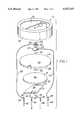
- FIG. 1is a perspective partially exploded view of the fluorescence sensor invention illustrating its component parts and how it is manufactured;
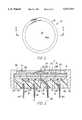
- FIG. 2is a top plan view of the fluorescence sensor invention set forth in FIG. 1;
- FIG. 3is an enlarged sectional view of the of the fluorescence sensor invention set forth in FIGS. 1 and 2 taken substantially on the line 3--3 of FIG. 2;
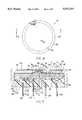
- FIG. 4is a top plan view of a second embodiment of the fluorescence sensor invention.
- FIG. 5is an enlarged sectional view of the fluorescence sensor invention set forth in FIG. 4 taken substantially on the line 5--5 of FIG. 4;
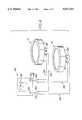
- FIG. 6is a perspective view of the embodiments of the fluorescence sensor invention in use with an indicator.
- the fluorescence sensor inventionis illustrated and is designated generally by the number 10.
- the sensor 10comprises photodetector means for detecting light comprising a thin substantially flat photodetector or wafer 12, filtering means for filtering light comprising a thin substantially flat high pass filter layer 14 that has a generally circular perimeter that is located adjacent to and is optically coupled to the photodetector means comprising the photodetector wafer 12 and a thin substantially flat glass wafer 16 that has a generally circular perimeter that is located adjacent to and is optically coupled to the filter means comprising the high pass filter layer 14.
- the sensor 10also comprises indicator means for providing a fluorescent emission as a result of excitation light comprising a substantially flat thin indicator membrane layer 18 that has a generally circular perimeter that is located adjacent to and is optically coupled to the glass layer 16, light emitting means for emitting excitation light comprising a light emitting diode 20 (LED) that is located within the central portion of the indicator layer 18 and a thin electrically conductive reflective metal disc 22 that is located between the light emitting diode 20 and the glass wafer 16 plus filtering means for filtering light comprising a low pass filter coating 24 surrounding the upper portion of the light emitting diode 20.
- the indicator layer 18is poured into place.
- the photodetector layer 12is connected to a positive post 26 and a negative post 28 whose respective upper end portions 30 and 32 are electrically connected to the photodetector layer 12.
- a lead 36has one end soldered or secured by conductive adhesive to the upper end portion 30 of the post 26 and the other end is attached or secured in a conventional manner to the upper surface 38 of the photodetector layer 12.
- a lead 40has one end secured to the upper end portion 32 of the post 28 by soldering or by a conductive adhesive and the other end is secured or attached to the underside 34 of the photodetector 12 in a conventional manner.
- the high pass filter layer 14has its underside 42 secured to the upper side or surface 38 of the photodetector layer 12 by a very thin layer of optical adhesive 44 and the upper surface 46 of the high pass filter layer 14 is secured to the lower surface 48 of the glass layer 16 by another very thin layer of optical adhesive 50.
- the reflective foil 22is attached to the upper surface 52 of the glass layer 16 by a suitable adhesive 53 known in the art and the light emitting diode 20 is attached to the upper surface of the reflective foil 22 by an electrically conducting adhesive layer 54.
- the low pass filter coating 24is secured to the upper outer portion of the light emitting diode 20 by light conductive adhesive 56.
- Electrical leads 58 and 60are provided for the light emitting diode 20 and extend respectively from the light emitting diode 20 and the electrically connected conductive foil disc 22 to the respective upper end portions 66 and 68 of the posts 62 and 64 whose respective upper end portions 66 and 68 are located below the outer portion of the under surface 42 of the filter layer 14.
- the indicator membrane layer 18contains indicator molecules designated by the number 71 and is cast onto the upper surface 52 of the glass layer 16 as well as around the light emitting diode 20 and its low pass filter coating 24 and portions of its leads 58 and 60.
- a circular ring shaped machined metal housing 70is provided that circles the outer edges of the photodetector layer 12, the filter layer 14, the glass layer 16 and the membrane layer 18.
- the lower portion of the machined housing 70is closed or sealed off with casting ceramic or other potting material 72 known in the art that also secures the posts 26, 28, 62 and 64 in place. Consequently, the sensor 10 is a unitary structure with all its operational components located within the housing 70 and only the positive and negative signal posts 26 and 28 and the electrical power posts 62 and 64 extending from the unitary structure surrounded by and contained within the housing 70. It is important to note, as indicated in FIG.
- the light emitting diode 20 and the photodetector 12are located in such a manner that the primary or main axis of light emission from the light emitting diode 20, designated by the letter A, is substantially perpendicular to the primary or main axis, designated by the letter B, of light detection of the photodetector 12. This is very important for the fluorescence sensor 10 since it it results in high efficiency and high sensitivity.
- the sensor 74comprises photodetector means for detecting light comprising a thin photodetector layer 76 that is substantially identical to the previously described photodetector wafer or layer 12, filtering means for filtering light comprising a high pass filter layer 78 that is substantially identical to the previously described high pass filter layer 14 and a glass layer 80 that is substantially identical to the previously described glass layer 16.
- the high pass filter layer 78is located adjacent to and is optically coupled to the photodetector means comprising the photodetector layer or wafer 76.
- the glass layer 80is located adjacent to and is optically coupled to the filter means comprising the filter layer 78.
- the sensor 74also has waveguide means for functioning as a waveguide comprising a thin substantially flat waveguide layer 82 whose under surface 84 is located adjacent to and is in optical contact with the upper surface 86 of the glass layer 80 as a result of optical adhesive 88.
- the upper surface 90 of the waveguide layer 82is located adjacent to and is in optical contact with the lower surface 92 of an indicator layer 94.
- This indicator membrane layer 94has indicator molecules designated by the number 95 and may be cast onto the upper surface 90 of the waveguide layer 82.
- the sensor 74also has light emitting means for emitting excitation light comprising a light emitting diode 96 that is similar to the previously described diode 20, filtering means for filtering light comprising a low pass filter coating 98 surrounding the upper portions of the diode 96 that is similar to the previously described low pass filter coating 24 and the light emitting diode 96 has its lower surface in contact with a thin electrically conductive reflective metal foil disc 100 that is similar to the previously described reflective metal foil disc 22.
- the sensor 74has respective positive and negative posts 102 and 104, that are similar to the previously described posts 26 and 28, and are electrically connected to the respective upperside 105 and underside 106 of the photodetector layer 76 in a conventional manner via the respective electrical leads 107 and 109.
- the high pass filter layer 78has its lower surface 114 secured to the upper surface 112 of the photodetector layer 76 by a very thin layer of optical adhesive 116 similar to the previously described adhesive 44.
- the upper surface 118 of the high pass filter 78is also secured to the lower surface 120 of the glass layer 80 by a thin layer 122 of optical adhesive similar to the previously described adhesive 50.
- the reflective foil disc 100is connected to the upper surface 86 of the glass layer 80 by a suitable adhesive known in the art and the light emitting diode 96 is attached to the upper surface of the reflective foil 100 by an electrical conducting adhesive layer 124 and the low pass filter layer 98 is secured to the diode 96 by a light conducting adhesive coating (not shown).
- the light emitting diode 96has associated electrical leads 128 and 130 that extend respectively from the diode 96 and the metal foil 100 located under and in electrical contact with the diode 96 to the respective posts 132 and 134 that are located below the outer under side 114 of the high pass filter layer 78 in a manner similar to that for the leads 58 and 60 and the respective posts 62 and 64 of the embodiment set forth in FIGS. 1 through 3. It will be noted that the light emitting diode 96 and its low pass filter coating or layer 98 is surrounded by the waveguide layer 82 which is cast around the light emitting diode 96 and its low pass filter coating 98 that are centrally located above the center portion of the glass layer 78.
- a circular ring shaped machined metal housing 139that is substantially identical to the metal housing 70 of the embodiment 10, is provided that circles the outer edges of the photodetector layer 74, the filter layer 78, the glass layer 80, the waveguide layer 82 and the indicator layer 94.
- the lower portion of the machined housing 70is closed or sealed off with casting ceramic or other potting material 141 known in the art that is identical to the the material 72 of the embodiment 10. This material 141 also secures the posts 102, 104, 132 and 134 in place. Consequently, the sensor 74 is a unitary structure, the same as the sensor embodiment 10.
- the light emitting diode 96 and the photodetector 76are located in such a manner that the primary or main axis of light emission from the light emitting diode 96, designated by the letter C, is substantially perpendicular to the primary or main axis, designated by the letter D, of light detection of the photodetector 76. This is very important for the fluorescence sensor 74 since it it results in high efficiency and high sensitivity.
- the positive post 26 of the sensor 10is electrically connected to the positive input 140 of a light intensity indicator 142 via the conductor 144, the switch 146 and the conductor 148.
- the negative post 28is electrically connected to the negative input 150 of the light intensity indicator 142 via the conductor 152, the switch 154 and the conductor 156.
- the sensor 74can be electrically connected to the light intensity indicator 142 by having the positive post 102 of the sensor 74 connected to the positive input 140 of the light intensity indicator 142 via the conductor 158, the switch 146 and the conductor 148.
- the negative post 104is connected to the negative input 150 of the light intensity indicator 142 via the conductor 160, the switch 154, and the conductor 156.
- the light intensity output from either the sensor 10 or 74can be read on the meter 162 of the light intensity indicator 142 through the use of the switches 146 and 154.
- both of the fluorescence sensor embodiments 10 and 74are manufactured using standard components and techniques known in the art in the following manner.
- the outer housing from a standard optical diode detectorsuch as a UDT020 available from United Detector Technology of Hawthorne, Calif. is removed to expose the surface of the silicon photodiode 12.
- a small drop of optical adhesive 44such as manufactured by Norland Products of New Brunswick, N.J. or other similar adhesive.
- a thin film high pass color filter 14is die cut from a standard sheet into a circular disc and placed onto the surface 38 of the diode 12 thereby covering the active diode area with the wavelength specific filter that is attached to the surface 38 of the diode 12 by the optical adhesive 44.
- a suitable film filter 14may be selected and obtained from any photography lighting supply house such as R & R Lighting Company, Inc. of Silver Spring, Md.
- Onto the upper surface 46 of the optical film filter disc 14is placed a second small drop of optical adhesive 50 (Norland type).
- optical adhesive 50Norland type
- Onto this surfaceis placed a circular glass disc 16 of a diameter exceeding that of the color filter 14 and the dimensions of the photodiode detector 12. The glass disc 16 is attached to the upper surface of the colored filter disc 14 by the optical adhesive 50.
- a small drop 53 of high temperature epoxysuch as that produced by Epoxy Technology, Billercia, Mass., is placed approximately in the center (placement is not critical, but the center is preferred) of the disc 16.
- a much smaller (approximately 300+ micron) diameter electrically conductive metallic disc 22is affixed to the glass via the high temperature epoxy 53 and a wire lead 60 (or line of conductive ink or adhesive) is then laid onto the glass layer surface 52 between the metallic disc 22 and a conductive pin or post 64 which is affixed beneath or adjacent to the photodetector which is a photodiode 12 allowing electrical conduction between the post 64 and the centrally located metallic disc 22.
- the metallic disc 22Onto the upper surface of the metallic disc 22 is placed a small drop of electrically conductive adhesive 54 such as that made by Circuit Works, Inc. of Santa Cruz, Calif. and others. Onto the conductive adhesive 54 and the associated metallic disc 22 is placed an LED chip emitter die 20 as made by Cree Research, Durham, N.C. and others, thereby forming an electrical path between the post 64 as described previously and the cathode (or anode alternatively) of the LED die 20.
- electrically conductive adhesive 54such as that made by Circuit Works, Inc. of Santa Cruz, Calif. and others.
- an LED chip emitter die 20As made by Cree Research, Durham, N.C. and others, thereby forming an electrical path between the post 64 as described previously and the cathode (or anode alternatively) of the LED die 20.
- a second electrical lead of fine wire 58is wire bonded and the wire 58 is routed across the surface 52 of the glass disc 16 from the LED die 20 to a second pin or post 62 located adjacent or beneath the photodiode 12.
- This stacked and adhered arraycomprising the photodetector 12, the filter 14, the glass layer 16, the metal disc 22 and the photodetector 20 and the high pass filter coating 24 is then cemented within a circular housing 70 machined to a dimensioning which covers and protects the array's sides and mates to the periphery of the glass disc 16 with epoxy (Epoxy Technology), thereby hermetically sealing the front face and those components beneath the glass disc 16 from the ambient environment.
- epoxyEpoxy Technology
- the membrane indicator mixture 18which covers the surface 52 of the glass layer 16, embeds the LED die 20 and its lead wires 58 and 60 and can fill to a level equal to the thickness machined into the housing 70.
- the LED 20is minimally submerged. Due to the formulation of the membrane indicator mixture 18 the liquid self levels across the surface and polymerizes and cures, thereby immobilizing the indicator molecules 71 and forming an active porous membrane as the outer surface on the face of the sensor 10.
- the membrane thicknesscan be controlled by precise volumetric dispensing onto the surface 52 of the glass layer 16.
- the membrane/indicator formulationmay be changed to create different sensors specific for different analytes.
- the membraneis formulated and applied as follows to create a sensor specific for oxygen. Beginning with 1 ml of silicone (commercially available as Dow Corning, Midland, Mich., RTV Sealant) dilute with 2 mls of Naptha (EE Zimmerman Company, Pittsburgh, Pa.) and agitate by vortexing in a sealed glass test tube (13+ cc volume). Add 200 ⁇ l of 6 mg/ml fluorescent indicator molecule ruthenium complex dissolved in chloroform. Agitate by vortex to homogeneity and pipette 250 ⁇ l of this solution onto the surface of the glass as detailed in the device above.
- the embodiment 74uses a waveguide layer 82 but is constructed in an identical manner as the embodiment 10 except a non-porous wave guide layer 82 is poured onto the surface 86 of the glass layer 80 instead of a porous membrane of the embodiment 10. There is no indicator molecule within the waveguide layer 80. The indicator molecules 95 are immobilized instead in an indicator layer 94 located on the upper surface 90 of the waveguide layer 80.
- a clear polymer(organic or inorganic) is poured onto the surface 86 of the glass layer 80 and allowed to self level and cure.
- the polymer waveguideis chosen for suitable clarity and refractive index properties so as to optimally conduct light of the desired wavelength throughout its volume.
- the indicator molecule layer 94is attached to the upper surface 86 of the waveguide layer 82 with the indicator molecules indicated by the number 95 that are immobilized to the upper surface 86 of the waveguide layer 82 using any of dozens of common techniques known in the art, thereby completing the device construction.
- the specificity of the sensor 10 or 74 for a particular analyteis conferred by the choice of immobilized indicator molecule 71 or 95. Then the optical properties of the waveguide 82 are chosen to accommodate its wavelength optimums.
- the sensor embodiments 10 and 74 of this inventionare used in the following manner.
- the sensors 10 and 74may be used in many different applications and environments.
- the sensor's analyte specificityis conferred by the indicator molecule 71 or 95 chosen from many available both commercially (SIGMA and others) and as listed in scientific literature.
- the senor 10 or 74may read oxygen by using many different molecules as listed in the scientific literature and commercially available and known to those skilled in the art.
- the devicemay be used to analyze the concentration of dissolved oxygen in a liquid or slurry, i.e. water, chemicals, process streams, fermenter broths, waste treatment streams, etc. or to analyze the oxygen concentration in a gaseous mixture such as air, various gas mixtures containing oxygen utilized in combustion, environmental conditions in enclosed spaces or reactors or life support systems.
- the previously described sensors 10 and/or 74is or are connected to electronics comprising a signal amplifier (not shown) from the photodiode detector that can form part of the measuring means for measuring the electric signal from the the photodetector means such as the light intensity indicator 142 and a power supply (not shown) to power the LED 20 or 96.
- oxygendiffuses into the membrane indicator layer 18 or 94 whereby oxygen interacts with the indicator molecules 71 or 95 on a molecular level causing a decrease in fluorescence intensity as detected or seen by the photodetector 12 or 76, thereby decreasing the electronic signal to the processing electronics forming the measuring means 142 for measuring the electric current from the the photodetector means 12 or 76 which is calibrated to read oxygen in suitable units of measure known in the art.
Landscapes
- Health & Medical Sciences (AREA)
- Physics & Mathematics (AREA)
- Chemical & Material Sciences (AREA)
- Immunology (AREA)
- Pathology (AREA)
- Analytical Chemistry (AREA)
- Biochemistry (AREA)
- General Health & Medical Sciences (AREA)
- General Physics & Mathematics (AREA)
- Life Sciences & Earth Sciences (AREA)
- Chemical Kinetics & Catalysis (AREA)
- Optics & Photonics (AREA)
- Nuclear Medicine, Radiotherapy & Molecular Imaging (AREA)
- Spectroscopy & Molecular Physics (AREA)
- Investigating, Analyzing Materials By Fluorescence Or Luminescence (AREA)
- Investigating Or Analysing Materials By The Use Of Chemical Reactions (AREA)
- Glass Compositions (AREA)
- Light Receiving Elements (AREA)
- Led Device Packages (AREA)
- Gyroscopes (AREA)
Abstract
Description
Fluorescence is a photochemical phenomena in which a photon of specific light wavelength (excitation wavelength) strikes an indicator molecule, thereby exciting an electron to a higher energy state as a result of the collision. As that "excited" electron decays back down to its original ground state, another photon of light is released at a longer wavelength (emission wavelength).
Indicator molecules are specific in their excitation and emission wavelengths. The fluorescent emission from an indicator molecule may be attenuated or enhanced by the local presence of the molecule being analyzed. For example, a tris(4,7-diphenyl-1,10-phenanthroline)ruthenium (II) perchlorate molecule particular for oxygen sensing is excited by shining light onto the substance at 460 nm (blue). The molecules' fluorescent emission immediately occurs at 620 nm (orange-red). However, the emission is quenched by the local presence of oxygen interacting with the indicator molecule, to cause the intensity of the fluorescence to be related to the ambient oxygen concentration. Consequently, the more oxygen that is present, the lower the emission intensity and vice-versa and when zero or no oxygen is present, the maximum fluorescent intensity of emitted light is present.
These analytical techniques using fluorescent molecules as indicators have classically been used in fluorescence spectrophotometers. These instruments are designed to read fluorescence intensity and also the decay time of fluorescence. These devices typically cost 20,000 to 50,000 dollars and are used generally in research laboratories.
A second area of fluorescence sensor state-of-the-art is in fiber optic devices. These sensor devices allow miniaturization and remote sensing of specific analytes. The fluorescent indicator molecule is immobilized via mechanical means or chemistry to one end of an optical fiber. To the opposite end of the fiber is attached a fiber coupler (Y shaped fiber) or a beam splitter.
Incident excitation light is coupled into one leg of the fiber typically via a filtennd a lens. Excitation light is carried via the fiber to the distal end where the fluorescent indicator molecule is immobilized to the tip. Upon excitation, the indicator molecule uniformly radiates the fluorescent light, some of which is recaptured by the fiber tip and propagated back through the fiber to the Y junction or "coupler". At the junction, a substantial portion (typically half) of the fluorescence is conveyed back to the emitter or point of origin thereby unavailable for signal detection. To offset the inefficiencies of the system, lasers are often used to raise the input power and highly sensitive photomultiplier tubes are used as detectors thereby raising costs by thousands of dollars. The other half travels along the other leg of the Y to the detector and is recorded. A primary disadvantage with the system is the losses occurring at each fiber junction and via lenses and filters. The system is at a maximum 1-5% efficient with resultant loss in sensitivity and range. These devices have been demonstrated in the lab and are very recently available commercially for very limited applications. These devices differ from the previously mentioned fluorescence spectrophotometers in that they are dedicated to their specific application.
In view of the foregoing it is readily apparent that there are definite limitations associated with such prior art fluorescence devices including cost inefficiency and limitations related to use. In addition, such prior art fluorescence devices are complex with many separate parts and are bulky.
This invention overcomes these problems associated with prior fluorescence devices and provides a fluorescence device with greatly reduced costs and complexity as well as greatly improved efficiency. This invention provides a novel platform which greatly extends the use of fluorescent indicator molecules as a sensor allowing utilization, sensitivity and cost analyses not previously available. The invention also has increased uses and is easier to use as well as being more reliable than prior art fluorescence devices.
This invention relates to the fluorescence devices and more particularly to fluorescence sensors.
Accordingly, it is an object of the invention to provide an improved fluorescence sensor.
It is an object of the invention to provide a fluorescence sensor that is highly efficient.
It is an object of the invention to provide a fluorescence sensor with improved optical efficiency.
It is an object of the invention to provide a fluorescence sensor that has increased sensitivity.
It is an object of the invention to provide a fluorescence sensor that has few parts.
It is an object of the invention to provide a fluorescence sensor that is easy to manufacture.
It is an object of the invention to provide a fluorescence sensor that has greatly reduced manufacturing costs.
It is an object of the invention to provide a fluorescence sensor that is manufactured with standard manufacturing techniques.
It is an object of the invention to provide a fluorescence sensor that is easy to assemble.
It is an object of the invention to provide a fluorescence sensor that is low in cost.
It is an object of the invention to provide a fluorescence sensor that has an increased number of uses.
It is an object of the invention to provide a fluorescence sensor that can be used in harsh environments.
It is an object of the invention to provide a fluorescence sensor that has increased thermal tolerances.
It is an object of the invention to provide a fluorescence sensor that is miniaturized.
It is an object of the invention to provide a fluorescence sensor with reduced volume.
It is an object of the invention to provide a fluorescence sensor that provides increased functionality with reduced volume.
It is an object of the invention to provide a fluorescence sensor with increased functional density.
It is an object of the invention to provide a fluorescence sensor that is well suited for use in places where the volume available is limited.
It is an object of the invention to provide a fluorescence sensor that is well suited for use in a variety of difficult situations.
It is an object of the invention to provide a fluorescence sensor that includes an emitter element that is imbedded within a chemically active element.
It is an object of the invention to provide a fluorescence sensor that includes an emitter element that is imbedded within a polymer (organic or inorganic) within which the indicator molecule is immobilized.
It is an object of the invention to provide a fluorescence sensor which may be used as a platform for fluorescent, luminescent, phosphorescent, absorbent or refractive difference indicator molecules immobilized on or within the polymer in which the emitter is imbedded.
It is an object of the invention to provide a fluorescence sensor with an imbedded emitter whereby the technique of querying the indicator molecule is via direct excitation/emission, evanescent excitation, or surface plasmon resonance type excitation or indirect excitation via a secondary fluorescent molecule.
It is an object of the invention to provide a fluorescence sensor where the emission element that is embedded is integral with low and high pass optical filters.
It is an object of the invention to provide a fluorescence sensor that has an integral optical detection element or diode.
It is an object of the invention to provide a fluorescence sensor which is built in one piece unit substantially on a single chip or integral package.
It is an object of the invention to provide a fluorescence sensor in which all optical processing is contained within the integral component and only power and signal leads enter and exit the active device or unit.
It is an object of the invention to provide a fluorescence sensor where the emitter enclosed is a light emitting diode (LED) die so as to provide optimal radial emission of excitation radiation from the source.
It is an object of the invention to provide a fluorescence sensor where the primary axis of excitation radiation from a light emitting diode is perpendicular to the primary axis of the photodetection of the emission of the photodetector.
It is an object of the invention to provide a fluorescence sensor that eliminates the need for fiber optics.
It is an object of the invention to provide a fluorescence sensor with a unitary structure where the entire radiation of the light source is initially released and propagated through the indicator layer, either within the layer or immobilized to the surface of the layer.
It is an object of the invention to provide a fluorescence sensor which may be used in analysis of gaseous or liquid states.
It is an object of the invention to provide a fluorescence sensor which may be used integral with its signal processing electronics or as a remote device.
It is an object of the invention to provide a fluorescence sensor where the membrane or indicator layer thickness is controlled by pouring the formulated contents by gravity or pressure around the emitter die.
It is an object of the invention to provide a fluorescence sensor where the thickness of the indicator layer is optically limited only by the thickness of the radially emitting P/N junction.
It is an object of the invention to provide a fluorescence sensor which has a low pass filter that is a coating or film.
It is an object of the invention to provide a fluorescence sensor which has a high pass filter that is a coating, film, or wafer.
It is an object of the invention to provide a fluorescence sensor which may be used for a multitude of analytes by immobilizing a specific indicator molecule on or within the sensor's indicator layer and calibrating the signal processing electronics.
It is an object of the invention to provide a fluorescence sensor whose signal processing electronics may include phase modulation, lifetime, intensity or relative intensity data interpretation methods.
It is an object of the invention to provide a fluorescence sensor which may have any emission wavelengths and any detection wavelengths.
It is an object of the invention to provide a fluorescence sensor where the low and high pass filters may be of any suitable exclusion/admission profile suitable to the indicator molecules chosen.
It is an object of the invention to provide a fluorescence sensor where the sensor is a solid state sensor.
It is an object of the invention to provide a fluorescence sensor which is designed for extremes of temperature, pressure and ambient conditions.
These and other objects will be apparent from the fluorescence sensor invention that has a photodetector, a high pass filter located adjacent the photodetector, and a glass layer located adjacent the high pass filter. Also,an indicator layer is located adjacent to the glass layer and a light emitting diode is embedded in the indicator layer. The indicator layer has indicator molecules that provide a fluorescent emission as a result of light from the light emitting diode. The indicator layer allows an analyte to diffuse into it and the presence of the analyte alters the amount of light emitted from the indicator molecules that passes through the glass layer and the high pass filter and is incident upon the photodetector. Since the amount of current from the photodetector depends upon the incident light this is used to detect the presence and amount of the analyte. In one embodiment a waveguide is also present.
The invention will be hereinafter more fully described with references to the accompanying drawings in which:
FIG. 1 is a perspective partially exploded view of the fluorescence sensor invention illustrating its component parts and how it is manufactured;
FIG. 2 is a top plan view of the fluorescence sensor invention set forth in FIG. 1;
FIG. 3 is an enlarged sectional view of the of the fluorescence sensor invention set forth in FIGS. 1 and 2 taken substantially on theline 3--3 of FIG. 2;
FIG. 4 is a top plan view of a second embodiment of the fluorescence sensor invention;
FIG. 5 is an enlarged sectional view of the fluorescence sensor invention set forth in FIG. 4 taken substantially on theline 5--5 of FIG. 4; and
FIG. 6 is a perspective view of the embodiments of the fluorescence sensor invention in use with an indicator.
Referring first to FIGS. 1, 2, and 3, the fluorescence sensor invention is illustrated and is designated generally by thenumber 10. Thesensor 10 comprises photodetector means for detecting light comprising a thin substantially flat photodetector orwafer 12, filtering means for filtering light comprising a thin substantially flat highpass filter layer 14 that has a generally circular perimeter that is located adjacent to and is optically coupled to the photodetector means comprising thephotodetector wafer 12 and a thin substantiallyflat glass wafer 16 that has a generally circular perimeter that is located adjacent to and is optically coupled to the filter means comprising the highpass filter layer 14. Thesensor 10 also comprises indicator means for providing a fluorescent emission as a result of excitation light comprising a substantially flat thinindicator membrane layer 18 that has a generally circular perimeter that is located adjacent to and is optically coupled to theglass layer 16, light emitting means for emitting excitation light comprising a light emitting diode 20 (LED) that is located within the central portion of theindicator layer 18 and a thin electrically conductivereflective metal disc 22 that is located between thelight emitting diode 20 and theglass wafer 16 plus filtering means for filtering light comprising a lowpass filter coating 24 surrounding the upper portion of thelight emitting diode 20. As indicated in FIG. 1, theindicator layer 18 is poured into place.
The details of the construction of thesensor 10 can best be understood by referring to FIG. 3 as well as FIG. 1. As illustrated in FIGS. 1 and 3, thephotodetector layer 12 is connected to apositive post 26 and anegative post 28 whose respectiveupper end portions photodetector layer 12. A lead 36 has one end soldered or secured by conductive adhesive to theupper end portion 30 of thepost 26 and the other end is attached or secured in a conventional manner to theupper surface 38 of thephotodetector layer 12. In a similar manner, alead 40 has one end secured to theupper end portion 32 of thepost 28 by soldering or by a conductive adhesive and the other end is secured or attached to theunderside 34 of thephotodetector 12 in a conventional manner.
The highpass filter layer 14 has itsunderside 42 secured to the upper side orsurface 38 of thephotodetector layer 12 by a very thin layer of optical adhesive 44 and theupper surface 46 of the highpass filter layer 14 is secured to thelower surface 48 of theglass layer 16 by another very thin layer ofoptical adhesive 50. Thereflective foil 22 is attached to theupper surface 52 of theglass layer 16 by asuitable adhesive 53 known in the art and thelight emitting diode 20 is attached to the upper surface of thereflective foil 22 by an electrically conductingadhesive layer 54. The lowpass filter coating 24 is secured to the upper outer portion of thelight emitting diode 20 by lightconductive adhesive 56.
Electrical leads 58 and 60 are provided for thelight emitting diode 20 and extend respectively from thelight emitting diode 20 and the electrically connectedconductive foil disc 22 to the respectiveupper end portions posts upper end portions under surface 42 of thefilter layer 14. Theindicator membrane layer 18 contains indicator molecules designated by thenumber 71 and is cast onto theupper surface 52 of theglass layer 16 as well as around thelight emitting diode 20 and its lowpass filter coating 24 and portions of itsleads
Also, a circular ring shaped machinedmetal housing 70 is provided that circles the outer edges of thephotodetector layer 12, thefilter layer 14, theglass layer 16 and themembrane layer 18. The lower portion of the machinedhousing 70 is closed or sealed off with casting ceramic orother potting material 72 known in the art that also secures theposts sensor 10 is a unitary structure with all its operational components located within thehousing 70 and only the positive andnegative signal posts housing 70. It is important to note, as indicated in FIG. 3, that thelight emitting diode 20 and thephotodetector 12 are located in such a manner that the primary or main axis of light emission from thelight emitting diode 20, designated by the letter A, is substantially perpendicular to the primary or main axis, designated by the letter B, of light detection of thephotodetector 12. This is very important for thefluorescence sensor 10 since it it results in high efficiency and high sensitivity.
Another embodiment of the fluorescence sensor invention is set forth in FIGS. 4 and 5 and is designated generally by thenumber 74. Thesensor 74 comprises photodetector means for detecting light comprising athin photodetector layer 76 that is substantially identical to the previously described photodetector wafer orlayer 12, filtering means for filtering light comprising a highpass filter layer 78 that is substantially identical to the previously described highpass filter layer 14 and aglass layer 80 that is substantially identical to the previously describedglass layer 16. The highpass filter layer 78 is located adjacent to and is optically coupled to the photodetector means comprising the photodetector layer orwafer 76. Theglass layer 80 is located adjacent to and is optically coupled to the filter means comprising thefilter layer 78. However, thesensor 74 also has waveguide means for functioning as a waveguide comprising a thin substantiallyflat waveguide layer 82 whose under surface 84 is located adjacent to and is in optical contact with theupper surface 86 of theglass layer 80 as a result ofoptical adhesive 88. Theupper surface 90 of thewaveguide layer 82 is located adjacent to and is in optical contact with thelower surface 92 of anindicator layer 94. Thisindicator membrane layer 94 has indicator molecules designated by the number 95 and may be cast onto theupper surface 90 of thewaveguide layer 82. Thesensor 74 also has light emitting means for emitting excitation light comprising a light emitting diode 96 that is similar to the previously describeddiode 20, filtering means for filtering light comprising a low pass filter coating 98 surrounding the upper portions of the diode 96 that is similar to the previously described lowpass filter coating 24 and the light emitting diode 96 has its lower surface in contact with a thin electrically conductive reflectivemetal foil disc 100 that is similar to the previously described reflectivemetal foil disc 22.
As illustrated in FIG. 5, thesensor 74 has respective positive andnegative posts posts respective upperside 105 andunderside 106 of thephotodetector layer 76 in a conventional manner via the respectiveelectrical leads 107 and 109. The highpass filter layer 78 has itslower surface 114 secured to theupper surface 112 of thephotodetector layer 76 by a very thin layer of optical adhesive 116 similar to the previously described adhesive 44. Theupper surface 118 of thehigh pass filter 78 is also secured to thelower surface 120 of theglass layer 80 by athin layer 122 of optical adhesive similar to the previously described adhesive 50. Thereflective foil disc 100 is connected to theupper surface 86 of theglass layer 80 by a suitable adhesive known in the art and the light emitting diode 96 is attached to the upper surface of thereflective foil 100 by an electrical conducting adhesive layer 124 and the low pass filter layer 98 is secured to the diode 96 by a light conducting adhesive coating (not shown).
The light emitting diode 96 has associatedelectrical leads metal foil 100 located under and in electrical contact with the diode 96 to therespective posts side 114 of the highpass filter layer 78 in a manner similar to that for theleads respective posts waveguide layer 82 which is cast around the light emitting diode 96 and its low pass filter coating 98 that are centrally located above the center portion of theglass layer 78.
Also, a circular ring shaped machinedmetal housing 139, that is substantially identical to themetal housing 70 of theembodiment 10, is provided that circles the outer edges of thephotodetector layer 74, thefilter layer 78, theglass layer 80, thewaveguide layer 82 and theindicator layer 94. The lower portion of the machinedhousing 70 is closed or sealed off with casting ceramic orother potting material 141 known in the art that is identical to the thematerial 72 of theembodiment 10. Thismaterial 141 also secures theposts sensor 74 is a unitary structure, the same as thesensor embodiment 10. with all its operational components located within thehousing 139 and only the positive andnegative signal posts electrical power posts housing 139. It is important to note, as indicated in FIG. 5, that the light emitting diode 96 and thephotodetector 76 are located in such a manner that the primary or main axis of light emission from the light emitting diode 96, designated by the letter C, is substantially perpendicular to the primary or main axis, designated by the letter D, of light detection of thephotodetector 76. This is very important for thefluorescence sensor 74 since it it results in high efficiency and high sensitivity.
As illustrated in FIG. 6, thepositive post 26 of thesensor 10 is electrically connected to thepositive input 140 of alight intensity indicator 142 via theconductor 144, the switch 146 and theconductor 148. In a similar manner, thenegative post 28 is electrically connected to thenegative input 150 of thelight intensity indicator 142 via theconductor 152, the switch 154 and the conductor 156. Alternatively, thesensor 74 can be electrically connected to thelight intensity indicator 142 by having thepositive post 102 of thesensor 74 connected to thepositive input 140 of thelight intensity indicator 142 via theconductor 158, the switch 146 and theconductor 148. In a similar manner, thenegative post 104 is connected to thenegative input 150 of thelight intensity indicator 142 via theconductor 160, the switch 154, and the conductor 156. As a result of this arrangement, the light intensity output from either thesensor meter 162 of thelight intensity indicator 142 through the use of the switches 146 and 154.
In the preferred embodiments both of thefluorescence sensor embodiments fluorescence sensor embodiment 10, the outer housing from a standard optical diode detector such as a UDT020 available from United Detector Technology of Hawthorne, Calif. is removed to expose the surface of thesilicon photodiode 12. Onto theupper surface 38 of thediode 12 is placed a small drop of optical adhesive 44 such as manufactured by Norland Products of New Brunswick, N.J. or other similar adhesive. A thin film highpass color filter 14 is die cut from a standard sheet into a circular disc and placed onto thesurface 38 of thediode 12 thereby covering the active diode area with the wavelength specific filter that is attached to thesurface 38 of thediode 12 by theoptical adhesive 44. Asuitable film filter 14 may be selected and obtained from any photography lighting supply house such as R & R Lighting Company, Inc. of Silver Spring, Md. Onto theupper surface 46 of the opticalfilm filter disc 14 is placed a second small drop of optical adhesive 50 (Norland type). Onto this surface is placed acircular glass disc 16 of a diameter exceeding that of thecolor filter 14 and the dimensions of thephotodiode detector 12. Theglass disc 16 is attached to the upper surface of thecolored filter disc 14 by theoptical adhesive 50.
Onto theupper surface 52 of the glass disc 16 asmall drop 53 of high temperature epoxy, such as that produced by Epoxy Technology, Billercia, Mass., is placed approximately in the center (placement is not critical, but the center is preferred) of thedisc 16. A much smaller (approximately 300+ micron) diameter electrically conductivemetallic disc 22 is affixed to the glass via thehigh temperature epoxy 53 and a wire lead 60 (or line of conductive ink or adhesive) is then laid onto theglass layer surface 52 between themetallic disc 22 and a conductive pin or post 64 which is affixed beneath or adjacent to the photodetector which is aphotodiode 12 allowing electrical conduction between thepost 64 and the centrally locatedmetallic disc 22. Onto the upper surface of themetallic disc 22 is placed a small drop of electrically conductive adhesive 54 such as that made by Circuit Works, Inc. of Santa Cruz, Calif. and others. Onto theconductive adhesive 54 and the associatedmetallic disc 22 is placed an LED chip emitter die 20 as made by Cree Research, Durham, N.C. and others, thereby forming an electrical path between thepost 64 as described previously and the cathode (or anode alternatively) of the LED die 20. Onto the upper surface (anode or cathode) of the LED die 20 one end of a second electrical lead offine wire 58 is wire bonded and thewire 58 is routed across thesurface 52 of theglass disc 16 from the LED die 20 to a second pin or post 62 located adjacent or beneath thephotodiode 12. This completes a circuit segment whereby power may be applied across the twoposts glass disc 16.
This stacked and adhered array comprising thephotodetector 12, thefilter 14, theglass layer 16, themetal disc 22 and thephotodetector 20 and the highpass filter coating 24 is then cemented within acircular housing 70 machined to a dimensioning which covers and protects the array's sides and mates to the periphery of theglass disc 16 with epoxy (Epoxy Technology), thereby hermetically sealing the front face and those components beneath theglass disc 16 from the ambient environment. Into a pocket created by theupper surface 52 of theglass disc 16 and the side wall machined into thehousing 70 is poured a membrane indicator formulation 18 (FIG. 1) which covers thesurface 52 of theglass layer 16, embeds the LED die 20 and itslead wires housing 70. TheLED 20 is minimally submerged. Due to the formulation of themembrane indicator mixture 18 the liquid self levels across the surface and polymerizes and cures, thereby immobilizing theindicator molecules 71 and forming an active porous membrane as the outer surface on the face of thesensor 10. The membrane thickness can be controlled by precise volumetric dispensing onto thesurface 52 of theglass layer 16.
The membrane/indicator formulation may be changed to create different sensors specific for different analytes. In one example embodiment the membrane is formulated and applied as follows to create a sensor specific for oxygen. Beginning with 1 ml of silicone (commercially available as Dow Corning, Midland, Mich., RTV Sealant) dilute with 2 mls of Naptha (EE Zimmerman Company, Pittsburgh, Pa.) and agitate by vortexing in a sealed glass test tube (13+ cc volume). Add 200 μl of 6 mg/ml fluorescent indicator molecule ruthenium complex dissolved in chloroform. Agitate by vortex to homogeneity and pipette 250 μl of this solution onto the surface of the glass as detailed in the device above. Allow to cure at room temperature over night or in reduced time at higher temperatures (not to exceed 60 degrees Centigrade). The bottom cavity below theunderside 34 of thephotodetector 12 that is formed by thehousing 70 is then filled with the pottingmaterial 72 that seals thehousing 70 and also secures thevarious posts
This example is now ready for use as an oxygen sensor when mated with suitable electronics. Other examples would differ from the description above only by changing the type ofindicator molecule 71 andmembrane 18 formulation.
As indicated in FIG. 5, theembodiment 74 uses awaveguide layer 82 but is constructed in an identical manner as theembodiment 10 except a non-porouswave guide layer 82 is poured onto thesurface 86 of theglass layer 80 instead of a porous membrane of theembodiment 10. There is no indicator molecule within thewaveguide layer 80. The indicator molecules 95 are immobilized instead in anindicator layer 94 located on theupper surface 90 of thewaveguide layer 80.
As an example ofembodiment 74, a clear polymer (organic or inorganic) is poured onto thesurface 86 of theglass layer 80 and allowed to self level and cure. The polymer waveguide is chosen for suitable clarity and refractive index properties so as to optimally conduct light of the desired wavelength throughout its volume. Theindicator molecule layer 94 is attached to theupper surface 86 of thewaveguide layer 82 with the indicator molecules indicated by the number 95 that are immobilized to theupper surface 86 of thewaveguide layer 82 using any of dozens of common techniques known in the art, thereby completing the device construction. The specificity of thesensor indicator molecule 71 or 95. Then the optical properties of thewaveguide 82 are chosen to accommodate its wavelength optimums.
The sensor embodiments 10 and 74 of this invention are used in the following manner. Thesensors indicator molecule 71 or 95 chosen from many available both commercially (SIGMA and others) and as listed in scientific literature.
For example, thesensor sensors 10 and/or 74 is or are connected to electronics comprising a signal amplifier (not shown) from the photodiode detector that can form part of the measuring means for measuring the electric signal from the the photodetector means such as thelight intensity indicator 142 and a power supply (not shown) to power theLED 20 or 96. As thesensor membrane indicator layer indicator molecules 71 or 95 on a molecular level causing a decrease in fluorescence intensity as detected or seen by thephotodetector
Although the invention has been described in considerable detail with reference to certain preferred embodiments it will be appreciated and understood that various changes and modifications may be made without departing from the spirit and scope of the invention as defined in the appended claims.
Claims (19)
1. A fluorescence sensor for sensing an analyte comprising: photodetector means for generating an electric signal as a result of being exposed to incident light; indicator means for providing a fluorescent emission as a result of excitation light, said indicator means comprising a material permitting said analyte to diffuse therein and having light emitting indicator molecules specific to said analyte to cause said indicator molecules to interact with said analyte to alter the amount of light incident upon said photodetector means from light emitted from said indicator molecules; light emitting means for emitting excitation light having at least a portion thereof located within said indicator means; said photodetector means having a primary axis of light detection and said light emitting means having a primary axis of light emission, said photodetector means and said light emitting means being located to cause the primary axis of light emission from said light emitting means to be substantially perpendicular to the primary axis of light detection of said photodetector means; said photodetector means, said indicator means and said light emitting means being located in one unitary structure.
2. The fluorescence sensor of claim 1 further comprising filtering means for filtering light located between said indicator means and said photodetector means.
3. The fluorescence sensor of claim 2 wherein said filtering means comprises a high pass filter.
4. The fluorescence sensor of claim 2 wherein said filtering means filters out light above or below a certain wavelength.
5. The fluorescence sensor of claim 2 further comprising second filtering means for filtering light surrounding a portion of said light emitting means.
6. The fluorescence sensor of claim 1 wherein said light emitting means comprises a light emitting diode.
7. The fluorescence sensor of claim 1 wherein said photodetector means has an electric signal output and further comprising measuring means connected to said photodetector means for measuring the electric signal output from said photodetector means.
8. The fluorescence sensor of claim 1 further comprising a housing surrounding at least a portion of said photodetector means, said indicator means and said light emitting means.
9. The fluorescence sensor of claim 1 further comprising a glass layer located adjacent to said indicator means.
10. The fluorescence sensor of claim 1 wherein said indicator means comprises a substantially flat indicator membrane.
11. The fluorescence sensor of claim 1 wherein the light emitting indicator molecules of said indicator means interact with oxygen.
12. A fluorescence sensor for sensing an analyte comprising: photodetector means for generating an electric signal as a result of being exposed to incident light; indicator means for providing a fluorescent emission as a result of excitation light, said indicator means comprising a material permitting said analyte to diffuse therein and having light emitting indicator molecules specific to said analyte to cause said indicator molecules to interact with said analyte to alter the amount of light incident upon said photodetector means from light emitted from said indicator molecules; a waveguide layer located adjacent to said indicator means; light emitting means for emitting excitation light having at least a portion thereof surrounded by said waveguide layer; said photodetector means having a primary axis of light detection and said light emitting means having a primary axis of light emission, said photodetector means and said light emitting means being located to cause the primary axis of light emission from said light emitting means to be substantially perpendicular to the primary axis of light detection of said photodetector means; said photodetector means, said indicator means, said waveguide layer and said light emitting means being located in one unitary structure.
13. The fluorescence sensor of claim 12 further comprising filtering means for filtering light located between said said waveguide layer and said photodetector means.
14. The fluorescence sensor of claim 13 wherein said filtering means comprises a high pass filter.
15. The fluorescence sensor of claim 13 further comprising second filtering means for filtering light surrounding a portion of said light emitting means.
16. The fluorescence sensor of claim 12 wherein said light emitting means comprises a light emitting diode.
17. The fluorescence sensor of claim 12 wherein said photodetector means has an electric signal output and further comprising measuring means connected to said photodetector means for measuring the electric signal output from said photodetector means.
18. The fluorescence sensor of claim 12 further comprising a housing surrounding at least a portion of said photodetector means, said indicator means and said waveguide layer.
19. The fluorescence sensor of claim 12 further comprising a glass layer located adjacent to said waveguide layer.
Priority Applications (16)
| Application Number | Priority Date | Filing Date | Title |
|---|---|---|---|
| US08/393,166US5517313A (en) | 1995-02-21 | 1995-02-21 | Fluorescent optical sensor |
| PT96906556TPT811154E (en) | 1995-02-21 | 1996-02-15 | FLUORESCENT OPTICAL SENSOR |
| CA002213482ACA2213482C (en) | 1995-02-21 | 1996-02-15 | Fluorescent optical sensor |
| MXPA/A/1997/006360AMXPA97006360A (en) | 1995-02-21 | 1996-02-15 | Optical sensor fluoresce |
| DK96906556TDK0811154T3 (en) | 1995-02-21 | 1996-02-15 | Optical fluorescence sensor |
| CN96192171ACN1098456C (en) | 1995-02-21 | 1996-02-15 | fluorescent sensor |
| PCT/US1996/002325WO1996026429A1 (en) | 1995-02-21 | 1996-02-15 | Fluorescent optical sensor |
| ES96906556TES2240991T3 (en) | 1995-02-21 | 1996-02-15 | FLUORESCENT OPTICAL SENSOR. |
| JP52579096AJP3638611B2 (en) | 1995-02-21 | 1996-02-15 | Optical fluorescent sensor |
| EP96906556AEP0811154B1 (en) | 1995-02-21 | 1996-02-15 | Fluorescent optical sensor |
| AT96906556TATE294380T1 (en) | 1995-02-21 | 1996-02-15 | OPTICAL FLUORESCENCE SENSOR |
| KR1019970705803AKR100355905B1 (en) | 1995-02-21 | 1996-02-15 | Fluorescent light sensor |
| AU49897/96AAU693007C (en) | 1995-02-21 | 1996-02-15 | Fluorescent optical sensor |
| DE69634660TDE69634660T2 (en) | 1995-02-21 | 1996-02-15 | OPTICAL FLUORESCENT SENSOR |
| NO19973761ANO325071B1 (en) | 1995-02-21 | 1997-08-15 | Fluorescent optical sensor |
| FI973405AFI117683B (en) | 1995-02-21 | 1997-08-20 | Fluorescent optical detector |
Applications Claiming Priority (1)
| Application Number | Priority Date | Filing Date | Title |
|---|---|---|---|
| US08/393,166US5517313A (en) | 1995-02-21 | 1995-02-21 | Fluorescent optical sensor |
Publications (1)
| Publication Number | Publication Date |
|---|---|
| US5517313Atrue US5517313A (en) | 1996-05-14 |
Family
ID=23553559
Family Applications (1)
| Application Number | Title | Priority Date | Filing Date |
|---|---|---|---|
| US08/393,166Expired - LifetimeUS5517313A (en) | 1995-02-21 | 1995-02-21 | Fluorescent optical sensor |
Country Status (14)
| Country | Link |
|---|---|
| US (1) | US5517313A (en) |
| EP (1) | EP0811154B1 (en) |
| JP (1) | JP3638611B2 (en) |
| KR (1) | KR100355905B1 (en) |
| CN (1) | CN1098456C (en) |
| AT (1) | ATE294380T1 (en) |
| CA (1) | CA2213482C (en) |
| DE (1) | DE69634660T2 (en) |
| DK (1) | DK0811154T3 (en) |
| ES (1) | ES2240991T3 (en) |
| FI (1) | FI117683B (en) |
| NO (1) | NO325071B1 (en) |
| PT (1) | PT811154E (en) |
| WO (1) | WO1996026429A1 (en) |
Cited By (116)
| Publication number | Priority date | Publication date | Assignee | Title |
|---|---|---|---|---|
| EP0834734A3 (en)* | 1996-10-01 | 1998-09-16 | Texas Instruments Inc. | Optical sensor |
| WO1998052024A1 (en)* | 1997-05-13 | 1998-11-19 | Colvin Arthur E Jr | Improved fluorescence sensing device |
| WO1998052023A1 (en)* | 1997-05-13 | 1998-11-19 | Colvin Arthur E Jr | Improved fluorescence sensing device |
| US5910661A (en)* | 1997-05-13 | 1999-06-08 | Colvin, Jr.; Arthur E. | Flourescence sensing device |
| WO1999039637A1 (en) | 1998-02-05 | 1999-08-12 | Mault James R | Metabolic calorimeter employing respiratory gas analysis |
| US5984861A (en)* | 1997-09-29 | 1999-11-16 | Boston Scientific Corporation | Endofluorescence imaging module for an endoscope |
| US6009339A (en)* | 1997-02-27 | 1999-12-28 | Terumo Cardiovascular Systems Corporation | Blood parameter measurement device |
| WO2000013003A1 (en)* | 1998-08-26 | 2000-03-09 | Sensors For Medicine And Science, Inc. | Optical-based sensing devices |
| US6045756A (en)* | 1996-10-01 | 2000-04-04 | Texas Instruments Incorporated | Miniaturized integrated sensor platform |
| US6055451A (en) | 1997-12-12 | 2000-04-25 | Spectrx, Inc. | Apparatus and method for determining tissue characteristics |
| US6096065A (en)* | 1997-09-29 | 2000-08-01 | Boston Scientific Corporation | Sheath for tissue spectroscopy |
| US6111248A (en)* | 1996-10-01 | 2000-08-29 | Texas Instruments Incorporated | Self-contained optical sensor system |
| US6119031A (en)* | 1996-11-21 | 2000-09-12 | Boston Scientific Corporation | Miniature spectrometer |
| WO2000067634A2 (en) | 1999-05-10 | 2000-11-16 | Mault James R | Airway-based cardiac output monitor and methods for using same |
| US6155491A (en) | 1998-05-29 | 2000-12-05 | Welch Allyn Data Collection, Inc. | Lottery game ticket processing apparatus |
| US6185443B1 (en) | 1997-09-29 | 2001-02-06 | Boston Scientific Corporation | Visible display for an interventional device |
| US6188812B1 (en) | 1998-09-01 | 2001-02-13 | Hung Pin Kao | Method and apparatus for enhanced evanescent fluorescence and color filtering using a high refractive index thin film coating |
| US6241948B1 (en) | 1998-05-20 | 2001-06-05 | The Research Foundation Of State University Of New York | Sensing device with sol-gel derived film on the light source |
| US6289229B1 (en) | 1998-01-20 | 2001-09-11 | Scimed Life Systems, Inc. | Readable probe array for in vivo use |
| US6303937B1 (en)* | 1998-02-27 | 2001-10-16 | Eastman Kodak Company | Ceramic calibration filter |
| US6304766B1 (en) | 1998-08-26 | 2001-10-16 | Sensors For Medicine And Science | Optical-based sensing devices, especially for in-situ sensing in humans |
| US6324418B1 (en) | 1997-09-29 | 2001-11-27 | Boston Scientific Corporation | Portable tissue spectroscopy apparatus and method |
| US6325978B1 (en) | 1998-08-04 | 2001-12-04 | Ntc Technology Inc. | Oxygen monitoring and apparatus |
| US6331438B1 (en) | 1999-11-24 | 2001-12-18 | Iowa State University Research Foundation, Inc. | Optical sensors and multisensor arrays containing thin film electroluminescent devices |
| US6400974B1 (en)* | 2000-06-29 | 2002-06-04 | Sensors For Medicine And Science, Inc. | Implanted sensor processing system and method for processing implanted sensor output |
| US6402689B1 (en) | 1998-09-30 | 2002-06-11 | Sicel Technologies, Inc. | Methods, systems, and associated implantable devices for dynamic monitoring of physiological and biological properties of tumors |
| US6405073B1 (en) | 1997-07-22 | 2002-06-11 | Scimed Life Systems, Inc. | Miniature spectrometer system and method |
| US20020091324A1 (en)* | 1998-04-06 | 2002-07-11 | Nikiforos Kollias | Non-invasive tissue glucose level monitoring |
| US20020102212A1 (en)* | 2000-11-09 | 2002-08-01 | Black Robert D. | Methods, circuits and compositions of matter for in vivo detection of biomolecule concentrations using fluorescent tags |
| US20020119581A1 (en)* | 2001-01-05 | 2002-08-29 | Daniloff George Y. | Detection of analytes |
| US6454921B1 (en)* | 1997-03-25 | 2002-09-24 | Usf Filtration And Separations Group, Inc. | Electrochemical cell |
| US6505059B1 (en) | 1998-04-06 | 2003-01-07 | The General Hospital Corporation | Non-invasive tissue glucose level monitoring |
| US20030023181A1 (en)* | 2001-07-26 | 2003-01-30 | Mault James R. | Gas analyzer of the fluorescent-film type particularly useful for respiratory analysis |
| US20030065275A1 (en)* | 1999-08-02 | 2003-04-03 | Mault James R. | Metabolic calorimeter employing respiratory gas analysis |
| US6572561B2 (en) | 1998-01-16 | 2003-06-03 | Healthetech, Inc. | Respiratory calorimeter |
| US20030125616A1 (en)* | 2001-11-30 | 2003-07-03 | Black Robert D. | Disposable single-use external dosimeters for use in radiation therapies |
| US20030133123A1 (en)* | 2002-01-10 | 2003-07-17 | Ming-Hsiung Yeh | Sensor formulation for the detection of gas composition and method of making same |
| US20030135122A1 (en)* | 1997-12-12 | 2003-07-17 | Spectrx, Inc. | Multi-modal optical tissue diagnostic system |
| US6612306B1 (en) | 1999-10-13 | 2003-09-02 | Healthetech, Inc. | Respiratory nitric oxide meter |
| US6620106B2 (en) | 2000-09-29 | 2003-09-16 | Healthetech, Inc. | Indirect calorimetry system |
| US6627177B2 (en) | 2000-12-05 | 2003-09-30 | The Regents Of The University Of California | Polyhydroxyl-substituted organic molecule sensing optical in vivo method utilizing a boronic acid adduct and the device thereof |
| US6653141B2 (en) | 2000-12-05 | 2003-11-25 | The Regents Of The University Of California | Polyhydroxyl-substituted organic molecule sensing method and device |
| US20040010197A1 (en)* | 1998-09-11 | 2004-01-15 | Spectrx, Inc | Multi-modal optical tissue diagnostic system |
| US6696690B2 (en)* | 2001-12-17 | 2004-02-24 | The Boeing Company | Method and apparatus to correct for the temperature sensitivity of pressure sensitive paint |
| US20040065562A1 (en)* | 2001-10-10 | 2004-04-08 | Alastair Hodges | Electrochemical cell |
| US6728560B2 (en) | 1998-04-06 | 2004-04-27 | The General Hospital Corporation | Non-invasive tissue glucose level monitoring |
| US20040087844A1 (en)* | 2002-11-01 | 2004-05-06 | Brian Yen | Apparatus and method for pattern delivery of radiation and biological characteristic analysis |
| US20040147843A1 (en)* | 1999-11-05 | 2004-07-29 | Shabbir Bambot | System and method for determining tissue characteristics |
| US20040161853A1 (en)* | 2003-02-13 | 2004-08-19 | Zhongping Yang | Implantable chemical sensor with rugged optical coupler |
| US20040186390A1 (en)* | 2002-08-01 | 2004-09-23 | Lynette Ross | Respiratory analyzer for exercise use |
| US20040197267A1 (en)* | 2003-02-19 | 2004-10-07 | Black Robert D. | In vivo fluorescence sensors, systems, and related methods operating in conjunction with fluorescent analytes |
| US20040206636A1 (en)* | 1995-11-16 | 2004-10-21 | Hodges Alastair Mcindoe | Electrochemical cell |
| US6815211B1 (en) | 1998-08-04 | 2004-11-09 | Ntc Technology | Oxygen monitoring methods and apparatus (I) |
| US20040234962A1 (en)* | 2003-05-02 | 2004-11-25 | Javier Alarcon | Multicoated or multilayer entrapment matrix for protein biosensor |
| US20050014290A1 (en)* | 2002-01-04 | 2005-01-20 | Hsieh Helen Vivian | Binding proteins as biosensors |
| US6855556B2 (en) | 2002-01-04 | 2005-02-15 | Becton, Dickinson And Company | Binding protein as biosensors |
| US20050042704A1 (en)* | 2002-01-04 | 2005-02-24 | Javier Alarcon | Entrapped binding protein as biosensors |
| US20050077176A1 (en)* | 1995-06-19 | 2005-04-14 | Lifescan, Inc. | Electrochemical cell |
| US20050120572A1 (en)* | 2003-12-05 | 2005-06-09 | Jack Valenti | Hinge-mounted door leveling devices and assemblies |
| US20050157301A1 (en)* | 2004-01-20 | 2005-07-21 | The Regents Of The University Of California | Integrated, fluorescence-detecting microanalytical system |
| US20050227242A1 (en)* | 2004-04-13 | 2005-10-13 | Sensors For Medicine And Science, Inc. | Non-covalent immobilization of indicator molecules |
| US20050237518A1 (en)* | 2001-12-11 | 2005-10-27 | Sensors For Medicine And Science, Inc. | High performance fluorescent optical sensor |
| US20050236580A1 (en)* | 2004-04-26 | 2005-10-27 | Sensors For Medicine And Science, Inc. | Systems and methods for extending the useful life of optical sensors |
| US20050283057A1 (en)* | 1998-08-20 | 2005-12-22 | Raskas Eric J | Micro-invasive method for painless detection of analytes in extracellular space |
| US20050287065A1 (en)* | 2001-04-23 | 2005-12-29 | Sicel Technologies, Inc. | Systems, methods and devices for in vivo monitoring of a localized response via a radiolabeled analyte in a subject |
| US20060030761A1 (en)* | 1998-06-19 | 2006-02-09 | Raskas Eric J | Micro optical sensor device |
| US20060078908A1 (en)* | 2004-06-09 | 2006-04-13 | Pitner James B | Multianalyte sensor |
| US20060083688A1 (en)* | 2000-12-05 | 2006-04-20 | Bakthan Singaram | Optical determination of glucose utilizing boronic acid adducts |
| WO2006113070A2 (en) | 2005-04-15 | 2006-10-26 | Sensors For Medicine And Science, Inc. | Optical-based sensing devices |
| US7135342B2 (en) | 2001-05-04 | 2006-11-14 | Sensors For Medicine And Science, Inc. | Electro-optical sensing device with reference channel |
| AU2004201752B2 (en)* | 1998-08-26 | 2007-01-11 | Sensors For Medicine And Science, Inc. | Optical-based sensing devices |
| US20070194247A1 (en)* | 2005-08-31 | 2007-08-23 | Stratagene California | Compact optical module for fluorescence excitation and detection |
| US20070225612A1 (en)* | 1996-07-15 | 2007-09-27 | Mace Leslie E | Metabolic measurements system including a multiple function airway adapter |
| WO2007124464A2 (en) | 2006-04-20 | 2007-11-01 | Becton, Dickinson And Company | Thermostable proteins and methods of making and using thereof |
| US7335164B2 (en) | 1996-07-15 | 2008-02-26 | Ntc Technology, Inc. | Multiple function airway adapter |
| US20080105939A1 (en)* | 2004-07-28 | 2008-05-08 | Kean Loo Keh | Coated Package with Filter Profile |
| US20080238046A1 (en)* | 2007-03-29 | 2008-10-02 | Giddings Joshua J | Air bag bracket/fastener |
| WO2008133551A1 (en)* | 2007-04-27 | 2008-11-06 | St. Jude Medical Ab | Implantable concentration sensor and device |
| US7553280B2 (en)* | 2000-06-29 | 2009-06-30 | Sensors For Medicine And Science, Inc. | Implanted sensor processing system and method |
| US20100024526A1 (en)* | 2008-07-28 | 2010-02-04 | Sensors For Medicine & Science, Inc. | Systems and methods for optical measurement of analyte concentration |
| US20100073669A1 (en)* | 2008-09-19 | 2010-03-25 | Sensors For Medicine & Science, Inc. | Optical sensor assembly |
| US20100108909A1 (en)* | 2003-08-01 | 2010-05-06 | The Gillette Corporation, A Delaware Corporation | Battery |
| US20100136517A1 (en)* | 2007-05-07 | 2010-06-03 | Massachusetts Institute Of Technology | Matrix stabilization of aggregation-based assays |
| US7800078B2 (en) | 2003-04-15 | 2010-09-21 | Sensors For Medicine And Science, Inc. | Printed circuit board with integrated antenna and implantable sensor processing system with integrated printed circuit board antenna |
| WO2011003035A2 (en) | 2009-07-02 | 2011-01-06 | Dexcom, Inc. | Analyte sensor |
| US7899518B2 (en) | 1998-04-06 | 2011-03-01 | Masimo Laboratories, Inc. | Non-invasive tissue glucose level monitoring |
| EP2292626A1 (en) | 2000-08-04 | 2011-03-09 | Sensors for Medicine and Science, Inc. | Detection of analytes in aqueous environments |
| WO2011075575A1 (en) | 2009-12-17 | 2011-06-23 | Bayer Healthcare Llc | Transdermal systems, devices, and methods to optically analyze an analyte |
| USRE42567E1 (en) | 1995-11-16 | 2011-07-26 | Lifescan, Inc. | Electrochemical cell |
| WO2012125814A2 (en) | 2011-03-15 | 2012-09-20 | Sensors For Medicine & Science, Inc. | Integrated catalytic protection of oxidation sensitive materials |
| EP2419717A4 (en)* | 2009-04-13 | 2012-12-05 | Olympus Corp | Fluorescence sensor, needle-type fluorescence sensor, and method for measuring analyte |
| US20130234045A1 (en)* | 2010-10-26 | 2013-09-12 | Terumo Kabushiki Kaisha | Correction method of fluorescence sensor and fluorescence sensor |
| WO2013149129A1 (en) | 2012-03-29 | 2013-10-03 | Senseonics, Incorporated | Purification of glucose concentration signal in an implantable fluorescence based glucose sensor |
| US8720772B2 (en) | 2007-12-31 | 2014-05-13 | Oridion Medical 1987 Ltd. | Tube verifier |
| US8853649B2 (en) | 2010-10-25 | 2014-10-07 | Terumo Kabushiki Kaisha | Fluorescence sensor |
| WO2014205205A1 (en) | 2013-06-19 | 2014-12-24 | Senseonics, Incorporated | A remotely powered sensor with antenna location independent of sensing site |
| WO2015005953A1 (en) | 2013-07-09 | 2015-01-15 | Senseonics, Incorporated | Purification of glucose concentration signal in an implantable fluorescence based glucose sensor |
| WO2015027018A1 (en) | 2013-08-21 | 2015-02-26 | Senseonics, Incorporated | Drug elution for in vivo protection of bio-sensing analytes |
| US9867540B2 (en) | 2013-08-09 | 2018-01-16 | Senseonics, Incorporated | Co-planar, near field communication telemetry link for an analyte sensor |
| US9901250B2 (en) | 2013-10-09 | 2018-02-27 | Senseonics, Incorporated | Use of a sensor with multiple external sensor transceiver devices |
| US9963556B2 (en) | 2013-09-18 | 2018-05-08 | Senseonics, Incorporated | Critical point drying of hydrogels in analyte sensors |
| US10080514B2 (en) | 2013-11-15 | 2018-09-25 | Senseonics, Incorporated | Fluorescence-based sensor with multiple indicator grafts |
| US10687704B2 (en) | 2009-12-30 | 2020-06-23 | The University Of Kentucky Research Foundation | System, device, and method for determination of intraocular pressure |
| US10980461B2 (en) | 2008-11-07 | 2021-04-20 | Dexcom, Inc. | Advanced analyte sensor calibration and error detection |
| US11000215B1 (en) | 2003-12-05 | 2021-05-11 | Dexcom, Inc. | Analyte sensor |
| EP3909507A1 (en) | 2012-02-10 | 2021-11-17 | Senseonics, Incorporated | Digital asic sensor platform |
| US11382539B2 (en) | 2006-10-04 | 2022-07-12 | Dexcom, Inc. | Analyte sensor |
| US20220252570A1 (en)* | 2019-07-19 | 2022-08-11 | Sensirion Ag | Total organic carbon sensor |
| US20220338813A1 (en)* | 2019-09-04 | 2022-10-27 | Universitat Pompeu Fabra | Implantable electronic sensing system for measuring and monitoring medical parameters |
| US11672860B2 (en) | 2018-11-02 | 2023-06-13 | Senseonics, Incorporated | Drug eluting matrix on analyte indicator |
| US11793430B2 (en) | 2019-10-01 | 2023-10-24 | Senseonics, Incorporated | Use of additives, copolymers, and dopants for optical stability of analyte sensing components |
| US11826143B2 (en) | 2018-12-05 | 2023-11-28 | Senseonics, Incorporated | Reduction of in vivo analyte signal degradation using multiple metals |
| US11963761B2 (en) | 2019-05-16 | 2024-04-23 | Senseonics, Incorporated | Mediation of in vivo analyte signal degradation |
| EP4365912A2 (en) | 2017-01-19 | 2024-05-08 | DexCom, Inc. | Flexible analyte sensors |
| US12279862B2 (en) | 2019-02-22 | 2025-04-22 | Senseonics, Incorporated | Mediation of in vivo analyte signal degradation |
| US12419551B2 (en) | 2019-05-08 | 2025-09-23 | Senseonics, Incorporated | Mediation of in vivo analyte signal degradation |
Families Citing this family (7)
| Publication number | Priority date | Publication date | Assignee | Title |
|---|---|---|---|---|
| JP4593957B2 (en)* | 2004-03-31 | 2010-12-08 | テルモ株式会社 | Electro-optical detector |
| EP1830177A1 (en) | 2006-03-02 | 2007-09-05 | F. Hoffman-la Roche AG | Integrated test element |
| CN100543460C (en)* | 2007-05-24 | 2009-09-23 | 泰州动态通量生命科学仪器有限公司 | A kind of high flux real-time minimum multifunctional fluorescent detector |
| WO2012169230A1 (en)* | 2011-06-08 | 2012-12-13 | オリンパス株式会社 | Fluorescence sensor |
| WO2013161990A1 (en)* | 2012-04-27 | 2013-10-31 | オリンパス株式会社 | Fluorescent light sensor |
| WO2013161989A1 (en)* | 2012-04-27 | 2013-10-31 | オリンパス株式会社 | Fluorescence sensor |
| WO2013161991A1 (en)* | 2012-04-27 | 2013-10-31 | オリンパス株式会社 | Fluorescence sensor |
Citations (3)
| Publication number | Priority date | Publication date | Assignee | Title |
|---|---|---|---|---|
| US4003707A (en)* | 1975-02-28 | 1977-01-18 | Max-Planck-Gesellschaft Zur Forderung Der Wissenschaften E.V. | Method and arrangement for measuring the concentration of gases |
| US4084905A (en)* | 1976-03-11 | 1978-04-18 | Canadian Patents & Development Limited | Apparatus for detecting and measuring fluorescence emission |
| US4643877A (en)* | 1983-08-12 | 1987-02-17 | Max Planck Gesellschaft Zur Foerderung Der Wissenschaften | Fluorometer |
Family Cites Families (6)
| Publication number | Priority date | Publication date | Assignee | Title |
|---|---|---|---|---|
| AT390677B (en)* | 1986-10-10 | 1990-06-11 | Avl Verbrennungskraft Messtech | SENSOR ELEMENT FOR DETERMINING SUBSTANCE CONCENTRATIONS |
| US4846548A (en)* | 1987-05-06 | 1989-07-11 | St&E, Inc. | Fiber optic which is an inherent chemical sensor |
| US5037615A (en)* | 1987-10-30 | 1991-08-06 | Cordis Corporation | Tethered pair fluorescence energy transfer indicators, chemical sensors, and method of making such sensors |
| US5176882A (en)* | 1990-12-06 | 1993-01-05 | Hewlett-Packard Company | Dual fiberoptic cell for multiple serum measurements |
| US5262638A (en)* | 1991-09-16 | 1993-11-16 | The United States Of America As Represented By The United States National Aeronautics And Space Administration | Optical fibers and fluorosensors having improved power efficiency and methods of producing same |
| US5315672A (en)* | 1991-09-23 | 1994-05-24 | Texas Instruments Incorporated | Fiber optic chemical sensor |
- 1995
- 1995-02-21USUS08/393,166patent/US5517313A/ennot_activeExpired - Lifetime
- 1996
- 1996-02-15CNCN96192171Apatent/CN1098456C/ennot_activeExpired - Lifetime
- 1996-02-15ESES96906556Tpatent/ES2240991T3/ennot_activeExpired - Lifetime
- 1996-02-15JPJP52579096Apatent/JP3638611B2/ennot_activeExpired - Lifetime
- 1996-02-15ATAT96906556Tpatent/ATE294380T1/enactive
- 1996-02-15WOPCT/US1996/002325patent/WO1996026429A1/enactiveIP Right Grant
- 1996-02-15PTPT96906556Tpatent/PT811154E/enunknown
- 1996-02-15CACA002213482Apatent/CA2213482C/ennot_activeExpired - Lifetime
- 1996-02-15DKDK96906556Tpatent/DK0811154T3/enactive
- 1996-02-15DEDE69634660Tpatent/DE69634660T2/ennot_activeExpired - Lifetime
- 1996-02-15KRKR1019970705803Apatent/KR100355905B1/ennot_activeExpired - Lifetime
- 1996-02-15EPEP96906556Apatent/EP0811154B1/ennot_activeExpired - Lifetime
- 1997
- 1997-08-15NONO19973761Apatent/NO325071B1/ennot_activeIP Right Cessation
- 1997-08-20FIFI973405Apatent/FI117683B/ennot_activeIP Right Cessation
Patent Citations (3)
| Publication number | Priority date | Publication date | Assignee | Title |
|---|---|---|---|---|
| US4003707A (en)* | 1975-02-28 | 1977-01-18 | Max-Planck-Gesellschaft Zur Forderung Der Wissenschaften E.V. | Method and arrangement for measuring the concentration of gases |
| US4084905A (en)* | 1976-03-11 | 1978-04-18 | Canadian Patents & Development Limited | Apparatus for detecting and measuring fluorescence emission |
| US4643877A (en)* | 1983-08-12 | 1987-02-17 | Max Planck Gesellschaft Zur Foerderung Der Wissenschaften | Fluorometer |
Cited By (266)
| Publication number | Priority date | Publication date | Assignee | Title |
|---|---|---|---|---|
| US7604722B2 (en) | 1995-06-19 | 2009-10-20 | Lifescan, Inc. | Electrochemical cell |
| US8597480B2 (en) | 1995-06-19 | 2013-12-03 | Lifescan, Inc. | Electrochemical cell |
| US20100084288A1 (en)* | 1995-06-19 | 2010-04-08 | Lifescan, Inc. | Electrochemical Cell |
| US20100192369A1 (en)* | 1995-06-19 | 2010-08-05 | Lifescan, Inc. | Electrochemical Cell |
| USRE44330E1 (en) | 1995-06-19 | 2013-07-02 | Lifescan Inc. | Electrochemical cell |
| US20050098431A1 (en)* | 1995-06-19 | 2005-05-12 | Lifescan, Inc. | Electrochemical cell |
| US8075760B2 (en) | 1995-06-19 | 2011-12-13 | Lifescan, Inc. | Electrochemical cell |
| US8101056B2 (en) | 1995-06-19 | 2012-01-24 | Lifescan, Inc. | Electrochemical cell |
| US20100078324A1 (en)* | 1995-06-19 | 2010-04-01 | Lifescan, Inc. | Electrochemical cell |
| US20050077176A1 (en)* | 1995-06-19 | 2005-04-14 | Lifescan, Inc. | Electrochemical cell |
| US7608175B2 (en) | 1995-06-19 | 2009-10-27 | Lifescan, Inc. | Electrochemical cell |
| US20060254932A1 (en)* | 1995-11-16 | 2006-11-16 | Lifescan, Inc. | Electrochemical cell |
| US7431814B2 (en) | 1995-11-16 | 2008-10-07 | Lifescan, Inc. | Electrochemical cell |
| USRE42567E1 (en) | 1995-11-16 | 2011-07-26 | Lifescan, Inc. | Electrochemical cell |
| US20040206636A1 (en)* | 1995-11-16 | 2004-10-21 | Hodges Alastair Mcindoe | Electrochemical cell |
| US9075004B2 (en) | 1996-06-19 | 2015-07-07 | Lifescan, Inc. | Electrochemical cell |
| US7335164B2 (en) | 1996-07-15 | 2008-02-26 | Ntc Technology, Inc. | Multiple function airway adapter |
| US20070225612A1 (en)* | 1996-07-15 | 2007-09-27 | Mace Leslie E | Metabolic measurements system including a multiple function airway adapter |
| US5922285A (en)* | 1996-10-01 | 1999-07-13 | Texas Instruments Incorporated | Integrated fluorescence-based biochemical sensor |
| US6752962B2 (en) | 1996-10-01 | 2004-06-22 | Texas Instruments Incorporated | Miniaturized integrated sensor platform |
| US6111248A (en)* | 1996-10-01 | 2000-08-29 | Texas Instruments Incorporated | Self-contained optical sensor system |
| US6326210B1 (en) | 1996-10-01 | 2001-12-04 | Texas Instruments Incorporated | Method of making and connecting a miniaturized integrated sensor |
| US6045756A (en)* | 1996-10-01 | 2000-04-04 | Texas Instruments Incorporated | Miniaturized integrated sensor platform |
| EP0834734A3 (en)* | 1996-10-01 | 1998-09-16 | Texas Instruments Inc. | Optical sensor |
| US6024923A (en)* | 1996-10-01 | 2000-02-15 | Texas Instruments Incorporated | Integrated fluorescence-based biochemical sensor |
| US6343227B1 (en) | 1996-11-21 | 2002-01-29 | Boston Scientific Corporation | Miniature spectrometer |
| US6119031A (en)* | 1996-11-21 | 2000-09-12 | Boston Scientific Corporation | Miniature spectrometer |
| US20020115918A1 (en)* | 1996-11-21 | 2002-08-22 | Crowley Robert J. | Miniature spectrometer |
| US8126531B2 (en) | 1996-11-21 | 2012-02-28 | Boston Scientific Scimed, Inc. | Miniature spectrometer |
| US8660637B2 (en) | 1996-11-21 | 2014-02-25 | Boston Scientific Scimed, Inc. | Miniature spectrometer |
| US6208880B1 (en) | 1997-02-27 | 2001-03-27 | Terumo Cardiovascular Systems Corporation | Blood parameter measurement device |
| US6009339A (en)* | 1997-02-27 | 1999-12-28 | Terumo Cardiovascular Systems Corporation | Blood parameter measurement device |
| US20060163061A1 (en)* | 1997-03-25 | 2006-07-27 | Lifescan, Inc. | Method of filling an amperometric cell |
| US6454921B1 (en)* | 1997-03-25 | 2002-09-24 | Usf Filtration And Separations Group, Inc. | Electrochemical cell |
| US7041210B2 (en) | 1997-03-25 | 2006-05-09 | Lifescan, Inc. | Method of filling an amperometric cell |
| US6592744B1 (en) | 1997-03-25 | 2003-07-15 | Lifescan, Inc. | Method of filling an amperometric cell |
| US20030164293A1 (en)* | 1997-03-25 | 2003-09-04 | Hodges Alastair M. | Method of filling an amperometric cell |
| US5917605A (en)* | 1997-05-13 | 1999-06-29 | Colvin, Jr.; Arthur E. | Fluorescence sensing device |
| US5910661A (en)* | 1997-05-13 | 1999-06-08 | Colvin, Jr.; Arthur E. | Flourescence sensing device |
| US5894351A (en)* | 1997-05-13 | 1999-04-13 | Colvin, Jr.; Arthur E. | Fluorescence sensing device |
| WO1998052023A1 (en)* | 1997-05-13 | 1998-11-19 | Colvin Arthur E Jr | Improved fluorescence sensing device |
| AU723849B2 (en)* | 1997-05-13 | 2000-09-07 | Arthur E. Colvin Jr. | Improved fluorescence sensing device |
| WO1998052024A1 (en)* | 1997-05-13 | 1998-11-19 | Colvin Arthur E Jr | Improved fluorescence sensing device |
| US6405073B1 (en) | 1997-07-22 | 2002-06-11 | Scimed Life Systems, Inc. | Miniature spectrometer system and method |
| US6185443B1 (en) | 1997-09-29 | 2001-02-06 | Boston Scientific Corporation | Visible display for an interventional device |
| US6324418B1 (en) | 1997-09-29 | 2001-11-27 | Boston Scientific Corporation | Portable tissue spectroscopy apparatus and method |
| US5984861A (en)* | 1997-09-29 | 1999-11-16 | Boston Scientific Corporation | Endofluorescence imaging module for an endoscope |
| US6096065A (en)* | 1997-09-29 | 2000-08-01 | Boston Scientific Corporation | Sheath for tissue spectroscopy |
| US6383209B1 (en) | 1997-09-29 | 2002-05-07 | Boston Scientific Corporation | Sheath for tissue spectroscopy |
| US6364831B1 (en) | 1997-09-29 | 2002-04-02 | Boston Scientific Corporation | Endofluorescence imaging module for an endoscope |
| US6882875B1 (en) | 1997-09-29 | 2005-04-19 | Boston Scientific Corporation | Visible display for an interventional device |
| US6055451A (en) | 1997-12-12 | 2000-04-25 | Spectrx, Inc. | Apparatus and method for determining tissue characteristics |
| US20030135122A1 (en)* | 1997-12-12 | 2003-07-17 | Spectrx, Inc. | Multi-modal optical tissue diagnostic system |
| US6572561B2 (en) | 1998-01-16 | 2003-06-03 | Healthetech, Inc. | Respiratory calorimeter |
| US7302289B2 (en) | 1998-01-20 | 2007-11-27 | Scimed Life Systems, Inc. | Readable probe array for in-vivo use |
| US6289229B1 (en) | 1998-01-20 | 2001-09-11 | Scimed Life Systems, Inc. | Readable probe array for in vivo use |
| US8140148B2 (en) | 1998-01-20 | 2012-03-20 | Boston Scientific Scimed Ltd. | Readable probe array for in vivo use |
| WO1999039637A1 (en) | 1998-02-05 | 1999-08-12 | Mault James R | Metabolic calorimeter employing respiratory gas analysis |
| US6303937B1 (en)* | 1998-02-27 | 2001-10-16 | Eastman Kodak Company | Ceramic calibration filter |
| US7899518B2 (en) | 1998-04-06 | 2011-03-01 | Masimo Laboratories, Inc. | Non-invasive tissue glucose level monitoring |
| US6505059B1 (en) | 1998-04-06 | 2003-01-07 | The General Hospital Corporation | Non-invasive tissue glucose level monitoring |
| US6728560B2 (en) | 1998-04-06 | 2004-04-27 | The General Hospital Corporation | Non-invasive tissue glucose level monitoring |
| US20020091324A1 (en)* | 1998-04-06 | 2002-07-11 | Nikiforos Kollias | Non-invasive tissue glucose level monitoring |
| US6241948B1 (en) | 1998-05-20 | 2001-06-05 | The Research Foundation Of State University Of New York | Sensing device with sol-gel derived film on the light source |
| US6304660B1 (en) | 1998-05-29 | 2001-10-16 | Welch Allyn Data Collection, Inc. | Apparatuses for processing security documents |
| US6405929B1 (en) | 1998-05-29 | 2002-06-18 | Hand Held Products, Inc. | Material detection systems for security documents |
| US6155491A (en) | 1998-05-29 | 2000-12-05 | Welch Allyn Data Collection, Inc. | Lottery game ticket processing apparatus |
| US20060030761A1 (en)* | 1998-06-19 | 2006-02-09 | Raskas Eric J | Micro optical sensor device |
| US20070208237A1 (en)* | 1998-06-19 | 2007-09-06 | Raskas Eric J | Method of using a micro optical sensor device |
| US6325978B1 (en) | 1998-08-04 | 2001-12-04 | Ntc Technology Inc. | Oxygen monitoring and apparatus |
| US6616896B2 (en) | 1998-08-04 | 2003-09-09 | Ntc Technology Inc. | Oxygen monitoring apparatus |
| US6815211B1 (en) | 1998-08-04 | 2004-11-09 | Ntc Technology | Oxygen monitoring methods and apparatus (I) |
| US7897109B2 (en) | 1998-08-04 | 2011-03-01 | Ric Investments, Llc | Oxygen monitoring apparatus |
| US8965470B2 (en) | 1998-08-20 | 2015-02-24 | Becton, Dickinson And Company | Micro-invasive method for painless detection of analytes in extracellular space |
| US7409238B2 (en) | 1998-08-20 | 2008-08-05 | Becton, Dickinson And Company | Micro-invasive method for painless detection of analytes in extracellular space |
| US20090093693A1 (en)* | 1998-08-20 | 2009-04-09 | Eric Jules Raskas | Micro-invasive method for painless detection of analytes in extracellular space |
| US20050283057A1 (en)* | 1998-08-20 | 2005-12-22 | Raskas Eric J | Micro-invasive method for painless detection of analytes in extracellular space |
| US20060149143A1 (en)* | 1998-08-26 | 2006-07-06 | Sensors For Medicine And Science | Optical-based sensing devices |
| CN102226766A (en)* | 1998-08-26 | 2011-10-26 | 医药及科学传感器公司 | Optical-based sensing devices |
| US8233953B2 (en) | 1998-08-26 | 2012-07-31 | Sensors For Medicine And Science | Optical-based sensing devices |
| WO2000013003A1 (en)* | 1998-08-26 | 2000-03-09 | Sensors For Medicine And Science, Inc. | Optical-based sensing devices |
| US20040176669A1 (en)* | 1998-08-26 | 2004-09-09 | Sensors For Medicine And Science | Optical-based sensing devices |
| EP1956365A2 (en) | 1998-08-26 | 2008-08-13 | Sensors for Medicine and Science, Inc. | Optical-based sensing devices |
| US6711423B2 (en) | 1998-08-26 | 2004-03-23 | Sensors For Medicine And Science, Inc. | Optical-based sensing devices |
| AU770909B2 (en)* | 1998-08-26 | 2004-03-04 | Sensors For Medicine And Science, Inc. | Optical-based sensing devices |
| CN102226766B (en)* | 1998-08-26 | 2017-03-01 | 医药及科学传感器公司 | Based on optical sensing device further |
| AU2004201752B2 (en)* | 1998-08-26 | 2007-01-11 | Sensors For Medicine And Science, Inc. | Optical-based sensing devices |
| CN101209201B (en)* | 1998-08-26 | 2011-12-07 | 医药及科学传感器公司 | Optical-based sensing devices |
| US7016714B2 (en) | 1998-08-26 | 2006-03-21 | Sensors For Medicine And Science | Optical-based sensing devices |
| KR100682488B1 (en)* | 1998-08-26 | 2007-02-15 | 센서즈 포 메드슨 앤드 사이언스 인코포레이티드 | Optical system |
| US6304766B1 (en) | 1998-08-26 | 2001-10-16 | Sensors For Medicine And Science | Optical-based sensing devices, especially for in-situ sensing in humans |
| EP2325622A1 (en) | 1998-08-26 | 2011-05-25 | Sensors for Medicine and Science, Inc. | Optical-based sensing device |
| US20080108885A1 (en)* | 1998-08-26 | 2008-05-08 | Sensors For Medicine And Science | Optical-based sensing devices |
| CN100385232C (en)* | 1998-08-26 | 2008-04-30 | 医药及科学传感器公司 | Optical-based sensing device |
| US6330464B1 (en) | 1998-08-26 | 2001-12-11 | Sensors For Medicine & Science | Optical-based sensing devices |
| US7289836B2 (en) | 1998-08-26 | 2007-10-30 | Sensors For Medicine And Science, Inc. | Optical-based sensing devices |
| US6188812B1 (en) | 1998-09-01 | 2001-02-13 | Hung Pin Kao | Method and apparatus for enhanced evanescent fluorescence and color filtering using a high refractive index thin film coating |
| US20040010197A1 (en)* | 1998-09-11 | 2004-01-15 | Spectrx, Inc | Multi-modal optical tissue diagnostic system |
| US6975899B2 (en) | 1998-09-11 | 2005-12-13 | Spectrx, Inc. | Multi-modal optical tissue diagnostic system |
| US20060089556A1 (en)* | 1998-09-11 | 2006-04-27 | Spectrx, Inc. | Multi-modal optical tissue diagnostic system |
| US20100268078A1 (en)* | 1998-09-30 | 2010-10-21 | Scarantino Charles W | Methods and systems for monitoring patients undergoing treatment for cancer |
| US7769431B2 (en) | 1998-09-30 | 2010-08-03 | North Carolina State University | Methods, systems, and associated implantable devices for detecting radiation in patients undergoing treatment for cancer |
| US7010340B2 (en) | 1998-09-30 | 2006-03-07 | North Carolina State University | Methods, systems, and associated implantable devices for dynamic monitoring of physiological and biological properties of tumors |
| US20040230115A1 (en)* | 1998-09-30 | 2004-11-18 | Scarantino Charles W. | Methods, systems, and associated implantable devices for radiation dose verification for therapies used to treat tumors |
| US20030195396A1 (en)* | 1998-09-30 | 2003-10-16 | Scarantino Charles W. | Methods, systems, and associated implantable devices for dynamic monitoring of physiological and biological properties of tumors |
| US20050228247A1 (en)* | 1998-09-30 | 2005-10-13 | Sicel Technologies, Inc. | Methods, systems, and associated implantable devices for dynamic monitoring of physiological and biological properties of tumors |
| US6963771B2 (en) | 1998-09-30 | 2005-11-08 | North Carolina State University | Methods, systems, and associated implantable devices for radiation dose verification for therapies used to treat tumors |
| US6963770B2 (en) | 1998-09-30 | 2005-11-08 | North Carolina State University | Methods, systems, and associated implantable devices for dynamic monitoring of physiological and biological properties of tumors |
| US6402689B1 (en) | 1998-09-30 | 2002-06-11 | Sicel Technologies, Inc. | Methods, systems, and associated implantable devices for dynamic monitoring of physiological and biological properties of tumors |
| US7756568B2 (en) | 1998-09-30 | 2010-07-13 | North Carolina State University | Methods, systems, and associated implantable devices for dynamic monitoring of physiological and biological properties of tumors |
| US9662049B2 (en) | 1998-09-30 | 2017-05-30 | North Carolina State University | Methods and systems for monitoring patients undergoing treatment for cancer |
| US8380290B2 (en) | 1998-09-30 | 2013-02-19 | North Carolina State University | Implantable devices for dynamic monitoring of physiological and biological properties of tumors |
| US7787937B2 (en) | 1998-09-30 | 2010-08-31 | North Carolina State University | Methods, systems, and associated implantable devices for detecting radiation in patients undergoing treatment for cancer |
| US20060241407A1 (en)* | 1998-09-30 | 2006-10-26 | Sicel Technologies, Inc. | Methods, systems, and associated implantable devices for detecting radiation in patients undergoing treatment for cancer |
| US7778692B2 (en) | 1998-09-30 | 2010-08-17 | North Carolina State University | Methods, systems, and associated implantable devices for detecting radiation in patients undergoing treatment for cancer |
| US20050251033A1 (en)* | 1998-09-30 | 2005-11-10 | Sicel Technologies, Inc. | Methods, systems, and associated implantable devices for detecting radiation in patients undergoing treatment for cancer |
| US7171252B1 (en) | 1998-09-30 | 2007-01-30 | Sicel Technologies, Inc. | Methods, computer program products, and devices for calibrating chronically tissue implanted sensors using chronically tissue |
| WO2000067634A2 (en) | 1999-05-10 | 2000-11-16 | Mault James R | Airway-based cardiac output monitor and methods for using same |
| US20030065275A1 (en)* | 1999-08-02 | 2003-04-03 | Mault James R. | Metabolic calorimeter employing respiratory gas analysis |
| US6612306B1 (en) | 1999-10-13 | 2003-09-02 | Healthetech, Inc. | Respiratory nitric oxide meter |
| US20040147843A1 (en)* | 1999-11-05 | 2004-07-29 | Shabbir Bambot | System and method for determining tissue characteristics |
| US6331438B1 (en) | 1999-11-24 | 2001-12-18 | Iowa State University Research Foundation, Inc. | Optical sensors and multisensor arrays containing thin film electroluminescent devices |
| EP2103250A1 (en) | 2000-06-29 | 2009-09-23 | Sensors for Medicine and Science, Inc. | Implanted sensor processing system and method |
| US7553280B2 (en)* | 2000-06-29 | 2009-06-30 | Sensors For Medicine And Science, Inc. | Implanted sensor processing system and method |
| US6400974B1 (en)* | 2000-06-29 | 2002-06-04 | Sensors For Medicine And Science, Inc. | Implanted sensor processing system and method for processing implanted sensor output |
| US20170181632A1 (en)* | 2000-06-29 | 2017-06-29 | Senseonics, Incorporated | Implanted sensor processing system and method for processing implanted sensor output |
| US20090264718A1 (en)* | 2000-06-29 | 2009-10-22 | Sensors For Medicine And Science,Inc. | Implanted sensor processing system and method for processing implanted sensor output |
| EP2292626A1 (en) | 2000-08-04 | 2011-03-09 | Sensors for Medicine and Science, Inc. | Detection of analytes in aqueous environments |
| US6620106B2 (en) | 2000-09-29 | 2003-09-16 | Healthetech, Inc. | Indirect calorimetry system |
| US20080228049A1 (en)* | 2000-11-09 | 2008-09-18 | Sicel Technologies, Inc. | Systems, Circuits and Apparatus For In Vivo Detection of Biomolecule Concentrations Using Fluorescent Tags |
| US20020102212A1 (en)* | 2000-11-09 | 2002-08-01 | Black Robert D. | Methods, circuits and compositions of matter for in vivo detection of biomolecule concentrations using fluorescent tags |
| US7378056B2 (en) | 2000-11-09 | 2008-05-27 | Sicel Technologies, Inc. | Circuits for in vivo detection of biomolecule concentrations using fluorescent tags |
| US6653141B2 (en) | 2000-12-05 | 2003-11-25 | The Regents Of The University Of California | Polyhydroxyl-substituted organic molecule sensing method and device |
| US20060083688A1 (en)* | 2000-12-05 | 2006-04-20 | Bakthan Singaram | Optical determination of glucose utilizing boronic acid adducts |
| US6627177B2 (en) | 2000-12-05 | 2003-09-30 | The Regents Of The University Of California | Polyhydroxyl-substituted organic molecule sensing optical in vivo method utilizing a boronic acid adduct and the device thereof |
| US20040028612A1 (en)* | 2000-12-05 | 2004-02-12 | Bakthan Singaram | Optical determination of glucose utilizing boronic acid adducts |
| US7470420B2 (en) | 2000-12-05 | 2008-12-30 | The Regents Of The University Of California | Optical determination of glucose utilizing boronic acid adducts |
| US20020119581A1 (en)* | 2001-01-05 | 2002-08-29 | Daniloff George Y. | Detection of analytes |
| US7011814B2 (en) | 2001-04-23 | 2006-03-14 | Sicel Technologies, Inc. | Systems, methods and devices for in vivo monitoring of a localized response via a radiolabeled analyte in a subject |
| US20050287065A1 (en)* | 2001-04-23 | 2005-12-29 | Sicel Technologies, Inc. | Systems, methods and devices for in vivo monitoring of a localized response via a radiolabeled analyte in a subject |
| US20110064617A1 (en)* | 2001-05-04 | 2011-03-17 | Sensors For Medicine And Science, Inc. | Electro-optical sensing device with reference channel |
| CN100520372C (en)* | 2001-05-04 | 2009-07-29 | 医药及科学传感器公司 | Electro-optical sensing device with reference channel |
| US7135342B2 (en) | 2001-05-04 | 2006-11-14 | Sensors For Medicine And Science, Inc. | Electro-optical sensing device with reference channel |
| US20030023181A1 (en)* | 2001-07-26 | 2003-01-30 | Mault James R. | Gas analyzer of the fluorescent-film type particularly useful for respiratory analysis |
| US20040065562A1 (en)* | 2001-10-10 | 2004-04-08 | Alastair Hodges | Electrochemical cell |
| US7431820B2 (en) | 2001-10-10 | 2008-10-07 | Lifescan, Inc. | Electrochemical cell |
| US8486243B2 (en) | 2001-10-10 | 2013-07-16 | Lifescan, Inc. | Electrochemical cell |
| US8801907B2 (en) | 2001-10-10 | 2014-08-12 | Lifescan, Inc. | Electrochemical cell |
| US20090250602A1 (en)* | 2001-11-30 | 2009-10-08 | Black Robert D | Single-use external dosimeters for use in radiation therapies |
| US20030125616A1 (en)* | 2001-11-30 | 2003-07-03 | Black Robert D. | Disposable single-use external dosimeters for use in radiation therapies |
| US20050090738A1 (en)* | 2001-11-30 | 2005-04-28 | Black Robert D. | Disposable single-use external dosimeters for detecting radiation in fluoroscopy and other medical procedures/therapies |
| US8148696B2 (en) | 2001-11-30 | 2012-04-03 | SNC Holdings Corp. | Single-use external dosimeters for use in radiation therapies and related devices and computer program products |
| US7557353B2 (en) | 2001-11-30 | 2009-07-07 | Sicel Technologies, Inc. | Single-use external dosimeters for use in radiation therapies |
| US20110210258A1 (en)* | 2001-11-30 | 2011-09-01 | Black Robert D | Disposable single-use external dosimeters for detecting radiation in fluoroscopy and other medical procedures/therapies |
| US7966054B2 (en) | 2001-11-30 | 2011-06-21 | Sicel Technologies, Inc. | Disposable single-use external dosimeters for detecting radiation in fluoroscopy and other medical procedures/therapies |
| US20040236207A1 (en)* | 2001-11-30 | 2004-11-25 | Widener Steven R. | Single-use external dosimeters for use in radiation therapies and related methods, systems and computer program products |
| US20110121188A1 (en)* | 2001-11-30 | 2011-05-26 | Black Robert D | Single-use internal dosimeters for detecting radiation in medical procedures/therapies |
| US20090127469A1 (en)* | 2001-11-30 | 2009-05-21 | Sicel Technologies, Inc. | Single-Use External Dosimeters for Use in Radiation Therapies and Related Devices and Computer Program Products |
| US7923694B2 (en) | 2001-11-30 | 2011-04-12 | Sicel Technologies, Inc. | Single-use external dosimeters for use in radiation therapies |
| US20050010110A1 (en)* | 2001-11-30 | 2005-01-13 | Black Robert D. | Disposable single-use internal dosimeters for detecting radiation in medical procedures/therapies |
| US7491942B2 (en) | 2001-11-30 | 2009-02-17 | Sicel Technologies, Inc. | Single-use internal dosimeters for detecting radiation in fluoroscopy and other medical procedures/therapies |
| US7495224B2 (en) | 2001-11-30 | 2009-02-24 | Sicel Technologies, Inc. | Single-use external dosimeters for use in radiation therapies and related methods and systems |
| US20050237518A1 (en)* | 2001-12-11 | 2005-10-27 | Sensors For Medicine And Science, Inc. | High performance fluorescent optical sensor |
| EP1454129A4 (en)* | 2001-12-11 | 2006-08-02 | Sensors For Med & Science Inc | High performance fluorescent optical sensor |
| US7190445B2 (en) | 2001-12-11 | 2007-03-13 | Sensors For Medicine And Science, Inc. | High performance fluorescent optical sensor |
| CN1602420B (en)* | 2001-12-11 | 2010-05-26 | 医药及科学传感器公司 | High performance fluorescent optical sensor |
| US6696690B2 (en)* | 2001-12-17 | 2004-02-24 | The Boeing Company | Method and apparatus to correct for the temperature sensitivity of pressure sensitive paint |
| US7629172B2 (en) | 2002-01-04 | 2009-12-08 | Becton, Dickinson And Company | Entrapped binding protein as biosensors |
| US20050014290A1 (en)* | 2002-01-04 | 2005-01-20 | Hsieh Helen Vivian | Binding proteins as biosensors |
| US20050042704A1 (en)* | 2002-01-04 | 2005-02-24 | Javier Alarcon | Entrapped binding protein as biosensors |
| US6855556B2 (en) | 2002-01-04 | 2005-02-15 | Becton, Dickinson And Company | Binding protein as biosensors |
| US7851593B2 (en) | 2002-01-04 | 2010-12-14 | Becton, Dickinson And Company | Binding proteins as biosensors |
| US20030133123A1 (en)* | 2002-01-10 | 2003-07-17 | Ming-Hsiung Yeh | Sensor formulation for the detection of gas composition and method of making same |
| US6989246B2 (en) | 2002-01-10 | 2006-01-24 | Becton, Dickinson And Company | Sensor formulation for simultaneously monitoring at least two components of a gas composition |
| US20040186390A1 (en)* | 2002-08-01 | 2004-09-23 | Lynette Ross | Respiratory analyzer for exercise use |
| US7108659B2 (en) | 2002-08-01 | 2006-09-19 | Healthetech, Inc. | Respiratory analyzer for exercise use |
| US20040087844A1 (en)* | 2002-11-01 | 2004-05-06 | Brian Yen | Apparatus and method for pattern delivery of radiation and biological characteristic analysis |
| US7233817B2 (en) | 2002-11-01 | 2007-06-19 | Brian Yen | Apparatus and method for pattern delivery of radiation and biological characteristic analysis |
| US20040161853A1 (en)* | 2003-02-13 | 2004-08-19 | Zhongping Yang | Implantable chemical sensor with rugged optical coupler |
| US20040197267A1 (en)* | 2003-02-19 | 2004-10-07 | Black Robert D. | In vivo fluorescence sensors, systems, and related methods operating in conjunction with fluorescent analytes |
| US7510699B2 (en) | 2003-02-19 | 2009-03-31 | Sicel Technologies, Inc. | In vivo fluorescence sensors, systems, and related methods operating in conjunction with fluorescent analytes |
| US7800078B2 (en) | 2003-04-15 | 2010-09-21 | Sensors For Medicine And Science, Inc. | Printed circuit board with integrated antenna and implantable sensor processing system with integrated printed circuit board antenna |
| US20040234962A1 (en)* | 2003-05-02 | 2004-11-25 | Javier Alarcon | Multicoated or multilayer entrapment matrix for protein biosensor |
| US20100108909A1 (en)* | 2003-08-01 | 2010-05-06 | The Gillette Corporation, A Delaware Corporation | Battery |
| US11020031B1 (en) | 2003-12-05 | 2021-06-01 | Dexcom, Inc. | Analyte sensor |
| US20050120572A1 (en)* | 2003-12-05 | 2005-06-09 | Jack Valenti | Hinge-mounted door leveling devices and assemblies |
| US11000215B1 (en) | 2003-12-05 | 2021-05-11 | Dexcom, Inc. | Analyte sensor |
| US7221455B2 (en)* | 2004-01-20 | 2007-05-22 | The Regents Of The Unversity Of California | Integrated, fluorescence-detecting microanalytical system |
| US20050157301A1 (en)* | 2004-01-20 | 2005-07-21 | The Regents Of The University Of California | Integrated, fluorescence-detecting microanalytical system |
| WO2005100981A1 (en) | 2004-04-13 | 2005-10-27 | Sensors For Medicine And Science, Inc. | Non-covalent immobilization of indicator molecules |
| US20050227242A1 (en)* | 2004-04-13 | 2005-10-13 | Sensors For Medicine And Science, Inc. | Non-covalent immobilization of indicator molecules |
| US7713745B2 (en) | 2004-04-13 | 2010-05-11 | Sensors For Medicine And Science, Inc. | Non-covalent immobilization of indicator molecules |
| US7375347B2 (en) | 2004-04-26 | 2008-05-20 | Sensors For Medicine And Science, Inc. | Systems and methods for extending the useful life of optical sensors |
| US20090146078A1 (en)* | 2004-04-26 | 2009-06-11 | Sensors For Medicine And Science, Inc. | Systems and methods for extending the useful life of optical sensors |
| US20050236580A1 (en)* | 2004-04-26 | 2005-10-27 | Sensors For Medicine And Science, Inc. | Systems and methods for extending the useful life of optical sensors |
| US8502167B2 (en) | 2004-04-26 | 2013-08-06 | Sensors For Medicine And Science, Inc. | Systems and methods for extending the useful life of optical sensors |
| US7951605B2 (en) | 2004-06-09 | 2011-05-31 | Becton, Dickinson And Company | Multianalyte sensor |
| US20060078908A1 (en)* | 2004-06-09 | 2006-04-13 | Pitner James B | Multianalyte sensor |
| US7951863B2 (en)* | 2004-07-28 | 2011-05-31 | Avago Technologies Ecbu Ip (Singapore) Pte. Ltd. | Coated package with filter profile |
| US20080105939A1 (en)* | 2004-07-28 | 2008-05-08 | Kean Loo Keh | Coated Package with Filter Profile |
| US7822450B2 (en) | 2005-04-15 | 2010-10-26 | Sensors For Medicine And Science, Inc. | Optical-based sensing devices |
| WO2006113070A2 (en) | 2005-04-15 | 2006-10-26 | Sensors For Medicine And Science, Inc. | Optical-based sensing devices |
| US7308292B2 (en) | 2005-04-15 | 2007-12-11 | Sensors For Medicine And Science, Inc. | Optical-based sensing devices |
| US20070194247A1 (en)* | 2005-08-31 | 2007-08-23 | Stratagene California | Compact optical module for fluorescence excitation and detection |
| EP2259061A2 (en) | 2005-12-07 | 2010-12-08 | The Regents of The University of California | Boronic acid derivatives |
| WO2007067743A2 (en) | 2005-12-07 | 2007-06-14 | The Regents Of The University Of California | Optical determination of glucose utilizing boronic acid adducts-ii |
| WO2007124464A2 (en) | 2006-04-20 | 2007-11-01 | Becton, Dickinson And Company | Thermostable proteins and methods of making and using thereof |
| US11382539B2 (en) | 2006-10-04 | 2022-07-12 | Dexcom, Inc. | Analyte sensor |
| US20080238046A1 (en)* | 2007-03-29 | 2008-10-02 | Giddings Joshua J | Air bag bracket/fastener |
| WO2008133551A1 (en)* | 2007-04-27 | 2008-11-06 | St. Jude Medical Ab | Implantable concentration sensor and device |
| US20100136517A1 (en)* | 2007-05-07 | 2010-06-03 | Massachusetts Institute Of Technology | Matrix stabilization of aggregation-based assays |
| US9480832B2 (en) | 2007-12-31 | 2016-11-01 | Oridion Medical 1987 Ltd. | Tube verifier |
| US8720772B2 (en) | 2007-12-31 | 2014-05-13 | Oridion Medical 1987 Ltd. | Tube verifier |
| US8763892B2 (en) | 2007-12-31 | 2014-07-01 | Oridon Medical 1987 Ltd. | Tube verifier |
| US8763895B2 (en) | 2007-12-31 | 2014-07-01 | Oridion Medical 1987 Ltd. | Tube verifier |
| US9206932B2 (en) | 2007-12-31 | 2015-12-08 | Oridion Medical (1987) Ltd. | Tube verifier |
| US8967461B2 (en) | 2007-12-31 | 2015-03-03 | Oridion Medical (1987) Ltd. | Tube verifier |
| EP2313761A4 (en)* | 2008-07-28 | 2013-08-14 | Sensors For Med & Science Inc | Systems and methods for optical measurement of analyte concentration |
| US20100024526A1 (en)* | 2008-07-28 | 2010-02-04 | Sensors For Medicine & Science, Inc. | Systems and methods for optical measurement of analyte concentration |
| US20100073669A1 (en)* | 2008-09-19 | 2010-03-25 | Sensors For Medicine & Science, Inc. | Optical sensor assembly |
| US8223325B2 (en) | 2008-09-19 | 2012-07-17 | Sensors For Medicine & Science, Inc. | Optical sensor assembly |
| US10980461B2 (en) | 2008-11-07 | 2021-04-20 | Dexcom, Inc. | Advanced analyte sensor calibration and error detection |
| EP2419717A4 (en)* | 2009-04-13 | 2012-12-05 | Olympus Corp | Fluorescence sensor, needle-type fluorescence sensor, and method for measuring analyte |
| US8649836B2 (en) | 2009-04-13 | 2014-02-11 | Terumo Kabushiki Kaisha | Fluorescence sensor, needle-type fluorescence sensor, and method for measuring analyte |
| US11559229B2 (en) | 2009-07-02 | 2023-01-24 | Dexcom, Inc. | Analyte sensor |
| EP3970610A2 (en) | 2009-07-02 | 2022-03-23 | Dexcom, Inc. | Analyte sensors and methods of manufacturing same |
| EP4029444A1 (en) | 2009-07-02 | 2022-07-20 | Dexcom, Inc. | Analyte sensor |
| US12011266B2 (en) | 2009-07-02 | 2024-06-18 | Dexcom, Inc. | Analyte sensor |
| US12220234B2 (en) | 2009-07-02 | 2025-02-11 | Dexcom, Inc. | Analyte sensors and methods of manufacturing same |
| WO2011003035A2 (en) | 2009-07-02 | 2011-01-06 | Dexcom, Inc. | Analyte sensor |
| US9354226B2 (en) | 2009-12-17 | 2016-05-31 | Ascensia Diabetes Care Holdings Ag | Transdermal systems, devices, and methods to optically analyze an analyte |
| WO2011075575A1 (en) | 2009-12-17 | 2011-06-23 | Bayer Healthcare Llc | Transdermal systems, devices, and methods to optically analyze an analyte |
| US10687704B2 (en) | 2009-12-30 | 2020-06-23 | The University Of Kentucky Research Foundation | System, device, and method for determination of intraocular pressure |
| US8853649B2 (en) | 2010-10-25 | 2014-10-07 | Terumo Kabushiki Kaisha | Fluorescence sensor |
| US20130234045A1 (en)* | 2010-10-26 | 2013-09-12 | Terumo Kabushiki Kaisha | Correction method of fluorescence sensor and fluorescence sensor |
| WO2012125814A2 (en) | 2011-03-15 | 2012-09-20 | Sensors For Medicine & Science, Inc. | Integrated catalytic protection of oxidation sensitive materials |
| US10674937B2 (en) | 2011-03-15 | 2020-06-09 | Senseonics, Incorporated | Integrated catalytic protection of oxidation sensitive materials |
| US9681824B2 (en) | 2011-03-15 | 2017-06-20 | Senseonics, Incorporated | Integrated catalytic protection of oxidation sensitive materials |
| EP3909507A1 (en) | 2012-02-10 | 2021-11-17 | Senseonics, Incorporated | Digital asic sensor platform |
| EP3228244A1 (en) | 2012-03-29 | 2017-10-11 | Senseonics, Incorporated | Purification of glucose concentration signal in an implantable fluorescence based glucose sensor |
| WO2013149129A1 (en) | 2012-03-29 | 2013-10-03 | Senseonics, Incorporated | Purification of glucose concentration signal in an implantable fluorescence based glucose sensor |
| US10016133B2 (en) | 2013-06-19 | 2018-07-10 | Senseonics, Incorporated | Remotely powered sensor with antenna location independent of sensing site |
| WO2014205205A1 (en) | 2013-06-19 | 2014-12-24 | Senseonics, Incorporated | A remotely powered sensor with antenna location independent of sensing site |
| US10524660B2 (en) | 2013-06-19 | 2020-01-07 | Senseonics, Incorporated | Remotely powered sensor with antenna location independent of sensing site |
| WO2015005953A1 (en) | 2013-07-09 | 2015-01-15 | Senseonics, Incorporated | Purification of glucose concentration signal in an implantable fluorescence based glucose sensor |
| US9867540B2 (en) | 2013-08-09 | 2018-01-16 | Senseonics, Incorporated | Co-planar, near field communication telemetry link for an analyte sensor |
| WO2015027018A1 (en) | 2013-08-21 | 2015-02-26 | Senseonics, Incorporated | Drug elution for in vivo protection of bio-sensing analytes |
| US9931068B2 (en) | 2013-08-21 | 2018-04-03 | Senseonics, Incorporated | Drug elution for in vivo protection of bio-sensing analytes |
| EP3427661A1 (en) | 2013-08-21 | 2019-01-16 | Senseonics, Incorporated | Drug elution for in vivo protection of bio-sensing analytes |
| US10435517B2 (en) | 2013-09-18 | 2019-10-08 | Senseonics, Incorporated | Critical point drying of hydrogels in analyte sensors |
| US9963556B2 (en) | 2013-09-18 | 2018-05-08 | Senseonics, Incorporated | Critical point drying of hydrogels in analyte sensors |
| US9901250B2 (en) | 2013-10-09 | 2018-02-27 | Senseonics, Incorporated | Use of a sensor with multiple external sensor transceiver devices |
| US10575731B2 (en) | 2013-10-09 | 2020-03-03 | Senseonics, Incorporated | Use of a sensor with multiple external sensor transceiver devices |
| US12193780B2 (en) | 2013-10-09 | 2025-01-14 | Senseonics, Incorporated | Use of a sensor with multiple external sensor transceiver devices |
| US10912498B2 (en) | 2013-11-15 | 2021-02-09 | Senseonics, Incorporated | Fluorescence-based sensor with multiple indicator grafts |
| US10080514B2 (en) | 2013-11-15 | 2018-09-25 | Senseonics, Incorporated | Fluorescence-based sensor with multiple indicator grafts |
| EP4365912A2 (en) | 2017-01-19 | 2024-05-08 | DexCom, Inc. | Flexible analyte sensors |
| US11672860B2 (en) | 2018-11-02 | 2023-06-13 | Senseonics, Incorporated | Drug eluting matrix on analyte indicator |
| US11826143B2 (en) | 2018-12-05 | 2023-11-28 | Senseonics, Incorporated | Reduction of in vivo analyte signal degradation using multiple metals |
| US12279862B2 (en) | 2019-02-22 | 2025-04-22 | Senseonics, Incorporated | Mediation of in vivo analyte signal degradation |
| US12419551B2 (en) | 2019-05-08 | 2025-09-23 | Senseonics, Incorporated | Mediation of in vivo analyte signal degradation |
| US11963761B2 (en) | 2019-05-16 | 2024-04-23 | Senseonics, Incorporated | Mediation of in vivo analyte signal degradation |
| US11953486B2 (en)* | 2019-07-19 | 2024-04-09 | Sensirion Ag | Total organic carbon sensor utilizing down conversion |
| US20220252570A1 (en)* | 2019-07-19 | 2022-08-11 | Sensirion Ag | Total organic carbon sensor |
| US20220338813A1 (en)* | 2019-09-04 | 2022-10-27 | Universitat Pompeu Fabra | Implantable electronic sensing system for measuring and monitoring medical parameters |
| US11793430B2 (en) | 2019-10-01 | 2023-10-24 | Senseonics, Incorporated | Use of additives, copolymers, and dopants for optical stability of analyte sensing components |
Also Published As
| Publication number | Publication date |
|---|---|
| PT811154E (en) | 2005-09-30 |
| CA2213482C (en) | 2002-01-08 |
| JP3638611B2 (en) | 2005-04-13 |
| NO973761D0 (en) | 1997-08-15 |
| FI973405A0 (en) | 1997-08-20 |
| FI973405A7 (en) | 1997-08-20 |
| CN1178006A (en) | 1998-04-01 |
| AU4989796A (en) | 1996-09-11 |
| EP0811154B1 (en) | 2005-04-27 |
| EP0811154A4 (en) | 1998-09-16 |
| KR100355905B1 (en) | 2002-11-18 |
| DK0811154T3 (en) | 2005-08-22 |
| CA2213482A1 (en) | 1996-08-29 |
| FI117683B (en) | 2007-01-15 |
| WO1996026429A1 (en) | 1996-08-29 |
| NO973761L (en) | 1997-10-17 |
| JPH11500825A (en) | 1999-01-19 |
| EP0811154A1 (en) | 1997-12-10 |
| ATE294380T1 (en) | 2005-05-15 |
| CN1098456C (en) | 2003-01-08 |
| DE69634660T2 (en) | 2006-03-16 |
| NO325071B1 (en) | 2008-01-28 |
| DE69634660D1 (en) | 2005-06-02 |
| AU693007B2 (en) | 1998-06-18 |
| ES2240991T3 (en) | 2005-10-16 |
| MX9706360A (en) | 1998-07-31 |
| KR19980702404A (en) | 1998-07-15 |
Similar Documents
| Publication | Publication Date | Title |
|---|---|---|
| US5517313A (en) | Fluorescent optical sensor | |
| US5157262A (en) | Sensor element for determination of concentration of substances | |
| US5910661A (en) | Flourescence sensing device | |
| US5922285A (en) | Integrated fluorescence-based biochemical sensor | |
| US4755667A (en) | Sensor element for determination of concentration of substances | |
| US5917605A (en) | Fluorescence sensing device | |
| KR100508666B1 (en) | Improved fluorescence sensing device | |
| CN101819149B (en) | High performance fluorescent optical sensor | |
| JPS61251724A (en) | Spectrophotometer | |
| AU693007C (en) | Fluorescent optical sensor | |
| MXPA97006360A (en) | Optical sensor fluoresce | |
| Lamprecht et al. | Integrated waveguide sensor platform utilizing organic photodiodes | |
| HK1023402B (en) | Fluorescence sensing device | |
| Will et al. | Silicon micro sensors as integrated readout platform for colorimetric and fluorescence based opto-chemical transducers | |
| MXPA99010462A (en) | Improved fluorescence sensing device |
Legal Events
| Date | Code | Title | Description |
|---|---|---|---|
| STCF | Information on status: patent grant | Free format text:PATENTED CASE | |
| FEPP | Fee payment procedure | Free format text:PAYOR NUMBER ASSIGNED (ORIGINAL EVENT CODE: ASPN); ENTITY STATUS OF PATENT OWNER: SMALL ENTITY | |
| REMI | Maintenance fee reminder mailed | ||
| FPAY | Fee payment | Year of fee payment:4 | |
| SULP | Surcharge for late payment | ||
| FPAY | Fee payment | Year of fee payment:8 | |
| FPAY | Fee payment | Year of fee payment:12 | |
| AS | Assignment | Owner name:NEW ENTERPRISE ASSOCIATES 10, LIMITED PARTNERSHIP, Free format text:SECURITY AGREEMENT;ASSIGNOR:SENSORS FOR MEDICINE AND SCIENCE, INC.;REEL/FRAME:025644/0315 Effective date:20101102 | |
| AS | Assignment | Owner name:SENSORS FOR MEDICINE AND SCIENCE, INC., MARYLAND Free format text:RELEASE BY SECURED PARTY;ASSIGNOR:NEW ENTERPRISE ASSOCIATES 10, LIMITED PARTNERSHIP;REEL/FRAME:027362/0509 Effective date:20111209 |