US5509923A - Device for dissecting, grasping, or cutting an object - Google Patents
Device for dissecting, grasping, or cutting an objectDownload PDFInfo
- Publication number
- US5509923A US5509923AUS07/631,809US63180990AUS5509923AUS 5509923 AUS5509923 AUS 5509923AUS 63180990 AUS63180990 AUS 63180990AUS 5509923 AUS5509923 AUS 5509923A
- Authority
- US
- United States
- Prior art keywords
- elements
- another
- end portions
- elongate elements
- elongate
- Prior art date
- Legal status (The legal status is an assumption and is not a legal conclusion. Google has not performed a legal analysis and makes no representation as to the accuracy of the status listed.)
- Expired - Lifetime
Links
- 238000005520cutting processMethods0.000titleclaimsabstractdescription62
- 239000000463materialSubstances0.000claimsabstractdescription96
- 229910001285shape-memory alloyInorganic materials0.000claimsabstractdescription54
- 238000000034methodMethods0.000claimsdescription18
- 239000010935stainless steelSubstances0.000claimsdescription5
- 229910001220stainless steelInorganic materials0.000claimsdescription5
- 241001465754MetazoaSpecies0.000claimsdescription3
- 229910001000nickel titaniumInorganic materials0.000claimsdescription2
- 238000001356surgical procedureMethods0.000abstractdescription4
- 230000007246mechanismEffects0.000description27
- 229910045601alloyInorganic materials0.000description23
- 239000000956alloySubstances0.000description23
- 230000009471actionEffects0.000description14
- 230000006870functionEffects0.000description14
- 230000035882stressEffects0.000description13
- 230000008859changeEffects0.000description11
- 229910000734martensiteInorganic materials0.000description11
- PXHVJJICTQNCMI-UHFFFAOYSA-NNickelChemical compound[Ni]PXHVJJICTQNCMI-UHFFFAOYSA-N0.000description10
- 238000002224dissectionMethods0.000description10
- 229910052751metalInorganic materials0.000description9
- 239000002184metalSubstances0.000description9
- 238000013459approachMethods0.000description8
- 230000009466transformationEffects0.000description8
- 150000002739metalsChemical class0.000description6
- RYGMFSIKBFXOCR-UHFFFAOYSA-NCopperChemical compound[Cu]RYGMFSIKBFXOCR-UHFFFAOYSA-N0.000description5
- 229910052802copperInorganic materials0.000description5
- 239000010949copperSubstances0.000description5
- 229910052759nickelInorganic materials0.000description5
- RTAQQCXQSZGOHL-UHFFFAOYSA-NTitaniumChemical compound[Ti]RTAQQCXQSZGOHL-UHFFFAOYSA-N0.000description4
- 230000008901benefitEffects0.000description4
- 239000010936titaniumSubstances0.000description4
- 229910052719titaniumInorganic materials0.000description4
- 238000005452bendingMethods0.000description3
- 239000004033plasticSubstances0.000description3
- XEEYBQQBJWHFJM-UHFFFAOYSA-NIronChemical compound[Fe]XEEYBQQBJWHFJM-UHFFFAOYSA-N0.000description2
- HCHKCACWOHOZIP-UHFFFAOYSA-NZincChemical compound[Zn]HCHKCACWOHOZIP-UHFFFAOYSA-N0.000description2
- 230000032683agingEffects0.000description2
- 229910052782aluminiumInorganic materials0.000description2
- XAGFODPZIPBFFR-UHFFFAOYSA-NaluminiumChemical compound[Al]XAGFODPZIPBFFR-UHFFFAOYSA-N0.000description2
- 229910001566austeniteInorganic materials0.000description2
- 230000036760body temperatureEffects0.000description2
- 230000005489elastic deformationEffects0.000description2
- 230000001747exhibiting effectEffects0.000description2
- 239000000835fiberSubstances0.000description2
- 238000012986modificationMethods0.000description2
- 230000004048modificationEffects0.000description2
- 238000011084recoveryMethods0.000description2
- 238000000926separation methodMethods0.000description2
- 238000010008shearingMethods0.000description2
- 229910052720vanadiumInorganic materials0.000description2
- LEONUFNNVUYDNQ-UHFFFAOYSA-Nvanadium atomChemical compound[V]LEONUFNNVUYDNQ-UHFFFAOYSA-N0.000description2
- 229910052725zincInorganic materials0.000description2
- 239000011701zincSubstances0.000description2
- VYZAMTAEIAYCRO-UHFFFAOYSA-NChromiumChemical compound[Cr]VYZAMTAEIAYCRO-UHFFFAOYSA-N0.000description1
- 229910000639Spring steelInorganic materials0.000description1
- 229910000831SteelInorganic materials0.000description1
- HZEWFHLRYVTOIW-UHFFFAOYSA-N[Ti].[Ni]Chemical group[Ti].[Ni]HZEWFHLRYVTOIW-UHFFFAOYSA-N0.000description1
- 230000006978adaptationEffects0.000description1
- 239000000853adhesiveSubstances0.000description1
- 230000001070adhesive effectEffects0.000description1
- 238000005275alloyingMethods0.000description1
- 238000000137annealingMethods0.000description1
- 230000006399behaviorEffects0.000description1
- 230000009286beneficial effectEffects0.000description1
- 229910002056binary alloyInorganic materials0.000description1
- 229910052804chromiumInorganic materials0.000description1
- 239000011651chromiumSubstances0.000description1
- 229910017052cobaltInorganic materials0.000description1
- 239000010941cobaltSubstances0.000description1
- GUTLYIVDDKVIGB-UHFFFAOYSA-Ncobalt atomChemical compound[Co]GUTLYIVDDKVIGB-UHFFFAOYSA-N0.000description1
- 230000007423decreaseEffects0.000description1
- 229910003460diamondInorganic materials0.000description1
- 239000010432diamondSubstances0.000description1
- 230000005611electricityEffects0.000description1
- 238000002674endoscopic surgeryMethods0.000description1
- 238000001839endoscopyMethods0.000description1
- 239000012530fluidSubstances0.000description1
- 208000014674injuryDiseases0.000description1
- 238000003780insertionMethods0.000description1
- 230000037431insertionEffects0.000description1
- 238000012977invasive surgical procedureMethods0.000description1
- 229910052742ironInorganic materials0.000description1
- 230000002262irrigationEffects0.000description1
- 238000003973irrigationMethods0.000description1
- 238000002357laparoscopic surgeryMethods0.000description1
- 239000007788liquidSubstances0.000description1
- 230000003446memory effectEffects0.000description1
- -1polytetrafluoroethylenePolymers0.000description1
- 229920001343polytetrafluoroethylenePolymers0.000description1
- 239000004810polytetrafluoroethyleneSubstances0.000description1
- 230000003252repetitive effectEffects0.000description1
- 239000010959steelSubstances0.000description1
- 230000001131transforming effectEffects0.000description1
- 230000008733traumaEffects0.000description1
- 238000003466weldingMethods0.000description1
Images



Classifications
- A—HUMAN NECESSITIES
- A61—MEDICAL OR VETERINARY SCIENCE; HYGIENE
- A61B—DIAGNOSIS; SURGERY; IDENTIFICATION
- A61B10/00—Instruments for taking body samples for diagnostic purposes; Other methods or instruments for diagnosis, e.g. for vaccination diagnosis, sex determination or ovulation-period determination; Throat striking implements
- A61B10/02—Instruments for taking cell samples or for biopsy
- A—HUMAN NECESSITIES
- A61—MEDICAL OR VETERINARY SCIENCE; HYGIENE
- A61B—DIAGNOSIS; SURGERY; IDENTIFICATION
- A61B17/00—Surgical instruments, devices or methods
- A61B17/02—Surgical instruments, devices or methods for holding wounds open, e.g. retractors; Tractors
- A61B17/0218—Surgical instruments, devices or methods for holding wounds open, e.g. retractors; Tractors for minimally invasive surgery
- A—HUMAN NECESSITIES
- A61—MEDICAL OR VETERINARY SCIENCE; HYGIENE
- A61B—DIAGNOSIS; SURGERY; IDENTIFICATION
- A61B17/00—Surgical instruments, devices or methods
- A61B17/04—Surgical instruments, devices or methods for suturing wounds; Holders or packages for needles or suture materials
- A61B17/0469—Suturing instruments for use in minimally invasive surgery, e.g. endoscopic surgery
- A—HUMAN NECESSITIES
- A61—MEDICAL OR VETERINARY SCIENCE; HYGIENE
- A61B—DIAGNOSIS; SURGERY; IDENTIFICATION
- A61B17/00—Surgical instruments, devices or methods
- A61B17/08—Wound clamps or clips, i.e. not or only partly penetrating the tissue ; Devices for bringing together the edges of a wound
- A—HUMAN NECESSITIES
- A61—MEDICAL OR VETERINARY SCIENCE; HYGIENE
- A61B—DIAGNOSIS; SURGERY; IDENTIFICATION
- A61B17/00—Surgical instruments, devices or methods
- A61B17/10—Surgical instruments, devices or methods for applying or removing wound clamps, e.g. containing only one clamp or staple; Wound clamp magazines
- A—HUMAN NECESSITIES
- A61—MEDICAL OR VETERINARY SCIENCE; HYGIENE
- A61B—DIAGNOSIS; SURGERY; IDENTIFICATION
- A61B17/00—Surgical instruments, devices or methods
- A61B17/12—Surgical instruments, devices or methods for ligaturing or otherwise compressing tubular parts of the body, e.g. blood vessels or umbilical cord
- A61B17/12009—Implements for ligaturing other than by clamps or clips, e.g. using a loop with a slip knot
- A61B17/12013—Implements for ligaturing other than by clamps or clips, e.g. using a loop with a slip knot for use in minimally invasive surgery, e.g. endoscopic surgery
- A—HUMAN NECESSITIES
- A61—MEDICAL OR VETERINARY SCIENCE; HYGIENE
- A61B—DIAGNOSIS; SURGERY; IDENTIFICATION
- A61B17/00—Surgical instruments, devices or methods
- A61B17/22—Implements for squeezing-off ulcers or the like on inner organs of the body; Implements for scraping-out cavities of body organs, e.g. bones; for invasive removal or destruction of calculus using mechanical vibrations; for removing obstructions in blood vessels, not otherwise provided for
- A61B17/221—Gripping devices in the form of loops or baskets for gripping calculi or similar types of obstructions
- A—HUMAN NECESSITIES
- A61—MEDICAL OR VETERINARY SCIENCE; HYGIENE
- A61B—DIAGNOSIS; SURGERY; IDENTIFICATION
- A61B17/00—Surgical instruments, devices or methods
- A61B17/28—Surgical forceps
- A61B17/29—Forceps for use in minimally invasive surgery
- A—HUMAN NECESSITIES
- A61—MEDICAL OR VETERINARY SCIENCE; HYGIENE
- A61B—DIAGNOSIS; SURGERY; IDENTIFICATION
- A61B17/00—Surgical instruments, devices or methods
- A61B17/32—Surgical cutting instruments
- A61B17/320016—Endoscopic cutting instruments, e.g. arthroscopes, resectoscopes
- A—HUMAN NECESSITIES
- A61—MEDICAL OR VETERINARY SCIENCE; HYGIENE
- A61B—DIAGNOSIS; SURGERY; IDENTIFICATION
- A61B17/00—Surgical instruments, devices or methods
- A61B17/32—Surgical cutting instruments
- A61B17/3205—Excision instruments
- A61B17/32056—Surgical snare instruments
- B—PERFORMING OPERATIONS; TRANSPORTING
- B25—HAND TOOLS; PORTABLE POWER-DRIVEN TOOLS; MANIPULATORS
- B25B—TOOLS OR BENCH DEVICES NOT OTHERWISE PROVIDED FOR, FOR FASTENING, CONNECTING, DISENGAGING OR HOLDING
- B25B9/00—Hand-held gripping tools other than those covered by group B25B7/00
- B—PERFORMING OPERATIONS; TRANSPORTING
- B26—HAND CUTTING TOOLS; CUTTING; SEVERING
- B26B—HAND-HELD CUTTING TOOLS NOT OTHERWISE PROVIDED FOR
- B26B13/00—Hand shears; Scissors
- B26B13/26—Hand shears; Scissors with intermediate links between the grips and the blades, e.g. for remote actuation
- A—HUMAN NECESSITIES
- A61—MEDICAL OR VETERINARY SCIENCE; HYGIENE
- A61B—DIAGNOSIS; SURGERY; IDENTIFICATION
- A61B10/00—Instruments for taking body samples for diagnostic purposes; Other methods or instruments for diagnosis, e.g. for vaccination diagnosis, sex determination or ovulation-period determination; Throat striking implements
- A61B10/02—Instruments for taking cell samples or for biopsy
- A61B10/06—Biopsy forceps, e.g. with cup-shaped jaws
- A—HUMAN NECESSITIES
- A61—MEDICAL OR VETERINARY SCIENCE; HYGIENE
- A61B—DIAGNOSIS; SURGERY; IDENTIFICATION
- A61B17/00—Surgical instruments, devices or methods
- A61B17/30—Surgical pincettes, i.e. surgical tweezers without pivotal connections
- A—HUMAN NECESSITIES
- A61—MEDICAL OR VETERINARY SCIENCE; HYGIENE
- A61B—DIAGNOSIS; SURGERY; IDENTIFICATION
- A61B17/00—Surgical instruments, devices or methods
- A61B17/32—Surgical cutting instruments
- A61B17/3201—Scissors
- A—HUMAN NECESSITIES
- A61—MEDICAL OR VETERINARY SCIENCE; HYGIENE
- A61B—DIAGNOSIS; SURGERY; IDENTIFICATION
- A61B17/00—Surgical instruments, devices or methods
- A61B17/34—Trocars; Puncturing needles
- A61B17/3417—Details of tips or shafts, e.g. grooves, expandable, bendable; Multiple coaxial sliding cannulas, e.g. for dilating
- A61B17/3421—Cannulas
- A—HUMAN NECESSITIES
- A61—MEDICAL OR VETERINARY SCIENCE; HYGIENE
- A61B—DIAGNOSIS; SURGERY; IDENTIFICATION
- A61B17/00—Surgical instruments, devices or methods
- A61B17/00234—Surgical instruments, devices or methods for minimally invasive surgery
- A61B2017/00287—Bags for minimally invasive surgery
- A—HUMAN NECESSITIES
- A61—MEDICAL OR VETERINARY SCIENCE; HYGIENE
- A61B—DIAGNOSIS; SURGERY; IDENTIFICATION
- A61B17/00—Surgical instruments, devices or methods
- A61B17/00234—Surgical instruments, devices or methods for minimally invasive surgery
- A61B2017/00349—Needle-like instruments having hook or barb-like gripping means, e.g. for grasping suture or tissue
- A—HUMAN NECESSITIES
- A61—MEDICAL OR VETERINARY SCIENCE; HYGIENE
- A61B—DIAGNOSIS; SURGERY; IDENTIFICATION
- A61B17/00—Surgical instruments, devices or methods
- A61B17/00234—Surgical instruments, devices or methods for minimally invasive surgery
- A61B2017/00353—Surgical instruments, devices or methods for minimally invasive surgery one mechanical instrument performing multiple functions, e.g. cutting and grasping
- A—HUMAN NECESSITIES
- A61—MEDICAL OR VETERINARY SCIENCE; HYGIENE
- A61B—DIAGNOSIS; SURGERY; IDENTIFICATION
- A61B17/00—Surgical instruments, devices or methods
- A61B2017/00367—Details of actuation of instruments, e.g. relations between pushing buttons, or the like, and activation of the tool, working tip, or the like
- A61B2017/00371—Multiple actuation, e.g. pushing of two buttons, or two working tips becoming operational
- A61B2017/0038—Simultaneous actuation of two tools by pushing one button or the like
- A—HUMAN NECESSITIES
- A61—MEDICAL OR VETERINARY SCIENCE; HYGIENE
- A61B—DIAGNOSIS; SURGERY; IDENTIFICATION
- A61B17/00—Surgical instruments, devices or methods
- A61B2017/0042—Surgical instruments, devices or methods with special provisions for gripping
- A61B2017/00455—Orientation indicators, e.g. recess on the handle
- A—HUMAN NECESSITIES
- A61—MEDICAL OR VETERINARY SCIENCE; HYGIENE
- A61B—DIAGNOSIS; SURGERY; IDENTIFICATION
- A61B17/00—Surgical instruments, devices or methods
- A61B2017/00831—Material properties
- A61B2017/00867—Material properties shape memory effect
- A—HUMAN NECESSITIES
- A61—MEDICAL OR VETERINARY SCIENCE; HYGIENE
- A61B—DIAGNOSIS; SURGERY; IDENTIFICATION
- A61B17/00—Surgical instruments, devices or methods
- A61B17/04—Surgical instruments, devices or methods for suturing wounds; Holders or packages for needles or suture materials
- A61B17/06—Needles ; Sutures; Needle-suture combinations; Holders or packages for needles or suture materials
- A61B2017/06052—Needle-suture combinations in which a suture is extending inside a hollow tubular needle, e.g. over the entire length of the needle
- A—HUMAN NECESSITIES
- A61—MEDICAL OR VETERINARY SCIENCE; HYGIENE
- A61B—DIAGNOSIS; SURGERY; IDENTIFICATION
- A61B17/00—Surgical instruments, devices or methods
- A61B17/04—Surgical instruments, devices or methods for suturing wounds; Holders or packages for needles or suture materials
- A61B17/06—Needles ; Sutures; Needle-suture combinations; Holders or packages for needles or suture materials
- A61B17/06166—Sutures
- A61B2017/06171—Sutures helically or spirally coiled
- A—HUMAN NECESSITIES
- A61—MEDICAL OR VETERINARY SCIENCE; HYGIENE
- A61B—DIAGNOSIS; SURGERY; IDENTIFICATION
- A61B17/00—Surgical instruments, devices or methods
- A61B17/22—Implements for squeezing-off ulcers or the like on inner organs of the body; Implements for scraping-out cavities of body organs, e.g. bones; for invasive removal or destruction of calculus using mechanical vibrations; for removing obstructions in blood vessels, not otherwise provided for
- A61B2017/22072—Implements for squeezing-off ulcers or the like on inner organs of the body; Implements for scraping-out cavities of body organs, e.g. bones; for invasive removal or destruction of calculus using mechanical vibrations; for removing obstructions in blood vessels, not otherwise provided for with an instrument channel, e.g. for replacing one instrument by the other
- A—HUMAN NECESSITIES
- A61—MEDICAL OR VETERINARY SCIENCE; HYGIENE
- A61B—DIAGNOSIS; SURGERY; IDENTIFICATION
- A61B17/00—Surgical instruments, devices or methods
- A61B17/22—Implements for squeezing-off ulcers or the like on inner organs of the body; Implements for scraping-out cavities of body organs, e.g. bones; for invasive removal or destruction of calculus using mechanical vibrations; for removing obstructions in blood vessels, not otherwise provided for
- A61B17/221—Gripping devices in the form of loops or baskets for gripping calculi or similar types of obstructions
- A61B2017/2212—Gripping devices in the form of loops or baskets for gripping calculi or similar types of obstructions having a closed distal end, e.g. a loop
- A—HUMAN NECESSITIES
- A61—MEDICAL OR VETERINARY SCIENCE; HYGIENE
- A61B—DIAGNOSIS; SURGERY; IDENTIFICATION
- A61B17/00—Surgical instruments, devices or methods
- A61B17/28—Surgical forceps
- A61B17/29—Forceps for use in minimally invasive surgery
- A61B2017/2901—Details of shaft
- A61B2017/2905—Details of shaft flexible
- A—HUMAN NECESSITIES
- A61—MEDICAL OR VETERINARY SCIENCE; HYGIENE
- A61B—DIAGNOSIS; SURGERY; IDENTIFICATION
- A61B17/00—Surgical instruments, devices or methods
- A61B17/28—Surgical forceps
- A61B17/29—Forceps for use in minimally invasive surgery
- A61B2017/2926—Details of heads or jaws
- A61B2017/2927—Details of heads or jaws the angular position of the head being adjustable with respect to the shaft
- A—HUMAN NECESSITIES
- A61—MEDICAL OR VETERINARY SCIENCE; HYGIENE
- A61B—DIAGNOSIS; SURGERY; IDENTIFICATION
- A61B17/00—Surgical instruments, devices or methods
- A61B17/28—Surgical forceps
- A61B17/29—Forceps for use in minimally invasive surgery
- A61B2017/2926—Details of heads or jaws
- A61B2017/2932—Transmission of forces to jaw members
- A61B2017/2933—Transmission of forces to jaw members camming or guiding means
- A61B2017/2936—Pins in guiding slots
- A—HUMAN NECESSITIES
- A61—MEDICAL OR VETERINARY SCIENCE; HYGIENE
- A61B—DIAGNOSIS; SURGERY; IDENTIFICATION
- A61B17/00—Surgical instruments, devices or methods
- A61B17/28—Surgical forceps
- A61B17/29—Forceps for use in minimally invasive surgery
- A61B2017/2926—Details of heads or jaws
- A61B2017/2932—Transmission of forces to jaw members
- A61B2017/2933—Transmission of forces to jaw members camming or guiding means
- A61B2017/2937—Transmission of forces to jaw members camming or guiding means with flexible part
- A—HUMAN NECESSITIES
- A61—MEDICAL OR VETERINARY SCIENCE; HYGIENE
- A61B—DIAGNOSIS; SURGERY; IDENTIFICATION
- A61B17/00—Surgical instruments, devices or methods
- A61B17/28—Surgical forceps
- A61B17/29—Forceps for use in minimally invasive surgery
- A61B2017/2926—Details of heads or jaws
- A61B2017/2932—Transmission of forces to jaw members
- A61B2017/2943—Toothed members, e.g. rack and pinion
- A—HUMAN NECESSITIES
- A61—MEDICAL OR VETERINARY SCIENCE; HYGIENE
- A61B—DIAGNOSIS; SURGERY; IDENTIFICATION
- A61B17/00—Surgical instruments, devices or methods
- A61B17/32—Surgical cutting instruments
- A61B2017/320064—Surgical cutting instruments with tissue or sample retaining means
- A—HUMAN NECESSITIES
- A61—MEDICAL OR VETERINARY SCIENCE; HYGIENE
- A61B—DIAGNOSIS; SURGERY; IDENTIFICATION
- A61B17/00—Surgical instruments, devices or methods
- A61B17/32—Surgical cutting instruments
- A61B17/3209—Incision instruments
- A61B17/3211—Surgical scalpels, knives; Accessories therefor
- A61B2017/32113—Surgical scalpels, knives; Accessories therefor with extendable or retractable guard or blade
- A—HUMAN NECESSITIES
- A61—MEDICAL OR VETERINARY SCIENCE; HYGIENE
- A61B—DIAGNOSIS; SURGERY; IDENTIFICATION
- A61B18/00—Surgical instruments, devices or methods for transferring non-mechanical forms of energy to or from the body
- A61B18/04—Surgical instruments, devices or methods for transferring non-mechanical forms of energy to or from the body by heating
- A61B18/12—Surgical instruments, devices or methods for transferring non-mechanical forms of energy to or from the body by heating by passing a current through the tissue to be heated, e.g. high-frequency current
- A61B18/14—Probes or electrodes therefor
- A61B2018/1405—Electrodes having a specific shape
- A61B2018/1407—Loop
- A—HUMAN NECESSITIES
- A61—MEDICAL OR VETERINARY SCIENCE; HYGIENE
- A61F—FILTERS IMPLANTABLE INTO BLOOD VESSELS; PROSTHESES; DEVICES PROVIDING PATENCY TO, OR PREVENTING COLLAPSING OF, TUBULAR STRUCTURES OF THE BODY, e.g. STENTS; ORTHOPAEDIC, NURSING OR CONTRACEPTIVE DEVICES; FOMENTATION; TREATMENT OR PROTECTION OF EYES OR EARS; BANDAGES, DRESSINGS OR ABSORBENT PADS; FIRST-AID KITS
- A61F2/00—Filters implantable into blood vessels; Prostheses, i.e. artificial substitutes or replacements for parts of the body; Appliances for connecting them with the body; Devices providing patency to, or preventing collapsing of, tubular structures of the body, e.g. stents
- A61F2/02—Prostheses implantable into the body
- A61F2/30—Joints
- A61F2002/30001—Additional features of subject-matter classified in A61F2/28, A61F2/30 and subgroups thereof
- A61F2002/30003—Material related properties of the prosthesis or of a coating on the prosthesis
- A61F2002/3006—Properties of materials and coating materials
- A61F2002/30092—Properties of materials and coating materials using shape memory or superelastic materials, e.g. nitinol
- A—HUMAN NECESSITIES
- A61—MEDICAL OR VETERINARY SCIENCE; HYGIENE
- A61F—FILTERS IMPLANTABLE INTO BLOOD VESSELS; PROSTHESES; DEVICES PROVIDING PATENCY TO, OR PREVENTING COLLAPSING OF, TUBULAR STRUCTURES OF THE BODY, e.g. STENTS; ORTHOPAEDIC, NURSING OR CONTRACEPTIVE DEVICES; FOMENTATION; TREATMENT OR PROTECTION OF EYES OR EARS; BANDAGES, DRESSINGS OR ABSORBENT PADS; FIRST-AID KITS
- A61F2210/00—Particular material properties of prostheses classified in groups A61F2/00 - A61F2/26 or A61F2/82 or A61F9/00 or A61F11/00 or subgroups thereof
- A61F2210/0014—Particular material properties of prostheses classified in groups A61F2/00 - A61F2/26 or A61F2/82 or A61F9/00 or A61F11/00 or subgroups thereof using shape memory or superelastic materials, e.g. nitinol
- A61F2210/0019—Particular material properties of prostheses classified in groups A61F2/00 - A61F2/26 or A61F2/82 or A61F9/00 or A61F11/00 or subgroups thereof using shape memory or superelastic materials, e.g. nitinol operated at only one temperature whilst inside or touching the human body, e.g. constrained in a non-operative shape during surgery, another temperature only occurring before the operation
Definitions
- This inventionrelates to a device and to a method of dissecting, grasping or cutting an object.
- Many devices which are used commonly for grasping or cutting objectshave two elements which can be moved towards one another and away from one another.
- the elementshave surfaces which may be blunt or sharp so that an object positioned between them may be either grasped or cut when the elements are moved towards one another.
- Examples of such devicesinclude tongs, tweezers, forceps, scissors, guillotines, and wire cutters.
- Such devicescan also be adapted to dissect tissue, for example, by placing the elements of the device into or next to an object and then causing the elements to splay apart thereby dissecting the object.
- the elements of such devicesare generally rigid, and are moved relative to one another pivotally.
- the combined requirements that the elements be rigid and capable of pivotal movementcan preclude their use in situations where there is a limited amount of space.
- tissuefor example, to expose an underlying site, to dissect tissue from surrounding tissue, and/or to cut diseased or damaged tissue.
- one or more elements of such grasping or cutting devicescan be formed from a pseudoelastic material, preferably a pseudoelastic material, such as a shape memory alloy, which is capable of being greatly deformed without permanent deformation, to provide an improved device that can be more readily used in applications in which there is a limited amount of space.
- the devicecan be operated remotely or at angles more conveniently than previously used devices.
- the device, with appropriately configured edgescan also be used to dissect tissue.
- the present inventionprovides a device for dissecting an object which comprises at least two elongate elements, positioned alongside one another, each having a body portion and an end portion, the end portions of the elements:
- the present inventionprovides a device for grasping or cutting an object which comprises at least two elongate elements, positioned alongside one another, each having a body portion and an end portion, the end portions of the elements:
- a further aspect of this inventioncomprises a device for dissecting an object which comprises
- a portion of at least one of the elements and/or said actuating meansis formed from a pseudoelastic material.
- Another aspect of this inventioncomprises a device for grasping or cutting an object which comprises
- a portion of at least one of the elements and/or said actuating meansis formed from a pseudoelastic material.
- a further aspect of this inventioncomprises a device for dissecting an object which comprises
- the elements and the componentare longitudinally slideable relative to one another so that at least the end portions of the elements can be slid into and out of said component and wherein a portion of at least one of the elements is formed from a pseudoelastic material.
- Yet another aspect of this inventioncomprises a device for grasping or cutting an object which comprises
- the elements and the componentare longitudinally slideable relative to one another so that at least the end portions of the elements can be slid into and out of said component and wherein a portion of at least one of the elements is formed from a pseudoelastic material which can be deformed when under an applied stress.
- a still further aspect of this inventioncomprises a method of dissecting an object from surrounding material, which comprises:
- a further aspect of this inventioncomprises a method of grasping or cutting an object, which comprises:
- the pseudoelastic materialis preferably a shape memory alloy, such as a nickel/titanium-based alloy, as discussed more fully below.
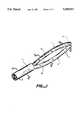
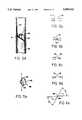
- FIG. 1is an isometric view of a device of the invention
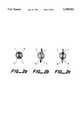
- FIGS. 2 (a) to (c)are cross-sections through the device shown in FIG. 1, taken at lines A--A, B--B and C--C respectively;
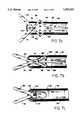
- FIGS. 3 (a) to (e)are elevational views of a first embodiment of the device shown in FIG. 1 at various stages during a cutting operation;
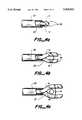
- FIGS. 4 (a) to (c)are elevational views, partially in section, of another embodiment of the device at various stages during a cutting or grasping operation.
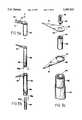
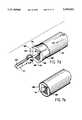
- FIGS. 5 (a) to (e)illustrate an embodiment of a device in accordance with this invention in which the end portions and body portions of the elongate elements are integral and are moved by a rotational actuator made of a material other than a pseudoelastic material.
- FIGS. 6 (a) to (e)illustrate representative cross sections of end portions of the elements adapted to grasp or cut an object.
- FIGS. 7 (a) to (e)illustrate various actuating means which function to cause the elements to splay apart and come together and, optionally, rotate the elements, and/or withdraw the elements into or out of the hollow component.
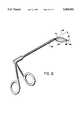
- FIG. 8illustrates an embodiment of the device of this invention in which the end portions are curved when at least partially unconstrained and pinned together pivotally at their tips.
- FIG. 9demonstrates a method of using a grasping device of this invention.
- FIGS. 10 (a) to (c)illustrate an embodiment of the device of this invention in which the elements are splayed and in which the body portions of the elements are bent when the elements are unconstrained.
- FIGS. 11 (a) and (b)illustrate a device of this invention in which the elements have end portions beyond a pivot point, and in which the body portions of the elements are of pseudoelastic material and when unconstrained are bent to splay the end portions and position them at a desired angle with respect to the hollow component.
- the body portionsact as actuating means to open and close the end portions of the elements to dissect, grasp and/or cut an object.
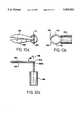
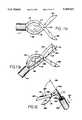
- FIG. 12illustrates a device similar to the device in FIG. 11(b), but in which the body portions of the elements are made of a pseudoelastic material and have a bend of about 90°.
- FIG. 13illustrates another device in accordance with this invention.
- the device of this inventioncomprises a hollow elongate component and two elongate elements.
- the hollow componentis tubular. This has the advantage that the device can be operated remotely.
- the material of the hollow componentmay be polymeric. It may be flexible or rigid. If made of polymeric material, the material may be reinforced, for example, with fibers, to enable it to withstand the forces exerted on it by the elements while they are constrained within and deformed by the component.
- a suitable polymeric material for the componentis, for example, polytetrafluoroethylene, reinforced with braided fibers.
- the material of the hollow componentmay be metallic, for example stainless steel.
- a preferred hollow componentis an elongate tube, preferably formed from stainless steel. The elongate hollow component can be, for example, a tubular housing, cannula, catheter or sheath.
- the hollow componentmay be circular in cross-section which can have the advantage that it permits deformation of the elements substantially uniformly in all directions. Other cross-sections may be preferable in some situations. For example, it can be advantageous to use a hollow component which has the same shape in cross-section as the elements which are received within it, to minimize twisting of the elements relative to one another.
- the elementsare at least partially formed from a pseudoelastic material, such as a shape memory alloy that exhibits pseudoelasticity.
- a pseudoelastic materialsuch as a shape memory alloy that exhibits pseudoelasticity.
- Shape memory alloys which exhibit superelasticityalso referred in the literature as non-linear pseudoelasticity
- These elementscan be designed (using appropriately treated alloys and appropriate dimensions) such that when they are loaded beyond a certain amount, the elements will tend to deform with a concomitant austenite to stress-induced-martensite phase change, instead of merely presenting a greater resistance with limited deformation to the load, which is seen with conventional metals.
- U.S. Pat. No. 4,935,068, of Duerigwhich is commonly assigned with the present application and incorporated herein by reference, teaches the fundamental principles of shape memory alloys. Some alloys which are capable of transforming between martensitic and austenitic phases are able to exhibit a shape memory effect. The transformation between phases may be caused by a change in temperature. For example, a shape memory alloy in the martensitic phase will begin to transform to the austenitic phase when its temperature rises above A s and the transformation will be complete when the temperature rises above A f . The forward transformation will begin when the temperature drops below M s and will be complete when the temperature drops below M f . The temperatures M s , M f , A s , and A f define the thermal transformation hysteresis loop of the shape memory alloy.
- shape memory alloysexhibit pseudoelasticity, which does not rely on temperature change in order to accomplish shape change.
- a pseudoelastic alloyis capable of being elastically deformed far beyond the elastic limits of conventional metals.
- Superelasticityarises in appropriately treated alloys while they are in their austenitic phase at a temperature which is greater than A s and less than M d (A s is the temperature at which, when a shape memory alloy in its martensitic phase is heated, the transformation to the austenitic phase begins, and M d is the maximum temperature at which the transformation to the martensitic phase can be induced by the application of stress).
- a sis the temperature at which, when a shape memory alloy in its martensitic phase is heated, the transformation to the austenitic phase begins
- M dis the maximum temperature at which the transformation to the martensitic phase can be induced by the application of stress.
- Superelasticitycan be achieved when the alloy is annealed at a temperature which is less than the temperature at which the alloy is fully recrystallized.
- Alternative methods of creating superelasticity in shape memory alloyssuch as solution treating and aging, or alloying, are also discussed in "An Engineer's Perspective of Pseudoelasticity",
- An articlemay be provided with a desired configuration by holding it in that configuration during annealing, or during solution treatment and aging.
- An article formed from an alloy which exhibits superelasticitycan be deformed substantially reversibly by 11% or more.
- “linear pseudoelasticity”is believed not to be accompanied by a phase change. It is exhibited by shape memory alloys which have been cold worked or irradiated to stabilize the martensite, but have not been annealed in the manner discussed above.
- An article formed from an alloy which exhibits linear pseudoelasticitycan be deformed substantially reversibly by 4% or more.
- the treatment of shape memory alloys to enhance their pseudoelastic propertiesis also discussed in above-mentioned U.S. Pat. No. 4,935,068 to Duerig, incorporated herein by reference.
- the alloy that is used in the devices of this inventionmay exhibit either linear pseudoelasticity or superelasticity (which is sometimes referred to as non-linear pseudoelasticity), or pseudoelasticity of an intermediate type, it is generally preferred that it exhibit superelasticity because of the large amount of deformation that is available without the onset of plasticity.
- U.S. Pat. No. 4,665,906 to Jerviswhich is commonly assigned with the present application and is incorporated herein by reference, teaches the use of pseudoelastic shape memory alloys in medical devices.
- the pseudoelastic materialwill be selected according to the characteristics desired of the article.
- a shape memory alloyit is preferably a nickel titanium based alloy, which may include additional elements which might affect the yield strength that is available from the alloy or the temperature at which particular desired pseudoelastic characteristics are obtained.
- the alloymay be a binary alloy consisting essentially of nickel and titanium, for example 50.8 atomic percent nickel and 49.2 atomic percent titanium, or it may include a quantity of a third element such as copper, cobalt, vanadium, chromium or iron. Alloys consisting essentially of nickel, titanium and vanadium, such as disclosed in U.S. Pat. No.
- Copper based alloysmay also be used, for example alloys consisting essentially of copper, aluminum and nickel; copper, aluminum and zinc; and copper and zinc.
- An article exhibiting superelasticitycan be substantially reversibly deformed, by as much as eleven percent or more.
- a 1.00 meter length of superelastic wiremay be stretched to 1.11 meters in length, wherein its alloy will undergo a phase change to at least a partially more martensitic phase known as stress-induced-martensite. Upon release of the stress, the wire will return substantially to its 1.00 meter length, and its alloy will, correspondingly, return at least substantially toward its more austenitic phase.
- a similar wire of spring steel or other conventional metalmay only be elastically stretched approximately one percent, or to 1.01 meter in length.
- any further stretching of the conventional wireif not resulting in actual breakage of the wire, will result in a non-elastic (plastic) transformation such that, upon relief of the stress, the wire will not return to its original length.
- Linear pseudoelastic and superelastic materialsmay also be bent, twisted, and compressed, rather than stretched, to a far greater degree than conventional metals.
- the superelastic propertyis achieved by phase transformation within the alloy, rather than by the dislocation movements which occur during the plastic deformation of ordinary metals.
- a superelastic materialmay be deformed and released thousands of times, without being subject to breakage due to the metal fatigue which limits the number of deformation cycles which an ordinary metal may undergo without failure.
- the device of the inventionhas the advantage that, by use of elongate elements formed at least partially from a pseudoelastic material which can be deformed, it can be used in applications in which there is a limited amount of space. Furthermore, the device can be operated remotely or at an angle more conveniently than many previously used devices.
- At least one of the end portions of the elongate elementsis formed from a pseudoelastic material, preferably a pseudoelastic shape memory alloy, and that end portion may have a curved configuration when not constrained and can be deformed into a straightened configuration when within a constraint, such as a hollow component.
- the term "straightened configuration"means that the configuration of the element is straighter when deformed than it is when not deformed. This may be used in dissection (the separation of tissues).
- the end portions of the elongate elementsare formed from a pseudoelastic material, preferably a pseudoelastic shape memory alloy, and are deformed into a straightened configuration when within the hollow component and curve at an angle to the end of the component when extended therefrom.
- the end portions of the elongate elementsare formed from a pseudoelastic material, preferably a pseudoelastic shape memory alloy, and are deformed into a curved configuration when within the component and are substantially straight when extruded from the component.
- the body portion of one or both of the elongate elementsis formed from a pseudoelastic material, preferably a pseudoelastic shape memory alloy, and the body portion of the element becomes curved on exiting the component, thereby splaying the end portion away from the other end portion.
- an actuating meanswhich may be formed from a pseudoelastic material, preferably a pseudoelastic shape memory alloy, can be provided to splay the end portions apart from one another and/or to move them toward one another. In such embodiments, it is not necessary for the elongate elements to be formed from a pseudoelastic material.
- At least a portion of at least one, preferably each, of the elongate elementsis formed from a pseudoelastic material, preferably a pseudoelastic shape memory alloy.
- a shape memory alloy which exhibits pseudoelasticityhas the advantage that the amount of elastic deformation that is available is large compared with that available from many other materials.
- the end portion of one or both of the elementsis formed from a pseudoelastic shape memory alloy.
- a section of the body portion of one or both of the elementsis formed from a pseudoelastic shape memory alloy.
- the end and body portions of the elongate elementsmay be formed from the same material, for example, both may be formed from a shape memory alloy, for convenience. Frequently, however, it may be preferable to use different materials because of the different functions that the end and body portions might have to serve.
- the end portionsmay be of stainless steel or the like to provide a sharp cutting edge or a cutting edge of stainless steel may be provided on a part of end portions formed from a sharp memory alloy.
- the cross-sections of the end and body portionswill generally be different, although this need not necessarily be the case.
- the end portionsmay be rectangular to present a grasping surface or triangular to present a cutting surface, and the body portions may be rectangular for rigidity.
- the end portions of the elongate elementsare pivotally connected to one another towards their free ends. This minimizes the possibility of an object becoming dislocated from the device before it is grasped or cut.
- the devicemay then be used to move an object once it has been positioned between the elements. This can also be achieved when the elements are not joined together at their free ends, but with less control in some situations.
- the elementsWhen the elements are not connected directly at their free ends, they may be connected by a flexible component which extends between the end portions of the elements so as, together with the end portions of the elements, to form a closed loop. Leaving the elements unattached at their free ends can facilitate positioning the device so that the object is located between the elements.
- the tips of the free endsmay be blunt, especially when the elements are not attached at their free ends. Alternatively, the free ends may be pointed to facilitate dissection, for example.
- the end portions of the elongate elementsmay be provided with a cutting edge of a material other than a shape memory alloy.
- the cutting edgemay be inlaid in the end portion or can extend from the end portion of the device.
- the body portions of the elongate elementsare attached to one another.
- the elementsmay be attached to one another by adhesive material or by fasteners such as screws or rivets, or the elements may be formed as a single body of material.
- the elementsmay be attached to an elongate member by which they are moved longitudinally relative to the hollow component.
- such a membermay be hollow, at least at its end, and the elements may be received within the member.
- the elongate elementsmay be symmetrical when they are splayed outwardly apart, and preferably also when deformed inwardly. However, for some applications, it might be appropriate for the elements not to be symmetrical, or for the elements not to be deformed symmetrically (for example only one of the elements might be deformed), or both.
- the cutting surfaces of the elongate elementsmay abut one another in the manner of wire cutters, or they may cross one another in the manner of shears.
- the grasping surfaces of the elementsmay abut one another and be sufficiently blunt to avoid cutting the object to be grasped. Alternatively, the grasping surfaces need not be configured so as to contact each other in the manner of cutting devices.
- the object being graspedneed merely be entrapped between the end portions of the elements.
- the grasping surfacesmay be ridged or contain protuberances to assist in grasping the object.
- an objectmay be grasped or cut using the device of the invention by bringing the device and the object together while the elongate elements are positioned at least partially within the component, and by then moving the hollow component and the elements longitudinally relative to one another, so that the end portions of the elements extend from the object and become splayed outwardly.
- This actioncan be used to spread or dissect surrounding material from the object, if desired, to isolate the object.
- the objectcan then be positioned between the elements to be grasped or cut in accordance with the method described above.
- the deviceis provided with means for actuating the end portions of the elongate elements, which are not necessarily formed from a pseudoelastic.
- actuating meansare described more fully below with reference to the drawings and include rack and pinion means, pin and slot means, four-bar linkages and the like.
- the actuating meansmay be formed of a pseudoelastic material.
- the actuating meansmay permit the elements to be rotated.
- the actuating meansmay also provide suitable means for irrigating the elements, or conduct electrical current to one or both of the elements, if desired.
- the devicewill be particularly useful in applications in which access to an object to be dissected, cut or grasped is restricted, for example in medical applications in which the object to be dissected, cut or grasped is a part of a human or animal body.
- the elongate elementsmay be positioned in the body by means of a hollow component in the from of a cannula, catheter or sheath introduced, for example, through an opening into a body cavity.
- the devicemay be arranged so that the axis on which the elements dissect, cut and/or grasp the object is not coaxial with the axis of at least a significant portion of the hollow component.
- Thismay be arranged, for example, by providing the elongate elements with a suitable bend.
- the elementsmay be deformed from their bent configuration towards their straight configuration, and held in the straight configuration, by the hollow component while they are within it.
- itmay be arranged by use of a hollow component which is bent towards the end from which the elements extend.
- the devicemay also be useful in the assembly of mechanical, electrical or other equipment, for example by means of robots.
- FIGS. 1 and 2show a cutting or grasping device which comprises two elongate elements 1 and 3, each having a body portion 5 and an end portion 7.
- the end portionsare joined together pivotally at their free ends by a pin 9.
- the end portionspreferably have a triangular cross-section, where the apex of the triangle provides a cutting surface 10.
- any flat cross-sectional areamay present a grasping surface.
- Other possible cross-sectional areasare illustrated in FIGS. 6(a) to (e).
- the elongate elementsare preferably formed from a pseudoelastic material, preferably a shape memory alloy which has been treated so that it exhibits pseudoelasticity in the temperature range between ambient temperature and a temperature above body temperature.
- Elongate elements 1 and 3are located within an elongate housing 11 within which they can slide longitudinally, the housing preferably being a stiff tubular sheath.
- the elongate elementscan be extended beyond the end of housing 11 by longitudinally moving them relative to housing 11 via any suitable manually operated mechanism.
- FIG. 2shows the cross-sectional configurations of elongate elements 1 and 3 at positions A--A, B--B, and C--C of FIG. 1, which illustrates the elongate elements splayed apart.
- FIG. 3 (a)shows a cutting device with elongate elements 1 and 3 restricted completely within housing 11, which holds the elongate elements in a deformed configuration inwardly towards one another.
- the housingis positioned as desired relative to an object to be cut (or dissected or grasped) while the elongate elements are in this configuration.
- the end portions 7 of the elongate elementsare caused to extend from the housing, by relative movement of the elements and the housing.
- end portions 7 of the elementssplay outwardly apart, as shown in FIG. 3 (b), allowing an object 15 to be positioned between them, as shown in FIG. 3 (c).
- Object 15is caused to engage the surfaces 10 of elongate elements 1 and 3. Relative longitudinal movement of the elongate elements and the housing will force at least parts of the elongate elements together, thereby grasping or cutting the object, as shown in FIGS. 3 (d) and 3 (e). If desired, object 15 can be moved by holding the housing and moving the elongate elements. If it is desired not to move object 15, the elongate elements are held fixed and the housing is moved. The elongate elements can be retracted into the housing for removal of the device from the site of the dissecting, cutting and/or cutting operation.
- end portions 7may represent sections of spherical surfaces to facilitate the splaying and closing. End portions 7 may be used to grasp, instead of cutting, tissues. The grasping function would be facilitated if end portions 7 do not have cutting surfaces 10, and if end portions 7 are not fully retracted back into housing 11. Furthermore, the splaying action of elongate elements 1 and 3 may be utilized to separate tissues for dissection.
- FIG. 4shows a device which comprises two elongate elements 21 and 23 that are preferably formed from a pseudoelastic material and more preferably a shape memory alloy which has been treated so that it exhibits superelastic behavior.
- the elementscan slide longitudinally within a tubular housing 25.
- FIG. 4 (a)shows the device with the elongate elements 21 and 23 positioned almost entirely within the tubular housing 25. Housing 25 constrains elongate elements 21 and 23 in straightened and deformed shapes.
- the elongate elements 21 and 23are moved longitudinally relative to housing 25, the elongate elements extend from the end of housing 25, as shown in FIGS. 4 (b) and 4 (c). As they extend from the end of housing 25, the elongate elements become unconstrained and recover toward their preset curved shapes pseudoelastically. They pseudoelastically splay outwardly so that they can receive an object 27 between them or, alternatively, be used to dissect surrounding material.
- the elongate elementsmay be interconnected indirectly towards their free ends 29 by a flexible component, such as a piece of wire 31, which helps to prevent dislocation of object 27 from between the elongate elements.
- Object 27is cut or grasped by relative movement between housing 25 and the elongate elements, such that the elongate elements become constrained within the housing, generally as described above with reference to FIG. 3.
- the splaying action of elongate elements 21 and 23may also be utilized to separate tissues for dissection. Elongate elements 21 and 23 may curve out of the plane of the paper.
- FIG. 5 (a)illustrates an embodiment of the invention in which elongate elements 51 and 52 are substantially planar and straight in their unconstrained shapes, but are located in a plane which deviates by an angle .o slashed. from a plane which includes the axis x--x of a hollow tube 53.
- elongate elements 51 and 52are attached to outer tube 53 and inner tube 55, respectively, as shown in FIG. 5 (b).
- the proximal end (i.e., the end opposite the elongate element 52) of inner tube 55is provided with a groove 58, and inner tube 55 is positioned within outer tube 53.
- the proximal end of outer tube 53is provided with a groove 59, which extends in a direction opposite to groove 58 of inner tube 55.
- Plunger 60is provided with a peg 60a. The plunger may be positioned at the proximal end of the tubes.
- the proximal ends 58p and 59p of grooves 58 and 59, respectively,are positioned such that they overlap and are engaged by peg 60a.
- plunger 60When plunger 60 is pushed into inner tube 55 in a distal direction toward the elongate elements, peg 60a engages grooves 58 and 59, causing tubes 53 and 55, and thereby the elongate elements 51 and 52, to rotate in opposite directions. Preferentially, this rotation would cause the elongate elements to rotate into a more overlapped configuration. The elongate elements can thereby grasp an object placed between them. If the elongate elements have cutting edges, they could thereby cut an object placed between them. When plunger 60 is withdrawn from inner tube 55 again, peg 60a could cause tubes 53 and 55 to rotate such that elongate elements 51 and 52 splay apart from their overlapped configuration. Elongate elements 51 and 52 could thereby be used to separate tissues for dissection.
- the angle .o slashed. between elongate elements 51 and 52 and tubes 53 and 55can be any number of degrees desired.
- the elongate elementsmay be curved, not only within the plane generally described by their plane of motion, but also out of the plane generally described by their plane of motion.
- the groovesmay be spiralled, and longer, such that elongate elements 51 and 52 could be caused to rotate in both directions of their overlapped position in one stroke of plunger 60.
- the groovesmay also be located anywhere along the lengths of tubes 53 and 55.
- peg 60amay be appropriately located anywhere along plunger 60.
- grooves 58 and 59could be made configured such that elongate elements 51 and 52 could be brought to their overlapped configuration by withdrawing plunger 60 in a proximal direction away from the elongate elements.
- FIG. 5 (c)shows one method of the attachment of elongate elements 51 and 52 onto inner and outer tubes 53 and 55, respectively.
- Elongate element 52is provided with aperture 63 which fits over stem 64, which is integral with or is secured to the distal end of inner tube 55.
- the length of stem 64is equal to or less than the thickness of elongate element 52.
- the cross-sectional shapes of aperture 63 and stem 64are preferably noncircular, and they may, for example, be square, serrated, notched, etc.
- Screw 65 and washer 66fasten elongate element 52 to inner tube 55. Washer 66 may have a beveled side to accommodate the angle .o slashed.
- the distal face of tube 55 and the distal face of stem 64should also be slanted (not shown) at .o slashed. relative to the axis x--x of tube 55.
- Elongate element 51is provided with an aperture 68 which fits over stem 69, which is integral with or is secured to the distal end of outer tube 53.
- the length of stem 69is preferably slightly greater than the thickness of elongate element 51, so that rotation of elongate element 51 relative to elongate element 52 is not hindered.
- the cross-sectional shapes of aperture 68 and stem 69are preferably noncircular, and they may, for example, be square, serrated, notched, etc.
- the distal face of tube 53 and the distal face of stem 69should be slanted (not shown) at an angle .o slashed. relative to the axis x--x of tube 53.
- Inner tube 55, with attached elongate element 52fits into outer tube 53.
- Elongate element 51will be captured between the base of stem 69 and elongate element 52.
- FIG. 5 (d)when elongate elements 51 and 52 are drawn into sheath 61 (shown in cross-section), they will be deformed in a direction more parallel to axis x--x. This deformation will be facilitated if elongate elements 51 and 52 are transversely curved along their longitudinal dimensions (i.e., trough shaped).
- the circumferences of elongate elements 51 and 52 along portions 81 and 83should preferably not extend beyond the outer diameter of outer tube 53.
- outer tube 53is extended distally beyond the end of sheath 61, elongate elements 51 and 52 will no longer be constrained, and they will elastically recover their preset shapes again. This deformation and shape recovery is enhanced if the elongate elements are made of a pseudoelastic shape memory alloy.
- FIG. 5 (e)is a bottom view of a possible embodiment of washer 66.
- Projection 62has an outer diameter which is equal to or smaller than the outer diameter of outer tube 53.
- the surface of projection 62, which holds elongate element 52,may be rough, or it may even have teeth or protrusions, in order to obtain a better grip on elongate element 52.
- Projection 62preferably encompasses less than half of the circumferential arc of washer 66.
- the remaining circumference of washer 66has a outer diameter which is equal to or smaller than the maximum diameter of the head of screw 65.
- the head of screw 65preferably has a diameter which is equal to or less than the smallest diametral dimension of stem 64. As shown in FIG.
- projection 62covers the back end of elongate element 52.
- elongate element 52and secondarily, elongate element 51, can be given as much bending length as possible when they are both constrained within sheath 61.
- the sides 33 and 34 of projection 62are preferably parallel to axis y--y, where axis y--y is perpendicular to the longitudinal dimension of elongate element 52 and is perpendicular to the axis of symmetry of washer 66. This will permit ready bending of elongate element 52 along a zone which is perpendicular to its longitudinal dimension.
- outer tube 53 and inner tube 55there may be any suitable means between outer tube 53 and inner tube 55 to prevent plunger 60 from pushing inner tube 55 out of outer 53 tube when plunger 60 is pushed in a distal direction in inner tube 55.
- Plunger 60can be pushed relative to sheath 61 and tubes 53 and 55 by any suitable manually operated mechanism. Examples of manually operated mechanisms include sliders, pistol grip handles, scissors handles, and syringe-plunger arrangements.
- FIG. 5An alternate version of the embodiment of FIG. 5 would have a stiff central rod slid along an inner longitudinal bore in the plunger.
- the elongate elementswould be attached to their respective tubes along one side of the wall of each tube, e.g. by welding or by longitudinally slitting the walls instead of being held by a screw.
- the central rodcould then be used to straighten the elongate elements (assuming the elongate elements do not have any apertures) and deform them to be more in line with the axis of the tubes.
- the cutting and grasping edgesmay be integral with the elements or may be formed separately and/or of different materials and attached thereto.
- FIG. 6 (a)illustrates grasping surfaces 71 and 72. Surfaces 71 and 72 may be flat or they may contain ridges, protrusions or the like to aid in gripping an object.
- FIG. 6 (b)illustrates shearing cutting edges 73 and 74 which cut an object by a shearing action.
- FIG. 6 (c)illustrates another pair of edges for cutting.
- FIG. 6 (c)surface 75 is flat, while edge 76 provides a sharp edge for cutting an object.
- FIG. 6 (d)illustrates cutting edges 77 and 78. Sharp edges 77 and 78 of the triangular cross-sections meet to permit cutting.
- FIG. 6 (e)illustrates cutting edges 80 and 82, which are at any desired angles a and ⁇ relative to the direction of opening and closing of the elongate elements.
- the cutting edges or gripping surfacescould be made of any material such as steel, diamond, plastic, etc., which is attached to the elongate elements.
- dissectioncould be performed by providing any suitable edge opposite edges 71-78 and 80 and 82 of FIGS. 6 (a)-(e).
- FIGS. 7 (a), (b), and (c)illustrate several different means of actuating elongate elements.
- the body portions of elongate elements 150 and 151are joined together at pivot 152.
- pivot 152is one end of a linkage composed of four links 153, 154, 155, and 156, which are pivotally connected to each other.
- Elongate elements 150 and 151are preferably rigidly attached to links 153 and 154, respectively.
- links 153 and 154may merely represent extensions of elongate elements 150 and 151, respectively.
- Pivot 152is preferably fixed to a cannula 159.
- the pivot 157 at the other end of the linkageis joined to rod 158.
- Rod 158When rod 158 is pushed in direction 301, pivot 157 is pushed closer to pivot 152. This will cause elongate elements 150 and 151 to splay apart. Since the transverse dimension of linkage 153, 154, 155, and 156 which is perpendicular to rod 158 becomes larger as pivot 157 approaches pivot 152, slots 160 and 161 may be provided in cannula 159 to permit pivot 157 to approach closer to pivot 152 if the transverse dimension of cannula 159 is small.
- Rod 158may be pushed (or pulled) relative to cannula 159 by any suitable manually operated mechanism. Examples of manually operated mechanisms include sliders, pistol grip handles, scissors handles, and syringe-plunger arrangements.
- Elongate elements 150 and 151may be constrained in deformed and straightened shapes within a sheath 162. This will permit compact and relatively atraumatic entry into a body. Rod 158 can then be pushed axially in direction 301 within sheath 162. The linkage 153, 154, 155, and 156 will partially extend through slots 160 and 161 in cannula 159, but the inner surface of sheath 162 will prevent pivot 157 from fully approaching pivot 152. Therefore, cannula 159 will be forced to move in direction 301, and elongate elements 150 and 151 will extend from the end of sheath 162 in direction 301.
- slots 163 and 164are provided in sheath 162 to permit rod 158 to push pivot 157 fully toward pivot 152 in order to fully splay elongate elements 150 and 151 apart.
- Slots 163 and 164 in sheath 162may be made to overlap slots 160 and 161 in cannula 159 by simply extending cannula 159 far enough within sheath 162, or by extending cannula 159 far enough within sheath 162 and then rotating sheath 162 relative to cannula 159 to allow the respective slots to coincide.
- Rod 158may then be used to splay or increasingly overlap elongate elements 150 and 151 as desired.
- Rod 158can be moved in direction 302 so that pivot 157 is moved as far away as possible from pivot 152. This will cause elongate elements 150 and 151 to be in their most overlapped configuration. Moving rod 158 further in direction 302 relative to sheath 162 will cause cannula 159 to slide in direction 302, and will cause elements 150 and 151 to be drawn into straightened (i.e. non-curved) shapes within sheath 162. This will permit the entire assembly to be withdrawn from the body in a compact and relatively atraumatic fashion.
- the passive (reference) member of the manually operated mechanismwould preferably be mounted to sheath 162.
- the extension and withdrawal of elongate elements 150 and 151 from or into sheath 162can be accomplished by utilizing an expanded stroke of the same manually operated mechanism which is used to splay or increasingly overlap elongate elements 150 and 151.
- a meansmust be provided to prevent cannula 159 from sliding beyond a certain location within sheath 162 in direction 301.
- a meansmay be provided to minimize relative motion between cannula 159 and sheath 162 while the linkage is being used to repeatedly move elongate elements 150 and 151 toward their splayed or overlapped configurations.
- the manually operated mechanismwould preferably permit axial rotation of the entire assembly of sheath 162 and its contents relative to the manually operated mechanism, so that elongate elements 150 and 151 can be oriented in any desired direction relative to the manually operated mechanism.
- FIG. 7 (b)shows an embodiment in which elongate elements 150 and 151 have a pivot 165 and body portions 166 and 167, respectively.
- Body portions 166 and 167have slots 168 and 169, respectively.
- a rod 190has a peg 191 which is oriented to slideably engage slots 168 and 169.
- Pivot 165is fixed to the cannula 192, and slots 168 and 169 are preferably oriented so that motion of rod 190 in direction 310 will urge elongate elements 150 and 151 toward their overlapped configuration, and motion of rod 190 in direction 320 will splay elongate elements 150 and 151 apart.
- Cannula 192may be substantially the same as cannula 159 shown in FIG. 7 (a).
- a sheath 193, which may substantially be the same as sheath 162 shown in FIG. 7 (a),can be utilized. The function and use of the embodiment shown in FIG. 7 (b) is then substantially the same as the embodiment shown in FIG. 7 (a).
- a variation of the embodiment illustrated in FIG. 7 (b)would include elongate elements in which the slots are placed distal to the pivot point between the elongate elements. (That is, the slots are located between the pivot point and the tips of the elongate elements). Body portions 166 and 167 as shown in FIG. 7 (b), and slots 160, 161, 163, and 164 as shown in FIG. 7 (a) may then not be necessary. However, the actuating rod (such as rod 190 shown in FIG. 7 (b)), would have to be designed so that it does not interfere with the pivot point between the elongate elements.
- FIG. 7 (c)shows another embodiment in which the elongate elements 150 and 151 may be made to splay apart or increasingly overlap each other.
- Elongate elements 150 and 151are hinged at pivot 170, which is preferably fixed to a cannula 176.
- elongate elements 150 and 151each have a rounded body portion with teeth along edges 171 and 172, respectively. The teeth engage the corresponding grooves located in jaws 173 and 174 of sliding member 175.
- the degree of splaying or overlapping of elongate elements 150 and 151may be limited by limiting the lengths of edges 171 or 172 which are toothed.
- the degree of splaying or overlapping of elongate elements 150 and 151may be limited by limiting the lengths of the grooved zones in jaws 173 and 174.
- Sliding member 175is moved in direction 303 or 305 by any suitable manually operated mechanism. Examples of manually operated mechanisms include sliders, pistol grip handles, scissors handles, and syringe-plunger arrangements. Elongate elements 150 and 151 are preferably moved toward their overlapped configuration when sliding member 175 is moved in direction 303 and moved toward their splayed apart configuration when sliding member 175 is moved in direction 305 (not shown).
- toothed edges 171 and 172can be located on elongate elements 150 and 151 such that moving sliding member 175 in direction 303 moves elongate elements 150 and 151 toward their splayed configuration and moving sliding member 175 in direction 305 moves elongate elements 150 and 151 toward their overlapped configuration (not shown).
- Elongate elements 150 and 151may be constrained in straightened shapes within a sheath 178. This will permit compact and relatively atraumatic entry into a body. Sliding member 175 can then be moved in direction 303 relative to sheath 178 in order to extend elongate elements 150 and 151 from the end of the sheath. In the preferred mode, this motion will also tend to keep elongate elements 150 and 151 in their overlapped configuration without splaying these elements apart in the wrong direction. (As described above, toothed edges 171 and/or 172 and/or the jaws 173 and/or 174 can be designed to prevent splaying in the wrong direction).
- Elongate elements 150 and 151can then be repeatedly moved toward their splayed configuration or their overlapped configuration by moving sliding member 175 in directions 305 or 303, respectively, and a means may be provided to minimize relative motion between cannula 176 and sheath 178 during this repetitive motion.
- Elongate elements 150 and 151can be withdrawn back inside sheath 178 by forcibly moving sliding member 175 in direction 305 relative to sheath 178.
- the end of sheath 178would force elongate elements 150 and 151 into their overlapped configuration, as well as forcing elongate elements 150 and 151 into straightened shapes into sheath 178 in order to permit the entire assembly to be withdrawn from a body in a compact and relatively atraumatic fashion.
- sheath 178can be extended over elongate elements 150 and 151 to straighten these elements into sheath 178 and to permit the entire assembly to be withdrawn from a body in a compact and relatively atraumatic fashion.
- a sheath 178it could be mounted to the passive (reference) member of the manually operated mechanism.
- the extension and withdrawal of elongate elements 150 and 151 from or into sheath 178can be accomplished by utilizing an expanded stroke of the same manually operated mechanism which is used to move sliding member 175 in order to splay or increasingly overlap elongate elements 150 and 151.
- this mechanismwould preferably permit axial rotation of the entire assembly of sheath 178 and its contents relative to the manually operated mechanism.
- FIG. 7 (d)shows how sliding member 175 could be configured around a pivot fixing member 185, which has holes 181 and 182.
- Elongate elements 150 and 151are rotatably mounted on a pin 180.
- the ends of pin 180can be placed into holes 181 and 182 when sheath 178 is pulled back in direction 400, since the ends of sliding member 175 and the ends of pivot fixing member 185 can gently splay apart when they are not held within sheath 178.
- sheath 178is moved back in direction 401, elongate elements 150 and 151 will be securely held when pin 180 is within sheath 178.
- the end of pivot fixing member 185 which has holes 181 and 182can be fork shaped.
- a meansis provided which minimizes motion of pivot fixing member 185 relative to sheath 178 when sliding member 175 is utilized to repeatedly move elongate elements 150 and 151 toward their splayed or overlapped configurations.
- FIG. 7 (e)shows the device before sheath 178 is pulled back to permit insertion of elongate elements 150 and 151.
- pin 180is preferably longer that the dimension between the two fork ends of pivot fixing member 185, so that pin 180 is firmly locked into place.
- the elongate elementsare preferably made of a pseudoelastic material, preferably a pseudoelastic shape memory alloy.
- the unconstrained shapesmay be curved in directions away from the general planes of the body portions of the elongate elements (e.g. out of the plane of the paper).
- the elongate elementscan be used for cutting, grasping, and/or dissecting tissues.
- the end portions of the elongate elementscan be fashioned appropriately for any of these functions, or separate appropriately designed parts may be attached to the end portions of the elongate elements.
- FIG. 8shows a cutting device, similar to the device shown in FIG. 1, with curved elongate elements 91 and 93 extended from a housing 92.
- Angle 94is defined by the axis 95 of housing 92 and the straight line 96 which passes through the point of intersection of axis 95 with the distal end of housing 92 and the pin 99.
- Angle 94can be any desired angle, even greater than 90 degrees, thus permitting dissecting, cutting and/or grasping in a direction off axis 95. This provides access to difficult to reach locations in the body.
- Elongate elements 91 and 93are preferably shaped so that they circumscribe spherical arcs which allow the elements to engage each other and perform the cutting or grasping function, either as they are retracted back into housing 92, or as housing 92 is extended over the elongate elements.
- the portions of elongate elements 91 and 93 which enter housing 92assume a less curved shape.
- Elements 91 and 93may be formed of a pseudoelastic material, preferably a pseudoelastic shape memory alloy.
- FIG. 9shows a device in which elongate elements 102 and 106, preferably made of a pseudoelastic material and more preferably a superelastic shape memory alloy, are first held constrained in straightened and deformed shapes inside a cannula 103. This permits compact placement into a body through tissue incision or orifice 108. Elongate elements 102 and 106 are then extended out of cannula 103 by moving elongate elements 102 and 106 in direction 501 relative to cannula 103. Since at least part of extended elongate elements 102 and 106 are no longer constrained, they will splay apart due to recovery of the pseudoelastic material into its preset curved unconstrained shape.
- elongate elements 102 and 106preferably made of a pseudoelastic material and more preferably a superelastic shape memory alloy
- Cannula 103can be then be extended onto elongate elements 102 and 106 to force these elements to approach each other.
- elongate elements 102 and 106can be withdrawn back into cannula 103 to force these elements to approach each other.
- the tips of elongate elements 102 and 106can be used to grasp tissue 107 or an object.
- the grasping function of elongate elements 102 and 106can be enhanced by providing the end portions of these elements with bends 104 and 105, teeth (not shown), or the like at their tips.
- Elongate elements 102 and 106may also be ribbed or toothed along their entire lengths (not shown). The described mode of action may permit the instrument to be used multiple times in each location.
- the large pseudoelastic deformationpermits much wider splaying of elongate elements 102 and 106 over a much shorter distance 109 than would be possible with conventional metals. This permits working in more confined spaces, particularly in endoscopic or laparoscopic surgery.
- a variation of this embodimentmay include more than two elongate elements.
- Shape memory alloyshave a special feature which is beneficial for any of the embodiments of this invention, but in particular for any of the embodiments in which a grasping action is desired (especially in the embodiment shown in FIG. 9).
- a superelastic shape memory alloyAs a superelastic shape memory alloy is increasingly deformed from its unloaded shape, some of its austenitic phase changes into stress-induced-martensite. The stress strain curve presents a plateau during this phase change. This means that while the alloy undergoes this phase change, it can deform greatly with only minimal increases in loading. Therefore, elongate elements comprising superelastic shape memory alloys have a built-in safety feature.
- These elementscan be designed (using appropriately treated alloys and appropriate dimensions) such that when they are loaded beyond a certain amount, the elements will tend to deform with a concommitant austenite to stress-induced-martensite phase change, instead of merely presenting a greater resistance with limited deformation to the load, which is seen with conventional metals.
- FIGS. 10 (a), (b), and (c)illustrate three views of another embodiment.
- elongate elements 121 and 123are extended outside the housing 120, they splay outward causing end portions 122 and 124 to separate also.
- end portions 122 and 124are partially withdrawn into housing 120, they cause end portions 122 and 124 to approach each other.
- elongate elements 121 and 123are further withdrawn into housing 120, the sections 121e and 123e of elongate elements 121 and 123 are forced to deform into straightened shapes in order to pass into housing 120, thus causing the direction of orientation of end portions 122 and 124 to approach the direction of axis 126 of housing 120, and the angle 125 approaches zero degrees (angle 125 is defined by axis 126 of housing 120 and the plane of end portions 122 and 124). End portions 122 and 124 may also be fully or partially withdrawn into housing 120, if desired.
- the straight configurationpermits easy placement and/or removal of the instrument into or from a body in a compact and relatively atraumatic fashion. However, with elongate elements 121 and 123 in a completely extended position, angle 125 permits access to difficult to reach locations.
- the body portions of elongate elements 121 and 123are preferably made of a pseudoelastic material and more preferably a superelastic shape memory alloy.
- sections 121e and 123emay be the only parts of elongate elements 121 and 123 which are made of a pseudoelastic material.
- End portions 122 and 124may also be made of a pseudoelastic material, but they could be made of any suitable material, even if elements 121 and 123 are made at least in part of a pseudoelastic material.
- End portions 122 and 124may have a cutting function or a grasping function.
- end portions 122 and 124may be curved. They may also be used to separate (dissect) tissues. The described mode of action may permit the instrument to be used multiple times in each location.
- FIGS. 11 (a) and 11 (b)show embodiments similar to the embodiments shown in FIGS. 1 and 8, respectively.
- the elongate elements 131 and 133extend beyond the pin 139 in order to provide end portions 135 and 134.
- End portions 135 and 134may be unitary extensions of elongate elements 131 and 133 or they may be separate portions bolted or attached to elongate elements 131 and 133.
- the action of withdrawing elongate elements 131 and 133 into housing 111closes and deforms body portions 117 and 116, and the scissor action is transmitted to end portions 135 and 134.
- FIG. 11 (b)illustrates a curved version of FIG. 11 (a).
- the angle 112is defined by the axis 113 of housing 111 and the straight line 114 passing through the point of intersection of axis 113 with the distal end of the housing and pin 139.
- Angle 112can be any number of degrees, even greater than 90 degrees, thus permitting dissection, cutting and/or grasping in a direction off axis 113. This provides access to difficult to reach locations within a body.
- body portions 116 and 117are preferably made of a pseudoelastic material, preferably a superelastic shape memory alloy.
- end portions 134 and 135may be made of a pseudoelastic material, but these end portions could be made of any suitable material, even if body portions 116 and 117 are made of a pseudoelastic material.
- End portions 134 and 135may have a cutting function or a grasping function. They may also be used to separate and dissect tissues. The described mode of action may permit the instrument to be used multiple times in each location.
- FIG. 12illustrates another embodiment similar to the embodiment shown in FIG. 11 (b).
- Body portions 141 and 143 of elongate elements 119 and 118are used to create both a scissors action through a pinned location 149 and also to provide the ability to direct the scissor action at an angle of about ninety degrees off the axis 148 of housing 140.
- Elongate elements 119 and 118splay apart when they are outside of housing 140.
- sections 141e and 143emove toward one another. This action in turn causes the end portions 146 and 147 to approach each other in a scissor fashion by pivoting around pin 149, which is substantially parallel to axis 148.
- housing 140Because the relative movement of housing 140 in directions 144 and 145 is perpendicular to end portions 146 and 147, the position of these end portions is unchanged with respect to the tissue location. After end portions 146 and 147 have closed, withdrawal of elongate elements 119 and 118 into housing 140 (or moving housing 140 in direction 144 relative to elongate elements 119 and 118) causes sections 141e and 143e to straighten from their curved shapes. This permits end portions 146 and 147 to generally align with axis 148 of housing 140. End portions 146 and 147 may also be fully or partially withdrawn into housing 140, if desired. The straight configuration permits easy placement and/or removal of the instrument from a body in a compact and relatively atraumatic fashion.
- body portions 141 and 143 of elongate elements 119 and 118are preferably made of a pseudoelastic material, more preferably a superelastic shape memory alloy.
- sections 141e and 143emay be the only parts of body portions 141 and 143 which are made of pseudoelastic material.
- End portions 146 and 147may also be made of pseudoelastic material, but they could be made of any suitable material, even if body portions 141 and 143 are made at least in part of a pseudoelastic material.
- End portions 146 and 147may have a cutting function or a grasping function. They may also be used to separate (dissect) tissues. The described mode of action may permit the instrument to be used multiple times in each location.
- a variation of the embodiment shown in FIG. 12would still have the bent portions 141e and 143e, but would have end portions 146 and 147 in a plane which is parallel to axis 148, so that pivot 149 is perpendicular to axis 148.
- moving body portion 141 in direction 144 and/or moving body portion 143 in direction 145would tend to splay end portions 146 and 147 apart.
- Moving body portion 141 in direction 145 and/or moving element 143 in direction 144would tend to bring end portions 146 and 147 into a more overlapped configuration.
- the body portions of the elongate elementsact as the actuating means for the end portions of the elongate elements.
- body portions 141 and 143would preferably be either round or made of flat material oriented in a plane perpendicular to the plane of end portions 146 and 147. If body portions 141 and 143 are made of flat material, they may include a 90 degree twist in the material between sections 141e and 143e and end portions 146 and 147, respectively.
- FIG. 13shows a device of this invention in which the elongate elements 186 and 187 are bent, preferably about 90 degrees, relative to the longitudinal axis of housing 188.
- the elongate elementsare slid longitudinally along the axis of housing 188 by means of any suitable manually operated mechanism in order to separate end portions 183 and 184 from each other or to bring end portions 183 and 184 toward each other or even in contact with each other.
- End portions 183 and 184can have any suitable surfaces in order to permit dissection, cutting, and/or grasping.
- Elongate elements 186 and 187are preferably made of a pseudoelastic material, more preferably a superelastic shape memory alloy.
- End portions 183 and 184may be made of any suitable material, whether it is pseudoelastic or not.
- both of the elongate elementsare actuated by the manually operated mechanism, so that dissection, cutting, and/or grasping is done by an equal symmetrical motion of each elongate element.
- any suitable manually operated mechanismmay be utilized to move the elongate elements.
- Possible mechanismsinclude sliders, pistol grip handles, scissors handles, and syringe-plunger arrangements.
- a meansis preferably provided to prevent any undesired axial rotation of the elongate elements relative to the manually operated mechanism while the manually operated mechanism is being used to splay or overlap the elongate elements.
- a suitable meansmay be provided for passing a fluid (liquid or gas) through the device for irrigation, aspiration, insufflation, etc.
- electricitymay be passed to one or both end portion(s) of the elongate element(s) for purposes of electrocautery or electrocutting.
- the tips (of the end portions) of the elongate elementsmay be pointed or blunt. Pointed tips may facilitate the use of the device of this invention in the separation (dissection) of tissues, while blunt tips would minimize the risk of any undesired trauma that the tips could inflict upon tissues.
Landscapes
- Health & Medical Sciences (AREA)
- Life Sciences & Earth Sciences (AREA)
- Surgery (AREA)
- Engineering & Computer Science (AREA)
- Molecular Biology (AREA)
- Public Health (AREA)
- Veterinary Medicine (AREA)
- Biomedical Technology (AREA)
- Heart & Thoracic Surgery (AREA)
- Medical Informatics (AREA)
- General Health & Medical Sciences (AREA)
- Animal Behavior & Ethology (AREA)
- Nuclear Medicine, Radiotherapy & Molecular Imaging (AREA)
- Orthopedic Medicine & Surgery (AREA)
- Vascular Medicine (AREA)
- Mechanical Engineering (AREA)
- Pathology (AREA)
- Forests & Forestry (AREA)
- Ophthalmology & Optometry (AREA)
- Reproductive Health (AREA)
- Surgical Instruments (AREA)
Abstract
Description
This application is a continuation-in-part of application Ser. No. 07/594,770, filed Oct. 9, 1990 which in turn is a continuation-in-part of application Ser. No. 07/394,463 filed Aug. 16, 1989, both abandoned the entire disclosures of each of said applications are incorporated herein by reference.
This invention relates to a device and to a method of dissecting, grasping or cutting an object.
Many devices which are used commonly for grasping or cutting objects have two elements which can be moved towards one another and away from one another. The elements have surfaces which may be blunt or sharp so that an object positioned between them may be either grasped or cut when the elements are moved towards one another. Examples of such devices include tongs, tweezers, forceps, scissors, guillotines, and wire cutters. Such devices can also be adapted to dissect tissue, for example, by placing the elements of the device into or next to an object and then causing the elements to splay apart thereby dissecting the object.
The elements of such devices are generally rigid, and are moved relative to one another pivotally. The combined requirements that the elements be rigid and capable of pivotal movement can preclude their use in situations where there is a limited amount of space. Furthermore, it can be difficult to manipulate such devices remotely or at angles. These factors tend to make it difficult to use such devices within the body of an animal or human undergoing surgery, especially during less invasive surgical techniques, such as arthroscopy, endoscopy and laproscopy. During such surgery, it may be necessary to grasp and move tissue, for example, to expose an underlying site, to dissect tissue from surrounding tissue, and/or to cut diseased or damaged tissue.
In these less invasive surgical procedures, elongate housings have been developed to position the instrument or device into the body through a minimal incision. Example of such devices are disclosed in U.S. Pat. Nos. 2,670,519 to Recklitis, 2,114,695 to Anderson, 2,137,910 to Anderson, 3,404,677 to Springer, 3,491,747 to Robinson, 4,218,821 to Schneider, 4,423,729 to Gray, 4,612,708 to Hattori, 4,656,999 to Storz, 4,678,459 to Onik, 4,768,505 to Okada et al, European Patent No. 380,874 to Bencini and German Patents Nos. 1,266,446 to Fischer and 3,732,236 to Baumgart.
It has now been discovered that one or more elements of such grasping or cutting devices can be formed from a pseudoelastic material, preferably a pseudoelastic material, such as a shape memory alloy, which is capable of being greatly deformed without permanent deformation, to provide an improved device that can be more readily used in applications in which there is a limited amount of space. Furthermore, the device can be operated remotely or at angles more conveniently than previously used devices. The device, with appropriately configured edges can also be used to dissect tissue.
It has been proposed to make medical devices from pseudoelastic materials, but such prior art devices typically do not have elements which are splayed apart and then, preferably moved toward one another in the manner necessary in dissecting, grasping or cutting devices, such as forceps, scissors or the like. Further, prior art devices using pseudoelastic materials do not have elements which are near one another and then splay apart to separate or dissect tissue. Descriptions of medical devices made from pseudoelastic materials can be found in U.S. Pat. Nos. 4,616,656 to Nicholson et al, 4,665,906 to Jervis, 4,898,156 to Gatturna et al, 4,899,743 to Nicholson et al and 4,926,860 to Stice et al, the disclosures of which are incorporated herein by reference.
In one aspect, the present invention provides a device for dissecting an object which comprises at least two elongate elements, positioned alongside one another, each having a body portion and an end portion, the end portions of the elements:
i being capable of being splayed apart from one another when free of transverse constraint to dissect said object from surrounding material; and
ii being capable of being moved toward one another;
wherein a portion of at least one of the elements is formed from a pseudoelastic material.
In another aspect, the present invention provides a device for grasping or cutting an object which comprises at least two elongate elements, positioned alongside one another, each having a body portion and an end portion, the end portions of the elements:
(i) being capable of being splayed outwardly apart from one another when free of transverse constraint and presenting grasping or cutting surfaces to an object to be grasped or cut that is placed between them; and
(ii) being capable of being moved inwardly towards one another to grasp or cut said object;
wherein a portion of at least one of the elements is formed from a pseudoelastic material.
A further aspect of this invention comprises a device for dissecting an object which comprises
a. at least two elongate elements, positioned alongside one another, each having a body portion and an end portion, the end portions of the elements:
i. being capable of being splayed apart from one another when free of transverse constraint for dissecting said object from surrounding material; and
ii. being capable of being moved toward one another; and
b. actuating means;
wherein a portion of at least one of the elements and/or said actuating means is formed from a pseudoelastic material.
Another aspect of this invention comprises a device for grasping or cutting an object which comprises
(a) at least two elongate elements, positioned alongside one another, each having a body portion and an end portion, the end portions of the elements:
(i) being capable of being splayed outwardly apart from one another when free of transverse constraint and presenting grasping or cutting surfaces to an object to be grasped or cut that is placed between them; and
(ii) being capable of being moved inwardly towards one another to grasp or cut said object; and
(b) actuating means;
wherein a portion of at least one of the elements and/or said actuating means is formed from a pseudoelastic material.
A further aspect of this invention comprises a device for dissecting an object which comprises
a. a hollow elongate component; and
b. at least two elongate elements, at least part of which are positioned within said component, said elements being positioned alongside one another, each having a body portion and an end portion, the end portions of the elements:
i. being capable of being splayed apart from one another when free of transverse constraint; and
ii. being capable of being moved toward one another;
wherein the elements and the component are longitudinally slideable relative to one another so that at least the end portions of the elements can be slid into and out of said component and wherein a portion of at least one of the elements is formed from a pseudoelastic material.
Yet another aspect of this invention comprises a device for grasping or cutting an object which comprises
(a) a hollow elongate component;
(a) at least two elongate elements, at least part of which are positioned within said component, said elements being positioned alongside one another, each having a body portion and an end portion, the end portions of the elements:
(i) being capable of being splayed outwardly apart from one another when free of transverse constraint and presenting grasping or cutting surfaces to an object to be grasped or cut that is placed between them; and
(ii) being capable of being moved inwardly towards one another to grasp or cut said object;
wherein the elements and the component are longitudinally slideable relative to one another so that at least the end portions of the elements can be slid into and out of said component and wherein a portion of at least one of the elements is formed from a pseudoelastic material which can be deformed when under an applied stress.
A still further aspect of this invention comprises a method of dissecting an object from surrounding material, which comprises:
A. providing a device which comprises at least two elongate elements, positioned alongside one another, each having a body portion and an end portion, the end portions of the elements being capable of being splayed apart from one another when free of transverse constraint to dissect said object from surrounding material; and wherein a portion of at least one of the elements is formed from a pseudoelastic material;
B. positioning end portions adjacent the object; and
C. causing said end portions to splay apart so as to dissect said object from surrounding material.
A further aspect of this invention comprises a method of grasping or cutting an object, which comprises:
i. providing any one of the cutting or grasping devices as described above;
ii. positioning the object between splayed apart end portions of the elements; and
iii. causing said end portions to move toward one another so as to grasp or cut said object.
The pseudoelastic material is preferably a shape memory alloy, such as a nickel/titanium-based alloy, as discussed more fully below.
The invention will be better understood with reference to the accompanying drawings, in which:
FIG. 1 is an isometric view of a device of the invention;
FIGS. 2 (a) to (c) are cross-sections through the device shown in FIG. 1, taken at lines A--A, B--B and C--C respectively;
FIGS. 3 (a) to (e) are elevational views of a first embodiment of the device shown in FIG. 1 at various stages during a cutting operation;
FIGS. 4 (a) to (c) are elevational views, partially in section, of another embodiment of the device at various stages during a cutting or grasping operation.
FIGS. 5 (a) to (e) illustrate an embodiment of a device in accordance with this invention in which the end portions and body portions of the elongate elements are integral and are moved by a rotational actuator made of a material other than a pseudoelastic material.
FIGS. 6 (a) to (e) illustrate representative cross sections of end portions of the elements adapted to grasp or cut an object.
FIGS. 7 (a) to (e) illustrate various actuating means which function to cause the elements to splay apart and come together and, optionally, rotate the elements, and/or withdraw the elements into or out of the hollow component.
FIG. 8 illustrates an embodiment of the device of this invention in which the end portions are curved when at least partially unconstrained and pinned together pivotally at their tips.
FIG. 9 demonstrates a method of using a grasping device of this invention.
FIGS. 10 (a) to (c) illustrate an embodiment of the device of this invention in which the elements are splayed and in which the body portions of the elements are bent when the elements are unconstrained.
FIGS. 11 (a) and (b) illustrate a device of this invention in which the elements have end portions beyond a pivot point, and in which the body portions of the elements are of pseudoelastic material and when unconstrained are bent to splay the end portions and position them at a desired angle with respect to the hollow component. The body portions act as actuating means to open and close the end portions of the elements to dissect, grasp and/or cut an object.
FIG. 12 illustrates a device similar to the device in FIG. 11(b), but in which the body portions of the elements are made of a pseudoelastic material and have a bend of about 90°.
FIG. 13 illustrates another device in accordance with this invention.
The device of this invention comprises a hollow elongate component and two elongate elements. Preferably, the hollow component is tubular. This has the advantage that the device can be operated remotely.
The material of the hollow component may be polymeric. It may be flexible or rigid. If made of polymeric material, the material may be reinforced, for example, with fibers, to enable it to withstand the forces exerted on it by the elements while they are constrained within and deformed by the component. A suitable polymeric material for the component is, for example, polytetrafluoroethylene, reinforced with braided fibers. Alternatively, the material of the hollow component may be metallic, for example stainless steel. A preferred hollow component is an elongate tube, preferably formed from stainless steel. The elongate hollow component can be, for example, a tubular housing, cannula, catheter or sheath.
The hollow component may be circular in cross-section which can have the advantage that it permits deformation of the elements substantially uniformly in all directions. Other cross-sections may be preferable in some situations. For example, it can be advantageous to use a hollow component which has the same shape in cross-section as the elements which are received within it, to minimize twisting of the elements relative to one another.
Preferably, the elements are at least partially formed from a pseudoelastic material, such as a shape memory alloy that exhibits pseudoelasticity. Shape memory alloys which exhibit superelasticity (also referred in the literature as non-linear pseudoelasticity), are especially preferred. As a superelastic shape memory alloy is increasingly deformed from its unconstrained shape, some of its austenitic phase changes into stress-induced-martensite. The stress/strain curve presents a plateau during this phase change. This means that while the alloy undergoes this phase change, it can deform greatly with only minimal increases in loading. Therefore, cutting, dissecting and grasping elements comprising superelastic shape memory alloys have a built-in safety feature. These elements can be designed (using appropriately treated alloys and appropriate dimensions) such that when they are loaded beyond a certain amount, the elements will tend to deform with a concomitant austenite to stress-induced-martensite phase change, instead of merely presenting a greater resistance with limited deformation to the load, which is seen with conventional metals.
U.S. Pat. No. 4,935,068, of Duerig which is commonly assigned with the present application and incorporated herein by reference, teaches the fundamental principles of shape memory alloys. Some alloys which are capable of transforming between martensitic and austenitic phases are able to exhibit a shape memory effect. The transformation between phases may be caused by a change in temperature. For example, a shape memory alloy in the martensitic phase will begin to transform to the austenitic phase when its temperature rises above As and the transformation will be complete when the temperature rises above Af. The forward transformation will begin when the temperature drops below Ms and will be complete when the temperature drops below Mf. The temperatures Ms, Mf, As, and Af define the thermal transformation hysteresis loop of the shape memory alloy.
Under certain conditions, shape memory alloys exhibit pseudoelasticity, which does not rely on temperature change in order to accomplish shape change. A pseudoelastic alloy is capable of being elastically deformed far beyond the elastic limits of conventional metals.
The property of pseudoelasticity of certain shape memory alloys, which preferably is used in the devices of this invention, is the subject of a paper entitled "An Engineer's Perspective of Pseudoelasticity", by T. W. Duerig and R. Zadno, published in Engineering Aspects of Shape Memory Alloys, page 380, T. W. Duerig, K. Melton, D. Stoeckel, and M. Wayman, editors, Butterworth Publishers, 1990 (proceedings of a conference entitled "Engineering Aspects of Shape Memory Alloys", held in Lansing, Mich. in Aug. 1988). As discussed in the paper, the disclosure of which is incorporated herein by reference, certain alloys are capable of exhibiting pseudoelasticity of two types. "Superelasticity" arises in appropriately treated alloys while they are in their austenitic phase at a temperature which is greater than As and less than Md (As is the temperature at which, when a shape memory alloy in its martensitic phase is heated, the transformation to the austenitic phase begins, and Md is the maximum temperature at which the transformation to the martensitic phase can be induced by the application of stress). Superelasticity can be achieved when the alloy is annealed at a temperature which is less than the temperature at which the alloy is fully recrystallized. Alternative methods of creating superelasticity in shape memory alloys, such as solution treating and aging, or alloying, are also discussed in "An Engineer's Perspective of Pseudoelasticity", referenced above. An article may be provided with a desired configuration by holding it in that configuration during annealing, or during solution treatment and aging. An article formed from an alloy which exhibits superelasticity can be deformed substantially reversibly by 11% or more. In contrast, "linear pseudoelasticity", is believed not to be accompanied by a phase change. It is exhibited by shape memory alloys which have been cold worked or irradiated to stabilize the martensite, but have not been annealed in the manner discussed above. An article formed from an alloy which exhibits linear pseudoelasticity can be deformed substantially reversibly by 4% or more. The treatment of shape memory alloys to enhance their pseudoelastic properties is also discussed in above-mentioned U.S. Pat. No. 4,935,068 to Duerig, incorporated herein by reference.
While the alloy that is used in the devices of this invention may exhibit either linear pseudoelasticity or superelasticity (which is sometimes referred to as non-linear pseudoelasticity), or pseudoelasticity of an intermediate type, it is generally preferred that it exhibit superelasticity because of the large amount of deformation that is available without the onset of plasticity. U.S. Pat. No. 4,665,906 to Jervis, which is commonly assigned with the present application and is incorporated herein by reference, teaches the use of pseudoelastic shape memory alloys in medical devices.
The pseudoelastic material will be selected according to the characteristics desired of the article. When a shape memory alloy is used, it is preferably a nickel titanium based alloy, which may include additional elements which might affect the yield strength that is available from the alloy or the temperature at which particular desired pseudoelastic characteristics are obtained. For example, the alloy may be a binary alloy consisting essentially of nickel and titanium, for example 50.8 atomic percent nickel and 49.2 atomic percent titanium, or it may include a quantity of a third element such as copper, cobalt, vanadium, chromium or iron. Alloys consisting essentially of nickel, titanium and vanadium, such as disclosed in U.S. Pat. No. 4,505,767, the disclosure of which is incorporated herein by reference, are preferred for some applications, particularly since they can also exhibit superelastic properties at or around body temperatures, and because they are stiffer and/or can store more elastic energy. Copper based alloys may also be used, for example alloys consisting essentially of copper, aluminum and nickel; copper, aluminum and zinc; and copper and zinc.
An article exhibiting superelasticity can be substantially reversibly deformed, by as much as eleven percent or more. For example, a 1.00 meter length of superelastic wire may be stretched to 1.11 meters in length, wherein its alloy will undergo a phase change to at least a partially more martensitic phase known as stress-induced-martensite. Upon release of the stress, the wire will return substantially to its 1.00 meter length, and its alloy will, correspondingly, return at least substantially toward its more austenitic phase. By way of contrast, a similar wire of spring steel or other conventional metal may only be elastically stretched approximately one percent, or to 1.01 meter in length. Any further stretching of the conventional wire, if not resulting in actual breakage of the wire, will result in a non-elastic (plastic) transformation such that, upon relief of the stress, the wire will not return to its original length. Linear pseudoelastic and superelastic materials may also be bent, twisted, and compressed, rather than stretched, to a far greater degree than conventional metals.
It is believed that the superelastic property is achieved by phase transformation within the alloy, rather than by the dislocation movements which occur during the plastic deformation of ordinary metals. A superelastic material may be deformed and released thousands of times, without being subject to breakage due to the metal fatigue which limits the number of deformation cycles which an ordinary metal may undergo without failure.
As discussed above, the device of the invention has the advantage that, by use of elongate elements formed at least partially from a pseudoelastic material which can be deformed, it can be used in applications in which there is a limited amount of space. Furthermore, the device can be operated remotely or at an angle more conveniently than many previously used devices.
In certain embodiments of the invention, at least one of the end portions of the elongate elements is formed from a pseudoelastic material, preferably a pseudoelastic shape memory alloy, and that end portion may have a curved configuration when not constrained and can be deformed into a straightened configuration when within a constraint, such as a hollow component. The term "straightened configuration" means that the configuration of the element is straighter when deformed than it is when not deformed. This may be used in dissection (the separation of tissues). When the end portion of the element (or end portions of the elements if both are of a pseudoelastic material) is extruded from the hollow component it is no longer constrained and reverts or recovers to splay away from the other element. When the end portion is withdrawn back into the hollow component, or the hollow component is drawn over the end portion, it moves toward the other end portion grasping or cutting any object placed between them.
In some embodiments of the invention, the end portions of the elongate elements are formed from a pseudoelastic material, preferably a pseudoelastic shape memory alloy, and are deformed into a straightened configuration when within the hollow component and curve at an angle to the end of the component when extended therefrom.
In certain other embodiments the end portions of the elongate elements are formed from a pseudoelastic material, preferably a pseudoelastic shape memory alloy, and are deformed into a curved configuration when within the component and are substantially straight when extruded from the component.
In still other embodiments, the body portion of one or both of the elongate elements is formed from a pseudoelastic material, preferably a pseudoelastic shape memory alloy, and the body portion of the element becomes curved on exiting the component, thereby splaying the end portion away from the other end portion.
In any embodiment, an actuating means, which may be formed from a pseudoelastic material, preferably a pseudoelastic shape memory alloy, can be provided to splay the end portions apart from one another and/or to move them toward one another. In such embodiments, it is not necessary for the elongate elements to be formed from a pseudoelastic material.
In summarizing, at least a portion of at least one, preferably each, of the elongate elements is formed from a pseudoelastic material, preferably a pseudoelastic shape memory alloy. The use of a shape memory alloy which exhibits pseudoelasticity has the advantage that the amount of elastic deformation that is available is large compared with that available from many other materials. In certain preferred embodiments, the end portion of one or both of the elements is formed from a pseudoelastic shape memory alloy. In other embodiments, a section of the body portion of one or both of the elements is formed from a pseudoelastic shape memory alloy. The large amount of elastic deformation of the elements allows the device to be used to dissect, grasp and/or cut large objects, while ensuring also that the device has a small transverse dimension when the elements are deformed inwardly, allowing the device to pass through small spaces.
The end and body portions of the elongate elements may be formed from the same material, for example, both may be formed from a shape memory alloy, for convenience. Frequently, however, it may be preferable to use different materials because of the different functions that the end and body portions might have to serve. For example, the end portions may be of stainless steel or the like to provide a sharp cutting edge or a cutting edge of stainless steel may be provided on a part of end portions formed from a sharp memory alloy. The cross-sections of the end and body portions will generally be different, although this need not necessarily be the case. For example, the end portions may be rectangular to present a grasping surface or triangular to present a cutting surface, and the body portions may be rectangular for rigidity.
In some embodiments, the end portions of the elongate elements are pivotally connected to one another towards their free ends. This minimizes the possibility of an object becoming dislocated from the device before it is grasped or cut. The device may then be used to move an object once it has been positioned between the elements. This can also be achieved when the elements are not joined together at their free ends, but with less control in some situations. When the elements are not connected directly at their free ends, they may be connected by a flexible component which extends between the end portions of the elements so as, together with the end portions of the elements, to form a closed loop. Leaving the elements unattached at their free ends can facilitate positioning the device so that the object is located between the elements. The tips of the free ends may be blunt, especially when the elements are not attached at their free ends. Alternatively, the free ends may be pointed to facilitate dissection, for example.
The end portions of the elongate elements may be provided with a cutting edge of a material other than a shape memory alloy. The cutting edge may be inlaid in the end portion or can extend from the end portion of the device.
Preferably the body portions of the elongate elements are attached to one another. This can facilitate manipulation of the two elements. For example, the elements may be attached to one another by adhesive material or by fasteners such as screws or rivets, or the elements may be formed as a single body of material. Alternatively, the elements may be attached to an elongate member by which they are moved longitudinally relative to the hollow component. For example, such a member may be hollow, at least at its end, and the elements may be received within the member.
The elongate elements may be symmetrical when they are splayed outwardly apart, and preferably also when deformed inwardly. However, for some applications, it might be appropriate for the elements not to be symmetrical, or for the elements not to be deformed symmetrically (for example only one of the elements might be deformed), or both.
The cutting surfaces of the elongate elements may abut one another in the manner of wire cutters, or they may cross one another in the manner of shears. The grasping surfaces of the elements may abut one another and be sufficiently blunt to avoid cutting the object to be grasped. Alternatively, the grasping surfaces need not be configured so as to contact each other in the manner of cutting devices. The object being grasped need merely be entrapped between the end portions of the elements. The grasping surfaces may be ridged or contain protuberances to assist in grasping the object.
In certain embodiments, an object may be grasped or cut using the device of the invention by bringing the device and the object together while the elongate elements are positioned at least partially within the component, and by then moving the hollow component and the elements longitudinally relative to one another, so that the end portions of the elements extend from the object and become splayed outwardly. This action can be used to spread or dissect surrounding material from the object, if desired, to isolate the object. The object can then be positioned between the elements to be grasped or cut in accordance with the method described above.
In other embodiments, the device is provided with means for actuating the end portions of the elongate elements, which are not necessarily formed from a pseudoelastic. Illustrative actuating means are described more fully below with reference to the drawings and include rack and pinion means, pin and slot means, four-bar linkages and the like. In certain embodiments, the actuating means may be formed of a pseudoelastic material. The actuating means may permit the elements to be rotated. The actuating means may also provide suitable means for irrigating the elements, or conduct electrical current to one or both of the elements, if desired.
The device will be particularly useful in applications in which access to an object to be dissected, cut or grasped is restricted, for example in medical applications in which the object to be dissected, cut or grasped is a part of a human or animal body. In these applications, the elongate elements may be positioned in the body by means of a hollow component in the from of a cannula, catheter or sheath introduced, for example, through an opening into a body cavity.
The device may be arranged so that the axis on which the elements dissect, cut and/or grasp the object is not coaxial with the axis of at least a significant portion of the hollow component. This may be arranged, for example, by providing the elongate elements with a suitable bend. The elements may be deformed from their bent configuration towards their straight configuration, and held in the straight configuration, by the hollow component while they are within it. Alternatively, it may be arranged by use of a hollow component which is bent towards the end from which the elements extend.
The device may also be useful in the assembly of mechanical, electrical or other equipment, for example by means of robots.
Turning now to the drawings, FIGS. 1 and 2 show a cutting or grasping device which comprises twoelongate elements 1 and 3, each having abody portion 5 and anend portion 7. The end portions are joined together pivotally at their free ends by apin 9. The end portions preferably have a triangular cross-section, where the apex of the triangle provides a cuttingsurface 10. Alternatively, any flat cross-sectional area may present a grasping surface. Other possible cross-sectional areas are illustrated in FIGS. 6(a) to (e).
The elongate elements are preferably formed from a pseudoelastic material, preferably a shape memory alloy which has been treated so that it exhibits pseudoelasticity in the temperature range between ambient temperature and a temperature above body temperature.
FIG. 2 shows the cross-sectional configurations ofelongate elements 1 and 3 at positions A--A, B--B, and C--C of FIG. 1, which illustrates the elongate elements splayed apart.
FIG. 3 (a) shows a cutting device withelongate elements 1 and 3 restricted completely within housing 11, which holds the elongate elements in a deformed configuration inwardly towards one another. The housing is positioned as desired relative to an object to be cut (or dissected or grasped) while the elongate elements are in this configuration. Once so positioned, theend portions 7 of the elongate elements are caused to extend from the housing, by relative movement of the elements and the housing. Once released from the transverse constraint imposed by the housing,end portions 7 of the elements splay outwardly apart, as shown in FIG. 3 (b), allowing anobject 15 to be positioned between them, as shown in FIG. 3 (c).
The end portions 7 (or any other portion, as desired) ofelongate elements 1 and 3 may represent sections of spherical surfaces to facilitate the splaying and closing.End portions 7 may be used to grasp, instead of cutting, tissues. The grasping function would be facilitated ifend portions 7 do not have cuttingsurfaces 10, and ifend portions 7 are not fully retracted back into housing 11. Furthermore, the splaying action ofelongate elements 1 and 3 may be utilized to separate tissues for dissection.
FIG. 4 shows a device which comprises twoelongate elements tubular housing 25. FIG. 4 (a) shows the device with theelongate elements tubular housing 25.Housing 25 constrainselongate elements
Aselongate elements housing 25, the elongate elements extend from the end ofhousing 25, as shown in FIGS. 4 (b) and 4 (c). As they extend from the end ofhousing 25, the elongate elements become unconstrained and recover toward their preset curved shapes pseudoelastically. They pseudoelastically splay outwardly so that they can receive anobject 27 between them or, alternatively, be used to dissect surrounding material. The elongate elements may be interconnected indirectly towards their free ends 29 by a flexible component, such as a piece ofwire 31, which helps to prevent dislocation ofobject 27 from between the elongate elements.Object 27 is cut or grasped by relative movement betweenhousing 25 and the elongate elements, such that the elongate elements become constrained within the housing, generally as described above with reference to FIG. 3. The splaying action ofelongate elements Elongate elements
FIG. 5 (a) illustrates an embodiment of the invention in which elongateelements hollow tube 53. In this embodiment,elongate elements outer tube 53 andinner tube 55, respectively, as shown in FIG. 5 (b). The proximal end (i.e., the end opposite the elongate element 52) ofinner tube 55 is provided with agroove 58, andinner tube 55 is positioned withinouter tube 53. The proximal end ofouter tube 53 is provided with agroove 59, which extends in a direction opposite to groove 58 ofinner tube 55.Plunger 60 is provided with a peg 60a. The plunger may be positioned at the proximal end of the tubes. The proximal ends 58p and 59p ofgrooves grooves elongate elements plunger 60 is pushed intoinner tube 55 in a distal direction toward the elongate elements, peg 60a engagesgrooves tubes elongate elements plunger 60 is withdrawn frominner tube 55 again, peg 60a could causetubes elongate elements Elongate elements
With respect to this embodiment, it should be noted that the angle .o slashed. betweenelongate elements tubes plunger 60. Correspondingly there would be additional grooves (or slots) intubes elongate elements plunger 60. The grooves may also be located anywhere along the lengths oftubes plunger 60. Finally,grooves elongate elements plunger 60 in a proximal direction away from the elongate elements.
FIG. 5 (c) shows one method of the attachment ofelongate elements outer tubes Elongate element 52 is provided withaperture 63 which fits overstem 64, which is integral with or is secured to the distal end ofinner tube 55. The length ofstem 64 is equal to or less than the thickness ofelongate element 52. The cross-sectional shapes ofaperture 63 and stem 64 are preferably noncircular, and they may, for example, be square, serrated, notched, etc.Screw 65 andwasher 66 fasten elongateelement 52 toinner tube 55.Washer 66 may have a beveled side to accommodate the angle .o slashed. between the axis x--x of inner tube 55 (and tube 53) and the plane ofelongate elements tube 55 and the distal face ofstem 64 should also be slanted (not shown) at .o slashed. relative to the axis x--x oftube 55.
FIG. 5 (e) is a bottom view of a possible embodiment ofwasher 66.Projection 62 has an outer diameter which is equal to or smaller than the outer diameter ofouter tube 53. The surface ofprojection 62, which holdselongate element 52, may be rough, or it may even have teeth or protrusions, in order to obtain a better grip onelongate element 52.Projection 62 preferably encompasses less than half of the circumferential arc ofwasher 66. The remaining circumference ofwasher 66 has a outer diameter which is equal to or smaller than the maximum diameter of the head ofscrew 65. The head ofscrew 65 preferably has a diameter which is equal to or less than the smallest diametral dimension ofstem 64. As shown in FIG. 5 (d),projection 62 covers the back end ofelongate element 52. In this manner,elongate element 52, and secondarily,elongate element 51, can be given as much bending length as possible when they are both constrained within sheath 61. Thesides 33 and 34 ofprojection 62 are preferably parallel to axis y--y, where axis y--y is perpendicular to the longitudinal dimension ofelongate element 52 and is perpendicular to the axis of symmetry ofwasher 66. This will permit ready bending ofelongate element 52 along a zone which is perpendicular to its longitudinal dimension.
There may be any suitable means betweenouter tube 53 andinner tube 55 to preventplunger 60 from pushinginner tube 55 out of outer 53 tube whenplunger 60 is pushed in a distal direction ininner tube 55. In addition, there may be any suitable means betweenouter tube 53 and sheath 61, so thatouter tube 53 can not be completely pushed out of sheath 61 onceelongate elements plunger 60 is used to cause rotation ofelongate elements Plunger 60 can be pushed relative to sheath 61 andtubes
An alternate version of the embodiment of FIG. 5 would have a stiff central rod slid along an inner longitudinal bore in the plunger. In this case, the elongate elements would be attached to their respective tubes along one side of the wall of each tube, e.g. by welding or by longitudinally slitting the walls instead of being held by a screw. The central rod could then be used to straighten the elongate elements (assuming the elongate elements do not have any apertures) and deform them to be more in line with the axis of the tubes.
While most of the specific embodiments are directed to cutting devices, it is to be understood that blunt edges can replace the cutting edges in any of the embodiments. Illustrative blunt and cutting edges are shown in FIGS. 6 (a), (b), (c), (d), and (e). The cutting and grasping edges may be integral with the elements or may be formed separately and/or of different materials and attached thereto. FIG. 6 (a) illustrates graspingsurfaces Surfaces edges surface 75 is flat, whileedge 76 provides a sharp edge for cutting an object. FIG. 6 (d) illustrates cuttingedges 77 and 78. Sharp edges 77 and 78 of the triangular cross-sections meet to permit cutting. FIG. 6 (e) illustrates cuttingedges
In any of the embodiments, dissection could be performed by providing any suitable edge opposite edges 71-78 and 80 and 82 of FIGS. 6 (a)-(e).
FIGS. 7 (a), (b), and (c) illustrate several different means of actuating elongate elements. In FIG. 7 (a), the body portions ofelongate elements pivot 152. Also joined atpivot 152 is one end of a linkage composed of fourlinks Elongate elements links links elongate elements Pivot 152 is preferably fixed to acannula 159. Thepivot 157 at the other end of the linkage is joined torod 158. Whenrod 158 is pushed indirection 301,pivot 157 is pushed closer to pivot 152. This will causeelongate elements linkage rod 158 becomes larger aspivot 157 approachespivot 152,slots cannula 159 to permitpivot 157 to approach closer to pivot 152 if the transverse dimension ofcannula 159 is small.Rod 158 may be pushed (or pulled) relative to cannula 159 by any suitable manually operated mechanism. Examples of manually operated mechanisms include sliders, pistol grip handles, scissors handles, and syringe-plunger arrangements.
The passive (reference) member of the manually operated mechanism would preferably be mounted tosheath 162. In this fashion, the extension and withdrawal ofelongate elements sheath 162 can be accomplished by utilizing an expanded stroke of the same manually operated mechanism which is used to splay or increasingly overlapelongate elements cannula 159 from sliding beyond a certain location withinsheath 162 indirection 301. Also, a means may be provided to minimize relative motion betweencannula 159 andsheath 162 while the linkage is being used to repeatedly moveelongate elements sheath 162 and its contents relative to the manually operated mechanism, so thatelongate elements
In the configuration illustrated in FIG. 7 (a), it will be noted that movement ofrod 158 indirection 301 will tend to splayelongate elements sheath 162. In an alternative method,links links links links rod 158 indirection 301 will then urgeelongate elements sheath 162 by motion indirection 301 when the sheath is held fixed.Elongate elements rod 158 indirection 302. When the device is to be withdrawn from a body,rod 158 is moved further indirection 302, so thatpivot 157 is as far as possible frompivot 152, where the configuration shown in FIG. 7 (a) would be an intermediate position.Elongate elements rod 158 even further indirection 302, relative tosheath 162, will permit withdrawal ofelongate elements sheath 162.
FIG. 7 (b) shows an embodiment in which elongateelements body portions Body portions slots rod 190 has apeg 191 which is oriented to slideably engageslots cannula 192, andslots rod 190 indirection 310 will urgeelongate elements rod 190 indirection 320 will splayelongate elements slots rod 190 indirection 320 will again bringelongate elements Cannula 192 may be substantially the same ascannula 159 shown in FIG. 7 (a). In addition, asheath 193, which may substantially be the same assheath 162 shown in FIG. 7 (a), can be utilized. The function and use of the embodiment shown in FIG. 7 (b) is then substantially the same as the embodiment shown in FIG. 7 (a).
A variation of the embodiment illustrated in FIG. 7 (b) would include elongate elements in which the slots are placed distal to the pivot point between the elongate elements. (That is, the slots are located between the pivot point and the tips of the elongate elements).Body portions slots rod 190 shown in FIG. 7 (b)), would have to be designed so that it does not interfere with the pivot point between the elongate elements.
FIG. 7 (c) shows another embodiment in which theelongate elements Elongate elements pivot 170, which is preferably fixed to acannula 176. Surroundingpivot 170,elongate elements edges 171 and 172, respectively. The teeth engage the corresponding grooves located injaws 173 and 174 of slidingmember 175. The degree of splaying or overlapping ofelongate elements edges 171 or 172 which are toothed. Additionally, or alternatively, the degree of splaying or overlapping ofelongate elements jaws 173 and 174. Slidingmember 175 is moved indirection Elongate elements member 175 is moved indirection 303 and moved toward their splayed apart configuration when slidingmember 175 is moved in direction 305 (not shown). However,toothed edges 171 and 172 can be located onelongate elements member 175 indirection 303 moveselongate elements member 175 indirection 305 moveselongate elements
If asheath 178 is utilized, it could be mounted to the passive (reference) member of the manually operated mechanism. In this fashion, the extension and withdrawal ofelongate elements sheath 178 can be accomplished by utilizing an expanded stroke of the same manually operated mechanism which is used to move slidingmember 175 in order to splay or increasingly overlapelongate elements elongate elements sheath 178 and its contents relative to the manually operated mechanism.
Whenelongate elements cannula 176 far enough indirection 303 so thatpivot 170 is beyond the end ofsheath 178. Then the pivot pin can be removed, slidingmember 175 can be extended indirection 303 beyond the end ofcannula 176, andelongate elements jaws 173 and 174 in a direction perpendicular to the longitudinal axis of slidingmember 175.
FIG. 7 (d) shows how slidingmember 175 could be configured around apivot fixing member 185, which hasholes Elongate elements pin 180. The ends ofpin 180 can be placed intoholes sheath 178 is pulled back indirection 400, since the ends of slidingmember 175 and the ends ofpivot fixing member 185 can gently splay apart when they are not held withinsheath 178. Whensheath 178 is moved back indirection 401,elongate elements pin 180 is withinsheath 178. The end ofpivot fixing member 185 which hasholes pivot fixing member 185 relative tosheath 178 when slidingmember 175 is utilized to repeatedly moveelongate elements sheath 178 is pulled back to permit insertion ofelongate elements pin 180 is preferably longer that the dimension between the two fork ends ofpivot fixing member 185, so thatpin 180 is firmly locked into place.
In the embodiments described for FIGS. 7 (a), (b), (c), and (d), the elongate elements are preferably made of a pseudoelastic material, preferably a pseudoelastic shape memory alloy. The unconstrained shapes may be curved in directions away from the general planes of the body portions of the elongate elements (e.g. out of the plane of the paper). Also, in any of the embodiments described for FIGS. 7 (a), (b), (c), and (d), the elongate elements can be used for cutting, grasping, and/or dissecting tissues. The end portions of the elongate elements can be fashioned appropriately for any of these functions, or separate appropriately designed parts may be attached to the end portions of the elongate elements.
FIG. 8 shows a cutting device, similar to the device shown in FIG. 1, with curvedelongate elements housing 92. This permits the elongate elements to be both open for dissecting, cutting and/or grasping and curved at anangle 94 away fromaxis 95 ofhousing 92.Angle 94 is defined by theaxis 95 ofhousing 92 and thestraight line 96 which passes through the point of intersection ofaxis 95 with the distal end ofhousing 92 and thepin 99.Angle 94 can be any desired angle, even greater than 90 degrees, thus permitting dissecting, cutting and/or grasping in a direction offaxis 95. This provides access to difficult to reach locations in the body.Elongate elements housing 92, or ashousing 92 is extended over the elongate elements. The portions ofelongate elements housing 92 assume a less curved shape.Elements
FIG. 9 shows a device in which elongateelements 102 and 106, preferably made of a pseudoelastic material and more preferably a superelastic shape memory alloy, are first held constrained in straightened and deformed shapes inside acannula 103. This permits compact placement into a body through tissue incision or orifice 108.Elongate elements 102 and 106 are then extended out ofcannula 103 by movingelongate elements 102 and 106 in direction 501 relative tocannula 103. Since at least part of extendedelongate elements 102 and 106 are no longer constrained, they will splay apart due to recovery of the pseudoelastic material into its preset curved unconstrained shape.Cannula 103 can be then be extended ontoelongate elements 102 and 106 to force these elements to approach each other. Alternatively,elongate elements 102 and 106 can be withdrawn back intocannula 103 to force these elements to approach each other. In either mode, the tips ofelongate elements 102 and 106 can be used to grasptissue 107 or an object. The grasping function ofelongate elements 102 and 106 can be enhanced by providing the end portions of these elements with bends 104 and 105, teeth (not shown), or the like at their tips.Elongate elements 102 and 106 may also be ribbed or toothed along their entire lengths (not shown). The described mode of action may permit the instrument to be used multiple times in each location.
In embodiments of the invention in which the elongate elements are made of a pseudoelastic shape memory alloy, the large pseudoelastic deformation (up to 11% or more) permits much wider splaying ofelongate elements 102 and 106 over a muchshorter distance 109 than would be possible with conventional metals. This permits working in more confined spaces, particularly in endoscopic or laparoscopic surgery. A variation of this embodiment may include more than two elongate elements.
Shape memory alloys have a special feature which is beneficial for any of the embodiments of this invention, but in particular for any of the embodiments in which a grasping action is desired (especially in the embodiment shown in FIG. 9). As a superelastic shape memory alloy is increasingly deformed from its unloaded shape, some of its austenitic phase changes into stress-induced-martensite. The stress strain curve presents a plateau during this phase change. This means that while the alloy undergoes this phase change, it can deform greatly with only minimal increases in loading. Therefore, elongate elements comprising superelastic shape memory alloys have a built-in safety feature. These elements can be designed (using appropriately treated alloys and appropriate dimensions) such that when they are loaded beyond a certain amount, the elements will tend to deform with a concommitant austenite to stress-induced-martensite phase change, instead of merely presenting a greater resistance with limited deformation to the load, which is seen with conventional metals.
Just as the stress strain curves of shape memory alloys present a plateau upon loading, they also present a plateau in the stress strain curve upon unloading. Unloading occurs when an elongate element made of superelastic shape memory alloy is permitted to revert from a significantly deformed shape toward its original unstressed shape. Because of the plateau, such an element can maintain an almost constant force during much of the unloading cycle until just before it is completely unloaded. This feature is especially useful for any grasper embodiment of this invention, because it means that an object held between one or more elongate elements made of a superelastic shape memory alloy can be gripped with nearly a constant force despite decreases in the amount(s) of deformation of the element(s).
FIGS. 10 (a), (b), and (c) illustrate three views of another embodiment. Aselongate elements housing 120, they splay outward causingend portions elongate elements housing 120, they causeend portions elongate elements housing 120, thesections elongate elements housing 120, thus causing the direction of orientation ofend portions housing 120, and the angle 125 approaches zero degrees (angle 125 is defined by axis 126 ofhousing 120 and the plane ofend portions 122 and 124).End portions housing 120, if desired. The straight configuration permits easy placement and/or removal of the instrument into or from a body in a compact and relatively atraumatic fashion. However, withelongate elements
In the embodiments shown in FIGS. 10 (a), (b), and (c), the body portions ofelongate elements sections elongate elements End portions elements End portions portions
FIGS. 11 (a) and 11 (b) show embodiments similar to the embodiments shown in FIGS. 1 and 8, respectively. In FIGS. 11 (a) and 11(b), theelongate elements pin 139 in order to provideend portions End portions elongate elements elements elongate elements body portions portions angle 112 is defined by theaxis 113 of housing 111 and the straight line 114 passing through the point of intersection ofaxis 113 with the distal end of the housing andpin 139.Angle 112 can be any number of degrees, even greater than 90 degrees, thus permitting dissection, cutting and/or grasping in a direction offaxis 113. This provides access to difficult to reach locations within a body.
In the embodiments of FIGS. 11 (a) and 11 (b),body portions portions body portions End portions
FIG. 12 illustrates another embodiment similar to the embodiment shown in FIG. 11 (b).Body portions elongate elements location 149 and also to provide the ability to direct the scissor action at an angle of about ninety degrees off theaxis 148 ofhousing 140.Elongate elements housing 140. Ashousing 140 is pushed over thebody portions end portions pin 149, which is substantially parallel toaxis 148. Because the relative movement ofhousing 140 in directions 144 and 145 is perpendicular to endportions end portions elongate elements housing 140 in direction 144 relative to elongateelements 119 and 118) causes sections 141e and 143e to straighten from their curved shapes. This permitsend portions axis 148 ofhousing 140.End portions housing 140, if desired. The straight configuration permits easy placement and/or removal of the instrument from a body in a compact and relatively atraumatic fashion.
In the embodiments of FIG. 12,body portions elongate elements body portions End portions body portions End portions
A variation of the embodiment shown in FIG. 12 would still have the bent portions 141e and 143e, but would haveend portions axis 148, so thatpivot 149 is perpendicular toaxis 148. In this embodiment, movingbody portion 141 in direction 144 and/or movingbody portion 143 in direction 145 would tend to splayend portions body portion 141 in direction 145 and/or movingelement 143 in direction 144 would tend to bringend portions body portions end portions body portions portions
FIG. 13 shows a device of this invention in which theelongate elements housing 188. The elongate elements are slid longitudinally along the axis ofhousing 188 by means of any suitable manually operated mechanism in order to separateend portions end portions End portions Elongate elements elongate elements housing 188. The straight configuration permits easy placement and/or removal of the instrument from a body in a compact and relatively atraumatic fashion.End portions
In any of the embodiments of this invention, preferably both of the elongate elements are actuated by the manually operated mechanism, so that dissection, cutting, and/or grasping is done by an equal symmetrical motion of each elongate element. However, in some situations, it may be desirable to have embodiments in which one elongate element is moved more by the manually operated mechanism than the other elongate element. In some cases, it may even be desired to have one elongate element function as a stationary and thereby passive element, where the manually operated mechanism only moves the other elongate element.
In any of the embodiments of this invention, any suitable manually operated mechanism may be utilized to move the elongate elements. Possible mechanisms include sliders, pistol grip handles, scissors handles, and syringe-plunger arrangements. In any of the embodiments of this invention, it may be desirable to be able to axial rotate the elongate elements relative to the manually operated mechanism, so that the elongate elements can be pointed in a preferred direction without having to rotate the manually operated mechanism itself. This feature would enhance the comfort of using a device of this invention. However, a means is preferably provided to prevent any undesired axial rotation of the elongate elements relative to the manually operated mechanism while the manually operated mechanism is being used to splay or overlap the elongate elements.
In any of the embodiments of this invention, a suitable means may be provided for passing a fluid (liquid or gas) through the device for irrigation, aspiration, insufflation, etc. In any of the embodiments of this invention, electricity may be passed to one or both end portion(s) of the elongate element(s) for purposes of electrocautery or electrocutting.
In any of the embodiments of this invention, the tips (of the end portions) of the elongate elements may be pointed or blunt. Pointed tips may facilitate the use of the device of this invention in the separation (dissection) of tissues, while blunt tips would minimize the risk of any undesired trauma that the tips could inflict upon tissues.
While the invention has been described in connection with specific embodiments thereof, those skilled in the art will recognize that various modifications are possible within the principles described herein. Such modifications, variations, uses, or adaptations of the invention, including such departures from the present disclosure as come within known or customary practice in the art, fall within the scope of the invention and of the appended claims.
Claims (21)
1. A device for dissecting an object which comprises at least two elongate elements, positioned alongside one another, each having a body portion and an end portion, the end portions of the elements including means for:
i. being capable of being splayed apart from one another when free of transverse constraint to dissect said object from surrounding material; and
ii. being capable of being moved toward one another;
wherein a portion of at least one of the elements is formed from a pseudoelastic material.
2. A device for manipulating an object which comprises at least two elongate elements, positioned alongside one another, each having a body portion and an end portion, the end portions of the elements including means for:
i. being capable of being splayed apart from one another when free of transverse constraint and presenting manipulating surfaces to an object to be manipulated that is placed between them; and
ii. being capable of being moved toward one another to manipulate said object;
wherein a portion of at least one of the elements is formed from a pseudoelastic material.
3. A device for dissecting an object which comprises
a. a hollow elongate component; and
b. at least two elongate elements, at least part of which are positioned within said component, said elements being positioned alongside one another, each having a body portion and an end portion, the end portions of the elements including means for:
i. being capable of being splayed apart from one another when free of transverse constraint to dissect said object from surrounding material; and
ii. being capable of being moved toward one another;
wherein the elements and the component are longitudinally slideable relative to one another so that at least a portion of the elements can be slide into and out of said component and wherein a portion of at least one of the elements is formed from a pseudoelastic material.
4. A device for manipulating an object which comprises
a. a hollow elongate component; and
b. at least two elongate elements, at least part of which are positioned within said component, said elements being positioned alongside one another, each having a body portion and an end portion, the end portions of the elements including means for:
i. being capable of being splayed apart from one another when free of transverse constraint and presenting manipulating surfaces to an object to be manipulated that is placed between them; and
ii. being capable of being moved towards one another to manipulate said object;
wherein the elements and the component are longitudinally slideable relative to one another so that at least a portion of the elements can be slid into and out of said component and wherein a portion of at least one of the elements is formed from a pseudoelastic material.
5. A device as claimed in claim 1, 2, 3, or 4, wherein the pseudoelastic material is a pseudoelastic shape memory alloy.
6. A device as claimed in claim 1, 2, 3, or 4, wherein the pseudoelastic material is a superelastic material.
7. A device as claimed in claim 1, claim 2, claim 3, or claim 4, in which the end portions of the elements are pivotally connected to one another towards their free ends.
8. A device as claimed in claim 1, 2, 3 or 4 wherein the end portions of the elements are pivotally connected to one another.
9. A device as claimed in claim 2 or 4 wherein the means for manipulating comprises means for cutting said object.
10. A device as claimed in claim 2 or 4 which further comprises a cutting edge of a material other than a shape memory alloy.
11. A device for manipulating an object which comprises at least two elongate elements positioned alongside one another, each having a body portion and an end portion, at least a portion of at least one of the elongate elements including a manipulating edge constructed of a material other than a shape memory alloy, the end portions of the elements including means for:
i. being capable of being splayed apart from one another when free of transverse constraint and presenting manipulating surfaces to an object to be manipulated that is placed between them; and
ii. being capable of being moved toward one another to manipulate said object;
wherein a portion of at least one of the elements is formed from a pseudoelastic material.
12. A device as claimed in claim 11, wherein said cutting edge is of stainless steel.
13. A device as claimed in claim 2, or claim 4, which further comprises at least one grasping surface.
14. A method of manipulating an object, which comprises:
A. providing a device which comprises
a. at least two elongate elements, positioned alongside one another, each having a body portion and an end portion, the end portions of the elements:
i. being capable of being splayed apart from one another when free of transverse constraint and presenting manipulating surfaces to an object to be manipulated that is placed between them; and
ii. being capable of being moved toward one another to manipulate said object;
wherein at least a portion of at least one of the elements is formed from a pseudoelastic material;
B. positioning the object between the splayed apart end portions of the elements; and
C. causing said end portions to move toward one another so as to manipulate said object.
15. A method of manipulating an object, which comprises:
A. providing a device which comprises:
a. a hollow elongate component; and
b. at least two elongate elements, at least part of which are positioned within said component, said elements being positioned alongside one another, each having a body portion and an end portion, the end portions of the elements:
i. being capable of being splayed apart from one another when free of transverse constraint and presenting manipulating surfaces to an object to be manipulated that is placed between them; and
ii. being capable of being moved toward one another to manipulate said object;
wherein the elements and the component are longitudinally slideable relative to one another so that at least a portion of the elements can be slid into and out of said component and wherein at least a portion of at least one of the elements is formed from a pseudoelastic material;
B. positioning said object between the splayed apart end portions of the elements; and
C. causing said end portions to move toward one another so as to manipulate said object.
16. A method of claim 14, or 15, wherein the pseudoelastic material is a superelastic material.
17. A method as claimed in claim 16, wherein the pseudoelastic material is a shape memory alloy.
18. A method of dissecting an object from surrounding material as claimed in claim 16 wherein the shape memory alloy is a nickel titanium alloy.
19. A method as claimed in claim 14, or claim 15, in which the object is a part of a human body or animal body.
20. A method as claimed in claim 19, in which the object is an internal part of the body, and the method includes the step of positioning at least the end portions of the elements within the body.
21. A method as claimed in claim 14 or 15 wherein the step of manipulating said object comprises cutting said object.
Priority Applications (6)
| Application Number | Priority Date | Filing Date | Title |
|---|---|---|---|
| US07/631,809US5509923A (en) | 1989-08-16 | 1990-12-21 | Device for dissecting, grasping, or cutting an object |
| US07/843,775US5632746A (en) | 1989-08-16 | 1992-02-28 | Device or apparatus for manipulating matter |
| US08/022,259US5749879A (en) | 1989-08-16 | 1993-02-24 | Device or apparatus for manipulating matter |
| US08/474,200US5820628A (en) | 1989-08-16 | 1995-06-07 | Device or apparatus for manipulating matter |
| US08/486,550US5601572A (en) | 1989-08-16 | 1995-06-07 | Device or apparatus for manipulating matter having a elastic ring clip |
| US08/483,785US5904690A (en) | 1989-08-16 | 1995-06-07 | Device or apparatus for manipulating matter |
Applications Claiming Priority (3)
| Application Number | Priority Date | Filing Date | Title |
|---|---|---|---|
| US39446389A | 1989-08-16 | 1989-08-16 | |
| US59477090A | 1990-10-09 | 1990-10-09 | |
| US07/631,809US5509923A (en) | 1989-08-16 | 1990-12-21 | Device for dissecting, grasping, or cutting an object |
Related Parent Applications (2)
| Application Number | Title | Priority Date | Filing Date |
|---|---|---|---|
| US39446389AContinuation-In-Part | 1989-08-16 | 1989-08-16 | |
| US59477090AContinuation-In-Part | 1989-08-16 | 1990-10-09 |
Related Child Applications (2)
| Application Number | Title | Priority Date | Filing Date |
|---|---|---|---|
| US07/843,775Continuation-In-PartUS5632746A (en) | 1989-08-16 | 1992-02-28 | Device or apparatus for manipulating matter |
| US83377592AContinuation-In-Part | 1992-02-11 | 1992-02-28 |
Publications (1)
| Publication Number | Publication Date |
|---|---|
| US5509923Atrue US5509923A (en) | 1996-04-23 |
Family
ID=27014747
Family Applications (1)
| Application Number | Title | Priority Date | Filing Date |
|---|---|---|---|
| US07/631,809Expired - LifetimeUS5509923A (en) | 1989-08-16 | 1990-12-21 | Device for dissecting, grasping, or cutting an object |
Country Status (1)
| Country | Link |
|---|---|
| US (1) | US5509923A (en) |
Cited By (202)
| Publication number | Priority date | Publication date | Assignee | Title |
|---|---|---|---|---|
| US5601582A (en)* | 1994-11-16 | 1997-02-11 | Wilson-Cook Medical Inc. | Cutting catheter |
| US5676678A (en)* | 1993-07-17 | 1997-10-14 | Schad; Gerhard | Surgical instrument with releasable jaw holder |
| US5772676A (en)* | 1994-02-07 | 1998-06-30 | Karl Storz Gmbh & Co. | Endoscopic cutting device |
| WO1998037817A1 (en)* | 1997-02-25 | 1998-09-03 | Karl Storz Gmbh & Co. | Spatula dissector capable of expandable spreading |
| US5810881A (en)* | 1993-10-28 | 1998-09-22 | Microsurgical Equipment Ltd. | Clamping or gripping devices and method for producing the same |
| WO1998049945A1 (en)* | 1997-05-08 | 1998-11-12 | Surgical Dynamics, Inc. | Multiple bladed surgical cutting device removably connected to a rotary drive element |
| DE19728114C1 (en)* | 1997-07-02 | 1999-02-04 | Aesculap Ag & Co Kg | Surgical tubular shaft instrument |
| US5925056A (en)* | 1996-04-12 | 1999-07-20 | Surgical Dynamics, Inc. | Surgical cutting device removably connected to a rotary drive element |
| WO2000027294A1 (en)* | 1998-11-05 | 2000-05-18 | Andrea Scarfi | A medical instrument for cutting tissue in the human or animal body |
| US6080160A (en)* | 1996-12-04 | 2000-06-27 | Light Sciences Limited Partnership | Use of shape memory alloy for internally fixing light emitting device at treatment site |
| US20020035380A1 (en)* | 2000-09-18 | 2002-03-21 | Cameron Health, Inc. | Power supply for an implantable subcutaneous cardioverter-defibrillator |
| US20020042629A1 (en)* | 2000-09-18 | 2002-04-11 | Cameron Health, Inc. | Cardioverter-defibrillator having a focused shocking area and orientation thereof |
| US20020049476A1 (en)* | 2000-09-18 | 2002-04-25 | Cameron Health, Inc. | Biphasic waveform anti-bradycardia pacing for a subcutaneous implantable cardioverter-defibrillator |
| US20020052636A1 (en)* | 2000-09-18 | 2002-05-02 | Cameron Health, Inc. | Subcutaneous electrode for transthoracic conduction with low-profile installation appendage and method of doing same |
| US6402771B1 (en) | 1999-12-23 | 2002-06-11 | Guidant Endovascular Solutions | Snare |
| US20020091414A1 (en)* | 2000-09-18 | 2002-07-11 | Cameron Health, Inc. | Monophasic waveform for anti-bradycardia pacing for a subcutaneous implantable cardioverter-defibrillator |
| US20020107544A1 (en)* | 2000-09-18 | 2002-08-08 | Cameron Health, Inc. | Current waveform for anti-bradycardia pacing for a subcutaneous implantable cardioverter-defibrillator |
| US20020107546A1 (en)* | 2000-09-18 | 2002-08-08 | Cameron Health, Inc. | Packaging technology for non-transvenous cardioverter/defibrillator devices |
| US20020120299A1 (en)* | 2000-09-18 | 2002-08-29 | Cameron Health, Inc. | Current waveforms for anti-tachycardia pacing for a subcutaneous implantable cardioverter- defibrillator |
| US6458139B1 (en) | 1999-06-21 | 2002-10-01 | Endovascular Technologies, Inc. | Filter/emboli extractor for use in variable sized blood vessels |
| US6514273B1 (en) | 2000-03-22 | 2003-02-04 | Endovascular Technologies, Inc. | Device for removal of thrombus through physiological adhesion |
| US6551341B2 (en) | 2001-06-14 | 2003-04-22 | Advanced Cardiovascular Systems, Inc. | Devices configured from strain hardened Ni Ti tubing |
| US6551342B1 (en) | 2001-08-24 | 2003-04-22 | Endovascular Technologies, Inc. | Embolic filter |
| US20030088278A1 (en)* | 2000-09-18 | 2003-05-08 | Cameron Health, Inc. | Optional use of a lead for a unitary subcutaneous implantable cardioverter-defibrillator |
| US6575997B1 (en) | 1999-12-23 | 2003-06-10 | Endovascular Technologies, Inc. | Embolic basket |
| US6602272B2 (en) | 2000-11-02 | 2003-08-05 | Advanced Cardiovascular Systems, Inc. | Devices configured from heat shaped, strain hardened nickel-titanium |
| US20030153944A1 (en)* | 2001-10-19 | 2003-08-14 | Scimed Life Systems, Inc. | Embolus extractor |
| WO2003018130A3 (en)* | 2000-09-18 | 2003-11-27 | Cameron Health Inc | Subcutaneous electrode for transthoracic conduction with highly maneuverable insertion tool |
| US6685724B1 (en)* | 1999-08-24 | 2004-02-03 | The Penn State Research Foundation | Laparoscopic surgical instrument and method |
| US20040138692A1 (en)* | 2003-01-13 | 2004-07-15 | Scimed Life Systems, Inc. | Embolus extractor |
| US6778860B2 (en) | 2001-11-05 | 2004-08-17 | Cameron Health, Inc. | Switched capacitor defibrillation circuit |
| US20040172071A1 (en)* | 2000-09-18 | 2004-09-02 | Cameron Health, Inc. | Subcutaneous only implantable cardioverter-defibrillator and optional pacer |
| US20040186485A1 (en)* | 2003-03-19 | 2004-09-23 | Jason Kear | Device for manipulating material in a tissue |
| US20040199082A1 (en)* | 2003-04-03 | 2004-10-07 | Ostroff Alan H. | Selctable notch filter circuits |
| US20040210293A1 (en)* | 2000-09-18 | 2004-10-21 | Cameron Health, Inc. | Subcutaneous electrode for transthoracic conduction with insertion tool |
| US20040215308A1 (en)* | 2000-09-18 | 2004-10-28 | Cameron Health, Inc. | Subcutaneous electrode with improved contact shape for transthoracic conduction |
| US20040220608A1 (en)* | 2003-05-01 | 2004-11-04 | D'aquanni Peter | Radiopaque nitinol embolic protection frame |
| US20040236379A1 (en)* | 2001-11-21 | 2004-11-25 | Cameron Health, Inc. | Apparatus and method of arrhythmia detection in a subcutaneous implantable cardioverter/defibrillator |
| US6824560B2 (en) | 2001-06-13 | 2004-11-30 | Advanced Cardiovascular Systems, Inc. | Double-butted superelastic nitinol tubing |
| US6830638B2 (en) | 2002-05-24 | 2004-12-14 | Advanced Cardiovascular Systems, Inc. | Medical devices configured from deep drawn nickel-titanium alloys and nickel-titanium clad alloys and method of making the same |
| US20040254611A1 (en)* | 2003-06-02 | 2004-12-16 | Cameron Health, Inc. | Method and devices for performing cardiac waveform appraisal |
| US20040254613A1 (en)* | 2001-11-21 | 2004-12-16 | Cameron Health, Inc. | Method for discriminating between ventricular and supraventricular arrhythmias |
| US6834204B2 (en) | 2001-11-05 | 2004-12-21 | Cameron Health, Inc. | Method and apparatus for inducing defibrillation in a patient using a T-shock waveform |
| US20040260353A1 (en)* | 2000-09-18 | 2004-12-23 | Cameron Health, Inc. | Radian curve shaped implantable cardioverter-defibrillator canister |
| US6856835B2 (en) | 2000-09-18 | 2005-02-15 | Cameron Health, Inc. | Biphasic waveform for anti-tachycardia pacing for a subcutaneous implantable cardioverter-defibrillator |
| US20050049644A1 (en)* | 2001-11-21 | 2005-03-03 | Cameron Health, Inc. | Multiple electrode vectors for implantable cardiac treatment devices |
| US6866044B2 (en) | 2000-09-18 | 2005-03-15 | Cameron Health, Inc. | Method of insertion and implantation of implantable cardioverter-defibrillator canisters |
| US20050090844A1 (en)* | 2003-10-27 | 2005-04-28 | Paracor Surgical, Inc. | Long fatigue life nitinol |
| US20050107835A1 (en)* | 2000-09-18 | 2005-05-19 | Cameron Health, Inc. | Ceramics and/or other material insulated shell for active and non-active S-ICD can |
| US20050192639A1 (en)* | 2000-09-18 | 2005-09-01 | Cameron Health, Inc. | Flexible subcutaneous implantable cardioverter-defibrillator |
| US6950705B2 (en) | 2000-09-18 | 2005-09-27 | Cameron Health, Inc. | Canister designs for implantable cardioverter-defibrillators |
| US20050228441A1 (en)* | 1995-04-25 | 2005-10-13 | The University Of Dundee | Biocompatible gripping device |
| US20050240113A1 (en)* | 2001-11-05 | 2005-10-27 | Cameron Health, Inc. | Low power A/D converter |
| US20060001070A1 (en)* | 2004-05-03 | 2006-01-05 | Samsung Electronics Co., Ltd. | Capacitor of a memory device and fabrication method thereof |
| US20060025826A1 (en)* | 2000-09-18 | 2006-02-02 | Cameron Health, Inc. | Subcutaneous implantable cardioverter-defibrillator employing a telescoping lead |
| US20060086440A1 (en)* | 2000-12-27 | 2006-04-27 | Boylan John F | Nitinol alloy design for improved mechanical stability and broader superelastic operating window |
| US20060089681A1 (en)* | 2004-10-21 | 2006-04-27 | Cameron Health, Inc. | Implantable medical device |
| US20060116595A1 (en)* | 2004-11-29 | 2006-06-01 | Cameron Health, Inc. | Method for defining signal templates in implantable cardiac devices |
| US20060116725A1 (en)* | 2004-11-29 | 2006-06-01 | Cameron Health, Inc. | Method and apparatus for beat alignment and comparison |
| US20060122676A1 (en)* | 2004-12-06 | 2006-06-08 | Cameron Health, Inc. | Apparatus and method for subcutaneous electrode insertion |
| US7065407B2 (en) | 2000-09-18 | 2006-06-20 | Cameron Health, Inc. | Duckbill-shaped implantable cardioverter-defibrillator canister and method of use |
| US20060167504A1 (en)* | 2005-01-25 | 2006-07-27 | Cameron Health, Inc. | Devices for adapting charge initiation for an implantable cardioverter-defibrillator |
| US20060167503A1 (en)* | 2005-01-25 | 2006-07-27 | Cameron Health, Inc. | Method for adapting charge initiation for an implantable cardioverter-defibrillator |
| US7090682B2 (en) | 2000-09-18 | 2006-08-15 | Cameron Health, Inc. | Method and apparatus for extraction of a subcutaneous electrode |
| US20060206136A1 (en)* | 1996-02-23 | 2006-09-14 | Memory Medical Systems, Inc. | Medical device with slotted memory metal tube |
| US20060241698A1 (en)* | 2005-04-26 | 2006-10-26 | Cameron Health, Inc. | Methods and implantable devices for inducing fibrillation by alternating constant current |
| US7149575B2 (en) | 2000-09-18 | 2006-12-12 | Cameron Health, Inc. | Subcutaneous cardiac stimulator device having an anteriorly positioned electrode |
| US20070032829A1 (en)* | 2005-08-04 | 2007-02-08 | Cameron Health, Inc. | Methods and devices for tachyarrhythmia sensing and high-pass filter bypass |
| US20070049979A1 (en)* | 2000-09-18 | 2007-03-01 | Cameron Health, Inc. | Bradycardia pacing in a subcutaneous device |
| US20070055271A1 (en)* | 2005-08-16 | 2007-03-08 | Laurent Schaller | Spinal Tissue Distraction Devices |
| US20070060933A1 (en)* | 2005-07-11 | 2007-03-15 | Meera Sankaran | Curette heads |
| US7194302B2 (en) | 2000-09-18 | 2007-03-20 | Cameron Health, Inc. | Subcutaneous cardiac stimulator with small contact surface electrodes |
| US20070088370A1 (en)* | 2005-10-14 | 2007-04-19 | Applied Medical Resources Corporation | Tissue retrieval system |
| US20070135781A1 (en)* | 2005-10-14 | 2007-06-14 | Applied Medical Resources Corporation | Device for isolating and removing tissue from a body cavity |
| US7239925B2 (en) | 2000-09-18 | 2007-07-03 | Cameron Health, Inc. | Subcutaneous electrode for transthoracic conduction with improved installation characteristics |
| US20070249965A1 (en)* | 1990-12-18 | 2007-10-25 | Advanced Cardiovascular System, Inc. | Superelastic guiding member |
| US20070270872A1 (en)* | 2006-05-19 | 2007-11-22 | Gary Thau | Bone cutting fixture assembly with guide appendages |
| US20070276445A1 (en)* | 2006-05-26 | 2007-11-29 | Cameron Health, Inc. | Systems and methods for sensing vector selection in an implantable medical device |
| US20070276452A1 (en)* | 2006-05-26 | 2007-11-29 | Cameron Health, Inc. | Implantable medical device systems having initialization functions and methods of operation |
| US20080015644A1 (en)* | 2006-07-14 | 2008-01-17 | Cameron Health, Inc. | End of life battery testing in an implantable medical device |
| US20080027532A1 (en)* | 2000-12-27 | 2008-01-31 | Abbott Cardiovascular Systems Inc. | Radiopaque nitinol alloys for medical devices |
| US20080065128A1 (en)* | 2003-01-20 | 2008-03-13 | Hazem Ezzat | Surgical device and method |
| US20080077030A1 (en)* | 2006-09-26 | 2008-03-27 | Cameron Health, Inc. | Signal analysis in implantable cardiac treatment devices |
| US20090030446A1 (en)* | 2007-07-25 | 2009-01-29 | Measamer John P | Tissue Manipulator |
| US20090030447A1 (en)* | 2007-07-25 | 2009-01-29 | Measamer John P | Method of Tissue Manipulation |
| US20090069806A1 (en)* | 2005-05-11 | 2009-03-12 | Mayo Foundation For Medical And Research | Apparatus and methods for internal surgical procedures |
| US20090198096A1 (en)* | 2003-10-27 | 2009-08-06 | Paracor Medical, Inc. | Long fatigue life cardiac harness |
| US20090248130A1 (en)* | 1999-12-01 | 2009-10-01 | Abbott Cardiovascular Systems, Inc. | Nitinol alloy design and composition for vascular stents |
| US7623916B2 (en) | 2006-12-20 | 2009-11-24 | Cameron Health, Inc. | Implantable cardiac stimulus devices and methods with input recharge circuitry |
| US7623909B2 (en) | 2006-05-26 | 2009-11-24 | Cameron Health, Inc. | Implantable medical devices and programmers adapted for sensing vector selection |
| US7623913B2 (en) | 2006-08-01 | 2009-11-24 | Cameron Health, Inc. | Implantable medical devices using heuristic filtering in cardiac event detection |
| US7632303B1 (en) | 2000-06-07 | 2009-12-15 | Advanced Cardiovascular Systems, Inc. | Variable stiffness medical devices |
| US20100063575A1 (en)* | 2007-03-05 | 2010-03-11 | Alon Shalev | Multi-component expandable supportive bifurcated endoluminal grafts and methods for using same |
| US20100070019A1 (en)* | 2006-10-29 | 2010-03-18 | Aneuwrap Ltd. | extra-vascular wrapping for treating aneurysmatic aorta and methods thereof |
| US20100094278A1 (en)* | 2008-10-13 | 2010-04-15 | Guangyao Jia | Capsularhexis Device With Flexible Heating Element |
| US20100125329A1 (en)* | 2000-11-02 | 2010-05-20 | Zhi Cheng Lin | Pseudoelastic stents having a drug coating and a method of producing the same |
| US7783340B2 (en) | 2007-01-16 | 2010-08-24 | Cameron Health, Inc. | Systems and methods for sensing vector selection in an implantable medical device using a polynomial approach |
| US7877139B2 (en) | 2006-09-22 | 2011-01-25 | Cameron Health, Inc. | Method and device for implantable cardiac stimulus device lead impedance measurement |
| US20110087235A1 (en)* | 2009-10-09 | 2011-04-14 | Applied Medical Resources Corporation | Single incision laparoscopic tissue retrieval system |
| US20110152887A1 (en)* | 2009-12-22 | 2011-06-23 | Wilson-Cook Medical Inc. | Medical devices with detachable pivotable jaws |
| US7976648B1 (en) | 2000-11-02 | 2011-07-12 | Abbott Cardiovascular Systems Inc. | Heat treatment for cold worked nitinol to impart a shape setting capability without eventually developing stress-induced martensite |
| US20110196407A1 (en)* | 2010-02-05 | 2011-08-11 | Benmaamer Moutaa | Multiple function surgical instrument |
| US20110224705A1 (en)* | 2010-03-12 | 2011-09-15 | Ueno Tomio | Surgical tool for anastomosis |
| WO2011112721A1 (en)* | 2010-03-09 | 2011-09-15 | University Of Louisville Research Foundation, Inc. | Endoscopic closure device |
| US8200341B2 (en) | 2007-02-07 | 2012-06-12 | Cameron Health, Inc. | Sensing vector selection in a cardiac stimulus device with postural assessment |
| US20130030456A1 (en)* | 2010-01-04 | 2013-01-31 | Zyga Technology Inc. | Sacroiliac fusion system |
| US8366773B2 (en) | 2005-08-16 | 2013-02-05 | Benvenue Medical, Inc. | Apparatus and method for treating bone |
| EP2421451A4 (en)* | 2009-04-21 | 2013-02-27 | Xlumena Inc | System and method for delivering expanding trocar through a sheath |
| US8454617B2 (en) | 2005-08-16 | 2013-06-04 | Benvenue Medical, Inc. | Devices for treating the spine |
| WO2013101918A1 (en)* | 2011-12-27 | 2013-07-04 | Symmetry Medical, Inc. | Instrument with removable tip |
| US8486131B2 (en) | 2007-12-15 | 2013-07-16 | Endospan Ltd. | Extra-vascular wrapping for treating aneurysmatic aorta in conjunction with endovascular stent-graft and methods thereof |
| US8535327B2 (en) | 2009-03-17 | 2013-09-17 | Benvenue Medical, Inc. | Delivery apparatus for use with implantable medical devices |
| US8574287B2 (en) | 2011-06-14 | 2013-11-05 | Endospan Ltd. | Stents incorporating a plurality of strain-distribution locations |
| US8591583B2 (en) | 2005-08-16 | 2013-11-26 | Benvenue Medical, Inc. | Devices for treating the spine |
| CN103547225A (en)* | 2010-06-23 | 2014-01-29 | 直观外科手术操作公司 | Combined scissor-grasper tool used in laparoscopy |
| US8652135B2 (en) | 2010-08-23 | 2014-02-18 | Covidien Lp | Surgical forceps |
| US8718793B2 (en) | 2006-08-01 | 2014-05-06 | Cameron Health, Inc. | Electrode insertion tools, lead assemblies, kits and methods for placement of cardiac device electrodes |
| US8814873B2 (en) | 2011-06-24 | 2014-08-26 | Benvenue Medical, Inc. | Devices and methods for treating bone tissue |
| US8814854B2 (en) | 2009-06-03 | 2014-08-26 | Alcon Research, Ltd. | Capsulotomy repair device and method for capsulotomy repair |
| EP2563230A4 (en)* | 2010-04-27 | 2014-10-22 | Apriomed Ab | BIOPSY EXTRACTION UNIT |
| US8870938B2 (en) | 2009-06-23 | 2014-10-28 | Endospan Ltd. | Vascular prostheses for treating aneurysms |
| US8945203B2 (en) | 2009-11-30 | 2015-02-03 | Endospan Ltd. | Multi-component stent-graft system for implantation in a blood vessel with multiple branches |
| US8951298B2 (en) | 2011-06-21 | 2015-02-10 | Endospan Ltd. | Endovascular system with circumferentially-overlapping stent-grafts |
| US8956370B2 (en) | 2010-10-01 | 2015-02-17 | Applied Medical Resources Corporation | Laparoscopic tissue retrieval system |
| US8956397B2 (en) | 2009-12-31 | 2015-02-17 | Endospan Ltd. | Endovascular flow direction indicator |
| US8979892B2 (en) | 2009-07-09 | 2015-03-17 | Endospan Ltd. | Apparatus for closure of a lumen and methods of using the same |
| US9101457B2 (en) | 2009-12-08 | 2015-08-11 | Endospan Ltd. | Endovascular stent-graft system with fenestrated and crossing stent-grafts |
| USD737438S1 (en) | 2014-03-04 | 2015-08-25 | Novartis Ag | Capsulorhexis handpiece |
| US9119639B2 (en) | 2011-08-09 | 2015-09-01 | DePuy Synthes Products, Inc. | Articulated cavity creator |
| US9144430B2 (en) | 2010-03-11 | 2015-09-29 | Olympus Corporation | Surgical forceps |
| US9149645B2 (en) | 2013-03-11 | 2015-10-06 | Cameron Health, Inc. | Methods and devices implementing dual criteria for arrhythmia detection |
| US9241729B2 (en) | 2012-12-14 | 2016-01-26 | DePuy Synthes Products, Inc. | Device to aid in the deployment of a shape memory instrument |
| US9241755B2 (en) | 2010-05-11 | 2016-01-26 | Alcon Research, Ltd. | Capsule polishing device and method for capsule polishing |
| US9254209B2 (en) | 2011-07-07 | 2016-02-09 | Endospan Ltd. | Stent fixation with reduced plastic deformation |
| US9339270B2 (en) | 2010-10-11 | 2016-05-17 | Cook Medical Technologies Llc | Medical devices with detachable pivotable jaws |
| US20160206308A1 (en)* | 2015-01-16 | 2016-07-21 | Boston Scientific Scimed, Inc. | Delivery tools for medical implants and methods of using the same |
| US9427339B2 (en) | 2011-10-30 | 2016-08-30 | Endospan Ltd. | Triple-collar stent-graft |
| US9439693B2 (en) | 2013-02-01 | 2016-09-13 | DePuy Synthes Products, Inc. | Steerable needle assembly for use in vertebral body augmentation |
| US9468517B2 (en) | 2010-02-08 | 2016-10-18 | Endospan Ltd. | Thermal energy application for prevention and management of endoleaks in stent-grafts |
| US9486341B2 (en) | 2011-03-02 | 2016-11-08 | Endospan Ltd. | Reduced-strain extra-vascular ring for treating aortic aneurysm |
| US9526638B2 (en) | 2011-02-03 | 2016-12-27 | Endospan Ltd. | Implantable medical devices constructed of shape memory material |
| US9579065B2 (en) | 2013-03-12 | 2017-02-28 | Cameron Health Inc. | Cardiac signal vector selection with monophasic and biphasic shape consideration |
| US9597204B2 (en) | 2011-12-04 | 2017-03-21 | Endospan Ltd. | Branched stent-graft system |
| US20170112484A1 (en)* | 2013-01-17 | 2017-04-27 | Abbott Cardiovascular Systems, Inc. | Access device for accessing tissue |
| US9668892B2 (en) | 2013-03-11 | 2017-06-06 | Endospan Ltd. | Multi-component stent-graft system for aortic dissections |
| WO2017127487A1 (en)* | 2016-01-21 | 2017-07-27 | The Cleveland Clinic Foundation | System and apparatus for assisting with submucosal dissections |
| US9770350B2 (en) | 2012-05-15 | 2017-09-26 | Endospan Ltd. | Stent-graft with fixation elements that are radially confined for delivery |
| US9788963B2 (en) | 2003-02-14 | 2017-10-17 | DePuy Synthes Products, Inc. | In-situ formed intervertebral fusion device and method |
| US9839510B2 (en) | 2011-08-28 | 2017-12-12 | Endospan Ltd. | Stent-grafts with post-deployment variable radial displacement |
| US9855046B2 (en) | 2011-02-17 | 2018-01-02 | Endospan Ltd. | Vascular bands and delivery systems therefor |
| US9955960B2 (en) | 2011-02-26 | 2018-05-01 | Abbott Cardiovascular Systems, Inc. | Hinged tissue support device |
| US9955977B2 (en) | 2009-12-22 | 2018-05-01 | Cook Medical Technologies Llc | Medical devices with detachable pivotable jaws |
| US9993360B2 (en) | 2013-01-08 | 2018-06-12 | Endospan Ltd. | Minimization of stent-graft migration during implantation |
| US10010437B2 (en) | 2011-10-17 | 2018-07-03 | W. L. Gore & Associates, Inc. | Endoluminal device retrieval devices and related systems and methods |
| US10010336B2 (en) | 2009-12-22 | 2018-07-03 | Cook Medical Technologies, Inc. | Medical devices with detachable pivotable jaws |
| CN108567453A (en)* | 2018-03-15 | 2018-09-25 | 郭子恒 | A kind of new-type multi-purpose gun-shaped surgical dilator |
| US10085783B2 (en) | 2013-03-14 | 2018-10-02 | Izi Medical Products, Llc | Devices and methods for treating bone tissue |
| US10327799B2 (en) | 2014-09-30 | 2019-06-25 | Imott Inc. | Scissors |
| US20190223897A1 (en)* | 2018-01-25 | 2019-07-25 | Scanlan International, Inc. | Surgical instrument including flat and curved handle surfaces |
| US10485684B2 (en) | 2014-12-18 | 2019-11-26 | Endospan Ltd. | Endovascular stent-graft with fatigue-resistant lateral tube |
| WO2020061181A1 (en)* | 2018-09-18 | 2020-03-26 | Brigham Young University | Developable and collapsable internal cutting mechanism |
| WO2020061190A1 (en)* | 2018-09-18 | 2020-03-26 | Brigham Young University | Developable and collapsable external cutting or gripping mechanism |
| US10603197B2 (en) | 2013-11-19 | 2020-03-31 | Endospan Ltd. | Stent system with radial-expansion locking |
| US10617439B2 (en) | 2010-06-23 | 2020-04-14 | Intuitive Surgical Operations, Inc. | Combinational scissor-grasper tool for use in laparoscopy |
| WO2020112217A1 (en)* | 2018-09-18 | 2020-06-04 | Brigham Young University | Developable and collapsable shaft deployment mechanism |
| USD907202S1 (en) | 2018-01-25 | 2021-01-05 | Scanlan International, Inc. | Surgical instrument handle |
| US10888433B2 (en) | 2016-12-14 | 2021-01-12 | DePuy Synthes Products, Inc. | Intervertebral implant inserter and related methods |
| US10940016B2 (en) | 2017-07-05 | 2021-03-09 | Medos International Sarl | Expandable intervertebral fusion cage |
| US10966840B2 (en) | 2010-06-24 | 2021-04-06 | DePuy Synthes Products, Inc. | Enhanced cage insertion assembly |
| US10973652B2 (en) | 2007-06-26 | 2021-04-13 | DePuy Synthes Products, Inc. | Highly lordosed fusion cage |
| US11033278B2 (en) | 2017-11-08 | 2021-06-15 | Mayo Foundation For Medical Education And Research | Systems and methods for endoscopic submucosal dissection using magnetically attachable clips |
| CN114098912A (en)* | 2016-09-30 | 2022-03-01 | 波士顿科学国际有限公司 | tissue retraction device |
| US11273050B2 (en) | 2006-12-07 | 2022-03-15 | DePuy Synthes Products, Inc. | Intervertebral implant |
| US11344424B2 (en) | 2017-06-14 | 2022-05-31 | Medos International Sarl | Expandable intervertebral implant and related methods |
| US11350946B2 (en) | 2017-11-08 | 2022-06-07 | Mayo Foundation For Medical Education And Research | Systems and methods for endoscopic submucosal dissection using magnetically attachable clips |
| US11426286B2 (en) | 2020-03-06 | 2022-08-30 | Eit Emerging Implant Technologies Gmbh | Expandable intervertebral implant |
| US11426290B2 (en) | 2015-03-06 | 2022-08-30 | DePuy Synthes Products, Inc. | Expandable intervertebral implant, system, kit and method |
| US11446156B2 (en) | 2018-10-25 | 2022-09-20 | Medos International Sarl | Expandable intervertebral implant, inserter instrument, and related methods |
| US11446155B2 (en) | 2017-05-08 | 2022-09-20 | Medos International Sarl | Expandable cage |
| US11452607B2 (en) | 2010-10-11 | 2022-09-27 | DePuy Synthes Products, Inc. | Expandable interspinous process spacer implant |
| US11497619B2 (en) | 2013-03-07 | 2022-11-15 | DePuy Synthes Products, Inc. | Intervertebral implant |
| US11510788B2 (en) | 2016-06-28 | 2022-11-29 | Eit Emerging Implant Technologies Gmbh | Expandable, angularly adjustable intervertebral cages |
| US11547428B2 (en) | 2019-11-15 | 2023-01-10 | Applied Medical Resources Corporation | Redeploy able tissue retrieval system |
| US11596522B2 (en) | 2016-06-28 | 2023-03-07 | Eit Emerging Implant Technologies Gmbh | Expandable and angularly adjustable intervertebral cages with articulating joint |
| US11602438B2 (en) | 2008-04-05 | 2023-03-14 | DePuy Synthes Products, Inc. | Expandable intervertebral implant |
| US11607321B2 (en) | 2009-12-10 | 2023-03-21 | DePuy Synthes Products, Inc. | Bellows-like expandable interbody fusion cage |
| US11612491B2 (en) | 2009-03-30 | 2023-03-28 | DePuy Synthes Products, Inc. | Zero profile spinal fusion cage |
| US11654033B2 (en) | 2010-06-29 | 2023-05-23 | DePuy Synthes Products, Inc. | Distractible intervertebral implant |
| US11684358B2 (en) | 2015-04-20 | 2023-06-27 | Boston Scientific Scimed, Inc. | Fusible biodegradable sutures utilizing tissue soldering technology |
| US11690679B2 (en) | 2019-01-08 | 2023-07-04 | Covidien Lp | Localization systems and methods of use |
| US11707263B2 (en) | 2018-11-16 | 2023-07-25 | Applied Medical Resources Corporation | Tissue retrieval system with retention features |
| US11737881B2 (en) | 2008-01-17 | 2023-08-29 | DePuy Synthes Products, Inc. | Expandable intervertebral implant and associated method of manufacturing the same |
| US11737679B2 (en) | 2019-01-08 | 2023-08-29 | Covidien Lp | Localization systems and methods of use |
| US11752009B2 (en) | 2021-04-06 | 2023-09-12 | Medos International Sarl | Expandable intervertebral fusion cage |
| US11850160B2 (en) | 2021-03-26 | 2023-12-26 | Medos International Sarl | Expandable lordotic intervertebral fusion cage |
| US11911287B2 (en) | 2010-06-24 | 2024-02-27 | DePuy Synthes Products, Inc. | Lateral spondylolisthesis reduction cage |
| USRE49973E1 (en) | 2013-02-28 | 2024-05-21 | DePuy Synthes Products, Inc. | Expandable intervertebral implant, system, kit and method |
| US12023048B2 (en)* | 2014-07-31 | 2024-07-02 | Spinal Elements, Inc. | Vertical cutter and method of use |
| US12070224B2 (en) | 2009-12-22 | 2024-08-27 | Cook Medical Technologies Llc | Medical devices with detachable pivotable jaws |
| US12090064B2 (en) | 2022-03-01 | 2024-09-17 | Medos International Sarl | Stabilization members for expandable intervertebral implants, and related systems and methods |
| US20240307087A1 (en)* | 2017-03-31 | 2024-09-19 | Jihad A. Mustapha | Chronic total occlusion crossing devices and methods |
| CN114098912B (en)* | 2016-09-30 | 2025-10-10 | 波士顿科学国际有限公司 | Tissue retraction device |
Citations (18)
| Publication number | Priority date | Publication date | Assignee | Title |
|---|---|---|---|---|
| US1829559A (en)* | 1927-09-13 | 1931-10-27 | British American Tobacco Co | Cigarette and method of making same |
| US2054149A (en)* | 1935-03-25 | 1936-09-15 | Wappler Frederick Charles | Surgical snare |
| US3736941A (en)* | 1969-04-02 | 1973-06-05 | Molins Machine Co Ltd | Cigarettes and the like |
| US4198960A (en)* | 1977-01-31 | 1980-04-22 | Olympus Optical Co., Ltd. | Apparatus for removing a foreign matter having individually operable trapping and flexing wires, a central channel for illumination, suction and injection and a laterally disposed bore for feeding fluids |
| US4273128A (en)* | 1980-01-14 | 1981-06-16 | Lary Banning G | Coronary cutting and dilating instrument |
| US4427000A (en)* | 1981-07-13 | 1984-01-24 | Olympus Optical Co., Ltd. | Endoscope having a temperature sensitive memory alloy plate as the treatment instrument driving device |
| US4467802A (en)* | 1980-03-31 | 1984-08-28 | Harald Maslanka | Surgical gripping instrument |
| US4505767A (en)* | 1983-10-14 | 1985-03-19 | Raychem Corporation | Nickel/titanium/vanadium shape memory alloy |
| US4509517A (en)* | 1982-09-30 | 1985-04-09 | Zibelin Henry S | Kidney stone instrument |
| US4590938A (en)* | 1984-05-04 | 1986-05-27 | Segura Joseph W | Medical retriever device |
| US4616656A (en)* | 1985-03-19 | 1986-10-14 | Nicholson James E | Self-actuating breast lesion probe and method of using |
| US4655219A (en)* | 1983-07-22 | 1987-04-07 | American Hospital Supply Corporation | Multicomponent flexible grasping device |
| US4665906A (en)* | 1983-10-14 | 1987-05-19 | Raychem Corporation | Medical devices incorporating sim alloy elements |
| US4899743A (en)* | 1987-12-15 | 1990-02-13 | Mitek Surgical Products, Inc. | Suture anchor installation tool |
| US4935068A (en)* | 1989-01-23 | 1990-06-19 | Raychem Corporation | Method of treating a sample of an alloy |
| US5064428A (en)* | 1990-09-18 | 1991-11-12 | Cook Incorporated | Medical retrieval basket |
| US5133727A (en)* | 1990-05-10 | 1992-07-28 | Symbiosis Corporation | Radial jaw biopsy forceps |
| US5171233A (en)* | 1990-04-25 | 1992-12-15 | Microvena Corporation | Snare-type probe |
- 1990
- 1990-12-21USUS07/631,809patent/US5509923A/ennot_activeExpired - Lifetime
Patent Citations (18)
| Publication number | Priority date | Publication date | Assignee | Title |
|---|---|---|---|---|
| US1829559A (en)* | 1927-09-13 | 1931-10-27 | British American Tobacco Co | Cigarette and method of making same |
| US2054149A (en)* | 1935-03-25 | 1936-09-15 | Wappler Frederick Charles | Surgical snare |
| US3736941A (en)* | 1969-04-02 | 1973-06-05 | Molins Machine Co Ltd | Cigarettes and the like |
| US4198960A (en)* | 1977-01-31 | 1980-04-22 | Olympus Optical Co., Ltd. | Apparatus for removing a foreign matter having individually operable trapping and flexing wires, a central channel for illumination, suction and injection and a laterally disposed bore for feeding fluids |
| US4273128A (en)* | 1980-01-14 | 1981-06-16 | Lary Banning G | Coronary cutting and dilating instrument |
| US4467802A (en)* | 1980-03-31 | 1984-08-28 | Harald Maslanka | Surgical gripping instrument |
| US4427000A (en)* | 1981-07-13 | 1984-01-24 | Olympus Optical Co., Ltd. | Endoscope having a temperature sensitive memory alloy plate as the treatment instrument driving device |
| US4509517A (en)* | 1982-09-30 | 1985-04-09 | Zibelin Henry S | Kidney stone instrument |
| US4655219A (en)* | 1983-07-22 | 1987-04-07 | American Hospital Supply Corporation | Multicomponent flexible grasping device |
| US4505767A (en)* | 1983-10-14 | 1985-03-19 | Raychem Corporation | Nickel/titanium/vanadium shape memory alloy |
| US4665906A (en)* | 1983-10-14 | 1987-05-19 | Raychem Corporation | Medical devices incorporating sim alloy elements |
| US4590938A (en)* | 1984-05-04 | 1986-05-27 | Segura Joseph W | Medical retriever device |
| US4616656A (en)* | 1985-03-19 | 1986-10-14 | Nicholson James E | Self-actuating breast lesion probe and method of using |
| US4899743A (en)* | 1987-12-15 | 1990-02-13 | Mitek Surgical Products, Inc. | Suture anchor installation tool |
| US4935068A (en)* | 1989-01-23 | 1990-06-19 | Raychem Corporation | Method of treating a sample of an alloy |
| US5171233A (en)* | 1990-04-25 | 1992-12-15 | Microvena Corporation | Snare-type probe |
| US5133727A (en)* | 1990-05-10 | 1992-07-28 | Symbiosis Corporation | Radial jaw biopsy forceps |
| US5064428A (en)* | 1990-09-18 | 1991-11-12 | Cook Incorporated | Medical retrieval basket |
Non-Patent Citations (3)
| Title |
|---|
| Engineering Aspects of Shape Memory Alloys, Duerig, Melton, Stockel and Wayman, 1990, pp. 369 393.* |
| Engineering Aspects of Shape Memory Alloys, Duerig, Melton, Stockel and Wayman, 1990, pp. 369-393. |
| Hodgson, D E, Using Shape Memory Alloys, Shape Memory Applications, Inc. Cupertino, CA, 1988.* |
Cited By (488)
| Publication number | Priority date | Publication date | Assignee | Title |
|---|---|---|---|---|
| US20070249965A1 (en)* | 1990-12-18 | 2007-10-25 | Advanced Cardiovascular System, Inc. | Superelastic guiding member |
| US5676678A (en)* | 1993-07-17 | 1997-10-14 | Schad; Gerhard | Surgical instrument with releasable jaw holder |
| US5810881A (en)* | 1993-10-28 | 1998-09-22 | Microsurgical Equipment Ltd. | Clamping or gripping devices and method for producing the same |
| US5772676A (en)* | 1994-02-07 | 1998-06-30 | Karl Storz Gmbh & Co. | Endoscopic cutting device |
| US5601582A (en)* | 1994-11-16 | 1997-02-11 | Wilson-Cook Medical Inc. | Cutting catheter |
| US20050228441A1 (en)* | 1995-04-25 | 2005-10-13 | The University Of Dundee | Biocompatible gripping device |
| US8377037B2 (en) | 1996-02-23 | 2013-02-19 | Evm Systems Llc | Medical device with slotted memory metal tube |
| US8052670B2 (en) | 1996-02-23 | 2011-11-08 | Evm Systems Llc | Medical device with slotted memory metal tube |
| US20060206136A1 (en)* | 1996-02-23 | 2006-09-14 | Memory Medical Systems, Inc. | Medical device with slotted memory metal tube |
| US5968062A (en)* | 1996-04-12 | 1999-10-19 | Surgical Dynamics, Inc. | Surgical cutting device removeably connected to a rotarty drive element |
| US5925056A (en)* | 1996-04-12 | 1999-07-20 | Surgical Dynamics, Inc. | Surgical cutting device removably connected to a rotary drive element |
| US6080160A (en)* | 1996-12-04 | 2000-06-27 | Light Sciences Limited Partnership | Use of shape memory alloy for internally fixing light emitting device at treatment site |
| WO1998037817A1 (en)* | 1997-02-25 | 1998-09-03 | Karl Storz Gmbh & Co. | Spatula dissector capable of expandable spreading |
| WO1998049945A1 (en)* | 1997-05-08 | 1998-11-12 | Surgical Dynamics, Inc. | Multiple bladed surgical cutting device removably connected to a rotary drive element |
| DE19728114C1 (en)* | 1997-07-02 | 1999-02-04 | Aesculap Ag & Co Kg | Surgical tubular shaft instrument |
| EP0888746A3 (en)* | 1997-07-02 | 2001-01-24 | Aesculap AG & Co. KG | Surgical instrument having a tubular shaft |
| US5964779A (en)* | 1997-07-02 | 1999-10-12 | Aesculap Ag & Co. Kg | Surgical tubular-shafted instrument |
| WO2000027294A1 (en)* | 1998-11-05 | 2000-05-18 | Andrea Scarfi | A medical instrument for cutting tissue in the human or animal body |
| US6458129B2 (en) | 1998-11-05 | 2002-10-01 | Andrea Scarfi | Medical instrument for cutting tissue in the human or animal body |
| US6458139B1 (en) | 1999-06-21 | 2002-10-01 | Endovascular Technologies, Inc. | Filter/emboli extractor for use in variable sized blood vessels |
| US7179273B1 (en) | 1999-06-21 | 2007-02-20 | Endovascular Technologies, Inc. | Filter/emboli extractor for use in variable sized blood vessels |
| US6685724B1 (en)* | 1999-08-24 | 2004-02-03 | The Penn State Research Foundation | Laparoscopic surgical instrument and method |
| US20040138701A1 (en)* | 1999-08-24 | 2004-07-15 | The Penn State Research Foundation | Laparoscopic surgical instrument and method |
| US7331978B2 (en) | 1999-08-24 | 2008-02-19 | The Penn State Research Foundation | Laparoscopic surgical instrument and method |
| US20090248130A1 (en)* | 1999-12-01 | 2009-10-01 | Abbott Cardiovascular Systems, Inc. | Nitinol alloy design and composition for vascular stents |
| US6402771B1 (en) | 1999-12-23 | 2002-06-11 | Guidant Endovascular Solutions | Snare |
| US6913612B2 (en) | 1999-12-23 | 2005-07-05 | Endovascular Technologies, Inc. | Snare |
| US20030204202A1 (en)* | 1999-12-23 | 2003-10-30 | Olin Palmer | Embolic basket |
| US20030199921A1 (en)* | 1999-12-23 | 2003-10-23 | Olin Palmer | Snare |
| US20060100663A1 (en)* | 1999-12-23 | 2006-05-11 | Olin Palmer | Embolic basket |
| US8142442B2 (en) | 1999-12-23 | 2012-03-27 | Abbott Laboratories | Snare |
| US6641590B1 (en) | 1999-12-23 | 2003-11-04 | Endovascular Technologies, Inc. | Snare |
| US7004956B2 (en) | 1999-12-23 | 2006-02-28 | Endovascular Technologies, Inc. | Embolic basket |
| US6575997B1 (en) | 1999-12-23 | 2003-06-10 | Endovascular Technologies, Inc. | Embolic basket |
| US20080275497A1 (en)* | 1999-12-23 | 2008-11-06 | Endosvascular Technologies, Inc. | Snare |
| US6592607B1 (en) | 1999-12-23 | 2003-07-15 | Endovascular Technologies, Inc. | Snare |
| US8137377B2 (en) | 1999-12-23 | 2012-03-20 | Abbott Laboratories | Embolic basket |
| US7004954B1 (en) | 2000-03-22 | 2006-02-28 | Endovascular Technologies, Inc. | Device for removal of thrombus through physiological adhesion |
| US6514273B1 (en) | 2000-03-22 | 2003-02-04 | Endovascular Technologies, Inc. | Device for removal of thrombus through physiological adhesion |
| US7632303B1 (en) | 2000-06-07 | 2009-12-15 | Advanced Cardiovascular Systems, Inc. | Variable stiffness medical devices |
| US8447398B2 (en) | 2000-09-18 | 2013-05-21 | Cameron Health, Inc. | Subcutaneous implantable cardioverter-defibrillator placement methods |
| US7043299B2 (en) | 2000-09-18 | 2006-05-09 | Cameron Health, Inc. | Subcutaneous implantable cardioverter-defibrillator employing a telescoping lead |
| US9144683B2 (en) | 2000-09-18 | 2015-09-29 | Cameron Health, Inc. | Post-shock treatment in a subcutaneous device |
| US20040172071A1 (en)* | 2000-09-18 | 2004-09-02 | Cameron Health, Inc. | Subcutaneous only implantable cardioverter-defibrillator and optional pacer |
| US20070142865A1 (en)* | 2000-09-18 | 2007-06-21 | Cameron Health, Inc. | Subcutaneous Implantable Cardioverter-Defibrillator Placement Methods |
| US20040186529A1 (en)* | 2000-09-18 | 2004-09-23 | Cameron Health, Inc. | Subcutaneous electrode for transthoracic conduction with highly maneuverable insertion tool |
| US20020107545A1 (en)* | 2000-09-18 | 2002-08-08 | Cameron Health, Inc. | Power supply for a subcutaneous implantable cardioverter-defibrillator |
| US20040210294A1 (en)* | 2000-09-18 | 2004-10-21 | Cameron Health, Inc. | Subcutaneous electrode for transthoracic conduction with low profile installation appendage |
| US20040210293A1 (en)* | 2000-09-18 | 2004-10-21 | Cameron Health, Inc. | Subcutaneous electrode for transthoracic conduction with insertion tool |
| US20040215308A1 (en)* | 2000-09-18 | 2004-10-28 | Cameron Health, Inc. | Subcutaneous electrode with improved contact shape for transthoracic conduction |
| US20020035380A1 (en)* | 2000-09-18 | 2002-03-21 | Cameron Health, Inc. | Power supply for an implantable subcutaneous cardioverter-defibrillator |
| US8412320B2 (en) | 2000-09-18 | 2013-04-02 | Cameron Health, Inc. | Nontransvenous and nonepicardial methods of cardiac treatment and stimulus |
| US20020042629A1 (en)* | 2000-09-18 | 2002-04-11 | Cameron Health, Inc. | Cardioverter-defibrillator having a focused shocking area and orientation thereof |
| US8160699B2 (en) | 2000-09-18 | 2012-04-17 | Cameron Health, Inc. | Cardioverter-defibrillator having a focused shocking area and orientation thereof |
| US20020107546A1 (en)* | 2000-09-18 | 2002-08-08 | Cameron Health, Inc. | Packaging technology for non-transvenous cardioverter/defibrillator devices |
| US20020049476A1 (en)* | 2000-09-18 | 2002-04-25 | Cameron Health, Inc. | Biphasic waveform anti-bradycardia pacing for a subcutaneous implantable cardioverter-defibrillator |
| US20020052636A1 (en)* | 2000-09-18 | 2002-05-02 | Cameron Health, Inc. | Subcutaneous electrode for transthoracic conduction with low-profile installation appendage and method of doing same |
| WO2003018130A3 (en)* | 2000-09-18 | 2003-11-27 | Cameron Health Inc | Subcutaneous electrode for transthoracic conduction with highly maneuverable insertion tool |
| US7359754B2 (en) | 2000-09-18 | 2008-04-15 | Cameron Health, Inc. | Optional use of a lead for a unitary subcutaneous implantable cardioverter-defibrillator |
| US7363083B2 (en) | 2000-09-18 | 2008-04-22 | Cameron Health, Inc. | Flexible subcutaneous implantable cardioverter-defibrillator |
| US7406350B2 (en) | 2000-09-18 | 2008-07-29 | Cameron Health, Inc. | Subcutaneous implantable cardioverter-defibrillator employing a telescoping lead |
| US20040260353A1 (en)* | 2000-09-18 | 2004-12-23 | Cameron Health, Inc. | Radian curve shaped implantable cardioverter-defibrillator canister |
| US20050010251A9 (en)* | 2000-09-18 | 2005-01-13 | Cameron Health, Inc. | Optional use of a lead for a unitary subcutaneous implantable cardioverter-defibrillator |
| US7302300B2 (en) | 2000-09-18 | 2007-11-27 | Cameron Health, Inc. | Subcutaneous electrode for transthoracic conduction with highly maneuverable insertion tool |
| US6856835B2 (en) | 2000-09-18 | 2005-02-15 | Cameron Health, Inc. | Biphasic waveform for anti-tachycardia pacing for a subcutaneous implantable cardioverter-defibrillator |
| US20050049643A9 (en)* | 2000-09-18 | 2005-03-03 | Cameron Health, Inc. | Power supply for a subcutaneous implantable cardioverter-defibrillator |
| US20020091414A1 (en)* | 2000-09-18 | 2002-07-11 | Cameron Health, Inc. | Monophasic waveform for anti-bradycardia pacing for a subcutaneous implantable cardioverter-defibrillator |
| US6866044B2 (en) | 2000-09-18 | 2005-03-15 | Cameron Health, Inc. | Method of insertion and implantation of implantable cardioverter-defibrillator canisters |
| US20050065559A1 (en)* | 2000-09-18 | 2005-03-24 | Cameron Health, Inc. | Monophasic waveform for anti-tachycardia pacing for a subcutaneous implantable cardioverter-defibrillator |
| US8014862B2 (en) | 2000-09-18 | 2011-09-06 | Cameron Health, Inc. | Anterior active housing subcutaneous positioning methods |
| US20050107835A1 (en)* | 2000-09-18 | 2005-05-19 | Cameron Health, Inc. | Ceramics and/or other material insulated shell for active and non-active S-ICD can |
| US20050119705A9 (en)* | 2000-09-18 | 2005-06-02 | Cameron Health, Inc. | Cardioverter-defibrillator having a focused shocking area and orientation thereof |
| US20050137637A1 (en)* | 2000-09-18 | 2005-06-23 | Cameron Health, Inc. | Biphasic waveform for anti-tachycardia pacing for a subcutaneous implantable cardioverter-defibrillator |
| US20050137625A1 (en)* | 2000-09-18 | 2005-06-23 | Cameron Health, Inc. | Power supply for a subcutaneous implantable cardioverter-defibrillator |
| US20050143778A1 (en)* | 2000-09-18 | 2005-06-30 | Cameron Health, Inc. | Current waveforms for anti-bradycardia pacing for a subcutaneous implantable cardioverter-defibrillator |
| US7428437B2 (en) | 2000-09-18 | 2008-09-23 | Cameron Health, Inc. | Canister designs for implantable cardioverter-defibrillators |
| US6937907B2 (en) | 2000-09-18 | 2005-08-30 | Cameron Health, Inc. | Subcutaneous electrode for transthoracic conduction with low-profile installation appendage and method of doing same |
| US7299097B2 (en) | 2000-09-18 | 2007-11-20 | Cameron Health, Inc. | Subcutaneous electrode for transthoracic conduction with insertion tool |
| US7299092B2 (en) | 2000-09-18 | 2007-11-20 | Cameron Health, Inc. | Subcutaneous electrode for transthoracic conduction with low profile installation appendage |
| US20050192639A1 (en)* | 2000-09-18 | 2005-09-01 | Cameron Health, Inc. | Flexible subcutaneous implantable cardioverter-defibrillator |
| US6950705B2 (en) | 2000-09-18 | 2005-09-27 | Cameron Health, Inc. | Canister designs for implantable cardioverter-defibrillators |
| US6952610B2 (en) | 2000-09-18 | 2005-10-04 | Cameron Health, Inc. | Current waveforms for anti-tachycardia pacing for a subcutaneous implantable cardioverter- defibrillator |
| US20020107548A1 (en)* | 2000-09-18 | 2002-08-08 | Cameron Health, Inc. | Cardioverter-defibrillator having a focused shocking area and orientation thereof |
| US7274962B2 (en) | 2000-09-18 | 2007-09-25 | Cameron Health, Inc. | Subcutaneous electrode with improved contact shape for transthoracic conduction |
| US20050277990A1 (en)* | 2000-09-18 | 2005-12-15 | Cameron Health, Inc. | Current waveforms for anti-tachycardia pacing for a subcutaneous implantable cardioverter-defibrillator |
| US20060004416A1 (en)* | 2000-09-18 | 2006-01-05 | Cameron Health, Inc. | Canister designs for implantable cardioverter-defibrillators |
| US7463924B2 (en) | 2000-09-18 | 2008-12-09 | Cameron Health, Inc. | Methods for determining placement of an implantable cardiac stimulus device |
| US6988003B2 (en) | 2000-09-18 | 2006-01-17 | Cameron Health, Inc. | Implantable cardioverter-defibrillator having two spaced apart shocking electrodes on housing |
| US20060025826A1 (en)* | 2000-09-18 | 2006-02-02 | Cameron Health, Inc. | Subcutaneous implantable cardioverter-defibrillator employing a telescoping lead |
| US20060036289A1 (en)* | 2000-09-18 | 2006-02-16 | Cameron Health, Inc. | Optional use of a lead for a unitary subcutaneous implantable cardioverter-defibrillator |
| US7239925B2 (en) | 2000-09-18 | 2007-07-03 | Cameron Health, Inc. | Subcutaneous electrode for transthoracic conduction with improved installation characteristics |
| US7502645B2 (en) | 2000-09-18 | 2009-03-10 | Cameron Health, Inc. | Current waveforms for anti-bradycardia pacing for a subcutaneous implantable cardioverter-defibrillator |
| US20030088278A1 (en)* | 2000-09-18 | 2003-05-08 | Cameron Health, Inc. | Optional use of a lead for a unitary subcutaneous implantable cardioverter-defibrillator |
| US7536222B2 (en) | 2000-09-18 | 2009-05-19 | Cameron Health, Inc. | Nonvascular implantable defibrillator and method |
| US7835790B2 (en) | 2000-09-18 | 2010-11-16 | Cameron Health, Inc. | Anterior active housing subcutaneous positioning methods |
| US7039465B2 (en) | 2000-09-18 | 2006-05-02 | Cameron Health, Inc. | Ceramics and/or other material insulated shell for active and non-active S-ICD can |
| US7039459B2 (en) | 2000-09-18 | 2006-05-02 | Cameron Health, Inc. | Cardioverter-defibrillator having a focused shocking area and orientation thereof |
| US7349736B2 (en) | 2000-09-18 | 2008-03-25 | Cameron Health, Inc. | Active housing dual lead assembly |
| US20020107544A1 (en)* | 2000-09-18 | 2002-08-08 | Cameron Health, Inc. | Current waveform for anti-bradycardia pacing for a subcutaneous implantable cardioverter-defibrillator |
| US7813797B2 (en) | 2000-09-18 | 2010-10-12 | Cameron Health, Inc. | Cardioverter-defibrillator having a focused shocking area and orientation thereof |
| US7774058B2 (en) | 2000-09-18 | 2010-08-10 | Cameron Health, Inc. | Anterior positioning on opposing sides of sternum |
| US7774059B2 (en) | 2000-09-18 | 2010-08-10 | Cameron Health | Anterior positioning inactive housing |
| US7065407B2 (en) | 2000-09-18 | 2006-06-20 | Cameron Health, Inc. | Duckbill-shaped implantable cardioverter-defibrillator canister and method of use |
| US7065410B2 (en) | 2000-09-18 | 2006-06-20 | Cameron Health, Inc. | Subcutaneous electrode with improved contact shape for transthorasic conduction |
| US7069080B2 (en) | 2000-09-18 | 2006-06-27 | Cameron Health, Inc. | Active housing and subcutaneous electrode cardioversion/defibrillating system |
| US7076296B2 (en) | 2000-09-18 | 2006-07-11 | Cameron Health, Inc. | Method of supplying energy to subcutaneous cardioverter-defibrillator and pacer |
| US7076294B2 (en) | 2000-09-18 | 2006-07-11 | Cameron Health, Inc. | Method of implanting ICD and subcutaneous lead |
| US7194309B2 (en) | 2000-09-18 | 2007-03-20 | Cameron Health, Inc. | Packaging technology for non-transvenous cardioverter/defibrillator devices |
| US7751885B2 (en) | 2000-09-18 | 2010-07-06 | Cameron Health, Inc. | Bradycardia pacing in a subcutaneous device |
| US7090682B2 (en) | 2000-09-18 | 2006-08-15 | Cameron Health, Inc. | Method and apparatus for extraction of a subcutaneous electrode |
| US7092754B2 (en) | 2000-09-18 | 2006-08-15 | Cameron Health, Inc. | Monophasic waveform for anti-bradycardia pacing for a subcutaneous implantable cardioverter-defibrillator |
| US7194302B2 (en) | 2000-09-18 | 2007-03-20 | Cameron Health, Inc. | Subcutaneous cardiac stimulator with small contact surface electrodes |
| US20070060958A1 (en)* | 2000-09-18 | 2007-03-15 | Cameron Health, Inc. | Anterior positioning inactive housing |
| US7120496B2 (en) | 2000-09-18 | 2006-10-10 | Cameron Health, Inc. | Radian curve shaped implantable cardioverter-defibrillator canister |
| US7120495B2 (en) | 2000-09-18 | 2006-10-10 | Cameron Health, Inc. | Flexible subcutaneous implantable cardioverter-defibrillator |
| US20060229682A1 (en)* | 2000-09-18 | 2006-10-12 | Cameron Health, Inc. | Power supply for an implantable subcutaneous cardioverter-defibrillator |
| US7720534B2 (en) | 2000-09-18 | 2010-05-18 | Cameron Health, Inc. | Transthoracic impedance measurement in a subcutaneous device |
| US7146212B2 (en) | 2000-09-18 | 2006-12-05 | Cameron Health, Inc. | Anti-bradycardia pacing for a subcutaneous implantable cardioverter-defibrillator |
| US7149575B2 (en) | 2000-09-18 | 2006-12-12 | Cameron Health, Inc. | Subcutaneous cardiac stimulator device having an anteriorly positioned electrode |
| US20070021791A1 (en)* | 2000-09-18 | 2007-01-25 | Cameron Health, Inc. | Transthoracic impedance measurement in a subcutaneous device |
| US7720536B2 (en) | 2000-09-18 | 2010-05-18 | Cameron Health, Inc. | Power supply for an implantable subcutaneous cardioverter-defibrillator |
| US20020120299A1 (en)* | 2000-09-18 | 2002-08-29 | Cameron Health, Inc. | Current waveforms for anti-tachycardia pacing for a subcutaneous implantable cardioverter- defibrillator |
| US7181274B2 (en) | 2000-09-18 | 2007-02-20 | Cameron Health, Inc. | Methods for inducing fibrillation utilizing subcutaneous electrodes |
| US20070049979A1 (en)* | 2000-09-18 | 2007-03-01 | Cameron Health, Inc. | Bradycardia pacing in a subcutaneous device |
| US7657322B2 (en) | 2000-09-18 | 2010-02-02 | Cameron Health, Inc. | Subcutaneous electrode with improved contact shape for transthoracic conduction |
| US20070055309A1 (en)* | 2000-09-18 | 2007-03-08 | Cameron Health, Inc. | Active housing dual lead assembly |
| US7657311B2 (en) | 2000-09-18 | 2010-02-02 | Cameron Health, Inc. | Subcutaneous only implantable cardioverter-defibrillator and optional pacer |
| US20020095184A1 (en)* | 2000-09-18 | 2002-07-18 | Bardy Gust H. | Monophasic waveform for anti-tachycardia pacing for a subcutaneous implantable cardioverter-defibrillator |
| US7627375B2 (en) | 2000-09-18 | 2009-12-01 | Cameron Health, Inc. | Implantable cardiac stimulus methods |
| US20070060957A1 (en)* | 2000-09-18 | 2007-03-15 | Cameron Health, Inc. | Anterior positioning on opposing sides of sternum |
| US20070060960A1 (en)* | 2000-09-18 | 2007-03-15 | Cameron Health, Inc. | Anterior active housing subcutaneous positioning methods |
| US20100125329A1 (en)* | 2000-11-02 | 2010-05-20 | Zhi Cheng Lin | Pseudoelastic stents having a drug coating and a method of producing the same |
| US20030199920A1 (en)* | 2000-11-02 | 2003-10-23 | Boylan John F. | Devices configured from heat shaped, strain hardened nickel-titanium |
| US7976648B1 (en) | 2000-11-02 | 2011-07-12 | Abbott Cardiovascular Systems Inc. | Heat treatment for cold worked nitinol to impart a shape setting capability without eventually developing stress-induced martensite |
| US7938843B2 (en) | 2000-11-02 | 2011-05-10 | Abbott Cardiovascular Systems Inc. | Devices configured from heat shaped, strain hardened nickel-titanium |
| US6602272B2 (en) | 2000-11-02 | 2003-08-05 | Advanced Cardiovascular Systems, Inc. | Devices configured from heat shaped, strain hardened nickel-titanium |
| US7918011B2 (en) | 2000-12-27 | 2011-04-05 | Abbott Cardiovascular Systems, Inc. | Method for providing radiopaque nitinol alloys for medical devices |
| US20080027532A1 (en)* | 2000-12-27 | 2008-01-31 | Abbott Cardiovascular Systems Inc. | Radiopaque nitinol alloys for medical devices |
| US20060086440A1 (en)* | 2000-12-27 | 2006-04-27 | Boylan John F | Nitinol alloy design for improved mechanical stability and broader superelastic operating window |
| US20050033415A1 (en)* | 2001-06-13 | 2005-02-10 | Pelton Brian Lee | Double-butted superelastic nitinol tubing |
| US6824560B2 (en) | 2001-06-13 | 2004-11-30 | Advanced Cardiovascular Systems, Inc. | Double-butted superelastic nitinol tubing |
| US20030158575A1 (en)* | 2001-06-14 | 2003-08-21 | Boylan John F. | Devices configured from strain hardened Ni Ti tubing |
| US6551341B2 (en) | 2001-06-14 | 2003-04-22 | Advanced Cardiovascular Systems, Inc. | Devices configured from strain hardened Ni Ti tubing |
| US20030195554A1 (en)* | 2001-08-24 | 2003-10-16 | Shen Christopher T. | Embolic filter |
| US6551342B1 (en) | 2001-08-24 | 2003-04-22 | Endovascular Technologies, Inc. | Embolic filter |
| US7004955B2 (en) | 2001-08-24 | 2006-02-28 | Endovascular Technologies, Inc. | Embolic filter |
| US7749243B2 (en) | 2001-10-19 | 2010-07-06 | Boston Scientific Scimed, Inc. | Embolus extractor |
| US20030153944A1 (en)* | 2001-10-19 | 2003-08-14 | Scimed Life Systems, Inc. | Embolus extractor |
| US20070239201A1 (en)* | 2001-10-19 | 2007-10-11 | Boston Scientific Scimed, Inc. | Embolus extractor |
| US7623920B2 (en) | 2001-11-05 | 2009-11-24 | Cameron Health, Inc. | Low power A/D converter |
| US6834204B2 (en) | 2001-11-05 | 2004-12-21 | Cameron Health, Inc. | Method and apparatus for inducing defibrillation in a patient using a T-shock waveform |
| US6778860B2 (en) | 2001-11-05 | 2004-08-17 | Cameron Health, Inc. | Switched capacitor defibrillation circuit |
| US20050240113A1 (en)* | 2001-11-05 | 2005-10-27 | Cameron Health, Inc. | Low power A/D converter |
| US7330757B2 (en) | 2001-11-21 | 2008-02-12 | Cameron Health, Inc. | Method for discriminating between ventricular and supraventricular arrhythmias |
| US9993653B2 (en) | 2001-11-21 | 2018-06-12 | Cameron Health, Inc. | Apparatus and method for identifying atrial arrhythmia by far-field sensing |
| US9522283B2 (en) | 2001-11-21 | 2016-12-20 | Cameron Health Inc. | Apparatus and method for identifying atrial arrhythmia by far-field sensing |
| US20040236379A1 (en)* | 2001-11-21 | 2004-11-25 | Cameron Health, Inc. | Apparatus and method of arrhythmia detection in a subcutaneous implantable cardioverter/defibrillator |
| US20040254613A1 (en)* | 2001-11-21 | 2004-12-16 | Cameron Health, Inc. | Method for discriminating between ventricular and supraventricular arrhythmias |
| US20050049644A1 (en)* | 2001-11-21 | 2005-03-03 | Cameron Health, Inc. | Multiple electrode vectors for implantable cardiac treatment devices |
| US7379772B2 (en) | 2001-11-21 | 2008-05-27 | Cameron Health, Inc. | Apparatus and method of arrhythmia detection in a subcutaneous implantable cardioverter/defibrillator |
| US20050192505A1 (en)* | 2001-11-21 | 2005-09-01 | Cameron Health, Inc. | Method for discriminating between ventricular and supraventricular arrhythmias |
| US7392085B2 (en) | 2001-11-21 | 2008-06-24 | Cameron Health, Inc. | Multiple electrode vectors for implantable cardiac treatment devices |
| US7627367B2 (en) | 2001-11-21 | 2009-12-01 | Cameron Health, Inc. | Multiple electrode vectors for implantable cardiac treatment devices |
| US20050192507A1 (en)* | 2001-11-21 | 2005-09-01 | Cameron Health, Inc. | Multiple electrode vectors for implantable cardiac treatment devices |
| US7444182B2 (en) | 2001-11-21 | 2008-10-28 | Cameron Health, Inc. | Method for discriminating between ventricular and supraventricular arrhythmias |
| US9138589B2 (en) | 2001-11-21 | 2015-09-22 | Cameron Health, Inc. | Apparatus and method for identifying atrial arrhythmia by far-field sensing |
| US6830638B2 (en) | 2002-05-24 | 2004-12-14 | Advanced Cardiovascular Systems, Inc. | Medical devices configured from deep drawn nickel-titanium alloys and nickel-titanium clad alloys and method of making the same |
| US20040138692A1 (en)* | 2003-01-13 | 2004-07-15 | Scimed Life Systems, Inc. | Embolus extractor |
| US20080065128A1 (en)* | 2003-01-20 | 2008-03-13 | Hazem Ezzat | Surgical device and method |
| US20100252611A1 (en)* | 2003-01-20 | 2010-10-07 | Hazem Ezzat | Surgical Device and Method |
| US7766928B2 (en) | 2003-01-20 | 2010-08-03 | Hazem Ezzat | Surgical device and method |
| US9801729B2 (en) | 2003-02-14 | 2017-10-31 | DePuy Synthes Products, Inc. | In-situ formed intervertebral fusion device and method |
| US9925060B2 (en) | 2003-02-14 | 2018-03-27 | DePuy Synthes Products, Inc. | In-situ formed intervertebral fusion device and method |
| US11096794B2 (en) | 2003-02-14 | 2021-08-24 | DePuy Synthes Products, Inc. | In-situ formed intervertebral fusion device and method |
| US10639164B2 (en) | 2003-02-14 | 2020-05-05 | DePuy Synthes Products, Inc. | In-situ formed intervertebral fusion device and method |
| US10376372B2 (en) | 2003-02-14 | 2019-08-13 | DePuy Synthes Products, Inc. | In-situ formed intervertebral fusion device and method |
| US10555817B2 (en) | 2003-02-14 | 2020-02-11 | DePuy Synthes Products, Inc. | In-situ formed intervertebral fusion device and method |
| US9808351B2 (en) | 2003-02-14 | 2017-11-07 | DePuy Synthes Products, Inc. | In-situ formed intervertebral fusion device and method |
| US9814589B2 (en) | 2003-02-14 | 2017-11-14 | DePuy Synthes Products, Inc. | In-situ formed intervertebral fusion device and method |
| US9814590B2 (en) | 2003-02-14 | 2017-11-14 | DePuy Synthes Products, Inc. | In-situ formed intervertebral fusion device and method |
| US10492918B2 (en) | 2003-02-14 | 2019-12-03 | DePuy Synthes Products, Inc. | In-situ formed intervertebral fusion device and method |
| US10575959B2 (en) | 2003-02-14 | 2020-03-03 | DePuy Synthes Products, Inc. | In-situ formed intervertebral fusion device and method |
| US9788963B2 (en) | 2003-02-14 | 2017-10-17 | DePuy Synthes Products, Inc. | In-situ formed intervertebral fusion device and method |
| US10583013B2 (en) | 2003-02-14 | 2020-03-10 | DePuy Synthes Products, Inc. | In-situ formed intervertebral fusion device and method |
| US10786361B2 (en) | 2003-02-14 | 2020-09-29 | DePuy Synthes Products, Inc. | In-situ formed intervertebral fusion device and method |
| US10433971B2 (en) | 2003-02-14 | 2019-10-08 | DePuy Synthes Products, Inc. | In-situ formed intervertebral fusion device and method |
| US11432938B2 (en) | 2003-02-14 | 2022-09-06 | DePuy Synthes Products, Inc. | In-situ intervertebral fusion device and method |
| US11207187B2 (en) | 2003-02-14 | 2021-12-28 | DePuy Synthes Products, Inc. | In-situ formed intervertebral fusion device and method |
| US10420651B2 (en) | 2003-02-14 | 2019-09-24 | DePuy Synthes Products, Inc. | In-situ formed intervertebral fusion device and method |
| US10085843B2 (en) | 2003-02-14 | 2018-10-02 | DePuy Synthes Products, Inc. | In-situ formed intervertebral fusion device and method |
| US10405986B2 (en) | 2003-02-14 | 2019-09-10 | DePuy Synthes Products, Inc. | In-situ formed intervertebral fusion device and method |
| US20040186485A1 (en)* | 2003-03-19 | 2004-09-23 | Jason Kear | Device for manipulating material in a tissue |
| US8052694B2 (en) | 2003-03-19 | 2011-11-08 | Boston Scientific Scimed, Inc. | Device for manipulating material in a tissue |
| WO2004093695A1 (en)* | 2003-03-19 | 2004-11-04 | Boston Scientific Limited | Device for manipulating material in a tissue |
| US20040199082A1 (en)* | 2003-04-03 | 2004-10-07 | Ostroff Alan H. | Selctable notch filter circuits |
| US7942892B2 (en) | 2003-05-01 | 2011-05-17 | Abbott Cardiovascular Systems Inc. | Radiopaque nitinol embolic protection frame |
| US20040220608A1 (en)* | 2003-05-01 | 2004-11-04 | D'aquanni Peter | Radiopaque nitinol embolic protection frame |
| US20060212068A1 (en)* | 2003-05-01 | 2006-09-21 | Advanced Cardiovascular Systems, Inc. | Embolic protection device with an elongated superelastic radiopaque core member |
| US10183171B2 (en) | 2003-05-29 | 2019-01-22 | Cameron Health, Inc. | Method for discriminating between ventricular and supraventricular arrhythmias |
| US9555259B2 (en) | 2003-05-29 | 2017-01-31 | Cameron Health Inc. | Method for discriminating between ventricular and supraventricular arrhythmias |
| US9155485B2 (en) | 2003-05-29 | 2015-10-13 | Cameron Health, Inc. | Method for discriminating between ventricular and supraventricular arrhythmias |
| US20080132965A1 (en)* | 2003-05-29 | 2008-06-05 | Cameron Health, Inc. | Method for Discriminating Between Ventricular and Supraventricular Arrhythmias |
| US9968796B2 (en) | 2003-05-29 | 2018-05-15 | Cameron Health, Inc. | Method for discriminating between ventricular and supraventricular arrhythmias |
| US8942802B2 (en) | 2003-05-29 | 2015-01-27 | Cameron Health, Inc. | Method for discriminating between ventricular and supraventricular arrhythmias |
| US11020602B2 (en) | 2003-05-29 | 2021-06-01 | Cameron Health, Inc. | Method for discriminating between ventricular and supraventricular arrhythmias |
| US7248921B2 (en) | 2003-06-02 | 2007-07-24 | Cameron Health, Inc. | Method and devices for performing cardiac waveform appraisal |
| US8626285B2 (en) | 2003-06-02 | 2014-01-07 | Cameron Health, Inc. | Method and devices for performing cardiac waveform appraisal |
| US20040254611A1 (en)* | 2003-06-02 | 2004-12-16 | Cameron Health, Inc. | Method and devices for performing cardiac waveform appraisal |
| US20050090844A1 (en)* | 2003-10-27 | 2005-04-28 | Paracor Surgical, Inc. | Long fatigue life nitinol |
| US7455738B2 (en) | 2003-10-27 | 2008-11-25 | Paracor Medical, Inc. | Long fatigue life nitinol |
| US20090198096A1 (en)* | 2003-10-27 | 2009-08-06 | Paracor Medical, Inc. | Long fatigue life cardiac harness |
| US20060001070A1 (en)* | 2004-05-03 | 2006-01-05 | Samsung Electronics Co., Ltd. | Capacitor of a memory device and fabrication method thereof |
| US20060089681A1 (en)* | 2004-10-21 | 2006-04-27 | Cameron Health, Inc. | Implantable medical device |
| US7477935B2 (en) | 2004-11-29 | 2009-01-13 | Cameron Health, Inc. | Method and apparatus for beat alignment and comparison |
| US20060116595A1 (en)* | 2004-11-29 | 2006-06-01 | Cameron Health, Inc. | Method for defining signal templates in implantable cardiac devices |
| US20060116725A1 (en)* | 2004-11-29 | 2006-06-01 | Cameron Health, Inc. | Method and apparatus for beat alignment and comparison |
| US7991459B2 (en) | 2004-11-29 | 2011-08-02 | Cameron Health, Inc. | Method for defining signal templates in implantable cardiac devices |
| US7376458B2 (en) | 2004-11-29 | 2008-05-20 | Cameron Health, Inc. | Method for defining signal templates in implantable cardiac devices |
| US7655014B2 (en) | 2004-12-06 | 2010-02-02 | Cameron Health, Inc. | Apparatus and method for subcutaneous electrode insertion |
| US20060122676A1 (en)* | 2004-12-06 | 2006-06-08 | Cameron Health, Inc. | Apparatus and method for subcutaneous electrode insertion |
| US8229563B2 (en) | 2005-01-25 | 2012-07-24 | Cameron Health, Inc. | Devices for adapting charge initiation for an implantable cardioverter-defibrillator |
| US20060167503A1 (en)* | 2005-01-25 | 2006-07-27 | Cameron Health, Inc. | Method for adapting charge initiation for an implantable cardioverter-defibrillator |
| US11083897B2 (en) | 2005-01-25 | 2021-08-10 | Cameron Health, Inc. | Methods and devices for adapting charge initiation for an implantable defibrillator |
| US10052487B2 (en) | 2005-01-25 | 2018-08-21 | Cameron Health, Inc. | Methods and devices for adapting charge initiation for an implantable defibrillator |
| US8160697B2 (en) | 2005-01-25 | 2012-04-17 | Cameron Health, Inc. | Method for adapting charge initiation for an implantable cardioverter-defibrillator |
| US20060167504A1 (en)* | 2005-01-25 | 2006-07-27 | Cameron Health, Inc. | Devices for adapting charge initiation for an implantable cardioverter-defibrillator |
| US7555338B2 (en) | 2005-04-26 | 2009-06-30 | Cameron Health, Inc. | Methods and implantable devices for inducing fibrillation by alternating constant current |
| US20060241698A1 (en)* | 2005-04-26 | 2006-10-26 | Cameron Health, Inc. | Methods and implantable devices for inducing fibrillation by alternating constant current |
| US20090069806A1 (en)* | 2005-05-11 | 2009-03-12 | Mayo Foundation For Medical And Research | Apparatus and methods for internal surgical procedures |
| US8287535B2 (en)* | 2005-05-11 | 2012-10-16 | Mayo Foundation For Medical Education And Research | Apparatus and methods for internal surgical procedures |
| US8747403B2 (en) | 2005-05-11 | 2014-06-10 | Mayo Foundation For Medical Education And Research | Apparatus and methods for internal surgical procedures |
| US9839440B2 (en) | 2005-05-11 | 2017-12-12 | Mayo Foundation For Medical Education And Research | Apparatus and methods for internal surgical procedures |
| US20070060933A1 (en)* | 2005-07-11 | 2007-03-15 | Meera Sankaran | Curette heads |
| US8116867B2 (en) | 2005-08-04 | 2012-02-14 | Cameron Health, Inc. | Methods and devices for tachyarrhythmia sensing and high-pass filter bypass |
| US20070032829A1 (en)* | 2005-08-04 | 2007-02-08 | Cameron Health, Inc. | Methods and devices for tachyarrhythmia sensing and high-pass filter bypass |
| US7670374B2 (en) | 2005-08-16 | 2010-03-02 | Benvenue Medical, Inc. | Methods of distracting tissue layers of the human spine |
| US7666227B2 (en) | 2005-08-16 | 2010-02-23 | Benvenue Medical, Inc. | Devices for limiting the movement of material introduced between layers of spinal tissue |
| US8057544B2 (en) | 2005-08-16 | 2011-11-15 | Benvenue Medical, Inc. | Methods of distracting tissue layers of the human spine |
| US9259326B2 (en) | 2005-08-16 | 2016-02-16 | Benvenue Medical, Inc. | Spinal tissue distraction devices |
| US8808376B2 (en) | 2005-08-16 | 2014-08-19 | Benvenue Medical, Inc. | Intravertebral implants |
| US8366773B2 (en) | 2005-08-16 | 2013-02-05 | Benvenue Medical, Inc. | Apparatus and method for treating bone |
| US7967865B2 (en) | 2005-08-16 | 2011-06-28 | Benvenue Medical, Inc. | Devices for limiting the movement of material introduced between layers of spinal tissue |
| US8801787B2 (en) | 2005-08-16 | 2014-08-12 | Benvenue Medical, Inc. | Methods of distracting tissue layers of the human spine |
| US7967864B2 (en) | 2005-08-16 | 2011-06-28 | Benvenue Medical, Inc. | Spinal tissue distraction devices |
| US9788974B2 (en) | 2005-08-16 | 2017-10-17 | Benvenue Medical, Inc. | Spinal tissue distraction devices |
| US8454617B2 (en) | 2005-08-16 | 2013-06-04 | Benvenue Medical, Inc. | Devices for treating the spine |
| US9066808B2 (en) | 2005-08-16 | 2015-06-30 | Benvenue Medical, Inc. | Method of interdigitating flowable material with bone tissue |
| US9044338B2 (en) | 2005-08-16 | 2015-06-02 | Benvenue Medical, Inc. | Spinal tissue distraction devices |
| US8979929B2 (en) | 2005-08-16 | 2015-03-17 | Benvenue Medical, Inc. | Spinal tissue distraction devices |
| US8556978B2 (en) | 2005-08-16 | 2013-10-15 | Benvenue Medical, Inc. | Devices and methods for treating the vertebral body |
| US7963993B2 (en) | 2005-08-16 | 2011-06-21 | Benvenue Medical, Inc. | Methods of distracting tissue layers of the human spine |
| US8591583B2 (en) | 2005-08-16 | 2013-11-26 | Benvenue Medical, Inc. | Devices for treating the spine |
| US7955391B2 (en) | 2005-08-16 | 2011-06-07 | Benvenue Medical, Inc. | Methods for limiting the movement of material introduced between layers of spinal tissue |
| US8961609B2 (en) | 2005-08-16 | 2015-02-24 | Benvenue Medical, Inc. | Devices for distracting tissue layers of the human spine |
| US7785368B2 (en) | 2005-08-16 | 2010-08-31 | Benvenue Medical, Inc. | Spinal tissue distraction devices |
| US20070055273A1 (en)* | 2005-08-16 | 2007-03-08 | Laurent Schaller | Methods of Distracting Tissue Layers of the Human Spine |
| US20070055275A1 (en)* | 2005-08-16 | 2007-03-08 | Laurent Schaller | Methods for Limiting the Movement of Material Introduced Between Layers of Spinal Tissue |
| US20070055265A1 (en)* | 2005-08-16 | 2007-03-08 | Laurent Schaller | Devices For Limiting the Movement Of Material Introduced Between Layers Of Spinal Tissue |
| US20070055271A1 (en)* | 2005-08-16 | 2007-03-08 | Laurent Schaller | Spinal Tissue Distraction Devices |
| US20100174288A1 (en)* | 2005-08-16 | 2010-07-08 | Laurent Schaller | Methods for Limiting the Movement of Material Introduced Between Layers of Spinal Tissue |
| US10028840B2 (en) | 2005-08-16 | 2018-07-24 | Izi Medical Products, Llc | Spinal tissue distraction devices |
| US8882836B2 (en) | 2005-08-16 | 2014-11-11 | Benvenue Medical, Inc. | Apparatus and method for treating bone |
| US7666226B2 (en) | 2005-08-16 | 2010-02-23 | Benvenue Medical, Inc. | Spinal tissue distraction devices |
| US7670375B2 (en) | 2005-08-16 | 2010-03-02 | Benvenue Medical, Inc. | Methods for limiting the movement of material introduced between layers of spinal tissue |
| US9326866B2 (en) | 2005-08-16 | 2016-05-03 | Benvenue Medical, Inc. | Devices for treating the spine |
| US8652147B2 (en) | 2005-10-14 | 2014-02-18 | Applied Medical Resources Corporation | Device for isolating and removing tissue from a body cavity |
| US9579115B2 (en) | 2005-10-14 | 2017-02-28 | Applied Medical Resources Corporation | Tissue retrieval system |
| US20070135781A1 (en)* | 2005-10-14 | 2007-06-14 | Applied Medical Resources Corporation | Device for isolating and removing tissue from a body cavity |
| US11357524B2 (en) | 2005-10-14 | 2022-06-14 | Applied Medical Resources Corporation | Tissue retrieval system |
| US10537345B2 (en) | 2005-10-14 | 2020-01-21 | Applied Medical Resources Corporation | Tissue retrieval system |
| US8721658B2 (en) | 2005-10-14 | 2014-05-13 | Applied Medical Resources Corporation | Tissue retrieval system |
| US20070088370A1 (en)* | 2005-10-14 | 2007-04-19 | Applied Medical Resources Corporation | Tissue retrieval system |
| US20070270872A1 (en)* | 2006-05-19 | 2007-11-22 | Gary Thau | Bone cutting fixture assembly with guide appendages |
| US7967824B2 (en) | 2006-05-19 | 2011-06-28 | Greatbatch Medical S.A. | Bone cutting fixture assembly with guide appendages |
| US9744366B2 (en) | 2006-05-26 | 2017-08-29 | Cameron Health, Inc. | Sensing vector selection in a cardiac stimulus device with postural assessment |
| US20070276445A1 (en)* | 2006-05-26 | 2007-11-29 | Cameron Health, Inc. | Systems and methods for sensing vector selection in an implantable medical device |
| US9357969B2 (en) | 2006-05-26 | 2016-06-07 | Cameron Health, Inc. | Sensing vector selection in a cardiac stimulus device with postural assessment |
| US8965530B2 (en) | 2006-05-26 | 2015-02-24 | Cameron Health, Inc. | Implantable cardiac devices and methods using an x/y counter |
| US9364677B2 (en) | 2006-05-26 | 2016-06-14 | Cameron Health, Inc. | Systems and methods for sensing vector selection in an implantable medical device |
| US20070276452A1 (en)* | 2006-05-26 | 2007-11-29 | Cameron Health, Inc. | Implantable medical device systems having initialization functions and methods of operation |
| US8788023B2 (en) | 2006-05-26 | 2014-07-22 | Cameron Health, Inc. | Systems and methods for sensing vector selection in an implantable medical device |
| US7623909B2 (en) | 2006-05-26 | 2009-11-24 | Cameron Health, Inc. | Implantable medical devices and programmers adapted for sensing vector selection |
| US10575740B2 (en) | 2006-05-26 | 2020-03-03 | Cameron Health Inc. | Systems and methods for sensing vector selection in an implantable medical device |
| US20080015644A1 (en)* | 2006-07-14 | 2008-01-17 | Cameron Health, Inc. | End of life battery testing in an implantable medical device |
| US7623913B2 (en) | 2006-08-01 | 2009-11-24 | Cameron Health, Inc. | Implantable medical devices using heuristic filtering in cardiac event detection |
| US8718793B2 (en) | 2006-08-01 | 2014-05-06 | Cameron Health, Inc. | Electrode insertion tools, lead assemblies, kits and methods for placement of cardiac device electrodes |
| US9216284B2 (en) | 2006-08-01 | 2015-12-22 | Cameron Health, Inc. | Electrode insertion tools, lead assemblies, kits and methods for placement of cardiac device electrodes |
| US7877139B2 (en) | 2006-09-22 | 2011-01-25 | Cameron Health, Inc. | Method and device for implantable cardiac stimulus device lead impedance measurement |
| US20080077030A1 (en)* | 2006-09-26 | 2008-03-27 | Cameron Health, Inc. | Signal analysis in implantable cardiac treatment devices |
| US8014851B2 (en) | 2006-09-26 | 2011-09-06 | Cameron Health, Inc. | Signal analysis in implantable cardiac treatment devices |
| US20100070019A1 (en)* | 2006-10-29 | 2010-03-18 | Aneuwrap Ltd. | extra-vascular wrapping for treating aneurysmatic aorta and methods thereof |
| US11660206B2 (en) | 2006-12-07 | 2023-05-30 | DePuy Synthes Products, Inc. | Intervertebral implant |
| US11497618B2 (en) | 2006-12-07 | 2022-11-15 | DePuy Synthes Products, Inc. | Intervertebral implant |
| US11642229B2 (en) | 2006-12-07 | 2023-05-09 | DePuy Synthes Products, Inc. | Intervertebral implant |
| US11712345B2 (en) | 2006-12-07 | 2023-08-01 | DePuy Synthes Products, Inc. | Intervertebral implant |
| US11432942B2 (en) | 2006-12-07 | 2022-09-06 | DePuy Synthes Products, Inc. | Intervertebral implant |
| US11273050B2 (en) | 2006-12-07 | 2022-03-15 | DePuy Synthes Products, Inc. | Intervertebral implant |
| US7623916B2 (en) | 2006-12-20 | 2009-11-24 | Cameron Health, Inc. | Implantable cardiac stimulus devices and methods with input recharge circuitry |
| US7783340B2 (en) | 2007-01-16 | 2010-08-24 | Cameron Health, Inc. | Systems and methods for sensing vector selection in an implantable medical device using a polynomial approach |
| US10016609B2 (en) | 2007-02-07 | 2018-07-10 | Cameron Health, Inc. | Sensing vector selection in a cardiac stimulus device with postural assessment |
| US8200341B2 (en) | 2007-02-07 | 2012-06-12 | Cameron Health, Inc. | Sensing vector selection in a cardiac stimulus device with postural assessment |
| US8781602B2 (en) | 2007-02-07 | 2014-07-15 | Cameron Health, Inc. | Sensing vector selection in a cardiac stimulus device with postural assessment |
| US8968408B2 (en) | 2007-02-21 | 2015-03-03 | Benvenue Medical, Inc. | Devices for treating the spine |
| US10285821B2 (en) | 2007-02-21 | 2019-05-14 | Benvenue Medical, Inc. | Devices for treating the spine |
| US10575963B2 (en) | 2007-02-21 | 2020-03-03 | Benvenue Medical, Inc. | Devices for treating the spine |
| US9642712B2 (en) | 2007-02-21 | 2017-05-09 | Benvenue Medical, Inc. | Methods for treating the spine |
| US10426629B2 (en) | 2007-02-21 | 2019-10-01 | Benvenue Medical, Inc. | Devices for treating the spine |
| US20100063575A1 (en)* | 2007-03-05 | 2010-03-11 | Alon Shalev | Multi-component expandable supportive bifurcated endoluminal grafts and methods for using same |
| US8317856B2 (en) | 2007-03-05 | 2012-11-27 | Endospan Ltd. | Multi-component expandable supportive bifurcated endoluminal grafts and methods for using same |
| US8709068B2 (en) | 2007-03-05 | 2014-04-29 | Endospan Ltd. | Multi-component bifurcated stent-graft systems |
| US10973652B2 (en) | 2007-06-26 | 2021-04-13 | DePuy Synthes Products, Inc. | Highly lordosed fusion cage |
| US11622868B2 (en) | 2007-06-26 | 2023-04-11 | DePuy Synthes Products, Inc. | Highly lordosed fusion cage |
| US20090030446A1 (en)* | 2007-07-25 | 2009-01-29 | Measamer John P | Tissue Manipulator |
| US20090030447A1 (en)* | 2007-07-25 | 2009-01-29 | Measamer John P | Method of Tissue Manipulation |
| EP2022411A1 (en)* | 2007-07-25 | 2009-02-11 | Ethicon Endo-Surgery, Inc. | Tissue manipulator |
| US8486131B2 (en) | 2007-12-15 | 2013-07-16 | Endospan Ltd. | Extra-vascular wrapping for treating aneurysmatic aorta in conjunction with endovascular stent-graft and methods thereof |
| US11737881B2 (en) | 2008-01-17 | 2023-08-29 | DePuy Synthes Products, Inc. | Expandable intervertebral implant and associated method of manufacturing the same |
| US11617655B2 (en) | 2008-04-05 | 2023-04-04 | DePuy Synthes Products, Inc. | Expandable intervertebral implant |
| US11707359B2 (en) | 2008-04-05 | 2023-07-25 | DePuy Synthes Products, Inc. | Expandable intervertebral implant |
| US12023255B2 (en) | 2008-04-05 | 2024-07-02 | DePuy Synthes Products, Inc. | Expandable inter vertebral implant |
| US11712342B2 (en) | 2008-04-05 | 2023-08-01 | DePuy Synthes Products, Inc. | Expandable intervertebral implant |
| US11701234B2 (en) | 2008-04-05 | 2023-07-18 | DePuy Synthes Products, Inc. | Expandable intervertebral implant |
| US11602438B2 (en) | 2008-04-05 | 2023-03-14 | DePuy Synthes Products, Inc. | Expandable intervertebral implant |
| US11712341B2 (en) | 2008-04-05 | 2023-08-01 | DePuy Synthes Products, Inc. | Expandable intervertebral implant |
| US12011361B2 (en) | 2008-04-05 | 2024-06-18 | DePuy Synthes Products, Inc. | Expandable intervertebral implant |
| US9125720B2 (en) | 2008-10-13 | 2015-09-08 | Alcon Research, Ltd. | Capsularhexis device with flexible heating element |
| US20100094278A1 (en)* | 2008-10-13 | 2010-04-15 | Guangyao Jia | Capsularhexis Device With Flexible Heating Element |
| US8535327B2 (en) | 2009-03-17 | 2013-09-17 | Benvenue Medical, Inc. | Delivery apparatus for use with implantable medical devices |
| US12097124B2 (en) | 2009-03-30 | 2024-09-24 | DePuy Synthes Products, Inc. | Zero profile spinal fusion cage |
| US11612491B2 (en) | 2009-03-30 | 2023-03-28 | DePuy Synthes Products, Inc. | Zero profile spinal fusion cage |
| EP2421451A4 (en)* | 2009-04-21 | 2013-02-27 | Xlumena Inc | System and method for delivering expanding trocar through a sheath |
| US8814854B2 (en) | 2009-06-03 | 2014-08-26 | Alcon Research, Ltd. | Capsulotomy repair device and method for capsulotomy repair |
| US11090148B2 (en) | 2009-06-23 | 2021-08-17 | Endospan Ltd. | Vascular prosthesis for treating aneurysms |
| US9918825B2 (en) | 2009-06-23 | 2018-03-20 | Endospan Ltd. | Vascular prosthesis for treating aneurysms |
| US8870938B2 (en) | 2009-06-23 | 2014-10-28 | Endospan Ltd. | Vascular prostheses for treating aneurysms |
| US8979892B2 (en) | 2009-07-09 | 2015-03-17 | Endospan Ltd. | Apparatus for closure of a lumen and methods of using the same |
| US20110087235A1 (en)* | 2009-10-09 | 2011-04-14 | Applied Medical Resources Corporation | Single incision laparoscopic tissue retrieval system |
| US9033995B2 (en) | 2009-10-09 | 2015-05-19 | Applied Medical Resources Corporation | Single incision laparoscopic tissue retrieval system |
| US10245053B2 (en) | 2009-10-09 | 2019-04-02 | Applied Medical Resources Corporation | Single incision laparoscopic tissue retrieval system |
| US11969179B2 (en) | 2009-10-09 | 2024-04-30 | Applied Medical Resources Corporation | Single incision laparoscopic tissue retrieval system |
| US11191557B2 (en) | 2009-10-09 | 2021-12-07 | Applied Medical Resources Corporation | Single incision laparoscopic tissue retrieval system |
| US12127929B2 (en) | 2009-11-30 | 2024-10-29 | Endospan Ltd. | Multi-component stent-graft system for implantation in a blood vessel with multiple branches |
| US10201413B2 (en) | 2009-11-30 | 2019-02-12 | Endospan Ltd. | Multi-component stent-graft system for implantation in a blood vessel with multiple branches |
| US10888413B2 (en) | 2009-11-30 | 2021-01-12 | Endospan Ltd. | Multi-component stent-graft system for implantation in a blood vessel with multiple branches |
| US8945203B2 (en) | 2009-11-30 | 2015-02-03 | Endospan Ltd. | Multi-component stent-graft system for implantation in a blood vessel with multiple branches |
| US9101457B2 (en) | 2009-12-08 | 2015-08-11 | Endospan Ltd. | Endovascular stent-graft system with fenestrated and crossing stent-grafts |
| US11607321B2 (en) | 2009-12-10 | 2023-03-21 | DePuy Synthes Products, Inc. | Bellows-like expandable interbody fusion cage |
| US10548612B2 (en) | 2009-12-22 | 2020-02-04 | Cook Medical Technologies Llc | Medical devices with detachable pivotable jaws |
| US20110152887A1 (en)* | 2009-12-22 | 2011-06-23 | Wilson-Cook Medical Inc. | Medical devices with detachable pivotable jaws |
| US11576682B2 (en) | 2009-12-22 | 2023-02-14 | Cook Medical Technologies Llc | Medical devices with detachable pivotable jaws |
| US10010336B2 (en) | 2009-12-22 | 2018-07-03 | Cook Medical Technologies, Inc. | Medical devices with detachable pivotable jaws |
| US9987018B2 (en) | 2009-12-22 | 2018-06-05 | Cook Medical Technologies Llc | Medical devices with detachable pivotable jaws |
| US10792046B2 (en) | 2009-12-22 | 2020-10-06 | Cook Medical Technologies Llc | Medical devices with detachable pivotable jaws |
| US10813650B2 (en) | 2009-12-22 | 2020-10-27 | Cook Medical Technologies Llc | Medical devices with detachable pivotable jaws |
| US11129624B2 (en) | 2009-12-22 | 2021-09-28 | Cook Medical Technologies Llc | Medical devices with detachable pivotable jaws |
| US12070224B2 (en) | 2009-12-22 | 2024-08-27 | Cook Medical Technologies Llc | Medical devices with detachable pivotable jaws |
| US9375219B2 (en) | 2009-12-22 | 2016-06-28 | Cook Medical Technologies Llc | Medical devices with detachable pivotable jaws |
| US9955977B2 (en) | 2009-12-22 | 2018-05-01 | Cook Medical Technologies Llc | Medical devices with detachable pivotable jaws |
| US8771293B2 (en)* | 2009-12-22 | 2014-07-08 | Cook Medical Technologies Llc | Medical devices with detachable pivotable jaws |
| US12426892B2 (en) | 2009-12-22 | 2025-09-30 | Cook Medical Technologies Llc | Medical devices with detachable pivotable jaws |
| US8956397B2 (en) | 2009-12-31 | 2015-02-17 | Endospan Ltd. | Endovascular flow direction indicator |
| US20130030456A1 (en)* | 2010-01-04 | 2013-01-31 | Zyga Technology Inc. | Sacroiliac fusion system |
| US11737882B2 (en) | 2010-01-04 | 2023-08-29 | Surgalign Spine Technologies, Inc. | Sacroiliac fusion system |
| US9161763B2 (en)* | 2010-01-04 | 2015-10-20 | Zyga Technology, Inc. | Sacroiliac fusion system |
| US20110196407A1 (en)* | 2010-02-05 | 2011-08-11 | Benmaamer Moutaa | Multiple function surgical instrument |
| US9468517B2 (en) | 2010-02-08 | 2016-10-18 | Endospan Ltd. | Thermal energy application for prevention and management of endoleaks in stent-grafts |
| US8894667B2 (en) | 2010-03-09 | 2014-11-25 | University Of Louisville Research Foundation, Inc. | Endoscopic closure device |
| WO2011112721A1 (en)* | 2010-03-09 | 2011-09-15 | University Of Louisville Research Foundation, Inc. | Endoscopic closure device |
| US9144430B2 (en) | 2010-03-11 | 2015-09-29 | Olympus Corporation | Surgical forceps |
| US9433421B2 (en)* | 2010-03-12 | 2016-09-06 | Jms Co., Ltd. | Surgical tool for anastomosis |
| US20110224705A1 (en)* | 2010-03-12 | 2011-09-15 | Ueno Tomio | Surgical tool for anastomosis |
| EP2563230A4 (en)* | 2010-04-27 | 2014-10-22 | Apriomed Ab | BIOPSY EXTRACTION UNIT |
| US9241755B2 (en) | 2010-05-11 | 2016-01-26 | Alcon Research, Ltd. | Capsule polishing device and method for capsule polishing |
| CN103547225A (en)* | 2010-06-23 | 2014-01-29 | 直观外科手术操作公司 | Combined scissor-grasper tool used in laparoscopy |
| US10617439B2 (en) | 2010-06-23 | 2020-04-14 | Intuitive Surgical Operations, Inc. | Combinational scissor-grasper tool for use in laparoscopy |
| CN103547225B (en)* | 2010-06-23 | 2017-04-26 | 直观外科手术操作公司 | Combined scissor-grasper tool for use in laparoscopy |
| US11612406B2 (en) | 2010-06-23 | 2023-03-28 | Intuitive Surgical Operations, Inc. | Combinational scissor-grasper tool for use in laparoscopy |
| US8870902B2 (en) | 2010-06-23 | 2014-10-28 | Intuitive Surgical Operations, Inc. | Combinational scissor-grasper for use in laparoscopy |
| WO2011161626A3 (en)* | 2010-06-23 | 2016-05-26 | Intuitive Surgical Operations, Inc. | Combinational scissor-grasper tool for use in laparoscopy |
| EP3524185A2 (en) | 2010-06-23 | 2019-08-14 | Intuitive Surgical Operations Inc. | Combinational scissor-grasper tool for use in laparoscopy |
| CN107432761A (en)* | 2010-06-23 | 2017-12-05 | 直观外科手术操作公司 | The combined type scissors grasper instrument used in celioscopy |
| US11911287B2 (en) | 2010-06-24 | 2024-02-27 | DePuy Synthes Products, Inc. | Lateral spondylolisthesis reduction cage |
| US11872139B2 (en) | 2010-06-24 | 2024-01-16 | DePuy Synthes Products, Inc. | Enhanced cage insertion assembly |
| US10966840B2 (en) | 2010-06-24 | 2021-04-06 | DePuy Synthes Products, Inc. | Enhanced cage insertion assembly |
| US12318304B2 (en) | 2010-06-24 | 2025-06-03 | DePuy Synthes Products, Inc. | Lateral spondylolisthesis reduction cage |
| US11654033B2 (en) | 2010-06-29 | 2023-05-23 | DePuy Synthes Products, Inc. | Distractible intervertebral implant |
| US8652135B2 (en) | 2010-08-23 | 2014-02-18 | Covidien Lp | Surgical forceps |
| US9949748B2 (en) | 2010-10-01 | 2018-04-24 | Applied Medical Resources Corporation | Laparoscopic tissue retrieval system |
| US8956370B2 (en) | 2010-10-01 | 2015-02-17 | Applied Medical Resources Corporation | Laparoscopic tissue retrieval system |
| US11452607B2 (en) | 2010-10-11 | 2022-09-27 | DePuy Synthes Products, Inc. | Expandable interspinous process spacer implant |
| US9339270B2 (en) | 2010-10-11 | 2016-05-17 | Cook Medical Technologies Llc | Medical devices with detachable pivotable jaws |
| US9526638B2 (en) | 2011-02-03 | 2016-12-27 | Endospan Ltd. | Implantable medical devices constructed of shape memory material |
| US9855046B2 (en) | 2011-02-17 | 2018-01-02 | Endospan Ltd. | Vascular bands and delivery systems therefor |
| US9955960B2 (en) | 2011-02-26 | 2018-05-01 | Abbott Cardiovascular Systems, Inc. | Hinged tissue support device |
| US9486341B2 (en) | 2011-03-02 | 2016-11-08 | Endospan Ltd. | Reduced-strain extra-vascular ring for treating aortic aneurysm |
| US8574287B2 (en) | 2011-06-14 | 2013-11-05 | Endospan Ltd. | Stents incorporating a plurality of strain-distribution locations |
| US8951298B2 (en) | 2011-06-21 | 2015-02-10 | Endospan Ltd. | Endovascular system with circumferentially-overlapping stent-grafts |
| US9314252B2 (en) | 2011-06-24 | 2016-04-19 | Benvenue Medical, Inc. | Devices and methods for treating bone tissue |
| US8814873B2 (en) | 2011-06-24 | 2014-08-26 | Benvenue Medical, Inc. | Devices and methods for treating bone tissue |
| US9254209B2 (en) | 2011-07-07 | 2016-02-09 | Endospan Ltd. | Stent fixation with reduced plastic deformation |
| US9610083B2 (en) | 2011-08-09 | 2017-04-04 | DePuy Synthes Products, Inc. | Articulated cavity creator |
| US9119639B2 (en) | 2011-08-09 | 2015-09-01 | DePuy Synthes Products, Inc. | Articulated cavity creator |
| US9839510B2 (en) | 2011-08-28 | 2017-12-12 | Endospan Ltd. | Stent-grafts with post-deployment variable radial displacement |
| US10932930B2 (en) | 2011-10-17 | 2021-03-02 | W. L. Gore & Associates, Inc. | Endoluminal device retrieval devices and related systems and methods |
| US10010437B2 (en) | 2011-10-17 | 2018-07-03 | W. L. Gore & Associates, Inc. | Endoluminal device retrieval devices and related systems and methods |
| US9427339B2 (en) | 2011-10-30 | 2016-08-30 | Endospan Ltd. | Triple-collar stent-graft |
| US9597204B2 (en) | 2011-12-04 | 2017-03-21 | Endospan Ltd. | Branched stent-graft system |
| WO2013101918A1 (en)* | 2011-12-27 | 2013-07-04 | Symmetry Medical, Inc. | Instrument with removable tip |
| US9044258B2 (en) | 2011-12-27 | 2015-06-02 | Specialty Surgical Instrumentation Inc. | Instrument with removable tip |
| US9770350B2 (en) | 2012-05-15 | 2017-09-26 | Endospan Ltd. | Stent-graft with fixation elements that are radially confined for delivery |
| US10159497B2 (en) | 2012-12-14 | 2018-12-25 | DePuy Synthes Products, Inc. | Device to aid in the deployment of a shape memory instrument |
| US9241729B2 (en) | 2012-12-14 | 2016-01-26 | DePuy Synthes Products, Inc. | Device to aid in the deployment of a shape memory instrument |
| US9993360B2 (en) | 2013-01-08 | 2018-06-12 | Endospan Ltd. | Minimization of stent-graft migration during implantation |
| US20170112484A1 (en)* | 2013-01-17 | 2017-04-27 | Abbott Cardiovascular Systems, Inc. | Access device for accessing tissue |
| US10143460B2 (en)* | 2013-01-17 | 2018-12-04 | Abbott Cardiovascular Systems, Inc. | Access device for accessing tissue |
| US9439693B2 (en) | 2013-02-01 | 2016-09-13 | DePuy Synthes Products, Inc. | Steerable needle assembly for use in vertebral body augmentation |
| USRE49973E1 (en) | 2013-02-28 | 2024-05-21 | DePuy Synthes Products, Inc. | Expandable intervertebral implant, system, kit and method |
| US11497619B2 (en) | 2013-03-07 | 2022-11-15 | DePuy Synthes Products, Inc. | Intervertebral implant |
| US11850164B2 (en) | 2013-03-07 | 2023-12-26 | DePuy Synthes Products, Inc. | Intervertebral implant |
| US9844678B2 (en) | 2013-03-11 | 2017-12-19 | Cameron Health, Inc. | Methods and devices implementing dual criteria for arrhythmia detection |
| US9668892B2 (en) | 2013-03-11 | 2017-06-06 | Endospan Ltd. | Multi-component stent-graft system for aortic dissections |
| US9421390B2 (en) | 2013-03-11 | 2016-08-23 | Cameron Health Inc. | Methods and devices implementing dual criteria for arrhythmia detection |
| US9149645B2 (en) | 2013-03-11 | 2015-10-06 | Cameron Health, Inc. | Methods and devices implementing dual criteria for arrhythmia detection |
| US9579065B2 (en) | 2013-03-12 | 2017-02-28 | Cameron Health Inc. | Cardiac signal vector selection with monophasic and biphasic shape consideration |
| US10085783B2 (en) | 2013-03-14 | 2018-10-02 | Izi Medical Products, Llc | Devices and methods for treating bone tissue |
| US10603197B2 (en) | 2013-11-19 | 2020-03-31 | Endospan Ltd. | Stent system with radial-expansion locking |
| USD737438S1 (en) | 2014-03-04 | 2015-08-25 | Novartis Ag | Capsulorhexis handpiece |
| US12023048B2 (en)* | 2014-07-31 | 2024-07-02 | Spinal Elements, Inc. | Vertical cutter and method of use |
| US10327799B2 (en) | 2014-09-30 | 2019-06-25 | Imott Inc. | Scissors |
| US11419742B2 (en) | 2014-12-18 | 2022-08-23 | Endospan Ltd. | Endovascular stent-graft with fatigue-resistant lateral tube |
| US10485684B2 (en) | 2014-12-18 | 2019-11-26 | Endospan Ltd. | Endovascular stent-graft with fatigue-resistant lateral tube |
| US12193954B2 (en) | 2014-12-18 | 2025-01-14 | Endospan Ltd. | Endovascular stent-graft with fatigue-resistant lateral tube |
| US20160206308A1 (en)* | 2015-01-16 | 2016-07-21 | Boston Scientific Scimed, Inc. | Delivery tools for medical implants and methods of using the same |
| US10512457B2 (en)* | 2015-01-16 | 2019-12-24 | Boston Scientific Scimed, Inc. | Delivery tools for medical implants and methods of using the same |
| US12048428B2 (en) | 2015-01-16 | 2024-07-30 | Boston Scientific Scimed, Inc. | Delivery tools for medical implants and methods of using the same |
| US11426290B2 (en) | 2015-03-06 | 2022-08-30 | DePuy Synthes Products, Inc. | Expandable intervertebral implant, system, kit and method |
| US11684358B2 (en) | 2015-04-20 | 2023-06-27 | Boston Scientific Scimed, Inc. | Fusible biodegradable sutures utilizing tissue soldering technology |
| AU2017209092B2 (en)* | 2016-01-21 | 2019-12-05 | The Cleveland Clinic Foundation | System and apparatus for assisting with submucosal dissections |
| JP2019508097A (en)* | 2016-01-21 | 2019-03-28 | ザ クリーブランド クリニック ファウンデーション | System and apparatus for assisting submucosal dissection |
| US10206669B2 (en) | 2016-01-21 | 2019-02-19 | The Cleveland Clinic Foundation | System, method, and apparatus for assisting with submucosal dissections |
| WO2017127487A1 (en)* | 2016-01-21 | 2017-07-27 | The Cleveland Clinic Foundation | System and apparatus for assisting with submucosal dissections |
| US12419623B2 (en) | 2016-01-21 | 2025-09-23 | The Cleveland Clinic Foundation | System, method, and apparatus for assisting with submucosal dissections |
| EP3405118A1 (en)* | 2016-01-21 | 2018-11-28 | The Cleveland Clinic Foundation | System and apparatus for assisting with submucosal dissections |
| CN108778150A (en)* | 2016-01-21 | 2018-11-09 | 克利夫兰临床基金会 | Systems and devices for assisting submucosal dissection |
| US11596523B2 (en) | 2016-06-28 | 2023-03-07 | Eit Emerging Implant Technologies Gmbh | Expandable and angularly adjustable articulating intervertebral cages |
| US11596522B2 (en) | 2016-06-28 | 2023-03-07 | Eit Emerging Implant Technologies Gmbh | Expandable and angularly adjustable intervertebral cages with articulating joint |
| US12433757B2 (en) | 2016-06-28 | 2025-10-07 | Eit Emerging Implant Technologies Gmbh | Expandable, angularly adjustable and articulating intervertebral cages |
| US11510788B2 (en) | 2016-06-28 | 2022-11-29 | Eit Emerging Implant Technologies Gmbh | Expandable, angularly adjustable intervertebral cages |
| US12390343B2 (en) | 2016-06-28 | 2025-08-19 | Eit Emerging Implant Technologies Gmbh | Expandable, angularly adjustable intervertebral cages |
| CN114098912A (en)* | 2016-09-30 | 2022-03-01 | 波士顿科学国际有限公司 | tissue retraction device |
| CN114098912B (en)* | 2016-09-30 | 2025-10-10 | 波士顿科学国际有限公司 | Tissue retraction device |
| US12133642B2 (en) | 2016-09-30 | 2024-11-05 | Boston Scientific Scimed, Inc. | Tissue retraction device |
| US10888433B2 (en) | 2016-12-14 | 2021-01-12 | DePuy Synthes Products, Inc. | Intervertebral implant inserter and related methods |
| US20240307087A1 (en)* | 2017-03-31 | 2024-09-19 | Jihad A. Mustapha | Chronic total occlusion crossing devices and methods |
| US11446155B2 (en) | 2017-05-08 | 2022-09-20 | Medos International Sarl | Expandable cage |
| US12427031B2 (en) | 2017-05-08 | 2025-09-30 | Medos International Sarl | Expandable cage |
| US11344424B2 (en) | 2017-06-14 | 2022-05-31 | Medos International Sarl | Expandable intervertebral implant and related methods |
| US10940016B2 (en) | 2017-07-05 | 2021-03-09 | Medos International Sarl | Expandable intervertebral fusion cage |
| US11033278B2 (en) | 2017-11-08 | 2021-06-15 | Mayo Foundation For Medical Education And Research | Systems and methods for endoscopic submucosal dissection using magnetically attachable clips |
| US11350946B2 (en) | 2017-11-08 | 2022-06-07 | Mayo Foundation For Medical Education And Research | Systems and methods for endoscopic submucosal dissection using magnetically attachable clips |
| US20190223897A1 (en)* | 2018-01-25 | 2019-07-25 | Scanlan International, Inc. | Surgical instrument including flat and curved handle surfaces |
| USD907202S1 (en) | 2018-01-25 | 2021-01-05 | Scanlan International, Inc. | Surgical instrument handle |
| USD949337S1 (en) | 2018-01-25 | 2022-04-19 | Scanlan International, Inc. | Surgical instrument handle |
| CN108567453A (en)* | 2018-03-15 | 2018-09-25 | 郭子恒 | A kind of new-type multi-purpose gun-shaped surgical dilator |
| CN113164164B (en)* | 2018-09-18 | 2023-10-27 | 布莱阿姆青年大学 | Expandable and collapsible external cutting or clamping mechanism |
| WO2020112217A1 (en)* | 2018-09-18 | 2020-06-04 | Brigham Young University | Developable and collapsable shaft deployment mechanism |
| WO2020061181A1 (en)* | 2018-09-18 | 2020-03-26 | Brigham Young University | Developable and collapsable internal cutting mechanism |
| CN113164164A (en)* | 2018-09-18 | 2021-07-23 | 布莱阿姆青年大学 | Deployable and foldable external cutting or clamping mechanism |
| US11938643B2 (en) | 2018-09-18 | 2024-03-26 | Brigham Young University | Developable and collapsable external cutting or gripping mechanism |
| US12048450B2 (en) | 2018-09-18 | 2024-07-30 | Brigham Young University | Developable and collapsable internal cutting mechanism |
| US20220031347A1 (en)* | 2018-09-18 | 2022-02-03 | Brigham Young University | Developable and collapsable internal cutting mechanism |
| WO2020061190A1 (en)* | 2018-09-18 | 2020-03-26 | Brigham Young University | Developable and collapsable external cutting or gripping mechanism |
| US11992929B2 (en) | 2018-09-18 | 2024-05-28 | Brigham Young University | Developable and collapsible shaft deployment mechanism |
| EP3852641A4 (en)* | 2018-09-18 | 2022-06-01 | Brigham Young University | Developable and collapsable external cutting or gripping mechanism |
| US11446156B2 (en) | 2018-10-25 | 2022-09-20 | Medos International Sarl | Expandable intervertebral implant, inserter instrument, and related methods |
| US11707263B2 (en) | 2018-11-16 | 2023-07-25 | Applied Medical Resources Corporation | Tissue retrieval system with retention features |
| US12268376B2 (en) | 2018-11-16 | 2025-04-08 | Applied Medical Resources Corporation | Tissue retrieval system with retention features |
| US11737679B2 (en) | 2019-01-08 | 2023-08-29 | Covidien Lp | Localization systems and methods of use |
| US11690679B2 (en) | 2019-01-08 | 2023-07-04 | Covidien Lp | Localization systems and methods of use |
| US11547428B2 (en) | 2019-11-15 | 2023-01-10 | Applied Medical Resources Corporation | Redeploy able tissue retrieval system |
| US12193693B2 (en) | 2019-11-15 | 2025-01-14 | Applied Medical Resources Corporation | Redeployable tissue retrieval system |
| US11806245B2 (en) | 2020-03-06 | 2023-11-07 | Eit Emerging Implant Technologies Gmbh | Expandable intervertebral implant |
| US11426286B2 (en) | 2020-03-06 | 2022-08-30 | Eit Emerging Implant Technologies Gmbh | Expandable intervertebral implant |
| US11850160B2 (en) | 2021-03-26 | 2023-12-26 | Medos International Sarl | Expandable lordotic intervertebral fusion cage |
| US12023258B2 (en) | 2021-04-06 | 2024-07-02 | Medos International Sarl | Expandable intervertebral fusion cage |
| US11752009B2 (en) | 2021-04-06 | 2023-09-12 | Medos International Sarl | Expandable intervertebral fusion cage |
| US12090064B2 (en) | 2022-03-01 | 2024-09-17 | Medos International Sarl | Stabilization members for expandable intervertebral implants, and related systems and methods |
| US12440346B2 (en) | 2023-03-31 | 2025-10-14 | DePuy Synthes Products, Inc. | Expandable intervertebral implant |
Similar Documents
| Publication | Publication Date | Title |
|---|---|---|
| US5509923A (en) | Device for dissecting, grasping, or cutting an object | |
| EP0487645B1 (en) | A device for grasping or cutting an object | |
| US5820628A (en) | Device or apparatus for manipulating matter | |
| US7722626B2 (en) | Method of manipulating matter in a mammalian body | |
| US5601572A (en) | Device or apparatus for manipulating matter having a elastic ring clip | |
| US5904690A (en) | Device or apparatus for manipulating matter | |
| EP1484077B1 (en) | Surgical device for manipulating tissue | |
| US6190399B1 (en) | Super-elastic flexible jaw assembly | |
| CA2118006C (en) | A surgical device | |
| US5275615A (en) | Medical instrument having gripping jaws | |
| US5645075A (en) | Jaw assembly for an endoscopic instrument | |
| EP2286730A2 (en) | Suture retrograder | |
| JPH0649040B2 (en) | Surgical hook scissors |
Legal Events
| Date | Code | Title | Description |
|---|---|---|---|
| AS | Assignment | Owner name:RAYCHEM CORPORATION, 300 CONSTITUTION DR., MENLO P Free format text:ASSIGNMENT OF ASSIGNORS INTEREST.;ASSIGNORS:MIDDLEMAN, LEE M.;PYKA, WALTER;REEL/FRAME:005560/0967 Effective date:19901221 | |
| STCF | Information on status: patent grant | Free format text:PATENTED CASE | |
| AS | Assignment | Owner name:MEDTRONIC, INC., MINNESOTA Free format text:ASSIGNMENT OF ASSIGNORS INTEREST;ASSIGNOR:RAYCHEM CORPORATION;REEL/FRAME:008907/0388 Effective date:19961004 | |
| FPAY | Fee payment | Year of fee payment:4 | |
| FPAY | Fee payment | Year of fee payment:8 | |
| FPAY | Fee payment | Year of fee payment:12 |