US5455670A - Optical electronic distance measuring apparatus with movable mirror - Google Patents
Optical electronic distance measuring apparatus with movable mirrorDownload PDFInfo
- Publication number
- US5455670A US5455670AUS08/068,543US6854393AUS5455670AUS 5455670 AUS5455670 AUS 5455670AUS 6854393 AUS6854393 AUS 6854393AUS 5455670 AUS5455670 AUS 5455670A
- Authority
- US
- United States
- Prior art keywords
- signal
- distance
- rangefinders
- targets
- determining
- Prior art date
- Legal status (The legal status is an assumption and is not a legal conclusion. Google has not performed a legal analysis and makes no representation as to the accuracy of the status listed.)
- Expired - Lifetime
Links
- 230000003287optical effectEffects0.000titleclaimsdescription26
- 230000000737periodic effectEffects0.000claimsdescription2
- 238000004861thermometryMethods0.000claims1
- 238000005259measurementMethods0.000abstractdescription34
- 238000012937correctionMethods0.000abstractdescription13
- 238000001514detection methodMethods0.000abstractdescription6
- 230000000694effectsEffects0.000abstractdescription6
- 238000000034methodMethods0.000description7
- 238000004364calculation methodMethods0.000description6
- 238000010586diagramMethods0.000description6
- 230000010354integrationEffects0.000description6
- 238000012360testing methodMethods0.000description6
- 230000008859changeEffects0.000description4
- 230000033001locomotionEffects0.000description4
- 241000931526Acer campestreSpecies0.000description3
- 239000003990capacitorSubstances0.000description3
- 239000004020conductorSubstances0.000description3
- 230000003071parasitic effectEffects0.000description3
- 230000004044responseEffects0.000description3
- 238000010276constructionMethods0.000description2
- 230000007423decreaseEffects0.000description2
- 238000013461designMethods0.000description2
- 230000006870functionEffects0.000description2
- NJPPVKZQTLUDBO-UHFFFAOYSA-NnovaluronChemical compoundC1=C(Cl)C(OC(F)(F)C(OC(F)(F)F)F)=CC=C1NC(=O)NC(=O)C1=C(F)C=CC=C1FNJPPVKZQTLUDBO-UHFFFAOYSA-N0.000description2
- 230000008569processEffects0.000description2
- 230000005855radiationEffects0.000description2
- 230000003595spectral effectEffects0.000description2
- UFHFLCQGNIYNRP-UHFFFAOYSA-NHydrogenChemical compound[H][H]UFHFLCQGNIYNRP-UHFFFAOYSA-N0.000description1
- XUIMIQQOPSSXEZ-UHFFFAOYSA-NSiliconChemical compound[Si]XUIMIQQOPSSXEZ-UHFFFAOYSA-N0.000description1
- 229910000831SteelInorganic materials0.000description1
- 239000013078crystalSubstances0.000description1
- 230000001419dependent effectEffects0.000description1
- 238000006073displacement reactionMethods0.000description1
- 230000007613environmental effectEffects0.000description1
- 230000005284excitationEffects0.000description1
- 230000005484gravityEffects0.000description1
- 229910052739hydrogenInorganic materials0.000description1
- 239000001257hydrogenSubstances0.000description1
- 238000002955isolationMethods0.000description1
- 230000007774longtermEffects0.000description1
- 230000013011matingEffects0.000description1
- 238000012986modificationMethods0.000description1
- 230000004048modificationEffects0.000description1
- 238000012544monitoring processMethods0.000description1
- 230000010355oscillationEffects0.000description1
- 238000012545processingMethods0.000description1
- 230000035945sensitivityEffects0.000description1
- 238000000926separation methodMethods0.000description1
- 229910052710siliconInorganic materials0.000description1
- 239000010703siliconSubstances0.000description1
- 238000001228spectrumMethods0.000description1
- 239000010959steelSubstances0.000description1
- 230000001360synchronised effectEffects0.000description1
- 238000013519translationMethods0.000description1
Images




Classifications
- H—ELECTRICITY
- H01—ELECTRIC ELEMENTS
- H01Q—ANTENNAS, i.e. RADIO AERIALS
- H01Q15/00—Devices for reflection, refraction, diffraction or polarisation of waves radiated from an antenna, e.g. quasi-optical devices
- H01Q15/14—Reflecting surfaces; Equivalent structures
- H01Q15/147—Reflecting surfaces; Equivalent structures provided with means for controlling or monitoring the shape of the reflecting surface
- G—PHYSICS
- G01—MEASURING; TESTING
- G01S—RADIO DIRECTION-FINDING; RADIO NAVIGATION; DETERMINING DISTANCE OR VELOCITY BY USE OF RADIO WAVES; LOCATING OR PRESENCE-DETECTING BY USE OF THE REFLECTION OR RERADIATION OF RADIO WAVES; ANALOGOUS ARRANGEMENTS USING OTHER WAVES
- G01S13/00—Systems using the reflection or reradiation of radio waves, e.g. radar systems; Analogous systems using reflection or reradiation of waves whose nature or wavelength is irrelevant or unspecified
- G01S13/02—Systems using reflection of radio waves, e.g. primary radar systems; Analogous systems
- G01S13/06—Systems determining position data of a target
- G01S13/46—Indirect determination of position data
- G—PHYSICS
- G01—MEASURING; TESTING
- G01S—RADIO DIRECTION-FINDING; RADIO NAVIGATION; DETERMINING DISTANCE OR VELOCITY BY USE OF RADIO WAVES; LOCATING OR PRESENCE-DETECTING BY USE OF THE REFLECTION OR RERADIATION OF RADIO WAVES; ANALOGOUS ARRANGEMENTS USING OTHER WAVES
- G01S17/00—Systems using the reflection or reradiation of electromagnetic waves other than radio waves, e.g. lidar systems
- G01S17/87—Combinations of systems using electromagnetic waves other than radio waves
- G—PHYSICS
- G01—MEASURING; TESTING
- G01S—RADIO DIRECTION-FINDING; RADIO NAVIGATION; DETERMINING DISTANCE OR VELOCITY BY USE OF RADIO WAVES; LOCATING OR PRESENCE-DETECTING BY USE OF THE REFLECTION OR RERADIATION OF RADIO WAVES; ANALOGOUS ARRANGEMENTS USING OTHER WAVES
- G01S17/00—Systems using the reflection or reradiation of electromagnetic waves other than radio waves, e.g. lidar systems
- G01S17/02—Systems using the reflection of electromagnetic waves other than radio waves
- G01S17/06—Systems determining position data of a target
- G01S17/08—Systems determining position data of a target for measuring distance only
- G01S17/32—Systems determining position data of a target for measuring distance only using transmission of continuous waves, whether amplitude-, frequency-, or phase-modulated, or unmodulated
- G01S17/36—Systems determining position data of a target for measuring distance only using transmission of continuous waves, whether amplitude-, frequency-, or phase-modulated, or unmodulated with phase comparison between the received signal and the contemporaneously transmitted signal
- G—PHYSICS
- G01—MEASURING; TESTING
- G01S—RADIO DIRECTION-FINDING; RADIO NAVIGATION; DETERMINING DISTANCE OR VELOCITY BY USE OF RADIO WAVES; LOCATING OR PRESENCE-DETECTING BY USE OF THE REFLECTION OR RERADIATION OF RADIO WAVES; ANALOGOUS ARRANGEMENTS USING OTHER WAVES
- G01S17/00—Systems using the reflection or reradiation of electromagnetic waves other than radio waves, e.g. lidar systems
- G01S17/88—Lidar systems specially adapted for specific applications
- G—PHYSICS
- G01—MEASURING; TESTING
- G01S—RADIO DIRECTION-FINDING; RADIO NAVIGATION; DETERMINING DISTANCE OR VELOCITY BY USE OF RADIO WAVES; LOCATING OR PRESENCE-DETECTING BY USE OF THE REFLECTION OR RERADIATION OF RADIO WAVES; ANALOGOUS ARRANGEMENTS USING OTHER WAVES
- G01S13/00—Systems using the reflection or reradiation of radio waves, e.g. radar systems; Analogous systems using reflection or reradiation of waves whose nature or wavelength is irrelevant or unspecified
- G01S13/02—Systems using reflection of radio waves, e.g. primary radar systems; Analogous systems
- G01S13/06—Systems determining position data of a target
- G01S13/46—Indirect determination of position data
- G01S2013/466—Indirect determination of position data by Trilateration, i.e. two antennas or two sensors determine separately the distance to a target, whereby with the knowledge of the baseline length, i.e. the distance between the antennas or sensors, the position data of the target is determined
- G—PHYSICS
- G01—MEASURING; TESTING
- G01S—RADIO DIRECTION-FINDING; RADIO NAVIGATION; DETERMINING DISTANCE OR VELOCITY BY USE OF RADIO WAVES; LOCATING OR PRESENCE-DETECTING BY USE OF THE REFLECTION OR RERADIATION OF RADIO WAVES; ANALOGOUS ARRANGEMENTS USING OTHER WAVES
- G01S7/00—Details of systems according to groups G01S13/00, G01S15/00, G01S17/00
- G01S7/48—Details of systems according to groups G01S13/00, G01S15/00, G01S17/00 of systems according to group G01S17/00
- G01S7/497—Means for monitoring or calibrating
Definitions
- This inventionrelates to electronic distance measuring apparatus, and in particular, to apparatus employing an infrared modulated signal.
- Electronic distance measuring apparatusare widely used. These apparatuses are wavelength dependant and may use signals of long waves, e.g., 150 m to 2 km wavelength, referred to as hydrographic systems for navigation purposes, microwaves, e.g., 8 mm to 10 cm wave length, and visible light of significantly shorter wavelength, e.g., in the order of about 0.6 ⁇ -6 m wave lengths.
- the latter referred to as optical systemsoften use infrared light waves generated by lasers. More commonly these systems are referred to as laser rangefinders. All of these systems are described in more detail in the literature such as Electromagnetic Distance Measurement, C. D. Burnside, 3rd Ed., BSP Professional books, London, 1991 and a book of the same title by J. M. Rueger, 3rd Ed., Springer-Verlag, New York, 1990. These texts include descriptions of apparatuses and detailed explanation of their principles of operation.
- the present inventorsare presently involved in the design of a radio telescope as also discussed in the aforementioned article.
- the telescopehas a reflector surface which is a part of a paraboloid, so positioned that radiation can reach the reflector and then pass to one of two focal points without meeting obstructions.
- This clear aperturecollects radiation from a circular area of 100 m diameter.
- the goalis to provide an instrument which performs well at radio wavelengths as short as 3 min.
- a radio telescopeTo achieve satisfactory performance at short wavelengths, a radio telescope must meet two main requirements:
- the reflector surfacemust maintain its required shape.
- the present inventorsrecognize a need for an accurate rangefinder system that may advantageously be used in the radio telescope to deal with the above problems.
- One useis to measure the shape of the reflector surface.
- Another useis to assist in pointing the telescope accurately in the sky.
- no known rangefinder systemhas the accuracy essential for these tasks, e.g., an accuracy to 50 ⁇ m over a distance of about 120 meters, including considering the effects of atmospheric conditions and circuit accuracies on the resulting measurements.
- to measure 2000 points in a radio telescope in a reasonable time framerequires a measuring rate of about 5 measurements per second. No known system can do this.
- An electronic optical distance measuring apparatuscomprises means for generating a modulated optical signal at a given modulation frequency.
- Meanstransmit the optical signal from a reference location to a plurality of targets each of which reflects the received transmitted signal.
- Meansreceive the reflected signals at the reference location and detect the received signals wherein the detected signals each have a phase difference with the transmitted signal manifesting the distance between the target corresponding to that detected signal and the reference location.
- Meansdetermine the phase difference between the detected signals and the transmitted signal and generate a phase difference signal.
- Means responsive to the phase difference signalare included for determining the distance from the reference location to each of the targets from the determined phase difference.
- the means for transmittingincludes mirror means for directing the transmitted signal to the plurality of targets.
- the means for determining phase differenceincludes means for measuring phase difference from a zero point, the zero point tending to exhibit drift causing error in the determined distance, the means for transmitting including means for transmitting the optical signal to a first reference target for generating a reflected reference distance signal and means are included responsive to the reference distance signal applied thereto for periodically correcting for the periodic drift to thereby improve the accuracy of the apparatus.
- a plurality of the apparatusesfor determining a plurality of different distances are provided and further include means responsive to the plurality of determined distances for further determining a combined measurement value based on the values of each of the determined distances.
- the combined measurementmay include trilateration computations for determining the position of the targets.
- the position of the surface thereofcan be measured accurately.
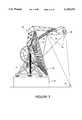
- FIG. 1is a front perspective view of a radio telescope including an embodiment of the present invention
- FIG. 1ais an isometric view showing a portion of the telescope surface of FIG. 1 in more detail
- FIG. 2is a side elevation view of the telescope of FIG. 1;
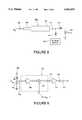
- FIG. 3is a block circuit diagram of a rangefinder according to an embodiment utilizing certain principles of the present invention.
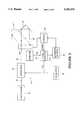
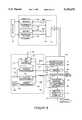
- FIG. 4is a block circuit schematic of a rangefinder according to a preferred embodiment of the present invention.
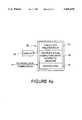
- FIG. 4ais a diagram showing the central computer in more detail as utilized in the embodiment of FIG. 4;
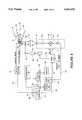
- FIG. 5is a circuit diagram of the local computer, servo system and reference signal generating portions of the circuit of FIG. 4;
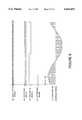
- FIG. 6is chart of waveforms used to explain the principles of phase detection
- FIG. 7is a more detailed circuit diagram of the frequency generator of FIG. 4;
- FIG. 8is a more detailed circuit diagram of the rf transmitter of FIG. 4;
- FIG. 9is a more detailed circuit diagram of the receiver of FIG. 4;
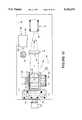
- FIGS. 10 and 11are respective plan and side elevation views of the switching mirror, laser and detector portions of the apparatus according to an embodiment of the present invention.
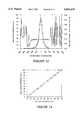
- FIG. 12is a chart illustrating the range variation of the measured distance as compared to the received reflected signal amplitude
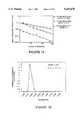
- FIG. 13is a chart illustrating correction for refractive index variation on a measured unknown distance of 50 m using a benchmark reference signal generated using a known distance 100 m reference target;
- FIG. 14is a chart illustrating the linearity of the measured distance as compared to actual distance
- FIG. 15is a chart illustrating noise contributions to measured distance values.
- FIG. 16illustrates the rms noise at 120 m.
- a radio telescope 10having for example a 100 m circular diameter aperture includes an antenna 12, a support frame 14 mounted on a pedestal 16 and a signal feed horn system 18 secured on a horn frame 20 secured to support frame 14.
- the antenna 12comprises a plurality of panels 22, e.g., 2006 panels, each forming a segment of a parabolic surface.
- the panelsare joined at their corners by connecting links not part of the present invention which include actuators constructed to displace the panels to form a continuous parabolic surface.
- a retroreflector cube 24At each of these intersections is a retroreflector cube 24, FIG. 1a. In this embodiment there may be for example over 2000 such cubes.
- the panels 22are positioned such as to accurately form the desired parabolic shape which, for the desired accuracy, requires the cubes 24 to be in a desired position to within 50 ⁇ m as mentioned in the introductory portion. Also, it may be desired to insure the antenna is aimed accurately in the sky and therefore the position of the parabolic surface of the antenna 12 is needed for this purpose as well.
- a rangefinder system 26To measure the position of the panels via the cubes 24, a rangefinder system 26 according to an embodiment of the present invention is provided.
- the system 26includes three rangefinders 28, 30 and 32 each generating an infrared laser beam 28', 30' and 32', respectively.
- the beams 28', 30' and 32'are all aimed at the same cube, e.g., 24', either simultaneously as shown or in some given sequence.
- the beamsare caused to traverse all cubes 24 of the antenna 12 by a scanning system for the beams 28', 30' and 32' described below.
- the important datais that the distance to each cube 24 be measured, the system 26 including a computer for analyzing the data to compute by trilateration the location of each cube of the antenna.
- the system 26also includes one or more benchmark retroreflector cubes 15 located on the ground.
- An additional rangefinder(not shown) identical to rangefinders 28, 30 or 32 is used to correct for atmospheric conditions that cause measuring errors such as might be caused by refractive index variations and so on.
- the additional rangefinderis fixed relative to the ground to provide an accurate unchanging benchmark reference signal.
- the rangefinders of system 26 being mounted on the support frame 14are subject to occasional motions and therefore are not sufficiently fixed for purposes of providing a benchmark reference.
- the benchmark cubesare used to determine the location of the triangle 29, FIG. 2, defined by the three rangefinders 28, 30 and 32.
- the cubes 15are preferably located at least the same or a greater distance as the minimum distance from the rangefinders as that of the target cubes whose location is to be measured.
- the benchmark cubes 15should be at 120 to 150 m from the laser rangerfinder reference location in the present example.
- the cubes 15 in the Figuresare not illustrated as located to scale.
- Triangle 29is a reference whose position with respect to the ground is determined by range measurements from each apex of the triangle to any three targets on the ground. To position the triangle 29 relative to the ground to an accuracy of 0.5 arc seconds requires a range measurement accuracy of about 50 ⁇ m over a distance of about 130 m.
- the reflector panel construction of the antenna 12facilitates the measurement and adjustment of the surface.
- the position of corners of each panel 22 deviating from the required parabolic curvatureis sensed.
- connections between the surface panels and backup structureare made through linear actuators (not shown) located at each junction of four panel corners.
- the reflecting surfaceis essentially a continuous sheet that may be adjusted to remove both the gravitationally induced deformations resulting from tilting the telescope and thermally induced changes in the backup structure. These deformations change slowly when compared to the speed at which the surface can be measured with the present invention.
- the system 26can be used to sample the cubes 24 at selected representative regions of the parabolic surface.
- the rangefinder system 26is useful for measuring points on other large structures, for example buildings, bridges, dams and so on for monitoring such structures for significant displacements which might indicate a risk of structural damage. Such structures are meant to remain relatively fixed, rather than to be movable as the antenna 12, and therefore present a less complex distance measurement problem.
- Each rangefinder 28, 30 and 32may measure a distance to a surface retroreflector 24 and also to each of its neighboring rangefinders.
- the range datais processed in a computer, to be described below, to give the best-fit paraboloid surface.
- the adjustment required at each actuator to correct the departure from the best-fit surfaceis calculated and used to operate the appropriate actuator.
- the antenna 12At its shortest operating wavelength, the antenna 12 has a diffraction beam of ⁇ 7 arcsec and accurate pointing of this beam presents a daunting problem.
- the determination of the best-fit surfaceis the first step towards a solution, since this means that the location of the paraboloid and the direction of its axis are known in reference to the surface measuring rangefinders.
- the position of these rangefinders with respect to fixed points on the groundare derived using measurements from ground-based rangefinders (not shown) surrounding the telescope. If these ranges are known to an accuracy of 50 ⁇ m, the telescope beam direction will be known to an accuracy of ⁇ 1 arcsec over most of the sky.
- the specifications of the rangefinder system 26result from the requirements of both accuracy and measurement speed.
- the speed of measurementis dictated by the rate at which the ranges to be measured are changing due to thermal effects and the excitation of various modes of oscillation of the telescope structure.
- System 26has an accuracy of 50 ⁇ m for ranges up to 120 m and measures five ranges per second to meet these requirements, i.e., it measures the positions of five cubes 24 per second.
- a typical rangefinder 28 of system 26 of FIG. 1includes a light source 34, generally a high speed laser diode as commercially available, preferably a 780 nm-1 mW output diode, a high frequency modulator 36, e.g., 1.5 Ghz, which modulates the source 34 output beam 34' forming a modulated beam 36' which is applied to a scan mirror 38.
- the mirror 38is controlled by control 40 to direct the output beam 36' to a retroreflector cube 24".
- the reflected return signal 42is received by the mirror and directed to phase detector 44.
- the phase detectormay include internal elements (not shown in this figure) for employing intermediate frequencies for actual phase detection.
- the phase detector 44is illustrated as a discrete component whereas in FIG. 4, to be described, the phase detection is implemented in computer programming.
- FIG. 3is simplified from an actual system illustrated in FIG. 4.
- FIG. 3is presented merely to illustrate general principles of certain aspects of the present invention whereas in practice the rangefinder of FIG. 4 is representative of one preferred implementation.
- the detector 44receives an enable signal from the control 40 which starts the phase detection cycle.
- the detector 44receives as one input a reference signal having a reference phase ⁇ R produced by oscillator 46.
- the oscillator 46also applies this signal to modulator 36 to modulate the beam 34'.
- phase ⁇ S of the intensity modulation envelope of the returned beam 42is retarded with respect to the phase ⁇ R of the outgoing beam 36' by 2d/ ⁇ , where d is the distance to be measured and ⁇ is the wavelength of the intensity modulation envelope and depends on the group refractive index of the atmosphere. If ⁇ 2d, the phase will be retarded by more than one cycle and ambiguities in distance reading arise.
- the output signal Po of the phase detector 44repeats approximately every 10 cm. In some applications, this ambiguity is resolved by a change of modulation wavelength but here all distances are sufficiently known such that resolving the ambiguity is unimportant.
- the output of the phase detector 44is applied to a distance determining circuit 48 which calculates the distance measured based on the measured phase difference.
- Control 40which may be a programmed computer, as is the circuit 48, determines when the desired data has been received by the circuit 48 so that calculation of the distance can begin. At this time the control 40 displaces the mirror 38 to direct the modulated beam at the next retroreflector cube 24'". This process is continued for all of the cubes 24 and for all three rangefinders 28, 30 and 32.
- reference cubes 15for generating benchmark correction for ret? active index variations or for other correction factors which are explained in more detail below in connection with the embodiment of FIG. 4.
- representative rangefinder 28is shown, it being identical to rangefinders 30 and 32.
- the laser rangefinders 28, 30 and 32, FIG. 4are shown with a benchmark measurement capability.
- the benchmark measurement in these rangefindersis shown for purposes of illustration.
- the benchmark measurementswould be made by a separate identical rangefinder as described in FIG. 4 but fixed in position relative to the earth via a relatively immobile structure. The fixed rangefinder would aim its beams at the cubes 15 to provide a reference correction factor for the index of refraction of the atmosphere to be utilized be rangefinders 28, 30 and 32.
- Rangefinder 28includes a local computer 50 which sends and receives signals to servo system 52 via data bus 54 and to phase detector 56 via data bus 58. It should be understood that single lines herein may comprise single conductors or multiple conductors or a data bus as appropriate.
- Servo system 52provides azimuth and elevation drive signals to mirror 38 for rotating mirror 38 about two orthogonal axes. Servo system 52 also includes a position encoder for each axis for sensing the mirror position and telling the computer the position of the mirror.
- the computerinstructs the servo system as to what points to measure, that is, to what cubes 24 the measuring beam is to be aimed and in what sequence. This will be explained in more detail in connection with FIG. 5.
- the mirror 38 position at the intersection of these axesprovides a reference location for the transmitted beam.
- An analog to digital converter and reference IF signal generator 56receives an intermediate frequency (IF) detected signal 107.
- the signal 107is applied to A/D converter portion of generator 56 which digitizes the signal 107.
- Generator 56generates an IF signal 108 which is a reference used by frequency generator 70.
- the local computer 50also periodically corrects for zero offset in the circuitry and refractive index error as will be explained. From the computed phase differences the computer 50 then calculates the corresponding distances using known computation methodology.
- Generator 56 anti computer 50will be discussed in more detail below in connection with FIG. 5. After the computer 50 computes the phase differences and determines the distances, this data is transmitted to the central computer 90 at the instruction of the computer 90 for further processing.
- a transmitter 58areceives the modulation signal Ms from frequency generator 70 at 1.5 Ghz. Sinusoidal variation of the current through the transmitter diode modulates the intensity of the outputted transmitted beam.
- the modulated light beamis transmitted from transmitter 58a through optical isolator 62 to mirror 64 and mirror 66 to scan mirror 38 which transmits the modulated laser beam to the selected cube 1-n , to a local cube 68 at the mirror 38 location for providing a reference beam as will be explained and to benchmark cube 15 for correcting the measured distances as will also be explained.
- Frequency generator 70is responsive to maser 72 for generating signal Ms and a signal Ms+IF in response to a reference IF signal produced by phase detector 56.
- reference signal IFis 1 Khz.
- the receiver 74includes a return laser beam detector 76, a fast silicon device, which receives the focused returned beam through light collecting lens 78 and applies its output signal to mixer 80 through amplifier 82.
- Mixer 80receives the signal Ms+IF from generator 70 and produces an output modulated IF signal on output conductor 84 which is applied to the phase detector 56 through amplifier 86.
- Optical alignmentensures that the transmitted and received beams are coaxial.
- the divergence of the transmitted beam from mirror 38is such that the beam received at the distant retroreflector cube 24 has a diameter several times that of the retroreflector. Consequently, positioning of the light beam with respect to the retroreflector is not critical; an angular positional accuracy of 20 arcsec is more than adequate.
- phase of the resultant 1 Khz intermediate frequency of the mixed return signalis directly related to the phase of the 1.5 Ghz modulation envelope of the returned signal and is a measure of the path length to the designated retroreflector cube with the restriction of the ambiguity previously mentioned.
- the local computer 50 of each of the three systemsis connected to the central computer 90, FIG. 4a, which instructs each computer 50 as to what cubes to direct its beam at and ill what sequence via instructions 89.
- the central computerreceives range information 87 corrected for index of refraction index and zero offset from each of the three rangefinders and performs a trilateration computation on the received data.
- the central computer 90gives the local computer 50 a list of points at which measurements are to be taken.
- the central computer 90knows the position of all of the cubes and thus can compute the error based on programmed actual or desired position information for each cube.
- the informationcan be stored as a table or be included in the programmed instructions.
- the central computer 90also is coupled to a display 90' for displaying the desired information.
- the central computer 90is given the corrected distances determined by each rangefinder to each cube.
- Computer 90also is given the coordinates of each rangefinder to a reference location, e.g., a center point of the antenna foundation pedestal 16.
- Computer 90thus can compute the radius to each cube since the three arc lengths from the three rangefinders intersect each cube.
- the computer 90is instructed to guess a nominal point position of each cube.
- a commonly known algorithm 91, FIG. 4ais used to then iteratively compute the solution of the trilateration computation solving for three polynomial equations. Using this computation, the coordinates of each measured cube is determined providing the measured coordinates of each cube position. These measurements are made repetitively.
- a typical sequence of operationsis for the central computer 90 to issue a series of commands for the retroreflector cube 24 positions, the local computer 50 then drives the beam steering mirror 38 to the first of these, computes a range, stores the result, and moves on to the next retroreflector. At the end of the measurement sequence, the results of the measurement are passed on to the central computer 90.
- the beam steering mirror 38is used to make a measurement of the known length of a reference path to reference cube 68 within the instrument at regular intervals.
- One calibration measurement per minuteis sufficient to reduce the zero-point error to less than 5 ⁇ m.
- the calibration measurementis used by the computer 50 by programmed instructions to correct the actual measured distances occurring after the determination of the correction factor.
- Computer 50then corrects for refractive index error also using programmed instructions 93 FIG. 5 employing the benchmark distance signal. That is, the distance to the benchmark target is computed and this is used as a reference against the actual known distance to that benchmark target which is stored in the computer. The computer 50 compares these two values and the difference is the correction factor. This factor is then applied to subsequently measured distances to correct the measured results. Known techniques are used to correct for the different distance values.
- the A/D and reference signal generator 56comprises an A/D converter 92 on a circuit board which includes a direct memory access (DMA) interface circuit 94.
- the DMA circuit 94supplies the A/D output signals to the computer 50 DMA controller 96.
- the DMA controllerplaces this information in memory 98 in the computer 50.
- a local crystal oscillator 100generates a signal, e.g., 10 Mhz, waveform 102, FIG. 6. This signal is applied to programmable counter 104 which counts down the signal 102 into a digital signal 106 and applies this signal to programmable counter 107 which generates reference IF signal 108 which preferably is 1 Khz.
- the signal 106has n pulses per cycle of IF signal 108, preferably n being 64, which is arbitrary.
- Signal 108is applied to programmable counter 110 which produces a trigger signal 112 upon receipt of an enable signal 114 from computer 50. See FIG. 6.
- the detected IF return signal outputted by amplifier 86, FIG. 4is sampled by the converter 92 at n, i.e., 64, times in each reference IF signal 108 cycle. These samples are sent to the computer 50 memory by DMA controller 96.
- the accurate measurement of the phaserequires high spectral purity of both the 1.5 Ghz transmitter and the 1.5 Ghz+1 Khz local oscillator. Any noise of these two oscillators at a frequency of 1 Khz away from the desired frequency will add noise to the 1 Khz intermediate frequency and, consequently, degrade the accuracy of the range measurement. Therefore, the purity of the oscillators is important for operation of this system.
- the enable signal 114is preferably generated once in this embodiment for every measurement.
- Computer 50via resident instructions 116 performs the phase calculation 97 on the resultant 8192 points for determining the phase differences between the return signal 107 digitized by converter and generator 56 and reference IF signal 108. This information is then used to calculate the measured distances using known techniques with distance calculator instructions 99 in computer 50.
- the computer 50gets all of the data for a given calculation from the converter 92, it is given a one bit signal indicating this.
- the computerperforms its calculations and simultaneously therewith sends a control signal to the servo system controller 120 to move mirror 38 to aim the beam at the next cube.
- Thisis a commercially available controller whose details need not be given here.
- the controller 120sends appropriate control signals to the azimuth and elevation motors 122 and 124, respectively, of the mirror 38 to direct the beam to the next retroreflector cube.
- the motors as commercially availableinclude incremental encoders 126 and 128, respectively, for providing position indicating signals to the controller 120.
- 16-bit analog-to-digital converter 92synchronized to the 1 Khz reference signal, is used to sample the 1 kHz signal into a sequence of samples s j .
- the signal amplitude and phaseare ##EQU2##
- the number of samples nis 64 and m is 128.
- FIG. 12is a record of received amplitude and computed phase as the transmitted beam is scanned across a retroreflector in a test apparatus employing a rangefinder constructed according to the present invention.
- the computed distanceremains constant over a change of amplitude in received signal of several orders of magnitude.
- the frequency generator 70is shown in FIG. 7. Another requirement of the oscillators of the system, in addition to that discussed above regarding the phase detector, is that of absolute stability. An accuracy of 10 ⁇ m in a range of 120 m is better than 1 part in 10 7 , so the stability of the oscillators must be greater than this.
- a hydrogen maser 72 preferably at 100 MHz outputis used as the frequency standard providing a long-term stability of 1 part in 10 15 .
- a commercially available ⁇ 15 multiplier 130receives the 100 MHz signal from maser 72 and outputs a stable 1.5 GHz modulating signal Ms to the laser diode of the transmitter 58a, FIG. 4.
- a coupler 132feeds the signal Ms to mixer 134.
- a second signal 135 applied to mixer 134is received from the voltage controlled oscillator 138 via coupler 139.
- the mixer 134outputs a difference frequency signal 136 maintained at 1 KHz by phase locking to the reference IF signal 108 with phase lock circuit 140.
- Thisis the result of combining a voltage controlled signal 135 Ms+IF, 1.5 GHz+1 kHz, output by voltage controlled oscillator (VCO) 138, with the 1.5 GHz Ms signal output by multiplier 130.
- VCOvoltage controlled oscillator
- These signalsare phase locked by circuit 140 which applies the resulting DC voltage 138' to VCO 138.
- the coupler 139applies the VCO 138 output signal 135 Ms+IF to mixers 80 (FIG. 4) and 134.
- the rf transmitter 58a laser diode 142is modulated by varying the bias current with signal Ms about a fixed DC value produced by circuit 144.
- the matching and bias circuitincludes a 50 ohm microstrip line 146 connected at one end to terminal 148 which receives the modulation signal Ms and at the other end to microstrip 150 which is 25 ohm and comprises a wavelength of ⁇ /4 at 1.5 GHz.
- the 1.5 GHz rf modulating signalmust be power matched to the diode impedance ( ⁇ 10 ⁇ ) in the presence of the parasitic capacitance (not shown) and the parasitic lead inductance 151 associated with the diode package.
- the parasitic lead inductance 151is series resonated at 1.5 GHz using a chip capacitor 152 coupled between microstrip 150 and the diode 142 cathode.
- the dc biasis supplied from circuit 144 to the diode cathode through rf choke 154.
- the diode impedanceis transformed to 50 ⁇ using the microstrip 150 quarter-wave transformer.
- a return loss of less than -15 dBis at the transmitter rf input terminal 148.
- a modulation depth for an rf drive level at 1 mWis estimated to be 30%.
- the laser diode 142 and all associated biasing componentsare contained in a well-shielded enclosure 160, FIG. 10.
- the laser diode 142is provided within integral GRIN lens collimator (not shown) in the enclosure 160 to produce a 1.5 ⁇ 2.0 mm beam 162 having a beam divergence of 1 mR. This beam emerges from the transmitter through a small aperture in enclosure 160.
- the receiver 74comprises a photodetector diode 164 whose anode is coupled to a reference potential and whose cathode is coupled to DC bias terminal 166 through an rf choke 168.
- the diode cathodeis connected through an rf amplifier 169 (20 dB) to a double-balanced mixer 170.
- the mixerreceives at terminal 172 the phase locked signal Ms+IF from the frequency generator 70.
- the mixer 170output 1 kHz IF signal, which is dc isolated from the mixer, is further amplified ( ⁇ 300) using low-noise op-amp 174.
- Amplifier 174is coupled via capacitor 176 to mixer 170 and to terminal 178 via capacitor 180 at its output.
- the rf componentsare interconnected using 50 ⁇ microstrip and all the components are mounted within a metallic enclosure 180, FIG. 10. Particular care should be taken to filter all power supply connections.
- any leakage signal at the phase detector 56, FIG. 4must be less than one ten-thousandth of the voltage resulting from the optical return signal. This level of isolation requires care in design and construction.
- the basic requirements of the beam switching mirror 38are a positioning accuracy of preferably about 20 arcsec and an ability to switch between positions separated by ⁇ 2° in less than 70 ms. This follows from the requirement to measure five points per second on the surface of the telescope 12 (this assumes that adjacent measurement points have a separation of one panel width). If there is 128 ms integration time per point, then 72 ms remain for mirror movement and settling.
- the mirror 38, transmitter 58a and receiver 74are all mounted to a common reference support 182.
- Support 182is provided a reference location in the system 26, FIG. 1, that is stable and accurate to the extent permitted by the structure to which it is attached.
- the support 182is mounted via a first ball 183 in a socket 185 secured on an accurately located base 187.
- the ball 183rotates about point 185' but cannot linearly displace.
- the point 185'is on axis 189 orthogonal to the plane of and intersects the intersection of axes 184 and 186. This intersection does not linearly displace.
- the support 182is also secured to base 187 by balls 191 and 193.
- Ball 191rests on a plane surface 195 supported by plate 182' and is free to displace in any direction on surface 195.
- Ball 193lies in a V-shaped groove 197 in a member supported by plate 182'. Groove 197 extends in the axial direction of axis 184 and ball 193 can only displace in the directions parallel to axis 184.
- Balls 183 and 193are axial aligned beneath and parallel to axis 184.
- Ball 191is offset from this alignment to one side to form a triangular support for support 182.
- Plate 182'is supported by base 187.
- a bolt 199passes through support 182 and is secured to plate 182' by nut 199'.
- a spring 201compressively resiliently urges the balls against their mating surfaces.
- each rangefinderis similarly mounted to its supporting structure in FIGS. 1 and 2.
- Lens 78has a transmitted beam (162) directing mirror 66 secured centrally thereto and a second mirror 64 directs the laser beam 162 from transmitter 58a to mirror 38.
- Mirror 38preferably is a precision elliptical fiat mirror and is commercially available.
- Motion in two orthogonal azimuth and elevation axes 184 and 186 which intersect at the mirror reflecting surfaceis provided by a two-axes mount, the mirror being driven about each axis by a corresponding direct drive torque motor 122 and 124, respectively.
- Each axis positionis sensed by a corresponding respective incremental encoder 126 and 128, having a resolution of 10 5 pulses per revolution.
- a commercially available servo controller 120, FIG. 5,is used to complete a closed-loop servo for accurate positioning of the mirror 38 and contains the hardware required to provide a high performance positioning servo without the need for velocity sensors or analog compensation.
- the local computer 50instructs the azimuth and elevation servos to return to a home reference position.
- Thisis automatic on commercially available servo controllers. This position is referenced at a precise predetermined angle. All positions of the encoders are referenced to the home position.
- the incremental encoderssense angular positions.
- the local computerhas in memory the azimuth and elevation positions of each retroreflector cube.
- the controller 120outputs an analog DC error signal which is amplified and applied to the appropriate motor. The mirror moves until the desired angular positions are reached.
- the initial coordinates of each cubeare determined manually by observation of the laser beam of each rangefinder as it is incident on a cube.
- the coordinatesare then manually entered into computer 50.
- a series of amplitude readings around the suspected center of the cubeare taken, and a 3 ⁇ 3 convolution fit is made by computer 50 to determine the exact optical center. This information on the coordinates is then placed in a computer 50 file.
- the laser system 26, FIG. 1is caused to traverse the cubes 24 in the desired sequence at the rate of five cubes per second.
- the local computers 50 of each rangefinderupon command of the central computer 90, instructs the servo controller of each rangefinder 28, 30 and 32 to scan the cubes with the modulated beams, each cube being scanned by all three beams in the sequence.
- the 128 cycles of the 64 samplesare taken of the received beams from each measured point and stored locally.
- Each local computerthen computes the phase differences for that point according to the method discussed above.
- the phase difference resultis then processed to provide a measured distance corrected for zero point and refractive index.
- the central computer 90calculates the trilateration computation from the received data, storing and displaying the results as desired.
- the local reference cube 68is used to provide correction for the circuit drift and periodically the benchmark cube(s) 15 is used to provide a correction for atmospheric conditions.
- the benchmark cube 15is located at least the same distance as the cubes 24 to be measured and represent closely the atmosphere in the target cubes 24 paths.
- the computersautomatically enter the corrections in the calculations of the measured distances.
- the circuit driftis corrected every 30 seconds and the benchmark correction may be generated every minute or so. However, these may be set to other values in accordance with a given implementation.
- FIG. 13curves a and b illustrate bench mark laser beams at different ranges 50 m and 120 m.
- Curve cis a corrected data curve using data generated by benchmark reference signal a. This illustrates the effectiveness of the refractive index correction according to the disclosed system. It should be noted that over a 30 hour period curve c is corrected curve b having an rms of 18 ⁇ m.
- Curve dis the temperature. Sensitivity of the speed of light in the atmosphere is approximately 1 ppm/°C., e.g., 100 ⁇ m/°C. at 100 m. Therefore, this is significant and should be compensated. Thus, correction factors may be introduced into the computer calculation equations for the determination of distances taking into consideration refractive index.
- a test instrument as mentioned abovewas set up in an isolated building equipped to transmit the laser beam over a horizontal path to a distant retroreflector mounted on an accurately calibrated translation stage.
- the first test performedwas a measure of the linearity of the instrument as shown in FIG. 16. This test was made at a range of 100 m with an integration time of 1 s per data point. The slope of the response was correct and the standard deviation of a single point was less than 20 ⁇ m, an acceptable value. There was no sign of cyclical error that would be expected if there was rf leakage at the transmitter frequency into the receiver circuits.
- Turbulenceconsists of "bubbles” or “blobs” of air at slightly differing density to the surrounding air and is characterized by the so-called structure function C n 2 , which may be considered a measure of the refractive-index difference between the "blobs" and the surrounding air.
- structure function C n 2may be considered a measure of the refractive-index difference between the "blobs" and the surrounding air.
- FIG. 15a plot of the standard deviation (rms) on a range reading plotted against the number of intermediate frequency (IF) cycles per reading.
- the IFis 1 kHz; thus, ten IF cycles is an integration time of 10 ms.
- the noise introduced by the data-taking circuitry, the lowermost curve,is seen to be small, around 0.7 ⁇ m for 128 cycles.
- the noisedecreases as the square root of the integration time, as would be expected for random noise.
- a similar resultis observed for measuring a short (1 m) range, the intermediate curve, but in this case the noise is higher, around 6 ⁇ m for 128 ms.
- the source of this noiseis believed to be phase noise on both the transmitter and local oscillator sources. This could be reduced, either by increasing the 1 kHz IF frequency or by increasing the spectral purity of the oscillators, but this performance is considered acceptable for the present implementation.
- the uppermost curveshows a corresponding plot for a range of about 31.5 m. In this case, atmospheric turbulence causes the phase fluctuations to decrease more slowly with integration time, t -0 .3 instead of t -0 .5 due to the Kolmorogorov spectrum of phase variation with time for path lengths greater than the size of the turbulence cells.
- the test instrumentwas then set up to measure to a retroreflector at a range of 120 m. Measurements were taken once per second with an integration time of 128 ms. Each minute the mean and rms of the 60 measured ranges were calculated and stored. The values obtained for the rms departures from the mean were then plotted as shown in FIG. 16. In this example, the rms values cluster around 20 ⁇ m, with no values over 50 ⁇ m. Over tests continued for several months, rms values varied from 9 to 45 ⁇ m. It was noted that the lowest values occurred early on still, foggy mornings and generally the higher values on sunny afternoon s.
Landscapes
- Engineering & Computer Science (AREA)
- Physics & Mathematics (AREA)
- Radar, Positioning & Navigation (AREA)
- Remote Sensing (AREA)
- Electromagnetism (AREA)
- Computer Networks & Wireless Communication (AREA)
- General Physics & Mathematics (AREA)
- Optical Radar Systems And Details Thereof (AREA)
Abstract
Description
Claims (32)
Priority Applications (1)
| Application Number | Priority Date | Filing Date | Title |
|---|---|---|---|
| US08/068,543US5455670A (en) | 1993-05-27 | 1993-05-27 | Optical electronic distance measuring apparatus with movable mirror |
Applications Claiming Priority (1)
| Application Number | Priority Date | Filing Date | Title |
|---|---|---|---|
| US08/068,543US5455670A (en) | 1993-05-27 | 1993-05-27 | Optical electronic distance measuring apparatus with movable mirror |
Publications (1)
| Publication Number | Publication Date |
|---|---|
| US5455670Atrue US5455670A (en) | 1995-10-03 |
Family
ID=22083238
Family Applications (1)
| Application Number | Title | Priority Date | Filing Date |
|---|---|---|---|
| US08/068,543Expired - LifetimeUS5455670A (en) | 1993-05-27 | 1993-05-27 | Optical electronic distance measuring apparatus with movable mirror |
Country Status (1)
| Country | Link |
|---|---|
| US (1) | US5455670A (en) |
Cited By (80)
| Publication number | Priority date | Publication date | Assignee | Title |
|---|---|---|---|---|
| US5811826A (en)* | 1996-02-07 | 1998-09-22 | Massachusetts Institute Of Technology | Methods and apparatus for remotely sensing the orientation of an object |
| US5870191A (en)* | 1996-02-12 | 1999-02-09 | Massachusetts Institute Of Technology | Apparatus and methods for surface contour measurement |
| WO1999010706A1 (en)* | 1997-08-29 | 1999-03-04 | Perceptron, Inc. | Digital 3-d light modulated position measurement system |
| US5900936A (en)* | 1996-03-18 | 1999-05-04 | Massachusetts Institute Of Technology | Method and apparatus for detecting relative displacement using a light source |
| EP0793117A3 (en)* | 1996-02-29 | 1999-08-11 | Akio Kubo | Light wave distance measuring apparatus and method for determining distance of an object |
| US5982481A (en)* | 1996-10-01 | 1999-11-09 | Mcdonnell Douglas Corporation | Alignment system and method for dish concentrators |
| WO1999063302A1 (en)* | 1998-06-04 | 1999-12-09 | Massachusetts Institute Of Technology | Compensation for measurement uncertainty due to atmospheric effects |
| US6031612A (en)* | 1996-02-12 | 2000-02-29 | Massachusetts Institute Of Technology | Apparatus and methods for contour measurement using movable sources |
| US6204916B1 (en)* | 1998-02-03 | 2001-03-20 | Minolta Co., Ltd. | Three dimensional information measurement method and apparatus |
| US6293027B1 (en)* | 1999-05-11 | 2001-09-25 | Trw Inc. | Distortion measurement and adjustment system and related method for its use |
| US6429942B1 (en)* | 1998-09-28 | 2002-08-06 | California Institute Of Technology | Using a 2D displacement sensor to derive 3D displacement information |
| US6501538B1 (en)* | 1999-11-15 | 2002-12-31 | Leuze Electronic Ghbh & Co. | Optoelectronic arrangement for determining an object's profile |
| US6690474B1 (en) | 1996-02-12 | 2004-02-10 | Massachusetts Institute Of Technology | Apparatus and methods for surface contour measurement |
| WO2004018968A1 (en)* | 2002-08-03 | 2004-03-04 | Robert Bosch Gmbh | Method and device for optically measuring distance |
| US20040125037A1 (en)* | 2001-07-09 | 2004-07-01 | Parsons Barry Frederick | Laser alignment apparatus and method |
| US20040214567A1 (en)* | 2003-03-21 | 2004-10-28 | Tae Oh Yoon | Method and apparatus for measuring resource information of mobile communication base station antenna |
| US20060066836A1 (en)* | 2004-09-30 | 2006-03-30 | Bridges Robert E | Absolute distance meter that measures a moving retroreflector |
| US7358516B2 (en) | 2001-04-13 | 2008-04-15 | Carl Zeiss Ag | System and method for determining a position or/and orientation of two objects relative to each other as well as beam guiding arrangement, interferometer arrangement and device for changing an optical path length for use in such a system and method |
| US20080100821A1 (en)* | 2006-09-29 | 2008-05-01 | Kabushiki Kaisha Topcon | Electro-optical distance measuring method, distance measuring program and distance measuring system |
| WO2008089480A3 (en)* | 2007-01-19 | 2008-10-23 | Ass Universities Inc | Fiber optically coupled, multiplexed, and chopped laser rangefinder |
| US20090125265A1 (en)* | 2008-12-06 | 2009-05-14 | Parker David H | Method for Calibrating a Laser-Based Spherical Coordinate Measurement System by a Mechanical Harmonic Oscillator |
| US20090132199A1 (en)* | 2008-12-04 | 2009-05-21 | Parker David H | Method for Measuring the Structural Health of a Civil Structure |
| US7609365B2 (en) | 2006-09-21 | 2009-10-27 | Kabushiki Kaisha Topcon | Electro-optical distance measuring method, distance measuring program and distance measuring device |
| US20110032509A1 (en)* | 2009-08-07 | 2011-02-10 | Faro Technologies, Inc. | Absolute distance meter with optical switch |
| US20110093219A1 (en)* | 2008-12-04 | 2011-04-21 | Parker David H | Methods for modeling the structural health of a civil structure based on electronic distance measurements |
| US20110170534A1 (en)* | 2010-01-11 | 2011-07-14 | Faro Technologies, Inc. | Method and apparatus for synchronizing measurements taken by multiple metrology devices |
| US20110178754A1 (en)* | 2010-01-20 | 2011-07-21 | Faro Technologies, Inc. | Portable Articulated Arm Coordinate Measuring Machine Having Integrated Software Controls |
| US20110173827A1 (en)* | 2010-01-20 | 2011-07-21 | Faro Technologies, Inc. | Coordinate measurement machines with removable accessories |
| US20110176148A1 (en)* | 2010-01-20 | 2011-07-21 | Faro Technologies, Inc. | Coordinate measuring machine having an illuminated probe end and method of operation |
| DE102010039948A1 (en)* | 2010-08-30 | 2012-03-01 | Carl Zeiss Ag | Measuring unit, measuring system and method for determining a relative position and relative orientation |
| WO2012154322A1 (en) | 2011-04-15 | 2012-11-15 | Faro Technologies, Inc. | Absolute distance meter that uses a fiber-optic switch to reduce drift |
| US8416396B2 (en) | 2010-07-18 | 2013-04-09 | David H. Parker | Methods and apparatus for optical amplitude modulated wavefront shaping |
| USD688577S1 (en) | 2012-02-21 | 2013-08-27 | Faro Technologies, Inc. | Laser tracker |
| DE102012210042B3 (en)* | 2012-06-14 | 2013-09-05 | Ifm Electronic Gmbh | Light runtime measuring device for measuring distance of object , has photo mixing detector, evaluation unit, high-frequency generator, driver, impedance converter and optical transmitter, where impedance converter has strip line |
| US8615893B2 (en) | 2010-01-20 | 2013-12-31 | Faro Technologies, Inc. | Portable articulated arm coordinate measuring machine having integrated software controls |
| US8638446B2 (en) | 2010-01-20 | 2014-01-28 | Faro Technologies, Inc. | Laser scanner or laser tracker having a projector |
| US8677643B2 (en) | 2010-01-20 | 2014-03-25 | Faro Technologies, Inc. | Coordinate measurement machines with removable accessories |
| US8832954B2 (en) | 2010-01-20 | 2014-09-16 | Faro Technologies, Inc. | Coordinate measurement machines with removable accessories |
| US8875409B2 (en) | 2010-01-20 | 2014-11-04 | Faro Technologies, Inc. | Coordinate measurement machines with removable accessories |
| US8902408B2 (en) | 2011-02-14 | 2014-12-02 | Faro Technologies Inc. | Laser tracker used with six degree-of-freedom probe having separable spherical retroreflector |
| US8898919B2 (en) | 2010-01-20 | 2014-12-02 | Faro Technologies, Inc. | Coordinate measurement machine with distance meter used to establish frame of reference |
| US8952845B1 (en)* | 2011-06-15 | 2015-02-10 | Lockheed Martin Corporation | Dynamic relative internal alignment calibration |
| US8997362B2 (en) | 2012-07-17 | 2015-04-07 | Faro Technologies, Inc. | Portable articulated arm coordinate measuring machine with optical communications bus |
| US9007601B2 (en) | 2010-04-21 | 2015-04-14 | Faro Technologies, Inc. | Automatic measurement of dimensional data with a laser tracker |
| US9041914B2 (en) | 2013-03-15 | 2015-05-26 | Faro Technologies, Inc. | Three-dimensional coordinate scanner and method of operation |
| US9054416B2 (en) | 2010-09-20 | 2015-06-09 | Associated Universities, Inc. | Inverted conical sinuous antenna above a ground plane |
| US9074883B2 (en) | 2009-03-25 | 2015-07-07 | Faro Technologies, Inc. | Device for optically scanning and measuring an environment |
| US9113023B2 (en) | 2009-11-20 | 2015-08-18 | Faro Technologies, Inc. | Three-dimensional scanner with spectroscopic energy detector |
| US9163922B2 (en) | 2010-01-20 | 2015-10-20 | Faro Technologies, Inc. | Coordinate measurement machine with distance meter and camera to determine dimensions within camera images |
| US9164173B2 (en) | 2011-04-15 | 2015-10-20 | Faro Technologies, Inc. | Laser tracker that uses a fiber-optic coupler and an achromatic launch to align and collimate two wavelengths of light |
| US9168654B2 (en) | 2010-11-16 | 2015-10-27 | Faro Technologies, Inc. | Coordinate measuring machines with dual layer arm |
| US9210288B2 (en) | 2009-11-20 | 2015-12-08 | Faro Technologies, Inc. | Three-dimensional scanner with dichroic beam splitters to capture a variety of signals |
| US9329271B2 (en) | 2010-05-10 | 2016-05-03 | Faro Technologies, Inc. | Method for optically scanning and measuring an environment |
| US9354043B2 (en) | 2008-12-04 | 2016-05-31 | Laura P. Solliday | Methods for measuring and modeling the structural health of pressure vessels based on electronic distance measurements |
| US9372265B2 (en) | 2012-10-05 | 2016-06-21 | Faro Technologies, Inc. | Intermediate two-dimensional scanning with a three-dimensional scanner to speed registration |
| US9377885B2 (en) | 2010-04-21 | 2016-06-28 | Faro Technologies, Inc. | Method and apparatus for locking onto a retroreflector with a laser tracker |
| US9395174B2 (en) | 2014-06-27 | 2016-07-19 | Faro Technologies, Inc. | Determining retroreflector orientation by optimizing spatial fit |
| US9400170B2 (en) | 2010-04-21 | 2016-07-26 | Faro Technologies, Inc. | Automatic measurement of dimensional data within an acceptance region by a laser tracker |
| US9417056B2 (en) | 2012-01-25 | 2016-08-16 | Faro Technologies, Inc. | Device for optically scanning and measuring an environment |
| US9417316B2 (en) | 2009-11-20 | 2016-08-16 | Faro Technologies, Inc. | Device for optically scanning and measuring an environment |
| CN105929382A (en)* | 2016-04-15 | 2016-09-07 | 中国科学院上海技术物理研究所 | Receiving and transmitting coaxial auxiliary light correction device and method for active photoelectric system |
| US9453913B2 (en) | 2008-11-17 | 2016-09-27 | Faro Technologies, Inc. | Target apparatus for three-dimensional measurement system |
| US9482529B2 (en) | 2011-04-15 | 2016-11-01 | Faro Technologies, Inc. | Three-dimensional coordinate scanner and method of operation |
| US9482755B2 (en) | 2008-11-17 | 2016-11-01 | Faro Technologies, Inc. | Measurement system having air temperature compensation between a target and a laser tracker |
| US9513107B2 (en) | 2012-10-05 | 2016-12-06 | Faro Technologies, Inc. | Registration calculation between three-dimensional (3D) scans based on two-dimensional (2D) scan data from a 3D scanner |
| US9529083B2 (en) | 2009-11-20 | 2016-12-27 | Faro Technologies, Inc. | Three-dimensional scanner with enhanced spectroscopic energy detector |
| US9551575B2 (en) | 2009-03-25 | 2017-01-24 | Faro Technologies, Inc. | Laser scanner having a multi-color light source and real-time color receiver |
| US9607239B2 (en) | 2010-01-20 | 2017-03-28 | Faro Technologies, Inc. | Articulated arm coordinate measurement machine having a 2D camera and method of obtaining 3D representations |
| US9628775B2 (en) | 2010-01-20 | 2017-04-18 | Faro Technologies, Inc. | Articulated arm coordinate measurement machine having a 2D camera and method of obtaining 3D representations |
| US9638507B2 (en) | 2012-01-27 | 2017-05-02 | Faro Technologies, Inc. | Measurement machine utilizing a barcode to identify an inspection plan for an object |
| US9686532B2 (en) | 2011-04-15 | 2017-06-20 | Faro Technologies, Inc. | System and method of acquiring three-dimensional coordinates using multiple coordinate measurement devices |
| US9772394B2 (en) | 2010-04-21 | 2017-09-26 | Faro Technologies, Inc. | Method and apparatus for following an operator and locking onto a retroreflector with a laser tracker |
| US9983298B2 (en) | 2015-02-05 | 2018-05-29 | Associated Universities, LLC | Fiber optic based laser range finder |
| US10067231B2 (en) | 2012-10-05 | 2018-09-04 | Faro Technologies, Inc. | Registration calculation of three-dimensional scanner data performed between scans based on measurements by two-dimensional scanner |
| US10145671B2 (en) | 2016-03-31 | 2018-12-04 | Topcon Positioning Systems, Inc. | Three dimensional laser measuring system and method |
| US10175037B2 (en) | 2015-12-27 | 2019-01-08 | Faro Technologies, Inc. | 3-D measuring device with battery pack |
| US10203268B2 (en) | 2008-12-04 | 2019-02-12 | Laura P. Solliday | Methods for measuring and modeling the process of prestressing concrete during tensioning/detensioning based on electronic distance measurements |
| US10281259B2 (en) | 2010-01-20 | 2019-05-07 | Faro Technologies, Inc. | Articulated arm coordinate measurement machine that uses a 2D camera to determine 3D coordinates of smoothly continuous edge features |
| CN113759351A (en)* | 2021-10-09 | 2021-12-07 | 宁波未感半导体科技有限公司 | Laser radar receiving end calibration system and method |
| US12081264B1 (en) | 2021-08-12 | 2024-09-03 | SA Photonics, Inc. | Beacons for optical location and tracking |
Citations (5)
| Publication number | Priority date | Publication date | Assignee | Title |
|---|---|---|---|---|
| US3809477A (en)* | 1972-11-01 | 1974-05-07 | Us Interior | Measuring apparatus for spatially modulated reflected beams |
| US4274736A (en)* | 1978-10-11 | 1981-06-23 | Kern & Co. Ag | Method and apparatus for electrooptical distance measurement |
| US4457625A (en)* | 1981-07-13 | 1984-07-03 | Itek Corporation | Self calibrating contour measuring system using fringe counting interferometers |
| US4560271A (en)* | 1982-04-08 | 1985-12-24 | Tokyo Kogaku Kikai Kabushiki Kaisha | Optical distance-measuring method and apparatus therefor |
| US4810088A (en)* | 1984-08-16 | 1989-03-07 | Hughes Aircraft Company | Laser rangefinder and thermal imager with enhanced scanning mirror control |
- 1993
- 1993-05-27USUS08/068,543patent/US5455670A/ennot_activeExpired - Lifetime
Patent Citations (5)
| Publication number | Priority date | Publication date | Assignee | Title |
|---|---|---|---|---|
| US3809477A (en)* | 1972-11-01 | 1974-05-07 | Us Interior | Measuring apparatus for spatially modulated reflected beams |
| US4274736A (en)* | 1978-10-11 | 1981-06-23 | Kern & Co. Ag | Method and apparatus for electrooptical distance measurement |
| US4457625A (en)* | 1981-07-13 | 1984-07-03 | Itek Corporation | Self calibrating contour measuring system using fringe counting interferometers |
| US4560271A (en)* | 1982-04-08 | 1985-12-24 | Tokyo Kogaku Kikai Kabushiki Kaisha | Optical distance-measuring method and apparatus therefor |
| US4810088A (en)* | 1984-08-16 | 1989-03-07 | Hughes Aircraft Company | Laser rangefinder and thermal imager with enhanced scanning mirror control |
Non-Patent Citations (4)
| Title |
|---|
| J. M. Payne et al.; Rev. of Scientific Instr.; vol. 63, #6; Jun. 1992; p. 3311. |
| J. M. Payne et al.; Rev. of Scientific Instr.; vol. 63, 6; Jun. 1992; p. 3311.* |
| J. M. Payne; Rev. of Scientific Instr.; vol. 44, #3; Mar. 1973; p. 304. |
| J. M. Payne; Rev. of Scientific Instr.; vol. 44, 3; Mar. 1973; p. 304.* |
Cited By (160)
| Publication number | Priority date | Publication date | Assignee | Title |
|---|---|---|---|---|
| US5811826A (en)* | 1996-02-07 | 1998-09-22 | Massachusetts Institute Of Technology | Methods and apparatus for remotely sensing the orientation of an object |
| US6229619B1 (en) | 1996-02-12 | 2001-05-08 | Massachusetts Institute Of Technology | Compensation for measurement uncertainty due to atmospheric effects |
| US5870191A (en)* | 1996-02-12 | 1999-02-09 | Massachusetts Institute Of Technology | Apparatus and methods for surface contour measurement |
| US6031612A (en)* | 1996-02-12 | 2000-02-29 | Massachusetts Institute Of Technology | Apparatus and methods for contour measurement using movable sources |
| US7242484B2 (en) | 1996-02-12 | 2007-07-10 | Massachusetts Institute Of Technology | Apparatus and methods for surface contour measurement |
| US6690474B1 (en) | 1996-02-12 | 2004-02-10 | Massachusetts Institute Of Technology | Apparatus and methods for surface contour measurement |
| US20060012802A1 (en)* | 1996-02-12 | 2006-01-19 | Lyle Shirley | Apparatus and methods for surface contour measurement |
| US6341015B2 (en) | 1996-02-12 | 2002-01-22 | Massachusetts Institute Of Technology | Compensation for measurement uncertainty due to atmospheric effects |
| US6952270B2 (en) | 1996-02-12 | 2005-10-04 | Massachusetts Institute Of Technology | Apparatus and methods for surface contour measurements |
| US20040105100A1 (en)* | 1996-02-12 | 2004-06-03 | Lyle Shirley | Apparatus and methods for surface contour measurements |
| EP0793117A3 (en)* | 1996-02-29 | 1999-08-11 | Akio Kubo | Light wave distance measuring apparatus and method for determining distance of an object |
| US5900936A (en)* | 1996-03-18 | 1999-05-04 | Massachusetts Institute Of Technology | Method and apparatus for detecting relative displacement using a light source |
| US5982481A (en)* | 1996-10-01 | 1999-11-09 | Mcdonnell Douglas Corporation | Alignment system and method for dish concentrators |
| WO1999010706A1 (en)* | 1997-08-29 | 1999-03-04 | Perceptron, Inc. | Digital 3-d light modulated position measurement system |
| US6204916B1 (en)* | 1998-02-03 | 2001-03-20 | Minolta Co., Ltd. | Three dimensional information measurement method and apparatus |
| WO1999063302A1 (en)* | 1998-06-04 | 1999-12-09 | Massachusetts Institute Of Technology | Compensation for measurement uncertainty due to atmospheric effects |
| US6429942B1 (en)* | 1998-09-28 | 2002-08-06 | California Institute Of Technology | Using a 2D displacement sensor to derive 3D displacement information |
| US6293027B1 (en)* | 1999-05-11 | 2001-09-25 | Trw Inc. | Distortion measurement and adjustment system and related method for its use |
| US6501538B1 (en)* | 1999-11-15 | 2002-12-31 | Leuze Electronic Ghbh & Co. | Optoelectronic arrangement for determining an object's profile |
| US7358516B2 (en) | 2001-04-13 | 2008-04-15 | Carl Zeiss Ag | System and method for determining a position or/and orientation of two objects relative to each other as well as beam guiding arrangement, interferometer arrangement and device for changing an optical path length for use in such a system and method |
| US20040125037A1 (en)* | 2001-07-09 | 2004-07-01 | Parsons Barry Frederick | Laser alignment apparatus and method |
| US7091922B2 (en)* | 2001-07-09 | 2006-08-15 | Commonwealth Scientific And Industrial Research Organisation | Laser alignment apparatus and method |
| WO2004018968A1 (en)* | 2002-08-03 | 2004-03-04 | Robert Bosch Gmbh | Method and device for optically measuring distance |
| KR100967530B1 (en) | 2002-08-03 | 2010-07-05 | 로베르트 보쉬 게엠베하 | Optical distance measuring method and apparatus |
| US20050162639A1 (en)* | 2002-08-03 | 2005-07-28 | Joerg Stierle | Method and device for optically measuring distance |
| US7224444B2 (en) | 2002-08-03 | 2007-05-29 | Robert Bosch Gmbh | Method and device for optically measuring distance |
| US7280195B2 (en)* | 2003-03-21 | 2007-10-09 | Sk Telecom Co., Ltd. | Method and apparatus for measuring resource information of mobile communication base station antenna |
| US20040214567A1 (en)* | 2003-03-21 | 2004-10-28 | Tae Oh Yoon | Method and apparatus for measuring resource information of mobile communication base station antenna |
| US7352446B2 (en) | 2004-09-30 | 2008-04-01 | Faro Technologies, Inc. | Absolute distance meter that measures a moving retroreflector |
| WO2006039682A1 (en)* | 2004-09-30 | 2006-04-13 | Faro Technologies, Inc. | Absolute distance meter that measures a moving retroreflector |
| US20060066836A1 (en)* | 2004-09-30 | 2006-03-30 | Bridges Robert E | Absolute distance meter that measures a moving retroreflector |
| CN101031817B (en)* | 2004-09-30 | 2011-02-09 | Faro科技有限公司 | Absolute Range Finder for Measuring Moving Retroreflectors |
| US7609365B2 (en) | 2006-09-21 | 2009-10-27 | Kabushiki Kaisha Topcon | Electro-optical distance measuring method, distance measuring program and distance measuring device |
| US20080100821A1 (en)* | 2006-09-29 | 2008-05-01 | Kabushiki Kaisha Topcon | Electro-optical distance measuring method, distance measuring program and distance measuring system |
| US7474387B2 (en)* | 2006-09-29 | 2009-01-06 | Kabushiki Kaisha Topcon | Electro-optical distance measuring method, distance measuring program and distance measuring system |
| WO2008089480A3 (en)* | 2007-01-19 | 2008-10-23 | Ass Universities Inc | Fiber optically coupled, multiplexed, and chopped laser rangefinder |
| US7586586B2 (en) | 2007-01-19 | 2009-09-08 | Associates Universities, Inc. | Fiber optically coupled, multiplexed, and chopped laser rangefinder |
| US20090046271A1 (en)* | 2007-01-19 | 2009-02-19 | Kim Theodore Constantikes | Fiber optically coupled, multiplexed, and chopped laser rangefinder |
| US9482755B2 (en) | 2008-11-17 | 2016-11-01 | Faro Technologies, Inc. | Measurement system having air temperature compensation between a target and a laser tracker |
| US9453913B2 (en) | 2008-11-17 | 2016-09-27 | Faro Technologies, Inc. | Target apparatus for three-dimensional measurement system |
| US9354043B2 (en) | 2008-12-04 | 2016-05-31 | Laura P. Solliday | Methods for measuring and modeling the structural health of pressure vessels based on electronic distance measurements |
| US20090132199A1 (en)* | 2008-12-04 | 2009-05-21 | Parker David H | Method for Measuring the Structural Health of a Civil Structure |
| US7895015B2 (en) | 2008-12-04 | 2011-02-22 | Parker David H | Method for measuring the structural health of a civil structure |
| US8209134B2 (en) | 2008-12-04 | 2012-06-26 | Laura P. Solliday | Methods for modeling the structural health of a civil structure based on electronic distance measurements |
| US20110093219A1 (en)* | 2008-12-04 | 2011-04-21 | Parker David H | Methods for modeling the structural health of a civil structure based on electronic distance measurements |
| US10203268B2 (en) | 2008-12-04 | 2019-02-12 | Laura P. Solliday | Methods for measuring and modeling the process of prestressing concrete during tensioning/detensioning based on electronic distance measurements |
| US20090125265A1 (en)* | 2008-12-06 | 2009-05-14 | Parker David H | Method for Calibrating a Laser-Based Spherical Coordinate Measurement System by a Mechanical Harmonic Oscillator |
| US7856334B2 (en) | 2008-12-06 | 2010-12-21 | Parker David H | Method for calibrating a laser-based spherical coordinate measurement system by a mechanical harmonic oscillator |
| US9551575B2 (en) | 2009-03-25 | 2017-01-24 | Faro Technologies, Inc. | Laser scanner having a multi-color light source and real-time color receiver |
| US9074883B2 (en) | 2009-03-25 | 2015-07-07 | Faro Technologies, Inc. | Device for optically scanning and measuring an environment |
| DE102010038955B4 (en) | 2009-08-07 | 2019-08-01 | Faro Technologies, Inc. | Absolute distance measuring device with optical switch |
| US20110032509A1 (en)* | 2009-08-07 | 2011-02-10 | Faro Technologies, Inc. | Absolute distance meter with optical switch |
| US8659749B2 (en) | 2009-08-07 | 2014-02-25 | Faro Technologies, Inc. | Absolute distance meter with optical switch |
| US8570493B2 (en) | 2009-08-07 | 2013-10-29 | Faro Technologies, Inc. | Absolute distance meter that uses a fiber-optic switch to reduce drift |
| DE102010038955A1 (en) | 2009-08-07 | 2011-02-24 | Faro Technologies, Inc., Lake Mary | Absolute distance measuring device with optical switch |
| US9529083B2 (en) | 2009-11-20 | 2016-12-27 | Faro Technologies, Inc. | Three-dimensional scanner with enhanced spectroscopic energy detector |
| US9113023B2 (en) | 2009-11-20 | 2015-08-18 | Faro Technologies, Inc. | Three-dimensional scanner with spectroscopic energy detector |
| US9417316B2 (en) | 2009-11-20 | 2016-08-16 | Faro Technologies, Inc. | Device for optically scanning and measuring an environment |
| US9210288B2 (en) | 2009-11-20 | 2015-12-08 | Faro Technologies, Inc. | Three-dimensional scanner with dichroic beam splitters to capture a variety of signals |
| US20110170534A1 (en)* | 2010-01-11 | 2011-07-14 | Faro Technologies, Inc. | Method and apparatus for synchronizing measurements taken by multiple metrology devices |
| US8630314B2 (en) | 2010-01-11 | 2014-01-14 | Faro Technologies, Inc. | Method and apparatus for synchronizing measurements taken by multiple metrology devices |
| US20110173826A1 (en)* | 2010-01-20 | 2011-07-21 | Faro Technologies, Inc. | Display for coordinate measuring machine |
| US20110176148A1 (en)* | 2010-01-20 | 2011-07-21 | Faro Technologies, Inc. | Coordinate measuring machine having an illuminated probe end and method of operation |
| US20110178754A1 (en)* | 2010-01-20 | 2011-07-21 | Faro Technologies, Inc. | Portable Articulated Arm Coordinate Measuring Machine Having Integrated Software Controls |
| US20110178758A1 (en)* | 2010-01-20 | 2011-07-21 | Faro Technologies, Inc. | Integrated part temperature measurement system |
| US20110173827A1 (en)* | 2010-01-20 | 2011-07-21 | Faro Technologies, Inc. | Coordinate measurement machines with removable accessories |
| US8276286B2 (en) | 2010-01-20 | 2012-10-02 | Faro Technologies, Inc. | Display for coordinate measuring machine |
| US8537374B2 (en) | 2010-01-20 | 2013-09-17 | Faro Technologies, Inc. | Coordinate measuring machine having an illuminated probe end and method of operation |
| US8533967B2 (en) | 2010-01-20 | 2013-09-17 | Faro Technologies, Inc. | Coordinate measurement machines with removable accessories |
| US10281259B2 (en) | 2010-01-20 | 2019-05-07 | Faro Technologies, Inc. | Articulated arm coordinate measurement machine that uses a 2D camera to determine 3D coordinates of smoothly continuous edge features |
| US20110173824A1 (en)* | 2010-01-20 | 2011-07-21 | Faro Technologies, Inc. | Coordinate measurement device |
| US9163922B2 (en) | 2010-01-20 | 2015-10-20 | Faro Technologies, Inc. | Coordinate measurement machine with distance meter and camera to determine dimensions within camera images |
| US8601702B2 (en) | 2010-01-20 | 2013-12-10 | Faro Technologies, Inc. | Display for coordinate measuring machine |
| US8615893B2 (en) | 2010-01-20 | 2013-12-31 | Faro Technologies, Inc. | Portable articulated arm coordinate measuring machine having integrated software controls |
| US20110178753A1 (en)* | 2010-01-20 | 2011-07-21 | Faro Technologies, Inc. | Portable Articulated Arm Coordinate Measuring Machine and Integrated Environmental Recorder |
| US20110178765A1 (en)* | 2010-01-20 | 2011-07-21 | Faro Technologies, Inc. | Multi-functional coordinate measurement machines |
| US8638446B2 (en) | 2010-01-20 | 2014-01-28 | Faro Technologies, Inc. | Laser scanner or laser tracker having a projector |
| US20110178766A1 (en)* | 2010-01-20 | 2011-07-21 | Faro Technologies, Inc. | Method for evaluating mounting stability of articulated arm coordinate measurement machine using inclinometers |
| US8677643B2 (en) | 2010-01-20 | 2014-03-25 | Faro Technologies, Inc. | Coordinate measurement machines with removable accessories |
| US20110178755A1 (en)* | 2010-01-20 | 2011-07-21 | Faro Technologies, Inc. | Portable Articulated Arm Coordinate Measuring Machine and Integrated Electronic Data Processing System |
| US8683709B2 (en) | 2010-01-20 | 2014-04-01 | Faro Technologies, Inc. | Portable articulated arm coordinate measuring machine with multi-bus arm technology |
| US20110178763A1 (en)* | 2010-01-20 | 2011-07-21 | Faro Technologies, Inc. | Use of inclinometers to improve relocation of a portable articulated arm coordinate measuring machine |
| US8763266B2 (en) | 2010-01-20 | 2014-07-01 | Faro Technologies, Inc. | Coordinate measurement device |
| US8832954B2 (en) | 2010-01-20 | 2014-09-16 | Faro Technologies, Inc. | Coordinate measurement machines with removable accessories |
| US10060722B2 (en) | 2010-01-20 | 2018-08-28 | Faro Technologies, Inc. | Articulated arm coordinate measurement machine having a 2D camera and method of obtaining 3D representations |
| US20110178764A1 (en)* | 2010-01-20 | 2011-07-21 | Faro Technologies, Inc. | Portable Articulated Arm Coordinate Measuring Machine with Multi-Bus Arm Technology |
| US8875409B2 (en) | 2010-01-20 | 2014-11-04 | Faro Technologies, Inc. | Coordinate measurement machines with removable accessories |
| US8284407B2 (en) | 2010-01-20 | 2012-10-09 | Faro Technologies, Inc. | Coordinate measuring machine having an illuminated probe end and method of operation |
| US8898919B2 (en) | 2010-01-20 | 2014-12-02 | Faro Technologies, Inc. | Coordinate measurement machine with distance meter used to establish frame of reference |
| US20110175745A1 (en)* | 2010-01-20 | 2011-07-21 | Faro Technologies, Inc. | Embedded arm strain sensors |
| US8942940B2 (en) | 2010-01-20 | 2015-01-27 | Faro Technologies, Inc. | Portable articulated arm coordinate measuring machine and integrated electronic data processing system |
| US9628775B2 (en) | 2010-01-20 | 2017-04-18 | Faro Technologies, Inc. | Articulated arm coordinate measurement machine having a 2D camera and method of obtaining 3D representations |
| US9607239B2 (en) | 2010-01-20 | 2017-03-28 | Faro Technologies, Inc. | Articulated arm coordinate measurement machine having a 2D camera and method of obtaining 3D representations |
| US9009000B2 (en) | 2010-01-20 | 2015-04-14 | Faro Technologies, Inc. | Method for evaluating mounting stability of articulated arm coordinate measurement machine using inclinometers |
| US10480929B2 (en) | 2010-04-21 | 2019-11-19 | Faro Technologies, Inc. | Method and apparatus for following an operator and locking onto a retroreflector with a laser tracker |
| US9377885B2 (en) | 2010-04-21 | 2016-06-28 | Faro Technologies, Inc. | Method and apparatus for locking onto a retroreflector with a laser tracker |
| US9400170B2 (en) | 2010-04-21 | 2016-07-26 | Faro Technologies, Inc. | Automatic measurement of dimensional data within an acceptance region by a laser tracker |
| US9146094B2 (en) | 2010-04-21 | 2015-09-29 | Faro Technologies, Inc. | Automatic measurement of dimensional data with a laser tracker |
| US9772394B2 (en) | 2010-04-21 | 2017-09-26 | Faro Technologies, Inc. | Method and apparatus for following an operator and locking onto a retroreflector with a laser tracker |
| US9007601B2 (en) | 2010-04-21 | 2015-04-14 | Faro Technologies, Inc. | Automatic measurement of dimensional data with a laser tracker |
| US10209059B2 (en) | 2010-04-21 | 2019-02-19 | Faro Technologies, Inc. | Method and apparatus for following an operator and locking onto a retroreflector with a laser tracker |
| US9684078B2 (en) | 2010-05-10 | 2017-06-20 | Faro Technologies, Inc. | Method for optically scanning and measuring an environment |
| US9329271B2 (en) | 2010-05-10 | 2016-05-03 | Faro Technologies, Inc. | Method for optically scanning and measuring an environment |
| US8630828B2 (en) | 2010-07-18 | 2014-01-14 | David H. Parker | Methods for modeling amplitude modulated light through dispersive optical systems and electronic distance measurement instruments |
| US8416396B2 (en) | 2010-07-18 | 2013-04-09 | David H. Parker | Methods and apparatus for optical amplitude modulated wavefront shaping |
| DE102010039948A1 (en)* | 2010-08-30 | 2012-03-01 | Carl Zeiss Ag | Measuring unit, measuring system and method for determining a relative position and relative orientation |
| US9329027B2 (en) | 2010-08-30 | 2016-05-03 | Carl Zeiss Ag | Measuring unit, measuring system and method for determining a relative position and relative orientation |
| DE102010039948B4 (en)* | 2010-08-30 | 2020-10-22 | Carl Zeiss Ag | Measuring unit, measuring system and method for determining a relative position and relative orientation |
| US9054416B2 (en) | 2010-09-20 | 2015-06-09 | Associated Universities, Inc. | Inverted conical sinuous antenna above a ground plane |
| US9168654B2 (en) | 2010-11-16 | 2015-10-27 | Faro Technologies, Inc. | Coordinate measuring machines with dual layer arm |
| US8902408B2 (en) | 2011-02-14 | 2014-12-02 | Faro Technologies Inc. | Laser tracker used with six degree-of-freedom probe having separable spherical retroreflector |
| US8681320B2 (en) | 2011-04-15 | 2014-03-25 | Faro Technologies, Inc. | Gimbal instrument having a prealigned and replaceable optics bench |
| US8848203B2 (en) | 2011-04-15 | 2014-09-30 | Faro Technologies, Inc. | Six degree-of-freedom laser tracker that cooperates with a remote projector to convey information |
| WO2012154322A1 (en) | 2011-04-15 | 2012-11-15 | Faro Technologies, Inc. | Absolute distance meter that uses a fiber-optic switch to reduce drift |
| US10578423B2 (en) | 2011-04-15 | 2020-03-03 | Faro Technologies, Inc. | Diagnosing multipath interference and eliminating multipath interference in 3D scanners using projection patterns |
| US9207309B2 (en) | 2011-04-15 | 2015-12-08 | Faro Technologies, Inc. | Six degree-of-freedom laser tracker that cooperates with a remote line scanner |
| US10302413B2 (en) | 2011-04-15 | 2019-05-28 | Faro Technologies, Inc. | Six degree-of-freedom laser tracker that cooperates with a remote sensor |
| US9448059B2 (en) | 2011-04-15 | 2016-09-20 | Faro Technologies, Inc. | Three-dimensional scanner with external tactical probe and illuminated guidance |
| US9453717B2 (en) | 2011-04-15 | 2016-09-27 | Faro Technologies, Inc. | Diagnosing multipath interference and eliminating multipath interference in 3D scanners using projection patterns |
| US9164173B2 (en) | 2011-04-15 | 2015-10-20 | Faro Technologies, Inc. | Laser tracker that uses a fiber-optic coupler and an achromatic launch to align and collimate two wavelengths of light |
| US9482746B2 (en) | 2011-04-15 | 2016-11-01 | Faro Technologies, Inc. | Six degree-of-freedom laser tracker that cooperates with a remote sensor |
| US9482529B2 (en) | 2011-04-15 | 2016-11-01 | Faro Technologies, Inc. | Three-dimensional coordinate scanner and method of operation |
| US8537376B2 (en) | 2011-04-15 | 2013-09-17 | Faro Technologies, Inc. | Enhanced position detector in laser tracker |
| US9157987B2 (en) | 2011-04-15 | 2015-10-13 | Faro Technologies, Inc. | Absolute distance meter based on an undersampling method |
| US9494412B2 (en) | 2011-04-15 | 2016-11-15 | Faro Technologies, Inc. | Diagnosing multipath interference and eliminating multipath interference in 3D scanners using automated repositioning |
| US10267619B2 (en) | 2011-04-15 | 2019-04-23 | Faro Technologies, Inc. | Three-dimensional coordinate scanner and method of operation |
| US9151830B2 (en) | 2011-04-15 | 2015-10-06 | Faro Technologies, Inc. | Six degree-of-freedom laser tracker that cooperates with a remote structured-light scanner |
| US8558992B2 (en) | 2011-04-15 | 2013-10-15 | Faro Technologies, Inc. | Laser tracker with enhanced illumination indicators |
| US10119805B2 (en) | 2011-04-15 | 2018-11-06 | Faro Technologies, Inc. | Three-dimensional coordinate scanner and method of operation |
| US8842259B2 (en) | 2011-04-15 | 2014-09-23 | Faro Technologies, Inc. | Laser tracker with enhanced handling features |
| US9686532B2 (en) | 2011-04-15 | 2017-06-20 | Faro Technologies, Inc. | System and method of acquiring three-dimensional coordinates using multiple coordinate measurement devices |
| US8908154B2 (en) | 2011-04-15 | 2014-12-09 | Faro Technologies, Inc. | Laser tracker that combines two different wavelengths with a fiber-optic coupler |
| US8952845B1 (en)* | 2011-06-15 | 2015-02-10 | Lockheed Martin Corporation | Dynamic relative internal alignment calibration |
| US9417056B2 (en) | 2012-01-25 | 2016-08-16 | Faro Technologies, Inc. | Device for optically scanning and measuring an environment |
| US9638507B2 (en) | 2012-01-27 | 2017-05-02 | Faro Technologies, Inc. | Measurement machine utilizing a barcode to identify an inspection plan for an object |
| USD688577S1 (en) | 2012-02-21 | 2013-08-27 | Faro Technologies, Inc. | Laser tracker |
| USD705678S1 (en) | 2012-02-21 | 2014-05-27 | Faro Technologies, Inc. | Laser tracker |
| DE102012210042B3 (en)* | 2012-06-14 | 2013-09-05 | Ifm Electronic Gmbh | Light runtime measuring device for measuring distance of object , has photo mixing detector, evaluation unit, high-frequency generator, driver, impedance converter and optical transmitter, where impedance converter has strip line |
| US8997362B2 (en) | 2012-07-17 | 2015-04-07 | Faro Technologies, Inc. | Portable articulated arm coordinate measuring machine with optical communications bus |
| US10739458B2 (en) | 2012-10-05 | 2020-08-11 | Faro Technologies, Inc. | Using two-dimensional camera images to speed registration of three-dimensional scans |
| US11035955B2 (en) | 2012-10-05 | 2021-06-15 | Faro Technologies, Inc. | Registration calculation of three-dimensional scanner data performed between scans based on measurements by two-dimensional scanner |
| US10067231B2 (en) | 2012-10-05 | 2018-09-04 | Faro Technologies, Inc. | Registration calculation of three-dimensional scanner data performed between scans based on measurements by two-dimensional scanner |
| US11815600B2 (en) | 2012-10-05 | 2023-11-14 | Faro Technologies, Inc. | Using a two-dimensional scanner to speed registration of three-dimensional scan data |
| US11112501B2 (en) | 2012-10-05 | 2021-09-07 | Faro Technologies, Inc. | Using a two-dimensional scanner to speed registration of three-dimensional scan data |
| US10203413B2 (en) | 2012-10-05 | 2019-02-12 | Faro Technologies, Inc. | Using a two-dimensional scanner to speed registration of three-dimensional scan data |
| US9618620B2 (en) | 2012-10-05 | 2017-04-11 | Faro Technologies, Inc. | Using depth-camera images to speed registration of three-dimensional scans |
| US9372265B2 (en) | 2012-10-05 | 2016-06-21 | Faro Technologies, Inc. | Intermediate two-dimensional scanning with a three-dimensional scanner to speed registration |
| US9513107B2 (en) | 2012-10-05 | 2016-12-06 | Faro Technologies, Inc. | Registration calculation between three-dimensional (3D) scans based on two-dimensional (2D) scan data from a 3D scanner |
| US9739886B2 (en) | 2012-10-05 | 2017-08-22 | Faro Technologies, Inc. | Using a two-dimensional scanner to speed registration of three-dimensional scan data |
| US9746559B2 (en) | 2012-10-05 | 2017-08-29 | Faro Technologies, Inc. | Using two-dimensional camera images to speed registration of three-dimensional scans |
| US9482514B2 (en) | 2013-03-15 | 2016-11-01 | Faro Technologies, Inc. | Diagnosing multipath interference and eliminating multipath interference in 3D scanners by directed probing |
| US9041914B2 (en) | 2013-03-15 | 2015-05-26 | Faro Technologies, Inc. | Three-dimensional coordinate scanner and method of operation |
| US9395174B2 (en) | 2014-06-27 | 2016-07-19 | Faro Technologies, Inc. | Determining retroreflector orientation by optimizing spatial fit |
| US9983298B2 (en) | 2015-02-05 | 2018-05-29 | Associated Universities, LLC | Fiber optic based laser range finder |
| US10175037B2 (en) | 2015-12-27 | 2019-01-08 | Faro Technologies, Inc. | 3-D measuring device with battery pack |
| US10145671B2 (en) | 2016-03-31 | 2018-12-04 | Topcon Positioning Systems, Inc. | Three dimensional laser measuring system and method |
| CN105929382A (en)* | 2016-04-15 | 2016-09-07 | 中国科学院上海技术物理研究所 | Receiving and transmitting coaxial auxiliary light correction device and method for active photoelectric system |
| CN105929382B (en)* | 2016-04-15 | 2018-10-19 | 中国科学院上海技术物理研究所 | A kind of coaxial fill-in light calibration device of the transmitting-receiving of active electro-optical system and method |
| US12081264B1 (en) | 2021-08-12 | 2024-09-03 | SA Photonics, Inc. | Beacons for optical location and tracking |
| CN113759351A (en)* | 2021-10-09 | 2021-12-07 | 宁波未感半导体科技有限公司 | Laser radar receiving end calibration system and method |
Similar Documents
| Publication | Publication Date | Title |
|---|---|---|
| US5455670A (en) | Optical electronic distance measuring apparatus with movable mirror | |
| Payne et al. | Rangefinder with fast multiple range capability | |
| Estler et al. | Large-scale metrology–an update | |
| US5589928A (en) | Method and apparatus for measuring distance to a target | |
| EP1660906B1 (en) | Self-compensating laser tracker | |
| EP1794620B1 (en) | Absolute distance meter that measures a moving retroreflector | |
| WO1990012284A1 (en) | An arrangement for performing position determination | |
| KR20010015576A (en) | Highly accurate three-dimensional surface digitizing system and methods | |
| US10816646B2 (en) | Distance measurement instrument | |
| RU2292566C1 (en) | Multifunctional optical-radar system | |
| CN109633575A (en) | A kind of three axis calibration systems and method of satellite-borne microwave optics composite radar | |
| CN109100733A (en) | Laser radar apparatus error detecting facility, method and device | |
| US4896032A (en) | Active boresight drift measurement and calibration apparatus | |
| US9983298B2 (en) | Fiber optic based laser range finder | |
| US7113289B1 (en) | High accuracy angular resolution and measurement | |
| JPH03167404A (en) | Method for measuring size of large object | |
| RU2231820C2 (en) | Position control apparatus of beam pattern of antenna of mobile detection radar | |
| Parker et al. | Measurement system for the Green Bank Telescope | |
| Brown et al. | Precision Measurement of Australian EDM Baseline using a He-Ne Laser Beat Distance Meter. | |
| Slater | Metrology and radio performance of reflector of chilbolton aerial | |
| Payne | Pointing the GBT | |
| McDonnell | Linear Measurements: EDM Instruments | |
| RU2082085C1 (en) | Double-frequency laser interference meter which measures linear movements | |
| Sydenham | Linear and angular transducers for positional control in the decametre range. A survey of available techniques | |
| Harvey et al. | A millimetre wave, single mode, quasi-optical, complex reflectometer operating as a nulling bridge. |
Legal Events
| Date | Code | Title | Description |
|---|---|---|---|
| AS | Assignment | Owner name:ASSOCIATED UNIVERSITIES, INC., DISTRICT OF COLUMBI Free format text:ASSIGNMENT OF ASSIGNORS INTEREST;ASSIGNORS:PAYNE, JOHN M.;PARKER, DAVID H.;BRADLEY, RICHARD F.;REEL/FRAME:006746/0972;SIGNING DATES FROM 19930517 TO 19930519 | |
| REMI | Maintenance fee reminder mailed | ||
| FPAY | Fee payment | Year of fee payment:4 | |
| SULP | Surcharge for late payment | ||
| FPAY | Fee payment | Year of fee payment:8 | |
| SULP | Surcharge for late payment | Year of fee payment:7 | |
| REMI | Maintenance fee reminder mailed | ||
| REIN | Reinstatement after maintenance fee payment confirmed | ||
| FEPP | Fee payment procedure | Free format text:PETITION RELATED TO MAINTENANCE FEES GRANTED (ORIGINAL EVENT CODE: PMFG); ENTITY STATUS OF PATENT OWNER: SMALL ENTITY Free format text:PETITION RELATED TO MAINTENANCE FEES FILED (ORIGINAL EVENT CODE: PMFP); ENTITY STATUS OF PATENT OWNER: SMALL ENTITY | |
| FP | Lapsed due to failure to pay maintenance fee | Effective date:20071003 | |
| PRDP | Patent reinstated due to the acceptance of a late maintenance fee | Effective date:20081204 | |
| FPAY | Fee payment | Year of fee payment:12 | |
| STCF | Information on status: patent grant | Free format text:PATENTED CASE | |
| SULP | Surcharge for late payment | ||
| AS | Assignment | Owner name:SOLLIDAY, LAURA A., WEST VIRGINIA Free format text:ASSIGNMENT OF ASSIGNORS INTEREST;ASSIGNOR:LIN, SOPHIE, EXECUTOR OF THE ESTATE OF JOHN MICHAEL PAYNE AND TRUSTEE OF THE JOHN MICHAEL PAYNE TRUST;REEL/FRAME:026648/0565 Effective date:20110124 Owner name:JOHN MICHAEL PAYNE FAMILY TRUST, VIRGINIA Free format text:ASSIGNMENT OF ASSIGNORS INTEREST;ASSIGNOR:LIN, SOPHIE, EXECUTOR OF THE ESTATE OF JOHN MICHAEL PAYNE AND TRUSTEE OF THE JOHN MICHAEL PAYNE TRUST;REEL/FRAME:026648/0565 Effective date:20110124 | |
| AS | Assignment | Owner name:PAYNE, JOHN-MICHAEL FAMILY TRUST, VIRGINIA Free format text:ASSIGNMENT OF ASSIGNORS INTEREST;ASSIGNOR:SOPHIE LIN EXECUTOR OF THE ESTATE OF JOHN MICHAEL PAYNE AND TRUSTEE OF THE JOHN MICHAEL PAYNE TRUST;REEL/FRAME:026610/0193 Effective date:20110124 Owner name:SOLLIDAY, LAURA A., WEST VIRGINIA Free format text:ASSIGNMENT OF ASSIGNORS INTEREST;ASSIGNOR:SOPHIE LIN EXECUTOR OF THE ESTATE OF JOHN MICHAEL PAYNE AND TRUSTEE OF THE JOHN MICHAEL PAYNE TRUST;REEL/FRAME:026610/0193 Effective date:20110124 | |
| XAS | Not any more in us assignment database | Free format text:ASSIGNMENT OF ASSIGNORS INTEREST;ASSIGNOR:SOPHIE LIN EXECUTOR OF THE ESTATE OF JOHN MICHAEL PAYNE AND TRUSTEE OF THE JOHN MICHAEL PAYNE TRUST;REEL/FRAME:025828/0416 |