US5446307A - Microelectronic 3D bipolar magnetotransistor magnetometer - Google Patents
Microelectronic 3D bipolar magnetotransistor magnetometerDownload PDFInfo
- Publication number
- US5446307A US5446307AUS08/334,823US33482394AUS5446307AUS 5446307 AUS5446307 AUS 5446307AUS 33482394 AUS33482394 AUS 33482394AUS 5446307 AUS5446307 AUS 5446307A
- Authority
- US
- United States
- Prior art keywords
- slanted
- magnetometer
- etched cavity
- contacts
- silicon substrate
- Prior art date
- Legal status (The legal status is an assumption and is not a legal conclusion. Google has not performed a legal analysis and makes no representation as to the accuracy of the status listed.)
- Expired - Fee Related
Links
- 238000004377microelectronicMethods0.000titledescription2
- 239000000758substrateSubstances0.000claimsabstractdescription20
- XUIMIQQOPSSXEZ-UHFFFAOYSA-NSiliconChemical compound[Si]XUIMIQQOPSSXEZ-UHFFFAOYSA-N0.000claimsabstractdescription19
- 229910052710siliconInorganic materials0.000claimsabstractdescription19
- 239000010703siliconSubstances0.000claimsabstractdescription19
- 239000000969carrierSubstances0.000claimsabstractdescription4
- 239000002184metalSubstances0.000claimsdescription21
- 239000002019doping agentSubstances0.000claimsdescription3
- 239000007943implantSubstances0.000abstractdescription2
- 238000005259measurementMethods0.000description5
- 238000000034methodMethods0.000description4
- 230000035945sensitivityEffects0.000description3
- VYPSYNLAJGMNEJ-UHFFFAOYSA-NSilicium dioxideChemical compoundO=[Si]=OVYPSYNLAJGMNEJ-UHFFFAOYSA-N0.000description2
- 230000010354integrationEffects0.000description2
- 230000005355Hall effectEffects0.000description1
- 238000003491arrayMethods0.000description1
- 238000006243chemical reactionMethods0.000description1
- 229910052681coesiteInorganic materials0.000description1
- 229910052906cristobaliteInorganic materials0.000description1
- 238000005516engineering processMethods0.000description1
- 238000002513implantationMethods0.000description1
- 238000001459lithographyMethods0.000description1
- 238000004519manufacturing processMethods0.000description1
- 239000004065semiconductorSubstances0.000description1
- 239000000377silicon dioxideSubstances0.000description1
- 229910052682stishoviteInorganic materials0.000description1
- 229910052905tridymiteInorganic materials0.000description1
Images
Classifications
- H—ELECTRICITY
- H10—SEMICONDUCTOR DEVICES; ELECTRIC SOLID-STATE DEVICES NOT OTHERWISE PROVIDED FOR
- H10D—INORGANIC ELECTRIC SEMICONDUCTOR DEVICES
- H10D48/00—Individual devices not covered by groups H10D1/00 - H10D44/00
- H10D48/40—Devices controlled by magnetic fields
Definitions
- the present inventionrelates generally to the field of microelectronic sensors and more particularly, to sensors that measure magnetic field in three dimensions.
- microscale Hall two dimensional magnetic sensorswhich have been integrated with silicon CMOS technology, have been reported in such publications as, "Integrated Semiconductor Magnetic Field Sensors," by Bates et al, Proceedings of IEEE, Vol . 74, page 1107, 1986.
- Such sensorshave several advantages over other two dimensional sensors. These include microscale integration of magnetic sensors with silicon integrated circuits, low cost, light weight, small size, and high volume manufacturing. Additional advantages include the ability to fabricate devices in large arrays, the ability to make measurements over a large cross sectional area simultaneously, and the ability to reconfigure connections between devices to achieve higher sensitivity and lower distortion of the local magnetic field due to the small measuring currents. Despite these advantages, these sensors have not been able to measure the three components of a magnetic field.
- the three sensors required to measure the three orthogonal directions of the magnetic fielddo not have identical geometries and sensitivity and therefore, require complex calibration. Accordingly, there exists a need in the magnetic field sensor art to provide for a three dimensional sensor without the need for this complex calibration and yet still have all the advantages of two dimensional sensors.
- the present inventionfulfills such a need.
- one object of the present inventionis to provide for a magnetic field sensor that can measure all three orthogonal directions of a magnetic field while being readily incorporated into microcircuits without the need for excessive calibration.
- Another object of the present inventionis to provide for such a sensor with all the advantages of two dimensional magnetic sensors.
- Still a further object of the present inventionis to provide for such a sensor which minimizes the distortion of the local magnetic field due to the measurement process.
- an emitter and two collectorscan then be formed by further implanting n+ regions in the PN junction region.
- ohmic contactsare formed to establish a base contact.
- an appropriate biasis applied to the emitter through to the base and collectors.
- the deviceoperates as a standard bipolar transistor.
- the currents of both the minority and majority carriers in the base regionwill respond to the component of the magnetic field perpendicular to the face of the slanted etch. As a result, there will be a difference in the currents in the collectors. These currents can then be simply calibrated to measure the magnetic field component.
- By forming similar sensors on 3 or 4 of the faces of the etched structureall three components of the magnetic field can be computed.
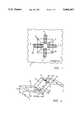
- FIG. 1is a top view of one embodiment of the present invention
- FIG. 2is a partial cross-section view of one element of the embodiment shown in FIG. 1;
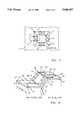
- FIG. 3is a top view of a second embodiment of the present invention.
- FIG. 4is a partial cross-section view of one element of the embodiment shown in FIG. 3.
- FIG. 1there is shown a top view of one embodiment of the present invention.
- an anisotropic etchis used to make an etch cavity 4 in an n type silicon substrate 2 to form a plurality of slanted faces 6 and a horizontal flat surface (labelled as 21 in FIG. 2 and FIG. 4 as 21') at the bottom of the etch cavity 4.
- the cavityis in the shape of an inverted and truncated pyramidoidal geometric structure with the length of the slanted faces 6 being approximately 5 ⁇ in length and the flat bottom surface 21 being 10-20 ⁇ in length and width.
- Regions 8are implanted with a p type dopant so as to form a PN junction with the silicon substrate, thus electrically isolating the regions 8.
- a detailed view of portion 10 of the present inventionis shown in cross-section in FIG. 2.
- regions 8are formed over the horizontal top surface of the substrate 2, slanted faces 6, and horizontal bottom surface 21.
- An emitter 26 and two collectors 30 and 32are formed on the implanted region 8 by doping the region with n type dopants and making ohmic metal contacts.
- a base region 28 and base contact 34are formed by making further ohmic metal contacts.
- the present inventionoperates as a standard bipolar transistor. Hence, the currents of both the majority and the minority carriers in the base region 28 will respond to the component of the magnetic field perpendicular to the faces 6. As a result, there will be a difference in the collector currents in the collectors 30 and 32 which can be calibrated to measure the magnetic field component.
- FIG. 3shows a top view of an alternate embodiment of the present invention.
- an anisotropic etchis used to make an etch cavity 4 in a silicon substrate 2'.
- the silicon substrate 2'is doped p type and the regions 8' implanted in the slanted faces 6' are implanted as an n+ type. Therefore, a PN junction 20 is formed to electrically isolate the implanted regions 8' on the slanted faces 6'.
- FIG. 4shows a detailed cross-section of region 10' of FIG. 3.
- ohmic metal contactsare formed on the implanted region 8' to form source and drain electrodes 24 in order to measure Hall current.
- Another set of ohmic metal contactsare made to the implanted region 8' at both the upper and lower portions of slanted face 6 to form electrodes 28' which will measure the Hall voltage.
- Metal leads 30 formed on the top 23 and bottom 21' of the etched cavity 4provide the electrical connection to metal contact pads 32 for the Hall voltage measurements.
- An insulating layer of SiO 2 22is deposited to make contact with the source and drain contacts 24 and Hall voltage contacts 28'.
- this second embodimentis also biased similarly to that described in the first embodiment.
- the component of the magnetic field perpendicular to the slanted faces 6is computed with a simple conversion to its orthogonal component as noted in the description of the first embodiment.
- all three components of the magnetic fieldcan be computed. Since the perpendicular directions of the faces 6 of the etch pit 4 are not mutually orthogonal, an additional simple computation is required to extract the 3 orthogonal magnetic field components.
Landscapes
- Hall/Mr Elements (AREA)
- Measuring Magnetic Variables (AREA)
Abstract
Description
The invention described herein may be made, used, sold, and/or licensed by, or on behalf of, the Government of the United States of America without the payment to us of any royalties thereon.
The present invention relates generally to the field of microelectronic sensors and more particularly, to sensors that measure magnetic field in three dimensions.
Heretofore, microscale Hall two dimensional magnetic sensors, which have been integrated with silicon CMOS technology, have been reported in such publications as, "Integrated Semiconductor Magnetic Field Sensors," by Bates et al, Proceedings of IEEE, Vol . 74, page 1107, 1986. Such sensors have several advantages over other two dimensional sensors. These include microscale integration of magnetic sensors with silicon integrated circuits, low cost, light weight, small size, and high volume manufacturing. Additional advantages include the ability to fabricate devices in large arrays, the ability to make measurements over a large cross sectional area simultaneously, and the ability to reconfigure connections between devices to achieve higher sensitivity and lower distortion of the local magnetic field due to the small measuring currents. Despite these advantages, these sensors have not been able to measure the three components of a magnetic field. Although three dimensional sensors capable of integration with silicon microcircuitry have been reported in such publications as, "Integrated 3-D Magnetic Sensor Based on an n-p-n Transistor," by Kordic, IEEE Electronic Devices Letters EDL-7,page 196, 1986; "Three Dimensional Magnetic Field Sensors," by Kordic et al, IEEE Transactions on Electronic Devices, Vol. 35, page 771, 1986; and "The Hall Effect in Integrated Magnetotransistors," by Nathan et al IEEE Transactions on Electronic Devices, Vol 36, page 108, 1989, these devices rely on the magnetic deflection of vertical currents in the bulk region of a silicon microcircuit. In these three dimensional sensors, the three sensors required to measure the three orthogonal directions of the magnetic field do not have identical geometries and sensitivity and therefore, require complex calibration. Accordingly, there exists a need in the magnetic field sensor art to provide for a three dimensional sensor without the need for this complex calibration and yet still have all the advantages of two dimensional sensors. The present invention fulfills such a need.
Accordingly, one object of the present invention is to provide for a magnetic field sensor that can measure all three orthogonal directions of a magnetic field while being readily incorporated into microcircuits without the need for excessive calibration.
Another object of the present invention is to provide for such a sensor with all the advantages of two dimensional magnetic sensors.
Still a further object of the present invention is to provide for such a sensor which minimizes the distortion of the local magnetic field due to the measurement process.
These and other objects of the invention are achieved by providing for a pyramid shaped ,etch in an n or p type silicon substrate, or any symmetric etch with slanted edges, with p or n type implants in the slanted edges of the etch to form a PN junction. With such a structure, an emitter and two collectors can then be formed by further implanting n+ regions in the PN junction region. To complete the device, ohmic contacts are formed to establish a base contact.
In operation, an appropriate bias is applied to the emitter through to the base and collectors. By so biasing the device, the device operates as a standard bipolar transistor. The currents of both the minority and majority carriers in the base region will respond to the component of the magnetic field perpendicular to the face of the slanted etch. As a result, there will be a difference in the currents in the collectors. These currents can then be simply calibrated to measure the magnetic field component. By forming similar sensors on 3 or 4 of the faces of the etched structure all three components of the magnetic field can be computed.
These and other features of the present invention will become apparent in light of the following Detailed Description of the Invention and referenced drawings wherein:
FIG. 1 is a top view of one embodiment of the present invention;
FIG. 2 is a partial cross-section view of one element of the embodiment shown in FIG. 1;
FIG. 3 is a top view of a second embodiment of the present invention; and
FIG. 4 is a partial cross-section view of one element of the embodiment shown in FIG. 3.
Now referring to the drawings, and in particular FIG. 1, there is shown a top view of one embodiment of the present invention. As shown, an anisotropic etch is used to make anetch cavity 4 in an ntype silicon substrate 2 to form a plurality ofslanted faces 6 and a horizontal flat surface (labelled as 21 in FIG. 2 and FIG. 4 as 21') at the bottom of theetch cavity 4. In a preferred embodiment of the present invention, the cavity is in the shape of an inverted and truncated pyramidoidal geometric structure with the length of theslanted faces 6 being approximately 5μ in length and theflat bottom surface 21 being 10-20μ in length and width.Regions 8 are implanted with a p type dopant so as to form a PN junction with the silicon substrate, thus electrically isolating theregions 8. A detailed view ofportion 10 of the present invention is shown in cross-section in FIG. 2.
As shown in detail in FIG. 2,regions 8 are formed over the horizontal top surface of thesubstrate 2,slanted faces 6, andhorizontal bottom surface 21. Anemitter 26 and twocollectors region 8 by doping the region with n type dopants and making ohmic metal contacts. Abase region 28 andbase contact 34 are formed by making further ohmic metal contacts.
In operation, appropriate biases are applied from theemitter 26 tobase 34 and fromemitter 26 tocollectors base region 28 will respond to the component of the magnetic field perpendicular to thefaces 6. As a result, there will be a difference in the collector currents in thecollectors
In having a plurality of similarlyshaped elements 10, all three components of the magnetic field can be computed by known methods to those skilled in the art. Of course, as those skilled in the art will also realize that because the perpendicular directions of theslanted faces 6 are not mutually orthogonal, an additional computation is required to obtain the orthogonal components.
FIG. 3 shows a top view of an alternate embodiment of the present invention. As shown, an anisotropic etch is used to make anetch cavity 4 in a silicon substrate 2'. However, for this embodiment, the silicon substrate 2' is doped p type and the regions 8' implanted in the slanted faces 6' are implanted as an n+ type. Therefore, aPN junction 20 is formed to electrically isolate the implanted regions 8' on the slanted faces 6'.
FIG. 4 shows a detailed cross-section of region 10' of FIG. 3. As shown, ohmic metal contacts are formed on the implanted region 8' to form source anddrain electrodes 24 in order to measure Hall current. Metal leads 27, which are formed over the upper portion ofslanted face 6 and thetop 23 of theetched cavity 4, provide the electrical connection to metal contacts 26' on thetop surface 23 of theetch cavity 4 to form source and drain contacts from theohmic metal contacts 24. Another set of ohmic metal contacts are made to the implanted region 8' at both the upper and lower portions ofslanted face 6 to form electrodes 28' which will measure the Hall voltage. Metal leads 30 formed on thetop 23 and bottom 21' of theetched cavity 4 provide the electrical connection tometal contact pads 32 for the Hall voltage measurements. An insulating layer ofSiO 2 22 is deposited to make contact with the source and draincontacts 24 and Hall voltage contacts 28'.
In operation, this second embodiment is also biased similarly to that described in the first embodiment. By running current from the source to thedrain contacts 24 and by measuring the Hall voltage between contacts 28', the component of the magnetic field perpendicular to theslanted faces 6 is computed with a simple conversion to its orthogonal component as noted in the description of the first embodiment. By making similar sensors on 3 or 4 of thefaces 6 of theetch pit 4, all three components of the magnetic field can be computed. Since the perpendicular directions of thefaces 6 of theetch pit 4 are not mutually orthogonal, an additional simple computation is required to extract the 3 orthogonal magnetic field components.
Details of processing steps for both embodiments, for example the manner of lithography used, doping method and amounts, and implantation methods, can all be altered in accordance with the present invention to accommodate various applications; all of these variations in processing will be readily apparent to one skilled in the art. Likewise, the arrangement of the electrical leads and contacts can be similarly altered. In particular, for specific applications it may be desirable to do the measurement computation, processing, and temperature compensation directly on the integrated circuit located next to the sensor. In this case, the electrical leads will go directly to the processing circuit and not to the contact pads. The connections between the individual sensors in an array on a chip can be hard wired or accomplished by more flexible on chip circuitry which can be reconfigured electrically. A sensitivity gain, for the same value of Hall current, can therefore be achieved by connecting the Hall voltage measurements in series for adjacent sensors which have collinear Hall currents. Electrical connections can also be configured to minimize the distortion of the magnetic field due to the Hall currents themselves.
Accordingly, the present invention should not be limited to the prior description, but only by the appended claims.
Claims (10)
1. A three dimensional magnetometer comprising:
a silicon substrate having an etched cavity which has a plurality of slanted faces therein and a bottom surface within the etched cavity, the silicon substrate also having a top surface;
implanted regions formed on at least three of the slanted faces, each implanted region extending from a portion of the top surface of the silicon substrate to a portion of the bottom surface within the etched cavity;
at least two collector contacts disposed on each of the implanted regions at the top surface of the silicon substrate;
an emitter contact disposed on each of the implanted regions at the bottom surface of the etched cavity;
a base region disposed on each of the implanted regions at the slanted face;
wherein appropriate biases are applied to the emitter contact through to the base region and collector contacts and wherein the currents of both minority and majority carriers in the base region will respond to a component of the magnetic field perpendicular to a face of the slanted edge, whereby there will be a difference in the currents in the collector contacts which are calibrated to measure the magnetic field component.
2. The magnetometer of claim 1 wherein the silicon substrate is n type and the implanted regions are p type so that a pn junction is formed.
3. The magnetometer of claim 2 wherein the emitter and collector contacts are n type and form ohmic metal contacts.
4. The magnetometer of claim 3 further comprising a base contact on the implanted region at the top surface of the silicon substrate and wherein the base region and the base contact are ohmic metal contacts.
5. The magnetometer of claim 4 wherein the etched cavity is in the shape of an inverted and truncated pyramidoidal geometric structure.
6. The magnetometer of claim 5 wherein the length of the slanted faces of the etched cavity are 5μ and the dimensions of the bottom of the etched cavity are 10-20 μ.
7. A three dimensional magnetometer comprising:
a silicon substrate doped with a p type dopant and having an etched cavity which has a plurality of slanted faces therein and a bottom surface within the etched cavity, the silicon substrate also having a top surface;
n+ doped implanted regions formed on at least three of the slanted faces, each implanted region extending from a portion of the top surface of the silicon substrate to a portion of the bottom surface within the etched cavity, wherein a pn junction is formed between the implanted regions and the substrate;
source and drain contacts formed on each of the implanted regions at the slanted face, the source and drain contacts having at least first and second metal leads extending over the top surface of the substrate to contact pads disposed on the top surface of the substrate;
at least two metal contacts formed an upper and lower portion of the slanted face, the metal contact formed on the upper portion of the slanted face having a third metal lead extending over the top surface of the substrate to a first metal pad and the metal contact formed on the lower portion of the slanted face having a fourth metal lead extending over the bottom surface within the etched cavity to a second metal pad;
wherein appropriate biases are applied to the source and drain contacts and wherein a Hall voltage can be measured between the two metal contacts such that the component of the magnetic field perpendicular to the slanted face can be measured.
8. The magnetometer of claim 7 wherein the emitter and collector contacts are n type and form ohmic metal contacts.
9. The magnetometer of claim 8 wherein the etched cavity is in the shape of an inverted and truncated pyramidoidal geometric structure.
10. The magnetometer of claim 9 wherein the length of the slanted faces of the etched cavity are 5μ and the dimensions of the bottom of the etched cavity are 10-20μ.
Priority Applications (1)
| Application Number | Priority Date | Filing Date | Title |
|---|---|---|---|
| US08/334,823US5446307A (en) | 1994-11-04 | 1994-11-04 | Microelectronic 3D bipolar magnetotransistor magnetometer |
Applications Claiming Priority (1)
| Application Number | Priority Date | Filing Date | Title |
|---|---|---|---|
| US08/334,823US5446307A (en) | 1994-11-04 | 1994-11-04 | Microelectronic 3D bipolar magnetotransistor magnetometer |
Publications (1)
| Publication Number | Publication Date |
|---|---|
| US5446307Atrue US5446307A (en) | 1995-08-29 |
Family
ID=23308992
Family Applications (1)
| Application Number | Title | Priority Date | Filing Date |
|---|---|---|---|
| US08/334,823Expired - Fee RelatedUS5446307A (en) | 1994-11-04 | 1994-11-04 | Microelectronic 3D bipolar magnetotransistor magnetometer |
Country Status (1)
| Country | Link |
|---|---|
| US (1) | US5446307A (en) |
Cited By (15)
| Publication number | Priority date | Publication date | Assignee | Title |
|---|---|---|---|---|
| US6324035B2 (en) | 1998-08-20 | 2001-11-27 | Hitachi, Ltd. | Magnetic recording and reading device |
| US20030076092A1 (en)* | 2001-10-18 | 2003-04-24 | Nec Corporation | Electric and magnetic field detection device and electric and magnetic field measurement apparatus |
| US20030076094A1 (en)* | 2001-10-18 | 2003-04-24 | Nec Corporation | Magnetic field detection device and magnetic field measurement apparatus |
| US6744250B2 (en) | 2001-09-08 | 2004-06-01 | Robert Bosch Gmbh | Device for measuring the strength of a vector component of a magnetic field, current-measuring device and use of a field-effect transistor |
| US20050174112A1 (en)* | 2004-02-06 | 2005-08-11 | Denso Corporation | Magnetic sensor apparatus and manufacturing method thereof |
| FR2880731A1 (en)* | 2005-01-11 | 2006-07-14 | Commissariat Energie Atomique | COMPONENT, IN PARTICULAR WITH ACTIVE ELEMENTS, AND METHOD FOR PRODUCING SUCH COMPONENT |
| US20070035294A1 (en)* | 2004-06-03 | 2007-02-15 | Honeywell International Inc. | Integrated Three-Dimensional Magnetic Sensing Device and Method to Fabricate an Integrated Three-Dimensional Magnetic Sensing Device |
| US20080217288A1 (en)* | 2005-01-21 | 2008-09-11 | Marcus Breuer | Method of manufacturing a magnetic sensor with tilted magnetoresistive structures |
| US20090315129A1 (en)* | 2006-07-13 | 2009-12-24 | Jean Baptiste Albertini | Integrated circuit distributed over at least two non-parallel planes and its method of production |
| RU2387046C1 (en)* | 2008-09-18 | 2010-04-20 | Государственное Учреждение "Научно-производственный комплекс "Технологический центр" Московского Государственного института электронной техники" (ГУ НПК "ТЦ" МИЭТ) | Integral electromagnetic transducer built around bipolar magnetic transistor |
| WO2012119900A1 (en)* | 2011-03-04 | 2012-09-13 | Nxp B.V. | Magnetic sensors |
| FR2988903A1 (en)* | 2012-03-27 | 2013-10-04 | Bosch Gmbh Robert | SENSOR AND METHOD FOR MANUFACTURING AND MOUNTING |
| US20160003923A1 (en)* | 2014-07-01 | 2016-01-07 | Nxp B.V. | Differential lateral magnetic field sensor system with offset cancelling and implemented using silicon-on-insulator technology |
| US9515198B1 (en) | 2015-12-11 | 2016-12-06 | International Business Machines Corporation | Magnetic-field and magnetic-field gradient sensors based on lateral SOI bipolar transistors |
| US20170239560A1 (en)* | 2016-02-23 | 2017-08-24 | Mediatek Inc. | Position tracking ring, band or bracelet and virtual reality system |
Citations (6)
| Publication number | Priority date | Publication date | Assignee | Title |
|---|---|---|---|---|
| US4015148A (en)* | 1976-05-05 | 1977-03-29 | Bell Telephone Laboratories, Incorporated | Hall effect device for use in obtaining square or square root of a voltage amplitude |
| US4223292A (en)* | 1977-07-25 | 1980-09-16 | Hitachi, Ltd. | Hall element |
| SU1490656A1 (en)* | 1987-05-15 | 1989-06-30 | Объединенный Институт Ядерных Исследований | Three-component magnetic field transducer and method of its manufacturing |
| US5162886A (en)* | 1990-05-21 | 1992-11-10 | Sumitomo Electric Industries Ltd. | Hall device |
| US5179429A (en)* | 1992-03-30 | 1993-01-12 | Motorola, Inc. | Magnetic field sensor with split collector contacts for high sensitivity |
| US5323050A (en)* | 1993-06-01 | 1994-06-21 | Motorola, Inc. | Collector arrangement for magnetotransistor |
- 1994
- 1994-11-04USUS08/334,823patent/US5446307A/ennot_activeExpired - Fee Related
Patent Citations (6)
| Publication number | Priority date | Publication date | Assignee | Title |
|---|---|---|---|---|
| US4015148A (en)* | 1976-05-05 | 1977-03-29 | Bell Telephone Laboratories, Incorporated | Hall effect device for use in obtaining square or square root of a voltage amplitude |
| US4223292A (en)* | 1977-07-25 | 1980-09-16 | Hitachi, Ltd. | Hall element |
| SU1490656A1 (en)* | 1987-05-15 | 1989-06-30 | Объединенный Институт Ядерных Исследований | Three-component magnetic field transducer and method of its manufacturing |
| US5162886A (en)* | 1990-05-21 | 1992-11-10 | Sumitomo Electric Industries Ltd. | Hall device |
| US5179429A (en)* | 1992-03-30 | 1993-01-12 | Motorola, Inc. | Magnetic field sensor with split collector contacts for high sensitivity |
| US5323050A (en)* | 1993-06-01 | 1994-06-21 | Motorola, Inc. | Collector arrangement for magnetotransistor |
Non-Patent Citations (8)
| Title |
|---|
| Bates et al, "Integrated Semiconductor Magnetic Field Sensors," Proceedingsf IEEE, vol. 74, p. 1107, 1986. |
| Bates et al, Integrated Semiconductor Magnetic Field Sensors, Proceedings of IEEE, vol. 74, p. 1107, 1986.* |
| Kordic et al, "Three Dimensional Magnetic Field Sensors", IEEE Transactions on Electronic Devices, vol. 35, p. 771, 1986. |
| Kordic et al, Three Dimensional Magnetic Field Sensors , IEEE Transactions on Electronic Devices, vol. 35, p. 771, 1986.* |
| Kordic, "Integrated 3-D Magnetic Sensor Based on an n-p-n Transistor", IEEE Electronic Devices Letters EDL-7, p. 196, 1986. |
| Kordic, Integrated 3 D Magnetic Sensor Based on an n p n Transistor , IEEE Electronic Devices Letters EDL 7, p. 196, 1986.* |
| Nathan et al, "The Hall Effect in Integrated Magnetotransistors", IEEE Transactions on Electronic Devices, vol. 36, p. 108, 1989. |
| Nathan et al, The Hall Effect in Integrated Magnetotransistors , IEEE Transactions on Electronic Devices, vol. 36, p. 108, 1989.* |
Cited By (38)
| Publication number | Priority date | Publication date | Assignee | Title |
|---|---|---|---|---|
| US20070127155A1 (en)* | 1998-08-20 | 2007-06-07 | Yoshihiro Shiroishi | Magnetic recording and reading device |
| US6404605B2 (en)* | 1998-08-20 | 2002-06-11 | Hitachi, Ltd. | Magnetic recording and reading device |
| US6407892B2 (en)* | 1998-08-20 | 2002-06-18 | Hitachi, Ltd. | Magnetic recording and reading device |
| US7339762B2 (en) | 1998-08-20 | 2008-03-04 | Hitachi Global Storage Technologies Japan, Ltd. | Magnetic recording and reading device |
| US6324035B2 (en) | 1998-08-20 | 2001-11-27 | Hitachi, Ltd. | Magnetic recording and reading device |
| US20040085685A1 (en)* | 1998-08-20 | 2004-05-06 | Yoshihiro Shiroishi | Magnetic recording and reading device |
| US6819531B2 (en) | 1998-08-20 | 2004-11-16 | Hitachi, Ltd. | Magnetic recording and reading device having 50 mb/s transfer rate |
| US7782566B2 (en) | 1998-08-20 | 2010-08-24 | Hitachi Global Storage Technologies Japan, Ltd. | Magnetic recording and reading device |
| US20100246054A1 (en)* | 1998-08-20 | 2010-09-30 | Yoshihiro Shiroishi | Magnetic Recording And Reading Device |
| US7903374B2 (en) | 1998-08-20 | 2011-03-08 | Hitachi Global Storage Technologies Japan, Ltd. | Magnetic recording and reading device |
| US7177115B2 (en) | 1998-08-20 | 2007-02-13 | Hitachi Global Storage Technologies Japan, Ltd. | Magnetic recording and reading device |
| US6744250B2 (en) | 2001-09-08 | 2004-06-01 | Robert Bosch Gmbh | Device for measuring the strength of a vector component of a magnetic field, current-measuring device and use of a field-effect transistor |
| DE10144268B4 (en)* | 2001-09-08 | 2015-03-05 | Robert Bosch Gmbh | Device for measuring the strength of a vector component of a magnetic field |
| US20030076094A1 (en)* | 2001-10-18 | 2003-04-24 | Nec Corporation | Magnetic field detection device and magnetic field measurement apparatus |
| US6844725B2 (en) | 2001-10-18 | 2005-01-18 | Nec Corporation | Electric and magnetic field detection device and electric and magnetic field measurement apparatus |
| US20030076092A1 (en)* | 2001-10-18 | 2003-04-24 | Nec Corporation | Electric and magnetic field detection device and electric and magnetic field measurement apparatus |
| US7221157B2 (en)* | 2004-02-06 | 2007-05-22 | Denso Corporation | Magnetic sensor apparatus and manufacturing method thereof |
| US20050174112A1 (en)* | 2004-02-06 | 2005-08-11 | Denso Corporation | Magnetic sensor apparatus and manufacturing method thereof |
| US7358722B2 (en)* | 2004-06-03 | 2008-04-15 | Honeywell International Inc. | Integrated three-dimensional magnetic sensing device and method to fabricate an integrated three-dimensional magnetic sensing device |
| US20070035294A1 (en)* | 2004-06-03 | 2007-02-15 | Honeywell International Inc. | Integrated Three-Dimensional Magnetic Sensing Device and Method to Fabricate an Integrated Three-Dimensional Magnetic Sensing Device |
| FR2880731A1 (en)* | 2005-01-11 | 2006-07-14 | Commissariat Energie Atomique | COMPONENT, IN PARTICULAR WITH ACTIVE ELEMENTS, AND METHOD FOR PRODUCING SUCH COMPONENT |
| US20080050561A1 (en)* | 2005-01-11 | 2008-02-28 | Helene Joisten | Micromechanical Component With Active Elements and Method Producing a Component of This Type |
| WO2006075081A1 (en)* | 2005-01-11 | 2006-07-20 | Commissariat A L'energie Atomique | Micromechanical component with active elements and method for producing a component of this type |
| US8110119B2 (en)* | 2005-01-21 | 2012-02-07 | International Business Machines Corporation | Method of manufacturing a magnetic sensor with tilted magnetoresistive structures |
| US20080217288A1 (en)* | 2005-01-21 | 2008-09-11 | Marcus Breuer | Method of manufacturing a magnetic sensor with tilted magnetoresistive structures |
| US20090315129A1 (en)* | 2006-07-13 | 2009-12-24 | Jean Baptiste Albertini | Integrated circuit distributed over at least two non-parallel planes and its method of production |
| RU2387046C1 (en)* | 2008-09-18 | 2010-04-20 | Государственное Учреждение "Научно-производственный комплекс "Технологический центр" Московского Государственного института электронной техники" (ГУ НПК "ТЦ" МИЭТ) | Integral electromagnetic transducer built around bipolar magnetic transistor |
| WO2012119900A1 (en)* | 2011-03-04 | 2012-09-13 | Nxp B.V. | Magnetic sensors |
| US9702958B2 (en) | 2011-03-04 | 2017-07-11 | Nxp B.V. | Magnetic sensors |
| FR2988903A1 (en)* | 2012-03-27 | 2013-10-04 | Bosch Gmbh Robert | SENSOR AND METHOD FOR MANUFACTURING AND MOUNTING |
| US9632104B2 (en) | 2012-03-27 | 2017-04-25 | Robert Bosch Gmbh | Sensor, method for producing a sensor and method for mounting a sensor |
| CN103359681A (en)* | 2012-03-27 | 2013-10-23 | 罗伯特·博世有限公司 | Sensor, method for producing sensor and method for mounting sensor |
| US20160003923A1 (en)* | 2014-07-01 | 2016-01-07 | Nxp B.V. | Differential lateral magnetic field sensor system with offset cancelling and implemented using silicon-on-insulator technology |
| US9696390B2 (en)* | 2014-07-01 | 2017-07-04 | Nxp B.V. | Differential lateral magnetic field sensor system with offset cancelling and implemented using silicon-on-insulator technology |
| US9515198B1 (en) | 2015-12-11 | 2016-12-06 | International Business Machines Corporation | Magnetic-field and magnetic-field gradient sensors based on lateral SOI bipolar transistors |
| US9614148B1 (en) | 2015-12-11 | 2017-04-04 | International Business Machines Corporation | Magnetic-field and magnetic-field gradient sensors based on lateral SOI bipolar transistors |
| US20170239560A1 (en)* | 2016-02-23 | 2017-08-24 | Mediatek Inc. | Position tracking ring, band or bracelet and virtual reality system |
| US11904234B2 (en)* | 2016-02-23 | 2024-02-20 | Mediatek Inc. | Position tracking ring, band or bracelet and virtual reality system |
Similar Documents
| Publication | Publication Date | Title |
|---|---|---|
| US5446307A (en) | Microelectronic 3D bipolar magnetotransistor magnetometer | |
| US8169045B2 (en) | System and method for constructing shielded seebeck temperature difference sensor | |
| EP2746799B1 (en) | Semiconductor magnetic field sensors | |
| TWI286383B (en) | Semiconductor piezoresistive sensor and operation method thereof | |
| US3593067A (en) | Semiconductor radiation sensor | |
| CA2302040A1 (en) | Shielded integrated circuit capacitor | |
| US4908682A (en) | Power MOSFET having a current sensing element of high accuracy | |
| US20150008544A1 (en) | Physical quantity sensor | |
| KR20150105530A (en) | Buried Magnetic Sensor | |
| EP0615287B1 (en) | Dielectric isolated bipolar transistor | |
| US5428242A (en) | Semiconductor devices with shielding for resistance elements | |
| US4660065A (en) | Hall effect device with surface potential shielding layer | |
| US3488564A (en) | Planar epitaxial resistors | |
| US5055820A (en) | Hall element and magnetic sensor system employing the same | |
| US20040016981A1 (en) | Semiconductor acceleration sensor using doped semiconductor layer as wiring | |
| US4906921A (en) | Structure and process for testing integrated circuits permitting determination of the properties of layers | |
| US6504153B1 (en) | Semiconductor infrared detecting device | |
| CN113394339B (en) | Hall effect sensor device and method of forming a Hall effect sensor device | |
| US5304838A (en) | Vertical resistive element for integrated circuit miniaturization | |
| JPS62260376A (en) | integrated circuit chip | |
| EP0162165A2 (en) | A Hall effect device and method for fabricating such a device | |
| CN113104804B (en) | Infrared thermopile sensor, chip and preparation method thereof | |
| US4533898A (en) | Symmetrical temperature sensor | |
| JPH0531307B2 (en) | ||
| US20250306139A1 (en) | Reduced noise hall sensor |
Legal Events
| Date | Code | Title | Description |
|---|---|---|---|
| AS | Assignment | Owner name:ARMY, UNITED STATES OF AMERICA, THE, AS REPRESENTE Free format text:ASSIGNMENT OF ASSIGNORS INTEREST;ASSIGNORS:LUX, ROBERT A.;HARVEY, JAMES F.;MULFORD, CHARLES D., JR.;AND OTHERS;REEL/FRAME:007533/0287;SIGNING DATES FROM 19941101 TO 19941102 | |
| REMI | Maintenance fee reminder mailed | ||
| FPAY | Fee payment | Year of fee payment:4 | |
| SULP | Surcharge for late payment | ||
| LAPS | Lapse for failure to pay maintenance fees | ||
| STCH | Information on status: patent discontinuation | Free format text:PATENT EXPIRED DUE TO NONPAYMENT OF MAINTENANCE FEES UNDER 37 CFR 1.362 | |
| FP | Lapsed due to failure to pay maintenance fee | Effective date:20030829 |