CROSS REFERENCE TO RELATED APPLICATIONThis application is a continuation-in-part of patent application Ser. No. 07/800,507, filed Nov. 27, 1991, now abandoned, the specification of which is incorporated herein by reference.
BACKGROUND OF THE INVENTION1. Field of the Invention
The present invention pertains to safety penetrating instruments and, more particularly, to establishing communication with anatomical cavities utilizing automatically retractable safety penetrating instruments having portal sleeves and penetrating members with sharp tips disposed within the portal sleeves for penetrating cavity walls with automatic retraction of the penetrating members into the portal sleeves upon penetration to protect tissue and organ structures within the cavities from the sharp tips of the penetrating members.
2. Discussion of the Prior Art
Penetrating instruments are widely used in medical procedures to gain access to anatomical cavities of various sizes; and, in particular, use of penetrating instruments has become an extremely popular and important first step in endoscopic, or least invasive, procedures to establish an endoscopic portal for many various procedures, with access being established via a portal sleeve positioned during penetration into the cavity with the penetrating instrument. Such penetrating instruments include a penetrating member having a sharp tip or point to pierce or penetrate the tissue forming the cavity wall, and the force required to penetrate the cavity wall is dependent upon the type and thickness of the tissue of the wall. Once the wall is penetrated, it is desirable to protect the sharp tip of the penetrating member to prevent inadvertent contact with or injury to tissue or organ structures in or forming the cavity, and a particular problem exists where substantial force is required to penetrate the cavity wall or the cavity is very small in that, once penetration is achieved, the lack of tissue resistance can result in the sharp tip traveling too far into the cavity and injuring adjacent tissue or organ structures.
Safety trocars having a spring-biased protective shield disposed between an outer sleeve and an inner trocar are marketed by Ethicon, Inc. as the Endopath and by United States Surgical Corp. as the Surgiport. U.S. Pat. Nos. 4,535,773 to Yoon, 4,601,710 to Moll and 4,654,030 to Moll et al are illustrative of such safety trocars. A trocar disposed within a portal sleeve and retractable within the sleeve in response to an electrical signal generated when force from tissue contact is removed from the sharp tip of the trocar is set forth in U.S. Pat. No. 4,535,773 to Yoon.
SUMMARY OF THE INVENTIONIt is a primary object of the present invention to provide improved safety penetrating instruments capable of use in a wide variety of procedures and having the general configuration and appearance of standard penetrating instruments.
Another object of the present invention is to provide an automatic retractable safety penetrating instrument in a rest position with a sharp distal tip of a penetrating member in a retracted position within a portal sleeve while a hub coupled with the penetrating member is engaged with a housing coupled with the portal sleeve and to allow the penetrating member to be manually moved to an operative extended position with the sharp distal tip extending beyond the distal end of the portal sleeve.
A further object of the present invention is to provide an automatic retractable safety penetrating instrument in a rest state with bias devices therein disposed in relaxed or unloaded states and moved to biased or loaded states prior to penetration of tissue.
Another object of the present invention is to automatically retract a penetrating member of a safety penetrating instrument to a protected position in response to distal movement of the safety penetrating instrument after a distal end of a portal sleeve enters a body cavity.
A further object of the present invention is to arrange an operating member in a safety penetrating instrument such that movement of the operating member distally places the penetrating member in a protected, safe position within the instrument.
The present invention has an additional object of allowing safe introduction of portal sleeves into body cavities of very small size, such as spinal canal, synovial, pleural or pericardial cavities, for example, by automatically retracting a sharp tip of a safety penetrating instrument within the portal sleeve after the cavity is penetrated thereby minimizing the extension of the safety penetrating instrument into the cavity.
An additional object of the present invention is to provide a method of safely penetrating various anatomical cavities by automatically retracting a penetrating member upon entry into a cavity in response to distal movement of a component of a safety penetrating instrument.
A further object of the present invention is to provide a safety penetrating instrument including a portal sleeve and a distally biased penetrating member disposed within the portal sleeve and having a sharp tip retractable within the portal sleeve in response to movement of the penetrating member due to the distal bias upon penetration through tissue of a cavity wall.
Some of the advantages of the present invention over the prior art are that the automatic retractable safety penetrating instrument can be provided and stored in a rest state with the sharp distal tip withdrawn into the portal sleeve in a safe, protected position and with the bias devices in relaxed states, small or narrow anatomical cavities can be safely penetrated, portal sleeves can safely be introduced into anatomical cavities of various sizes to expand the use of least invasive procedures in many areas including, for example, the cardiac, brain, vascular, chest, genitourinary system, breast and spinal fields, safe penetration of cavities can be accomplished with no parts of the safety penetrating instrument other than the portal sleeve protruding beyond the sharp tip of the penetrating member as is particularly desirable where organ structures adhere to cavity walls, the automatic retractable safety penetrating instrument encourages the use of a smooth, continuous penetrating motion by the surgeon thereby reducing trauma, tears and irregular surfaces in the tissue of the cavity wall, the automatic retractable safety penetrating instrument can be used to penetrate anatomical cavities of the type containing organ structures that could be injured by contact with even a blunt instrument part such as a safety shield, with the use of a threaded distal tip on a penetrating member, penetration of the narrowest of anatomical cavities can be achieved in a safe manner in view of the gradual advancement of the penetrating member coupled with immediate automatic retraction of the penetrating member upon entry into the cavity, safe penetration is achieved while permitting injection or evacuation of fluids, a single puncture can be used for both insufflation and forming an endoscopic portal thereby simplifying diagnostic and surgical procedures, trauma and damage to tissue is minimized, tissue jamming and trapping is avoided and safety penetrating instruments according to the present invention can be inexpensively manufactured to be reusable or disposable for universal use.
The present invention is generally characterized in a method of establishing a portal communicating with an anatomical cavity for the introduction of instruments utilizing an automatic retractable safety penetrating instrument including a portal sleeve and a penetrating member disposed in the portal sleeve including the steps of forcing the automatic retractable safety penetrating instrument through tissue to enter the anatomical cavity with the penetrating member in an extended position wherein a sharp distal tip of the penetrating member extends beyond a distal end of the portal sleeve, biasing an operating member in the automatic retractable safety penetrating instrument to move distally upon entry of the automatic retractable safety penetrating instrument into the anatomical cavity, and automatically retracting the penetrating member in response to distal movement of the operating member to a retracted position wherein the sharp distal tip of the penetrating member is within the portal sleeve. The present invention is further generally characterized in a method of establishing a portal communicating with an anatomical cavity for the introduction of instruments utilizing an automatic retractable safety penetrating instrument including a portal sleeve and a penetrating member disposed in the portal sleeve wherein the automatic retractable safety penetrating instrument is provided in a rest state where the penetrating member is in a retracted position wherein a sharp distal tip of the penetrating member is within the portal sleeve and, for use, the penetrating member is moved from the retracted position to an extended position wherein the sharp distal tip of the penetrating member extends from a distal end of the portal sleeve. The automatic retractable safety penetrating instrument utilizes various arrangements of locking and releasing or trigger mechanisms and bias devices of various types including coiled compression and tension springs, bellows or accordion springs, telescoping springs and springs made of elastic materials such as rubber, sponge, foamed plastic and the like. When the automatic retractable safety penetrating instrument is in the rest state, the springs are preferably in a relaxed, unbiased condition to extend their shelf life; and, when the penetrating member is moved to the operative, extending position, the springs are placed in biased or loaded conditions.
These and other objects and advantages of the present invention will become apparent from the following description of the preferred embodiments taken in conjunction with the accompanying drawings wherein identical reference numbers are used for identical parts and references with one hundred or multiples thereof are used for similar parts.
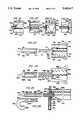
BRIEF DESCRIPTION OF THE DRAWINGSFIG. 1 is a broken side view, partly in section, of an automatic retractable safety penetrating instrument according to the present invention.
FIG. 2 is a top view of the hub of the automatic retractable safety penetrating instrument of FIG. 1.
FIG. 3 is a section taken alongline 3--3 of FIG. 2.
FIGS. 4 and 5 are broken side views, partly in section, illustrating operation of the automatic retractable safety penetrating instrument of FIG. 1.
FIGS. 6, 7, 8, 9 and 10 show various types of springs useful as bias devices in the automatic retractable safety penetrating instrument of the present invention.
FIG. 11 is a broken sectional view of a modification of a hub arrangement for the automatic retractable safety penetrating instrument of the present invention.
FIG. 12 is a broken perspective view of the locking and releasing mechanism of FIG. 11.
FIGS. 13 and 14 are broken sectional views of modifications of hub arrangements for the automatic retractable safety penetrating instrument of the present invention.
FIG. 15 is a broken sectional view of another embodiment of an automatic retractable safety penetrating instrument according to the present invention.
FIG. 16 is a broken sectional view of a further embodiment of an automatic retractable safety penetrating instrument according to the present invention.
FIG. 16A is a cross-section of a modification of the automatic retractable safety penetrating instrument of FIG. 16.
FIG. 17 is a side view of the distal end of a further modification of the automatic retractable safety penetrating instrument of FIG. 16.
FIG. 18 is a side view of the distal end of another modification of the automatic retractable safety penetrating instrument of FIG. 16.
FIGS. 19 and 20 are broken sections of modified hub arrangements for use with the automatic retractable safety penetrating instrument of FIG. 16.
FIG. 21 is a broken sectional view of another hub arrangement for use with the automatic retractable safety penetrating instrument of FIG. 16.
FIG. 22 is a broken sectional view of the hub arrangement of FIG. 21 in the rest or retracted state.
FIGS. 23, 24 and 25 are broken side views, partly in section, of other embodiments of automatic retractable safety penetrating instruments according to the present invention.
FIG. 26 is a broken view of the distal end of the automatic retractable safety penetrating instrument of FIG. 25 after retraction of the penetrating member.
DESCRIPTION OF THE PREFERRED EMBODIMENTSAn automatic retractablesafety penetrating instrument 30 according to the present invention is illustrated in FIG. 1 and includes an elongate penetratingmember 32, aportal sleeve 34 concentrically disposed around the penetrating member, ahub 36 mounting penetratingmember 32 and avalve housing 38mounting portal sleeve 34. Thehub 36 can be latched tohousing 38 with the use of any suitable releasable mechanism, such asdetents 40 operated bybuttons 42, allowing the hub to be removed from the housing withdrawing the penetrating member from the portal sleeve. Accordingly, the automatic retractablesafety penetrating instrument 30 can be considered to be formed of a portal unit and a penetrating unit, the portal unit includingportal sleeve 34 andhousing 38 and the penetrating unit including penetratingmember 32 andhub 36.
Penetratingmember 32 is preferably made of a medical grade material, such as stainless steel, and has an outer diameter or size dependent upon the surgical procedure to be performed and the anatomical cavity to be penetrated. The penetratingmember 32 has adistal end 44 terminating at asharp tip 46 for penetrating anatomical tissue. Thedistal end 44 can have various configurations; and, as shown in FIG. 1, the distal end is formed as a trocar with a pyramidal shape defined by equally spaced end surfaces or facets tapering distally tosharp tip 46 and terminating proximally at scalloped edges orjunctions 47 joining the facets to anelongated body 48 which can be cylindrical or have any desirable configuration in cross-section.Body 48 extends proximally from thedistal end junction 47 to terminate at an operating member orflange 50 at a proximal end of the penetrating member, the proximal end being disposed inhub 36 withbody 48 passing through an aperture in a front wall of the hub. Thebody 48 can be hollow or tubular along the length of the penetrating member, and an aperture (not shown) can be disposed at thedistal end 44 to allow communication entirely through theinstrument 30 via avalve 51 carried on the rear wall ofhub 36, or the body can be partly hollow or tubular to receive atube 52 extending distally from the rear wall of the hub and into the hollow proximal end of the penetrating member. A coiledhelical operating spring 54 is connected betweenflange 50 and aretraction plate 56 of a retractingmember 58, the plate having an aperture therethrough receiving the proximal end of penetratingmember 32 and joining arail arrangement 59 forming a recess for receiving a coiled, helical retractingspring 60 connected between the rear wall ofhub 36 andretraction plate 56. If required, a guide rod 62 can extend from the rear wall of the hub to the front wall of the hub passing throughretraction plate 56 to provide a guide to maintain the retractingspring 60 in axial alignment.
Hub 36 can be made of any suitable material to be disposable or reusable and has an external configuration to cooperate withhousing 38 to be easily grasped with one hand for use in penetrating tissue.Hub 36 can have any desired configuration in cross-section and is shown in FIG. 3 as being substantially rectangular while having a flared profile as shown in FIGS. 1 and 2. Atop wall 64 of the hub has a central recessedchannel 66 aligned with the longitudinal axis of the automatic retractable safety penetrating instrument, and a slot 68 is disposed in thechannel 66 and is formed of a longitudinal portion 70 aligned with the longitudinal axis of theinstrument 30, a distaltransverse portion 71, an intermediatetransverse portion 72 and a proximaltransverse portion 74, as best shown in FIG. 2. Apin 76 is threadedly secured in the periphery offlange 50 and extends through slot 68, as best shown in FIG. 3, the pin having a "T" configuration to terminate at anexternal knob 77. As previously noted,valve 51, which can be of any conventional design, is provided in the rear wall of the hub in alignment with the lumen oftube 52 to allow passage of fluid entirely through the instrument for additional confirmation of cavity penetration via leakage detection and for irrigation and aspiration when the penetrating member is hollow along its length and provided with an aperture at the distal end to establish fluid communication through the instrument.
A retracting mechanism engages the proximal end of the penetratingmember 32 and includes the retractingmember 58 and retractingspring 60, and the retracting mechanism is actuated by a locking and releasing ortrigger mechanism 76 formed of a latch or locking spring having a substantiallyflat base 78 secured to a wall ofhub 36 with anarm 80 bent inwardly therefrom and extending angularly distally in the direction of the longitudinal axis. A bent locking finger ormember 82 is carried on the distal end ofarm 80 to engage retractingplate 56 and hold the plate against the front wall of the hub to prevent movement thereof when the locking spring is in its normal position as illustrated in FIG. 1. Thetrigger mechanism 76 has a releasing or triggermember 84 extending rearwardly or proximally fromarm 80 at an angle to allow movement offlange 50 thereby in a proximal direction without causing bending ofarm 80. Theguide rail 59 terminates proximally at aflange 86 acting as a positive stop or abutment member to limit proximal movement of the penetrating member by abutment withflange 50, and trigger 84 is positioned distally offlange 86 by a distance corresponding to the distal movement desired of flange or operatingmember 50 prior to automatic retraction, as will be explained in more detail hereinafter. The locking and releasing or trigger mechanism can be mounted at any suitable location on the hub and provided with any required configuration to act as a stop or abutment to prevent proximal movement of the retracting member and to be actuated or released by the distally moving operating member. The locking and releasing mechanism can be made as one piece or multiple pieces dependent upon the hub construction and the operating member utilized to actuate the trigger,flange 50 in the embodiment of FIG. 1. As shown, lockingmember 82 and trigger 84 are unitarily, integrally formed of a single strip of resilient, spring material such as metal or plastic.
Portal sleeve 34 is preferably made of a substantially cylindrical length of rigid or flexible material, such as stainless steel or other suitable, medically acceptable, plastic or metal material, and can be transparent or opaque. The portal sleeve has adistal end 88 having a configuration to produce a smooth profile withdistal end 44 of the penetrating member when the instrument is in an operating state to penetrate tissue, and the portal sleeve has a proximal end mounted in or formed with a front wall ofvalve housing 38 with a lumen extending between the distal and proximal ends.Housing 38 can be made of any suitable material to be disposable or reusable and has a configuration in cross-section corresponding to the cross-sectional configuration ofhub 36 with a flared external profile facilitating grasping during use. A wall 90 extends inwardly fromhousing 38 at the rear end thereof at a position distally spaced from the rear end of the housing to produce a recess for receivingdetents 40, the wall 90 having a central passage for receiving avalve assembly 92.Valve assembly 92 can have any conventional configuration to produce a closed or sealed condition upon removal of the penetrating unit; however, in accordance with the present invention,valve assembly 92 is formed of a unitary, one-piece integral construction of rubber or soft plastic to facilitate sealing to prevent fluid flow through the instrument when the penetrating unit is removed. Thevalve assembly 92 is formed of abody 94 having a passage 96 therethrough and aproximal flange 98 extending outwardly therefrom to be received in the recess at the rear end of thehousing 38. Thebody 94 has a peripheral configuration to fit snugly within the passage through wall 90, and avalve member 98 extends distally frombody 94 and has a normally sealed position with a hemispherical bulging end 100 received in the valve seat formed at the end of passage 96 to produce a normally closed, sealed configuration. To provide assisted bias toward the sealed configuration, aspring member 102 can be embedded within thevalve assembly 92 to bias thevalve member 98 toward the valve seat 96. While the face of the valve seat is illustrated as being transverse to the longitudinal axis of the automatic retractablesafety penetrating instrument 30, the valve seat can be angularly oriented as illustrated in phantom at 104.
In use, the automatic retractablesafety penetrating instrument 30 is normally provided in a rest state wherein thedistal end 44 of penetratingmember 32 is retracted withinportal sleeve 34 to be in a safe protected condition, the rest state coinciding with the retracted position for the penetrating member, shown in FIG. 5. In the rest state, retractingspring 60 is in a relaxed, unbiased or unloaded state, and theretraction member 58 is moved proximally untilflange 86 abuts the rear wall of thehub 36 carrying with it penetratingmember 32, it being noted that operatingspring 54 is similarly in an unbiased state in the rest position. Accordingly, with the automatic retractable safety penetrating instrument initially provided in a rest state, no loading of thesprings 54 and 60 exists such that the strength of the springs is not weakened and shelf life is increased. With the automatic retractable safety penetrating instrument in the rest state, pin 76 can be rotated to be received intransverse slot portion 74 to be locked in that position to assure that the sharpdistal end 44 of the penetrating member remains in a protected position. By formingflange 50 separate from the penetrating member and rotatably mountingflange 50 on the proximal end of the penetrating member,pin 76 can be rotated in slot 68 without rotation of the penetrating member. When it is desired to utilize theinstrument 30 to penetrate tissue to introduce the portal sleeve into an anatomical cavity, theknob 77 is grasped and moved distally within longitudinal slot portion 70 to the distal end thereof causingretraction plate 56 to move overarm 80 andfinger 82 to be locked in place adjacent the front wall of the hub as shown in FIG. 1. Locking of the retraction plate can be confirmed by feel and sound as the locking member snaps into place and also visually by viewing the position ofknob 77 relative to slot 68. With theinstrument 30 in the extended condition shown in FIG. 1, thedistal end junction 47 of the penetrating member will be spaced from thedistal end 88 of the portal sleeve by a distance A which distance is the same as the spacing betweenflange 50 and stop orabutment member 86.
The instrument can now be utilized to penetrate tissue and enter an anatomical cavity in three manners. In a first manner,pin 76 is rotated intotransverse slot portion 71 which allows the instrument to be used as a standard trocar since the penetrating member is prevented from retracting. In a second manner, the hub and housing are grasped by the surgeon and the instrument is forced against tissue T, as shown in FIG. 4, causing penetratingmember 32 to move proximally against the bias of operatingspring 54 untilflange 50 abuts stopmember 86 at which time the penetrating member will be in the operative position with thedistal end junction 47 of the penetrating member aligned with thedistal end 88 of the portal sleeve, as shown in FIG. 4. When the flange or operatingmember 50 moves proximally, the operating member causes triggermember 84 to deflect proximally such that theflange 50 moves proximally past the trigger member, as shown in FIG. 4, wherein thehousing 38 is not shown to simplify understanding of the present invention. While thetrigger member 84 is shown in FIG. 4 as being closely adjacent or abuttingflange 50,trigger member 84 can be positioned at varying distances fromflange 50 to control the amount of distal movement of the operating member required before the penetrating member is retracted. In a third manner of operation, the penetrating member is manually moved to the operative position by graspingknob 77, moving thepin 76 proximally in slot portion 70 and then positioning the pin intransverse slot portion 72 to maintain the penetrating member in the operative position with thedistal end junction 47 in alignment with the portal sleevedistal end 88. In either of the second or third manners, after the penetrating member is moved to the operative position, the instrument is forced through the tissue T to enter the anatomical cavity with the sharpdistal tip 46 of the penetrating member extending beyond the distal end of the portal sleeve with the distal end of the instrument having the configuration of a standard trocar; and, once the distal end of the instrument has passed through the tissue T, operatingspring 54 will move penetratingmember 32 distally causing distal movement of operatingmember 50 to engagetrigger member 84 andflex arm 80 downwardly looking at FIG. 4 such that lockingmember 82 is moved out of abutment withretraction plate 56. Accordingly, retractingspring 60 will automatically move the retractingmember 58 and the penetrating member to the retracted position shown in FIG. 5 with the sharp distal tip of the penetrating member within the portal sleeve in a safe protected position. When the third manner of operation is utilized, the surgeon can merely utilize his finger to move thepin 76 out oftransverse slot portion 72 once tissue penetration has begun thereby allowing retraction upon entry into the anatomical cavity while in the second manner of operation, the knob will continuously remain in the longitudinal slot portion 70 to produce automatic retraction. If desired, thepin 76 can remain in thetransverse portion 72 preventing automatic retraction similar to the first manner of operation described above.
Once the distal end of the instrument has entered into the anatomical cavity and the penetrating member has moved to the retracted position, the portal sleeve will have been introduced into the cavity such that the penetrating unit can be withdrawn from the portal unit. When the penetrating member is withdrawn, thevalve member 98 will return to the biased position such that end 100 will engage the valve seat 96 to seal the portal unit from fluid flow therethrough from insufflation pressure. The one-piece construction ofvalve assembly 92 has the advantages of being inexpensive to manufacture by molding and of being easily replaceable when used with reusable portal units. Additionally, the axial length of passage 96 produces an elongate seal with penetratingmember 32 minimizing escape of fluid during cavity penetration; and, if an instrument of a different size than the penetrating member is to be introduced after withdrawal of the penetrating unit, the valve assembly can be easily interchanged to install a valve assembly having a passage 96 of a diameter to seal along the different size instrument.
While coiled springs are shown in theinstrument 30 with the retracting spring axially offset from the longitudinal axis of the instrument and the operating spring concentric therewith and surrounding the penetrating member, many different arrangements and types of springs or bias devices can be utilized with the present invention. For example, FIG. 6 illustrates a bellows or accordion-type spring 106, FIG. 7 illustrates an elastic, tubular rubber orplastic spring 108, FIG. 8 illustrates an elastic, solid rubber or sponge-like spring 110, FIG. 9 illustrates a telescoping,pan-spring type spring 112 and FIG. 10 illustrates a leaf-spring 114 made of strip of spring or resilient metal or plastic. Any of these spring or bias devices or other bias devices are useful with the present invention having loaded or biased states in either compression or tension.
A modification of a hub arrangement 136 for use with the automatic retractable safety penetrating instrument of the present invention is illustrated in FIG. 11 wherein a penetrating member 132 terminates at a flange or operatingmember 150 extending inwardly and outwardly, and aretraction member 158 is concentrically disposed within the open proximal end of the penetrating member 132. Theretraction member 158 has aproximal flange 186 forming a stop or abutment member to limit proximal movement of the penetrating member and has adistal flange 157 forming an annular space withflange 150 within which a coiledoperating spring 154 is disposed and connected toflanges 150 and 157. A retractingspring 160 is mounted in compression betweenflange 186 and aflange 153 extending fromtube 152. A locking and releasing ortrigger mechanism 176 is formed in a modular fashion to facilitate assembly within hub 136, the locking and releasingmechanism 176 including a spring strip having a base 178 curving into anarm 180 which joins a lockingfinger 182 which terminates at an extendingportion 183. Atrigger member 184 is formed of a cam having opposinglegs 185 and 187, thetrigger member 184 being rotatably or pivotally mounted on apin 189 extending betweensidewalls 191 and 193 of a case having afloor 195 to whichbase 178 is secured. By providing the locking and releasing mechanism as a module, the mechanism can be simply assembled and secured within hub 136, and it will be appreciated that any of the locking and releasing mechanisms described herein can be formed in a modular fashion to facilitate assembly of the automatic retractable safety penetrating instrument.
The operation of the modification of FIG. 11 is similar to that described above with respect toinstrument 30 in thatretraction member 158 is locked against proximal movement by engagement with lockingmember 182 withflange 186 while penetrating member 132 can move proximally against the bias ofspring 154. Onceflange 150 has moved to a position in abutment withstop member 186, the distal end of the penetrating member will be aligned with the distal end of the portal sleeve such that the penetrating member is in the operative position; and, after entry into an anatomical cavity, distal movement of the penetrating member from the tension bias ofoperating spring 154 will cause the operatingmember 150 to engageleg 185 oftrigger cam 184 pivoting the cam and causingleg 187 to engageportion 183 andflex arm 180 to move lockingfinger 182 out of abutment withflange 186 thereby allowing retractingspring 160 to move theretraction member 158 and the penetrating member 132 to the retracted position with the sharp distal tip of the penetrating member within the portal sleeve due to the coupling offlange 157 to operatingmember flange 150 viaspring 154. While the operation is similar to that described above relative toinstrument 30, it will be appreciated that a concentric arrangement of springs is utilized in the modification of FIG. 11 to allow the hub to have minimal depth and the locking finger is disposed proximally of the trigger.
Another modification of a hub arrangement for use with the instrument of the present invention is illustrated in FIG. 13 wherein thehub arrangement 236 includes aretraction member 258 having a "U" shape in cross-section with a proximal flange and stopmember 286 locked in place by lockingfinger 282 of a locking and releasingmechanism 276.Mechanism 276 is similar tomechanism 176 with the exception that triggercam 284 has aleg 287 carrying apin 289 at the end thereof, thepin 289 riding in aslot 291 in extendingportion 283 to cause flexing ofarm 280 whentrigger cam 284 is pivoted or rotated counterclockwise looking at FIG. 13 due to distal movement of the operating member formed byflange 250 on the proximal end of the penetratingmember 232 to engageleg 285 oftrigger cam 284. Retractingspring 260 is connected to stopmember 286 and the rear wall ofhub 236 to cause automatic retraction of the penetrating member once lockingfinger 282 is moved away from the end ofabutment member 286.Operating spring 254 is connected betweenflange 250 andflange 253 on the end oftube 252 such that penetratingmember 232 is biased by tension onspring 254 to move distally once the automatic retractable safety penetrating instrument has penetrated into an anatomical cavity. The arrangement ofsprings 260 and 254 in longitudinal coaxial alignment inhub arrangement 236 permits the hub to have minimal width.
Thehub arrangement 336 shown in FIG. 14 is similar tohub arrangement 236 with the exception that lockingfinger 382 is disposed at the end of thearm 380 similar to lockingfinger 82 in FIG. 1 whiletrigger cam 384 is similar to triggercam 184 shown in FIGS. 11 and 12.Operating spring 354 is connected betweenflange 350 on the proximal end of the penetrating member 132 and aretraction plate 356 similar toplate 56 in FIG. 1. The operation ofhub arrangement 336 is similar to that described with respect tohub arrangement 236 with retractingspring 360 connected to stopmember 386 and the hub rear wall to be biased in tension to retract the penetrating member into the portal sleeve.
In the automatic retractablesafety penetrating instrument 430 shown in FIG. 15, the valve housing is not illustrated in order to simplify the drawing, andinstrument 430 utilizes a cannulated penetratingmember 432 having an open, angleddistal end 444 terminating at a sharpdistal tip 446 and aligned with thedistal end 488 ofportal sleeve 434. The penetratingmember 432 terminates proximally at a flange 456 operating as a retraction plate and joining arail guide 459 receiving a retractingspring 460 connected to the rear wall of thehub 436 and the retraction member 458 formed by plate 456 andrail 459. Retraction member 458 can be formed as one-piece with penetratingmember 432 or can be a separate member fastened thereto in any suitable manner. Aprobe 461 is slidably received withintubular penetrating member 432 and has a bluntdistal end 463 extending beyond sharpdistal point 446 in the operating state with anaperture 465 therein to allow communication entirely through theinstrument 430 in the manner described above with respect toinstrument 30.Probe 461 has a proximal end 450 with a flange-like configuration to form an operating member for actuating retraction, and theprobe 461 is biased distally by acoiled spring 454 connected between aflange 453 on the distal end oftube 452 and the proximal end of the penetrating member. The locking and releasing ortrigger mechanism 476 includes atrigger cam 484 and a lockingfinger 482 having extendinglegs 485 and 483, respectively, with complementary angled or beveled ends adjacent or abutting one another.Trigger cam 484 is pivotally mounted onhub 436 at apivot 477 while lockingfinger 482 is pivotally mounted onhub 436 at apivot 481 at a position such that lockingfinger 482 abuts retraction plate 456, the locking finger being biased toward the locking position by acompression leaf spring 479 engaging the hub and thearm 483 to bias the locking finger counterclockwise looking at FIG. 15. In order to penetrate tissue, theblunt end 463 of theprobe 461 is placed against the tissue; and, when theinstrument 430 is forced through the tissue, theprobe 461 moves proximally such that operating member 450 movespast trigger member 484 causing the trigger to pivot clockwise looking at FIG. 15 thereby not moving lockingfinger 482. An abutment 449 is supported on thehub 436 at a position to abut the proximal end 450 ofprobe 461 to limit proximal movement of the probe such that probedistal end 463 is aligned with penetrating memberdistal end 444, and the distal ends 444 and 463 preferably are arranged at the same angle to produce a substantially solid tissue penetrating tip. With the probe moved proximally and the operating member 450 positioned distally of thetrigger 484, the tip of the trigger will be received in the annular recess adjacent operating member 450, and the instrument can be forced through the tissue. Once the distal end of the instrument has entered the anatomical cavity, theprobe 461 will move distally under the force of operatingspring 454 causing operating member 450 to engagetrigger 484 and pivot the trigger counterclockwise to in turnpivot locking finger 482 clockwise due to the beveled engagement ofarms 485 and 483 against the bias ofspring 479 moving the locking finger away from retraction plate 456 and allowing retractingspring 460 to retract the penetrating member to a safe position withinportal sleeve 434, the probe remaining in the extended position. If it is desired to retract the probe along with the penetrating member, aprotrusion 487 can be provided onprobe 461 to be engaged by the retracting plate such that the probe moves proximally along with the penetrating member. Another manner in which the probe can be retracted with the penetrating member is to provide a pin and slot engagement between the probe and the penetrating member.
An automatic retractablesafety penetrating instrument 530 without the valve housing is illustrated in FIG. 16 wherein the penetratingmember 532 has a solid trocardistal end 544 terminating at asharp tip 546, and the penetrating member has apassage 533 longitudinally therethrough receiving aprobe 561 having a bluntdistal end 563 extending through an aperture in one of the facets of the trocardistal end 544 aligned with thepassage 533. Theprobe 561 carries aflange 550 on the proximal end thereof forming an operating member for the retracting mechanism. A retractingspring 560 is connected between the rear wall ofhub 536 and the proximal end of penetratingmember 532 which carries aflange 556 forming a retraction member held in place by engagement with a lockingfinger 582 of a locking and releasing ortrigger mechanism 576 having atrigger member 584 extending proximally therefrom for engagement by the operatingmember 550 in a manner similar to that described above. Theprobe 561 can protrude from thedistal end 544 by any distance such that theblunt end 563 can just barely protrude from the facet or lateral cutting edge of thedistal end 544 to be disposed proximally of thesharp tip 546 or can extend distally beyond thesharp tip 546 dependent upon the procedure to be performed.
In operation, when theinstrument 530 is forced through tissue, theprobe 561 will move proximally against the bias ofoperating spring 554, which is mounted in compression between operatingmember 550 and the rear wall ofhub 536, until theblunt end 563 is flush with the facet of thedistal end 544 at which time the operatingmember 550 will have moved proximally pasttrigger 584. Upon entry into the anatomical cavity, thespring 554 will move probe 561 distally causing operatingmember 550 to engagetrigger 584 andflex arm 580 of the trigger mechanism such that lockingfinger 582 is moved out of engagement withretraction member 556. Accordingly, retractingspring 560 will retract the penetrating member along with the probe into the portal sleeve to a safe protected position. If desired,passage 533 can be formed as a groove 533' in the external surface of the penetrating member such that theprobe 561 is disposed externally of the penetrating member and theblunt end 563 is disposed at the lateral edge of the distal tip adjacent the portal sleeve distal end as shown in cross-section in FIG. 16A, or the body of the penetrating member can have a diameter less than the diameter of the portal sleeve to allow the probe to be positioned in the space therebetween external of the penetrating member.
FIG. 17 illustrates a modification of automatic retractablesafety penetrating instrument 530 wherein two ormore probes 561 extend through the facets of thedistal end 544 of the penetrating member. The use of a plurality ofprobes 561 provides added safety for the situation where one of the probes becomes jammed during tissue penetration; and, further, by arranging the probes to extendblunt ends 563 distally beyondsharp point 546, the probes can provide protection for the tip when the probes are in the extended position shown in FIG. 17. The probes can be utilized to operate PG,28 a single locking and releasing mechanism or multiple locking and releasing mechanisms positioned in the hub.
In the modification of FIG. 18, aprobe 561 contacts a flexible membrane or window 565 disposed on one of the facets of thedistal end 544 of the penetrating member such that no openings are produced in the distal end to avoid trapping of tissue. In use, the flexible membrane will move to a position flush with the facet during tissue penetration and, after entry into a cavity, will bulge distally such that the membrane acts as a sensor to sense reduced pressure on the distal tip of the penetrating member. Theprobe 561 will act as a detector to detect distal movement of the membrane and actuate the trigger mechanism and retraction of the penetrating member. Various detector mediums could be utilized, such as wire, fluid or electrical components like piezoelectric transducers, to detect movement of the membrane, which acts an operating member, and produce a signal to actuate the retracting mechanism. The trigger mechanism will be responsive to the detector signal and could be, accordingly, mechanical, fluidic or electrical in operation.
A modified hub arrangement for the automatic retractablesafety penetrating instrument 530 is shown in FIG. 19 wherein distal bias forprobe 561 is provided by a tubular rubber sleeve 554' having a distal end mounted in penetratingmember 532 and a proximal end secured to operatingmember 550 such that the operating spring or bias device formed by 554' is in tension when the probe is moved proximally pasttrigger 584 of the latch mechanism. The retracting spring 560' is formed by an elastic, solid rubber or sponge member secured to the rear wall ofhub 536 and toretraction member 556 so as to be in tension or stretched when in the position shown in FIG. 19. In this manner, the retracting spring or bias device 560' will contract upon lockingfinger 582 releasingflange 556 to retract the penetrating member.
In the modified hub arrangement of FIG. 20, retractingspring 560" is formed by an accordion-like or bellows bias device connected toretraction member 556 and the hub rear wall to be stretched or in tension when in the position illustrated while coiledoperating spring 554 is centered inguide walls 555 extending from the hub wall, thespring 554 being positioned laterally of the longitudinal axis to be received within a channel formed by thewalls 555.
Another modified hub arrangement is illustrated in FIG. 21 wherein the retracting spring is formed by a leaf orstrip metal spring 660 having ends secured to theretraction member 556 on the proximal end of penetratingmember 532 and the rear wall ofhub 536, theleaf spring 660 being shown in a loaded, tension position in FIG. 21 and in an unloaded, relaxed position in FIG. 22. The operating spring forprobe 561 is formed by aU-shaped leaf spring 654 shown in FIG. 21 in its unloaded, unbiased position with one end secured to the proximal end of penetratingmember 532 and a second end secured to operatingmember 550 on the proximal end ofprobe 561. The locking and releasingmechanism 76 from FIG. 1 is utilized with the modification of FIG. 21 such thattrigger 84 is engaged by operatingmember 550 after penetration into an anatomical cavity due to the bias fromleaf spring 654 which is placed in tension during penetration of tissue by proximal movement of theprobe 561. Once the lockingfinger 82 is moved in response to distal movement of the probe, the retractingspring 660 returns to its normal relaxed or unbiased state as shown in FIG. 22 retracting the penetrating member and the probe within the portal sleeve. The locking and releasingmechanism 76 and thesprings 660 and 664 can be made of unitary construction from a single strip of resilient metal or plastic by connecting thebase 78 of the locking and releasing mechanism with theproximal end 661 ofspring 660 as shown in phantom at 663 and by also connecting thedistal end 665 of retractingspring 660 with theend 667 ofoperating spring 654. By appropriately forming the entire locking and releasing mechanism and retracting and operating springs of a one-piece leaf spring construction, assembly and cost of manufacture can be substantially reduced. When the retracting and operating springs and the locking and releasing mechanism are made from a single resilient strip, the retractingspring 660 can have a serpentine configuration to increase spring power.
Another embodiment of an automatic retractable safety penetrating instrument 730 according to the present invention is illustrated in FIG. 23 without the valve housing, the instrument 730 having a construction to be particularly advantageous for economic and simple assembly and manufacture. The locking and releasingmechanism 376 is similar to that shown in FIG. 14 while theretraction member 758 has aplate 756 engaged by the lockingfinger 382 and a stop orabutment member 786 spaced from aflange 750 on the proximal end of a solid penetratingmember 732, the flange forming the operating member for actuatingtrigger 384. The space betweenflange 750 and stopmember 786 is equal to the distance A between thedistal end junction 747 of the penetrating member and thedistal end 788 of theportal sleeve 734 such that, as described above with reference toinstrument 30, initial proximal movement of the penetrating member is limited by abutment offlange 750 withstop member 786. A coiledoperating spring 754 is mounted in compression betweenflange 750 and the rear wall ofhub 736, and aguide rod 755 extends centrally through thespring 754 to be received in anaxial channel 757 formed in the proximal end of the penetrating member. The retractingspring 760 is connected between thestop member 786 ofretraction member 758 and the rear wall of thehub 736. Theguide rod 755 assures non-cocking and smooth retracting movement of the penetrating member after triggering of the locking and releasing mechanism while aguide rod 759 passing throughspring 760 provides similar guiding action for the retraction member and the penetrating member.
Another embodiment of an automatic retractablesafety penetrating instrument 830 according to the present invention is illustrated in FIG. 24 without the valve housing and has ahub arrangement 836 similar tohub arrangement 736 in instrument 730 with the exception thatretraction member 858 is formed as asingle plate 856 with no stop member to limit proximal movement of the penetratingmember 832. Instead, a positive stop to limit proximal movement of penetratingmember 832 to the operative position is formed by thedistal end 833 of asleeve 835 extending distally fromretraction member 858 through thefront wall 837 ofhub 836. Thedistal end 833 ofsleeve 835 is spaced from thedistal end 888 of theportal sleeve 834 by a distance A equal to the distance between the distal end junction 847 of the penetrating member and thedistal end 888 of the portal sleeve. The penetratingmember 832 has asolid body 848 of a diameter less than the diameter of the distal end junction 847 to form ashoulder 845 at the juncture thereof. In this manner, proximal movement of the penetrating member is limited by abutment ofshoulder 845 with sleevedistal end 833; and, thus, the hub arrangement is simplified by not requiring a positive stop therein.Springs 854 and 860 are arranged and operate in the same manner assprings 754 and 760 in instrument 730.
FIG. 25 shows an automatic retractablesafety penetrating instrument 930 according to the present invention which differs frominstrument 830 in that thehub 936 is elongated to allow retraction of the penetratingmember 932 substantially within theportal sleeve 934, the sleeve, preferably, having a slender configuration to facilitate handling of the instrument by a surgeon.Portal sleeve 934 is made of a shape memory material, such as a resilient plastic or a spring metal, and has a curved, hook or "J" shaped, non-linear normal configuration while being substantially linear when penetratingmember 932 is received in the lumen thereof. Theoperating spring 954 is mounted betweenoperating member 950 formed by a flange on the proximal end of the penetrating member andretraction plate 856. Thevalve housing 938 has an elongate, handle-like configuration, and a "trumpet"valve assembly 992 is utilized to control fluid flow through thehousing 938. The trumpet valve assembly includes avalve member 998 biased upwardly by acompression spring 999, and thevalve member 998 has anaperture 997 therethrough for accommodatingsleeve 935 in sealing relation. The retraction operation ofinstrument 930 is the same as described above with respect toinstrument 830 with the exception that distal bias of the penetrating member is established withtension operating spring 954 rather than with a compression spring. Once penetration is achieved, and retraction plate 956 is released bytrigger mechanism 376, penetratingmember 932 will be retracted a distance slightly less than the longitudinal dimension ofhub 936 such thatdistal end 844 of the penetrating member is substantially within theportal sleeve 934. With the penetrating member in the retracted position, theportion 935 of theportal sleeve 934 distal of the penetrating memberdistal end 844 will automatically return to the normal predetermined, non-linear configuration, as shown in FIG. 26, where the distal portion extends away from the longitudinal axis of the portal sleeve. The hook or "J" shaped configuration of the portal sleeve distal portion anchors or stabilizes the instrument in the cavity such that the penetrating unit formed ofhub 936, penetratingmember 932 andsleeve 935 can be withdrawn fromhousing 938 while the portal unit is securely held in position. After withdrawal of the penetrating unit,spring 999forces valve member 998 upwardly to seal the housing to prevent fluid flow therethrough. The configuration ofvalve housing 938 provides a grip-like handle particularly advantageous for certain procedures whether used with the previously described hub configurations or theelongate hub 936.
Automatic retractable safety penetrating instruments according to the present invention can incorporate various features of the modifications and embodiments disclosed herein dependent upon specific procedures to be performed. For example, the penetrating member can be solid or hollow and have distal ends of various configurations, such as trocar or pyramidal, conical, threaded or open needle-like configurations. The positions of the retracting and operating springs can be coaxial, concentric, laterally offset, within the penetrating member or external of the penetrating member dependent upon size constraints for the hub associated with specific uses for the instruments. Where the springs are laterally offset, the hub can have a reduced length; and, where the springs are aligned with the longitudinal axis of the instrument, the hub can have a reduced width. When the springs are concentrically disposed and positioned within the penetrating member, the overall size of the hub is minimized. The springs can be loaded or biased in either tension or compression; and, preferably, the instruments are provided for use with the springs in a relaxed or unloaded state to increase shelf life. The pin and slot arrangement between the penetrating member and the hub provides the surgeon with control over the instrument to allow use without retraction and to allow manual movement of the penetrating member to an operative position with the distal end of the penetrating member extending from the distal end of the portal sleeve and in alignment therewith to have the appearance of a standard trocar penetrating instrument. By disposing theknob 77 in a recessed channel, accidental dislodging of thepin 76 in the slot 68 is prevented. Movement of the pin also produces a visual indication of retracting and extending operation of the instrument which can also be determined by feel and sound both upon movement to the locked extended position and to the retracted position.
The hub arrangement used in the automatic retractable safety penetrating instruments will depend on procedural requirements and the springs and locking and releasing mechanisms housed therein. Where a fluid passage is desired through the instrument, a guide tube can be used to extend from the hub rear wall into the hollow proximal end of the penetrating member; however, if no fluid passage is desired, no guide tube or hub valve is required as shown in FIGS. 19 through 25. If a guide for the penetrating member is desired, a channel as shown in FIG. 20 or a rod as shown in FIGS. 23, 24 and 25 can be used.
The locking and releasing mechanism chosen for the automatic retractable safety penetrating instruments will depend upon ease of manufacture and assembly, holding or locking forces required and releasing forces required. The spacing of the trigger from the operating member during tissue penetration will determine the distal movement required of the operating member prior to automatic retraction. The configuration of the trigger will depend on the bias force on the operating member and the amount of movement required of the locking member to release the retraction member. The use of one piece, metal-or plastic strips or leaf springs to form the locking and releasing mechanisms facilitates assembly while assembly of multi-part locking and releasing mechanisms can be facilitated by use of a case to produce a module for installation in a hub as shown in FIGS. 11 and 12. In FIGS. 11, 13, 14 and 23, the retracting member also forms a stop to limit proximal movement of the penetrating member to assure alignment of the penetrating member and portal sleeve distal ends.
With the penetrating member carrying the operating member, automatic retractable safety penetrating instruments of the present invention have the appearance and tissue penetrating profile of standard trocar penetrating instruments; while, with the operating member carried by a probe movable within or externally of the penetrating member, entry into an anatomical cavity can be minimized while still having a configuration similar to a standard trocar penetrating instrument.
Inasmuch as the present invention is subject to many variations, modifications and changes in detail, it is intended that all subject matter discussed above or shown in the accompanying drawings be interpreted as illustrative only and not be taken in a limiting sense.