US5445054A - Sheet cutting apparatus and method - Google Patents
Sheet cutting apparatus and methodDownload PDFInfo
- Publication number
- US5445054A US5445054AUS08/125,054US12505493AUS5445054AUS 5445054 AUS5445054 AUS 5445054AUS 12505493 AUS12505493 AUS 12505493AUS 5445054 AUS5445054 AUS 5445054A
- Authority
- US
- United States
- Prior art keywords
- blade
- ledger
- sheet material
- cut
- cutter
- Prior art date
- Legal status (The legal status is an assumption and is not a legal conclusion. Google has not performed a legal analysis and makes no representation as to the accuracy of the status listed.)
- Expired - Fee Related
Links
Images

Classifications
- B—PERFORMING OPERATIONS; TRANSPORTING
- B26—HAND CUTTING TOOLS; CUTTING; SEVERING
- B26D—CUTTING; DETAILS COMMON TO MACHINES FOR PERFORATING, PUNCHING, CUTTING-OUT, STAMPING-OUT OR SEVERING
- B26D1/00—Cutting through work characterised by the nature or movement of the cutting member or particular materials not otherwise provided for; Apparatus or machines therefor; Cutting members therefor
- B26D1/01—Cutting through work characterised by the nature or movement of the cutting member or particular materials not otherwise provided for; Apparatus or machines therefor; Cutting members therefor involving a cutting member which does not travel with the work
- B26D1/12—Cutting through work characterised by the nature or movement of the cutting member or particular materials not otherwise provided for; Apparatus or machines therefor; Cutting members therefor involving a cutting member which does not travel with the work having a cutting member moving about an axis
- B26D1/25—Cutting through work characterised by the nature or movement of the cutting member or particular materials not otherwise provided for; Apparatus or machines therefor; Cutting members therefor involving a cutting member which does not travel with the work having a cutting member moving about an axis with a non-circular cutting member
- B26D1/34—Cutting through work characterised by the nature or movement of the cutting member or particular materials not otherwise provided for; Apparatus or machines therefor; Cutting members therefor involving a cutting member which does not travel with the work having a cutting member moving about an axis with a non-circular cutting member moving about an axis parallel to the line of cut
- B26D1/36—Cutting through work characterised by the nature or movement of the cutting member or particular materials not otherwise provided for; Apparatus or machines therefor; Cutting members therefor involving a cutting member which does not travel with the work having a cutting member moving about an axis with a non-circular cutting member moving about an axis parallel to the line of cut and rotating continuously in one direction during cutting, e.g. mounted on a rotary cylinder
- B26D1/365—Cutting through work characterised by the nature or movement of the cutting member or particular materials not otherwise provided for; Apparatus or machines therefor; Cutting members therefor involving a cutting member which does not travel with the work having a cutting member moving about an axis with a non-circular cutting member moving about an axis parallel to the line of cut and rotating continuously in one direction during cutting, e.g. mounted on a rotary cylinder for thin material, e.g. for sheets, strips or the like
- A—HUMAN NECESSITIES
- A24—TOBACCO; CIGARS; CIGARETTES; SIMULATED SMOKING DEVICES; SMOKERS' REQUISITES
- A24B—MANUFACTURE OR PREPARATION OF TOBACCO FOR SMOKING OR CHEWING; TOBACCO; SNUFF
- A24B7/00—Cutting tobacco
- A24B7/04—Cutting tobacco by machines with revolving knives
- B—PERFORMING OPERATIONS; TRANSPORTING
- B26—HAND CUTTING TOOLS; CUTTING; SEVERING
- B26D—CUTTING; DETAILS COMMON TO MACHINES FOR PERFORATING, PUNCHING, CUTTING-OUT, STAMPING-OUT OR SEVERING
- B26D7/00—Details of apparatus for cutting, cutting-out, stamping-out, punching, perforating, or severing by means other than cutting
- B26D7/26—Means for mounting or adjusting the cutting member; Means for adjusting the stroke of the cutting member
- B26D7/2628—Means for adjusting the position of the cutting member
- Y—GENERAL TAGGING OF NEW TECHNOLOGICAL DEVELOPMENTS; GENERAL TAGGING OF CROSS-SECTIONAL TECHNOLOGIES SPANNING OVER SEVERAL SECTIONS OF THE IPC; TECHNICAL SUBJECTS COVERED BY FORMER USPC CROSS-REFERENCE ART COLLECTIONS [XRACs] AND DIGESTS
- Y10—TECHNICAL SUBJECTS COVERED BY FORMER USPC
- Y10T—TECHNICAL SUBJECTS COVERED BY FORMER US CLASSIFICATION
- Y10T83/00—Cutting
- Y10T83/04—Processes
- Y10T83/0515—During movement of work past flying cutter
- Y—GENERAL TAGGING OF NEW TECHNOLOGICAL DEVELOPMENTS; GENERAL TAGGING OF CROSS-SECTIONAL TECHNOLOGIES SPANNING OVER SEVERAL SECTIONS OF THE IPC; TECHNICAL SUBJECTS COVERED BY FORMER USPC CROSS-REFERENCE ART COLLECTIONS [XRACs] AND DIGESTS
- Y10—TECHNICAL SUBJECTS COVERED BY FORMER USPC
- Y10T—TECHNICAL SUBJECTS COVERED BY FORMER US CLASSIFICATION
- Y10T83/00—Cutting
- Y10T83/04—Processes
- Y10T83/0524—Plural cutting steps
- Y10T83/0538—Repetitive transverse severing from leading edge of work
- Y10T83/0543—Alternately forming products of less than total width of work
- Y—GENERAL TAGGING OF NEW TECHNOLOGICAL DEVELOPMENTS; GENERAL TAGGING OF CROSS-SECTIONAL TECHNOLOGIES SPANNING OVER SEVERAL SECTIONS OF THE IPC; TECHNICAL SUBJECTS COVERED BY FORMER USPC CROSS-REFERENCE ART COLLECTIONS [XRACs] AND DIGESTS
- Y10—TECHNICAL SUBJECTS COVERED BY FORMER USPC
- Y10T—TECHNICAL SUBJECTS COVERED BY FORMER US CLASSIFICATION
- Y10T83/00—Cutting
- Y10T83/04—Processes
- Y10T83/0524—Plural cutting steps
- Y10T83/0538—Repetitive transverse severing from leading edge of work
- Y10T83/0548—With longitudinal severing
- Y10T83/0558—Along zigzag or undulant line or cut
- Y—GENERAL TAGGING OF NEW TECHNOLOGICAL DEVELOPMENTS; GENERAL TAGGING OF CROSS-SECTIONAL TECHNOLOGIES SPANNING OVER SEVERAL SECTIONS OF THE IPC; TECHNICAL SUBJECTS COVERED BY FORMER USPC CROSS-REFERENCE ART COLLECTIONS [XRACs] AND DIGESTS
- Y10—TECHNICAL SUBJECTS COVERED BY FORMER USPC
- Y10T—TECHNICAL SUBJECTS COVERED BY FORMER US CLASSIFICATION
- Y10T83/00—Cutting
- Y10T83/465—Cutting motion of tool has component in direction of moving work
- Y10T83/4766—Orbital motion of cutting blade
- Y10T83/4795—Rotary tool
- Y10T83/4801—With undulant cutting edge [e.g., "pinking" tool]
- Y—GENERAL TAGGING OF NEW TECHNOLOGICAL DEVELOPMENTS; GENERAL TAGGING OF CROSS-SECTIONAL TECHNOLOGIES SPANNING OVER SEVERAL SECTIONS OF THE IPC; TECHNICAL SUBJECTS COVERED BY FORMER USPC CROSS-REFERENCE ART COLLECTIONS [XRACs] AND DIGESTS
- Y10—TECHNICAL SUBJECTS COVERED BY FORMER USPC
- Y10T—TECHNICAL SUBJECTS COVERED BY FORMER US CLASSIFICATION
- Y10T83/00—Cutting
- Y10T83/465—Cutting motion of tool has component in direction of moving work
- Y10T83/4766—Orbital motion of cutting blade
- Y10T83/4795—Rotary tool
- Y10T83/4824—With means to cause progressive transverse cutting
- Y—GENERAL TAGGING OF NEW TECHNOLOGICAL DEVELOPMENTS; GENERAL TAGGING OF CROSS-SECTIONAL TECHNOLOGIES SPANNING OVER SEVERAL SECTIONS OF THE IPC; TECHNICAL SUBJECTS COVERED BY FORMER USPC CROSS-REFERENCE ART COLLECTIONS [XRACs] AND DIGESTS
- Y10—TECHNICAL SUBJECTS COVERED BY FORMER USPC
- Y10T—TECHNICAL SUBJECTS COVERED BY FORMER US CLASSIFICATION
- Y10T83/00—Cutting
- Y10T83/465—Cutting motion of tool has component in direction of moving work
- Y10T83/4766—Orbital motion of cutting blade
- Y10T83/4795—Rotary tool
- Y10T83/4847—With cooperating stationary tool
- Y—GENERAL TAGGING OF NEW TECHNOLOGICAL DEVELOPMENTS; GENERAL TAGGING OF CROSS-SECTIONAL TECHNOLOGIES SPANNING OVER SEVERAL SECTIONS OF THE IPC; TECHNICAL SUBJECTS COVERED BY FORMER USPC CROSS-REFERENCE ART COLLECTIONS [XRACs] AND DIGESTS
- Y10—TECHNICAL SUBJECTS COVERED BY FORMER USPC
- Y10T—TECHNICAL SUBJECTS COVERED BY FORMER US CLASSIFICATION
- Y10T83/00—Cutting
- Y10T83/869—Means to drive or to guide tool
- Y10T83/8789—With simple revolving motion only
- Y10T83/8796—Progressively cutting
Definitions
- the present inventionrelates to an apparatus for and a method of cutting a web of sheet material, such as reconstituted tobacco sheet, and more particularly to an apparatus for cutting a web of sheet material into a cut product having a desired length and width and a method of making cut filler from a sheet of reconstituted tobacco.
- the web to be cut into smaller pieceshas a width greater than the desired dimensions of the final cut product
- the webis slit longitudinally in the direction of travel of the web with one or more knives or cutters and is then cut transversely to the direction of travel.
- the webmay be initially cut transversely across the web width to form elongated strips which are then cut into two or more strips of shorter lengths.
- European Patent Publication No. 0124255discloses one known apparatus and method of the former type for shredding a sheet material in which a longitudinally pre-slit web of reconstituted tobacco or blended leaf tobacco is fed off the end of a support table past a serrated ledger blade supported at the edge of the table.
- a complementary serrated blade fixed to a rotating cylinderstrikes the projecting sheet portion extending past the ledger blade, penetrates the sheet and separates the projecting portion of the sheet by tearing.
- this cutter designa clearance is maintained between the fixed ledger blade and the moving blade so that there is no interference between the blades.
- the absence of interferenceis said to be advantageous to solve the problems of blade wear, noise and blade adjustment owing to sagging of the rotating shaft of the cutter.
- the transverse cutting or tearing of the projecting portionresults in a cut product having a length equal to the spacing between the pre-slits and a width proportional to cutter speed and the feed rate of the sheet, i.e., equal to the distance the web of sheet material is advanced between successive cuts or tears by the moving blade or blades.
- U.S. Pat. No. 2,335,515 to Jehlediscloses a cutting method and apparatus with a fixed and a movable cutter which is used to cut a sheet of plastic material into small pieces or chips suitable for a plastic molding process.
- the movable cutteris made up of a plurality of toothed cutters arranged axially on a rotating shaft in two sets with the cutters of the first set alternating with the cutters of the second set and the teeth of the first set being circumferentially offset or staggered with the teeth of the second set.
- each set of cutter teethcuts alternate pieces from the sheet so that two rows of cutter teeth must cut the sheet to cut off pieces equal in length to one entire sheet width.
- a sheet cutting apparatus and methodhaving a movable cutter blade that is capable of coacting with a fixed cutter blade to substantially simultaneously cut the entire width of a web of sheet material both longitudinally as well as transversely into cut pieces of desired dimensions so that pre-slitting of the sheet is unnecessary. It would also be desirable to provide a cutting apparatus having blades that are substantially self-sharpening and are characterized by substantially reduced blade wear.
- the present inventionis directed to a method of and an apparatus for cutting a web of sheet material into cut pieces having predetermined lengths and widths.
- the sheet cutting apparatuscomprises a fixed ledger blade mounted in a ledger block having a platen over which the web of sheet material is advanced by a feed roll.
- One or more movable cutter bladesis fixed to a rotatable drum or shaft for coacting with the ledger blade to cut off a portion of the sheet projecting beyond the ledger blade in the direction of advancement of the sheet.
- Coaction between the cutter blade and the ledger bladesubstantially simultaneously cuts the projecting portion of the sheet transversely across the entire width of the sheet and longitudinally in one or more cuts in the direction of travel of the sheet.
- the cut productis in the form of narrow, rectangular strips or pieces of sheet material.
- the sheet materialis a web of reconstituted tobacco
- the strips or piecesmay be used as cut filler along or in combination with cut filler made from tobacco leaf.
- the width of the cut filler stripsmay be about 1/32 inch and the length may range from about 1/2 inch to about 1 inch or more.
- the width of the cut stripis determined by the relationship between the rate of feed or advancement of the sheet, the rotational speed of the cutter drum or shaft and the number of cutter blades mounted to the rotatable drum or shaft.
- the movable cutter bladeis formed with a plurality of short, longitudinally-extending knife edges transversely spaced from one another a dimension or dimensions equal to the desired length or lengths of the cut pieces, e.g., 1/2 inch to 1 inch. Concave, generally cylindrically- or elliptically-shaped surfaces are formed between each knife edge so that the cutting face of the blade has an undulating or wave-like appearance.
- a narrow stripis cut from the entire width of the web and that strip is substantially simultaneously cut by the knife edges into shorter lengths corresponding to the spacing between the knife edges.
- the ledger bladeis preferably made of a soft or mild steel and the cutter blade or blades is preferably made of a harder steel such as CPM 10 V. Because of the difference in hardness of the blades the ledger blade is a "sacrificial blade" and must be periodically adjusted by advancing the same toward the cutter blade so that the blades are essentially self-sharpening. It has been advantageously found with this arrangement that blade wear is relatively small, e.g., on the order of about 0.0001 inch per week, so that sharpness of the blades may be maintained by a relatively simple periodic adjustment of the ledger blade.
- the ledger blade and the cutter blade or bladesare provided with a complementary zigzag or sawtooth pattern or configuration.
- the sawtooth patternis interrupted by complementary straight blade portions on the ledger and cutter blades extending at a slight angle to the longitudinal direction of feed of the web of sheet material. These blade portions coact with each other to cut the zigzag strip into lengths corresponding to the spacing between the complementary straight blade portions.
- This construction of the zigzag blades according to the inventionis operative to cut a zigzag strip across the entire width of the web of sheet material and to simultaneously cut off the zigzag strip at spaced transverse intervals corresponding to the spacing between the straight blade portions.
- the ledger blade and cutting bladesare made of the same materials as the corresponding blades of the first embodiment of the invention.
- the straight blade portionsare arranged at a slight angular inclination (about 1°) relative to the longitudinal movement of the web and to the axis of adjustment of the ledger blade. This slight angular offset from the adjustment axis is necessary to maintain the self-sharpening effect that would otherwise be absent if the straight blade portions of the ledger blade were adjustable parallel to the straight blade portions of the cutting blades.
- Each successive straight blade portion on the cutter bladesis preferably arranged at an opposite angular inclination to the preceding straight blade portion so as to balance the transverse forces between the ledger blade and cutting blades when they coact with one another. If the angular inclination of all the straight blade portions were in the same direction, the transverse force between the blades would be substantial and could adversely affect the self-sharpening and cutting characteristics of the coacting blades.
- the ledger blade and the cutting blade or bladesare provided with a complementary scalloped configuration similar to a sine wave pattern.
- the scalloped patternis interrupted at spaced transverse intervals by straight blade portions extending at a slight inclination to the direction of feed of the web or the adjustment direction of the ledger blade. These straight blade portions function in the same manner and are self-sharpening in the same way as the straight blade portions of the second embodiment.
- the zigzag shape of the strips of the second embodiment and the scalloped shape of the strips of the third embodimenthave an improved filling capacity when used as cut filler in a cigarette as compared with the narrow rectangular strips of the first embodiment.
- the zigzag and scalloped stripspreferably have a width of about 1/2 inch to 1/16 inch, a length of about 3/4 inch to 11/2 inch and a peak-to-peak dimension of about 3/16 inch to 1/4 inch.
- the cutting methodcomprises the step of rotating at least one cutting blade to coact with a stationary ledger blade to substantially simultaneously cut a web of sheet material both transversely and longitudinally into cut strips or pieces, especially to form cut filler from a sheet of reconstituted tobacco.
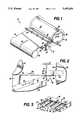
- FIG. 1is a perspective view of a first embodiment of the sheet cutting apparatus of the invention
- FIG. 2is a fragmentary side elevation detail of the cutting apparatus of FIG. 1 showing the coaction of the cutting blades;
- FIG. 3is a fragmentary detail in perspective showing the cutting surfaces of the movable cutter blade of the cutting apparatus of the invention
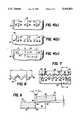
- FIGS. 4(a)-(c)are fragmentary top plan views of a web of sheet material showing the progression of the cuts made by the cutter blade of FIG. 3;
- FIG. 5is a fragmentary side elevation view of another embodiment of the cutting apparatus of the present invention.
- FIG. 6is an enlarged cross-sectional detail of the cutting apparatus of FIG. 5 showing the coaction of the cutting blades
- FIG. 7is a fragmentary top plan view of the cutter blades of a second embodiment of the invention.
- FIG. 8is a top view of a cut zigzag strip or piece formed by the blades of the second embodiment of the invention.
- FIG. 9is an enlarged detail of the movable cutter blade shown in FIG. 7;
- FIG. 10is a fragmentary top plan view of a cutter blade of a third embodiment of the invention.
- FIG. 11is a top view of a cut scalloped strip formed by the blades of the third embodiment of the invention.
- FIG. 1a first embodiment of the sheet cutting apparatus of the invention which is designated generally by reference numeral 10. Only so much of the apparatus 10 is shown in FIG. 1 as is necessary for a complete understanding of the present invention, it being understood that other components of the apparatus, such as drive and control means for the rotatable elements and the like are necessary for operation of the apparatus.
- Cutting apparatus 10comprises a fixed cutter component 12 and a movable cutter component 14 for cutting a web W of sheet material, such as reconstituted tobacco sheet or the like, advanced from a roll 16 by a feed roller 18 in a longitudinal direction shown by arrow 20.
- Fixed cutter component 12comprises a ledger block 22 on which a ledger blade 24 is mounted at an inclination in the range of about 15°-20° and rigidly clamped in place by a platen 26 fixed to the ledger block 22 by bolts (not shown) extending through openings (not shown) in the ledger blade.
- a plurality of ledger blade adjustment screws 28are threadably mounted in the ledger block 22 for adjusting the ledger blade 24 in the direction shown by the arrow 30 in FIG. 2.
- Movable cutter blade 14comprises a drum 32 mounted for rotation on a shaft (not shown) for rotation in the counter-clockwise direction shown by the arrow 34. Rigidly mounted in slots the periphery of drum 32 are a plurality of cutter blades 36, four blades being shown in the FIG. 1 embodiment. While four blades 36 are shown, it will be understood that a greater or lesser number of cutter blades may be used. Typically, one to twenty-four blades are used. If the web W is reconstituted tobacco sheet, it typically would have a width of about two feet and the width of the fixed and movable cutter components 12, 14 would have a width at least the width of the web W.
- FIGS. 2 and 3the coaction of the ledger and cutter blades 24, 36 will be described.
- Cutter blade 36has a rake angle A which may be about 5°.
- the underside or cutting face 38 of cutter blade 36is shown in FIG. 3 and is formed with a plurality of knife edges 40 extending in the direction of travel 20 of the web W, i.e., perpendicular to the rotational axis of the cutter drum 32.
- cutter face 38is provided with concave surfaces 42 which may have a generally circular, elliptical, or other curvilinear shape in cross-section.
- the cutter face 38thus defines a wave-like or undulating edge 39 on the front face 41 of the cutter blade 36.
- the spacing S between the knife edges 40defines the lengths of the pieces cut from the projecting portion P of the web W as explained hereinafter.
- FIGS. 4(a)-(c)The above-described cutting sequence is best illustrated with reference to FIGS. 4(a)-(c).
- the web W having front edge 54is shown at the point in time when the knife edges 40 of the cutter blade 36 have slit or at least partially slit the projecting portion P of the web along lines 44 (shown partially cut by dashed lines) which are spaced apart a distance corresponding to spacing S in FIG. 3.
- the tips 37 of the knife edges 40have penetrated the web at points 46 and have moved past the uppermost edge 25 of the ledger blade 24 to a point where the coaction between edges 39 and 25 have initiated transverse slits 48, 50 propagating in opposite directions from points 46.
- the transverse slits 48, 50join one another to cut off the projecting portion P from the web along continuous slit 52 when the points 43 on the undulating edge 39 pass or coact with edge 25 thereby cutting the projecting portion P into a plurality of individual cut pieces F defined by slits 52 and 44' and front edge 54 and having a width w corresponding to the width of projecting portion P and a length l corresponding to the spacing S (FIG. 3) between knife edges 40.
- the width w of the cut pieces Fmay be varied by changing the feed rate of the web, the rotational speed of the drum 32 or the number of blades 36 on the drum or a combination of any of those changes.
- the cutter blade 36is preferably made of a hard steel, such as CPM 10 V steel, and the ledger blade is made of a soft or mild steel. Because the cutter blade is made of a harder steel than the ledger blade, the ledger blade is a "sacrificial" blade that will be maintained sharp by periodic adjustment of the ledger blade toward the cutter blade in the direction of arrow 30 (FIG. 2). As shown in FIG. 2, the end face 27 of the ledger blade 24 has a large radius from top to bottom equal to the radius of the tips 37 of the cutter blade 36 from the rotational axis of drum 32.
- the rake angle Awhich is preferably about 5°, prevents interference between the end face 41 of the cutter blade 36 and the end face 27 of the ledger blade 24 that might otherwise cause substantial blade wear.
- the thickness of the cutter blade 36 and ledger blade 24is preferably in the range of about 1/16 inch to about 1/8 inch but may be of greater or lesser thickness.
- FIG. 5illustrates another embodiment of a cutting apparatus 60 constructed according to the invention which comprises a fixed blade component 62 and a movable blade component 64.
- the fixed blade component 62comprises a ledger block 66 having a ledger blade 68 mounted to the top surface thereof for slidable movement toward the movable blade component.
- Ledger blade 68may be mounted for slidable movement in any suitable manner such as by a sliding block 70 bolted to the ledger blade 68 and keyed for sliding movement along a guideway 72 in the ledger block 66.
- Ledger blade 68forms a platen over which a web W of sheet material, such as reconstituted tobacco sheet, is fed by means of a feed roll 74.
- the ledger blade 68is adjustable in a horizontal plane toward the movable blade component 64 in the direction shown by arrow 76 by a plurality of adjustment screws 78 (only one shown). When the ledger blade 68 is properly adjusted, it may be bolted rigidly to the ledger block 66 by bolts (not shown).
- the movable blade component 64comprises a drum 80 rotatable in the direction of arrow 81 and having one or more cutter blades 82 rigidly affixed in slots in the periphery of drum 80.
- Cutter blades 82preferably engage the ledger blade 68 at an angle. As shown in FIG. 5, this angular relationship may be accomplished by offsetting the rotational axis of the drum a distance D from the plane of the upper surface of the ledger blade 68.
- the upper surface of ledger blade 68 and the rotational axis of drum 80may be in a common horizontal plane and the cutter blades 82 may be offset parallel to and clockwise from that plane, e.g., a distance D.
- the cutter blades 82may be affixed to the drum 80 at an angle to a radial line from the drum axis.
- the embodiment of the cutting apparatus 60 shown in FIG. 5is especially useful for forming the zigzag or scalloped strips shown in FIGS. 8 and 11 as will be described hereinafter.
- FIGS. 6-8which illustrate the zigzag pattern blades, and especially FIG. 6, the ledger blade 68 and cutter blade 82 are shown in enlarged detail in a cross-section taken along line E--E of FIG. 7.
- the blades 68, 82have been spaced apart to show the entire blade surfaces, it being understood that in the position shown in FIG. 6 the blade 82 is in interengaging relationship with the blade 68.
- blade 82is angularly offset at an angle B from the plane of the ledger blade 68.
- the zigzag face 88 of the cutter blade 82is provided with a rake angle C greater than angle B to insure that there is no interference between zigzag face 88 and the zigzag face 90 of the ledger blade 68 as blade 82 rotates past blade 68.
- the straight complementary blade portions 85, 87 and 89, 91are operative to cut longitudinal slits in the web which define the ends of each zigzag piece cut from the projecting portion of the web.
- the cutter blade 82is made of a hard steel and the ledger blade 68 is a "sacrificial" blade made of a soft or mild steel.
- the ledger blade 68is adjustable in the direction of arrow 76 by means of adjustment screws 78 (FIG. 5).
- the blades 68, 82 shown in FIG. 7 when used in the apparatus 60 of FIG. 5are operative to cut the zigzag strips 92 shown in FIG. 8 from the web W.
- the width X of the strips 92 as measured in the direction of web travelis, as in the first embodiment, a function of the feed rate of the web W and the rotational speed and number of cutter blades 82.
- the length y of the strips 92is determined by the spacing between the complementary straight blade portions 85, 87 and 89, 91 (FIG. 7) which coact to cut longitudinal slits in the web W defining the ends 94, 96, respectively, of the strip 92.
- the complementary straight blade portions 85, 87 and 89, 91are preferably disposed at a slight angle of about 1° to the longitudinal direction of adjustment of the ledger blade 68 so that the straight blade portions are self-sharpening. It will be appreciated that if the straight blade portions are oriented parallel to the adjustment direction, the straight blade portions 85, 89 of the cutter blade 82 will not be operative to sharpen the straight blade portions 87, 91 of the sacrificial ledger blade 68.
- the blade portions 85, 87are arranged at a small angular inclination opposite to that of the straight blade portions 89, 91 so that the transverse force generated between the blade portions 85, 87 when those portions coact will be counterbalanced by the transverse force generated between the blade portions 89, 91 when those portions coact. It should be apparent that the number of coacting straight portions 85, 87 of the blades should be equal to the number of oppositely inclined coacting straight blade portions 89, 91 to exactly counterbalance the transverse forces between the blades 68, 82.
- FIG. 9illustrates in enlarged detail the small inclination angle I of straight blade portion 85 of cutter blade 82 which is necessary to sharpen the straight blade portion 87 of the ledger blade 68.
- the angle Iis about 1°.
- FIG. 10illustrates the cutter blade 100 of a third embodiment of the invention in which the blade pattern is scalloped or generally sinusoidal in shape.
- the blade 100can be used in the apparatus 60 of FIG. 5 with a complementary shaped ledger blade (not shown).
- the coacting cutter blade 100 and its ledger blade(not shown) will have essentially the same cross-sectional appearance as that shown in FIG. 6.
- the straight blade portions 104, 106have the same form, inclination and function as the straight blade portions 85, 89 respectively, of the blade 82 of the second embodiment.
- the straight blade portions 104, 106are oppositely inclined to counter-balance the transverse forces caused by coaction of the complementary straight blade portions of the blade 100 and its ledger blade.
- FIG. 11shows one of the plurality of strips 108 that is cut from a projecting portion of the web W by a single cut by the cutter blade 100 in which the length m of the strip 108 is determined by the spacing between blade portions 104 and 106, and the width n is determined as in the second embodiment by the feed rate of the web W and the rotational speed and number of cutter blades.
- the third embodiment of the inventiondiffers from the second embodiment only in the blade pattern and shape of the cut strip.
Landscapes
- Life Sciences & Earth Sciences (AREA)
- Forests & Forestry (AREA)
- Engineering & Computer Science (AREA)
- Mechanical Engineering (AREA)
- Nonmetal Cutting Devices (AREA)
Abstract
Description
The present invention relates to an apparatus for and a method of cutting a web of sheet material, such as reconstituted tobacco sheet, and more particularly to an apparatus for cutting a web of sheet material into a cut product having a desired length and width and a method of making cut filler from a sheet of reconstituted tobacco.
In the cigarette making art, small particles of tobacco and tobacco fines resulting from the handling of tobacco leaf and the manufacture of cigarettes and other tobacco products are recycled into a web or sheet product known as reconstituted tobacco, for example, by conventional paper making processes. The webs or sheets are then cut into smaller pieces then shredded into strips useful as cut filler in the cigarette making process. Similarly, in other arts, such as plastic molding, a web of plastic sheet material may be cut into smaller pieces or chips for subsequent processing.
Typically, if the web to be cut into smaller pieces has a width greater than the desired dimensions of the final cut product, the web is slit longitudinally in the direction of travel of the web with one or more knives or cutters and is then cut transversely to the direction of travel. Alternatively, the web may be initially cut transversely across the web width to form elongated strips which are then cut into two or more strips of shorter lengths.
European Patent Publication No. 0124255 discloses one known apparatus and method of the former type for shredding a sheet material in which a longitudinally pre-slit web of reconstituted tobacco or blended leaf tobacco is fed off the end of a support table past a serrated ledger blade supported at the edge of the table. A complementary serrated blade fixed to a rotating cylinder strikes the projecting sheet portion extending past the ledger blade, penetrates the sheet and separates the projecting portion of the sheet by tearing. According to this cutter design, a clearance is maintained between the fixed ledger blade and the moving blade so that there is no interference between the blades. The absence of interference is said to be advantageous to solve the problems of blade wear, noise and blade adjustment owing to sagging of the rotating shaft of the cutter. Because the sheet material is longitudinally pre-slit, the transverse cutting or tearing of the projecting portion results in a cut product having a length equal to the spacing between the pre-slits and a width proportional to cutter speed and the feed rate of the sheet, i.e., equal to the distance the web of sheet material is advanced between successive cuts or tears by the moving blade or blades.
U.S. Pat. No. 2,335,515 to Jehle discloses a cutting method and apparatus with a fixed and a movable cutter which is used to cut a sheet of plastic material into small pieces or chips suitable for a plastic molding process. According to this patent, the movable cutter is made up of a plurality of toothed cutters arranged axially on a rotating shaft in two sets with the cutters of the first set alternating with the cutters of the second set and the teeth of the first set being circumferentially offset or staggered with the teeth of the second set. With this arrangement, rotation of the movable cutter and advancement of the sheet will cause one row of the first set of teeth to cut pieces from the sheet having a length equal to the transverse width of the teeth of the first set, then one row of the second set of teeth to cut pieces from the sheet having a length equal to the transverse width of the teeth of the second set, then the second row of the first set of teeth to cut pieces from the sheet and so on. Thus, each set of cutter teeth cuts alternate pieces from the sheet so that two rows of cutter teeth must cut the sheet to cut off pieces equal in length to one entire sheet width.
It would be desirable to provide a sheet cutting apparatus and method having a movable cutter blade that is capable of coacting with a fixed cutter blade to substantially simultaneously cut the entire width of a web of sheet material both longitudinally as well as transversely into cut pieces of desired dimensions so that pre-slitting of the sheet is unnecessary. It would also be desirable to provide a cutting apparatus having blades that are substantially self-sharpening and are characterized by substantially reduced blade wear.
The present invention is directed to a method of and an apparatus for cutting a web of sheet material into cut pieces having predetermined lengths and widths. According to the apparatus aspects of the invention, the sheet cutting apparatus comprises a fixed ledger blade mounted in a ledger block having a platen over which the web of sheet material is advanced by a feed roll. One or more movable cutter blades is fixed to a rotatable drum or shaft for coacting with the ledger blade to cut off a portion of the sheet projecting beyond the ledger blade in the direction of advancement of the sheet. Coaction between the cutter blade and the ledger blade substantially simultaneously cuts the projecting portion of the sheet transversely across the entire width of the sheet and longitudinally in one or more cuts in the direction of travel of the sheet.
In a first embodiment of the invention, the cut product is in the form of narrow, rectangular strips or pieces of sheet material. If the sheet material is a web of reconstituted tobacco, the strips or pieces may be used as cut filler along or in combination with cut filler made from tobacco leaf. In such case, the width of the cut filler strips may be about 1/32 inch and the length may range from about 1/2 inch to about 1 inch or more. The width of the cut strip is determined by the relationship between the rate of feed or advancement of the sheet, the rotational speed of the cutter drum or shaft and the number of cutter blades mounted to the rotatable drum or shaft.
The movable cutter blade is formed with a plurality of short, longitudinally-extending knife edges transversely spaced from one another a dimension or dimensions equal to the desired length or lengths of the cut pieces, e.g., 1/2 inch to 1 inch. Concave, generally cylindrically- or elliptically-shaped surfaces are formed between each knife edge so that the cutting face of the blade has an undulating or wave-like appearance. Each time the cutter blade or blades coact with the ledger blade a narrow strip is cut from the entire width of the web and that strip is substantially simultaneously cut by the knife edges into shorter lengths corresponding to the spacing between the knife edges.
The ledger blade is preferably made of a soft or mild steel and the cutter blade or blades is preferably made of a harder steel such asCPM 10 V. Because of the difference in hardness of the blades the ledger blade is a "sacrificial blade" and must be periodically adjusted by advancing the same toward the cutter blade so that the blades are essentially self-sharpening. It has been advantageously found with this arrangement that blade wear is relatively small, e.g., on the order of about 0.0001 inch per week, so that sharpness of the blades may be maintained by a relatively simple periodic adjustment of the ledger blade.
In a second embodiment of the invention, the ledger blade and the cutter blade or blades are provided with a complementary zigzag or sawtooth pattern or configuration. At spaced transverse intervals across the ledger and cutter blades, the sawtooth pattern is interrupted by complementary straight blade portions on the ledger and cutter blades extending at a slight angle to the longitudinal direction of feed of the web of sheet material. These blade portions coact with each other to cut the zigzag strip into lengths corresponding to the spacing between the complementary straight blade portions. This construction of the zigzag blades according to the invention is operative to cut a zigzag strip across the entire width of the web of sheet material and to simultaneously cut off the zigzag strip at spaced transverse intervals corresponding to the spacing between the straight blade portions. The ledger blade and cutting blades are made of the same materials as the corresponding blades of the first embodiment of the invention.
The straight blade portions are arranged at a slight angular inclination (about 1°) relative to the longitudinal movement of the web and to the axis of adjustment of the ledger blade. This slight angular offset from the adjustment axis is necessary to maintain the self-sharpening effect that would otherwise be absent if the straight blade portions of the ledger blade were adjustable parallel to the straight blade portions of the cutting blades. Each successive straight blade portion on the cutter blades is preferably arranged at an opposite angular inclination to the preceding straight blade portion so as to balance the transverse forces between the ledger blade and cutting blades when they coact with one another. If the angular inclination of all the straight blade portions were in the same direction, the transverse force between the blades would be substantial and could adversely affect the self-sharpening and cutting characteristics of the coacting blades.
According to a third embodiment of the invention, the ledger blade and the cutting blade or blades are provided with a complementary scalloped configuration similar to a sine wave pattern. Like the second embodiment of the invention, the scalloped pattern is interrupted at spaced transverse intervals by straight blade portions extending at a slight inclination to the direction of feed of the web or the adjustment direction of the ledger blade. These straight blade portions function in the same manner and are self-sharpening in the same way as the straight blade portions of the second embodiment.
Advantageously, the zigzag shape of the strips of the second embodiment and the scalloped shape of the strips of the third embodiment have an improved filling capacity when used as cut filler in a cigarette as compared with the narrow rectangular strips of the first embodiment. When used as cut filler, the zigzag and scalloped strips preferably have a width of about 1/2 inch to 1/16 inch, a length of about 3/4 inch to 11/2 inch and a peak-to-peak dimension of about 3/16 inch to 1/4 inch.
According to the method aspects of the present invention, the cutting method comprises the step of rotating at least one cutting blade to coact with a stationary ledger blade to substantially simultaneously cut a web of sheet material both transversely and longitudinally into cut strips or pieces, especially to form cut filler from a sheet of reconstituted tobacco.
With the foregoing and other advantages and features of the invention that will become hereinafter apparent, the nature of the invention may be more clearly understood by reference to the following detailed description of the invention, the appended claims and to the several views illustrated in the drawings.
FIG. 1 is a perspective view of a first embodiment of the sheet cutting apparatus of the invention;
FIG. 2 is a fragmentary side elevation detail of the cutting apparatus of FIG. 1 showing the coaction of the cutting blades;
FIG. 3 is a fragmentary detail in perspective showing the cutting surfaces of the movable cutter blade of the cutting apparatus of the invention;
FIGS. 4(a)-(c) are fragmentary top plan views of a web of sheet material showing the progression of the cuts made by the cutter blade of FIG. 3;
FIG. 5 is a fragmentary side elevation view of another embodiment of the cutting apparatus of the present invention;
FIG. 6 is an enlarged cross-sectional detail of the cutting apparatus of FIG. 5 showing the coaction of the cutting blades;
FIG. 7 is a fragmentary top plan view of the cutter blades of a second embodiment of the invention;
FIG. 8 is a top view of a cut zigzag strip or piece formed by the blades of the second embodiment of the invention;
FIG. 9 is an enlarged detail of the movable cutter blade shown in FIG. 7;
FIG. 10 is a fragmentary top plan view of a cutter blade of a third embodiment of the invention; and
FIG. 11 is a top view of a cut scalloped strip formed by the blades of the third embodiment of the invention.
Referring now in detail to the drawings, there is illustrated in FIG. 1 a first embodiment of the sheet cutting apparatus of the invention which is designated generally byreference numeral 10. Only so much of theapparatus 10 is shown in FIG. 1 as is necessary for a complete understanding of the present invention, it being understood that other components of the apparatus, such as drive and control means for the rotatable elements and the like are necessary for operation of the apparatus.
Cuttingapparatus 10 comprises a fixedcutter component 12 and amovable cutter component 14 for cutting a web W of sheet material, such as reconstituted tobacco sheet or the like, advanced from aroll 16 by afeed roller 18 in a longitudinal direction shown byarrow 20.Fixed cutter component 12 comprises aledger block 22 on which aledger blade 24 is mounted at an inclination in the range of about 15°-20° and rigidly clamped in place by aplaten 26 fixed to theledger block 22 by bolts (not shown) extending through openings (not shown) in the ledger blade. A plurality of ledger blade adjustment screws 28 are threadably mounted in theledger block 22 for adjusting theledger blade 24 in the direction shown by thearrow 30 in FIG. 2.
Now referring to FIGS. 2 and 3, the coaction of the ledger andcutter blades platen 26 byfeed roll 18 in thedirection 20, a portion P of the web will be projected past theuppermost edge 25 of theledger blade 24.Cutter blade 36 has a rake angle A which may be about 5°. The underside or cuttingface 38 ofcutter blade 36 is shown in FIG. 3 and is formed with a plurality of knife edges 40 extending in the direction oftravel 20 of the web W, i.e., perpendicular to the rotational axis of thecutter drum 32. Between knife edges 40cutter face 38 is provided withconcave surfaces 42 which may have a generally circular, elliptical, or other curvilinear shape in cross-section. The cutter face 38 thus defines a wave-like or undulatingedge 39 on thefront face 41 of thecutter blade 36. The spacing S between the knife edges 40 defines the lengths of the pieces cut from the projecting portion P of the web W as explained hereinafter.
Referring again to FIG. 2, rotation ofdrum 32 in thecounterclockwise direction 34 causes the knife edges 40 ofcutter blade 36 to engage the top surface of the projecting portion P of the web. Continued rotation of thedrum 32 causes each of the knife edges 40 to slit or cut through the projecting portion P in the longitudinal direction of feed of the web shown byarrow 20. When theoutermost tips 37 of the knife edges 40 move past theuppermost edge 25 ofledger blade 24, the coaction betweensuch edge 25 and the undulatingedge 39 of thefront face 41 of thecutter blade 36 gradually cuts slits in the web in each transverse direction from the knife edges 40 until the deepest points 43 (FIG. 3) of theconcave surfaces 42 or undulatingedge 39 move past theuppermost edge 25 of theledger blade 24 at which time the slits join together to cut off projecting portion P from the web W.
The above-described cutting sequence is best illustrated with reference to FIGS. 4(a)-(c). Referring first to FIG. 4(a), the web W havingfront edge 54 is shown at the point in time when the knife edges 40 of thecutter blade 36 have slit or at least partially slit the projecting portion P of the web along lines 44 (shown partially cut by dashed lines) which are spaced apart a distance corresponding to spacing S in FIG. 3. Thetips 37 of the knife edges 40 have penetrated the web atpoints 46 and have moved past theuppermost edge 25 of theledger blade 24 to a point where the coaction betweenedges transverse slits cutter blade 36 relative to theledger blade 24 as shown in FIG. 4(b) causes the knife edges 40 to slit completely through the projecting portion P as shown by solid line slits 44' and further causes coaction betweenedges transverse slits transverse slits continuous slit 52 when thepoints 43 on the undulatingedge 39 pass or coact withedge 25 thereby cutting the projecting portion P into a plurality of individual cut pieces F defined byslits 52 and 44' andfront edge 54 and having a width w corresponding to the width of projecting portion P and a length l corresponding to the spacing S (FIG. 3) between knife edges 40. It will be appreciated that the width w of the cut pieces F may be varied by changing the feed rate of the web, the rotational speed of thedrum 32 or the number ofblades 36 on the drum or a combination of any of those changes.
Thecutter blade 36 is preferably made of a hard steel, such as CPM 10 V steel, and the ledger blade is made of a soft or mild steel. Because the cutter blade is made of a harder steel than the ledger blade, the ledger blade is a "sacrificial" blade that will be maintained sharp by periodic adjustment of the ledger blade toward the cutter blade in the direction of arrow 30 (FIG. 2). As shown in FIG. 2, theend face 27 of theledger blade 24 has a large radius from top to bottom equal to the radius of thetips 37 of thecutter blade 36 from the rotational axis ofdrum 32. The rake angle A, which is preferably about 5°, prevents interference between theend face 41 of thecutter blade 36 and theend face 27 of theledger blade 24 that might otherwise cause substantial blade wear. The thickness of thecutter blade 36 andledger blade 24 is preferably in the range of about 1/16 inch to about 1/8 inch but may be of greater or lesser thickness.
FIG. 5 illustrates another embodiment of a cuttingapparatus 60 constructed according to the invention which comprises a fixed blade component 62 and amovable blade component 64. The fixed blade component 62 comprises aledger block 66 having aledger blade 68 mounted to the top surface thereof for slidable movement toward the movable blade component.Ledger blade 68 may be mounted for slidable movement in any suitable manner such as by a slidingblock 70 bolted to theledger blade 68 and keyed for sliding movement along aguideway 72 in theledger block 66.Ledger blade 68 forms a platen over which a web W of sheet material, such as reconstituted tobacco sheet, is fed by means of afeed roll 74. Theledger blade 68 is adjustable in a horizontal plane toward themovable blade component 64 in the direction shown byarrow 76 by a plurality of adjustment screws 78 (only one shown). When theledger blade 68 is properly adjusted, it may be bolted rigidly to theledger block 66 by bolts (not shown).
Themovable blade component 64 comprises adrum 80 rotatable in the direction ofarrow 81 and having one ormore cutter blades 82 rigidly affixed in slots in the periphery ofdrum 80.Cutter blades 82 preferably engage theledger blade 68 at an angle. As shown in FIG. 5, this angular relationship may be accomplished by offsetting the rotational axis of the drum a distance D from the plane of the upper surface of theledger blade 68. Alternatively, the upper surface ofledger blade 68 and the rotational axis ofdrum 80 may be in a common horizontal plane and thecutter blades 82 may be offset parallel to and clockwise from that plane, e.g., a distance D. In another possible arrangement, thecutter blades 82 may be affixed to thedrum 80 at an angle to a radial line from the drum axis. The embodiment of the cuttingapparatus 60 shown in FIG. 5 is especially useful for forming the zigzag or scalloped strips shown in FIGS. 8 and 11 as will be described hereinafter.
Referring now to FIGS. 6-8 which illustrate the zigzag pattern blades, and especially FIG. 6, theledger blade 68 andcutter blade 82 are shown in enlarged detail in a cross-section taken along line E--E of FIG. 7. In FIG. 7 theblades blade 82 is in interengaging relationship with theblade 68. When thezigzag tips 84 ofblade 82 engage the mating uppermost points 86 of theledger blade 68,blade 82 is angularly offset at an angle B from the plane of theledger blade 68. Thezigzag face 88 of thecutter blade 82 is provided with a rake angle C greater than angle B to insure that there is no interference betweenzigzag face 88 and thezigzag face 90 of theledger blade 68 asblade 82 rotatespast blade 68. The straightcomplementary blade portions
As in the first embodiment, thecutter blade 82 is made of a hard steel and theledger blade 68 is a "sacrificial" blade made of a soft or mild steel. Thus, the lowermost zigzag edge of thecutter blade 82 cuts or shapes thezigzag face 90 of the ledger blade and maintains it in a sharpened condition. To accommodate the minimal wear between the blades, theledger blade 68 is adjustable in the direction ofarrow 76 by means of adjustment screws 78 (FIG. 5).
Theblades apparatus 60 of FIG. 5 are operative to cut the zigzag strips 92 shown in FIG. 8 from the web W. The width X of thestrips 92 as measured in the direction of web travel is, as in the first embodiment, a function of the feed rate of the web W and the rotational speed and number ofcutter blades 82. The length y of thestrips 92 is determined by the spacing between the complementarystraight blade portions ends strip 92.
The complementarystraight blade portions ledger blade 68 so that the straight blade portions are self-sharpening. It will be appreciated that if the straight blade portions are oriented parallel to the adjustment direction, thestraight blade portions cutter blade 82 will not be operative to sharpen thestraight blade portions sacrificial ledger blade 68. Preferably, theblade portions straight blade portions blade portions blade portions straight portions straight blade portions blades
FIG. 9 illustrates in enlarged detail the small inclination angle I ofstraight blade portion 85 ofcutter blade 82 which is necessary to sharpen thestraight blade portion 87 of theledger blade 68. Preferably, the angle I is about 1°.
FIG. 10 illustrates thecutter blade 100 of a third embodiment of the invention in which the blade pattern is scalloped or generally sinusoidal in shape. Theblade 100 can be used in theapparatus 60 of FIG. 5 with a complementary shaped ledger blade (not shown). In cross-section taken longitudinally through one of thepeaks 102 of theblade 100, thecoacting cutter blade 100 and its ledger blade (not shown) will have essentially the same cross-sectional appearance as that shown in FIG. 6. Similarly, thestraight blade portions straight blade portions blade 82 of the second embodiment. As also shown in FIG. 10, thestraight blade portions blade 100 and its ledger blade.
FIG. 11 shows one of the plurality ofstrips 108 that is cut from a projecting portion of the web W by a single cut by thecutter blade 100 in which the length m of thestrip 108 is determined by the spacing betweenblade portions
Although only preferred embodiments are specifically illustrated and described herein, it will be appreciated that many modifications and variations of the present invention are possible in light of the above teachings and within the purview of the appended claims without departing from the spirit and intended scope of the invention.
Claims (25)
1. Apparatus for cutting a sheet material having a given width and an indeterminate length into cut pieces comprising:
means for feeding the sheet material in a longitudinal direction along its length;
a ledger blade having a width and adapted to be secured in a fixed position, said ledger blade comprising a straight cutting edge;
a rotatable cutter blade having a width and adapted to engage the ledger blade in a coacting relation to cut said sheet material, said cutter blade having an undulating cutting edge coacting with the straight cutting edge of the ledger blade and a plurality of knife edges intersecting said undulating cutting edge and extending in said longitudinal direction, said feeding means feeding the sheet material between said ledger blade and said cutter blade in said longitudinal direction along its length such that a projecting portion of said sheet material extends past said ledger blade; and
said cutter blade and ledger blade including means for cutting off the projecting portion transversely across the entire given width of the sheet material and for substantially simultaneously cutting said projecting portion into a plurality of cut pieces.
2. Apparatus according to claim 1, wherein the coacting of said ledger and cutter blades cuts said projecting portion into a plurality of cut pieces by a plurality of cuts arranged substantially in said longitudinal direction.
3. Apparatus according to claim 2, including concave surfaces between said knife edges, said concave surfaces and said knife edges intersecting at a front face of said cutter blade to define said undulating cutting edge.
4. Apparatus according to claim 1, wherein said blades are made of steel material, the steel material of the cutter blade being harder than the steel material of the ledger blade.
5. Apparatus according to claim 4, wherein said cutter blade is made of CPM 10 V steel and said ledger blade is made of a soft or mild steel.
6. Apparatus according to claim 4, including means for adjusting said ledger blade in said longitudinal direction toward said cutter blade to accommodate wear between said blades and maintain the sharpness of said ledger blade.
7. Apparatus according to claim 1, wherein the cutter and ledger blades have complementary zigzag cutting portions including a plurality of complementary straight blade portions for cutting said projecting portion into said plurality of cut pieces.
8. Apparatus according to claim 7, wherein said complementary straight blade portions are arranged at an inclination of about 1° to said longitudinal direction.
9. Apparatus according to claim 7, wherein said straight blade portions are arranged in spaced relationship transversely across the width of the ledger blade and cutter blade, alternating ones of said complementary straight blade portions being inclined to said longitudinal direction in opposite directions.
10. Apparatus according to claim 1, wherein the coacting of said ledger and cutter blades cuts said projecting portion into a plurality of cut pieces by a plurality of cuts arranged at a slight inclination to said longitudinal direction.
11. Apparatus according to claim 10, wherein said inclination is about 1°.
12. Apparatus for cutting a sheet material having a given width and an indeterminate length into cut pieces comprising:
a ledger blade having a width and adapted to be secured in a fixed position;
a rotatable cutter blade having a width and adapted to engage the ledger blade in a coacting relation to cut said sheet material;
means for feeding the sheet material between said ledger blade and said cutter blade in a longitudinal direction along its length such that a projecting portion of said sheet material extends past said ledger blade; and
said cutter blade and ledger blade including means for cutting off the projecting portion transversely across the entire given width of the sheet material and for substantially simultaneously cutting said projecting portion into a plurality of cut pieces, said cutter and ledger blades having complementary scalloped cutting portions including a plurality of complementary straight blade portions for cutting said projecting portion into said plurality of cut pieces.
13. Apparatus according to claim 12, wherein said complementary straight blade portions are arranged at an inclination of about 1° to said longitudinal direction.
14. Apparatus according to claim 12, wherein said straight blade portions are arranged in spaced relationship transversely across the width of the ledger blade and cutter blade, alternating ones of said complementary straight blade portions being inclined to said longitudinal direction in opposite directions.
15. Apparatus for cutting a sheet material having a given width and an indeterminate length into cut pieces comprising:
a ledger blade having a width and adapted to be secured in a fixed position;
a rotatable cutter blade having a width and adapted to engage the ledger blade in a coacting relation to cut said sheet material;
means for feeding the sheet material between said ledger blade and said cutter blade in a longitudinal direction along its length such that a projecting portion of said sheet material extends past said ledger blade; and
the cutter and ledger blades having complementary scalloped cutting portions coacting to cut off the projecting portion transversely across the entire given width of the sheet material such that the cut off projecting portion has a substantially constant dimension in the longitudinal direction of feed of the sheet material across the entire given width of the sheet material, said blades including a plurality of complementary straight blade portions for substantially simultaneously cutting said projecting portion into a plurality of cut pieces.
16. Apparatus according to claim 15, wherein said straight blade portions are arranged in spaced relationship transversely across the width of the ledger blade and cutter blade, alternating ones of said complementary straight blade portions being inclined to said longitudinal direction in opposite directions.
17. Apparatus according to claim 15, wherein said complementary straight blade portions are arranged at an inclination of about 1° to said longitudinal direction.
18. A process for making cut filler from a sheet of reconstituted tobacco or leaf tobacco comprising the step of:
continuously feeding a sheet having a given width in a longitudinal direction over a fixed ledger blade with a scalloped cutting edge such that a portion of said sheet projects past the edge of said ledger blade;
rotating a cutter blade having a scalloped cutting edge complementary to the scalloped cutting edge of said ledger blade into engagement with the scalloped edge of said ledger blade;
coacting said blades to cut off the projecting portion of said sheet across the entire width of said sheet such that the cut off projecting portion has a substantially constant dimension in the longitudinal direction of feed of the sheet material across the entire given width of the sheet material, said blades further coacting to substantially simultaneously cut said projecting portion into a plurality of cut pieces having a scalloped shape and suitable for use as cut filler.
19. The process according to claim 18, wherein said blades are made of steel, the steel of said cutter blade being harder than the steel of the ledger blade and including the step of adjusting said ledger blade in said longitudinal direction toward said cutter blade to sharpen said ledger blade.
20. Apparatus for cutting a sheet material having a given width and an indeterminate length into cut pieces comprising:
means for feeding the sheet material in a longitudinal direction along its length;
a ledger blade comprising a straight cutting edge, said blade having a width and adapted to be secured in a fixed position;
a rotatable cutter blade having a width and adapted to engage the ledger blade in a coacting relation to cut said sheet material, said cutter blade having an undulating cutting edge and a plurality of knife edges intersecting said undulating cutting edges and extending in said longitudinal direction;
means for feeding the sheet material between said ledger blade and said cutter blade in said longitudinal direction such that a projecting portion of said sheet material extends past said ledger blade; and
said cutter blade and ledger blade including means coacting the edges thereof to cut off the projecting portion transversely across the entire given width of the sheet material such that the cut off projecting portion has a substantially constant dimension in the longitudinal direction of feed of the sheet material across the entire given width of the sheet material, said blades further coacting with said plurality of knife edges to substantially simultaneously cut said projecting portion into a plurality of cut pieces.
21. Apparatus according to claim 20, wherein said coacting means of said ledger and cutter blades cuts said projecting portion into a plurality of cut pieces by a plurality of cuts arranged at a slight inclination to said longitudinal direction.
22. Apparatus according to claim 20, including concave surfaces between said knife edges, said concave surfaces and said knife edges intersecting at a front face of said cutter blade to define said undulating cutting edge.
23. Apparatus according to claim 20, wherein said coacting means of said ledger and cutter blades cuts said projecting portion into a plurality of cut pieces by a plurality of cuts arranged substantially in said longitudinal direction.
24. Apparatus for cutting a sheet material having a given width and an indeterminate length into cut pieces comprising:
a ledger blade having a width and adapted to be secured in a fixed position;
a rotatable cutter blade having a width and adapted to engage the ledger blade in a coacting relation to cut said sheet material;
means for feeding the sheet material between said ledger blade and said cutter blade in a longitudinal direction along its length such that a projecting portion of said sheet material extends past said ledger blade; and
said cutter blade and ledger blade having complementary zigzag cutting portions and including means coacting to cut off the projecting portion transversely across the entire given width of the sheet material such that the cut off projecting portion has a substantially constant dimension in the longitudinal direction of feed of the sheet material across the entire given width of the sheet material, said blades including a plurality of complementary straight blade portions further coacting to substantially simultaneously cut said projecting portion into a plurality of cut pieces, said complementary straight blade portions being arranged at an inclination of about 1° to said longitudinal direction.
25. Apparatus according to claim 24, wherein said straight blade portions are arranged in spaced relationship transversely across the width of the ledger blade and cutter blade, alternating ones of said complementary straight blade portions being inclined to said longitudinal direction in opposite directions.
Priority Applications (1)
| Application Number | Priority Date | Filing Date | Title |
|---|---|---|---|
| US08/125,054US5445054A (en) | 1993-09-21 | 1993-09-21 | Sheet cutting apparatus and method |
Applications Claiming Priority (1)
| Application Number | Priority Date | Filing Date | Title |
|---|---|---|---|
| US08/125,054US5445054A (en) | 1993-09-21 | 1993-09-21 | Sheet cutting apparatus and method |
Publications (1)
| Publication Number | Publication Date |
|---|---|
| US5445054Atrue US5445054A (en) | 1995-08-29 |
Family
ID=22417999
Family Applications (1)
| Application Number | Title | Priority Date | Filing Date |
|---|---|---|---|
| US08/125,054Expired - Fee RelatedUS5445054A (en) | 1993-09-21 | 1993-09-21 | Sheet cutting apparatus and method |
Country Status (1)
| Country | Link |
|---|---|
| US (1) | US5445054A (en) |
Cited By (44)
| Publication number | Priority date | Publication date | Assignee | Title |
|---|---|---|---|---|
| US5755654A (en)* | 1995-10-24 | 1998-05-26 | James River Corporation Of Virginia | Method and apparatus for pinch perforating multiply web material |
| EP0744367A3 (en)* | 1995-05-26 | 1998-05-27 | Voith Sulzer Papiermaschinen Gesellschaft mbH | Apparatus for producing a perforated track in travelling web, e.g. a paper web |
| US6142049A (en)* | 1995-10-17 | 2000-11-07 | Moore Business Forms, Inc. | Linerless label cut-off |
| US20030116664A1 (en)* | 2001-12-26 | 2003-06-26 | Castronovo Charles A. | Zero-clearance cutting systems |
| US6595216B1 (en) | 2001-03-20 | 2003-07-22 | Brown & Williamson Tobacco Corporation | Method of cutting sheets of reconstituted tobacco |
| US20030205121A1 (en)* | 2002-05-06 | 2003-11-06 | Florian Precision, Llc. | Wire chopper module for EDM system |
| US20040045567A1 (en)* | 2000-05-12 | 2004-03-11 | Lewis William David | Tobacco reconstitution |
| US20040188556A1 (en)* | 2003-03-25 | 2004-09-30 | Tom Jong | Single cutter shredder |
| EP1493488A1 (en)* | 2003-04-03 | 2005-01-05 | Frank Chang | Single cutter shredder |
| US20050040264A1 (en)* | 2001-12-26 | 2005-02-24 | Castronovo Charles A. | Double-secondary shredders in zero-clearance cutting systems |
| US20050039750A1 (en)* | 2000-08-29 | 2005-02-24 | Wickham Peter John D. | Respiratory apparatus with improved flow-flattening detection |
| US20050150986A1 (en)* | 2001-12-26 | 2005-07-14 | Castronovo Charles A. | Self-healing cutting apparatus and other self-healing machinery |
| US20050241449A1 (en)* | 2004-05-01 | 2005-11-03 | Chen Ching M | Cutting machine for cutting paper into chips |
| US20060042419A1 (en)* | 2004-07-16 | 2006-03-02 | Yeqing Deng | Pattern cutter, its processing methods and moulds |
| US20060071046A1 (en)* | 1998-04-14 | 2006-04-06 | Roberts Brian J | Ticket dispensing modules and method |
| US20060075865A1 (en)* | 2004-10-07 | 2006-04-13 | Floding Daniel L | Film cutter |
| US20060086855A1 (en)* | 2001-12-26 | 2006-04-27 | Castronovo Charles A | No-oil shredder and other no-oil machinery |
| US20080099030A1 (en)* | 2006-10-18 | 2008-05-01 | Philip Morris Usa Inc. | Process for shredding a tobacco sheet and apparatus |
| US20090100978A1 (en)* | 2007-10-17 | 2009-04-23 | Von Freden Christoph | Device for the rotative scoring of flat printed products |
| DE102007057409A1 (en)* | 2007-11-27 | 2009-05-28 | Khs Ag | Cutting device and method for operating a cutting device |
| US20090314863A1 (en)* | 2001-12-26 | 2009-12-24 | Castronovo Charles A | Self-Healing Cutting Apparatus and Other Self-Healing Machinery |
| US20110100383A1 (en)* | 2009-10-29 | 2011-05-05 | R.J. Reynolds Tobacco Company | Sheet material cutting apparatus, and associated method |
| US20110240706A1 (en)* | 2010-03-30 | 2011-10-06 | Brian Christopher Schwamberger | Web diverting apparatus |
| US20120000335A1 (en)* | 2010-07-01 | 2012-01-05 | Automatik Plastics Machinery Gmbh | Cutter bar |
| DE102011050601A1 (en)* | 2011-05-24 | 2012-11-29 | Heusch Gmbh & Co. Kg | Knife and cutting device and method for cutting |
| US20140026384A1 (en)* | 2012-07-27 | 2014-01-30 | Nb Tech Inc. | Visual display system and method of constructing a high-gain reflective beam-splitter |
| US20140366695A1 (en)* | 2013-06-12 | 2014-12-18 | The Procter & Gamble Company | Method of perforating a nonlinear line of weakness |
| US20140366702A1 (en)* | 2013-06-12 | 2014-12-18 | The Procter & Gamble Company | Perforating apparatus for manufacturing a nonlinear line of weakness |
| CN105328734A (en)* | 2015-11-03 | 2016-02-17 | 西南大学 | Tobacco sheet shredding cutter |
| US9463465B2 (en) | 2012-09-06 | 2016-10-11 | Charles A. Castronovo | Compact high-security destruction machine |
| USD791205S1 (en)* | 2015-04-06 | 2017-07-04 | Zenith Cutter, Inc. | Serrated male slot knife |
| USD791206S1 (en)* | 2015-07-31 | 2017-07-04 | Zenith Cutter, Inc. | Serrated male slot knife |
| US9731434B2 (en) | 2010-08-11 | 2017-08-15 | Fossflakes A/S | Apparatus for the manufacture of a plastics filling material and a method of using the apparatus |
| CN109512013A (en)* | 2018-12-06 | 2019-03-26 | 江苏中烟工业有限责任公司 | Pressing-drawing-type sliding cutting type pipe tobacco guillotine cutting device |
| US10350776B2 (en) | 2016-05-11 | 2019-07-16 | Zenith Cutter, Inc. | Cutoff knife serration |
| CN111687928A (en)* | 2020-06-18 | 2020-09-22 | 金陵科技学院 | Stamping equipment for processing building materials |
| US10889459B2 (en) | 2015-03-17 | 2021-01-12 | The Procter & Gamble Company | Method for perforating a nonlinear line of weakness |
| US10919168B2 (en) | 2015-03-17 | 2021-02-16 | The Procter & Gamble Company | Apparatus for perforating a web material |
| US10947671B2 (en) | 2017-09-11 | 2021-03-16 | The Procter & Gamble Company | Sanitary tissue product with a shaped line of weakness |
| US10946545B2 (en) | 2013-06-12 | 2021-03-16 | The Procter & Gamble Company | Nonlinear line of weakness formed by a perforating apparatus |
| US10960566B2 (en) | 2015-03-17 | 2021-03-30 | The Procter & Gamble Company | Apparatus for perforating a nonlinear line of weakness |
| US11044936B2 (en) | 2015-05-29 | 2021-06-29 | Philip Morris Products S.A. | Method of making tobacco cut filler |
| US11806889B2 (en)* | 2017-09-11 | 2023-11-07 | The Procter & Gamble Company | Perforating apparatus and method for manufacturing a shaped line of weakness |
| US11806890B2 (en) | 2017-09-11 | 2023-11-07 | The Procter & Gamble Company | Perforating apparatus and method for manufacturing a shaped line of weakness |
Citations (20)
| Publication number | Priority date | Publication date | Assignee | Title |
|---|---|---|---|---|
| US127235A (en)* | 1872-05-28 | Reuben w | ||
| US1301964A (en)* | 1915-09-07 | 1919-04-29 | Flintkote Co | Shingle-strip machine. |
| US1334149A (en)* | 1920-03-16 | Method oe producing punchings | ||
| US1666204A (en)* | 1926-06-16 | 1928-04-17 | Norman P Harshberger | Shingle |
| US1874902A (en)* | 1928-11-22 | 1932-08-30 | Western Cartridge Co | Method and apparatus of cutting sheets |
| US2315028A (en)* | 1941-10-27 | 1943-03-30 | Matthew J Thomas | Juice extracting machine |
| US2335515A (en)* | 1940-06-11 | 1943-11-30 | Condor Solvents Inc | Cutting method and apparatus |
| US2993400A (en)* | 1957-06-07 | 1961-07-25 | Ici Ltd | Method for comminuting solid synthetic resinous materials |
| US3017795A (en)* | 1957-06-06 | 1962-01-23 | Falls Paper & Power Company | Method and apparatus for forming individual wrapped pads from otherwise continuous batt strips |
| US3119312A (en)* | 1960-07-29 | 1964-01-28 | Design & Manufacture Inc | Rotary die cutting apparatus and method |
| US3353754A (en)* | 1964-11-25 | 1967-11-21 | American Enka Corp | Process and apparatus for cutting synthetic polymer sheets into chips |
| US3468199A (en)* | 1967-02-06 | 1969-09-23 | Black Clawson Co | Conversion of sheet material into smaller pieces |
| US3587373A (en)* | 1967-03-13 | 1971-06-28 | Tarkelt Ab | Methods and apparatus for making granules |
| US3762256A (en)* | 1972-04-17 | 1973-10-02 | Du Pont | Polymeric web shredding |
| US3779123A (en)* | 1972-10-16 | 1973-12-18 | Cumberland Eng Co | Knife holder and knife therefor |
| US4308776A (en)* | 1980-04-23 | 1982-01-05 | Philip Morris Incorporated | Web sectioning apparatus with adjustable knife engagement |
| US4422358A (en)* | 1981-04-06 | 1983-12-27 | The Standard Register Company | Apparatus for cutting a continuous narrow strip into short sections |
| EP0124255A2 (en)* | 1983-03-31 | 1984-11-07 | Philip Morris Products Inc. | A method and apparatus for uniformly cutting tobacco sheets |
| US5146820A (en)* | 1991-05-10 | 1992-09-15 | Machine Design Service, Inc. | Paper cutting apparatus and method |
| US5297746A (en)* | 1992-02-06 | 1994-03-29 | Nelmor Company, Inc. | Granulator knife |
- 1993
- 1993-09-21USUS08/125,054patent/US5445054A/ennot_activeExpired - Fee Related
Patent Citations (20)
| Publication number | Priority date | Publication date | Assignee | Title |
|---|---|---|---|---|
| US127235A (en)* | 1872-05-28 | Reuben w | ||
| US1334149A (en)* | 1920-03-16 | Method oe producing punchings | ||
| US1301964A (en)* | 1915-09-07 | 1919-04-29 | Flintkote Co | Shingle-strip machine. |
| US1666204A (en)* | 1926-06-16 | 1928-04-17 | Norman P Harshberger | Shingle |
| US1874902A (en)* | 1928-11-22 | 1932-08-30 | Western Cartridge Co | Method and apparatus of cutting sheets |
| US2335515A (en)* | 1940-06-11 | 1943-11-30 | Condor Solvents Inc | Cutting method and apparatus |
| US2315028A (en)* | 1941-10-27 | 1943-03-30 | Matthew J Thomas | Juice extracting machine |
| US3017795A (en)* | 1957-06-06 | 1962-01-23 | Falls Paper & Power Company | Method and apparatus for forming individual wrapped pads from otherwise continuous batt strips |
| US2993400A (en)* | 1957-06-07 | 1961-07-25 | Ici Ltd | Method for comminuting solid synthetic resinous materials |
| US3119312A (en)* | 1960-07-29 | 1964-01-28 | Design & Manufacture Inc | Rotary die cutting apparatus and method |
| US3353754A (en)* | 1964-11-25 | 1967-11-21 | American Enka Corp | Process and apparatus for cutting synthetic polymer sheets into chips |
| US3468199A (en)* | 1967-02-06 | 1969-09-23 | Black Clawson Co | Conversion of sheet material into smaller pieces |
| US3587373A (en)* | 1967-03-13 | 1971-06-28 | Tarkelt Ab | Methods and apparatus for making granules |
| US3762256A (en)* | 1972-04-17 | 1973-10-02 | Du Pont | Polymeric web shredding |
| US3779123A (en)* | 1972-10-16 | 1973-12-18 | Cumberland Eng Co | Knife holder and knife therefor |
| US4308776A (en)* | 1980-04-23 | 1982-01-05 | Philip Morris Incorporated | Web sectioning apparatus with adjustable knife engagement |
| US4422358A (en)* | 1981-04-06 | 1983-12-27 | The Standard Register Company | Apparatus for cutting a continuous narrow strip into short sections |
| EP0124255A2 (en)* | 1983-03-31 | 1984-11-07 | Philip Morris Products Inc. | A method and apparatus for uniformly cutting tobacco sheets |
| US5146820A (en)* | 1991-05-10 | 1992-09-15 | Machine Design Service, Inc. | Paper cutting apparatus and method |
| US5297746A (en)* | 1992-02-06 | 1994-03-29 | Nelmor Company, Inc. | Granulator knife |
Cited By (124)
| Publication number | Priority date | Publication date | Assignee | Title |
|---|---|---|---|---|
| EP0744367A3 (en)* | 1995-05-26 | 1998-05-27 | Voith Sulzer Papiermaschinen Gesellschaft mbH | Apparatus for producing a perforated track in travelling web, e.g. a paper web |
| US6142049A (en)* | 1995-10-17 | 2000-11-07 | Moore Business Forms, Inc. | Linerless label cut-off |
| US5755654A (en)* | 1995-10-24 | 1998-05-26 | James River Corporation Of Virginia | Method and apparatus for pinch perforating multiply web material |
| US7665394B2 (en)* | 1998-04-14 | 2010-02-23 | Gtech Corporation | Ticket dispensing modules and method |
| US20060071046A1 (en)* | 1998-04-14 | 2006-04-06 | Roberts Brian J | Ticket dispensing modules and method |
| US20040045567A1 (en)* | 2000-05-12 | 2004-03-11 | Lewis William David | Tobacco reconstitution |
| US20050039750A1 (en)* | 2000-08-29 | 2005-02-24 | Wickham Peter John D. | Respiratory apparatus with improved flow-flattening detection |
| US6807969B1 (en) | 2001-03-20 | 2004-10-26 | Brown & Williamson Tobacco Corporation | Method for processing reconstituted tobacco |
| US6595216B1 (en) | 2001-03-20 | 2003-07-22 | Brown & Williamson Tobacco Corporation | Method of cutting sheets of reconstituted tobacco |
| US7111801B2 (en) | 2001-12-26 | 2006-09-26 | Castronovo Charles A | Destroying non-homogeneous loads using zero-clearance cutting systems, double-secondary shredders in zero-clearance cutting systems, and other zero-clearance systems |
| US7427040B2 (en)* | 2001-12-26 | 2008-09-23 | Castronovo Charles A | No-oil shredder and other no-oil machinery |
| US20050029377A1 (en)* | 2001-12-26 | 2005-02-10 | Castronovo Charles A. | Zero-clearance cutting systems |
| US20050029372A1 (en)* | 2001-12-26 | 2005-02-10 | Castronovo Charles A. | Zero-clearance cutting systems |
| US20050040264A1 (en)* | 2001-12-26 | 2005-02-24 | Castronovo Charles A. | Double-secondary shredders in zero-clearance cutting systems |
| US20050040267A1 (en)* | 2001-12-26 | 2005-02-24 | Castronovo Charles A. | Zero-clearance cutting systems |
| US20050040268A1 (en)* | 2001-12-26 | 2005-02-24 | Castronovo Charles A. | Zero-clearance cutting systems |
| US8100353B2 (en)* | 2001-12-26 | 2012-01-24 | Castronovo Charles A | Self-healing cutting apparatus and other self-healing machinery |
| US20050120841A1 (en)* | 2001-12-26 | 2005-06-09 | Castronovo Charles A. | Zero-clearance cutting systems |
| US20050150986A1 (en)* | 2001-12-26 | 2005-07-14 | Castronovo Charles A. | Self-healing cutting apparatus and other self-healing machinery |
| US6938844B2 (en)* | 2001-12-26 | 2005-09-06 | Charles A. Castronovo | Zero-clearance cutting systems |
| US8292204B2 (en) | 2001-12-26 | 2012-10-23 | Castronovo Charles A | Motorized sacrificial material |
| US8297544B2 (en) | 2001-12-26 | 2012-10-30 | Castronovo Charles A | Screenless disintegrators |
| US8408484B2 (en) | 2001-12-26 | 2013-04-02 | Charles A. Castronovo | Zero-clearance cutting machine |
| US8596564B2 (en) | 2001-12-26 | 2013-12-03 | Charles A. Castronovo | Destroying paper into high security pieces, powderizing methods, and other high-security destruction |
| US20030116664A1 (en)* | 2001-12-26 | 2003-06-26 | Castronovo Charles A. | Zero-clearance cutting systems |
| WO2003057370A1 (en)* | 2001-12-26 | 2003-07-17 | Charles Castronovo | Zero-clearance cutting systems |
| US20060086855A1 (en)* | 2001-12-26 | 2006-04-27 | Castronovo Charles A | No-oil shredder and other no-oil machinery |
| US20060124785A1 (en)* | 2001-12-26 | 2006-06-15 | Castronovo Charles A | Destroying a non-homogeneous load |
| US20060175446A1 (en)* | 2001-12-26 | 2006-08-10 | Castronovo Charles A | Feeding mechanism |
| US7090214B2 (en) | 2001-12-26 | 2006-08-15 | Castronovo Charles A | Feeding mechanism |
| US7090156B2 (en) | 2001-12-26 | 2006-08-15 | Castronovo Charles A | Destroying planar material |
| US7100852B2 (en) | 2001-12-26 | 2006-09-05 | Castronovo Charles A | Helical cutting |
| US20060196980A1 (en)* | 2001-12-26 | 2006-09-07 | Castronovo Charles A | Residue exit for security destruction machines |
| US20060208117A1 (en)* | 2001-12-26 | 2006-09-21 | Castronovo Charles A | Destroying planar material into high security pieces |
| US20100019073A1 (en)* | 2001-12-26 | 2010-01-28 | Castronovo Charles A | Destroying Paper Into High Security Pieces, Powderizing Methods, and Other High-Security Destruction |
| US20060249607A1 (en)* | 2001-12-26 | 2006-11-09 | Castronovo Charles A | Helical cutting |
| US20090314863A1 (en)* | 2001-12-26 | 2009-12-24 | Castronovo Charles A | Self-Healing Cutting Apparatus and Other Self-Healing Machinery |
| US20070018021A1 (en)* | 2001-12-26 | 2007-01-25 | Castronovo Charles A | Sacrificial rotary scissors |
| US7175116B2 (en) | 2001-12-26 | 2007-02-13 | Castronovo Charles A | High-security cutting |
| EP1465733A4 (en)* | 2001-12-26 | 2007-03-07 | Charles Castronovo | Zero-clearance cutting systems |
| US7204436B2 (en) | 2001-12-26 | 2007-04-17 | Castronovo Charles A | Residue exit for security destruction machines |
| US20070108325A1 (en)* | 2001-12-26 | 2007-05-17 | Castronovo Charles A | Motorized Sacrificial Material |
| US7607598B2 (en) | 2001-12-26 | 2009-10-27 | Castronovo Charles A | Self-healing cutting apparatus and other self-healing machinery |
| US7240864B2 (en) | 2001-12-26 | 2007-07-10 | Castronovo Charles A | Helical cutting |
| US20070164142A1 (en)* | 2001-12-26 | 2007-07-19 | Castronovo Charles A | Destruction Method With 45 Degree Feeding |
| US20070187533A1 (en)* | 2001-12-26 | 2007-08-16 | Castronovo Charles A | Screenless Disintegrators |
| US7267294B2 (en) | 2001-12-26 | 2007-09-11 | Castronovo Charles A | Zero-clearance cutting systems |
| US7270282B2 (en) | 2001-12-26 | 2007-09-18 | Castronovo Charles A | Screenless disintegrators |
| US7334747B2 (en) | 2001-12-26 | 2008-02-26 | Castronovo Charles A | Destroying planar material into high security pieces |
| US7357340B2 (en) | 2001-12-26 | 2008-04-15 | Castronovo Charles A | Destruction method with 45 degree feeding |
| US7500625B2 (en) | 2001-12-26 | 2009-03-10 | Castronovo Charles A | Feeding mechanism |
| US7424981B2 (en) | 2001-12-26 | 2008-09-16 | Castronovo Charles A | Destroying a non-homogeneous load |
| US7448562B2 (en) | 2001-12-26 | 2008-11-11 | Castronovo Charles A | High-security destruction including sacrificial cutting followed by non-sacrificial cutting |
| US20050263635A1 (en)* | 2002-05-06 | 2005-12-01 | Florian Dana L | Wire chopper module for EDM system |
| US6948413B2 (en)* | 2002-05-06 | 2005-09-27 | Florian Precision, Llc | Wire chopper module for EDM system |
| US7140285B2 (en) | 2002-05-06 | 2006-11-28 | Florian Precision, Llc | Wire chopper module for EDM system |
| US20030205121A1 (en)* | 2002-05-06 | 2003-11-06 | Florian Precision, Llc. | Wire chopper module for EDM system |
| US20040188556A1 (en)* | 2003-03-25 | 2004-09-30 | Tom Jong | Single cutter shredder |
| EP1493488A1 (en)* | 2003-04-03 | 2005-01-05 | Frank Chang | Single cutter shredder |
| US20050241449A1 (en)* | 2004-05-01 | 2005-11-03 | Chen Ching M | Cutting machine for cutting paper into chips |
| US20060042419A1 (en)* | 2004-07-16 | 2006-03-02 | Yeqing Deng | Pattern cutter, its processing methods and moulds |
| US20060075865A1 (en)* | 2004-10-07 | 2006-04-13 | Floding Daniel L | Film cutter |
| US7849770B2 (en)* | 2004-10-07 | 2010-12-14 | Douglas Machine, Inc. | Film cutter |
| WO2006078679A3 (en)* | 2005-01-18 | 2007-06-21 | Charles A Castronovo | Self-healing cutting apparatus and other self-healing machinery |
| US8991404B2 (en) | 2006-10-18 | 2015-03-31 | Philip Morris Usa Inc. | Process for shredding a tobacco sheet and apparatus |
| US20080099030A1 (en)* | 2006-10-18 | 2008-05-01 | Philip Morris Usa Inc. | Process for shredding a tobacco sheet and apparatus |
| US8196502B2 (en)* | 2007-10-17 | 2012-06-12 | Kolbus Gmbh & Co. Kg | Device for the rotative scoring of flat printed products |
| US20090100978A1 (en)* | 2007-10-17 | 2009-04-23 | Von Freden Christoph | Device for the rotative scoring of flat printed products |
| DE102007057409B4 (en)* | 2007-11-27 | 2010-04-08 | Khs Ag | cutter |
| US20100300581A1 (en)* | 2007-11-27 | 2010-12-02 | Kraemer Klaus | Beverage bottle filling plant with a beverage bottle labeling machine, and a cutting arrangement for a beverage bottle labeling machine |
| DE102007057409A1 (en)* | 2007-11-27 | 2009-05-28 | Khs Ag | Cutting device and method for operating a cutting device |
| US9016284B2 (en) | 2009-10-29 | 2015-04-28 | R.J. Reynolds Tobacco Company | Sheet material cutting apparatus |
| US20110100383A1 (en)* | 2009-10-29 | 2011-05-05 | R.J. Reynolds Tobacco Company | Sheet material cutting apparatus, and associated method |
| US9808952B2 (en) | 2009-10-29 | 2017-11-07 | R. J. Reynolds Tobacco Company | Sheet material cutting apparatus, and associated method |
| US20110240706A1 (en)* | 2010-03-30 | 2011-10-06 | Brian Christopher Schwamberger | Web diverting apparatus |
| US20120000335A1 (en)* | 2010-07-01 | 2012-01-05 | Automatik Plastics Machinery Gmbh | Cutter bar |
| US9731434B2 (en) | 2010-08-11 | 2017-08-15 | Fossflakes A/S | Apparatus for the manufacture of a plastics filling material and a method of using the apparatus |
| DE102011050601A1 (en)* | 2011-05-24 | 2012-11-29 | Heusch Gmbh & Co. Kg | Knife and cutting device and method for cutting |
| US20140026384A1 (en)* | 2012-07-27 | 2014-01-30 | Nb Tech Inc. | Visual display system and method of constructing a high-gain reflective beam-splitter |
| US9211481B2 (en)* | 2012-07-27 | 2015-12-15 | Nb Tech Inc. | Visual display system and method of constructing a high-gain reflective beam-splitter |
| US10108020B2 (en) | 2012-07-27 | 2018-10-23 | Nb Tech Inc. | Visual display system for a high-gain reflective beam-splitter |
| US9463465B2 (en) | 2012-09-06 | 2016-10-11 | Charles A. Castronovo | Compact high-security destruction machine |
| US12179377B2 (en) | 2013-06-12 | 2024-12-31 | The Procter & Gamble Company | Method of perforating a nonlinear line of weakness |
| USD1045407S1 (en) | 2013-06-12 | 2024-10-08 | The Procter & Gamble Company | Paper product |
| US11745378B2 (en) | 2013-06-12 | 2023-09-05 | The Procter & Gamble Company | Nonlinear line of weakness formed by a perforating apparatus |
| US20140366702A1 (en)* | 2013-06-12 | 2014-12-18 | The Procter & Gamble Company | Perforating apparatus for manufacturing a nonlinear line of weakness |
| US20140366695A1 (en)* | 2013-06-12 | 2014-12-18 | The Procter & Gamble Company | Method of perforating a nonlinear line of weakness |
| US11697219B2 (en) | 2013-06-12 | 2023-07-11 | The Procter & Gamble Company | Method of perforating a nonlinear line of weakness |
| US11254024B2 (en)* | 2013-06-12 | 2022-02-22 | The Procter & Gamble Company | Method of perforating a nonlinear line of weakness |
| US10946545B2 (en) | 2013-06-12 | 2021-03-16 | The Procter & Gamble Company | Nonlinear line of weakness formed by a perforating apparatus |
| US10814513B2 (en)* | 2013-06-12 | 2020-10-27 | The Procter & Gamble Company | Perforating apparatus for manufacturing a nonlinear line of weakness |
| US10960566B2 (en) | 2015-03-17 | 2021-03-30 | The Procter & Gamble Company | Apparatus for perforating a nonlinear line of weakness |
| US11661301B2 (en) | 2015-03-17 | 2023-05-30 | The Procter & Gamble Company | Method for perforating a nonlinear line of weakness |
| US12365559B2 (en) | 2015-03-17 | 2025-07-22 | The Procter & Gamble Company | Method for perforating a nonlinear line of weakness |
| US10889459B2 (en) | 2015-03-17 | 2021-01-12 | The Procter & Gamble Company | Method for perforating a nonlinear line of weakness |
| US11413779B2 (en) | 2015-03-17 | 2022-08-16 | The Procter & Gamble Company | Apparatus for perforating a web material |
| US11407608B2 (en) | 2015-03-17 | 2022-08-09 | The Procter & Gamble Company | Method for perforating a nonlinear line of weakness |
| US11584034B2 (en) | 2015-03-17 | 2023-02-21 | The Procter & Gamble Company | Apparatus for perforating a nonlinear line of weakness |
| US12030739B2 (en) | 2015-03-17 | 2024-07-09 | The Procter & Gamble Company | Method for perforating a nonlinear line of weakness |
| US10919168B2 (en) | 2015-03-17 | 2021-02-16 | The Procter & Gamble Company | Apparatus for perforating a web material |
| USD791205S1 (en)* | 2015-04-06 | 2017-07-04 | Zenith Cutter, Inc. | Serrated male slot knife |
| US11044936B2 (en) | 2015-05-29 | 2021-06-29 | Philip Morris Products S.A. | Method of making tobacco cut filler |
| US20210267261A1 (en)* | 2015-05-29 | 2021-09-02 | Philip Morris Products S.A. | Method of making tobacco cut filler |
| US12102111B2 (en)* | 2015-05-29 | 2024-10-01 | Philip Morris Products S.A. | Method of making tobacco cut filler |
| USD791206S1 (en)* | 2015-07-31 | 2017-07-04 | Zenith Cutter, Inc. | Serrated male slot knife |
| CN105328734A (en)* | 2015-11-03 | 2016-02-17 | 西南大学 | Tobacco sheet shredding cutter |
| US10350776B2 (en) | 2016-05-11 | 2019-07-16 | Zenith Cutter, Inc. | Cutoff knife serration |
| US12031275B2 (en) | 2017-09-11 | 2024-07-09 | The Procter & Gamble Company | Sanitary tissue product with a shaped line of weakness |
| US11180892B2 (en) | 2017-09-11 | 2021-11-23 | The Procter & Gamble Company | Sanitary tissue product with a shaped line of weakness |
| US11668051B2 (en) | 2017-09-11 | 2023-06-06 | The Procter & Gamble Company | Sanitary tissue product with a shaped line of weakness |
| US10947671B2 (en) | 2017-09-11 | 2021-03-16 | The Procter & Gamble Company | Sanitary tissue product with a shaped line of weakness |
| US11806889B2 (en)* | 2017-09-11 | 2023-11-07 | The Procter & Gamble Company | Perforating apparatus and method for manufacturing a shaped line of weakness |
| US11806890B2 (en) | 2017-09-11 | 2023-11-07 | The Procter & Gamble Company | Perforating apparatus and method for manufacturing a shaped line of weakness |
| US20240009880A1 (en)* | 2017-09-11 | 2024-01-11 | The Procter & Gamble Company | Perforating Apparatus and Method for Manufacturing A Shaped Line of Weakness |
| US11952722B2 (en) | 2017-09-11 | 2024-04-09 | The Procter & Gamble Company | Sanitary tissue product with a shaped line of weakness |
| US11268243B2 (en) | 2017-09-11 | 2022-03-08 | The Procter & Gamble Company | Sanitary tissue product with a shaped line of weakness |
| US12366038B2 (en) | 2017-09-11 | 2025-07-22 | The Procter & Gamble Company | Sanitary tissue product with a shaped line of weakness |
| US11008709B2 (en) | 2017-09-11 | 2021-05-18 | The Procter & Gamble Company | Sanitary tissue product with a shaped line of weakness |
| US11008710B2 (en) | 2017-09-11 | 2021-05-18 | The Procter & Gamble Company | Sanitary tissue product with a shaped line of weakness |
| US12157244B2 (en) | 2017-09-11 | 2024-12-03 | The Procter & Gamble Company | Perforating apparatus and method for manufacturing a shaped line of weakness |
| US12157243B2 (en)* | 2017-09-11 | 2024-12-03 | The Procter & Gamble Company | Perforating apparatus and method for manufacturing a shaped line of weakness |
| CN109512013A (en)* | 2018-12-06 | 2019-03-26 | 江苏中烟工业有限责任公司 | Pressing-drawing-type sliding cutting type pipe tobacco guillotine cutting device |
| CN109512013B (en)* | 2018-12-06 | 2023-10-03 | 江苏中烟工业有限责任公司 | Press-pull type sliding cut tobacco cutting device |
| CN111687928A (en)* | 2020-06-18 | 2020-09-22 | 金陵科技学院 | Stamping equipment for processing building materials |
Similar Documents
| Publication | Publication Date | Title |
|---|---|---|
| US5445054A (en) | Sheet cutting apparatus and method | |
| AU747583B2 (en) | Knife and cutting wheel for a food product slicing apparatus | |
| US4596541A (en) | Slit-score method and apparatus | |
| US3860180A (en) | Method and apparatus for destroying documents | |
| EP3638468B1 (en) | Size-reduction machine and size-reduction unit therefor | |
| EP1638741B1 (en) | Knife arrangement for minimizing feathering during high speed cutting of food products | |
| US9808952B2 (en) | Sheet material cutting apparatus, and associated method | |
| US4664006A (en) | Rotary cutter apparatus | |
| KR940006184B1 (en) | Improvement in knives in cutting machines | |
| CA1101780A (en) | Rotatable cutter mechanism for cutting different length notches in a moving web | |
| EP0791293B1 (en) | Method and apparatus for cutting and discharging bread dough | |
| CA1136539A (en) | Apparatus for severing running paper webs or the like | |
| EP2799143A1 (en) | Adjustable anvil for comminuting apparatus | |
| US3769866A (en) | Device for transforming strips of material into dimensioned pieces | |
| EP0059737A1 (en) | Apparatus for continuously cutting and removing thin trim strips from a printed web | |
| EP0717600B1 (en) | Rotary cutter | |
| US4184619A (en) | Cutting device | |
| US4467687A (en) | Alignment system for a rotary cutter | |
| CA1262076A (en) | Apparatus and method for continuously cutting shredded grain product | |
| EP0654329A1 (en) | Method and device for scissor cutting strip material | |
| US5197364A (en) | Method of and apparatus for trimming lateral marginal portions of sheets in a stream of partly overlapping sheets | |
| US3584668A (en) | Knives in cutting machines | |
| US20070221033A1 (en) | Cutting Knife for Rotary Cutting Installations | |
| US4981270A (en) | Paper shredding machine | |
| US4463640A (en) | Rotary cutting and alignment system for a printing press |
Legal Events
| Date | Code | Title | Description |
|---|---|---|---|
| AS | Assignment | Owner name:R. J. REYNOLDS TOBACCO COMPANY, NORTH CAROLINA Free format text:ASSIGNMENT OF ASSIGNORS INTEREST;ASSIGNOR:PRYOR, JAMES W.;REEL/FRAME:006724/0029 Effective date:19930917 | |
| FEPP | Fee payment procedure | Free format text:PAYOR NUMBER ASSIGNED (ORIGINAL EVENT CODE: ASPN); ENTITY STATUS OF PATENT OWNER: LARGE ENTITY | |
| REMI | Maintenance fee reminder mailed | ||
| LAPS | Lapse for failure to pay maintenance fees | ||
| FP | Lapsed due to failure to pay maintenance fee | Effective date:19990829 | |
| STCH | Information on status: patent discontinuation | Free format text:PATENT EXPIRED DUE TO NONPAYMENT OF MAINTENANCE FEES UNDER 37 CFR 1.362 |