US5443450A - Medication delivery device and method of construction - Google Patents
Medication delivery device and method of constructionDownload PDFInfo
- Publication number
- US5443450A US5443450AUS08/235,442US23544294AUS5443450AUS 5443450 AUS5443450 AUS 5443450AUS 23544294 AUS23544294 AUS 23544294AUS 5443450 AUS5443450 AUS 5443450A
- Authority
- US
- United States
- Prior art keywords
- side portion
- curved portion
- base
- reservoir
- internal cavity
- Prior art date
- Legal status (The legal status is an assumption and is not a legal conclusion. Google has not performed a legal analysis and makes no representation as to the accuracy of the status listed.)
- Expired - Lifetime
Links
- 229940079593drugDrugs0.000titleclaimsabstractdescription105
- 239000003814drugSubstances0.000titleclaimsabstractdescription105
- 238000000034methodMethods0.000titleclaimsdescription9
- 238000010276constructionMethods0.000titledescription3
- 239000012530fluidSubstances0.000claimsdescription23
- 230000002093peripheral effectEffects0.000claimsdescription12
- 238000004891communicationMethods0.000claimsdescription5
- 239000000463materialSubstances0.000description7
- 229910052751metalInorganic materials0.000description5
- 239000002184metalSubstances0.000description5
- 230000008569processEffects0.000description5
- 230000001954sterilising effectEffects0.000description5
- 238000004659sterilization and disinfectionMethods0.000description5
- RTAQQCXQSZGOHL-UHFFFAOYSA-NTitaniumChemical compound[Ti]RTAQQCXQSZGOHL-UHFFFAOYSA-N0.000description4
- 239000007789gasSubstances0.000description4
- 239000000126substanceSubstances0.000description4
- 239000010936titaniumSubstances0.000description4
- 229910052719titaniumInorganic materials0.000description4
- 239000002245particleSubstances0.000description3
- 239000004033plasticSubstances0.000description3
- 238000005086pumpingMethods0.000description3
- 238000011144upstream manufacturingMethods0.000description3
- 238000003466weldingMethods0.000description3
- RZVAJINKPMORJF-UHFFFAOYSA-NAcetaminophenChemical compoundCC(=O)NC1=CC=C(O)C=C1RZVAJINKPMORJF-UHFFFAOYSA-N0.000description2
- MHAJPDPJQMAIIY-UHFFFAOYSA-NHydrogen peroxideChemical compoundOOMHAJPDPJQMAIIY-UHFFFAOYSA-N0.000description2
- 241000700605VirusesSpecies0.000description2
- 239000013013elastic materialSubstances0.000description2
- 238000001914filtrationMethods0.000description2
- 239000011521glassSubstances0.000description2
- 239000007788liquidSubstances0.000description2
- 239000005297pyrexSubstances0.000description2
- 230000005855radiationEffects0.000description2
- 229910052710siliconInorganic materials0.000description2
- 239000010703siliconSubstances0.000description2
- 241000894006BacteriaSpecies0.000description1
- 239000004593EpoxySubstances0.000description1
- IAYPIBMASNFSPL-UHFFFAOYSA-NEthylene oxideChemical compoundC1CO1IAYPIBMASNFSPL-UHFFFAOYSA-N0.000description1
- 230000006978adaptationEffects0.000description1
- 239000000853adhesiveSubstances0.000description1
- 230000001070adhesive effectEffects0.000description1
- 230000000712assemblyEffects0.000description1
- 238000000429assemblyMethods0.000description1
- 230000001580bacterial effectEffects0.000description1
- 230000008901benefitEffects0.000description1
- 239000000919ceramicSubstances0.000description1
- 230000007797corrosionEffects0.000description1
- 238000005260corrosionMethods0.000description1
- 230000009977dual effectEffects0.000description1
- 229920001971elastomerPolymers0.000description1
- 125000003700epoxy groupChemical group0.000description1
- 239000003292glueSubstances0.000description1
- 208000015181infectious diseaseDiseases0.000description1
- 238000003754machiningMethods0.000description1
- 238000004519manufacturing processMethods0.000description1
- 230000007246mechanismEffects0.000description1
- 238000012986modificationMethods0.000description1
- 230000004048modificationEffects0.000description1
- 229920000647polyepoxidePolymers0.000description1
- 239000003566sealing materialSubstances0.000description1
- 229920002379silicone rubberPolymers0.000description1
- 239000004945silicone rubberSubstances0.000description1
- 238000003860storageMethods0.000description1
Images


Classifications
- A—HUMAN NECESSITIES
- A61—MEDICAL OR VETERINARY SCIENCE; HYGIENE
- A61M—DEVICES FOR INTRODUCING MEDIA INTO, OR ONTO, THE BODY; DEVICES FOR TRANSDUCING BODY MEDIA OR FOR TAKING MEDIA FROM THE BODY; DEVICES FOR PRODUCING OR ENDING SLEEP OR STUPOR
- A61M5/00—Devices for bringing media into the body in a subcutaneous, intra-vascular or intramuscular way; Accessories therefor, e.g. filling or cleaning devices, arm-rests
- A61M5/14—Infusion devices, e.g. infusing by gravity; Blood infusion; Accessories therefor
- A61M5/142—Pressure infusion, e.g. using pumps
- A61M5/14244—Pressure infusion, e.g. using pumps adapted to be carried by the patient, e.g. portable on the body
- A61M5/14276—Pressure infusion, e.g. using pumps adapted to be carried by the patient, e.g. portable on the body specially adapted for implantation
Definitions
- the present inventionrelates to medication delivery devices which are implanted within the body of a patient and methods of construction of the devices. More particularly, the invention relates to a medication delivery device having a uniquely compact size due to the bulged configuration of the cover of the device.
- implantable fluid medication dispenserstypically include a medication reservoir within a generally cylindrically shaped housing.
- Some form of fluid flow controlis also provided to control or regulate the flow of fluid medication from the reservoir to the outlet of the device for delivery of the medication to the desired location, usually through a catheter.
- the flow controlmay be provided by a pumping or metering device such as disclosed in U.S. Pat. No. 4,692,147 issued to Duggan.
- Other forms of flow controlare disclosed in U.S. Pat. Nos. 3,951,147 and 4,360,019.
- All implantable fluid medication dispensersmust also include some means to replenish the fluid medication in the medication reservoir.
- the previously mentioned U.S. Pat. Nos. 4,692,147 to Duggan and 3,951,147 to Tucker et al.disclose typical reservoir refill assemblies. Both include an opening or port through which a resealable septum may be accessed.
- a hypodermic needleis inserted through the septum and into a chamber between the septum and a needle stop, which may be a plug or filter. The medication is injected under pressure into the chamber and flows into the Reservoir.
- the present inventionis a medication delivery device having a particularly compact size due to the bulged configuration of the cover of the device.
- the medication delivery devicecomprises a housing, a reservoir located within the housing, a reservoir refill port in fluid communication with the reservoir, in outlet port and means connected between the reservoir and the outlet port for dispensing medication from the reservoir through the outlet port.
- the housingincludes a base and a cover.
- the coverhas a peripheral side portion, a substantially planer surface and a curved portion which joins the side portion and the substantially planer surface to form an internal cavity which is bounded by the side portion, the substantially planer surface and the base.
- the side portion between the substantially planer surface and the baseis substantially linear end the housing may be substantially in the shape of a cylinder.
- the curved portion of the coveris defined by one or more radii in a manner such that the area of the internal cavity will include substantially all of the area which would be formed if the side port on and the substantially planer surface were extended and joined in the absence of the curve portion. This enables substantially all of the vertical space between the substantially planer surface and the base portion to be utilized for the placement of internal components without the need for any offset from the side portion which would necessitated in order to provide clearance from the curved portion were it not bulged or pushed outwardly.
- the dispensing meansmay be a flow regulator, a flow restrictor, a pump, a medication metering device or any other dispensing means known to those of skill in the art. Additionally, the reservoir may include an aperture within which the reservoir refill port is positioned.
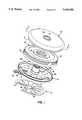
- FIG. 1is an exploded perspective view of one embodiment of the medication delivery device 10 of the present invention.
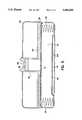
- FIG. 2is a cross sectional view thereof, taken generally along line 2--2 of FIG. 1.
- FIG. 3is a cross-sectional view of a typical prior art medication delivery device having a pleated ;reservoir in the collapsed or empty position.
- FIG. 4is a cross-sectional view similar to that of FIG. 3 but incorporating the reservoir in terminal configuration of the present invention.
- FIG. 5is a cross-sectional view of the medication delivery device of FIG. 4 with the pleated reservoir in the full or expanded position.
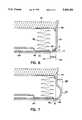
- FIG. 6is an enlarged cross-sectional view of a portion of the medication delivery device of FIG. 5.
- FIG. 7is a view similar to FIG. 6 but incorporating the bulged cover configuration of the present invention.
- medication delivery device 10for delivering a fluid medication 12 is illustrated.
- medicationis used in its broad sense, and may be any fluid, whether or not the fluid is medicinal in nature.
- fluidis also used in its broad sense, and includes both liquids and gasses.
- the medication delivery device 10may comprise five main components, namely, a manifold 13, a donut-shaped bellows reservoir 14, a bulkhead 15, a cover 16, and a flow regulator 30.
- flow regulator 30may be any type of flow restriction device such as capillary tubing.
- the manifold 13, the reservoir 14, the cover 16, and the flow regulator 30may all be bonded or assembled to the bulkhead 15 in any suitable way, as will be described in more detail below.
- the cover 16, manifold 13 and bulkhead 15together form an external housing of the medication delivery device.
- the bulkhead 15may have a hollow neck 17, a base 18, a number of through holes 19, a flow regulator mounting cavity 20; an outlet housing 21, an outlet conduit 22, and an outlet port 23. Although ten through holes 19 are illustrated in FIG. 1, there may be fewer, or more, through holes 19.
- the bulkhead 15's neck 17, base 18 and outlet housing 21are illustrated as being made as one integral component, they may be manufactured as separate components, and then bonded or assembled together in any suitable way.
- the outlet port 23is illustrated as being made as a separate component, which is then bonded or assembled to the outlet housing 21, the outlet port 23 and the outlet housing 21 may be made as one integral component.
- the medication delivery device 10may be equipped with any suitable means for preventing back flow of any fluid into the outlet port 23, such as a check valve.
- the means for preventing back flow of any fluid into the medication delivery device 10's outlet port 23may be mounted in any suitable location, either internally or externally of the device 10, such as in its outlet conduit 22 or adjacent to its outlet port 23.
- the medication delivery device 10may be equipped with any suitable means for permitting or preventing flow of the medication 12 out of the outlet port 23, such as an on-off valve.
- the means for permitting or preventing flow of the medication 12 out of the outlet port 23may be mounted in any suitable location, either internally or externally of the device 10, such as in its outlet conduit 22 or adjacent to its outlet port 23.
- the bulkhead 15's hollow neck 17may have an inlet 28.
- a septum 29Housed within the neck 17 may be a septum 29, which may be held in place by any suitable means, such as by a threaded hollow plug 31 or by an interference (press) fit between the neck 17 and the plug 31, or by welding the neck 17 to the plug 31.
- the septum 29may be made from any suitable resilient, self-sealing material which may be pierced by a needle, such as silicone rubber.
- Neck 17, inlet 28 and septum 29together comprise a refill port which enables reservoir 14 to be filled and refilled with medication in a manner described more fully hereafter.
- any suitable filter 33housed within the neck 17 may be any suitable filter 33, which may be bonded or assembled within the neck 17 in any suitable way.
- the filter 33may be held within the neck 17 by being sandwiched between the neck 17's shoulder 63 and the manifold 13's ribs 27.
- the filter 33may be selected to filter particles from the medication 12 of a size which might clog, or otherwise harm, any of the device 10's components which are located downstream from the filter 33; or which might clog, or otherwise harm, whatever is receiving the medication 12 from the device 10.
- the filter 33may be selected to filter out particles as small as bacteria, or even as small as viruses, to help protect the patient or animal from the possibility of infection.
- the filter 33may serve the dual functions of filtering out harmful bacterial or viruses from the medication 12, and of filtering out any particles from the medication 12 which might clog, or otherwise harm, the fluid flow regulator 30 and/or flow restrictor and keep it from operating properly.
- the filter 33is illustrated as being located within the bulkhead 15's neck 17, it could be placed in any other suitable location within the medication delivery device 10 which is upstream from where the outlet port 23 exits the device 10, such as in the reservoir 14, the through holes 19, the manifold 13's inlet recess 25, the manifold 13's outlet channels 26, the flow regulator mounting cavity 20, the outlet conduit 22, or the outlet port 23.
- the filter 33may be placed externally of the medication delivery device 10 in any suitable location, such as upstream from the neck 17's inlet port 28, or downstream from the device 10's outlet port 23. In such an event, the neck 17's shoulder 63 may be eliminated, since it would no longer be needed to hold the filter 33 in place within the neck 17.
- the flow regulator 30may be bonded or assembled to the bulkhead 15's regulator mounting cavity 20, over the outlet conduit 22, in any suitable way. Alternatively, the flow regulator 30 may be placed within the device 10 in any other suitable location which is downstream from the reservoir 14, the outlet conduit 22, or the outlet port 23.
- the flow regulator 30may be placed externally of the medication delivery device 10 in any suitable location, such as downstream of the outlet port 23. In such an event, the flow regulator mounting cavity 20 may be eliminated.
- the flow regulator 30may be any suitable fluid flow regulator which is selected to have the particular fluid flow characteristics which are desired for the particular intended use of the medication delivery device 10. For example, in order to help prevent an overdose of medication from being delivered to a patient by the device 10, the flow regulator 30 may be selected to provide a predetermined maximum flow rate of the medication 12, despite an overpressure of the medication 12 within the reservoir 14 which exceeds the normal operating parameters of the device 10. Such an overpressure might occur if, for example, the reservoir 14 was overfilled with the medication 12.
- the manifold 13may be bonded or assembled to the periphery of the bottom of the bulkhead 15's base 18 in any suitable way, and may form the bottom of the medication delivery device 10.
- the manifold 13may have a cutout 24, an inlet recess 25, a number of outlet channels 26, and a number of ribs 27.
- the cutout 24may be sized to accommodate the bulkhead 15's outlet housing 21.
- the ribs 27may separate the outlet channels 26 from each other, and may help to hold the filter 33 within the bulkhead 15's neck 17.
- One end of each of the outlet channels 26may be in fluid communication with the inlet recess 25, while the other end of each of the outlet channels 26 may be in fluid communication with a respective through hole 19 in the bulkhead 15.
- outlet channels 26 and nine ribs 27there may be fewer, or more, outlet channels 26 and ribs 27.
- the manifold 13's inlet recess 25 and outlet channels 26are illustrated as being separate components, the outlet channels 26 may be eliminated and replaced by an enlarged inlet recess 25 which fluidly communicates with the bulkhead 15's through holes 19; and the inlet recess 25 may be eliminated and replaced by enlarged outlet channels 26 which are in fluid communication with the bulkhead 15's hollow neck 17.
- the reservoir 14may have a central hole 35, pleated inner and outer sides 37, 39, and an open bottom having inner and outer mounting flanges 41, 43.
- the reservoir 14may be bonded or assembled to the bulkhead 15 in any suitable way; such as by bonding or assembling its inner mounting flange 41 to the outside of the base of the neck 17, and by bonding or assembling its outer mounting flange 43 to the inside of the bulkhead 15's peripheral lip 45.
- the bulkhead 15's base 18forms the bottom of the reservoir 14, and the medication 12 may enter the reservoir 14 through the holes 19 in the base 18.
- a donut-shaped reservoir 14, with the bulkhead 15's neck 17 extending through the reservoir 14's central hole 35may be preferred. This is because such a construction results in an unusually compact medication delivery device 10 while retaining sufficient medication storage capacity.
- This arrangementprovides a compact radially adjacent or side-by-side positioning of the reservoir and the refill port which does not add to the thickness of the medical delivery device in the direction of the longitudinal axis of the housing. Such compactness may be particularly desirable for the device 10 in certain circumstances, such as if it is designed to be implanted within a patient's body.
- the reservoir 14 and its central hole 35are illustrated as having circular shapes, they could have any other suitable rounded or angular shape, such as oval, square or rectangular. Additionally, instead of being positioned concentrically with the longitudinal axis of the housing at the center of reservoir 14 as illustrated, hole 35 could be offset to any desired nonconcentric location.
- the reservoir 14's pleated inner and outer sides 37, 39permit the volume of the reservoir 14 to be varied. For example, as seen in FIG. 2, when the reservoir 14 is full, then its pleated inner and outer sides 37, 39 unfold a maximum amount, thereby permitting the reservoir 14's top 61 to be located a maximum distance from the bulkhead 15's base 18, which forms the bottom of the reservoir 14.
- the reservoir 14may be any other suitable adjustable volume device.
- the reservoir 14may be a simple balloon or bladder, having unpleated sides, which is made from any suitable flexible or elastic material, such as rubber or plastic.
- the cover 16may have a central hole 47 for the bulkhead 15's neck 17; and inner and outer mounting flanges 49, 51.
- the cover 16may be bonded or assembled to the bulkhead 15 in any suitable way, such as by bonding or assembling its inner mounting flange 49 to the outside of the top of the neck 17, and by bonding or assembling its outer mounting flange 51 to the outside of the bulkhead 15's peripheral lip 45.
- a positive pressuremay be imparted to the medication 12 within the reservoir 14 in any suitable way.
- the space 53 between the reservoir 14 and the cover 16may be pressurized in any suitable way, such as by locating in the space 53 a quantity of any suitable, volatile substance which has a relatively high vapor pressure at the intended operating temperature range of the medication delivery device 10.
- the suitable, volatile substancemay, for example, be Freon 87, which has a gas liquid-gas vapor pressure of 3.9 PSIG at 37° C. or R-11 which has a vapor pressure of 8.4 PSIG at 37° C.
- the space 53may be pressurized by filling it with a compressed gas.
- a positive pressuremay be imparted to the medication 12 within the reservoir 14 by making the reservoir 14 to be self-collapsing, such as by fabricating the reservoir 14 from an elastic material which is stretched when the reservoir 14 is filled with the medication 12.
- a positive pressuremay be imparted to the medication 12 within the reservoir 14 by using an external mechanical force to collapse the reservoir 14, such as by locating a spring between the reservoir 14's top 61 and the inside of the cover 16.
- the medication delivery device 10may be initially filled with the medication 12 in any suitable way, such as by first inserting a hollow needle 55 through the neck 17's septum 29, and into the space 57 which is located between the septum 29 and the filter 33. Any undesired perforation of the filter 33 by the needle 55 may be prevented in any suitable way, such as by providing a space 57 between the septum 29 and the filter 33.
- the needle 55may be selected to be of the type which has a relatively blunt end, with an outlet hole 59 on its side.
- a perforated needle stopmay be located in the neck 17 between the septum 29 and the filter 33. The size of the perforations in the needle stop may be selected to be small enough to prevent the passage of the needle 55 therethrough; but large enough to permit the free passage of the medication 12 therethrough.
- a vacuummay then applied to the needle 55 until all of the air in the space 57, the filter 33, the inlet recess 25, the outlet channels 26, the through holes 19, the reservoir 14, the flow regulator 30, the outlet conduit 22, and the outlet port 23 has been evacuated.
- the check valvewhich was mentioned above, may be used to prevent air from flowing into the medication delivery device 10 through its outlet port 23 during the evacuation process.
- the needle 55may then be withdrawn, and the septum 29 will automatically reseal itself, thereby not admitting any air into the device 10.
- a new needle 55connected to a source of medication 12, may then be inserted through the septum 29 into the space 57.
- the source of the medication 12 for the needle 55may be pressurized.
- the medication 12will then be drawn into and/or forced into the medication delivery device 10 through the needle 55, and fill the space 57, the filter 33, the inlet recess 25, the outlet channels 27, the through holes 19, the reservoir 14, the flow regulator 30, the outlet conduit 22, and the outlet port 23.
- the on-off valvewhich was mentioned above, may be used to prevent the medication 12 from leaking out of the outlet port 23.
- the needle 55may then be withdrawn, and the septum 29 will automatically reseal itself, to prevent any medication 12 from leaking out of, and any air from leaking into, the space 57.
- any suitable delivery meanssuch as a catheter, may then be attached in any suitable way to the medication delivery device 10's outlet port 23, for conveying the medication 12 from the outlet port 23 to the location where the medication 12 is to be delivered.
- the on-off valvewhich was mentioned above, may be turned on long enough to permit the medication 12 to flow out of the outlet port 23 until any undesired air in the outlet port 23 and the delivery means has been purged; at which time the on-off valve may then be turned off.
- the medication delivery device 10may then be secured in any suitable way in its location of intended use, such as by inserting it within a patient's body.
- the free end of the delivery meanssuch as the free end of the catheter, may then secured in any suitable way at the location where the medication 12 is to be delivered.
- the on-off valvemay be turned on. That will permit the pressurized medication 12 in the reservoir 14 to flow out one the reservoir 14 and through the flow regulator 30, the outlet conduit 22, the outlet port 23, the delivery means.
- the rate of flow of the medication 12 from the reservoir 14is governed by the flow regulator 30.
- the reservoir 14may be refilled with medication 12 in any suitable way, such as by the use of a needle 55 in a manner similar to that described above. Since the medication delivery device 10 may be installed within a patient's or animal's body, the needle 55 may be used to fill the reservoir 14 without removing the device 10 from the patient or animal, by simply inserting the needle 55 into the septum 29, through the patient's or animal's skin.
- the collapsible surface of bellows reservoir 14has an indented surface portion 72 which extends inwardly towards manifold 13.
- indented surface portion 72When reservoir 14 is compressed or empty indented surface portion 72 insures that reservoir 14 more completely empties as will be explained in more detail with reference FIGS. 3-5.
- Device 80includes an inlet 82 formed from a hollow neck portion 84 which maybe an integral part of a bulkhead 86.
- Bulkhead 86includes a raised portion or boss 88 which is usually an integral portion of bulkhead 86.
- a septum 90is housed within neck portion 84.
- Device 80includes a conventional bellows reservoir 92 (as opposed to the doughnut-shaped reservoir 14 of delivery device 10) which, in FIG. 3, is shown in the collpased or empty position.
- a two piece cover or housingis comprised of an upper cover 94 and lower cover 96.
- other components of device 80are not illustrated since they are not necessary for an understanding of the present invention.
- Device 80may be any conventional medication delivery device such as the Synchromed® Drug Pump manufactured by Medtronic, Inc., Minneapolis, Minn.
- the manner in which the medication is dispensedi.e. flow regulation, flow restriction, pumping, metering is not critical to the present invention.
- boss 88is usually formed as an integral part of bulkhead 86. Since bulkhead 86 is typically made of a metal such as titanium or Ti-6A1-4V a difficult machining step must be included in manufacturing the device in order to machine the bulkhead to its final configuration including boss 88. Additionally, boss 88 adds significant additional weight to the device. Since the medication delivery device is meant to be implanted in a patient, even a small increase in weight is undesirable. Conversely, even a small decrease in the weight of the device as shown in the embodiment of FIG. 2 is desirable.
- FIG. 4is a cross-sectional view of a medication delivery device similar to that shown in FIG. 3 but incoporating the novel reservoir end terminal design of the present invention.
- FIG. 5is a cross-sectional view of the device of FIG. 4 but with the bellows reservoir in its fully expanded position as it would be when full of medication.
- Like reference numeralsare used in FIGS. 4 and 5 to identify like components.
- reservoir 92is provided with an indented surface portion 108 which lies generally between pleats 98.
- Indented surface portion 108extends into reservoir 92 in the direction of bulkhead 86 a distance which is approximately equal to distance t. Therefore, the upper surface 110 of raised surface portion 108 generally meets with the lower surface 112 of bulkhead 86 such that when reservoir 92 is in the collapsed/empty position nearly all of the fluid medication in the reservoir is evacuated.
- indented surface portion 108is provided with a ridge or dimple 114 to reduce the surface tension between surfaces 110 and 112.
- cover 16is configured such that it's circumferential/peripheral edge is bulged away from the center of the device to define a circumferentially protruding portion 70.
- FIGS. 6 and 7the concept of the bulged cover configuration of the present invention is more fully described with respect to an additional embodiment. It should be understood that the bulged cover configuration shown is equally applicable to all types of implantable medication delivery devices and is not meant to be limited to the embodiments shown in FIGS. 1, 2 and 7. Additionally, although the circumferentially protruding portion/curved cover portion has been shown on one peripheral edge, it could be used with both edges of the device.
- FIG. 6is an enlarged cross-sectional view of a portion of a medication delivery device similar to the device of FIG. 5 depicting generally the area between the pleats of the device and the cover oriented at the right side of the device as viewed in FIG. 5.
- FIG. 7is a view similar to FIG. 6 incorporating the bulged cover configuration of the present invention. Again, like reference numerals are used to identify like components.
- cover 96may be seen to include a bottom cover portion 116 and a side cover portion 118. Portions 116 and 118 are joined by a curved cover portion 120. Curved cover portion 120 is shown as it is traditionally formed with a gradual curvature which approximates a single smooth radial surface tangential to both surfaces 116 and 118. A smooth gradual curve with a sufficiently large radius is desirable both for patient comfort and to prevent complications such as the device wearing or abraiding through the skin. However, a large gradual radius such as shown in FIG. 6 limits the usable internal space of the device. This is perhaps more clearly understood by extending the interior surfaces of portions 116 and 118 along lines 117 and 119, respectively.
- Lines 117 and 119meet at a point P which represents the place where portions 116 and 118 would intersect in the absence of the gradual curve provided by curved cover portion 120.
- This areaextends peripherally around the device.
- the ends of the pleats 98must be spaced a distance W from side cover portion 118 (line 119) to pleats 98 (represented by extended line 121) so that pleats 98 have proper clearance from curved cover portion 120.
- Distance Wrepresents the amount of space adjacent side cover portion 118 which is not usable due to the need to move components inwardly to prevent their contact with the curved cover portion of the device.
- the unusable space represented by area Acan be reduced or eliminated by bulging curved portion 120' outwardly a distance D as measured between a line 122 and side cover portion 118.
- Line 122is tangential to the external surface of curved cover portion 120' and parallel to side cover portion 118. This is accomplished by moving the radius outward so that curved cover portion 120' forms a peripheral lip or ridge about the device (in the same manner as circumferentially protruding portion 70 in FIG. 2).
- curved cover portion 120'may be made by forming a gradually curving surface which may be comprised by combining one or more different radii, it being necessary only that the external peripheral lip be of smooth and gradual contour with no sharp angles.
- the bulged cover configuration of FIG. 7the total vertical height of a device can be utilized. This enables the device to be made thinner which provides a significant advantage for an implantable device.
- the medication delivery device 10may have many alternative shapes, arrangements and variations.
- the device 10instead of the device 10 having an overall circular or cylindrical shape, it could have any other suitable rounded or angular shape, such as oval, square or rectangular.
- the reservoir 14instead of the device 10 having a concentric arrangement in which the bulkhead 15's neck 17 is located within the reservoir 14's hole 35, the reservoir 14 may not have a hole 35, and the neck 17 may be located along side of and substantially surrounded by the reservoir 14.
- All of the medication delivery device 10's componentsmay be made from, and bonded or assembled with, any suitable, durable, stable, corrosion-resistant substances which are compatible with the medication 12; which are compatible with the intended environment in which the device 10 is intended to be used; and which are compatible with the person, animal or thing with which the 10 is intended to be used.
- the manifold 13; the cover 14; and the bulkhead 15's neck 17, base 18, outlet housing 21, outlet port 23 and plug 31may be made from any suitable material which is also relatively rigid, such as plastic, ceramic, or metal.
- a suitable metalmay be commercially pure titanium or Ti-6A1-4V.
- the reservoir 14may be made from any suitable material which is also relatively flexible (for proper operation of its pleated inner and outer sides 37, 39), such as plastic, or metal.
- a suitable metalmay be commercially pure titanium or Ti-6A1-4V.
- all of the device 10's componentsmay be made from, and bonded or assembled with, substances which are compatible with at least one suitable sterilization process, such as heat sterilization (e.g., steam autoclaving), gas sterilization (e.g., ethylene oxide), liquid sterilization (e.g., hydrogen peroxide); or radiation sterilization (e.g., gamma radiation).
- heat sterilizatione.g., steam autoclaving
- gas sterilizatione.g., ethylene oxide
- liquid sterilizatione.g., hydrogen peroxide
- radiation sterilizatione.g., gamma radiation
- any of the medication delivery device 10's componentsmay be assembled together in any suitable leak-proof way, with or without gaskets, such as by using any suitable mechanical fastening means.
- the plug 31may be connected to the neck 17 with threads, in which case the septum 29 may act as a gasket for the plug 31.
- the flow regulator 30may be secured within the flow regulator mounting cavity 20 by the use of an O-ring gasket and any suitable mechanical clamping mechanism.
- any of the medication delivery device 10's componentsmay also be bonded together in any suitable leak-proof way, such as by using any suitable welding process, such as laser welding.
- the outer edge of the manifold 13may be welded to the bottom of the periphery of the bulkhead 15's base 18; the outlet port 23 may be welded to the bulkhead 15's outlet housing 21; the reservoir 14's inner and outer mounting flanges 41, 43 may be welded to the bulkhead 15's neck 17 and lip 45, respectively; and the cover 16's inner and outer mounting flanges 49, 51 may be welded to the bulkhead 15's neck 17 and lip 45, respectively.
- any of the medication delivery device 10's componentsmay also be bonded together in a leak-proof way, with or without gaskets, by using any suitable bonding materials, such as adhesives, glues and epoxies.
- any of the medication delivery device 10's componentsmay be bonded together in a leak-proof way with any suitable anodic bonding process.
- the flow regulator 30may be anodically bonded to the regulator mounting cavity 20 if the flow regulator 30's base 11 and the regulator mounting cavity 20's bottom 60 are made from, or have applied thereto in any suitable way, any suitable respective materials which may be anodically bonded together, such as silicon or titanium and 7740 Pyrex® glass made by the Corning Company of Corning, N.Y.
- a layer of any suitable, compatible material which is anodically bondable with the regulator's base 11 and the cavity's bottom 60may be inserted between the regulator's base 11 and the cavity's bottom 60 in any suitable way, before starting the anodic bonding process.
- the layer of suitable, compatible, anodic bonding materialmay be selected to be made from silicon.
Landscapes
- Health & Medical Sciences (AREA)
- Vascular Medicine (AREA)
- Engineering & Computer Science (AREA)
- Anesthesiology (AREA)
- Biomedical Technology (AREA)
- Heart & Thoracic Surgery (AREA)
- Hematology (AREA)
- Life Sciences & Earth Sciences (AREA)
- Animal Behavior & Ethology (AREA)
- General Health & Medical Sciences (AREA)
- Public Health (AREA)
- Veterinary Medicine (AREA)
- Infusion, Injection, And Reservoir Apparatuses (AREA)
- Conveying And Assembling Of Building Elements In Situ (AREA)
- Medical Preparation Storing Or Oral Administration Devices (AREA)
Abstract
Description
The present invention relates to medication delivery devices which are implanted within the body of a patient and methods of construction of the devices. More particularly, the invention relates to a medication delivery device having a uniquely compact size due to the bulged configuration of the cover of the device.
The use of implantable fluid medication dispensers is well known. These devices typically include a medication reservoir within a generally cylindrically shaped housing. Some form of fluid flow control is also provided to control or regulate the flow of fluid medication from the reservoir to the outlet of the device for delivery of the medication to the desired location, usually through a catheter. The flow control may be provided by a pumping or metering device such as disclosed in U.S. Pat. No. 4,692,147 issued to Duggan. Other forms of flow control are disclosed in U.S. Pat. Nos. 3,951,147 and 4,360,019.
All implantable fluid medication dispensers must also include some means to replenish the fluid medication in the medication reservoir. The previously mentioned U.S. Pat. Nos. 4,692,147 to Duggan and 3,951,147 to Tucker et al. disclose typical reservoir refill assemblies. Both include an opening or port through which a resealable septum may be accessed. To refill the reservoir a hypodermic needle is inserted through the septum and into a chamber between the septum and a needle stop, which may be a plug or filter. The medication is injected under pressure into the chamber and flows into the Reservoir.
One disadvantage exists with respect to currently used fluid medication dispensers is the relatively large size of the devices. The external cover or housing must be made large enough to accommodate the fluid medication reservoir, the reservoir refill assembly and all of the associated electronic/control components necessary to the proper function of the device. In order to accommodate all of these internal components, medication dispensers have typically been bulkier than desired. Therefore, it would be desirable to provide a medication delivery device where the overall dimensions are reduced. In particular, it would be desirable to provide such a device with a reduced thickness.
The present invention is a medication delivery device having a particularly compact size due to the bulged configuration of the cover of the device. The medication delivery device comprises a housing, a reservoir located within the housing, a reservoir refill port in fluid communication with the reservoir, in outlet port and means connected between the reservoir and the outlet port for dispensing medication from the reservoir through the outlet port. The housing includes a base and a cover. The cover has a peripheral side portion, a substantially planer surface and a curved portion which joins the side portion and the substantially planer surface to form an internal cavity which is bounded by the side portion, the substantially planer surface and the base. The side portion between the substantially planer surface and the base is substantially linear end the housing may be substantially in the shape of a cylinder. The curved portion of the cover is defined by one or more radii in a manner such that the area of the internal cavity will include substantially all of the area which would be formed if the side port on and the substantially planer surface were extended and joined in the absence of the curve portion. This enables substantially all of the vertical space between the substantially planer surface and the base portion to be utilized for the placement of internal components without the need for any offset from the side portion which would necessitated in order to provide clearance from the curved portion were it not bulged or pushed outwardly.
The dispensing means may be a flow regulator, a flow restrictor, a pump, a medication metering device or any other dispensing means known to those of skill in the art. Additionally, the reservoir may include an aperture within which the reservoir refill port is positioned.
FIG. 1 is an exploded perspective view of one embodiment of the medication delivery device 10 of the present invention; and
FIG. 2 is a cross sectional view thereof, taken generally alongline 2--2 of FIG. 1.
FIG. 3 is a cross-sectional view of a typical prior art medication delivery device having a pleated ;reservoir in the collapsed or empty position.
FIG. 4 is a cross-sectional view similar to that of FIG. 3 but incorporating the reservoir in terminal configuration of the present invention.
FIG. 5 is a cross-sectional view of the medication delivery device of FIG. 4 with the pleated reservoir in the full or expanded position.
FIG. 6 is an enlarged cross-sectional view of a portion of the medication delivery device of FIG. 5.
FIG. 7 is a view similar to FIG. 6 but incorporating the bulged cover configuration of the present invention.
Referring now to FIGS. 1-2, a medication delivery device 10, for delivering a fluid medication 12, is illustrated. The term "medication" is used in its broad sense, and may be any fluid, whether or not the fluid is medicinal in nature. The term "fluid" is also used in its broad sense, and includes both liquids and gasses.
Turning again to FIGS. 1-2, the medication delivery device 10 may comprise five main components, namely, amanifold 13, a donut-shaped bellows reservoir 14, abulkhead 15, acover 16, and aflow regulator 30. Optionally,flow regulator 30 may be any type of flow restriction device such as capillary tubing. Additionally, it should be understood that although the embodiment of the invention disclosed in FIGS. 1 and 2 has a dispensing means consisting of a flow regulator, the invention is equally applicable to devices utilizing other means of dispensing medication such as programmable or nonprogrammable pumping or metering means as will be familiar to those of skill in the art. Themanifold 13, thereservoir 14, thecover 16, and theflow regulator 30 may all be bonded or assembled to thebulkhead 15 in any suitable way, as will be described in more detail below. Thecover 16,manifold 13 andbulkhead 15 together form an external housing of the medication delivery device.
Thebulkhead 15 may have ahollow neck 17, abase 18, a number of through holes 19, a flowregulator mounting cavity 20; anoutlet housing 21, anoutlet conduit 22, and anoutlet port 23. Although ten through holes 19 are illustrated in FIG. 1, there may be fewer, or more, through holes 19.
Although thebulkhead 15's neck 17,base 18 andoutlet housing 21 are illustrated as being made as one integral component, they may be manufactured as separate components, and then bonded or assembled together in any suitable way. Similarly, although theoutlet port 23 is illustrated as being made as a separate component, which is then bonded or assembled to theoutlet housing 21, theoutlet port 23 and theoutlet housing 21 may be made as one integral component.
Although not illustrated, for clarity, the medication delivery device 10 may be equipped with any suitable means for preventing back flow of any fluid into theoutlet port 23, such as a check valve. The means for preventing back flow of any fluid into the medication delivery device 10's outlet port 23 may be mounted in any suitable location, either internally or externally of the device 10, such as in itsoutlet conduit 22 or adjacent to itsoutlet port 23.
Although also not illustrated, for clarity, the medication delivery device 10 may be equipped with any suitable means for permitting or preventing flow of the medication 12 out of theoutlet port 23, such as an on-off valve. The means for permitting or preventing flow of the medication 12 out of theoutlet port 23 may be mounted in any suitable location, either internally or externally of the device 10, such as in itsoutlet conduit 22 or adjacent to itsoutlet port 23.
Thebulkhead 15'shollow neck 17 may have aninlet 28. Housed within theneck 17 may be aseptum 29, which may be held in place by any suitable means, such as by a threadedhollow plug 31 or by an interference (press) fit between theneck 17 and theplug 31, or by welding theneck 17 to theplug 31. Theseptum 29 may be made from any suitable resilient, self-sealing material which may be pierced by a needle, such as silicone rubber.Neck 17,inlet 28 andseptum 29 together comprise a refill port which enablesreservoir 14 to be filled and refilled with medication in a manner described more fully hereafter.
Also housed within theneck 17 may be anysuitable filter 33, which may be bonded or assembled within theneck 17 in any suitable way. For example, as seen in FIG. 2, thefilter 33 may be held within theneck 17 by being sandwiched between theneck 17's shoulder 63 and themanifold 13's ribs 27.
Thefilter 33 may be selected to filter particles from the medication 12 of a size which might clog, or otherwise harm, any of the device 10's components which are located downstream from thefilter 33; or which might clog, or otherwise harm, whatever is receiving the medication 12 from the device 10. For example, if the device 10 is to be used for medical or veterinary purposes, thefilter 33 may be selected to filter out particles as small as bacteria, or even as small as viruses, to help protect the patient or animal from the possibility of infection. By way of further example, if thefilter 33 is located upstream from thefluid flow regulator 30, then thefilter 33 may serve the dual functions of filtering out harmful bacterial or viruses from the medication 12, and of filtering out any particles from the medication 12 which might clog, or otherwise harm, thefluid flow regulator 30 and/or flow restrictor and keep it from operating properly.
Although thefilter 33 is illustrated as being located within thebulkhead 15'sneck 17, it could be placed in any other suitable location within the medication delivery device 10 which is upstream from where theoutlet port 23 exits the device 10, such as in thereservoir 14, the through holes 19, the manifold 13'sinlet recess 25, the manifold 13'soutlet channels 26, the flowregulator mounting cavity 20, theoutlet conduit 22, or theoutlet port 23.
Alternatively, thefilter 33 may be placed externally of the medication delivery device 10 in any suitable location, such as upstream from theneck 17'sinlet port 28, or downstream from the device 10'soutlet port 23. In such an event, theneck 17's shoulder 63 may be eliminated, since it would no longer be needed to hold thefilter 33 in place within theneck 17.
Theflow regulator 30 may be bonded or assembled to thebulkhead 15'sregulator mounting cavity 20, over theoutlet conduit 22, in any suitable way. Alternatively, theflow regulator 30 may be placed within the device 10 in any other suitable location which is downstream from thereservoir 14, theoutlet conduit 22, or theoutlet port 23.
Alternatively, theflow regulator 30 may be placed externally of the medication delivery device 10 in any suitable location, such as downstream of theoutlet port 23. In such an event, the flowregulator mounting cavity 20 may be eliminated.
Theflow regulator 30 may be any suitable fluid flow regulator which is selected to have the particular fluid flow characteristics which are desired for the particular intended use of the medication delivery device 10. For example, in order to help prevent an overdose of medication from being delivered to a patient by the device 10, theflow regulator 30 may be selected to provide a predetermined maximum flow rate of the medication 12, despite an overpressure of the medication 12 within thereservoir 14 which exceeds the normal operating parameters of the device 10. Such an overpressure might occur if, for example, thereservoir 14 was overfilled with the medication 12.
The manifold 13 may be bonded or assembled to the periphery of the bottom of thebulkhead 15'sbase 18 in any suitable way, and may form the bottom of the medication delivery device 10. The manifold 13 may have acutout 24, aninlet recess 25, a number ofoutlet channels 26, and a number ofribs 27. Thecutout 24 may be sized to accommodate thebulkhead 15'soutlet housing 21. Theribs 27 may separate theoutlet channels 26 from each other, and may help to hold thefilter 33 within thebulkhead 15'sneck 17. One end of each of theoutlet channels 26 may be in fluid communication with theinlet recess 25, while the other end of each of theoutlet channels 26 may be in fluid communication with a respective through hole 19 in thebulkhead 15.
Although tenoutlet channels 26 and nineribs 27 are illustrated, there may be fewer, or more,outlet channels 26 andribs 27. Although the manifold 13'sinlet recess 25 andoutlet channels 26 are illustrated as being separate components, theoutlet channels 26 may be eliminated and replaced by anenlarged inlet recess 25 which fluidly communicates with thebulkhead 15's through holes 19; and theinlet recess 25 may be eliminated and replaced byenlarged outlet channels 26 which are in fluid communication with thebulkhead 15'shollow neck 17.
Thereservoir 14 may have acentral hole 35, pleated inner andouter sides flanges reservoir 14 may be bonded or assembled to thebulkhead 15 in any suitable way; such as by bonding or assembling itsinner mounting flange 41 to the outside of the base of theneck 17, and by bonding or assembling its outer mountingflange 43 to the inside of thebulkhead 15'speripheral lip 45. As a result, thebulkhead 15'sbase 18 forms the bottom of thereservoir 14, and the medication 12 may enter thereservoir 14 through the holes 19 in thebase 18.
The use of a donut-shapedreservoir 14, with thebulkhead 15'sneck 17 extending through thereservoir 14'scentral hole 35, may be preferred. This is because such a construction results in an unusually compact medication delivery device 10 while retaining sufficient medication storage capacity. This arrangement provides a compact radially adjacent or side-by-side positioning of the reservoir and the refill port which does not add to the thickness of the medical delivery device in the direction of the longitudinal axis of the housing. Such compactness may be particularly desirable for the device 10 in certain circumstances, such as if it is designed to be implanted within a patient's body. Although thereservoir 14 and itscentral hole 35 are illustrated as having circular shapes, they could have any other suitable rounded or angular shape, such as oval, square or rectangular. Additionally, instead of being positioned concentrically with the longitudinal axis of the housing at the center ofreservoir 14 as illustrated,hole 35 could be offset to any desired nonconcentric location.
Thereservoir 14's pleated inner andouter sides reservoir 14 to be varied. For example, as seen in FIG. 2, when thereservoir 14 is full, then its pleated inner andouter sides reservoir 14's top 61 to be located a maximum distance from thebulkhead 15'sbase 18, which forms the bottom of thereservoir 14.
On the other hand, when thereservoir 14 is empty or evacuated, its pleated inner andouter sides reservoir 14'sindented portion 72 of top 61 to be located a minimum distance from thebulkhead 15'sbase 18.
Although thereservoir 14 is illustrated as having pleated inner andouter sides reservoir 14 may be any other suitable adjustable volume device. For example, thereservoir 14 may be a simple balloon or bladder, having unpleated sides, which is made from any suitable flexible or elastic material, such as rubber or plastic.
Thecover 16 may have acentral hole 47 for thebulkhead 15'sneck 17; and inner and outer mountingflanges cover 16 may be bonded or assembled to thebulkhead 15 in any suitable way, such as by bonding or assembling itsinner mounting flange 49 to the outside of the top of theneck 17, and by bonding or assembling its outer mountingflange 51 to the outside of thebulkhead 15'speripheral lip 45.
A positive pressure may be imparted to the medication 12 within thereservoir 14 in any suitable way. For example, thespace 53 between thereservoir 14 and thecover 16 may be pressurized in any suitable way, such as by locating in the space 53 a quantity of any suitable, volatile substance which has a relatively high vapor pressure at the intended operating temperature range of the medication delivery device 10. The suitable, volatile substance may, for example, be Freon 87, which has a gas liquid-gas vapor pressure of 3.9 PSIG at 37° C. or R-11 which has a vapor pressure of 8.4 PSIG at 37° C. Alternatively, thespace 53 may be pressurized by filling it with a compressed gas.
Alternatively, a positive pressure may be imparted to the medication 12 within thereservoir 14 by making thereservoir 14 to be self-collapsing, such as by fabricating thereservoir 14 from an elastic material which is stretched when thereservoir 14 is filled with the medication 12.
Alternatively, a positive pressure may be imparted to the medication 12 within thereservoir 14 by using an external mechanical force to collapse thereservoir 14, such as by locating a spring between thereservoir 14's top 61 and the inside of thecover 16.
The medication delivery device 10 may be initially filled with the medication 12 in any suitable way, such as by first inserting ahollow needle 55 through theneck 17'sseptum 29, and into the space 57 which is located between theseptum 29 and thefilter 33. Any undesired perforation of thefilter 33 by theneedle 55 may be prevented in any suitable way, such as by providing a space 57 between theseptum 29 and thefilter 33. In addition, theneedle 55 may be selected to be of the type which has a relatively blunt end, with an outlet hole 59 on its side. Further, although not illustrated for clarity, a perforated needle stop may be located in theneck 17 between theseptum 29 and thefilter 33. The size of the perforations in the needle stop may be selected to be small enough to prevent the passage of theneedle 55 therethrough; but large enough to permit the free passage of the medication 12 therethrough.
A vacuum may then applied to theneedle 55 until all of the air in the space 57, thefilter 33, theinlet recess 25, theoutlet channels 26, the through holes 19, thereservoir 14, theflow regulator 30, theoutlet conduit 22, and theoutlet port 23 has been evacuated. The check valve, which was mentioned above, may be used to prevent air from flowing into the medication delivery device 10 through itsoutlet port 23 during the evacuation process. Theneedle 55 may then be withdrawn, and theseptum 29 will automatically reseal itself, thereby not admitting any air into the device 10.
Anew needle 55, connected to a source of medication 12, may then be inserted through theseptum 29 into the space 57. The source of the medication 12 for theneedle 55 may be pressurized. The medication 12 will then be drawn into and/or forced into the medication delivery device 10 through theneedle 55, and fill the space 57, thefilter 33, theinlet recess 25, theoutlet channels 27, the through holes 19, thereservoir 14, theflow regulator 30, theoutlet conduit 22, and theoutlet port 23. After the medication delivery device 10 has been filled with the desired amount of the medication 12, the on-off valve, which was mentioned above, may be used to prevent the medication 12 from leaking out of theoutlet port 23. Theneedle 55 may then be withdrawn, and theseptum 29 will automatically reseal itself, to prevent any medication 12 from leaking out of, and any air from leaking into, the space 57.
Once the desired amount of the medication 12 has been inserted into the medication delivery device 10, any suitable delivery means, such as a catheter, may then be attached in any suitable way to the medication delivery device 10'soutlet port 23, for conveying the medication 12 from theoutlet port 23 to the location where the medication 12 is to be delivered. The on-off valve, which was mentioned above, may be turned on long enough to permit the medication 12 to flow out of theoutlet port 23 until any undesired air in theoutlet port 23 and the delivery means has been purged; at which time the on-off valve may then be turned off.
The medication delivery device 10 may then be secured in any suitable way in its location of intended use, such as by inserting it within a patient's body. The free end of the delivery means, such as the free end of the catheter, may then secured in any suitable way at the location where the medication 12 is to be delivered.
Once the device 10 and the free end of the delivery means have been secured in their desired location, the on-off valve may be turned on. That will permit the pressurized medication 12 in thereservoir 14 to flow out one thereservoir 14 and through theflow regulator 30, theoutlet conduit 22, theoutlet port 23, the delivery means. The rate of flow of the medication 12 from thereservoir 14 is governed by theflow regulator 30.
After a period of use, thereservoir 14 may be refilled with medication 12 in any suitable way, such as by the use of aneedle 55 in a manner similar to that described above. Since the medication delivery device 10 may be installed within a patient's or animal's body, theneedle 55 may be used to fill thereservoir 14 without removing the device 10 from the patient or animal, by simply inserting theneedle 55 into theseptum 29, through the patient's or animal's skin.
Further, the collapsible surface ofbellows reservoir 14 has anindented surface portion 72 which extends inwardly towardsmanifold 13. Whenreservoir 14 is compressed or emptyindented surface portion 72 insures thatreservoir 14 more completely empties as will be explained in more detail with reference FIGS. 3-5.
With reference to FIG. 3 there is shown a prior art medication delivery device 80. Device 80 includes aninlet 82 formed from ahollow neck portion 84 which maybe an integral part of abulkhead 86.Bulkhead 86 includes a raised portion orboss 88 which is usually an integral portion ofbulkhead 86. Aseptum 90 is housed withinneck portion 84. Device 80 includes a conventional bellows reservoir 92 (as opposed to the doughnut-shapedreservoir 14 of delivery device 10) which, in FIG. 3, is shown in the collpased or empty position. A two piece cover or housing is comprised of anupper cover 94 andlower cover 96. For purposes of clarity, other components of device 80 are not illustrated since they are not necessary for an understanding of the present invention. Device 80 may be any conventional medication delivery device such as the Synchromed® Drug Pump manufactured by Medtronic, Inc., Minneapolis, Minn. The manner in which the medication is dispensed (i.e. flow regulation, flow restriction, pumping, metering) is not critical to the present invention.
With continued reference to FIG. 3 it can be seen that whenreservoir 92 is fully collapsed, it's pleated edges 98 occupy a space t betweenlines pleats 98 when viewed in the orientation of FIG. 3. Thus, in order to more completely empty the reservoir when it is in its collapsed state, aboss 88 has been included as part ofbulkhead 86.Boss 88 is configured to extended into reservoir 92 a distance approximately equal to distance t. It can be seen that when collapsed, theinner surface 104 ofreservoir 92 contacts the bottom surface 106 ofboss 82 thus, insuring thatreservoir 92 is more nearly voided of medication when in the collapsed or empty position.
Although providingboss 88 onbulkhead 86 has solved the problem of being able to more nearly empty the pleated reservoir when in the collapsed position, it is a solution which has led to other problems. For example,boss 88 is usually formed as an integral part ofbulkhead 86. Sincebulkhead 86 is typically made of a metal such as titanium or Ti-6A1-4V a difficult machining step must be included in manufacturing the device in order to machine the bulkhead to its finalconfiguration including boss 88. Additionally,boss 88 adds significant additional weight to the device. Since the medication delivery device is meant to be implanted in a patient, even a small increase in weight is undesirable. Conversely, even a small decrease in the weight of the device as shown in the embodiment of FIG. 2 is desirable.
Referring now to FIGS. 4 and 5, there is shown another embodiment of a medication delivery device which solves the above discussed problems of emptying a bellows reservoir without adding to the overall weight of the device. FIG. 4 is a cross-sectional view of a medication delivery device similar to that shown in FIG. 3 but incoporating the novel reservoir end terminal design of the present invention. FIG. 5 is a cross-sectional view of the device of FIG. 4 but with the bellows reservoir in its fully expanded position as it would be when full of medication. Like reference numerals are used in FIGS. 4 and 5 to identify like components. As best seen in FIG. 4, instead of including a boss onbulkhead 86,reservoir 92 is provided with anindented surface portion 108 which lies generally between pleats 98.Indented surface portion 108 extends intoreservoir 92 in the direction of bulkhead 86 a distance which is approximately equal to distance t. Therefore, theupper surface 110 of raisedsurface portion 108 generally meets with thelower surface 112 ofbulkhead 86 such that whenreservoir 92 is in the collapsed/empty position nearly all of the fluid medication in the reservoir is evacuated. Optionally,indented surface portion 108 is provided with a ridge ordimple 114 to reduce the surface tension betweensurfaces
In order to further reduce the size of medication delivery device 10, there is incorporated a unique cover shape. As discussed previously with reference to FIG. 2 it can be seen thatcover 16 is configured such that it's circumferential/peripheral edge is bulged away from the center of the device to define acircumferentially protruding portion 70.
Turning now to FIGS. 6 and 7, the concept of the bulged cover configuration of the present invention is more fully described with respect to an additional embodiment. It should be understood that the bulged cover configuration shown is equally applicable to all types of implantable medication delivery devices and is not meant to be limited to the embodiments shown in FIGS. 1, 2 and 7. Additionally, although the circumferentially protruding portion/curved cover portion has been shown on one peripheral edge, it could be used with both edges of the device. FIG. 6 is an enlarged cross-sectional view of a portion of a medication delivery device similar to the device of FIG. 5 depicting generally the area between the pleats of the device and the cover oriented at the right side of the device as viewed in FIG. 5. FIG. 7 is a view similar to FIG. 6 incorporating the bulged cover configuration of the present invention. Again, like reference numerals are used to identify like components.
As seen in FIG. 6, cover 96 may be seen to include abottom cover portion 116 and aside cover portion 118.Portions curved cover portion 120.Curved cover portion 120 is shown as it is traditionally formed with a gradual curvature which approximates a single smooth radial surface tangential to bothsurfaces portions lines Lines portions curved cover portion 120. The area bounded bylines curved cover portion 120, which approximates the shape of a triangle, represents the internal area A which is lost due tocurved portion 120. This area, of course, extends peripherally around the device. As illustrated, the ends of thepleats 98 must be spaced a distance W from side cover portion 118 (line 119) to pleats 98 (represented by extended line 121) so that pleats 98 have proper clearance fromcurved cover portion 120. Distance W represents the amount of space adjacentside cover portion 118 which is not usable due to the need to move components inwardly to prevent their contact with the curved cover portion of the device.
As shown in FIG. 7 the unusable space represented by area A can be reduced or eliminated by bulging curved portion 120' outwardly a distance D as measured between aline 122 andside cover portion 118.Line 122 is tangential to the external surface of curved cover portion 120' and parallel toside cover portion 118. This is accomplished by moving the radius outward so that curved cover portion 120' forms a peripheral lip or ridge about the device (in the same manner as circumferentially protrudingportion 70 in FIG. 2).
As shown in FIG. 7 point P which is the intersection oflines lines 119 and 121 (the side cover portion and the pleats) is considerably smaller than distance W and, in fact, is dictated more by the need to maintain a minimum clearance between the pleats and the side cover than it is by loss of internal area due to curved portion 120'.
In practice curved cover portion 120' may be made by forming a gradually curving surface which may be comprised by combining one or more different radii, it being necessary only that the external peripheral lip be of smooth and gradual contour with no sharp angles. With the bulged cover configuration of FIG. 7 the total vertical height of a device can be utilized. This enables the device to be made thinner which provides a significant advantage for an implantable device.
Within the scope of the present invention, the medication delivery device 10, as well as its various components, may have many alternative shapes, arrangements and variations. For example, instead of the device 10 having an overall circular or cylindrical shape, it could have any other suitable rounded or angular shape, such as oval, square or rectangular. In addition, instead of the device 10 having a concentric arrangement in which thebulkhead 15'sneck 17 is located within thereservoir 14'shole 35, thereservoir 14 may not have ahole 35, and theneck 17 may be located along side of and substantially surrounded by thereservoir 14.
All of the medication delivery device 10's components may be made from, and bonded or assembled with, any suitable, durable, stable, corrosion-resistant substances which are compatible with the medication 12; which are compatible with the intended environment in which the device 10 is intended to be used; and which are compatible with the person, animal or thing with which the 10 is intended to be used.
The manifold 13; thecover 14; and thebulkhead 15'sneck 17,base 18,outlet housing 21,outlet port 23 and plug 31 may be made from any suitable material which is also relatively rigid, such as plastic, ceramic, or metal. A suitable metal may be commercially pure titanium or Ti-6A1-4V.
Thereservoir 14 may be made from any suitable material which is also relatively flexible (for proper operation of its pleated inner andouter sides 37, 39), such as plastic, or metal. A suitable metal may be commercially pure titanium or Ti-6A1-4V.
In addition, if the medication delivery device 10 is to be used in a medical or veterinary context, all of the device 10's components may be made from, and bonded or assembled with, substances which are compatible with at least one suitable sterilization process, such as heat sterilization (e.g., steam autoclaving), gas sterilization (e.g., ethylene oxide), liquid sterilization (e.g., hydrogen peroxide); or radiation sterilization (e.g., gamma radiation).
Any of the medication delivery device 10's components may be assembled together in any suitable leak-proof way, with or without gaskets, such as by using any suitable mechanical fastening means. For example, theplug 31 may be connected to theneck 17 with threads, in which case theseptum 29 may act as a gasket for theplug 31. Further, theflow regulator 30 may be secured within the flowregulator mounting cavity 20 by the use of an O-ring gasket and any suitable mechanical clamping mechanism.
In addition, any of the medication delivery device 10's components may also be bonded together in any suitable leak-proof way, such as by using any suitable welding process, such as laser welding. For example, the outer edge of the manifold 13 may be welded to the bottom of the periphery of thebulkhead 15'sbase 18; theoutlet port 23 may be welded to thebulkhead 15'soutlet housing 21; thereservoir 14's inner and outer mountingflanges bulkhead 15'sneck 17 andlip 45, respectively; and thecover 16's inner and outer mountingflanges bulkhead 15'sneck 17 andlip 45, respectively.
Alternatively, any of the medication delivery device 10's components may also be bonded together in a leak-proof way, with or without gaskets, by using any suitable bonding materials, such as adhesives, glues and epoxies.
Alternatively, any of the medication delivery device 10's components may be bonded together in a leak-proof way with any suitable anodic bonding process. For example, theflow regulator 30 may be anodically bonded to theregulator mounting cavity 20 if theflow regulator 30's base 11 and theregulator mounting cavity 20's bottom 60 are made from, or have applied thereto in any suitable way, any suitable respective materials which may be anodically bonded together, such as silicon or titanium and 7740 Pyrex® glass made by the Corning Company of Corning, N.Y.
Alternatively, if the regulator's base 11 and the cavity's bottom 60 are not made from, or coated with, materials which may be anodically bonded directly together, then a layer of any suitable, compatible material which is anodically bondable with the regulator's base 11 and the cavity's bottom 60 may be inserted between the regulator's base 11 and the cavity's bottom 60 in any suitable way, before starting the anodic bonding process. For example, if both the regulator's base 11 and the cavity's bottom 60 were made from, or were coated with, 7740 Pyrex® glass (which will not anodically bond to itself), then the layer of suitable, compatible, anodic bonding material may be selected to be made from silicon.
It is understood that the foregoing forms of the present invention were described and/or illustrated strictly by way of non-limiting example.
In view of all of the disclosures herein, these and further modifications, adaptations and variations of the present invention will now be apparent to those skilled in the art to which it pertains, within the scope of the following claims.
Claims (11)
1. A medication delivery device comprising:
a housing including a base and a cover, said cover having a peripheral side portion, a substantially planer surface and a curved portion joining said side portion and said substantially planer surface, whereby an internal cavity is formed bounded by said side portion, said substantially planer surface and said base, said side portion being substantially linear along a side portion axis extending between said base and said substantially planer surface, said side portion axis being approximately perpendicular to said substantially planar surface, said curved portion having a radius centered on said side portion axis a distance from said planar surface equal to the length of said radius, said curved portion extending away from said internal cavity, said curved portion contacting said substantially planar surface and said side portion approximately along said side portion axis, whereby the area of said internal cavity includes substantially all of the area that would be formed if said side portion and said substantially planer surface were extended and joined in the absence of said curved portion,
a reservoir within said housing,
a reservoir refill port in fluid communication with said reservoir,
an outlet port, and
means connected between said reservoir and said outlet port for dispensing medication from said reservoir through said outlet port.
2. The device of claim 1 wherein said dispensing means comprises a flow regulator.
3. The device of claim 1 wherein said dispensing means comprises a flow restrictor.
4. The device of claim 1 wherein said dispensing means comprises a pump.
5. The device of claim 1 wherein said dispensing means comprises a medication metering device.
6. The device of claim 1 wherein said reservoir includes an aperture within which said reservoir refill port is positioned.
7. A housing for an implantable device comprising:
a base;
a cover, said cover having a peripheral side portion, a substantially planer surface and a curved portion joining said side portion and said substantially planer surface, whereby an internal cavity is formed bounded by said side portion, said substantially planer surface and said base, said side portion being substantially linear along a side portion axis extending between said base and said substantially planer surface, said side portion axis being approximately perpendicular to said substantially planar surface, said curved portion having a radius centered on said side portion axis a distance from said planar surface equal to the length of said radius, said curved portion extending away from said internal cavity, said curved portion contacting said substantially planar surface and said side portion approximately along said side portion axis, whereby the area of said internal cavity includes substantially all of the area that would be formed if said side portion and said substantially planer surface were extended and joined in the absence of said curved portion.
8. A cover for an implantable medical device having a base, the cover comprising:
a peripheral side portion;
a substantially planer surface; and
a curved portion joining said side portion and said substantially planer surface, whereby an internal cavity is formed bounded by said side portion, said substantially planer surface and the base, said side portion being substantially linear along a side portion axis extending between the base and said substantially planer surface, said side portion axis being approximately perpendicular to said substantially planar surface, said curved portion having a radius centered on said side portion axis a distance from said planar surface equal to the length of said radius, said curved portion extending away from said internal cavity, said curved portion contacting said substantially planar surface and said side portion approximately along said side portion axis, whereby the area of said internal cavity includes substantially all of the area that would be formed if said side portion and said substantially planer surface were extended and joined in the absence of said curved portion.
9. A cover for an implantable medical device having a base, the cover comprising:
a peripheral side portion;
a substantially planer surface; and
a curved portion joining said side portion and said substantially planer surface, whereby an internal cavity is formed bounded by said side portion, said substantially planer surface and the base, said side portion being substantially linear along a side portion axis extending between the base and said substantially planer surface, said curved portion having a radius centered on said side portion axis a distance from said planar surface equal to the length of said radius, said curved portion extending away from said internal cavity, said curved portion contacting said substantially planar surface and said side portion approximately along said side portion axis, whereby the area of said internal cavity includes substantially all of the area that would be formed if said side portion and said substantially planer surface were extended and joined in the absence of said curved portion.
10. A connecting portion between a peripheral side portion and a substantially planar surface on a cover for an implantable medical device having a base, the side portion being substantially linear along a side portion axis extending between the base and the substantially planer surface, the side portion, the substantially planer surface and the base forming an internal cavity, the connecting portion comprising:
a curved portion joining the side portion and the substantially planer surface, said curved portion having a radius centered on the side portion axis a distance from the planar surface equal to the length of said radius, said curved portion extending away from the internal cavity, said curved portion contacting the substantially planar surface and the side portion approximately along the side portion axis, whereby the area of the internal cavity includes substantially all of the area that would be formed if the side portion and the substantially planer surface were extended and joined in the absence of said curved portion.
11. A method for joining a side portion and a substantially planar surface on a cover for an implantable medical device having a base, the side portion being substantially linear along a side portion axis extending between the base and the substantially planer surface, the side portion axis being approximately perpendicular to the substantially planar surface, whereby an internal cavity is formed bounded by the side portion, the substantially planer surface and the base, the method comprising the steps of:
forming a curved portion between the side portion and the substantially planer surface along a radius centered on the side portion axis a distance from the planar surface equal to the length of the radius, the curved portion extending away from the internal cavity, the curved portion contacting the substantially planar surface and the side portion approximately along the side portion axis;
whereby the area of the internal cavity includes substantially all of the area that would be formed if the side portion and the substantially planer surface were extended and joined in the absence of the curved portion.
Priority Applications (6)
| Application Number | Priority Date | Filing Date | Title |
|---|---|---|---|
| US08/235,442US5443450A (en) | 1994-04-29 | 1994-04-29 | Medication delivery device and method of construction |
| PCT/US1995/003089WO1995029718A1 (en) | 1994-04-29 | 1995-03-06 | Medication delivery device and method of construction |
| DE69517169TDE69517169T2 (en) | 1994-04-29 | 1995-03-06 | DEVICE FOR DISPENSING MEDICINES |
| CA002189033ACA2189033C (en) | 1994-04-29 | 1995-03-06 | Medication delivery device and method of construction |
| EP95913659AEP0757565B1 (en) | 1994-04-29 | 1995-03-06 | Medication delivery device |
| AU19963/95AAU681501B2 (en) | 1994-04-29 | 1995-03-06 | Medication delivery device and method of construction |
Applications Claiming Priority (1)
| Application Number | Priority Date | Filing Date | Title |
|---|---|---|---|
| US08/235,442US5443450A (en) | 1994-04-29 | 1994-04-29 | Medication delivery device and method of construction |
Publications (1)
| Publication Number | Publication Date |
|---|---|
| US5443450Atrue US5443450A (en) | 1995-08-22 |
Family
ID=22885531
Family Applications (1)
| Application Number | Title | Priority Date | Filing Date |
|---|---|---|---|
| US08/235,442Expired - LifetimeUS5443450A (en) | 1994-04-29 | 1994-04-29 | Medication delivery device and method of construction |
Country Status (6)
| Country | Link |
|---|---|
| US (1) | US5443450A (en) |
| EP (1) | EP0757565B1 (en) |
| AU (1) | AU681501B2 (en) |
| CA (1) | CA2189033C (en) |
| DE (1) | DE69517169T2 (en) |
| WO (1) | WO1995029718A1 (en) |
Cited By (39)
| Publication number | Priority date | Publication date | Assignee | Title |
|---|---|---|---|---|
| US5551849A (en)* | 1994-04-29 | 1996-09-03 | Medtronic, Inc. | Medication delivery device and method of construction |
| US5616132A (en)* | 1995-06-09 | 1997-04-01 | Subot, Inc. | Injection device |
| FR2808205A1 (en)* | 2000-04-28 | 2001-11-02 | Medtronic Inc | Medication injecting implant has separating partition and sub-assemblies made in one piece from biocompatible material |
| US6315769B1 (en) | 1999-09-13 | 2001-11-13 | Medtronic, Inc. | Apparatus and method for measuring the amount of fluid contained in an implantable medical device |
| WO2002017989A3 (en)* | 2000-08-30 | 2002-05-16 | Medtronic Inc | System and method for attaching upper and lower outer cases in an implantable drug pump |
| US6482177B1 (en) | 1999-09-13 | 2002-11-19 | Medtronic, Inc. | Apparatus and method for measuring the amount of fluid contained in an implantable medical device |
| US6485462B1 (en) | 1997-08-27 | 2002-11-26 | Science Incorporated | Fluid delivery device with heat activated energy source |
| US6629954B1 (en)* | 2000-01-31 | 2003-10-07 | Medtronic, Inc. | Drug delivery pump with isolated hydraulic metering |
| US6635049B1 (en)* | 1999-04-30 | 2003-10-21 | Medtronic, Inc. | Drug bolus delivery system |
| US20030208184A1 (en)* | 2000-01-11 | 2003-11-06 | Paul Burke | Implantable, refillable infusion device and spetum replacement kit |
| US6665563B2 (en) | 1996-07-17 | 2003-12-16 | Medtronic, Inc. | System and method for enhancing cardiac signal sensing by cardiac pacemakers through genetic treatment |
| US20040020173A1 (en)* | 2002-07-30 | 2004-02-05 | Cho Steven T. | Low temperature anodic bonding method using focused energy for assembly of micromachined systems |
| US20040039376A1 (en)* | 1996-02-02 | 2004-02-26 | Peery John R. | Sustained delivery of an active agent using an implantable system |
| US20040236377A1 (en)* | 2001-07-02 | 2004-11-25 | Medtronic, Inc. | System and method for enhancing cardiac signal sensing by cardiac pacemakers through genetic treatment |
| AU778902B2 (en)* | 1996-02-02 | 2004-12-23 | Intarcia Therapeutics, Inc. | A device for an active agent in a fluid environment of use |
| US20060142705A1 (en)* | 2003-04-24 | 2006-06-29 | Halili Edgardo C | Implantable medication delivery device having needle receiving slot |
| US7094201B1 (en) | 1996-07-17 | 2006-08-22 | Medtronic, Inc. | System and method for genetically treating cardiac conduction disturbances |
| US7172572B2 (en) | 2001-10-04 | 2007-02-06 | Boston Scientific Scimed, Inc. | Manifold system for a medical device |
| US20070117841A1 (en)* | 2003-10-24 | 2007-05-24 | Ozes Osman N | Use of pirfenidone in therapeutic regimens |
| US20070156090A1 (en)* | 2004-05-26 | 2007-07-05 | Kriesel Marshall S | Fluid delivery apparatus |
| US20080131398A1 (en)* | 2006-08-21 | 2008-06-05 | United Therapeutics Corporation | Combination therapy for treatment of viral infections |
| US20080243077A1 (en)* | 2007-04-02 | 2008-10-02 | Bivin Donald B | Fluid dispenser with uniformly collapsible reservoir |
| US20090234303A1 (en)* | 2004-03-02 | 2009-09-17 | Halili Edgardo C | Medical Device Needle Receiving Port |
| WO2010107739A2 (en) | 2009-03-18 | 2010-09-23 | The Board Of Trustees Of The Leland Stanford Junior University | Methods and compositions of treating a flaviviridae family viral infection |
| US7896866B1 (en)* | 2005-09-15 | 2011-03-01 | Advanced Neuromodulation Systems, Inc. | System and method for making an implantable pump thinner |
| EP2390262A1 (en) | 2003-05-16 | 2011-11-30 | Intermune, Inc. | Synthetic chemokine receptor ligands and methods of use thereof |
| US8287495B2 (en) | 2009-07-30 | 2012-10-16 | Tandem Diabetes Care, Inc. | Infusion pump system with disposable cartridge having pressure venting and pressure feedback |
| WO2012175698A1 (en) | 2011-06-23 | 2012-12-27 | Université Libre de Bruxelles | Therapeutic use of all-trans retinoic acid (atra) in patients suffering from alcoholic liver disease |
| US8408421B2 (en) | 2008-09-16 | 2013-04-02 | Tandem Diabetes Care, Inc. | Flow regulating stopcocks and related methods |
| US8650937B2 (en) | 2008-09-19 | 2014-02-18 | Tandem Diabetes Care, Inc. | Solute concentration measurement device and related methods |
| US8979825B2 (en)* | 2011-04-15 | 2015-03-17 | Medtronic, Inc. | Implantable fluid delivery device including gas chamber pressure sensor |
| US8986253B2 (en) | 2008-01-25 | 2015-03-24 | Tandem Diabetes Care, Inc. | Two chamber pumps and related methods |
| US9364484B2 (en) | 2011-12-06 | 2016-06-14 | The Board Of Trustees Of The Leland Stanford Junior University | Methods and compositions for treating viral diseases |
| US9956377B2 (en) | 2002-09-20 | 2018-05-01 | Angiodynamics, Inc. | Method and apparatus for intra-aortic substance delivery to a branch vessel |
| US9962486B2 (en) | 2013-03-14 | 2018-05-08 | Tandem Diabetes Care, Inc. | System and method for detecting occlusions in an infusion pump |
| US10258736B2 (en) | 2012-05-17 | 2019-04-16 | Tandem Diabetes Care, Inc. | Systems including vial adapter for fluid transfer |
| US10279112B2 (en) | 2012-09-24 | 2019-05-07 | Angiodynamics, Inc. | Power injector device and method of use |
| US10780215B2 (en) | 2013-03-15 | 2020-09-22 | Tandem Diabetes Care, Inc. | Device and method for setting therapeutic parameters for an infusion device |
| US11369739B2 (en) | 2013-01-21 | 2022-06-28 | Medline Industries, Lp | Method to provide injection system parameters for injecting fluid into patient |
Families Citing this family (1)
| Publication number | Priority date | Publication date | Assignee | Title |
|---|---|---|---|---|
| CN109715266B (en) | 2016-10-20 | 2021-11-30 | Emd密理博公司 | Valve protection and pipeline management device |
Citations (17)
| Publication number | Priority date | Publication date | Assignee | Title |
|---|---|---|---|---|
| US3468308A (en)* | 1966-01-17 | 1969-09-23 | Howard R Bierman | Pressure infusion device for ambulatory patients with pressure control means |
| US3951147A (en)* | 1975-04-07 | 1976-04-20 | Metal Bellows Company | Implantable infusate pump |
| US4193397A (en)* | 1977-12-01 | 1980-03-18 | Metal Bellows Corporation | Infusion apparatus and method |
| US4221219A (en)* | 1978-07-31 | 1980-09-09 | Metal Bellows Corporation | Implantable infusion apparatus and method |
| US4299220A (en)* | 1979-05-03 | 1981-11-10 | The Regents Of The University Of Minnesota | Implantable drug infusion regulator |
| US4360019A (en)* | 1979-02-28 | 1982-11-23 | Andros Incorporated | Implantable infusion device |
| US4360919A (en)* | 1979-09-11 | 1982-11-23 | Fujitsu Limited | Semiconductor light emitting device |
| US4673391A (en)* | 1983-05-31 | 1987-06-16 | Koichi Sakurai | Non-contact controlled micropump |
| US4692147A (en)* | 1980-04-02 | 1987-09-08 | Medtronic, Inc. | Drug administration device |
| US4886499A (en)* | 1986-12-18 | 1989-12-12 | Hoffmann-La Roche Inc. | Portable injection appliance |
| US4978338A (en)* | 1988-04-21 | 1990-12-18 | Therex Corp. | Implantable infusion apparatus |
| US5061242A (en)* | 1989-07-18 | 1991-10-29 | Infusaid, Inc. | Adjustable implantable drug infusion system |
| US5088983A (en)* | 1989-09-26 | 1992-02-18 | Infusaid, Inc. | Pressure regulator for implantable pump |
| US5090963A (en)* | 1990-10-19 | 1992-02-25 | Product Development (Z.G.S.) Ltd. | Electrochemically driven metering medicament dispenser |
| US5147310A (en)* | 1990-11-13 | 1992-09-15 | Giannini Peter T | Pressure infusion system |
| US5176644A (en)* | 1990-11-29 | 1993-01-05 | Minimed Technologies, Ltd. | Medication infusion pump with improved liquid-vapor pressure reservoir |
| US5197322A (en)* | 1990-11-29 | 1993-03-30 | Minimed Technologies, Ltd. | Pressure reservoir filling process for an implantable medication infusion pump |
Family Cites Families (7)
| Publication number | Priority date | Publication date | Assignee | Title |
|---|---|---|---|---|
| US1945126A (en)* | 1932-04-11 | 1934-01-30 | Upjohn Co | Container for hypodermic solutions and other medicinal preparations |
| US3870181A (en)* | 1973-02-12 | 1975-03-11 | Monsanto Co | Molecularly oriented bottle |
| US4581018A (en)* | 1983-02-08 | 1986-04-08 | Novacor Medical Corporation | Implantable infusion device |
| JPS59199461A (en)* | 1983-04-23 | 1984-11-12 | テルモ株式会社 | Packing vessel |
| SE458986B (en)* | 1985-03-29 | 1989-05-29 | Draco Ab | DOSFOERPACKNING |
| AU616647B2 (en)* | 1987-12-19 | 1991-11-07 | Terumo Kabushiki Kaisha | Package of medical container |
| US5045064A (en)* | 1990-06-01 | 1991-09-03 | Infusaid, Inc. | Constant pressure implantable pump reservoir |
- 1994
- 1994-04-29USUS08/235,442patent/US5443450A/ennot_activeExpired - Lifetime
- 1995
- 1995-03-06DEDE69517169Tpatent/DE69517169T2/ennot_activeExpired - Lifetime
- 1995-03-06EPEP95913659Apatent/EP0757565B1/ennot_activeExpired - Lifetime
- 1995-03-06AUAU19963/95Apatent/AU681501B2/ennot_activeCeased
- 1995-03-06WOPCT/US1995/003089patent/WO1995029718A1/enactiveIP Right Grant
- 1995-03-06CACA002189033Apatent/CA2189033C/ennot_activeExpired - Fee Related
Patent Citations (17)
| Publication number | Priority date | Publication date | Assignee | Title |
|---|---|---|---|---|
| US3468308A (en)* | 1966-01-17 | 1969-09-23 | Howard R Bierman | Pressure infusion device for ambulatory patients with pressure control means |
| US3951147A (en)* | 1975-04-07 | 1976-04-20 | Metal Bellows Company | Implantable infusate pump |
| US4193397A (en)* | 1977-12-01 | 1980-03-18 | Metal Bellows Corporation | Infusion apparatus and method |
| US4221219A (en)* | 1978-07-31 | 1980-09-09 | Metal Bellows Corporation | Implantable infusion apparatus and method |
| US4360019A (en)* | 1979-02-28 | 1982-11-23 | Andros Incorporated | Implantable infusion device |
| US4299220A (en)* | 1979-05-03 | 1981-11-10 | The Regents Of The University Of Minnesota | Implantable drug infusion regulator |
| US4360919A (en)* | 1979-09-11 | 1982-11-23 | Fujitsu Limited | Semiconductor light emitting device |
| US4692147A (en)* | 1980-04-02 | 1987-09-08 | Medtronic, Inc. | Drug administration device |
| US4673391A (en)* | 1983-05-31 | 1987-06-16 | Koichi Sakurai | Non-contact controlled micropump |
| US4886499A (en)* | 1986-12-18 | 1989-12-12 | Hoffmann-La Roche Inc. | Portable injection appliance |
| US4978338A (en)* | 1988-04-21 | 1990-12-18 | Therex Corp. | Implantable infusion apparatus |
| US5061242A (en)* | 1989-07-18 | 1991-10-29 | Infusaid, Inc. | Adjustable implantable drug infusion system |
| US5088983A (en)* | 1989-09-26 | 1992-02-18 | Infusaid, Inc. | Pressure regulator for implantable pump |
| US5090963A (en)* | 1990-10-19 | 1992-02-25 | Product Development (Z.G.S.) Ltd. | Electrochemically driven metering medicament dispenser |
| US5147310A (en)* | 1990-11-13 | 1992-09-15 | Giannini Peter T | Pressure infusion system |
| US5176644A (en)* | 1990-11-29 | 1993-01-05 | Minimed Technologies, Ltd. | Medication infusion pump with improved liquid-vapor pressure reservoir |
| US5197322A (en)* | 1990-11-29 | 1993-03-30 | Minimed Technologies, Ltd. | Pressure reservoir filling process for an implantable medication infusion pump |
Cited By (62)
| Publication number | Priority date | Publication date | Assignee | Title |
|---|---|---|---|---|
| US5551849A (en)* | 1994-04-29 | 1996-09-03 | Medtronic, Inc. | Medication delivery device and method of construction |
| US5616132A (en)* | 1995-06-09 | 1997-04-01 | Subot, Inc. | Injection device |
| AU778902B2 (en)* | 1996-02-02 | 2004-12-23 | Intarcia Therapeutics, Inc. | A device for an active agent in a fluid environment of use |
| US8535701B2 (en) | 1996-02-02 | 2013-09-17 | Intarcia Therapeutics, Inc. | Sustained delivery of an active agent using an implantable system |
| US20100114074A1 (en)* | 1996-02-02 | 2010-05-06 | Intarcia Therapeutics, Inc. | Sustained delivery of an active agent using an implantable system |
| US20040039376A1 (en)* | 1996-02-02 | 2004-02-26 | Peery John R. | Sustained delivery of an active agent using an implantable system |
| US8298562B2 (en) | 1996-02-02 | 2012-10-30 | Intarcia Therapeutics, Inc. | Sustained delivery of an active agent using an implantable system |
| US7655257B2 (en) | 1996-02-02 | 2010-02-02 | Intarcia Therapeutics, Inc. | Sustained delivery of an active agent using an implantable system |
| US8080259B2 (en) | 1996-02-02 | 2011-12-20 | Intarcia Therapeutics, Inc. | Sustained delivery of an active agent using an implantable system |
| US7337011B2 (en) | 1996-07-17 | 2008-02-26 | Medtronic, Inc. | System and method for enhancing cardiac signal sensing by cardiac pacemakers through genetic treatment |
| US7094201B1 (en) | 1996-07-17 | 2006-08-22 | Medtronic, Inc. | System and method for genetically treating cardiac conduction disturbances |
| US6665563B2 (en) | 1996-07-17 | 2003-12-16 | Medtronic, Inc. | System and method for enhancing cardiac signal sensing by cardiac pacemakers through genetic treatment |
| US6801805B2 (en) | 1996-07-17 | 2004-10-05 | Medtronic, Inc. | System and method for enhancing cardiac signal sensing by cardiac pacemakers through genetic treatment |
| US6485462B1 (en) | 1997-08-27 | 2002-11-26 | Science Incorporated | Fluid delivery device with heat activated energy source |
| US6635049B1 (en)* | 1999-04-30 | 2003-10-21 | Medtronic, Inc. | Drug bolus delivery system |
| US6315769B1 (en) | 1999-09-13 | 2001-11-13 | Medtronic, Inc. | Apparatus and method for measuring the amount of fluid contained in an implantable medical device |
| US6482177B1 (en) | 1999-09-13 | 2002-11-19 | Medtronic, Inc. | Apparatus and method for measuring the amount of fluid contained in an implantable medical device |
| US6764472B1 (en) | 2000-01-11 | 2004-07-20 | Bard Access Systems, Inc. | Implantable refillable infusion device |
| US20040249363A1 (en)* | 2000-01-11 | 2004-12-09 | Bard Access Systems, Inc. | Implantable, refillable infusion device and septum replacement kit |
| US20030208184A1 (en)* | 2000-01-11 | 2003-11-06 | Paul Burke | Implantable, refillable infusion device and spetum replacement kit |
| US7108686B2 (en) | 2000-01-11 | 2006-09-19 | Bard Access Systems, Inc. | Implantable, refillable infusion device and septum replacement kit |
| US6629954B1 (en)* | 2000-01-31 | 2003-10-07 | Medtronic, Inc. | Drug delivery pump with isolated hydraulic metering |
| FR2808205A1 (en)* | 2000-04-28 | 2001-11-02 | Medtronic Inc | Medication injecting implant has separating partition and sub-assemblies made in one piece from biocompatible material |
| AU2001286932B2 (en)* | 2000-08-30 | 2006-03-02 | Medtronic, Inc. | System and method for attaching upper and lower outer cases in an implantable drug pump |
| US6719739B2 (en) | 2000-08-30 | 2004-04-13 | Medtronic, Inc. | System and method for attaching upper and lower outer cases in an implantable drug pump |
| WO2002017989A3 (en)* | 2000-08-30 | 2002-05-16 | Medtronic Inc | System and method for attaching upper and lower outer cases in an implantable drug pump |
| US20040236377A1 (en)* | 2001-07-02 | 2004-11-25 | Medtronic, Inc. | System and method for enhancing cardiac signal sensing by cardiac pacemakers through genetic treatment |
| US7172572B2 (en) | 2001-10-04 | 2007-02-06 | Boston Scientific Scimed, Inc. | Manifold system for a medical device |
| US20040020173A1 (en)* | 2002-07-30 | 2004-02-05 | Cho Steven T. | Low temperature anodic bonding method using focused energy for assembly of micromachined systems |
| US9956377B2 (en) | 2002-09-20 | 2018-05-01 | Angiodynamics, Inc. | Method and apparatus for intra-aortic substance delivery to a branch vessel |
| US20060142705A1 (en)* | 2003-04-24 | 2006-06-29 | Halili Edgardo C | Implantable medication delivery device having needle receiving slot |
| EP2390262A1 (en) | 2003-05-16 | 2011-11-30 | Intermune, Inc. | Synthetic chemokine receptor ligands and methods of use thereof |
| US7407973B2 (en) | 2003-10-24 | 2008-08-05 | Intermune, Inc. | Use of pirfenidone in therapeutic regimens |
| US20070117841A1 (en)* | 2003-10-24 | 2007-05-24 | Ozes Osman N | Use of pirfenidone in therapeutic regimens |
| US20090234303A1 (en)* | 2004-03-02 | 2009-09-17 | Halili Edgardo C | Medical Device Needle Receiving Port |
| US20070156090A1 (en)* | 2004-05-26 | 2007-07-05 | Kriesel Marshall S | Fluid delivery apparatus |
| US7896866B1 (en)* | 2005-09-15 | 2011-03-01 | Advanced Neuromodulation Systems, Inc. | System and method for making an implantable pump thinner |
| US20080131398A1 (en)* | 2006-08-21 | 2008-06-05 | United Therapeutics Corporation | Combination therapy for treatment of viral infections |
| US20080243077A1 (en)* | 2007-04-02 | 2008-10-02 | Bivin Donald B | Fluid dispenser with uniformly collapsible reservoir |
| US8986253B2 (en) | 2008-01-25 | 2015-03-24 | Tandem Diabetes Care, Inc. | Two chamber pumps and related methods |
| US8448824B2 (en) | 2008-09-16 | 2013-05-28 | Tandem Diabetes Care, Inc. | Slideable flow metering devices and related methods |
| US8408421B2 (en) | 2008-09-16 | 2013-04-02 | Tandem Diabetes Care, Inc. | Flow regulating stopcocks and related methods |
| US8650937B2 (en) | 2008-09-19 | 2014-02-18 | Tandem Diabetes Care, Inc. | Solute concentration measurement device and related methods |
| WO2010107739A2 (en) | 2009-03-18 | 2010-09-23 | The Board Of Trustees Of The Leland Stanford Junior University | Methods and compositions of treating a flaviviridae family viral infection |
| US11135362B2 (en) | 2009-07-30 | 2021-10-05 | Tandem Diabetes Care, Inc. | Infusion pump systems and methods |
| US12144964B2 (en) | 2009-07-30 | 2024-11-19 | Tandem Diabetes Care, Inc | Infusion pump system with disposable cartridge having pressure venting and pressure feedback |
| US8758323B2 (en) | 2009-07-30 | 2014-06-24 | Tandem Diabetes Care, Inc. | Infusion pump system with disposable cartridge having pressure venting and pressure feedback |
| US8926561B2 (en) | 2009-07-30 | 2015-01-06 | Tandem Diabetes Care, Inc. | Infusion pump system with disposable cartridge having pressure venting and pressure feedback |
| US8287495B2 (en) | 2009-07-30 | 2012-10-16 | Tandem Diabetes Care, Inc. | Infusion pump system with disposable cartridge having pressure venting and pressure feedback |
| US8298184B2 (en) | 2009-07-30 | 2012-10-30 | Tandem Diabetes Care, Inc. | Infusion pump system with disposable cartridge having pressure venting and pressure feedback |
| US9211377B2 (en) | 2009-07-30 | 2015-12-15 | Tandem Diabetes Care, Inc. | Infusion pump system with disposable cartridge having pressure venting and pressure feedback |
| US12042627B2 (en) | 2009-07-30 | 2024-07-23 | Tandem Diabetes Care, Inc. | Infusion pump systems and methods |
| US11285263B2 (en) | 2009-07-30 | 2022-03-29 | Tandem Diabetes Care, Inc. | Infusion pump systems and methods |
| US8979825B2 (en)* | 2011-04-15 | 2015-03-17 | Medtronic, Inc. | Implantable fluid delivery device including gas chamber pressure sensor |
| WO2012175698A1 (en) | 2011-06-23 | 2012-12-27 | Université Libre de Bruxelles | Therapeutic use of all-trans retinoic acid (atra) in patients suffering from alcoholic liver disease |
| US10869873B2 (en) | 2011-12-06 | 2020-12-22 | The Board Of Trustees Of The Leland Stanford Junior University | Methods and compositions for treating viral diseases |
| US9364484B2 (en) | 2011-12-06 | 2016-06-14 | The Board Of Trustees Of The Leland Stanford Junior University | Methods and compositions for treating viral diseases |
| US10258736B2 (en) | 2012-05-17 | 2019-04-16 | Tandem Diabetes Care, Inc. | Systems including vial adapter for fluid transfer |
| US10279112B2 (en) | 2012-09-24 | 2019-05-07 | Angiodynamics, Inc. | Power injector device and method of use |
| US11369739B2 (en) | 2013-01-21 | 2022-06-28 | Medline Industries, Lp | Method to provide injection system parameters for injecting fluid into patient |
| US9962486B2 (en) | 2013-03-14 | 2018-05-08 | Tandem Diabetes Care, Inc. | System and method for detecting occlusions in an infusion pump |
| US10780215B2 (en) | 2013-03-15 | 2020-09-22 | Tandem Diabetes Care, Inc. | Device and method for setting therapeutic parameters for an infusion device |
Also Published As
| Publication number | Publication date |
|---|---|
| DE69517169T2 (en) | 2000-10-19 |
| EP0757565B1 (en) | 2000-05-24 |
| DE69517169D1 (en) | 2000-06-29 |
| EP0757565A1 (en) | 1997-02-12 |
| WO1995029718A1 (en) | 1995-11-09 |
| CA2189033A1 (en) | 1995-11-09 |
| AU681501B2 (en) | 1997-08-28 |
| CA2189033C (en) | 1999-08-03 |
| AU1996395A (en) | 1995-11-29 |
Similar Documents
| Publication | Publication Date | Title |
|---|---|---|
| US5443450A (en) | Medication delivery device and method of construction | |
| US5551849A (en) | Medication delivery device and method of construction | |
| EP0757566B1 (en) | Drug delivery device and method of construction | |
| EP0998317B1 (en) | Inlet port for a medication infusion pump | |
| US6666845B2 (en) | Implantable infusion pump | |
| CA1054471A (en) | Implantable infusate pump | |
| US4769008A (en) | Pressurized fluid dispenser | |
| US5120315A (en) | Pressurized fluid dispenser | |
| AU628054B2 (en) | Implantable infusion apparatus | |
| JP3127020B2 (en) | Pharmaceutical infusion pump, pressure reservoir and method of using the same | |
| US4038983A (en) | Fluid infusion pump | |
| WO2002053207A2 (en) | Implantable infusion pump | |
| WO2004078238A1 (en) | Pressure regulator for infusor | |
| US5263935A (en) | Pressurized fluid dispenser | |
| US20090214364A1 (en) | Mechanical liquid pump | |
| KR101888473B1 (en) | Filter for liquid line used for medical use with filtration function and reverse flow shutoff function | |
| US20070156090A1 (en) | Fluid delivery apparatus |
Legal Events
| Date | Code | Title | Description |
|---|---|---|---|
| AS | Assignment | Owner name:MEDTRONIC, INC., MINNESOTA Free format text:ASSIGNMENT OF ASSIGNORS INTEREST;ASSIGNORS:KRATOSKA, PAUL S.;CHRISTIANSEN, CHRIS;REEL/FRAME:006988/0251 Effective date:19940429 | |
| FEPP | Fee payment procedure | Free format text:PAYOR NUMBER ASSIGNED (ORIGINAL EVENT CODE: ASPN); ENTITY STATUS OF PATENT OWNER: LARGE ENTITY | |
| STCF | Information on status: patent grant | Free format text:PATENTED CASE | |
| FPAY | Fee payment | Year of fee payment:4 | |
| FPAY | Fee payment | Year of fee payment:8 | |
| FPAY | Fee payment | Year of fee payment:12 |