US5403378A - Method and apparatus for protecting an injection device disposed in a hot blast conduit of a blast furnace - Google Patents
Method and apparatus for protecting an injection device disposed in a hot blast conduit of a blast furnaceDownload PDFInfo
- Publication number
- US5403378A US5403378AUS08/084,412US8441293AUS5403378AUS 5403378 AUS5403378 AUS 5403378AUS 8441293 AUS8441293 AUS 8441293AUS 5403378 AUS5403378 AUS 5403378A
- Authority
- US
- United States
- Prior art keywords
- hot blast
- duct
- tubes
- injected
- injecting
- Prior art date
- Legal status (The legal status is an assumption and is not a legal conclusion. Google has not performed a legal analysis and makes no representation as to the accuracy of the status listed.)
- Expired - Fee Related
Links
Images


Classifications
- C—CHEMISTRY; METALLURGY
- C21—METALLURGY OF IRON
- C21B—MANUFACTURE OF IRON OR STEEL
- C21B5/00—Making pig-iron in the blast furnace
- C21B5/001—Injecting additional fuel or reducing agents
- C21B5/003—Injection of pulverulent coal
Definitions
- the inventionconcerns a method and an apparatus for protecting an injection device in a blast furnace. Specifically, the invention is directed to a method and apparatus for cooling the injection lance disposed in the hot blast conduit.
- U.S. Pat. No. 3,758,090discloses an arrangement with which an injection lance for injecting fuel, which is fitted into the hot blast conduit of a blast furnace, can be cooled.
- the known injection lancecomprises a central tube which serves for the supply of heating oil.
- the central tubeis concentrically surrounded by a multi-wall outer tube in which oxygen is supplied; the oxygen serves for atomisation and combustion of the heating oil which issues from the central tube.
- the outer tubehas a coolant duct which permits a circulation of coolant in the outer tube, by way of a feed connection and a discharge connection.
- the object of the present inventionis that of providing a method and an apparatus which provides improved cooling of the injection lance, which reduces the burn-back phenomenon.
- the coal dustis injected through the central duct and a mixture of oxygen-bearing gas and the cooling fluid is injected through an annular duct which surrounds the central duct.
- coal dustis injected through the central duct, oxygen-bearing gas is injected through the inner annular duct and the cooling fluid is injected through the outer annular duct. This permits mutually independent control of the pressures of the oxygen-bearing gas and the cooling fluid.
- the cooling fluid usedis water which is injected in the form of a spray mist in an atomised condition, by means of a carrier gas.
- a carrier gasAs a result of atomisation of the water, microdrops are formed, which are at least partly in contact with the tube wall to be cooled and which by virtue of their enthalpy of evaporation, make a particularly effective contribution to the overall cooling action which in other respects is achieved by a transfer of heat from the tube wall to the cooling fluid which is formed from the water and the carrier gas and which flows past the tube wall.
- FIG. 1shows an injection apparatus according to the invention, which is fitted into a hot blast conduit of a blast furnace
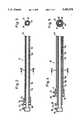
- FIG. 2is a view in longitudinal section of an injection lance of an injection apparatus which is fitted into a hot blast conduit of a blast furnace, as shown in FIG. 1,
- FIG. 3is a view of the injection lance of FIG. 2 in cross-section taken along section line III--III in FIG. 2,
- FIG. 4is a view in longitudinal section of a further embodiment of an injection lance
- FIG. 5is a view of the injection lance shown in FIG. 4 in cross-section taken along section line V--V in FIG. 4, and
- FIG. 6shows an injection apparatus fitted into the hot blast conduit of a blast furnace as shown in FIG. 1, with an injection lance accommodated in a receiving arrangement.
- FIG. 1shows an injection apparatus 10 comprising an injection lance 11 and a receiving arrangement 12 for accommodating the injection lance 11 in an outside wall 13 of a hot blast conduit 14.
- the hot blast conduit 14serves for feeding hot air at about 1200° C. into the interior of a blast furnace (not shown here).
- the hot blast conduit 14opens into a water-cooled tuyere 15 which is accommodated by a water-cooled tuyere insert 16.
- the tuyere insert 16is fitted into a wall 17 of the blast furnace.
- the injection apparatus 10serves for the injection of coal dust into the hot blast conduit 14 of the blast furnace.
- the coal dust which issues from the injection lance 11 into the hot blastis heated by the hot blast and is ignited at the latest upon passing into the blast furnace.
- FIGS. 2 and 3show a first embodiment of the injection lance 11. It comprises a central inner tube 18 and an outer tube 19 which is arranged in concentric relationship with the inner tube 18.
- the inner tube 18forms a central duct 20 and the outer tube 19, by virtue of its radial spacing relative to the inner tube 18, forms an annular duct 21 (see FIG. 3).
- the inner tube 18is provided with an inlet 22 for the supply of a mixture comprising a carrier gas and coal dust.
- the outer tube 19has two inlets 24 and 25 which are separated from each other by a separating wall or partition 23.
- the inlet 24which is towards a closed end 26 of the tube serves for the supply of water and the adjacent inlet 25 serves for the supply of oxygen.
- the injection lance 11 shown in FIGS. 2 and 3can be used for carrying out the per se known method of injecting coal dust through the central inner tube 18 by means of a carrier gas and supplying oxygen through the annular duct 21 for better combustion of the coal dust.
- wateris added through the inlet 24 to the oxygen which is carried in the annular duct 21 so that the water is entrained by the oxygen which flows past the separating wall 23 and is atomised, forming fine microdrops.
- the spray mist of oxygen and water which is formed in that wayserves both for combustion of the coal dust issuing from the duct 20 and also for cooling of the walls of the inner tube 18 and the outer tube 19 including the discharge cross-section 27 of the injection lance 11, which, as shown in FIG. 1, is exposed to the hot blast flow in the hot blast conduit 14.
- the oxygenserves not only for better combustion of the coal dust but also as a carrier gas for the atomised water.
- FIGS. 4 and 5show an injection lance for carrying out a further alternative form of the method according to the invention.
- the injection lance 28comprises a central inner tube 29, a central tube 30 and an outer tube 31.
- the inner tube 29 and the central tube 30 as well as the outer tube 31are concentric and arranged with radially spaced-apart tube walls.
- the inner tube 29forms a central duct 32; the inner tube 29 and the central tube 30 form an inner annular duct 33; and the central tube 30 and the outer tube 31 form an outer annular duct 34.
- the inner tube 29has an inlet 36 for supplying a mixture comprising a carrier gas and coal dust.
- the central tube 30has an inlet 38 for the supply of oxygen.
- the outer tube 31has an inlet 40 which is disposed directly at the end of the tube, for the supply of water, and an inlet 42 which is adjacent thereto and which is separated by a separating wall 41, for the supply of air as the carrier gas.
- coal dustsuspended in a carrier gas
- oxygenis injected through the inner annular duct 33 and a spray mist comprising water with air as the carrier gas is injected through the outer annular duct 34.
- the separate supply of the cooling fluid and the oxygenpermits mutually independent control of the amounts of those agents which are discharged.
- FIG. 6shows the injection apparatus 10 with the receiving arrangement 12 for receiving the injection lance 11 and 28 respectively.
- the receiving arrangement 12has a connecting region 44 with which it is fitted into a connecting opening 45 in the outside wall 13 of the hot blast conduit 14.
- the injection lance 11 or 28respectively can be inserted in its longitudinal direction into the receiving arrangement 12 and is held in the inserted condition in two receiving bores 46, 47 in the receiving arrangement 12.
- the injection lance 11, 28is oriented at an acute angle relative to the hot blast flow in the hot blast conduit 14.
- the discharge opening 27, 43 of the injection lance 11, 28is disposed approximately in the region of the centre line of the hot blast flow.
- Adjoining the connecting region 44 of the receiving arrangement 12is a housing portion 48 which is adapted to the contour of the outside wall 13 of the hot blast conduit 14.
- the housing portion 48has a closure means 49 which provides for automatic closure of the receiving bore 46 after removal of the injection lance 11, 28 from the receiving arrangement 12.
- the closure means 49comprises a cover-like closing member 50 which is displaceably guided in a guide groove 51 substantially parallel to the outside wall 13 of the hot blast conduit 14.
- a compression spring 54is disposed between the groove bottom which is formed as an abutment 52, and an end region 53, which is towards the abutment 52, of the closing member 50.
- the end region of the closing member 50which is arranged in opposite relationship to the end region 53 of the closing member 50, is in the form of a closing edge 55.
- a closing means 56As viewed in the direction of displacement of the closing member 50, arranged in the housing portion 48 is a closing means 56 which is of a configuration which corresponds to the closing edge 55.
- FIG. 6shows the closing means 49 in the open condition, the closing edge 55 of the closing member 50 being separated from the closing recess 56 by the injection lance 11, 28.
- the closing member 50bears under a spring loading against the side of the injection lance 11, 28.
- the closing member 50is displaced by virtue of the force applied thereto by the compression spring 54, until the closing edge 55 bears in position in the closing recess 56, whereby the receiving bore 46 of the receiving arrangement 12 is closed and any discharge of gases from the hot blast conduit 14 is prevented.
- the injection lance 11, 28is pushed with its discharge openings 27, 43 against the closing edge 55 of the closing member 50 so that, by utilising the wedge effect, as the closing edge 55 and the longitudinal wall of the injection lance 11, 28 are disposed at an acute angle to each other, the closing member 50 is displaced towards the abutment 52 against the force of the compression spring 54 and the injection lance 11, 28 can be moved into a position in which it is ready for operation, in the receiving arrangement 12.
Landscapes
- Engineering & Computer Science (AREA)
- Chemical & Material Sciences (AREA)
- Manufacturing & Machinery (AREA)
- Materials Engineering (AREA)
- Metallurgy (AREA)
- Organic Chemistry (AREA)
- Blast Furnaces (AREA)
Abstract
Description
The invention concerns a method and an apparatus for protecting an injection device in a blast furnace. Specifically, the invention is directed to a method and apparatus for cooling the injection lance disposed in the hot blast conduit.
Injection lances for injection coal dust as a substitute fuel, for example for piece coke and heating oil, into the hot blast conduit of a blast furnace by means of a carrier gas, have long been used in the smelting of iron ores (Stahl und Eisen 110, 1990, pages 35-40). In recent times endeavours have been made to increase the maximum amounts of coal dust which hitherto could be injected by the injection of oxygen or an oxygen-bearing gas together with the coal dust which is entrained by a carrier gas.
In conjunction with the hot blast temperature which is about 1200° C., that results in a strong tendency to burn back in the mouth region of the injection lance.
U.S. Pat. No. 3,758,090 discloses an arrangement with which an injection lance for injecting fuel, which is fitted into the hot blast conduit of a blast furnace, can be cooled. The known injection lance comprises a central tube which serves for the supply of heating oil. The central tube is concentrically surrounded by a multi-wall outer tube in which oxygen is supplied; the oxygen serves for atomisation and combustion of the heating oil which issues from the central tube. For cooling purposes, the outer tube has a coolant duct which permits a circulation of coolant in the outer tube, by way of a feed connection and a discharge connection.
The object of the present invention is that of providing a method and an apparatus which provides improved cooling of the injection lance, which reduces the burn-back phenomenon.
In a two-tube lance, the coal dust is injected through the central duct and a mixture of oxygen-bearing gas and the cooling fluid is injected through an annular duct which surrounds the central duct.
In a three-tube lance, coal dust is injected through the central duct, oxygen-bearing gas is injected through the inner annular duct and the cooling fluid is injected through the outer annular duct. This permits mutually independent control of the pressures of the oxygen-bearing gas and the cooling fluid.
It is found to be particularly advantageous if the cooling fluid used is water which is injected in the form of a spray mist in an atomised condition, by means of a carrier gas. As a result of atomisation of the water, microdrops are formed, which are at least partly in contact with the tube wall to be cooled and which by virtue of their enthalpy of evaporation, make a particularly effective contribution to the overall cooling action which in other respects is achieved by a transfer of heat from the tube wall to the cooling fluid which is formed from the water and the carrier gas and which flows past the tube wall.
Further advantageous configurations of the injection are set forth in the description that follows.
The preferred embodiments of the invention are described in greater detail with reference to the accompanying drawings in which:
FIG. 1 shows an injection apparatus according to the invention, which is fitted into a hot blast conduit of a blast furnace,
FIG. 2 is a view in longitudinal section of an injection lance of an injection apparatus which is fitted into a hot blast conduit of a blast furnace, as shown in FIG. 1,
FIG. 3 is a view of the injection lance of FIG. 2 in cross-section taken along section line III--III in FIG. 2,
FIG. 4 is a view in longitudinal section of a further embodiment of an injection lance,
FIG. 5 is a view of the injection lance shown in FIG. 4 in cross-section taken along section line V--V in FIG. 4, and
FIG. 6 shows an injection apparatus fitted into the hot blast conduit of a blast furnace as shown in FIG. 1, with an injection lance accommodated in a receiving arrangement.
FIG. 1 shows aninjection apparatus 10 comprising an injection lance 11 and areceiving arrangement 12 for accommodating the injection lance 11 in anoutside wall 13 of ahot blast conduit 14.
Thehot blast conduit 14 serves for feeding hot air at about 1200° C. into the interior of a blast furnace (not shown here). Thehot blast conduit 14 opens into a water-cooled tuyere 15 which is accommodated by a water-cooledtuyere insert 16. Thetuyere insert 16 is fitted into awall 17 of the blast furnace.
Theinjection apparatus 10 serves for the injection of coal dust into thehot blast conduit 14 of the blast furnace. The coal dust which issues from the injection lance 11 into the hot blast is heated by the hot blast and is ignited at the latest upon passing into the blast furnace.
FIGS. 2 and 3 show a first embodiment of the injection lance 11. It comprises a centralinner tube 18 and anouter tube 19 which is arranged in concentric relationship with theinner tube 18. Theinner tube 18 forms acentral duct 20 and theouter tube 19, by virtue of its radial spacing relative to theinner tube 18, forms an annular duct 21 (see FIG. 3). Theinner tube 18 is provided with aninlet 22 for the supply of a mixture comprising a carrier gas and coal dust. Theouter tube 19 has two inlets 24 and 25 which are separated from each other by a separating wall or partition 23. The inlet 24 which is towards a closedend 26 of the tube serves for the supply of water and the adjacent inlet 25 serves for the supply of oxygen.
The injection lance 11 shown in FIGS. 2 and 3 can be used for carrying out the per se known method of injecting coal dust through the centralinner tube 18 by means of a carrier gas and supplying oxygen through theannular duct 21 for better combustion of the coal dust.
Now, in accordance with the method of the invention, water is added through the inlet 24 to the oxygen which is carried in theannular duct 21 so that the water is entrained by the oxygen which flows past the separating wall 23 and is atomised, forming fine microdrops. The spray mist of oxygen and water which is formed in that way serves both for combustion of the coal dust issuing from theduct 20 and also for cooling of the walls of theinner tube 18 and theouter tube 19 including the discharge cross-section 27 of the injection lance 11, which, as shown in FIG. 1, is exposed to the hot blast flow in thehot blast conduit 14.
In the described variant of the method according to the invention therefore, the oxygen serves not only for better combustion of the coal dust but also as a carrier gas for the atomised water.
FIGS. 4 and 5 show an injection lance for carrying out a further alternative form of the method according to the invention. The injection lance 28 comprises a centralinner tube 29, acentral tube 30 and anouter tube 31. Theinner tube 29 and thecentral tube 30 as well as theouter tube 31 are concentric and arranged with radially spaced-apart tube walls. Theinner tube 29 forms acentral duct 32; theinner tube 29 and thecentral tube 30 form an innerannular duct 33; and thecentral tube 30 and theouter tube 31 form an outerannular duct 34. At its closedtube end 35 theinner tube 29 has aninlet 36 for supplying a mixture comprising a carrier gas and coal dust. In the region of its closed end 37 thecentral tube 30 has an inlet 38 for the supply of oxygen. Finally in the region of its closedend 39 theouter tube 31 has aninlet 40 which is disposed directly at the end of the tube, for the supply of water, and an inlet 42 which is adjacent thereto and which is separated by a separating wall 41, for the supply of air as the carrier gas.
With that injection lance, coal dust, suspended in a carrier gas, is injected through thecentral duct 32, oxygen is injected through the innerannular duct 33 and a spray mist comprising water with air as the carrier gas is injected through the outerannular duct 34.
The separate supply of the cooling fluid and the oxygen permits mutually independent control of the amounts of those agents which are discharged.
FIG. 6 shows theinjection apparatus 10 with thereceiving arrangement 12 for receiving the injection lance 11 and 28 respectively.
Thereceiving arrangement 12 has a connectingregion 44 with which it is fitted into a connecting opening 45 in theoutside wall 13 of thehot blast conduit 14. The injection lance 11 or 28 respectively can be inserted in its longitudinal direction into the receivingarrangement 12 and is held in the inserted condition in two receivingbores 46, 47 in thereceiving arrangement 12. In that connection, the injection lance 11, 28 is oriented at an acute angle relative to the hot blast flow in thehot blast conduit 14. In that arrangement, the discharge opening 27, 43 of the injection lance 11, 28 is disposed approximately in the region of the centre line of the hot blast flow.
Adjoining the connectingregion 44 of the receivingarrangement 12 is ahousing portion 48 which is adapted to the contour of theoutside wall 13 of thehot blast conduit 14. Thehousing portion 48 has a closure means 49 which provides for automatic closure of the receivingbore 46 after removal of the injection lance 11, 28 from thereceiving arrangement 12.
The closure means 49 comprises a cover-like closing member 50 which is displaceably guided in a guide groove 51 substantially parallel to theoutside wall 13 of thehot blast conduit 14. A compression spring 54 is disposed between the groove bottom which is formed as anabutment 52, and an end region 53, which is towards theabutment 52, of the closing member 50. The end region of the closing member 50, which is arranged in opposite relationship to the end region 53 of the closing member 50, is in the form of aclosing edge 55. As viewed in the direction of displacement of the closing member 50, arranged in thehousing portion 48 is aclosing means 56 which is of a configuration which corresponds to theclosing edge 55.
FIG. 6 shows the closing means 49 in the open condition, theclosing edge 55 of the closing member 50 being separated from theclosing recess 56 by the injection lance 11, 28. In that condition the closing member 50 bears under a spring loading against the side of the injection lance 11, 28. After removal of the injection lance 11, 28 from the receivingarrangement 12, the closing member 50 is displaced by virtue of the force applied thereto by the compression spring 54, until the closingedge 55 bears in position in theclosing recess 56, whereby the receiving bore 46 of the receivingarrangement 12 is closed and any discharge of gases from thehot blast conduit 14 is prevented.
For the purposes of opening the closure means 49, the injection lance 11, 28 is pushed with itsdischarge openings 27, 43 against the closingedge 55 of the closing member 50 so that, by utilising the wedge effect, as the closingedge 55 and the longitudinal wall of the injection lance 11, 28 are disposed at an acute angle to each other, the closing member 50 is displaced towards theabutment 52 against the force of the compression spring 54 and the injection lance 11, 28 can be moved into a position in which it is ready for operation, in the receivingarrangement 12.
Claims (11)
1. A method of cooling an injection lance having a discharge end which extends into a hot blast conduit furnace comprising the steps of
providing said injection lance with at least two tubes, which are concentrically arranged and radially spaced from each other to form a central duct and a first annular duct, each of said tubes being open at said discharge end for injecting material into said hot blast conduit,
injecting a fine grain solid fuel into said hot blast conduit through a first one of said tubes, and
injecting a cooling means, through another of said tubes, for the evaporative cooling of said first one of said tubes.
2. A method according to claim 1, wherein
said fine grain solid is injected through said central duct, and
said injecting of a cooling means includes injecting a spray mist of water through said first annular duct.
3. A method according to claim 1 including the step of
providing said injection lance with a third tube open at said discharge end for injecting a material into said hot blast conduit, and concentrically arranged with and radially spaced from said other two tubes to thereby form a second annular duct having an annular shape and surrounding said central duct and said first annular duct.
4. A method according to claim 3, wherein
said fuel is injected through said first duct,
an oxygen-bearing gas is injected through said second duct, and
said cooling means is injected through said third duct.
5. A method according to claim 1 wherein
said injecting of fine grain solid fuel includes mixing an oxygen-bearing gas with a fine grain solid fuel.
6. A method according to claim 1, wherein
said fine grain solid fuel includes coal dust.
7. An injection apparatus having a discharge end which extends into a hot blast conduit of a blast furnace comprising
at least two tubes which are concentrically arranged and radially spaced from each other to form a central duct and a first annular duct, each of said tubes being open at said discharge end for injecting material into said hot blast conduit,
a first one of said tubes for injecting a fine grain solid fuel into said hot blast conduit, and
another of said tubes for injecting a cooling means for the evaporative cooling of said first one of said tubes.
8. An injection apparatus according to claim 7 wherein
said tubes are removably inserted through an opening in a wall of said hot blast conduit, and further comprising attachment means for attaching said injection apparatus to an outside portion of said wall of said hot blast conduit, and
said attachment means comprises closing means for automatically closing said opening in said wall of said hot blast conduit upon removal of said tube means.
9. An injection apparatus according to claim 7, wherein
said fuel is injected through said central duct, and
said cooling means is a spray mist of water injected through said first annular duct.
10. An injection apparatus according to claim 7, further comprising
a third tube open at said discharge end for injecting material into said hot blast conduit, and being concentrically arranged with and radially spaced from said other tube tubes to thereby form a second annular duct having an annular shape and surrounding said central duct and said first annular duct.
11. An injection apparatus according to claim 7, wherein
said fuel is injected through said central duct,
an oxygen-bearing gas is injected through said first annular duct, and
said cooling means is a spray mist of water injected through said second annular duct.
Applications Claiming Priority (1)
| Application Number | Priority Date | Filing Date | Title |
|---|---|---|---|
| DE4136274ADE4136274A1 (en) | 1991-11-04 | 1991-11-04 | METHOD AND DEVICE FOR PROTECTING A BLOWING DEVICE ARRANGED IN A HOT WIND LINE OF A BLAST FURNACE |
Publications (1)
| Publication Number | Publication Date |
|---|---|
| US5403378Atrue US5403378A (en) | 1995-04-04 |
Family
ID=6444055
Family Applications (1)
| Application Number | Title | Priority Date | Filing Date |
|---|---|---|---|
| US08/084,412Expired - Fee RelatedUS5403378A (en) | 1991-11-04 | 1993-06-29 | Method and apparatus for protecting an injection device disposed in a hot blast conduit of a blast furnace |
Country Status (7)
| Country | Link |
|---|---|
| US (1) | US5403378A (en) |
| EP (1) | EP0565695A1 (en) |
| AU (1) | AU2898292A (en) |
| BR (1) | BR9205447A (en) |
| DE (1) | DE4136274A1 (en) |
| WO (1) | WO1993009254A1 (en) |
| ZA (1) | ZA928255B (en) |
Cited By (4)
| Publication number | Priority date | Publication date | Assignee | Title |
|---|---|---|---|---|
| US6273909B1 (en) | 1998-10-05 | 2001-08-14 | Teramed Inc. | Endovascular graft system |
| US7112217B1 (en) | 1998-03-16 | 2006-09-26 | Cordis Corporation | Biluminal endovascular graft system |
| US20110101576A1 (en)* | 2007-08-29 | 2011-05-05 | Posco | Tuyere for Manufacturing Molten Iron and Method for Injecting Gas Using the Same |
| JP2013185180A (en)* | 2012-03-06 | 2013-09-19 | Nippon Steel & Sumitomo Metal Corp | Method of blowing reducing gas from blast furnace tuyere and blowing lance |
Families Citing this family (2)
| Publication number | Priority date | Publication date | Assignee | Title |
|---|---|---|---|---|
| RU2449022C2 (en)* | 2010-06-07 | 2012-04-27 | Открытое акционерное общество "Нижнетагильский металлургический комбинат" (ОАО "НТМК") | Method for cooling air blowing tuyere and supplying natural gas to blast furnace, and device for its implementation |
| DE102018113774A1 (en)* | 2018-06-08 | 2019-12-12 | Aktien-Gesellschaft der Dillinger Hüttenwerke | Apparatus and method for introducing a replacement reducing agent into a blast furnace |
Citations (6)
| Publication number | Priority date | Publication date | Assignee | Title |
|---|---|---|---|---|
| US1518854A (en)* | 1920-08-06 | 1924-12-09 | Edmund B Kirby | Method of operating blast furnaces |
| SU532624A1 (en)* | 1975-08-11 | 1976-10-25 | Всесоюзный научно-исследовательский институт металлургической теплотехники | Device for injecting nozzles when fuel oil is injected into a blast furnace |
| US4700930A (en)* | 1985-04-15 | 1987-10-20 | Institut de Recherches de la Sidergie Francaise Irsid | Device for injecting pulverulent material, such as coal, in a blast furnace |
| US4887800A (en)* | 1987-01-09 | 1989-12-19 | Nippon Kokan Kabushiki Kaisha | Tuyere of blast furnace |
| US5018458A (en)* | 1990-09-12 | 1991-05-28 | Zimpro Passavant Environmental Systems, Inc. | Furnace combustion zone temperature control method |
| WO1991014791A1 (en)* | 1990-03-20 | 1991-10-03 | Küttner Gmbh & Co. Kg | Process and device for injecting coal dust and oxygen into a blast furnace |
Family Cites Families (14)
| Publication number | Priority date | Publication date | Assignee | Title |
|---|---|---|---|---|
| DE462207C (en)* | 1928-07-06 | Gaston De Bethune | Device for introducing dusty or powdery substances into the melting zone of shaft furnaces, especially blast furnaces | |
| FR1280598A (en)* | 1960-06-21 | 1962-01-08 | Pompey Acieries | Device for injecting liquid, semi-liquid, pulverulent, fluidized or the like substances |
| FR1316711A (en)* | 1961-12-22 | 1963-02-01 | Mobil Oil France | Advanced burner |
| FR1337262A (en)* | 1962-06-01 | 1963-09-13 | Exxon Standard Sa | Method and device for injecting fuel into blast furnaces |
| DE1433317A1 (en)* | 1962-06-23 | 1968-11-07 | Salzgitter Huettenwerk Ag | Device for introducing liquid, gaseous or dust-like fuels into the frame of a shaft furnace, primarily a blast furnace |
| LU48010A1 (en)* | 1964-02-24 | 1965-04-17 | ||
| FR1406013A (en)* | 1964-06-04 | 1965-07-16 | Normandie Ste Metallurgique | Stopper for fuel injection orifice in a hot blast furnace nozzle |
| DE1232603B (en)* | 1964-06-04 | 1967-01-19 | Normandie Ste Metallurgique | Closing device for an opening for introducing fuel into a hot wind blow mold of a blast furnace |
| NL6712305A (en)* | 1966-09-12 | 1968-03-13 | ||
| DE2114781C3 (en)* | 1971-03-26 | 1974-11-07 | Nippon Kokan K.K., Tokio | Heating method for blast furnaces and apparatus therefor |
| US3937449A (en)* | 1974-06-26 | 1976-02-10 | United States Steel Corporation | Liquid-fuel atomization and injection device |
| DE2633061C3 (en)* | 1975-08-14 | 1980-02-14 | Creusot-Loire, Paris | Blowing process for furnaces with a melting shaft, in particular blast furnaces and blow molds for carrying out the process |
| FR2328773A2 (en)* | 1975-10-21 | 1977-05-20 | Creusot Loire | Blast furnace tuyere which is not water cooled - using three concentric pipes to supply hot blast, oxidising gas, and fuel |
| GB8506655D0 (en)* | 1985-03-14 | 1985-04-17 | British Steel Corp | Smelting shaft furnaces |
- 1991
- 1991-11-04DEDE4136274Apatent/DE4136274A1/ennot_activeWithdrawn
- 1992
- 1992-10-26ZAZA928255Apatent/ZA928255B/enunknown
- 1992-11-03EPEP92923142Apatent/EP0565695A1/ennot_activeWithdrawn
- 1992-11-03BRBR9205447Apatent/BR9205447A/ennot_activeApplication Discontinuation
- 1992-11-03WOPCT/EP1992/002519patent/WO1993009254A1/ennot_activeApplication Discontinuation
- 1992-11-03AUAU28982/92Apatent/AU2898292A/ennot_activeAbandoned
- 1993
- 1993-06-29USUS08/084,412patent/US5403378A/ennot_activeExpired - Fee Related
Patent Citations (6)
| Publication number | Priority date | Publication date | Assignee | Title |
|---|---|---|---|---|
| US1518854A (en)* | 1920-08-06 | 1924-12-09 | Edmund B Kirby | Method of operating blast furnaces |
| SU532624A1 (en)* | 1975-08-11 | 1976-10-25 | Всесоюзный научно-исследовательский институт металлургической теплотехники | Device for injecting nozzles when fuel oil is injected into a blast furnace |
| US4700930A (en)* | 1985-04-15 | 1987-10-20 | Institut de Recherches de la Sidergie Francaise Irsid | Device for injecting pulverulent material, such as coal, in a blast furnace |
| US4887800A (en)* | 1987-01-09 | 1989-12-19 | Nippon Kokan Kabushiki Kaisha | Tuyere of blast furnace |
| WO1991014791A1 (en)* | 1990-03-20 | 1991-10-03 | Küttner Gmbh & Co. Kg | Process and device for injecting coal dust and oxygen into a blast furnace |
| US5018458A (en)* | 1990-09-12 | 1991-05-28 | Zimpro Passavant Environmental Systems, Inc. | Furnace combustion zone temperature control method |
Non-Patent Citations (2)
| Title |
|---|
| "Investigation Pulverized Coal Injection with Oxygen at NKK", Steel Times, Feb. 1990, pp. 83-865. |
| Investigation Pulverized Coal Injection with Oxygen at NKK , Steel Times, Feb. 1990, pp. 83 865.* |
Cited By (7)
| Publication number | Priority date | Publication date | Assignee | Title |
|---|---|---|---|---|
| US7112217B1 (en) | 1998-03-16 | 2006-09-26 | Cordis Corporation | Biluminal endovascular graft system |
| US6273909B1 (en) | 1998-10-05 | 2001-08-14 | Teramed Inc. | Endovascular graft system |
| US20020052645A1 (en)* | 1998-10-05 | 2002-05-02 | Kugler Chad J. | Endovascular graft system |
| US6939371B2 (en) | 1998-10-05 | 2005-09-06 | Cordis Corporation | Endovascular graft system |
| US20110101576A1 (en)* | 2007-08-29 | 2011-05-05 | Posco | Tuyere for Manufacturing Molten Iron and Method for Injecting Gas Using the Same |
| EP2193212A4 (en)* | 2007-08-29 | 2012-06-13 | Posco | PIPE FOR THE PRODUCTION OF FUSION IRON AND METHOD FOR INJECTING GAS USING THE SAME |
| JP2013185180A (en)* | 2012-03-06 | 2013-09-19 | Nippon Steel & Sumitomo Metal Corp | Method of blowing reducing gas from blast furnace tuyere and blowing lance |
Also Published As
| Publication number | Publication date |
|---|---|
| AU2898292A (en) | 1993-06-07 |
| WO1993009254A1 (en) | 1993-05-13 |
| BR9205447A (en) | 1994-07-05 |
| EP0565695A1 (en) | 1993-10-20 |
| DE4136274A1 (en) | 1993-05-06 |
| ZA928255B (en) | 1993-05-06 |
Similar Documents
| Publication | Publication Date | Title |
|---|---|---|
| US5624253A (en) | Radiation burner | |
| JPS6038513A (en) | Method and burner for burning liquefied or gassy fuel while inhiibting generation of nox | |
| US4203717A (en) | Flat flame burner assembly | |
| CA2053129A1 (en) | Burner arrangement for the combustion of fine-grained to dusty solid fuel | |
| KR100937947B1 (en) | Dry metallurgical treatment methods and injectors for metals, molten metals, and / or slag | |
| SU955866A3 (en) | Apparatus for feeding and burning additional fuel in shaft furnace | |
| RU95116288A (en) | SOLID FUEL BURNER | |
| US5403378A (en) | Method and apparatus for protecting an injection device disposed in a hot blast conduit of a blast furnace | |
| US4257760A (en) | Cyclone burners | |
| US5333840A (en) | Blast pipe and tuyere arrangement for a blast furnace and method | |
| KR960016161B1 (en) | Process & device for the disposal of dust in a cupola by combustion/slag production | |
| US3357383A (en) | Horizontal cylindrical furnace with removal of liquid slag | |
| US5227117A (en) | Apparatus for blast furnace fuel injection | |
| US2261559A (en) | Tuyere | |
| JP2004518826A (en) | A device that blows gas into a container | |
| CS205038B2 (en) | Tuyere incooled by water | |
| US2833230A (en) | Pulverized coal firing system | |
| US4469509A (en) | Process of producing sponge iron by a direct reduction of iron oxide-containing material in a rotary kiln | |
| US2881720A (en) | Cyclone furnaces | |
| US4043541A (en) | Blast furnace tuyere | |
| US4615675A (en) | Furnace channel heating method and apparatus | |
| AU2007226496B2 (en) | Equipment and method for heating gas in connection with sintering | |
| US2918024A (en) | Fuel burning method | |
| SU840116A1 (en) | Blasting tuyere of blast furnace | |
| SU643086A3 (en) | Blast furnace tuyere |
Legal Events
| Date | Code | Title | Description |
|---|---|---|---|
| AS | Assignment | Owner name:KORTEC AG, SWITZERLAND Free format text:ASSIGNMENT OF ASSIGNORS INTEREST;ASSIGNORS:WELLS, WILLIAM;WEBER, RALPH;REEL/FRAME:006949/0234;SIGNING DATES FROM 19940117 TO 19940303 | |
| FEPP | Fee payment procedure | Free format text:PAYOR NUMBER ASSIGNED (ORIGINAL EVENT CODE: ASPN); ENTITY STATUS OF PATENT OWNER: LARGE ENTITY | |
| CC | Certificate of correction | ||
| FEPP | Fee payment procedure | Free format text:PAYOR NUMBER ASSIGNED (ORIGINAL EVENT CODE: ASPN); ENTITY STATUS OF PATENT OWNER: LARGE ENTITY Free format text:PAYER NUMBER DE-ASSIGNED (ORIGINAL EVENT CODE: RMPN); ENTITY STATUS OF PATENT OWNER: LARGE ENTITY | |
| REMI | Maintenance fee reminder mailed | ||
| LAPS | Lapse for failure to pay maintenance fees | ||
| FP | Lapsed due to failure to pay maintenance fee | Effective date:19990404 | |
| STCH | Information on status: patent discontinuation | Free format text:PATENT EXPIRED DUE TO NONPAYMENT OF MAINTENANCE FEES UNDER 37 CFR 1.362 |