US5393952A - Plasma torch for cutting use with nozzle protection cap having annular secondary GPS passage and insulator disposed in the secondary gas passage - Google Patents
Plasma torch for cutting use with nozzle protection cap having annular secondary GPS passage and insulator disposed in the secondary gas passageDownload PDFInfo
- Publication number
- US5393952A US5393952AUS08/107,815US10781593AUS5393952AUS 5393952 AUS5393952 AUS 5393952AUS 10781593 AUS10781593 AUS 10781593AUS 5393952 AUS5393952 AUS 5393952A
- Authority
- US
- United States
- Prior art keywords
- nozzle
- electrode
- passage
- protection cap
- plasma
- Prior art date
- Legal status (The legal status is an assumption and is not a legal conclusion. Google has not performed a legal analysis and makes no representation as to the accuracy of the status listed.)
- Expired - Lifetime
Links
Images


Classifications
- H—ELECTRICITY
- H05—ELECTRIC TECHNIQUES NOT OTHERWISE PROVIDED FOR
- H05H—PLASMA TECHNIQUE; PRODUCTION OF ACCELERATED ELECTRICALLY-CHARGED PARTICLES OR OF NEUTRONS; PRODUCTION OR ACCELERATION OF NEUTRAL MOLECULAR OR ATOMIC BEAMS
- H05H1/00—Generating plasma; Handling plasma
- H05H1/24—Generating plasma
- H05H1/26—Plasma torches
- H05H1/32—Plasma torches using an arc
- H05H1/34—Details, e.g. electrodes, nozzles
- H—ELECTRICITY
- H05—ELECTRIC TECHNIQUES NOT OTHERWISE PROVIDED FOR
- H05H—PLASMA TECHNIQUE; PRODUCTION OF ACCELERATED ELECTRICALLY-CHARGED PARTICLES OR OF NEUTRONS; PRODUCTION OR ACCELERATION OF NEUTRAL MOLECULAR OR ATOMIC BEAMS
- H05H1/00—Generating plasma; Handling plasma
- H05H1/24—Generating plasma
- H05H1/26—Plasma torches
- H05H1/32—Plasma torches using an arc
- H05H1/34—Details, e.g. electrodes, nozzles
- H05H1/3457—Nozzle protection devices
- H—ELECTRICITY
- H05—ELECTRIC TECHNIQUES NOT OTHERWISE PROVIDED FOR
- H05H—PLASMA TECHNIQUE; PRODUCTION OF ACCELERATED ELECTRICALLY-CHARGED PARTICLES OR OF NEUTRONS; PRODUCTION OR ACCELERATION OF NEUTRAL MOLECULAR OR ATOMIC BEAMS
- H05H1/00—Generating plasma; Handling plasma
- H05H1/24—Generating plasma
- H05H1/26—Plasma torches
- H05H1/32—Plasma torches using an arc
- H05H1/34—Details, e.g. electrodes, nozzles
- H05H1/3436—Hollow cathodes with internal coolant flow
- H—ELECTRICITY
- H05—ELECTRIC TECHNIQUES NOT OTHERWISE PROVIDED FOR
- H05H—PLASMA TECHNIQUE; PRODUCTION OF ACCELERATED ELECTRICALLY-CHARGED PARTICLES OR OF NEUTRONS; PRODUCTION OR ACCELERATION OF NEUTRAL MOLECULAR OR ATOMIC BEAMS
- H05H1/00—Generating plasma; Handling plasma
- H05H1/24—Generating plasma
- H05H1/26—Plasma torches
- H05H1/32—Plasma torches using an arc
- H05H1/34—Details, e.g. electrodes, nozzles
- H05H1/3468—Vortex generators
- H—ELECTRICITY
- H05—ELECTRIC TECHNIQUES NOT OTHERWISE PROVIDED FOR
- H05H—PLASMA TECHNIQUE; PRODUCTION OF ACCELERATED ELECTRICALLY-CHARGED PARTICLES OR OF NEUTRONS; PRODUCTION OR ACCELERATION OF NEUTRAL MOLECULAR OR ATOMIC BEAMS
- H05H1/00—Generating plasma; Handling plasma
- H05H1/24—Generating plasma
- H05H1/26—Plasma torches
- H05H1/32—Plasma torches using an arc
- H05H1/34—Details, e.g. electrodes, nozzles
- H05H1/3478—Geometrical details
Definitions
- the present inventionrelates to a plasma torch utilized for a plasma cutting machine.
- Japanese Patent Laid-open Publication No. 53-119753discloses a plasma welding torch having a structure in which a metallic nozzle cap electrically insulated from the nozzle is mounted to the periphery of the nozzle and a secondary gas is blown between the nozzle and the nozzle protection cap.
- a front side of a cut grooveis wide and a rear side thereof is narrow, and for this reason, the cut surface does not provide a perpendicular surface and has an inclination.
- a workpiece to be cutmay be blown up by thermal deformation or in accordance with its supported condition, and it is difficult to avoid these phenomenon.
- the nozzlecontacts the workpiece to be cut, the double-arc is generated, thus being difficult to avoid causing of danger for damaging the nozzle.
- a protection capis adapted to the water-cooled nozzle.
- this functionhas a function for preventing the nozzle from contacting the workpiece to be cut, but this function is for shutting out a welding portion from atmosphere by the secondary gas, and since an opening of the protection cap is widely opened, there is no function for protecting the nozzle from the blow-up of the fused metal at the piercing time.
- a plasma arc of high temperature and high velocityis obtained by finely throttling the arc less than the nozzle diameter. If a large amount of current passes to a nozzle having a small nozzle diameter, it becomes possible to cut the workpiece at a high cutting speed with a narrow cut groove width. However, as the electric current increases, there causes a double-arc generation phenomenon in which the current passes a metallic portion of the nozzle without passing the nozzle orifice, thus lowering the cutting ability and damaging the nozzle.
- the temperature of the nozzle protection caprises due to the radiation from the plasma arc or the cut surface of the workpiece. Accordingly, in a case of exchanging consumable parts such as nozzle and electrode, it is required to effect the cooling for a time being by passing the secondary gas after the stopping of the arc or to exchange the consumable parts manually by utilizing for example hand gloves, thus being inconvenient and reducing workability at the time of exchanging the consumable parts.
- the electrode and the nozzleabut, in the fixed state, against respectively insulated metallic portions of the torch body, and power from a D.C. power source is supplied to the metallic portions, respectively.
- a cooling water passage connecting the metallic portion of the electrode side and the metallic portion of the nozzle sideis formed for cooling the electrode and the nozzle.
- the torch bodyis constructed in a condition that the respective metallic portions are electrically insulated, but the respective metallic portions are connected with each other through the cooling water passage and the cooling water passes therethrough, so that a minute electric current passes through the cooling water.
- This minute electric currenthardly affects the generation of the arc, but corrosion on the metallic portion of the torch body gradually progresses by an electrochemical function due to this electric current.
- the electrode and the nozzleare water-cooled, there will be provided such a problem that the torch becomes unusable before long.
- the present inventionwas conceived in view of the above matters and aims to provide a plasma arc capable of: achieving a function for effectively protecting a nozzle in a torch structure in which the nozzle is water-cooled to remarkably improve the life time of the nozzle; reducing a loss in time caused by the exchange of the nozzle and the running cost; performing a precise cutting operation with a fine cut groove width by rectifying the secondary gas by an insulator interposed in the secondary gas passage and then again throttling the plasma arc jetted from the nozzle 2; changing an inclination of a cut surface of the workpiece to a perpendicular direction by gyrating a gyration flow of the secondary gas in the same direction as the gyrating direction of the plasma arc; exchanging only the front end portion of the nozzle protection cap as a consumable part, thus being economical, because the nozzle protection cap can be separated into the front end portion and the base end portion; handing the base end portion of the nozzle protection cap without paying any specific attention to that portion
- the plasma torch according to the present inventionhas a structure in which a water-cooled electrode 1 is utilized and a plasma arc is generated between the electrode 1 and a workpiece 24 to be cut through an orifice 16 of a nozzle arranged so as to cover the electrode 1 through a plasma gas passage formed therebetween and the plasma torch is characterized in that a nozzle protection cap 5, 5a, 5b, 5c or 5d having, on its front end side, an opening opposing to the orifice 16 of the nozzle 2 is secured, in an electrically insulated state from the electrode 1 and the nozzle 2, to a portion outside a nozzle cap 4 so as to form an annular secondary gas passage 8 communicating with the opening between the nozzle protection cap and the nozzle cap 4, and an insulator 14 having an annular structure of an electrically insulating material and having a rectifying passage for rectifying a gas flow passing the secondary gas passage 8 is interposed in the secondary gas passage 8.
- the nozzle protection cap 5is formed of a metal material having a good thermal conductivity.
- the nozzle protection cap 5bis composed of a front end portion 20 for protecting a front end portion of the nozzle 2 and a base end portion 19 secured to a torch body side, the front end portion 20 and the base end portion 19 being coupled detachably.
- flanged portionsare provided for the front end portion 20 and the base end portion 19 constituting the nozzle protection cap 5b so as to be fitted to each other, or screws are formed to portions of the front end portion 20 and the base end portion 19 coupled with each other so that the front end portion 20 and the base end portion 19 are fitted to or screwed with each other in an easily detachable manner.
- the front end portion 20 among the front end portion 20 and the base end portion 19 constituting the nozzle protection cap 5bis formed of a metal material having a good thermal conductivity and the base end portion 19 thereamong is formed of a metal material being excellent in mechanical strength.
- a gap 17 between the front end surface of the nozzle 2 and an inside surface of the opening of the nozzle protection cap 5, 5a or 5bhas a dimension h of 0.5 -1.5 mm.
- a ratio ⁇ 2 / ⁇ 1 between an orifice diameter ⁇ 1 of the nozzle 2 and an opening diameter ⁇ 2 of the nozzle protection cap 5, 5a or 5bis set to 1.0-5.0.
- the nozzle protection cap 5dis formed so as to have a bag-shape double wall structure having a space formed as a cooling water chamber 21a.
- a plasma gas flow-in passage 6a for introducing the plasma gas into a plasma gas passage 6 formed around the electrode 1is formed, in an inclined manner with respect to an axis of the torch, for imparting a gyrating flow to the plasma gas
- the rectifying passage of the insulator 14 or 14ais formed to provide a spiral shape for imparting a gyrating flow to the secondary gas passing the rectifying passage in the same direction as the gyrating flow of the plasma gas, and a relationship between an orifice length L and the orifice diameter ⁇ 1 is satisfied with L/ ⁇ 1 ⁇ 2.
- a flow-in passage 25 communicating the cooling water chamber 9 on the side of the electrode 1 with the cooling water passage 10 on the side of the nozzle 2is composed of a tube 26 formed of an electrically insulating material.
- the plasma torch having the embodiments described aboveattains the following functions and effects.
- the nozzle cap 4 and the nozzle protection cap 5are axially aligned by the insulator and then coupled together.
- the nozzle protection capcan be cooled by providing the cooling water chamber to the base end portion 19a of the nozzle protection cap.
- the plasma gasis gyrated in the plasma gas passage 6 and the secondary gas is also gyrated in the plasma gas flow-in passage 6a in the same direction as that of the plasma gas.
- the nozzle protection functioncan be effectively achieved also with respect to a torch structure in which the nozzle 2 is water-cooled, and accordingly, the life time of the nozzle 2 can be remarkably improved and the loss in time in the nozzle exchanging operation and the running cost can be reduced. Furthermore, by interposing the insulator in the secondary gas passage, the secondary gas is rectified by the insulator and the plasma arc jetted from the nozzle 2 is again throttled, thereby performing the precise cutting operation with a fine cut groove.
- the secondary gascan be gyrated in the same direction as the gyrating direction of the plasma arc by the rectifying passage of the insulator 14 or 14a, the inclination of the cut surface of the workpiece 24 can be changed to the perpendicular direction.
- the nozzle protection capis separated into the front end portion and the base end portion, only the front end portion can be exchanged as a consumable part, thus being economical.
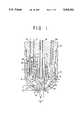
- FIG. 1is a sectional view showing one concrete embodiment of the present invention
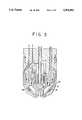
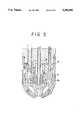
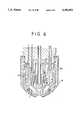
- FIGS. 4 to 7are sectional views of further embodiments of the present invention.
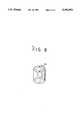
- FIG. 8is a perspective view showing a structure of a plasma gas flow-in passage.
- reference numeral 1denotes an electrode
- numeral 2is a nozzle supported by a nozzle support member 3 at a portion opposing to the front end of the electrode 1
- numeral 4denotes a nozzle cap covering the nozzle 1 except for the lower end portion thereof
- numeral 5denotes a nozzle protection cap covering an outside of the nozzle cap 4.
- a plasma gas passage 6communicated with the nozzle 2 from this periphery, and a cooling water passage 7 is formed between the nozzle 2 and the nozzle cap 4.
- a secondary gas passage 8is formed between the nozzle cap 4 and the nozzle protection cap 5 so as to open to the front end side of the nozzle 2.
- a cooling water chamber 9is formed inside the electrode 1 and this cooling water chamber 9 is, on one hand, communicated with the cooling water passage 7.
- a cooling water flow-in passage 10is communicated with the cooling water chamber 9 and a cooling water flow-out passage 10a is, on the other hand, connected with the cooling water passage 7.
- a plasma gas flow-in passage 11 and a secondary gas flow-in passage 12are connected respectively to the plasma gas passage 6 and the secondary gas passage 8.
- Reference numeral 13denotes a torch body, which is electrically insulated from the electrode 1 and the nozzle 2.
- the nozzle protection cap 5is screwed with this torch body 13.
- the secondary gas passage 8 formed between the nozzle cap 4 and the nozzle protection cap 5provides a tapered annular shape, and an insulator 14 formed of an insulating material, also acting as a spacer, is mounted in the secondary gas passage 8 in an air-tight manner with respect to walls of the nozzle cap 4 and the nozzle protection cap 5.
- the insulator 14is provided with a plurality of small openings 15 in the circumferential direction of the insulator so as to constitute rectifying passages communicating the downstream side and the upstream side of the insulator with each other.
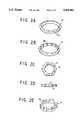
- These small openings forming the rectifying passagemay be formed as axial grooves 15a formed on an inner (or outer) surface of the insulator 14 as shown in FIG. 2(b) in place of small openings 15 shown in FIG. 2(a).
- the small openings 15 and the grooves 15a forming the rectifying passagemay be formed so as to provide spiral shapes with respect to the axis of the insulator.
- a ratio ( ⁇ 2 / ⁇ 1 ) between a diameter ⁇ 1 of an orifice 16 of the nozzle 2 and a diameter ⁇ 2 of an opening of the nozzle protection cap 5is 1.0 to 5.0, and preferably 2.0 to 4.0, wherein in the case of ⁇ 2 / ⁇ 1 ⁇ 1.0, the front end of the nozzle protection cap 5 is deformed and damaged by the heat of the plasma arc and, moreover, the flow of the secondary gas is disturbed, and in the case of ⁇ 2 / ⁇ 1 >5.0, the blow-up of the fused metal adheres to the nozzle 2 and the gap 17 between the lower surface of the nozzle 2 and the nozzle protection cap 5, causing the double-arc.
- the gap 17has a gap dimension h of 0.5 to 1.5 mm, wherein in the case of h ⁇ 0.5 mm, the flow velocity of the secondary gas jet is too fast to disturb the arc.
- the insulators 14 described aboveare formed of a synthetic resin such as fluoride series resin or ceramics material.
- the secondary gas passing through the annular secondary gas passage 8is rectified during the passing through the rectifying passage constituted by the small holes 15 or grooves 15a formed to the insulator 14.
- the nozzle 2can be protected from the blow-up of the fused metal at the time of the piercing operation by setting the opening diameter ⁇ 2 of the nozzle protection cap 5.
- FIG. 3shows an alternation of the insulator, in which the insulator 14a is formed annularly from a material having a rectangular section, and this insulator 14a is fitted to stepped portions formed to opposing portions of the nozzle cap 4a and the nozzle protection cap 5a and fixed thereto.
- a rectifying passage 18is formed to an outer peripheral side of the insulator 14a.
- the nozzle cap 4a and the nozzle protection cap 5aare axially aligned by the insulator 14a, thus performing the positioning of these members.
- FIG. 4shows a further embodiment in which the nozzle protection cap is provided with a front end side portion and a base end side portion which are formed of different materials.
- the coupling of the base end portion 19 and the front end portion 20will be performed by providing a flange portion 20a on the side of the front end portion and a flange portion, which is engaged with the flange portion 20a, formed to the base end portion 19.
- the flange portion of the base end portion 19is fixedly fitted to this flange portion 20a or both end portions are fixedly screwed with each other by means of screws.
- the front end portion of the nozzle protection cap 5bis damaged, but according to this embodiment, only the front end portion 20 thereof can be exchanged, thus being economical in comparison with a full change of the nozzle protection cap.
- the nozzle protection cap 5bis provided with the divided base end portion 19 and front end portion 20, it is possible that both the portions can be formed with different materials, and by forming the front end portion 20 with a material having a good thermal conductive property, even if high temperature fused metal adheres, the fused metal can be cooled for a short time and then easily peeled off. Further, the torch cannot be deformed even in contact with the workpiece to be cut by forming the base end portion 19 with a material having good mechanical strength.
- FIG. 5shows a further embodiment capable of cooling the nozzle protection cap.
- annular cooling water chamber 21is formed inside a base end portion 19a of a nozzle protection cap 5c and the annular cooling water chamber 21 communicates with a cooling water chamber 9 inside the electrode 1 on the side of the electrode 1.
- the base end portion of the nozzle protection cap 5cis cooled by the cooling water in the cooling water chamber 21 to thereby suppress the temperature rising of the nozzle protection cap.
- FIG. 6shows a further embodiment having a structure for cooling the nozzle protection cap, in which the cooling water chamber 21a of the nozzle protection cap 5d is formed to provide a vertically widened annular structure to thereby improve a cooling capacity to that portion.
- this cooling water chamber 21aother than the passage 22 on the flow-in side communicated with the cooling water chamber 9 on the side of the electrode 1, there is communicated a passage on a flow-out side communicated with the cooling water passage 7 provided around the nozzle 2.
- the secondary gas flow jetted from the gap of the nozzle protection capcan be made as a gyrating flow by forming spirally, with respect to the central portion of the torch, the rectifying passage 18 formed to the insulator 14a.
- the length L of the orifice of the nozzle 2is determined to have relation of L/ ⁇ 1 ⁇ 2 with respect to the orifice diameter ⁇ 1 .
- the gyrating direction of the secondary gasis made to accord with the gyrating direction of the plasma gas.
- the wall 24a to be cut on the upstream side of the gyrating flow of the secondary gasis made perpendicular and another wall 24b is cut with inclination so as to open at its front end side.
- the right side cut wall 24ais made perpendicular.
- a tube 26 formed of an electrically insulating materialis fitted into the flow-in passage 25 communicating the cooling water chamber 9 on the side of the electrode 1 with the cooling water passage 10 on the side of the nozzle 2.
Landscapes
- Physics & Mathematics (AREA)
- Engineering & Computer Science (AREA)
- Plasma & Fusion (AREA)
- Spectroscopy & Molecular Physics (AREA)
- Geometry (AREA)
- Plasma Technology (AREA)
- Arc Welding In General (AREA)
Abstract
Description
The present invention relates to a plasma torch utilized for a plasma cutting machine.
This includes a torch of the type utilized for a plasma cutting machine in which an electrode and a nozzle are cooled by cooling water. In this type, the electrode is attached to a body of the torch, to which the nozzle is attached through a gas jetting port for jetting an operation gas by gyrating about a periphery of axes of an insulating member and the electrode. Portions of the nozzle, except for the front end including a nozzle orifice of the nozzle, are covered, and a nozzle cap for fixing the nozzle to the torch body is screwed with the torch body. In this structure, the cooling water after cooling the electrode passes a cooling water passage formed inside the torch body, then through a space defined by the torch body, the nozzle and the nozzle cap to cool the nozzle and then returns again to the cooling water passage formed to the torch body.
In a plasma torch, at a time when a front end of the nozzle is exposed, there is a fear of damaging, in a welding operation, the nozzle by a fused metal (dross) blown up to the nozzle at a time of carrying out a piercing operation (cutting operation for forming a hole) to a thickened plate at a cutting start time, or there is a fear of damaging the nozzle due to an inaccurate discharge, called a double-arc, caused by the contact between the nozzle and a workpiece to be cut. To obviate these fears, in the air-cooling nozzle, a metallic nozzle protection cap electrically insulated from the nozzle is provided for protecting the nozzle front end portion, and also, the gas cooling the nozzle passes, as it is, the space between the nozzle and the nozzle cap to thereby blow off the blown-up fused metal. This nozzle protection method is disclosed in U.S. Pat. No. 4861962 (Hiper: Filed on Aug. 29, 1989).
As in the above Second Prior Art, Japanese Patent Laid-open Publication No. 53-119753 (HITACHI SEIKO: Filed on Mar. 30, 1977) discloses a plasma welding torch having a structure in which a metallic nozzle cap electrically insulated from the nozzle is mounted to the periphery of the nozzle and a secondary gas is blown between the nozzle and the nozzle protection cap.
In the plasma cutting, in general, a front side of a cut groove (kerf) is wide and a rear side thereof is narrow, and for this reason, the cut surface does not provide a perpendicular surface and has an inclination.
On the contrary, it is known that, in the plasma torch in which an operation gas is gyrated around a periphery of the axis of an electrode for stabilizing an arc to thereby jet out the arc, the cut surface does not provide a bilaterally symmetric surface and provides an asymmetric surface. By utilizing these phenomenon, in a condition that a front kerf width is wide and a rear kerf width is narrow, a perpendicular cutting can be done with respect to only one side surface to be cut by gyrating the operation gas, which technology is disclosed in "Welding Technology", Vol. 6, Jun., 1988.
In the above respective prior art, the following problems have been provided in points of (1) protection of nozzle, (2) contraction of plasma arc due to secondary gas, (3) temperature rising of nozzle protection cap, (4) adjustment of gyrating air and (5) electrical corrosion of a cooling water passage surface.
In the plasma cutting, when a piercing working (hole formation cutting) is carried out to a thickened plate at a cutting operation start time, a fused metal (dross) blown up to the nozzle is stuck to the nozzle, which may result in the causing of a fuse damage to the nozzle or in the causing of an inaccurate discharge, so-called double-arc, in contact of the nozzle to a workpiece to be cut, thus damaging the nozzle.
Accordingly, as referred to in the above First Prior Art, there has been proposed a method, in which, in the plasma torch having the nozzle exposed, when the piercing working is done to a thickened plate, the piercing working is carried out at the highest position during the movement of the main arc to avoid the blow-up of the fused metal (dross) at the piercing working, and after the penetration of the hole, the torch is lowered to a position suitable for a cutting operation to start the cutting operation. However, according to this method, it is unavoidable to make complicated the height control of the torch at the cutting start time. Furthermore, there may be caused a case that a workpiece to be cut may be blown up by thermal deformation or in accordance with its supported condition, and it is difficult to avoid these phenomenon. When the nozzle contacts the workpiece to be cut, the double-arc is generated, thus being difficult to avoid causing of danger for damaging the nozzle.
In the torch having an air-cooled nozzle of the above Second Prior Art, which has been made in consideration of the above matters, there is disclosed a mechanism of the nozzle protection cap for preventing adhering of the fused metal to the nozzle and electrical contact of the nozzle to the workpiece to be cut at the time of the piercing operation. However, the technology of this Second Prior Art is adapted to the air-cooled type plasma torch but is not adapted to the technology of the First Prior Art of the plasma torch in which the nozzle is water-cooled because of the difference of the shape of the front portion of the torch. Furthermore, based on a mechanism for utilizing a cooling gas air-cooling the nozzle, it is necessary to flow a large amount of the cooling gas, and in order to ensure the large amount of the cooling gas, a plurality of openings, other than an opening passing the plasma arc on the torch axis, to the nozzle protection cap. Because of the formation of these openings, a large amount of the cooling gas is jetted on the surface of the workpiece to be cut, so that disturbance to the plasma arc is increased, thereby affecting a bad influence to the cutting operation, thus providing a problem.
In the above Third Prior Art, a protection cap is adapted to the water-cooled nozzle. However, this function has a function for preventing the nozzle from contacting the workpiece to be cut, but this function is for shutting out a welding portion from atmosphere by the secondary gas, and since an opening of the protection cap is widely opened, there is no function for protecting the nozzle from the blow-up of the fused metal at the piercing time.
In the plasma cutting technology, a plasma arc of high temperature and high velocity is obtained by finely throttling the arc less than the nozzle diameter. If a large amount of current passes to a nozzle having a small nozzle diameter, it becomes possible to cut the workpiece at a high cutting speed with a narrow cut groove width. However, as the electric current increases, there causes a double-arc generation phenomenon in which the current passes a metallic portion of the nozzle without passing the nozzle orifice, thus lowering the cutting ability and damaging the nozzle.
In the technology of the First Prior Art, the operation gas is forcibly gyrated and jetted around the electrode to finely throttle the arc, and the nozzle is water-cooled to thereby hardly cause the double-arc. However, since the restriction of the plasma arc jetted from the nozzle is released and hence the plasma arc is swelled after the jetting-out from the nozzle, the cut groove width may be widened, thus providing a problem.
In the Second Prior Art, since the nozzle is not water-cooled, the cooling of the nozzle is insufficient and the double-arc is hence hardly caused and it is difficult to remarkably increase the electric current. Furthermore, although it is possible to further throttle the arc jetted from the nozzle by utilizing the secondary gas supplied so as to enclose the plasma arc by the nozzle protection cap, in the technology of the Second Prior Art, an opening is formed, other than the central opening for passing the secondary gas to enclose the plasma gas, for increasing the gas flow rate to cool the nozzle. Accordingly, it is impossible to independently control only the secondary gas surrounding the arc, and it is therefore difficult to achieve flow velocity or pressure sufficient for further throttling the plasma arc.
Since only the air-cooling of the secondary gas is performed to the nozzle protection cap of the Second and Third Prior Art, the temperature of the nozzle protection cap rises due to the radiation from the plasma arc or the cut surface of the workpiece. Accordingly, in a case of exchanging consumable parts such as nozzle and electrode, it is required to effect the cooling for a time being by passing the secondary gas after the stopping of the arc or to exchange the consumable parts manually by utilizing for example hand gloves, thus being inconvenient and reducing workability at the time of exchanging the consumable parts.
As disclosed as the Fourth Prior Art, it is possible to obtain a perpendicular cut surface for the surface to be cut of one side by utilizing the fact that the cut surface is formed with an inclination by the gyrating air current effect. However, it is necessary to increase or decrease the strength of the gyrating air, that is, operation gas flow rate, for the adjustment of the inclined degree of the cut surface in conformity with the thickness of the workpiece to be cut and the cutting speed. However, the operation gas flow rate has its optimum value for maintaining stable the arc, and the increasing or decreasing of the operation gas flow rate results in the causing of the instable arc, and accordingly, it is difficult to adjust the inclined degree of the cut surface of the workpiece.
As shown in the First Prior Art, in the plasma torch in which the electrode and the nozzle are water-cooled, the electrode and the nozzle abut, in the fixed state, against respectively insulated metallic portions of the torch body, and power from a D.C. power source is supplied to the metallic portions, respectively. A cooling water passage connecting the metallic portion of the electrode side and the metallic portion of the nozzle side is formed for cooling the electrode and the nozzle.
An electric potential is caused between the metallic portion of the electrode side and the metallic portion of the nozzle side during the generation of the plasma arc. At this time, the torch body is constructed in a condition that the respective metallic portions are electrically insulated, but the respective metallic portions are connected with each other through the cooling water passage and the cooling water passes therethrough, so that a minute electric current passes through the cooling water. This minute electric current hardly affects the generation of the arc, but corrosion on the metallic portion of the torch body gradually progresses by an electrochemical function due to this electric current. Thus, in the torch in which the electrode and the nozzle are water-cooled, there will be provided such a problem that the torch becomes unusable before long.
The present invention was conceived in view of the above matters and aims to provide a plasma arc capable of: achieving a function for effectively protecting a nozzle in a torch structure in which the nozzle is water-cooled to remarkably improve the life time of the nozzle; reducing a loss in time caused by the exchange of the nozzle and the running cost; performing a precise cutting operation with a fine cut groove width by rectifying the secondary gas by an insulator interposed in the secondary gas passage and then again throttling the plasma arc jetted from thenozzle 2; changing an inclination of a cut surface of the workpiece to a perpendicular direction by gyrating a gyration flow of the secondary gas in the same direction as the gyrating direction of the plasma arc; exchanging only the front end portion of the nozzle protection cap as a consumable part, thus being economical, because the nozzle protection cap can be separated into the front end portion and the base end portion; handing the base end portion of the nozzle protection cap without paying any specific attention to that portion at a time of maintenance or inspection because the base end portion of the nozzle protection cap can be cooled by the cooling water; and further, reducing generation of an electrochemical corrosion due to the cooling water.
In order to achieve the above object, the plasma torch according to the present invention has a structure in which a water-cooled electrode 1 is utilized and a plasma arc is generated between the electrode 1 and aworkpiece 24 to be cut through anorifice 16 of a nozzle arranged so as to cover the electrode 1 through a plasma gas passage formed therebetween and the plasma torch is characterized in that anozzle protection cap orifice 16 of thenozzle 2 is secured, in an electrically insulated state from the electrode 1 and thenozzle 2, to a portion outside anozzle cap 4 so as to form an annularsecondary gas passage 8 communicating with the opening between the nozzle protection cap and thenozzle cap 4, and aninsulator 14 having an annular structure of an electrically insulating material and having a rectifying passage for rectifying a gas flow passing thesecondary gas passage 8 is interposed in thesecondary gas passage 8.
Further, thenozzle protection cap 5 is formed of a metal material having a good thermal conductivity.
Further, theinsulator 14 has a rectangular section and theinsulator 14 is fixedly engaged with stepped portions formed to an outer peripheral surface of thenozzle cap 4 and an inner peripheral surface of the nozzle protection cap.
Further, thenozzle protection cap 5b is composed of afront end portion 20 for protecting a front end portion of thenozzle 2 and abase end portion 19 secured to a torch body side, thefront end portion 20 and thebase end portion 19 being coupled detachably.
Further, flanged portions are provided for thefront end portion 20 and thebase end portion 19 constituting thenozzle protection cap 5b so as to be fitted to each other, or screws are formed to portions of thefront end portion 20 and thebase end portion 19 coupled with each other so that thefront end portion 20 and thebase end portion 19 are fitted to or screwed with each other in an easily detachable manner.
Further, thefront end portion 20 among thefront end portion 20 and thebase end portion 19 constituting thenozzle protection cap 5b is formed of a metal material having a good thermal conductivity and thebase end portion 19 thereamong is formed of a metal material being excellent in mechanical strength.
Further, agap 17 between the front end surface of thenozzle 2 and an inside surface of the opening of thenozzle protection cap
Further, a ratio Φ2 /Φ1 between an orifice diameter Φ1 of thenozzle 2 and an opening diameter Φ2 of thenozzle protection cap
Further, an annularcooling water chamber 21 is formed inside the base end portion of thenozzle protection cap 5c so that thecooling water chamber 21 is communicated with a cooling water chamber 9 formed inside the electrode 1.
Further, thenozzle protection cap 5d is formed so as to have a bag-shape double wall structure having a space formed as a cooling water chamber 21a.
Further, a plasma gas flow-in passage 6a for introducing the plasma gas into aplasma gas passage 6 formed around the electrode 1 is formed, in an inclined manner with respect to an axis of the torch, for imparting a gyrating flow to the plasma gas, the rectifying passage of theinsulator 14 or 14a is formed to provide a spiral shape for imparting a gyrating flow to the secondary gas passing the rectifying passage in the same direction as the gyrating flow of the plasma gas, and a relationship between an orifice length L and the orifice diameter Φ1 is satisfied with L/Φ1 ≦2.
Still further, a flow-inpassage 25 communicating the cooling water chamber 9 on the side of the electrode 1 with the coolingwater passage 10 on the side of thenozzle 2 is composed of atube 26 formed of an electrically insulating material.
The plasma torch having the embodiments described above attains the following functions and effects.
The plasma arc jetted from the nozzle together with the plasma gas is jetted through thenozzle 2 and thenozzle orifice 16. At this moment, the secondary gas is jetted in a direction towards the plasma arc from thegap 17 and then the secondary gas is rectified by theinsulator 14.
Thenozzle cap 4 and thenozzle protection cap 5 are axially aligned by the insulator and then coupled together.
Only the front end portion of the nozzle protection cap composed of thefront end portion 20 and thebase end portion
The nozzle protection cap can be cooled by providing the cooling water chamber to thebase end portion 19a of the nozzle protection cap.
The plasma gas is gyrated in theplasma gas passage 6 and the secondary gas is also gyrated in the plasma gas flow-in passage 6a in the same direction as that of the plasma gas.
The electrochemical corrosion can be prevented by fitting thetube 26 formed of an electrically insulating material into a cooling water flow passage.
According to the present invention, the nozzle protection function can be effectively achieved also with respect to a torch structure in which thenozzle 2 is water-cooled, and accordingly, the life time of thenozzle 2 can be remarkably improved and the loss in time in the nozzle exchanging operation and the running cost can be reduced. Furthermore, by interposing the insulator in the secondary gas passage, the secondary gas is rectified by the insulator and the plasma arc jetted from thenozzle 2 is again throttled, thereby performing the precise cutting operation with a fine cut groove.
Furthermore, since the secondary gas can be gyrated in the same direction as the gyrating direction of the plasma arc by the rectifying passage of theinsulator 14 or 14a, the inclination of the cut surface of theworkpiece 24 can be changed to the perpendicular direction.
Furthermore, since the nozzle protection cap is separated into the front end portion and the base end portion, only the front end portion can be exchanged as a consumable part, thus being economical.
The above and further objects, embodiments and advantages of the present invention will be further made clear by those skilled in the art from the descriptions made hereunder with reference to the accompanying drawings in which preferred examples conforming with the principle of the present invention are described as preferred embodiments.
FIG. 1 is a sectional view showing one concrete embodiment of the present invention;
FIGS. 2(a) to 2(e) are perspective, plan and front views of different examples of insulators;
FIG. 3 is a sectional view of another embodiment of the present invention;
FIGS. 4 to 7 are sectional views of further embodiments of the present invention; and
FIG. 8 is a perspective view showing a structure of a plasma gas flow-in passage.
Hereinbelow, several embodiments of the present invention will be described in detail in conjunction with the accompanying drawings.
In the drawings, reference numeral 1 denotes an electrode, numeral 2 is a nozzle supported by anozzle support member 3 at a portion opposing to the front end of the electrode 1,numeral 4 denotes a nozzle cap covering the nozzle 1 except for the lower end portion thereof, and numeral 5 denotes a nozzle protection cap covering an outside of thenozzle cap 4. Around the periphery of the electrode 1 there is formed aplasma gas passage 6 communicated with thenozzle 2 from this periphery, and acooling water passage 7 is formed between thenozzle 2 and thenozzle cap 4. Furthermore, asecondary gas passage 8 is formed between thenozzle cap 4 and thenozzle protection cap 5 so as to open to the front end side of thenozzle 2.
Thenozzle protection cap 5 is electrically insulated from thenozzle cap 4, and thenozzle 2 is supported also by the front end portion of thenozzle cap 4.
A cooling water chamber 9 is formed inside the electrode 1 and this cooling water chamber 9 is, on one hand, communicated with the coolingwater passage 7. A cooling water flow-inpassage 10 is communicated with the cooling water chamber 9 and a cooling water flow-out passage 10a is, on the other hand, connected with the coolingwater passage 7. A plasma gas flow-in passage 11 and a secondary gas flow-inpassage 12 are connected respectively to theplasma gas passage 6 and thesecondary gas passage 8.
Thesecondary gas passage 8 formed between thenozzle cap 4 and thenozzle protection cap 5 provides a tapered annular shape, and aninsulator 14 formed of an insulating material, also acting as a spacer, is mounted in thesecondary gas passage 8 in an air-tight manner with respect to walls of thenozzle cap 4 and thenozzle protection cap 5. Theinsulator 14 is provided with a plurality ofsmall openings 15 in the circumferential direction of the insulator so as to constitute rectifying passages communicating the downstream side and the upstream side of the insulator with each other.
These small openings forming the rectifying passage may be formed as axial grooves 15a formed on an inner (or outer) surface of theinsulator 14 as shown in FIG. 2(b) in place ofsmall openings 15 shown in FIG. 2(a).
Thesmall openings 15 and the grooves 15a forming the rectifying passage may be formed so as to provide spiral shapes with respect to the axis of the insulator.
Further, theinsulators 14 shown in FIGS. 2(a) and 2(b) are formed with the tapered annular shapes in conformity with the tapered annular shape of thesecondary gas passage 8, but the shape of theinsulator 14 is not limited to those shown in FIGS. 2(a) and 2(b) and theinsulator 14 may be formed so as to provide a rectangular shape in section as shown in FIG. 2 (c), 2 (d) or 2 (e) for passing the rectified secondary gas along the axial direction.
It is desired that a ratio (Φ2 /Φ1) between a diameter Φ1 of anorifice 16 of thenozzle 2 and a diameter Φ2 of an opening of thenozzle protection cap 5 is 1.0 to 5.0, and preferably 2.0 to 4.0, wherein in the case of Φ2 /Φ1 <1.0, the front end of thenozzle protection cap 5 is deformed and damaged by the heat of the plasma arc and, moreover, the flow of the secondary gas is disturbed, and in the case of Φ2 /Φ1 >5.0, the blow-up of the fused metal adheres to thenozzle 2 and thegap 17 between the lower surface of thenozzle 2 and thenozzle protection cap 5, causing the double-arc.
Further, it is desired that thegap 17 has a gap dimension h of 0.5 to 1.5 mm, wherein in the case of h<0.5 mm, the flow velocity of the secondary gas jet is too fast to disturb the arc.
Theinsulators 14 described above are formed of a synthetic resin such as fluoride series resin or ceramics material.
According to the above structure, the plasma arc generated from the electrode 1 is jetted, together with the plasma gas supplied to theplasma gas passage 6 formed around the electrode 1, through thenozzle 2 and the opening of thenozzle protection cap 5. At this moment, thenozzle 2 is cooled by the cooling water passing through the coolingwater passage 7. Further, the secondary gas is jetted through thesecondary gas passage 8 so as to enclose the periphery of the plasma from thegap 17, and in this time, the secondary gas is rectified during the passing through theinsulator 14.
Namely, the secondary gas passing through the annularsecondary gas passage 8 is rectified during the passing through the rectifying passage constituted by thesmall holes 15 or grooves 15a formed to theinsulator 14.
Further at this time, it can be made possible to supply the secondary gas jetted so as to enclose the plasma arc with sufficient flow rate and at sufficient flow velocity by setting, to an optimum value, the dimension h of thegap 17 between the lower end surface of thenozzle 2 and thenozzle protection cap 5.
Furthermore, thenozzle 2 can be protected from the blow-up of the fused metal at the time of the piercing operation by setting the opening diameter Φ2 of thenozzle protection cap 5.
Another embodiment of the present invention is described hereunder with reference to FIG. 3.
FIG. 3 shows an alternation of the insulator, in which the insulator 14a is formed annularly from a material having a rectangular section, and this insulator 14a is fitted to stepped portions formed to opposing portions of the nozzle cap 4a and the nozzle protection cap 5a and fixed thereto. A rectifyingpassage 18 is formed to an outer peripheral side of the insulator 14a.
According to this structure, the nozzle cap 4a and the nozzle protection cap 5a are axially aligned by the insulator 14a, thus performing the positioning of these members.
FIG. 4 shows a further embodiment in which the nozzle protection cap is provided with a front end side portion and a base end side portion which are formed of different materials.
Namely, thenozzle protection cap 5b has thebase end portion 19 screwed with thenozzle body 13 and thefront end portion 20 on the side of thenozzle 2, theseportions front end portion 20.
The coupling of thebase end portion 19 and thefront end portion 20 will be performed by providing a flange portion 20a on the side of the front end portion and a flange portion, which is engaged with the flange portion 20a, formed to thebase end portion 19. The flange portion of thebase end portion 19 is fixedly fitted to this flange portion 20a or both end portions are fixedly screwed with each other by means of screws.
In the usage of the plasma torch, the front end portion of thenozzle protection cap 5b is damaged, but according to this embodiment, only thefront end portion 20 thereof can be exchanged, thus being economical in comparison with a full change of the nozzle protection cap.
Furthermore, since thenozzle protection cap 5b is provided with the dividedbase end portion 19 andfront end portion 20, it is possible that both the portions can be formed with different materials, and by forming thefront end portion 20 with a material having a good thermal conductive property, even if high temperature fused metal adheres, the fused metal can be cooled for a short time and then easily peeled off. Further, the torch cannot be deformed even in contact with the workpiece to be cut by forming thebase end portion 19 with a material having good mechanical strength.
Furthermore, FIG. 5 shows a further embodiment capable of cooling the nozzle protection cap.
Namely, an annularcooling water chamber 21 is formed inside abase end portion 19a of anozzle protection cap 5c and the annularcooling water chamber 21 communicates with a cooling water chamber 9 inside the electrode 1 on the side of the electrode 1.
According to this structure, the base end portion of thenozzle protection cap 5c is cooled by the cooling water in the coolingwater chamber 21 to thereby suppress the temperature rising of the nozzle protection cap.
FIG. 6 shows a further embodiment having a structure for cooling the nozzle protection cap, in which the cooling water chamber 21a of thenozzle protection cap 5d is formed to provide a vertically widened annular structure to thereby improve a cooling capacity to that portion. With this cooling water chamber 21a, other than thepassage 22 on the flow-in side communicated with the cooling water chamber 9 on the side of the electrode 1, there is communicated a passage on a flow-out side communicated with the coolingwater passage 7 provided around thenozzle 2.
Further, in an insulator 14a shown in FIG. 7, the secondary gas flow jetted from the gap of the nozzle protection cap can be made as a gyrating flow by forming spirally, with respect to the central portion of the torch, the rectifyingpassage 18 formed to the insulator 14a.
Furthermore, a plurality of plasma gas flow-in passages 6a for introducing the plasma gas into theplasma gas passage 6 provided around the electrode 1 are formed as shown in FIG. 8 with an inclined state with respect to the axis of the torch so as to thereby impart the gyrating flow to the plasma gas flow blown into theplasma gas passage 6.
With this structure, the length L of the orifice of thenozzle 2 is determined to have relation of L/Φ1 ≦2 with respect to the orifice diameter Φ1.
In this structure, the gyrating direction of the secondary gas is made to accord with the gyrating direction of the plasma gas.
When aworkpiece 24 is cut as shown in FIG. 7 by the plasma torch of this embodiment, thewall 24a to be cut on the upstream side of the gyrating flow of the secondary gas is made perpendicular and anotherwall 24b is cut with inclination so as to open at its front end side.
As described above, for example, in a case where the secondary gas is gyrated rightwardly, as viewed from an upper side, the right side cutwall 24a is made perpendicular.
Furthermore, in the above embodiments, in order to reduce the electrochemical corrosion due to the cooling water, it is necessary to reduce the electric current passing through the cooling water and, for this reason, it is therefore necessary to reduce an area contacting to a metallic portion of the whole torch structure.
From the above fact, as shown in FIG. 1, atube 26 formed of an electrically insulating material is fitted into the flow-inpassage 25 communicating the cooling water chamber 9 on the side of the electrode 1 with the coolingwater passage 10 on the side of thenozzle 2.
Claims (13)
1. A plasma torch for cutting use comprising:
a torch body;
an electrode arranged in the torch body;
nozzle means arranged outside the electrode for covering the electrode, with a plasma gas passage formed therebetween, said nozzle means being provided with a nozzle orifice;
a nozzle cap for covering the nozzle means, said nozzle cap having an outer peripheral surface with a stepped portion;
a nozzle protection cap having a front end side with an opening opposing the orifice of the nozzle means, said nozzle protection cap being disposed outside the nozzle cap with an annular secondary gas passage therebetween communicating with the opening, said nozzle protection cap being electrically insulated from the electrode and the nozzle means, and said nozzle protection cap having an inner peripheral surface with a stepped portion; and
an insulator disposed in the secondary gas passage and formed of an electrically insulating material, said insulator having a rectifying passage for rectifying a gas flow passing through the secondary gas passage, said insulator having a rectangular section and said insulator being fixedly engaged with said stepped portions formed in the outer peripheral surface of the nozzle cap and the inner peripheral surface of the nozzle protection cap.
2. A plasma torch for cutting use comprising:
a torch body having an axis;
an electrode arranged in the torch body, said electrode having a cooling water chamber therein;
nozzle means arranged outside the electrode for covering the electrode, with a plasma gas passage formed therebetween, said nozzle means being provided with a nozzle orifice;
a nozzle cap for covering the nozzle means;
a nozzle protection cap having a front end side with an opening opposing the orifice of the nozzle means, said nozzle protection cap being disposed outside the nozzle cap with an annular secondary gas passage therebetween communicating with the opening, said nozzle protection cap being electrically insulated from the electrode and the nozzle means, said nozzle protection cap having a base end portion with a double wall structure defining a space formed as an annular cooling water chamber which is in communication with the cooling water chamber formed inside the electrode; and
an insulator disposed in the secondary gas passage and formed of an electrically insulating material, said insulator having a rectifying passage for rectifying a gas flow passing through the secondary gas passage;
a plasma gas passage; and
a plasma gas flow-in passage, formed around the electrode in an inclined manner with respect to said axis of the torch body, said plasma gas flow-in passage being arranged for introducing plasma gas into said plasma gas passage and for imparting a gyrating flow to the introduced plasma gas;
wherein said rectifying passage of the insulator is formed to provide a spiral shape for imparting a gyrating flow, in the same direction as the gyrating flow of the plasma gas, to the secondary gas passing through the rectifying passage; and
wherein a relationship between the orifice length L and the orifice diameter Φ1 is satisfied by L/Φ2 ≦2.
3. A plasma torch for cutting use comprising:
a torch body having an axis;
an electrode arranged in the torch body;
nozzle means arranged outside the electrode for covering the electrode, with a plasma gas passage formed therebetween, said nozzle means being provided with a nozzle orifice;
a nozzle cap for covering the nozzle means;
a nozzle protection cap having a front end side with an opening opposing the orifice of the nozzle means, said nozzle protection cap being disposed outside the nozzle cap with an annular secondary gas passage therebetween communicating with the opening, said nozzle protection cap being electrically insulated from the electrode and the nozzle means; and
an insulator disposed in the secondary gas passage and formed of an electrically insulating material, said insulator having a rectifying passage for rectifying a gas flow passing through the secondary gas passage;
a plasma gas passage formed around the electrode;
plasma gas flow-in passage, formed around the electrode in an inclined manner with respect to said axis of the torch body, for introducing plasma gas into said plasma gas passage and for imparting a gyrating flow to the introduced plasma gas; and
said rectifying passage of the insulator being formed to provide a spiral shape for imparting a gyrating flow, in the same direction as the gyrating flow of the plasma gas, to the secondary gas passing through the rectifying passage.
4. A plasma torch according to claim 3, wherein a relationship between an orifice length L and an orifice diameter Φ1 is satisfied by L/Φ1 ≦2.
5. A plasma torch for cutting use comprising:
a torch body having an axis;
an electrode arranged in the torch body;
nozzle means arranged outside the electrode for covering the electrode, with a plasma gas passage formed therebetween, said nozzle means being provided with a nozzle orifice;
a nozzle cap for covering the nozzle means;
a nozzle protection cap having a front end side with an opening opposing the orifice of the nozzle means, said nozzle protection cap being disposed outside the nozzle cap with an annular secondary gas passage therebetween communicating with the opening, said nozzle protection cap being electrically insulated from the electrode and the nozzle means, said nozzle protection cap being provided with a front end portion for protecting a front end portion of the nozzle means and a base end portion secured to the torch body, said front end portion and said base end portion being detachably coupled together;
an insulator disposed in the secondary gas passage and formed of an electrically insulating material, said insulator having a rectifying passage for rectifying a gas flow passing through the secondary gas passage;
a plasma gas passage; and
a plasma gas flow-in passage, formed around the electrode in an inclined manner with respect to said axis of the torch body, said plasma gas flow-in passage being arranged for introducing plasma gas into said plasma gas passage and for imparting a gyrating flow to the introduced plasma gas;
wherein said rectifying passage of the insulator is formed to provide a spiral shape for imparting a gyrating flow, in the same direction as the gyrating flow of the plasma gas, to the secondary gas passing through the rectifying passage; and
wherein a relationship between the orifice length L and the orifice diameter Φ1 is satisfied by L/Φ1 ≦2.
6. A plasma torch according to claim 5, wherein said front end portion is provided with a flanged portion and said base end portion is provided with a flanged portion detachably engaged with the flanged portion of the front end portion.
7. A plasma torch according to claim 5, wherein said front end portion is provided with a screw thread and said base end portion is provided with a screw thread detachably engaged with the screw thread of the front end portion.
8. A plasma torch according to claim 5 wherein said front end portion is formed of a metal materials having a good thermal conductivity and said base end portion is formed of a metal material having excellent mechanical strength.
9. A plasma torch according to claim 5, further including a cooling water chamber formed inside the electrode, and an annular cooling water chamber formed inside the base end portion of the nozzle protection cap in communication with the cooling water chamber formed inside the electrode.
10. A plasma torch according to claim 5, wherein said electrode has a cooling water chamber therein and said nozzle means has a cooling water passage formed at a side thereof; and further including a flow-in passage formed at a side of the electrode for communicating the cooling water chamber with the cooling water passage, said flow-in passage including a tube member formed of an electrically insulating material.
11. A plasma torch according to claim 5, wherein said electrode is a water-cooled electrode.
12. A plasma torch for cutting use comprising:
a torch body;
an electrode arranged in the torch body;
nozzle means arranged outside the electrode for covering the electrode, with a plasma gas passage formed therebetween, said nozzle means being provided with a nozzle orifice;
a nozzle cap for covering the nozzle means;
a nozzle protection cap having a front end side with an opening opposing the orifice of the nozzle means, said nozzle protection cap being disposed outside the nozzle cap with an annular secondary gas passage therebetween communicating with the opening, said nozzle protection cap being electrically insulated from the electrode and the nozzle means;
an insulator disposed in the secondary gas passage and formed of an electrically insulating material, said insulator having a rectifying passage for rectifying a gas flow passing through the secondary gas passage; and
said nozzle having a front end surface opposing a distal end of said front end side of the nozzle protection cap through a gap therebetween, said gap having a dimension h of 0.5-1.5 mm in order to increase the assist gas flow rate.
13. A plasma torch for cutting use comprising:
a torch body;
an electrode arranged in the torch body;
nozzle means arranged outside the electrode for covering the electrode, with a plasma gas passage formed therebetween, said nozzle means being provided with a nozzle orifice;
a nozzle cap for covering the nozzle means;
a nozzle protection cap having a front end side with an opening opposing the orifice of the nozzle means, said nozzle protection cap being disposed outside the nozzle cap means with an annular secondary gas passage therebetween communicating with the opening, said nozzle protection cap being electrically insulated from the electrode and the nozzle means;
an insulator disposed in the secondary gas passage and formed of an electrically insulating material, said insulator having a rectifying passage for rectifying a gas flow passing through the secondary gas passage; and
a ratio Φ2 /Φ1 between an orifice diameter Φ1 of the nozzle and an opening diameter Φ2 of the nozzle protection cap being set to 1.0-5.0.
Applications Claiming Priority (5)
| Application Number | Priority Date | Filing Date | Title |
|---|---|---|---|
| JP3-017154 | 1991-02-28 | ||
| JP1715491 | 1991-02-28 | ||
| JP3-033399 | 1991-04-12 | ||
| JP3339991 | 1991-04-12 | ||
| PCT/JP1992/000239WO1992015421A1 (en) | 1991-02-28 | 1992-02-28 | Plasma torch for cutting |
Publications (1)
| Publication Number | Publication Date |
|---|---|
| US5393952Atrue US5393952A (en) | 1995-02-28 |
Family
ID=26353640
Family Applications (1)
| Application Number | Title | Priority Date | Filing Date |
|---|---|---|---|
| US08/107,815Expired - LifetimeUS5393952A (en) | 1991-02-28 | 1992-02-28 | Plasma torch for cutting use with nozzle protection cap having annular secondary GPS passage and insulator disposed in the secondary gas passage |
Country Status (4)
| Country | Link |
|---|---|
| US (1) | US5393952A (en) |
| EP (1) | EP0573653B1 (en) |
| DE (1) | DE69224183T2 (en) |
| WO (1) | WO1992015421A1 (en) |
Cited By (51)
| Publication number | Priority date | Publication date | Assignee | Title |
|---|---|---|---|---|
| US5695662A (en)* | 1988-06-07 | 1997-12-09 | Hypertherm, Inc. | Plasma arc cutting process and apparatus using an oxygen-rich gas shield |
| US5760363A (en)* | 1996-09-03 | 1998-06-02 | Hypertherm, Inc. | Apparatus and method for starting and stopping a plasma arc torch used for mechanized cutting and marking applications |
| US5773785A (en)* | 1995-06-07 | 1998-06-30 | Komatsu Ltd. | Plasma cutting apparatus for concrete structures |
| US5771818A (en)* | 1996-05-20 | 1998-06-30 | Prometron Technics Co., Ltd. | Cooling system for waste disposal device |
| US5841095A (en)* | 1996-10-28 | 1998-11-24 | Hypertherm, Inc. | Apparatus and method for improved assembly concentricity in a plasma arc torch |
| US5856647A (en)* | 1997-03-14 | 1999-01-05 | The Lincoln Electric Company | Drag cup for plasma arc torch |
| US5906758A (en)* | 1997-09-30 | 1999-05-25 | The Esab Group, Inc. | Plasma arc torch |
| US6013893A (en)* | 1997-04-18 | 2000-01-11 | Deutsches Zentrum Fuer Luft- Und Raumfahrt E.V. | Plasma burner with a fluid-cooled anode |
| US6054669A (en)* | 1998-05-20 | 2000-04-25 | The Esab Group, Inc. | Plasma marking torch and method of operating same |
| US6096992A (en)* | 1999-01-29 | 2000-08-01 | The Esab Group, Inc. | Low current water injection nozzle and associated method |
| US6156995A (en)* | 1998-12-02 | 2000-12-05 | The Esab Group, Inc. | Water-injection nozzle assembly with insulated front end |
| US6163009A (en)* | 1998-10-23 | 2000-12-19 | Innerlogic, Inc. | Process for operating a plasma arc torch |
| US6191380B1 (en) | 1999-06-16 | 2001-02-20 | Hughen Gerrard Thomas | Plasma arc torch head |
| US6222154B1 (en)* | 1999-05-12 | 2001-04-24 | Komatsu Ltd. | Plasma cutting method and device with the use of a plasma torch |
| US6326583B1 (en) | 2000-03-31 | 2001-12-04 | Innerlogic, Inc. | Gas control system for a plasma arc torch |
| US6337460B2 (en) | 2000-02-08 | 2002-01-08 | Thermal Dynamics Corporation | Plasma arc torch and method for cutting a workpiece |
| RU2192338C2 (en)* | 2000-08-10 | 2002-11-10 | Акционерное общество открытого типа "Научно-исследовательский технологический институт" | Plasmotron for air-flame cutting |
| US6498317B2 (en) | 1998-10-23 | 2002-12-24 | Innerlogic, Inc. | Process for operating a plasma arc torch |
| RU2212773C2 (en)* | 2001-11-16 | 2003-09-20 | Авдеев Аркадий Игоревич | Arc-plasma generator |
| US20030213782A1 (en)* | 2002-04-19 | 2003-11-20 | Mackenzie Darrin H. | Plasma arc torch |
| US6667459B1 (en) | 2000-11-21 | 2003-12-23 | Hypertherm, Inc. | Configurable nozzle baffle apparatus and method |
| US6677551B2 (en) | 1998-10-23 | 2004-01-13 | Innerlogic, Inc. | Process for operating a plasma arc torch |
| US6703581B2 (en) | 2001-02-27 | 2004-03-09 | Thermal Dynamics Corporation | Contact start plasma torch |
| US20040149702A1 (en)* | 2003-01-14 | 2004-08-05 | Cebora S.P.A. | Contact start plasma torch |
| WO2008101226A1 (en)* | 2007-02-16 | 2008-08-21 | Hypertherm, Inc. | Gas-cooled plasma arc cutting torch |
| US20100276397A1 (en)* | 2009-05-01 | 2010-11-04 | Baker Hughes Incorporated | Electrically isolated gas cups for plasma transfer arc welding torches, and related methods |
| CN101483968B (en)* | 2008-01-08 | 2012-01-11 | 财团法人工业技术研究院 | Jet plasma gun and plasma treatment equipment using it |
| US20120138580A1 (en)* | 2009-08-11 | 2012-06-07 | Volker Krink | Protective Nozzle Cap, Protective Nozzle Cap Retainer, and Arc Plasma Torch having said Protective Nozzle Cap and or said Protective Nozzle Cap Retainer |
| EP2393343A3 (en)* | 2008-03-12 | 2013-05-29 | Hypertherm, Inc | Apparatus and method for a liquid cooled shield for improved piercing performance |
| EP2804450A3 (en)* | 2013-05-16 | 2014-12-17 | Kjellberg-Stiftung | Insulating member for a plasma torch consisting of one or several parts, in particular a plasma cutting torch, and assemblies and plasma torch equipped with the same |
| US20150028002A1 (en)* | 2013-07-25 | 2015-01-29 | Hypertherm, Inc. | Devices for Gas Cooling Plasma Arc Torches and Related Systems and Methods |
| WO2016060840A1 (en)* | 2014-10-14 | 2016-04-21 | Hypertherm, Inc. | High access consumables for a plasma arc cutting system |
| CN106180996A (en)* | 2014-10-14 | 2016-12-07 | 海别得公司 | High Access Consumables for Plasma Arc Cutting Systems |
| US9560732B2 (en) | 2006-09-13 | 2017-01-31 | Hypertherm, Inc. | High access consumables for a plasma arc cutting system |
| WO2017024149A1 (en)* | 2015-08-04 | 2017-02-09 | Hypertherm, Inc. | Improved plasma arc cutting systems, consumables and operational methods |
| US9662747B2 (en) | 2006-09-13 | 2017-05-30 | Hypertherm, Inc. | Composite consumables for a plasma arc torch |
| US9789561B2 (en) | 2008-03-12 | 2017-10-17 | Hypertherm, Inc. | Apparatus and method for a liquid cooled shield for improved piercing performance |
| US20170332469A1 (en)* | 2014-05-07 | 2017-11-16 | Kjellberg-Stiftung | Plasma cutting torch assembly and use of wear parts in a plasma cutting torch assembly |
| US9949356B2 (en) | 2012-07-11 | 2018-04-17 | Lincoln Global, Inc. | Electrode for a plasma arc cutting torch |
| EP3307030A4 (en)* | 2015-06-02 | 2018-05-23 | Fuji Machine Mfg. Co., Ltd. | Plasma generating device |
| CN108127236A (en)* | 2018-02-05 | 2018-06-08 | 常州九圣焊割设备有限公司 | High efficiency and heat radiation formula plasma arc cutting torch |
| US10098217B2 (en) | 2012-07-19 | 2018-10-09 | Hypertherm, Inc. | Composite consumables for a plasma arc torch |
| US10194516B2 (en) | 2006-09-13 | 2019-01-29 | Hypertherm, Inc. | High access consumables for a plasma arc cutting system |
| US10278274B2 (en) | 2015-08-04 | 2019-04-30 | Hypertherm, Inc. | Cartridge for a liquid-cooled plasma arc torch |
| CN109845410A (en)* | 2016-10-12 | 2019-06-04 | 依赛彼集团公司 | Equipped with the internal consumptive material component for removing thermal element |
| CN111590175A (en)* | 2020-06-01 | 2020-08-28 | 中国石油大学(华东) | Plasma nozzle for cutting petroleum casing pipe |
| US20220234138A1 (en)* | 2021-01-28 | 2022-07-28 | II-VI Delaware, Inc | Nozzle adapter for laser cutting head |
| US12217118B2 (en) | 2012-04-04 | 2025-02-04 | Hypertherm, Inc. | Configuring signal devices in thermal processing systems |
| CN119407295A (en)* | 2025-01-07 | 2025-02-11 | 山东伊诺维森焊割科技有限公司 | A multi-gas plasma arc gouging torch capable of changing arc shape |
| US12280441B2 (en) | 2017-02-09 | 2025-04-22 | Hypertherm, Inc. | Swirl ring and contact element for a plasma arc torch cartridge |
| EP4557893A3 (en)* | 2016-04-11 | 2025-08-27 | Hypertherm, Inc. | Inner cap for a plasma arc cutting system |
Families Citing this family (12)
| Publication number | Priority date | Publication date | Assignee | Title |
|---|---|---|---|---|
| US5278388A (en)* | 1993-06-07 | 1994-01-11 | Huang Huang Nan | Plasma welding and cutting gun for discharging plasma gas with constant outlet pressure |
| US5518443A (en)* | 1994-05-13 | 1996-05-21 | Norton Company | Superabrasive tool |
| TW285746B (en)* | 1994-10-26 | 1996-09-11 | Matsushita Electric Industrial Co Ltd | |
| KR100272916B1 (en)* | 1995-01-31 | 2000-11-15 | 안자키 사토루 | Machining Torch |
| FR2779316B1 (en)* | 1998-05-29 | 2000-08-25 | Aerospatiale | COLD GAS MIXING DEVICE AT THE PLASMA TORCH |
| DE102004049445C5 (en)* | 2004-10-08 | 2016-04-07 | Kjellberg Finsterwalde Plasma Und Maschinen Gmbh | plasma torch |
| DE102009031857C5 (en)* | 2009-07-03 | 2017-05-11 | Kjellberg Finsterwalde Plasma Und Maschinen Gmbh | Nozzle for a liquid-cooled plasma torch and plasma torch head with the same |
| CA2765449C (en) | 2009-07-03 | 2014-10-21 | Kjellberg Finsterwalde Plasma Und Maschinen Gmbh | Nozzle for a liquid-cooled plasma torch and plasma torch head having the same |
| CN104470187B (en)* | 2014-11-13 | 2016-10-05 | 衢州昀睿工业设计有限公司 | A kind of two stage electric arc plasma torch for being pyrolyzed water |
| DE102016219350A1 (en) | 2016-10-06 | 2018-04-12 | Kjellberg-Stiftung | Nozzle cap, arc plasma torch with this nozzle cap and use of the arc plasma torch |
| CN110315177B (en)* | 2019-08-06 | 2024-09-13 | 河北瓦尔丁科技有限公司 | Accelerating gas circuit device for plasma power supply cutting torch head |
| CN114453715A (en)* | 2021-09-06 | 2022-05-10 | 中海油能源发展股份有限公司 | Plasma melting windowing tool head for offshore oil casing and using method of tool head |
Citations (11)
| Publication number | Priority date | Publication date | Assignee | Title |
|---|---|---|---|---|
| US3204076A (en)* | 1962-10-04 | 1965-08-31 | Thermal Dynamics Corp | Electric arc torch |
| JPS53119753A (en)* | 1977-03-30 | 1978-10-19 | Hitachi Seiko Kk | Arc torch |
| US4125754A (en)* | 1976-01-15 | 1978-11-14 | Rene Wasserman | Installation for surfacing using plasma-arc welding |
| US4341947A (en)* | 1978-02-07 | 1982-07-27 | Mitsubishi Denki Kabushiki Kaisha | Glow discharge heating apparatus |
| GB2091594A (en)* | 1981-01-28 | 1982-08-04 | Eutectic Corp | Plasma transferred arc torch |
| JPS57165370A (en)* | 1981-03-18 | 1982-10-12 | Ici Ltd | Triazole or imidazole compounds, manufacture and fungicidal or plant growth regulant agent |
| US4521666A (en)* | 1982-12-23 | 1985-06-04 | Union Carbide Corporation | Plasma arc torch |
| JPS63154272A (en)* | 1986-12-17 | 1988-06-27 | Mitsubishi Heavy Ind Ltd | Plasma torch |
| US4861962A (en)* | 1988-06-07 | 1989-08-29 | Hypertherm, Inc. | Nozzle shield for a plasma arc torch |
| JPH0220667A (en)* | 1988-07-06 | 1990-01-24 | Origin Electric Co Ltd | Plasma torch |
| US4954688A (en)* | 1989-11-01 | 1990-09-04 | Esab Welding Products, Inc. | Plasma arc cutting torch having extended lower nozzle member |
Family Cites Families (1)
| Publication number | Priority date | Publication date | Assignee | Title |
|---|---|---|---|---|
| JPS57165370U (en)* | 1981-04-09 | 1982-10-18 |
- 1992
- 1992-02-28USUS08/107,815patent/US5393952A/ennot_activeExpired - Lifetime
- 1992-02-28EPEP92906228Apatent/EP0573653B1/ennot_activeExpired - Lifetime
- 1992-02-28DEDE69224183Tpatent/DE69224183T2/ennot_activeExpired - Fee Related
- 1992-02-28WOPCT/JP1992/000239patent/WO1992015421A1/enactiveIP Right Grant
Patent Citations (13)
| Publication number | Priority date | Publication date | Assignee | Title |
|---|---|---|---|---|
| US3204076A (en)* | 1962-10-04 | 1965-08-31 | Thermal Dynamics Corp | Electric arc torch |
| US4125754A (en)* | 1976-01-15 | 1978-11-14 | Rene Wasserman | Installation for surfacing using plasma-arc welding |
| JPS53119753A (en)* | 1977-03-30 | 1978-10-19 | Hitachi Seiko Kk | Arc torch |
| US4341947A (en)* | 1978-02-07 | 1982-07-27 | Mitsubishi Denki Kabushiki Kaisha | Glow discharge heating apparatus |
| US4389559A (en)* | 1981-01-28 | 1983-06-21 | Eutectic Corporation | Plasma-transferred-arc torch construction |
| GB2091594A (en)* | 1981-01-28 | 1982-08-04 | Eutectic Corp | Plasma transferred arc torch |
| JPS57165370A (en)* | 1981-03-18 | 1982-10-12 | Ici Ltd | Triazole or imidazole compounds, manufacture and fungicidal or plant growth regulant agent |
| US4521666A (en)* | 1982-12-23 | 1985-06-04 | Union Carbide Corporation | Plasma arc torch |
| JPS63154272A (en)* | 1986-12-17 | 1988-06-27 | Mitsubishi Heavy Ind Ltd | Plasma torch |
| US4861962A (en)* | 1988-06-07 | 1989-08-29 | Hypertherm, Inc. | Nozzle shield for a plasma arc torch |
| US4861962B1 (en)* | 1988-06-07 | 1996-07-16 | Hypertherm Inc | Nozzle shield for a plasma arc torch |
| JPH0220667A (en)* | 1988-07-06 | 1990-01-24 | Origin Electric Co Ltd | Plasma torch |
| US4954688A (en)* | 1989-11-01 | 1990-09-04 | Esab Welding Products, Inc. | Plasma arc cutting torch having extended lower nozzle member |
Non-Patent Citations (2)
| Title |
|---|
| "Welding Technology", vol. 6, Jun., 1988, pp. 115-121. |
| Welding Technology , vol. 6, Jun., 1988, pp. 115 121.* |
Cited By (76)
| Publication number | Priority date | Publication date | Assignee | Title |
|---|---|---|---|---|
| US5695662A (en)* | 1988-06-07 | 1997-12-09 | Hypertherm, Inc. | Plasma arc cutting process and apparatus using an oxygen-rich gas shield |
| US5773785A (en)* | 1995-06-07 | 1998-06-30 | Komatsu Ltd. | Plasma cutting apparatus for concrete structures |
| US5771818A (en)* | 1996-05-20 | 1998-06-30 | Prometron Technics Co., Ltd. | Cooling system for waste disposal device |
| US5760363A (en)* | 1996-09-03 | 1998-06-02 | Hypertherm, Inc. | Apparatus and method for starting and stopping a plasma arc torch used for mechanized cutting and marking applications |
| US5841095A (en)* | 1996-10-28 | 1998-11-24 | Hypertherm, Inc. | Apparatus and method for improved assembly concentricity in a plasma arc torch |
| US5856647A (en)* | 1997-03-14 | 1999-01-05 | The Lincoln Electric Company | Drag cup for plasma arc torch |
| US6013893A (en)* | 1997-04-18 | 2000-01-11 | Deutsches Zentrum Fuer Luft- Und Raumfahrt E.V. | Plasma burner with a fluid-cooled anode |
| US5906758A (en)* | 1997-09-30 | 1999-05-25 | The Esab Group, Inc. | Plasma arc torch |
| US6054669A (en)* | 1998-05-20 | 2000-04-25 | The Esab Group, Inc. | Plasma marking torch and method of operating same |
| US6163009A (en)* | 1998-10-23 | 2000-12-19 | Innerlogic, Inc. | Process for operating a plasma arc torch |
| US6498317B2 (en) | 1998-10-23 | 2002-12-24 | Innerlogic, Inc. | Process for operating a plasma arc torch |
| US6677551B2 (en) | 1998-10-23 | 2004-01-13 | Innerlogic, Inc. | Process for operating a plasma arc torch |
| US6156995A (en)* | 1998-12-02 | 2000-12-05 | The Esab Group, Inc. | Water-injection nozzle assembly with insulated front end |
| US6096992A (en)* | 1999-01-29 | 2000-08-01 | The Esab Group, Inc. | Low current water injection nozzle and associated method |
| US6222154B1 (en)* | 1999-05-12 | 2001-04-24 | Komatsu Ltd. | Plasma cutting method and device with the use of a plasma torch |
| US6191380B1 (en) | 1999-06-16 | 2001-02-20 | Hughen Gerrard Thomas | Plasma arc torch head |
| US6337460B2 (en) | 2000-02-08 | 2002-01-08 | Thermal Dynamics Corporation | Plasma arc torch and method for cutting a workpiece |
| US6326583B1 (en) | 2000-03-31 | 2001-12-04 | Innerlogic, Inc. | Gas control system for a plasma arc torch |
| RU2192338C2 (en)* | 2000-08-10 | 2002-11-10 | Акционерное общество открытого типа "Научно-исследовательский технологический институт" | Plasmotron for air-flame cutting |
| US6667459B1 (en) | 2000-11-21 | 2003-12-23 | Hypertherm, Inc. | Configurable nozzle baffle apparatus and method |
| US6703581B2 (en) | 2001-02-27 | 2004-03-09 | Thermal Dynamics Corporation | Contact start plasma torch |
| RU2212773C2 (en)* | 2001-11-16 | 2003-09-20 | Авдеев Аркадий Игоревич | Arc-plasma generator |
| US20030213782A1 (en)* | 2002-04-19 | 2003-11-20 | Mackenzie Darrin H. | Plasma arc torch |
| US7019254B2 (en) | 2002-04-19 | 2006-03-28 | Thermal Dynamics Corporation | Plasma arc torch |
| US6815632B2 (en)* | 2003-01-14 | 2004-11-09 | Cebora S.P.A. | Contact start plasma torch |
| US20040149702A1 (en)* | 2003-01-14 | 2004-08-05 | Cebora S.P.A. | Contact start plasma torch |
| US9662747B2 (en) | 2006-09-13 | 2017-05-30 | Hypertherm, Inc. | Composite consumables for a plasma arc torch |
| US10194516B2 (en) | 2006-09-13 | 2019-01-29 | Hypertherm, Inc. | High access consumables for a plasma arc cutting system |
| US9560732B2 (en) | 2006-09-13 | 2017-01-31 | Hypertherm, Inc. | High access consumables for a plasma arc cutting system |
| WO2008101226A1 (en)* | 2007-02-16 | 2008-08-21 | Hypertherm, Inc. | Gas-cooled plasma arc cutting torch |
| US20080217305A1 (en)* | 2007-02-16 | 2008-09-11 | Hypertherm, Inc. | Gas-Cooled Plasma Arc Cutting Torch |
| US8089025B2 (en) | 2007-02-16 | 2012-01-03 | Hypertherm, Inc. | Gas-cooled plasma arc cutting torch |
| CN101632328B (en)* | 2007-02-16 | 2013-04-24 | 海别得公司 | Gas-cooled plasma arc cutting torch |
| CN101483968B (en)* | 2008-01-08 | 2012-01-11 | 财团法人工业技术研究院 | Jet plasma gun and plasma treatment equipment using it |
| US9789561B2 (en) | 2008-03-12 | 2017-10-17 | Hypertherm, Inc. | Apparatus and method for a liquid cooled shield for improved piercing performance |
| EP2393343A3 (en)* | 2008-03-12 | 2013-05-29 | Hypertherm, Inc | Apparatus and method for a liquid cooled shield for improved piercing performance |
| US20100276397A1 (en)* | 2009-05-01 | 2010-11-04 | Baker Hughes Incorporated | Electrically isolated gas cups for plasma transfer arc welding torches, and related methods |
| US8921731B2 (en)* | 2009-08-11 | 2014-12-30 | Kjellberg Finsterwalde Plasma Und Maschinen Gmbh | Protective nozzle cap, protective nozzle cap retainer, and arc plasma torch having said protective nozzle cap and or said protective nozzle cap retainer |
| US20120138580A1 (en)* | 2009-08-11 | 2012-06-07 | Volker Krink | Protective Nozzle Cap, Protective Nozzle Cap Retainer, and Arc Plasma Torch having said Protective Nozzle Cap and or said Protective Nozzle Cap Retainer |
| US12217118B2 (en) | 2012-04-04 | 2025-02-04 | Hypertherm, Inc. | Configuring signal devices in thermal processing systems |
| US9949356B2 (en) | 2012-07-11 | 2018-04-17 | Lincoln Global, Inc. | Electrode for a plasma arc cutting torch |
| US10098217B2 (en) | 2012-07-19 | 2018-10-09 | Hypertherm, Inc. | Composite consumables for a plasma arc torch |
| CN105230131A (en)* | 2013-05-16 | 2016-01-06 | 卡尔伯格-基金会 | For plasma torch and especially the single-piece of plasma torch or multi-piece type insulating component and there is assembly and the plasma torch of this insulating component |
| US10485086B2 (en) | 2013-05-16 | 2019-11-19 | Kjellberg-Stiftung | Single or multi-part insulating component for a plasma torch, particularly a plasma cutting torch, and assemblies and plasma torches having the same |
| RU2691729C2 (en)* | 2013-05-16 | 2019-06-18 | Кьельберг-Штифтунг | Monolithic or composite insulating part for plasma torch, in particular torch for plasma cutting, as well as device and plasma torch with this device |
| WO2014184656A3 (en)* | 2013-05-16 | 2015-01-22 | Kjellberg-Stiftung | Single or multi-part insulating component for a plasma torch, particularly a plasma cutting torch, and assemblies and plasma torches having the same |
| EP2804450A3 (en)* | 2013-05-16 | 2014-12-17 | Kjellberg-Stiftung | Insulating member for a plasma torch consisting of one or several parts, in particular a plasma cutting torch, and assemblies and plasma torch equipped with the same |
| CN105230131B (en)* | 2013-05-16 | 2018-10-09 | 卡尔伯格-基金会 | One-piece or multi-piece insulating component for a plasma torch, in particular a plasma cutting torch, assembly with such an insulating component, and a plasma torch |
| US20150028002A1 (en)* | 2013-07-25 | 2015-01-29 | Hypertherm, Inc. | Devices for Gas Cooling Plasma Arc Torches and Related Systems and Methods |
| US9144148B2 (en) | 2013-07-25 | 2015-09-22 | Hypertherm, Inc. | Devices for gas cooling plasma arc torches and related systems and methods |
| US10716199B2 (en)* | 2013-07-25 | 2020-07-14 | Hypertherm, Inc. | Devices for gas cooling plasma arc torches and related systems and methods |
| US20170332469A1 (en)* | 2014-05-07 | 2017-11-16 | Kjellberg-Stiftung | Plasma cutting torch assembly and use of wear parts in a plasma cutting torch assembly |
| WO2016060840A1 (en)* | 2014-10-14 | 2016-04-21 | Hypertherm, Inc. | High access consumables for a plasma arc cutting system |
| CN111482685A (en)* | 2014-10-14 | 2020-08-04 | 海别得公司 | High accessibility consumables for plasma arc cutting systems |
| CN106180996B (en)* | 2014-10-14 | 2020-03-03 | 海别得公司 | High accessibility consumables for plasma arc cutting systems |
| CN106180996A (en)* | 2014-10-14 | 2016-12-07 | 海别得公司 | High Access Consumables for Plasma Arc Cutting Systems |
| US20180146537A1 (en)* | 2015-06-02 | 2018-05-24 | Fuji Machine Mfg. Co., Ltd. | Plasma generating device |
| US10980101B2 (en)* | 2015-06-02 | 2021-04-13 | Fuji Corporation | Plasma generating device |
| EP3307030A4 (en)* | 2015-06-02 | 2018-05-23 | Fuji Machine Mfg. Co., Ltd. | Plasma generating device |
| WO2017024149A1 (en)* | 2015-08-04 | 2017-02-09 | Hypertherm, Inc. | Improved plasma arc cutting systems, consumables and operational methods |
| EP3332615B1 (en)* | 2015-08-04 | 2022-04-13 | Hypertherm, Inc. | Improved plasma arc cutting systems, consumables and operational methods |
| US10561009B2 (en) | 2015-08-04 | 2020-02-11 | Hypertherm, Inc. | Cartridge for a liquid-cooled plasma arc torch |
| US11665807B2 (en)* | 2015-08-04 | 2023-05-30 | Hypertherm, Inc. | Cartridge for a liquid-cooled plasma arc torch |
| US10609805B2 (en) | 2015-08-04 | 2020-03-31 | Hypertherm, Inc. | Cartridge for a liquid-cooled plasma arc torch |
| US10278274B2 (en) | 2015-08-04 | 2019-04-30 | Hypertherm, Inc. | Cartridge for a liquid-cooled plasma arc torch |
| RU2677638C2 (en)* | 2015-08-04 | 2019-01-18 | Гипертерм, Инк. | Improved plasma arc cutting systems, consumables and operational methods |
| US10555410B2 (en) | 2015-08-04 | 2020-02-04 | Hypertherm, Inc. | Cartridge for a liquid-cooled plasma arc torch |
| US9900972B2 (en) | 2015-08-04 | 2018-02-20 | Hypertherm, Inc. | Plasma arc cutting systems, consumables and operational methods |
| EP4557893A3 (en)* | 2016-04-11 | 2025-08-27 | Hypertherm, Inc. | Inner cap for a plasma arc cutting system |
| CN109845410A (en)* | 2016-10-12 | 2019-06-04 | 依赛彼集团公司 | Equipped with the internal consumptive material component for removing thermal element |
| US12280441B2 (en) | 2017-02-09 | 2025-04-22 | Hypertherm, Inc. | Swirl ring and contact element for a plasma arc torch cartridge |
| CN108127236A (en)* | 2018-02-05 | 2018-06-08 | 常州九圣焊割设备有限公司 | High efficiency and heat radiation formula plasma arc cutting torch |
| CN111590175A (en)* | 2020-06-01 | 2020-08-28 | 中国石油大学(华东) | Plasma nozzle for cutting petroleum casing pipe |
| US20220234138A1 (en)* | 2021-01-28 | 2022-07-28 | II-VI Delaware, Inc | Nozzle adapter for laser cutting head |
| US12103105B2 (en)* | 2021-01-28 | 2024-10-01 | Ii-Vi Delaware, Inc. | Nozzle adapter for laser cutting head |
| CN119407295A (en)* | 2025-01-07 | 2025-02-11 | 山东伊诺维森焊割科技有限公司 | A multi-gas plasma arc gouging torch capable of changing arc shape |
Also Published As
| Publication number | Publication date |
|---|---|
| DE69224183D1 (en) | 1998-02-26 |
| EP0573653A4 (en) | 1994-03-17 |
| DE69224183T2 (en) | 1998-06-18 |
| EP0573653B1 (en) | 1998-01-21 |
| WO1992015421A1 (en) | 1992-09-17 |
| EP0573653A1 (en) | 1993-12-15 |
Similar Documents
| Publication | Publication Date | Title |
|---|---|---|
| US5393952A (en) | Plasma torch for cutting use with nozzle protection cap having annular secondary GPS passage and insulator disposed in the secondary gas passage | |
| US5756959A (en) | Coolant tube for use in a liquid-cooled electrode disposed in a plasma arc torch | |
| JP3157164B2 (en) | Improved nozzle and improved operating method for plasma arc torch | |
| US4777343A (en) | Plasma arc apparatus | |
| JP2640707B2 (en) | Plasma torch for cutting | |
| JP3172532B2 (en) | Plasma arc cutting method and apparatus | |
| CA1234689A (en) | Plasma gun | |
| US7754996B2 (en) | Method and apparatus for alignment of components of a plasma arc torch | |
| US5591356A (en) | Plasma torch having cylindrical velocity reduction space between electrode end and nozzle orifice | |
| JP2739522B2 (en) | Plasma arc torch and method of piercing and then cutting a workpiece by a plasma arc using the plasma arc torch | |
| US4055741A (en) | Plasma arc torch | |
| KR101696872B1 (en) | Plasma gun device for plasma spray system and plasma spray spray system comprising the same | |
| US8835796B2 (en) | Diffuser shape vent slots in a hand torch shield castellation | |
| US4059743A (en) | Plasma arc cutting torch | |
| EP0641269A1 (en) | Improved electrode for high current density plasma arc torch | |
| US6096992A (en) | Low current water injection nozzle and associated method | |
| KR100272917B1 (en) | Plasma cutting method | |
| US6011238A (en) | Electrode for a plasma torch | |
| JP2689310B2 (en) | Plasma torch for cutting and plasma cutting method | |
| JP2997224B2 (en) | Plasma cutting machine | |
| CN223185722U (en) | Throttle nozzle for laser processing device and laser processing head | |
| WO1993016835A1 (en) | Plasma torch for cutting | |
| CN214684681U (en) | Narrow gap welding gun | |
| JP2689310C (en) | ||
| JP3260013B2 (en) | Plasma torch nozzle |
Legal Events
| Date | Code | Title | Description |
|---|---|---|---|
| AS | Assignment | Owner name:KABUSHIKI KAISHA KOMATSU SEISAKUSHO, JAPAN Free format text:ASSIGNMENT OF ASSIGNORS INTEREST;ASSIGNORS:YAMAGUCHI, YOSHIHIRO;SATOH, HITOSHI;SHINTANI, TOSHIYA;REEL/FRAME:006742/0400 Effective date:19930812 | |
| FEPP | Fee payment procedure | Free format text:PAYOR NUMBER ASSIGNED (ORIGINAL EVENT CODE: ASPN); ENTITY STATUS OF PATENT OWNER: LARGE ENTITY | |
| STCF | Information on status: patent grant | Free format text:PATENTED CASE | |
| FPAY | Fee payment | Year of fee payment:4 | |
| FPAY | Fee payment | Year of fee payment:8 | |
| FPAY | Fee payment | Year of fee payment:12 |