US5367516A - Method and apparatus for signal transmission and reception - Google Patents
Method and apparatus for signal transmission and receptionDownload PDFInfo
- Publication number
- US5367516A US5367516AUS08/033,518US3351893AUS5367516AUS 5367516 AUS5367516 AUS 5367516AUS 3351893 AUS3351893 AUS 3351893AUS 5367516 AUS5367516 AUS 5367516A
- Authority
- US
- United States
- Prior art keywords
- signal
- input
- output
- analog
- channels
- Prior art date
- Legal status (The legal status is an assumption and is not a legal conclusion. Google has not performed a legal analysis and makes no representation as to the accuracy of the status listed.)
- Expired - Lifetime
Links
Images



Classifications
- H—ELECTRICITY
- H04—ELECTRIC COMMUNICATION TECHNIQUE
- H04K—SECRET COMMUNICATION; JAMMING OF COMMUNICATION
- H04K1/00—Secret communication
- H04K1/02—Secret communication by adding a second signal to make the desired signal unintelligible
- H—ELECTRICITY
- H04—ELECTRIC COMMUNICATION TECHNIQUE
- H04L—TRANSMISSION OF DIGITAL INFORMATION, e.g. TELEGRAPHIC COMMUNICATION
- H04L25/00—Baseband systems
- H04L25/02—Details ; arrangements for supplying electrical power along data transmission lines
- H04L25/03—Shaping networks in transmitter or receiver, e.g. adaptive shaping networks
- H04L25/03006—Arrangements for removing intersymbol interference
- H04L25/03343—Arrangements at the transmitter end
- H—ELECTRICITY
- H04—ELECTRIC COMMUNICATION TECHNIQUE
- H04L—TRANSMISSION OF DIGITAL INFORMATION, e.g. TELEGRAPHIC COMMUNICATION
- H04L69/00—Network arrangements, protocols or services independent of the application payload and not provided for in the other groups of this subclass
- H04L69/40—Network arrangements, protocols or services independent of the application payload and not provided for in the other groups of this subclass for recovering from a failure of a protocol instance or entity, e.g. service redundancy protocols, protocol state redundancy or protocol service redirection
Definitions
- This inventionrelates to signal transmitting and receiving systems and more particularly to signal decomposition and reconstruction techniques in signal transmission and reception systems.
- a modulator-demodulatoris an electronic device that modulates transmitted signals and demodulates received signals.
- the modemgenerally provides an interface between an analog communications system and digital devices to thus make possible analog transmission of digital information between two terminals or stations.
- Such transmissionsmay be over a transmission line, such as a telephone or other communication line for example, coupled between the two stations.
- Such transmission linesare generally band-limited. That is, the information may be transmitted over the transmission lines only over a predetermined range of frequencies.
- telephone transmission linesare generally provided having a bandwidth of 3 kilohertz (kHz).
- kHzkilohertz
- an analog signal representing, e.g. a voice signalmay be represented as a stream of bits (i.e. a digital signal).
- the digitized signalwhich may be converted back to an analog representation of the digital data for the purpose of transmission over a telephone lines, is less susceptible to noise on the telephone line, is capable of multiplexed channel operation in the telephone bandwidth, reduces crosstalk and enables relatively easy digital encryption for secure transmission.
- the digitized voice signalwhich typically is at, e.g., 64,000 bits-per-second (bps), may not be readily sent by modem within the available approximately 3,000 Hz bandwidth of the telephone lines or be readily sent at that bit rate within the available telephone line bandwidth.
- compression of the 64,000 bps digitized voice signalis generally employed. For example, with compression from 64,000 bps to 2,400 bps, four simultaneous channels of 2,400 bps each may be multiplexed via a modem onto a 9,600 bps data stream transmitted over the bandwidth of the analog telephone lines.
- analog signalssuch as voice signals
- Digital techniquesinclude frequency inversion and other operations (e.g. modulation) on the amplitude, frequency or phase of the time varying analog signal. Such operations may or may not be accomplished with a digital computer.
- Digital voice encryption techniquesincluding the American National Standard Institute's (ANSI) data encryption standard (DES) algorithm, perform bit stream operations on digitized samples of the analog signal and then transmit the digital result to a receiver. Such transmission may be accomplished through a modem for example.
- a modemfor transmission of a speech signal, the speech signal is compressed. That is, some of the input information (i.e. the input speech signal) is discarded such that the signal may be transmitted at a rate at which the modem operates. This results in a loss of information which may manifest itself as a degradation in voice sound quality.
- a modemincludes a modulator, for receiving on each of a plurality of modulator channels an input sample, wherein the modulator groups the first plurality of input samples to form an input data frame and wherein the modulator multiplies the input data frame by a first rotation matrix having a row dimension and a column dimension corresponding to the number of channels in the modulator to provide an output data frame corresponding to a modulated output signal.
- the modemfurther includes a demodulator, having a plurality of channels, for receiving a data frame corresponding to a modulated output signal provided from a first plurality of input samples, wherein the demodulator multiplies the received data frame by a second rotation matrix having a row dimension and a column dimension corresponding to the number of channels in the demodulator to provide a demodulated signal corresponding to an output data frame having a first plurality of output samples, wherein the demodulator provides on each of the demodulator channels a corresponding one of the first plurality of output samples wherein each of the output samples correspond to one of the first plurality of input samples.
- a modembased on an invertible transform which operates on groups of input samples is provided.
- the invertible transformis here provided by application of the rotation matrix.
- a signalmay be transmitted over a transmission link at a relatively high data rate.
- the modulated data framemay then be sent over a transmission link and received in a demodulator of a second modem.
- the demodulatordemodulates the received modulated data frame by multiplying the received modulated data frame by a second rotation matrix which performs the inverse operation of the first rotation matrix and thus provides a demodulated signal.
- the demodulated signalmay then be fed to a receiver for further processing.
- the transform provided by the rotation matrixis computationally simple and thus results in a lower delay time than conventional techniques.
- a coding circuitmay be coupled to at least one channel of the modulator to provided a coded modulated data frame.
- a corresponding decoding circuitmay be coupled to a corresponding channel of the demodulator of the second modem to thus decode the coded modulated data frame.
- a timing circuit coupled between the first and second modemsprovides timing signals to each of the first and second modems.
- a method and apparatus for providing a modem for sending digital data over an analog mediumincludes a synthesizer to provide a modulator and an analyzer to provide a demodulator.
- digital data to be transmittedmay be applied to the input ports of the synthesizer.
- the datamay be scrambled by a random number generator coupled to the synthesizer to thus provide an encrypting modem.
- Such a modemmay be provided using relatively simple hardware and thus the modem may be provided as a portable encrypting modem.
- the modulation and demodulation operationsmay be accomplished using invertible transform techniques which result in faster processing operations and thus result in a shorter delay.
- the modemmay transmit and receive signals at a higher data rate than modems heretofore.
- a signal encryptorincludes an analyzer, for decomposing an input signal into a plurality of analyzer signals, each of said analyzer signals provided on one of a plurality of analyzer channels and an encryptor circuit, coupled to each of the analyzer channels, for modifying at least one of the analyzer signals.
- the signal encryptorfurther includes a synthesizer, having a plurality of synthesizer channels each of the synthesizer channels coupled to a corresponding one of the analyzer channels, wherein the synthesizer receives each of the plurality of analyzer signals fed thereto and combines the plurality of analyzer signals into a reconstructed output signal corresponding to an encrypted input signal.
- a signal encryptorfor encrypting sampled signals for secure transmission over a transmission medium or link without compression.
- the signal encryptor and likewise a corresponding signal decryptormay be provided from an inverse transform such as a rotation matrix.
- the rotation matrixoperates on a block of encrypted data signals to provide an encrypted data frame for transmission over the transmission link.
- the signal encryptormay further be provided having an input signal conditioning circuit coupled to the analyzer input for appropriately filtering and sampling, with an analog to digital converter, an analog signal fed thereto.
- the signal encryptormay further be provided having an output signal conditioning circuit coupled to the synthesizer output for appropriately converting sampled a digital signal fed thereto to an analog signal and for coupling the analog signal to an signal encryptor output port through a filter having appropriately selected filter characteristics.
- the signal encryptoroperates such that the spectrum of the input signal may be modified at each frequency, or band of frequencies, by a secret number.
- the transmitted signalapproximates white noise and thus the new spectrum conceals the original signal.
- a receiverinverts the operation.
- the method and apparatus of the present inventionthus provides an invertible transform technique for modifying the spectrum of the transmitted signal at each frequency or band of frequencies by a value which may be for example a secret number.
- the modified spectrumconceals the original signal fed from a transmitter to a transmission link.
- a receiverUpon reception, a receiver inverts the transform operation to exactly recover the original signal.
- the original input signalmay be recovered at the synthesizer output port.
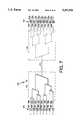
- FIG. 1is a diagrammatical representation of a signal decomposition-recomposition system
- FIG. 1Ais a diagrammatical representation of a cascade analyzer
- FIG. 1Bis a diagrammatical representation of a cascade synthesizer
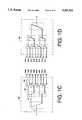
- FIG. 1Cis a diagrammatical representation of a tree analyzer
- FIG. 1Dis a diagrammatical representation of a tree synthesizer
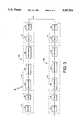
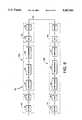
- FIG. 2is a block diagram of a signal encryptor
- FIG. 3is a block diagram of a transmitting and receiving system for the transmission and reception of secure signals
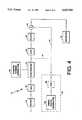
- FIG. 4is a block diagram of a signal encrypting transmitting and receiving system
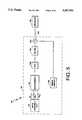
- FIG. 5is a block diagram of a modem
- FIG. 6is a block diagram of a coded modem
- FIG. 7is a block diagram of a coded tree modem
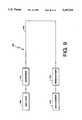
- FIG. 8is a block diagram of a system for receiving and transmitting compressed signals
- FIG. 9is a block diagram of a signal compression system for transmitting and receiving signals over a digital link.
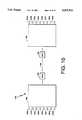
- FIG. 10is a block diagram of a modem.
- a signal decomposition-recomposition system 10includes an analyzer 12 having an input port 14a and a pair of output ports 16a, 16b. Each of the output ports 16a, 16b are coupled to a corresponding pair of input ports 18a, 18b of a synthesizer 20.
- An analog input signal X fed to the analyzer input port 14ais decomposed into a pair of signals W' and V' each of which is fed to a corresponding one of the output ports 16a, 16b.
- a pair of input signals W', V' fed to the synthesizer input ports 18a, 18bare reconstructed in to an output signal Y at a synthesizer output port 22a.
- the decomposition and reconstruction processes performed by the analyzer 12 and the synthesizer 20 as well as the signals V' and W'will be described further hereinbelow. Suffice it here to say that the input signal X is decomposed into the signals V' and W' such that the signals V' and W' may later be combined to exactly reconstruct the input signal X.
- the sub-analyzer and sub-synthesizer building blocksoperate digitally, however, for clarity in the description, the signal conditioning circuits required to convert between analog signals and digital signals in the system have been omitted.
- Such signal conditioning circuitswill be described in conjunction with FIG. 4 below. Briefly, however, and as will be described in conjunction with FIG. 4, when an input signal to a system building block, e.g. a sub-analyzer or sub-synthesizer, corresponds to an analog signal, the signal should first be fed through a filter having filter characteristics selected to provide Nyquist filtering. The appropriately filtered signal may then be sampled by an analog-to-digital converter (ADC). Similarly, if the output from a system building block is to be an analog signal, the signal should be fed to a digital-to-analog converter (DAC) and fed to a second filter likewise selected having filter characteristics selected to provide Nyquist filtering.
- ADCanalog-to-digital converter
- the sub-synthesizer 20performs the inverse operation of the sub-analyzer 12, and vice versa. That is, if the signals W' and V' from a sub-analyzer are applied as input signals to the sub-synthesizer input ports 18a, 18b, the output signal Y will be identical to the sequence of input samples, X, except for a predetermined time delay. In a preferred embodiment, the time delay corresponds to one sample time.
- the analyzer 12 and synthesizer 20provide signal decomposition and reconstruction functions.
- the sub-analyzer and sub-synthesizermay be used as building blocks and may be coupled to provide more complex circuits which may themselves be coupled to provide a variety of signal transmitting and receiving systems.
- tine analyzer 12 and synthesizer 20 as well as other system building blocks to be described hereinbelowmay be efficiently implemented in hardware, software or by a combination of hardware and software.
- the analyzers and synthesizers to be described hereinoperate on an ordered sequence of numbers, which may be, but are not limited to, samples from an analog to digital converter (ADC).
- samplesmay be expressed as X(0), X(1), X(2), and X(3) where X(0) is the most recent sample.
- Each of the binary numbers X(0) through X(3)has a particular value within a predetermined range of values.
- An 8-bit ADCfor example, may provide a range of decimal values between -128 to +127.
- the sequence of samples X(0) through X(3)may be considered as the coordinates of a vector [X] in a 4-dimensional space.
- a linear transformationmay be made from the coordinate system of X to another coordinate system in the same 4-dimensional space.
- the vector Xmay be transformed to a vector Y by a "rotation" matrix C. In matrix notation this may be expressed as:
- the vector Yhas components which correspond to the projections of X onto the new transformation axes.
- Such projectionsare provided by forming a vector dot product.
- a set of Walsh codes, Code 1-Code 4may be provided as:
- Codes Code 1-Code 4 aboverepresent an orthogonal coordinate axis in the 4-dimensions of this time ordered space. Codes 1-4 have a length corresponding to the square root of 4, (i.e. the dot product of code 1 with itself equals 4) and thus are not unit vectors.
- the rotation matrix Cmay be expressed as: ##EQU1##
- the rows C 1 -C 4 of the rotation matrix Ccorrespond to the components of the Walsh code vectors such that matrix multiplication between the rotation matrix C and the vector X is equivalent to the dot product of a particular one of the vectors C 1 -C 4 with the vector X.
- the components of the row vector Xmay be expressed as:
- a new state vector Ymay be expressed as:
- the new state vector [Y]completely describes the original state defined by [X] and may be computed on every group of 4 samples X(0)-X(3).
- Lcorresponds to the dimension of a row or column vector of the matrix C.
- analyzersmay be defined having 2 outputs using the 2-dimensional vector above.
- Walsh vectors of any dimensionmay be generated by the two dimensional vectors C 1 , C 2 . That is, substitution of a set of Walsh codes into a 2-dimensional generator matrix provides a new Walsh code having twice the dimension. Using this procedure an N-dimensional transformation needed to provide an analyzer, may be provided. Thus, because of the way that Walsh vectors are constructed from their two dimensional Walsh generators, higher dimension analyzers and synthesizers may be constructed from the 2-dimensional case.
- matrix equations for providing a modem or a signal encryptormay be generated.
- the fundamental operation in the requisite computationsis addition and subtraction of terms.
- equations which describe the sub-analyzer output signals V' and W'may be provided as:
- V'corresponds to a scaling or filtering function of the sampled input signal X
- W'corresponds to a residual or derivative of the sampled input signal X
- X(n)corresponds to the most recent input sample
- X(n-1) and X(n-2)correspond to the two previous input samples
- SHIFTcorresponds to a variable set equal to a positive power of 2 (such as 32, or 64, or . . . );
- BNcorresponds to a positive integer having a value between 0 and SHIFT and is preferred to have a relatively small value.
- the scaling function V' and the residual W' defined by Equations 1 and 2may be evaluated on alternate input samples of the input signal X, such that the value of the residual W' corresponds to twice the difference between the "center" sample, X(n-1), and the midpoint of a line connecting the two nearest neighbors of X(n-1) here, the two nearest neighbors being represented as X(n) and X(n-2).
- Equations 1 and 2are evaluated on alternate input samples, only the odd numbered (or alternatively only the even numbered) "center points" are selected for the calculation.
- the output rate of the sub-analyzercorresponds to one-half the input rate of the input signal X.
- the residual W'may also be interpreted as a deceleration about the center point.
- the residual W'may also be interpreted as a deceleration about the center point.
- the interpretation of the residual W'(N) described aboveindicates that the residual W'(N) responds only to changes in the slope around alternate samples.
- one characteristic of the residual W' in the present inventionis that the residual W' is provided having a value of zero when the slope about the center point is constant.
- the conventionally defined residual W(n)is related to the effective residual W' (n) as defined in the present invention by
- the sub-synthesizer operationmay be described by equations 3 and 4 below:
- Y'(-)corresponds to a saved, previously calculated (i.e. recursive) , value of Y'(n) .
- variable SHIFTBy defining the variable SHIFT, as above and taking advantage of the fact that multiplication and division by a power of two, is equivalent to a right or left shift on a binary computer, practical implementations of these equations may be provided with relatively little and simple hardware and are therefore preferred.
- the residual W'has been defined to provide a particular characteristic and the sequence V' is selected to provide the remainder of the sequence.
- a so-called “cascade analyzer” 24includes a plurality of here N sub-analyzers.
- the cascade analyzer 24may be provided by feeding the signal V' 1 from an output port of a first sub-analyzer 24a into the input port of a second sub-analyzer 24b and feeding a signal V' 2 from the output port of the second sub-analyzer into the input port of a third analyzer (not shown) and so on.
- the processcontinuing until a sub-analyzer 24N provides a signal V' N having a predetermined sample rate.
- each sub-analyzerhalves the sample rate to its input, the various output signals, W' 1 , W' 2 . . . W' N of the cascade analyzer are provided at differing rates.
- a so-called "cascade synthesizer" 26may be provided from a plurality of sub-synthesizer 26a-26N which may be of the type described above in conjunction with FIG. 1.
- the cascade synthesizeroperates to provide the inverse operation of the cascade analyzer.
- a so-called "tree analyzer" 28may be provided by appropriately coupling a plurality of sub-analyzers 29a-29g each of which may be of the type described above in conjunction with FIG. 1.
- a cascade emanating from the scale function V'(N)it is also possible to have residual cascades emanating from one or more residual sequences W'(N). That is, the residual sequences W'(N) may themselves be considered as inputs for a multiresolution analysis. It is therefore, in that case, possible to provide both the scaling function sequence V' and the residual sequence W' having equal same sample rates.
- the sample ratecorresponding to one-eighth the original sample rate.
- the tree analyzer 28may be provided by analyzing each of the residual sequence outputs W' until all such sequences are brought down to one rate, which is normally below the Nyquist rate of the lower cutoff frequency of a transmission link with which the analyzer cooperates.
- the three level analyzer tree 28is here provided having all of its output 29a-29h at 1/8 the sample rate, r, of the analog input signal, X.
- Each output samplemay include many more bits per sample than the input sample, however, the numbers represented by those output samples will usually be small in magnitude and easily requantized by a quantizer (not shown).
- a so-called "tree synthesizer” 30may be provided from a plurality of sub-synthesizers 31a-31g, each of which may be of the type described above in conjunction with FIG. 1.
- the tree synthesizer 30provides the inverse operation of the tree analyzer 28 (FIG. 1C).
- FIGS. 2-8may be used to indicate a sub-analyzer, a cascade analyzer, or a tree analyzer element and likewise, the term synthesizer referred to in FIGS. 2-8 may be used to indicate a sub-synthesizer, a cascade synthesizer or a tree synthesizer element, each of which have been described above in conjunction with FIGS. 1-1D.
- each of the analyzer and synthesizer elementsmay be provided according to the matrix transformation technique or alternatively each of the analyzer and synthesizer elements may be provided according to the three point equations of the forms of Equations 1 and 2 above, or alternatively still, each of the analyzer and synthesizer elements may be provided according to equations of the form: ##EQU2##
- analyzers and synthesizersare provided as tree type analyzers and synthesizers
- channels 29h through 29ewould be operated on, respectively, by matrix vectors C 1 , C 3 , C 5 , and C 7 and channels 29d through 29a would be operated on, respectively, by matrix vectors C 2 , C 4 , C 6 , and C 8 .
- a signal encryptor 32includes an analyzer 33 having signal encryption circuit 34, which may be provided for example as a random number generator, coupled thereto.
- the analyzer 33is provided by coupling a plurality, here five, sub-analyzers as shown. Each of the sub-analyzers may be of the type and thus operate in a similar manner as the sub-analyzer described above in conjunction with FIG.1.
- Each of a plurality of analyzer output ports 33a-33fare coupled to a corresponding one of a like plurality of input ports 36a-36f of a synthesizer 36.
- the synthesizer 36is provided by coupling a plurality, here five, sub-synthesizers as shown. Each of the sub-synthesizers may be of the type and thus operate in a similar manner as the sub-synthesizer described above in conjunction with FIG. 1.
- the input signal Xwhich may be for example a voice signal
- the input signal Xis fed to the analyzer input port 33a' and decomposed by the analyzer 33 in the manner described above in conjunction with FIG. 1.
- the input signal Xis decomposed into signals V 1 , V 2 , V 3 , V 4 , V 5 , and W 1 , W 2 , W 3 , W 4 and W 5 as shown.
- the random number generator 34which may be provided for example as a digital random number generator, feeds an encryption signal to each of the signal paths of the residuals, W' 1 -W' 5 .
- the value of each of the residuals, W' 1 -W' 5are thus modified to correspond to signals E 1 -E 5 .
- one method for encrypting the residuals W' 1 -W' 5is to provide a logical exclusive or (XOR) operation between the sign of the residuals W' 1 -W' 5 and a logical variable having a value corresponding to a logical one (as shown).
- another method of encryptionmay be provided by adding several individual secret binary bit streams to one or all of the residuals W'.
- the residual signals W'are generally provided having a relatively low power level and thus the residual signals W' 1 -W' 5 may appear simply as noise signals (i.e. "buried" in noise) by either or both of the above mentioned encryption techniques.
- Other methods of encrypting well known to those of ordinary skill in the artmay also be used including permutation of channels and substitution of symbols.
- each of the signals V 1 '-V 5 'may be encrypted or a combination of the signals W K ' and V K ' may be encrypted.
- the signal encryptor 32may be modified to include digital cipher feedback, which is common in the encryption art.
- digital cipher feedbackeach of the 5 XOR outputs from the analyzer should be fed back to the inputs of 5 separate secret random number generators (not shown) in the manner of the data encryption standard (DES) for encryption.
- DESdata encryption standard
- any means well known to those of ordinary skill in the art for providing random digital numbersincluding but not limited to the DES, with or without cipher feedback may be used.
- other methods of deriving and using the random numbers to modify the value of the residuals W'including but not limited to additive noise techniques and the like which do not use the XOR function may also be used.
- the encrypted signals E 1 -E 5are subsequently coupled to corresponding ones of the analyzer output ports 33a-33f and then fed to the synthesizer input ports 36a-36e along with an unmodified signal V5 fed to input port 36f.
- the synthesizer 36employs Equations 3 and 4 to reconstruct the signals E 1 -E 5 fed thereto to provide a reconstructed output signal Y which may be transmitted on a communication channel (not shown) for example.
- a receiverreceives the transmitted signal and analyzes the signal to recover the signals V5 and E l -E 5 .
- the receiversubsequently decrypts the signals E l -E 5 to recover the signals W 1 -W 5 and resynthesizes to get the original signal X.
- the synthesizer 36reconstructs the signals E l -E 5 such that the resultant reconstructed signal X' provided at the synthesizer output port should not occupy more than the Nyquist bandwidth.
- the sampling frequency of the highest frequency encrypted stagecorrespond to twice the upper cutoff frequency of the transmission channel.
- the reconstructed encrypted signal X' provided at the synthesizer output portwill of course have a different (noise-like) power spectrum and a different average total power due to the additive noise introduced.
- the input signal powermay be diminished to restrict the total channel power.
- Means for restricting the total channel powermay include means for transmitting the power factor to the receiver by using the amplitude of pilot tones which may be used to synchronize the decryptor and an ADC. These pilot tones may be used to derive the ADC clock by a phase locked loop for example and may be provided as explicit narrow band tones or, alternately the pilot tones may be provided as a secret coded sequence added to the residual W' to hide the true value of the residual.
- the receiverwould correlate the appropriate residual in order to establish time synchronization. Specific coded sequences (such as the GOLD codes and JPL ranging codes) having suitable correlation properties required for acquiring synchronization by this method are known in the art of spread spectrum communications.
- the encryptorrecovers the signal out of the receiver substantially exactly like the original input signal except for the presence of noise from the channel and noise-like fluctuations due to imprecise timing synchronization of the ADC converters in the transmitter and receiver ends.
- the signal encryptormay also include a means for line equalization (not shown). Such means are well known to those of ordinary skill in the art of modem design. Variations in line loss with frequency (tilt) and phase shift may be compensated by adaptive filtering and often includes a precursor burst of known energy to set the filter parameters and a means for periodically modifying the equalizer coefficients based on a measure of the quality of the received signal.
- line loss with frequency (tilt) and phase shiftmay be compensated by adaptive filtering and often includes a precursor burst of known energy to set the filter parameters and a means for periodically modifying the equalizer coefficients based on a measure of the quality of the received signal.
- the signal encryptor 32acts as a broadband random number generator.
- the signal encryptormay be used as a generator to provide a signal on the line which may be used in the line equalization process.
- the analyzermay be used to measure the channel response of each channel. If the synthesizer, thus provides a test signal on each channel the analyzer may measure the response on each channel to determine the loss on each channel. Thus the analyzer and synthesizer may be used to provide a method of line equalization.
- this conceptmay be further refined to only using a synthesizer at the sending end and only an analyzer at the receiving end.
- the delay in a treemay correspond to
- a transmitting and receiving system 40 for the transmission and reception of secure signalsincludes a transmitting portion 40a and a receiving portion 40b.
- the transmitting portion 40aincludes a signal conditioning circuit 41 including an input filter 42 having appropriately selected filter characteristics preferably selected to provide Nyquist filtering to an analog signal fed thereto.
- the filter 42couples the analog signal to an analog-to digital converter (ADC) 43 which converts the received analog signal into a digital signal representative of the analog signal.
- ADCanalog-to digital converter
- the analog signal fed to the ADC 43 input portmay be fed through an amplifier or other preconditioning circuits (not shown) and then fed to the ADC 43.
- signal preconditioning circuitssuch as low noise amplifiers and buffer amplifiers are relatively wide-band amplifiers and are further characterized as having relatively low levels of phase dispersion over the bandwidth of the amplifier. That is, the amplifiers impart to the amplified output signal a substantially equal phase shift to the amplified output signals therefrom at least over the bandwidth of the transmitted signal.
- the sampling rate of the ADC 43is preferably greater than twice the Nyquist sampling frequency (i.e. greater than twice the frequency of the highest frequency component signal in the input spectrum).
- the ADC 43converts the signals provided from the filter 42 in accordance with the predetermined sampling rate to provide a stream of digital words. At the output of the ADC 43 such stream of digital words are fed to a signal encryption circuit 44.
- the signal encryption circuit 44includes an analyzer 46 which appropriately decomposes the signal fed thereto into a plurality of signals, an encryptor circuit 48 which encrypts the decomposed signals and a synthesizer 50 which combines the signals fed thereto into a reconstructed encrypted signal.
- the signal encryption circuit 44may be of the type and operate in a manner similar to the signal encryption circuit 32 described above in conjunction with FIG. 2.
- the encryptor circuit 44may encrypt the signal by adding a secret number to the residue, W' with the value of the secret number known only to the sender and receiver. Such an addition may typically be done modula 2. That is, by providing a logical exclusive-or (XOR) function bit by bit to the residual signal. Such addition may also be accomplished by simply adding modulo the actual word size of the data.
- the encryptor 48may be provided as a secret number generator which may be of a type that provides a different secret number based on the number of times it is requested to do so, or it may be of the type that the output depends only on its input. The latter type may often be self-synchronizing. The former type may suffer loss of sync between the encryptor and the decryptor if the receiver, for any reason, loses bit or word synchronization with the transmitter.
- the encryptor 48may provide permutation operations among the several channels or alternatively the encryptor 48 may provide substitution operations or alternatively still the signal encryptor may provide the logical or operation described above in conjunction with FIG. 2.
- the signal encryption circuit 44feeds the reconstructed encrypted signal to an input port of an output signal conditioning circuit 51 which includes a digital-to analog-converter (DAC) 52 which may be provided as a logarithmic ADC for example, which converts the encrypted bit stream fed thereto to an analog signal representative of the encrypted bit stream.
- DACdigital-to analog-converter
- the analog signalis subsequently fed to an output filter 54 having appropriately selected filter characteristics as described above.
- the filter 54couples the signal fed thereto to a first end of a transmission channel 56, which may be provided for example as a telephone line. A second end of the transmission channel 56 is coupled to the receiving portion 40b of the transmitting and receiving system 40.
- the receiving portion 40breceives a secure signal fed thereto and decrypts the signal to provide a clear text signal at an output port.
- the receiving portion 40b of the transmitting and receiving system 40receives the encrypted signal through an input signal conditioning circuit 57 at an input port of an input filter 58 having appropriately selected filter characteristics.
- the input filter 58couples the signal to an ADC 60 which converts the analog signal to provide a stream of digital words in the same manner as described above.
- the filter 58may be provided having a low pass filter frequency cutoff characteristic corresponding to one-half the sampling frequency of the ADC 60.
- the ADC 60feeds the stream of digital words to a decryption circuit 61 which includes an analyzer 62 which decomposes the signal fed thereto into a plurality of signals and a decryptor circuit 64.
- the decryptor circuit 64subtracts the secret number, to recover the original data.
- the decryptor-synthesizer combination 64, 66performs the inverse operation of the encryptor-analyzer 48, 46 at the transmitter and feeds the decrypted and appropriately recomposed signal to a digital to analog converter (DAC) 68.
- the DAC 68provides an analog signal corresponding to the bit stream fed thereto and feeds the analog signal to a receiver output filter having appropriately selected filter characteristics as described above.
- the number of levelsmay typically be determined by the lower limit of the input signal bandwidth.
- a practical requirement for most applicationsmay be to dispose a pre-filter (not shown) having a high-pass or band pass filter characteristic prior to the signal conditioning circuit 41.
- the system of sender and receivermay not recover a signal having a bandwidth which exceeds the bandwidth of the communications link 56.
- the bandwidth of the linkgenerally has practical limits, for example a single television (TV) channel.
- a signal encryption system 72receives an analog signal at an input port and filters and converts the analog signal to a first stream of bits via a filter 74 and an ADC 76 in the same manner as described above in conjunction with FIG. 4.
- the bit streamis fed from the ADC 76 to a signal encryptor 78.
- the signal encryptor 78receives the signals directly on separate signal channels.
- a random number generator 80is coupled to the signal encryptor 78 and feeds a stream of random bits to the signal encryptor 78.
- the random stream of bitsmodifies the first bit stream to thus provide an encrypted signal.
- the signal encryptor 78combines the signals to thus provide a reconstructed encrypted signal at an output port.
- the encrypted signalis subsequently fed from the signal encryptor 78 to an input port of a DAC 82 which converts the encrypted bit stream to an analog signal.
- the analog signalis coupled through a filter 84 which provides an appropriately filtered signal to a first input port of a signal combining circuit 86.
- a timing circuit 87includes a timing signal generator 88 for providing a timing signal.
- the timing circuit 87may provide to a receiver 92 either an analog or a digital timing signal and thus an optional ADC 90 is here shown coupled between the timing signal generator 88 and the summing circuit 86. If the DAC 90 is included in the timing circuit 90 then the timing signal is fed through optional signal path 91' to the digital input port of the DAC 8d. If the ADC 90 is omitted then the timing signal is fed through signal path 91 to the summing circuit 86 as shown.
- Timing and synchronization schemesare known to those of ordinary skill in the art.
- an oscillator locked to (i.e. derived from) the sampling rate of the sending portionmay be sent over the link.
- the received oscillator signalmay be used to derive (via phase locked loop techniques for example) the receiver's clock signals for sampling.
- the timing informationmay be applied to the encryptor and decryptor respectively.
- two timing signalsmay be required because the inherent delay in the sending portion of the system effectively defines "words" rather than just signal bits that should be synchronized.
- word synchronizationmay be achieved by providing a second sender oscillator which may be locked to the first oscillator (alternatively, the first oscillator may be locked to second oscillator thus requiring only a word synchronization) and operating at a rate depending upon both the number of levels in the cascade and on the type of system being provided i.e. a signal encryptor, a signal compressor, or a modem.
- Such oscillator signalsmay occupy the same bandwidth as the system information, since they may be subtracted out by the known techniques for removing a signal of known frequency and constant amplitude.
- these two oscillatorsshould preferably provide signals having a particular frequency and a particular amplitude.
- these two oscillatorsshould preferably be locked to signals having frequencies corresponding to those frequencies which define the extreme upper and lower band edges of the frequency bandwidth of the system information (and the system information while still maintaining the requirement that will not exceed the band limits of the link.
- One method for removing an interfering signal (namely, the received oscillator signal) from the accompanying system information signalis to form a feedback loop that subtracts out an amount of the known (as received) frequency until the resulting difference no longer contains any narrow band correlation to the known (received) oscillator.
- the operation of a phase locked loopincludes multiplication of an input signal with a local oscillator (which, in turn, is locked to the received timing signal) and then integrating the result with a low-pass filter.
- a system for transmitting digital data over an analog medium 94includes a modulator-demodulator (modem) 95 here only a modulator portion of the modem 95 being shown.
- the modem 95includes a data assembly unit 96 for forming digital data into frames or bytes having a predetermined length appropriately selected for data transmission.
- the data assembly unitfeeds the data to the input ports of a synthesizer 98 which forms the data into a bit stream in accordance with the technique of the sub-synthesizer 20 described above in conjunction with FIG. 1. That is, here digital data to be transmitted is applied to the residual inputs W' 1 . . . W' N of the synthesizer
- This datamay be encrypted by a random number generator (not shown) which provides an encrypting sequence which may or may not be a secret sequence.
- the synthesizer 98feeds the bit stream into an input port of a DAC 100, which may be provided having a nonlinear response characteristic, which generates an analog signal corresponding to the bit stream fed thereto.
- a DAC 100which may be provided having a nonlinear response characteristic, which generates an analog signal corresponding to the bit stream fed thereto.
- the digitized samples out of the sendershould be converted via the DAC 100 to an analog signal representation of the digital signal fed thereto.
- the analog signalis subsequently filtered for anti-aliasing with a filter 102 having a low pass filter characteristic and preferably having a relatively steep filter skirt and a cutoff frequency corresponding to one-half the sampling rate frequency.
- the filtered signalis coupled to a first input port of a summing circuit 104.
- a timing circuit 106feeds a timing signal into a second input port of the summing circuit. The summing circuit thus superimposes the two analog signals fed thereto.
- a timing signalmay be transmitted via
- the superimposed analog signalis transmitted over an analog transmission link 107 (e.g. a telephone line) to a receiver 108 where the timing signal may be used to provide timing data for the receiver such that the bit stream may be recovered from the analog signal.
- an analog transmission link 107e.g. a telephone line
- the timing signalmay be used to provide timing data for the receiver such that the bit stream may be recovered from the analog signal. It is believed that a modem constructed in accordance with the present invention may operate at or near the maximum data rate theoretically possible for a transmission link based on signal to noise ratio of the link and Shannon's Law.
- substantially all noise in the frequency range above one-half the receiver sampling rate frequencyshould be filtered with a filter having a low-pass filter characteristic and having a cutoff frequency above one-half the receiver sampling rate frequency. If the transmission link 107 is provided as a transmission line over which signals having a frequency between 400 Hz and 3200 Hz may be transmitted then the input signal may appropriately be sampled at a sampling rate typically of about 6400 bps.
- a single tone having a frequency typically of about 3200 Hzmay be provided by the timing circuit and added to the transmitted signal and phase-locked at the receiver as one means of synchronizing a receiver ADC clock. Since the tone may be provided having a known amplitude and frequency, it may be subtracted rather than filtered out at the receiver and thus there is no resultant loss of data.
- a signal tone having a frequency typically of about 400 Hzmay be used to provide a word synchronization for formulating the word comprising the input to all the cascade levels.
- Signals in the frequency range below 400 Hzmay be used for signalling for line turnaround in a semi-full duplex modem, for sending reverse channel data and network information. Bits per cascade level may be increased until the maximum power per unit of data which may be transmitted and Shannon's limit are reached.
- error correcting codessuch as M of N codes (M redundant bits out of N) and scrambling signals may be applied to the input data words as is known to those of ordinary skill in the modem art.
- a shared signal S 2may be provided for example, as a voice signal, television (TV) signal or facsimile (FAX) signal or alternatively the shared signal S 2 may be provided from additional modems of the same type operating with orthogonal code sequences.
- the coded modem 110includes a coder 112 for providing the coding operation.
- the coded signalis fed to a synthesizer 114 which provides a relatively broadband signal having a noise-like frequency spectrum to an input port of a summing circuit 116.
- a sharing signalmay be fed to a second input port of the summing circuit.
- the summing circuitcouples the signals fed thereto to a first end of a transmission line 117.
- a signal tap 118couples a portion of the signal transmitted over the transmission line 117 to an optional signal processor 124.
- the signal processor 124feeds a processed signal to a receiver 125.
- the codes of the coder 112are selected to have good auto- and cross- correlation properties, and thus the modem data may be recovered even when the modem operates at low power relative to the shared signal.
- the receiver 125which may be provided as a TV receiver for example, the modem signal may appear to be a small random background noise. However if the shared signal is coupled to the TV receiver 125 through the signal processor 124 containing the code sequences, C, then most or substantially all of the modem "interference" in the TV receiver 124 may be removed by known techniques for cancelling correlated noise.
- the modem 110includes the coder 112 for providing a coding operation C, and a decoder 122 for providing a correlation operation, C.
- a correlation operationdata is recovered by digitally integrating the product of the received sequence with the stored code, C.
- a signal sharing the linkwill typically tend to integrate to near zero since the shared transmission is uncorrelated to the chosen code, C.
- the optional interference cancellation operation for the sharing signalis performed by the signal processor, 124.
- At least one of the signals, W' kis forced to be a sequence having known correlation properties.
- the chosen signal W' kmay preferably correspond to the signal having lowest inband sample rate. It should be noted however, that in a direct sequence coded modem all the W' k s are so coded.
- Walsh codesalso known as Hadamard codes
- the kernal for a Walsh codeis provided as:
- Non-orthogonal codes having a large auto-correlation and a small cross-correlationmay also be suitable, and some of such codes are known to be particularly good for fast acquisition of synchronization in a sliding correlator.
- An example of a sliding correlatormay be made with code 3. If word sync is unknown (assume for this discussion that bit sync is known) then one of four possibilities may occur in the receiver's correlator: they are ##EQU5##
- the residual, W', of the lowest frequency stage in the sender's cascademay be arranged to have code 3 define its value (or at least the sign of W' would follow code 3).
- code 3define its value (or at least the sign of W' would follow code 3).
- an incoming data bitmay be expressed as corresponding to either +1 or -1. If that data bit multiplies one of the codes, code 2 for example, then the resulting 4 bit sequence is either code 2 or code 2 with the sign of each bit reversed. If that sequence is applied to one of the W' inputs of a cascade or tree synthesizer as a sequence of bits, then the receiver's analyzer will recover that W' and may correlate with code 2 to get either a large positive or a large negative number which will determine the receiver output as a +1 or a -1 respectively.
- an example using a single bithas been described. In practical systems of course, such operations would typically be performed on digital words having a plurality of bits.
- coded modems of the type described in FIG. 6may operate simultaneously over the same link, within the constraint of total link power. Each modem should use a different orthogonal code. For example, a code 3 modem would not interfere with a code 2 modem. It should be noted that the number of modems that may share a link using the 4 bit Walsh codes described above is more than four since each modem may have a different and unique combination of codes on each of its independent residual inputs, provided certain groups of modems don't operate at exactly the same time. It should also be noted that these multiple modems may simply be provided as different orthogonally coded data bits.
- a two wire full duplex modemmay be provided by using a companion set of almost orthogonal codes.
- the Walsh codes identified as code 1 through code 4 above, and their bit-wise complement,are only one half of the 16 possible combinations of 4-bits. As shown below the remaining combinations also form another set of mutually orthogonal vectors, below numbered as c5 through c8.
- This second set of 4 vectorsis not orthogonal to the first set. It can be described as "nearly orthogonal" because the dot product of any member of set 1 with any member of set 2 is always half the length of the vector; and of course the dot product of any member with another of the same set is always 0 except that the product with itself is always equal to the length.
- the master groupis orthogonal and the slave group is also orthogonal, however the cross group correlation is -2 for the dual and +2 for any other cross term.
- One end of a transmission linkmay transmit signals using the master set of codes and a second end of the transmission link may transmit using the slave set of codes.
- the modems at each end of a linkcan be assigned to use set 1 or set 2 as Master and Slave. If the Master used only codes 1 and 2 and the Slave used codes 3 and 4 then all echo signals would be totally cancelled by the orthogonality but the data throughout for each modem would be half of the rate possible by using the arrangement described above based on the two sets of codes.
- coded modems of the type described in conjunction with FIG. 6may coexist with other signals on the link since 'the correlator will provide little or no output signal. Longer code sequences may improve this effect at the expense of lower data throughput. Certain codes, other than the Walsh codes, may be better able to exploit this characteristic for multiple access applications.
- jamming signalsinclude voice (hence data may be sent as ⁇ noise ⁇ under the voice), television (hence high definition digital information may be sent in the same channel as standard video to maintain compatibility), code division multiplexing and two wire full duplex FDX.
- voicephrase data may be sent as ⁇ noise ⁇ under the voice
- televisionphrase high definition digital information may be sent in the same channel as standard video to maintain compatibility
- code division multiplexingand two wire full duplex FDX.
- the disclosed techniqueis an improvement on those methods because the modem utilizes the bandwidth more efficiently than heretofore.
- the modem described hereinbeing a modulator (the synthesizer) and a demodulator (the analyzer) may also take the form of a baseband RF or soundwave transmitter modulator and receiver (or above baseband except for the limits of ADC's ). Such a receiver may have application in receiving digital High Definition TV (HDTV).
- a modulatorthe synthesizer
- a demodulatorthe analyzer
- HDTVdigital High Definition TV
- Coded modems of the type described above in conjunction with FIG. 6 and to be described in conjunction with FIG. 7 belowmay use Walsh codes to pre-encode data which is applied to the w' and v' inputs. Because the synthesizer itself uses Walsh codes, if implemented by the rotation matrix, it should be pointed out that these two coding schemes are independent. For example, the code length for the data inputs need not be the same as the number of synthesizer outputs. The number of outputs is equal to the length of the synthesizer rotation operators. Thus by applying the matrix method to the coded modem, the coded modem becomes in essence a twice coded modem.
- a coded tree modem 126includes a plurality of coder circuits 128a-128h coupled to corresponding ones of a plurality of input ports 130a-130h of a tree-type synthesizer 130 operating in accordance with the principles described above in conjunction with FIG. 1.
- the synthesizer output portis coupled through a link 132 to an input port of a tree-type analyzer 134 also operating in accordance with the principles described above in conjunction with FIG. 1.
- a plurality of decoder circuits 136a-136hare coupled to the analyzer output ports 134a-134h to decode the coded signals fed thereto.
- the coded tree modem 126operates such that the coder circuit performs a coding operation of multiplying a data word times an orthogonal code C.
- the decoderperforms a correlation operation here denoted C.
- Ca correlation operation
- the final V' input sequence on line 130hmay be set to zero if it is assumed to be below a frequency corresponding to the lower frequency limit of the passband frequency of the link 132.
- a system for transmitting and receiving compressed signals 138includes a transmit portion 138a having an input signal conditioning circuit 139, which here includes an input filter 140 and an ADC 142.
- the filter 140 and ADC 142are selected to operate in accordance with the techniques described above to provide an appropriate stream of digital words to the first input port of an analyzer 144.
- a quantizer 146is coupled between the analyzer 144 and a synthesizer 148. In operation, the signal compressor quantizer 146 maps the residual W'(N) into a new number taking fewer bits to describe. Thus it is a compression operation.
- An output signal conditioning circuit 149includes a DAC 150 coupled to the output port of the synthesizer 148.
- the DAC 150receives a digital stream of words and provides an analog output signal representative of the bit stream fed thereto.
- a filter 152 having appropriately selected filter characteristicscouples the analog signal from the DAC 150 to a first end of a transmission line 154.
- a second end of the transmission line 154is coupled to a receive portion 138b of the system 138.
- the receive portion bincludes an input signal conditioning circuit 156, which appropriately filters and converts the analog signal fed thereto to provide an appropriate stream of digital words to the first input port of an analyzer 158.
- An inverse quantizer 160(i.e. requantizer) is coupled between the analyzer 158 and a synthesizer 162.
- the requantizer 160remaps to the original bit definition.
- the compression operationlowers the information content of the signal and that lost information may not be recovered. In many applications, however, the lost information is redundant or the human observer is insensitive to the level of detail contained in the information discarded by the quantizer and thus little or no signal degradation may be detected.
- An output signal conditioning circuit 163receives a reconstructed digital stream of words from the synthesizer 162 and provides an appropriately filtered analog output signal representative of the bit stream fed thereto to an the output port of the receive portion 138b of the system.
- bandwidthmay generally be reduced by limiting the number of bits devoted to the residual W'.
- an alternative which may provide an increased reduction in bandwidthmay be accomplished by first replacing a signal V 5 on the cascade channel corresponding to the lowest frequency band with a zero, thus only transmitting the signal W' 5 .
- a signal W' 3 associated with a cascade channel corresponding to the frequency band in the 700 Hz to 1400 Hz frequency rangemay be eliminated or coarsely quantized.
- Huffman coding or codebook vector quantization methodsmay be used on W' 2 .
- the frequency band from 700 Hz to 1400 Hzmay be isolated. Since human voice especially in the English language, generally does not include a formant in this range, the cascade channel corresponding to the frequency band from 700 Hz to 1400 Hz may be eliminated (i.e. by setting the residual W' 3 equal to zero) with little loss in intelligibility. Similarly, as shown in the Table below, W' 1 and W' 5 may also be set to zero
- W' 1 through W' 5 and V 5are sampled at the rates shown in the Table and it is possible to transmit only the signals corresponding to the residuals W' 2 and W' 4 , for example, which have sample rates of 700 and 2800 baud perhaps less than 2 bits for each residual W' 2 , W' 4 after Huffman coding. Further reduction may also be possible since W' 2 may simply be considered as another sampled signal and thus may also be subdivided by multiresolution analysis to further reduce the bandwidth.
- the receivermay be provided having the same form with received signal applied to V 0 and the clear output taken from V' 0 .
- a digital compression circuit 166includes an analyzer 168 coupled to a quantizer 170.
- a digital signalis fed to the analyzer input.
- the analyzer 168decomposes the signal and the quantizer 170 performs a compression operation as described above in conjunction with FIG. 8.
- the quantizer 170subsequently feeds a compressed digital signal to a first end of a digital link 172.
- a second end of the digital link 172is coupled to an input port of a requantizer 174.
- the requantizer 174receives the signal fed thereto performs an inverse quantization process and subsequently feeds a requantized signal to a synthesizer 176.
- a logical operationsuch as an exclusive or operation
- a telephone modem 178includes a synthesizer 180, capable of operation over the frequency band from 400 Hz to 3200 Hz.
- the synthesizer 180feeds a signal to a DAC 182 having a sampling rate typically of about 6400 samples/second which converts the bit stream fed thereto to an analog signal.
- the analog signalis subsequently fed over an analog transmission link 184 to an ADC 186 also having a sampling rate typically of about 6400 samples/second.
- the ADC 186converts the analog signal fed thereto to a digital bit stream.
- the digital bit streamis subsequently fed to an analyzer 188.
- the synthesizer 180may be provided in accordance with the matrix transformation methods described above in conjunction with FIG. 1. It should be noted, however, that the synthesizer 180 may alternatively be provided as a three level tree synthesizer in accordance with Equations 3 and 4 also described above in conjunction with FIG. 1.
- the synthesizer 180operates on the data frames fed thereto with a rotation matrix.
- an 8 dimensional rotation matrixwould be applied to the data frames.
- the analyzer 188would perform an inverse rotation operation by applying an 8 dimensional matrix corresponding to the inverse matrix of the matrix used by the synthesizer 180.
- the basic sampling rate of the DAC 182 and ADC 186is 6400 samples/sec.
- the digital input and outputoperate at a frame rate of 1/8 or 800 frames per second.
- Each framemay be composed, for example, of 35 bits divided into 7 words of 5 bits (or more) each and applied to channels 180a-180h.
- the thruputis 28,000 bps (35 bits times 800 frames/second).
- the usable rateis determined by the S/N ratio on the link 184 and forward error correction (FEC).
- FECforward error correction
- the modem 178may operate at a data transfer rate at or below 28 kbps.
- the modem 178may utilize FEC and as is common practice, the frequency range from 300 Hz to 400 Hz may be used for frequency shift keying (FSK) diagnostic signalling.
- FSKfrequency shift keying
- Channel 180hcorresponds to signaling below 400 hz and cannot be used for data in this example. However, if a signal having a constant amplitude and alternating sign is applied to channel 180h then a 400 hz tone may be filtered from the line signal by a receiver (not shown) to aid in synchronization. In addition, the known preselected amplitude may be recovered from channel 188h as data and used as a gain calibration signal in the receiver and, may further be used to define block boundaries for FEC block coding schemes.
- coded modemsmay obtain synchronization information without any tones appearing in the transmitted signal.
- clandestine communications by encrypting coded modemsmay be transmitted as low level, seemingly uncorrelated, noise in the same narrow bandwidth as simultaneous, non secret, communications.
- the data in the channels 180a-180gmay be scrambled, as is common practice in modems, so that the output appears more noise-like when transmitting the commonly encountered input string of 35 zeros or ones. Without scrambling, an input string of zeros will produce a modulated but strongly correlated output without a DC component.
- the data received by the analyzer 188will be a multiple of the actual data.
- the multiplication factorwill correspond to the dimension of the rotation matrix which in turn corresponds to the number of channels in the synthesizer 180.
- the receivershould quantize, that is, round the received channel output to the nearest multiple then divide by the multiple to reduce the effects of noise on the link 184.
- a modem using baseband modulation techniquesin which no carrier signal exists, may also be provided by using the matrix rotation approach or by the equations provided in conjunction with FIGS. 1-1D above.
- the modemmust demodulate and process groups of two or more samples to recover the data.
- single samplesare processed to recover the data.
- a modem operating according to the matrix method described aboveshould modulate and demodulate groups of samples. For example, if the matrix vectors are of length eight, then eight samples should be processed together as an independent group by the demodulator. That is, the demodulator multiplies the group of samples by the inverse matrix used in the modulator. It should be noted that the grouping of samples is part of the modulation and distinct, for example, from a block data coding method for error correction, and both techniques may be simultaneously used in a single modem.
Landscapes
- Engineering & Computer Science (AREA)
- Computer Networks & Wireless Communication (AREA)
- Signal Processing (AREA)
- Computer Security & Cryptography (AREA)
- Power Engineering (AREA)
- Digital Transmission Methods That Use Modulated Carrier Waves (AREA)
- Time-Division Multiplex Systems (AREA)
Abstract
Description
[Y]=[C]*[X]
Code 1=+1+1+1+1
Code 2=+1-1+1-1
Code 3=+1+1-1-1
Code 4=+1-1-1+1
[X]=[X(0), X(1), X(2), X(3)]
[Y]=[[C.sub.1 ]*[X], [C.sub.2 ]*[X], [C.sub.3 ]*[X], [C.sub.4 ]*[X]]
[X]=[C][Y]
[C]=1/L[C]
V'=SHIFT*X(n-1)-BN*W'Equation 1
W'=2*X(n-1)-X(n)-X(n-2)Equation 2
W(n)=B*W'(n)
W(N)=X(n-1)-V(N)
Y(n-1)=Y'(n-1)/SHIFT Equation 3
Y(n)=Y'(n)/SHIFT Equation 4
Delay=2.sup.L -1
______________________________________ MASTER (set 1) SLAVE (set 2) ______________________________________ c1 = + + + + C5 = + - - - = c1 c2 = + - + - c6 = + + - + = c2 c3 = + + - - c7 = + - + + = c3 c4 = + - - + c8 = + + + - = c4 ______________________________________
TABLE ______________________________________ SAMPLE RATE SIGNAL (samples/second) FILTER RANGE (Hz) ______________________________________ W'.sub.1 5600 W'.sub.1 = 0 >> 2800 to 3200 W'.sub.2 2800 W'.sub.2 >> 1400 to 2800 W'.sub.3 1400 W'.sub.3 = 0 >> 700 to 1400 W'.sub.4 700 W'.sub.4 >> 350 to 700 W'.sub.5 350 W'.sub.5 = 0 >> 175 to 350 V.sub.5 175 V.sub.5 = 0 ______________________________________
Claims (24)
Priority Applications (13)
| Application Number | Priority Date | Filing Date | Title |
|---|---|---|---|
| US08/033,518US5367516A (en) | 1993-03-17 | 1993-03-17 | Method and apparatus for signal transmission and reception |
| AU63938/94AAU6393894A (en) | 1993-03-17 | 1994-02-16 | Method and apparatus for signal transmission and reception |
| CA002158440ACA2158440C (en) | 1993-03-17 | 1994-02-16 | Method and apparatus for signal transmission and reception |
| EP94911411AEP0699360A4 (en) | 1993-03-17 | 1994-02-16 | Method and apparatus for signal transmission and reception |
| PCT/US1994/002025WO1994022236A1 (en) | 1993-03-17 | 1994-02-16 | Method and apparatus for signal transmission and reception |
| US08/634,179US5995539A (en) | 1993-03-17 | 1996-04-18 | Method and apparatus for signal transmission and reception |
| US08/683,180US5682404A (en) | 1993-03-17 | 1996-07-18 | Method and apparatus for signal transmission and reception |
| US08/953,528US5835590A (en) | 1993-03-17 | 1997-10-17 | Method and apparatus for signal transmission and reception |
| US09/450,085US6263017B1 (en) | 1993-03-17 | 1999-11-29 | Method and apparatus for signal transmission and reception |
| US09/894,168US6532256B2 (en) | 1993-03-17 | 2001-06-27 | Method and apparatus for signal transmission and reception |
| US10/379,870US20030161392A1 (en) | 1993-03-17 | 2003-03-05 | Method and apparatus for signal transmission and reception |
| US10/744,345US6973124B2 (en) | 1993-03-17 | 2003-12-23 | Method and apparatus for signal transmission and reception |
| US11/058,805US20050141603A1 (en) | 1993-03-17 | 2005-02-16 | Method and apparatus for signal transmission and reception |
Applications Claiming Priority (1)
| Application Number | Priority Date | Filing Date | Title |
|---|---|---|---|
| US08/033,518US5367516A (en) | 1993-03-17 | 1993-03-17 | Method and apparatus for signal transmission and reception |
Related Child Applications (2)
| Application Number | Title | Priority Date | Filing Date |
|---|---|---|---|
| US34225994AContinuation | 1993-03-17 | 1994-11-18 | |
| US08/953,528ContinuationUS5835590A (en) | 1993-03-17 | 1997-10-17 | Method and apparatus for signal transmission and reception |
Publications (1)
| Publication Number | Publication Date |
|---|---|
| US5367516Atrue US5367516A (en) | 1994-11-22 |
Family
ID=21870867
Family Applications (3)
| Application Number | Title | Priority Date | Filing Date |
|---|---|---|---|
| US08/033,518Expired - LifetimeUS5367516A (en) | 1993-03-17 | 1993-03-17 | Method and apparatus for signal transmission and reception |
| US08/683,180Expired - LifetimeUS5682404A (en) | 1993-03-17 | 1996-07-18 | Method and apparatus for signal transmission and reception |
| US08/953,528Expired - LifetimeUS5835590A (en) | 1993-03-17 | 1997-10-17 | Method and apparatus for signal transmission and reception |
Family Applications After (2)
| Application Number | Title | Priority Date | Filing Date |
|---|---|---|---|
| US08/683,180Expired - LifetimeUS5682404A (en) | 1993-03-17 | 1996-07-18 | Method and apparatus for signal transmission and reception |
| US08/953,528Expired - LifetimeUS5835590A (en) | 1993-03-17 | 1997-10-17 | Method and apparatus for signal transmission and reception |
Country Status (5)
| Country | Link |
|---|---|
| US (3) | US5367516A (en) |
| EP (1) | EP0699360A4 (en) |
| AU (1) | AU6393894A (en) |
| CA (1) | CA2158440C (en) |
| WO (1) | WO1994022236A1 (en) |
Cited By (21)
| Publication number | Priority date | Publication date | Assignee | Title |
|---|---|---|---|---|
| WO1998024186A3 (en)* | 1996-11-12 | 1998-10-08 | California Inst Of Techn | Semiconductor imaging sensor with on-chip encryption |
| US5835590A (en)* | 1993-03-17 | 1998-11-10 | Miller; William J. | Method and apparatus for signal transmission and reception |
| US5920278A (en)* | 1997-05-28 | 1999-07-06 | Gregory D. Gibbons | Method and apparatus for identifying, locating, tracking, or communicating with remote objects |
| US5982807A (en)* | 1997-03-17 | 1999-11-09 | Harris Corporation | High data rate spread spectrum transceiver and associated methods |
| US20010008523A1 (en)* | 1999-12-01 | 2001-07-19 | Lg Electronics Inc. | Method for generating and transmitting optimal cell ID codes |
| EP0865181A3 (en)* | 1997-03-10 | 2001-08-16 | Sony Corporation | Method of reducing cochannel interference |
| WO2001080520A3 (en)* | 2000-04-12 | 2002-02-07 | Nortel Networks Ltd | Security encrypted network access identifier for ip mobility systems |
| US6347115B1 (en)* | 1998-05-20 | 2002-02-12 | Xerox Corporation | Method and system for predictive coding of images treated with the Roberts Method |
| EP0966133A3 (en)* | 1998-06-15 | 2002-07-24 | Sony International (Europe) GmbH | Orthogonal transformations for interference reduction in multicarrier systems |
| EP0896767B1 (en)* | 1996-05-01 | 2003-01-22 | Elastic Networks Inc. | Information network access apparatus and methods for communicating information packets via telephone lines |
| US6526037B1 (en)* | 1998-07-24 | 2003-02-25 | Korea Advanced Institute Of Science & Technology | Method for allocating signature sequence in CDMA system |
| WO2003021859A1 (en)* | 2001-08-31 | 2003-03-13 | Broadband Physics, Inc. | Compensation for non-linear distortion in a modem receiver |
| US6563858B1 (en) | 1998-01-16 | 2003-05-13 | Intersil Americas Inc. | Method of performing antenna diversity in spread spectrum in wireless local area network |
| US6603801B1 (en) | 1998-01-16 | 2003-08-05 | Intersil Americas Inc. | Spread spectrum transceiver for use in wireless local area network and having multipath mitigation |
| US20030231714A1 (en)* | 2002-03-29 | 2003-12-18 | Kjeldsen Erik H. | System and method for orthogonally multiplexed signal transmission and reception |
| US20040136448A1 (en)* | 1993-03-17 | 2004-07-15 | Miller William J. | Method and apparatus for signal transmission and reception |
| US20040240588A1 (en)* | 2001-08-31 | 2004-12-02 | Miller William J. | Compensation for non-linear distortion in a modem receiver |
| US20080225927A1 (en)* | 2005-10-28 | 2008-09-18 | Kddi Corporation | Transmission method |
| US7627056B1 (en) | 2002-03-29 | 2009-12-01 | Scientific Research Corporation | System and method for orthogonally multiplexed signal transmission and reception on a non-contiguous spectral basis |
| US9485128B2 (en) | 1999-11-09 | 2016-11-01 | Tq Delta, Llc | System and method for scrambling using a bit scrambler and a phase scrambler |
| CN115982786A (en)* | 2023-03-20 | 2023-04-18 | 合肥顺弘欣信息科技有限公司 | Multi-chip parallel encryption method realized through frequency confusion |
Families Citing this family (27)
| Publication number | Priority date | Publication date | Assignee | Title |
|---|---|---|---|---|
| US5883929A (en)* | 1996-04-03 | 1999-03-16 | Ericsson, Inc. | Synchronization method, and associated circuitry, for synchronizing a receiver with a transmitter |
| US7072832B1 (en) | 1998-08-24 | 2006-07-04 | Mindspeed Technologies, Inc. | System for speech encoding having an adaptive encoding arrangement |
| US6385573B1 (en)* | 1998-08-24 | 2002-05-07 | Conexant Systems, Inc. | Adaptive tilt compensation for synthesized speech residual |
| GB9818911D0 (en)* | 1998-08-28 | 1998-10-21 | Northern Telecom Ltd | Method of setting-up and controlling synchronisation in a modem |
| US6345069B1 (en)* | 1998-10-16 | 2002-02-05 | Texas Instruments Incorporated | Simplified cell search scheme for first and second stage |
| US6683955B1 (en)* | 1998-12-17 | 2004-01-27 | Intel Corporation | Method for receiving a secured transmission of information through a plurality of frequency orthogonal subchannels |
| GB9903900D0 (en) | 1999-02-19 | 1999-04-14 | Digital Gramaphone And Wireles | Data encoding/decoding device and apparatus using the same |
| US6490295B1 (en)* | 1999-05-04 | 2002-12-03 | 3Com Corporation | High-speed MODEM operating over two or more telephone lines |
| US6529569B1 (en)* | 1999-08-13 | 2003-03-04 | Hubbell Incorporated | Architecture for increasing density of channel bank in digital carrier system |
| US7231045B1 (en) | 1999-08-30 | 2007-06-12 | Intel Corporation | Secure transaction modem storing unique indicia |
| US6829290B1 (en)* | 1999-09-28 | 2004-12-07 | Texas Instruments Incorporated | Wireless communications system with combining of multiple paths selected from correlation to the primary synchronization channel |
| US6831956B1 (en) | 1999-09-28 | 2004-12-14 | Texas Instruments Incorporated | Wireless communications system with combining of multiple paths selected from sub-windows in response to the primary synchronization channel |
| US6453160B1 (en)* | 2000-07-31 | 2002-09-17 | Motorola, Inc. | Exploiting a broadcast system to enhance a wireless gaming experience using position holders to replace data |
| US6470180B1 (en) | 2000-07-31 | 2002-10-22 | Motorola, Inc. | Exploiting a broadcast system to enhance a wireless gaming experience |
| US6842733B1 (en) | 2000-09-15 | 2005-01-11 | Mindspeed Technologies, Inc. | Signal processing system for filtering spectral content of a signal for speech coding |
| US6850884B2 (en)* | 2000-09-15 | 2005-02-01 | Mindspeed Technologies, Inc. | Selection of coding parameters based on spectral content of a speech signal |
| US20040242157A1 (en)* | 2001-09-28 | 2004-12-02 | Klinke Stefano Ambrosius | Device and method for supressing periodic interference signals |
| US6931413B2 (en)* | 2002-06-25 | 2005-08-16 | Microsoft Corporation | System and method providing automated margin tree analysis and processing of sampled data |
| US20070111681A1 (en)* | 2005-11-14 | 2007-05-17 | Alberth William P Jr | Transmit power allocation in wireless communication devices |
| US8548265B2 (en)* | 2006-01-05 | 2013-10-01 | Fastvdo, Llc | Fast multiplierless integer invertible transforms |
| US20070201595A1 (en)* | 2006-02-24 | 2007-08-30 | Stimple James R | Clock recovery system |
| US8170604B2 (en)* | 2006-06-27 | 2012-05-01 | Motorola Mobility, Inc. | Method and system for managing communications for a multi-mode communications device |
| US8665778B2 (en) | 2006-11-30 | 2014-03-04 | Motorola Mobility Llc | Monitoring and control of transmit power in a multi-modem wireless communication device |
| US8059702B2 (en)* | 2006-11-30 | 2011-11-15 | Motorola Mobility, Inc. | Monitoring multiple modem transmission in a communication device |
| US8744519B2 (en)* | 2006-12-14 | 2014-06-03 | Motorola Mobility Llc | Multimodal phone data session management enhancement that alleviates dual transmission problems |
| US8195250B2 (en)* | 2008-04-30 | 2012-06-05 | Motorola Mobility, Inc. | Method and apparatus for controlling power among modems in a multi-mode mobile communication device |
| US8244137B1 (en)* | 2009-06-30 | 2012-08-14 | Verizon Patent And Licensing Inc. | Multichannel on a single wave laser over wave division multiplexing in free space optics using phase masks |
Citations (19)
| Publication number | Priority date | Publication date | Assignee | Title |
|---|---|---|---|---|
| US4438511A (en)* | 1980-11-10 | 1984-03-20 | Telebit Corporation | Packetized ensemble modem |
| US4596898A (en)* | 1984-03-14 | 1986-06-24 | Computer Security Systems, Inc. | Method and apparatus for protecting stored and transmitted data from compromise or interception |
| US4654480A (en)* | 1985-11-26 | 1987-03-31 | Weiss Jeffrey A | Method and apparatus for synchronizing encrypting and decrypting systems |
| US4679227A (en)* | 1985-05-20 | 1987-07-07 | Telebit Corporation | Ensemble modem structure for imperfect transmission media |
| US4800518A (en)* | 1985-06-21 | 1989-01-24 | Racal Data Communications, Inc. | Differential correlator circuit |
| US4811394A (en)* | 1982-07-28 | 1989-03-07 | Communications Satellite Corporation | Variable starting state scrambling circuit |
| US4817146A (en)* | 1984-10-17 | 1989-03-28 | General Electric Company | Cryptographic digital signal transceiver method and apparatus |
| US4907271A (en)* | 1985-04-19 | 1990-03-06 | Alcatel Business Systems Limited | Secure transmission of information between electronic stations |
| US4914699A (en)* | 1988-10-11 | 1990-04-03 | Itt Corporation | High frequency anti-jam communication system terminal |
| US4920565A (en)* | 1988-07-18 | 1990-04-24 | Northern Telecom Limited | Method for connection of secure conference calls |
| US4924516A (en)* | 1989-05-23 | 1990-05-08 | At&T Paradyne | Method and system for a synchronized pseudo-random privacy modem |
| US4979188A (en)* | 1988-04-29 | 1990-12-18 | Motorola, Inc. | Spectrally efficient method for communicating an information signal |
| US4985919A (en)* | 1988-09-30 | 1991-01-15 | Aisin Seiki Kabushiki Kaisha | Secure communication control system |
| US5031214A (en)* | 1990-01-29 | 1991-07-09 | Dziewit Halina S | Document authentication apparatus |
| US5054034A (en)* | 1985-05-20 | 1991-10-01 | Telebit Corporation | Ensemble modem structure for imperfect transmission media |
| US5111504A (en)* | 1990-08-17 | 1992-05-05 | General Instrument Corporation | Information processing apparatus with replaceable security element |
| US5150401A (en)* | 1990-12-04 | 1992-09-22 | Chips International, Inc. | Retrofittable encryption/decryption apparatus using modified frequency modulation |
| US5179542A (en)* | 1991-12-31 | 1993-01-12 | Raytheon Company | Signal processor |
| US5204874A (en)* | 1991-08-28 | 1993-04-20 | Motorola, Inc. | Method and apparatus for using orthogonal coding in a communication system |
Family Cites Families (7)
| Publication number | Priority date | Publication date | Assignee | Title |
|---|---|---|---|---|
| NZ198844A (en)* | 1980-11-14 | 1984-05-31 | Plessey Overseas | Digital information transmission: two dimensional code |
| JPS58209990A (en)* | 1982-05-27 | 1983-12-07 | Kazutomo Imahori | How to convert adenosine monophosphate to adenosine triphosphate |
| US4882726A (en)* | 1987-11-23 | 1989-11-21 | Motorola Canada Limited | Full duplex modem system for differing data bit rates |
| US5052024A (en)* | 1990-05-23 | 1991-09-24 | Motorola, Inc. | Offset frequency multipoint modem and communications network |
| US5235615A (en)* | 1991-05-22 | 1993-08-10 | Cylink Corporation | Spread spectrum method |
| US5365550A (en)* | 1991-07-18 | 1994-11-15 | Pulse Electronics, Inc. | Initial synchronization and tracking circuits for spread spectrum receivers |
| US5367516A (en)* | 1993-03-17 | 1994-11-22 | Miller William J | Method and apparatus for signal transmission and reception |
- 1993
- 1993-03-17USUS08/033,518patent/US5367516A/ennot_activeExpired - Lifetime
- 1994
- 1994-02-16EPEP94911411Apatent/EP0699360A4/ennot_activeWithdrawn
- 1994-02-16AUAU63938/94Apatent/AU6393894A/ennot_activeAbandoned
- 1994-02-16WOPCT/US1994/002025patent/WO1994022236A1/enactiveApplication Filing
- 1994-02-16CACA002158440Apatent/CA2158440C/ennot_activeExpired - Fee Related
- 1996
- 1996-07-18USUS08/683,180patent/US5682404A/ennot_activeExpired - Lifetime
- 1997
- 1997-10-17USUS08/953,528patent/US5835590A/ennot_activeExpired - Lifetime
Patent Citations (20)
| Publication number | Priority date | Publication date | Assignee | Title |
|---|---|---|---|---|
| US4438511A (en)* | 1980-11-10 | 1984-03-20 | Telebit Corporation | Packetized ensemble modem |
| US4811394A (en)* | 1982-07-28 | 1989-03-07 | Communications Satellite Corporation | Variable starting state scrambling circuit |
| US4596898A (en)* | 1984-03-14 | 1986-06-24 | Computer Security Systems, Inc. | Method and apparatus for protecting stored and transmitted data from compromise or interception |
| US4817146A (en)* | 1984-10-17 | 1989-03-28 | General Electric Company | Cryptographic digital signal transceiver method and apparatus |
| US4907271A (en)* | 1985-04-19 | 1990-03-06 | Alcatel Business Systems Limited | Secure transmission of information between electronic stations |
| US5054034A (en)* | 1985-05-20 | 1991-10-01 | Telebit Corporation | Ensemble modem structure for imperfect transmission media |
| US4679227A (en)* | 1985-05-20 | 1987-07-07 | Telebit Corporation | Ensemble modem structure for imperfect transmission media |
| US4731816A (en)* | 1985-05-20 | 1988-03-15 | Telebit Corporation | Ensemble modem structure for imperfect transmission media |
| US4800518A (en)* | 1985-06-21 | 1989-01-24 | Racal Data Communications, Inc. | Differential correlator circuit |
| US4654480A (en)* | 1985-11-26 | 1987-03-31 | Weiss Jeffrey A | Method and apparatus for synchronizing encrypting and decrypting systems |
| US4979188A (en)* | 1988-04-29 | 1990-12-18 | Motorola, Inc. | Spectrally efficient method for communicating an information signal |
| US4920565A (en)* | 1988-07-18 | 1990-04-24 | Northern Telecom Limited | Method for connection of secure conference calls |
| US4985919A (en)* | 1988-09-30 | 1991-01-15 | Aisin Seiki Kabushiki Kaisha | Secure communication control system |
| US4914699A (en)* | 1988-10-11 | 1990-04-03 | Itt Corporation | High frequency anti-jam communication system terminal |
| US4924516A (en)* | 1989-05-23 | 1990-05-08 | At&T Paradyne | Method and system for a synchronized pseudo-random privacy modem |
| US5031214A (en)* | 1990-01-29 | 1991-07-09 | Dziewit Halina S | Document authentication apparatus |
| US5111504A (en)* | 1990-08-17 | 1992-05-05 | General Instrument Corporation | Information processing apparatus with replaceable security element |
| US5150401A (en)* | 1990-12-04 | 1992-09-22 | Chips International, Inc. | Retrofittable encryption/decryption apparatus using modified frequency modulation |
| US5204874A (en)* | 1991-08-28 | 1993-04-20 | Motorola, Inc. | Method and apparatus for using orthogonal coding in a communication system |
| US5179542A (en)* | 1991-12-31 | 1993-01-12 | Raytheon Company | Signal processor |
Non-Patent Citations (14)
| Title |
|---|
| "The Analog Voice Privacy System;" R. V. Cox, et al, IEEE Publications, 1986, pp. 341-344. |
| Improved Technique for Design of Perfect Reconstruction FIR QMF Banks with Lossless Polyphase Matrices; P. P. Vaidyanathan, Senior Member, IEEE, Truong Q. Nguyen, Student Member, IEEE, Zinnur Doganata, Student Member, IEEE, and Tapio Saramaki, IEEE Transactions on Accoustics, Speech, and Signal Processing, vol. 37, No. 7, Jul., 1989, pp. 10421 1056.* |
| Improved Technique for Design of Perfect Reconstruction FIR QMF Banks with Lossless Polyphase Matrices; P. P. Vaidyanathan, Senior Member, IEEE, Truong Q. Nguyen, Student Member, IEEE, Zinnur Doganata, Student Member, IEEE, and Tapio Saramaki, IEEE Transactions on Accoustics, Speech, and Signal Processing, vol. 37, No. 7, Jul., 1989, pp. 10421-1056. |
| Lattice Structures for Optimal Design and Robust Implementation of Two Channel Perfect Reconstruction QMF Banks; P. P. Baidyanathan, Member, IEEE, and Phuong Quan Hoang, Student Member, IEE; IEEE Transactions on Acoustics, Speech and Signal Processing, vol. 36, No. 1, Jan. 1988, pp. 81 94.* |
| Lattice Structures for Optimal Design and Robust Implementation of Two-Channel Perfect-Reconstruction QMF Banks; P. P. Baidyanathan, Member, IEEE, and Phuong-Quan Hoang, Student Member, IEE; IEEE Transactions on Acoustics, Speech and Signal Processing, vol. 36, No. 1, Jan. 1988, pp. 81-94. |
| P. P. Vaidyanathan and Phuong Quan Hoang, The Perfect Reconstruction QMF Bank: New Architectures, Solutions, and Optimization Strategies, 1987 IEEE pp. 2169 2172.* |
| P. P. Vaidyanathan and Phuong-Quan Hoang, The Perfect-Reconstruction QMF Bank: New Architectures, Solutions, and Optimization Strategies, 1987 IEEE pp. 2169-2172. |
| Perfect Reconstruction FIR Filter Banks: Some Properties and Factorizations; Martin Vetterli, Member, IEEE, and Didier LE Gall, Member, IEEE, Transactions on Acoustics, Speech, and Signal Processing, vol. 37 No. 7, Jul., 1989, pp. 1057 1071.* |
| Perfect Reconstruction FIR Filter Banks: Some Properties and Factorizations; Martin Vetterli, Member, IEEE, and Didier LE Gall, Member, IEEE, Transactions on Acoustics, Speech, and Signal Processing, vol. 37 No. 7, Jul., 1989, pp. 1057-1071. |
| Rioul, O. et al., IEEE SP Magazine, pp. 14 38 (Oct. 1991).* |
| Rioul, O. et al., IEEE SP Magazine, pp. 14-38 (Oct. 1991). |
| The Analog Voice Privacy System; R. V. Cox, et al, IEEE Publications, 1986, pp. 341 344.* |
| The Digital All Pass Filter: A Versatile Signal Processing Building Block; Philip A. Regalia, Student Member, IEEE, Sanjit K. Mitra, Fellow, IEEE, and P. P. Vaidyanathan, Member, IEEE; Proceedings of the IEEE, vol. 76, No. 1, Jan., 1988, pp. 19 22.* |
| The Digital All-Pass Filter: A Versatile Signal Processing Building Block; Philip A. Regalia, Student Member, IEEE, Sanjit K. Mitra, Fellow, IEEE, and P. P. Vaidyanathan, Member, IEEE; Proceedings of the IEEE, vol. 76, No. 1, Jan., 1988, pp. 19-22. |
Cited By (35)
| Publication number | Priority date | Publication date | Assignee | Title |
|---|---|---|---|---|
| US20050141603A1 (en)* | 1993-03-17 | 2005-06-30 | Broadband Physics, Inc. | Method and apparatus for signal transmission and reception |
| US5835590A (en)* | 1993-03-17 | 1998-11-10 | Miller; William J. | Method and apparatus for signal transmission and reception |
| US20040136448A1 (en)* | 1993-03-17 | 2004-07-15 | Miller William J. | Method and apparatus for signal transmission and reception |
| US6973124B2 (en)* | 1993-03-17 | 2005-12-06 | Broadband Physics, Inc. | Method and apparatus for signal transmission and reception |
| EP0896767B1 (en)* | 1996-05-01 | 2003-01-22 | Elastic Networks Inc. | Information network access apparatus and methods for communicating information packets via telephone lines |
| US6400824B1 (en) | 1996-11-12 | 2002-06-04 | California Institute Of Technology | Semiconductor imaging sensor with on-chip encryption |
| WO1998024186A3 (en)* | 1996-11-12 | 1998-10-08 | California Inst Of Techn | Semiconductor imaging sensor with on-chip encryption |
| EP0865181A3 (en)* | 1997-03-10 | 2001-08-16 | Sony Corporation | Method of reducing cochannel interference |
| US5982807A (en)* | 1997-03-17 | 1999-11-09 | Harris Corporation | High data rate spread spectrum transceiver and associated methods |
| USRE40231E1 (en) | 1997-03-17 | 2008-04-08 | Conexant, Inc. | High data spread spectrum transceiver and associated methods |
| US5920278A (en)* | 1997-05-28 | 1999-07-06 | Gregory D. Gibbons | Method and apparatus for identifying, locating, tracking, or communicating with remote objects |
| US6563858B1 (en) | 1998-01-16 | 2003-05-13 | Intersil Americas Inc. | Method of performing antenna diversity in spread spectrum in wireless local area network |
| US6603801B1 (en) | 1998-01-16 | 2003-08-05 | Intersil Americas Inc. | Spread spectrum transceiver for use in wireless local area network and having multipath mitigation |
| US6678310B1 (en) | 1998-01-16 | 2004-01-13 | Intersil Americas Inc | Wireless local area network spread spectrum transceiver with multipath mitigation |
| US6347115B1 (en)* | 1998-05-20 | 2002-02-12 | Xerox Corporation | Method and system for predictive coding of images treated with the Roberts Method |
| EP0966133A3 (en)* | 1998-06-15 | 2002-07-24 | Sony International (Europe) GmbH | Orthogonal transformations for interference reduction in multicarrier systems |
| US6631168B2 (en) | 1998-06-15 | 2003-10-07 | Sony International (Europe) Gmbh | Generating matrices to be used for the random orthogonal transformation of blocks of data in a transmission chain |
| US6526037B1 (en)* | 1998-07-24 | 2003-02-25 | Korea Advanced Institute Of Science & Technology | Method for allocating signature sequence in CDMA system |
| US9485128B2 (en) | 1999-11-09 | 2016-11-01 | Tq Delta, Llc | System and method for scrambling using a bit scrambler and a phase scrambler |
| US9755876B2 (en) | 1999-11-09 | 2017-09-05 | Tq Delta, Llc | System and method for scrambling the phase of the carriers in a multicarrier communications system |
| US10187240B2 (en) | 1999-11-09 | 2019-01-22 | Tq Delta, Llc | System and method for scrambling the phase of the carriers in a multicarrier communications system |
| US20010008523A1 (en)* | 1999-12-01 | 2001-07-19 | Lg Electronics Inc. | Method for generating and transmitting optimal cell ID codes |
| US7106690B2 (en)* | 1999-12-01 | 2006-09-12 | Lg Electronics Inc. | Method for generating and transmitting optimal cell ID codes |
| WO2001080520A3 (en)* | 2000-04-12 | 2002-02-07 | Nortel Networks Ltd | Security encrypted network access identifier for ip mobility systems |
| US7173966B2 (en) | 2001-08-31 | 2007-02-06 | Broadband Physics, Inc. | Compensation for non-linear distortion in a modem receiver |
| US20040240588A1 (en)* | 2001-08-31 | 2004-12-02 | Miller William J. | Compensation for non-linear distortion in a modem receiver |
| US6735264B2 (en) | 2001-08-31 | 2004-05-11 | Rainmaker Technologies, Inc. | Compensation for non-linear distortion in a modem receiver |
| WO2003021859A1 (en)* | 2001-08-31 | 2003-03-13 | Broadband Physics, Inc. | Compensation for non-linear distortion in a modem receiver |
| US7206359B2 (en) | 2002-03-29 | 2007-04-17 | Scientific Research Corporation | System and method for orthogonally multiplexed signal transmission and reception |
| US7627056B1 (en) | 2002-03-29 | 2009-12-01 | Scientific Research Corporation | System and method for orthogonally multiplexed signal transmission and reception on a non-contiguous spectral basis |
| US20090316568A1 (en)* | 2002-03-29 | 2009-12-24 | Harris Fredric J | System and method for orthogonally multiplexed signal transmission and reception on a non-contiguous spectral basis |
| US20030231714A1 (en)* | 2002-03-29 | 2003-12-18 | Kjeldsen Erik H. | System and method for orthogonally multiplexed signal transmission and reception |
| US20080225927A1 (en)* | 2005-10-28 | 2008-09-18 | Kddi Corporation | Transmission method |
| CN115982786A (en)* | 2023-03-20 | 2023-04-18 | 合肥顺弘欣信息科技有限公司 | Multi-chip parallel encryption method realized through frequency confusion |
| CN115982786B (en)* | 2023-03-20 | 2024-01-05 | 马云生 | Multi-chip parallel encryption method realized through frequency confusion |
Also Published As
| Publication number | Publication date |
|---|---|
| US5682404A (en) | 1997-10-28 |
| CA2158440C (en) | 2003-12-16 |
| CA2158440A1 (en) | 1994-09-29 |
| EP0699360A1 (en) | 1996-03-06 |
| AU6393894A (en) | 1994-10-11 |
| EP0699360A4 (en) | 2004-12-08 |
| US5835590A (en) | 1998-11-10 |
| WO1994022236A1 (en) | 1994-09-29 |
Similar Documents
| Publication | Publication Date | Title |
|---|---|---|
| US5367516A (en) | Method and apparatus for signal transmission and reception | |
| US5995539A (en) | Method and apparatus for signal transmission and reception | |
| EP1421731B1 (en) | Compensation for non-linear distortion in a modem receiver | |
| US7173966B2 (en) | Compensation for non-linear distortion in a modem receiver | |
| US4817146A (en) | Cryptographic digital signal transceiver method and apparatus | |
| US4393276A (en) | Fourier masking analog signal secure communication system | |
| US6456657B1 (en) | Frequency division multiplexed transmission of sub-band signals | |
| US4972474A (en) | Integer encryptor | |
| US4179586A (en) | System of encoded speech transmission and reception | |
| US4937867A (en) | Variable time inversion algorithm controlled system for multi-level speech security | |
| EP0178608B1 (en) | Subband encoding method and apparatus | |
| US5742679A (en) | Optimized simultaneous audio and data transmission using QADM with phase randomization | |
| EP1010307B1 (en) | Digital transmission using subband coding | |
| CA1256178A (en) | Cryptographic digital signal transceiver method and apparatus | |
| CA2301866A1 (en) | Digital transmission using subband coding | |
| CA2214287A1 (en) | Method and apparatus for encoding a signal using pairs of its sub-band signals for quadrature amplitude modulation |
Legal Events
| Date | Code | Title | Description |
|---|---|---|---|
| STPP | Information on status: patent application and granting procedure in general | Free format text:APPLICATION UNDERGOING PREEXAM PROCESSING | |
| FPAY | Fee payment | Year of fee payment:4 | |
| AS | Assignment | Owner name:RAINMAKER TECHNOLOGY, INC., CALIFORNIA Free format text:ASSIGNMENT OF ASSIGNORS INTEREST;ASSIGNOR:MILLER, WILLIAM J.;REEL/FRAME:010485/0182 Effective date:19991124 | |
| AS | Assignment | Owner name:SILICON VALLEY BANK, CALIFORNIA Free format text:SECURITY INTEREST;ASSIGNOR:RAINMAKER TECHNOLOGIES, INC.;REEL/FRAME:011064/0561 Effective date:20000703 | |
| FEPP | Fee payment procedure | Free format text:PAYOR NUMBER ASSIGNED (ORIGINAL EVENT CODE: ASPN); ENTITY STATUS OF PATENT OWNER: SMALL ENTITY | |
| FPAY | Fee payment | Year of fee payment:8 | |
| REMI | Maintenance fee reminder mailed | ||
| AS | Assignment | Owner name:BROADBAND PHYSICS, INC. A CALIFORNIA CORP., CALIFO Free format text:CHANGE OF NAME;ASSIGNOR:RAINMAKER TECHNOLOGIES, INC. A CALIFORNIA CORP.;REEL/FRAME:013758/0381 Effective date:20030108 | |
| FPAY | Fee payment | Year of fee payment:12 | |
| AS | Assignment | Owner name:INTRATECH, INC., FLORIDA Free format text:ASSIGNMENT OF ASSIGNORS INTEREST;ASSIGNOR:BROADBAND PHYSICS, INC.;REEL/FRAME:020166/0918 Effective date:20071102 |