US5366922A - Method for producing CMOS transistor - Google Patents
Method for producing CMOS transistorDownload PDFInfo
- Publication number
- US5366922A US5366922AUS08/155,341US15534193AUS5366922AUS 5366922 AUS5366922 AUS 5366922AUS 15534193 AUS15534193 AUS 15534193AUS 5366922 AUS5366922 AUS 5366922A
- Authority
- US
- United States
- Prior art keywords
- film
- type
- region
- impurity
- boron
- Prior art date
- Legal status (The legal status is an assumption and is not a legal conclusion. Google has not performed a legal analysis and makes no representation as to the accuracy of the status listed.)
- Expired - Lifetime
Links
Images






Classifications
- H—ELECTRICITY
- H10—SEMICONDUCTOR DEVICES; ELECTRIC SOLID-STATE DEVICES NOT OTHERWISE PROVIDED FOR
- H10D—INORGANIC ELECTRIC SEMICONDUCTOR DEVICES
- H10D84/00—Integrated devices formed in or on semiconductor substrates that comprise only semiconducting layers, e.g. on Si wafers or on GaAs-on-Si wafers
- H10D84/01—Manufacture or treatment
- H10D84/0123—Integrating together multiple components covered by H10D12/00 or H10D30/00, e.g. integrating multiple IGBTs
- H10D84/0126—Integrating together multiple components covered by H10D12/00 or H10D30/00, e.g. integrating multiple IGBTs the components including insulated gates, e.g. IGFETs
- H10D84/0165—Integrating together multiple components covered by H10D12/00 or H10D30/00, e.g. integrating multiple IGBTs the components including insulated gates, e.g. IGFETs the components including complementary IGFETs, e.g. CMOS devices
- H10D84/017—Manufacturing their source or drain regions, e.g. silicided source or drain regions
- H—ELECTRICITY
- H01—ELECTRIC ELEMENTS
- H01L—SEMICONDUCTOR DEVICES NOT COVERED BY CLASS H10
- H01L21/00—Processes or apparatus adapted for the manufacture or treatment of semiconductor or solid state devices or of parts thereof
- H01L21/02—Manufacture or treatment of semiconductor devices or of parts thereof
- H01L21/04—Manufacture or treatment of semiconductor devices or of parts thereof the devices having potential barriers, e.g. a PN junction, depletion layer or carrier concentration layer
- H01L21/18—Manufacture or treatment of semiconductor devices or of parts thereof the devices having potential barriers, e.g. a PN junction, depletion layer or carrier concentration layer the devices having semiconductor bodies comprising elements of Group IV of the Periodic Table or AIIIBV compounds with or without impurities, e.g. doping materials
- H01L21/22—Diffusion of impurity materials, e.g. doping materials, electrode materials, into or out of a semiconductor body, or between semiconductor regions; Interactions between two or more impurities; Redistribution of impurities
- H01L21/225—Diffusion of impurity materials, e.g. doping materials, electrode materials, into or out of a semiconductor body, or between semiconductor regions; Interactions between two or more impurities; Redistribution of impurities using diffusion into or out of a solid from or into a solid phase, e.g. a doped oxide layer
- H01L21/2251—Diffusion into or out of group IV semiconductors
- H01L21/2254—Diffusion into or out of group IV semiconductors from or through or into an applied layer, e.g. photoresist, nitrides
- H—ELECTRICITY
- H10—SEMICONDUCTOR DEVICES; ELECTRIC SOLID-STATE DEVICES NOT OTHERWISE PROVIDED FOR
- H10D—INORGANIC ELECTRIC SEMICONDUCTOR DEVICES
- H10D84/00—Integrated devices formed in or on semiconductor substrates that comprise only semiconducting layers, e.g. on Si wafers or on GaAs-on-Si wafers
- H10D84/01—Manufacture or treatment
- H10D84/02—Manufacture or treatment characterised by using material-based technologies
- H10D84/03—Manufacture or treatment characterised by using material-based technologies using Group IV technology, e.g. silicon technology or silicon-carbide [SiC] technology
- H10D84/038—Manufacture or treatment characterised by using material-based technologies using Group IV technology, e.g. silicon technology or silicon-carbide [SiC] technology using silicon technology, e.g. SiGe
- H—ELECTRICITY
- H10—SEMICONDUCTOR DEVICES; ELECTRIC SOLID-STATE DEVICES NOT OTHERWISE PROVIDED FOR
- H10D—INORGANIC ELECTRIC SEMICONDUCTOR DEVICES
- H10D84/00—Integrated devices formed in or on semiconductor substrates that comprise only semiconducting layers, e.g. on Si wafers or on GaAs-on-Si wafers
- H10D84/80—Integrated devices formed in or on semiconductor substrates that comprise only semiconducting layers, e.g. on Si wafers or on GaAs-on-Si wafers characterised by the integration of at least one component covered by groups H10D12/00 or H10D30/00, e.g. integration of IGFETs
- H10D84/82—Integrated devices formed in or on semiconductor substrates that comprise only semiconducting layers, e.g. on Si wafers or on GaAs-on-Si wafers characterised by the integration of at least one component covered by groups H10D12/00 or H10D30/00, e.g. integration of IGFETs of only field-effect components
- H10D84/83—Integrated devices formed in or on semiconductor substrates that comprise only semiconducting layers, e.g. on Si wafers or on GaAs-on-Si wafers characterised by the integration of at least one component covered by groups H10D12/00 or H10D30/00, e.g. integration of IGFETs of only field-effect components of only insulated-gate FETs [IGFET]
- H10D84/85—Complementary IGFETs, e.g. CMOS
- H10D84/859—Complementary IGFETs, e.g. CMOS comprising both N-type and P-type wells, e.g. twin-tub
- Y—GENERAL TAGGING OF NEW TECHNOLOGICAL DEVELOPMENTS; GENERAL TAGGING OF CROSS-SECTIONAL TECHNOLOGIES SPANNING OVER SEVERAL SECTIONS OF THE IPC; TECHNICAL SUBJECTS COVERED BY FORMER USPC CROSS-REFERENCE ART COLLECTIONS [XRACs] AND DIGESTS
- Y10—TECHNICAL SUBJECTS COVERED BY FORMER USPC
- Y10S—TECHNICAL SUBJECTS COVERED BY FORMER USPC CROSS-REFERENCE ART COLLECTIONS [XRACs] AND DIGESTS
- Y10S148/00—Metal treatment
- Y10S148/034—Diffusion of boron or silicon
Definitions
- the present inventionrelates to the method of producing a complementary Metal Insulator Semiconductor filed effect transistor (hereinafter, referred to as "CMOS transistor").
- CMOS transistorcomplementary Metal Insulator Semiconductor filed effect transistor
- ion implantation technologyis utilized to dope N type impurity and P type impurity into a semiconductor substrate so as to form a pair of N type source and drain regions and another pair of P type source and drain regions.
- the doped impuritieshave a depth profile of density in the form of Gaussian distribution, the impurities are distributed broadly in the depth direction. Therefore, the impurity distribution cannot be confined in a relatively shallow portion of the semiconductor material, thereby causing problem that scaling-down of the device cannot easily be performed. Since the source and drain regions formed by the ion implantation have a relatively great junction depth, the CMOS transistor device cannot be operated satisfactorily at submicron channel length.
- an object of the present inventionis to provide an improved method of producing a CMOS transistor device with using a new impurity doping technology effective to form in a semiconductor layer a source region and a drain region having a relatively small junction depth.
- the first stepis carried out such that a pair of device regions are formed separately from each other by a field oxide film on a pair of corresponding well regions having opposite conductivity types and being disposed adjacent to each other in a semiconductor substrate.
- a gate insulating film and a gate electrodeare formed in each of the device regions.
- impurities of opposite conductivity typesare introduced into the corresponding device regions to form source and drain regions.
- a new impurity doping technologyis applied to at least one of the device regions to form a pair of source and drain regions having a small junction capacitance.
- This new impurity doping technologymay be selectively applied, with priority, to preferable one of the pair of device regions to achieve most efficient effects.
- the gate insulating filmis partly removed in the selected one of the device regions so as to effect cleaning treatment to expose an active surface of semiconductor material.
- a source gas having an impurity component of one conductivity typeis applied to the active surface to deposit thereon an adsorption film containing the impurity component of the one conductivity type.
- another impurity component of another conductivity typeis introduced into the nonselected or remaining device region to form a pair of source and drain regions of said another conductivity type.
- the solid-phase diffusion of the impurity componentis effected from a diffusion source of the adsorption film to form a pair of source and drain regions of said one conductivity type in the selected device region.
- the formation of source and drain regions of said another conductivity typecan be carried out by the conventional ion implantation technology. Otherwise, said another conductivity type impurity component may be introduced by means of the new impurity doping method in manner similar to the third and fifth steps.
- a diborane gas containing a P type of impurity boronis applied to the semiconductor active surface in one of the device regions to deposit an adsorption film composed of the P type impurity boron. Then, the solid-phase diffusion of the impurity boron is effected from a diffusion source of the adsorption film to form a pair of source and drain regions of P conductivity type in the semiconductor layer.
- N type of impurity arsenicis introduced into the other device region by ion implantation to form N conductivity type of source and drain regions.
- a source gas containing an impurity componentis applied to an active surface of a semiconductor layer to deposit an impurity adsorption film.
- the impurity adsorption amountcan be quite easily adjusted by regulating gas pressure and gas charging time interval.
- the solid-phase diffusion of impurity componentis carried out from a diffusion source composed of the impurity adsorption film into the semiconductor layer to form a pair of source and drain regions.
- the adsorbed amount of impurityis adjusted so as to form a significantly shallow and confined impurity diffusion region to reduce a junction capacitance of the source and drain regions.
- This new methodis particularly effective to introduce P type of impurity boron.
- the P type impurity of boron atomhas a mass smaller than that of N type impurity of arsenic atom. Accordingly, when doping the boron atoms by the conventional ion implantation technology, its depth profile of the density would be broad as twice as that of the arsenic atoms. Therefore, it would be difficult to reduce a junction depth of the source and drain regions.
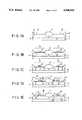
- FIGS. 1A-1Eare a step diagram showing a first embodiment of the inventive method of producing a CMOS transistor device
- FIG. 2is a block diagram showing an impurity doping apparatus
- FIGS 3A-3Care a step diagram showing a variation of the first embodiment
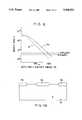
- FIG. 4is a process sequence chart of impurity doping treatment
- FIGS. 5A-5Fare a step diagram showing a second embodiment of the inventive method of producing a CMOS transistor device
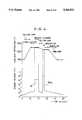
- FIG. 6is a graph showing a depth profile of the impurity density in source and drain regions
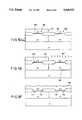
- FIGS. 7A-7Eare a step diagram showing formation of well regions
- FIGS. 8A-8Iare a step diagram showing a third embodiment of the inventive method of producing a CMOS transistor device.
- FIGS. 9A-9Dare a step diagram showing a variation of the third embodiment.
- FIGS. 1A-1Eare a step diagram showing a first embodiment of the inventive method of producing a CMOS transistor device.
- a silicon substrate 1 of P typethere is provided a silicon substrate 1 of P type.
- a pair of an N well region 2 and a P well region 3are formed adjacently to each other on a surface of the silicon substrate 1.
- a field oxide film 4is formed by, for example, selective thermal oxidation on the silicon substrate surface after a given pattern.
- a device region 5is surrounded by the field oxide film 4 and is placed over the N well region 2.
- Another device region 6is also defined over the P well region 3.
- a gate oxide film 7is coated over the device region 5 and another gate oxide film 8 is coated over the other device region 6.
- a gate electrode 9is formed on the gate oxide film 7, and another gate electrode 10 is formed on the other gate oxide film 8.
- These gate electrodes 9 and 10are obtained by depositing a polysilicon film by chemical vapor deposition technology and subsequently by patterning the polysilicon film by photolithography technology and etching technology.
- a part of the gate oxide films 7 and 8is removed through a mask composed of the gate electrodes 9 and 10, and then an uncovered surface of the device regions 5 and 6 is cleaned or activated to expose an active surface of silicon material. Then, a diborane gas containing an impurity component of boron is applied to the substrate 1 to selectively deposit an adsorption film 11 containing the impurity boron on the cleaned active surface of silicon layer in the device regions 5 and 6.
- the diborane gasis firmly and stably adsorbed only on the active face of silicon layer and is not deposited substantially on the field oxide film 4.
- the device region 5is coated by a resist film 12, while the other device region 6 is uncovered.
- N type of impurity arsenicis introduced into the uncovered device region 6 in an amount sufficiently greater than that of boron contained in the impurity film 11 deposited in the FIG. 1C step to form a pair of N + type source region 13 and N + type drain region 14. Consequently, on N channel insulating gate field effect transistor or NMOS is formed in the device region 6.
- the arsenic atomsare doped into the device region 6 by ion implantation through a mask of the gate electrode 10.
- the resist film 12is removed and substrate 1 is subjected to thermal treatment.
- the impurity boronis diffused from the impurity adsorption film 11 into a bulk of the N well region 2 by solid-phase diffusion so as to form P + type source region 15 and P + type drain region 16.
- the amount of impurity boron contained in the adsorption film 11is optimumly set such that boron atoms are limitatively diffused to form the shallow source region 15 and the drain regions 16 having a small junction depth. Consequently, a P channel MIS field effect transistor or PMOS is formed in the device region 5.
- the impurity of arsenic doped into the other device region 6is also concurrently activated by this thermal treatment.
- the inventive production methodis characterized essentially by sequential treatments of surface activation of the silicon layer, adsorption of impurity onto the activated surface, and diffusion of the impurity. These sequential treatments are carried out by an impurity doping apparatus shown in FIG. 2.
- the FIG. 2 apparatusis provided with a vacuum chamber 22 made of quartz for containing centrally therein a silicon substrate 1 formed with a pair of device regions 5 and 6. A temperature of the substrate 1 is held at a given level by controlling a heating system 23 utilizing an infrared lamp heater or resistance heater.
- a high vacuum evacuation system 24comprised of plural pumps including a main pump composed of a turbo molecular pump.
- Vacuum degree inside the chamber 22is measured by a pressure gage 25.
- Transportation of the silicon substrate 1is carried out by utilizing a transportation mechanism 28 from a loading chamber 27 to the chamber 22 which is connected to the loading chamber 27 through a gate valve 26a which is held open during the transportation.
- the loading chamber 27is normally evacuated by another evacuation system 29 while opening a gate valve 26b except during the supply of silicon substrates to the loading chamber 27 and during the transportation of silicon substrates.
- a gas supply source 31is connected to the chamber 22 through a gas flow control system 30.
- the gas supply source 31is provided with a plurality of bottles for storing source gas species needed for the sequential treatments.
- the gas flow control system 30is utilized to control selection of gas species, charging amount and charging time interval of a source gas which is introduced from the gas supply source 31 to the chamber 22.
- the silicon substrate 1is placed in a central portion of the vacuum chamber 22 which is evacuated at less than 1 ⁇ 10 -4 Pa of the background pressure. Then the substrate temperature is set at 850° C. by using the heating system 23, and hydrogen gas is introduced from the gas supply source 31 into the chamber at about 1 ⁇ 10 -2 Pa for a given time interval. By this treatment, an inert film or natural oxide film is removed from the silicon layer of the substrate to expose a chemically active face of silicon. After finishing cleaning of the silicon layer surface, the hydrogen is stopped and the substrate temperature is set to 800° C.
- the active surface of the silicon layeris applied with a source compound gas containing diborane having boron element and being diluted to 5% by nitrogen gas, which is fed from the gas supply source 31.
- the source gasis charged for a given time internal into the chamber 22 at 1 ⁇ 10 -2 Pa of internal chamber pressure, thereby forming an adsorption film containing boron element or boron compound.
- This adsorption filmis firmly fixed to the active surface in quite stable state.
- the adsorption amountis proportional to the charging pressure and charging time interval of the diborane gas. Therefore, these parameters are adequately set to obtain an optimum adsorption amount of boron.
- the substrate 1is annealed to diffuse the boron atoms into the semiconductor layer. Namely, after forming the adsorption film, the diborane gas is stopped and the substrate 1 is heated for a given time interval in vacuum to effect diffusion of the impurity from a diffusion source of the adsorption film into the silicon layer. The diffused impurity atoms of boron are activated simultaneously.
- diborane gasis utilized to form source and drain regions in the silicon layer.
- P type of impurity adsorption filmcan be formed by other gaseous compounds of III-group elements such as trimethyl gallium (TMG) and boron trichloride (BCl 3 ).
- a source gas containing N type of impurity componentmay be utilized to form an adsorption film containing the N type impurity component to effect diffusion of the N type impurity from the adsorption film.
- Such compound gasmay be selected from arsine (AsH 3 ), phosphorus trichloride (PCl 3 ), antimony pentachloride (SbCl 5 ) and phosphine (PH 3 ).
- FIGS. 3A-3Care a step diagram showing a variation of the first embodiment of producing a CMOS transistor device.
- an N type substrate 1is prepared.
- a natural oxide filmis removed from a surface of the substrate 1 to expose an active silicon face.
- a diborane gas containing an impurity component of boronis applied to the substrate 1 to deposit an adsorption film 2 having the impurity boron.
- N type impurity of arsenicis doped by ion implantation into the substrate 1 to form an N type well region 4.
- the resist film 3is removed, and thereafter the substrate 1 is subjected to thermal treatment.
- the impurity boronis diffused from the impurity adsorption film 2 into the bulk of the substrate 1 by solid-phase diffusion to form a P type well region 5.
- a CMOS transistor deviceis formed on a silicon layer in the form of N type well region 4 and P type well region 5 in manner similar to the FIGS. 1A-1E steps.
- FIG. 4is a process sequence chart of the cleaning and adsorption treatments carried out in the FIG. 1C and FIG. 3A steps.
- the horizontal axisindicates a process time and the vertical axis indicates a substrate temperature and a chamber pressure.
- the substrateis held initially at 700° C., since the chamber is held normally at 700° C. so that the substrate temperature is instantly raised to 700° C. after transportation of the substrate into the chamber.
- the chamberis normally evacuated at less than 1 ⁇ 10 -4 Pa of high vacuum degree when a gas is not charged thereinto.
- the background pressure level of 1 ⁇ 10 -4 Pais not critical, but the background pressure may be optimumly set in conjunction with the substrate temperature and the ambient gas species filled in the chamber during the surface cleaning treatment.
- the direct adsorption of the impurity and the diffusion of the impurityare effected to the active surface of the semiconductor layer to form a source region and a drain region so as to reduce a junction depth of these regions, thereby advantageously enabling miniaturization in the device size.
- the new adsorption and diffusion technologyis utilized to form a P channel region to thereby improve the operation speed of CMOS transistor device.
- the P channel transistorhas an operation speed lower than that of the N channel transistor.
- FIGS. 5A-5Fshow a second embodiment of the method of producing a CMOS transistor device with using the new impurity doping technology.
- a P type semiconductor substrate 101is formed with an N well region 102 and a P well region 103. Further, a pair of device regions 105 and 106 are defined on the substrate by a patterned field oxide film 104.
- a gate oxide film 107 and a gate electrode 108are sequentially formed in each device region.
- the gate oxide film 107is partly removed by etching except under the gate electrode 108 to open a window portion which is not covered by the patterned gate electrode 108. Then an adsorption film 109 composed of P type impurity of boron is formed on the window portion.
- the window portionis normally covered by an inert film in the form of a natural oxide film on a silicon layer of the substrate 101 even after removing the gate oxide film 107 by regular etching.
- This natural oxide filmmust be removed to expose an active silicon surface by thermally treating the substrate in vacuum prior to formation of film 109.
- the impurity adsorption treatmentis carried out such that a diborane gas containing an impurity component of boron is applied to the exposed silicon active surface while heating the substrate 101 in vacuum to thereby form the boron adsorption film 109.
- the impurity adsorption film 109is partly removed from the device region 106 on the P well region 103, while the remaining part of the impurity adsorption film 109 is covered by a resist 110 on the other device region 105 over the N well region 102.
- aqueous solution of HF or aqueous solution of mixture of HF and HNO 3is applied to the uncovered device region 106 to etch away the adsorption film by wet etching technology to provide an exposed surface of the P well region 103.
- dry etching technologysuch as reactive ion etching may be effected to remove the impurity adsorption film.
- an N type impurity of arsenic (As)is selectively doped into the P well region 103 by ion implantation.
- the resist 110is removed, and then an inter-layer insulating film 115 is deposited over the substrate.
- reflow treatmentis effected in ambient gas of oxygen to level the inter-layer insulating film 115, and concurrently to effect diffusion of the impurities of boron and arsenic to form a pair of source region 111 and drain region 112 of PMOS and another pair of source region 113 and drain region 114 of NMOS.
- CMOS transistor devicehaving a shallow junction depth of the P type source region 111 and drain region 112.
- FIG. 6is a depth profile of the impurities of boron (B) and arsenic (As) in the CMOS transistor device produced by the FIGS. 5A-5F steps, the depth profile being measured by secondary ion mass spectrometer (SIMC).
- SIMCsecondary ion mass spectrometer
- the source and drain regions of PMOShas about 850 ⁇ of junction depth determined by a crossing point between the boron profile (B) and phosphorus profile (P) of the N well region.
- the source and drain regions of NMOShas about 960 ⁇ of junction depth determined by a crossing point between the arsenic profile (As) and boron profile (B) of P well region.
- the inventive methodcan produce a CMOS transistor device having a shallow junction depth in source and drain regions of PMOS and NMOS.
- FIGS. 7A-7Eshow a variation of the above described second embodiment, to illustrate process of forming well regions.
- a field oxide film 104is formed on a surface of a P type semiconductor substrate 101 to define a pair of device regions and a device separation region.
- an adsorption film 109 of P type impurity of boronis deposited on the pair of device regions by the new impurity doping technology.
- one of the device regionsis covered by a resist film 110, and a part of the adsorption film 109 is removed from the other uncovered device region.
- N type impurity of phosphorus (P)is selectively doped into the other device region, from which the boron adsorption film is removed, by means of ion implantation.
- the resist film 110is removed, and the substrate is annealed to diffuse the impurities of boron and phosphorus limitatively into the device regions to form a P well region 116 and an N well region 117.
- the well regionscan be formed in the substrate in self-alignment manner through a mask of the field oxide film.
- the boron adsorption filmis partly removed from one of the pair of device regions, and then an N type impurity is doped into the one of device regions by ion implantation to thereby facilitate formation of the N type impurity diffusion region.
- FIGS. 8A-8IThis embodiment is directed to the method of producing a specific type of the CMOS transistor device having a pair of device regions provided in a semiconductor layer in the form of a semiconductor thin film deposited on a semiconductor substrate by epitaxial silicon growth technology.
- This film type of the CMOS transistor deviceis advantageous in contrast to the before-described regular type in view of the scale-down merit of the device.
- a P type silicon substrate 201In the FIG. 8A step, there is provided a P type silicon substrate 201. A pair of N well region 202 and P well region 203 are formed adjacently to each other in a surface of the silicon substrate 201. A first field oxide film 204 having a given pattern is formed on the silicon substrate 201 by selective thermal oxidation. An active region 205 bordered by the first field oxide film 204 is defined on the N well region 202, and another active region 206 is also defined on the P well region 203 in similar manner.
- a continuous silicon film 207is deposited over the pair of active regions 205 and 206 and over the first field oxide film 204.
- the deposition of silicon film 207is effected by reduced-pressure epitaxy using a silane gas (SiH 4 ) and a hydrogen gas (H 2 ) while heating the substrate at a temperature in the range from 800° C. to 1000° C.
- the silicon thin film 207has a thickness less than 2000 ⁇ . Namely, in a later step, the new impurity doping technology is utilized controllably to form a shallow profile of the impurity diffusion density in the silicon thin film 207 so that the film thickness of the epitaxially grown silicon can be effectively reduced to a degree comparable to the junction depth.
- the thickness of the silicon filmshould be set more than 2000 ⁇ . According to the invention, the thickness of the silicon film 207 can be effectively reduced to there by advantageously lower a junction capacitance of source and drain regions.
- the silicon film 207is selectively thermally oxidized to form a second field oxide film 208 after a given pattern. Consequently, a part of the silicon film 207, which is not thermally oxidized, remains on the active region 205 and on a periphery of the first field oxide film 204 which surrounds the active region 205. The thus left part of the silicon film 207 defines a device region 209. In similar manner, another device region 210 is defined on the active region 206 and on a bordering periphery of the first field oxide film 208 by a left part of the silicon film 207. The thus obtained part of device regions 209 and 210 are separated from each other by the second field oxide film 208. The device regions 209 and 210 are disposed over the corresponding active regions 205 and 206 to cover them.
- the semiconductor silicon film 207is deposited on the N type of active region 205 in the form of N - type silicon single crystal, while the same silicon film 207 is deposited on the P type of active region 206 in the form of P - type silicon single crystal.
- a wider area of the device regionis formed on a smaller area of the active region, and a transistor device is formed in the wider area of the device region to enable efficient use of the semiconductor surface spacing to thereby improve integration density of the semiconductor devices.
- a gate oxide film 211is coated over the device region 209, and another gate oxide film 213 is coated over the device region 210. These gate oxide films are formed by wet oxidation of the silicon film 207. Subsequently, a gate electrode 212 is provided on the gate oxide film 211, and another gate electrode 214 is provided on the other gate oxide film 213. These gate electrodes 212 and 214 can be formed by depositing a polysilicon film by chemical vapor deposition and by patterning the deposited polysilicon film by photolithography technology and etching technology.
- one device region 209is coated by a resist film 215, while the other device region 210 is left uncovered.
- N type impurity of arsenicis doped into the silicon film 207 to form a pair of N + type source region 216 and N + type drain region 217. Consequently, an N channel MOS transistor is formed in the device region 210.
- Doping of the arsenicis carried out through a mask of the gate electrode 214 so that the impurity of arsenic is implanted into the silicon film 207 through the gate insulating film 213.
- the device region 210 formed with the NMOS transistoris covered by a silicon dioxide film 218, while the resist film 215 is removed from the device region 209.
- the coating of silicon dioxide film 218is carried out by chemical vapor deposition over the entire area of the substrate 201 after removing the resist film 215. Then, the silicon dioxide film 218 is partly removed from the device region 209 by etching. Subsequently, the gate oxide film 211 is removed from the surface of silicon film 207 within the device region 209, and the uncovered surface of silicon film 207 is cleaned to form an exposed active surface of the silicon film 207.
- diborane gas containing impurity component of boronis applied to the substrate 201 so that an adsorption film 219 containing the impurity of boron is selectively deposited only on the active face of the silicon film 207.
- Diborane gasis adsorbed stably and firmly on the active face of the silicon film, and is not deposited on the second field oxide film 208 and on the mask silicon dioxide film 218.
- This adsorption treatmentis effected while heating the substrate 201, hence the mask must be composed of the silicon dioxide film 218 instead of a regular resist film of organic material.
- the substrate 201is subjected to thermal treatment.
- the impurity boronis diffused into the bulk of the silicon film 207 from the impurity adsorption film 219 by solid-phase diffusion so as to form P + type source region 220 and P + type drain region 221.
- Amount of the impurity boron contained in the adsorption film 219is optimumly set so as to enable limitative diffusion of the boron atoms to thereby form the source region 220 and drain region 221 having a small junction capacitance.
- a P channel MOS transistoris formed in the device region 209.
- the impurity of arsenic doped into the device region 210is concurrently activated. Further, the used silicon dioxide film 218 is removed.
- an inter-layer insulating film 301is formed on the substrate 201, and then contact holes are formed through the insulating film 301 by etching.
- a metal film pattern 302is formed over the insulating film 301 to thereby complete a CMOS transistor device.
- FIGS. 9A-9Dshow a step diagram illustrating a variation of the third embodiment.
- a P type substrate 201there is prepared a P type substrate 201.
- a pair of N well region 232 and P well region 233are formed adjacently to each other in a surface of the substrate 201.
- the surface of substrate 201is partly covered with a first field oxide film 234 except a portion on the N well region 232 to define an active region 236 and except another portion on the P well region 233 to define another active region 237.
- the entire area of the N well region 232is coated by a silicon dioxide film 236 by chemical vapor deposition.
- a surface of the active region 237 provided on the P well region 233is cleaned to expose an active silicon face. This cleaning treatment is carried out by removing a natural oxide film.
- diborane gasis introduced while heating the substrate 201 to deposit selectively an impurity film 238 composed of boron only on the active region 237.
- a semiconductor film 239is deposited on the entire area of the substrate 201.
- the semiconductor film 239is formed by reduced-pressure epitaxial growth using a silane gas and a hydrogen gas, at less than 2000 ⁇ of the film thickness.
- the adsorption film 238 having the P type of the impurity boronis interposed between the P well region 233 and the silicon semiconductor film 239 in this variation. This impurity deposition film 238 is provided to form a channel stopper region.
- a P channel MOS transistor 240is formed on the N well region 232, and an N channel MOS transistor 241 is formed on the P well Region 233 in manner similar to the FIG. 8C-FIG. 8H steps.
- the diffusion layer 239 containing a high density of impurity boronis interposed at a boundary between a channel region 242 of the N channel transistor 241 and the P well region 233 in this variation.
- This P + type diffusion layer 238is caused from the adsorption film 238 of the boron impurity deposited in the FIG. 9B step to function as a channel stopper region.
- the channel stopper regionsuppresses expansion of depletion layers positioned at opposite ends of the channel region 242 in the channel direction to avoid punch-through and short channel effect which would cause defects of the device.
Landscapes
- Engineering & Computer Science (AREA)
- Physics & Mathematics (AREA)
- Condensed Matter Physics & Semiconductors (AREA)
- General Physics & Mathematics (AREA)
- Manufacturing & Machinery (AREA)
- Computer Hardware Design (AREA)
- Microelectronics & Electronic Packaging (AREA)
- Power Engineering (AREA)
- Metal-Oxide And Bipolar Metal-Oxide Semiconductor Integrated Circuits (AREA)
Abstract
Description
This is a continuation of application Ser. No. 07/839,689 filed Feb. 24, 1992, and now abandoned, which is itself a continuation of application Ser. No. 07/623,163 filed Dec. 6, 1990, also abandoned.
The present invention relates to the method of producing a complementary Metal Insulator Semiconductor filed effect transistor (hereinafter, referred to as "CMOS transistor").
In the conventional method of producing a CMOS transistor, ion implantation technology is utilized to dope N type impurity and P type impurity into a semiconductor substrate so as to form a pair of N type source and drain regions and another pair of P type source and drain regions.
However, according to the ion implantation technology, since the doped impurities have a depth profile of density in the form of Gaussian distribution, the impurities are distributed broadly in the depth direction. Therefore, the impurity distribution cannot be confined in a relatively shallow portion of the semiconductor material, thereby causing problem that scaling-down of the device cannot easily be performed. Since the source and drain regions formed by the ion implantation have a relatively great junction depth, the CMOS transistor device cannot be operated satisfactorily at submicron channel length.
In view of the above noted drawbacks of the prior art, an object of the present invention is to provide an improved method of producing a CMOS transistor device with using a new impurity doping technology effective to form in a semiconductor layer a source region and a drain region having a relatively small junction depth.
In order to achieve the above noted object, in the invention method of producing a CMOS transistor device, the first step is carried out such that a pair of device regions are formed separately from each other by a field oxide film on a pair of corresponding well regions having opposite conductivity types and being disposed adjacent to each other in a semiconductor substrate. Subsequently in the second step, a gate insulating film and a gate electrode are formed in each of the device regions. Then in the third step, impurities of opposite conductivity types are introduced into the corresponding device regions to form source and drain regions. In this treatment, a new impurity doping technology is applied to at least one of the device regions to form a pair of source and drain regions having a small junction capacitance. This new impurity doping technology may be selectively applied, with priority, to preferable one of the pair of device regions to achieve most efficient effects. Namely in the third step, the gate insulating film is partly removed in the selected one of the device regions so as to effect cleaning treatment to expose an active surface of semiconductor material. Then, a source gas having an impurity component of one conductivity type is applied to the active surface to deposit thereon an adsorption film containing the impurity component of the one conductivity type. In the fourth step, another impurity component of another conductivity type is introduced into the nonselected or remaining device region to form a pair of source and drain regions of said another conductivity type. Lastly, in the fifth step, the solid-phase diffusion of the impurity component is effected from a diffusion source of the adsorption film to form a pair of source and drain regions of said one conductivity type in the selected device region. The formation of source and drain regions of said another conductivity type can be carried out by the conventional ion implantation technology. Otherwise, said another conductivity type impurity component may be introduced by means of the new impurity doping method in manner similar to the third and fifth steps.
For example, a diborane gas containing a P type of impurity boron is applied to the semiconductor active surface in one of the device regions to deposit an adsorption film composed of the P type impurity boron. Then, the solid-phase diffusion of the impurity boron is effected from a diffusion source of the adsorption film to form a pair of source and drain regions of P conductivity type in the semiconductor layer. On the other hand, N type of impurity arsenic is introduced into the other device region by ion implantation to form N conductivity type of source and drain regions.
According to the invention, a source gas containing an impurity component is applied to an active surface of a semiconductor layer to deposit an impurity adsorption film. The impurity adsorption amount can be quite easily adjusted by regulating gas pressure and gas charging time interval. The solid-phase diffusion of impurity component is carried out from a diffusion source composed of the impurity adsorption film into the semiconductor layer to form a pair of source and drain regions. The adsorbed amount of impurity is adjusted so as to form a significantly shallow and confined impurity diffusion region to reduce a junction capacitance of the source and drain regions. This new method is particularly effective to introduce P type of impurity boron. Namely, the P type impurity of boron atom has a mass smaller than that of N type impurity of arsenic atom. Accordingly, when doping the boron atoms by the conventional ion implantation technology, its depth profile of the density would be broad as twice as that of the arsenic atoms. Therefore, it would be difficult to reduce a junction depth of the source and drain regions.
FIGS. 1A-1E are a step diagram showing a first embodiment of the inventive method of producing a CMOS transistor device;
FIG. 2 is a block diagram showing an impurity doping apparatus;
FIGS 3A-3C are a step diagram showing a variation of the first embodiment;
FIG. 4 is a process sequence chart of impurity doping treatment;
FIGS. 5A-5F are a step diagram showing a second embodiment of the inventive method of producing a CMOS transistor device;
FIG. 6 is a graph showing a depth profile of the impurity density in source and drain regions;
FIGS. 7A-7E are a step diagram showing formation of well regions;
FIGS. 8A-8I are a step diagram showing a third embodiment of the inventive method of producing a CMOS transistor device; and
FIGS. 9A-9D are a step diagram showing a variation of the third embodiment.
Hereinafter, various embodiments of the invention will be described in detail with reference to the attached drawings. FIGS. 1A-1E are a step diagram showing a first embodiment of the inventive method of producing a CMOS transistor device. In the FIG. 1A step, there is provided asilicon substrate 1 of P type. A pair of an Nwell region 2 and aP well region 3 are formed adjacently to each other on a surface of thesilicon substrate 1. Afield oxide film 4 is formed by, for example, selective thermal oxidation on the silicon substrate surface after a given pattern. Adevice region 5 is surrounded by thefield oxide film 4 and is placed over the Nwell region 2. Anotherdevice region 6 is also defined over theP well region 3.
In the FIG. 1B step, agate oxide film 7 is coated over thedevice region 5 and anothergate oxide film 8 is coated over theother device region 6. Subsequently, agate electrode 9 is formed on thegate oxide film 7, and anothergate electrode 10 is formed on the othergate oxide film 8. Thesegate electrodes
In the FIG. 1C step, a part of thegate oxide films gate electrodes device regions substrate 1 to selectively deposit anadsorption film 11 containing the impurity boron on the cleaned active surface of silicon layer in thedevice regions field oxide film 4.
In the FIG. 1D step, thedevice region 5 is coated by a resistfilm 12, while theother device region 6 is uncovered. Then, N type of impurity arsenic is introduced into theuncovered device region 6 in an amount sufficiently greater than that of boron contained in theimpurity film 11 deposited in the FIG. 1C step to form a pair of N+type source region 13 and N+type drain region 14. Consequently, on N channel insulating gate field effect transistor or NMOS is formed in thedevice region 6. The arsenic atoms are doped into thedevice region 6 by ion implantation through a mask of thegate electrode 10.
In the FIG. 1E. step, the resistfilm 12 is removed andsubstrate 1 is subjected to thermal treatment. By heating or annealing of the substrate, the impurity boron is diffused from theimpurity adsorption film 11 into a bulk of theN well region 2 by solid-phase diffusion so as to form P+type source region 15 and P+type drain region 16. The amount of impurity boron contained in theadsorption film 11 is optimumly set such that boron atoms are limitatively diffused to form theshallow source region 15 and thedrain regions 16 having a small junction depth. Consequently, a P channel MIS field effect transistor or PMOS is formed in thedevice region 5. The impurity of arsenic doped into theother device region 6 is also concurrently activated by this thermal treatment.
As apparent from the above description, the inventive production method is characterized essentially by sequential treatments of surface activation of the silicon layer, adsorption of impurity onto the activated surface, and diffusion of the impurity. These sequential treatments are carried out by an impurity doping apparatus shown in FIG. 2. The FIG. 2 apparatus is provided with avacuum chamber 22 made of quartz for containing centrally therein asilicon substrate 1 formed with a pair ofdevice regions substrate 1 is held at a given level by controlling aheating system 23 utilizing an infrared lamp heater or resistance heater. Inside of thechamber 22 is evacuated by a highvacuum evacuation system 24 comprised of plural pumps including a main pump composed of a turbo molecular pump. Vacuum degree inside thechamber 22 is measured by apressure gage 25. Transportation of thesilicon substrate 1 is carried out by utilizing atransportation mechanism 28 from aloading chamber 27 to thechamber 22 which is connected to theloading chamber 27 through agate valve 26a which is held open during the transportation. Theloading chamber 27 is normally evacuated by anotherevacuation system 29 while opening agate valve 26b except during the supply of silicon substrates to theloading chamber 27 and during the transportation of silicon substrates. Agas supply source 31 is connected to thechamber 22 through a gasflow control system 30. Thegas supply source 31 is provided with a plurality of bottles for storing source gas species needed for the sequential treatments. The gasflow control system 30 is utilized to control selection of gas species, charging amount and charging time interval of a source gas which is introduced from thegas supply source 31 to thechamber 22.
Next, the detailed description is given for the inventively essential treatments of surface activation of semiconductor layer, adsorption of impurity and diffusion of impurity with reference to FIG. 2. Thesilicon substrate 1 is placed in a central portion of thevacuum chamber 22 which is evacuated at less than 1×10⁻⁴ Pa of the background pressure. Then the substrate temperature is set at 850° C. by using theheating system 23, and hydrogen gas is introduced from thegas supply source 31 into the chamber at about 1×10⁻² Pa for a given time interval. By this treatment, an inert film or natural oxide film is removed from the silicon layer of the substrate to expose a chemically active face of silicon. After finishing cleaning of the silicon layer surface, the hydrogen is stopped and the substrate temperature is set to 800° C. After reaching stably this set temperature, the active surface of the silicon layer is applied with a source compound gas containing diborane having boron element and being diluted to 5% by nitrogen gas, which is fed from thegas supply source 31. The source gas is charged for a given time internal into thechamber 22 at 1×10⁻² Pa of internal chamber pressure, thereby forming an adsorption film containing boron element or boron compound. This adsorption film is firmly fixed to the active surface in quite stable state. The adsorption amount is proportional to the charging pressure and charging time interval of the diborane gas. Therefore, these parameters are adequately set to obtain an optimum adsorption amount of boron. Lastly, thesubstrate 1 is annealed to diffuse the boron atoms into the semiconductor layer. Namely, after forming the adsorption film, the diborane gas is stopped and thesubstrate 1 is heated for a given time interval in vacuum to effect diffusion of the impurity from a diffusion source of the adsorption film into the silicon layer. The diffused impurity atoms of boron are activated simultaneously. In the above described embodiment, diborane gas is utilized to form source and drain regions in the silicon layer. However, P type of impurity adsorption film can be formed by other gaseous compounds of III-group elements such as trimethyl gallium (TMG) and boron trichloride (BCl3). The ion implantation technology is utilized to dope N type of impurity into the silicon semiconductor layer in the above embodiment. However, in similar manner to the formation of P type source and drain regions, a source gas containing N type of impurity component may be utilized to form an adsorption film containing the N type impurity component to effect diffusion of the N type impurity from the adsorption film. Such compound gas may be selected from arsine (AsH3), phosphorus trichloride (PCl3), antimony pentachloride (SbCl5) and phosphine (PH3).
FIGS. 3A-3C are a step diagram showing a variation of the first embodiment of producing a CMOS transistor device. In the FIG. 3A step, anN type substrate 1 is prepared. A natural oxide film is removed from a surface of thesubstrate 1 to expose an active silicon face. Subsequently, a diborane gas containing an impurity component of boron is applied to thesubstrate 1 to deposit anadsorption film 2 having the impurity boron.
In the FIG. 3B step, a part of thesubstrate 1 is covered with a resistfilm 3, and then N type impurity of arsenic is doped by ion implantation into thesubstrate 1 to form an Ntype well region 4.
In the FIG. 3C step, the resistfilm 3 is removed, and thereafter thesubstrate 1 is subjected to thermal treatment. By this heating or annealing, the impurity boron is diffused from theimpurity adsorption film 2 into the bulk of thesubstrate 1 by solid-phase diffusion to form a Ptype well region 5. Thereafter a CMOS transistor device is formed on a silicon layer in the form of Ntype well region 4 and Ptype well region 5 in manner similar to the FIGS. 1A-1E steps.
FIG. 4 is a process sequence chart of the cleaning and adsorption treatments carried out in the FIG. 1C and FIG. 3A steps. In the chart, the horizontal axis indicates a process time and the vertical axis indicates a substrate temperature and a chamber pressure. The substrate is held initially at 700° C., since the chamber is held normally at 700° C. so that the substrate temperature is instantly raised to 700° C. after transportation of the substrate into the chamber. The chamber is normally evacuated at less than 1×10⁻⁴ Pa of high vacuum degree when a gas is not charged thereinto. The background pressure level of 1×10⁻⁴ Pa is not critical, but the background pressure may be optimumly set in conjunction with the substrate temperature and the ambient gas species filled in the chamber during the surface cleaning treatment.
As described above, according to the invention, the direct adsorption of the impurity and the diffusion of the impurity are effected to the active surface of the semiconductor layer to form a source region and a drain region so as to reduce a junction depth of these regions, thereby advantageously enabling miniaturization in the device size. Particularly, the new adsorption and diffusion technology is utilized to form a P channel region to thereby improve the operation speed of CMOS transistor device. Conventionally, the P channel transistor has an operation speed lower than that of the N channel transistor.
Next, FIGS. 5A-5F show a second embodiment of the method of producing a CMOS transistor device with using the new impurity doping technology. In the FIG. 5A step, a Ptype semiconductor substrate 101 is formed with anN well region 102 and aP well region 103. Further, a pair ofdevice regions field oxide film 104.
The in the FIG. 5B step, agate oxide film 107 and agate electrode 108 are sequentially formed in each device region.
In the FIG. 5C step, thegate oxide film 107 is partly removed by etching except under thegate electrode 108 to open a window portion which is not covered by the patternedgate electrode 108. Then anadsorption film 109 composed of P type impurity of boron is formed on the window portion. The window portion is normally covered by an inert film in the form of a natural oxide film on a silicon layer of thesubstrate 101 even after removing thegate oxide film 107 by regular etching. This natural oxide film must be removed to expose an active silicon surface by thermally treating the substrate in vacuum prior to formation offilm 109. The impurity adsorption treatment is carried out such that a diborane gas containing an impurity component of boron is applied to the exposed silicon active surface while heating thesubstrate 101 in vacuum to thereby form theboron adsorption film 109.
In the FIG. 5D step, theimpurity adsorption film 109 is partly removed from thedevice region 106 on theP well region 103, while the remaining part of theimpurity adsorption film 109 is covered by a resist 110 on theother device region 105 over theN well region 102. Namely, after coating theother device region 105 with the resist 110, aqueous solution of HF or aqueous solution of mixture of HF and HNO3 is applied to theuncovered device region 106 to etch away the adsorption film by wet etching technology to provide an exposed surface of theP well region 103. Otherwise, dry etching technology such as reactive ion etching may be effected to remove the impurity adsorption film.
Then in the FIG. 5E step, an N type impurity of arsenic (As) is selectively doped into theP well region 103 by ion implantation.
Lastly, in the FIG. 5F step the resist 110 is removed, and then an inter-layerinsulating film 115 is deposited over the substrate. Thereafter, reflow treatment is effected in ambient gas of oxygen to level the inter-layerinsulating film 115, and concurrently to effect diffusion of the impurities of boron and arsenic to form a pair ofsource region 111 and drainregion 112 of PMOS and another pair ofsource region 113 and drainregion 114 of NMOS. By such treatments, there is produced a CMOS transistor device having a shallow junction depth of the Ptype source region 111 and drainregion 112.
FIG. 6 is a depth profile of the impurities of boron (B) and arsenic (As) in the CMOS transistor device produced by the FIGS. 5A-5F steps, the depth profile being measured by secondary ion mass spectrometer (SIMC). As shown in the profile, the source and drain regions of PMOS has about 850 Å of junction depth determined by a crossing point between the boron profile (B) and phosphorus profile (P) of the N well region. On the other hand, the source and drain regions of NMOS has about 960 Å of junction depth determined by a crossing point between the arsenic profile (As) and boron profile (B) of P well region. Accordingly, the inventive method can produce a CMOS transistor device having a shallow junction depth in source and drain regions of PMOS and NMOS.
FIGS. 7A-7E show a variation of the above described second embodiment, to illustrate process of forming well regions. In the FIG. 7A step, afield oxide film 104 is formed on a surface of a Ptype semiconductor substrate 101 to define a pair of device regions and a device separation region.
In the FIG. 7B step, anadsorption film 109 of P type impurity of boron is deposited on the pair of device regions by the new impurity doping technology.
In the FIG. 7C step, one of the device regions is covered by a resistfilm 110, and a part of theadsorption film 109 is removed from the other uncovered device region.
Then in the FIG. 7D step, N type impurity of phosphorus (P) is selectively doped into the other device region, from which the boron adsorption film is removed, by means of ion implantation.
Lastly in the FIG. 7E step, the resistfilm 110 is removed, and the substrate is annealed to diffuse the impurities of boron and phosphorus limitatively into the device regions to form aP well region 116 and anN well region 117. According to this treatment, the well regions can be formed in the substrate in self-alignment manner through a mask of the field oxide film.
As described above, according to the second embodiment of the invention, the boron adsorption film is partly removed from one of the pair of device regions, and then an N type impurity is doped into the one of device regions by ion implantation to thereby facilitate formation of the N type impurity diffusion region.
Lastly, the third embodiment of the inventive method is described with reference to FIGS. 8A-8I. This embodiment is directed to the method of producing a specific type of the CMOS transistor device having a pair of device regions provided in a semiconductor layer in the form of a semiconductor thin film deposited on a semiconductor substrate by epitaxial silicon growth technology. This film type of the CMOS transistor device is advantageous in contrast to the before-described regular type in view of the scale-down merit of the device.
In the FIG. 8A step, there is provided a Ptype silicon substrate 201. A pair ofN well region 202 andP well region 203 are formed adjacently to each other in a surface of thesilicon substrate 201. A firstfield oxide film 204 having a given pattern is formed on thesilicon substrate 201 by selective thermal oxidation. Anactive region 205 bordered by the firstfield oxide film 204 is defined on theN well region 202, and anotheractive region 206 is also defined on theP well region 203 in similar manner.
In the FIG. 8B step, acontinuous silicon film 207 is deposited over the pair ofactive regions field oxide film 204. The deposition ofsilicon film 207 is effected by reduced-pressure epitaxy using a silane gas (SiH4) and a hydrogen gas (H2) while heating the substrate at a temperature in the range from 800° C. to 1000° C. The siliconthin film 207 has a thickness less than 2000 Å. Namely, in a later step, the new impurity doping technology is utilized controllably to form a shallow profile of the impurity diffusion density in the siliconthin film 207 so that the film thickness of the epitaxially grown silicon can be effectively reduced to a degree comparable to the junction depth. On the other hand, when the impurity doping were carried out by the conventional ion implantation technology, the thickness of the silicon film should be set more than 2000 Å. According to the invention, the thickness of thesilicon film 207 can be effectively reduced to there by advantageously lower a junction capacitance of source and drain regions.
In the FIG. 8C step, thesilicon film 207 is selectively thermally oxidized to form a secondfield oxide film 208 after a given pattern. Consequently, a part of thesilicon film 207, which is not thermally oxidized, remains on theactive region 205 and on a periphery of the firstfield oxide film 204 which surrounds theactive region 205. The thus left part of thesilicon film 207 defines adevice region 209. In similar manner, anotherdevice region 210 is defined on theactive region 206 and on a bordering periphery of the firstfield oxide film 208 by a left part of thesilicon film 207. The thus obtained part ofdevice regions field oxide film 208. Thedevice regions active regions
Thesemiconductor silicon film 207 is deposited on the N type ofactive region 205 in the form of N- type silicon single crystal, while thesame silicon film 207 is deposited on the P type ofactive region 206 in the form of P- type silicon single crystal. As described above, a wider area of the device region is formed on a smaller area of the active region, and a transistor device is formed in the wider area of the device region to enable efficient use of the semiconductor surface spacing to thereby improve integration density of the semiconductor devices.
In the FIG. 8D step, agate oxide film 211 is coated over thedevice region 209, and anothergate oxide film 213 is coated over thedevice region 210. These gate oxide films are formed by wet oxidation of thesilicon film 207. Subsequently, agate electrode 212 is provided on thegate oxide film 211, and anothergate electrode 214 is provided on the othergate oxide film 213. Thesegate electrodes
In the FIG. 8E step onedevice region 209 is coated by a resistfilm 215, while theother device region 210 is left uncovered. In this state, N type impurity of arsenic is doped into thesilicon film 207 to form a pair of N+type source region 216 and N+type drain region 217. Consequently, an N channel MOS transistor is formed in thedevice region 210. Doping of the arsenic is carried out through a mask of thegate electrode 214 so that the impurity of arsenic is implanted into thesilicon film 207 through thegate insulating film 213.
In the FIG. 8F step, thedevice region 210 formed with the NMOS transistor is covered by asilicon dioxide film 218, while the resistfilm 215 is removed from thedevice region 209. The coating ofsilicon dioxide film 218 is carried out by chemical vapor deposition over the entire area of thesubstrate 201 after removing the resistfilm 215. Then, thesilicon dioxide film 218 is partly removed from thedevice region 209 by etching. Subsequently, thegate oxide film 211 is removed from the surface ofsilicon film 207 within thedevice region 209, and the uncovered surface ofsilicon film 207 is cleaned to form an exposed active surface of thesilicon film 207.
In the FIG. 8G step, diborane gas containing impurity component of boron is applied to thesubstrate 201 so that anadsorption film 219 containing the impurity of boron is selectively deposited only on the active face of thesilicon film 207. Diborane gas is adsorbed stably and firmly on the active face of the silicon film, and is not deposited on the secondfield oxide film 208 and on the masksilicon dioxide film 218. This adsorption treatment is effected while heating thesubstrate 201, hence the mask must be composed of thesilicon dioxide film 218 instead of a regular resist film of organic material.
In the FIG. 8H step, thesubstrate 201 is subjected to thermal treatment. By heating or annealing, the impurity boron is diffused into the bulk of thesilicon film 207 from theimpurity adsorption film 219 by solid-phase diffusion so as to form P+type source region 220 and P+type drain region 221. Amount of the impurity boron contained in theadsorption film 219 is optimumly set so as to enable limitative diffusion of the boron atoms to thereby form thesource region 220 and drainregion 221 having a small junction capacitance. Accordingly, a P channel MOS transistor is formed in thedevice region 209. During the course of this annealing treatment, the impurity of arsenic doped into thedevice region 210 is concurrently activated. Further, the usedsilicon dioxide film 218 is removed.
Lastly in the FIG. 8I step, an inter-layerinsulating film 301 is formed on thesubstrate 201, and then contact holes are formed through the insulatingfilm 301 by etching. Ametal film pattern 302 is formed over the insulatingfilm 301 to thereby complete a CMOS transistor device.
Lastly, FIGS. 9A-9D show a step diagram illustrating a variation of the third embodiment. In the FIG. 9A step, there is prepared aP type substrate 201. A pair ofN well region 232 andP well region 233 are formed adjacently to each other in a surface of thesubstrate 201. The surface ofsubstrate 201 is partly covered with a firstfield oxide film 234 except a portion on theN well region 232 to define anactive region 236 and except another portion on theP well region 233 to define anotheractive region 237. Then, the entire area of theN well region 232 is coated by asilicon dioxide film 236 by chemical vapor deposition. On the other hand, a surface of theactive region 237 provided on theP well region 233 is cleaned to expose an active silicon face. This cleaning treatment is carried out by removing a natural oxide film.
In the FIG. 9B step, diborane gas is introduced while heating thesubstrate 201 to deposit selectively animpurity film 238 composed of boron only on theactive region 237.
In the FIG. 9C step, asemiconductor film 239 is deposited on the entire area of thesubstrate 201. Thesemiconductor film 239 is formed by reduced-pressure epitaxial growth using a silane gas and a hydrogen gas, at less than 2000 Å of the film thickness. As apparent from the comparison between FIG. 8B and FIG. 9C, theadsorption film 238 having the P type of the impurity boron is interposed between theP well region 233 and thesilicon semiconductor film 239 in this variation. Thisimpurity deposition film 238 is provided to form a channel stopper region.
Lastly, in the FIG. 9D step, a Pchannel MOS transistor 240 is formed on theN well region 232, and an Nchannel MOS transistor 241 is formed on theP well Region 233 in manner similar to the FIG. 8C-FIG. 8H steps.
As understood from the comparison between FIG. 9D and FIG. 8H, thediffusion layer 239 containing a high density of impurity boron is interposed at a boundary between achannel region 242 of theN channel transistor 241 and theP well region 233 in this variation. This P+type diffusion layer 238 is caused from theadsorption film 238 of the boron impurity deposited in the FIG. 9B step to function as a channel stopper region. Namely, the channel stopper region suppresses expansion of depletion layers positioned at opposite ends of thechannel region 242 in the channel direction to avoid punch-through and short channel effect which would cause defects of the device.
While the description above refers to particular embodiments of the present invention, it will be understood that many modifications may be made without departing from the spirit thereof. The accompanying claims are intended to cover such modifications as would fall within the true scope and spirit of the present invention.
The presently disclosed embodiments are therefore to be considered in all respects as illustrative and not restrictive, the scope of the invention being indicated by the appended claims, rather than the foregoing description, and all changes which come within the meaning and range of equivalency of the claims are therefore intended to be embraced therein.
Claims (3)
1. A method of producing a CMOS transistor device, comprising:
the first step of forming a P type MOS device region and an N type MOS device region adjacent to each other in a surface portion of a semiconductor substrate;
the second step of forming sequentially a gate insulating film and a gate electrode on the gate insulating film on each of the device regions;
the third step of removing the gate insulating film on each of the device regions using the associated gate electrode as a mask, and then exposing an active semiconductor surface on each of the device regions;
the fourth step of applying a gas containing an impurity component of P conductivity type to the exposed active semiconductor surface to form thereon an adsorption film composed of the impurity component of P conductivity type;
the fifth step of forming a resist layer on the P type MOS device region;
the sixth step of removing the adsorption film formed in the fourth step from the N type MOS device region, using the resist layer formed in the fifth step as a mask;
the seventh step of ion implanting an N conductivity type impurity component into the N type MOS device region to form N type MOS device source and drain regions using the resist layer as a mask; and
the eighth step of effecting solid-phase diffusion of the impurity component of P conductivity type from a diffusion source composed of the adsorption film to form source and drain regions of P conductivity type in said P type MOS device region.
2. A method according to claim 1, wherein said fourth step comprises heating the substrate to a temperature at about 800° C. to form the adsorption film on the exposed active semiconductor surface.
3. A method according to claim 1, wherein the fourth step comprises applying a diborane gas containing a P type impurity component of boron to the active semiconductor surface to form an adsorption film containing the P type impurity component of boron.
Priority Applications (1)
| Application Number | Priority Date | Filing Date | Title |
|---|---|---|---|
| US08/155,341US5366922A (en) | 1989-12-06 | 1993-11-22 | Method for producing CMOS transistor |
Applications Claiming Priority (9)
| Application Number | Priority Date | Filing Date | Title |
|---|---|---|---|
| JP1-318552 | 1989-12-06 | ||
| JP1318552AJP2867046B2 (en) | 1989-12-06 | 1989-12-06 | Manufacturing method of complementary insulated gate field effect transistor |
| JP1-318561 | 1989-12-06 | ||
| JP1318561AJP2926419B2 (en) | 1989-12-06 | 1989-12-06 | Method for manufacturing semiconductor device |
| JP1-318559 | 1989-12-06 | ||
| JP1318559AJP2934665B2 (en) | 1989-12-06 | 1989-12-06 | Method for manufacturing semiconductor device |
| US62316390A | 1990-12-06 | 1990-12-06 | |
| US83968992A | 1992-02-24 | 1992-02-24 | |
| US08/155,341US5366922A (en) | 1989-12-06 | 1993-11-22 | Method for producing CMOS transistor |
Related Parent Applications (1)
| Application Number | Title | Priority Date | Filing Date |
|---|---|---|---|
| US83968992AContinuation | 1989-12-06 | 1992-02-24 |
Publications (1)
| Publication Number | Publication Date |
|---|---|
| US5366922Atrue US5366922A (en) | 1994-11-22 |
Family
ID=27531094
Family Applications (1)
| Application Number | Title | Priority Date | Filing Date |
|---|---|---|---|
| US08/155,341Expired - LifetimeUS5366922A (en) | 1989-12-06 | 1993-11-22 | Method for producing CMOS transistor |
Country Status (1)
| Country | Link |
|---|---|
| US (1) | US5366922A (en) |
Cited By (24)
| Publication number | Priority date | Publication date | Assignee | Title |
|---|---|---|---|---|
| US5571912A (en)* | 1990-10-19 | 1996-11-05 | Boehringer Ingelheim Pharmaceuticals, Inc. | Method for the preparation of 5,11-dihydro-6h-dipyrido [3,2-b:2',3'-e][1,4]diazepines |
| US5753530A (en)* | 1992-04-21 | 1998-05-19 | Seiko Instruments, Inc. | Impurity doping method with diffusion source of boron-silicide film |
| US5872047A (en)* | 1996-06-24 | 1999-02-16 | Hyundai Electronics Industries Co., Ltd. | Method for forming shallow junction of a semiconductor device |
| US6323071B1 (en) | 1992-12-04 | 2001-11-27 | Semiconductor Energy Laboratory Co., Ltd. | Method for forming a semiconductor device |
| US6479331B1 (en)* | 1993-06-30 | 2002-11-12 | Semiconductor Energy Laboratory Co., Ltd. | Method of fabricating a semiconductor device |
| US6720627B1 (en)* | 1995-10-04 | 2004-04-13 | Sharp Kabushiki Kaisha | Semiconductor device having junction depths for reducing short channel effect |
| US20110089417A1 (en)* | 2009-10-21 | 2011-04-21 | Semiconductor Energy Laboratory Co., Ltd. | Semiconductor device |
| US20110101339A1 (en)* | 2009-10-30 | 2011-05-05 | Semiconductor Energy Laboratory Co., Ltd. | Semiconductor device |
| US20110156117A1 (en)* | 2009-12-25 | 2011-06-30 | Semiconductor Energy Laboratory Co., Ltd. | Semiconductor device |
| US8207756B2 (en) | 2009-10-30 | 2012-06-26 | Semiconductor Energy Laboratory Co., Ltd. | Logic circuit and semiconductor device |
| US8339828B2 (en) | 2009-11-20 | 2012-12-25 | Semiconductor Energy Laboratory Co., Ltd. | Semiconductor device |
| US8415731B2 (en) | 2010-01-20 | 2013-04-09 | Semiconductor Energy Laboratory Co., Ltd. | Semiconductor storage device with integrated capacitor and having transistor overlapping sections |
| US8467231B2 (en) | 2010-08-06 | 2013-06-18 | Semiconductor Energy Laboratory Co., Ltd. | Semiconductor device and driving method thereof |
| US8471256B2 (en) | 2009-11-27 | 2013-06-25 | Semiconductor Energy Laboratory Co., Ltd. | Semiconductor device and method for manufacturing the same |
| US8488394B2 (en) | 2010-08-06 | 2013-07-16 | Semiconductor Energy Laboratory Co., Ltd. | Semiconductor device |
| US8680520B2 (en) | 2009-11-20 | 2014-03-25 | Semiconductor Energy Laboratory Co., Ltd. | Semiconductor device |
| US8780629B2 (en) | 2010-01-15 | 2014-07-15 | Semiconductor Energy Laboratory Co., Ltd. | Semiconductor device and driving method thereof |
| US8860108B2 (en) | 2009-10-30 | 2014-10-14 | Semiconductor Energy Laboratory Co., Ltd. | Oxide-based thin-film transistor (TFT) semiconductor memory device having source/drain electrode of one transistor connected to gate electrode of the other |
| US9305630B2 (en) | 2013-07-17 | 2016-04-05 | Semiconductor Energy Laboratory Co., Ltd. | Semiconductor device and method for driving the same |
| US9773787B2 (en) | 2015-11-03 | 2017-09-26 | Semiconductor Energy Laboratory Co., Ltd. | Semiconductor device, memory device, electronic device, or method for driving the semiconductor device |
| US9780093B2 (en) | 2010-07-02 | 2017-10-03 | Semiconductor Energy Laboratory Co., Ltd. | Semiconductor device |
| US10217736B2 (en) | 2013-09-23 | 2019-02-26 | Semiconductor Energy Laboratory Co., Ltd. | Semiconductor device including transistor and capacitor |
| US10236287B2 (en) | 2013-09-23 | 2019-03-19 | Semiconductor Energy Laboratory Co., Ltd. | Semiconductor device including semiconductor electrically surrounded by electric field of conductive film |
| US10490553B2 (en) | 2009-10-29 | 2019-11-26 | Semiconductor Energy Laboratory Co., Ltd. | Semiconductor device |
Citations (25)
| Publication number | Priority date | Publication date | Assignee | Title |
|---|---|---|---|---|
| US3506508A (en)* | 1964-02-26 | 1970-04-14 | Siemens Ag | Use of gas etching under vacuum pressure for purifying silicon |
| US4242691A (en)* | 1978-09-18 | 1980-12-30 | Mitsubishi Denki Kabushiki Kaisha | MOS Semiconductor device |
| WO1982001380A1 (en)* | 1980-10-20 | 1982-04-29 | Ncr Co | Process for forming a polysilicon gate integrated circuit device |
| US4381202A (en)* | 1980-03-27 | 1983-04-26 | Fujitsu Limited | Selective epitaxy by beam energy and devices thereon |
| US4395433A (en)* | 1979-11-22 | 1983-07-26 | Tokyo Shibaura Denki Kabushiki Kaisha | Method for manufacturing a semiconductor device having regions of different thermal conductivity |
| US4441932A (en)* | 1981-03-11 | 1984-04-10 | Mitsubishi Denki Kabushiki Kaisha | Process for preparing semiconductor device having active base region implanted therein using walled emitter opening and the edge of dielectric isolation zone |
| US4626450A (en)* | 1984-06-25 | 1986-12-02 | Hitachi, Ltd. | Process for producing semiconductor devices |
| JPS62271475A (en)* | 1987-04-03 | 1987-11-25 | Hitachi Ltd | Semiconductor device |
| US4737471A (en)* | 1985-06-19 | 1988-04-12 | Fujitsu Limited | Method for fabricating an insulated-gate FET having a narrow channel width |
| JPS63166220A (en)* | 1986-12-26 | 1988-07-09 | Toshiba Corp | Manufacturing method of semiconductor device |
| JPS63192266A (en)* | 1987-02-04 | 1988-08-09 | Oki Electric Ind Co Ltd | CMOS integrated circuit and its manufacturing method |
| JPS63239939A (en)* | 1987-03-27 | 1988-10-05 | Toshiba Corp | Method and device for introducing impurities into a semiconductor substrate |
| US4791074A (en)* | 1986-08-29 | 1988-12-13 | Kabushiki Kaisha Toshiba | Method of manufacturing a semiconductor apparatus |
| EP0316165A2 (en)* | 1987-11-11 | 1989-05-17 | Seiko Instruments Inc. | A method of trench isolation |
| EP0322921A2 (en)* | 1987-12-30 | 1989-07-05 | Fujitsu Limited | Method of forming shallow junction and semiconductor device having said shallow junction |
| JPH01192159A (en)* | 1988-01-27 | 1989-08-02 | Mitsubishi Electric Corp | semiconductor equipment |
| US4855258A (en)* | 1987-10-22 | 1989-08-08 | Ncr Corporation | Native oxide reduction for sealing nitride deposition |
| US4861729A (en)* | 1987-08-24 | 1989-08-29 | Matsushita Electric Industrial Co., Ltd. | Method of doping impurities into sidewall of trench by use of plasma source |
| US4879255A (en)* | 1987-06-04 | 1989-11-07 | Fujitsu Limited | Method for fabricating bipolar-MOS devices |
| US4891326A (en)* | 1984-05-16 | 1990-01-02 | Hitachi, Ltd. | Semiconductor device and a process for manufacturing the same |
| US4940505A (en)* | 1988-12-02 | 1990-07-10 | Eaton Corporation | Method for growing single crystalline silicon with intermediate bonding agent and combined thermal and photolytic activation |
| US4966861A (en)* | 1986-10-08 | 1990-10-30 | Fujitsu Limited | Vapor deposition method for simultaneously growing an epitaxial silicon layer and a polycrystalline silicone layer over a selectively oxidized silicon substrate |
| US4968639A (en)* | 1987-12-21 | 1990-11-06 | Sgs-Thomson Microelectronics S.R.L. | Process for manufacturing CMOS integrated devices with reduced gate lengths |
| US4996168A (en)* | 1987-11-07 | 1991-02-26 | Mitsubishi Denki Kabushiki Kaisha | Method for manufacturing P type semiconductor device employing diffusion of boron glass |
| EP0413982A1 (en)* | 1989-07-27 | 1991-02-27 | Junichi Nishizawa | Impurity doping method with adsorbed diffusion source |
- 1993
- 1993-11-22USUS08/155,341patent/US5366922A/ennot_activeExpired - Lifetime
Patent Citations (25)
| Publication number | Priority date | Publication date | Assignee | Title |
|---|---|---|---|---|
| US3506508A (en)* | 1964-02-26 | 1970-04-14 | Siemens Ag | Use of gas etching under vacuum pressure for purifying silicon |
| US4242691A (en)* | 1978-09-18 | 1980-12-30 | Mitsubishi Denki Kabushiki Kaisha | MOS Semiconductor device |
| US4395433A (en)* | 1979-11-22 | 1983-07-26 | Tokyo Shibaura Denki Kabushiki Kaisha | Method for manufacturing a semiconductor device having regions of different thermal conductivity |
| US4381202A (en)* | 1980-03-27 | 1983-04-26 | Fujitsu Limited | Selective epitaxy by beam energy and devices thereon |
| WO1982001380A1 (en)* | 1980-10-20 | 1982-04-29 | Ncr Co | Process for forming a polysilicon gate integrated circuit device |
| US4441932A (en)* | 1981-03-11 | 1984-04-10 | Mitsubishi Denki Kabushiki Kaisha | Process for preparing semiconductor device having active base region implanted therein using walled emitter opening and the edge of dielectric isolation zone |
| US4891326A (en)* | 1984-05-16 | 1990-01-02 | Hitachi, Ltd. | Semiconductor device and a process for manufacturing the same |
| US4626450A (en)* | 1984-06-25 | 1986-12-02 | Hitachi, Ltd. | Process for producing semiconductor devices |
| US4737471A (en)* | 1985-06-19 | 1988-04-12 | Fujitsu Limited | Method for fabricating an insulated-gate FET having a narrow channel width |
| US4791074A (en)* | 1986-08-29 | 1988-12-13 | Kabushiki Kaisha Toshiba | Method of manufacturing a semiconductor apparatus |
| US4966861A (en)* | 1986-10-08 | 1990-10-30 | Fujitsu Limited | Vapor deposition method for simultaneously growing an epitaxial silicon layer and a polycrystalline silicone layer over a selectively oxidized silicon substrate |
| JPS63166220A (en)* | 1986-12-26 | 1988-07-09 | Toshiba Corp | Manufacturing method of semiconductor device |
| JPS63192266A (en)* | 1987-02-04 | 1988-08-09 | Oki Electric Ind Co Ltd | CMOS integrated circuit and its manufacturing method |
| JPS63239939A (en)* | 1987-03-27 | 1988-10-05 | Toshiba Corp | Method and device for introducing impurities into a semiconductor substrate |
| JPS62271475A (en)* | 1987-04-03 | 1987-11-25 | Hitachi Ltd | Semiconductor device |
| US4879255A (en)* | 1987-06-04 | 1989-11-07 | Fujitsu Limited | Method for fabricating bipolar-MOS devices |
| US4861729A (en)* | 1987-08-24 | 1989-08-29 | Matsushita Electric Industrial Co., Ltd. | Method of doping impurities into sidewall of trench by use of plasma source |
| US4855258A (en)* | 1987-10-22 | 1989-08-08 | Ncr Corporation | Native oxide reduction for sealing nitride deposition |
| US4996168A (en)* | 1987-11-07 | 1991-02-26 | Mitsubishi Denki Kabushiki Kaisha | Method for manufacturing P type semiconductor device employing diffusion of boron glass |
| EP0316165A2 (en)* | 1987-11-11 | 1989-05-17 | Seiko Instruments Inc. | A method of trench isolation |
| US4968639A (en)* | 1987-12-21 | 1990-11-06 | Sgs-Thomson Microelectronics S.R.L. | Process for manufacturing CMOS integrated devices with reduced gate lengths |
| EP0322921A2 (en)* | 1987-12-30 | 1989-07-05 | Fujitsu Limited | Method of forming shallow junction and semiconductor device having said shallow junction |
| JPH01192159A (en)* | 1988-01-27 | 1989-08-02 | Mitsubishi Electric Corp | semiconductor equipment |
| US4940505A (en)* | 1988-12-02 | 1990-07-10 | Eaton Corporation | Method for growing single crystalline silicon with intermediate bonding agent and combined thermal and photolytic activation |
| EP0413982A1 (en)* | 1989-07-27 | 1991-02-27 | Junichi Nishizawa | Impurity doping method with adsorbed diffusion source |
Non-Patent Citations (8)
| Title |
|---|
| "Metal-Oxide-Silicon Field-Effect Transistor Made by Means of Solid-Phase Doping", by Gong et al.; J. Appl. Phys. 65 (11), 1 Jun. 1989. |
| "Ultrashallow, high doping of boron using molecular layer doping", by Nishizawa; Applied Physics Letters; 5b(1990) 2 Apr., No. 14, |
| Leung, D. L., et al., "CMOS Devices Fabricated in Thin Epitaxial Silicon on Oxide", 1989 IEEE SOS/SOI Technology conference, Oct., 1989, pp. 74-75. |
| Leung, D. L., et al., CMOS Devices Fabricated in Thin Epitaxial Silicon on Oxide , 1989 IEEE SOS/SOI Technology conference, Oct., 1989, pp. 74 75.* |
| Metal Oxide Silicon Field Effect Transistor Made by Means of Solid Phase Doping , by Gong et al.; J. Appl. Phys. 65 (11), 1 Jun. 1989.* |
| Simple structured PMOSFET Fabricated Using Molecular Layer Doping; Nishizawa et al.; Electron Device Letters No. 3, 11 (1990) Mar., pp. 105 106.* |
| Simple-structured PMOSFET Fabricated Using Molecular Layer Doping; Nishizawa et al.; Electron Device Letters No. 3, 11 (1990) Mar., pp. 105-106. |
| Ultrashallow, high doping of boron using molecular layer doping , by Nishizawa; Applied Physics Letters; 5b(1990) 2 Apr., No. 14,* |
Cited By (65)
| Publication number | Priority date | Publication date | Assignee | Title |
|---|---|---|---|---|
| US5571912A (en)* | 1990-10-19 | 1996-11-05 | Boehringer Ingelheim Pharmaceuticals, Inc. | Method for the preparation of 5,11-dihydro-6h-dipyrido [3,2-b:2',3'-e][1,4]diazepines |
| US5753530A (en)* | 1992-04-21 | 1998-05-19 | Seiko Instruments, Inc. | Impurity doping method with diffusion source of boron-silicide film |
| US6806125B2 (en) | 1992-12-04 | 2004-10-19 | Semiconductor Energy Laboratory Co., Ltd. | Method of manufacturing a thin film transistor device |
| US7622335B2 (en) | 1992-12-04 | 2009-11-24 | Semiconductor Energy Laboratory Co., Ltd. | Method for manufacturing a thin film transistor device |
| US6338991B1 (en) | 1992-12-04 | 2002-01-15 | Semiconductor Energy Laboratory Co., Ltd. | Semiconductor device and method for manufacturing the same |
| US8062935B2 (en) | 1992-12-04 | 2011-11-22 | Semiconductor Energy Laboratory Co., Ltd. | Semiconductor device and method for manufacturing the same |
| US20030036222A1 (en)* | 1992-12-04 | 2003-02-20 | Semiconductor Energy Laboratory Co., Ltd. | Semiconductor device and method of fabricating the same |
| US6323071B1 (en) | 1992-12-04 | 2001-11-27 | Semiconductor Energy Laboratory Co., Ltd. | Method for forming a semiconductor device |
| US8278660B2 (en) | 1992-12-04 | 2012-10-02 | Semiconductor Energy Laboratory Co., Ltd. | Semiconductor device and method for manufacturing the same |
| US6872605B2 (en) | 1992-12-04 | 2005-03-29 | Semiconductor Energy Laboratory Co., Ltd. | Semiconductor device and method of fabricating the same |
| US7238558B2 (en) | 1993-06-30 | 2007-07-03 | Semiconductor Energy Laboratory Co., Ltd. | Semiconductor device and method of fabricating the same |
| US6479331B1 (en)* | 1993-06-30 | 2002-11-12 | Semiconductor Energy Laboratory Co., Ltd. | Method of fabricating a semiconductor device |
| US20050045962A1 (en)* | 1995-10-04 | 2005-03-03 | Sharp Kabushiki Kaisha | Semiconductor device having junction depths for reducing short channel effect |
| US6720627B1 (en)* | 1995-10-04 | 2004-04-13 | Sharp Kabushiki Kaisha | Semiconductor device having junction depths for reducing short channel effect |
| US5872047A (en)* | 1996-06-24 | 1999-02-16 | Hyundai Electronics Industries Co., Ltd. | Method for forming shallow junction of a semiconductor device |
| US20110089417A1 (en)* | 2009-10-21 | 2011-04-21 | Semiconductor Energy Laboratory Co., Ltd. | Semiconductor device |
| US10490553B2 (en) | 2009-10-29 | 2019-11-26 | Semiconductor Energy Laboratory Co., Ltd. | Semiconductor device |
| US8896042B2 (en) | 2009-10-30 | 2014-11-25 | Semiconductor Energy Laboratory Co., Ltd. | Semiconductor device comprising oxide semiconductor |
| US9105511B2 (en) | 2009-10-30 | 2015-08-11 | Semiconductor Energy Laboratory Co., Ltd. | Semiconductor device comprising oxide semiconductor |
| US12211534B2 (en) | 2009-10-30 | 2025-01-28 | Semiconductor Energy Laboratory Co., Ltd. | Semiconductor device |
| US12205622B2 (en) | 2009-10-30 | 2025-01-21 | Semiconductor Energy Laboratory Co., Ltd. | Semiconductor device |
| US11963374B2 (en) | 2009-10-30 | 2024-04-16 | Semiconductor Energy Laboratory Co., Ltd. | Semiconductor device |
| US11322498B2 (en) | 2009-10-30 | 2022-05-03 | Semiconductor Energy Laboratory Co., Ltd. | Semiconductor device |
| US10811417B2 (en) | 2009-10-30 | 2020-10-20 | Semiconductor Energy Laboratory Co., Ltd. | Semiconductor device |
| US10510757B2 (en) | 2009-10-30 | 2019-12-17 | Semiconductor Energy Laboratory Co., Ltd. | Semiconductor device including storage element |
| US8570070B2 (en) | 2009-10-30 | 2013-10-29 | Semiconductor Energy Laboratory Co., Ltd. | Logic circuit and semiconductor device |
| US20110101339A1 (en)* | 2009-10-30 | 2011-05-05 | Semiconductor Energy Laboratory Co., Ltd. | Semiconductor device |
| US9722086B2 (en) | 2009-10-30 | 2017-08-01 | Semiconductor Energy Laboratory Co., Ltd. | Logic circuit and semiconductor device |
| US9685447B2 (en) | 2009-10-30 | 2017-06-20 | Semiconductor Energy Laboratory Co., Ltd. | Semiconductor device comprising transistor including oxide semiconductor |
| US8207756B2 (en) | 2009-10-30 | 2012-06-26 | Semiconductor Energy Laboratory Co., Ltd. | Logic circuit and semiconductor device |
| US9373640B2 (en) | 2009-10-30 | 2016-06-21 | Semiconductor Energy Laboratory Co., Ltd. | Semiconductor device |
| US8860108B2 (en) | 2009-10-30 | 2014-10-14 | Semiconductor Energy Laboratory Co., Ltd. | Oxide-based thin-film transistor (TFT) semiconductor memory device having source/drain electrode of one transistor connected to gate electrode of the other |
| US8804396B2 (en) | 2009-11-20 | 2014-08-12 | Semiconductor Energy Laboratory Co., Ltd. | Semiconductor device |
| US9705005B2 (en) | 2009-11-20 | 2017-07-11 | Semiconductor Energy Laboratory Co., Ltd. | Semiconductor device |
| US8339828B2 (en) | 2009-11-20 | 2012-12-25 | Semiconductor Energy Laboratory Co., Ltd. | Semiconductor device |
| US8619454B2 (en) | 2009-11-20 | 2013-12-31 | Semiconductor Energy Laboratory Co., Ltd. | Semiconductor device |
| US9135958B2 (en) | 2009-11-20 | 2015-09-15 | Semiconductor Energy Laboratory Co., Ltd. | Semiconductor device |
| US8680520B2 (en) | 2009-11-20 | 2014-03-25 | Semiconductor Energy Laboratory Co., Ltd. | Semiconductor device |
| US11894486B2 (en) | 2009-11-27 | 2024-02-06 | Semiconductor Energy Laboratory Co., Ltd. | Method for manufacturing semiconductor device |
| US20190109259A1 (en) | 2009-11-27 | 2019-04-11 | Semiconductor Energy Laboratory Co., Ltd. | Semiconductor device and method for manufacturing the same |
| US12396292B2 (en) | 2009-11-27 | 2025-08-19 | Semiconductor Energy Laboratory Co., Ltd. | Semiconductor device comprising first and second conductive layers |
| US8471256B2 (en) | 2009-11-27 | 2013-06-25 | Semiconductor Energy Laboratory Co., Ltd. | Semiconductor device and method for manufacturing the same |
| US9748436B2 (en) | 2009-11-27 | 2017-08-29 | Semiconductor Energy Laboratory Co., Ltd. | Semiconductor device and method for manufacturing the same |
| US10396236B2 (en) | 2009-11-27 | 2019-08-27 | Semiconductor Energy Laboratory Co., Ltd. | Semiconductor device and display device |
| US9054201B2 (en) | 2009-12-25 | 2015-06-09 | Semiconductor Energy Laboratory Co., Ltd. | Semiconductor device |
| US8482001B2 (en) | 2009-12-25 | 2013-07-09 | Semiconductor Energy Laboratory Co., Ltd. | Semiconductor device |
| US12426373B2 (en) | 2009-12-25 | 2025-09-23 | Semiconductor Energy Laboratory Co., Ltd. | Semiconductor device |
| US12426374B2 (en) | 2009-12-25 | 2025-09-23 | Semiconductor Energy Laboratory Co., Ltd. | Semiconductor device |
| US20110156117A1 (en)* | 2009-12-25 | 2011-06-30 | Semiconductor Energy Laboratory Co., Ltd. | Semiconductor device |
| US11676975B2 (en) | 2009-12-25 | 2023-06-13 | Semiconductor Energy Laboratory Co., Ltd. | Semiconductor device |
| US10083996B2 (en) | 2009-12-25 | 2018-09-25 | Semiconductor Energy Laboratory Co., Ltd. | Semiconductor device |
| US8780629B2 (en) | 2010-01-15 | 2014-07-15 | Semiconductor Energy Laboratory Co., Ltd. | Semiconductor device and driving method thereof |
| US9136280B2 (en) | 2010-01-15 | 2015-09-15 | Semiconductor Energy Laboratory Co., Ltd. | Semiconductor device and driving method thereof |
| US8415731B2 (en) | 2010-01-20 | 2013-04-09 | Semiconductor Energy Laboratory Co., Ltd. | Semiconductor storage device with integrated capacitor and having transistor overlapping sections |
| US11233055B2 (en) | 2010-07-02 | 2022-01-25 | Semiconductor Energy Laboratory Co., Ltd. | Semiconductor device |
| US10319723B2 (en) | 2010-07-02 | 2019-06-11 | Semiconductor Energy Laboratory Co., Ltd. | Semiconductor device |
| US9780093B2 (en) | 2010-07-02 | 2017-10-03 | Semiconductor Energy Laboratory Co., Ltd. | Semiconductor device |
| US12160999B2 (en) | 2010-07-02 | 2024-12-03 | Semiconductor Energy Laboratory Co., Ltd. | Semiconductor device |
| US8488394B2 (en) | 2010-08-06 | 2013-07-16 | Semiconductor Energy Laboratory Co., Ltd. | Semiconductor device |
| US8837232B2 (en) | 2010-08-06 | 2014-09-16 | Semiconductor Energy Laboratory Co., Ltd. | Semiconductor device |
| US8467231B2 (en) | 2010-08-06 | 2013-06-18 | Semiconductor Energy Laboratory Co., Ltd. | Semiconductor device and driving method thereof |
| US9305630B2 (en) | 2013-07-17 | 2016-04-05 | Semiconductor Energy Laboratory Co., Ltd. | Semiconductor device and method for driving the same |
| US10236287B2 (en) | 2013-09-23 | 2019-03-19 | Semiconductor Energy Laboratory Co., Ltd. | Semiconductor device including semiconductor electrically surrounded by electric field of conductive film |
| US10217736B2 (en) | 2013-09-23 | 2019-02-26 | Semiconductor Energy Laboratory Co., Ltd. | Semiconductor device including transistor and capacitor |
| US9773787B2 (en) | 2015-11-03 | 2017-09-26 | Semiconductor Energy Laboratory Co., Ltd. | Semiconductor device, memory device, electronic device, or method for driving the semiconductor device |
Similar Documents
| Publication | Publication Date | Title |
|---|---|---|
| US5366922A (en) | Method for producing CMOS transistor | |
| US5925574A (en) | Method of producing a bipolar transistor | |
| US6391749B1 (en) | Selective epitaxial growth method in semiconductor device | |
| US5338697A (en) | Doping method of barrier region in semiconductor device | |
| US4966861A (en) | Vapor deposition method for simultaneously growing an epitaxial silicon layer and a polycrystalline silicone layer over a selectively oxidized silicon substrate | |
| US6376318B1 (en) | Method of manufacturing a semiconductor device | |
| US6645835B1 (en) | Semiconductor film forming method and manufacturing method for semiconductor devices thereof | |
| US6649543B1 (en) | Methods of forming silicon nitride, methods of forming transistor devices, and transistor devices | |
| JP3079575B2 (en) | Method for manufacturing semiconductor device | |
| US5256162A (en) | Apparatus for forming shallow electrical junctions | |
| JP2599556B2 (en) | Method for manufacturing semiconductor device having highly doped region | |
| EP0430168A2 (en) | Doping method of impurity into semiconductor trench wall | |
| US5650347A (en) | Method of manufacturing a lightly doped drain MOS transistor | |
| US5874352A (en) | Method of producing MIS transistors having a gate electrode of matched conductivity type | |
| JP3116163B2 (en) | Method of manufacturing insulated gate field effect transistor | |
| EP0431616A2 (en) | Method of producing CMOS transistor | |
| GB2121235A (en) | Method for manufacturing an insulated gate field effect transistor device | |
| JP2867046B2 (en) | Manufacturing method of complementary insulated gate field effect transistor | |
| JP3263058B2 (en) | Method of implanting impurities into semiconductor inner wall | |
| EP0430166A2 (en) | Method of doping impurity into semiconductor films and patterned semiconductor strip | |
| JP3023481B2 (en) | Method of implanting impurities into semiconductor film | |
| JP2934665B2 (en) | Method for manufacturing semiconductor device | |
| JP2926344B2 (en) | Method for manufacturing field effect transistor | |
| JP2926419B2 (en) | Method for manufacturing semiconductor device | |
| JP2876414B2 (en) | Manufacturing method of diffusion resistance element |
Legal Events
| Date | Code | Title | Description |
|---|---|---|---|
| AS | Assignment | Owner name:SEIKO INSTRUMENTS INC., JAPAN Free format text:ASSIGNMENT OF ASSIGNORS INTEREST;ASSIGNORS:AOKI, KENJI;SAITO, NAOTO;REEL/FRAME:007094/0992 Effective date:19940613 | |
| STCF | Information on status: patent grant | Free format text:PATENTED CASE | |
| FPAY | Fee payment | Year of fee payment:4 | |
| FPAY | Fee payment | Year of fee payment:8 | |
| FPAY | Fee payment | Year of fee payment:12 |