US5353671A - Upright piano with key action mechanism responsive to repetition without double strike and loss of sound - Google Patents
Upright piano with key action mechanism responsive to repetition without double strike and loss of soundDownload PDFInfo
- Publication number
- US5353671A US5353671AUS08/111,289US11128993AUS5353671AUS 5353671 AUS5353671 AUS 5353671AUS 11128993 AUS11128993 AUS 11128993AUS 5353671 AUS5353671 AUS 5353671A
- Authority
- US
- United States
- Prior art keywords
- butt
- jack
- repetition lever
- repetition
- key
- Prior art date
- Legal status (The legal status is an assumption and is not a legal conclusion. Google has not performed a legal analysis and makes no representation as to the accuracy of the status listed.)
- Expired - Fee Related
Links
Images


Classifications
- G—PHYSICS
- G10—MUSICAL INSTRUMENTS; ACOUSTICS
- G10C—PIANOS, HARPSICHORDS, SPINETS OR SIMILAR STRINGED MUSICAL INSTRUMENTS WITH ONE OR MORE KEYBOARDS
- G10C3/00—Details or accessories
- G10C3/12—Keyboards; Keys
- G—PHYSICS
- G10—MUSICAL INSTRUMENTS; ACOUSTICS
- G10C—PIANOS, HARPSICHORDS, SPINETS OR SIMILAR STRINGED MUSICAL INSTRUMENTS WITH ONE OR MORE KEYBOARDS
- G10C3/00—Details or accessories
- G10C3/16—Actions
- G10C3/24—Repetition [tremolo] mechanisms
Definitions
- This inventionrelates to an upright piano and, more particularly, to a key action mechanism incorporated in the upright piano.
- a typical example of the key action mechanismis disclosed in Japanese Utility Model Application laid-open (Kokai) No. 57-30791, and the prior art key action mechanism disclosed therein aims at improvement of response characteristics to a repetition or a quick fingering such as tremolo.
- the prior art key action mechanismis provided in association with a key and with a hammer assembly for striking a string, and a capstan button is upright at the rear end portion of the key.
- the prior art key action mechanismcomprises a whippen assembly swingably supported by a stationary action rail and upwardly pushed by the capstan button, a jack swingably supported on the whippen assembly, a compression coil spring inserted between the whippen assembly and the toe of the jack, a butt rotatably supported by the stationary action rail and connected with the hammer assembly, a regulating button for defining a release of the jack, a catcher backwardly projecting from the butt, a back check projecting from the whippen assembly and opposed to the catcher, and a spring wire backwardly projecting from the butt.
- the buttis urged by a butt spring in a direction to space from the associated strings.
- the compression coil springallows the jack to stay to the initial position under the butt, and the toe of the jack is spaced apart from the regulating button, and the back check is also spaced apart from the catcher.
- the capstan buttonWhen a player depresses the key, the capstan button upwardly depresses the whippen assembly, and the whippen assembly is driven for rotation.
- the jackAs the jack is swingably supported on the whippen assembly, the jack pushes the butt with the rotation of the whippen assembly, and drives the butt and, accordingly, the hammer assembly for rotation toward the string.
- the jackstarts rotating to release from the butt, and kicks the butt.
- the hammer assemblyrushes toward the string, and strikes the string for producing a piano sound.
- the hammer assemblyrebounds from the string, and backwardly rotates.
- the butt springsupplements the rotation of the hammer assembly.
- the catchermoves closer to the back check, and the spring wire is brought into contact with the top surface of the back check before the catcher is brought into contact with the back check.
- the spring wireis deformed, and the deformation causes the elastic force to urge the butt in the direction to the string.
- the catcheris brought into contact with the back check.
- the butt and, accordingly, the hammer assemblyslightly advance toward the string.
- the elastic force caused by the spring wireslightly lifts the butt, and the butt thus lifted allows the jack to easily move thereunder. This means that the key action mechanism gets ready for response to the next key depressing, and the spring wire improves the response characteristics to the quick fingering.
- the prior art key action mechanismthus arranged encounters various problems.
- Another problemis the loss of a sound.
- the spring wireBefore the jack is released from the butt, the spring wire must be brought into contact with the top surface of the back check, so that the jack can return under the butt when the catcher is released from the back check due to the key slightly lifted. And elastic force caused by the spring wire is expected to be larger than that of the butt spring so as to slightly lift the butt.
- the back checkWhen the player depresses the key slowly, the back check is upwardly moved together with the whippen assembly, and pushes the spring wire upwardly after the jack is released from the butt, and, accordingly, the spring wire urges the butt toward the string.
- the elastic force of the spring wirecauses the butt and, accordingly, the hammer assembly to rotate forcibly toward the string, and presses the hammer against the string. No vibration takes place on the string, and the expected sound is lost due to the hammer assembly pressed against the string.
- the present inventionproposes to produce a gap between a leading end of the repetition lever and a back check by a rotation of the repetition lever due to an escape of a jack so that a hammer assembly can slightly rotate backwardly after the striking even if a key is depressed slowly, when the jack is escaped from the butt and before the butt rotates backwardly.
- an upright pianocomprising: a) a keyboard having at least one key swingable between a rest position without any force and an end position, a capstan button projecting from a rear end portion of the at least one key; b) at least one string associated with the at least one key; c) at least one hammer assembly for striking the at least one string; d) a key action mechanism linked with the at least one key for driving the at least one hammer assembly, and having d-1) a whippen assembly pivotaly supported by a stationary structure, and rotated by the capstan button between a first initial position corresponding to the rest position and a first terminal position corresponding to the end position through a first intermediate position, d-2) a jack pivotaly supported by the whippen assembly, and moved from a second initial position to a restricted position without any pivotal motion when the whippen assembly is swung from the first initial position to the first intermediate position, the jack being rotated around the whippen assembly from the restricted position through
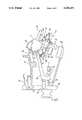
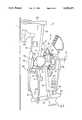
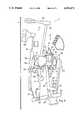
- FIG. 1is a side view showing essential parts of an upright piano according to the present invention while the key is staying in a rest position;
- FIG. 2is a partially cut-away side view showing, in an enlarged scale, a key action mechanism accompanied with a repetition mechanism shown in FIG. 1;
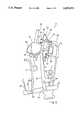
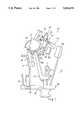
- FIG. 3is a side view showing the key action mechanism and the repetition mechanism when the jack is escaped from the butt;
- FIG. 4is a side view showing the essential parts of the upright piano when the key action mechanism enters a back-checked state
- FIG. 5is a side view showing, in an enlarged scale, the key action mechanism and the repetition mechanism in the back-checked state;
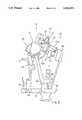
- FIG. 6is a side view showing the key action mechanism and the repetition mechanism in the suspended state after the key is softly depressed
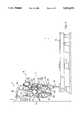
- FIG. 7is a side view showing a repetition mechanism incorporated in another upright piano according to the present invention.
- FIG. 8is a side view showing a repetition mechanism incorporated in yet another upright piano according to the present invention.
- FIG. 9is a side view showing a repetition mechanism incorporated in still another upright piano according to the present invention.
- an upright piano embodying the present inventioncomprises a keyboard 1 having a plurality of black and white keys 1a, a balance rail 1b mounted on a key bed 1c and turnably supporting the black and white keys 1 a with respect to balance pins, and a capstan button 1d projecting from a rear end portion of each key 1a.
- Notesare assigned to the keys 1a, and a player instructs the upright piano to produce a sound with a note by depressing one of the keys 1a.
- the upright pianofurther comprises a plurality of key action mechanisms 2 each associated with one of the black and white keys 1a, a plurality of hammer assemblies 3 respectively associated with the key action mechanisms 2 and each connected with the associated key action mechanism 2, strings 4 vertically stretched and respectively associated with the keys 1a and, accordingly, the hammer assemblies 3 and a plurality of damper assemblies 5 respectively associated with the strings 4.
- FIG. 1illustrates only one of the keys 1a and the associated key action mechanism 2, hammer assembly 3, string 4 and damper assembly 5, and description is focused on the one set of key, key action mechanism, hammer assembly, the string and damper assembly.
- terms “clockwise”, “counter clockwise”, “right” and “left”are determined on the paper where a related figure is drawn.
- the key action mechanism 2comprises a whippen/whippen heel assembly 2a held in contact with the pair of capstan buttons 1d, a whippen flange 2b connected with a center rail 6 and swingably supporting the whippen/whippen heel assembly 2a, a jack flange 2c fixed to the whippen/whippen heel assembly 2a on the right side of the whippen flange 2b, a jack 2d rotatably supported by the jack flange 2c, a jack spring 2e urging the jack 2d in the counter clockwise direction, a damper spoon 2f projecting from the whippen/whippen heel assembly 2a on the left side of the whippen flange 2b, and a back check 2g projecting from the whippen/whippen heel assembly 2a on the right side of the jack flange 2c.
- the back checkis fabricated from a back check wire projecting from the whippen/whippen heel assembly 2a, a back check block fixed to the upper end of the back check wire and a back check felt bonded to the back check block as similar to that of an ordinary acoustic piano.
- the key action mechanism 2further comprises a butt flange 2h fixed to the center rail 6, a butt 2i rotatably supported by the butt flange 2h, a butt skin 2j bonded to the lower surface of the right side portion of the butt 2i, a butt spring 2k urging the butt 2i in the clockwise direction, and a regulating button 2m downwardly projecting from a regulating rail 7 in opposing relation to a toe of the jack 2d.
- the hammer assembly 3projects from the upper end of the butt 2i, and is rotatable together with the butt 2i.
- the jack 2dis held in contact with the butt skin 2j, and the toe of the jack 2d is spaced apart from a regulating button 2m.
- the regulating button 2mhas a leather sheet where the toe of the jack 2d is brought into contact.
- the jack 2dpushes the butt 2i for rotating in the counter clockwise direction, and the toe of the jack 2d is getting closer to the regulating button 2m.
- the jack 2dstarts to rotate in the clockwise direction, and the jack 2d is escaped from the butt skin 2j and kicks the butt 2i so that the hammer assembly 3 rushes toward the string 4.
- the key action mechanism 2further comprises a catcher 2n projecting from the right side surface of the butt 2i, and a catcher skin 2o bonded to the right side surface of the catcher 2n and opposed to the back check 2g. While the key 1a is staying in the rest position, the catcher skin 2o is spaced apart from the back check 2g. However, after the hammer assembly 3 strikes the string 4, the hammer assembly rebounds on the string 4, and the butt 2i rotates in the clockwise direction. The butt spring 2k urges the butt 2i, and the catcher 2n and the catcher skin 2o are moved toward the back check 2g. The catcher skin 2o is brought into contact with the back check 2g, and the back check 2g sets a limit on the rotation of the butt 2i.
- the key action mechanism 2thus arranged is accompanied with a repetition mechanism 8, and the repetition mechanism 8 comprises a flange 2p fixed to the butt 2i, a repetition lever 2q supported by the flange 2p and rotatable with respect to a pin 2r supported by the flange 2p, a cord 2s projecting from the upper surface of the flange 2p, a spring 2t coupled between the cord 2s and the repetition lever 2q for urging the repetition lever 2q in the clockwise direction, a regulating screw 2u screwed into the repetition lever 2q on the left side of the flange 2p and opposed to a butt cloth 2v bonded to the butt 2i, a rod member 2w snugly received in a hole formed in the repetition lever 2q on the right side of the flange 2p, a block member 2x fixed to the rod member 2w, and a regulating screw 2y screwed into the block member 2x and held in contact with a jack cloth 2z bonded to the jack 2d.
- the regulating screw 2yis screwed into or out of the block member 2x, and changes the distance between the jack cloth 2z and the block member 2x. In other words, the regulating screw 2y changes the initial angle of the repetition lever 2q. If the screw 2y increases the distance, the rod member 2w pushes the repetition lever 2q, and causes the repetition lever 2q to rotate around the pin 2r in the counter clockwise direction. On the other hand, if the screw 2y is screwed into the block member 2x, the distance is decreased, and the repetition lever 2q rotates in the clockwise direction.
- the regulating screw 2ydetermines the initial angular position of the repetition lever 2q, and, therefore, regulates the distance between the semi-spherical portion of the repetition lever 2q and the top surface of the back check 2g when the escape of the jack 2d completes but before the rotation of the hammer assembly 3 in the clockwise direction. In other words, the regulating screw 2y determines the amount of backward motion of the hammer assembly 3 after the escape of the jack 2d when the key 1a is depressed slowly, as will be described hereinlater.
- the hammer assembly 3comprises a hammer shank 3a implanted into the butt 2i and a hammer head 3b supported by the hammer shank 3a. While the key 1a is staying in the rest position, the hammer head 3b is spaced apart from the string 4. However, the hammer head 3b strikes the string 4 when the key action mechanism 2 is driven by the key 1a.
- the string 4usually consists of three music wires, and vibrate for producing a sound with the note assigned to the associated key 1a upon a strike with the hammer head 3b.
- the damper assembly 5comprises a damper lever flange 5a fixed to the center rail 6, a damper lever 5b rotatably supported by the damper lever flange 5a, a damper wire 5c projecting from the damper lever 5b, and a damper head 5d fixed to the leading end of the damper wire 5c, and a damper spring 5e urges the damper lever 5b in the counter clockwise direction.
- the damper spoon 2fWhile the key 1a is staying in the rest position, the damper spoon 2f is spaced apart from the lower end portion of the damper lever 5b, and the damper head 5d is pressed against the string 4. However, if the damper spoon 2f declines toward the left side due to the key 1a depressed by the player, the damper spoon is brought into contact with the lower end portion of the damper lever 5b at the predetermined point, and, then, the damper lever 5b is driven for rotation in the clockwise direction, and leaves the damper head 5d from the string 4. After the key 1a is released, the damper assembly 5 returns to the initial position, and the damper head 5d takes up the vibrations of the string 4. Though not shown in the drawings, the upright piano according to the present invention is equipped with pedal mechanisms, and one of the pedal mechanisms is provided in association with the damper assembly 5 for holding off the damper head 5d.
- the damper spoon 2f thus declining on the left sideis brought into contact with the lower end portion of the damper lever 5b at the predetermined point and rotates the damper lever 5b in the clockwise direction around the damper flange 5a, and the damper head 5d is left from the string 4. As a result, the string 4 is ready for free vibrations.
- the jackpushes the butt 2i until the toe of the jack 2d is brought into contact with the regulating button 2m, and rotates the butt 2i in the counter clockwise direction. While the jack 2d upwardly pushes the butt 2i, the butt cloth 2v is spaced from the regulating screw 2u.
- the jack 2drotates around the jack flange 2c in the clockwise direction against the elastic force of the jack spring 2e, and the jack spring 2e is resiliently deformed.
- the jack 2dis finally escaped from the butt 2i, and the butt 2i is kicked by the jack 2d.
- the butt 2i thus kickedis driven for rotation in the counter clockwise direction, and the hammer assembly rushes toward the string 4.
- the hammer head 3bstrikes the string 4, and the string 4 vibrates for producing a sound with the note assigned to the depressed key 1a.
- the spring 2tkeeps the head of the regulating screw 2y in contact with the jack cloth 2z. Therefore, the jack escaped from the butt urges the regulating screw 2y and, accordingly, the repetition lever 2q to rotate against the elastic force of the spring 2u in the counter clockwise direction without any contact with the back check felt, and the repetition lever 2q reaches a certain position over the back check felt as shown in FIG. 3.
- a gap Gtakes place between the top surface of the back check felt and the semi-spherical portion of the repetition lever 2q.
- the hammer head 3brebounds on the string 4, and is never pressed against the string 4. In other words, the hammer head 3b never terminates a pianissimo sound. Because the hammer assembly 3 can rotate in the clockwise direction due to the gap G, after the hammer head 3b strikes the strings 4, or after the escape of the jack 2d in the adjusting the regulating button 2m.
- the hammer head 3brebounds on the string 4, and the butt spring 2k urges the butt 2i to rotate in the clockwise direction, and the semi-spherical portion of the repetition lever 2q is brought into contact with the top of the back check felt of the back check 2g before the contact of the catcher skin 2o with the back check felt. Since the butt 2i and, accordingly, the hammer assembly 3 continues to rotate in the clockwise direction until it is checked by the back check 2g, the repetition lever 2q further rotates in the counter clockwise direction around the pin 2r.
- the catcher skin 2ois brought into contact with the left side surface of the back check felt, and the head of the regulating screw 2y is left from the jack cloth 2z.
- the key action mechanism 2enters a suspended state shown in FIGS. 4 and 5.
- the catcher 2nnever widely rebounds on the back check felt, because the impact at the hammer rebound is taken up through the rotation of the repetition lever 2q in the counter clockwise direction.
- the spring 2taccumulates part of the inertia in the form of resilient force. Therefore, the hammer head 3b never strikes the string 4 again.
- the key action mechanism 2When the key action mechanism 2 enters the suspended state, the key 1a have already reached the end position. If the player slightly lifts the key 1a, the whippen/whippen heel assembly 2a slightly rotates in the clockwise direction around the whippen flange 2b, and, accordingly, the back check 2g rotates in the clockwise direction. As a result, the back check felt is left from the catcher skin 2o.
- the release of the catcher from the back check due to the rotation of the whippen/whippen heel assembly 2d in the clockwise directionallows the repetition lever 2q to rotate around the pin 2p in the clockwise direction due to the elastic force of the spring 2t so as to continue to be held in contact with the back check felt, and the reaction to the rotation of the repetition lever 2q rotates the flange 2p and, accordingly, the butt 2i in the counter clockwise direction.
- the repetition lever 2q and the butt 2ibecome stationary, because the regulating button 2m sets a limit on the jack 2d.
- the whippen/whippen heel assembly 2aWhile the player is further lifting the key 1a, the whippen/whippen heel assembly 2a is also rotating in the clockwise direction around the whippen flange 2b, and the back check 2g is also rotating together with the whippen/whippen heel assembly 2a.
- This motion of the back check feltis equivalent to a sliding motion of the repetition lever 2q in the leftward direction with respect to the back check felt, because the rotation of the back check 2g is larger in the horizontal component than the vertical component.
- the repetition lever 2qis held in contact with the back check felt at the semi-spherical portion, and the sliding motion is smooth, Therefore, the hammer assembly rotates little in the clockwise direction.
- the toe of the jack 2dis spaced apart from the regulating button 2m through the rotation of the whippen/whippen heel assembly 2a in the clockwise direction, and, then, the jack spring 2c fully expands. Then, the jack 2d rapidly turns in the counter clockwise direction around the jack flange 2c, and returns beneath the butt skin 2j, because the semi-spherical portion of the repetition lever 2q is held in contact with the back check felt so that return of the hammer assembly 3 and, accordingly, the butt 2i is delayed.
- the jack 2dis brought into contact with the butt skin 2o, and the key action mechanism 2 enters ready for response to a key redepressing.
- the key action mechanism 2enters the ready for response to a key depressing when the key 1a is lifted from the end position by less than 3 millimeters. This means that the key action mechanism 2 is responsive to a quick repetition or a quick fingering.
- the key action mechanism 2is responsive to the key depressing, and the hammer head 3b strikes the string 4 as described hereinbefore.
- the driving force exerted on the butt 2i by rebounding on the string 4is so small that the reaction on the hammer assembly 3 can not exceed the elastic force of the spring 2t.
- the key action mechanism 2enters the suspended state when the repetition lever 2q is brought into contact with the upper surface of the back check felt, and the catcher skin 2o never contacts with the back check felt.
- the catcher 2ois never caught by the back check 2g due to the weak reaction, the hammer assembly does not strike the string 4 again, because the butt spring 2k urges the butt 2i in the clockwise direction, the back check felt takes up the impact and the repetition lever 2q is rotatably supported by the butt 2i.
- the key action mechanism 2is responsive to a quick and strong repetition, because the jack 2d returns beneath the butt skin 2j before the key 1a reaches the rest position.
- the key action mechanism 2does not press the hammer head 3b against the string 4 even if the player softly depresses the key 1a, because the gap is produced between the semi-spherical portion of the repetition lever 2q and the back check felt when the jack 2d is escaped from the butt 2i but before the hammer assembly 3 rotates in the clockwise direction. Therefore, the butt 2i and, accordingly, the hammer assembly 3 can rotate voer the predetermined angle in the clockwise direction due to the gap after the escape of the jack 2d.
- the key action mechanism 2never allows the hammer head 3b to strike the string 4 twice even if the player softly depresses the key 1a, because the butt spring 2k urges the butt 2i in the clockwise direction, the back check felt takes up the impact and the repetition lever 2q is rotatably supported by the butt 2i.
- the key action mechanism 2is easily regulated, especially, in the adjusting the regulating button 2m, because the repetition lever 2q is pushed up over the back check felt through the rotation of the jack 2d due to the escape without any contact with the back check 2g for allowing the hammer assembly 3 to slightly move in the clockwise direction. Therefore, the tuner can discriminate the timing when the hammer assembly 3 being approached to the string 4 by the jack slightly returns due to the gap G after escape of the jack 2d, and the tuner can adjust the distance between the hammer head 3b and the string 4 to the predetermined value at that timing.
- a key action mechanism 11is accompanied with a repetition mechanism 12, and the key action mechanism 11 and the repetition mechanism 12 form parts of an upright piano embodying the present invention. Though not shown in FIG. 7, an associated key is staying in the rest position, and the key action mechanism 11 and the repetition mechanism 12 remain in respective initial positions.
- the upright piano implementing the second embodimentis only different in the structure of the repetition mechanism 12 from the first embodiment, and the other components are labeled with the same references designating the corresponding components of the first embodiment without detailed description.
- the rod member 2w, the block member 2x and the regulating screw 2yare replaced with a deformable rod member 12a.
- the other component partsare similar to those of the first embodiment, and are labeled with the same references without any detailed description.
- the deformable rod member 12ais bent at an intermediate portion, and the leading end portion 12b is directed at angle A with respect to the boss portion 12c.
- a tunerchanges the angle A, and the initial position of the repetition lever 2q is regulable.
- the upright piano implementing the second embodimentachieves all the advantages of the first embodiment.
- a key action mechanism 21is accompanied with a repetition mechanism 22, and the key action mechanism 21 and the repetition mechanism 22 form parts of an upright piano embodying the present invention. Though not shown in FIG. 8, an associated key is staying in the rest position, and the key action mechanism 21 and the repetition mechanism 22 remain in respective initial positions.
- the upright piano implementing the third embodimentis only different in the structure of the repetition mechanism 22 from the first embodiment, and the other components are labeled with the same references designating the corresponding components of the first embodiment without detailed description.
- the rod member 2w, the block member 2x and the regulating screw 2yare replaced with a deformable rod member 22a, and the deformable rod member 22a is similar to the deformable rod member 12a of the second embodiment.
- the repetition lever 2qis replaced with a repetition lever 22b, and a regulating screw 22c is engaged with the right end portion of the repetition lever 22b instead of the semi-spherical portion.
- the other component partsare similar to those of the first embodiment, and are labeled with the same references without any detailed description.
- the regulating screw 22cis screwed into or out of the right end portion, and, after the escape of jack 2d, the gap between the head of the screw 22c and the back check felt is regulated to an appropriate value without any deformation of the rod 22a.
- the upright piano implementing the third embodimentachieves all the advantages of the first embodiment.
- a key action mechanism 31is accompanied with a repetition mechanism 32, and the key action mechanism 31 and the repetition mechanism 32 form parts of an upright piano embodying the present invention. Though not shown in FIG. 9, an associated key is staying in the rest position, and the key action mechanism 31 and the repetition mechanism 32 remain in respective initial positions.
- the upright piano implementing the fourth embodimentis only different in the structure of the repetition mechanism 32 from the first embodiment, and the other components are labeled with the same references designating the corresponding components of the first embodiment without detailed description.
- the repetition lever 2qis replaced with a repetition lever 32a, and semi-spherical portions 32b and 32c are formed in both end portions of the repetition lever 32a.
- the other component partsare similar to those of the first embodiment, and are labeled with the same references without any detailed description.
- the semi-spherical portion 32bmakes sliding motion on the back check felt smooth. Though the rotation range of the repetition lever 32a can not be regulated, the height of the semi-spherical portion 32c is determined to an optimum value. Therefore, there is not problem in playing characteristics.
- the upright piano implementing the fourth embodimentachieves all the advantages of the first embodiment.
- an upright piano according to the present inventionmay form a part of an automatic player piano disclosed in, for example, U.S. Pat. No. 4,913,026, and a music is reproduced through a playback mode of operation on the upright piano.
- Another upright pianomay be equipped with an electronic tone generating system coupled with a speaker system and a shank stopper.
- the shank stopperis moved into or out of the orbits of the hammer assemblies depending upon the modes of operation. While the upright piano is staying in a silent mode, the hammer assemblies driven by the associated key action mechanisms are brought into contact with the shank stopper before strike at the strings, and the tone generating system synthesizes sounds instead of the strings.
Landscapes
- Physics & Mathematics (AREA)
- Engineering & Computer Science (AREA)
- Acoustics & Sound (AREA)
- Multimedia (AREA)
- Electrophonic Musical Instruments (AREA)
Abstract
Description
This invention relates to an upright piano and, more particularly, to a key action mechanism incorporated in the upright piano.
A typical example of the key action mechanism is disclosed in Japanese Utility Model Application laid-open (Kokai) No. 57-30791, and the prior art key action mechanism disclosed therein aims at improvement of response characteristics to a repetition or a quick fingering such as tremolo.
The prior art key action mechanism is provided in association with a key and with a hammer assembly for striking a string, and a capstan button is upright at the rear end portion of the key. The prior art key action mechanism comprises a whippen assembly swingably supported by a stationary action rail and upwardly pushed by the capstan button, a jack swingably supported on the whippen assembly, a compression coil spring inserted between the whippen assembly and the toe of the jack, a butt rotatably supported by the stationary action rail and connected with the hammer assembly, a regulating button for defining a release of the jack, a catcher backwardly projecting from the butt, a back check projecting from the whippen assembly and opposed to the catcher, and a spring wire backwardly projecting from the butt. The butt is urged by a butt spring in a direction to space from the associated strings.
While the key is staying at a rest position, the compression coil spring allows the jack to stay to the initial position under the butt, and the toe of the jack is spaced apart from the regulating button, and the back check is also spaced apart from the catcher.
When a player depresses the key, the capstan button upwardly depresses the whippen assembly, and the whippen assembly is driven for rotation. As the jack is swingably supported on the whippen assembly, the jack pushes the butt with the rotation of the whippen assembly, and drives the butt and, accordingly, the hammer assembly for rotation toward the string. However, when the toe of the jack is brought into contact with the regulating button, the jack starts rotating to release from the butt, and kicks the butt. As a result, the hammer assembly rushes toward the string, and strikes the string for producing a piano sound.
The hammer assembly rebounds from the string, and backwardly rotates. The butt spring supplements the rotation of the hammer assembly. The catcher moves closer to the back check, and the spring wire is brought into contact with the top surface of the back check before the catcher is brought into contact with the back check. As the hammer assembly continues to rotate backwardly until it is checked by the back check, the spring wire is deformed, and the deformation causes the elastic force to urge the butt in the direction to the string. After the contact of the spring wire with the top surface of the back check, the catcher is brought into contact with the back check. As a result, when the key is slightly lifted and the catcher is released from the back check, the butt and, accordingly, the hammer assembly slightly advance toward the string. The elastic force caused by the spring wire slightly lifts the butt, and the butt thus lifted allows the jack to easily move thereunder. This means that the key action mechanism gets ready for response to the next key depressing, and the spring wire improves the response characteristics to the quick fingering.
However, the prior art key action mechanism thus arranged encounters various problems. First, when a player softly depresses the key producing a pianissimo sound, the hammer assembly rebounds from the string. Therefore, as the torque backwardly rotating the butt can not overcome the torque produced by the spring wire for urging the butt toward the string, the hammer assembly is liable to return without any contact between the back check and the catcher for striking the string again.
Another problem is the loss of a sound. Before the jack is released from the butt, the spring wire must be brought into contact with the top surface of the back check, so that the jack can return under the butt when the catcher is released from the back check due to the key slightly lifted. And elastic force caused by the spring wire is expected to be larger than that of the butt spring so as to slightly lift the butt. When the player depresses the key slowly, the back check is upwardly moved together with the whippen assembly, and pushes the spring wire upwardly after the jack is released from the butt, and, accordingly, the spring wire urges the butt toward the string. In this case, the elastic force of the spring wire causes the butt and, accordingly, the hammer assembly to rotate forcibly toward the string, and presses the hammer against the string. No vibration takes place on the string, and the expected sound is lost due to the hammer assembly pressed against the string.
Yet another problem is encountered in the prior art key action mechanism in regulating. In the regulating, especially, adjusting the regulating button for an ordinary acoustic piano, while a tuner is slowly depressing a key, the jack is released from the butt at a predetermined point, and the hammer slightly returns thereafter. At the timing when the hammer slightly returns, the tuner adjusts the distance between the hammer head and the string to a predetermined value. However, as described hereinbefore, the prior art key action mechanism is equipped with the spring wire, and the spring wire is still held in contact with the back check after the release of the jack. This means that the tuner can not discriminate the timing when the distance should be adjusted to the predetermined value, because the hammer urged toward the string by the spring wire, not by the jack, can not return slightly after the jack is released from the butt.
It is therefore an important object of the present invention to provide an upright piano which is free from the double-strike and the loss of a sound due to cling to the string and is easily regulated.
To accomplish the object, the present invention proposes to produce a gap between a leading end of the repetition lever and a back check by a rotation of the repetition lever due to an escape of a jack so that a hammer assembly can slightly rotate backwardly after the striking even if a key is depressed slowly, when the jack is escaped from the butt and before the butt rotates backwardly.
In accordance with the present invention, there is provided an upright piano comprising: a) a keyboard having at least one key swingable between a rest position without any force and an end position, a capstan button projecting from a rear end portion of the at least one key; b) at least one string associated with the at least one key; c) at least one hammer assembly for striking the at least one string; d) a key action mechanism linked with the at least one key for driving the at least one hammer assembly, and having d-1) a whippen assembly pivotaly supported by a stationary structure, and rotated by the capstan button between a first initial position corresponding to the rest position and a first terminal position corresponding to the end position through a first intermediate position, d-2) a jack pivotaly supported by the whippen assembly, and moved from a second initial position to a restricted position without any pivotal motion when the whippen assembly is swung from the first initial position to the first intermediate position, the jack being rotated around the whippen assembly from the restricted position through an escape position to a second terminal position when the whippen assembly is rotated from the first intermediate position to the first terminal position, d-3) a butt pivotaly supported by the stationary structure, and connected with the hammer assembly, the butt being rotated by the jack in a forward direction from a third initial position corresponding to the second initial position to a released position corresponding to the escape position, the butt being kicked by the jack at the released position for rushing the at least one hammer assembly toward the at least one string, the at least one hammer assembly rebounding on the at least one string so that the butt being rotated in a backward direction through a second intermediate position to a third terminal position, d-4) a back check projecting from the whippen assembly, and d-5) a catcher backwardly projecting from the butt, and brought into contact with the back check when the butt reaches the third terminal position; and e) a repetition mechanism having e-1) a repetition lever rotatably supported by the butt, and rotated by a jack due to the escape so as to produce a gap between a leading end thereof and the back check when the jack reaches the second terminal position and before the at least one hammer assembly rotates backwardly, then the leading end being brought into contact with the back check when the butt reaches the second intermediate position, e-2) a driving rod means projecting from the repetition lever, brought into contact with the jack, and rotating the repetition lever over the back check on the way from the escape position to the second terminal position by the jack rotation due to the escape, and e-3) an elastic means urging the repetition lever for allowing the driving rod means to be brought into contact with the jack.
The features and advantages of the upright piano according to the present invention will be more clearly understood from the following description taken in conjunction with the accompanying drawings in which:
FIG. 1 is a side view showing essential parts of an upright piano according to the present invention while the key is staying in a rest position;
FIG. 2 is a partially cut-away side view showing, in an enlarged scale, a key action mechanism accompanied with a repetition mechanism shown in FIG. 1;
FIG. 3 is a side view showing the key action mechanism and the repetition mechanism when the jack is escaped from the butt;
FIG. 4 is a side view showing the essential parts of the upright piano when the key action mechanism enters a back-checked state;
FIG. 5 is a side view showing, in an enlarged scale, the key action mechanism and the repetition mechanism in the back-checked state;
FIG. 6 is a side view showing the key action mechanism and the repetition mechanism in the suspended state after the key is softly depressed;
FIG. 7 is a side view showing a repetition mechanism incorporated in another upright piano according to the present invention;
FIG. 8 is a side view showing a repetition mechanism incorporated in yet another upright piano according to the present invention; and
FIG. 9 is a side view showing a repetition mechanism incorporated in still another upright piano according to the present invention.
Referring first to FIG. 1 of the drawings, an upright piano embodying the present invention comprises a keyboard 1 having a plurality of black andwhite keys 1a, abalance rail 1b mounted on a key bed 1c and turnably supporting the black andwhite keys 1 a with respect to balance pins, and acapstan button 1d projecting from a rear end portion of eachkey 1a. Notes are assigned to thekeys 1a, and a player instructs the upright piano to produce a sound with a note by depressing one of thekeys 1a.
The upright piano further comprises a plurality ofkey action mechanisms 2 each associated with one of the black andwhite keys 1a, a plurality ofhammer assemblies 3 respectively associated with thekey action mechanisms 2 and each connected with the associatedkey action mechanism 2,strings 4 vertically stretched and respectively associated with thekeys 1a and, accordingly, thehammer assemblies 3 and a plurality ofdamper assemblies 5 respectively associated with thestrings 4. However, FIG. 1 illustrates only one of thekeys 1a and the associatedkey action mechanism 2,hammer assembly 3,string 4 anddamper assembly 5, and description is focused on the one set of key, key action mechanism, hammer assembly, the string and damper assembly. In the following description, terms "clockwise", "counter clockwise", "right" and "left" are determined on the paper where a related figure is drawn.
As will be better seen from FIG. 2, thekey action mechanism 2 comprises a whippen/whippen heel assembly 2a held in contact with the pair ofcapstan buttons 1d, awhippen flange 2b connected with acenter rail 6 and swingably supporting the whippen/whippen heel assembly 2a, ajack flange 2c fixed to the whippen/whippen heel assembly 2a on the right side of thewhippen flange 2b, ajack 2d rotatably supported by thejack flange 2c, ajack spring 2e urging thejack 2d in the counter clockwise direction, adamper spoon 2f projecting from the whippen/whippen heel assembly 2a on the left side of thewhippen flange 2b, and a back check 2g projecting from the whippen/whippen heel assembly 2a on the right side of thejack flange 2c. The back check is fabricated from a back check wire projecting from the whippen/whippen heel assembly 2a, a back check block fixed to the upper end of the back check wire and a back check felt bonded to the back check block as similar to that of an ordinary acoustic piano.
Thekey action mechanism 2 further comprises abutt flange 2h fixed to thecenter rail 6, abutt 2i rotatably supported by thebutt flange 2h, abutt skin 2j bonded to the lower surface of the right side portion of thebutt 2i, abutt spring 2k urging thebutt 2i in the clockwise direction, and a regulatingbutton 2m downwardly projecting from a regulatingrail 7 in opposing relation to a toe of thejack 2d. Thehammer assembly 3 projects from the upper end of thebutt 2i, and is rotatable together with thebutt 2i. Thejack 2d is held in contact with thebutt skin 2j, and the toe of thejack 2d is spaced apart from a regulatingbutton 2m. The regulatingbutton 2m has a leather sheet where the toe of thejack 2d is brought into contact.
While the whippen/whippen heel assembly 2a is rotating in the counter clockwise direction due to thekey 1a, not shown in FIG. 2, depressed, thejack 2d pushes thebutt 2i for rotating in the counter clockwise direction, and the toe of thejack 2d is getting closer to the regulatingbutton 2m. When the toe of thejack 2d is brought into contact with the regulatingbutton 2m, thejack 2d starts to rotate in the clockwise direction, and thejack 2d is escaped from thebutt skin 2j and kicks thebutt 2i so that thehammer assembly 3 rushes toward thestring 4.
Thekey action mechanism 2 further comprises acatcher 2n projecting from the right side surface of thebutt 2i, and a catcher skin 2o bonded to the right side surface of thecatcher 2n and opposed to the back check 2g. While thekey 1a is staying in the rest position, the catcher skin 2o is spaced apart from the back check 2g. However, after thehammer assembly 3 strikes thestring 4, the hammer assembly rebounds on thestring 4, and thebutt 2i rotates in the clockwise direction. Thebutt spring 2k urges thebutt 2i, and thecatcher 2n and the catcher skin 2o are moved toward the back check 2g. The catcher skin 2o is brought into contact with the back check 2g, and the back check 2g sets a limit on the rotation of thebutt 2i.
Thekey action mechanism 2 thus arranged is accompanied with arepetition mechanism 8, and therepetition mechanism 8 comprises aflange 2p fixed to thebutt 2i, a repetition lever 2q supported by theflange 2p and rotatable with respect to apin 2r supported by theflange 2p, acord 2s projecting from the upper surface of theflange 2p, aspring 2t coupled between thecord 2s and the repetition lever 2q for urging the repetition lever 2q in the clockwise direction, a regulatingscrew 2u screwed into the repetition lever 2q on the left side of theflange 2p and opposed to abutt cloth 2v bonded to thebutt 2i, arod member 2w snugly received in a hole formed in the repetition lever 2q on the right side of theflange 2p, ablock member 2x fixed to therod member 2w, and a regulatingscrew 2y screwed into theblock member 2x and held in contact with ajack cloth 2z bonded to thejack 2d.
The regulatingscrew 2y is screwed into or out of theblock member 2x, and changes the distance between thejack cloth 2z and theblock member 2x. In other words, the regulatingscrew 2y changes the initial angle of the repetition lever 2q. If thescrew 2y increases the distance, therod member 2w pushes the repetition lever 2q, and causes the repetition lever 2q to rotate around thepin 2r in the counter clockwise direction. On the other hand, if thescrew 2y is screwed into theblock member 2x, the distance is decreased, and the repetition lever 2q rotates in the clockwise direction. Thus, the regulatingscrew 2y determines the initial angular position of the repetition lever 2q, and, therefore, regulates the distance between the semi-spherical portion of the repetition lever 2q and the top surface of the back check 2g when the escape of thejack 2d completes but before the rotation of thehammer assembly 3 in the clockwise direction. In other words, the regulatingscrew 2y determines the amount of backward motion of thehammer assembly 3 after the escape of thejack 2d when the key 1a is depressed slowly, as will be described hereinlater.
Turning back to FIG. 1, thehammer assembly 3 comprises a hammer shank 3a implanted into thebutt 2i and ahammer head 3b supported by the hammer shank 3a. While the key 1a is staying in the rest position, thehammer head 3b is spaced apart from thestring 4. However, thehammer head 3b strikes thestring 4 when thekey action mechanism 2 is driven by the key 1a.
Thestring 4 usually consists of three music wires, and vibrate for producing a sound with the note assigned to the associated key 1a upon a strike with thehammer head 3b.
Thedamper assembly 5 comprises adamper lever flange 5a fixed to thecenter rail 6, adamper lever 5b rotatably supported by thedamper lever flange 5a, adamper wire 5c projecting from thedamper lever 5b, and adamper head 5d fixed to the leading end of thedamper wire 5c, and adamper spring 5e urges thedamper lever 5b in the counter clockwise direction.
While the key 1a is staying in the rest position, thedamper spoon 2f is spaced apart from the lower end portion of thedamper lever 5b, and thedamper head 5d is pressed against thestring 4. However, if thedamper spoon 2f declines toward the left side due to the key 1a depressed by the player, the damper spoon is brought into contact with the lower end portion of thedamper lever 5b at the predetermined point, and, then, thedamper lever 5b is driven for rotation in the clockwise direction, and leaves thedamper head 5d from thestring 4. After the key 1a is released, thedamper assembly 5 returns to the initial position, and thedamper head 5d takes up the vibrations of thestring 4. Though not shown in the drawings, the upright piano according to the present invention is equipped with pedal mechanisms, and one of the pedal mechanisms is provided in association with thedamper assembly 5 for holding off thedamper head 5d.
Description is hereinbelow made on sequential motions of the upright piano. Assuming now that a player depresses the key 1a, the pair ofcapstan buttons 1d is upwardly moved, and pushes the whippen/whippen heel assembly 2a upwardly, and the whippen/whippen heel assembly 2a is driven for rotation in the counter clockwise direction around thewhippen flange 2b. In the counter clockwise rotation, thejack 2d and the back check 2g are upwardly moved from the initial position together with the whippen/whippen heel assembly 2a, and thedamper spoon 2f declines toward the left side.
Thedamper spoon 2f thus declining on the left side is brought into contact with the lower end portion of thedamper lever 5b at the predetermined point and rotates thedamper lever 5b in the clockwise direction around thedamper flange 5a, and thedamper head 5d is left from thestring 4. As a result, thestring 4 is ready for free vibrations.
The jack pushes thebutt 2i until the toe of thejack 2d is brought into contact with theregulating button 2m, and rotates thebutt 2i in the counter clockwise direction. While thejack 2d upwardly pushes thebutt 2i, thebutt cloth 2v is spaced from the regulatingscrew 2u.
However, when the toe of thejack 2d is brought into contact with theregulating button 2m, thejack 2d rotates around thejack flange 2c in the clockwise direction against the elastic force of thejack spring 2e, and thejack spring 2e is resiliently deformed. Thejack 2d is finally escaped from thebutt 2i, and thebutt 2i is kicked by thejack 2d. Thebutt 2i thus kicked is driven for rotation in the counter clockwise direction, and the hammer assembly rushes toward thestring 4. Thehammer head 3b strikes thestring 4, and thestring 4 vibrates for producing a sound with the note assigned to the depressed key 1a.
On the other hand, thespring 2t keeps the head of the regulatingscrew 2y in contact with thejack cloth 2z. Therefore, the jack escaped from the butt urges the regulatingscrew 2y and, accordingly, the repetition lever 2q to rotate against the elastic force of thespring 2u in the counter clockwise direction without any contact with the back check felt, and the repetition lever 2q reaches a certain position over the back check felt as shown in FIG. 3. A gap G takes place between the top surface of the back check felt and the semi-spherical portion of the repetition lever 2q.
Even if the player softly depresses the key 1a, thehammer head 3b rebounds on thestring 4, and is never pressed against thestring 4. In other words, thehammer head 3b never terminates a pianissimo sound. Because thehammer assembly 3 can rotate in the clockwise direction due to the gap G, after thehammer head 3b strikes thestrings 4, or after the escape of thejack 2d in the adjusting theregulating button 2m.
Thehammer head 3b rebounds on thestring 4, and thebutt spring 2k urges thebutt 2i to rotate in the clockwise direction, and the semi-spherical portion of the repetition lever 2q is brought into contact with the top of the back check felt of the back check 2g before the contact of the catcher skin 2o with the back check felt. Since thebutt 2i and, accordingly, thehammer assembly 3 continues to rotate in the clockwise direction until it is checked by the back check 2g, the repetition lever 2q further rotates in the counter clockwise direction around thepin 2r.
After the contact of the semi-spherical portion of the repetition lever 2q with the top of the back check felt, the catcher skin 2o is brought into contact with the left side surface of the back check felt, and the head of the regulatingscrew 2y is left from thejack cloth 2z. Thekey action mechanism 2 enters a suspended state shown in FIGS. 4 and 5. However, thecatcher 2n never widely rebounds on the back check felt, because the impact at the hammer rebound is taken up through the rotation of the repetition lever 2q in the counter clockwise direction. Thespring 2t accumulates part of the inertia in the form of resilient force. Therefore, thehammer head 3b never strikes thestring 4 again.
In order to prevent thestring 4 from double-strike, it is important to regulate the gap G to an appropriate value for allowing thehammer assembly 3 to rotate over the predetermined angle in the clockwise direction after striking thestring 4 even if the key 1a is depressed slowly before the contact between the catcher skin 2o and the back check felt.
It is also important to adjust the distance between the head of the regulatingscrew 2u and thebutt cloth 2v to an appropriate value when the key action mechanism enters the suspended state, because it determines the playing characteristics, for example, prevention of restriking or repetition characteristics. When the distance is too short, the impact at the butt rebounding from thestrings 4 can not be taken up. Therefore, thehammer head 3b is liable to restrike thestring 4. On the other hand, when the distance is too long, the impact is taken up completely, but the rotation range of the repetition lever 2q in the counter clockwise direction is so large that the response characteristics to the quick fingering is not improved.
When thekey action mechanism 2 enters the suspended state, the key 1a have already reached the end position. If the player slightly lifts the key 1a, the whippen/whippen heel assembly 2a slightly rotates in the clockwise direction around thewhippen flange 2b, and, accordingly, the back check 2g rotates in the clockwise direction. As a result, the back check felt is left from the catcher skin 2o.
The release of the catcher from the back check due to the rotation of the whippen/whippen heel assembly 2d in the clockwise direction allows the repetition lever 2q to rotate around thepin 2p in the clockwise direction due to the elastic force of thespring 2t so as to continue to be held in contact with the back check felt, and the reaction to the rotation of the repetition lever 2q rotates theflange 2p and, accordingly, thebutt 2i in the counter clockwise direction. When the head of the regulatingscrew 2y is brought into contact with thejack cloth 2z, the repetition lever 2q and thebutt 2i become stationary, because theregulating button 2m sets a limit on thejack 2d.
While the player is further lifting the key 1a, the whippen/whippen heel assembly 2a is also rotating in the clockwise direction around thewhippen flange 2b, and the back check 2g is also rotating together with the whippen/whippen heel assembly 2a. This motion of the back check felt is equivalent to a sliding motion of the repetition lever 2q in the leftward direction with respect to the back check felt, because the rotation of the back check 2g is larger in the horizontal component than the vertical component. The repetition lever 2q is held in contact with the back check felt at the semi-spherical portion, and the sliding motion is smooth, Therefore, the hammer assembly rotates little in the clockwise direction.
When the key 1a is lifted from the end position by a predetermined distance, the toe of thejack 2d is spaced apart from theregulating button 2m through the rotation of the whippen/whippen heel assembly 2a in the clockwise direction, and, then, thejack spring 2c fully expands. Then, thejack 2d rapidly turns in the counter clockwise direction around thejack flange 2c, and returns beneath thebutt skin 2j, because the semi-spherical portion of the repetition lever 2q is held in contact with the back check felt so that return of thehammer assembly 3 and, accordingly, thebutt 2i is delayed.
Thus, before thebutt 2i returns to the initial position shown in FIGS. 1 and 2, thejack 2d is brought into contact with the butt skin 2o, and thekey action mechanism 2 enters ready for response to a key redepressing. Assuming now that the upright piano implementing the present invention is the same size as an ordinary upright piano, thekey action mechanism 2 enters the ready for response to a key depressing when the key 1a is lifted from the end position by less than 3 millimeters. This means that thekey action mechanism 2 is responsive to a quick repetition or a quick fingering.
Assuming now that the player softly depresses the key 1a, thekey action mechanism 2 is responsive to the key depressing, and thehammer head 3b strikes thestring 4 as described hereinbefore. However, the driving force exerted on thebutt 2i by rebounding on thestring 4 is so small that the reaction on thehammer assembly 3 can not exceed the elastic force of thespring 2t. In this situation, thekey action mechanism 2 enters the suspended state when the repetition lever 2q is brought into contact with the upper surface of the back check felt, and the catcher skin 2o never contacts with the back check felt. Though the catcher 2o is never caught by the back check 2g due to the weak reaction, the hammer assembly does not strike thestring 4 again, because thebutt spring 2k urges thebutt 2i in the clockwise direction, the back check felt takes up the impact and the repetition lever 2q is rotatably supported by thebutt 2i.
As will be appreciated from the foregoing description, thekey action mechanism 2 according to the present invention is responsive to a quick and strong repetition, because thejack 2d returns beneath thebutt skin 2j before the key 1a reaches the rest position.
Thekey action mechanism 2 does not press thehammer head 3b against thestring 4 even if the player softly depresses the key 1a, because the gap is produced between the semi-spherical portion of the repetition lever 2q and the back check felt when thejack 2d is escaped from thebutt 2i but before thehammer assembly 3 rotates in the clockwise direction. Therefore, thebutt 2i and, accordingly, thehammer assembly 3 can rotate voer the predetermined angle in the clockwise direction due to the gap after the escape of thejack 2d.
Thekey action mechanism 2 never allows thehammer head 3b to strike thestring 4 twice even if the player softly depresses the key 1a, because thebutt spring 2k urges thebutt 2i in the clockwise direction, the back check felt takes up the impact and the repetition lever 2q is rotatably supported by thebutt 2i.
Moreover, thekey action mechanism 2 is easily regulated, especially, in the adjusting theregulating button 2m, because the repetition lever 2q is pushed up over the back check felt through the rotation of thejack 2d due to the escape without any contact with the back check 2g for allowing thehammer assembly 3 to slightly move in the clockwise direction. Therefore, the tuner can discriminate the timing when thehammer assembly 3 being approached to thestring 4 by the jack slightly returns due to the gap G after escape of thejack 2d, and the tuner can adjust the distance between thehammer head 3b and thestring 4 to the predetermined value at that timing.
Turning to FIG. 7 of the drawings, akey action mechanism 11 is accompanied with arepetition mechanism 12, and thekey action mechanism 11 and therepetition mechanism 12 form parts of an upright piano embodying the present invention. Though not shown in FIG. 7, an associated key is staying in the rest position, and thekey action mechanism 11 and therepetition mechanism 12 remain in respective initial positions. However, the upright piano implementing the second embodiment is only different in the structure of therepetition mechanism 12 from the first embodiment, and the other components are labeled with the same references designating the corresponding components of the first embodiment without detailed description.
In therepetition mechanism 12, therod member 2w, theblock member 2x and the regulatingscrew 2y are replaced with adeformable rod member 12a. However, the other component parts are similar to those of the first embodiment, and are labeled with the same references without any detailed description.
Thedeformable rod member 12a is bent at an intermediate portion, and theleading end portion 12b is directed at angle A with respect to theboss portion 12c. In a regulating, a tuner changes the angle A, and the initial position of the repetition lever 2q is regulable.
The upright piano implementing the second embodiment achieves all the advantages of the first embodiment.
Turning to FIG. 8 of the drawings, akey action mechanism 21 is accompanied with arepetition mechanism 22, and thekey action mechanism 21 and therepetition mechanism 22 form parts of an upright piano embodying the present invention. Though not shown in FIG. 8, an associated key is staying in the rest position, and thekey action mechanism 21 and therepetition mechanism 22 remain in respective initial positions. However, the upright piano implementing the third embodiment is only different in the structure of therepetition mechanism 22 from the first embodiment, and the other components are labeled with the same references designating the corresponding components of the first embodiment without detailed description.
In therepetition mechanism 22, therod member 2w, theblock member 2x and the regulatingscrew 2y are replaced with adeformable rod member 22a, and thedeformable rod member 22a is similar to thedeformable rod member 12a of the second embodiment. Moreover, the repetition lever 2q is replaced with arepetition lever 22b, and a regulatingscrew 22c is engaged with the right end portion of therepetition lever 22b instead of the semi-spherical portion. However, the other component parts are similar to those of the first embodiment, and are labeled with the same references without any detailed description.
In a regulating, the regulatingscrew 22c is screwed into or out of the right end portion, and, after the escape ofjack 2d, the gap between the head of thescrew 22c and the back check felt is regulated to an appropriate value without any deformation of therod 22a.
The upright piano implementing the third embodiment achieves all the advantages of the first embodiment.
Turning to FIG. 9 of the drawings, akey action mechanism 31 is accompanied with arepetition mechanism 32, and thekey action mechanism 31 and therepetition mechanism 32 form parts of an upright piano embodying the present invention. Though not shown in FIG. 9, an associated key is staying in the rest position, and thekey action mechanism 31 and therepetition mechanism 32 remain in respective initial positions. The upright piano implementing the fourth embodiment is only different in the structure of therepetition mechanism 32 from the first embodiment, and the other components are labeled with the same references designating the corresponding components of the first embodiment without detailed description.
In therepetition mechanism 32, the repetition lever 2q is replaced with arepetition lever 32a, andsemi-spherical portions 32b and 32c are formed in both end portions of therepetition lever 32a. However, the other component parts are similar to those of the first embodiment, and are labeled with the same references without any detailed description.
Thesemi-spherical portion 32b makes sliding motion on the back check felt smooth. Though the rotation range of therepetition lever 32a can not be regulated, the height of the semi-spherical portion 32c is determined to an optimum value. Therefore, there is not problem in playing characteristics.
The upright piano implementing the fourth embodiment achieves all the advantages of the first embodiment.
Although particular embodiments of the present invention have been shown and described, it will be obvious to those skilled in the art that various changes and modifications may be made without departing from the spirit and scope of the present invention. For example, various types of spring are available for thespring 2t, and each of the regulating screws 2u and 2y is replaceable with washers fixed between a bolt and a nut.
Moreover, an upright piano according to the present invention may form a part of an automatic player piano disclosed in, for example, U.S. Pat. No. 4,913,026, and a music is reproduced through a playback mode of operation on the upright piano.
Another upright piano may be equipped with an electronic tone generating system coupled with a speaker system and a shank stopper. In this instance, the shank stopper is moved into or out of the orbits of the hammer assemblies depending upon the modes of operation. While the upright piano is staying in a silent mode, the hammer assemblies driven by the associated key action mechanisms are brought into contact with the shank stopper before strike at the strings, and the tone generating system synthesizes sounds instead of the strings.
Claims (9)
1. An upright piano comprising:
a) a keyboard having at least one key swingable between a rest position without any force and an end position, a capstan button projecting from a rear portion of said at least one key;
b) at least one string associated with said at least one key;
c) at least one hammer assembly for striking said at least one string;
d) a key action mechanism linked with said at least one key for driving said at least one hammer assembly, and having
d-1) a whippen assembly pivotaly supported by a stationary structure, and rotated by said capstan button between a first initial position corresponding to said rest position and a first terminal position corresponding to said end position through a first intermediate position,
d-2) a jack pivotaly supported by said whippen assembly, and moved from a second initial position to a restricted position without any pivotal motion when said whippen assembly is swung from said first initial position to said first intermediate position, said jack being rotated around said whippen assembly from said restricted position through an escape position to a second terminal position when said whippen assembly is rotated from said first intermediate position to said first terminal position,
d-3) a butt pivotaly supported by said stationary structure, and connected with said hammer assembly, said butt being rotated by said jack in a forward direction from a third initial position corresponding to said second initial position to a released position corresponding to said escape position, said butt being kicked by said jack at said released position for rushing said at least one hammer assembly toward said at least one string, said at least one hammer assembly rebounding on said at least one string so that said butt being rotated in a backward direction through a second intermediate position to a third terminal position,
d-4) a back check projecting from said whippen assembly, and
d-5) a catcher backwardly projecting from said butt, and brought into contact with said back check when said butt reaches said third terminal position; and
e) a repetition mechanism having
e-1) a repetition lever rotatably supported by said butt, and rotated by said jack due to the escape so as to produce a gap between a leading end thereof and said back check when said jack reaches said second terminal position and before said at least one hammer assembly rotates backwardly, then said leading end being brought into contact with said back check when said butt reaches said second intermediate position,
e-2) a driving rod means projecting from said repetition lever, brought into contact with said jack, and rotating said repetition lever over said back check on the way from said escape position to said second terminal position through the rotation of said jack due to the escape, and
e-3) an elastic means urging said repetition lever for allowing said driving rod means to be brought into contact with said jack.
2. An upright piano as set forth in claim 1, in which said driving rod means comprises a rod member projecting from said repetition lever, and a regulating means coupled with a leading end of said rod member and changing an initial position of said repetition lever, thereby regulating said gap between the leading end of said repetition lever and said back check to an appropriate value when said jack reaches said second terminal position and before said at least one hammer assembly rotates backwardly.
3. An upright piano as set forth in claim 1, in which said repetition mechanism further comprises e-4) a bracket member fixed to said butt and pivotaly supporting said repetition lever, and e-5) a regulating means coupled with the rear end of said repetition lever and changing a rotation range of said repetition lever by changing a gap between the rear end of said repetition lever and said butt when said at least one hammer assembly reaches said third terminal position.
4. An upright piano as set forth in claim 3, in which said elastic means comprises a rigid member projecting from said bracket member, and a spring member coupled between said rigid member and a rear end portion of said repetition lever.
5. An upright piano as set forth in claim 1, in which said leading end of said repetition lever is shaped into a semi-spherical configuration so as to decrease friction on said back check.
6. An upright piano as set forth in claim 1, in which the rear end portion of said repetition lever is shaped into a semi-spherical configuration.
7. An upright piano as set forth in claim 1, in which said driving rod means comprises a rod member projecting from said repetition lever, a block member fixed to a leading end portion of said rod member, and a bolt member screwed into and out of said block member.
8. An upright piano as set forth in claim 1, in which said driving rod means comprises a deformable rod member projecting from said repetition lever.
9. An upright piano as set forth in claim 8, in which a regulating means is coupled with the leading end of said repetition lever, thereby regulating a gap between said regulating means and said back check to an appropriate value when said jack reaches said second terminal position and before said at least one hammer assembly rotates backwardly.
Applications Claiming Priority (2)
| Application Number | Priority Date | Filing Date | Title |
|---|---|---|---|
| JP4-255642 | 1992-08-31 | ||
| JP4255642AJPH0683326A (en) | 1992-08-31 | 1992-08-31 | Action of upright piano |
Publications (1)
| Publication Number | Publication Date |
|---|---|
| US5353671Atrue US5353671A (en) | 1994-10-11 |
Family
ID=17281586
Family Applications (1)
| Application Number | Title | Priority Date | Filing Date |
|---|---|---|---|
| US08/111,289Expired - Fee RelatedUS5353671A (en) | 1992-08-31 | 1993-08-24 | Upright piano with key action mechanism responsive to repetition without double strike and loss of sound |
Country Status (5)
| Country | Link |
|---|---|
| US (1) | US5353671A (en) |
| EP (1) | EP0585798B1 (en) |
| JP (1) | JPH0683326A (en) |
| KR (1) | KR970009938B1 (en) |
| DE (1) | DE69321910T2 (en) |
Cited By (11)
| Publication number | Priority date | Publication date | Assignee | Title |
|---|---|---|---|---|
| US20070068361A1 (en)* | 2005-09-29 | 2007-03-29 | Kabushiki Kaisha Kawai Gakki Seisakusho | Bat for upright piano |
| US20070180974A1 (en)* | 2006-02-09 | 2007-08-09 | Kabushiki Kaisha Kawai Gakki Seisakusho | Jack motion-restricting device for upright piano |
| US20100269665A1 (en)* | 2009-04-24 | 2010-10-28 | Steinway Musical Instruments, Inc. | Hammer Stoppers And Use Thereof In Pianos Playable In Acoustic And Silent Modes |
| US7825312B2 (en) | 2008-02-27 | 2010-11-02 | Steinway Musical Instruments, Inc. | Pianos playable in acoustic and silent modes |
| US20110123017A1 (en)* | 2004-05-03 | 2011-05-26 | Somatek | System and method for providing particularized audible alerts |
| US20110232457A1 (en)* | 2010-03-25 | 2011-09-29 | Yamaha Corporation | Upright piano type action |
| US20120180614A1 (en)* | 2009-07-29 | 2012-07-19 | Yugen Kaisha Fujii Piano Service | Action of upright piano |
| US20130186251A1 (en)* | 2012-01-19 | 2013-07-25 | Kirk Burgett | Main action rail for upright piano with front-accessible whippen flange screw |
| US8541673B2 (en) | 2009-04-24 | 2013-09-24 | Steinway Musical Instruments, Inc. | Hammer stoppers for pianos having acoustic and silent modes |
| US8937235B2 (en) | 2012-04-20 | 2015-01-20 | Christopher Richard Rawson | Professional upright piano action |
| WO2015172219A1 (en)* | 2015-04-13 | 2015-11-19 | Pacheco De Carvalho Júnior Djalma | Structural arrangement introduced on a mechanism for upright pianos with gravitational action |
Families Citing this family (5)
| Publication number | Priority date | Publication date | Assignee | Title |
|---|---|---|---|---|
| US7345235B2 (en)* | 2004-03-17 | 2008-03-18 | Yamaha Corporation | Keyboard musical instrument having keys equipped with balancers biting into keys and method for securing balancers to keys |
| JP4989864B2 (en) | 2005-03-11 | 2012-08-01 | 株式会社河合楽器製作所 | Piano action |
| RU2521332C1 (en)* | 2013-06-21 | 2014-06-27 | Александр Борисович ГАВРИЛИН | Piano double repetition mechanism |
| RU2019143443A (en)* | 2019-12-19 | 2021-06-21 | Владислав Владимирович Волков | Piano keyboard mechanism |
| RU198278U1 (en)* | 2020-02-13 | 2020-06-29 | Игорь Николаевич Жмотов | Two rehearsal unit for piano mechanics |
Citations (7)
| Publication number | Priority date | Publication date | Assignee | Title |
|---|---|---|---|---|
| JPS5730791A (en)* | 1980-07-31 | 1982-02-19 | Nippon Oil Co Ltd | Fluid catalytic cracking of heavy petroleum oil containing distillation residue |
| US4854211A (en)* | 1986-09-09 | 1989-08-08 | Tanaka International Co., Ltd. | Action mechanism of an upright piano |
| US4860626A (en)* | 1986-09-09 | 1989-08-29 | Hajime Tanaka | Wippen heel mechanism for an upright piano |
| US4879939A (en)* | 1986-09-04 | 1989-11-14 | Wall Paul G | Action for upright piano |
| US4896577A (en)* | 1987-10-02 | 1990-01-30 | Trivelas Chris A | Action for upright piano |
| US5042354A (en)* | 1987-10-02 | 1991-08-27 | Fandrich Design, Inc. | Action for upright piano |
| US5272950A (en)* | 1989-11-17 | 1993-12-28 | Petersen Erik I | Striking mechanism for a piano |
Family Cites Families (3)
| Publication number | Priority date | Publication date | Assignee | Title |
|---|---|---|---|---|
| DE3428759A1 (en)* | 1983-08-06 | 1985-02-28 | Nippon Gakki Seizo K.K., Hamamatsu, Shizuoka | Improved bearing bush for pegs of a piano keyboard mechanism |
| DE3785680T2 (en)* | 1986-01-17 | 1993-11-11 | Fernand Kummer | Retractor for a small piano and means for its use. |
| JPH04226497A (en)* | 1990-06-26 | 1992-08-17 | Yamaha Corp | Muter upright piano |
- 1992
- 1992-08-31JPJP4255642Apatent/JPH0683326A/enactivePending
- 1993
- 1993-08-24USUS08/111,289patent/US5353671A/ennot_activeExpired - Fee Related
- 1993-08-25DEDE69321910Tpatent/DE69321910T2/ennot_activeExpired - Fee Related
- 1993-08-25EPEP93113583Apatent/EP0585798B1/ennot_activeExpired - Lifetime
- 1993-08-30KRKR1019930017066Apatent/KR970009938B1/ennot_activeExpired - Fee Related
Patent Citations (7)
| Publication number | Priority date | Publication date | Assignee | Title |
|---|---|---|---|---|
| JPS5730791A (en)* | 1980-07-31 | 1982-02-19 | Nippon Oil Co Ltd | Fluid catalytic cracking of heavy petroleum oil containing distillation residue |
| US4879939A (en)* | 1986-09-04 | 1989-11-14 | Wall Paul G | Action for upright piano |
| US4854211A (en)* | 1986-09-09 | 1989-08-08 | Tanaka International Co., Ltd. | Action mechanism of an upright piano |
| US4860626A (en)* | 1986-09-09 | 1989-08-29 | Hajime Tanaka | Wippen heel mechanism for an upright piano |
| US4896577A (en)* | 1987-10-02 | 1990-01-30 | Trivelas Chris A | Action for upright piano |
| US5042354A (en)* | 1987-10-02 | 1991-08-27 | Fandrich Design, Inc. | Action for upright piano |
| US5272950A (en)* | 1989-11-17 | 1993-12-28 | Petersen Erik I | Striking mechanism for a piano |
Cited By (17)
| Publication number | Priority date | Publication date | Assignee | Title |
|---|---|---|---|---|
| US20110123017A1 (en)* | 2004-05-03 | 2011-05-26 | Somatek | System and method for providing particularized audible alerts |
| US7335829B2 (en)* | 2005-09-29 | 2008-02-26 | Kabushiki Kaisha Kawai Gakki Seisakusho | Bat for upright piano |
| US20070068361A1 (en)* | 2005-09-29 | 2007-03-29 | Kabushiki Kaisha Kawai Gakki Seisakusho | Bat for upright piano |
| US20070180974A1 (en)* | 2006-02-09 | 2007-08-09 | Kabushiki Kaisha Kawai Gakki Seisakusho | Jack motion-restricting device for upright piano |
| US7408102B2 (en)* | 2006-02-09 | 2008-08-05 | Kabushiki Kaisha Kawai Gakki Seisakusho | Jack motion-restricting device for upright piano |
| US7825312B2 (en) | 2008-02-27 | 2010-11-02 | Steinway Musical Instruments, Inc. | Pianos playable in acoustic and silent modes |
| US8148620B2 (en) | 2009-04-24 | 2012-04-03 | Steinway Musical Instruments, Inc. | Hammer stoppers and use thereof in pianos playable in acoustic and silent modes |
| US20100269665A1 (en)* | 2009-04-24 | 2010-10-28 | Steinway Musical Instruments, Inc. | Hammer Stoppers And Use Thereof In Pianos Playable In Acoustic And Silent Modes |
| US8541673B2 (en) | 2009-04-24 | 2013-09-24 | Steinway Musical Instruments, Inc. | Hammer stoppers for pianos having acoustic and silent modes |
| US20120180614A1 (en)* | 2009-07-29 | 2012-07-19 | Yugen Kaisha Fujii Piano Service | Action of upright piano |
| US8525007B2 (en)* | 2009-07-29 | 2013-09-03 | Yugen Kaisha Fujii Piano Service | Action of upright piano |
| US20110232457A1 (en)* | 2010-03-25 | 2011-09-29 | Yamaha Corporation | Upright piano type action |
| US8294009B2 (en)* | 2010-03-25 | 2012-10-23 | Yamaha Corporation | Upright piano type action |
| US20130186251A1 (en)* | 2012-01-19 | 2013-07-25 | Kirk Burgett | Main action rail for upright piano with front-accessible whippen flange screw |
| US8735699B2 (en)* | 2012-01-19 | 2014-05-27 | Kirk Burgett | Main action rail for upright piano with front-accessible whippen flange screw |
| US8937235B2 (en) | 2012-04-20 | 2015-01-20 | Christopher Richard Rawson | Professional upright piano action |
| WO2015172219A1 (en)* | 2015-04-13 | 2015-11-19 | Pacheco De Carvalho Júnior Djalma | Structural arrangement introduced on a mechanism for upright pianos with gravitational action |
Also Published As
| Publication number | Publication date |
|---|---|
| DE69321910D1 (en) | 1998-12-10 |
| JPH0683326A (en) | 1994-03-25 |
| KR970009938B1 (en) | 1997-06-19 |
| KR940004522A (en) | 1994-03-15 |
| EP0585798B1 (en) | 1998-11-04 |
| EP0585798A3 (en) | 1995-03-15 |
| EP0585798A2 (en) | 1994-03-09 |
| DE69321910T2 (en) | 1999-06-17 |
Similar Documents
| Publication | Publication Date | Title |
|---|---|---|
| US5353671A (en) | Upright piano with key action mechanism responsive to repetition without double strike and loss of sound | |
| US5541353A (en) | Keyboard instrument for selectively producing mechanical sounds and synthetic sounds without any mechanical vibrations on music wires | |
| JP2743862B2 (en) | Keyboard instrument | |
| US5583306A (en) | Keyboard musical instrument having jacks changeable in escape speed between acoustic sound mode and silent mode | |
| US5123321A (en) | Piano | |
| US5287787A (en) | Upright piano for constant key-touch regardless of manipulation of soft pedal | |
| EP1156472A2 (en) | Regulating button mechanism for easily regulating escape timing, silent system cooperative therewith and keyboard musical instrument equipped therewith | |
| JPH01161294A (en) | Upright piano action | |
| KR20030077457A (en) | Upright keyboard instrument | |
| US4854211A (en) | Action mechanism of an upright piano | |
| US5594188A (en) | Keyboard musical instrument having key action mechanisms movable to and from strings | |
| JP2570704Y2 (en) | Keyboard instrument | |
| US4953433A (en) | Action for grand piano | |
| US5524519A (en) | Piano provided with a mechanism for controlling string striking movement | |
| JPH0627934A (en) | Keyboard musical instrument | |
| JP3456216B2 (en) | Keyboard instrument | |
| JP3317363B2 (en) | Keyboard instrument | |
| JP3188197B2 (en) | Electronic musical instrument keyboard device | |
| JP3438741B2 (en) | Keyboard instrument | |
| JP2002182649A (en) | Action mechanism and keyboard instrument having this action mechanism | |
| JPH0675559A (en) | Keyed musical instrument | |
| JP3484680B2 (en) | Keyboard instrument | |
| JP3654268B2 (en) | Keyboard instrument | |
| KR0155174B1 (en) | Keyboard instrument for selectively generating mechanical and synthesized sounds without mechanical vibration of piano wire | |
| JP3373684B2 (en) | Electronic musical instrument keyboard device |
Legal Events
| Date | Code | Title | Description |
|---|---|---|---|
| AS | Assignment | Owner name:YAMAHA CORPORATION, JAPAN Free format text:ASSIGNMENT OF ASSIGNORS INTEREST;ASSIGNORS:INOUE, SATOSHI;HAYASHIDA, HAJIME;REEL/FRAME:006675/0607 Effective date:19930817 | |
| FEPP | Fee payment procedure | Free format text:PAYOR NUMBER ASSIGNED (ORIGINAL EVENT CODE: ASPN); ENTITY STATUS OF PATENT OWNER: LARGE ENTITY | |
| REMI | Maintenance fee reminder mailed | ||
| LAPS | Lapse for failure to pay maintenance fees | ||
| FP | Lapsed due to failure to pay maintenance fee | Effective date:19981011 | |
| STCH | Information on status: patent discontinuation | Free format text:PATENT EXPIRED DUE TO NONPAYMENT OF MAINTENANCE FEES UNDER 37 CFR 1.362 |