US5321584A - Battery and holder assembly for use with a battery operated touch pen - Google Patents
Battery and holder assembly for use with a battery operated touch penDownload PDFInfo
- Publication number
- US5321584A US5321584AUS08/006,265US626593AUS5321584AUS 5321584 AUS5321584 AUS 5321584AUS 626593 AUS626593 AUS 626593AUS 5321584 AUS5321584 AUS 5321584A
- Authority
- US
- United States
- Prior art keywords
- touch pen
- battery
- touch
- pen body
- carried
- Prior art date
- Legal status (The legal status is an assumption and is not a legal conclusion. Google has not performed a legal analysis and makes no representation as to the accuracy of the status listed.)
- Expired - Fee Related
Links
Images
Classifications
- H—ELECTRICITY
- H01—ELECTRIC ELEMENTS
- H01M—PROCESSES OR MEANS, e.g. BATTERIES, FOR THE DIRECT CONVERSION OF CHEMICAL ENERGY INTO ELECTRICAL ENERGY
- H01M50/00—Constructional details or processes of manufacture of the non-active parts of electrochemical cells other than fuel cells, e.g. hybrid cells
- H01M50/20—Mountings; Secondary casings or frames; Racks, modules or packs; Suspension devices; Shock absorbers; Transport or carrying devices; Holders
- H01M50/204—Racks, modules or packs for multiple batteries or multiple cells
- H01M50/207—Racks, modules or packs for multiple batteries or multiple cells characterised by their shape
- H01M50/213—Racks, modules or packs for multiple batteries or multiple cells characterised by their shape adapted for cells having curved cross-section, e.g. round or elliptic
- G—PHYSICS
- G06—COMPUTING OR CALCULATING; COUNTING
- G06F—ELECTRIC DIGITAL DATA PROCESSING
- G06F3/00—Input arrangements for transferring data to be processed into a form capable of being handled by the computer; Output arrangements for transferring data from processing unit to output unit, e.g. interface arrangements
- G06F3/01—Input arrangements or combined input and output arrangements for interaction between user and computer
- G06F3/03—Arrangements for converting the position or the displacement of a member into a coded form
- G06F3/033—Pointing devices displaced or positioned by the user, e.g. mice, trackballs, pens or joysticks; Accessories therefor
- G06F3/0354—Pointing devices displaced or positioned by the user, e.g. mice, trackballs, pens or joysticks; Accessories therefor with detection of 2D relative movements between the device, or an operating part thereof, and a plane or surface, e.g. 2D mice, trackballs, pens or pucks
- G06F3/03545—Pens or stylus
- Y—GENERAL TAGGING OF NEW TECHNOLOGICAL DEVELOPMENTS; GENERAL TAGGING OF CROSS-SECTIONAL TECHNOLOGIES SPANNING OVER SEVERAL SECTIONS OF THE IPC; TECHNICAL SUBJECTS COVERED BY FORMER USPC CROSS-REFERENCE ART COLLECTIONS [XRACs] AND DIGESTS
- Y02—TECHNOLOGIES OR APPLICATIONS FOR MITIGATION OR ADAPTATION AGAINST CLIMATE CHANGE
- Y02E—REDUCTION OF GREENHOUSE GAS [GHG] EMISSIONS, RELATED TO ENERGY GENERATION, TRANSMISSION OR DISTRIBUTION
- Y02E60/00—Enabling technologies; Technologies with a potential or indirect contribution to GHG emissions mitigation
- Y02E60/10—Energy storage using batteries
Definitions
- Touch pensare known in the art and are of the general type having a touch port serial data device for reading data from a touch memory device and which data is stored in a non-volatile memory in the touch pen. Data is read to the memory via a touch probe serial data device coupled to the memory and also carried by the touch pen.
- a touch memory devicewhich may contain various different types of information, for example, inventory information, identification information, security information and the like and which information is dynamic and changing or which information may be portable from one location to another.
- the touch penprovides an efficient and convenient way to keep track of such information and transfer it to a central location to update the information at the central location, for example, a computer which may be used for inventory control or processing.
- Various applications of the touch penare known in the art and one may refer to trade literature for a more detailed explanation of the operation of a touch pen and exemplary applications.
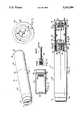
- FIG. 1is a perspective view of a battery powered touch pen embodying the present invention.
- FIG. 2is a partially cut away, cross-sectional view of the battery powered touch pen of FIG. 1 revealing the battery and touch port holder assembly and electrical contacts between the assembly and electrical circuitry in the touch pen body.
- FIG. 4illustrates schematically and partially cutaway the compressible pins carried by the touch pen body to electrically and physically contact the axially facing foil paths carried by the wafer circuit board of the assembly.
- FIG. 5is a plan view of the wafer circuit board showing the foil circuit paths.
- the spring 48is in biasing contact with the opposite end 50 of the battery 28 urging the battery toward the wafer circuit board 44 and causes the braided conductors 58 and 68, respectively to be in tension thereby maintaining the battery 28 in physical and electrical connection between the respective wafer circuit boards 44 and 46. It will be seen that the battery 28 can be released and a replacement battery inserted by compressing the spring 48.
- a good and reliable electrical contactis also made with the circuit paths 62 and 72 by the respective heads 90,96 of the compression pins which heads push in the opposing direction from the direction of force exerted by the spring 48 thus insuring contact with the respective circuit paths when the holder assembly 22 is screwed onto the touch pen body 20. It will also be appreciated and recognized that in the present arrangement with the heads of the compression pins being biased axially toward the wafer printed circuit board 44 when the holder assembly 22 is threadably engaged to the touch pen body 20 and with the foil path 74 being urged into engagement with the screw head 84 by the spring 48, a viable electrical connection is ensured and maintained.
- the foil circuit paths 62, 72 and 74 carried by the circular wafer printed circuit board 44are concentric and present an outwardly, axially facing contact surface to the contact heads 90,96 of the compression pins and to the screw head 84, respectively.
- the concentric circuit pathsare radially spaced and offset from one another in a predetermined spacing arrangement coincident with the spacing arrangement of the compression pins carried by the touch pen body 20.
- the outer foil circuit path 72carries the ground voltage reference potential from the battery 28; foil circuit path 62 carries the data signals from the data lead 54, and foil circuit path 74 carries the positive voltage reference potential from the battery 28.
- a touch pen having a battery and touch port holder assembly to provide an expeditious and easy method to replace the battery used in a touch penhas been described above. It will be recognized by those skilled in the art that numerous changes and modifications may be made to the above described embodiment without departing from the spirit and scope of the invention and therefore the invention has been described by way of illustration rather than limitation.
Landscapes
- Engineering & Computer Science (AREA)
- General Engineering & Computer Science (AREA)
- Theoretical Computer Science (AREA)
- Human Computer Interaction (AREA)
- Physics & Mathematics (AREA)
- General Physics & Mathematics (AREA)
- Chemical & Material Sciences (AREA)
- Chemical Kinetics & Catalysis (AREA)
- Electrochemistry (AREA)
- General Chemical & Material Sciences (AREA)
- Power Sources (AREA)
- Battery Mounting, Suspending (AREA)
Abstract
Description
The present invention relates generally to touch pens and deals more particularly with a replaceable battery and holder assembly for use with a battery operated touch pen.
Touch pens are known in the art and are of the general type having a touch port serial data device for reading data from a touch memory device and which data is stored in a non-volatile memory in the touch pen. Data is read to the memory via a touch probe serial data device coupled to the memory and also carried by the touch pen. Typically, data is read from a touch memory device which may contain various different types of information, for example, inventory information, identification information, security information and the like and which information is dynamic and changing or which information may be portable from one location to another. The touch pen provides an efficient and convenient way to keep track of such information and transfer it to a central location to update the information at the central location, for example, a computer which may be used for inventory control or processing. Various applications of the touch pen are known in the art and one may refer to trade literature for a more detailed explanation of the operation of a touch pen and exemplary applications.
One drawback associated with battery operated touch pens of the above general type is that the touch pen must be returned to a maintenance or repair group for disassembly and removal of the battery from the touch pen, generally by unsoldering the battery connections and installing and resoldering a fresh battery. The obvious disadvantage is that the touch pen is removed from service during the time that the battery is replaced and data, which may be time sensitive, contained within the touch pen memory cannot be transferred, updated or otherwise used thereby possibly delaying other operations dependent upon the data stored in the touch pen.
Another disadvantage is that the battery must be replaced by a person having skill and knowledge of electronic components, soldering techniques, and so forth. In addition, such handling may affect the data stored in the touch pen.
It would be desirable therefore to have a battery powered touch pen with the capability to have its battery supply replaced easily and simply without the time consuming and labor intensive effort now required to replace such a battery.
It would also be desirable to replace a battery in a touch pen without the "downtime" generally associated with battery replacement in known touch pens so that data contained within the touch pen memory can be readably and timely transferred, updated, or otherwise used in the normal manner without introducing delay into an operation with which the data of the touch pen is used.
It is an aim of the present invention therefore to provide a touch pen having a replaceable battery and holder assembly which overcomes the above mentioned disadvantages and shortcomings of known touch pens.
In accordance with the present invention, a battery and touch port holder assembly for use with a battery powered touch pen is presented. The battery is held in compression between two wafer circuit boards by the biasing action of a spring urging the battery in one direction against one wafer circuit board and the second wafer circuit board in the opposite direction. Braided electrical conductors are diametrically disposed opposite one another and extend between and maintain the two wafers circuit boards in a fixed spaced relation with respect to one another when the battery is inserted therebetween and which conductors also carry a voltage potential and data signal, respectively. The battery and touch port holder assembly are carried within a cylindrically shaped chamber formed in a releasably attached end portion of the touch pen which is engageable with the touch pen body.
Foil circuit paths carried on the wafer printed circuit board closest to the touch pen body provide outwardly, axially facing contact surfaces for battery and ground voltage reference potentials and data signals from the touch port. Compression pins having axially extending heads are carried by the touch pen body and contact the respective foil paths of the wafer printed circuit board when the releasably attached end portion carrying the holder assembly is engaged with the touch pen body. The heads of the compression pins are urged into contact with the foil circuit paths to provide reliable contact and to take up dimensional tolerances that may exist between different units.
Other features and advantages of the present invention will become readily apparent from the following written description and drawings wherein:
FIG. 1 is a perspective view of a battery powered touch pen embodying the present invention.
FIG. 2 is a partially cut away, cross-sectional view of the battery powered touch pen of FIG. 1 revealing the battery and touch port holder assembly and electrical contacts between the assembly and electrical circuitry in the touch pen body.
FIG. 3 illustrates the battery and touch port holder assembly removed from the battery and touch port holder assembly housing.
FIG. 4 illustrates schematically and partially cutaway the compressible pins carried by the touch pen body to electrically and physically contact the axially facing foil paths carried by the wafer circuit board of the assembly.
FIG. 5 is a plan view of the wafer circuit board showing the foil circuit paths.
Turning now to the drawings and considering the invention in further detail, a battery operated touch pen of the general type with which the present invention may be practiced is shown in perspective view in FIG. 1 and generally designated 10. The touch pen 10 is generally tubular, pen-shaped and includes atouch probe 12 at oneend 14 and atouch port 16 at itsopposite end 18. The touch pen 10 further includes a touch body generally designated 20 and a releasable engageable battery and touch portholder assembly housing 22. Thebattery holder assembly 22 is releasably engageable with thetouch pen body 20 by means of snap engagement, twist-lock or threadably screwing the assembly to the body. In the illustrated embodiment of FIG. 1, thebattery holder assembly 22 is threadably attached to thetouch pen body 20 at the annular ring attachment band generally designated 24.
Turning now to FIG. 2, the battery and touch port holder assembly and electrical connection to the touch pen body is shown in greater detail. The battery and touchport holder assembly 22 includes a cylindricallyshaped housing 26 for receiving thebattery 28 andtouch port 16. As illustrated, thehousing 26 includes threads generally designated 30 along the inner peripheral surface of thehousing 26 at oneend 32. The threads 30 are threadably engageable with complementary threads 34 located on the outerperipheral surface 36 of thetouch pen body 20. As more clearly illustrated in FIG. 3, thebattery 28 andtouch port 16 are received within an inwardly open cylindrical chamber generally designated 38 within thehousing 26. Thehousing 26 has an opening at theend 18 to receive in complementary engagement anannular flange 40 of the touch port with theflange 40 being in contact with anannular lip 42 formed in thehousing 26 at theend 18 to prevent the battery and touchport holder assembly 22 from being pushed out of thehousing 26.
As illustrated in FIG. 2, thebattery 28 is held in a spring biased relationship between a circular wafer printedcircuit board 44 at the oneend 76 of the battery nearest the touch pen body and a second circular printedwafer circuit board 46 at theopposite end 50 of the battery furthest from the touch pen body with aspring 48 being located between thecircuit board 46 and theend 50 of thebattery 28. Thecircular wafer board 46 includes afoil circuit path 52 to electrically couple the data lead 54 of thetouch port 16 to oneend 56 of abraided conductor 58. Theopposite end 60 of thebraided conductor 58 is connected to thewafer circuit board 44 and afoil circuit path 62 carried on thecircuit board 44 to provide a means of electronic connection to circuitry carried by the touch pen body as disclosed in further detail below. Thespring 48 andflange 40 of thetouch port 16 are connected to a foil circuit path 64 located on the surface of thewafer circuit board 46. Oneend 66 of a braidedwire conductor 68 is electrically and physically coupled to the circuit path 64 and thecircuit board 46 diametrically opposite theend 56 of thebraided conductor 58. Theopposite end 70 of thebraided conductor 68 is physically connected to thecircuit board 44 and electrically to afoil circuit path 72 located on the surface of the printedcircuit board 44 to provide an electrical connection to the touch pen body as described in further detail below. A thirdfoil circuit path 74 is carried on the surface of thewafer circuit board 44 and provides an electrical connection for the oneend 76 of thebattery 28 to provide a source of power to the touch pen body as described below.
In the illustrated embodiment, thespring 48 is in biasing contact with theopposite end 50 of thebattery 28 urging the battery toward thewafer circuit board 44 and causes thebraided conductors battery 28 in physical and electrical connection between the respectivewafer circuit boards battery 28 can be released and a replacement battery inserted by compressing thespring 48.
An annular insulator 80 through which the data lead 54 passes is inserted between theflange 40 of thetouch port 16 and thewafer circuit board 46 to maintain a physical separation and electrical insulation between the data lead 54 and theflange 40. Theflange 40 is electrically and physically coupled to the foil path 64 which is electrically connected to thespring 48 by means of afoil conductor 82 having one respective end attached to theflange 40 and an opposite end to the foil circuit path 64 which is carried on the surface of the wafer printedcircuit board 46.
Electrical contact is made between circuitry carried within thetouch pen body 20 and the battery and touchport holder assembly 22 by means of thefoil circuit paths wafer circuit board 44 and which paths are brought into physical and electrical contact with respective electrical connections carried by thetouch pen body 20. As illustrated in FIG. 2, one voltage polarity of thebattery 28 is supplied to the electrical circuitry through contact of ascrew head 84 of anaxial screw 86 carried by thetouch pen body 20. Thehead 84 of thescrew 86 is in physical and electrical contact with thefoil path 74 and electrically to the battery when theholder assembly 22 is threadably engaged with the touch pen body. The arrangement insures a viable electrical contact between thescrew head 84 and thefoil path 74 as a result of the force of thespring 48 urging the battery and thefoil 74 into engagement with thescrew head 84.
The opposite voltage polarity of thebattery 28 carried by the electrical conductor 64 is supplied to the electrical circuitry carried by thetouch pen 20 by means of acompressible pin 88 carried by the touch pen body. Thecompressible pin 88, as illustrated in detail in FIG. 4, includes an axially extendinghead 90 which is movable in the direction indicated byarrow 92 to compress aspring 94 which biases thehead 90 outward into engagement with thefoil circuit path 72 when the holder assembly is engaged with thetouch pen body 20. The data signals from and to the touch port memory device carried by theelectrical conductor 58 is supplied to the electrical circuitry carried by thetouch pen 20 by means of acompressible pin 89 carried by the touch pen body. Thecompressible pin 89 is substantially identical to thecompressible pin 88 and includes an axially extendinghead 96 which is movable in the axial direction to compress aspring 98 which biases thehead 96 outward into engagement with thefoil circuit path 62 when the holder assembly is engaged with thetouch pen body 20.
A good and reliable electrical contact is also made with thecircuit paths respective heads spring 48 thus insuring contact with the respective circuit paths when theholder assembly 22 is screwed onto thetouch pen body 20. It will also be appreciated and recognized that in the present arrangement with the heads of the compression pins being biased axially toward the wafer printedcircuit board 44 when theholder assembly 22 is threadably engaged to thetouch pen body 20 and with thefoil path 74 being urged into engagement with thescrew head 84 by thespring 48, a viable electrical connection is ensured and maintained. One feature and advantage of the present arrangement is that the battery and touchport holder assembly 22 can be utilized with any number of different touch pen bodies since any tolerance differences between units are taken up and compensated for by the combined action of the axially biased heads of the compression pins and the biasing on thewafer circuit board 44.
As illustrated in FIG. 5, thefoil circuit paths circuit board 44 are concentric and present an outwardly, axially facing contact surface to thecontact heads screw head 84, respectively. The concentric circuit paths are radially spaced and offset from one another in a predetermined spacing arrangement coincident with the spacing arrangement of the compression pins carried by thetouch pen body 20. In the preferred embodiment, the outerfoil circuit path 72 carries the ground voltage reference potential from thebattery 28;foil circuit path 62 carries the data signals from the data lead 54, andfoil circuit path 74 carries the positive voltage reference potential from thebattery 28.
A touch pen having a battery and touch port holder assembly to provide an expeditious and easy method to replace the battery used in a touch pen has been described above. It will be recognized by those skilled in the art that numerous changes and modifications may be made to the above described embodiment without departing from the spirit and scope of the invention and therefore the invention has been described by way of illustration rather than limitation.
Claims (4)
1. A battery powered touch pen of the general type having an axially elongated body and a touch probe at one end for collecting data from at least one touch memory device, a non-volatile memory device means for storing the data, means for reading and writing data to the memory device means and a touch port at a second end opposite said first end for transferring data from said memory device means to at least one touch memory device, said touch pen comprising:
a battery holder assembly having means for carrying a battery and the touch port and being releasably engaged with one end of the touch pen body for providing:
an electrical circuit contact between the battery carried by said holder and the electrical circuitry carried by the touch pen body whereby a voltage potential is supplied to the electrical circuitry;
a first data logic contact between the touch port and the electrical circuitry carried by the touch pen body;
said battery holder assembly further having an axially elongated end portion having means for releasably engaging one end of said axially elongated touch pen body, said end portion having an inwardly open internal chamber for receiving and holding a battery, and further including means for holding said touch port in axial alignment with said end portion;
printed circuit board means having a surface for carrying at least three foil circuit paths and being disposed and carried by said battery holder at said inwardly open end, said battery being releasably held in a sandwiched relationship between said touch port and said printed circuit board and being electrically coupled to predetermined of said foil paths on said printed circuit board to provide a predetermined voltage polarity between said predetermined foil paths, said printed circuit board being carried so that said foil paths provide an outwardly, axially facing contact surface;
first electrical contact means located at said one end of the touch pen body and extending axially outward therefrom and in registration with a first predetermined one of said foil paths carried by said printed circuit board to make a physical and electrical contact therewith when said battery holder assembly is in engagement with said one end of the touch pen body;
second electrical contact means located at said one end of the touch pen body and extending axially outward therefrom and in registration with a second predetermined one of said foil paths carried by said printed circuit board to make a physical and electrical contact therewith when said battery holder assembly is in engagement with said one end of the touch pen body, said second electrical contact means being in a predefined spaced radial relationship with respect to said first electrical contact means;
third electrical contact means coaxially located with and at said one end of the touch pen body and in registration with a third predetermined one of said foil paths carried by the printed circuit board to make physical and electrical contact therewith when said battery holder assembly is in engagement with said one end of the touch pen body.
2. A battery powered touch pen as defined in claim 1 wherein said first electrical contact means further comprises a first compression pin having a contact head slidingly carried by an axial body and spring means for urging said contact head axially outward.
3. A battery powered touch pen as defined in claim 2 wherein said second electrical contact means further comprises a second compression pin having a contact head slidingly carried by a second axial body and second spring means for urging said contact head axially outward.
4. A battery powered touch pen as defined in claim 1 wherein said battery holder assembly is threadably engaged with said touch pen body.
Priority Applications (1)
| Application Number | Priority Date | Filing Date | Title |
|---|---|---|---|
| US08/006,265US5321584A (en) | 1993-01-19 | 1993-01-19 | Battery and holder assembly for use with a battery operated touch pen |
Applications Claiming Priority (1)
| Application Number | Priority Date | Filing Date | Title |
|---|---|---|---|
| US08/006,265US5321584A (en) | 1993-01-19 | 1993-01-19 | Battery and holder assembly for use with a battery operated touch pen |
Publications (1)
| Publication Number | Publication Date |
|---|---|
| US5321584Atrue US5321584A (en) | 1994-06-14 |
Family
ID=21720076
Family Applications (1)
| Application Number | Title | Priority Date | Filing Date |
|---|---|---|---|
| US08/006,265Expired - Fee RelatedUS5321584A (en) | 1993-01-19 | 1993-01-19 | Battery and holder assembly for use with a battery operated touch pen |
Country Status (1)
| Country | Link |
|---|---|
| US (1) | US5321584A (en) |
Cited By (14)
| Publication number | Priority date | Publication date | Assignee | Title |
|---|---|---|---|---|
| US5883338A (en)* | 1994-12-16 | 1999-03-16 | Hyundai Electronics America, Inc. | Telementry by digitizer stylus |
| USD413858S (en)* | 1998-05-29 | 1999-09-14 | Sony Corporation | Rechargeable battery |
| US6195446B1 (en)* | 1994-12-16 | 2001-02-27 | Hyundai Electronics America | Digitizer stylus with memory for storing handwriting data |
| US6421233B1 (en)* | 2000-06-12 | 2002-07-16 | High Tech Computer Corporation | Pocket personal computer with improved battery compartment enclosing structure |
| US20030195825A1 (en)* | 1999-05-19 | 2003-10-16 | I.D. Systems, Inc. | System and method for managing remotely and distantly located assets |
| US20030225707A1 (en)* | 2002-01-09 | 2003-12-04 | Ehrman Kenneth S. | System and method for managing a remotely located asset |
| US20050029872A1 (en)* | 2003-08-08 | 2005-02-10 | Ehrman Kenneth S. | Universal power supply |
| US20050108089A1 (en)* | 1999-05-19 | 2005-05-19 | Ehrman Kenneth S. | Fully automated vehicle rental system |
| US20060208891A1 (en)* | 2005-03-01 | 2006-09-21 | Ehrman Kenneth S | Mobile portal for rfid applications |
| US20080068170A1 (en)* | 2005-03-01 | 2008-03-20 | I.D. Systems, Inc. | System and method for reading and verifying RFID tags |
| US20100042758A1 (en)* | 2007-07-12 | 2010-02-18 | Philip Seibert | System and Method for Information Handling System Battery With Integrated Communication Ports |
| US20130050101A1 (en)* | 2011-08-24 | 2013-02-28 | Dexin Corporation | Wireless transmission method for touch pen with wireless storage and forwarding capability and system thereof |
| CN106648161A (en)* | 2015-11-04 | 2017-05-10 | 群光电子股份有限公司 | Stylus structure |
| CN107438816A (en)* | 2015-03-31 | 2017-12-05 | 微软技术许可有限责任公司 | Interlocking integrated battery structure for electronic stylus |
Citations (4)
| Publication number | Priority date | Publication date | Assignee | Title |
|---|---|---|---|---|
| US4883926A (en)* | 1988-04-21 | 1989-11-28 | Hewlett-Packard Company | Stylus switch |
| US5107541A (en)* | 1985-11-05 | 1992-04-21 | National Research Development Corporation | Method and apparatus for capturing information in drawing or writing |
| US5122427A (en)* | 1991-08-09 | 1992-06-16 | Skil Corporation | Battery pack |
| US5247137A (en)* | 1991-10-25 | 1993-09-21 | Mark Epperson | Autonomous computer input device and marking instrument |
- 1993
- 1993-01-19USUS08/006,265patent/US5321584A/ennot_activeExpired - Fee Related
Patent Citations (4)
| Publication number | Priority date | Publication date | Assignee | Title |
|---|---|---|---|---|
| US5107541A (en)* | 1985-11-05 | 1992-04-21 | National Research Development Corporation | Method and apparatus for capturing information in drawing or writing |
| US4883926A (en)* | 1988-04-21 | 1989-11-28 | Hewlett-Packard Company | Stylus switch |
| US5122427A (en)* | 1991-08-09 | 1992-06-16 | Skil Corporation | Battery pack |
| US5247137A (en)* | 1991-10-25 | 1993-09-21 | Mark Epperson | Autonomous computer input device and marking instrument |
Cited By (44)
| Publication number | Priority date | Publication date | Assignee | Title |
|---|---|---|---|---|
| US6556694B2 (en) | 1994-12-16 | 2003-04-29 | Hyundai Electronics America | Digitizer stylus containing handwriting data |
| US6195446B1 (en)* | 1994-12-16 | 2001-02-27 | Hyundai Electronics America | Digitizer stylus with memory for storing handwriting data |
| US5883338A (en)* | 1994-12-16 | 1999-03-16 | Hyundai Electronics America, Inc. | Telementry by digitizer stylus |
| USD413858S (en)* | 1998-05-29 | 1999-09-14 | Sony Corporation | Rechargeable battery |
| US7876197B2 (en) | 1999-05-19 | 2011-01-25 | I.D. Systems, Inc. | Mobile asset data management system |
| US20080140483A1 (en)* | 1999-05-19 | 2008-06-12 | I.D. Systems, Inc. | Mobile asset data management system |
| US8370268B2 (en) | 1999-05-19 | 2013-02-05 | I.D. Systems, Inc. | Systems and methods for remote vehicle rental with remote vehicle access |
| US7911320B2 (en) | 1999-05-19 | 2011-03-22 | I.D. Systems, Inc. | Mobile asset data management system |
| US20040015419A1 (en)* | 1999-05-19 | 2004-01-22 | I.D. Systems, Inc. | System architecture and communications for an asset management system |
| US7898388B2 (en) | 1999-05-19 | 2011-03-01 | I.D. Systems, Inc. | Mobile asset data management system |
| US20050108089A1 (en)* | 1999-05-19 | 2005-05-19 | Ehrman Kenneth S. | Fully automated vehicle rental system |
| US20100217630A1 (en)* | 1999-05-19 | 2010-08-26 | I.D. Systems, Inc. | Systems and methods for remote vehicle rental |
| US20080140440A1 (en)* | 1999-05-19 | 2008-06-12 | I.D. Systems, Inc. | Mobile asset data management system |
| US7165040B2 (en) | 1999-05-19 | 2007-01-16 | I.D. Systems, Inc. | System and method for managing remotely and distantly located assets |
| US7171381B2 (en) | 1999-05-19 | 2007-01-30 | I.D. Systems, Inc. | System architecture and communications for an asset management system |
| US20030195825A1 (en)* | 1999-05-19 | 2003-10-16 | I.D. Systems, Inc. | System and method for managing remotely and distantly located assets |
| US20080140482A1 (en)* | 1999-05-19 | 2008-06-12 | I.D. Systems, Inc. | Mobile asset data management system |
| US20080140544A1 (en)* | 1999-05-19 | 2008-06-12 | I.D. Systems, Inc. | Mobile asset data management system |
| US20080183522A1 (en)* | 1999-05-19 | 2008-07-31 | I.D. Systems, Inc. | Mobile asset data management system |
| US20080136584A1 (en)* | 1999-05-19 | 2008-06-12 | I.D. Systems, Inc. | Mobile asset data management system |
| US6421233B1 (en)* | 2000-06-12 | 2002-07-16 | High Tech Computer Corporation | Pocket personal computer with improved battery compartment enclosing structure |
| US20030216976A1 (en)* | 2002-01-09 | 2003-11-20 | I.D. Systems, Inc. | System and method for remotely managing maintenance operations associated with an asset |
| US20030225707A1 (en)* | 2002-01-09 | 2003-12-04 | Ehrman Kenneth S. | System and method for managing a remotely located asset |
| US7707054B2 (en) | 2002-01-09 | 2010-04-27 | I.D. Systems, Inc. | System and method for remotely managing maintenance operations associated with an asset |
| US7656271B2 (en) | 2002-01-09 | 2010-02-02 | I.D. Systems, Inc. | System and method for managing a remotely located asset |
| US20050029872A1 (en)* | 2003-08-08 | 2005-02-10 | Ehrman Kenneth S. | Universal power supply |
| US7683760B2 (en) | 2005-03-01 | 2010-03-23 | I.D. Systems, Inc. | Mobile portal for RFID applications |
| US7667573B2 (en) | 2005-03-01 | 2010-02-23 | I.D. Systems, Inc. | Mobile portal for RFID applications |
| US7656273B2 (en) | 2005-03-01 | 2010-02-02 | I.D. Systems, Inc. | Mobile portal for RFID luggage handling applications |
| US20100194604A1 (en)* | 2005-03-01 | 2010-08-05 | I.D. Systems, Inc. | Mobile portal for rfid applications |
| US20080122626A1 (en)* | 2005-03-01 | 2008-05-29 | I.D. Systems, Inc. | System and method for reading and verifying RFID tags |
| US7786844B2 (en) | 2005-03-01 | 2010-08-31 | I.D. Systems, Inc. | Mobile portal for RFID applications |
| US20060208891A1 (en)* | 2005-03-01 | 2006-09-21 | Ehrman Kenneth S | Mobile portal for rfid applications |
| US20060208890A1 (en)* | 2005-03-01 | 2006-09-21 | Ehrman Kenneth S | Mobile portal for rfid applications |
| US20080068170A1 (en)* | 2005-03-01 | 2008-03-20 | I.D. Systems, Inc. | System and method for reading and verifying RFID tags |
| US8120467B2 (en) | 2005-03-01 | 2012-02-21 | I.D. Systems, Inc. | Mobile portal for RFID applications |
| US20080068171A1 (en)* | 2005-03-01 | 2008-03-20 | I.D. Systems, Inc. | Mobile portal for RFID luggage handling applications |
| US20100042758A1 (en)* | 2007-07-12 | 2010-02-18 | Philip Seibert | System and Method for Information Handling System Battery With Integrated Communication Ports |
| US20130050101A1 (en)* | 2011-08-24 | 2013-02-28 | Dexin Corporation | Wireless transmission method for touch pen with wireless storage and forwarding capability and system thereof |
| US9029717B2 (en)* | 2011-08-24 | 2015-05-12 | Dexin Corporation | Wireless transmission method for touch pen with wireless storage and forwarding capability and system thereof |
| CN107438816A (en)* | 2015-03-31 | 2017-12-05 | 微软技术许可有限责任公司 | Interlocking integrated battery structure for electronic stylus |
| US11561628B2 (en) | 2015-03-31 | 2023-01-24 | Microsoft Technology Licensing, Llc | Interlocking integrated battery structure for an electronic stylus |
| CN106648161A (en)* | 2015-11-04 | 2017-05-10 | 群光电子股份有限公司 | Stylus structure |
| CN106648161B (en)* | 2015-11-04 | 2019-07-02 | 群光电子股份有限公司 | Stylus structure |
Similar Documents
| Publication | Publication Date | Title |
|---|---|---|
| US5321584A (en) | Battery and holder assembly for use with a battery operated touch pen | |
| US6692293B2 (en) | Technique for identifying multiple circuit components | |
| US6546445B1 (en) | Method and system for connecting dual storage interfaces | |
| US5429518A (en) | Socket terminal | |
| US4849944A (en) | Connecting structure for connecting a memory unit to a memory unit controller | |
| ATE369991T1 (en) | PRINT CARTRIDGE AND PRINTER WITH PRINT CASSETTE | |
| US5855064A (en) | Method of making personal computer power supply systems | |
| US5491830A (en) | Automatic slot identification and address decoder arrangement | |
| EP1598198A3 (en) | Terminals for circuit board | |
| US20040043651A1 (en) | AC adapter connector assembly | |
| US11237652B2 (en) | Electronic pen | |
| US6141223A (en) | Battery assembly for supplying power to an integrated circuit | |
| US20070091592A1 (en) | All-in-one adapter container | |
| US20090233490A1 (en) | Electrical adapter assembly and apparatus using the same | |
| US6204457B1 (en) | Electromagnetic inking digitizer pen and method | |
| US11899046B2 (en) | Measuring apparatus for operating state | |
| US5539252A (en) | Fastener with onboard memory | |
| EP0426271B1 (en) | Portable semiconductor storage device | |
| CA2167776A1 (en) | Universal trailer light locator | |
| CN112965621B (en) | Electromagnetic pen and electronic device | |
| JPH10112012A (en) | Electrical connection system for video cassette recorder | |
| GB2273268A (en) | Retractable illuminating pen. | |
| US6822841B2 (en) | Circuit board with protection capability and method of protecting a circuit board | |
| KR100350855B1 (en) | Chip solting unit used for apparatus for inspecting surface mounted chip | |
| JP2007206906A (en) | Cylinder type device |
Legal Events
| Date | Code | Title | Description |
|---|---|---|---|
| AS | Assignment | Owner name:TEK ELECTRONICS MANUFACTURING CORPORATION, CONNECT Free format text:ASSIGNMENT OF ASSIGNORS INTEREST.;ASSIGNOR:MATHENY, MARK;REEL/FRAME:006395/0593 Effective date:19930104 | |
| LAPS | Lapse for failure to pay maintenance fees | ||
| FP | Lapsed due to failure to pay maintenance fee | Effective date:19980614 | |
| AS | Assignment | Owner name:TEK INDUSTRIES, INC., CONNECTICUT Free format text:MERGER;ASSIGNOR:TEK ELECTRONICS MANUFACTURING CORPORATION;REEL/FRAME:009901/0408 Effective date:19980323 | |
| STCH | Information on status: patent discontinuation | Free format text:PATENT EXPIRED DUE TO NONPAYMENT OF MAINTENANCE FEES UNDER 37 CFR 1.362 |