US5279565A - Intravascular treatment apparatus and method - Google Patents
Intravascular treatment apparatus and methodDownload PDFInfo
- Publication number
- US5279565A US5279565AUS08/012,704US1270493AUS5279565AUS 5279565 AUS5279565 AUS 5279565AUS 1270493 AUS1270493 AUS 1270493AUS 5279565 AUS5279565 AUS 5279565A
- Authority
- US
- United States
- Prior art keywords
- support frame
- treatment site
- delivery
- agent
- actuator shaft
- Prior art date
- Legal status (The legal status is an assumption and is not a legal conclusion. Google has not performed a legal analysis and makes no representation as to the accuracy of the status listed.)
- Expired - Fee Related
Links
- 238000011282treatmentMethods0.000titleclaimsabstractdescription171
- 238000000034methodMethods0.000titleclaimsdescription39
- 238000012384transportation and deliveryMethods0.000claimsabstractdescription159
- 239000003795chemical substances by applicationSubstances0.000claimsabstractdescription97
- 239000003814drugSubstances0.000claimsabstractdescription41
- 229940124597therapeutic agentDrugs0.000claimsabstractdescription17
- 210000001367arteryAnatomy0.000claimsabstractdescription9
- 239000002775capsuleSubstances0.000claimsdescription29
- 229940079593drugDrugs0.000claimsdescription23
- 210000002889endothelial cellAnatomy0.000claimsdescription12
- 239000008280bloodSubstances0.000claimsdescription11
- 210000004369bloodAnatomy0.000claimsdescription11
- 210000004027cellAnatomy0.000claimsdescription11
- 239000012528membraneSubstances0.000claimsdescription11
- 238000010899nucleationMethods0.000claimsdescription11
- 239000011159matrix materialSubstances0.000claimsdescription10
- 239000012530fluidSubstances0.000claimsdescription9
- 208000031481Pathologic ConstrictionDiseases0.000claimsdescription7
- 239000002184metalSubstances0.000claimsdescription6
- 229910052751metalInorganic materials0.000claimsdescription6
- 208000037804stenosisDiseases0.000claimsdescription5
- 230000036262stenosisEffects0.000claimsdescription5
- 239000001963growth mediumSubstances0.000claimsdescription3
- 230000002093peripheral effectEffects0.000claims1
- 210000001519tissueAnatomy0.000description17
- 230000007246mechanismEffects0.000description11
- 238000002399angioplastyMethods0.000description8
- 230000001413cellular effectEffects0.000description8
- 210000000056organAnatomy0.000description8
- 230000017531blood circulationEffects0.000description7
- 210000004204blood vesselAnatomy0.000description6
- 238000012377drug deliveryMethods0.000description6
- 238000005470impregnationMethods0.000description6
- 230000010412perfusionEffects0.000description5
- 238000004891communicationMethods0.000description4
- 238000001802infusionMethods0.000description4
- 208000037803restenosisDiseases0.000description4
- 230000002966stenotic effectEffects0.000description4
- 238000012546transferMethods0.000description4
- 239000008135aqueous vehicleSubstances0.000description3
- 230000008901benefitEffects0.000description3
- 238000013461designMethods0.000description3
- 238000002224dissectionMethods0.000description3
- 230000003511endothelial effectEffects0.000description3
- 239000002831pharmacologic agentSubstances0.000description3
- 230000000717retained effectEffects0.000description3
- 201000001320AtherosclerosisDiseases0.000description2
- 208000007536ThrombosisDiseases0.000description2
- 239000003146anticoagulant agentSubstances0.000description2
- 229960004676antithrombotic agentDrugs0.000description2
- 208000029078coronary artery diseaseDiseases0.000description2
- 230000000694effectsEffects0.000description2
- 238000009472formulationMethods0.000description2
- 239000000203mixtureSubstances0.000description2
- 230000035515penetrationEffects0.000description2
- 239000011148porous materialSubstances0.000description2
- 108090000623proteins and genesProteins0.000description2
- 229910001220stainless steelInorganic materials0.000description2
- 239000010935stainless steelSubstances0.000description2
- 238000012385systemic deliveryMethods0.000description2
- 238000002560therapeutic procedureMethods0.000description2
- 206010067484Adverse reactionDiseases0.000description1
- 206010004446Benign prostatic hyperplasiaDiseases0.000description1
- 206010028851NecrosisDiseases0.000description1
- 208000018737Parkinson diseaseDiseases0.000description1
- 208000004403Prostatic HyperplasiaDiseases0.000description1
- 206010042618Surgical procedure repeatedDiseases0.000description1
- 230000001154acute effectEffects0.000description1
- 206010000891acute myocardial infarctionDiseases0.000description1
- 208000009956adenocarcinomaDiseases0.000description1
- 230000006838adverse reactionEffects0.000description1
- 239000003242anti bacterial agentSubstances0.000description1
- 230000001399anti-metabolic effectEffects0.000description1
- 230000002927anti-mitotic effectEffects0.000description1
- 230000002785anti-thrombosisEffects0.000description1
- 229940088710antibiotic agentDrugs0.000description1
- 229940127219anticoagulant drugDrugs0.000description1
- 239000003080antimitotic agentSubstances0.000description1
- 238000013459approachMethods0.000description1
- 230000003143atherosclerotic effectEffects0.000description1
- 108010005774beta-GalactosidaseProteins0.000description1
- 230000015572biosynthetic processEffects0.000description1
- 210000004556brainAnatomy0.000description1
- 235000014633carbohydratesNutrition0.000description1
- 150000001720carbohydratesChemical class0.000description1
- 210000001715carotid arteryAnatomy0.000description1
- 230000015556catabolic processEffects0.000description1
- 230000004663cell proliferationEffects0.000description1
- 238000012258culturingMethods0.000description1
- 230000034994deathEffects0.000description1
- 238000006731degradation reactionMethods0.000description1
- 230000001627detrimental effectEffects0.000description1
- 201000010099diseaseDiseases0.000description1
- 208000037265diseases, disorders, signs and symptomsDiseases0.000description1
- 230000009977dual effectEffects0.000description1
- 230000008030eliminationEffects0.000description1
- 238000003379elimination reactionMethods0.000description1
- 238000005516engineering processMethods0.000description1
- 239000004744fabricSubstances0.000description1
- 230000002349favourable effectEffects0.000description1
- 238000001914filtrationMethods0.000description1
- 239000003102growth factorSubstances0.000description1
- 239000007952growth promoterSubstances0.000description1
- 238000001631haemodialysisMethods0.000description1
- 230000000322hemodialysisEffects0.000description1
- 239000003112inhibitorSubstances0.000description1
- 238000001990intravenous administrationMethods0.000description1
- 210000002414legAnatomy0.000description1
- 239000002502liposomeSubstances0.000description1
- -1low molecular weightSubstances0.000description1
- 239000000463materialSubstances0.000description1
- 238000002483medicationMethods0.000description1
- 239000007769metal materialSubstances0.000description1
- 150000002739metalsChemical class0.000description1
- 238000013508migrationMethods0.000description1
- 230000005012migrationEffects0.000description1
- 238000012986modificationMethods0.000description1
- 230000004048modificationEffects0.000description1
- 210000004165myocardiumAnatomy0.000description1
- 230000017074necrotic cell deathEffects0.000description1
- 239000002773nucleotideSubstances0.000description1
- 125000003729nucleotide groupChemical group0.000description1
- 210000004789organ systemAnatomy0.000description1
- 210000003101oviductAnatomy0.000description1
- 239000002245particleSubstances0.000description1
- 230000008569processEffects0.000description1
- 102000004196processed proteins & peptidesHuman genes0.000description1
- 108090000765processed proteins & peptidesProteins0.000description1
- 230000035755proliferationEffects0.000description1
- 210000002307prostateAnatomy0.000description1
- 201000007094prostatitisDiseases0.000description1
- 102000004169proteins and genesHuman genes0.000description1
- 238000010926purgeMethods0.000description1
- 230000007115recruitmentEffects0.000description1
- 230000008439repair processEffects0.000description1
- 210000003752saphenous veinAnatomy0.000description1
- 235000021309simple sugarNutrition0.000description1
- 150000003431steroidsChemical class0.000description1
- 239000000725suspensionSubstances0.000description1
- 230000001225therapeutic effectEffects0.000description1
- 230000001732thrombotic effectEffects0.000description1
- 238000013519translationMethods0.000description1
- 210000003708urethraAnatomy0.000description1
- 210000003462veinAnatomy0.000description1
- 230000003612virological effectEffects0.000description1
Images

Classifications
- A—HUMAN NECESSITIES
- A61—MEDICAL OR VETERINARY SCIENCE; HYGIENE
- A61M—DEVICES FOR INTRODUCING MEDIA INTO, OR ONTO, THE BODY; DEVICES FOR TRANSDUCING BODY MEDIA OR FOR TAKING MEDIA FROM THE BODY; DEVICES FOR PRODUCING OR ENDING SLEEP OR STUPOR
- A61M25/00—Catheters; Hollow probes
- A61M25/0067—Catheters; Hollow probes characterised by the distal end, e.g. tips
- A61M25/0068—Static characteristics of the catheter tip, e.g. shape, atraumatic tip, curved tip or tip structure
- A61M25/007—Side holes, e.g. their profiles or arrangements; Provisions to keep side holes unblocked
- A—HUMAN NECESSITIES
- A61—MEDICAL OR VETERINARY SCIENCE; HYGIENE
- A61M—DEVICES FOR INTRODUCING MEDIA INTO, OR ONTO, THE BODY; DEVICES FOR TRANSDUCING BODY MEDIA OR FOR TAKING MEDIA FROM THE BODY; DEVICES FOR PRODUCING OR ENDING SLEEP OR STUPOR
- A61M29/00—Dilators with or without means for introducing media, e.g. remedies
- A61M29/02—Dilators made of swellable material
- A—HUMAN NECESSITIES
- A61—MEDICAL OR VETERINARY SCIENCE; HYGIENE
- A61B—DIAGNOSIS; SURGERY; IDENTIFICATION
- A61B17/00—Surgical instruments, devices or methods
- A61B17/22—Implements for squeezing-off ulcers or the like on inner organs of the body; Implements for scraping-out cavities of body organs, e.g. bones; for invasive removal or destruction of calculus using mechanical vibrations; for removing obstructions in blood vessels, not otherwise provided for
- A61B2017/22082—Implements for squeezing-off ulcers or the like on inner organs of the body; Implements for scraping-out cavities of body organs, e.g. bones; for invasive removal or destruction of calculus using mechanical vibrations; for removing obstructions in blood vessels, not otherwise provided for after introduction of a substance
- A61B2017/22084—Implements for squeezing-off ulcers or the like on inner organs of the body; Implements for scraping-out cavities of body organs, e.g. bones; for invasive removal or destruction of calculus using mechanical vibrations; for removing obstructions in blood vessels, not otherwise provided for after introduction of a substance stone- or thrombus-dissolving
- A—HUMAN NECESSITIES
- A61—MEDICAL OR VETERINARY SCIENCE; HYGIENE
- A61M—DEVICES FOR INTRODUCING MEDIA INTO, OR ONTO, THE BODY; DEVICES FOR TRANSDUCING BODY MEDIA OR FOR TAKING MEDIA FROM THE BODY; DEVICES FOR PRODUCING OR ENDING SLEEP OR STUPOR
- A61M25/00—Catheters; Hollow probes
- A61M25/0043—Catheters; Hollow probes characterised by structural features
- A61M2025/0057—Catheters delivering medicament other than through a conventional lumen, e.g. porous walls or hydrogel coatings
- A—HUMAN NECESSITIES
- A61—MEDICAL OR VETERINARY SCIENCE; HYGIENE
- A61M—DEVICES FOR INTRODUCING MEDIA INTO, OR ONTO, THE BODY; DEVICES FOR TRANSDUCING BODY MEDIA OR FOR TAKING MEDIA FROM THE BODY; DEVICES FOR PRODUCING OR ENDING SLEEP OR STUPOR
- A61M25/00—Catheters; Hollow probes
- A61M25/0067—Catheters; Hollow probes characterised by the distal end, e.g. tips
- A61M25/0082—Catheter tip comprising a tool
- A61M2025/0096—Catheter tip comprising a tool being laterally outward extensions or tools, e.g. hooks or fibres
- A—HUMAN NECESSITIES
- A61—MEDICAL OR VETERINARY SCIENCE; HYGIENE
- A61M—DEVICES FOR INTRODUCING MEDIA INTO, OR ONTO, THE BODY; DEVICES FOR TRANSDUCING BODY MEDIA OR FOR TAKING MEDIA FROM THE BODY; DEVICES FOR PRODUCING OR ENDING SLEEP OR STUPOR
- A61M25/00—Catheters; Hollow probes
- A61M25/10—Balloon catheters
- A61M2025/1043—Balloon catheters with special features or adapted for special applications
- A61M2025/1095—Balloon catheters with special features or adapted for special applications with perfusion means for enabling blood circulation while the balloon is in an inflated state or in a deflated state, e.g. permanent by-pass within catheter shaft
Definitions
- This inventionrelates generally to drug delivery devices, and more specifically to intravascular catheters for delivery of therapeutic agents from within a lumen of a blood vessel or other body organ.
- a catheter having a dilatation device such as a balloon at its distal endis positioned in a lumen of a blood vessel with the dilatation device disposed within a stenotic region of the vessel.
- the dilatation deviceis then expanded in order to dilatate the vessel and restore adequate blood flow through the region of stenosis.
- abrupt closurerefers to the acute interruption of blood flow at the site of angioplasty which typically occurs within the initial hours following the procedure. If arterial patency is not restored, acute myocardial infarction and death may occur.
- the primary mechanisms of abrupt closureare arterial dissection and/or thrombosis.
- the ability to maintain arterial dissections from occluding the vessel lumen via a deployable mechanismwould allow perfusion of distal myocardium and reduce the complications associated with abrupt closure.
- agent directly into the arterial walle.g. antithrombotic agents
- Restenosisrefers to the re-narrowing of a vessel after an initially successful angioplasty procedure. Restenosis usually occurs within the first six months following angioplasty and is due to proliferation and migration of the cellular components of the vessel wall. Local delivery of agent would provide the means to achieve agent tissue concentrations far exceeding what is possible via systemic delivery. It is also postulated that the delivery of agent(s) directly into the arterial wall would interrupt the cellular proliferation and recruitment and hence reduce the incidence restenosis. Other interventional therapies used in the treatment of atherosclerosis, such as atherectomy, in which the stenotic region of the vessel is mechanically debulked to restore adequate blood flow through the stenotic region of the vessel, may equally benefit from such local delivery of agent (s).
- the potential utility of local intramural drug deliveryis not limited to atherosclerotic coronary artery disease.
- Other sites of atherosclerosise.g. renal, iliac, femoral, distal leg and carotid arteries as well as saphenous vein grafts, synthetic grafts and arterio-venous shunts used for hemodialysis
- Local intramural therapy using agent(s)may prove efficacious in non-arterial structures, including the prostrate via the prostatic urethra (benign prostatic hypertrophy, prostatitis and adenocarcinoma), fallopian tubes via its lumen (strictures), and brain parenchyma (Parkinson's Disease).
- intravenous medicationsare delivered systemically by vein, or regionally (e.g. intracoronary infusion).
- Systemic deliveryis not well suited to the treatment of disease entities with a single site of interest (e.g., coronary artery disease) in that is necessitates: 1) exposing sites other than the site of interest to medication where is may have an adverse reaction; 2) sufficiently large quantities of agent within the entire volume of distribution to obtain the desired effect; and 3) exposing the agent to degradation and elimination by an organ system(s) remote from the site of interest.
- the agent tissue concentration within the site of interestis often limited by the detrimental effects of the agent at distant sites.
- Local intramural agent deliveryobviates these problems. Therefore, it is of particular importance to deliver the therapeutic agent directly to the treatment site by intimate contact with or penetration into the tissue over a substantial portion of the luminal surface, rather than simply releasing the agent into the bloodstream in the vicinity of the treatment site.
- known treatment apparatusdo not permit the delivery of a drug directly to a treatment site independently of the deployment of the delivery interface against the lumen wall.
- known treatment apparatusfrequently employ an expandable member such as a balloon which is expanded at or near the treatment site and brought into contact with the lumen wall.
- a drugis infused through pores disposed either directly in the wall of the balloon, or in a second expandable member surrounding the balloon.
- the drugitself serves as the expansion fluid for the balloon, with the drug being expelled through the porous surface of the expanded balloon.
- the drugis first delivered into the outer expandable member, and the balloon is then expanded so as to force the drug through the porous surface in the outer member.
- the drugcannot be infused without expanding the balloon, nor can the timing of drug infusion be controlled independently of balloon expansion.
- Another field of concern to the present inventionis that of cellular seeding for repair of injured arterial tissue following angioplasty or atherectomy treatment.
- Nable et al.have reported the ability to seed autologous endothelial cells transfected with the ⁇ -galactosidase gene upon injured arterial surface (Science 1989;xx:1343-44, incorporated herein by reference).
- Other investigatorsare working along similar lines. Most investigators have used a catheter system which isolates a site in the vessel by occluding the artery with balloons proximally and distally to that site. Cells are then introduced into the isolated portion. The efficacy of cell transfer by this approach is poor.
- an intravascular treatment apparatuswhich can be used to administer therapeutic agents to a treatment site within the lumen of a blood vessel or other organ by direct contact with a substantial portion of the interior wall thereof.
- the treatment apparatuswill be deployable against the treatment site independently of the delivery of the agent to the site.
- the deployment mechanismwhen deployed, will maintain the vessel patent and allow substantial flow of blood to pass around it and perfuse the tissue distal to the treatment site for extended periods of time.
- the deployment mechanismwill be a substantially rigid mechanical apparatus deployable and retractable by positive actuation from the proximal end of the apparatus.
- the apparatusshould have a mechanism for delivering an agent to the treatment site which engages the treatment site along a porous contact surface and which is capable of injecting the agent at pressures sufficient to deeply penetrate tissue.
- the apparatuswill preferably facilitate delivery of a variety of agent types and formulations, including pharmacological agents as well as endothelial cells for seeding purposes.
- the apparatusshould be useful for treatment of blood vessels as well as a variety of other body organs.
- Balloon-tipped catheters appropriate for angioplasty treatment proceduresare described in, for example, U.S. Pat. Nos. 4,323,071, 4,292,974, 4,762,129, and 4,775,371.
- a catheter for locally applying medication to the wall of a blood vessel or other lumenis described in U.S. Pat. No. 5,087,244, the catheter having a balloon near its distal end which is expanded with a medication, which then flows through minute holes in the balloon surface at a low flow rate.
- 4,994,033describes an intravascular treatment apparatus having a pair of expansion members concentrically arranged near its distal end wherein a drug is delivered to the outer expansion member, after which the inner expansion member is expanded, thereby expanding the outer member against the vessel wall and forcing the drug through minute holes in the outer member to bathe the vessel wall.
- U.S. Pat. No. 5,021,044describes an intravascular treatment apparatus having a plurality of holes on the outer surface of the catheter body through which a drug may be delivered to a site within a vessel.
- U.S. Pat. No. 5,112,305describes a catheter for delivery of therapeutic agents to an interior wall of a vessel, the catheter having a balloon near its distal end with tubular extensions projecting from its outer surface. A drug is delivered to the balloon which expands the balloon and flows through the tubular extensions into the vessel wall.
- Other drug delivery devicesare described in U.S. Pat. Nos. 4,406,656, 5,015,232, 5,087,247, and 4,850,969.
- the present inventionprovides an intravascular treatment apparatus for administering a therapeutic agent into a treatment site in the wall of a body lumen, while maintaining the vessel patent and permitting the flow of blood through the deployed mechanism so as to perfuse tissue distal to the treatment site.
- the treatment apparatuswill have particular usefulness in treating arterial stenoses in connection with an angioplasty treatment, but will have further application in treating a variety of body organs, such as the prostate, the urogenital or the biliary ducts.
- the treatment apparatusis particularly advantageous over known devices because it permits deployment of the delivery mechanism against the treatment site independently of the delivery of the agent to the treatment site.
- the inventionthereby provides means to mechanically maintain open arteries at the site of dissection to restore blood flow.
- the treatment apparatushas the further advantage of employing a resilient mechanical support frame rather than an inflatable expansion member for deploying the agent delivery mechanism against the treatment site, resulting in greater rigidity and improved deployment actuation capable of adjusting to a wide range of luminal diameters.
- the means of agent deliveryis further improved over prior devices through the use of a substantially rigid platform with a porous surface which contacts the treatment site and infuses an agent at a pressure sufficient to achieve penetration over a substantial portion of the luminal surface.
- the treatment apparatus of the present inventioncomprises a catheter body having a distal end, a proximal end and a passage therebetween; a support frame coupled to the catheter body incorporating a platform with delivery means, the support frame being movable between a retracted position adjacent the catheter body and a deployed position radially extended from the catheter body; an actuator shaft extending through the passage and coupled to the support frame for moving the support frame between the retracted and deployed positions; and independent means coupled to the support frame for delivering an agent to the treatment site through the platform, the delivery means being in contact with the treatment site in the deployed position.
- the support framemay have a variety of configurations.
- the support framewill comprise a first beam having a first end connected to the catheter body and a second end connected to the platform including the delivery means, the second end being radially deflectable from the catheter body.
- the support framemay be deployed by deflecting the second end of the beam.
- a second beamis provided which has a third end connected to the actuator shaft and a radially deflectable fourth end connected to the platform, the distance between the first and third ends being greater than the distance between the second and fourth ends so as to form a generally trapezoidal shape.
- a cam meansis mounted to the distal end of the actuator shaft which engages the first beam, so that moving the cam means relative to the first beam using the actuator shaft will radially deflect the second end so as to deploy the platform.
- a second beamwill usually connect the platform including the delivery means to the catheter body to form a parallelogram type linkage.
- a first beamwill connect to the platform including the delivery means to the actuator shaft, and cam means will be fixed to the catheter body near its distal end, whereby the beam is deflected radially when using the actuator shaft to engage the beam with the cam means.
- a second beamwill usually be connected between the platform including the delivery means and the actuator shaft, again forming a parallelogram type linkage.
- the delivery meanswill comprise, in an exemplary embodiment, a rigid platform having a radially-facing contact surface and delivery interface for delivering the agent.
- the delivery interfacemay comprise, in various embodiments, a porous rigid matrix, such as sintered metal, a manifold of tubes with radially-facing perforations, or a bladder having a plurality of perforations on its radially-facing surface.
- the delivery interfacemay comprise a detachable porous membrane for applying a cell graft to the treatment site.
- the agentis supplied from the proximal end of the catheter and communicated to the delivery means through one or more delivery passages in the catheter body, the delivery means being connected to the delivery passages by feeder tubes.
- the feeder tubesare used as beams in the support frame, thereby performing dual tasks of communicating the agent to the delivery means as well as forming part of the support frame and deployment mechanism.
- the agentmay be contained in a capsule retained at the distal end of the catheter body.
- a feeder tubeextends between the capsule and the delivery means.
- a piston slidably disposed in the catheter body adjacent the capsulemay be actuated from the proximal end of the catheter by a delivery actuator extending through the catheter body, whereby the piston compresses the capsule so as to force the agent contained therein through the feeder tubes to the platform including the delivery means.
- a treatment apparatusis transluminally positioned in a vessel with a distal end of the treatment apparatus adjacent the treatment site.
- a support frame at the distal end of the treatment apparatusis deployed and thus radially deflected so that a contact surface of a platform including delivery means coupled to the support frame is in intimal contact with the treatment site.
- An agentis supplied to the delivery means, and the agent is delivered to the treatment site through a delivery interface on the delivery means.
- an agentmay be supplied through the delivery means to medicate the blood stream at and distal to the treatment site. After this, and by deploying the delivery means, an agent may be expelled through the delivery means to impregnate the treatment site. Usually, this is performed by supplying the agent through a delivery passage from the proximal end of the catheter.
- a pistonmay be actuated using an actuator extending to the proximal end of the catheter, the piston compressing a capsule containing the agent at the distal end, the capsule being connected to the delivery means.
- the agentmay be administered to the luminal wall in a continuously pressurized stream, or alternatively in a pulsating pressurized stream to optimize the tissue impregnation process.
- Dosesmay be adjusted within very precise limits by using suitable pressurized dispensing means at the proximal end of the treatment apparatus.
- the methodmay further include discontinuing delivery of the agent, retracting the support frame with the delivery means, repositioning the treatment apparatus, and repeating the procedure at the same or a different treatment site without withdrawing the device from the vessel lumen.
- the apparatusallows blood flow to continue to perfuse tissue downstream from the treatment site during treatment.
- bloodmay flood around the members of the support frame between the platforms and the catheter body. This permits treatments of long duration, as long as 20 minutes or more.
- the treatment apparatus of the present inventionovercomes the prior art interdependence of deployment and delivery.
- the mechanical deploying means of the present inventionprovides rigidity during deployment as well as controlled retraction.
- the platforms of the delivery meansprovide increased rigidity and improved contact with the treatment site, for improved impregnation of a substantial portion of the luminal surface.
- the use of the mechanically actuated support frame and rigid platform in place of the porous balloons of known devicespermits the delivery means to be retracted from the vessel wall without the tendency to draw blood or other fluids into the treatment apparatus, thereby facilitating multiple treatments in the vessel without withdrawing the treatment apparatus from the patient and without risk of infusing diluted or contaminated fluids, but only the agent itself.
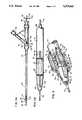
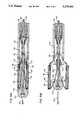
- FIG. 1Ais a side elevational view of a treatment apparatus constructed in accordance with the principles of the present invention.
- FIG. 1Bis a side elevational view of a distal portion of the treatment apparatus of FIG. 1A.
- FIG. 2is a perspective view of the distal portion of the treatment apparatus of FIG. 1A with the delivery means in a deployed position.
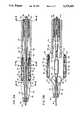
- FIG. 3Ais a side cross-sectional view of a distal portion of the treatment apparatus of FIG. 1A with the delivery means in a retracted position.
- FIG. 3Bis a side cross-sectional view of a distal portion of the treatment apparatus of FIG. 1A with the delivery means in a deployed position.
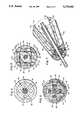
- FIGS. 4-6are transverse cross-sectional views of the treatment apparatus of FIG. 3A at lines 4--4, 5--5 and 6--6, respectively.
- FIG. 7is a perspective view of a distal end of the treatment apparatus of FIG. 1A.
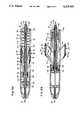
- FIGS. 8A and 8Bare side cross-sectional views of an alternative embodiment of a treatment apparatus constructed in accordance with the principles of the present invention.
- FIGS. 9A and 9Bare side cross-sectional views of a further embodiment of a treatment apparatus constructed in accordance with the principles of the present invention.
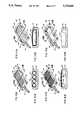
- FIGS. 10A and 10Bare perspective and transverse cross-sectional views, respectively, of an exemplary embodiment of the delivery means of a treatment apparatus constructed in accordance with the principles of the present invention.
- FIGS. 11A and 11Bare perspective and transverse cross-sectional views, respectively, of a further embodiment of the delivery means of the treatment apparatus of the present invention.
- FIGS. 12A and 12Bare perspective and transverse cross-sectional views, respectively, of another embodiment of the delivery means of the treatment apparatus of the present invention.
- FIGS. 13A and 13Bare perspective and transverse cross-sectional views, respectively, of still another embodiment of the delivery means of the treatment apparatus of the present invention.
- FIGS. 14A and 14Billustrate a distal portion of the treatment apparatus of FIG. 1 positioned in a stenotic region of a vessel according to the method of the present invention.
- the intravascular treatment apparatus of the present inventionincludes an elongate flexible catheter body 20 having a distal end 22 and a proximal end 24.
- a nose cone 26is disposed distally of distal end 22 and is movable in the axial direction relative to body 20.
- Delivery means 28is coupled to nose cone 26 and body 20, as described in detail below.
- a movable guidewire 30extends through the treatment apparatus and beyond its distal end 22.
- a proximal housing 32is attached to proximal end 24 of catheter body 20.
- Proximal housing 32includes a deployment actuator 34 having a pair of finger grips 36 attached to an actuator shaft 38 which extends through body 20 to nose cone 26.
- An agent supply port 40extends laterally from housing 32, to which may be connected a syringe or other device for supplying a therapeutic agent to the treatment apparatus.
- Supply port 40has a supply lumen 42 communicating with an annular plenum or manifold 44 in housing 32.
- the interior of housing 32includes, in addition to annular plenum 44, a central passage 46 within which actuator shaft 38 is slidably disposed.
- Actuator shaft 38further includes a guidewire passage 48 through which guidewire 30 passes.
- Delivery means 28comprises a plurality of rigid platforms 29, each coupled to catheter body 20 and nose cone 26 by means of a support frame 39.
- Support frame 39comprises a distal beam 52 attached to nose cone 26 and a proximal beam 54 attached to catheter body 20, forming a linkage generally trapezoidal in shape.
- a delivery interface 49is disposed on a radially-facing side of each platform 29.
- beams 52, 54will have flexibility and resiliency so as to deflect radially outward when nose cone 26 is pulled toward catheter body 20, as described more fully below.
- beams 52, 54may be substantially rigid and pivotally attached to nose cone 26 and catheter body 20 so as to pivot radially outward. Beams 52, 54 will, in any event, have sufficient rigidity to provide a radial expansion force against the vessel wall in tight contact between contact surfaces 50 and the treatment site.
- beams 52, 54are nested within the perimeter of catheter body 20 and nose cone 26, with contact faces 50 generally being flush with the exterior surface of the treatment apparatus. Slots 56 are provided in nose cone 26 and the distal end 22 of catheter body 20, so that, when the platforms are deployed, beams 52, 54 can freely move radially outward.
- actuator shaft 38extends through a passage 58 in catheter body 20 and attaches to a distal end 60 of nose cone 26.
- Proximal beams 54in a preferred embodiment, comprise feeder tubes which are connected at their proximal ends to agent delivery passages 62 in the catheter body 20.
- Agent delivery passages 62are in communication with annular plenum 44 in proximal housing 32.
- Feeder tubes 54are attached at their distal ends 55 to platforms 29, in communication with a plenum 64 in an interior portion of each platform.
- Distal beams 52connect platforms 29 to nose cone 26. As best seen in FIG. 7, distal beams 52 are connected, or made integral with, an annular ring 66 at their distal ends which is retained in a toroidal aperture 68 in the distal portion of nose cone 26. Beams 52 extend proximally from ring 66 within slots 56 of nose cone 26, and are configured to flare radially outward to their proximal ends 53 attached to platforms 29. Referring to FIG. 3B, it can be seen that proximal movement of nose cone 26 will cause the ends 53, 55 of flexible beams 52, 54 to deflect radially, thereby deploying platforms 29 while maintaining contact surfaces 50 in a substantially constant orientation relative to the catheter body 20 (and the vessel wall).
- finger grips 36 at the proximal end of the actuator shaft 38are pulled proximally relative to catheter body 20, translating nose cone 26 in a proximal direction. Ends 53, 55 of beams 52, 54 deflect such that platforms 29 are deployed radially outward bringing contact surfaces 50 against the interior wall of the vessel.
- An agentmay then be supplied through supply port 40, delivery passage 62 and feeder tubes 54 into plenum 64, whereupon the agent will be delivered through delivery interface 49 to impregnate the treatment site in the vessel wall.
- FIG. 4illustrates a cross-section of catheter body 20.
- Body 20includes, in a preferred embodiment, a plurality of delivery passages 62, usually one delivery passage for each platform 29. Alternatively, a single delivery passage may be provided in body 20, with a manifold (not shown) at the distal end 22 by which the agent may be distributed to each feeder tube and platform.
- Body 20further includes the central passage 58 within which the actuator shaft 38 is slidably disposed. As described above, actuator shaft 38 has a guidewire passage 48 through which a guidewire 30 may be inserted for guiding the treatment apparatus into its position within the vessel.
- FIG. 5illustrates a cross-section of a distal portion of the apparatus of the present invention.
- the four platforms 29are arranged such that each contact surface 50 faces in an angular direction of approximately 90° to each adjacent platform.
- the contact surfacesare rounded so as to provide a minimally circular introducing profile for the treatment apparatus while also presenting a conforming contact with the wall of the vessel.
- a lower portion of each platform 29comprises a rigid non-porous base 63 with an interior aperture defining a plenum 64.
- Plenum 64is sealed on its open radial side by delivery interface 49 which in this embodiment, comprises a porous matrix 51.
- a core member 76is disposed about actuator shaft 38 against which bases 63 of platforms 29 rest in their retracted position.
- porous matrices 51are composed of sintered metal, such as stainless steel.
- the sintered structureprovides a rigid surface for non-deforming contact with the treatment site while having the appropriate porosity to infuse a therapeutic agent therethrough.
- the pores of matrices 51will be configured to inject the agent into the treatment site at a pressure sufficient to attain deep impregnation into the adventitial layer of the vessel or wall tissue of another organ.
- Porous sintered metals of various porosity and fabricated in various geometriesare available from, for example, Mott Metallurgical corporation, Farmington Industrial Park, Farmington, Conn. 06032.
- porous matrices 51will comprise sintered stainless steel plates having a filtration grade in the range of 0.2 to 100 microns, and preferably in the range of 10 to 50 microns.
- FIG. 6illustrates a cross-section of nose cone 26 of the embodiment of FIGS. 1-3. It can be seen that slots 56 in nose cone 26 form a cross shape, with each of distal beams 52 extending through a slot 56. In a retracted position, contact surfaces 50 of porous matrices 51 are substantially flush with the exterior surface of catheter body 20 and the proximal end of nose cone 26.
- delivery means 28comprises a platform 29 having a rigid base 63 defining an aperture 64. Delivery interface 49 is disposed within aperture 64. A contact surface 50 sealed into aperture 64 provides contact with the vessel wall in the deployed position.
- delivery interface 49comprises a manifold of tubes 67 comprising a plurality of perforate tubes in communication with feeder tube 54.
- Manifold 67may be plastic or metal material with radially facing orifices formed at selected locations along the tubes.
- delivery interface 49comprises a perforate bladder 69, which may be flexible or rigid, disposed within aperture 64 in communication with feeder tube 54.
- delivery interface 49comprises an endothelial patch 220 fixed to base 63 so as to cover plenum 64.
- Endothelial patch 220consists of a support membrane 222, comprising, for example, a permeable or semipermeable fabric such as GortexTM.
- a support membrane 222comprising, for example, a permeable or semipermeable fabric such as GortexTM.
- endothelial cells 226have been cultured.
- platforms 29have been deployed to be in close opposition to the arterial wall, an aqueous vehicle is communicated to plenum 64 under pressure, causing endothelial cells 226 to migrate through membrane 222, thereby providing endothelial cell seeding of the vessel wall.
- delivery interface 49comprises simply an open plenum 64.
- platforms 29are deployed such that contact surfaces 50 seal against the vessel wall.
- a therapeutic agentwhich may comprise a pharmacological agent or endothelial cells in a culture medium, is communicated to plenum 64 through feeder tubes 54.
- platforms 29are radially deployable from body 20 by means of a parallelogram-type support frame 81.
- Support frame 81includes a pair of beams 82, 84 linking platforms 29 to a distal end of actuator shaft 86.
- Proximal beam 84is attached to a proximal end of platform 29, and on its opposite end to an extension 104 of actuator shaft 86.
- Distal beam 82will preferably comprise a feeder tube extending into plenum 64 of platform 29 and fixed at its opposing end to a distal, radially enlarged portion 88 of extension 104 of actuator shaft 86.
- Distal ends 90 of feeder tubes 82are cut at an angle to provide a sharp tip and extend distally of enlarged distal portion 88 of extension 104 of actuator shaft 86.
- Actuator shaft 86is slidably disposed in a passage 87 in body 20 and extends to the proximal end of the treatment apparatus, where the treatment apparatus shaft will have a handle or similar means for grasping by the user (not shown). It can be seen that by exerting a proximal force on actuator shaft 86, distal radially enlarged, portion 88 pulls with it beams 82, 84. A portion of distal end 92 of catheter body 20 provides a camming surface which forces proximal beam 84 radially outward, as shown in FIG. 8B. Beams 82, 84 have sufficient flexibility and resilience to flex radially outward, while having sufficient rigidity to maintain tight contact between contact surface 50 and the treatment site. Slots 94 formed in the distal end of catheter body 20 allow beams 82 and 84 to extend radially outward as actuator shaft 86 is pulled proximally.
- the treatment apparatusfurther includes a spring 96 disposed about actuator shaft 86 and residing within an aperture 97 within catheter body 20.
- the proximal end 98 of the springengages block 100 fixed in catheter body 20, while distal end 102 of the spring is engaged by extension 104 on actuator shaft 86.
- Translation of actuator 86further compresses spring 96.
- Release of actuator shaft 86will allow spring 96 to return to its originally pre-loaded configuration, up to a proximal stop for actuator shaft 86 (not shown), providing an automatic retraction of platforms 29 by release of force on the proximal end of actuator shaft 86.
- FIGS. 8A, 8Balso illustrate a second preferred embodiment for communicating an agent to the delivery means 28.
- agent-containing capsules 106 of toroidal configurationare retained in an aperture 108 distally of distal end 88 of enlarged portion 88 of extension 104 of actuator shaft 86.
- Capsules 106comprise a collapsible material, such as plastic.
- a piston 110is slidably disposed within aperture 108 distally of capsules 106.
- Piston 110is attached to the distal end of agent delivery actuator shaft 112 which extends proximally to the proximal end of catheter body 20 within a passage 113 in actuator shaft 86.
- capsules 106are disposed distally of the sharp ends 90 of feeder tubes 82.
- delivery actuatory 112When delivery means 28 have been deployed against the treatment site and the agent is to be administered, delivery actuatory 112 is pulled in the proximal direction so that piston 110 pushes capsules 106 against feeder tube tips 90, thereby piercing capsules 106. Further movement of actuator 112 in the proximal direction collapses capsules 106, forcing the agent contained therein through feeder tubes 82 into plenum 64 of platforms 29 and through delivery interface 49 to impregnate the treatment site.
- agent-containing capsules 106are illustrated in conjunction with a parallelogram-type support frame in FIGS. 8A and 8B, it should be understood that such an agent delivery mechanism may also be used with the trapezoidal support frame embodiment described above in connection with FIGS. 1-7. Similarly, an agent may be delivered to the delivery means in the devices of FIGS. 8A and 8B through a delivery passage from a proximal end of the treatment apparatus as in FIGS. 1-7, rather than using capsules 106 at the distal end of the device.
- FIGS. 9A and 9BA further embodiment of the intravascular treatment apparatus of the present invention is shown in FIGS. 9A and 9B.
- feeder tubes 54 serving as proximal beams of support frame 118extend from agent delivery passages 62 to plenums 64 in platforms 29.
- Feeder tubes 54can flex radially outward in slots 56 at the distal end of catheter body 20.
- the embodiment of FIGS. 9A and 9Bis similar to that described above in connection with FIGS. 1-7.
- the apparatusincludes a cam 120 distally of delivery means 28 which is attached to the distal end of actuator shaft 38.
- Distal beams 122connect platforms 29 to a core member 124 which forms part of catheter body 20.
- Camming surfaces 126are provided on a proximal side of cam 120 and engage the inner surfaces 127 of distal beams 122.
- the apparatus of the present inventionis suitable for delivery of a variety of therapeutic agents including low molecular weight, pharmaceuticals, proteins, peptides, nucleotides, carbohydrates, muccopolysaccharides, simple sugars and steroids.
- the present inventionfacilitates delivery of such agents in a variety of formulations, including aqueous vehicle or liposome.
- the apparatusis further useful for delivery of viral particles (to facilitate gene transfer) or for cellular seeding (e.g. endothelial, monocytic, or myocytic cells).
- the agents deliveredmay perform a variety of functions including anti-thrombotics, anti-metabolics, growth factor inhibitors, growth promoters, anticoagulants, antimitotics and antibiotics.
- the apparatusis positioned transluminally in a body lumen or vessel V which will typically be an artery.
- the apparatuswill be positioned such that delivery means 28 is disposed near the treatment site, which will most often be a region of stenosis S in an artery.
- a movable guidewire 30will be used to guide the treatment apparatus through the artery.
- a fixed guidewire attached to the distal end of the treatment apparatusmay be used instead of or in conjunction with movable guidewire 30.
- platforms 29are radially deployed by pulling actuator shaft 38, causing beams 52, 54 to deflect radially outward.
- platforms 29are extended such that contact surfaces 50 engage the treatment site S in tight contact therewith.
- the agentWhen delivery of an agent is desired, the agent is supplied to the delivery means 28 either through an agent supply port 40 at the proximal end of the treatment apparatus and agent supply passages 62 (FIG. 1), or by actuating a delivery actuator to pierce agent-containing capsules 106 in the distal end of the device and collapse the capsules to expel the agent contained therein (FIGS. 8A and 8B).
- the agentwill be communicated into plenums 64 of platforms 29, and infused through delivery interface 49 to impregnate the treatment site S.
- delivery interface 49will be configured to inject the agent into the treatment site at varying pressures, with higher pressures being sufficient to attain deep impregnation into the adventitial layer of the vessel, or up to the outermost regions of another organ wall.
- treatment at a particular sitehas been completed, delivery of the agent may be terminated, and, if desired, the platforms 28 retracted by distal movement of actuator shaft 38. Alternatively, further infusion of the agent may be performed at treatment site S.
- the apparatusmay be removed from the vessel, or repositioned within the same vessel without removing it, and the procedure repeated by re-deploying the platforms and impregnating a new treatment site with the agent.
- the delivery means 28will be deployed to engage the vessel wall, forming a seal between contact surfaces 50 of platforms 29 and the wall tissue.
- Delivery means 28will preferably comprise one of the embodiments illustrated in FIGS. 12 and 13.
- support membrane 220is held against the treatment site, support membrane 220 being porous and having endothelial cells 226 cultured on its surface opposite that contacting the treatment site.
- An aqueous vehicleis then communicated to plenums 64 in platforms 29 under sufficient pressure to cause transfer of cells 226 across membrane 220 and into the vessel tissue, thereby effecting cellular seeding of the treatment site.
- platforms 29are deployed against the vessel wall to form a seal against contact surface 50. Endothelial cells in fluid suspension are then communicated to plenums 64, where they are maintained in close opposition to the treatment site for sufficient time to effect cellular seeding.
- treatment of a particular site in a vessel or organ lumenmay be performed for extended periods without danger of tissue necrosis downstream from the treatment site.
- the mechanically-actuated support frame of the inventiondoes not occupy the entirety of the lumen in the area of treatment as do inflatable balloon-type expansion devices, blood may flow around the treatment apparatus and between the delivery means and the catheter body, thereby perfusing downstream tissue during treatment. This facilitates treatments of up to 20 minutes or more, a period unobtainable using known devices.
- Such extended treatmentsare particularly advantageous in cellular seeding, where extended and continuous exposure of endothelial cells to the arterial surface results in significantly improved cell transfer and adhesion.
- extended exposure of vessel tissue to a pharmacological agentwill result in improved impregnation and therapeutic effect in the treatment site.
Landscapes
- Health & Medical Sciences (AREA)
- Life Sciences & Earth Sciences (AREA)
- Hematology (AREA)
- Anesthesiology (AREA)
- Biomedical Technology (AREA)
- Heart & Thoracic Surgery (AREA)
- Engineering & Computer Science (AREA)
- Animal Behavior & Ethology (AREA)
- General Health & Medical Sciences (AREA)
- Public Health (AREA)
- Veterinary Medicine (AREA)
- Vascular Medicine (AREA)
- Biophysics (AREA)
- Pulmonology (AREA)
- Media Introduction/Drainage Providing Device (AREA)
Abstract
Description
This invention relates generally to drug delivery devices, and more specifically to intravascular catheters for delivery of therapeutic agents from within a lumen of a blood vessel or other body organ.
In percutaneous transluminal angioplasty procedures, a catheter having a dilatation device such as a balloon at its distal end, is positioned in a lumen of a blood vessel with the dilatation device disposed within a stenotic region of the vessel. The dilatation device is then expanded in order to dilatate the vessel and restore adequate blood flow through the region of stenosis.
While angioplasty treatment frequently produces favorable results, it is not without problems. Primary among these are abrupt closure and restenosis. Abrupt closure refers to the acute interruption of blood flow at the site of angioplasty which typically occurs within the initial hours following the procedure. If arterial patency is not restored, acute myocardial infarction and death may occur. The primary mechanisms of abrupt closure are arterial dissection and/or thrombosis. The ability to maintain arterial dissections from occluding the vessel lumen via a deployable mechanism would allow perfusion of distal myocardium and reduce the complications associated with abrupt closure. Furthermore, it is postulated that the ability to deliver agent directly into the arterial wall (e.g. antithrombotic agents) would reduce thrombus formation and hence the incidence of abrupt thrombotic closure.
Restenosis refers to the re-narrowing of a vessel after an initially successful angioplasty procedure. Restenosis usually occurs within the first six months following angioplasty and is due to proliferation and migration of the cellular components of the vessel wall. Local delivery of agent would provide the means to achieve agent tissue concentrations far exceeding what is possible via systemic delivery. It is also postulated that the delivery of agent(s) directly into the arterial wall would interrupt the cellular proliferation and recruitment and hence reduce the incidence restenosis. Other interventional therapies used in the treatment of atherosclerosis, such as atherectomy, in which the stenotic region of the vessel is mechanically debulked to restore adequate blood flow through the stenotic region of the vessel, may equally benefit from such local delivery of agent (s).
The potential utility of local intramural drug delivery is not limited to atherosclerotic coronary artery disease. Other sites of atherosclerosis (e.g. renal, iliac, femoral, distal leg and carotid arteries as well as saphenous vein grafts, synthetic grafts and arterio-venous shunts used for hemodialysis) would also be appropriate vessels for local intramural drug delivery. Local intramural therapy using agent(s) may prove efficacious in non-arterial structures, including the prostrate via the prostatic urethra (benign prostatic hypertrophy, prostatitis and adenocarcinoma), fallopian tubes via its lumen (strictures), and brain parenchyma (Parkinson's Disease).
At present, intravenous medications are delivered systemically by vein, or regionally (e.g. intracoronary infusion). Systemic delivery is not well suited to the treatment of disease entities with a single site of interest (e.g., coronary artery disease) in that is necessitates: 1) exposing sites other than the site of interest to medication where is may have an adverse reaction; 2) sufficiently large quantities of agent within the entire volume of distribution to obtain the desired effect; and 3) exposing the agent to degradation and elimination by an organ system(s) remote from the site of interest. Furthermore, the agent tissue concentration within the site of interest is often limited by the detrimental effects of the agent at distant sites. Local intramural agent delivery obviates these problems. Therefore, it is of particular importance to deliver the therapeutic agent directly to the treatment site by intimate contact with or penetration into the tissue over a substantial portion of the luminal surface, rather than simply releasing the agent into the bloodstream in the vicinity of the treatment site.
While various catheters have been developed for local delivery of drugs to a treatment site within a vessel or organ lumen, such devices have suffered from certain drawbacks. In particular, known treatment apparatus do not permit the delivery of a drug directly to a treatment site independently of the deployment of the delivery interface against the lumen wall. For example, known treatment apparatus frequently employ an expandable member such as a balloon which is expanded at or near the treatment site and brought into contact with the lumen wall. A drug is infused through pores disposed either directly in the wall of the balloon, or in a second expandable member surrounding the balloon. In the former design, the drug itself serves as the expansion fluid for the balloon, with the drug being expelled through the porous surface of the expanded balloon. In the latter case, the drug is first delivered into the outer expandable member, and the balloon is then expanded so as to force the drug through the porous surface in the outer member. In both of these types of drug delivery devices, the drug cannot be infused without expanding the balloon, nor can the timing of drug infusion be controlled independently of balloon expansion.
Moreover, because such devices rely on a balloon-type expansion member to provide deployment of the porous infusion surface against the vessel wall, they completely occlude the vessel in the region of treatment when in their deployed configuration. This severely restricts, or even blocks entirely, blood flow through the vessel during treatment, preventing perfusion of tissue downstream from the treatment site. Therefore, the time such devices may be allowed to remain deployed is very limited, commonly for as little as one to two minutes. Catheters have been developed which have perfusion passages through the catheter shaft to allow blood to bypass through the device and perfuse the tissue downstream. However, due to size limitations and other design constraints, it is difficult to design such perfusion passages with sufficient blood flow capacity to allow deployment of the delivery device for relatively long periods of time. Furthermore, conventional perfusion balloon catheters, while able to maintain the blood vessel patent following a dilatation procedure, suffer from certain drawbacks, including the "flagging" of their amorphous structure when deflated, and the relatively limited vessel size range that a single device can be designed for. No such devices also able to do drug delivery are known to exist. In non-perfusing devices which employ the therapeutic agent itself as the expansion fluid for the balloon, the reversal of fluid flow required to deflate the balloon tends to draw blood into the device, preventing further use of the device until the blood has been expelled and the device has been refilled with agent. Typically, this prevents multiple treatments within the same vessel without withdrawing the catheter for purging or replacement.
It has also been recognized that alternative mechanisms to the existing devices utilizing balloon deployment to infuse an agent are unavailable in known treatment apparatus.
Another field of concern to the present invention is that of cellular seeding for repair of injured arterial tissue following angioplasty or atherectomy treatment. In the past decade there have been great advances in the technology enabling the culturing and transfecting of endothelial cells. Nable et al., have reported the ability to seed autologous endothelial cells transfected with the β-galactosidase gene upon injured arterial surface (Science 1989;xx:1343-44, incorporated herein by reference). Other investigators are working along similar lines. Most investigators have used a catheter system which isolates a site in the vessel by occluding the artery with balloons proximally and distally to that site. Cells are then introduced into the isolated portion. The efficacy of cell transfer by this approach is poor.
An intravascular treatment apparatus is therefore desired which can be used to administer therapeutic agents to a treatment site within the lumen of a blood vessel or other organ by direct contact with a substantial portion of the interior wall thereof. Desirably, the treatment apparatus will be deployable against the treatment site independently of the delivery of the agent to the site. Preferably, the deployment mechanism, when deployed, will maintain the vessel patent and allow substantial flow of blood to pass around it and perfuse the tissue distal to the treatment site for extended periods of time. Most desirably, the deployment mechanism will be a substantially rigid mechanical apparatus deployable and retractable by positive actuation from the proximal end of the apparatus. In addition, the apparatus should have a mechanism for delivering an agent to the treatment site which engages the treatment site along a porous contact surface and which is capable of injecting the agent at pressures sufficient to deeply penetrate tissue. The apparatus will preferably facilitate delivery of a variety of agent types and formulations, including pharmacological agents as well as endothelial cells for seeding purposes. Finally, the apparatus should be useful for treatment of blood vessels as well as a variety of other body organs.
Balloon-tipped catheters appropriate for angioplasty treatment procedures are described in, for example, U.S. Pat. Nos. 4,323,071, 4,292,974, 4,762,129, and 4,775,371. A catheter for locally applying medication to the wall of a blood vessel or other lumen is described in U.S. Pat. No. 5,087,244, the catheter having a balloon near its distal end which is expanded with a medication, which then flows through minute holes in the balloon surface at a low flow rate. U.S. Pat. No. 4,994,033 describes an intravascular treatment apparatus having a pair of expansion members concentrically arranged near its distal end wherein a drug is delivered to the outer expansion member, after which the inner expansion member is expanded, thereby expanding the outer member against the vessel wall and forcing the drug through minute holes in the outer member to bathe the vessel wall. U.S. Pat. No. 5,021,044 describes an intravascular treatment apparatus having a plurality of holes on the outer surface of the catheter body through which a drug may be delivered to a site within a vessel. U.S. Pat. No. 5,112,305 describes a catheter for delivery of therapeutic agents to an interior wall of a vessel, the catheter having a balloon near its distal end with tubular extensions projecting from its outer surface. A drug is delivered to the balloon which expands the balloon and flows through the tubular extensions into the vessel wall. Other drug delivery devices are described in U.S. Pat. Nos. 4,406,656, 5,015,232, 5,087,247, and 4,850,969.
The present invention provides an intravascular treatment apparatus for administering a therapeutic agent into a treatment site in the wall of a body lumen, while maintaining the vessel patent and permitting the flow of blood through the deployed mechanism so as to perfuse tissue distal to the treatment site. The treatment apparatus will have particular usefulness in treating arterial stenoses in connection with an angioplasty treatment, but will have further application in treating a variety of body organs, such as the prostate, the urogenital or the biliary ducts. The treatment apparatus is particularly advantageous over known devices because it permits deployment of the delivery mechanism against the treatment site independently of the delivery of the agent to the treatment site. The invention thereby provides means to mechanically maintain open arteries at the site of dissection to restore blood flow. The treatment apparatus has the further advantage of employing a resilient mechanical support frame rather than an inflatable expansion member for deploying the agent delivery mechanism against the treatment site, resulting in greater rigidity and improved deployment actuation capable of adjusting to a wide range of luminal diameters. The means of agent delivery is further improved over prior devices through the use of a substantially rigid platform with a porous surface which contacts the treatment site and infuses an agent at a pressure sufficient to achieve penetration over a substantial portion of the luminal surface.
In a preferred embodiment, the treatment apparatus of the present invention comprises a catheter body having a distal end, a proximal end and a passage therebetween; a support frame coupled to the catheter body incorporating a platform with delivery means, the support frame being movable between a retracted position adjacent the catheter body and a deployed position radially extended from the catheter body; an actuator shaft extending through the passage and coupled to the support frame for moving the support frame between the retracted and deployed positions; and independent means coupled to the support frame for delivering an agent to the treatment site through the platform, the delivery means being in contact with the treatment site in the deployed position.
The support frame may have a variety of configurations. In a specific embodiment, the support frame will comprise a first beam having a first end connected to the catheter body and a second end connected to the platform including the delivery means, the second end being radially deflectable from the catheter body. The support frame may be deployed by deflecting the second end of the beam. In one embodiment, a second beam is provided which has a third end connected to the actuator shaft and a radially deflectable fourth end connected to the platform, the distance between the first and third ends being greater than the distance between the second and fourth ends so as to form a generally trapezoidal shape. By pulling the actuator shaft, the third end of the second beam is drawn toward the first end of the first beam, thereby deflecting the second and fourth ends of the beams radially so as to deploy the platform against the treatment site. In an alternative embodiment, a cam means is mounted to the distal end of the actuator shaft which engages the first beam, so that moving the cam means relative to the first beam using the actuator shaft will radially deflect the second end so as to deploy the platform. In this embodiment, a second beam will usually connect the platform including the delivery means to the catheter body to form a parallelogram type linkage.
In a further embodiment, a first beam will connect to the platform including the delivery means to the actuator shaft, and cam means will be fixed to the catheter body near its distal end, whereby the beam is deflected radially when using the actuator shaft to engage the beam with the cam means. In this embodiment, a second beam will usually be connected between the platform including the delivery means and the actuator shaft, again forming a parallelogram type linkage.
The delivery means will comprise, in an exemplary embodiment, a rigid platform having a radially-facing contact surface and delivery interface for delivering the agent. The delivery interface may comprise, in various embodiments, a porous rigid matrix, such as sintered metal, a manifold of tubes with radially-facing perforations, or a bladder having a plurality of perforations on its radially-facing surface. Alternatively, the delivery interface may comprise a detachable porous membrane for applying a cell graft to the treatment site.
Usually, the agent is supplied from the proximal end of the catheter and communicated to the delivery means through one or more delivery passages in the catheter body, the delivery means being connected to the delivery passages by feeder tubes. Preferably, the feeder tubes are used as beams in the support frame, thereby performing dual tasks of communicating the agent to the delivery means as well as forming part of the support frame and deployment mechanism.
In an alternative embodiment, the agent may be contained in a capsule retained at the distal end of the catheter body. In this embodiment, a feeder tube extends between the capsule and the delivery means. A piston slidably disposed in the catheter body adjacent the capsule may be actuated from the proximal end of the catheter by a delivery actuator extending through the catheter body, whereby the piston compresses the capsule so as to force the agent contained therein through the feeder tubes to the platform including the delivery means.
In the method of the present invention, a treatment apparatus is transluminally positioned in a vessel with a distal end of the treatment apparatus adjacent the treatment site. A support frame at the distal end of the treatment apparatus is deployed and thus radially deflected so that a contact surface of a platform including delivery means coupled to the support frame is in intimal contact with the treatment site. An agent is supplied to the delivery means, and the agent is delivered to the treatment site through a delivery interface on the delivery means.
If desired, without deploying the support frame, an agent may be supplied through the delivery means to medicate the blood stream at and distal to the treatment site. After this, and by deploying the delivery means, an agent may be expelled through the delivery means to impregnate the treatment site. Usually, this is performed by supplying the agent through a delivery passage from the proximal end of the catheter. Alternatively, a piston may be actuated using an actuator extending to the proximal end of the catheter, the piston compressing a capsule containing the agent at the distal end, the capsule being connected to the delivery means. The agent may be administered to the luminal wall in a continuously pressurized stream, or alternatively in a pulsating pressurized stream to optimize the tissue impregnation process. Doses may be adjusted within very precise limits by using suitable pressurized dispensing means at the proximal end of the treatment apparatus. Advantageously, the method may further include discontinuing delivery of the agent, retracting the support frame with the delivery means, repositioning the treatment apparatus, and repeating the procedure at the same or a different treatment site without withdrawing the device from the vessel lumen.
Through the use of an expandable support frame rather than an inflatable balloon, the apparatus allows blood flow to continue to perfuse tissue downstream from the treatment site during treatment. In the deployed configuration of the support frame, blood may flood around the members of the support frame between the platforms and the catheter body. This permits treatments of long duration, as long as 20 minutes or more.
Further, by providing deployment of the delivery means independently of the delivery itself, the treatment apparatus of the present invention overcomes the prior art interdependence of deployment and delivery. The mechanical deploying means of the present invention provides rigidity during deployment as well as controlled retraction. The platforms of the delivery means provide increased rigidity and improved contact with the treatment site, for improved impregnation of a substantial portion of the luminal surface. Moreover, the use of the mechanically actuated support frame and rigid platform in place of the porous balloons of known devices permits the delivery means to be retracted from the vessel wall without the tendency to draw blood or other fluids into the treatment apparatus, thereby facilitating multiple treatments in the vessel without withdrawing the treatment apparatus from the patient and without risk of infusing diluted or contaminated fluids, but only the agent itself.
A further understanding of the nature and advantages of the invention may be realized by reference to the remaining portions of the specification and the drawings.
FIG. 1A is a side elevational view of a treatment apparatus constructed in accordance with the principles of the present invention.
FIG. 1B is a side elevational view of a distal portion of the treatment apparatus of FIG. 1A.
FIG. 2 is a perspective view of the distal portion of the treatment apparatus of FIG. 1A with the delivery means in a deployed position.
FIG. 3A is a side cross-sectional view of a distal portion of the treatment apparatus of FIG. 1A with the delivery means in a retracted position.
FIG. 3B is a side cross-sectional view of a distal portion of the treatment apparatus of FIG. 1A with the delivery means in a deployed position.
FIGS. 4-6 are transverse cross-sectional views of the treatment apparatus of FIG. 3A at lines 4--4, 5--5 and 6--6, respectively.
FIG. 7 is a perspective view of a distal end of the treatment apparatus of FIG. 1A.
FIGS. 8A and 8B are side cross-sectional views of an alternative embodiment of a treatment apparatus constructed in accordance with the principles of the present invention.
FIGS. 9A and 9B are side cross-sectional views of a further embodiment of a treatment apparatus constructed in accordance with the principles of the present invention.
FIGS. 10A and 10B are perspective and transverse cross-sectional views, respectively, of an exemplary embodiment of the delivery means of a treatment apparatus constructed in accordance with the principles of the present invention.
FIGS. 11A and 11B are perspective and transverse cross-sectional views, respectively, of a further embodiment of the delivery means of the treatment apparatus of the present invention.
FIGS. 12A and 12B are perspective and transverse cross-sectional views, respectively, of another embodiment of the delivery means of the treatment apparatus of the present invention.
FIGS. 13A and 13B are perspective and transverse cross-sectional views, respectively, of still another embodiment of the delivery means of the treatment apparatus of the present invention.
FIGS. 14A and 14B illustrate a distal portion of the treatment apparatus of FIG. 1 positioned in a stenotic region of a vessel according to the method of the present invention.
Referring to FIG. 1A, the intravascular treatment apparatus of the present invention includes an elongateflexible catheter body 20 having adistal end 22 and aproximal end 24. Anose cone 26 is disposed distally ofdistal end 22 and is movable in the axial direction relative tobody 20. Delivery means 28 is coupled tonose cone 26 andbody 20, as described in detail below. Amovable guidewire 30 extends through the treatment apparatus and beyond itsdistal end 22.
Aproximal housing 32 is attached toproximal end 24 ofcatheter body 20.Proximal housing 32 includes a deployment actuator 34 having a pair of finger grips 36 attached to anactuator shaft 38 which extends throughbody 20 tonose cone 26. Anagent supply port 40 extends laterally fromhousing 32, to which may be connected a syringe or other device for supplying a therapeutic agent to the treatment apparatus.Supply port 40 has asupply lumen 42 communicating with an annular plenum or manifold 44 inhousing 32. The interior ofhousing 32 includes, in addition toannular plenum 44, acentral passage 46 within which actuatorshaft 38 is slidably disposed.Actuator shaft 38 further includes aguidewire passage 48 through which guidewire 30 passes.
Referring now to FIGS. 1B and 2, the distal portion of the intravascular treatment apparatus will be described. Delivery means 28 comprises a plurality ofrigid platforms 29, each coupled tocatheter body 20 andnose cone 26 by means of a support frame 39. Support frame 39 comprises adistal beam 52 attached tonose cone 26 and aproximal beam 54 attached tocatheter body 20, forming a linkage generally trapezoidal in shape. Adelivery interface 49 is disposed on a radially-facing side of eachplatform 29.
Preferably, beams 52, 54 will have flexibility and resiliency so as to deflect radially outward whennose cone 26 is pulled towardcatheter body 20, as described more fully below. Alternatively, beams 52, 54 may be substantially rigid and pivotally attached tonose cone 26 andcatheter body 20 so as to pivot radially outward.Beams
In the retracted position, beams 52, 54 are nested within the perimeter ofcatheter body 20 andnose cone 26, with contact faces 50 generally being flush with the exterior surface of the treatment apparatus.Slots 56 are provided innose cone 26 and thedistal end 22 ofcatheter body 20, so that, when the platforms are deployed, beams 52, 54 can freely move radially outward.
As illustrated in FIGS. 3A-3B,actuator shaft 38 extends through apassage 58 incatheter body 20 and attaches to adistal end 60 ofnose cone 26.Proximal beams 54, in a preferred embodiment, comprise feeder tubes which are connected at their proximal ends toagent delivery passages 62 in thecatheter body 20.Agent delivery passages 62 are in communication withannular plenum 44 inproximal housing 32.Feeder tubes 54 are attached at theirdistal ends 55 toplatforms 29, in communication with aplenum 64 in an interior portion of each platform.
When deployment ofplatforms 29 is desired, finger grips 36 at the proximal end of theactuator shaft 38 are pulled proximally relative tocatheter body 20, translatingnose cone 26 in a proximal direction. Ends 53, 55 ofbeams platforms 29 are deployed radially outward bringing contact surfaces 50 against the interior wall of the vessel. An agent may then be supplied throughsupply port 40,delivery passage 62 andfeeder tubes 54 intoplenum 64, whereupon the agent will be delivered throughdelivery interface 49 to impregnate the treatment site in the vessel wall.
FIG. 4 illustrates a cross-section ofcatheter body 20.Body 20 includes, in a preferred embodiment, a plurality ofdelivery passages 62, usually one delivery passage for eachplatform 29. Alternatively, a single delivery passage may be provided inbody 20, with a manifold (not shown) at thedistal end 22 by which the agent may be distributed to each feeder tube and platform.Body 20 further includes thecentral passage 58 within which theactuator shaft 38 is slidably disposed. As described above,actuator shaft 38 has aguidewire passage 48 through which aguidewire 30 may be inserted for guiding the treatment apparatus into its position within the vessel.
FIG. 5 illustrates a cross-section of a distal portion of the apparatus of the present invention. It can be seen that the fourplatforms 29 are arranged such that eachcontact surface 50 faces in an angular direction of approximately 90° to each adjacent platform. Preferably, the contact surfaces are rounded so as to provide a minimally circular introducing profile for the treatment apparatus while also presenting a conforming contact with the wall of the vessel. A lower portion of eachplatform 29 comprises a rigidnon-porous base 63 with an interior aperture defining aplenum 64.Plenum 64 is sealed on its open radial side bydelivery interface 49 which in this embodiment, comprises aporous matrix 51. Acore member 76 is disposed aboutactuator shaft 38 against which bases 63 ofplatforms 29 rest in their retracted position.
In a preferred embodiment,porous matrices 51 are composed of sintered metal, such as stainless steel. The sintered structure provides a rigid surface for non-deforming contact with the treatment site while having the appropriate porosity to infuse a therapeutic agent therethrough. Preferably, the pores ofmatrices 51 will be configured to inject the agent into the treatment site at a pressure sufficient to attain deep impregnation into the adventitial layer of the vessel or wall tissue of another organ. Porous sintered metals of various porosity and fabricated in various geometries are available from, for example, Mott Metallurgical corporation, Farmington Industrial Park, Farmington, Conn. 06032. In a specific embodiment,porous matrices 51 will comprise sintered stainless steel plates having a filtration grade in the range of 0.2 to 100 microns, and preferably in the range of 10 to 50 microns.
FIG. 6 illustrates a cross-section ofnose cone 26 of the embodiment of FIGS. 1-3. It can be seen thatslots 56 innose cone 26 form a cross shape, with each ofdistal beams 52 extending through aslot 56. In a retracted position, contact surfaces 50 ofporous matrices 51 are substantially flush with the exterior surface ofcatheter body 20 and the proximal end ofnose cone 26.
Alternative embodiments of delivery means 28 are shown in FIGS. 10-13. In each of these embodiments, delivery means 28 comprises aplatform 29 having arigid base 63 defining anaperture 64.Delivery interface 49 is disposed withinaperture 64. Acontact surface 50 sealed intoaperture 64 provides contact with the vessel wall in the deployed position.
In the embodiment of FIGS. 10A and 10B,delivery interface 49 comprises a manifold oftubes 67 comprising a plurality of perforate tubes in communication withfeeder tube 54.Manifold 67 may be plastic or metal material with radially facing orifices formed at selected locations along the tubes.
In FIGS. 11A-11B,delivery interface 49 comprises aperforate bladder 69, which may be flexible or rigid, disposed withinaperture 64 in communication withfeeder tube 54.
Referring to FIGS. 12A-12B,delivery interface 49 comprises anendothelial patch 220 fixed tobase 63 so as to coverplenum 64.Endothelial patch 220 consists of asupport membrane 222, comprising, for example, a permeable or semipermeable fabric such as Gortex™. On an inward-facingsurface 224 ofmembrane 222,endothelial cells 226 have been cultured. Whenplatforms 29 have been deployed to be in close opposition to the arterial wall, an aqueous vehicle is communicated to plenum 64 under pressure, causingendothelial cells 226 to migrate throughmembrane 222, thereby providing endothelial cell seeding of the vessel wall.
In a further embodiment, illustrated in FIGS. 13A-13B,delivery interface 49 comprises simply anopen plenum 64. In this embodiment,platforms 29 are deployed such that contact surfaces 50 seal against the vessel wall. A therapeutic agent, which may comprise a pharmacological agent or endothelial cells in a culture medium, is communicated to plenum 64 throughfeeder tubes 54. By maintainingplatforms 29 against the vessel wall for an extended period of time, effective impregnation and/or cellular seeding of the treatment site is achieved.
Alternative embodiments of the apparatus of the present invention are illustrated in FIGS. 8 and 9. In the embodiment to FIGS. 8A and 8B,platforms 29 are radially deployable frombody 20 by means of a parallelogram-type support frame 81.Support frame 81 includes a pair ofbeams platforms 29 to a distal end ofactuator shaft 86.Proximal beam 84 is attached to a proximal end ofplatform 29, and on its opposite end to anextension 104 ofactuator shaft 86.Distal beam 82 will preferably comprise a feeder tube extending intoplenum 64 ofplatform 29 and fixed at its opposing end to a distal, radially enlargedportion 88 ofextension 104 ofactuator shaft 86. Distal ends 90 offeeder tubes 82 are cut at an angle to provide a sharp tip and extend distally of enlargeddistal portion 88 ofextension 104 ofactuator shaft 86.
In this embodiment, the treatment apparatus further includes aspring 96 disposed aboutactuator shaft 86 and residing within anaperture 97 withincatheter body 20. Theproximal end 98 of the spring engages block 100 fixed incatheter body 20, while distal end 102 of the spring is engaged byextension 104 onactuator shaft 86. Translation ofactuator 86further compresses spring 96. Release ofactuator shaft 86 will allowspring 96 to return to its originally pre-loaded configuration, up to a proximal stop for actuator shaft 86 (not shown), providing an automatic retraction ofplatforms 29 by release of force on the proximal end ofactuator shaft 86.
FIGS. 8A, 8B also illustrate a second preferred embodiment for communicating an agent to the delivery means 28. In this embodiment, agent-containingcapsules 106 of toroidal configuration are retained in anaperture 108 distally ofdistal end 88 ofenlarged portion 88 ofextension 104 ofactuator shaft 86.Capsules 106 comprise a collapsible material, such as plastic. A piston 110 is slidably disposed withinaperture 108 distally ofcapsules 106. Piston 110 is attached to the distal end of agentdelivery actuator shaft 112 which extends proximally to the proximal end ofcatheter body 20 within apassage 113 inactuator shaft 86. Initially,capsules 106 are disposed distally of the sharp ends 90 offeeder tubes 82. When delivery means 28 have been deployed against the treatment site and the agent is to be administered,delivery actuatory 112 is pulled in the proximal direction so that piston 110 pushescapsules 106 againstfeeder tube tips 90, thereby piercingcapsules 106. Further movement ofactuator 112 in the proximal direction collapsescapsules 106, forcing the agent contained therein throughfeeder tubes 82 intoplenum 64 ofplatforms 29 and throughdelivery interface 49 to impregnate the treatment site.
While the agent-containingcapsules 106 are illustrated in conjunction with a parallelogram-type support frame in FIGS. 8A and 8B, it should be understood that such an agent delivery mechanism may also be used with the trapezoidal support frame embodiment described above in connection with FIGS. 1-7. Similarly, an agent may be delivered to the delivery means in the devices of FIGS. 8A and 8B through a delivery passage from a proximal end of the treatment apparatus as in FIGS. 1-7, rather than usingcapsules 106 at the distal end of the device.
A further embodiment of the intravascular treatment apparatus of the present invention is shown in FIGS. 9A and 9B. In this embodiment,feeder tubes 54 serving as proximal beams ofsupport frame 118 extend fromagent delivery passages 62 toplenums 64 inplatforms 29.Feeder tubes 54 can flex radially outward inslots 56 at the distal end ofcatheter body 20. In these respects, the embodiment of FIGS. 9A and 9B is similar to that described above in connection with FIGS. 1-7.
This embodiment differs, however, in that, rather than employing a trapezoidal deflectable support frame as shown in FIGS. 1-7, the apparatus includes acam 120 distally of delivery means 28 which is attached to the distal end ofactuator shaft 38.Distal beams 122connect platforms 29 to acore member 124 which forms part ofcatheter body 20. Camming surfaces 126 are provided on a proximal side ofcam 120 and engage theinner surfaces 127 ofdistal beams 122. By translatingactuator shaft 38 andcam 120 in a proximal direction,distal beams 122 are forced radially outward, causingproximal beams 54 to flex and/or pivot radially outward, maintaining contact surfaces 50 in a substantially constant orientation relative tobody 20. Whenplatforms 29 have been deployed to the desired position, an agent may be delivered throughdelivery passage 62 andfeeder tubes 54 intoplenum 64, and throughdelivery interface 49 to impregnate the treatment site.
It should be understood that the apparatus of the present invention is suitable for delivery of a variety of therapeutic agents including low molecular weight, pharmaceuticals, proteins, peptides, nucleotides, carbohydrates, muccopolysaccharides, simple sugars and steroids. The present invention facilitates delivery of such agents in a variety of formulations, including aqueous vehicle or liposome. The apparatus is further useful for delivery of viral particles (to facilitate gene transfer) or for cellular seeding (e.g. endothelial, monocytic, or myocytic cells). The agents delivered may perform a variety of functions including anti-thrombotics, anti-metabolics, growth factor inhibitors, growth promoters, anticoagulants, antimitotics and antibiotics.
In a preferred embodiment of the method of the present invention, as shown in FIGS. 14A and 14B, the apparatus is positioned transluminally in a body lumen or vessel V which will typically be an artery. The apparatus will be positioned such that delivery means 28 is disposed near the treatment site, which will most often be a region of stenosis S in an artery. Usually, amovable guidewire 30 will be used to guide the treatment apparatus through the artery. A fixed guidewire attached to the distal end of the treatment apparatus may be used instead of or in conjunction withmovable guidewire 30.
When the treatment apparatus has been positioned near the treatment site S,platforms 29 are radially deployed by pullingactuator shaft 38, causingbeams platforms 29 are extended such that contact surfaces 50 engage the treatment site S in tight contact therewith.
When delivery of an agent is desired, the agent is supplied to the delivery means 28 either through anagent supply port 40 at the proximal end of the treatment apparatus and agent supply passages 62 (FIG. 1), or by actuating a delivery actuator to pierce agent-containingcapsules 106 in the distal end of the device and collapse the capsules to expel the agent contained therein (FIGS. 8A and 8B). The agent will be communicated intoplenums 64 ofplatforms 29, and infused throughdelivery interface 49 to impregnate the treatment site S. In a preferred embodiment,delivery interface 49 will be configured to inject the agent into the treatment site at varying pressures, with higher pressures being sufficient to attain deep impregnation into the adventitial layer of the vessel, or up to the outermost regions of another organ wall.
Once treatment at a particular site has been completed, delivery of the agent may be terminated, and, if desired, theplatforms 28 retracted by distal movement ofactuator shaft 38. Alternatively, further infusion of the agent may be performed at treatment site S. When treatment of the site is complete, the apparatus may be removed from the vessel, or repositioned within the same vessel without removing it, and the procedure repeated by re-deploying the platforms and impregnating a new treatment site with the agent.
Where cellular seeding is to be performed, the delivery means 28 will be deployed to engage the vessel wall, forming a seal between contact surfaces 50 ofplatforms 29 and the wall tissue. Delivery means 28 will preferably comprise one of the embodiments illustrated in FIGS. 12 and 13. Using the embodiment of FIGS. 12A and 12B,support membrane 220 is held against the treatment site,support membrane 220 being porous and havingendothelial cells 226 cultured on its surface opposite that contacting the treatment site. An aqueous vehicle is then communicated toplenums 64 inplatforms 29 under sufficient pressure to cause transfer ofcells 226 acrossmembrane 220 and into the vessel tissue, thereby effecting cellular seeding of the treatment site. Similarly, using thedelivery interface 49 of FIGS. 13A and 13B,platforms 29 are deployed against the vessel wall to form a seal againstcontact surface 50. Endothelial cells in fluid suspension are then communicated toplenums 64, where they are maintained in close opposition to the treatment site for sufficient time to effect cellular seeding.
Using the apparatus and method of the present invention, treatment of a particular site in a vessel or organ lumen may be performed for extended periods without danger of tissue necrosis downstream from the treatment site. Because the mechanically-actuated support frame of the invention does not occupy the entirety of the lumen in the area of treatment as do inflatable balloon-type expansion devices, blood may flow around the treatment apparatus and between the delivery means and the catheter body, thereby perfusing downstream tissue during treatment. This facilitates treatments of up to 20 minutes or more, a period unobtainable using known devices. Such extended treatments are particularly advantageous in cellular seeding, where extended and continuous exposure of endothelial cells to the arterial surface results in significantly improved cell transfer and adhesion. Moreover, extended exposure of vessel tissue to a pharmacological agent will result in improved impregnation and therapeutic effect in the treatment site.
While the above is a complete description of the preferred embodiments of the invention, various alternatives, modifications, and equivalents may be used. Therefore, the above description should not be taken as limiting the scope of the invention which is defined by the appended claims.
Claims (72)
1. Apparatus for administering a therapeutic agent to a treatment site in a body lumen, the apparatus comprising:
a catheter body having a distal end, a proximal end and a passage therebetween;
a support frame coupled to the catheter body, the support frame being movable between a retracted position adjacent the catheter body and a deployed position radially extended from the catheter body;
an actuator shaft extending through the passage and having a distal end for engaging the support frame for moving the support frame between the retracted and deployed positions; and
means coupled to the support frame for delivering the agent radially outwardly from the support frame under fluid pressure to the treatment site, the delivery means being in contact with the treatment site in the deployed position.
2. The apparatus of claim 1 wherein the support frame comprises at least a first beam having a first end connected to the catheter body and a second end connected to the delivery means, the second end being radially deflectable from the catheter body.
3. The apparatus of claim 2 wherein the support frame further comprises a second beam having a third end connected to the actuator shaft and a radially-deflectable fourth end connected to the delivery means, the distance between the first and third ends being greater than the distance between the second and fourth ends, wherein the third end may be drawn toward the first end by the actuator shaft to radially deflect the second and fourth ends.
4. The apparatus of claim 2 further comprising cam means attached to the distal end of the actuator shaft, the cam means movable against the first beam by means of the actuator shaft to deflect the second end.
5. The apparatus of claim 1 wherein the support frame comprises a first beam having a first end connected to the actuator shaft and a second end connected to the delivery means, wherein the second end is radially deflectable from the catheter body.
6. The apparatus of claim 5 further comprising cam means fixed to the catheter body near the distal end, the cam means configured to engage the first beam by moving the actuator shaft, thereby deflecting the second end.
7. The apparatus of claim 1 wherein the means for delivering the agent comprises a platform having a contact surface for contacting the treatment site in the deployed position, and a delivery interface through which the agent is delivered.
8. The apparatus of claim 7 wherein the delivery interface comprises a rigid porous matrix.
9. The apparatus of claim 8 wherein the porous matrix is sintered metal.
10. The apparatus of claim 7 wherein the delivery interface comprises a perforate bladder.
11. The apparatus of claim 7 wherein the delivery interface comprises a manifold of perforate tubes.
12. The apparatus of claim 7 wherein the delivery interface comprises an open plenum on the platform, the contact surface being disposed about the periphery of the plenum.
13. The apparatus of claim 7 wherein the delivery interface comprises a support membrane for applying a cell graft.
14. Apparatus for administering a therapeutic agent to a treatment site in a body lumen, the apparatus comprising:
a catheter body having a distal end, a proximal end and a passage therebetween;
a support frame coupled to the catheter body, the support frame being movable between a retracted position adjacent the catheter body and a deployed position radially extended from the catheter body;
an actuator shaft extending through the passage and having a distal end for engaging the support frame for moving the support frame between the retracted and deployed positions;
a platform coupled to the support frame, the platform having a contact surface for contacting the treatment site in the deployed position and a delivery interface for delivering the agent under fluid pressure to the treatment site.
15. The apparatus of claim 14 wherein the support frame comprises at least a first beam having a first end connected to the catheter body and a second end connected to the platform, the second end being radially deflectable from the catheter body.
16. The apparatus of claim 15 wherein the support frame further comprises a second beam having a third end connected to the actuator shaft and a radially-deflectable fourth end connected to the platform, the distance between the first and third ends being greater than the distance between the second and fourth ends, wherein the third end may be drawn toward the first end by the actuator shaft to radially deflect the second and fourth ends.
17. The apparatus of claim 15 further comprising cam means attached to the distal end of the actuator shaft, the cam means movable against the first beam by means of the actuator shaft to deflect the second end.
18. The apparatus of claim 14 wherein the support frame comprises a first beam having a first end connected to the actuator shaft and a second end connected to the delivery interface, wherein the second end is radially deflectable from the catheter body.
19. The apparatus of claim 18 further comprising cam means fixed to the catheter body near the distal end, the cam means configured to engage the first beam by moving the actuator shaft, thereby deflecting the second end.
20. The apparatus of claim 14 wherein the delivery interface comprises a rigid porous matrix.
21. The apparatus of claim 20 wherein the porous matrix is sintered metal.
22. The apparatus of claim 14 wherein the delivery interface comprises a perforate bladder.
23. The apparatus of claim 14 wherein the delivery interface comprises a manifold of perforate tubes.
24. The apparatus of claim 14 wherein the delivery interface comprises an open plenum on the platform, the contact surface being disposed about the periphery of the plenum.
25. The apparatus of claim 14 wherein the delivery interface comprises a support membrane for applying a cell graft.
26. The apparatus of claim 14 further comprising means for communicating the therapeutic agent to the delivery interface.
27. The apparatus of claim 26 wherein the communicating means comprises a delivery passage through the catheter body, a distal end of the delivery passage being connected to the delivery interface by a feeder tube.
28. The apparatus of claim 26 wherein the communicating means comprises a collapsible drug-containing capsule disposed in an aperture at the distal end of the catheter body, and a feeder tube for connecting the capsule to the delivery interface.
29. The apparatus of claim 28 further comprising a drug supply actuator for collapsing the capsule, the drug supply actuator comprising a piston slidably disposed in the aperture and a rod coupled to the piston and extending through an actuator passage in the catheter body.
30. The apparatus of claim 29 wherein the feeder tube is selectively connectable to the capsule.
31. The apparatus of claim 30 wherein the capsule is slidably disposed in the aperture so as to be movable into engagement with the feeder tube by the piston.
32. The apparatus of claim 31 wherein the feeder tube comprises a sharpened tip for piercing the capsule.
33. A method of administering a therapeutic agent to a treatment site in a wall of a vessel, the method comprising the steps of:
transluminally positioning a catheter in the vessel with a distal end of the catheter adjacent the treatment site;
radially extending a support frame at the distal end of the catheter such that a contact surface of delivery means coupled to the support frame is against the treatment site;
communicating the therapeutic agent to the delivery means; and
delivering the therapeutic agent under fluid pressure to the treatment site through a delivery interface on the delivery means.
34. The method of claim 33 wherein the support frame is deflected by moving an actuator shaft slidably disposed in a passage through the catheter, the actuator shaft being coupled at its distal end to the support frame.
35. The method of claim 33 wherein the support frame is deflected by moving an actuator shaft slidably disposed in a passage through the catheter, the actuator shaft being coupled at its distal end to cam means for engaging the support frame.
36. The method of claim 33 further comprising:
discontinuing delivery of the agent;
retracting the support frame;
repositioning the catheter;
radially re-extending the support frame such that the delivery means contacts a second treatment site; and
delivering an agent through the delivery interface to a second treatment site.
37. The method of claim 33 wherein the step of radially extending is performed before any of the agent has been communicated to the delivery means.
38. The method of claim 33 wherein the step of delivering comprises injecting the agent through a rigid porous matrix.
39. The method of claim 33 wherein the step of delivering comprises injecting the agent through a perforate bladder coupled to the support frame.
40. The method of claim 33 wherein the step of delivering comprises injecting the agent through a manifold of perforate tubes coupled to the support frame.
41. The method of claim 33 wherein the delivery means comprises an open plenum for carrying the agent, the step of delivering comprising maintaining an open side of the plenum against the treatment site to bathe the treatment site in the agent.
42. The method of claim 41 wherein the agent comprises endothelial cells in a culture medium for seeding the treatment site.
43. The method of claim 33 wherein the step of delivering comprises applying a cell graft to the treatment site.
44. The method of claim 33 wherein the vessel is an artery and the treatment site is a region of stenosis.
45. The method of claim 44 wherein the contact surface of the delivery means is maintained against the treatment site while the agent is delivered for a period of at least 10 minutes.
46. The method of claim 45 wherein the support frame is configured to allow blood to flow past the catheter such that body tissue downstream from the treatment site is perfused while the delivery means is maintained against the treatment site.
47. Apparatus for administering an agent to a treatment site in a body lumen, the apparatus comprising:
a catheter body having a distal end, a proximal end and a passage therebetween;
a support frame coupled to the catheter body, the support frame being movable between a retracted position adjacent the catheter body and a deployed position radially extended from the catheter body;
an actuator shaft extending through the passage and having a distal end for engaging the support frame for moving the support frame between the retracted and deployed positions;
a platform coupled to the support frame, the platform having a contact surface for contacting the treatment site in the deployed position and a delivery interface for delivering the agent to the treatment site, wherein the delivery interface is selected from the group consisting of a rigid porous matrix, a perforate bladder, a manifold of perforate tubes, an open plenum surrounded by a peripheral contact surface, and a support membrane for applying a cell graft.
48. The apparatus of claim 47 wherein the support frame comprises at least a first beam having a first end connected to the catheter body and a second end connected to the platform, the second end being radially deflectable from the catheter body.
49. The apparatus of claim 48 wherein the support frame further comprises a second beam having a third end connected to the actuator shaft and a radially-deflectable fourth end connected to the platform, the distance between the first and third ends being greater than the distance between the second and fourth ends, wherein the third end may be drawn toward the first end by the actuator shaft to radially deflect the second and fourth ends.
50. The apparatus of claim 48 further comprising cam means attached to the distal end of the actuator shaft, the cam means movable against the first beam by means of the actuator shaft to deflect the second end.
51. The apparatus of claim 47 wherein the support frame comprises a first beam having a first end connected to the actuator shaft and a second end connected to the delivery interface, wherein the second end is radially deflectable from the catheter body.
52. The apparatus of claim 51 further comprising cam means fixed to the catheter body near the distal end, the cam means configured to engage the first beam by moving the actuator shaft, thereby deflecting the second end.
53. The apparatus of claim 47 wherein the porous matrix is sintered metal.
54. Apparatus for administering an agent to a treatment site in a body lumen, the apparatus comprising:
a catheter body having a distal end, a proximal end and a passage therebetween;
a support frame coupled to the catheter body, the support frame being movable between a retracted position adjacent the catheter body and a deployed position radially extended from the catheter body;
an actuator shaft extending through the passage and having a distal end for engaging the support frame for moving the support frame between the retracted and deployed positions;
a platform coupled to the support frame, the platform having a contact surface for contacting the treatment site in the deployed position and a delivery interface for delivering the agent to the treatment site; and
a collapsible drug-containing capsule disposed in the distal end of the catheter body and a feeder tube for connecting the capsule to the delivery interface.
55. The apparatus of claim 54 wherein the support frame comprises at least a first beam having a first end connected to the catheter body and a second end connected to the platform, the second end being radially deflectable from the catheter body.
56. The apparatus of claim 55 wherein the support frame further comprises a second beam having a third end connected to the actuator shaft and a radially-deflectable fourth end connected to the platform, the distance between the first and third ends being greater than the distance between the second and fourth ends, wherein the third end may be drawn toward the first end by the actuator shaft to radially deflect the second and fourth ends.
57. The apparatus of claim 55 further comprising cam means attached to the distal end of the actuator shaft, the cam means movable against the first beam by means of the actuator shaft to deflect the second end.
58. The apparatus of claim 54 wherein the support frame comprises a first beam having a first end connected to the actuator shaft and a second end connected to the delivery interface, wherein the second end is radially deflectable from the catheter body.
59. The apparatus of claim 58 further comprising cam means fixed to the catheter body near the distal end, the cam means configured to engage the first beam by moving the actuator shaft, thereby deflecting the second end.
60. The apparatus of claim 54 further comprising a drug supply actuator for collapsing the capsule, the drug supply actuator comprising a piston slidably disposed in the aperture and a rod coupled to the piston and extending through an actuator passage in the catheter body.
61. The apparatus of claim 60 wherein the feeder tube is selectively connectable to the capsule.
62. The apparatus of claim 61 wherein the capsule is slidably disposed in the aperture so as to be movable into engagement with the feeder tube by the piston.
63. The apparatus of claim 62 wherein the feeder tube comprises a sharpened tip for piercing the capsule.
64. A method of administering an agent to a treatment site in a wall of a vessel, the method comprising the steps of:
transluminally positioning a catheter in the vessel with a distal end of the catheter adjacent the treatment site;
radially extending a support frame at the distal end of the catheter such that a contact surface of delivery means coupled to the support frame is against the treatment site;
communicating an agent to the delivery means; and
delivering the agent to the treatment site through a delivery interface on the delivery means, wherein the delivery interface is selected from the group consisting of a rigid porous matrix, a perforate bladder, a manifold of perforate tubes, an open plenum, and a support membrane for applying a cell graft.
65. The method of claim 64 wherein the support frame is deflected by moving an actuator shaft slidably disposed in a passage through the catheter, the actuator shaft being coupled at its distal end to the support frame.
66. The method of claim 64 wherein the support frame is deflected by moving an actuator shaft slidably disposed in a passage through the catheter, the actuator shaft being coupled at its distal end to cam means for engaging the support frame.
67. The method of claim 64 further comprising:
discontinuing delivery of the agent;
retracting the support frame;
repositioning the catheter;
radially re-extending the support frame such that the delivery means contacts a second treatment site; and
delivering an agent through the delivery interface to a second treatment site.
68. The method of claim 64 wherein the step of radially extending is performed before any of the agent has been communicated to the delivery means.
69. The method of claim 64 wherein the agent comprises endothelial cells in a culture medium for seeding the treatment site through an open plenum delivery interface.
70. The method of claim 64 wherein the vessel is an artery and the treatment site is a region of stenosis.
71. A method of administering an agent to a stenosis site in a wall of an artery, the method comprising the steps of:
transluminally positioning a catheter in the vessel with a distal end of the catheter adjacent the treatment site;
radially extending a support frame at the distal end of the catheter such that a contact surface of delivery means coupled to the support frame is against the treatment site;
communicating an agent to the delivery means; and
delivering the agent to the treatment site through a delivery interface on the delivery means, wherein the contact surface of the delivery means is maintained against the treatment site while the agent is delivered for a period of at least 10 minutes.
72. The method of claim 71 wherein the support frame is configured to allow blood to flow past the catheter such that body tissue downstream from the treatment site is perfused while the delivery means is maintained against the treatment site.
Priority Applications (1)
| Application Number | Priority Date | Filing Date | Title |
|---|---|---|---|
| US08/012,704US5279565A (en) | 1993-02-03 | 1993-02-03 | Intravascular treatment apparatus and method |
Applications Claiming Priority (1)
| Application Number | Priority Date | Filing Date | Title |
|---|---|---|---|
| US08/012,704US5279565A (en) | 1993-02-03 | 1993-02-03 | Intravascular treatment apparatus and method |
Publications (1)
| Publication Number | Publication Date |
|---|---|
| US5279565Atrue US5279565A (en) | 1994-01-18 |
Family
ID=21756286
Family Applications (1)
| Application Number | Title | Priority Date | Filing Date |
|---|---|---|---|
| US08/012,704Expired - Fee RelatedUS5279565A (en) | 1993-02-03 | 1993-02-03 | Intravascular treatment apparatus and method |
Country Status (1)
| Country | Link |
|---|---|
| US (1) | US5279565A (en) |
Cited By (165)
| Publication number | Priority date | Publication date | Assignee | Title |
|---|---|---|---|---|
| US5364356A (en)* | 1993-07-19 | 1994-11-15 | Bavaria Medizin Technologie Gmbh | Sleeve catheter |
| WO1995021593A1 (en)* | 1994-02-10 | 1995-08-17 | Endovascular Systems, Inc. | Apparatus and method for deployment of radially expandable stents by a mechanical linkage |
| US5443477A (en)* | 1994-02-10 | 1995-08-22 | Stentco, Inc. | Apparatus and method for deployment of radially expandable stents by a mechanical linkage |
| US5507769A (en)* | 1994-10-18 | 1996-04-16 | Stentco, Inc. | Method and apparatus for forming an endoluminal bifurcated graft |
| US5556376A (en)* | 1988-07-22 | 1996-09-17 | Yoon; Inbae | Multifunctional devices having loop configured portions and collection systems for endoscopic surgical procedures and methods thereof |
| WO1996040325A1 (en)* | 1995-06-07 | 1996-12-19 | Interventional Innovations Corporation | Drug delivery catheters and methods of use |
| US5599307A (en)* | 1993-07-26 | 1997-02-04 | Loyola University Of Chicago | Catheter and method for the prevention and/or treatment of stenotic processes of vessels and cavities |
| US5626562A (en)* | 1994-11-28 | 1997-05-06 | Devices For Vascular Intervention | Drug delivery catheter |
| WO1997017889A1 (en)* | 1995-11-16 | 1997-05-22 | Applied Medical Resources Corporation | Intraluminal extraction catheter |
| FR2743301A1 (en)* | 1996-01-05 | 1997-07-11 | Medicorp Sa | LEVER MICROCOMMISSUROTOME |
| WO1997025096A1 (en)* | 1996-01-11 | 1997-07-17 | Interventional Technologies, Inc. | Catheter with fluid medication injectors |
| US5669924A (en)* | 1995-10-26 | 1997-09-23 | Shaknovich; Alexander | Y-shuttle stent assembly for bifurcating vessels and method of using the same |
| WO1997036633A1 (en)* | 1996-04-03 | 1997-10-09 | Interventional Innovations Corporation | Catheters for guiding drugs by deployable grooves |
| US5713860A (en)* | 1992-11-02 | 1998-02-03 | Localmed, Inc. | Intravascular catheter with infusion array |
| US5713907A (en)* | 1995-07-20 | 1998-02-03 | Endotex Interventional Systems, Inc. | Apparatus and method for dilating a lumen and for inserting an intraluminal graft |
| US5746716A (en)* | 1995-07-10 | 1998-05-05 | Interventional Technologies Inc. | Catheter for injecting fluid medication into an arterial wall |
| US5807398A (en)* | 1995-04-28 | 1998-09-15 | Shaknovich; Alexander | Shuttle stent delivery catheter |
| US5823996A (en)* | 1996-02-29 | 1998-10-20 | Cordis Corporation | Infusion balloon catheter |
| US5840067A (en)* | 1997-02-28 | 1998-11-24 | Berguer; Ramon | Centerflow catheter |
| US5873852A (en)* | 1995-07-10 | 1999-02-23 | Interventional Technologies | Device for injecting fluid into a wall of a blood vessel |
| US5914345A (en)* | 1994-10-11 | 1999-06-22 | Endoluminal Therapeutics, Inc. | Treatment of tissues to reduce subsequent response to injury |
| US5924997A (en)* | 1996-07-29 | 1999-07-20 | Campbell; Thomas Henderson | Catheter and method for the thermal mapping of hot spots in vascular lesions of the human body |
| WO1999040963A1 (en)* | 1997-02-28 | 1999-08-19 | Lumend, Inc. | Catheter system for treating a vascular occlusion |
| WO1999040853A1 (en)* | 1997-02-28 | 1999-08-19 | Lumend, Inc. | Intravascular catheter system for treating a vascular occlusion |
| US6015423A (en)* | 1998-04-10 | 2000-01-18 | Andrese; Craig A. | Dilatation catheter tip for angioplasty procedures |
| US6048332A (en)* | 1998-10-09 | 2000-04-11 | Ave Connaught | Dimpled porous infusion balloon |
| US6056721A (en)* | 1997-08-08 | 2000-05-02 | Sunscope International, Inc. | Balloon catheter and method |
| US6081738A (en)* | 1998-01-15 | 2000-06-27 | Lumend, Inc. | Method and apparatus for the guided bypass of coronary occlusions |
| US6102904A (en)* | 1995-07-10 | 2000-08-15 | Interventional Technologies, Inc. | Device for injecting fluid into a wall of a blood vessel |
| US6120516A (en)* | 1997-02-28 | 2000-09-19 | Lumend, Inc. | Method for treating vascular occlusion |
| WO2000013738A3 (en)* | 1998-09-08 | 2000-11-23 | Lumend Inc | Methods and apparatus for treating vascular occlusions |
| US6152141A (en)* | 1994-07-28 | 2000-11-28 | Heartport, Inc. | Method for delivery of therapeutic agents to the heart |
| WO2001010313A1 (en) | 1999-08-05 | 2001-02-15 | Kensey Nash Corporation | System and method for delivering agents into targeted tissue of a living being |
| US6210392B1 (en)* | 1999-01-15 | 2001-04-03 | Interventional Technologies, Inc. | Method for treating a wall of a blood vessel |
| US6217549B1 (en)* | 1997-02-28 | 2001-04-17 | Lumend, Inc. | Methods and apparatus for treating vascular occlusions |
| US6217527B1 (en) | 1998-09-30 | 2001-04-17 | Lumend, Inc. | Methods and apparatus for crossing vascular occlusions |
| US6231546B1 (en) | 1998-01-13 | 2001-05-15 | Lumend, Inc. | Methods and apparatus for crossing total occlusions in blood vessels |
| US6245026B1 (en) | 1996-07-29 | 2001-06-12 | Farallon Medsystems, Inc. | Thermography catheter |
| US6254571B1 (en) | 1996-04-18 | 2001-07-03 | Applied Medical Resources Corporation | Remote clot management |
| US6266550B1 (en) | 1998-01-16 | 2001-07-24 | Lumend, Inc. | Catheter apparatus for treating arterial occlusions |
| US6281225B1 (en) | 1998-06-11 | 2001-08-28 | Cerus Corporation | Inhibiting proliferation of arterial smooth muscle cells |
| US6280413B1 (en) | 1995-06-07 | 2001-08-28 | Medtronic Ave, Inc. | Thrombolytic filtration and drug delivery catheter with a self-expanding portion |
| US6283947B1 (en) | 1999-07-13 | 2001-09-04 | Advanced Cardiovascular Systems, Inc. | Local drug delivery injection catheter |
| US6299603B1 (en) | 1998-08-03 | 2001-10-09 | Karl I. Hecker | Injection apparatus and method of using same |
| US6348061B1 (en)* | 2000-02-22 | 2002-02-19 | Powermed, Inc. | Vessel and lumen expander attachment for use with an electromechanical driver device |
| US20020058961A1 (en)* | 2000-10-16 | 2002-05-16 | Aguilar Amiel R. | Catheter |
| US6395208B1 (en) | 1999-01-25 | 2002-05-28 | Atrium Medical Corporation | Method of making an expandable fluoropolymer device |
| US6397849B1 (en) | 1998-08-03 | 2002-06-04 | Insite Vision Incorporated | Methods of ophthalmic administration |
| US6398798B2 (en)* | 1998-02-28 | 2002-06-04 | Lumend, Inc. | Catheter system for treating a vascular occlusion |
| US20020077564A1 (en)* | 1996-07-29 | 2002-06-20 | Farallon Medsystems, Inc. | Thermography catheter |
| US20020084304A1 (en)* | 1999-06-02 | 2002-07-04 | Whitman Michael P. | Surgical clamping, cutting and stapling device |
| US20020103459A1 (en)* | 2000-12-05 | 2002-08-01 | Sparks Kurt D. | Catheter system for vascular re-entry from a sub-intimal space |
| US6428552B1 (en) | 2001-01-22 | 2002-08-06 | Lumend, Inc. | Method and apparatus for crossing intravascular occlusions |
| US20020133153A1 (en)* | 2001-01-16 | 2002-09-19 | Hyde Edward R. | Transosseous core approach and instrumentation for joint replacement and repair |
| US6454997B1 (en)* | 1997-08-15 | 2002-09-24 | Therox, Inc. | Apparatus for the preparation and delivery of gas-enriched fluids |
| US20020143358A1 (en)* | 2001-02-13 | 2002-10-03 | Domingo Nicanor A. | Method and apparatus for micro-dissection of vascular occlusions |
| US6475159B1 (en) | 1995-09-20 | 2002-11-05 | S. Ward Casscells | Method of detecting vulnerable atherosclerotic plaque |
| US6488197B1 (en) | 2000-02-22 | 2002-12-03 | Power Medical Interventions, Inc. | Fluid delivery device for use with anastomosing resecting and stapling instruments |
| US20020183716A1 (en)* | 1999-01-25 | 2002-12-05 | Atrium Medical Corporation | Expandable fluoropolymer device and method of making |
| US6491201B1 (en) | 2000-02-22 | 2002-12-10 | Power Medical Interventions, Inc. | Fluid delivery mechanism for use with anastomosing, stapling, and resecting instruments |
| US6494862B1 (en) | 1999-07-13 | 2002-12-17 | Advanced Cardiovascular Systems, Inc. | Substance delivery apparatus and a method of delivering a therapeutic substance to an anatomical passageway |
| US6508825B1 (en) | 1997-02-28 | 2003-01-21 | Lumend, Inc. | Apparatus for treating vascular occlusions |
| US6514214B2 (en) | 2001-02-13 | 2003-02-04 | Scimed Life Systems, Inc. | Intravascular temperature sensor |
| US6517565B1 (en) | 1999-06-02 | 2003-02-11 | Power Medical Interventions, Inc. | Carriage assembly for controlling a steering wire steering mechanism within a flexible shaft |
| US20030045865A1 (en)* | 2001-08-23 | 2003-03-06 | David Knapp | Compositions and techniques for localized therapy |
| US20030105478A1 (en)* | 2001-11-30 | 2003-06-05 | Whitman Michael P. | Surgical device |
| US20030130677A1 (en)* | 2002-01-08 | 2003-07-10 | Whitman Michael P. | Surgical device |
| US20030163081A1 (en)* | 2002-02-28 | 2003-08-28 | Constantz Brent R. | Localized fluid delivery devices having a porous applicator and methods for using the same |
| US6615071B1 (en) | 1995-09-20 | 2003-09-02 | Board Of Regents, The University Of Texas System | Method and apparatus for detecting vulnerable atherosclerotic plaque |
| US20030171691A1 (en)* | 1999-06-25 | 2003-09-11 | Casscells S. Ward | Method and apparatus for detecting vulnerable atherosclerotic plaque |
| US6645217B1 (en) | 1999-05-15 | 2003-11-11 | Advanced Cardiovascular Systems, Inc. | Over-the-wire atherectomy catheter |
| US6685716B1 (en)* | 2000-01-04 | 2004-02-03 | Transvascular, Inc. | Over-the-wire apparatus and method for open surgery making of fluid connection between two neighboring vessels |
| US6685672B1 (en) | 2000-07-13 | 2004-02-03 | Edwards Lifesciences Corporation | Multi-balloon drug delivery catheter for angiogenesis |
| US6694181B2 (en) | 2001-02-12 | 2004-02-17 | Scimed Life Systems, Inc. | Methods and devices for detecting vulnerable plaque |
| US6692458B2 (en) | 2000-12-19 | 2004-02-17 | Edwards Lifesciences Corporation | Intra-pericardial drug delivery device with multiple balloons and method for angiogenesis |
| US6695830B2 (en)* | 1999-01-15 | 2004-02-24 | Scimed Life Systems, Inc. | Method for delivering medication into an arterial wall for prevention of restenosis |
| US20040044405A1 (en)* | 2001-10-25 | 2004-03-04 | Wolff Matthew R. | Vascular stent or graft coated or impregnated with protein tyrosine kinase inhibitors and method of using same |
| US20040054351A1 (en)* | 1999-07-19 | 2004-03-18 | Deniega Jose Castillo | Catheter for uniform delivery of medication |
| US6716233B1 (en) | 1999-06-02 | 2004-04-06 | Power Medical Interventions, Inc. | Electromechanical driver and remote surgical instrument attachment having computer assisted control capabilities |
| US20040073132A1 (en)* | 2002-05-07 | 2004-04-15 | Tracy Maahs | Systems and methods for detecting vulnerable plaque |
| US20040111081A1 (en)* | 1999-06-02 | 2004-06-10 | Whitman Michael P. | Electro-mechanical surgical device |
| US6763261B2 (en) | 1995-09-20 | 2004-07-13 | Board Of Regents, The University Of Texas System | Method and apparatus for detecting vulnerable atherosclerotic plaque |
| US6793652B1 (en) | 1999-06-02 | 2004-09-21 | Power Medical Interventions, Inc. | Electro-mechanical surgical device |
| US20040225372A1 (en)* | 2003-05-09 | 2004-11-11 | Gellman Barry N. | Stricture retractor |
| US20050021002A1 (en)* | 2003-06-10 | 2005-01-27 | Deckman Robert K. | Catheter systems and methods for crossing vascular occlusions |
| US20050113687A1 (en)* | 2003-09-15 | 2005-05-26 | Atrium Medical Corporation | Application of a therapeutic substance to a tissue location using a porous medical device |
| US20050124918A1 (en)* | 2003-12-05 | 2005-06-09 | Scimed Life Systems, Inc. | Guide catheter with removable support |
| US20050171478A1 (en)* | 1998-01-13 | 2005-08-04 | Selmon Matthew R. | Catheter system for crossing total occlusions in vasculature |
| US20050187576A1 (en)* | 2004-02-23 | 2005-08-25 | Whitman Michael P. | Surgical cutting and stapling device |
| US6949114B2 (en)* | 1998-11-06 | 2005-09-27 | Neomend, Inc. | Systems, methods, and compositions for achieving closure of vascular puncture sites |
| US6955661B1 (en) | 1999-01-25 | 2005-10-18 | Atrium Medical Corporation | Expandable fluoropolymer device for delivery of therapeutic agents and method of making |
| US6981941B2 (en) | 1999-06-02 | 2006-01-03 | Power Medical Interventions | Electro-mechanical surgical device |
| US20060020319A1 (en)* | 2004-07-20 | 2006-01-26 | Medtronic Vascular, Inc. | Device and method for delivering an endovascular stent-graft having a longitudinally unsupported portion |
| US7008535B1 (en) | 2000-08-04 | 2006-03-07 | Wayne State University | Apparatus for oxygenating wastewater |
| US20060084910A1 (en)* | 2004-10-15 | 2006-04-20 | David Hoffman | Drug delivery sheath |
| US7032798B2 (en) | 1999-06-02 | 2006-04-25 | Power Medical Interventions, Inc. | Electro-mechanical surgical device |
| US20060129125A1 (en)* | 2004-12-09 | 2006-06-15 | Ams Research Corporation | Needleless delivery systems |
| US7123968B1 (en) | 1996-09-20 | 2006-10-17 | The Board Of Regents Of The University Of Texas System | Heat treatment of inflamed tissue |
| US20070071047A1 (en)* | 2005-09-29 | 2007-03-29 | Cymer, Inc. | 6K pulse repetition rate and above gas discharge laser system solid state pulse power system improvements |
| US20070071058A1 (en)* | 2005-09-29 | 2007-03-29 | Cymer, Inc. | Gas discharge laser system electrodes and power supply for delivering electrical energy to same |
| US20070106108A1 (en)* | 2005-11-10 | 2007-05-10 | Hermann George D | Brachytherapy Apparatus and Methods for Using Them |
| US20070142695A1 (en)* | 2004-11-05 | 2007-06-21 | Theragenics Corporation | Expandable brachytherapy device |
| US20070161958A1 (en)* | 2006-01-10 | 2007-07-12 | Glenn Bradley J | Stabilized implantable vascular access port |
| US20070167664A1 (en)* | 2005-10-31 | 2007-07-19 | Hermann George D | Brachytherapy apparatus and methods of using same |
| US20070232997A1 (en)* | 2006-03-31 | 2007-10-04 | Glenn Bradley J | Subcutaneous catheter retainer |
| US20070250035A1 (en)* | 2006-04-19 | 2007-10-25 | El-Nounou Fozan O | Devices and methods for intravascular drug delivery |
| US20080027266A1 (en)* | 2002-09-10 | 2008-01-31 | Cianna Medical, Inc. | Brachytherapy apparatus and methods for using same |
| US20080091055A1 (en)* | 2006-10-08 | 2008-04-17 | Cianna Medical, Inc. | Expandable brachytherapy apparatus and methods for using them |
| US20080221384A1 (en)* | 2006-06-02 | 2008-09-11 | Cianna Medical, Inc. | Expandable brachytherapy apparatus and methods for using them |
| US20080249509A1 (en)* | 2007-04-05 | 2008-10-09 | Glenn Bradley J | Stabilized elongate implantable vascular access device |
| US20090023986A1 (en)* | 1998-08-12 | 2009-01-22 | Stewart Michael C | Vessel Harvesting |
| US20090093765A1 (en)* | 2007-10-09 | 2009-04-09 | Glenn Bradley J | Enhanced stability implantable medical device |
| US20090156882A1 (en)* | 2007-12-16 | 2009-06-18 | Cianna Medical, Inc. | Expandable brachytherapy apparatus and methods for using them |
| WO2009097621A1 (en)* | 2008-01-31 | 2009-08-06 | Proteon Therapeutics, Llc | Medical device |
| US20090227836A1 (en)* | 2008-03-06 | 2009-09-10 | Wilson-Cook Medical Inc. | Medical systems for accessing an internal bodily opening |
| US7603166B2 (en) | 1996-09-20 | 2009-10-13 | Board Of Regents University Of Texas System | Method and apparatus for detection of vulnerable atherosclerotic plaque |
| US20090281374A1 (en)* | 2008-01-11 | 2009-11-12 | Leanna Gary | Endoscope Anchoring Device |
| US20090312788A1 (en)* | 2008-05-15 | 2009-12-17 | Wilson-Cook Medical Inc. | Systems, devices and methods for accessing a bodily opening |
| EP2138575A1 (en) | 2002-02-20 | 2009-12-30 | The General Hospital Corporation | Conjugates comprising a biodegradable polymer and uses therefor |
| US20100048978A1 (en)* | 2008-08-18 | 2010-02-25 | Cianna Medical, Inc. | Brachytherapy apparatus, systems, and methods for using them |
| US7695470B1 (en) | 1998-08-12 | 2010-04-13 | Maquet Cardiovascular Llc | Integrated vessel ligator and transector |
| US7743960B2 (en) | 2002-06-14 | 2010-06-29 | Power Medical Interventions, Llc | Surgical device |
| US7753876B2 (en) | 2004-05-10 | 2010-07-13 | Medtronic Vascular, Inc. | Expandable jaw drug delivery catheter |
| WO2010088509A1 (en)* | 2009-01-30 | 2010-08-05 | Wilson-Cook Medical, Inc. | Expandable port for accessing a bodily opening |
| US7780638B1 (en)* | 1999-07-19 | 2010-08-24 | I-Flow Corporation | Catheter for uniform delivery of medication |
| US20100292541A1 (en)* | 2009-05-15 | 2010-11-18 | Wilson-Cook Medical Inc. | Systems, devices and methods for accessing a bodily opening |
| US7887476B2 (en) | 2005-11-10 | 2011-02-15 | Cianna Medical, Inc. | Helical brachytherapy apparatus and methods of using same |
| US7918230B2 (en) | 2007-09-21 | 2011-04-05 | Tyco Healthcare Group Lp | Surgical device having a rotatable jaw portion |
| US7963433B2 (en) | 2007-09-21 | 2011-06-21 | Tyco Healthcare Group Lp | Surgical device having multiple drivers |
| US20110153030A1 (en)* | 2001-08-27 | 2011-06-23 | Synecor, Llc | Positioning tools and methods for implanting medical devices |
| US20110172609A1 (en)* | 2010-01-08 | 2011-07-14 | Ratio, Inc. | Microneedle component assembly for drug delivery device |
| US20110172645A1 (en)* | 2010-01-08 | 2011-07-14 | Ratio, Inc. | Wearable drug delivery device including integrated pumping and activation elements |
| US20110172639A1 (en)* | 2010-01-08 | 2011-07-14 | Ratio, Inc. | Device and method for delivery of microneedle to desired depth within the skin |
| US20110172637A1 (en)* | 2010-01-08 | 2011-07-14 | Ratio, Inc. | Drug delivery device including tissue support structure |
| US20110190698A1 (en)* | 2007-05-31 | 2011-08-04 | Abbott Cardiovascular Systems Inc. | Method and Apparatus for Delivering an Agent to a Kidney |
| US20110213302A1 (en)* | 2003-09-15 | 2011-09-01 | Herweck Steve A | Method of coating a folded medical device |
| US20110210121A1 (en)* | 2007-02-13 | 2011-09-01 | Gateway Plastics, Inc. | Container system |
| US20110230700A1 (en)* | 2010-03-18 | 2011-09-22 | Cianna Medical, Inc. | Expandable brachytherapy apparatus and methods for using them |
| US20110238039A1 (en)* | 2007-05-31 | 2011-09-29 | Abbott Cardiovascular Systems, Inc. | Method and Apparatus for Improving Delivery of an Agent to a Kidney |
| US8216209B2 (en) | 2007-05-31 | 2012-07-10 | Abbott Cardiovascular Systems Inc. | Method and apparatus for delivering an agent to a kidney |
| US8668675B2 (en) | 2010-11-03 | 2014-03-11 | Flugen, Inc. | Wearable drug delivery device having spring drive and sliding actuation mechanism |
| WO2014197688A1 (en)* | 2013-06-06 | 2014-12-11 | Boston Scientific Scimed, Inc. | Devices for delivering energy and related methods of use |
| US9067063B2 (en) | 2010-11-03 | 2015-06-30 | Cianna Medical, Inc. | Expandable brachytherapy apparatus and methods for using them |
| US9113878B2 (en) | 2002-01-08 | 2015-08-25 | Covidien Lp | Pinion clip for right angle linear cutter |
| US9149610B2 (en) | 2007-05-31 | 2015-10-06 | Abbott Cardiovascular Systems Inc. | Method and apparatus for improving delivery of an agent to a kidney |
| US9238102B2 (en) | 2009-09-10 | 2016-01-19 | Medipacs, Inc. | Low profile actuator and improved method of caregiver controlled administration of therapeutics |
| US9500186B2 (en) | 2010-02-01 | 2016-11-22 | Medipacs, Inc. | High surface area polymer actuator with gas mitigating components |
| US20160374715A1 (en)* | 2015-06-25 | 2016-12-29 | Covidien Lp | Tissue-removing catheter with adjustable cross-sectional dimension |
| US9883919B2 (en) | 2010-07-21 | 2018-02-06 | Cianna Medical, Inc. | Brachytherapy apparatus, systems, and methods for using them |
| US9995295B2 (en) | 2007-12-03 | 2018-06-12 | Medipacs, Inc. | Fluid metering device |
| US10000605B2 (en) | 2012-03-14 | 2018-06-19 | Medipacs, Inc. | Smart polymer materials with excess reactive molecules |
| US10208158B2 (en) | 2006-07-10 | 2019-02-19 | Medipacs, Inc. | Super elastic epoxy hydrogel |
| US10299770B2 (en) | 2006-06-01 | 2019-05-28 | Maquet Cardiovascular Llc | Endoscopic vessel harvesting system components |
| US10507012B2 (en) | 2000-11-17 | 2019-12-17 | Maquet Cardiovascular Llc | Vein harvesting system and method |
| US10772995B2 (en) | 2004-09-28 | 2020-09-15 | Atrium Medical Corporation | Cross-linked fatty acid-based biomaterials |
| US10792312B2 (en) | 2004-09-28 | 2020-10-06 | Atrium Medical Corporation | Barrier layer |
| US10814043B2 (en) | 2004-09-28 | 2020-10-27 | Atrium Medical Corporation | Cross-linked fatty acid-based biomaterials |
| US10864304B2 (en) | 2009-08-11 | 2020-12-15 | Atrium Medical Corporation | Anti-infective antimicrobial-containing biomaterials |
| US10888617B2 (en) | 2012-06-13 | 2021-01-12 | Atrium Medical Corporation | Cured oil-hydrogel biomaterial compositions for controlled drug delivery |
| EP3834874A1 (en)* | 2019-12-11 | 2021-06-16 | Biotronik Ag | Catheter with scoring element |
| US11083823B2 (en) | 2005-09-28 | 2021-08-10 | Atrium Medical Corporation | Tissue-separating fatty acid adhesion barrier |
| US11097035B2 (en) | 2010-07-16 | 2021-08-24 | Atrium Medical Corporation | Compositions and methods for altering the rate of hydrolysis of cured oil-based materials |
| US11166929B2 (en) | 2009-03-10 | 2021-11-09 | Atrium Medical Corporation | Fatty-acid based particles |
| US12144964B2 (en) | 2009-07-30 | 2024-11-19 | Tandem Diabetes Care, Inc | Infusion pump system with disposable cartridge having pressure venting and pressure feedback |
| EP4501218A2 (en) | 2014-09-17 | 2025-02-05 | Canary Medical Inc. | Devices, systems and methods for using and monitoring medical devices |
Citations (13)
| Publication number | Priority date | Publication date | Assignee | Title |
|---|---|---|---|---|
| US597988A (en)* | 1898-01-25 | Mund bensel | ||
| US832201A (en)* | 1904-12-12 | 1906-10-02 | Samuel L Kistler | Dilator. |
| GB1283614A (en)* | 1969-12-20 | 1972-08-02 | Inst Serdechno Sosudistoi Khir | Dilator for performing mitral and tricuspidal commissurotomy per atrium cordis |
| US4577631A (en)* | 1984-11-16 | 1986-03-25 | Kreamer Jeffry W | Aneurysm repair apparatus and method |
| US4585000A (en)* | 1983-09-28 | 1986-04-29 | Cordis Corporation | Expandable device for treating intravascular stenosis |
| US4610662A (en)* | 1981-11-24 | 1986-09-09 | Schneider Medintag Ag | Method for the elimination or the enlargement of points of constriction in vessels carrying body fluids |
| US4636195A (en)* | 1982-04-02 | 1987-01-13 | Harvey Wolinsky | Method and apparatus for removing arterial constriction |
| US4660571A (en)* | 1985-07-18 | 1987-04-28 | Cordis Corporation | Percutaneous lead having radially adjustable electrode |
| US4824436A (en)* | 1985-04-09 | 1989-04-25 | Harvey Wolinsky | Method for the prevention of restenosis |
| US5011472A (en)* | 1988-09-06 | 1991-04-30 | Brown University Research Foundation | Implantable delivery system for biological factors |
| US5030201A (en)* | 1989-11-24 | 1991-07-09 | Aubrey Palestrant | Expandable atherectomy catheter device |
| US5034001A (en)* | 1989-09-08 | 1991-07-23 | Advanced Cardiovascular Systems, Inc. | Method of repairing a damaged blood vessel with an expandable cage catheter |
| US5087244A (en)* | 1989-01-31 | 1992-02-11 | C. R. Bard, Inc. | Catheter and method for locally applying medication to the wall of a blood vessel or other body lumen |
- 1993
- 1993-02-03USUS08/012,704patent/US5279565A/ennot_activeExpired - Fee Related
Patent Citations (13)
| Publication number | Priority date | Publication date | Assignee | Title |
|---|---|---|---|---|
| US597988A (en)* | 1898-01-25 | Mund bensel | ||
| US832201A (en)* | 1904-12-12 | 1906-10-02 | Samuel L Kistler | Dilator. |
| GB1283614A (en)* | 1969-12-20 | 1972-08-02 | Inst Serdechno Sosudistoi Khir | Dilator for performing mitral and tricuspidal commissurotomy per atrium cordis |
| US4610662A (en)* | 1981-11-24 | 1986-09-09 | Schneider Medintag Ag | Method for the elimination or the enlargement of points of constriction in vessels carrying body fluids |
| US4636195A (en)* | 1982-04-02 | 1987-01-13 | Harvey Wolinsky | Method and apparatus for removing arterial constriction |
| US4585000A (en)* | 1983-09-28 | 1986-04-29 | Cordis Corporation | Expandable device for treating intravascular stenosis |
| US4577631A (en)* | 1984-11-16 | 1986-03-25 | Kreamer Jeffry W | Aneurysm repair apparatus and method |
| US4824436A (en)* | 1985-04-09 | 1989-04-25 | Harvey Wolinsky | Method for the prevention of restenosis |
| US4660571A (en)* | 1985-07-18 | 1987-04-28 | Cordis Corporation | Percutaneous lead having radially adjustable electrode |
| US5011472A (en)* | 1988-09-06 | 1991-04-30 | Brown University Research Foundation | Implantable delivery system for biological factors |
| US5087244A (en)* | 1989-01-31 | 1992-02-11 | C. R. Bard, Inc. | Catheter and method for locally applying medication to the wall of a blood vessel or other body lumen |
| US5034001A (en)* | 1989-09-08 | 1991-07-23 | Advanced Cardiovascular Systems, Inc. | Method of repairing a damaged blood vessel with an expandable cage catheter |
| US5030201A (en)* | 1989-11-24 | 1991-07-09 | Aubrey Palestrant | Expandable atherectomy catheter device |
Cited By (370)
| Publication number | Priority date | Publication date | Assignee | Title |
|---|---|---|---|---|
| US5556376A (en)* | 1988-07-22 | 1996-09-17 | Yoon; Inbae | Multifunctional devices having loop configured portions and collection systems for endoscopic surgical procedures and methods thereof |
| US5713860A (en)* | 1992-11-02 | 1998-02-03 | Localmed, Inc. | Intravascular catheter with infusion array |
| US5364356A (en)* | 1993-07-19 | 1994-11-15 | Bavaria Medizin Technologie Gmbh | Sleeve catheter |
| US5599307A (en)* | 1993-07-26 | 1997-02-04 | Loyola University Of Chicago | Catheter and method for the prevention and/or treatment of stenotic processes of vessels and cavities |
| WO1995021593A1 (en)* | 1994-02-10 | 1995-08-17 | Endovascular Systems, Inc. | Apparatus and method for deployment of radially expandable stents by a mechanical linkage |
| US5443477A (en)* | 1994-02-10 | 1995-08-22 | Stentco, Inc. | Apparatus and method for deployment of radially expandable stents by a mechanical linkage |
| US5591196A (en)* | 1994-02-10 | 1997-01-07 | Endovascular Systems, Inc. | Method for deployment of radially expandable stents |
| US5618300A (en)* | 1994-02-10 | 1997-04-08 | Endovascular Systems, Inc. | Apparatus and method for deployment of radially expandable stents by a mechanical linkage |
| US6152141A (en)* | 1994-07-28 | 2000-11-28 | Heartport, Inc. | Method for delivery of therapeutic agents to the heart |
| US5914345A (en)* | 1994-10-11 | 1999-06-22 | Endoluminal Therapeutics, Inc. | Treatment of tissues to reduce subsequent response to injury |
| US6071956A (en)* | 1994-10-11 | 2000-06-06 | Endoluminal Therapeutics, Inc. | Treatment of tissues to reduce subsequent response to injury |
| EP2103277A3 (en)* | 1994-10-18 | 2010-01-20 | TERAMed Corporation | Apparatus for deploying stents |
| US5507769A (en)* | 1994-10-18 | 1996-04-16 | Stentco, Inc. | Method and apparatus for forming an endoluminal bifurcated graft |
| US5865794A (en)* | 1994-11-28 | 1999-02-02 | Devices For Vascular Intervention | Drug delivery catheter |
| US5626562A (en)* | 1994-11-28 | 1997-05-06 | Devices For Vascular Intervention | Drug delivery catheter |
| US5807398A (en)* | 1995-04-28 | 1998-09-15 | Shaknovich; Alexander | Shuttle stent delivery catheter |
| US6280413B1 (en) | 1995-06-07 | 2001-08-28 | Medtronic Ave, Inc. | Thrombolytic filtration and drug delivery catheter with a self-expanding portion |
| US5713853A (en)* | 1995-06-07 | 1998-02-03 | Interventional Innovations Corporation | Methods for treating thrombosis |
| WO1996040325A1 (en)* | 1995-06-07 | 1996-12-19 | Interventional Innovations Corporation | Drug delivery catheters and methods of use |
| US6102904A (en)* | 1995-07-10 | 2000-08-15 | Interventional Technologies, Inc. | Device for injecting fluid into a wall of a blood vessel |
| US5746716A (en)* | 1995-07-10 | 1998-05-05 | Interventional Technologies Inc. | Catheter for injecting fluid medication into an arterial wall |
| US5873852A (en)* | 1995-07-10 | 1999-02-23 | Interventional Technologies | Device for injecting fluid into a wall of a blood vessel |
| US5713907A (en)* | 1995-07-20 | 1998-02-03 | Endotex Interventional Systems, Inc. | Apparatus and method for dilating a lumen and for inserting an intraluminal graft |
| US6763261B2 (en) | 1995-09-20 | 2004-07-13 | Board Of Regents, The University Of Texas System | Method and apparatus for detecting vulnerable atherosclerotic plaque |
| US20060094980A1 (en)* | 1995-09-20 | 2006-05-04 | Casscells S W | Detecting thermal discrepancies in vessel walls |
| US6475159B1 (en) | 1995-09-20 | 2002-11-05 | S. Ward Casscells | Method of detecting vulnerable atherosclerotic plaque |
| US7513876B2 (en) | 1995-09-20 | 2009-04-07 | Board Of Regents, The University Of Texas System | Detecting thermal discrepancies in vessel walls |
| US6615071B1 (en) | 1995-09-20 | 2003-09-02 | Board Of Regents, The University Of Texas System | Method and apparatus for detecting vulnerable atherosclerotic plaque |
| US20030004430A1 (en)* | 1995-09-20 | 2003-01-02 | Casscells S. Ward | Detecting thermal discrepancies in vessel walls |
| US6993382B2 (en) | 1995-09-20 | 2006-01-31 | Board Of Regents The University Of Texas System | Method of detecting vulnerable atherosclerotic plaque |
| US5669924A (en)* | 1995-10-26 | 1997-09-23 | Shaknovich; Alexander | Y-shuttle stent assembly for bifurcating vessels and method of using the same |
| US5827304A (en)* | 1995-11-16 | 1998-10-27 | Applied Medical Resources Corporation | Intraluminal extraction catheter |
| WO1997017889A1 (en)* | 1995-11-16 | 1997-05-22 | Applied Medical Resources Corporation | Intraluminal extraction catheter |
| FR2743301A1 (en)* | 1996-01-05 | 1997-07-11 | Medicorp Sa | LEVER MICROCOMMISSUROTOME |
| CN100369642C (en)* | 1996-01-05 | 2008-02-20 | 波顿医学股份有限公司 | Microcommissurotomy device with levers |
| US6183494B1 (en)* | 1996-01-05 | 2001-02-06 | Medicorp S.A. | Microcommissurotomy device with levers |
| EA000649B1 (en)* | 1996-01-05 | 1999-12-29 | Медикорп Эс. Эй. | Microcommisurotomy device with levers |
| AU716741B2 (en)* | 1996-01-05 | 2000-03-02 | Medicorp S.A. | Microcommissurotomy device with levers |
| WO1997025092A1 (en)* | 1996-01-05 | 1997-07-17 | Medicorp S.A. | Microcommissurotomy device with levers |
| US5713863A (en)* | 1996-01-11 | 1998-02-03 | Interventional Technologies Inc. | Catheter with fluid medication injectors |
| WO1997025096A1 (en)* | 1996-01-11 | 1997-07-17 | Interventional Technologies, Inc. | Catheter with fluid medication injectors |
| US5823996A (en)* | 1996-02-29 | 1998-10-20 | Cordis Corporation | Infusion balloon catheter |
| WO1997036633A1 (en)* | 1996-04-03 | 1997-10-09 | Interventional Innovations Corporation | Catheters for guiding drugs by deployable grooves |
| US5904670A (en)* | 1996-04-03 | 1999-05-18 | Xrt Corp. | Catheters and methods for guiding drugs and other agents to an intended site by deployable grooves |
| US6254571B1 (en) | 1996-04-18 | 2001-07-03 | Applied Medical Resources Corporation | Remote clot management |
| US6245026B1 (en) | 1996-07-29 | 2001-06-12 | Farallon Medsystems, Inc. | Thermography catheter |
| US20020077564A1 (en)* | 1996-07-29 | 2002-06-20 | Farallon Medsystems, Inc. | Thermography catheter |
| US5924997A (en)* | 1996-07-29 | 1999-07-20 | Campbell; Thomas Henderson | Catheter and method for the thermal mapping of hot spots in vascular lesions of the human body |
| US7603166B2 (en) | 1996-09-20 | 2009-10-13 | Board Of Regents University Of Texas System | Method and apparatus for detection of vulnerable atherosclerotic plaque |
| US7123968B1 (en) | 1996-09-20 | 2006-10-17 | The Board Of Regents Of The University Of Texas System | Heat treatment of inflamed tissue |
| WO1999038559A1 (en)* | 1997-01-10 | 1999-08-05 | Interventional Technologies Inc. | Device for injecting fluid into a wall of a blood vessel |
| US6120516A (en)* | 1997-02-28 | 2000-09-19 | Lumend, Inc. | Method for treating vascular occlusion |
| US6599304B1 (en) | 1997-02-28 | 2003-07-29 | Lumend, Inc. | Methods and apparatus for treating vascular occlusions |
| US6010449A (en)* | 1997-02-28 | 2000-01-04 | Lumend, Inc. | Intravascular catheter system for treating a vascular occlusion |
| US6638247B1 (en)* | 1997-02-28 | 2003-10-28 | Lumend, Inc. | Method and apparatus for treating vascular occlusions |
| US6508825B1 (en) | 1997-02-28 | 2003-01-21 | Lumend, Inc. | Apparatus for treating vascular occlusions |
| US6800085B2 (en) | 1997-02-28 | 2004-10-05 | Lumend, Inc. | Methods and apparatus for treating vascular occlusions |
| US6217549B1 (en)* | 1997-02-28 | 2001-04-17 | Lumend, Inc. | Methods and apparatus for treating vascular occlusions |
| US5968064A (en)* | 1997-02-28 | 1999-10-19 | Lumend, Inc. | Catheter system for treating a vascular occlusion |
| US5840067A (en)* | 1997-02-28 | 1998-11-24 | Berguer; Ramon | Centerflow catheter |
| US6746462B1 (en)* | 1997-02-28 | 2004-06-08 | Lumend, Inc. | Methods and apparatus for treating vascular occlusions |
| WO1999040963A1 (en)* | 1997-02-28 | 1999-08-19 | Lumend, Inc. | Catheter system for treating a vascular occlusion |
| WO1999040853A1 (en)* | 1997-02-28 | 1999-08-19 | Lumend, Inc. | Intravascular catheter system for treating a vascular occlusion |
| US6056721A (en)* | 1997-08-08 | 2000-05-02 | Sunscope International, Inc. | Balloon catheter and method |
| US6454997B1 (en)* | 1997-08-15 | 2002-09-24 | Therox, Inc. | Apparatus for the preparation and delivery of gas-enriched fluids |
| US20020192111A1 (en)* | 1997-08-15 | 2002-12-19 | Vincent Divino | Apparatus for the preparation and delivery of gas-enriched fluids |
| US6221049B1 (en) | 1998-01-13 | 2001-04-24 | Lumend, Inc. | Methods and apparatus for crossing vascular occlusions |
| US20050171478A1 (en)* | 1998-01-13 | 2005-08-04 | Selmon Matthew R. | Catheter system for crossing total occlusions in vasculature |
| US6514217B1 (en) | 1998-01-13 | 2003-02-04 | Lumend, Inc. | Methods and apparatus for treating vascular occlusions |
| US6511458B2 (en) | 1998-01-13 | 2003-01-28 | Lumend, Inc. | Vascular re-entry catheter |
| US6235000B1 (en) | 1998-01-13 | 2001-05-22 | Lumend, Inc. | Apparatus for crossing total occlusion in blood vessels |
| US6231546B1 (en) | 1998-01-13 | 2001-05-15 | Lumend, Inc. | Methods and apparatus for crossing total occlusions in blood vessels |
| US6157852A (en)* | 1998-01-15 | 2000-12-05 | Lumend, Inc. | Catheter apparatus for treating arterial occlusions |
| US6241667B1 (en) | 1998-01-15 | 2001-06-05 | Lumend, Inc. | Catheter apparatus for guided transvascular treatment of arterial occlusions |
| US6081738A (en)* | 1998-01-15 | 2000-06-27 | Lumend, Inc. | Method and apparatus for the guided bypass of coronary occlusions |
| US6266550B1 (en) | 1998-01-16 | 2001-07-24 | Lumend, Inc. | Catheter apparatus for treating arterial occlusions |
| US6398798B2 (en)* | 1998-02-28 | 2002-06-04 | Lumend, Inc. | Catheter system for treating a vascular occlusion |
| US6015423A (en)* | 1998-04-10 | 2000-01-18 | Andrese; Craig A. | Dilatation catheter tip for angioplasty procedures |
| US6281225B1 (en) | 1998-06-11 | 2001-08-28 | Cerus Corporation | Inhibiting proliferation of arterial smooth muscle cells |
| US6397849B1 (en) | 1998-08-03 | 2002-06-04 | Insite Vision Incorporated | Methods of ophthalmic administration |
| US6309374B1 (en) | 1998-08-03 | 2001-10-30 | Insite Vision Incorporated | Injection apparatus and method of using same |
| US6299603B1 (en) | 1998-08-03 | 2001-10-09 | Karl I. Hecker | Injection apparatus and method of using same |
| US7938842B1 (en)* | 1998-08-12 | 2011-05-10 | Maquet Cardiovascular Llc | Tissue dissector apparatus |
| US9730782B2 (en) | 1998-08-12 | 2017-08-15 | Maquet Cardiovascular Llc | Vessel harvester |
| US20110202082A1 (en)* | 1998-08-12 | 2011-08-18 | Maquet Cardiovascular, Llc | Tissue dissector apparatus and method |
| US8986335B2 (en) | 1998-08-12 | 2015-03-24 | Maquet Cardiovascular Llc | Tissue dissector apparatus and method |
| US7695470B1 (en) | 1998-08-12 | 2010-04-13 | Maquet Cardiovascular Llc | Integrated vessel ligator and transector |
| US20100234843A1 (en)* | 1998-08-12 | 2010-09-16 | Maquet Cardiovascular Llc | Apparatus and method for integrated vessel ligator and transector |
| US20090023986A1 (en)* | 1998-08-12 | 2009-01-22 | Stewart Michael C | Vessel Harvesting |
| US8075559B2 (en) | 1998-08-12 | 2011-12-13 | Maquet Cardiovascular, Llc | Apparatus and method for integrated vessel ligator and transector |
| US8460331B2 (en) | 1998-08-12 | 2013-06-11 | Maquet Cardiovascular, Llc | Tissue dissector apparatus and method |
| US9700398B2 (en) | 1998-08-12 | 2017-07-11 | Maquet Cardiovascular Llc | Vessel harvester |
| WO2000013738A3 (en)* | 1998-09-08 | 2000-11-23 | Lumend Inc | Methods and apparatus for treating vascular occlusions |
| US6217527B1 (en) | 1998-09-30 | 2001-04-17 | Lumend, Inc. | Methods and apparatus for crossing vascular occlusions |
| US6048332A (en)* | 1998-10-09 | 2000-04-11 | Ave Connaught | Dimpled porous infusion balloon |
| US6949114B2 (en)* | 1998-11-06 | 2005-09-27 | Neomend, Inc. | Systems, methods, and compositions for achieving closure of vascular puncture sites |
| US8066690B2 (en) | 1999-01-15 | 2011-11-29 | Boston Scientific Scimed, Inc. | Method for delivering medication into an arterial wall for prevention of restenosis |
| US20100152702A1 (en)* | 1999-01-15 | 2010-06-17 | Boston Scientific Scimed, Inc. | Method for delivering medication into an arterial wall for prevention of restenosis |
| US6695830B2 (en)* | 1999-01-15 | 2004-02-24 | Scimed Life Systems, Inc. | Method for delivering medication into an arterial wall for prevention of restenosis |
| US6210392B1 (en)* | 1999-01-15 | 2001-04-03 | Interventional Technologies, Inc. | Method for treating a wall of a blood vessel |
| US20040153048A1 (en)* | 1999-01-15 | 2004-08-05 | Vigil Dennis M. | Method for delivering medication into an arterial wall for prevention of restenosis |
| US6955661B1 (en) | 1999-01-25 | 2005-10-18 | Atrium Medical Corporation | Expandable fluoropolymer device for delivery of therapeutic agents and method of making |
| US6395208B1 (en) | 1999-01-25 | 2002-05-28 | Atrium Medical Corporation | Method of making an expandable fluoropolymer device |
| US20110118703A1 (en)* | 1999-01-25 | 2011-05-19 | Herweck Steve A | Expandable fluoropolymer device for delivery of therapeutic agents and method of making |
| US7637886B2 (en) | 1999-01-25 | 2009-12-29 | Atrium Medical Corporation | Expandable fluoropolymer device and method of making |
| US9050442B2 (en) | 1999-01-25 | 2015-06-09 | Atrium Medical Corporation | Expandable fluoropolymer device for delivery of therapeutic agents and method of making |
| US20020183716A1 (en)* | 1999-01-25 | 2002-12-05 | Atrium Medical Corporation | Expandable fluoropolymer device and method of making |
| US6645217B1 (en) | 1999-05-15 | 2003-11-11 | Advanced Cardiovascular Systems, Inc. | Over-the-wire atherectomy catheter |
| US10314659B2 (en) | 1999-06-02 | 2019-06-11 | Covidien Lp | Electro-mechanical surgical device |
| US6846309B2 (en) | 1999-06-02 | 2005-01-25 | Power Medical Interventions, Inc. | Electro-mechanical surgical device |
| US6716233B1 (en) | 1999-06-02 | 2004-04-06 | Power Medical Interventions, Inc. | Electromechanical driver and remote surgical instrument attachment having computer assisted control capabilities |
| US9113847B2 (en) | 1999-06-02 | 2015-08-25 | Covidien Lp | Electro-mechanical surgical device |
| US9033868B2 (en) | 1999-06-02 | 2015-05-19 | Covidien Lp | Couplings for interconnecting components of an electro-mechanical surgical device |
| US8690913B2 (en) | 1999-06-02 | 2014-04-08 | Covidien Lp | Electromechanical drive and remote surgical instrument attachment having computer assisted control capabilities |
| US20040111081A1 (en)* | 1999-06-02 | 2004-06-10 | Whitman Michael P. | Electro-mechanical surgical device |
| US20100276471A1 (en)* | 1999-06-02 | 2010-11-04 | Power Medical Interventions, Llc | Electromechanical driver and remote surgical instrument attachment having computer assisted control capabilities |
| US20040153124A1 (en)* | 1999-06-02 | 2004-08-05 | Whitman Michael P. | Electromechanical driver and remote surgical instrument attachment having computer assisted control capabilities |
| US8628467B2 (en) | 1999-06-02 | 2014-01-14 | Covidien Lp | Moisture-detecting shaft for use with an electro-mechanical surgical device |
| US9241716B2 (en) | 1999-06-02 | 2016-01-26 | Covidien Lp | Electromechanical drive and remote surgical instrument attachment having computer assisted control capabilities |
| US6793652B1 (en) | 1999-06-02 | 2004-09-21 | Power Medical Interventions, Inc. | Electro-mechanical surgical device |
| US7032798B2 (en) | 1999-06-02 | 2006-04-25 | Power Medical Interventions, Inc. | Electro-mechanical surgical device |
| US20070055304A1 (en)* | 1999-06-02 | 2007-03-08 | Whitman Michael P | Electromechanical driver and remote surgical instrument attachment having computer assisted control capabilities |
| US20020084304A1 (en)* | 1999-06-02 | 2002-07-04 | Whitman Michael P. | Surgical clamping, cutting and stapling device |
| US6843403B2 (en) | 1999-06-02 | 2005-01-18 | Power Medical Interventions, Inc. | Surgical clamping, cutting and stapling device |
| US6846308B2 (en) | 1999-06-02 | 2005-01-25 | Power Medical Interventions, Inc. | Electro-mechanical surgical device |
| US9078654B2 (en) | 1999-06-02 | 2015-07-14 | Covidien Lp | Surgical device |
| US6846307B2 (en) | 1999-06-02 | 2005-01-25 | Power Medical Interventions, Inc. | Electro-mechanical surgical device |
| US9782172B2 (en) | 1999-06-02 | 2017-10-10 | Covidien Lp | Electromechanical drive and remote surgical instrument attachment having computer assisted control capabilities |
| US6849071B2 (en) | 1999-06-02 | 2005-02-01 | Power Medical Interventions, Inc. | Electro-mechanical surgical device |
| US8016858B2 (en) | 1999-06-02 | 2011-09-13 | Tyco Healthcare Group Ip | Electromechanical driver and remote surgical instrument attachment having computer assisted control capabilities |
| US9247940B2 (en) | 1999-06-02 | 2016-02-02 | Covidien Lp | Surgical cutting and stapling device |
| US10335143B2 (en) | 1999-06-02 | 2019-07-02 | Covidien Lp | Surgical cutting and stapling device |
| US9662109B2 (en) | 1999-06-02 | 2017-05-30 | Covidien Lp | Electromechanical drive and remote surgical instrument attachment having computer assisted control capabilities |
| US20050192609A1 (en)* | 1999-06-02 | 2005-09-01 | Whitman Michael P. | Electro-mechanical surgical device |
| US8357144B2 (en) | 1999-06-02 | 2013-01-22 | Covidien, LP | Electro-mechanical surgical device |
| US6517565B1 (en) | 1999-06-02 | 2003-02-11 | Power Medical Interventions, Inc. | Carriage assembly for controlling a steering wire steering mechanism within a flexible shaft |
| US6981941B2 (en) | 1999-06-02 | 2006-01-03 | Power Medical Interventions | Electro-mechanical surgical device |
| US9364200B2 (en) | 1999-06-02 | 2016-06-14 | Covidien Lp | Electro-mechanical surgical device |
| US7758613B2 (en) | 1999-06-02 | 2010-07-20 | Power Medical Interventions, Llc | Electromechanical driver and remote surgical instrument attachment having computer assisted control capabilities |
| US7951071B2 (en) | 1999-06-02 | 2011-05-31 | Tyco Healthcare Group Lp | Moisture-detecting shaft for use with an electro-mechanical surgical device |
| US7077856B2 (en) | 1999-06-02 | 2006-07-18 | Power Medical Interventions, Inc. | Electromechanical driver and remote surgical instrument attachment having computer assisted control capabilities |
| US20030171691A1 (en)* | 1999-06-25 | 2003-09-11 | Casscells S. Ward | Method and apparatus for detecting vulnerable atherosclerotic plaque |
| US7426409B2 (en) | 1999-06-25 | 2008-09-16 | Board Of Regents, The University Of Texas System | Method and apparatus for detecting vulnerable atherosclerotic plaque |
| US7150738B2 (en) | 1999-07-13 | 2006-12-19 | Advanced Cardiovascular Systems, Inc. | Substance delivery apparatus and a method of delivering a therapeutic substance to an anatomical passageway |
| US20030040712A1 (en)* | 1999-07-13 | 2003-02-27 | Pinaki Ray | Substance delivery apparatus and a method of delivering a therapeutic substance to an anatomical passageway |
| US6689099B2 (en)* | 1999-07-13 | 2004-02-10 | Advanced Cardiovascular Systems, Inc. | Local drug delivery injection catheter |
| US6494862B1 (en) | 1999-07-13 | 2002-12-17 | Advanced Cardiovascular Systems, Inc. | Substance delivery apparatus and a method of delivering a therapeutic substance to an anatomical passageway |
| US6283947B1 (en) | 1999-07-13 | 2001-09-04 | Advanced Cardiovascular Systems, Inc. | Local drug delivery injection catheter |
| US20090182304A1 (en)* | 1999-07-19 | 2009-07-16 | I-Flow Corporation | Catheter for uniform delivery of medication |
| US7780638B1 (en)* | 1999-07-19 | 2010-08-24 | I-Flow Corporation | Catheter for uniform delivery of medication |
| US8048057B2 (en) | 1999-07-19 | 2011-11-01 | Kimberly-Clark Worldwide, Inc. | Catheter for uniform delivery of medication |
| US7510550B2 (en)* | 1999-07-19 | 2009-03-31 | I-Flow Corporation | Catheter for uniform delivery of medication |
| US20040054351A1 (en)* | 1999-07-19 | 2004-03-18 | Deniega Jose Castillo | Catheter for uniform delivery of medication |
| US7594900B1 (en) | 1999-08-05 | 2009-09-29 | Kensey Nash Corporation | Systems and methods for delivering agents into targeted tissue of a living being |
| WO2001010313A1 (en) | 1999-08-05 | 2001-02-15 | Kensey Nash Corporation | System and method for delivering agents into targeted tissue of a living being |
| US20040158227A1 (en)* | 1999-08-05 | 2004-08-12 | Kensey Nash Corporation, Marsh Creek Corporate Center | Systems and methods for delivering agents into targeted tissue of a living being |
| US20100094196A1 (en)* | 1999-08-05 | 2010-04-15 | Nash John E | Systems and methods for delivering agents into targeted tissue of a living being |
| US6709427B1 (en) | 1999-08-05 | 2004-03-23 | Kensey Nash Corporation | Systems and methods for delivering agents into targeted tissue of a living being |
| US20030191449A1 (en)* | 1999-08-05 | 2003-10-09 | Kensey Nash Corporation | Systems for delivering agents into targeted tissue of a living being |
| US7419482B2 (en) | 1999-08-05 | 2008-09-02 | Kensey Nash Corporation | Systems and methods for delivering agents into targeted tissue of a living being |
| US6685716B1 (en)* | 2000-01-04 | 2004-02-03 | Transvascular, Inc. | Over-the-wire apparatus and method for open surgery making of fluid connection between two neighboring vessels |
| US6695199B2 (en) | 2000-02-22 | 2004-02-24 | Power Medical Interventions, Inc. | Fluid delivery mechanism for use with anastomosing, stapling, and resecting instruments |
| US6681979B2 (en) | 2000-02-22 | 2004-01-27 | Power Medical Interventions, Inc. | Fluid delivery device for use with anastomosing stapling, and resecting instruments |
| US6348061B1 (en)* | 2000-02-22 | 2002-02-19 | Powermed, Inc. | Vessel and lumen expander attachment for use with an electromechanical driver device |
| US6488197B1 (en) | 2000-02-22 | 2002-12-03 | Power Medical Interventions, Inc. | Fluid delivery device for use with anastomosing resecting and stapling instruments |
| US6716230B2 (en) | 2000-02-22 | 2004-04-06 | Power Medical Interventions, Inc. | Vessel and lumen expander attachment for use with an electromechanical driver device |
| JP2013063298A (en)* | 2000-02-22 | 2013-04-11 | Tyco Healthcare Group Lp | Attachment to vessel and lumen dilator used with electromechanical driving device |
| US6491201B1 (en) | 2000-02-22 | 2002-12-10 | Power Medical Interventions, Inc. | Fluid delivery mechanism for use with anastomosing, stapling, and resecting instruments |
| US6685672B1 (en) | 2000-07-13 | 2004-02-03 | Edwards Lifesciences Corporation | Multi-balloon drug delivery catheter for angiogenesis |
| US20040215140A1 (en)* | 2000-07-13 | 2004-10-28 | Forman Michael Robert | Multi-balloon drug delivery catheter for angiogenesis |
| US6997898B2 (en) | 2000-07-13 | 2006-02-14 | Edwards Lifesciences Corporation | Multi-balloon drug delivery catheter for angiogenesis |
| US20060054554A1 (en)* | 2000-08-04 | 2006-03-16 | Spears J R | Method for oxygenating wastewater |
| US7294278B2 (en) | 2000-08-04 | 2007-11-13 | Wayne State University | Method for oxygenating wastewater |
| US7008535B1 (en) | 2000-08-04 | 2006-03-07 | Wayne State University | Apparatus for oxygenating wastewater |
| US20020058961A1 (en)* | 2000-10-16 | 2002-05-16 | Aguilar Amiel R. | Catheter |
| US10507012B2 (en) | 2000-11-17 | 2019-12-17 | Maquet Cardiovascular Llc | Vein harvesting system and method |
| US7004173B2 (en) | 2000-12-05 | 2006-02-28 | Lumend, Inc. | Catheter system for vascular re-entry from a sub-intimal space |
| US20020103459A1 (en)* | 2000-12-05 | 2002-08-01 | Sparks Kurt D. | Catheter system for vascular re-entry from a sub-intimal space |
| US6692458B2 (en) | 2000-12-19 | 2004-02-17 | Edwards Lifesciences Corporation | Intra-pericardial drug delivery device with multiple balloons and method for angiogenesis |
| US20020133153A1 (en)* | 2001-01-16 | 2002-09-19 | Hyde Edward R. | Transosseous core approach and instrumentation for joint replacement and repair |
| US6428552B1 (en) | 2001-01-22 | 2002-08-06 | Lumend, Inc. | Method and apparatus for crossing intravascular occlusions |
| US6694181B2 (en) | 2001-02-12 | 2004-02-17 | Scimed Life Systems, Inc. | Methods and devices for detecting vulnerable plaque |
| US20020143358A1 (en)* | 2001-02-13 | 2002-10-03 | Domingo Nicanor A. | Method and apparatus for micro-dissection of vascular occlusions |
| US6514214B2 (en) | 2001-02-13 | 2003-02-04 | Scimed Life Systems, Inc. | Intravascular temperature sensor |
| US7135189B2 (en) | 2001-08-23 | 2006-11-14 | Boston Scientific Scimed, Inc. | Compositions and techniques for localized therapy |
| US20070059338A1 (en)* | 2001-08-23 | 2007-03-15 | David Knapp | Compositions and techniques for localized therapy |
| US7947299B2 (en) | 2001-08-23 | 2011-05-24 | Boston Scientific Scimed, Inc. | Compositions and techniques for localized therapy |
| US20030045865A1 (en)* | 2001-08-23 | 2003-03-06 | David Knapp | Compositions and techniques for localized therapy |
| US20110153030A1 (en)* | 2001-08-27 | 2011-06-23 | Synecor, Llc | Positioning tools and methods for implanting medical devices |
| US9844453B2 (en)* | 2001-08-27 | 2017-12-19 | Boston Scientific Scimed, Inc. | Positioning tools and methods for implanting medical devices |
| US9180036B2 (en) | 2001-08-27 | 2015-11-10 | Boston Scientific Scimed, Inc. | Methods for implanting medical devices |
| US20160022464A1 (en)* | 2001-08-27 | 2016-01-28 | Boston Scientific Scimed, Inc. | Positioning tools and methods for implanting medical devices |
| US8784354B2 (en)* | 2001-08-27 | 2014-07-22 | Boston Scientific Scimed, Inc. | Positioning tools and methods for implanting medical devices |
| US20040044405A1 (en)* | 2001-10-25 | 2004-03-04 | Wolff Matthew R. | Vascular stent or graft coated or impregnated with protein tyrosine kinase inhibitors and method of using same |
| US7695485B2 (en) | 2001-11-30 | 2010-04-13 | Power Medical Interventions, Llc | Surgical device |
| US20100249816A1 (en)* | 2001-11-30 | 2010-09-30 | Power Medical Interventions Llc | Surgical device |
| US8021373B2 (en) | 2001-11-30 | 2011-09-20 | Tyco Healthcare Group Lp | Surgical device |
| US20030105478A1 (en)* | 2001-11-30 | 2003-06-05 | Whitman Michael P. | Surgical device |
| US8512359B2 (en) | 2001-11-30 | 2013-08-20 | Covidien Lp | Surgical device |
| US8740932B2 (en) | 2001-11-30 | 2014-06-03 | Covidien Lp | Surgical device |
| US8518074B2 (en) | 2002-01-08 | 2013-08-27 | Covidien Lp | Surgical device |
| US8858589B2 (en) | 2002-01-08 | 2014-10-14 | Covidien Lp | Surgical device |
| US8016855B2 (en) | 2002-01-08 | 2011-09-13 | Tyco Healthcare Group Lp | Surgical device |
| US20030130677A1 (en)* | 2002-01-08 | 2003-07-10 | Whitman Michael P. | Surgical device |
| US9113878B2 (en) | 2002-01-08 | 2015-08-25 | Covidien Lp | Pinion clip for right angle linear cutter |
| EP2138575A1 (en) | 2002-02-20 | 2009-12-30 | The General Hospital Corporation | Conjugates comprising a biodegradable polymer and uses therefor |
| US7815596B2 (en) | 2002-02-28 | 2010-10-19 | Cordis Corporation | Localized fluid delivery having a porous applicator and methods for using the same |
| EP1487356A4 (en)* | 2002-02-28 | 2010-04-14 | Cordis Corp | Localized fluid delivery having a porous applicator and methods for using the same |
| US20030163081A1 (en)* | 2002-02-28 | 2003-08-28 | Constantz Brent R. | Localized fluid delivery devices having a porous applicator and methods for using the same |
| US20040073132A1 (en)* | 2002-05-07 | 2004-04-15 | Tracy Maahs | Systems and methods for detecting vulnerable plaque |
| US8056786B2 (en) | 2002-06-14 | 2011-11-15 | Tyco Healthcare Group Lp | Surgical device |
| US8540733B2 (en) | 2002-06-14 | 2013-09-24 | Covidien Lp | Surgical method and device having a first jaw and a second jaw in opposed correspondence for clamping, cutting, and stapling tissue |
| US7743960B2 (en) | 2002-06-14 | 2010-06-29 | Power Medical Interventions, Llc | Surgical device |
| US9861362B2 (en) | 2002-06-14 | 2018-01-09 | Covidien Lp | Surgical device |
| US8795145B2 (en) | 2002-09-10 | 2014-08-05 | Cianna Medical, Inc. | Brachytherapy apparatus and methods for using same |
| US20080027266A1 (en)* | 2002-09-10 | 2008-01-31 | Cianna Medical, Inc. | Brachytherapy apparatus and methods for using same |
| US8323171B2 (en) | 2002-09-10 | 2012-12-04 | Cianna Medical, Inc. | Brachytherapy apparatus and methods for using same |
| US20090216064A1 (en)* | 2002-09-10 | 2009-08-27 | Lebovic Gail S | Brachytherapy apparatus and methods for using same |
| US20040225372A1 (en)* | 2003-05-09 | 2004-11-11 | Gellman Barry N. | Stricture retractor |
| US7651529B2 (en)* | 2003-05-09 | 2010-01-26 | Boston Scientific Scimed, Inc. | Stricture retractor |
| US20050021002A1 (en)* | 2003-06-10 | 2005-01-27 | Deckman Robert K. | Catheter systems and methods for crossing vascular occlusions |
| US8702679B2 (en) | 2003-06-10 | 2014-04-22 | Cordis Corporation | Catheter systems and methods for crossing vascular occlusions |
| US20050113687A1 (en)* | 2003-09-15 | 2005-05-26 | Atrium Medical Corporation | Application of a therapeutic substance to a tissue location using a porous medical device |
| US8308684B2 (en) | 2003-09-15 | 2012-11-13 | Atrium Medical Corporation | Method of coating a folded medical device |
| US8021331B2 (en) | 2003-09-15 | 2011-09-20 | Atrium Medical Corporation | Method of coating a folded medical device |
| US20110213302A1 (en)* | 2003-09-15 | 2011-09-01 | Herweck Steve A | Method of coating a folded medical device |
| US7771369B2 (en) | 2003-12-05 | 2010-08-10 | Boston Scientific Scimed, Inc. | Guide catheter with removable support |
| US20050124918A1 (en)* | 2003-12-05 | 2005-06-09 | Scimed Life Systems, Inc. | Guide catheter with removable support |
| US20100249754A1 (en)* | 2003-12-05 | 2010-09-30 | Boston Scientific Scimed, Inc. | Guide Catheter With Removable Support |
| US8277438B2 (en) | 2003-12-05 | 2012-10-02 | Boston Scientific Scimed, Inc. | Guide catheter with removable support |
| US20050187576A1 (en)* | 2004-02-23 | 2005-08-25 | Whitman Michael P. | Surgical cutting and stapling device |
| US11219452B2 (en) | 2004-02-23 | 2022-01-11 | Covidien Lp | Surgical cutting and stapling device |
| US8025199B2 (en) | 2004-02-23 | 2011-09-27 | Tyco Healthcare Group Lp | Surgical cutting and stapling device |
| US7753876B2 (en) | 2004-05-10 | 2010-07-13 | Medtronic Vascular, Inc. | Expandable jaw drug delivery catheter |
| US20100249897A1 (en)* | 2004-07-20 | 2010-09-30 | Medtronic Vascular, Inc. | Device and Method for Delivering an Endovascular Stent-Graft Having a Longitudinally Unsupported Portion |
| US7758626B2 (en)* | 2004-07-20 | 2010-07-20 | Medtronic Vascular, Inc. | Device and method for delivering an endovascular stent-graft having a longitudinally unsupported portion |
| US20060020319A1 (en)* | 2004-07-20 | 2006-01-26 | Medtronic Vascular, Inc. | Device and method for delivering an endovascular stent-graft having a longitudinally unsupported portion |
| US10869902B2 (en) | 2004-09-28 | 2020-12-22 | Atrium Medical Corporation | Cured gel and method of making |
| US10814043B2 (en) | 2004-09-28 | 2020-10-27 | Atrium Medical Corporation | Cross-linked fatty acid-based biomaterials |
| US10792312B2 (en) | 2004-09-28 | 2020-10-06 | Atrium Medical Corporation | Barrier layer |
| US10772995B2 (en) | 2004-09-28 | 2020-09-15 | Atrium Medical Corporation | Cross-linked fatty acid-based biomaterials |
| US11793912B2 (en) | 2004-09-28 | 2023-10-24 | Atrium Medical Corporation | Cross-linked fatty acid-based biomaterials |
| US8771257B2 (en)* | 2004-10-15 | 2014-07-08 | Boston Scientific Scimed, Inc. | Drug delivery sheath |
| US20060084910A1 (en)* | 2004-10-15 | 2006-04-20 | David Hoffman | Drug delivery sheath |
| US8684899B2 (en) | 2004-11-05 | 2014-04-01 | Theragenics Corporation | Expandable brachytherapy device |
| US20070142695A1 (en)* | 2004-11-05 | 2007-06-21 | Theragenics Corporation | Expandable brachytherapy device |
| US20070167668A1 (en)* | 2004-11-05 | 2007-07-19 | Theragenics Corporation | Expandable brachytherapy device |
| US8690746B2 (en) | 2004-11-05 | 2014-04-08 | Theragenics Corporation | Expandable brachytherapy device |
| US20100121129A1 (en)* | 2004-11-05 | 2010-05-13 | Theragenics Corporation | Expandable brachytherapy device |
| US20090264696A1 (en)* | 2004-11-05 | 2009-10-22 | Theragenics Corporation | Expandable brachytherapy device |
| US20100130807A1 (en)* | 2004-11-05 | 2010-05-27 | Theragenics Corporation | Expandable brachytherapy device |
| US8568284B2 (en) | 2004-11-05 | 2013-10-29 | Theragenics Corporation | Expandable brachytherapy device |
| US8562504B2 (en) | 2004-11-05 | 2013-10-22 | Theragenics Corporation | Expandable brachytherapy device |
| US7497819B2 (en)* | 2004-11-05 | 2009-03-03 | Theragenics Corporation | Expandable brachytherapy device |
| US7497820B2 (en)* | 2004-11-05 | 2009-03-03 | Theragenics Corporation | Expandable brachytherapy device |
| US8398534B2 (en) | 2004-11-05 | 2013-03-19 | Theragenics Corporation | Expandable brachytherapy device |
| US7662082B2 (en) | 2004-11-05 | 2010-02-16 | Theragenics Corporation | Expandable brachytherapy device |
| US20100222628A1 (en)* | 2004-11-05 | 2010-09-02 | Theragenics Corporation | Expandable brachytherapy device |
| US9623260B2 (en) | 2004-11-05 | 2017-04-18 | Theragenics Corporation | Expandable brachytherapy device |
| US9808650B2 (en) | 2004-11-05 | 2017-11-07 | Theragenics Corporation | Expandable brachytherapy device |
| US8808232B2 (en) | 2004-12-09 | 2014-08-19 | Ams Research Corporation | Needleless delivery systems |
| US8262605B2 (en)* | 2004-12-09 | 2012-09-11 | Ams Research Corporation | Needleless delivery systems |
| US8986244B2 (en) | 2004-12-09 | 2015-03-24 | Ams Research Corporation | Needleless delivery systems |
| US20060129125A1 (en)* | 2004-12-09 | 2006-06-15 | Ams Research Corporation | Needleless delivery systems |
| US11083823B2 (en) | 2005-09-28 | 2021-08-10 | Atrium Medical Corporation | Tissue-separating fatty acid adhesion barrier |
| US20090238225A1 (en)* | 2005-09-29 | 2009-09-24 | Cymer, Inc. | 6K pulse repetition rate and above gas discharge laser system solid state pulse power system improvements |
| US20070071058A1 (en)* | 2005-09-29 | 2007-03-29 | Cymer, Inc. | Gas discharge laser system electrodes and power supply for delivering electrical energy to same |
| US20070071047A1 (en)* | 2005-09-29 | 2007-03-29 | Cymer, Inc. | 6K pulse repetition rate and above gas discharge laser system solid state pulse power system improvements |
| US7736292B2 (en) | 2005-10-31 | 2010-06-15 | Cianna Medical, Inc. | Brachytherapy apparatus and methods of using same |
| US20070167664A1 (en)* | 2005-10-31 | 2007-07-19 | Hermann George D | Brachytherapy apparatus and methods of using same |
| US7887476B2 (en) | 2005-11-10 | 2011-02-15 | Cianna Medical, Inc. | Helical brachytherapy apparatus and methods of using same |
| US7862496B2 (en) | 2005-11-10 | 2011-01-04 | Cianna Medical, Inc. | Brachytherapy apparatus and methods for using them |
| US20100204537A1 (en)* | 2005-11-10 | 2010-08-12 | Hermann George D | Brachytherapy apparatus and methods for using them |
| US8858415B2 (en) | 2005-11-10 | 2014-10-14 | Cianna Medical, Inc. | Brachytherapy apparatus and methods for using them |
| US20110137103A1 (en)* | 2005-11-10 | 2011-06-09 | Hermann George D | Brachytherapy apparatus and methods for using them |
| US10201716B2 (en) | 2005-11-10 | 2019-02-12 | Cianna Medical, Inc. | Brachytherapy apparatus and methods for using them |
| US11130004B2 (en) | 2005-11-10 | 2021-09-28 | Cianna Medical, Inc. | Brachytherapy apparatus and methods for using them |
| US20070106108A1 (en)* | 2005-11-10 | 2007-05-10 | Hermann George D | Brachytherapy Apparatus and Methods for Using Them |
| US7708722B2 (en) | 2006-01-10 | 2010-05-04 | Stealth Therapeutics, Inc. | Stabilized implantable vascular access port |
| US8282610B1 (en) | 2006-01-10 | 2012-10-09 | Stealth Therapeutics, Inc. | Stabilized implantable vascular access port |
| US20070161958A1 (en)* | 2006-01-10 | 2007-07-12 | Glenn Bradley J | Stabilized implantable vascular access port |
| US9138563B2 (en)* | 2006-03-31 | 2015-09-22 | Stealth Therapeutics, Inc. | Subcutaneous catheter retainer |
| US20070232997A1 (en)* | 2006-03-31 | 2007-10-04 | Glenn Bradley J | Subcutaneous catheter retainer |
| US20070250035A1 (en)* | 2006-04-19 | 2007-10-25 | El-Nounou Fozan O | Devices and methods for intravascular drug delivery |
| US11141055B2 (en) | 2006-06-01 | 2021-10-12 | Maquet Cardiovascular Llc | Endoscopic vessel harvesting system components |
| US11134835B2 (en) | 2006-06-01 | 2021-10-05 | Maquet Cardiovascular Llc | Endoscopic vessel harvesting system components |
| US10299770B2 (en) | 2006-06-01 | 2019-05-28 | Maquet Cardiovascular Llc | Endoscopic vessel harvesting system components |
| US9072893B2 (en) | 2006-06-02 | 2015-07-07 | Cianna Medical, Inc. | Expandable brachytherapy apparatus and methods for using them |
| US20080221384A1 (en)* | 2006-06-02 | 2008-09-11 | Cianna Medical, Inc. | Expandable brachytherapy apparatus and methods for using them |
| US10208158B2 (en) | 2006-07-10 | 2019-02-19 | Medipacs, Inc. | Super elastic epoxy hydrogel |
| US20080091055A1 (en)* | 2006-10-08 | 2008-04-17 | Cianna Medical, Inc. | Expandable brachytherapy apparatus and methods for using them |
| US8771161B2 (en) | 2006-10-08 | 2014-07-08 | Cianna Medical, Inc. | Expandable brachytherapy apparatus and methods for using them |
| US20100099939A1 (en)* | 2006-10-08 | 2010-04-22 | Cianna Medical, Inc. | Expandable brachytherapy apparatus and methods for using them |
| US7862498B2 (en) | 2006-10-08 | 2011-01-04 | Cianna Medical, Inc. | Expandable brachytherapy apparatus and methods for using them |
| US20110210121A1 (en)* | 2007-02-13 | 2011-09-01 | Gateway Plastics, Inc. | Container system |
| US20080249509A1 (en)* | 2007-04-05 | 2008-10-09 | Glenn Bradley J | Stabilized elongate implantable vascular access device |
| US8083723B2 (en) | 2007-04-05 | 2011-12-27 | Stealth Therapeutics, Inc. | Stabilized elongate implantable vascular access device |
| US20110190698A1 (en)* | 2007-05-31 | 2011-08-04 | Abbott Cardiovascular Systems Inc. | Method and Apparatus for Delivering an Agent to a Kidney |
| US9364586B2 (en) | 2007-05-31 | 2016-06-14 | Abbott Cardiovascular Systems Inc. | Method and apparatus for improving delivery of an agent to a kidney |
| US8216209B2 (en) | 2007-05-31 | 2012-07-10 | Abbott Cardiovascular Systems Inc. | Method and apparatus for delivering an agent to a kidney |
| US8496615B2 (en) | 2007-05-31 | 2013-07-30 | Abbott Cardiovascular Systems, Inc. | Method and apparatus for delivering an agent to a kidney |
| US9149610B2 (en) | 2007-05-31 | 2015-10-06 | Abbott Cardiovascular Systems Inc. | Method and apparatus for improving delivery of an agent to a kidney |
| US9144509B2 (en) | 2007-05-31 | 2015-09-29 | Abbott Cardiovascular Systems Inc. | Method and apparatus for delivering an agent to a kidney |
| US9108028B2 (en) | 2007-05-31 | 2015-08-18 | Abbott Cardivascular Systems Inc. | Method and apparatus for delivering an agent to a kidney |
| US20110238039A1 (en)* | 2007-05-31 | 2011-09-29 | Abbott Cardiovascular Systems, Inc. | Method and Apparatus for Improving Delivery of an Agent to a Kidney |
| US10420548B2 (en) | 2007-09-21 | 2019-09-24 | Covidien Lp | Surgical device having multiple drivers |
| US20110192884A1 (en)* | 2007-09-21 | 2011-08-11 | Tyco Healthcare Group Lp | Surgical device having multiple drivers |
| US10881397B2 (en) | 2007-09-21 | 2021-01-05 | Covidien Lp | Surgical device having a rotatable jaw portion |
| US8342379B2 (en) | 2007-09-21 | 2013-01-01 | Covidien Lp | Surgical device having multiple drivers |
| US8272554B2 (en) | 2007-09-21 | 2012-09-25 | Tyco Healthcare Group Lp | Surgical device having multiple drivers |
| US9017371B2 (en) | 2007-09-21 | 2015-04-28 | Covidien Lp | Surgical device having multiple drivers |
| US20110132961A1 (en)* | 2007-09-21 | 2011-06-09 | Tyco Healthcare Group Lp | Surgical device having a rotatable jaw portion |
| US7918230B2 (en) | 2007-09-21 | 2011-04-05 | Tyco Healthcare Group Lp | Surgical device having a rotatable jaw portion |
| US20110198385A1 (en)* | 2007-09-21 | 2011-08-18 | Tyco Healthcare Group Lp | Surgical device having multiple drivers |
| US8752748B2 (en) | 2007-09-21 | 2014-06-17 | Covidien Lp | Surgical device having a rotatable jaw portion |
| US7963433B2 (en) | 2007-09-21 | 2011-06-21 | Tyco Healthcare Group Lp | Surgical device having multiple drivers |
| US7992758B2 (en) | 2007-09-21 | 2011-08-09 | Tyco Healthcare Group Lp | Surgical device having a rotatable jaw portion |
| US9204877B2 (en) | 2007-09-21 | 2015-12-08 | Covidien Lp | Surgical device having a rotatable jaw portion |
| US11317909B2 (en) | 2007-09-21 | 2022-05-03 | Covidien Lp | Surgical device having multiple drivers |
| US8353440B2 (en) | 2007-09-21 | 2013-01-15 | Covidien Lp | Surgical device having a rotatable jaw portion |
| US9282961B2 (en) | 2007-09-21 | 2016-03-15 | Covidien Lp | Surgical device having multiple drivers |
| US20110132960A1 (en)* | 2007-09-21 | 2011-06-09 | Tyco Healthcare Group Lp | Surgical device having a rotatable jaw portion |
| US10117651B2 (en) | 2007-09-21 | 2018-11-06 | Covidien Lp | Surgical device having a rotatable jaw portion |
| US20090093765A1 (en)* | 2007-10-09 | 2009-04-09 | Glenn Bradley J | Enhanced stability implantable medical device |
| US8209015B2 (en) | 2007-10-09 | 2012-06-26 | Stealth Therapeutics, Inc. | Enhanced stability implantable medical device |
| US9995295B2 (en) | 2007-12-03 | 2018-06-12 | Medipacs, Inc. | Fluid metering device |
| US8517907B2 (en) | 2007-12-16 | 2013-08-27 | Cianna Medical, Inc. | Expandable brachytherapy apparatus and methods for using them |
| US20090156882A1 (en)* | 2007-12-16 | 2009-06-18 | Cianna Medical, Inc. | Expandable brachytherapy apparatus and methods for using them |
| US20090281374A1 (en)* | 2008-01-11 | 2009-11-12 | Leanna Gary | Endoscope Anchoring Device |
| WO2009097621A1 (en)* | 2008-01-31 | 2009-08-06 | Proteon Therapeutics, Llc | Medical device |
| US20110160682A1 (en)* | 2008-01-31 | 2011-06-30 | Franano F Nicholas | Medical device |
| US20090227836A1 (en)* | 2008-03-06 | 2009-09-10 | Wilson-Cook Medical Inc. | Medical systems for accessing an internal bodily opening |
| US8974379B2 (en) | 2008-03-06 | 2015-03-10 | Cook Medical Technologies Llc | Medical systems for accessing an internal bodily opening |
| US20090312788A1 (en)* | 2008-05-15 | 2009-12-17 | Wilson-Cook Medical Inc. | Systems, devices and methods for accessing a bodily opening |
| US9028523B2 (en) | 2008-05-15 | 2015-05-12 | Cook Medical Technologies Llc | Systems, devices and methods for accessing a bodily opening |
| US20100048978A1 (en)* | 2008-08-18 | 2010-02-25 | Cianna Medical, Inc. | Brachytherapy apparatus, systems, and methods for using them |
| US8475353B2 (en) | 2008-08-18 | 2013-07-02 | Cianna Medical, Inc. | Brachytherapy apparatus, systems, and methods for using them |
| US8636635B2 (en) | 2008-08-18 | 2014-01-28 | Cianna Medical, Inc. | Brachytherapy apparatus, systems, and methods for using them |
| US20100048977A1 (en)* | 2008-08-18 | 2010-02-25 | Cianna Medical, Inc. | Brachytherapy apparatus, systems, and methods for using them |
| WO2010088509A1 (en)* | 2009-01-30 | 2010-08-05 | Wilson-Cook Medical, Inc. | Expandable port for accessing a bodily opening |
| US20100204549A1 (en)* | 2009-01-30 | 2010-08-12 | Wilson-Cook Medical Inc. | Expandable port for accessing a bodily opening |
| US8267857B2 (en)* | 2009-01-30 | 2012-09-18 | Cook Medical Technologies Llc | Expandable port for accessing a bodily opening |
| US11166929B2 (en) | 2009-03-10 | 2021-11-09 | Atrium Medical Corporation | Fatty-acid based particles |
| US8834361B2 (en) | 2009-05-15 | 2014-09-16 | Cook Medical Technologies Llc | Systems, devices and methods for accessing a bodily opening |
| US20100292541A1 (en)* | 2009-05-15 | 2010-11-18 | Wilson-Cook Medical Inc. | Systems, devices and methods for accessing a bodily opening |
| US12144964B2 (en) | 2009-07-30 | 2024-11-19 | Tandem Diabetes Care, Inc | Infusion pump system with disposable cartridge having pressure venting and pressure feedback |
| US10864304B2 (en) | 2009-08-11 | 2020-12-15 | Atrium Medical Corporation | Anti-infective antimicrobial-containing biomaterials |
| US9238102B2 (en) | 2009-09-10 | 2016-01-19 | Medipacs, Inc. | Low profile actuator and improved method of caregiver controlled administration of therapeutics |
| US20110172609A1 (en)* | 2010-01-08 | 2011-07-14 | Ratio, Inc. | Microneedle component assembly for drug delivery device |
| US20110172639A1 (en)* | 2010-01-08 | 2011-07-14 | Ratio, Inc. | Device and method for delivery of microneedle to desired depth within the skin |
| US20110172637A1 (en)* | 2010-01-08 | 2011-07-14 | Ratio, Inc. | Drug delivery device including tissue support structure |
| US20110172645A1 (en)* | 2010-01-08 | 2011-07-14 | Ratio, Inc. | Wearable drug delivery device including integrated pumping and activation elements |
| US9500186B2 (en) | 2010-02-01 | 2016-11-22 | Medipacs, Inc. | High surface area polymer actuator with gas mitigating components |
| US20110230700A1 (en)* | 2010-03-18 | 2011-09-22 | Cianna Medical, Inc. | Expandable brachytherapy apparatus and methods for using them |
| US8814775B2 (en) | 2010-03-18 | 2014-08-26 | Cianna Medical, Inc. | Expandable brachytherapy apparatus and methods for using them |
| US11097035B2 (en) | 2010-07-16 | 2021-08-24 | Atrium Medical Corporation | Compositions and methods for altering the rate of hydrolysis of cured oil-based materials |
| US9883919B2 (en) | 2010-07-21 | 2018-02-06 | Cianna Medical, Inc. | Brachytherapy apparatus, systems, and methods for using them |
| US9067063B2 (en) | 2010-11-03 | 2015-06-30 | Cianna Medical, Inc. | Expandable brachytherapy apparatus and methods for using them |
| US8668675B2 (en) | 2010-11-03 | 2014-03-11 | Flugen, Inc. | Wearable drug delivery device having spring drive and sliding actuation mechanism |
| US10000605B2 (en) | 2012-03-14 | 2018-06-19 | Medipacs, Inc. | Smart polymer materials with excess reactive molecules |
| US10888617B2 (en) | 2012-06-13 | 2021-01-12 | Atrium Medical Corporation | Cured oil-hydrogel biomaterial compositions for controlled drug delivery |
| US9814618B2 (en) | 2013-06-06 | 2017-11-14 | Boston Scientific Scimed, Inc. | Devices for delivering energy and related methods of use |
| CN105358083B (en)* | 2013-06-06 | 2019-05-31 | 波士顿科学国际有限公司 | Device for transmitting energy and related method of use |
| WO2014197688A1 (en)* | 2013-06-06 | 2014-12-11 | Boston Scientific Scimed, Inc. | Devices for delivering energy and related methods of use |
| CN105358083A (en)* | 2013-06-06 | 2016-02-24 | 波士顿科学国际有限公司 | Device for transmitting energy and related method of use |
| EP4501218A2 (en) | 2014-09-17 | 2025-02-05 | Canary Medical Inc. | Devices, systems and methods for using and monitoring medical devices |
| US20160374715A1 (en)* | 2015-06-25 | 2016-12-29 | Covidien Lp | Tissue-removing catheter with adjustable cross-sectional dimension |
| US10478213B2 (en)* | 2015-06-25 | 2019-11-19 | Covidien Lp | Tissue-removing catheter with adjustable cross-sectional dimension |
| EP3834874A1 (en)* | 2019-12-11 | 2021-06-16 | Biotronik Ag | Catheter with scoring element |
| US12064135B2 (en) | 2019-12-11 | 2024-08-20 | Biotronik Ag | Catheter with radially expandable scoring element |
Similar Documents
| Publication | Publication Date | Title |
|---|---|---|
| US5279565A (en) | Intravascular treatment apparatus and method | |
| US5336178A (en) | Intravascular catheter with infusion array | |
| EP1825824B1 (en) | Minimally invasive intravascular treatment device | |
| JP3225225B2 (en) | Catheter for stent delivery system | |
| US20080077165A1 (en) | Minimally Invasive Intravascular Treatment Device | |
| EP0399712B1 (en) | Intravascular drug delivery dilation catheter | |
| US5833658A (en) | Catheters for the delivery of solutions and suspensions | |
| US5653689A (en) | Infusion catheter | |
| US5421826A (en) | Drug delivery and dilatation catheter having a reinforced perfusion lumen | |
| US5810767A (en) | Method and apparatus for pressurized intraluminal drug delivery | |
| US20080077164A1 (en) | Minimally Invasive Intravascular Treatment Device | |
| JPH0698938A (en) | Method and device for delivering drug in blood vessel | |
| US20020133217A1 (en) | Exchangeable catheter | |
| WO1999027985A1 (en) | Catheter system of specified dead space for the delivery of a low volume liquid bolus | |
| CZ284434B6 (en) | Sleeve catheter | |
| US20090105642A1 (en) | Low profile agent delivery perfusion catheter having reversibly expanding frames | |
| CN110548211B (en) | Medicine balloon catheter with plugging function | |
| US7753876B2 (en) | Expandable jaw drug delivery catheter | |
| JPH11506633A (en) | Infusion sleeve catheter with distal distribution manifold | |
| US20250152923A1 (en) | Vascular stenosis treatment apparatus | |
| CN115920210A (en) | Double-layer balloon conveying device | |
| CN222676367U (en) | Intracoronary thrombolysis device for acute myocardial infarction | |
| HK1112382A (en) | Minimally invasive intravascular treatment device |
Legal Events
| Date | Code | Title | Description |
|---|---|---|---|
| AS | Assignment | Owner name:LOCALMED, INC., CALIFORNIA Free format text:ASSIGNMENT OF ASSIGNORS INTEREST.;ASSIGNOR:KLEIN, ENRIQUE J., ET AL;REEL/FRAME:006428/0410 Effective date:19930202 | |
| FEPP | Fee payment procedure | Free format text:PAYOR NUMBER ASSIGNED (ORIGINAL EVENT CODE: ASPN); ENTITY STATUS OF PATENT OWNER: SMALL ENTITY | |
| FPAY | Fee payment | Year of fee payment:4 | |
| REMI | Maintenance fee reminder mailed | ||
| LAPS | Lapse for failure to pay maintenance fees | ||
| STCH | Information on status: patent discontinuation | Free format text:PATENT EXPIRED DUE TO NONPAYMENT OF MAINTENANCE FEES UNDER 37 CFR 1.362 | |
| FP | Lapsed due to failure to pay maintenance fee | Effective date:20020118 |