US5265300A - Floor scrubber - Google Patents
Floor scrubberDownload PDFInfo
- Publication number
- US5265300A US5265300AUS07/819,790US81979092AUS5265300AUS 5265300 AUS5265300 AUS 5265300AUS 81979092 AUS81979092 AUS 81979092AUS 5265300 AUS5265300 AUS 5265300A
- Authority
- US
- United States
- Prior art keywords
- vehicle
- frame
- scrub
- scrubbing
- squeegee
- Prior art date
- Legal status (The legal status is an assumption and is not a legal conclusion. Google has not performed a legal analysis and makes no representation as to the accuracy of the status listed.)
- Expired - Fee Related
Links
- 238000005201scrubbingMethods0.000claimsabstractdescription72
- 230000007246mechanismEffects0.000claimsabstractdescription53
- 230000033001locomotionEffects0.000claimsdescription34
- 238000004140cleaningMethods0.000claimsdescription9
- 239000012530fluidSubstances0.000claimsdescription6
- 238000012423maintenanceMethods0.000abstractdescription5
- 230000008439repair processEffects0.000abstractdescription5
- 238000010408sweepingMethods0.000description3
- 241001417527PempheridaeSpecies0.000description2
- 240000008821Menyanthes trifoliataSpecies0.000description1
- 235000004443Ricinus communisNutrition0.000description1
- 244000007853Sarothamnus scopariusSpecies0.000description1
- 230000006835compressionEffects0.000description1
- 238000007906compressionMethods0.000description1
- 230000008878couplingEffects0.000description1
- 238000010168coupling processMethods0.000description1
- 238000005859coupling reactionMethods0.000description1
- 238000012986modificationMethods0.000description1
- 230000004048modificationEffects0.000description1
- 230000000284resting effectEffects0.000description1
- XLYOFNOQVPJJNP-UHFFFAOYSA-NwaterSubstancesOXLYOFNOQVPJJNP-UHFFFAOYSA-N0.000description1
Images


Classifications
- A—HUMAN NECESSITIES
- A47—FURNITURE; DOMESTIC ARTICLES OR APPLIANCES; COFFEE MILLS; SPICE MILLS; SUCTION CLEANERS IN GENERAL
- A47L—DOMESTIC WASHING OR CLEANING; SUCTION CLEANERS IN GENERAL
- A47L11/00—Machines for cleaning floors, carpets, furniture, walls, or wall coverings
- A47L11/29—Floor-scrubbing machines characterised by means for taking-up dirty liquid
- A47L11/30—Floor-scrubbing machines characterised by means for taking-up dirty liquid by suction
- A47L11/302—Floor-scrubbing machines characterised by means for taking-up dirty liquid by suction having rotary tools
- A47L11/305—Floor-scrubbing machines characterised by means for taking-up dirty liquid by suction having rotary tools the tools being disc brushes
- A—HUMAN NECESSITIES
- A47—FURNITURE; DOMESTIC ARTICLES OR APPLIANCES; COFFEE MILLS; SPICE MILLS; SUCTION CLEANERS IN GENERAL
- A47L—DOMESTIC WASHING OR CLEANING; SUCTION CLEANERS IN GENERAL
- A47L11/00—Machines for cleaning floors, carpets, furniture, walls, or wall coverings
- A47L11/40—Parts or details of machines not provided for in groups A47L11/02 - A47L11/38, or not restricted to one of these groups, e.g. handles, arrangements of switches, skirts, buffers, levers
- A47L11/4036—Parts or details of the surface treating tools
- A47L11/4044—Vacuuming or pick-up tools; Squeegees
- A—HUMAN NECESSITIES
- A47—FURNITURE; DOMESTIC ARTICLES OR APPLIANCES; COFFEE MILLS; SPICE MILLS; SUCTION CLEANERS IN GENERAL
- A47L—DOMESTIC WASHING OR CLEANING; SUCTION CLEANERS IN GENERAL
- A47L11/00—Machines for cleaning floors, carpets, furniture, walls, or wall coverings
- A47L11/40—Parts or details of machines not provided for in groups A47L11/02 - A47L11/38, or not restricted to one of these groups, e.g. handles, arrangements of switches, skirts, buffers, levers
- A47L11/4061—Steering means; Means for avoiding obstacles; Details related to the place where the driver is accommodated
Definitions
- This inventionrelates generally to floor scrubbing vehicles, and more particularly to a unique mechanism for mounting the scrubbing apparatus.
- Floor sweeping and scrubbing machinesgenerally include more than one scrub brush and a laterally extending flexible squeegee.
- the scrub brushes and their respective rotational drive motorsare typically mounted in a housing, or scrub head.
- This scrub headis variously located at the front, middle, or rear of the scrubbing machine.
- the scrub headis generally attached to the frame of the machine through a vertical motion mechanism so that the brushes may be raised from contact with the floor for inactive transportation and lowered into contact with the floor for active sweeping and scrubbing.
- Each scrub brushis mounted so as to remain in contact with the floor when scrubbing even though the floor may be uneven.
- the scrub head and squeegeenormally do not extend beyond the horizontal limits of the machine frame, because they would be vulnerable to damage by collision with permanent objects.
- the present inventionovercomes these disadvantages by providing a floor scrubbing vehicle or machine having a unique mounting mechanism for the scrub brushes and squeegee which permits horizontal motion of the scrub brushes and squeegee together, and in addition a novel hinge arrangement which permits the scrub brushes and squeegee to swing out away from the vehicle about a generally vertical axis.
- the scrub brushes and their respective drive motorsare mounted onto a scrub head.
- the squeegeeis mounted so as to move horizontally in conjunction with the scrub head.
- the scrub head and squeegeeare mounted to the frame through a mechanism which allows for selective lateral motion of the scrub head and squeegee.
- the operatormay selectively position the scrub head and squeegee laterally in order to scrub along a wall.
- the mechanismis also spring biased outwardly so that if any component extending beyond the horizontal limits of the machine frame contacts a permanent object, the scrub head and squeegee is free to be pushed inwardly by the object to avoid damage, and subsequently to automatically extend laterally outwardly to resume contact with the wall following passage of the permanent object.
- the scrub head and squeegeeare mounted to the scrubbing machine frame by a hinge which allows the scrub head and squeegee to rotate about a vertical axis and swing out away from the machine frame.
- the scrub head and squeegeecan thus break away from the machine frame if the extended scrub head and squeegee collide with an immovable object.
- the hingefurther allows the scrub brush and squeegee to intentionally be pivoted out from the machine frame for the purposes of repair or maintenance.
- FIG. 1is a side elevational view of a scrubbing vehicle embodying the principles of the present invention showing the scrub head and mounting mechanism in a raised non-operating position;
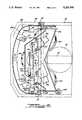
- FIG. 2is a diagrammatic top plan view showing the mounting mechanism of the present invention in its laterally retracted position
- FIG. 3is a view similar to FIG. 2 showing the mounting mechanism of the present invention in its laterally extended position
- FIG. 4is a view similar to FIG. 2 showing the mounting mechanism of the present invention in a position in which it has been swung away from the vehicle.
- FIG. 5is a partial perspective view of the retainer and release mechanism according to the present invention.
- FIG. 1shows a sweeping and scrubbing vehicle 12 having a frame 14 which supports the various machine components.
- the vehicleis carried on three wheels, including two wheels 16 located at the front of vehicle 12, and a single wheel 18 which can rotate about a generally vertical axis for steering located at the rear of the vehicle 12.
- the vehicle 12includes an operator's seat 20, a steering wheel 22 for actuating rear wheel 18, a motor or engine 24, the usual control mechanism 26 for locomotion, a sweeper assembly 27 of conventional design resting on floor 29, a hopper 31 for storing the debris swept up by sweeper assembly 27, and tanks 28 for storing clean and dirty scrubbing solution.
- the scrubbing vehicle 12is provided with a scrubbing pod 30 at the rear of the vehicle which consists of a scrubbing pod frame 32, three rotary scrub brushes 34 which are mounted on a scrub head 36, and a squeegee assembly 38.
- Squeegee assembly 38is supported on floor 29 by castors 37, and is carried under pod frame 32 by support members 40.
- Squeegee 38utilizes a vacuum hose 41 to pick up fluid from floor 29.
- Squeegee assembly 38is preferably a single integral U-shaped member as shown in FIG. 2, or may be constructed of one main squeegee 43 with two side squeegees 45.
- the vehicle 12may also include a forwardly and laterally outwardly disposed side broom 39.
- scrub head 36is mounted to the scrubbing pod frame 32 by a horizontal motion mechanism 48 that allows scrub brushes 34 and scrub head 36, in concert with squeegee assembly 38, to translate laterally.
- the scrub head 36translates in an orbit without rotating about its own axis, such that each scrub brush 34 remains beyond the rear tire turning area 42. This orbital path allows a compact mounting arrangement, yet permits the scrub head 36 to shift laterally.
- the mechanism 48is shown in FIGS. 2, 3 and consists of the scrubbing pod frame 32, which is generally a reversed D-shape in plan, composing one ground link.
- Mechanism 48includes first and second rocker arms 50 and 52 which are connected at one end to pod frame 32 by means of a pin and journal pivotal connector 51, and at the other end to scrub head 36 by a similar pivotal connector 53.
- Rocker arms 50 and 52are mounted in a parallel configuration so that the scrubbing pod frame 32, the scrub head 36, and first and second parallel rocker arms 50 and 52 form a four bar mechanism.
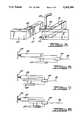
- the operation of mechanism 48is shown more clearly in FIGS.
- variable length member 54preferably an electric actuator, which connects scrubbing pod frame 32 to a slider block 49 which is formed to slide freely on a traveller bar 56 which extends between similar points located near the outer ends of first and second rocker arms 50 and 52, and slider block 49 is affixed to the plunger of a gas spring 55.
- the base end of gas spring 55is connected to traveller bar 56.
- actuator 54compresses and shortens in length, moving slider block 49 laterally.
- the gas spring 55resists compression and exerts a force on traveller bar 56 to extend scrub head 36 laterally.
- a contact wheel 58is affixed to scrub head 36 and extends outward beyond scrub head 36 and squeegee 38.
- scrub head 36 and traveller bar 56are urged inwards to an extended position of mechanism 48 as shown in FIG. 8.
- Spring 55is forced to compress because actuator 54 will not move, preventing slider block 49 from moving relative to pod frame 32.
- gas spring 55compresses, and traveller bar 56 slides through slider block 49, and scrub head 36 retracts inward until the obstacle has passed, when gas spring 55 pushes scrub head 36 back out.
- Actuator 54is thus attached to spring member 55 which provides resilient resistance to horizontal motion of scrub head 36 and squeegee 38 to prevent damage to the elements.
- the mechanism 48allows scrub head 36, scrub brushes 34, main squeegee 38, and side squeegees 40 to translate in an arc without rotating, which prevents any one of the scrub brushes 34 from entering the locus of possible positions enclosed by the rear tire turning area 42.
- Mechanism 48is shown in FIG. 3 in a laterally extended position.
- the operatormay selectively actuate electric actuator 54 so as to place scrub head 36 and squeegees 38 into a selected lateral position, and mechanism 48 will provide for automatic retraction in the event that the wall contact wheel 58 encounters an obstruction.
- Mechanism 48further automatically extends scrub brushes 34, scrub head 36 and squeegees 38 laterally outward after passage of the obstruction.
- horizontal motion mechanism 48and thus scrub head 36 and squeegee 38, is mounted to a scrubbing pod frame 32, which is mounted to vehicle frame 14 by a hinge 60, which allows scrubbing pod 30 to be rotated around a generally vertical axis.
- the scrubbing podmay rotate at least up to 90 degrees.
- FIG. 4shows scrubbing pod 30 in a rotated position.
- Hinge 60allows for rotation of scrubbing pod 30 in the event of collision with an immovable object, or for access to scrub head 36, scrub brushes 34, drive motors 46, and squeegee 38 for the purposes of maintenance or repair.
- a release retainer 62is shown in FIGS. 2 and 5, which releasably clamps scrubbing pod frame 32 in place adjacent to vehicle frame 14.
- Retainer 62consists of a pin 64 passed through perforated plates 66 which are affixed to vehicle frame 14 and a flexible retainer clamp 68 formed to accept pin 64 in an interlocking relationship.
- Retainer clamp 68is preferably formed of a block of rubber.
Landscapes
- Vehicle Cleaning, Maintenance, Repair, Refitting, And Outriggers (AREA)
Abstract
Description
This invention relates generally to floor scrubbing vehicles, and more particularly to a unique mechanism for mounting the scrubbing apparatus.
Floor sweeping and scrubbing machines generally include more than one scrub brush and a laterally extending flexible squeegee. The scrub brushes and their respective rotational drive motors are typically mounted in a housing, or scrub head. This scrub head is variously located at the front, middle, or rear of the scrubbing machine. The scrub head is generally attached to the frame of the machine through a vertical motion mechanism so that the brushes may be raised from contact with the floor for inactive transportation and lowered into contact with the floor for active sweeping and scrubbing. Each scrub brush is mounted so as to remain in contact with the floor when scrubbing even though the floor may be uneven. The scrub head and squeegee normally do not extend beyond the horizontal limits of the machine frame, because they would be vulnerable to damage by collision with permanent objects. However, because the machine frame normally extends laterally further than the scrub head, the scrub brushes cannot scrub in close proximity to a wall. One solution for this problem is to provide a scrubbing side brush at a front corner of the machine extending out forwardly and laterally beyond the machine frame to scrub along walls. Unfortunately, the scrubbing pattern on the floor for a side brush often fails to match the pattern of the main brushes. Furthermore, a side brush may track outside of the pickup squeegee on turns due to its forward outwardly disposed location, and the side brush consequently leaves a trail of water and cleaning solution on the floor.
The present invention overcomes these disadvantages by providing a floor scrubbing vehicle or machine having a unique mounting mechanism for the scrub brushes and squeegee which permits horizontal motion of the scrub brushes and squeegee together, and in addition a novel hinge arrangement which permits the scrub brushes and squeegee to swing out away from the vehicle about a generally vertical axis. The scrub brushes and their respective drive motors are mounted onto a scrub head. The squeegee is mounted so as to move horizontally in conjunction with the scrub head. The scrub head and squeegee are mounted to the frame through a mechanism which allows for selective lateral motion of the scrub head and squeegee. The operator may selectively position the scrub head and squeegee laterally in order to scrub along a wall. The mechanism is also spring biased outwardly so that if any component extending beyond the horizontal limits of the machine frame contacts a permanent object, the scrub head and squeegee is free to be pushed inwardly by the object to avoid damage, and subsequently to automatically extend laterally outwardly to resume contact with the wall following passage of the permanent object. In addition, the scrub head and squeegee are mounted to the scrubbing machine frame by a hinge which allows the scrub head and squeegee to rotate about a vertical axis and swing out away from the machine frame. The scrub head and squeegee can thus break away from the machine frame if the extended scrub head and squeegee collide with an immovable object. The hinge further allows the scrub brush and squeegee to intentionally be pivoted out from the machine frame for the purposes of repair or maintenance.
It is therefore an object of the present invention to provide a unique floor scrubbing vehicle having a mechanism allowing horizontal motion of the scrub brushes in conjunction with a squeegee.
It is a further object of the present invention to provide a novel resilient coupling between the machine frame and the scrub head and squeegee so that the scrub head and squeegee will automatically retract in the event of striking an immovable obstacle and automatically extend following passage of the obstacle.
It is a further object of the present invention to provide a novel hinge and release means so that the scrub head and squeegee may rotate about a vertical axis, to prevent damage from contact with an immovable object, as well as to facilitate repair and maintenance.
These and other advantages and features will become apparent from the following description and claims in conjunction with the accompanying drawings.
FIG. 1 is a side elevational view of a scrubbing vehicle embodying the principles of the present invention showing the scrub head and mounting mechanism in a raised non-operating position;
FIG. 2 is a diagrammatic top plan view showing the mounting mechanism of the present invention in its laterally retracted position;
FIG. 3 is a view similar to FIG. 2 showing the mounting mechanism of the present invention in its laterally extended position; and
FIG. 4 is a view similar to FIG. 2 showing the mounting mechanism of the present invention in a position in which it has been swung away from the vehicle.
FIG. 5 is a partial perspective view of the retainer and release mechanism according to the present invention.
FIGS. 6 through 8 are diagrammatic front elevations showing the operation of the mounting mechanism.
With reference to the drawings, FIG. 1 shows a sweeping andscrubbing vehicle 12 having aframe 14 which supports the various machine components. The vehicle is carried on three wheels, including two wheels 16 located at the front ofvehicle 12, and asingle wheel 18 which can rotate about a generally vertical axis for steering located at the rear of thevehicle 12. Thevehicle 12 includes an operator'sseat 20, asteering wheel 22 for actuatingrear wheel 18, a motor or engine 24, theusual control mechanism 26 for locomotion, a sweeper assembly 27 of conventional design resting on floor 29, a hopper 31 for storing the debris swept up by sweeper assembly 27, and tanks 28 for storing clean and dirty scrubbing solution. Thescrubbing vehicle 12 is provided with ascrubbing pod 30 at the rear of the vehicle which consists of ascrubbing pod frame 32, threerotary scrub brushes 34 which are mounted on ascrub head 36, and asqueegee assembly 38. Squeegeeassembly 38 is supported on floor 29 bycastors 37, and is carried underpod frame 32 bysupport members 40. Squeegee 38 utilizes avacuum hose 41 to pick up fluid from floor 29. Squeegeeassembly 38 is preferably a single integral U-shaped member as shown in FIG. 2, or may be constructed of onemain squeegee 43 with twoside squeegees 45. Thevehicle 12 may also include a forwardly and laterally outwardly disposedside broom 39.
As shown more clearly in FIG. 2,pod 30 preferably includes threerotary scrub brushes 34 which are driven byelectric motors 46 and are mounted toscrub head 36 to rotate about generally vertical axes. Thescrub brushes 34 may also be mounted to rotate about generally horizontal axes. The respective centers of the brushes describe an arc so that eachscrub brush 34 is located proximate to, yet outside of the rear tire turning area 42. This configuration allows a more compact arrangement of thescrub brushes 34 about therear wheel 18. Thescrub head 36 is attached topod 30 by a vertical motion mechanism 44 which allows it to be raised for transport and lowered for active scrubbing in the usual manner. When scrubbing, it will rise and fall to follow an uneven floor surface 29. As is customary, a downward force may be imparted upon thescrub head 36 to cause it to clean more effectively.
As shown in FIGS. 2 and 3,scrub head 36 is mounted to thescrubbing pod frame 32 by ahorizontal motion mechanism 48 that allowsscrub brushes 34 andscrub head 36, in concert withsqueegee assembly 38, to translate laterally. Thescrub head 36 translates in an orbit without rotating about its own axis, such that eachscrub brush 34 remains beyond the rear tire turning area 42. This orbital path allows a compact mounting arrangement, yet permits thescrub head 36 to shift laterally.
Themechanism 48 is shown in FIGS. 2, 3 and consists of thescrubbing pod frame 32, which is generally a reversed D-shape in plan, composing one ground link.Mechanism 48 includes first andsecond rocker arms pod frame 32 by means of a pin and journalpivotal connector 51, and at the other end to scrubhead 36 by a similarpivotal connector 53.Rocker arms scrubbing pod frame 32, thescrub head 36, and first and secondparallel rocker arms mechanism 48 is shown more clearly in FIGS. 6, 7 and 8, which depict avariable length member 54, preferably an electric actuator, which connectsscrubbing pod frame 32 to aslider block 49 which is formed to slide freely on atraveller bar 56 which extends between similar points located near the outer ends of first andsecond rocker arms slider block 49 is affixed to the plunger of agas spring 55. The base end ofgas spring 55 is connected totraveller bar 56. To shiftscrub head 36 laterally outward to an extended position ofmechanism 48 as shown in FIG. 7,actuator 54 compresses and shortens in length, movingslider block 49 laterally. Thegas spring 55 resists compression and exerts a force ontraveller bar 56 to extendscrub head 36 laterally. Acontact wheel 58 is affixed to scrubhead 36 and extends outward beyondscrub head 36 and squeegee 38. Whenscrub head 36 is in an extended position andcontact wheel 58 collides with and is urged inwards by an obstacle,scrub head 36 andtraveller bar 56 are urged inwards to an extended position ofmechanism 48 as shown in FIG. 8.Spring 55 is forced to compress becauseactuator 54 will not move, preventingslider block 49 from moving relative topod frame 32. Thus,gas spring 55 compresses, andtraveller bar 56 slides throughslider block 49, andscrub head 36 retracts inward until the obstacle has passed, whengas spring 55 pushesscrub head 36 back out.
As shown in FIG. 4,horizontal motion mechanism 48, and thus scrubhead 36 andsqueegee 38, is mounted to a scrubbingpod frame 32, which is mounted tovehicle frame 14 by ahinge 60, which allows scrubbingpod 30 to be rotated around a generally vertical axis. In the preferred embodiment, the scrubbing pod may rotate at least up to 90 degrees. FIG. 4shows scrubbing pod 30 in a rotated position.Hinge 60 allows for rotation of scrubbingpod 30 in the event of collision with an immovable object, or for access to scrubhead 36, scrub brushes 34,drive motors 46, andsqueegee 38 for the purposes of maintenance or repair.
A release retainer 62 is shown in FIGS. 2 and 5, which releasably clamps scrubbingpod frame 32 in place adjacent tovehicle frame 14. Retainer 62 consists of a pin 64 passed throughperforated plates 66 which are affixed tovehicle frame 14 and aflexible retainer clamp 68 formed to accept pin 64 in an interlocking relationship.Retainer clamp 68 is preferably formed of a block of rubber. Ifscrub head 36,squeegee 38 andcontact wheel 58 are extended laterally outward and encounter an immovable obstacle such that resilient shifting inward of thescrub head 36 is insufficient, pin 64 will separate fromrubber retainer clamp 68, allowing scrubbingpod 30 to rotate rearwardly to prevent damage to squeegee 38, scrub brushes 34 orscrub head 36. Scrubbingpod 30 may also be swung out for maintenance and repair by removing pin 64 from retainer 62.
It should be understood that the preferred embodiment of the invention has been shown and described herein, and that various modifications of the preferred embodiment will become apparent to those skilled in the art after a study of the specification, drawings, and the following claims.
Claims (28)
1. A scrubbing vehicle for moving in a longitudinal direction and cleaning a surface, comprising:
a) at least one scrub brush adapted to rotate about a generally vertical axis;
b) at least one squeegee for picking up a fluid from said surface; and
c) a horizontal motion mechanism for mounting said scrub brush and said squeegee to said vehicle for concurrent transverse extension and retraction with respect to said vehicle, said squeegee remaining in substantially constant angular orientation with respect to said vehicle during said extension and retraction.
2. The vehicle as set forth in claim 1, wherein said horizontal motion mechanism is spring-loaded, allowing for resilient horizontal lateral extension and retraction of said scrub brush and said squeegee.
3. The vehicle as set forth in claim 2, wherein said horizontal motion mechanism further comprises a spring member, said spring member being operative to allow for resilient retraction of said scrub brush and said squeegee upon contact with an immovable object and providing for subsequent spring-loaded extension of said brush and said squeegee in conjunction, following contact with said object.
4. The vehicle as set forth in claim 1, wherein said horizontal motion mechanism further comprises a frame, a scrub head mounted to said frame, said scrub brush being mounted to said scrub head.
5. The vehicle as set forth in claim 4, wherein said horizontal motion mechanism further comprises at least two swing arms, said swing arms having first and second ends, said first ends rotatably mounted to said frame by first pivotal connectors operative to allow said swing arms to rotate relative to said frame about generally vertical axes, said second ends rotatably mounted to said scrub head by second pivotal connectors operative to allow said swing arms to rotate relative to said scrub head about generally vertical axes, such that said horizontal motion mechanism allows said scrub head to translate horizontally with respect to said frame in an arc, said scrub head remaining in constant angular orientation with respect to said frame throughout said horizontal translation.
6. The vehicle as set forth in claim 1, which further comprises a vehicle frame and a scrubbing pod frame, said scrub brush and said squeegee being mounted to said scrubbing pod frame, and a hinge for mounting said scrubbing pod frame to said vehicle frame such that said scrubbing pod frame may rotate relative to said vehicle frame about a generally vertical axis.
7. The vehicle as set forth in claim 6, which further comprises a retainer operative to releasably retain said scrubbing pod frame in position adjacent to said vehicle frame.
8. The vehicle as set forth in claim 1, which further comprises:
a) a plurality of scrub brushes;
b) a plurality of wheels, at least one of said wheels adapted to rotate about a generally vertical axis for steering said vehicle;
c) a turning area defined by said steering wheel as it moves through its steering positions;
d) said scrub brushes being mounted in close proximity to, yet outside of, said turning area; and
e) said horizontal motion mechanism being adapted to transversely extend and retract said scrub brushes such that said brushes remain outside of said turning area throughout said extension and retraction.
9. A scrubbing vehicle for moving forwardly in a longitudinal direction and cleaning a surface, comprising:
a) a plurality of wheels for engaging said surface;
b) at least one scrub brush adapted to rotate around a generally vertical axis; and
c) a horizontal motion mechanism located at the trailing end of said vehicle following said wheels for mounting said scrub brush to said vehicle for transverse extension and retraction with respect to said vehicle.
10. The vehicle as set forth in claim 9, wherein said horizontal motion mechanism is spring-loaded, allowing for resilient horizontal lateral extension and retraction of said scrub brush.
11. The vehicle as set forth in claim 10, wherein said horizontal motion mechanism further comprises a spring member, said spring member being operative to allow for resilient retraction of said scrub brush upon contact with an immovable object and providing for subsequent spring-loaded extension of said brush following contact with said object.
12. The vehicle as set forth in claim 9, which further comprises a frame, a scrub head mounted to said frame, said scrub brush being mounted to said scrub head.
13. The vehicle as set forth in claim 9, which further comprises a vehicle frame, a scrubbing pod frame, said scrub brush being mounted to said scrubbing pod frame, and a hinge for mounting said scrubbing pod frame to said vehicle frame such that said scrubbing pod frame may rotate relative to said vehicle frame about a generally vertical axis.
14. The vehicle as set forth in claim 13, which further comprises a retainer operative to releasably retain said scrubbing pod frame in position adjacent to said vehicle frame.
15. The vehicle as set forth in claim 9, which further comprises a squeegee for picking up a fluid from said surface.
16. The vehicle as set forth in claim 9, which further comprises:
a) a plurality of scrub brushes;
b) at least one of said plurality of wheels being adapted to rotate about a generally vertical axis for steering said vehicle;
c) a turning area defined by said steering wheel as it moves through its steering positions;
d) said scrub brushes being mounted in close proximity to, yet outside of, said turning area; and
e) said horizontal motion mechanism being adapted to transversely extend and retract said scrub brushes such that said brushes remain outside of said turning area throughout said extension and retraction.
17. A scrubbing vehicle for moving forwardly in a longitudinal direction and cleaning a surface, comprising:
a) at least one scrub brush adapted to rotate around a generally vertical axis; and
b) a horizontal motion mechanism located at the trailing end of said vehicle for mounting said scrub brush to said vehicle for transverse extension and retraction with respect to said vehicle, wherein said horizontal motion mechanism has at least two swing arms, said swing arms having first and second ends, said first ends rotatably mounted to said frame by first pivotal connectors operative to allow said swing arms to rotate relative to said frame about generally vertical axes, said second ends rotatably mounted to said scrub head by second pivotal connectors operative to allow said swing arms to rotate relative to said scrub head about generally vertical axes, such that said horizontal motion mechanism allows said scrub head to translate horizontally with respect to said frame in an arc, said scrub head remaining in constant angular orientation with respect to said frame throughout said horizontal translation.
18. A scrubbing vehicle for moving in a horizontal direction and cleaning a surface, comprising:
a) a vehicle frame having a front end and a rear end;
b) a plurality of wheels for engaging said surface;
c) a scrubbing pod frame located at said rear end of said vehicle frame behind said wheels, said scrubbing pod frame being mounted to said vehicle frame by a pivotal hinge adapted to allow said scrubbing pod frame to rotate relative to said vehicle frame about a generally vertical axis;
d) at least one scrub brush adapted to rotate around a generally vertical axis; and
e) at least one squeegee for picking up a fluid from said surface, said scrub brush and said squeegee being mounted to said scrubbing pod frame.
19. The vehicle as set forth in claim 18, which further comprises a retainer operative to releasably retain said scrubbing pod frame in position adjacent to said vehicle frame.
20. The vehicle as set forth in claim 18, which further comprises a horizontal motion mechanism for concurrent transverse extension and retraction of said scrub brush and said squeegee with respect to said vehicle.
21. The vehicle as set forth in claim 20, which further comprises:
a) a plurality of scrub brushes;
b) at least one of said plurality of wheels being adapted to rotate about a generally vertical axis for steering said vehicle;
c) a turning area defined by said steering wheel as it moves through its steering positions;
d) said scrub brushes being mounted in close proximity to, yet outside of, said turning area; and
e) said horizontal motion mechanism being adapted to transversely extend and retract said scrub brushes such that said brushes remain outside of said turning area throughout said extension and retraction.
22. The vehicle as set forth in claim 18, which further comprises a scrub head mounted to said scrubbing pod frame, said scrub brush being mounted to said scrub head.
23. A scrubbing vehicle for moving in a horizontal direction and cleaning a surface, comprising:
a) a vehicle frame having a front end and a rear end;
b) a scrubbing pod frame located at said rear end of said vehicle frame, said scrubbing pod frame being mounted to said vehicle frame by a pivotal hinge adapted to allow said scrubbing pod frame to rotate relative to said vehicle frame about a generally vertical axis;
c) at least one scrub brush adapted to rotate around a generally vertical axis; and
d) at least one squeegee for picking up a fluid from said surface, said scrub brush and said squeegee being mounted to said scrubbing pod frame, wherein said horizontal motion mechanism is spring-loaded, allowing for resilient horizontal lateral extension and retraction of said scrub brush and said squeegee.
24. The vehicle as set forth in claim 23, wherein said spring-loaded horizontal motion mechanism comprises a spring member, said spring member being operative to allow for resilient retraction of said scrub brush and said squeegee upon contact with an immovable object and providing for subsequent spring-loaded extension of said brush and said squeegee in conjunction, following contact with said object.
25. A scrubbing vehicle for moving in a horizontal direction and cleaning a surface, comprising:
a) a vehicle frame having a front end and a rear end;
b) a scrubbing pod frame located at said rear end of said vehicle frame, said scrubbing pod frame being mounted to said vehicle frame by a pivotal hinge adapted to allow said scrubbing pod frame to rotate relative to said vehicle frame about a generally vertical axis;
c) at least one scrub brush adapted to rotate around a generally vertical axis;
d) at least one squeegee for picking up a fluid from said surface, said scrub brush and said squeegee being mounted to said scrubbing pod frame; and
e) a horizontal motion mechanism for concurrent transverse extension and retraction of said scrub brush and said squeegee with respect to said vehicle, wherein said horizontal motion mechanism has at least two swing arms, said swing arms having first and second ends, said first ends rotatably mounted to said frame by first pivotal connectors operative to allow said swing arms to rotate relative to said frame about generally vertical axes, said second ends rotatably mounted to said scrub head by second pivotal connectors operative to allow said swing arms to rotate relative to said scrub head about generally vertical axes, such that said horizontal motion mechanism allows said scrub head to translate horizontally with respect to said frame in an arc, said scrub head remaining in constant angular orientation with respect to said frame throughout said horizontal translation.
26. A scrubbing vehicle for moving in a forward horizontal direction and cleaning a surface comprising:
a) a plurality of scrub brushes adapted to rotate about generally vertical axes;
b) a plurality of wheels, at least one of said wheels being a steering wheel adapted to rotate about a generally vertical axis for steering said vehicle;
c) a turning area defined by said steering wheel as it moves through its steering positions;
d) said scrub brushes being mounted rearward of said wheels and in close proximity to, yet outside of, said turning area, a portion of at least one scrub brush extending forward of a portion of said turning area in a retracted position; and
e) a horizontal motion mechanism for mounting said scrub brushes to said vehicle for transverse extension and retraction of said scrub brushes.
27. The vehicle as set forth in claim 26, wherein said horizontal motion mechanism extends and retracts said scrub brushes such that said brushes remain outside of said turning area throughout said extension and retraction.
28. A scrubbing vehicle for moving in a horizontal direction and cleaning a surface, comprising:
a) at least one scrub brush;
b) a vehicle frame and a scrubbing pod frame;
c) a horizontal motion mechanism for mounting said scrub brush to said scrubbing pod frame for transverse extension and retraction with respect to said scrubbing pod frame, said horizontal motion mechanism being spring-loaded to allow for resilient retraction of said scrub brush upon contact with an immovable obstacle to prevent damage, and providing for subsequent spring-loaded extension of said brush following contact with said vehicle;
d) a hinge for mounting said scrubbing pod frame to said vehicle frame such that said scrubbing pod frame may rotate relative to said vehicle frame about a generally vertical axis;
e) a retainer operative to releasably retain said scrubbing pod frame in position adjacent to said vehicle frame, said retainer operative to release said scrubbing pod frame to rotate with respect to said vehicle frame upon contact with an immovable obstacle.
Priority Applications (2)
| Application Number | Priority Date | Filing Date | Title |
|---|---|---|---|
| US07/819,790US5265300A (en) | 1992-01-13 | 1992-01-13 | Floor scrubber |
| EP92308437AEP0551709A1 (en) | 1992-01-13 | 1992-09-16 | Floor scrubber |
Applications Claiming Priority (1)
| Application Number | Priority Date | Filing Date | Title |
|---|---|---|---|
| US07/819,790US5265300A (en) | 1992-01-13 | 1992-01-13 | Floor scrubber |
Publications (1)
| Publication Number | Publication Date |
|---|---|
| US5265300Atrue US5265300A (en) | 1993-11-30 |
Family
ID=25229082
Family Applications (1)
| Application Number | Title | Priority Date | Filing Date |
|---|---|---|---|
| US07/819,790Expired - Fee RelatedUS5265300A (en) | 1992-01-13 | 1992-01-13 | Floor scrubber |
Country Status (2)
| Country | Link |
|---|---|
| US (1) | US5265300A (en) |
| EP (1) | EP0551709A1 (en) |
Cited By (31)
| Publication number | Priority date | Publication date | Assignee | Title |
|---|---|---|---|---|
| US5455985A (en)* | 1994-01-10 | 1995-10-10 | Tennant Company | Steerable side squeegees |
| US5579555A (en)* | 1995-10-10 | 1996-12-03 | The National Super Service Company | Squeegee assembly for floor cleaning machine |
| USD376227S (en) | 1994-04-25 | 1996-12-03 | Windsor Industries, Inc. | Floor sweeper |
| US5613261A (en)* | 1994-04-14 | 1997-03-25 | Minolta Co., Ltd. | Cleaner |
| US5623743A (en)* | 1996-06-04 | 1997-04-29 | Clarke Industries, Inc. | Mobile surface scrubber solution recovery system |
| US5630246A (en)* | 1994-04-25 | 1997-05-20 | Windsor Industries, Inc. | Floor cleaning apparatus with flap having wear indicator |
| USD382383S (en)* | 1994-04-25 | 1997-08-12 | Windsor Industries, Inc. | Floor scrubber |
| US5687443A (en)* | 1995-08-18 | 1997-11-18 | Moore; Terry D. | Motorized janitorial cart with accessories |
| USD387519S (en)* | 1995-11-17 | 1997-12-09 | Kabushiki Kaisha Toyoda Jidoshokki Seisakusho | Operation panel for a floor scrubber |
| US5881417A (en)* | 1994-04-25 | 1999-03-16 | Windsor Industries, Inc. | Floor cleaning apparatus with contouring broom |
| US6163923A (en)* | 1997-03-27 | 2000-12-26 | Georg Hefter Maschinenbau | Soil processing machine |
| US6357070B1 (en) | 2000-02-16 | 2002-03-19 | Windsor Industries, Inc. | Multi-function, battery-powered, rider cleaning machine |
| US6557207B2 (en) | 2000-08-22 | 2003-05-06 | Alto U.S. Inc. | Squeegee assembly for a floor surface treatment apparatus |
| US6684452B2 (en) | 2001-10-17 | 2004-02-03 | Nilfisk-Advance, Inc. | Dual cleaning mode carpet extractor |
| US20040025288A1 (en)* | 2002-03-21 | 2004-02-12 | Hamline Anthony John | Tool mounting assembly for a surface maintenance machine |
| US6760947B2 (en) | 2000-08-22 | 2004-07-13 | Alto U.S. Inc. | Apparatus for treating a floor surface utilizing a handle mounted traverse switch |
| US6763544B2 (en) | 2000-08-22 | 2004-07-20 | Alto Us, Inc. | Apparatus for treating a floor surface |
| US20070089251A1 (en)* | 2005-10-21 | 2007-04-26 | Tennant Company | Floor cleaner scrub head having a movable disc scrub member |
| US20090113666A1 (en)* | 2006-02-07 | 2009-05-07 | Johnson Kale R | Squeegee Assembly |
| USD622181S1 (en)* | 2009-06-10 | 2010-08-24 | Chad Phillips | Turf cleaning machine |
| US8887340B2 (en)* | 2003-05-14 | 2014-11-18 | Kärcher North America, Inc. | Floor cleaning apparatus |
| US8966693B2 (en) | 2009-08-05 | 2015-03-03 | Karcher N. America, Inc. | Method and apparatus for extended use of cleaning fluid in a floor cleaning machine |
| US9015887B1 (en) | 2003-05-14 | 2015-04-28 | Kärcher North America, Inc. | Floor treatment apparatus |
| US10010230B2 (en) | 2014-03-24 | 2018-07-03 | International Cleaning Equipment Holdings Co., Ltd. | Riding floor cleaning machines having intelligent systems, associated sub-assemblies incorporating intelligent systems, and associated methods of use |
| CN109907695A (en)* | 2019-03-29 | 2019-06-21 | 深圳市杉川机器人有限公司 | Running gear, its control method and indoor cleaning machine people |
| IT201800005370A1 (en)* | 2018-05-15 | 2019-11-15 | FLOOR SCRUBBER MACHINE. | |
| USD907868S1 (en) | 2019-01-24 | 2021-01-12 | Karcher North America, Inc. | Floor cleaner |
| WO2021023048A1 (en)* | 2019-08-08 | 2021-02-11 | 深圳市杉川机器人有限公司 | Cleaning robot chassis structure and cleaning robot |
| US11051670B2 (en) | 2017-04-13 | 2021-07-06 | Intelligent Cleaning Equipment Holdings Co. Ltd. | Floor cleaning machines having intelligent systems, associated sub-assemblies incorporating intelligent systems, and associated methods of use |
| US12070181B2 (en) | 2017-05-04 | 2024-08-27 | Alfred Kärcher SE & Co. KG | Floor cleaning appliance and method for cleaning a floor surface |
| US12075957B2 (en) | 2014-03-24 | 2024-09-03 | Intelligent Cleaning Equipment Holdings Co. Ltd. | Floor cleaning machines having intelligent systems, associated sub-assemblies incorporating intelligent systems, and associated methods of use |
Families Citing this family (6)
| Publication number | Priority date | Publication date | Assignee | Title |
|---|---|---|---|---|
| DE69705983T2 (en)* | 1996-03-01 | 2001-11-22 | Unilever N.V., Rotterdam | Floor cleaning device |
| ES2145554T3 (en)* | 1996-03-01 | 2000-07-01 | Unilever Nv | FLOOR CLEANING DEVICE. |
| EP0792614B1 (en)* | 1996-03-01 | 2000-03-29 | Unilever N.V. | Apparatus for cleaning a ground |
| US5970571A (en)* | 1996-04-11 | 1999-10-26 | Nilfisk Schwamborn Gmbh | Suction hood for wet floor cleaning machines |
| CN101720199B (en)* | 2007-06-29 | 2012-12-26 | 纽麦蒂克国际有限公司 | Floor cleaning machine |
| FR2968019B1 (en)* | 2010-11-26 | 2013-09-27 | Daniel Perie Ets | ROAD MAINTENANCE VEHICLE EQUIPPED WITH A SUCTION DEVICE |
Citations (19)
| Publication number | Priority date | Publication date | Assignee | Title |
|---|---|---|---|---|
| US3277511A (en)* | 1964-04-15 | 1966-10-11 | Nat Super Service Company | Adjustable width floor treating machine |
| US3345671A (en)* | 1966-01-11 | 1967-10-10 | Ross D Wilson | Floor scrubbing and polishing machine |
| US3701177A (en)* | 1971-04-22 | 1972-10-31 | Star Ind Inc | Front wheel driven floor scrubber |
| US3866541A (en)* | 1972-03-24 | 1975-02-18 | Connor James M O | Self-propelled floor cleaning apparatus with movable brush |
| US3942218A (en)* | 1972-05-22 | 1976-03-09 | Tennant Company | Scrubbing machine |
| US3996636A (en)* | 1975-12-17 | 1976-12-14 | Star Industries, Inc. | Floor scrubbing machine |
| US4006506A (en)* | 1975-02-10 | 1977-02-08 | The Scott & Fetzer Company | Surface cleaning machine with squeegee assembly |
| US4009500A (en)* | 1976-04-26 | 1977-03-01 | Star Industries, Inc. | Floor scrubbing apparatus |
| US4041567A (en)* | 1975-04-10 | 1977-08-16 | The Scott & Fetzer Company | Combination sweeping-scrubbing apparatus |
| US4364138A (en)* | 1980-11-12 | 1982-12-21 | Wetrok, Inc. | Automatic floor cleaning machine with removable drive carriage |
| US4369540A (en)* | 1981-03-27 | 1983-01-25 | The Scott & Fetzer Company | Floor cleaning machine |
| US4429433A (en)* | 1982-08-27 | 1984-02-07 | The Scott & Fetzer Company | Surface cleaning machine with squeegee assembly |
| US4490873A (en)* | 1983-10-24 | 1985-01-01 | Stratton Harry M | Floating-brush assembly for use with floor-scrubbing and polishing machines |
| US4506405A (en)* | 1983-09-29 | 1985-03-26 | Mcgraw-Edison Company | Floor treating machine |
| US4619010A (en)* | 1984-04-04 | 1986-10-28 | Cooper Industries, Inc. | Scrubber with mechanism for automatically raising and lowering a squeegee assembly |
| US4633541A (en)* | 1983-09-29 | 1987-01-06 | Cooper Industries | Floor treating machine |
| US4674142A (en)* | 1984-08-28 | 1987-06-23 | Internationale Octrooi Maatschappij | Floor cleaning machine |
| US4942638A (en)* | 1987-12-16 | 1990-07-24 | Hako-Werke Gmbh & Co. | Hand-guided, mobile cleaning machine |
| US5016310A (en)* | 1989-08-21 | 1991-05-21 | Tennant Company | Floor scrubber having laterally variable scrub brush position |
Family Cites Families (3)
| Publication number | Priority date | Publication date | Assignee | Title |
|---|---|---|---|---|
| FR2657769B1 (en)* | 1990-02-07 | 1994-07-29 | Miroir 2000 Sarl | SELF-PROPELLED MACHINE FOR SURFACE TREATMENT USING LIQUID AGENTS AND ROTARY BRUSHES. |
| DE9108482U1 (en)* | 1991-02-01 | 1991-10-10 | Zachhuber, Kurt, 8122 Penzberg | Scrubber dryer |
| EP0569430B1 (en)* | 1991-02-01 | 1994-11-02 | Kurt Zachhuber | Floor treating machine |
- 1992
- 1992-01-13USUS07/819,790patent/US5265300A/ennot_activeExpired - Fee Related
- 1992-09-16EPEP92308437Apatent/EP0551709A1/ennot_activeWithdrawn
Patent Citations (19)
| Publication number | Priority date | Publication date | Assignee | Title |
|---|---|---|---|---|
| US3277511A (en)* | 1964-04-15 | 1966-10-11 | Nat Super Service Company | Adjustable width floor treating machine |
| US3345671A (en)* | 1966-01-11 | 1967-10-10 | Ross D Wilson | Floor scrubbing and polishing machine |
| US3701177A (en)* | 1971-04-22 | 1972-10-31 | Star Ind Inc | Front wheel driven floor scrubber |
| US3866541A (en)* | 1972-03-24 | 1975-02-18 | Connor James M O | Self-propelled floor cleaning apparatus with movable brush |
| US3942218A (en)* | 1972-05-22 | 1976-03-09 | Tennant Company | Scrubbing machine |
| US4006506A (en)* | 1975-02-10 | 1977-02-08 | The Scott & Fetzer Company | Surface cleaning machine with squeegee assembly |
| US4041567A (en)* | 1975-04-10 | 1977-08-16 | The Scott & Fetzer Company | Combination sweeping-scrubbing apparatus |
| US3996636A (en)* | 1975-12-17 | 1976-12-14 | Star Industries, Inc. | Floor scrubbing machine |
| US4009500A (en)* | 1976-04-26 | 1977-03-01 | Star Industries, Inc. | Floor scrubbing apparatus |
| US4364138A (en)* | 1980-11-12 | 1982-12-21 | Wetrok, Inc. | Automatic floor cleaning machine with removable drive carriage |
| US4369540A (en)* | 1981-03-27 | 1983-01-25 | The Scott & Fetzer Company | Floor cleaning machine |
| US4429433A (en)* | 1982-08-27 | 1984-02-07 | The Scott & Fetzer Company | Surface cleaning machine with squeegee assembly |
| US4506405A (en)* | 1983-09-29 | 1985-03-26 | Mcgraw-Edison Company | Floor treating machine |
| US4633541A (en)* | 1983-09-29 | 1987-01-06 | Cooper Industries | Floor treating machine |
| US4490873A (en)* | 1983-10-24 | 1985-01-01 | Stratton Harry M | Floating-brush assembly for use with floor-scrubbing and polishing machines |
| US4619010A (en)* | 1984-04-04 | 1986-10-28 | Cooper Industries, Inc. | Scrubber with mechanism for automatically raising and lowering a squeegee assembly |
| US4674142A (en)* | 1984-08-28 | 1987-06-23 | Internationale Octrooi Maatschappij | Floor cleaning machine |
| US4942638A (en)* | 1987-12-16 | 1990-07-24 | Hako-Werke Gmbh & Co. | Hand-guided, mobile cleaning machine |
| US5016310A (en)* | 1989-08-21 | 1991-05-21 | Tennant Company | Floor scrubber having laterally variable scrub brush position |
Cited By (62)
| Publication number | Priority date | Publication date | Assignee | Title |
|---|---|---|---|---|
| US5455985A (en)* | 1994-01-10 | 1995-10-10 | Tennant Company | Steerable side squeegees |
| US5613261A (en)* | 1994-04-14 | 1997-03-25 | Minolta Co., Ltd. | Cleaner |
| US5881417A (en)* | 1994-04-25 | 1999-03-16 | Windsor Industries, Inc. | Floor cleaning apparatus with contouring broom |
| USD376227S (en) | 1994-04-25 | 1996-12-03 | Windsor Industries, Inc. | Floor sweeper |
| US5630246A (en)* | 1994-04-25 | 1997-05-20 | Windsor Industries, Inc. | Floor cleaning apparatus with flap having wear indicator |
| USD382383S (en)* | 1994-04-25 | 1997-08-12 | Windsor Industries, Inc. | Floor scrubber |
| US5687443A (en)* | 1995-08-18 | 1997-11-18 | Moore; Terry D. | Motorized janitorial cart with accessories |
| US5579555A (en)* | 1995-10-10 | 1996-12-03 | The National Super Service Company | Squeegee assembly for floor cleaning machine |
| USD387519S (en)* | 1995-11-17 | 1997-12-09 | Kabushiki Kaisha Toyoda Jidoshokki Seisakusho | Operation panel for a floor scrubber |
| USRE36565E (en)* | 1996-06-04 | 2000-02-15 | Alto U. S. Inc. | Mobile surface scrubber solution recovery system |
| US5623743A (en)* | 1996-06-04 | 1997-04-29 | Clarke Industries, Inc. | Mobile surface scrubber solution recovery system |
| US6163923A (en)* | 1997-03-27 | 2000-12-26 | Georg Hefter Maschinenbau | Soil processing machine |
| US6357070B1 (en) | 2000-02-16 | 2002-03-19 | Windsor Industries, Inc. | Multi-function, battery-powered, rider cleaning machine |
| US6557207B2 (en) | 2000-08-22 | 2003-05-06 | Alto U.S. Inc. | Squeegee assembly for a floor surface treatment apparatus |
| US6760947B2 (en) | 2000-08-22 | 2004-07-13 | Alto U.S. Inc. | Apparatus for treating a floor surface utilizing a handle mounted traverse switch |
| US6763544B2 (en) | 2000-08-22 | 2004-07-20 | Alto Us, Inc. | Apparatus for treating a floor surface |
| US20080201896A1 (en)* | 2001-10-17 | 2008-08-28 | Nilfisk-Advance, Inc. | Dual Cleaning Mode Carpet Extractor |
| US6684452B2 (en) | 2001-10-17 | 2004-02-03 | Nilfisk-Advance, Inc. | Dual cleaning mode carpet extractor |
| US20040154124A1 (en)* | 2001-10-17 | 2004-08-12 | Dexter Lehman | Dual cleaning mode carpet extractor |
| US7370386B2 (en) | 2001-10-17 | 2008-05-13 | Nilfisk-Advance, Inc. | Dual cleaning mode carpet extractor |
| US20040025288A1 (en)* | 2002-03-21 | 2004-02-12 | Hamline Anthony John | Tool mounting assembly for a surface maintenance machine |
| US7059015B2 (en) | 2002-03-21 | 2006-06-13 | Tennant Company | Tool mounting assembly for a surface maintenance machine |
| US9192276B2 (en) | 2003-05-14 | 2015-11-24 | Karcher North America, Inc. | Floor cleaning apparatus |
| US9510721B2 (en) | 2003-05-14 | 2016-12-06 | Karcher North America, Inc. | Floor cleaning apparatus |
| US10555657B2 (en) | 2003-05-14 | 2020-02-11 | Kärcher North America, Inc. | Floor treatment apparatus |
| US9757005B2 (en) | 2003-05-14 | 2017-09-12 | Kärcher North America, Inc. | Floor treatment apparatus |
| US9730566B2 (en) | 2003-05-14 | 2017-08-15 | Kärcher North America, Inc. | Floor treatment apparatus |
| US8887340B2 (en)* | 2003-05-14 | 2014-11-18 | Kärcher North America, Inc. | Floor cleaning apparatus |
| US9451861B2 (en) | 2003-05-14 | 2016-09-27 | Kärcher North America, Inc. | Floor treatment apparatus |
| US9015887B1 (en) | 2003-05-14 | 2015-04-28 | Kärcher North America, Inc. | Floor treatment apparatus |
| US20070089251A1 (en)* | 2005-10-21 | 2007-04-26 | Tennant Company | Floor cleaner scrub head having a movable disc scrub member |
| US8584294B2 (en)* | 2005-10-21 | 2013-11-19 | Tennant Company | Floor cleaner scrub head having a movable disc scrub member |
| US20090113666A1 (en)* | 2006-02-07 | 2009-05-07 | Johnson Kale R | Squeegee Assembly |
| US8166606B2 (en)* | 2006-02-07 | 2012-05-01 | Nilfisk-Advance, Inc. | Squeegee assembly |
| USD622181S1 (en)* | 2009-06-10 | 2010-08-24 | Chad Phillips | Turf cleaning machine |
| US8966693B2 (en) | 2009-08-05 | 2015-03-03 | Karcher N. America, Inc. | Method and apparatus for extended use of cleaning fluid in a floor cleaning machine |
| US10433694B2 (en) | 2014-03-24 | 2019-10-08 | Intelligent Cleaning Equipment Holdings Co. Ltd. | Floor cleaning machines having intelligent systems, associated sub-assemblies incorporating intelligent systems, and associated methods of use |
| US10548446B2 (en) | 2014-03-24 | 2020-02-04 | Intelligent Cleaning Equipment Holdings Co., Ltd. | Floor cleaning machines having intelligent systems, associated sub-assemblies incorporating intelligent systems, and associated methods of use |
| US10076220B2 (en) | 2014-03-24 | 2018-09-18 | International Cleaning Equipment Holdings Co., Ltd. | Floor cleaning machines having intelligent systems, associated sub-assemblies incorporating intelligent systems, and associated methods of use |
| US10251522B2 (en) | 2014-03-24 | 2019-04-09 | Intelligent Cleaning Equipment Holdings Co. Ltd. | Riding floor cleaning machines having intelligent systems, associated sub-assemblies incorporating intelligent systems, and associated methods of use |
| US12075957B2 (en) | 2014-03-24 | 2024-09-03 | Intelligent Cleaning Equipment Holdings Co. Ltd. | Floor cleaning machines having intelligent systems, associated sub-assemblies incorporating intelligent systems, and associated methods of use |
| US10016112B2 (en) | 2014-03-24 | 2018-07-10 | International Cleaning Equipment Holdings Co., Ltd. | Floor cleaning machines having intelligent systems, associated sub-assemblies incorporating intelligent systems, and associated methods of use |
| US11369246B2 (en) | 2014-03-24 | 2022-06-28 | Intelligent Cleaning Equipment Holdings Co. Ltd. | Riding floor cleaning machines having intelligent systems, associated sub-assemblies incorporating intelligent systems, and associated methods of use |
| US10016113B2 (en) | 2014-03-24 | 2018-07-10 | International Cleaning Equipment Holdings Co., Ltd. | Riding floor cleaning machines having intelligent systems, associated sub-assemblies incorporating intelligent systems, and associated methods of use |
| US10548447B2 (en) | 2014-03-24 | 2020-02-04 | Intelligent Cleaning Equipment Holdings Co., Ltd. | Riding floor cleaning machines having intelligent systems, associated sub-assemblies incorporating intelligent systems, and associated methods of use |
| US11490775B2 (en) | 2014-03-24 | 2022-11-08 | Intelligent Cleaning Equipment Holdings Co., Ltd. | Floor cleaning machines having intelligent systems, associated sub-assemblies incorporating intelligent systems, and associated methods of use |
| US10010230B2 (en) | 2014-03-24 | 2018-07-03 | International Cleaning Equipment Holdings Co., Ltd. | Riding floor cleaning machines having intelligent systems, associated sub-assemblies incorporating intelligent systems, and associated methods of use |
| US10602901B2 (en) | 2014-03-24 | 2020-03-31 | Intelligent Cleaning Equipment Holdings Co., Ltd. | Riding floor cleaning machines having intelligent systems, associated sub-assemblies incorporating intelligent systems, and associated methods of use |
| US10729301B2 (en) | 2014-03-24 | 2020-08-04 | Intelligent Cleaning Equipment Holdings Co., Ltd. | Floor cleaning machines having intelligent systems, associated sub-assemblies incorporating intelligent systems, and associated methods of use |
| US11918161B2 (en) | 2014-03-24 | 2024-03-05 | Intelligent Cleaning Equipment Holdings Co., Ltd. | Floor cleaning machines having intelligent systems, associated sub-assemblies incorporating intelligent systems, and associated methods of use |
| US11641998B2 (en) | 2014-03-24 | 2023-05-09 | Intelligent Cleaning Equipment Holdings Co. Ltd. | Riding floor cleaning machines having intelligent systems, associated sub-assemblies incorporating intelligent systems, and associated methods of use |
| US10932639B2 (en) | 2014-03-24 | 2021-03-02 | Intelligent Cleaning Equipment Holdings Co. Ltd. | Riding floor cleaning machines having intelligent systems, associated sub-assemblies incorporating intelligent systems, and associated methods of use |
| US11071432B2 (en) | 2014-03-24 | 2021-07-27 | Intelligent Cleaning Equipment Holdings Co. Ltd. | Floor cleaning machines having intelligent systems, associated sub-assemblies incorporating intelligent systems, and associated methods of use |
| US11051670B2 (en) | 2017-04-13 | 2021-07-06 | Intelligent Cleaning Equipment Holdings Co. Ltd. | Floor cleaning machines having intelligent systems, associated sub-assemblies incorporating intelligent systems, and associated methods of use |
| US12070181B2 (en) | 2017-05-04 | 2024-08-27 | Alfred Kärcher SE & Co. KG | Floor cleaning appliance and method for cleaning a floor surface |
| WO2019219422A1 (en)* | 2018-05-15 | 2019-11-21 | Fimap S.P.A. | Floor washing-drying machine |
| US11849893B2 (en) | 2018-05-15 | 2023-12-26 | Fimap S.P.A. | Floor washing-drying machine |
| IT201800005370A1 (en)* | 2018-05-15 | 2019-11-15 | FLOOR SCRUBBER MACHINE. | |
| USD907868S1 (en) | 2019-01-24 | 2021-01-12 | Karcher North America, Inc. | Floor cleaner |
| CN109907695B (en)* | 2019-03-29 | 2024-02-20 | 深圳市杉川机器人有限公司 | Mobile device, control method thereof and indoor cleaning robot |
| CN109907695A (en)* | 2019-03-29 | 2019-06-21 | 深圳市杉川机器人有限公司 | Running gear, its control method and indoor cleaning machine people |
| WO2021023048A1 (en)* | 2019-08-08 | 2021-02-11 | 深圳市杉川机器人有限公司 | Cleaning robot chassis structure and cleaning robot |
Also Published As
| Publication number | Publication date |
|---|---|
| EP0551709A1 (en) | 1993-07-21 |
Similar Documents
| Publication | Publication Date | Title |
|---|---|---|
| US5265300A (en) | Floor scrubber | |
| US5623743A (en) | Mobile surface scrubber solution recovery system | |
| US7448114B2 (en) | Floor sweeping and scrubbing machine | |
| US11071431B2 (en) | Floor cleaning apparatus and method of cleaning a floor | |
| EP0662301B1 (en) | Steerable side squeegees | |
| EP2814369B1 (en) | Surface maintenance vehicle with compact side brush assembly | |
| US5377376A (en) | Mobile surface cleaning machine | |
| JP2855069B2 (en) | Sweeper | |
| US5016310A (en) | Floor scrubber having laterally variable scrub brush position | |
| US6836919B2 (en) | Suspension device for floor maintenance appliance | |
| AU667812B2 (en) | Sweeping unit | |
| US7025834B2 (en) | Retractable broom and dust skirt | |
| US4317252A (en) | Sweeper-scrubber | |
| US4951347A (en) | Brush-type cleaning system | |
| US7313839B2 (en) | Sweeping system with front removable hopper | |
| US4854005A (en) | Automatic floor scrubbing machine with squeegee assembly and adjustable wheels | |
| EP0982437B1 (en) | Sweeping machine with movable recirculation flap | |
| US5901410A (en) | Apparatus for cleaning a floor surface | |
| US4872233A (en) | Street sweeper with cool springs supported drag shoe | |
| US7059015B2 (en) | Tool mounting assembly for a surface maintenance machine | |
| EP0792614B1 (en) | Apparatus for cleaning a ground |
Legal Events
| Date | Code | Title | Description |
|---|---|---|---|
| AS | Assignment | Owner name:AAR CORPORATION Free format text:ASSIGNMENT OF ASSIGNORS INTEREST.;ASSIGNORS:O'HARA, ROBERT J.;KNOWLTON, CHRISTOPHER M.;REEL/FRAME:006037/0338 Effective date:19920218 | |
| REMI | Maintenance fee reminder mailed | ||
| LAPS | Lapse for failure to pay maintenance fees | ||
| FP | Lapsed due to failure to pay maintenance fee | Effective date:19971203 | |
| STCH | Information on status: patent discontinuation | Free format text:PATENT EXPIRED DUE TO NONPAYMENT OF MAINTENANCE FEES UNDER 37 CFR 1.362 |