US5252143A - Bipolar transistor structure with reduced collector-to-substrate capacitance - Google Patents
Bipolar transistor structure with reduced collector-to-substrate capacitanceDownload PDFInfo
- Publication number
- US5252143A US5252143AUS07/837,683US83768392AUS5252143AUS 5252143 AUS5252143 AUS 5252143AUS 83768392 AUS83768392 AUS 83768392AUS 5252143 AUS5252143 AUS 5252143A
- Authority
- US
- United States
- Prior art keywords
- layer
- substrate
- feed
- dielectric
- subcollector
- Prior art date
- Legal status (The legal status is an assumption and is not a legal conclusion. Google has not performed a legal analysis and makes no representation as to the accuracy of the status listed.)
- Expired - Lifetime
Links
Images

Classifications
- H—ELECTRICITY
- H10—SEMICONDUCTOR DEVICES; ELECTRIC SOLID-STATE DEVICES NOT OTHERWISE PROVIDED FOR
- H10D—INORGANIC ELECTRIC SEMICONDUCTOR DEVICES
- H10D62/00—Semiconductor bodies, or regions thereof, of devices having potential barriers
- H10D62/10—Shapes, relative sizes or dispositions of the regions of the semiconductor bodies; Shapes of the semiconductor bodies
- H10D62/13—Semiconductor regions connected to electrodes carrying current to be rectified, amplified or switched, e.g. source or drain regions
- H10D62/137—Collector regions of BJTs
- H—ELECTRICITY
- H10—SEMICONDUCTOR DEVICES; ELECTRIC SOLID-STATE DEVICES NOT OTHERWISE PROVIDED FOR
- H10D—INORGANIC ELECTRIC SEMICONDUCTOR DEVICES
- H10D10/00—Bipolar junction transistors [BJT]
- H10D10/40—Vertical BJTs
- H10D10/421—Vertical BJTs having both emitter-base and base-collector junctions ending at the same surface of the body
- H—ELECTRICITY
- H10—SEMICONDUCTOR DEVICES; ELECTRIC SOLID-STATE DEVICES NOT OTHERWISE PROVIDED FOR
- H10D—INORGANIC ELECTRIC SEMICONDUCTOR DEVICES
- H10D10/00—Bipolar junction transistors [BJT]
- H10D10/80—Heterojunction BJTs
- H10D10/821—Vertical heterojunction BJTs
- Y—GENERAL TAGGING OF NEW TECHNOLOGICAL DEVELOPMENTS; GENERAL TAGGING OF CROSS-SECTIONAL TECHNOLOGIES SPANNING OVER SEVERAL SECTIONS OF THE IPC; TECHNICAL SUBJECTS COVERED BY FORMER USPC CROSS-REFERENCE ART COLLECTIONS [XRACs] AND DIGESTS
- Y10—TECHNICAL SUBJECTS COVERED BY FORMER USPC
- Y10S—TECHNICAL SUBJECTS COVERED BY FORMER USPC CROSS-REFERENCE ART COLLECTIONS [XRACs] AND DIGESTS
- Y10S148/00—Metal treatment
- Y10S148/011—Bipolar transistors
- Y—GENERAL TAGGING OF NEW TECHNOLOGICAL DEVELOPMENTS; GENERAL TAGGING OF CROSS-SECTIONAL TECHNOLOGIES SPANNING OVER SEVERAL SECTIONS OF THE IPC; TECHNICAL SUBJECTS COVERED BY FORMER USPC CROSS-REFERENCE ART COLLECTIONS [XRACs] AND DIGESTS
- Y10—TECHNICAL SUBJECTS COVERED BY FORMER USPC
- Y10S—TECHNICAL SUBJECTS COVERED BY FORMER USPC CROSS-REFERENCE ART COLLECTIONS [XRACs] AND DIGESTS
- Y10S148/00—Metal treatment
- Y10S148/072—Heterojunctions
Definitions
- the present inventionrelates generally to transistors and more particularly to an improved substrate structure for bipolar and heterojunction bipolar transistors having reduced collector-to-substrate capacitance.
- a bipolar or heterojunction bipolar transistorthere is a p - substrate with a buried layer of n + silicon developed thereon. This buried layer is commonly called the subcollector layer. Then a lightly-doped layer of n type silicon is epitaxially grown over the buried layer with this lightly-doped layer being commonly called the collector layer.
- the subcollector regionextends completely beneath the active region of the transistor and to at least one side thereof to permit electrical contact thereto. This results in a broad p-n junction between the substrate and the subcollector regions with the collector current flowing very close to the p type substrate region. The longer this p-n junction, the greater the substrate-to-collector capacitance of the semiconductor device.
- the present inventionprovides a pre-processed substrate structure for constructing a semiconductor device having very low substrate-to-collector capacitance, thereby facilitating operation at high frequencies and convenient electrical connections with the elements of the device.
- a substrate structureincludes a substrate of semiconductor material such as p - silicon, a subcollector layer of semiconductor material such as n + silicon, a dielectric between the subcollector and the substrate, a window through the dielectric, and a feed-through layer of epitaxial semiconductor material in the window.
- the substratemay instead be formed of n type silicon and the subcollector layer of p type silicon if desired.
- the dielectriccomprises, for example, silicon dioxide formed on the substrate.
- the subcollector layeris preferably a mixed deposition layer which comprises epitaxial silicon where it overlies the material in the window and polycrystalline silicon where it overlies the dielectric. Such a layer may be formed by any of several deposition processes known in the art.
- the feed-through layerextends between, and is in contact with, the substrate and the subcollector.
- This layertypically is lightly doped to reduce the substrate-collector capacitance as much as possible. "Lightly doped” means that the material has been doped such that it is easily depleted of free carriers at a desired bias level.
- the feed-through layerdoes not extend out of the window.
- the size of the contact area between the feed-through layer and the subcollectoris governed by the size of the window opening and is usually about equal to the size of the contact area between the feed-through layer and the substrate.
- the feed-through layeroverfills the window and spills out onto a portion of the dielectric between the dielectric and the subcollector layer.
- the contact area between the feed-through layer and the subcollectoris significantly larger than the contact area between the feed-through layer and the substrate.
- the dielectricis sunk into a portion of an upper surface region of the substrate. Another portion of the upper surface region, in which portion there is no dielectric but which is typically surrounded by dielectric, serves as the feed-through layer.
- a complete semiconductor devicefor example a transistor, is made by constructing a semiconductor structure such as collector, base and emitter layers on the subcollector of any of the above-described embodiments of the substrate structure.
- An active region of the semiconductor structureis aligned with the feed-through layer beneath the subcollector.
- the base layeris fabricated of silicon, whereas if a heterojunction bipolar transistor is desired the base is made out of silicon-germanium.
- Channel stops generally surrounding the windoware preferably used to define a region of the substrate where a semiconductor device is to be built and in particular to isolate the device from other devices to be fabricated elsewhere on the same substrate.
- the windowis the same size as, or larger than, the active region of the semiconductor, and this size defines the size of the contact area between the substrate and the feed-through layer.
- the size of the window, and hence the size of the contact area between the feed-through layer and the substrateis smaller than that of the active region, resulting in even lower substrate-to-collector capacitance.
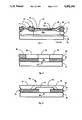
- FIG. 1is a cross-sectional schematic view of a conventional transistor according to the prior art
- FIG. 2is a cross-sectional schematic view of a substrate structure according to a first embodiment of the present invention
- FIG. 3is a cross-sectional schematic view of a substrate structure according to a second embodiment of the invention.
- FIG. 4is a cross-sectional schematic view of a substrate structure according to a third embodiment of the invention.
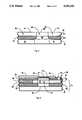
- FIG. 6is a cross-sectional schematic view of a heterojunction bipolar transistor built on a substrate structure of the kind illustrated in FIG. 2;
- FIG. 7is a cross-sectional schematic view of an embodiment of the invention wherein a plurality of active device regions are separated by channels stops.
- the inventionis embodied in a novel substrate structure having a subcollector layer that is separated from a substrate by a dielectric except in a limited area defined by a window containing a feed-through layer.
- FIG. 1illustrates a conventional silicon bipolar transistor of the prior art in cross-section.
- the transistorincludes a p - substrate 10 with an n + buried, or subcollector, layer 12 on top.
- Above the subcollector layer 12is an n type epitaxially grown collector layer 14 with an n + collector contact 11 and a p + base layer 16 on top of the collector layer 14 with silicon dioxide (SiO 2 ) 17 separating the contact 11 and the base layer 16 from each other.
- SiO 2silicon dioxide
- n + single crystal emitter 18Over substantially the central portion of the base layer 16 there is an n + single crystal emitter 18 with an n + polycrystalline silicon emitter contact 13 on top of the layer 18. There is also a base contact 15 of p + silicon adjacent the collector and emitter contacts 11 and 13 are separated therefrom by SiO 2 17 and 19, respectively.
- the subcollector layer 12extends beneath both an active region of the transistor (the active region is described generally as the emitter 13, the base 16 and a portion 14a of the collector 14 that lies beneath the base 16) and the remainder thereof, and the entire lower surface area of the subcollector 12 is in direct physical contact with the substrate 10. Much of the collector-to-substrate capacitance is attributable to this large area of contact between the subcollector and the substrate.
- the present inventionprovides a pre-processed substrate structure for a semiconductor device.
- This structurehas a dielectric between the subcollector and the substrate except in a relatively small area wherein a feed-through layer of epitaxial material extends between the subcollector and a portion of the substrate through a window in the dielectric.
- This structurereduces the contact area between the substrate and the subcollector, providing much lower substrate-to-collector capacitance than could otherwise be attained.
- FIGS. 2, 3 and 4Three illustrative embodiments of the present invention are shown in FIGS. 2, 3 and 4, respectively. Each of these embodiments provides a slightly different way to pre-process the substrate to develop a subcollector layer that is substantially separated, over much of its area, from the substrate material by a dielectric such as SiO 2 .
- the pre-processed substrate structureincludes a substrate 21 of semiconductor material such a p - silicon, a subcollector layer 23 of semiconductor material such as n + silicon, a dielectric 25 between the subcollector 23 and the substrate 21 with a window 27 therethrough, and a feed-through layer 29 of epitaxial semiconductor material in the window 27, as shown in FIG. 2.
- the dielectric 25serves as an intervening layer that spaces the subcollector layer 23 apart from the substrate 21.
- the subcollector layer 23preferably comprises mixed-deposition material having an epitaxial portion 31 that overlies the feed-through layer 29 in the window 27 and a ploycrystalline portion 33 that overlies the dielectric 25.
- the substrate structureis preferably fabricated with a substrate of p - silicon and a subcollector of n + silicon if the semiconductor device to be constructed on the structure is an npn transistor. These polarities are reversed if a pnp transistor is to be constructed.
- the window 27is typically about the size of an active region of the semiconductor device that is to be constructed on the subcollector layer 23.
- the feed-through layer 29,which preferably comprises either n - or p - silicon as desired, fills or partially fills the window 27.
- the layer 29is preferably selectively epitaxially grown in the window 27.
- the subcollector layer 23preferably comprises heavily doped silicon.
- the epitaxial portion 31 and the polycrystalline portion 33are formed either by directly depositing heavily doped silicon or by depositing undoped or lightly doped silicon and then doping the silicon as desired.
- the layer 29is developed as a lower portion of the subcollector layer 23, for example by growing the subcollector layer 23 as a mixed-deposition layer in, over and around the window.
- the part of the material which is in and over the windowis epitaxial and the part which surrounds the window is polycrystalline. After the material is grown, it is doped such that the relatively greater diffusion rate through polycrystalline silicon than through epitaxial silicon provides the desired doping levels in the subcollector and in the feed-through material in the window.
- An insulating layer 34abuts the subcollector layer 23 to electrically isolate the subcollector layer 23 from any nearby device.
- the area of contact between the feed-through layer and the substrateis made smaller than the area of the active region of the semiconductor device to further reduce the substrate-to-collector capacitance.
- this embodimentis constructed by starting as with the first embodiment with a substrate 35 and a dielectric 37 such as SiO 2 , with a window 39 therethrough, grown on the substrate 35.
- a feed-through layer 41overfills the window 39, a portion of the layer 41 extending laterally outward from the window 39 over the dielectric 37, between the dielectric and an overlying subcollector layer 43.
- the subcollector 43includes an epitaxial portion 45 that overlies the feed-through layer 41 and a polycrystalline portion 47 that overlies the dielectric 37 to provide an upper surface 49 on which to construct the semiconductor device.
- the upper surface 49is planar, but depending on the desired structure of the device to be built thereon a non-planar surface may be adequate.
- a dielectric 51is formed in, or sunk into, a first portion 53 of an upper surface region 55 of a substrate 57 as shown in FIG. 4.
- the dielectric 51separates a subcollector layer 59 from underlying portions 61 of the substrate 57.
- the dielectric 51which as in the other embodiments is preferably SiO 2 , is sunk into the substrate 57 by the LOCOS process or the like.
- the feed-through layer 63 of this embodimentcomprises a second portion 65 of the upper surface region 55 of the substrate 57, in which portion no dielectric is formed.
- the subcollector 59comprises a mixed layer of polycrystalline silicon 67 and epitaxial silicon 69.
- the polycrystalline silicon 67overlies the dielectric 51.
- the epitaxial silicon 69overlies the feed-through layer 63.
- the active region of the semiconductor device to be built on the subcollector layerwill be above and generally aligned with and in most cases about the same size as the area of the feed-through layers 29 and 63, respectively.
- the lateral dimensions of the active regionmay be some 10% to 15% smaller than the dimensions of the feed-through layer to avoid sidewall effects which are commonly found in a mixed epitaxial and polycrystalline deposition such as the subcollector layer of the present invention.
- the lateral dimensions of the active regionare 25% to 30% or more larger than the lateral dimensions of the dimensions of the portion of the feed-through layer 41 which occupies the window 39 and contacts the substrate 35.
- FIG. 5illustrates an example of a silicon bipolar transistor built on a pre-processed substrate structure generally 71 according to the first embodiment as shown in FIG. 2. Elements of the structure 71 which are similar to corresponding elements in FIG. 2 have been given the same reference numerals.
- a SiO 2 dielectric layer 73is formed on the surface of the subcollector 23 with a window 75 above the feed-through layer 29. N type silicon is then deposited in the window 75 to form a collector layer 77, which layer does not completely fill the window. P type silicon is then developed over the collector layer 77, filling the remaining portion of the window, to form a base layer 79. An n + emitter layer 81, typically having a smaller area than the base 79, is then formed centrally over the base 79. A polycrystalline silicon layer 83 is formed over the SiO 2 layer 73 and an outer circumference of the base layer 79 to provide an external connection to the base 79. A second window 85 is opened through the SiO 2 layer 73 and this second window is overfilled with n or n + silicon to make a contact 87 with the subcollector layer 23. Insulating material 34 isolates the transistor from other nearby devices (not shown).
- the active region of the finished transistormay be considered generally as that portion which occupies the window 75.
- the active regionis generally aligned with, and typically has similar lateral dimensions as, that portion of the surface area of the substrate 21 which is in contact with the feed-through layer 29. As discussed above, in some embodiments the lateral dimensions of the active region are either larger or smaller than those of the feed-through layer.
- bipolar transistor constructed on a substrate structure according to the first embodimenthas been described, it will be apparent that such a transistor may be fabricated on a structure according to any of the embodiments, as desired. It will also be apparent that other kinds of bipolar transistors may be constructed on a substrate structure according to the invention.
- FIG. 6illustrates an example of a silicon-germanium heterojunction bipolar transistor built on a pre-processed substrate structure generally 91 according to the first embodiment as shown in FIG. 2.
- elements of the structure 71which are similar to corresponding elements in FIG. 2 have been given the same reference numerals.
- a SiO 2 dielectric layer 93is formed on the subcollector 23 with a window 95 above the feed-through layer 29. N or n/n + silicon is then deposited in the window 95 to form a collector layer 97. P + silicon-germanium is then deposited over the dielectric 93 and the collector 97, forming a base layer 99.
- the base layer 99comprises an epitaxial portion 101 over the collector layer 97 and a polycrystalline portion 103 elsewhere.
- a silicon emitter layer 105is deposited over the base layer 99; the layer 105 includes an epitaxial portion 107 over the epitaxial portion 101 of the base 99 and a polycrystalline portion 109 over the polycrystalline portion 103 of the base 99.
- a p type dopantis added to the polycrystalline portions 103 and 109.
- n + silicon emitter contact layer 111is added over the epitaxial portion 107 of the emitter 105.
- a second window 113is opened through the SiO 2 layer 93 and is filled with n or n + silicon to make a contact 115 with the subcollector layer 23 to provide for an external collector connection. Insulating material 34 and 117 is used as needed to prevent unwanted electrical conduction paths.
- a pre-processed substrate structure configured to receive a plurality of semiconductor devicesis illustrated in FIG. 7.
- the structureincludes a substrate 119, made for example of p - silicon; a dielectric layer 121, for example of SiO 2 , on the substrate with windows 123 and 125 therethrough; lightly doped silicon, for example n - silicon, in the windows to form feed-through layers 127 and 129, respectively; mixed-deposition n + silicon subcollectors 131 and 133 over the feed-through layers 127 and 129, respectively; and insulating material 135 to electrically isolate the subcollectors from each other.
- Separate semiconductor devices(not shown) are developed over each of the subcollectors as has already been described.
- p + channel stop regions 137are preferably diffused into the surface of the substrate 119 to electrically isolate the devices and to insure that there are no low resistance paths through the substrate 119 from one device to another.
- These channel stopsare primarily necessary when a p type substrate is used; this is because p type silicon is susceptible to inversion during oxidation whereas n type this is because p type silicon is susceptible to inversion during oxidation whereas n type silicon tends to become more heavily n type when oxidized.
- the collector and the emitter layersherein, the nearly symmetrical behavior of many transistor structures allows those layers to be used in the alternative mode, e.g. interchanging the emitter and collector functions.
- the polarities given aboveare for npn devices except as otherwise noted, but the various embodiments and examples are readily adapted for pnp devices by reversing the polarities of the various layers.
- the channel regions 137are primarily useful in connection with p type substrates.
- the pre-processed substrate structure of the inventionprovides a means of constructing a transistor having very low substrate-to-collector capacitance.
- the structure provided by the inventionis readily adaptable for either npn or pnp devices and is advantageously used to fabricate a plurality of transistors on a single substrate. Electrical connections with the collector are easily established.
Landscapes
- Bipolar Transistors (AREA)
Abstract
Description
Claims (19)
Priority Applications (1)
| Application Number | Priority Date | Filing Date | Title |
|---|---|---|---|
| US07/837,683US5252143A (en) | 1990-10-15 | 1992-02-18 | Bipolar transistor structure with reduced collector-to-substrate capacitance |
Applications Claiming Priority (2)
| Application Number | Priority Date | Filing Date | Title |
|---|---|---|---|
| US59761590A | 1990-10-15 | 1990-10-15 | |
| US07/837,683US5252143A (en) | 1990-10-15 | 1992-02-18 | Bipolar transistor structure with reduced collector-to-substrate capacitance |
Related Parent Applications (1)
| Application Number | Title | Priority Date | Filing Date |
|---|---|---|---|
| US59761590AContinuation | 1990-10-15 | 1990-10-15 |
Publications (1)
| Publication Number | Publication Date |
|---|---|
| US5252143Atrue US5252143A (en) | 1993-10-12 |
Family
ID=27082864
Family Applications (1)
| Application Number | Title | Priority Date | Filing Date |
|---|---|---|---|
| US07/837,683Expired - LifetimeUS5252143A (en) | 1990-10-15 | 1992-02-18 | Bipolar transistor structure with reduced collector-to-substrate capacitance |
Country Status (1)
| Country | Link |
|---|---|
| US (1) | US5252143A (en) |
Cited By (6)
| Publication number | Priority date | Publication date | Assignee | Title |
|---|---|---|---|---|
| US5340754A (en)* | 1992-09-02 | 1994-08-23 | Motorla, Inc. | Method for forming a transistor having a dynamic connection between a substrate and a channel region |
| US5420053A (en)* | 1993-05-07 | 1995-05-30 | Nec Corporation | Method for manufacturing semiconductor device having bipolar transistor and polycrystalline silicon resistor |
| US5620907A (en)* | 1995-04-10 | 1997-04-15 | Lucent Technologies Inc. | Method for making a heterojunction bipolar transistor |
| US5635411A (en)* | 1991-11-12 | 1997-06-03 | Rohm Co., Ltd. | Method of making semiconductor apparatus |
| US5672522A (en)* | 1996-03-05 | 1997-09-30 | Trw Inc. | Method for making selective subcollector heterojunction bipolar transistors |
| US20040222486A1 (en)* | 2003-05-09 | 2004-11-11 | International Business Machines Corporation | BiCMOS TECHNOLOGY ON SOI SUBSTRATES |
Citations (21)
| Publication number | Priority date | Publication date | Assignee | Title |
|---|---|---|---|---|
| US4381202A (en)* | 1980-03-27 | 1983-04-26 | Fujitsu Limited | Selective epitaxy by beam energy and devices thereon |
| US4425574A (en)* | 1979-06-29 | 1984-01-10 | International Business Machines Corporation | Buried injector memory cell formed from vertical complementary bipolar transistor circuits and method of fabrication therefor |
| US4539744A (en)* | 1984-02-03 | 1985-09-10 | Fairchild Camera & Instrument Corporation | Semiconductor planarization process and structures made thereby |
| US4566914A (en)* | 1983-05-13 | 1986-01-28 | Micro Power Systems, Inc. | Method of forming localized epitaxy and devices formed therein |
| JPS6189668A (en)* | 1984-10-09 | 1986-05-07 | Matsushita Electric Ind Co Ltd | Manufacturing method of semiconductor device |
| US4651410A (en)* | 1984-12-18 | 1987-03-24 | Semiconductor Division Thomson-Csf Components Corporation | Method of fabricating regions of a bipolar microwave integratable transistor |
| US4663831A (en)* | 1985-10-08 | 1987-05-12 | Motorola, Inc. | Method of forming transistors with poly-sidewall contacts utilizing deposition of polycrystalline and insulating layers combined with selective etching and oxidation of said layers |
| US4696097A (en)* | 1985-10-08 | 1987-09-29 | Motorola, Inc. | Poly-sidewall contact semiconductor device method |
| EP0267082A1 (en)* | 1986-10-08 | 1988-05-11 | Fujitsu Limited | A method for fabricating a semiconductor device comprising simultaneous growing of epitaxial and polycristalline Si layers over a selectively oxydized Si substrate, by vapor deposition |
| US4764480A (en)* | 1985-04-01 | 1988-08-16 | National Semiconductor Corporation | Process for making high performance CMOS and bipolar integrated devices on one substrate with reduced cell size |
| US4764801A (en)* | 1985-10-08 | 1988-08-16 | Motorola Inc. | Poly-sidewall contact transistors |
| EP0306213A2 (en)* | 1987-09-02 | 1989-03-08 | AT&T Corp. | Submicron bipolar transistor with edge contacts |
| US4829016A (en)* | 1987-10-19 | 1989-05-09 | Purdue Research Foundation | Bipolar transistor by selective and lateral epitaxial overgrowth |
| US4849371A (en)* | 1986-12-22 | 1989-07-18 | Motorola Inc. | Monocrystalline semiconductor buried layers for electrical contacts to semiconductor devices |
| US4851362A (en)* | 1987-08-25 | 1989-07-25 | Oki Electric Industry Co., Ltd. | Method for manufacturing a semiconductor device |
| US4860077A (en)* | 1987-09-28 | 1989-08-22 | Motorola, Inc. | Vertical semiconductor device having a sidewall emitter |
| US4876212A (en)* | 1987-10-01 | 1989-10-24 | Motorola Inc. | Process for fabricating complimentary semiconductor devices having pedestal structures |
| US4879255A (en)* | 1987-06-04 | 1989-11-07 | Fujitsu Limited | Method for fabricating bipolar-MOS devices |
| US4902641A (en)* | 1987-07-31 | 1990-02-20 | Motorola, Inc. | Process for making an inverted silicon-on-insulator semiconductor device having a pedestal structure |
| EP0375965A1 (en)* | 1988-11-30 | 1990-07-04 | Fujitsu Limited | Heterojunction bipolar transistor and method of producing the same |
| US5177582A (en)* | 1989-09-22 | 1993-01-05 | Siemens Aktiengesellschaft | CMOS-compatible bipolar transistor with reduced collector/substrate capacitance and process for producing the same |
- 1992
- 1992-02-18USUS07/837,683patent/US5252143A/ennot_activeExpired - Lifetime
Patent Citations (21)
| Publication number | Priority date | Publication date | Assignee | Title |
|---|---|---|---|---|
| US4425574A (en)* | 1979-06-29 | 1984-01-10 | International Business Machines Corporation | Buried injector memory cell formed from vertical complementary bipolar transistor circuits and method of fabrication therefor |
| US4381202A (en)* | 1980-03-27 | 1983-04-26 | Fujitsu Limited | Selective epitaxy by beam energy and devices thereon |
| US4566914A (en)* | 1983-05-13 | 1986-01-28 | Micro Power Systems, Inc. | Method of forming localized epitaxy and devices formed therein |
| US4539744A (en)* | 1984-02-03 | 1985-09-10 | Fairchild Camera & Instrument Corporation | Semiconductor planarization process and structures made thereby |
| JPS6189668A (en)* | 1984-10-09 | 1986-05-07 | Matsushita Electric Ind Co Ltd | Manufacturing method of semiconductor device |
| US4651410A (en)* | 1984-12-18 | 1987-03-24 | Semiconductor Division Thomson-Csf Components Corporation | Method of fabricating regions of a bipolar microwave integratable transistor |
| US4764480A (en)* | 1985-04-01 | 1988-08-16 | National Semiconductor Corporation | Process for making high performance CMOS and bipolar integrated devices on one substrate with reduced cell size |
| US4764801A (en)* | 1985-10-08 | 1988-08-16 | Motorola Inc. | Poly-sidewall contact transistors |
| US4696097A (en)* | 1985-10-08 | 1987-09-29 | Motorola, Inc. | Poly-sidewall contact semiconductor device method |
| US4663831A (en)* | 1985-10-08 | 1987-05-12 | Motorola, Inc. | Method of forming transistors with poly-sidewall contacts utilizing deposition of polycrystalline and insulating layers combined with selective etching and oxidation of said layers |
| EP0267082A1 (en)* | 1986-10-08 | 1988-05-11 | Fujitsu Limited | A method for fabricating a semiconductor device comprising simultaneous growing of epitaxial and polycristalline Si layers over a selectively oxydized Si substrate, by vapor deposition |
| US4849371A (en)* | 1986-12-22 | 1989-07-18 | Motorola Inc. | Monocrystalline semiconductor buried layers for electrical contacts to semiconductor devices |
| US4879255A (en)* | 1987-06-04 | 1989-11-07 | Fujitsu Limited | Method for fabricating bipolar-MOS devices |
| US4902641A (en)* | 1987-07-31 | 1990-02-20 | Motorola, Inc. | Process for making an inverted silicon-on-insulator semiconductor device having a pedestal structure |
| US4851362A (en)* | 1987-08-25 | 1989-07-25 | Oki Electric Industry Co., Ltd. | Method for manufacturing a semiconductor device |
| EP0306213A2 (en)* | 1987-09-02 | 1989-03-08 | AT&T Corp. | Submicron bipolar transistor with edge contacts |
| US4860077A (en)* | 1987-09-28 | 1989-08-22 | Motorola, Inc. | Vertical semiconductor device having a sidewall emitter |
| US4876212A (en)* | 1987-10-01 | 1989-10-24 | Motorola Inc. | Process for fabricating complimentary semiconductor devices having pedestal structures |
| US4829016A (en)* | 1987-10-19 | 1989-05-09 | Purdue Research Foundation | Bipolar transistor by selective and lateral epitaxial overgrowth |
| EP0375965A1 (en)* | 1988-11-30 | 1990-07-04 | Fujitsu Limited | Heterojunction bipolar transistor and method of producing the same |
| US5177582A (en)* | 1989-09-22 | 1993-01-05 | Siemens Aktiengesellschaft | CMOS-compatible bipolar transistor with reduced collector/substrate capacitance and process for producing the same |
Non-Patent Citations (4)
| Title |
|---|
| A. S. Yue et al., "Multilayered Structure of GaAs/epo-Si/SiOs/Si", Jan. 1990, Jour. of Crystal Growth (99) pp. 356-360. |
| A. S. Yue et al., Multilayered Structure of GaAs/epo Si/SiOs/Si , Jan. 1990, Jour. of Crystal Growth (99) pp. 356 360.* |
| H. Ming Liaw, "Simox and Induced Lateral Overgrowth for Pedestal Bipolar", Technical Develp. (18), Oct. 1988. |
| H. Ming Liaw, Simox and Induced Lateral Overgrowth for Pedestal Bipolar , Technical Develp. (18), Oct. 1988.* |
Cited By (10)
| Publication number | Priority date | Publication date | Assignee | Title |
|---|---|---|---|---|
| US5635411A (en)* | 1991-11-12 | 1997-06-03 | Rohm Co., Ltd. | Method of making semiconductor apparatus |
| US5340754A (en)* | 1992-09-02 | 1994-08-23 | Motorla, Inc. | Method for forming a transistor having a dynamic connection between a substrate and a channel region |
| US5393681A (en)* | 1992-09-02 | 1995-02-28 | Motorola, Inc. | Method for forming a compact transistor structure |
| US5527723A (en)* | 1992-09-02 | 1996-06-18 | Motorola, Inc. | Method for forming a dynamic contact which can be either on or off or switched therebetween |
| US5627395A (en)* | 1992-09-02 | 1997-05-06 | Motorola Inc. | Vertical transistor structure |
| US5420053A (en)* | 1993-05-07 | 1995-05-30 | Nec Corporation | Method for manufacturing semiconductor device having bipolar transistor and polycrystalline silicon resistor |
| US5620907A (en)* | 1995-04-10 | 1997-04-15 | Lucent Technologies Inc. | Method for making a heterojunction bipolar transistor |
| US5672522A (en)* | 1996-03-05 | 1997-09-30 | Trw Inc. | Method for making selective subcollector heterojunction bipolar transistors |
| US20040222486A1 (en)* | 2003-05-09 | 2004-11-11 | International Business Machines Corporation | BiCMOS TECHNOLOGY ON SOI SUBSTRATES |
| US6936910B2 (en) | 2003-05-09 | 2005-08-30 | International Business Machines Corporation | BiCMOS technology on SOI substrates |
Similar Documents
| Publication | Publication Date | Title |
|---|---|---|
| US4902641A (en) | Process for making an inverted silicon-on-insulator semiconductor device having a pedestal structure | |
| US4038680A (en) | Semiconductor integrated circuit device | |
| US4483726A (en) | Double self-aligned fabrication process for making a bipolar transistor structure having a small polysilicon-to-extrinsic base contact area | |
| KR100270965B1 (en) | High-speed bipolar transistor and method for fabricating the same | |
| US5506427A (en) | Heterojunction bipolar transistor with silicon-germanium base | |
| EP0172878B1 (en) | A bipolar transistor with active elements formed in slots | |
| US5496745A (en) | Method for making bipolar transistor having an enhanced trench isolation | |
| US5432376A (en) | Semiconductor devices containing power and control transistors | |
| US6239477B1 (en) | Self-aligned transistor contact for epitaxial layers | |
| US5101256A (en) | Bipolar transistor with ultra-thin epitaxial base and method of fabricating same | |
| US5587327A (en) | Process for preparing a heterojunction bipolar transistor | |
| US5484737A (en) | Method for fabricating bipolar transistor | |
| US4876212A (en) | Process for fabricating complimentary semiconductor devices having pedestal structures | |
| GB1360130A (en) | Semiconductor devices | |
| US5187554A (en) | Bipolar transistor | |
| KR100379586B1 (en) | Self aligned double poly BJT formation method using SiGe spacers as extrinsic base contacts | |
| US4933733A (en) | Slot collector transistor | |
| KR100292905B1 (en) | Bipolar transistor on a semiconductor-on-insulator substrate and method for manufacturing thereof | |
| US5252143A (en) | Bipolar transistor structure with reduced collector-to-substrate capacitance | |
| US5177582A (en) | CMOS-compatible bipolar transistor with reduced collector/substrate capacitance and process for producing the same | |
| US4860077A (en) | Vertical semiconductor device having a sidewall emitter | |
| JP2615646B2 (en) | Manufacturing method of bipolar transistor | |
| US5796157A (en) | High-frequency lateral PNP transistor | |
| EP0481202A1 (en) | Transistor structure with reduced collector-to-substrate capacitance | |
| KR100263790B1 (en) | Semiconductor device and manufacturing method thereof |
Legal Events
| Date | Code | Title | Description |
|---|---|---|---|
| STCF | Information on status: patent grant | Free format text:PATENTED CASE | |
| FEPP | Fee payment procedure | Free format text:PAYOR NUMBER ASSIGNED (ORIGINAL EVENT CODE: ASPN); ENTITY STATUS OF PATENT OWNER: LARGE ENTITY | |
| FPAY | Fee payment | Year of fee payment:4 | |
| AS | Assignment | Owner name:HEWLETT-PACKARD COMPANY, A DELAWARE CORPORATION, C Free format text:MERGER;ASSIGNOR:HEWLETT-PACKARD COMPANY, A CALIFORNIA CORPORATION;REEL/FRAME:010841/0649 Effective date:19980520 | |
| AS | Assignment | Owner name:AGILENT TECHNOLOGIES INC., CALIFORNIA Free format text:ASSIGNMENT OF ASSIGNORS INTEREST;ASSIGNOR:HEWLETT-PACKARD COMPANY, A DELAWARE CORPORATION;REEL/FRAME:010901/0336 Effective date:20000520 | |
| FPAY | Fee payment | Year of fee payment:8 | |
| FPAY | Fee payment | Year of fee payment:12 | |
| AS | Assignment | Owner name:AVAGO TECHNOLOGIES GENERAL IP PTE. LTD., SINGAPORE Free format text:ASSIGNMENT OF ASSIGNORS INTEREST;ASSIGNOR:AGILENT TECHNOLOGIES, INC.;REEL/FRAME:017207/0020 Effective date:20051201 | |
| AS | Assignment | Owner name:AVAGO TECHNOLOGIES GENERAL IP (SINGAPORE) PTE. LTD Free format text:CORRECTIVE ASSIGNMENT TO CORRECT THE NAME OF THE ASSIGNEE PREVIOUSLY RECORDED ON REEL 017207 FRAME 0020. ASSIGNOR(S) HEREBY CONFIRMS THE ASSIGNMENT;ASSIGNOR:AGILENT TECHNOLOGIES, INC.;REEL/FRAME:038633/0001 Effective date:20051201 |