US5251958A - Synchronous adjusting device for office chairs or the like - Google Patents
Synchronous adjusting device for office chairs or the likeDownload PDFInfo
- Publication number
- US5251958A US5251958AUS07/752,503US75250391AUS5251958AUS 5251958 AUS5251958 AUS 5251958AUS 75250391 AUS75250391 AUS 75250391AUS 5251958 AUS5251958 AUS 5251958A
- Authority
- US
- United States
- Prior art keywords
- articulation
- back part
- location
- carrier structure
- chair
- Prior art date
- Legal status (The legal status is an assumption and is not a legal conclusion. Google has not performed a legal analysis and makes no representation as to the accuracy of the status listed.)
- Expired - Fee Related
Links
Images


Classifications
- A—HUMAN NECESSITIES
- A47—FURNITURE; DOMESTIC ARTICLES OR APPLIANCES; COFFEE MILLS; SPICE MILLS; SUCTION CLEANERS IN GENERAL
- A47C—CHAIRS; SOFAS; BEDS
- A47C31/00—Details or accessories for chairs, beds, or the like, not provided for in other groups of this subclass, e.g. upholstery fasteners, mattress protectors, stretching devices for mattress nets
- A47C31/12—Means, e.g. measuring means, for adapting chairs, beds or mattresses to the shape or weight of persons
- A47C31/126—Means, e.g. measuring means, for adapting chairs, beds or mattresses to the shape or weight of persons for chairs
- A—HUMAN NECESSITIES
- A47—FURNITURE; DOMESTIC ARTICLES OR APPLIANCES; COFFEE MILLS; SPICE MILLS; SUCTION CLEANERS IN GENERAL
- A47C—CHAIRS; SOFAS; BEDS
- A47C1/00—Chairs adapted for special purposes
- A47C1/02—Reclining or easy chairs
- A47C1/031—Reclining or easy chairs having coupled concurrently adjustable supporting parts
- A47C1/032—Reclining or easy chairs having coupled concurrently adjustable supporting parts the parts being movably-coupled seat and back-rest
- A47C1/03255—Reclining or easy chairs having coupled concurrently adjustable supporting parts the parts being movably-coupled seat and back-rest with a central column, e.g. rocking office chairs
- A—HUMAN NECESSITIES
- A47—FURNITURE; DOMESTIC ARTICLES OR APPLIANCES; COFFEE MILLS; SPICE MILLS; SUCTION CLEANERS IN GENERAL
- A47C—CHAIRS; SOFAS; BEDS
- A47C1/00—Chairs adapted for special purposes
- A47C1/02—Reclining or easy chairs
- A47C1/031—Reclining or easy chairs having coupled concurrently adjustable supporting parts
- A47C1/032—Reclining or easy chairs having coupled concurrently adjustable supporting parts the parts being movably-coupled seat and back-rest
- A47C1/03261—Reclining or easy chairs having coupled concurrently adjustable supporting parts the parts being movably-coupled seat and back-rest characterised by elastic means
- A47C1/03283—Reclining or easy chairs having coupled concurrently adjustable supporting parts the parts being movably-coupled seat and back-rest characterised by elastic means with fluid springs
Definitions
- the inventionstarts from a synchronous adjusting device for office chairs, seat furniture or the like.
- synchronous mechanismmeans the arrangement of a combined or dependent back adjustment and seat adjustment, that is to say the adjustment of the back inclination fundamentally also results in an adjustment of the sitting surface.
- Known office chairshave a relatively complicated mechanical construction which is distinguished by a multiplicity of articulation points for the purpose of coordinating the cycle of movement between the seat part and back part.
- the adjustment of the inclination of the back partshould take place in such a way that a counterpressure or a corresponding counter moment rising with an increasing inclination is generated.
- the synchronousthat is to say simultaneous adjustment of the seat part, serves for adapting the chair to the physical characteristics of the user.
- pressure unitsare usually employed additionally for influencing and damping the individual movements.
- a particular problem of known office chairsis that they generally have to be adjusted to the weight or size of the user.
- a large heavy userexerts a substantially higher force on the back part than a lighter and smaller user.
- the object on which the invention is basedis to avoid the disadvantages described in relation to the state of the art and to propose a chair mechanism as a synchronous mechanism which is of extremely simple and effective construction, that is to say has few mechanical means and, if appropriate, can do without additional force accumulators and pressure units.
- a further object of the inventionis to equip such an office chair with a convenient adjusting mechanism which allows damped movements and retentions in any position without catching.
- the chairincludes a carrier structure of fixed location, having front and rear regions and a back part having first and second locations of articulation disposed below one another.
- the first location of articulation of the back partis pivotally jointed to the rear region of the carrier structure, whereby upon pivotal movement of the back part, the second location of articulation moves along a circular path about the first location of articulation.
- the chairfurther has a seat part having front and rear regions.
- the rear region of the seat partis pivotally jointed to the second location of articulation of the back part.
- a single coupling componentconnects the front region of the seat part with the front region of the carrier structure.
- An arrangementcompels an end of the single coupling component to travel in a circularly arcuate path having a center of curvature which is fixed relative to the carrier structure.
- the travelling end of the single coupling componentis situated at all times at a height level which is below the second location of articulation of the back part.
- the inventionis based on the principal idea that, during the adjustment of the backrest, a restoring movement of the back part must take place as a function of the weight of the user. At the same time, the restoring moment must rise automatically with the increase in the inclination, since the lever arm for the torque increases constantly with the increase in inclination. Consequently, the counter moment must also increase constantly with an increase in the inclination of the back part.
- such a counter moment or restoring moment during the adjustment of the back inclinationis obtained, in the first place, in that the back part is mounted rotatably relative to the seat part at a distance in height, and a restoring force counteracting the leaning force of the user at the back leaning point acts in the lower region of the back part.
- the back parttherefore acts in the manner of a rocker and is supported by the carrier structure at a fixed location and rotatably.
- the restoring force or counterforce in the lower region of the back partresults from the weight of the user which brings about a counter moment via the connection of the seat part to the back part and, in the front seat region, via the deflection.
- the carrier structureis connected in the front region to the seat part pivotably via a pendulum lever which allows the movable mounting of the seat part.
- a pendulum leverinstead of a pendulum lever, the front region of the seat part can also be connected to the carrier structure via a slotted-link guide or via a curved guide.
- the movement of the front region of the seat partis brought about synchronously as a result of the adjustment of the back part, both the front and the rear region of the seat part executing an upwardly directed movement which generates an increasing lever arm for the restoring moment.
- the connecting joint between the back part and the seat partis virtually underneath the fixed bearing of the back part on the carrier structure, since, in this position, virtually no torque acts on the back part.
- the lower connection pointcan also be located somewhat in front of the perpendicular through the bearing point.
- a restoring moment caused by the seat loadis thereby established directly whenever the back part is subjected to load.
- the lever arms on the back part below and above the bearing point on the carrier structure and the lever arm at the front articulation point of the seat part relative to the carrier structureare selected in such a way that the load on the back part always produces an adjustment of the inclination of the backrest or the back part since this is, of course, desirable. But this adjustment of the inclination of the back part and the forwardly directed upward movement of the front region of the seat part will always bring about restoring moments which are coordinated with the load on the seat part.
- the front region of the seat partis so guided via the pendulum lever or by means of a slotted-link guide or curved guide that, when the back part is subjected to load, an upwardly directed pivoting movement with an increasing counter moment occurs.
- This upwardly directed pivoting movementcounteracts the weight of the user, thereby generating an additional restoring moment of the back part.
- the carrier structureconsists of a narrow elongate base spar which is arranged underneath the seat part and which extends over and beyond the rear region of the seat part. Attached to the end of the base spar is a stirrup-like transverse branch or a bow-like stirrup which connects the base spar to the two lateral bearing points for the back part.
- the two armrestscan directly adjoin this bowshaped stirrup.
- the office chair according to the inventioncan be operated per se without any damping device or force accumulator, since, during the adjustment, the user himself serves as a weight counterbalance for the generation of restoring forces.
- a damping of the movement and a retention of specific sitting positionscan be advantageous.
- there is a lifting cylinderwhich can be loaded on both sides or a correspondingly acting bellows which is tensioned between the fixed carrier structure and the seat part.
- the adjusting movement of the seat part and of the back partcan be influenced by the conveyance of the fluid between the front and rear parts of the lifting cylinder of the bellows.
- Different sitting parameterscan be set by throttling or blocking the fluid flow.
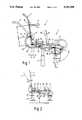
- FIG. 1shows a diagrammatic representation of an office chair with a 4-point synchronous adjusting device
- FIG. 2shows a diagrammatic representation according to FIG. 1 with a different seat-part and back-part adjustment
- FIG. 3shows a modified exemplary embodiment with an alternative seat-part control
- FIG. 4shows an extended exemplary embodiment according to FIG. 3,
- FIG. 5shows an exemplary embodiment of the invention with an additional damping and retaining device
- FIG. 6shows a diagrammatic representation of the damping and retaining device
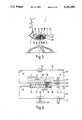
- FIG. 7shows an exemplary embodiment of an alternative valve arrangement in the exemplary embodiment according to FIG. 6.
- the office chair 1 illustrated in FIG. 1consists of a carrier structure 2 of fixed location, with a chair column 3 and with a seat part 5 connected to it in the front chair region 4 and a back part 7 articulated in the rear chair region 6.
- the seat part 5is connected in an articulated manner to the carrier structure 2 via a pendulum lever 8.
- the back part 7is connected rotatably to the carrier structure 2 at the articulation point A of fixed location.
- the articulated connection between the seat part 5 and the back part 7is made at the articulation point B.
- the pendulum lever 8is articulated at a fixed location on the carrier structure 2 at the point C.
- the articulated connection between the pendulum lever 8 and the seat part 5is made at the point D (lever arm "c").
- the a points A, B, C and Dform the basis for the 4-point synchronous adjusting device of the office chair.
- FIG. 1 and FIG. 2show the lever ratios and force ratios. These are explained as follows:
- This torque 11gives rise to a circular movement 12 of the point B, as represented by the arrow.
- the circular movementtakes place as a result of the fixed mounting of the back part 7 at the center of rotation A.
- the distance A-Bis designated by "b".
- the office chairis approximately in the neutral initial position.
- the perpendiculars for the points A and Bare at a distance d>0.
- the horizontal distance "e" between the points C and Dalso generates an additional restoring moment.
- FIGS. 1 and 2the user's body weight 15 is shown.
- This body weight 15can, according to the representation of FIG. 1, be broken down into a parallelogram of forces with the forces 15' and 15", the force 15' being projected to the point B (same angle ⁇ 1 ) and being perpendicular to the connecting line 10-B.
- the force 15'thus generates a countertorque 11' which is obtained from the amount of the force 15' times the lever arm b.
- the force 15'rises with an increasing rearward deflection of the back part 7 (angle ⁇ 1 ⁇ 2 ), that is to say with an increase of the portion d.
- the point Btravels to the point B' and the point D to the point D' (FIG. 2).
- the points A and Cremain at a fixed location.
- the torque 11 occurring as a result of the back force 9is counteracted by a counter moment 11' occurring as a result of the weight 15.
- the lever arm cwill always be lower than the lever arm b, in order, when there is an increase in the inclination of the back part 7, to prevent the possibility of buckling at the point B. Further, as seen in FIGS. 1 and 2, the lever arm c is shorter than the lever arm b.
- the lever arm cIn the extended position, the lever arm c thereby forms a gentle limitation of the inclination in relation to the connecting line B-C.
- the extended positionis represented by dot-and-dash lines in FIG. 1 with the straight connecting line B-C-D". This arrangement prevents the backrest from buckling, since the connecting points B-C-D" lie on one line (19") and the point B thus cannot rotate further about the point A.
- This extended positionis accordingly the limiting position of the chair which is established automatically as a result of the lever ratios.
- the restoring force or restoring moment 11'rises with an increasing back inclination as a result of the lever arms d' and e' increasing thereby.
- the rearwardly directed bow 16 of the carrier structure 2serves both mechanical and safety purposes with regard to jamming of movable parts.
- the carrier structure of fixed locationconsists of a lower base member 17 which is arranged centrally and symmetrically underneath the seat part 5 and which projects rearwards beyond a perpendicular through the center of rotation A (point 18) and from the end of which (point 18) a kind of stirrup-shaped branch 16 extends upwards to the lateral regions or points A of the back part 7 (see especially FIGS. 3 and 4).
- FIGS. 3 and 4illustrate an alternative embodiment of the mounting of the front region of the seat part 5.
- a roller mounting along a curve 20 with the mid-point C and radius cis selected.
- the seat part 5is connected firmly to a roller block 21 and a roller 22 which rolls on the fixed curve 20 of the carrier structure 2.
- the roller 22corresponds to the point D in FIGS. 1 and 2.
- the imaginary connecting line B-Dis designated by the reference symbol 19.
- the limiting position of the back adjustmentis reached when the points B-C-D" lie on one line 19", the point C in FIG. 3 being considered as the mid-point of the curve 14 or 20.
- a chair cross 25is also indicated on the chair column 3 in FIG. 4.
- the invention according to FIGS. 1 to 4can, in principle, be used without any damping means or restoring means. This arises, as described, as a result of the torque 11 brought about by the back force 9 and the countertorque 11' from the weight 15.
- a bearing block 26 for a double-acting bellows 27is fastened to the fixed carrier structure 2.
- the bellowsconsists of a front chamber 28 and of a rear chamber 29 which are separated from one another by a partition wall 30.
- the middle partition wall 30at the same time forms the cylindrical counterbearing for the bearing block 26.
- the two ends of the concertina chambers 28, 29are surrounded by a bracket 38 and are connected rigidly to this.
- the bracket 38is itself connected firmly to the seat part 5 and executes its movements. A kinematic reversal is possible.
- the inner spaces 28, 29 of the bellows 27are filled with a fluid, for example a hydraulic oil or water.
- a fluidfor example a hydraulic oil or water.
- the two chambers 28, 29are connected to one another via two ring lines 31, 32 guided separately.
- the ring line 32constitutes a restoring circuit for the unoccupied chair and the ring line 31 an adjusting circuit and a damping and retaining circuit for the occupied chair.
- a directional valve 33regulates the fluid flow between the chambers 28, 29 according to different positions.
- a nonreturn valve 34 in the ring line 32 and a throttle 35 with a nonreturn valve 36 and retaining valve 37 in the ring line 31serve for influencing the fluid in different sitting positions.
- the end regions of the chambers 28, 29are connected firmly to the seat part 5 via the bracket 38.
- An additional restoring spring 39is designed as a tension spring and returns the office chair to its initial position, as shown in FIG. 5.
- the adjusting mechanism of FIG. 5is described as follows in terms of its mode of operation according to the basic representation of FIG. 6:
- the directional valve 33is actuated and displaced downwards out of the position according to FIG. 6.
- the upper chamber 40 of the valve 33thereby joins the circuit 32 and closes this, so that no more fluid can flow through (interruption 43), whilst the middle chamber 41 joins the circuit 31 and opens this (arrow 44).
- the lower chamber 42 of the valve 33comes out of engagement.
- the seat part 5is displaced forwards.
- the concertina 27is likewise displaced forwards, that is to say to the right in FIG. 6, via the bracket 38.
- the backrest adjustmentcan be retained in any position as a result of the actuation of the retaining valve 37.
- the circuit in the ring line 31is thereby broken and a rigid connection is made between the bearing block 26 and seat part 5 via the concertina 27.
- the valve 33When the chair is unoccupied, the valve 33 returns to the position according to FIG. 6. The fluid can thereby flow only through the chamber 41 and therefore through the upper ring line 32, whilst the lower ring line 31 is blocked.
- the upper ring line 32serves for the once-only restoration of the backrest when the latter is inclined rearwards. In this case, the fluid must flow from the front chamber 28 via the line 32 and via the nonreturn valve 34 to the rear chamber 29 (arrow 48).
- the restoring spring 39assists this operation.
- the line 32When the backrest 7 is in the normal position, the line 32 is also blocked by the nonreturn valve 34. An adjustment of the backrest is possible only as a result of the actuation of the valve 33.
- FIG. 7illustrates an alternative exemplary embodiment of a valve arrangement according to the exemplary embodiment shown in FIGS. 5 and 6. This relates especially to the arrangement of the multidirectional valve 33 in FIG. 6.
- the directional valve 33'is located in the interspace between the front chamber 28 and rear chamber 29, that is to say the valve 33' itself forms the partition wall 30' of the double-acting concertina.
- the fluidis conveyed from one chamber to the other chamber directly by the directional valve 33'.
- the directional valve 33'has a valve housing 49 to which the two chambers 28, 29 of the double-acting concertina 27' are adjacent on the left and right.
- the two ends 50, 51 of the concertina 27'are connected fixedly to the carrier structure 2 in a kinematic reversal in relation to the exemplary embodiment according to FIG. 6, whilst the valve housing 49 is connected to the seat part 5 and is therefore movable to and fro. This connection is represented symbolically in FIG. 7a.
- the directional valve 33'has a vertically adjustable actuating tappet 52 which is vertically displaceable between an upper position 53 and a lower position 54. This adjustment takes place simultaneously with the loading of the chair by the user, that is to say in the upper position 53 the chair is under no load, whilst in the lower position 54 the chair is loaded.
- FIG. 7ashows the lower, that is to say the occupied chair position.
- the tappet 52reaches in its lower region into a horizontal passage bore 55 which connects the two chambers 28, 29 and which can be closed by nonreturn valves 56 and 57.
- the nonreturn valves 56, 57are respectively designed to transmit from the passage bore 55 to the chambers 28, 29 and can block in the opposite direction This is represented symbolically once more above FIG. 7a.
- the nonreturn valves 56, 57possess centrally on their plate surface actuating pins 58, 59 which reach into the passage bore 55 as far as the actuating tappet 52 and which interact with the predetermined curved shape on the tappet cylinder of the actuating tappet 52.
- actuating pins 58, 59By manual rotation of the setting wheel 60 through 90° about the longitudinal axis 61, different curves of the tappet-cylinder surface can be actuated.
- the left actuating pin 58 of the nonreturn valve 57 for the chamber 29bears against the outer surface of the actuating tappet 52, so that the nonreturn valve is opened in this position.
- fluidcan pass from the chamber 29 via the passage bore 55 and the nonreturn valve 56 into the chamber 28.
- the nonreturn valve 56opens automatically counter to the pressure of the press spring 63.
- the nonreturn valve 57has a corresponding press spring 64.
- the fluidwill flow from the chamber 29 into the chamber 28, and vice versa.
- the two actuating pins 58, 59bear against the outer cylindrical surface of the actuating tappet 52, so that the two nonreturn valves 56, 57 are pressed radially outwards and are consequently open (in FIG. 7a, the right nonreturn valve 56 is conversely shown closed).
- the valve seat of the nonreturn valve 57possesses, in the region of the annular gap 62, an additional annular shoulder 65 which increases the flow resistance for the fluid through this annular gap. The result of this is that, when being restored forwards, the backrest is guided with more damping than during the rearward adjustment .
- the valve seattherefore acts in a similar way to the throttle 35 in FIG. 6.
- FIG. 7bshows an end view of the directional valve according to FIG. 7a. Like parts are designated by the same reference symbols.
- the nonreturn valve 56 with press spring 63is fastened to the valve housing 49 via a connecting web 70.
- the valve housing 49additionally possesses two safety valves 71, 72 which close passage bores 73, 74 between the chambers 28, 29.
- the valve plates 75, 76are pressed against the valve seat by leaf springs 77.
- These additional safety valvesserve for protecting the concertina 27 or 27' in the event that the inclination of the backrest is actuated very abruptly and with excessive force and flow equalisation, with the chair unoccupied, via the directional valve 33 or 33' cannot take place. In this case, a flow of the fluid between the two chambers 28, 29, and vice versa, can take place via the safety valves 71, 72.
- the sectional representation in FIG. 7cshows in longitudinal section the safety valves 71, 72 arranged one above the other.
- the longitudinal tappets 78, 79serve at the same time as a one-sided mounting with recesses 80 for the leaf springs 77.
- FIG. 7balso shows a V-shaped retaining stirrup 81 for a 90° adjustment movement of the setting wheel 60, in order to reach the particular position for retention or for releasing the retention of the backrest adjustment.
Landscapes
- Dentistry (AREA)
- General Health & Medical Sciences (AREA)
- Health & Medical Sciences (AREA)
- Chairs Characterized By Structure (AREA)
- Chairs For Special Purposes, Such As Reclining Chairs (AREA)
- Exchange Systems With Centralized Control (AREA)
- Ignition Installations For Internal Combustion Engines (AREA)
- Nitrogen Condensed Heterocyclic Rings (AREA)
- Seats For Vehicles (AREA)
- Mechanical Operated Clutches (AREA)
- Devices For Checking Fares Or Tickets At Control Points (AREA)
- Selective Calling Equipment (AREA)
- Mobile Radio Communication Systems (AREA)
- Organic Low-Molecular-Weight Compounds And Preparation Thereof (AREA)
- Hydrogenated Pyridines (AREA)
- Chair Legs, Seat Parts, And Backrests (AREA)
Abstract
Description
The invention starts from a synchronous adjusting device for office chairs, seat furniture or the like.
Where office chairs are concerned, the term "synchronous mechanism" means the arrangement of a combined or dependent back adjustment and seat adjustment, that is to say the adjustment of the back inclination fundamentally also results in an adjustment of the sitting surface.
Known office chairs have a relatively complicated mechanical construction which is distinguished by a multiplicity of articulation points for the purpose of coordinating the cycle of movement between the seat part and back part. Thus, the adjustment of the inclination of the back part should take place in such a way that a counterpressure or a corresponding counter moment rising with an increasing inclination is generated. The synchronous, that is to say simultaneous adjustment of the seat part, serves for adapting the chair to the physical characteristics of the user. For the adjustment, pressure units are usually employed additionally for influencing and damping the individual movements.
A particular problem of known office chairs is that they generally have to be adjusted to the weight or size of the user. A large heavy user exerts a substantially higher force on the back part than a lighter and smaller user. The same applies to the load on the seat part, the movement of which is associated with the movement of the back part.
The object on which the invention is based is to avoid the disadvantages described in relation to the state of the art and to propose a chair mechanism as a synchronous mechanism which is of extremely simple and effective construction, that is to say has few mechanical means and, if appropriate, can do without additional force accumulators and pressure units.
A further object of the invention is to equip such an office chair with a convenient adjusting mechanism which allows damped movements and retentions in any position without catching.
This object and others to become apparent as the specification progresses, are accomplished by the invention, according to which, briefly stated, the chair includes a carrier structure of fixed location, having front and rear regions and a back part having first and second locations of articulation disposed below one another. The first location of articulation of the back part is pivotally jointed to the rear region of the carrier structure, whereby upon pivotal movement of the back part, the second location of articulation moves along a circular path about the first location of articulation. The chair further has a seat part having front and rear regions. The rear region of the seat part is pivotally jointed to the second location of articulation of the back part. A single coupling component connects the front region of the seat part with the front region of the carrier structure. An arrangement compels an end of the single coupling component to travel in a circularly arcuate path having a center of curvature which is fixed relative to the carrier structure. The travelling end of the single coupling component is situated at all times at a height level which is below the second location of articulation of the back part.
Further advantageous and expedient developments of the invention for achieving the object according to the invention are contained in the subclaims.
The invention is based on the principal idea that, during the adjustment of the backrest, a restoring movement of the back part must take place as a function of the weight of the user. At the same time, the restoring moment must rise automatically with the increase in the inclination, since the lever arm for the torque increases constantly with the increase in inclination. Consequently, the counter moment must also increase constantly with an increase in the inclination of the back part.
According to the invention, such a counter moment or restoring moment during the adjustment of the back inclination is obtained, in the first place, in that the back part is mounted rotatably relative to the seat part at a distance in height, and a restoring force counteracting the leaning force of the user at the back leaning point acts in the lower region of the back part. The back part therefore acts in the manner of a rocker and is supported by the carrier structure at a fixed location and rotatably. The restoring force or counterforce in the lower region of the back part results from the weight of the user which brings about a counter moment via the connection of the seat part to the back part and, in the front seat region, via the deflection. At the same time, the greater the inclination of the back part, the higher the counter moment becomes This is the result of the lever effects caused by the deflection of the upper and lower portions of the back part and of the seat part in the front region in conjunction with the fixedly mounted centers of rotation.
According to the invention, therefore, the carrier structure is connected in the front region to the seat part pivotably via a pendulum lever which allows the movable mounting of the seat part. Instead of a pendulum lever, the front region of the seat part can also be connected to the carrier structure via a slotted-link guide or via a curved guide.
The movement of the front region of the seat part is brought about synchronously as a result of the adjustment of the back part, both the front and the rear region of the seat part executing an upwardly directed movement which generates an increasing lever arm for the restoring moment.
In an advantageous version of the invention, with the chair in the normal position the connecting joint between the back part and the seat part is virtually underneath the fixed bearing of the back part on the carrier structure, since, in this position, virtually no torque acts on the back part. However, the lower connection point can also be located somewhat in front of the perpendicular through the bearing point. A restoring moment caused by the seat load is thereby established directly whenever the back part is subjected to load. The lever arms on the back part below and above the bearing point on the carrier structure and the lever arm at the front articulation point of the seat part relative to the carrier structure are selected in such a way that the load on the back part always produces an adjustment of the inclination of the backrest or the back part since this is, of course, desirable. But this adjustment of the inclination of the back part and the forwardly directed upward movement of the front region of the seat part will always bring about restoring moments which are coordinated with the load on the seat part.
To achieve the desired moments and counter moments on the seat part, therefore, the front region of the seat part is so guided via the pendulum lever or by means of a slotted-link guide or curved guide that, when the back part is subjected to load, an upwardly directed pivoting movement with an increasing counter moment occurs. This upwardly directed pivoting movement counteracts the weight of the user, thereby generating an additional restoring moment of the back part.
It is advantageous, furthermore, if the carrier structure consists of a narrow elongate base spar which is arranged underneath the seat part and which extends over and beyond the rear region of the seat part. Attached to the end of the base spar is a stirrup-like transverse branch or a bow-like stirrup which connects the base spar to the two lateral bearing points for the back part. The two armrests can directly adjoin this bowshaped stirrup. The advantage of this embodiment is that the chair need not have in its side regions any additional guides or supporting structures which can lead to jamming. Moreover, the back part can be made highly curved and bulged, in order to allow the user to adopt a sitting position arranged as far to the rear as possible. Finally, an attractive design becomes possible thereby.
The office chair according to the invention can be operated per se without any damping device or force accumulator, since, during the adjustment, the user himself serves as a weight counterbalance for the generation of restoring forces. In an advantageous embodiment of the invention, however, a damping of the movement and a retention of specific sitting positions can be advantageous. For this, in a development of the invention, there is a lifting cylinder which can be loaded on both sides or a correspondingly acting bellows which is tensioned between the fixed carrier structure and the seat part. The adjusting movement of the seat part and of the back part can be influenced by the conveyance of the fluid between the front and rear parts of the lifting cylinder of the bellows. Different sitting parameters can be set by throttling or blocking the fluid flow.
Further details of the invention are illustrated in the drawing and explained in more detail in the following description. In the drawing:
FIG. 1 shows a diagrammatic representation of an office chair with a 4-point synchronous adjusting device,
FIG. 2 shows a diagrammatic representation according to FIG. 1 with a different seat-part and back-part adjustment,
FIG. 3 shows a modified exemplary embodiment with an alternative seat-part control,
FIG. 4 shows an extended exemplary embodiment according to FIG. 3,
FIG. 5 shows an exemplary embodiment of the invention with an additional damping and retaining device,
FIG. 6 shows a diagrammatic representation of the damping and retaining device, and
FIG. 7 shows an exemplary embodiment of an alternative valve arrangement in the exemplary embodiment according to FIG. 6.
Theoffice chair 1 illustrated in FIG. 1 consists of acarrier structure 2 of fixed location, with achair column 3 and with aseat part 5 connected to it in the front chair region 4 and aback part 7 articulated in therear chair region 6. Theseat part 5 is connected in an articulated manner to thecarrier structure 2 via a pendulum lever 8. Theback part 7 is connected rotatably to thecarrier structure 2 at the articulation point A of fixed location. The articulated connection between theseat part 5 and theback part 7 is made at the articulation point B. The pendulum lever 8 is articulated at a fixed location on thecarrier structure 2 at the point C. The articulated connection between the pendulum lever 8 and theseat part 5 is made at the point D (lever arm "c"). The a points A, B, C and D form the basis for the 4-point synchronous adjusting device of the office chair.
Both FIG. 1 and FIG. 2 show the lever ratios and force ratios. These are explained as follows:
The leaningforce 9 exerted on theback part 7 by a user, not shown in any more detail, at the leaninggravity center 10 brings about atorque 11 which is directed counterclockwise about the center of rotation A and which is calculated from the leaning force 9' resulting from the parallelogram of forces times the lever arm a (distance between point A and point 10) (the force 9' is perpendicular to the connecting line 10-A). Thistorque 11 gives rise to acircular movement 12 of the point B, as represented by the arrow. The circular movement takes place as a result of the fixed mounting of theback part 7 at the center of rotation A. The distance A-B is designated by "b".
The circular movement of the point B (arrow 12) ensures, furthermore, that theseat part 5 moves to the right in the figure in the direction of thearrow 13. As a result of the articulation of theseat part 5 on the pendulum lever 8 at the point C of fixed location, the point D which constitutes one end of the pendulum lever 8, executes an upwardly directedcircular movement 14 with the lever arm "c" according to thearrow 14. The lever arm c constitutes the radius of curvature of the circular travel path of point D, whereas point C constitutes the center of curvature of the circular travel path. As represented by dot-and-dash lines in FIGS. 1 and 2, theseat part 5 thereby rises into the position 5'. The length of the lever arm of the pendulum lever 8 is denoted by "c".
In the representation according to FIG. 1, the office chair is approximately in the neutral initial position. Thus, the perpendiculars for the points A and B are at a distance d>0. The result of this is that any load on theseat part 5 already generates a restoring moment which is designated as a restoring torque 11'. In any events, the connecting point B will be located below the center of rotation A (d=0) or to the right of this in FIG. 1 (d≧0), in order to generate a restoring moment 11' when theseat part 5 is to load. The horizontal distance "e" between the points C and D also generates an additional restoring moment.
In FIGS. 1 and 2, the user'sbody weight 15 is shown. Thisbody weight 15 can, according to the representation of FIG. 1, be broken down into a parallelogram of forces with theforces 15' and 15", the force 15' being projected to the point B (same angle α1) and being perpendicular to the connecting line 10-B. The force 15' thus generates a countertorque 11' which is obtained from the amount of the force 15' times the lever arm b. As is evident from FIGS. 1 and 2, the force 15' rises with an increasing rearward deflection of the back part 7 (angle α1 →α2), that is to say with an increase of the portion d. This means that the restoring moment 11' caused by the user'sbody weight 15 increases with an increasing inclination nation β of the back part, in order to counteract the constantly increasingmoment 11. The restoring force 15' thus always takes the form of a perpendicular to the connecting line 10-B. Likewise, theresultant force 15" is parallel to the connecting line 10-B. Moreover, in FIGS. 1 and 2, the respectively offset points representing the increased inclination 7' of the backrest are identified by corresponding apostrophes.
Accordingly, the point B travels to the point B' and the point D to the point D' (FIG. 2). The points A and C remain at a fixed location.
In the invention, therefore, thetorque 11 occurring as a result of theback force 9 is counteracted by a counter moment 11' occurring as a result of theweight 15. By an optimum design of the lever arms a and b for generating thetorques 11, 11' and by the lever arm c for generatingpivoting movement 14, an optimum coordination of the office chair, without an additional restoring spring, can be achieved. The lever arm c will always be lower than the lever arm b, in order, when there is an increase in the inclination of theback part 7, to prevent the possibility of buckling at the point B. Further, as seen in FIGS. 1 and 2, the lever arm c is shorter than the lever arm b. In the extended position, the lever arm c thereby forms a gentle limitation of the inclination in relation to the connecting line B-C. The extended position is represented by dot-and-dash lines in FIG. 1 with the straight connecting line B-C-D". This arrangement prevents the backrest from buckling, since the connecting points B-C-D" lie on one line (19") and the point B thus cannot rotate further about the point A. This extended position is accordingly the limiting position of the chair which is established automatically as a result of the lever ratios. At the same time, the restoring force or restoring moment 11' rises with an increasing back inclination as a result of the lever arms d' and e' increasing thereby. This leads to a progressive rise of the restoring moment and to a gentle limitation of the backrest adjustment. The user can assist the restoring effect by slight leg pressure in the front seat region. This is true especially in therear backrest position 7" with a high lever arm e" (see FIGS. 1 and 2).
The rearwardly directedbow 16 of thecarrier structure 2 serves both mechanical and safety purposes with regard to jamming of movable parts. Thus, the carrier structure of fixed location consists of alower base member 17 which is arranged centrally and symmetrically underneath theseat part 5 and which projects rearwards beyond a perpendicular through the center of rotation A (point 18) and from the end of which (point 18) a kind of stirrup-shapedbranch 16 extends upwards to the lateral regions or points A of the back part 7 (see especially FIGS. 3 and 4).
FIGS. 3 and 4 illustrate an alternative embodiment of the mounting of the front region of theseat part 5. Instead of the guidance of the point D about the fixed center of rotation C by means of the pendulum lever 8 with the lever arm c in FIGS. 1 and 2, in the exemplary embodiment according to FIG. 3 a roller mounting along acurve 20 with the mid-point C and radius c is selected. Thus, theseat part 5 is connected firmly to aroller block 21 and aroller 22 which rolls on the fixedcurve 20 of thecarrier structure 2. Theroller 22 corresponds to the point D in FIGS. 1 and 2. When theback part 7 is inclined into the position 7' by rotation about the fixed center of rotation A, once again there is a displacement of the point B into the position B' according to thearrow 12, so that the seat part rises from theposition 5 into the position 5' and is displaced forwards. At the same time, theroller block 21 travels forwards into the position 21' and theroller 22 or point D into the point 22', D'. The upwardly directedcurved shape 20 therefore gives rise to the same movement as the rotational movement of the point D along thecurve 14 in FIG. 1. Instead of the roller mounting 19, a slotted-link guide can also be provided correspondingly.
In FIGS. 1 to 3, the imaginary connecting line B-D is designated by thereference symbol 19. The limiting position of the back adjustment is reached when the points B-C-D" lie on oneline 19", the point C in FIG. 3 being considered as the mid-point of thecurve
In the embodiment according to FIG. 4, as a development of the principle according to FIG. 3 aback part 7 formed on to the rear, with abulge 23 provided in the lower region, is shown. As a result of thisbulge 23, the user can sit even further rearwards in the chair, so that the diagrammatically illustratedhip point 24 of a user comes nearer to the center of rotation B. The so-called "shirt pull-out effect" is thereby reduced to a minimum.
Achair cross 25 is also indicated on thechair column 3 in FIG. 4.
The invention according to FIGS. 1 to 4 can, in principle, be used without any damping means or restoring means. This arises, as described, as a result of thetorque 11 brought about by theback force 9 and the countertorque 11' from theweight 15.
For a more comfortable or different adaptation of the office chair, influencing the movement process according to the invention, as represented in FIGS. 5 and 6, can be advantageous. For this, abearing block 26 for a double-acting bellows 27 is fastened to the fixedcarrier structure 2. The bellows consists of afront chamber 28 and of arear chamber 29 which are separated from one another by apartition wall 30. Themiddle partition wall 30 at the same time forms the cylindrical counterbearing for thebearing block 26. The two ends of theconcertina chambers bracket 38 and are connected rigidly to this. Thebracket 38 is itself connected firmly to theseat part 5 and executes its movements. A kinematic reversal is possible. Theinner spaces bellows 27 are filled with a fluid, for example a hydraulic oil or water. At the same time, the twochambers ring lines ring line 32 constitutes a restoring circuit for the unoccupied chair and thering line 31 an adjusting circuit and a damping and retaining circuit for the occupied chair. Adirectional valve 33 regulates the fluid flow between thechambers nonreturn valve 34 in thering line 32 and athrottle 35 with anonreturn valve 36 and retainingvalve 37 in thering line 31 serve for influencing the fluid in different sitting positions. The end regions of thechambers seat part 5 via thebracket 38. An additional restoringspring 39 is designed as a tension spring and returns the office chair to its initial position, as shown in FIG. 5.
The adjusting mechanism of FIG. 5 is described as follows in terms of its mode of operation according to the basic representation of FIG. 6:
1. Chair occupied by a user
Insofar as theseat part 5 is loaded by a user with theweight 15, thedirectional valve 33 is actuated and displaced downwards out of the position according to FIG. 6. Theupper chamber 40 of thevalve 33 thereby joins thecircuit 32 and closes this, so that no more fluid can flow through (interruption 43), whilst themiddle chamber 41 joins thecircuit 31 and opens this (arrow 44). Thelower chamber 42 of thevalve 33 comes out of engagement. As a result of the rearward actuation of theback part 7, theseat part 5 is displaced forwards. Theconcertina 27 is likewise displaced forwards, that is to say to the right in FIG. 6, via thebracket 38. As a result of the fixed mounting of themiddle part 30 of theconcertina 27 on thebearing block 26, the fluid therefore has to flow from thechamber 29 via theline 31 into the chamber 28 (arrow 46). This takes place via the nonreturn valve 36 (arrow 47) and via the open retainingvalve 37. This flow occurs largely undamped, that is to say without any influence by thethrottle 35. However, a minimum damping of the movement occurs as a result of line-flow losses. Of course, an additional damping member can be introduced into thecircuit 31.
If required, the backrest adjustment can be retained in any position as a result of the actuation of the retainingvalve 37. The circuit in thering line 31 is thereby broken and a rigid connection is made between the bearingblock 26 andseat part 5 via theconcertina 27.
When the backrest is restored forwards, the seat part is displaced rearwards. In this case, the fluid flows from thechamber 28 via theline 31 and via thethrottle 35 to the chamber 29 (arrow 46'). Restoration takes place damped as a result of thethrottle 35. With the chair occupied, therefore, only thering line 31 is in operation. Fluid flows through it counterclockwise (arrow 46) when there is an increase in the inclination of the back part and clockwise (arrow 46,) when there is a reduction in the inclination of the back part.
2. Chair without a user
When the chair is unoccupied, thevalve 33 returns to the position according to FIG. 6. The fluid can thereby flow only through thechamber 41 and therefore through theupper ring line 32, whilst thelower ring line 31 is blocked. Theupper ring line 32 serves for the once-only restoration of the backrest when the latter is inclined rearwards. In this case, the fluid must flow from thefront chamber 28 via theline 32 and via thenonreturn valve 34 to the rear chamber 29 (arrow 48). The restoringspring 39 assists this operation. When thebackrest 7 is in the normal position, theline 32 is also blocked by thenonreturn valve 34. An adjustment of the backrest is possible only as a result of the actuation of thevalve 33.
FIG. 7 illustrates an alternative exemplary embodiment of a valve arrangement according to the exemplary embodiment shown in FIGS. 5 and 6. This relates especially to the arrangement of themultidirectional valve 33 in FIG. 6.
In the exemplary embodiment according to FIG. 7, the directional valve 33' is located in the interspace between thefront chamber 28 andrear chamber 29, that is to say the valve 33' itself forms the partition wall 30' of the double-acting concertina. Instead of the tworing lines
As shown in section in FIG. 7a, for this the directional valve 33' has a valve housing 49 to which the twochambers carrier structure 2 in a kinematic reversal in relation to the exemplary embodiment according to FIG. 6, whilst the valve housing 49 is connected to theseat part 5 and is therefore movable to and fro. This connection is represented symbolically in FIG. 7a.
The directional valve 33' has a vertically adjustable actuating tappet 52 which is vertically displaceable between anupper position 53 and alower position 54. This adjustment takes place simultaneously with the loading of the chair by the user, that is to say in theupper position 53 the chair is under no load, whilst in thelower position 54 the chair is loaded. FIG. 7a shows the lower, that is to say the occupied chair position. The tappet 52 reaches in its lower region into a horizontal passage bore 55 which connects the twochambers nonreturn valves nonreturn valves chambers nonreturn valves setting wheel 60 through 90° about thelongitudinal axis 61, different curves of the tappet-cylinder surface can be actuated. For example, in FIG. 7a, the left actuating pin 58 of thenonreturn valve 57 for thechamber 29 bears against the outer surface of the actuating tappet 52, so that the nonreturn valve is opened in this position. Thus, via the annular gap 62, fluid can pass from thechamber 29 via the passage bore 55 and thenonreturn valve 56 into thechamber 28. Thenonreturn valve 56 opens automatically counter to the pressure of thepress spring 63. Thenonreturn valve 57 has a corresponding press spring 64.
As described in relation to FIG. 6 with regard to theopen ring line 31, during the adjustment of the inclination of the back part the fluid will flow from thechamber 29 into thechamber 28, and vice versa. In this case, the two actuating pins 58, 59 bear against the outer cylindrical surface of the actuating tappet 52, so that the twononreturn valves right nonreturn valve 56 is conversely shown closed). The valve seat of thenonreturn valve 57 possesses, in the region of the annular gap 62, an additional annular shoulder 65 which increases the flow resistance for the fluid through this annular gap. The result of this is that, when being restored forwards, the backrest is guided with more damping than during the rearward adjustment .The valve seat therefore acts in a similar way to thethrottle 35 in FIG. 6.
To produce a retention of the backrest adjustment, the passage of the fluid through the passage bore 55 must be blocked. This position is shown in FIG. 7a for theright nonreturn valve 56. As a result of a rotation of thesetting wheel 60 through 90°, the actuating pins 58, 59 slide into recesses 66 on the outer cylindrical surface of the tappet 52, so that the twononreturn valves valve 37 in FIG. 6.
When the chair is no longer occupied, the actuating tappet 52 shifts from thelower position 54 into theupper position 53. In this case, the actuating pins 58, 59 slide intofurther recesses 67 in the lower region of the actuating tappet 52, with the result that the valves are closed. However, as a result of the lift of the actuating tappet 52, a bypass bore 68 is opened by thelower tappet pin 69, so that fluid can pass from theleft chamber 29 into the passage bore 55 and from there by thenonreturn valve 56 into theright chamber 28. This bypass bore 68 with the fluid passage described corresponds to thering line 32 in FIG. 6.
Since, in the exemplary embodiment according to FIG. 7a the directional valve 33' is displaced each time together with theseat part 5, when the backrest inclination is restored there is a flow movement from thechamber 29 into thechamber 28, because the valve moves from right to left in FIG. 7a. Consequently, the directions of flow are reversed in comparison with the representation of FIG. 6. The directions offlow
FIG. 7b shows an end view of the directional valve according to FIG. 7a. Like parts are designated by the same reference symbols. Thenonreturn valve 56 withpress spring 63 is fastened to the valve housing 49 via a connectingweb 70.
As shown in FIG. 7b in conjunction with FIG. 7c, the valve housing 49 additionally possesses twosafety valves chambers leaf springs 77. These additional safety valves serve for protecting theconcertina 27 or 27' in the event that the inclination of the backrest is actuated very abruptly and with excessive force and flow equalisation, with the chair unoccupied, via thedirectional valve 33 or 33' cannot take place. In this case, a flow of the fluid between the twochambers safety valves safety valves longitudinal tappets 78, 79 serve at the same time as a one-sided mounting withrecesses 80 for the leaf springs 77.
FIG. 7b also shows a V-shaped retainingstirrup 81 for a 90° adjustment movement of thesetting wheel 60, in order to reach the particular position for retention or for releasing the retention of the backrest adjustment.
The invention is not restricted to the exemplary embodiment described and illustrated. On the contrary, it also embraces all modifications and developments of the basic idea according to the invention which are open to an average person skilled in the art.
Claims (7)
1. A chair comprising
(a) a carrier structure of fixed location; said carrier structure having front and rear regions;
(b) a back part having first and second locations of articulation; said first location of articulation being at a height level above said second location of articulation; said first and second locations of articulation defining a length portion of said back part; said first location of articulation of said back part being pivotally jointed to said rear region of said carrier structure, whereby upon pivotal movement of said back part, said second location of articulation moves along a circular path about said first location of articulation;
(c) a seat part having front and rear regions; said rear region of said seat part being pivotally jointed to said second location of articulation of said back part;
(d) a single coupling component connecting said front region of said seat part with said front region of said carrier structure such that the front regions of the seat part and the carrier structure are movable relative to one another; said single coupling component having an end; and
(e) means for compelling said end of said single coupling component to travel in a circularly arcuate path having a center of curvature being fixed relative to said carrier structure; said end of said single coupling component being situated at all times at a height level below the second location of articulation of said back part.
2. The chair as defined in claim 1, wherein a distance between said center of curvature and said end of said single coupling component constitutes a radius of curvature of said path; said radius of curvature being situated at all times below said length portion of said back part.
3. The chair as defined in claim 1, wherein a distance between said center of curvature and said end of said single coupling component is smaller than said length portion of said back part.
4. The chair as defined in claim 1, wherein said single coupling component is a pendulum lever having spaced first and second locations of articulation; said first location of articulation of said pendulum lever constituting said center of curvature and being pivotally jointed to said front region of said carrier structure and said second location of articulation of said pendulum lever constituting said end of said single coupling element and being pivotally jointed to said front region of said seat part, whereby upon pivotal movement of said pendulum lever, said second location of articulation of said pendulum lever moves along said circularly arcuate path; the pivotal connection between the pendulum lever and the carrier structure constituting said means for compelling said end of said single coupling component to travel in a circularly arcuate path.
5. The chair as defined in claim 1, wherein said end of said single coupling component has a top dead center position between said seat part and said carrier structure; in said top dead center position said second location of articulation of said back part, said center of curvature and said end of said single coupling component lie on a single straight line.
6. The chair as defined in claim 1, wherein in an unloaded state of the chair the second location of articulation of said back part is situated below the first location of articulation of said back part at an offset d such that a torque generated about the first location of articulation of said back part by a load imparted on the back part is counteracted by a restoring torque generated about the first location of articulation of said back part by a load imparted on the seat part.
7. The chair as defined in claim 1, wherein said carrier structure includes
(a) a base member situated centrally underneath said seat part and
(b) an extension connected to said base member in said rear region of the carrier structure, said extension having an upwardly oriented course and a terminus to which said first location of articulation of said back part is pivotally jointed.
Priority Applications (1)
| Application Number | Priority Date | Filing Date | Title |
|---|---|---|---|
| US08/043,552US5366274A (en) | 1989-12-29 | 1993-04-07 | Synchronous adjusting device for office chairs or the like |
Applications Claiming Priority (2)
| Application Number | Priority Date | Filing Date | Title |
|---|---|---|---|
| DE3943282 | 1989-12-29 | ||
| DE3943282 | 1989-12-29 |
Related Child Applications (1)
| Application Number | Title | Priority Date | Filing Date |
|---|---|---|---|
| US08/043,552DivisionUS5366274A (en) | 1989-12-29 | 1993-04-07 | Synchronous adjusting device for office chairs or the like |
Publications (1)
| Publication Number | Publication Date |
|---|---|
| US5251958Atrue US5251958A (en) | 1993-10-12 |
Family
ID=6396599
Family Applications (2)
| Application Number | Title | Priority Date | Filing Date |
|---|---|---|---|
| US07/752,503Expired - Fee RelatedUS5251958A (en) | 1989-12-29 | 1990-12-21 | Synchronous adjusting device for office chairs or the like |
| US08/043,552Expired - Fee RelatedUS5366274A (en) | 1989-12-29 | 1993-04-07 | Synchronous adjusting device for office chairs or the like |
Family Applications After (1)
| Application Number | Title | Priority Date | Filing Date |
|---|---|---|---|
| US08/043,552Expired - Fee RelatedUS5366274A (en) | 1989-12-29 | 1993-04-07 | Synchronous adjusting device for office chairs or the like |
Country Status (12)
| Country | Link |
|---|---|
| US (2) | US5251958A (en) |
| EP (2) | EP0461228B1 (en) |
| JP (1) | JP2978244B2 (en) |
| AT (1) | ATE110543T1 (en) |
| AU (2) | AU640441B2 (en) |
| BR (1) | BR9007175A (en) |
| CA (1) | CA2047746C (en) |
| DE (2) | DE59006985D1 (en) |
| DK (1) | DK0461228T3 (en) |
| ES (1) | ES2061227T3 (en) |
| NO (2) | NO913282L (en) |
| WO (1) | WO1991009554A1 (en) |
Cited By (53)
| Publication number | Priority date | Publication date | Assignee | Title |
|---|---|---|---|---|
| US5486035A (en)* | 1994-08-01 | 1996-01-23 | Koepke; Marcus C. | Occupant weight operated chair |
| US5860701A (en)* | 1996-09-06 | 1999-01-19 | Thomas Jungjohann | Seating furniture component or the like with a coupled backrest and seat adjustment |
| US5979984A (en)* | 1997-10-24 | 1999-11-09 | Steelcase Development Inc. | Synchrotilt chair with forwardly movable seat |
| US6007150A (en) | 1998-03-08 | 1999-12-28 | Milsco Manufacturing Company | Motorcycle seat with adjustable backrest |
| USD445580S1 (en) | 2000-09-28 | 2001-07-31 | Formway Furniture Limited | Chair |
| USD446397S1 (en) | 2000-09-28 | 2001-08-14 | Formway Furniture Limited | Chair |
| USD448277S1 (en) | 2000-09-28 | 2001-09-25 | Formway Furniture Limited | Castor |
| USD448219S1 (en) | 2000-09-28 | 2001-09-25 | Formway Furniture Limited | Castored base for a chair |
| USD460300S1 (en) | 2000-09-28 | 2002-07-16 | Formway Furniture Limited | Slotted seat panel for a chair |
| USD463144S1 (en) | 2000-09-28 | 2002-09-24 | Formway Furniture Limited | Chair |
| WO2002102199A1 (en)* | 2001-06-15 | 2002-12-27 | Hon Technology Inc. | Improved ergonomic chair |
| US6637072B2 (en) | 2000-09-29 | 2003-10-28 | Formway Furniture Limited | Castored base for an office chair |
| US6709058B1 (en) | 1999-04-09 | 2004-03-23 | Humanscale Corp. | Ergonomic chair |
| US6755473B2 (en) | 2000-11-22 | 2004-06-29 | Herman Miller, Inc. | Fluid control system for an office furniture device |
| US6802566B2 (en) | 2000-09-28 | 2004-10-12 | Formway Furniture Limited | Arm assembly for a chair |
| US6820935B1 (en)* | 2000-10-18 | 2004-11-23 | Enrico Cioncada | Armchair with variable position |
| US20040245828A1 (en)* | 2003-06-05 | 2004-12-09 | Norman Christopher J. | Seating unit with crossbar seat support |
| US6840582B2 (en) | 2002-05-14 | 2005-01-11 | Formway Furniture Limited | Height adjustable arm assembly |
| US20050029848A1 (en)* | 2002-09-12 | 2005-02-10 | Heidmann Kurt R. | Seating unit having motion control |
| US6880886B2 (en) | 2002-09-12 | 2005-04-19 | Steelcase Development Corporation | Combined tension and back stop function for seating unit |
| US20050264087A1 (en)* | 2004-05-13 | 2005-12-01 | Humanscale Corporation | Mesh chair component |
| US20050275265A1 (en)* | 2004-06-09 | 2005-12-15 | Deimen Michael L | Chair ride mechanism with tension assembly |
| WO2006114239A1 (en)* | 2005-04-28 | 2006-11-02 | Bock 1 Gmbh & Co. Kg | Synchronmechanik |
| US20070001497A1 (en)* | 2005-06-20 | 2007-01-04 | Humanscale Corporation | Seating apparatus with reclining movement |
| WO2007023301A1 (en)* | 2005-08-26 | 2007-03-01 | Hilary Rolf Birkbeck | Variable configuration seating |
| WO2007127740A2 (en) | 2006-04-24 | 2007-11-08 | Humanscale Corporation | Chair having an automatically adjusting resistance to tilting |
| WO2012041448A1 (en)* | 2010-09-30 | 2012-04-05 | Bock 1 Gmbh & Co. Kg | Synchronizing mechanism |
| USD673401S1 (en) | 2005-05-13 | 2013-01-01 | Humanscale Corporation | Chair support structure |
| ITVI20120006A1 (en)* | 2012-01-11 | 2013-07-12 | Lovato Srl | CHAIR WITH SEAT / SEAT MOVEMENT OF THE TYPE "SYNCHRO" |
| US8567864B2 (en) | 2011-08-12 | 2013-10-29 | Hni Corporation | Flexible back support member with integrated recline stop notches |
| USD707477S1 (en) | 2012-08-29 | 2014-06-24 | Hni Technologies, Inc. | Chair |
| USD707995S1 (en) | 2012-05-23 | 2014-07-01 | Hni Technologies Inc. | Chair |
| US8820835B2 (en) | 2012-08-29 | 2014-09-02 | Hni Technologies Inc. | Resilient chair incorporating multiple flex zones |
| US8973995B2 (en) | 2009-02-25 | 2015-03-10 | Donati S.P.A. | Device for synchronizing the tilt of a chair back and seat |
| US9004597B2 (en) | 2012-09-20 | 2015-04-14 | Steelcase Inc. | Chair back mechanism and control assembly |
| US9198514B2 (en) | 2012-05-23 | 2015-12-01 | Hni Technologies Inc. | Chair with pivot function and method of making |
| US9504326B1 (en) | 2012-04-10 | 2016-11-29 | Humanscale Corporation | Reclining chair |
| US20160360887A1 (en)* | 2015-06-11 | 2016-12-15 | Davis Furniture Industries, Inc. | Chair |
| US9706845B2 (en) | 2012-09-20 | 2017-07-18 | Steelcase Inc. | Chair assembly |
| US9801471B2 (en) | 2014-04-17 | 2017-10-31 | Hni Technologies Inc. | Chair and chair control assemblies, systems, and methods |
| US20180271334A1 (en)* | 2017-03-22 | 2018-09-27 | Andrew J Hart Enterprises Limited | Bath transfer chair |
| US10098466B2 (en) | 2013-12-17 | 2018-10-16 | Donati S.P.A. | Chair with adjustable backrest |
| US10575648B2 (en) | 2015-04-13 | 2020-03-03 | Steelcase Inc. | Seating arrangement |
| US10799028B2 (en) | 2017-08-10 | 2020-10-13 | NHI Corporation | Chairs including flexible frames |
| US11096497B2 (en) | 2015-04-13 | 2021-08-24 | Steelcase Inc. | Seating arrangement |
| US11109683B2 (en) | 2019-02-21 | 2021-09-07 | Steelcase Inc. | Body support assembly and method for the use and assembly thereof |
| US11259637B2 (en) | 2015-04-13 | 2022-03-01 | Steelcase Inc. | Seating arrangement |
| US20220087425A1 (en)* | 2020-09-18 | 2022-03-24 | Dinkar Chellaram | Synchronous-tilt reclining chair |
| US11304528B2 (en) | 2012-09-20 | 2022-04-19 | Steelcase Inc. | Chair assembly with upholstery covering |
| US11350750B2 (en) | 2018-04-17 | 2022-06-07 | L&P Property Management Company | Tilt mechanism for a chair and chair |
| US11357329B2 (en) | 2019-12-13 | 2022-06-14 | Steelcase Inc. | Body support assembly and methods for the use and assembly thereof |
| US11589678B2 (en) | 2019-01-17 | 2023-02-28 | Hni Technologies Inc. | Chairs including flexible frames |
| WO2025095789A1 (en)* | 2023-10-30 | 2025-05-08 | H2 Norway As | Reclining seat with concealed mechanism |
Families Citing this family (37)
| Publication number | Priority date | Publication date | Assignee | Title |
|---|---|---|---|---|
| KR100334315B1 (en) | 1992-06-15 | 2002-10-11 | 헤르만밀러인코퍼레이티드 | Slope control device for office |
| DE4219599C2 (en)* | 1992-06-16 | 2002-08-01 | Drabert Gmbh | Synchronizing device for office chairs or the like |
| US5765914A (en)* | 1995-06-07 | 1998-06-16 | Herman Miller, Inc. | Chair with a tilt control mechanism |
| US6139103A (en)* | 1997-03-12 | 2000-10-31 | Leggett & Platt, Inc. | Synchronized chair seat and backrest tilt control mechanism |
| US5918935A (en)* | 1997-06-03 | 1999-07-06 | Stulik; Edward L. | Reclining chair |
| GB2346852B (en) | 1998-07-31 | 2001-06-13 | Ferno Washington | Chairs |
| ITVI980182A1 (en)* | 1998-09-25 | 2000-03-25 | Enrico Cioncada | VARIABLE TRIM CHAIR. |
| DE19853041A1 (en)* | 1998-11-18 | 2000-05-25 | Stoll Sedus Ag | Device for synchronously adjusting the seat and backrest of a chair |
| DE19922446B8 (en)* | 1999-05-07 | 2009-02-19 | Bock-1 Gmbh & Co. | Synchronous mechanism for a correlated seat-backrest movement of an office chair |
| US7807247B1 (en)* | 1999-10-29 | 2010-10-05 | Bromley Robert L | Flexlock with headed pintle and conical buttressing |
| AU2001240399A1 (en)* | 2000-03-24 | 2001-10-03 | Giroflex Entwicklungs Ag | Seat and backrest assembly for seating, in particular office chairs |
| DE10026475A1 (en)* | 2000-05-27 | 2001-12-06 | Haworth Bueroeinrichtung Gmbh | chair |
| US6585320B2 (en) | 2001-06-15 | 2003-07-01 | Virco Mgmt. Corporation | Tilt control mechanism for a tilt back chair |
| US6644741B2 (en) | 2001-09-20 | 2003-11-11 | Haworth, Inc. | Chair |
| DE10215285A1 (en)* | 2002-04-07 | 2003-10-16 | Christian Erker | Seat shell with tilt-contour coupling mechanism |
| US7207629B2 (en) | 2003-06-23 | 2007-04-24 | Herman Miller, Inc. | Tilt chair |
| US20050017561A1 (en)* | 2003-07-21 | 2005-01-27 | Burmeister Richard F. | Seat, seat recliner mechanism, and seat recliner system |
| US6945602B2 (en)* | 2003-12-18 | 2005-09-20 | Haworth, Inc. | Tilt control mechanism for chair |
| US7458637B2 (en) | 2004-06-10 | 2008-12-02 | Steelcase Inc. | Back construction with flexible lumbar |
| US7237841B2 (en) | 2004-06-10 | 2007-07-03 | Steelcase Development Corporation | Back construction with flexible lumbar |
| US7367581B2 (en)* | 2005-08-26 | 2008-05-06 | Link Treasure Limited | Baby stroller frame with seat direction changing mechanism |
| USD660056S1 (en) | 2006-06-20 | 2012-05-22 | Humanscale Corporation | Chair |
| CN101801241B (en)* | 2007-03-13 | 2013-06-05 | Hni技术公司 | Dynamic chair back lumbar support system |
| CH700928B1 (en)* | 2007-10-12 | 2010-11-15 | Sitag Ag | People sitting at a Wippfeder. |
| AU2011250605B2 (en) | 2010-05-05 | 2016-06-16 | Allsteel Inc. | Moveable and demountable wall panel system for butt-glazed wall panels |
| BR112014006472A2 (en) | 2011-09-21 | 2017-03-28 | Miller Herman Inc | two-level headrest, body support frame and method of supporting a user's skull |
| CN105101845B (en) | 2013-03-15 | 2018-11-09 | Hni技术公司 | Chair with curved backrest |
| USD731833S1 (en) | 2014-04-17 | 2015-06-16 | Allsteel Inc. | Chair |
| US10064493B2 (en) | 2014-04-17 | 2018-09-04 | Hni Technologies Inc. | Flex lumbar support |
| US9801470B2 (en) | 2014-10-15 | 2017-10-31 | Hni Technologies Inc. | Molded chair with integrated support and method of making same |
| USD743180S1 (en) | 2014-10-15 | 2015-11-17 | Hni Technologies Inc. | Chair |
| DE102015111016B4 (en)* | 2015-07-08 | 2021-07-15 | Figueroa Büro für Gestaltung GmbH | Chair with a synchronous mechanism for synchronous adjustment of the chair carrier when the backrest is swiveled |
| DE102015009888B4 (en)* | 2015-07-29 | 2020-11-26 | Walter Frese | Seat device with swiveling seat part and synchronously swiveling backrest |
| DE202017007682U1 (en) | 2017-02-16 | 2024-04-19 | Oliver Deichmann | Chair |
| DE102017001503A1 (en) | 2017-02-16 | 2018-08-16 | Oliver Deichmann | A chair, in particular an office chair, with a mechanism acting between the seat surface and the backrest, by means of which the inclination resistance of the backrest is dependent on the load on the seat surface. The seat is at least partially raised depending on the load on the backrest. |
| CN109330781B (en)* | 2018-10-15 | 2024-05-14 | 安徽工程大学 | Transfer device |
| NL2026485B1 (en) | 2020-09-16 | 2022-05-16 | Npk Design B V | Adjustable chair |
Citations (12)
| Publication number | Priority date | Publication date | Assignee | Title |
|---|---|---|---|---|
| US1888471A (en)* | 1930-01-29 | 1932-11-22 | Robbins Elmer | Adjustable arm chair |
| US2679285A (en)* | 1952-04-30 | 1954-05-25 | Norman P Martin | Lounge chair |
| US2679286A (en)* | 1952-04-30 | 1954-05-25 | Norman P Martin | Foldable lounge chair |
| GB724305A (en)* | 1952-04-30 | 1955-02-16 | Anton Lorenz | A lounge chair |
| US2730164A (en)* | 1952-06-19 | 1956-01-10 | Heywood Wakefield Co | Pivotal arrangement for recliner chairs |
| DE2359440A1 (en)* | 1972-11-30 | 1974-06-06 | Ekornes Fabrikker As J E | ADAPTABLE CHAIR, ARMCHAIR OR DGL |
| WO1983003957A1 (en)* | 1982-05-19 | 1983-11-24 | Ami | Articulated seat |
| DE8629091U1 (en)* | 1986-10-31 | 1987-01-15 | Fundel, Renate, 8870 Günzburg | Seating |
| US4768829A (en)* | 1984-01-27 | 1988-09-06 | Plycraft Inc. | Adjustable chair |
| EP0309804A2 (en)* | 1987-09-30 | 1989-04-05 | Davis Furniture Industries Incorporated | Office chair |
| US4877291A (en)* | 1987-12-14 | 1989-10-31 | Taylor William P | Reclining chair |
| US4988145A (en)* | 1986-06-04 | 1991-01-29 | Roeder Gmbh Sitzmoebelwerke | Seating furniture |
Family Cites Families (8)
| Publication number | Priority date | Publication date | Assignee | Title |
|---|---|---|---|---|
| US2615499A (en)* | 1950-12-27 | 1952-10-28 | Gen Motors Corp | Hydrotilt |
| DE1405239A1 (en)* | 1959-10-31 | 1969-03-20 | Daimler Benz Ag | Adjustable seat |
| FR1513964A (en)* | 1967-03-06 | 1968-02-16 | Seats with automatic leveling, especially for tractors | |
| US3489459A (en)* | 1968-04-16 | 1970-01-13 | Universal Oil Prod Co | Vehicle seat with fall away recline seat section |
| CH645795A5 (en)* | 1979-07-23 | 1984-10-31 | Drabert Soehne | Chair, in particular visual display unit chair |
| DE3537203A1 (en)* | 1984-10-24 | 1986-04-24 | Klöber GmbH & Co, 7770 Überlingen | Work chair with inclination mechanism for seat and back |
| CH670363A5 (en)* | 1986-09-24 | 1989-06-15 | Giroflex Entwicklungs Ag | |
| JPH0520199Y2 (en)* | 1988-11-30 | 1993-05-26 |
- 1990
- 1990-12-21DKDK91901274.0Tpatent/DK0461228T3/enactive
- 1990-12-21ESES91901274Tpatent/ES2061227T3/ennot_activeExpired - Lifetime
- 1990-12-21DEDE59006985Tpatent/DE59006985D1/ennot_activeExpired - Fee Related
- 1990-12-21CACA002047746Apatent/CA2047746C/ennot_activeExpired - Fee Related
- 1990-12-21JPJP3501663Apatent/JP2978244B2/ennot_activeExpired - Fee Related
- 1990-12-21EPEP91901274Apatent/EP0461228B1/ennot_activeExpired - Lifetime
- 1990-12-21ATAT91901274Tpatent/ATE110543T1/ennot_activeIP Right Cessation
- 1990-12-21AUAU69686/91Apatent/AU640441B2/ennot_activeCeased
- 1990-12-21DEDE4041157Apatent/DE4041157A1/ennot_activeWithdrawn
- 1990-12-21BRBR909007175Apatent/BR9007175A/ennot_activeIP Right Cessation
- 1990-12-21USUS07/752,503patent/US5251958A/ennot_activeExpired - Fee Related
- 1990-12-21WOPCT/DE1990/000994patent/WO1991009554A1/enactiveIP Right Grant
- 1990-12-21EPEP93113055Apatent/EP0578276A1/ennot_activeWithdrawn
- 1991
- 1991-08-22NONO91913282Apatent/NO913282L/enunknown
- 1993
- 1993-04-07USUS08/043,552patent/US5366274A/ennot_activeExpired - Fee Related
- 1993-10-15AUAU49054/93Apatent/AU662661B2/ennot_activeCeased
- 1996
- 1996-01-16NONO960183Apatent/NO960183D0/ennot_activeApplication Discontinuation
Patent Citations (12)
| Publication number | Priority date | Publication date | Assignee | Title |
|---|---|---|---|---|
| US1888471A (en)* | 1930-01-29 | 1932-11-22 | Robbins Elmer | Adjustable arm chair |
| US2679285A (en)* | 1952-04-30 | 1954-05-25 | Norman P Martin | Lounge chair |
| US2679286A (en)* | 1952-04-30 | 1954-05-25 | Norman P Martin | Foldable lounge chair |
| GB724305A (en)* | 1952-04-30 | 1955-02-16 | Anton Lorenz | A lounge chair |
| US2730164A (en)* | 1952-06-19 | 1956-01-10 | Heywood Wakefield Co | Pivotal arrangement for recliner chairs |
| DE2359440A1 (en)* | 1972-11-30 | 1974-06-06 | Ekornes Fabrikker As J E | ADAPTABLE CHAIR, ARMCHAIR OR DGL |
| WO1983003957A1 (en)* | 1982-05-19 | 1983-11-24 | Ami | Articulated seat |
| US4768829A (en)* | 1984-01-27 | 1988-09-06 | Plycraft Inc. | Adjustable chair |
| US4988145A (en)* | 1986-06-04 | 1991-01-29 | Roeder Gmbh Sitzmoebelwerke | Seating furniture |
| DE8629091U1 (en)* | 1986-10-31 | 1987-01-15 | Fundel, Renate, 8870 Günzburg | Seating |
| EP0309804A2 (en)* | 1987-09-30 | 1989-04-05 | Davis Furniture Industries Incorporated | Office chair |
| US4877291A (en)* | 1987-12-14 | 1989-10-31 | Taylor William P | Reclining chair |
Cited By (115)
| Publication number | Priority date | Publication date | Assignee | Title |
|---|---|---|---|---|
| US5486035A (en)* | 1994-08-01 | 1996-01-23 | Koepke; Marcus C. | Occupant weight operated chair |
| US5860701A (en)* | 1996-09-06 | 1999-01-19 | Thomas Jungjohann | Seating furniture component or the like with a coupled backrest and seat adjustment |
| US6394549B1 (en) | 1997-10-24 | 2002-05-28 | Steelcase Development Corporation | Seating unit with reclineable back and forwardly movable seat |
| US5979984A (en)* | 1997-10-24 | 1999-11-09 | Steelcase Development Inc. | Synchrotilt chair with forwardly movable seat |
| US6007150A (en) | 1998-03-08 | 1999-12-28 | Milsco Manufacturing Company | Motorcycle seat with adjustable backrest |
| US6709058B1 (en) | 1999-04-09 | 2004-03-23 | Humanscale Corp. | Ergonomic chair |
| US20090091174A1 (en)* | 1999-04-09 | 2009-04-09 | Humanscale Corporation | Ergonomic Armrest |
| US6959965B2 (en) | 1999-04-09 | 2005-11-01 | Humanscale Corporation | Ergonomic chair |
| US7980631B2 (en) | 1999-04-09 | 2011-07-19 | Humanscale Corporation | Ergonomic armrest |
| US7441839B2 (en) | 2000-09-28 | 2008-10-28 | Formway Furniture Limited | Reclinable chair |
| US6817667B2 (en) | 2000-09-28 | 2004-11-16 | Formway Furniture Limited | Reclinable chair |
| USD448219S1 (en) | 2000-09-28 | 2001-09-25 | Formway Furniture Limited | Castored base for a chair |
| USD446397S1 (en) | 2000-09-28 | 2001-08-14 | Formway Furniture Limited | Chair |
| USD448277S1 (en) | 2000-09-28 | 2001-09-25 | Formway Furniture Limited | Castor |
| US6910741B2 (en) | 2000-09-28 | 2005-06-28 | Formway Furniture Limited | Lumbar support |
| US6908159B2 (en) | 2000-09-28 | 2005-06-21 | Formway Furniture Limited | Seat for a reclining office chair |
| USD445580S1 (en) | 2000-09-28 | 2001-07-31 | Formway Furniture Limited | Chair |
| US6874852B2 (en) | 2000-09-28 | 2005-04-05 | Formway Furniture Limited | Lumbar support |
| US6802566B2 (en) | 2000-09-28 | 2004-10-12 | Formway Furniture Limited | Arm assembly for a chair |
| USD460300S1 (en) | 2000-09-28 | 2002-07-16 | Formway Furniture Limited | Slotted seat panel for a chair |
| USD463144S1 (en) | 2000-09-28 | 2002-09-24 | Formway Furniture Limited | Chair |
| US7798573B2 (en) | 2000-09-28 | 2010-09-21 | Formway Furniture Limited | Reclinable chair |
| US6637072B2 (en) | 2000-09-29 | 2003-10-28 | Formway Furniture Limited | Castored base for an office chair |
| US6820935B1 (en)* | 2000-10-18 | 2004-11-23 | Enrico Cioncada | Armchair with variable position |
| US6755473B2 (en) | 2000-11-22 | 2004-06-29 | Herman Miller, Inc. | Fluid control system for an office furniture device |
| CN100401945C (en)* | 2001-06-15 | 2008-07-16 | Hni技术公司 | Improved ergonomic chair |
| GB2392613A (en)* | 2001-06-15 | 2004-03-10 | Hon Tech Inc | Improved ergonomic chair background of the invention |
| US6669292B2 (en) | 2001-06-15 | 2003-12-30 | Hon Technology Inc. | Ergonomic chair |
| GB2392613B (en)* | 2001-06-15 | 2005-10-19 | Hon Tech Inc | Improved ergonomic chair |
| US6609755B2 (en) | 2001-06-15 | 2003-08-26 | Hon Technology Inc. | Ergonomic chair |
| WO2002102199A1 (en)* | 2001-06-15 | 2002-12-27 | Hon Technology Inc. | Improved ergonomic chair |
| US6840582B2 (en) | 2002-05-14 | 2005-01-11 | Formway Furniture Limited | Height adjustable arm assembly |
| US20050029848A1 (en)* | 2002-09-12 | 2005-02-10 | Heidmann Kurt R. | Seating unit having motion control |
| US7360835B2 (en) | 2002-09-12 | 2008-04-22 | Steelcase Inc. | Seating with comfort surface |
| US20060055220A1 (en)* | 2002-09-12 | 2006-03-16 | Heidmann Kurt R | Seating unit with novel flexible supports |
| US6869142B2 (en) | 2002-09-12 | 2005-03-22 | Steelcase Development Corporation | Seating unit having motion control |
| US6880886B2 (en) | 2002-09-12 | 2005-04-19 | Steelcase Development Corporation | Combined tension and back stop function for seating unit |
| US6957863B2 (en) | 2002-09-12 | 2005-10-25 | Steelcase Development Corporation | Seating unit having motion control |
| US7165811B2 (en) | 2002-09-12 | 2007-01-23 | Steelcase Development Corporation | Control mechanism for seating unit |
| US7234774B2 (en) | 2002-09-12 | 2007-06-26 | Steelcase Development Corporation | Seating unit with novel flexible supports |
| US7226130B2 (en) | 2002-09-12 | 2007-06-05 | Steelcase Development Corporation | Seating with comfort surface |
| US7048335B2 (en) | 2003-06-05 | 2006-05-23 | Steelcase Development Corporation | Seating unit with crossbar seat support |
| US20040245828A1 (en)* | 2003-06-05 | 2004-12-09 | Norman Christopher J. | Seating unit with crossbar seat support |
| US8240771B2 (en) | 2004-05-13 | 2012-08-14 | Humanscale Corporation | Mesh chair component |
| US20050264087A1 (en)* | 2004-05-13 | 2005-12-01 | Humanscale Corporation | Mesh chair component |
| US7273253B2 (en) | 2004-06-09 | 2007-09-25 | Kimball International, Inc. | Chair ride mechanism with tension assembly |
| US20080030059A1 (en)* | 2004-06-09 | 2008-02-07 | Kimball International, Inc. | Chair ride mechanism with tension assembly |
| US20050275265A1 (en)* | 2004-06-09 | 2005-12-15 | Deimen Michael L | Chair ride mechanism with tension assembly |
| US7625045B2 (en) | 2004-06-09 | 2009-12-01 | Kimball International, Inc. | Chair ride mechanism with tension assembly |
| WO2006114239A1 (en)* | 2005-04-28 | 2006-11-02 | Bock 1 Gmbh & Co. Kg | Synchronmechanik |
| US20080272638A1 (en)* | 2005-04-28 | 2008-11-06 | Bock 1 Gmbh & Co. Kg | Synchronization Mechanism |
| USD673401S1 (en) | 2005-05-13 | 2013-01-01 | Humanscale Corporation | Chair support structure |
| US8777312B2 (en) | 2005-06-20 | 2014-07-15 | Humanscale Corporation | Seating apparatus with reclining movement |
| US8061775B2 (en) | 2005-06-20 | 2011-11-22 | Humanscale Corporation | Seating apparatus with reclining movement |
| US20090152930A1 (en)* | 2005-06-20 | 2009-06-18 | Humanscale Corporation | Seating Apparatus With Reclining Movement |
| US20070001497A1 (en)* | 2005-06-20 | 2007-01-04 | Humanscale Corporation | Seating apparatus with reclining movement |
| WO2007023301A1 (en)* | 2005-08-26 | 2007-03-01 | Hilary Rolf Birkbeck | Variable configuration seating |
| WO2007127740A2 (en) | 2006-04-24 | 2007-11-08 | Humanscale Corporation | Chair having an automatically adjusting resistance to tilting |
| US8973995B2 (en) | 2009-02-25 | 2015-03-10 | Donati S.P.A. | Device for synchronizing the tilt of a chair back and seat |
| WO2012041448A1 (en)* | 2010-09-30 | 2012-04-05 | Bock 1 Gmbh & Co. Kg | Synchronizing mechanism |
| US8567864B2 (en) | 2011-08-12 | 2013-10-29 | Hni Corporation | Flexible back support member with integrated recline stop notches |
| US9572432B2 (en) | 2011-08-12 | 2017-02-21 | Hni Corporation | Flexible back support member with integrated recline stop notches |
| ITVI20120006A1 (en)* | 2012-01-11 | 2013-07-12 | Lovato Srl | CHAIR WITH SEAT / SEAT MOVEMENT OF THE TYPE "SYNCHRO" |
| US9504326B1 (en) | 2012-04-10 | 2016-11-29 | Humanscale Corporation | Reclining chair |
| USD707995S1 (en) | 2012-05-23 | 2014-07-01 | Hni Technologies Inc. | Chair |
| US9198514B2 (en) | 2012-05-23 | 2015-12-01 | Hni Technologies Inc. | Chair with pivot function and method of making |
| US10448742B2 (en) | 2012-05-23 | 2019-10-22 | Hni Technologies Inc. | Chair with pivot function |
| US9743773B2 (en) | 2012-05-23 | 2017-08-29 | Hni Technologies, Inc. | Method of making a chair with pivot function |
| USD707477S1 (en) | 2012-08-29 | 2014-06-24 | Hni Technologies, Inc. | Chair |
| US8820835B2 (en) | 2012-08-29 | 2014-09-02 | Hni Technologies Inc. | Resilient chair incorporating multiple flex zones |
| US9526339B2 (en) | 2012-09-20 | 2016-12-27 | Steelcase Inc. | Control assembly for chair |
| US9004597B2 (en) | 2012-09-20 | 2015-04-14 | Steelcase Inc. | Chair back mechanism and control assembly |
| USD742677S1 (en) | 2012-09-20 | 2015-11-10 | Steelcase Inc. | Chair |
| USD742676S1 (en) | 2012-09-20 | 2015-11-10 | Steelcase Inc. | Chair |
| US9027998B2 (en) | 2012-09-20 | 2015-05-12 | Steelcase Inc. | Chair assembly |
| US9345328B2 (en) | 2012-09-20 | 2016-05-24 | Steelcase Inc. | Chair assembly with upholstery covering |
| US9451826B2 (en) | 2012-09-20 | 2016-09-27 | Steelcase Inc. | Chair assembly |
| US9462888B2 (en) | 2012-09-20 | 2016-10-11 | Steelcase Inc. | Control assembly for chair |
| US9492013B2 (en) | 2012-09-20 | 2016-11-15 | Steelcase Inc. | Chair back mechanism and control assembly |
| US9027999B2 (en) | 2012-09-20 | 2015-05-12 | Steelcase Inc. | Control assembly for chair |
| US11304528B2 (en) | 2012-09-20 | 2022-04-19 | Steelcase Inc. | Chair assembly with upholstery covering |
| US9027997B2 (en) | 2012-09-20 | 2015-05-12 | Steelcasel Inc. | Chair assembly |
| US9022476B2 (en) | 2012-09-20 | 2015-05-05 | Steelcase Inc. | Control assembly for chair |
| US9706845B2 (en) | 2012-09-20 | 2017-07-18 | Steelcase Inc. | Chair assembly |
| US9049935B2 (en) | 2012-09-20 | 2015-06-09 | Steelcase Inc. | Control assembly for chair |
| US9010859B2 (en) | 2012-09-20 | 2015-04-21 | Steelcase Inc. | Chair assembly |
| US10206507B2 (en) | 2012-09-20 | 2019-02-19 | Steelcase Inc. | Control assembly for chair |
| US9844267B2 (en) | 2012-09-20 | 2017-12-19 | Steelcase Inc. | Chair back mechanism and control assembly |
| US9861201B2 (en) | 2012-09-20 | 2018-01-09 | Steelcase, Inc. | Chair assembly |
| US9918552B2 (en) | 2012-09-20 | 2018-03-20 | Steelcase Inc. | Control assembly for chair |
| US10098466B2 (en) | 2013-12-17 | 2018-10-16 | Donati S.P.A. | Chair with adjustable backrest |
| US9801471B2 (en) | 2014-04-17 | 2017-10-31 | Hni Technologies Inc. | Chair and chair control assemblies, systems, and methods |
| US10455940B2 (en) | 2014-04-17 | 2019-10-29 | Hni Technologies Inc. | Chair and chair control assemblies, systems, and methods |
| US10575648B2 (en) | 2015-04-13 | 2020-03-03 | Steelcase Inc. | Seating arrangement |
| US11963621B2 (en) | 2015-04-13 | 2024-04-23 | Steelcase Inc. | Seating arrangement |
| US11553797B2 (en) | 2015-04-13 | 2023-01-17 | Steelcase Inc. | Seating arrangement |
| US11096497B2 (en) | 2015-04-13 | 2021-08-24 | Steelcase Inc. | Seating arrangement |
| US11324325B2 (en) | 2015-04-13 | 2022-05-10 | Steelcase Inc. | Seating arrangement |
| US11259637B2 (en) | 2015-04-13 | 2022-03-01 | Steelcase Inc. | Seating arrangement |
| US20160360887A1 (en)* | 2015-06-11 | 2016-12-15 | Davis Furniture Industries, Inc. | Chair |
| US9713381B2 (en)* | 2015-06-11 | 2017-07-25 | Davis Furniture Industries, Inc. | Chair |
| US10694897B2 (en)* | 2017-03-22 | 2020-06-30 | Andrew J Hart Enterprises Limited | Bath transfer chair |
| US20180271334A1 (en)* | 2017-03-22 | 2018-09-27 | Andrew J Hart Enterprises Limited | Bath transfer chair |
| US10799028B2 (en) | 2017-08-10 | 2020-10-13 | NHI Corporation | Chairs including flexible frames |
| US11350750B2 (en) | 2018-04-17 | 2022-06-07 | L&P Property Management Company | Tilt mechanism for a chair and chair |
| US12075921B2 (en) | 2019-01-17 | 2024-09-03 | Hni Technologies Inc. | Chairs including flexible frames |
| US11589678B2 (en) | 2019-01-17 | 2023-02-28 | Hni Technologies Inc. | Chairs including flexible frames |
| US11109683B2 (en) | 2019-02-21 | 2021-09-07 | Steelcase Inc. | Body support assembly and method for the use and assembly thereof |
| US11357329B2 (en) | 2019-12-13 | 2022-06-14 | Steelcase Inc. | Body support assembly and methods for the use and assembly thereof |
| US11786039B2 (en) | 2019-12-13 | 2023-10-17 | Steelcase Inc. | Body support assembly and methods for the use and assembly thereof |
| US11805913B2 (en) | 2019-12-13 | 2023-11-07 | Steelcase Inc. | Body support assembly and methods for the use and assembly thereof |
| US12161232B2 (en) | 2019-12-13 | 2024-12-10 | Steelcase Inc. | Body support assembly and methods for the use and assembly thereof |
| US11690455B2 (en)* | 2020-09-18 | 2023-07-04 | Dinkar Chellaram | Synchronous-tilt reclining chair |
| US20220087425A1 (en)* | 2020-09-18 | 2022-03-24 | Dinkar Chellaram | Synchronous-tilt reclining chair |
| WO2025095789A1 (en)* | 2023-10-30 | 2025-05-08 | H2 Norway As | Reclining seat with concealed mechanism |
Also Published As
| Publication number | Publication date |
|---|---|
| DE59006985D1 (en) | 1994-10-06 |
| JP2978244B2 (en) | 1999-11-15 |
| NO913282D0 (en) | 1991-08-22 |
| EP0578276A1 (en) | 1994-01-12 |
| NO913282L (en) | 1991-08-29 |
| CA2047746A1 (en) | 1991-06-30 |
| NO960183D0 (en) | 1996-01-16 |
| AU4905493A (en) | 1993-12-23 |
| DK0461228T3 (en) | 1994-12-19 |
| ES2061227T3 (en) | 1994-12-01 |
| AU662661B2 (en) | 1995-09-07 |
| AU6968691A (en) | 1991-07-24 |
| BR9007175A (en) | 1991-12-10 |
| NO960183L (en) | 1991-08-29 |
| DE4041157A1 (en) | 1991-07-04 |
| US5366274A (en) | 1994-11-22 |
| WO1991009554A1 (en) | 1991-07-11 |
| CA2047746C (en) | 2002-02-19 |
| EP0461228B1 (en) | 1994-08-31 |
| AU640441B2 (en) | 1993-08-26 |
| JPH04504816A (en) | 1992-08-27 |
| EP0461228A1 (en) | 1991-12-18 |
| ATE110543T1 (en) | 1994-09-15 |
Similar Documents
| Publication | Publication Date | Title |
|---|---|---|
| US5251958A (en) | Synchronous adjusting device for office chairs or the like | |
| US4988145A (en) | Seating furniture | |
| EP0339089B1 (en) | Reclining chair | |
| CN107536314B (en) | Seat reclining mechanism | |
| US4962962A (en) | Piece of seating furniture | |
| US5080318A (en) | Tilting control assembly for chair | |
| US4703974A (en) | Seat furniture | |
| US6513222B2 (en) | Method for adjusting a seat | |
| EP1100357B1 (en) | A chair | |
| US11135988B2 (en) | Passenger restraint system for roller coasters | |
| CN100396213C (en) | back chair | |
| USRE34354E (en) | Chair for an office or the like | |
| FI87978B (en) | STOL | |
| US10194746B2 (en) | Seat tilting mechanism with two springs | |
| EP1353584B1 (en) | Chairs | |
| NO317791B1 (en) | Moving joints | |
| JP7486776B2 (en) | Chair operating mechanism | |
| HK40033555A (en) | Passenger restraint system for roller coasters | |
| JP2562808Y2 (en) | Chair locking equipment | |
| JPH052122Y2 (en) | ||
| JPH048819Y2 (en) | ||
| JPH09117343A (en) | Chair | |
| JPH085636Y2 (en) | Chair tilt controller | |
| JPH0693853B2 (en) | Chair | |
| ITBS960037U1 (en) | DEVICE TO CHANGE THE ANGLE BETWEEN SEAT AND BACK IN CHAIRS WITH A VARIABLE INCLINATION SUPPORT GROUP |
Legal Events
| Date | Code | Title | Description |
|---|---|---|---|
| AS | Assignment | Owner name:WILKHAHN WILKENING + HAHNE GMBH + CO. Free format text:ASSIGNMENT OF ASSIGNORS INTEREST.;ASSIGNORS:ROERICHT, HANS;FLEISCHMANN, HORST;BIGGEL, FRANZ;AND OTHERS;REEL/FRAME:005902/0152;SIGNING DATES FROM 19910819 TO 19910823 | |
| FPAY | Fee payment | Year of fee payment:4 | |
| FEPP | Fee payment procedure | Free format text:PAYOR NUMBER ASSIGNED (ORIGINAL EVENT CODE: ASPN); ENTITY STATUS OF PATENT OWNER: LARGE ENTITY | |
| FPAY | Fee payment | Year of fee payment:8 | |
| REMI | Maintenance fee reminder mailed | ||
| LAPS | Lapse for failure to pay maintenance fees | ||
| STCH | Information on status: patent discontinuation | Free format text:PATENT EXPIRED DUE TO NONPAYMENT OF MAINTENANCE FEES UNDER 37 CFR 1.362 | |
| FP | Lapsed due to failure to pay maintenance fee | Effective date:20051012 | |
| FEPP | Fee payment procedure | Free format text:PAYER NUMBER DE-ASSIGNED (ORIGINAL EVENT CODE: RMPN); ENTITY STATUS OF PATENT OWNER: LARGE ENTITY Free format text:PAYOR NUMBER ASSIGNED (ORIGINAL EVENT CODE: ASPN); ENTITY STATUS OF PATENT OWNER: LARGE ENTITY |