US5212419A - Lightweight high power electromotive device - Google Patents
Lightweight high power electromotive deviceDownload PDFInfo
- Publication number
- US5212419A US5212419AUS07/820,287US82028792AUS5212419AUS 5212419 AUS5212419 AUS 5212419AUS 82028792 AUS82028792 AUS 82028792AUS 5212419 AUS5212419 AUS 5212419A
- Authority
- US
- United States
- Prior art keywords
- stator
- electromotive device
- magnetic field
- bars
- inductor
- Prior art date
- Legal status (The legal status is an assumption and is not a legal conclusion. Google has not performed a legal analysis and makes no representation as to the accuracy of the status listed.)
- Expired - Lifetime
Links
- 230000004907fluxEffects0.000claimsabstractdescription62
- 238000004804windingMethods0.000claimsabstractdescription33
- 239000004020conductorSubstances0.000claimsabstractdescription23
- 230000005672electromagnetic fieldEffects0.000claimsdescription7
- 239000000696magnetic materialSubstances0.000abstractdescription5
- XEEYBQQBJWHFJM-UHFFFAOYSA-NIronChemical compound[Fe]XEEYBQQBJWHFJM-UHFFFAOYSA-N0.000description16
- 238000013461designMethods0.000description16
- RYGMFSIKBFXOCR-UHFFFAOYSA-NCopperChemical compound[Cu]RYGMFSIKBFXOCR-UHFFFAOYSA-N0.000description12
- 229910052802copperInorganic materials0.000description12
- 239000010949copperSubstances0.000description12
- 230000001965increasing effectEffects0.000description9
- 239000000463materialSubstances0.000description9
- 229910052742ironInorganic materials0.000description7
- 230000000694effectsEffects0.000description5
- 238000004519manufacturing processMethods0.000description5
- 230000036961partial effectEffects0.000description5
- 238000004382pottingMethods0.000description5
- 230000002829reductive effectEffects0.000description5
- 238000000034methodMethods0.000description4
- 238000001816coolingMethods0.000description3
- 238000010438heat treatmentMethods0.000description3
- 239000010410layerSubstances0.000description3
- 230000035699permeabilityEffects0.000description3
- 239000012256powdered ironSubstances0.000description3
- 239000011347resinSubstances0.000description3
- 229920005989resinPolymers0.000description3
- 238000013459approachMethods0.000description2
- 239000000919ceramicSubstances0.000description2
- KPLQYGBQNPPQGA-UHFFFAOYSA-Ncobalt samariumChemical compound[Co].[Sm]KPLQYGBQNPPQGA-UHFFFAOYSA-N0.000description2
- 238000010276constructionMethods0.000description2
- 230000003247decreasing effectEffects0.000description2
- 230000020169heat generationEffects0.000description2
- 238000003475laminationMethods0.000description2
- 230000000670limiting effectEffects0.000description2
- 230000013011matingEffects0.000description2
- 229910052751metalInorganic materials0.000description2
- 239000002184metalSubstances0.000description2
- 230000004048modificationEffects0.000description2
- 238000012986modificationMethods0.000description2
- 229920001296polysiloxanePolymers0.000description2
- 229910000938samarium–cobalt magnetInorganic materials0.000description2
- 230000001131transforming effectEffects0.000description2
- CWYNVVGOOAEACU-UHFFFAOYSA-NFe2+Chemical compound[Fe+2]CWYNVVGOOAEACU-UHFFFAOYSA-N0.000description1
- QJVKUMXDEUEQLH-UHFFFAOYSA-N[B].[Fe].[Nd]Chemical compound[B].[Fe].[Nd]QJVKUMXDEUEQLH-UHFFFAOYSA-N0.000description1
- 239000000853adhesiveSubstances0.000description1
- 230000001070adhesive effectEffects0.000description1
- 230000008901benefitEffects0.000description1
- 230000015572biosynthetic processEffects0.000description1
- 230000001680brushing effectEffects0.000description1
- 239000002826coolantSubstances0.000description1
- 238000007598dipping methodMethods0.000description1
- 230000003028elevating effectEffects0.000description1
- 239000003292glueSubstances0.000description1
- 238000005470impregnationMethods0.000description1
- 230000006872improvementEffects0.000description1
- AJCDFVKYMIUXCR-UHFFFAOYSA-Noxobarium;oxo(oxoferriooxy)ironChemical compound[Ba]=O.O=[Fe]O[Fe]=O.O=[Fe]O[Fe]=O.O=[Fe]O[Fe]=O.O=[Fe]O[Fe]=O.O=[Fe]O[Fe]=O.O=[Fe]O[Fe]=OAJCDFVKYMIUXCR-UHFFFAOYSA-N0.000description1
- 230000008569processEffects0.000description1
- 230000009467reductionEffects0.000description1
- 230000000717retained effectEffects0.000description1
- 239000002356single layerSubstances0.000description1
- 238000012546transferMethods0.000description1
- 238000009941weavingMethods0.000description1
Images



Classifications
- H—ELECTRICITY
- H02—GENERATION; CONVERSION OR DISTRIBUTION OF ELECTRIC POWER
- H02K—DYNAMO-ELECTRIC MACHINES
- H02K41/00—Propulsion systems in which a rigid body is moved along a path due to dynamo-electric interaction between the body and a magnetic field travelling along the path
- H02K41/02—Linear motors; Sectional motors
- H02K41/03—Synchronous motors; Motors moving step by step; Reluctance motors
- H02K41/031—Synchronous motors; Motors moving step by step; Reluctance motors of the permanent magnet type
- H—ELECTRICITY
- H02—GENERATION; CONVERSION OR DISTRIBUTION OF ELECTRIC POWER
- H02K—DYNAMO-ELECTRIC MACHINES
- H02K1/00—Details of the magnetic circuit
- H02K1/06—Details of the magnetic circuit characterised by the shape, form or construction
- H02K1/12—Stationary parts of the magnetic circuit
- H—ELECTRICITY
- H02—GENERATION; CONVERSION OR DISTRIBUTION OF ELECTRIC POWER
- H02K—DYNAMO-ELECTRIC MACHINES
- H02K21/00—Synchronous motors having permanent magnets; Synchronous generators having permanent magnets
- H02K21/12—Synchronous motors having permanent magnets; Synchronous generators having permanent magnets with stationary armatures and rotating magnets
- H—ELECTRICITY
- H02—GENERATION; CONVERSION OR DISTRIBUTION OF ELECTRIC POWER
- H02K—DYNAMO-ELECTRIC MACHINES
- H02K21/00—Synchronous motors having permanent magnets; Synchronous generators having permanent magnets
- H02K21/12—Synchronous motors having permanent magnets; Synchronous generators having permanent magnets with stationary armatures and rotating magnets
- H02K21/14—Synchronous motors having permanent magnets; Synchronous generators having permanent magnets with stationary armatures and rotating magnets with magnets rotating within the armatures
- H—ELECTRICITY
- H02—GENERATION; CONVERSION OR DISTRIBUTION OF ELECTRIC POWER
- H02K—DYNAMO-ELECTRIC MACHINES
- H02K21/00—Synchronous motors having permanent magnets; Synchronous generators having permanent magnets
- H02K21/12—Synchronous motors having permanent magnets; Synchronous generators having permanent magnets with stationary armatures and rotating magnets
- H02K21/22—Synchronous motors having permanent magnets; Synchronous generators having permanent magnets with stationary armatures and rotating magnets with magnets rotating around the armatures, e.g. flywheel magnetos
Definitions
- This inventionrelates to a high power-to-weight electromotive device capable of use as a motor, alternator or generator.
- Electromotive devicesare known for use both in transforming electrical energy into mechanical power and transforming mechanical power into electrical energy. In both cases, the energy or power producing capability results from relative movement between a magnetic field and electrically conductive elements.
- Lightweight motor, alternator and generator devicesare well known and some are capable of operation at high speeds. However, many such devices are not capable of producing high power at high speeds. For example, high power density devices of 0.6 horsepower per pound of weight are known to be useful for periods of intermittent operation, but such devices are incapable of continuous operation at high power densities in excess of 1 horsepower per pound. Also prior high power electromotive devices have not been capable of simultaneous high speed and high torque operation, nor have they provided efficiency of operation.
- U.S. Pat. No. 4,900,965discloses an electromotive device with a high power density per unit weight effected by utilization of an armature assembly having a large diameter-fin cross section speculation ratio.
- This structure of the '965 patentresults in low opposing induced currents, as well as low eddy currents, to enable operation of the electromotive device at high efficiency with maintainable high torque during high speed operation.
- the '965 patentprovides for minimal hysteresis or eddy current losses by providing a flux path through stationary iron.
- This designled to an improvement over conventional motors which suffer such eddy current losses due to the fact that the iron through which the flux path travels is moving. Since the torque of the motor is proportional to the flux, any reduction in the flux will result in decreased torque. In a typical electric motor, the torque will fall off rapidly with increasing speed.
- the eddy current losses in the copper conductors and armature barsare associated with the windings or copper and are caused by cross leakage between the bars (made worse by radially long bars) and direct exposure of the copper to the magnetic field, and over saturation of the armature bars due to an excess amount of permanent magnet material.
- the '965 patentprovides a device which minimizes those losses. Losses associated with bar to bar cross leakage are reduced by designing the '965 device to incorporate radially short armature bars. Losses induced by the copper being directly exposed to the magnetic field is solved by the '965 patent through the use of an I-shaped armature bar acting as a shield to the magnetic field. Finally, losses caused by oversaturation of the armature bars are solved by the '965 patent by designing the amount of permanent magnet material such that the bars just approach saturation. The design of the '965 device, however, necessitates that the flux travel through at least four air gaps, a design which has led to problems as a result of air gap reluctance.
- the '944 designutilizes a straight-sided armature bar of powdered iron which allows full exposure of the copper windings to the magnetic field.
- the powdered irondoes not have the flux-carrying ability that other embodiments such as silicone iron does.
- the '944 patentutilizes extremely fine wire with its windings.
- the armature barsare fabricated from powdered iron to maximize the amount of flux traveling through what would otherwise be a very large air gap.
- a final object of this inventionis to use the core stators having integral flux return paths in curvilinear sections up to 360° to drive, without limitation, devices such as rim mounted magnets on fans, propellers and impellers.
- This inventionprovides an improved electromotive device using oriented magnetic material to improve performance and reduce size and weight of the device.
- the designutilizes stacks of oriented stator bars of magnetic material generally formed in the shape of a I wherein the top cross bar of the I is of a thickened design.
- the oriented stator bar materialmay be produced with the lower cross bar of the I thickened in design.
- the stator baris oriented to provide the maximum permeability along the long axis, thereby allowing the maximum flux to be carried by the minimum amount of material.
- the motors or alternators of the present inventionare more efficient, lighter and less expensive.
- the stator inductorwhich is a combination of the magnetic stator bars complete with copper windings, is relatively thin and provides for cooling on both sides thereby allowing more power to be drawn from the device.
- the magnetic flux fieldis confined to the magnetic material, thereby minimizing the number of air gaps and, as a result, decreasing the iron eddy currents in the copper windings.
- the individual stator bars which make up the stator inductorare, preferably, manufactured in a stamping process.
- the cross section of the stator barsare designed to be as wide as practical to take advantage of the permeability of the oriented material. Variations using the design of the present invention can include more than three phases.
- the phasesmay also be individually driven with, for instance, an H-bridge.
- this inventionincludes the flux return path in the material of the magnetic stator bar, the need for a separate high tolerance laminated flux return path is eliminated.
- the present inventionhas reduced the costliness of production of the electromotive device and has eliminated the need for high tolerance manufacturing of the parts to meet the high tolerance air gap requirements between the magnetic stators and the separate return path.
- the use of the magnetic stator as the flux return pathreduces the air gap flux reluctance which negatively affects the motor torque.
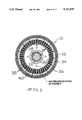
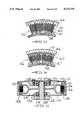
- FIG. 1is a side sectional view of a rotary implementation of the electromotive device of this invention
- FIG. 2is a sectional view taken along line 2--2 of FIG. 1;
- FIG. 3is an enlarged view of section 3 of FIG. 2;
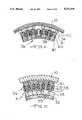
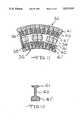
- FIG. 4is an elevated view of a stator core manufactured for use in a rotary implementation of the present invention
- FIG. 5is a detailed view of a single stator bar as utilized in FIG. 4;
- FIG. 6is an elevated view of an alternative embodiment of a stator core manufactured for use in a rotary implementation of the present invention.
- FIG. 7is a detailed view of a single stator bar as utilized in FIG. 6;
- FIG. 8is an elevated view of yet another alternative embodiment of a stator core manufactured for use in a rotary implementation of the present invention.
- FIG. 8Ais an detailed view of three stator bar units as utilized in FIG. 8;
- FIG. 9is a partial cut away view illustrating the flux return path of the invention as utilized in a rotary electromotive device of this invention.
- FIG. 10is a partial cut away view illustrating the flux return path of an alternative embodiment of the invention as utilized in a rotary electromotive device of this invention
- FIG. 11is a partial cut away view illustrating still another alternative embodiment of the use of two distinct embodiments of stator inductors in a stacked combination with a rotary electromotive device of this invention
- FIG. 12is a view of a single lamination stamping of an oriented grain ferrous metal which, when laminated in mass creates a stator bar;
- FIG. 13is a partial cut away view showing yet another alternative embodiment of the present invention.
- FIG. 14is a partial cut away view showing yet another embodiment of the present invention.
- FIG. 15is a side sectional view of an alternative embodiment of the electromotive device of the present invention, illustrating an alternative structure for the stator inductor;
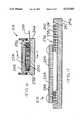
- FIG. 16is an end view of still another alternative embodiment of the electromotive device of this invention illustrating a flat linear implementation thereof;
- FIG. 17is a sectional view taken along line 17--17 of FIG. 16;
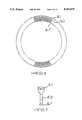
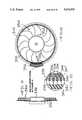
- FIG. 18is a top view of a thin rim drive motor utilizing the electromotive device of the present invention.
- FIG. 19is a side view of the thin rim drive motor of FIG. 18.
- FIG. 20is an enlarged view of section 20 of FIG. 18.
- This inventionrelates to all electric motors, alternators and generators where a magnetic flux path is defined by a magnetic material. It is particularly useful, but not limited to, devices having circular symmetry, and works very well in brushless motor designs. More alternatively, it can be useful in linear and curvilinear motors, as well as circular motors.
- the inventionprovides a high power density (1 to 5 horsepower per pound) electromotive device.
- torquefalls off rapidly with increasing motor speed. This is primarily due to opposing induced currents or eddy current losses in the copper conductors and armature bars. These losses are minimized by this invention and torque is thereby maintained at continuous operations at high speeds.
- an electromotive device having circular symmetryis shown as having an outer cylindrical housing 10.
- the housing 10is preferably integrally formed with a first end plate 12 and includes a second end plate 14 secured to the opposed end of the housing 10 to create an enclosed hollow cylinder 15. It should be noted that it is perfectly acceptable to form the housing 10 with separate units or end plates 12, 14, if desired.
- Each end plate 12, 14includes an aperture 16, 18, respectively, concentrically formed about the axially centerline of the cylindrical housing 10.
- Each aperture 16, 18includes a set of bearing members 20, 22 designed to retain a motor shaft 24 in position for rotation about the axial centerline.
- the bearing members 20, 22each include an outer race 26, 26' fixed to the first end plate 12 and second end plate 14, respectively.
- the inner race 28, 28'is fixed to the shaft member 24 in cooperative relationship with the outer races 26, 26'.
- Ball members 30, 30'are positioned between the inner races 28, 28' and outer race 26, 26'.
- the rotor 32is a cup-shaped member 34 fixed to the shaft 24 at a position proximate the first end plate 12 and extending in a concentric spaced relationship with the first end plate 12 and outer housing 10.
- a plurality of magnets 34are fixed to the inside surface 33 of the rotor 32.
- the magnets 34are permanent magnets preferably formed of neodymium boron iron (Nd Fe B), but they may also be formed of barium ferrite ceramic (BaFe ceramic), samarium cobalt (SmCo), or the like. Permanent magnets are used in the illustrative exemplary embodiment, but they can also be replaced with electromagnets.
- the stator inductor 36is fixed with respect to the housing 10.
- the stator inductor 36is mounted within the second end plate 14 and is spaced concentrically around the centerline axis of the shaft 24.
- the rotor 32rotates about the center axis causing the magnets 34 to rotate around the stator inductor 36 in a spaced relationship, preferably a gap of 20 to 30 thousandths of an inch.
- the stator inductor 36includes electrical conductors or wires 38 which are wound between the stator bars 40.
- the electrical conductors 38are preferably a bundle of relatively large diameter insulated copper wires wound into a linking pattern, with the opposite end of the wire bundles connected to connectors 39 which extend through an aperture 37 located in the second end plate 14.
- the electrical conductor 38is formed into a bundle throughout the stator inductor 36, with each turn of the bundled windings having a flux carrying element or stator bar 40 located therebetween. Variations of typical windings are schematically represented in FIGS. 2, 9, 10, 11, 13 and 14.
- the stator bars 40are flux carrying elements preferably formed from a lamination of a plurality of silicone iron sheets.
- FIG. 12is illustrative of one embodiment of a single layer or sheet of a laminated stator bar 40.
- the extensions 41 at the four cornersgive the bar 40 a beam cross sectional configuration with an enlarged thickened cross section at 41'.
- the extensions 41, 41'provide increased surface area for cooling, as well as enhanced flux shielding for the windings 38. Shielding the electrical conductor windings 38 from the magnetic fields within the motor minimizes eddy currents within the coils and assists in achieving a high power-to-weight ratio. This and the increased cooling heat exchange surface allows for higher current flow which increases field strength without increasing eddy currents in the windings.
- the magnetic flux return path variously illustrated in FIGS. 9, 10 and 11extends through the thickened extensions 41' of the stator bar 40 and follows through the magnets 34 into the inside surface 33 of the rotor 32.
- a single stator baris illustrated with the grain direction or orientation within the metal forming the bar 40 controlled to be along the long axis.
- This orientationallows for maximum permeability or maximum flux to be carried by a minimum amount of iron, thereby providing a lighter motor with more room for windings 38. Since the grain direction is parallel to the primary flux path through the stator bar 40 heat generation is reduced because the level of resistance to the magnetic flux is reduced. By comparison, a standard stator having a random grain pattern provides maximum resistance which leads to maximum heat generation. Thus, a grain pattern following the direction of flux minimizes resistance and heating.
- the controlled grain inductor bar or stator bar 40 construction as shown in FIG. 12allows higher flux densities without increased heating, thereby increasing the efficiency of the device.
- FIGS. 4, 5 and 9a first embodiment of a combination of stator inductor 36 intended for use with the rotary electromotive device of FIG. 1 is shown.
- Each stator bar 40 of the inductor 36is shown with extensions on its outside radial perimeter 41 and thickened extensions on its inside radial perimeter 41'.
- the stator bars 40are layered with the number of layers being designed in accordance with the desired amount of power. For instance, layering the stator bars 40 to a 6/10th of an inch depth will provide an approximate horsepower of 10 and layering the stator bars to 1.2 inches will provide a 20 horsepower electromotive device.
- FIG. 9the flux paths for an electromotive device designed with stator bars 40 such as those illustrated in FIGS. 4 and 5 are shown.
- stator inductor 36an alternative embodiment of the stator inductor 36 is shown wherein the extension 41 on the outside radius of each stator bar 40 is of the thickened cross section and the extension 41' on the inner radius of the stator bar is of the narrow cross section.
- stator bars 40are designed to be layered to provide desired amounts of power.
- An electromotive device utilizing a stator inductor 36 configuration of this typewill be provided with the rotor 32 and magnets 34 on the inside radius of the stator inductor 36, as shown in FIG. 10. Referring to FIG. 10, the flux path of such an alternative embodiment of the electromotive device is illustrated.
- stator bars 40have the thickened cross section at the outer radial extension 41 and the thinner cross section at the inner radial extension 41'.
- Such a stator bar designis used with a rotor 32 carrying magnets 34 proximate the inner radial thinner cross sections 41'.
- the thicker cross section 41is provided with a curved arc mating surface 42, 42'.
- the mating surface 42, 42' combination of the stator bar 40allows for a universal stamping of the stator bar 40 to be used in forming stator inductors 36 of different radial sizes.
- this embodiment of the stator bar 40may also be utilized with stators having the thickened cross-section at the inner radial extension 41'.
- stator inductors 36yet another alternative embodiment of an electromotive device of the present invention is shown utilizing both designs of stator inductors 36.
- the magnets 34are sandwiched between layers of stator inductors 36 wherein the thickened cross-sections of the sets of stator bars 40 are positioned in spaced relationship from the magnets 34.
- Such stacking of the varied types of stator inductors 36will provide for enhanced power.
- the two cylindrical stator inductors 36can be configured by placing additional layers of stator inductor elements radially inwardly or outwardly as shown to increase power.
- FIG. 13yet another alternative embodiment of the stator inductor 36 of the present invention is shown.
- Formation of the thickened cross section of a stator bar 40is formed by utilizing standard I-bars 43 having equal cross sectional extensions 41 on all four corners and adhering a thickened flux return member 44 to the outer radial surface or the inner radial surface of the I bar 43, depending on design.
- FIG. 14there is schematically shown a detail view of an alternative design for positioning of the stator bars 40 with respect to each other.
- the stator bars 40are positioned extremely closely to each other when forming the stator inductor 36. If the stator bars 40 are positioned with an air gap 46 between each stator bar 40 will effect the inductance of the coils. The smaller the air gap 46 the larger the inductance. Since the inductance controls the speed with which the electrical conductor coil 38 receives current, which in turn affects the torque level of the motor upon startup, controlling the inductance through the air gap between the stator bars 40 will therefore affect the rate with which the motor torque will be provided.
- the electromotive deviceis again of circular configuration. It includes an outer housing 100 having a first end plate 112 and a second end plate 114 affixed to the housing 100 to create an enclosed hollow cylinder 115. A first aperture 116 and second aperture 118 are located on the axial centerline of the first end plate 112 and second end plate 114, respectively. Each aperture 116, 118 carries a first bearing member 120 and a second bearing member 122. The shaft member 124 is positioned for rotation in the bearing members 120, 122 to rotate on the axial centerline.
- the outer housing 100carries a plurality of magnets 134 permanently fixed thereto.
- the magnets 134may be of the permanent variety or may be electromagnets.
- the rotor 132is fixed to the shaft member 124 and carries a stator inductor 136 composed of stacked stator bars 140 wound with electrical conductors 138.
- the stator inductor 136 with electrical conductor windings 138is rotationally movable by the rotor 132 with respect to the magnets 134, which are fixed in position on the housing 100.
- Slip rings(not shown) provide the necessary power to the stator inductor 136.
- the stator inductor 136is carried at both ends 135 by the rotor 132 to eliminate any cantilever effect on the stator inductor 136. Such a cantilever effect can sometimes deleteriously affect the operation of an electromotive device due to fluctuations and interference with the minimal air gap between the magnets 134 and the stator inductor 136.
- the linear motor 210includes a linearly oriented stator inductor 236.
- the stator bars 240which make up the inductors 236 are similar to those shown in FIGS. 4 and 5.
- the stator bars 240are arranged linearly and are retained in a potting 246.
- a carriage member 248 carrying a plurality of magnets 234is positioned on the potting 246 for linear movement with respect to the stator inductor 236.
- the stator bars 240are wound with copper electrical conductors 238 to form the stator inductor 236.
- the linear motor 210is operated by supplying current to the electrical conductors 238 and then pulsing the current to propel the moving carriage 248 horizontally in both directions.
- Fan rim drive motorsare generally designed for use in instances where a low thickness profile is required and a motor drive mounted on the axis of the fan is undesirable.
- a typical application of a fan rim drive motoris used with a motorized vehicle. Rather than mounting the motor drive for the fan on the axis of the fan the motor is instead mounted to the housing 310 of the fan 352.
- the stator inductor 336is contained in a stator potting 346 which is fixed to the housing 310 of the fan 352.
- the stator inductor 336is composed of stator bars 340 is wound with electrical conductors 338.
- the rim 354 of the fan 352which is spaced with an appropriate gap 356 from the stator inductor 336 includes the plurality of magnets 334.
- the magnetsare fixed to a flux return path 344 which in turn is fixed to the rim 354 of the fan 352.
- Current which is pulsed through the windings 338 of the stator inductor 336will provide movement to the fan 352 as a result of the flux movement through the stator inductor 336, magnets 334, and flux return path 344.
- stator barsare individually stamped and stacked.
- the stacks of stator barsare fastened or held together by any acceptable adhesive such as tape or glue, prior to receiving the windings of the electrical conductors.
- any acceptable adhesivesuch as tape or glue
- the stator barsare to be utilized with curvilinear motors they are fastened together using tooling designed as a specific circular magnetic winding fixture. Once the stack of stator bars are in place in the tooling, the coils of the electrical conductors are wound around the stator bars to form the stator inductor. A potting fixture is then attached to the winding fixture. The stator inductor is then potted in an epoxy-type resin.
- Pottingis achieved either through vacuum impregnation, dipping, brushing or centrifugal application, or which ever method best meets the specific design requirements.
- temperaturesare elevated to cure the resin by elevating the temperatures around the potted stator inductor or bonding the coils and cores within a heat sink at one end.
Landscapes
- Engineering & Computer Science (AREA)
- Power Engineering (AREA)
- Chemical & Material Sciences (AREA)
- Combustion & Propulsion (AREA)
- Electromagnetism (AREA)
- Physics & Mathematics (AREA)
- Permanent Magnet Type Synchronous Machine (AREA)
- Iron Core Of Rotating Electric Machines (AREA)
- Hybrid Cells (AREA)
- Electrotherapy Devices (AREA)
- Input Circuits Of Receivers And Coupling Of Receivers And Audio Equipment (AREA)
- Charge And Discharge Circuits For Batteries Or The Like (AREA)
- Filling, Topping-Up Batteries (AREA)
Abstract
Description
This invention relates to a high power-to-weight electromotive device capable of use as a motor, alternator or generator. Electromotive devices are known for use both in transforming electrical energy into mechanical power and transforming mechanical power into electrical energy. In both cases, the energy or power producing capability results from relative movement between a magnetic field and electrically conductive elements.
Lightweight motor, alternator and generator devices are well known and some are capable of operation at high speeds. However, many such devices are not capable of producing high power at high speeds. For example, high power density devices of 0.6 horsepower per pound of weight are known to be useful for periods of intermittent operation, but such devices are incapable of continuous operation at high power densities in excess of 1 horsepower per pound. Also prior high power electromotive devices have not been capable of simultaneous high speed and high torque operation, nor have they provided efficiency of operation.
Many of the problems associated with achieving a high power-to-weight ratio electromotive device have been addressed by U.S. Pat. No. 4,900,965. The '965 patent discloses an electromotive device with a high power density per unit weight effected by utilization of an armature assembly having a large diameter-fin cross section speculation ratio. This structure of the '965 patent results in low opposing induced currents, as well as low eddy currents, to enable operation of the electromotive device at high efficiency with maintainable high torque during high speed operation.
The '965 patent provides for minimal hysteresis or eddy current losses by providing a flux path through stationary iron. This design led to an improvement over conventional motors which suffer such eddy current losses due to the fact that the iron through which the flux path travels is moving. Since the torque of the motor is proportional to the flux, any reduction in the flux will result in decreased torque. In a typical electric motor, the torque will fall off rapidly with increasing speed. The eddy current losses in the copper conductors and armature bars are associated with the windings or copper and are caused by cross leakage between the bars (made worse by radially long bars) and direct exposure of the copper to the magnetic field, and over saturation of the armature bars due to an excess amount of permanent magnet material.
The '965 patent provides a device which minimizes those losses. Losses associated with bar to bar cross leakage are reduced by designing the '965 device to incorporate radially short armature bars. Losses induced by the copper being directly exposed to the magnetic field is solved by the '965 patent through the use of an I-shaped armature bar acting as a shield to the magnetic field. Finally, losses caused by oversaturation of the armature bars are solved by the '965 patent by designing the amount of permanent magnet material such that the bars just approach saturation. The design of the '965 device, however, necessitates that the flux travel through at least four air gaps, a design which has led to problems as a result of air gap reluctance. It has been found that to maintain useful flux density in spite of the air gap reluctance, the magnets must be thickened radially. However, such a modification enlarges the diameter of the motor, increases the weight of the motor, and increases the cost of the motor, all of which are contrary to the desire to have a lightweight motor. Since the torque levels of the motor are proportional to the amount of useful flux, less useful flux will result in reduced motor torque and higher current draw at higher speeds for the motor. Therefore, it is still an objective to design a high powered, lightweight motor having high torque levels and increased useful flux.
Another high power-to-weight ratio electromotive device has been addressed by a dispersed conductor electromagnetic device which is the subject of U.S. Pat. No. 5,004,944. The '944 design utilizes a straight-sided armature bar of powdered iron which allows full exposure of the copper windings to the magnetic field. The powdered iron does not have the flux-carrying ability that other embodiments such as silicone iron does. To minimize the eddy current effect, the '944 patent utilizes extremely fine wire with its windings. The armature bars are fabricated from powdered iron to maximize the amount of flux traveling through what would otherwise be a very large air gap.
The '944 approach has been proven undesirable in terms of power-in versus power-out due to the resistance characteristics of the fine wire. This resistance characteristic causes significant energy losses in the form of heat at higher operating levels which translates into lost power and efficiency. In addition, the straight-sided armature bars do not easily lend themselves to standard production automatic winding techniques as the coils tend to slip outward from between the bars. Thus, other winding techniques must be utilized.
The power loss in the '944 patent due to fine wire resistance is again compensated for by increasing the amount of permanent magnet material beyond the saturation level of the iron bars. Aside from the costs of additional material, however, the bulk of this additional flux goes to the copper winding in the form of eddy current loss and is dispersed, leaving very little gain in power for the additional material investment.
While the preceding and other various arrangements have been designed with the objective of achieving a high power-to-weight ratio electromotive device, they have not been completely successful.
Thus, it is primary objective of this invention to provide an electromotive device which achieves a high power-to-weight ratio by dispersing the electromotive windings to minimize eddy currents within the coils.
It is a further object of this invention to provide an electromotive device which achieves a high power-to-weight ratio by dispersing the electromagnetic field core pieces to minimize eddy currents.
It is a still further objective of this invention to provide an electromotive device which achieves a high power-to-weight ratio by dispersing the electromotive windings to minimize eddy currents within the coils and dispersing the electromagnetic field core pieces to minimize eddy currents generally.
It is another objective of this invention to provide an electromotive device which achieves a high power-to-weight ratio by shielding the electromotive windings with field core piece extensions to minimize eddy current within the coils.
It is still another object of this invention to provide an improved electromotive device capable of use as a highly efficient motor, alternator, or generator.
It is still another object of this invention to provide an improved electromotive device that is capable of continuous operation at high power densities in excess of one horsepower per pound.
It is still another object of this invention to provide an improved electromotive device having an optimum thickness armature assembly which represents a balance among the effects of heat transfer to the cooling medium, heat production from resistance heating and other sources, and torque production.
It is still another object of this invention to provide an electromotive device of simple design having an integrated flux return path.
It is still another object of this invention to build an electromotive device having the maximum flux in the iron cores and incorporating a built-in return path in these cores, thus eliminating the need for a separate return path.
A final object of this invention is to use the core stators having integral flux return paths in curvilinear sections up to 360° to drive, without limitation, devices such as rim mounted magnets on fans, propellers and impellers.
The foregoing and other objectives will become apparent to one skilled in the art as the description proceeds. The invention resides in the novel construction, combination and arrangement of parts substantially as described and illustrated in the specification and drawings of this patent application, and more particularly as defined by the appended claims. It is understood that changes in the precise embodiments of the disclosed invention are meant to be included as within the scope of the claims. The description of the preferred embodiment is intended to be illustrative and is not intended to be limiting upon the scope of the claims.
This invention provides an improved electromotive device using oriented magnetic material to improve performance and reduce size and weight of the device. The design utilizes stacks of oriented stator bars of magnetic material generally formed in the shape of a I wherein the top cross bar of the I is of a thickened design. Alternatively, the oriented stator bar material may be produced with the lower cross bar of the I thickened in design. The stator bar is oriented to provide the maximum permeability along the long axis, thereby allowing the maximum flux to be carried by the minimum amount of material. Thus, the motors or alternators of the present invention are more efficient, lighter and less expensive. In the present invention, the stator inductor, which is a combination of the magnetic stator bars complete with copper windings, is relatively thin and provides for cooling on both sides thereby allowing more power to be drawn from the device. The magnetic flux field is confined to the magnetic material, thereby minimizing the number of air gaps and, as a result, decreasing the iron eddy currents in the copper windings.
The individual stator bars which make up the stator inductor are, preferably, manufactured in a stamping process. The cross section of the stator bars are designed to be as wide as practical to take advantage of the permeability of the oriented material. Variations using the design of the present invention can include more than three phases. The phases may also be individually driven with, for instance, an H-bridge.
Since this invention includes the flux return path in the material of the magnetic stator bar, the need for a separate high tolerance laminated flux return path is eliminated. By eliminating the high tolerance laminated flux return path and its concomitant air gaps, the present invention has reduced the costliness of production of the electromotive device and has eliminated the need for high tolerance manufacturing of the parts to meet the high tolerance air gap requirements between the magnetic stators and the separate return path. Finally, the use of the magnetic stator as the flux return path reduces the air gap flux reluctance which negatively affects the motor torque.
FIG. 1 is a side sectional view of a rotary implementation of the electromotive device of this invention;
FIG. 2 is a sectional view taken alongline 2--2 of FIG. 1;
FIG. 3 is an enlarged view of section 3 of FIG. 2;
FIG. 4 is an elevated view of a stator core manufactured for use in a rotary implementation of the present invention;
FIG. 5 is a detailed view of a single stator bar as utilized in FIG. 4;
FIG. 6 is an elevated view of an alternative embodiment of a stator core manufactured for use in a rotary implementation of the present invention;
FIG. 7 is a detailed view of a single stator bar as utilized in FIG. 6;
FIG. 8 is an elevated view of yet another alternative embodiment of a stator core manufactured for use in a rotary implementation of the present invention;
FIG. 8A is an detailed view of three stator bar units as utilized in FIG. 8;
FIG. 9 is a partial cut away view illustrating the flux return path of the invention as utilized in a rotary electromotive device of this invention;
FIG. 10 is a partial cut away view illustrating the flux return path of an alternative embodiment of the invention as utilized in a rotary electromotive device of this invention;
FIG. 11 is a partial cut away view illustrating still another alternative embodiment of the use of two distinct embodiments of stator inductors in a stacked combination with a rotary electromotive device of this invention;
FIG. 12 is a view of a single lamination stamping of an oriented grain ferrous metal which, when laminated in mass creates a stator bar;
FIG. 13 is a partial cut away view showing yet another alternative embodiment of the present invention;
FIG. 14 is a partial cut away view showing yet another embodiment of the present invention;
FIG. 15 is a side sectional view of an alternative embodiment of the electromotive device of the present invention, illustrating an alternative structure for the stator inductor;
FIG. 16 is an end view of still another alternative embodiment of the electromotive device of this invention illustrating a flat linear implementation thereof;
FIG. 17 is a sectional view taken alongline 17--17 of FIG. 16;
FIG. 18 is a top view of a thin rim drive motor utilizing the electromotive device of the present invention;
FIG. 19 is a side view of the thin rim drive motor of FIG. 18; and,
FIG. 20 is an enlarged view ofsection 20 of FIG. 18.
This invention relates to all electric motors, alternators and generators where a magnetic flux path is defined by a magnetic material. It is particularly useful, but not limited to, devices having circular symmetry, and works very well in brushless motor designs. More alternatively, it can be useful in linear and curvilinear motors, as well as circular motors.
The invention provides a high power density (1 to 5 horsepower per pound) electromotive device. In a typical electromotor, torque falls off rapidly with increasing motor speed. This is primarily due to opposing induced currents or eddy current losses in the copper conductors and armature bars. These losses are minimized by this invention and torque is thereby maintained at continuous operations at high speeds.
Referring now to FIGS. 1, 2 and 3, an electromotive device having circular symmetry is shown as having an outercylindrical housing 10. Thehousing 10 is preferably integrally formed with afirst end plate 12 and includes asecond end plate 14 secured to the opposed end of thehousing 10 to create an enclosedhollow cylinder 15. It should be noted that it is perfectly acceptable to form thehousing 10 with separate units orend plates end plate aperture 16, 18, respectively, concentrically formed about the axially centerline of thecylindrical housing 10. Eachaperture 16, 18 includes a set of bearingmembers motor shaft 24 in position for rotation about the axial centerline. The bearingmembers outer race 26, 26' fixed to thefirst end plate 12 andsecond end plate 14, respectively. Theinner race 28, 28' is fixed to theshaft member 24 in cooperative relationship with theouter races 26, 26'. Ball members 30, 30' are positioned between theinner races 28, 28' andouter race 26, 26'.
Therotor 32 is a cup-shapedmember 34 fixed to theshaft 24 at a position proximate thefirst end plate 12 and extending in a concentric spaced relationship with thefirst end plate 12 andouter housing 10. A plurality ofmagnets 34 are fixed to theinside surface 33 of therotor 32. In the exemplary embodiment, themagnets 34 are permanent magnets preferably formed of neodymium boron iron (Nd Fe B), but they may also be formed of barium ferrite ceramic (BaFe ceramic), samarium cobalt (SmCo), or the like. Permanent magnets are used in the illustrative exemplary embodiment, but they can also be replaced with electromagnets.
Thestator inductor 36 is fixed with respect to thehousing 10. Thestator inductor 36 is mounted within thesecond end plate 14 and is spaced concentrically around the centerline axis of theshaft 24. Therotor 32 rotates about the center axis causing themagnets 34 to rotate around thestator inductor 36 in a spaced relationship, preferably a gap of 20 to 30 thousandths of an inch. Thestator inductor 36 includes electrical conductors orwires 38 which are wound between the stator bars 40. Theelectrical conductors 38 are preferably a bundle of relatively large diameter insulated copper wires wound into a linking pattern, with the opposite end of the wire bundles connected toconnectors 39 which extend through anaperture 37 located in thesecond end plate 14. The use of dispersed, large diameter windings for theelectrical conductor 38 enables the resultant electromotive device to achieve a high power-to-weight ratio because more actual copper can be distributed into any given space. Preferably theelectrical conductors 38 are formed into a bundle throughout thestator inductor 36, with each turn of the bundled windings having a flux carrying element orstator bar 40 located therebetween. Variations of typical windings are schematically represented in FIGS. 2, 9, 10, 11, 13 and 14.
The stator bars 40 are flux carrying elements preferably formed from a lamination of a plurality of silicone iron sheets. FIG. 12 is illustrative of one embodiment of a single layer or sheet of alaminated stator bar 40. Theextensions 41 at the four corners give the bar 40 a beam cross sectional configuration with an enlarged thickened cross section at 41'. Theextensions 41, 41' provide increased surface area for cooling, as well as enhanced flux shielding for thewindings 38. Shielding theelectrical conductor windings 38 from the magnetic fields within the motor minimizes eddy currents within the coils and assists in achieving a high power-to-weight ratio. This and the increased cooling heat exchange surface allows for higher current flow which increases field strength without increasing eddy currents in the windings. The magnetic flux return path variously illustrated in FIGS. 9, 10 and 11 extends through the thickened extensions 41' of thestator bar 40 and follows through themagnets 34 into theinside surface 33 of therotor 32.
Referring again to FIG. 12, a single stator bar is illustrated with the grain direction or orientation within the metal forming thebar 40 controlled to be along the long axis. This orientation allows for maximum permeability or maximum flux to be carried by a minimum amount of iron, thereby providing a lighter motor with more room forwindings 38. Since the grain direction is parallel to the primary flux path through thestator bar 40 heat generation is reduced because the level of resistance to the magnetic flux is reduced. By comparison, a standard stator having a random grain pattern provides maximum resistance which leads to maximum heat generation. Thus, a grain pattern following the direction of flux minimizes resistance and heating. The controlled grain inductor bar orstator bar 40 construction as shown in FIG. 12 allows higher flux densities without increased heating, thereby increasing the efficiency of the device.
Referring now to FIGS. 4, 5 and 9, a first embodiment of a combination ofstator inductor 36 intended for use with the rotary electromotive device of FIG. 1 is shown. Eachstator bar 40 of theinductor 36 is shown with extensions on its outsideradial perimeter 41 and thickened extensions on its inside radial perimeter 41'. The stator bars 40 are layered with the number of layers being designed in accordance with the desired amount of power. For instance, layering the stator bars 40 to a 6/10th of an inch depth will provide an approximate horsepower of 10 and layering the stator bars to 1.2 inches will provide a 20 horsepower electromotive device. Referring to FIG. 9, the flux paths for an electromotive device designed withstator bars 40 such as those illustrated in FIGS. 4 and 5 are shown.
Referring now to FIGS. 6, 7 and 10, an alternative embodiment of thestator inductor 36 is shown wherein theextension 41 on the outside radius of eachstator bar 40 is of the thickened cross section and the extension 41' on the inner radius of the stator bar is of the narrow cross section. Again, the stator bars 40 are designed to be layered to provide desired amounts of power. An electromotive device utilizing astator inductor 36 configuration of this type will be provided with therotor 32 andmagnets 34 on the inside radius of thestator inductor 36, as shown in FIG. 10. Referring to FIG. 10, the flux path of such an alternative embodiment of the electromotive device is illustrated.
Referring now to FIGS. 8 and 8A, yet another alternative embodiment designed for thestator inductor 36 is shown. The stator bars 40 have the thickened cross section at the outerradial extension 41 and the thinner cross section at the inner radial extension 41'. Such a stator bar design is used with arotor 32 carryingmagnets 34 proximate the inner radial thinner cross sections 41'. Thethicker cross section 41 is provided with a curvedarc mating surface 42, 42'. Themating surface 42, 42' combination of thestator bar 40 allows for a universal stamping of thestator bar 40 to be used in formingstator inductors 36 of different radial sizes. Of course, it is envisioned that this embodiment of thestator bar 40 may also be utilized with stators having the thickened cross-section at the inner radial extension 41'.
Referring now to FIG. 11, yet another alternative embodiment of an electromotive device of the present invention is shown utilizing both designs ofstator inductors 36. Themagnets 34 are sandwiched between layers ofstator inductors 36 wherein the thickened cross-sections of the sets of stator bars 40 are positioned in spaced relationship from themagnets 34. Such stacking of the varied types ofstator inductors 36 will provide for enhanced power. The twocylindrical stator inductors 36 can be configured by placing additional layers of stator inductor elements radially inwardly or outwardly as shown to increase power.
Referring now to FIG. 13 yet another alternative embodiment of thestator inductor 36 of the present invention is shown. Formation of the thickened cross section of astator bar 40 is formed by utilizing standard I-bars 43 having equal crosssectional extensions 41 on all four corners and adhering a thickenedflux return member 44 to the outer radial surface or the inner radial surface of the I bar 43, depending on design.
Referring now to FIG. 14, there is schematically shown a detail view of an alternative design for positioning of the stator bars 40 with respect to each other. In most embodiments shown in the drawings, the stator bars 40 are positioned extremely closely to each other when forming thestator inductor 36. If the stator bars 40 are positioned with anair gap 46 between eachstator bar 40 will effect the inductance of the coils. The smaller theair gap 46 the larger the inductance. Since the inductance controls the speed with which theelectrical conductor coil 38 receives current, which in turn affects the torque level of the motor upon startup, controlling the inductance through the air gap between the stator bars 40 will therefore affect the rate with which the motor torque will be provided.
Referring now to FIG. 15, an alternative embodiment of an electromotive device of the present invention is shown. The electromotive device is again of circular configuration. It includes an outer housing 100 having a first end plate 112 and asecond end plate 114 affixed to the housing 100 to create an enclosedhollow cylinder 115. Afirst aperture 116 andsecond aperture 118 are located on the axial centerline of the first end plate 112 andsecond end plate 114, respectively. Eachaperture first bearing member 120 and asecond bearing member 122. The shaft member 124 is positioned for rotation in the bearingmembers magnets 134 permanently fixed thereto. As in the embodiments previously discussed, themagnets 134 may be of the permanent variety or may be electromagnets. The rotor 132 is fixed to the shaft member 124 and carries astator inductor 136 composed of stacked stator bars 140 wound with electrical conductors 138. In this embodiment, thestator inductor 136 with electrical conductor windings 138 is rotationally movable by the rotor 132 with respect to themagnets 134, which are fixed in position on the housing 100. Slip rings (not shown) provide the necessary power to thestator inductor 136. Thestator inductor 136 is carried at both ends 135 by the rotor 132 to eliminate any cantilever effect on thestator inductor 136. Such a cantilever effect can sometimes deleteriously affect the operation of an electromotive device due to fluctuations and interference with the minimal air gap between themagnets 134 and thestator inductor 136.
Referring now to FIGS. 16 and 17, the present invention is shown as utilized with a linear motor of the type used to drive typewriter carriages and weaving shuttles. Thelinear motor 210 includes a linearly orientedstator inductor 236. The stator bars 240 which make up theinductors 236 are similar to those shown in FIGS. 4 and 5. The stator bars 240 are arranged linearly and are retained in apotting 246. Acarriage member 248 carrying a plurality ofmagnets 234 is positioned on thepotting 246 for linear movement with respect to thestator inductor 236. As in the previously discussed embodiments, the stator bars 240 are wound with copperelectrical conductors 238 to form thestator inductor 236. Thelinear motor 210 is operated by supplying current to theelectrical conductors 238 and then pulsing the current to propel the movingcarriage 248 horizontally in both directions.
Referring now to FIGS. 18, 19 and 20, the present invention is shown in an embodiment intended to be utilized with a fanrim drive motor 350. Fan rim drive motors are generally designed for use in instances where a low thickness profile is required and a motor drive mounted on the axis of the fan is undesirable. A typical application of a fan rim drive motor is used with a motorized vehicle. Rather than mounting the motor drive for the fan on the axis of the fan the motor is instead mounted to thehousing 310 of thefan 352. Thestator inductor 336 is contained in astator potting 346 which is fixed to thehousing 310 of thefan 352. Thestator inductor 336 is composed of stator bars 340 is wound withelectrical conductors 338. Therim 354 of thefan 352 which is spaced with anappropriate gap 356 from thestator inductor 336 includes the plurality ofmagnets 334. The magnets are fixed to aflux return path 344 which in turn is fixed to therim 354 of thefan 352. Current which is pulsed through thewindings 338 of thestator inductor 336 will provide movement to thefan 352 as a result of the flux movement through thestator inductor 336,magnets 334, and flux returnpath 344.
In most all embodiments utilizing the present invention, the stator bars are individually stamped and stacked. The stacks of stator bars are fastened or held together by any acceptable adhesive such as tape or glue, prior to receiving the windings of the electrical conductors. If the stator bars are to be utilized with curvilinear motors they are fastened together using tooling designed as a specific circular magnetic winding fixture. Once the stack of stator bars are in place in the tooling, the coils of the electrical conductors are wound around the stator bars to form the stator inductor. A potting fixture is then attached to the winding fixture. The stator inductor is then potted in an epoxy-type resin. Potting is achieved either through vacuum impregnation, dipping, brushing or centrifugal application, or which ever method best meets the specific design requirements. After application of the epoxy-type resin temperatures are elevated to cure the resin by elevating the temperatures around the potted stator inductor or bonding the coils and cores within a heat sink at one end.
While preferred embodiments of this invention have been illustrated and described, variations and modifications may be apparent to those skilled in the art. Therefore, the above written disclosure of the preferred embodiments of this invention are not intended to be limiting upon the scope and breadth of the invention. Rather, the scope and breadth of the invention should be determined from the claims which follow.
Claims (16)
1. An electromotive device comprising, in combination:
a stator inductor composed of a plurality of magnetic flux conducting stator bars, said stator bars each having a longitudinal grain orientation, and an electrical conductor disposed as randomly dispersed windings around said plurality of stator bars for creating an electromagnetic field;
means adjacent said inductor for generating a magnetic field within said electromotive device;
said stator bars being of a geometry wherein said windings are shielded from such magnetic field within said electromotive device and for providing a first flux return path for substantially all of the flux, said flux return path being generally perpendicular to such grain orientation through said stator bar; and
a second flux return path proximate said magnetic field generating means.
2. The electromotive device of claim 1, wherein said stator bars are generally of an I configuration having a neck portion with opposed cross-bars, generally perpendicular to the longitudinal orientation of said neck portion, integral with said neck portion, whereby the cross bar of said I configuration proximate said magnetic field generating means is of a narrow cross section and the remaining cross bar spaced from said magnetic field generating means and opposed to said first cross bar is of a generally thick cross section to provide said first flux return path.
3. The electromotive device of claim 2, wherein said stator inductor is fixed with respect to a housing enclosing said electromotive device and said magnetic field generating means includes a plurality of magnets fixed to a rotor positioned proximate said stator inductor for rotation about an axis central to said rotor and said stator inductor.
4. The electromotive device of claim 3, wherein said magnetic field generating means includes a plurality of permanent magnets fixed to said rotor.
5. The electromotive device of claim 3, wherein said magnetic field generating means includes a plurality of electromagnets fixed to said rotor.
6. The electromotive device of claim 2, wherein adjacent stator bars are contiguous at their thick cross sectional cross bar.
7. The electromotive device of claim 2, wherein said adjacent stator bars are spaced a specific distance from each other at the thick cross sectional cross bar to create an air gap inductance level in such electromotive device.
8. The electromotive device of claim 2, wherein said stator bars have arcuate engagement surfaces on the thick cross sectional cross bar, such arcuate engagement surface for providing stator inductors of differing diameters while utilizing a single stator bar of universal shape.
9. The electromotive device of claim 1, wherein said stator bars are of an I shaped geometry having a neck portion with opposed cross bars, generally perpendicular to the longitudinal orientation of said neck portion, integral with said neck portion and further include a flux return member fixed to the cross bar positioned in opposition to said magnetic field generating means.
10. The electromotive device of claim 1, wherein said stator inductor is fixed to a rotor about an axial centerline and said magnetic field generating means is positioned proximate said stator inductor about such same centerline wherein said stator inductor and rotor rotate with respect to said magnetic field generating means.
11. The electromotive device of claim 10, wherein said magnetic field generating means includes a plurality of permanent magnets fixed to said housing.
12. The electromotive device of claim 10, wherein said magnetic field generating means includes a plurality of electromagnets fixed to said housing.
13. The electromotive device of claim 2, wherein said stator inductor is linear and said magnetic field generating means is positioned proximate said linear stator inductor and further including means for moving said magnetic field generating means with respect to said stator inductor.
14. An electromotive device comprising, In combination:
a first stator inductor composed of a first set of magnetic flux conducting stator bars, each of said first set of stator bars having a longitudinal grain orientation, and a first electrical conductor disposed as randomly dispersed windings around said first set of stator bars for creating an electromagnetic field;
means adjacent said first stator inductor for generating a magnetic field within said electromotive device;
a second stator inductor composed of a second set of magnetic flux conducting stator bars, each of said second set of stator bars having a longitudinal grain orientation, and a second electrical conductor disposed as randomly dispersed windings around said second set of stator bars for creating a second electromagnetic field, said second stator inductor being positioned in opposed relationship with said first stator inductor wherein said magnetic field generating means is positioned therebetween;
said first and second stator inductors having respective stator bars of a geometry wherein said respective windings from such magnetic field within said electromotive device and for providing a first flux return path and a second flux return path for substantially all of the flux, said first and second flux return paths being generally perpendicular to such respective grain orientations through each respective set of stator bars.
15. An electromotive device comprising, in combination, a fan assembly having a stator inductor composed of a plurality of magnetic flux conducting stator bars with an electrical conductor disposed as randomly dispersed windings around said plurality of stator bars for creating an electromagnetic field positioned on a housing member encompassing a fan member; means for generating a magnetic field positioned on said fan member in a position proximate said stator inductor; said stator bars being of a geometry wherein said windings are shielded from said magnetic field within said electromotive device and for providing a first flux return path through said stator bars; and a second flux return path positioned on said fan member proximate said magnetic field generating means.
16. An electromotive device comprising, in combination:
a fan assembly having a stator inductor composed of a plurality of magnetic flux conducting stator bars, said stator bars each having a longitudinal grain orientation, and an electrical conductor disposed as randomly dispersed windings around said plurality of stator bars for creating an electromagnetic field, said stator inductor being positioned on a housing member encompassing a fan member;
means for generating a magnetic field within said electromotive device positioned on said fan member in a position proximate to said stator inductor; said stator bars being of a geometry wherein said windings are shielded from such magnetic field within said electromotive device and for providing a first flux return path for substantially all of the flux, said flux return path being generally perpendicular to such grain orientation through said stator bars; and
a second flux return path positioned on said fan member proximate said magnetic field generating means.
Priority Applications (11)
| Application Number | Priority Date | Filing Date | Title |
|---|---|---|---|
| US07/820,287US5212419A (en) | 1992-01-10 | 1992-01-10 | Lightweight high power electromotive device |
| TW081109727ATW221724B (en) | 1992-01-10 | 1992-12-04 | |
| JP5512529AJPH07505038A (en) | 1992-01-10 | 1993-01-07 | Lightweight, high-power electric motor/generator |
| ES93902941TES2104124T3 (en) | 1992-01-10 | 1993-01-07 | LIGHTWEIGHT, HIGH POWER ELECTROMOTOR DEVICE. |
| AU34335/93AAU662801B2 (en) | 1992-01-10 | 1993-01-07 | Lightweight high power electromotive device |
| PCT/US1993/000058WO1993014552A1 (en) | 1992-01-10 | 1993-01-07 | Lightweight high power electromotive device |
| CA002127557ACA2127557C (en) | 1992-01-10 | 1993-01-07 | Lightweight high power electromotive device |
| KR1019940702418AKR100194190B1 (en) | 1992-01-10 | 1993-01-07 | Lightweight High Power Transmission |
| MX9300043AMX9300043A (en) | 1992-01-10 | 1993-01-07 | HIGH POWER, LIGHT WEIGHT ELECTROMOTRIZ DEVICE. |
| EP93902941AEP0620952B1 (en) | 1992-01-10 | 1993-01-07 | Lightweight high power electromotive device |
| DE69310714TDE69310714T2 (en) | 1992-01-10 | 1993-01-07 | LIGHTWEIGHT ELECTRIC MOTOR LIGHTWEIGHT DEVICE |
Applications Claiming Priority (1)
| Application Number | Priority Date | Filing Date | Title |
|---|---|---|---|
| US07/820,287US5212419A (en) | 1992-01-10 | 1992-01-10 | Lightweight high power electromotive device |
Publications (1)
| Publication Number | Publication Date |
|---|---|
| US5212419Atrue US5212419A (en) | 1993-05-18 |
Family
ID=25230392
Family Applications (1)
| Application Number | Title | Priority Date | Filing Date |
|---|---|---|---|
| US07/820,287Expired - LifetimeUS5212419A (en) | 1992-01-10 | 1992-01-10 | Lightweight high power electromotive device |
Country Status (11)
| Country | Link |
|---|---|
| US (1) | US5212419A (en) |
| EP (1) | EP0620952B1 (en) |
| JP (1) | JPH07505038A (en) |
| KR (1) | KR100194190B1 (en) |
| AU (1) | AU662801B2 (en) |
| CA (1) | CA2127557C (en) |
| DE (1) | DE69310714T2 (en) |
| ES (1) | ES2104124T3 (en) |
| MX (1) | MX9300043A (en) |
| TW (1) | TW221724B (en) |
| WO (1) | WO1993014552A1 (en) |
Cited By (66)
| Publication number | Priority date | Publication date | Assignee | Title |
|---|---|---|---|---|
| US5345133A (en)* | 1992-06-10 | 1994-09-06 | Okuma Corporation | Electric motor |
| US5382859A (en)* | 1992-09-01 | 1995-01-17 | Unique Mobility | Stator and method of constructing same for high power density electric motors and generators |
| EP0627805A3 (en)* | 1993-06-03 | 1995-04-05 | Secretary Trade Ind Brit | Electromagnetic machine. |
| WO1995010876A1 (en)* | 1993-10-15 | 1995-04-20 | Libby Corporation | Lightweight high power electromotive device and method for making same |
| WO1995012912A1 (en)* | 1993-11-01 | 1995-05-11 | Stridsberg Innovation Ab | An electric motor and its fabrication |
| US5751089A (en)* | 1992-01-29 | 1998-05-12 | Stridsberg Innovation Ab | Brushless DC motors/generators |
| US5955809A (en)* | 1992-08-17 | 1999-09-21 | Intellectual Property Law Department Sundstrand Corporation | Permanent magnet generator with auxiliary winding |
| US6044737A (en)* | 1997-04-02 | 2000-04-04 | Industrial Technology Research Institute | Stator of and arc shaping method for brushless motor |
| EP0967707A3 (en)* | 1998-06-19 | 2001-04-18 | Siemens Canada Limited | Divisible lamination brushless pump-motor having fluid cooling system |
| US6262505B1 (en)* | 1997-03-26 | 2001-07-17 | Satcon Technology Corporation | Flywheel power supply having axial magnetic bearing for frictionless rotation |
| US6278216B1 (en)* | 1999-05-04 | 2001-08-21 | I-Ho Li | Vehicle motor |
| US6313556B1 (en)* | 1999-09-30 | 2001-11-06 | Reliance Electric Technologies, Llc | Superconducting electromechanical rotating device having a liquid-cooled, potted, one layer stator winding |
| US6376944B1 (en) | 2000-07-11 | 2002-04-23 | Eagle-Picher Industries, Inc. | Electrical power generator |
| US6384496B1 (en) | 1999-05-17 | 2002-05-07 | Wavecrest Laboratories, Llc | Multiple magnetic path electric motor |
| US6400059B1 (en)* | 2000-11-15 | 2002-06-04 | Chun-Pu Hsu | Inner stator of drum type motor |
| US20020135263A1 (en)* | 2001-03-02 | 2002-09-26 | Encap Motor Corporation | Stator assembly made from a plurality of toroidal core segments and motor using same |
| US6459185B1 (en)* | 1998-08-24 | 2002-10-01 | Magnet-Motor Gesellschaft Fur Magnetmotorische Technik Mbh | Electrical machine with permanent magnets |
| US6468163B1 (en)* | 1998-11-19 | 2002-10-22 | Baruffaldi S.P.A. | Device for transmitting the movement for motor-vehicle fans with a front-linkage induction coupling |
| US6487769B2 (en) | 2000-11-30 | 2002-12-03 | Emerson Electric Co. | Method and apparatus for constructing a segmented stator |
| US20030071534A1 (en)* | 2000-01-20 | 2003-04-17 | Helmut Kreuzer | Method for producing a magnetically excitable core comprising a core winding for an electric machine |
| US6584813B2 (en) | 2001-03-26 | 2003-07-01 | Emerson Electric Co. | Washing machine including a segmented stator switched reluctance motor |
| US6597078B2 (en) | 2000-12-04 | 2003-07-22 | Emerson Electric Co. | Electric power steering system including a permanent magnet motor |
| US6631794B1 (en)* | 2000-04-14 | 2003-10-14 | Meritor Heavy Vehicle Systems, Llc | Drive unit assembly with a regenerative retarder |
| US6664704B2 (en) | 2001-11-23 | 2003-12-16 | David Gregory Calley | Electrical machine |
| US20040021437A1 (en)* | 2002-07-31 | 2004-02-05 | Maslov Boris A. | Adaptive electric motors and generators providing improved performance and efficiency |
| US6700284B2 (en) | 2001-03-26 | 2004-03-02 | Emerson Electric Co. | Fan assembly including a segmented stator switched reluctance fan motor |
| US20040090136A1 (en)* | 2002-11-12 | 2004-05-13 | Mitsubishi Denki Kabushiki Kaisha | Three-phase alternating current generator |
| US6744166B2 (en) | 2001-01-04 | 2004-06-01 | Emerson Electric Co. | End cap assembly for a switched reluctance electric machine |
| US20040119427A1 (en)* | 2001-02-08 | 2004-06-24 | Lennart Stridsberg | High reliability motor system |
| US6781276B1 (en)* | 1998-12-15 | 2004-08-24 | Bonus Enegy A/S | Generator for a windmill, stator module for use in such a generator and use of such a generator |
| US20040263099A1 (en)* | 2002-07-31 | 2004-12-30 | Maslov Boris A | Electric propulsion system |
| US20050046375A1 (en)* | 2002-07-31 | 2005-03-03 | Maslov Boris A. | Software-based adaptive control system for electric motors and generators |
| US6897591B2 (en) | 2001-03-26 | 2005-05-24 | Emerson Electric Co. | Sensorless switched reluctance electric machine with segmented stator |
| US20050206267A1 (en)* | 2003-01-14 | 2005-09-22 | Hiromichi Koshiishi | Method of manufacturing a stator core |
| WO2005117243A1 (en)* | 2004-05-25 | 2005-12-08 | Meier, Mojca | Synchronous electromechanical transformer |
| US7012350B2 (en) | 2001-01-04 | 2006-03-14 | Emerson Electric Co. | Segmented stator switched reluctance machine |
| US20070018520A1 (en)* | 2005-07-21 | 2007-01-25 | Nissan Motor Co., Ltd. | Motor/generator to reduce cogging torque |
| US20070114870A1 (en)* | 2005-11-23 | 2007-05-24 | Daewood Electronic Corporation | Induction motor capable of utilizing magnetic fluxes of end-turns of a stator to increase torque of a rotor |
| US20070281558A1 (en)* | 2004-06-30 | 2007-12-06 | Jansen Patrick L | Electrical machine with double-sided rotor |
| US20080169720A1 (en)* | 2005-05-23 | 2008-07-17 | Marko Petek | Synchronous Electromechanical Transformer |
| US20080211322A1 (en)* | 2004-09-03 | 2008-09-04 | Wolfgang Heinrich | Multipolar, Linear or Rotating Synchronous Direct Drive Motor |
| US20080309188A1 (en)* | 2007-05-09 | 2008-12-18 | David Gregory Calley | Electrical output generating devices and driven electrical devices with reduced flux leakage using permanent magnet components, and methods of making and using the same |
| US20090021098A1 (en)* | 2002-05-30 | 2009-01-22 | Denso Corporation | Permanent magnet type three-phase AC generator |
| US20090051233A1 (en)* | 2007-08-20 | 2009-02-26 | Scott Terry D | Rotor and stator assemblies for permanent magnet electric generator |
| US20090162225A1 (en)* | 2007-12-20 | 2009-06-25 | Fu Zhun Precision Industry (Shen Zhen) Co., Ltd. | Pump for liquid cooling system |
| US20090206696A1 (en)* | 2007-05-09 | 2009-08-20 | David Gregory Calley | Electrical output generating and driven devices using disk and non-disk shaped rotors, and methods of making and using the same |
| US7679245B2 (en) | 2001-09-17 | 2010-03-16 | Beacon Power Corporation | Repulsive lift systems, flywheel energy storage systems utilizing such systems and methods related thereto |
| US20100109462A1 (en)* | 2008-11-03 | 2010-05-06 | Motor Excellence Llc | Transverse and/or commutated flux system stator concepts |
| US20110074235A1 (en)* | 2009-09-29 | 2011-03-31 | Ngan Fai Leung | Air cooled electric motor |
| US20110148238A1 (en)* | 2009-04-09 | 2011-06-23 | Goodzeit Carl L | Dual Armature Motor/Generator With Flux Linkage |
| US20110169365A1 (en)* | 2010-03-15 | 2011-07-14 | Motor Excellence Llc | Transverse and/or commutated flux systems configured to provide reduced flux leakage, hysteresis loss reduction, and phase matching |
| US20110169366A1 (en)* | 2010-03-15 | 2011-07-14 | Motor Excellence Llc | Transverse and/or commutated systems having phase offset |
| US20110169381A1 (en)* | 2010-03-15 | 2011-07-14 | Motor Excellence Llc | Transverse and/or commutated flux systems for electric bicycles |
| US20110309695A1 (en)* | 2010-06-21 | 2011-12-22 | Huard Steven R | Internally cooled servo motor with dry rotor |
| EP1650432A4 (en)* | 2003-07-08 | 2012-01-25 | Kinpara Shiro | Wind power generation system, arrangement structure of permanent magnets, and electricity/force conversion system |
| US20120025013A1 (en)* | 2010-07-29 | 2012-02-02 | Rolls-Royce Plc | Aerospace vehicle yaw generating tail section |
| US8405275B2 (en) | 2010-11-17 | 2013-03-26 | Electric Torque Machines, Inc. | Transverse and/or commutated flux systems having segmented stator laminations |
| US20130088103A1 (en)* | 2011-10-05 | 2013-04-11 | Industrias Metalurgicas Pescarmona S.A.I.C. Y F. | Synchronic Wind Turbine Generator |
| US8836196B2 (en) | 2010-11-17 | 2014-09-16 | Electric Torque Machines, Inc. | Transverse and/or commutated flux systems having segmented stator laminations |
| US8952590B2 (en) | 2010-11-17 | 2015-02-10 | Electric Torque Machines Inc | Transverse and/or commutated flux systems having laminated and powdered metal portions |
| US20170141625A1 (en)* | 2015-11-12 | 2017-05-18 | Hamilton Sundstrand Corporation | Electric component including custom metal grain orientation |
| US9742227B2 (en) | 2015-08-11 | 2017-08-22 | Genesis Robotics Llp | Electric machine |
| US20170346360A1 (en)* | 2014-12-10 | 2017-11-30 | Audi Ag | Electric Machine and Motor Vehicle |
| US11043885B2 (en) | 2016-07-15 | 2021-06-22 | Genesis Robotics And Motion Technologies Canada, Ulc | Rotary actuator |
| US11139707B2 (en)* | 2015-08-11 | 2021-10-05 | Genesis Robotics And Motion Technologies Canada, Ulc | Axial gap electric machine with permanent magnets arranged between posts |
| US20230131690A1 (en)* | 2021-10-22 | 2023-04-27 | General Electric Renovables Espana, S.L. | Electrical machine tooth assemblies and methods |
Families Citing this family (1)
| Publication number | Priority date | Publication date | Assignee | Title |
|---|---|---|---|---|
| AU5576998A (en)* | 1997-01-24 | 1998-08-18 | Sohken Ohtex Kabushiki-Kaisha | Ac generator |
Citations (35)
| Publication number | Priority date | Publication date | Assignee | Title |
|---|---|---|---|---|
| US295368A (en)* | 1884-03-18 | dennis | ||
| US464026A (en)* | 1891-12-01 | Transformer and armature-core | ||
| US497001A (en)* | 1893-05-09 | Rookes evelyn | ||
| US1227185A (en)* | 1915-09-01 | 1917-05-22 | Alfons H Neuland | Induction device. |
| US2792511A (en)* | 1954-03-17 | 1957-05-14 | Westinghouse Electric Corp | Oriented-punching cores for dynamoelectric machines |
| US3014139A (en)* | 1959-10-27 | 1961-12-19 | Gen Electric | Direct-cooled cable winding for electro magnetic device |
| US3082337A (en)* | 1955-09-26 | 1963-03-19 | Parsons C A & Co Ltd | Dynamo-electric machines |
| US3102964A (en)* | 1961-04-13 | 1963-09-03 | Black & Decker Mfg Co | High-efficiency permanent magnet motor |
| US3128402A (en)* | 1962-05-17 | 1964-04-07 | Jr Owen D Amick | Direct current generator |
| US3134037A (en)* | 1960-10-21 | 1964-05-19 | Napier & Son Ltd | Motor with hydrodynamic supported rotor |
| US3275863A (en)* | 1965-02-01 | 1966-09-27 | Elliott M Norton | Electric machine construction |
| US3312846A (en)* | 1962-09-11 | 1967-04-04 | Printed Motors Inc | Electric rotating machines |
| US3322986A (en)* | 1964-04-03 | 1967-05-30 | Sperry Rand Corp | Gyroscopic rotor |
| US3538364A (en)* | 1968-01-30 | 1970-11-03 | Cem Comp Electro Mec | Rotary electrical machine of direct or alternating current type |
| US3602749A (en)* | 1970-02-20 | 1971-08-31 | Ernie B Esters | Dynamoelectric machine |
| US3659129A (en)* | 1970-09-15 | 1972-04-25 | Gen Electric | Insulated bar dynamoelectric machine and method of forming |
| US3663850A (en)* | 1970-08-03 | 1972-05-16 | Phelon Co Inc | Field means for a dynamoelectric machine, magnet preassembly for use therein |
| US3729642A (en)* | 1970-02-20 | 1973-04-24 | E Esters | Plural stator dynamoelectric machine |
| US3845338A (en)* | 1974-02-20 | 1974-10-29 | Transicoil Inc | Direct current shell armature motor |
| US3858071A (en)* | 1970-05-28 | 1974-12-31 | Ibm | High frequency, low inductance generator |
| US4114057A (en)* | 1976-12-06 | 1978-09-12 | Esters Ernie B | Dynamoelectric machine with inner and outer stators |
| US4128364A (en)* | 1972-11-23 | 1978-12-05 | Papst-Motoren Kg | Radial flow fan with motor cooling and resilient support of rotor shaft |
| US4149309A (en)* | 1977-07-27 | 1979-04-17 | Mitsui Mfg. Co., Ltd. | Laminated core manufacture |
| US4316111A (en)* | 1978-12-14 | 1982-02-16 | Bbc Brown, Boveri & Company, Ltd. | Laminated salient field pole piece for dynamoelectric machines |
| US4321494A (en)* | 1974-06-25 | 1982-03-23 | Bbc Brown, Boveri & Company, Ltd. | Air-gap winding in an electrical machine |
| US4364169A (en)* | 1980-10-24 | 1982-12-21 | Nippondenso Co., Ltd. | Method of producing a stator iron core |
| US4398167A (en)* | 1979-12-28 | 1983-08-09 | International Business Machines Corporation | Limited angle electric rotary actuator |
| US4451749A (en)* | 1981-09-11 | 1984-05-29 | Nippondenso Co., Ltd. | AC Generator |
| US4501980A (en)* | 1982-06-04 | 1985-02-26 | Motornetics Corporation | High torque robot motor |
| US4517484A (en)* | 1982-02-18 | 1985-05-14 | Ateliers De Constructions Electriques De Charleroi (Acec) | Double gap electric generating machines |
| US4731554A (en)* | 1985-11-14 | 1988-03-15 | Allied Corporation | Low profile ring-shaped motor |
| US4734606A (en)* | 1985-11-20 | 1988-03-29 | Hajec Chester S | Electric motor with ferrofluid bearing |
| US4900965A (en)* | 1988-09-28 | 1990-02-13 | Fisher Technology, Inc. | Lightweight high power electromotive device |
| US5004944A (en)* | 1985-12-23 | 1991-04-02 | Unique Mobility, Inc. | Lightweight high power electromagnetic transducer |
| US5075606A (en)* | 1989-01-27 | 1991-12-24 | Lipman Leonard H | Solid state DC fan motor |
Family Cites Families (10)
| Publication number | Priority date | Publication date | Assignee | Title |
|---|---|---|---|---|
| US1756672A (en)* | 1922-10-12 | 1930-04-29 | Allis Louis Co | Dynamo-electric machine |
| FR1204192A (en)* | 1958-10-13 | 1960-01-25 | Process for manufacturing stator assemblies, of the type with two telescopic annular rings made of ferro-magnetic material with windings placed between the two rings, and the products obtained by this process | |
| JPS57211947A (en)* | 1981-06-22 | 1982-12-25 | Brother Ind Ltd | Magnetic path forming member |
| US4553075A (en)* | 1983-08-04 | 1985-11-12 | Rotron Incorporated | Simple brushless DC fan motor with reversing field |
| JPS60109738A (en)* | 1983-11-16 | 1985-06-15 | Sato Raito Kogyo Kk | Motor |
| JPS61240847A (en)* | 1985-04-17 | 1986-10-27 | Secoh Giken Inc | Miniature motor fan |
| JPH0244848B2 (en)* | 1985-07-10 | 1990-10-05 | Nippon Oils & Fats Co Ltd | TOSOYONET SUKOKASEIJUSHISOSEIBUTSU |
| US4949022A (en)* | 1989-01-27 | 1990-08-14 | Lipman Leonard H | Solid state DC fan motor |
| DE3929331C1 (en)* | 1989-09-04 | 1990-12-13 | Buehler Gmbh Nachf Geb | Process for producing and winding stator laminations intended for electric motors with internal rotors |
| JP3094071B2 (en)* | 1993-02-26 | 2000-10-03 | 運輸省港湾技術研究所長 | Quality test system for mixed soil |
- 1992
- 1992-01-10USUS07/820,287patent/US5212419A/ennot_activeExpired - Lifetime
- 1992-12-04TWTW081109727Apatent/TW221724B/zhactive
- 1993
- 1993-01-07AUAU34335/93Apatent/AU662801B2/ennot_activeCeased
- 1993-01-07EPEP93902941Apatent/EP0620952B1/ennot_activeExpired - Lifetime
- 1993-01-07WOPCT/US1993/000058patent/WO1993014552A1/enactiveIP Right Grant
- 1993-01-07ESES93902941Tpatent/ES2104124T3/ennot_activeExpired - Lifetime
- 1993-01-07JPJP5512529Apatent/JPH07505038A/enactivePending
- 1993-01-07CACA002127557Apatent/CA2127557C/ennot_activeExpired - Fee Related
- 1993-01-07MXMX9300043Apatent/MX9300043A/enunknown
- 1993-01-07KRKR1019940702418Apatent/KR100194190B1/ennot_activeExpired - Fee Related
- 1993-01-07DEDE69310714Tpatent/DE69310714T2/ennot_activeExpired - Fee Related
Patent Citations (35)
| Publication number | Priority date | Publication date | Assignee | Title |
|---|---|---|---|---|
| US464026A (en)* | 1891-12-01 | Transformer and armature-core | ||
| US497001A (en)* | 1893-05-09 | Rookes evelyn | ||
| US295368A (en)* | 1884-03-18 | dennis | ||
| US1227185A (en)* | 1915-09-01 | 1917-05-22 | Alfons H Neuland | Induction device. |
| US2792511A (en)* | 1954-03-17 | 1957-05-14 | Westinghouse Electric Corp | Oriented-punching cores for dynamoelectric machines |
| US3082337A (en)* | 1955-09-26 | 1963-03-19 | Parsons C A & Co Ltd | Dynamo-electric machines |
| US3014139A (en)* | 1959-10-27 | 1961-12-19 | Gen Electric | Direct-cooled cable winding for electro magnetic device |
| US3134037A (en)* | 1960-10-21 | 1964-05-19 | Napier & Son Ltd | Motor with hydrodynamic supported rotor |
| US3102964A (en)* | 1961-04-13 | 1963-09-03 | Black & Decker Mfg Co | High-efficiency permanent magnet motor |
| US3128402A (en)* | 1962-05-17 | 1964-04-07 | Jr Owen D Amick | Direct current generator |
| US3312846A (en)* | 1962-09-11 | 1967-04-04 | Printed Motors Inc | Electric rotating machines |
| US3322986A (en)* | 1964-04-03 | 1967-05-30 | Sperry Rand Corp | Gyroscopic rotor |
| US3275863A (en)* | 1965-02-01 | 1966-09-27 | Elliott M Norton | Electric machine construction |
| US3538364A (en)* | 1968-01-30 | 1970-11-03 | Cem Comp Electro Mec | Rotary electrical machine of direct or alternating current type |
| US3602749A (en)* | 1970-02-20 | 1971-08-31 | Ernie B Esters | Dynamoelectric machine |
| US3729642A (en)* | 1970-02-20 | 1973-04-24 | E Esters | Plural stator dynamoelectric machine |
| US3858071A (en)* | 1970-05-28 | 1974-12-31 | Ibm | High frequency, low inductance generator |
| US3663850A (en)* | 1970-08-03 | 1972-05-16 | Phelon Co Inc | Field means for a dynamoelectric machine, magnet preassembly for use therein |
| US3659129A (en)* | 1970-09-15 | 1972-04-25 | Gen Electric | Insulated bar dynamoelectric machine and method of forming |
| US4128364A (en)* | 1972-11-23 | 1978-12-05 | Papst-Motoren Kg | Radial flow fan with motor cooling and resilient support of rotor shaft |
| US3845338A (en)* | 1974-02-20 | 1974-10-29 | Transicoil Inc | Direct current shell armature motor |
| US4321494A (en)* | 1974-06-25 | 1982-03-23 | Bbc Brown, Boveri & Company, Ltd. | Air-gap winding in an electrical machine |
| US4114057A (en)* | 1976-12-06 | 1978-09-12 | Esters Ernie B | Dynamoelectric machine with inner and outer stators |
| US4149309A (en)* | 1977-07-27 | 1979-04-17 | Mitsui Mfg. Co., Ltd. | Laminated core manufacture |
| US4316111A (en)* | 1978-12-14 | 1982-02-16 | Bbc Brown, Boveri & Company, Ltd. | Laminated salient field pole piece for dynamoelectric machines |
| US4398167A (en)* | 1979-12-28 | 1983-08-09 | International Business Machines Corporation | Limited angle electric rotary actuator |
| US4364169A (en)* | 1980-10-24 | 1982-12-21 | Nippondenso Co., Ltd. | Method of producing a stator iron core |
| US4451749A (en)* | 1981-09-11 | 1984-05-29 | Nippondenso Co., Ltd. | AC Generator |
| US4517484A (en)* | 1982-02-18 | 1985-05-14 | Ateliers De Constructions Electriques De Charleroi (Acec) | Double gap electric generating machines |
| US4501980A (en)* | 1982-06-04 | 1985-02-26 | Motornetics Corporation | High torque robot motor |
| US4731554A (en)* | 1985-11-14 | 1988-03-15 | Allied Corporation | Low profile ring-shaped motor |
| US4734606A (en)* | 1985-11-20 | 1988-03-29 | Hajec Chester S | Electric motor with ferrofluid bearing |
| US5004944A (en)* | 1985-12-23 | 1991-04-02 | Unique Mobility, Inc. | Lightweight high power electromagnetic transducer |
| US4900965A (en)* | 1988-09-28 | 1990-02-13 | Fisher Technology, Inc. | Lightweight high power electromotive device |
| US5075606A (en)* | 1989-01-27 | 1991-12-24 | Lipman Leonard H | Solid state DC fan motor |
Cited By (126)
| Publication number | Priority date | Publication date | Assignee | Title |
|---|---|---|---|---|
| US5751089A (en)* | 1992-01-29 | 1998-05-12 | Stridsberg Innovation Ab | Brushless DC motors/generators |
| US5345133A (en)* | 1992-06-10 | 1994-09-06 | Okuma Corporation | Electric motor |
| US5955809A (en)* | 1992-08-17 | 1999-09-21 | Intellectual Property Law Department Sundstrand Corporation | Permanent magnet generator with auxiliary winding |
| US5382859A (en)* | 1992-09-01 | 1995-01-17 | Unique Mobility | Stator and method of constructing same for high power density electric motors and generators |
| US5592731A (en)* | 1992-09-01 | 1997-01-14 | Unique Mobility, Inc. | Method of constructing a stator |
| EP0627805A3 (en)* | 1993-06-03 | 1995-04-05 | Secretary Trade Ind Brit | Electromagnetic machine. |
| WO1995010876A1 (en)* | 1993-10-15 | 1995-04-20 | Libby Corporation | Lightweight high power electromotive device and method for making same |
| US5554902A (en)* | 1993-10-15 | 1996-09-10 | Libby Corporation | Lightweight high power electromotive device and method for making same |
| WO1995012912A1 (en)* | 1993-11-01 | 1995-05-11 | Stridsberg Innovation Ab | An electric motor and its fabrication |
| US6262505B1 (en)* | 1997-03-26 | 2001-07-17 | Satcon Technology Corporation | Flywheel power supply having axial magnetic bearing for frictionless rotation |
| US6044737A (en)* | 1997-04-02 | 2000-04-04 | Industrial Technology Research Institute | Stator of and arc shaping method for brushless motor |
| EP0967707A3 (en)* | 1998-06-19 | 2001-04-18 | Siemens Canada Limited | Divisible lamination brushless pump-motor having fluid cooling system |
| US6459185B1 (en)* | 1998-08-24 | 2002-10-01 | Magnet-Motor Gesellschaft Fur Magnetmotorische Technik Mbh | Electrical machine with permanent magnets |
| US6468163B1 (en)* | 1998-11-19 | 2002-10-22 | Baruffaldi S.P.A. | Device for transmitting the movement for motor-vehicle fans with a front-linkage induction coupling |
| US6781276B1 (en)* | 1998-12-15 | 2004-08-24 | Bonus Enegy A/S | Generator for a windmill, stator module for use in such a generator and use of such a generator |
| EP2273652A1 (en)* | 1998-12-15 | 2011-01-12 | Siemens Aktiengesellschaft | Generator, stator module for a generator and use of the generator in a windmill |
| US6278216B1 (en)* | 1999-05-04 | 2001-08-21 | I-Ho Li | Vehicle motor |
| US6384496B1 (en) | 1999-05-17 | 2002-05-07 | Wavecrest Laboratories, Llc | Multiple magnetic path electric motor |
| US6313556B1 (en)* | 1999-09-30 | 2001-11-06 | Reliance Electric Technologies, Llc | Superconducting electromechanical rotating device having a liquid-cooled, potted, one layer stator winding |
| US7600311B2 (en)* | 2000-01-20 | 2009-10-13 | Robert Bosch Gmbh | Method for producing a magnetically excitable core comprising a core winding for an electric machine |
| US20030071534A1 (en)* | 2000-01-20 | 2003-04-17 | Helmut Kreuzer | Method for producing a magnetically excitable core comprising a core winding for an electric machine |
| US6631794B1 (en)* | 2000-04-14 | 2003-10-14 | Meritor Heavy Vehicle Systems, Llc | Drive unit assembly with a regenerative retarder |
| US6376944B1 (en) | 2000-07-11 | 2002-04-23 | Eagle-Picher Industries, Inc. | Electrical power generator |
| US6400059B1 (en)* | 2000-11-15 | 2002-06-04 | Chun-Pu Hsu | Inner stator of drum type motor |
| US6487769B2 (en) | 2000-11-30 | 2002-12-03 | Emerson Electric Co. | Method and apparatus for constructing a segmented stator |
| US6597078B2 (en) | 2000-12-04 | 2003-07-22 | Emerson Electric Co. | Electric power steering system including a permanent magnet motor |
| US7012350B2 (en) | 2001-01-04 | 2006-03-14 | Emerson Electric Co. | Segmented stator switched reluctance machine |
| US6744166B2 (en) | 2001-01-04 | 2004-06-01 | Emerson Electric Co. | End cap assembly for a switched reluctance electric machine |
| US20040119427A1 (en)* | 2001-02-08 | 2004-06-24 | Lennart Stridsberg | High reliability motor system |
| US6885162B2 (en)* | 2001-02-08 | 2005-04-26 | Stridsberg Innovation Ab | High reliability motor system |
| US20020135263A1 (en)* | 2001-03-02 | 2002-09-26 | Encap Motor Corporation | Stator assembly made from a plurality of toroidal core segments and motor using same |
| US7036207B2 (en)* | 2001-03-02 | 2006-05-02 | Encap Motor Corporation | Stator assembly made from a plurality of toroidal core segments and motor using same |
| US6897591B2 (en) | 2001-03-26 | 2005-05-24 | Emerson Electric Co. | Sensorless switched reluctance electric machine with segmented stator |
| US6700284B2 (en) | 2001-03-26 | 2004-03-02 | Emerson Electric Co. | Fan assembly including a segmented stator switched reluctance fan motor |
| US6584813B2 (en) | 2001-03-26 | 2003-07-01 | Emerson Electric Co. | Washing machine including a segmented stator switched reluctance motor |
| US7679245B2 (en) | 2001-09-17 | 2010-03-16 | Beacon Power Corporation | Repulsive lift systems, flywheel energy storage systems utilizing such systems and methods related thereto |
| US20040150288A1 (en)* | 2001-11-23 | 2004-08-05 | David Calley | Electrical machine |
| US6924579B2 (en)* | 2001-11-23 | 2005-08-02 | David Calley | Electrical machine |
| US6664704B2 (en) | 2001-11-23 | 2003-12-16 | David Gregory Calley | Electrical machine |
| US7791241B2 (en) | 2002-05-30 | 2010-09-07 | Denso Corporation | Permanent magnet type three-phase AC generator |
| US20090021098A1 (en)* | 2002-05-30 | 2009-01-22 | Denso Corporation | Permanent magnet type three-phase AC generator |
| US20050046375A1 (en)* | 2002-07-31 | 2005-03-03 | Maslov Boris A. | Software-based adaptive control system for electric motors and generators |
| US20040021437A1 (en)* | 2002-07-31 | 2004-02-05 | Maslov Boris A. | Adaptive electric motors and generators providing improved performance and efficiency |
| US20040263099A1 (en)* | 2002-07-31 | 2004-12-30 | Maslov Boris A | Electric propulsion system |
| US20040090136A1 (en)* | 2002-11-12 | 2004-05-13 | Mitsubishi Denki Kabushiki Kaisha | Three-phase alternating current generator |
| US7271517B2 (en)* | 2002-11-12 | 2007-09-18 | Mitsubishi Denki Kabushika Kaisha | Three-phase alternating current generator |
| US20050206267A1 (en)* | 2003-01-14 | 2005-09-22 | Hiromichi Koshiishi | Method of manufacturing a stator core |
| US20050184689A1 (en)* | 2003-02-06 | 2005-08-25 | Wavecrest Laboratories | Adaptive electric motors and generators providing improved performance and efficiency |
| EP1650432A4 (en)* | 2003-07-08 | 2012-01-25 | Kinpara Shiro | Wind power generation system, arrangement structure of permanent magnets, and electricity/force conversion system |
| US7723888B2 (en) | 2004-05-25 | 2010-05-25 | Marko Petek | Synchronous electromechanical transformer |
| WO2005117243A1 (en)* | 2004-05-25 | 2005-12-08 | Meier, Mojca | Synchronous electromechanical transformer |
| US20070281558A1 (en)* | 2004-06-30 | 2007-12-06 | Jansen Patrick L | Electrical machine with double-sided rotor |
| US7830063B2 (en)* | 2004-06-30 | 2010-11-09 | General Electric Company | Electrical machine with double-sided rotor |
| US20080211322A1 (en)* | 2004-09-03 | 2008-09-04 | Wolfgang Heinrich | Multipolar, Linear or Rotating Synchronous Direct Drive Motor |
| US20080169720A1 (en)* | 2005-05-23 | 2008-07-17 | Marko Petek | Synchronous Electromechanical Transformer |
| US20070018520A1 (en)* | 2005-07-21 | 2007-01-25 | Nissan Motor Co., Ltd. | Motor/generator to reduce cogging torque |
| US7595575B2 (en)* | 2005-07-21 | 2009-09-29 | Nissan Motor Co., Ltd. | Motor/generator to reduce cogging torque |
| US20070114870A1 (en)* | 2005-11-23 | 2007-05-24 | Daewood Electronic Corporation | Induction motor capable of utilizing magnetic fluxes of end-turns of a stator to increase torque of a rotor |
| US7989084B2 (en) | 2007-05-09 | 2011-08-02 | Motor Excellence, Llc | Powdered metal manufacturing method and devices |
| US7800275B2 (en) | 2007-05-09 | 2010-09-21 | Motor Excellence, Llc | Electrical devices using electronmagnetic rotors |
| US7876019B2 (en) | 2007-05-09 | 2011-01-25 | Motor Excellence, Llc | Electrical devices with reduced flux leakage using permanent magnet components |
| US20090160288A1 (en)* | 2007-05-09 | 2009-06-25 | David Gregory Calley | Electrical output generating devices and driven electrical devices using electromagnetic rotors, and methods of making and using the same |
| US20110221298A1 (en)* | 2007-05-09 | 2011-09-15 | Motor Excellence, Llc | Electrical devices having tape wound core laminate rotor or stator elements |
| US7973446B2 (en) | 2007-05-09 | 2011-07-05 | Motor Excellence, Llc | Electrical devices having tape wound core laminate rotor or stator elements |
| US20080309188A1 (en)* | 2007-05-09 | 2008-12-18 | David Gregory Calley | Electrical output generating devices and driven electrical devices with reduced flux leakage using permanent magnet components, and methods of making and using the same |
| US20090206696A1 (en)* | 2007-05-09 | 2009-08-20 | David Gregory Calley | Electrical output generating and driven devices using disk and non-disk shaped rotors, and methods of making and using the same |
| US7868511B2 (en) | 2007-05-09 | 2011-01-11 | Motor Excellence, Llc | Electrical devices using disk and non-disk shaped rotors |
| US20100295410A1 (en)* | 2007-05-09 | 2010-11-25 | Motor Excellence Llc. | Electrical devices using electromagnetic rotors |
| US20090208771A1 (en)* | 2007-05-09 | 2009-08-20 | Thomas Janecek | Powdered metal manufacturing method and devices |
| US7863797B2 (en) | 2007-05-09 | 2011-01-04 | Motor Excellence, Llc | Electrical devices using electromagnetic rotors |
| US7671509B2 (en)* | 2007-08-20 | 2010-03-02 | Scott Terry D | Rotor and stator assemblies for permanent magnet electric generator |
| US20090051233A1 (en)* | 2007-08-20 | 2009-02-26 | Scott Terry D | Rotor and stator assemblies for permanent magnet electric generator |
| US20090162225A1 (en)* | 2007-12-20 | 2009-06-25 | Fu Zhun Precision Industry (Shen Zhen) Co., Ltd. | Pump for liquid cooling system |
| US20100109453A1 (en)* | 2008-11-03 | 2010-05-06 | Motor Excellence Llc | Polyphase transverse and/or commutated flux systems |
| US7868508B2 (en) | 2008-11-03 | 2011-01-11 | Motor Excellence, Llc | Polyphase transverse and/or commutated flux systems |
| US20110062723A1 (en)* | 2008-11-03 | 2011-03-17 | Motor Excellence, Llc | Polyphase transverse and/or commutated flux systems |
| US8193679B2 (en) | 2008-11-03 | 2012-06-05 | Motor Excellence Llc | Polyphase transverse and/or commutated flux systems |
| US7923886B2 (en) | 2008-11-03 | 2011-04-12 | Motor Excellence, Llc | Transverse and/or commutated flux system rotor concepts |
| US20100109462A1 (en)* | 2008-11-03 | 2010-05-06 | Motor Excellence Llc | Transverse and/or commutated flux system stator concepts |
| US20110148225A1 (en)* | 2008-11-03 | 2011-06-23 | Motor Excellence Llc | Transverse and/or commutated flux system rotor concepts |
| US20100109452A1 (en)* | 2008-11-03 | 2010-05-06 | Motor Excellence Llc | Transverse and/or commutated flux system rotor concepts |
| US8242658B2 (en) | 2008-11-03 | 2012-08-14 | Electric Torque Machines Inc. | Transverse and/or commutated flux system rotor concepts |
| US8030819B2 (en) | 2008-11-03 | 2011-10-04 | Motor Excellence, Llc | Transverse and/or commutated flux system rotor concepts |
| US20110050010A1 (en)* | 2008-11-03 | 2011-03-03 | Motor Excellence Llc | Transverse and/or commutated flux system stator concepts |
| US7851965B2 (en) | 2008-11-03 | 2010-12-14 | Motor Excellence, Llc | Transverse and/or commutated flux system stator concepts |
| US7994678B2 (en) | 2008-11-03 | 2011-08-09 | Motor Excellence, Llc | Polyphase transverse and/or commutated flux systems |
| US8008821B2 (en) | 2008-11-03 | 2011-08-30 | Motor Excellence, Llc | Transverse and/or commutated flux system stator concepts |
| US20110148238A1 (en)* | 2009-04-09 | 2011-06-23 | Goodzeit Carl L | Dual Armature Motor/Generator With Flux Linkage |
| US8084909B2 (en)* | 2009-04-09 | 2011-12-27 | Goodzeit Carl L | Dual armature motor/generator with flux linkage |
| US8519582B2 (en) | 2009-09-29 | 2013-08-27 | Regal Beloit America, Inc. | Air cooled electric motor |
| US9391493B2 (en) | 2009-09-29 | 2016-07-12 | Regal Beloit America, Inc. | Air cooled electric motor |
| US20110074235A1 (en)* | 2009-09-29 | 2011-03-31 | Ngan Fai Leung | Air cooled electric motor |
| US8415848B2 (en) | 2010-03-15 | 2013-04-09 | Electric Torque Machines, Inc. | Transverse and/or commutated flux systems configured to provide reduced flux leakage, hysteresis loss reduction, and phase matching |
| US20110169366A1 (en)* | 2010-03-15 | 2011-07-14 | Motor Excellence Llc | Transverse and/or commutated systems having phase offset |
| US20110169365A1 (en)* | 2010-03-15 | 2011-07-14 | Motor Excellence Llc | Transverse and/or commutated flux systems configured to provide reduced flux leakage, hysteresis loss reduction, and phase matching |
| US8222786B2 (en) | 2010-03-15 | 2012-07-17 | Motor Excellence Llc | Transverse and/or commutated flux systems having phase offset |
| US8053944B2 (en) | 2010-03-15 | 2011-11-08 | Motor Excellence, Llc | Transverse and/or commutated flux systems configured to provide reduced flux leakage, hysteresis loss reduction, and phase matching |
| US8395291B2 (en) | 2010-03-15 | 2013-03-12 | Electric Torque Machines, Inc. | Transverse and/or commutated flux systems for electric bicycles |
| US8760023B2 (en)* | 2010-03-15 | 2014-06-24 | Electric Torque Machines, Inc. | Transverse and/or commutated flux systems having phase offset |
| US20110169381A1 (en)* | 2010-03-15 | 2011-07-14 | Motor Excellence Llc | Transverse and/or commutated flux systems for electric bicycles |
| US20110309695A1 (en)* | 2010-06-21 | 2011-12-22 | Huard Steven R | Internally cooled servo motor with dry rotor |
| US8960599B2 (en)* | 2010-07-29 | 2015-02-24 | Rolls-Royce Plc | Aerospace vehicle yaw generating tail section |
| US20120025013A1 (en)* | 2010-07-29 | 2012-02-02 | Rolls-Royce Plc | Aerospace vehicle yaw generating tail section |
| US8405275B2 (en) | 2010-11-17 | 2013-03-26 | Electric Torque Machines, Inc. | Transverse and/or commutated flux systems having segmented stator laminations |
| US8836196B2 (en) | 2010-11-17 | 2014-09-16 | Electric Torque Machines, Inc. | Transverse and/or commutated flux systems having segmented stator laminations |
| US8854171B2 (en) | 2010-11-17 | 2014-10-07 | Electric Torque Machines Inc. | Transverse and/or commutated flux system coil concepts |
| US8952590B2 (en) | 2010-11-17 | 2015-02-10 | Electric Torque Machines Inc | Transverse and/or commutated flux systems having laminated and powdered metal portions |
| US20130088103A1 (en)* | 2011-10-05 | 2013-04-11 | Industrias Metalurgicas Pescarmona S.A.I.C. Y F. | Synchronic Wind Turbine Generator |
| US20170346360A1 (en)* | 2014-12-10 | 2017-11-30 | Audi Ag | Electric Machine and Motor Vehicle |
| US10547226B2 (en)* | 2014-12-10 | 2020-01-28 | Audi Ag | Electric machine and motor vehicle |
| US9742227B2 (en) | 2015-08-11 | 2017-08-22 | Genesis Robotics Llp | Electric machine |
| US10476323B2 (en) | 2015-08-11 | 2019-11-12 | Genesis Robotics & Motion Technologies Canada, Ulc | Electric machine |
| US9748804B2 (en) | 2015-08-11 | 2017-08-29 | Genesis Robotics Llp | Electric machine |
| US9748803B2 (en) | 2015-08-11 | 2017-08-29 | Genesis Robotics LLC | Electric machine |
| US9755463B2 (en) | 2015-08-11 | 2017-09-05 | Genesis Robotics Llp | Electric machine |
| US9742225B2 (en) | 2015-08-11 | 2017-08-22 | Genesis Robotics Llp | Electric machine |
| US10075030B2 (en) | 2015-08-11 | 2018-09-11 | Genesis Robotics & Motion Technologies Canada, Ulc | Electric machine |
| US9742226B2 (en) | 2015-08-11 | 2017-08-22 | Genesis Robotics Llp | Electric machine |
| US11139707B2 (en)* | 2015-08-11 | 2021-10-05 | Genesis Robotics And Motion Technologies Canada, Ulc | Axial gap electric machine with permanent magnets arranged between posts |
| US11043862B2 (en) | 2015-08-11 | 2021-06-22 | Genesis Robotics And Motion Technologies Canada, Ulc | Electric machine |
| US10594172B2 (en)* | 2015-11-12 | 2020-03-17 | Hamilton Sundstrand Corporation | Electric component including custom metal grain orientation |
| US20170141625A1 (en)* | 2015-11-12 | 2017-05-18 | Hamilton Sundstrand Corporation | Electric component including custom metal grain orientation |
| US11431208B2 (en) | 2015-11-12 | 2022-08-30 | Hamilton Sundstrand Corporation | Electric component including custom metal grain orientation |
| US11043885B2 (en) | 2016-07-15 | 2021-06-22 | Genesis Robotics And Motion Technologies Canada, Ulc | Rotary actuator |
| US20230131690A1 (en)* | 2021-10-22 | 2023-04-27 | General Electric Renovables Espana, S.L. | Electrical machine tooth assemblies and methods |
| US12316182B2 (en)* | 2021-10-22 | 2025-05-27 | General Electric Renovables Espana, S.L. | Electrical machine tooth assemblies and methods |
Also Published As
| Publication number | Publication date |
|---|---|
| MX9300043A (en) | 1993-11-01 |
| DE69310714D1 (en) | 1997-06-19 |
| JPH07505038A (en) | 1995-06-01 |
| TW221724B (en) | 1994-03-11 |
| EP0620952A1 (en) | 1994-10-26 |
| EP0620952A4 (en) | 1994-11-02 |
| WO1993014552A1 (en) | 1993-07-22 |
| AU3433593A (en) | 1993-08-03 |
| CA2127557A1 (en) | 1993-07-22 |
| KR100194190B1 (en) | 1999-06-15 |
| AU662801B2 (en) | 1995-09-14 |
| DE69310714T2 (en) | 1997-10-30 |
| ES2104124T3 (en) | 1997-10-01 |
| CA2127557C (en) | 1997-04-08 |
| EP0620952B1 (en) | 1997-05-14 |
| KR940704077A (en) | 1994-12-12 |
Similar Documents
| Publication | Publication Date | Title |
|---|---|---|
| US5212419A (en) | Lightweight high power electromotive device | |
| US4900965A (en) | Lightweight high power electromotive device | |
| US12009717B2 (en) | Multi-tunnel electric machine | |
| EP0230639B1 (en) | Lightweight high power electromagnetic transducer | |
| EP0193929B1 (en) | Method for making a servomotor | |
| US7294948B2 (en) | Rotor-stator structure for electrodynamic machines | |
| US5130595A (en) | Multiple magnetic paths machine | |
| EP1068662B1 (en) | Electrical machine element | |
| EP0261953A2 (en) | Full flux reversal variable reluctance machine | |
| WO2003067740A1 (en) | Rotary electric motor having at least three axially aligned stator poles and/or rotor poles | |
| JPH08126277A (en) | Flat rotating machine | |
| US20080093950A1 (en) | Polyphase Claw-Pole Machines With a Segmented Magnetic Circuit | |
| US20230275476A1 (en) | Axial flux electric machine including hybrid stator core with soft magnetic composite (smc) components and laminate component having locking mechanism to secure the smc components | |
| CA2051118C (en) | Lightweight high power electromotive device | |
| EP0151509A1 (en) | Disc-armature electric machines | |
| WO2007044680A2 (en) | Motor modules for linear and rotary motors | |
| MXPA00009625A (en) | Electrical machine element |
Legal Events
| Date | Code | Title | Description |
|---|---|---|---|
| AS | Assignment | Owner name:FISHER ELECTRIC MOTOR TECHNOLOGY, INC. A CORP. Free format text:ASSIGNMENT OF ASSIGNORS INTEREST.;ASSIGNORS:FISHER, GENE A.;JACOBS, JOHN T.;REEL/FRAME:005982/0313 Effective date:19920109 | |
| STCF | Information on status: patent grant | Free format text:PATENTED CASE | |
| FEPP | Fee payment procedure | Free format text:PAYOR NUMBER ASSIGNED (ORIGINAL EVENT CODE: ASPN); ENTITY STATUS OF PATENT OWNER: SMALL ENTITY | |
| FPAY | Fee payment | Year of fee payment:4 | |
| FPAY | Fee payment | Year of fee payment:8 | |
| FPAY | Fee payment | Year of fee payment:12 |