US5176699A - Surgical device with double jaw actuation - Google Patents
Surgical device with double jaw actuationDownload PDFInfo
- Publication number
- US5176699A US5176699AUS07/710,402US71040291AUS5176699AUS 5176699 AUS5176699 AUS 5176699AUS 71040291 AUS71040291 AUS 71040291AUS 5176699 AUS5176699 AUS 5176699A
- Authority
- US
- United States
- Prior art keywords
- shaft member
- handle portion
- jaw
- handle
- members
- Prior art date
- Legal status (The legal status is an assumption and is not a legal conclusion. Google has not performed a legal analysis and makes no representation as to the accuracy of the status listed.)
- Expired - Lifetime
Links
- 210000003811fingerAnatomy0.000claimsdescription4
- 210000005224forefingerAnatomy0.000claimsdescription2
- 210000003813thumbAnatomy0.000claimsdescription2
- 230000004048modificationEffects0.000description5
- 238000012986modificationMethods0.000description5
- 210000000683abdominal cavityAnatomy0.000description3
Images


Classifications
- A—HUMAN NECESSITIES
- A61—MEDICAL OR VETERINARY SCIENCE; HYGIENE
- A61B—DIAGNOSIS; SURGERY; IDENTIFICATION
- A61B17/00—Surgical instruments, devices or methods
- A61B17/28—Surgical forceps
- A61B17/29—Forceps for use in minimally invasive surgery
- A—HUMAN NECESSITIES
- A61—MEDICAL OR VETERINARY SCIENCE; HYGIENE
- A61B—DIAGNOSIS; SURGERY; IDENTIFICATION
- A61B17/00—Surgical instruments, devices or methods
- A61B17/28—Surgical forceps
- A61B17/2804—Surgical forceps with two or more pivotal connections
- A—HUMAN NECESSITIES
- A61—MEDICAL OR VETERINARY SCIENCE; HYGIENE
- A61B—DIAGNOSIS; SURGERY; IDENTIFICATION
- A61B17/00—Surgical instruments, devices or methods
- A61B17/28—Surgical forceps
- A61B17/29—Forceps for use in minimally invasive surgery
- A61B17/2909—Handles
- A—HUMAN NECESSITIES
- A61—MEDICAL OR VETERINARY SCIENCE; HYGIENE
- A61B—DIAGNOSIS; SURGERY; IDENTIFICATION
- A61B17/00—Surgical instruments, devices or methods
- A61B17/28—Surgical forceps
- A61B17/2812—Surgical forceps with a single pivotal connection
- A61B17/2833—Locking means
- A61B2017/2837—Locking means with a locking ratchet
- A—HUMAN NECESSITIES
- A61—MEDICAL OR VETERINARY SCIENCE; HYGIENE
- A61B—DIAGNOSIS; SURGERY; IDENTIFICATION
- A61B17/00—Surgical instruments, devices or methods
- A61B17/28—Surgical forceps
- A61B17/2812—Surgical forceps with a single pivotal connection
- A61B17/2841—Handles
- A61B2017/2845—Handles with a spring pushing the handle back
- A—HUMAN NECESSITIES
- A61—MEDICAL OR VETERINARY SCIENCE; HYGIENE
- A61B—DIAGNOSIS; SURGERY; IDENTIFICATION
- A61B17/00—Surgical instruments, devices or methods
- A61B17/28—Surgical forceps
- A61B17/29—Forceps for use in minimally invasive surgery
- A61B2017/2926—Details of heads or jaws
- A61B2017/2927—Details of heads or jaws the angular position of the head being adjustable with respect to the shaft
- A—HUMAN NECESSITIES
- A61—MEDICAL OR VETERINARY SCIENCE; HYGIENE
- A61B—DIAGNOSIS; SURGERY; IDENTIFICATION
- A61B17/00—Surgical instruments, devices or methods
- A61B17/28—Surgical forceps
- A61B17/29—Forceps for use in minimally invasive surgery
- A61B2017/2926—Details of heads or jaws
- A61B2017/2932—Transmission of forces to jaw members
- A61B2017/2939—Details of linkages or pivot points
- A61B2017/294—Connection of actuating rod to jaw, e.g. releasable
- A—HUMAN NECESSITIES
- A61—MEDICAL OR VETERINARY SCIENCE; HYGIENE
- A61B—DIAGNOSIS; SURGERY; IDENTIFICATION
- A61B17/00—Surgical instruments, devices or methods
- A61B17/28—Surgical forceps
- A61B17/29—Forceps for use in minimally invasive surgery
- A61B2017/2926—Details of heads or jaws
- A61B2017/2932—Transmission of forces to jaw members
- A61B2017/2943—Toothed members, e.g. rack and pinion
- A—HUMAN NECESSITIES
- A61—MEDICAL OR VETERINARY SCIENCE; HYGIENE
- A61B—DIAGNOSIS; SURGERY; IDENTIFICATION
- A61B17/00—Surgical instruments, devices or methods
- A61B17/28—Surgical forceps
- A61B17/29—Forceps for use in minimally invasive surgery
- A61B2017/2946—Locking means
Definitions
- the inventionrelates to surgical devices; and, more particularly, to a surgical tool having a pair of grasping jaws actuated to open and close.
- the surgeonmakes a hole in the patient's body and manipulates a surgical instrument that is passed through an elongated small diameter hollow tube or cannula inserted into the hole in the patient's abdominal cavity.
- a cannulamay have an outer diameter as small as eleven millimeters and be about 8 to 9" long.
- the surgeonviews the interior of the abdominal cavity through a conventional lens system associated with the patient which projects the interior view on a video screen.
- Such an instrumentshould be able to be inserted through such a small diameter tube, grasp or separate tissue, coagulate tissue, etc.
- Such an instrumentshould be about 12 to 14" long and should allow the surgeon to grasp with ease.
- the jaws of such an instrumentshould be able to open and close outside of the cannula with the parts of the instruments effecting such opening and closing working within the cannula.
- a surgical devicehaving a pair of slidably interlocking spring biased upper and lower shaft members.
- a grasping handleis associated with one end of the interlocking shaft members for grasping the same and sliding the upper shaft member forwardly along the lower shaft member.
- a grasping jaw memberis pivotally connected to the other end of the shaft members, the jaw members being in meshing engagement thereby effecting a double jaw opening and closing when the upper shaft member is actuated with respect to the lower shaft member.
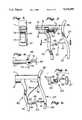
- FIG. 1is a vertical view of a surgical device in accordance with the teachings of the invention
- FIG. 2is a view taken along lines 2--2 of FIG. 1;
- FIG. 3is a detailed view of a portion of the device of FIG. 1;
- FIG. 4is a view similar to FIG. 1 showing a modification of the device of FIG. 1;
- FIG. 5is a view taken along lines 5--5 of FIG. 4;
- FIG. 6is a vertical view of a portion of the apparatus of FIG. 1 showing a modification of the handle portions thereof;
- FIG. 7is a vertical view of a portion of the apparatus of FIG. 1 showing a modification thereof;
- FIG. 8is a view taken along lines 8--8 of FIG. 7;
- FIG. 9is a view similar to FIG. 4 adding the ratchet mechanism of FIGS. 7 and 8 thereto;
- FIG. 10is a view similar to FIG. 2 showing a modification of the interlocking means thereof;
- FIG. 11is a view similar to FIG. 3 showing another modification of the grasping means
- FIG. 12is a view taken along lines 12--12 of FIG. 11;
- FIG. 13is a view taken along lines 13--13 of FIG. 12.
- a surgical device 10having a pair of upper and lower elongated shaft members 11, 12.
- upper shaft member 11is generally round in shape with an elongated rounded cavity 13 extending therealong.
- Lower shaft member 12is also generally round in shape with an elongated rounded protrusion 14 configured similarly to cavity 13 and adapted to ride therein.
- Shaft member 11terminates at its forward end in a tapered end 15 (FIG. 3).
- Shaft member 12terminates at its forward end in a tapered end 16.
- a first upper jaw member 17, having a gear 18 at one end and a plurality of spaced teeth 19 extending therefromis pivotally connected to end 15 by pivot pin 20.
- a second lower jaw member 21, having a gear 22 at one end and a plurality of spaced teeth 23 extending therefromis pivotally connected to end 16 by a pivot pin 24.
- teeth 19, 23face inwardly toward each other and each set of teeth 19, 23 curve to a terminal end, such as ends 25, 26, respectively.
- Upper shaft member 11terminates at the rear in a contoured gripping member or first handle portion 27 having shaft member 11 fixed thereto.
- Handle portion 27is curved at top end 28 to provide a palm rest for the surgeon, the integral lower inwardly curved end 29 providing a palm rest.
- Lower shaft portion 12has at its rear end a second handle portion 30 having shaft portion 12 fixed thereto at its upper end.
- Handle portion 30is contoured to receive therearound the fingers of the surgeon.
- a stop member 31may be provided on the underside of upper shaft member 11.
- a coiled spring 32is fixed at one end of the upper end of handle portion 30 and at its other end to stop member 31 (of course, coiled spring 32 need not be fixed to either handle portion 30 or stop member 31 but is disposed therebetween in any suitable manner). Spring 32 thus normally biases first handle portion 27 away from second handle portion 30.
- the surgeongrasps handle portions 27, 30 with his or her fingers about handle portion 30, his or her palm against parts 28 and 29 of handle portion 27.
- the surgeonsqueezes handle portions 27, 30 together against the bias of spring 32.
- Thismoves upper shaft portion 11, keyed to lower shaft portion 12 by cavity 13 and protrusion 14, along lower shaft portion 12 in a straight aligned manner.
- the forward stroke of the surgeon's palmis short driving upper shaft member 11 forward with upper gear 18 meshing with lower gear 22 to close the hinged jaw members 17, 21. That is, as the two gears 18, 22 mesh on the forward movement of upper shaft member 11, lower jaw member 21 moving clockwise bringing end 26 upwardly. A double jaw opening and closing action is thus effected.
- a short flat spring 33is fixed at one end 34 to handle portion 30 and extends to and curves adjacent handle portion 27 at curved end 35.
- curved end 35abuts against and is disposed in a notch 36 on handle portion 27 thereby retaining the same in position.
- spring 33biases handle portions 27, 30 apart.
- handle portion 37fixed to upper shaft member 11
- handle portion 38fixed to upper shaft member 11
- Handle portions 38, 39fixed to upper and lower shaft members 12, respectively, are arcuate members to provide engagement by the forefinger (upper handle portion 38) and middle and fourth finger (lower handle portion 39) of the surgeon.
- a ratchet mechanism 40may be added to the embodiment of FIGS. 1 and 4 to assist in operation of the devices of FIGS. 1 and 4. This provides firm stable operation of the devices of FIGS. 1 and 4.
- an elongated member 41is fixed to handle portion 29 and extends toward handle portion 30 terminating in a single downwardly extending tapered tooth 42 (see also FIG. 8).
- a like elongated member 43(FIG. 7) is fixed to and extends from handle portion 30 to handle portion 29. Member 43 terminates in a plurality of spaced upwardly extending tapered teeth 44 (see also FIG. 8).
- Members 41, 43may be resilient and tooth 42 engages teeth 44 when handle portion 29, 30 are squeezed together. This provides firm stable actuation of device 10.
- tooth 42moves past the last tooth of teeth 44 (e.g., tooth 44'--FIG. 8), it drops downwardly and handle portion 29 returns to the FIG. 1 position.
- ratchet mechanism 40provides an overriding ratchet means to hold jaw members 17, 21 closed.
- FIG. 9wherein like numerals refer to like parts of the embodiment of FIG. 4, the embodiment of FIG. 4 has been modified to add the ratchet mechanism 40 of the embodiment of FIGS. 7 and 8. Further description is deemed unnecessary.
- upper shaft member 45may have a T-shaped slot 47 receiving therein a like configured T-shaped member 48 of lower shaft member 46.
- T-shaped slot 47may be a T-shaped slot 47 receiving therein a like configured T-shaped member 48 of lower shaft member 46.
- the shaft members 11, 12 or 45, 46may be connected together for gripping in any suitable manner.
- shaft members 50, 51otherwise identical to shaft members 12 of FIG. 1 and interconnected in like manner, are shown.
- Upper shaft member 50terminates at the forward end in a rounded slotted yoke 52 (see also, FIG. 12) adapted to receive a pin 53 connected to jaw member 63 therein in a snap fitting relationship.
- Lower shaft member 51terminates in a yoked head 54 having a first lower slot 55 receiving a pin 56 therein (FIG. 12) in a snap fitting relationship.
- Pin 56is integral with lower jaw member 57 which may be otherwise similar to lower jaw member 21 with suitable teeth 23 thereon.
- Pin 56also is the axle for toothed gear 58 (FIG. 13) having lower jaw member 57 integral therewith.
- Head 54also has a slot 59 at its upper end (FIG. 13) receiving in a rounded hole 60 therein a pin 61.
- Pin 61is the axle for gear 62 having upper jaw member 63 integral therewith which is also otherwise similar to upper toothed jaw member 17.
Landscapes
- Health & Medical Sciences (AREA)
- Surgery (AREA)
- Life Sciences & Earth Sciences (AREA)
- Biomedical Technology (AREA)
- Nuclear Medicine, Radiotherapy & Molecular Imaging (AREA)
- Engineering & Computer Science (AREA)
- Ophthalmology & Optometry (AREA)
- Heart & Thoracic Surgery (AREA)
- Medical Informatics (AREA)
- Molecular Biology (AREA)
- Animal Behavior & Ethology (AREA)
- General Health & Medical Sciences (AREA)
- Public Health (AREA)
- Veterinary Medicine (AREA)
- Surgical Instruments (AREA)
Abstract
Description
1. Field of the Invention
The invention relates to surgical devices; and, more particularly, to a surgical tool having a pair of grasping jaws actuated to open and close.
2. Description of the Prior Art
In working inside of the abdominal cavity of a patient, the surgeon makes a hole in the patient's body and manipulates a surgical instrument that is passed through an elongated small diameter hollow tube or cannula inserted into the hole in the patient's abdominal cavity. Such a cannula may have an outer diameter as small as eleven millimeters and be about 8 to 9" long. The surgeon views the interior of the abdominal cavity through a conventional lens system associated with the patient which projects the interior view on a video screen. Such an instrument should be able to be inserted through such a small diameter tube, grasp or separate tissue, coagulate tissue, etc. Such an instrument should be about 12 to 14" long and should allow the surgeon to grasp with ease. The jaws of such an instrument should be able to open and close outside of the cannula with the parts of the instruments effecting such opening and closing working within the cannula.
It is an object of this invention to provide a surgical device having a double jaw opening and closing action.
It is a further object of this invention to provide such a device having a spring biasing a pair of interlocking elongated members, one of the members having a grasping jaw at one end meshing with a like grasping jaw at one end of the other of the members.
These and other objects are preferably accomplished by providing a surgical device having a pair of slidably interlocking spring biased upper and lower shaft members. A grasping handle is associated with one end of the interlocking shaft members for grasping the same and sliding the upper shaft member forwardly along the lower shaft member. A grasping jaw member is pivotally connected to the other end of the shaft members, the jaw members being in meshing engagement thereby effecting a double jaw opening and closing when the upper shaft member is actuated with respect to the lower shaft member.
FIG. 1 is a vertical view of a surgical device in accordance with the teachings of the invention;
FIG. 2 is a view taken alonglines 2--2 of FIG. 1;
FIG. 3 is a detailed view of a portion of the device of FIG. 1;
FIG. 4 is a view similar to FIG. 1 showing a modification of the device of FIG. 1;
FIG. 5 is a view taken along lines 5--5 of FIG. 4;
FIG. 6 is a vertical view of a portion of the apparatus of FIG. 1 showing a modification of the handle portions thereof;
FIG. 7 is a vertical view of a portion of the apparatus of FIG. 1 showing a modification thereof;
FIG. 8 is a view taken alonglines 8--8 of FIG. 7;
FIG. 9 is a view similar to FIG. 4 adding the ratchet mechanism of FIGS. 7 and 8 thereto;
FIG. 10 is a view similar to FIG. 2 showing a modification of the interlocking means thereof;
FIG. 11 is a view similar to FIG. 3 showing another modification of the grasping means;
FIG. 12 is a view taken alonglines 12--12 of FIG. 11; and
FIG. 13 is a view taken alonglines 13--13 of FIG. 12.
Referring now to FIG. 1 of the drawing, asurgical device 10 is shown having a pair of upper and lowerelongated shaft members upper shaft member 11 is generally round in shape with an elongatedrounded cavity 13 extending therealong.Lower shaft member 12 is also generally round in shape with an elongatedrounded protrusion 14 configured similarly tocavity 13 and adapted to ride therein.
Shaftmember 11 terminates at its forward end in a tapered end 15 (FIG. 3). Shaftmember 12 terminates at its forward end in atapered end 16. A firstupper jaw member 17, having agear 18 at one end and a plurality of spacedteeth 19 extending therefrom is pivotally connected toend 15 bypivot pin 20. In like manner, a secondlower jaw member 21, having agear 22 at one end and a plurality of spacedteeth 23 extending therefrom is pivotally connected toend 16 by apivot pin 24. As seen in FIG. 1,teeth teeth ends
Astop member 31 may be provided on the underside ofupper shaft member 11. A coiledspring 32 is fixed at one end of the upper end ofhandle portion 30 and at its other end to stop member 31 (of course, coiledspring 32 need not be fixed to either handleportion 30 or stopmember 31 but is disposed therebetween in any suitable manner).Spring 32 thus normally biasesfirst handle portion 27 away fromsecond handle portion 30.
In operation, the surgeon grasps handleportions handle portion 30, his or her palm againstparts handle portion 27. The surgeon squeezes handleportions spring 32. This movesupper shaft portion 11, keyed tolower shaft portion 12 bycavity 13 andprotrusion 14, alonglower shaft portion 12 in a straight aligned manner. The forward stroke of the surgeon's palm is short drivingupper shaft member 11 forward withupper gear 18 meshing withlower gear 22 to close thehinged jaw members gears upper shaft member 11,lower jaw member 21 moving clockwise bringingend 26 upwardly. A double jaw opening and closing action is thus effected.
As an alternative tospring 32 and stopmember 31, as seen in FIG. 4, wherein like numerals refer to like parts of the device of FIGS. 1 and 2, a shortflat spring 33 is fixed at oneend 34 to handleportion 30 and extends to and curvesadjacent handle portion 27 atcurved end 35. As seen in FIG. 5, curvedend 35 abuts against and is disposed in anotch 36 onhandle portion 27 thereby retaining the same in position. Thus,spring 33 biases handleportions upper shaft member 11 moves forward alonglower shaft member 12 as heretofore discussed. When released, handle portions return to the FIG. 4 position.
Another embodiment of the handle portions are shown in FIG. 6 wherein like numerals refer to like parts of the embodiment of FIG. 1. Here,handle portion 37, fixed toupper shaft member 11, is a curved member providing a thumb rest for the surgeon. Handleportions lower shaft members 12, respectively, are arcuate members to provide engagement by the forefinger (upper handle portion 38) and middle and fourth finger (lower handle portion 39) of the surgeon.
As seen in FIG. 7, aratchet mechanism 40 may be added to the embodiment of FIGS. 1 and 4 to assist in operation of the devices of FIGS. 1 and 4. This provides firm stable operation of the devices of FIGS. 1 and 4. Thus, referring to FIG. 7 wherein like numerals refer to like parts of the embodiment of FIG. 1, anelongated member 41 is fixed to handleportion 29 and extends towardhandle portion 30 terminating in a single downwardly extending tapered tooth 42 (see also FIG. 8). A like elongated member 43 (FIG. 7) is fixed to and extends fromhandle portion 30 to handleportion 29.Member 43 terminates in a plurality of spaced upwardly extending tapered teeth 44 (see also FIG. 8).Members tooth 42 engagesteeth 44 whenhandle portion device 10. Whentooth 42 moves past the last tooth of teeth 44 (e.g., tooth 44'--FIG. 8), it drops downwardly and handleportion 29 returns to the FIG. 1 position. Thus, ratchetmechanism 40 provides an overriding ratchet means to holdjaw members
As seen in FIG. 9, wherein like numerals refer to like parts of the embodiment of FIG. 4, the embodiment of FIG. 4 has been modified to add theratchet mechanism 40 of the embodiment of FIGS. 7 and 8. Further description is deemed unnecessary.
The interengagement ofshaft members protrusion 14 andcavity 13 interengagement of FIG. 2,upper shaft member 45 may have a T-shapedslot 47 receiving therein a like configured T-shapedmember 48 oflower shaft member 46. Other variations may occur to an artisan.
Theshaft members shaft members shaft members 12 of FIG. 1 and interconnected in like manner, are shown.Upper shaft member 50 terminates at the forward end in a rounded slotted yoke 52 (see also, FIG. 12) adapted to receive apin 53 connected tojaw member 63 therein in a snap fitting relationship.Lower shaft member 51 terminates in a yokedhead 54 having a firstlower slot 55 receiving apin 56 therein (FIG. 12) in a snap fitting relationship.Pin 56 is integral withlower jaw member 57 which may be otherwise similar tolower jaw member 21 withsuitable teeth 23 thereon.Pin 56 also is the axle for toothed gear 58 (FIG. 13) havinglower jaw member 57 integral therewith.
The meshing ofgears gear shaft members device 10 of FIG. 1. Thus, further discussion is deemed unnecessary.
It can be seen that there is a new improved surgical device having upper and lower grasping jaws which are in meshing engagements providing an effective double jaw opening and closing action. The short stroke ofshaft members short ratchet mechanism 40. Theupper jaw member 17 actuates thelower jaw member 21.
Claims (14)
1. A surgical device comprising:
a first upper rigid elongated shaft member keyed along a substantial portion of its length to a second lower rigid elongated shaft member for reciprocal movement therealong in parallel relation thereto;
handle means at one end of said first and second shaft members for grasping said device;
biasing means associated with said first and second shaft members for normally biasing said first shaft member in a direction laterally along said second shaft member;
an upper jaw member;
a lower jaw member;
said upper jaw member being pivotally connected to said upper shaft member and said lower jaw member being pivotally connected to said lower shaft member, each of said jaw members having a plurality of spaced teeth thereon, the teeth of one of said jaw members facing the teeth of the other of said jaw members; and
said jaw members being in meshing engagement whereby reciprocation of said upper shaft member in a direction sliding along said lower shaft member and toward said jaw members and parallel to said lower shaft member moves said upper jaw member in a counterclockwise direction whereby said lower jaw member, in meshing engagement with said upper jaw member, moves in a clockwise direction thereby moving the teeth of said jaw members together.
2. In the device of claim 1 wherein each of said jaw members taper to a point.
3. In the device of claim 2 wherein each of said jaw members are arcuate in cross section.
4. In the device of claim 1 wherein each of said jaw members has an integral gear portion pivotally connected to its respective shaft member, said gear portions having gear teeth thereon in meshing engagement.
5. In the device of claim 1 wherein said upper shaft member has a top wall and a bottom wall, and said handle means includes a handle portion fixedly secured to one end of said lower shaft member having an upper end and a downwardly extending lower end, said biasing means including a stop member mounted on the bottom wall of said upper shaft member, and a spring mounted between the upper end-of said handle portion and said stop member.
6. In the device of claim 5 including a second handle portion fixed to one end of said upper shaft member and spaced from said first mentioned handle portion, each of said handle portions being contoured to fit the hand of a user.
7. In the device of claim 1 wherein said handle means includes a first handle portion fixedly secured to one end of said upper shaft member, and a second handle portion fixedly secured to one end of said lower shaft member and spaced from said first handle portion, said handle portions being contoured to fit the hand of a user.
8. In the device of claim 7 including a third handle portion being fixed to said lower shaft member extending upwardly therefrom, said first, second and third handle portions being arcuate in cross section with said first handle portion curving away from said second and third handle portions and adapted to be engaged by a thumb of a user, said second and third handle portions curving away from said first handle portion, said second handle portion being adapted to be engaged by a middle and fourth finger of a user and said third handle portion being adapted to be engaged by a forefinger of a user.
9. In the device of claim 1 wherein said first upper shaft member and said second lower shaft member are keyed to each other by an elongated cavity on one of said shaft members receiving therein a like configured interlocking member on the other of said shaft members.
10. In the device of claim 1 wherein said handle means includes a first handle portion fixed to one end of said upper shaft member and a second handle portion fixed to one end of said lower shaft member, said biasing means including a flat resilient spring fixed to said second handle portion and extending to and curving about said first handle portion forming a curved end abutting against said first handle portions.
11. In the device of claim 10 wherein said first handle portion includes a notch therein facing said second handle portion receiving said curved end therein.
12. In the device of claim including ratchet means associated with said handle means for ratcheting said upper shaft member with respect to said lower shaft member when said upper shaft member is reciprocated along said lower shaft member.
13. In the device of claim 12 wherein said handle means includes a first handle portion fixed to one end of said upper shaft member and a second handle portion fixed to one end of said lower shaft member and spaced from said first handle portion, said ratchet means including a first elongated ratchet member fixed to said first handle portion and extending toward said second handle portion, a second elongated ratchet member fixed to said second handle portion and extending toward said first handle portion, one of said ratchet members having at least one downwardly extending ratchet tooth thereon, the other of said ratchet members having a plurality of upwardly extending ratchet teeth thereon, said ratchet tooth being normally biased away from engagement with said ratchet teeth by said biasing means, said ratchet tooth being adapted to engage and ratchet into said ratchet teeth when said first and second handle portions are squeezed against the bias of said biasing means.
14. A surgical device comprising:
a first upper rigid elongated shaft member keyed along a substantial portion of its length to a second lower rigid elongated shaft member for reciprocal movement therealong in parallel relation thereto;
handle means at one end of said first and second shaft members for grasping said device;
biasing means associated with said first and second shaft members for normally biasing said first shaft member in a direction laterally along said second shaft member;
an upper jaw member;
a lower jaw member;
said upper jaw member being pivotally connected to said upper shaft member and to an extension portion of said lower shaft member, and said lower jaw member being pivotally connected only to said lower shaft member, each of said jaw members having a plurality of spaced teeth thereon, the teeth of one of said jaw members facing the teeth of the other of said jaw members; and
said jaw members being in meshing engagement whereby reciprocation of said first upper shaft member in a direction sliding along said lower shaft member and toward said jaw members and parallel thereto moves said upper jaw member in a counterclockwise direction whereby said lower jaw member, in meshing engagement with said upper jaw member, moves in a clockwise direction thereby moving the teeth of said jaw members together.
Priority Applications (4)
| Application Number | Priority Date | Filing Date | Title |
|---|---|---|---|
| US07/710,402US5176699A (en) | 1991-06-05 | 1991-06-05 | Surgical device with double jaw actuation |
| EP92920736AEP0695143B1 (en) | 1991-06-05 | 1992-09-10 | Surgical device with double jaw actuation |
| DE69228008TDE69228008T2 (en) | 1991-06-05 | 1992-09-10 | SURGICAL DEVICE WITH OPERATION OF DOUBLE JAWS |
| PCT/US1992/007671WO1994005223A1 (en) | 1991-06-05 | 1992-09-10 | Surgical device with double jaw actuation |
Applications Claiming Priority (2)
| Application Number | Priority Date | Filing Date | Title |
|---|---|---|---|
| US07/710,402US5176699A (en) | 1991-06-05 | 1991-06-05 | Surgical device with double jaw actuation |
| PCT/US1992/007671WO1994005223A1 (en) | 1991-06-05 | 1992-09-10 | Surgical device with double jaw actuation |
Publications (1)
| Publication Number | Publication Date |
|---|---|
| US5176699Atrue US5176699A (en) | 1993-01-05 |
Family
ID=26785011
Family Applications (1)
| Application Number | Title | Priority Date | Filing Date |
|---|---|---|---|
| US07/710,402Expired - LifetimeUS5176699A (en) | 1991-06-05 | 1991-06-05 | Surgical device with double jaw actuation |
Country Status (4)
| Country | Link |
|---|---|
| US (1) | US5176699A (en) |
| EP (1) | EP0695143B1 (en) |
| DE (1) | DE69228008T2 (en) |
| WO (1) | WO1994005223A1 (en) |
Cited By (44)
| Publication number | Priority date | Publication date | Assignee | Title |
|---|---|---|---|---|
| US5275615A (en)* | 1992-09-11 | 1994-01-04 | Anthony Rose | Medical instrument having gripping jaws |
| WO1994018893A1 (en)* | 1993-02-22 | 1994-09-01 | Valleylab, Inc. | A laparoscopic dissection tension retractor device and method |
| US5354312A (en)* | 1992-09-18 | 1994-10-11 | Ethicon, Inc. | Endoscopic anvil grasping instrument |
| US5411519A (en)* | 1992-09-23 | 1995-05-02 | United States Surgical Corporation | Surgical apparatus having hinged jaw structure |
| USD362908S (en) | 1994-05-20 | 1995-10-03 | Depuy Inc. | Endoscopic surgical instrument handle |
| US5454819A (en)* | 1994-03-17 | 1995-10-03 | Nusurg Medical, Inc. | Spring biased laparoscopic surgical needle holder |
| US5472439A (en)* | 1993-10-06 | 1995-12-05 | American Cyanamid Company | Endoscopic surgical instrument with rotatable inner shaft |
| US5476479A (en)* | 1991-09-26 | 1995-12-19 | United States Surgical Corporation | Handle for endoscopic surgical instruments and jaw structure |
| US5483952A (en)* | 1991-09-26 | 1996-01-16 | United States Surgical Corporation | Handle for surgical instruments |
| US5489292A (en) | 1990-10-05 | 1996-02-06 | United States Surgical Corporation | Endoscopic surgical instrument with grip enhancing means |
| US5507772A (en)* | 1993-05-25 | 1996-04-16 | Depuy Inc. | Cleanable, inspectable, and replaceable surgical instrument |
| US5509922A (en)* | 1990-10-05 | 1996-04-23 | United States Surgical Corporation | Endoscopic surgical instrument |
| EP0706780A3 (en)* | 1994-10-07 | 1996-07-03 | United States Surgical Corp | Surgical instruments useful for endoscopic spinal procedures |
| US5626609A (en)* | 1990-10-05 | 1997-05-06 | United States Surgical Corporation | Endoscopic surgical instrument |
| JPH09507613A (en)* | 1994-01-12 | 1997-07-29 | エフエスアイ インターナショナル インコーポレイテッド | Recirculation of wafer cleaning material |
| WO1998000066A1 (en)* | 1996-07-03 | 1998-01-08 | Applied Medical Resources Corporation | Laparoscopic surgical clamp |
| US5797959A (en)* | 1995-09-21 | 1998-08-25 | United States Surgical Corporation | Surgical apparatus with articulating jaw structure |
| US5873886A (en)* | 1995-04-04 | 1999-02-23 | United States Surgical Corporation | Surgical cutting apparatus |
| US5879365A (en)* | 1995-04-04 | 1999-03-09 | United States Surgical Corporation | Surgical cutting apparatus |
| US6015412A (en)* | 1997-01-08 | 2000-01-18 | Atlantech Medical Devices Limited | Cutting device |
| US20010031221A1 (en)* | 1997-12-17 | 2001-10-18 | Wu Su-Syin S. | Apparatus and method for delivering fluids to contact surfaces between parts of a medical device |
| US6447532B1 (en) | 1996-09-18 | 2002-09-10 | Kunst & Van Leerdam Medical Technology B.V. | Manipulating pliers |
| US20030026729A1 (en)* | 1997-08-21 | 2003-02-06 | Wu Su-Syin S. | Lumen sterilization device and method |
| US20040193167A1 (en)* | 2002-04-16 | 2004-09-30 | Arthrocare Corporation | Transverse suspension device |
| US20050192598A1 (en)* | 2004-02-27 | 2005-09-01 | Applied Medical Resources Corporation | System and method for actuating a laparoscopic surgical instrument |
| US20060235516A1 (en)* | 2005-04-01 | 2006-10-19 | Arthrocare Corporation | Surgical methods for anchoring and implanting tissues |
| US20060271059A1 (en)* | 2005-05-16 | 2006-11-30 | Arthrocare Corporation | Convergent tunnel guide apparatus and method |
| US20080195144A1 (en)* | 2005-08-11 | 2008-08-14 | Olympus Medical Systems Corp. | Medical intervention instrument |
| US20090054732A1 (en)* | 2007-08-23 | 2009-02-26 | Markham Harold A | Instrument for endoscopic surgery |
| US20090163905A1 (en)* | 2007-12-21 | 2009-06-25 | Winkler Matthew J | Ablation device with internally cooled electrodes |
| US20100030029A1 (en)* | 2008-08-04 | 2010-02-04 | Markham Harold A | Instrument for endoscopic surgery with knee in shaft and shaft stable handpiece |
| US7901404B2 (en) | 2004-01-16 | 2011-03-08 | Arthrocare Corporation | Bone harvesting device and method |
| US20120098284A1 (en)* | 2010-10-26 | 2012-04-26 | Aberth Karl R | Folding reach extender |
| US8382777B1 (en)* | 2012-01-23 | 2013-02-26 | Hasan M. Sh. Sh. Alshemari | Surgical needle holder |
| EP2601895A1 (en)* | 2011-12-08 | 2013-06-12 | Richard Wolf GmbH | Medical instrument |
| US8528951B1 (en) | 2010-10-26 | 2013-09-10 | Karl R. Aberth | Folding reach extender |
| CN103565515A (en)* | 2012-07-19 | 2014-02-12 | 科维蒂恩有限合伙公司 | Surgical forceps including reposable end effector assemblies |
| US8998892B2 (en) | 2007-12-21 | 2015-04-07 | Atricure, Inc. | Ablation device with cooled electrodes and methods of use |
| US9022443B1 (en) | 2010-10-26 | 2015-05-05 | Karl R. Aberth | Folding reach extender |
| EP3634248A4 (en)* | 2016-06-06 | 2020-12-09 | Macneil, Hugh Finlay | SURGICAL CLAMP FOR CLAMPING AN ORGAN |
| US20210052319A1 (en)* | 2018-03-30 | 2021-02-25 | GYRUS ACMI, INC., d/b/a Olympus Surgical Technologies America | Forceps including a double biased handle latch |
| US11207127B2 (en) | 2014-09-25 | 2021-12-28 | Covidien Lp | Surgical instruments facilitating replacement of disposable components and/or sterilization of reusable components |
| US20230397921A1 (en)* | 2020-10-26 | 2023-12-14 | G. Hipp & Sohn GmbH | Surgical Instrument |
| US20240099735A1 (en)* | 2019-10-15 | 2024-03-28 | G. Hipp & Sohn GmbH | Surgical instrument |
Families Citing this family (8)
| Publication number | Priority date | Publication date | Assignee | Title |
|---|---|---|---|---|
| US5788710A (en) | 1996-04-30 | 1998-08-04 | Boston Scientific Corporation | Calculus removal |
| DE19700114C1 (en)* | 1997-01-03 | 1998-11-19 | Univ Ludwigs Albert | Handle part of an endoscopic instrument |
| DE19702447C2 (en)* | 1997-01-24 | 2003-12-04 | Aesculap Ag & Co Kg | Instrument handle for a surgical tubular shaft instrument |
| JP4181410B2 (en) | 2001-03-09 | 2008-11-12 | ボストン サイエンティフィック リミテッド | System and method for implanting an implant |
| DE60223502T2 (en) | 2001-03-09 | 2008-11-13 | Boston Scientific Ltd., St. Michael | MEDICAL SLING |
| AU2003259834A1 (en) | 2002-12-17 | 2004-07-29 | Boston Scientific Limited | Spacer for sling delivery system |
| US7361138B2 (en) | 2003-07-31 | 2008-04-22 | Scimed Life Systems, Inc. | Bioabsorbable casing for surgical sling assembly |
| DE102004030030A1 (en)* | 2004-05-18 | 2005-12-15 | Erbe Elektromedizin Gmbh | Handle for a surgical instrument |
Citations (13)
| Publication number | Priority date | Publication date | Assignee | Title |
|---|---|---|---|---|
| US2579536A (en)* | 1950-06-29 | 1951-12-25 | Frank C Barr | Pickup tongs |
| US2790437A (en)* | 1955-10-12 | 1957-04-30 | Welch Allyn Inc | Surgical instrument |
| US3328066A (en)* | 1965-01-06 | 1967-06-27 | Johnston Orin | Pickup device for trash |
| US3989049A (en)* | 1973-07-30 | 1976-11-02 | In Bae Yoon | Method of applying an elastic ring to an anatomical tubular structure |
| US4122856A (en)* | 1976-10-08 | 1978-10-31 | American Hospital Supply Corporation | Surgical instrument and method of assembly thereof |
| US4243047A (en)* | 1979-02-07 | 1981-01-06 | Auburn Enterprises, Inc. | Instrument for taking tissue specimens |
| SU980703A1 (en)* | 1980-05-16 | 1982-12-15 | Иркутский Государственный Медицинский Институт | Device for dissection of tissues |
| GB2119696A (en)* | 1982-04-29 | 1983-11-23 | Karl Storz | Surgical forceps |
| US4646751A (en)* | 1984-05-18 | 1987-03-03 | Diener Verwaltungs-und Beteiligungsgesellschaft m.b.H. | Biopsy forceps |
| US4763669A (en)* | 1986-01-09 | 1988-08-16 | Jaeger John C | Surgical instrument with adjustable angle of operation |
| US4887612A (en)* | 1988-04-27 | 1989-12-19 | Esco Precision, Inc. | Endoscopic biopsy forceps |
| US4944093A (en)* | 1987-10-26 | 1990-07-31 | Richard Wolf Gmbh | Forceps with shearing jaws |
| US4961430A (en)* | 1988-07-28 | 1990-10-09 | John Sheahon | Cervical biopsy instrument |
Family Cites Families (5)
| Publication number | Priority date | Publication date | Assignee | Title |
|---|---|---|---|---|
| US984756A (en)* | 1909-09-08 | 1911-02-21 | Paul Frisch | Surgical forceps. |
| FR2082987A5 (en)* | 1970-11-26 | 1971-12-10 | Martinaud Camille | |
| US4043343A (en)* | 1975-08-01 | 1977-08-23 | Williams Robert W | Forceps |
| US4712545A (en)* | 1984-04-05 | 1987-12-15 | Acufex Microsurgical, Inc. | Surgical instrument |
| ATE131370T1 (en)* | 1989-08-16 | 1995-12-15 | Raychem Corp | ARRANGEMENT FOR GRABING OR CUTTING AN OBJECT |
- 1991
- 1991-06-05USUS07/710,402patent/US5176699A/ennot_activeExpired - Lifetime
- 1992
- 1992-09-10DEDE69228008Tpatent/DE69228008T2/ennot_activeExpired - Fee Related
- 1992-09-10WOPCT/US1992/007671patent/WO1994005223A1/enactiveIP Right Grant
- 1992-09-10EPEP92920736Apatent/EP0695143B1/ennot_activeExpired - Lifetime
Patent Citations (13)
| Publication number | Priority date | Publication date | Assignee | Title |
|---|---|---|---|---|
| US2579536A (en)* | 1950-06-29 | 1951-12-25 | Frank C Barr | Pickup tongs |
| US2790437A (en)* | 1955-10-12 | 1957-04-30 | Welch Allyn Inc | Surgical instrument |
| US3328066A (en)* | 1965-01-06 | 1967-06-27 | Johnston Orin | Pickup device for trash |
| US3989049A (en)* | 1973-07-30 | 1976-11-02 | In Bae Yoon | Method of applying an elastic ring to an anatomical tubular structure |
| US4122856A (en)* | 1976-10-08 | 1978-10-31 | American Hospital Supply Corporation | Surgical instrument and method of assembly thereof |
| US4243047A (en)* | 1979-02-07 | 1981-01-06 | Auburn Enterprises, Inc. | Instrument for taking tissue specimens |
| SU980703A1 (en)* | 1980-05-16 | 1982-12-15 | Иркутский Государственный Медицинский Институт | Device for dissection of tissues |
| GB2119696A (en)* | 1982-04-29 | 1983-11-23 | Karl Storz | Surgical forceps |
| US4646751A (en)* | 1984-05-18 | 1987-03-03 | Diener Verwaltungs-und Beteiligungsgesellschaft m.b.H. | Biopsy forceps |
| US4763669A (en)* | 1986-01-09 | 1988-08-16 | Jaeger John C | Surgical instrument with adjustable angle of operation |
| US4944093A (en)* | 1987-10-26 | 1990-07-31 | Richard Wolf Gmbh | Forceps with shearing jaws |
| US4887612A (en)* | 1988-04-27 | 1989-12-19 | Esco Precision, Inc. | Endoscopic biopsy forceps |
| US4961430A (en)* | 1988-07-28 | 1990-10-09 | John Sheahon | Cervical biopsy instrument |
Cited By (73)
| Publication number | Priority date | Publication date | Assignee | Title |
|---|---|---|---|---|
| US5489292A (en) | 1990-10-05 | 1996-02-06 | United States Surgical Corporation | Endoscopic surgical instrument with grip enhancing means |
| US5626609A (en)* | 1990-10-05 | 1997-05-06 | United States Surgical Corporation | Endoscopic surgical instrument |
| US5509922A (en)* | 1990-10-05 | 1996-04-23 | United States Surgical Corporation | Endoscopic surgical instrument |
| US5476479A (en)* | 1991-09-26 | 1995-12-19 | United States Surgical Corporation | Handle for endoscopic surgical instruments and jaw structure |
| US5483952A (en)* | 1991-09-26 | 1996-01-16 | United States Surgical Corporation | Handle for surgical instruments |
| US5275615A (en)* | 1992-09-11 | 1994-01-04 | Anthony Rose | Medical instrument having gripping jaws |
| US5354312A (en)* | 1992-09-18 | 1994-10-11 | Ethicon, Inc. | Endoscopic anvil grasping instrument |
| US5411519A (en)* | 1992-09-23 | 1995-05-02 | United States Surgical Corporation | Surgical apparatus having hinged jaw structure |
| US5474057A (en)* | 1993-02-22 | 1995-12-12 | Valleylab Inc. | Laparoscopic dissection tension retractor device and method |
| WO1994018893A1 (en)* | 1993-02-22 | 1994-09-01 | Valleylab, Inc. | A laparoscopic dissection tension retractor device and method |
| US5507772A (en)* | 1993-05-25 | 1996-04-16 | Depuy Inc. | Cleanable, inspectable, and replaceable surgical instrument |
| US5472439A (en)* | 1993-10-06 | 1995-12-05 | American Cyanamid Company | Endoscopic surgical instrument with rotatable inner shaft |
| US5776146A (en)* | 1993-10-20 | 1998-07-07 | Applied Medical Resources | Laparoscopic surgical clamp |
| JPH09507613A (en)* | 1994-01-12 | 1997-07-29 | エフエスアイ インターナショナル インコーポレイテッド | Recirculation of wafer cleaning material |
| US5454819A (en)* | 1994-03-17 | 1995-10-03 | Nusurg Medical, Inc. | Spring biased laparoscopic surgical needle holder |
| USD362908S (en) | 1994-05-20 | 1995-10-03 | Depuy Inc. | Endoscopic surgical instrument handle |
| EP1224914A3 (en)* | 1994-10-07 | 2004-01-28 | United States Surgical Corporation | Surgical instruments useful for endoscopic spinal procedures |
| US5851214A (en)* | 1994-10-07 | 1998-12-22 | United States Surgical Corporation | Surgical instrument useful for endoscopic procedures |
| EP0706780A3 (en)* | 1994-10-07 | 1996-07-03 | United States Surgical Corp | Surgical instruments useful for endoscopic spinal procedures |
| US5873886A (en)* | 1995-04-04 | 1999-02-23 | United States Surgical Corporation | Surgical cutting apparatus |
| US5879365A (en)* | 1995-04-04 | 1999-03-09 | United States Surgical Corporation | Surgical cutting apparatus |
| US5797959A (en)* | 1995-09-21 | 1998-08-25 | United States Surgical Corporation | Surgical apparatus with articulating jaw structure |
| WO1998000066A1 (en)* | 1996-07-03 | 1998-01-08 | Applied Medical Resources Corporation | Laparoscopic surgical clamp |
| WO1998011833A3 (en)* | 1996-09-18 | 2002-11-14 | Tu Delft | Manipulating pliers |
| US6447532B1 (en) | 1996-09-18 | 2002-09-10 | Kunst & Van Leerdam Medical Technology B.V. | Manipulating pliers |
| US6015412A (en)* | 1997-01-08 | 2000-01-18 | Atlantech Medical Devices Limited | Cutting device |
| US20030026729A1 (en)* | 1997-08-21 | 2003-02-06 | Wu Su-Syin S. | Lumen sterilization device and method |
| US7229591B2 (en) | 1997-08-21 | 2007-06-12 | Ethicon, Inc. | Lumen sterilization device and method |
| US20010031221A1 (en)* | 1997-12-17 | 2001-10-18 | Wu Su-Syin S. | Apparatus and method for delivering fluids to contact surfaces between parts of a medical device |
| US20040193167A1 (en)* | 2002-04-16 | 2004-09-30 | Arthrocare Corporation | Transverse suspension device |
| US7713293B2 (en) | 2002-04-16 | 2010-05-11 | Arthrocare Corporation | Transverse suspension device |
| US7901404B2 (en) | 2004-01-16 | 2011-03-08 | Arthrocare Corporation | Bone harvesting device and method |
| US7578832B2 (en)* | 2004-02-27 | 2009-08-25 | Applied Medical Resources Corporation | System for actuating a laparoscopic surgical instrument |
| US20050192598A1 (en)* | 2004-02-27 | 2005-09-01 | Applied Medical Resources Corporation | System and method for actuating a laparoscopic surgical instrument |
| US8114120B2 (en) | 2004-02-27 | 2012-02-14 | Applied Medical Resources Corporation | System and method for actuating a laparoscopic surgical instrument |
| US20090318954A1 (en)* | 2004-02-27 | 2009-12-24 | Applied Medical Resources Corporation | System and method for actuating a laparoscopic surgical instrument |
| US7591850B2 (en) | 2005-04-01 | 2009-09-22 | Arthrocare Corporation | Surgical methods for anchoring and implanting tissues |
| US20060235516A1 (en)* | 2005-04-01 | 2006-10-19 | Arthrocare Corporation | Surgical methods for anchoring and implanting tissues |
| US7842042B2 (en) | 2005-05-16 | 2010-11-30 | Arthrocare Corporation | Convergent tunnel guide apparatus and method |
| US20060271059A1 (en)* | 2005-05-16 | 2006-11-30 | Arthrocare Corporation | Convergent tunnel guide apparatus and method |
| US20080195144A1 (en)* | 2005-08-11 | 2008-08-14 | Olympus Medical Systems Corp. | Medical intervention instrument |
| US9770229B2 (en)* | 2005-08-11 | 2017-09-26 | Olympus Corporation | Medical intervention instrument |
| US20090054732A1 (en)* | 2007-08-23 | 2009-02-26 | Markham Harold A | Instrument for endoscopic surgery |
| US8114076B2 (en)* | 2007-08-23 | 2012-02-14 | Markham Harold A | Instrument for endoscopic surgery |
| US8915878B2 (en) | 2007-12-21 | 2014-12-23 | Atricure, Inc. | Ablation device with internally cooled electrodes |
| US20090163905A1 (en)* | 2007-12-21 | 2009-06-25 | Winkler Matthew J | Ablation device with internally cooled electrodes |
| US8998892B2 (en) | 2007-12-21 | 2015-04-07 | Atricure, Inc. | Ablation device with cooled electrodes and methods of use |
| US8353907B2 (en) | 2007-12-21 | 2013-01-15 | Atricure, Inc. | Ablation device with internally cooled electrodes |
| US20100030029A1 (en)* | 2008-08-04 | 2010-02-04 | Markham Harold A | Instrument for endoscopic surgery with knee in shaft and shaft stable handpiece |
| CN102528789A (en)* | 2010-10-26 | 2012-07-04 | 卡尔·R·艾伯思 | Folding and extending expander |
| US9022443B1 (en) | 2010-10-26 | 2015-05-05 | Karl R. Aberth | Folding reach extender |
| US8528951B1 (en) | 2010-10-26 | 2013-09-10 | Karl R. Aberth | Folding reach extender |
| US20120098284A1 (en)* | 2010-10-26 | 2012-04-26 | Aberth Karl R | Folding reach extender |
| US8814242B1 (en) | 2010-10-26 | 2014-08-26 | Karl R. Aberth | Folding reach extender |
| CN102528789B (en)* | 2010-10-26 | 2014-12-10 | 卡尔·R·艾伯思 | Folding and extending expander |
| US8328256B2 (en)* | 2010-10-26 | 2012-12-11 | Aberth Karl R | Folding reach extender |
| JP2013119036A (en)* | 2011-12-08 | 2013-06-17 | Richard Wolf Gmbh | Medical device |
| EP2601895A1 (en)* | 2011-12-08 | 2013-06-12 | Richard Wolf GmbH | Medical instrument |
| US8926599B2 (en) | 2011-12-08 | 2015-01-06 | Richard Wolf Gmbh | Medical instrument |
| EP2617368A1 (en)* | 2012-01-23 | 2013-07-24 | Hasan M. Sh. Sh. Alshemari | Surgical needle holder |
| US8382777B1 (en)* | 2012-01-23 | 2013-02-26 | Hasan M. Sh. Sh. Alshemari | Surgical needle holder |
| EP2687177A3 (en)* | 2012-07-19 | 2014-03-12 | Covidien LP | Surgical forceps including reposable end effector assemblies |
| US9301798B2 (en) | 2012-07-19 | 2016-04-05 | Covidien Lp | Surgical forceps including reposable end effector assemblies |
| US20160157929A1 (en)* | 2012-07-19 | 2016-06-09 | Covidien Lp | Surgical forceps including reposable end effector assemblies |
| CN103565515A (en)* | 2012-07-19 | 2014-02-12 | 科维蒂恩有限合伙公司 | Surgical forceps including reposable end effector assemblies |
| US10413353B2 (en)* | 2012-07-19 | 2019-09-17 | Covidien Lp | Surgical forceps including reposable end effector assemblies |
| US11596465B2 (en) | 2012-07-19 | 2023-03-07 | Covidien Lp | Surgical forceps including reposable end effector assemblies |
| US11207127B2 (en) | 2014-09-25 | 2021-12-28 | Covidien Lp | Surgical instruments facilitating replacement of disposable components and/or sterilization of reusable components |
| EP3634248A4 (en)* | 2016-06-06 | 2020-12-09 | Macneil, Hugh Finlay | SURGICAL CLAMP FOR CLAMPING AN ORGAN |
| US20210052319A1 (en)* | 2018-03-30 | 2021-02-25 | GYRUS ACMI, INC., d/b/a Olympus Surgical Technologies America | Forceps including a double biased handle latch |
| US11944370B2 (en)* | 2018-03-30 | 2024-04-02 | Gyrus Acmi, Inc. | Forceps including a double biased handle latch |
| US20240099735A1 (en)* | 2019-10-15 | 2024-03-28 | G. Hipp & Sohn GmbH | Surgical instrument |
| US20230397921A1 (en)* | 2020-10-26 | 2023-12-14 | G. Hipp & Sohn GmbH | Surgical Instrument |
Also Published As
| Publication number | Publication date |
|---|---|
| WO1994005223A1 (en) | 1994-03-17 |
| DE69228008D1 (en) | 1999-02-04 |
| DE69228008T2 (en) | 1999-06-10 |
| EP0695143B1 (en) | 1998-12-23 |
| EP0695143A4 (en) | 1995-10-30 |
| EP0695143A1 (en) | 1996-02-07 |
Similar Documents
| Publication | Publication Date | Title |
|---|---|---|
| US5176699A (en) | Surgical device with double jaw actuation | |
| US7896900B2 (en) | Medical instrument for grasping an object, in particular needle holder | |
| US6609322B1 (en) | Gun handle design | |
| US6488695B1 (en) | Ophthalmologic surgical probe | |
| US5250056A (en) | Forceps-type surgical instrument | |
| US5338317A (en) | Rotational surgical instrument handle | |
| EP0653923B1 (en) | Improved surgical instrument handle | |
| US5211655A (en) | Multiple use forceps for endoscopy | |
| US6533797B1 (en) | Control grip assembly | |
| DE2625425C3 (en) | Device for attaching surgical clips | |
| US5184625A (en) | Biopsy forceps device having improved handle | |
| WO2004091377A3 (en) | Surgical instrument with trigger control | |
| US5630831A (en) | Fingerlike medical instruments for use in laparoscopic procedures | |
| WO1994004084A1 (en) | Improved handle mechanism for manual instruments | |
| EP1815809A1 (en) | Handle for surgical instruments | |
| JP2007508117A5 (en) | ||
| WO1994005222A1 (en) | Grasping forceps | |
| RU2007126952A (en) | TOOL FOR USE IN LAPAROSCOPIC SURGERY | |
| US20070016248A1 (en) | Medical gripping and/or cutting instrument | |
| US10105127B2 (en) | Surgical instrument with a manual control | |
| GB2585284A (en) | Disposable handle for medical instruments | |
| US7972345B2 (en) | Surgical instrument | |
| US4263898A (en) | Vaginal speculum | |
| WO1995015718A1 (en) | Microsurgical needle holder | |
| US5439461A (en) | Grip for a surgical instrument |
Legal Events
| Date | Code | Title | Description |
|---|---|---|---|
| STCF | Information on status: patent grant | Free format text:PATENTED CASE | |
| AS | Assignment | Owner name:MARK/M RESOURCES, INC., CALIFORNIA Free format text:ASSIGNMENT OF ASSIGNORS INTEREST;ASSIGNOR:MARKHAM, HAROLD;REEL/FRAME:006763/0366 Effective date:19930201 | |
| FEPP | Fee payment procedure | Free format text:PAYOR NUMBER ASSIGNED (ORIGINAL EVENT CODE: ASPN); ENTITY STATUS OF PATENT OWNER: SMALL ENTITY | |
| FPAY | Fee payment | Year of fee payment:4 | |
| FPAY | Fee payment | Year of fee payment:8 | |
| REMI | Maintenance fee reminder mailed | ||
| FPAY | Fee payment | Year of fee payment:12 | |
| SULP | Surcharge for late payment | Year of fee payment:11 |