US5163649A - Multi-axis positional gimbal - Google Patents
Multi-axis positional gimbalDownload PDFInfo
- Publication number
- US5163649A US5163649AUS07/778,430US77843091AUS5163649AUS 5163649 AUS5163649 AUS 5163649AUS 77843091 AUS77843091 AUS 77843091AUS 5163649 AUS5163649 AUS 5163649A
- Authority
- US
- United States
- Prior art keywords
- arm
- pallet
- gimbal
- passageways
- microscope
- Prior art date
- Legal status (The legal status is an assumption and is not a legal conclusion. Google has not performed a legal analysis and makes no representation as to the accuracy of the status listed.)
- Expired - Fee Related
Links
- 238000013507mappingMethods0.000claimsabstractdescription12
- 239000000758substrateSubstances0.000claimsdescription25
- 238000007689inspectionMethods0.000claimsdescription15
- 230000007547defectEffects0.000abstractdescription16
- 238000005476solderingMethods0.000description2
- 230000002459sustained effectEffects0.000description2
- 206010044565TremorDiseases0.000description1
- 230000000295complement effectEffects0.000description1
- 230000002950deficientEffects0.000description1
- 238000004519manufacturing processMethods0.000description1
- 238000003466weldingMethods0.000description1
Images


Classifications
- F—MECHANICAL ENGINEERING; LIGHTING; HEATING; WEAPONS; BLASTING
- F16—ENGINEERING ELEMENTS AND UNITS; GENERAL MEASURES FOR PRODUCING AND MAINTAINING EFFECTIVE FUNCTIONING OF MACHINES OR INSTALLATIONS; THERMAL INSULATION IN GENERAL
- F16M—FRAMES, CASINGS OR BEDS OF ENGINES, MACHINES OR APPARATUS, NOT SPECIFIC TO ENGINES, MACHINES OR APPARATUS PROVIDED FOR ELSEWHERE; STANDS; SUPPORTS
- F16M13/00—Other supports for positioning apparatus or articles; Means for steadying hand-held apparatus or articles
- F—MECHANICAL ENGINEERING; LIGHTING; HEATING; WEAPONS; BLASTING
- F16—ENGINEERING ELEMENTS AND UNITS; GENERAL MEASURES FOR PRODUCING AND MAINTAINING EFFECTIVE FUNCTIONING OF MACHINES OR INSTALLATIONS; THERMAL INSULATION IN GENERAL
- F16M—FRAMES, CASINGS OR BEDS OF ENGINES, MACHINES OR APPARATUS, NOT SPECIFIC TO ENGINES, MACHINES OR APPARATUS PROVIDED FOR ELSEWHERE; STANDS; SUPPORTS
- F16M11/00—Stands or trestles as supports for apparatus or articles placed thereon ; Stands for scientific apparatus such as gravitational force meters
- F16M11/02—Heads
- F16M11/04—Means for attachment of apparatus; Means allowing adjustment of the apparatus relatively to the stand
- F16M11/06—Means for attachment of apparatus; Means allowing adjustment of the apparatus relatively to the stand allowing pivoting
- F16M11/12—Means for attachment of apparatus; Means allowing adjustment of the apparatus relatively to the stand allowing pivoting in more than one direction
- F16M11/14—Means for attachment of apparatus; Means allowing adjustment of the apparatus relatively to the stand allowing pivoting in more than one direction with ball-joint
- F—MECHANICAL ENGINEERING; LIGHTING; HEATING; WEAPONS; BLASTING
- F16—ENGINEERING ELEMENTS AND UNITS; GENERAL MEASURES FOR PRODUCING AND MAINTAINING EFFECTIVE FUNCTIONING OF MACHINES OR INSTALLATIONS; THERMAL INSULATION IN GENERAL
- F16M—FRAMES, CASINGS OR BEDS OF ENGINES, MACHINES OR APPARATUS, NOT SPECIFIC TO ENGINES, MACHINES OR APPARATUS PROVIDED FOR ELSEWHERE; STANDS; SUPPORTS
- F16M11/00—Stands or trestles as supports for apparatus or articles placed thereon ; Stands for scientific apparatus such as gravitational force meters
- F16M11/20—Undercarriages with or without wheels
- F16M11/24—Undercarriages with or without wheels changeable in height or length of legs, also for transport only, e.g. by means of tubes screwed into each other
- F—MECHANICAL ENGINEERING; LIGHTING; HEATING; WEAPONS; BLASTING
- F16—ENGINEERING ELEMENTS AND UNITS; GENERAL MEASURES FOR PRODUCING AND MAINTAINING EFFECTIVE FUNCTIONING OF MACHINES OR INSTALLATIONS; THERMAL INSULATION IN GENERAL
- F16M—FRAMES, CASINGS OR BEDS OF ENGINES, MACHINES OR APPARATUS, NOT SPECIFIC TO ENGINES, MACHINES OR APPARATUS PROVIDED FOR ELSEWHERE; STANDS; SUPPORTS
- F16M13/00—Other supports for positioning apparatus or articles; Means for steadying hand-held apparatus or articles
- F16M13/02—Other supports for positioning apparatus or articles; Means for steadying hand-held apparatus or articles for supporting on, or attaching to, an object, e.g. tree, gate, window-frame, cycle
- H—ELECTRICITY
- H05—ELECTRIC TECHNIQUES NOT OTHERWISE PROVIDED FOR
- H05K—PRINTED CIRCUITS; CASINGS OR CONSTRUCTIONAL DETAILS OF ELECTRIC APPARATUS; MANUFACTURE OF ASSEMBLAGES OF ELECTRICAL COMPONENTS
- H05K13/00—Apparatus or processes specially adapted for manufacturing or adjusting assemblages of electric components
- H05K13/0015—Orientation; Alignment; Positioning
- H—ELECTRICITY
- H05—ELECTRIC TECHNIQUES NOT OTHERWISE PROVIDED FOR
- H05K—PRINTED CIRCUITS; CASINGS OR CONSTRUCTIONAL DETAILS OF ELECTRIC APPARATUS; MANUFACTURE OF ASSEMBLAGES OF ELECTRICAL COMPONENTS
- H05K13/00—Apparatus or processes specially adapted for manufacturing or adjusting assemblages of electric components
- H05K13/04—Mounting of components, e.g. of leadless components
- H05K13/0486—Replacement and removal of components
- F—MECHANICAL ENGINEERING; LIGHTING; HEATING; WEAPONS; BLASTING
- F16—ENGINEERING ELEMENTS AND UNITS; GENERAL MEASURES FOR PRODUCING AND MAINTAINING EFFECTIVE FUNCTIONING OF MACHINES OR INSTALLATIONS; THERMAL INSULATION IN GENERAL
- F16M—FRAMES, CASINGS OR BEDS OF ENGINES, MACHINES OR APPARATUS, NOT SPECIFIC TO ENGINES, MACHINES OR APPARATUS PROVIDED FOR ELSEWHERE; STANDS; SUPPORTS
- F16M2200/00—Details of stands or supports
- F16M2200/02—Locking means
- F16M2200/025—Locking means for translational movement
- F16M2200/027—Locking means for translational movement by friction
- F—MECHANICAL ENGINEERING; LIGHTING; HEATING; WEAPONS; BLASTING
- F16—ENGINEERING ELEMENTS AND UNITS; GENERAL MEASURES FOR PRODUCING AND MAINTAINING EFFECTIVE FUNCTIONING OF MACHINES OR INSTALLATIONS; THERMAL INSULATION IN GENERAL
- F16M—FRAMES, CASINGS OR BEDS OF ENGINES, MACHINES OR APPARATUS, NOT SPECIFIC TO ENGINES, MACHINES OR APPARATUS PROVIDED FOR ELSEWHERE; STANDS; SUPPORTS
- F16M2200/00—Details of stands or supports
- F16M2200/04—Balancing means
- F16M2200/044—Balancing means for balancing rotational movement of the undercarriage
Definitions
- This inventionrelates to a gimbal which can move on all three axes, particularly a gimbal having a support surface of an article which can move same into a desired position and accurately sustain said position.
- What is neededis an apparatus which can position a substrate in the above viewing field with sustained accuracy, so as to free the viewer's hands to perform other tasks, operate other equipment, to make notes thereof and the like.
- both the above clamping means and leveling stageare able to tilt but otherwise display confined movement near their respective support surfaces
- U.S. Pat. No. 4,577,819 (1986)discloses a boom apparatus which has considerably greater range of movement of boom pivoting around a support post in the vertical plane as well as in the horizontal plane
- the boomcannot accurately sustain its position in the vertical plane and must be locked at three points thereon by spring-loaded plunger 88 (FIG. 4) and thus displays limited or 3 point stability in such plane, which while fine for the intended purpose of mobility of a welding apparatus at the distal end of such boom, would not be satisfactory for freely positioning an article in a microscopic field with sustained accuracy.
- the present inventionprovides a multi-axis positionable gimbal comprising; a first arm mounted to a support member at one end and a second arm mounted to the first arm at an angle and proximate the other end thereof.
- An article supportis pivotably mounted on the second arm proximate the distal end thereof.
- means for pivoting the second arm transversely on the first armas are means for pivoting the article support on the second arm to move the article support into a desired location and angle for observation and mapping thereof.
- a pallet of the apparatus of the inventionis pivotally mounted on a ball and socket joint mounted on the above second arm.
- a lockis mounted on the ball and socket joint, to lock the pallet and its contents, e.g., a substrate, at a desired angle for inspection.
- the arm sectionsare adjustable in length for greater positionable choice in article inspection.
- a negator springis provided to assist the positional accuracy of the pallet and adjacent arm section as further discussed below.
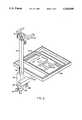
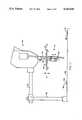
- FIG. 1is an elevation view of a gimbal apparatus embodying the present invention
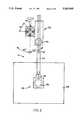
- FIG. 2is a perspective view of the gimbal assembly embodying the invention shown in FIG. 1, taken on lines 2--2 of FIG. 1, looking in the direction of the arrows;
- FIG. 3is a bottom plan view of the gimbal assembly embodying the invention shown in FIGS. 1 and 2, taken on lines 3--3 looking in the direction of the arrows;
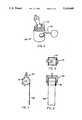
- FIGS. 4is a perspective view of a component of the gimbal assembly embodying the invention, as shown in FIG. 1.
- FIG. 5is a sectional elevation view of a component of the gimbal assembly embodiment of the invention shown in FIGS. 1, 2 and 3;
- FIG. 6is a cross-sectional elevation view of the component of FIG. 5 taken on lines 6--6, looking in the direction of the arrows;
- FIGS. 7, and 8are fragmentary end and side elevation views respectively of another component of the gimbal assembly embodying the invention as shown in FIG. 1;
- FIG. 9is a top plan view of the component of the gimbal assembly of the invention shown in FIG. 8;
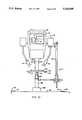
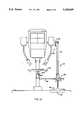
- FIGS. 10 and 11are front and side elevation views, respectively, of another gimbal assembly embodying the invention.
- FIG. 12is a front elevation view of yet another gimbal assembly embodying the invention.
- a multi-axis positional gimbal 10is attached to a support surface 12 and support members 14 and 16 and includes a first arm 18, a junction member or linear bearing assembly 20, a second arm 22, a ball and socket mounting 24, a ball and socket joint 26 and a pallet 28, pivotably mounted on such joint 26, as shown in FIGS. 1, 2 and 3.
- the pallet 28is mounted to pivot on the ball 30 of the ball and socket joint 26 and be locked into a desired position by locking lever 32, as shown or indicated in FIGS. 1 and 4.
- the second arm 22slides axially through channel 40 of bearing or junction member 20, as shown or indicated in FIGS. 2, 5 and 6.
- the second arm 22has a keyway 42, along at least part of its length while the junction member 20 has a threaded aperture 44 therethrough and a locking screw 46 in threaded engagement therewith to contact the keyway 42 and fix the second arm 22 in position in the junction member 20, as shown or indicated in FIGS. 5 and 6.
- the first arm 18is positioned in sliding engagement with channel 50 of junction member 20 and also passes through an aperture in annular member or collar 52 as shown in FIG. 5.
- the first arm 18also has a keyway 54 and the collar 52 has a threaded aperture 56 to receive a screw lock 58 therethrough in threaded engagement therewith, so that it can advance through the threaded aperture 56 into contact with the keyway 54 and fix the position of the collar 52 on said first arm 18, which in turn, provides a rotatable bearing surface 53 for the junction member 20, as shown or indicated in FIGS. 2 and 5.
- second arm 22 and pallet 28can slide back and forth in junction member 20 and be fixed in a desired position by a turn of the locking screw 46 into the keyway 42 of such second arm 22 as indicated in FIGS. 5 and 6.
- the junction member 50 and collar 52(and thus the second arm 22 and pallet 28), can slide up and down axially on first arm 18, with collar 52 being lockable in a desired elevation thereon by a turn of the locking screw 18 into the keyway 54 of such first arm 18 as shown or indicated in FIGS. 1, 2 and 5.
- the collar 52is desirably pivotably attached to the bearing assembly 20 so that the latter may pivot on the former, e.g., through an arc of 110 degrees as indicated in FIG. 3.
- collar 52 and bearing assembly 20ride together up and down on first arm 18, generally with locking screw 58 extending partway into keyway 54 thereof for guidance purposes as collar 52 and bearing assembly 20 are moved therealong.
- the locking screw 58can, at any desired elevation, be advanced into the threaded aperture 56 of the collar 52, to lock collar 52 and bearing assembly 20 in place on the first arm 18, as indicated in FIGS. 2, 3 and 5.
- the locking screw 46extends partway into the keyway 42 of the second arm 22 to guide the first arm 18 as it slides back and forth in the channel 40 of the bearing assembly 20 and when such arm 22 and pallet 28 reach a desired position, the screw 46 can be advanced further into the keyway 42 of the second arm 22, to contact same and lock such arm and pallet in the desired lateral position, as shown or indicated in FIGS. 3, 5 and 6.
- negator (linear) spring 60Providing upward lift to the junction member or bearing assembly 20 is negator (linear) spring 60 as shown in FIGS. 1, 5, 7, 8 and 9.
- the negator spring 60is mounted on rotatable drum 62 (mounted in turn, on bracket assembly 64, pivotably mounted in turn, to the upper support member 14) and the other end of said negator spring 60 is attached to the bearing assembly 20 in a counter-force application, as shown or indicated in FIGS. 1, 2, 5, 7 and 8.
- the negator spring 60also known as a constant-force spring, applies an upward counter-force to the linear bearing 20, second arm 22 and pallet 28 to substantially offset the weight thereof so that an operator may more easily maneuver the assembly in all directions as more fully discussed below.
- gimbal assembly 10is mounted on a dynascope 70 as shown in FIGS. 10 and 11
- the dynascope 70which operates like a large microscope, has a housing 72, a viewing window 74, with cross-hairs 76, a viewing lens assembly 78, a pair of lamps 80 and 82 and offset support posts 84 and 86 with base 88, which mounts on a workbench 92, all as shown in FIGS. 10 and 11.
- the operatorplaces a substrate, such as a printed wiring assembly or PWA 29 on the pallet 28, as shown in FIGS. 2 and 10.
- the operatorthen, with dynascope 70 and lights 80 and 82 turned on, moves the pallet 28 by hand in any desired direction, e.g., laterally, upwardly or downwardly into focus in the window 74 of the dynascope 70 and then tilts such pallet, as desired, to locate a circuit defect, e.g., a soldering break 77 in the window 74, as indicated in FIG. 10.
- the operatorcan turn the locking screws 46 and 58, to make contact in their respective keyways with said second arm 22 and first arm 18 and can pivot the locking lever 32 against the ball 30, to lock the pallet 28 and substrate 29 in the desired attitude and position in the field of view of the dynascope, as shown or indicated in FIGS. 10 and 11.
- the positional gimbal embodying the present inventionis, as indicated above, readily moved into position and secured in place with a high degree of positional accuracy, which is important for locating and/or mapping small components in a PWA substrate (where chips can be as small as 0.05 inches across) and locating and/or mapping even smaller defects in such substrate such as soldering defects or improperly orientated components therein.
- the pallet and substrateare guided by hand, into the field of view of the stereo dynascope 70 and inspected in the dynascope window 74 of FIG. 10.
- the palletis shifted such that the defect is positioned under the intersection of the cross-hairs 76 of the window 74 and the gimbal assembly components locked in place as discussed above.
- IDSInspection Digitizing System
- emitterse.g., emitters 85 and 87 mounted on the dynascope 70, and emitters 101, 103 and 105, by means known in the art, in combination with four spaced microphones (91, 93, 95 and 97) mounted below on the workbench 92, can map the location of the components and/or the defects in such substrate and provide a print-out of the coordinates thereof, e.g., for repair purposes.
- multi-axis positional gimbal 90has a similar structure to the positional gimbal 10 embodying the invention, described above, except that it is supported on the bench 92, from below as shown in FIG. 12. That is the positional gimbal 90 has a first arm 94 and a second arm 96, passing through a bearing assembly 98, the second arm 96 supporting a pallet 100, on a ball and socket joint 102, as previously described with respect to positional gimbal 10 shown, e.g., in FIG. 10. However, first arm 94 is mounted on a base member 95, on the workbench 92, as shown in FIG. 12. Further, as shown, the bearing assembly 98 is counter-supported by negator spring assembly 104, pivotally attached to support stub 106, mounted in turn, to the upper portion of first arm 94, also as shown in FIG. 12.
- the multi-axes positional gimbal embodying the present inventionis able to emulate the flexibility and range of movement achieved by hand-holding a substrate to inspect it, e.g., for defective components under a microscope, including multi-axis movement and tilting of such substrate and when a defect is found, to lock the pallet and substrate into the desired position for further inspection or mapping of the location thereof in the substrate.
- the operator's handsare then free to make notes, operate the IDS mapping system or perform other tasks.
- the positional gimbal embodying the inventionoperates with an accuracy of a few thousandths of an inch which is necessary for inspection of small components or defects thereof such as those of a PWA substrate.
- the positional gimbal of the inventioncan employ a pallet or other holding means to support an article of various sizes thereon and can be used with or without a microscope.
- the positional gimbal embodying the present inventioncan be used without a negator spring, within the scope of the invention but preferably employs such constant-force spring to facilitate the operation thereof.
- a constant-force springis preferred although other types of springs can be employed such as a helical spring or a counterweight on a pulley, in Place of a negator spring on a drum, if desired, within the scope of the invention.
- the keyways and locking screws mounted on the first and second arms of the positional gimbal of the inventioncan be replaced by clamps of various types or dispensed with, if desired, within the scope of the invention. However, such keyways and screw locks are preferred.
- the pallet or other article holdercan be positioned directly on the second arm, e.g., arm 22 of FIGS. 1 and 2 and said arm 22 can be pivoted on its axis, e.g., from side to side, within the scope of the invention.
- the pallet or other article holdercan be positioned directly on the second arm, e.g., arm 22 of FIGS. 1 and 2 and said arm 22 can be pivoted on its axis, e.g., from side to side, within the scope of the invention.
- ball and socket jointare preferred.
- the positional gimbal of the inventioncan be free-standing, e.g., mounted on a bench, or be mounted to another surface or instrument, as indicated above.
- the positional gimbal of the inventionsupports an article for inspection, which support can be moved in all directions as if the hand were holding the article, yet permits the highly accurate locking into position of such article for inspection and mapping of small components or defects while the operator's hands are free to perform other tasks.
- the positional gimbal of the inventioncan be free-standing, e.g., mounted on a bench, or be mounted to another surface or instrument, as indicated above.
- the positional gimbal of the inventionsupports an article for inspection, which support can be moved in all directions as if the hand were holding the article, yet permits the highly accurate locking into position of such article for inspection and mapping of small components or defects while the operator's hands are free to perform other tasks.
Landscapes
- Engineering & Computer Science (AREA)
- General Engineering & Computer Science (AREA)
- Mechanical Engineering (AREA)
- Manufacturing & Machinery (AREA)
- Microelectronics & Electronic Packaging (AREA)
- Details Of Measuring And Other Instruments (AREA)
Abstract
Description
The invention described herein may be manufactured and used by or for the Government for governmental purposes without the payment of any royalty thereon.
This is a divisional application of application Ser. No. 07/502,599,field 30 Mar. 1990, having the same title.
1. Field of the Invention
This invention relates to a gimbal which can move on all three axes, particularly a gimbal having a support surface of an article which can move same into a desired position and accurately sustain said position.
2. The Prior Art
In the production of components, e.g., electrical components, there is often a requirement for locating microscopic defects therein so as to reject or repair such components and improve the quality of the product. For example, it is necessary to inspect electrical substrates, e.g., a printed wiring assembly (PWA) using small components. In the prior art, such substrate is held by hand under a microscope and is turned at various angles that the viewer may see defects, e.g., at the soldered joints thereof. The viewer attempts to memorize the coordinates of the defect, puts the substrate down, e.g., on a work surface and enters the coordinates into a mapping system or attempts to hold the substrate in place under the microscope with one hand, while operating, e.g., an inspection digitizing system (IDS). Of course, under a microscope a slight tremor of the hand can move the substrate and located defect out of focus and/or out of position, causing the recording of erroneous data and inaccurate mapping of such defects. Even if the substrate be held accurately under the microscope, the arm soon tires and becomes less steady. Meanwhile the viewer has but one other arm to operate the above IDS or other equipment or to make notes and, of course, cannot move about without removing the substrate from the viewing field.
What is needed is an apparatus which can position a substrate in the above viewing field with sustained accuracy, so as to free the viewer's hands to perform other tasks, operate other equipment, to make notes thereof and the like.
Looking at the prior art, one sees a clamping means with a ball and socket base for holding a loudspeaker, U.S. Pat. No. 4,765,580 (1988) and a leveling stage of limited movement relative to a reference plane, U.S. Pat. No. 4,226,569 (1980).
Thus, both the above clamping means and leveling stage are able to tilt but otherwise display confined movement near their respective support surfaces
On the other hand, U.S. Pat. No. 4,577,819 (1986) discloses a boom apparatus which has considerably greater range of movement of boom pivoting around a support post in the vertical plane as well as in the horizontal plane However, here the boom cannot accurately sustain its position in the vertical plane and must be locked at three points thereon by spring-loaded plunger 88 (FIG. 4) and thus displays limited or 3 point stability in such plane, which while fine for the intended purpose of mobility of a welding apparatus at the distal end of such boom, would not be satisfactory for freely positioning an article in a microscopic field with sustained accuracy.
Thus the prior art does not suggest an accurate positioning mechanism, e.g., in a microscopic field, and there is a need and market for an accurate inspection apparatus that overcomes the above prior art shortcomings and frees the hands of the viewer for complementary or other tasks.
There has now been discovered an inspection apparatus which has the flexibility and range of movement associated with hands-on feeling of inspection, which provides the necessary positional accuracy for mapping of small components and which frees the hands for other duties.
Broadly, the present invention provides a multi-axis positionable gimbal comprising; a first arm mounted to a support member at one end and a second arm mounted to the first arm at an angle and proximate the other end thereof. An article support is pivotably mounted on the second arm proximate the distal end thereof. Also provided are means for pivoting the second arm transversely on the first arm, as are means for pivoting the article support on the second arm to move the article support into a desired location and angle for observation and mapping thereof.
Desirably, a pallet of the apparatus of the invention is pivotally mounted on a ball and socket joint mounted on the above second arm. Preferably, a lock is mounted on the ball and socket joint, to lock the pallet and its contents, e.g., a substrate, at a desired angle for inspection.
Desirably the arm sections are adjustable in length for greater positionable choice in article inspection.
In another embodiment, a negator spring is provided to assist the positional accuracy of the pallet and adjacent arm section as further discussed below.
The invention will become more apparent from the following detailed specification and drawings in which;
FIG. 1 is an elevation view of a gimbal apparatus embodying the present invention;
FIG. 2 is a perspective view of the gimbal assembly embodying the invention shown in FIG. 1, taken on lines 2--2 of FIG. 1, looking in the direction of the arrows;
FIG. 3 is a bottom plan view of the gimbal assembly embodying the invention shown in FIGS. 1 and 2, taken on lines 3--3 looking in the direction of the arrows;
FIGS. 4 is a perspective view of a component of the gimbal assembly embodying the invention, as shown in FIG. 1.
FIG. 5 is a sectional elevation view of a component of the gimbal assembly embodiment of the invention shown in FIGS. 1, 2 and 3;
FIG. 6 is a cross-sectional elevation view of the component of FIG. 5 taken on lines 6--6, looking in the direction of the arrows;
FIGS. 7, and 8 are fragmentary end and side elevation views respectively of another component of the gimbal assembly embodying the invention as shown in FIG. 1;
FIG. 9 is a top plan view of the component of the gimbal assembly of the invention shown in FIG. 8;
FIGS. 10 and 11 are front and side elevation views, respectively, of another gimbal assembly embodying the invention and
FIG. 12 is a front elevation view of yet another gimbal assembly embodying the invention.
Referring now in more detail to the drawings, a multi-axispositional gimbal 10 is attached to asupport surface 12 and supportmembers first arm 18, a junction member orlinear bearing assembly 20, asecond arm 22, a ball and socket mounting 24, a ball andsocket joint 26 and apallet 28, pivotably mounted onsuch joint 26, as shown in FIGS. 1, 2 and 3. Thepallet 28 is mounted to pivot on theball 30 of the ball andsocket joint 26 and be locked into a desired position bylocking lever 32, as shown or indicated in FIGS. 1 and 4. Thesecond arm 22 slides axially throughchannel 40 of bearing orjunction member 20, as shown or indicated in FIGS. 2, 5 and 6. Thesecond arm 22 has akeyway 42, along at least part of its length while thejunction member 20 has a threaded aperture 44 therethrough and alocking screw 46 in threaded engagement therewith to contact thekeyway 42 and fix thesecond arm 22 in position in thejunction member 20, as shown or indicated in FIGS. 5 and 6.
Thefirst arm 18 is positioned in sliding engagement withchannel 50 ofjunction member 20 and also passes through an aperture in annular member orcollar 52 as shown in FIG. 5. Thefirst arm 18 also has akeyway 54 and thecollar 52 has a threadedaperture 56 to receive ascrew lock 58 therethrough in threaded engagement therewith, so that it can advance through the threadedaperture 56 into contact with thekeyway 54 and fix the position of thecollar 52 on saidfirst arm 18, which in turn, provides a rotatable bearing surface 53 for thejunction member 20, as shown or indicated in FIGS. 2 and 5.
Thussecond arm 22 andpallet 28 can slide back and forth injunction member 20 and be fixed in a desired position by a turn of thelocking screw 46 into thekeyway 42 of suchsecond arm 22 as indicated in FIGS. 5 and 6. Similarly, thejunction member 50 and collar 52 (and thus thesecond arm 22 and pallet 28), can slide up and down axially onfirst arm 18, withcollar 52 being lockable in a desired elevation thereon by a turn of thelocking screw 18 into thekeyway 54 of suchfirst arm 18 as shown or indicated in FIGS. 1, 2 and 5.
Thecollar 52 is desirably pivotably attached to thebearing assembly 20 so that the latter may pivot on the former, e.g., through an arc of 110 degrees as indicated in FIG. 3. Thuscollar 52 and bearingassembly 20, ride together up and down onfirst arm 18, generally withlocking screw 58 extending partway intokeyway 54 thereof for guidance purposes ascollar 52 and bearingassembly 20 are moved therealong. Thelocking screw 58 can, at any desired elevation, be advanced into the threadedaperture 56 of thecollar 52, to lockcollar 52 and bearingassembly 20 in place on thefirst arm 18, as indicated in FIGS. 2, 3 and 5.
Similarly, thelocking screw 46 extends partway into thekeyway 42 of thesecond arm 22 to guide thefirst arm 18 as it slides back and forth in thechannel 40 of thebearing assembly 20 and whensuch arm 22 andpallet 28 reach a desired position, thescrew 46 can be advanced further into thekeyway 42 of thesecond arm 22, to contact same and lock such arm and pallet in the desired lateral position, as shown or indicated in FIGS. 3, 5 and 6.
Providing upward lift to the junction member orbearing assembly 20 is negator (linear)spring 60 as shown in FIGS. 1, 5, 7, 8 and 9. Thenegator spring 60 is mounted on rotatable drum 62 (mounted in turn, onbracket assembly 64, pivotably mounted in turn, to the upper support member 14) and the other end of saidnegator spring 60 is attached to thebearing assembly 20 in a counter-force application, as shown or indicated in FIGS. 1, 2, 5, 7 and 8. Thenegator spring 60, also known as a constant-force spring, applies an upward counter-force to the linear bearing 20,second arm 22 andpallet 28 to substantially offset the weight thereof so that an operator may more easily maneuver the assembly in all directions as more fully discussed below.
In an example of the use of the multi-axis positional gimbal embodying the invention,gimbal assembly 10 is mounted on adynascope 70 as shown in FIGS. 10 and 11 Thedynascope 70, which operates like a large microscope, has ahousing 72, aviewing window 74, withcross-hairs 76, aviewing lens assembly 78, a pair oflamps offset support posts base 88, which mounts on aworkbench 92, all as shown in FIGS. 10 and 11.
The operator places a substrate, such as a printed wiring assembly orPWA 29 on thepallet 28, as shown in FIGS. 2 and 10. The operator then, withdynascope 70 andlights pallet 28 by hand in any desired direction, e.g., laterally, upwardly or downwardly into focus in thewindow 74 of thedynascope 70 and then tilts such pallet, as desired, to locate a circuit defect, e.g., asoldering break 77 in thewindow 74, as indicated in FIG. 10.
Thus with the locking pins 46 and 58 extending partly into theirrespective keyways negator spring 60, which counter-balances or compensates for the weight of the bearingassembly 20,second arm 22,pallet 28 andsubstrate 29,such pallet 28 can be maneuvered with little effort by the hand of the operator in any direction and angle and (with proper choice of negator spring) remain in place, when the operator's hand is removed, e.g., for note-taking or other duties. To insure thatsuch pallet 28 remains in place, the operator can turn the locking screws 46 and 58, to make contact in their respective keyways with saidsecond arm 22 andfirst arm 18 and can pivot the lockinglever 32 against theball 30, to lock thepallet 28 andsubstrate 29 in the desired attitude and position in the field of view of the dynascope, as shown or indicated in FIGS. 10 and 11.
The positional gimbal embodying the present invention is, as indicated above, readily moved into position and secured in place with a high degree of positional accuracy, which is important for locating and/or mapping small components in a PWA substrate (where chips can be as small as 0.05 inches across) and locating and/or mapping even smaller defects in such substrate such as soldering defects or improperly orientated components therein.
Thus the pallet and substrate are guided by hand, into the field of view of thestereo dynascope 70 and inspected in thedynascope window 74 of FIG. 10. When a defect is noticed, the pallet is shifted such that the defect is positioned under the intersection of the cross-hairs 76 of thewindow 74 and the gimbal assembly components locked in place as discussed above. At this point the operator's hands can be freed to make notes or perform other duties including operating a computerized Inspection Digitizing System (IDS) (not shown) which, utilizing emitters, e.g.,emitters dynascope 70, andemitters workbench 92, can map the location of the components and/or the defects in such substrate and provide a print-out of the coordinates thereof, e.g., for repair purposes.
In another embodiment of the invention, multi-axispositional gimbal 90 has a similar structure to thepositional gimbal 10 embodying the invention, described above, except that it is supported on thebench 92, from below as shown in FIG. 12. That is thepositional gimbal 90 has afirst arm 94 and asecond arm 96, passing through a bearingassembly 98, thesecond arm 96 supporting apallet 100, on a ball andsocket joint 102, as previously described with respect topositional gimbal 10 shown, e.g., in FIG. 10. However,first arm 94 is mounted on abase member 95, on theworkbench 92, as shown in FIG. 12. Further, as shown, the bearingassembly 98 is counter-supported bynegator spring assembly 104, pivotally attached to supportstub 106, mounted in turn, to the upper portion offirst arm 94, also as shown in FIG. 12.
Accordingly, the multi-axes positional gimbal embodying the present invention, is able to emulate the flexibility and range of movement achieved by hand-holding a substrate to inspect it, e.g., for defective components under a microscope, including multi-axis movement and tilting of such substrate and when a defect is found, to lock the pallet and substrate into the desired position for further inspection or mapping of the location thereof in the substrate. As previously noted, the operator's hands are then free to make notes, operate the IDS mapping system or perform other tasks.
The positional gimbal embodying the invention operates with an accuracy of a few thousandths of an inch which is necessary for inspection of small components or defects thereof such as those of a PWA substrate.
The positional gimbal of the invention can employ a pallet or other holding means to support an article of various sizes thereon and can be used with or without a microscope. The positional gimbal embodying the present invention can be used without a negator spring, within the scope of the invention but preferably employs such constant-force spring to facilitate the operation thereof. Where a spring is used, a constant-force spring is preferred although other types of springs can be employed such as a helical spring or a counterweight on a pulley, in Place of a negator spring on a drum, if desired, within the scope of the invention.
The keyways and locking screws mounted on the first and second arms of the positional gimbal of the invention can be replaced by clamps of various types or dispensed with, if desired, within the scope of the invention. However, such keyways and screw locks are preferred.
Further, instead of a ball and socket joint, the pallet or other article holder can be positioned directly on the second arm, e.g.,arm 22 of FIGS. 1 and 2 and saidarm 22 can be pivoted on its axis, e.g., from side to side, within the scope of the invention. However, such ball and socket joint are preferred.
Finally, the positional gimbal of the invention can be free-standing, e.g., mounted on a bench, or be mounted to another surface or instrument, as indicated above. As noted above, the positional gimbal of the invention supports an article for inspection, which support can be moved in all directions as if the hand were holding the article, yet permits the highly accurate locking into position of such article for inspection and mapping of small components or defects while the operator's hands are free to perform other tasks.
Finally, the positional gimbal of the invention can be free-standing, e.g., mounted on a bench, or be mounted to another surface or instrument, as indicated above. As noted above, the positional gimbal of the invention supports an article for inspection, which support can be moved in all directions as if the hand were holding the article, yet permits the highly accurate locking into position of such article for inspection and mapping of small components or defects while the operator's hands are free to perform other tasks.
Claims (6)
1. A multi-axis positional gimbal assembly comprising, a junction member having two passageways therein at angles to each other, a first arm sized to insert into one of said passageways and to axially shift therein, a second arm sized to insert into the other of said passageways and to axially shift therein, locking means to releasably secure said arms in said passageways, a pallet pivotally mounted on said second arm at a point remote from said junction member, means to pivot said second arm and junction member about the axis of said first arm to move said pallet on all three axes as desired and means to mount said first arm on a support member at a portion remote from said junction member to thus mount said assembly.
2. The gimbal of claim 1 wherein said support member has a vertical or horizontal surface.
3. The gimbal assembly of claim 2 wherein said support member is a microscope.
4. The gimbal of claim 1 being mounted on said support member for use with a microscope so as to position said pallet int eh viewing field of said microscope.
5. The gimbal of claim 4 wherein a substrate is mounted on said pallet, positioned as desired for viewing and the coordinates of components of said substrate are located and mapped by an inspection digitizing system.
6. The gimbal of claim 5 wherein a substrate is mounted on said pallet, said gimbal assembly having sufficient positional accuracy for the mapping of very small components of said substrate by an inspection digitising system.
Priority Applications (1)
| Application Number | Priority Date | Filing Date | Title |
|---|---|---|---|
| US07/778,430US5163649A (en) | 1990-03-30 | 1991-10-16 | Multi-axis positional gimbal |
Applications Claiming Priority (2)
| Application Number | Priority Date | Filing Date | Title |
|---|---|---|---|
| US07/502,599US5135196A (en) | 1990-03-30 | 1990-03-30 | Multi-axis positional gimbal |
| US07/778,430US5163649A (en) | 1990-03-30 | 1991-10-16 | Multi-axis positional gimbal |
Related Parent Applications (1)
| Application Number | Title | Priority Date | Filing Date |
|---|---|---|---|
| US07/502,599DivisionUS5135196A (en) | 1990-03-30 | 1990-03-30 | Multi-axis positional gimbal |
Publications (1)
| Publication Number | Publication Date |
|---|---|
| US5163649Atrue US5163649A (en) | 1992-11-17 |
Family
ID=27054219
Family Applications (1)
| Application Number | Title | Priority Date | Filing Date |
|---|---|---|---|
| US07/778,430Expired - Fee RelatedUS5163649A (en) | 1990-03-30 | 1991-10-16 | Multi-axis positional gimbal |
Country Status (1)
| Country | Link |
|---|---|
| US (1) | US5163649A (en) |
Cited By (11)
| Publication number | Priority date | Publication date | Assignee | Title |
|---|---|---|---|---|
| US5606262A (en)* | 1995-06-07 | 1997-02-25 | Teradyne, Inc. | Manipulator for automatic test equipment test head |
| US5931048A (en)* | 1995-02-23 | 1999-08-03 | Aesop | Manipulator for automatic test equipment test head |
| US20050063050A1 (en)* | 2003-09-22 | 2005-03-24 | Konstandinos Zamfes | Horizontal Binocular Microscope for vertically gravitated and floating samples. |
| US20090145241A1 (en)* | 2007-12-10 | 2009-06-11 | Cowgill Bruce L | Manipulator constant force spring counterbalance |
| US20110080563A1 (en)* | 2009-10-07 | 2011-04-07 | Greaves Nigel J | Gimbaled handle stabilizing controller assembly |
| US8585205B2 (en) | 2009-10-07 | 2013-11-19 | Nigel J. Greaves | Gimbaled handle stabilizing controller assembly |
| US9534730B2 (en) | 2010-08-26 | 2017-01-03 | Garrett W. Brown | Multi-arm gimbal system |
| US20180100893A1 (en)* | 2016-10-10 | 2018-04-12 | Reid-Ashman Manufacturing, Inc. | Manipulator |
| US10024484B2 (en) | 2014-11-16 | 2018-07-17 | Brown Garrett W | Tensile parallelogram arm |
| EP3785336B1 (en)* | 2018-04-24 | 2023-02-01 | Schleuniger AG | Tool changer, machine tool, and method for changing a tool |
| TWI895138B (en) | 2024-10-14 | 2025-08-21 | 威盛電子股份有限公司 | Electronic device and mounting accessory |
Citations (13)
| Publication number | Priority date | Publication date | Assignee | Title |
|---|---|---|---|---|
| US1562650A (en)* | 1918-02-18 | 1925-11-24 | Meyer William | X-ray apparatus |
| US1754006A (en)* | 1925-08-08 | 1930-04-08 | Burdick Corp | Support |
| US2051508A (en)* | 1933-03-23 | 1936-08-18 | Philips Nv | Support for light sources |
| US2293879A (en)* | 1941-10-31 | 1942-08-25 | Air Reduction | Torch supporting and adjusting apparatus |
| US2837307A (en)* | 1954-01-27 | 1958-06-03 | Franklin X Ray Corp | Supports |
| US3123024A (en)* | 1964-03-03 | Self-leveling devices | ||
| US3627250A (en)* | 1970-04-10 | 1971-12-14 | Ca Atomic Energy Ltd | Overhead isocentric couch for therapy equipment |
| US3722842A (en)* | 1970-02-26 | 1973-03-27 | Stiefelmayer Kg C | Implement for measuring or marking workpieces |
| US4226569A (en)* | 1977-04-20 | 1980-10-07 | Thomson-Csf | Wafer loading and positioning device |
| US4577819A (en)* | 1984-05-14 | 1986-03-25 | Bennett Richard C | Self-balancing boom apparatus |
| US4765580A (en)* | 1987-06-22 | 1988-08-23 | Wright Richard M | Loudspeaker support |
| US4836478A (en)* | 1987-10-15 | 1989-06-06 | Ergotron, Inc. | Suspension system for personal computers and monitors |
| US4973015A (en)* | 1987-09-17 | 1990-11-27 | Schlumberger Technologies, Inc. | Manipulator apparatus for test head support and orientation |
- 1991
- 1991-10-16USUS07/778,430patent/US5163649A/ennot_activeExpired - Fee Related
Patent Citations (13)
| Publication number | Priority date | Publication date | Assignee | Title |
|---|---|---|---|---|
| US3123024A (en)* | 1964-03-03 | Self-leveling devices | ||
| US1562650A (en)* | 1918-02-18 | 1925-11-24 | Meyer William | X-ray apparatus |
| US1754006A (en)* | 1925-08-08 | 1930-04-08 | Burdick Corp | Support |
| US2051508A (en)* | 1933-03-23 | 1936-08-18 | Philips Nv | Support for light sources |
| US2293879A (en)* | 1941-10-31 | 1942-08-25 | Air Reduction | Torch supporting and adjusting apparatus |
| US2837307A (en)* | 1954-01-27 | 1958-06-03 | Franklin X Ray Corp | Supports |
| US3722842A (en)* | 1970-02-26 | 1973-03-27 | Stiefelmayer Kg C | Implement for measuring or marking workpieces |
| US3627250A (en)* | 1970-04-10 | 1971-12-14 | Ca Atomic Energy Ltd | Overhead isocentric couch for therapy equipment |
| US4226569A (en)* | 1977-04-20 | 1980-10-07 | Thomson-Csf | Wafer loading and positioning device |
| US4577819A (en)* | 1984-05-14 | 1986-03-25 | Bennett Richard C | Self-balancing boom apparatus |
| US4765580A (en)* | 1987-06-22 | 1988-08-23 | Wright Richard M | Loudspeaker support |
| US4973015A (en)* | 1987-09-17 | 1990-11-27 | Schlumberger Technologies, Inc. | Manipulator apparatus for test head support and orientation |
| US4836478A (en)* | 1987-10-15 | 1989-06-06 | Ergotron, Inc. | Suspension system for personal computers and monitors |
Cited By (17)
| Publication number | Priority date | Publication date | Assignee | Title |
|---|---|---|---|---|
| US5931048A (en)* | 1995-02-23 | 1999-08-03 | Aesop | Manipulator for automatic test equipment test head |
| US5606262A (en)* | 1995-06-07 | 1997-02-25 | Teradyne, Inc. | Manipulator for automatic test equipment test head |
| US20050063050A1 (en)* | 2003-09-22 | 2005-03-24 | Konstandinos Zamfes | Horizontal Binocular Microscope for vertically gravitated and floating samples. |
| US7533560B2 (en)* | 2003-09-22 | 2009-05-19 | Canadian Logging Systems Corp. | Horizontal binocular microscope for vertically gravitated and floating samples |
| US20090145241A1 (en)* | 2007-12-10 | 2009-06-11 | Cowgill Bruce L | Manipulator constant force spring counterbalance |
| US7685885B2 (en) | 2007-12-10 | 2010-03-30 | Teradyne, Inc. | Manipulator constant force spring counterbalance |
| US8714744B2 (en) | 2009-10-07 | 2014-05-06 | Nigel J. Greaves | Gimbaled handle stabilizing controller assembly |
| US8585205B2 (en) | 2009-10-07 | 2013-11-19 | Nigel J. Greaves | Gimbaled handle stabilizing controller assembly |
| US20110080563A1 (en)* | 2009-10-07 | 2011-04-07 | Greaves Nigel J | Gimbaled handle stabilizing controller assembly |
| US20140185013A1 (en)* | 2009-10-07 | 2014-07-03 | Garrett W. Brown | Gimbaled handle stabilizing controller assembly |
| US8845103B2 (en)* | 2009-10-07 | 2014-09-30 | Garrett W. Brown | Gimbaled handle stabilizing controller assembly |
| US9534730B2 (en) | 2010-08-26 | 2017-01-03 | Garrett W. Brown | Multi-arm gimbal system |
| US10024484B2 (en) | 2014-11-16 | 2018-07-17 | Brown Garrett W | Tensile parallelogram arm |
| US20180100893A1 (en)* | 2016-10-10 | 2018-04-12 | Reid-Ashman Manufacturing, Inc. | Manipulator |
| US10634718B2 (en)* | 2016-10-10 | 2020-04-28 | Reid-Ashman Manufacturing, Inc. | Manipulator for moving a test head |
| EP3785336B1 (en)* | 2018-04-24 | 2023-02-01 | Schleuniger AG | Tool changer, machine tool, and method for changing a tool |
| TWI895138B (en) | 2024-10-14 | 2025-08-21 | 威盛電子股份有限公司 | Electronic device and mounting accessory |
Similar Documents
| Publication | Publication Date | Title |
|---|---|---|
| US5311304A (en) | Apparatus for the positioning of components on a printed circuit board or the like | |
| US5337178A (en) | Titlable optical microscope stage | |
| US5163649A (en) | Multi-axis positional gimbal | |
| US7640672B2 (en) | Laser reference device | |
| USRE35514E (en) | Scanning force microscope having aligning and adjusting means | |
| US6653825B2 (en) | Meter lead holder device | |
| US5135196A (en) | Multi-axis positional gimbal | |
| CN213118181U (en) | FOV angle test equipment | |
| US5253106A (en) | Oblique viewing system for microscopes | |
| US3297291A (en) | Articulate support arm assembly for optical devices | |
| US5986753A (en) | Wafer holding and orienting fixture for optical profilometry | |
| US5726454A (en) | Tripod for polishing a sample and for viewing the sample under a microscope | |
| US20030103277A1 (en) | Imaging device with angle-compensated focus | |
| US4281928A (en) | Optical transit square with focusable crossing telescopes | |
| US5950318A (en) | Laser beam focus and alignment method and apparatus | |
| CN217111417U (en) | Combined collimator standard device | |
| US6053469A (en) | Low-cost 2-axis mirror mount | |
| US5276502A (en) | Subject position adjustment apparatus for use with interferometers | |
| KR0180610B1 (en) | Probe Card Inspector | |
| US20030020927A1 (en) | Precision video gauging machine for vertically oriented workpieces | |
| US20030231316A1 (en) | Multi-directional mirror device and method for optical inspection and autofocus measurement of objects | |
| JPH0627711B2 (en) | Inspection equipment | |
| JPH02190813A (en) | Method and device for adjusting horizontality of sample container | |
| US6765734B1 (en) | Adjustable sample holder for optical equipment | |
| CN218864994U (en) | Visualization test equipment |
Legal Events
| Date | Code | Title | Description |
|---|---|---|---|
| FPAY | Fee payment | Year of fee payment:4 | |
| SULP | Surcharge for late payment | ||
| REMI | Maintenance fee reminder mailed | ||
| LAPS | Lapse for failure to pay maintenance fees | ||
| FP | Expired due to failure to pay maintenance fee | Effective date:20001117 | |
| STCH | Information on status: patent discontinuation | Free format text:PATENT EXPIRED DUE TO NONPAYMENT OF MAINTENANCE FEES UNDER 37 CFR 1.362 |