US5121343A - 3-D stereo computer output printer - Google Patents
3-D stereo computer output printerDownload PDFInfo
- Publication number
- US5121343A US5121343AUS07/554,742US55474290AUS5121343AUS 5121343 AUS5121343 AUS 5121343AUS 55474290 AUS55474290 AUS 55474290AUS 5121343 AUS5121343 AUS 5121343A
- Authority
- US
- United States
- Prior art keywords
- printing
- stereo
- producing
- hard copy
- printing system
- Prior art date
- Legal status (The legal status is an assumption and is not a legal conclusion. Google has not performed a legal analysis and makes no representation as to the accuracy of the status listed.)
- Expired - Lifetime
Links
Images


Classifications
- G—PHYSICS
- G06—COMPUTING OR CALCULATING; COUNTING
- G06K—GRAPHICAL DATA READING; PRESENTATION OF DATA; RECORD CARRIERS; HANDLING RECORD CARRIERS
- G06K15/00—Arrangements for producing a permanent visual presentation of the output data, e.g. computer output printers
- G—PHYSICS
- G02—OPTICS
- G02B—OPTICAL ELEMENTS, SYSTEMS OR APPARATUS
- G02B30/00—Optical systems or apparatus for producing three-dimensional [3D] effects, e.g. stereoscopic images
- G02B30/20—Optical systems or apparatus for producing three-dimensional [3D] effects, e.g. stereoscopic images by providing first and second parallax images to an observer's left and right eyes
- G02B30/22—Optical systems or apparatus for producing three-dimensional [3D] effects, e.g. stereoscopic images by providing first and second parallax images to an observer's left and right eyes of the stereoscopic type
- G02B30/25—Optical systems or apparatus for producing three-dimensional [3D] effects, e.g. stereoscopic images by providing first and second parallax images to an observer's left and right eyes of the stereoscopic type using polarisation techniques
- G—PHYSICS
- G02—OPTICS
- G02B—OPTICAL ELEMENTS, SYSTEMS OR APPARATUS
- G02B5/00—Optical elements other than lenses
- G02B5/30—Polarising elements
- G02B5/3025—Polarisers, i.e. arrangements capable of producing a definite output polarisation state from an unpolarised input state
- G—PHYSICS
- G06—COMPUTING OR CALCULATING; COUNTING
- G06K—GRAPHICAL DATA READING; PRESENTATION OF DATA; RECORD CARRIERS; HANDLING RECORD CARRIERS
- G06K15/00—Arrangements for producing a permanent visual presentation of the output data, e.g. computer output printers
- G06K15/02—Arrangements for producing a permanent visual presentation of the output data, e.g. computer output printers using printers
- G06K15/12—Arrangements for producing a permanent visual presentation of the output data, e.g. computer output printers using printers by photographic printing, e.g. by laser printers
- G06K15/1295—Arrangements for producing a permanent visual presentation of the output data, e.g. computer output printers using printers by photographic printing, e.g. by laser printers using a particular photoreceptive medium
- H—ELECTRICITY
- H04—ELECTRIC COMMUNICATION TECHNIQUE
- H04N—PICTORIAL COMMUNICATION, e.g. TELEVISION
- H04N13/00—Stereoscopic video systems; Multi-view video systems; Details thereof
- H04N13/30—Image reproducers
- H04N13/332—Displays for viewing with the aid of special glasses or head-mounted displays [HMD]
- H04N13/337—Displays for viewing with the aid of special glasses or head-mounted displays [HMD] using polarisation multiplexing
- G—PHYSICS
- G06—COMPUTING OR CALCULATING; COUNTING
- G06K—GRAPHICAL DATA READING; PRESENTATION OF DATA; RECORD CARRIERS; HANDLING RECORD CARRIERS
- G06K2215/00—Arrangements for producing a permanent visual presentation of the output data
- G06K2215/0082—Architecture adapted for a particular function
- H—ELECTRICITY
- H04—ELECTRIC COMMUNICATION TECHNIQUE
- H04N—PICTORIAL COMMUNICATION, e.g. TELEVISION
- H04N13/00—Stereoscopic video systems; Multi-view video systems; Details thereof
- H04N13/10—Processing, recording or transmission of stereoscopic or multi-view image signals
- H—ELECTRICITY
- H04—ELECTRIC COMMUNICATION TECHNIQUE
- H04N—PICTORIAL COMMUNICATION, e.g. TELEVISION
- H04N13/00—Stereoscopic video systems; Multi-view video systems; Details thereof
- H04N13/30—Image reproducers
- H04N13/398—Synchronisation thereof; Control thereof
Definitions
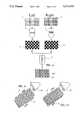
- This inventionrelates to the field of computer hard copy output devices. In particular it deals with printers color and black and white, including laser printers, ink-jet printers, thermal printers and photographic printers. It also relates to the general field of 3-D stereo imaging and recording, and in particular, 3-D stereo computer hardcopy printers.
- the principal object of the present inventionis to provide computer hardcopy graphic printers which print 3-D stereo images. It comprises:
- FIGS. 1b and 1cillustrate the use of micropolarizer sheets for demultiplexing and stereo viewing of the printed image by means of polarized spectacles.
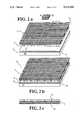
- FIG. 2a-cshow the 3-D stereo print made of laminating a printed micropolarize sheet with a polarization preserving aluminum coated paper.
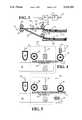
- FIG. 3shows the preferred embodiment of this invention, which is a complete 3-D stereo computer printing system.
- FIGS. 4 and 5show detailed views of the means to align the micropolarizers to the print head.
- FIG. 6shows another embodiment in which the printing is done on the aluminum coated sheet then laminated to the micropolarizer sheet.
- FIG. 7illustrates another alignment means for use with embodiment of FIG. 6.
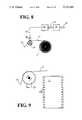
- FIG. 8illustrates a simplified 3-D printer with a self-alignment mechanism based on precision sprocket roller.
- FIG. 9shows a side view of the precision sprocket roller feeding the paper.
- FIG. 12a-eshow five classes of print heads which can be used with the preferred embodiments of FIGS. 3, 6, and 8.
- FIG. 1aillustrates the spatial multiplexing principles.
- the data representing the left and right imagesare stored in a bit map format (other formats may also be used) in left memory array 1 (L-RAM), and right memory array 2 (R-RAM) respectively.
- L-RAMleft memory array 1
- R-RAMright memory array 2
- the left image 1is modulated and stored in the array 5.
- the right imageis spatially modulated using the compliment of MOD 4 to produce the compliment pattern stored in array 6.
- the modulated images 5 and 6are combined (multiplexed) using a spatial multiplexer 7 and the spatially multiplexed image (SMI) is stored in the array 8.
- the SMI 8shows a combined left and right images side by side on a pixel by pixel basis and therefore caries of the stereo information.
- the flow diagram of FIG. 1ais an algorithm to produce the SMI which can be implemented either in hardware as described below in connection with FIGS. 7 and 8, or it can be implemented in software. In FIG.
- the SMI 8is combined with a spatial demultiplexer 9, a micropolarizer, ⁇ Pol sheet described in Application Ser. No. 536,190, and Ser. No. 536,419 and a polarization decoder 10, a pair of spectacles with polarization states P1 and P2.
- the SMI and the ⁇ Pol arrays which have the same periodare aligned such that the left pixels in the SMI illuminate the P2 cells in the ⁇ Pol array and the right pixels illuminate the P1 cells.
- the left pixelsbecome P2 polarized and the right pixels become P1 polarized.
- FIG. 1cshows that the SMI 8 may also be placed top of the ⁇ Pol. Choosing between the configurations of FIG. 1b and FIG. 1c depends on how the SMI is illuminated, and whether the transmissive mode or reflective mode of display is used; see Ser. No. 536,190.
- FIGS. 2a and 2bshow how the final desired hardcopy stereo output is obtained. It comprises two sheets 11 and 12 laminated together to produce the output print 16.
- the first sheet 11is a ⁇ Pol 9 on which the SMI 8 is printed after proper alignment is ensured.
- the second sheet 12consists of regular paper 13, coated with aluminum or silver flakes 14 and a clear adhesive layer 15.
- the aluminum or silver layeris needed to preserve the polarization and maximize the brightness. If paper only was used in 13, the polarized light striking its surface becomes depolarized and as it emerges from the ⁇ Pol layer its brightness is reduced by at least 50%.
- FIG. 2cshows another simpler embodiment which eliminates the sheet 12 but achieves the same result by directly coating the back of the ⁇ Pol 9 with a silver or aluminum film 14.
- polarizer polymersThere are two classes of polarizer polymers; the absorptive class such as polyvinyl alcohol, PVA, and the reflective class such as cholesteric liquid crystal silicone, CLCS (see Robert Maurer et al, Society of Information Display SID 90 Digest, p. 110, 1990, and Martin Schadt, and Jurg Funischilling, SID 90 Digest, p. 324, 1990).
- the absorptive classconverts unpolarized light to linearly polarized light of state P1 by absorbing the orthogonal state P2. This absorbed light energy is converted to heat and is lost for ever.
- the polyvinyl alcohol, PVAused to construct the ⁇ Pols in Ser. No. 536,190, and Ser. No.
- 536,419belongs to the absorptive class. Hard copies based on the absorptive class, in general, lose at least 50% of the illuminating light.
- the reflective classseparate the incident unpolarized light into two circularly polarized states P1 and P2, one state P1 is transmitted and the other state P2 is reflected. In this case no light energy is lost to heat and therefore it is possible to convert 100% of the incident light into polarized light with the desired state of polarization. This is done by coating a sheet of CLCS with a reflective metallic film on one side, and illuminating it on the other side with unpolarized light. 50% of this light is reflected as P1, and the other 50% is transmitted as P2. This P2.
- This P2 lightis then reflected by the metallic layer and converted into P1 (it is well known in the field of optics that a circularly polarized light of one state is converted to the orthogonal state as a result of reflection), thus all the incident light converted to polarized light of state P1.
- This reflective class of polarizers when used to fabricate ⁇ Polsprovides at least a factor of 2 brighter3-D stereo prints than the absorptive class.
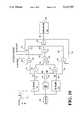
- FIG. 3is the printing system which is capable of producing a 3-D stereo hard copy output 16(this laminated output is described in FIG. 2). It has 6 new elements which were not needed in conventional 2-D printers; These are: The SMI Generator 25; The ⁇ Pol Sheets 11, The Silver Coated Paper 12, The Alignment Means 29; The X-Y-theta Motion Controller 27; and The Laminating Rollers 23, 24. The other elements are found in conventional 2-D printers.
- the systemworks as follows. The left and right images from the host computer are transferred to the SMI Generator 25 well known serial or parallel means through the interface bus 30. The SMI 8 produced according to the algorithm described in FIG. 1a is then transferred through bus 31 to the Printer Engine Electronics 26.
- a ⁇ Pol sheet 11is fed from tray 17 by means of a rubber surface cylindrical roller 19 which presses on the sheet while rotating to move the paper to the left. Alignment means 29 ensures that the sheet is properly aligned relative to the print head. The feed back signal 33 is produced by the alignment element 29 when the sheet is out of alignment with respect to the print head.
- the ⁇ Pol sheet 11is transported to the print head 28 which is controlled by the Printer Electronics 26 through control lines 34 and the SMI is printed.
- a silver coated sheet 12is also fed from tray 18 by means of roller 20. Both sheets are transported through their designated paths by a variety of known means 21,22 and these are appropriately synchronized to arrive simultaneously at the laminating rollers 23,24, to be laminated together and to produce the complete output print 16.
- the detailed of the alignment element 29is shown in FIG. 4. It consists of the following components:
- a light detector 36which detects the LED light transmitted through both ⁇ Pols 37 and 11
- a motion controller 29which causes the roller 19 to have X, Y, and angular motion in response to signals from the Printer Electronics 26 through lines 32, and
- An auxiliary rollerwhich is lowered to hold the ⁇ Pol sheet 11 in position when complete alignment is achieved. It then transports it for printing while always maintaining alignment.
- the alignmentcan be based either on maximizing the detected light or minimizing it. Maximum light is detected when P1 state of 37 is covered completely by P1 of 11, and P2 of 37 is covered by P2 of 11. Minimum light is detected when P1 is covered completely by P2. If one chooses to minimize the detected light for perfect alignment, x, and y error signals are fed back to the printer electronics to cause motion of the roller 19 in the X, Y and theta directions until the error signals vanish. When this happens, roller 38 takes over to hold down ⁇ Pol 11 and feeds it to the left for printing.
- FIG. 5shown another alignment embodiment. It is identical to the arrangement of FIG. 4 described above, except that instead of controlling the motion of the roller 19, the platform 22 is controlled.
- a simplified self-aligned 3-D stereo printeris produced. It eliminates the alignment device 29, the laminating rollers 23,24, the tray 18. Instead, it uses a roll of stock ⁇ Pol 11 coated from one side with a reflective film, and on the other side the SMI is printed to produce the final print 16 (see FIG. 2c).
- the self-alignment of the ⁇ Pol relative to the print headis achieved by means of a precision sprocket roller 19 which feeds, transports and aligns the stock 11.
- the stock 11has rectangular holes 19b for the sprocket teeth 19a. The holes are precisely located relative to ⁇ Pol array, and relative to the sprocket teeth. Printing starts at the origin which is a fixed point on the precision sprocket roller 19. This guarantees that SMI is aligned to the ⁇ Pol.
- the SMI Generator general algorithm shown in FIG. 1ais implemented by means of two embodiments shown in FIGS. 10 and 11.
- the spatial modulation and spatial multiplexingare accomplished by means of a flip-flop 45, AND gates 50, 51, 57,58, 59, and OR gates 54, 65.
- the left and right image dataare loaded into L-RAM 43 and R-RAM 44 respectively.
- the SMI generationstarts by reading simultaneously the L-RAM and R-RAM on a row by row basis starting with the first row. The operation is synchronized with the clock 42.
- the complementary outputs 46, 49 of the flip-flop 45 and the memory outputs 47, 48drive respectively the AND gates 50 and 51 to produce the modulated outputs 52 and 53.
- each input and out put of the logic gateshas N bits for each pixel.
- the modulation wave-forms 46, 49are shown in the inset along with the clock pulses.
- the gates 57, 58, 59add flexibility to the printer by giving the user a choice to select to print in stereo by making input 62 high, while inputs 60, and 61 low; or print left image only by making input 60 high while 56 and 61 low; or print right image only by putting 61 high, while keeping 60 and 56 low.
- the result of the selection 66is stored in the SMI-RAM 67 whose output 68 is sent to the Printer Engine Electronics 25.
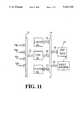
- FIG. 11is another SMI Generator embodiment which uses a microprocessor 69 to control the printer and co-ordinate printing for many users through interface buses 70 a-d which are connected to bus 71.
- the CPU 69receives the image data through 72 and transfers it via buses 73, 75, 76 and 77 to L-RAM 43 and R-RAM 44.
- the microprocessorsubsequently, produces the SMI and stores it in SMI-RAM.
- the microprocessoris programmed to do this following the algorithm outlined in FIG. 1a. Then it transfers the SMI to the Print Engine 74 to complete printing.
- the construction of the print head 28can be based on one of five printing classes illustrated in FIG. 12.
- the ink ribbon class FIG. 12ais the most common.
- the inkis transferred from the ribbon 81 to the paper 11 by means of a print mechanism 80.
- Thismay be print hammers, print wire matrix, or thermal head which locally melts the ink and transfers it to the paper.
- the ink-jet class FIG. 12btransfers drops of ink through nozzles 82 to the paper 11.
- An ink reservoir 83 for each coloris connected to the nozzles through 84.
- FIG. 12cis an electrostatic print head which transfers charge from the charger 85 directly to the paper. The amount of charge represents the image gray scale. Using a developer 93, this charge covered paper is then developed by attracting toner or ink.
- the photographic class FIG. 12dis used for high resolution color printers.
- the paper 11is covered with a photosensitive film which is then exposed through a lens 87 by means of an image generator such as a CRT or a light valve.
- the exposed paperis then developed by an appropriate developer 93.
- FIG. 12ethe class, also known as xerographic, is shown in FIG. 12e.
- a cylindrical drum 90 covered with photoconductive materialis charged with a charger 91.
- a laser or light valveprojects the image onto the charged surface through lens 89.
- the charges on the illuminated surfaceis conducted away, while the charge on the unilluminated surface remains.
- This latent charge imageis developed by the toner 92.
- the tonerconsists of particles that are attracted by the charge and stick to the surface of the drum.
- the toner imageis then transferred from the drum to the paper 11 and fused into it.
Landscapes
- Physics & Mathematics (AREA)
- Engineering & Computer Science (AREA)
- General Physics & Mathematics (AREA)
- Optics & Photonics (AREA)
- General Engineering & Computer Science (AREA)
- Theoretical Computer Science (AREA)
- Multimedia (AREA)
- Signal Processing (AREA)
- Printers Or Recording Devices Using Electromagnetic And Radiation Means (AREA)
Abstract
Description
1. Field of the Invention
This invention relates to the field of computer hard copy output devices. In particular it deals with printers color and black and white, including laser printers, ink-jet printers, thermal printers and photographic printers. It also relates to the general field of 3-D stereo imaging and recording, and in particular, 3-D stereo computer hardcopy printers.
2. Description of Related Art
All living creatures are endowed with a pair of eyes for 3-D stereoscopic vision. They have depended on this vision for their survival. Yet, in spite of the tremendous advances in information technology, there is no prior art teaching how to obtain hardcopy outputs from computers in the form of 3-D stereo prints.
The principal object of the present invention is to provide computer hardcopy graphic printers which print 3-D stereo images. It comprises:
Means for electronically multiplexing spatially, the left and right images, printing them, and demultiplexing them with micropolarizers for viewing.
Means for aligning the micropolarizers to the spatially multiplexed image printer head and
means for laminating the printed multiplexed image, the micropolarizer sheets and special polarizing preserving sheets which are coated with silver or aluminum flakes.
FIG. 1a illustrates the principles behind the stereo printer, spatial modulation and spatial multiplexing of the left and right images.
FIGS. 1b and 1c illustrate the use of micropolarizer sheets for demultiplexing and stereo viewing of the printed image by means of polarized spectacles.
FIG. 2a-c show the 3-D stereo print made of laminating a printed micropolarize sheet with a polarization preserving aluminum coated paper.
FIG. 3 shows the preferred embodiment of this invention, which is a complete 3-D stereo computer printing system.
FIGS. 4 and 5 show detailed views of the means to align the micropolarizers to the print head.
FIG. 6 shows another embodiment in which the printing is done on the aluminum coated sheet then laminated to the micropolarizer sheet.
FIG. 7 illustrates another alignment means for use with embodiment of FIG. 6.
FIG. 8 illustrates a simplified 3-D printer with a self-alignment mechanism based on precision sprocket roller.
FIG. 9 shows a side view of the precision sprocket roller feeding the paper.
FIG. 10 and 11 illustrate electronic means for combining the left and right images.
FIG. 12a-e show five classes of print heads which can be used with the preferred embodiments of FIGS. 3, 6, and 8.
The invention is based on two fundamentally new concepts combined for the first time to record and display 3-D images. They are: Spatial Multiplexing of left and right images and Micro-Polarizers. These are described in my co-pending applications: "A System For Producing 3-D Stereo Images", Ser. Nos. 536,190, filed Jun. 11, 1990 and "Methods For Manufacturing Micropolarizers", Ser. No. 536,419, filed Jun. 11, 1990. FIG. 1a illustrates the spatial multiplexing principles. The data representing the left and right images are stored in a bit map format (other formats may also be used) in left memory array 1 (L-RAM), and right memory array 2 (R-RAM) respectively. Each pixel in the array has N-bits for color and gray-scale. Using a spatialcheckerboard modulator MOD 3, theleft image 1 is modulated and stored in thearray 5. The right image is spatially modulated using the compliment ofMOD 4 to produce the compliment pattern stored in array 6. The modulatedimages 5 and 6 are combined (multiplexed) using aspatial multiplexer 7 and the spatially multiplexed image (SMI) is stored in thearray 8. The SMI 8 shows a combined left and right images side by side on a pixel by pixel basis and therefore caries of the stereo information. The flow diagram of FIG. 1a is an algorithm to produce the SMI which can be implemented either in hardware as described below in connection with FIGS. 7 and 8, or it can be implemented in software. In FIG. 1b theSMI 8 is combined with aspatial demultiplexer 9, a micropolarizer, μPol sheet described in Application Ser. No. 536,190, and Ser. No. 536,419 and apolarization decoder 10, a pair of spectacles with polarization states P1 and P2. The SMI and the μPol arrays which have the same period are aligned such that the left pixels in the SMI illuminate the P2 cells in the μPol array and the right pixels illuminate the P1 cells. Thus, the left pixels become P2 polarized and the right pixels become P1 polarized. Because of the discriminating ability of the polarized eye glasses, the left eye which has a P2 polarizer can seen only the P2-polarized left pixels, and the right eye which has a P1 polarizer can see only the P1-polarized right pixels. To achieve the 3-D stereo sensation the human brain fuses the left and right images in the same manner it deals with natural 3-D scenes. FIG. 1c shows that theSMI 8 may also be placed top of the μPol. Choosing between the configurations of FIG. 1b and FIG. 1c depends on how the SMI is illuminated, and whether the transmissive mode or reflective mode of display is used; see Ser. No. 536,190.
To build a hardcopy printer to output images from computers in stereo the above concept is used in conjunction with the principles taught in the embodiments described here. FIGS. 2a and 2b show how the final desired hardcopy stereo output is obtained. It comprises twosheets output print 16. Thefirst sheet 11 is aμPol 9 on which theSMI 8 is printed after proper alignment is ensured. Thesecond sheet 12 consists ofregular paper 13, coated with aluminum orsilver flakes 14 and aclear adhesive layer 15. The aluminum or silver layer is needed to preserve the polarization and maximize the brightness. If paper only was used in 13, the polarized light striking its surface becomes depolarized and as it emerges from the μPol layer its brightness is reduced by at least 50%. FIG. 2c shows another simpler embodiment which eliminates thesheet 12 but achieves the same result by directly coating the back of theμPol 9 with a silver oraluminum film 14.
There are two classes of polarizer polymers; the absorptive class such as polyvinyl alcohol, PVA, and the reflective class such as cholesteric liquid crystal silicone, CLCS (see Robert Maurer et al, Society ofInformation Display SID 90 Digest, p. 110, 1990, and Martin Schadt, and Jurg Funischilling,SID 90 Digest, p. 324, 1990). The absorptive class converts unpolarized light to linearly polarized light of state P1 by absorbing the orthogonal state P2. This absorbed light energy is converted to heat and is lost for ever. The polyvinyl alcohol, PVA, used to construct the μPols in Ser. No. 536,190, and Ser. No. 536,419 belongs to the absorptive class. Hard copies based on the absorptive class, in general, lose at least 50% of the illuminating light. The reflective class separate the incident unpolarized light into two circularly polarized states P1 and P2, one state P1 is transmitted and the other state P2 is reflected. In this case no light energy is lost to heat and therefore it is possible to convert 100% of the incident light into polarized light with the desired state of polarization. This is done by coating a sheet of CLCS with a reflective metallic film on one side, and illuminating it on the other side with unpolarized light. 50% of this light is reflected as P1, and the other 50% is transmitted as P2. This P2. This P2 light is then reflected by the metallic layer and converted into P1 (it is well known in the field of optics that a circularly polarized light of one state is converted to the orthogonal state as a result of reflection), thus all the incident light converted to polarized light of state P1. This reflective class of polarizers when used to fabricate μPols, provides at least a factor of 2 brighter3-D stereo prints than the absorptive class.
FIG. 3 is the printing system which is capable of producing a 3-D stereo hard copy output 16(this laminated output is described in FIG. 2). It has 6 new elements which were not needed in conventional 2-D printers; These are: TheSMI Generator 25; TheμPol Sheets 11, The Silver CoatedPaper 12, The Alignment Means 29; The X-Y-theta Motion Controller 27; and TheLaminating Rollers SMI Generator 25 well known serial or parallel means through theinterface bus 30. TheSMI 8 produced according to the algorithm described in FIG. 1a is then transferred throughbus 31 to thePrinter Engine Electronics 26. This controls the electromechanical components, the paper handling, the print formatting, print head drivers, user interface, and other chores. When printing starts, aμPol sheet 11 is fed fromtray 17 by means of a rubber surfacecylindrical roller 19 which presses on the sheet while rotating to move the paper to the left. Alignment means 29 ensures that the sheet is properly aligned relative to the print head. The feed back signal 33 is produced by thealignment element 29 when the sheet is out of alignment with respect to the print head. When alignment is completed, theμPol sheet 11 is transported to theprint head 28 which is controlled by thePrinter Electronics 26 throughcontrol lines 34 and the SMI is printed. At the same time, a silver coatedsheet 12 is also fed fromtray 18 by means ofroller 20. Both sheets are transported through their designated paths by a variety of known means 21,22 and these are appropriately synchronized to arrive simultaneously at thelaminating rollers complete output print 16.
The detailed of thealignment element 29 is shown in FIG. 4. It consists of the following components:
Asmall μPol array 37 having the same period as thestock μPol sheet 11. It is fixed to aplatform 22. Its position is fixed relative to the print head. This serves as an absolute reference point, or the origin, x=0 and y=0 so that the 0,0 pixel of the SMI is always printed by theprint head 28 at the same origin.
AnLED 35 which illuminates both μPols 37 and 11.
Alight detector 36 which detects the LED light transmitted through bothμPols
Amotion controller 29 which causes theroller 19 to have X, Y, and angular motion in response to signals from thePrinter Electronics 26 throughlines 32, and
An auxiliary roller which is lowered to hold theμPol sheet 11 in position when complete alignment is achieved. It then transports it for printing while always maintaining alignment.
The alignment can be based either on maximizing the detected light or minimizing it. Maximum light is detected when P1 state of 37 is covered completely by P1 of 11, and P2 of 37 is covered by P2 of 11. Minimum light is detected when P1 is covered completely by P2. If one chooses to minimize the detected light for perfect alignment, x, and y error signals are fed back to the printer electronics to cause motion of theroller 19 in the X, Y and theta directions until the error signals vanish. When this happens,roller 38 takes over to hold down μPol 11 and feeds it to the left for printing. FIG. 5 shown another alignment embodiment. It is identical to the arrangement of FIG. 4 described above, except that instead of controlling the motion of theroller 19, theplatform 22 is controlled.
Instead of printing directly on theμPol 1, it is possible to print the SMI into the silver coatedsheets 12. This requires slight modification of the system described in FIG. 3 to that described in FIG. 6. The latter system has differentpaper handling parts different device 29 shown in FIG. 7. It uses the reflective mode. A black an white checkerboard alignment pattern is printed on thesheet 12, such that the white squares are covered by P1 state of theμPol 11. The LED light is polarized with a state P2 so that when perfect alignment is achieved, the reflected light detected by thedetector 36 is zero. The transmittederror signal 33 causes asignal 32 to control the X, Y and angular motion of theplatform 22 holdingμPol 11 until alignment is achieved. The final step is laminating 11 and 12 together by thelaminating rollers
In another embodiment described in FIG. 8, a simplified self-aligned 3-D stereo printer is produced. It eliminates thealignment device 29, thelaminating rollers tray 18. Instead, it uses a roll ofstock μPol 11 coated from one side with a reflective film, and on the other side the SMI is printed to produce the final print 16 (see FIG. 2c). The self-alignment of the μPol relative to the print head is achieved by means of aprecision sprocket roller 19 which feeds, transports and aligns thestock 11. As FIG. 9 shows, thestock 11 hasrectangular holes 19b for thesprocket teeth 19a. The holes are precisely located relative to μPol array, and relative to the sprocket teeth. Printing starts at the origin which is a fixed point on theprecision sprocket roller 19. This guarantees that SMI is aligned to the μPol.
The SMI Generator general algorithm shown in FIG. 1a is implemented by means of two embodiments shown in FIGS. 10 and 11. In FIG. 10, the spatial modulation and spatial multiplexing are accomplished by means of a flip-flop 45, ANDgates gates RAM 43 and R-RAM 44 respectively. The SMI generation starts by reading simultaneously the L-RAM and R-RAM on a row by row basis starting with the first row. The operation is synchronized with theclock 42. Thecomplementary outputs gates outputs OR gate 54 to produce the spatially multiplexedoutput 55. Note that each input and out put of the logic gates has N bits for each pixel. The modulation wave-forms gates input 62 high, whileinputs input 60 high while 56 and 61 low; or print right image only by putting 61 high, while keeping 60 and 56 low. The result of theselection 66 is stored in the SMI-RAM 67 whose output 68 is sent to thePrinter Engine Electronics 25.
FIG. 11 is another SMI Generator embodiment which uses amicroprocessor 69 to control the printer and co-ordinate printing for many users through interface buses 70 a-d which are connected tobus 71. TheCPU 69 receives the image data through 72 and transfers it viabuses RAM 43 and R-RAM 44. The microprocessor, subsequently, produces the SMI and stores it in SMI-RAM. The microprocessor is programmed to do this following the algorithm outlined in FIG. 1a. Then it transfers the SMI to thePrint Engine 74 to complete printing.
The construction of theprint head 28 can be based on one of five printing classes illustrated in FIG. 12. The ink ribbon class FIG. 12a is the most common. The ink is transferred from theribbon 81 to thepaper 11 by means of aprint mechanism 80. This may be print hammers, print wire matrix, or thermal head which locally melts the ink and transfers it to the paper. The ink-jet class FIG. 12b transfers drops of ink throughnozzles 82 to thepaper 11. Anink reservoir 83 for each color is connected to the nozzles through 84. FIG. 12c is an electrostatic print head which transfers charge from thecharger 85 directly to the paper. The amount of charge represents the image gray scale. Using adeveloper 93, this charge covered paper is then developed by attracting toner or ink.
For high resolution color printers, the photographic class FIG. 12d is used. Thepaper 11 is covered with a photosensitive film which is then exposed through a lens 87 by means of an image generator such as a CRT or a light valve. The exposed paper is then developed by anappropriate developer 93. Finally, the class, also known as xerographic, is shown in FIG. 12e. Acylindrical drum 90 covered with photoconductive material is charged with a charger 91. A laser or light valve projects the image onto the charged surface throughlens 89. The charges on the illuminated surface is conducted away, while the charge on the unilluminated surface remains. This latent charge image is developed by thetoner 92. The toner consists of particles that are attracted by the charge and stick to the surface of the drum. The toner image is then transferred from the drum to thepaper 11 and fused into it.
Claims (16)
1. A printing system for producing 3-D stereo hard copy computer outputs of graphic images in response to applying the left and right perspectives of an imaged object to its input, comprising:
a. a spatial multiplexing means for combining the left and right perspectives into a single spatially multiplexed image, SMI;
b. printing medium comprising at least one component;
c. means for printing the SMI on said printing medium;
d. image aligning means;
e. handling means for feeding, transporting, and combining components of printing medium and
f. means for decoding and viewing 3-D stereo images.
2. A printing system for producing 3-D stereo hard copy computer outputs of graphic images according to claim 1, wherein the means for spatial multiplexing is based on the following algorithm: Two complementary spatial modulators modulate the left and right perspectives with a spatial code pattern and its complement respectively. These modulated perspectives are then combined into one spatially multiplexed image. Said algorithm is implemented by software, hardware, or optical means.
3. A printing system for producing 3-D stero hard copy computer outputs of graphic images according to claim 1, wherein the printing medium comprises a micro-polarizer array, μPol, sheet component, and a polarization preserving reflective component. The two components are laminated together at the end of the printing process.
4. A printing system for producing 3-D stereo hard copy computer outputs of graphic images according to claim 3, wherein the μPol sheet is based on the absorptive polarizing class that is made of polyvinyl alcohol, PVA.
5. A printing system for producing 3-D stereo hard copy computer outputs of graphic images according to claim 3, wherein the μPol sheet is based on the reflective polarizing class that is made of cholesteric liquid crystal silicone, CLCS, polymer.
6. A printing system for producing 3-D stereo hard copy computer outputs of graphic images according to claim 1, wherein the printing means prints the SMI directly on the μPol component of the printing medium.
7. A printing system for producing 3-D stereo hard copy computer outputs of graphic images according to claim 1, wherein the printing means prints the SMI directly on the reflective component of the printing medium.
8. A printing system for producing 3-D stereo hard copy computer outputs of graphic images according to claim 1, wherein image aligning means ensures that the printed pixels of the left perspective overlap one polarization state of the μPol, while the right pixels overlap the other orthogonal polarization state of the μPol.
9. A computer printing system for producing 3-D stereo hardcopy prints according to claim 1, wherein the image aligning means comprises:
means for detecting misalignment and generating error signals;
means for controlling the motion of the print medium; and
feedback means for adjusting the position of the print medium.
10. A printing system for producing 3-D stereo hard copy computer outputs of graphic images according to claim 9, wherein the means for detecting misalignment comprises, a small micropolarizer array, a light generator, light detector, and the light emanating from the print medium.
11. A printing system for producing 3-D stereo hard copy computer outputs of graphic images according to claim 1, wherein the image aligning means comprises a precision sprocket roller and sprocket perforations precisely located on the print medium relative to the printing means.
12. A printing system for producing 3-D stereo hard copy computer outputs of graphic images according to claim 1, wherein the means for printing the SMI includes, photographic, electro-photographic, electrostatic, ink jet, and ink ribbon/impact head combination.
13. A printing system for producing 3-D stereo hard copy computer outputs of graphic images according to claim 1, wherein the printing medium is a micropolarizer array, μPol, coated from one side with a photographic emulsion to be used with a high resolution photographic printing means.
14. A printing system for producing 3-D stereo hard copy computer outputs of graphic images according to claim 1, wherein the means for decoding and viewing the 3-D stereo image comprises the μPol of the printing medium and a pair of polarized eye glasses.
15. A printing system for producing 3-D stereo hard copy computer outputs of graphic images according to claim 2, wherein the means for implementing the spatial multiplexing algorithm is an electronic circuit which enables the system to print the left mode only, right mode only, or the 3-D stereo mode. Said circuit comprises a clock generator, a RAM for each perspective, flip-flop, logic gates, RAM for the SMI, and logic means for selecting the left-mode, right-mode, or stereo mode.
16. A computer printing system for producing 3-D stereo hardcopy prints according to claim 2, wherein the means for combining image perspectives comprises multiple user interface buses, RAM for each perspective, a microprocessor, buses, SMI RAM, and a program to generate the modulation and multiplexing functions.
Priority Applications (1)
| Application Number | Priority Date | Filing Date | Title |
|---|---|---|---|
| US07/554,742US5121343A (en) | 1990-07-19 | 1990-07-19 | 3-D stereo computer output printer |
Applications Claiming Priority (1)
| Application Number | Priority Date | Filing Date | Title |
|---|---|---|---|
| US07/554,742US5121343A (en) | 1990-07-19 | 1990-07-19 | 3-D stereo computer output printer |
Publications (1)
| Publication Number | Publication Date |
|---|---|
| US5121343Atrue US5121343A (en) | 1992-06-09 |
Family
ID=24214539
Family Applications (1)
| Application Number | Title | Priority Date | Filing Date |
|---|---|---|---|
| US07/554,742Expired - LifetimeUS5121343A (en) | 1990-07-19 | 1990-07-19 | 3-D stereo computer output printer |
Country Status (1)
| Country | Link |
|---|---|
| US (1) | US5121343A (en) |
Cited By (74)
| Publication number | Priority date | Publication date | Assignee | Title |
|---|---|---|---|---|
| US5330799A (en)* | 1992-09-15 | 1994-07-19 | The Phscologram Venture, Inc. | Press polymerization of lenticular images |
| US5400069A (en)* | 1993-06-16 | 1995-03-21 | Bell Communications Research, Inc. | Eye contact video-conferencing system and screen |
| USRE35029E (en)* | 1989-01-13 | 1995-08-29 | The Phscologram Venture, Inc. | Computer-generated autostereography method and apparatus |
| US5457554A (en)* | 1993-04-26 | 1995-10-10 | Faris; Sadeg M. | 3-D printing technology based on selective reflecting polarizing media |
| US5519794A (en)* | 1994-04-01 | 1996-05-21 | Rotaventure L.L.C. | Computer-generated autostereography method and apparatus |
| US5543965A (en)* | 1994-05-11 | 1996-08-06 | Nvision Grafix, Inc. | Method and apparatus for autostereoscopic lenticular displays utilizing random dot patterns |
| US5546513A (en)* | 1993-09-20 | 1996-08-13 | Eastman Kodak Company | Data transmission system for sparse array print head |
| WO1996039301A1 (en)* | 1995-06-06 | 1996-12-12 | Cycolor, Inc. | A printer for a drive bay |
| US5757388A (en)* | 1996-12-16 | 1998-05-26 | Eastman Kodak Company | Electronic camera and integral ink jet printer |
| US5764248A (en)* | 1995-01-31 | 1998-06-09 | Rowland Institute For Science | Production of digitized stereoscopic polarizing images by ink jet printing |
| US5764871A (en)* | 1993-10-21 | 1998-06-09 | Eastman Kodak Company | Method and apparatus for constructing intermediate images for a depth image from stereo images using velocity vector fields |
| US5784171A (en)* | 1992-06-24 | 1998-07-21 | Sony Corporation | Printing method, printing device, printing head, container vessel for containing printing object and printing method for cassettes |
| US5808797A (en) | 1992-04-28 | 1998-09-15 | Silicon Light Machines | Method and apparatus for modulating a light beam |
| US5841579A (en) | 1995-06-07 | 1998-11-24 | Silicon Light Machines | Flat diffraction grating light valve |
| US5973710A (en)* | 1995-04-13 | 1999-10-26 | Supercom, Ltd. | Method and apparatus for printing on passports and the like |
| US5982553A (en) | 1997-03-20 | 1999-11-09 | Silicon Light Machines | Display device incorporating one-dimensional grating light-valve array |
| US6088102A (en) | 1997-10-31 | 2000-07-11 | Silicon Light Machines | Display apparatus including grating light-valve array and interferometric optical system |
| US6101036A (en) | 1998-06-23 | 2000-08-08 | Silicon Light Machines | Embossed diffraction grating alone and in combination with changeable image display |
| US6108022A (en)* | 1995-04-13 | 2000-08-22 | Supercom Ltd. | Method for producing identification documents and documents produced by it |
| US6106088A (en)* | 1997-10-01 | 2000-08-22 | Xerox Corporation | Printhead assembly with integral lifetime monitoring system |
| US6130770A (en) | 1998-06-23 | 2000-10-10 | Silicon Light Machines | Electron gun activated grating light valve |
| US6172697B1 (en)* | 1996-05-15 | 2001-01-09 | Samsung Electronics Co., Ltd. | Method and apparatus for detecting the level of toner using a photosensor |
| US6193349B1 (en)* | 1997-06-18 | 2001-02-27 | Lexmark International, Inc. | Ink jet print cartridge having active cooling cell |
| US6215579B1 (en) | 1998-06-24 | 2001-04-10 | Silicon Light Machines | Method and apparatus for modulating an incident light beam for forming a two-dimensional image |
| US6259465B1 (en)* | 1998-11-11 | 2001-07-10 | Eastman Kodak Company | Laser thermal media with improved abrasion resistance |
| US6271808B1 (en) | 1998-06-05 | 2001-08-07 | Silicon Light Machines | Stereo head mounted display using a single display device |
| US6297872B1 (en)* | 1997-12-27 | 2001-10-02 | Konica Corporation | Image forming apparatus |
| US6334664B1 (en)* | 1998-12-16 | 2002-01-01 | Silverbrook Research Pty Ltd | Capping a printhead against a transfer roller |
| US6404464B1 (en)* | 1995-10-30 | 2002-06-11 | Reveo, Inc. | Method and system for producing color images with improved brightness and color characteristics on radiation absorptive surfaces |
| US6406111B1 (en)* | 1998-09-03 | 2002-06-18 | Xerox Corporation | Method of increasing the resolution of an ink jet printer |
| US6550907B2 (en)* | 1996-07-11 | 2003-04-22 | Canon Kabushiki Kaisha | Recording apparatus |
| US6593952B1 (en)* | 1999-06-14 | 2003-07-15 | Sony Corporation | Printer system, printer apparatus, printing method, ink ribbon and printing medium |
| US6631986B2 (en) | 1998-12-16 | 2003-10-14 | Silverbrook Research Pty Ltd | Printer transport roller with internal drive motor |
| US6676236B1 (en)* | 1993-01-19 | 2004-01-13 | Canon Kabushiki Kaisha | Information processing system including the printing apparatus |
| US6712480B1 (en) | 2002-09-27 | 2004-03-30 | Silicon Light Machines | Controlled curvature of stressed micro-structures |
| US6728023B1 (en) | 2002-05-28 | 2004-04-27 | Silicon Light Machines | Optical device arrays with optimized image resolution |
| US6747781B2 (en) | 2001-06-25 | 2004-06-08 | Silicon Light Machines, Inc. | Method, apparatus, and diffuser for reducing laser speckle |
| US6747760B2 (en) | 2000-05-23 | 2004-06-08 | Silverbrook Research Pty Ltd | Print engine controller for a multi-segment printhead |
| US6764875B2 (en) | 1998-07-29 | 2004-07-20 | Silicon Light Machines | Method of and apparatus for sealing an hermetic lid to a semiconductor die |
| US6767751B2 (en) | 2002-05-28 | 2004-07-27 | Silicon Light Machines, Inc. | Integrated driver process flow |
| US6782205B2 (en) | 2001-06-25 | 2004-08-24 | Silicon Light Machines | Method and apparatus for dynamic equalization in wavelength division multiplexing |
| US6800238B1 (en) | 2002-01-15 | 2004-10-05 | Silicon Light Machines, Inc. | Method for domain patterning in low coercive field ferroelectrics |
| US6801354B1 (en) | 2002-08-20 | 2004-10-05 | Silicon Light Machines, Inc. | 2-D diffraction grating for substantially eliminating polarization dependent losses |
| US6806997B1 (en) | 2003-02-28 | 2004-10-19 | Silicon Light Machines, Inc. | Patterned diffractive light modulator ribbon for PDL reduction |
| US6813059B2 (en) | 2002-06-28 | 2004-11-02 | Silicon Light Machines, Inc. | Reduced formation of asperities in contact micro-structures |
| US6822797B1 (en) | 2002-05-31 | 2004-11-23 | Silicon Light Machines, Inc. | Light modulator structure for producing high-contrast operation using zero-order light |
| US6829258B1 (en) | 2002-06-26 | 2004-12-07 | Silicon Light Machines, Inc. | Rapidly tunable external cavity laser |
| US6829092B2 (en) | 2001-08-15 | 2004-12-07 | Silicon Light Machines, Inc. | Blazed grating light valve |
| US6829077B1 (en) | 2003-02-28 | 2004-12-07 | Silicon Light Machines, Inc. | Diffractive light modulator with dynamically rotatable diffraction plane |
| US6865346B1 (en) | 2001-06-05 | 2005-03-08 | Silicon Light Machines Corporation | Fiber optic transceiver |
| US6872984B1 (en) | 1998-07-29 | 2005-03-29 | Silicon Light Machines Corporation | Method of sealing a hermetic lid to a semiconductor die at an angle |
| AU2003248305B2 (en)* | 1998-12-16 | 2005-05-26 | Zamtec Limited | A printer for incorporation into consumer electronic (CE) systems with limited access |
| US6908201B2 (en) | 2002-06-28 | 2005-06-21 | Silicon Light Machines Corporation | Micro-support structures |
| US6922273B1 (en) | 2003-02-28 | 2005-07-26 | Silicon Light Machines Corporation | PDL mitigation structure for diffractive MEMS and gratings |
| US6922272B1 (en) | 2003-02-14 | 2005-07-26 | Silicon Light Machines Corporation | Method and apparatus for leveling thermal stress variations in multi-layer MEMS devices |
| US6928207B1 (en) | 2002-12-12 | 2005-08-09 | Silicon Light Machines Corporation | Apparatus for selectively blocking WDM channels |
| US6927891B1 (en) | 2002-12-23 | 2005-08-09 | Silicon Light Machines Corporation | Tilt-able grating plane for improved crosstalk in 1×N blaze switches |
| US6934070B1 (en) | 2002-12-18 | 2005-08-23 | Silicon Light Machines Corporation | Chirped optical MEM device |
| US6947613B1 (en) | 2003-02-11 | 2005-09-20 | Silicon Light Machines Corporation | Wavelength selective switch and equalizer |
| US6956878B1 (en) | 2000-02-07 | 2005-10-18 | Silicon Light Machines Corporation | Method and apparatus for reducing laser speckle using polarization averaging |
| US6956995B1 (en) | 2001-11-09 | 2005-10-18 | Silicon Light Machines Corporation | Optical communication arrangement |
| US6987600B1 (en) | 2002-12-17 | 2006-01-17 | Silicon Light Machines Corporation | Arbitrary phase profile for better equalization in dynamic gain equalizer |
| US6991953B1 (en) | 2001-09-13 | 2006-01-31 | Silicon Light Machines Corporation | Microelectronic mechanical system and methods |
| US7027202B1 (en) | 2003-02-28 | 2006-04-11 | Silicon Light Machines Corp | Silicon substrate as a light modulator sacrificial layer |
| US7042611B1 (en) | 2003-03-03 | 2006-05-09 | Silicon Light Machines Corporation | Pre-deflected bias ribbons |
| US7054515B1 (en) | 2002-05-30 | 2006-05-30 | Silicon Light Machines Corporation | Diffractive light modulator-based dynamic equalizer with integrated spectral monitor |
| US7057819B1 (en) | 2002-12-17 | 2006-06-06 | Silicon Light Machines Corporation | High contrast tilting ribbon blazed grating |
| US7057795B2 (en) | 2002-08-20 | 2006-06-06 | Silicon Light Machines Corporation | Micro-structures with individually addressable ribbon pairs |
| US7068372B1 (en) | 2003-01-28 | 2006-06-27 | Silicon Light Machines Corporation | MEMS interferometer-based reconfigurable optical add-and-drop multiplexor |
| US7177081B2 (en) | 2001-03-08 | 2007-02-13 | Silicon Light Machines Corporation | High contrast grating light valve type device |
| US7286764B1 (en) | 2003-02-03 | 2007-10-23 | Silicon Light Machines Corporation | Reconfigurable modulator-based optical add-and-drop multiplexer |
| US7391973B1 (en) | 2003-02-28 | 2008-06-24 | Silicon Light Machines Corporation | Two-stage gain equalizer |
| US20090027474A1 (en)* | 1998-12-16 | 2009-01-29 | Silverbrook Research Pty Ltd | Printer with print engine mounted within paper tray |
| JP2017161599A (en)* | 2016-03-07 | 2017-09-14 | 日東電工株式会社 | Depolarization film, optical laminate, display device |
Citations (2)
| Publication number | Priority date | Publication date | Assignee | Title |
|---|---|---|---|---|
| US2623433A (en)* | 1947-09-20 | 1952-12-30 | Stipek Johann | Stereoscopic projection system, including anaglyphic and polarizing filters |
| US3659939A (en)* | 1968-09-18 | 1972-05-02 | Hobrough Ltd | Automatic orthophoto printer |
- 1990
- 1990-07-19USUS07/554,742patent/US5121343A/ennot_activeExpired - Lifetime
Patent Citations (2)
| Publication number | Priority date | Publication date | Assignee | Title |
|---|---|---|---|---|
| US2623433A (en)* | 1947-09-20 | 1952-12-30 | Stipek Johann | Stereoscopic projection system, including anaglyphic and polarizing filters |
| US3659939A (en)* | 1968-09-18 | 1972-05-02 | Hobrough Ltd | Automatic orthophoto printer |
Cited By (93)
| Publication number | Priority date | Publication date | Assignee | Title |
|---|---|---|---|---|
| USRE35029E (en)* | 1989-01-13 | 1995-08-29 | The Phscologram Venture, Inc. | Computer-generated autostereography method and apparatus |
| US5808797A (en) | 1992-04-28 | 1998-09-15 | Silicon Light Machines | Method and apparatus for modulating a light beam |
| US5784171A (en)* | 1992-06-24 | 1998-07-21 | Sony Corporation | Printing method, printing device, printing head, container vessel for containing printing object and printing method for cassettes |
| US5815282A (en)* | 1992-06-24 | 1998-09-29 | Sony Corporation | Cassette having color-printed recessed and conveyed surfaces |
| US5554432A (en)* | 1992-09-15 | 1996-09-10 | The Phscologram Venture, Inc. | Press polymerization of lenticular images |
| US5330799A (en)* | 1992-09-15 | 1994-07-19 | The Phscologram Venture, Inc. | Press polymerization of lenticular images |
| US6676236B1 (en)* | 1993-01-19 | 2004-01-13 | Canon Kabushiki Kaisha | Information processing system including the printing apparatus |
| US5457554A (en)* | 1993-04-26 | 1995-10-10 | Faris; Sadeg M. | 3-D printing technology based on selective reflecting polarizing media |
| US5400069A (en)* | 1993-06-16 | 1995-03-21 | Bell Communications Research, Inc. | Eye contact video-conferencing system and screen |
| US5546513A (en)* | 1993-09-20 | 1996-08-13 | Eastman Kodak Company | Data transmission system for sparse array print head |
| US5764871A (en)* | 1993-10-21 | 1998-06-09 | Eastman Kodak Company | Method and apparatus for constructing intermediate images for a depth image from stereo images using velocity vector fields |
| US5519794A (en)* | 1994-04-01 | 1996-05-21 | Rotaventure L.L.C. | Computer-generated autostereography method and apparatus |
| US5543965A (en)* | 1994-05-11 | 1996-08-06 | Nvision Grafix, Inc. | Method and apparatus for autostereoscopic lenticular displays utilizing random dot patterns |
| US5764248A (en)* | 1995-01-31 | 1998-06-09 | Rowland Institute For Science | Production of digitized stereoscopic polarizing images by ink jet printing |
| US5973710A (en)* | 1995-04-13 | 1999-10-26 | Supercom, Ltd. | Method and apparatus for printing on passports and the like |
| US6108022A (en)* | 1995-04-13 | 2000-08-22 | Supercom Ltd. | Method for producing identification documents and documents produced by it |
| WO1996039301A1 (en)* | 1995-06-06 | 1996-12-12 | Cycolor, Inc. | A printer for a drive bay |
| CN1078852C (en)* | 1995-06-06 | 2002-02-06 | 希卡勒公司 | Printer for drive bay |
| US5841579A (en) | 1995-06-07 | 1998-11-24 | Silicon Light Machines | Flat diffraction grating light valve |
| US6404464B1 (en)* | 1995-10-30 | 2002-06-11 | Reveo, Inc. | Method and system for producing color images with improved brightness and color characteristics on radiation absorptive surfaces |
| US6172697B1 (en)* | 1996-05-15 | 2001-01-09 | Samsung Electronics Co., Ltd. | Method and apparatus for detecting the level of toner using a photosensor |
| US6550907B2 (en)* | 1996-07-11 | 2003-04-22 | Canon Kabushiki Kaisha | Recording apparatus |
| US5757388A (en)* | 1996-12-16 | 1998-05-26 | Eastman Kodak Company | Electronic camera and integral ink jet printer |
| US5982553A (en) | 1997-03-20 | 1999-11-09 | Silicon Light Machines | Display device incorporating one-dimensional grating light-valve array |
| US6193349B1 (en)* | 1997-06-18 | 2001-02-27 | Lexmark International, Inc. | Ink jet print cartridge having active cooling cell |
| US6106088A (en)* | 1997-10-01 | 2000-08-22 | Xerox Corporation | Printhead assembly with integral lifetime monitoring system |
| US6088102A (en) | 1997-10-31 | 2000-07-11 | Silicon Light Machines | Display apparatus including grating light-valve array and interferometric optical system |
| US6297872B1 (en)* | 1997-12-27 | 2001-10-02 | Konica Corporation | Image forming apparatus |
| US6271808B1 (en) | 1998-06-05 | 2001-08-07 | Silicon Light Machines | Stereo head mounted display using a single display device |
| US6101036A (en) | 1998-06-23 | 2000-08-08 | Silicon Light Machines | Embossed diffraction grating alone and in combination with changeable image display |
| US6130770A (en) | 1998-06-23 | 2000-10-10 | Silicon Light Machines | Electron gun activated grating light valve |
| US6215579B1 (en) | 1998-06-24 | 2001-04-10 | Silicon Light Machines | Method and apparatus for modulating an incident light beam for forming a two-dimensional image |
| US6872984B1 (en) | 1998-07-29 | 2005-03-29 | Silicon Light Machines Corporation | Method of sealing a hermetic lid to a semiconductor die at an angle |
| US6764875B2 (en) | 1998-07-29 | 2004-07-20 | Silicon Light Machines | Method of and apparatus for sealing an hermetic lid to a semiconductor die |
| US6406111B1 (en)* | 1998-09-03 | 2002-06-18 | Xerox Corporation | Method of increasing the resolution of an ink jet printer |
| US6259465B1 (en)* | 1998-11-11 | 2001-07-10 | Eastman Kodak Company | Laser thermal media with improved abrasion resistance |
| US20050078161A1 (en)* | 1998-12-16 | 2005-04-14 | Kia Silverbrook | Transfer roller assembly for a compact printer |
| US6899420B2 (en) | 1998-12-16 | 2005-05-31 | Silverbrook Research Pty Ltd | Printing system with compact print engine |
| US7841789B2 (en) | 1998-12-16 | 2010-11-30 | Silverbrook Research Pty Ltd | Printer with print engine mounted within paper tray |
| US20040090511A1 (en)* | 1998-12-16 | 2004-05-13 | Kia Silverbrook | Printing system with compact print engine |
| US20060055758A1 (en)* | 1998-12-16 | 2006-03-16 | Silverbrook Research Pty Ltd | Page-width inkjet printer with printhead-transfer roller arrangement |
| US6918665B2 (en) | 1998-12-16 | 2005-07-19 | Silverbrook Research Pty Ltd | Printing system with compact transfer roller |
| US20050151779A1 (en)* | 1998-12-16 | 2005-07-14 | Kia Silverbrook | Printhead-transfer roller arrangement |
| US20100253741A1 (en)* | 1998-12-16 | 2010-10-07 | Silverbrook Research Pty Ltd | Printer with print head and ink transfer roller |
| AU2003248305B2 (en)* | 1998-12-16 | 2005-05-26 | Zamtec Limited | A printer for incorporation into consumer electronic (CE) systems with limited access |
| US7484840B2 (en) | 1998-12-16 | 2009-02-03 | Silverbrook Research Pty Ltd | Transfer roller assembly for a compact printer |
| US20090027474A1 (en)* | 1998-12-16 | 2009-01-29 | Silverbrook Research Pty Ltd | Printer with print engine mounted within paper tray |
| US20080111848A1 (en)* | 1998-12-16 | 2008-05-15 | Silverbrook Research Pty Ltd | Print engine with a transfer roller for a recess-mountable pagewidth printer |
| US6631986B2 (en) | 1998-12-16 | 2003-10-14 | Silverbrook Research Pty Ltd | Printer transport roller with internal drive motor |
| US7328966B2 (en) | 1998-12-16 | 2008-02-12 | Silverbrook Research Pty Ltd | Page-width inkjet printer with printhead-transfer roller arrangement |
| US7845789B2 (en) | 1998-12-16 | 2010-12-07 | Silverbrook Research Pty Ltd | Print engine with a transfer roller for a recess-mountable pagewidth printer |
| US6334664B1 (en)* | 1998-12-16 | 2002-01-01 | Silverbrook Research Pty Ltd | Capping a printhead against a transfer roller |
| US7055947B2 (en) | 1998-12-16 | 2006-06-06 | Silverbrook Research Pty Ltd | Printhead-transfer roller arrangement |
| US6593952B1 (en)* | 1999-06-14 | 2003-07-15 | Sony Corporation | Printer system, printer apparatus, printing method, ink ribbon and printing medium |
| US6956878B1 (en) | 2000-02-07 | 2005-10-18 | Silicon Light Machines Corporation | Method and apparatus for reducing laser speckle using polarization averaging |
| US20040239710A1 (en)* | 2000-05-23 | 2004-12-02 | Silverbrook Research Pty Ltd | Dithering unit for multi-segment printhead |
| US20080111845A9 (en)* | 2000-05-23 | 2008-05-15 | Silverbrook Research Pty Ltd | Dithering unit for multi-segment printhead |
| US6747760B2 (en) | 2000-05-23 | 2004-06-08 | Silverbrook Research Pty Ltd | Print engine controller for a multi-segment printhead |
| US7177081B2 (en) | 2001-03-08 | 2007-02-13 | Silicon Light Machines Corporation | High contrast grating light valve type device |
| US6865346B1 (en) | 2001-06-05 | 2005-03-08 | Silicon Light Machines Corporation | Fiber optic transceiver |
| US6782205B2 (en) | 2001-06-25 | 2004-08-24 | Silicon Light Machines | Method and apparatus for dynamic equalization in wavelength division multiplexing |
| US6747781B2 (en) | 2001-06-25 | 2004-06-08 | Silicon Light Machines, Inc. | Method, apparatus, and diffuser for reducing laser speckle |
| US6829092B2 (en) | 2001-08-15 | 2004-12-07 | Silicon Light Machines, Inc. | Blazed grating light valve |
| US7049164B2 (en) | 2001-09-13 | 2006-05-23 | Silicon Light Machines Corporation | Microelectronic mechanical system and methods |
| US6991953B1 (en) | 2001-09-13 | 2006-01-31 | Silicon Light Machines Corporation | Microelectronic mechanical system and methods |
| US6956995B1 (en) | 2001-11-09 | 2005-10-18 | Silicon Light Machines Corporation | Optical communication arrangement |
| US6800238B1 (en) | 2002-01-15 | 2004-10-05 | Silicon Light Machines, Inc. | Method for domain patterning in low coercive field ferroelectrics |
| US6728023B1 (en) | 2002-05-28 | 2004-04-27 | Silicon Light Machines | Optical device arrays with optimized image resolution |
| US6767751B2 (en) | 2002-05-28 | 2004-07-27 | Silicon Light Machines, Inc. | Integrated driver process flow |
| US7054515B1 (en) | 2002-05-30 | 2006-05-30 | Silicon Light Machines Corporation | Diffractive light modulator-based dynamic equalizer with integrated spectral monitor |
| US6822797B1 (en) | 2002-05-31 | 2004-11-23 | Silicon Light Machines, Inc. | Light modulator structure for producing high-contrast operation using zero-order light |
| US6829258B1 (en) | 2002-06-26 | 2004-12-07 | Silicon Light Machines, Inc. | Rapidly tunable external cavity laser |
| US6813059B2 (en) | 2002-06-28 | 2004-11-02 | Silicon Light Machines, Inc. | Reduced formation of asperities in contact micro-structures |
| US6908201B2 (en) | 2002-06-28 | 2005-06-21 | Silicon Light Machines Corporation | Micro-support structures |
| US7057795B2 (en) | 2002-08-20 | 2006-06-06 | Silicon Light Machines Corporation | Micro-structures with individually addressable ribbon pairs |
| US6801354B1 (en) | 2002-08-20 | 2004-10-05 | Silicon Light Machines, Inc. | 2-D diffraction grating for substantially eliminating polarization dependent losses |
| US6712480B1 (en) | 2002-09-27 | 2004-03-30 | Silicon Light Machines | Controlled curvature of stressed micro-structures |
| US6928207B1 (en) | 2002-12-12 | 2005-08-09 | Silicon Light Machines Corporation | Apparatus for selectively blocking WDM channels |
| US7057819B1 (en) | 2002-12-17 | 2006-06-06 | Silicon Light Machines Corporation | High contrast tilting ribbon blazed grating |
| US6987600B1 (en) | 2002-12-17 | 2006-01-17 | Silicon Light Machines Corporation | Arbitrary phase profile for better equalization in dynamic gain equalizer |
| US6934070B1 (en) | 2002-12-18 | 2005-08-23 | Silicon Light Machines Corporation | Chirped optical MEM device |
| US6927891B1 (en) | 2002-12-23 | 2005-08-09 | Silicon Light Machines Corporation | Tilt-able grating plane for improved crosstalk in 1×N blaze switches |
| US7068372B1 (en) | 2003-01-28 | 2006-06-27 | Silicon Light Machines Corporation | MEMS interferometer-based reconfigurable optical add-and-drop multiplexor |
| US7286764B1 (en) | 2003-02-03 | 2007-10-23 | Silicon Light Machines Corporation | Reconfigurable modulator-based optical add-and-drop multiplexer |
| US6947613B1 (en) | 2003-02-11 | 2005-09-20 | Silicon Light Machines Corporation | Wavelength selective switch and equalizer |
| US6922272B1 (en) | 2003-02-14 | 2005-07-26 | Silicon Light Machines Corporation | Method and apparatus for leveling thermal stress variations in multi-layer MEMS devices |
| US7391973B1 (en) | 2003-02-28 | 2008-06-24 | Silicon Light Machines Corporation | Two-stage gain equalizer |
| US6922273B1 (en) | 2003-02-28 | 2005-07-26 | Silicon Light Machines Corporation | PDL mitigation structure for diffractive MEMS and gratings |
| US6806997B1 (en) | 2003-02-28 | 2004-10-19 | Silicon Light Machines, Inc. | Patterned diffractive light modulator ribbon for PDL reduction |
| US7027202B1 (en) | 2003-02-28 | 2006-04-11 | Silicon Light Machines Corp | Silicon substrate as a light modulator sacrificial layer |
| US6829077B1 (en) | 2003-02-28 | 2004-12-07 | Silicon Light Machines, Inc. | Diffractive light modulator with dynamically rotatable diffraction plane |
| US7042611B1 (en) | 2003-03-03 | 2006-05-09 | Silicon Light Machines Corporation | Pre-deflected bias ribbons |
| JP2017161599A (en)* | 2016-03-07 | 2017-09-14 | 日東電工株式会社 | Depolarization film, optical laminate, display device |
Similar Documents
| Publication | Publication Date | Title |
|---|---|---|
| US5121343A (en) | 3-D stereo computer output printer | |
| US5165013A (en) | 3-D stereo pen plotter | |
| US5146415A (en) | Self-aligned stereo printer | |
| US5398131A (en) | Stereoscopic hardcopy methods | |
| US5264964A (en) | Multi-mode stereoscopic imaging system | |
| US5455602A (en) | Combined modulation schemes for spatial light modulators | |
| EP0680192B1 (en) | Digital printer using two-dimensional, full frame light valve | |
| US4740809A (en) | Optical printing system | |
| US5953103A (en) | Color printer | |
| JP2002207258A (en) | Method and apparatus for printing image with plural formats by using space optical modulator | |
| US5113202A (en) | Electronic single pass, two color printing system | |
| US5970215A (en) | Printing variable density pixels on a photosensitive medium | |
| CN101546146B (en) | Image forming apparatus | |
| CN102349028A (en) | Systems and methods of producing gradient index optics | |
| JP2944043B2 (en) | Method and apparatus for image exposure of photosensitive media using multiple light valves | |
| JPH10177285A (en) | Color print and method and device for forming color print | |
| US6151058A (en) | Dynamic control of laser power in electrophotographic device to produce accurate positive and negative printed output | |
| JP3530875B2 (en) | Solid-state scanning optical writing device | |
| JP3041081B2 (en) | Light color printer | |
| JPH08337010A (en) | Single pass system color printer using liquid crystal | |
| JPH0452151A (en) | Optical signal generator | |
| JP2847772B2 (en) | Method of driving optical shutter head for optical printer | |
| JPH1097175A (en) | Holographic stereogram forming device | |
| JPS60200224A (en) | image exposure device | |
| JPH01210976A (en) | How to drive an electrophotographic printer |
Legal Events
| Date | Code | Title | Description |
|---|---|---|---|
| STCF | Information on status: patent grant | Free format text:PATENTED CASE | |
| REMI | Maintenance fee reminder mailed | ||
| FPAY | Fee payment | Year of fee payment:4 | |
| SULP | Surcharge for late payment | ||
| FPAY | Fee payment | Year of fee payment:8 | |
| AS | Assignment | Owner name:ARISAWA MANUFACTURING CO., LTD., JAPAN Free format text:LOAN AND SECURITY AGREEMENT;ASSIGNOR:VREX INCORPORATION;REEL/FRAME:014102/0766 Effective date:20030324 | |
| AS | Assignment | Owner name:REVEO, INC., NEW YORK Free format text:ASSIGNMENT OF ASSIGNORS INTEREST;ASSIGNOR:FARIS, SADEG M.;REEL/FRAME:014539/0566 Effective date:20030917 | |
| AS | Assignment | Owner name:REVEO, INC, NEW YORK Free format text:ASSIGNMENT OF ASSIGNORS INTEREST;ASSIGNOR:FARIS, SADEG M.;REEL/FRAME:014646/0460 Effective date:20031022 | |
| FPAY | Fee payment | Year of fee payment:12 |