US5111361A - Device having a slider portion and a stand portion for titling a compact electronic apparatus - Google Patents
Device having a slider portion and a stand portion for titling a compact electronic apparatusDownload PDFInfo
- Publication number
- US5111361A US5111361AUS07/719,983US71998391AUS5111361AUS 5111361 AUS5111361 AUS 5111361AUS 71998391 AUS71998391 AUS 71998391AUS 5111361 AUS5111361 AUS 5111361A
- Authority
- US
- United States
- Prior art keywords
- housing
- stand
- bottom face
- guide passage
- slider
- Prior art date
- Legal status (The legal status is an assumption and is not a legal conclusion. Google has not performed a legal analysis and makes no representation as to the accuracy of the status listed.)
- Expired - Fee Related
Links
Images




Classifications
- G—PHYSICS
- G06—COMPUTING OR CALCULATING; COUNTING
- G06F—ELECTRIC DIGITAL DATA PROCESSING
- G06F3/00—Input arrangements for transferring data to be processed into a form capable of being handled by the computer; Output arrangements for transferring data from processing unit to output unit, e.g. interface arrangements
- G06F3/14—Digital output to display device ; Cooperation and interconnection of the display device with other functional units
- G06F3/147—Digital output to display device ; Cooperation and interconnection of the display device with other functional units using display panels
- G—PHYSICS
- G06—COMPUTING OR CALCULATING; COUNTING
- G06F—ELECTRIC DIGITAL DATA PROCESSING
- G06F1/00—Details not covered by groups G06F3/00 - G06F13/00 and G06F21/00
- G06F1/16—Constructional details or arrangements
- G06F1/1613—Constructional details or arrangements for portable computers
- G06F1/1615—Constructional details or arrangements for portable computers with several enclosures having relative motions, each enclosure supporting at least one I/O or computing function
- G06F1/1616—Constructional details or arrangements for portable computers with several enclosures having relative motions, each enclosure supporting at least one I/O or computing function with folding flat displays, e.g. laptop computers or notebooks having a clamshell configuration, with body parts pivoting to an open position around an axis parallel to the plane they define in closed position
- G—PHYSICS
- G06—COMPUTING OR CALCULATING; COUNTING
- G06F—ELECTRIC DIGITAL DATA PROCESSING
- G06F1/00—Details not covered by groups G06F3/00 - G06F13/00 and G06F21/00
- G06F1/16—Constructional details or arrangements
- G06F1/1613—Constructional details or arrangements for portable computers
- G06F1/1633—Constructional details or arrangements of portable computers not specific to the type of enclosures covered by groups G06F1/1615 - G06F1/1626
- G06F1/1635—Details related to the integration of battery packs and other power supplies such as fuel cells or integrated AC adapter
- G—PHYSICS
- G06—COMPUTING OR CALCULATING; COUNTING
- G06F—ELECTRIC DIGITAL DATA PROCESSING
- G06F1/00—Details not covered by groups G06F3/00 - G06F13/00 and G06F21/00
- G06F1/16—Constructional details or arrangements
- G06F1/1613—Constructional details or arrangements for portable computers
- G06F1/1633—Constructional details or arrangements of portable computers not specific to the type of enclosures covered by groups G06F1/1615 - G06F1/1626
- G06F1/1656—Details related to functional adaptations of the enclosure, e.g. to provide protection against EMI, shock, water, or to host detachable peripherals like a mouse or removable expansions units like PCMCIA cards, or to provide access to internal components for maintenance or to removable storage supports like CDs or DVDs, or to mechanically mount accessories
- G06F1/166—Details related to functional adaptations of the enclosure, e.g. to provide protection against EMI, shock, water, or to host detachable peripherals like a mouse or removable expansions units like PCMCIA cards, or to provide access to internal components for maintenance or to removable storage supports like CDs or DVDs, or to mechanically mount accessories related to integrated arrangements for adjusting the position of the main body with respect to the supporting surface, e.g. legs for adjusting the tilt angle
- G—PHYSICS
- G06—COMPUTING OR CALCULATING; COUNTING
- G06F—ELECTRIC DIGITAL DATA PROCESSING
- G06F1/00—Details not covered by groups G06F3/00 - G06F13/00 and G06F21/00
- G06F1/16—Constructional details or arrangements
- G06F1/1613—Constructional details or arrangements for portable computers
- G06F1/1633—Constructional details or arrangements of portable computers not specific to the type of enclosures covered by groups G06F1/1615 - G06F1/1626
- G06F1/1675—Miscellaneous details related to the relative movement between the different enclosures or enclosure parts
- G06F1/1679—Miscellaneous details related to the relative movement between the different enclosures or enclosure parts for locking or maintaining the movable parts of the enclosure in a fixed position, e.g. latching mechanism at the edge of the display in a laptop or for the screen protective cover of a PDA
Definitions
- the present inventionrelates to a compact electronic apparatus, such as a laptop personal computer, word processor, etc.
- a keyboardis disposed at the front portion of a housing having a substantially rectangular plane configuration
- a display unitcontaining a flat panel display therein, is rockably mounted between the keyboard and the rear portion of the housing, so that the keyboard is covered by the display unit when it is shut down.
- a compact electronic apparatussuch as a laptop personal computer, is provided with a tilting mechanism for tilting the keyboard forward so as to improve the operability of the keyboard.
- a pair of legsare provided at the right and left ends of the bottom of the rear portion of the housing. By raising the legs folded on the bottom of the housing, the housing is declined forward so that the keyboard can be used in a tilting state.
- the two legsmust be rocked, thus making the tilting operation troublesome. Further, the housing is declined only by raising the legs, so that the tilting state of the housing is not stable.
- the present inventionincludes a compact electronic apparatus comprising: a housing substantially in the form of a rectangular prism, having a bottom face constituting a mounting surface and a top face opposed to the bottom face; information input means on the top face of the housing; and tilting means at the rear potion of the housing for tilting the bottom face.
- the tilting meansincludes a guide passage formed in the housing, having an opening on the bottom face of the housing, and extending from the opening toward the top face of the housing.
- a sliderhaving a first connecting portion, is arranged in the guide passage and movable along the extending direction of the guide passage, between an up position where the first connecting portion is situated inside the guide passage and a down position where the first connecting portion is situated outside the passage.
- a plate-like standhaving a second connecting portion, is connected to the first connecting portion. The stand is rockable between a raised position where the stand extends along the extending direction of the guide passage and a housed position where the stand extends substantially parallel to the bottom face of the housing when the slider is in the down position.
- the second connecting portionis adapted to be inserted into the guide passage, thereby keeping the stand in the raised position when the slider is moved to the up position.
- a receiving depressionis formed in the bottom face of the housing and communicates with the opening of the guide passage. The stand is moved to its housed position, it is housed in the receiving depression.
- the standTo tilt the housing, the stand is rocked while being drawn out, and then the stand and coupling portion are inserted into the slide passage. The stand is inserted until it is restricted by the stopper means. At that point, the coupling portion is located in the slide passage. Therefore, the raised stand is locked in place by the slide passage and prevented from falling back and forth.
- the keyboardWhen the compact electronic apparatus with its stand in the raised portion is placed on a desk or the like, the keyboard is declined (tilted) forward.
- the tilting operationcan be performed by rocking the single stand. Further, the raised stand is restrained from falling in the longitudinal direction of the housing by the wall defining the slide passage, thus ensuring high stability.
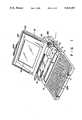
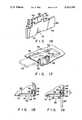
- FIG. 1is a perspective view of the computer with its display unit open;
- FIG. 2is a rear perspective view of the computer with the display unit closed;
- FIG. 3is a rear view of the computer
- FIG. 4is a side view of the computer
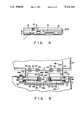
- FIG. 5is a sectional view showing hinges
- FIG. 6is an exploded perspective view of one of the hinges
- FIG. 7is a sectional view taken along line VII--VII of FIG. 5;
- FIG. 8is an exploded perspective view showing the rear portion of the computer
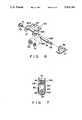
- FIG. 9is a bottom view of a battery pack
- FIG. 10is a sectional view taken along line X--X of FIG. 9;
- FIG. 11is a sectional view showing a state in which the battery pack is fitted in a receiving recess of a housing
- FIG. 12is a sectional view showing a state in which the battery pack is in process of being fitted in the receiving recess of the housing;
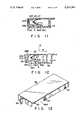
- FIG. 13is a perspective view of an optional cover
- FIG. 14is a side view of the computer with its stand in a housed position
- FIG. 15is a side view of the computer with its stand in a raised position
- FIG. 16is a perspective view showing the stand and a slider
- FIG. 17is a sectional view schematically showing a stand holder portion
- FIG. 18is a sectional view of a tilting mechanism with the stand in the housed position.
- FIG. 19is a sectional view of the tilting mechanism with the stand in the raised position.
- the personal computercomprises a plastic housing 1 having a substantially rectangular plane configuration.
- the housing 1includes base portion 2, which has a substantially rectangular bottom wall and a peripheral wall protruding therefrom and extending along the peripheral edge of the bottom wall, and a cover portion 3 covering the rear half of the top face of the base portion.
- a keyboard unit 4is mounted on the front half of the base portion 2.
- the top face of the housing 1has a stepped form, including front and rear half portions 6 and 8.
- the front half portion 6, which includes the keyboard unit 4is situated at the front half portion of the housing.
- the rear half portion 8is situated at the rear half portion of the housing and on a higher level than the front half portion 6.
- the housing 1contains therein a printed board (not shown) mounted with electronic components, a printed board (not shown) for indicator, a floppy disk drive unit 10, etc.
- a display unit 12is rockably mounted on the cover portion 3 of the housing 1.
- the unit 12includes a flat panel display 14, such as a liquid crystal display, an outer cover 12a enclosing the back of the display 14, and an inner cover 12b having a display window. Further, the unit 12 has a pair of legs 16a and 16b, which are inserted in their corresponding recesses 18 in the upper surface of the cover portion 3, and are rockably supported by means of hinges mentioned later.
- the display unit 12can rock between an open position shown in FIG. 1, where it allows an operator to operate the keyboard 4 while observing the display 14, and a closed position shown in FIG. 2, where it conceals the keyboard 4.
- the display unit 12is designed so that the upper surface of the outer cover 12a is continuous and flush with that of the cover portion 3 of the housing 1 or the rear half portion 8 when in the closed position.
- the display unit 12can be kept at the closed position by engaging its elastic hook 20a with a retaining groove 20b in the front end face of the housing 1. Further, the unit 12 can be kept fixed at any desired opening angle by means of hinges (mentioned later) for connection with the cover portion 3. Lead wires for connecting the display unit 12 and the printed boards in the housing 1 are passed through the legs 16a and 16b of the unit 12.
- the reference numeral 45denotes an indicator which is viewable without regard to the state, open or closed, of the display unit 12.
- a pair of hinges 40are incorporated in the leg 16b of the display unit 12. These hinges 40 serve not only to support the display unit 12 for rocking motion, but also to keep the unit 12 fixed at any desired opening angle. Since the two hinges 40 have the same construction, only one of them will be described in detail below.
- the hinge 40is provided with a bracket 42, which is fixed to a pair of bosses 43 on the inside of the outer cover 12a by means of screws 44.
- the bracket 42has a pair of integral bearing walls 46a and 46b facing each other, and a through hole 47 is bored through each bearing wall.
- a rotating shaft 48is rotatably passed through the holes 47.
- a screw 51is screwed in one end of the shaft 48 with the aid of a plain washer 49 and a spring washer 50, whereby the shaft 48 is prevented from coming off the bracket 42.
- the rotating shaft 48is a stepped shaft having a small-diameter portion 48a and a large-diameter portion 48b.
- a plain washer 52 with an outer diameter greater than the large-diameter portion 48bis fitted on the small-diameter portion 48a.
- a stepped portion between the large- and small-diameter portions 48a and 48bis situated close to the bearing wall 46a, and the washer 52 abuts against this stepped portion.
- wave washers 54 for use as ring-shaped spring members, e.g., two in number,are mounted on the small-diameter portion 48a so as to be situated between the bearing wall 46a and the plain washer 52.
- the washers 54are axially compressed between the wall 46a and the washer 52 by means of the fastening force of the screw 51.
- a frictional forceis produced between the wall 46a and the washer 52, that is, between the bracket 42 and the rotating shaft 48, by the action of the wave washers 54. This frictional force serves to restrain the relative rotation of the bracket 42 and the shaft 48.
- the other end portion of the rotating shaft 48projects into the inside space of the cover portion 3, penetrating the wall of the leg 38a and a wall defining the recess 18.
- a rectangular stopper portion 56is formed at the projecting end portion of the shaft 48.
- the stopper portion 56is nonrotatably fitted in a rectangular hole 58 of a receiving fitment 57, which is fixed to the inside of the cover portion 3.
- the bracket 42When the display unit 12 is rocked from its closed position to a desired open position, the bracket 42, fixed on the display unit side, rocks around the outer peripheral surface of the rotating shaft 48.
- the two wave washers 54are interposed compressed between the washer 52 on the shaft 48 and the bearing wall 46a of the bracket 42. Accordingly, the washers 54 are pressed against both the wall 46a and the washer 52 to produce the frictional force between them. This frictional force restrains the bracket 42 and the rotating shaft 48 from rocking relatively to each other, so that the display unit 12 can be kept fixed at the desired open position.
- the recesses 11 and 15open to the top face of the rear portion of the housing 1, i.e., the rear half portion 8, and the rear face of the housing.
- the optional part receiving recess 15opens to the lateral face of the rear portion of the housing 1, on the opposite side thereof to the power source receiving recess 11.
- the housing 1has a pair of parallel wall portions 13 and 17 formed at the rear portion thereof, and the power source receiving recess 11 is defined between these wall portions.
- the wall portion 17is situated between the recesses 11 and 15, thereby separating the two.
- a peripheral retaining portion or projection 19is formed at the rear end portion of each of the wall portions 13 and 17.
- the respective retaining portions 19 of the wall portions 13 and 17face each other.
- Each retaining portion 19has a retaining surface 19a at a predetermined distance from the upper surface of the bottom wall of the power source receiving recess 11.
- a pair of peripheral retaining portions 9are formed at the corner between a front end wall and the bottom wall defining the recess 11.
- Each retaining portion 9, which is formed of a through holehas a retaining surface 9a (upper side edge) spaced from the upper surface of the bottom wall of the recess 11.
- a pair of terminal fitments 7project into the power source receiving recess 11 through the bottom wall thereof.
- a detent projection 5protrudes integrally from the upper surface of the bottom wall of the recess 11 so as to be situated between the fitments 7.
- the projection 5has a slanting surface 5a which ascends forward from the rear end of the housing 1.
- the terminal fitments 7, which can be elastically deformed,is connected electrically with a battery pack 21 described below.
- the pack 21is fitted in the power source receiving recess 11 so that it can be removed from the back thereof.
- the top and rear faces of the battery pack 21are exposed, as shown in FIGS. 2 and 3, thus constituting part of an outer rear face of the housing 1.
- the top and rear faces of the battery pack 21, in particular,are situated flush with the rear half portion 8 of the top face of the housing 1 and the rear face thereof, respectively.
- the top face of the pack 21is also flush with the top face of the display unit 12 in the closed state.
- the battery pack 21has the form of a rectangular prism, as shown in FIGS. 8 and 9.
- a retaining projection 22is formed integrally on each lateral face of the pack 21 so that it can releasably engage its corresponding peripheral retaining portion 19.
- a pair of retaining projections 23protrude integrally from the front face of the battery pack 21 so that they can releasably engage their corresponding retaining portions 9.
- a pair of terminal strips 24, which are in contact with the terminal fitments 7,are exposed from the lower surface of the battery pack 21.
- the retaining projections 23are caused to engage their corresponding retaining portions 9, while the retaining projections 22 are caused to engage their corresponding retaining portions 19.
- the terminal fitments 7come elastically into contact with their corresponding terminal strips 24 of the battery pack 21, thereby urging the pack 21 upward.
- the battery pack 21is mounted in the power source receiving recess 11 in a manner such that it is restrained from moving from side to side by the wall portions 13 and 17, and from moving upward by the aforesaid engaging structures.
- the battery pack 21has a fixing mechanism 25 in its central portion, whereby it is kept mounted in the power source receiving recess 11.
- the mechanism 25includes a bell crank 26 rockably attached to the battery pack 21 and a torsion spring 27 for urging the crank 26.
- the bell crank 26is substantially L-shaped in lateral configuration, and its bent portion is supported on the battery pack 21 by means of a pivot 26a so that the crank 26 is rockable around the pivot.
- One arm portion of the crank 26extends along that portion of the battery pack 21 which is exposed when the pack 21 is mounted in the recess 11, that is, from the rear face of the pack 21 to the rear end portion of the top face thereof, thus constituting an operating section 26b.
- the operating section 26bis substantially T-shaped as viewed from the back of the battery pack 21, and has skid-proof corrugations on the outer surface thereof.
- a hollow 21a(see FIG. 12) is formed covering the rear face and the rear end portion of the top face of the battery pack 21.
- the operating section 26bengages the hollow 21a so as to be flush with the outer surface of the rear portion of the pack 21. As shown in FIG. 10, a distal end face 26b' of the operating section 26b is exposed so that a finger can be easily caught thereby.
- the other arm portion of the bell crank 26extends substantially at right angles to the operating section 26b and substantially parallel to the bottom surface of the battery pack 21, from the bent portion, thus constituting a retaining arm section 26c.
- a retaining pawl 26dprotrudes integrally from the lower surface of the arm section 26c. It can engage the detent projection 5 in the power source receiving recess 1.
- the bottom wall of the battery pack 21is formed with an elongate open portion 29 which extends forward from the rear end of the bottom wall.
- the whole arm section 26c except its extending end portionis exposed to the outside through the open portion 29.
- the extending end of the arm section 26ccan engage an edge portion 29a of the bottom wall of the battery pack 21 which defines the front edge of the open portion 29.
- the torsion spring 27is disposed inside the battery pack 21.
- One arm portion of the spring 27abuts against the ceiling surface of the pack 21, while the other arm portion of the spring abuts against the upper surface of the retaining arm section 26c, thereby urging the bell crank 26 to rock in the direction of arrow B around the pivot 26a.
- the extending end portion of the arm section 26cis pressed against the edge portion 29a of the battery pack 21, whereby the crank 26 is restrained from rocking in the direction of arrow B.
- the bell crank 26is normally kept in the state shown in FIG. 10.
- a pair of openings 24aare formed in the front end wall of the battery pack 21, and part of the each terminal strip 24 is exposed through its corresponding opening 24a.
- the battery pack 21can be applied to a case where the terminal fitments are provided on that wall portion of the housing 1 which defines the front face of the power source receiving recess 11.
- the operatorseizes the pack 21 with his or her fingers on the top and rear faces of the pack, and then insert it in the direction of arrow A of FIG. 8 from the back of the housing 1.
- the retaining projections 23are caused to engage the retaining surfaces (upper side edges) 9a of their corresponding peripheral retaining portions 9, while the retaining projections 22 are caused to engage the retaining surfaces 19a of their corresponding peripheral retaining portions 19.
- the terminal fitments 7come elastically into contact with their corresponding terminal strips 24 of the battery pack 21. Accordingly, the pack 21 is urged upward by the fitments 7.
- the battery pack 21is fitted in the power source receiving recess 11 in a manner such that it is restrained from moving from side to side by the wall portions 13 and 17, and from moving upward by the aforesaid engaging structures.
- the fixing mechanism 25operates as follows.
- the pack 21is pushed in the direction of arrow A in a manner such that its under surface is in alignment with the bottom surface of the receiving recess 11, as shown in FIG. 12, the detent projection 5 of the recess 11 projects through the open portion 29 of the pack 21 into the pack.
- the retaining pawl 26d of the retaining arm section 26cruns onto the projection 5 of the recess 11, so that the bell crank 26 rocks in the direction of arrow C against the urging force of the spring 27.
- the retaining pawl 26dgets over the detent projection 5.
- the mounting of the battery pack 21can be completed by the aforementioned one-touch operation, so that the pack 21 can be stably set in the housing 1.
- the battery pack 21may be fitted in the power source receiving recess 11 through one-touch operation such that it is forwardly inserted from the rear side, as indicated by arrow A of FIG. 12, after being fitted into the recess 11 from above, as indicated by arrow D.
- the battery pack 21can be removed from the power source receiving recess 11 by reversely following the aforementioned processes of mounting operation.
- the operatordraws out the whole pack 21 rearward while pushing the operating section 26b rearward with the thumb of his or her hand so that the hand is on the top and rear faces of the pack 21, which are exposed on the top face of the rear portion and the rear face, respectively, of the housing 1.
- the bell crank 26is rocked counterclockwise, as indicated by two-dot and dash line in FIG. 11, by the action of the operating section 26b, resisting the urging force of the spring 27.
- a through hole 31 for wiring and a retaining hole 32 continuous therewithare formed at the corner between a front end wall and a bottom wall of the optional part receiving recess 15, on the side of the wall portion 17 which divides the recess 15 and the power source receiving recess 11.
- a retaining hole 33is formed at the same corner portion, on the side opposite to the recess 11.
- a retaining groove 34extending parallel to the wall portion 17 is formed on the side edge of the bottom wall of the recess 15, on the side opposite to the recess 11.
- a nut 35is embedded in that end portion of the rear face of the housing 1 on the side opposite to the recess 11 so that it adjoins the recess 15.
- the receiving recess 15is fitted with a circuit board (not shown) for connection. If necessary, moreover, the recess 15 can contain an optional component, such as an interface substrate (not shown) for communication. An optional cover 36 is removably attached to the recess 15.
- the optional cover 36includes a top wall having a rectangular plane configuration and a peripheral wall formed along the peripheral edge of the top wall.
- the width of the top wallis equal to that of the battery pack 21.
- a pair of retaining projections 37which can be releasably fitted in the retaining holes 32 and 33 of the receiving recess 15, respectively, protrude integrally from the front wall of the optional cover 36.
- the front wall of the cover 36has a notch 36a which corresponds to the through hole 31.
- a rib(not shown), which is adapted to engage the retaining groove 34, protrudes from the lower end of the side wall surface of the cover 36, on the side opposite to the power source receiving recess 11.
- the reference numeral 80denotes a knockout portion formed in the rear wall of the optional cover 36
- the reference numeral 41denotes an engaging projection which project from the housing 1 into the receiving recess 15 and engages the lower surface of the front edge of the cover 36 as the cover is mounted.
- the reference numeral 82denotes an engaging projection which protrudes from the rear edge of the top wall of the cover 36 and engages the edge of the through hole 31 on the housing side.
- the optional cover 36is fitted into the optional part receiving recess 15 from the back of the housing 1 in the direction of arrow E of FIG. 8. Thereupon, the retaining projections 37 are caused to engage their corresponding retaining holes 32 and 33, and the rib is caused to engage the retaining groove 34.
- the optional cover 36is fitted to the receiving recess 15 in a manner such that it is restrained from moving from side to side by the wall portion 17 and the engagement between the rib and the groove 34, and from moving upward by the engagement between the projections 37 and the holes 32 and 33.
- the cover 36is fixed to the housing 1 by means of a screw 38 and another screw (not shown) so as to cover the recess 15.
- the screw 38is passed through the rear wall of the cover 36 to be threadedly engaged with the nut 35.
- the other screwis passed through a metal fitting 39 (see FIGS. 8 and 13) fixed to the cover 36, and is threadedly engaged with the circuit board for connection.
- the top and rear faces of the optional cover 36 and the lateral face thereof opposite to the battery pack 21are exposed, as shown in FIGS. 2 to 4, thus constituting part of the outer surface of the rear portion of the housing 1.
- the top and rear face of the cover 36are arranged flush with the rear half portion 8 of the top face of the housing 1 and the rear face thereof, respectively.
- the top face of the optional cover 36is also flush with the top face of the display unit 12 in the closed state.
- the upper end of the wall portion 17is covered by those end portions of the pack 21 and the cover 36 which abut against each other.
- the optional cover 36can be removed, as required, from the housing 1 by reversely following the aforementioned processes of mounting operation.
- a tilting mechanism 50is attached to the central portion of the bottom of the rear end portion of the housing 1.
- the tilting mechanism 50is provided with a holder portion 53 in the form of a thin box in the center of the tail end portion of the housing 1.
- the portion 53which has a rectangular cross section elongated in the transverse direction of the housing 1, extends upward from the bottom side of the housing. Only the lower end of the holder portion 53 opens to the bottom face of the housing 1.
- a slide passage(mentioned later) is defined by the inner surfaces of the holder portion 53.
- Two guide grooves 55are formed on each of paired inner surfaces of the portion 53 which extend in the transverse direction of the housing 1. More specifically, each groove 55 vertically extends from the uppermost portion of its corresponding inner surface of the holder portion 53 to the middle portion thereof.
- the slider 57is formed of a plate member having a thickness corresponding to the cross section of the holder portion 53.
- Projections 59are formed at the upper end of each lateral face of the slider 57 which faces the guide grooves 55.
- the projections 59are adapted to be slidably fitted in their corresponding guide grooves.
- the slider 57can slide in the holder portion 53 or the slide passage, within the range of extension of the guide grooves 55.
- a boss portion 60 for connectionprotrudes downward from the center of the lower end of the slider 57 on the bottom side of the housing 1.
- the tilting mechanism 50includes a stand 62 which is connected to the slider 57.
- the stand 62is formed of a rectangular plate as thick as or thinner than the slider 57.
- a pair of boss portions 64 for connectionprotrude from the center of one side end of the stand 62 so as to be spaced at a predetermined distance and situated on either side of the boss portion 60 of the slider 57.
- the boss portions 64are rotatably connected to the boss portion 60 of the slider 57 by means of a shaft 66, which penetrates these boss portions in the transverse direction of the housing 1.
- the stand 62can be rocked in the longitudinal direction of the housing 1, between a housed position shown in FIGS. 14 and 18 and a raised position shown in FIGS. 15 and 19.
- a depression 68 for receiving the stand 62is formed in the bottom face of the housing 1 so as to be situated in front of the holder portion 53.
- the depression 68is shaped corresponding to the outer configuration of the stand 62.
- a bottom opening of the holder portion 53communicates with the depression 68.
- a pair of elastic hooks 70protrude from the front-side edge of the depression 68.
- a pair of engaging recesses 72are formed at the end portion of the stand 62 on the side opposite to the slider 57.
- a hollow 73 for finger accessis formed on the front-side edge of the depression 68.
- a hollow 74 for finger accessis formed on the outer peripheral portion of the reverse side of the stand 62 which corresponds to the hollow 73.
- the depth Y (distance from open end to bottom) of the holder portion 53is greater than the distance X from the shaft 66 to the upper end of the slider 57.
- the stand 62can be inserted into the holder portion 53 so that the upper end portions of the boss portions 64 and the shaft 66 are housed in the portion 53.
- the upper end portions of the boss portions 64can be fitted into the holder portion 53 by inserting the stand 62 in the raised position into the portion 53.
- the upper end portions of the boss portions 64are surrounded by the walls of the holder portion 53, so that the stand 62 is restrained from rocking and kept in the raised position.
- Projections 76are formed on the top end face of the slider 57, and recesses 75 adapted to be releasably engaged with the projections 76 are formed on the upper end of their corresponding inner surfaces of the holder portion 53, whereby the raised stand 62 is positioned and fixed.
- the length of the guide grooves 55 on the inner surfaces of the holder portion 53is greater than the difference (Y-X) between the dimensions Y and X.
- the display unit 12In carrying the personal computer with the tilting mechanism 50 described above, the display unit 12 is closed, and the stand 62 is brought down to the housed position where it is housed in the receiving depression 68, as shown in FIGS. 14 and 18.
- the housing 1, display unit 12, and stand 62are combined into a single rectangular block which is handy to carry.
- the housing 1When using the personal computer on a desk or the like, the housing 1 is placed on the desk, and the display unit 12 is opened, as shown in FIG. 14.
- the operatorIn tilting the keyboard 4 for use, the operator lifts the rear portion of the housing 1 in the state shown in FIG. 14 with one of his or her hands, and inserts a finger of the other hand into the hollow 73 at the bottom of the housing. Then, the operator draws out and raises the stand 62 from the depression 68 with the tip of the inserted finger caught by the hollow 74 of the stand. In this state, the stand 62 is rocked to the rear side until the boss portions 64 abut against the wall portion of the holder portion 53.
- the stand 62is urged to be pushed in toward the housing 1 so that the boss portions 64 are inserted into the holder portion 53.
- the boss portions 64along with the slider 57, are fitted in the holder portion 53, as shown in FIGS. 15 and 19.
- the boss portions 64are thus located in the holder portion 53, the raised stand 62 is locked and prevented from falling in the longitudinal direction by the wall portion of the holder portion 53.
- the projections 76 of the slider 57engage their corresponding recesses 75 of the holder portion 53, whereupon the stand raising operation is completed.
- the personal computer of the present embodimenthas the following advantages.
- the mounting portion for the battery pack 21 and the optional componentis formed of the power source receiving recess 11 and the optional part receiving recess 15 which open to the top face of the rear portion of the housing 1, i.e., the rear half portion 8, and the rear face of the housing.
- the battery pack 21 and the optional cover 36are fitted to the recesses 11 and 15, respectively.
- the top and rear faces of the pack 21 and the cover 36, mounted separately in the recesses 11 and 15 from behind the housing 1,are exposed on the rear half portion 8 of the top face of the housing and the rear face thereof, respectively, thus constituting part of the outer surface of the housing.
- the housing 1need not be provided with any partition wall portion for concealing the top of the space for housing the battery pack 21 and the optional component, so that the rear portion of the housing can be reduced in thickness.
- the battery pack 21 and the optional cover 36are mounted on the top side of the rear portion of the housing 1. In contrast with the case in which the battery pack and the optional cover are arranged in front of the keyboard 4, therefore, the keyboard cannot be crossed by any wires, and can be operated without hindrance. If the battery pack 21 and the like are attached to the flank of the housing 1, they overlap the keyboard 4, so that the thickness of the housing 1 increases. To avoid this, a space for storing the pack 21, etc. must be secured beside the keyboard 4, so that the transverse dimension of the housing 1 increases. According to the present embodiment, on the other hand, the battery pack 21 and the optional cover 36 can be attached to the housing 1 without arousing such a problem. Thus, the arrangement in which the pack 21 and the cover 36 are located at the rear portion of the housing 1 has a great advantage over other arrangements in being more effective in utilizing the space of the housing and for compact designing of the housing.
- the battery pack 21can be mounted into or removed from the power source receiving recess 11 by moving the pack 21 in a direction perpendicular to its longitudinal direction. More specifically, the battery pack 21 is attached to the rear portion of the housing 1 so that its top and rear faces are exposed on the top face of the rear portion of the housing and the rear face thereof, respectively.
- the operatorcan remove the pack 21 rearward from the housing 1 after releasing it from the fixation by the fixing mechanism 25 with his or her hand on the top and rear faces of the pack 21.
- the direction of the release of the fixation by the fixing mechanism 25, that is, the rocking direction of the operating section 26b of the bell crank 26,is in alignment with the direction in which the battery pack 21 is drawn out from the receiving recess 11.
- the operating efficiencycan be improved.
- the edge portion 29a of its bottom wallis caught by the detent projection 5 of the housing 1, whereby the movement of the pack 21 can be stopped temporarily.
- the battery pack 21can be prevented from being mistakenly dropped while it is being drawn out rearward.
- the operatorcan reassure his or her hold of the battery pack 21, and then continue the removal thereof.
- the edge portion 29ais caught by the detent projection 5, furthermore, the operator can take out the battery pack 21 from the receiving recess by lifting it diagonally upward. In this case, the stroke for the rearward draw-out of the battery pack can be shortened.
- the personal computeris provided with the tilting mechanism 50, and the housing 1 can be easily tilted by only rocking the single stand 62 toward the rear side of the housing 1. In the raised position, moreover, the stand 62 is restrained from falling in the longitudinal direction by the wall portion of the holder portion 53, thus ensuring high stability. Since the space to house the stand 62 extends in the direction of the thickness of the housing 1, moreover, the tilting mechanism 50 does not constitute a hindrance to compact designing of the housing 1.
- the battery pack 21 and the optional cover 36may be mounted using various other arrangements without being limited to the above embodiment.
- the power source receiving recess and the optional part receiving recessmay be formed opening to the rear half portion of the top face of the housing and the rear portion of the lateral face thereof.
- a plurality of detent projections and a plurality of retaining pawlsmay be provided on the housing and in the fixing mechanism of the battery pack, respectively.
- the stand of the tilting mechanismis designed so that it is raised toward the rear side of the housing.
- the standmay be arranged so that it can be rocked and raised from the housed position toward the front side of the housing.
- the stand in the receiving depressionis retained by means of the elastic hooks (latch type) in the foregoing embodiment.
- the standmay be held in position by means of a spring, for example.
- the present inventionis not limited to personal computers, and may be applied to various other miniature electronic apparatuses, such as word processors.
Landscapes
- Engineering & Computer Science (AREA)
- Computer Hardware Design (AREA)
- Theoretical Computer Science (AREA)
- Physics & Mathematics (AREA)
- General Engineering & Computer Science (AREA)
- Human Computer Interaction (AREA)
- General Physics & Mathematics (AREA)
- Power Engineering (AREA)
- Mathematical Physics (AREA)
- Casings For Electric Apparatus (AREA)
- Power Sources (AREA)
Abstract
Description
This is a division of application Ser. No. 07/542,041, filed Jun. 22, 1990.
1. Field of the Invention
The present invention relates to a compact electronic apparatus, such as a laptop personal computer, word processor, etc.
2. Description of the Related Art
Various portable compact electronic apparatuses in which a keyboard is disposed at the front portion of a housing having a substantially rectangular plane configuration are known in the art. A display unit, containing a flat panel display therein, is rockably mounted between the keyboard and the rear portion of the housing, so that the keyboard is covered by the display unit when it is shut down.
A compact electronic apparatus, such as a laptop personal computer, is provided with a tilting mechanism for tilting the keyboard forward so as to improve the operability of the keyboard.
In a conventional tilting mechanism, a pair of legs are provided at the right and left ends of the bottom of the rear portion of the housing. By raising the legs folded on the bottom of the housing, the housing is declined forward so that the keyboard can be used in a tilting state.
However, with the above tilting mechanism, the two legs must be rocked, thus making the tilting operation troublesome. Further, the housing is declined only by raising the legs, so that the tilting state of the housing is not stable.
It is an object of the present invention to provide a compact electronic apparatus wherein the housing can be easily and stably tilted.
In order to achieve the object of the present invention, among others, the present invention includes a compact electronic apparatus comprising: a housing substantially in the form of a rectangular prism, having a bottom face constituting a mounting surface and a top face opposed to the bottom face; information input means on the top face of the housing; and tilting means at the rear potion of the housing for tilting the bottom face. The tilting means includes a guide passage formed in the housing, having an opening on the bottom face of the housing, and extending from the opening toward the top face of the housing. A slider, having a first connecting portion, is arranged in the guide passage and movable along the extending direction of the guide passage, between an up position where the first connecting portion is situated inside the guide passage and a down position where the first connecting portion is situated outside the passage. A plate-like stand, having a second connecting portion, is connected to the first connecting portion. The stand is rockable between a raised position where the stand extends along the extending direction of the guide passage and a housed position where the stand extends substantially parallel to the bottom face of the housing when the slider is in the down position. The second connecting portion is adapted to be inserted into the guide passage, thereby keeping the stand in the raised position when the slider is moved to the up position. A receiving depression is formed in the bottom face of the housing and communicates with the opening of the guide passage. The stand is moved to its housed position, it is housed in the receiving depression.
To tilt the housing, the stand is rocked while being drawn out, and then the stand and coupling portion are inserted into the slide passage. The stand is inserted until it is restricted by the stopper means. At that point, the coupling portion is located in the slide passage. Therefore, the raised stand is locked in place by the slide passage and prevented from falling back and forth. When the compact electronic apparatus with its stand in the raised portion is placed on a desk or the like, the keyboard is declined (tilted) forward.
Therefore, the tilting operation can be performed by rocking the single stand. Further, the raised stand is restrained from falling in the longitudinal direction of the housing by the wall defining the slide passage, thus ensuring high stability.
Additional objects and advantages of the invention will be set forth in the description which follows, and in part will be obvious from the description, or may be learned by practice of the invention. The objects and advantages of the invention may be realized and obtained by means of the instrumentalities and combinations particularly pointed out in the appended claims.
The accompanying drawings, which are incorporated in and constitute a part of the specification, illustrate a presently preferred embodiment of the invention and, together with the general description given above and the detailed description of the preferred embodiment given below, serve to explain the principles of the invention.
FIG. 1 is a perspective view of the computer with its display unit open;
FIG. 2 is a rear perspective view of the computer with the display unit closed;
FIG. 3 is a rear view of the computer;
FIG. 4 is a side view of the computer;
FIG. 5 is a sectional view showing hinges;
FIG. 6 is an exploded perspective view of one of the hinges;
FIG. 7 is a sectional view taken along line VII--VII of FIG. 5;
FIG. 8 is an exploded perspective view showing the rear portion of the computer;
FIG. 9 is a bottom view of a battery pack;
FIG. 10 is a sectional view taken along line X--X of FIG. 9;
FIG. 11 is a sectional view showing a state in which the battery pack is fitted in a receiving recess of a housing;
FIG. 12 is a sectional view showing a state in which the battery pack is in process of being fitted in the receiving recess of the housing;
FIG. 13 is a perspective view of an optional cover;
FIG. 14 is a side view of the computer with its stand in a housed position;
FIG. 15 is a side view of the computer with its stand in a raised position;
FIG. 16 is a perspective view showing the stand and a slider;
FIG. 17 is a sectional view schematically showing a stand holder portion;
FIG. 18 is a sectional view of a tilting mechanism with the stand in the housed position; and
FIG. 19 is a sectional view of the tilting mechanism with the stand in the raised position.
As shown in FIGS. 1 to 4, the personal computer comprises a plastic housing 1 having a substantially rectangular plane configuration. The housing 1 includesbase portion 2, which has a substantially rectangular bottom wall and a peripheral wall protruding therefrom and extending along the peripheral edge of the bottom wall, and acover portion 3 covering the rear half of the top face of the base portion. Akeyboard unit 4 is mounted on the front half of thebase portion 2. The top face of the housing 1 has a stepped form, including front andrear half portions front half portion 6, which includes thekeyboard unit 4, is situated at the front half portion of the housing. Therear half portion 8 is situated at the rear half portion of the housing and on a higher level than thefront half portion 6.
The housing 1 contains therein a printed board (not shown) mounted with electronic components, a printed board (not shown) for indicator, a floppy disk drive unit 10, etc.
As shown in FIGS. 1 to 4, adisplay unit 12 is rockably mounted on thecover portion 3 of the housing 1. Theunit 12 includes aflat panel display 14, such as a liquid crystal display, an outer cover 12a enclosing the back of thedisplay 14, and aninner cover 12b having a display window. Further, theunit 12 has a pair oflegs 16a and 16b, which are inserted in theircorresponding recesses 18 in the upper surface of thecover portion 3, and are rockably supported by means of hinges mentioned later. Thus, thedisplay unit 12 can rock between an open position shown in FIG. 1, where it allows an operator to operate thekeyboard 4 while observing thedisplay 14, and a closed position shown in FIG. 2, where it conceals thekeyboard 4. Thedisplay unit 12 is designed so that the upper surface of the outer cover 12a is continuous and flush with that of thecover portion 3 of the housing 1 or therear half portion 8 when in the closed position.
Thedisplay unit 12 can be kept at the closed position by engaging its elastic hook 20a with a retaininggroove 20b in the front end face of the housing 1. Further, theunit 12 can be kept fixed at any desired opening angle by means of hinges (mentioned later) for connection with thecover portion 3. Lead wires for connecting thedisplay unit 12 and the printed boards in the housing 1 are passed through thelegs 16a and 16b of theunit 12.
In FIGS. 1 and 2, thereference numeral 45 denotes an indicator which is viewable without regard to the state, open or closed, of thedisplay unit 12.
As shown in FIGS. 5 to 7, a pair ofhinges 40 are incorporated in theleg 16b of thedisplay unit 12. These hinges 40 serve not only to support thedisplay unit 12 for rocking motion, but also to keep theunit 12 fixed at any desired opening angle. Since the two hinges 40 have the same construction, only one of them will be described in detail below.
Thehinge 40 is provided with abracket 42, which is fixed to a pair ofbosses 43 on the inside of the outer cover 12a by means ofscrews 44. Thebracket 42 has a pair ofintegral bearing walls 46a and 46b facing each other, and a throughhole 47 is bored through each bearing wall. A rotatingshaft 48 is rotatably passed through theholes 47. Ascrew 51 is screwed in one end of theshaft 48 with the aid of aplain washer 49 and aspring washer 50, whereby theshaft 48 is prevented from coming off thebracket 42.
The rotatingshaft 48 is a stepped shaft having a small-diameter portion 48a and a large-diameter portion 48b. Aplain washer 52 with an outer diameter greater than the large-diameter portion 48b is fitted on the small-diameter portion 48a. A stepped portion between the large- and small-diameter portions 48a and 48b is situated close to the bearing wall 46a, and thewasher 52 abuts against this stepped portion. Further,wave washers 54 for use as ring-shaped spring members, e.g., two in number, are mounted on the small-diameter portion 48a so as to be situated between the bearing wall 46a and theplain washer 52. Thewashers 54 are axially compressed between the wall 46a and thewasher 52 by means of the fastening force of thescrew 51. Thus, a frictional force is produced between the wall 46a and thewasher 52, that is, between thebracket 42 and therotating shaft 48, by the action of thewave washers 54. This frictional force serves to restrain the relative rotation of thebracket 42 and theshaft 48.
The other end portion of therotating shaft 48 projects into the inside space of thecover portion 3, penetrating the wall of theleg 38a and a wall defining therecess 18. Arectangular stopper portion 56 is formed at the projecting end portion of theshaft 48. Thestopper portion 56 is nonrotatably fitted in arectangular hole 58 of a receivingfitment 57, which is fixed to the inside of thecover portion 3.
When thedisplay unit 12 is rocked from its closed position to a desired open position, thebracket 42, fixed on the display unit side, rocks around the outer peripheral surface of therotating shaft 48. The twowave washers 54 are interposed compressed between thewasher 52 on theshaft 48 and the bearing wall 46a of thebracket 42. Accordingly, thewashers 54 are pressed against both the wall 46a and thewasher 52 to produce the frictional force between them. This frictional force restrains thebracket 42 and therotating shaft 48 from rocking relatively to each other, so that thedisplay unit 12 can be kept fixed at the desired open position.
As shown in FIG. 8, a substantially rectangular power source receiving recess 11 and an optionalpart receiving recess 15, both extending long from side to side, are arranged side by side at the back of therecesses 18 of the rear portion orcover portion 3 of the housing 1. Therecesses 11 and 15 open to the top face of the rear portion of the housing 1, i.e., therear half portion 8, and the rear face of the housing. Further, the optionalpart receiving recess 15 opens to the lateral face of the rear portion of the housing 1, on the opposite side thereof to the power source receiving recess 11.
As shown in FIG. 8, the housing 1 has a pair ofparallel wall portions wall portion 17 is situated between therecesses 11 and 15, thereby separating the two. A peripheral retaining portion orprojection 19 is formed at the rear end portion of each of thewall portions respective retaining portions 19 of thewall portions portion 19 has a retaining surface 19a at a predetermined distance from the upper surface of the bottom wall of the power source receiving recess 11. Also, a pair of peripheral retaining portions 9 are formed at the corner between a front end wall and the bottom wall defining the recess 11. Each retaining portion 9, which is formed of a through hole, has a retaining surface 9a (upper side edge) spaced from the upper surface of the bottom wall of the recess 11.
A pair ofterminal fitments 7 project into the power source receiving recess 11 through the bottom wall thereof. Adetent projection 5 protrudes integrally from the upper surface of the bottom wall of the recess 11 so as to be situated between thefitments 7. Theprojection 5 has a slanting surface 5a which ascends forward from the rear end of the housing 1. Theterminal fitments 7, which can be elastically deformed, is connected electrically with abattery pack 21 described below.
Thebattery pack 21, which is of a charging type, serves as a power source for the personal computer. Thepack 21 is fitted in the power source receiving recess 11 so that it can be removed from the back thereof. In the fitted state, the top and rear faces of thebattery pack 21 are exposed, as shown in FIGS. 2 and 3, thus constituting part of an outer rear face of the housing 1. The top and rear faces of thebattery pack 21, in particular, are situated flush with therear half portion 8 of the top face of the housing 1 and the rear face thereof, respectively. The top face of thepack 21 is also flush with the top face of thedisplay unit 12 in the closed state.
Thebattery pack 21 has the form of a rectangular prism, as shown in FIGS. 8 and 9. A retainingprojection 22 is formed integrally on each lateral face of thepack 21 so that it can releasably engage its corresponding peripheral retainingportion 19. Also, a pair of retainingprojections 23 protrude integrally from the front face of thebattery pack 21 so that they can releasably engage their corresponding retaining portions 9. Furthermore, a pair ofterminal strips 24, which are in contact with theterminal fitments 7, are exposed from the lower surface of thebattery pack 21.
When thebattery pack 21 is inserted into the power source receiving recess 11 from the back of the housing 1, in the direction of arrow A of FIG. 8, the retainingprojections 23 are caused to engage their corresponding retaining portions 9, while the retainingprojections 22 are caused to engage theircorresponding retaining portions 19. As a result, theterminal fitments 7 come elastically into contact with their corresponding terminal strips 24 of thebattery pack 21, thereby urging thepack 21 upward. Thus, thebattery pack 21 is mounted in the power source receiving recess 11 in a manner such that it is restrained from moving from side to side by thewall portions
Thebattery pack 21 has afixing mechanism 25 in its central portion, whereby it is kept mounted in the power source receiving recess 11. As shown in FIGS. 9 and 10, themechanism 25 includes a bell crank 26 rockably attached to thebattery pack 21 and atorsion spring 27 for urging thecrank 26.
Thebell crank 26 is substantially L-shaped in lateral configuration, and its bent portion is supported on thebattery pack 21 by means of a pivot 26a so that thecrank 26 is rockable around the pivot. One arm portion of thecrank 26 extends along that portion of thebattery pack 21 which is exposed when thepack 21 is mounted in the recess 11, that is, from the rear face of thepack 21 to the rear end portion of the top face thereof, thus constituting anoperating section 26b. As shown in FIG. 2, theoperating section 26b is substantially T-shaped as viewed from the back of thebattery pack 21, and has skid-proof corrugations on the outer surface thereof. A hollow 21a (see FIG. 12) is formed covering the rear face and the rear end portion of the top face of thebattery pack 21. Normally, theoperating section 26b engages the hollow 21a so as to be flush with the outer surface of the rear portion of thepack 21. As shown in FIG. 10, adistal end face 26b' of theoperating section 26b is exposed so that a finger can be easily caught thereby.
The other arm portion of the bell crank 26 extends substantially at right angles to theoperating section 26b and substantially parallel to the bottom surface of thebattery pack 21, from the bent portion, thus constituting a retainingarm section 26c. A retainingpawl 26d protrudes integrally from the lower surface of thearm section 26c. It can engage thedetent projection 5 in the power source receiving recess 1. The bottom wall of thebattery pack 21 is formed with an elongateopen portion 29 which extends forward from the rear end of the bottom wall. Thewhole arm section 26c except its extending end portion is exposed to the outside through theopen portion 29. The extending end of thearm section 26c can engage an edge portion 29a of the bottom wall of thebattery pack 21 which defines the front edge of theopen portion 29.
Thetorsion spring 27 is disposed inside thebattery pack 21. One arm portion of thespring 27 abuts against the ceiling surface of thepack 21, while the other arm portion of the spring abuts against the upper surface of the retainingarm section 26c, thereby urging the bell crank 26 to rock in the direction of arrow B around the pivot 26a. Meanwhile, the extending end portion of thearm section 26c is pressed against the edge portion 29a of thebattery pack 21, whereby thecrank 26 is restrained from rocking in the direction of arrow B. Thus, the bell crank 26 is normally kept in the state shown in FIG. 10.
As shown in FIG. 8, moreover, a pair of openings 24a are formed in the front end wall of thebattery pack 21, and part of the eachterminal strip 24 is exposed through its corresponding opening 24a. Thus, thebattery pack 21 can be applied to a case where the terminal fitments are provided on that wall portion of the housing 1 which defines the front face of the power source receiving recess 11.
In mounting thebattery pack 21 in the power source receiving recess 11 of the housing 1, the operator seizes thepack 21 with his or her fingers on the top and rear faces of the pack, and then insert it in the direction of arrow A of FIG. 8 from the back of the housing 1.
Thereupon, the retainingprojections 23 are caused to engage the retaining surfaces (upper side edges) 9a of their corresponding peripheral retaining portions 9, while the retainingprojections 22 are caused to engage the retaining surfaces 19a of their corresponding peripheral retainingportions 19. At the same time, theterminal fitments 7 come elastically into contact with their corresponding terminal strips 24 of thebattery pack 21. Accordingly, thepack 21 is urged upward by thefitments 7. Thus, thebattery pack 21 is fitted in the power source receiving recess 11 in a manner such that it is restrained from moving from side to side by thewall portions
The moment thebattery pack 21 is mounted in this manner, the fixingmechanism 25 operates as follows. When thepack 21 is pushed in the direction of arrow A in a manner such that its under surface is in alignment with the bottom surface of the receiving recess 11, as shown in FIG. 12, thedetent projection 5 of the recess 11 projects through theopen portion 29 of thepack 21 into the pack. Accordingly, the retainingpawl 26d of the retainingarm section 26c runs onto theprojection 5 of the recess 11, so that the bell crank 26 rocks in the direction of arrow C against the urging force of thespring 27. When thebattery pack 21 is fully inserted into the receiving recess 11, thereafter, the retainingpawl 26d gets over thedetent projection 5. Immediately after this, thecrank 26 is rocked in the direction of arrow B by the urging force of thespring 27, so that thepawl 26d is caught by the projection, as indicated by full line in FIG. 11. Thus, thebattery pack 21 is fixed in the receiving recess 11, and is prevented from slipping out rearward from the recess 11. This operation of thefixing mechanism 25 can be automatically achieved by only pushing thebattery pack 21 into the receiving recess 11, in the direction of arrow A.
The mounting of thebattery pack 21 can be completed by the aforementioned one-touch operation, so that thepack 21 can be stably set in the housing 1.
Alternatively, thebattery pack 21 may be fitted in the power source receiving recess 11 through one-touch operation such that it is forwardly inserted from the rear side, as indicated by arrow A of FIG. 12, after being fitted into the recess 11 from above, as indicated by arrow D.
Thebattery pack 21 can be removed from the power source receiving recess 11 by reversely following the aforementioned processes of mounting operation. First, the operator draws out thewhole pack 21 rearward while pushing theoperating section 26b rearward with the thumb of his or her hand so that the hand is on the top and rear faces of thepack 21, which are exposed on the top face of the rear portion and the rear face, respectively, of the housing 1. Thereupon, the bell crank 26 is rocked counterclockwise, as indicated by two-dot and dash line in FIG. 11, by the action of theoperating section 26b, resisting the urging force of thespring 27. As a result, the retainingpawl 26d of the retainingarm section 26c is disengaged from thedetent projection 5, so that thebattery pack 21 is released from the fixation by the fixingmechanism 25. The moment thepack 21 is released in this manner, the whole pack is removed from the power source receiving recess 11 by the aforesaid draw-out operation.
In drawing out thebattery pack 21 from the receiving recess 11, the edge portion 29a of the bottom wall is caught by thedetent projection 5, as shown in FIG. 12, so that the draw-out operation is temporarily stopped. In this state, the retainingprojections corresponding retaining portions 9 and 19. If the operator mistakenly releases his or her hold of thebattery pack 21 in the disengaged state, therefore, thepack 21 can be prevented from unexpectedly falling, since the edge portion 29a is caught by theprojection 5.
As shown in FIG. 8, a through hole 31 for wiring and a retaininghole 32 continuous therewith are formed at the corner between a front end wall and a bottom wall of the optionalpart receiving recess 15, on the side of thewall portion 17 which divides therecess 15 and the power source receiving recess 11. Further, a retaininghole 33 is formed at the same corner portion, on the side opposite to the recess 11. Also, a retaininggroove 34 extending parallel to thewall portion 17 is formed on the side edge of the bottom wall of therecess 15, on the side opposite to the recess 11. Anut 35 is embedded in that end portion of the rear face of the housing 1 on the side opposite to the recess 11 so that it adjoins therecess 15.
The receivingrecess 15 is fitted with a circuit board (not shown) for connection. If necessary, moreover, therecess 15 can contain an optional component, such as an interface substrate (not shown) for communication. Anoptional cover 36 is removably attached to therecess 15.
As shown in FIGS. 8 and 13, theoptional cover 36 includes a top wall having a rectangular plane configuration and a peripheral wall formed along the peripheral edge of the top wall. The width of the top wall is equal to that of thebattery pack 21. A pair of retainingprojections 37, which can be releasably fitted in the retaining holes 32 and 33 of the receivingrecess 15, respectively, protrude integrally from the front wall of theoptional cover 36. Also, the front wall of thecover 36 has anotch 36a which corresponds to the through hole 31. A rib (not shown), which is adapted to engage the retaininggroove 34, protrudes from the lower end of the side wall surface of thecover 36, on the side opposite to the power source receiving recess 11.
In FIGS. 8 and 13, thereference numeral 80 denotes a knockout portion formed in the rear wall of theoptional cover 36, and thereference numeral 41 denotes an engaging projection which project from the housing 1 into the receivingrecess 15 and engages the lower surface of the front edge of thecover 36 as the cover is mounted. Thereference numeral 82 denotes an engaging projection which protrudes from the rear edge of the top wall of thecover 36 and engages the edge of the through hole 31 on the housing side.
Theoptional cover 36 is fitted into the optionalpart receiving recess 15 from the back of the housing 1 in the direction of arrow E of FIG. 8. Thereupon, the retainingprojections 37 are caused to engage their corresponding retaining holes 32 and 33, and the rib is caused to engage the retaininggroove 34. Thus, theoptional cover 36 is fitted to the receivingrecess 15 in a manner such that it is restrained from moving from side to side by thewall portion 17 and the engagement between the rib and thegroove 34, and from moving upward by the engagement between theprojections 37 and theholes cover 36 is fixed to the housing 1 by means of ascrew 38 and another screw (not shown) so as to cover therecess 15. Thescrew 38 is passed through the rear wall of thecover 36 to be threadedly engaged with thenut 35. The other screw is passed through a metal fitting 39 (see FIGS. 8 and 13) fixed to thecover 36, and is threadedly engaged with the circuit board for connection.
In this mounted state, the top and rear faces of theoptional cover 36 and the lateral face thereof opposite to thebattery pack 21 are exposed, as shown in FIGS. 2 to 4, thus constituting part of the outer surface of the rear portion of the housing 1. In the present embodiment, the top and rear face of thecover 36 are arranged flush with therear half portion 8 of the top face of the housing 1 and the rear face thereof, respectively. The top face of theoptional cover 36 is also flush with the top face of thedisplay unit 12 in the closed state. The upper end of thewall portion 17 is covered by those end portions of thepack 21 and thecover 36 which abut against each other.
Theoptional cover 36 can be removed, as required, from the housing 1 by reversely following the aforementioned processes of mounting operation.
As shown in FIGS. 14 to 19, atilting mechanism 50 is attached to the central portion of the bottom of the rear end portion of the housing 1.
As shown in detail in FIGS. 17 to 19, thetilting mechanism 50 is provided with aholder portion 53 in the form of a thin box in the center of the tail end portion of the housing 1. Theportion 53, which has a rectangular cross section elongated in the transverse direction of the housing 1, extends upward from the bottom side of the housing. Only the lower end of theholder portion 53 opens to the bottom face of the housing 1. A slide passage (mentioned later) is defined by the inner surfaces of theholder portion 53. Twoguide grooves 55 are formed on each of paired inner surfaces of theportion 53 which extend in the transverse direction of the housing 1. More specifically, eachgroove 55 vertically extends from the uppermost portion of its corresponding inner surface of theholder portion 53 to the middle portion thereof.
As shown in FIGS. 16 to 19, aslider 57 in the form of a rectangular prism, for use as a stand supporting member, is fitted in theholder portion 53 for vertical sliding motion. Namely, theslider 57 is formed of a plate member having a thickness corresponding to the cross section of theholder portion 53.Projections 59 are formed at the upper end of each lateral face of theslider 57 which faces theguide grooves 55. Theprojections 59 are adapted to be slidably fitted in their corresponding guide grooves. Thus, theslider 57 can slide in theholder portion 53 or the slide passage, within the range of extension of theguide grooves 55. Aboss portion 60 for connection protrudes downward from the center of the lower end of theslider 57 on the bottom side of the housing 1.
Thetilting mechanism 50 includes astand 62 which is connected to theslider 57. As shown in FIG. 16, thestand 62 is formed of a rectangular plate as thick as or thinner than theslider 57. A pair ofboss portions 64 for connection protrude from the center of one side end of thestand 62 so as to be spaced at a predetermined distance and situated on either side of theboss portion 60 of theslider 57. Theboss portions 64 are rotatably connected to theboss portion 60 of theslider 57 by means of ashaft 66, which penetrates these boss portions in the transverse direction of the housing 1. Thus, thestand 62 can be rocked in the longitudinal direction of the housing 1, between a housed position shown in FIGS. 14 and 18 and a raised position shown in FIGS. 15 and 19.
Adepression 68 for receiving thestand 62 is formed in the bottom face of the housing 1 so as to be situated in front of theholder portion 53. Thedepression 68 is shaped corresponding to the outer configuration of thestand 62. A bottom opening of theholder portion 53 communicates with thedepression 68. Thus, thewhole stand 68, including theboss portions 64, can be housed in thedepression 68 by being brought down forward around theshaft 66. The depth of thedepression 68 is equal to the thickness of thestand 62, so that the bottom face of the housing 1 is flush with the lower surface of thestand 62 when the stand is housed in thedepression 68.
As shown in FIGS. 17 and 19, a pair ofelastic hooks 70 protrude from the front-side edge of thedepression 68. Corresponding to thehooks 70, a pair of engagingrecesses 72 are formed at the end portion of thestand 62 on the side opposite to theslider 57. As thehooks 70 are removably engaged with therecesses 72, thestand 62 is prevented from unexpectedly getting out of thedepression 68. A hollow 73 for finger access is formed on the front-side edge of thedepression 68. Likewise, a hollow 74 for finger access is formed on the outer peripheral portion of the reverse side of thestand 62 which corresponds to the hollow 73. Thus, thestand 62 in the housed state can be raised with ease.
As shown in FIG. 19, the depth Y (distance from open end to bottom) of theholder portion 53 is greater than the distance X from theshaft 66 to the upper end of theslider 57. Thus, thestand 62 can be inserted into theholder portion 53 so that the upper end portions of theboss portions 64 and theshaft 66 are housed in theportion 53. In other words, the upper end portions of theboss portions 64 can be fitted into theholder portion 53 by inserting thestand 62 in the raised position into theportion 53. Thus, the upper end portions of theboss portions 64 are surrounded by the walls of theholder portion 53, so that thestand 62 is restrained from rocking and kept in the raised position.Projections 76 are formed on the top end face of theslider 57, and recesses 75 adapted to be releasably engaged with theprojections 76 are formed on the upper end of their corresponding inner surfaces of theholder portion 53, whereby the raisedstand 62 is positioned and fixed.
The length of theguide grooves 55 on the inner surfaces of theholder portion 53 is greater than the difference (Y-X) between the dimensions Y and X. By moving the raisedstand 62 downward, along with theslider 57, so that theprojections 59 of theslider 57 abut against the lower ends of thegrooves 55, therefore, theboss portions 64 and theshaft 66 can be drawn out of theholder portion 53, so that thestand 62 can be rocked to the housed position.
In carrying the personal computer with thetilting mechanism 50 described above, thedisplay unit 12 is closed, and thestand 62 is brought down to the housed position where it is housed in the receivingdepression 68, as shown in FIGS. 14 and 18. Thus, the housing 1,display unit 12, and stand 62 are combined into a single rectangular block which is handy to carry.
When using the personal computer on a desk or the like, the housing 1 is placed on the desk, and thedisplay unit 12 is opened, as shown in FIG. 14. In tilting thekeyboard 4 for use, the operator lifts the rear portion of the housing 1 in the state shown in FIG. 14 with one of his or her hands, and inserts a finger of the other hand into the hollow 73 at the bottom of the housing. Then, the operator draws out and raises thestand 62 from thedepression 68 with the tip of the inserted finger caught by the hollow 74 of the stand. In this state, thestand 62 is rocked to the rear side until theboss portions 64 abut against the wall portion of theholder portion 53. Then, thestand 62 is urged to be pushed in toward the housing 1 so that theboss portions 64 are inserted into theholder portion 53. Thereupon, theboss portions 64, along with theslider 57, are fitted in theholder portion 53, as shown in FIGS. 15 and 19. As theboss portions 64 are thus located in theholder portion 53, the raisedstand 62 is locked and prevented from falling in the longitudinal direction by the wall portion of theholder portion 53. Further, theprojections 76 of theslider 57 engage theircorresponding recesses 75 of theholder portion 53, whereupon the stand raising operation is completed.
When the housing 1 with the raisedstand 62 is placed on desk or the like, as shown in FIG. 15, thekeyboard 4 is declined forward, thus facilitating its operation.
Constructed in this manner, the personal computer of the present embodiment has the following advantages.
As mentioned before, the mounting portion for thebattery pack 21 and the optional component is formed of the power source receiving recess 11 and the optionalpart receiving recess 15 which open to the top face of the rear portion of the housing 1, i.e., therear half portion 8, and the rear face of the housing. Thebattery pack 21 and theoptional cover 36 are fitted to therecesses 11 and 15, respectively. The top and rear faces of thepack 21 and thecover 36, mounted separately in therecesses 11 and 15 from behind the housing 1, are exposed on therear half portion 8 of the top face of the housing and the rear face thereof, respectively, thus constituting part of the outer surface of the housing.
According to the arrangement described above, the housing 1 need not be provided with any partition wall portion for concealing the top of the space for housing thebattery pack 21 and the optional component, so that the rear portion of the housing can be reduced in thickness.
Thebattery pack 21 and theoptional cover 36 are mounted on the top side of the rear portion of the housing 1. In contrast with the case in which the battery pack and the optional cover are arranged in front of thekeyboard 4, therefore, the keyboard cannot be crossed by any wires, and can be operated without hindrance. If thebattery pack 21 and the like are attached to the flank of the housing 1, they overlap thekeyboard 4, so that the thickness of the housing 1 increases. To avoid this, a space for storing thepack 21, etc. must be secured beside thekeyboard 4, so that the transverse dimension of the housing 1 increases. According to the present embodiment, on the other hand, thebattery pack 21 and theoptional cover 36 can be attached to the housing 1 without arousing such a problem. Thus, the arrangement in which thepack 21 and thecover 36 are located at the rear portion of the housing 1 has a great advantage over other arrangements in being more effective in utilizing the space of the housing and for compact designing of the housing.
As mentioned before, moreover, thebattery pack 21 can be mounted into or removed from the power source receiving recess 11 by moving thepack 21 in a direction perpendicular to its longitudinal direction. More specifically, thebattery pack 21 is attached to the rear portion of the housing 1 so that its top and rear faces are exposed on the top face of the rear portion of the housing and the rear face thereof, respectively. Thus, the operator can remove thepack 21 rearward from the housing 1 after releasing it from the fixation by the fixingmechanism 25 with his or her hand on the top and rear faces of thepack 21. The direction of the release of the fixation by the fixingmechanism 25, that is, the rocking direction of theoperating section 26b of the bell crank 26, is in alignment with the direction in which thebattery pack 21 is drawn out from the receiving recess 11. Accordingly, these operations can be continuously performed one-handed, so that thebattery pack 21 can be removed with ease. Also in mounting thebattery pack 21 into the power source receiving recess 11, the operator can push in thepack 21 forward with his or her hand on the top and rear faces of thepack 21.
Since the operator can mount and remove thebattery pack 21 with his or her hand on the exposed top and rear faces thereof, as described above, the operating efficiency can be improved.
During the process of removing thebattery pack 21, moreover, the edge portion 29a of its bottom wall is caught by thedetent projection 5 of the housing 1, whereby the movement of thepack 21 can be stopped temporarily. Thus, thebattery pack 21 can be prevented from being mistakenly dropped while it is being drawn out rearward. After this temporary stop, the operator can reassure his or her hold of thebattery pack 21, and then continue the removal thereof. After the edge portion 29a is caught by thedetent projection 5, furthermore, the operator can take out thebattery pack 21 from the receiving recess by lifting it diagonally upward. In this case, the stroke for the rearward draw-out of the battery pack can be shortened.
The personal computer is provided with thetilting mechanism 50, and the housing 1 can be easily tilted by only rocking thesingle stand 62 toward the rear side of the housing 1. In the raised position, moreover, thestand 62 is restrained from falling in the longitudinal direction by the wall portion of theholder portion 53, thus ensuring high stability. Since the space to house thestand 62 extends in the direction of the thickness of the housing 1, moreover, thetilting mechanism 50 does not constitute a hindrance to compact designing of the housing 1.
It is to be understood that the present invention is not limited to the embodiment described above, and that various changes and modifications may be effected therein by one skilled in the art without departing from the scope or spirit of the invention.
Naturally, for example, thebattery pack 21 and theoptional cover 36 may be mounted using various other arrangements without being limited to the above embodiment. Further, the power source receiving recess and the optional part receiving recess may be formed opening to the rear half portion of the top face of the housing and the rear portion of the lateral face thereof.
A plurality of detent projections and a plurality of retaining pawls may be provided on the housing and in the fixing mechanism of the battery pack, respectively. In the embodiment described above, moreover, the stand of the tilting mechanism is designed so that it is raised toward the rear side of the housing. Alternatively, however, the stand may be arranged so that it can be rocked and raised from the housed position toward the front side of the housing. Further, the stand in the receiving depression is retained by means of the elastic hooks (latch type) in the foregoing embodiment. Alternatively, however, the stand may be held in position by means of a spring, for example.
Furthermore, the present invention is not limited to personal computers, and may be applied to various other miniature electronic apparatuses, such as word processors.
Claims (6)
1. A compact apparatus comprising:
a housing substantially in the form of a rectangular prism, having a bottom face constituting a mounting surface and a top face opposed to the bottom face;
information input means on the top face of the housing; and
tilting means at the rear portion of the housing for tilting the bottom face, said tilting means including:
a guide passage formed in the housing, having an opening on the bottom face of the housing, and extending from the opening toward the top face of the housing;
a slider having a first connecting portion and arranged in the guide passage, movable along the extending direction of the guide passage, between an up position where the first connecting portion is situated inside the guide passage and a down position where the first connecting portion is situated outside the guide passage;
a plate-shaped stand having a second connecting portion pivotally connected to the first connecting portion and rockable around the second connecting portion, between a raised position where the stand extends along the extending direction of the guide passage and a housed position where the stand extends substantially parallel to the bottom face of the housing, when the slider is in the down position, said second connecting portion being adapted to be inserted into the guide passage, thereby keeping the stand in the raised position, when the slider is moved to the up position; and
a receiving depression formed in the bottom face of the housing, communicating with the opening of the guide passage, and adapted to house the stand in the housed position.
2. An apparatus according to claim 1, wherein said tilting means includes stopper means for locking the slider to the up position.
3. An apparatus according to claim 1, wherein said tilting means includes retaining means for retaining the stand in the receiving depression.
4. An apparatus according to claim 3, wherein said retaining means includes an elastic projection, formed on the housing so as to project into the receiving depression, and a recess formed in the stand and adapted elastically to engage the elastic projection when the stand is rocked to the housed position.
5. An apparatus according to claim 1, wherein said receiving depression has substantially the same shape and size as the stand, and said tilting means includes a hollow portion in the bottom face of the housing so as to open thereon, communicating with the receiving depression, and permitting a finger to be inserted therein.
6. An apparatus according to claim 1, wherein the bottom face of the housing has a rear end portion and a front end portion, said guide passage opening to a region near the rear end of the bottom face, said stand being rockable from the raised position toward the front end of the bottom face, thereby reaching the housed position.
Applications Claiming Priority (6)
| Application Number | Priority Date | Filing Date | Title |
|---|---|---|---|
| JP1162221AJPH0327422A (en) | 1989-06-23 | 1989-06-23 | Small-sized electronic device |
| JP1-162219 | 1989-06-23 | ||
| JP1162216AJPH0329268A (en) | 1989-06-23 | 1989-06-23 | Battery pack attaching device for handy electronic instrument |
| JP1-162221 | 1989-06-23 | ||
| JP1162219AJPH0327596A (en) | 1989-06-23 | 1989-06-23 | small electronic equipment |
| JP1-162216 | 1989-06-23 |
Related Parent Applications (1)
| Application Number | Title | Priority Date | Filing Date |
|---|---|---|---|
| US54204190ADivision | 1989-06-23 | 1990-06-22 |
Publications (1)
| Publication Number | Publication Date |
|---|---|
| US5111361Atrue US5111361A (en) | 1992-05-05 |
Family
ID=27321975
Family Applications (1)
| Application Number | Title | Priority Date | Filing Date |
|---|---|---|---|
| US07/719,983Expired - Fee RelatedUS5111361A (en) | 1989-06-23 | 1991-06-24 | Device having a slider portion and a stand portion for titling a compact electronic apparatus |
Country Status (4)
| Country | Link |
|---|---|
| US (1) | US5111361A (en) |
| EP (1) | EP0404164B1 (en) |
| KR (1) | KR930005793B1 (en) |
| DE (1) | DE69032214T2 (en) |
Cited By (25)
| Publication number | Priority date | Publication date | Assignee | Title |
|---|---|---|---|---|
| DE4410729A1 (en)* | 1993-04-30 | 1994-11-03 | Toshiba Kawasaki Kk | Portable electronic apparatus having a housing for accommodating circuit boards and functional components |
| US5652694A (en)* | 1996-02-01 | 1997-07-29 | Canon Business Machines, Inc. | Friction hinge including compressed friction washer |
| US5818690A (en)* | 1997-04-30 | 1998-10-06 | Gateway 2000, Inc. | Lap top computer system with front elevating feet |
| US6115249A (en)* | 1997-12-10 | 2000-09-05 | International Business Machines Corporation | Portable computer stand for enhanced cooling |
| US20030219299A1 (en)* | 2002-05-22 | 2003-11-27 | Jens Klimke | Keyboard with a supporting device |
| US20050056765A1 (en)* | 2003-09-16 | 2005-03-17 | Yong-Kong Khor | Angle adjustment structure for electronic apparatus having display unit |
| US20050057894A1 (en)* | 2003-08-01 | 2005-03-17 | Lg Electronics Inc. | Supporting apparatus for portable computer |
| US20070159784A1 (en)* | 2005-10-18 | 2007-07-12 | Shaofen Chen | Multi-sectioned arm for portable electronic devices |
| US20080144263A1 (en)* | 2006-12-18 | 2008-06-19 | Loughnane James Cathal | Keyboard height adjustment system |
| US20090040693A1 (en)* | 2007-08-09 | 2009-02-12 | Fujitsu Limited | Electronic apparatus |
| US20090101789A1 (en)* | 2007-10-19 | 2009-04-23 | Foxconn Technology Co., Ltd. | Angle regulator and equipment with the angle regulator |
| US7549007B1 (en)* | 1995-12-07 | 2009-06-16 | Texas Instruments Incorporated | Portable computer having an interface for direct connection to a mobile telephone |
| US20090169982A1 (en)* | 2007-12-28 | 2009-07-02 | Fujitsu Limited | Electronic apparatus |
| US20100002379A1 (en)* | 2008-07-03 | 2010-01-07 | Hadad Christopher P | Laptop stand |
| US20100149752A1 (en)* | 2008-12-12 | 2010-06-17 | Micro-Star Internationa'l Co., Ltd. | Electronic device having sliding assembly |
| US20100277044A1 (en)* | 2009-04-30 | 2010-11-04 | Hong Fu Jin Precision Industry (Shenzhen) Co., Ltd | Chassis and manufacturing method thereof |
| US20100284146A1 (en)* | 2009-05-06 | 2010-11-11 | Hon Hai Precision Industry Co., Ltd. | Notebook computer and support stand thereof |
| WO2011162754A1 (en)* | 2010-06-23 | 2011-12-29 | Hewlett-Packard Development Company, L.P. | Input/output port systems and methods |
| US20120169191A1 (en)* | 2010-12-29 | 2012-07-05 | Hon Hai Precision Industry Co., Ltd. | Server having retractable foot pad |
| TWI403649B (en)* | 2008-12-12 | 2013-08-01 | Chi Mei Comm Systems Inc | Portable electronic device |
| US20130233182A1 (en)* | 2012-03-09 | 2013-09-12 | Cd3 Holdings, Inc. | Rotisserie oven |
| US20170153677A1 (en)* | 2015-11-27 | 2017-06-01 | Inventec (Pudong) Technology Corporation | Electronic apparatus |
| US10306177B2 (en) | 2011-02-21 | 2019-05-28 | Toshiba Visual Solutions Corporation | Television stand and electronic apparatus |
| WO2019236089A1 (en)* | 2018-06-07 | 2019-12-12 | Hewlett-Packard Development Company, L.P. | Electronic devices including support plates |
| US20230213968A1 (en)* | 2021-09-29 | 2023-07-06 | Mark Zadvinskis | Computer case with integrated tilt stand |
Families Citing this family (4)
| Publication number | Priority date | Publication date | Assignee | Title |
|---|---|---|---|---|
| US5272598A (en)* | 1990-06-25 | 1993-12-21 | Kabushiki Kaisha Toshiba | Portable electronic apparatus having an interchangeable detachable battery and optional component for expanding a function |
| JPH0455921A (en)* | 1990-06-25 | 1992-02-24 | Toshiba Corp | portable equipment |
| JP4555521B2 (en)* | 2001-09-18 | 2010-10-06 | 富士通株式会社 | Information processing apparatus and detachable unit |
| CN111043463B (en)* | 2019-12-03 | 2021-05-04 | 山东盈盘生物科技有限公司 | Intelligent analysis device |
Citations (7)
| Publication number | Priority date | Publication date | Assignee | Title |
|---|---|---|---|---|
| US4568056A (en)* | 1984-07-02 | 1986-02-04 | At&T Teletype Corporation | Tilt mechanism for a stand-alone keyboard |
| US4571456A (en)* | 1982-10-18 | 1986-02-18 | Grid Systems Corporation | Portable computer |
| US4658124A (en)* | 1981-10-21 | 1987-04-14 | Ing. C. Olivetti & C., S.P.A. | Keyboard having variable inclination of the key plane |
| US4742478A (en)* | 1984-09-19 | 1988-05-03 | Data General Corporation | Housing for a portable computer |
| US4858162A (en)* | 1987-08-28 | 1989-08-15 | Connect Computer Company, Inc. | Method and apparatus used in mounting expansion cards |
| US4951241A (en)* | 1986-06-30 | 1990-08-21 | Kabushiki Kaisha Toshiba | Portable apparatus having an adjustable handle-leg member |
| US4958889A (en)* | 1989-03-06 | 1990-09-25 | Dynabook Technologies Corporation | Three-position closure panel |
Family Cites Families (2)
| Publication number | Priority date | Publication date | Assignee | Title |
|---|---|---|---|---|
| DE8406521U1 (en)* | 1984-03-02 | 1984-07-05 | Hagenuk GmbH, 2300 Kiel | Wireless phone |
| US4926365A (en)* | 1988-08-26 | 1990-05-15 | Great Electronics Corporation | Portable computer system |
- 1990
- 1990-06-21EPEP90111785Apatent/EP0404164B1/ennot_activeExpired - Lifetime
- 1990-06-21DEDE69032214Tpatent/DE69032214T2/ennot_activeExpired - Fee Related
- 1990-06-22KRKR1019900009229Apatent/KR930005793B1/ennot_activeExpired - Fee Related
- 1991
- 1991-06-24USUS07/719,983patent/US5111361A/ennot_activeExpired - Fee Related
Patent Citations (8)
| Publication number | Priority date | Publication date | Assignee | Title |
|---|---|---|---|---|
| US4658124A (en)* | 1981-10-21 | 1987-04-14 | Ing. C. Olivetti & C., S.P.A. | Keyboard having variable inclination of the key plane |
| US4571456A (en)* | 1982-10-18 | 1986-02-18 | Grid Systems Corporation | Portable computer |
| US4571456B1 (en)* | 1982-10-18 | 1995-08-15 | Grid Systems Corp | Portable computer |
| US4568056A (en)* | 1984-07-02 | 1986-02-04 | At&T Teletype Corporation | Tilt mechanism for a stand-alone keyboard |
| US4742478A (en)* | 1984-09-19 | 1988-05-03 | Data General Corporation | Housing for a portable computer |
| US4951241A (en)* | 1986-06-30 | 1990-08-21 | Kabushiki Kaisha Toshiba | Portable apparatus having an adjustable handle-leg member |
| US4858162A (en)* | 1987-08-28 | 1989-08-15 | Connect Computer Company, Inc. | Method and apparatus used in mounting expansion cards |
| US4958889A (en)* | 1989-03-06 | 1990-09-25 | Dynabook Technologies Corporation | Three-position closure panel |
Non-Patent Citations (4)
| Title |
|---|
| Published Unexamined Japanese Utility Model Application No. 64 54369 (Japanese language, no translation available) (Copy in patent 07/542,041).* |
| Published Unexamined Japanese Utility Model Application No. 64-54369 (Japanese language, no translation available) (Copy in patent 07/542,041). |
| TOSHIBA T1600 Portable Personal Computer User s Manual (Sep. 1988), pp. i, 2 1 thru 2 7, 4 20 thru 4 25 (Copy in patent 07/542,041).* |
| TOSHIBA T1600 Portable Personal Computer User's Manual (Sep. 1988), pp. i, 2-1 thru 2-7, 4-20 thru 4-25 (Copy in patent 07/542,041). |
Cited By (43)
| Publication number | Priority date | Publication date | Assignee | Title |
|---|---|---|---|---|
| US5552967A (en)* | 1993-04-30 | 1996-09-03 | Kabushiki Kaisha Toshiba | Portable electronic apparatus having a housing for containing circuits board and functional components |
| US5691880A (en)* | 1993-04-30 | 1997-11-25 | Kabushiki Kaisha Toshiba | Portable electronic apparatus having a hinge mechanism which rotatably connects a flat display unit to a housing incorporating a frame for supporting a circuit board |
| DE4410729A1 (en)* | 1993-04-30 | 1994-11-03 | Toshiba Kawasaki Kk | Portable electronic apparatus having a housing for accommodating circuit boards and functional components |
| US7549007B1 (en)* | 1995-12-07 | 2009-06-16 | Texas Instruments Incorporated | Portable computer having an interface for direct connection to a mobile telephone |
| US5652694A (en)* | 1996-02-01 | 1997-07-29 | Canon Business Machines, Inc. | Friction hinge including compressed friction washer |
| US5818690A (en)* | 1997-04-30 | 1998-10-06 | Gateway 2000, Inc. | Lap top computer system with front elevating feet |
| US6115249A (en)* | 1997-12-10 | 2000-09-05 | International Business Machines Corporation | Portable computer stand for enhanced cooling |
| US6414842B1 (en) | 1997-12-10 | 2002-07-02 | International Business Machines Corporation | Portable computer stand for enhanced cooling |
| US20030219299A1 (en)* | 2002-05-22 | 2003-11-27 | Jens Klimke | Keyboard with a supporting device |
| US6808326B2 (en)* | 2002-05-22 | 2004-10-26 | Tektronix International Sales Gmbh | Keyboard with a supporting device |
| US20050057894A1 (en)* | 2003-08-01 | 2005-03-17 | Lg Electronics Inc. | Supporting apparatus for portable computer |
| US7298610B2 (en)* | 2003-08-01 | 2007-11-20 | Lg Electronics Inc. | Supporting apparatus for portable computer |
| US6880796B2 (en)* | 2003-09-16 | 2005-04-19 | Inventec Multimedia & Telecom Corporation | Angle adjustment structure for electronic apparatus having display unit |
| US20050056765A1 (en)* | 2003-09-16 | 2005-03-17 | Yong-Kong Khor | Angle adjustment structure for electronic apparatus having display unit |
| US20070159784A1 (en)* | 2005-10-18 | 2007-07-12 | Shaofen Chen | Multi-sectioned arm for portable electronic devices |
| US20080144263A1 (en)* | 2006-12-18 | 2008-06-19 | Loughnane James Cathal | Keyboard height adjustment system |
| US7652874B2 (en)* | 2006-12-18 | 2010-01-26 | Logitech Europe S.A. | Keyboard height adjustment system |
| US20090040693A1 (en)* | 2007-08-09 | 2009-02-12 | Fujitsu Limited | Electronic apparatus |
| US7817407B2 (en)* | 2007-08-09 | 2010-10-19 | Fujitsu Limited | Electronic apparatus |
| US20110019353A1 (en)* | 2007-08-09 | 2011-01-27 | Fujitsu Limited | Electronic apparatus |
| US20090101789A1 (en)* | 2007-10-19 | 2009-04-23 | Foxconn Technology Co., Ltd. | Angle regulator and equipment with the angle regulator |
| US7566043B2 (en)* | 2007-10-19 | 2009-07-28 | Foxconn Technology Co., Ltd. | Angle regulator and equipment with the angle regulator |
| US20090169982A1 (en)* | 2007-12-28 | 2009-07-02 | Fujitsu Limited | Electronic apparatus |
| US20100002379A1 (en)* | 2008-07-03 | 2010-01-07 | Hadad Christopher P | Laptop stand |
| US7821786B2 (en)* | 2008-07-03 | 2010-10-26 | Hadad Christopher P | Laptop stand |
| TWI403649B (en)* | 2008-12-12 | 2013-08-01 | Chi Mei Comm Systems Inc | Portable electronic device |
| US20100149752A1 (en)* | 2008-12-12 | 2010-06-17 | Micro-Star Internationa'l Co., Ltd. | Electronic device having sliding assembly |
| US7898802B2 (en)* | 2008-12-12 | 2011-03-01 | Micro-Star Int'l Co., Ltd. | Electronic device having sliding assembly |
| US20100277044A1 (en)* | 2009-04-30 | 2010-11-04 | Hong Fu Jin Precision Industry (Shenzhen) Co., Ltd | Chassis and manufacturing method thereof |
| US8072742B2 (en)* | 2009-04-30 | 2011-12-06 | Hong Fu Jin Precision Industry (Shenzhen) Co., Ltd. | Chassis and manufacturing method thereof |
| US20100284146A1 (en)* | 2009-05-06 | 2010-11-11 | Hon Hai Precision Industry Co., Ltd. | Notebook computer and support stand thereof |
| US7929298B2 (en)* | 2009-05-06 | 2011-04-19 | Hon Hai Precision Industry Co., Ltd. | Notebook computer and support stand thereof |
| US8922989B2 (en) | 2010-06-23 | 2014-12-30 | Hewlett-Packard Development Company, L.P. | Input/output port systems and methods |
| WO2011162754A1 (en)* | 2010-06-23 | 2011-12-29 | Hewlett-Packard Development Company, L.P. | Input/output port systems and methods |
| US20120169191A1 (en)* | 2010-12-29 | 2012-07-05 | Hon Hai Precision Industry Co., Ltd. | Server having retractable foot pad |
| US8579393B2 (en)* | 2010-12-29 | 2013-11-12 | Hong Fu Jin Precision Industry (Shenzhen) Co., Ltd. | Server having retractable foot pad |
| US10306177B2 (en) | 2011-02-21 | 2019-05-28 | Toshiba Visual Solutions Corporation | Television stand and electronic apparatus |
| US20130233182A1 (en)* | 2012-03-09 | 2013-09-12 | Cd3 Holdings, Inc. | Rotisserie oven |
| US20170153677A1 (en)* | 2015-11-27 | 2017-06-01 | Inventec (Pudong) Technology Corporation | Electronic apparatus |
| US9740253B2 (en)* | 2015-11-27 | 2017-08-22 | Inventec (Pudong) Technology Corporation | Electronic apparatus |
| WO2019236089A1 (en)* | 2018-06-07 | 2019-12-12 | Hewlett-Packard Development Company, L.P. | Electronic devices including support plates |
| US20230213968A1 (en)* | 2021-09-29 | 2023-07-06 | Mark Zadvinskis | Computer case with integrated tilt stand |
| US11971745B2 (en)* | 2021-09-29 | 2024-04-30 | Shaun Jackson Design, Inc. | Computer case with integrated tilt stand |
Also Published As
| Publication number | Publication date |
|---|---|
| EP0404164A3 (en) | 1992-08-12 |
| KR930005793B1 (en) | 1993-06-25 |
| DE69032214D1 (en) | 1998-05-14 |
| KR910001526A (en) | 1991-01-31 |
| DE69032214T2 (en) | 1998-09-24 |
| EP0404164B1 (en) | 1998-04-08 |
| EP0404164A2 (en) | 1990-12-27 |
Similar Documents
| Publication | Publication Date | Title |
|---|---|---|
| US5111361A (en) | Device having a slider portion and a stand portion for titling a compact electronic apparatus | |
| US5200883A (en) | Portable computer having an external battery mounting portion and optional device mounting portion | |
| US5506749A (en) | Portable data-processing system having a removable battery pack replaceable with a second larger battery pack having a cylindrical member usable as a hand grip | |
| US5738536A (en) | Portable electronic apparatus having a connector cover which can be housed in a case | |
| KR100302694B1 (en) | Information Processing Equipment | |
| EP0178800A2 (en) | Portable computer | |
| US7095607B2 (en) | Electronic apparatus with a removable component | |
| JPH0895669A (en) | Electronic system | |
| US5239444A (en) | Tiltable portable electronic apparatus with sliding tilt leg | |
| US5452179A (en) | Portable electronic apparatus having two disk drives mounted on a single fixing member | |
| JP2969677B2 (en) | Electronics | |
| US5294013A (en) | Portable electronic apparatus | |
| JPH0327596A (en) | small electronic equipment | |
| JPH0337081Y2 (en) | ||
| JPH09114544A (en) | Portable electronic devices | |
| JP3346801B2 (en) | Electronics | |
| KR200287289Y1 (en) | Structure of a lock apparatus for an electronic device | |
| KR100281532B1 (en) | Auxiliary Equipment Mounting Device for Portable Computers | |
| JPH05341906A (en) | Input device with track ball | |
| JP2847799B2 (en) | Electronics | |
| JP3204893B2 (en) | Information processing device | |
| KR0126595Y1 (en) | Portable computer | |
| JP3579235B2 (en) | Small electronic equipment system | |
| JPH07182068A (en) | Information processing equipment | |
| JP778H (en) | Memory card mounting mechanism |
Legal Events
| Date | Code | Title | Description |
|---|---|---|---|
| FEPP | Fee payment procedure | Free format text:PAYOR NUMBER ASSIGNED (ORIGINAL EVENT CODE: ASPN); ENTITY STATUS OF PATENT OWNER: LARGE ENTITY | |
| REMI | Maintenance fee reminder mailed | ||
| LAPS | Lapse for failure to pay maintenance fees | ||
| FP | Lapsed due to failure to pay maintenance fee | Effective date:19960508 | |
| STCH | Information on status: patent discontinuation | Free format text:PATENT EXPIRED DUE TO NONPAYMENT OF MAINTENANCE FEES UNDER 37 CFR 1.362 |