US5087849A - Laminated parts and a method for manufacture thereof - Google Patents
Laminated parts and a method for manufacture thereofDownload PDFInfo
- Publication number
- US5087849A US5087849AUS07/171,555US17155588AUS5087849AUS 5087849 AUS5087849 AUS 5087849AUS 17155588 AUS17155588 AUS 17155588AUS 5087849 AUS5087849 AUS 5087849A
- Authority
- US
- United States
- Prior art keywords
- stack
- lamina
- laminas
- strip
- thickness
- Prior art date
- Legal status (The legal status is an assumption and is not a legal conclusion. Google has not performed a legal analysis and makes no representation as to the accuracy of the status listed.)
- Expired - Lifetime
Links
- 238000000034methodMethods0.000titleclaimsdescription4
- 238000004519manufacturing processMethods0.000titledescription11
- 241000761557LaminaSpecies0.000claimsabstractdescription46
- 239000004020conductorSubstances0.000claimsabstractdescription8
- 239000000463materialSubstances0.000claims2
- 230000004044responseEffects0.000abstractdescription5
- 238000005259measurementMethods0.000description12
- 238000004080punchingMethods0.000description12
- 230000006835compressionEffects0.000description6
- 238000007906compressionMethods0.000description6
- 238000013016dampingMethods0.000description5
- 230000000994depressogenic effectEffects0.000description5
- 229910052782aluminiumInorganic materials0.000description4
- XAGFODPZIPBFFR-UHFFFAOYSA-NaluminiumChemical compound[Al]XAGFODPZIPBFFR-UHFFFAOYSA-N0.000description4
- 230000035945sensitivityEffects0.000description4
- 230000003111delayed effectEffects0.000description3
- 230000036961partial effectEffects0.000description3
- 241000237858GastropodaSpecies0.000description2
- 230000035508accumulationEffects0.000description2
- 238000009825accumulationMethods0.000description2
- 230000008901benefitEffects0.000description2
- 230000008859changeEffects0.000description2
- 238000012937correctionMethods0.000description2
- 230000000670limiting effectEffects0.000description2
- 230000007246mechanismEffects0.000description2
- 229910052751metalInorganic materials0.000description2
- 239000002184metalSubstances0.000description2
- 230000003287optical effectEffects0.000description2
- 230000000750progressive effectEffects0.000description2
- 238000012935AveragingMethods0.000description1
- 239000004677NylonSubstances0.000description1
- 238000005452bendingMethods0.000description1
- 238000010276constructionMethods0.000description1
- 230000009977dual effectEffects0.000description1
- 238000010030laminatingMethods0.000description1
- 238000012986modificationMethods0.000description1
- 230000004048modificationEffects0.000description1
- 229920001778nylonPolymers0.000description1
- 230000002093peripheral effectEffects0.000description1
- 238000012545processingMethods0.000description1
- 230000002829reductive effectEffects0.000description1
- 239000012858resilient materialSubstances0.000description1
- 230000000979retarding effectEffects0.000description1
- 230000002441reversible effectEffects0.000description1
- 238000000926separation methodMethods0.000description1
- 230000035939shockEffects0.000description1
Images


Classifications
- B—PERFORMING OPERATIONS; TRANSPORTING
- B21—MECHANICAL METAL-WORKING WITHOUT ESSENTIALLY REMOVING MATERIAL; PUNCHING METAL
- B21D—WORKING OR PROCESSING OF SHEET METAL OR METAL TUBES, RODS OR PROFILES WITHOUT ESSENTIALLY REMOVING MATERIAL; PUNCHING METAL
- B21D28/00—Shaping by press-cutting; Perforating
- B21D28/02—Punching blanks or articles with or without obtaining scrap; Notching
- B21D28/22—Notching the peripheries of circular blanks, e.g. laminations for dynamo-electric machines
- H—ELECTRICITY
- H02—GENERATION; CONVERSION OR DISTRIBUTION OF ELECTRIC POWER
- H02K—DYNAMO-ELECTRIC MACHINES
- H02K15/00—Processes or apparatus specially adapted for manufacturing, assembling, maintaining or repairing of dynamo-electric machines
- H02K15/02—Processes or apparatus specially adapted for manufacturing, assembling, maintaining or repairing of dynamo-electric machines of stator or rotor bodies
- H02K15/021—Magnetic cores
- H—ELECTRICITY
- H02—GENERATION; CONVERSION OR DISTRIBUTION OF ELECTRIC POWER
- H02K—DYNAMO-ELECTRIC MACHINES
- H02K2201/00—Specific aspects not provided for in the other groups of this subclass relating to the magnetic circuits
- H02K2201/09—Magnetic cores comprising laminations characterised by being fastened by caulking
- Y—GENERAL TAGGING OF NEW TECHNOLOGICAL DEVELOPMENTS; GENERAL TAGGING OF CROSS-SECTIONAL TECHNOLOGIES SPANNING OVER SEVERAL SECTIONS OF THE IPC; TECHNICAL SUBJECTS COVERED BY FORMER USPC CROSS-REFERENCE ART COLLECTIONS [XRACs] AND DIGESTS
- Y10—TECHNICAL SUBJECTS COVERED BY FORMER USPC
- Y10T—TECHNICAL SUBJECTS COVERED BY FORMER US CLASSIFICATION
- Y10T29/00—Metal working
- Y10T29/49—Method of mechanical manufacture
- Y10T29/49002—Electrical device making
- Y10T29/49009—Dynamoelectric machine
- Y—GENERAL TAGGING OF NEW TECHNOLOGICAL DEVELOPMENTS; GENERAL TAGGING OF CROSS-SECTIONAL TECHNOLOGIES SPANNING OVER SEVERAL SECTIONS OF THE IPC; TECHNICAL SUBJECTS COVERED BY FORMER USPC CROSS-REFERENCE ART COLLECTIONS [XRACs] AND DIGESTS
- Y10—TECHNICAL SUBJECTS COVERED BY FORMER USPC
- Y10T—TECHNICAL SUBJECTS COVERED BY FORMER US CLASSIFICATION
- Y10T29/00—Metal working
- Y10T29/49—Method of mechanical manufacture
- Y10T29/49002—Electrical device making
- Y10T29/49009—Dynamoelectric machine
- Y10T29/49012—Rotor
- Y—GENERAL TAGGING OF NEW TECHNOLOGICAL DEVELOPMENTS; GENERAL TAGGING OF CROSS-SECTIONAL TECHNOLOGIES SPANNING OVER SEVERAL SECTIONS OF THE IPC; TECHNICAL SUBJECTS COVERED BY FORMER USPC CROSS-REFERENCE ART COLLECTIONS [XRACs] AND DIGESTS
- Y10—TECHNICAL SUBJECTS COVERED BY FORMER USPC
- Y10T—TECHNICAL SUBJECTS COVERED BY FORMER US CLASSIFICATION
- Y10T29/00—Metal working
- Y10T29/51—Plural diverse manufacturing apparatus including means for metal shaping or assembling
- Y10T29/5197—Multiple stations working strip material
- Y—GENERAL TAGGING OF NEW TECHNOLOGICAL DEVELOPMENTS; GENERAL TAGGING OF CROSS-SECTIONAL TECHNOLOGIES SPANNING OVER SEVERAL SECTIONS OF THE IPC; TECHNICAL SUBJECTS COVERED BY FORMER USPC CROSS-REFERENCE ART COLLECTIONS [XRACs] AND DIGESTS
- Y10—TECHNICAL SUBJECTS COVERED BY FORMER USPC
- Y10T—TECHNICAL SUBJECTS COVERED BY FORMER US CLASSIFICATION
- Y10T29/00—Metal working
- Y10T29/53—Means to assemble or disassemble
- Y10T29/5313—Means to assemble electrical device
- Y10T29/5317—Laminated device
- Y—GENERAL TAGGING OF NEW TECHNOLOGICAL DEVELOPMENTS; GENERAL TAGGING OF CROSS-SECTIONAL TECHNOLOGIES SPANNING OVER SEVERAL SECTIONS OF THE IPC; TECHNICAL SUBJECTS COVERED BY FORMER USPC CROSS-REFERENCE ART COLLECTIONS [XRACs] AND DIGESTS
- Y10—TECHNICAL SUBJECTS COVERED BY FORMER USPC
- Y10T—TECHNICAL SUBJECTS COVERED BY FORMER US CLASSIFICATION
- Y10T29/00—Metal working
- Y10T29/53—Means to assemble or disassemble
- Y10T29/5313—Means to assemble electrical device
- Y10T29/53187—Multiple station assembly apparatus
- Y—GENERAL TAGGING OF NEW TECHNOLOGICAL DEVELOPMENTS; GENERAL TAGGING OF CROSS-SECTIONAL TECHNOLOGIES SPANNING OVER SEVERAL SECTIONS OF THE IPC; TECHNICAL SUBJECTS COVERED BY FORMER USPC CROSS-REFERENCE ART COLLECTIONS [XRACs] AND DIGESTS
- Y10—TECHNICAL SUBJECTS COVERED BY FORMER USPC
- Y10T—TECHNICAL SUBJECTS COVERED BY FORMER US CLASSIFICATION
- Y10T83/00—Cutting
- Y10T83/04—Processes
- Y10T83/0448—With subsequent handling [i.e., of product]
- Y10T83/0457—By retaining or reinserting product in workpiece
Definitions
- This inventionis in the field of laminated parts and their manufacture and more particularly electric motor or generator rotors and stators having stacked laminas and their manufacture.
- Rotor and stator manufacture employing stacked laminasis well known in the art.
- the laminasare blanked from continuous strip stock and then stacked and bound together to form the rotor or stator.
- the rotor or statorcould have a parallelism error, i.e. be out of conformance from a true right cylinder, thereby limiting close tolerance assembly of a rotor and a stator and operation thereof.
- This parallelism erroroccurs because in stacking the laminas the thicker portions of the laminas are directly overlying resulting in one side of the stack being higher than the opposite stack side causing a leaning or bending of the stack.
- a plurality of conductor slotsare formed around the periphery of the rotor or stator stack in arcuately spaced relation to one another. If it is desired to skew the slot axes relative to the stack axis, it is common practice to index each lamina an arcuate increment relative to the next preceding lamina so that in a stack the axis of each slot is skewed or slanted relative to the stack axis. The amount of indexing has been achieved by manually operated clamps after the stack has been formed and by a manually adjustable stop which controls the degree of arcuate travel in each rotational increment. Other prior art systems are evidenced by the statements made and documents cited in the prosecution of this application.
- laminasare blanked from elongated strip stock for electric motor parts such as rotors or stators.
- the laminasare stacked or overlaid to form a lamina stack.
- One or more stack reversalsi.e. half turn rotations about the stack axis, are performed just prior to stacking the next lamina.
- the number of reversals in each stackmay be selected and entered by the operator prior to press operation based on known or experienced thickness variations in the strip stock.
- the method of this inventionwill then automatically provide the entered number of stack reversals at determined vertically spaced places in the stack height.
- the particular reversalsmay be automatically selected by measuring the cross-feed or cross-grain differential thickness of the strip stock.
- Cross-feed differential thicknessis defined as the thickness differential between at least two points along a transverse line substantially perpendicular to the longitudinal feed direction of the strip stock.
- the operatorTo accurately obtain a predetermined skew angle of conductor slots in the rotor lamina stack, the operator enters the stack height, the desired skew angle, skew direction and nominal lamina thickness.
- the skew directionis + (plus) or - (minus) depending whether the skew angle is clockwise or counterclockwise from the stack axis, respectively.
- the nominal lamina thicknessis the average thickness of the strip stock. This invention provides for accurately indexing each lamina an arcuate increment relative the next previous lamina prior to stacking to accurately obtain the desired skew angle.
- the above mentioned half turn and indexingare achieved by a servomotor gear drive of a choke die which holds the stacked laminas.
- the instantaneous or actual rotational position of the dieis compared with the desired rotational position of the die as determined by this invention.
- An error signal corresponding to the differential of the actual and desired rotational positionsis used to drive the servomotor to achieve the desired rotational position of the die prior to stacking the next lamina.
- Another objectis to provide laminated parts manufactured according to the aforestated objects.
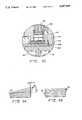
- FIG. 1is an enlarged plan view of a rotor core
- FIG. 2is a perspective view of a FIG. 1 rotor core
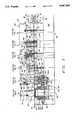
- FIG. 3is a simplified, partially broken away, vertical section of a die assembly for producing the core of FIG. 2;
- FIG. 3Ais a simplified, partially broken away, diagrammatic elevational view of the gauge that is partially shown in FIG. 3;
- FIG. 3Bis a simplified, partially broken away, diagrammatic plan view of the gauge of FIG. 3A;
- FIG. 3Cis an enlarged partial elevational view of the lower end area of a punch pin at Station No. 4 in FIG. 3;
- FIG. 3Dis an enlarged view of the circled area in FIG. 3;
- FIG. 4is a plan view of the strip stock used in the die assembly of FIG. 3 showing the blanking operations performed at each station in the press of FIG. 3 with hatch shading showing the openings blanked at each station to distinguish the openings blanked at previous stations;
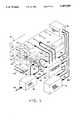
- FIG. 5is a simplified perspective diagrammatic view of the die assembly and control system of this invention.
- FIG. 6Ais an exaggerated enlarged fragmentary elevational view of a conventional core stack
- FIG. 6Bis a view similar to the view of FIG. 6A showing a core stack of this invention.
- FIG. 6Cis a view similar to the view of FIG. 6B showing another core stack of this invention.
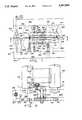
- FIG. 7is a partial, broken elevational view of a second thickness gauge embodiment for use with the press of FIG. 4;
- FIG. 8is a partial view of a section taken at 8-8 of FIG. 7.
- each lamina 22has a plurality of teardrop shaped slot openings 24 spaced about and adjacent its perimeter; a plurality of skew control holes 26 arcuately spaced about a circular arc that is spaced inwardly from the lamina perimeter; a plurality of oblong vent openings 28 arcuately spaced about a circular arc that is spaced further inwardly from the perimeter; and a central shaft hole 30 having central axis 32.
- a counterbore 33is formed in the lower end of core 20.
- Each lamina 22 excepting the bottom lamina in a core 20has arcuate interlock tabs 34 depressed from the lamina lower surface to engage a corresponding tab 34 and hole 26 in the next lower lamina 22 to interlock the two laminas in a manner well known in the art.
- the bottom lamina 22, or first lamina, in the core 20 stackhas the interlock tab 34 areas blanked and removed since, as will become apparent, it is not desired to interlock the bottom lamina 22 to the lamina next below it, which is the top lamina in the preceding core, in order that the cores are separate from one another.
- Each lamina 22is arcuately displaced about axis 32 from the lamina next below it before the two laminas are interlocked in a manner such that slots 38 are formed by openings 24 so that each of the slot 38 axes is provided with a desired skew angle to axis 32 for purposes well known in the art.
- slots 38are filled with a molten electrically conductive metal such as aluminum and are connected at their ends in a manner to provide rotor core conductor bars, as is well known in the art.
- the skew anglemay be left handed or right handed depending on whether the slot 38 axes cross axis 32 from left to right or right to left as one moves downwardly down the slot axes.
- cross feed or cross grainis a direction along a line that is perpendicular to the feed direction or length of strip 40, such as line A-B in FIG. 3B and nonuniform thickness refers to the condition wherein one edge 40A of strip 40 is thicker than the opposite edge 40B in the cross feed direction and is frequently present in available metal strip stock.
- Core 20has an error "d" which is a deviation from a true right cylinder and results from the thicker edges of laminas 22 being vertically superposed one upon another and a parallelism error E p which is the difference in heights of diametrically opposite sides of core 20 and is referred to herein to define the maximum permissible core 20 error that is permissible for a given application.
- E pparallelism error
- the thicker edgesmay be alternated with the thinner edges to provide a true right cylinder, FIG. 6B, and thus correct the error E p .
- the number of reversalsmay be preset and entered by the operator prior to core manufacture or automatically determined by actual measured thickness variations of opposite edges of the strip 40 during manufacture.
- FIGS. 3, 3A, 3B, 3C, and 4a blanking and core forming assembly 42 for the progressive blanking of an elongated stock strip 40 to form laminas 22 and core 20 will be described.
- the blanked or formed portions of strip 40 at each of the following described stationsis shown with a cross hatch shading to distinguish over those portions blanked at previous stations. Briefly, at Station No. 1, holes 26, shaft pilot hole 44 and pilot holes 46 are blanked. At Station No. 2, thirty four slot openings 24 and six vent openings 28 are blanked. At Station No.
- a cluster of punch pinsblank six interlock tab openings 48 for the first, or bottom, lamina 22 only in a core 20 and a counterbore punch blanks a counterbore opening 49 in a specified number of laminas 22 to form counterbore opening 33.
- arcuate interlock tabs 34are lanced from strip 40 and then depressed below the lower strip surface, a tab 34 being adjacent each hole 26 and having its depressed end immediately below the edge of the corresponding hole 26, FIG. 3.
- a lamina 22is blanked from strip 40, and shaft hole 30 is simultaneously blanked, after which lamina 22 is pushed back into the plane of strip 40.
- a lamina 22is pushed through strip 40 and into a choke ring die barrel which is rotated an angular increment to obtain the desired skew angle and direction of the axes of slots 38 and is rotated an additional 180° or half turn to compensate for thickness nonuniformity of strip 40.
- gauge 50has vertically spaced carbide rollers 51, 52 rotatable on precision ball bearings about horizontal, transverse axles 53A, 53B respectively, above and below strip 40, respectively. Rollers 51, 52 contact the upper and lower surfaces respectively of strip 40 at edge 40A adjacent cross-feed line A-B.
- vertically spaced carbide rollers 51A, 52Aare rotatable on precision ball bearings about axles 54, 54A respectively, above and below strip 40, respectively and contact the upper and lower surfaces of strip 40 at edge 40B adjacent line A-B.
- Axles 53, 53Aare affixed to one end of elongated outboard arms 55, 55A respectively, each of which is pivoted intermediately of its length to fixed pivot 55B.
- the opposite ends of arms 55, 55Aare fixed respectively to aluminum target plate 57 and sensor 58.
- a tension spring 59is coupled at its opposite ends to arms 55, 55A respectively to bias arms 55, 55A towards one another, maintaining contact between rollers 51, 52 and their respective surfaces of strip 40.
- Other arm biasing meansmay be used and spring 59 is diagrammatic.
- the lengths of arms 55, 55A between their respective rollers 51, 52 and pivot 55Bare a fraction, e.g.
- axles 54, 54Aare affixed to one end of elongated outboard arms 56, 56A respectively, each of which is pivoted intermediately of its length to fixed pivot 56B. The opposite ends of arms 56, 56A are pivoted respectively to aluminum target plate 57A and sensor 58A, mounted for sliding vertical movement, respectively.
- a tension spring 59Ais coupled at its opposite ends to arms 56, 56A respectively to bias the arms towards one another, maintaining contact between rollers 51A, 52A and their respective surfaces of strip 40.
- Other arm biasing meansmay be used and spring 59A is diagrammatic.
- the lengths of arms 56, 56A between their respective rollers 51A, 52A and pivot 56Bare a fraction, e.g. one third, of their lengths between pivot 56B and target plate 57A, sensor 58A, respectively, in order to magnify the relative movement between rollers 51A, 52A, which is imparted by and a measure of the thickness of strip 40 at edge 40B to increase sensitivity of the measurement.
- Sensor 58Ais of the type that can accurately measure the distance between its lower end and target plate 57A and provides strip 40 thickness measurements at each of edges 40A, 40B and also a thickness differential between edges 40A and 40B.
- Sensors 58, 58Aare commercially available from Kaman Instrumentation, P.O. Box 7463, Colorado Springs, Colo. 80933, their KD-4000 Series.
- Damping rollers 60, 61are placed above and below respectively and in pressure contact with strip 40 before the carbide sensing rollers and damping rollers 62, 63 are placed above and below respectively and in pressure contact with strip 40 after the carbide sensing rollers to damp any vibration of strip 40 so that accurate thickness measurements are facilitated.
- the signals from each sensor 58, 58Aare read and averaged in gauge 50 providing an analog "front” and “back” reading for the front edge 40A and the back edge 40B respectively.
- the two averagesare then averaged in gauge 50 or controller 190, FIG. 5, later described, by an additional averaging unit to provide an average strip 40 thickness.
- Sensors 58, 58Amay be contacting with rollers as shown, non-contacting, and electronic or air. In practice, it is preferable to clean strip 40 prior to gauging in any suitable manner known to the art and to use air jets on strip 40 immediately prior to strip 40 contact by the sensing rollers to insure accurate measurements.
- Gauge 50is superposed and securely mounted on elongated bolster 64 which extends longitudinally the length of assembly 42. Gauge 50 may also be placed elsewhere, e.g. between the strip 40 coil supply and assembly 42 since the thickness variations of strip 40 are sufficiently gradual that the measurement may be taken relatively close to assembly 42 although not immediately before Station No. 1 as shown.
- Elongated die shoe 66is superposed and securely mounted to bolster 64 and extends longitudinally between gauge 50 and the opposite longitudinal end of bolster 64.
- Elongated die retainer 68is superposed and securely attached to die shoe 66 and extends longitudinally the length thereof.
- Elongated punch assembly 69 having elongated upper shoe 70is superposed retainer 68 and is mounted for reciprocal vertical movement and is operated in a press, not shown, for use with assembly 42 and is commercially available, one source being Minster Machine Company, Minster, Ohio 45865, Model P2 series, or equivalent, which includes a feed mechanism for strip 40 and punch press control 72, FIG. 5, later described.
- the pressalso includes a powered ram, not shown, controlled by punch press control 72, to operate shoe 70 downwardly to blank strip 40 at each of Station Nos. 1-6.
- a cluster of elongated vertical punch pinsare mounted in and depend from shoe 70, pin 74 being shown, for blanking openings 26.
- the clusteris secured to shoe 70 by depending set block 76, in a manner known in the art.
- the lower end of each pin in the cluster, and the other depending pins and punches to be described at Station Nos. 2-6, in the raised position of shoe 70are above strip 40 and provide clearance for the progressive longitudinal movement of strip 40 through the stations of assembly 42.
- Pin 74, and the other Station No. 1 cluster pinsare received for longitudinal movement in close fitting openings in spring stripper 78 which depends from shoe 70 and is positioned immediately above strip 40, extends longitudinally of Station Nos. 1 and 2, and is mounted in conventional manner for stripping of strip 40 from pins of the cluster.
- the lower end of pin 74 and the other cluster pinspunch or blank openings 26 in strip 40.
- a pin clusteris mounted in and depends from shoe 70 for blanking vent openings 28, pin 80 being shown, in conventional manner, the pins extending through corresponding close fitting openings in set block assembly 82 which depends from and is secured to shoe 70.
- Assembly 82carries a pin cluster of vertical and depending pins for blanking slot openings 24, pins 84, 86 being shown.
- the vent and slot opening pins, including pins 80, 84, 86,are received for vertical sliding movement in stripper 78 and extend into corresponding close fitting openings in die retainer 68 during the punching stroke of shoe 70.
- depending counterbore punch 88is carried in carriage 90 which is mounted for reciprocal movement in bridge stripper 91.
- Carriage 90is spring urged upwardly by a pair of compression spring 92 which act between carriage 90 and stripper 91 which is supported immediately above strip 40 in conventional manner and extends longitudinally of Station Nos. 4 and 5.
- Solenoid plate 96shown in solid lines in its forward position, is mounted in shoe 70 for reciprocal movement longitudinally of shoe 70 as shown by double headed arrow 98 and is actuated by a solenoid, not shown. The retracted position of solenoid plate 96 is shown by the dashed line 96a.
- Plate 96 in its forward positiondisplaces carriage 90 downwardly relative to shoe 70 against the force of spring 92 and in this position punch 88 will blank out a counterbore opening 49 in strip 40 when shoe 70 is in a punching stroke.
- carriage 90is spring urged upwardly relative shoe 70 and in this position punch 88 will not blank out a counterbore opening 49 in strip 40 on a punching stroke of shoe 70.
- an opening 49can be selectively made in strip 40.
- Carriage 104carries a cluster of elongated vertically depending interlock tab blank punch pins, pin 106 being shown.
- Carriage 104has center bore 108 which slidingly clears punch 88 and carriage 104 is spring urged to an upward position relative shoe 70 by a plurality of compression springs acting between carriage 104 and stripper 91, spring 114 being shown.
- a pair of solenoid arms 110, 112are mounted in housing 94, which securely depends from shoe 70, to move transversely along lines CD, EF (FIG. 4) respectively, which lines are perpendicular to the line of feed of strip 40 and are actuated simultaneously by a solenoid mechanism not shown.
- arms 110, 112When arms 110, 112 are in their extended positions as shown in solid lines, they are between shoe 70 and carriage 104 displacing carriage 104 downwardly against the force of springs 114 in which position pins 106 are caused to blank interlock tab openings 48 from strip 40.
- arms 110, 112When arms 110, 112 are retracted to the dashed line positions 110A, 112A, respectively, they are clear of carriage 104 and it is spring urged upwardly so that when shoe 70 is in a punching stroke, interlock tabs 48 are not blanked from strip 40.
- openings 48can be selectively blanked from strip 40.
- carriage 118carries a cluster of vertically depending elongated pins, pin 120 being shown, for lancing and forming interlock tabs 34.
- the lower end of pin 120, and the other carriage 118 cluster pins,has a bevel 122, FIG. 3C, which imparts a corresponding bevel to each depressed tab 34.
- a spring 132is mounted in die shoe 66 to provide the spring loading for each pin 124.
- the retracted position of plate 128is shown by dashed line 128A.
- Plate 128 in its forward positiondisplaces carriage 118 downwardly relative to shoe 70 against the force of a plurality of compression springs mounted between stripper 91 and the lower surface of carriage 118, spring 126 being shown. In this position each pin 120 will lance and form a tab 34 when shoe 70 is in its punching position.
- tabs 34can be selectively lanced and formed. All laminas 22 except the bottom lamina in core 20 have tabs 34 lanced and formed therein. It is understood that when it is desired to change the direction of the axes of slots 38 from right hand to left hand, a different cluster of pins 106 and 120 will be used to change the direction of tab blank 48 and tabs 34 from counterclockwise to clockwise from their respective holes 26.
- Cylindrical punch 136is securely mounted in depending position from the lower surface of shoe 70 as by bolts, bolt 138 being shown, and is vertically slidably movable in an opening in spring stripper 139 which depends from shoe 70 in conventional manner and is supported immediately above strip 40.
- Stripper 139extends longitudinally of Station Nos. 5 and 6.
- Punch 136has an opening 141 for passing blanked slugs to chute 140 which is supported by flange 143 which is bolted to shoe 70 as by bolts 143A.
- Chute 140is shown 90° out of position in FIG. 3 for illustrative purposes.
- a cylindrical push back ring 142is slidably mounted for vertical movement in an opening in die ring 151 and is upwardly biased by a plurality of compression springs, spring 148 being shown, vertically slidably mounted in cylindrical block 144 which is secured in die shoe 66 by bolts, bolt 146 being shown.
- a plurality of heavy compression springs 145are mounted in bolster 64 and urge spring block 145A, mounted for vertical reciprocal movement in an opening in bolster 64, upwardly in the opening in bolster 64.
- 3Dis mounted for vertical reciprocal movement in an opening in die shoe 66 and is flush with and abuts the upper surface of block 145A and houses the heads of a plurality of bolts, bolt 147 shown.
- Bolts 147extend through respective springs 148 and are in threaded engagement with ring 142 so that ring 142 is spring urged upwardly.
- Flanged die ring 151is set in retainer 68 and limits the upward movement of ring 142.
- Also mounted in block 144is elongated vertical center shaft hole punch 150 which registers with opening 141.
- a lamina 22is blanked from strip 40 and shaft hole 30 is blanked, the blanked slug being carried away through opening 141 and chute 140 as by applying a vacuum or reduced pressure therein.
- Lamina 22is returned to the plane of strip 40 by push back ring 142 after which strip 40 is advanced to carry lamina 22 to Station No. 6.
- cylindrical punch 154is affixed to, and depends from, shoe 70 as by bolts, bolt 156 being shown, and is vertically slidable through an opening in stripper 139.
- Flanged collar 162is mounted in die shoe 66 in a race of tapered bearings 158 for rotation about vertical axis 160 and extends through an opening in die retainer 68.
- a replaceable carbide choke ring 164is press fitted into the upper end of collar 162 and rotates therewith.
- Spiral bevel ring gear 166is affixed to the lower surface of collar 162 as by bolts such as bolt 168 and rotatably drives collar 162 about axis 160.
- Spiral bevel pinion gear 170is in driving engagement with gear 166 and in turn is driven by servomotor 172, FIG. 5.
- Motor 172is geared such that five motor shaft revolutions equal one revolution of ring 164.
- a lamina 22is pushed from strip 40 into choke ring 164 which is dimensioned to receive and hold a stack 21 of laminas 22 in a frictional or interference fit, causing each of tabs 34 of the pushed lamina to engage and interlock with the corresponding tab openings and openings 26 of the top lamina 22 in stack 21 to secure the two laminas together in a given relative rotational position.
- servomotor 172After each downstroke of shoe 70, servomotor 172 turns gear 170 a predetermined rotational distance to impart a rotational movement to collar 162 through ring gear 166.
- the rotational distanceis determined by the skew angle of the axis of slots 38 and on the thickness variations of strip 40, as is explained more fully herein.
- the laminas 22are continually stacked in ring 164 of collar 162, the laminas in collar 162 building the stack 21 until a completed stack 21 forms a rotor core 20. As the top lamina 22 is forcefully inserted onto stack 21, the other laminas are pushed downwardly a distance equal to the thickness of a lamina. When all of the laminas in a stack 21 which forms a core 20 have cleared choke ring 164, the core 20 drops on conveyor belt 176, FIG. 5, which carries the core 20 to another processing area.
- the core 20 heightis determined by the number of laminas 22 in a completed stack 21, which in turn is controlled by the number of laminas formed between two successive bottom laminas which have interlock tab blanks 48 formed therein. As explained, the bottom laminas do not have tabs 34 formed therein and therefore will not interlock with the next lower lamina thus providing separation of successive cores 20.
- Power supply 180has a three phase 60 Hz input on line 182 from a conventional source, not shown. Power supply 180 is available from Kiowa Corporation, 7685 Corporate Way, Eden Prairie, Minn. 55344, Model No. 8360, bus voltage +120 to +160 VDC, continuous current ⁇ 60 amps, peak current ⁇ 100 amps, or equivalent. Supply 180 provides DC power to DC servomotor 172 through line 184 and receives motor 172 shaft rpm speed information from motor shaft coupled tachometer 186 on line 188 and a control signal from programmable controller 190 on line 192.
- Controller 190receives a motor 172 shaft rpm speed signal on line 193 from motor 172 attached to tachometer 186 and motor 172 shaft angular position ⁇ p on line 194 from motor 172 shaft coupled to optical encoder 196.
- Motor 172, tachometer 186, and optical encoder 196are of the type commercially available from PMI Motors Inc., 5 Aerial Way, Syosset, N.Y. 11791, Catalog No. MC24P, or equivalent.
- Encoder 196provides 1000 counts per revolution of motor 172 shaft so that there are 5000 counts from encoder 196 for each revolution of ring 164.
- Controller 190also receives thickness gauge 50 signals from sensors 58, 58A, on line 198, which signals are also supplied to punch press control 72 on line 200.
- Gauge 50may be preset to a minimum thickness and a maximum thickness for each of T 1 and T 2 and when the thickness is outside the minimum-maximum range of either of T 1 and T 2 a fault signal is sent on line 200 to press control 72 to stop the assembly 42 operation.
- Controller 190receives a crank position signal from punch press control 72 on line 201 to provide timing signals t a , t b , described below.
- Crank positiondefines the position of shoe 70 in its punching stroke cycle. It is important that assembly 42 be coordinated so that punching stroke of shoe 70 occurs only after all of the solenoid and rotational adjustments have been made. Also, it is preferable that strip 40 thickness readings by gauge 50 be made between punching strokes of shoe 70 to minimize shock and vibrations during measurement.
- Controller 190provides an enable interlock tab blank 48 signal to the solenoid for punch cluster arms 110, 112 at Station No. 3 on line 202, an an enable counterbore 49 punch signal to the solenoid for plate 96 at Station No. 3 on line 204, a disable interlock lance and form tabs 34 signal to the solenoid for plate 128 at Station No. 4 on line 206, a timing signal to gauge 50 on line 208, and a stop press signal to punch press control 72 on line 210 for stopping operation of die assembly 42, under certain conditions as described herein.
- controller 190Prior to die assembly 42 operation, the press operator inputs the following to controller 190:
- the operatorinputs the desired number of stack reversals per core 20 during stacking that would provide the correction for the parallelism error and therefor it would not be necessary to enter the parallelism error. Also, even if the number of stack reversals are automatically determined, the minimum number of reversals, Q, per core 20, may also be entered.
- controller 190that are automatically input during assembly 42 operation are as follows:
- T 1 minus T 2the differential of thickness of strip 40 at point 40A and the thickness of strip 40 at point 40B;
- t cenable time for outputs on lines 202, 204, or 206, approximately 50 ms each.
- initial thickness readings T 1 , T 2are taken on line 198 during a 10 ms window at time t a when strip 40 is at Station No. 3 for the first lamina in the stack 21 and controller 190 provides an average of thickness readings T 1 , T 2 which is compared to the operator entered input nominal stack height H to determine the approximate number N of laminas per core stack.
- This approximate number Nis used to determine the number of lamina 22 deposited on stack 21 before each reversal when the operator enters inputs for the minimum number of required reversals Q and to determine the incremental rotations required to provide the operator input for skew angle A s .
- four arithmetic running totalsare started.
- Two totalsare based on an average strip 40 thickness reading, and of these two, a first total is not delayed and a second total is delayed by three assembly 42 punch strokes of shoe 70 to reflect accumulated stack 21 height or thickness at Station No. 6.
- a running totalis also started for each of sensors 58, 58A in thickness gauge 50, one sensor at each of strip 40 edges 40A, 40B, and these totals are also delayed by three counts or strokes of assembly 42.
- the enabling of the interlock removal punch cluster at Station No. 3 on line 202occurs only on first or bottom lamina stroke in each core 20 stack.
- the interlock lance and tab 34 form cluster, Station No. 4is disabled by a signal on line 206 only on the assembly 42 stroke when the first lamina, or bottom lamina, is at Station No. 4.
- the enabling of the counterbore 33 punch 88is based on the above mentioned first total (undelayed average lamina thickness running total). Punch 88 is enabled on the first assembly 42 stroke for a new stack 21 and remains enabled until such first arithmetic total is greater than the nominal counterbore depth entered by the operator. Punch 88 is then disabled until the assembly 42 stroke for the next first lamina in a stack 21. Of course, if no counterbore thickness is entered by the operator, then punch 88 will always be disabled.
- the rotation of die ring 164 in Station No. 6is determined by: (1) operator inputs for (a) skew angle A s (b) rotor O.D., (c) stack height H, (d) skew direction, and when entered by the operator, (e) minimum number of stack 21 reversals, (f) parallelism error E p , and (2) Dynamic inputs for (a) accumulated differential between "front" edge 40A and "back" edge 40B thickness accumulations, a reversal or half turn of ring 164 occurring when accumulated thickness differential exceeds a factor of the permissible entered parallelism error E p ; a new differential thickness accumulation starts at each reversal of ring 164, and (b) sequential lamina 22 number "n" in a core 20 stack.
- the sequential number n of laminas 22 in the stack 21is used to determine a die ring 164 reversal when a minimum number of stack reversals Q is entered so that the reversals occur at predetermined intervals in the stack 21 as will be explained and described more fully.
- Controller 190determines core stack 21 reversals as follows:
- T 1Thickness measurement of strip 40 at edge 40A.
- T 2Thickness measurement of strip 40 at edge 40B.
- controller 190In operation of controller 190 to determine the desired ring 164 angular position, ⁇ , before interlocking the next lamina 22 on stack 21, the accumulated rotational increments of ring 164 to obtain the desired skew angle of slots 38 is added to ⁇ or half turn rotation that was determined in the manner immediately preceding.
- ⁇is in counts of encoder 196
- Hcore 20 stack height.
- ⁇counts of encoder 196 relating to state of half revolution of ring 164 as determined above.
- ⁇is compared with ⁇ p , received by controller 190 on line 194, and if there is an error differential, an error signal is provided on line 192 to power supply 180 which provides a correction voltage on line 184 to motor 172 to servo the error differential to zero, advancing or retarding the rotational position of ring 164 through the gearing.
- Controller 190determines the last lamina 22 in a core 20 stack by using binary signals, 0, 1, for L, which is the last lamina logic symbol:
- T N(T 1 +T 2 )/2, T 1 and T 2 being defined as before.
- n s1
- a signal for disabling punch assembly 42is provided on line 210 to control 72 when:
- Programmable controller 190is commercially available from Kiowa Corporation, address as above, and is designated Profiler II Motion Controller (modified) and includes:
- Custom software for programmable controller 190is also commercially available from Kiowa Corporation, address as above, for operation of controller 190 in the manner described above, and from other sources.
- gauge 50Ais shown and which may be mounted relative assembly 42 in the approximate position of gauge 50, FIG. 3, or may be mounted outboard of assembly 42 in a cleaner environment and for easier calibration.
- Lower housing 218has lower base 220 to which is secured horizontally spaced upstanding lower mounting arms, arms 222, 224 being shown, by a plurality of bolts, bolt 230 shown.
- Upper housing 232has upper base 233 to which is secured horizontally spaced depending upper mounting arms, arms 234, 236 being shown, by a plurality of bolts, not shown. Housings 218, 232 are resiliently coupled by a plurality of bolt-spring combinations, combination 242 shown.
- Elongated bolt 244has its head fitted in a shouldered opening in arm 222 and extends vertically upwardly through openings in corresponding lower and upper mounting arms 222, 234, respectively, and extends above base 233 where its threaded end is fastened to nuts 246, 248.
- Compression spring 250is fitted in facing shouldered openings in arms 222, 234, placing arms 222, 234 under a separating spring pressure. Since bolt-spring combinations similar to combination 242 in construction and mounting are placed in similar manner in each pair of corresponding lower and upper mounting arms, the arms in each pair are resiliently urged apart a distance that is adjustable by adjustably positioning nuts 246, 248 of each bolt-spring combination longitudinally on their respective bolts, urging housings 218, 232 resiliently apart.
- each of vertically spaced elongated damping rollers 254, 256each has its opposite axle ends rotatable in trunnioned mountings in respective mounting arms, the mounting of one axle end of roller 254 in arm 222 being shown, FIG. 8.
- each of vertically spaced elongated damping rollers 262, 264has its opposite axle ends rotatable in trunnioned mountings in respective mounting arms, the mounting of one axle end of roller 262 in arm 224 being shown.
- Rollers 254, 256, 262, 264each is preferably of a resilient material and nylon covered. Elongated strip 40 passes between and is dampened by rollers 262, 264 and rollers 254, 256 which are in adjustably resilient contact with strip 40 by adjusting the spacing between housings 218, 232 as previously explained.
- Damping plates 270, 272are positioned above and below strip 40 respectively, plate 270 secured below base 233 by transversely spaced vertical arms, arm 274 being shown, and plate 272 secured above base 220 by transversely spaced vertical arms, arm 278 being shown.
- Each of plates 270, 272has opposite cross feed edges that are tapered, one edge of each plate extending between and spaced from rollers 254, 256 and the opposite edge of each plate extending between and spaced from rollers 262, 264.
- Each of plates 270, 272has a vertical clearance of between 0.005-0.010 inches with its respective strip 40 surface to dampen strip 40 flutter and thus limit the movement and vibration of the thickness gauge rollers next described.
- Gauge 50Ahas vertically spaced carbide rollers 292, 294, similar to rollers 51, 52, FIGS. 3, 3A, rotatable on precision ball bearings about horizontal, transverse axles 296, 298, respectively, above and below strip 40, respectively.
- Rollers 292, 294contact the upper and lower surfaces respectively of strip 40 at edge 40A.
- Axles 296, 298are affixed to one end of roller arms 300, 302, respectively, arms 300, 302 fixed to pivot pins 304, 306 respectively.
- Pins 304, 306are rotatable on precision ball bearings in upstanding post 308 fixedly supported on base 220 between arms 222, 224.
- elongated gauge arms 312, 314Fixed to the outboard ends of pins 304, 306 are elongated gauge arms 312, 314 respectively, arms 312, 314 being replaceable for purposes later described. Opposed ends of arms 312, 314 carry aluminum target plate 316, similar to target plate 57, and sensor 318, similar to sensor 58, respectively.
- Spring loaded pin 320is slidably mounted in upstanding block 322 which is fixedly mounted to base 220 to bias arm 312 in a clockwise direction about pin 304 and spring loaded pin 324 is slidably mounted in block 326, which is supported in fixed relation to block 322, biasing arm 314 in a counterclockwise direction about pivot pin 306 to maintain contact between rollers 292, 294 and their respective surfaces of strip 40.
- Bolts 328, 330fixedly support block 322 to base 220 and have upwardly extending ends that act as rotational stops for arms 314, 312 respectively.
- the distance between axle 296 and pin 304is a fraction, e.g. one third, of the distance between pin 304 and target plate 316 and the distance between axle 298 and pin 306 is a fraction, e.g. one third, of the distance between pin 306 and sensor 318 in order to magnify the movement between rollers 292, 294 which is imparted by and a measure of the thickness of strip 40 at edge 40A and increase sensitivity of the measurement.
- Arms 312, 314may be replaced with arms having a greater distance between pins 304, 306 and plate 316, sensor 318 respectively for greater sensitivity as is understood by those skilled in the art.
- carbide rollers and associated sensor and target plateare mounted on the opposite cross-feed side 40B of strip 40 to measure the strip 40 thickness at edge 40B and operate to provide in conjunction with sensor 318 outputs the thickness measurements as described for sensors 58, 58A.
- the rotations of stack 21could be in increasing steps for successive stack rotations, e.g. 45° for the first rotation, 90° for the second rotation, 135° for the third rotation, and so forth, adding 45° rotation to each successive rotation.
- a parallelism error E pat least one accumulated reversal of stack 21 would be made.
- the thickness measurements T 1 , T 2may be made at other points in the manufacturing process as long as they are timely made for determination of the reversals of stack 21 during stacking of the laminas and can be made of the lamina itself after being blanked from strip 40.
- this inventioncan be used to advantage in the manufacture of other laminated parts than those described herein.
- other of the above described parametersmay be varied to suit a particular set of conditions for use of this invention.
Landscapes
- Engineering & Computer Science (AREA)
- Manufacturing & Machinery (AREA)
- Power Engineering (AREA)
- Mechanical Engineering (AREA)
- Manufacture Of Motors, Generators (AREA)
Abstract
Description
This is a continuation of copending application Ser. No. 853,207, filed Apr. 17, 1986 and now U.S. Pat. No. 4,738,020 granted Apr. 19, 1988 which in turn is divisional application of my copending application Ser. No. 06/478,692, filed Mar. 25, 1983 now U.S. Pat. No. 4,619,028 and entitled "APPARATUS FOR MANUFACTURE OF LAMINATED PARTS."
1. Field of the Invention
This invention is in the field of laminated parts and their manufacture and more particularly electric motor or generator rotors and stators having stacked laminas and their manufacture.
2. Brief Statement of the Prior Art
Rotor and stator manufacture employing stacked laminas is well known in the art. Typically, the laminas are blanked from continuous strip stock and then stacked and bound together to form the rotor or stator. However, due to manufacturing tolerance thickness variations of the strip stock the rotor or stator could have a parallelism error, i.e. be out of conformance from a true right cylinder, thereby limiting close tolerance assembly of a rotor and a stator and operation thereof. This parallelism error occurs because in stacking the laminas the thicker portions of the laminas are directly overlying resulting in one side of the stack being higher than the opposite stack side causing a leaning or bending of the stack.
Also, in laminated rotor or stator manufacture a plurality of conductor slots are formed around the periphery of the rotor or stator stack in arcuately spaced relation to one another. If it is desired to skew the slot axes relative to the stack axis, it is common practice to index each lamina an arcuate increment relative to the next preceding lamina so that in a stack the axis of each slot is skewed or slanted relative to the stack axis. The amount of indexing has been achieved by manually operated clamps after the stack has been formed and by a manually adjustable stop which controls the degree of arcuate travel in each rotational increment. Other prior art systems are evidenced by the statements made and documents cited in the prosecution of this application. Due to the inexactness of the above described manual adjustments, skew inaccuracies and/or excessive adjustment time resulted. Other prior art systems are evidenced by the statements made and documents cited in the prosecution of the aforementioned U.S. Patent and copending application from which this application is a continuation.
In a laminating press, laminas are blanked from elongated strip stock for electric motor parts such as rotors or stators. The laminas are stacked or overlaid to form a lamina stack. One or more stack reversals, i.e. half turn rotations about the stack axis, are performed just prior to stacking the next lamina. The number of reversals in each stack may be selected and entered by the operator prior to press operation based on known or experienced thickness variations in the strip stock. The method of this invention will then automatically provide the entered number of stack reversals at determined vertically spaced places in the stack height. Alternatively, the particular reversals may be automatically selected by measuring the cross-feed or cross-grain differential thickness of the strip stock. Cross-feed differential thickness is defined as the thickness differential between at least two points along a transverse line substantially perpendicular to the longitudinal feed direction of the strip stock. When the cross-feed thickness differential at a longitudinal portion on the strip stock is excessive, as determined from certain later explained parameters, a number of compensating stack reversals are automatically determined. In this manner, compensation is provided for nonuniform strip stock thickness.
To accurately obtain a predetermined skew angle of conductor slots in the rotor lamina stack, the operator enters the stack height, the desired skew angle, skew direction and nominal lamina thickness. The skew direction is + (plus) or - (minus) depending whether the skew angle is clockwise or counterclockwise from the stack axis, respectively. The nominal lamina thickness is the average thickness of the strip stock. This invention provides for accurately indexing each lamina an arcuate increment relative the next previous lamina prior to stacking to accurately obtain the desired skew angle.
The above mentioned half turn and indexing are achieved by a servomotor gear drive of a choke die which holds the stacked laminas. The instantaneous or actual rotational position of the die is compared with the desired rotational position of the die as determined by this invention. An error signal corresponding to the differential of the actual and desired rotational positions is used to drive the servomotor to achieve the desired rotational position of the die prior to stacking the next lamina.
It therefore is an object of this invention to provide a system for compensating for nonuniform thickness of strip stock from which stacked lamina electric motor or generator parts are fabricated.
It is an object of this invention to provide in the system of the previous object stack reversals about the stack axis, the number of reversals being operator entered prior to the stacking or automatically determined in response to measured cross-feed thickness of the strip stock.
It is a further object of this invention to index each lamina in a laminated stack electric motor or generator part having skewed conductor slots in response to operator entered inputs of stack height, a skew angle and nominal lamina thickness to accurately obtain a desired conductor slot skew angle.
Another object is to provide laminated parts manufactured according to the aforestated objects.
The above mentioned and other features and objects of this invention and the manner of obtaining them will become more apparent and the invention itself will be best understood by reference to the following description of an embodiment of the invention taken in conjunction with the accompanying drawings, described as follows.
FIG. 1 is an enlarged plan view of a rotor core;
FIG. 2 is a perspective view of a FIG. 1 rotor core;
FIG. 3 is a simplified, partially broken away, vertical section of a die assembly for producing the core of FIG. 2;
FIG. 3A is a simplified, partially broken away, diagrammatic elevational view of the gauge that is partially shown in FIG. 3;
FIG. 3B is a simplified, partially broken away, diagrammatic plan view of the gauge of FIG. 3A;
FIG. 3C is an enlarged partial elevational view of the lower end area of a punch pin at Station No. 4 in FIG. 3;
FIG. 3D is an enlarged view of the circled area in FIG. 3;
FIG. 4 is a plan view of the strip stock used in the die assembly of FIG. 3 showing the blanking operations performed at each station in the press of FIG. 3 with hatch shading showing the openings blanked at each station to distinguish the openings blanked at previous stations;
FIG. 5 is a simplified perspective diagrammatic view of the die assembly and control system of this invention;
FIG. 6A is an exaggerated enlarged fragmentary elevational view of a conventional core stack;
FIG. 6B is a view similar to the view of FIG. 6A showing a core stack of this invention;
FIG. 6C is a view similar to the view of FIG. 6B showing another core stack of this invention;
FIG. 7 is a partial, broken elevational view of a second thickness gauge embodiment for use with the press of FIG. 4; and
FIG. 8 is a partial view of a section taken at 8-8 of FIG. 7.
Referring to FIGS. 1 and 2 alaminated rotor core 20 formed of a plurality oflaminas 22 is shown. Eachlamina 22 has a plurality of teardrop shapedslot openings 24 spaced about and adjacent its perimeter; a plurality ofskew control holes 26 arcuately spaced about a circular arc that is spaced inwardly from the lamina perimeter; a plurality ofoblong vent openings 28 arcuately spaced about a circular arc that is spaced further inwardly from the perimeter; and acentral shaft hole 30 havingcentral axis 32. Acounterbore 33 is formed in the lower end ofcore 20. Eachlamina 22 excepting the bottom lamina in acore 20 hasarcuate interlock tabs 34 depressed from the lamina lower surface to engage acorresponding tab 34 andhole 26 in the nextlower lamina 22 to interlock the two laminas in a manner well known in the art. Thebottom lamina 22, or first lamina, in the core 20 stack has theinterlock tab 34 areas blanked and removed since, as will become apparent, it is not desired to interlock thebottom lamina 22 to the lamina next below it, which is the top lamina in the preceding core, in order that the cores are separate from one another.
Eachlamina 22 is arcuately displaced aboutaxis 32 from the lamina next below it before the two laminas are interlocked in a manner such thatslots 38 are formed byopenings 24 so that each of theslot 38 axes is provided with a desired skew angle toaxis 32 for purposes well known in the art. Typically,slots 38 are filled with a molten electrically conductive metal such as aluminum and are connected at their ends in a manner to provide rotor core conductor bars, as is well known in the art. The skew angle may be left handed or right handed depending on whether theslot 38 axes crossaxis 32 from left to right or right to left as one moves downwardly down the slot axes.
Referring to FIGS. 6A and 6B an important function performed by this invention will be described. When laminas 22 are blanked from astrip 40, FIG. 4, that has nonuniform thickness in the cross feed or cross grain direction, acore 20, FIG. 6A, could result. As used herein, cross feed or cross grain is a direction along a line that is perpendicular to the feed direction or length ofstrip 40, such as line A-B in FIG. 3B and nonuniform thickness refers to the condition wherein oneedge 40A ofstrip 40 is thicker than theopposite edge 40B in the cross feed direction and is frequently present in available metal strip stock.Core 20 has an error "d" which is a deviation from a true right cylinder and results from the thicker edges oflaminas 22 being vertically superposed one upon another and a parallelism error Ep which is the difference in heights of diametrically opposite sides ofcore 20 and is referred to herein to define the maximumpermissible core 20 error that is permissible for a given application. By providing a selected number of stack rotations, or reversals, of 180°, each reversal prior to interlocking the next lamina on the stack, the thicker edges may be alternated with the thinner edges to provide a true right cylinder, FIG. 6B, and thus correct the error Ep. In practice, it is often necessary to half turn or reverse only once, FIG. 6C, in anentire core 20 to provide a core stack with an acceptable parallelism error. In this invention the number of reversals may be preset and entered by the operator prior to core manufacture or automatically determined by actual measured thickness variations of opposite edges of thestrip 40 during manufacture.
Referring now to FIGS. 3, 3A, 3B, 3C, and 4, a blanking andcore forming assembly 42 for the progressive blanking of anelongated stock strip 40 to form laminas 22 andcore 20 will be described. The blanked or formed portions ofstrip 40 at each of the following described stations is shown with a cross hatch shading to distinguish over those portions blanked at previous stations. Briefly, at Station No. 1, holes 26,shaft pilot hole 44 andpilot holes 46 are blanked. At Station No. 2, thirty fourslot openings 24 and sixvent openings 28 are blanked. At Station No. 3, a cluster of punch pins blank sixinterlock tab openings 48 for the first, or bottom,lamina 22 only in acore 20 and a counterbore punch blanks a counterbore opening 49 in a specified number oflaminas 22 to formcounterbore opening 33. At Station No. 4arcuate interlock tabs 34 are lanced fromstrip 40 and then depressed below the lower strip surface, atab 34 being adjacent eachhole 26 and having its depressed end immediately below the edge of the correspondinghole 26, FIG. 3. At Station No. 5 alamina 22 is blanked fromstrip 40, andshaft hole 30 is simultaneously blanked, after which lamina 22 is pushed back into the plane ofstrip 40. At Station No. 6, alamina 22 is pushed throughstrip 40 and into a choke ring die barrel which is rotated an angular increment to obtain the desired skew angle and direction of the axes ofslots 38 and is rotated an additional 180° or half turn to compensate for thickness nonuniformity ofstrip 40.
Dampingrollers strip 40 before the carbide sensing rollers and dampingrollers strip 40 after the carbide sensing rollers to damp any vibration ofstrip 40 so that accurate thickness measurements are facilitated. The signals from eachsensor gauge 50 providing an analog "front" and "back" reading for thefront edge 40A and theback edge 40B respectively. The two averages are then averaged ingauge 50 orcontroller 190, FIG. 5, later described, by an additional averaging unit to provide anaverage strip 40 thickness.Sensors strip 40 prior to gauging in any suitable manner known to the art and to use air jets onstrip 40 immediately prior to strip 40 contact by the sensing rollers to insure accurate measurements.
At Station No. 1, a cluster of elongated vertical punch pins are mounted in and depend fromshoe 70,pin 74 being shown, for blankingopenings 26. The cluster is secured toshoe 70 by depending setblock 76, in a manner known in the art. The lower end of each pin in the cluster, and the other depending pins and punches to be described at Station Nos. 2-6, in the raised position ofshoe 70 are abovestrip 40 and provide clearance for the progressive longitudinal movement ofstrip 40 through the stations ofassembly 42.Pin 74, and the other Station No. 1 cluster pins, are received for longitudinal movement in close fitting openings inspring stripper 78 which depends fromshoe 70 and is positioned immediately abovestrip 40, extends longitudinally of Station Nos. 1 and 2, and is mounted in conventional manner for stripping ofstrip 40 from pins of the cluster. In the punching stroke ofshoe 70 the lower end ofpin 74 and the other cluster pins punch orblank openings 26 instrip 40.
At Station No. 2, a pin cluster is mounted in and depends fromshoe 70 for blankingvent openings 28,pin 80 being shown, in conventional manner, the pins extending through corresponding close fitting openings inset block assembly 82 which depends from and is secured toshoe 70.Assembly 82 carries a pin cluster of vertical and depending pins for blankingslot openings 24, pins 84, 86 being shown. The vent and slot opening pins, includingpins stripper 78 and extend into corresponding close fitting openings indie retainer 68 during the punching stroke ofshoe 70.
At Station No. 3, dependingcounterbore punch 88 is carried incarriage 90 which is mounted for reciprocal movement inbridge stripper 91.Carriage 90 is spring urged upwardly by a pair ofcompression spring 92 which act betweencarriage 90 andstripper 91 which is supported immediately abovestrip 40 in conventional manner and extends longitudinally of Station Nos. 4 and 5.Solenoid plate 96, shown in solid lines in its forward position, is mounted inshoe 70 for reciprocal movement longitudinally ofshoe 70 as shown by double headedarrow 98 and is actuated by a solenoid, not shown. The retracted position ofsolenoid plate 96 is shown by the dashed line 96a.Plate 96 in its forward position displacescarriage 90 downwardly relative toshoe 70 against the force ofspring 92 and in this position punch 88 will blank out a counterbore opening 49 instrip 40 whenshoe 70 is in a punching stroke. Whenplate 96 is in position 96a,carriage 90 is spring urged upwardlyrelative shoe 70 and in this position punch 88 will not blank out a counterbore opening 49 instrip 40 on a punching stroke ofshoe 70. Thus, by controlling the position ofplate 96, an opening 49 can be selectively made instrip 40.
At Station No. 4,carriage 118 carries a cluster of vertically depending elongated pins, pin 120 being shown, for lancing and forminginterlock tabs 34. The lower end ofpin 120, and theother carriage 118 cluster pins, has abevel 122, FIG. 3C, which imparts a corresponding bevel to eachdepressed tab 34. Mounted for reciprocal sliding movement in openings indie shoe 66 and dieretainer 68 beneath eachcarriage 118 cluster pin, such aspin 120, is an elongated vertical upwardly spring loaded supportingpin 124 against whichtab 34 is formed to limit its depressed distance to one lamina thickness and prevent tab inclination. Aspring 132 is mounted indie shoe 66 to provide the spring loading for eachpin 124.Solenoid plate 128, shown in solid lines in its forward position, is mounted just beneathshoe 70 for reciprocal movement longitudinally ofshoe 70 as shown by double headedarrow 130 and is actuated by a solenoid, not shown. The retracted position ofplate 128 is shown by dashedline 128A.Plate 128 in its forward position displacescarriage 118 downwardly relative toshoe 70 against the force of a plurality of compression springs mounted betweenstripper 91 and the lower surface ofcarriage 118,spring 126 being shown. In this position eachpin 120 will lance and form atab 34 whenshoe 70 is in its punching position. Whenplate 128 is inposition 128A,carriage 118 moves upwardly under the force ofspring 126 and the other springs not shown and pins 120 will not lance and form atab 34 on a punching stroke ofshoe 70. Thus by controlling the position ofplate 128,tabs 34 can be selectively lanced and formed. Alllaminas 22 except the bottom lamina incore 20 havetabs 34 lanced and formed therein. It is understood that when it is desired to change the direction of the axes ofslots 38 from right hand to left hand, a different cluster ofpins tabs 34 from counterclockwise to clockwise from theirrespective holes 26.
At Station No. 5, laminas 22 are punched fromstrip 40 and shaft holes 30 are simultaneously blanked and the slugs removed thoughchute 140, after which thelaminas 22 are returned to the plane ofstrip 40.Cylindrical punch 136 is securely mounted in depending position from the lower surface ofshoe 70 as by bolts, bolt 138 being shown, and is vertically slidably movable in an opening inspring stripper 139 which depends fromshoe 70 in conventional manner and is supported immediately abovestrip 40.Stripper 139 extends longitudinally of Station Nos. 5 and 6.Punch 136 has anopening 141 for passing blanked slugs tochute 140 which is supported byflange 143 which is bolted toshoe 70 as by bolts 143A.Chute 140 is shown 90° out of position in FIG. 3 for illustrative purposes. A cylindrical push backring 142 is slidably mounted for vertical movement in an opening indie ring 151 and is upwardly biased by a plurality of compression springs,spring 148 being shown, vertically slidably mounted incylindrical block 144 which is secured indie shoe 66 by bolts, bolt 146 being shown. A plurality of heavy compression springs 145 are mounted in bolster 64 andurge spring block 145A, mounted for vertical reciprocal movement in an opening in bolster 64, upwardly in the opening in bolster 64.Plate assembly 145B, FIG. 3D, is mounted for vertical reciprocal movement in an opening indie shoe 66 and is flush with and abuts the upper surface ofblock 145A and houses the heads of a plurality of bolts, bolt 147 shown.Bolts 147 extend throughrespective springs 148 and are in threaded engagement withring 142 so thatring 142 is spring urged upwardly. Flanged diering 151 is set inretainer 68 and limits the upward movement ofring 142. Also mounted inblock 144 is elongated vertical centershaft hole punch 150 which registers withopening 141. Asshoe 70 descends in a punching stroke, alamina 22 is blanked fromstrip 40 andshaft hole 30 is blanked, the blanked slug being carried away throughopening 141 andchute 140 as by applying a vacuum or reduced pressure therein.Lamina 22 is returned to the plane ofstrip 40 by push backring 142 after which strip 40 is advanced to carrylamina 22 to Station No. 6.
At Station No. 6,cylindrical punch 154 is affixed to, and depends from,shoe 70 as by bolts, bolt 156 being shown, and is vertically slidable through an opening instripper 139.Flanged collar 162 is mounted indie shoe 66 in a race oftapered bearings 158 for rotation aboutvertical axis 160 and extends through an opening indie retainer 68. A replaceablecarbide choke ring 164 is press fitted into the upper end ofcollar 162 and rotates therewith. Spiralbevel ring gear 166 is affixed to the lower surface ofcollar 162 as by bolts such asbolt 168 and rotatably drivescollar 162 aboutaxis 160. Spiralbevel pinion gear 170 is in driving engagement withgear 166 and in turn is driven byservomotor 172, FIG. 5.Motor 172 is geared such that five motor shaft revolutions equal one revolution ofring 164. On each punching stroke ofshoe 70, alamina 22 is pushed fromstrip 40 intochoke ring 164 which is dimensioned to receive and hold astack 21 oflaminas 22 in a frictional or interference fit, causing each oftabs 34 of the pushed lamina to engage and interlock with the corresponding tab openings andopenings 26 of thetop lamina 22 instack 21 to secure the two laminas together in a given relative rotational position. After each downstroke ofshoe 70,servomotor 172 turns gear 170 a predetermined rotational distance to impart a rotational movement tocollar 162 throughring gear 166. The rotational distance is determined by the skew angle of the axis ofslots 38 and on the thickness variations ofstrip 40, as is explained more fully herein.
Thelaminas 22 are continually stacked inring 164 ofcollar 162, the laminas incollar 162 building thestack 21 until a completedstack 21 forms arotor core 20. As thetop lamina 22 is forcefully inserted ontostack 21, the other laminas are pushed downwardly a distance equal to the thickness of a lamina. When all of the laminas in astack 21 which forms a core 20 have clearedchoke ring 164, the core 20 drops onconveyor belt 176, FIG. 5, which carries the core 20 to another processing area. The core 20 height is determined by the number oflaminas 22 in a completedstack 21, which in turn is controlled by the number of laminas formed between two successive bottom laminas which haveinterlock tab blanks 48 formed therein. As explained, the bottom laminas do not havetabs 34 formed therein and therefore will not interlock with the next lower lamina thus providing separation ofsuccessive cores 20.
Referring not to FIG. 5,thickness gauge 50, bolster 64, dieshoe 66, andshoe 70 are shown diagrammatically,shoe 70 being only partially shown.Power supply 180 has a threephase 60 Hz input online 182 from a conventional source, not shown.Power supply 180 is available from Kiowa Corporation, 7685 Corporate Way, Eden Prairie, Minn. 55344, Model No. 8360, bus voltage +120 to +160 VDC, continuous current ±60 amps, peak current ±100 amps, or equivalent.Supply 180 provides DC power toDC servomotor 172 throughline 184 and receivesmotor 172 shaft rpm speed information from motor shaft coupledtachometer 186 online 188 and a control signal fromprogrammable controller 190 online 192.Controller 190 receives amotor 172 shaft rpm speed signal online 193 frommotor 172 attached totachometer 186 andmotor 172 shaft angular position φp online 194 frommotor 172 shaft coupled tooptical encoder 196.Motor 172,tachometer 186, andoptical encoder 196 are of the type commercially available from PMI Motors Inc., 5 Aerial Way, Syosset, N.Y. 11791, Catalog No. MC24P, or equivalent.Encoder 196 provides 1000 counts per revolution ofmotor 172 shaft so that there are 5000 counts fromencoder 196 for each revolution ofring 164.
Prior to dieassembly 42 operation, the press operator inputs the following to controller 190:
H, Stack height ofcore 20;
As, Skew angle of axes ofslots 38relative axis 32;
Skew direction (+=Clockwise, -=Counterclockwise) ofslots 38;
TN,Nominal lamina 22 thickness;
EP, Permissible parallelism error incore 20 stack;
Q, minimum number ofstack 21 reversals (0, 1, 3, 5).
Note: If the number oflaminas 22 that are to be reversed is preset, i.e. not to be automatically determined by the thickness variations sensed bygauge 50, then the operator inputs the desired number of stack reversals percore 20 during stacking that would provide the correction for the parallelism error and therefor it would not be necessary to enter the parallelism error. Also, even if the number of stack reversals are automatically determined, the minimum number of reversals, Q, percore 20, may also be entered.
The dynamic inputs tocontroller 190 that are automatically input duringassembly 42 operation are as follows:
φp, the actual angular position ofmotor 172 shaft;
T1, the thickness ofstrip 40 atpoint 40A;
T2, the thickness ofstrip 40 atpoint 40B;
T1 minus T2, the differential of thickness ofstrip 40 atpoint 40A and the thickness ofstrip 40 atpoint 40B;
ta, enable time for reading T1 and T2 online 198, approximately 10 (milliseconds),
tb, enable time forservomotor 172 drive, approximately 100 ms;
tc, enable time for outputs onlines
In the operation ofcontroller 190, initial thickness readings T1, T2 are taken online 198 during a 10 ms window at time ta whenstrip 40 is at Station No. 3 for the first lamina in thestack 21 andcontroller 190 provides an average of thickness readings T1, T2 which is compared to the operator entered input nominal stack height H to determine the approximate number N of laminas per core stack. This approximate number N is used to determine the number oflamina 22 deposited onstack 21 before each reversal when the operator enters inputs for the minimum number of required reversals Q and to determine the incremental rotations required to provide the operator input for skew angle As. In addition, four arithmetic running totals are started. Two totals are based on anaverage strip 40 thickness reading, and of these two, a first total is not delayed and a second total is delayed by threeassembly 42 punch strokes ofshoe 70 to reflect accumulatedstack 21 height or thickness at Station No. 6. A running total is also started for each ofsensors thickness gauge 50, one sensor at each ofstrip 40edges assembly 42.
The enabling of the interlock removal punch cluster at Station No. 3 online 202 occurs only on first or bottom lamina stroke in each core 20 stack. The interlock lance andtab 34 form cluster, Station No. 4, is disabled by a signal online 206 only on theassembly 42 stroke when the first lamina, or bottom lamina, is at Station No. 4. The enabling of thecounterbore 33punch 88 is based on the above mentioned first total (undelayed average lamina thickness running total).Punch 88 is enabled on thefirst assembly 42 stroke for anew stack 21 and remains enabled until such first arithmetic total is greater than the nominal counterbore depth entered by the operator.Punch 88 is then disabled until theassembly 42 stroke for the next first lamina in astack 21. Of course, if no counterbore thickness is entered by the operator, then punch 88 will always be disabled.
The rotation ofdie ring 164 in Station No. 6 is determined by: (1) operator inputs for (a) skew angle As (b) rotor O.D., (c) stack height H, (d) skew direction, and when entered by the operator, (e) minimum number ofstack 21 reversals, (f) parallelism error Ep, and (2) Dynamic inputs for (a) accumulated differential between "front"edge 40A and "back"edge 40B thickness accumulations, a reversal or half turn ofring 164 occurring when accumulated thickness differential exceeds a factor of the permissible entered parallelism error Ep ; a new differential thickness accumulation starts at each reversal ofring 164, and (b)sequential lamina 22 number "n" in a core 20 stack. The sequential number n oflaminas 22 in thestack 21 is used to determine adie ring 164 reversal when a minimum number of stack reversals Q is entered so that the reversals occur at predetermined intervals in thestack 21 as will be explained and described more fully.
When the operator enters a number ofstack 21 reversals (Q):
______________________________________ CONDITION θ ______________________________________ n < (N/2Q - 1/2) 0 (N/2Q - 1/2) < n < (N/2Q + 1/2) 2500 (N/2Q + 1/2) < n < (1.5N/2Q - 1/2) 0 (1.5N/2Q - 1/2) < n < (1.5N/2Q + 1/2) 2500 (1.5N/2Q + 1/2) < n < (2.5N/2Q - 1/2) 0 (2.5N/2Q - 1/2) < n < (2.5N/2Q + 1/2) 2500 (2.5N/2Q + 1/2) < n < (3.5N/2Q - 1/2) 0 (3.5N/2Q - 1/2) < n < (3.5N/2Q + 1/2) 2500 (3.5N/2Q + 1/2) < n < (4.5N/2Q - 1/2) 0 (4.5N/2Q - 1/2) < n < (4.5N/2Q + 1/2) 2500 (4.5N/2Q + 1/2) < n 0 ______________________________________
where:
θ=counts of encoder 196 (Motor 172 is geared so that five shaft revolutions=one revolution ofring 164 andencoder 196 counts 1000 counts per shaft revolution so that there are 5000 counts ofencoder 196 for each revolution of ring 164); N=H/TN =nominal total number of laminas in a core 20 stack; Q=number of operator enteredminimum stack 21 reversals;
n=the particular lamina number in a core 20 stack where n=1 for the first lamina and n=N for the last lamina.
When operation is automatic (no operator entered Q):
______________________________________ CONDITION θ ______________________________________ >T.sub.1 - >T.sub.2 > ± E.sub.p /2 2500 >T.sub.1 - >T.sub.2 < ± E.sub.p /2 0 ______________________________________
where:
T1 =Thickness measurement ofstrip 40 atedge 40A.
T2 =Thickness measurement ofstrip 40 atedge 40B.
Ep =Operator entered parallelism error.
In operation ofcontroller 190 to determine the desiredring 164 angular position, φ, before interlocking thenext lamina 22 onstack 21, the accumulated rotational increments ofring 164 to obtain the desired skew angle ofslots 38 is added to θ or half turn rotation that was determined in the manner immediately preceding. Thus,
φ=5000 B.sub.S (S/H)+θ
where:
φ is in counts ofencoder 196;
BS is a skew factor determined bycontroller 190 from the operator entered skew angle As and is equal to the peripheral inches of skew between the top and bottom of asingle slot 38 in a core 20/ (core 20 O.D.X pi); also, BS =skew angle of aslot 38 axis/ 360°;
S=accumulated height ofstack 21 incollar 162.
H=core 20 stack height.
θ=counts ofencoder 196 relating to state of half revolution ofring 164 as determined above.
φ is compared with φp, received bycontroller 190 online 194, and if there is an error differential, an error signal is provided online 192 topower supply 180 which provides a correction voltage online 184 tomotor 172 to servo the error differential to zero, advancing or retarding the rotational position ofring 164 through the gearing.
L=0 when S<H-TN /2
L=1 when S>H-TN /2
S, H, and TN are defined as before. If TN is not entered by the operator, thencontroller 190 uses TN =(T1 +T2)/2, T1 and T2 being defined as before.
When L=1,controller 190 resets S, N, and ns, S and N being defined as before and ns =short count, a count that is made bycontroller 190 for timing signal tc and is equal to n, defined as before. ns is disabled when ns >2. When ns =1, an enable signal for punch cluster to removeblanks 48 is provided online 202 to the solenoid forarms 110, 112 for approximately 60 ms and when ns =2, a disable signal for punch cluster to lance andform tabs 34 is provided to the solenoid forplate 128 for approximately 60 ms.
When (Cd -S)>TN /2, an enable signal forcounterbore punch 88 is provided online 204 to the solenoid for positioningplate 96. CD is the enteredcounterbore 33 depth and S and TN are defined as before.
A signal for disablingpunch assembly 42 is provided online 210 to control 72 when:
N/2Q<16
N and Q being defined as before.
Also, when either T1 or T2 is outside a preset minimum-maximum range a fault signal online 200 is sent to punchpress control 72,assembly 42 is stopped sincestrip 40 is too far out of thickness variation tolerance to be used.
(1) No. MIC 8201 Motor control module.
(1) No. MIC 8210 Digital positioning module.
(1) No. MIC 8100 Digital I/O module.
(1) No. MIC 2124 Optically isolated I/O card with 24 I/O modules and DC power supply.
(1) No. MIC 8408 Analog input module.
(1) No. MIC 2832 Alphanumeric display.
(3) No. TW-8 Thumbwheel programmers.
(1) No. REM-2 Remote programming panel.
(1) EXP-2 Dual Port I/O expansion module.
Custom software forprogrammable controller 190 is also commercially available from Kiowa Corporation, address as above, for operation ofcontroller 190 in the manner described above, and from other sources.
Referring to FIGS. 7 and 8,gauge 50A is shown and which may be mountedrelative assembly 42 in the approximate position ofgauge 50, FIG. 3, or may be mounted outboard ofassembly 42 in a cleaner environment and for easier calibration.Lower housing 218 haslower base 220 to which is secured horizontally spaced upstanding lower mounting arms,arms Upper housing 232 hasupper base 233 to which is secured horizontally spaced depending upper mounting arms,arms Housings combination 242 shown.Elongated bolt 244 has its head fitted in a shouldered opening inarm 222 and extends vertically upwardly through openings in corresponding lower and upper mountingarms base 233 where its threaded end is fastened tonuts Compression spring 250 is fitted in facing shouldered openings inarms arms combination 242 in construction and mounting are placed in similar manner in each pair of corresponding lower and upper mounting arms, the arms in each pair are resiliently urged apart a distance that is adjustable by adjustably positioningnuts housings
Vertically spaced elongated dampingrollers roller 254 inarm 222 being shown, FIG. 8. In like manner, each of vertically spaced elongated dampingrollers roller 262 inarm 224 being shown.Rollers Elongated strip 40 passes between and is dampened byrollers rollers strip 40 by adjusting the spacing betweenhousings
Dampingplates strip 40 respectively,plate 270 secured belowbase 233 by transversely spaced vertical arms,arm 274 being shown, andplate 272 secured abovebase 220 by transversely spaced vertical arms,arm 278 being shown. Each ofplates rollers rollers plates respective strip 40 surface to dampenstrip 40 flutter and thus limit the movement and vibration of the thickness gauge rollers next described.
Modifications of this invention will be apparent to those skilled in the art. Ifsupply strip 40 has a certain differential cross feed thickness and experience shows that this differential exists over substantially the entire strip from a given supply coil, then only one or a relatively small number of thickness differentials need be read atgauge 50 andcontroller 190 can be set to determine the number Q ofstack 21 reversals percore 20 fabricated from that coil. Q, theminimum stack 21 reversals percore 20 may be entered concurrently with selection of the automatic reversal determination mode of this invention to insure a minimum number of stack reversals percore 20. Also, rotations ofstack 21 other than 180° may be made to accomplish the objectives of this invention, e.g. rotations of 90° to 270° could be used. The rotations ofstack 21 could be in increasing steps for successive stack rotations, e.g. 45° for the first rotation, 90° for the second rotation, 135° for the third rotation, and so forth, adding 45° rotation to each successive rotation. To correct for a parallelism error Ep, at least one accumulated reversal ofstack 21 would be made. The thickness measurements T1, T2 may be made at other points in the manufacturing process as long as they are timely made for determination of the reversals ofstack 21 during stacking of the laminas and can be made of the lamina itself after being blanked fromstrip 40. Further, this invention can be used to advantage in the manufacture of other laminated parts than those described herein. In like manner, other of the above described parameters may be varied to suit a particular set of conditions for use of this invention.
While there have been described above the principles of this invention in connection with specific embodiments, it is to be understood that this is by way of example and is not limiting of the scope of this invention.
Claims (2)
1. A rotor or stator made according to the method of stamping electric motor stator or rotor laminas from sheet stock material, provided from a supply, to form a stack of laminas each having a planar surface, the method comprising:
a first step of guiding sheet stock material from the supply;
a second step of stamping laminas in predetermined planar configurations each having an axis substantially perpendicular to the lamina plane and each having conductor slot openings arcuately spaced about said axis;
a third step of coaxially stacking said laminas so that the lamina axes are coaxial to form a stack having a stack axis substantially coaxial with said lamina axes, said stack axis being substantially perpendicular to the plane of each of said laminas;
a fourth step of providing incremental indexing of each of said laminas relative said stack rotationally about said stack axis a predetermined degree of rotational arc prior to stacking of said each lamina so that said openings form conductor slots having a slot axis skewed to said stack axis by a skew angle corresponding to said degree of rotational arc;
a fifth step of adjustably presetting the degree of said rotational arc to automatically obtain a desired skew angle;
a sixth step of utilizing certain ones of the parameters including relative skew between said slot axes and said stack axis, stack height, the predetermined degree of rotational arc through which prior lamina were incrementally indexed, and lamina thickness to determine said predetermined degree of rotational arc for automatically arcuately indexing each lamina to obtain said desired skew angle;
a seventh step of rotating at least one of said laminas relative to said stack about a stack axis that is substantially perpendicular to the planar surface of said laminas in a rotational arc that is in addition to and substantially greater than said fourth step indexing rotational arc; said fourth and seventh steps, in addition to providing incremental indexing of each of said laminas relative to said stack rotationally about said stack axis, rotating said at least one lamina relative to said stack to compensate for lamina thickness variations.
2. A rotor or stator according to claim 1 wherein the seventh step includes rotating said at least one lamina within an arc of approximately ninety to two hundred seventy degrees.
Priority Applications (8)
| Application Number | Priority Date | Filing Date | Title |
|---|---|---|---|
| US07/171,555US5087849A (en) | 1983-03-25 | 1988-03-22 | Laminated parts and a method for manufacture thereof |
| US07/724,866US5123155A (en) | 1983-03-25 | 1991-07-02 | Apparatus and method for manufacturing laminated parts |
| US07/874,860US5373622A (en) | 1983-03-25 | 1992-04-28 | Apparatus and method for manufacturing laminated parts |
| US08/043,002US5377115A (en) | 1983-03-25 | 1993-04-05 | Controller for a progressive die assembly for the manufacture of laminated parts |
| US08/042,992US5349740A (en) | 1983-03-25 | 1993-04-05 | Method and progressive die assembly with separate blanking and stacking for the manufacture of laminated parts |
| US08/216,303US5359763A (en) | 1983-03-25 | 1994-03-22 | Progressive die assembly apparatus with rotation and interlock for the manufacture of laminated parts |
| US08/279,787US5604678A (en) | 1983-03-25 | 1994-07-25 | Controller for a progressive die assembly for the manufacture of limited parts |
| US09/016,724US5960533A (en) | 1983-03-25 | 1998-01-30 | Apparatus for manufacture of laminated parts |
Applications Claiming Priority (3)
| Application Number | Priority Date | Filing Date | Title |
|---|---|---|---|
| US06/478,692US4619028A (en) | 1983-03-25 | 1983-03-25 | Apparatus for manufacture of laminated parts |
| US06/853,207US4738020A (en) | 1983-03-25 | 1986-04-17 | Method for manufacture of laminated parts |
| US07/171,555US5087849A (en) | 1983-03-25 | 1988-03-22 | Laminated parts and a method for manufacture thereof |
Related Parent Applications (1)
| Application Number | Title | Priority Date | Filing Date |
|---|---|---|---|
| US06/853,207ContinuationUS4738020A (en) | 1983-03-25 | 1986-04-17 | Method for manufacture of laminated parts |
Related Child Applications (1)
| Application Number | Title | Priority Date | Filing Date |
|---|---|---|---|
| US07/724,866ContinuationUS5123155A (en) | 1983-03-25 | 1991-07-02 | Apparatus and method for manufacturing laminated parts |
Publications (1)
| Publication Number | Publication Date |
|---|---|
| US5087849Atrue US5087849A (en) | 1992-02-11 |
Family
ID=27389988
Family Applications (3)
| Application Number | Title | Priority Date | Filing Date |
|---|---|---|---|
| US07/171,555Expired - LifetimeUS5087849A (en) | 1983-03-25 | 1988-03-22 | Laminated parts and a method for manufacture thereof |
| US08/042,992Expired - LifetimeUS5349740A (en) | 1983-03-25 | 1993-04-05 | Method and progressive die assembly with separate blanking and stacking for the manufacture of laminated parts |
| US08/216,303Expired - LifetimeUS5359763A (en) | 1983-03-25 | 1994-03-22 | Progressive die assembly apparatus with rotation and interlock for the manufacture of laminated parts |
Family Applications After (2)
| Application Number | Title | Priority Date | Filing Date |
|---|---|---|---|
| US08/042,992Expired - LifetimeUS5349740A (en) | 1983-03-25 | 1993-04-05 | Method and progressive die assembly with separate blanking and stacking for the manufacture of laminated parts |
| US08/216,303Expired - LifetimeUS5359763A (en) | 1983-03-25 | 1994-03-22 | Progressive die assembly apparatus with rotation and interlock for the manufacture of laminated parts |
Country Status (1)
| Country | Link |
|---|---|
| US (3) | US5087849A (en) |
Cited By (27)
| Publication number | Priority date | Publication date | Assignee | Title |
|---|---|---|---|---|
| US5248911A (en)* | 1992-04-17 | 1993-09-28 | Uppco Inc. | Laminated stator with improved flux pattern |
| US5349740A (en)* | 1983-03-25 | 1994-09-27 | L. H. Carbide Corporation | Method and progressive die assembly with separate blanking and stacking for the manufacture of laminated parts |
| US5365132A (en)* | 1993-05-27 | 1994-11-15 | General Electric Company | Lamination for a dynamoelectric machine with improved cooling capacity |
| US5377115A (en)* | 1983-03-25 | 1994-12-27 | L. H. Carbide Corporation | Controller for a progressive die assembly for the manufacture of laminated parts |
| US5636432A (en)* | 1993-10-20 | 1997-06-10 | General Electric Company | Tandem press system for manufacture of stator and rotor cores |
| US5755023A (en)* | 1996-06-05 | 1998-05-26 | L.H. Carbide Corporation | Lamina stack with at least one lamina layer having a plurality of discrete segments and an apparatus and method for manufacturing said stack |
| US5799387A (en)* | 1996-06-05 | 1998-09-01 | L.H. Carbide Corpordation | Lamina stack having a plurality of outer perimeter configurations and an apparatus and method for manufacturing said stack |
| US5881450A (en)* | 1996-12-05 | 1999-03-16 | L.H. Carbide Corporation | Dual action indexing system and method for a die assembly |
| US5943194A (en)* | 1996-11-15 | 1999-08-24 | Iomega Corporation | Laminated steel return path with actuator support features |
| US5960533A (en)* | 1983-03-25 | 1999-10-05 | L. H. Carbide Corporation | Apparatus for manufacture of laminated parts |
| US6163949A (en)* | 1996-06-05 | 2000-12-26 | L.H. Carbide Corporation | Method for manufacturing long, slender lamina stack from nonuniform laminae |
| US6195875B1 (en) | 1996-06-05 | 2001-03-06 | L.H. Carbide Corporation | Apparatus for manufacturing long, slender lamina stacks from nonuniform laminae |
| US6484387B1 (en) | 2000-06-07 | 2002-11-26 | L. H. Carbide Corporation | Progressive stamping die assembly having transversely movable die station and method of manufacturing a stack of laminae therewith |
| US6530142B2 (en) | 1996-12-05 | 2003-03-11 | L. H. Carbide Corporation | Dual action indexing system and method for a die assembly |
| US6636137B1 (en) | 1996-06-05 | 2003-10-21 | L.H. Carbide Corporation | Ignition coil assembly |
| US6984913B2 (en)* | 1992-10-26 | 2006-01-10 | L.H. Carbide Corporation | Lamination stack with center interlock |
| US20070011866A1 (en)* | 2005-07-12 | 2007-01-18 | Lee Barry A | Die assembly and method for manufacturing lamina stacks including formed features |
| US20080148548A1 (en)* | 2006-03-16 | 2008-06-26 | Master Lock Company Llc | Padlock |
| US20090152977A1 (en)* | 2007-12-13 | 2009-06-18 | Corrada S.P.A. | Electrical machine circuit element |
| US20140035423A1 (en)* | 2012-08-03 | 2014-02-06 | Hamilton Sundstrand Corporation | Construction of electric machines |
| WO2014099922A1 (en)* | 2012-12-17 | 2014-06-26 | Active Power, Inc. | Rotor assembly apparatus and methods |
| CN105921596A (en)* | 2016-06-28 | 2016-09-07 | 西安泰富西玛电机有限公司 | Compound press tool device for stator punched sheet of alternating current motor |
| CN106604788A (en)* | 2014-08-27 | 2017-04-26 | 东芝产业机器系统株式会社 | Progressive working machine and progressive working method |
| US20180123435A1 (en)* | 2016-10-27 | 2018-05-03 | Nio Nextev Limited | Motor rotor structure with copper conductive bars |
| US10590929B2 (en) | 2015-05-04 | 2020-03-17 | Penn United Technologies, Inc. | Method of coupling stator/rotor laminates |
| US11305328B2 (en)* | 2019-06-27 | 2022-04-19 | Toyota Motor Engineering & Manufacturing North America, Inc. | Blanking die apparatuses with infeed assemblies |
| CN118316263A (en)* | 2024-06-06 | 2024-07-09 | 宁波震裕科技股份有限公司 | Continuous production process of laminated iron core with positive punched shaft holes |
Families Citing this family (20)
| Publication number | Priority date | Publication date | Assignee | Title |
|---|---|---|---|---|
| US5540126A (en)* | 1994-05-26 | 1996-07-30 | Piramoon Technologies | Automatic lay-up machine for composite fiber tape |
| IT1286450B1 (en)* | 1996-12-06 | 1998-07-08 | Corrada Spa | LAMINAR ITEM INCLUDING MALE-FEMALE TYPE COUPLING ELEMENTS |
| US6006563A (en)* | 1997-06-17 | 1999-12-28 | Gr Spring & Stamping, Inc. | Progressive die machine and method |
| US6418611B1 (en) | 1997-06-17 | 2002-07-16 | Gr Spring & Stamping, Inc. | Progressive die machine |
| US5894182A (en)* | 1997-08-19 | 1999-04-13 | General Electric Company | Motor with rotor and stator core paired interlocks |
| US5972476A (en)* | 1997-11-21 | 1999-10-26 | Means Industries, Inc. | Laminated parts and method of making same |
| US6333112B1 (en) | 1997-11-21 | 2001-12-25 | Means Industries, Inc. | Laminated one-way clutch |
| US6018207A (en)* | 1998-07-10 | 2000-01-25 | General Electric Company | Paired interlocks for flexible indexing of rotated stator cores |
| US6223417B1 (en) | 1998-08-19 | 2001-05-01 | General Electric Corporation | Method for forming motor with rotor and stator core paired interlocks |
| US7020596B1 (en)* | 2002-03-12 | 2006-03-28 | Ford Global Technologies, Llc | Forming contoured torque converter parts with slots |
| KR100584192B1 (en)* | 2003-11-12 | 2006-05-29 | 한국코아 주식회사 | Laminated core manufacturing apparatus and laminated core manufacturing method using the same |
| JP2008099473A (en)* | 2006-10-13 | 2008-04-24 | Mitsubishi Electric Corp | Rotating electric machine |
| JP5739153B2 (en)* | 2010-12-21 | 2015-06-24 | 東芝産業機器システム株式会社 | Rotor core and method of manufacturing rotor core |
| CN102836911A (en)* | 2012-09-20 | 2012-12-26 | 河南中德特种电机有限公司 | Manufacture technology of tapered rotor motor stamped steel |
| US20140096371A1 (en)* | 2012-10-08 | 2014-04-10 | Dale K. Wells | Automated Assembly Apparatus for Making a Motor Component and Method of Making |
| CN205089597U (en) | 2012-11-20 | 2016-03-16 | 伊顿公司 | A rotor and roots's type device for roots's type device |
| JP6245978B2 (en)* | 2013-12-26 | 2017-12-13 | 株式会社三井ハイテック | Punching die apparatus and laminated iron core manufacturing method using the same |
| US20170101989A1 (en)* | 2014-03-12 | 2017-04-13 | Eaton Corporation | Methods for making a low inertia laminated rotor |
| CN106001226A (en)* | 2016-06-23 | 2016-10-12 | 安徽金帅洗衣机有限公司 | Washing machine motor stator punching process |
| US12427726B2 (en) | 2023-11-27 | 2025-09-30 | Schaeffler Technologies AG & Co. KG | System for applying adhesive |
Citations (1)
| Publication number | Priority date | Publication date | Assignee | Title |
|---|---|---|---|---|
| US3590208A (en)* | 1967-11-02 | 1971-06-29 | Licentia Gmbh | Method of aligning and welding laminated sheets for electrical machines |
Family Cites Families (23)
| Publication number | Priority date | Publication date | Assignee | Title |
|---|---|---|---|---|
| US412618A (en)* | 1889-10-08 | Process of and apparatus for punching and feeding blanks | ||
| US2562254A (en)* | 1948-01-21 | 1951-07-31 | Smith Corp A O | Electromagnetic device and method of making same |
| US3202851A (en)* | 1961-07-19 | 1965-08-24 | Gen Motors Corp | Method and means for aligning and fastening laminations of dynamoelectric machine |
| US3203077A (en)* | 1961-07-19 | 1965-08-31 | Gen Motors Corp | Fastening assembly and procedure |
| US3210827A (en)* | 1961-08-23 | 1965-10-12 | Kohlhagen Walter | Method of making field plates for synchronous motors |
| US3457445A (en)* | 1967-12-19 | 1969-07-22 | Gen Electric | Laminated rotors and stators with flux barriers for synchronous induction motors and method of making the same |
| US3581389A (en)* | 1968-09-18 | 1971-06-01 | Yaskawa Denki Seisakusho Kk | Febrication of magnetic cores for electric rotating machines having axially-spaced air gaps |
| US3823460A (en)* | 1970-09-25 | 1974-07-16 | Schuler Gmbh L | Apparatus for the alignment of blanks for motor plates |
| US3652889A (en)* | 1971-01-18 | 1972-03-28 | Gen Electric | Laminated dynamoelectric machine core and method of stacking |
| US3802068A (en)* | 1972-04-14 | 1974-04-09 | Gould Inc | Method of making a rotor |
| DE2653914C2 (en)* | 1976-11-27 | 1986-09-18 | L. Schuler GmbH, 7320 Göppingen | Device for stacking sheet metal in accordance with the punching pattern |
| US4110895A (en)* | 1977-07-27 | 1978-09-05 | Mitsui Mfg. Co., Ltd. | Apparatus for manufacturing laminated cores |
| US4272579A (en)* | 1977-07-27 | 1981-06-09 | Mitsui Mfg. Co., Ltd. | Laminated stack manufacture |
| US4160182A (en)* | 1977-07-27 | 1979-07-03 | Mitsui Mfg. Co., Ltd. | Laminated core manufacture |
| US4204314A (en)* | 1977-11-14 | 1980-05-27 | S.B.W. Engineers Limited | Method of making cast windings for electric motors |
| DE2815727A1 (en)* | 1978-04-12 | 1979-10-18 | Schuler Gmbh L | Stamp for electrical machinery laminations - has four punches working in sequence to stamp circular location holes |
| US4445272A (en)* | 1980-06-16 | 1984-05-01 | International Business Machines Corporation | Method and apparatus for stacking rotor blanks on a shaft |
| JPS5725138A (en)* | 1980-07-21 | 1982-02-09 | Mitsui Haitetsuku:Kk | Manufacture of laminated core |
| JPS5788858A (en)* | 1980-11-20 | 1982-06-02 | Sanyo Electric Co Ltd | Method of laminating stator core |
| US5123155A (en)* | 1983-03-25 | 1992-06-23 | L. H. Carbide Corporation | Apparatus and method for manufacturing laminated parts |
| US4619028A (en)* | 1983-03-25 | 1986-10-28 | L H Carbide Corporation | Apparatus for manufacture of laminated parts |
| US4738020A (en)* | 1983-03-25 | 1988-04-19 | L H Carbide Corporation | Method for manufacture of laminated parts |
| US5087849A (en)* | 1983-03-25 | 1992-02-11 | L H Carbide Corporation | Laminated parts and a method for manufacture thereof |
- 1988
- 1988-03-22USUS07/171,555patent/US5087849A/ennot_activeExpired - Lifetime
- 1993
- 1993-04-05USUS08/042,992patent/US5349740A/ennot_activeExpired - Lifetime
- 1994
- 1994-03-22USUS08/216,303patent/US5359763A/ennot_activeExpired - Lifetime
Patent Citations (1)
| Publication number | Priority date | Publication date | Assignee | Title |
|---|---|---|---|---|
| US3590208A (en)* | 1967-11-02 | 1971-06-29 | Licentia Gmbh | Method of aligning and welding laminated sheets for electrical machines |
Cited By (42)
| Publication number | Priority date | Publication date | Assignee | Title |
|---|---|---|---|---|
| US5349740A (en)* | 1983-03-25 | 1994-09-27 | L. H. Carbide Corporation | Method and progressive die assembly with separate blanking and stacking for the manufacture of laminated parts |
| US5359763A (en)* | 1983-03-25 | 1994-11-01 | L. H. Carbide Corporation | Progressive die assembly apparatus with rotation and interlock for the manufacture of laminated parts |
| US5377115A (en)* | 1983-03-25 | 1994-12-27 | L. H. Carbide Corporation | Controller for a progressive die assembly for the manufacture of laminated parts |
| US5604678A (en)* | 1983-03-25 | 1997-02-18 | L.H. Carbide Corporation | Controller for a progressive die assembly for the manufacture of limited parts |
| US5960533A (en)* | 1983-03-25 | 1999-10-05 | L. H. Carbide Corporation | Apparatus for manufacture of laminated parts |
| US5248911A (en)* | 1992-04-17 | 1993-09-28 | Uppco Inc. | Laminated stator with improved flux pattern |
| US6984913B2 (en)* | 1992-10-26 | 2006-01-10 | L.H. Carbide Corporation | Lamination stack with center interlock |
| US5365132A (en)* | 1993-05-27 | 1994-11-15 | General Electric Company | Lamination for a dynamoelectric machine with improved cooling capacity |
| US5915750A (en)* | 1993-10-20 | 1999-06-29 | General Electric Company | Method of manufacturing stator and rotor cores |
| US5636432A (en)* | 1993-10-20 | 1997-06-10 | General Electric Company | Tandem press system for manufacture of stator and rotor cores |
| US5799387A (en)* | 1996-06-05 | 1998-09-01 | L.H. Carbide Corpordation | Lamina stack having a plurality of outer perimeter configurations and an apparatus and method for manufacturing said stack |
| US5755023A (en)* | 1996-06-05 | 1998-05-26 | L.H. Carbide Corporation | Lamina stack with at least one lamina layer having a plurality of discrete segments and an apparatus and method for manufacturing said stack |
| US6000119A (en)* | 1996-06-05 | 1999-12-14 | L.H. Carbide Corporation | Lamina stack having a plurality of outer perimeter configurations and an apparatus and method for manufacturing said stack |
| US6131268A (en)* | 1996-06-05 | 2000-10-17 | L. H. Carbide Corporation | Method for manufacturing a lamina stack having at least two differently shaped lamina layers |
| US6163949A (en)* | 1996-06-05 | 2000-12-26 | L.H. Carbide Corporation | Method for manufacturing long, slender lamina stack from nonuniform laminae |
| US6745458B2 (en)* | 1996-06-05 | 2004-06-08 | L.H. Carbide Corporation | Laminated magnetic core and method for making |
| US6195875B1 (en) | 1996-06-05 | 2001-03-06 | L.H. Carbide Corporation | Apparatus for manufacturing long, slender lamina stacks from nonuniform laminae |
| US6636137B1 (en) | 1996-06-05 | 2003-10-21 | L.H. Carbide Corporation | Ignition coil assembly |
| US5943194A (en)* | 1996-11-15 | 1999-08-24 | Iomega Corporation | Laminated steel return path with actuator support features |
| US6141189A (en)* | 1996-11-15 | 2000-10-31 | Iomega Corporation | Laminated steel return path with actuator support features |
| US6530142B2 (en) | 1996-12-05 | 2003-03-11 | L. H. Carbide Corporation | Dual action indexing system and method for a die assembly |
| US6192575B1 (en) | 1996-12-05 | 2001-02-27 | L. H. Carbide Corporation | Dual action indexing system and method for a die assembly |
| US5881450A (en)* | 1996-12-05 | 1999-03-16 | L.H. Carbide Corporation | Dual action indexing system and method for a die assembly |
| US6484387B1 (en) | 2000-06-07 | 2002-11-26 | L. H. Carbide Corporation | Progressive stamping die assembly having transversely movable die station and method of manufacturing a stack of laminae therewith |
| US6742239B2 (en) | 2000-06-07 | 2004-06-01 | L.H. Carbide Corporation | Progressive stamping die assembly having transversely movable die station and method of manufacturing a stack of laminae therewith |
| US20070011866A1 (en)* | 2005-07-12 | 2007-01-18 | Lee Barry A | Die assembly and method for manufacturing lamina stacks including formed features |
| US7600312B2 (en) | 2005-07-12 | 2009-10-13 | L.H. Carbide Corporation | Die assembly for manufacturing lamina stacks that include formed features |
| US20080148548A1 (en)* | 2006-03-16 | 2008-06-26 | Master Lock Company Llc | Padlock |
| US7624489B2 (en)* | 2006-03-16 | 2009-12-01 | Master Lock Company Llc | Method of manufacturing a plurality of plates for a padlock |
| US20090152977A1 (en)* | 2007-12-13 | 2009-06-18 | Corrada S.P.A. | Electrical machine circuit element |
| US7851964B2 (en)* | 2007-12-13 | 2010-12-14 | Corrada S.P.A. | Electrical machine circuit element |
| US20140035423A1 (en)* | 2012-08-03 | 2014-02-06 | Hamilton Sundstrand Corporation | Construction of electric machines |
| US9419502B2 (en)* | 2012-08-03 | 2016-08-16 | Hamilton Sundstrand Corporation | Additive manufacturing of a component having a laminated stack of layers |
| WO2014099922A1 (en)* | 2012-12-17 | 2014-06-26 | Active Power, Inc. | Rotor assembly apparatus and methods |
| WO2014099913A1 (en)* | 2012-12-17 | 2014-06-26 | Active Power, Inc. | Laminated rotor apparatus and methods |
| CN106604788A (en)* | 2014-08-27 | 2017-04-26 | 东芝产业机器系统株式会社 | Progressive working machine and progressive working method |
| CN106604788B (en)* | 2014-08-27 | 2019-09-27 | 东芝产业机器系统株式会社 | Sequence feeding processing machine and sequence feeding processing method |
| US10590929B2 (en) | 2015-05-04 | 2020-03-17 | Penn United Technologies, Inc. | Method of coupling stator/rotor laminates |
| CN105921596A (en)* | 2016-06-28 | 2016-09-07 | 西安泰富西玛电机有限公司 | Compound press tool device for stator punched sheet of alternating current motor |
| US20180123435A1 (en)* | 2016-10-27 | 2018-05-03 | Nio Nextev Limited | Motor rotor structure with copper conductive bars |
| US11305328B2 (en)* | 2019-06-27 | 2022-04-19 | Toyota Motor Engineering & Manufacturing North America, Inc. | Blanking die apparatuses with infeed assemblies |
| CN118316263A (en)* | 2024-06-06 | 2024-07-09 | 宁波震裕科技股份有限公司 | Continuous production process of laminated iron core with positive punched shaft holes |
Also Published As
| Publication number | Publication date |
|---|---|
| US5359763A (en) | 1994-11-01 |
| US5349740A (en) | 1994-09-27 |
Similar Documents
| Publication | Publication Date | Title |
|---|---|---|
| US5087849A (en) | Laminated parts and a method for manufacture thereof | |
| US4738020A (en) | Method for manufacture of laminated parts | |
| US5123155A (en) | Apparatus and method for manufacturing laminated parts | |
| US4619028A (en) | Apparatus for manufacture of laminated parts | |
| US5960533A (en) | Apparatus for manufacture of laminated parts | |
| US8061171B2 (en) | Automated manufacturing machine | |
| EP2787610B1 (en) | Method and device for the manufacture of stators and rotors for axial motors | |
| US4615207A (en) | Progressive metal mold apparatus for production of laminated iron cores | |
| SE463701B (en) | PROVIDED TO PERFORM A V-SHAPED BENDING IN A PRESS AND DEVICE FOR ADJUSTING A SUPPORT ELEMENT IN A PRESS | |
| JPS6077647A (en) | Manufacture of laminated core | |
| JP2619148B2 (en) | Method and apparatus for applying a pattern to a metal coil | |
| US3608799A (en) | Print to cut register system | |
| US5365021A (en) | Coreweighing system for closed-loop stock gauging control | |
| US5722154A (en) | Method for setting skew angle | |
| EP0042046B1 (en) | Method of, and apparatus for, manufacturing laminated dynamoelectric machine structures | |
| CA1329224C (en) | Method and apparatus for stacking laminas | |
| US5937748A (en) | Metal coil printing mechanism and metal coil press machines including registration control | |
| JPH10193009A (en) | Metal hoop bending correction device | |
| JP2697175B2 (en) | Winding device | |
| CN114367560B (en) | Automatic correction device of motor shaft | |
| US4726209A (en) | Method of forming edgewise wound cores | |
| KR101507267B1 (en) | Apparatus for Supplying Materials to Manufacture Spiral Stator Core for High Efficient Motor | |
| EP4175774B1 (en) | Paneling machine including a workpiece rotation control system | |
| SU1624608A1 (en) | Method of electric mashine production | |
| JPS6212738B2 (en) |
Legal Events
| Date | Code | Title | Description |
|---|---|---|---|
| STCF | Information on status: patent grant | Free format text:PATENTED CASE | |
| FEPP | Fee payment procedure | Free format text:PAYOR NUMBER ASSIGNED (ORIGINAL EVENT CODE: ASPN); ENTITY STATUS OF PATENT OWNER: LARGE ENTITY | |
| FPAY | Fee payment | Year of fee payment:4 | |
| FEPP | Fee payment procedure | Free format text:PAT HLDR NO LONGER CLAIMS SMALL ENT STAT AS INDIV INVENTOR (ORIGINAL EVENT CODE: LSM1); ENTITY STATUS OF PATENT OWNER: LARGE ENTITY | |
| FPAY | Fee payment | Year of fee payment:8 | |
| FPAY | Fee payment | Year of fee payment:12 |