US5082799A - Method for fabricating indium phosphide/indium gallium arsenide phosphide buried heterostructure semiconductor lasers - Google Patents
Method for fabricating indium phosphide/indium gallium arsenide phosphide buried heterostructure semiconductor lasersDownload PDFInfo
- Publication number
- US5082799A US5082799AUS07/583,409US58340990AUS5082799AUS 5082799 AUS5082799 AUS 5082799AUS 58340990 AUS58340990 AUS 58340990AUS 5082799 AUS5082799 AUS 5082799A
- Authority
- US
- United States
- Prior art keywords
- layer
- wafer
- cap
- mask
- active layer
- Prior art date
- Legal status (The legal status is an assumption and is not a legal conclusion. Google has not performed a legal analysis and makes no representation as to the accuracy of the status listed.)
- Expired - Lifetime
Links
Images



Classifications
- H—ELECTRICITY
- H01—ELECTRIC ELEMENTS
- H01S—DEVICES USING THE PROCESS OF LIGHT AMPLIFICATION BY STIMULATED EMISSION OF RADIATION [LASER] TO AMPLIFY OR GENERATE LIGHT; DEVICES USING STIMULATED EMISSION OF ELECTROMAGNETIC RADIATION IN WAVE RANGES OTHER THAN OPTICAL
- H01S5/00—Semiconductor lasers
- H01S5/20—Structure or shape of the semiconductor body to guide the optical wave ; Confining structures perpendicular to the optical axis, e.g. index or gain guiding, stripe geometry, broad area lasers, gain tailoring, transverse or lateral reflectors, special cladding structures, MQW barrier reflection layers
- H01S5/22—Structure or shape of the semiconductor body to guide the optical wave ; Confining structures perpendicular to the optical axis, e.g. index or gain guiding, stripe geometry, broad area lasers, gain tailoring, transverse or lateral reflectors, special cladding structures, MQW barrier reflection layers having a ridge or stripe structure
- H01S5/227—Buried mesa structure ; Striped active layer
- H—ELECTRICITY
- H01—ELECTRIC ELEMENTS
- H01L—SEMICONDUCTOR DEVICES NOT COVERED BY CLASS H10
- H01L21/00—Processes or apparatus adapted for the manufacture or treatment of semiconductor or solid state devices or of parts thereof
- H01L21/02—Manufacture or treatment of semiconductor devices or of parts thereof
- H01L21/04—Manufacture or treatment of semiconductor devices or of parts thereof the devices having potential barriers, e.g. a PN junction, depletion layer or carrier concentration layer
- H01L21/18—Manufacture or treatment of semiconductor devices or of parts thereof the devices having potential barriers, e.g. a PN junction, depletion layer or carrier concentration layer the devices having semiconductor bodies comprising elements of Group IV of the Periodic Table or AIIIBV compounds with or without impurities, e.g. doping materials
- H01L21/30—Treatment of semiconductor bodies using processes or apparatus not provided for in groups H01L21/20 - H01L21/26
- H01L21/302—Treatment of semiconductor bodies using processes or apparatus not provided for in groups H01L21/20 - H01L21/26 to change their surface-physical characteristics or shape, e.g. etching, polishing, cutting
- H01L21/306—Chemical or electrical treatment, e.g. electrolytic etching
- H01L21/30604—Chemical etching
- H01L21/30612—Etching of AIIIBV compounds
- H—ELECTRICITY
- H01—ELECTRIC ELEMENTS
- H01L—SEMICONDUCTOR DEVICES NOT COVERED BY CLASS H10
- H01L21/00—Processes or apparatus adapted for the manufacture or treatment of semiconductor or solid state devices or of parts thereof
- H01L21/02—Manufacture or treatment of semiconductor devices or of parts thereof
- H01L21/04—Manufacture or treatment of semiconductor devices or of parts thereof the devices having potential barriers, e.g. a PN junction, depletion layer or carrier concentration layer
- H01L21/18—Manufacture or treatment of semiconductor devices or of parts thereof the devices having potential barriers, e.g. a PN junction, depletion layer or carrier concentration layer the devices having semiconductor bodies comprising elements of Group IV of the Periodic Table or AIIIBV compounds with or without impurities, e.g. doping materials
- H01L21/30—Treatment of semiconductor bodies using processes or apparatus not provided for in groups H01L21/20 - H01L21/26
- H01L21/302—Treatment of semiconductor bodies using processes or apparatus not provided for in groups H01L21/20 - H01L21/26 to change their surface-physical characteristics or shape, e.g. etching, polishing, cutting
- H01L21/306—Chemical or electrical treatment, e.g. electrolytic etching
- H01L21/30604—Chemical etching
- H01L21/30612—Etching of AIIIBV compounds
- H01L21/30621—Vapour phase etching
- H—ELECTRICITY
- H01—ELECTRIC ELEMENTS
- H01S—DEVICES USING THE PROCESS OF LIGHT AMPLIFICATION BY STIMULATED EMISSION OF RADIATION [LASER] TO AMPLIFY OR GENERATE LIGHT; DEVICES USING STIMULATED EMISSION OF ELECTROMAGNETIC RADIATION IN WAVE RANGES OTHER THAN OPTICAL
- H01S5/00—Semiconductor lasers
- H01S5/06—Arrangements for controlling the laser output parameters, e.g. by operating on the active medium
- H01S5/062—Arrangements for controlling the laser output parameters, e.g. by operating on the active medium by varying the potential of the electrodes
- H01S5/06226—Modulation at ultra-high frequencies
- H—ELECTRICITY
- H01—ELECTRIC ELEMENTS
- H01S—DEVICES USING THE PROCESS OF LIGHT AMPLIFICATION BY STIMULATED EMISSION OF RADIATION [LASER] TO AMPLIFY OR GENERATE LIGHT; DEVICES USING STIMULATED EMISSION OF ELECTROMAGNETIC RADIATION IN WAVE RANGES OTHER THAN OPTICAL
- H01S5/00—Semiconductor lasers
- H01S5/20—Structure or shape of the semiconductor body to guide the optical wave ; Confining structures perpendicular to the optical axis, e.g. index or gain guiding, stripe geometry, broad area lasers, gain tailoring, transverse or lateral reflectors, special cladding structures, MQW barrier reflection layers
- H01S5/22—Structure or shape of the semiconductor body to guide the optical wave ; Confining structures perpendicular to the optical axis, e.g. index or gain guiding, stripe geometry, broad area lasers, gain tailoring, transverse or lateral reflectors, special cladding structures, MQW barrier reflection layers having a ridge or stripe structure
- H01S5/227—Buried mesa structure ; Striped active layer
- H01S5/2275—Buried mesa structure ; Striped active layer mesa created by etching
- H—ELECTRICITY
- H01—ELECTRIC ELEMENTS
- H01S—DEVICES USING THE PROCESS OF LIGHT AMPLIFICATION BY STIMULATED EMISSION OF RADIATION [LASER] TO AMPLIFY OR GENERATE LIGHT; DEVICES USING STIMULATED EMISSION OF ELECTROMAGNETIC RADIATION IN WAVE RANGES OTHER THAN OPTICAL
- H01S5/00—Semiconductor lasers
- H01S5/20—Structure or shape of the semiconductor body to guide the optical wave ; Confining structures perpendicular to the optical axis, e.g. index or gain guiding, stripe geometry, broad area lasers, gain tailoring, transverse or lateral reflectors, special cladding structures, MQW barrier reflection layers
- H01S5/22—Structure or shape of the semiconductor body to guide the optical wave ; Confining structures perpendicular to the optical axis, e.g. index or gain guiding, stripe geometry, broad area lasers, gain tailoring, transverse or lateral reflectors, special cladding structures, MQW barrier reflection layers having a ridge or stripe structure
- H01S5/227—Buried mesa structure ; Striped active layer
- H01S5/2275—Buried mesa structure ; Striped active layer mesa created by etching
- H01S5/2277—Buried mesa structure ; Striped active layer mesa created by etching double channel planar buried heterostructure [DCPBH] laser
- H—ELECTRICITY
- H01—ELECTRIC ELEMENTS
- H01S—DEVICES USING THE PROCESS OF LIGHT AMPLIFICATION BY STIMULATED EMISSION OF RADIATION [LASER] TO AMPLIFY OR GENERATE LIGHT; DEVICES USING STIMULATED EMISSION OF ELECTROMAGNETIC RADIATION IN WAVE RANGES OTHER THAN OPTICAL
- H01S5/00—Semiconductor lasers
- H01S5/30—Structure or shape of the active region; Materials used for the active region
- H01S5/32—Structure or shape of the active region; Materials used for the active region comprising PN junctions, e.g. hetero- or double- heterostructures
- H01S5/323—Structure or shape of the active region; Materials used for the active region comprising PN junctions, e.g. hetero- or double- heterostructures in AIIIBV compounds, e.g. AlGaAs-laser, InP-based laser
- H01S5/3235—Structure or shape of the active region; Materials used for the active region comprising PN junctions, e.g. hetero- or double- heterostructures in AIIIBV compounds, e.g. AlGaAs-laser, InP-based laser emitting light at a wavelength longer than 1000 nm, e.g. InP-based 1300 nm and 1500 nm lasers
- H01S5/32391—Structure or shape of the active region; Materials used for the active region comprising PN junctions, e.g. hetero- or double- heterostructures in AIIIBV compounds, e.g. AlGaAs-laser, InP-based laser emitting light at a wavelength longer than 1000 nm, e.g. InP-based 1300 nm and 1500 nm lasers based on In(Ga)(As)P
Definitions
- This inventionpertains to semiconductor lasers and more particularly to high modulation bandwidth single transverse mode semiconductor lasers.
- Fabrication of single transverse mode semiconductor lasers with modulation bandwidth in excess of 15 GHzdepends heavily upon both the accurate control of the active layer doping, width, and thickness, and upon providing a lateral optical cladding of the active layer which minimizes surface recombination and carrier leakage while not affecting the single transverse modal properties of the laser.
- a low capacitance and low series resistance structureis required to minimize electrical parasitics.
- High frequency single transverse mode semiconductor lasershave been achieved by constricted mesa (Bowers, et al, "High-speed InGaAsP constricted mesa lasers", IEEE J. Quantum Electron., Vol. QE-22, pp. 833-884, June 1986), mass transport (Liau, et al, "A novel technique for GaInAsP/InP buried heterostructure fabrication", Appl. Phys. Lett., Vol. 40, pp. 568-570, April 1982) and vapor phase regrowth (Su, et al, "Ultra-high frequency modulation of InGaAsP lasers", Tech. Dig. Conf. Optical Fiber Communication, pp. 90-91, February 1986) techniques.
- an indium phosphide-based semiconductor laseris produced such that the epitaxial layer configurations (composition, thickness and doping) are appropriate for high frequency laser applications. This is accomplished by sandwiching a thin, narrow active layer of small bandgap material between thicker, larger bandgap material and filling the interstices on each side of the active layer with a semi-insulating layer in such manner that the sidewalls of the device form a smooth surface, thereby reducing the homojunction capacitance and carrier leakage.
- the method of fabrication of a 1.3 ⁇ InGaAsP laser with three dB bandwidth of 24 GHz and intrinsic resonance frequenciesuses a dry-etched vapor phase regrowth structure to fabricate lasers from LPE-grown, 1.3 ⁇ double heterostructure material, or any suitable epitaxial growth technique, i.e., (VDE, MOCVD, and MBE) that will produce InGaAsP/InP double heterostructure material.
- the methodcomprises the steps of dry-etching channels, followed by selective etching to undercut the active layer, then InP regrowth on the sidewalls in a halide vapor phase system.
- SiO 2 , and the p- and n-contact metallizationsare alloyed ZnAu and SnAu, respectively, using a flood exposure technique.
- FIG. 1is a cross-sectional view of a semiconductor wafer from which an embodiment of the laser of the present invention can be formed;
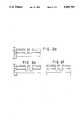
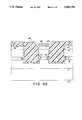
- FIGS. 2a through 2fare cross-sectional views of a portion of the wafer during various stages of fabrication of the embodiment of FIG. 1;
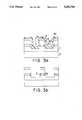
- FIGS. 3a and 3bare cross-sectional views of a portion of the wafer during various stages of fabrication of the embodiment of FIG. 1;
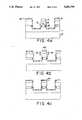
- FIGS. 4a through 4dare cross-sectional views of a portion of the wafer during various stages of fabrication of the embodiment of FIG. 1;
- FIG. 5is a perspective view in cross-section showing the structure of the injection type semiconductor laser embodiment of the present invention.
- FIGS. 6, 7, 8, and 9are diagrams illustrating operating characteristics of an embodiment of a laser in accordance with the present invention.
- An injection type semiconductor laser device embodying the present inventionwill now be described in detail by reference to a laser device of a InGaAsP-InP double heterostructure as an example.
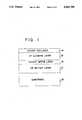
- FIG. 1A typical wafer as an initial starting point in the fabrication process is illustrated in FIG. 1.
- the substrateis typically composed of crystalline InP and is covered by a buffer layer of n-InP of about 1-2 microns thick.
- the active layeris composed of In.sub..73 Ga.sub..27 As.sub..63 P.sub..37 and has a thickness ideally of 0.2 microns.
- On top of the active layeris a cladding layer of InP approximately 1 micron thick.
- the fourth layercomprises a cap layer of In.sub..80 Ga.sub..20 As.sub..40 P.sub..60 of from 0.2-0.3 microns in thickness.
- CVDchemical vapor deposition
- LPEliquid phase epitaxy
- the initial step to produce the laser of the present inventionis to define the mesa.
- the mesa widthis determined by the desired final active layer width, the desired amount of regrowth on both sides of the active layer and any processing variables encountered in the photolithographic, dry etching and wet etching steps. As an example, if a one-micron ⁇ 0.1 micron active layer width with 0.1-0.2 microns of regrowth per side was desired, the initial mask for the mesa would be in the order of 2,0 microns.
- the first stepis to deposit a mask material, for example, 0.3 microns of SiO 2 , on the epitaxial cap layer that is compatible with said layer and with the dry and wet processing chemistries used in defining the mesa.
- the next stepis to apply a layer of photoresist material using standard photolithographic techniques.
- the next stepis to align and delineate stripes in the photoresist along the (110) crystallographic direction of the InP material, as shown in FIG. 2a.
- the exposed mask materialis then plasma etched in accordance with well known plasma etching techniques, for example utilizing CF 4 , to expose the underlying InGaAsP cap material.
- the waferis subjected to plasma etching in accordance with well known plasma etching techniques, for example C2H 6 /H 2 , to etch through the InGaAsP cap layer and stopping in the InP cladding layer in regions not protected by the SiO 2 mask, resulting in a wafer as shown in FIG. 2b.
- the waferis then subjected to a wet chemical etch of a 1:9 ratio of HCl and H 3 PO 4 acid mixture to selectively and anisotropically remove the InP cladding layer, using the InGaAsP cap layer as a mask, resulting in a wafer having the appearance as shown in FIG. 2c.
- the waferis again subjected to a plasma etch with the SiO 2 , the cap and the cladding layer now acting as a mask to etch through the InGaAsP active layer, stopping in the InP buffer layer, resulting in a wafer as shown in FIG. 2d.
- the waferis again subjected to a wet chemical etch using the aforementioned HCl and H 3 PO 4 acid mixture for a time sufficient to remove a portion, approximately one-half, of the exposed InP buffer layer, using the InGaAsP active layer as a mask, as shown in FIG. 2e.
- the waferis again exposed to wet chemical etching, this time in a solution of K 3 Fe(CN) 6 :KOH:H 2 O, which is well known, to selectively etch the InGaAsP cap and active layers laterally as shown in FIG. 2f.
- the solutionetches the active layer at about twice the rate of the cap layer. Since the amount of lateral etching required is only on the order of 0,4 microns or less, the resulting active layer is very uniform across the entire wafer. With the mesa, the active layer width and the cap width now defined, the SiO 2 mask is removed by hydrofluoric acid.
- the waferis then exposed to vapor phase epitaxial growth of an overlayer of semi-insulating InP as shown in FIG. 3A.
- the amount of regrowthis limited to minimize intentional diffusion of dopants into and out of the various devices layers thus degrading the quality of the devices.
- the exact amount and uniformity of regrowthis critical only to the extent that the under cut regions be completely filled laterally.
- the waferis again etched in the 1:9 hydrochloric and phosphoric acid mixture, leaving an unetched amount of regrowth cladding on the side wall of the active layer, the lateral dimension of this cladding being determined solely by the relative undercutting of the active layer with respect to the cap layer, and in view of the relative etch rate of the lateral etching and the amount of etching of the active layer (i.e. about 0.3-0.4 microns) the width of the cladding will be about 0.1-0.2 micron uniformly along the active layer.
- This techniqueautomatically controls the width of the regrown InP and symmetrically aligns the regrown material around the active layer.
- the active layer widthis poorly controlled due to oversized mesa and/or the amount of regrowth is relatively large (e.g. greater than 1 micron) or highly non-uniform for regrowth of less than 0.5 microns.
- the advantage of achieving a thin regrown regionis that it reduces homojunction capacitance and carrier leakage.
- a dielectric materialfor example approximately 0.4 microns SiO 2 , is deposited on the mesa side of the wafer, conforming to and encapsulating the mesa, the channels and covering the cap layer.
- This dielectricserves a number of purposes; it defines the p-contact using localized flood exposure, as disclosed in the cross-referenced application; it acts as a diffusion barrier during the diffusion step; it electrically isolates the p-metal overlay from the cap layer and is intrinsic to the reduction of the electrical parasitics of the device.
- the contact openingsare formed by using the localized flood exposure described in the copending application filed of even date herewith and assigned to the same assignee as the present application and is incorporated herein by reference thereto.
- the entire mesa top and an appreciable amount of the mesa sidewallis bared as is shown in FIG. 4a.
- Diffusion of an acceptor dopant, such as zinc, to p-type epitaxial layerscan be performed as shown in FIG. 4b so that the entire exposed surface is electrically modified to yield a higher differential gain, lower resistivity and lower contact resistance.
- the active layercan be heavily doped beyond the levels possible in as-grown epitaxial layers, a necessity for achieving high frequency operation.
- Ohmic contact metalmay then be deposited over the entire exposed surface such that the largest area of contact possible in this structure is achieved as shown in FIG. 4c and thus the lowest possible contact resistance in this structure is achieved without increasing the parasitic junction capacitance.
- this ohmic metal contact processresults in thermal properties that are superior to the other structures.
- a variety of other process techniquessuch a thick dielectrics to reduce parasitic chip capacitance and permits "epi down" mounting are performed. A resulting structure is shown in FIG. 4d.
- the substrate, or bottom, side of the waferis thinned to facilitate cleaving.
- An electrodeis formed on the bottom of the wafer, opposite to the ohmic contact on the top of the mesa structure, the wafer is divided into chips and made into laser devices as illustrated in FIG. 5 in a manner well known in the art.
- the intrinsic resonance of a semiconductor laseris proportional to the product of the total loss, the differential gain ⁇ g/ ⁇ N, and the photon density. If these parameters are optimized, it is then necessary to minimize electrical parasitics (i.e., the RC time constant) to fully exploit the modulation capabilities of the laser.
- This inventionutilizes a dry-etched, vapor-phase regrowth structure to fabricate lasers from LPE-grown, 1.3 ⁇ m double heterostructure material. This technique is a modification of the wet-etched, vapor-phase-regrowth technique previously used.
- SiO 2is used as a mask and for electrical isolation, and the p- and n-contact metallizations are alloyed ZnAu and SnAu, respectively.
- the dry-etched perpendicular sidewallsresult in two improvements compared to previously wet-etched vapor-phase-regrown lasers: 1) well-controlled regrowth widths of about 0.2 ⁇ m per side.
- a third improvementwas aimed at increasing the photon density in the laser cavity. Because of the perpendicular mesa sidewalls and the minimized regrowth, it was possible to accurately control the width of the emitting region to 0.9 ⁇ 0.1 ⁇ m. This dimension, coupled with active layer thicknesses of about 0.2 ⁇ m and cavity lengths of 100 to 130 ⁇ m, resulted in extremely high photon densities in a single spatial mode, even at moderate drive currents.
- Lasers made in accordance with this inventionhave achieved a modulation bandwidth of 24 GHz at room temperature and intrinsic resonance frequencies in excess of 22 GHz.
- the lasersare also characterized by a linear power-current curve, resulting in excellent modulation efficiencies even at 24 GHz.
- the swept frequency response (S 21 )is shown in FIG. 6 of a laser with a 3-dB bandwidth of 24 GHz.
- the 3-dB bandwidths for lasers according to this inventionranged from 18 to 24 GHz for lasers with cavity lengths of about 130 microns.
- FIG. 6shows that the modulation efficiency at 24 GHz has dropped only 3 dB with a 100 mA bias current compared to its low-frequency, low-bias values.
- the intrinsic resonance frequency, f oof the lasers was found from the measured relative intensity noise (RIN) spectral density.
- the RIN spectrum, shown in FIG. 7,indicates that even at bias currents as low as 60 mA the response peak is beyond 18 GHz.
- These data, together with the S 21 data of FIG. 6,indicate that the intrinsic resonance of this laser is in excess of 22 GHz.
- the resonance frequency, f o , and damping rate, ⁇are accurately determined, free of any electrical parasitics.
- the maximum achievable bandwidth in the absence of parasiticsi.e. limited only by damping
- FIG. 8shows the fitted ⁇ versus f o 2 for the same laser. From the slope, K is found to be 0.19 ns, while more typical values are approximately 0.3 ns. These values of K suggest that the maximum damping-limited bandwidth could be as high as 44 GHz.
- the intrinsic resonance frequencyis plotted as a function of the square root of the optical power in FIG. 9.
- the slope of this lineis 8.9 GHz/mW 1/2 .
- Because of the extremely high value of this slopelarge bandwidths are obtained at relatively low operating currents. Specifically, a 3 dB bandwidth of 20 GHz is achieved with as little as 55 mA of drive current. This may result in improved long-term reliability compared to previous high-frequency lasers.
- a record modulation bandwidth of 24 GHz at room-temperatureis reported for 1.3 ⁇ m lasers fabricated using a dry-etched, vapor phase regrowth technique. This and other dynamic characteristics are significantly better than the previous record of 22 GHz set by 1.3 ⁇ m VPR-BH lasers, and the 15 to 18 GHz bandwidths which are more typical for high-frequency InGaAsP laser structures. Furthermore, we observe intrinsic resonance frequencies in excess of 22 GHz, the highest yet obtained for either conventional double heterostructure or quantum well InGaAsP lasers. These improvements are accomplished by using a dry-etched, vapor phase regrowth technique. These lasers exhibit reduced leakage currents and electrical parasitics, and are characterized by a linear power-current curve, resulting in excellent modulation efficiencies even at 24 GHz.
Landscapes
- Physics & Mathematics (AREA)
- Engineering & Computer Science (AREA)
- General Physics & Mathematics (AREA)
- Condensed Matter Physics & Semiconductors (AREA)
- General Chemical & Material Sciences (AREA)
- Chemical Kinetics & Catalysis (AREA)
- Chemical & Material Sciences (AREA)
- Manufacturing & Machinery (AREA)
- Computer Hardware Design (AREA)
- Microelectronics & Electronic Packaging (AREA)
- Power Engineering (AREA)
- Geometry (AREA)
- Electromagnetism (AREA)
- Optics & Photonics (AREA)
- Semiconductor Lasers (AREA)
Abstract
Description
This application is related to an application entitled "Processing Method for Fabricating Electrical Contacts to Mesa Structures in Semiconductor Devices," Ser. No. 07/583,410; filed simultaneously herewith on Sept. 14, 1990 by R. F. Holmstrom, E. Meland and F. D. Crawford, inventors, and assigned to the same assignee as this application.
This invention pertains to semiconductor lasers and more particularly to high modulation bandwidth single transverse mode semiconductor lasers.
As fiber optic communication systems continue to push to even higher data rates and larger bandwidths, the availability of reproducible and reliable high-speed lasers becomes increasingly important. This is particularly true for microwave modulation schemes like subcarrier multiplexing, where low relative intensity noise (RIN) is very important, or for phase modulated systems, where the avoidance of phase noise is crucial. In both of these modulation schemes it is very important to avoid operating near the resonance peak of the laser, where RIN peaks and a π phase shift occurs. Both of these phenomena have a deleterious effect on the noise performance of the system. The further below the resonance peak the fiber optic system can be designed to operate, the better its noise performance will be. Clearly, demands on the system designer are reduced by the availability of lasers with higher resonance frequencies and modulation bandwidths.
Fabrication of single transverse mode semiconductor lasers with modulation bandwidth in excess of 15 GHz depends heavily upon both the accurate control of the active layer doping, width, and thickness, and upon providing a lateral optical cladding of the active layer which minimizes surface recombination and carrier leakage while not affecting the single transverse modal properties of the laser. In addition, a low capacitance and low series resistance structure is required to minimize electrical parasitics.
High frequency single transverse mode semiconductor lasers have been achieved by constricted mesa (Bowers, et al, "High-speed InGaAsP constricted mesa lasers", IEEE J. Quantum Electron., Vol. QE-22, pp. 833-884, June 1986), mass transport (Liau, et al, "A novel technique for GaInAsP/InP buried heterostructure fabrication", Appl. Phys. Lett., Vol. 40, pp. 568-570, April 1982) and vapor phase regrowth (Su, et al, "Ultra-high frequency modulation of InGaAsP lasers", Tech. Dig. Conf. Optical Fiber Communication, pp. 90-91, February 1986) techniques. These structures have broad mesa tops so as to reduce series resistance and facilitate the formation of ohmic contacts. In order to achieve this structure, the processes reported to date require selective wet chemical etching of the active layer of 4 microns or more to reduce its width and/or the epitaxial growth of thick layers of high quality p-doped, semi-insulating, or pn blocking layer configurations. These regrown materials are subject to unintentional doping to and from the p-type device structure layers during the regrowth process and tend to be electrically leaky which severely limits the achievable output power and bandwidth. (Ohtoshi, et al, "Current leakage mechanism in InGaAsP/InP buried heterostructure lasers", 11th IEEE International Semiconductor Laser Conference, Boston, Mass., 1988). In addition, wet chemical etching through dielectric masks, used to form the initial mesa structure, is inherently non-uniform so that control of active layer width, a necessity for high bandwidth single transverse mode operation, is very difficult resulting in low yield and non-reproducible results. Alternatively, the fabrication of narrow mesa tops leads to the additional problems of high series resistance and difficulty in photolithographically defining and forming ohmic contacts.
Accordingly, it is a primary object of this invention to obviate the above noted and other disadvantages of the prior art.
It is a further object of this invention to provide a high modulation bandwidth single transverse mode semiconductor laser.
It is yet a further object of this invention to provide a controllable and reproducible fabrication process for such a laser.
In a first aspect of the invention, an indium phosphide-based semiconductor laser is produced such that the epitaxial layer configurations (composition, thickness and doping) are appropriate for high frequency laser applications. This is accomplished by sandwiching a thin, narrow active layer of small bandgap material between thicker, larger bandgap material and filling the interstices on each side of the active layer with a semi-insulating layer in such manner that the sidewalls of the device form a smooth surface, thereby reducing the homojunction capacitance and carrier leakage.
In a second aspect of the invention, the method of fabrication of a 1.3μ InGaAsP laser with three dB bandwidth of 24 GHz and intrinsic resonance frequencies uses a dry-etched vapor phase regrowth structure to fabricate lasers from LPE-grown, 1.3μ double heterostructure material, or any suitable epitaxial growth technique, i.e., (VDE, MOCVD, and MBE) that will produce InGaAsP/InP double heterostructure material. The method comprises the steps of dry-etching channels, followed by selective etching to undercut the active layer, then InP regrowth on the sidewalls in a halide vapor phase system. SiO2, and the p- and n-contact metallizations are alloyed ZnAu and SnAu, respectively, using a flood exposure technique.
FIG. 1 is a cross-sectional view of a semiconductor wafer from which an embodiment of the laser of the present invention can be formed;
FIGS. 2a through 2f are cross-sectional views of a portion of the wafer during various stages of fabrication of the embodiment of FIG. 1;
FIGS. 3a and 3b are cross-sectional views of a portion of the wafer during various stages of fabrication of the embodiment of FIG. 1;
FIGS. 4a through 4d are cross-sectional views of a portion of the wafer during various stages of fabrication of the embodiment of FIG. 1;
FIG. 5 is a perspective view in cross-section showing the structure of the injection type semiconductor laser embodiment of the present invention;
FIGS. 6, 7, 8, and 9 are diagrams illustrating operating characteristics of an embodiment of a laser in accordance with the present invention.
An injection type semiconductor laser device embodying the present invention will now be described in detail by reference to a laser device of a InGaAsP-InP double heterostructure as an example.
A typical wafer as an initial starting point in the fabrication process is illustrated in FIG. 1. The substrate is typically composed of crystalline InP and is covered by a buffer layer of n-InP of about 1-2 microns thick. The active layer is composed of In.sub..73 Ga.sub..27 As.sub..63 P.sub..37 and has a thickness ideally of 0.2 microns. On top of the active layer is a cladding layer of InP approximately 1 micron thick. The fourth layer comprises a cap layer of In.sub..80 Ga.sub..20 As.sub..40 P.sub..60 of from 0.2-0.3 microns in thickness. A wafer of such composition and structure can be made by techniques well known in the art by chemical vapor deposition (CVD), liquid phase epitaxy (LPE) or a combination thereof and, and include all compositions of In1-x Gax Asy P1-y that would produce high frequency lasers emitting at λ=1.25 μm to λ=1.58 μm and all wavelengths between.
The initial step to produce the laser of the present invention is to define the mesa. The mesa width is determined by the desired final active layer width, the desired amount of regrowth on both sides of the active layer and any processing variables encountered in the photolithographic, dry etching and wet etching steps. As an example, if a one-micron ±0.1 micron active layer width with 0.1-0.2 microns of regrowth per side was desired, the initial mask for the mesa would be in the order of 2,0 microns. The first step is to deposit a mask material, for example, 0.3 microns of SiO2, on the epitaxial cap layer that is compatible with said layer and with the dry and wet processing chemistries used in defining the mesa. The next step is to apply a layer of photoresist material using standard photolithographic techniques. The next step is to align and delineate stripes in the photoresist along the (110) crystallographic direction of the InP material, as shown in FIG. 2a. The exposed mask material is then plasma etched in accordance with well known plasma etching techniques, for example utilizing CF4, to expose the underlying InGaAsP cap material. After the photoresist is removed, the wafer is subjected to plasma etching in accordance with well known plasma etching techniques, for example C2H6 /H2, to etch through the InGaAsP cap layer and stopping in the InP cladding layer in regions not protected by the SiO2 mask, resulting in a wafer as shown in FIG. 2b. The wafer is then subjected to a wet chemical etch of a 1:9 ratio of HCl and H3 PO4 acid mixture to selectively and anisotropically remove the InP cladding layer, using the InGaAsP cap layer as a mask, resulting in a wafer having the appearance as shown in FIG. 2c. The wafer is again subjected to a plasma etch with the SiO2, the cap and the cladding layer now acting as a mask to etch through the InGaAsP active layer, stopping in the InP buffer layer, resulting in a wafer as shown in FIG. 2d. The wafer is again subjected to a wet chemical etch using the aforementioned HCl and H3 PO4 acid mixture for a time sufficient to remove a portion, approximately one-half, of the exposed InP buffer layer, using the InGaAsP active layer as a mask, as shown in FIG. 2e.
The wafer is again exposed to wet chemical etching, this time in a solution of K3 Fe(CN)6 :KOH:H2 O, which is well known, to selectively etch the InGaAsP cap and active layers laterally as shown in FIG. 2f. In view of the difference in composition of the active layer and the cap layer, the solution etches the active layer at about twice the rate of the cap layer. Since the amount of lateral etching required is only on the order of 0,4 microns or less, the resulting active layer is very uniform across the entire wafer. With the mesa, the active layer width and the cap width now defined, the SiO2 mask is removed by hydrofluoric acid.
The wafer is then exposed to vapor phase epitaxial growth of an overlayer of semi-insulating InP as shown in FIG. 3A. The amount of regrowth is limited to minimize intentional diffusion of dopants into and out of the various devices layers thus degrading the quality of the devices. The exact amount and uniformity of regrowth is critical only to the extent that the under cut regions be completely filled laterally. The wafer is again etched in the 1:9 hydrochloric and phosphoric acid mixture, leaving an unetched amount of regrowth cladding on the side wall of the active layer, the lateral dimension of this cladding being determined solely by the relative undercutting of the active layer with respect to the cap layer, and in view of the relative etch rate of the lateral etching and the amount of etching of the active layer (i.e. about 0.3-0.4 microns) the width of the cladding will be about 0.1-0.2 micron uniformly along the active layer. This technique automatically controls the width of the regrown InP and symmetrically aligns the regrown material around the active layer. This is in contrast to the other techniques where either the active layer width is poorly controlled due to oversized mesa and/or the amount of regrowth is relatively large (e.g. greater than 1 micron) or highly non-uniform for regrowth of less than 0.5 microns. The advantage of achieving a thin regrown region is that it reduces homojunction capacitance and carrier leakage.
A dielectric material, for example approximately 0.4 microns SiO2, is deposited on the mesa side of the wafer, conforming to and encapsulating the mesa, the channels and covering the cap layer. This dielectric serves a number of purposes; it defines the p-contact using localized flood exposure, as disclosed in the cross-referenced application; it acts as a diffusion barrier during the diffusion step; it electrically isolates the p-metal overlay from the cap layer and is intrinsic to the reduction of the electrical parasitics of the device.
The contact openings are formed by using the localized flood exposure described in the copending application filed of even date herewith and assigned to the same assignee as the present application and is incorporated herein by reference thereto. In accordance with this method, the entire mesa top and an appreciable amount of the mesa sidewall is bared as is shown in FIG. 4a. Diffusion of an acceptor dopant, such as zinc, to p-type epitaxial layers can be performed as shown in FIG. 4b so that the entire exposed surface is electrically modified to yield a higher differential gain, lower resistivity and lower contact resistance. By controlling the amount of exposed sidewall, a feature of this technique, and the diffusion time and temperature, the active layer can be heavily doped beyond the levels possible in as-grown epitaxial layers, a necessity for achieving high frequency operation. Ohmic contact metal may then be deposited over the entire exposed surface such that the largest area of contact possible in this structure is achieved as shown in FIG. 4c and thus the lowest possible contact resistance in this structure is achieved without increasing the parasitic junction capacitance. In addition, this ohmic metal contact process results in thermal properties that are superior to the other structures. A variety of other process techniques such a thick dielectrics to reduce parasitic chip capacitance and permits "epi down" mounting are performed. A resulting structure is shown in FIG. 4d.
The substrate, or bottom, side of the wafer is thinned to facilitate cleaving. An electrode is formed on the bottom of the wafer, opposite to the ohmic contact on the top of the mesa structure, the wafer is divided into chips and made into laser devices as illustrated in FIG. 5 in a manner well known in the art.
The intrinsic resonance of a semiconductor laser is proportional to the product of the total loss, the differential gain ∂g/∂N, and the photon density. If these parameters are optimized, it is then necessary to minimize electrical parasitics (i.e., the RC time constant) to fully exploit the modulation capabilities of the laser. Past work on ultra-high-frequency diode lasers has been plagued by the difficulty of fabricating lasers with very small active areas, low leakage, and low electrical parasitics. This invention utilizes a dry-etched, vapor-phase regrowth structure to fabricate lasers from LPE-grown, 1.3 μm double heterostructure material. This technique is a modification of the wet-etched, vapor-phase-regrowth technique previously used. Basically, it consists of dry etching channels, followed by selective etching to undercut the active layer, then InP regrowth on the sidewalls in a halide vapor phase system. SiO2 is used as a mask and for electrical isolation, and the p- and n-contact metallizations are alloyed ZnAu and SnAu, respectively. The dry-etched perpendicular sidewalls result in two improvements compared to previously wet-etched vapor-phase-regrown lasers: 1) well-controlled regrowth widths of about 0.2 μm per side. Since this regrowth forms the p-n blocking homojunctions, limiting this width reduces homojunction leakage (thus improving the linearity of the power-current curves) and minimizes diffusion capacitance (thus extending the RC limit); 2 ) the entire top of the mesa was contained, using a flood exposure technique, thus reducing the contact and series resistance of the device.
A third improvement was aimed at increasing the photon density in the laser cavity. Because of the perpendicular mesa sidewalls and the minimized regrowth, it was possible to accurately control the width of the emitting region to 0.9±0.1 μm. This dimension, coupled with active layer thicknesses of about 0.2 μm and cavity lengths of 100 to 130 μm, resulted in extremely high photon densities in a single spatial mode, even at moderate drive currents.
Lasers made in accordance with this invention have achieved a modulation bandwidth of 24 GHz at room temperature and intrinsic resonance frequencies in excess of 22 GHz. The lasers are also characterized by a linear power-current curve, resulting in excellent modulation efficiencies even at 24 GHz. The swept frequency response (S21) is shown in FIG. 6 of a laser with a 3-dB bandwidth of 24 GHz. The 3-dB bandwidths for lasers according to this invention ranged from 18 to 24 GHz for lasers with cavity lengths of about 130 microns. FIG. 6 shows that the modulation efficiency at 24 GHz has dropped only 3 dB with a 100 mA bias current compared to its low-frequency, low-bias values.
The intrinsic resonance frequency, fo, of the lasers was found from the measured relative intensity noise (RIN) spectral density. The RIN spectrum, shown in FIG. 7, indicates that even at bias currents as low as 60 mA the response peak is beyond 18 GHz. These data, together with the S21 data of FIG. 6, indicate that the intrinsic resonance of this laser is in excess of 22 GHz. By fitting the RIN data to the standard single-mode rate equation solution, the resonance frequency, fo, and damping rate, γ, are accurately determined, free of any electrical parasitics. The maximum achievable bandwidth in the absence of parasitics (i.e. limited only by damping) can then be estimated, as shown by Olshansky, et al, IEEE J. Quan. Electron. QE 23, p. 1410 (1987), using the relationship f3dB =8.8/K, where K=γ/fo2. FIG. 8 shows the fitted γ versus fo2 for the same laser. From the slope, K is found to be 0.19 ns, while more typical values are approximately 0.3 ns. These values of K suggest that the maximum damping-limited bandwidth could be as high as 44 GHz.
The intrinsic resonance frequency is plotted as a function of the square root of the optical power in FIG. 9. The slope of this line is 8.9 GHz/mW1/2. We believe this to be the highest value ever reported for a semiconductor laser, more typical values of this slope are 5 to 6 GHz/mW1/2 for semiconductor lasers. Because of the extremely high value of this slope, large bandwidths are obtained at relatively low operating currents. Specifically, a 3 dB bandwidth of 20 GHz is achieved with as little as 55 mA of drive current. This may result in improved long-term reliability compared to previous high-frequency lasers.
A record modulation bandwidth of 24 GHz at room-temperature is reported for 1.3 μm lasers fabricated using a dry-etched, vapor phase regrowth technique. This and other dynamic characteristics are significantly better than the previous record of 22 GHz set by 1.3 μm VPR-BH lasers, and the 15 to 18 GHz bandwidths which are more typical for high-frequency InGaAsP laser structures. Furthermore, we observe intrinsic resonance frequencies in excess of 22 GHz, the highest yet obtained for either conventional double heterostructure or quantum well InGaAsP lasers. These improvements are accomplished by using a dry-etched, vapor phase regrowth technique. These lasers exhibit reduced leakage currents and electrical parasitics, and are characterized by a linear power-current curve, resulting in excellent modulation efficiencies even at 24 GHz.
We have demonstrated 1.3 μm lasers with intrinsic resonance frequencies in excess of 22 GHz, and 3dB bandwidths of up to 24 GHz. This is a significant improvement over the previous record of 22 GHz for the 3 dB bandwidth. These advances were achieved primarily by increasing the photon density in the lasing cavity (to increase the intrinsic resonance frequency), and by minimizing electrical parasitics. It is expected that these devices will play an important role in the realization of extremely broadband fiber optic systems in general, and in microwave multiplexed systems such as subcarrier systems in particular.
Claims (3)
1. A method of fabricating a semiconductor laser having an epitaxial layer wafer configuration comprising a substrate layer, a buffer layer, an active layer, a cladding layer, and a cap layer, wherein said wafer configuration is fabricated for high frequency laser applications, comprising the steps of:
a. depositing on said cap layer of said wafer a layer of mask material compatible with said cap layer;
b. applying a layer of photoresist material on said mask layer;
c. delineating stripes in said photoresist layer along a particular crystallographic direction of one of said wafer layers, thereby exposing window stripes of said mask layer;
d. plasma etching said exposed windows of said mask layer to expose said underlying cap layer to form exposed window stripes of said cap layer;
f. removing said photoresist;
g. subjecting regions of said wafer not protected by said mask material to plasma etching to completely etch said exposed cap layer windows and to partially etch through said cladding layer;
h. subjecting said wafer to a wet chemical etch mixture to selectively and anistropically remove the exposed material of said cladding layer, using said cap layer as an effective mask, whereby window stripes of said active layer are exposed;
i. subjecting said wafer to a plasma etch mixture wherein said mask material, cap layer, and cladding layer serve as an effective mask to etch through said active layer and partially etch through said buffer layer;
j. subjecting said wafer to a wet chemical etch for a time sufficient to remove a selected portion of the exposed buffer layer, using said active layer as an effective mask;
k. exposing said wafer to a wet chemical etching mixture to selectively and concurrently etch exposed regions of said cap layer and said active layer in a lateral direction to create spaces in sidewalls of said cap and active layer, wherein said etching mixture etches said active layer at a known faster rate than said cap layer;
l. removing said mask layer;
m. exposing said entire wafer to an epitaxial growth of an overlayer of a semi-insulating material;
n. etching said wafer to leave an unetched amount of regrowth cladding only in the lateral side wall spaces of said active layer wherein a lateral dimension of said regrowth cladding is determined by the relative undercutting of said active layer with respect to said cap layer;
o. depositing on the mesa side of said wafer a dielectric material which conforms to and encapsulates said mesa and a channel covering said cap layer;
p. forming contact openings on said wafer by performing localized flood exposure of said wafer to controllably remove said dielectric material from the top of said mesa and from a substantial portion of the mesa sidewall;
q. diffusing an appropriate dopant into said contact openings;
u. depositing ohmic contact metal over the entirety of said contact openings;
r. thinning said substrate layer; and
s. forming an electrode on said thinned substrate layer.
2. A method of making a semiconductor device as set forth in claim 1, wherein said second layer is composed of Inx Ga1-x Asy P1-y in which x=0.73 and y=0.67 and said fourth layer is composed of Ins Ga1-s Ast P1-t in which s=0.8 and t=0.4.
3. A method of making a semiconductor laser device as set forth in claim 1 or 2, in which the lateral etching of said second and fourth layers is accomplished by a solution of K3 Fe(CN)6 :KOH:H2 O.
Priority Applications (6)
| Application Number | Priority Date | Filing Date | Title |
|---|---|---|---|
| US07/583,409US5082799A (en) | 1990-09-14 | 1990-09-14 | Method for fabricating indium phosphide/indium gallium arsenide phosphide buried heterostructure semiconductor lasers |
| EP19910918807EP0500925A4 (en) | 1990-09-14 | 1991-09-12 | New structure and method for fabricating indium phosphide/indium gallium arsenide phosphide buried heterostructure semiconductor lasers |
| PCT/US1991/006600WO1992005576A1 (en) | 1990-09-14 | 1991-09-12 | New structure and method for fabricating indium phosphide/indium gallium arsenide phosphide buried heterostructure semiconductor lasers |
| JP3517190AJPH05502761A (en) | 1990-09-14 | 1991-09-12 | Novel structure of indium phosphide/indium gallium phosphide arsenide buried heterostructure semiconductor laser and its manufacturing method |
| CA002072632ACA2072632A1 (en) | 1990-09-14 | 1991-09-12 | Structure and method for fabricating indium phosphide/indium gallium arsenide phosphide buried heterostructure semiconductor lasers |
| US07/823,499US5222091A (en) | 1990-09-14 | 1992-01-21 | Structure for indium phosphide/indium gallium arsenide phosphide buried heterostructure semiconductor |
Applications Claiming Priority (1)
| Application Number | Priority Date | Filing Date | Title |
|---|---|---|---|
| US07/583,409US5082799A (en) | 1990-09-14 | 1990-09-14 | Method for fabricating indium phosphide/indium gallium arsenide phosphide buried heterostructure semiconductor lasers |
Related Child Applications (1)
| Application Number | Title | Priority Date | Filing Date |
|---|---|---|---|
| US07/823,499DivisionUS5222091A (en) | 1990-09-14 | 1992-01-21 | Structure for indium phosphide/indium gallium arsenide phosphide buried heterostructure semiconductor |
Publications (1)
| Publication Number | Publication Date |
|---|---|
| US5082799Atrue US5082799A (en) | 1992-01-21 |
Family
ID=24332984
Family Applications (1)
| Application Number | Title | Priority Date | Filing Date |
|---|---|---|---|
| US07/583,409Expired - LifetimeUS5082799A (en) | 1990-09-14 | 1990-09-14 | Method for fabricating indium phosphide/indium gallium arsenide phosphide buried heterostructure semiconductor lasers |
Country Status (5)
| Country | Link |
|---|---|
| US (1) | US5082799A (en) |
| EP (1) | EP0500925A4 (en) |
| JP (1) | JPH05502761A (en) |
| CA (1) | CA2072632A1 (en) |
| WO (1) | WO1992005576A1 (en) |
Cited By (51)
| Publication number | Priority date | Publication date | Assignee | Title |
|---|---|---|---|---|
| US5194400A (en)* | 1990-11-28 | 1993-03-16 | Matsushita Electric Industrial Co., Ltd. | Method for fabricating a semiconductor laser device using (Alx Ga1-x)y In1-y P semiconductor clad layers |
| US5339737A (en)* | 1992-07-20 | 1994-08-23 | Presstek, Inc. | Lithographic printing plates for use with laser-discharge imaging apparatus |
| US5351617A (en)* | 1992-07-20 | 1994-10-04 | Presstek, Inc. | Method for laser-discharge imaging a printing plate |
| US5353705A (en)* | 1992-07-20 | 1994-10-11 | Presstek, Inc. | Lithographic printing members having secondary ablation layers for use with laser-discharge imaging apparatus |
| US5379698A (en)* | 1992-07-20 | 1995-01-10 | Presstek, Inc. | Lithographic printing members for use with laser-discharge imaging |
| US5385092A (en)* | 1992-07-20 | 1995-01-31 | Presstek, Inc. | Laser-driven method and apparatus for lithographic imaging |
| USRE35512E (en)* | 1992-07-20 | 1997-05-20 | Presstek, Inc. | Lithographic printing members for use with laser-discharge imaging |
| US5658823A (en)* | 1994-08-27 | 1997-08-19 | Samsung Electronics Co., Ltd. | Semiconductor laser diode and manufacturing method therefor |
| US5755752A (en)* | 1992-04-24 | 1998-05-26 | Segal; Kim Robin | Diode laser irradiation system for biological tissue stimulation |
| US5877038A (en)* | 1996-11-27 | 1999-03-02 | The Regents Of The University Of California | Method of making a vertical cavity laser |
| US6167072A (en)* | 1997-06-06 | 2000-12-26 | University Of Florida | Modulated cap thin p-clad semiconductor laser |
| US6583033B2 (en) | 2000-08-22 | 2003-06-24 | The Regents Of The University Of California | Method of fabricating a distributed Bragg reflector by controlling material composition using molecular beam epitaxy |
| US20030156611A1 (en)* | 2002-02-21 | 2003-08-21 | Hoki Kwon | GaAs/Al(Ga)As distributed bragg reflector on InP |
| US20030156610A1 (en)* | 2002-02-21 | 2003-08-21 | Hoki Kwon | Carbon doped GaAsSb suitable for use in tunnel junctions of long-wavelength VCSELs |
| US6631154B2 (en) | 2000-08-22 | 2003-10-07 | The Regents Of The University Of California | Method of fabricating a distributed Bragg reflector having enhanced thermal and electrical properties |
| US20030219917A1 (en)* | 1998-12-21 | 2003-11-27 | Johnson Ralph H. | System and method using migration enhanced epitaxy for flattening active layers and the mechanical stabilization of quantum wells associated with vertical cavity surface emitting lasers |
| US20050123015A1 (en)* | 1998-12-21 | 2005-06-09 | Johnson Ralph H. | Use of GaAs extended barrier layers between active regions containing nitrogen and AlGaAs confining layers |
| US20050129078A1 (en)* | 1998-12-21 | 2005-06-16 | Johnson Ralph H. | Multicomponent barrier layers in quantum well active regions to enhance confinement and speed |
| US20050157765A1 (en)* | 1998-12-21 | 2005-07-21 | Honeywell International Inc. | Low temperature grown layers with migration enhanced epitaxy adjacent to an InGaAsN(Sb) based active region |
| US6922426B2 (en) | 2001-12-20 | 2005-07-26 | Finisar Corporation | Vertical cavity surface emitting laser including indium in the active region |
| US6975660B2 (en) | 2001-12-27 | 2005-12-13 | Finisar Corporation | Vertical cavity surface emitting laser including indium and antimony in the active region |
| US7058112B2 (en) | 2001-12-27 | 2006-06-06 | Finisar Corporation | Indium free vertical cavity surface emitting laser |
| US7095770B2 (en) | 2001-12-20 | 2006-08-22 | Finisar Corporation | Vertical cavity surface emitting laser including indium, antimony and nitrogen in the active region |
| US20060246700A1 (en)* | 1998-12-21 | 2006-11-02 | Johnson Ralph H | Migration enhanced epitaxy fabrication of active regions having quantum wells |
| US20070030865A1 (en)* | 2005-08-05 | 2007-02-08 | Daylight Solutions | External cavity tunable compact mid-IR laser |
| US20070201525A1 (en)* | 2004-10-01 | 2007-08-30 | Finisar Corporation | Vertical cavity surface emitting laser having strain reduced quantum wells |
| US20070291804A1 (en)* | 2005-06-15 | 2007-12-20 | Timothy Day | Compact mid-IR laser |
| US20080075133A1 (en)* | 2006-09-22 | 2008-03-27 | Daylight Solutions Inc. | Extended tuning in external cavity quantum cascade lasers |
| US7408964B2 (en) | 2001-12-20 | 2008-08-05 | Finisar Corporation | Vertical cavity surface emitting laser including indium and nitrogen in the active region |
| US20080298406A1 (en)* | 2005-06-15 | 2008-12-04 | Daylight Solutions Inc. | Compact external cavity mid-ir optical lasers |
| US20080304524A1 (en)* | 2007-03-12 | 2008-12-11 | Daylight Solutions, Inc. | Quantum cascade laser suitable for portable applications |
| US20090159798A1 (en)* | 2007-12-20 | 2009-06-25 | Daylight Solutions, Inc. | Gas imaging system |
| US20090213882A1 (en)* | 2008-01-17 | 2009-08-27 | Miles James Weida | Laser source that generates a plurality of alternative wavelength output beams |
| US20090268277A1 (en)* | 2005-06-15 | 2009-10-29 | Timothy Day | Lenses, optical sources, and their couplings |
| US20100110198A1 (en)* | 2008-04-01 | 2010-05-06 | Daylight Solutions, Inc. | Mid infrared optical illuminator assembly |
| US20100243891A1 (en)* | 2005-06-15 | 2010-09-30 | Timothy Day | Compact mid-ir laser |
| EP2290767A1 (en)* | 2009-08-28 | 2011-03-02 | Thales | Electrically modulated semiconductor laser |
| US20110080311A1 (en)* | 2009-10-05 | 2011-04-07 | Michael Pushkarsky | High output laser source assembly with precision output beam |
| US20110090930A1 (en)* | 2004-10-01 | 2011-04-21 | Finisar Corporation | Vertical cavity surface emitting laser with undoped top mirror |
| US20110222566A1 (en)* | 2010-03-15 | 2011-09-15 | Weida Miles J | Laser source that generates a rapidly changing output beam |
| US8306077B2 (en) | 2008-04-29 | 2012-11-06 | Daylight Solutions, Inc. | High output, mid infrared laser source assembly |
| US8335413B2 (en) | 2010-05-14 | 2012-12-18 | Daylight Solutions, Inc. | Optical switch |
| US8467430B2 (en) | 2010-09-23 | 2013-06-18 | Daylight Solutions, Inc. | Continuous wavelength tunable laser source with optimum orientation of grating and gain medium |
| US8565275B2 (en) | 2008-04-29 | 2013-10-22 | Daylight Solutions, Inc. | Multi-wavelength high output laser source assembly with precision output beam |
| US8774244B2 (en) | 2009-04-21 | 2014-07-08 | Daylight Solutions, Inc. | Thermal pointer |
| US9042688B2 (en) | 2011-01-26 | 2015-05-26 | Daylight Solutions, Inc. | Multiple port, multiple state optical switch |
| US9059562B2 (en) | 2011-06-23 | 2015-06-16 | Daylight Solutions, Inc. | Control system for directing power to a laser assembly |
| US9093813B2 (en) | 2011-10-11 | 2015-07-28 | Daylight Solutions, Inc. | Mounting base for a laser system |
| US9225148B2 (en) | 2010-09-23 | 2015-12-29 | Daylight Solutions, Inc. | Laser source assembly with thermal control and mechanically stable mounting |
| US20190363516A1 (en)* | 2017-02-07 | 2019-11-28 | Furukawa Electric Co., Ltd. | Optical waveguide structure |
| CN114256740A (en)* | 2021-12-15 | 2022-03-29 | 华中科技大学 | A DFB semiconductor laser |
Citations (18)
| Publication number | Priority date | Publication date | Assignee | Title |
|---|---|---|---|---|
| US4264381A (en)* | 1977-04-01 | 1981-04-28 | Itt Industries, Inc. | Fabrication of injection lasers utilizing a porous host diffusion layer |
| JPS56111284A (en)* | 1980-02-07 | 1981-09-02 | Nec Corp | Manufacture of semiconductor laser |
| JPS5743428A (en)* | 1980-08-28 | 1982-03-11 | Nec Corp | Mesa etching method |
| JPS5992591A (en)* | 1982-11-18 | 1984-05-28 | Nec Corp | Semiconductor laser of low radiation angle and manufacture thereof |
| JPS59130492A (en)* | 1983-01-17 | 1984-07-27 | Hitachi Ltd | Semiconductor laser device and its manufacturing method |
| JPS59227177A (en)* | 1983-06-08 | 1984-12-20 | Hitachi Ltd | semiconductor laser equipment |
| US4496403A (en)* | 1981-12-01 | 1985-01-29 | Itt Industries, Inc. | Method of making a compound semiconductor laser |
| JPS60251689A (en)* | 1984-05-28 | 1985-12-12 | Nippon Telegr & Teleph Corp <Ntt> | Semiconductor laser element and manufacture thereof |
| JPS6167980A (en)* | 1984-09-11 | 1986-04-08 | Anritsu Corp | Semiconductor laser |
| US4644551A (en)* | 1983-10-17 | 1987-02-17 | Nec Corporation | Buried-type semiconductor laser |
| US4662988A (en)* | 1984-06-28 | 1987-05-05 | Standard Telephones And Cables Public Limited Company | Semiconductor devices and their fabrication |
| US4764246A (en)* | 1985-08-06 | 1988-08-16 | American Telephone And Telegraph Company, At&T Bell Laboratories | Buried undercut mesa-like waveguide and method of making same |
| JPS6414092A (en)* | 1987-07-07 | 1989-01-18 | Riso Kagaku Corp | Preparation of base paper for thermal screen printing |
| US4815083A (en)* | 1985-06-27 | 1989-03-21 | Nec Corporation | Buried heterostructure semiconductor laser with high-resistivity semiconductor layer for current confinement |
| US4818722A (en)* | 1986-09-29 | 1989-04-04 | Siemens Aktiengesellschaft | Method for generating a strip waveguide |
| US4830986A (en)* | 1985-05-15 | 1989-05-16 | Itt Corporation | Laser manufacture |
| EP0319954A2 (en)* | 1987-12-08 | 1989-06-14 | Kabushiki Kaisha Toshiba | Semiconductor laser device and method of manufacturing the same |
| US4990465A (en)* | 1985-01-22 | 1991-02-05 | Massachusetts Institute Of Technology | Method of forming a surface emitting laser |
Family Cites Families (4)
| Publication number | Priority date | Publication date | Assignee | Title |
|---|---|---|---|---|
| JPS59155977A (en)* | 1983-02-25 | 1984-09-05 | Hitachi Ltd | Manufacturing method of semiconductor laser device |
| JPS6461081A (en)* | 1987-09-01 | 1989-03-08 | Japan Res Dev Corp | Distributed-feedback type semiconductor laser and manufacture thereof |
| JPH01114092A (en)* | 1987-10-28 | 1989-05-02 | Hitachi Ltd | Embedded semiconductor laser |
| US4987576A (en)* | 1988-11-30 | 1991-01-22 | Siemens Aktiengesellschaft | Electrically tunable semiconductor laser with ridge waveguide |
- 1990
- 1990-09-14USUS07/583,409patent/US5082799A/ennot_activeExpired - Lifetime
- 1991
- 1991-09-12JPJP3517190Apatent/JPH05502761A/enactivePending
- 1991-09-12WOPCT/US1991/006600patent/WO1992005576A1/ennot_activeApplication Discontinuation
- 1991-09-12EPEP19910918807patent/EP0500925A4/ennot_activeWithdrawn
- 1991-09-12CACA002072632Apatent/CA2072632A1/ennot_activeAbandoned
Patent Citations (18)
| Publication number | Priority date | Publication date | Assignee | Title |
|---|---|---|---|---|
| US4264381A (en)* | 1977-04-01 | 1981-04-28 | Itt Industries, Inc. | Fabrication of injection lasers utilizing a porous host diffusion layer |
| JPS56111284A (en)* | 1980-02-07 | 1981-09-02 | Nec Corp | Manufacture of semiconductor laser |
| JPS5743428A (en)* | 1980-08-28 | 1982-03-11 | Nec Corp | Mesa etching method |
| US4496403A (en)* | 1981-12-01 | 1985-01-29 | Itt Industries, Inc. | Method of making a compound semiconductor laser |
| JPS5992591A (en)* | 1982-11-18 | 1984-05-28 | Nec Corp | Semiconductor laser of low radiation angle and manufacture thereof |
| JPS59130492A (en)* | 1983-01-17 | 1984-07-27 | Hitachi Ltd | Semiconductor laser device and its manufacturing method |
| JPS59227177A (en)* | 1983-06-08 | 1984-12-20 | Hitachi Ltd | semiconductor laser equipment |
| US4644551A (en)* | 1983-10-17 | 1987-02-17 | Nec Corporation | Buried-type semiconductor laser |
| JPS60251689A (en)* | 1984-05-28 | 1985-12-12 | Nippon Telegr & Teleph Corp <Ntt> | Semiconductor laser element and manufacture thereof |
| US4662988A (en)* | 1984-06-28 | 1987-05-05 | Standard Telephones And Cables Public Limited Company | Semiconductor devices and their fabrication |
| JPS6167980A (en)* | 1984-09-11 | 1986-04-08 | Anritsu Corp | Semiconductor laser |
| US4990465A (en)* | 1985-01-22 | 1991-02-05 | Massachusetts Institute Of Technology | Method of forming a surface emitting laser |
| US4830986A (en)* | 1985-05-15 | 1989-05-16 | Itt Corporation | Laser manufacture |
| US4815083A (en)* | 1985-06-27 | 1989-03-21 | Nec Corporation | Buried heterostructure semiconductor laser with high-resistivity semiconductor layer for current confinement |
| US4764246A (en)* | 1985-08-06 | 1988-08-16 | American Telephone And Telegraph Company, At&T Bell Laboratories | Buried undercut mesa-like waveguide and method of making same |
| US4818722A (en)* | 1986-09-29 | 1989-04-04 | Siemens Aktiengesellschaft | Method for generating a strip waveguide |
| JPS6414092A (en)* | 1987-07-07 | 1989-01-18 | Riso Kagaku Corp | Preparation of base paper for thermal screen printing |
| EP0319954A2 (en)* | 1987-12-08 | 1989-06-14 | Kabushiki Kaisha Toshiba | Semiconductor laser device and method of manufacturing the same |
Non-Patent Citations (12)
| Title |
|---|
| Bowers et al., "High-Speed InGaAsP Constricted-Mesa Lasers", IEEE J. Quantum Electron., vol. QE-22, pp. 833-844. |
| Bowers et al., High Speed InGaAsP Constricted Mesa Lasers , IEEE J. Quantum Electron., vol. QE 22, pp. 833 844.* |
| Flynn et al., "Double Injection Leakage Currents . . . InP:Fe Current Blocking Layers", 11th IEEE Intl. Semi Lasers Conf., Boston MA; pp. 216-217 (1988). |
| Flynn et al., Double Injection Leakage Currents . . . InP:Fe Current Blocking Layers , 11th IEEE Intl. Semi Lasers Conf., Boston MA; pp. 216 217 (1988).* |
| Liau et al., "A Novel Technique for GaLnAsP/InP Buried Heterostructure Laser Fabrication", Appl. Phys. Lett. vol. 40, pp. 568-570 (Apr. 1982). |
| Liau et al., A Novel Technique for GaLnAsP/InP Buried Heterostructure Laser Fabrication , Appl. Phys. Lett. vol. 40, pp. 568 570 (Apr. 1982).* |
| Ohtoshi et al., "Current Leakage Mechanism in InGaAsP/InP Buried-Heterostructure Lasers", 11th IEEE Intl. Semi. Lasers Conf. Boston, MA, pp. 210-211 (1988). |
| Ohtoshi et al., Current Leakage Mechanism in InGaAsP/InP Buried Heterostructure Lasers , 11th IEEE Intl. Semi. Lasers Conf. Boston, MA, pp. 210 211 (1988).* |
| Su and Lanzisera, "Effect of Doping Level on the Gain Constant and the mod. Bw. of InGaAsP Semiconductor Lasers", Appl. Phys. Lett., 45, pp. 1302-1304, (1984). |
| Su and Lanzisera, Effect of Doping Level on the Gain Constant and the mod. Bw. of InGaAsP Semiconductor Lasers , Appl. Phys. Lett., 45, pp. 1302 1304, (1984).* |
| Su and Olshansky, "Ultra-High Frequency Modulation of InGaAsP Lasers", Tech., Dig. Conf. Optical Fiber Comm. Atlanta, GA, pp. 90-91 (Feb. 1986). |
| Su and Olshansky, Ultra High Frequency Modulation of InGaAsP Lasers , Tech., Dig. Conf. Optical Fiber Comm. Atlanta, GA, pp. 90 91 (Feb. 1986).* |
Cited By (95)
| Publication number | Priority date | Publication date | Assignee | Title |
|---|---|---|---|---|
| US5194400A (en)* | 1990-11-28 | 1993-03-16 | Matsushita Electric Industrial Co., Ltd. | Method for fabricating a semiconductor laser device using (Alx Ga1-x)y In1-y P semiconductor clad layers |
| US5755752A (en)* | 1992-04-24 | 1998-05-26 | Segal; Kim Robin | Diode laser irradiation system for biological tissue stimulation |
| US6033431A (en)* | 1992-04-24 | 2000-03-07 | Segal; Kim Robin | Diode laser irradiation system for biological tissue stimulation |
| US5339737A (en)* | 1992-07-20 | 1994-08-23 | Presstek, Inc. | Lithographic printing plates for use with laser-discharge imaging apparatus |
| US5351617A (en)* | 1992-07-20 | 1994-10-04 | Presstek, Inc. | Method for laser-discharge imaging a printing plate |
| US5353705A (en)* | 1992-07-20 | 1994-10-11 | Presstek, Inc. | Lithographic printing members having secondary ablation layers for use with laser-discharge imaging apparatus |
| US5379698A (en)* | 1992-07-20 | 1995-01-10 | Presstek, Inc. | Lithographic printing members for use with laser-discharge imaging |
| US5385092A (en)* | 1992-07-20 | 1995-01-31 | Presstek, Inc. | Laser-driven method and apparatus for lithographic imaging |
| USRE35512E (en)* | 1992-07-20 | 1997-05-20 | Presstek, Inc. | Lithographic printing members for use with laser-discharge imaging |
| US5658823A (en)* | 1994-08-27 | 1997-08-19 | Samsung Electronics Co., Ltd. | Semiconductor laser diode and manufacturing method therefor |
| US5877038A (en)* | 1996-11-27 | 1999-03-02 | The Regents Of The University Of California | Method of making a vertical cavity laser |
| US6167072A (en)* | 1997-06-06 | 2000-12-26 | University Of Florida | Modulated cap thin p-clad semiconductor laser |
| US7167495B2 (en) | 1998-12-21 | 2007-01-23 | Finisar Corporation | Use of GaAs extended barrier layers between active regions containing nitrogen and AlGaAs confining layers |
| US20050123015A1 (en)* | 1998-12-21 | 2005-06-09 | Johnson Ralph H. | Use of GaAs extended barrier layers between active regions containing nitrogen and AlGaAs confining layers |
| US7378680B2 (en) | 1998-12-21 | 2008-05-27 | Finisar Corporation | Migration enhanced epitaxy fabrication of quantum wells |
| US7286585B2 (en) | 1998-12-21 | 2007-10-23 | Finisar Corporation | Low temperature grown layers with migration enhanced epitaxy adjacent to an InGaAsN(Sb) based active region |
| US7257143B2 (en) | 1998-12-21 | 2007-08-14 | Finisar Corporation | Multicomponent barrier layers in quantum well active regions to enhance confinement and speed |
| US20030219917A1 (en)* | 1998-12-21 | 2003-11-27 | Johnson Ralph H. | System and method using migration enhanced epitaxy for flattening active layers and the mechanical stabilization of quantum wells associated with vertical cavity surface emitting lasers |
| US7435660B2 (en) | 1998-12-21 | 2008-10-14 | Finisar Corporation | Migration enhanced epitaxy fabrication of active regions having quantum wells |
| US20060246700A1 (en)* | 1998-12-21 | 2006-11-02 | Johnson Ralph H | Migration enhanced epitaxy fabrication of active regions having quantum wells |
| US20050157765A1 (en)* | 1998-12-21 | 2005-07-21 | Honeywell International Inc. | Low temperature grown layers with migration enhanced epitaxy adjacent to an InGaAsN(Sb) based active region |
| US20050142683A1 (en)* | 1998-12-21 | 2005-06-30 | Honeywell International | System for developing a nitrogen-containing active region |
| US20050129078A1 (en)* | 1998-12-21 | 2005-06-16 | Johnson Ralph H. | Multicomponent barrier layers in quantum well active regions to enhance confinement and speed |
| US20050034661A1 (en)* | 1998-12-21 | 2005-02-17 | Finisar Corporation | System for developing a nitrogen-containing active region |
| US6798817B2 (en) | 2000-08-22 | 2004-09-28 | The Regents Of The University Of California | Distributed bragg reflectors incorporating SB material for long-wavelength vertical cavity surface emitting lasers |
| US6631154B2 (en) | 2000-08-22 | 2003-10-07 | The Regents Of The University Of California | Method of fabricating a distributed Bragg reflector having enhanced thermal and electrical properties |
| US6583033B2 (en) | 2000-08-22 | 2003-06-24 | The Regents Of The University Of California | Method of fabricating a distributed Bragg reflector by controlling material composition using molecular beam epitaxy |
| US6841407B2 (en) | 2000-08-22 | 2005-01-11 | The Regents Of The University Of California | Method for aperturing vertical-cavity surface-emitting lasers (VCSELs) |
| US6653158B2 (en) | 2000-08-22 | 2003-11-25 | The Regents Of The University Of California | Double intracavity contacted long-wavelength VCSELs and method of fabricating same |
| US6687281B2 (en) | 2000-08-22 | 2004-02-03 | The Regents Of The University Of California | Double intracavity contacted long-wavelength VCSELs |
| US6714573B2 (en) | 2000-08-22 | 2004-03-30 | The Regents Of The University Of California | Contact scheme for intracavity-contacted vertical-cavity surface-emitting laser |
| US7095770B2 (en) | 2001-12-20 | 2006-08-22 | Finisar Corporation | Vertical cavity surface emitting laser including indium, antimony and nitrogen in the active region |
| US6922426B2 (en) | 2001-12-20 | 2005-07-26 | Finisar Corporation | Vertical cavity surface emitting laser including indium in the active region |
| US7408964B2 (en) | 2001-12-20 | 2008-08-05 | Finisar Corporation | Vertical cavity surface emitting laser including indium and nitrogen in the active region |
| US7058112B2 (en) | 2001-12-27 | 2006-06-06 | Finisar Corporation | Indium free vertical cavity surface emitting laser |
| US6975660B2 (en) | 2001-12-27 | 2005-12-13 | Finisar Corporation | Vertical cavity surface emitting laser including indium and antimony in the active region |
| US20030156610A1 (en)* | 2002-02-21 | 2003-08-21 | Hoki Kwon | Carbon doped GaAsSb suitable for use in tunnel junctions of long-wavelength VCSELs |
| US6822995B2 (en) | 2002-02-21 | 2004-11-23 | Finisar Corporation | GaAs/AI(Ga)As distributed bragg reflector on InP |
| US20030156611A1 (en)* | 2002-02-21 | 2003-08-21 | Hoki Kwon | GaAs/Al(Ga)As distributed bragg reflector on InP |
| US7295586B2 (en) | 2002-02-21 | 2007-11-13 | Finisar Corporation | Carbon doped GaAsSb suitable for use in tunnel junctions of long-wavelength VCSELs |
| US8451875B2 (en) | 2004-10-01 | 2013-05-28 | Finisar Corporation | Vertical cavity surface emitting laser having strain reduced quantum wells |
| US20110090930A1 (en)* | 2004-10-01 | 2011-04-21 | Finisar Corporation | Vertical cavity surface emitting laser with undoped top mirror |
| US8168456B2 (en) | 2004-10-01 | 2012-05-01 | Finisar Corporation | Vertical cavity surface emitting laser with undoped top mirror |
| US20070201525A1 (en)* | 2004-10-01 | 2007-08-30 | Finisar Corporation | Vertical cavity surface emitting laser having strain reduced quantum wells |
| US7466734B1 (en) | 2005-06-15 | 2008-12-16 | Daylight Solutions, Inc. | Compact external cavity mid-IR optical lasers |
| US20110173870A1 (en)* | 2005-06-15 | 2011-07-21 | Daylight Solutions Inc. | Security device with compact mid-ir laser |
| US20070291804A1 (en)* | 2005-06-15 | 2007-12-20 | Timothy Day | Compact mid-IR laser |
| US8050307B2 (en) | 2005-06-15 | 2011-11-01 | Daylight Solutions, Inc. | Compact mid-IR laser |
| US7492806B2 (en) | 2005-06-15 | 2009-02-17 | Daylight Solutions, Inc. | Compact mid-IR laser |
| US8027094B2 (en) | 2005-06-15 | 2011-09-27 | Daylight Solutions, Inc. | Lenses, optical sources, and their couplings |
| US20080298406A1 (en)* | 2005-06-15 | 2008-12-04 | Daylight Solutions Inc. | Compact external cavity mid-ir optical lasers |
| US20110103414A1 (en)* | 2005-06-15 | 2011-05-05 | Timothy Day | Compact mid-ir laser |
| US7873094B2 (en) | 2005-06-15 | 2011-01-18 | Daylight Solutions, Inc. | Compact Mid-IR laser |
| US20090262768A1 (en)* | 2005-06-15 | 2009-10-22 | Timothy Day | Compact mid-ir laser |
| US20090268277A1 (en)* | 2005-06-15 | 2009-10-29 | Timothy Day | Lenses, optical sources, and their couplings |
| US20110006229A1 (en)* | 2005-06-15 | 2011-01-13 | Timothy Day | Lenses, optical sources, and their couplings |
| US20100132581A1 (en)* | 2005-06-15 | 2010-06-03 | Timothy Day | Compact mid-ir laser |
| US7796341B2 (en) | 2005-06-15 | 2010-09-14 | Daylight Solutions, Inc. | Lenses, optical sources, and their couplings |
| US20100243891A1 (en)* | 2005-06-15 | 2010-09-30 | Timothy Day | Compact mid-ir laser |
| US20070030865A1 (en)* | 2005-08-05 | 2007-02-08 | Daylight Solutions | External cavity tunable compact mid-IR laser |
| US7535936B2 (en) | 2005-08-05 | 2009-05-19 | Daylight Solutions, Inc. | External cavity tunable compact Mid-IR laser |
| US20080075133A1 (en)* | 2006-09-22 | 2008-03-27 | Daylight Solutions Inc. | Extended tuning in external cavity quantum cascade lasers |
| US7826503B2 (en) | 2006-09-22 | 2010-11-02 | Daylight Solutions, Inc. | Extended tuning in external cavity quantum cascade lasers |
| US7424042B2 (en) | 2006-09-22 | 2008-09-09 | Daylight Solutions, Inc. | Extended tuning in external cavity quantum cascade lasers |
| US20090225802A1 (en)* | 2006-09-22 | 2009-09-10 | Timothy Day | Extended tuning in external cavity quantum cascade lasers |
| US8913637B1 (en) | 2007-03-12 | 2014-12-16 | Daylight Solutions, Inc. | Quantum cascade laser suitable for portable applications |
| US20080304524A1 (en)* | 2007-03-12 | 2008-12-11 | Daylight Solutions, Inc. | Quantum cascade laser suitable for portable applications |
| US20100290494A1 (en)* | 2007-03-12 | 2010-11-18 | Marsland Jr Rob | Quantum cascade laser suitable for portable applications |
| US8442081B2 (en) | 2007-03-12 | 2013-05-14 | Daylight Solutions, Inc. | Quantum cascade laser suitable for portable applications |
| US8189630B2 (en) | 2007-03-12 | 2012-05-29 | Daylight Solutions, Inc. | Quantum cascade laser suitable for portable applications |
| US7920608B2 (en) | 2007-03-12 | 2011-04-05 | Daylight Solutions, Inc. | Quantum cascade laser suitable for portable applications |
| US20090159798A1 (en)* | 2007-12-20 | 2009-06-25 | Daylight Solutions, Inc. | Gas imaging system |
| US7848382B2 (en) | 2008-01-17 | 2010-12-07 | Daylight Solutions, Inc. | Laser source that generates a plurality of alternative wavelength output beams |
| US20090213882A1 (en)* | 2008-01-17 | 2009-08-27 | Miles James Weida | Laser source that generates a plurality of alternative wavelength output beams |
| US8068521B2 (en) | 2008-01-17 | 2011-11-29 | Daylight Solutions, Inc. | Laser source that generates a plurality of alternative wavelength output beams |
| US20100110198A1 (en)* | 2008-04-01 | 2010-05-06 | Daylight Solutions, Inc. | Mid infrared optical illuminator assembly |
| US8565275B2 (en) | 2008-04-29 | 2013-10-22 | Daylight Solutions, Inc. | Multi-wavelength high output laser source assembly with precision output beam |
| US8306077B2 (en) | 2008-04-29 | 2012-11-06 | Daylight Solutions, Inc. | High output, mid infrared laser source assembly |
| US8879590B2 (en) | 2008-04-29 | 2014-11-04 | Daylight Solutions, Inc. | High output, mid infrared laser source assembly |
| US8774244B2 (en) | 2009-04-21 | 2014-07-08 | Daylight Solutions, Inc. | Thermal pointer |
| FR2949619A1 (en)* | 2009-08-28 | 2011-03-04 | Thales Sa | SEMICONDUCTOR LASER WITH ELECTRICAL MODULATION |
| EP2290767A1 (en)* | 2009-08-28 | 2011-03-02 | Thales | Electrically modulated semiconductor laser |
| US20110080311A1 (en)* | 2009-10-05 | 2011-04-07 | Michael Pushkarsky | High output laser source assembly with precision output beam |
| US8718105B2 (en) | 2010-03-15 | 2014-05-06 | Daylight Solutions, Inc. | Laser source that generates a rapidly changing output beam |
| US20110222566A1 (en)* | 2010-03-15 | 2011-09-15 | Weida Miles J | Laser source that generates a rapidly changing output beam |
| US8335413B2 (en) | 2010-05-14 | 2012-12-18 | Daylight Solutions, Inc. | Optical switch |
| US9225148B2 (en) | 2010-09-23 | 2015-12-29 | Daylight Solutions, Inc. | Laser source assembly with thermal control and mechanically stable mounting |
| US8467430B2 (en) | 2010-09-23 | 2013-06-18 | Daylight Solutions, Inc. | Continuous wavelength tunable laser source with optimum orientation of grating and gain medium |
| US10181693B2 (en) | 2010-09-23 | 2019-01-15 | Daylight Solutions, Inc. | Laser source assembly with thermal control and mechanically stable mounting |
| US9042688B2 (en) | 2011-01-26 | 2015-05-26 | Daylight Solutions, Inc. | Multiple port, multiple state optical switch |
| US9059562B2 (en) | 2011-06-23 | 2015-06-16 | Daylight Solutions, Inc. | Control system for directing power to a laser assembly |
| US9093813B2 (en) | 2011-10-11 | 2015-07-28 | Daylight Solutions, Inc. | Mounting base for a laser system |
| US20190363516A1 (en)* | 2017-02-07 | 2019-11-28 | Furukawa Electric Co., Ltd. | Optical waveguide structure |
| US11482838B2 (en)* | 2017-02-07 | 2022-10-25 | Furukawa Electric Co., Ltd. | Optical waveguide structure |
| CN114256740A (en)* | 2021-12-15 | 2022-03-29 | 华中科技大学 | A DFB semiconductor laser |
Also Published As
| Publication number | Publication date |
|---|---|
| JPH05502761A (en) | 1993-05-13 |
| EP0500925A4 (en) | 1993-06-23 |
| WO1992005576A1 (en) | 1992-04-02 |
| EP0500925A1 (en) | 1992-09-02 |
| CA2072632A1 (en) | 1992-03-15 |
Similar Documents
| Publication | Publication Date | Title |
|---|---|---|
| US5082799A (en) | Method for fabricating indium phosphide/indium gallium arsenide phosphide buried heterostructure semiconductor lasers | |
| JP2595457B2 (en) | RWG type semiconductor laser device and manufacturing method | |
| WO1987000348A1 (en) | Semiconductor structures and a method of manufacturing semiconductor structures | |
| US5260230A (en) | Method of manufacturing buried heterostructure semiconductor laser | |
| US5636237A (en) | Semiconductor laser device which makes it possible to realize high-speed modulation | |
| EP0260909B1 (en) | Semiconductor light-emitting device and method of manufacturing the same | |
| US5242857A (en) | Method of manufacturing semiconductor structures | |
| US5913107A (en) | Photosemiconductor device and method of fabricating the same | |
| US5801071A (en) | Method for producing semiconductor laser diode | |
| US5222091A (en) | Structure for indium phosphide/indium gallium arsenide phosphide buried heterostructure semiconductor | |
| US5043291A (en) | Method of manufacturing a broadband high emission power semiconductor laser from a BRS type buried stripe structure, and resulting laser | |
| US5661077A (en) | Method for fabricating an optical integrated circuit | |
| US20020158314A1 (en) | Buried mesa semiconductor device | |
| JPH059951B2 (en) | ||
| JPH05299764A (en) | Semiconductor laser manufacturing method | |
| US5360763A (en) | Method for fabricating an optical semiconductor device | |
| EP0273730B1 (en) | Method of fabricating semiconductor laser device | |
| US20030062517A1 (en) | Semiconductor device with current confinement structure | |
| JP2000353849A (en) | Optical semiconductor device and its manufacture | |
| US7378681B2 (en) | Ridge waveguide device surface passivation by epitaxial regrowth | |
| US6751246B2 (en) | Buried ribbon semiconductor laser and a method of fabrication | |
| US20250316962A1 (en) | Photonic devices with improved lateral current confinement | |
| JP3251615B2 (en) | Semiconductor laser device | |
| EP1339108A1 (en) | Semiconductor device with current confinement structure | |
| KR960003752B1 (en) | Mesa formation etching method of laser diode |
Legal Events
| Date | Code | Title | Description |
|---|---|---|---|
| AS | Assignment | Owner name:GTE LABORATORIES INCORPORATED, A DE CORP. Free format text:ASSIGNMENT OF ASSIGNORS INTEREST.;ASSIGNORS:MELAND, EDMUND;POWAZINIK, WILLIAM;HOLMSTROM, ROGER P.;REEL/FRAME:005496/0038;SIGNING DATES FROM 19901011 TO 19901012 | |
| STCF | Information on status: patent grant | Free format text:PATENTED CASE | |
| FPAY | Fee payment | Year of fee payment:4 | |
| FPAY | Fee payment | Year of fee payment:8 | |
| FEPP | Fee payment procedure | Free format text:PAYOR NUMBER ASSIGNED (ORIGINAL EVENT CODE: ASPN); ENTITY STATUS OF PATENT OWNER: LARGE ENTITY | |
| FPAY | Fee payment | Year of fee payment:12 | |
| AS | Assignment | Owner name:VERIZON LABORATORIES INC., MASSACHUSETTS Free format text:CHANGE OF NAME;ASSIGNOR:GTE LABORATORIES INCORPORATED;REEL/FRAME:019193/0372 Effective date:20000630 |